Cambridge A Level Chemistry 9701 — 2009 Oct/Nov Paper 2 · Variant 2
9701/22/O/N/09
The question paper and its mark scheme, free to read here and free to download. This is Cambridge’s own paper, exactly as it was sat.
Question paper12 pages
Mark scheme7 pages
Answers below. Sit the paper first if you are practising.
Paper as text
Question paper, page 1
This document consists of 11 printed pages and 1 blank page. DC (SHW 00422 3/09) 11743/2 © UCLES 2009 [Turn over UNIVERSITY OF CAMBRIDGE INTERNATIONAL EXAMINATIONS General Certificate of Education Advanced Subsidiary Level and Advanced Level READ THESE INSTRUCTIONS FIRST Write your name, Centre number and candidate number on all the work you hand in. Write in dark blue or black pen. You may use a pencil for any diagrams, graphs, or rough working. Do not use staples, paper clips, highlighters, glue or correction fluid. DO NOT WRITE ON ANY BARCODES. Answer all questions. You may lose marks if you do not show your working or if you do not use appropriate units. A Data Booklet is provided. The number of marks is given in brackets [ ] at the end of each question or part question. At the end of the examination, fasten all your work securely together. * 6 5 4 7 5 7 2 0 6 5 * CHEMISTRY 9701/22 Paper 2 Structured Questions AS Core October/November 2009 1 hour 15 minutes Candidates answer on the Question Paper. Additional Materials: Data Booklet For Examiner’s Use 1 2 3 4 5 Total
Question paper, page 2
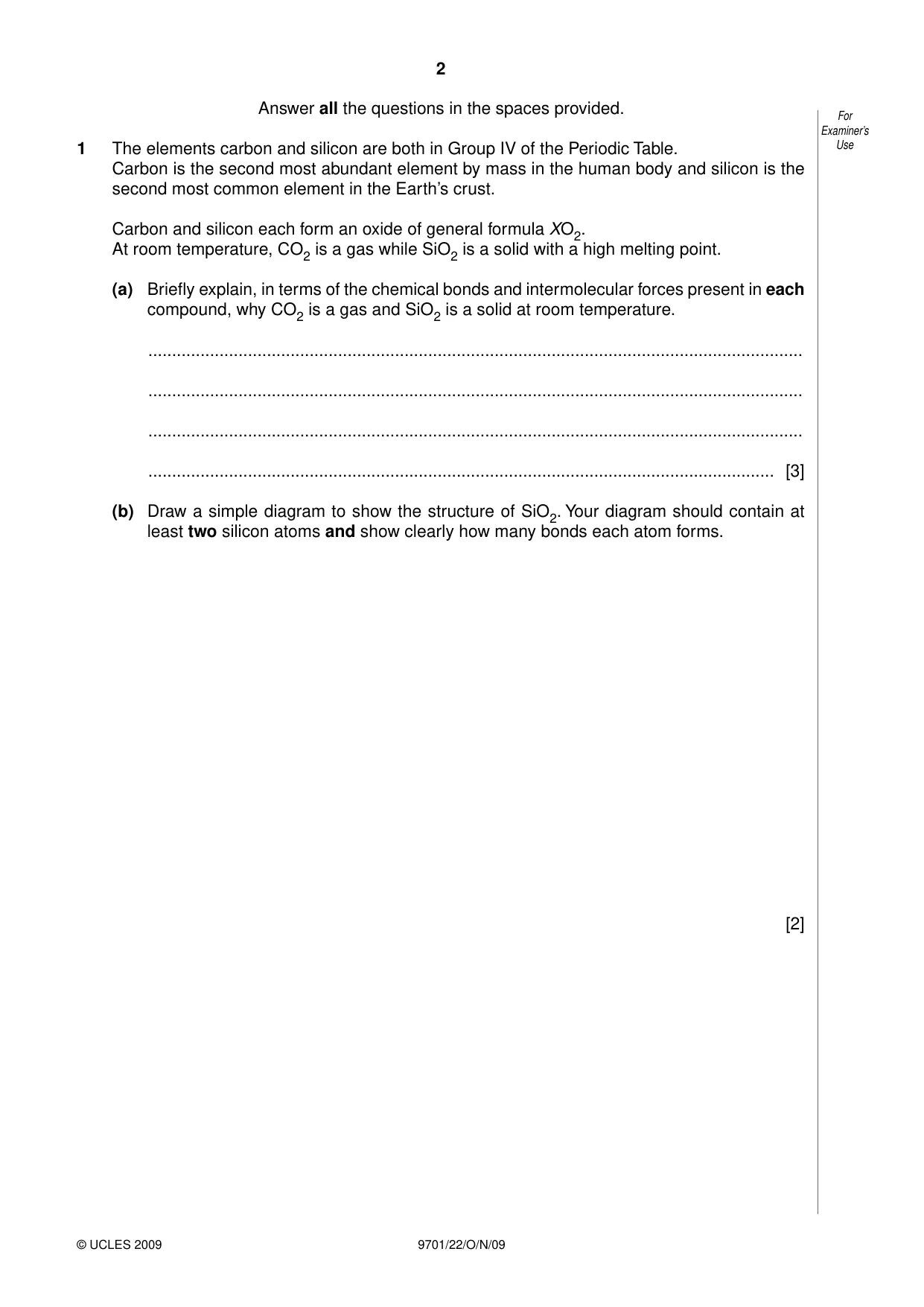
9701/22/O/N/09 © UCLES 2009 For Examiner’s Use Answer all the questions in the spaces provided. 1 The elements carbon and silicon are both in Group IV of the Periodic Table. Carbon is the second most abundant element by mass in the human body and silicon is the second most common element in the Earth’s crust. Carbon and silicon each form an oxide of general formula XO2. At room temperature, CO2 is a gas while SiO2 is a solid with a high melting point. (a) Briefly explain, in terms of the chemical bonds and intermolecular forces present in each compound, why CO2 is a gas and SiO2 is a solid at room temperature. … … … … [3] (b) Draw a simple diagram to show the structure of SiO2. Your diagram should contain at least two silicon atoms and show clearly how many bonds each atom forms. [2] 2
Question paper, page 3
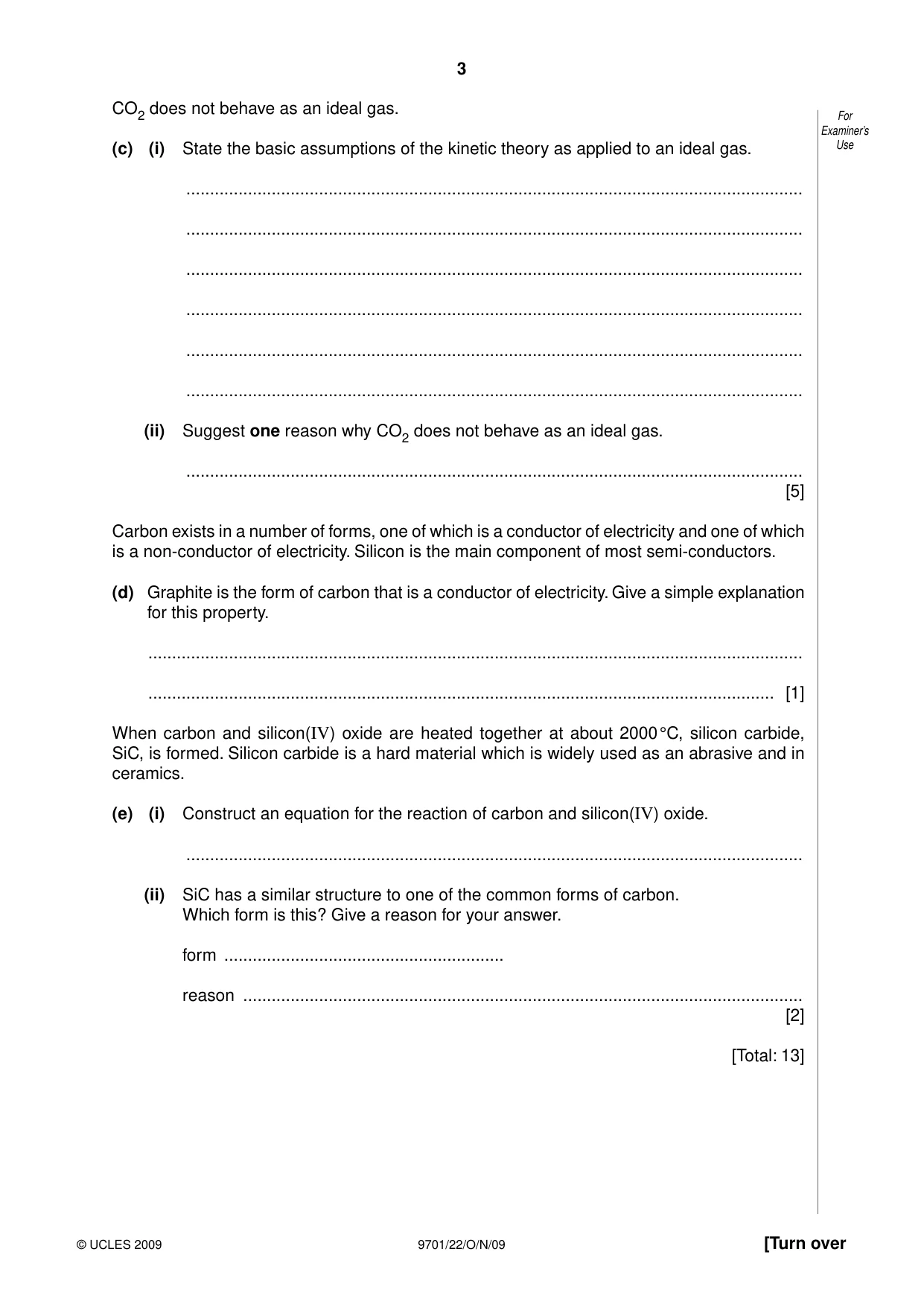
3 9701/22/O/N/09 © UCLES 2009 [Turn over For Examiner’s Use CO2 does not behave as an ideal gas. (c) (i) State the basic assumptions of the kinetic theory as applied to an ideal gas. … … … … … … (ii) Suggest one reason why CO2 does not behave as an ideal gas. … [5] Carbon exists in a number of forms, one of which is a conductor of electricity and one of which is a non-conductor of electricity. Silicon is the main component of most semi-conductors. (d) Graphite is the form of carbon that is a conductor of electricity. Give a simple explanation for this property. … … [1] When carbon and silicon(IV) oxide are heated together at about 2000 °C, silicon carbide, SiC, is formed. Silicon carbide is a hard material which is widely used as an abrasive and in ceramics. (e) (i) Construct an equation for the reaction of carbon and silicon(IV) oxide. … (ii) SiC has a similar structure to one of the common forms of carbon. Which form is this? Give a reason for your answer. form … reason … [2] [Total: 13]
Question paper, page 4
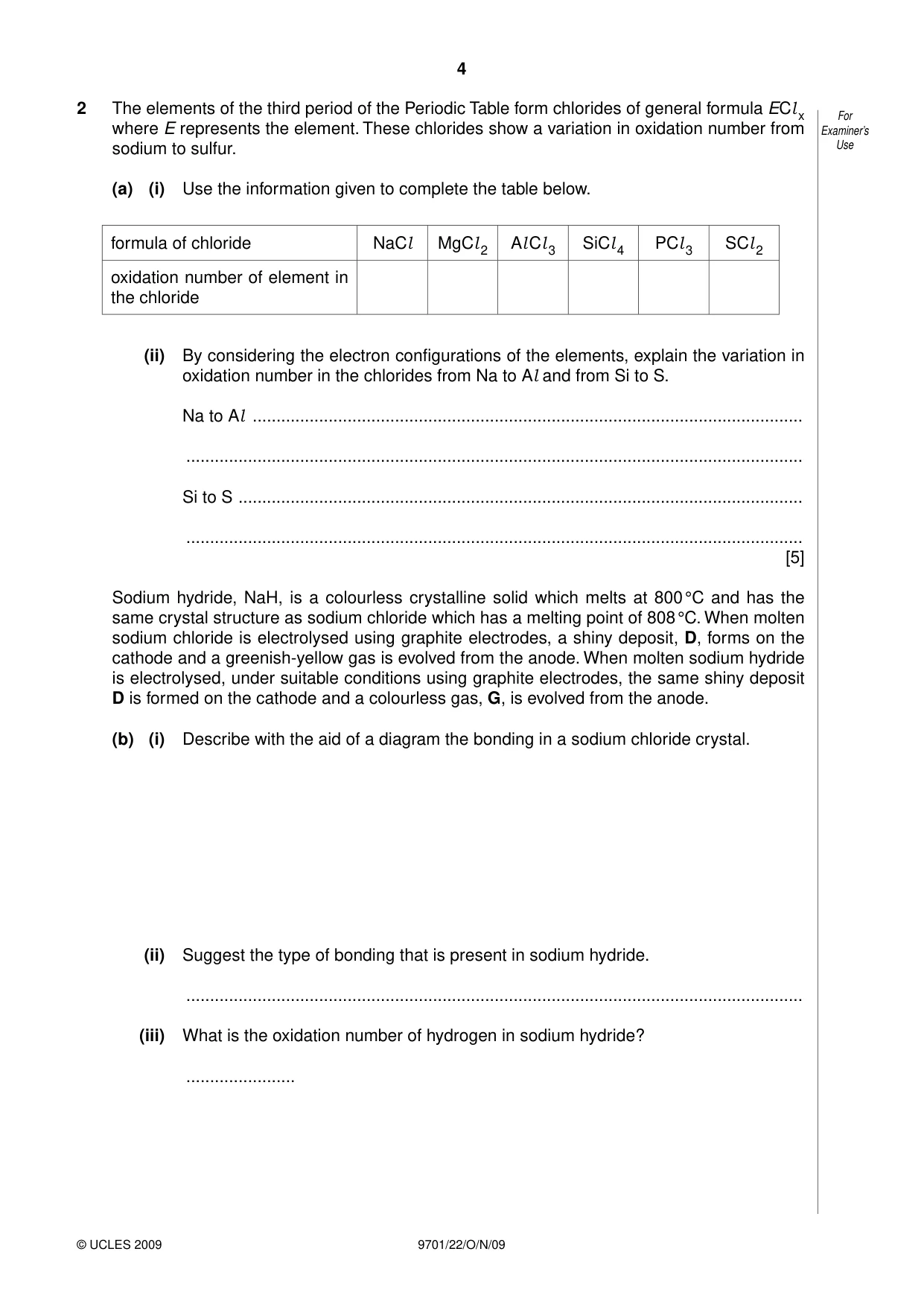
4 9701/22/O/N/09 © UCLES 2009 For Examiner’s Use 2 The elements of the third period of the Periodic Table form chlorides of general formula ECl x where E represents the element. These chlorides show a variation in oxidation number from sodium to sulfur. (a) (i) Use the information given to complete the table below. formula of chloride NaCl MgCl 2 Al Cl 3 SiCl 4 PCl 3 SCl 2 oxidation number of element in the chloride (ii) By considering the electron configurations of the elements, explain the variation in oxidation number in the chlorides from Na to Al and from Si to S. Na to Al … … Si to S … … [5] Sodium hydride, NaH, is a colourless crystalline solid which melts at 800 °C and has the same crystal structure as sodium chloride which has a melting point of 808 °C. When molten sodium chloride is electrolysed using graphite electrodes, a shiny deposit, D, forms on the cathode and a greenish-yellow gas is evolved from the anode. When molten sodium hydride is electrolysed, under suitable conditions using graphite electrodes, the same shiny deposit D is formed on the cathode and a colourless gas, G, is evolved from the anode. (b) (i) Describe with the aid of a diagram the bonding in a sodium chloride crystal. (ii) Suggest the type of bonding that is present in sodium hydride. … (iii) What is the oxidation number of hydrogen in sodium hydride? …
Question paper, page 5
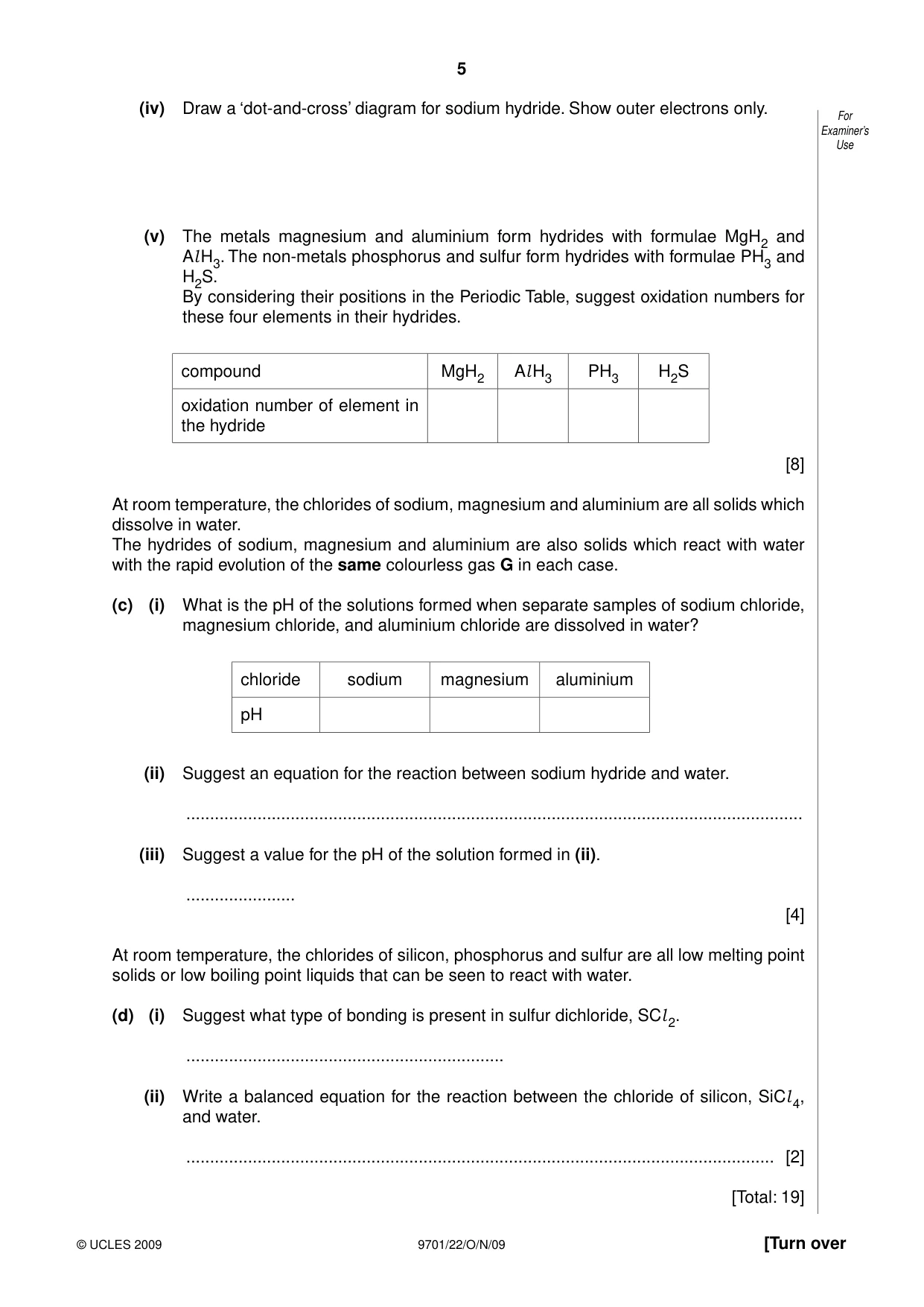
5 9701/22/O/N/09 © UCLES 2009 [Turn over For Examiner’s Use (iv) Draw a ‘dot-and-cross’ diagram for sodium hydride. Show outer electrons only. (v) The metals magnesium and aluminium form hydrides with formulae MgH2 and Al H3. The non-metals phosphorus and sulfur form hydrides with formulae PH3 and H2S. By considering their positions in the Periodic Table, suggest oxidation numbers for these four elements in their hydrides. compound MgH2 Al H3 PH3 H2S oxidation number of element in the hydride [8] At room temperature, the chlorides of sodium, magnesium and aluminium are all solids which dissolve in water. The hydrides of sodium, magnesium and aluminium are also solids which react with water with the rapid evolution of the same colourless gas G in each case. (c) (i) What is the pH of the solutions formed when separate samples of sodium chloride, magnesium chloride, and aluminium chloride are dissolved in water? chloride sodium magnesium aluminium pH (ii) Suggest an equation for the reaction between sodium hydride and water. … (iii) Suggest a value for the pH of the solution formed in (ii). … [4] At room temperature, the chlorides of silicon, phosphorus and sulfur are all low melting point solids or low boiling point liquids that can be seen to react with water. (d) (i) Suggest what type of bonding is present in sulfur dichloride, SCl 2. … (ii) Write a balanced equation for the reaction between the chloride of silicon, SiCl 4, and water. … [2] [Total: 19]
Question paper, page 6
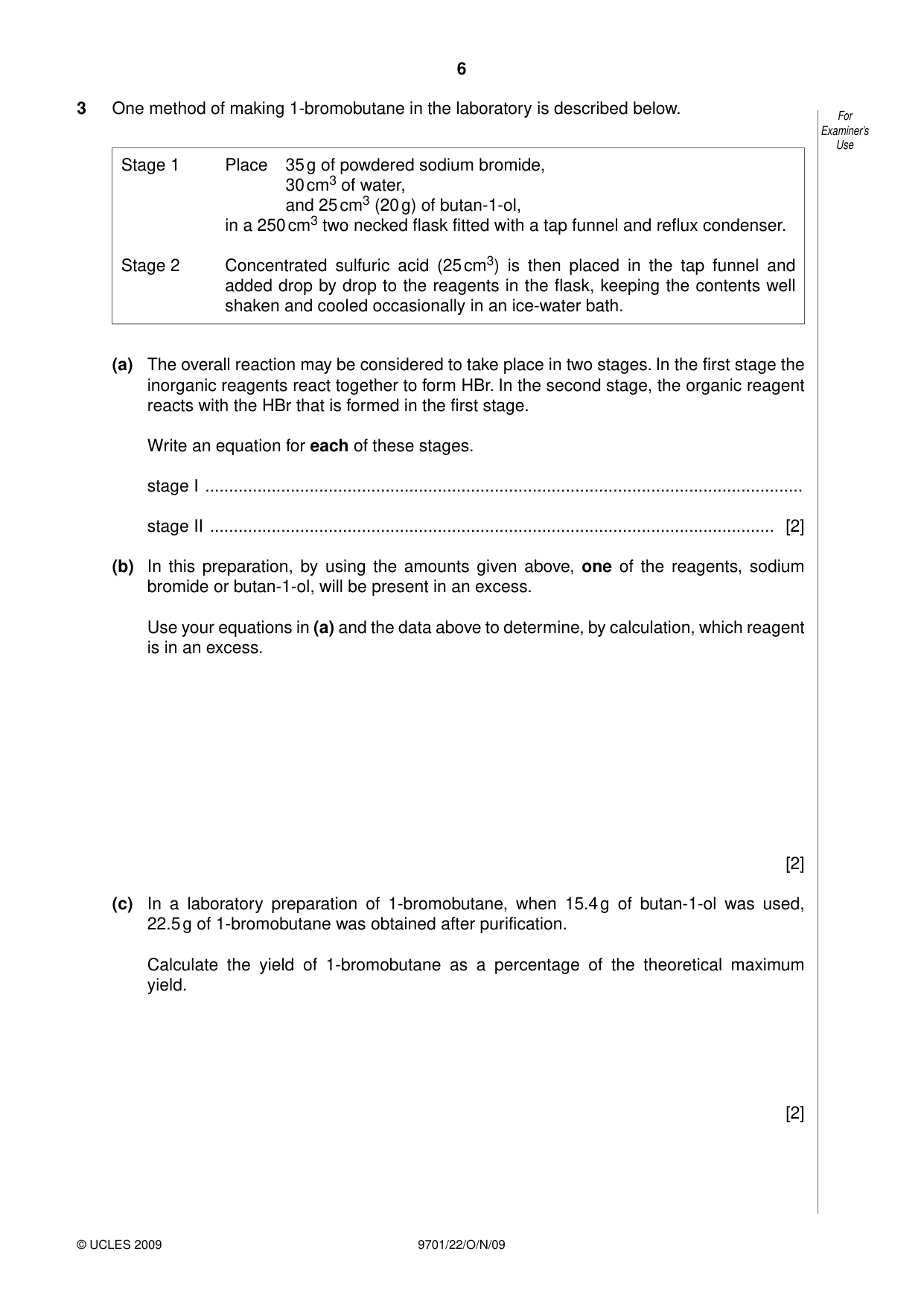
6 9701/22/O/N/09 © UCLES 2009 For Examiner’s Use 3 One method of making 1-bromobutane in the laboratory is described below. Stage 1 Place 35 g of powdered sodium bromide, 30 cm3 of water, and 25 cm3 (20 g) of butan-1-ol, in a 250 cm3 two necked flask fitted with a tap funnel and reflux condenser. Stage 2 Concentrated sulfuric acid (25 cm3) is then placed in the tap funnel and added drop by drop to the reagents in the flask, keeping the contents well shaken and cooled occasionally in an ice-water bath. (a) The overall reaction may be considered to take place in two stages. In the first stage the inorganic reagents react together to form HBr. In the second stage, the organic reagent reacts with the HBr that is formed in the first stage. Write an equation for each of these stages. stage I … stage II … [2] (b) In this preparation, by using the amounts given above, one of the reagents, sodium bromide or butan-1-ol, will be present in an excess. Use your equations in (a) and the data above to determine, by calculation, which reagent is in an excess. [2] (c) In a laboratory preparation of 1-bromobutane, when 15.4 g of butan-1-ol was used, 22.5 g of 1-bromobutane was obtained after purification. Calculate the yield of 1-bromobutane as a percentage of the theoretical maximum yield. [2]
Question paper, page 7
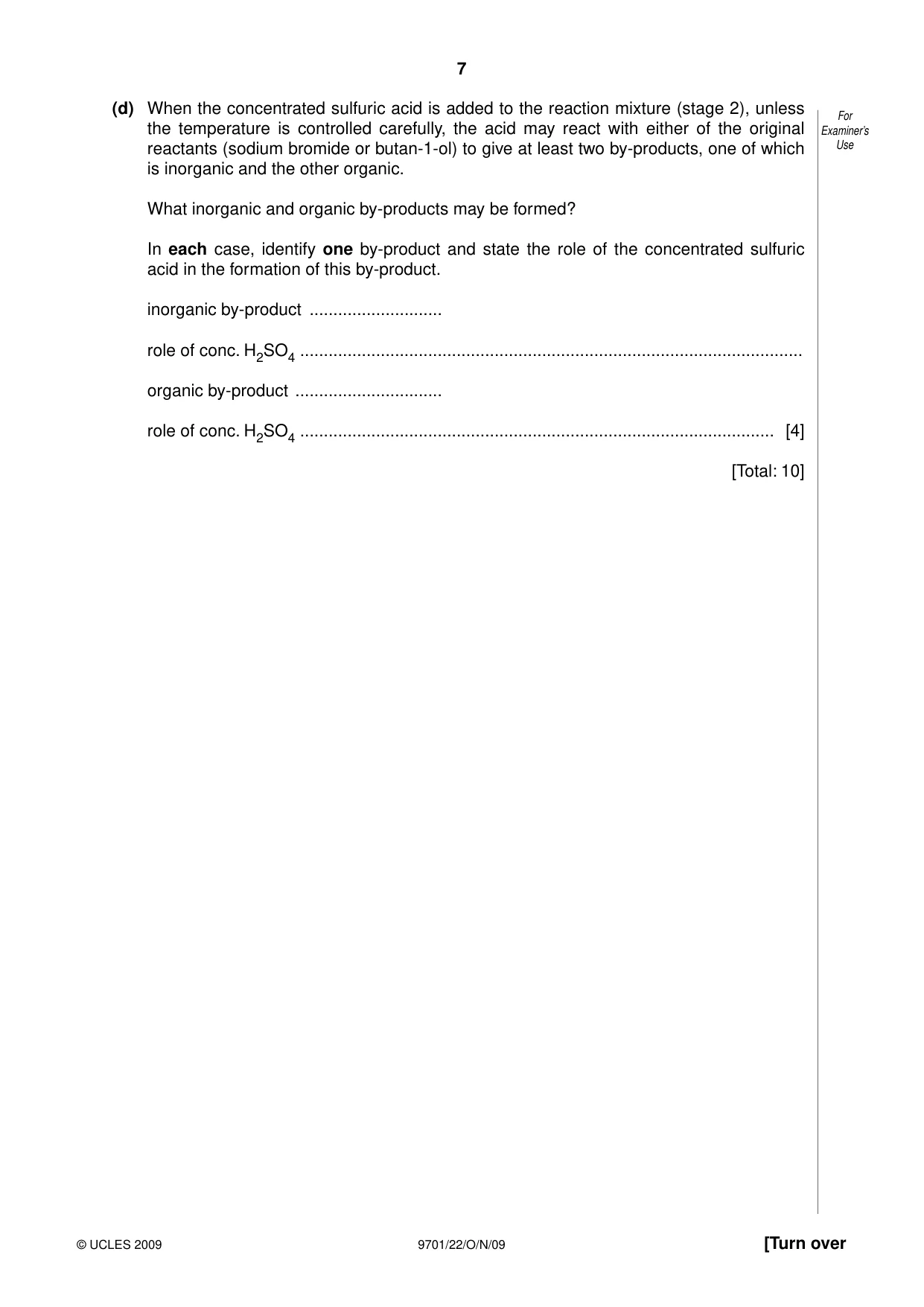
7 9701/22/O/N/09 © UCLES 2009 [Turn over For Examiner’s Use (d) When the concentrated sulfuric acid is added to the reaction mixture (stage 2), unless the temperature is controlled carefully, the acid may react with either of the original reactants (sodium bromide or butan-1-ol) to give at least two by-products, one of which is inorganic and the other organic. What inorganic and organic by-products may be formed? In each case, identify one by-product and state the role of the concentrated sulfuric acid in the formation of this by-product. inorganic by-product … role of conc. H2SO4 … organic by-product … role of conc. H2SO4 … [4] [Total: 10]
Question paper, page 8
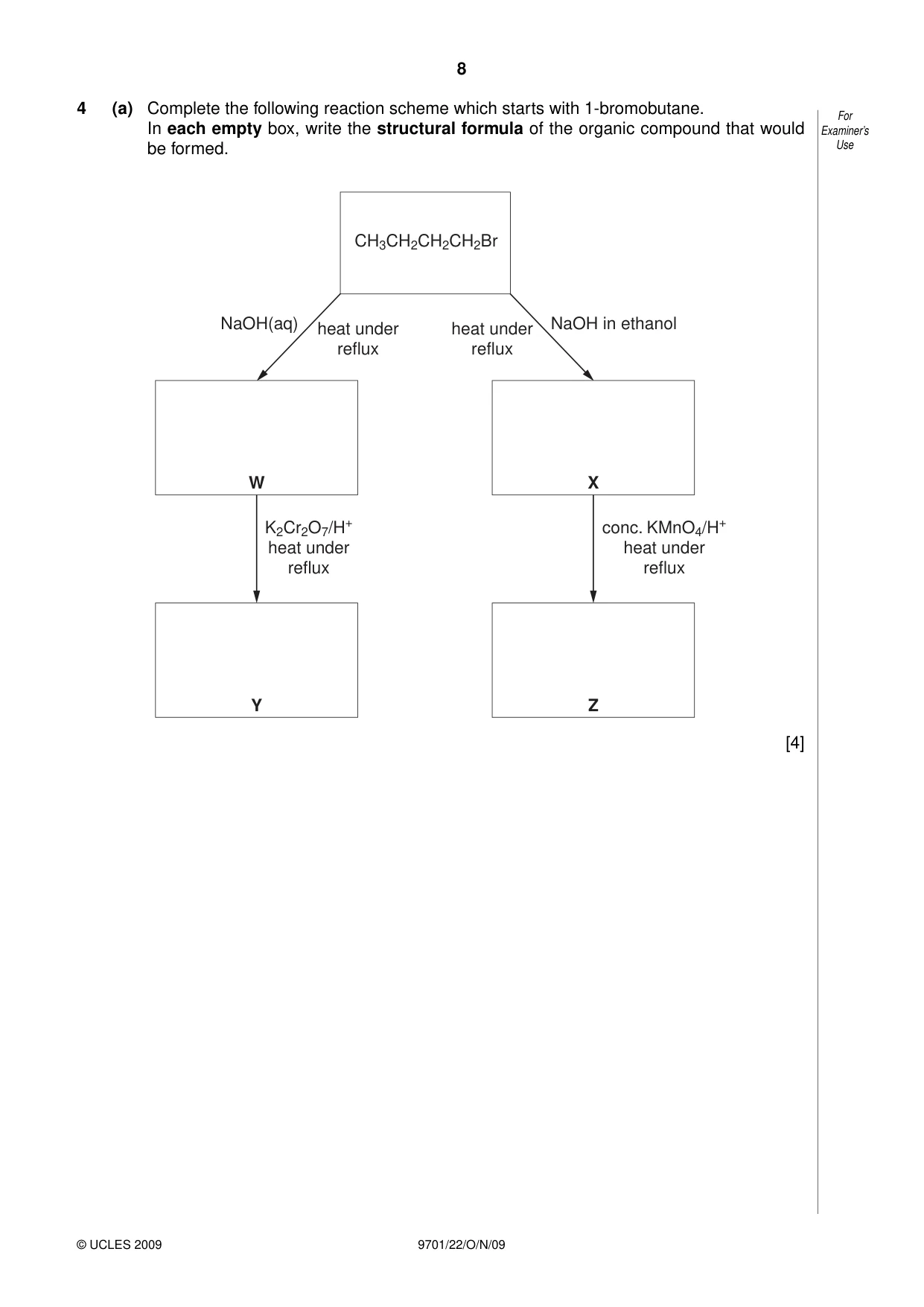
8 9701/22/O/N/09 © UCLES 2009 For Examiner’s Use 4 (a) Complete the following reaction scheme which starts with 1-bromobutane. In each empty box, write the structural formula of the organic compound that would be formed. CH3CH2CH2CH2Br K2Cr2O7/H+ heat under reflux conc. KMnO4/H+ heat under reflux NaOH(aq) NaOH in ethanol heat under reflux heat under reflux W Y X Z [4]
Question paper, page 9
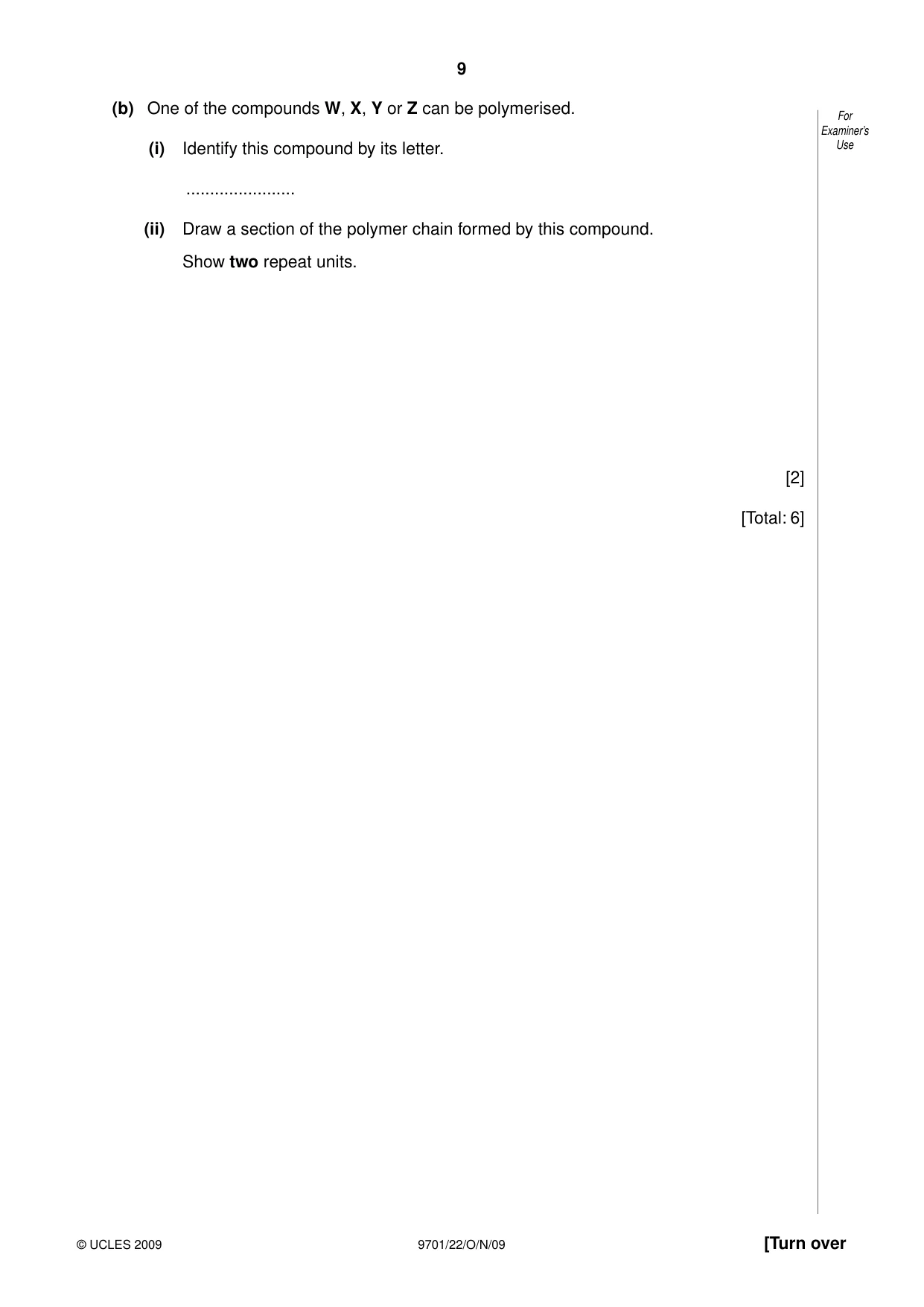
9 9701/22/O/N/09 © UCLES 2009 [Turn over For Examiner’s Use (b) One of the compounds W, X, Y or Z can be polymerised. (i) Identify this compound by its letter. … (ii) Draw a section of the polymer chain formed by this compound. Show two repeat units. [2] [Total: 6]
Question paper, page 10
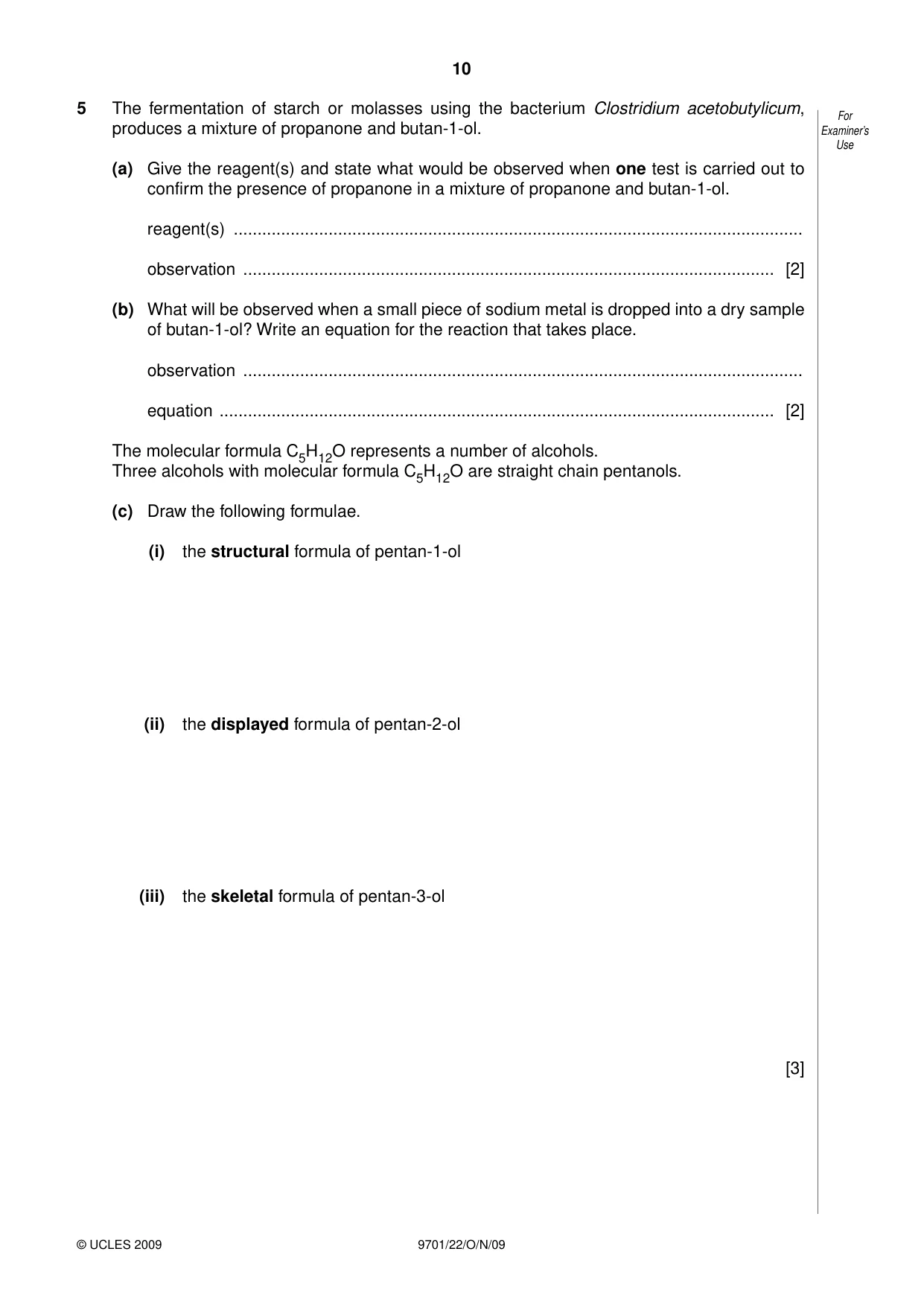
10 9701/22/O/N/09 © UCLES 2009 For Examiner’s Use 5 The fermentation of starch or molasses using the bacterium Clostridium acetobutylicum, produces a mixture of propanone and butan-1-ol. (a) Give the reagent(s) and state what would be observed when one test is carried out to confirm the presence of propanone in a mixture of propanone and butan-1-ol. reagent(s) … observation … [2] (b) What will be observed when a small piece of sodium metal is dropped into a dry sample of butan -1-ol? Write an equation for the reaction that takes place. observation … equation … [2] The molecular formula C5H12O represents a number of alcohols. Three alcohols with molecular formula C5H12O are straight chain pentanols. (c) Draw the following formulae. (i) the structural formula of pentan-1-ol (ii) the displayed formula of pentan-2-ol (iii) the skeletal formula of pentan-3-ol [3]
Question paper, page 11
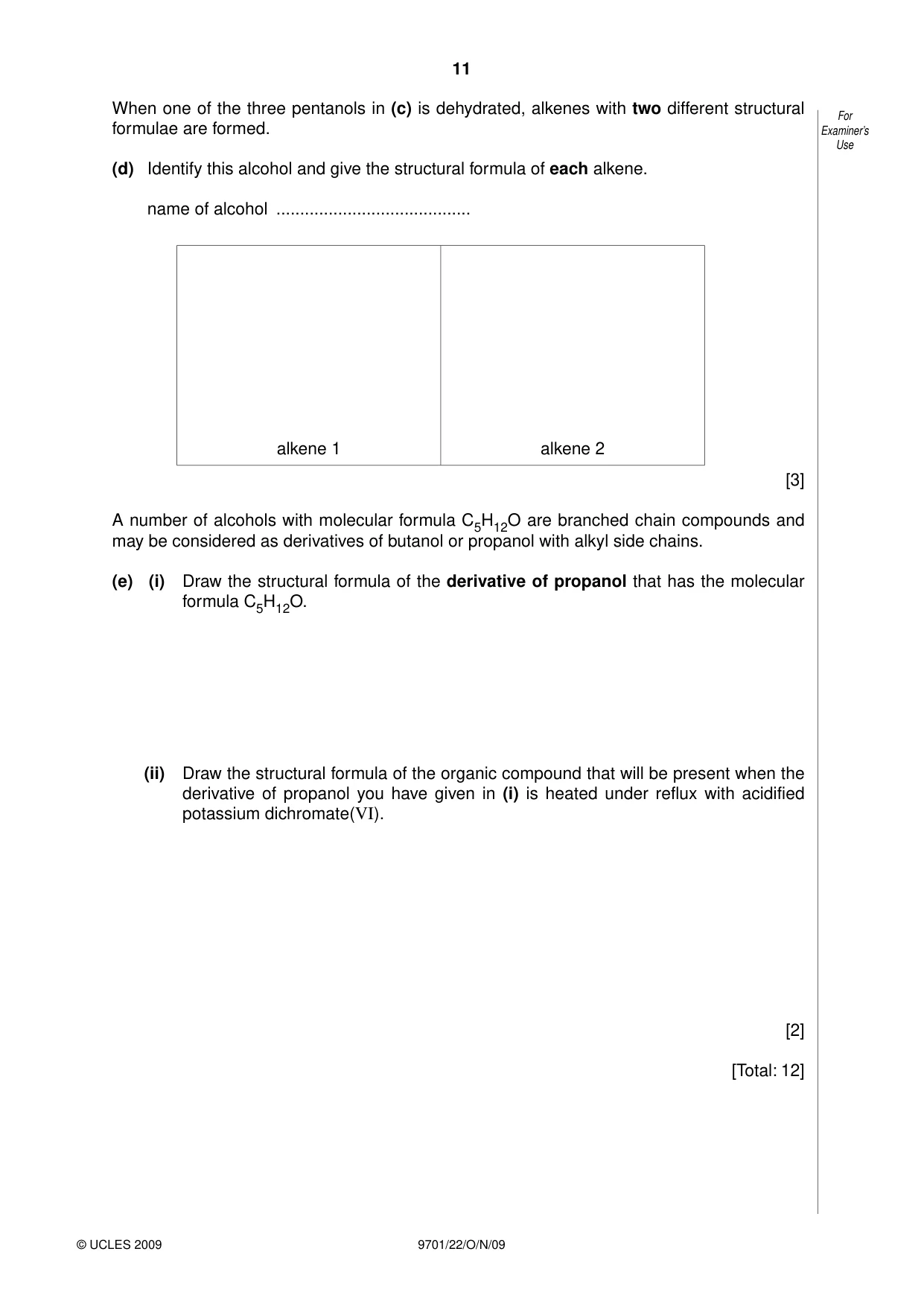
11 9701/22/O/N/09 © UCLES 2009 For Examiner’s Use When one of the three pentanols in (c) is dehydrated, alkenes with two different structural formulae are formed. (d) Identify this alcohol and give the structural formula of each alkene. name of alcohol … alkene 1 alkene 2 [3] A number of alcohols with molecular formula C5H12O are branched chain compounds and may be considered as derivatives of butanol or propanol with alkyl side chains. (e) (i) Draw the structural formula of the derivative of propanol that has the molecular formula C5H12O. (ii) Draw the structural formula of the organic compound that will be present when the derivative of propanol you have given in (i) is heated under reflux with acidified potassium dichromate(VI). [2] [Total: 12]
Question paper, page 12
12 9701/22/O/N/09 BLANK PAGE Permission to reproduce items where third-party owned material protected by copyright is included has been sought and cleared where possible. Every reasonable effort has been made by the publisher (UCLES) to trace copyright holders, but if any items requiring clearance have unwittingly been included, the publisher will be pleased to make amends at the earliest possible opportunity. University of Cambridge International Examinations is part of the Cambridge Assessment Group. Cambridge Assessment is the brand name of University of Cambridge Local Examinations Syndicate (UCLES), which is itself a department of the University of Cambridge.
Mark scheme, page 1
UNIVERSITY OF CAMBRIDGE INTERNATIONAL EXAMINATIONS GCE Advanced Subsidiary Level and GCE Advanced Level MARK SCHEME for the October/November 2009 question paper for the guidance of teachers 9701 CHEMISTRY 9701/22 Paper 22 (AS Structured Questions), maximum raw mark 60 This mark scheme is published as an aid to teachers and candidates, to indicate the requirements of the examination. It shows the basis on which Examiners were instructed to award marks. It does not indicate the details of the discussions that took place at an Examiners’ meeting before marking began, which would have considered the acceptability of alternative answers. Mark schemes must be read in conjunction with the question papers and the report on the examination. • CIE will not enter into discussions or correspondence in connection with these mark schemes. CIE is publishing the mark schemes for the October/November 2009 question papers for most IGCSE, GCE Advanced Level and Advanced Subsidiary Level syllabuses and some Ordinary Level syllabuses.
Mark scheme, page 2
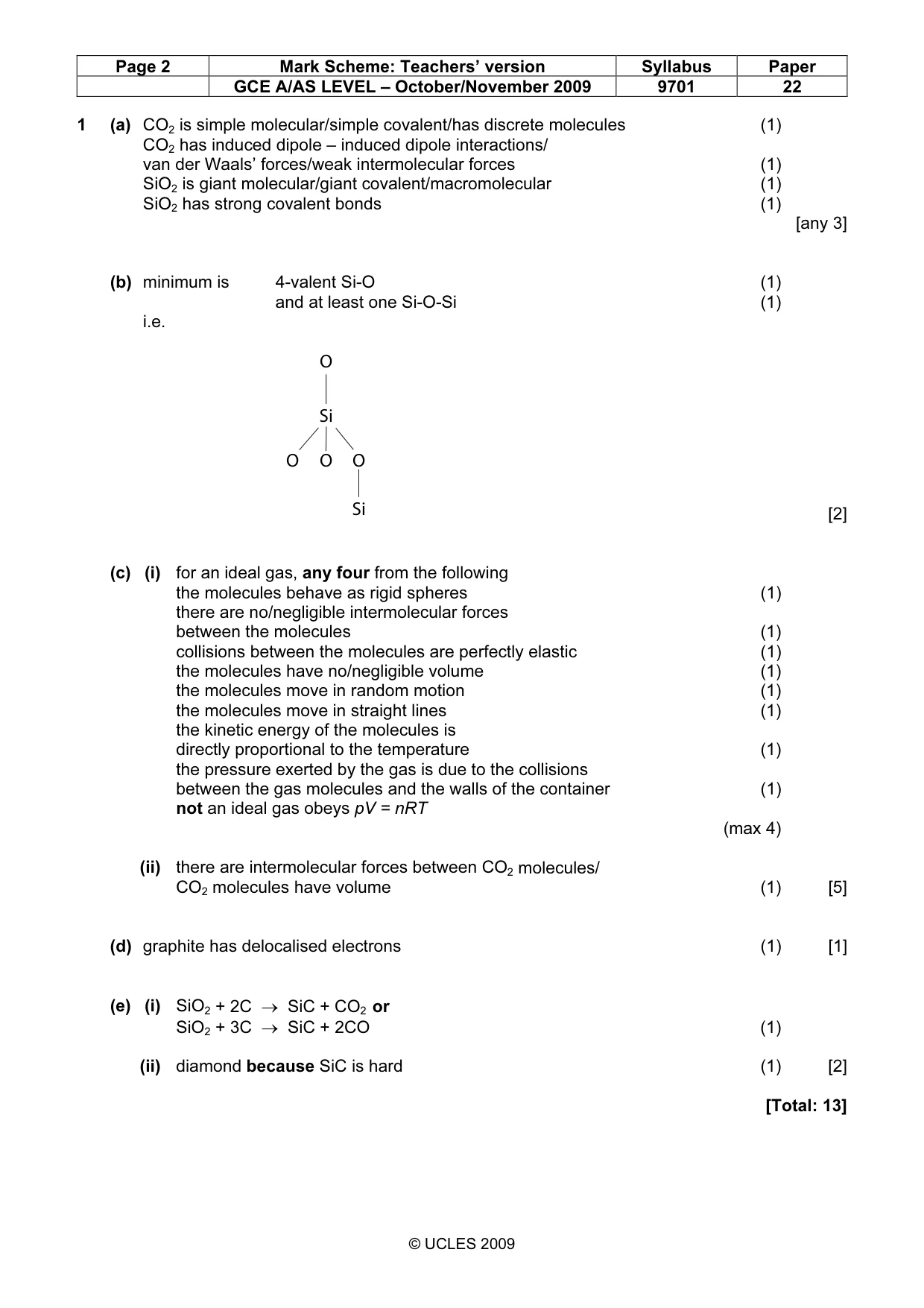
Page 2 Mark Scheme: Teachers’ version Syllabus Paper GCE A/AS LEVEL – October/November 2009 9701 22 © UCLES 2009 1 (a) CO2 is simple molecular/simple covalent/has discrete molecules (1) CO2 has induced dipole – induced dipole interactions/ van der Waals’ forces/weak intermolecular forces (1) SiO2 is giant molecular/giant covalent/macromolecular (1) SiO2 has strong covalent bonds (1) [any 3] (b) minimum is 4-valent Si-O (1) and at least one Si-O-Si (1) i.e. O Si Si O O O [2] (c) (i) for an ideal gas, any four from the following the molecules behave as rigid spheres (1) there are no/negligible intermolecular forces between the molecules (1) collisions between the molecules are perfectly elastic (1) the molecules have no/negligible volume (1) the molecules move in random motion (1) the molecules move in straight lines (1) the kinetic energy of the molecules is directly proportional to the temperature (1) the pressure exerted by the gas is due to the collisions between the gas molecules and the walls of the container (1) not an ideal gas obeys pV = nRT (max 4) (ii) there are intermolecular forces between CO2 molecules/ CO2 molecules have volume (1) [5] (d) graphite has delocalised electrons (1) [1] (e) (i) SiO2 + 2C → SiC + CO2 or SiO2 + 3C → SiC + 2CO (1) (ii) diamond because SiC is hard (1) [2] [Total: 13]
Mark scheme, page 3
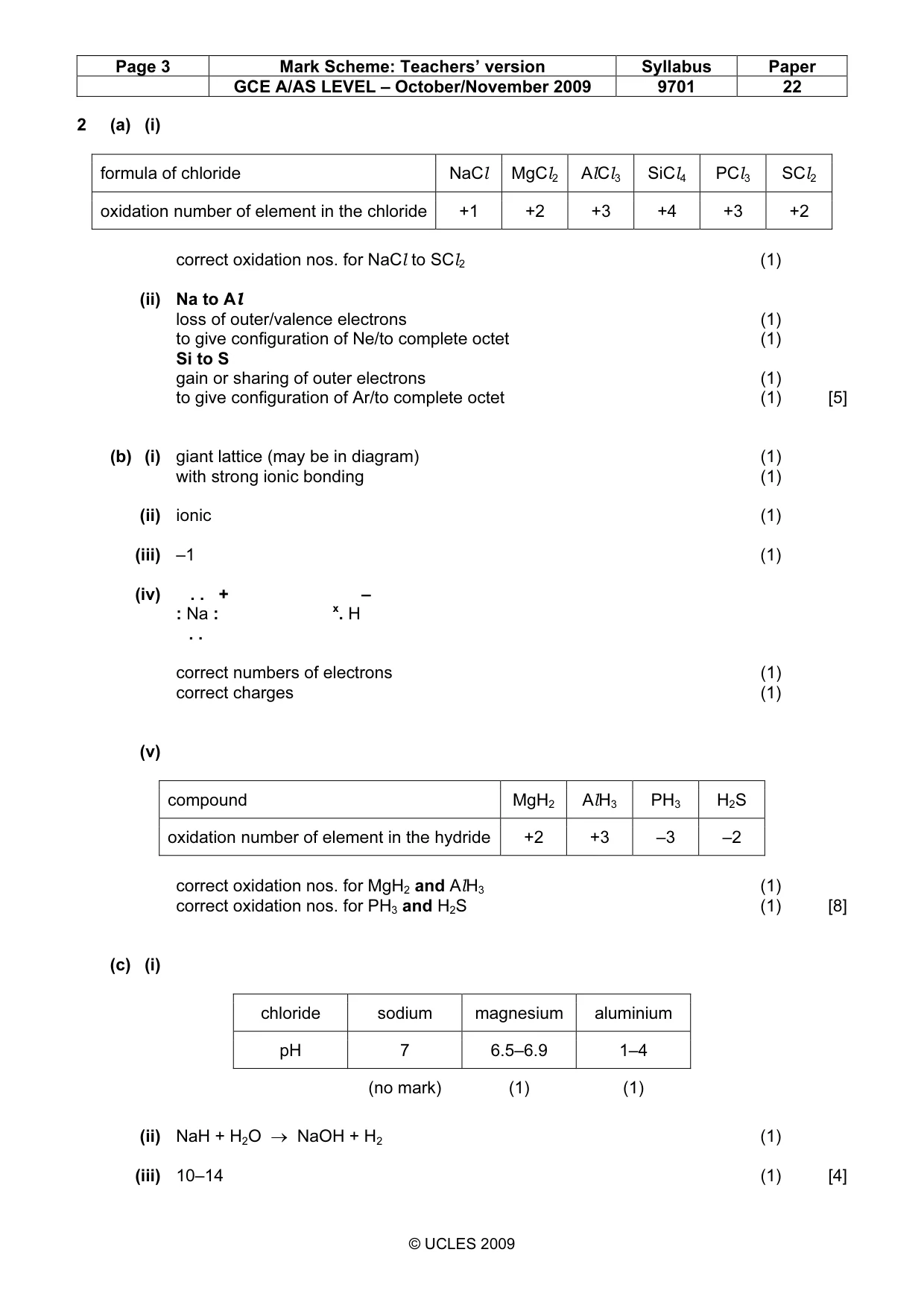
Page 3 Mark Scheme: Teachers’ version Syllabus Paper GCE A/AS LEVEL – October/November 2009 9701 22 © UCLES 2009 2 (a) (i) formula of chloride NaCl MgCl2 AlCl3 SiCl4 PCl3 SCl2 oxidation number of element in the chloride +1 +2 +3 +4 +3 +2 correct oxidation nos. for NaCl to SCl2 (1) (ii) Na to Al loss of outer/valence electrons (1) to give configuration of Ne/to complete octet (1) Si to S gain or sharing of outer electrons (1) to give configuration of Ar/to complete octet (1) [5] (b) (i) giant lattice (may be in diagram) (1) with strong ionic bonding (1) (ii) ionic (1) (iii) –1 (1) (iv) . . + – : Na : x. H . . correct numbers of electrons (1) correct charges (1) (v) compound MgH2 AlH3 PH3 H2S oxidation number of element in the hydride +2 +3 –3 –2 correct oxidation nos. for MgH2 and AlH3 (1) correct oxidation nos. for PH3 and H2S (1) [8] (c) (i) chloride sodium magnesium aluminium pH 7 6.5–6.9 1–4 (no mark) (1) (1) (ii) NaH + H2O → NaOH + H2 (1) (iii) 10–14 (1) [4]
Mark scheme, page 4
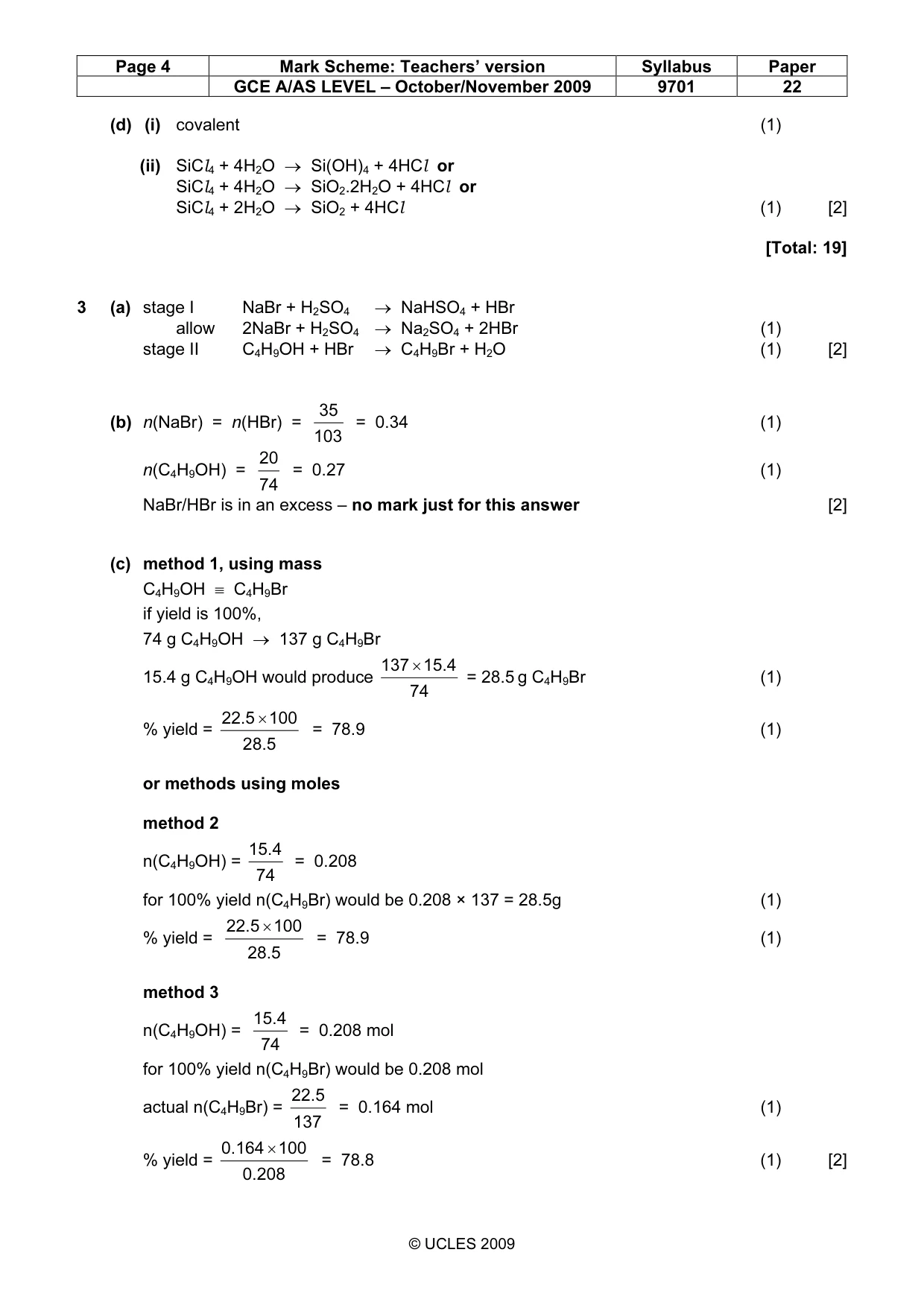
Page 4 Mark Scheme: Teachers’ version Syllabus Paper GCE A/AS LEVEL – October/November 2009 9701 22 © UCLES 2009 (d) (i) covalent (1) (ii) SiCl4 + 4H2O → Si(OH)4 + 4HCl or SiCl4 + 4H2O → SiO2.2H2O + 4HCl or SiCl4 + 2H2O → SiO2 + 4HCl (1) [2] [Total: 19] 3 (a) stage I NaBr + H2SO4 → NaHSO4 + HBr allow 2NaBr + H2SO4 → Na2SO4 + 2HBr (1) stage II C4H9OH + HBr → C4H9Br + H2O (1) [2] (b) n(NaBr) = n(HBr) = 103 35 = 0.34 (1) n(C4H9OH) = 74 20 = 0.27 (1) NaBr/HBr is in an excess – no mark just for this answer [2] (c) method 1, using mass C4H9OH ≡ C4H9Br if yield is 100%, 74 g C4H9OH → 137 g C4H9Br 15.4 g C4H9OH would produce 74 15.4 137 × = 28.5 g C4H9Br (1) % yield = 28.5 100 22.5 × = 78.9 (1) or methods using moles method 2 n(C4H9OH) = 74 15.4 = 0.208 for 100% yield n(C4H9Br) would be 0.208 × 137 = 28.5g (1) % yield = 28.5 100 22.5 × = 78.9 (1) method 3 n(C4H9OH) = 74 15.4 = 0.208 mol for 100% yield n(C4H9Br) would be 0.208 mol actual n(C4H9Br) = 137 22.5 = 0.164 mol (1) % yield = 0.208 100 0.164 × = 78.8 (1) [2]
Mark scheme, page 5
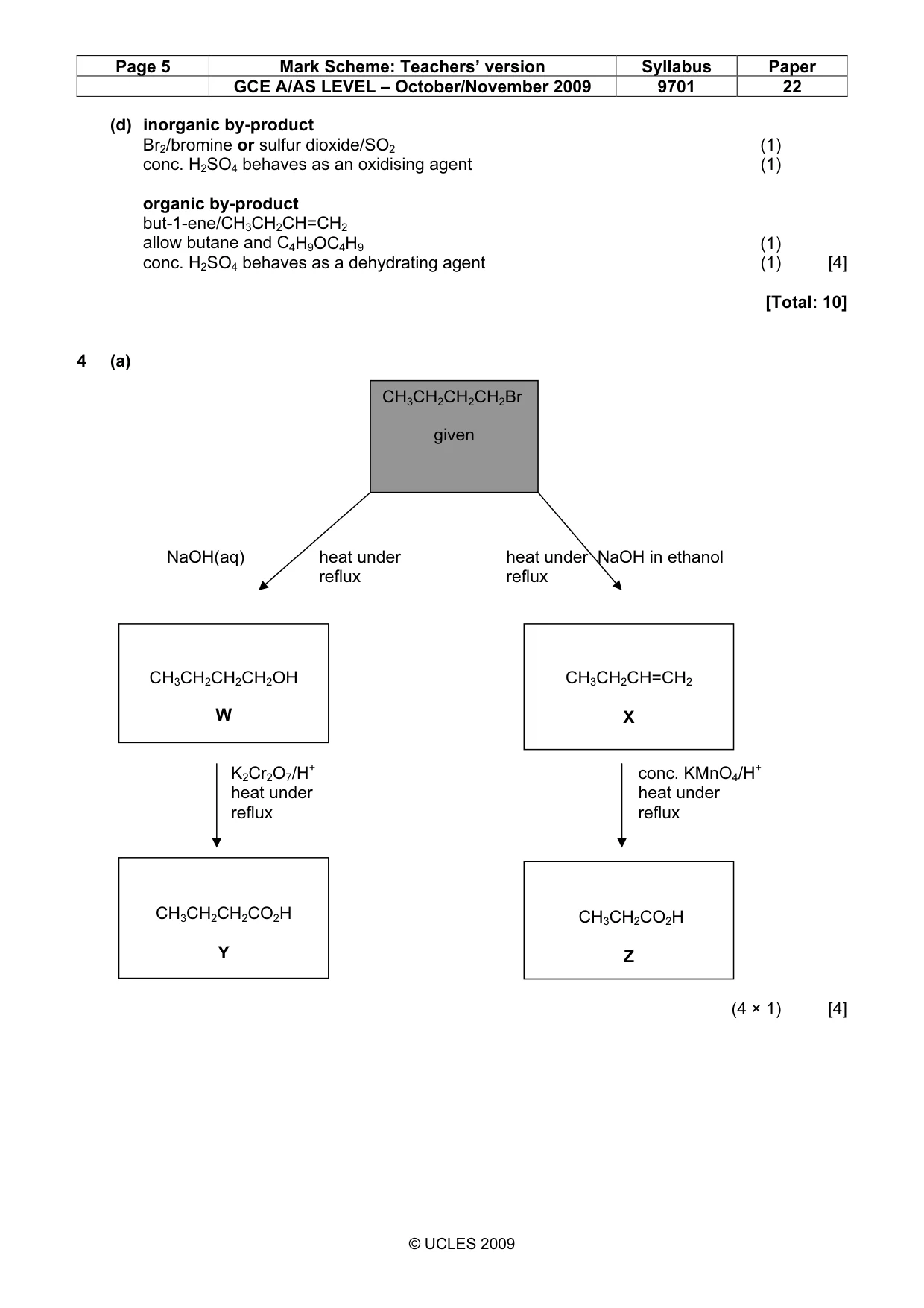
Page 5 Mark Scheme: Teachers’ version Syllabus Paper GCE A/AS LEVEL – October/November 2009 9701 22 © UCLES 2009 (d) inorganic by-product Br2/bromine or sulfur dioxide/SO2 (1) conc. H2SO4 behaves as an oxidising agent (1) organic by-product but-1-ene/CH3CH2CH=CH2 allow butane and C4H9OC4H9 (1) conc. H2SO4 behaves as a dehydrating agent (1) [4] [Total: 10] 4 (a) NaOH(aq) heat under heat under NaOH in ethanol reflux reflux K2Cr2O7/H+ conc. KMnO4/H+ heat under heat under reflux reflux (4 × 1) [4] CH3CH2CH2CH2Br given CH3CH2CH2CH2OH W CH3CH2CH2CO2H Y CH3CH2CH=CH2 X CH3CH2CO2H Z
Mark scheme, page 6
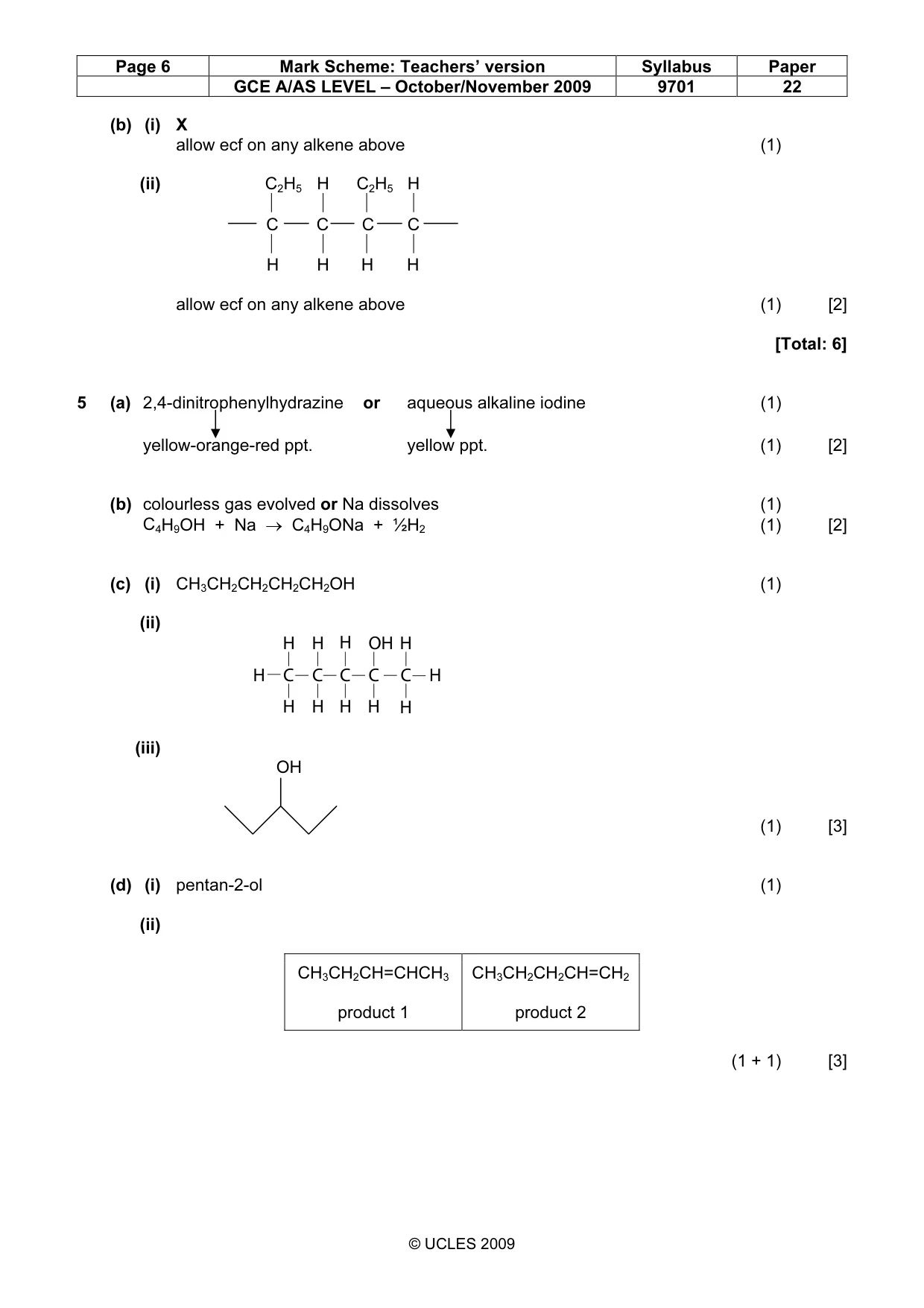
Page 6 Mark Scheme: Teachers’ version Syllabus Paper GCE A/AS LEVEL – October/November 2009 9701 22 © UCLES 2009 (b) (i) X allow ecf on any alkene above (1) (ii) C2H5 H C2H5 H C C C C H H H H allow ecf on any alkene above (1) [2] [Total: 6] 5 (a) 2,4-dinitrophenylhydrazine or aqueous alkaline iodine (1) yellow-orange-red ppt. yellow ppt. (1) [2] (b) colourless gas evolved or Na dissolves (1) C4H9OH + Na → C4H9ONa + ½H2 (1) [2] (c) (i) CH3CH2CH2CH2CH2OH (1) (ii) H H H OH H H H H H H H H C C C C C (iii) OH (1) [3] (d) (i) pentan-2-ol (1) (ii) CH3CH2CH=CHCH3 product 1 CH3CH2CH2CH=CH2 product 2 (1 + 1) [3]
Mark scheme, page 7
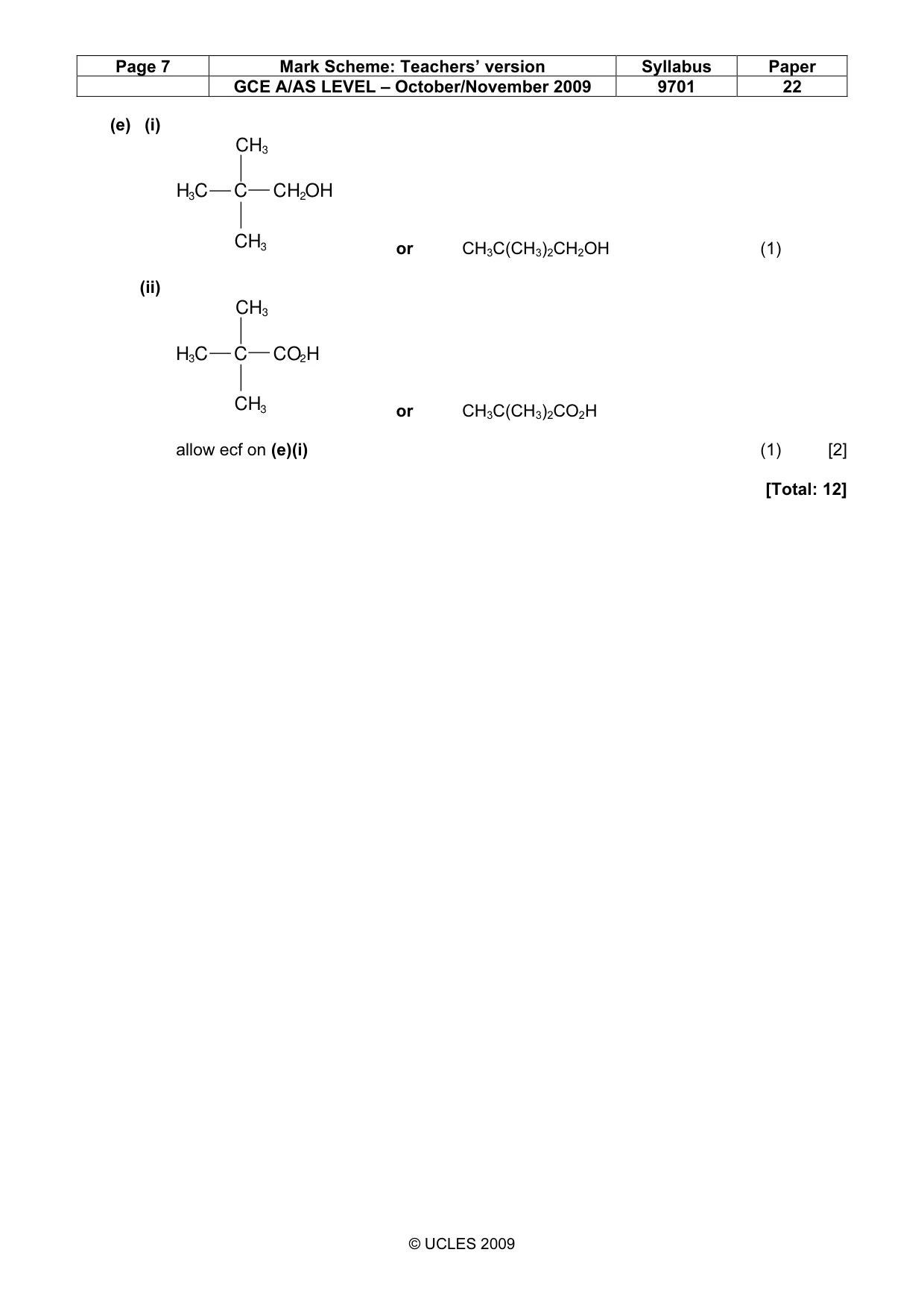
Page 7 Mark Scheme: Teachers’ version Syllabus Paper GCE A/AS LEVEL – October/November 2009 9701 22 © UCLES 2009 (e) (i) CH H C C CH OH CH 3 3 3 2 or CH3C(CH3)2CH2OH (1) (ii) CH H C C CO H CH 3 3 3 2 or CH3C(CH3)2CO2H allow ecf on (e)(i) (1) [2] [Total: 12]