Cambridge A Level Business (for first examination in 2016) 9609 — 2025 May/June Paper 2 · Variant 3
9609/23/M/J/25 · 2 questions · 60 marks · ≈68 min
The question paper and its mark scheme, free to read here and free to download. This is Cambridge’s own paper, exactly as it was sat.
Question paper4 pages

Mark scheme32 pages
Answers below. Sit the paper first if you are practising.

Questions as text
Q1 · Crafty Toys (CT) CT is a co-operative that produces and sells a range of wooden toys…
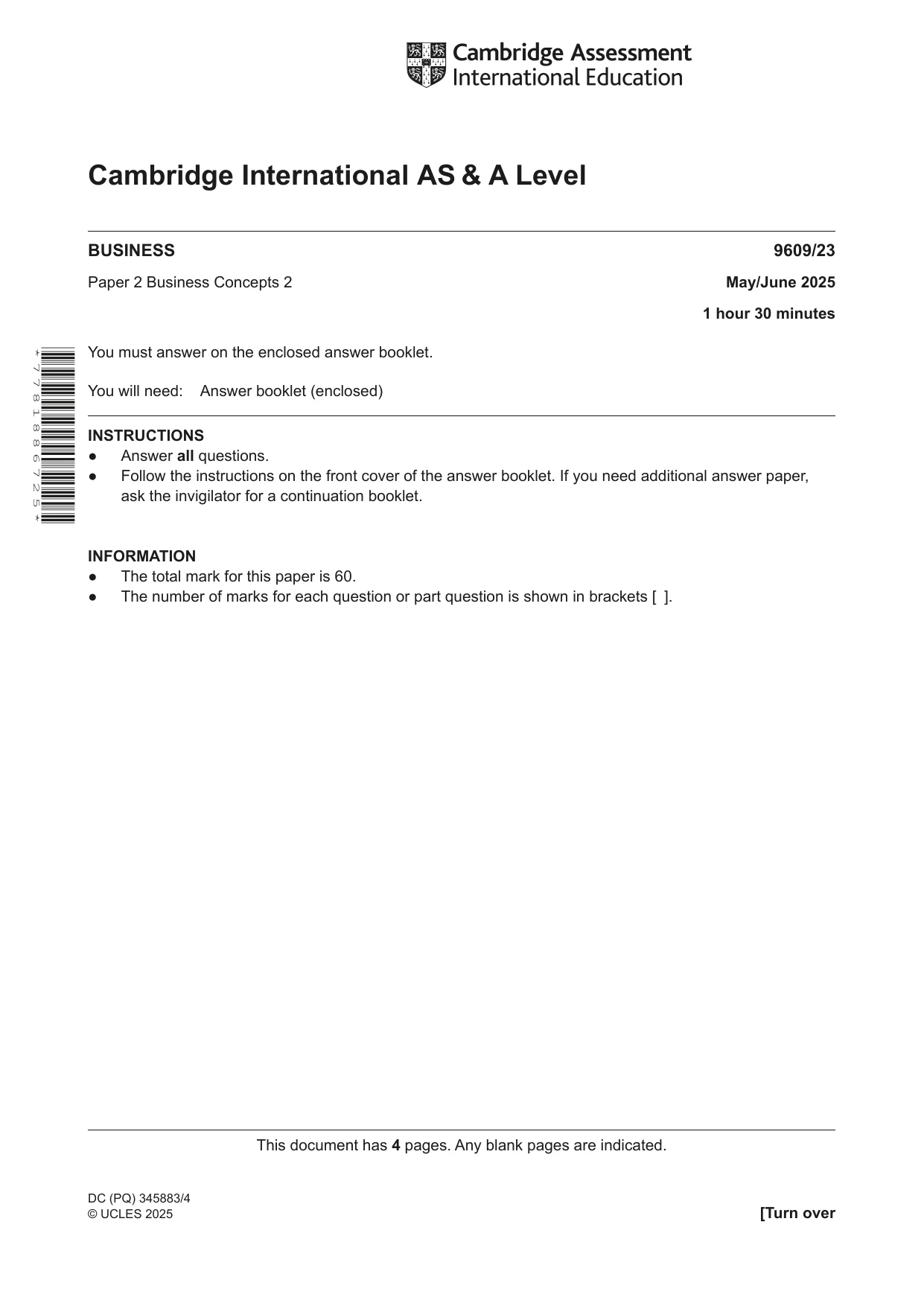
1 Crafty Toys (CT) CT is a co-operative that produces and sells a range of wooden toys, such as puzzles, cars and dolls. The co-operative was formed in 2020 by a group of 12 people who share a passion for making toys. They wanted to work together to create quality products that would appeal to children and parents. No one person takes on the role of manager; instead, they share the traditional manager functions between them. 5 CT operates from a large workshop in a rural area of country Z, making toys using labour-intensive techniques. CT uses locally sourced wood that is certified as eco-friendly. CT also uses natural paints and finishes that are safe and non-toxic for children. Table 1.1 shows CT’s output in 2024. Table 1.1 Output data for CT in 2024 10 Number of people Average hours worked Output per person per year 12 1800 54 000 units CT sells its products online through its own website and social media platforms, as well as through some independent retailers who specialise in ethical products. The co-operative 15 also attends various trade fairs and exhibitions to showcase its products and network with potential customers and suppliers. CT has never researched customer wants. CT faces some challenges in its current operations. These challenges include: • high costs of production • a long lead time 20 • a requirement for skilled workers. CT is considering changing to flow production to overcome these challenges. (a) (i) Identify one feature of a co-operative. [1] (ii) Explain the term traditional manager functions. [3] (b) (i) Refer to Table 1.1. Calculate the labour productivity for CT in 2024. [3] (ii) Explain one advantage to CT of labour-intensive operations. [3] (c) Analyse two methods of primary market research that CT could use to identify customer wants. [8] (d) Evaluate whether CT should change to flow production. [12]
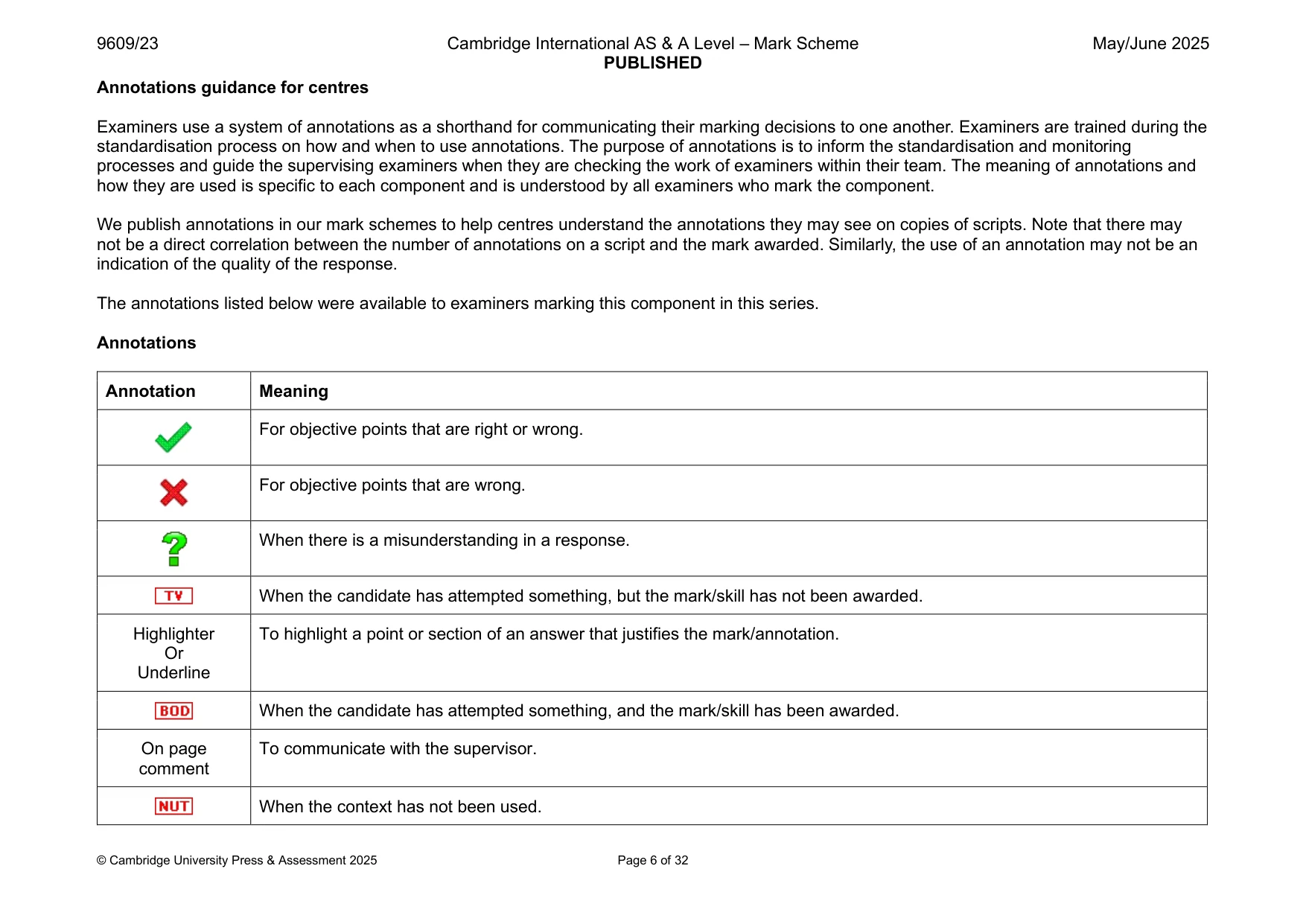
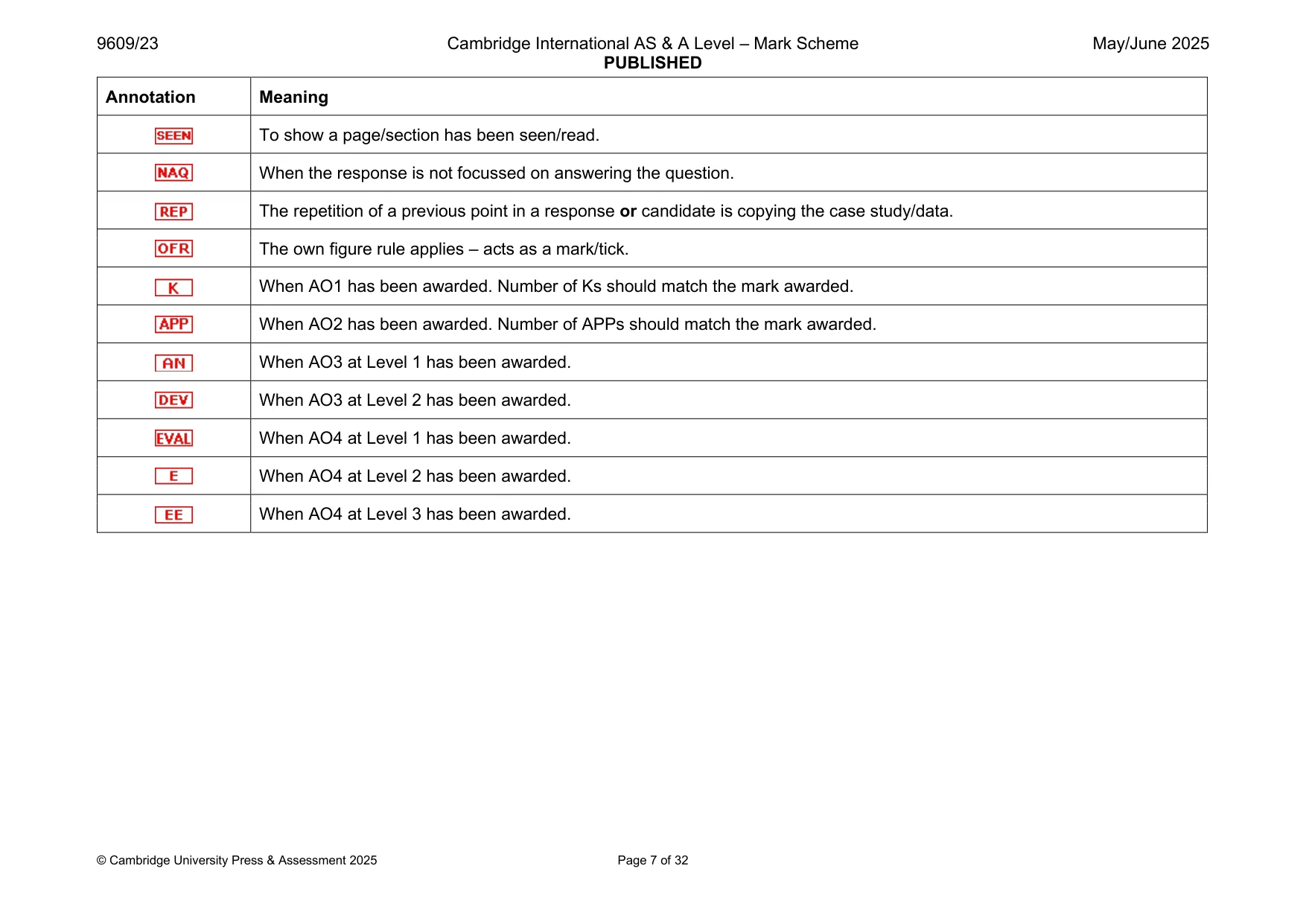
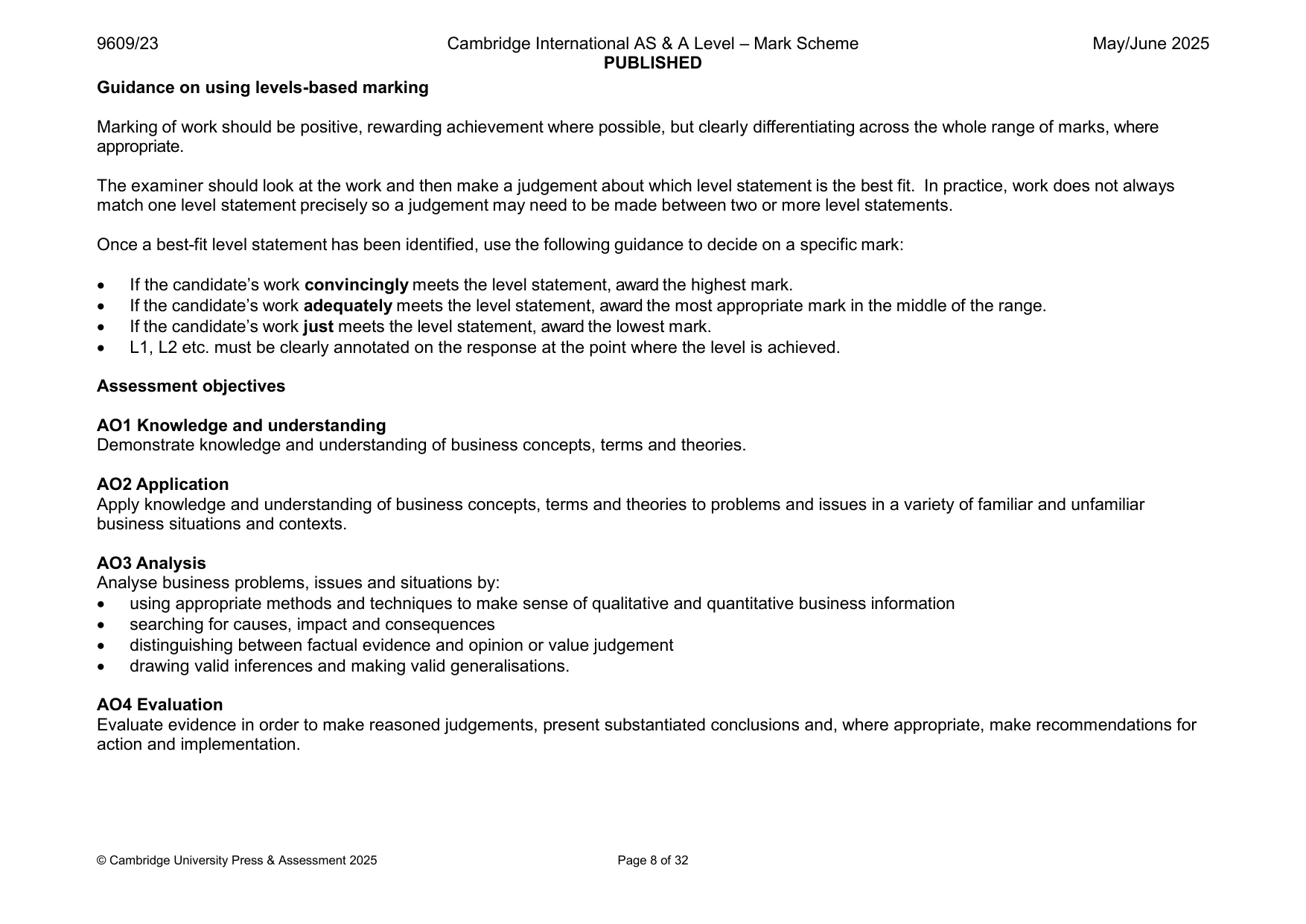
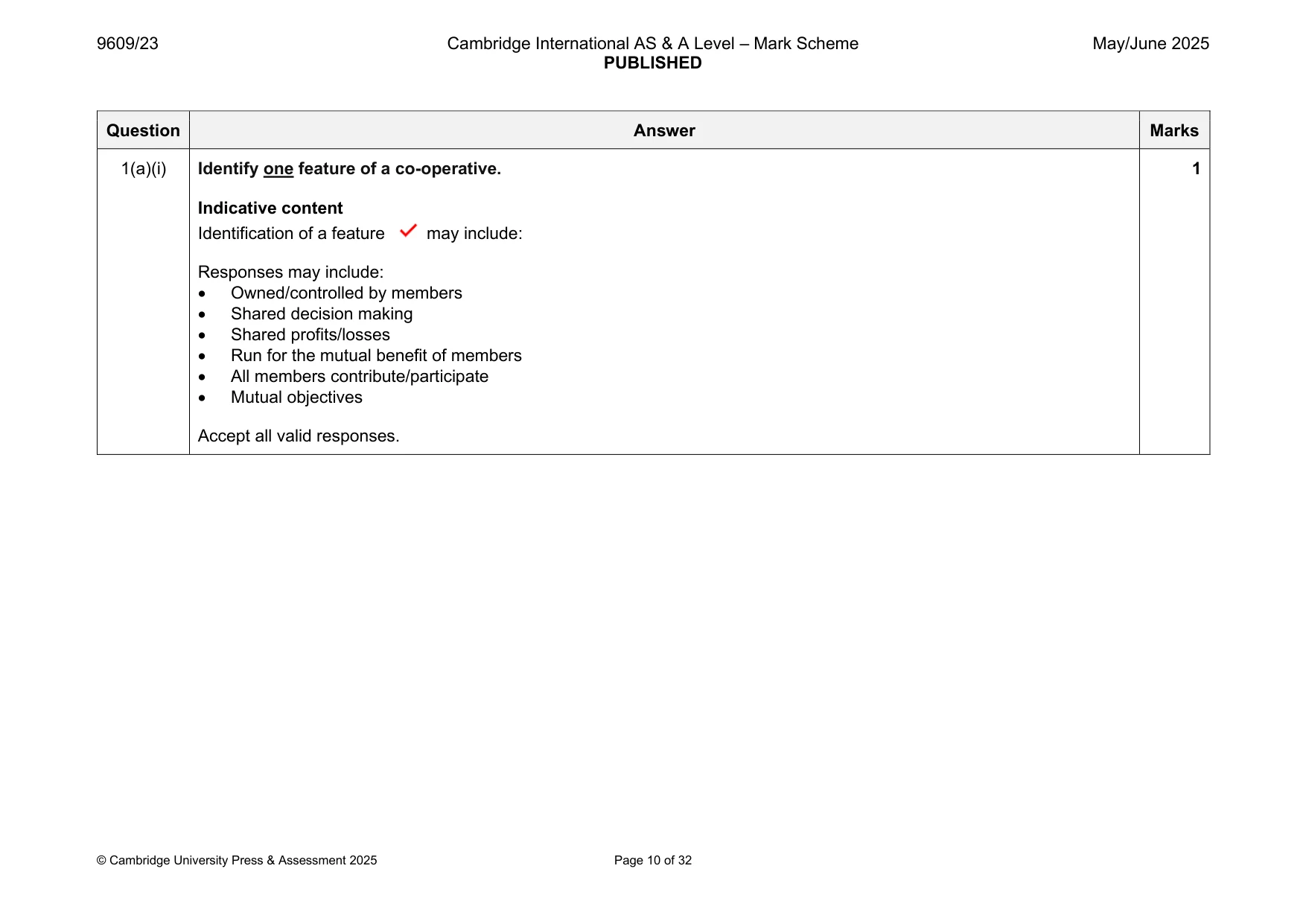
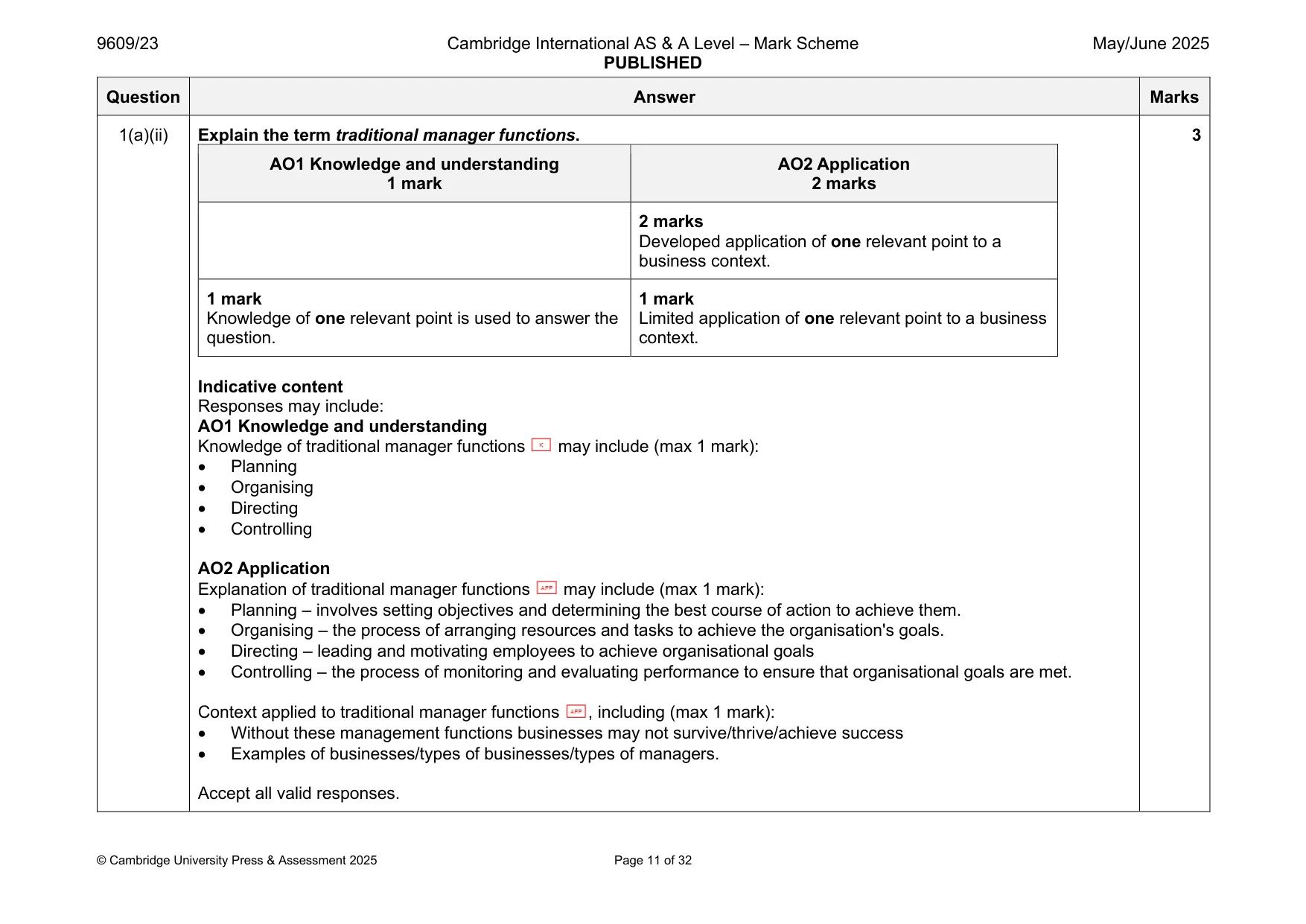
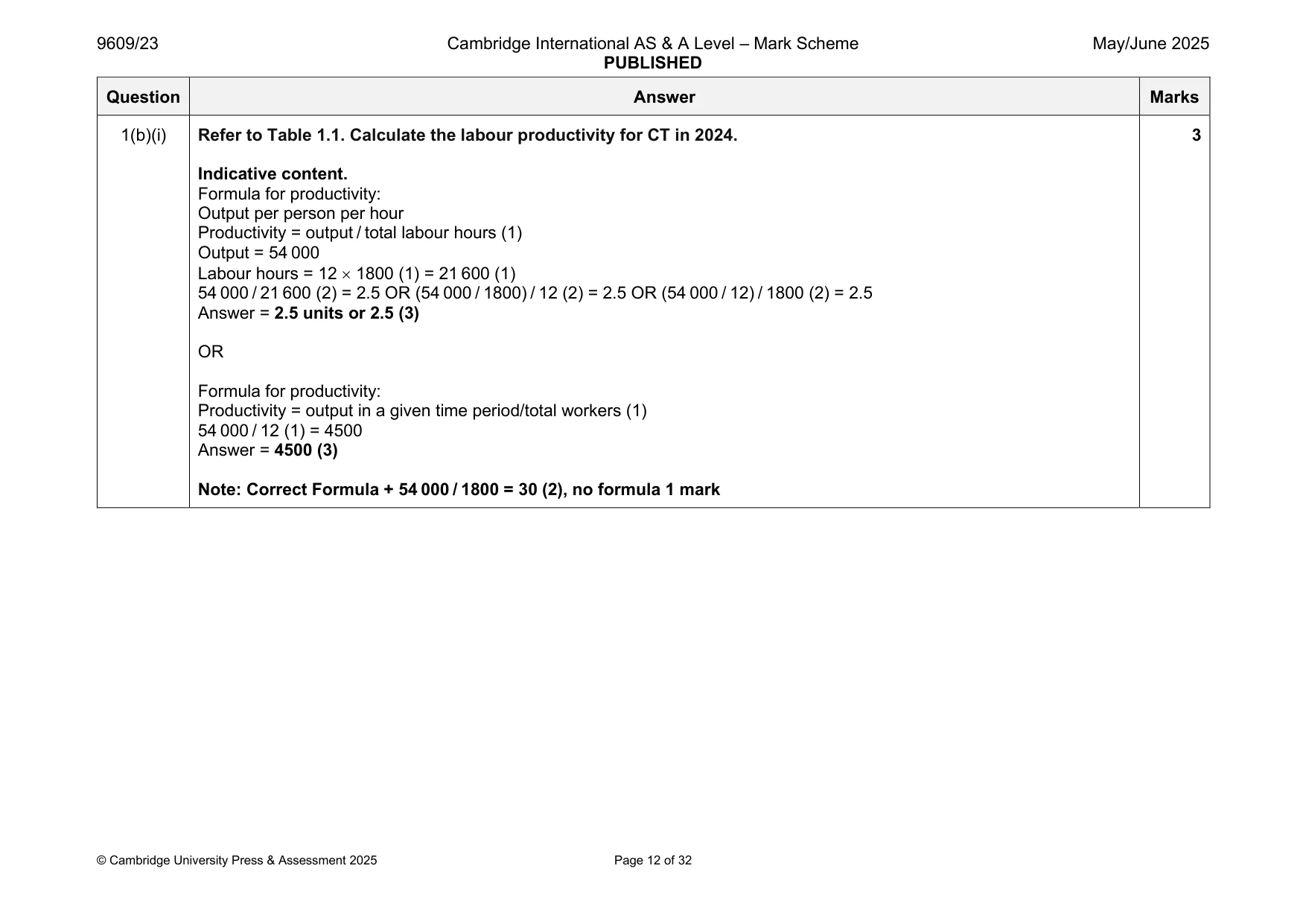
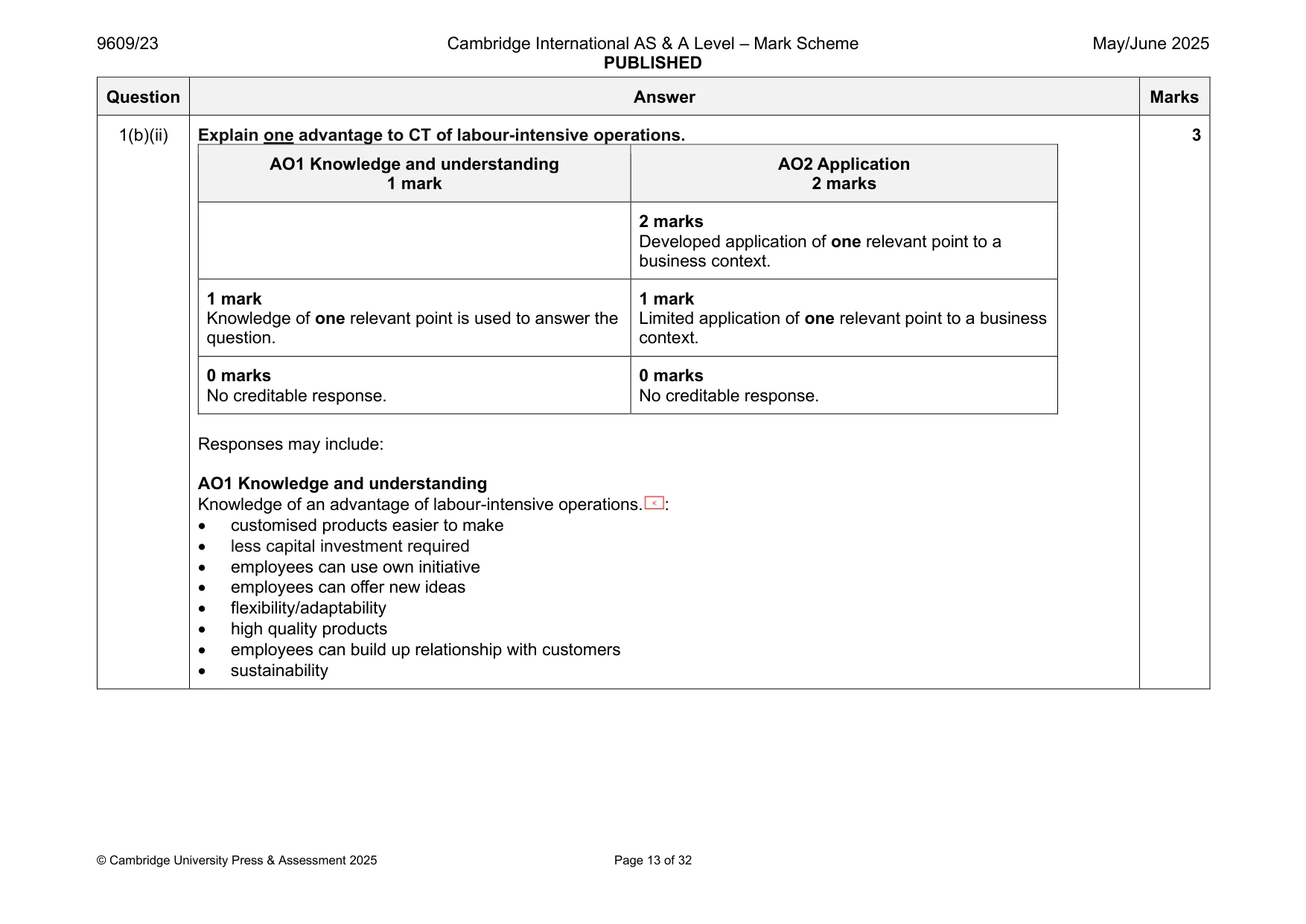
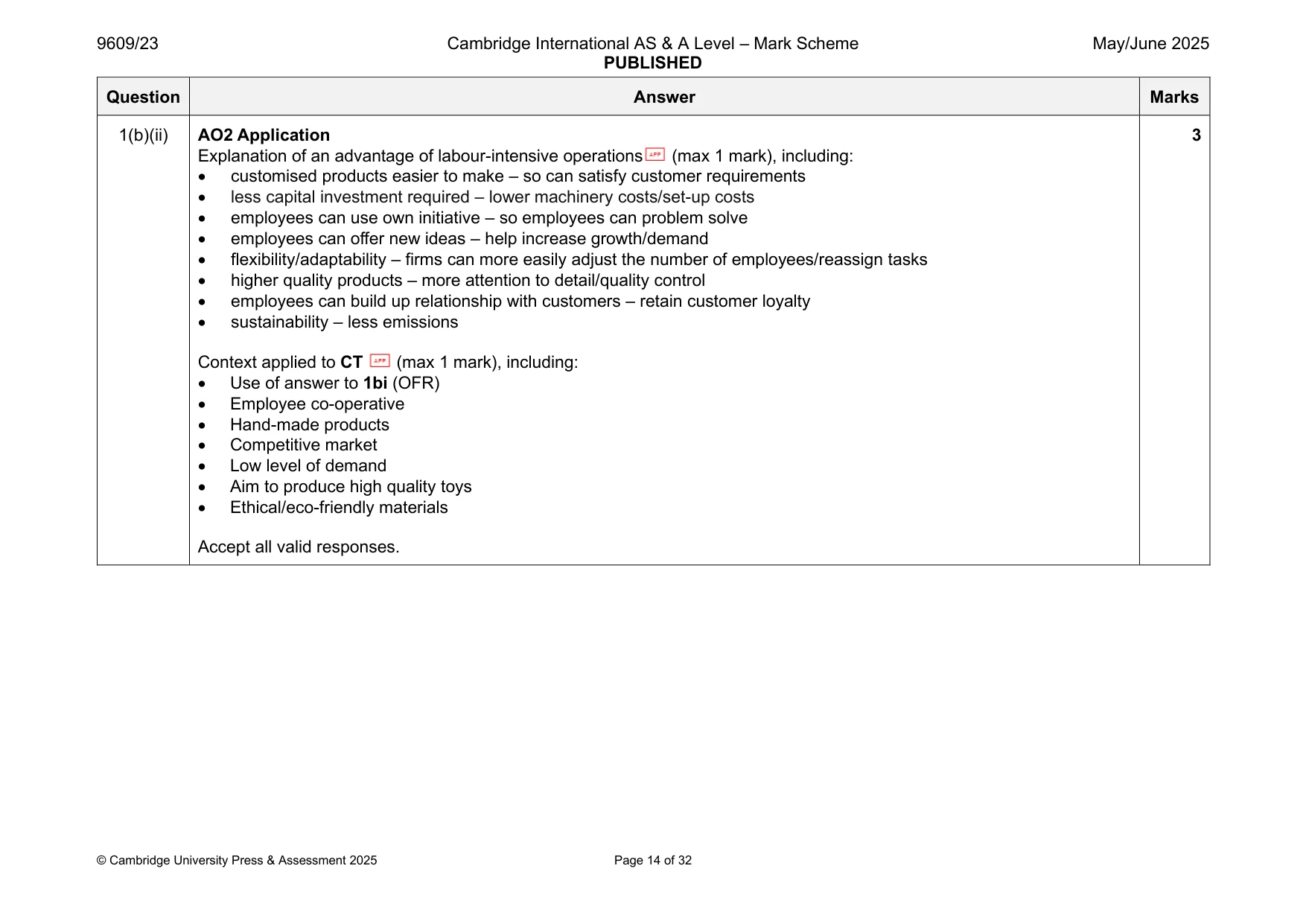
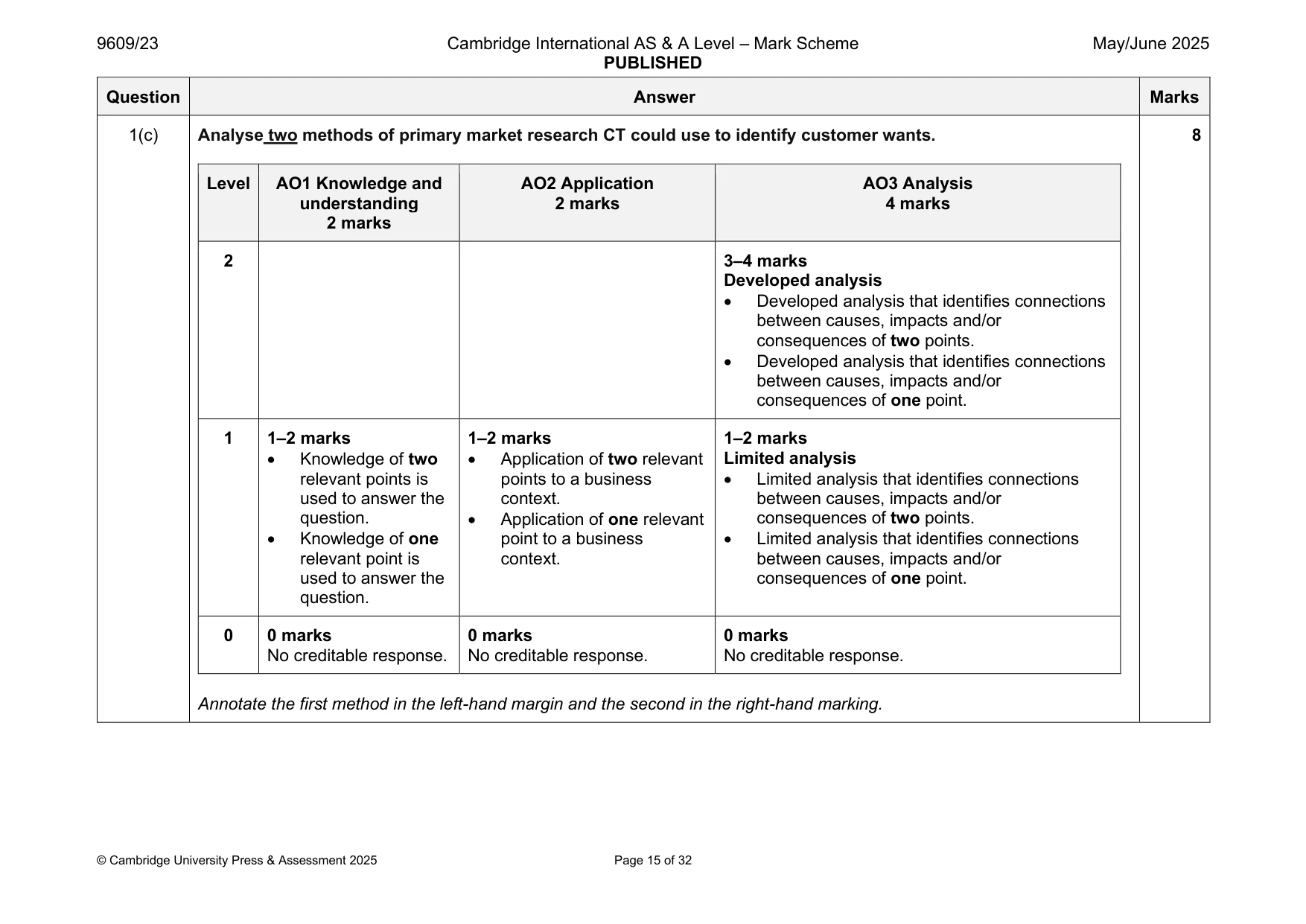
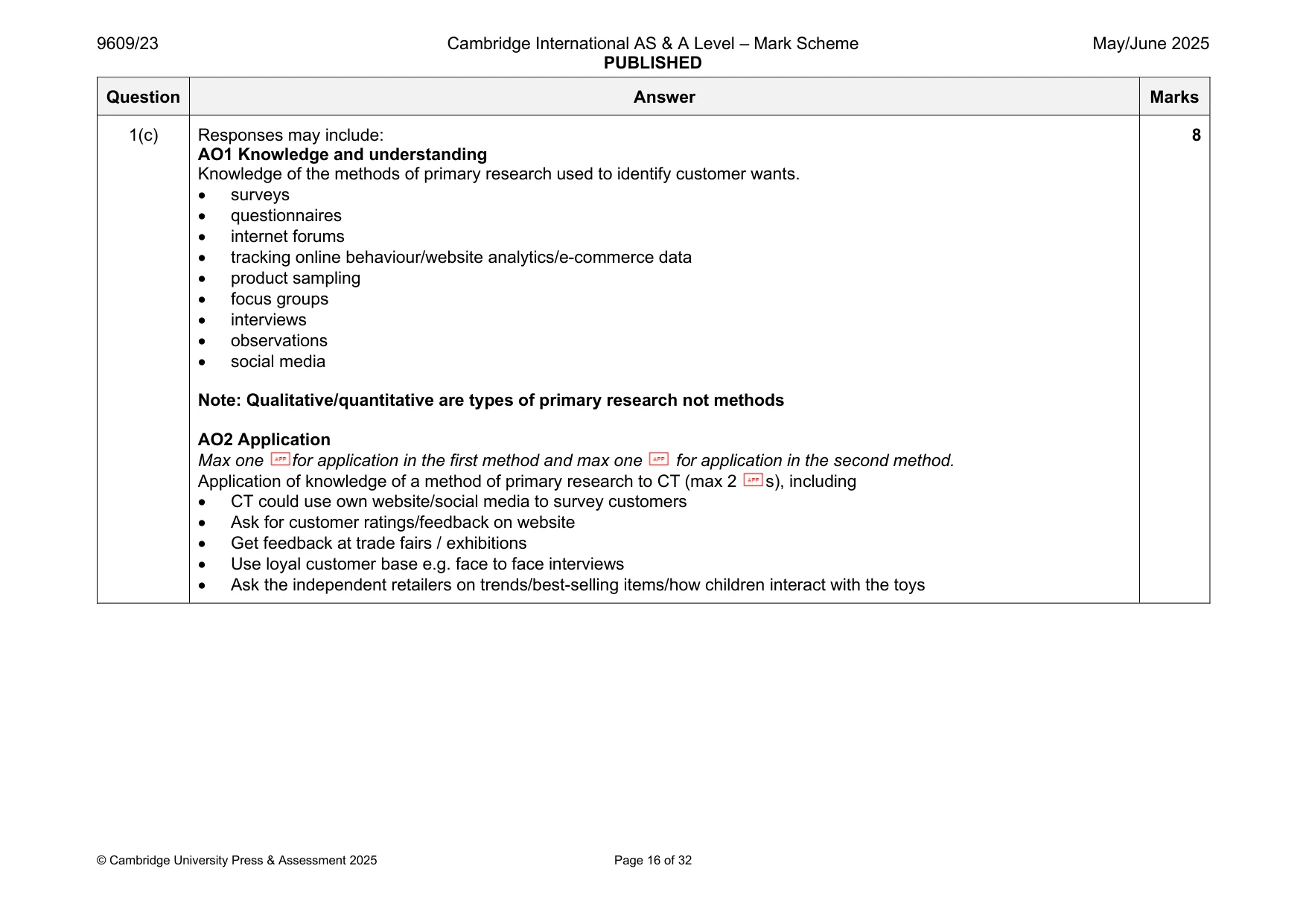
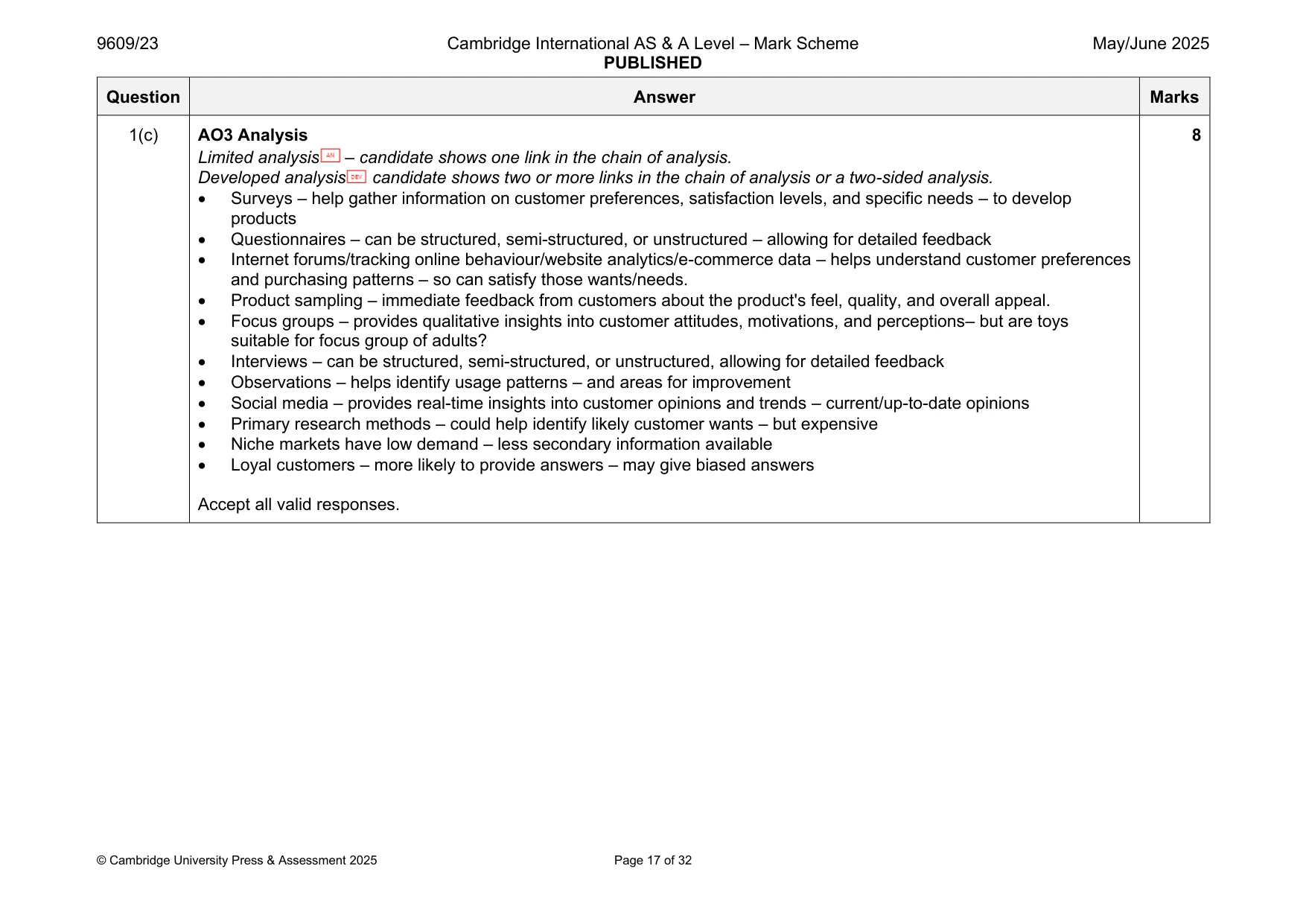
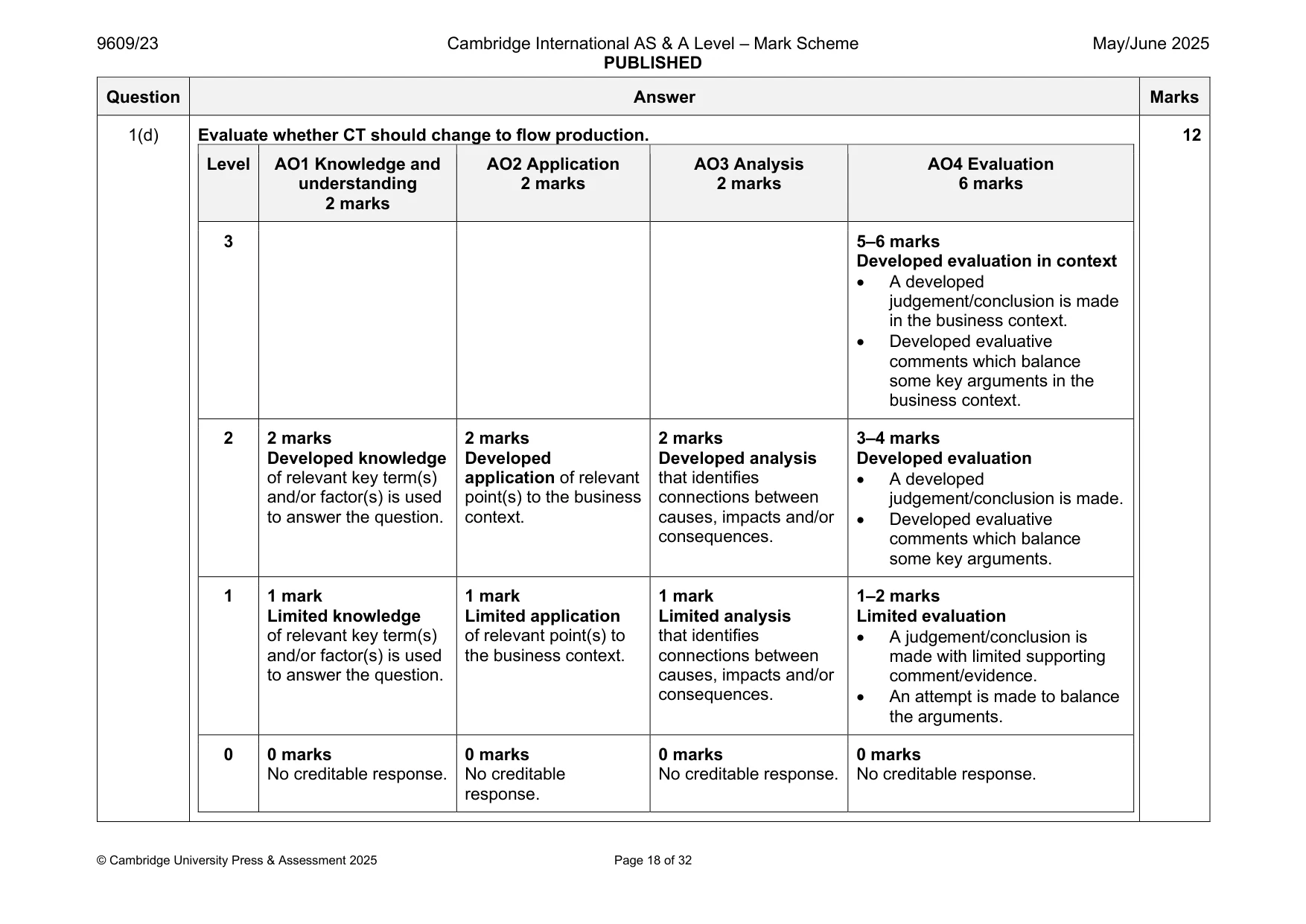
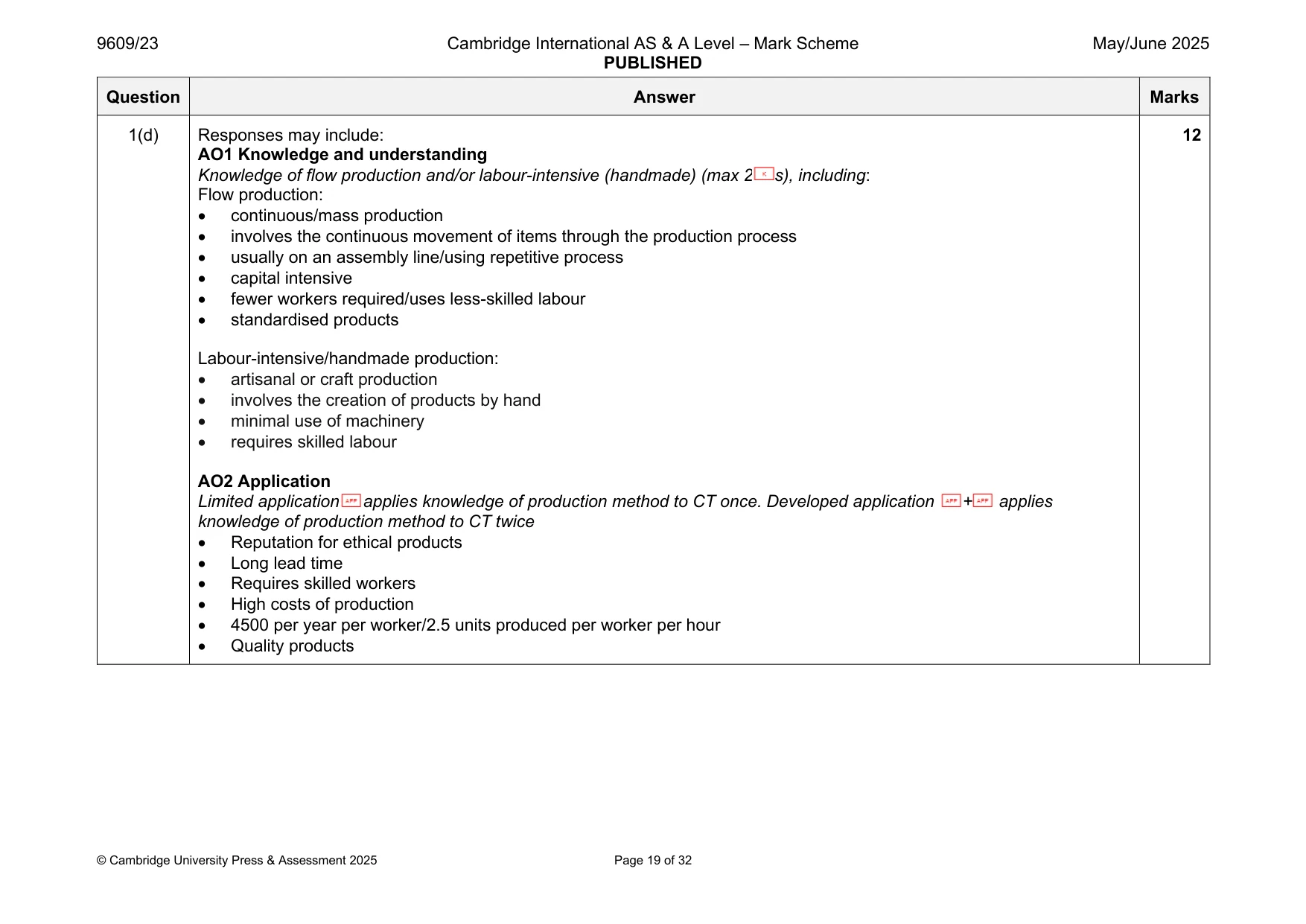
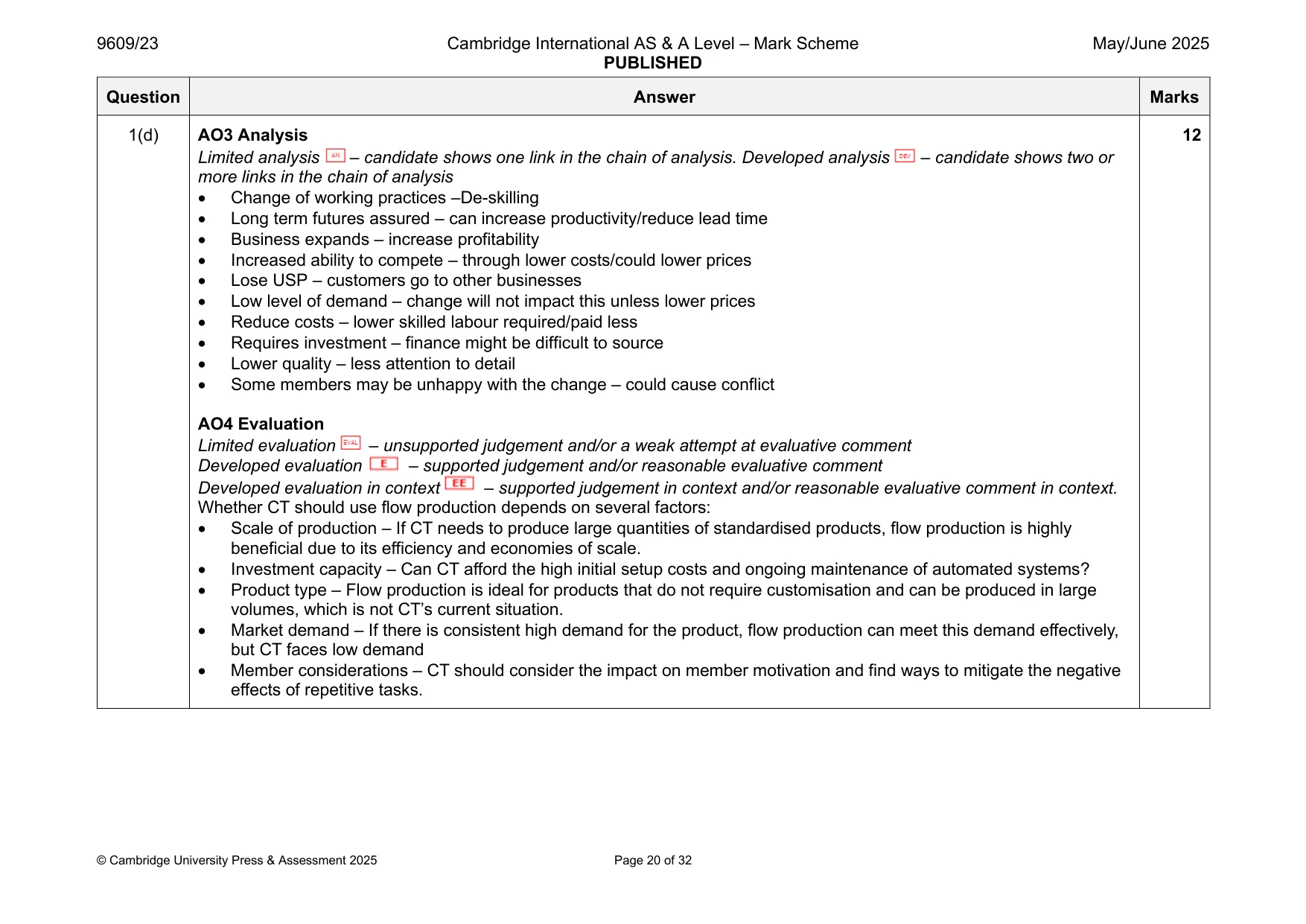
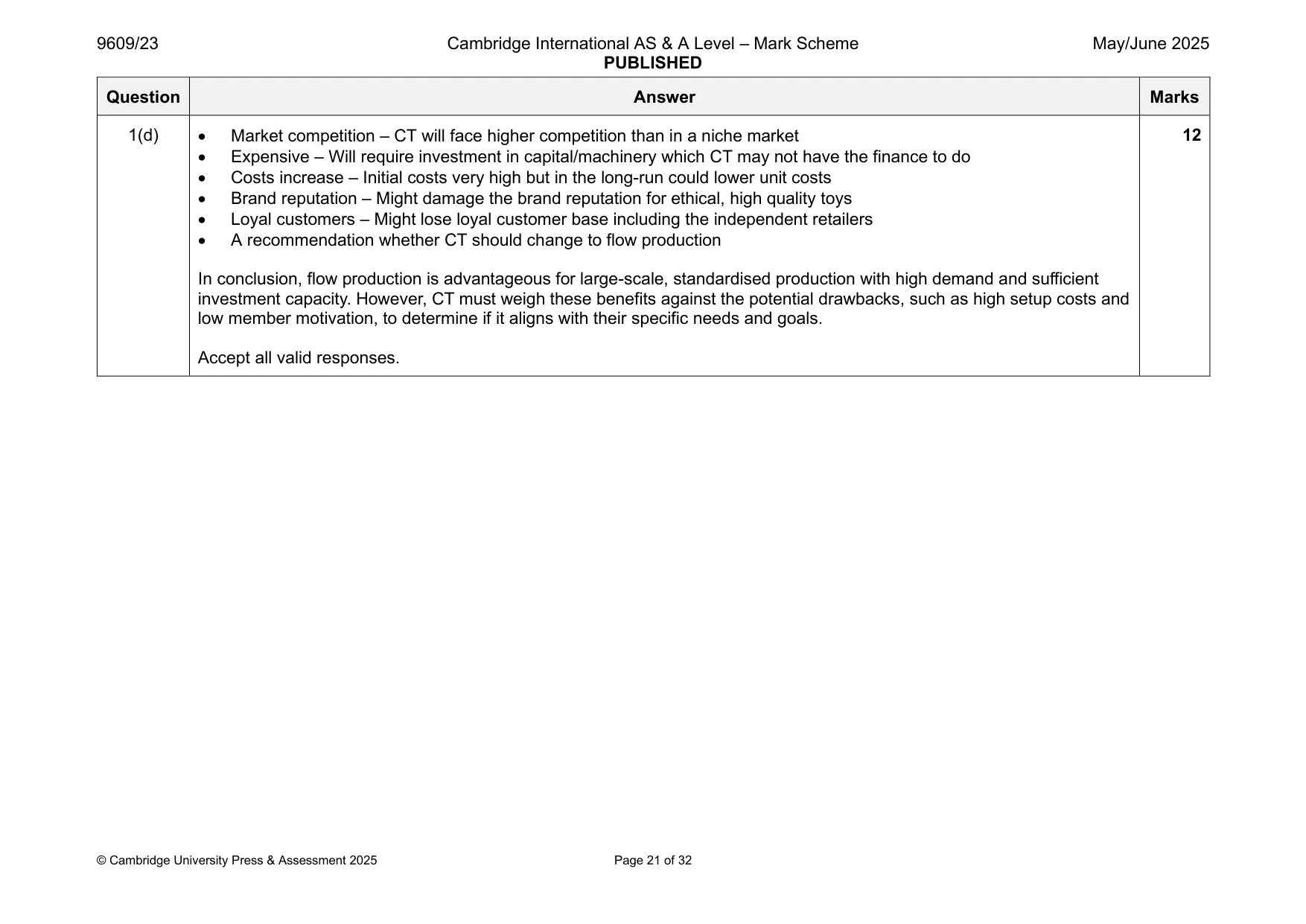
Mark scheme: Question Answer Marks 1(a)(i) Identify one feature of a co-operative. 1 Indicative content Identification of a feature may include: Responses may include: • Owned/controlled by members • Shared decision making • Shared profits/losses • Run for the mutual benefit of members • All members contribute/participate • Mutual objectives Accept all valid responses. 1(a)(ii) Explain the term traditional manager functions. 3 AO1 Knowledge and understanding AO2 Application 1 mark 2 marks 2 marks Developed application of one relevant point to a business context. 1 mark 1 mark Knowledge of one relevant point is used to answer the Limited application of one relevant point to a business question. context. Indicative content Responses may include: AO1 Knowledge and understanding Knowledge of traditional manager functions may include (max 1 mark): • Planning • Organising • Directing • Controlling AO2 Application Explanation of traditional manager functions may include (max 1 mark): • Planning – involves setting objectives and determining the best course of action to achieve them. • Organising – the process of arranging resources and tasks to achieve the organisation's goals. • Directing – leading and motivating employees to achieve organisational goals • Controlling – the process of monitoring and evaluating performance to ensure that organisational goals are met. Context applied to traditional manager functions , including (max 1 mark): • Without these management functions businesses may not survive/thrive/achieve success • Examples of businesses/types of businesses/types of managers. Accept all valid responses. 1(b)(i) Refer to Table 1.1. Calculate the labour productivity for CT in 2024. 3 Indicative content. Formula for productivity: Output per person per hour Productivity = output / total labour hours (1) Output = 54 000 Labour hours = 12 1800 (1) = 21 600 (1) 54 000 / 21 600 (2) = 2.5 OR (54 000 / 1800) / 12 (2) = 2.5 OR (54 000 / 12) / 1800 (2) = 2.5 Answer = 2.5 units or 2.5 (3) OR Formula for productivity: Productivity = output in a given time period/total workers (1) 54 000 / 12 (1) = 4500 Answer = 4500 (3) Note: Correct Formula + 54 000 / 1800 = 30 (2), no formula 1 mark 1(b)(ii) Explain one advantage to CT of labour-intensive operations. 3 AO1 Knowledge and understanding AO2 Application 1 mark 2 marks 2 marks Developed application of one relevant point to a business context. 1 mark 1 mark Knowledge of one relevant point is used to answer the Limited application of one relevant point to a business question. context. 0 marks 0 marks No creditable response. No creditable response. Responses may include: AO1 Knowledge and understanding Knowledge of an advantage of labour-intensive operations. : • customised products easier to make • less capital investment required • employees can use own initiative • employees can offer new ideas • flexibility/adaptability • high quality products • employees can build up relationship with customers • sustainability 1(b)(ii) AO2 Application 3 Explanation of an advantage of labour-intensive operations (max 1 mark), including: • customised products easier to make – so can satisfy customer requirements • less capital investment required – lower machinery costs/set-up costs • employees can use own initiative – so employees can problem solve • employees can offer new ideas – help increase growth/demand • flexibility/adaptability – firms can more easily adjust the number of employees/reassign tasks • higher quality products – more attention to detail/quality control • employees can build up relationship with customers – retain customer loyalty • sustainability – less emissions Context applied to CT (max 1 mark), including: • Use of answer to 1bi (OFR) • Employee co-operative • Hand-made products • Competitive market • Low level of demand • Aim to produce high quality toys • Ethical/eco-friendly materials Accept all valid responses. 1(c) Analyse two methods of primary market research CT could use to identify customer wants. 8 Level AO1 Knowledge and AO2 Application AO3 Analysis understanding 2 marks 4 marks 2 marks 2 3–4 marks Developed analysis • Developed analysis that identifies connections between causes, impacts and/or consequences of two points. • Developed analysis that identifies connections between causes, impacts and/or consequences of one point. 1 1–2 marks 1–2 marks 1–2 marks • Knowledge of two • Application of two relevant Limited analysis relevant points is points to a business • Limited analysis that identifies connections used to answer the context. between causes, impacts and/or question. • Application of one relevant consequences of two points. • Knowledge of one point to a business • Limited analysis that identifies connections relevant point is context. between causes, impacts and/or used to answer the consequences of one point. question. 0 0 marks 0 marks 0 marks No creditable response. No creditable response. No creditable response. Annotate the first method in the left-hand margin and the second in the right-hand marking. 1(c) Responses may include: 8 AO1 Knowledge and understanding Knowledge of the methods of primary research used to identify customer wants. • surveys • questionnaires • internet forums • tracking online behaviour/website analytics/e-commerce data • product sampling • focus groups • interviews • observations • social media Note: Qualitative/quantitative are types of primary research not methods AO2 Application Max one for application in the first method and max one for application in the second method. Application of knowledge of a method of primary research to CT (max 2 s), including • CT could use own website/social media to survey customers • Ask for customer ratings/feedback on website • Get feedback at trade fairs / exhibitions • Use loyal customer base e.g. face to face interviews • Ask the independent retailers on trends/best-selling items/how children interact with the toys 1(c) AO3 Analysis 8 Limited analysis – candidate shows one link in the chain of analysis. Developed analysis candidate shows two or more links in the chain of analysis or a two-sided analysis. • Surveys – help gather information on customer preferences, satisfaction levels, and specific needs – to develop products • Questionnaires – can be structured, semi-structured, or unstructured – allowing for detailed feedback • Internet forums/tracking online behaviour/website analytics/e-commerce data – helps understand customer preferences and purchasing patterns – so can satisfy those wants/needs. • Product sampling – immediate feedback from customers about the product's feel, quality, and overall appeal. • Focus groups – provides qualitative insights into customer attitudes, motivations, and perceptions– but are toys suitable for focus group of adults? • Interviews – can be structured, semi-structured, or unstructured, allowing for detailed feedback • Observations – helps identify usage patterns – and areas for improvement • Social media – provides real-time insights into customer opinions and trends – current/up-to-date opinions • Primary research methods – could help identify likely customer wants – but expensive • Niche markets have low demand – less secondary information available • Loyal customers – more likely to provide answers – may give biased answers Accept all valid responses. 1(d) Evaluate whether CT should change to flow production. 12 Level AO1 Knowledge and AO2 Application AO3 Analysis AO4 Evaluation understanding 2 marks 2 marks 6 marks 2 marks 3 5–6 marks Developed evaluation in context • A developed judgement/conclusion is made in the business context. • Developed evaluative comments which balance some key arguments in the business context. 2 2 marks 2 marks 2 marks 3–4 marks Developed knowledge Developed Developed analysis Developed evaluation of relevant key term(s) application of relevant that identifies • A developed and/or factor(s) is used point(s) to the business connections between judgement/conclusion is made. to answer the question. context. causes, impacts and/or • Developed evaluative consequences. comments which balance some key arguments. 1 1 mark 1 mark 1 mark 1–2 marks Limited knowledge Limited application Limited analysis Limited evaluation of relevant key term(s) of relevant point(s) to that identifies • A judgement/conclusion is and/or factor(s) is used the business context. connections between made with limited supporting to answer the question. causes, impacts and/or comment/evidence. consequences. • An attempt is made to balance the arguments. 0 0 marks 0 marks 0 marks 0 marks No creditable response. No creditable No creditable response. No creditable response. response. 1(d) Responses may include: 12 AO1 Knowledge and understanding Knowledge of flow production and/or labour-intensive (handmade) (max 2 s), including: Flow production: • continuous/mass production • involves the continuous movement of items through the production process • usually on an assembly line/using repetitive process • capital intensive • fewer workers required/uses less-skilled labour • standardised products Labour-intensive/handmade production: • artisanal or craft production • involves the creation of products by hand • minimal use of machinery • requires skilled labour AO2 Application Limited application applies knowledge of production method to CT once. Developed application + applies knowledge of production method to CT twice • Reputation for ethical products • Long lead time • Requires skilled workers • High costs of production • 4500 per year per worker/2.5 units produced per worker per hour • Quality products 1(d) AO3 Analysis 12 Limited analysis – candidate shows one link in the chain of analysis. Developed analysis – candidate shows two or more links in the chain of analysis • Change of working practices –De-skilling • Long term futures assured – can increase productivity/reduce lead time • Business expands – increase profitability • Increased ability to compete – through lower costs/could lower prices • Lose USP – customers go to other businesses • Low level of demand – change will not impact this unless lower prices • Reduce costs – lower skilled labour required/paid less • Requires investment – finance might be difficult to source • Lower quality – less attention to detail • Some members may be unhappy with the change – could cause conflict AO4 Evaluation Limited evaluation – unsupported judgement and/or a weak attempt at evaluative comment Developed evaluation – supported judgement and/or reasonable evaluative comment Developed evaluation in context – supported judgement in context and/or reasonable evaluative comment in context. Whether CT should use flow production depends on several factors: • Scale of production – If CT needs to produce large quantities of standardised products, flow production is highly beneficial due to its efficiency and economies of scale. • Investment capacity – Can CT afford the high initial setup costs and ongoing maintenance of automated systems? • Product type – Flow production is ideal for products that do not require customisation and can be produced in large volumes, which is not CT’s current situation. • Market demand – If there is consistent high demand for the product, flow production can meet this demand effectively, but CT faces low demand • Member considerations – CT should consider the impact on member motivation and find ways to mitigate the negative effects of repetitive tasks. 1(d) • Market competition – CT will face higher competition than in a niche market 12 • Expensive – Will require investment in capital/machinery which CT may not have the finance to do • Costs increase – Initial costs very high but in the long-run could lower unit costs • Brand reputation – Might damage the brand reputation for ethical, high quality toys • Loyal customers – Might lose loyal customer base including the independent retailers • A recommendation whether CT should change to flow production In conclusion, flow production is advantageous for large-scale, standardised production with high demand and sufficient investment capacity. However, CT must weigh these benefits against the potential drawbacks, such as high setup costs and low member motivation, to determine if it aligns with their specific needs and goals. Accept all valid responses.
Q2 · Fresh Farm (FF) FF is a partnership in country Q that grows a range of fruits and…
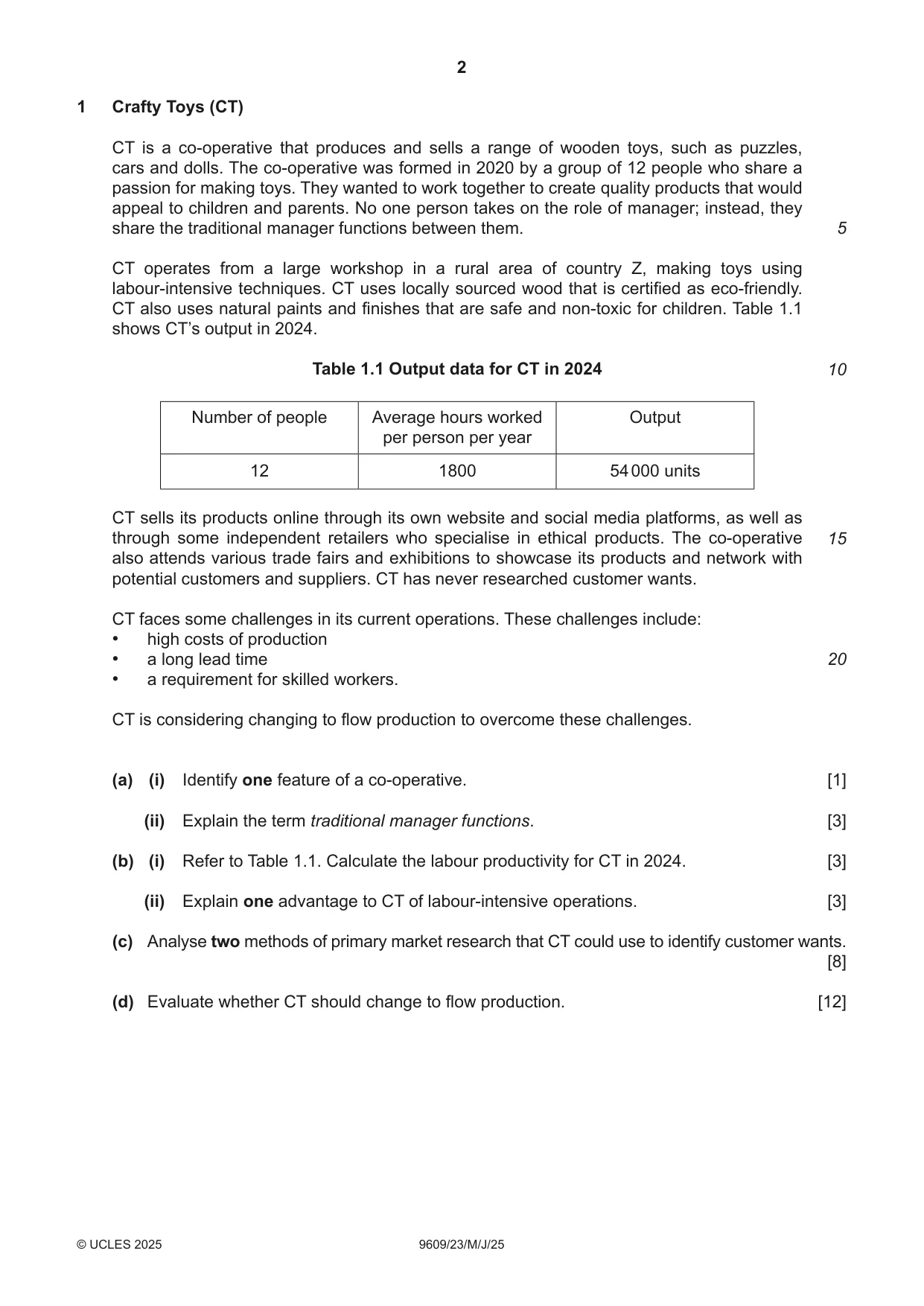
2 Fresh Farm (FF) FF is a partnership in country Q that grows a range of fruits and vegetables, such as apples, carrots and potatoes. FF also provides an advisory service to other farmers. The partnership was established in 2018 by three friends, Amrit, Harry and Sally, who provided the working capital. Their aim was to produce healthy and tasty food for themselves and others. FF grows crops using natural methods and practices. The produce is free from chemicals 5 and pesticides. It only uses renewable energy sources, such as solar panels and wind turbines. It harvests the crops by hand or using simple machines that minimise damage or waste, but this is labour intensive. FF sells its products directly to consumers through its own farm shop and online delivery service. It also sells to local restaurants. Table 2.1 shows information on FF’s revenue and 10 costs in 2024. Table 2.1 Extract from FF’s financial data for 2024 $000 Revenue 120 Direct costs 50 15 Indirect costs 30 FF has gained a loyal customer base who appreciate the quality, flavour and nutrition of its products. However, FF also faces some challenges and risks in the competitive and uncertain food market. FF has limited capacity in producing crops. Weather conditions affect its yield and quality. It also must deal with pests, diseases and natural disasters that could 20 damage or destroy its crops. Another challenge that FF faces is the high level of demand for its products in the market. The partnership must meet the expectations and requirements of its customers who want fresh, varied and consistent products throughout the year. (a) (i) Identify one feature of a partnership. [1] (ii) Explain the term working capital. [3] (b) (i) Refer to Table 2.1. Calculate FF’s profit in 2024. [3] (ii) Explain one factor influencing the supply of FF’s products. [3] (c) Analyse two benefits to FF of product differentiation. [8] (d) Evaluate whether business growth is a suitable objective for FF. [12]
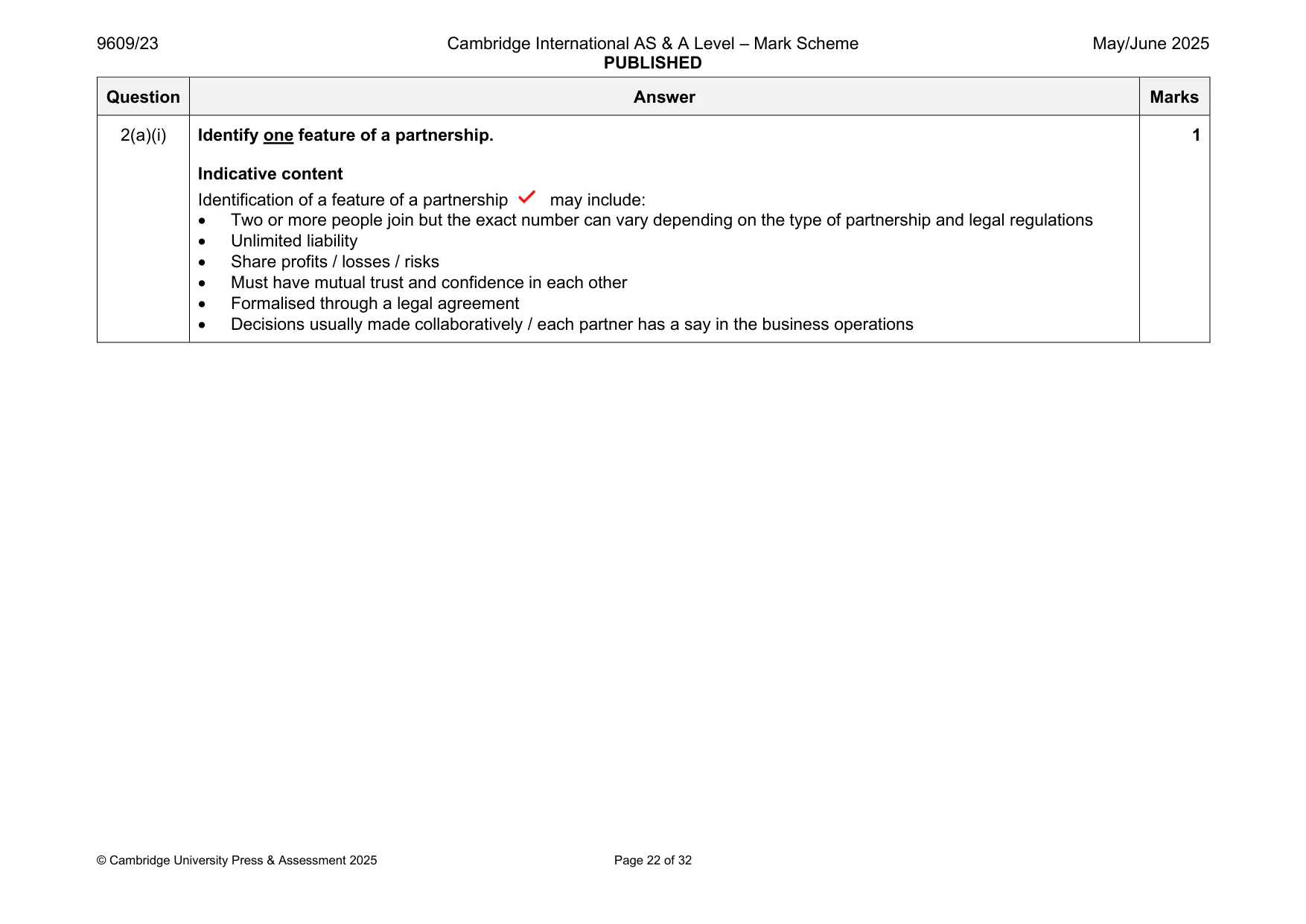
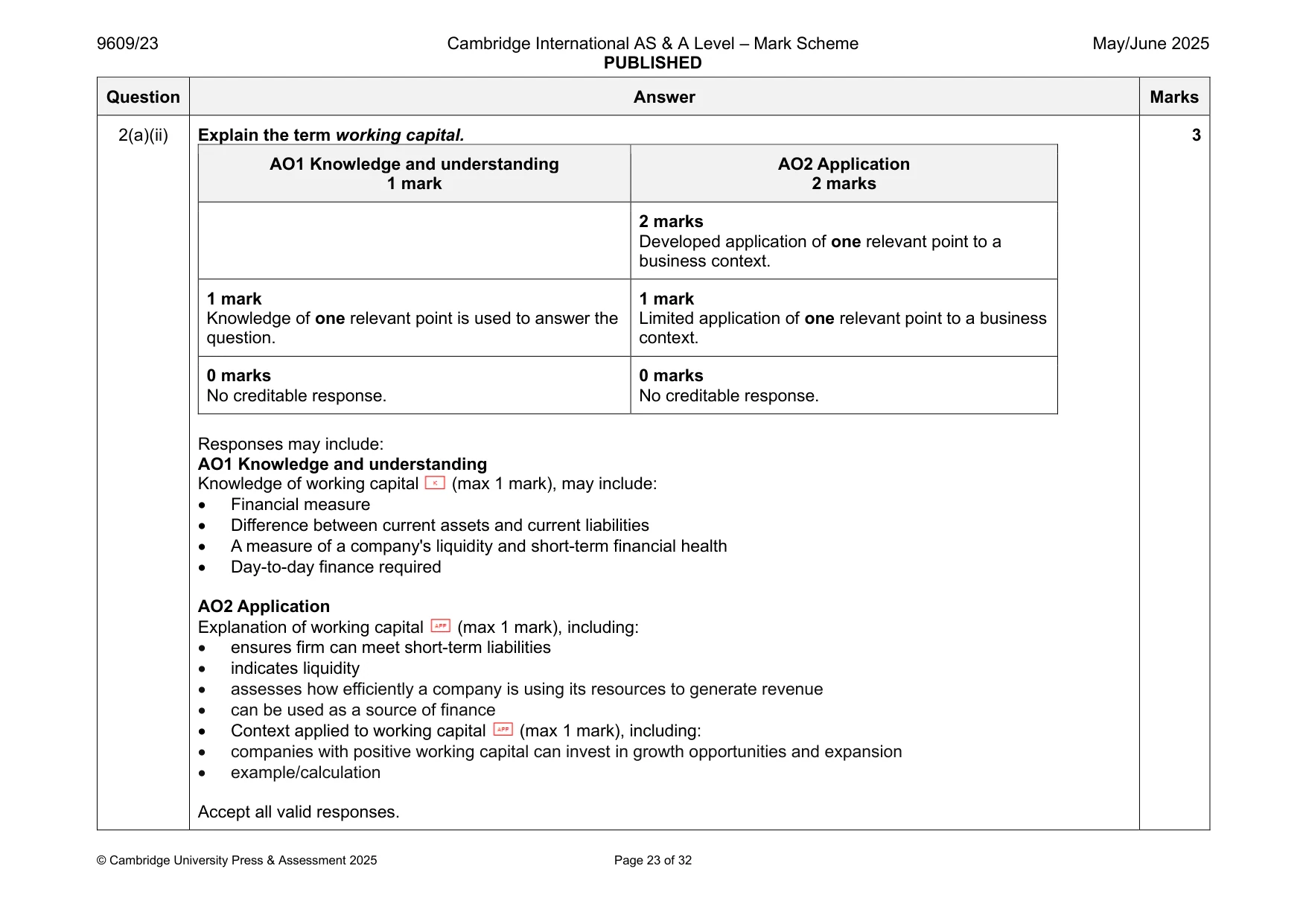
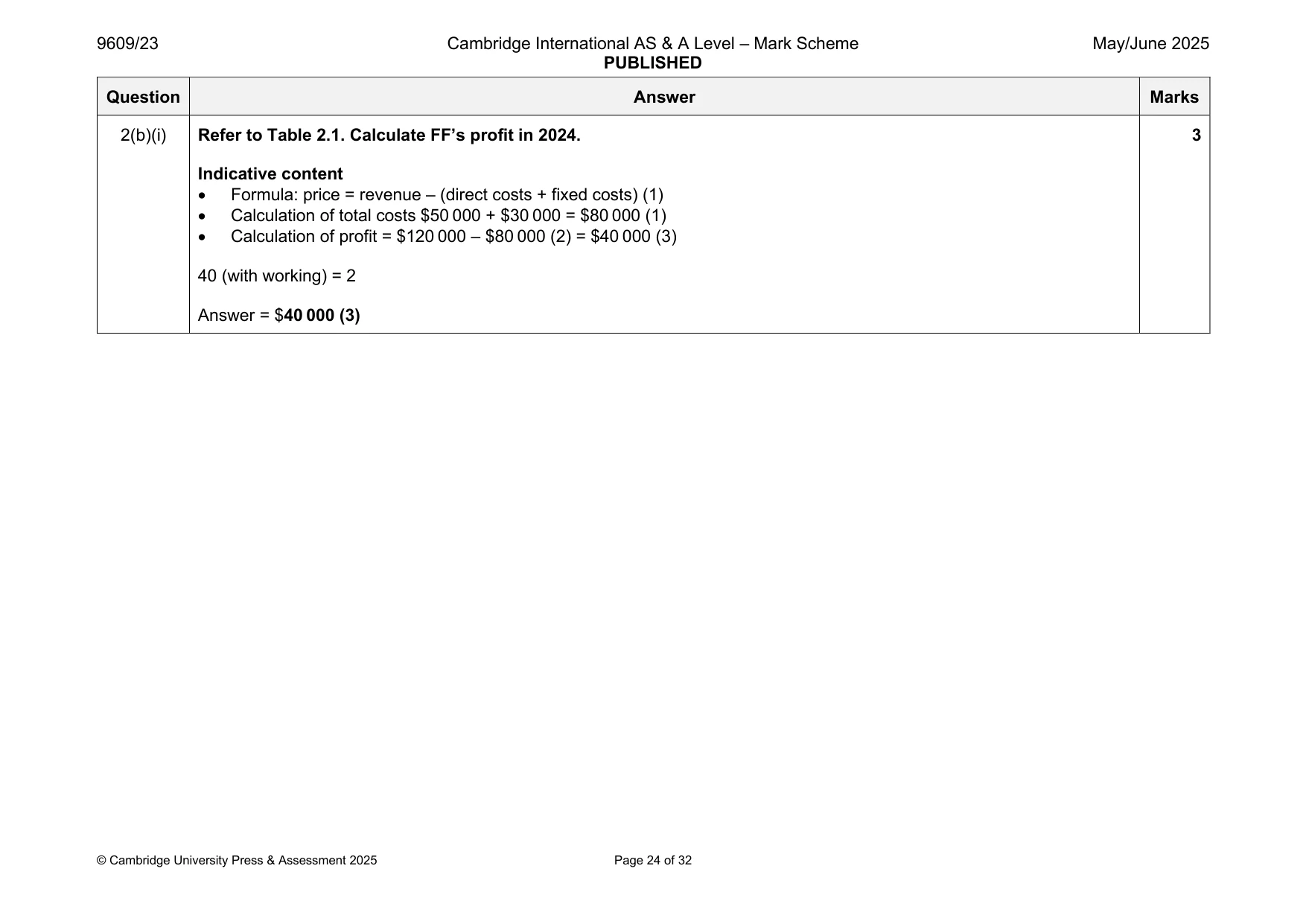
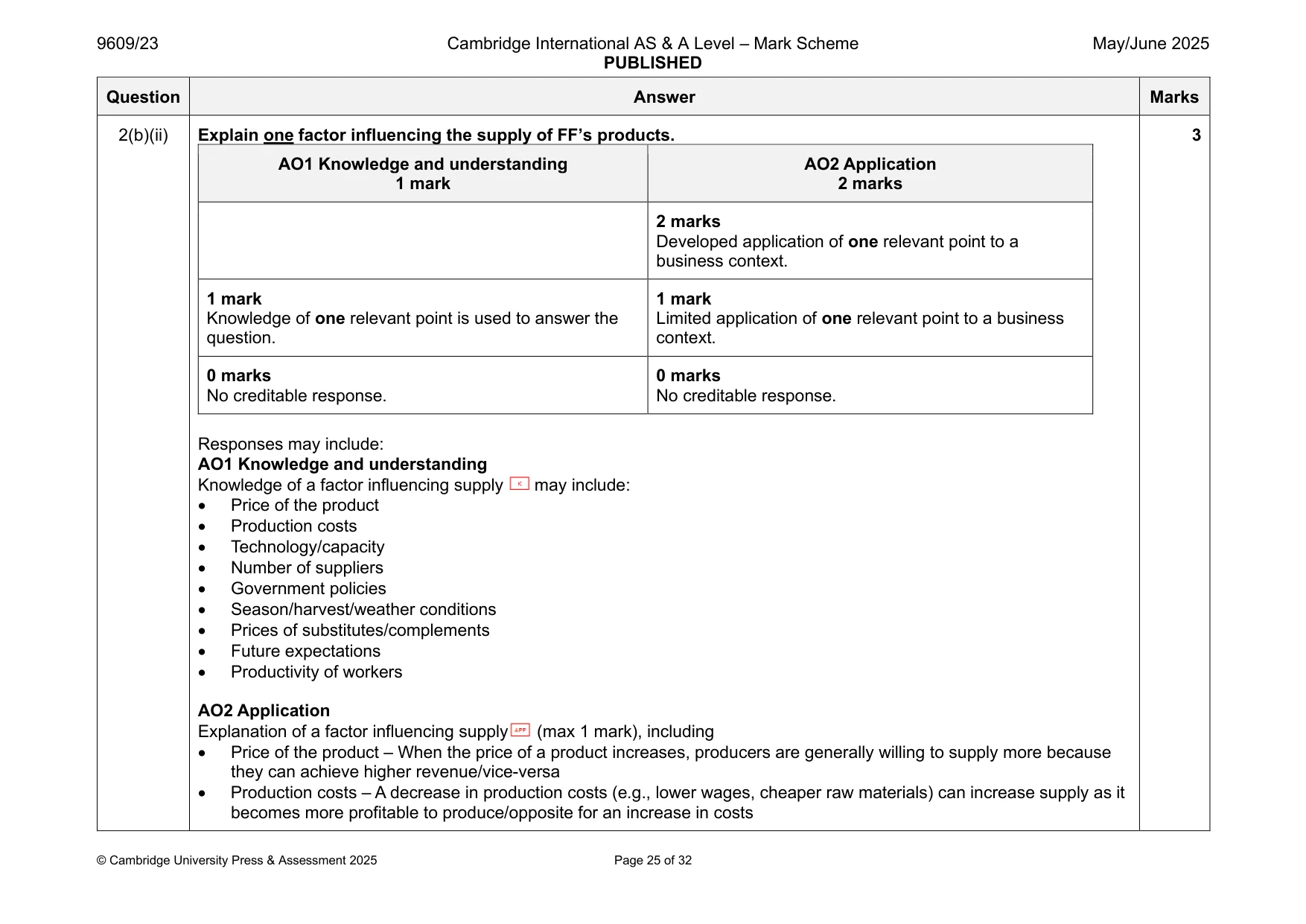
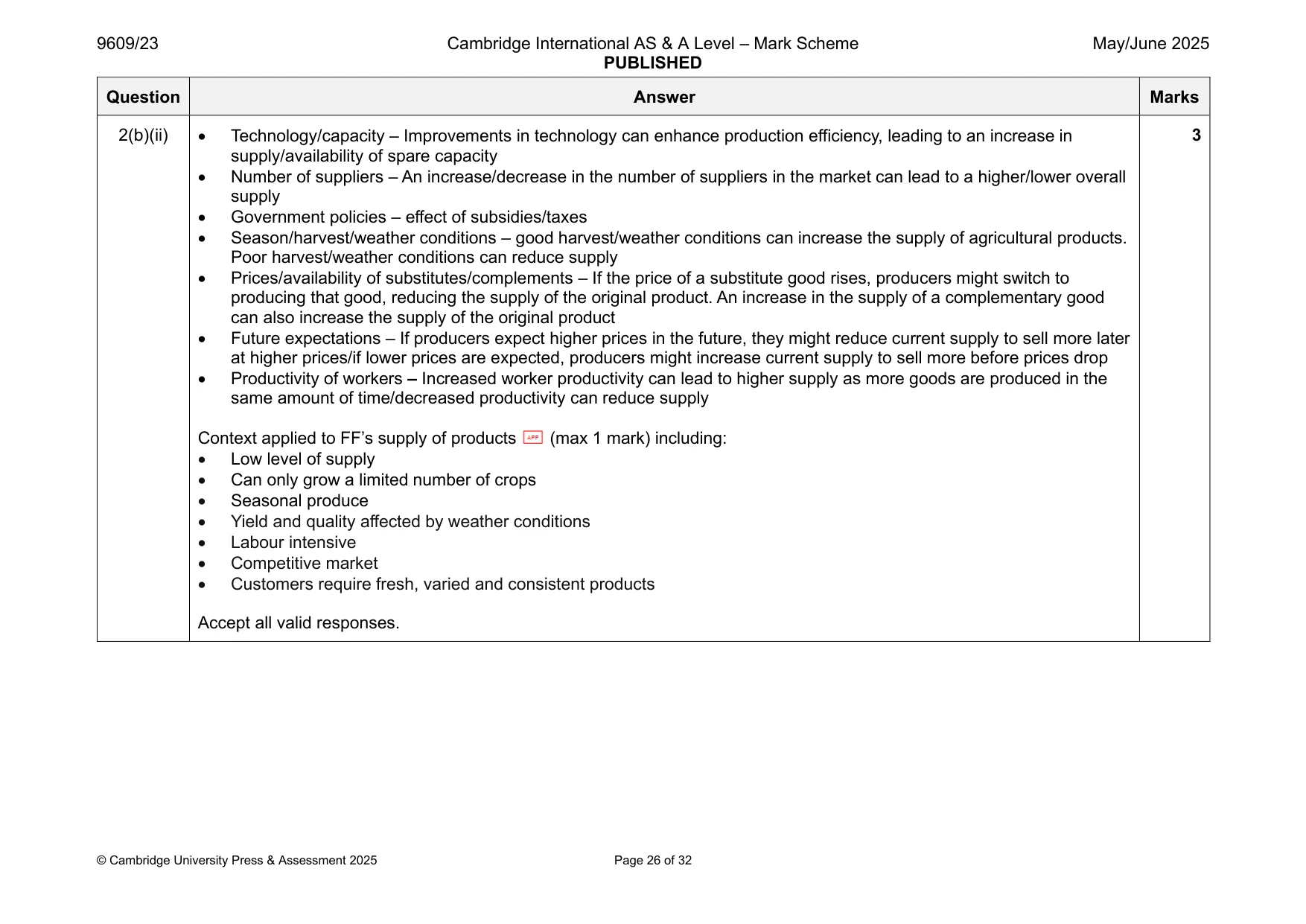
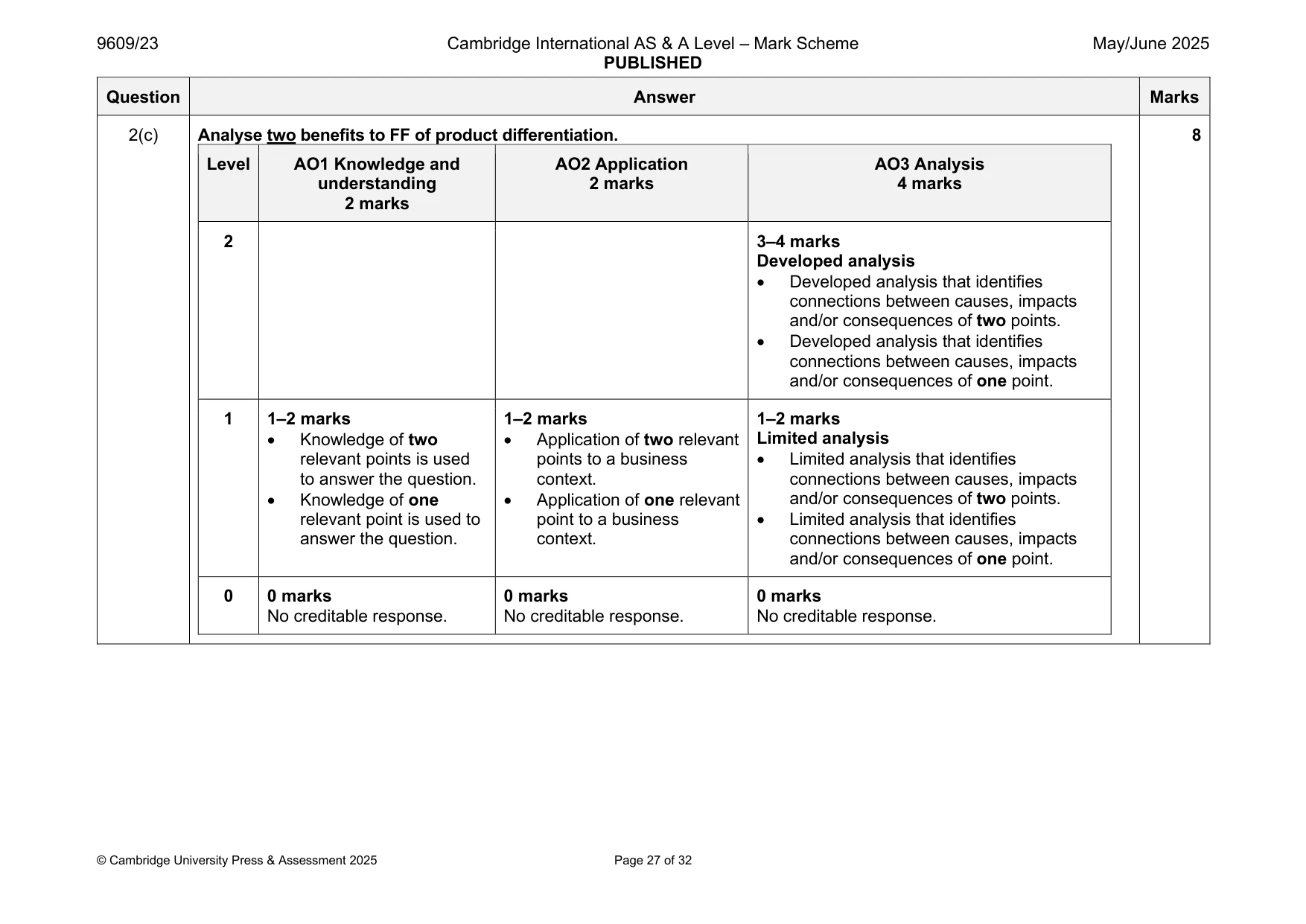
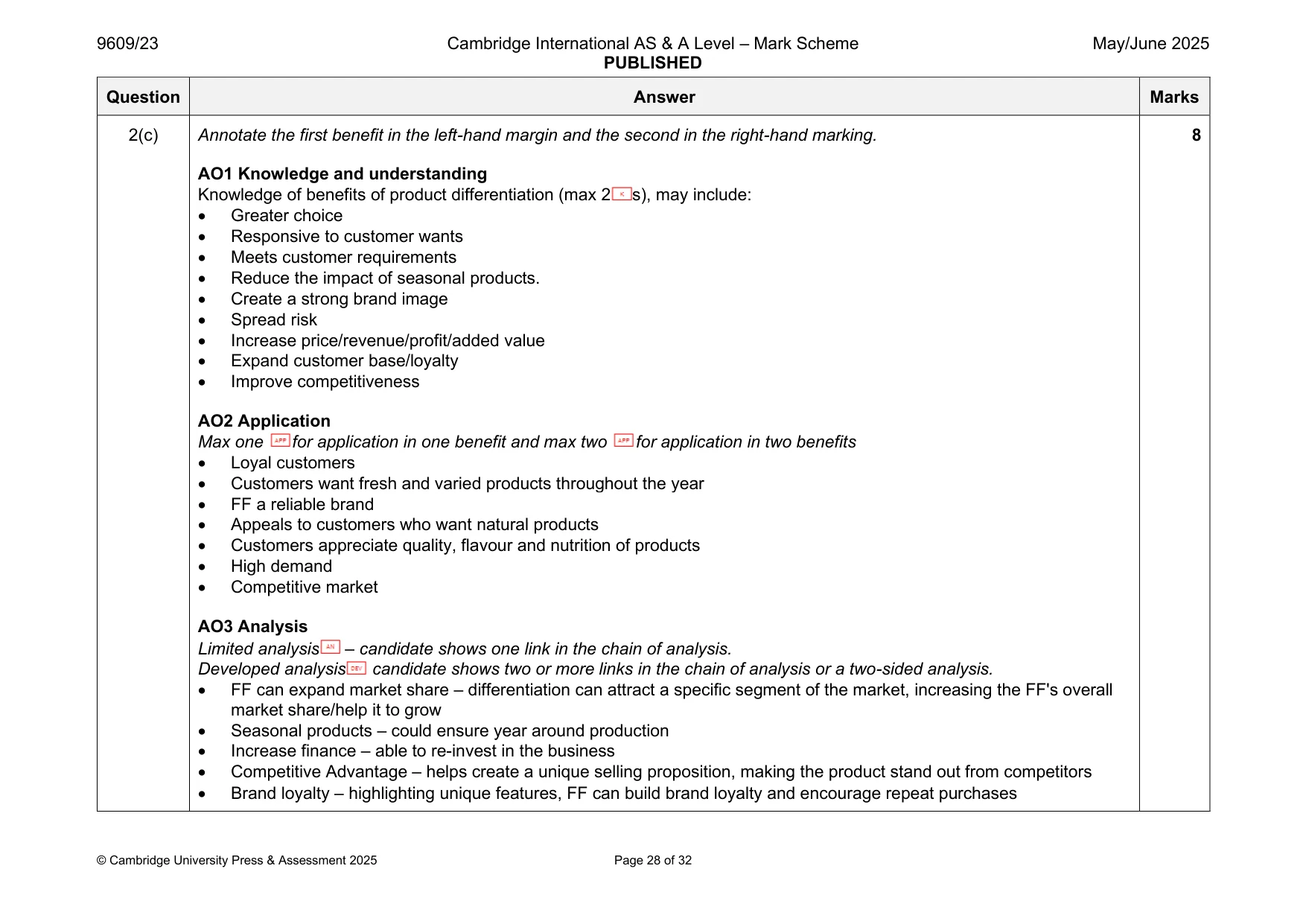
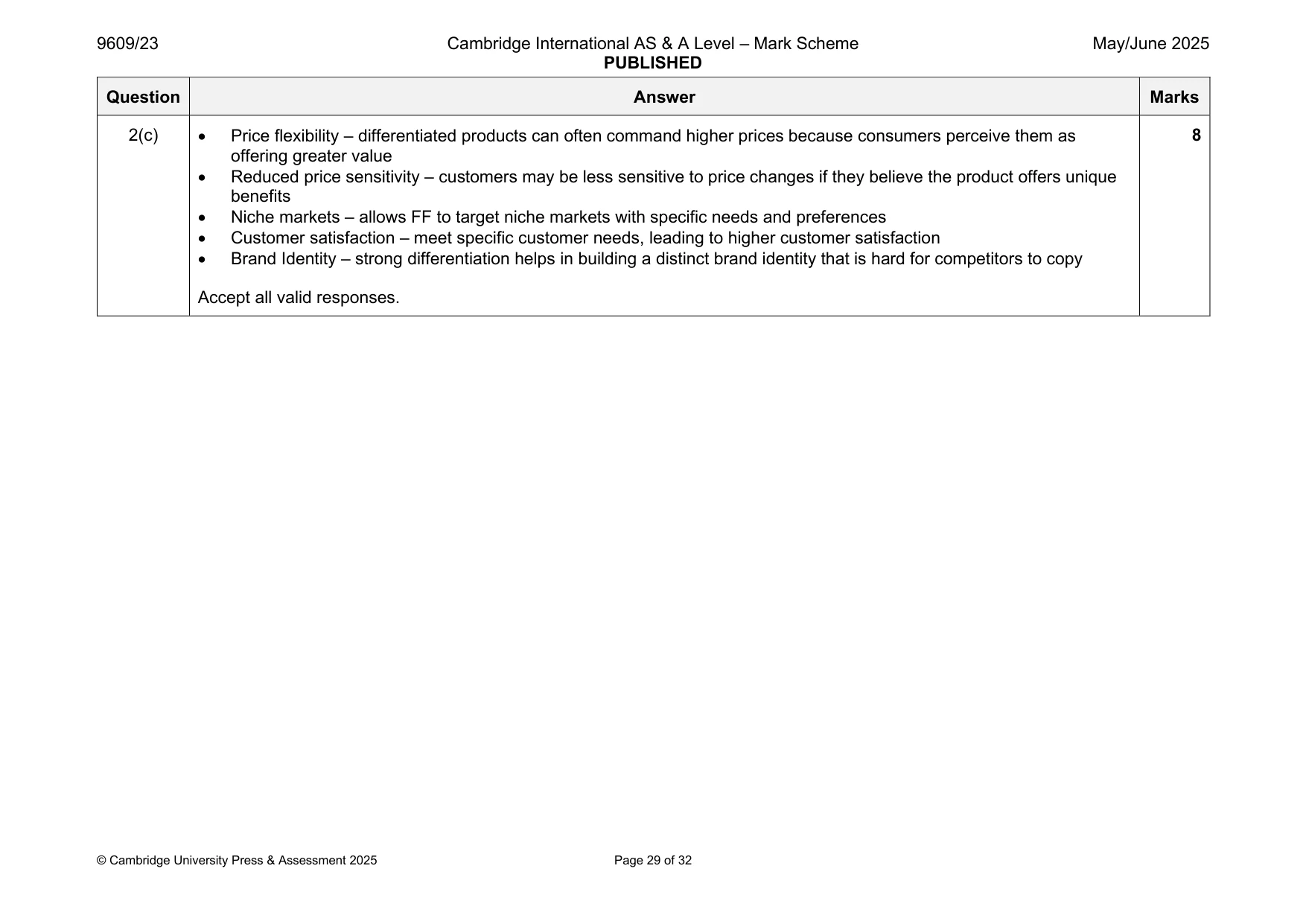
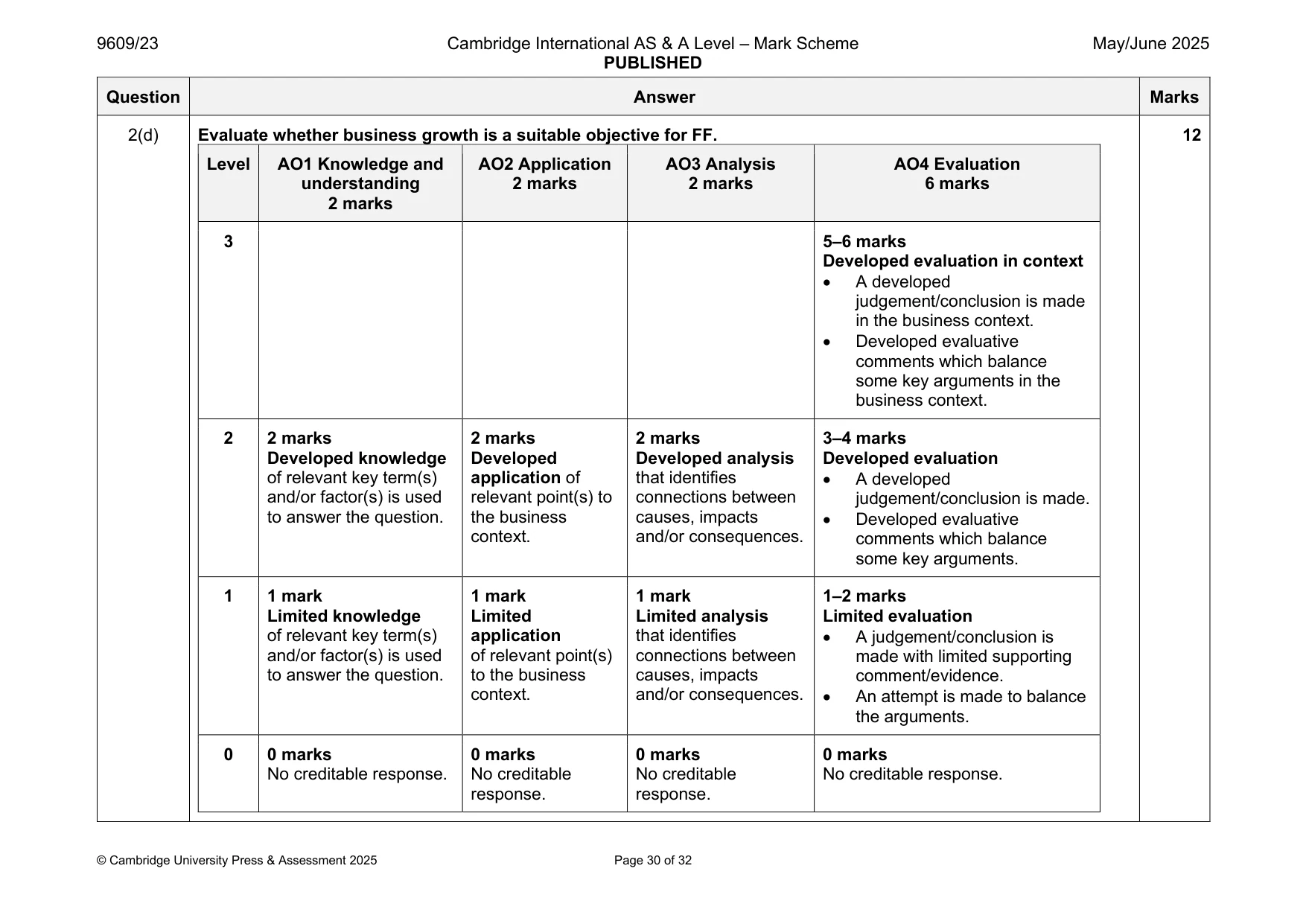
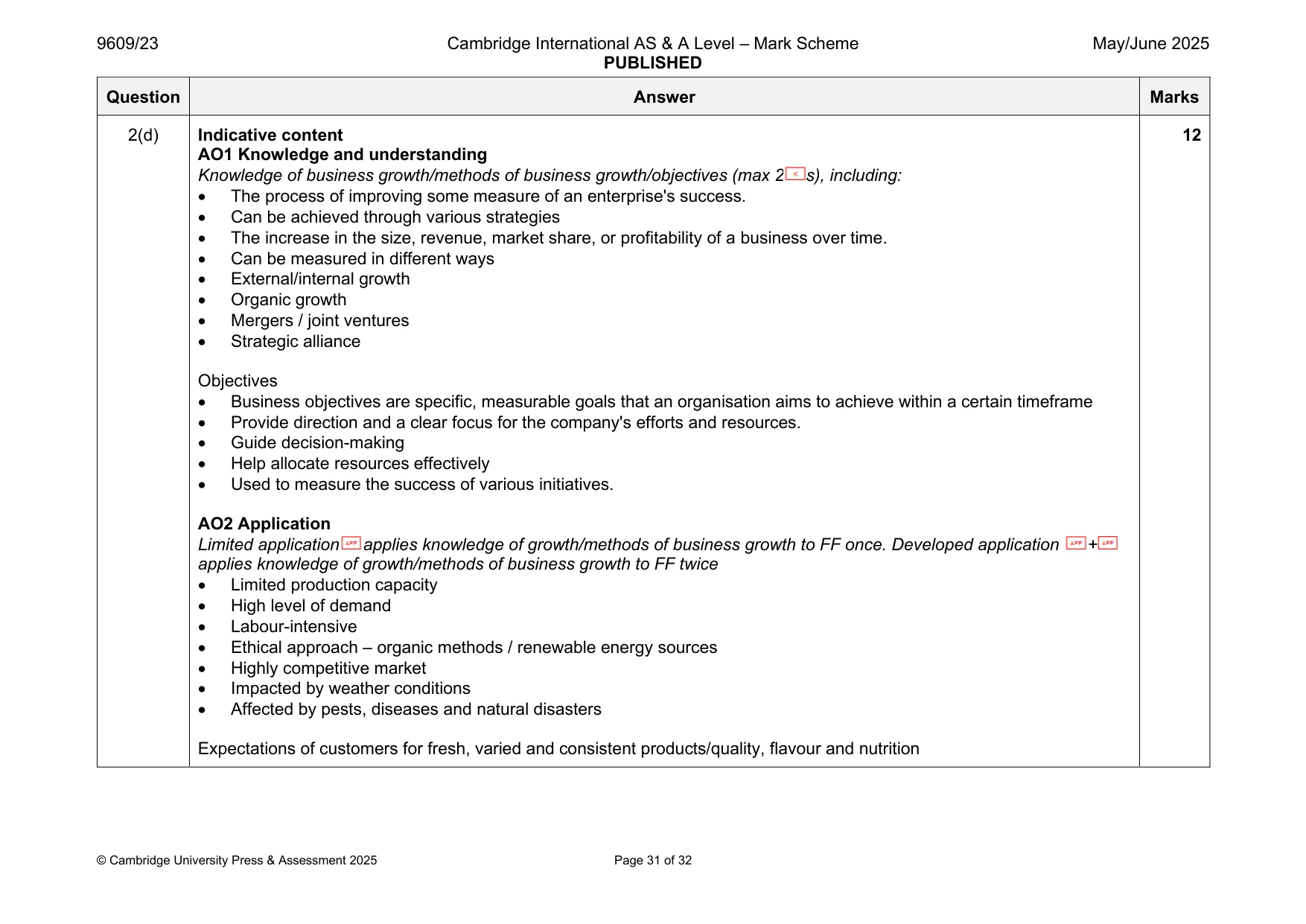
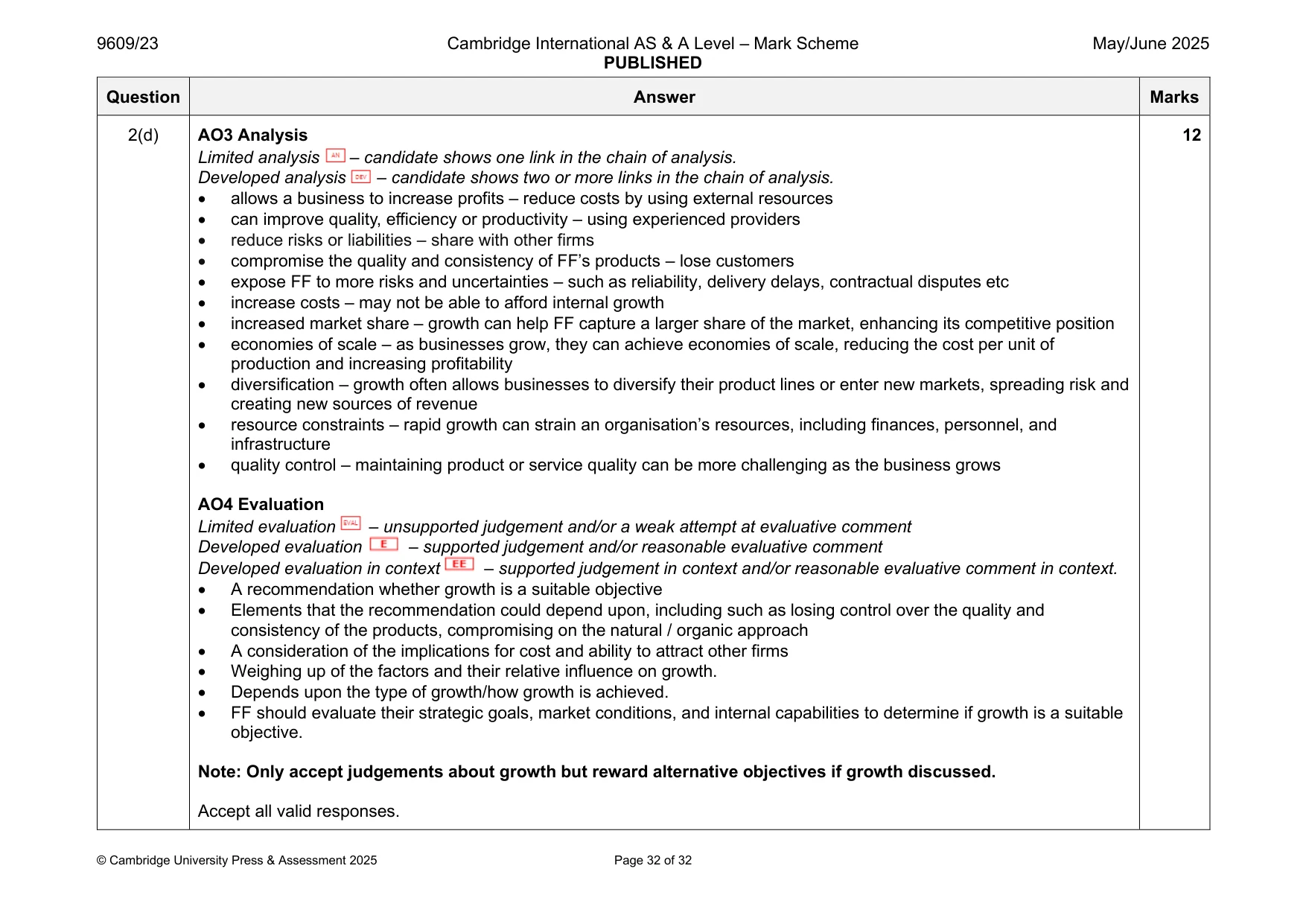
Mark scheme: 2(a)(i) Identify one feature of a partnership. 1 Indicative content Identification of a feature of a partnership may include: • Two or more people join but the exact number can vary depending on the type of partnership and legal regulations • Unlimited liability • Share profits / losses / risks • Must have mutual trust and confidence in each other • Formalised through a legal agreement • Decisions usually made collaboratively / each partner has a say in the business operations 2(a)(ii) Explain the term working capital. 3 AO1 Knowledge and understanding AO2 Application 1 mark 2 marks 2 marks Developed application of one relevant point to a business context. 1 mark 1 mark Knowledge of one relevant point is used to answer the Limited application of one relevant point to a business question. context. 0 marks 0 marks No creditable response. No creditable response. Responses may include: AO1 Knowledge and understanding Knowledge of working capital (max 1 mark), may include: • Financial measure • Difference between current assets and current liabilities • A measure of a company's liquidity and short-term financial health • Day-to-day finance required AO2 Application Explanation of working capital (max 1 mark), including: • ensures firm can meet short-term liabilities • indicates liquidity • assesses how efficiently a company is using its resources to generate revenue • can be used as a source of finance • Context applied to working capital (max 1 mark), including: • companies with positive working capital can invest in growth opportunities and expansion • example/calculation Accept all valid responses. 2(b)(i) Refer to Table 2.1. Calculate FF’s profit in 2024. 3 Indicative content • Formula: price = revenue – (direct costs + fixed costs) (1) • Calculation of total costs $50 000 + $30 000 = $80 000 (1) • Calculation of profit = $120 000 – $80 000 (2) = $40 000 (3) 40 (with working) = 2 Answer = $40 000 (3) 2(b)(ii) Explain one factor influencing the supply of FF’s products. 3 AO1 Knowledge and understanding AO2 Application 1 mark 2 marks 2 marks Developed application of one relevant point to a business context. 1 mark 1 mark Knowledge of one relevant point is used to answer the Limited application of one relevant point to a business question. context. 0 marks 0 marks No creditable response. No creditable response. Responses may include: AO1 Knowledge and understanding Knowledge of a factor influencing supply may include: • Price of the product • Production costs • Technology/capacity • Number of suppliers • Government policies • Season/harvest/weather conditions • Prices of substitutes/complements • Future expectations • Productivity of workers AO2 Application Explanation of a factor influencing supply (max 1 mark), including • Price of the product – When the price of a product increases, producers are generally willing to supply more because they can achieve higher revenue/vice-versa • Production costs – A decrease in production costs (e.g., lower wages, cheaper raw materials) can increase supply as it becomes more profitable to produce/opposite for an increase in costs 2(b)(ii) • Technology/capacity – Improvements in technology can enhance production efficiency, leading to an increase in 3 supply/availability of spare capacity • Number of suppliers – An increase/decrease in the number of suppliers in the market can lead to a higher/lower overall supply • Government policies – effect of subsidies/taxes • Season/harvest/weather conditions – good harvest/weather conditions can increase the supply of agricultural products. Poor harvest/weather conditions can reduce supply • Prices/availability of substitutes/complements – If the price of a substitute good rises, producers might switch to producing that good, reducing the supply of the original product. An increase in the supply of a complementary good can also increase the supply of the original product • Future expectations – If producers expect higher prices in the future, they might reduce current supply to sell more later at higher prices/if lower prices are expected, producers might increase current supply to sell more before prices drop • Productivity of workers – Increased worker productivity can lead to higher supply as more goods are produced in the same amount of time/decreased productivity can reduce supply Context applied to FF’s supply of products (max 1 mark) including: • Low level of supply • Can only grow a limited number of crops • Seasonal produce • Yield and quality affected by weather conditions • Labour intensive • Competitive market • Customers require fresh, varied and consistent products Accept all valid responses. 2(c) Analyse two benefits to FF of product differentiation. 8 Level AO1 Knowledge and AO2 Application AO3 Analysis understanding 2 marks 4 marks 2 marks 2 3–4 marks Developed analysis • Developed analysis that identifies connections between causes, impacts and/or consequences of two points. • Developed analysis that identifies connections between causes, impacts and/or consequences of one point. 1 1–2 marks 1–2 marks 1–2 marks • Knowledge of two • Application of two relevant Limited analysis relevant points is used points to a business • Limited analysis that identifies to answer the question. context. connections between causes, impacts • Knowledge of one • Application of one relevant and/or consequences of two points. relevant point is used to point to a business • Limited analysis that identifies answer the question. context. connections between causes, impacts and/or consequences of one point. 0 0 marks 0 marks 0 marks No creditable response. No creditable response. No creditable response. 2(c) Annotate the first benefit in the left-hand margin and the second in the right-hand marking. 8 AO1 Knowledge and understanding Knowledge of benefits of product differentiation (max 2 s), may include: • Greater choice • Responsive to customer wants • Meets customer requirements • Reduce the impact of seasonal products. • Create a strong brand image • Spread risk • Increase price/revenue/profit/added value • Expand customer base/loyalty • Improve competitiveness AO2 Application Max one for application in one benefit and max two for application in two benefits • Loyal customers • Customers want fresh and varied products throughout the year • FF a reliable brand • Appeals to customers who want natural products • Customers appreciate quality, flavour and nutrition of products • High demand • Competitive market AO3 Analysis Limited analysis – candidate shows one link in the chain of analysis. Developed analysis candidate shows two or more links in the chain of analysis or a two-sided analysis. • FF can expand market share – differentiation can attract a specific segment of the market, increasing the FF's overall market share/help it to grow • Seasonal products – could ensure year around production • Increase finance – able to re-invest in the business • Competitive Advantage – helps create a unique selling proposition, making the product stand out from competitors • Brand loyalty – highlighting unique features, FF can build brand loyalty and encourage repeat purchases 2(c) • Price flexibility – differentiated products can often command higher prices because consumers perceive them as 8 offering greater value • Reduced price sensitivity – customers may be less sensitive to price changes if they believe the product offers unique benefits • Niche markets – allows FF to target niche markets with specific needs and preferences • Customer satisfaction – meet specific customer needs, leading to higher customer satisfaction • Brand Identity – strong differentiation helps in building a distinct brand identity that is hard for competitors to copy Accept all valid responses. 2(d) Evaluate whether business growth is a suitable objective for FF. 12 Level AO1 Knowledge and AO2 Application AO3 Analysis AO4 Evaluation understanding 2 marks 2 marks 6 marks 2 marks 3 5–6 marks Developed evaluation in context • A developed judgement/conclusion is made in the business context. • Developed evaluative comments which balance some key arguments in the business context. 2 2 marks 2 marks 2 marks 3–4 marks Developed knowledge Developed Developed analysis Developed evaluation of relevant key term(s) application of that identifies • A developed and/or factor(s) is used relevant point(s) to connections between judgement/conclusion is made. to answer the question. the business causes, impacts • Developed evaluative context. and/or consequences. comments which balance some key arguments. 1 1 mark 1 mark 1 mark 1–2 marks Limited knowledge Limited Limited analysis Limited evaluation of relevant key term(s) application that identifies • A judgement/conclusion is and/or factor(s) is used of relevant point(s) connections between made with limited supporting to answer the question. to the business causes, impacts comment/evidence. context. and/or consequences. • An attempt is made to balance the arguments. 0 0 marks 0 marks 0 marks 0 marks No creditable response. No creditable No creditable No creditable response. response. response. 2(d) Indicative content 12 AO1 Knowledge and understanding Knowledge of business growth/methods of business growth/objectives (max 2 s), including: • The process of improving some measure of an enterprise's success. • Can be achieved through various strategies • The increase in the size, revenue, market share, or profitability of a business over time. • Can be measured in different ways • External/internal growth • Organic growth • Mergers / joint ventures • Strategic alliance Objectives • Business objectives are specific, measurable goals that an organisation aims to achieve within a certain timeframe • Provide direction and a clear focus for the company's efforts and resources. • Guide decision-making • Help allocate resources effectively • Used to measure the success of various initiatives. AO2 Application Limited application applies knowledge of growth/methods of business growth to FF once. Developed application + applies knowledge of growth/methods of business growth to FF twice • Limited production capacity • High level of demand • Labour-intensive • Ethical approach – organic methods / renewable energy sources • Highly competitive market • Impacted by weather conditions • Affected by pests, diseases and natural disasters Expectations of customers for fresh, varied and consistent products/quality, flavour and nutrition 2(d) AO3 Analysis 12 Limited analysis – candidate shows one link in the chain of analysis. Developed analysis – candidate shows two or more links in the chain of analysis. • allows a business to increase profits – reduce costs by using external resources • can improve quality, efficiency or productivity – using experienced providers • reduce risks or liabilities – share with other firms • compromise the quality and consistency of FF’s products – lose customers • expose FF to more risks and uncertainties – such as reliability, delivery delays, contractual disputes etc • increase costs – may not be able to afford internal growth • increased market share – growth can help FF capture a larger share of the market, enhancing its competitive position • economies of scale – as businesses grow, they can achieve economies of scale, reducing the cost per unit of production and increasing profitability • diversification – growth often allows businesses to diversify their product lines or enter new markets, spreading risk and creating new sources of revenue • resource constraints – rapid growth can strain an organisation’s resources, including finances, personnel, and infrastructure • quality control – maintaining product or service quality can be more challenging as the business grows AO4 Evaluation Limited evaluation – unsupported judgement and/or a weak attempt at evaluative comment Developed evaluation – supported judgement and/or reasonable evaluative comment Developed evaluation in context – supported judgement in context and/or reasonable evaluative comment in context. • A recommendation whether growth is a suitable objective • Elements that the recommendation could depend upon, including such as losing control over the quality and consistency of the products, compromising on the natural / organic approach • A consideration of the implications for cost and ability to attract other firms • Weighing up of the factors and their relative influence on growth. • Depends upon the type of growth/how growth is achieved. • FF should evaluate their strategic goals, market conditions, and internal capabilities to determine if growth is a suitable objective. Note: Only accept judgements about growth but reward alternative objectives if growth discussed. Accept all valid responses.
What was in this paper
The subtopics covered by these 2 questions, and how many questions each got. Open one in a new tab to see every Cambridge question on it.
What you needed in this session
Cambridge’s own grade thresholds for 2025 May/June, Paper 2 · Variant 3. A higher threshold means an easier paper — the bar moves with how the cohort did.