Cambridge A Level Business (for first examination in 2016) 9609 — 2022 May/June Paper 2 · Variant 3
9609/23/M/J/22 · 2 questions · 60 marks · ≈68 min
The question paper and its mark scheme, free to read here and free to download. This is Cambridge’s own paper, exactly as it was sat.
Question paper4 pages
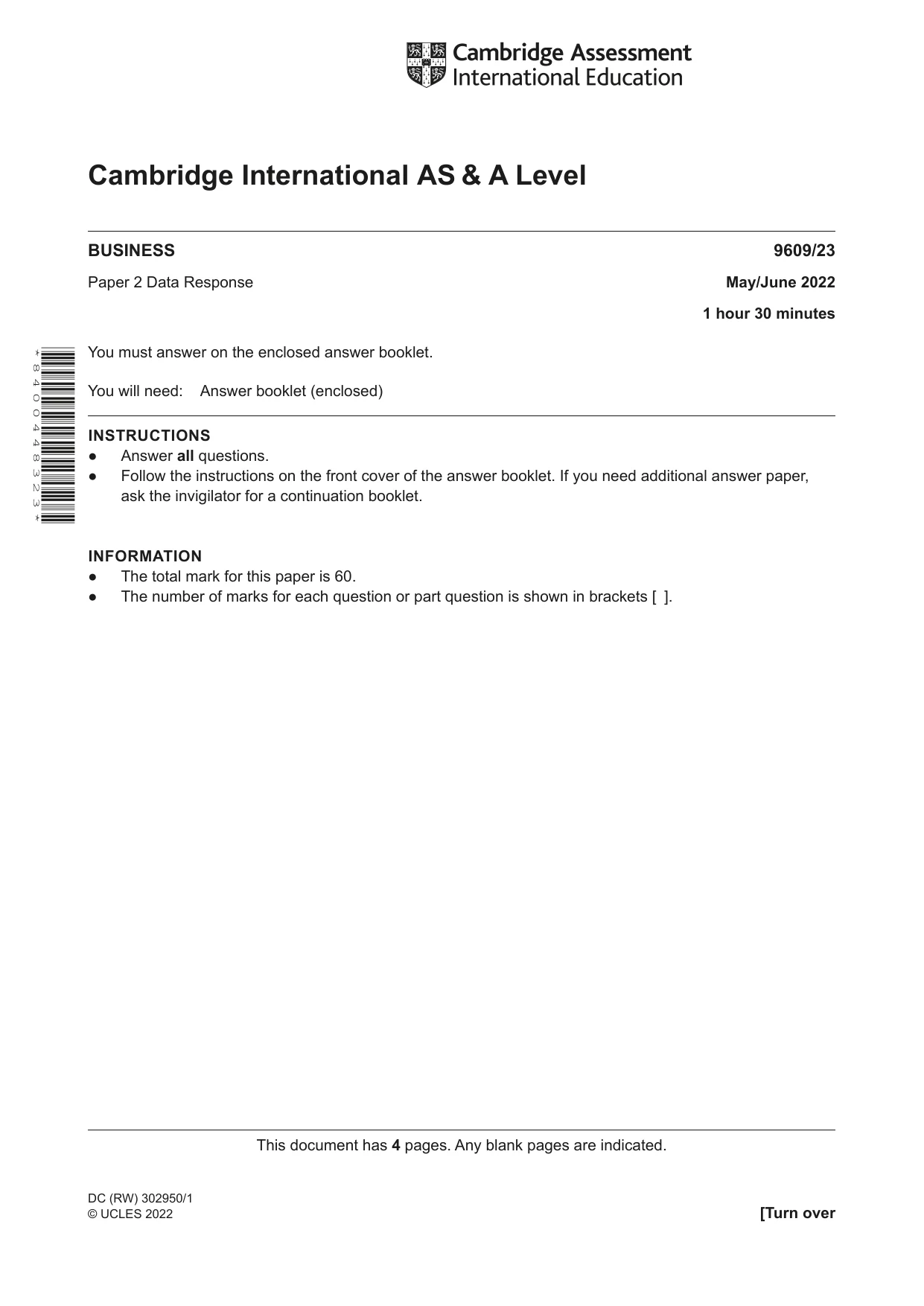

Mark scheme17 pages
Answers below. Sit the paper first if you are practising.


Questions as text
Q1 · Child Play (CP) Su is a sole trader who started a business called CP which operates a…
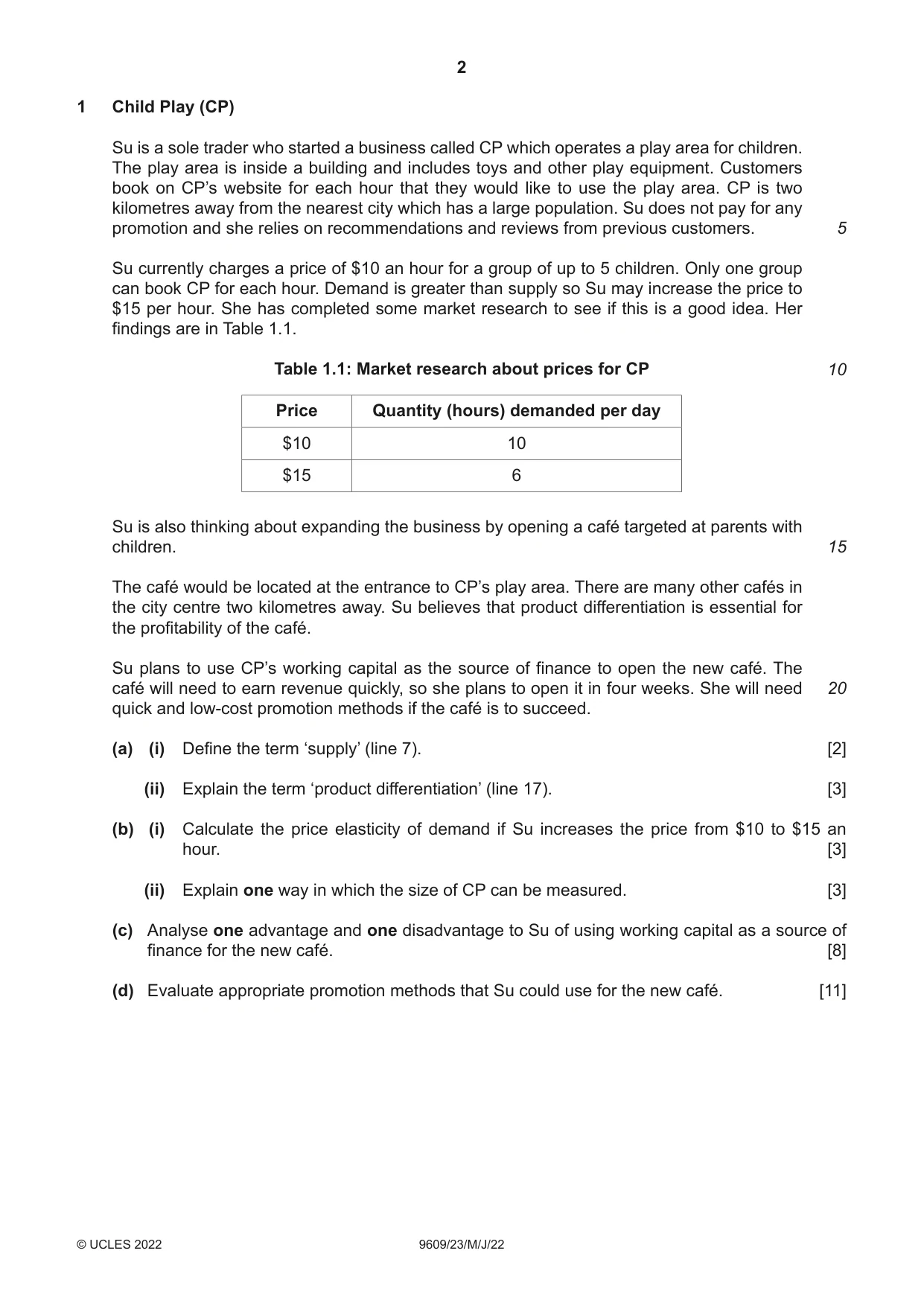
1 Child Play (CP) Su is a sole trader who started a business called CP which operates a play area for children. The play area is inside a building and includes toys and other play equipment. Customers book on CP’s website for each hour that they would like to use the play area. CP is two kilometres away from the nearest city which has a large population. Su does not pay for any promotion and she relies on recommendations and reviews from previous customers. 5 Su currently charges a price of $10 an hour for a group of up to 5 children. Only one group can book CP for each hour. Demand is greater than supply so Su may increase the price to $15 per hour. She has completed some market research to see if this is a good idea. Her findings are in Table 1.1. Table 1.1: Market research about prices for CP 10 Price Quantity (hours) demanded per day $10 10 $15 6 Su is also thinking about expanding the business by opening a café targeted at parents with children. 15 The café would be located at the entrance to CP’s play area. There are many other cafés in the city centre two kilometres away. Su believes that product differentiation is essential for the profitability of the café. Su plans to use CP’s working capital as the source of finance to open the new café. The café will need to earn revenue quickly, so she plans to open it in four weeks. She will need 20 quick and low‑cost promotion methods if the café is to succeed. (a) (i) Define the term ‘supply’ (line 7). [2] (ii) Explain the term ‘product differentiation’ (line 17). [3] (b) (i) Calculate the price elasticity of demand if Su increases the price from $10 to $15 an hour. [3] (ii) Explain one way in which the size of CP can be measured. [3] (c) Analyse one advantage and one disadvantage to Su of using working capital as a source of finance for the new café. [8] (d) Evaluate appropriate promotion methods that Su could use for the new café. [11]
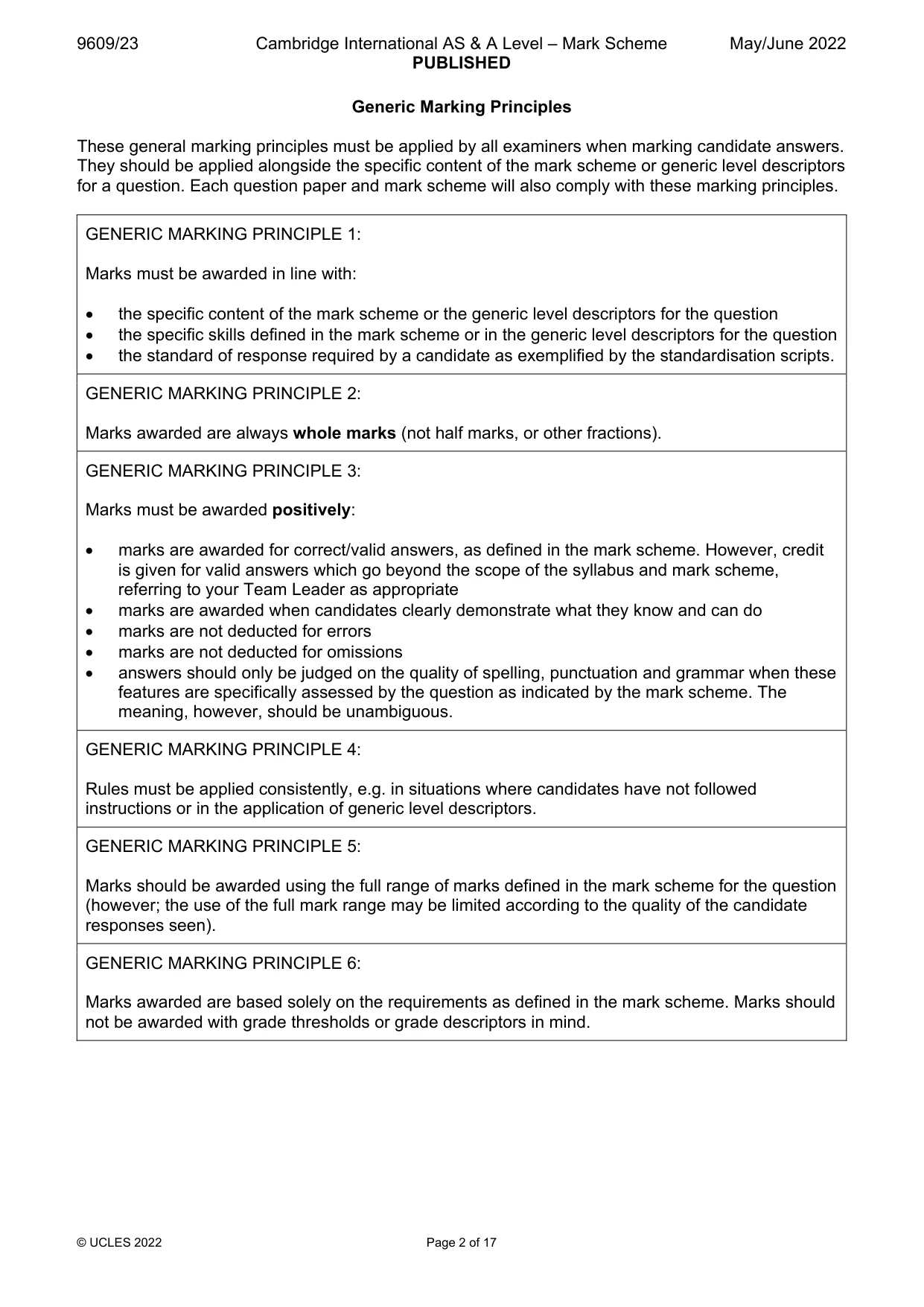
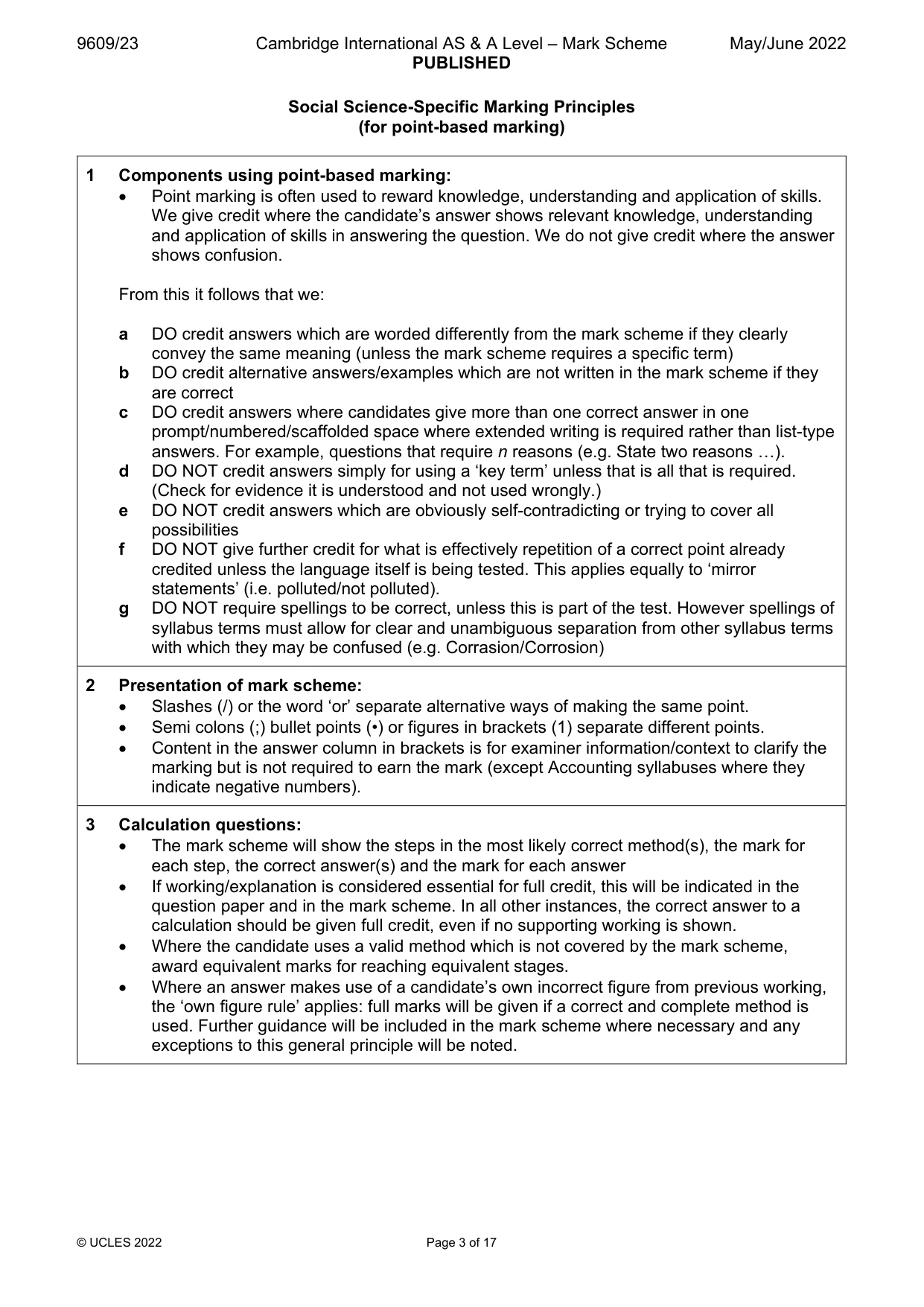
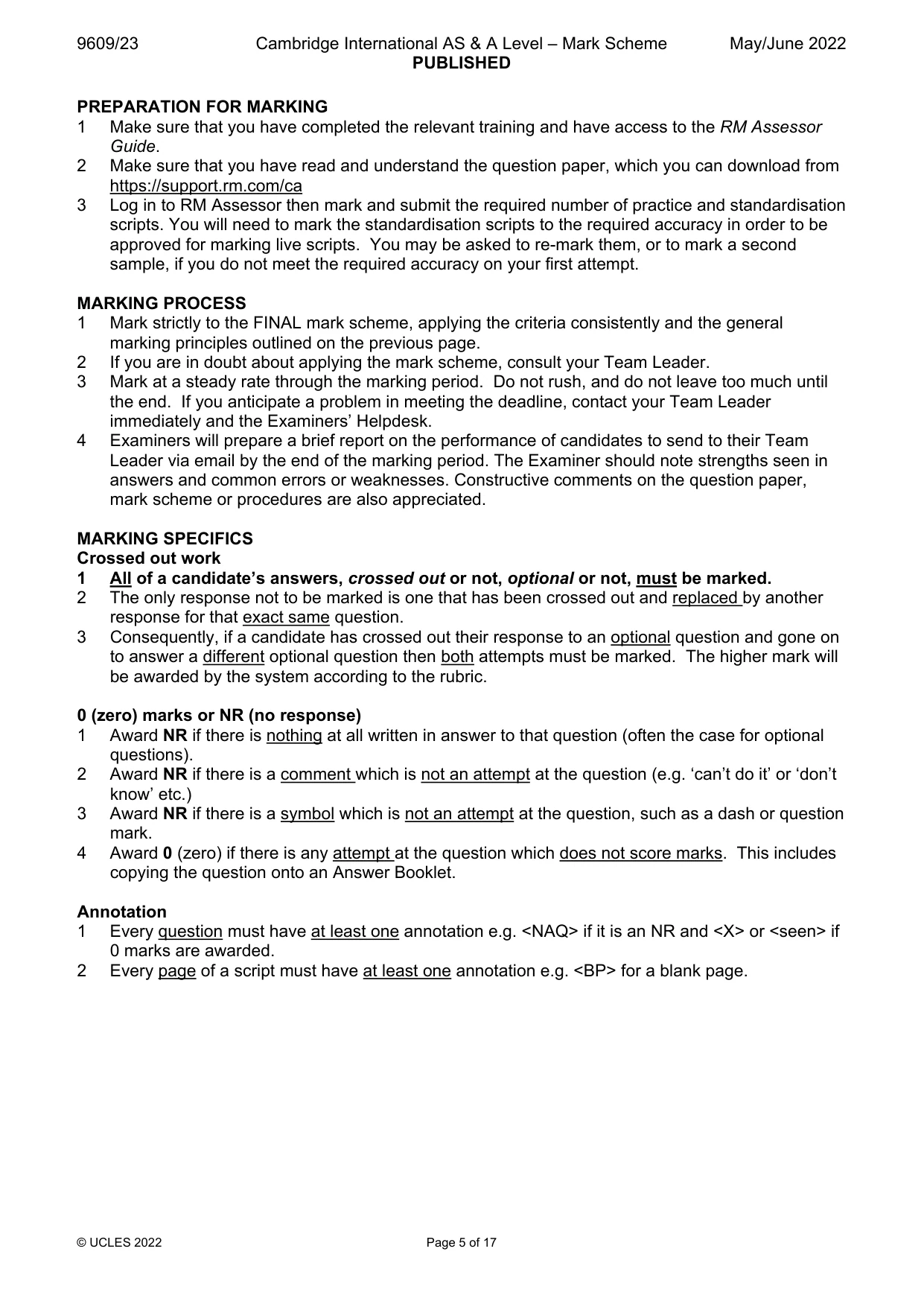
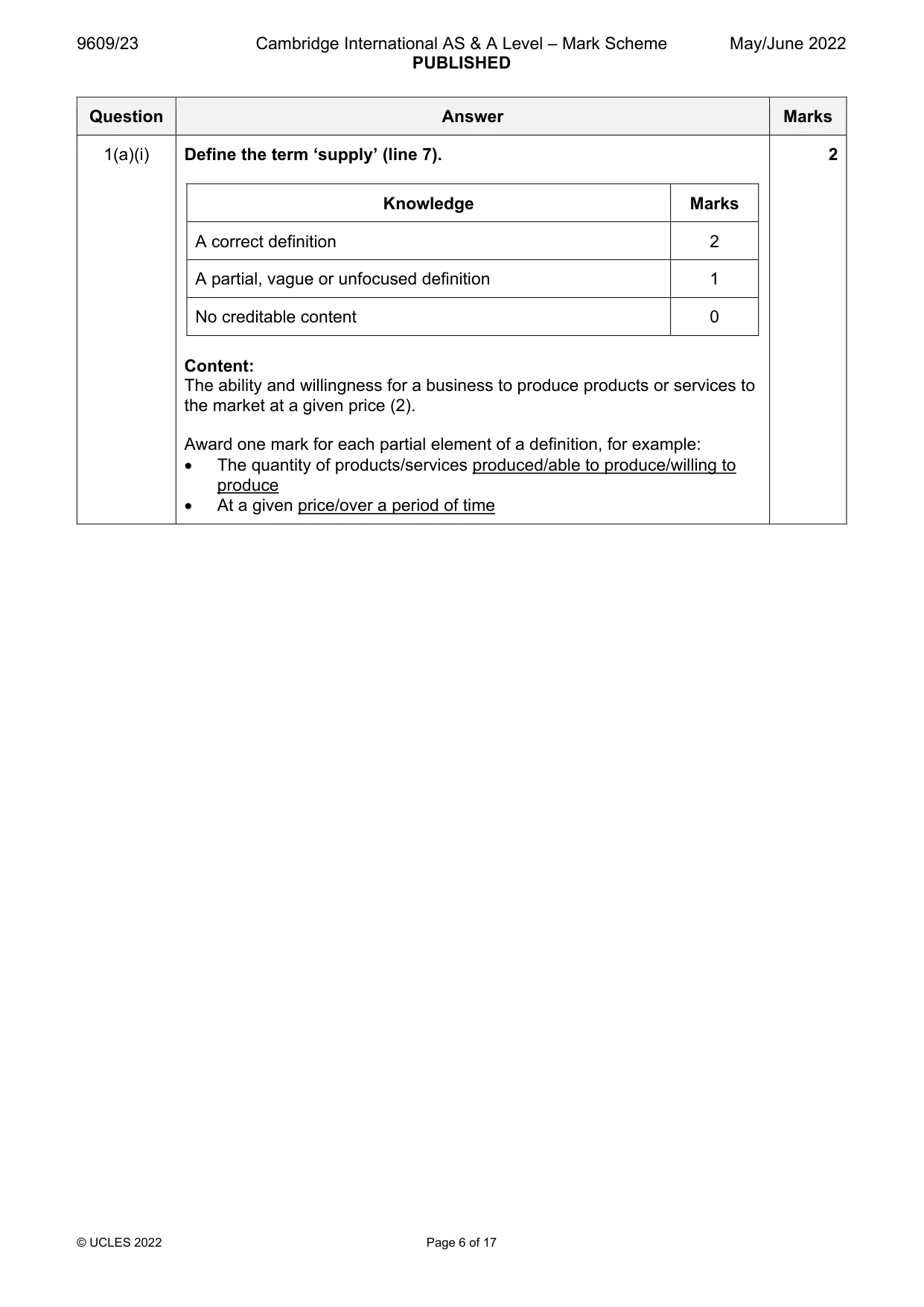
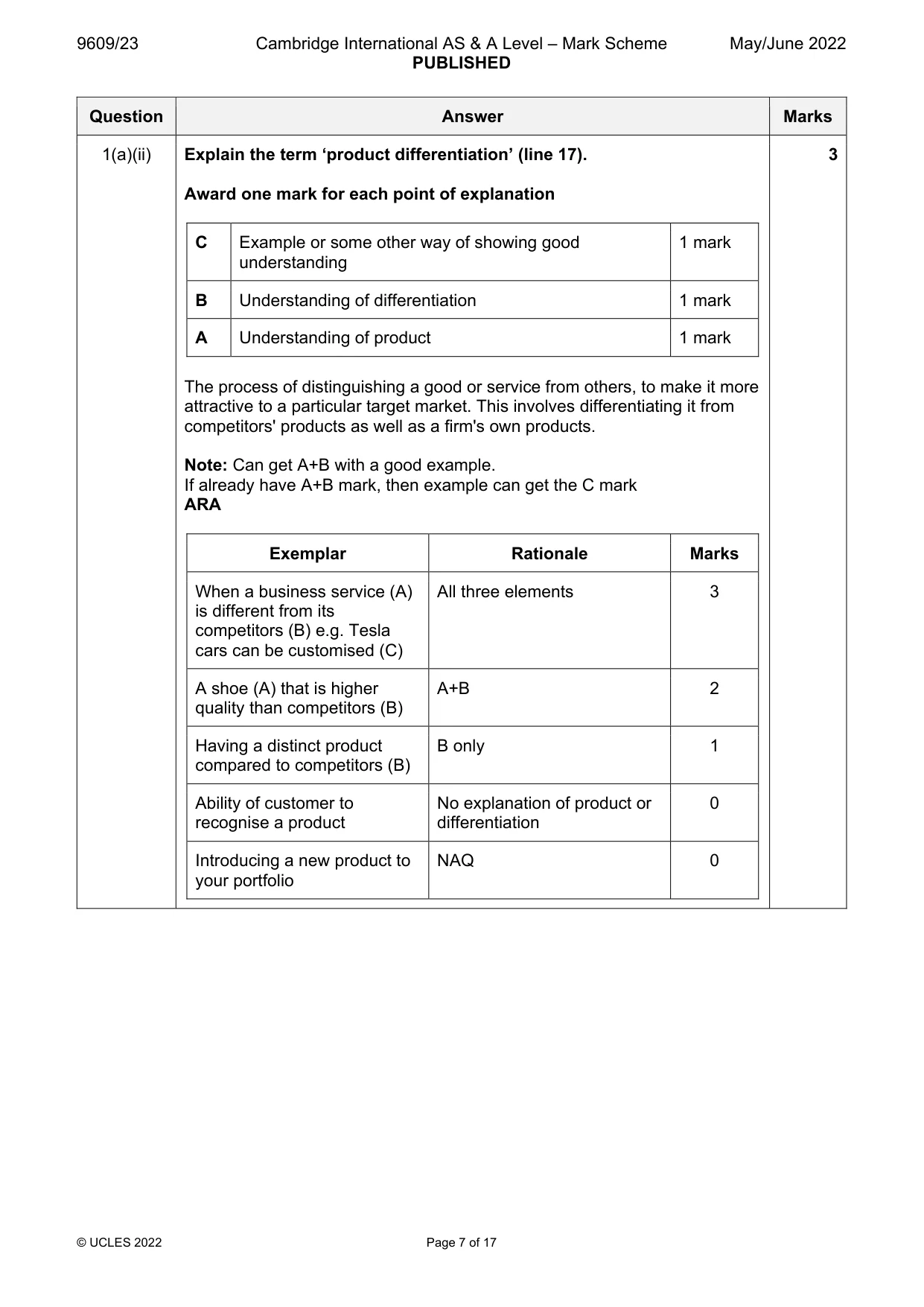
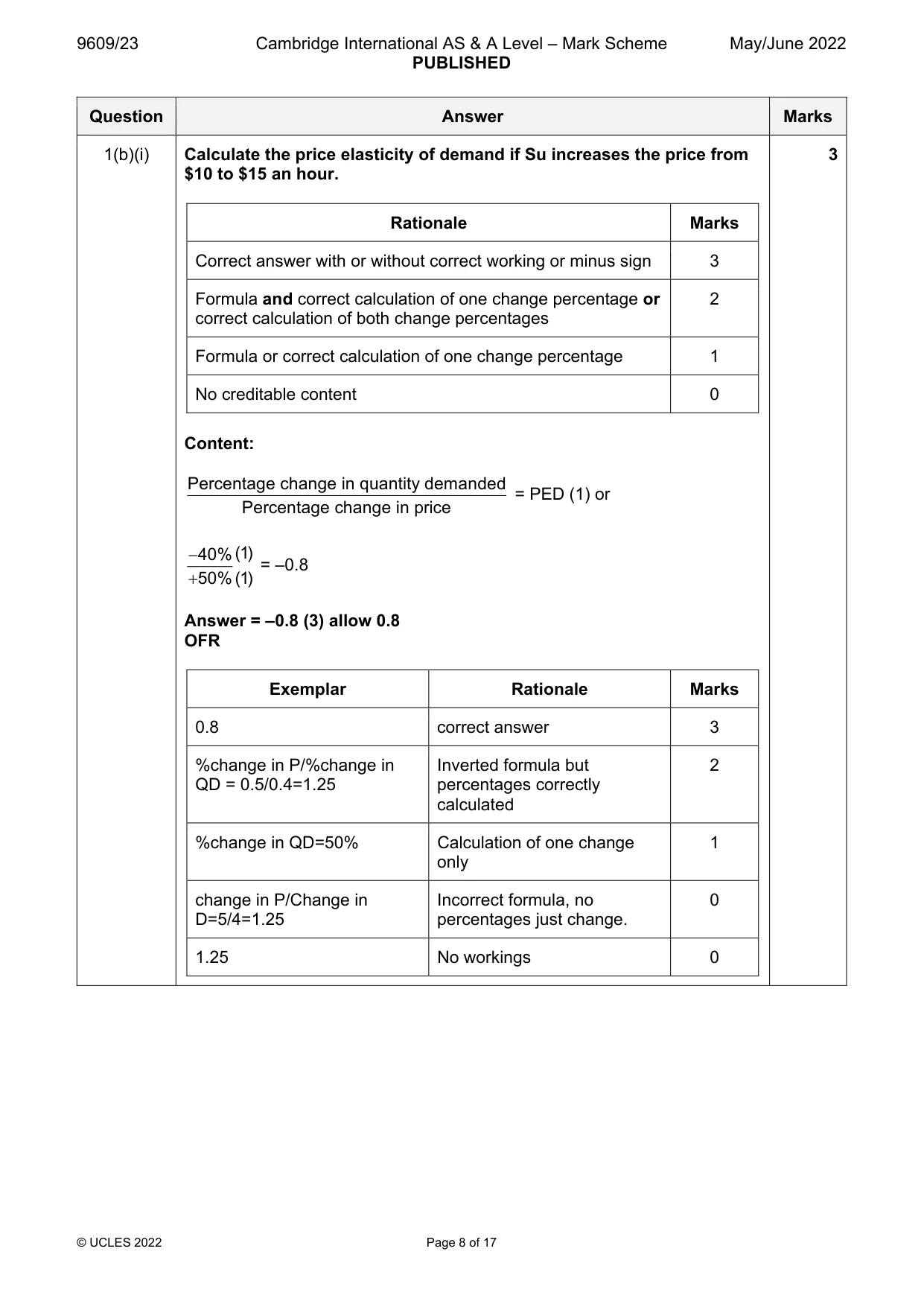
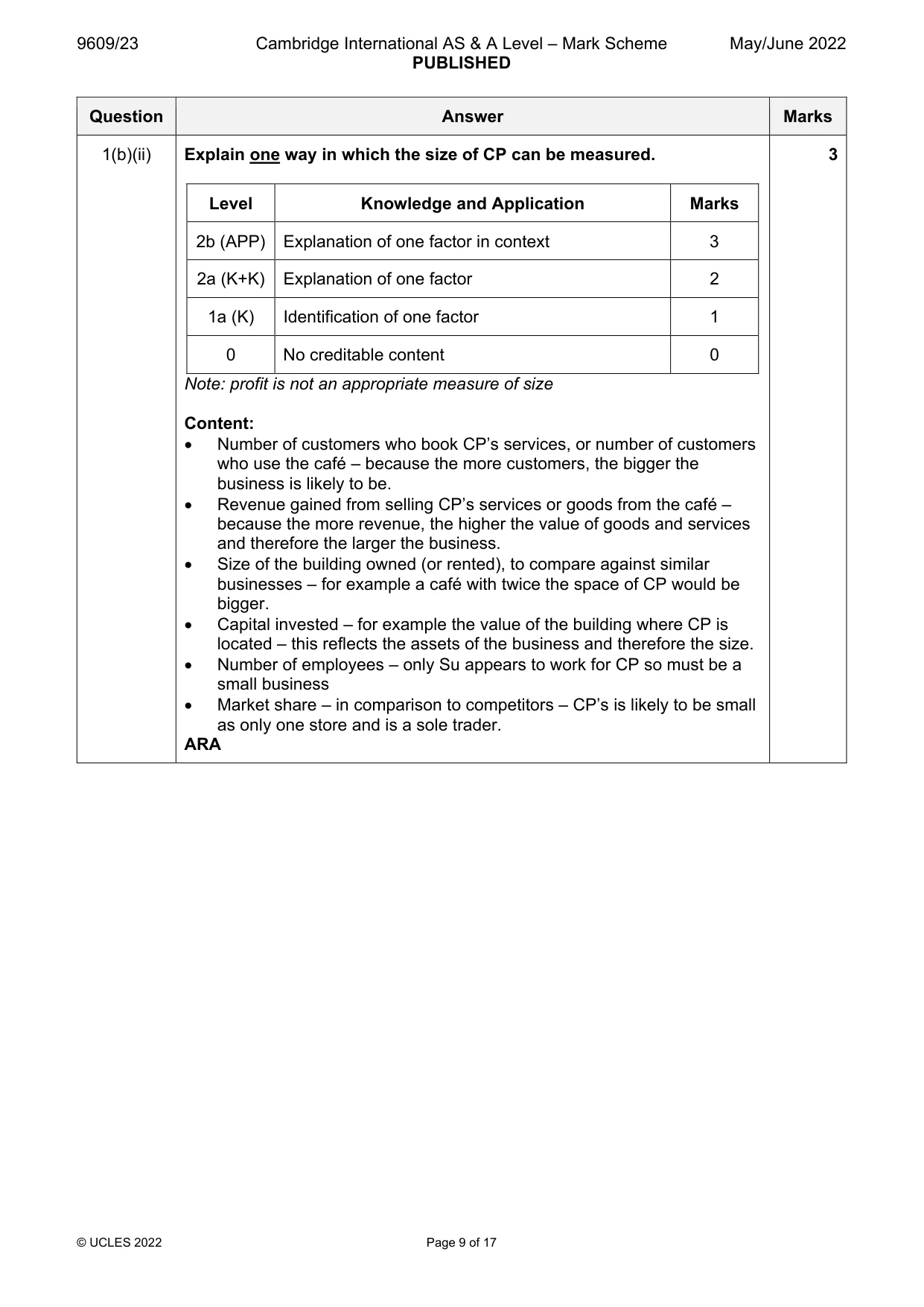
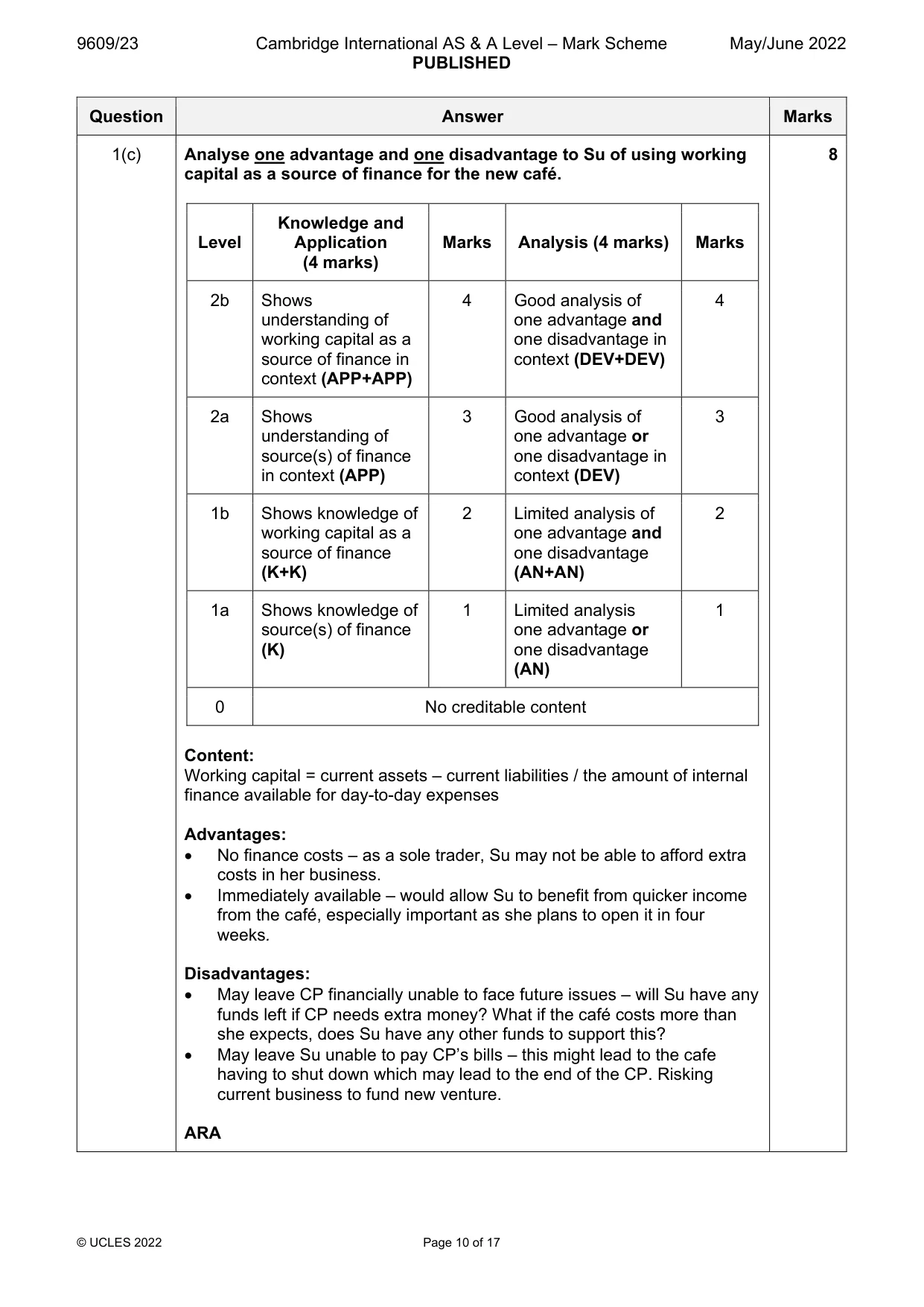
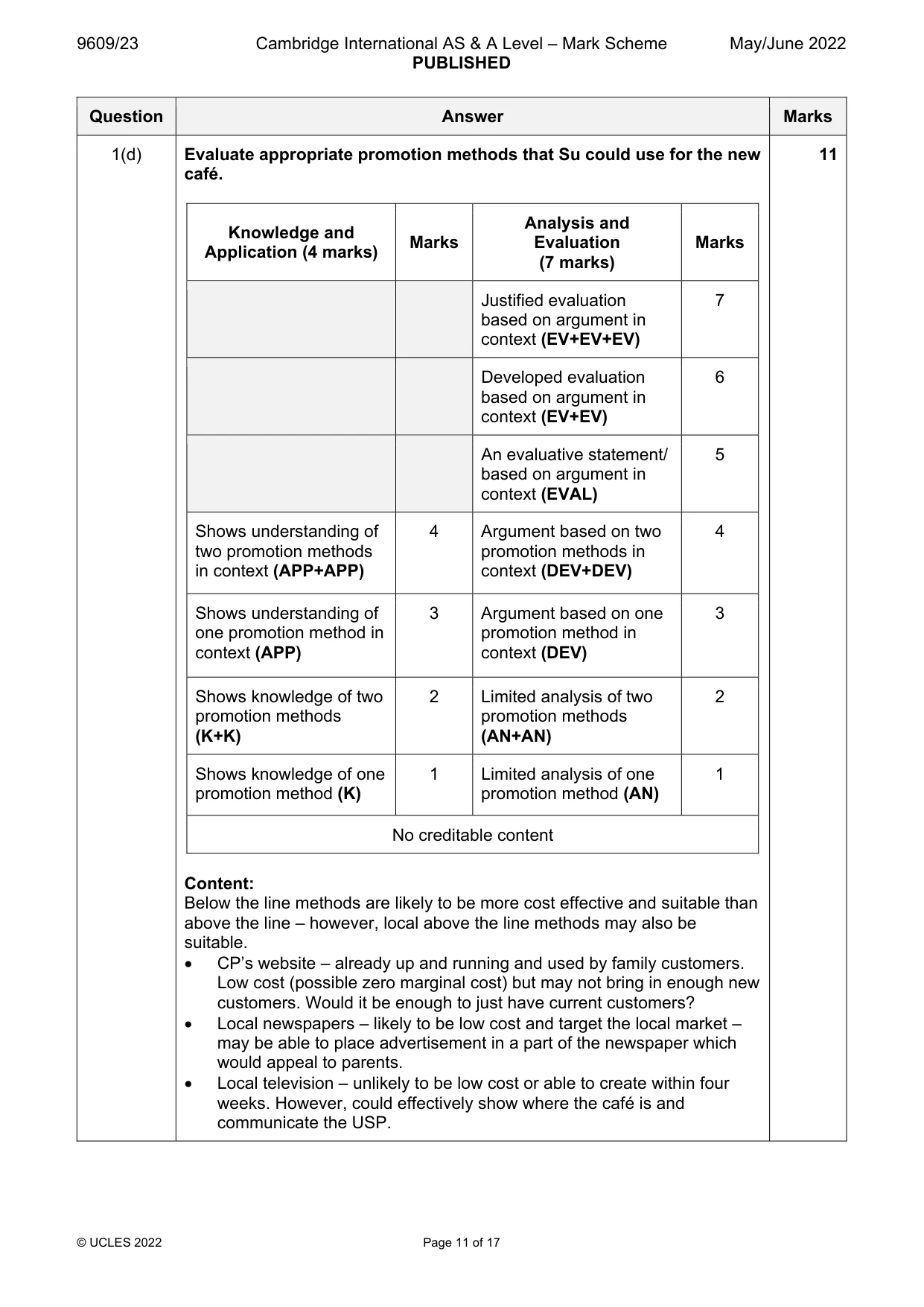
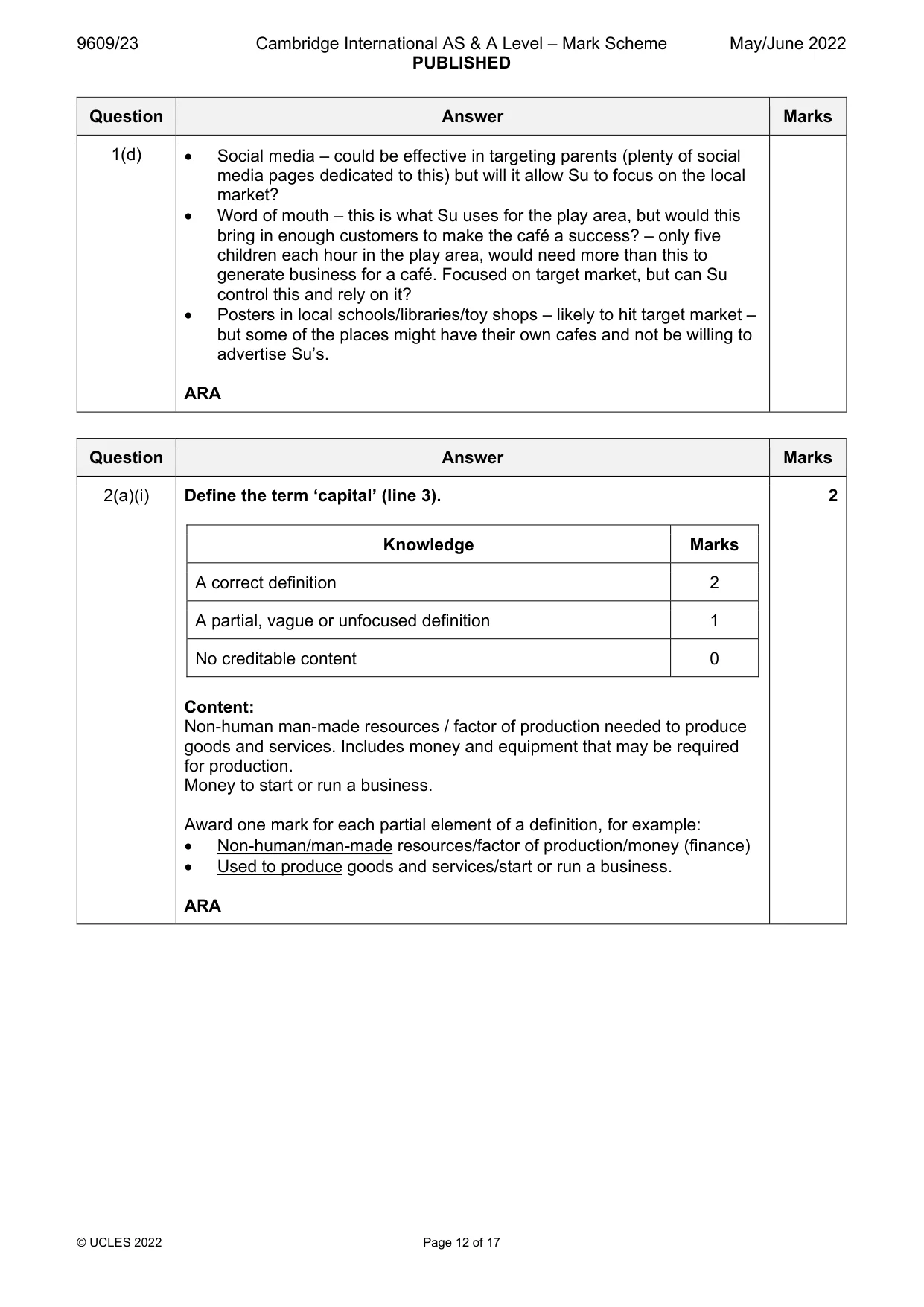
Mark scheme: Question Answer Marks 1(a)(i) Define the term ‘supply’ (line 7). 2 Knowledge Marks A correct definition 2 A partial, vague or unfocused definition 1 No creditable content 0 Content: The ability and willingness for a business to produce products or services to the market at a given price (2). Award one mark for each partial element of a definition, for example: The quantity of products/services produced/able to produce/willing to produce At a given price/over a period of time 1(a)(ii) Explain the term ‘product differentiation’ (line 17). 3 Award one mark for each point of explanation C Example or some other way of showing good 1 mark understanding B Understanding of differentiation 1 mark A Understanding of product 1 mark The process of distinguishing a good or service from others, to make it more attractive to a particular target market. This involves differentiating it from competitors' products as well as a firm's own products. Note: Can get A+B with a good example. If already have A+B mark, then example can get the C mark ARA Exemplar Rationale Marks When a business service (A) All three elements 3 is different from its competitors (B) e.g. Tesla cars can be customised (C) A shoe (A) that is higher A+B 2 quality than competitors (B) Having a distinct product B only 1 compared to competitors (B) Ability of customer to No explanation of product or 0 recognise a product differentiation Introducing a new product to NAQ 0 your portfolio 1(b)(i) Calculate the price elasticity of demand if Su increases the price from 3 $10 to $15 an hour. Rationale Marks Correct answer with or without correct working or minus sign 3 Formula and correct calculation of one change percentage or 2 correct calculation of both change percentages Formula or correct calculation of one change percentage 1 No creditable content 0 Content: Percentage change in quantity demanded = PED (1) or Percentage change in price 40% (1) = –0.8 50% (1) Answer = –0.8 (3) allow 0.8 OFR Exemplar Rationale Marks 0.8 correct answer 3 %change in P/%change in Inverted formula but 2 QD = 0.5/0.4=1.25 percentages correctly calculated %change in QD=50% Calculation of one change 1 only change in P/Change in Incorrect formula, no 0 D=5/4=1.25 percentages just change. 1.25 No workings 0 1(b)(ii) Explain one way in which the size of CP can be measured. 3 Level Knowledge and Application Marks 2b (APP) Explanation of one factor in context 3 2a (K+K) Explanation of one factor 2 1a (K) Identification of one factor 1 0 No creditable content 0 Note: profit is not an appropriate measure of size Content: Number of customers who book CP’s services, or number of customers who use the café – because the more customers, the bigger the business is likely to be. Revenue gained from selling CP’s services or goods from the café – because the more revenue, the higher the value of goods and services and therefore the larger the business. Size of the building owned (or rented), to compare against similar businesses – for example a café with twice the space of CP would be bigger. Capital invested – for example the value of the building where CP is located – this reflects the assets of the business and therefore the size. Number of employees – only Su appears to work for CP so must be a small business Market share – in comparison to competitors – CP’s is likely to be small as only one store and is a sole trader. ARA 1(c) Analyse one advantage and one disadvantage to Su of using working 8 capital as a source of finance for the new café. Knowledge and Level Application Marks Analysis (4 marks) Marks (4 marks) 2b Shows 4 Good analysis of 4 understanding of one advantage and working capital as a one disadvantage in source of finance in context (DEV+DEV) context (APP+APP) 2a Shows 3 Good analysis of 3 understanding of one advantage or source(s) of finance one disadvantage in in context (APP) context (DEV) 1b Shows knowledge of 2 Limited analysis of 2 working capital as a one advantage and source of finance one disadvantage (K+K) (AN+AN) 1a Shows knowledge of 1 Limited analysis 1 source(s) of finance one advantage or (K) one disadvantage (AN) 0 No creditable content Content: Working capital = current assets – current liabilities / the amount of internal finance available for day-to-day expenses Advantages: No finance costs – as a sole trader, Su may not be able to afford extra costs in her business. Immediately available – would allow Su to benefit from quicker income from the café, especially important as she plans to open it in four weeks. Disadvantages: May leave CP financially unable to face future issues – will Su have any funds left if CP needs extra money? What if the café costs more than she expects, does Su have any other funds to support this? May leave Su unable to pay CP’s bills – this might lead to the cafe having to shut down which may lead to the end of the CP. Risking current business to fund new venture. ARA 1(d) Evaluate appropriate promotion methods that Su could use for the new 11 café. Analysis and Knowledge and Marks Evaluation Marks Application (4 marks) (7 marks) Justified evaluation 7 based on argument in context (EV+EV+EV) Developed evaluation 6 based on argument in context (EV+EV) An evaluative statement/ 5 based on argument in context (EVAL) Shows understanding of 4 Argument based on two 4 two promotion methods promotion methods in in context (APP+APP) context (DEV+DEV) Shows understanding of 3 Argument based on one 3 one promotion method in promotion method in context (APP) context (DEV) Shows knowledge of two 2 Limited analysis of two 2 promotion methods promotion methods (K+K) (AN+AN) Shows knowledge of one 1 Limited analysis of one 1 promotion method (K) promotion method (AN) No creditable content Content: Below the line methods are likely to be more cost effective and suitable than above the line – however, local above the line methods may also be suitable. CP’s website – already up and running and used by family customers. Low cost (possible zero marginal cost) but may not bring in enough new customers. Would it be enough to just have current customers? Local newspapers – likely to be low cost and target the local market – may be able to place advertisement in a part of the newspaper which would appeal to parents. Local television – unlikely to be low cost or able to create within four weeks. However, could effectively show where the café is and communicate the USP. 1(d) Social media – could be effective in targeting parents (plenty of social media pages dedicated to this) but will it allow Su to focus on the local market? Word of mouth – this is what Su uses for the play area, but would this bring in enough customers to make the café a success? – only five children each hour in the play area, would need more than this to generate business for a café. Focused on target market, but can Su control this and rely on it? Posters in local schools/libraries/toy shops – likely to hit target market – but some of the places might have their own cafes and not be willing to advertise Su’s. ARA
Q2 · Clever Televisions (CTV) CTV is a public limited company that produces and sells…
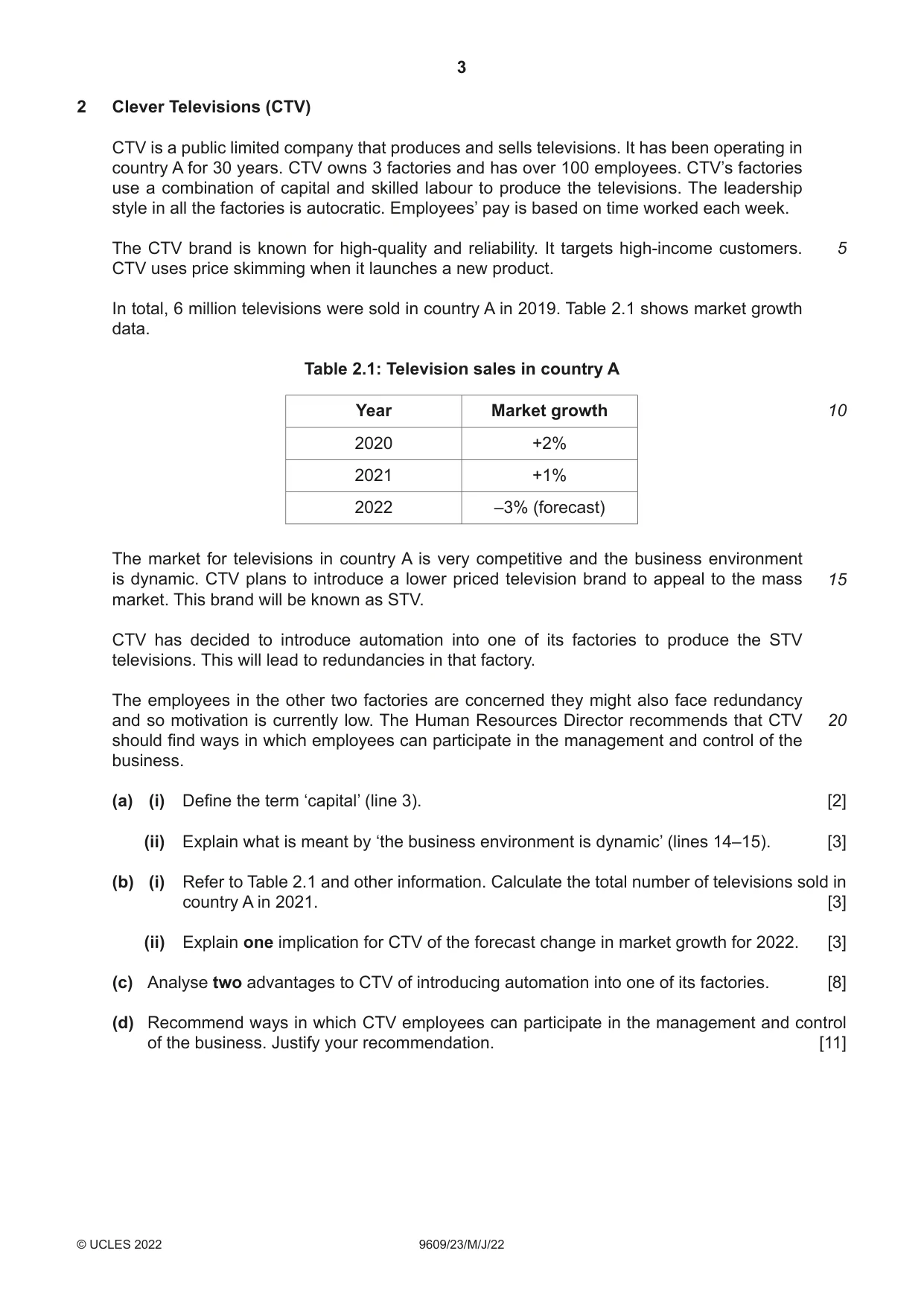
2 Clever Televisions (CTV) CTV is a public limited company that produces and sells televisions. It has been operating in country A for 30 years. CTV owns 3 factories and has over 100 employees. CTV’s factories use a combination of capital and skilled labour to produce the televisions. The leadership style in all the factories is autocratic. Employees’ pay is based on time worked each week. The CTV brand is known for high‑quality and reliability. It targets high‑income customers. 5 CTV uses price skimming when it launches a new product. In total, 6 million televisions were sold in country A in 2019. Table 2.1 shows market growth data. Table 2.1: Television sales in country A Year Market growth 10 2020 +2% 2021 +1% 2022 –3% (forecast) The market for televisions in country A is very competitive and the business environment is dynamic. CTV plans to introduce a lower priced television brand to appeal to the mass 15 market. This brand will be known as STV. CTV has decided to introduce automation into one of its factories to produce the STV televisions. This will lead to redundancies in that factory. The employees in the other two factories are concerned they might also face redundancy and so motivation is currently low. The Human Resources Director recommends that CTV 20 should find ways in which employees can participate in the management and control of the business. (a) (i) Define the term ‘capital’ (line 3). [2] (ii) Explain what is meant by ‘the business environment is dynamic’ (lines 14–15). [3] (b) (i) Refer to Table 2.1 and other information. Calculate the total number of televisions sold in country A in 2021. [3] (ii) Explain one implication for CTV of the forecast change in market growth for 2022. [3] (c) Analyse two advantages to CTV of introducing automation into one of its factories. [8] (d) Recommend ways in which CTV employees can participate in the management and control of the business. Justify your recommendation. [11]
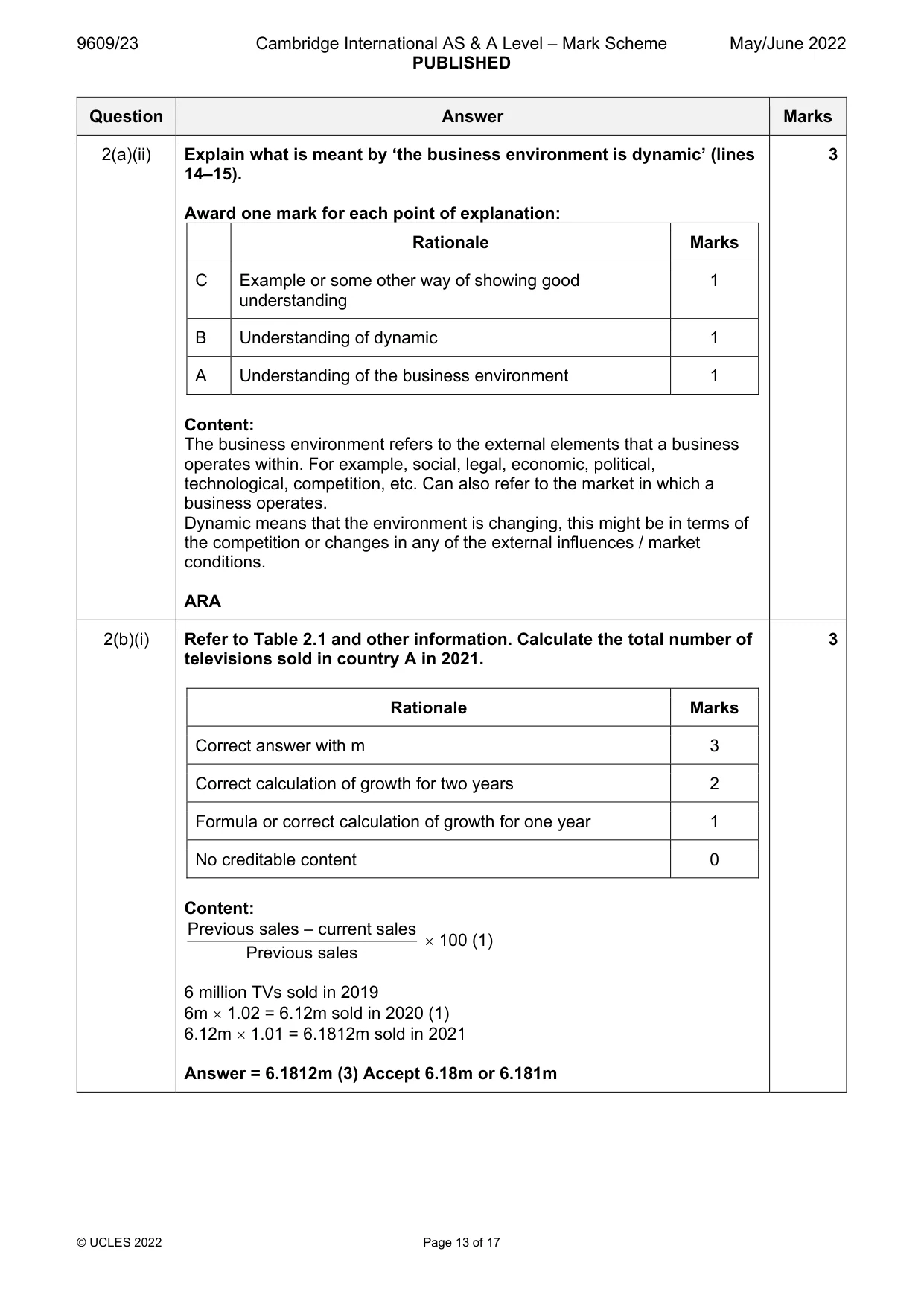
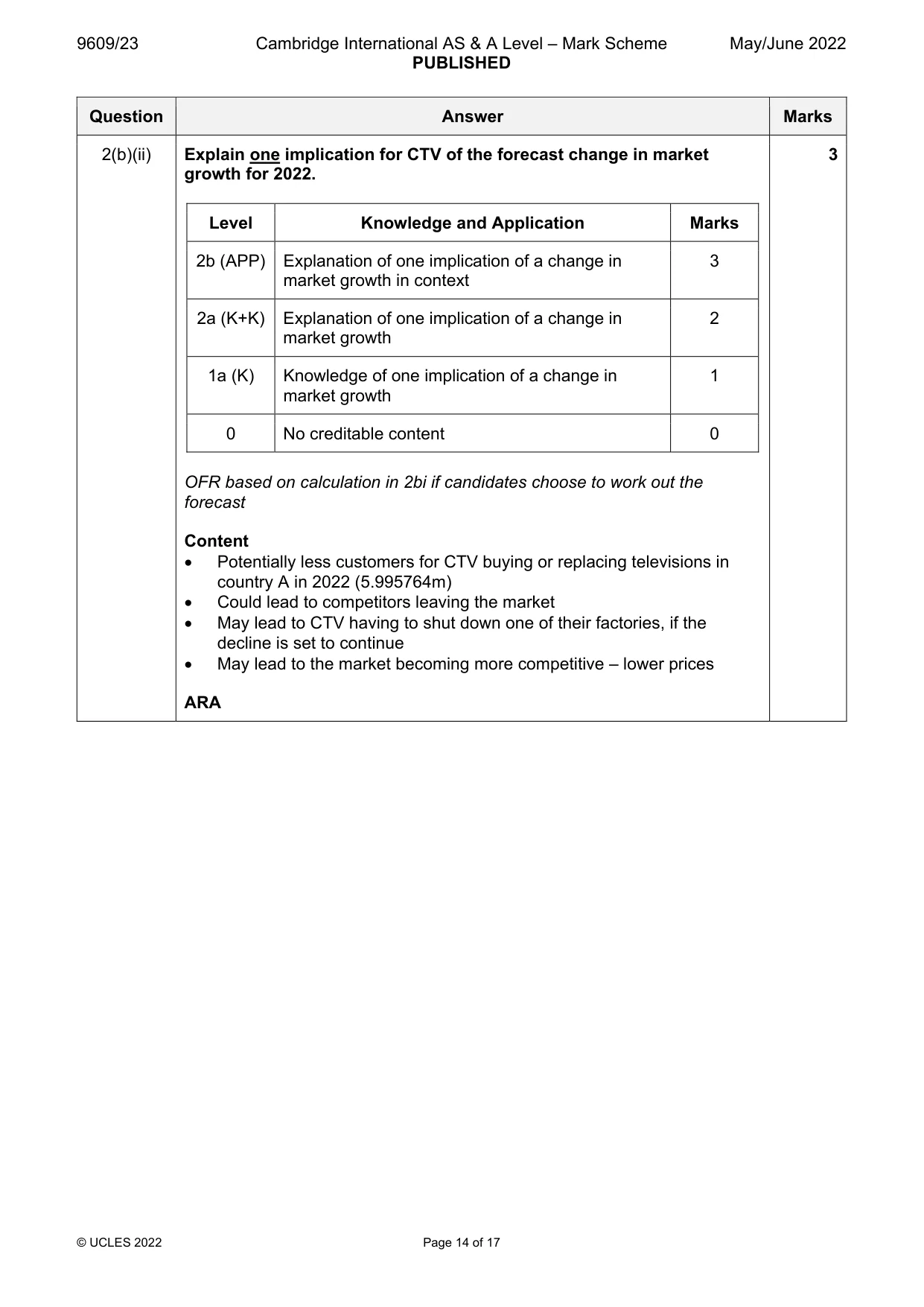
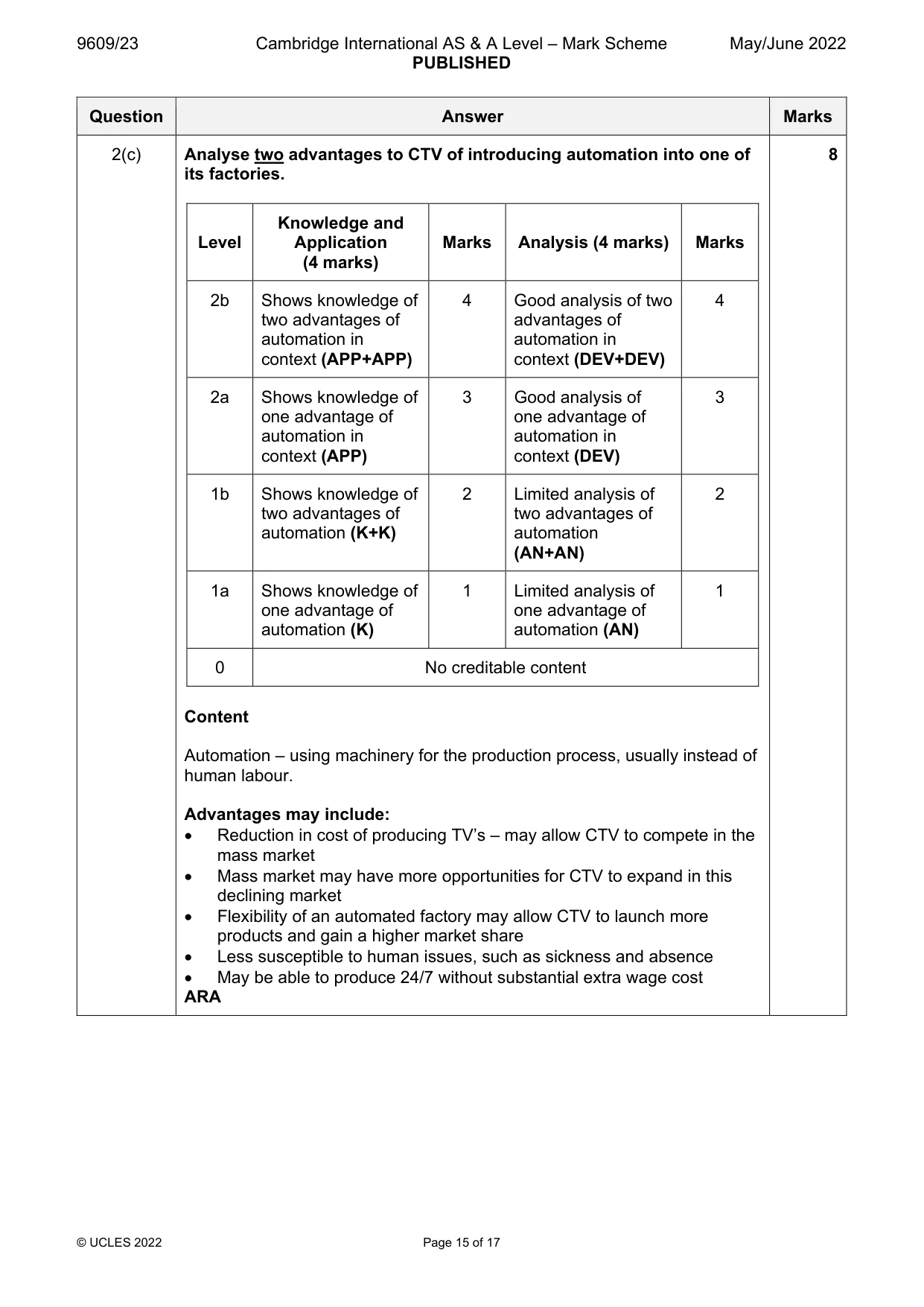
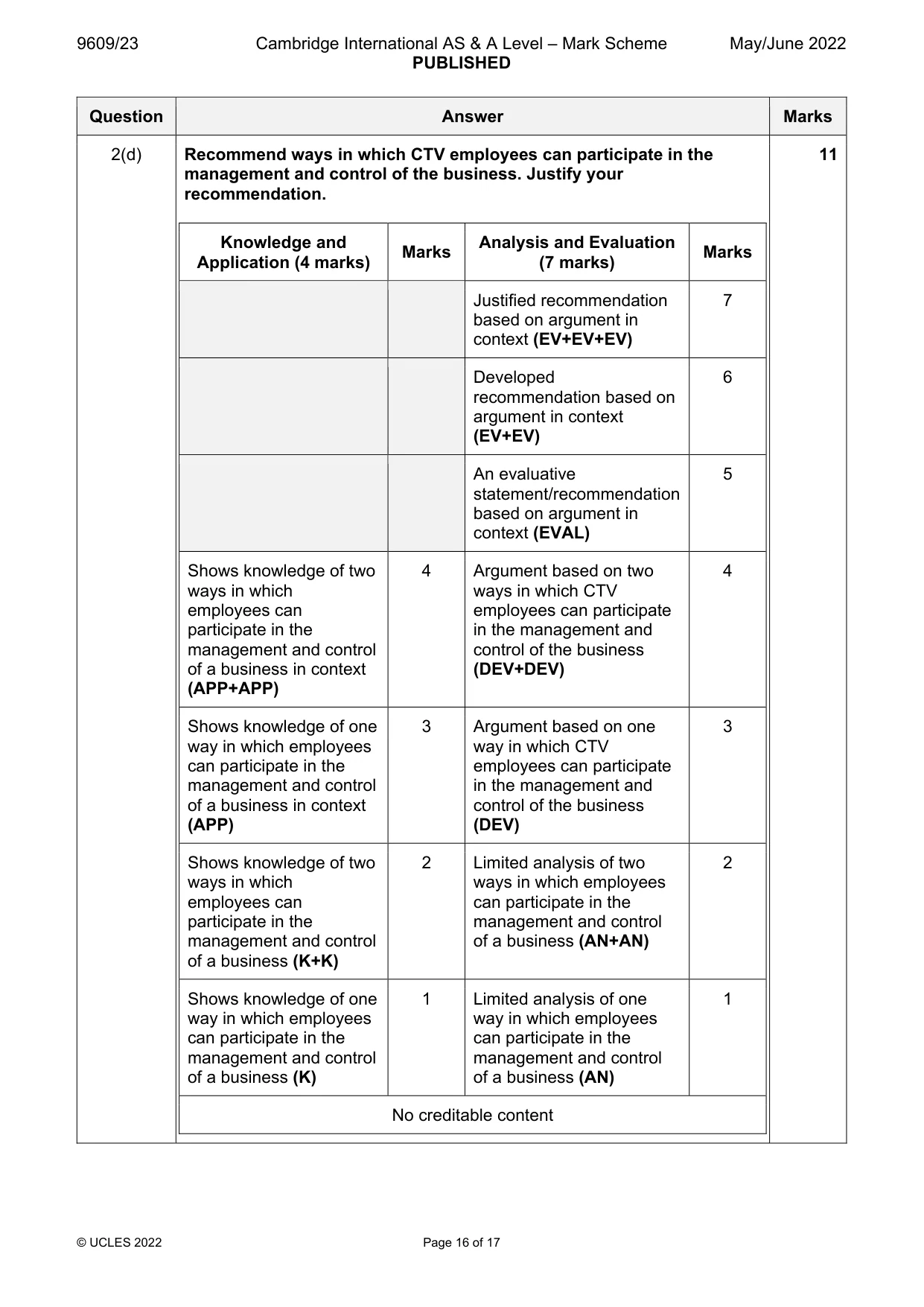
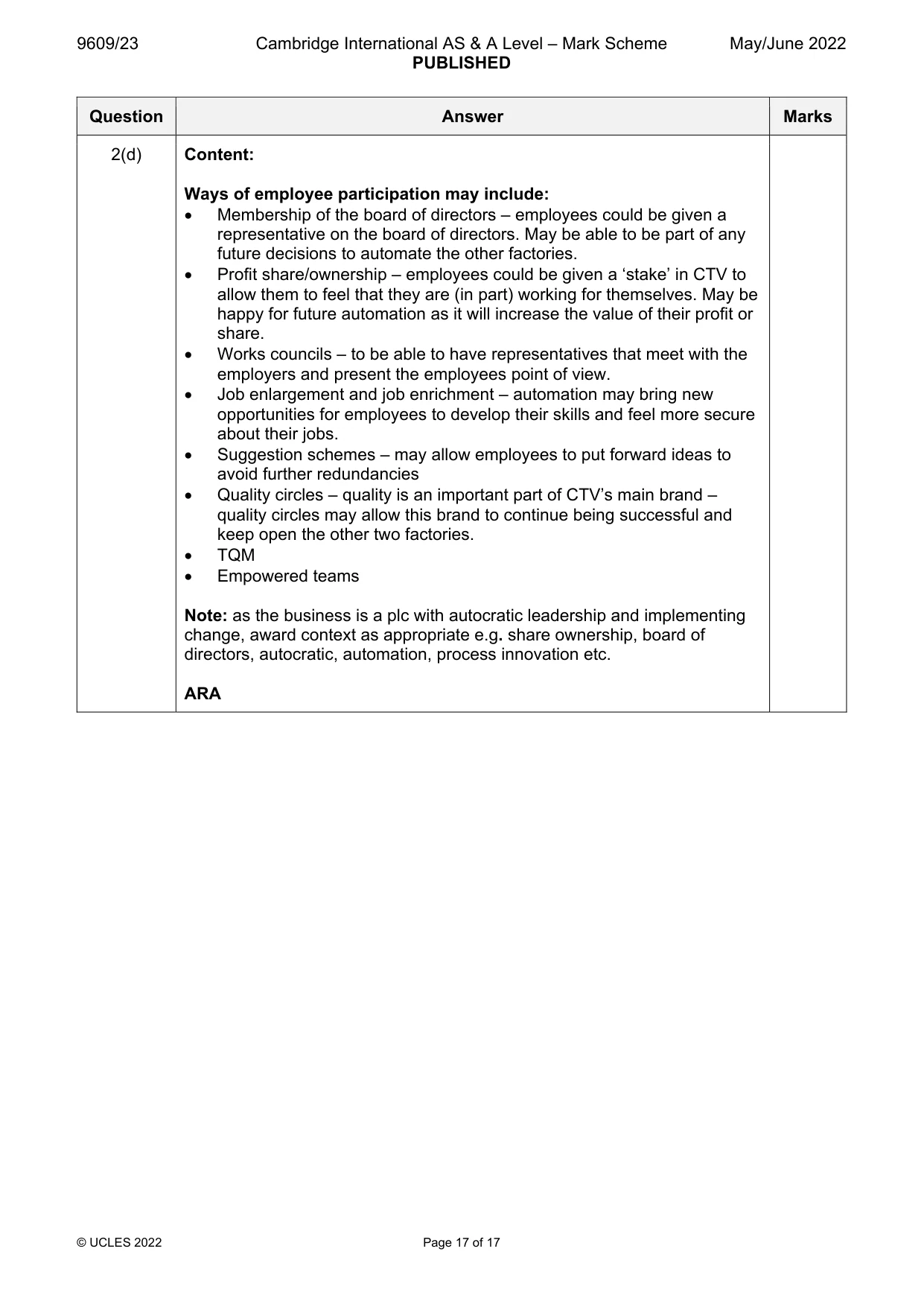
Mark scheme: 2(a)(i) Define the term ‘capital’ (line 3). 2 Knowledge Marks A correct definition 2 A partial, vague or unfocused definition 1 No creditable content 0 Content: Non-human man-made resources / factor of production needed to produce goods and services. Includes money and equipment that may be required for production. Money to start or run a business. Award one mark for each partial element of a definition, for example: Non-human/man-made resources/factor of production/money (finance) Used to produce goods and services/start or run a business. ARA 2(a)(ii) Explain what is meant by ‘the business environment is dynamic’ (lines 3 14–15). Award one mark for each point of explanation: Rationale Marks C Example or some other way of showing good 1 understanding B Understanding of dynamic 1 A Understanding of the business environment 1 Content: The business environment refers to the external elements that a business operates within. For example, social, legal, economic, political, technological, competition, etc. Can also refer to the market in which a business operates. Dynamic means that the environment is changing, this might be in terms of the competition or changes in any of the external influences / market conditions. ARA 2(b)(i) Refer to Table 2.1 and other information. Calculate the total number of 3 televisions sold in country A in 2021. Rationale Marks Correct answer with m 3 Correct calculation of growth for two years 2 Formula or correct calculation of growth for one year 1 No creditable content 0 Content: Previous sales – current sales 100 (1) Previous sales 6 million TVs sold in 2019 6m 1.02 = 6.12m sold in 2020 (1) 6.12m 1.01 = 6.1812m sold in 2021 Answer = 6.1812m (3) Accept 6.18m or 6.181m 2(b)(ii) Explain one implication for CTV of the forecast change in market 3 growth for 2022. Level Knowledge and Application Marks 2b (APP) Explanation of one implication of a change in 3 market growth in context 2a (K+K) Explanation of one implication of a change in 2 market growth 1a (K) Knowledge of one implication of a change in 1 market growth 0 No creditable content 0 OFR based on calculation in 2bi if candidates choose to work out the forecast Content Potentially less customers for CTV buying or replacing televisions in country A in 2022 (5.995764m) Could lead to competitors leaving the market May lead to CTV having to shut down one of their factories, if the decline is set to continue May lead to the market becoming more competitive – lower prices ARA 2(c) Analyse two advantages to CTV of introducing automation into one of 8 its factories. Knowledge and Level Application Marks Analysis (4 marks) Marks (4 marks) 2b Shows knowledge of 4 Good analysis of two 4 two advantages of advantages of automation in automation in context (APP+APP) context (DEV+DEV) 2a Shows knowledge of 3 Good analysis of 3 one advantage of one advantage of automation in automation in context (APP) context (DEV) 1b Shows knowledge of 2 Limited analysis of 2 two advantages of two advantages of automation (K+K) automation (AN+AN) 1a Shows knowledge of 1 Limited analysis of 1 one advantage of one advantage of automation (K) automation (AN) 0 No creditable content Content Automation – using machinery for the production process, usually instead of human labour. Advantages may include: Reduction in cost of producing TV’s – may allow CTV to compete in the mass market Mass market may have more opportunities for CTV to expand in this declining market Flexibility of an automated factory may allow CTV to launch more products and gain a higher market share Less susceptible to human issues, such as sickness and absence May be able to produce 24/7 without substantial extra wage cost ARA 2(d) Recommend ways in which CTV employees can participate in the 11 management and control of the business. Justify your recommendation. Knowledge and Analysis and Evaluation Marks Marks Application (4 marks) (7 marks) Justified recommendation 7 based on argument in context (EV+EV+EV) Developed 6 recommendation based on argument in context (EV+EV) An evaluative 5 statement/recommendation based on argument in context (EVAL) Shows knowledge of two 4 Argument based on two 4 ways in which ways in which CTV employees can employees can participate participate in the in the management and management and control control of the business of a business in context (DEV+DEV) (APP+APP) Shows knowledge of one 3 Argument based on one 3 way in which employees way in which CTV can participate in the employees can participate management and control in the management and of a business in context control of the business (APP) (DEV) Shows knowledge of two 2 Limited analysis of two 2 ways in which ways in which employees employees can can participate in the participate in the management and control management and control of a business (AN+AN) of a business (K+K) Shows knowledge of one 1 Limited analysis of one 1 way in which employees way in which employees can participate in the can participate in the management and control management and control of a business (K) of a business (AN) No creditable content 2(d) Content: Ways of employee participation may include: Membership of the board of directors – employees could be given a representative on the board of directors. May be able to be part of any future decisions to automate the other factories. Profit share/ownership – employees could be given a ‘stake’ in CTV to allow them to feel that they are (in part) working for themselves. May be happy for future automation as it will increase the value of their profit or share. Works councils – to be able to have representatives that meet with the employers and present the employees point of view. Job enlargement and job enrichment – automation may bring new opportunities for employees to develop their skills and feel more secure about their jobs. Suggestion schemes – may allow employees to put forward ideas to avoid further redundancies Quality circles – quality is an important part of CTV’s main brand – quality circles may allow this brand to continue being successful and keep open the other two factories. TQM Empowered teams Note: as the business is a plc with autocratic leadership and implementing change, award context as appropriate e.g. share ownership, board of directors, autocratic, automation, process innovation etc. ARA
What was in this paper
The subtopics covered by these 2 questions, and how many questions each got. Open one in a new tab to see every Cambridge question on it.
What you needed in this session
Cambridge’s own grade thresholds for 2022 May/June, Paper 2 · Variant 3. A higher threshold means an easier paper — the bar moves with how the cohort did.