Cambridge A Level Business (for first examination in 2016) 9609 — 2022 Oct/Nov Paper 2 · Variant 3
9609/23/O/N/22 · 2 questions · 60 marks · ≈68 min
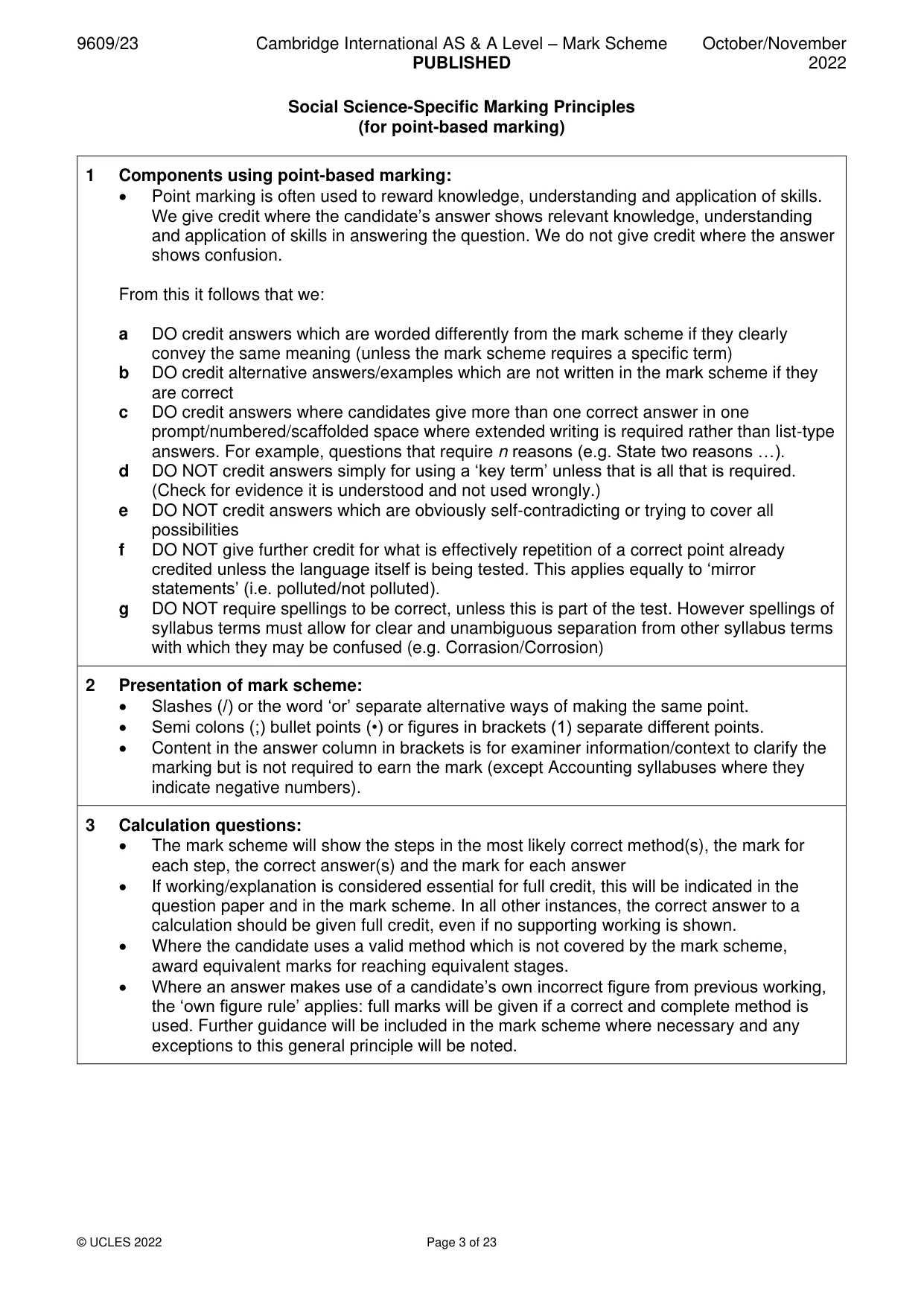
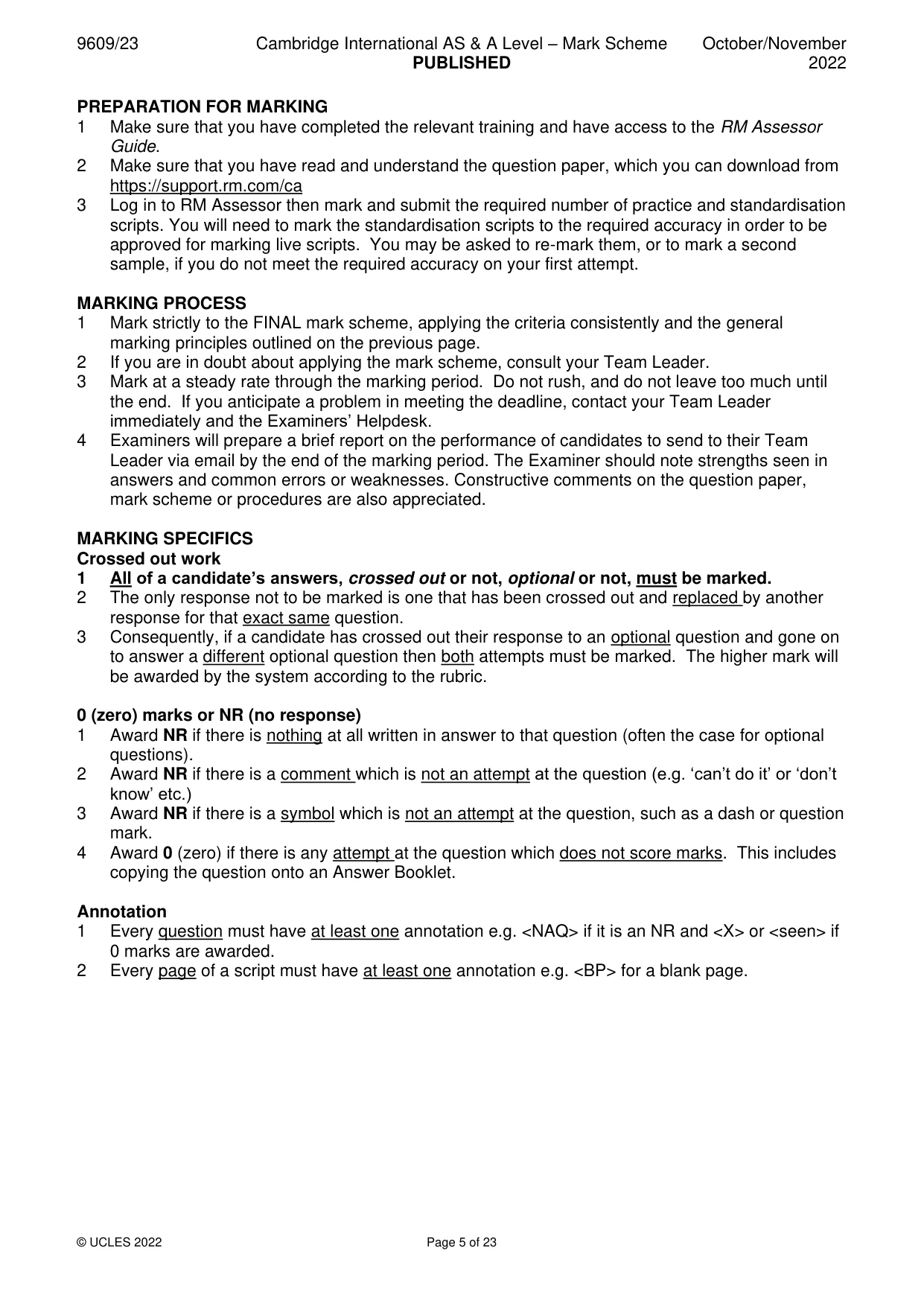
The question paper and its mark scheme, free to read here and free to download. This is Cambridge’s own paper, exactly as it was sat.
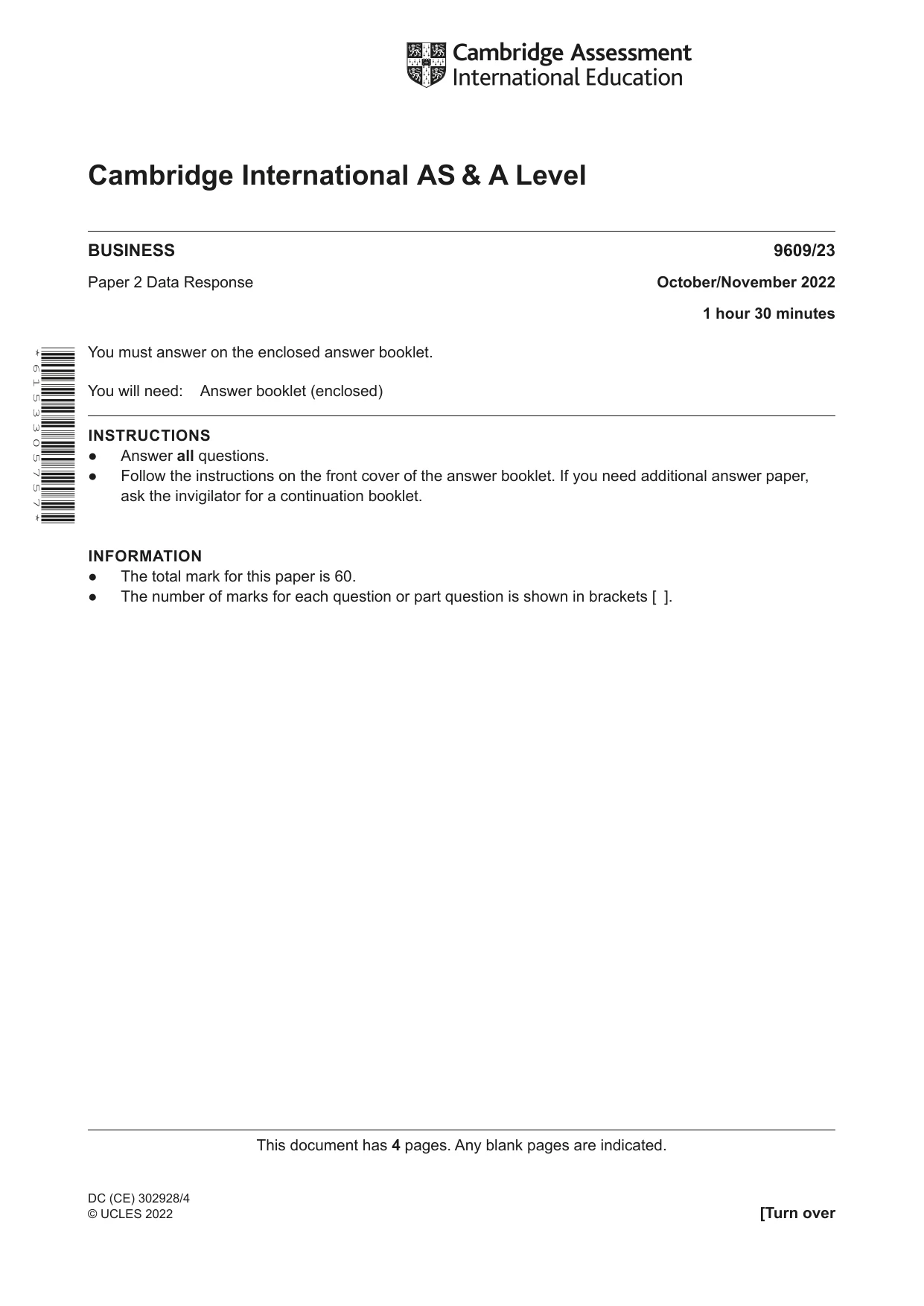
Question paper4 pages

Mark scheme23 pages
Answers below. Sit the paper first if you are practising.

Questions as text
Q1 · Pop-up Movies (PM) PM is a private limited company that was set up five years ago
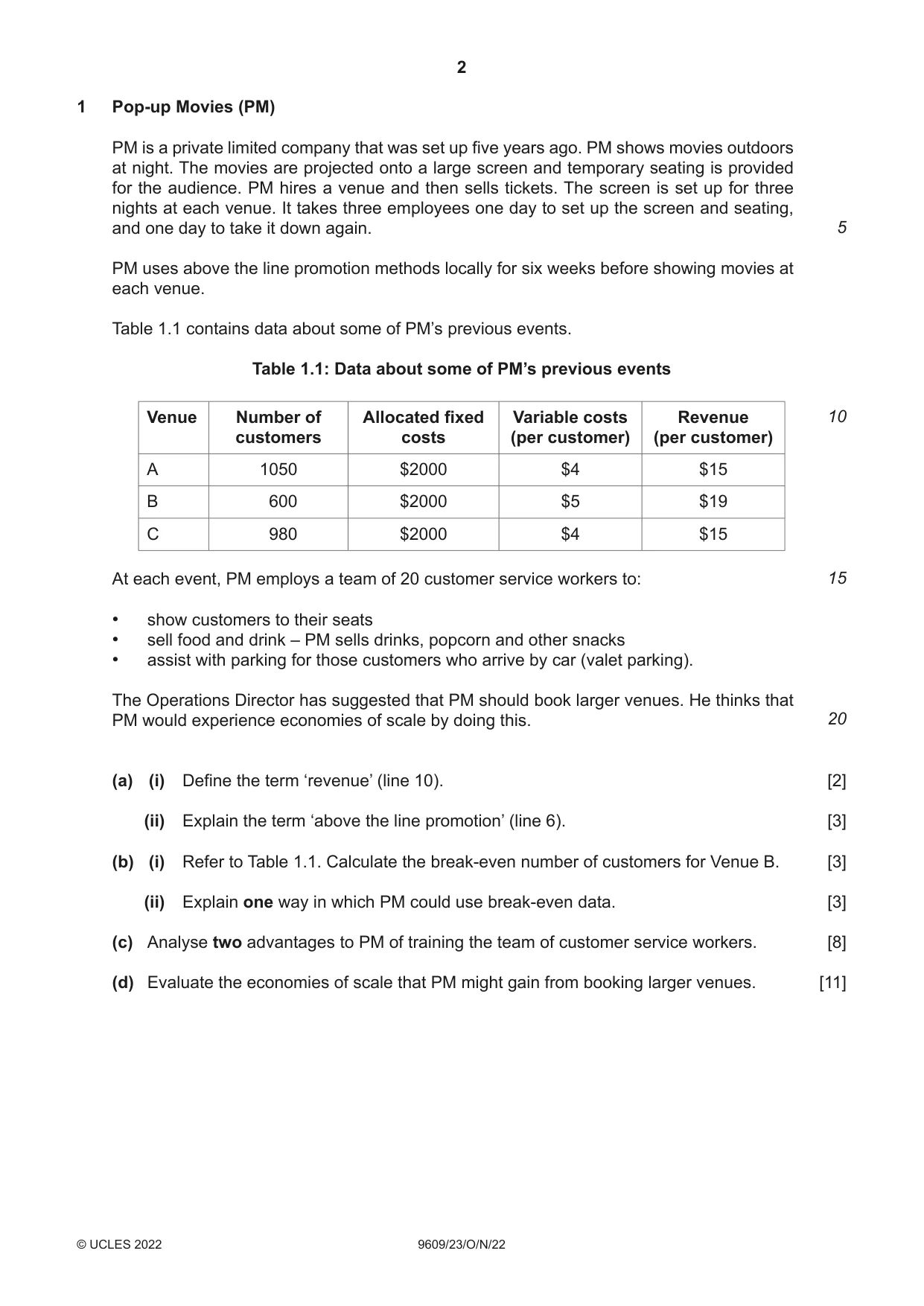
1 Pop-up Movies (PM) PM is a private limited company that was set up five years ago. PM shows movies outdoors at night. The movies are projected onto a large screen and temporary seating is provided for the audience. PM hires a venue and then sells tickets. The screen is set up for three nights at each venue. It takes three employees one day to set up the screen and seating, and one day to take it down again. 5 PM uses above the line promotion methods locally for six weeks before showing movies at each venue. Table 1.1 contains data about some of PM’s previous events. Table 1.1: Data about some of PM’s previous events Venue Number of Allocated fixed Variable costs Revenue 10 customers costs (per customer) (per customer) A 1050 $2000 $4 $15 B 600 $2000 $5 $19 C 980 $2000 $4 $15 At each event, PM employs a team of 20 customer service workers to: 15 • show customers to their seats • sell food and drink – PM sells drinks, popcorn and other snacks • assist with parking for those customers who arrive by car (valet parking). The Operations Director has suggested that PM should book larger venues. He thinks that PM would experience economies of scale by doing this. 20 (a) (i) Define the term ‘revenue’ (line 10). [2] (ii) Explain the term ‘above the line promotion’ (line 6). [3] (b) (i) Refer to Table 1.1. Calculate the break-even number of customers for Venue B. [3] (ii) Explain one way in which PM could use break-even data. [3] (c) Analyse two advantages to PM of training the team of customer service workers. [8] (d) Evaluate the economies of scale that PM might gain from booking larger venues. [11]
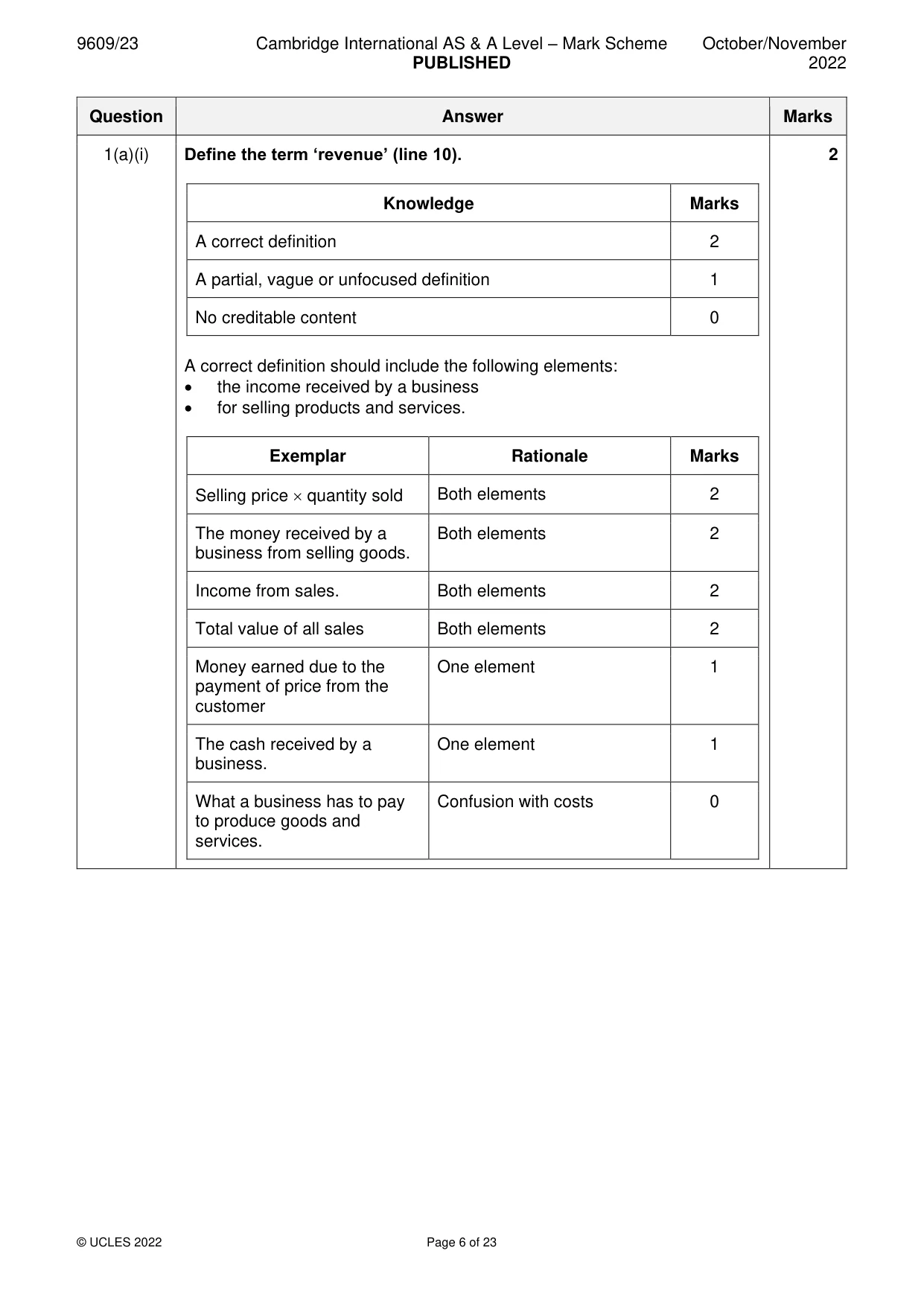
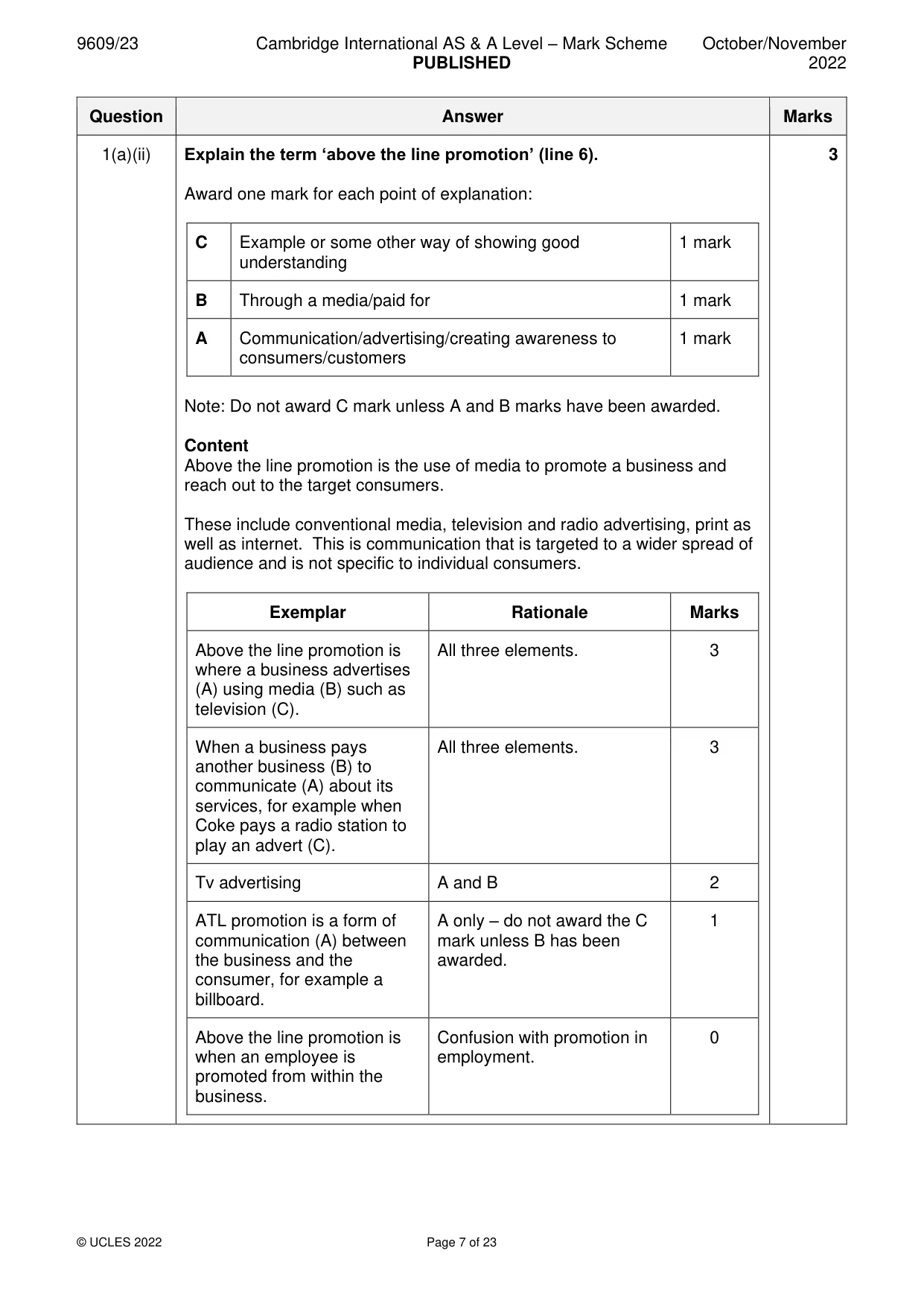
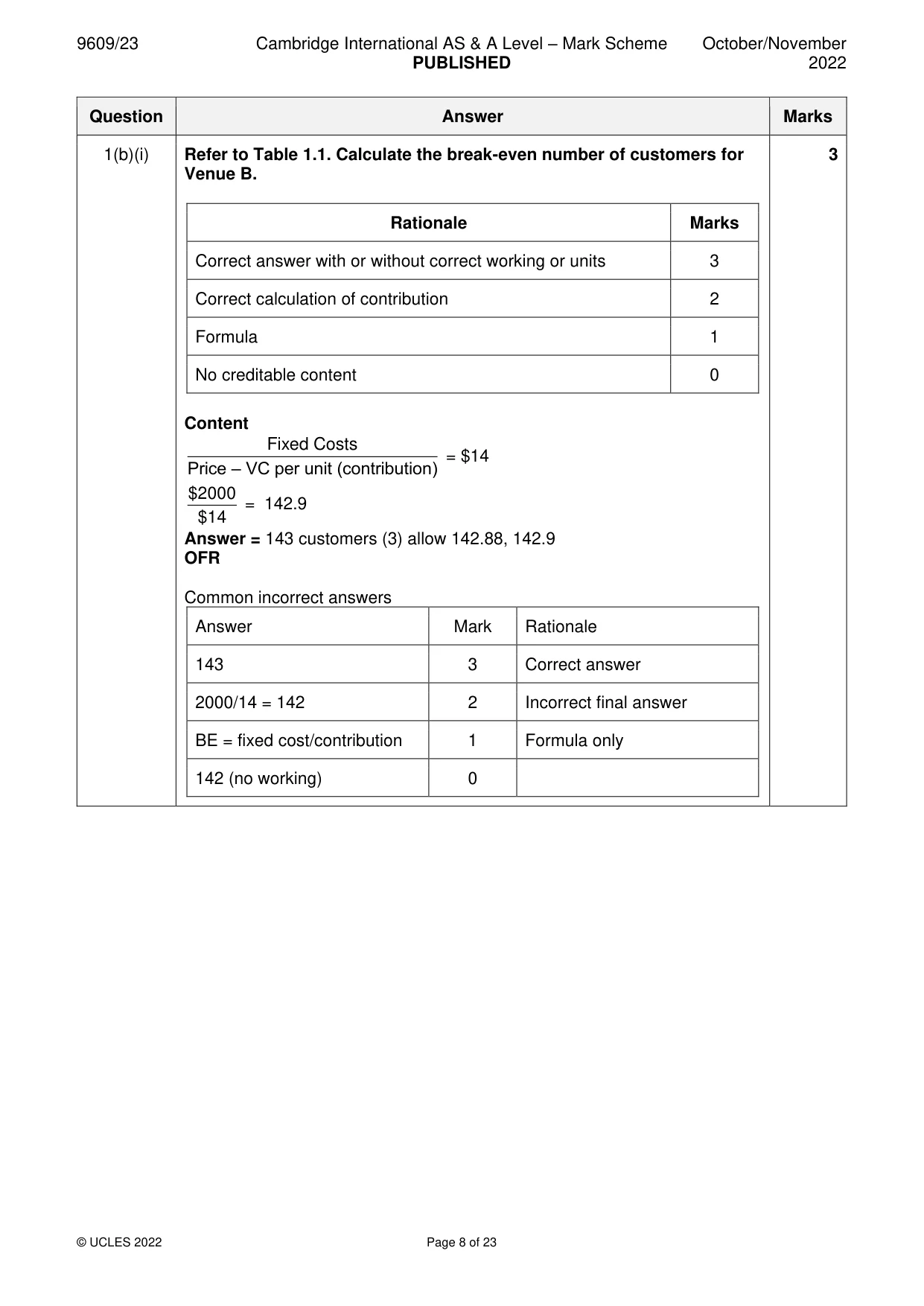
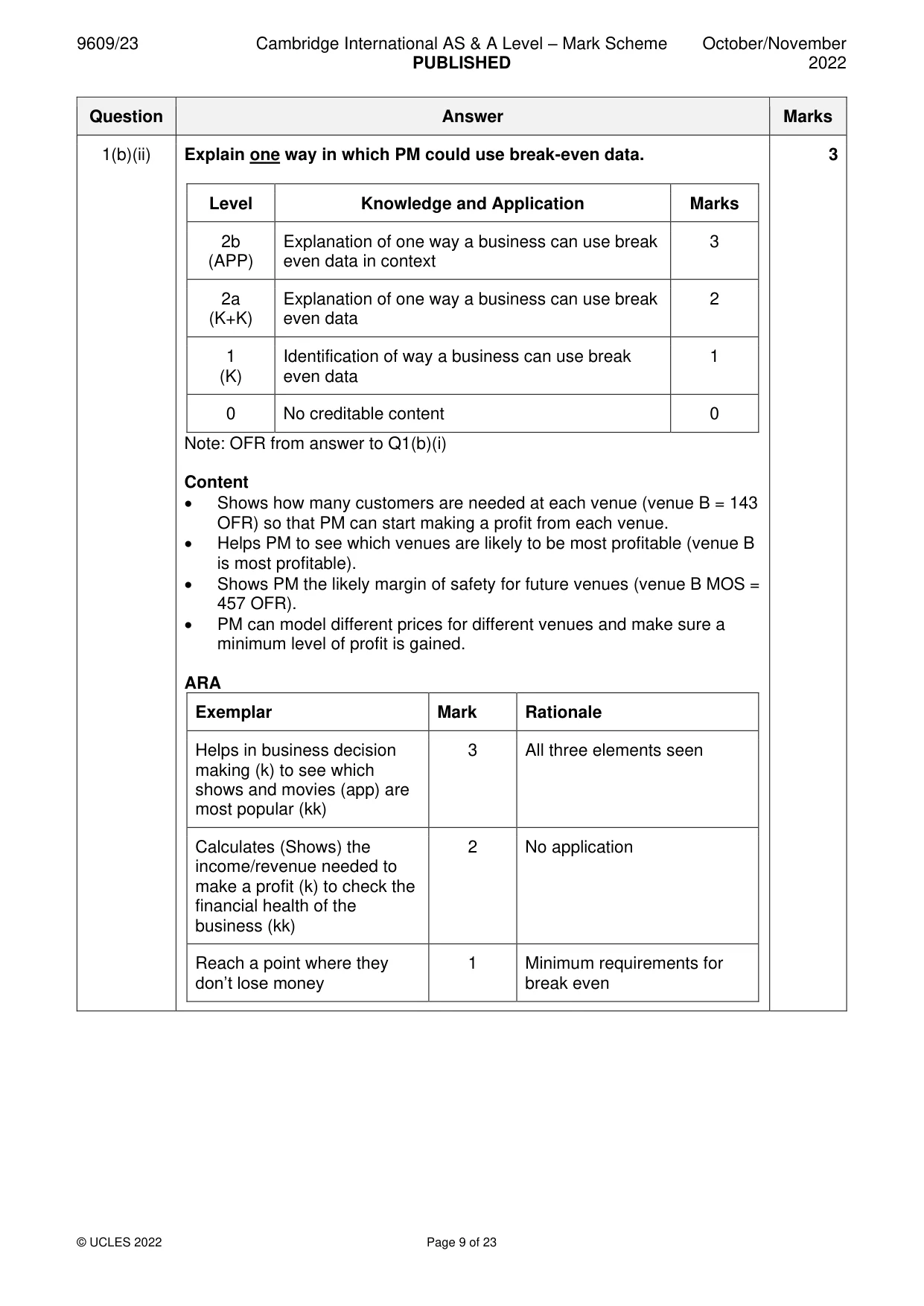
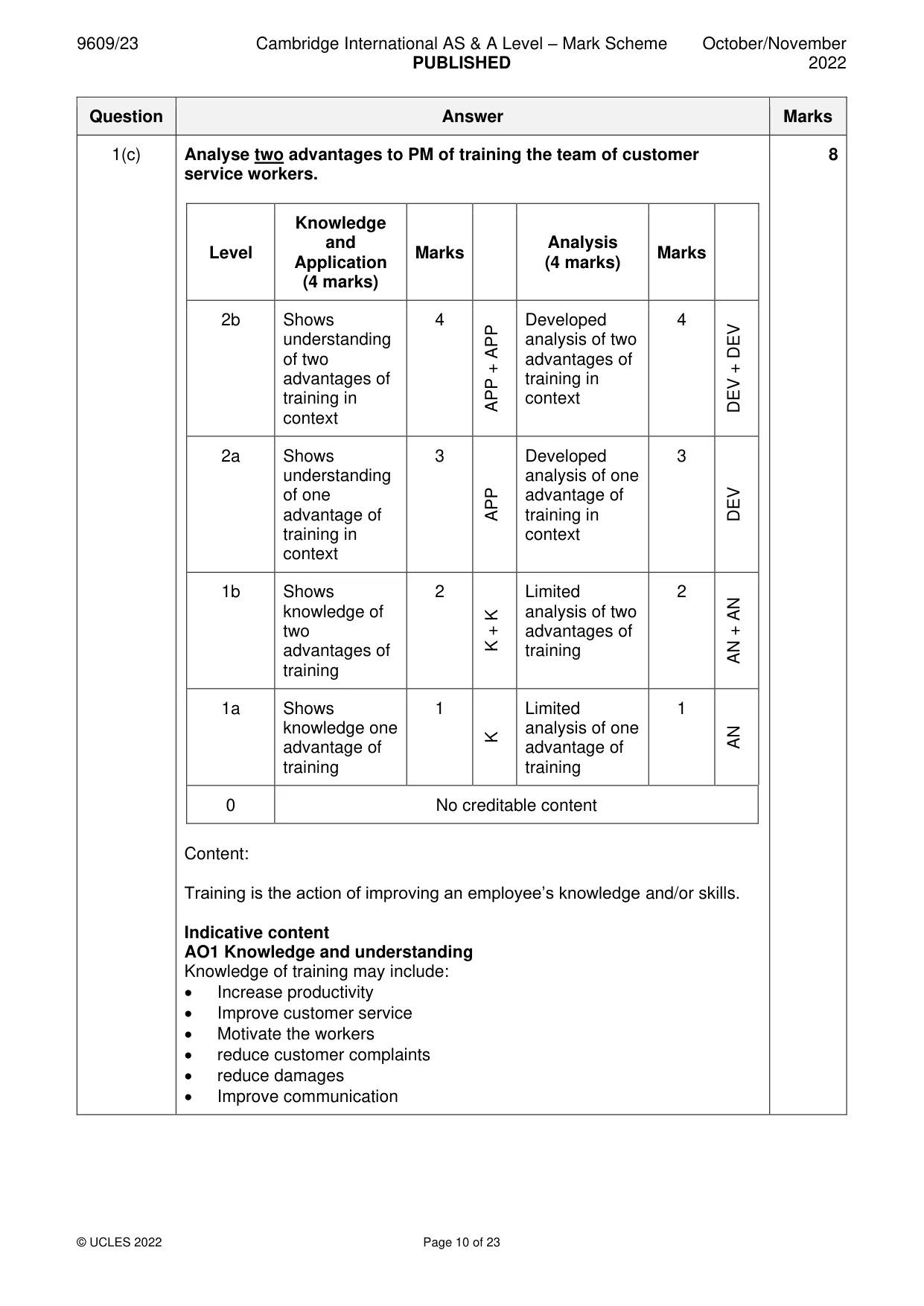
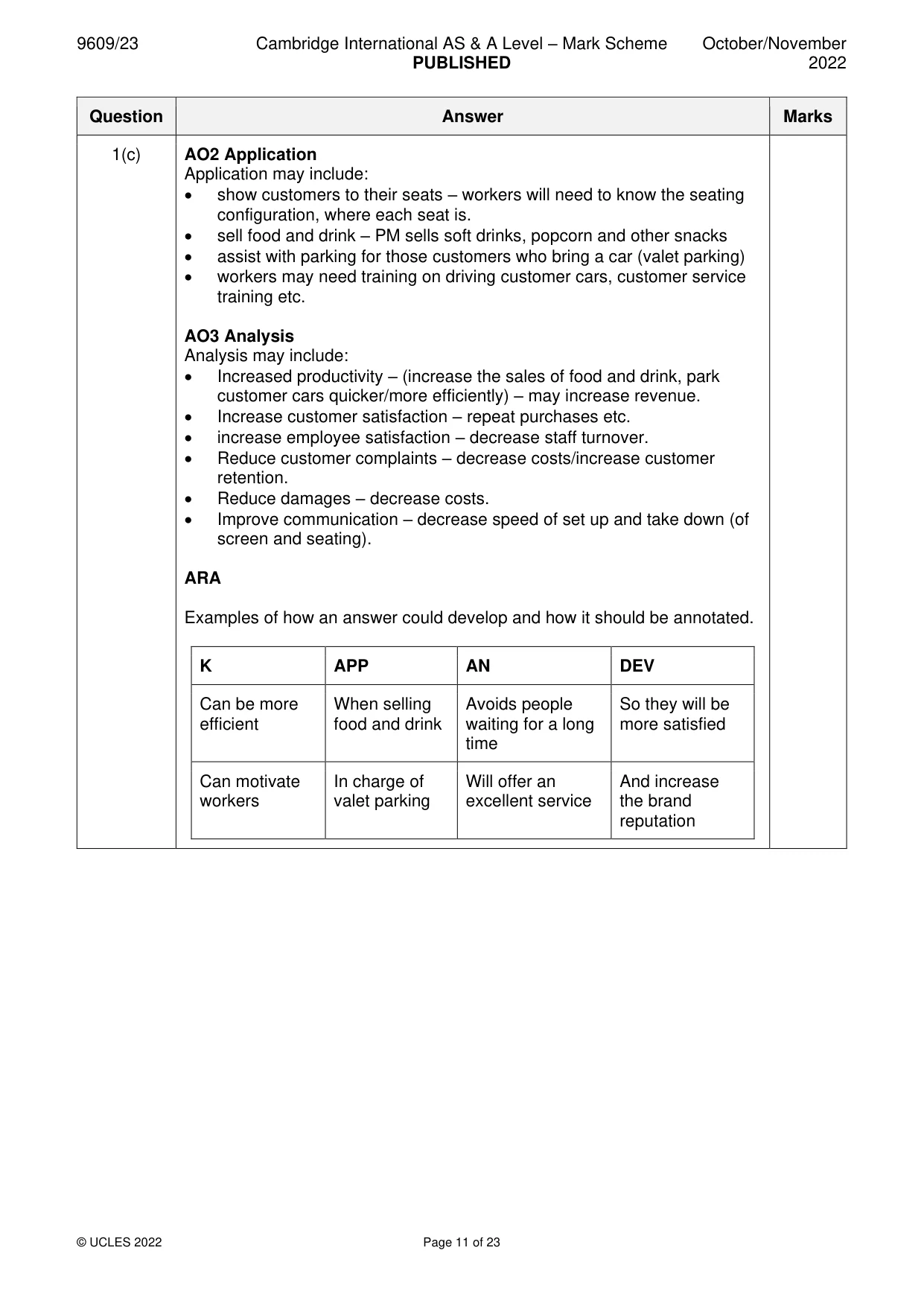
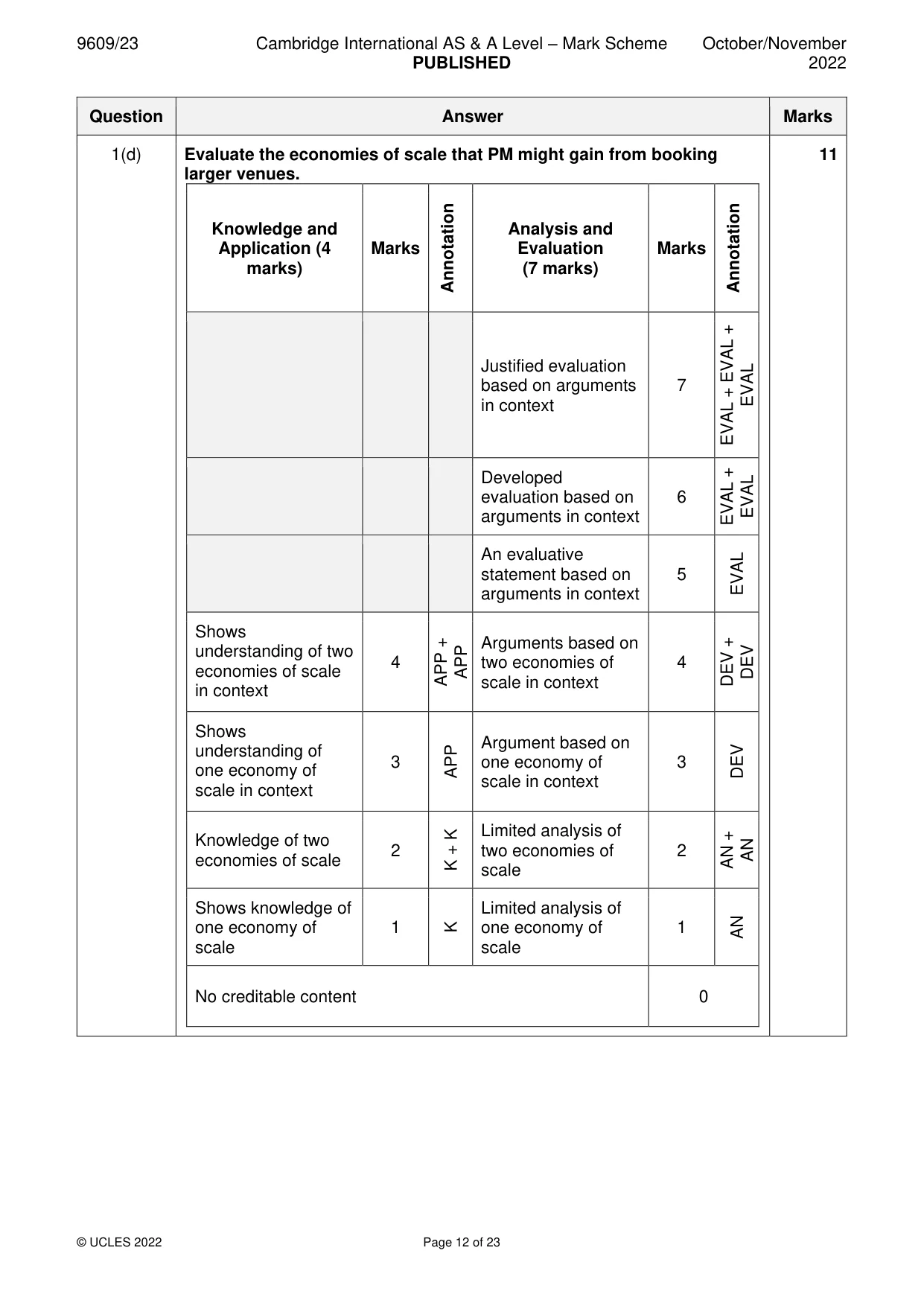
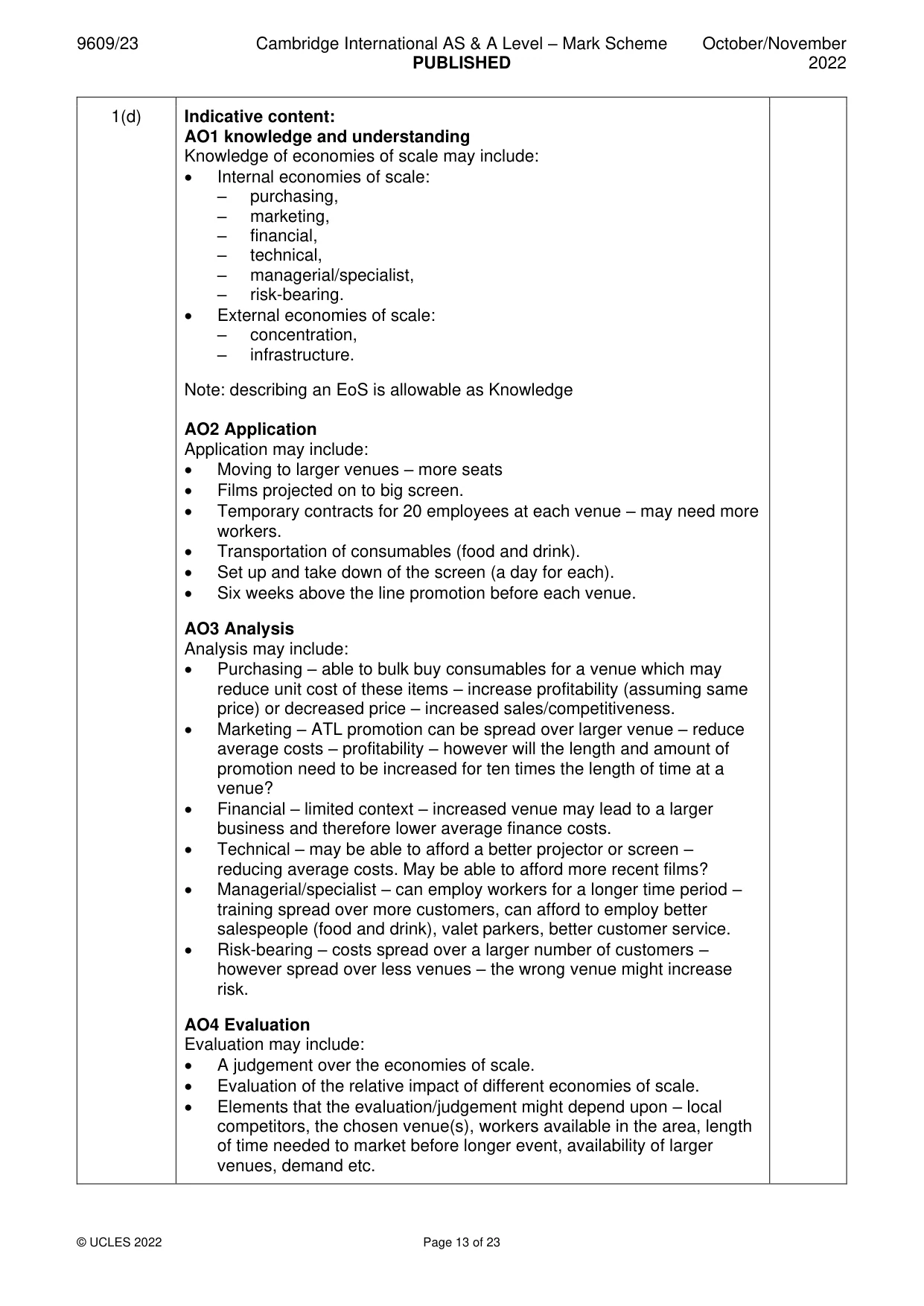
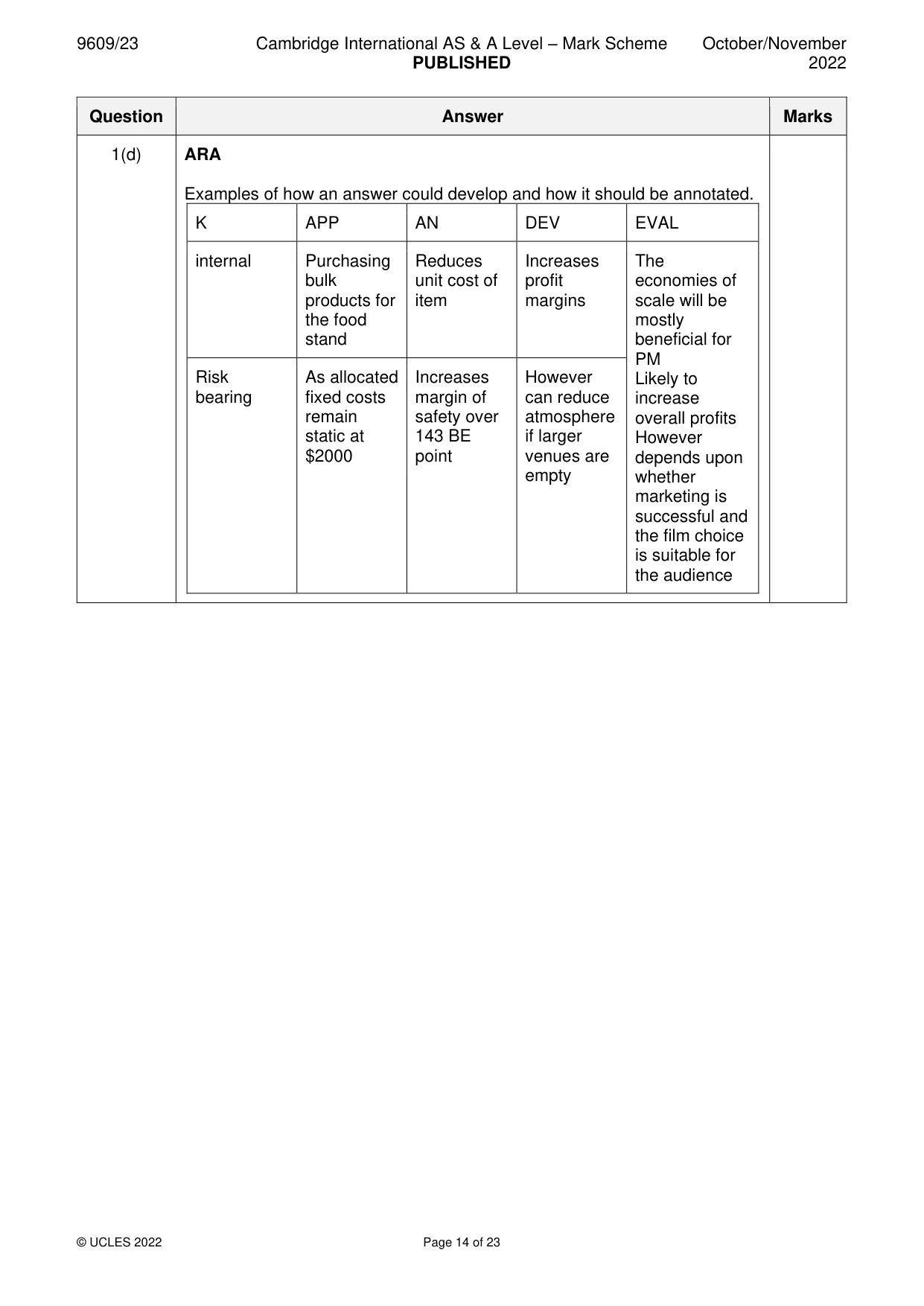
Mark scheme: Question Answer Marks 1(a)(i) Define the term ‘revenue’ (line 10). 2 Knowledge Marks A correct definition 2 A partial, vague or unfocused definition 1 No creditable content 0 A correct definition should include the following elements: • the income received by a business • for selling products and services. Exemplar Rationale Marks Selling price quantity sold Both elements 2 The money received by a Both elements 2 business from selling goods. Income from sales. Both elements 2 Total value of all sales Both elements 2 Money earned due to the One element 1 payment of price from the customer The cash received by a One element 1 business. What a business has to pay Confusion with costs 0 to produce goods and services. 1(a)(ii) Explain the term ‘above the line promotion’ (line 6). 3 Award one mark for each point of explanation: C Example or some other way of showing good 1 mark understanding B Through a media/paid for 1 mark A Communication/advertising/creating awareness to 1 mark consumers/customers Note: Do not award C mark unless A and B marks have been awarded. Content Above the line promotion is the use of media to promote a business and reach out to the target consumers. These include conventional media, television and radio advertising, print as well as internet. This is communication that is targeted to a wider spread of audience and is not specific to individual consumers. Exemplar Rationale Marks Above the line promotion is All three elements. 3 where a business advertises (A) using media (B) such as television (C). When a business pays All three elements. 3 another business (B) to communicate (A) about its services, for example when Coke pays a radio station to play an advert (C). Tv advertising A and B 2 ATL promotion is a form of A only – do not award the C 1 communication (A) between mark unless B has been the business and the awarded. consumer, for example a billboard. Above the line promotion is Confusion with promotion in 0 when an employee is employment. promoted from within the business. 1(b)(i) Refer to Table 1.1. Calculate the break-even number of customers for 3 Venue B. Rationale Marks Correct answer with or without correct working or units 3 Correct calculation of contribution 2 Formula 1 No creditable content 0 Content Fixed Costs = $14 Price – VC per unit (contribution) $2000 = 142.9 $14 Answer = 143 customers (3) allow 142.88, 142.9 OFR Common incorrect answers Answer Mark Rationale 143 3 Correct answer 2000/14 = 142 2 Incorrect final answer BE = fixed cost/contribution 1 Formula only 142 (no working) 0 1(b)(ii) Explain one way in which PM could use break-even data. 3 Level Knowledge and Application Marks 2b Explanation of one way a business can use break 3 (APP) even data in context 2a Explanation of one way a business can use break 2 (K+K) even data 1 Identification of way a business can use break 1 (K) even data 0 No creditable content 0 Note: OFR from answer to Q1(b)(i) Content • Shows how many customers are needed at each venue (venue B = 143 OFR) so that PM can start making a profit from each venue. • Helps PM to see which venues are likely to be most profitable (venue B is most profitable). • Shows PM the likely margin of safety for future venues (venue B MOS = 457 OFR). • PM can model different prices for different venues and make sure a minimum level of profit is gained. ARA Exemplar Mark Rationale Helps in business decision 3 All three elements seen making (k) to see which shows and movies (app) are most popular (kk) Calculates (Shows) the 2 No application income/revenue needed to make a profit (k) to check the financial health of the business (kk) Reach a point where they 1 Minimum requirements for don’t lose money break even 1(c) Analyse two advantages to PM of training the team of customer 8 service workers. Knowledge and Analysis Level Marks Marks Application (4 marks) (4 marks) 2b Shows 4 Developed 4 understanding analysis of two APP DEV of two advantages of + + advantages of training in training in context APP DEV context 2a Shows 3 Developed 3 understanding analysis of one of one advantage of APP advantagetraining in of DEV training in context context 1b Shows 2 Limited 2 knowledge of K analysis of two AN two + advantages of + advantages of K training AN training 1a Shows 1 Limited 1 knowledge one analysis of one K AN advantage of advantage of training training 0 No creditable content Content: Training is the action of improving an employee’s knowledge and/or skills. Indicative content AO1 Knowledge and understanding Knowledge of training may include: • Increase productivity • Improve customer service • Motivate the workers • reduce customer complaints • reduce damages • Improve communication 1(c) AO2 Application Application may include: • show customers to their seats – workers will need to know the seating configuration, where each seat is. • sell food and drink – PM sells soft drinks, popcorn and other snacks • assist with parking for those customers who bring a car (valet parking) • workers may need training on driving customer cars, customer service training etc. AO3 Analysis Analysis may include: • Increased productivity – (increase the sales of food and drink, park customer cars quicker/more efficiently) – may increase revenue. • Increase customer satisfaction – repeat purchases etc. • increase employee satisfaction – decrease staff turnover. • Reduce customer complaints – decrease costs/increase customer retention. • Reduce damages – decrease costs. • Improve communication – decrease speed of set up and take down (of screen and seating). ARA Examples of how an answer could develop and how it should be annotated. K APP AN DEV Can be more When selling Avoids people So they will be efficient food and drink waiting for a long more satisfied time Can motivate In charge of Will offer an And increase workers valet parking excellent service the brand reputation 1(d) Evaluate the economies of scale that PM might gain from booking 11 larger venues. Knowledge and Analysis and Application (4 Marks Evaluation Marks marks) (7 marks) Annotation Annotation + Justified evaluation EVAL based on arguments 7 + EVAL in context EVAL Developed + evaluation based on 6 EVAL arguments in context EVAL An evaluative statement based on 5 EVAL arguments in context Shows + Arguments based on + understanding of two 4 two economies of 4 economies of scale APP DEV APP scale in context DEV in context Shows Argument based on understanding of 3 one economy of 3 one economy of APP DEV scale in context scale in context K Limited analysis of + Knowledge of two 2 + two economies of 2 AN economies of scale K AN scale Shows knowledge of Limited analysis of one economy of 1 K one economy of 1 AN scale scale No creditable content 0 1(d) Indicative content: AO1 knowledge and understanding Knowledge of economies of scale may include: • Internal economies of scale: – purchasing, – marketing, – financial, – technical, – managerial/specialist, – risk-bearing. • External economies of scale: – concentration, – infrastructure. Note: describing an EoS is allowable as Knowledge AO2 Application Application may include: • Moving to larger venues – more seats • Films projected on to big screen. • Temporary contracts for 20 employees at each venue – may need more workers. • Transportation of consumables (food and drink). • Set up and take down of the screen (a day for each). • Six weeks above the line promotion before each venue. AO3 Analysis Analysis may include: • Purchasing – able to bulk buy consumables for a venue which may reduce unit cost of these items – increase profitability (assuming same price) or decreased price – increased sales/competitiveness. • Marketing – ATL promotion can be spread over larger venue – reduce average costs – profitability – however will the length and amount of promotion need to be increased for ten times the length of time at a venue? • Financial – limited context – increased venue may lead to a larger business and therefore lower average finance costs. • Technical – may be able to afford a better projector or screen – reducing average costs. May be able to afford more recent films? • Managerial/specialist – can employ workers for a longer time period – training spread over more customers, can afford to employ better salespeople (food and drink), valet parkers, better customer service. • Risk-bearing – costs spread over a larger number of customers – however spread over less venues – the wrong venue might increase risk. AO4 Evaluation Evaluation may include: • A judgement over the economies of scale. • Evaluation of the relative impact of different economies of scale. • Elements that the evaluation/judgement might depend upon – local competitors, the chosen venue(s), workers available in the area, length of time needed to market before longer event, availability of larger venues, demand etc. 1(d) ARA Examples of how an answer could develop and how it should be annotated. K APP AN DEV EVAL internal Purchasing Reduces Increases The bulk unit cost of profit economies of products for item margins scale will be the food mostly stand beneficial for PM Risk As allocated Increases However Likely to bearing fixed costs margin of can reduce increase remain safety over atmosphere overall profits static at 143 BE if larger However $2000 point venues are depends upon empty whether marketing is successful and the film choice is suitable for the audience
Q2 · Planting Pots (PP) Emily and Kabir are entrepreneurs
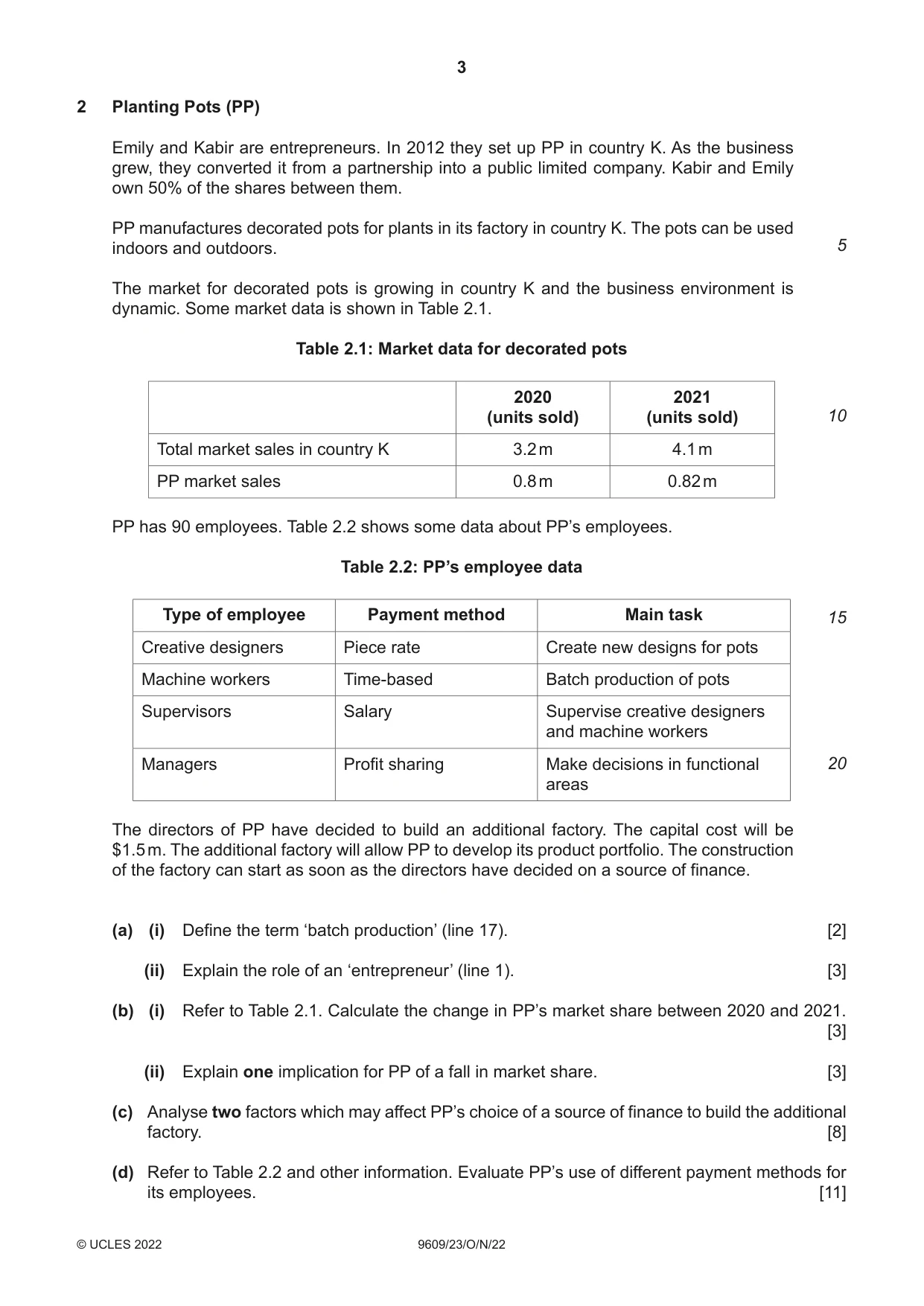
2 Planting Pots (PP) Emily and Kabir are entrepreneurs. In 2012 they set up PP in country K. As the business grew, they converted it from a partnership into a public limited company. Kabir and Emily own 50% of the shares between them. PP manufactures decorated pots for plants in its factory in country K. The pots can be used indoors and outdoors. 5 The market for decorated pots is growing in country K and the business environment is dynamic. Some market data is shown in Table 2.1. Table 2.1: Market data for decorated pots 2020 2021 (units sold) (units sold) 10 Total market sales in country K 3.2 m 4.1 m PP market sales 0.8 m 0.82 m PP has 90 employees. Table 2.2 shows some data about PP’s employees. Table 2.2: PP’s employee data Type of employee Payment method Main task 15 Creative designers Piece rate Create new designs for pots Machine workers Time-based Batch production of pots Supervisors Salary Supervise creative designers and machine workers Managers Profit sharing Make decisions in functional 20 areas The directors of PP have decided to build an additional factory. The capital cost will be $1.5 m. The additional factory will allow PP to develop its product portfolio. The construction of the factory can start as soon as the directors have decided on a source of finance. (a) (i) Define the term ‘batch production’ (line 17). [2] (ii) Explain the role of an ‘entrepreneur’ (line 1). [3] (b) (i) Refer to Table 2.1. Calculate the change in PP’s market share between 2020 and 2021. [3] (ii) Explain one implication for PP of a fall in market share. [3] (c) Analyse two factors which may affect PP’s choice of a source of finance to build the additional factory. [8] (d) Refer to Table 2.2 and other information. Evaluate PP’s use of different payment methods for its employees. [11]
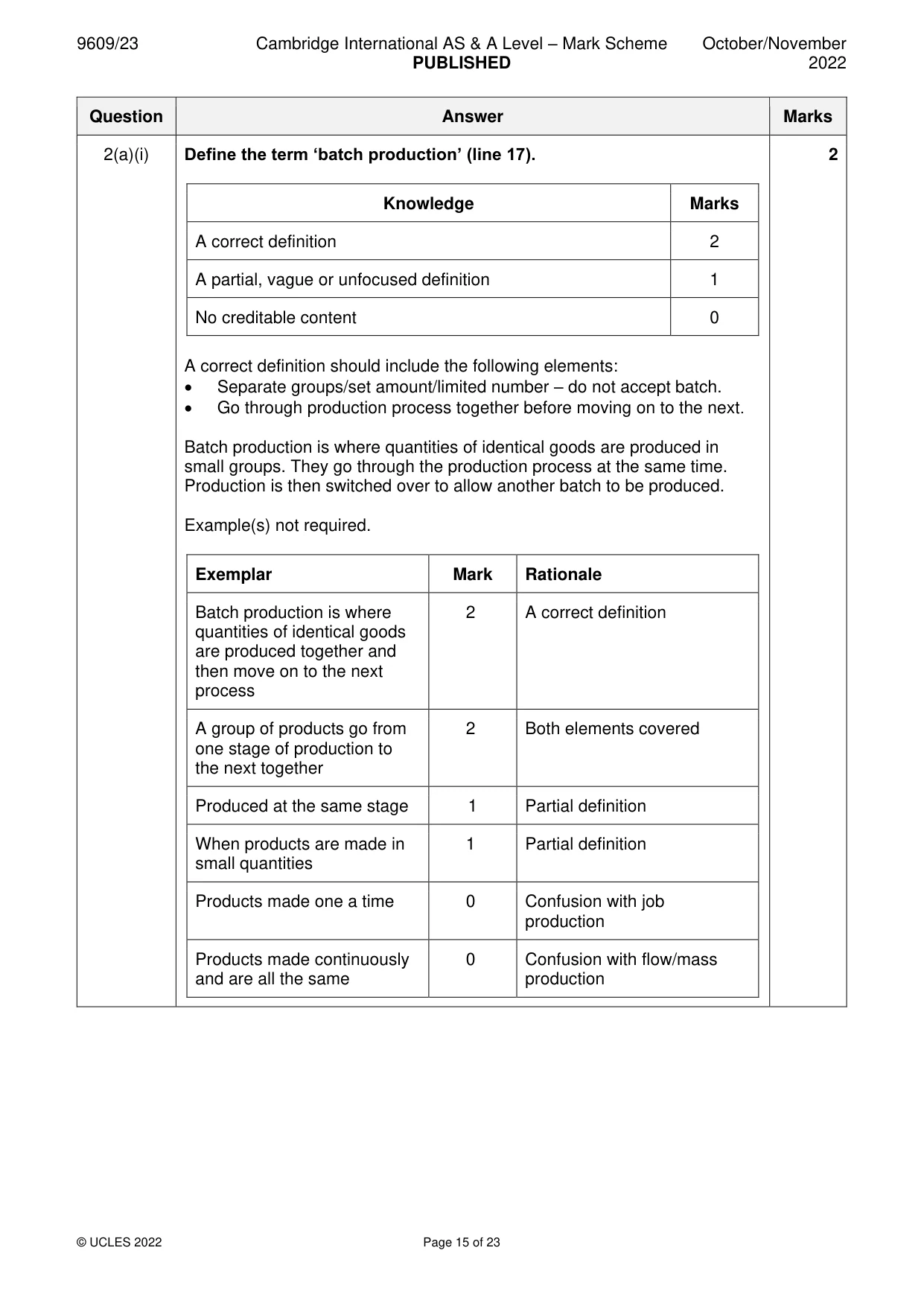
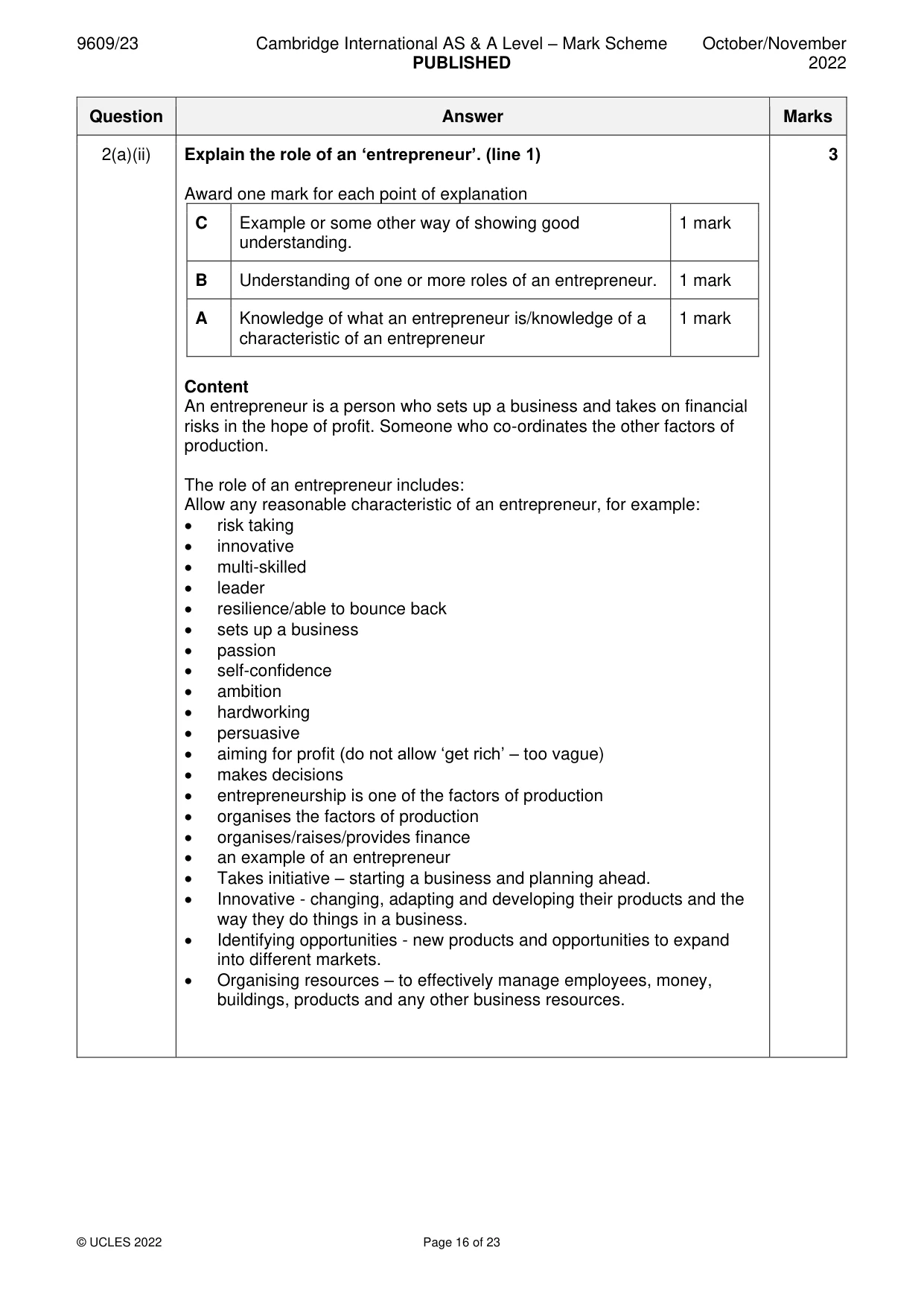
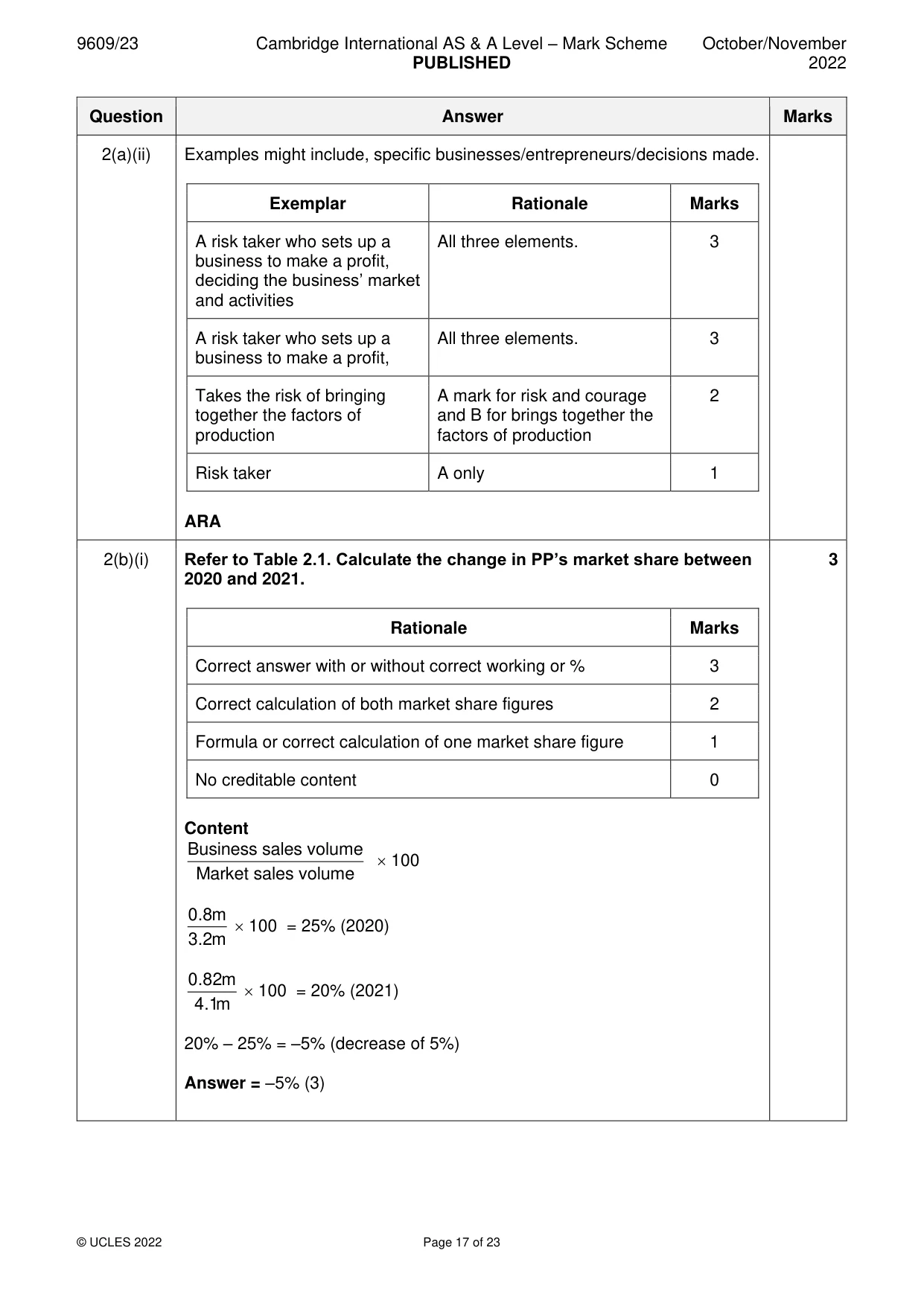
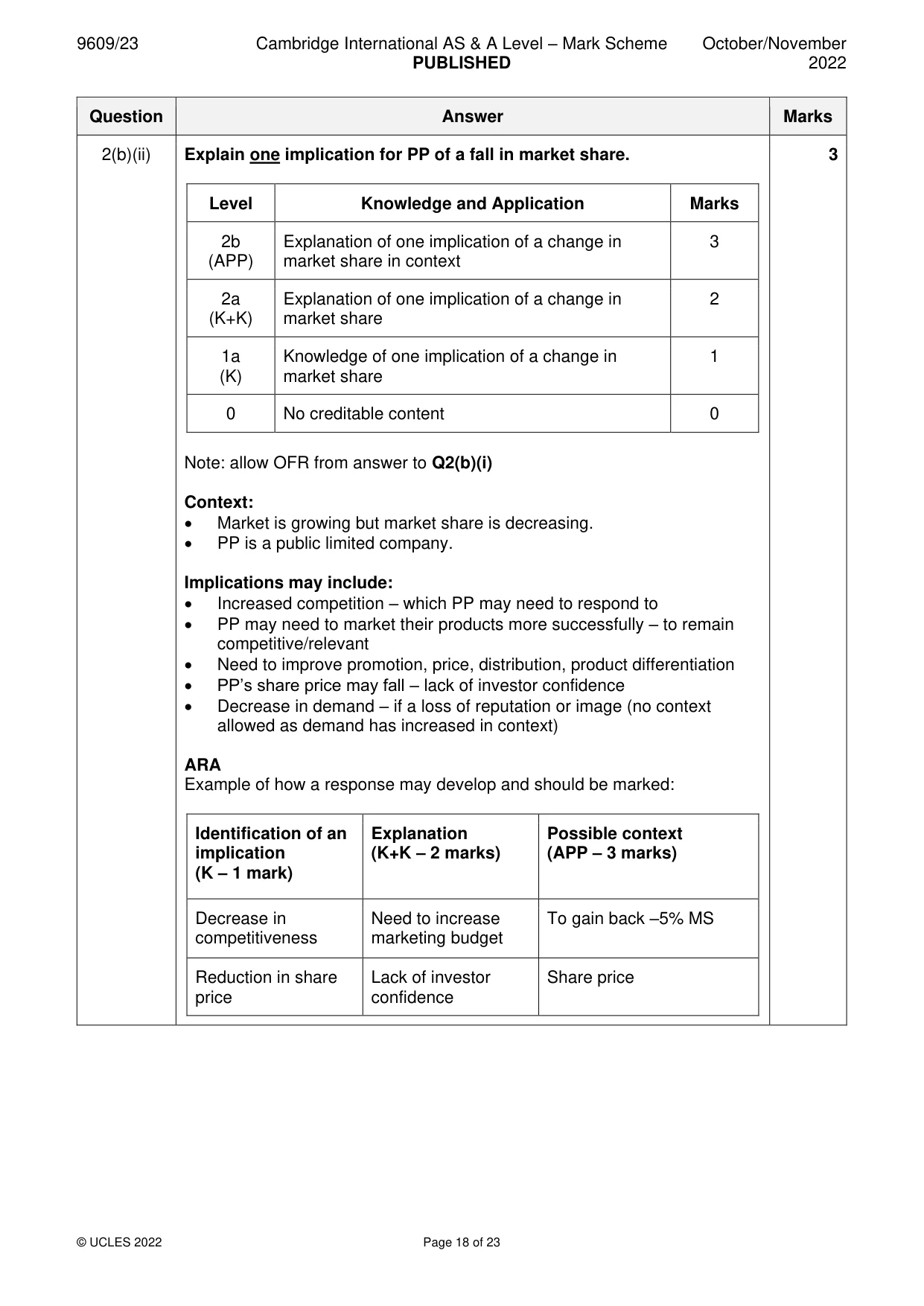
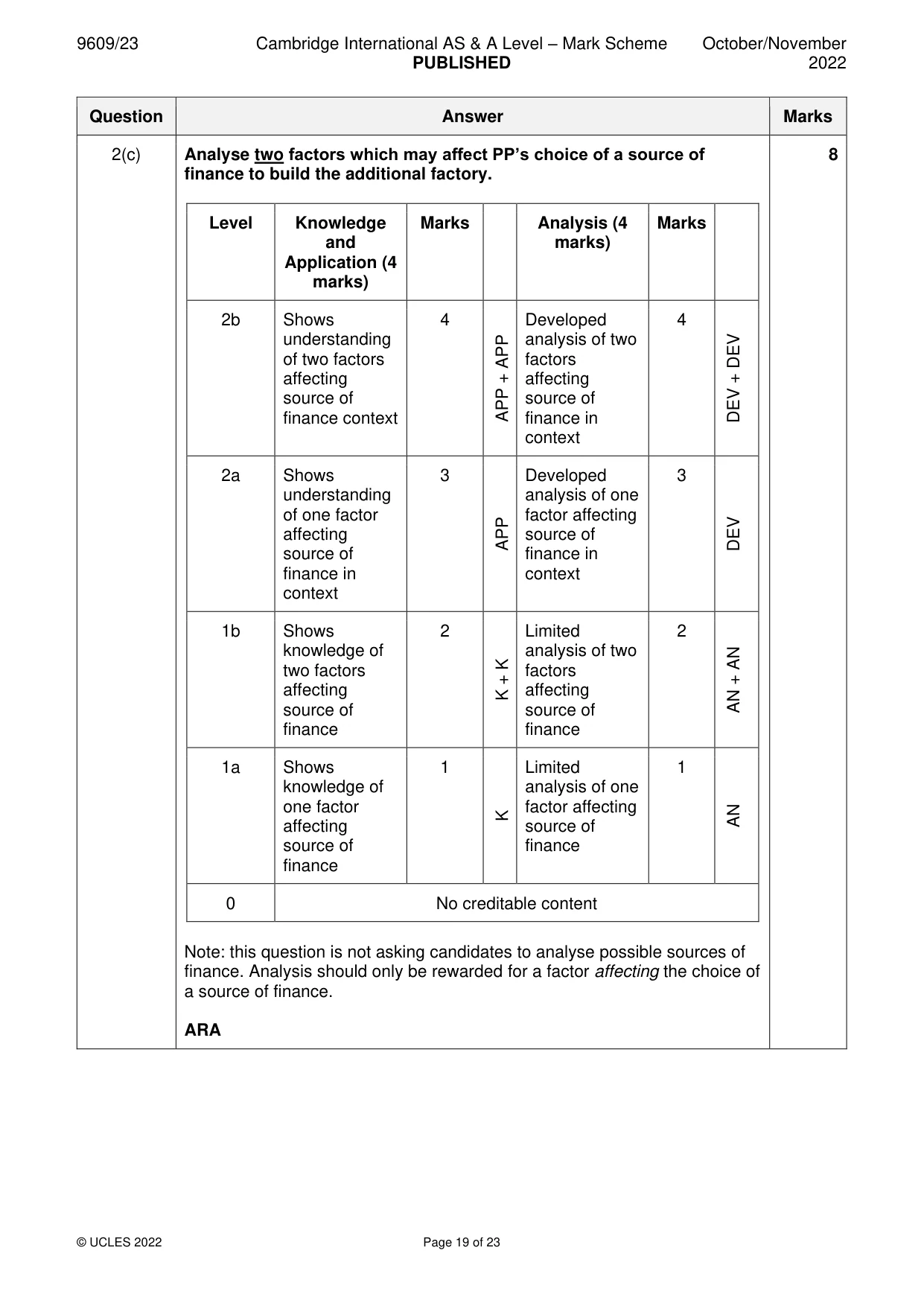
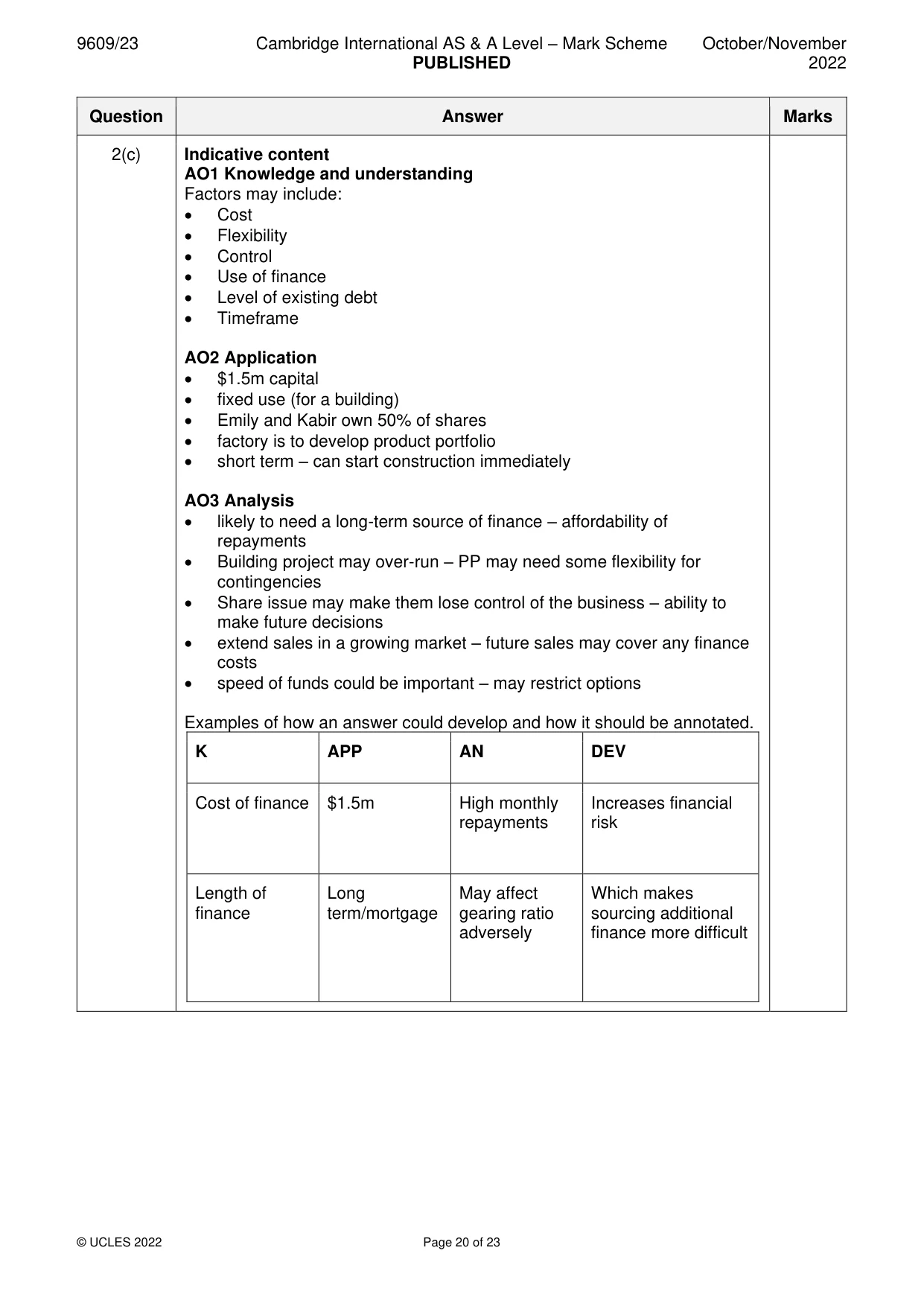
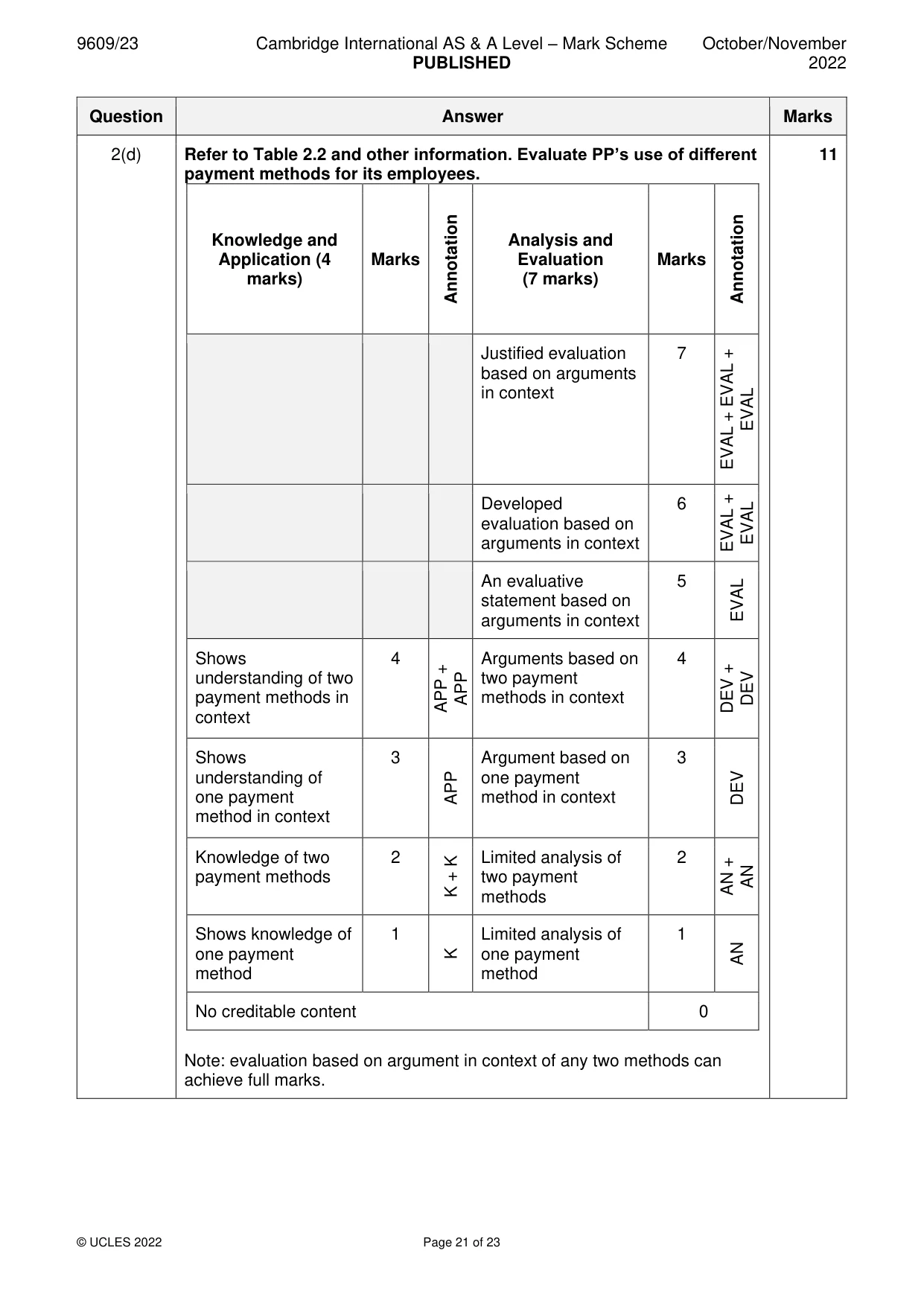
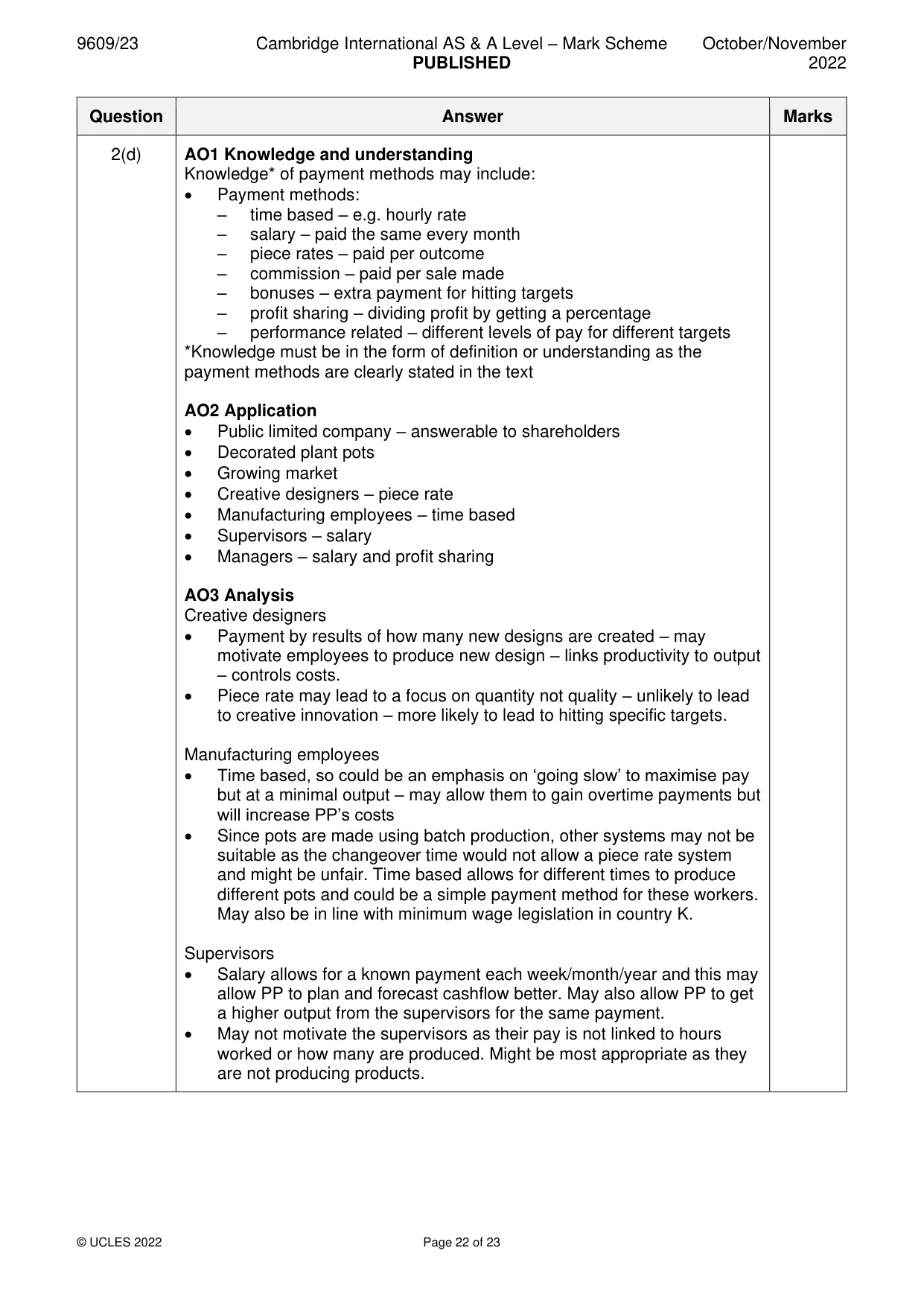
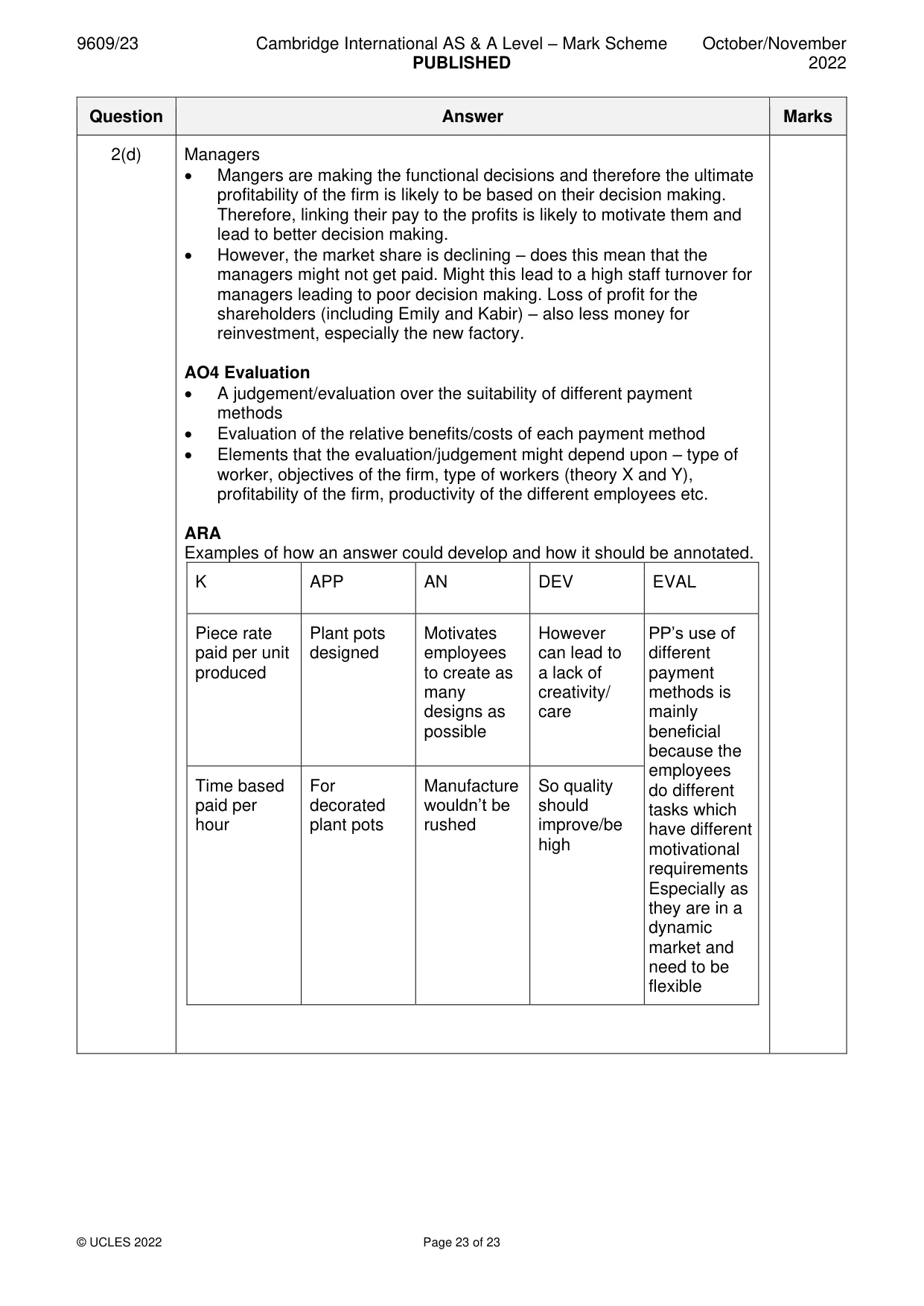
Mark scheme: 2(a)(i) Define the term ‘batch production’ (line 17). 2 Knowledge Marks A correct definition 2 A partial, vague or unfocused definition 1 No creditable content 0 A correct definition should include the following elements: • Separate groups/set amount/limited number – do not accept batch. • Go through production process together before moving on to the next. Batch production is where quantities of identical goods are produced in small groups. They go through the production process at the same time. Production is then switched over to allow another batch to be produced. Example(s) not required. Exemplar Mark Rationale Batch production is where 2 A correct definition quantities of identical goods are produced together and then move on to the next process A group of products go from 2 Both elements covered one stage of production to the next together Produced at the same stage 1 Partial definition When products are made in 1 Partial definition small quantities Products made one a time 0 Confusion with job production Products made continuously 0 Confusion with flow/mass and are all the same production 2(a)(ii) Explain the role of an ‘entrepreneur’. (line 1) 3 Award one mark for each point of explanation C Example or some other way of showing good 1 mark understanding. B Understanding of one or more roles of an entrepreneur. 1 mark A Knowledge of what an entrepreneur is/knowledge of a 1 mark characteristic of an entrepreneur Content An entrepreneur is a person who sets up a business and takes on financial risks in the hope of profit. Someone who co-ordinates the other factors of production. The role of an entrepreneur includes: Allow any reasonable characteristic of an entrepreneur, for example: • risk taking • innovative • multi-skilled • leader • resilience/able to bounce back • sets up a business • passion • self-confidence • ambition • hardworking • persuasive • aiming for profit (do not allow ‘get rich’ – too vague) • makes decisions • entrepreneurship is one of the factors of production • organises the factors of production • organises/raises/provides finance • an example of an entrepreneur • Takes initiative – starting a business and planning ahead. • Innovative - changing, adapting and developing their products and the way they do things in a business. • Identifying opportunities - new products and opportunities to expand into different markets. • Organising resources – to effectively manage employees, money, buildings, products and any other business resources. 2(a)(ii) Examples might include, specific businesses/entrepreneurs/decisions made. Exemplar Rationale Marks A risk taker who sets up a All three elements. 3 business to make a profit, deciding the business’ market and activities A risk taker who sets up a All three elements. 3 business to make a profit, Takes the risk of bringing A mark for risk and courage 2 together the factors of and B for brings together the production factors of production Risk taker A only 1 ARA 2(b)(i) Refer to Table 2.1. Calculate the change in PP’s market share between 3 2020 and 2021. Rationale Marks Correct answer with or without correct working or % 3 Correct calculation of both market share figures 2 Formula or correct calculation of one market share figure 1 No creditable content 0 Content Business sales volume 100 Market sales volume 0.8m 100 = 25% (2020) 3.2m 0.82m 100 = 20% (2021) 4.1m 20% – 25% = –5% (decrease of 5%) Answer = –5% (3) 2(b)(ii) Explain one implication for PP of a fall in market share. 3 Level Knowledge and Application Marks 2b Explanation of one implication of a change in 3 (APP) market share in context 2a Explanation of one implication of a change in 2 (K+K) market share 1a Knowledge of one implication of a change in 1 (K) market share 0 No creditable content 0 Note: allow OFR from answer to Q2(b)(i) Context: • Market is growing but market share is decreasing. • PP is a public limited company. Implications may include: • Increased competition – which PP may need to respond to • PP may need to market their products more successfully – to remain competitive/relevant • Need to improve promotion, price, distribution, product differentiation • PP’s share price may fall – lack of investor confidence • Decrease in demand – if a loss of reputation or image (no context allowed as demand has increased in context) ARA Example of how a response may develop and should be marked: Identification of an Explanation Possible context implication (K+K – 2 marks) (APP – 3 marks) (K – 1 mark) Decrease in Need to increase To gain back –5% MS competitiveness marketing budget Reduction in share Lack of investor Share price price confidence 2(c) Analyse two factors which may affect PP’s choice of a source of 8 finance to build the additional factory. Level Knowledge Marks Analysis (4 Marks and marks) Application (4 marks) 2b Shows 4 Developed 4 understanding analysis of two of two factors APP factors DEV affecting + affecting + source of of APP source finance context finance in DEV context 2a Shows 3 Developed 3 understanding analysis of one of one factor factor affecting affecting source of APP DEV source of finance in finance in context context 1b Shows 2 Limited 2 knowledge of analysis of two K AN two factors factors + + affecting K affecting AN source of source of finance finance 1a Shows 1 Limited 1 knowledge of analysis of one one factor factor affecting K AN affecting source of source of finance finance 0 No creditable content Note: this question is not asking candidates to analyse possible sources of finance. Analysis should only be rewarded for a factor affecting the choice of a source of finance. ARA 2(c) Indicative content AO1 Knowledge and understanding Factors may include: • Cost • Flexibility • Control • Use of finance • Level of existing debt • Timeframe AO2 Application • $1.5m capital • fixed use (for a building) • Emily and Kabir own 50% of shares • factory is to develop product portfolio • short term – can start construction immediately AO3 Analysis • likely to need a long-term source of finance – affordability of repayments • Building project may over-run – PP may need some flexibility for contingencies • Share issue may make them lose control of the business – ability to make future decisions • extend sales in a growing market – future sales may cover any finance costs • speed of funds could be important – may restrict options Examples of how an answer could develop and how it should be annotated. K APP AN DEV Cost of finance $1.5m High monthly Increases financial repayments risk Length of Long May affect Which makes finance term/mortgage gearing ratio sourcing additional adversely finance more difficult 2(d) Refer to Table 2.2 and other information. Evaluate PP’s use of different 11 payment methods for its employees. Knowledge and Analysis and Application (4 Marks Evaluation Marks marks) (7 marks) Annotation Annotation Justified evaluation 7 + based on arguments in context EVAL + EVAL EVAL Developed 6 + evaluation based on EVAL arguments in context EVAL An evaluative 5 statement based on EVAL arguments in context Shows 4 Arguments based on 4 understanding of two + two payment + payment methods in APP methods in context DEV APP DEV context Shows 3 Argument based on 3 understanding one payment of APP onemethodpaymentin context DEV method in context Knowledge of two 2 K Limited analysis of 2 + payment methods + two payment AN K AN methods Shows knowledge of 1 Limited analysis of 1 one payment K one payment AN method method No creditable content 0 Note: evaluation based on argument in context of any two methods can achieve full marks. 2(d) AO1 Knowledge and understanding Knowledge* of payment methods may include: • Payment methods: – time based – e.g. hourly rate – salary – paid the same every month – piece rates – paid per outcome – commission – paid per sale made – bonuses – extra payment for hitting targets – profit sharing – dividing profit by getting a percentage – performance related – different levels of pay for different targets *Knowledge must be in the form of definition or understanding as the payment methods are clearly stated in the text AO2 Application • Public limited company – answerable to shareholders • Decorated plant pots • Growing market • Creative designers – piece rate • Manufacturing employees – time based • Supervisors – salary • Managers – salary and profit sharing AO3 Analysis Creative designers • Payment by results of how many new designs are created – may motivate employees to produce new design – links productivity to output – controls costs. • Piece rate may lead to a focus on quantity not quality – unlikely to lead to creative innovation – more likely to lead to hitting specific targets. Manufacturing employees • Time based, so could be an emphasis on ‘going slow’ to maximise pay but at a minimal output – may allow them to gain overtime payments but will increase PP’s costs • Since pots are made using batch production, other systems may not be suitable as the changeover time would not allow a piece rate system and might be unfair. Time based allows for different times to produce different pots and could be a simple payment method for these workers. May also be in line with minimum wage legislation in country K. Supervisors • Salary allows for a known payment each week/month/year and this may allow PP to plan and forecast cashflow better. May also allow PP to get a higher output from the supervisors for the same payment. • May not motivate the supervisors as their pay is not linked to hours worked or how many are produced. Might be most appropriate as they are not producing products. 2(d) Managers • Mangers are making the functional decisions and therefore the ultimate profitability of the firm is likely to be based on their decision making. Therefore, linking their pay to the profits is likely to motivate them and lead to better decision making. • However, the market share is declining – does this mean that the managers might not get paid. Might this lead to a high staff turnover for managers leading to poor decision making. Loss of profit for the shareholders (including Emily and Kabir) – also less money for reinvestment, especially the new factory. AO4 Evaluation • A judgement/evaluation over the suitability of different payment methods • Evaluation of the relative benefits/costs of each payment method • Elements that the evaluation/judgement might depend upon – type of worker, objectives of the firm, type of workers (theory X and Y), profitability of the firm, productivity of the different employees etc. ARA Examples of how an answer could develop and how it should be annotated. K APP AN DEV EVAL Piece rate Plant pots Motivates However PP’s use of paid per unit designed employees can lead to different produced to create as a lack of payment many creativity/ methods is designs as care mainly possible beneficial because the employees Time based For Manufacture So quality do different paid per decorated wouldn’t be should tasks which hour plant pots rushed improve/be have different high motivational requirements Especially as they are in a dynamic market and need to be flexible
What was in this paper
The subtopics covered by these 2 questions, and how many questions each got. Open one in a new tab to see every Cambridge question on it.
What you needed in this session
Cambridge’s own grade thresholds for 2022 Oct/Nov, Paper 2 · Variant 3. A higher threshold means an easier paper — the bar moves with how the cohort did.