Cambridge A Level Business (for first examination in 2016) 9609 — 2022 May/June Paper 2 · Variant 2
9609/22/M/J/22 · 2 questions · 60 marks · ≈68 min
The question paper and its mark scheme, free to read here and free to download. This is Cambridge’s own paper, exactly as it was sat.
Question paper4 pages
Mark scheme30 pages
Answers below. Sit the paper first if you are practising.



Questions as text
Q1 · Farm Produce (FP) FP is a primary sector co-operative made up of six farms in country G
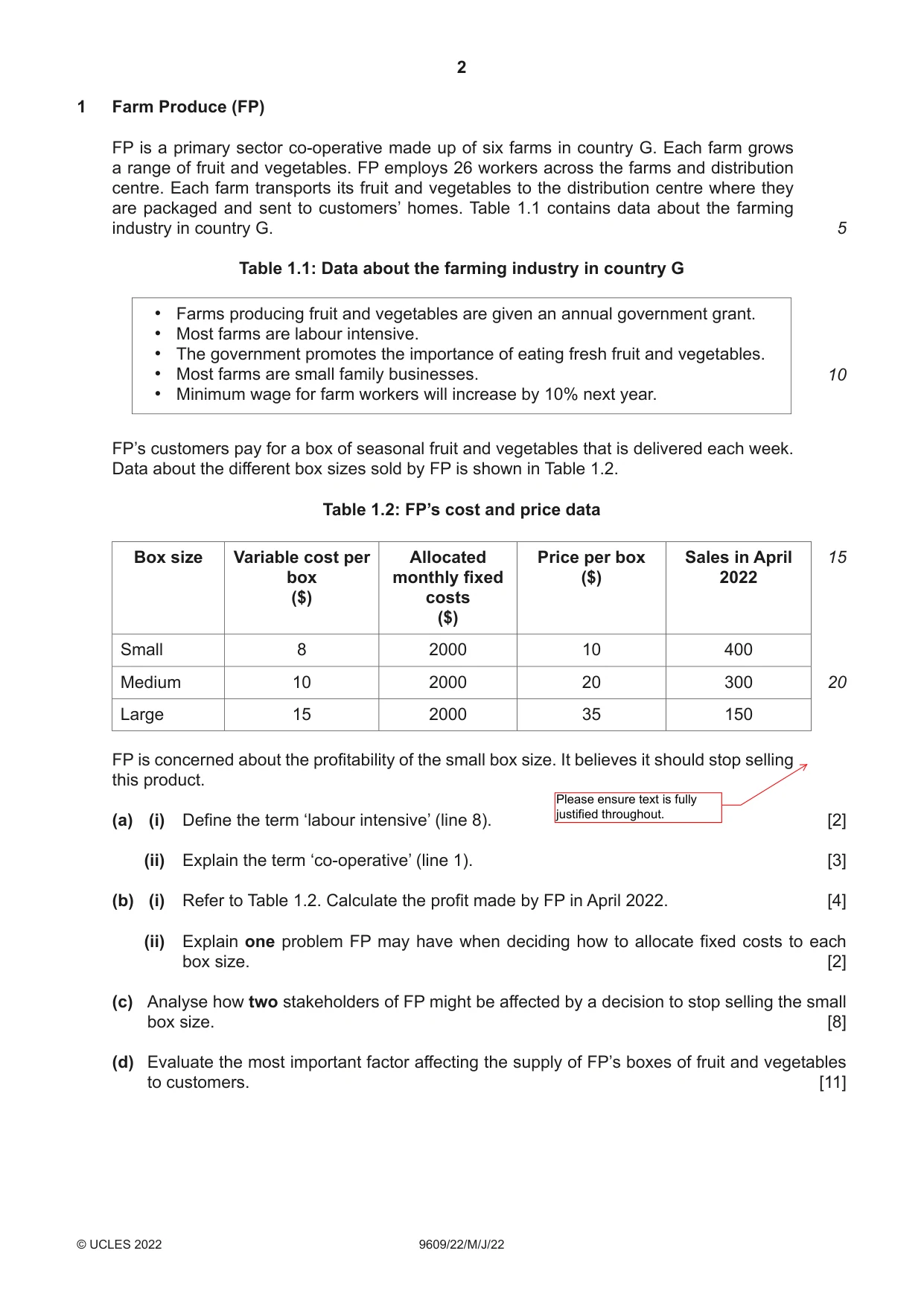
1 Farm Produce (FP) FP is a primary sector co-operative made up of six farms in country G. Each farm grows a range of fruit and vegetables. FP employs 26 workers across the farms and distribution centre. Each farm transports its fruit and vegetables to the distribution centre where they are packaged and sent to customers’ homes. Table 1.1 contains data about the farming industry in country G. 5 Table 1.1: Data about the farming industry in country G • Farms producing fruit and vegetables are given an annual government grant. • Most farms are labour intensive. • The government promotes the importance of eating fresh fruit and vegetables. • Most farms are small family businesses. 10 • Minimum wage for farm workers will increase by 10% next year. FP’s customers pay for a box of seasonal fruit and vegetables that is delivered each week. Data about the different box sizes sold by FP is shown in Table 1.2. Table 1.2: FP’s cost and price data Box size Variable cost per Allocated Price per box Sales in April 15 box monthly fixed ($) 2022 ($) costs ($) Small 8 2000 10 400 Medium 10 2000 20 300 20 Large 15 2000 35 150 FP is concerned about the profitability of the small box size. It believes it should stop selling this product. Please ensure text is fully (a) (i) Define the term ‘labour intensive’ (line 8). justified throughout. [2] (ii) Explain the term ‘co-operative’ (line 1). [3] (b) (i) Refer to Table 1.2. Calculate the profit made by FP in April 2022. [4] (ii) Explain one problem FP may have when deciding how to allocate fixed costs to each box size. [2] (c) Analyse how two stakeholders of FP might be affected by a decision to stop selling the small box size. [8] (d) Evaluate the most important factor affecting the supply of FP’s boxes of fruit and vegetables to customers. [11]
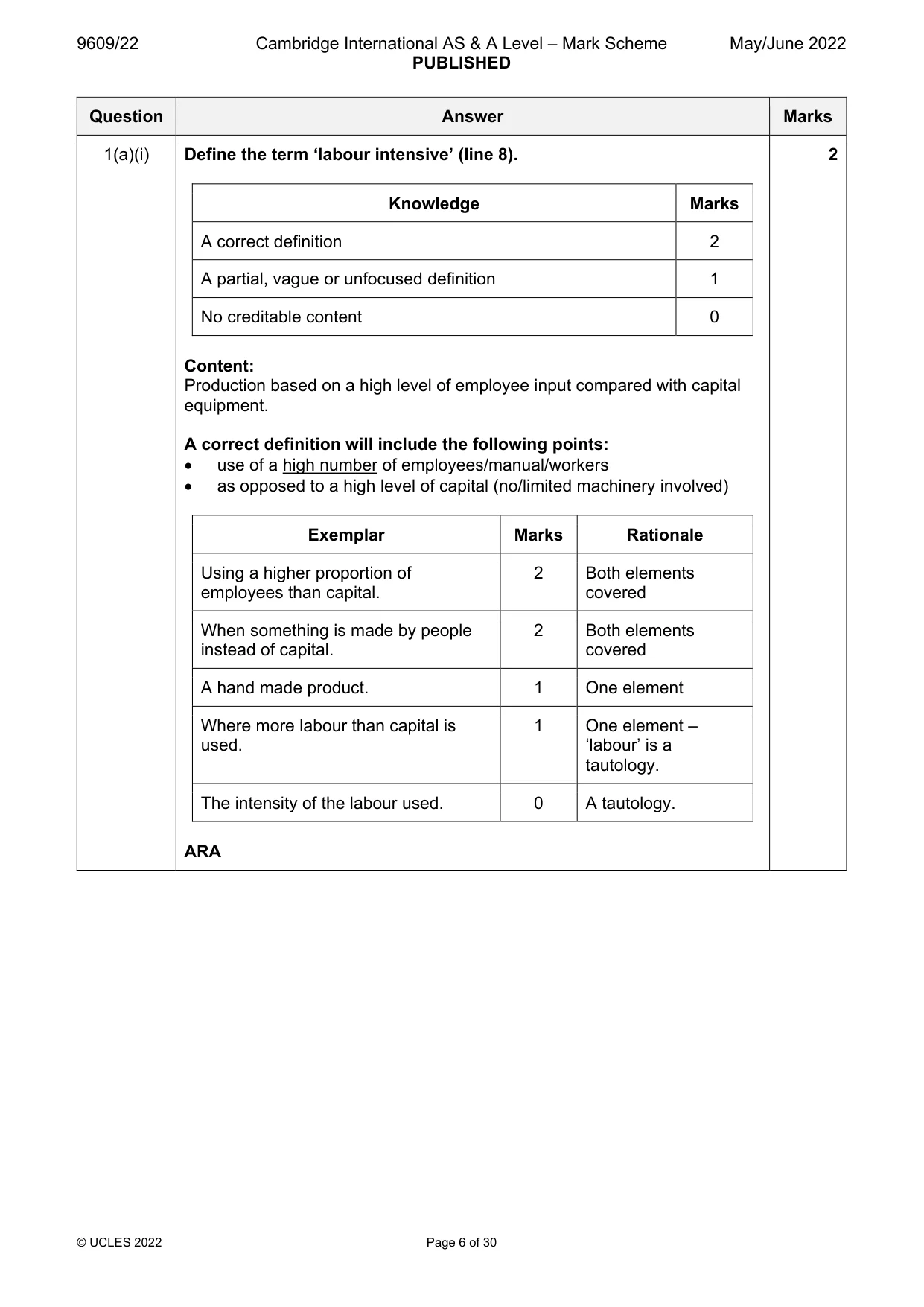
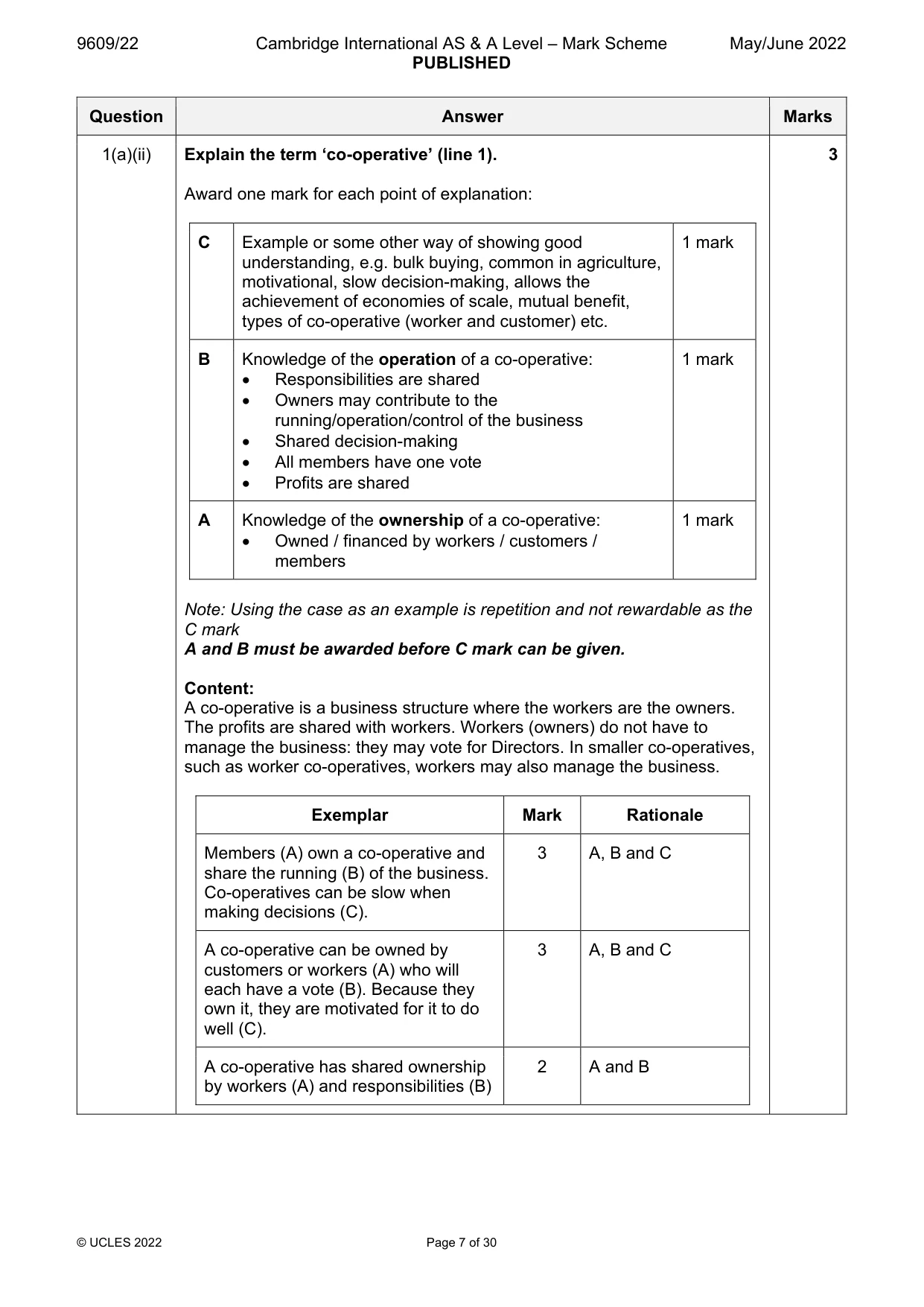
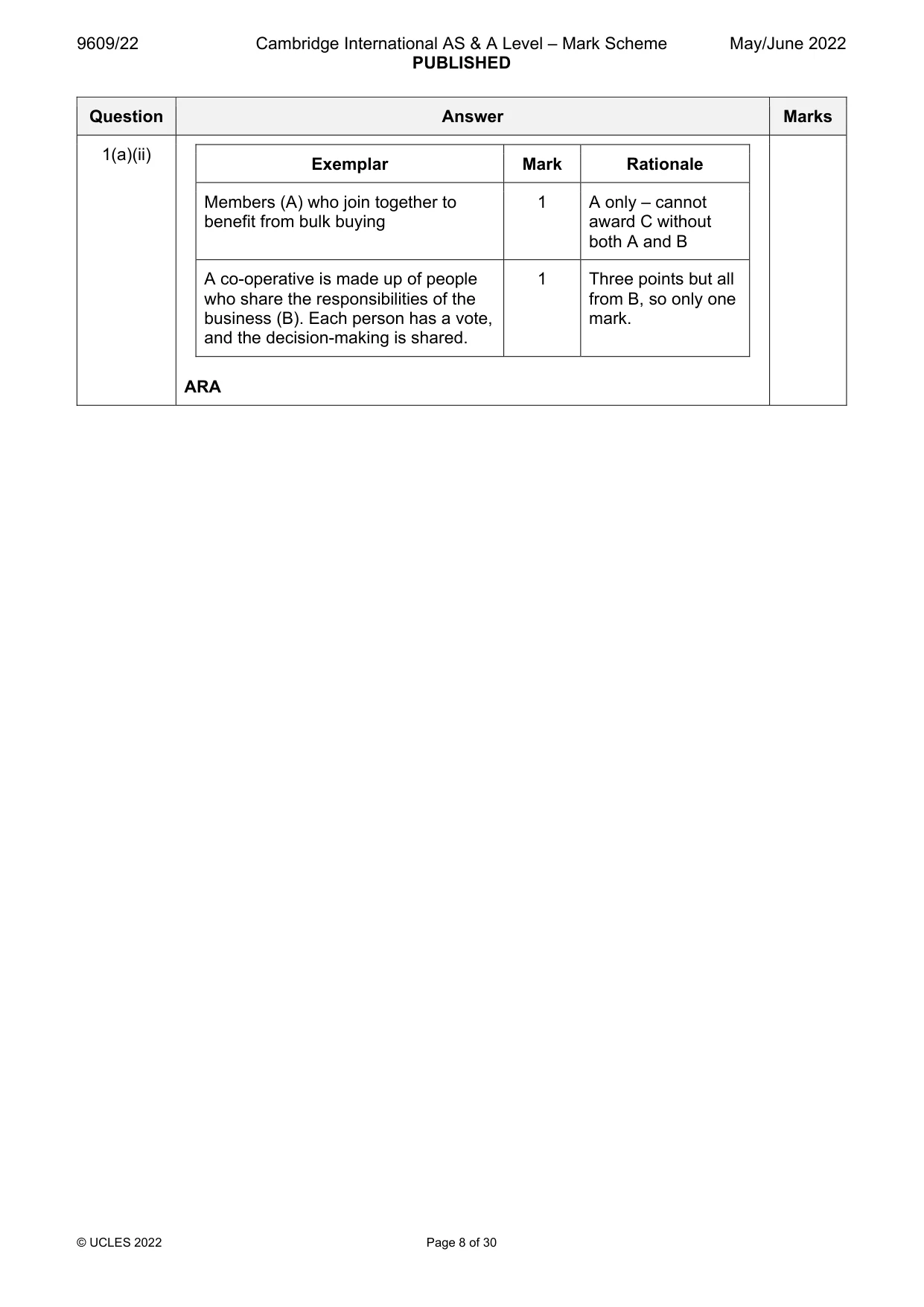
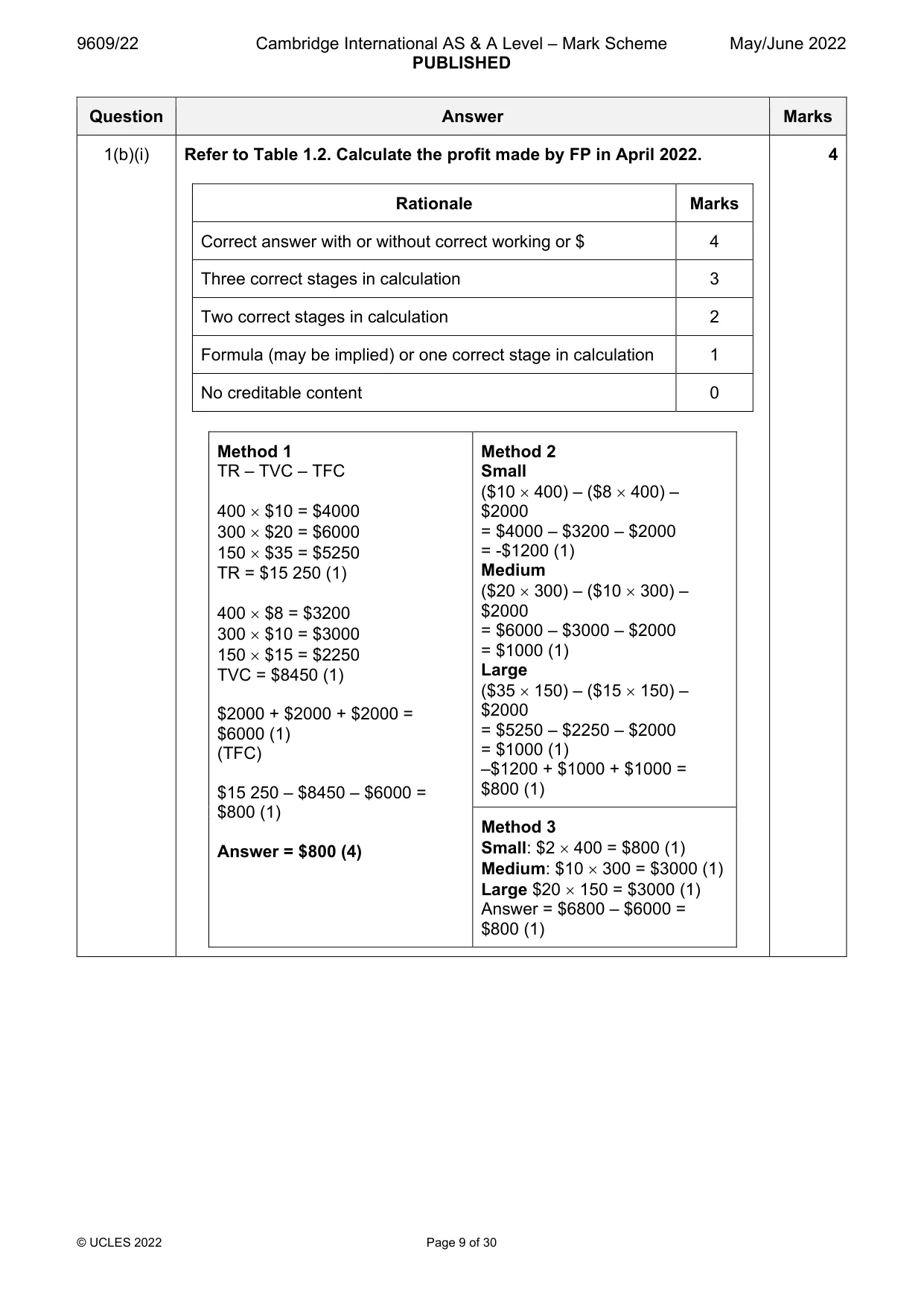
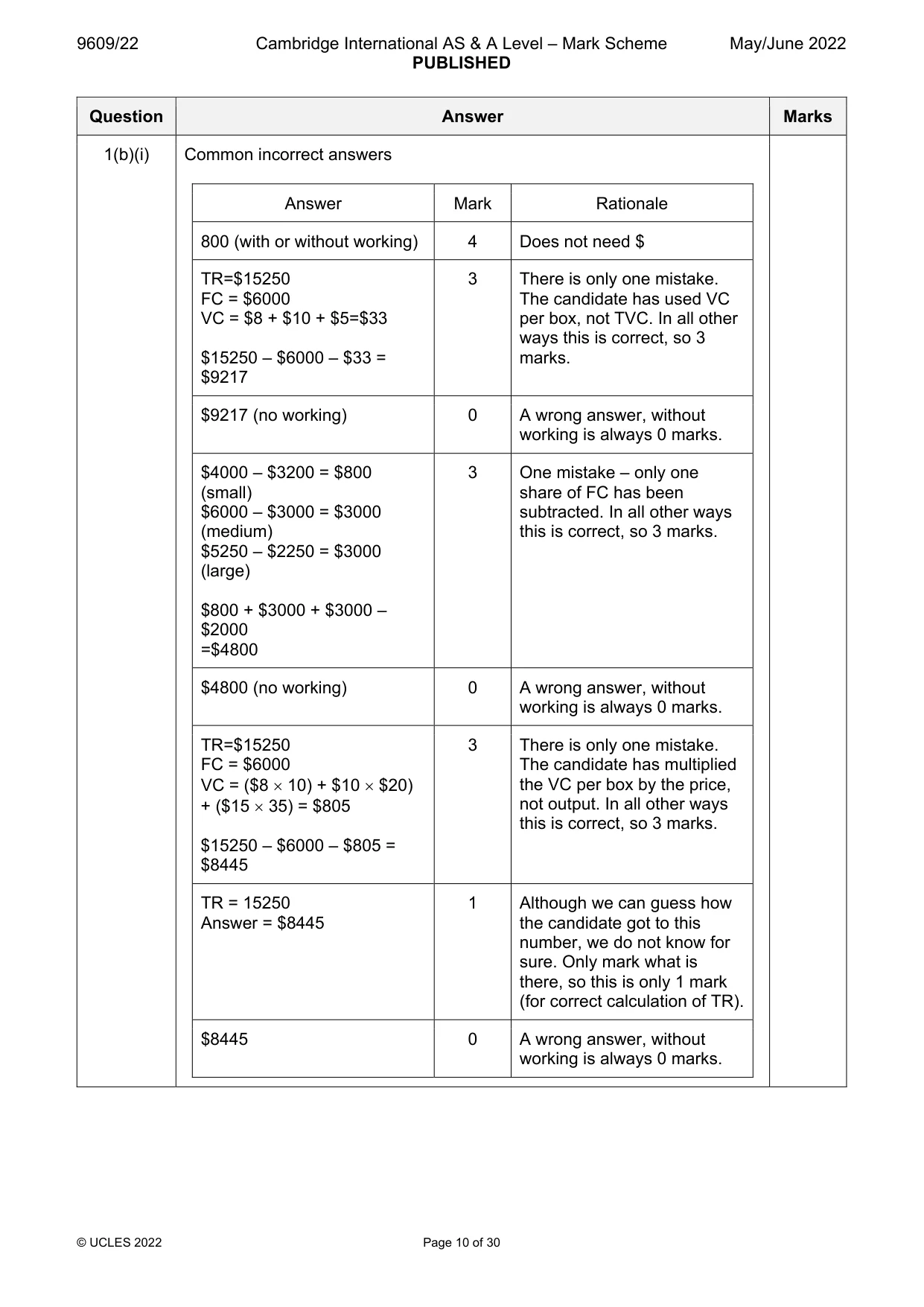
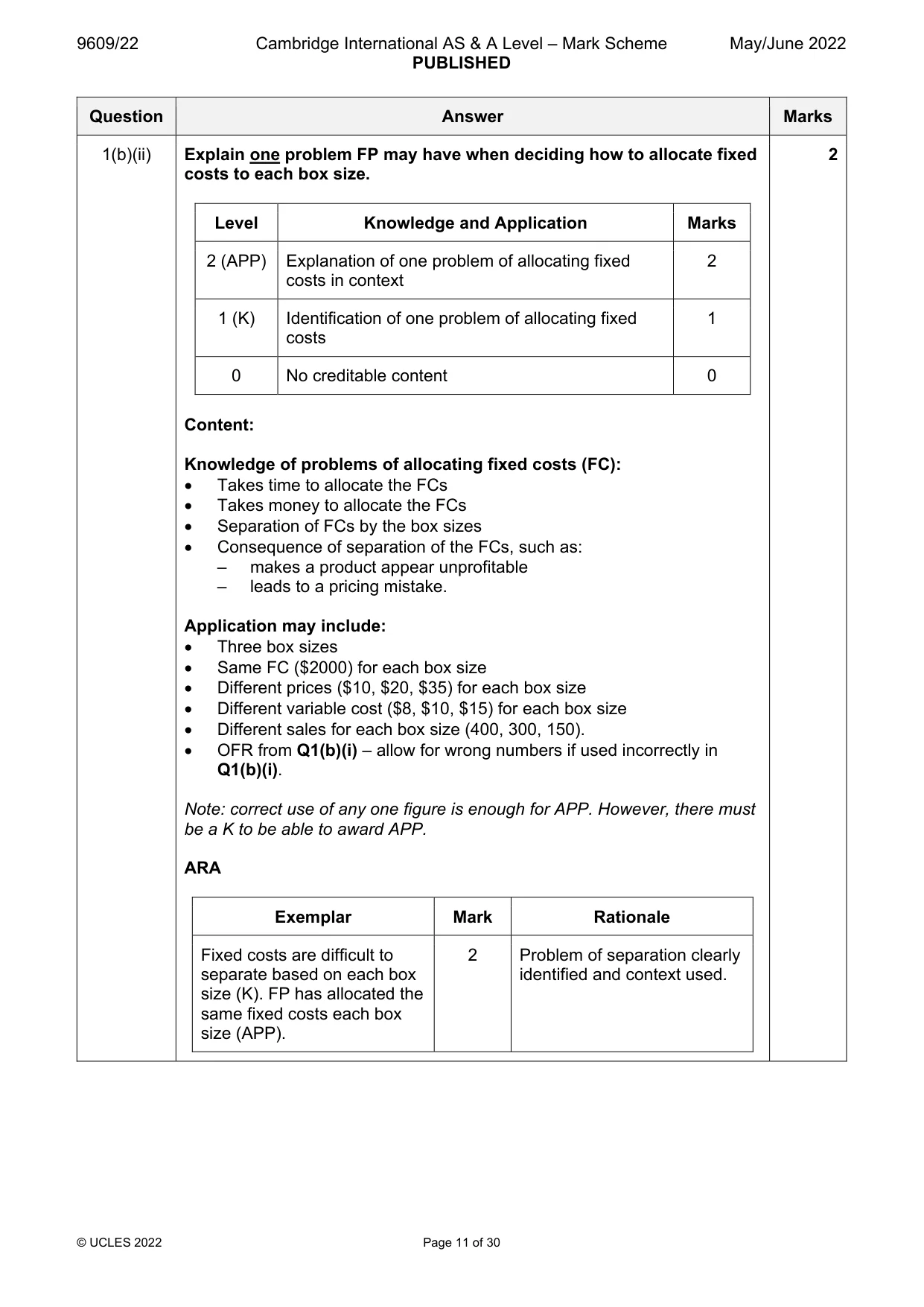
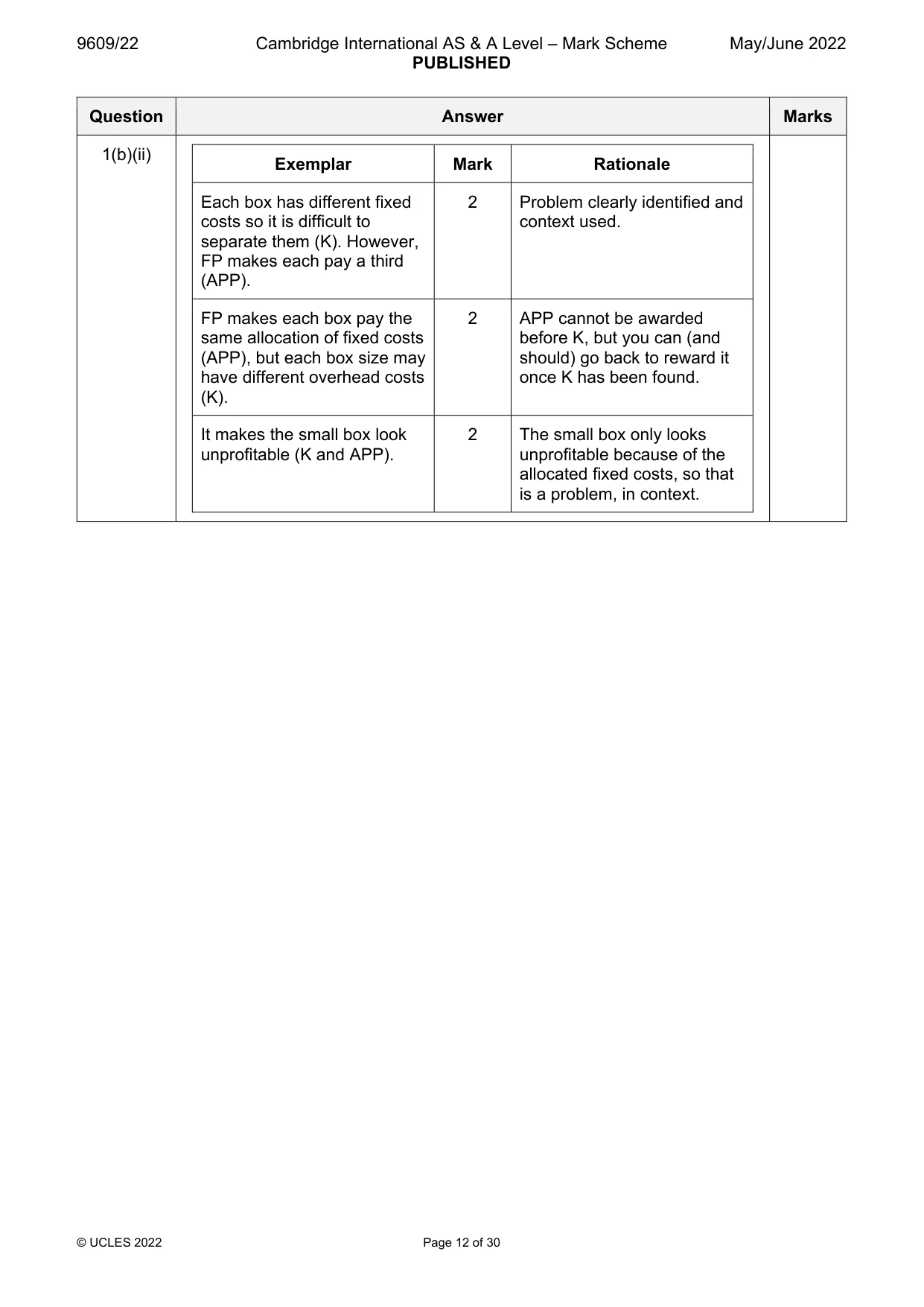
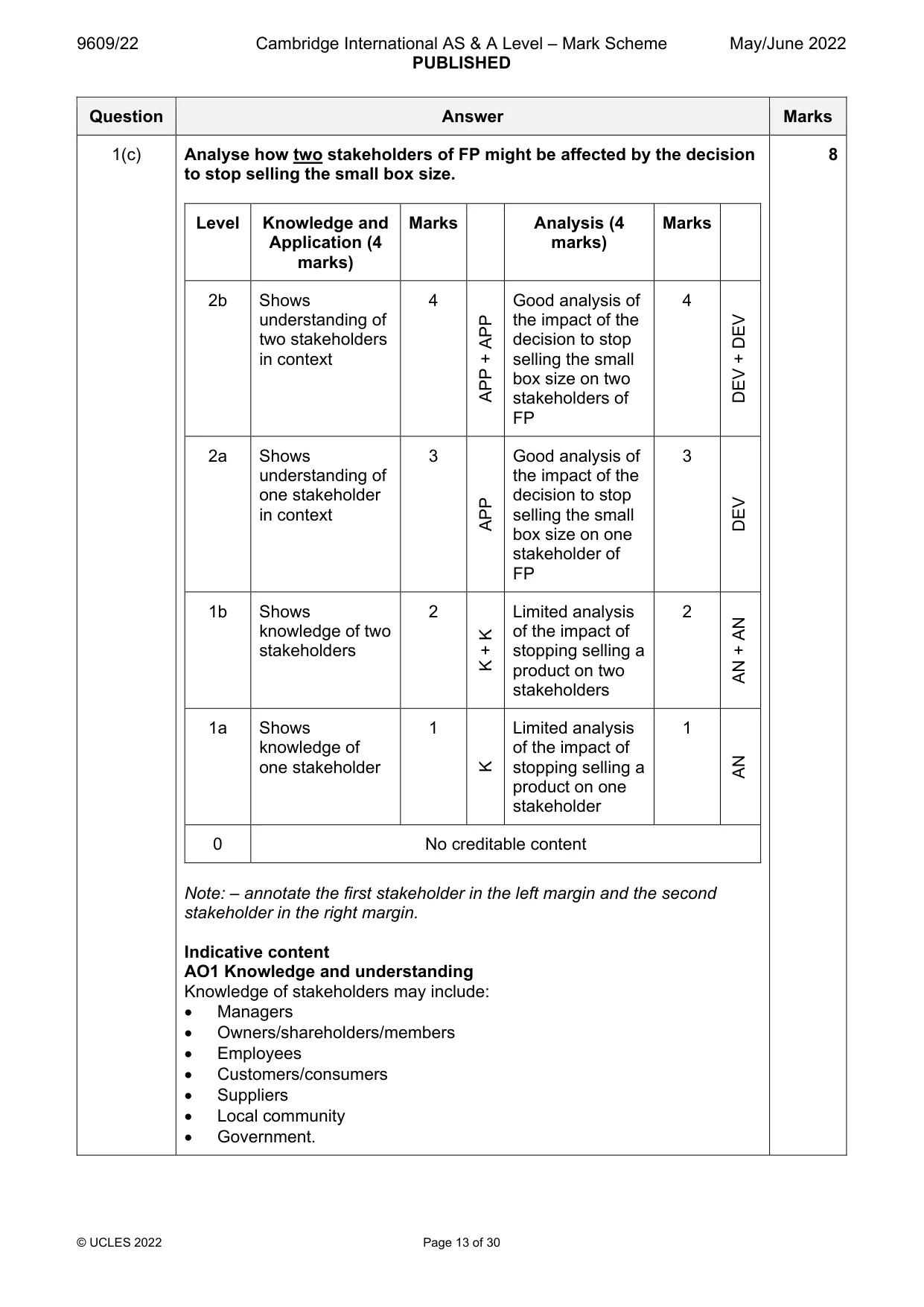
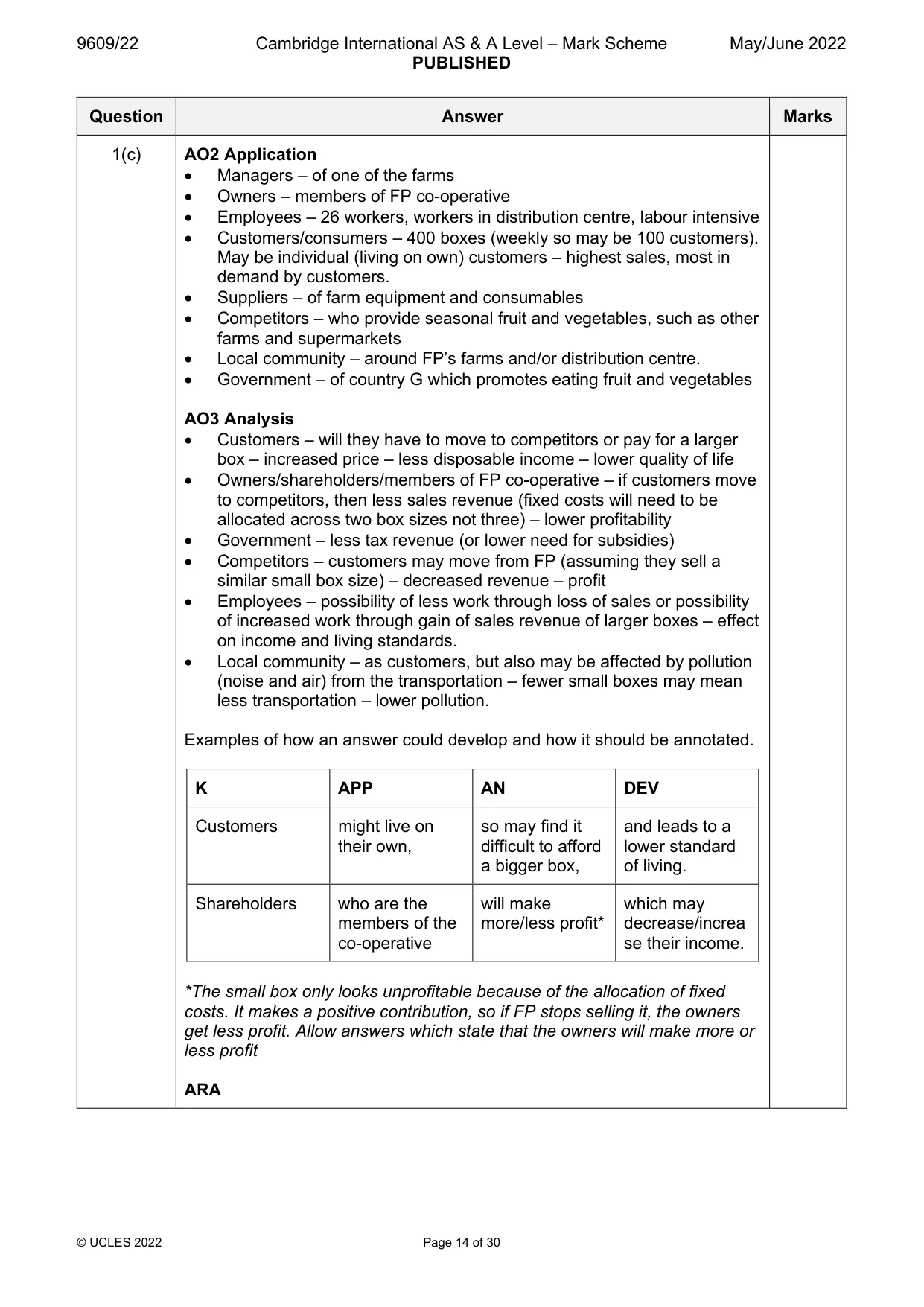
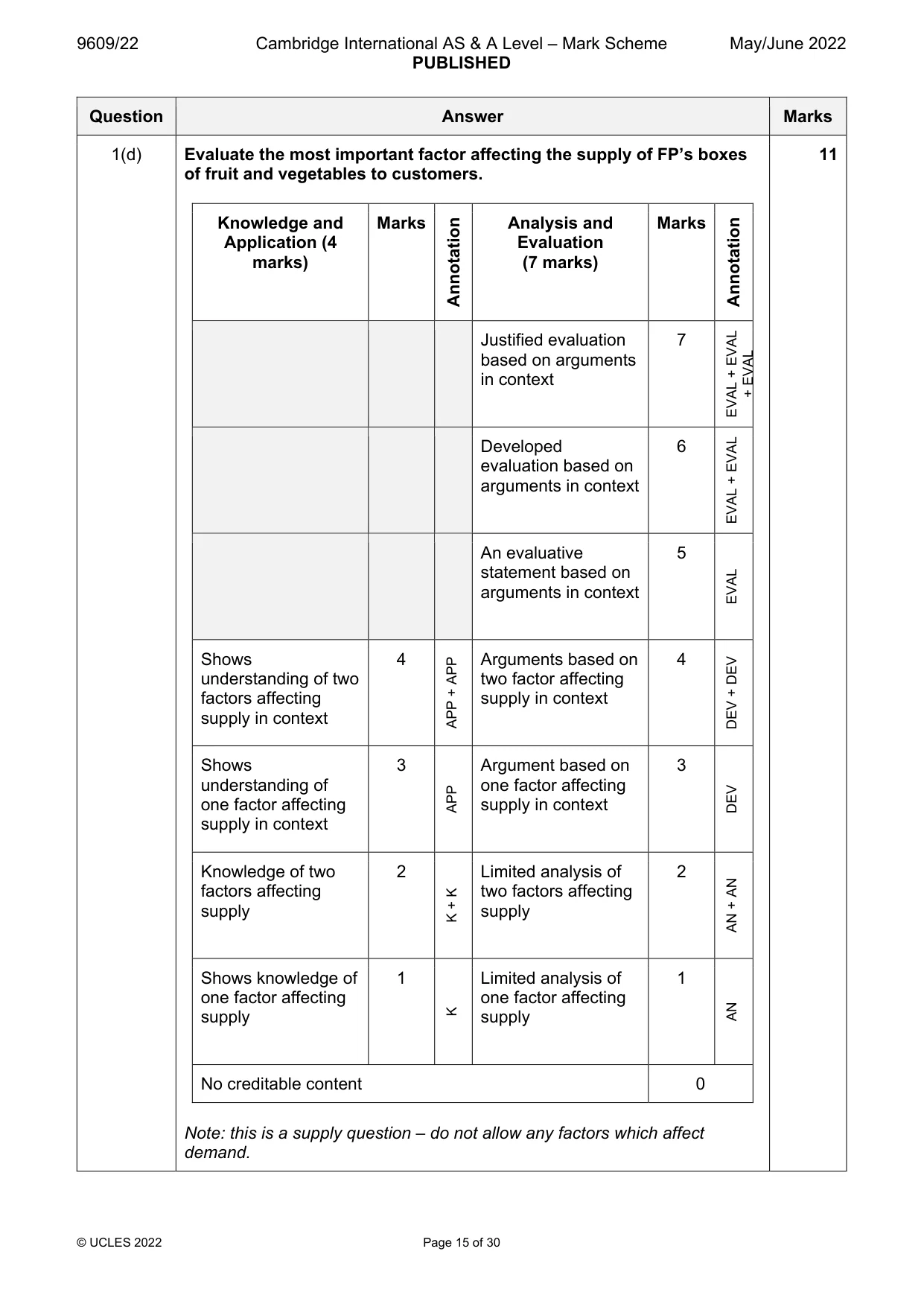
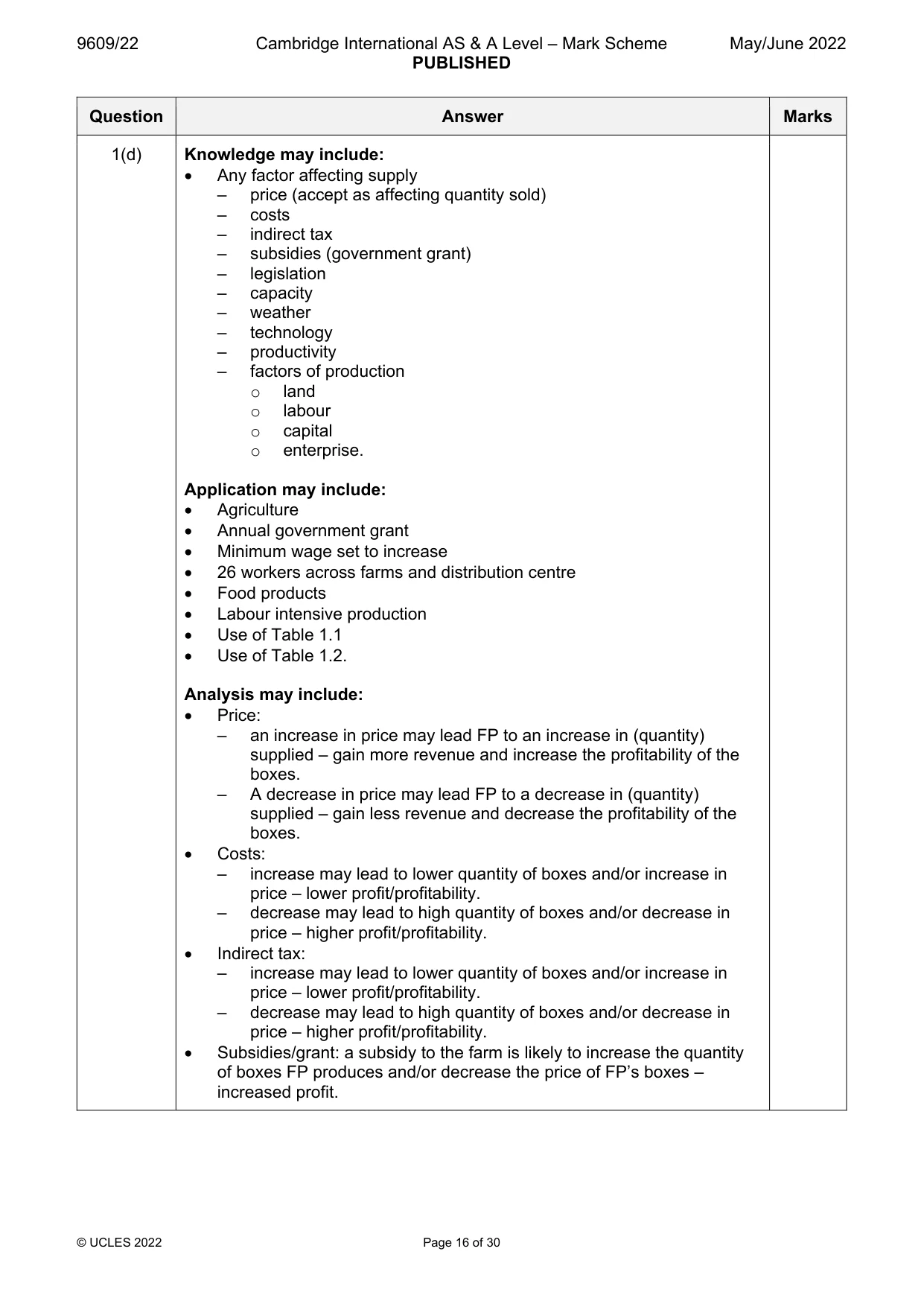
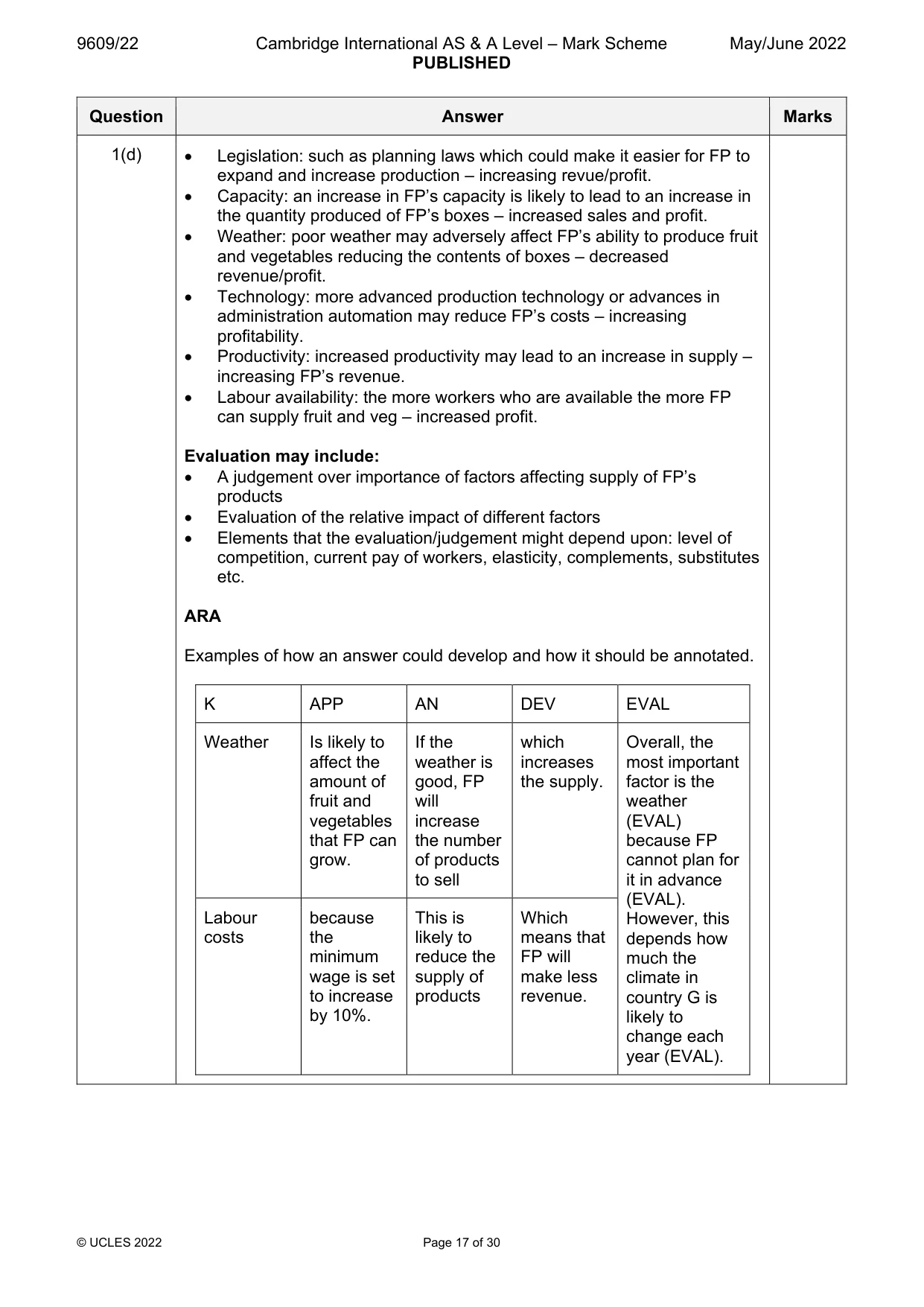
Mark scheme: Question Answer Marks 1(a)(i) Define the term ‘labour intensive’ (line 8). 2 Knowledge Marks A correct definition 2 A partial, vague or unfocused definition 1 No creditable content 0 Content: Production based on a high level of employee input compared with capital equipment. A correct definition will include the following points: use of a high number of employees/manual/workers as opposed to a high level of capital (no/limited machinery involved) Exemplar Marks Rationale Using a higher proportion of 2 Both elements employees than capital. covered When something is made by people 2 Both elements instead of capital. covered A hand made product. 1 One element Where more labour than capital is 1 One element – used. ‘labour’ is a tautology. The intensity of the labour used. 0 A tautology. ARA 1(a)(ii) Explain the term ‘co-operative’ (line 1). 3 Award one mark for each point of explanation: C Example or some other way of showing good 1 mark understanding, e.g. bulk buying, common in agriculture, motivational, slow decision-making, allows the achievement of economies of scale, mutual benefit, types of co-operative (worker and customer) etc. B Knowledge of the operation of a co-operative: 1 mark Responsibilities are shared Owners may contribute to the running/operation/control of the business Shared decision-making All members have one vote Profits are shared A Knowledge of the ownership of a co-operative: 1 mark Owned / financed by workers / customers / members Note: Using the case as an example is repetition and not rewardable as the C mark A and B must be awarded before C mark can be given. Content: A co-operative is a business structure where the workers are the owners. The profits are shared with workers. Workers (owners) do not have to manage the business: they may vote for Directors. In smaller co-operatives, such as worker co-operatives, workers may also manage the business. Exemplar Mark Rationale Members (A) own a co-operative and 3 A, B and C share the running (B) of the business. Co-operatives can be slow when making decisions (C). A co-operative can be owned by 3 A, B and C customers or workers (A) who will each have a vote (B). Because they own it, they are motivated for it to do well (C). A co-operative has shared ownership 2 A and B by workers (A) and responsibilities (B) 1(a)(ii) Exemplar Mark Rationale Members (A) who join together to 1 A only – cannot benefit from bulk buying award C without both A and B A co-operative is made up of people 1 Three points but all who share the responsibilities of the from B, so only one business (B). Each person has a vote, mark. and the decision-making is shared. ARA 1(b)(i) Refer to Table 1.2. Calculate the profit made by FP in April 2022. 4 Rationale Marks Correct answer with or without correct working or $ 4 Three correct stages in calculation 3 Two correct stages in calculation 2 Formula (may be implied) or one correct stage in calculation 1 No creditable content 0 Method 1 Method 2 TR – TVC – TFC Small ($10 400) – ($8 400) – 400 $10 = $4000 $2000 300 $20 = $6000 = $4000 – $3200 – $2000 150 $35 = $5250 = -$1200 (1) TR = $15 250 (1) Medium ($20 300) – ($10 300) – 400 $8 = $3200 $2000 300 $10 = $3000 = $6000 – $3000 – $2000 = $1000 (1) 150 $15 = $2250 Large TVC = $8450 (1) ($35 150) – ($15 150) – $2000 + $2000 + $2000 = $2000 $6000 (1) = $5250 – $2250 – $2000 (TFC) = $1000 (1) –$1200 + $1000 + $1000 = $15 250 – $8450 – $6000 = $800 (1) $800 (1) Method 3 Answer = $800 (4) Small: $2 400 = $800 (1) Medium: $10 300 = $3000 (1) Large $20 150 = $3000 (1) Answer = $6800 – $6000 = $800 (1) 1(b)(i) Common incorrect answers Answer Mark Rationale 800 (with or without working) 4 Does not need $ TR=$15250 3 There is only one mistake. FC = $6000 The candidate has used VC VC = $8 + $10 + $5=$33 per box, not TVC. In all other ways this is correct, so 3 $15250 – $6000 – $33 = marks. $9217 $9217 (no working) 0 A wrong answer, without working is always 0 marks. $4000 – $3200 = $800 3 One mistake – only one (small) share of FC has been $6000 – $3000 = $3000 subtracted. In all other ways (medium) this is correct, so 3 marks. $5250 – $2250 = $3000 (large) $800 + $3000 + $3000 – $2000 =$4800 $4800 (no working) 0 A wrong answer, without working is always 0 marks. TR=$15250 3 There is only one mistake. FC = $6000 The candidate has multiplied VC = ($8 10) + $10 $20) the VC per box by the price, + ($15 35) = $805 not output. In all other ways this is correct, so 3 marks. $15250 – $6000 – $805 = $8445 TR = 15250 1 Although we can guess how Answer = $8445 the candidate got to this number, we do not know for sure. Only mark what is there, so this is only 1 mark (for correct calculation of TR). $8445 0 A wrong answer, without working is always 0 marks. 1(b)(ii) Explain one problem FP may have when deciding how to allocate fixed 2 costs to each box size. Level Knowledge and Application Marks 2 (APP) Explanation of one problem of allocating fixed 2 costs in context 1 (K) Identification of one problem of allocating fixed 1 costs 0 No creditable content 0 Content: Knowledge of problems of allocating fixed costs (FC): Takes time to allocate the FCs Takes money to allocate the FCs Separation of FCs by the box sizes Consequence of separation of the FCs, such as: – makes a product appear unprofitable – leads to a pricing mistake. Application may include: Three box sizes Same FC ($2000) for each box size Different prices ($10, $20, $35) for each box size Different variable cost ($8, $10, $15) for each box size Different sales for each box size (400, 300, 150). OFR from Q1(b)(i) – allow for wrong numbers if used incorrectly in Q1(b)(i). Note: correct use of any one figure is enough for APP. However, there must be a K to be able to award APP. ARA Exemplar Mark Rationale Fixed costs are difficult to 2 Problem of separation clearly separate based on each box identified and context used. size (K). FP has allocated the same fixed costs each box size (APP). 1(b)(ii) Exemplar Mark Rationale Each box has different fixed 2 Problem clearly identified and costs so it is difficult to context used. separate them (K). However, FP makes each pay a third (APP). FP makes each box pay the 2 APP cannot be awarded same allocation of fixed costs before K, but you can (and (APP), but each box size may should) go back to reward it have different overhead costs once K has been found. (K). It makes the small box look 2 The small box only looks unprofitable (K and APP). unprofitable because of the allocated fixed costs, so that is a problem, in context. 1(c) Analyse how two stakeholders of FP might be affected by the decision 8 to stop selling the small box size. Level Knowledge and Marks Analysis (4 Marks Application (4 marks) marks) 2b Shows 4 Good analysis of 4 understanding of the impact of the two stakeholders APP decision to stop DEV in context + selling the small + size on two APP box stakeholders of DEV FP 2a Shows 3 Good analysis of 3 understanding of the impact of the one stakeholder decision to stop in context selling the small APP DEV box size on one stakeholder of FP 1b Shows 2 Limited analysis 2 knowledge of two K of the impact of AN stakeholders + stopping selling a + K product on two AN stakeholders 1a Shows 1 Limited analysis 1 knowledge of of the impact of one stakeholder K stopping selling a AN product on one stakeholder 0 No creditable content Note: – annotate the first stakeholder in the left margin and the second stakeholder in the right margin. Indicative content AO1 Knowledge and understanding Knowledge of stakeholders may include: Managers Owners/shareholders/members Employees Customers/consumers Suppliers Local community Government. 1(c) AO2 Application Managers – of one of the farms Owners – members of FP co-operative Employees – 26 workers, workers in distribution centre, labour intensive Customers/consumers – 400 boxes (weekly so may be 100 customers). May be individual (living on own) customers – highest sales, most in demand by customers. Suppliers – of farm equipment and consumables Competitors – who provide seasonal fruit and vegetables, such as other farms and supermarkets Local community – around FP’s farms and/or distribution centre. Government – of country G which promotes eating fruit and vegetables AO3 Analysis Customers – will they have to move to competitors or pay for a larger box – increased price – less disposable income – lower quality of life Owners/shareholders/members of FP co-operative – if customers move to competitors, then less sales revenue (fixed costs will need to be allocated across two box sizes not three) – lower profitability Government – less tax revenue (or lower need for subsidies) Competitors – customers may move from FP (assuming they sell a similar small box size) – decreased revenue – profit Employees – possibility of less work through loss of sales or possibility of increased work through gain of sales revenue of larger boxes – effect on income and living standards. Local community – as customers, but also may be affected by pollution (noise and air) from the transportation – fewer small boxes may mean less transportation – lower pollution. Examples of how an answer could develop and how it should be annotated. K APP AN DEV Customers might live on so may find it and leads to a their own, difficult to afford lower standard a bigger box, of living. Shareholders who are the will make which may members of the more/less profit* decrease/increa co-operative se their income. *The small box only looks unprofitable because of the allocation of fixed costs. It makes a positive contribution, so if FP stops selling it, the owners get less profit. Allow answers which state that the owners will make more or less profit ARA 1(d) Evaluate the most important factor affecting the supply of FP’s boxes 11 of fruit and vegetables to customers. Knowledge and Marks Analysis and Marks Application (4 Evaluation marks) (7 marks) Annotation Annotation Justified evaluation 7 EVAL based on arguments in context + EVAL + EVAL Developed 6 EVAL evaluation based on arguments in context + EVAL An evaluative 5 statement based on arguments in context EVAL Shows 4 Arguments based on 4 understanding of two APP two factor affecting DEV factors affecting + supply in context + supply in context APP DEV Shows 3 Argument based on 3 understanding of one factor affecting one factor affecting APP supply in context DEV supply in context Knowledge of two 2 Limited analysis of 2 factors affecting K two factors affecting AN supply +K supply + AN Shows knowledge of 1 Limited analysis of 1 one factor affecting one factor affecting K AN supply supply No creditable content 0 Note: this is a supply question – do not allow any factors which affect demand. 1(d) Knowledge may include: Any factor affecting supply – price (accept as affecting quantity sold) – costs – indirect tax – subsidies (government grant) – legislation – capacity – weather – technology – productivity – factors of production o land o labour o capital o enterprise. Application may include: Agriculture Annual government grant Minimum wage set to increase 26 workers across farms and distribution centre Food products Labour intensive production Use of Table 1.1 Use of Table 1.2. Analysis may include: Price: – an increase in price may lead FP to an increase in (quantity) supplied – gain more revenue and increase the profitability of the boxes. – A decrease in price may lead FP to a decrease in (quantity) supplied – gain less revenue and decrease the profitability of the boxes. Costs: – increase may lead to lower quantity of boxes and/or increase in price – lower profit/profitability. – decrease may lead to high quantity of boxes and/or decrease in price – higher profit/profitability. Indirect tax: – increase may lead to lower quantity of boxes and/or increase in price – lower profit/profitability. – decrease may lead to high quantity of boxes and/or decrease in price – higher profit/profitability. Subsidies/grant: a subsidy to the farm is likely to increase the quantity of boxes FP produces and/or decrease the price of FP’s boxes – increased profit. 1(d) Legislation: such as planning laws which could make it easier for FP to expand and increase production – increasing revue/profit. Capacity: an increase in FP’s capacity is likely to lead to an increase in the quantity produced of FP’s boxes – increased sales and profit. Weather: poor weather may adversely affect FP’s ability to produce fruit and vegetables reducing the contents of boxes – decreased revenue/profit. Technology: more advanced production technology or advances in administration automation may reduce FP’s costs – increasing profitability. Productivity: increased productivity may lead to an increase in supply – increasing FP’s revenue. Labour availability: the more workers who are available the more FP can supply fruit and veg – increased profit. Evaluation may include: A judgement over importance of factors affecting supply of FP’s products Evaluation of the relative impact of different factors Elements that the evaluation/judgement might depend upon: level of competition, current pay of workers, elasticity, complements, substitutes etc. ARA Examples of how an answer could develop and how it should be annotated. K APP AN DEV EVAL Weather Is likely to If the which Overall, the affect the weather is increases most important amount of good, FP the supply. factor is the fruit and will weather vegetables increase (EVAL) that FP can the number because FP grow. of products cannot plan for to sell it in advance (EVAL). Labour because This is Which However, this costs the likely to means that depends how minimum reduce the FP will much the wage is set supply of make less climate in to increase products revenue. country G is by 10%. likely to change each year (EVAL).
Q2 · Seaside Hotel (SH) SH is a large hotel located in a tourist area of country H
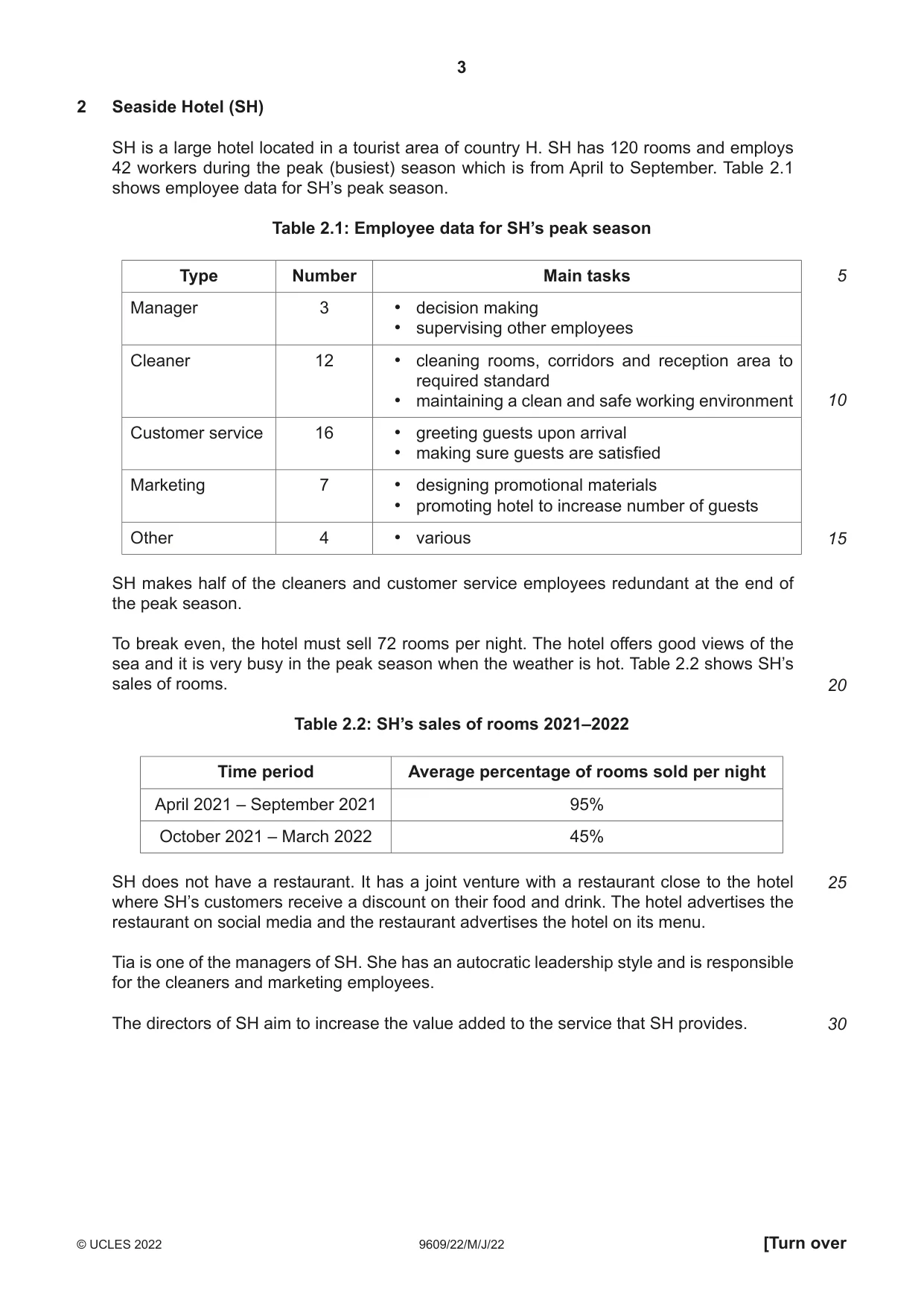
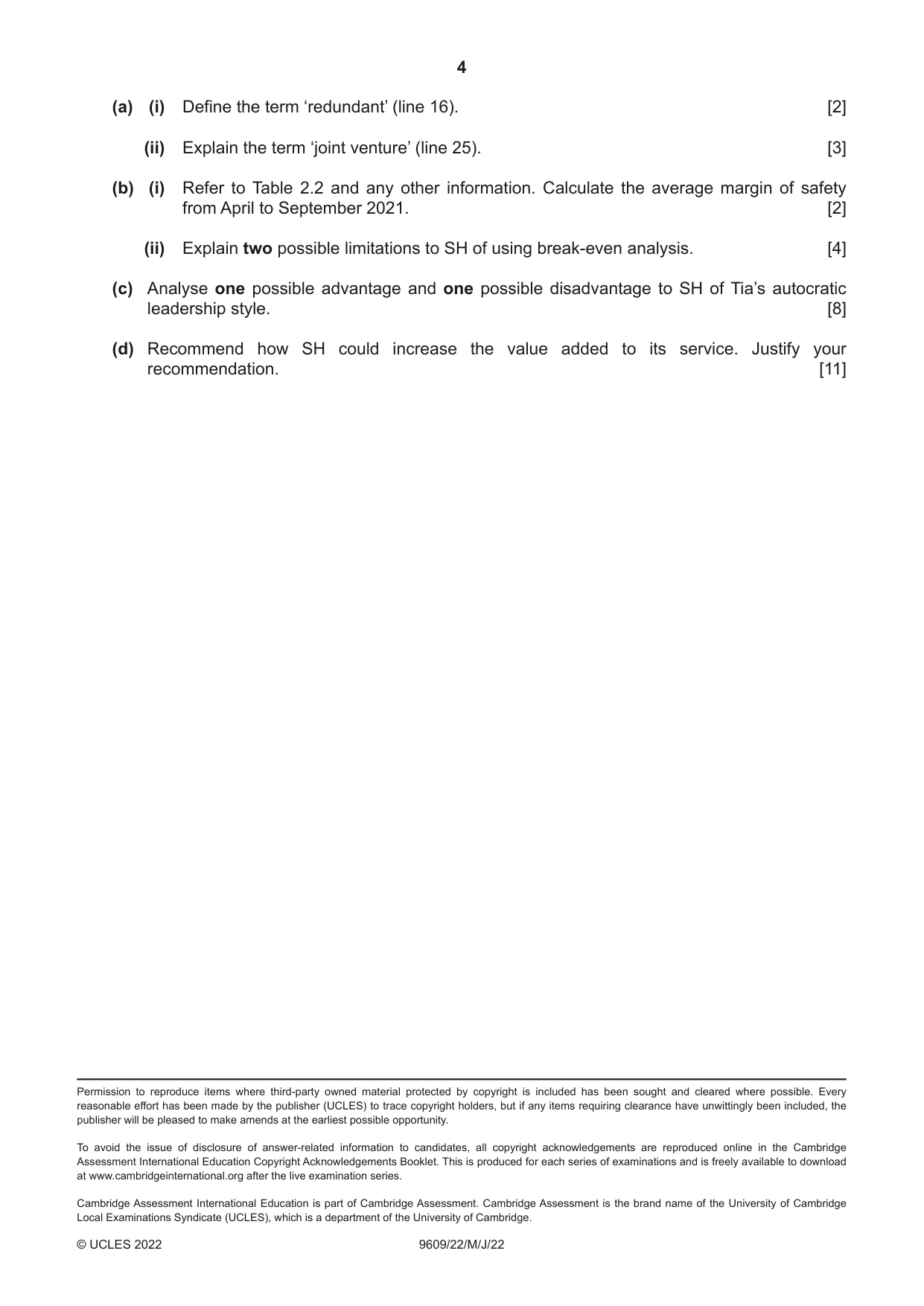
2 Seaside Hotel (SH) SH is a large hotel located in a tourist area of country H. SH has 120 rooms and employs 42 workers during the peak (busiest) season which is from April to September. Table 2.1 shows employee data for SH’s peak season. Table 2.1: Employee data for SH’s peak season Type Number Main tasks 5 Manager 3 • decision making • supervising other employees Cleaner 12 • cleaning rooms, corridors and reception area to required standard • maintaining a clean and safe working environment 10 Customer service 16 • greeting guests upon arrival • making sure guests are satisfied Marketing 7 • designing promotional materials • promoting hotel to increase number of guests Other 4 • various 15 SH makes half of the cleaners and customer service employees redundant at the end of the peak season. To break even, the hotel must sell 72 rooms per night. The hotel offers good views of the sea and it is very busy in the peak season when the weather is hot. Table 2.2 shows SH’s sales of rooms. 20 Table 2.2: SH’s sales of rooms 2021–2022 Time period Average percentage of rooms sold per night April 2021 – September 2021 95% October 2021 – March 2022 45% SH does not have a restaurant. It has a joint venture with a restaurant close to the hotel 25 where SH’s customers receive a discount on their food and drink. The hotel advertises the restaurant on social media and the restaurant advertises the hotel on its menu. Tia is one of the managers of SH. She has an autocratic leadership style and is responsible for the cleaners and marketing employees. The directors of SH aim to increase the value added to the service that SH provides. 30 (a) (i) Define the term ‘redundant’ (line 16). [2] (ii) Explain the term ‘joint venture’ (line 25). [3] (b) (i) Refer to Table 2.2 and any other information. Calculate the average margin of safety from April to September 2021. [2] (ii) Explain two possible limitations to SH of using break-even analysis. [4] (c) Analyse one possible advantage and one possible disadvantage to SH of Tia’s autocratic leadership style. [8] (d) Recommend how SH could increase the value added to its service. Justify your recommendation. [11]
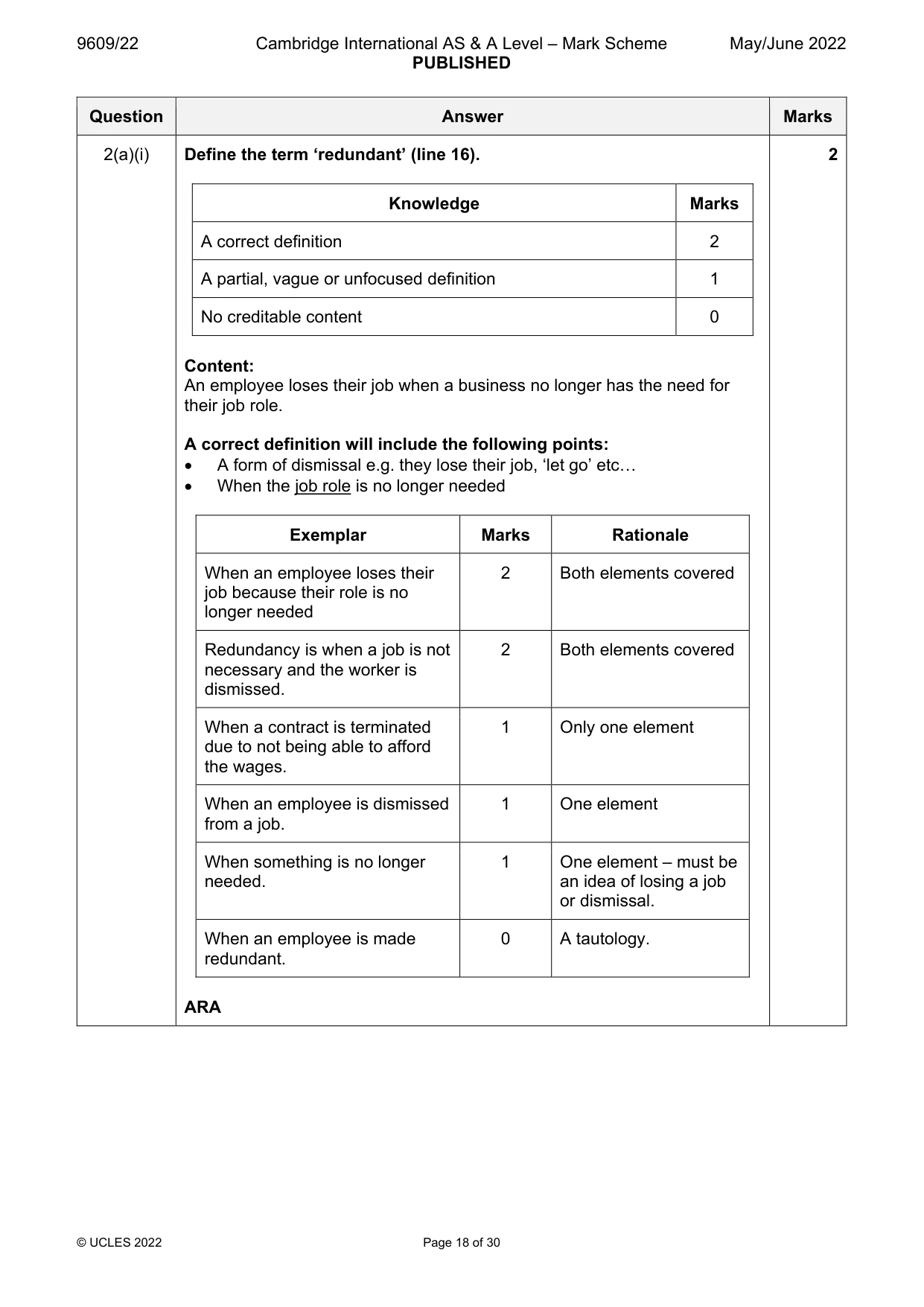
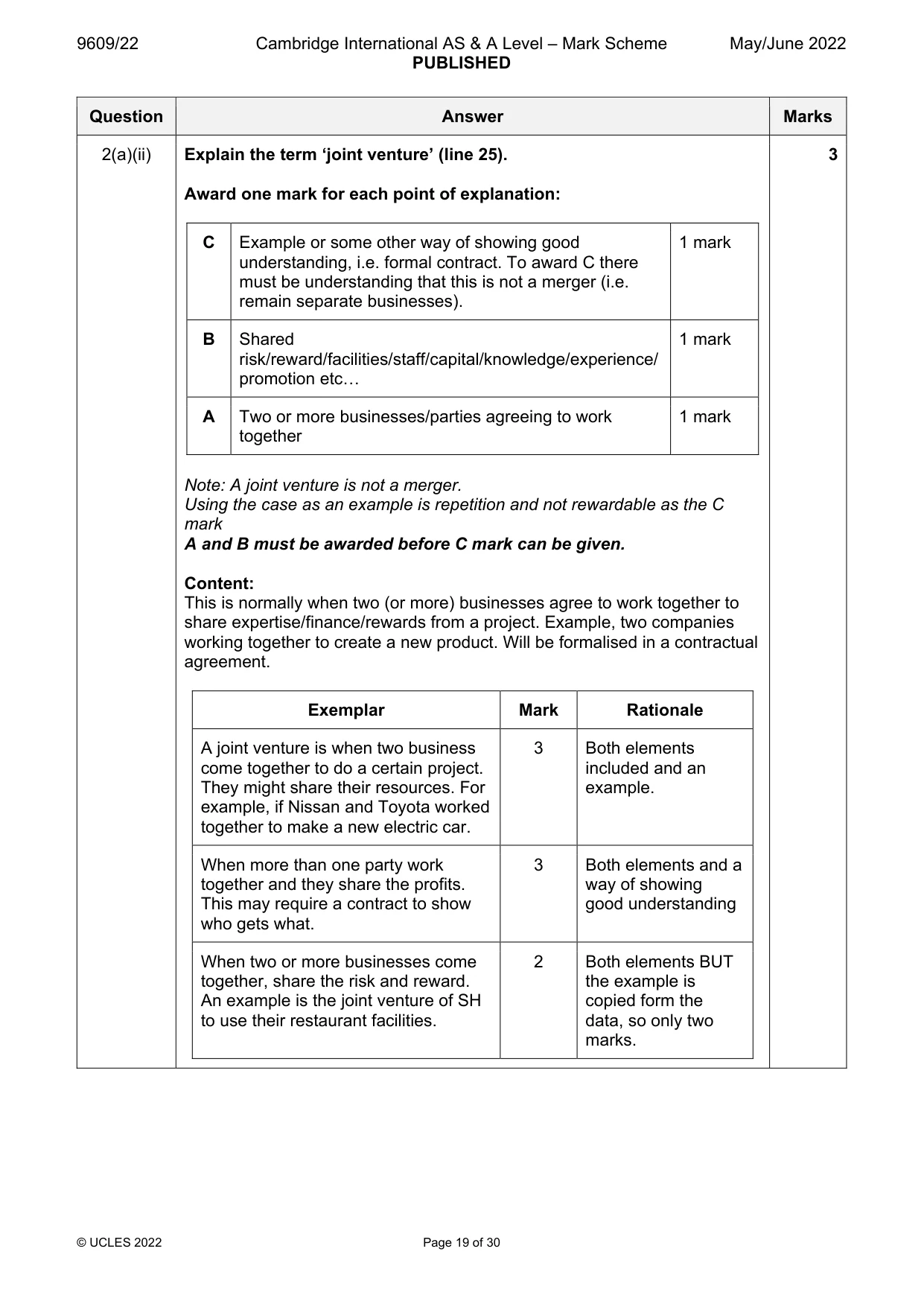
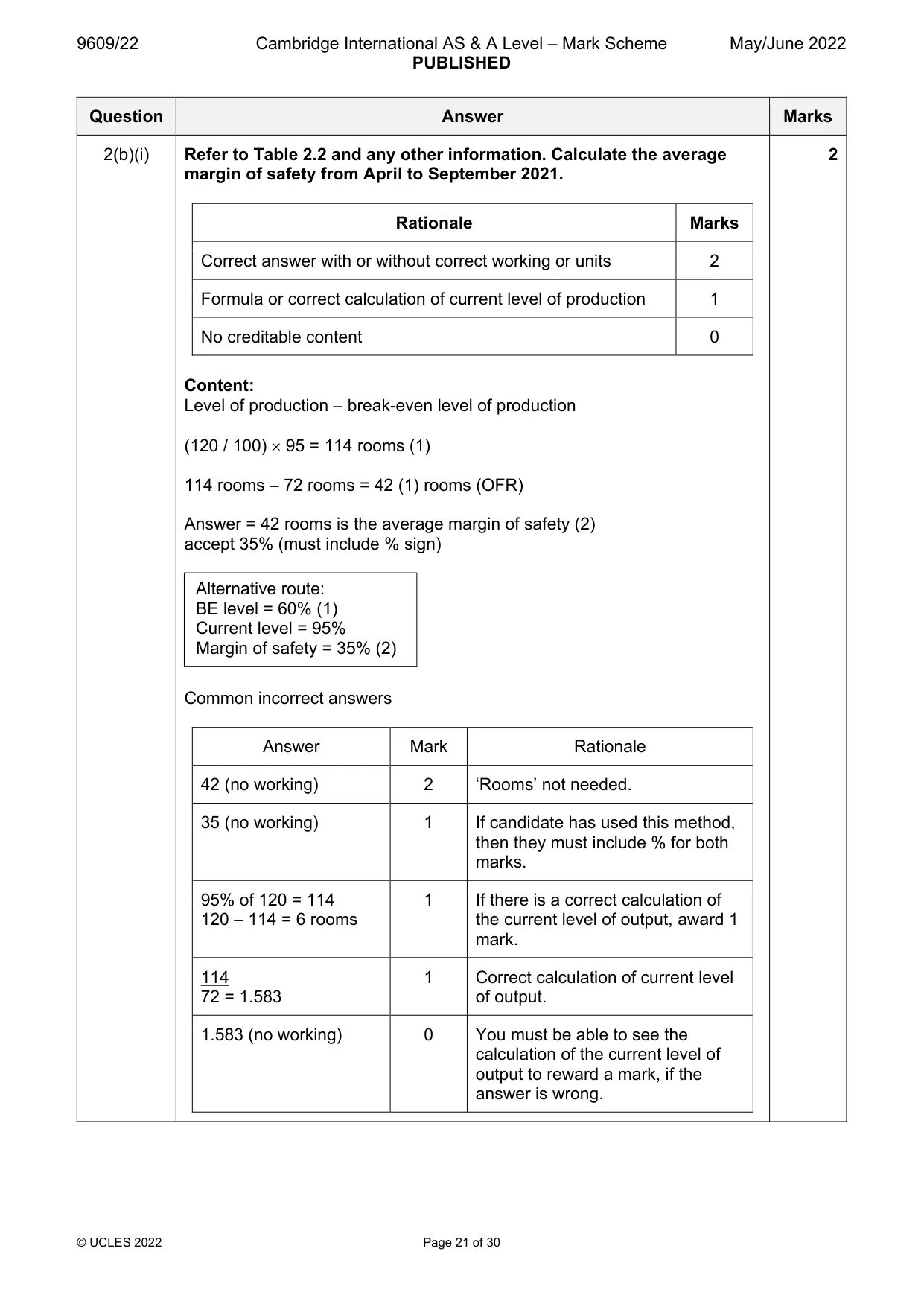
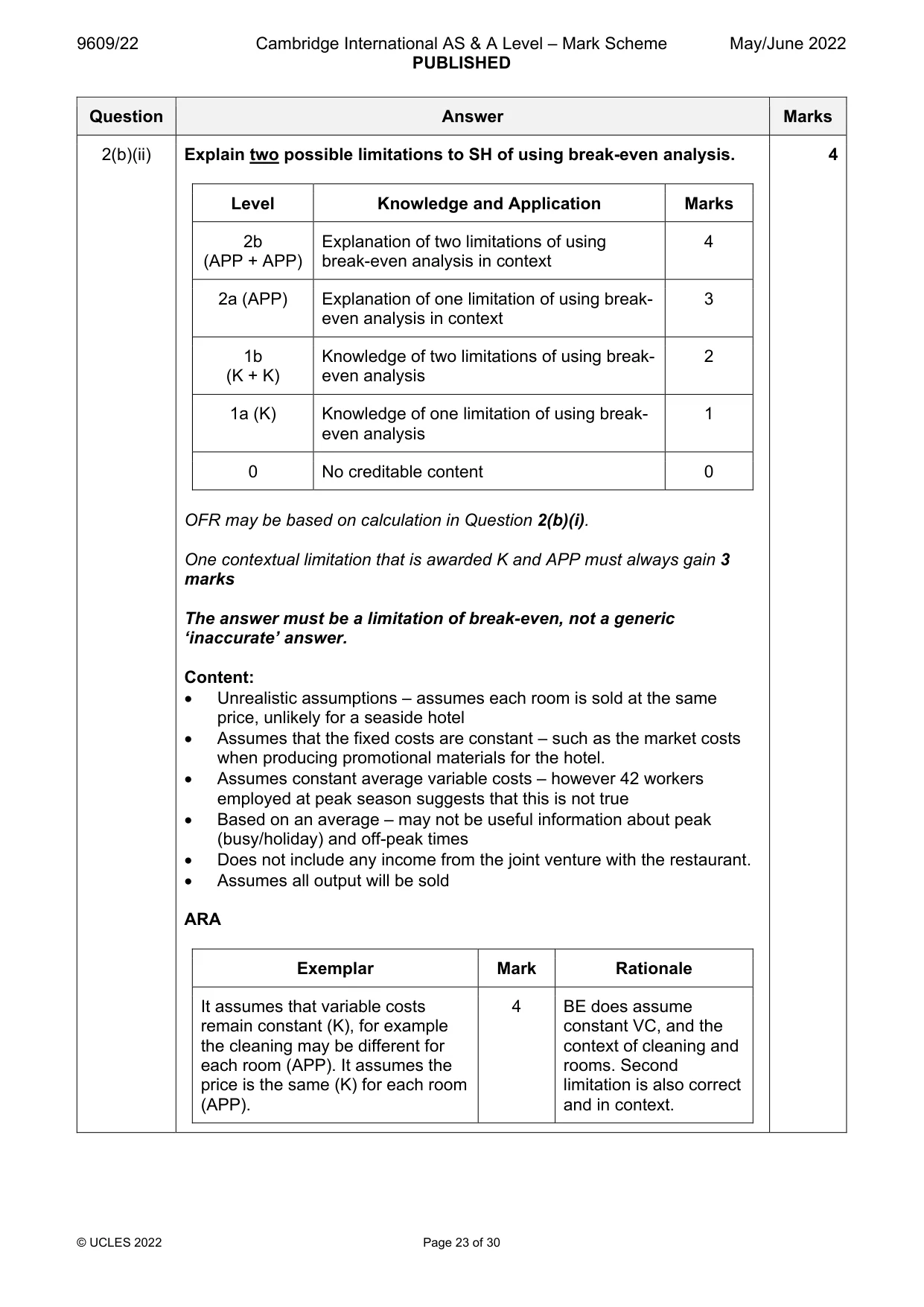
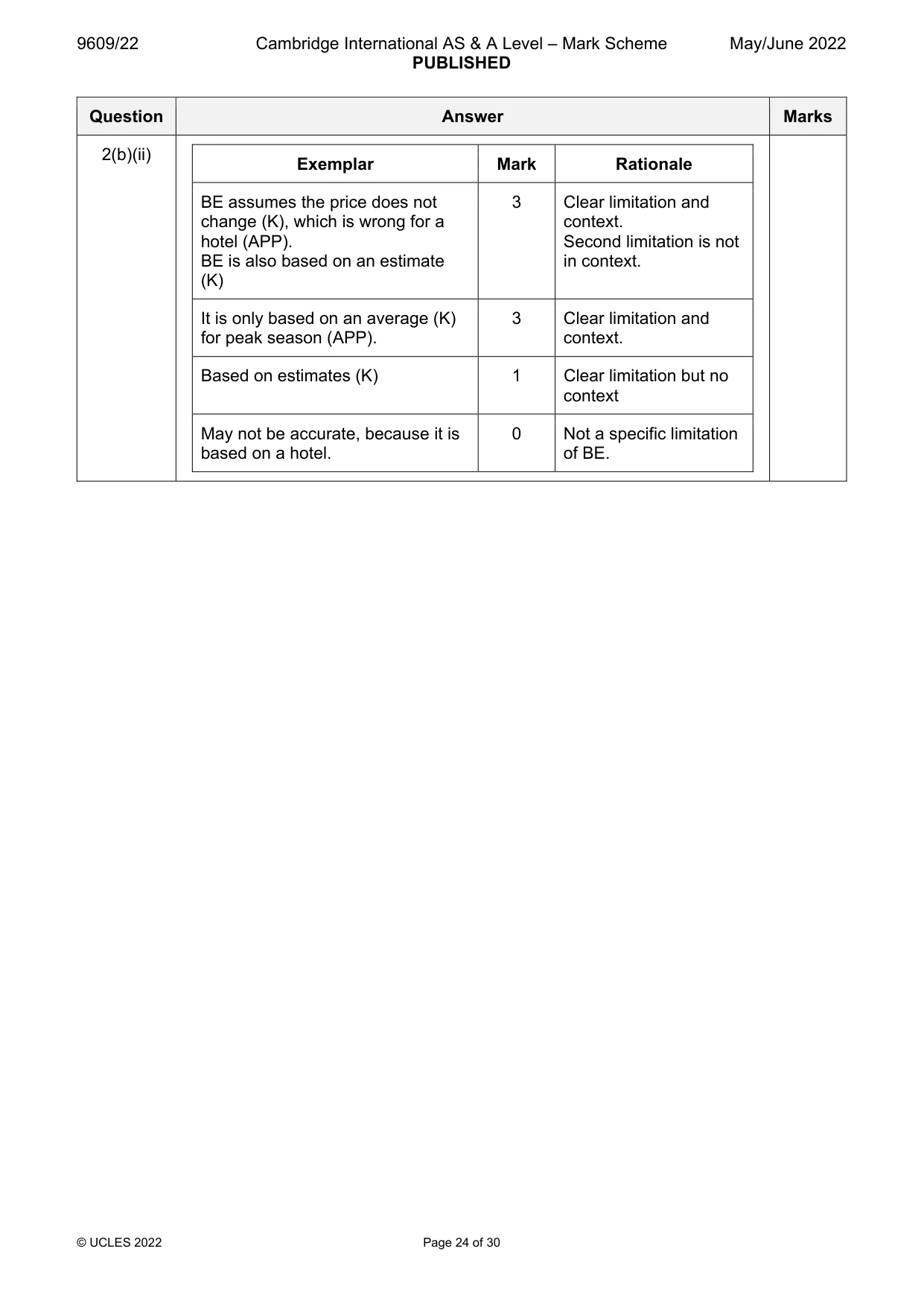
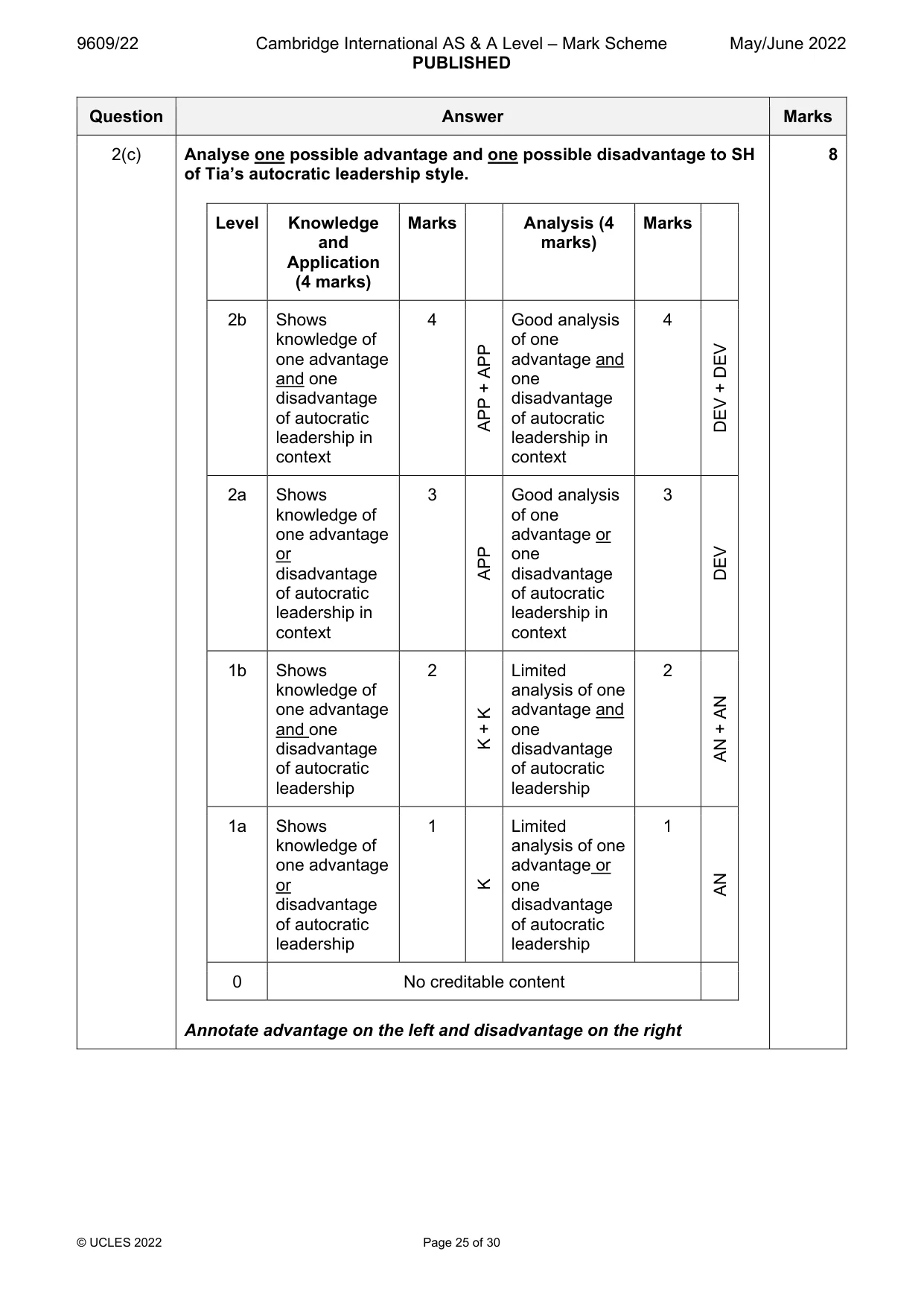
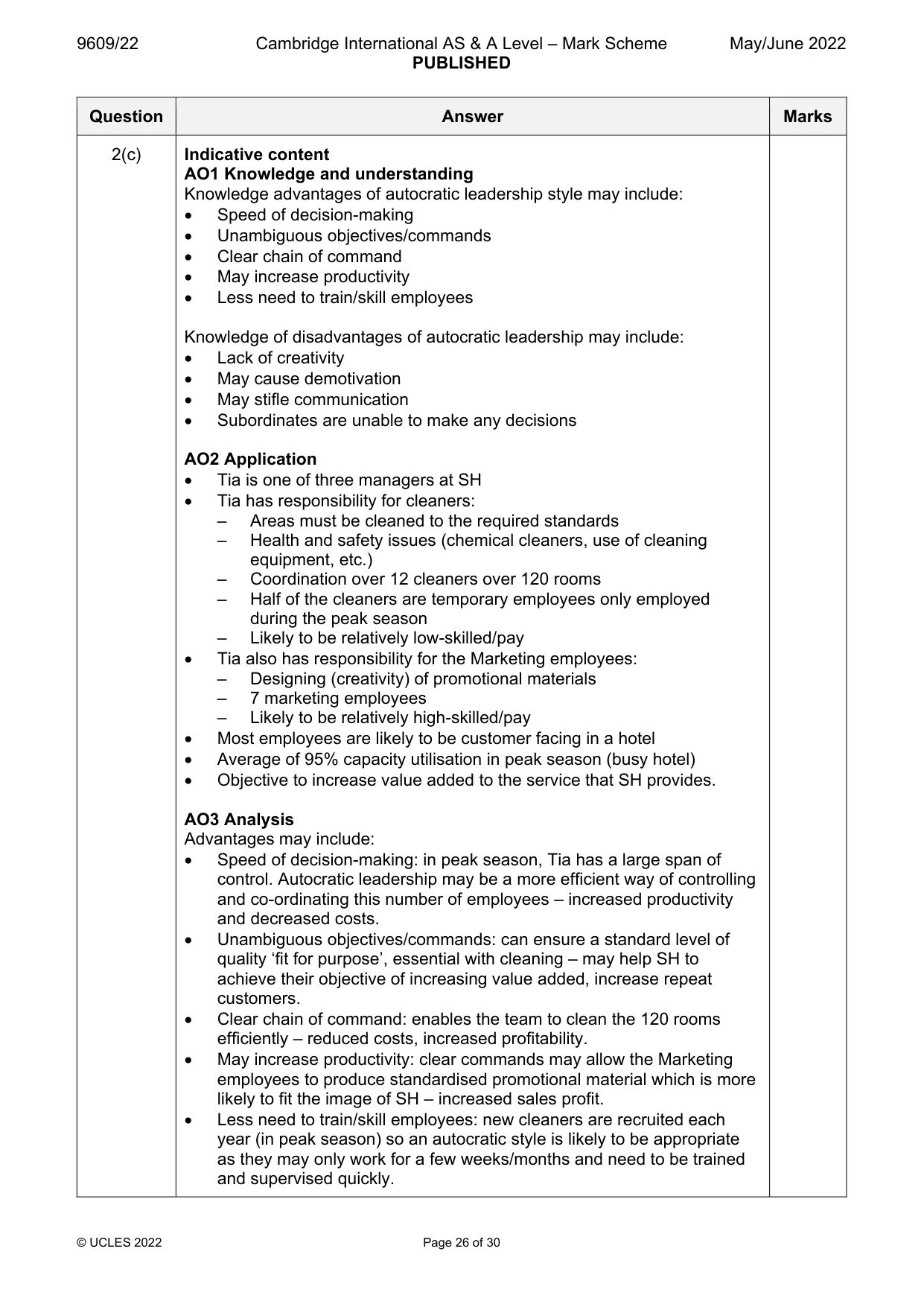
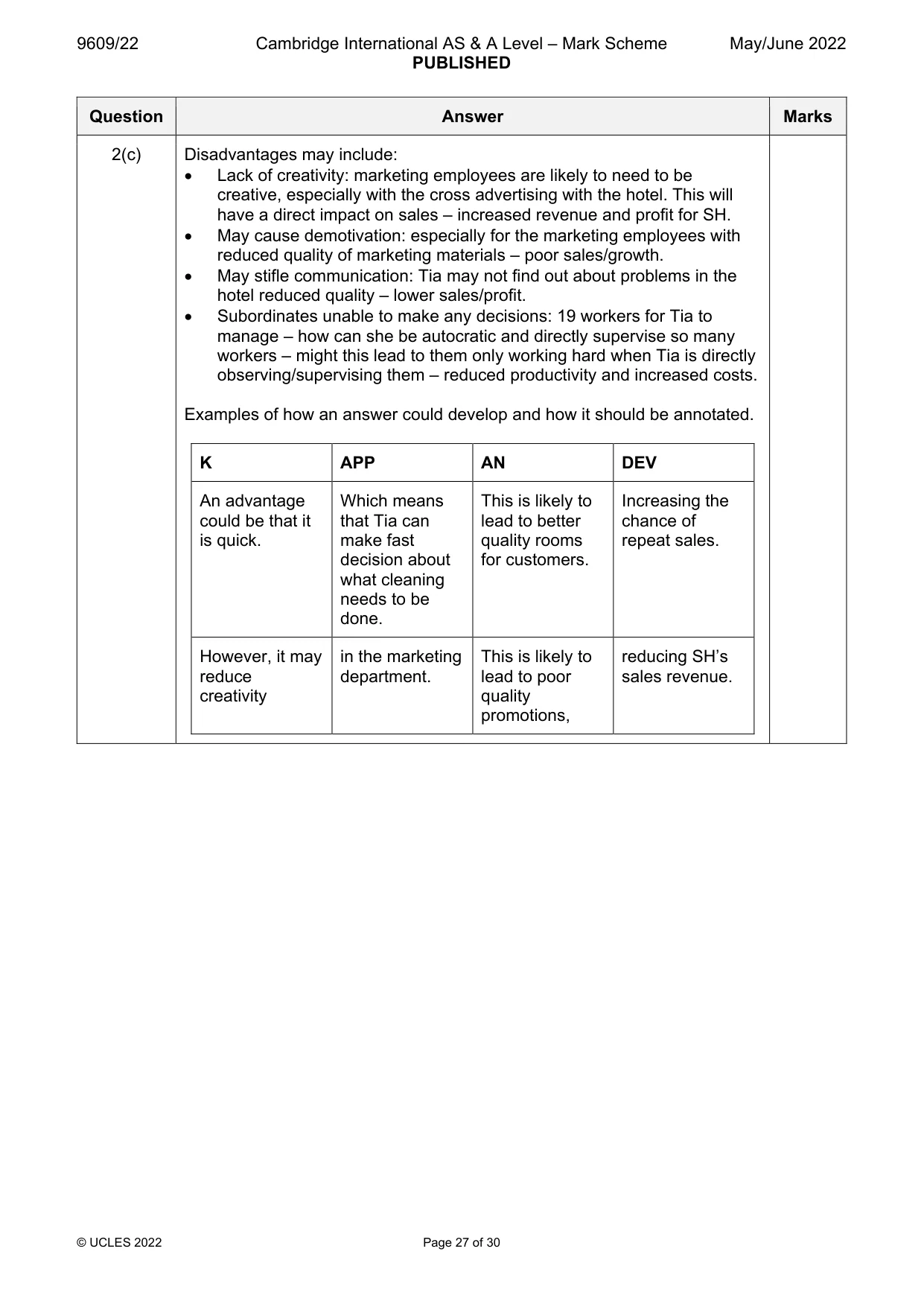
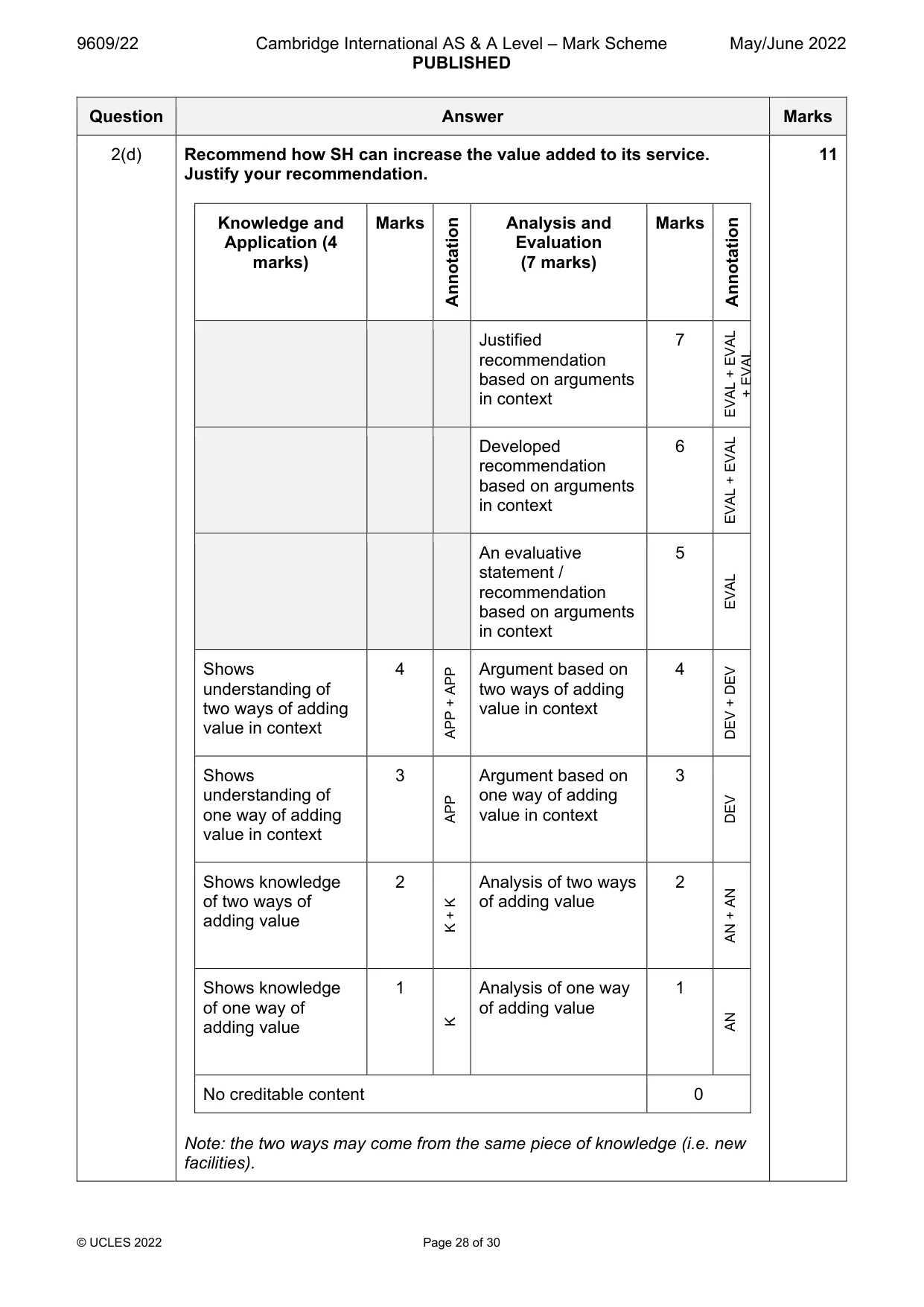
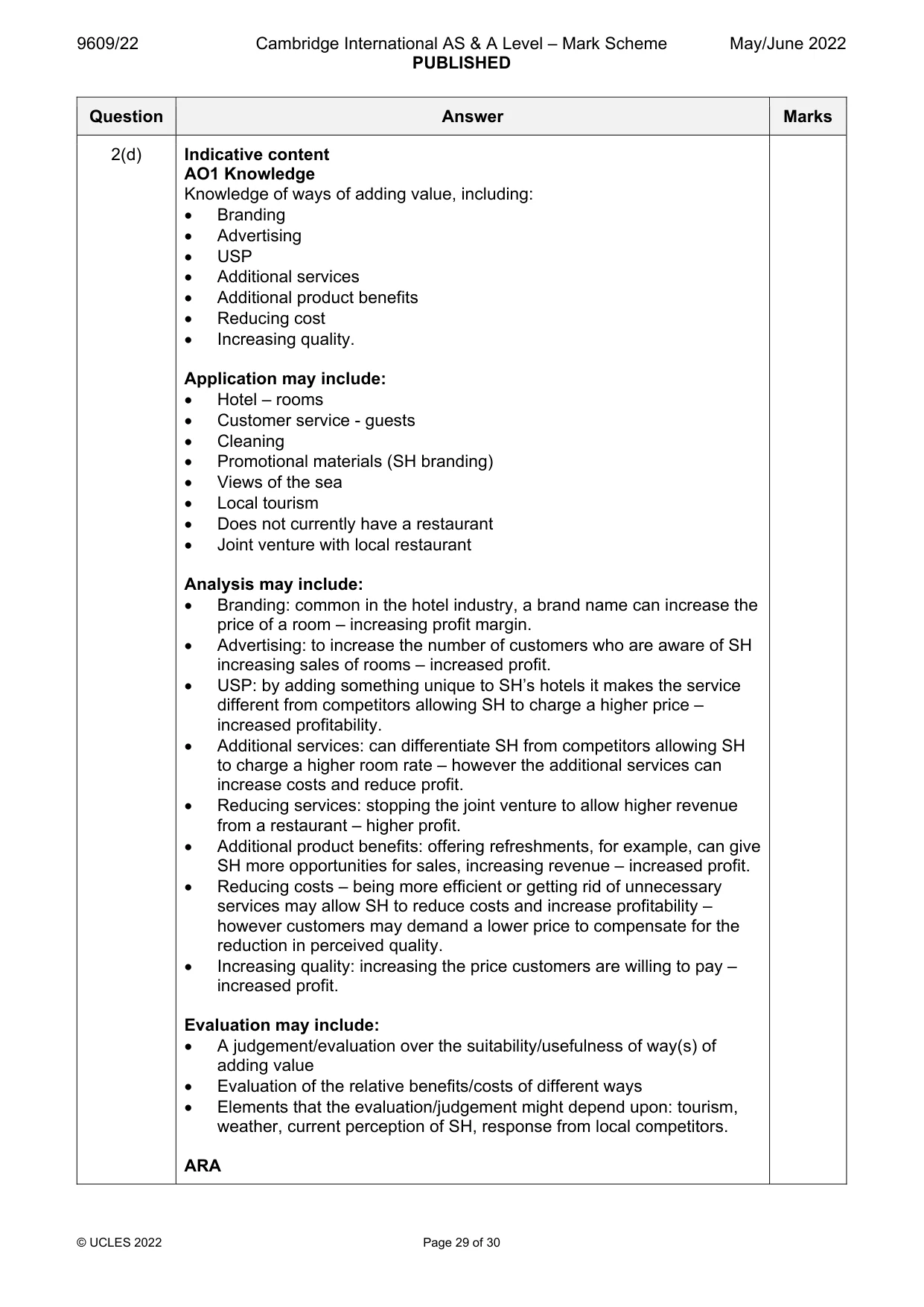
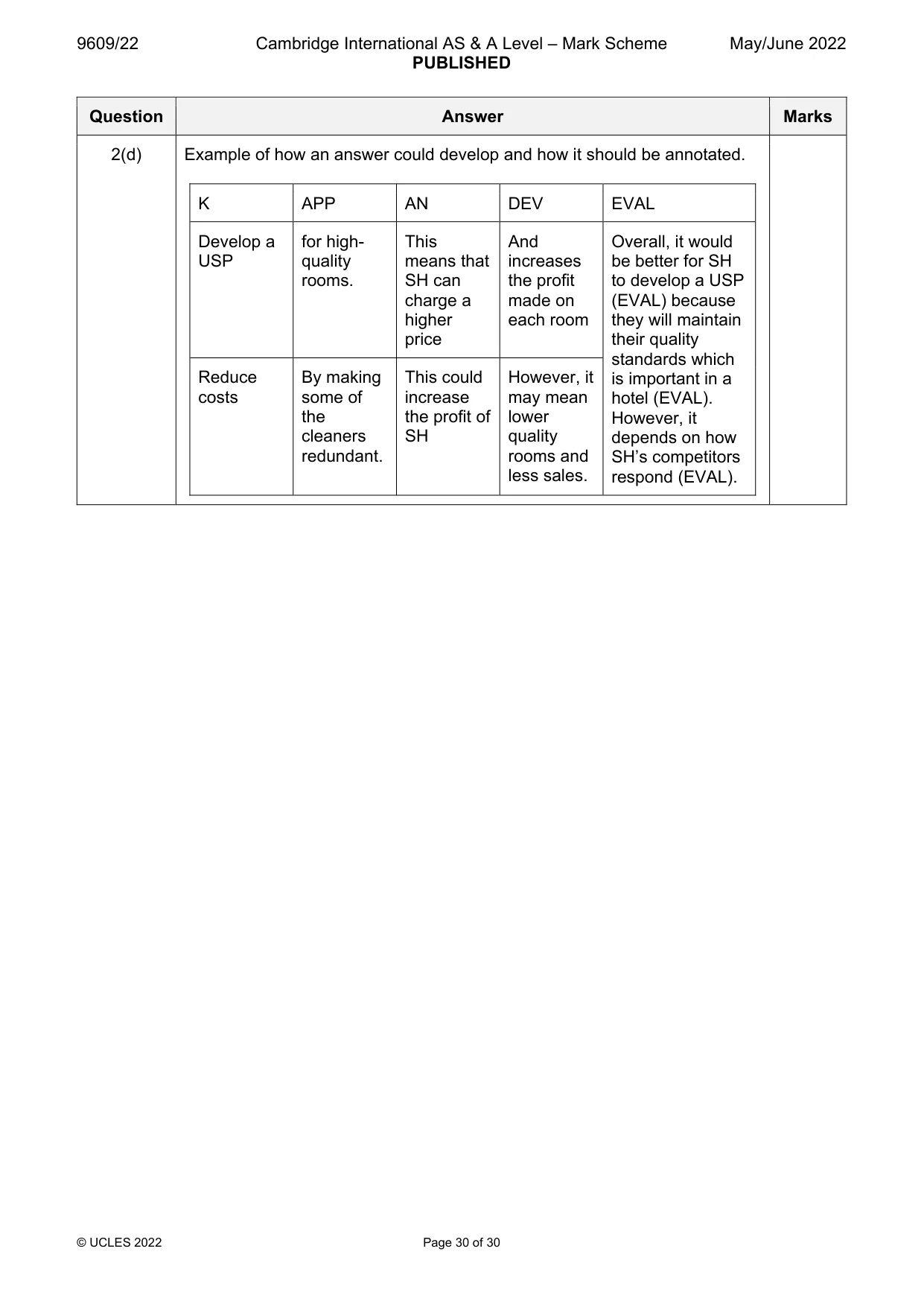
Mark scheme: 2(a)(i) Define the term ‘redundant’ (line 16). 2 Knowledge Marks A correct definition 2 A partial, vague or unfocused definition 1 No creditable content 0 Content: An employee loses their job when a business no longer has the need for their job role. A correct definition will include the following points: A form of dismissal e.g. they lose their job, ‘let go’ etc… When the job role is no longer needed Exemplar Marks Rationale When an employee loses their 2 Both elements covered job because their role is no longer needed Redundancy is when a job is not 2 Both elements covered necessary and the worker is dismissed. When a contract is terminated 1 Only one element due to not being able to afford the wages. When an employee is dismissed 1 One element from a job. When something is no longer 1 One element – must be needed. an idea of losing a job or dismissal. When an employee is made 0 A tautology. redundant. ARA 2(a)(ii) Explain the term ‘joint venture’ (line 25). 3 Award one mark for each point of explanation: C Example or some other way of showing good 1 mark understanding, i.e. formal contract. To award C there must be understanding that this is not a merger (i.e. remain separate businesses). B Shared 1 mark risk/reward/facilities/staff/capital/knowledge/experience/ promotion etc… A Two or more businesses/parties agreeing to work 1 mark together Note: A joint venture is not a merger. Using the case as an example is repetition and not rewardable as the C mark A and B must be awarded before C mark can be given. Content: This is normally when two (or more) businesses agree to work together to share expertise/finance/rewards from a project. Example, two companies working together to create a new product. Will be formalised in a contractual agreement. Exemplar Mark Rationale A joint venture is when two business 3 Both elements come together to do a certain project. included and an They might share their resources. For example. example, if Nissan and Toyota worked together to make a new electric car. When more than one party work 3 Both elements and a together and they share the profits. way of showing This may require a contract to show good understanding who gets what. When two or more businesses come 2 Both elements BUT together, share the risk and reward. the example is An example is the joint venture of SH copied form the to use their restaurant facilities. data, so only two marks. 2(a)(ii) Exemplar Mark Rationale When two or more business work 1 One element – do together for example if Nissan and not award C mark if Toyota work together to produce a A and B not new electric car. awarded. When more than one party works 1 One element. together on a project. 2(b)(i) Refer to Table 2.2 and any other information. Calculate the average 2 margin of safety from April to September 2021. Rationale Marks Correct answer with or without correct working or units 2 Formula or correct calculation of current level of production 1 No creditable content 0 Content: Level of production – break-even level of production (120 / 100) 95 = 114 rooms (1) 114 rooms – 72 rooms = 42 (1) rooms (OFR) Answer = 42 rooms is the average margin of safety (2) accept 35% (must include % sign) Alternative route: BE level = 60% (1) Current level = 95% Margin of safety = 35% (2) Common incorrect answers Answer Mark Rationale 42 (no working) 2 ‘Rooms’ not needed. 35 (no working) 1 If candidate has used this method, then they must include % for both marks. 95% of 120 = 114 1 If there is a correct calculation of 120 – 114 = 6 rooms the current level of output, award 1 mark. 114 1 Correct calculation of current level 72 = 1.583 of output. 1.583 (no working) 0 You must be able to see the calculation of the current level of output to reward a mark, if the answer is wrong. 2(b)(i) Answer Mark Rationale Current production – 1 Correct margin of safety formula. BE level Current production = 1 The candidate miscalculated the 115 current level of production, but the 115 – 72 = 41 last stage is correct based on their own figure. So OFR and 1 mark. 2(b)(ii) Explain two possible limitations to SH of using break-even analysis. 4 Level Knowledge and Application Marks 2b Explanation of two limitations of using 4 (APP + APP) break-even analysis in context 2a (APP) Explanation of one limitation of using break- 3 even analysis in context 1b Knowledge of two limitations of using break- 2 (K + K) even analysis 1a (K) Knowledge of one limitation of using break- 1 even analysis 0 No creditable content 0 OFR may be based on calculation in Question 2(b)(i). One contextual limitation that is awarded K and APP must always gain 3 marks The answer must be a limitation of break-even, not a generic ‘inaccurate’ answer. Content: Unrealistic assumptions – assumes each room is sold at the same price, unlikely for a seaside hotel Assumes that the fixed costs are constant – such as the market costs when producing promotional materials for the hotel. Assumes constant average variable costs – however 42 workers employed at peak season suggests that this is not true Based on an average – may not be useful information about peak (busy/holiday) and off-peak times Does not include any income from the joint venture with the restaurant. Assumes all output will be sold ARA Exemplar Mark Rationale It assumes that variable costs 4 BE does assume remain constant (K), for example constant VC, and the the cleaning may be different for context of cleaning and each room (APP). It assumes the rooms. Second price is the same (K) for each room limitation is also correct (APP). and in context. 2(b)(ii) Exemplar Mark Rationale BE assumes the price does not 3 Clear limitation and change (K), which is wrong for a context. hotel (APP). Second limitation is not BE is also based on an estimate in context. (K) It is only based on an average (K) 3 Clear limitation and for peak season (APP). context. Based on estimates (K) 1 Clear limitation but no context May not be accurate, because it is 0 Not a specific limitation based on a hotel. of BE. 2(c) Analyse one possible advantage and one possible disadvantage to SH 8 of Tia’s autocratic leadership style. Level Knowledge Marks Analysis (4 Marks and marks) Application (4 marks) 2b Shows 4 Good analysis 4 knowledge of of one one advantage advantage and APP DEV and one one + + disadvantage disadvantage of autocratic of autocratic APP DEV leadership in leadership in context context 2a Shows 3 Good analysis 3 knowledge of of one one advantage advantage or disadvantage or APP onedisadvantage DEV of autocratic of autocratic leadership in leadership in context context 1b Shows 2 Limited 2 knowledge of analysis of one one advantage K advantage and AN and one + one + disadvantage K disadvantage AN of autocratic of autocratic leadership leadership 1a Shows 1 Limited 1 knowledge of analysis of one one advantage advantage or or K one AN disadvantage disadvantage of autocratic of autocratic leadership leadership 0 No creditable content Annotate advantage on the left and disadvantage on the right 2(c) Indicative content AO1 Knowledge and understanding Knowledge advantages of autocratic leadership style may include: Speed of decision-making Unambiguous objectives/commands Clear chain of command May increase productivity Less need to train/skill employees Knowledge of disadvantages of autocratic leadership may include: Lack of creativity May cause demotivation May stifle communication Subordinates are unable to make any decisions AO2 Application Tia is one of three managers at SH Tia has responsibility for cleaners: – Areas must be cleaned to the required standards – Health and safety issues (chemical cleaners, use of cleaning equipment, etc.) – Coordination over 12 cleaners over 120 rooms – Half of the cleaners are temporary employees only employed during the peak season – Likely to be relatively low-skilled/pay Tia also has responsibility for the Marketing employees: – Designing (creativity) of promotional materials – 7 marketing employees – Likely to be relatively high-skilled/pay Most employees are likely to be customer facing in a hotel Average of 95% capacity utilisation in peak season (busy hotel) Objective to increase value added to the service that SH provides. AO3 Analysis Advantages may include: Speed of decision-making: in peak season, Tia has a large span of control. Autocratic leadership may be a more efficient way of controlling and co-ordinating this number of employees – increased productivity and decreased costs. Unambiguous objectives/commands: can ensure a standard level of quality ‘fit for purpose’, essential with cleaning – may help SH to achieve their objective of increasing value added, increase repeat customers. Clear chain of command: enables the team to clean the 120 rooms efficiently – reduced costs, increased profitability. May increase productivity: clear commands may allow the Marketing employees to produce standardised promotional material which is more likely to fit the image of SH – increased sales profit. Less need to train/skill employees: new cleaners are recruited each year (in peak season) so an autocratic style is likely to be appropriate as they may only work for a few weeks/months and need to be trained and supervised quickly. 2(c) Disadvantages may include: Lack of creativity: marketing employees are likely to need to be creative, especially with the cross advertising with the hotel. This will have a direct impact on sales – increased revenue and profit for SH. May cause demotivation: especially for the marketing employees with reduced quality of marketing materials – poor sales/growth. May stifle communication: Tia may not find out about problems in the hotel reduced quality – lower sales/profit. Subordinates unable to make any decisions: 19 workers for Tia to manage – how can she be autocratic and directly supervise so many workers – might this lead to them only working hard when Tia is directly observing/supervising them – reduced productivity and increased costs. Examples of how an answer could develop and how it should be annotated. K APP AN DEV An advantage Which means This is likely to Increasing the could be that it that Tia can lead to better chance of is quick. make fast quality rooms repeat sales. decision about for customers. what cleaning needs to be done. However, it may in the marketing This is likely to reducing SH’s reduce department. lead to poor sales revenue. creativity quality promotions, 2(d) Recommend how SH can increase the value added to its service. 11 Justify your recommendation. Knowledge and Marks Analysis and Marks Application (4 Evaluation marks) (7 marks) Annotation Annotation Justified 7 EVAL recommendation based on arguments + EVAL in context + EVAL Developed 6 EVAL recommendation based on arguments + in context EVAL An evaluative 5 statement / recommendation EVAL based on arguments in context Shows 4 Argument based on 4 understanding of APP two ways of adding DEV two ways of adding + value in context + value in context APP DEV Shows 3 Argument based on 3 understanding of one way of adding one way of adding APP value in context DEV value in context Shows knowledge 2 Analysis of two ways 2 of two ways of K of adding value AN adding value +K + AN Shows knowledge 1 Analysis of one way 1 of one way of of adding value K AN adding value No creditable content 0 Note: the two ways may come from the same piece of knowledge (i.e. new facilities). 2(d) Indicative content AO1 Knowledge Knowledge of ways of adding value, including: Branding Advertising USP Additional services Additional product benefits Reducing cost Increasing quality. Application may include: Hotel – rooms Customer service - guests Cleaning Promotional materials (SH branding) Views of the sea Local tourism Does not currently have a restaurant Joint venture with local restaurant Analysis may include: Branding: common in the hotel industry, a brand name can increase the price of a room – increasing profit margin. Advertising: to increase the number of customers who are aware of SH increasing sales of rooms – increased profit. USP: by adding something unique to SH’s hotels it makes the service different from competitors allowing SH to charge a higher price – increased profitability. Additional services: can differentiate SH from competitors allowing SH to charge a higher room rate – however the additional services can increase costs and reduce profit. Reducing services: stopping the joint venture to allow higher revenue from a restaurant – higher profit. Additional product benefits: offering refreshments, for example, can give SH more opportunities for sales, increasing revenue – increased profit. Reducing costs – being more efficient or getting rid of unnecessary services may allow SH to reduce costs and increase profitability – however customers may demand a lower price to compensate for the reduction in perceived quality. Increasing quality: increasing the price customers are willing to pay – increased profit. Evaluation may include: A judgement/evaluation over the suitability/usefulness of way(s) of adding value Evaluation of the relative benefits/costs of different ways Elements that the evaluation/judgement might depend upon: tourism, weather, current perception of SH, response from local competitors. ARA 2(d) Example of how an answer could develop and how it should be annotated. K APP AN DEV EVAL Develop a for high- This And Overall, it would USP quality means that increases be better for SH rooms. SH can the profit to develop a USP charge a made on (EVAL) because higher each room they will maintain price their quality standards which Reduce By making This could However, it is important in a costs some of increase may mean hotel (EVAL). the the profit of lower However, it cleaners SH quality depends on how redundant. rooms and SH’s competitors less sales. respond (EVAL).
What was in this paper
The subtopics covered by these 2 questions, and how many questions each got. Open one in a new tab to see every Cambridge question on it.
What you needed in this session
Cambridge’s own grade thresholds for 2022 May/June, Paper 2 · Variant 2. A higher threshold means an easier paper — the bar moves with how the cohort did.