Cambridge A Level Business (for first examination in 2016) 9609 — 2025 May/June Paper 2 · Variant 1
9609/21/M/J/25 · 2 questions · 60 marks · ≈68 min
The question paper and its mark scheme, free to read here and free to download. This is Cambridge’s own paper, exactly as it was sat.
Question paper4 pages

Mark scheme39 pages
Answers below. Sit the paper first if you are practising.
Questions as text
Q1 · Natural Shampoos (NS) NS is a private limited company set up by Saira and Chantal as a…
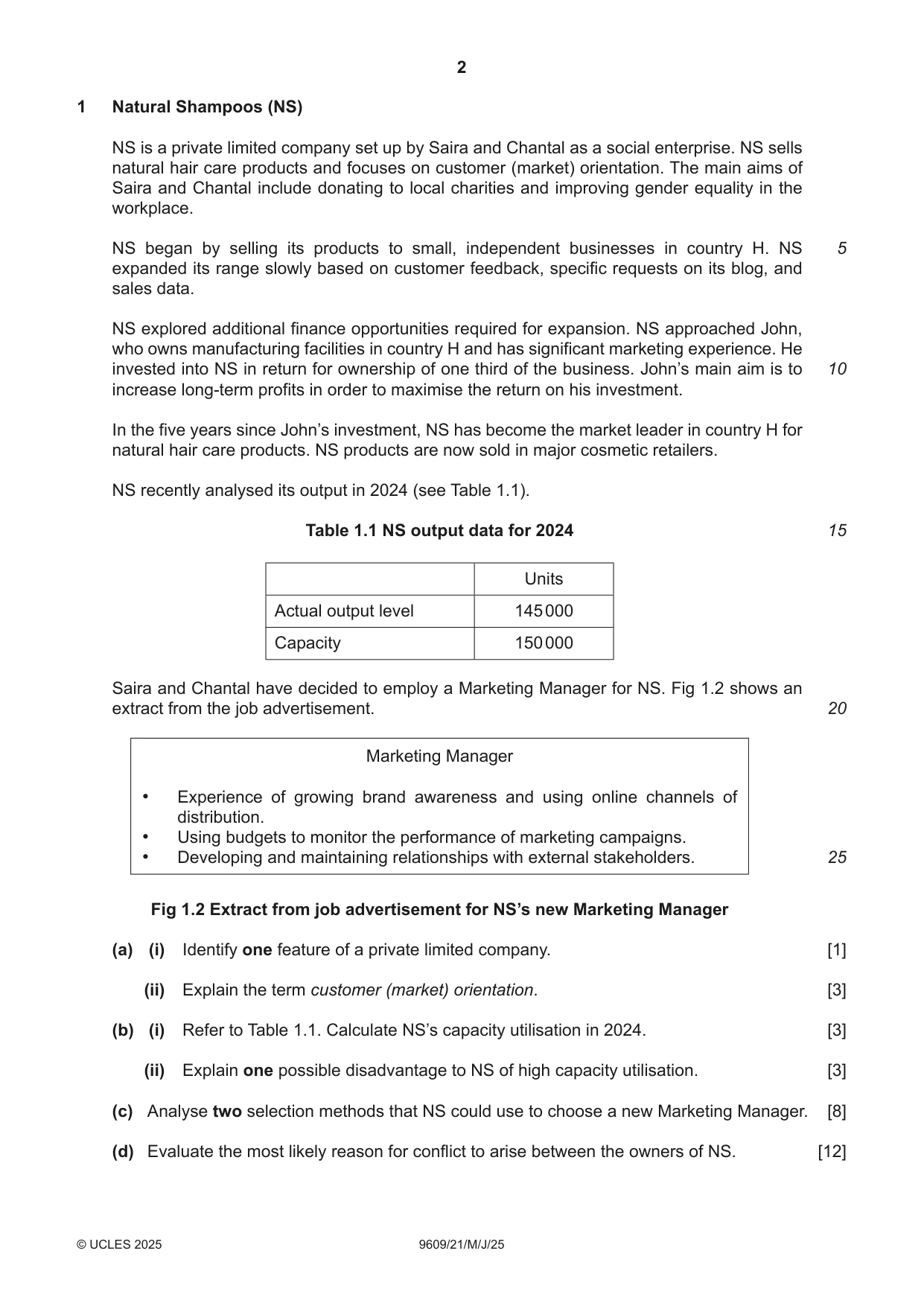
1 Natural Shampoos (NS) NS is a private limited company set up by Saira and Chantal as a social enterprise. NS sells natural hair care products and focuses on customer (market) orientation. The main aims of Saira and Chantal include donating to local charities and improving gender equality in the workplace. NS began by selling its products to small, independent businesses in country H. NS 5 expanded its range slowly based on customer feedback, specific requests on its blog, and sales data. NS explored additional finance opportunities required for expansion. NS approached John, who owns manufacturing facilities in country H and has significant marketing experience. He invested into NS in return for ownership of one third of the business. John’s main aim is to 10 increase long-term profits in order to maximise the return on his investment. In the five years since John’s investment, NS has become the market leader in country H for natural hair care products. NS products are now sold in major cosmetic retailers. NS recently analysed its output in 2024 (see Table 1.1). Table 1.1 NS output data for 2024 15 Units Actual output level 145 000 Capacity 150 000 Saira and Chantal have decided to employ a Marketing Manager for NS. Fig 1.2 shows an extract from the job advertisement. 20 Marketing Manager • Experience of growing brand awareness and using online channels of distribution. • Using budgets to monitor the performance of marketing campaigns. • Developing and maintaining relationships with external stakeholders. 25 Fig 1.2 Extract from job advertisement for NS’s new Marketing Manager (a) (i) Identify one feature of a private limited company. [1] (ii) Explain the term customer (market) orientation. [3] (b) (i) Refer to Table 1.1. Calculate NS’s capacity utilisation in 2024. [3] (ii) Explain one possible disadvantage to NS of high capacity utilisation. [3] (c) Analyse two selection methods that NS could use to choose a new Marketing Manager. [8] (d) Evaluate the most likely reason for conflict to arise between the owners of NS. [12]
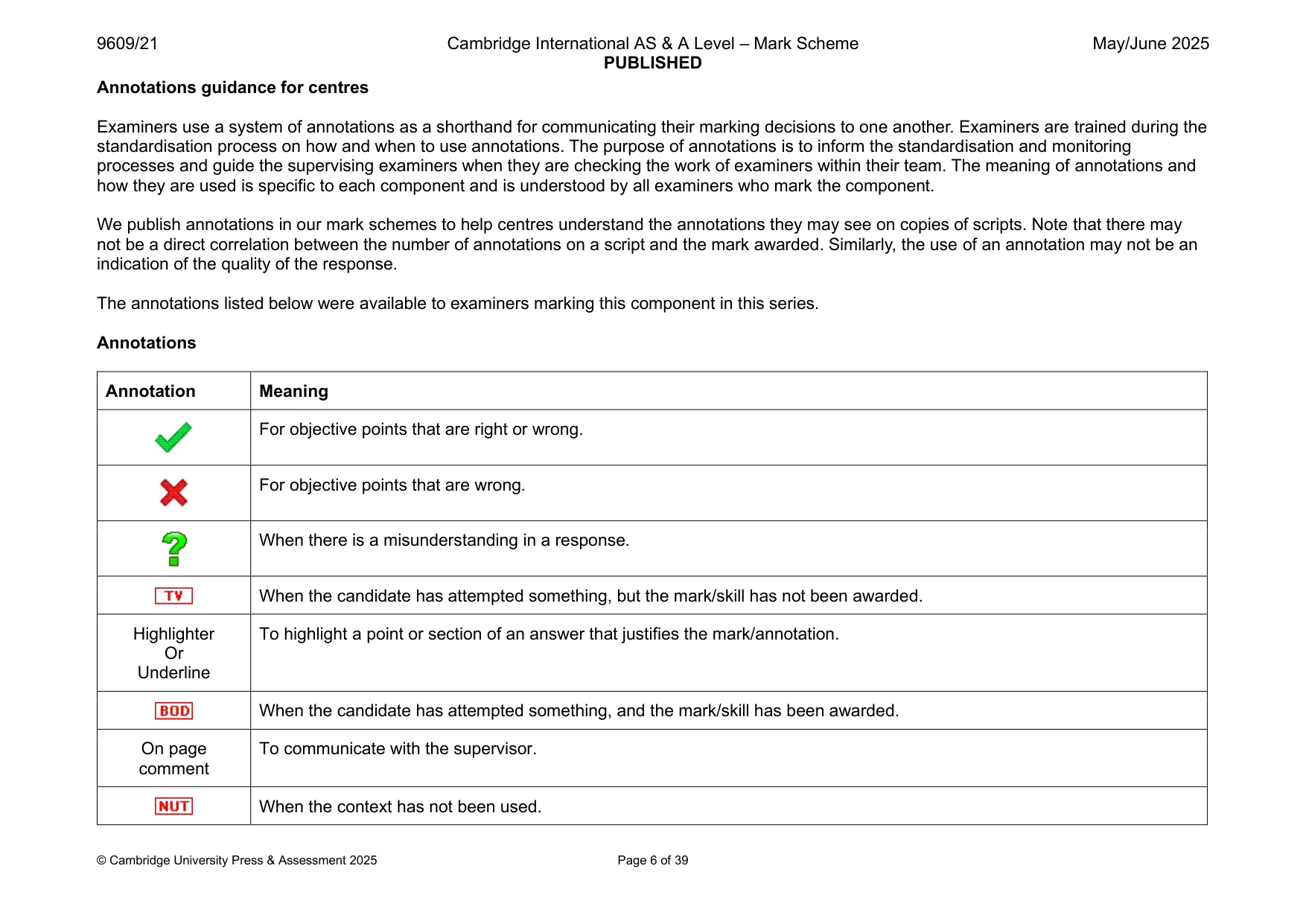
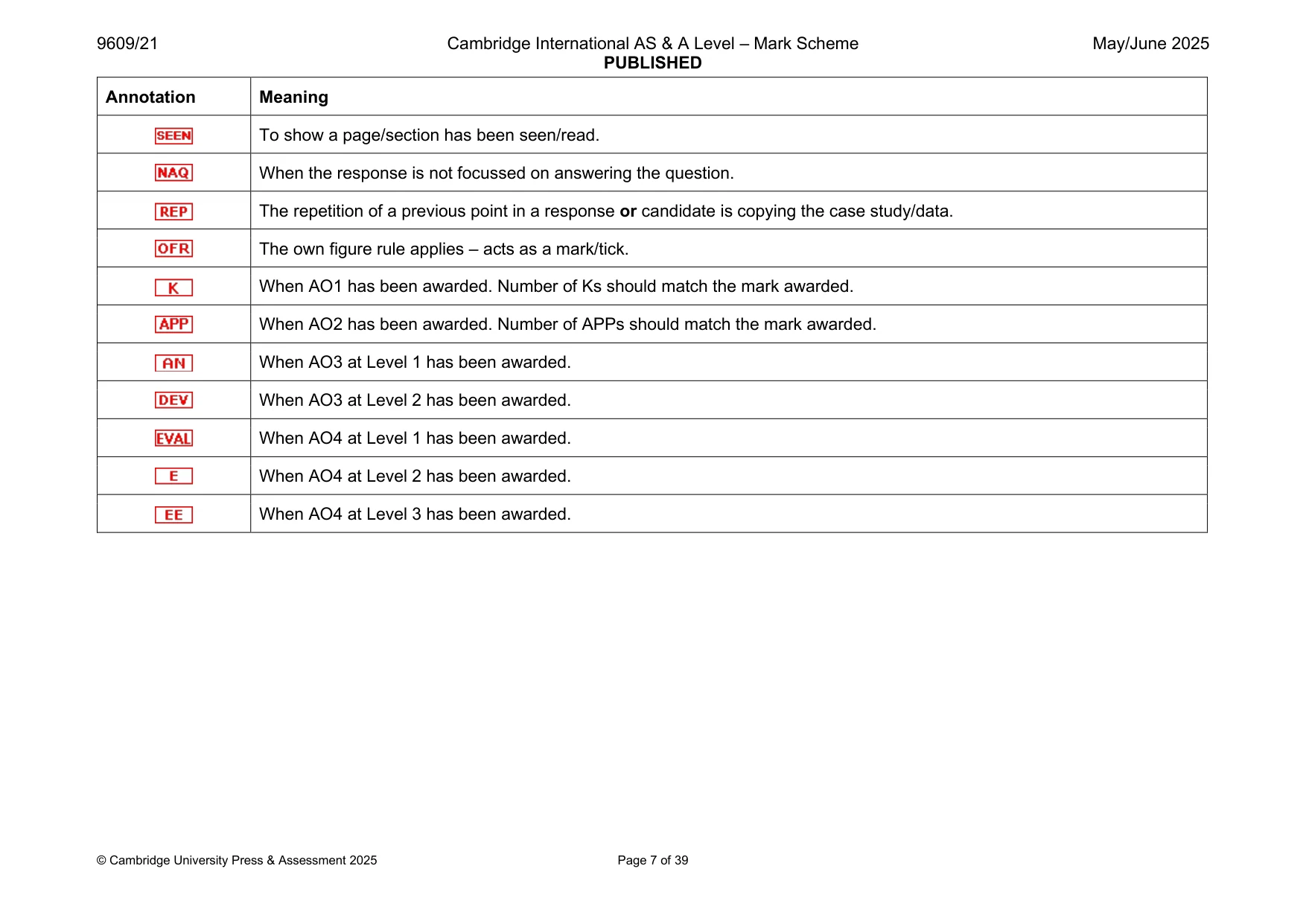
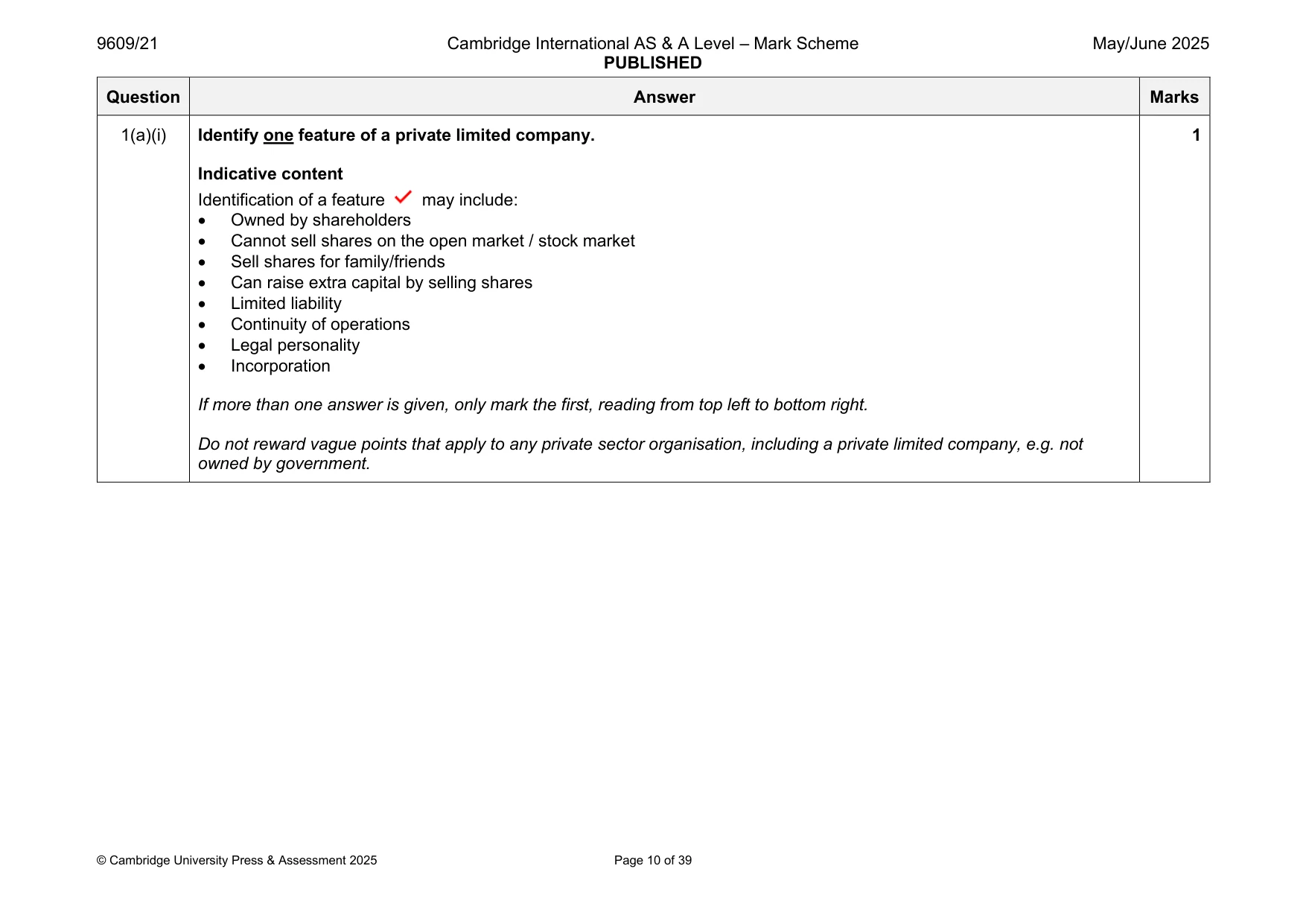
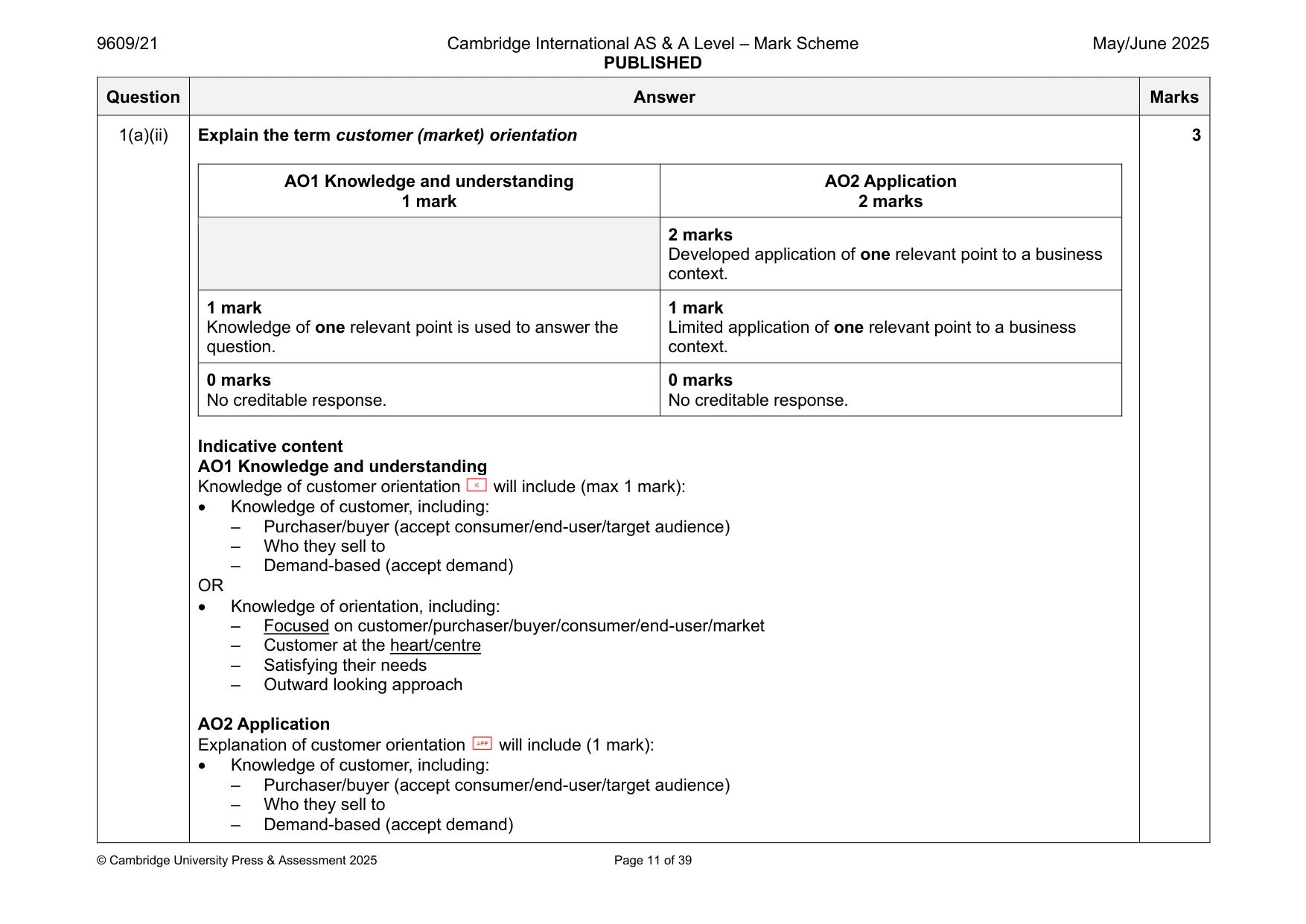
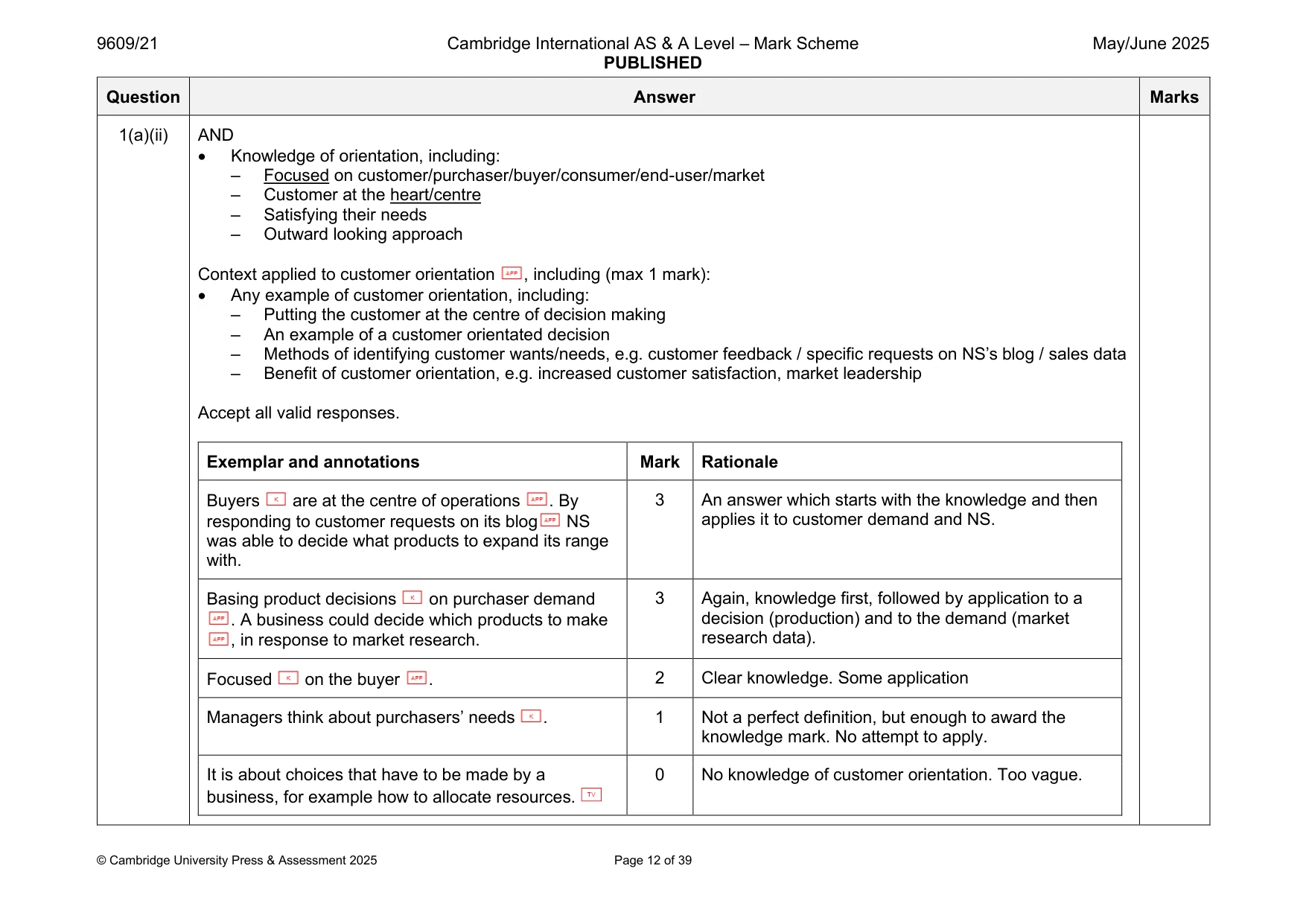
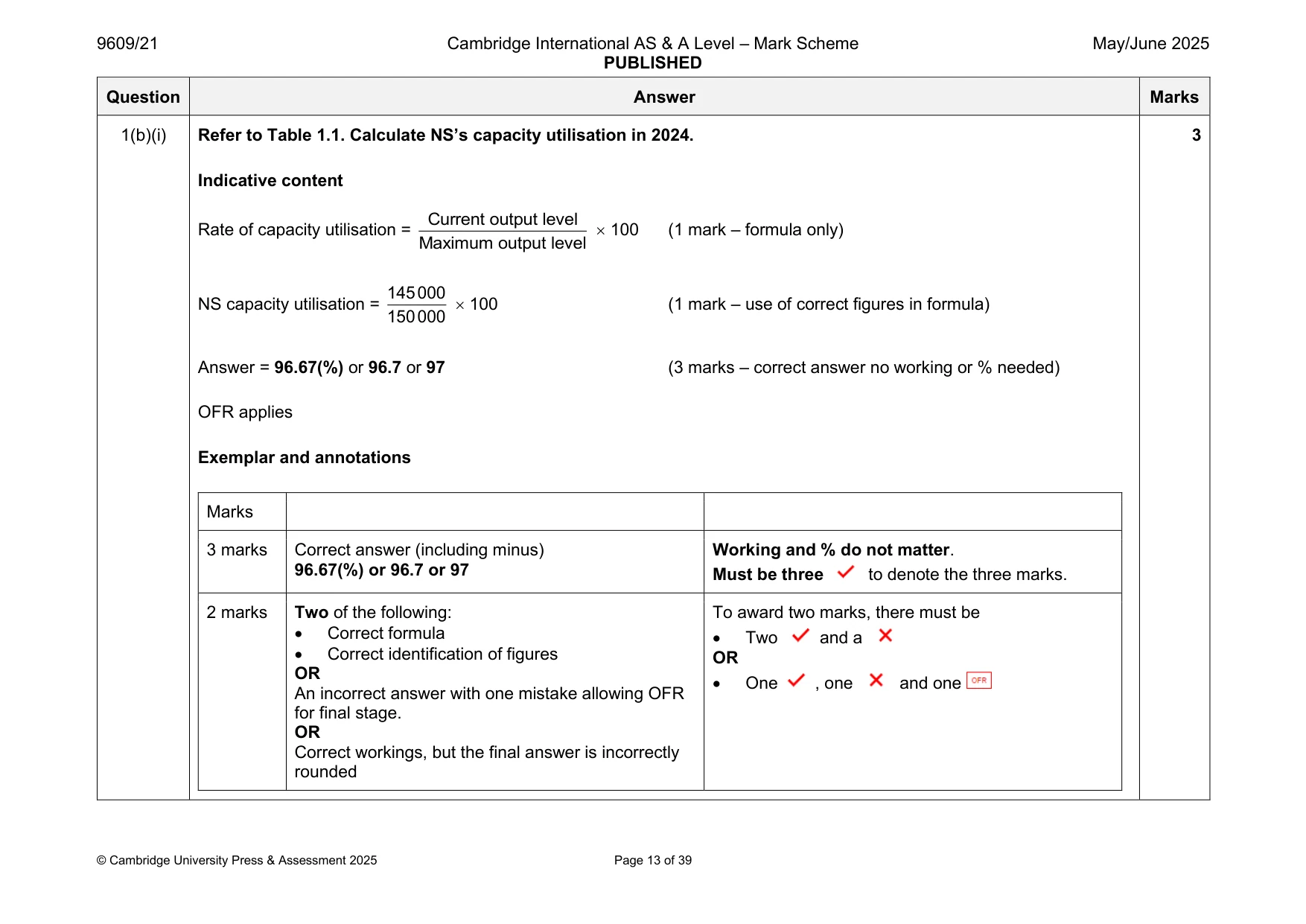
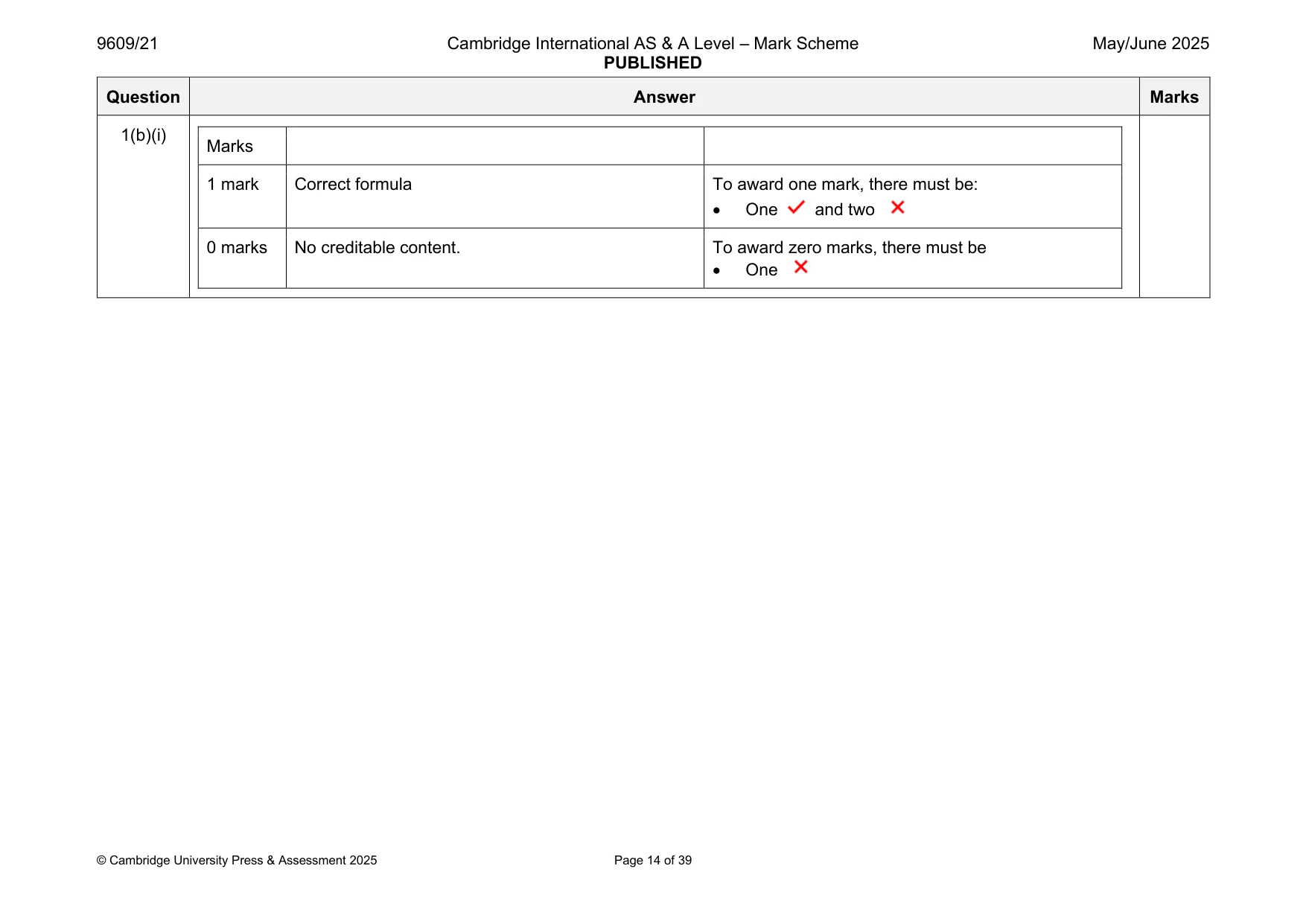
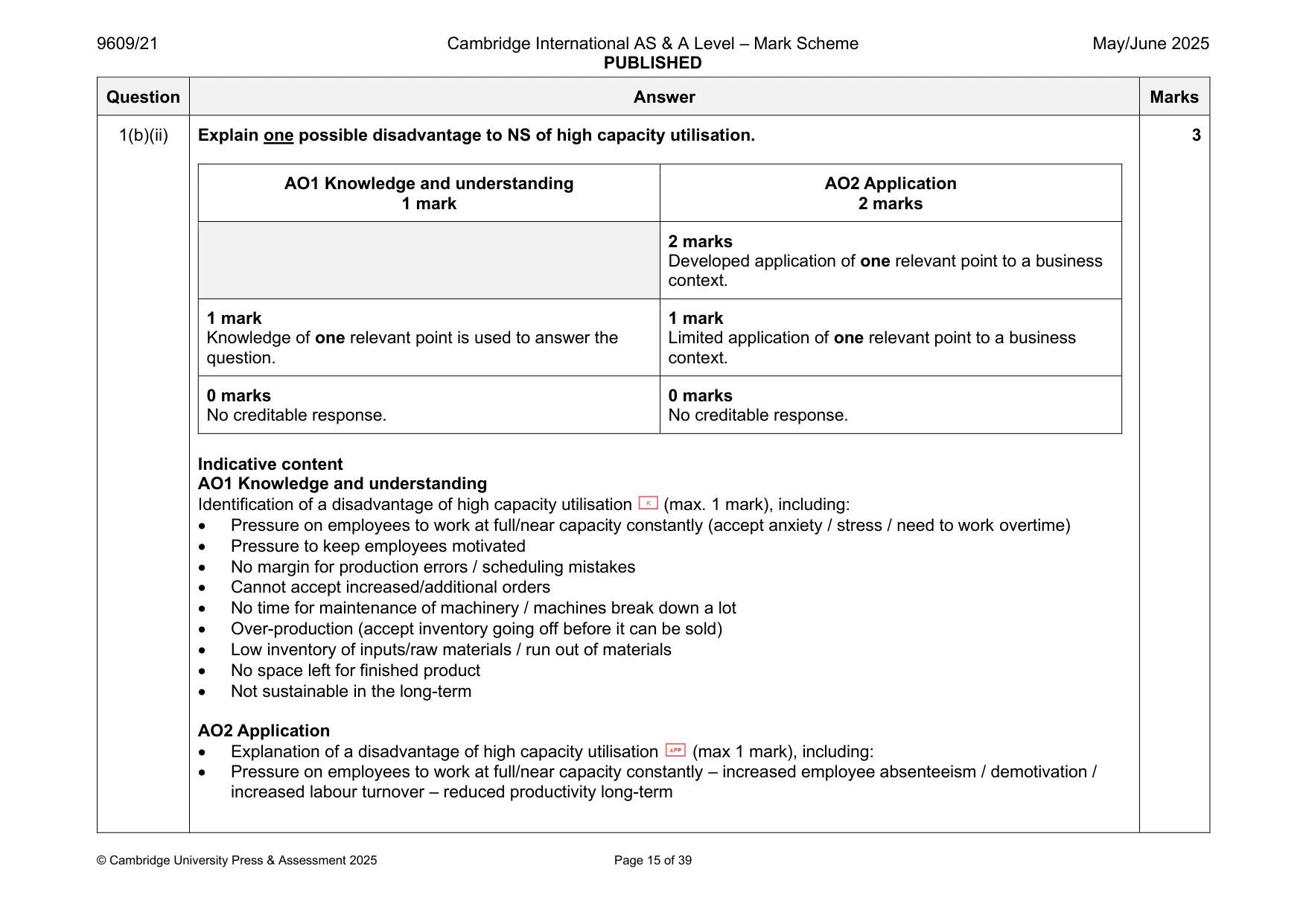
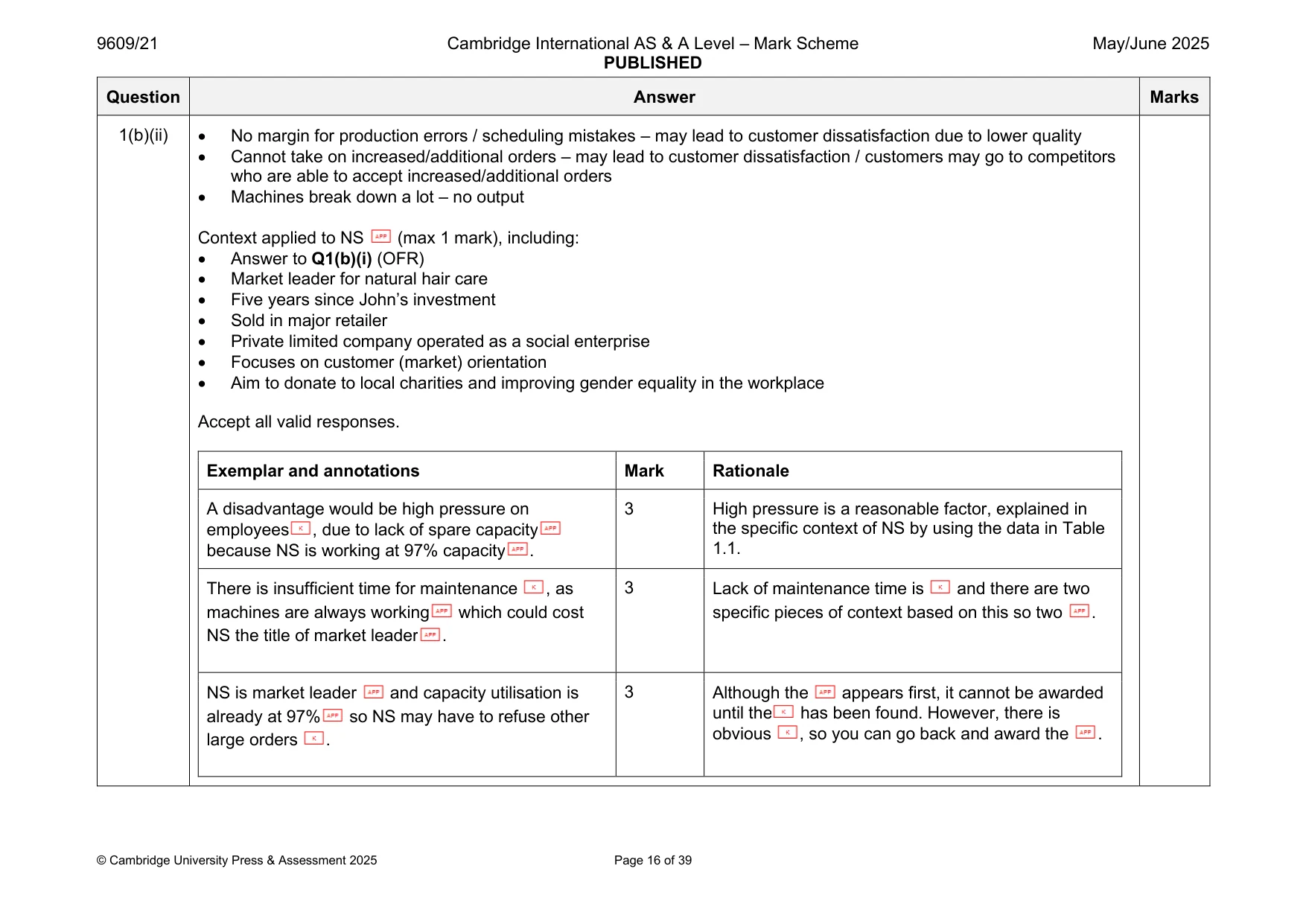
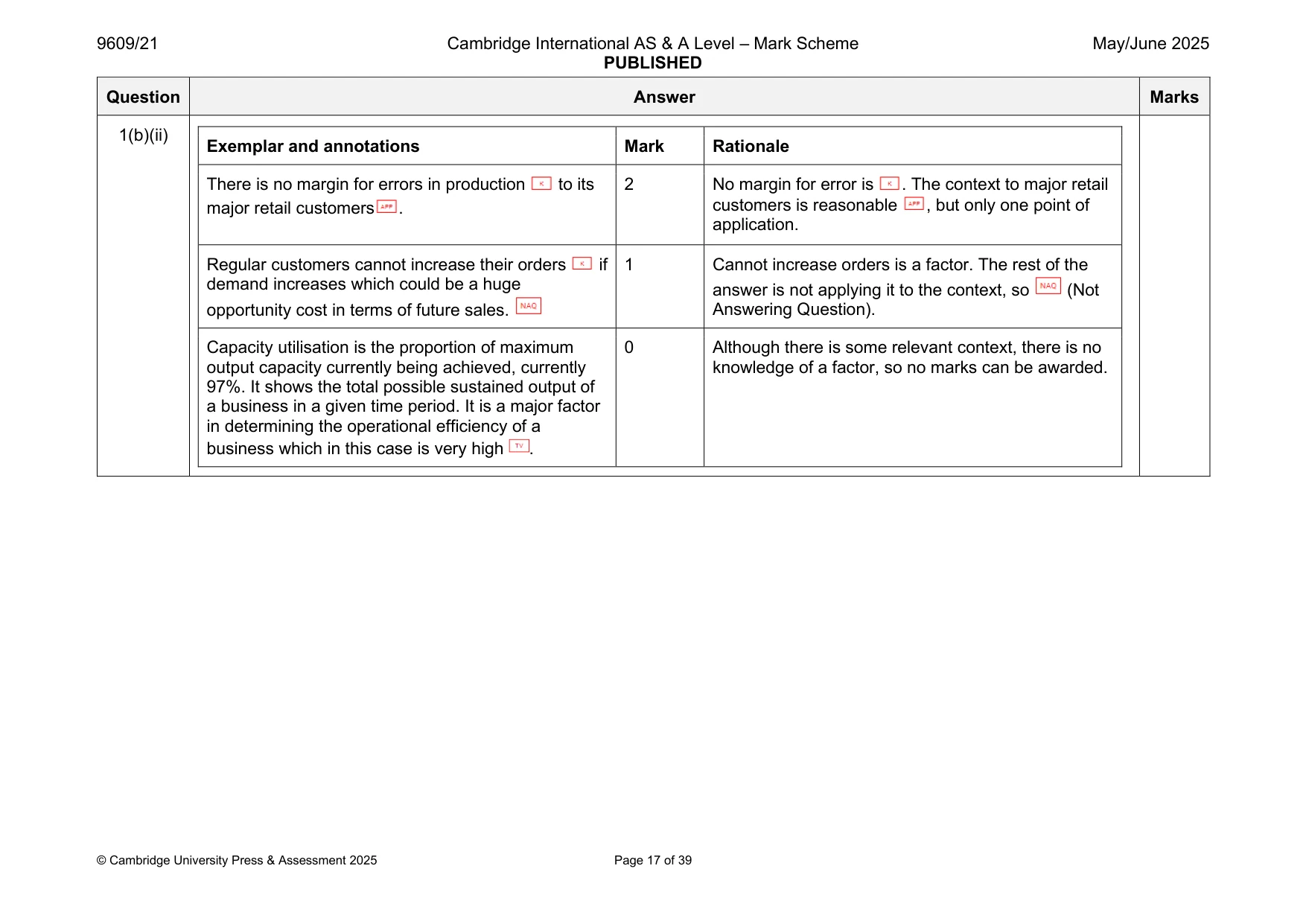
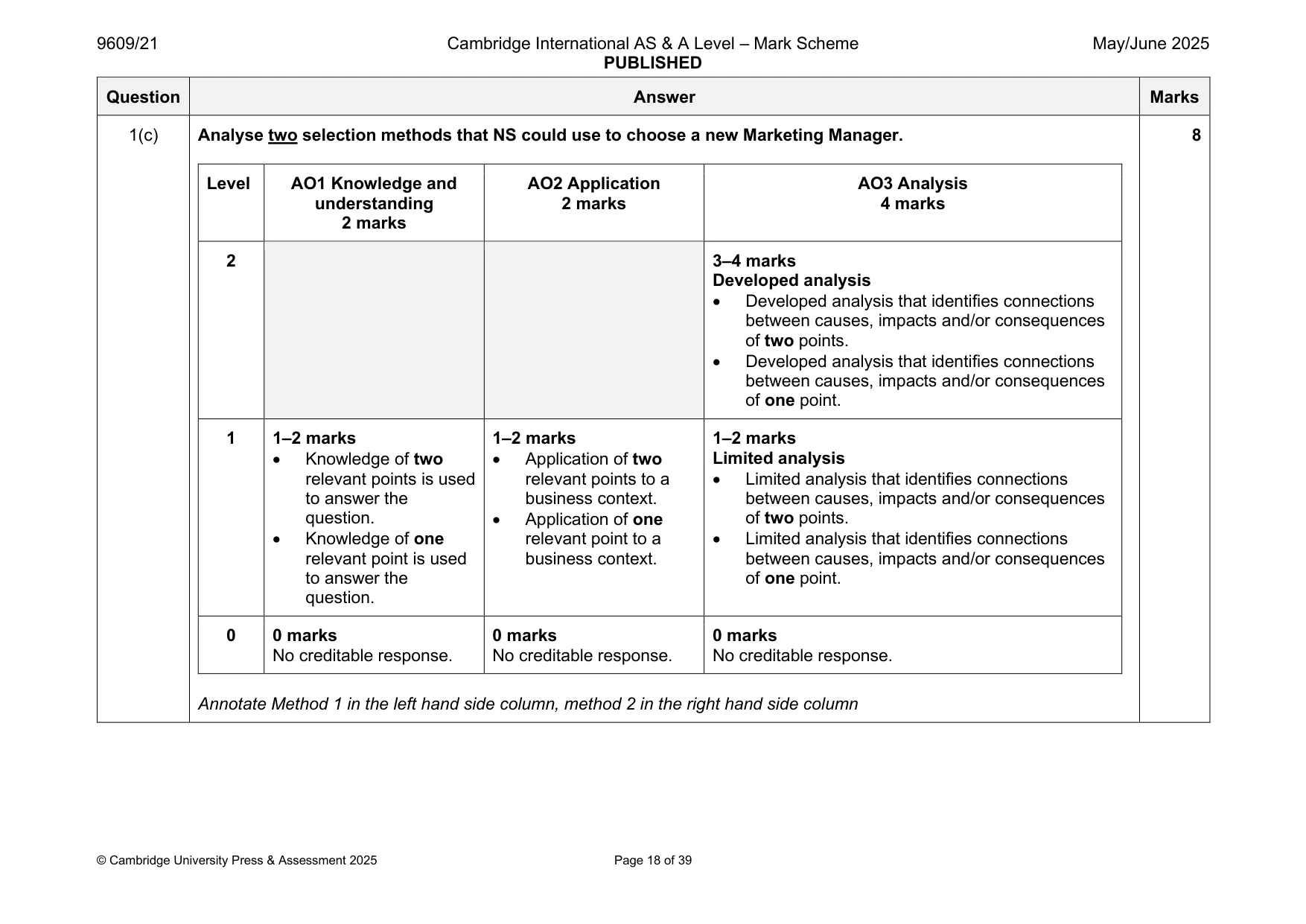
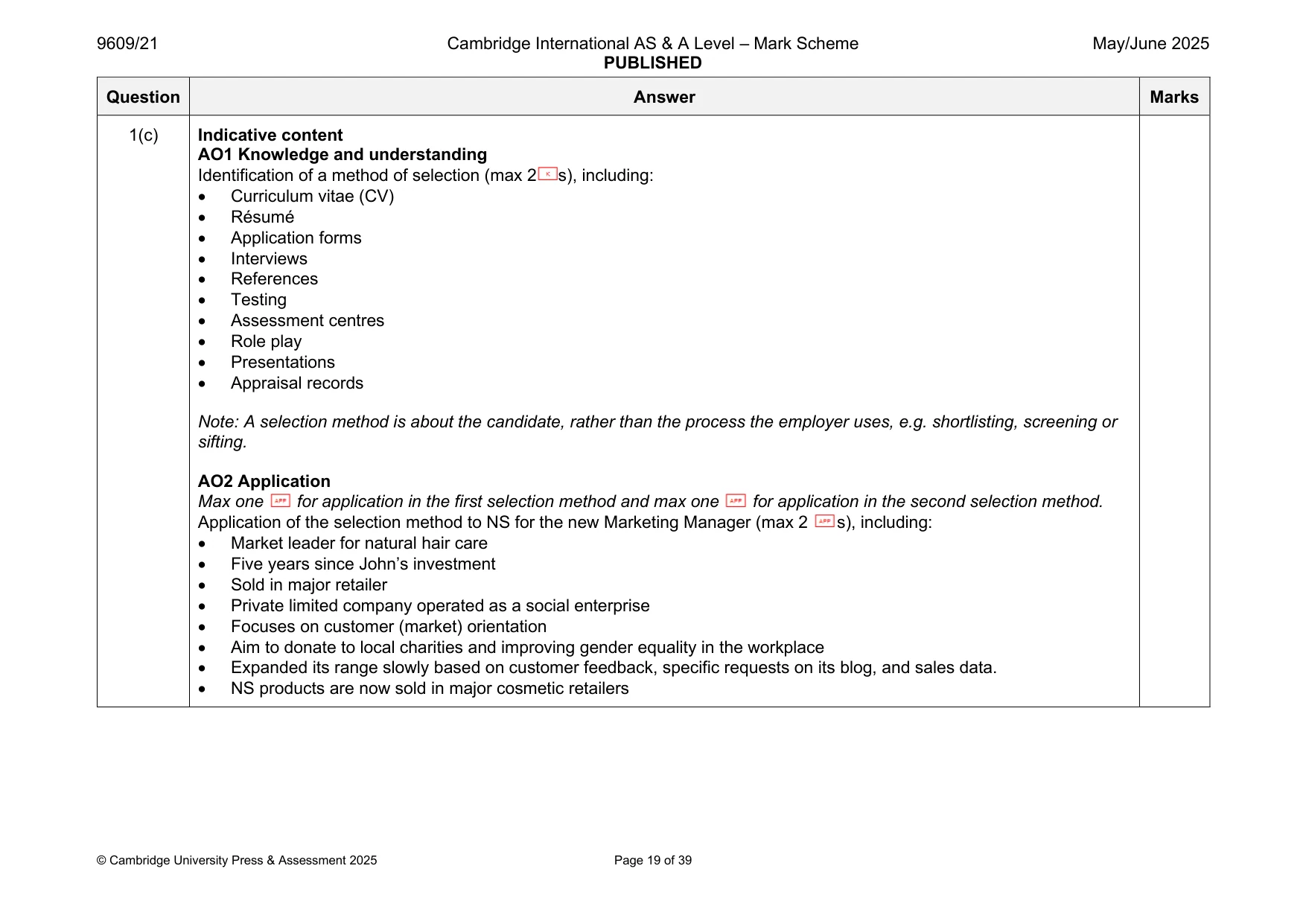
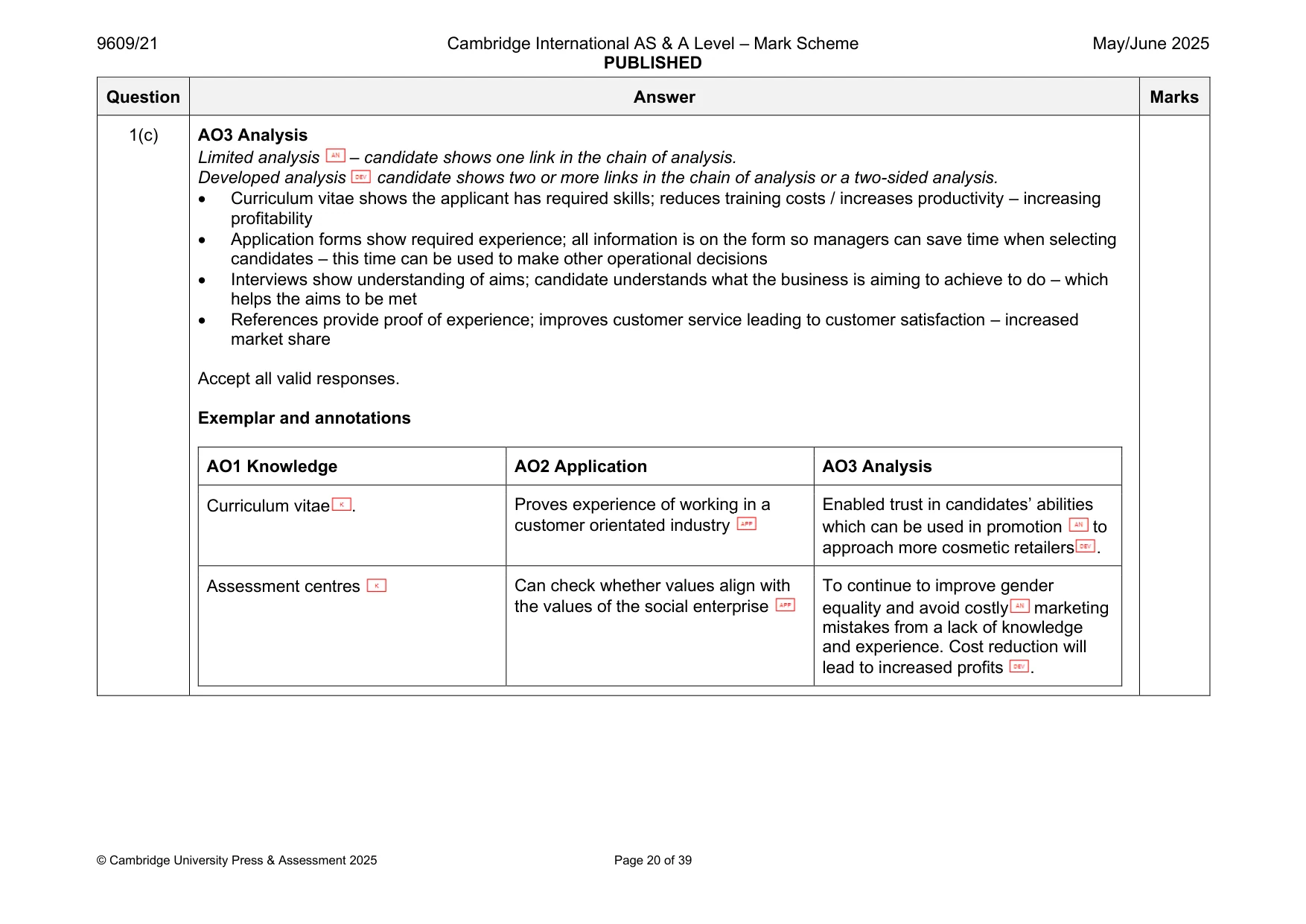
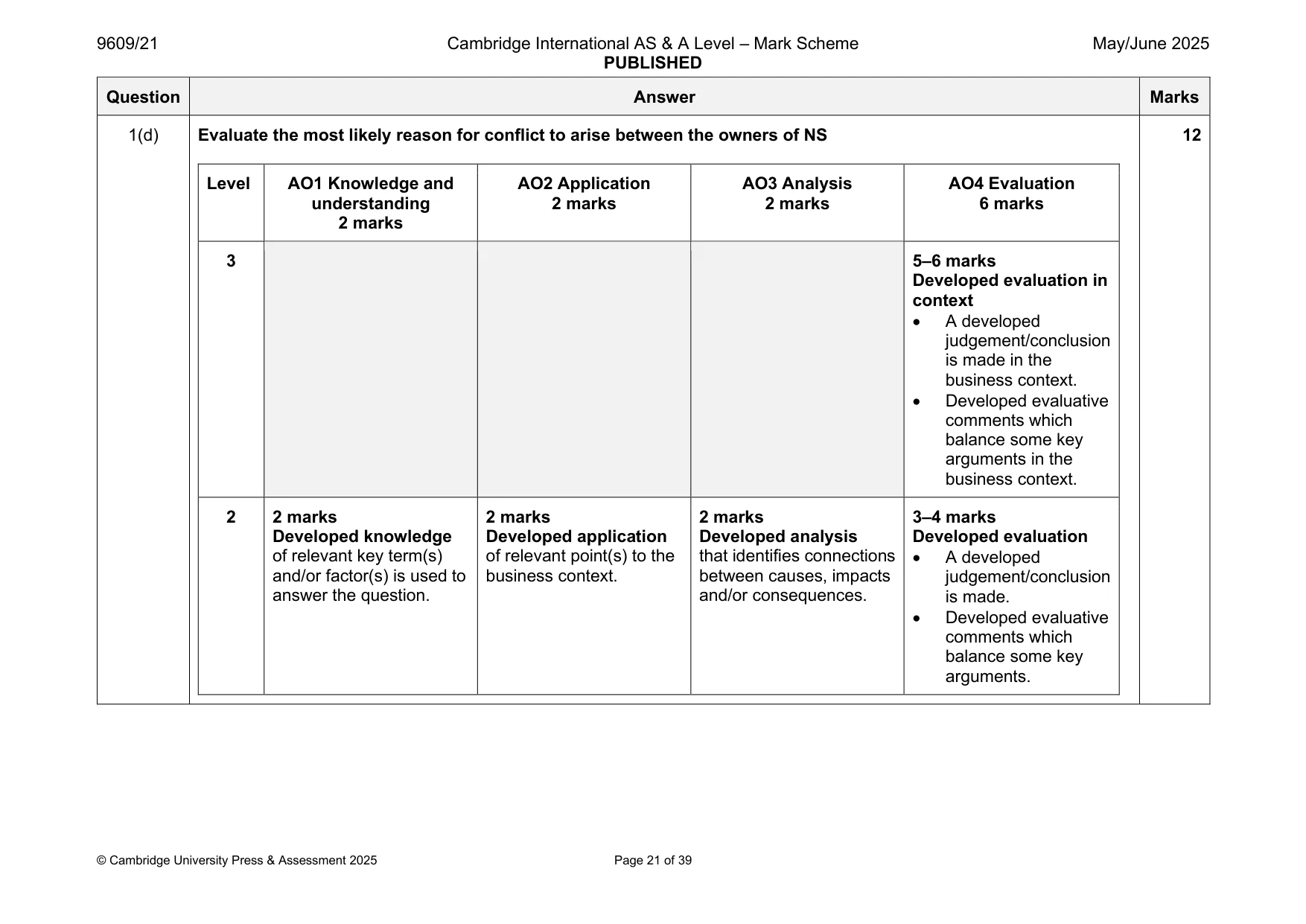
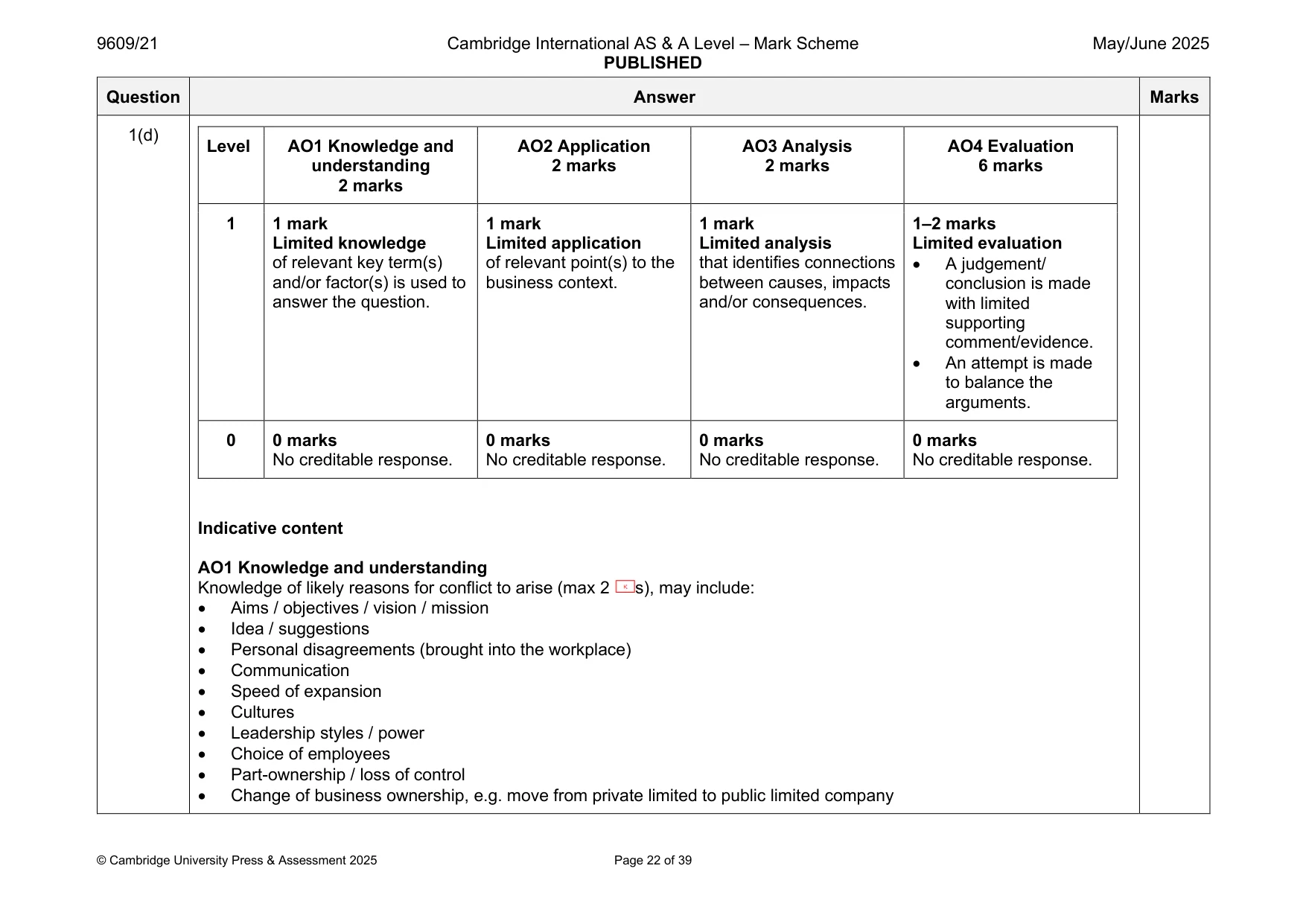
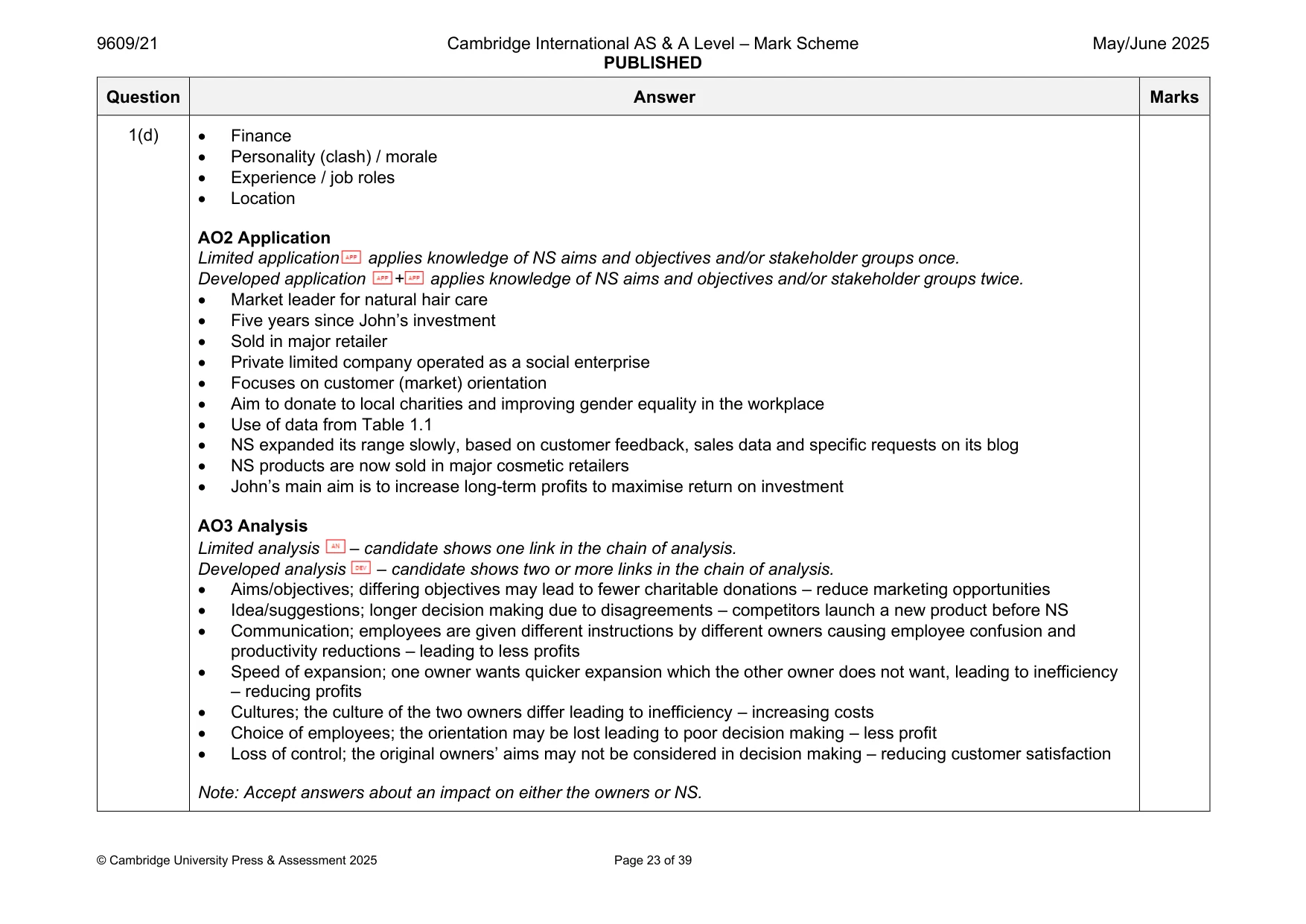
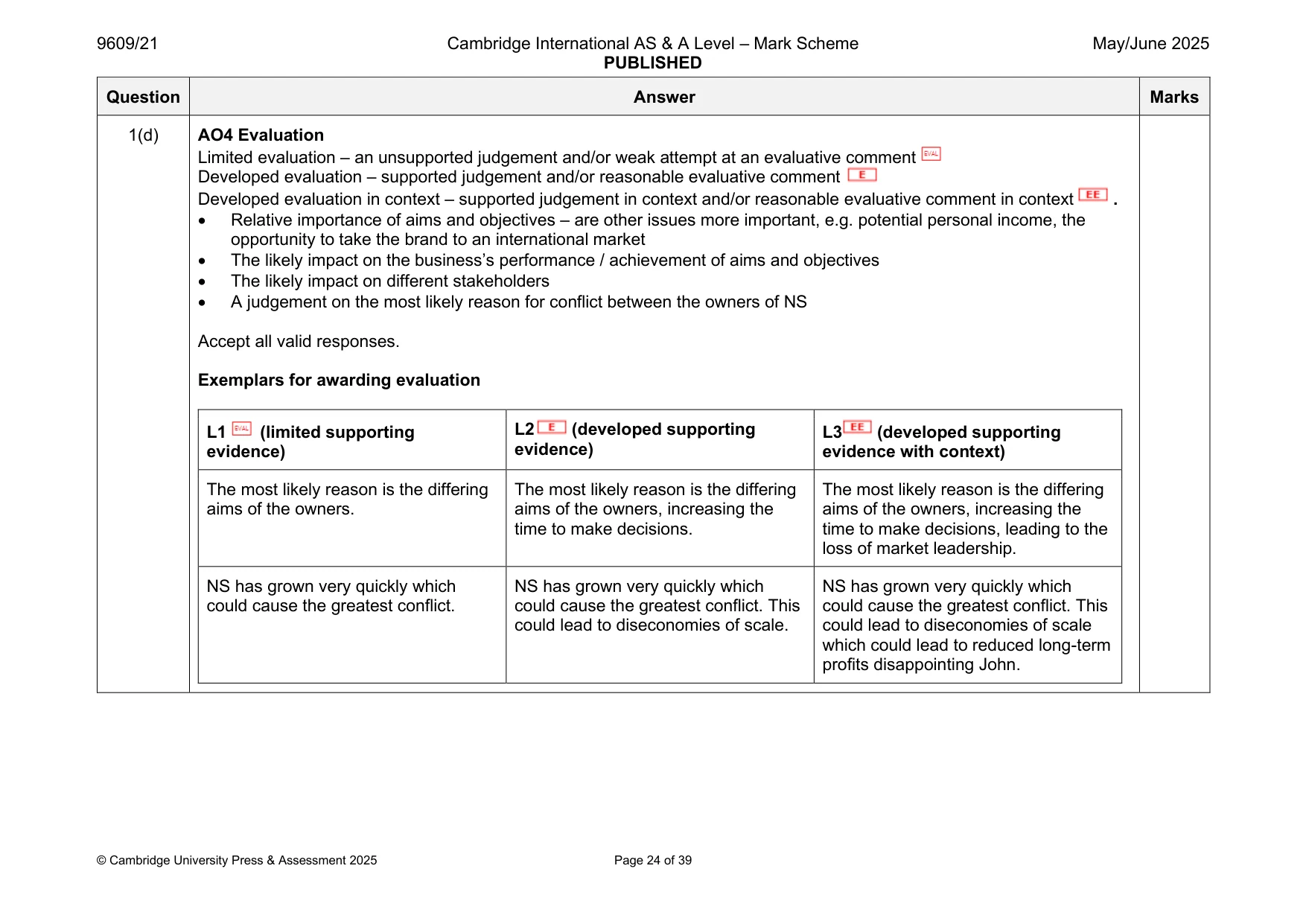
Mark scheme: Question Answer Marks 1(a)(i) Identify one feature of a private limited company. 1 Indicative content Identification of a feature may include: • Owned by shareholders • Cannot sell shares on the open market / stock market • Sell shares for family/friends • Can raise extra capital by selling shares • Limited liability • Continuity of operations • Legal personality • Incorporation If more than one answer is given, only mark the first, reading from top left to bottom right. Do not reward vague points that apply to any private sector organisation, including a private limited company, e.g. not owned by government. 1(a)(ii) Explain the term customer (market) orientation 3 AO1 Knowledge and understanding AO2 Application 1 mark 2 marks 2 marks Developed application of one relevant point to a business context. 1 mark 1 mark Knowledge of one relevant point is used to answer the Limited application of one relevant point to a business question. context. 0 marks 0 marks No creditable response. No creditable response. Indicative content AO1 Knowledge and understanding Knowledge of customer orientation will include (max 1 mark): • Knowledge of customer, including: – Purchaser/buyer (accept consumer/end-user/target audience) – Who they sell to – Demand-based (accept demand) OR • Knowledge of orientation, including: – Focused on customer/purchaser/buyer/consumer/end-user/market – Customer at the heart/centre – Satisfying their needs – Outward looking approach AO2 Application Explanation of customer orientation will include (1 mark): • Knowledge of customer, including: – Purchaser/buyer (accept consumer/end-user/target audience) – Who they sell to – Demand-based (accept demand) 1(a)(ii) AND • Knowledge of orientation, including: – Focused on customer/purchaser/buyer/consumer/end-user/market – Customer at the heart/centre – Satisfying their needs – Outward looking approach Context applied to customer orientation , including (max 1 mark): • Any example of customer orientation, including: – Putting the customer at the centre of decision making – An example of a customer orientated decision – Methods of identifying customer wants/needs, e.g. customer feedback / specific requests on NS’s blog / sales data – Benefit of customer orientation, e.g. increased customer satisfaction, market leadership Accept all valid responses. Exemplar and annotations Mark Rationale Buyers are at the centre of operations . By 3 An answer which starts with the knowledge and then responding to customer requests on its blog NS applies it to customer demand and NS. was able to decide what products to expand its range with. Basing product decisions on purchaser demand 3 Again, knowledge first, followed by application to a . A business could decide which products to make decision (production) and to the demand (market , in response to market research. research data). Focused on the buyer . 2 Clear knowledge. Some application Managers think about purchasers’ needs . 1 Not a perfect definition, but enough to award the knowledge mark. No attempt to apply. It is about choices that have to be made by a 0 No knowledge of customer orientation. Too vague. business, for example how to allocate resources. 1(b)(i) Refer to Table 1.1. Calculate NS’s capacity utilisation in 2024. 3 Indicative content Current output level Rate of capacity utilisation = 100 (1 mark – formula only) Maximum output level 145000 NS capacity utilisation = 100 (1 mark – use of correct figures in formula) 150000 Answer = 96.67(%) or 96.7 or 97 (3 marks – correct answer no working or % needed) OFR applies Exemplar and annotations Marks 3 marks Correct answer (including minus) Working and % do not matter. 96.67(%) or 96.7 or 97 Must be three to denote the three marks. 2 marks Two of the following: To award two marks, there must be • Correct formula • Two and a • Correct identification of figures OR OR • One , one and one An incorrect answer with one mistake allowing OFR for final stage. OR Correct workings, but the final answer is incorrectly rounded 1(b)(i) Marks 1 mark Correct formula To award one mark, there must be: • One and two 0 marks No creditable content. To award zero marks, there must be • One 1(b)(ii) Explain one possible disadvantage to NS of high capacity utilisation. 3 AO1 Knowledge and understanding AO2 Application 1 mark 2 marks 2 marks Developed application of one relevant point to a business context. 1 mark 1 mark Knowledge of one relevant point is used to answer the Limited application of one relevant point to a business question. context. 0 marks 0 marks No creditable response. No creditable response. Indicative content AO1 Knowledge and understanding Identification of a disadvantage of high capacity utilisation (max. 1 mark), including: • Pressure on employees to work at full/near capacity constantly (accept anxiety / stress / need to work overtime) • Pressure to keep employees motivated • No margin for production errors / scheduling mistakes • Cannot accept increased/additional orders • No time for maintenance of machinery / machines break down a lot • Over-production (accept inventory going off before it can be sold) • Low inventory of inputs/raw materials / run out of materials • No space left for finished product • Not sustainable in the long-term AO2 Application • Explanation of a disadvantage of high capacity utilisation (max 1 mark), including: • Pressure on employees to work at full/near capacity constantly – increased employee absenteeism / demotivation / increased labour turnover – reduced productivity long-term 1(b)(ii) • No margin for production errors / scheduling mistakes – may lead to customer dissatisfaction due to lower quality • Cannot take on increased/additional orders – may lead to customer dissatisfaction / customers may go to competitors who are able to accept increased/additional orders • Machines break down a lot – no output Context applied to NS (max 1 mark), including: • Answer to Q1(b)(i) (OFR) • Market leader for natural hair care • Five years since John’s investment • Sold in major retailer • Private limited company operated as a social enterprise • Focuses on customer (market) orientation • Aim to donate to local charities and improving gender equality in the workplace Accept all valid responses. Exemplar and annotations Mark Rationale A disadvantage would be high pressure on 3 High pressure is a reasonable factor, explained in employees , due to lack of spare capacity the specific context of NS by using the data in Table because NS is working at 97% capacity . 1.1. There is insufficient time for maintenance , as 3 Lack of maintenance time is and there are two machines are always working which could cost specific pieces of context based on this so two . NS the title of market leader . NS is market leader and capacity utilisation is 3 Although the appears first, it cannot be awarded already at 97% so NS may have to refuse other until the has been found. However, there is obvious , so you can go back and award the . large orders . 1(b)(ii) Exemplar and annotations Mark Rationale There is no margin for errors in production to its 2 No margin for error is . The context to major retail major retail customers . customers is reasonable , but only one point of application. Regular customers cannot increase their orders if 1 Cannot increase orders is a factor. The rest of the demand increases which could be a huge answer is not applying it to the context, so (Not opportunity cost in terms of future sales. Answering Question). Capacity utilisation is the proportion of maximum 0 Although there is some relevant context, there is no output capacity currently being achieved, currently knowledge of a factor, so no marks can be awarded. 97%. It shows the total possible sustained output of a business in a given time period. It is a major factor in determining the operational efficiency of a business which in this case is very high . 1(c) Analyse two selection methods that NS could use to choose a new Marketing Manager. 8 Level AO1 Knowledge and AO2 Application AO3 Analysis understanding 2 marks 4 marks 2 marks 2 3–4 marks Developed analysis • Developed analysis that identifies connections between causes, impacts and/or consequences of two points. • Developed analysis that identifies connections between causes, impacts and/or consequences of one point. 1 1–2 marks 1–2 marks 1–2 marks • Knowledge of two • Application of two Limited analysis relevant points is used relevant points to a • Limited analysis that identifies connections to answer the business context. between causes, impacts and/or consequences question. • Application of one of two points. • Knowledge of one relevant point to a • Limited analysis that identifies connections relevant point is used business context. between causes, impacts and/or consequences to answer the of one point. question. 0 0 marks 0 marks 0 marks No creditable response. No creditable response. No creditable response. Annotate Method 1 in the left hand side column, method 2 in the right hand side column 1(c) Indicative content AO1 Knowledge and understanding Identification of a method of selection (max 2 s), including: • Curriculum vitae (CV) • Résumé • Application forms • Interviews • References • Testing • Assessment centres • Role play • Presentations • Appraisal records Note: A selection method is about the candidate, rather than the process the employer uses, e.g. shortlisting, screening or sifting. AO2 Application Max one for application in the first selection method and max one for application in the second selection method. Application of the selection method to NS for the new Marketing Manager (max 2 s), including: • Market leader for natural hair care • Five years since John’s investment • Sold in major retailer • Private limited company operated as a social enterprise • Focuses on customer (market) orientation • Aim to donate to local charities and improving gender equality in the workplace • Expanded its range slowly based on customer feedback, specific requests on its blog, and sales data. • NS products are now sold in major cosmetic retailers 1(c) AO3 Analysis Limited analysis – candidate shows one link in the chain of analysis. Developed analysis candidate shows two or more links in the chain of analysis or a two-sided analysis. • Curriculum vitae shows the applicant has required skills; reduces training costs / increases productivity – increasing profitability • Application forms show required experience; all information is on the form so managers can save time when selecting candidates – this time can be used to make other operational decisions • Interviews show understanding of aims; candidate understands what the business is aiming to achieve to do – which helps the aims to be met • References provide proof of experience; improves customer service leading to customer satisfaction – increased market share Accept all valid responses. Exemplar and annotations AO1 Knowledge AO2 Application AO3 Analysis Curriculum vitae . Proves experience of working in a Enabled trust in candidates’ abilities customer orientated industry which can be used in promotion to approach more cosmetic retailers . Assessment centres Can check whether values align with To continue to improve gender the values of the social enterprise equality and avoid costly marketing mistakes from a lack of knowledge and experience. Cost reduction will lead to increased profits . 1(d) Evaluate the most likely reason for conflict to arise between the owners of NS 12 Level AO1 Knowledge and AO2 Application AO3 Analysis AO4 Evaluation understanding 2 marks 2 marks 6 marks 2 marks 3 5–6 marks Developed evaluation in context • A developed judgement/conclusion is made in the business context. • Developed evaluative comments which balance some key arguments in the business context. 2 2 marks 2 marks 2 marks 3–4 marks Developed knowledge Developed application Developed analysis Developed evaluation of relevant key term(s) of relevant point(s) to the that identifies connections • A developed and/or factor(s) is used to business context. between causes, impacts judgement/conclusion answer the question. and/or consequences. is made. • Developed evaluative comments which balance some key arguments. 1(d) Level AO1 Knowledge and AO2 Application AO3 Analysis AO4 Evaluation understanding 2 marks 2 marks 6 marks 2 marks 1 1 mark 1 mark 1 mark 1–2 marks Limited knowledge Limited application Limited analysis Limited evaluation of relevant key term(s) of relevant point(s) to the that identifies connections • A judgement/ and/or factor(s) is used to business context. between causes, impacts conclusion is made answer the question. and/or consequences. with limited supporting comment/evidence. • An attempt is made to balance the arguments. 0 0 marks 0 marks 0 marks 0 marks No creditable response. No creditable response. No creditable response. No creditable response. Indicative content AO1 Knowledge and understanding Knowledge of likely reasons for conflict to arise (max 2 s), may include: • Aims / objectives / vision / mission • Idea / suggestions • Personal disagreements (brought into the workplace) • Communication • Speed of expansion • Cultures • Leadership styles / power • Choice of employees • Part-ownership / loss of control • Change of business ownership, e.g. move from private limited to public limited company 1(d) • Finance • Personality (clash) / morale • Experience / job roles • Location AO2 Application Limited application applies knowledge of NS aims and objectives and/or stakeholder groups once. Developed application + applies knowledge of NS aims and objectives and/or stakeholder groups twice. • Market leader for natural hair care • Five years since John’s investment • Sold in major retailer • Private limited company operated as a social enterprise • Focuses on customer (market) orientation • Aim to donate to local charities and improving gender equality in the workplace • Use of data from Table 1.1 • NS expanded its range slowly, based on customer feedback, sales data and specific requests on its blog • NS products are now sold in major cosmetic retailers • John’s main aim is to increase long-term profits to maximise return on investment AO3 Analysis Limited analysis – candidate shows one link in the chain of analysis. Developed analysis – candidate shows two or more links in the chain of analysis. • Aims/objectives; differing objectives may lead to fewer charitable donations – reduce marketing opportunities • Idea/suggestions; longer decision making due to disagreements – competitors launch a new product before NS • Communication; employees are given different instructions by different owners causing employee confusion and productivity reductions – leading to less profits • Speed of expansion; one owner wants quicker expansion which the other owner does not want, leading to inefficiency – reducing profits • Cultures; the culture of the two owners differ leading to inefficiency – increasing costs • Choice of employees; the orientation may be lost leading to poor decision making – less profit • Loss of control; the original owners’ aims may not be considered in decision making – reducing customer satisfaction Note: Accept answers about an impact on either the owners or NS. 1(d) AO4 Evaluation Limited evaluation – an unsupported judgement and/or weak attempt at an evaluative comment Developed evaluation – supported judgement and/or reasonable evaluative comment Developed evaluation in context – supported judgement in context and/or reasonable evaluative comment in context . • Relative importance of aims and objectives – are other issues more important, e.g. potential personal income, the opportunity to take the brand to an international market • The likely impact on the business’s performance / achievement of aims and objectives • The likely impact on different stakeholders • A judgement on the most likely reason for conflict between the owners of NS Accept all valid responses. Exemplars for awarding evaluation L1 (limited supporting L2 (developed supporting L3 (developed supporting evidence) evidence) evidence with context) The most likely reason is the differing The most likely reason is the differing The most likely reason is the differing aims of the owners. aims of the owners, increasing the aims of the owners, increasing the time to make decisions. time to make decisions, leading to the loss of market leadership. NS has grown very quickly which NS has grown very quickly which NS has grown very quickly which could cause the greatest conflict. could cause the greatest conflict. This could cause the greatest conflict. This could lead to diseconomies of scale. could lead to diseconomies of scale which could lead to reduced long-term profits disappointing John.
Q2 · Premium Homes (PH) PH owns student rental accommodation in all the major cities in…
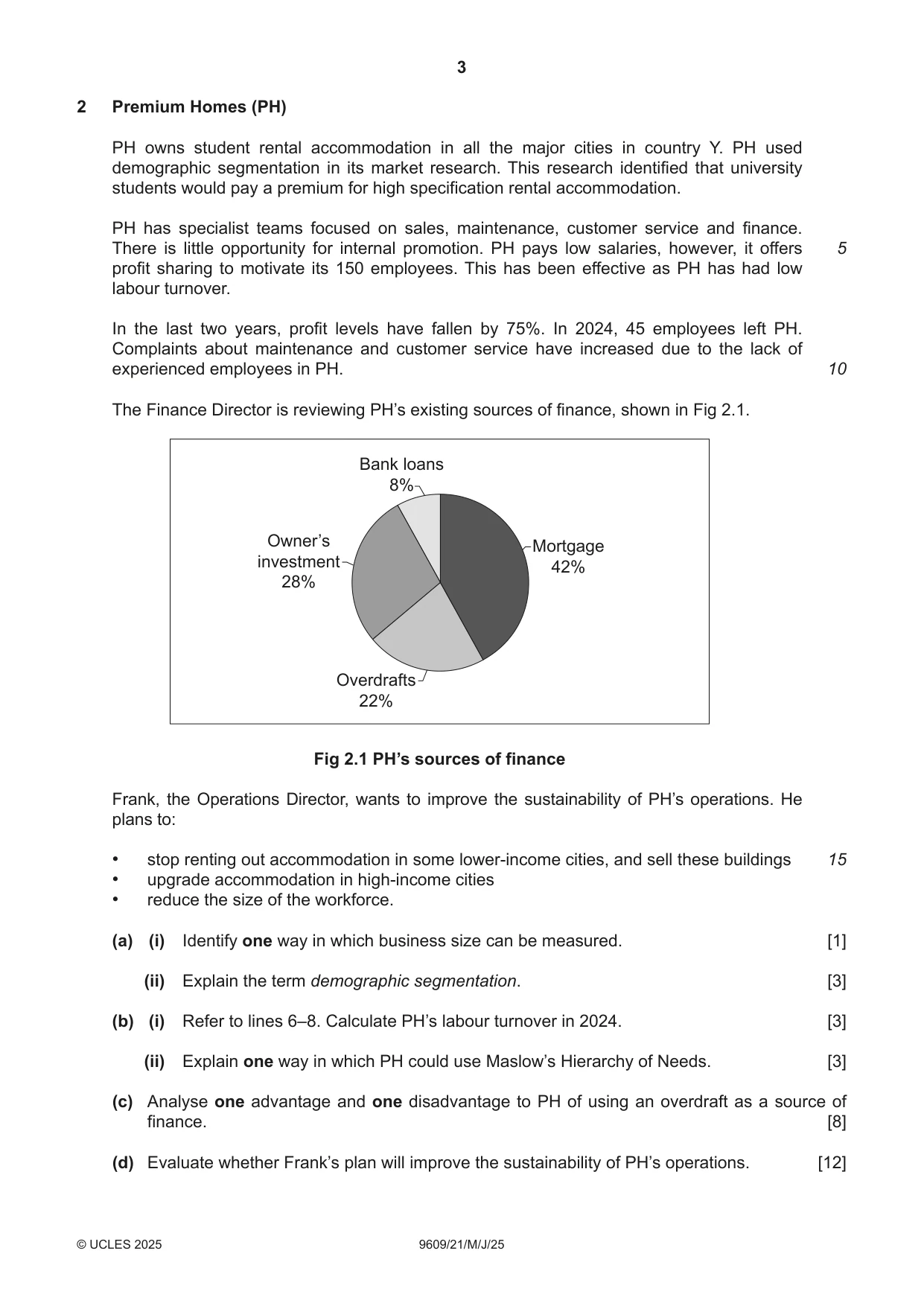
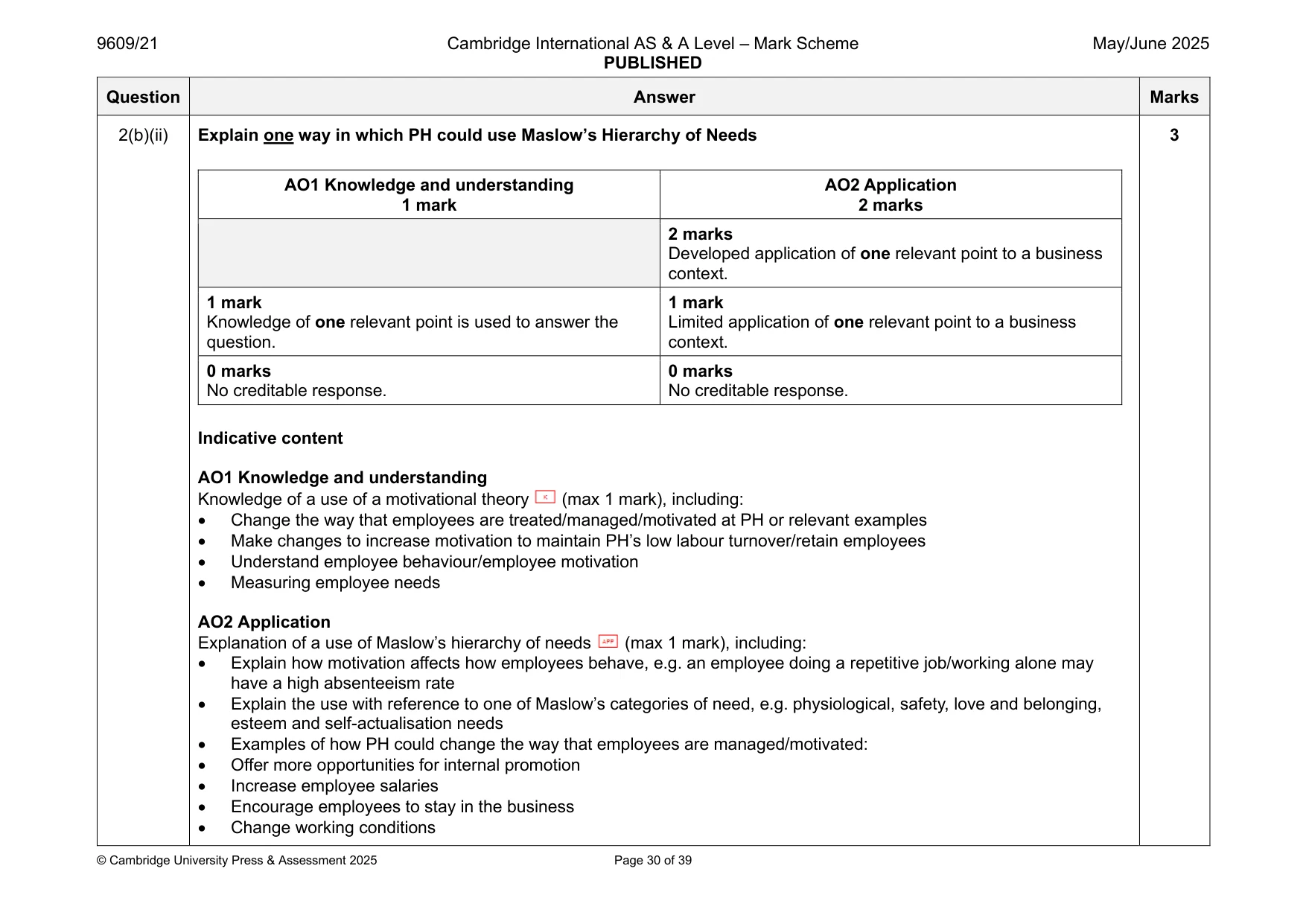
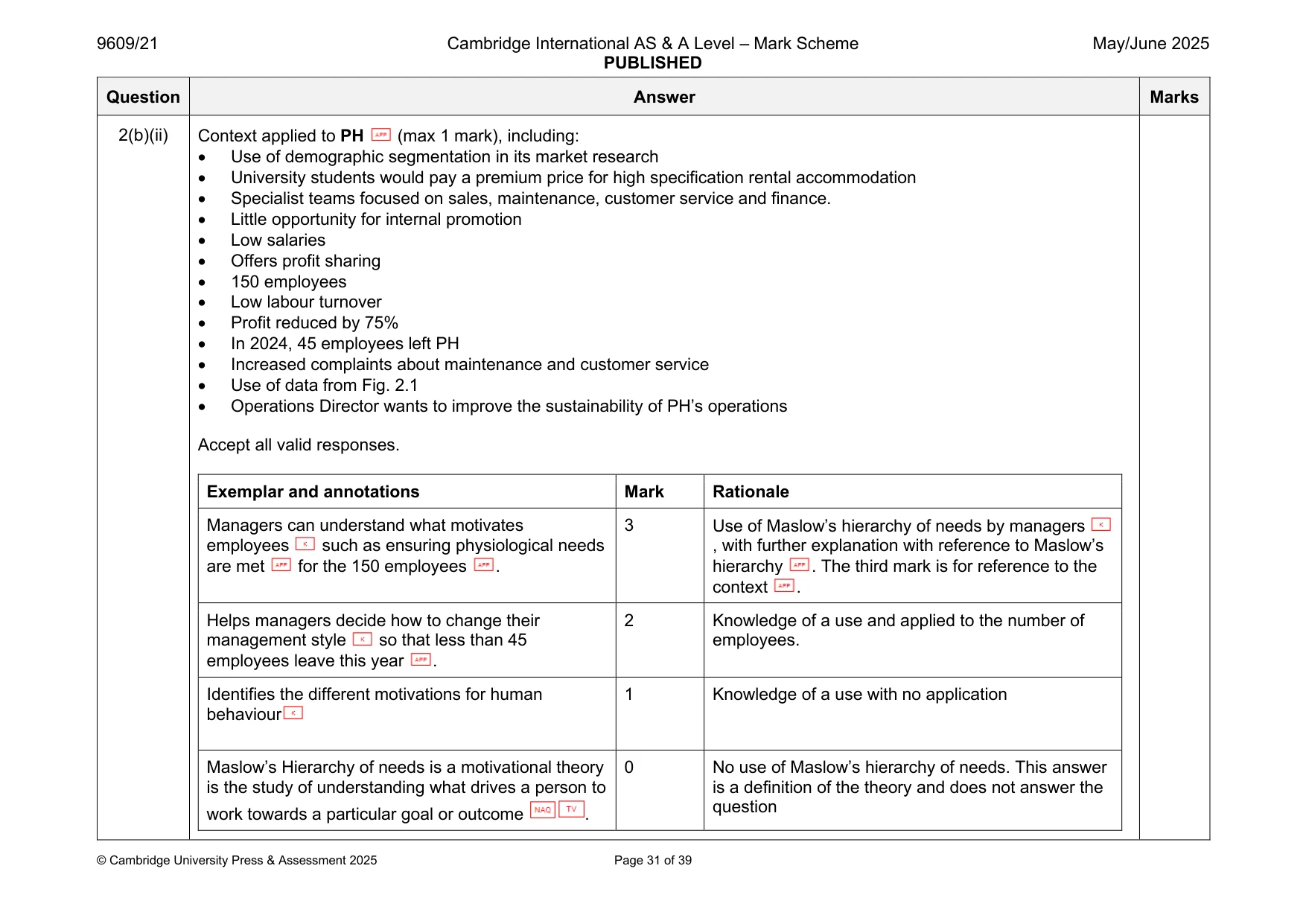
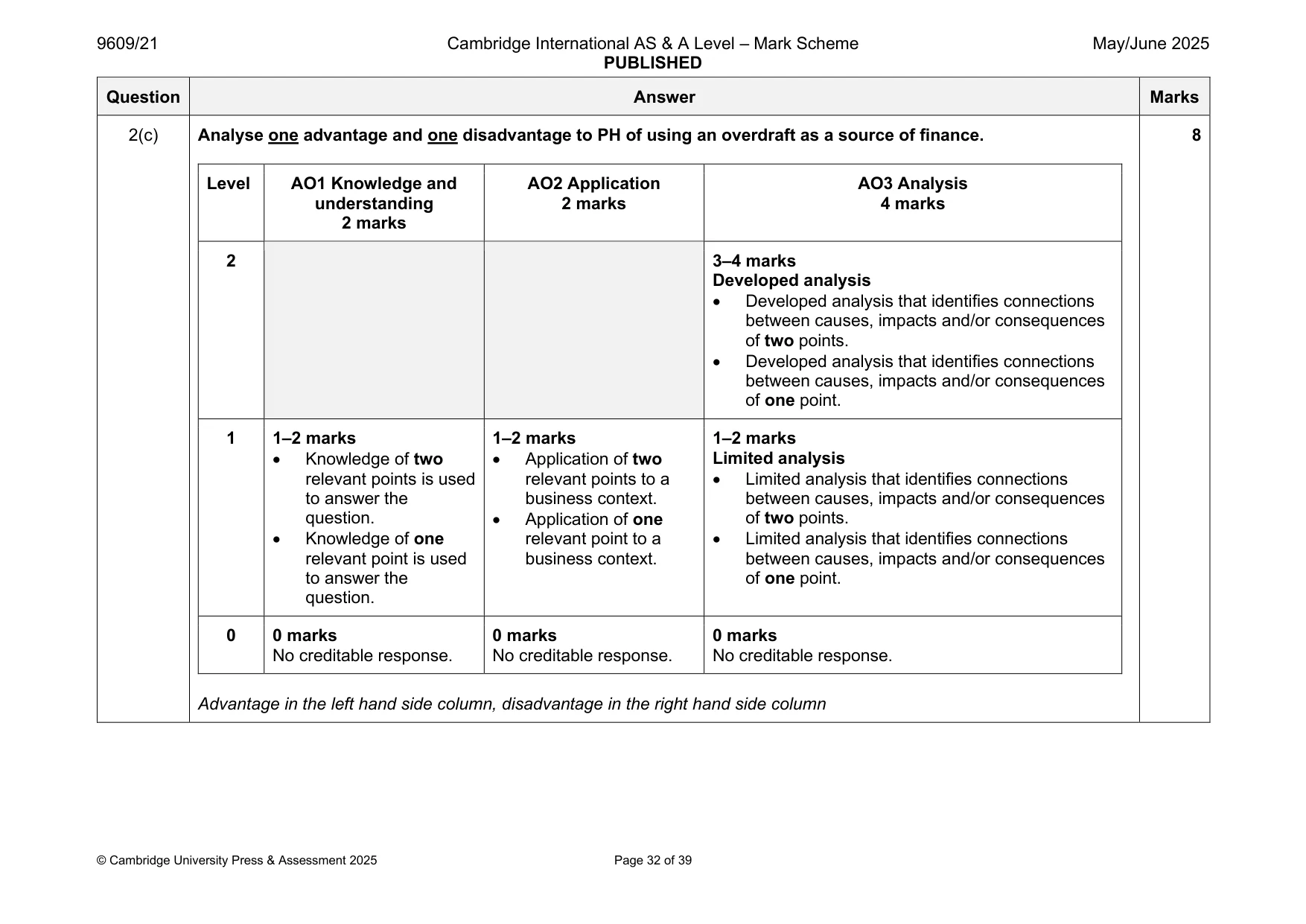
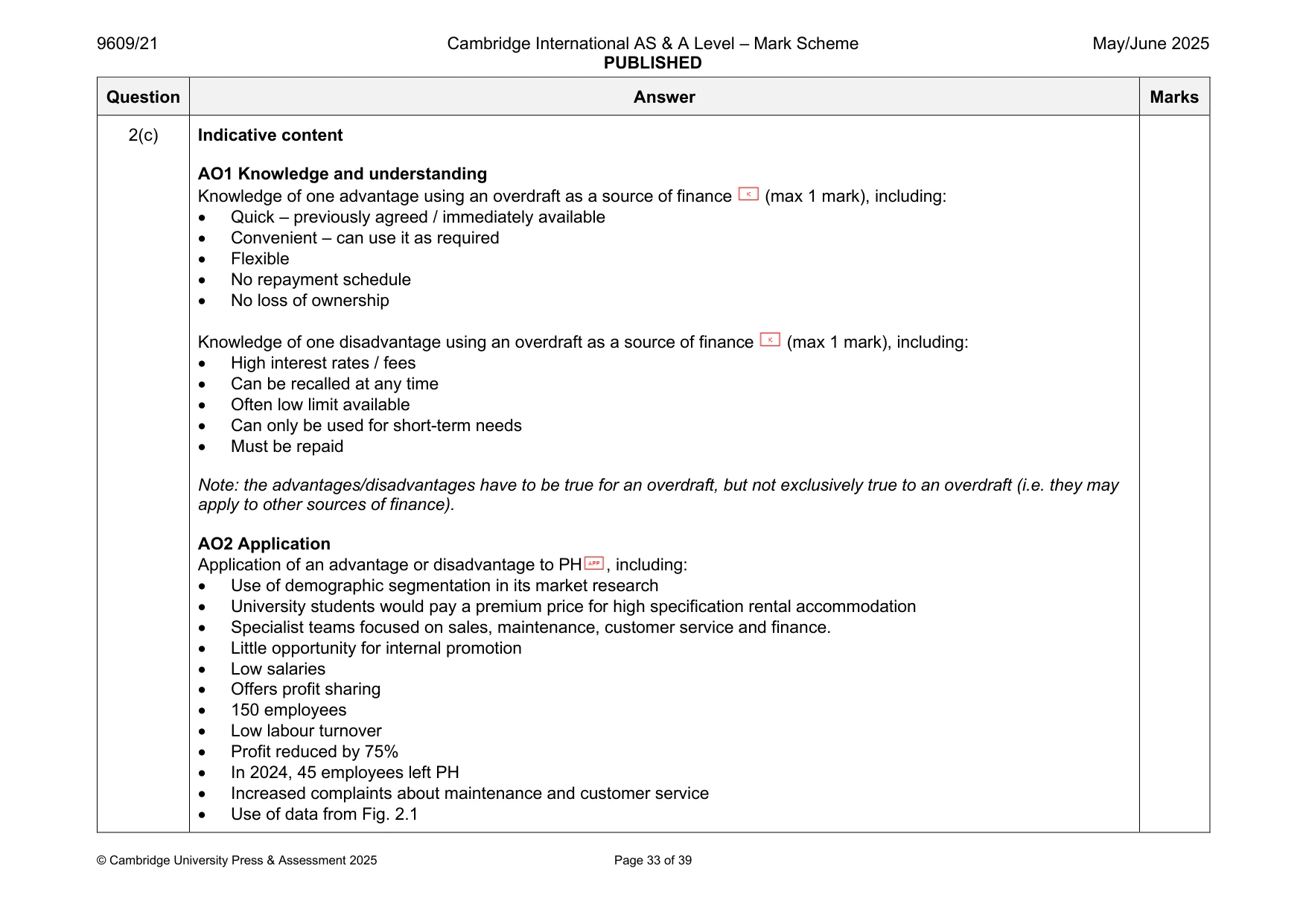
2 Premium Homes (PH) PH owns student rental accommodation in all the major cities in country Y. PH used demographic segmentation in its market research. This research identified that university students would pay a premium for high specification rental accommodation. PH has specialist teams focused on sales, maintenance, customer service and finance. There is little opportunity for internal promotion. PH pays low salaries, however, it offers 5 profit sharing to motivate its 150 employees. This has been effective as PH has had low labour turnover. In the last two years, profit levels have fallen by 75%. In 2024, 45 employees left PH. Complaints about maintenance and customer service have increased due to the lack of experienced employees in PH. 10 The Finance Director is reviewing PH’s existing sources of finance, shown in Fig 2.1. Bank loans 8% Owner’s Mortgage investment 42% 28% Overdrafts 22% Fig 2.1 PH’s sources of finance Frank, the Operations Director, wants to improve the sustainability of PH’s operations. He plans to: • stop renting out accommodation in some lower-income cities, and sell these buildings 15 • upgrade accommodation in high-income cities • reduce the size of the workforce. (a) (i) Identify one way in which business size can be measured. [1] (ii) Explain the term demographic segmentation. [3] (b) (i) Refer to lines 6–8. Calculate PH’s labour turnover in 2024. [3] (ii) Explain one way in which PH could use Maslow’s Hierarchy of Needs. [3] (c) Analyse one advantage and one disadvantage to PH of using an overdraft as a source of finance. [8] (d) Evaluate whether Frank’s plan will improve the sustainability of PH’s operations. [12]
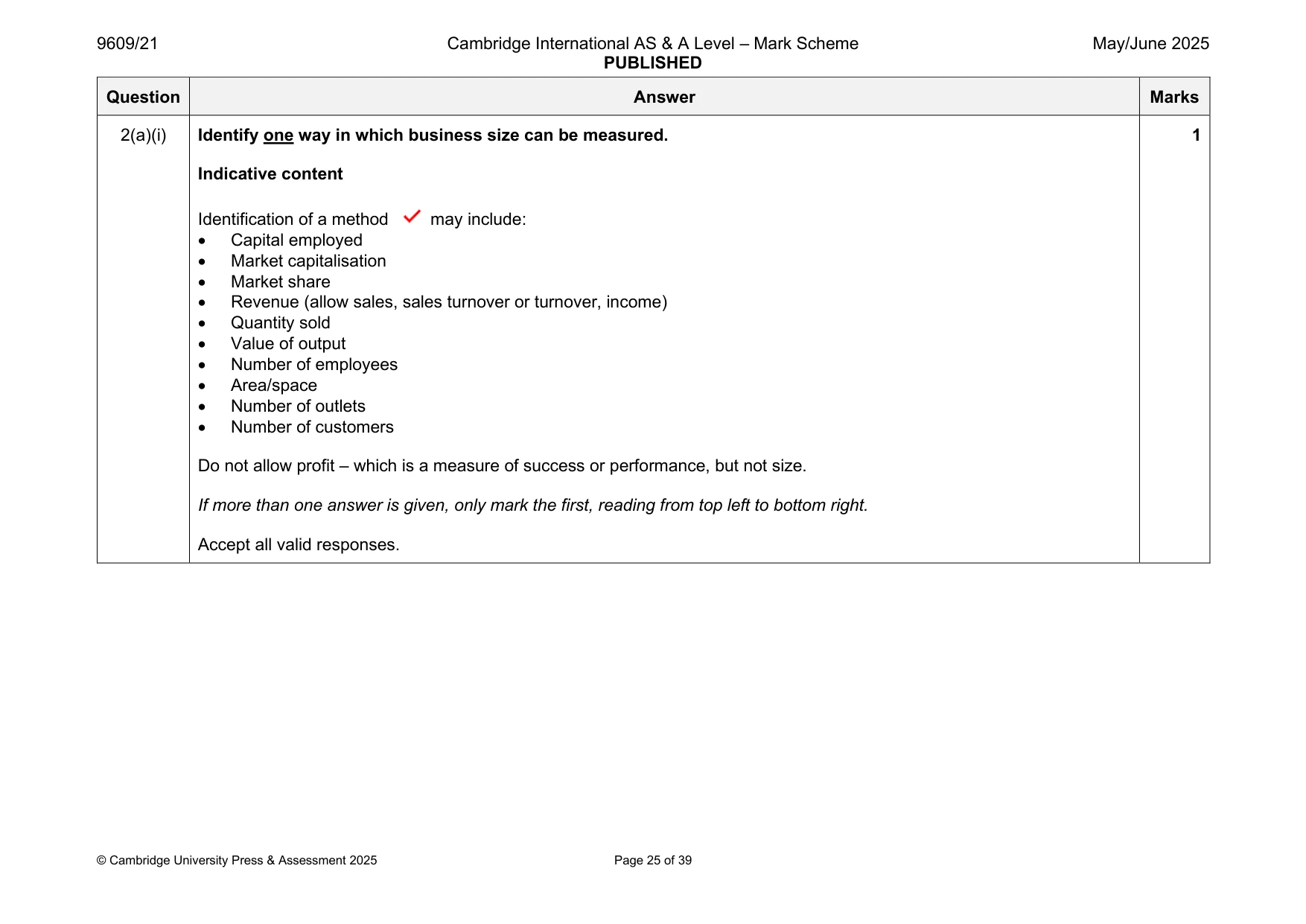
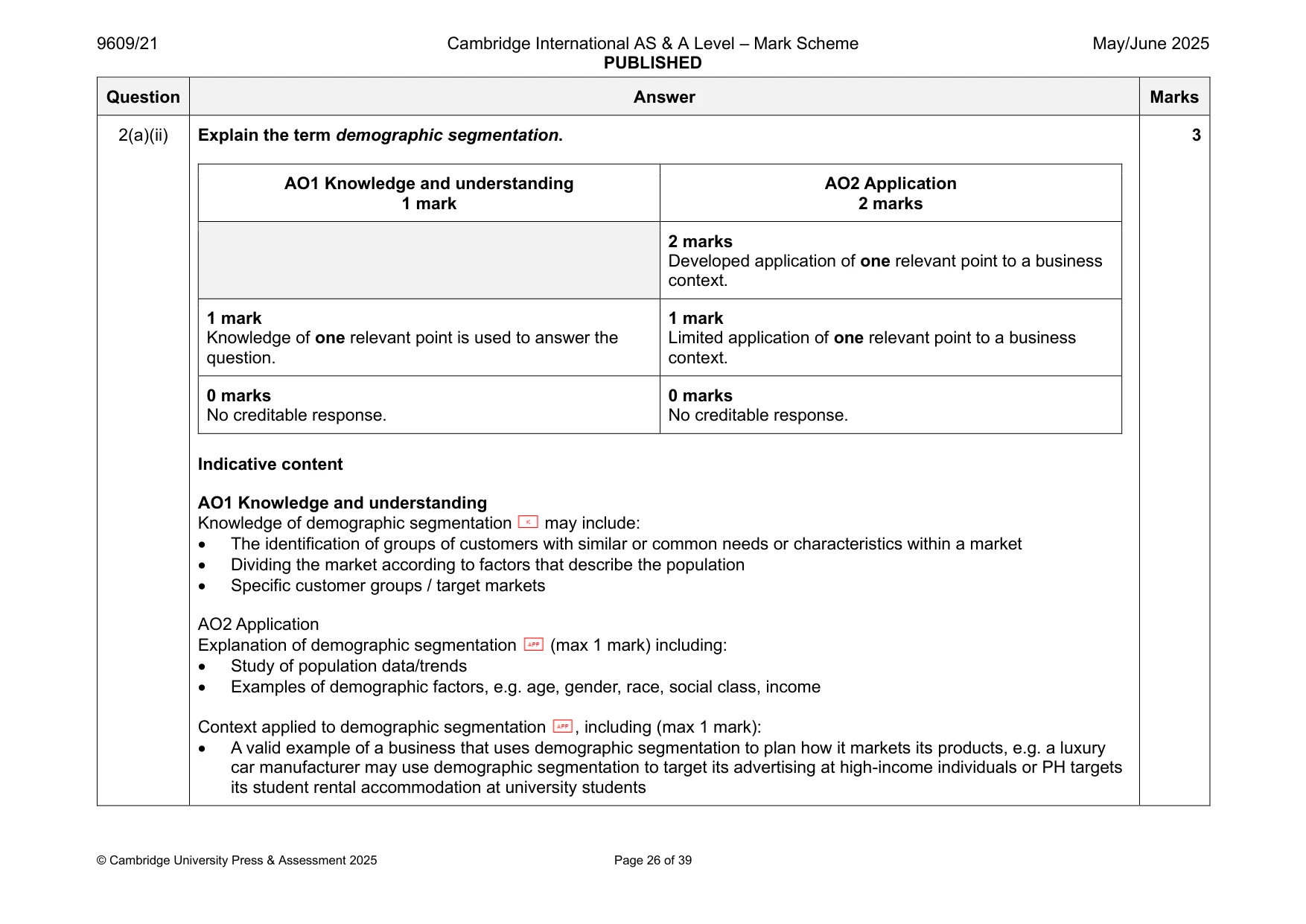
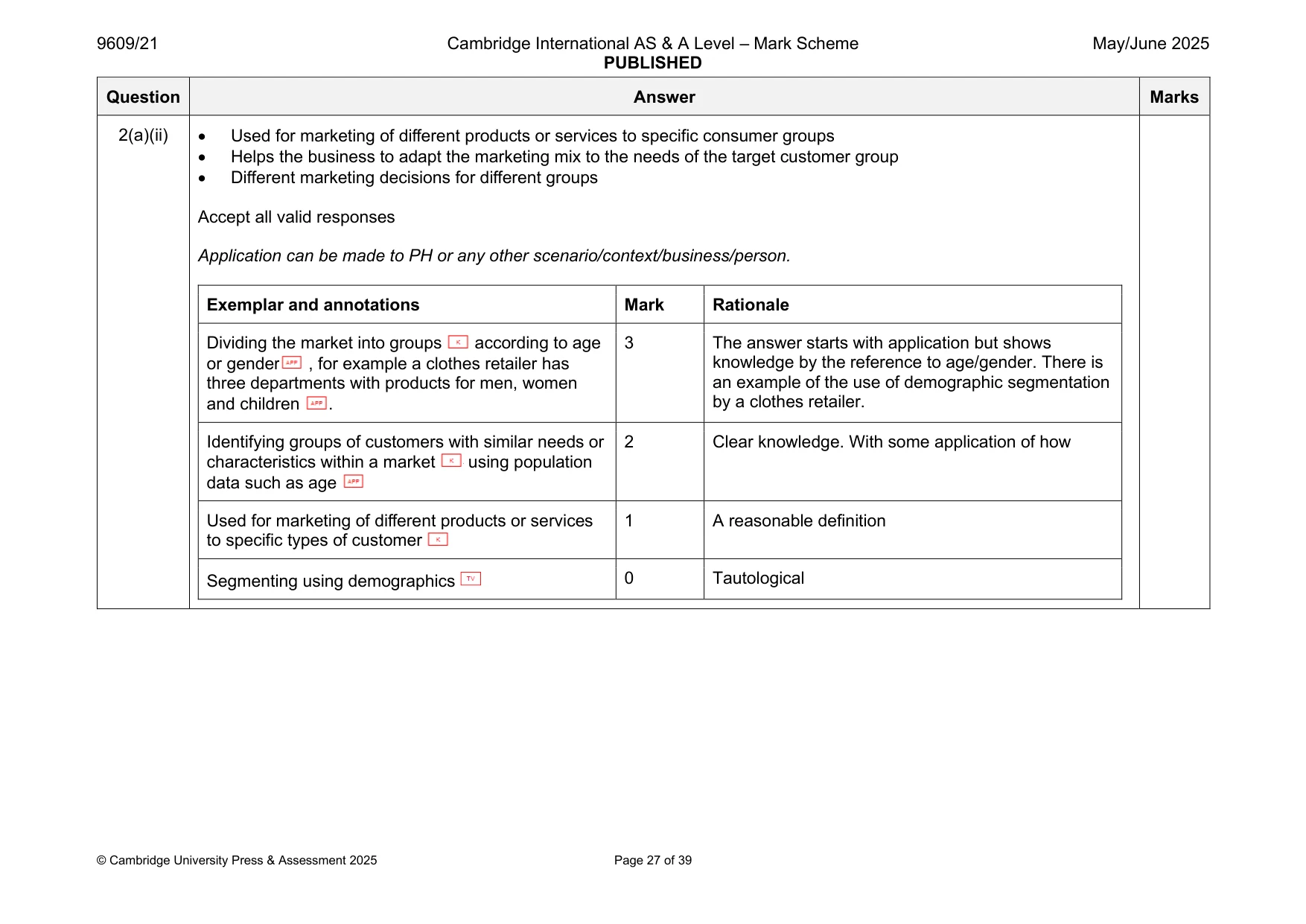
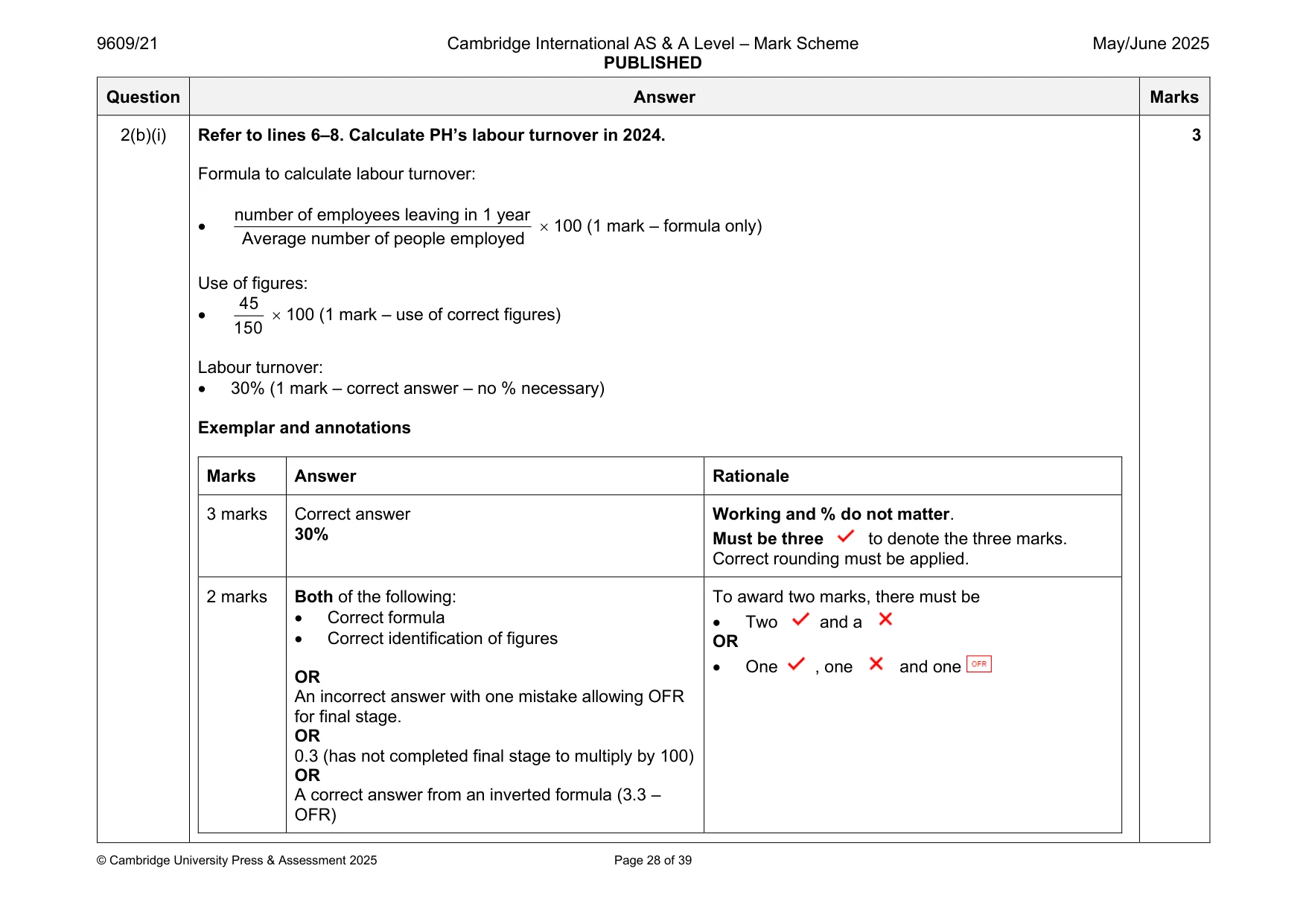
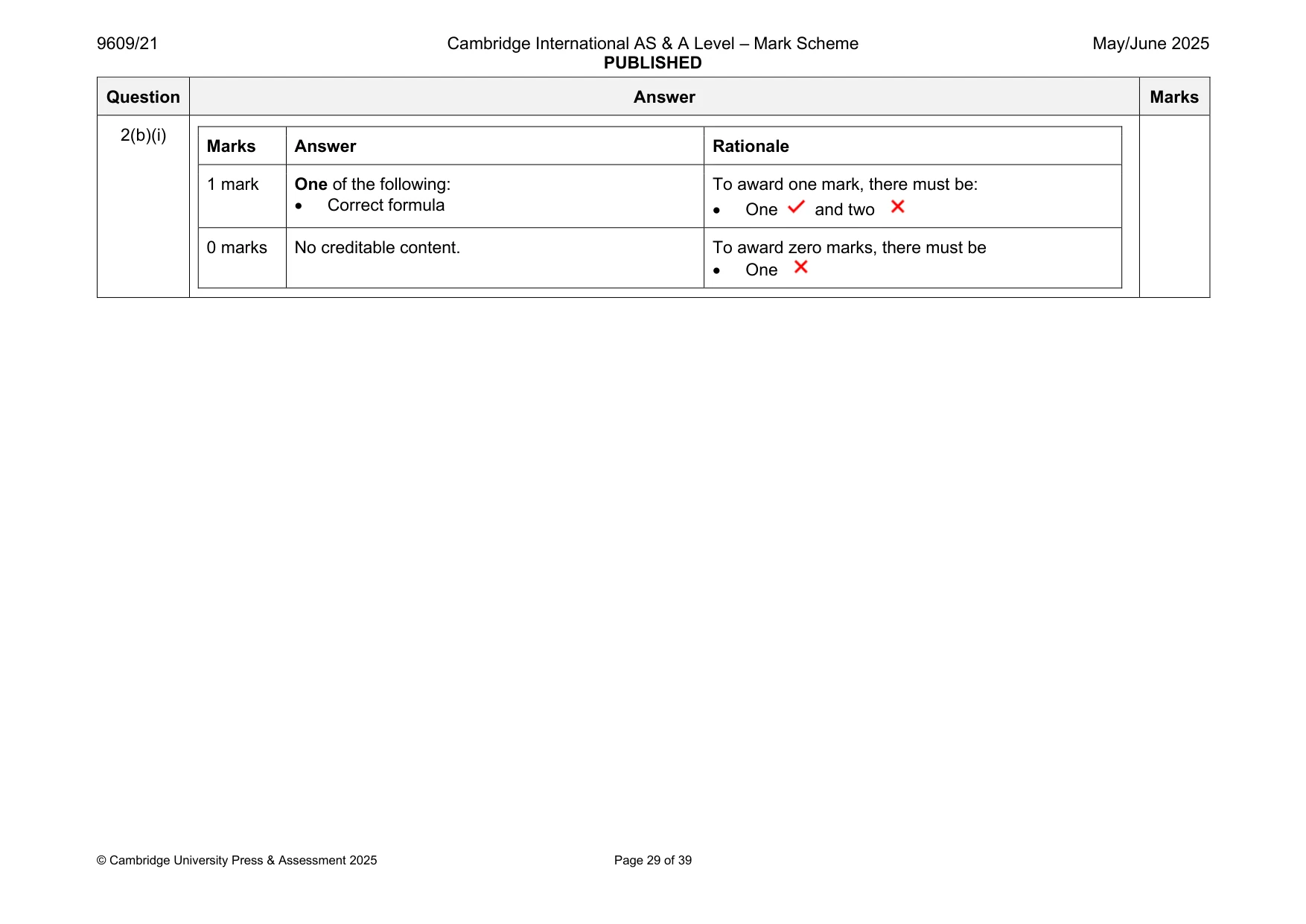
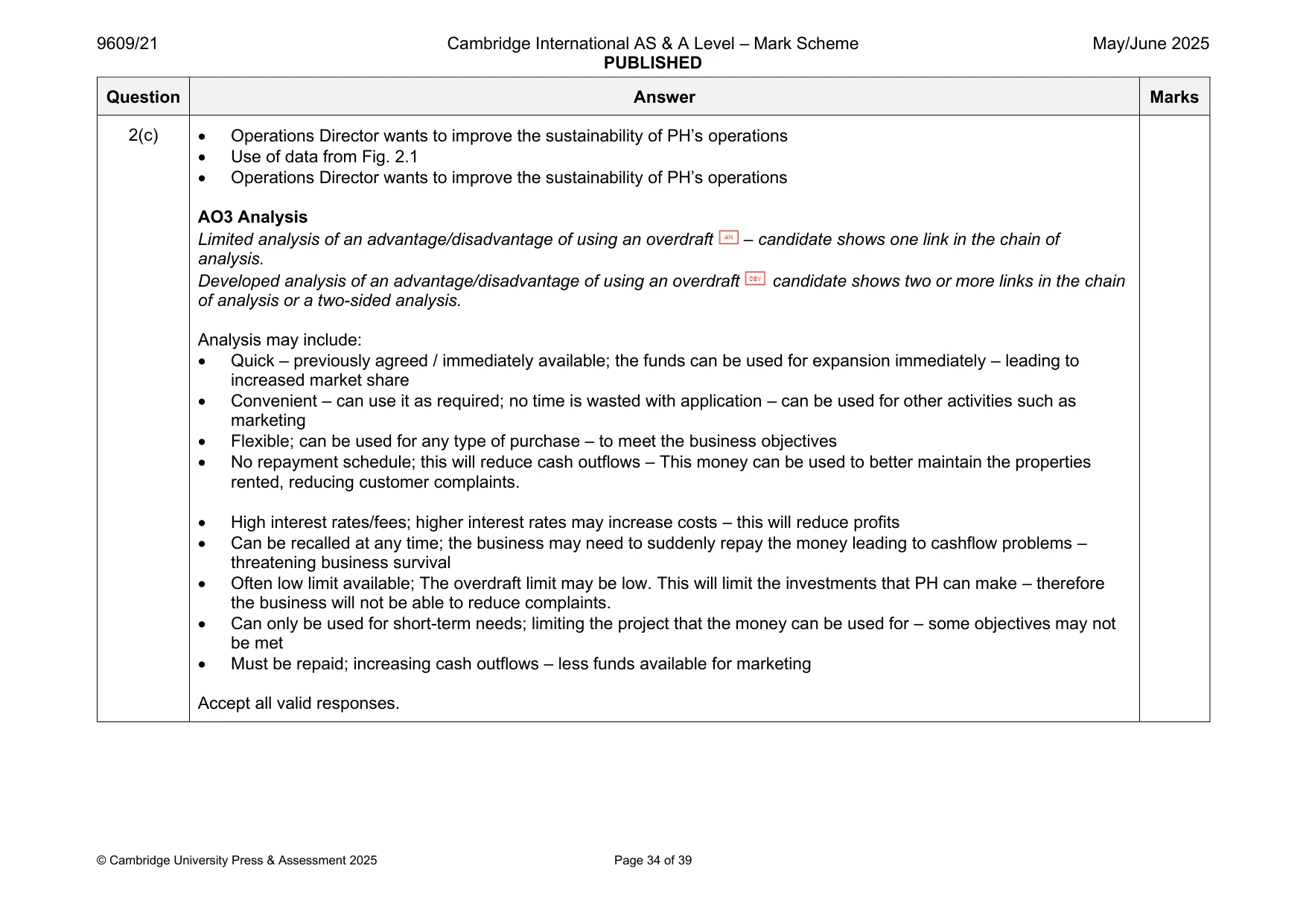
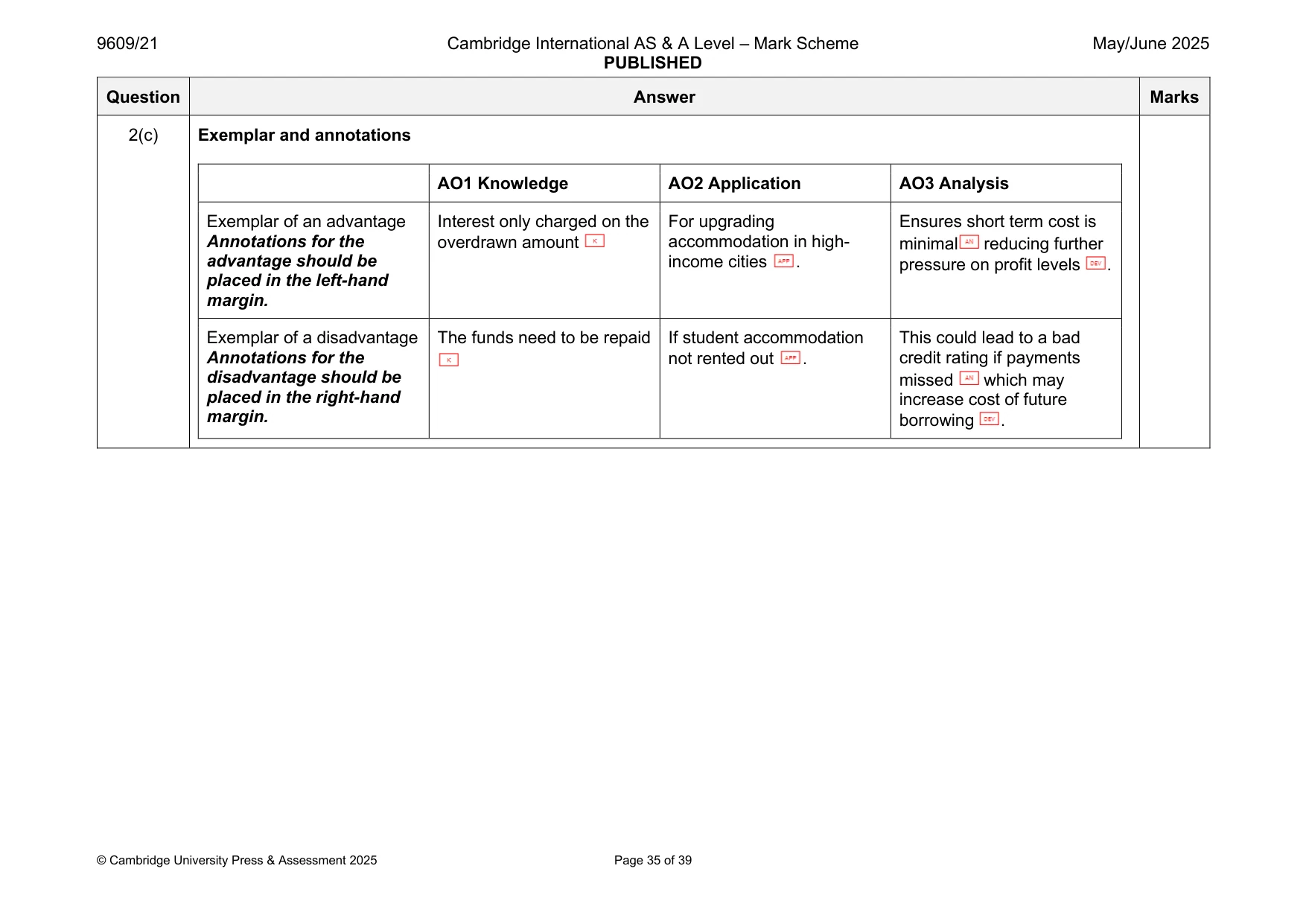
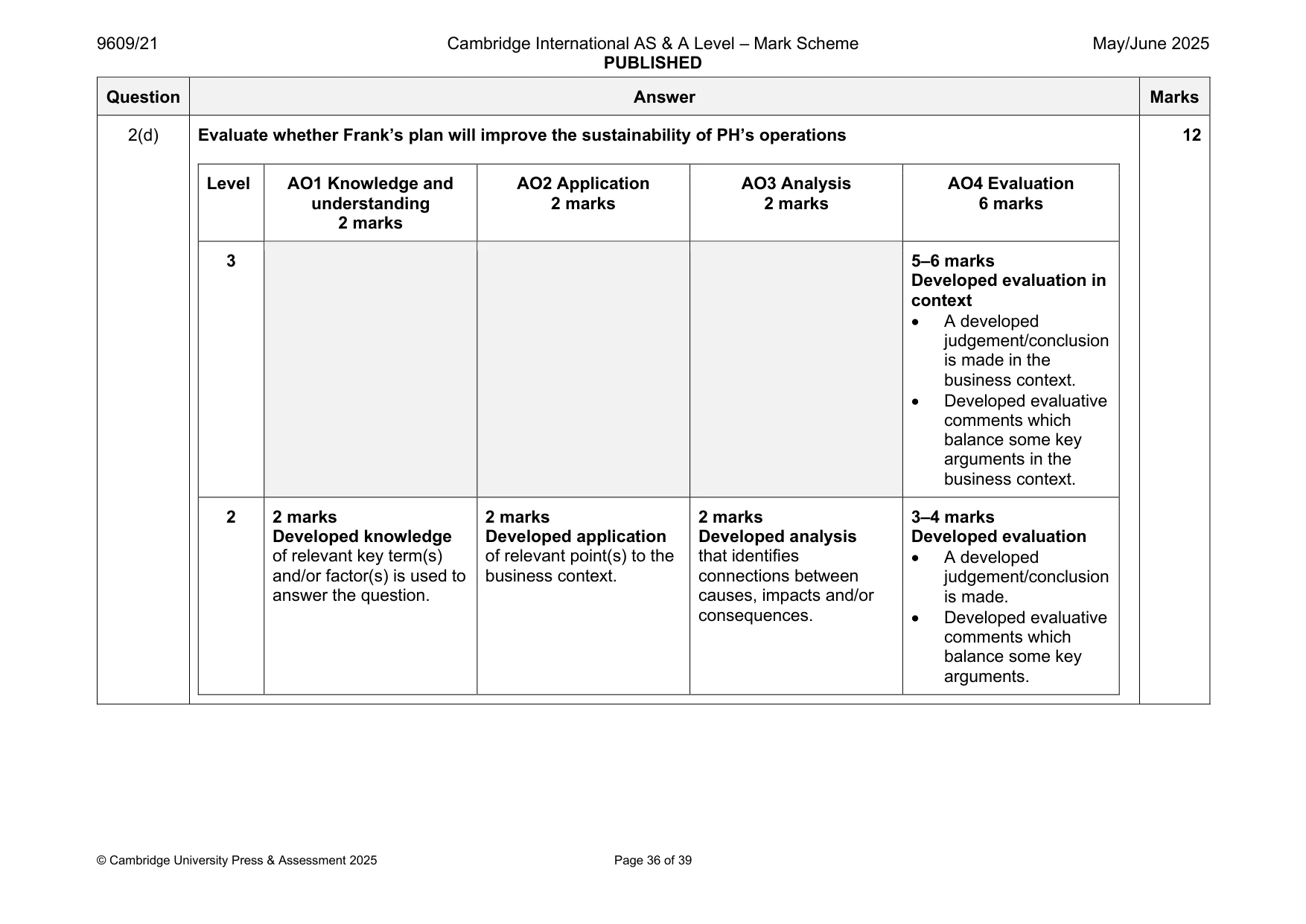
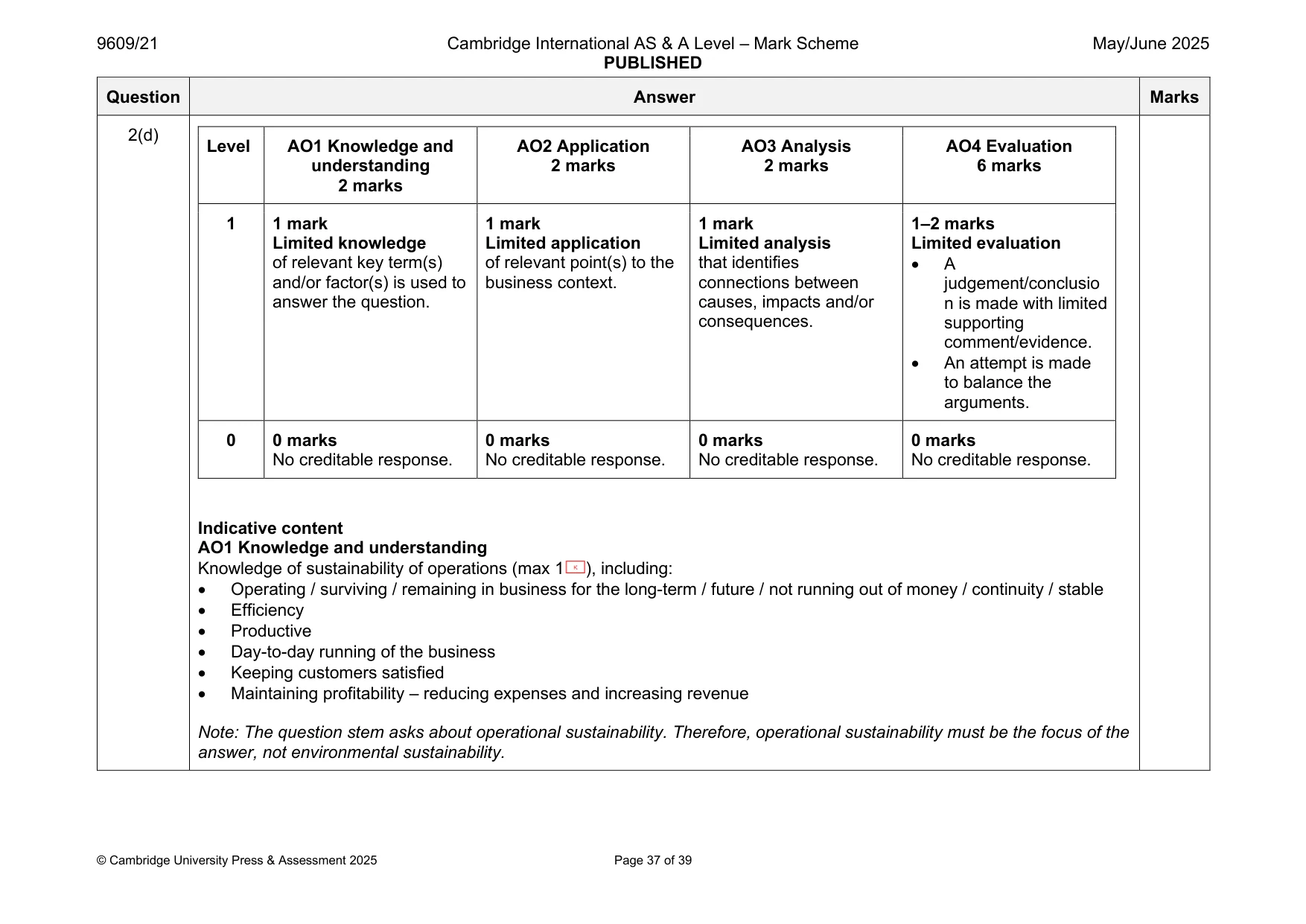
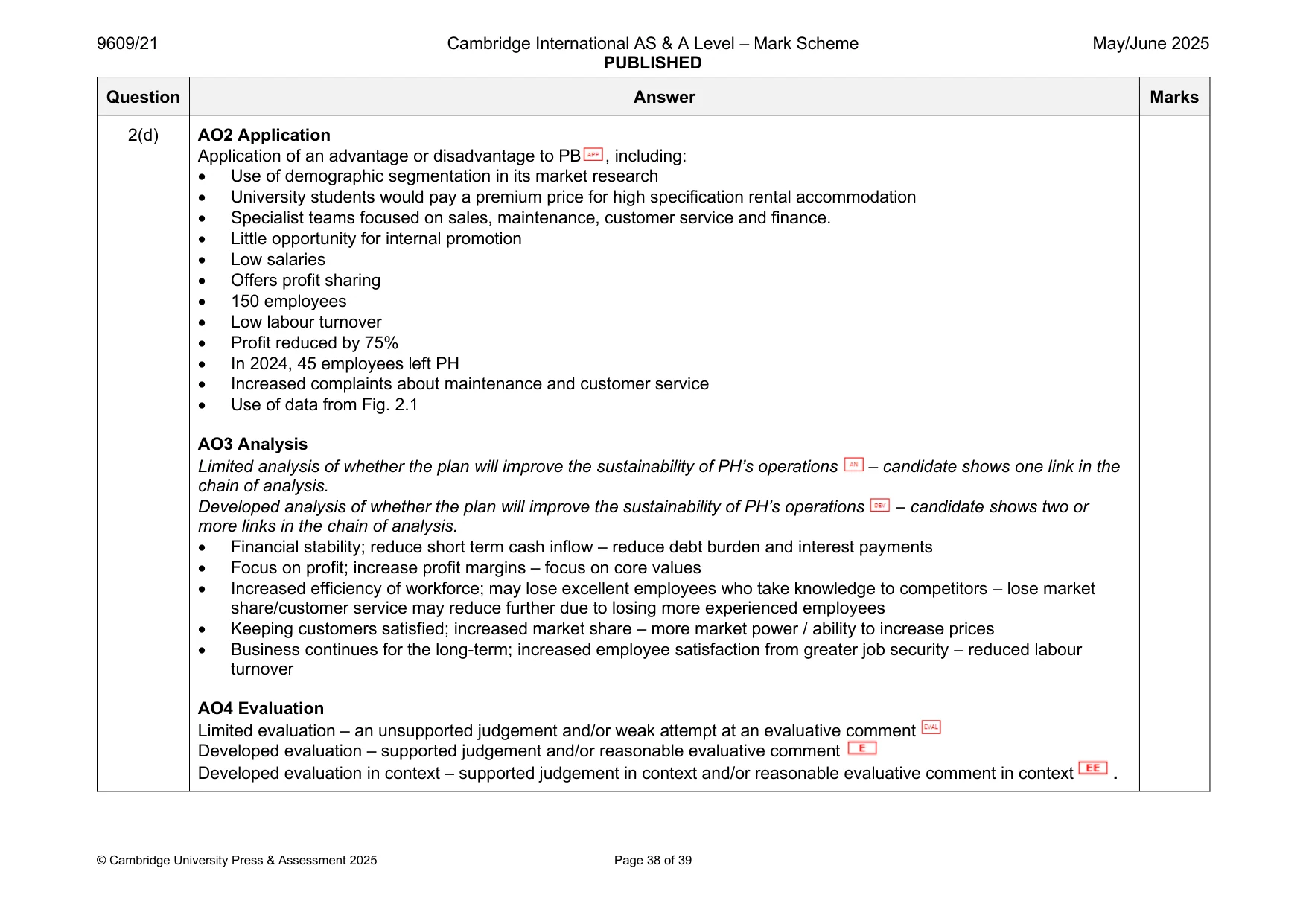
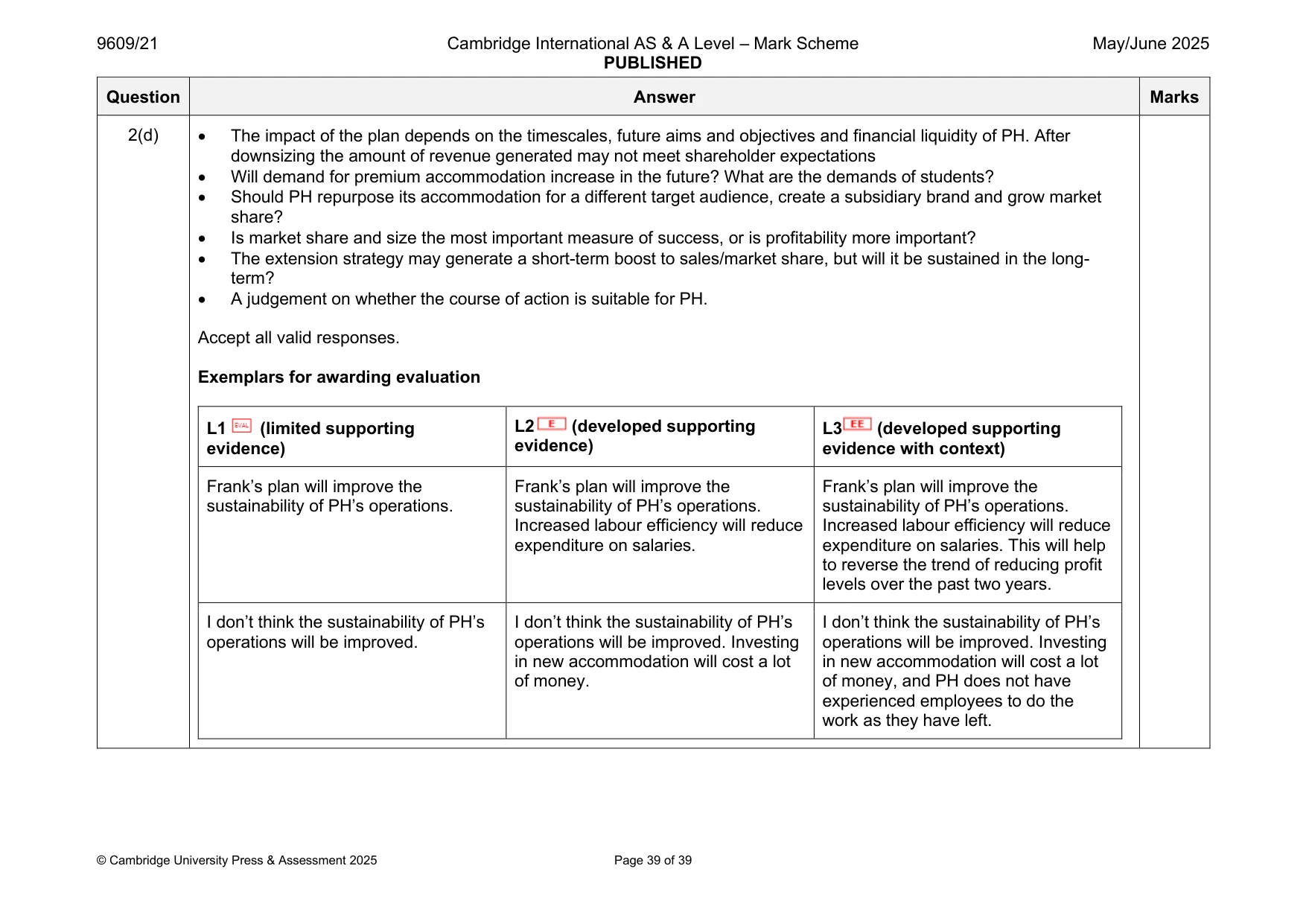
Mark scheme: 2(a)(i) Identify one way in which business size can be measured. 1 Indicative content Identification of a method may include: • Capital employed • Market capitalisation • Market share • Revenue (allow sales, sales turnover or turnover, income) • Quantity sold • Value of output • Number of employees • Area/space • Number of outlets • Number of customers Do not allow profit – which is a measure of success or performance, but not size. If more than one answer is given, only mark the first, reading from top left to bottom right. Accept all valid responses. 2(a)(ii) Explain the term demographic segmentation. 3 AO1 Knowledge and understanding AO2 Application 1 mark 2 marks 2 marks Developed application of one relevant point to a business context. 1 mark 1 mark Knowledge of one relevant point is used to answer the Limited application of one relevant point to a business question. context. 0 marks 0 marks No creditable response. No creditable response. Indicative content AO1 Knowledge and understanding Knowledge of demographic segmentation may include: • The identification of groups of customers with similar or common needs or characteristics within a market • Dividing the market according to factors that describe the population • Specific customer groups / target markets AO2 Application Explanation of demographic segmentation (max 1 mark) including: • Study of population data/trends • Examples of demographic factors, e.g. age, gender, race, social class, income Context applied to demographic segmentation , including (max 1 mark): • A valid example of a business that uses demographic segmentation to plan how it markets its products, e.g. a luxury car manufacturer may use demographic segmentation to target its advertising at high-income individuals or PH targets its student rental accommodation at university students 2(a)(ii) • Used for marketing of different products or services to specific consumer groups • Helps the business to adapt the marketing mix to the needs of the target customer group • Different marketing decisions for different groups Accept all valid responses Application can be made to PH or any other scenario/context/business/person. Exemplar and annotations Mark Rationale Dividing the market into groups according to age 3 The answer starts with application but shows or gender , for example a clothes retailer has knowledge by the reference to age/gender. There is three departments with products for men, women an example of the use of demographic segmentation and children . by a clothes retailer. Identifying groups of customers with similar needs or 2 Clear knowledge. With some application of how characteristics within a market using population data such as age Used for marketing of different products or services 1 A reasonable definition to specific types of customer Segmenting using demographics 0 Tautological 2(b)(i) Refer to lines 6–8. Calculate PH’s labour turnover in 2024. 3 Formula to calculate labour turnover: number of employees leaving in 1 year • 100 (1 mark – formula only) Average number of people employed Use of figures: 45 • 100 (1 mark – use of correct figures) 150 Labour turnover: • 30% (1 mark – correct answer – no % necessary) Exemplar and annotations Marks Answer Rationale 3 marks Correct answer Working and % do not matter. 30% Must be three to denote the three marks. Correct rounding must be applied. 2 marks Both of the following: To award two marks, there must be • Correct formula • Two and a • Correct identification of figures OR • One , one and one OR An incorrect answer with one mistake allowing OFR for final stage. OR 0.3 (has not completed final stage to multiply by 100) OR A correct answer from an inverted formula (3.3 – OFR) 2(b)(i) Marks Answer Rationale 1 mark One of the following: To award one mark, there must be: • Correct formula • One and two 0 marks No creditable content. To award zero marks, there must be • One 2(b)(ii) Explain one way in which PH could use Maslow’s Hierarchy of Needs 3 AO1 Knowledge and understanding AO2 Application 1 mark 2 marks 2 marks Developed application of one relevant point to a business context. 1 mark 1 mark Knowledge of one relevant point is used to answer the Limited application of one relevant point to a business question. context. 0 marks 0 marks No creditable response. No creditable response. Indicative content AO1 Knowledge and understanding Knowledge of a use of a motivational theory (max 1 mark), including: • Change the way that employees are treated/managed/motivated at PH or relevant examples • Make changes to increase motivation to maintain PH’s low labour turnover/retain employees • Understand employee behaviour/employee motivation • Measuring employee needs AO2 Application Explanation of a use of Maslow’s hierarchy of needs (max 1 mark), including: • Explain how motivation affects how employees behave, e.g. an employee doing a repetitive job/working alone may have a high absenteeism rate • Explain the use with reference to one of Maslow’s categories of need, e.g. physiological, safety, love and belonging, esteem and self-actualisation needs • Examples of how PH could change the way that employees are managed/motivated: • Offer more opportunities for internal promotion • Increase employee salaries • Encourage employees to stay in the business • Change working conditions 2(b)(ii) Context applied to PH (max 1 mark), including: • Use of demographic segmentation in its market research • University students would pay a premium price for high specification rental accommodation • Specialist teams focused on sales, maintenance, customer service and finance. • Little opportunity for internal promotion • Low salaries • Offers profit sharing • 150 employees • Low labour turnover • Profit reduced by 75% • In 2024, 45 employees left PH • Increased complaints about maintenance and customer service • Use of data from Fig. 2.1 • Operations Director wants to improve the sustainability of PH’s operations Accept all valid responses. Exemplar and annotations Mark Rationale Managers can understand what motivates 3 Use of Maslow’s hierarchy of needs by managers employees such as ensuring physiological needs , with further explanation with reference to Maslow’s are met for the 150 employees . hierarchy . The third mark is for reference to the context . Helps managers decide how to change their 2 Knowledge of a use and applied to the number of management style so that less than 45 employees. employees leave this year . Identifies the different motivations for human 1 Knowledge of a use with no application behaviour Maslow’s Hierarchy of needs is a motivational theory 0 No use of Maslow’s hierarchy of needs. This answer is the study of understanding what drives a person to is a definition of the theory and does not answer the question work towards a particular goal or outcome . 2(c) Analyse one advantage and one disadvantage to PH of using an overdraft as a source of finance. 8 Level AO1 Knowledge and AO2 Application AO3 Analysis understanding 2 marks 4 marks 2 marks 2 3–4 marks Developed analysis • Developed analysis that identifies connections between causes, impacts and/or consequences of two points. • Developed analysis that identifies connections between causes, impacts and/or consequences of one point. 1 1–2 marks 1–2 marks 1–2 marks • Knowledge of two • Application of two Limited analysis relevant points is used relevant points to a • Limited analysis that identifies connections to answer the business context. between causes, impacts and/or consequences question. • Application of one of two points. • Knowledge of one relevant point to a • Limited analysis that identifies connections relevant point is used business context. between causes, impacts and/or consequences to answer the of one point. question. 0 0 marks 0 marks 0 marks No creditable response. No creditable response. No creditable response. Advantage in the left hand side column, disadvantage in the right hand side column 2(c) Indicative content AO1 Knowledge and understanding Knowledge of one advantage using an overdraft as a source of finance (max 1 mark), including: • Quick – previously agreed / immediately available • Convenient – can use it as required • Flexible • No repayment schedule • No loss of ownership Knowledge of one disadvantage using an overdraft as a source of finance (max 1 mark), including: • High interest rates / fees • Can be recalled at any time • Often low limit available • Can only be used for short-term needs • Must be repaid Note: the advantages/disadvantages have to be true for an overdraft, but not exclusively true to an overdraft (i.e. they may apply to other sources of finance). AO2 Application Application of an advantage or disadvantage to PH , including: • Use of demographic segmentation in its market research • University students would pay a premium price for high specification rental accommodation • Specialist teams focused on sales, maintenance, customer service and finance. • Little opportunity for internal promotion • Low salaries • Offers profit sharing • 150 employees • Low labour turnover • Profit reduced by 75% • In 2024, 45 employees left PH • Increased complaints about maintenance and customer service • Use of data from Fig. 2.1 2(c) • Operations Director wants to improve the sustainability of PH’s operations • Use of data from Fig. 2.1 • Operations Director wants to improve the sustainability of PH’s operations AO3 Analysis Limited analysis of an advantage/disadvantage of using an overdraft – candidate shows one link in the chain of analysis. Developed analysis of an advantage/disadvantage of using an overdraft candidate shows two or more links in the chain of analysis or a two-sided analysis. Analysis may include: • Quick – previously agreed / immediately available; the funds can be used for expansion immediately – leading to increased market share • Convenient – can use it as required; no time is wasted with application – can be used for other activities such as marketing • Flexible; can be used for any type of purchase – to meet the business objectives • No repayment schedule; this will reduce cash outflows – This money can be used to better maintain the properties rented, reducing customer complaints. • High interest rates/fees; higher interest rates may increase costs – this will reduce profits • Can be recalled at any time; the business may need to suddenly repay the money leading to cashflow problems – threatening business survival • Often low limit available; The overdraft limit may be low. This will limit the investments that PH can make – therefore the business will not be able to reduce complaints. • Can only be used for short-term needs; limiting the project that the money can be used for – some objectives may not be met • Must be repaid; increasing cash outflows – less funds available for marketing Accept all valid responses. 2(c) Exemplar and annotations AO1 Knowledge AO2 Application AO3 Analysis Exemplar of an advantage Interest only charged on the For upgrading Ensures short term cost is Annotations for the overdrawn amount accommodation in high- minimal reducing further advantage should be income cities . pressure on profit levels . placed in the left-hand margin. Exemplar of a disadvantage The funds need to be repaid If student accommodation This could lead to a bad Annotations for the not rented out . credit rating if payments disadvantage should be missed which may placed in the right-hand increase cost of future margin. borrowing . 2(d) Evaluate whether Frank’s plan will improve the sustainability of PH’s operations 12 Level AO1 Knowledge and AO2 Application AO3 Analysis AO4 Evaluation understanding 2 marks 2 marks 6 marks 2 marks 3 5–6 marks Developed evaluation in context • A developed judgement/conclusion is made in the business context. • Developed evaluative comments which balance some key arguments in the business context. 2 2 marks 2 marks 2 marks 3–4 marks Developed knowledge Developed application Developed analysis Developed evaluation of relevant key term(s) of relevant point(s) to the that identifies • A developed and/or factor(s) is used to business context. connections between judgement/conclusion answer the question. causes, impacts and/or is made. consequences. • Developed evaluative comments which balance some key arguments. 2(d) Level AO1 Knowledge and AO2 Application AO3 Analysis AO4 Evaluation understanding 2 marks 2 marks 6 marks 2 marks 1 1 mark 1 mark 1 mark 1–2 marks Limited knowledge Limited application Limited analysis Limited evaluation of relevant key term(s) of relevant point(s) to the that identifies • A and/or factor(s) is used to business context. connections between judgement/conclusio answer the question. causes, impacts and/or n is made with limited consequences. supporting comment/evidence. • An attempt is made to balance the arguments. 0 0 marks 0 marks 0 marks 0 marks No creditable response. No creditable response. No creditable response. No creditable response. Indicative content AO1 Knowledge and understanding Knowledge of sustainability of operations (max 1 ), including: • Operating / surviving / remaining in business for the long-term / future / not running out of money / continuity / stable • Efficiency • Productive • Day-to-day running of the business • Keeping customers satisfied • Maintaining profitability – reducing expenses and increasing revenue Note: The question stem asks about operational sustainability. Therefore, operational sustainability must be the focus of the answer, not environmental sustainability. 2(d) AO2 Application Application of an advantage or disadvantage to PB , including: • Use of demographic segmentation in its market research • University students would pay a premium price for high specification rental accommodation • Specialist teams focused on sales, maintenance, customer service and finance. • Little opportunity for internal promotion • Low salaries • Offers profit sharing • 150 employees • Low labour turnover • Profit reduced by 75% • In 2024, 45 employees left PH • Increased complaints about maintenance and customer service • Use of data from Fig. 2.1 AO3 Analysis Limited analysis of whether the plan will improve the sustainability of PH’s operations – candidate shows one link in the chain of analysis. Developed analysis of whether the plan will improve the sustainability of PH’s operations – candidate shows two or more links in the chain of analysis. • Financial stability; reduce short term cash inflow – reduce debt burden and interest payments • Focus on profit; increase profit margins – focus on core values • Increased efficiency of workforce; may lose excellent employees who take knowledge to competitors – lose market share/customer service may reduce further due to losing more experienced employees • Keeping customers satisfied; increased market share – more market power / ability to increase prices • Business continues for the long-term; increased employee satisfaction from greater job security – reduced labour turnover AO4 Evaluation Limited evaluation – an unsupported judgement and/or weak attempt at an evaluative comment Developed evaluation – supported judgement and/or reasonable evaluative comment Developed evaluation in context – supported judgement in context and/or reasonable evaluative comment in context . 2(d) • The impact of the plan depends on the timescales, future aims and objectives and financial liquidity of PH. After downsizing the amount of revenue generated may not meet shareholder expectations • Will demand for premium accommodation increase in the future? What are the demands of students? • Should PH repurpose its accommodation for a different target audience, create a subsidiary brand and grow market share? • Is market share and size the most important measure of success, or is profitability more important? • The extension strategy may generate a short-term boost to sales/market share, but will it be sustained in the long- term? • A judgement on whether the course of action is suitable for PH. Accept all valid responses. Exemplars for awarding evaluation L1 (limited supporting L2 (developed supporting L3 (developed supporting evidence) evidence) evidence with context) Frank’s plan will improve the Frank’s plan will improve the Frank’s plan will improve the sustainability of PH’s operations. sustainability of PH’s operations. sustainability of PH’s operations. Increased labour efficiency will reduce Increased labour efficiency will reduce expenditure on salaries. expenditure on salaries. This will help to reverse the trend of reducing profit levels over the past two years. I don’t think the sustainability of PH’s I don’t think the sustainability of PH’s I don’t think the sustainability of PH’s operations will be improved. operations will be improved. Investing operations will be improved. Investing in new accommodation will cost a lot in new accommodation will cost a lot of money. of money, and PH does not have experienced employees to do the work as they have left.
What was in this paper
The subtopics covered by these 2 questions, and how many questions each got. Open one in a new tab to see every Cambridge question on it.
What you needed in this session
Cambridge’s own grade thresholds for 2025 May/June, Paper 2 · Variant 1. A higher threshold means an easier paper — the bar moves with how the cohort did.