Cambridge A Level Business (for first examination in 2016) 9609 — 2019 Oct/Nov Paper 2 · Variant 2
9609/22/O/N/19 · 2 questions · 60 marks · ≈68 min
The question paper and its mark scheme, free to read here and free to download. This is Cambridge’s own paper, exactly as it was sat.
Question paper4 pages


Mark scheme21 pages
Answers below. Sit the paper first if you are practising.

Questions as text
Q1 · Quality Fencing (QF) QF is owned by Seojun
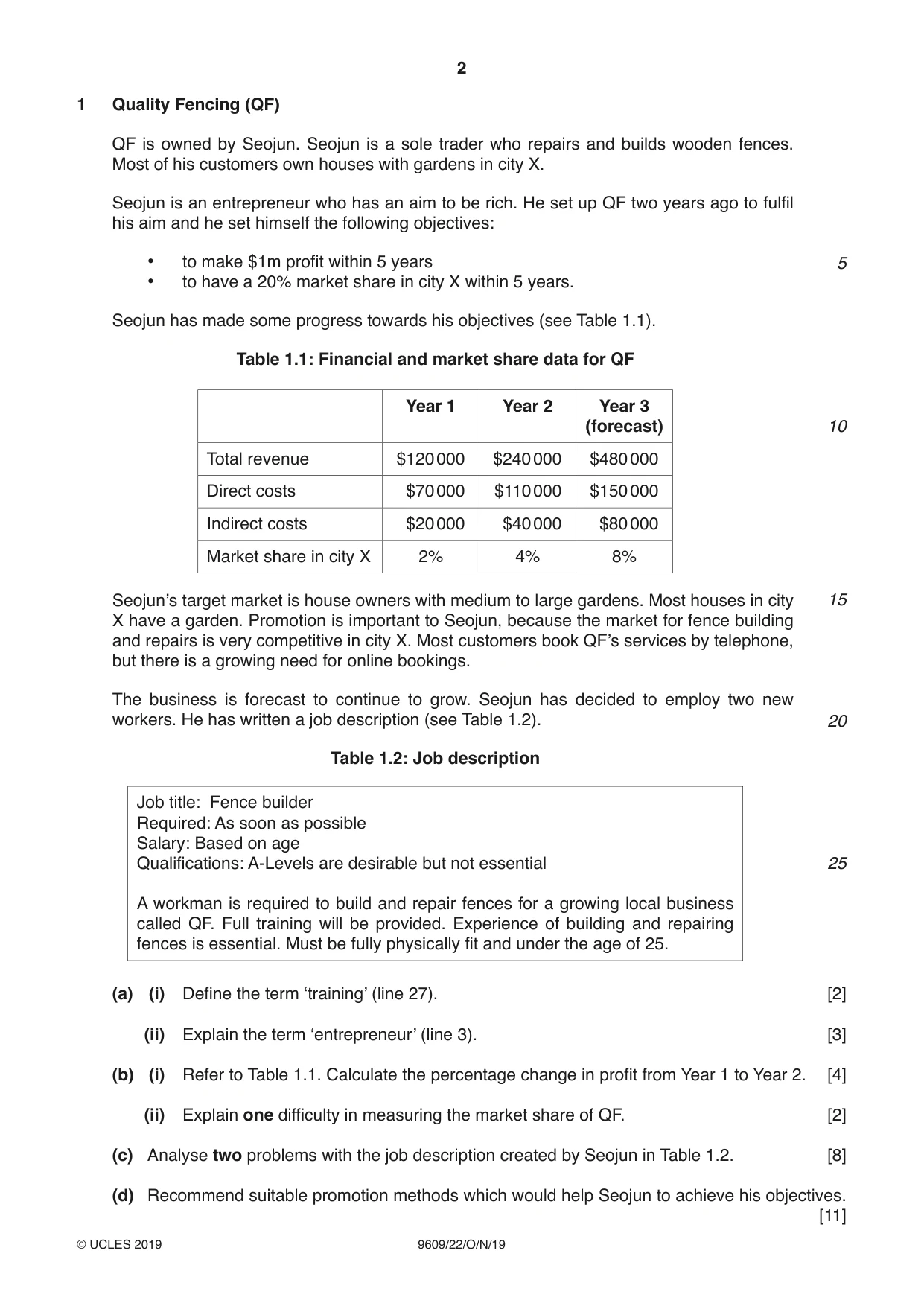
1 Quality Fencing (QF) QF is owned by Seojun. Seojun is a sole trader who repairs and builds wooden fences. Most of his customers own houses with gardens in city X. Seojun is an entrepreneur who has an aim to be rich. He set up QF two years ago to fulfil his aim and he set himself the following objectives: • to make $1m profit within 5 years 5 • to have a 20% market share in city X within 5 years. Seojun has made some progress towards his objectives (see Table 1.1). Table 1.1: Financial and market share data for QF Year 1 Year 2 Year 3 (forecast) 10 Total revenue $120 000 $240 000 $480 000 Direct costs $70 000 $110 000 $150 000 Indirect costs $20 000 $40 000 $80 000 Market share in city X 2% 4% 8% Seojun’s target market is house owners with medium to large gardens. Most houses in city 15 X have a garden. Promotion is important to Seojun, because the market for fence building and repairs is very competitive in city X. Most customers book QF’s services by telephone, but there is a growing need for online bookings. The business is forecast to continue to grow. Seojun has decided to employ two new workers. He has written a job description (see Table 1.2). 20 Table 1.2: Job description Job title: Fence builder Required: As soon as possible Salary: Based on age Qualifications: A-Levels are desirable but not essential 25 A workman is required to build and repair fences for a growing local business called QF. Full training will be provided. Experience of building and repairing fences is essential. Must be fully physically fit and under the age of 25. (a) (i) Define the term ‘training’ (line 27). [2] (ii) Explain the term ‘entrepreneur’ (line 3). [3] (b) (i) Refer to Table 1.1. Calculate the percentage change in profit from Year 1 to Year 2. [4] (ii) Explain one difficulty in measuring the market share of QF. [2] (c) Analyse two problems with the job description created by Seojun in Table 1.2. [8] (d) Recommend suitable promotion methods which would help Seojun to achieve his objectives. [11]
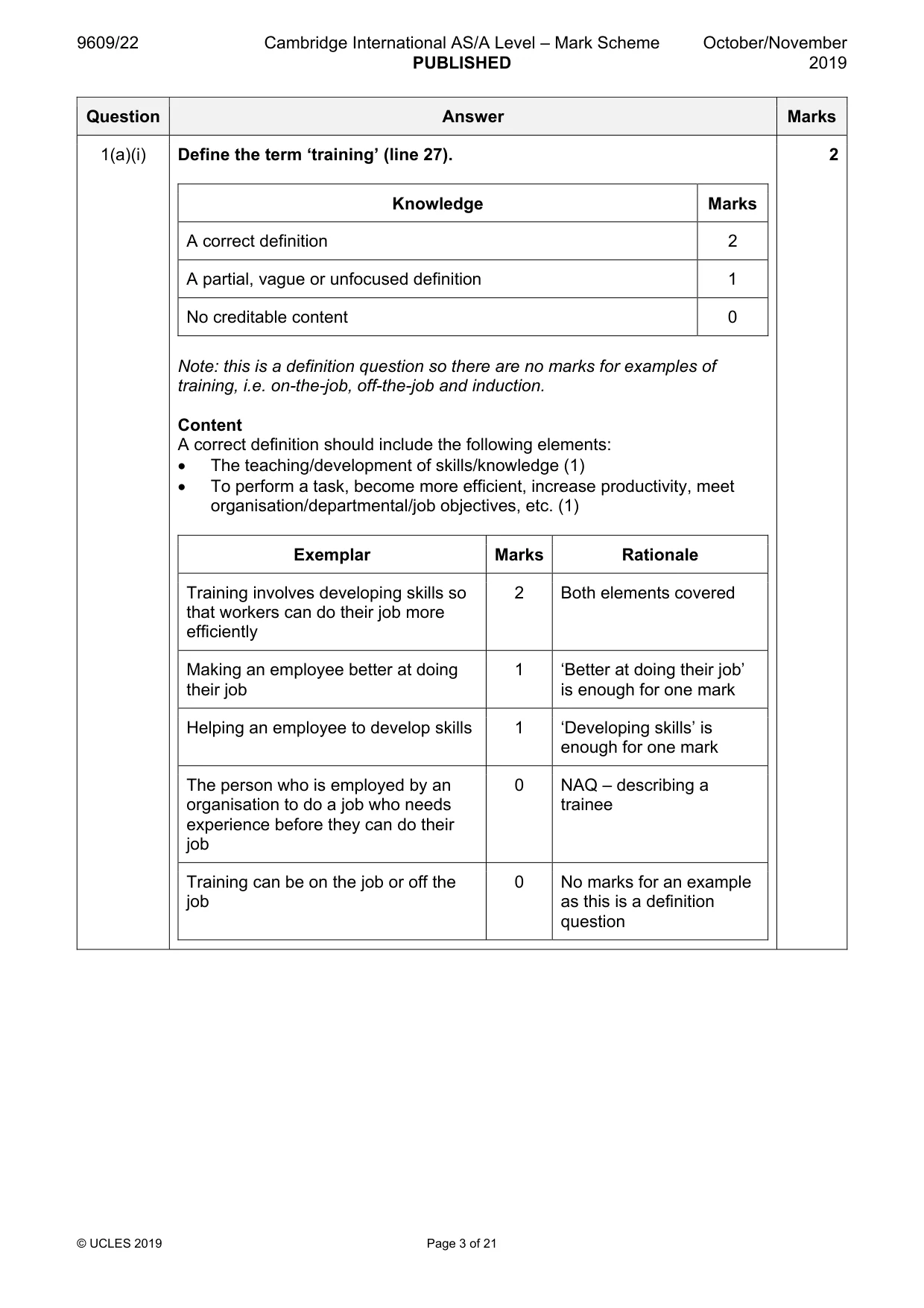
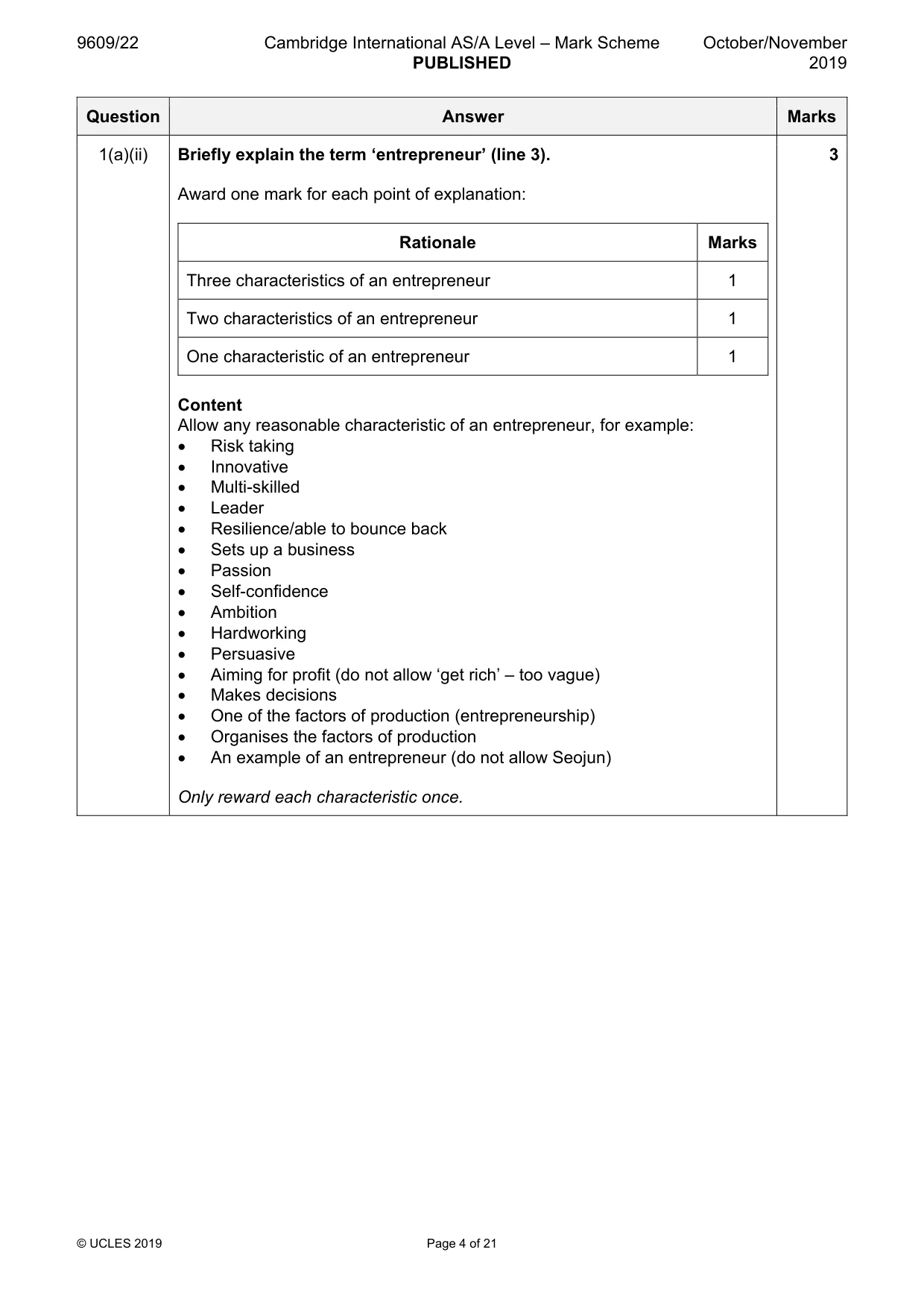
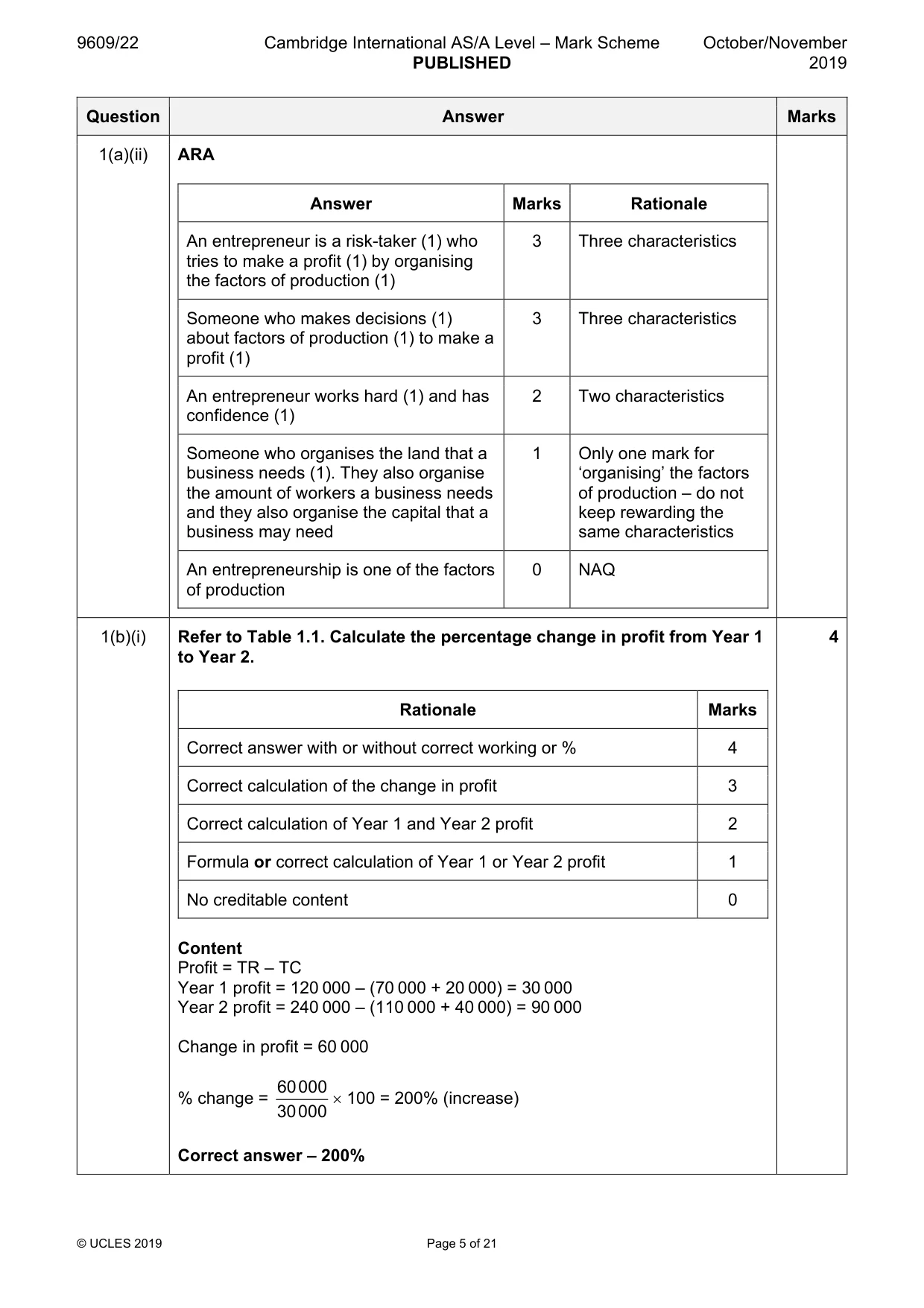
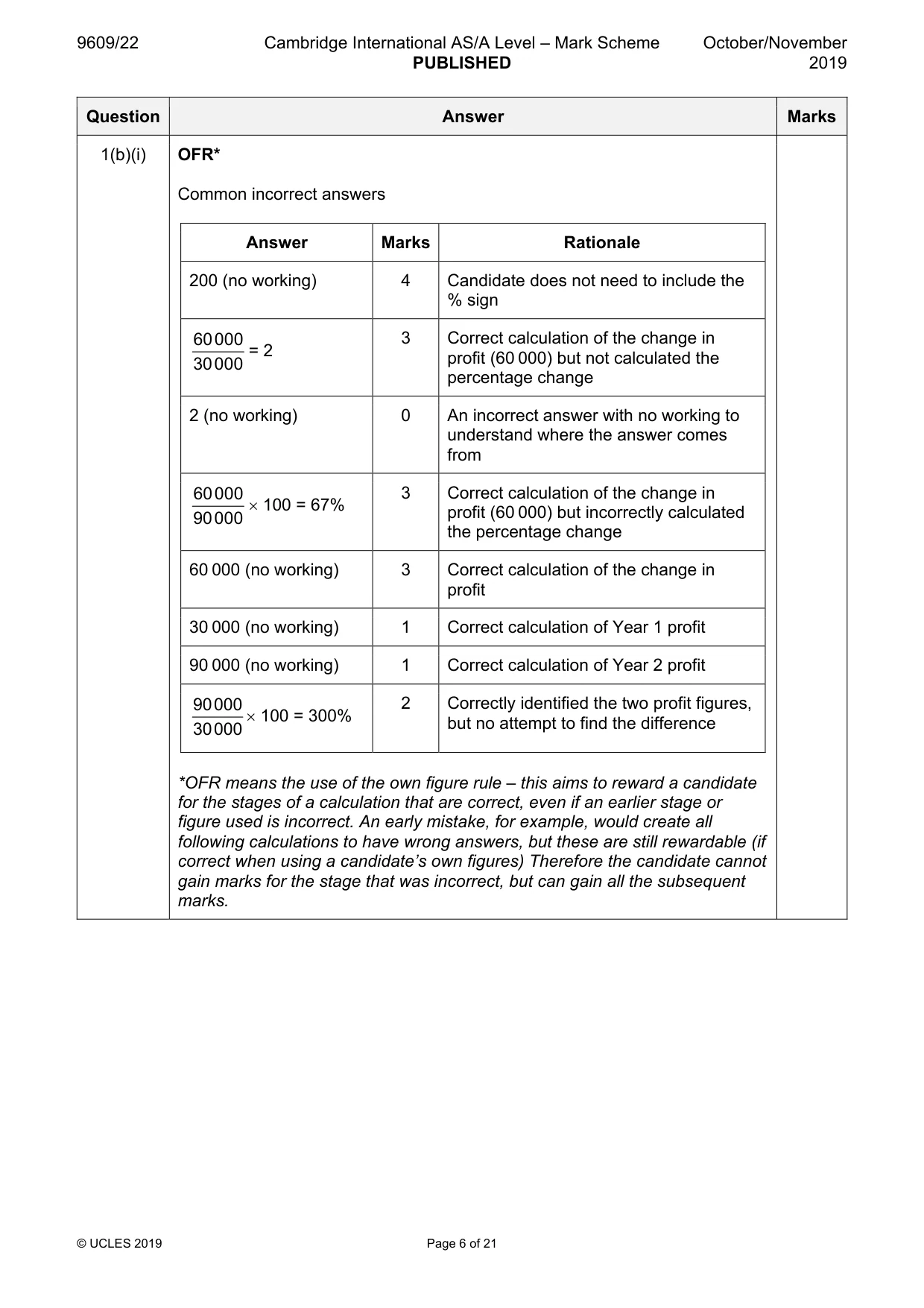
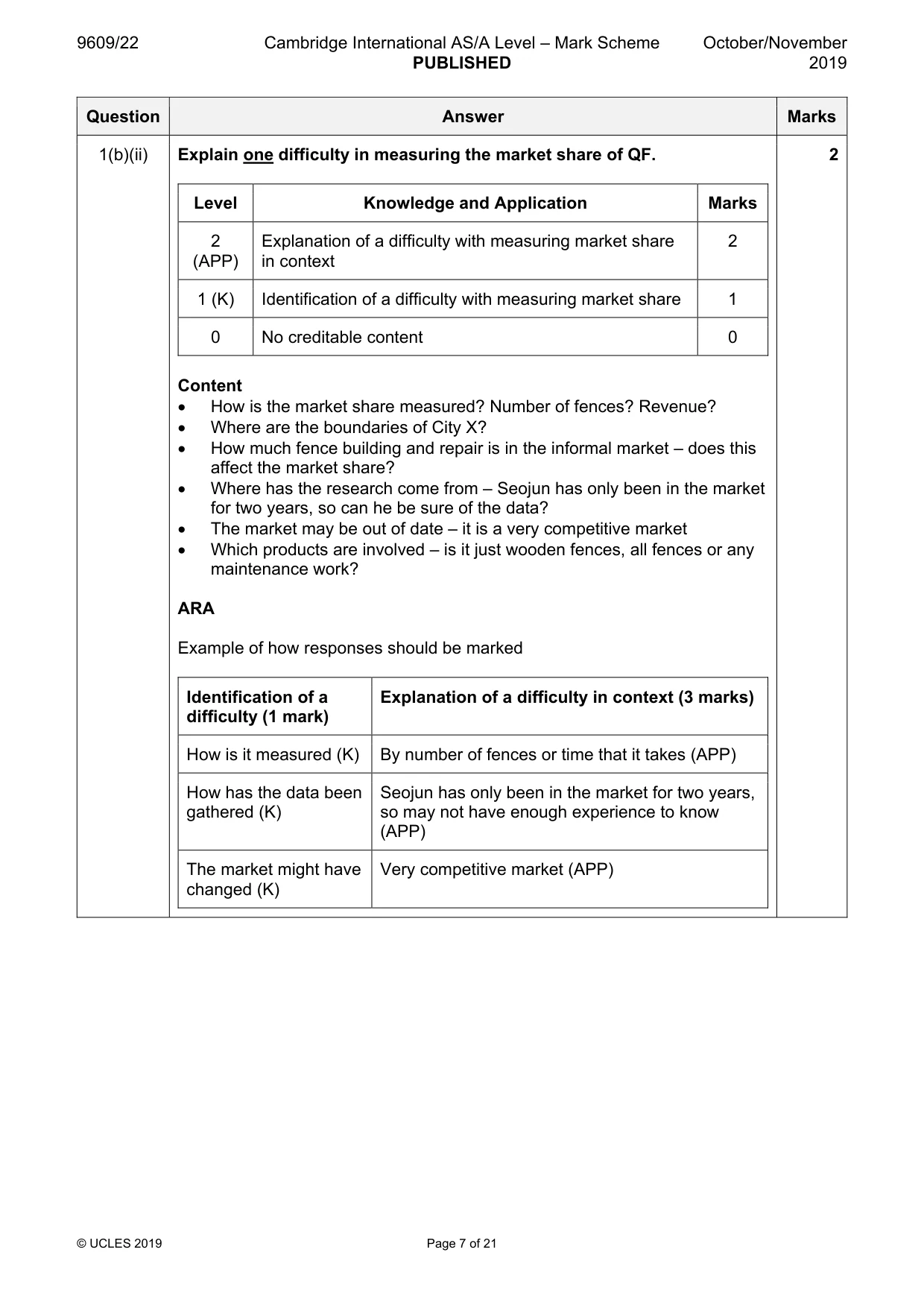
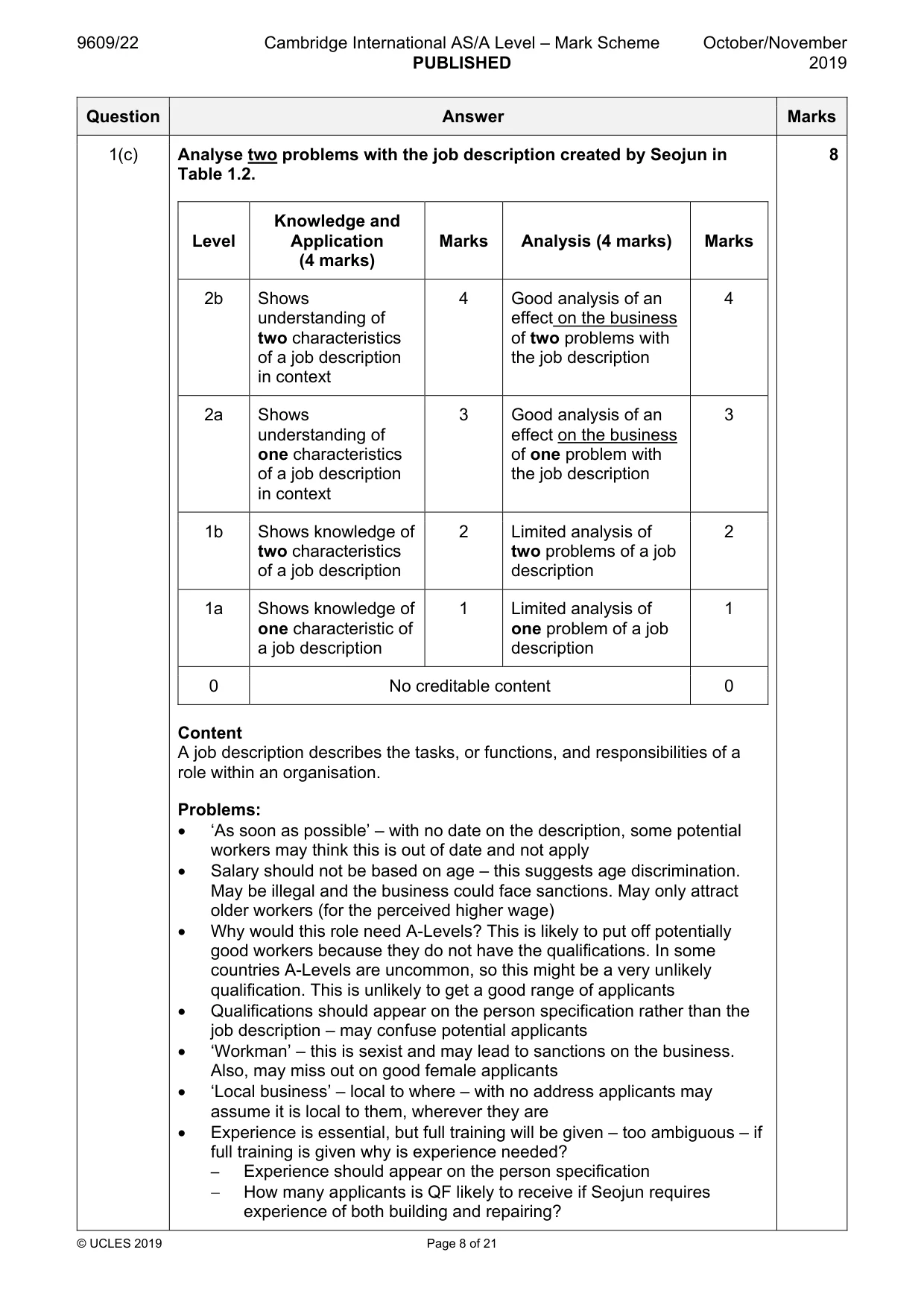
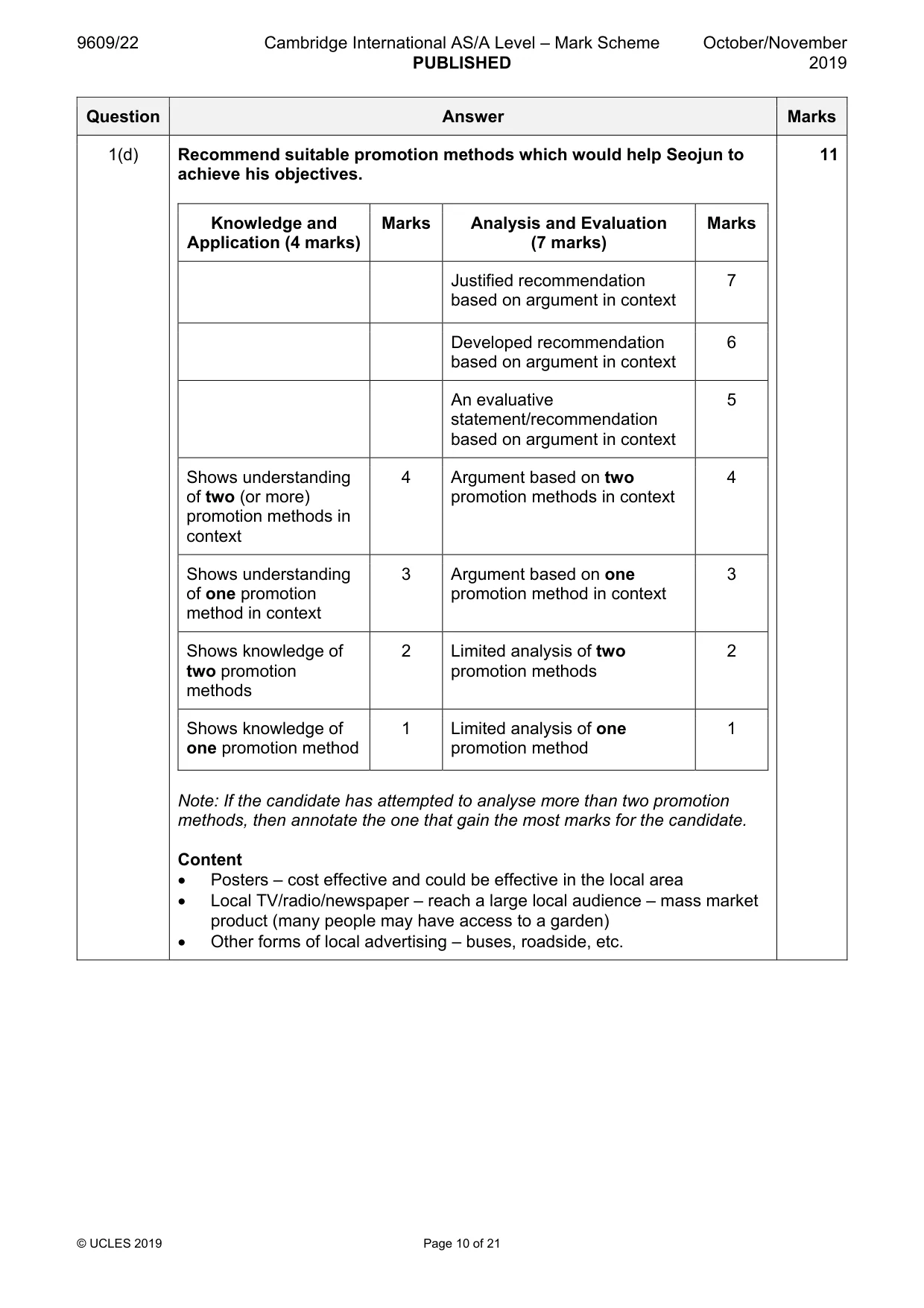
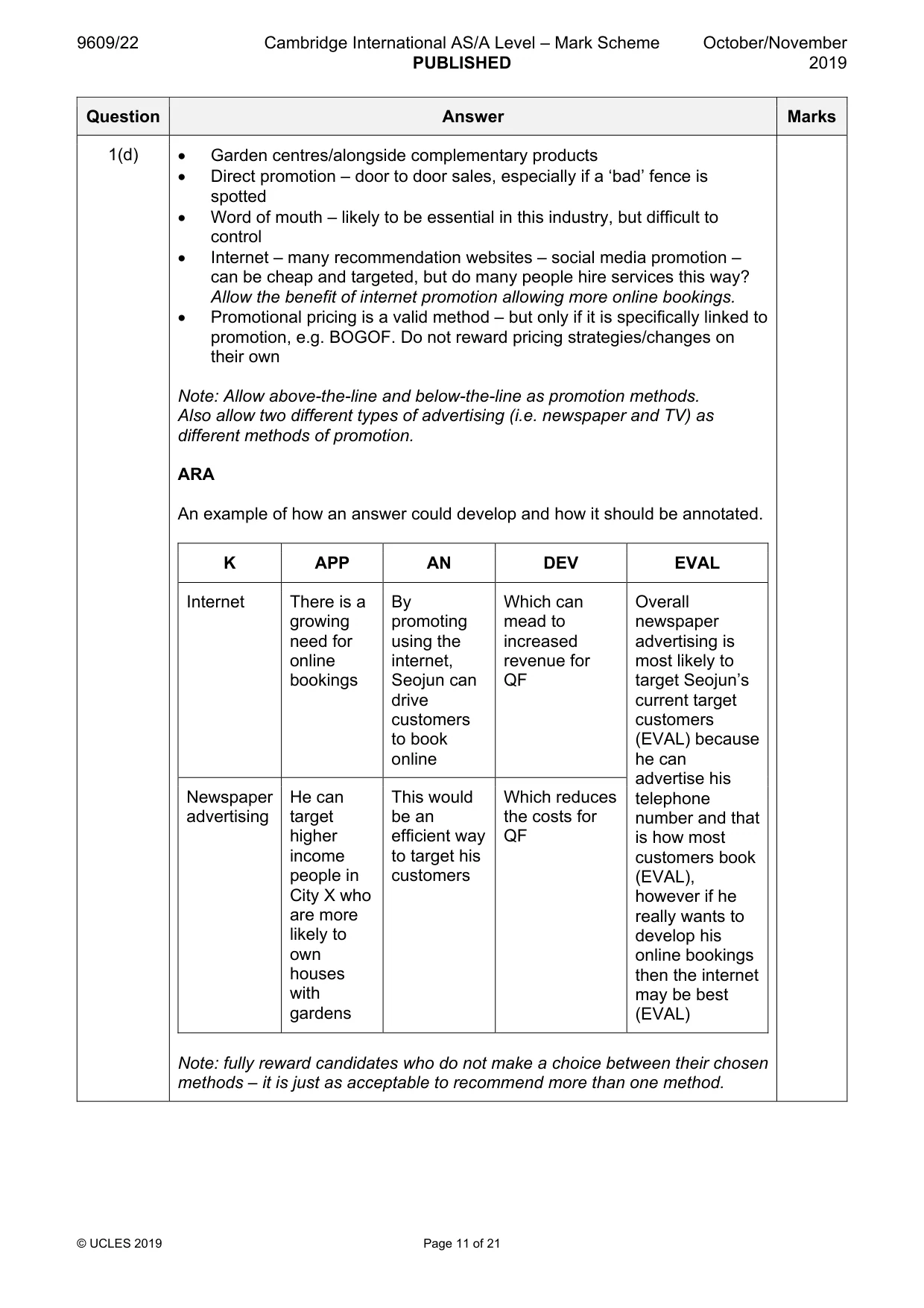
Mark scheme: Question Answer Marks 1(a)(i) Define the term ‘training’ (line 27). 2 Knowledge Marks A correct definition 2 A partial, vague or unfocused definition 1 No creditable content 0 Note: this is a definition question so there are no marks for examples of training, i.e. on-the-job, off-the-job and induction. Content A correct definition should include the following elements: • The teaching/development of skills/knowledge (1) • To perform a task, become more efficient, increase productivity, meet organisation/departmental/job objectives, etc. (1) Exemplar Marks Rationale Training involves developing skills so 2 Both elements covered that workers can do their job more efficiently Making an employee better at doing 1 ‘Better at doing their job’ their job is enough for one mark Helping an employee to develop skills 1 ‘Developing skills’ is enough for one mark The person who is employed by an 0 NAQ – describing a organisation to do a job who needs trainee experience before they can do their job Training can be on the job or off the 0 No marks for an example job as this is a definition question 1(a)(ii) Briefly explain the term ‘entrepreneur’ (line 3). 3 Award one mark for each point of explanation: Rationale Marks Three characteristics of an entrepreneur 1 Two characteristics of an entrepreneur 1 One characteristic of an entrepreneur 1 Content Allow any reasonable characteristic of an entrepreneur, for example: • Risk taking • Innovative • Multi-skilled • Leader • Resilience/able to bounce back • Sets up a business • Passion • Self-confidence • Ambition • Hardworking • Persuasive • Aiming for profit (do not allow ‘get rich’ – too vague) • Makes decisions • One of the factors of production (entrepreneurship) • Organises the factors of production • An example of an entrepreneur (do not allow Seojun) Only reward each characteristic once. 1(a)(ii) ARA Answer Marks Rationale An entrepreneur is a risk-taker (1) who 3 Three characteristics tries to make a profit (1) by organising the factors of production (1) Someone who makes decisions (1) 3 Three characteristics about factors of production (1) to make a profit (1) An entrepreneur works hard (1) and has 2 Two characteristics confidence (1) Someone who organises the land that a 1 Only one mark for business needs (1). They also organise ‘organising’ the factors the amount of workers a business needs of production – do not and they also organise the capital that a keep rewarding the business may need same characteristics An entrepreneurship is one of the factors 0 NAQ of production 1(b)(i) Refer to Table 1.1. Calculate the percentage change in profit from Year 1 4 to Year 2. Rationale Marks Correct answer with or without correct working or % 4 Correct calculation of the change in profit 3 Correct calculation of Year 1 and Year 2 profit 2 Formula or correct calculation of Year 1 or Year 2 profit 1 No creditable content 0 Content Profit = TR – TC Year 1 profit = 120 000 – (70 000 + 20 000) = 30 000 Year 2 profit = 240 000 – (110 000 + 40 000) = 90 000 Change in profit = 60 000 60000 % change = × 100 = 200% (increase) 30000 Correct answer – 200% 1(b)(i) OFR* Common incorrect answers Answer Marks Rationale 200 (no working) 4 Candidate does not need to include the % sign 60000 3 Correct calculation of the change in = 2 profit (60 000) but not calculated the 30000 percentage change 2 (no working) 0 An incorrect answer with no working to understand where the answer comes from 60000 3 Correct calculation of the change in × 100 = 67% profit (60 000) but incorrectly calculated 90000 the percentage change 60 000 (no working) 3 Correct calculation of the change in profit 30 000 (no working) 1 Correct calculation of Year 1 profit 90 000 (no working) 1 Correct calculation of Year 2 profit 90000 2 Correctly identified the two profit figures, × 100 = 300% but no attempt to find the difference 30000 *OFR means the use of the own figure rule – this aims to reward a candidate for the stages of a calculation that are correct, even if an earlier stage or figure used is incorrect. An early mistake, for example, would create all following calculations to have wrong answers, but these are still rewardable (if correct when using a candidate’s own figures) Therefore the candidate cannot gain marks for the stage that was incorrect, but can gain all the subsequent marks. 1(b)(ii) Explain one difficulty in measuring the market share of QF. 2 Level Knowledge and Application Marks 2 Explanation of a difficulty with measuring market share 2 (APP) in context 1 (K) Identification of a difficulty with measuring market share 1 0 No creditable content 0 Content • How is the market share measured? Number of fences? Revenue? • Where are the boundaries of City X? • How much fence building and repair is in the informal market – does this affect the market share? • Where has the research come from – Seojun has only been in the market for two years, so can he be sure of the data? • The market may be out of date – it is a very competitive market • Which products are involved – is it just wooden fences, all fences or any maintenance work? ARA Example of how responses should be marked Identification of a Explanation of a difficulty in context (3 marks) difficulty (1 mark) How is it measured (K) By number of fences or time that it takes (APP) How has the data been Seojun has only been in the market for two years, gathered (K) so may not have enough experience to know (APP) The market might have Very competitive market (APP) changed (K) 1(c) Analyse two problems with the job description created by Seojun in 8 Table 1.2. Knowledge and Level Application Marks Analysis (4 marks) Marks (4 marks) 2b Shows 4 Good analysis of an 4 understanding of effect on the business two characteristics of two problems with of a job description the job description in context 2a Shows 3 Good analysis of an 3 understanding of effect on the business one characteristics of one problem with of a job description the job description in context 1b Shows knowledge of 2 Limited analysis of 2 two characteristics two problems of a job of a job description description 1a Shows knowledge of 1 Limited analysis of 1 one characteristic of one problem of a job a job description description 0 No creditable content 0 Content A job description describes the tasks, or functions, and responsibilities of a role within an organisation. Problems: • ‘As soon as possible’ – with no date on the description, some potential workers may think this is out of date and not apply • Salary should not be based on age – this suggests age discrimination. May be illegal and the business could face sanctions. May only attract older workers (for the perceived higher wage) • Why would this role need A-Levels? This is likely to put off potentially good workers because they do not have the qualifications. In some countries A-Levels are uncommon, so this might be a very unlikely qualification. This is unlikely to get a good range of applicants • Qualifications should appear on the person specification rather than the job description – may confuse potential applicants • ‘Workman’ – this is sexist and may lead to sanctions on the business. Also, may miss out on good female applicants • ‘Local business’ – local to where – with no address applicants may assume it is local to them, wherever they are • Experience is essential, but full training will be given – too ambiguous – if full training is given why is experience needed? – Experience should appear on the person specification − How many applicants is QF likely to receive if Seojun requires experience of both building and repairing? 1(c) ARA Example of an Examples of Examples of possible aspect of a job application/context analysis (AN + DEV) description (K) (APP) A job description In this case experience This might mean that Seojun contains the of building and might not get any people experience repairing fences is applying (AN) which may needed (K) essential (APP). mean QF cannot grow in the future (DEV) 1(d) Recommend suitable promotion methods which would help Seojun to 11 achieve his objectives. Knowledge and Marks Analysis and Evaluation Marks Application (4 marks) (7 marks) Justified recommendation 7 based on argument in context Developed recommendation 6 based on argument in context An evaluative 5 statement/recommendation based on argument in context Shows understanding 4 Argument based on two 4 of two (or more) promotion methods in context promotion methods in context Shows understanding 3 Argument based on one 3 of one promotion promotion method in context method in context Shows knowledge of 2 Limited analysis of two 2 two promotion promotion methods methods Shows knowledge of 1 Limited analysis of one 1 one promotion method promotion method Note: If the candidate has attempted to analyse more than two promotion methods, then annotate the one that gain the most marks for the candidate. Content • Posters – cost effective and could be effective in the local area • Local TV/radio/newspaper – reach a large local audience – mass market product (many people may have access to a garden) • Other forms of local advertising – buses, roadside, etc. 1(d) • Garden centres/alongside complementary products • Direct promotion – door to door sales, especially if a ‘bad’ fence is spotted • Word of mouth – likely to be essential in this industry, but difficult to control • Internet – many recommendation websites – social media promotion – can be cheap and targeted, but do many people hire services this way? Allow the benefit of internet promotion allowing more online bookings. • Promotional pricing is a valid method – but only if it is specifically linked to promotion, e.g. BOGOF. Do not reward pricing strategies/changes on their own Note: Allow above-the-line and below-the-line as promotion methods. Also allow two different types of advertising (i.e. newspaper and TV) as different methods of promotion. ARA An example of how an answer could develop and how it should be annotated. K APP AN DEV EVAL Internet There is a By Which can Overall growing promoting mead to newspaper need for using the increased advertising is online internet, revenue for most likely to bookings Seojun can QF target Seojun’s drive current target customers customers to book (EVAL) because online he can advertise his Newspaper He can This would Which reduces telephone advertising target be an the costs for number and that higher efficient way QF is how most income to target his customers book people in customers (EVAL), City X who however if he are more really wants to likely to develop his own online bookings houses then the internet with may be best gardens (EVAL) Note: fully reward candidates who do not make a choice between their chosen methods – it is just as acceptable to recommend more than one method.
Q2 · Candy Planet (CP) CP is a public limited company which sells candy (sweets) to its…
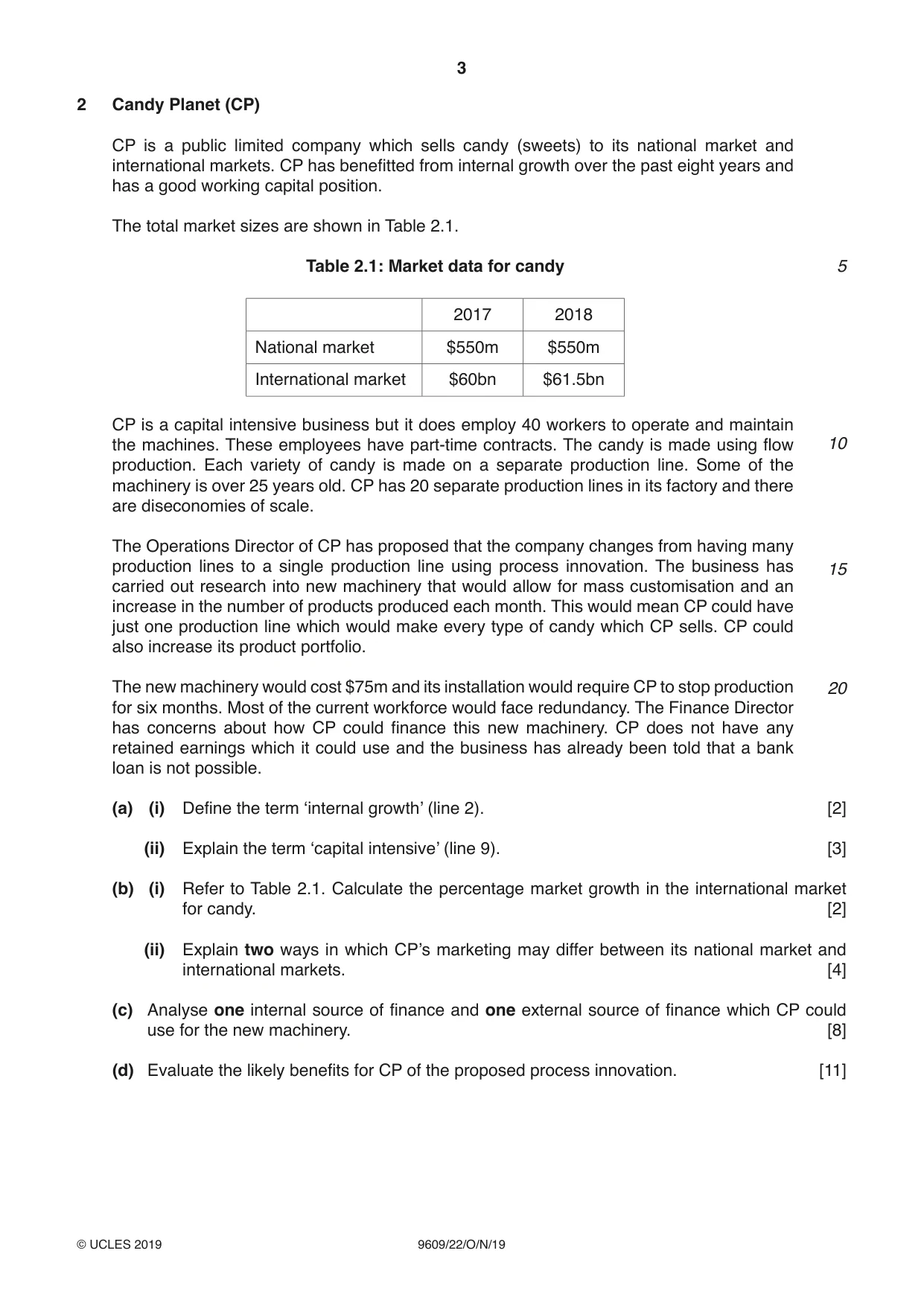
2 Candy Planet (CP) CP is a public limited company which sells candy (sweets) to its national market and international markets. CP has benefitted from internal growth over the past eight years and has a good working capital position. The total market sizes are shown in Table 2.1. Table 2.1: Market data for candy 5 2017 2018 National market $550m $550m International market $60bn $61.5bn CP is a capital intensive business but it does employ 40 workers to operate and maintain the machines. These employees have part-time contracts. The candy is made using flow 10 production. Each variety of candy is made on a separate production line. Some of the machinery is over 25 years old. CP has 20 separate production lines in its factory and there are diseconomies of scale. The Operations Director of CP has proposed that the company changes from having many production lines to a single production line using process innovation. The business has 15 carried out research into new machinery that would allow for mass customisation and an increase in the number of products produced each month. This would mean CP could have just one production line which would make every type of candy which CP sells. CP could also increase its product portfolio. The new machinery would cost $75m and its installation would require CP to stop production 20 for six months. Most of the current workforce would face redundancy. The Finance Director has concerns about how CP could finance this new machinery. CP does not have any retained earnings which it could use and the business has already been told that a bank loan is not possible. (a) (i) Define the term ‘internal growth’ (line 2). [2] (ii) Explain the term ‘capital intensive’ (line 9). [3] (b) (i) Refer to Table 2.1. Calculate the percentage market growth in the international market for candy. [2] (ii) Explain two ways in which CP’s marketing may differ between its national market and international markets. [4] (c) Analyse one internal source of finance and one external source of finance which CP could use for the new machinery. [8] (d) Evaluate the likely benefits for CP of the proposed process innovation. [11]
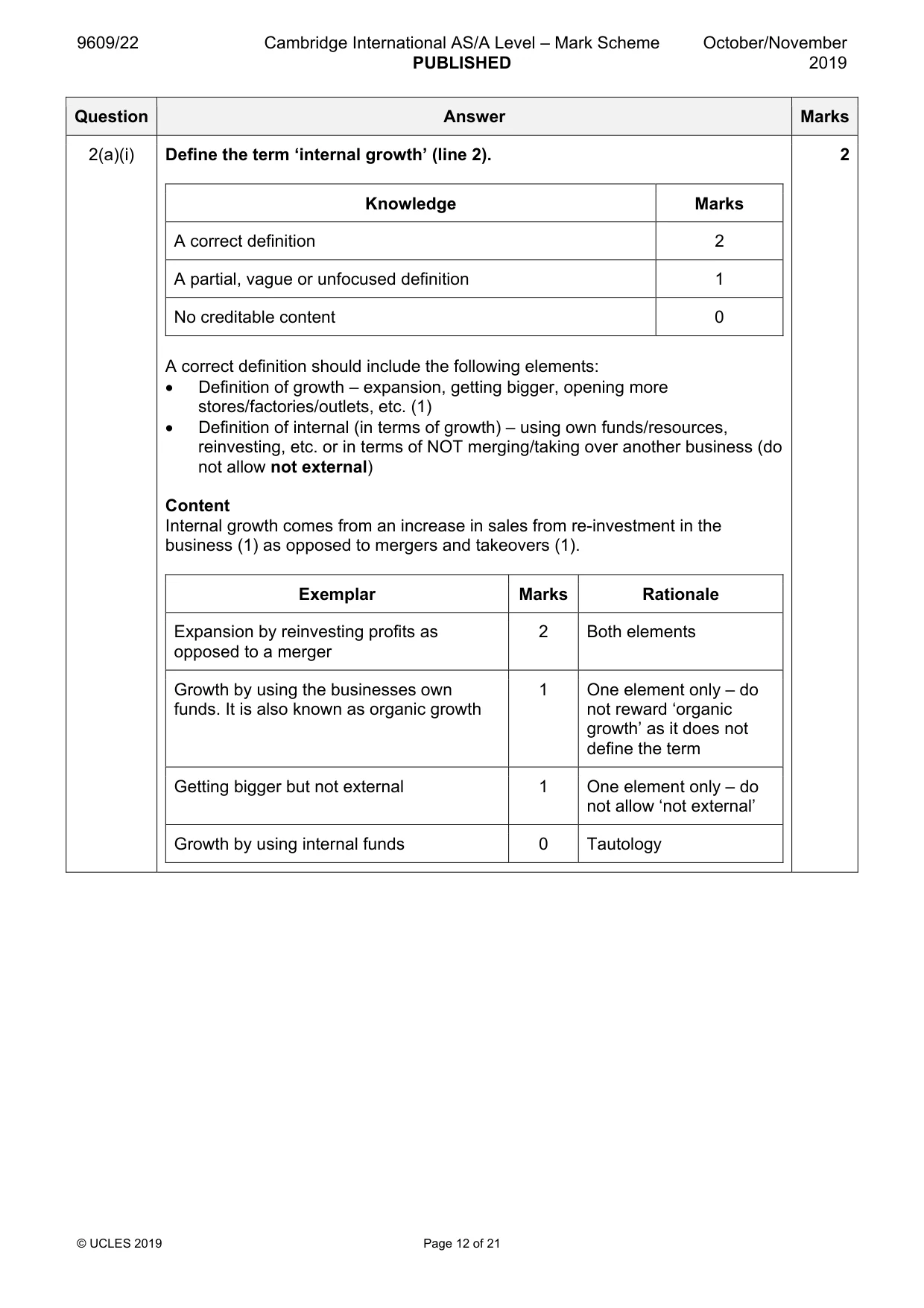
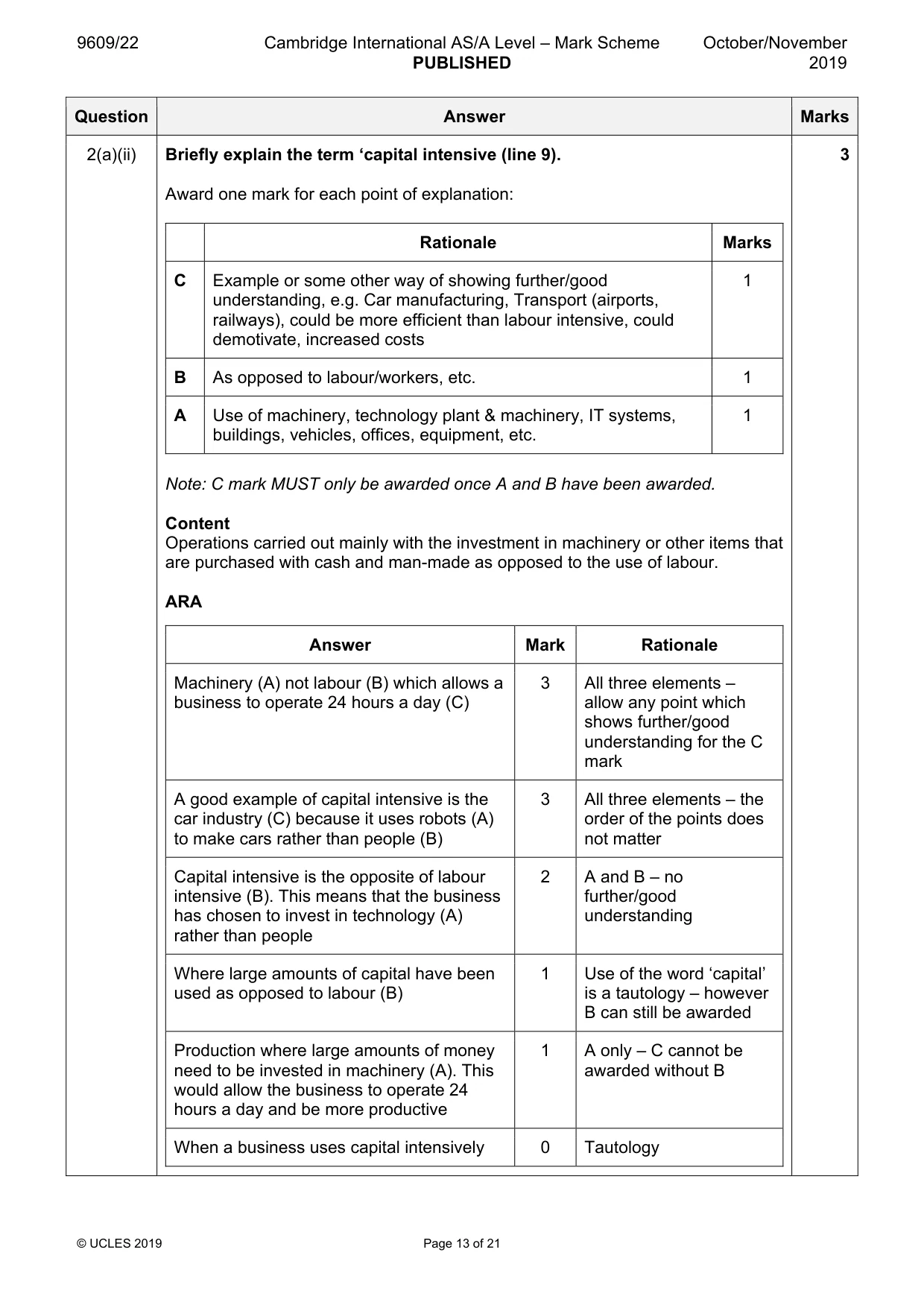
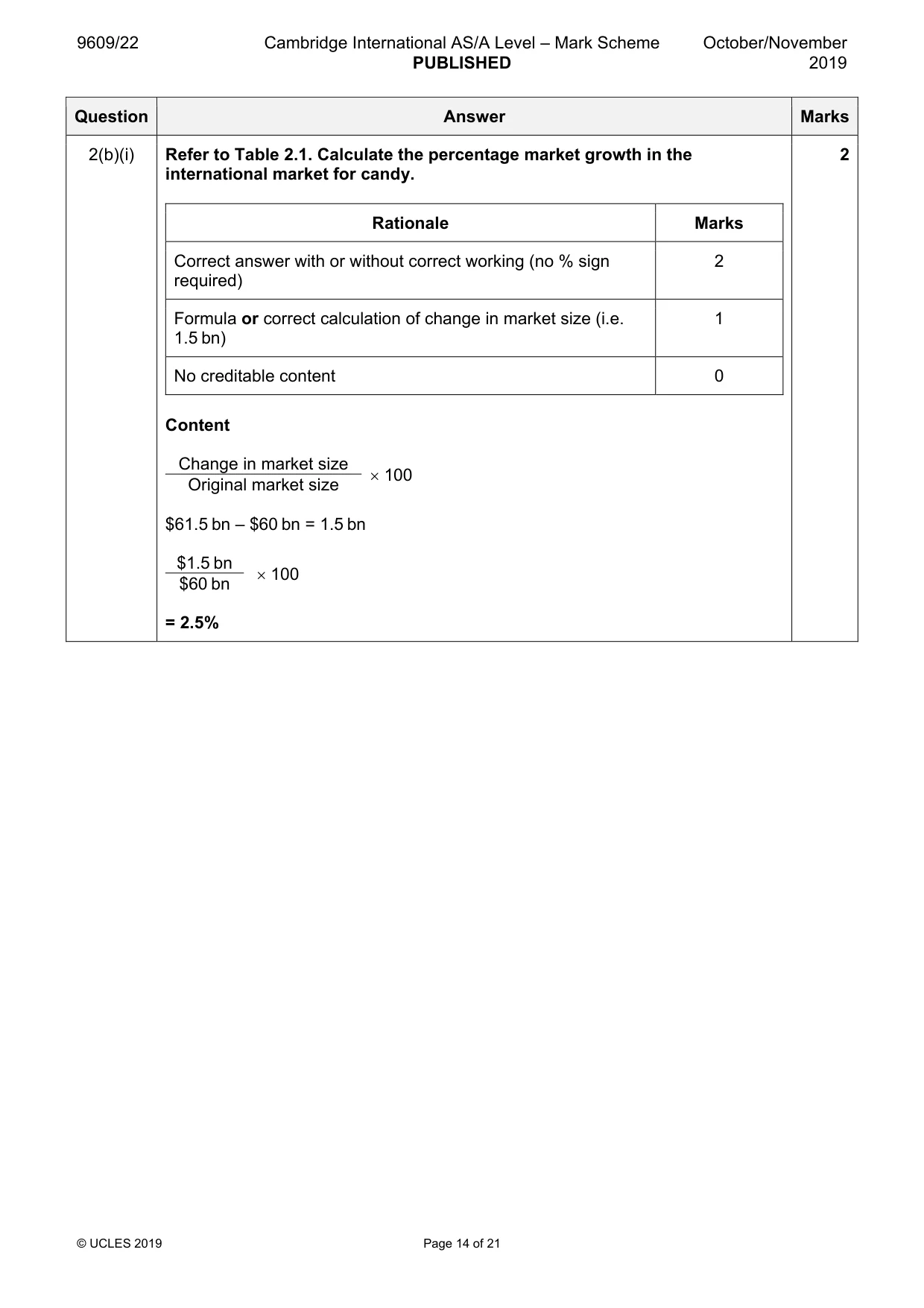
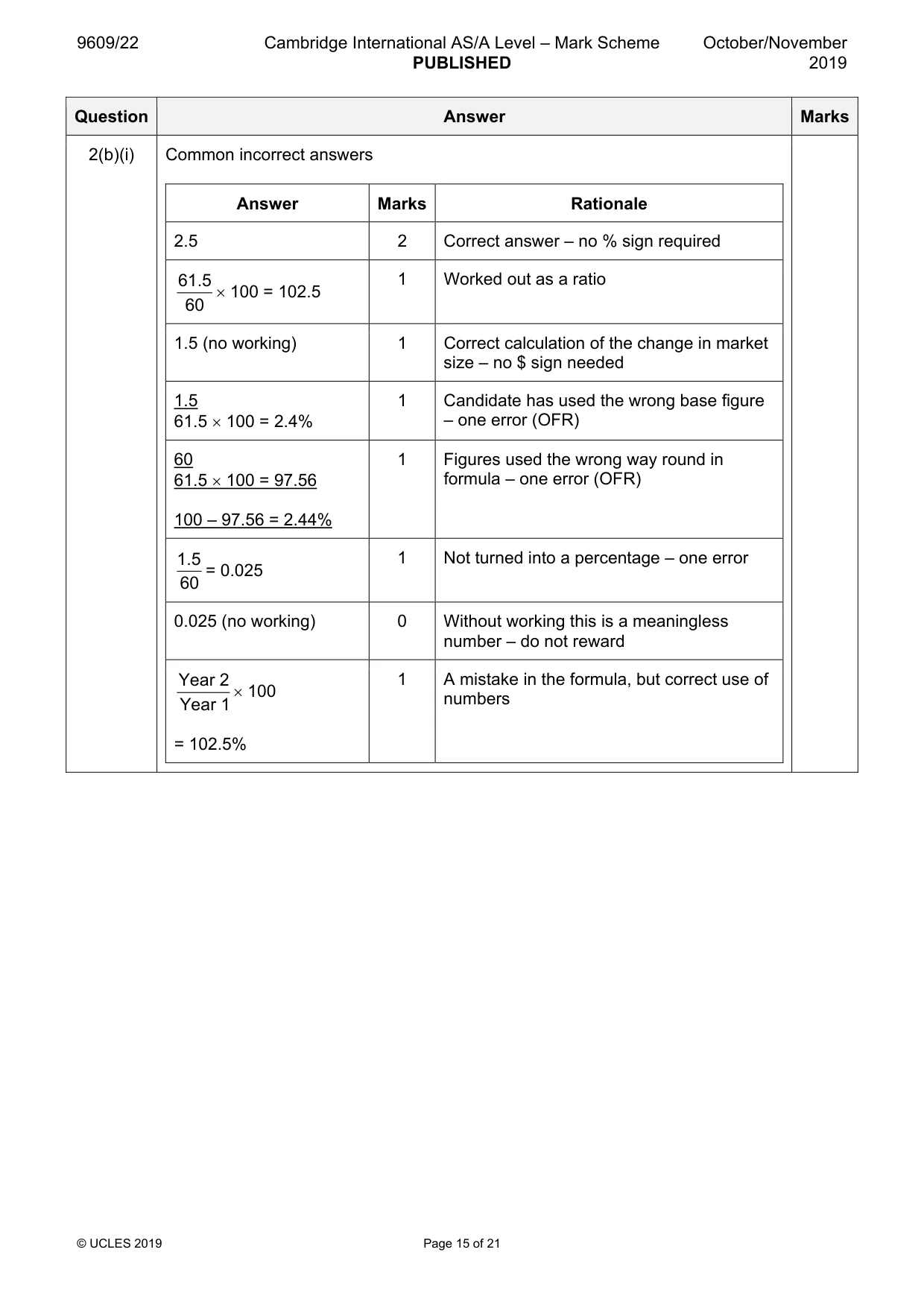
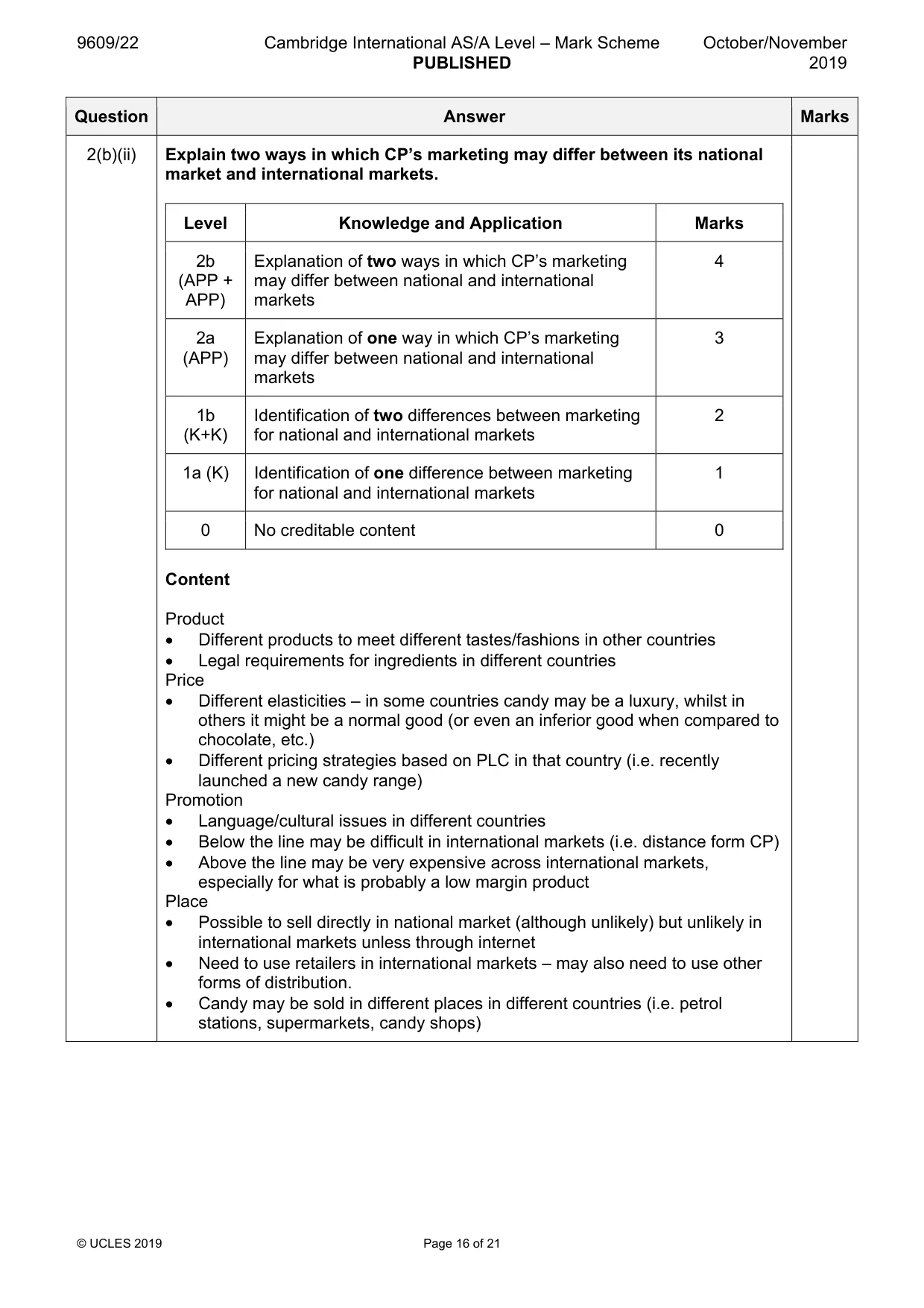
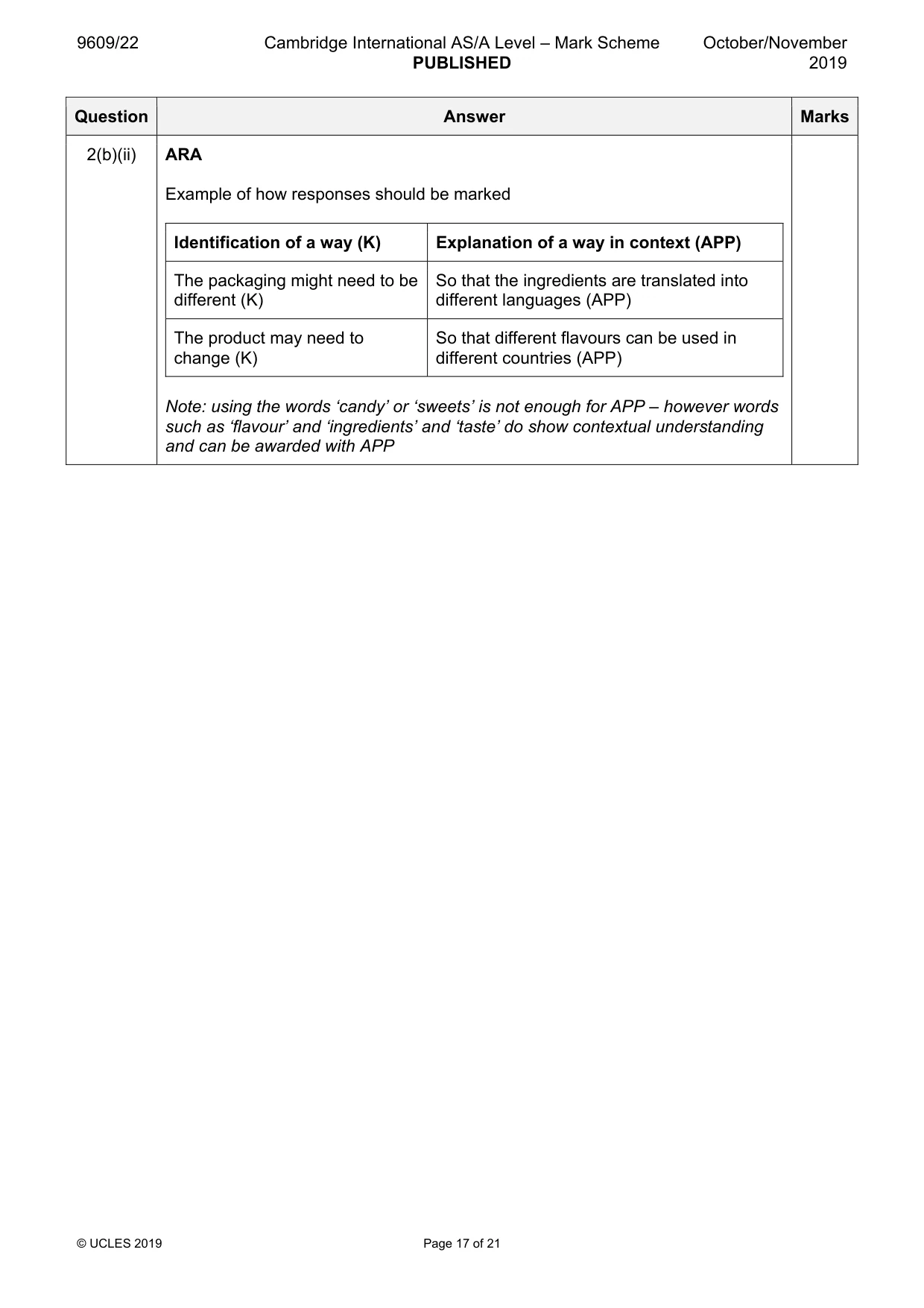
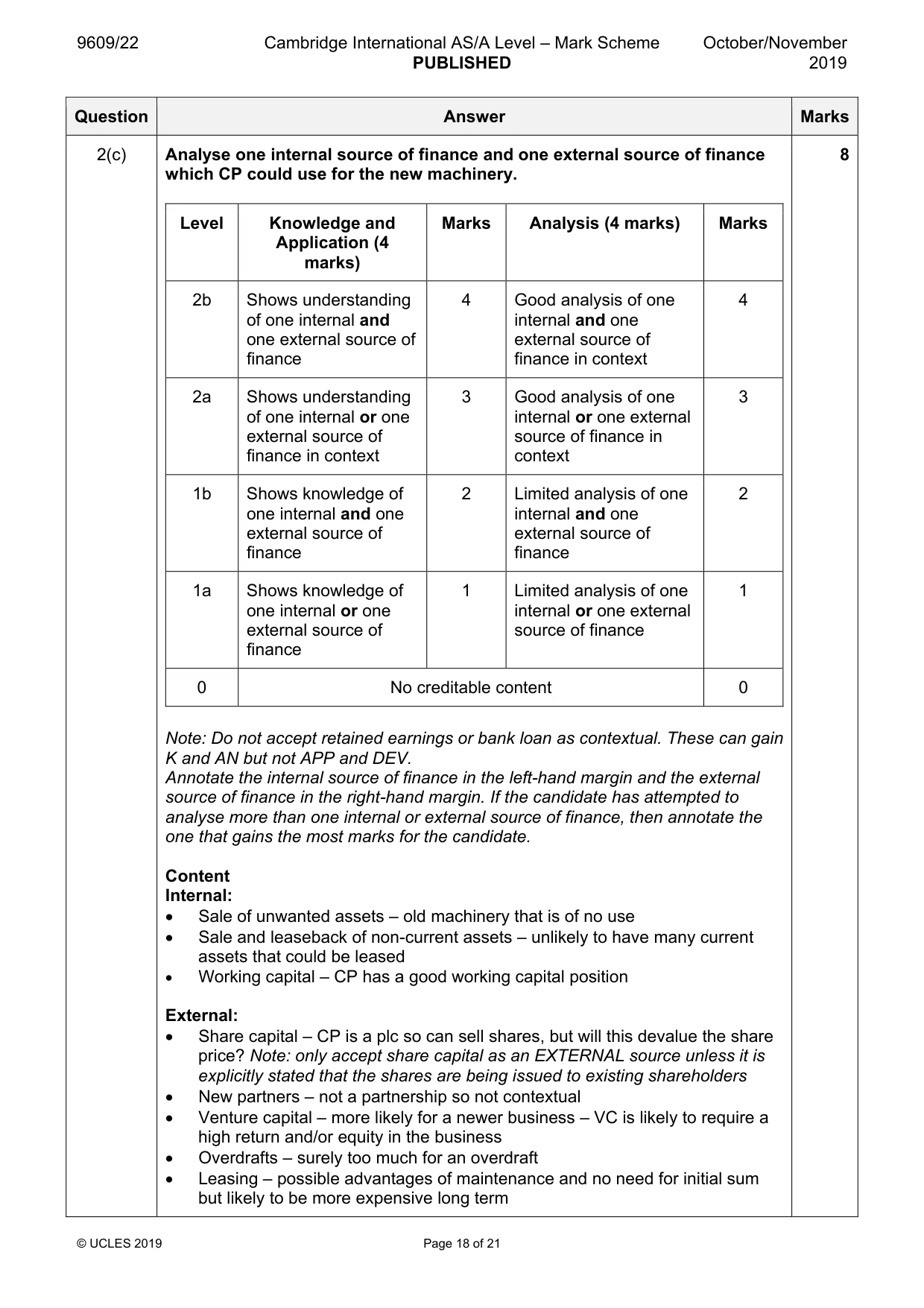
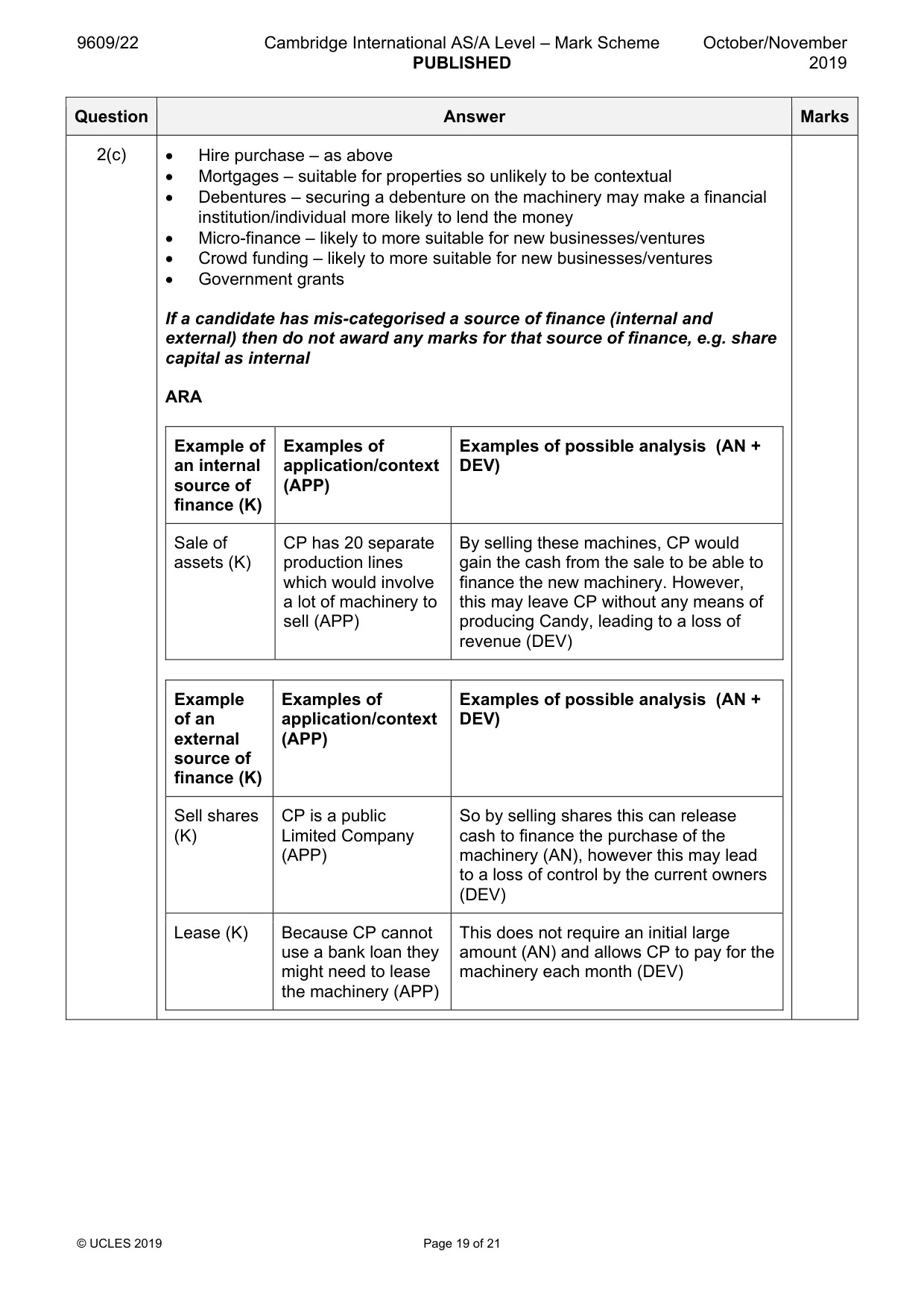
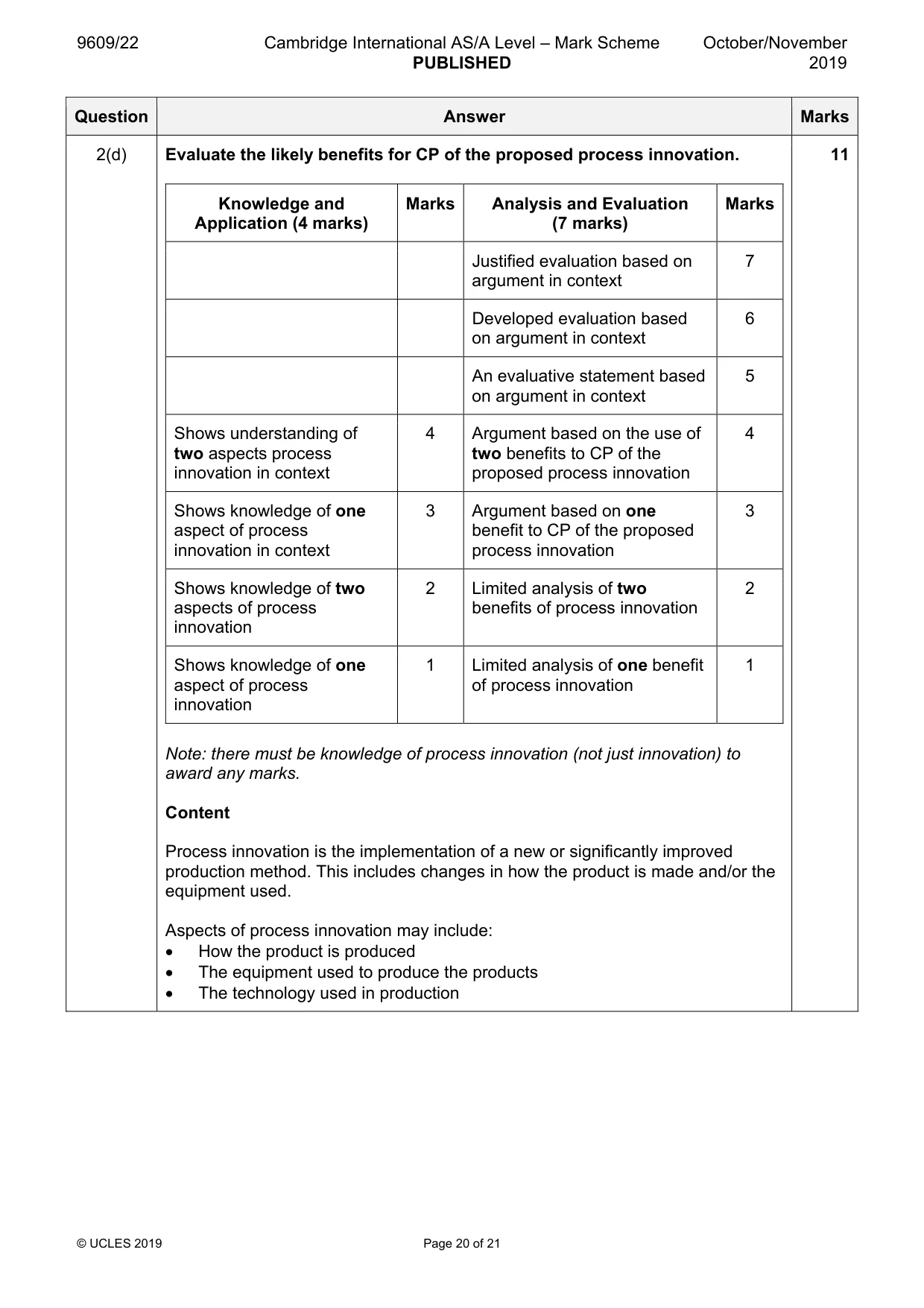
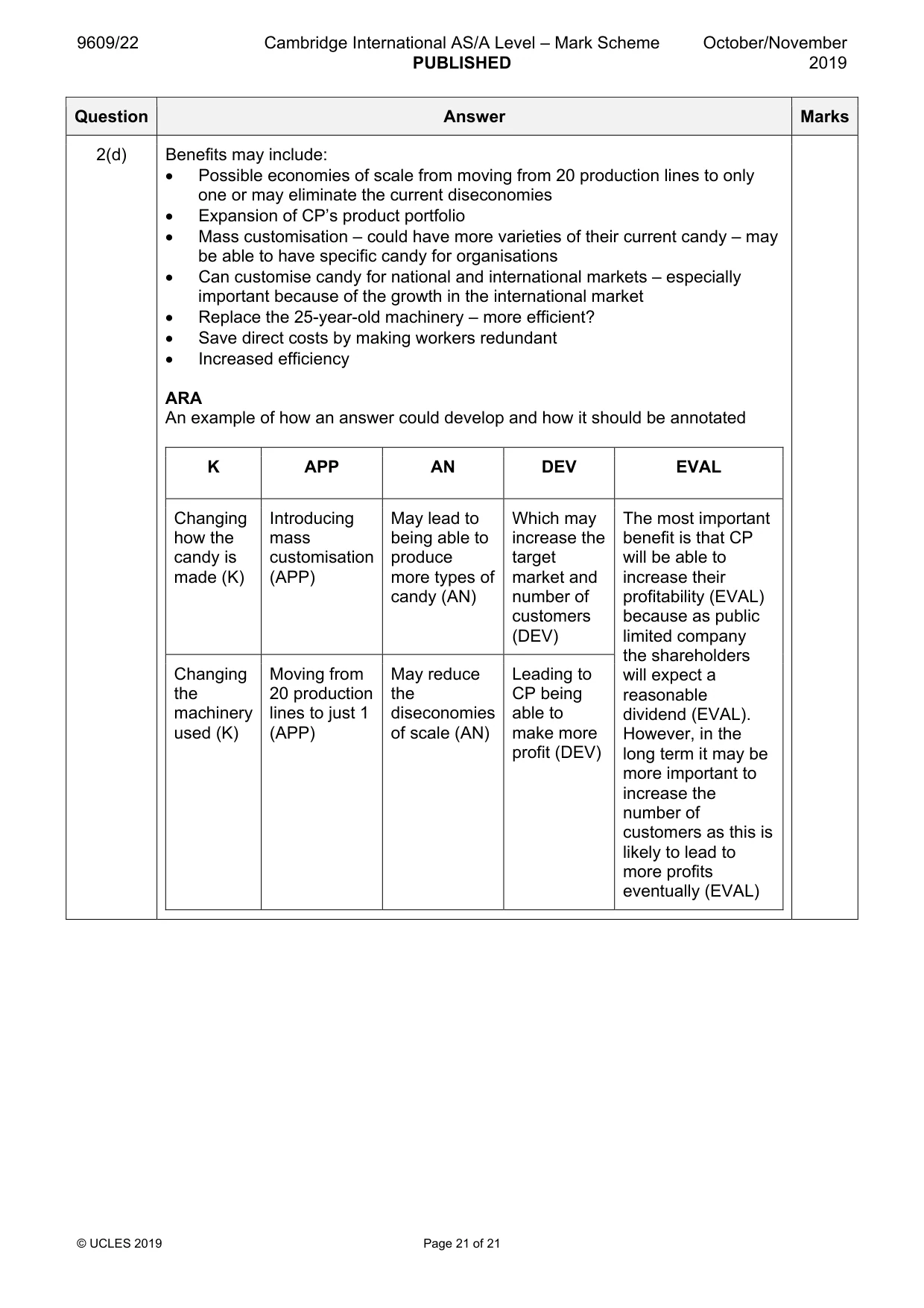
Mark scheme: 2(a)(i) Define the term ‘internal growth’ (line 2). 2 Knowledge Marks A correct definition 2 A partial, vague or unfocused definition 1 No creditable content 0 A correct definition should include the following elements: • Definition of growth – expansion, getting bigger, opening more stores/factories/outlets, etc. (1) • Definition of internal (in terms of growth) – using own funds/resources, reinvesting, etc. or in terms of NOT merging/taking over another business (do not allow not external) Content Internal growth comes from an increase in sales from re-investment in the business (1) as opposed to mergers and takeovers (1). Exemplar Marks Rationale Expansion by reinvesting profits as 2 Both elements opposed to a merger Growth by using the businesses own 1 One element only – do funds. It is also known as organic growth not reward ‘organic growth’ as it does not define the term Getting bigger but not external 1 One element only – do not allow ‘not external’ Growth by using internal funds 0 Tautology 2(a)(ii) Briefly explain the term ‘capital intensive (line 9). 3 Award one mark for each point of explanation: Rationale Marks C Example or some other way of showing further/good 1 understanding, e.g. Car manufacturing, Transport (airports, railways), could be more efficient than labour intensive, could demotivate, increased costs B As opposed to labour/workers, etc. 1 A Use of machinery, technology plant & machinery, IT systems, 1 buildings, vehicles, offices, equipment, etc. Note: C mark MUST only be awarded once A and B have been awarded. Content Operations carried out mainly with the investment in machinery or other items that are purchased with cash and man-made as opposed to the use of labour. ARA Answer Mark Rationale Machinery (A) not labour (B) which allows a 3 All three elements – business to operate 24 hours a day (C) allow any point which shows further/good understanding for the C mark A good example of capital intensive is the 3 All three elements – the car industry (C) because it uses robots (A) order of the points does to make cars rather than people (B) not matter Capital intensive is the opposite of labour 2 A and B – no intensive (B). This means that the business further/good has chosen to invest in technology (A) understanding rather than people Where large amounts of capital have been 1 Use of the word ‘capital’ used as opposed to labour (B) is a tautology – however B can still be awarded Production where large amounts of money 1 A only – C cannot be need to be invested in machinery (A). This awarded without B would allow the business to operate 24 hours a day and be more productive When a business uses capital intensively 0 Tautology 2(b)(i) Refer to Table 2.1. Calculate the percentage market growth in the 2 international market for candy. Rationale Marks Correct answer with or without correct working (no % sign 2 required) Formula or correct calculation of change in market size (i.e. 1 1.5 bn) No creditable content 0 Content Change in market size × 100 Original market size $61.5 bn – $60 bn = 1.5 bn $1.5 bn × 100 $60 bn = 2.5% 2(b)(i) Common incorrect answers Answer Marks Rationale 2.5 2 Correct answer – no % sign required 61.5 1 Worked out as a ratio × 100 = 102.5 60 1.5 (no working) 1 Correct calculation of the change in market size – no $ sign needed 1.5 1 Candidate has used the wrong base figure 61.5 × 100 = 2.4% – one error (OFR) 60 1 Figures used the wrong way round in 61.5 × 100 = 97.56 formula – one error (OFR) 100 – 97.56 = 2.44% 1.5 1 Not turned into a percentage – one error = 0.025 60 0.025 (no working) 0 Without working this is a meaningless number – do not reward Year 2 1 A mistake in the formula, but correct use of × 100 numbers Year 1 = 102.5% 2(b)(ii) Explain two ways in which CP’s marketing may differ between its national market and international markets. Level Knowledge and Application Marks 2b Explanation of two ways in which CP’s marketing 4 (APP + may differ between national and international APP) markets 2a Explanation of one way in which CP’s marketing 3 (APP) may differ between national and international markets 1b Identification of two differences between marketing 2 (K+K) for national and international markets 1a (K) Identification of one difference between marketing 1 for national and international markets 0 No creditable content 0 Content Product • Different products to meet different tastes/fashions in other countries • Legal requirements for ingredients in different countries Price • Different elasticities – in some countries candy may be a luxury, whilst in others it might be a normal good (or even an inferior good when compared to chocolate, etc.) • Different pricing strategies based on PLC in that country (i.e. recently launched a new candy range) Promotion • Language/cultural issues in different countries • Below the line may be difficult in international markets (i.e. distance form CP) • Above the line may be very expensive across international markets, especially for what is probably a low margin product Place • Possible to sell directly in national market (although unlikely) but unlikely in international markets unless through internet • Need to use retailers in international markets – may also need to use other forms of distribution. • Candy may be sold in different places in different countries (i.e. petrol stations, supermarkets, candy shops) 2(b)(ii) ARA Example of how responses should be marked Identification of a way (K) Explanation of a way in context (APP) The packaging might need to be So that the ingredients are translated into different (K) different languages (APP) The product may need to So that different flavours can be used in change (K) different countries (APP) Note: using the words ‘candy’ or ‘sweets’ is not enough for APP – however words such as ‘flavour’ and ‘ingredients’ and ‘taste’ do show contextual understanding and can be awarded with APP 2(c) Analyse one internal source of finance and one external source of finance 8 which CP could use for the new machinery. Level Knowledge and Marks Analysis (4 marks) Marks Application (4 marks) 2b Shows understanding 4 Good analysis of one 4 of one internal and internal and one one external source of external source of finance finance in context 2a Shows understanding 3 Good analysis of one 3 of one internal or one internal or one external external source of source of finance in finance in context context 1b Shows knowledge of 2 Limited analysis of one 2 one internal and one internal and one external source of external source of finance finance 1a Shows knowledge of 1 Limited analysis of one 1 one internal or one internal or one external external source of source of finance finance 0 No creditable content 0 Note: Do not accept retained earnings or bank loan as contextual. These can gain K and AN but not APP and DEV. Annotate the internal source of finance in the left-hand margin and the external source of finance in the right-hand margin. If the candidate has attempted to analyse more than one internal or external source of finance, then annotate the one that gains the most marks for the candidate. Content Internal: • Sale of unwanted assets – old machinery that is of no use • Sale and leaseback of non-current assets – unlikely to have many current assets that could be leased • Working capital – CP has a good working capital position External: • Share capital – CP is a plc so can sell shares, but will this devalue the share price? Note: only accept share capital as an EXTERNAL source unless it is explicitly stated that the shares are being issued to existing shareholders • New partners – not a partnership so not contextual • Venture capital – more likely for a newer business – VC is likely to require a high return and/or equity in the business • Overdrafts – surely too much for an overdraft • Leasing – possible advantages of maintenance and no need for initial sum but likely to be more expensive long term 2(c) • Hire purchase – as above • Mortgages – suitable for properties so unlikely to be contextual • Debentures – securing a debenture on the machinery may make a financial institution/individual more likely to lend the money • Micro-finance – likely to more suitable for new businesses/ventures • Crowd funding – likely to more suitable for new businesses/ventures • Government grants If a candidate has mis-categorised a source of finance (internal and external) then do not award any marks for that source of finance, e.g. share capital as internal ARA Example of Examples of Examples of possible analysis (AN + an internal application/context DEV) source of (APP) finance (K) Sale of CP has 20 separate By selling these machines, CP would assets (K) production lines gain the cash from the sale to be able to which would involve finance the new machinery. However, a lot of machinery to this may leave CP without any means of sell (APP) producing Candy, leading to a loss of revenue (DEV) Example Examples of Examples of possible analysis (AN + of an application/context DEV) external (APP) source of finance (K) Sell shares CP is a public So by selling shares this can release (K) Limited Company cash to finance the purchase of the (APP) machinery (AN), however this may lead to a loss of control by the current owners (DEV) Lease (K) Because CP cannot This does not require an initial large use a bank loan they amount (AN) and allows CP to pay for the might need to lease machinery each month (DEV) the machinery (APP) 2(d) Evaluate the likely benefits for CP of the proposed process innovation. 11 Knowledge and Marks Analysis and Evaluation Marks Application (4 marks) (7 marks) Justified evaluation based on 7 argument in context Developed evaluation based 6 on argument in context An evaluative statement based 5 on argument in context Shows understanding of 4 Argument based on the use of 4 two aspects process two benefits to CP of the innovation in context proposed process innovation Shows knowledge of one 3 Argument based on one 3 aspect of process benefit to CP of the proposed innovation in context process innovation Shows knowledge of two 2 Limited analysis of two 2 aspects of process benefits of process innovation innovation Shows knowledge of one 1 Limited analysis of one benefit 1 aspect of process of process innovation innovation Note: there must be knowledge of process innovation (not just innovation) to award any marks. Content Process innovation is the implementation of a new or significantly improved production method. This includes changes in how the product is made and/or the equipment used. Aspects of process innovation may include: • How the product is produced • The equipment used to produce the products • The technology used in production 2(d) Benefits may include: • Possible economies of scale from moving from 20 production lines to only one or may eliminate the current diseconomies • Expansion of CP’s product portfolio • Mass customisation – could have more varieties of their current candy – may be able to have specific candy for organisations • Can customise candy for national and international markets – especially important because of the growth in the international market • Replace the 25-year-old machinery – more efficient? • Save direct costs by making workers redundant • Increased efficiency ARA An example of how an answer could develop and how it should be annotated K APP AN DEV EVAL Changing Introducing May lead to Which may The most important how the mass being able to increase the benefit is that CP candy is customisation produce target will be able to made (K) (APP) more types of market and increase their candy (AN) number of profitability (EVAL) customers because as public (DEV) limited company the shareholders Changing Moving from May reduce Leading to will expect a the 20 production the CP being reasonable machinery lines to just 1 diseconomies able to dividend (EVAL). used (K) (APP) of scale (AN) make more However, in the profit (DEV) long term it may be more important to increase the number of customers as this is likely to lead to more profits eventually (EVAL)
What was in this paper
The subtopics covered by these 2 questions, and how many questions each got. Open one in a new tab to see every Cambridge question on it.
What you needed in this session
Cambridge’s own grade thresholds for 2019 Oct/Nov, Paper 2 · Variant 2. A higher threshold means an easier paper — the bar moves with how the cohort did.