Cambridge A Level Business (for first examination in 2016) 9609 — 2019 Oct/Nov Paper 2 · Variant 1
9609/21/O/N/19 · 3 questions · 60 marks · ≈68 min
The question paper and its mark scheme, free to read here and free to download. This is Cambridge’s own paper, exactly as it was sat.
Question paper4 pages

Mark scheme20 pages
Answers below. Sit the paper first if you are practising.
Questions as text
Q1 · Cracking Eggs (CE) Lian is a chicken farmer
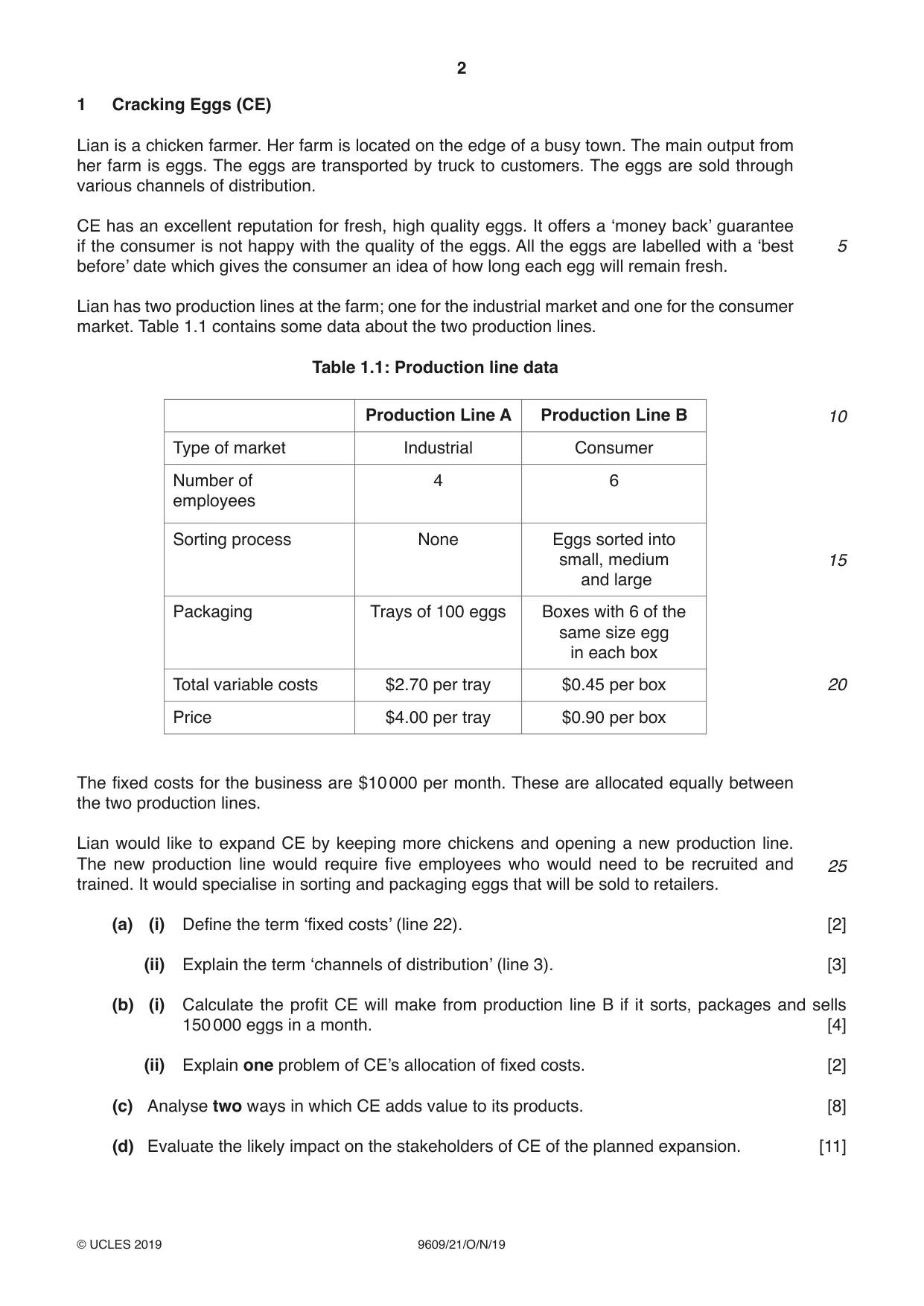
1 Cracking Eggs (CE) Lian is a chicken farmer. Her farm is located on the edge of a busy town. The main output from her farm is eggs. The eggs are transported by truck to customers. The eggs are sold through various channels of distribution. CE has an excellent reputation for fresh, high quality eggs. It offers a ‘money back’ guarantee if the consumer is not happy with the quality of the eggs. All the eggs are labelled with a ‘best 5 before’ date which gives the consumer an idea of how long each egg will remain fresh. Lian has two production lines at the farm; one for the industrial market and one for the consumer market. Table 1.1 contains some data about the two production lines. Table 1.1: Production line data Production Line A Production Line B 10 Type of market Industrial Consumer Number of 4 6 employees Sorting process None Eggs sorted into small, medium 15 and large Packaging Trays of 100 eggs Boxes with 6 of the same size egg in each box Total variable costs $2.70 per tray $0.45 per box 20 Price $4.00 per tray $0.90 per box The fixed costs for the business are $10 000 per month. These are allocated equally between the two production lines. Lian would like to expand CE by keeping more chickens and opening a new production line. The new production line would require five employees who would need to be recruited and 25 trained. It would specialise in sorting and packaging eggs that will be sold to retailers. (a) (i) Define the term ‘fixed costs’ (line 22). [2] (ii) Explain the term ‘channels of distribution’ (line 3). [3] (b) (i) Calculate the profit CE will make from production line B if it sorts, packages and sells 150 000 eggs in a month. [4] (ii) Explain one problem of CE’s allocation of fixed costs. [2] (c) Analyse two ways in which CE adds value to its products. [8] (d) Evaluate the likely impact on the stakeholders of CE of the planned expansion. [11]
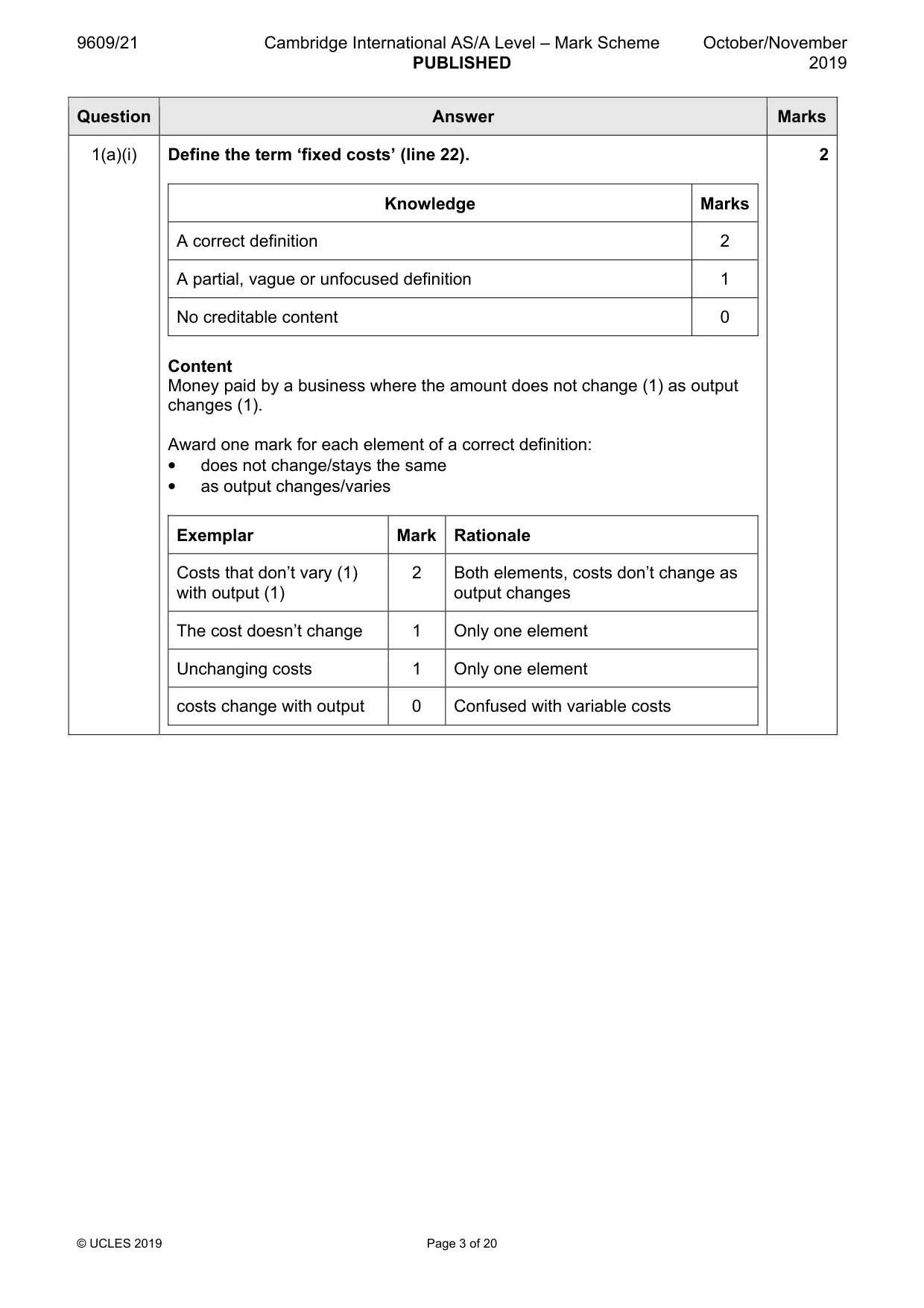
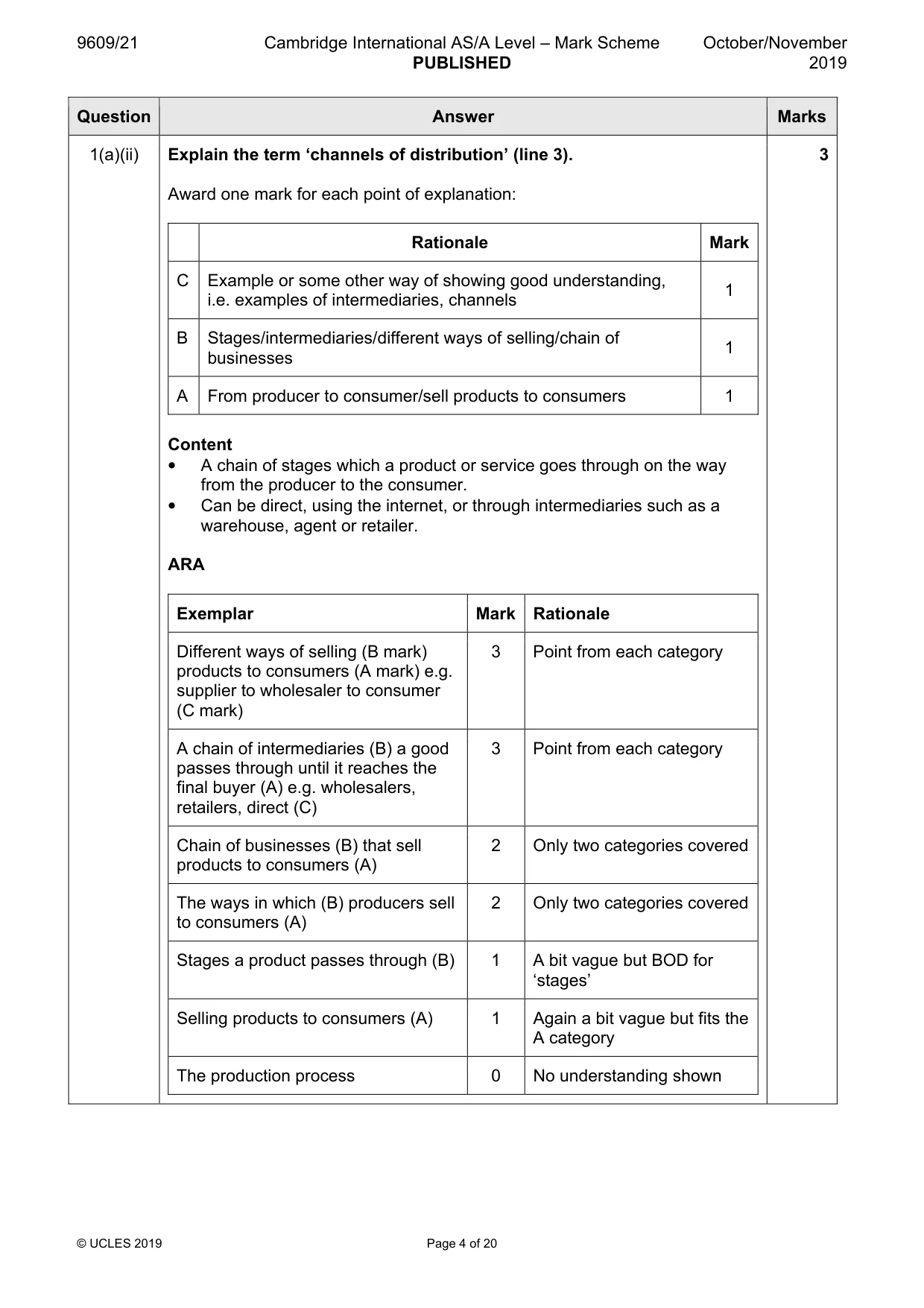
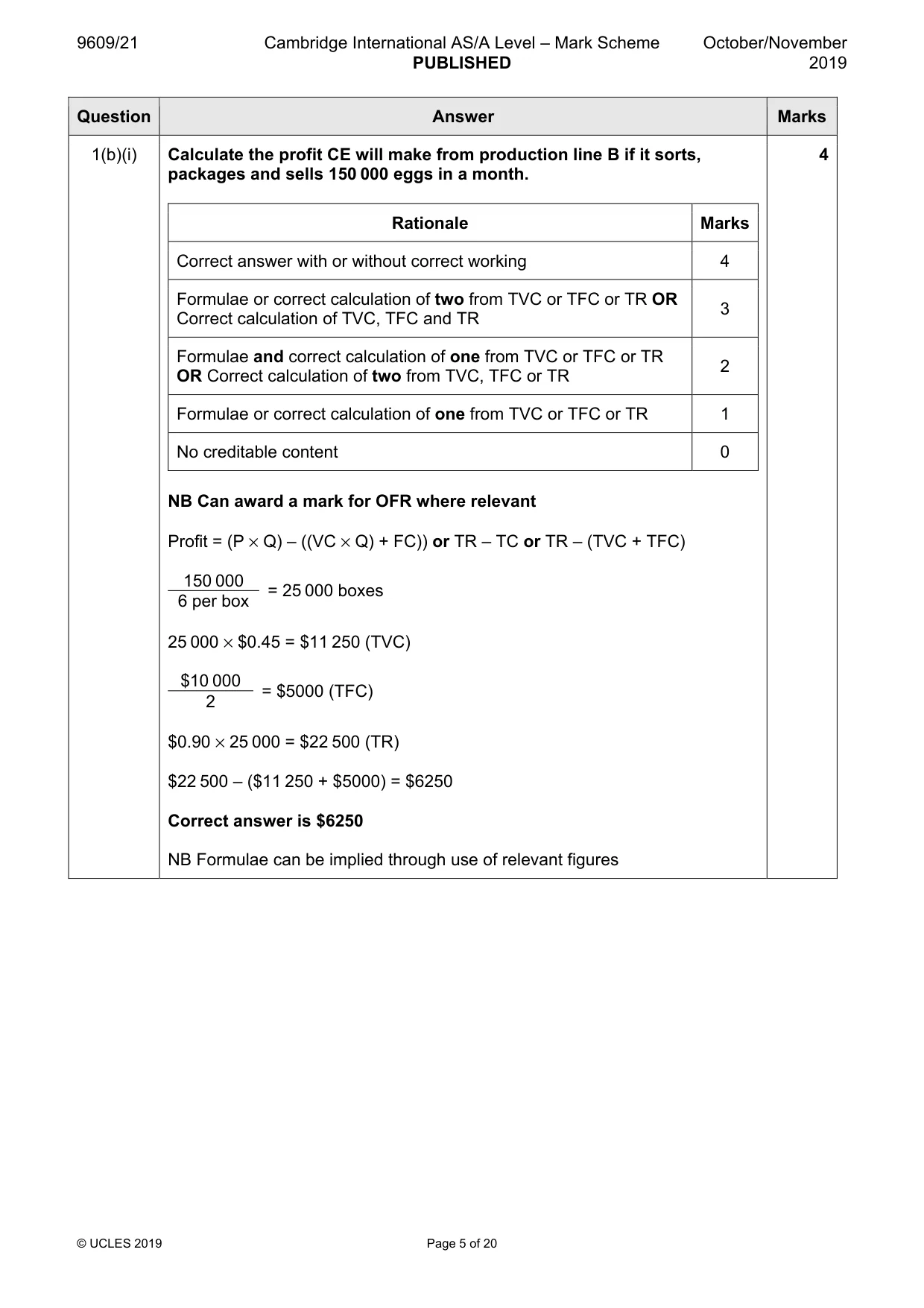
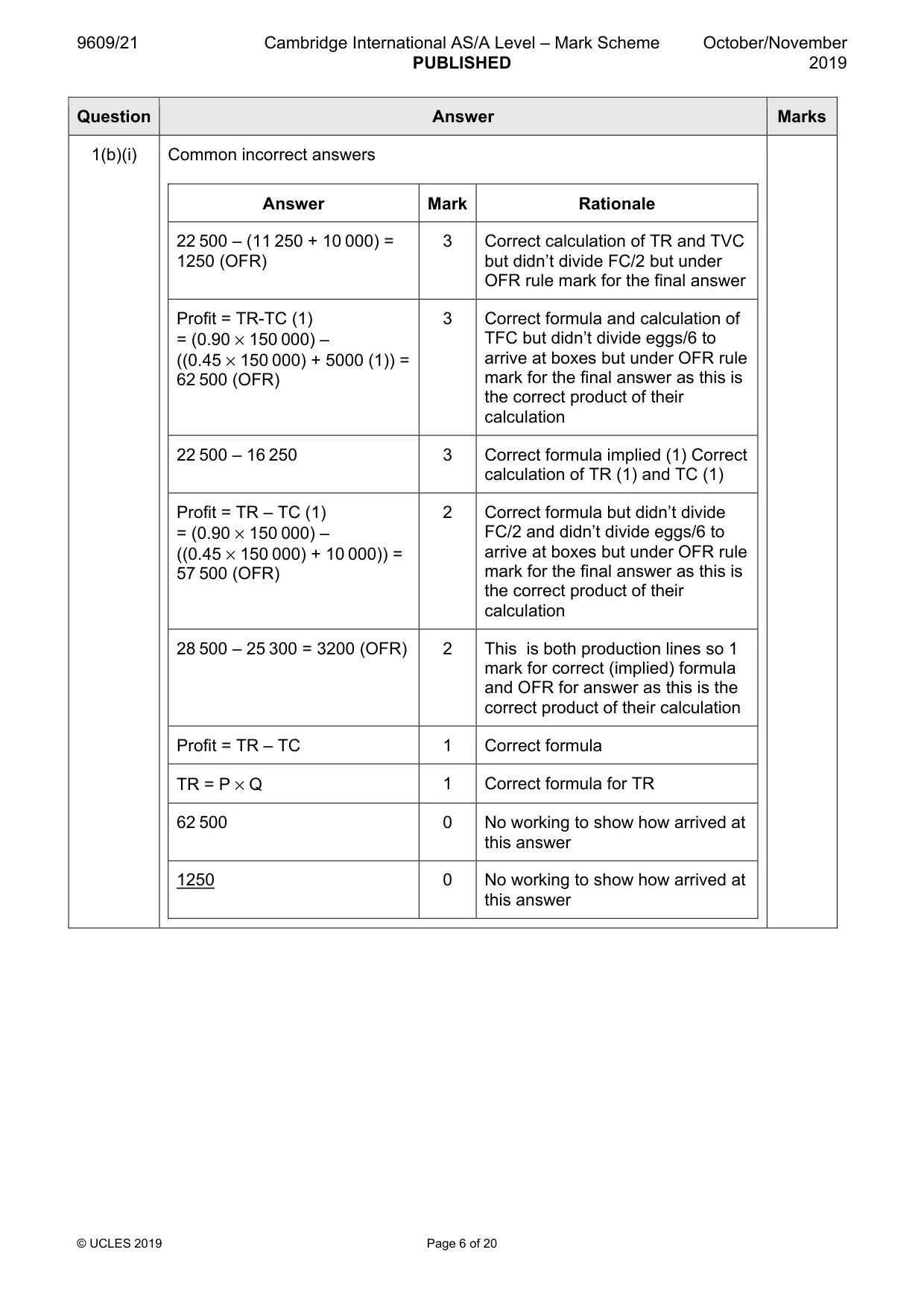
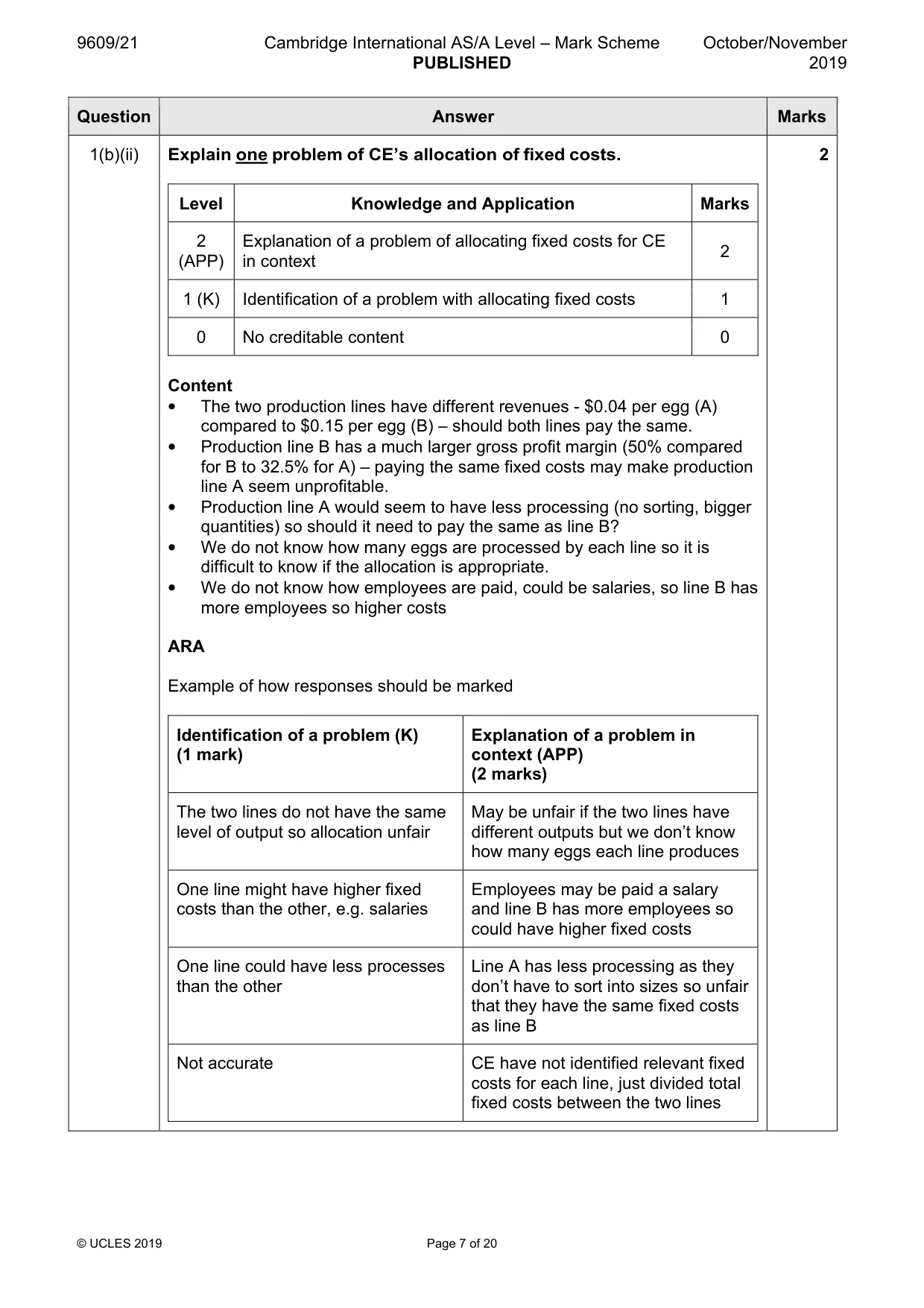
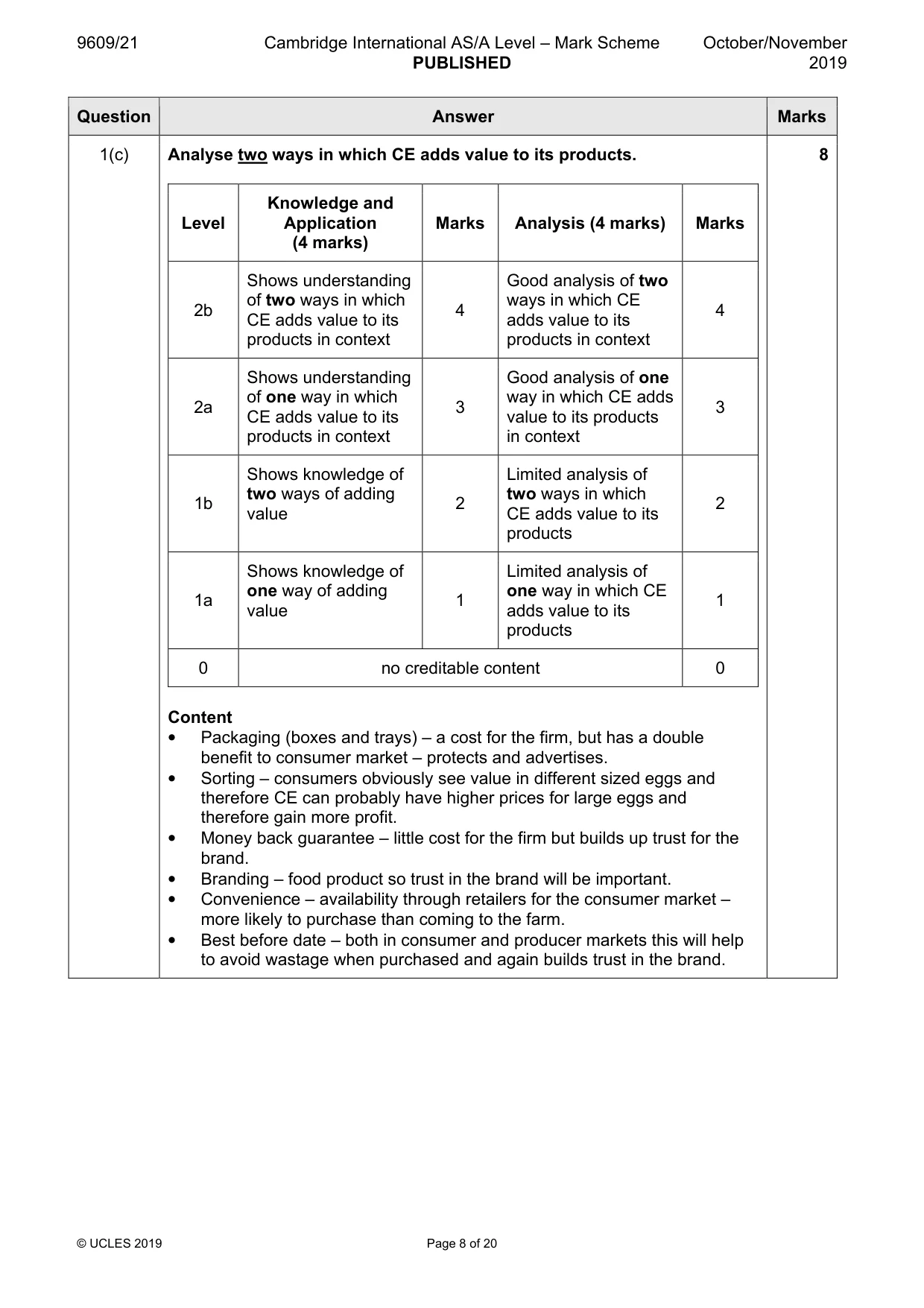
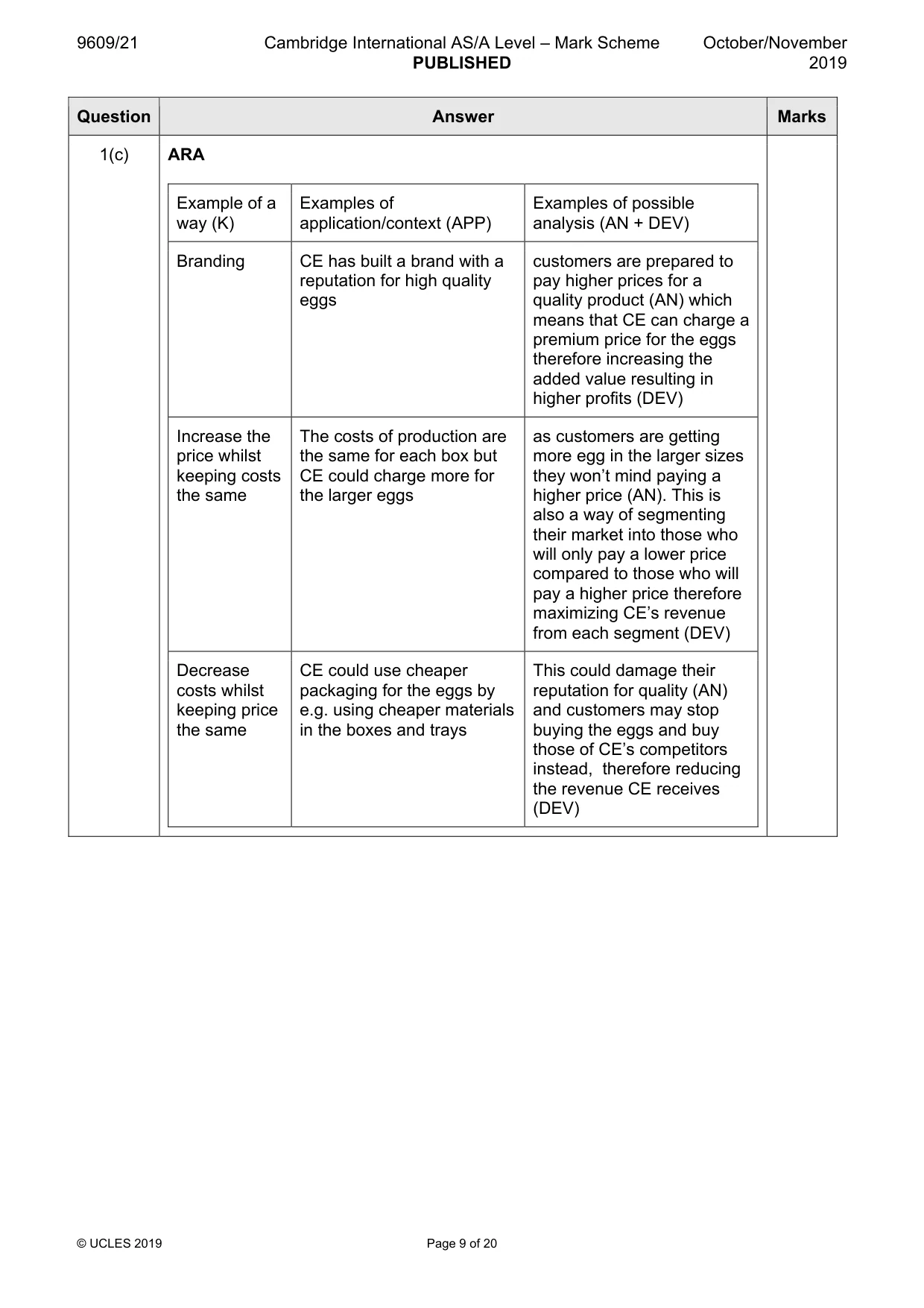
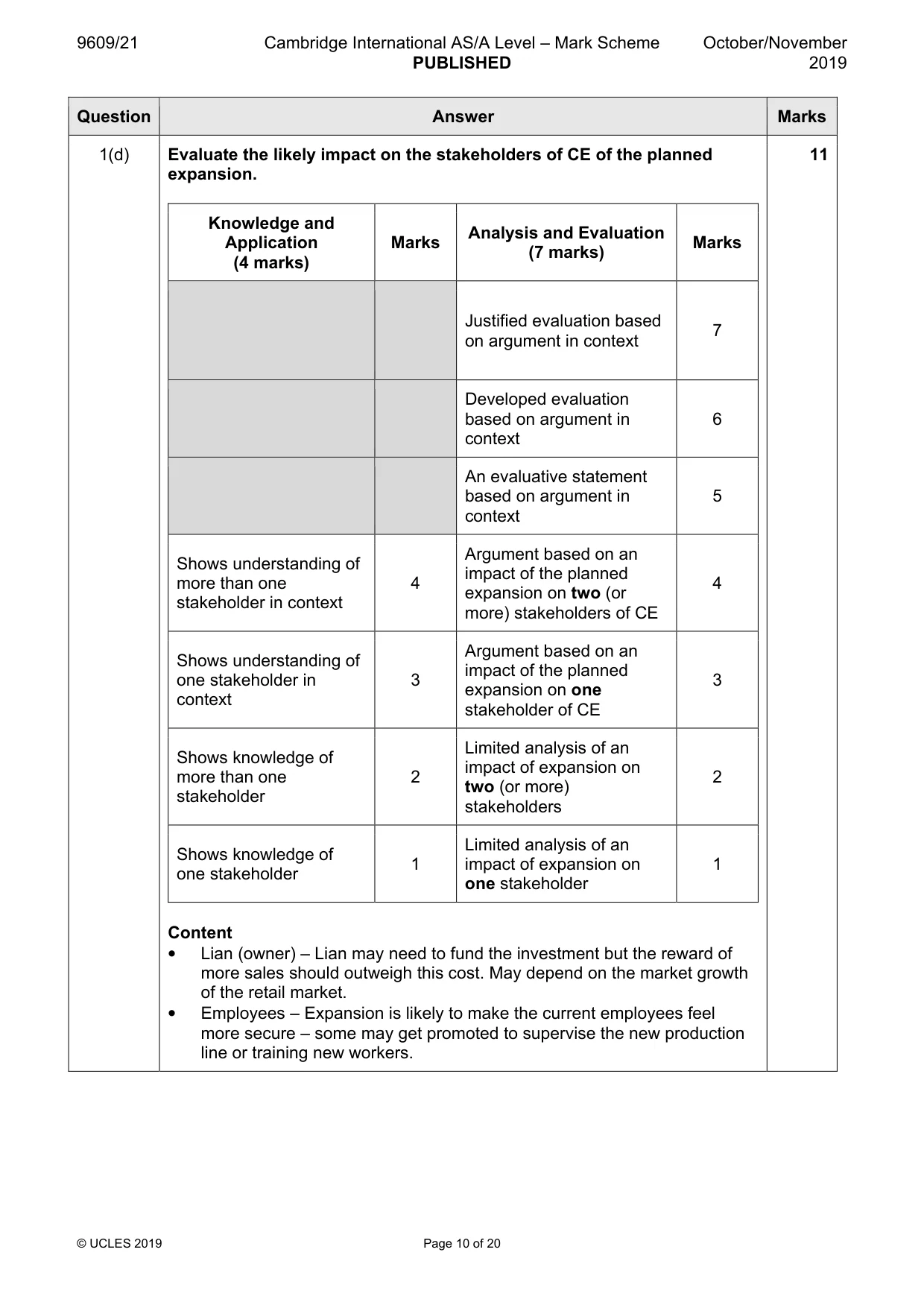
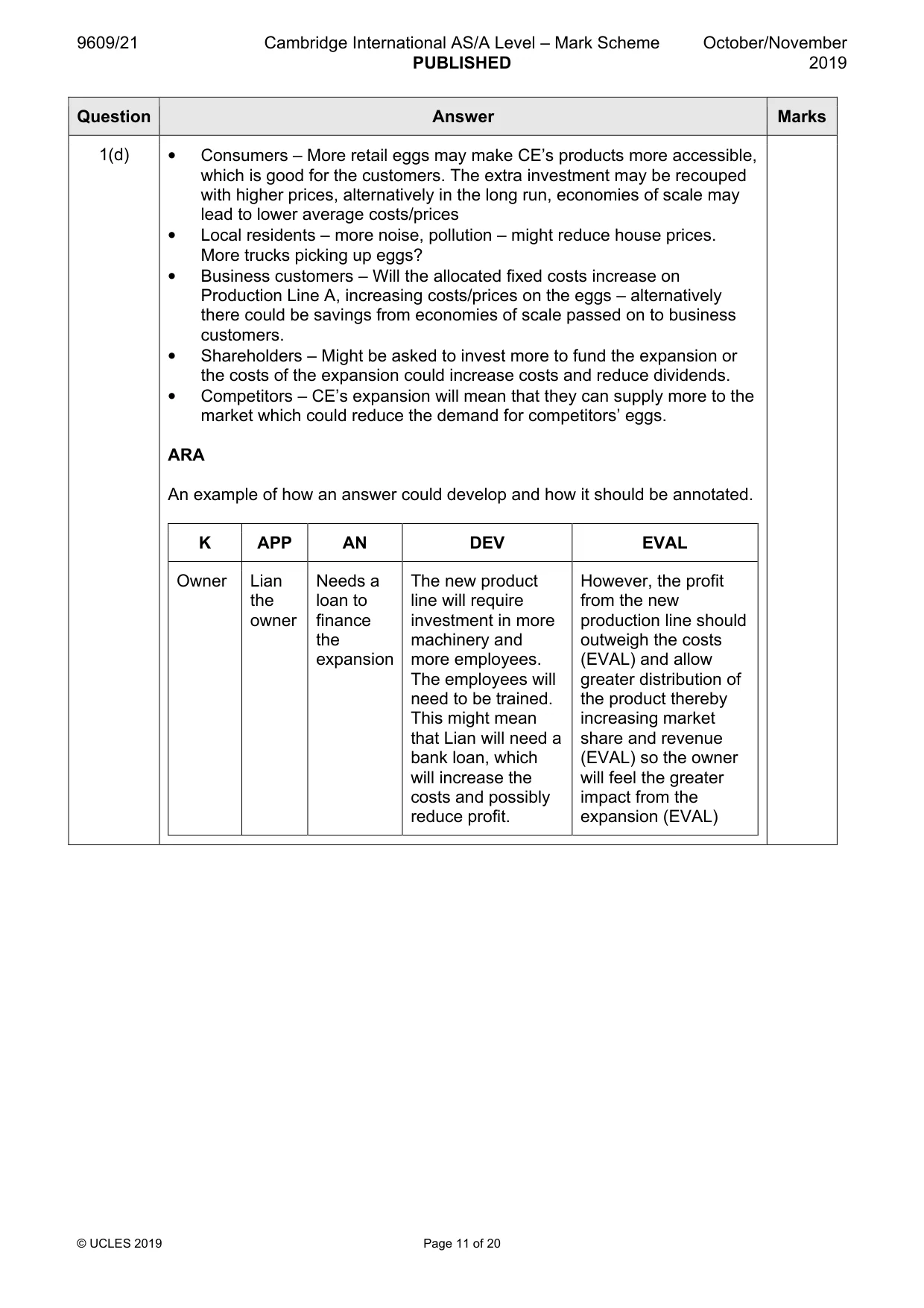
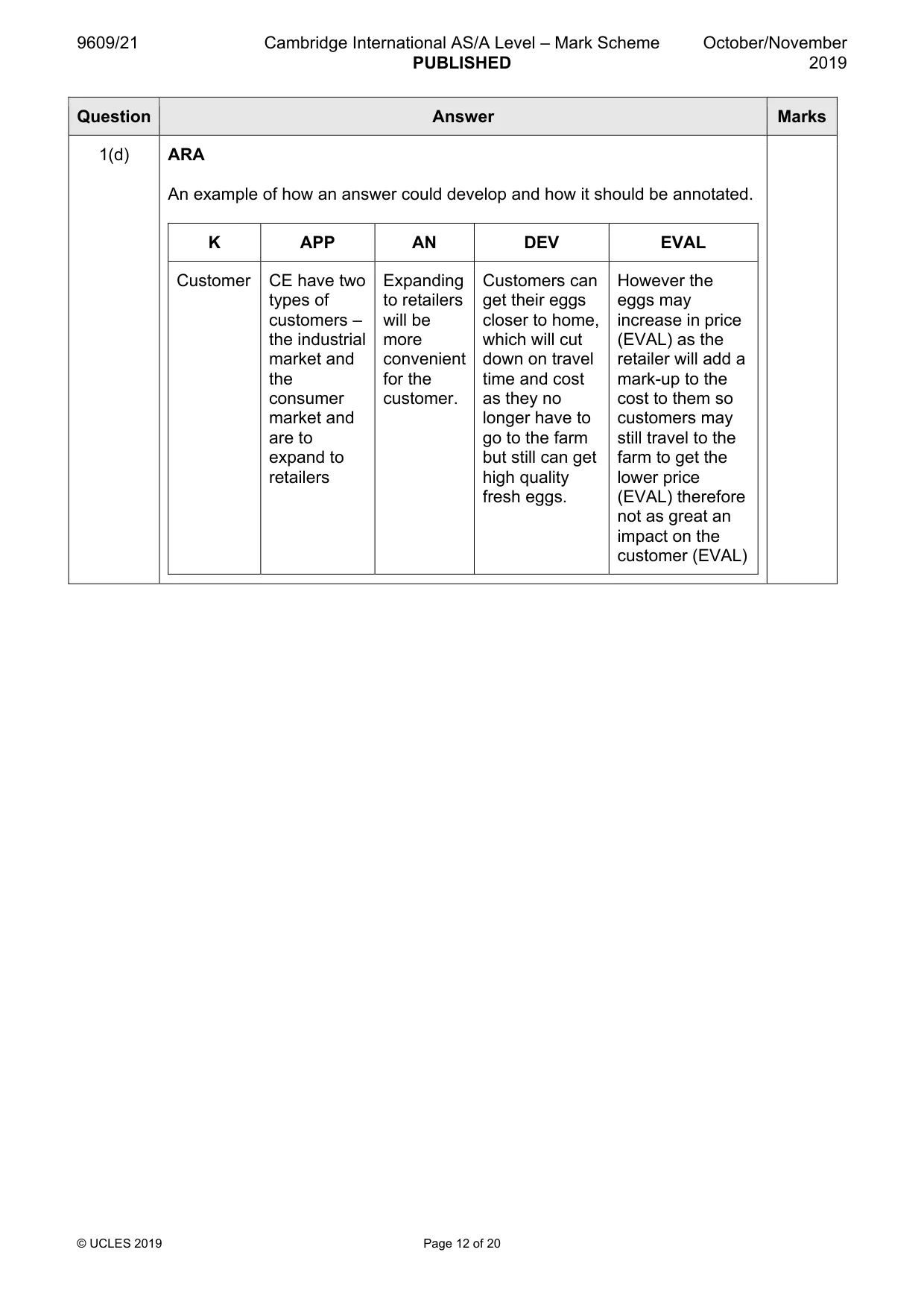
Mark scheme: Question Answer Marks 1(a)(i) Define the term ‘fixed costs’ (line 22). 2 Knowledge Marks A correct definition 2 A partial, vague or unfocused definition 1 No creditable content 0 Content Money paid by a business where the amount does not change (1) as output changes (1). Award one mark for each element of a correct definition: • does not change/stays the same • as output changes/varies Exemplar Mark Rationale Costs that don’t vary (1) 2 Both elements, costs don’t change as with output (1) output changes The cost doesn’t change 1 Only one element Unchanging costs 1 Only one element costs change with output 0 Confused with variable costs 1(a)(ii) Explain the term ‘channels of distribution’ (line 3). 3 Award one mark for each point of explanation: Rationale Mark C Example or some other way of showing good understanding, 1 i.e. examples of intermediaries, channels B Stages/intermediaries/different ways of selling/chain of 1 businesses A From producer to consumer/sell products to consumers 1 Content • A chain of stages which a product or service goes through on the way from the producer to the consumer. • Can be direct, using the internet, or through intermediaries such as a warehouse, agent or retailer. ARA Exemplar Mark Rationale Different ways of selling (B mark) 3 Point from each category products to consumers (A mark) e.g. supplier to wholesaler to consumer (C mark) A chain of intermediaries (B) a good 3 Point from each category passes through until it reaches the final buyer (A) e.g. wholesalers, retailers, direct (C) Chain of businesses (B) that sell 2 Only two categories covered products to consumers (A) The ways in which (B) producers sell 2 Only two categories covered to consumers (A) Stages a product passes through (B) 1 A bit vague but BOD for ‘stages’ Selling products to consumers (A) 1 Again a bit vague but fits the A category The production process 0 No understanding shown 1(b)(i) Calculate the profit CE will make from production line B if it sorts, 4 packages and sells 150 000 eggs in a month. Rationale Marks Correct answer with or without correct working 4 Formulae or correct calculation of two from TVC or TFC or TR OR 3 Correct calculation of TVC, TFC and TR Formulae and correct calculation of one from TVC or TFC or TR 2 OR Correct calculation of two from TVC, TFC or TR Formulae or correct calculation of one from TVC or TFC or TR 1 No creditable content 0 NB Can award a mark for OFR where relevant Profit = (P × Q) – ((VC × Q) + FC)) or TR – TC or TR – (TVC + TFC) 150 000 = 25 000 boxes 6 per box 25 000 × $0.45 = $11 250 (TVC) $10 000 = $5000 (TFC) 2 $0.90 × 25 000 = $22 500 (TR) $22 500 – ($11 250 + $5000) = $6250 Correct answer is $6250 NB Formulae can be implied through use of relevant figures 1(b)(i) Common incorrect answers Answer Mark Rationale 22 500 – (11 250 + 10 000) = 3 Correct calculation of TR and TVC 1250 (OFR) but didn’t divide FC/2 but under OFR rule mark for the final answer Profit = TR-TC (1) 3 Correct formula and calculation of = (0.90 × 150 000) – TFC but didn’t divide eggs/6 to ((0.45 × 150 000) + 5000 (1)) = arrive at boxes but under OFR rule 62 500 (OFR) mark for the final answer as this is the correct product of their calculation 22 500 – 16 250 3 Correct formula implied (1) Correct calculation of TR (1) and TC (1) Profit = TR – TC (1) 2 Correct formula but didn’t divide = (0.90 × 150 000) – FC/2 and didn’t divide eggs/6 to ((0.45 × 150 000) + 10 000)) = arrive at boxes but under OFR rule 57 500 (OFR) mark for the final answer as this is the correct product of their calculation 28 500 – 25 300 = 3200 (OFR) 2 This is both production lines so 1 mark for correct (implied) formula and OFR for answer as this is the correct product of their calculation Profit = TR – TC 1 Correct formula TR = P × Q 1 Correct formula for TR 62 500 0 No working to show how arrived at this answer 1250 0 No working to show how arrived at this answer 1(b)(ii) Explain one problem of CE’s allocation of fixed costs. 2 Level Knowledge and Application Marks 2 Explanation of a problem of allocating fixed costs for CE 2 (APP) in context 1 (K) Identification of a problem with allocating fixed costs 1 0 No creditable content 0 Content • The two production lines have different revenues - $0.04 per egg (A) compared to $0.15 per egg (B) – should both lines pay the same. • Production line B has a much larger gross profit margin (50% compared for B to 32.5% for A) – paying the same fixed costs may make production line A seem unprofitable. • Production line A would seem to have less processing (no sorting, bigger quantities) so should it need to pay the same as line B? • We do not know how many eggs are processed by each line so it is difficult to know if the allocation is appropriate. • We do not know how employees are paid, could be salaries, so line B has more employees so higher costs ARA Example of how responses should be marked Identification of a problem (K) Explanation of a problem in (1 mark) context (APP) (2 marks) The two lines do not have the same May be unfair if the two lines have level of output so allocation unfair different outputs but we don’t know how many eggs each line produces One line might have higher fixed Employees may be paid a salary costs than the other, e.g. salaries and line B has more employees so could have higher fixed costs One line could have less processes Line A has less processing as they than the other don’t have to sort into sizes so unfair that they have the same fixed costs as line B Not accurate CE have not identified relevant fixed costs for each line, just divided total fixed costs between the two lines 1(c) Analyse two ways in which CE adds value to its products. 8 Knowledge and Level Application Marks Analysis (4 marks) Marks (4 marks) Shows understanding Good analysis of two of two ways in which ways in which CE 2b 4 4 CE adds value to its adds value to its products in context products in context Shows understanding Good analysis of one of one way in which way in which CE adds 2a 3 3 CE adds value to its value to its products products in context in context Shows knowledge of Limited analysis of two ways of adding two ways in which 1b 2 2 value CE adds value to its products Shows knowledge of Limited analysis of one way of adding one way in which CE 1a 1 1 value adds value to its products 0 no creditable content 0 Content • Packaging (boxes and trays) – a cost for the firm, but has a double benefit to consumer market – protects and advertises. • Sorting – consumers obviously see value in different sized eggs and therefore CE can probably have higher prices for large eggs and therefore gain more profit. • Money back guarantee – little cost for the firm but builds up trust for the brand. • Branding – food product so trust in the brand will be important. • Convenience – availability through retailers for the consumer market – more likely to purchase than coming to the farm. • Best before date – both in consumer and producer markets this will help to avoid wastage when purchased and again builds trust in the brand. 1(c) ARA Example of a Examples of Examples of possible way (K) application/context (APP) analysis (AN + DEV) Branding CE has built a brand with a customers are prepared to reputation for high quality pay higher prices for a eggs quality product (AN) which means that CE can charge a premium price for the eggs therefore increasing the added value resulting in higher profits (DEV) Increase the The costs of production are as customers are getting price whilst the same for each box but more egg in the larger sizes keeping costs CE could charge more for they won’t mind paying a the same the larger eggs higher price (AN). This is also a way of segmenting their market into those who will only pay a lower price compared to those who will pay a higher price therefore maximizing CE’s revenue from each segment (DEV) Decrease CE could use cheaper This could damage their costs whilst packaging for the eggs by reputation for quality (AN) keeping price e.g. using cheaper materials and customers may stop the same in the boxes and trays buying the eggs and buy those of CE’s competitors instead, therefore reducing the revenue CE receives (DEV) 1(d) Evaluate the likely impact on the stakeholders of CE of the planned 11 expansion. Knowledge and Analysis and Evaluation Application Marks Marks (7 marks) (4 marks) Justified evaluation based 7 on argument in context Developed evaluation based on argument in 6 context An evaluative statement based on argument in 5 context Argument based on an Shows understanding of impact of the planned more than one 4 4 expansion on two (or stakeholder in context more) stakeholders of CE Argument based on an Shows understanding of impact of the planned one stakeholder in 3 3 expansion on one context stakeholder of CE Limited analysis of an Shows knowledge of impact of expansion on more than one 2 2 two (or more) stakeholder stakeholders Limited analysis of an Shows knowledge of 1 impact of expansion on 1 one stakeholder one stakeholder Content • Lian (owner) – Lian may need to fund the investment but the reward of more sales should outweigh this cost. May depend on the market growth of the retail market. • Employees – Expansion is likely to make the current employees feel more secure – some may get promoted to supervise the new production line or training new workers. 1(d) • Consumers – More retail eggs may make CE’s products more accessible, which is good for the customers. The extra investment may be recouped with higher prices, alternatively in the long run, economies of scale may lead to lower average costs/prices • Local residents – more noise, pollution – might reduce house prices. More trucks picking up eggs? • Business customers – Will the allocated fixed costs increase on Production Line A, increasing costs/prices on the eggs – alternatively there could be savings from economies of scale passed on to business customers. • Shareholders – Might be asked to invest more to fund the expansion or the costs of the expansion could increase costs and reduce dividends. • Competitors – CE’s expansion will mean that they can supply more to the market which could reduce the demand for competitors’ eggs. ARA An example of how an answer could develop and how it should be annotated. K APP AN DEV EVAL Owner Lian Needs a The new product However, the profit the loan to line will require from the new owner finance investment in more production line should the machinery and outweigh the costs expansion more employees. (EVAL) and allow The employees will greater distribution of need to be trained. the product thereby This might mean increasing market that Lian will need a share and revenue bank loan, which (EVAL) so the owner will increase the will feel the greater costs and possibly impact from the reduce profit. expansion (EVAL) 1(d) ARA An example of how an answer could develop and how it should be annotated. K APP AN DEV EVAL Customer CE have two Expanding Customers can However the types of to retailers get their eggs eggs may customers – will be closer to home, increase in price the industrial more which will cut (EVAL) as the market and convenient down on travel retailer will add a the for the time and cost mark-up to the consumer customer. as they no cost to them so market and longer have to customers may are to go to the farm still travel to the expand to but still can get farm to get the retailers high quality lower price fresh eggs. (EVAL) therefore not as great an impact on the customer (EVAL)
Q2 · Fantastic Flowers (FF) FF is a private limited company which sells flower arrangements…
2 Fantastic Flowers (FF) FF is a private limited company which sells flower arrangements for special occasions such as birthdays and anniversaries. This is a very competitive market. The business sells all of its products online. Customers use the FF website to choose the flowers they like and how they want them arranged. Once a customer has placed an order, a skilled employee will use job production to produce the 5 flower arrangement. Employees are paid a commission based on the final selling price of the
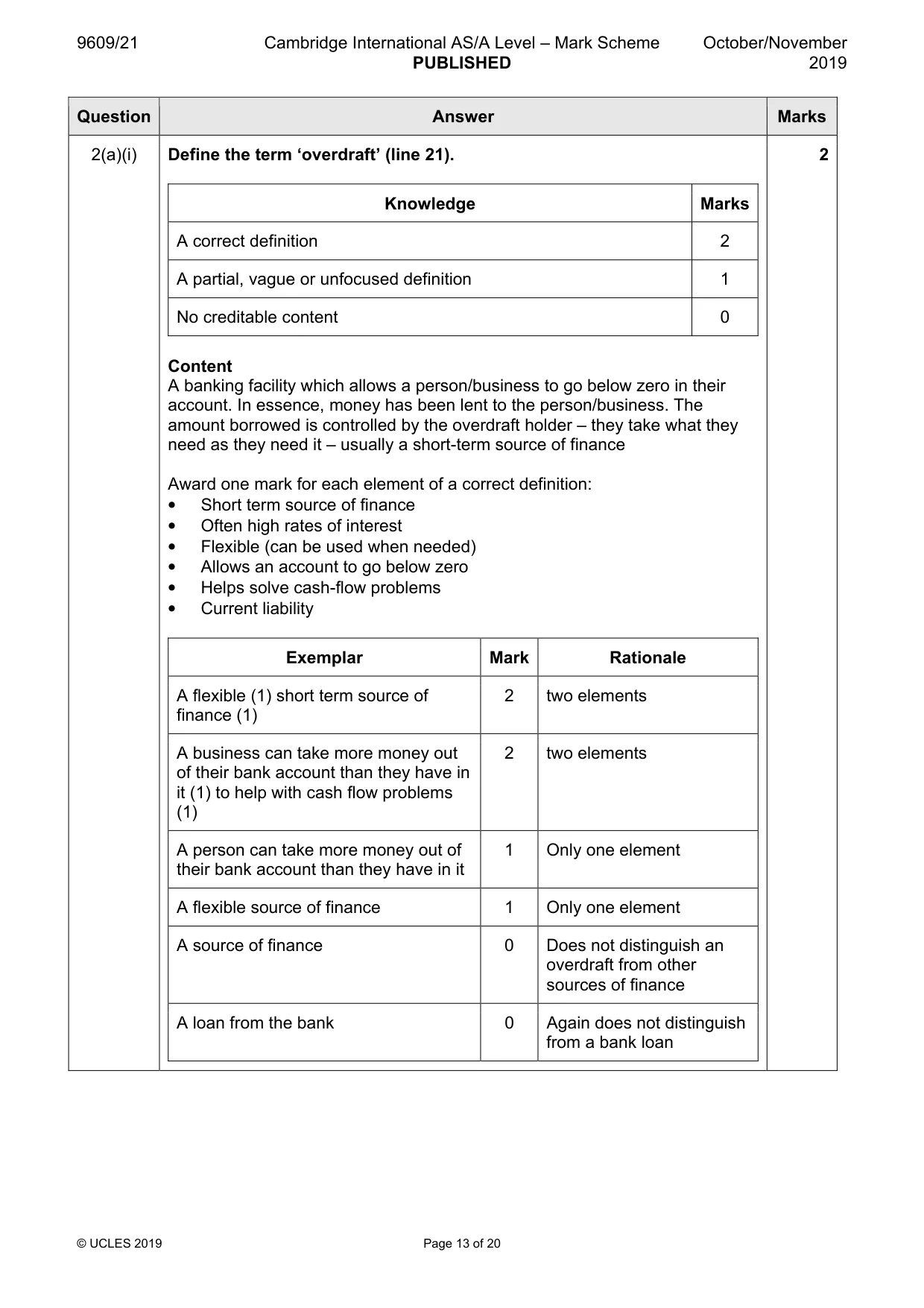
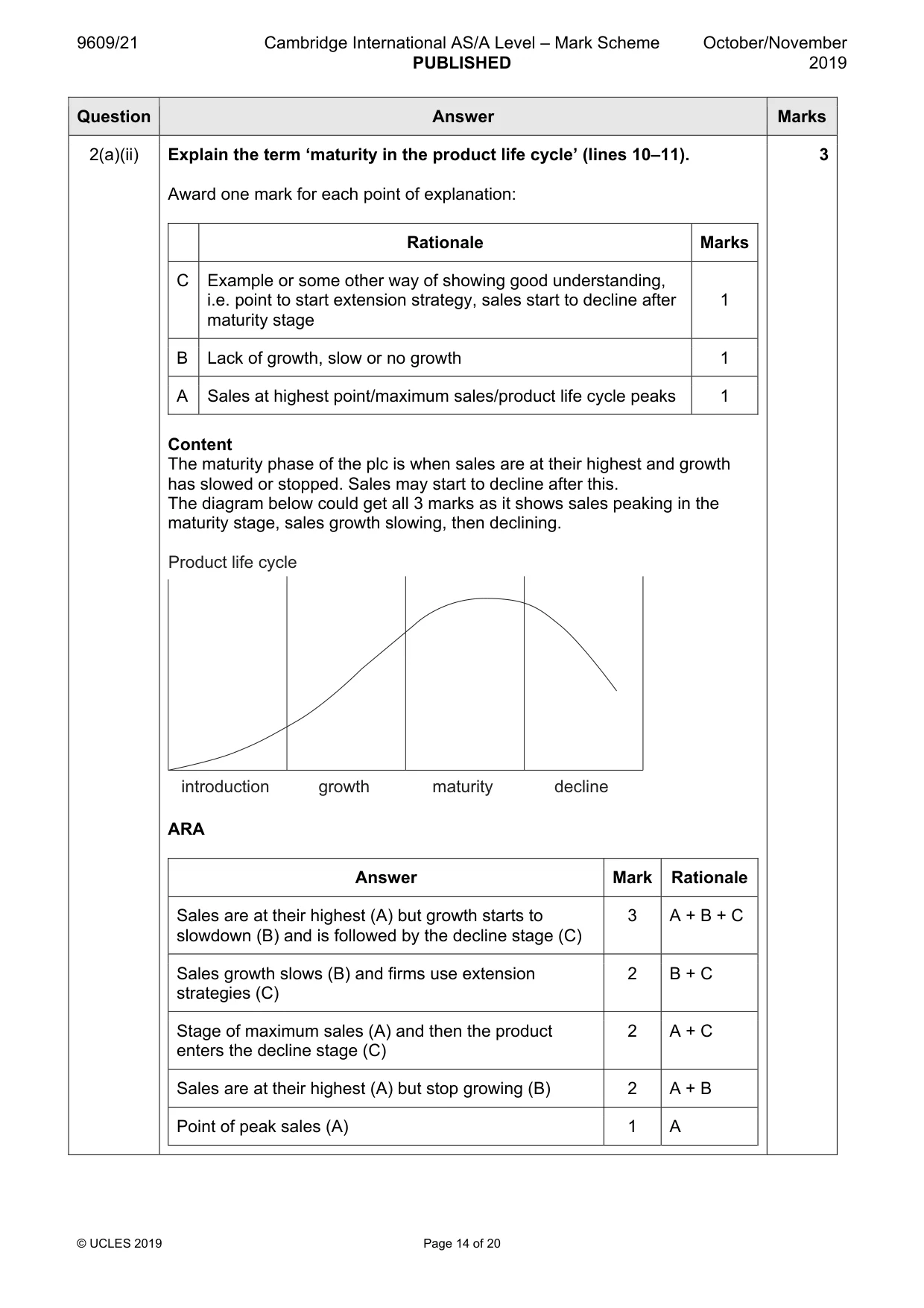
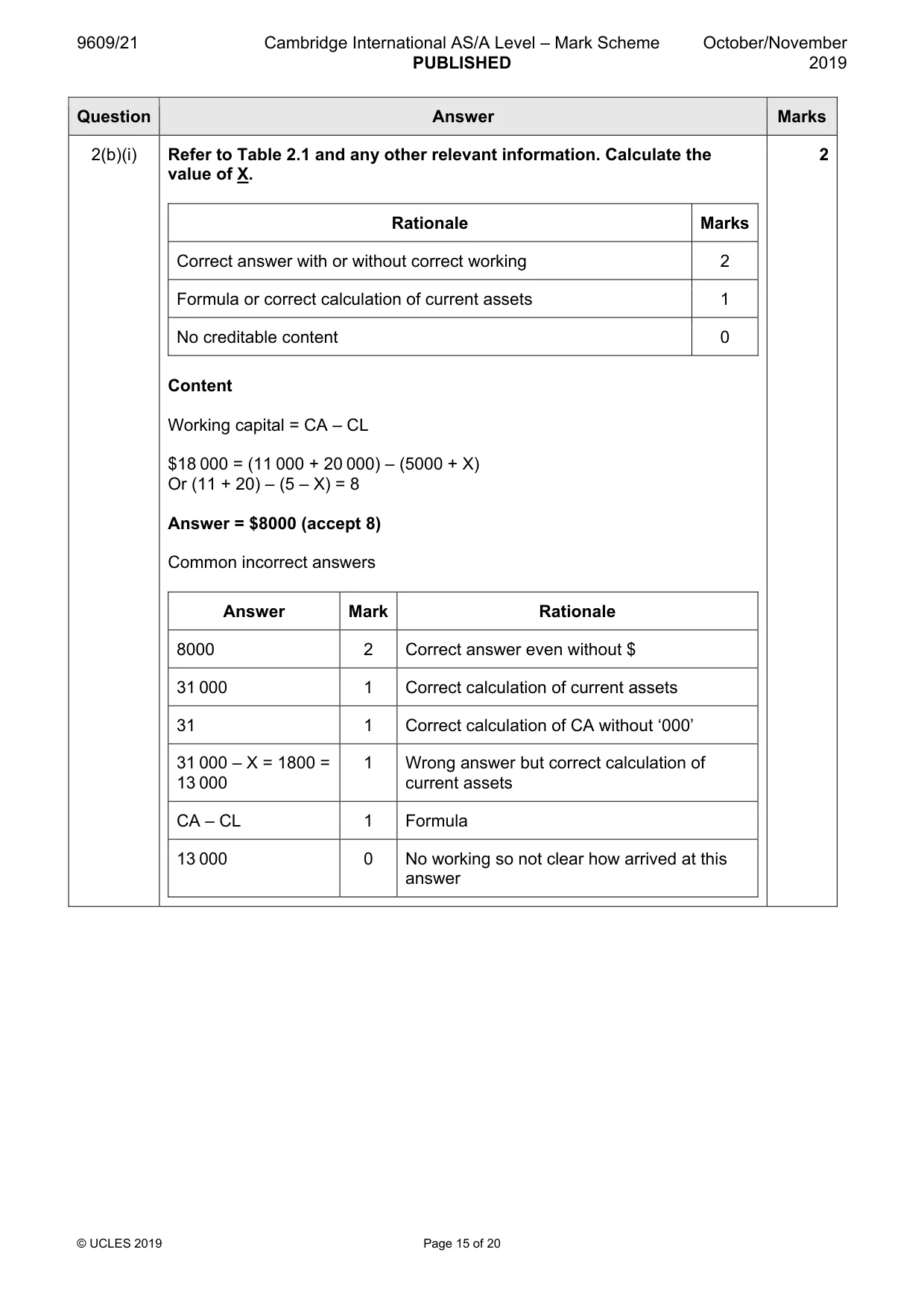
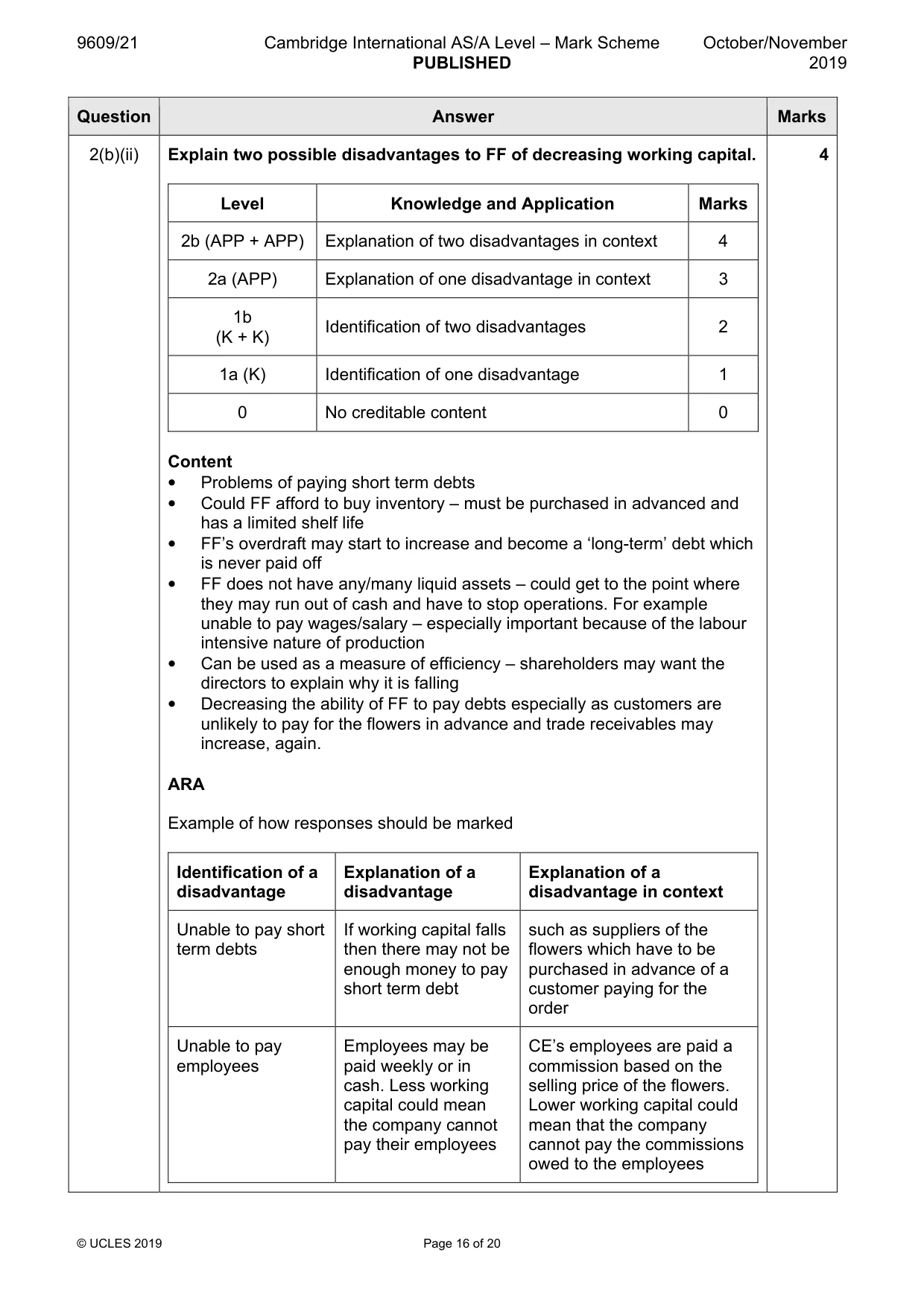
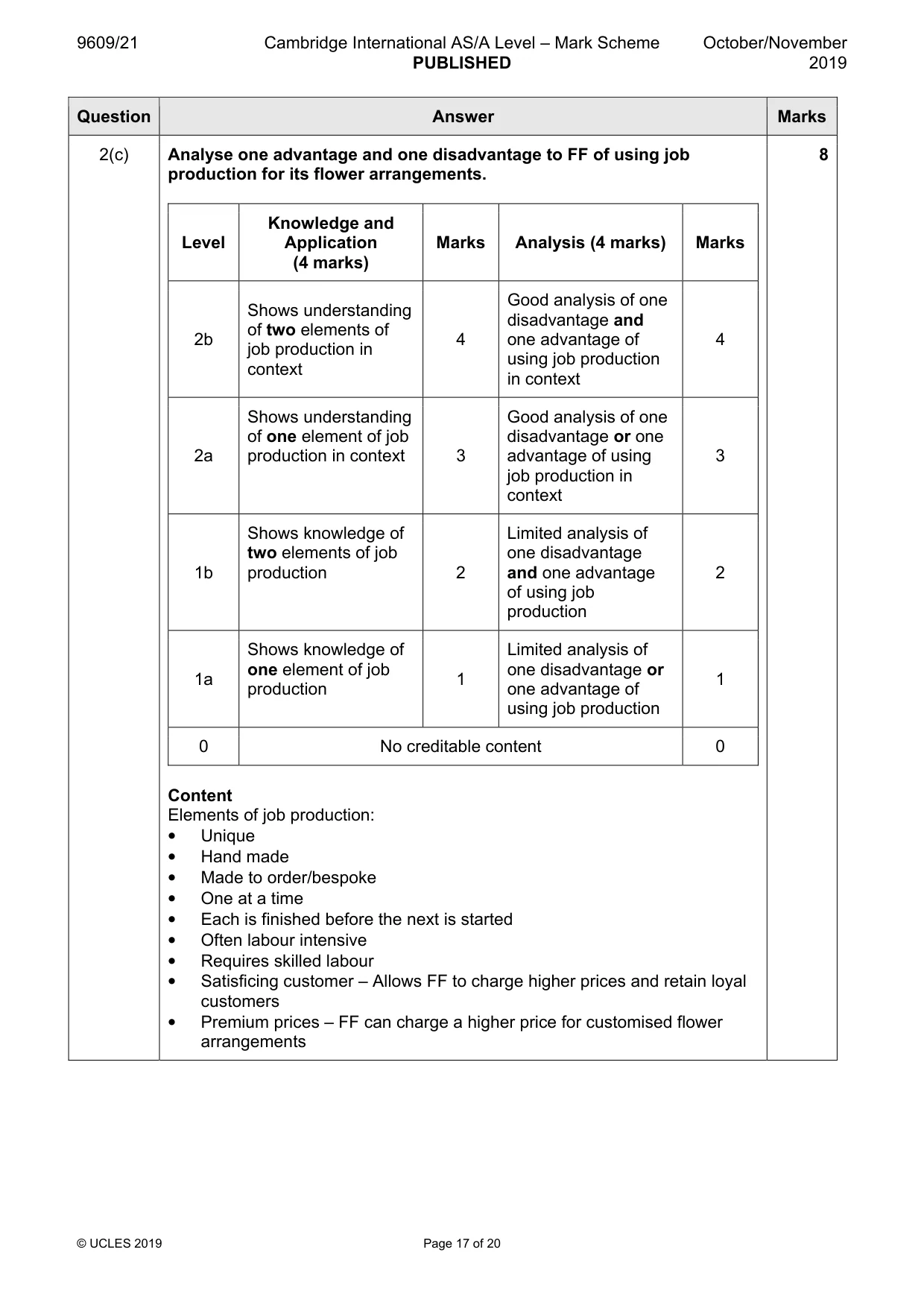
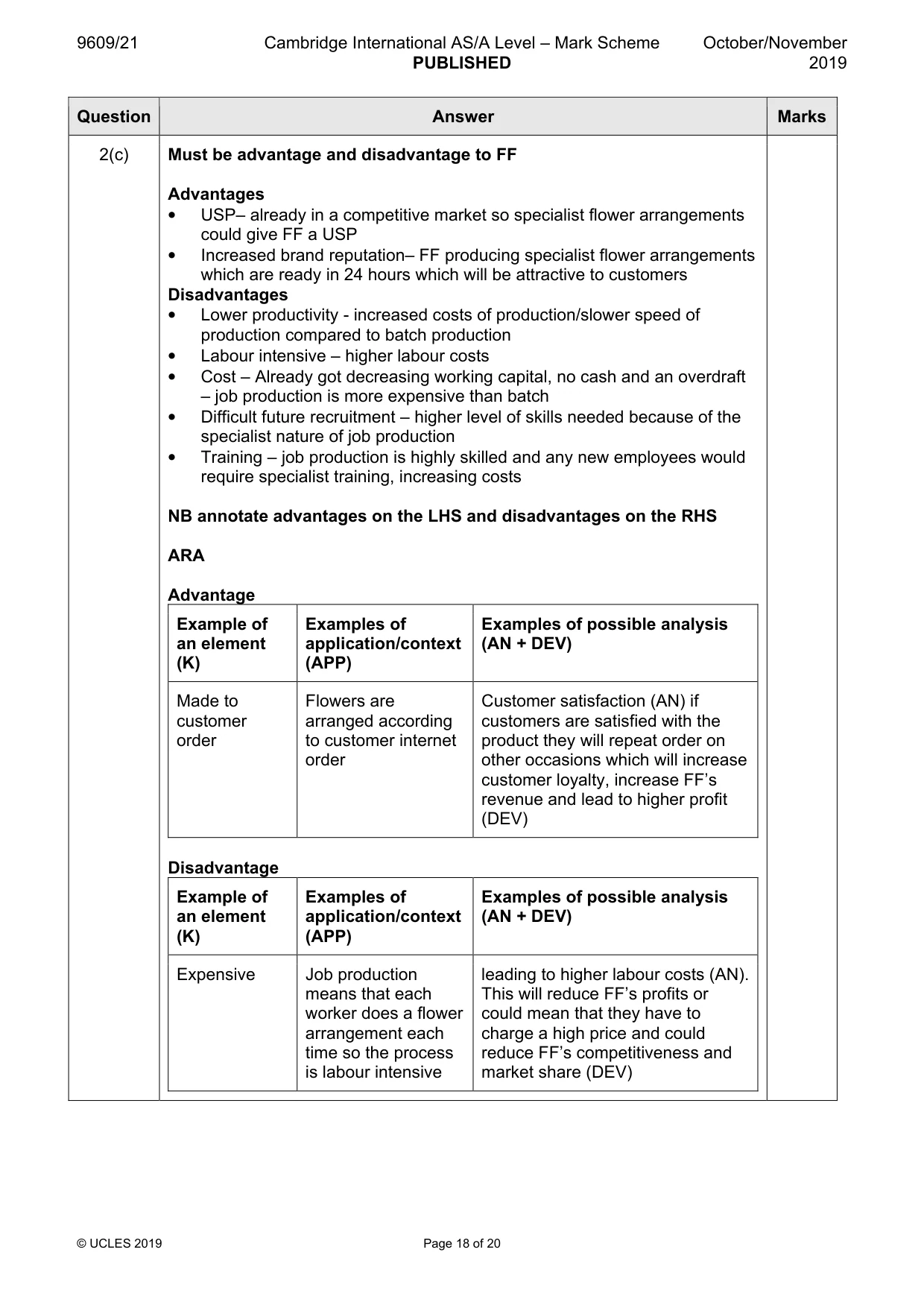
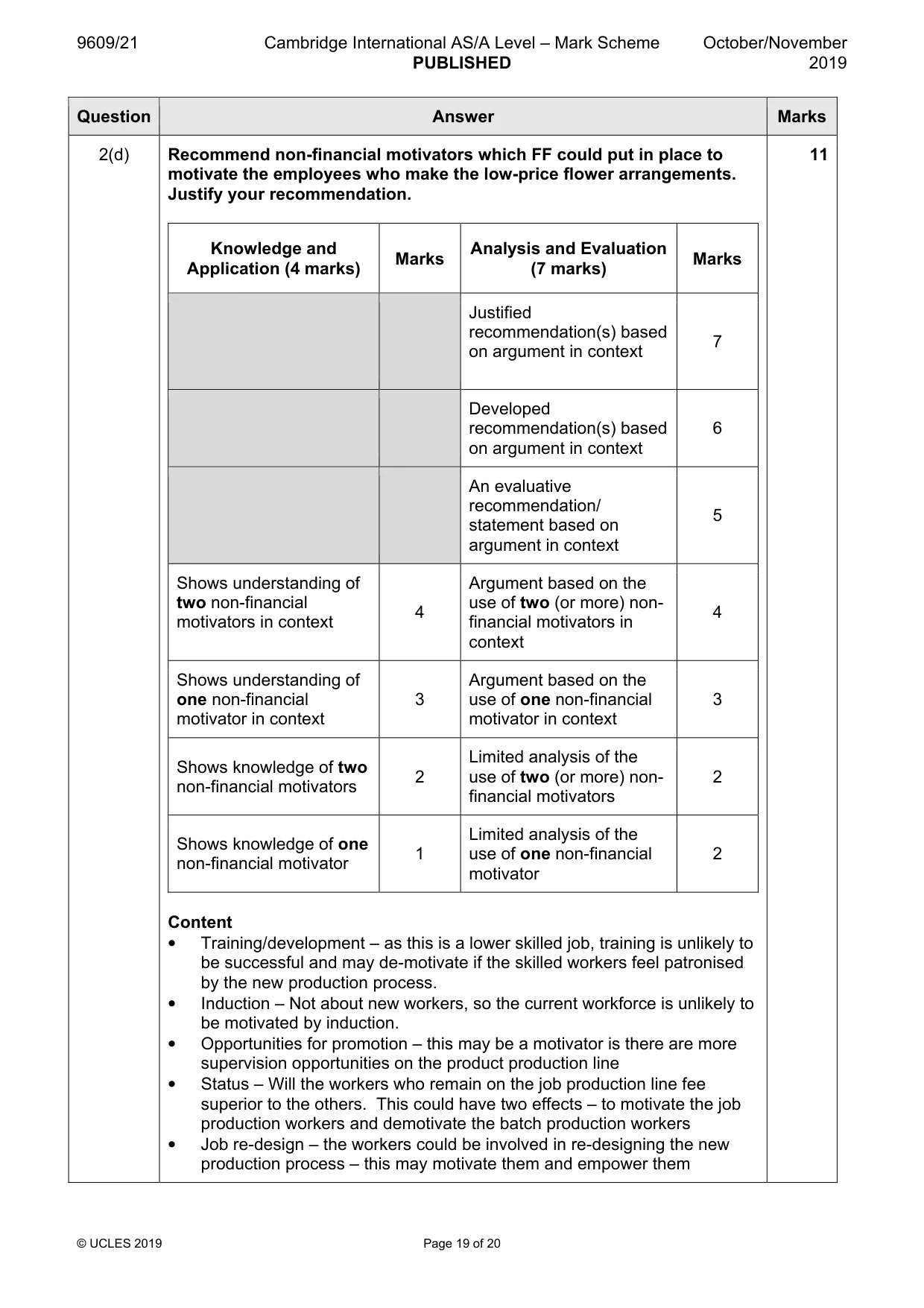
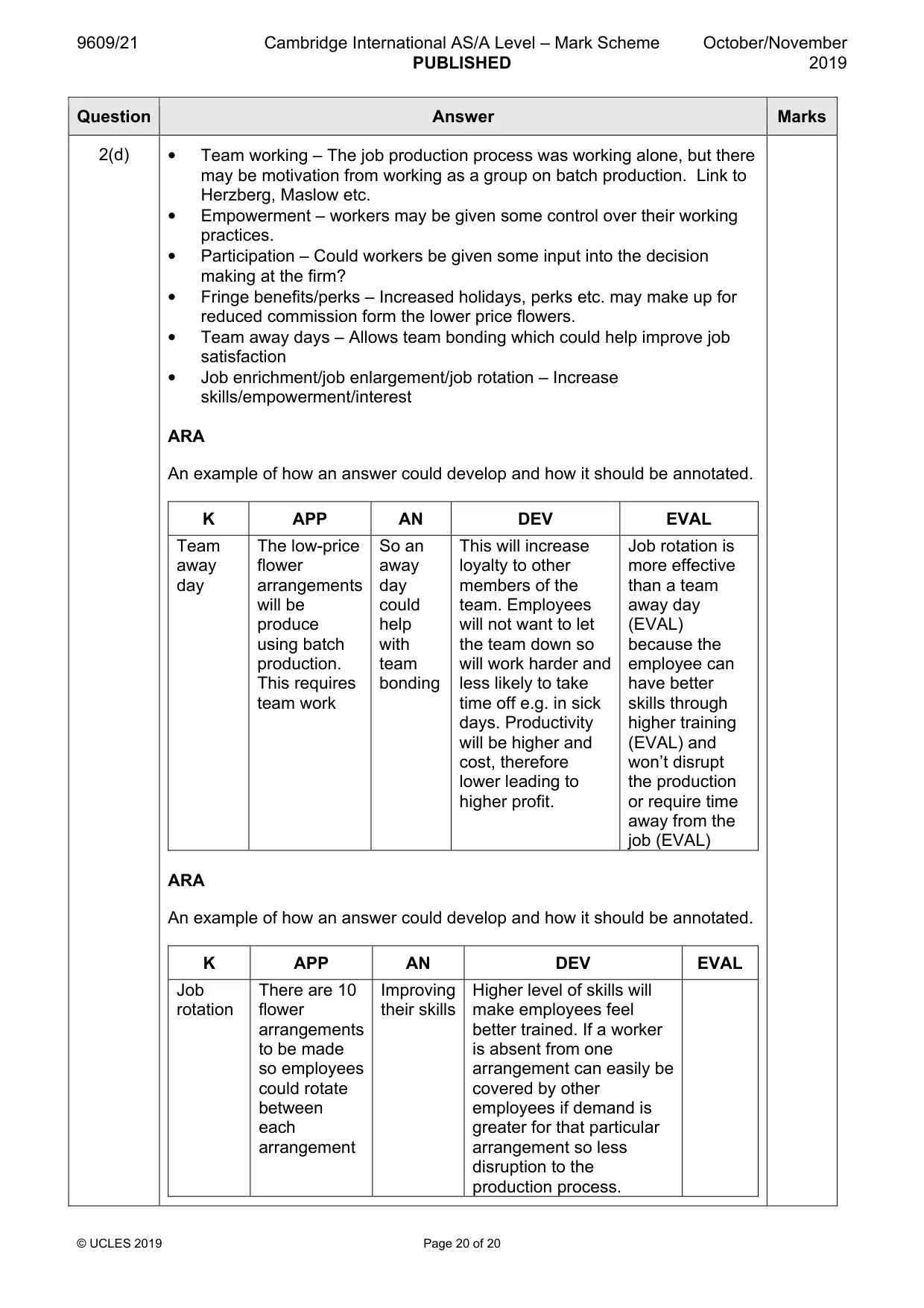
Mark scheme: 2(a)(i) Define the term ‘overdraft’ (line 21). 2 Knowledge Marks A correct definition 2 A partial, vague or unfocused definition 1 No creditable content 0 Content A banking facility which allows a person/business to go below zero in their account. In essence, money has been lent to the person/business. The amount borrowed is controlled by the overdraft holder – they take what they need as they need it – usually a short-term source of finance Award one mark for each element of a correct definition: • Short term source of finance • Often high rates of interest • Flexible (can be used when needed) • Allows an account to go below zero • Helps solve cash-flow problems • Current liability Exemplar Mark Rationale A flexible (1) short term source of 2 two elements finance (1) A business can take more money out 2 two elements of their bank account than they have in it (1) to help with cash flow problems (1) A person can take more money out of 1 Only one element their bank account than they have in it A flexible source of finance 1 Only one element A source of finance 0 Does not distinguish an overdraft from other sources of finance A loan from the bank 0 Again does not distinguish from a bank loan 2(a)(ii) Explain the term ‘maturity in the product life cycle’ (lines 10–11). 3 Award one mark for each point of explanation: Rationale Marks C Example or some other way of showing good understanding, i.e. point to start extension strategy, sales start to decline after 1 maturity stage B Lack of growth, slow or no growth 1 A Sales at highest point/maximum sales/product life cycle peaks 1 Content The maturity phase of the plc is when sales are at their highest and growth has slowed or stopped. Sales may start to decline after this. The diagram below could get all 3 marks as it shows sales peaking in the maturity stage, sales growth slowing, then declining. Product life cycle introduction growth maturity decline ARA Answer Mark Rationale Sales are at their highest (A) but growth starts to 3 A + B + C slowdown (B) and is followed by the decline stage (C) Sales growth slows (B) and firms use extension 2 B + C strategies (C) Stage of maximum sales (A) and then the product 2 A + C enters the decline stage (C) Sales are at their highest (A) but stop growing (B) 2 A + B Point of peak sales (A) 1 A 2(b)(i) Refer to Table 2.1 and any other relevant information. Calculate the 2 value of X. Rationale Marks Correct answer with or without correct working 2 Formula or correct calculation of current assets 1 No creditable content 0 Content Working capital = CA – CL $18 000 = (11 000 + 20 000) – (5000 + X) Or (11 + 20) – (5 – X) = 8 Answer = $8000 (accept 8) Common incorrect answers Answer Mark Rationale 8000 2 Correct answer even without $ 31 000 1 Correct calculation of current assets 31 1 Correct calculation of CA without ‘000’ 31 000 – X = 1800 = 1 Wrong answer but correct calculation of 13 000 current assets CA – CL 1 Formula 13 000 0 No working so not clear how arrived at this answer 2(b)(ii) Explain two possible disadvantages to FF of decreasing working capital. 4 Level Knowledge and Application Marks 2b (APP + APP) Explanation of two disadvantages in context 4 2a (APP) Explanation of one disadvantage in context 3 1b Identification of two disadvantages 2 (K + K) 1a (K) Identification of one disadvantage 1 0 No creditable content 0 Content • Problems of paying short term debts • Could FF afford to buy inventory – must be purchased in advanced and has a limited shelf life • FF’s overdraft may start to increase and become a ‘long-term’ debt which is never paid off • FF does not have any/many liquid assets – could get to the point where they may run out of cash and have to stop operations. For example unable to pay wages/salary – especially important because of the labour intensive nature of production • Can be used as a measure of efficiency – shareholders may want the directors to explain why it is falling • Decreasing the ability of FF to pay debts especially as customers are unlikely to pay for the flowers in advance and trade receivables may increase, again. ARA Example of how responses should be marked Identification of a Explanation of a Explanation of a disadvantage disadvantage disadvantage in context Unable to pay short If working capital falls such as suppliers of the term debts then there may not be flowers which have to be enough money to pay purchased in advance of a short term debt customer paying for the order Unable to pay Employees may be CE’s employees are paid a employees paid weekly or in commission based on the cash. Less working selling price of the flowers. capital could mean Lower working capital could the company cannot mean that the company pay their employees cannot pay the commissions owed to the employees 2(c) Analyse one advantage and one disadvantage to FF of using job 8 production for its flower arrangements. Knowledge and Level Application Marks Analysis (4 marks) Marks (4 marks) Good analysis of one Shows understanding disadvantage and of two elements of 2b 4 one advantage of 4 job production in using job production context in context Shows understanding Good analysis of one of one element of job disadvantage or one 2a production in context 3 advantage of using 3 job production in context Shows knowledge of Limited analysis of two elements of job one disadvantage 1b production 2 and one advantage 2 of using job production Shows knowledge of Limited analysis of one element of job one disadvantage or 1a 1 1 production one advantage of using job production 0 No creditable content 0 Content Elements of job production: • Unique • Hand made • Made to order/bespoke • One at a time • Each is finished before the next is started • Often labour intensive • Requires skilled labour • Satisficing customer – Allows FF to charge higher prices and retain loyal customers • Premium prices – FF can charge a higher price for customised flower arrangements 2(c) Must be advantage and disadvantage to FF Advantages • USP– already in a competitive market so specialist flower arrangements could give FF a USP • Increased brand reputation– FF producing specialist flower arrangements which are ready in 24 hours which will be attractive to customers Disadvantages • Lower productivity - increased costs of production/slower speed of production compared to batch production • Labour intensive – higher labour costs • Cost – Already got decreasing working capital, no cash and an overdraft – job production is more expensive than batch • Difficult future recruitment – higher level of skills needed because of the specialist nature of job production • Training – job production is highly skilled and any new employees would require specialist training, increasing costs NB annotate advantages on the LHS and disadvantages on the RHS ARA Advantage Example of Examples of Examples of possible analysis an element application/context (AN + DEV) (K) (APP) Made to Flowers are Customer satisfaction (AN) if customer arranged according customers are satisfied with the order to customer internet product they will repeat order on order other occasions which will increase customer loyalty, increase FF’s revenue and lead to higher profit (DEV) Disadvantage Example of Examples of Examples of possible analysis an element application/context (AN + DEV) (K) (APP) Expensive Job production leading to higher labour costs (AN). means that each This will reduce FF’s profits or worker does a flower could mean that they have to arrangement each charge a high price and could time so the process reduce FF’s competitiveness and is labour intensive market share (DEV) 2(d) Recommend non-financial motivators which FF could put in place to 11 motivate the employees who make the low-price flower arrangements. Justify your recommendation. Knowledge and Analysis and Evaluation Marks Marks Application (4 marks) (7 marks) Justified recommendation(s) based 7 on argument in context Developed recommendation(s) based 6 on argument in context An evaluative recommendation/ 5 statement based on argument in context Shows understanding of Argument based on the two non-financial use of two (or more) non- 4 4 motivators in context financial motivators in context Shows understanding of Argument based on the one non-financial 3 use of one non-financial 3 motivator in context motivator in context Limited analysis of the Shows knowledge of two 2 use of two (or more) non- 2 non-financial motivators financial motivators Limited analysis of the Shows knowledge of one 1 use of one non-financial 2 non-financial motivator motivator Content • Training/development – as this is a lower skilled job, training is unlikely to be successful and may de-motivate if the skilled workers feel patronised by the new production process. • Induction – Not about new workers, so the current workforce is unlikely to be motivated by induction. • Opportunities for promotion – this may be a motivator is there are more supervision opportunities on the product production line • Status – Will the workers who remain on the job production line fee superior to the others. This could have two effects – to motivate the job production workers and demotivate the batch production workers • Job re-design – the workers could be involved in re-designing the new production process – this may motivate them and empower them 2(d) • Team working – The job production process was working alone, but there may be motivation from working as a group on batch production. Link to Herzberg, Maslow etc. • Empowerment – workers may be given some control over their working practices. • Participation – Could workers be given some input into the decision making at the firm? • Fringe benefits/perks – Increased holidays, perks etc. may make up for reduced commission form the lower price flowers. • Team away days – Allows team bonding which could help improve job satisfaction • Job enrichment/job enlargement/job rotation – Increase skills/empowerment/interest ARA An example of how an answer could develop and how it should be annotated. K APP AN DEV EVAL Team The low-price So an This will increase Job rotation is away flower away loyalty to other more effective day arrangements day members of the than a team will be could team. Employees away day produce help will not want to let (EVAL) using batch with the team down so because the production. team will work harder and employee can This requires bonding less likely to take have better team work time off e.g. in sick skills through days. Productivity higher training will be higher and (EVAL) and cost, therefore won’t disrupt lower leading to the production higher profit. or require time away from the job (EVAL) ARA An example of how an answer could develop and how it should be annotated. K APP AN DEV EVAL Job There are 10 Improving Higher level of skills will rotation flower their skills make employees feel arrangements better trained. If a worker to be made is absent from one so employees arrangement can easily be could rotate covered by other between employees if demand is each greater for that particular arrangement arrangement so less disruption to the production process.
Q50 · Kilometres of the FF premises
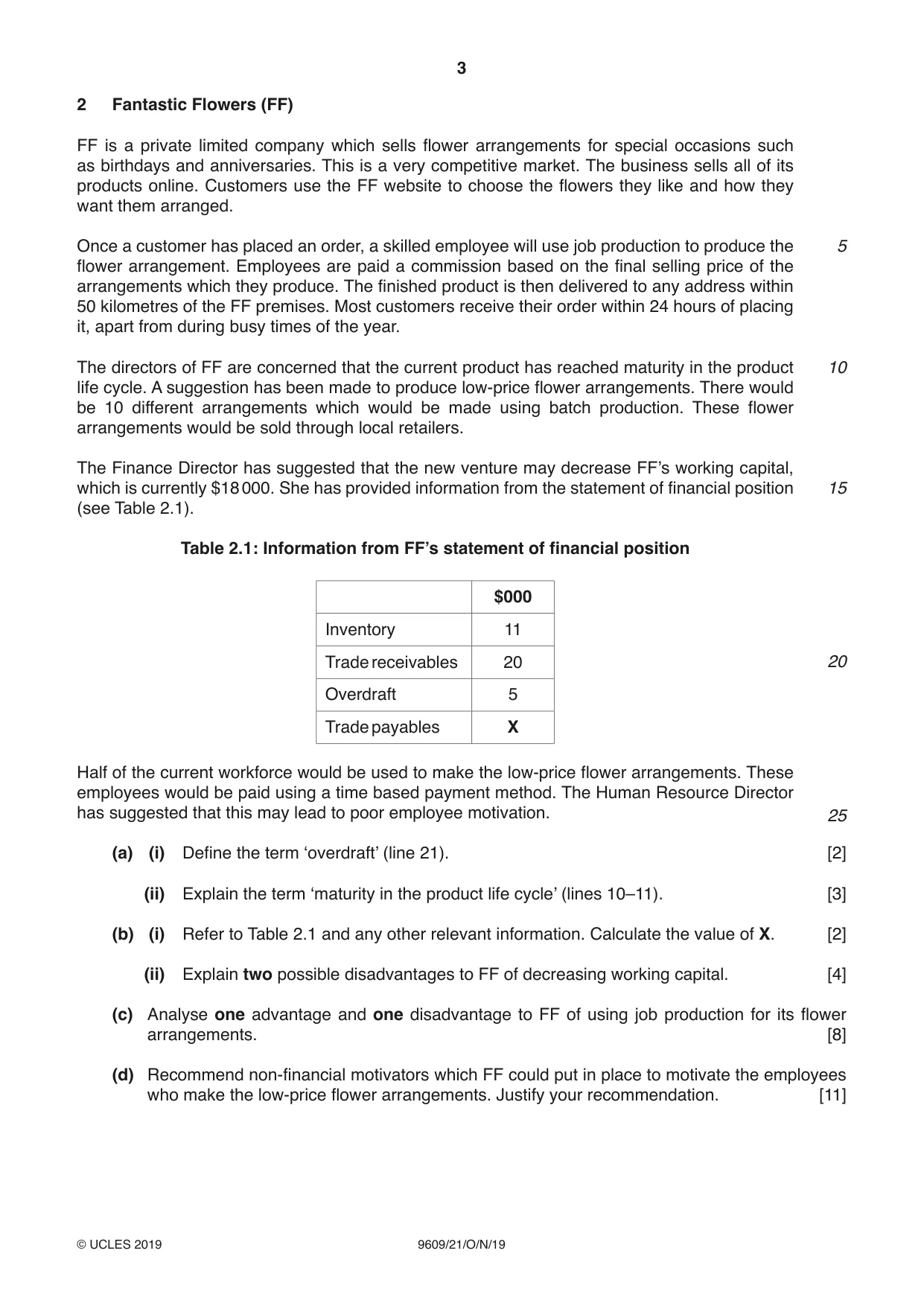
50 kilometres of the FF premises. Most customers receive their order within 24 hours of placing it, apart from during busy times of the year. The directors of FF are concerned that the current product has reached maturity in the product 10 life cycle. A suggestion has been made to produce low-price flower arrangements. There would be 10 different arrangements which would be made using batch production. These flower arrangements would be sold through local retailers. The Finance Director has suggested that the new venture may decrease FF’s working capital, which is currently $18 000. She has provided information from the statement of financial position 15 (see Table 2.1). Table 2.1: Information from FF’s statement of financial position $000 Inventory 11 Trade receivables 20 20 Overdraft 5 Trade payables X Half of the current workforce would be used to make the low-price flower arrangements. These employees would be paid using a time based payment method. The Human Resource Director has suggested that this may lead to poor employee motivation. 25 (a) (i) Define the term ‘overdraft’ (line 21). [2] (ii) Explain the term ‘maturity in the product life cycle’ (lines 10–11). [3] (b) (i) Refer to Table 2.1 and any other relevant information. Calculate the value of X. [2] (ii) Explain two possible disadvantages to FF of decreasing working capital. [4] (c) Analyse one advantage and one disadvantage to FF of using job production for its flower arrangements. [8] (d) Recommend non-financial motivators which FF could put in place to motivate the employees who make the low-price flower arrangements. Justify your recommendation. [11]
What was in this paper
The subtopics covered by these 3 questions, and how many questions each got. Open one in a new tab to see every Cambridge question on it.
What you needed in this session
Cambridge’s own grade thresholds for 2019 Oct/Nov, Paper 2 · Variant 1. A higher threshold means an easier paper — the bar moves with how the cohort did.