Cambridge A Level Business (for first examination in 2016) 9609 — 2019 May/June Paper 2 · Variant 2
9609/22/M/J/19 · 2 questions · 60 marks · ≈68 min
The question paper and its mark scheme, free to read here and free to download. This is Cambridge’s own paper, exactly as it was sat.
Question paper4 pages
Mark scheme24 pages
Answers below. Sit the paper first if you are practising.

Questions as text
Q1 · Job Shop (JS) JS is a public sector organisation in country X
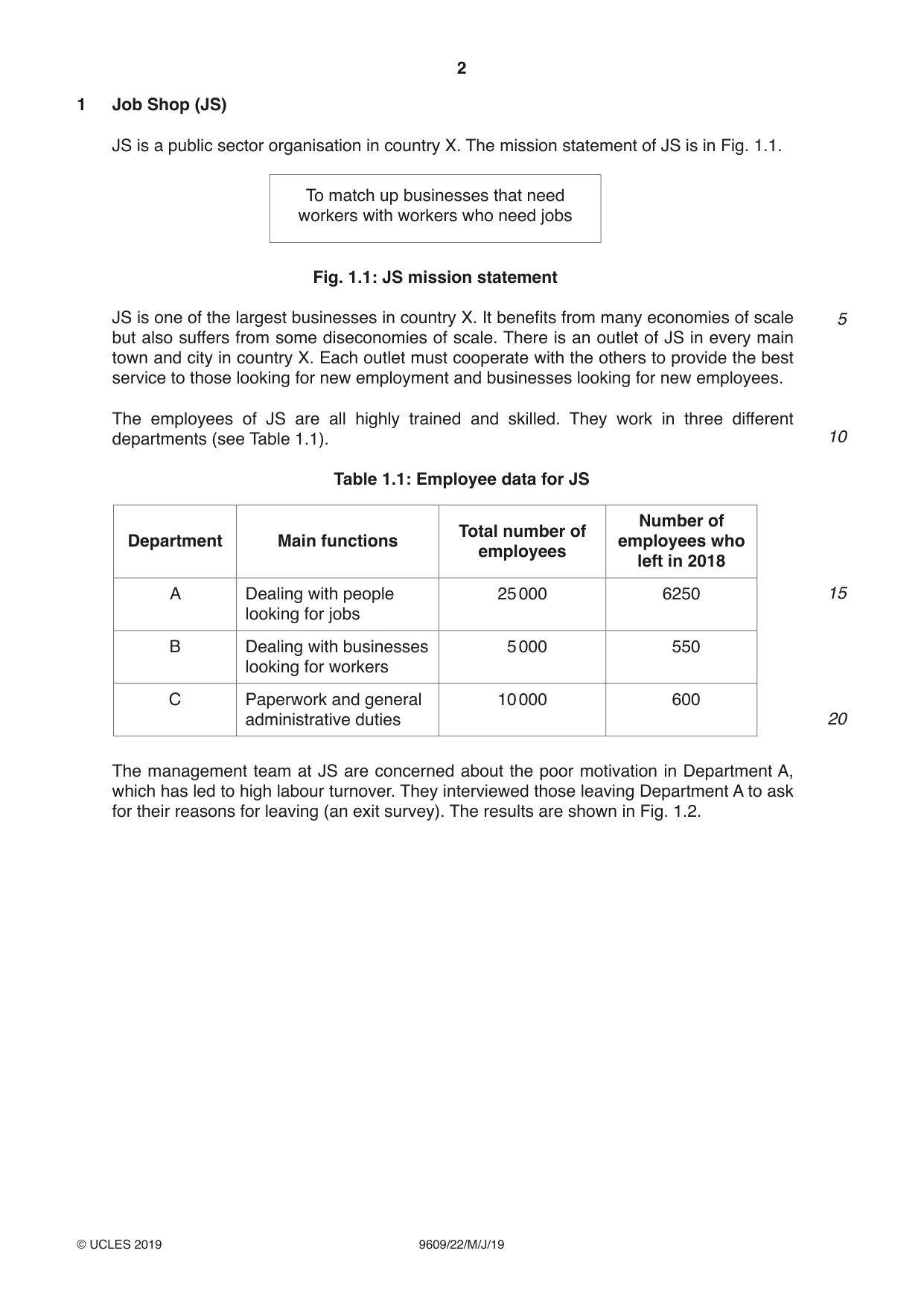
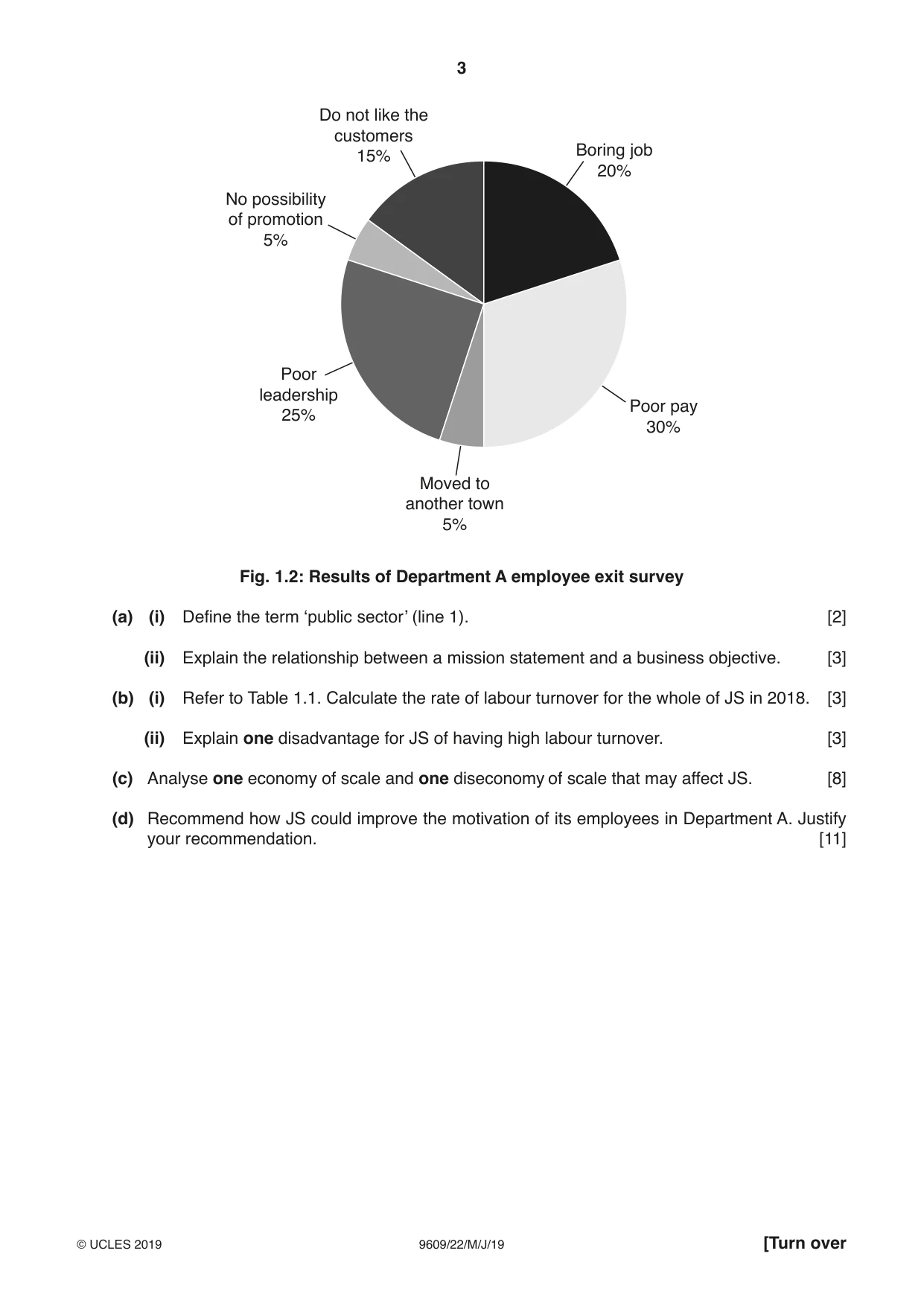
1 Job Shop (JS) JS is a public sector organisation in country X. The mission statement of JS is in Fig. 1.1. To match up businesses that need workers with workers who need jobs Fig. 1.1: JS mission statement JS is one of the largest businesses in country X. It benefits from many economies of scale 5 but also suffers from some diseconomies of scale. There is an outlet of JS in every main town and city in country X. Each outlet must cooperate with the others to provide the best service to those looking for new employment and businesses looking for new employees. The employees of JS are all highly trained and skilled. They work in three different departments (see Table 1.1). 10 Table 1.1: Employee data for JS Number of Total number of Department Main functions employees who employees left in 2018 A Dealing with people 25 000 6250 15 looking for jobs B Dealing with businesses 5 000 550 looking for workers C Paperwork and general 10 000 600 administrative duties 20 The management team at JS are concerned about the poor motivation in Department A, which has led to high labour turnover. They interviewed those leaving Department A to ask for their reasons for leaving (an exit survey). The results are shown in Fig. 1.2. Do not like the customers Boring job 15% 20% No possibility of promotion 5% Poor leadership Poor pay 25% 30% Moved to another town 5% Fig. 1.2: Results of Department A employee exit survey (a) (i) Define the term ‘public sector’ (line 1). [2] (ii) Explain the relationship between a mission statement and a business objective. [3] (b) (i) Refer to Table 1.1. Calculate the rate of labour turnover for the whole of JS in 2018. [3] (ii) Explain one disadvantage for JS of having high labour turnover. [3] (c) Analyse one economy of scale and one diseconomy of scale that may affect JS. [8] (d) Recommend how JS could improve the motivation of its employees in Department A. Justify your recommendation. [11]
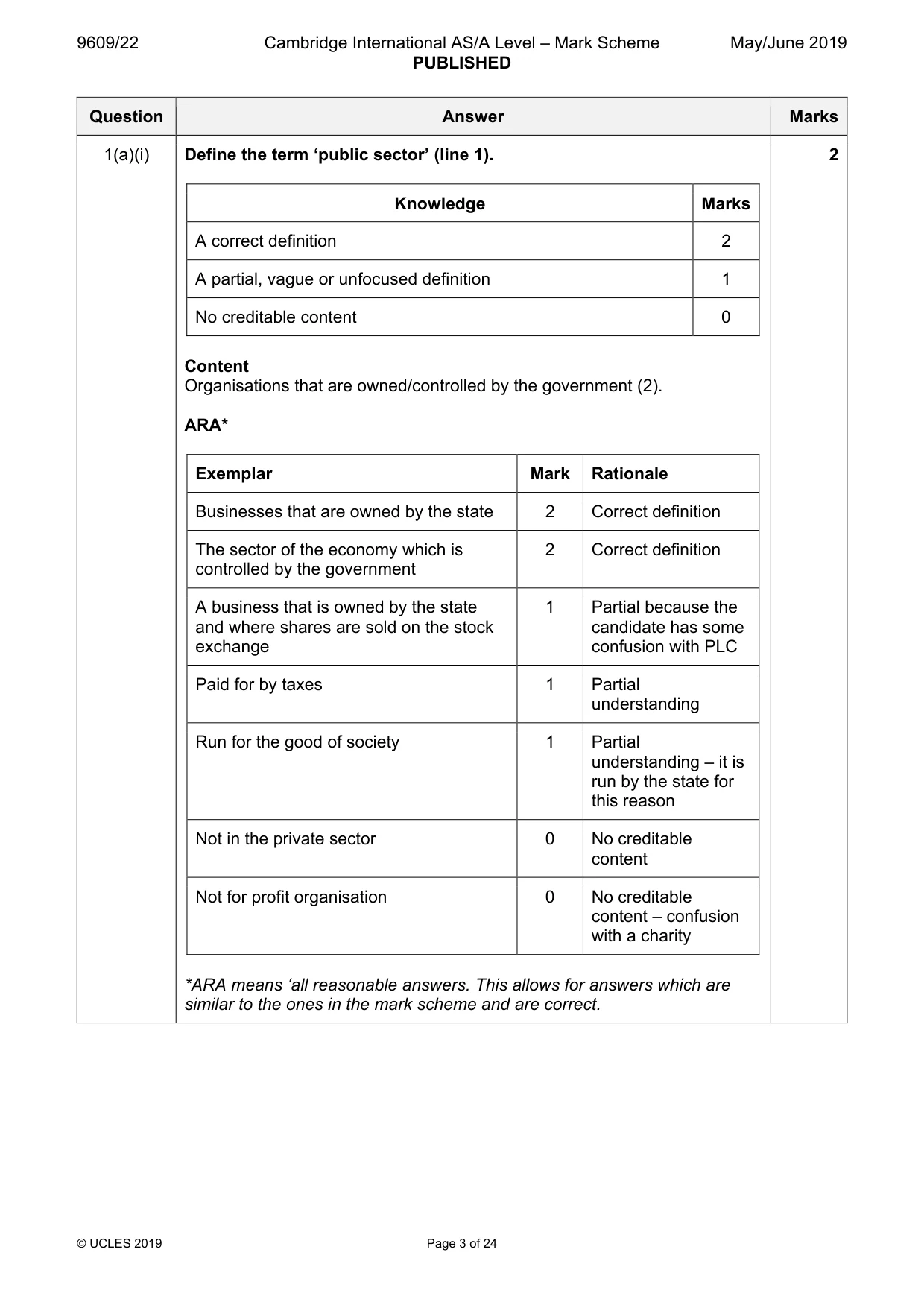
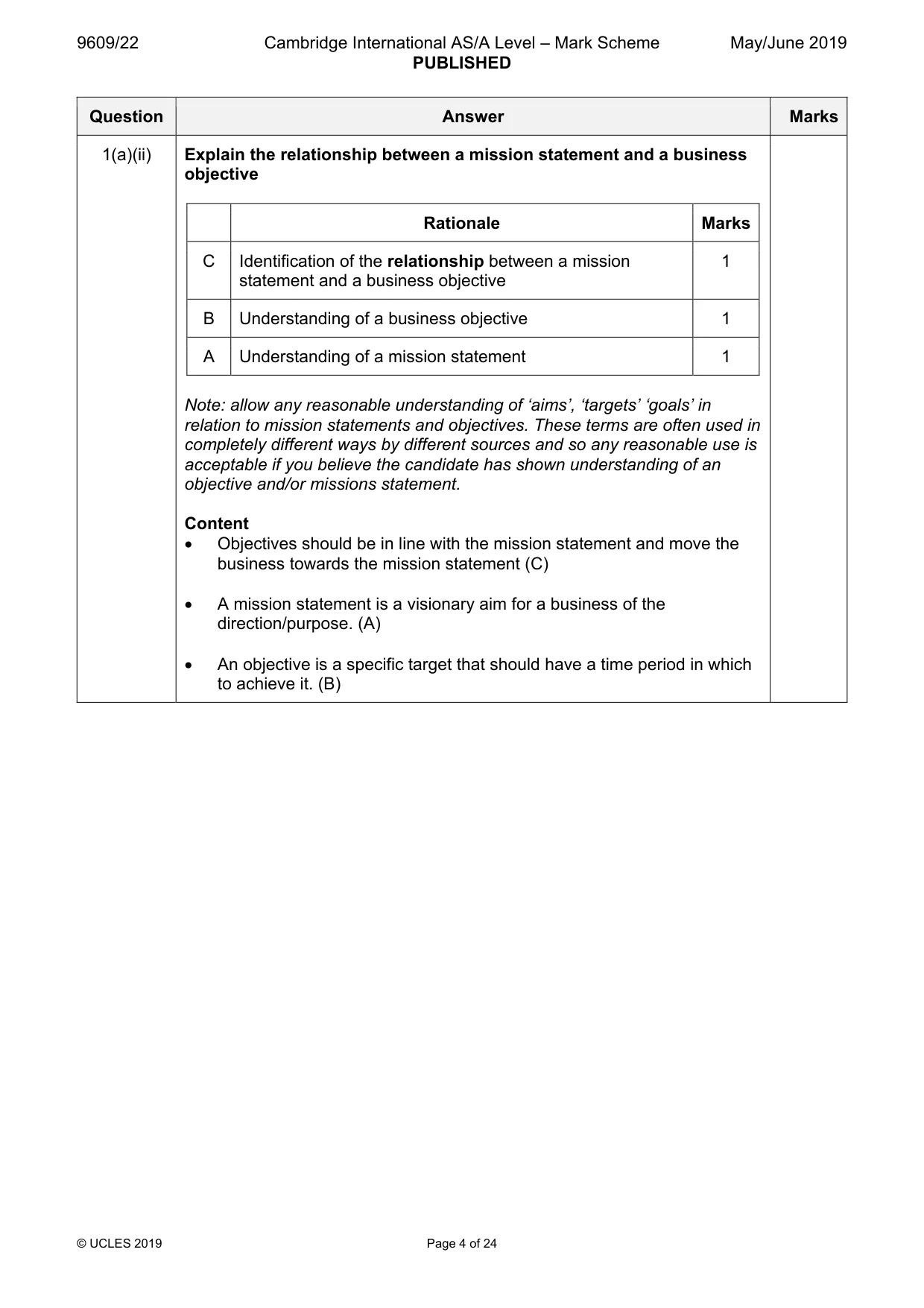
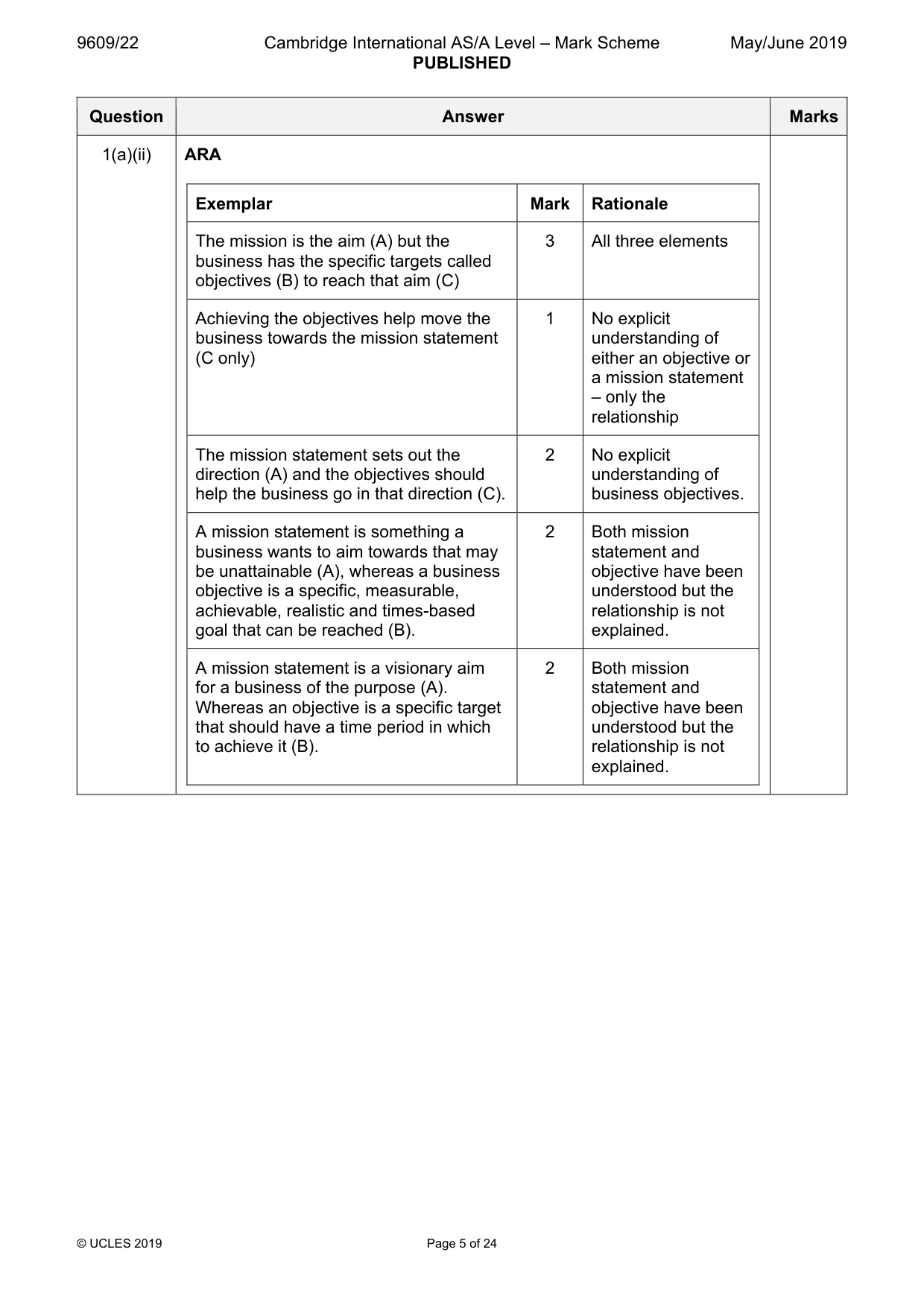
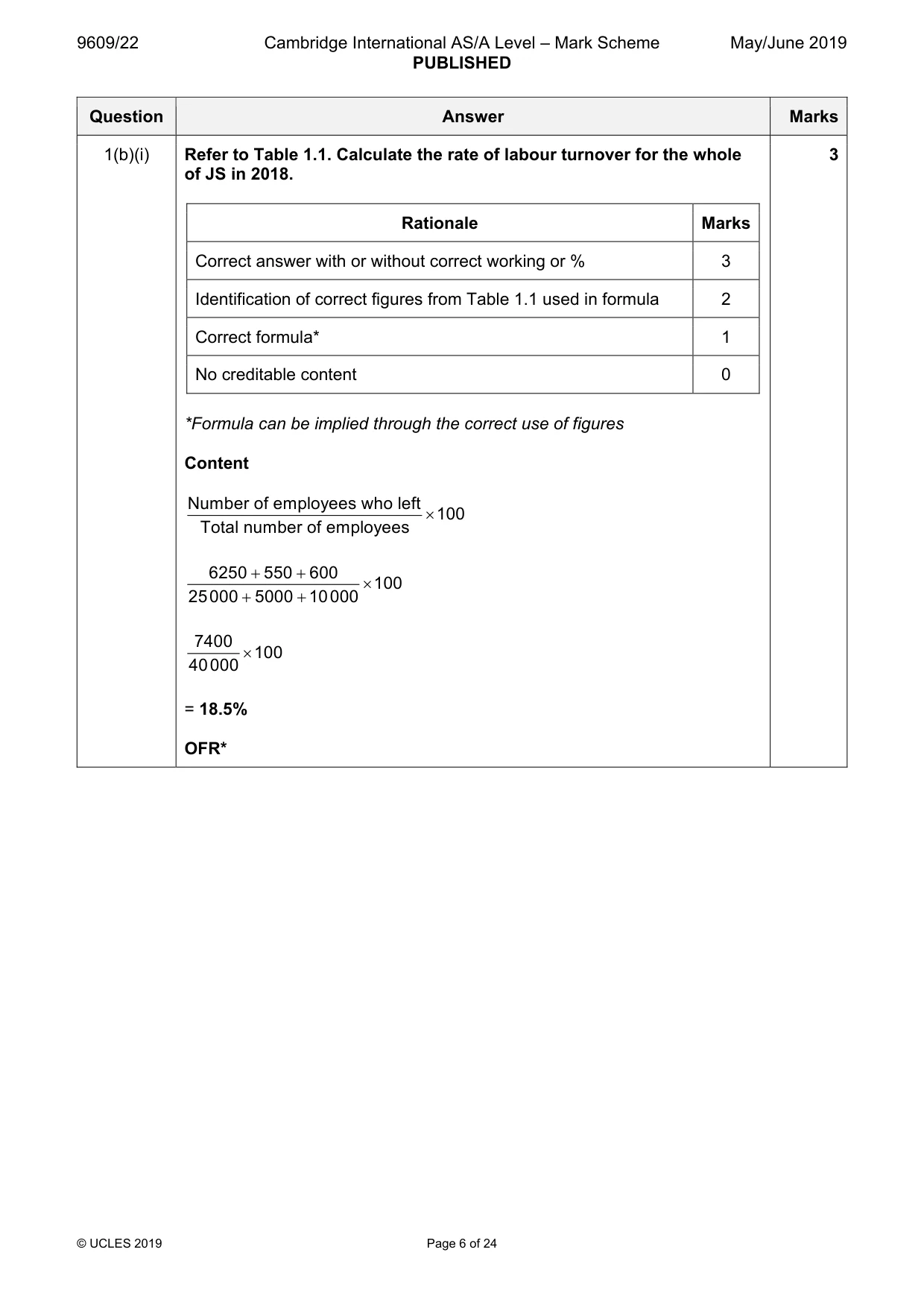
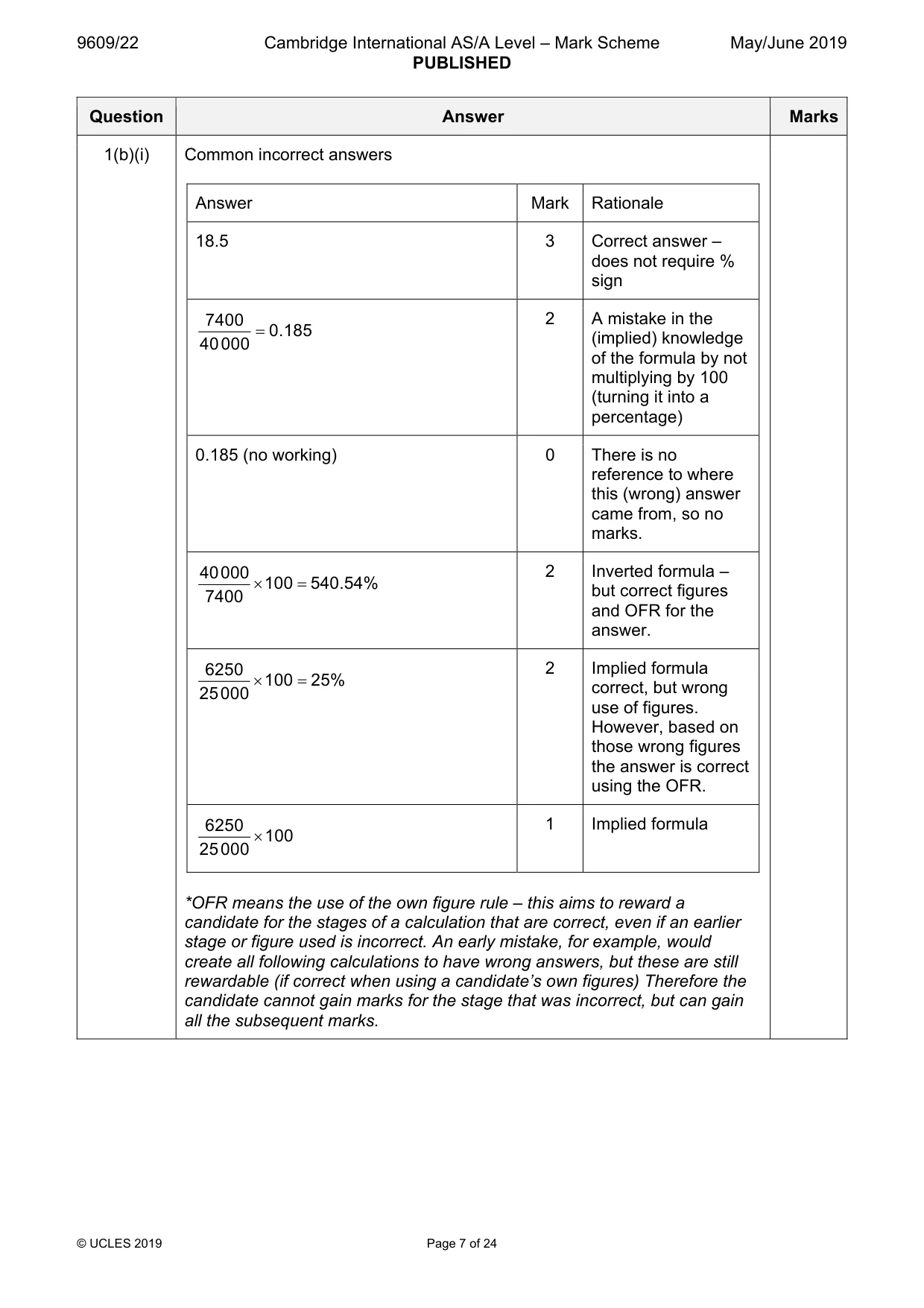
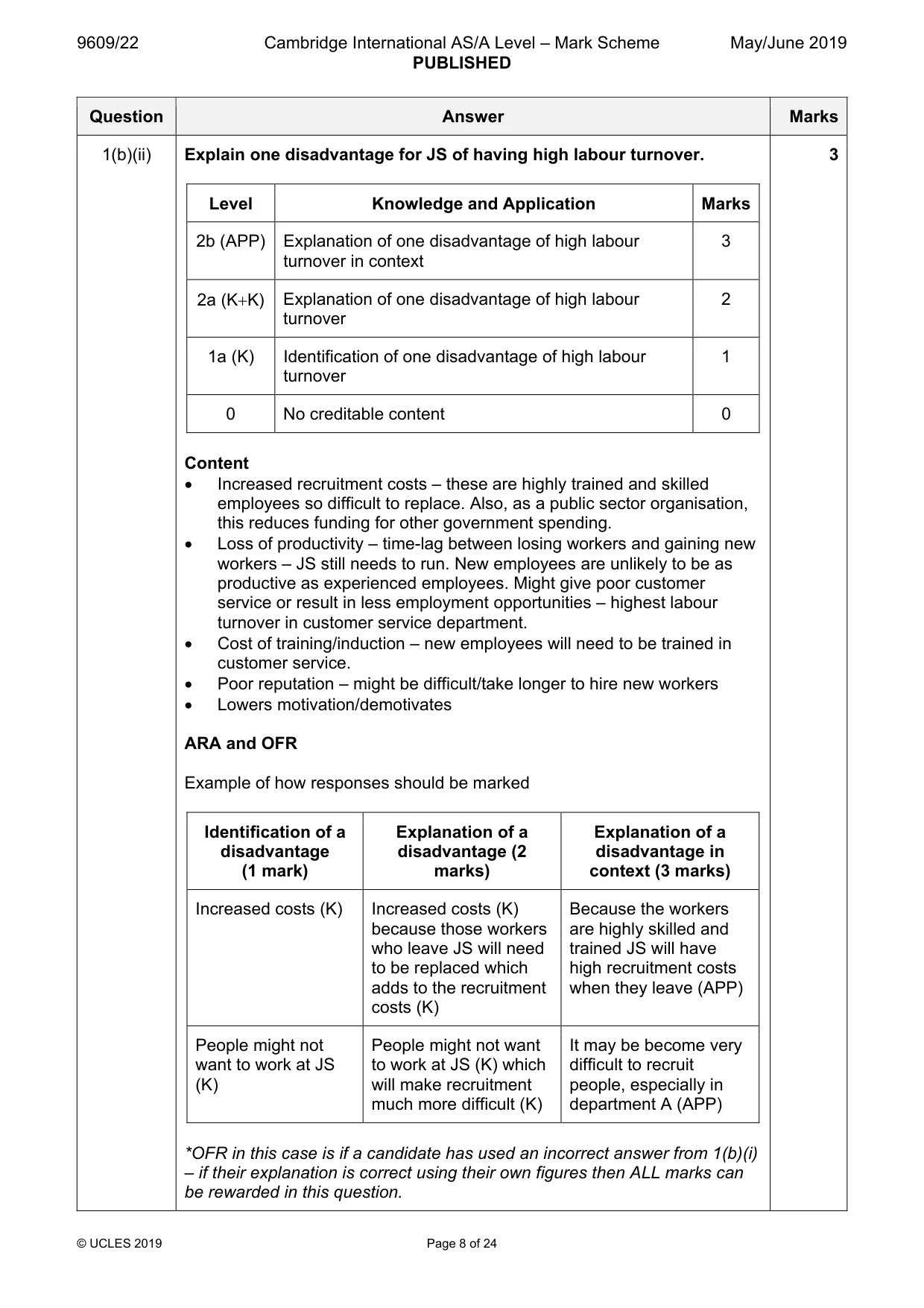
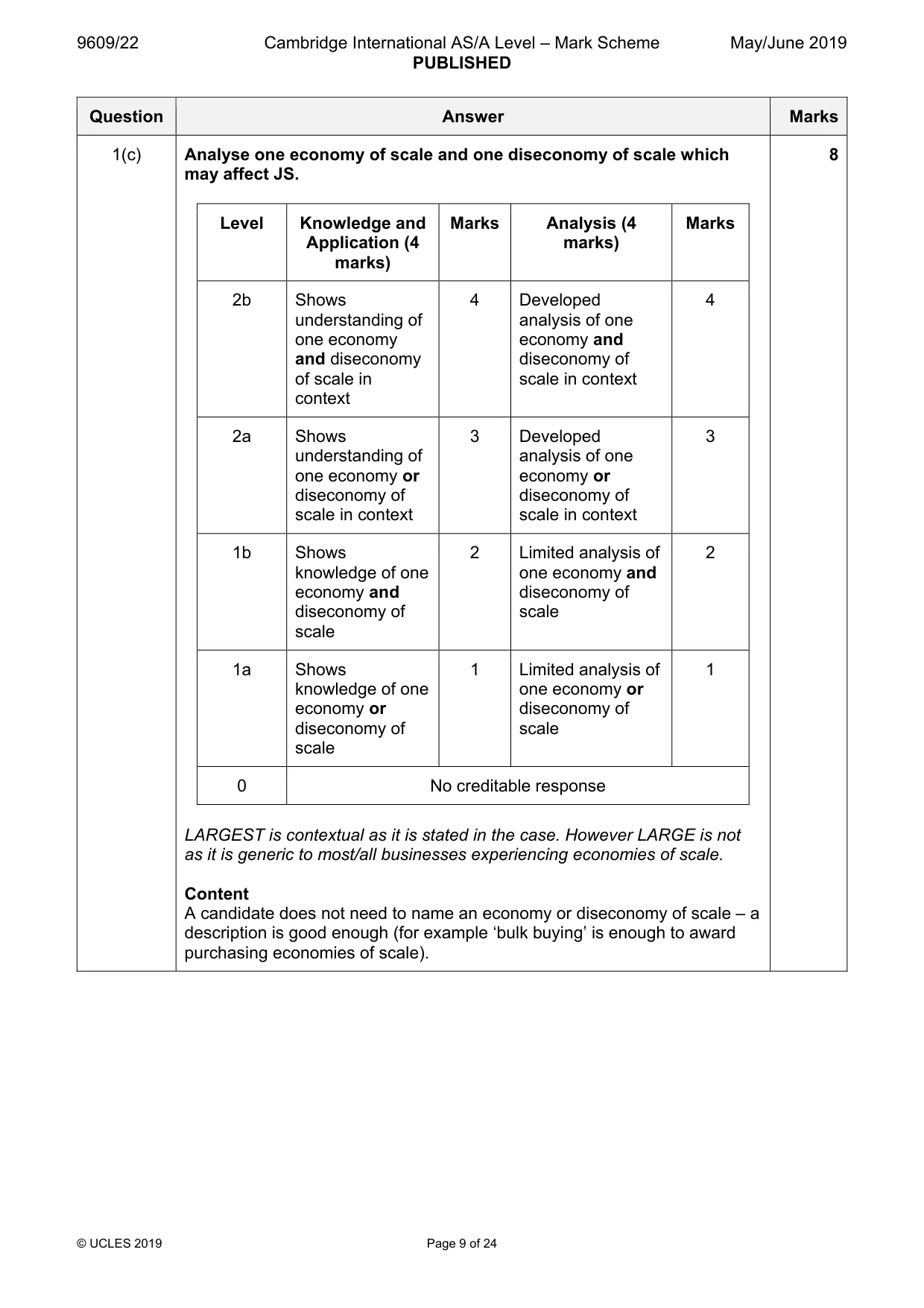
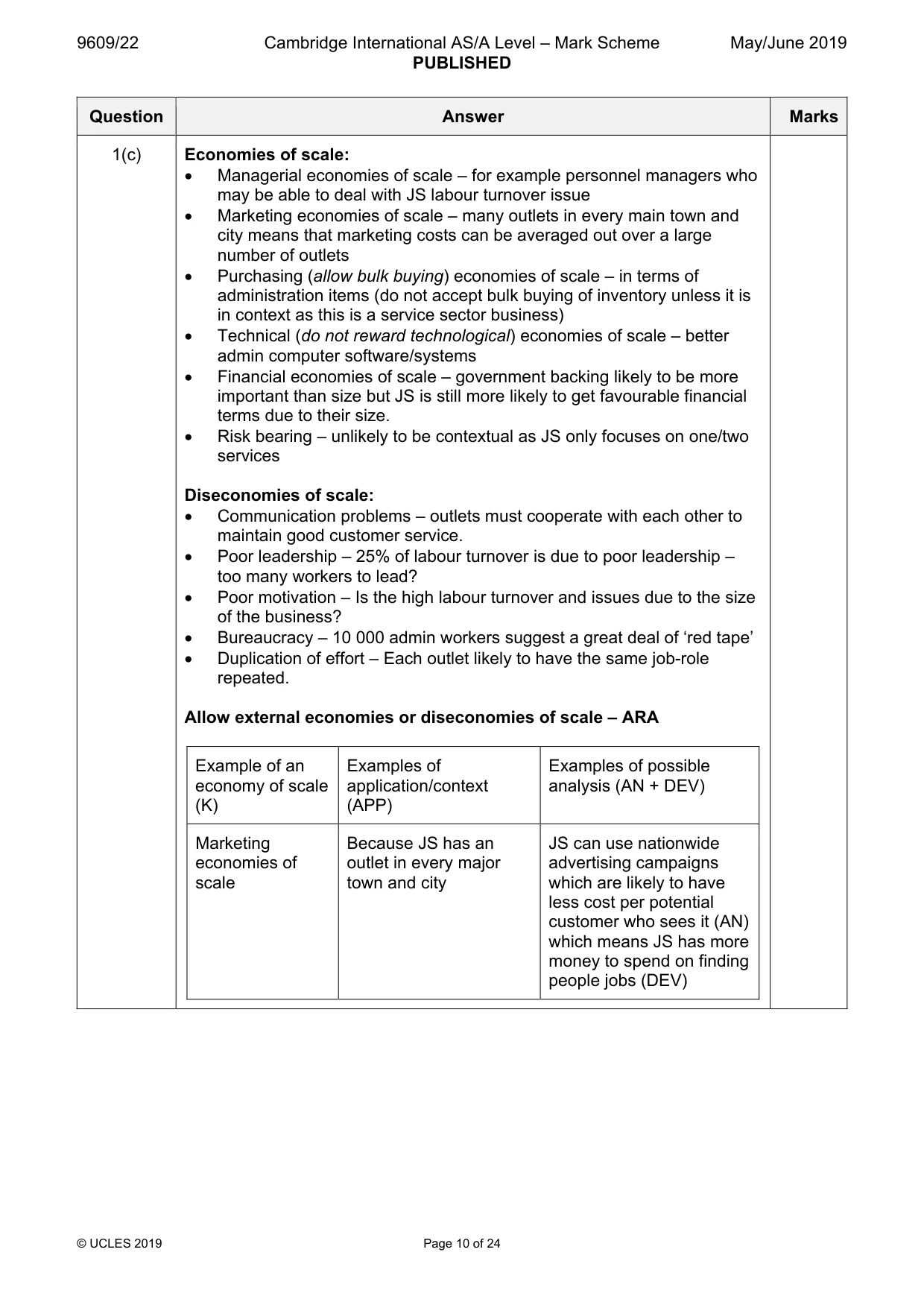
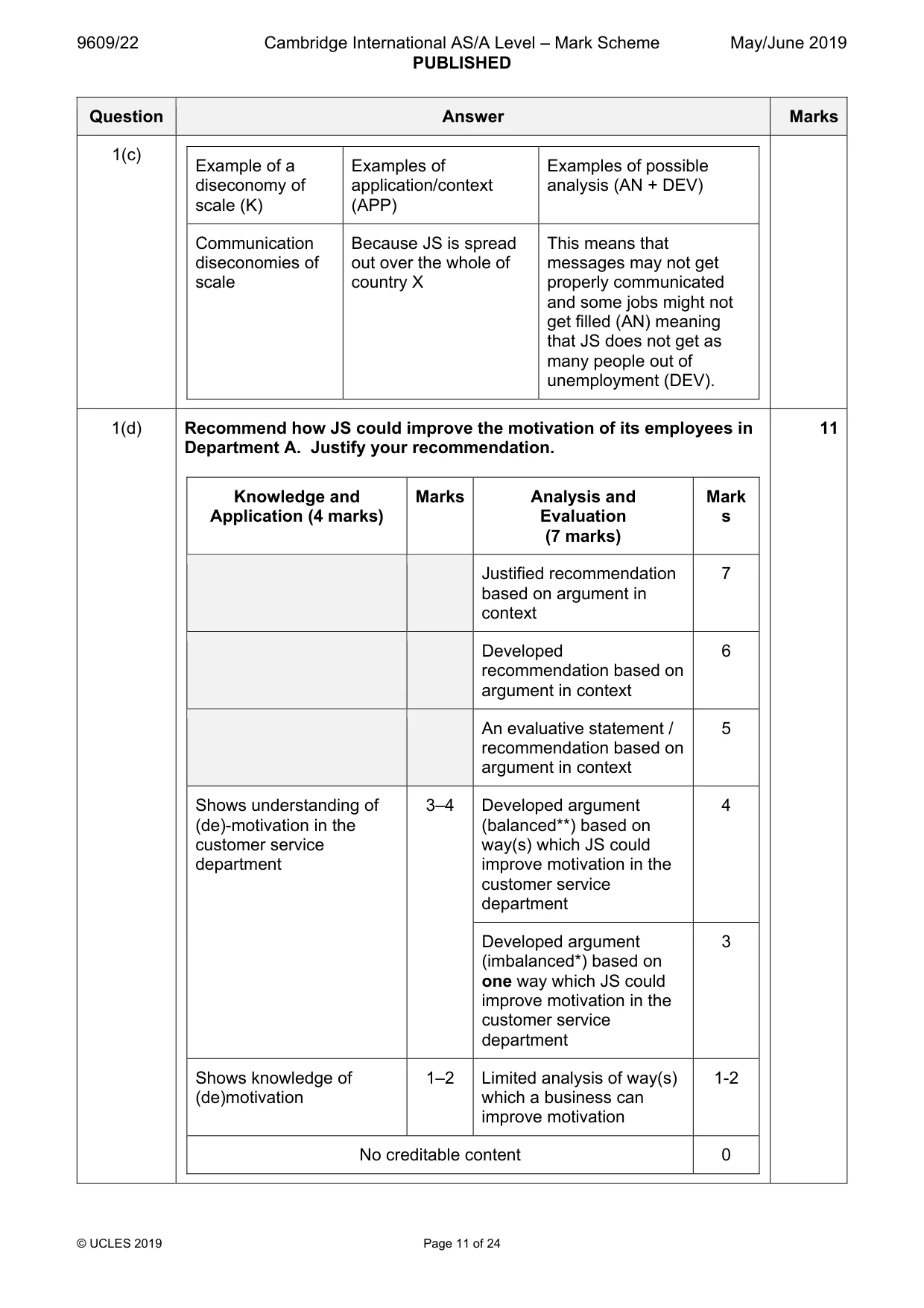
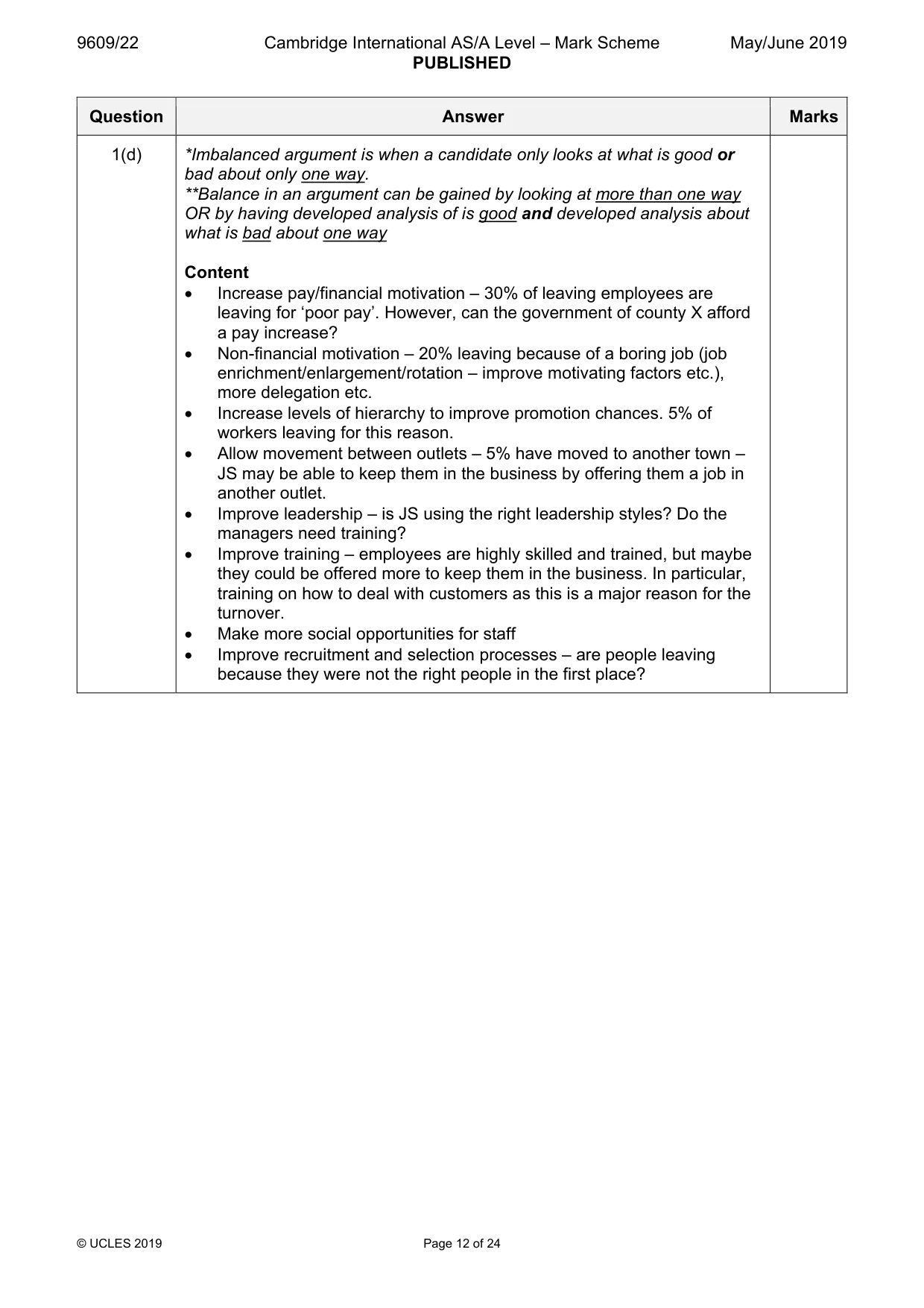
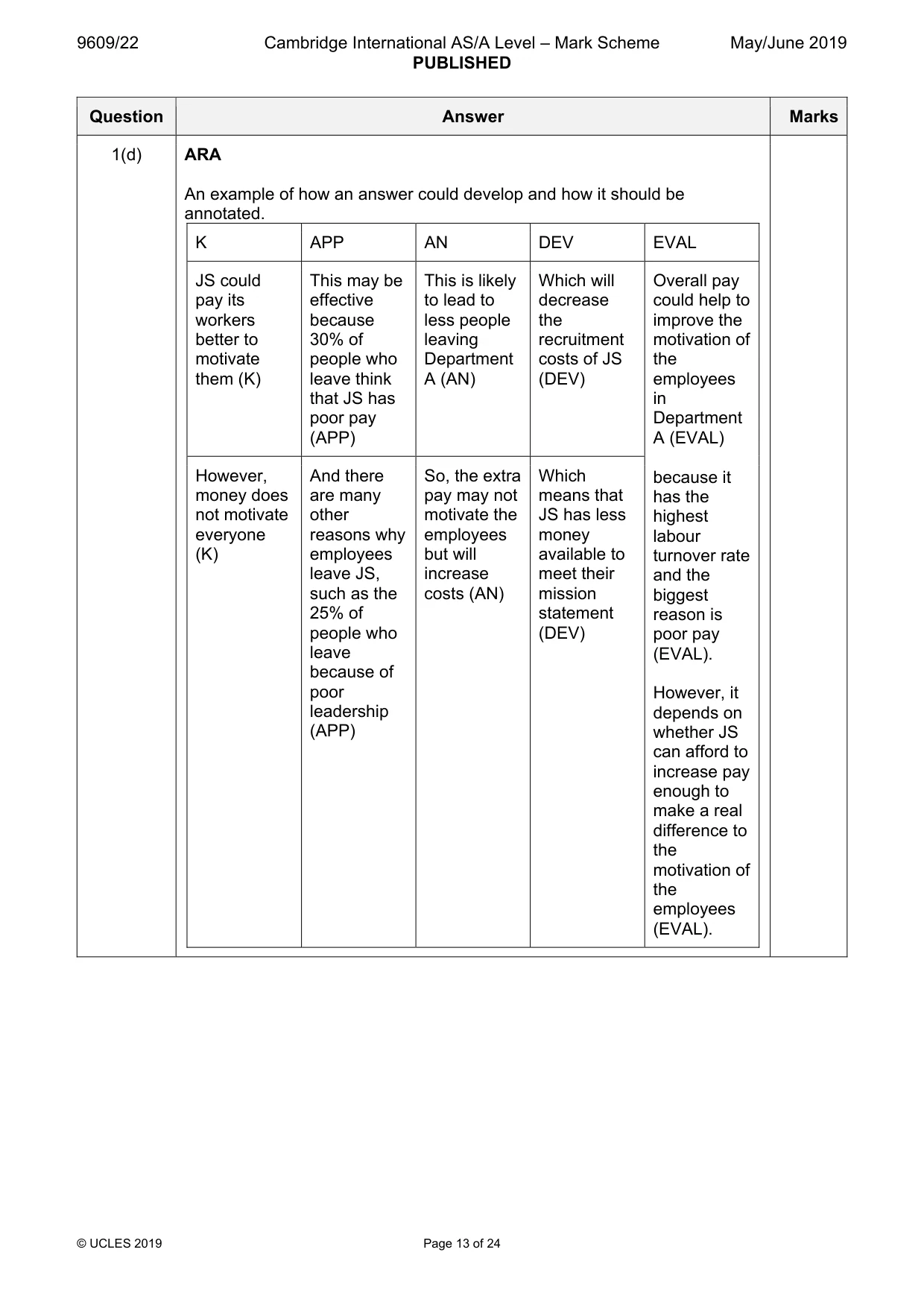
Mark scheme: Question Answer Marks 1(a)(i) Define the term ‘public sector’ (line 1). 2 Knowledge Marks A correct definition 2 A partial, vague or unfocused definition 1 No creditable content 0 Content Organisations that are owned/controlled by the government (2). ARA* Exemplar Mark Rationale Businesses that are owned by the state 2 Correct definition The sector of the economy which is 2 Correct definition controlled by the government A business that is owned by the state 1 Partial because the and where shares are sold on the stock candidate has some exchange confusion with PLC Paid for by taxes 1 Partial understanding Run for the good of society 1 Partial understanding – it is run by the state for this reason Not in the private sector 0 No creditable content Not for profit organisation 0 No creditable content – confusion with a charity *ARA means ‘all reasonable answers. This allows for answers which are similar to the ones in the mark scheme and are correct. 1(a)(ii) Explain the relationship between a mission statement and a business objective Rationale Marks C Identification of the relationship between a mission 1 statement and a business objective B Understanding of a business objective 1 A Understanding of a mission statement 1 Note: allow any reasonable understanding of ‘aims’, ‘targets’ ‘goals’ in relation to mission statements and objectives. These terms are often used in completely different ways by different sources and so any reasonable use is acceptable if you believe the candidate has shown understanding of an objective and/or missions statement. Content • Objectives should be in line with the mission statement and move the business towards the mission statement (C) • A mission statement is a visionary aim for a business of the direction/purpose. (A) • An objective is a specific target that should have a time period in which to achieve it. (B) 1(a)(ii) ARA Exemplar Mark Rationale The mission is the aim (A) but the 3 All three elements business has the specific targets called objectives (B) to reach that aim (C) Achieving the objectives help move the 1 No explicit business towards the mission statement understanding of (C only) either an objective or a mission statement – only the relationship The mission statement sets out the 2 No explicit direction (A) and the objectives should understanding of help the business go in that direction (C). business objectives. A mission statement is something a 2 Both mission business wants to aim towards that may statement and be unattainable (A), whereas a business objective have been objective is a specific, measurable, understood but the achievable, realistic and times-based relationship is not goal that can be reached (B). explained. A mission statement is a visionary aim 2 Both mission for a business of the purpose (A). statement and Whereas an objective is a specific target objective have been that should have a time period in which understood but the to achieve it (B). relationship is not explained. 1(b)(i) Refer to Table 1.1. Calculate the rate of labour turnover for the whole 3 of JS in 2018. Rationale Marks Correct answer with or without correct working or % 3 Identification of correct figures from Table 1.1 used in formula 2 Correct formula* 1 No creditable content 0 *Formula can be implied through the correct use of figures Content Number of employees who left × 100 Total number of employees 6250 + 550 + 600 × 100 25000 + 5000 + 10000 7400 × 100 40000 = 18.5% OFR* 1(b)(i) Common incorrect answers Answer Mark Rationale 18.5 3 Correct answer – does not require % sign 7400 2 A mistake in the = 0.185 (implied) knowledge 40000 of the formula by not multiplying by 100 (turning it into a percentage) 0.185 (no working) 0 There is no reference to where this (wrong) answer came from, so no marks. 40000 2 Inverted formula – × 100 = 540.54% but correct figures 7400 and OFR for the answer. 6250 2 Implied formula × 100 = 25% correct, but wrong 25000 use of figures. However, based on those wrong figures the answer is correct using the OFR. 6250 1 Implied formula × 100 25000 *OFR means the use of the own figure rule – this aims to reward a candidate for the stages of a calculation that are correct, even if an earlier stage or figure used is incorrect. An early mistake, for example, would create all following calculations to have wrong answers, but these are still rewardable (if correct when using a candidate’s own figures) Therefore the candidate cannot gain marks for the stage that was incorrect, but can gain all the subsequent marks. 1(b)(ii) Explain one disadvantage for JS of having high labour turnover. 3 Level Knowledge and Application Marks 2b (APP) Explanation of one disadvantage of high labour 3 turnover in context 2a (K+K) Explanation of one disadvantage of high labour 2 turnover 1a (K) Identification of one disadvantage of high labour 1 turnover 0 No creditable content 0 Content • Increased recruitment costs – these are highly trained and skilled employees so difficult to replace. Also, as a public sector organisation, this reduces funding for other government spending. • Loss of productivity – time-lag between losing workers and gaining new workers – JS still needs to run. New employees are unlikely to be as productive as experienced employees. Might give poor customer service or result in less employment opportunities – highest labour turnover in customer service department. • Cost of training/induction – new employees will need to be trained in customer service. • Poor reputation – might be difficult/take longer to hire new workers • Lowers motivation/demotivates ARA and OFR Example of how responses should be marked Identification of a Explanation of a Explanation of a disadvantage disadvantage (2 disadvantage in (1 mark) marks) context (3 marks) Increased costs (K) Increased costs (K) Because the workers because those workers are highly skilled and who leave JS will need trained JS will have to be replaced which high recruitment costs adds to the recruitment when they leave (APP) costs (K) People might not People might not want It may be become very want to work at JS to work at JS (K) which difficult to recruit (K) will make recruitment people, especially in much more difficult (K) department A (APP) *OFR in this case is if a candidate has used an incorrect answer from 1(b)(i) – if their explanation is correct using their own figures then ALL marks can be rewarded in this question. 1(c) Analyse one economy of scale and one diseconomy of scale which 8 may affect JS. Level Knowledge and Marks Analysis (4 Marks Application (4 marks) marks) 2b Shows 4 Developed 4 understanding of analysis of one one economy economy and and diseconomy diseconomy of of scale in scale in context context 2a Shows 3 Developed 3 understanding of analysis of one one economy or economy or diseconomy of diseconomy of scale in context scale in context 1b Shows 2 Limited analysis of 2 knowledge of one one economy and economy and diseconomy of diseconomy of scale scale 1a Shows 1 Limited analysis of 1 knowledge of one one economy or economy or diseconomy of diseconomy of scale scale 0 No creditable response LARGEST is contextual as it is stated in the case. However LARGE is not as it is generic to most/all businesses experiencing economies of scale. Content A candidate does not need to name an economy or diseconomy of scale – a description is good enough (for example ‘bulk buying’ is enough to award purchasing economies of scale). 1(c) Economies of scale: • Managerial economies of scale – for example personnel managers who may be able to deal with JS labour turnover issue • Marketing economies of scale – many outlets in every main town and city means that marketing costs can be averaged out over a large number of outlets • Purchasing (allow bulk buying) economies of scale – in terms of administration items (do not accept bulk buying of inventory unless it is in context as this is a service sector business) • Technical (do not reward technological) economies of scale – better admin computer software/systems • Financial economies of scale – government backing likely to be more important than size but JS is still more likely to get favourable financial terms due to their size. • Risk bearing – unlikely to be contextual as JS only focuses on one/two services Diseconomies of scale: • Communication problems – outlets must cooperate with each other to maintain good customer service. • Poor leadership – 25% of labour turnover is due to poor leadership – too many workers to lead? • Poor motivation – Is the high labour turnover and issues due to the size of the business? • Bureaucracy – 10 000 admin workers suggest a great deal of ‘red tape’ • Duplication of effort – Each outlet likely to have the same job-role repeated. Allow external economies or diseconomies of scale – ARA Example of an Examples of Examples of possible economy of scale application/context analysis (AN + DEV) (K) (APP) Marketing Because JS has an JS can use nationwide economies of outlet in every major advertising campaigns scale town and city which are likely to have less cost per potential customer who sees it (AN) which means JS has more money to spend on finding people jobs (DEV) 1(c) Example of a Examples of Examples of possible diseconomy of application/context analysis (AN + DEV) scale (K) (APP) Communication Because JS is spread This means that diseconomies of out over the whole of messages may not get scale country X properly communicated and some jobs might not get filled (AN) meaning that JS does not get as many people out of unemployment (DEV). 1(d) Recommend how JS could improve the motivation of its employees in 11 Department A. Justify your recommendation. Knowledge and Marks Analysis and Mark Application (4 marks) Evaluation s (7 marks) Justified recommendation 7 based on argument in context Developed 6 recommendation based on argument in context An evaluative statement / 5 recommendation based on argument in context Shows understanding of 3–4 Developed argument 4 (de)-motivation in the (balanced**) based on customer service way(s) which JS could department improve motivation in the customer service department Developed argument 3 (imbalanced*) based on one way which JS could improve motivation in the customer service department Shows knowledge of 1–2 Limited analysis of way(s) 1-2 (de)motivation which a business can improve motivation No creditable content 0 1(d) *Imbalanced argument is when a candidate only looks at what is good or bad about only one way. **Balance in an argument can be gained by looking at more than one way OR by having developed analysis of is good and developed analysis about what is bad about one way Content • Increase pay/financial motivation – 30% of leaving employees are leaving for ‘poor pay’. However, can the government of county X afford a pay increase? • Non-financial motivation – 20% leaving because of a boring job (job enrichment/enlargement/rotation – improve motivating factors etc.), more delegation etc. • Increase levels of hierarchy to improve promotion chances. 5% of workers leaving for this reason. • Allow movement between outlets – 5% have moved to another town – JS may be able to keep them in the business by offering them a job in another outlet. • Improve leadership – is JS using the right leadership styles? Do the managers need training? • Improve training – employees are highly skilled and trained, but maybe they could be offered more to keep them in the business. In particular, training on how to deal with customers as this is a major reason for the turnover. • Make more social opportunities for staff • Improve recruitment and selection processes – are people leaving because they were not the right people in the first place? 1(d) ARA An example of how an answer could develop and how it should be annotated. K APP AN DEV EVAL JS could This may be This is likely Which will Overall pay pay its effective to lead to decrease could help to workers because less people the improve the better to 30% of leaving recruitment motivation of motivate people who Department costs of JS the them (K) leave think A (AN) (DEV) employees that JS has in poor pay Department (APP) A (EVAL) However, And there So, the extra Which because it money does are many pay may not means that has the not motivate other motivate the JS has less highest everyone reasons why employees money labour (K) employees but will available to turnover rate leave JS, increase meet their and the such as the costs (AN) mission biggest 25% of statement reason is people who (DEV) poor pay leave (EVAL). because of poor However, it leadership depends on (APP) whether JS can afford to increase pay enough to make a real difference to the motivation of the employees (EVAL).
Q2 · Too Tasty (TT) TT is a brand of vegetable chips (crisps) owned by a large public limited…
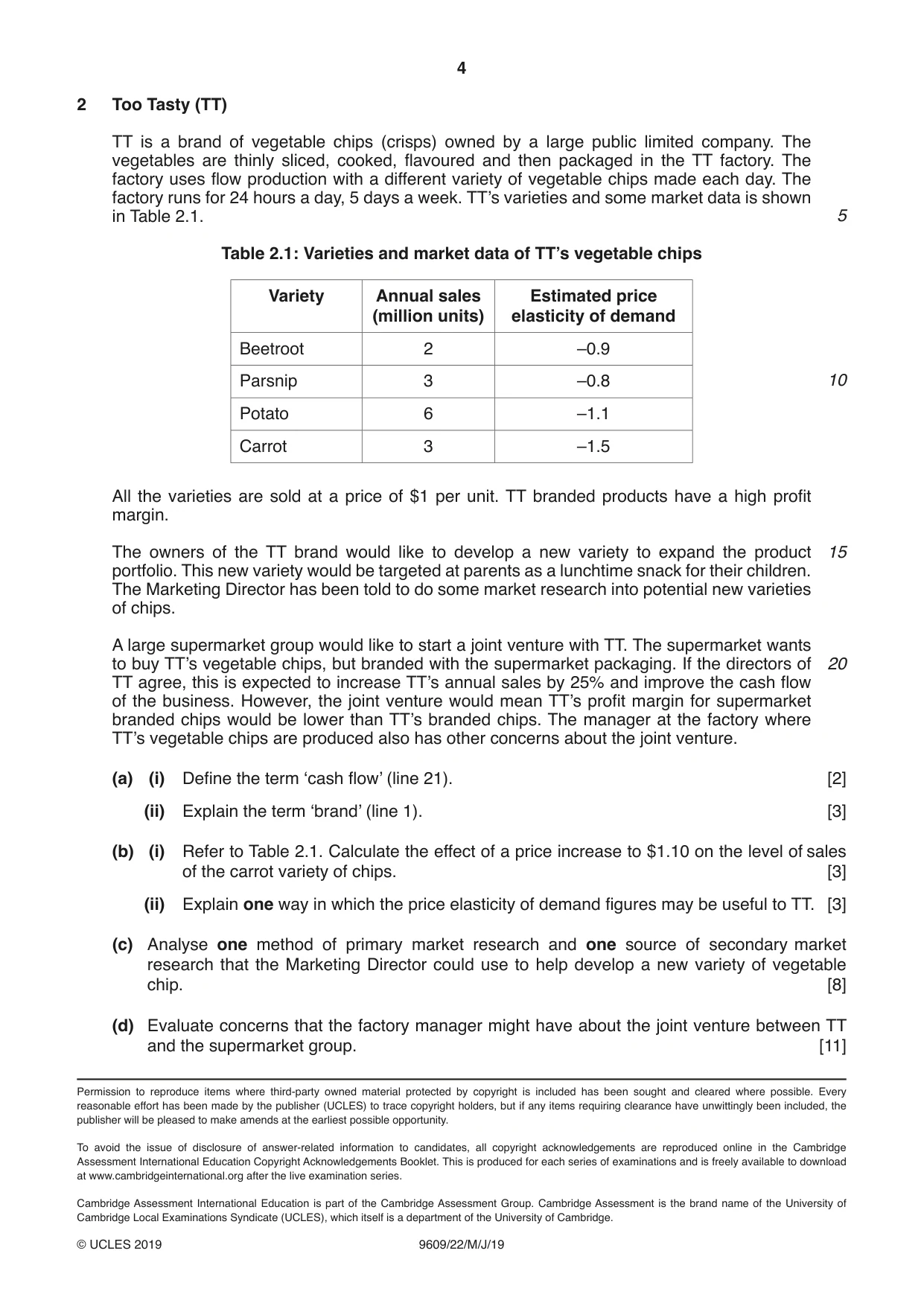
2 Too Tasty (TT) TT is a brand of vegetable chips (crisps) owned by a large public limited company. The vegetables are thinly sliced, cooked, flavoured and then packaged in the TT factory. The factory uses flow production with a different variety of vegetable chips made each day. The factory runs for 24 hours a day, 5 days a week. TT’s varieties and some market data is shown in Table 2.1. 5 Table 2.1: Varieties and market data of TT’s vegetable chips Variety Annual sales Estimated price (million units) elasticity of demand Beetroot 2 –0.9 Parsnip 3 –0.8 10 Potato 6 –1.1 Carrot 3 –1.5 All the varieties are sold at a price of $1 per unit. TT branded products have a high profit margin. The owners of the TT brand would like to develop a new variety to expand the product 15 portfolio. This new variety would be targeted at parents as a lunchtime snack for their children. The Marketing Director has been told to do some market research into potential new varieties of chips. A large supermarket group would like to start a joint venture with TT. The supermarket wants to buy TT’s vegetable chips, but branded with the supermarket packaging. If the directors of 20 TT agree, this is expected to increase TT’s annual sales by 25% and improve the cash flow of the business. However, the joint venture would mean TT’s profit margin for supermarket branded chips would be lower than TT’s branded chips. The manager at the factory where TT’s vegetable chips are produced also has other concerns about the joint venture. (a) (i) Define the term ‘cash flow’ (line 21). [2] (ii) Explain the term ‘brand’ (line 1). [3] (b) (i) Refer to Table 2.1. Calculate the effect of a price increase to $1.10 on the level of sales of the carrot variety of chips. [3] (ii) Explain one way in which the price elasticity of demand figures may be useful to TT. [3] (c) Analyse one method of primary market research and one source of secondary market research that the Marketing Director could use to help develop a new variety of vegetable chip. [8] (d) Evaluate concerns that the factory manager might have about the joint venture between TT and the supermarket group. [11]
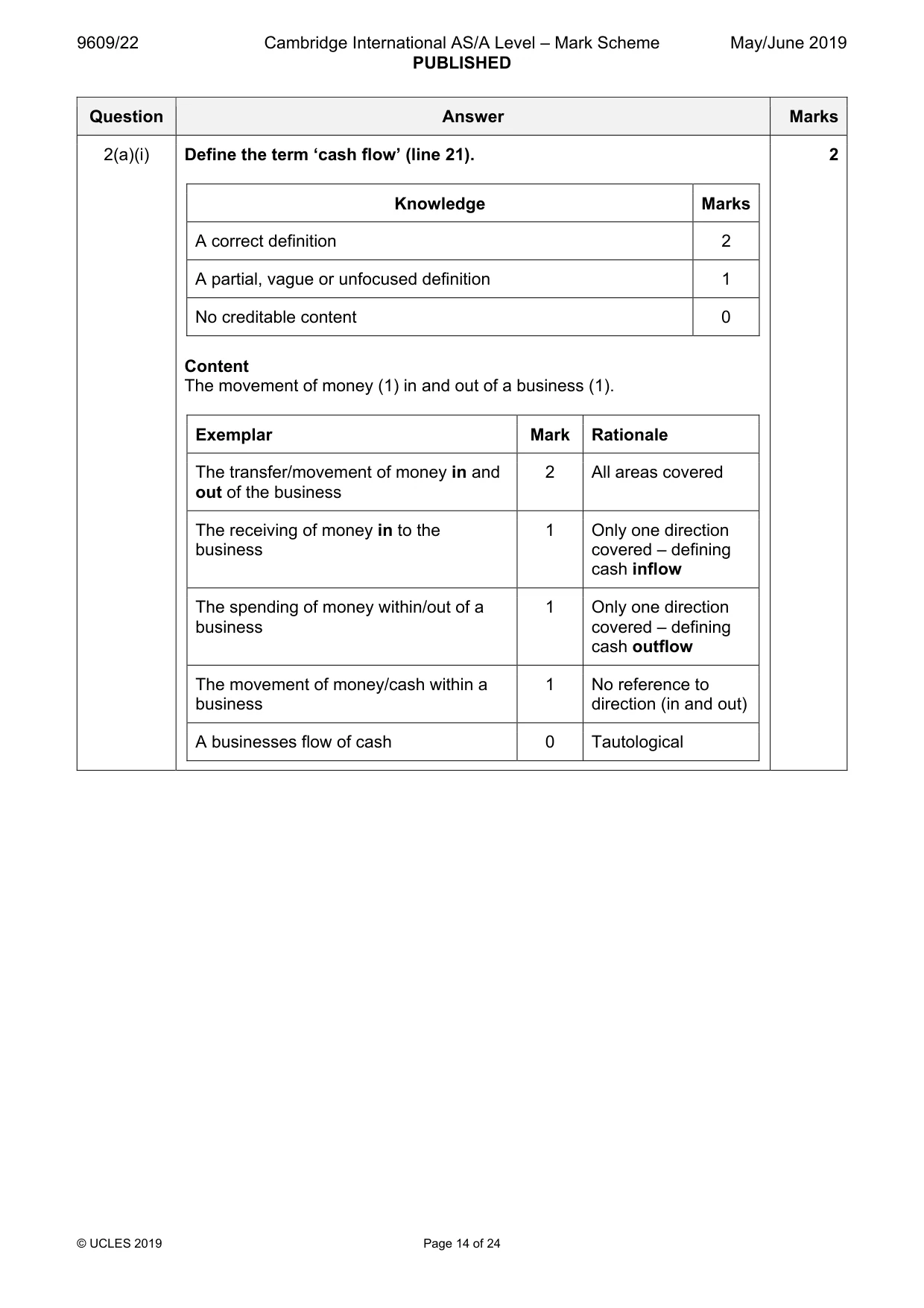
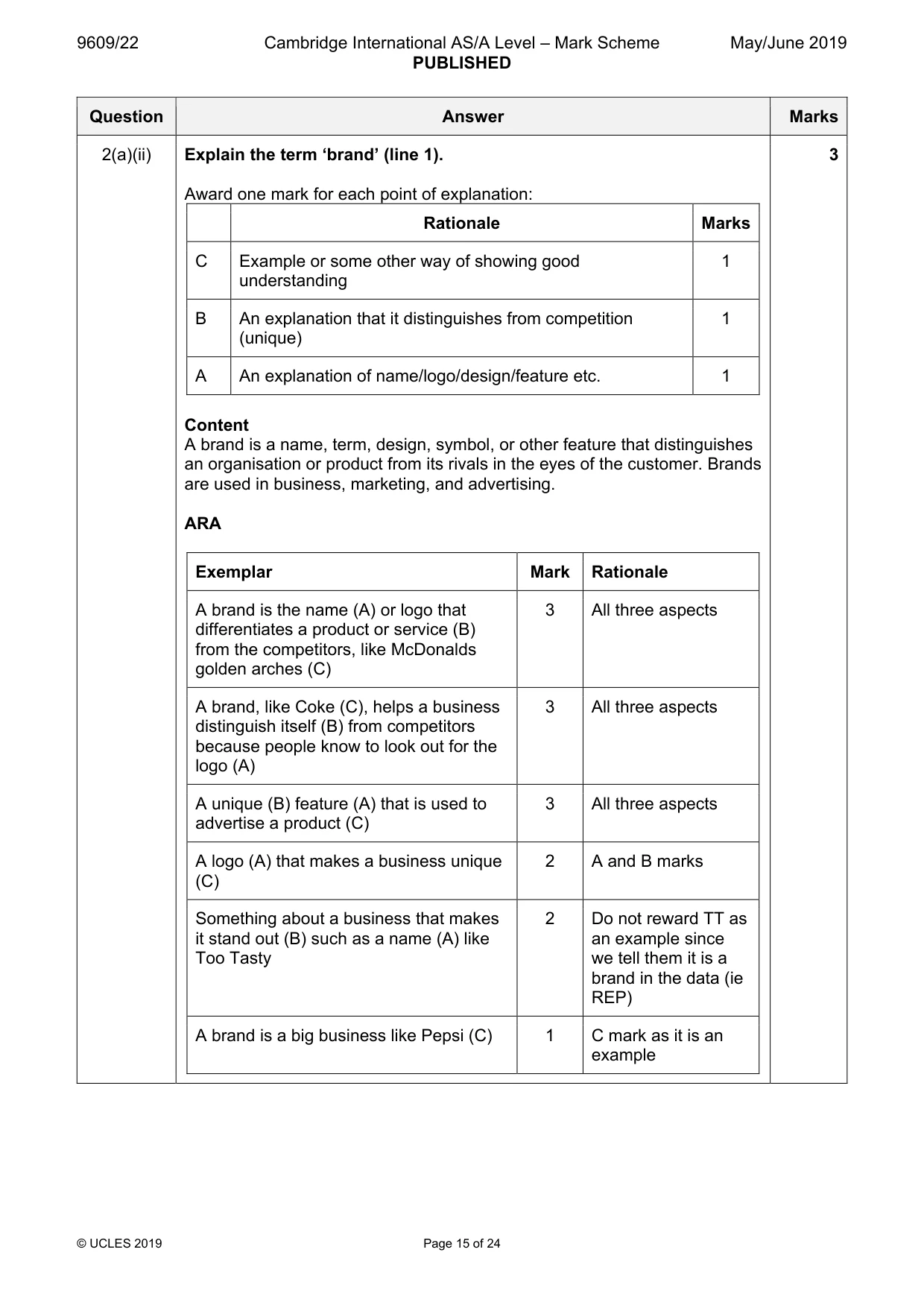
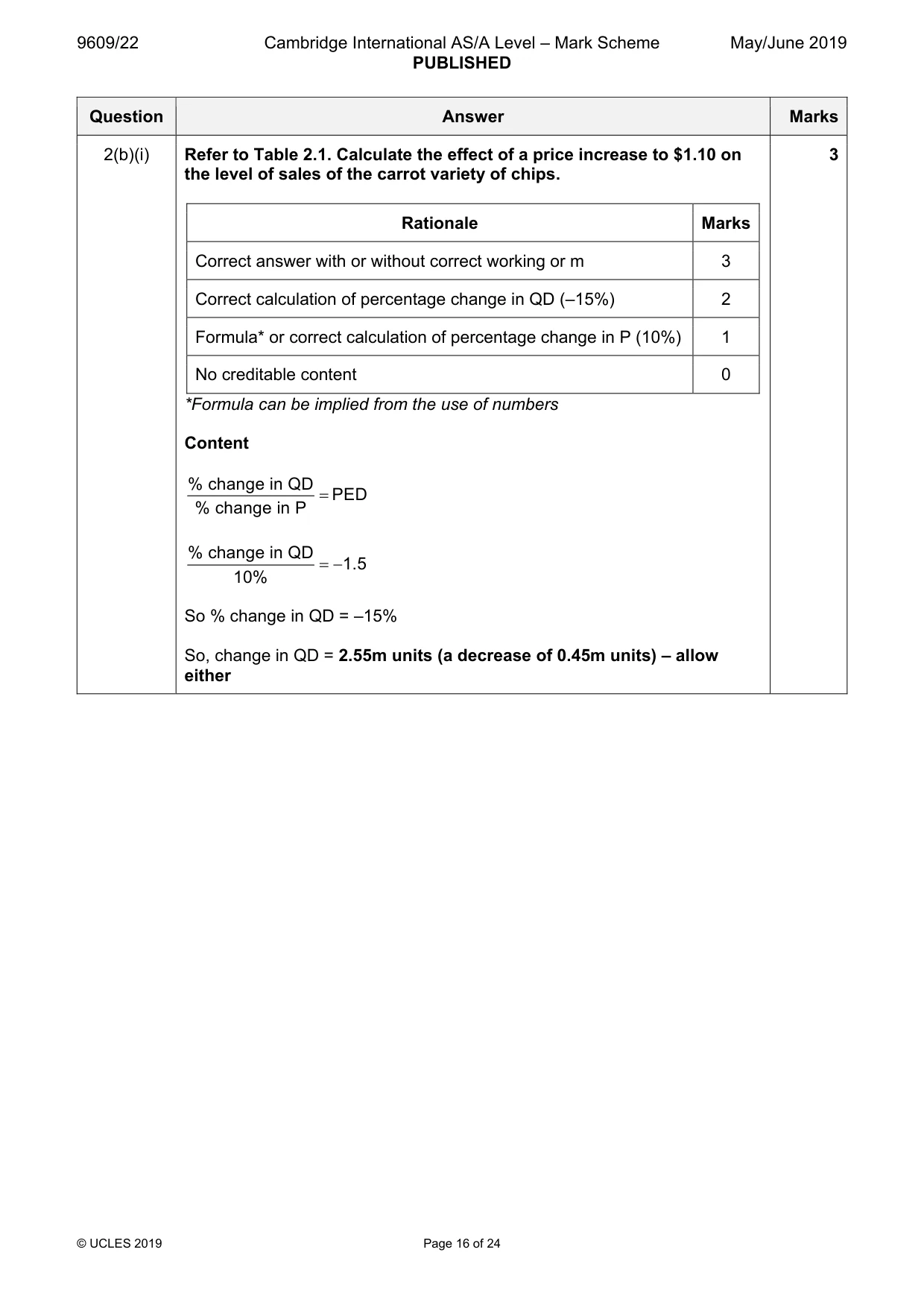
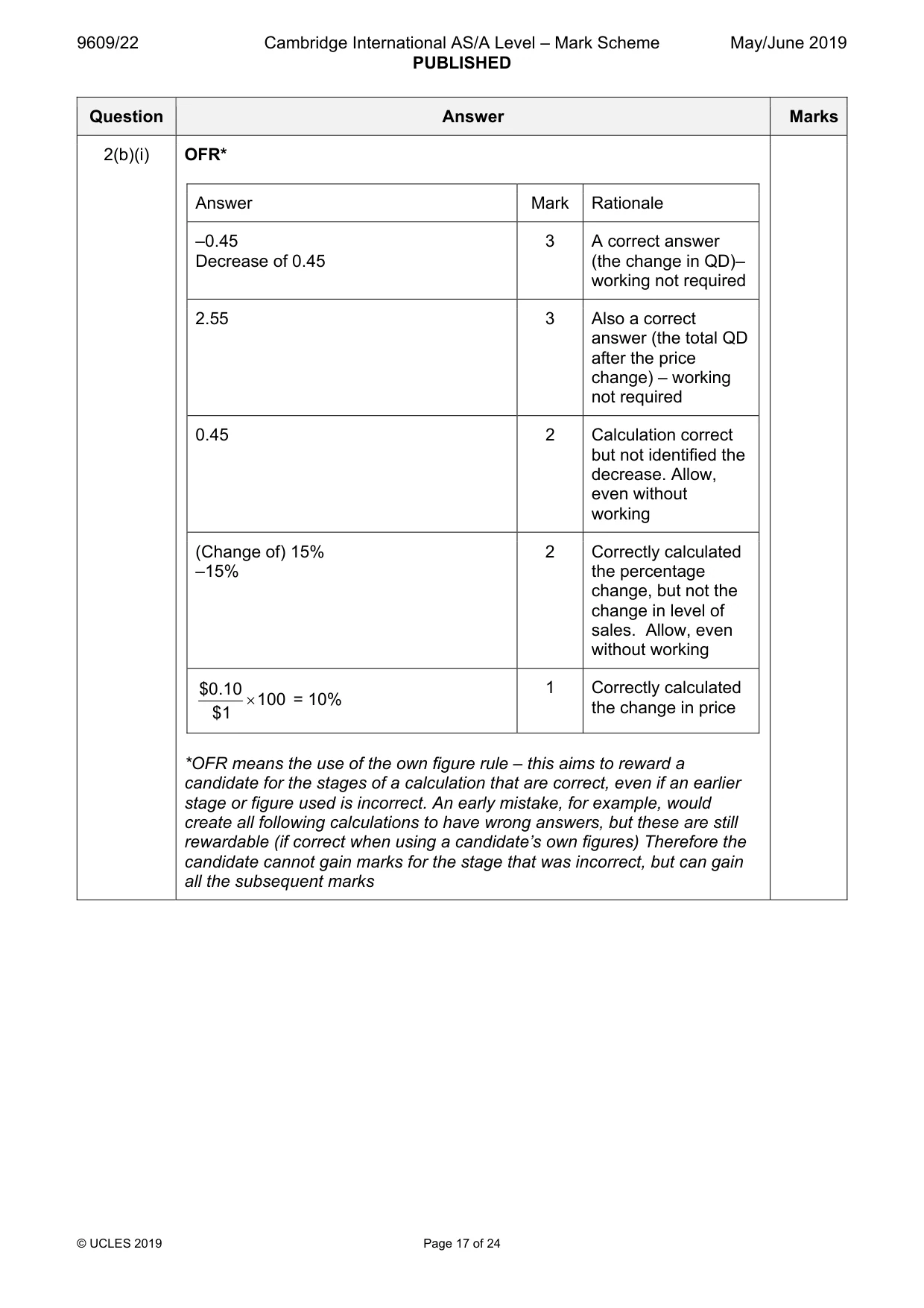
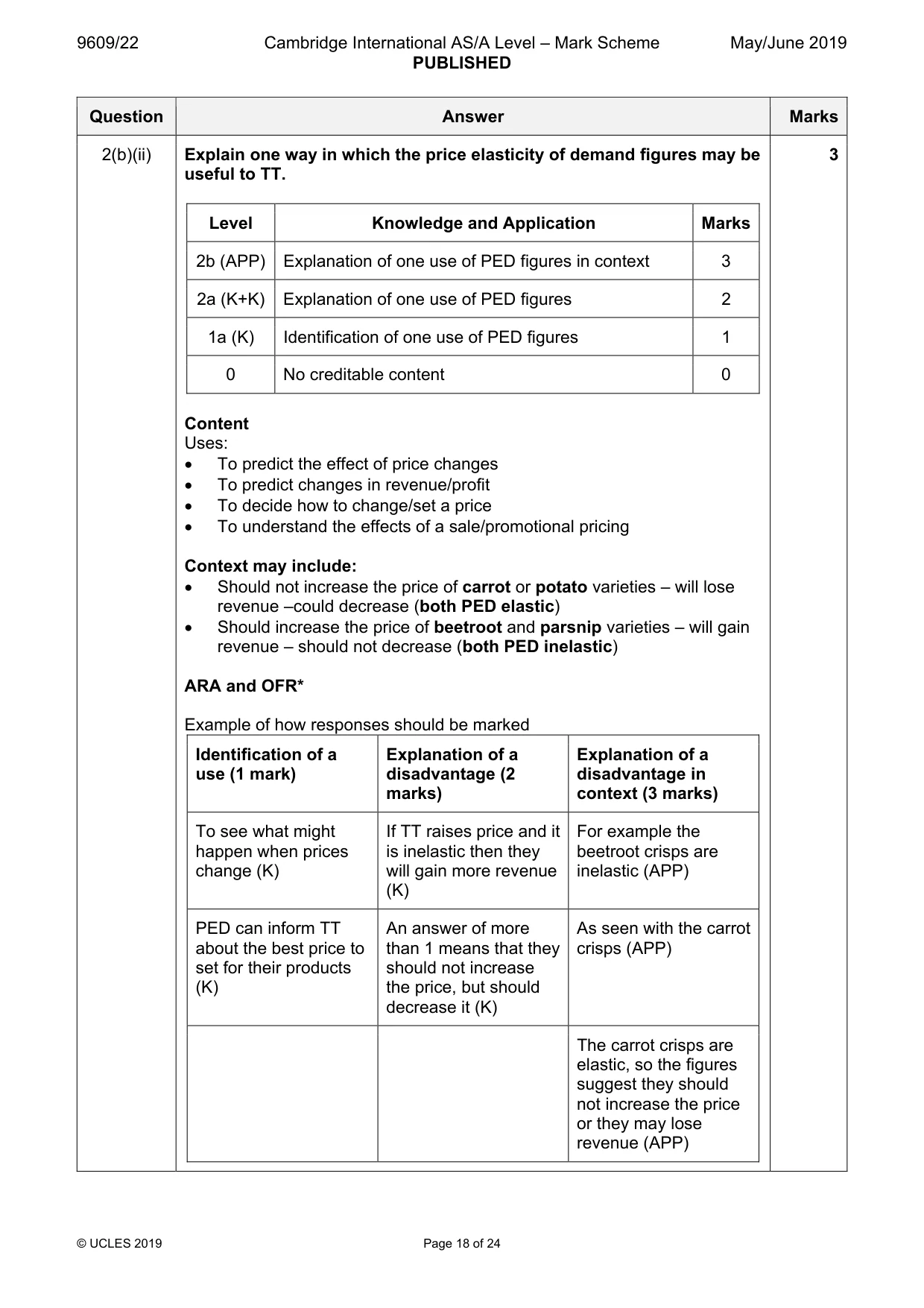
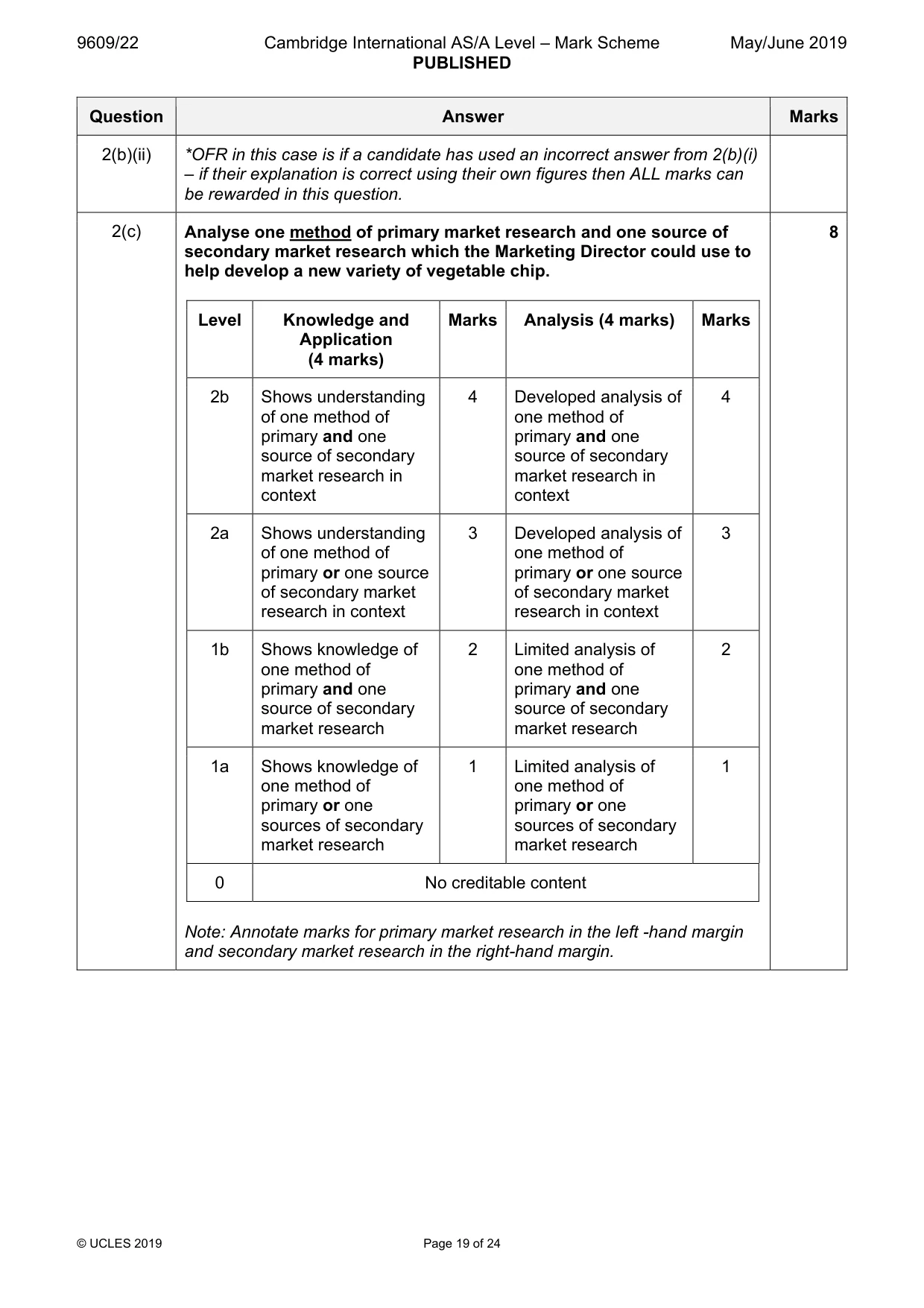
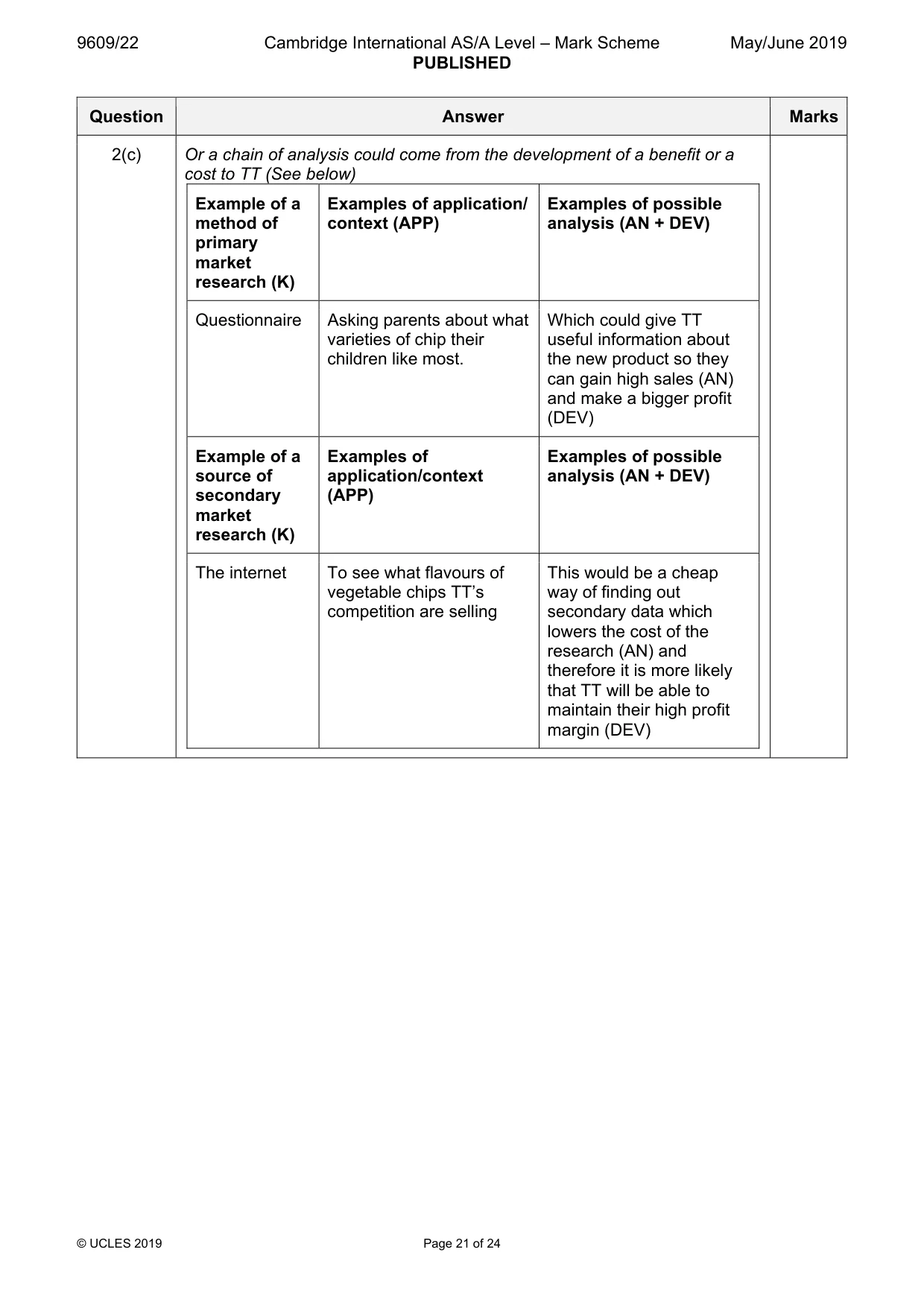
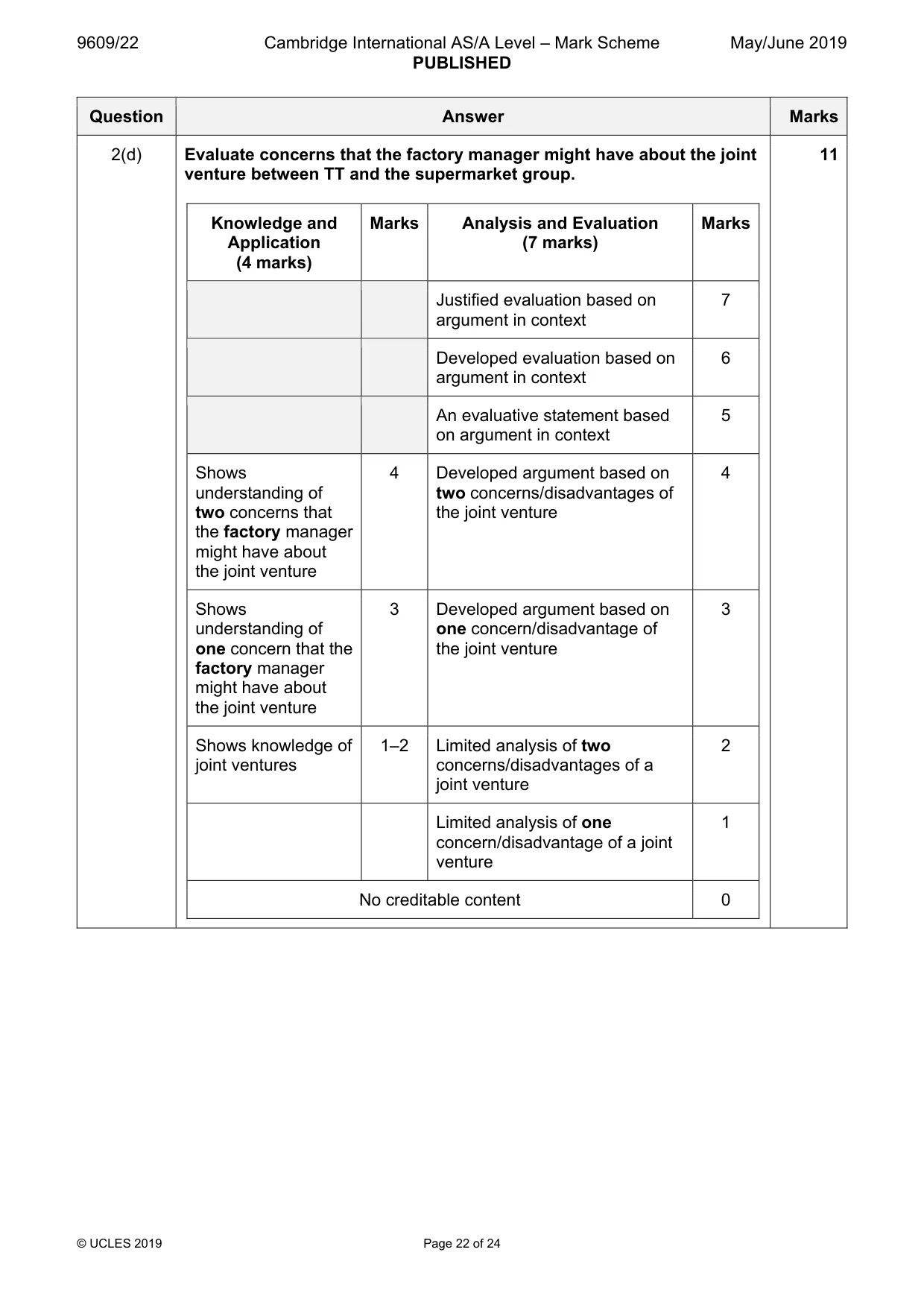
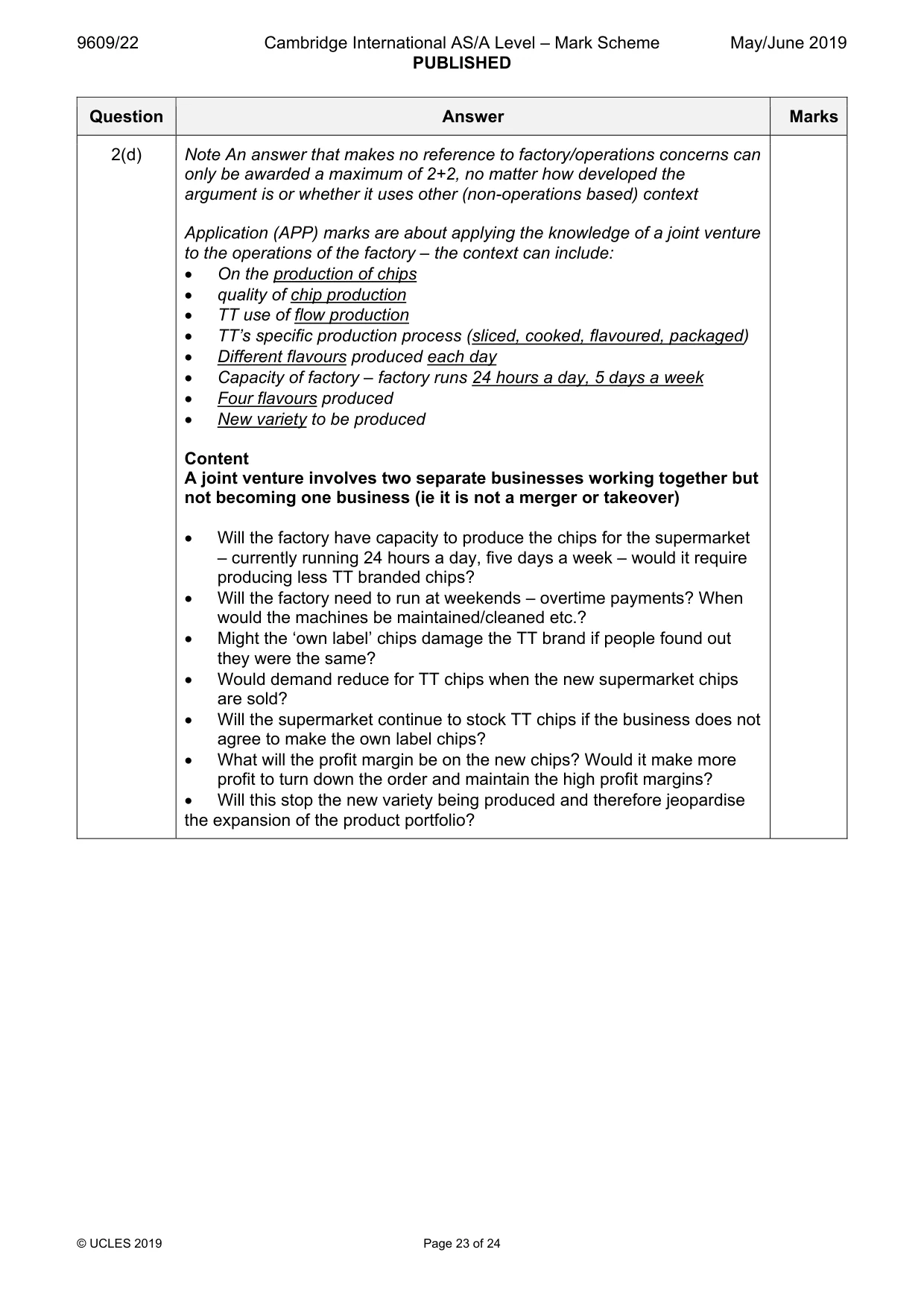
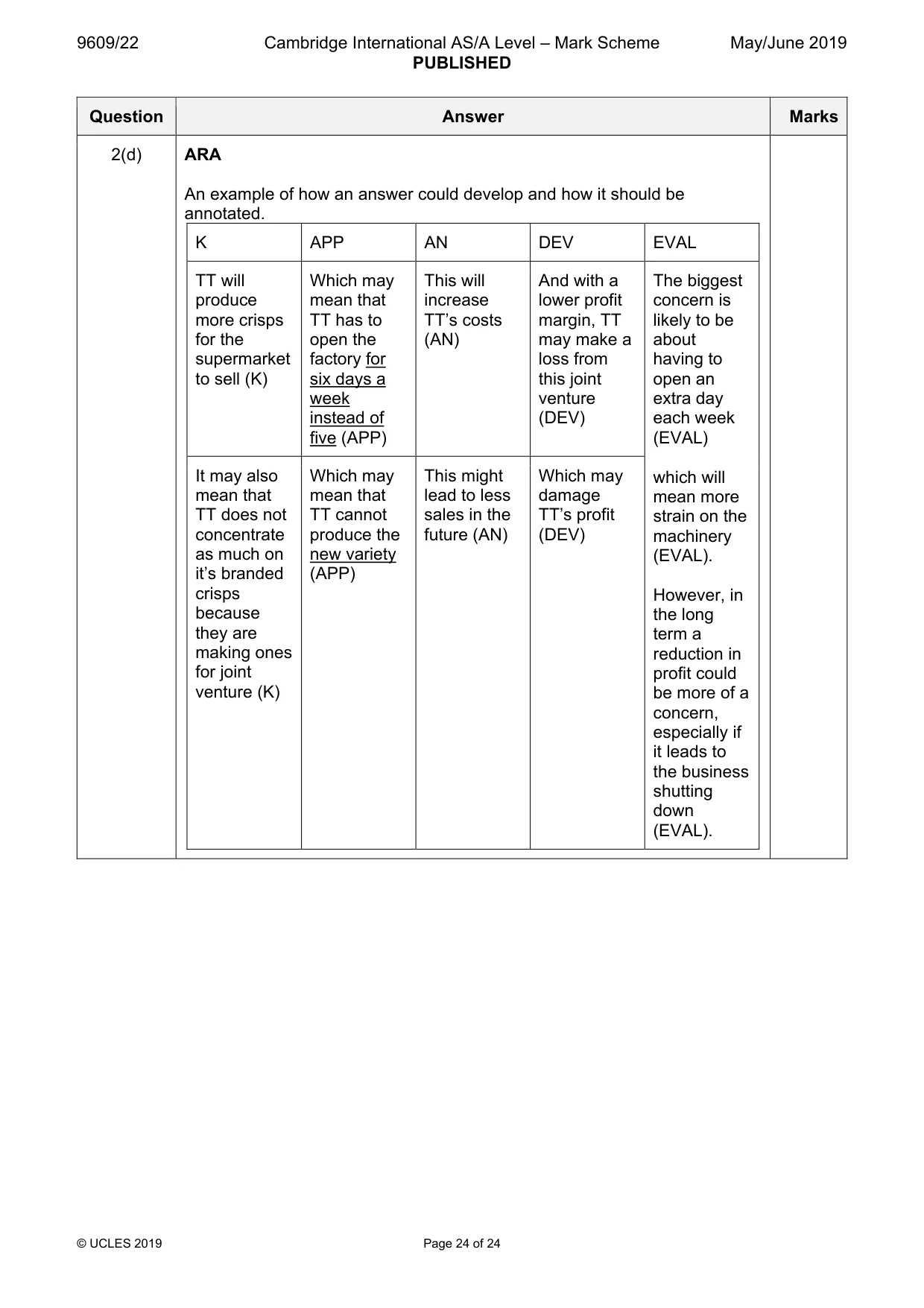
Mark scheme: 2(a)(i) Define the term ‘cash flow’ (line 21). 2 Knowledge Marks A correct definition 2 A partial, vague or unfocused definition 1 No creditable content 0 Content The movement of money (1) in and out of a business (1). Exemplar Mark Rationale The transfer/movement of money in and 2 All areas covered out of the business The receiving of money in to the 1 Only one direction business covered – defining cash inflow The spending of money within/out of a 1 Only one direction business covered – defining cash outflow The movement of money/cash within a 1 No reference to business direction (in and out) A businesses flow of cash 0 Tautological 2(a)(ii) Explain the term ‘brand’ (line 1). 3 Award one mark for each point of explanation: Rationale Marks C Example or some other way of showing good 1 understanding B An explanation that it distinguishes from competition 1 (unique) A An explanation of name/logo/design/feature etc. 1 Content A brand is a name, term, design, symbol, or other feature that distinguishes an organisation or product from its rivals in the eyes of the customer. Brands are used in business, marketing, and advertising. ARA Exemplar Mark Rationale A brand is the name (A) or logo that 3 All three aspects differentiates a product or service (B) from the competitors, like McDonalds golden arches (C) A brand, like Coke (C), helps a business 3 All three aspects distinguish itself (B) from competitors because people know to look out for the logo (A) A unique (B) feature (A) that is used to 3 All three aspects advertise a product (C) A logo (A) that makes a business unique 2 A and B marks (C) Something about a business that makes 2 Do not reward TT as it stand out (B) such as a name (A) like an example since Too Tasty we tell them it is a brand in the data (ie REP) A brand is a big business like Pepsi (C) 1 C mark as it is an example 2(b)(i) Refer to Table 2.1. Calculate the effect of a price increase to $1.10 on 3 the level of sales of the carrot variety of chips. Rationale Marks Correct answer with or without correct working or m 3 Correct calculation of percentage change in QD (–15%) 2 Formula* or correct calculation of percentage change in P (10%) 1 No creditable content 0 *Formula can be implied from the use of numbers Content % change in QD = PED % change in P % change in QD = − 1.5 10% So % change in QD = –15% So, change in QD = 2.55m units (a decrease of 0.45m units) – allow either 2(b)(i) OFR* Answer Mark Rationale –0.45 3 A correct answer Decrease of 0.45 (the change in QD)– working not required 2.55 3 Also a correct answer (the total QD after the price change) – working not required 0.45 2 Calculation correct but not identified the decrease. Allow, even without working (Change of) 15% 2 Correctly calculated –15% the percentage change, but not the change in level of sales. Allow, even without working $0.10 1 Correctly calculated × 100 = 10% the change in price $1 *OFR means the use of the own figure rule – this aims to reward a candidate for the stages of a calculation that are correct, even if an earlier stage or figure used is incorrect. An early mistake, for example, would create all following calculations to have wrong answers, but these are still rewardable (if correct when using a candidate’s own figures) Therefore the candidate cannot gain marks for the stage that was incorrect, but can gain all the subsequent marks 2(b)(ii) Explain one way in which the price elasticity of demand figures may be 3 useful to TT. Level Knowledge and Application Marks 2b (APP) Explanation of one use of PED figures in context 3 2a (K+K) Explanation of one use of PED figures 2 1a (K) Identification of one use of PED figures 1 0 No creditable content 0 Content Uses: • To predict the effect of price changes • To predict changes in revenue/profit • To decide how to change/set a price • To understand the effects of a sale/promotional pricing Context may include: • Should not increase the price of carrot or potato varieties – will lose revenue –could decrease (both PED elastic) • Should increase the price of beetroot and parsnip varieties – will gain revenue – should not decrease (both PED inelastic) ARA and OFR* Example of how responses should be marked Identification of a Explanation of a Explanation of a use (1 mark) disadvantage (2 disadvantage in marks) context (3 marks) To see what might If TT raises price and it For example the happen when prices is inelastic then they beetroot crisps are change (K) will gain more revenue inelastic (APP) (K) PED can inform TT An answer of more As seen with the carrot about the best price to than 1 means that they crisps (APP) set for their products should not increase (K) the price, but should decrease it (K) The carrot crisps are elastic, so the figures suggest they should not increase the price or they may lose revenue (APP) 2(b)(ii) *OFR in this case is if a candidate has used an incorrect answer from 2(b)(i) – if their explanation is correct using their own figures then ALL marks can be rewarded in this question. 2(c) Analyse one method of primary market research and one source of 8 secondary market research which the Marketing Director could use to help develop a new variety of vegetable chip. Level Knowledge and Marks Analysis (4 marks) Marks Application (4 marks) 2b Shows understanding 4 Developed analysis of 4 of one method of one method of primary and one primary and one source of secondary source of secondary market research in market research in context context 2a Shows understanding 3 Developed analysis of 3 of one method of one method of primary or one source primary or one source of secondary market of secondary market research in context research in context 1b Shows knowledge of 2 Limited analysis of 2 one method of one method of primary and one primary and one source of secondary source of secondary market research market research 1a Shows knowledge of 1 Limited analysis of 1 one method of one method of primary or one primary or one sources of secondary sources of secondary market research market research 0 No creditable content Note: Annotate marks for primary market research in the left -hand margin and secondary market research in the right-hand margin. 2(c) Content Primary methods: • Survey- could survey current customers about new varieties they might like • Questionnaires – Could ask about new possible varieties • Focus groups – ask a group to try the new varieties and give feedback on them • Observation – could observe what potential customers are buying from retailers – new varieties/flavours etc. • Testing – could hand out free samples for feedback Secondary sources: • Printed – trade magazines, research done by competitors • Paid for – from market research agencies, census etc. • Internet – demographics, new products in other markets etc. ARA A chain of analysis could come from an analysis of the benefits and costs of a method or source (See below). Example of a Examples of application/ Examples of possible method of context (APP) analysis (AN + DEV) primary market research (K) Questionnaire Asking parents about what Which could give TT varieties of chip their useful information about children like most. the new product so they can gain high sales (AN). However questionnaires are expensive to ask enough people to make them representative so this could increase TT’s costs (DEV) Example of a Examples of Examples of possible source of application/context analysis (AN + DEV) secondary (APP) market research (K) The internet To see what flavours of This would be a cheap vegetable chips TT’s way of finding out competition are selling secondary data which lowers the cost of the research (AN) however it will not tell TT about flavours which are in development so the research may be a waste of time (DEV) 2(c) Or a chain of analysis could come from the development of a benefit or a cost to TT (See below) Example of a Examples of application/ Examples of possible method of context (APP) analysis (AN + DEV) primary market research (K) Questionnaire Asking parents about what Which could give TT varieties of chip their useful information about children like most. the new product so they can gain high sales (AN) and make a bigger profit (DEV) Example of a Examples of Examples of possible source of application/context analysis (AN + DEV) secondary (APP) market research (K) The internet To see what flavours of This would be a cheap vegetable chips TT’s way of finding out competition are selling secondary data which lowers the cost of the research (AN) and therefore it is more likely that TT will be able to maintain their high profit margin (DEV) 2(d) Evaluate concerns that the factory manager might have about the joint 11 venture between TT and the supermarket group. Knowledge and Marks Analysis and Evaluation Marks Application (7 marks) (4 marks) Justified evaluation based on 7 argument in context Developed evaluation based on 6 argument in context An evaluative statement based 5 on argument in context Shows 4 Developed argument based on 4 understanding of two concerns/disadvantages of two concerns that the joint venture the factory manager might have about the joint venture Shows 3 Developed argument based on 3 understanding of one concern/disadvantage of one concern that the the joint venture factory manager might have about the joint venture Shows knowledge of 1–2 Limited analysis of two 2 joint ventures concerns/disadvantages of a joint venture Limited analysis of one 1 concern/disadvantage of a joint venture No creditable content 0 2(d) Note An answer that makes no reference to factory/operations concerns can only be awarded a maximum of 2+2, no matter how developed the argument is or whether it uses other (non-operations based) context Application (APP) marks are about applying the knowledge of a joint venture to the operations of the factory – the context can include: • On the production of chips • quality of chip production • TT use of flow production • TT’s specific production process (sliced, cooked, flavoured, packaged) • Different flavours produced each day • Capacity of factory – factory runs 24 hours a day, 5 days a week • Four flavours produced • New variety to be produced Content A joint venture involves two separate businesses working together but not becoming one business (ie it is not a merger or takeover) • Will the factory have capacity to produce the chips for the supermarket – currently running 24 hours a day, five days a week – would it require producing less TT branded chips? • Will the factory need to run at weekends – overtime payments? When would the machines be maintained/cleaned etc.? • Might the ‘own label’ chips damage the TT brand if people found out they were the same? • Would demand reduce for TT chips when the new supermarket chips are sold? • Will the supermarket continue to stock TT chips if the business does not agree to make the own label chips? • What will the profit margin be on the new chips? Would it make more profit to turn down the order and maintain the high profit margins? • Will this stop the new variety being produced and therefore jeopardise the expansion of the product portfolio? 2(d) ARA An example of how an answer could develop and how it should be annotated. K APP AN DEV EVAL TT will Which may This will And with a The biggest produce mean that increase lower profit concern is more crisps TT has to TT’s costs margin, TT likely to be for the open the (AN) may make a about supermarket factory for loss from having to to sell (K) six days a this joint open an week venture extra day instead of (DEV) each week five (APP) (EVAL) It may also Which may This might Which may which will mean that mean that lead to less damage mean more TT does not TT cannot sales in the TT’s profit strain on the concentrate produce the future (AN) (DEV) machinery as much on new variety (EVAL). it’s branded (APP) crisps However, in because the long they are term a making ones reduction in for joint profit could venture (K) be more of a concern, especially if it leads to the business shutting down (EVAL).
What was in this paper
The subtopics covered by these 2 questions, and how many questions each got. Open one in a new tab to see every Cambridge question on it.
What you needed in this session
Cambridge’s own grade thresholds for 2019 May/June, Paper 2 · Variant 2. A higher threshold means an easier paper — the bar moves with how the cohort did.