Cambridge A Level Business (for first examination in 2016) 9609 — 2019 May/June Paper 2 · Variant 3
9609/23/M/J/19 · 2 questions · 60 marks · ≈68 min
The question paper and its mark scheme, free to read here and free to download. This is Cambridge’s own paper, exactly as it was sat.
Question paper4 pages
Mark scheme21 pages
Answers below. Sit the paper first if you are practising.
Questions as text
Q1 · First Nature (FN) FN is a co-operative farm producing milk, beef and vegetables
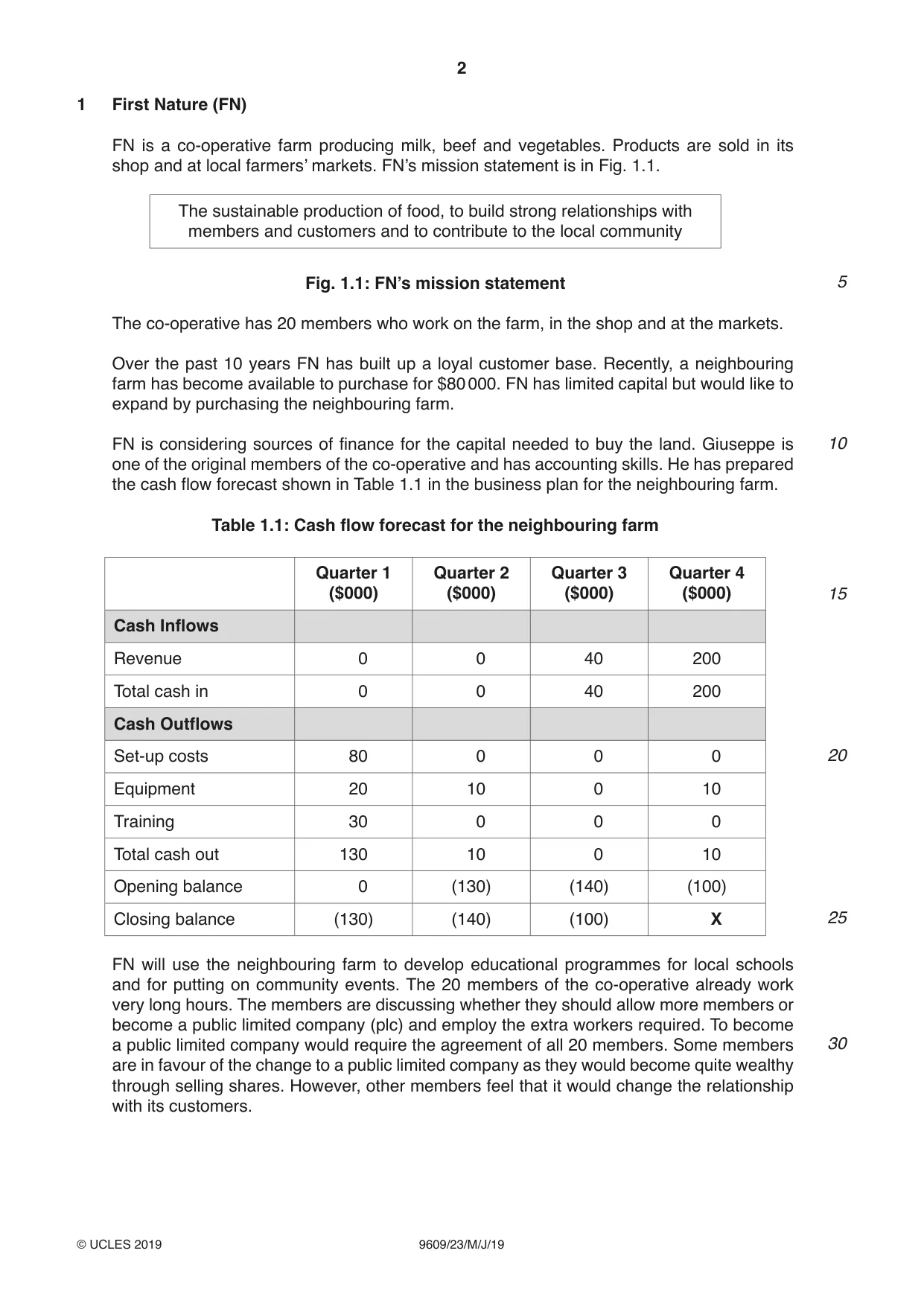
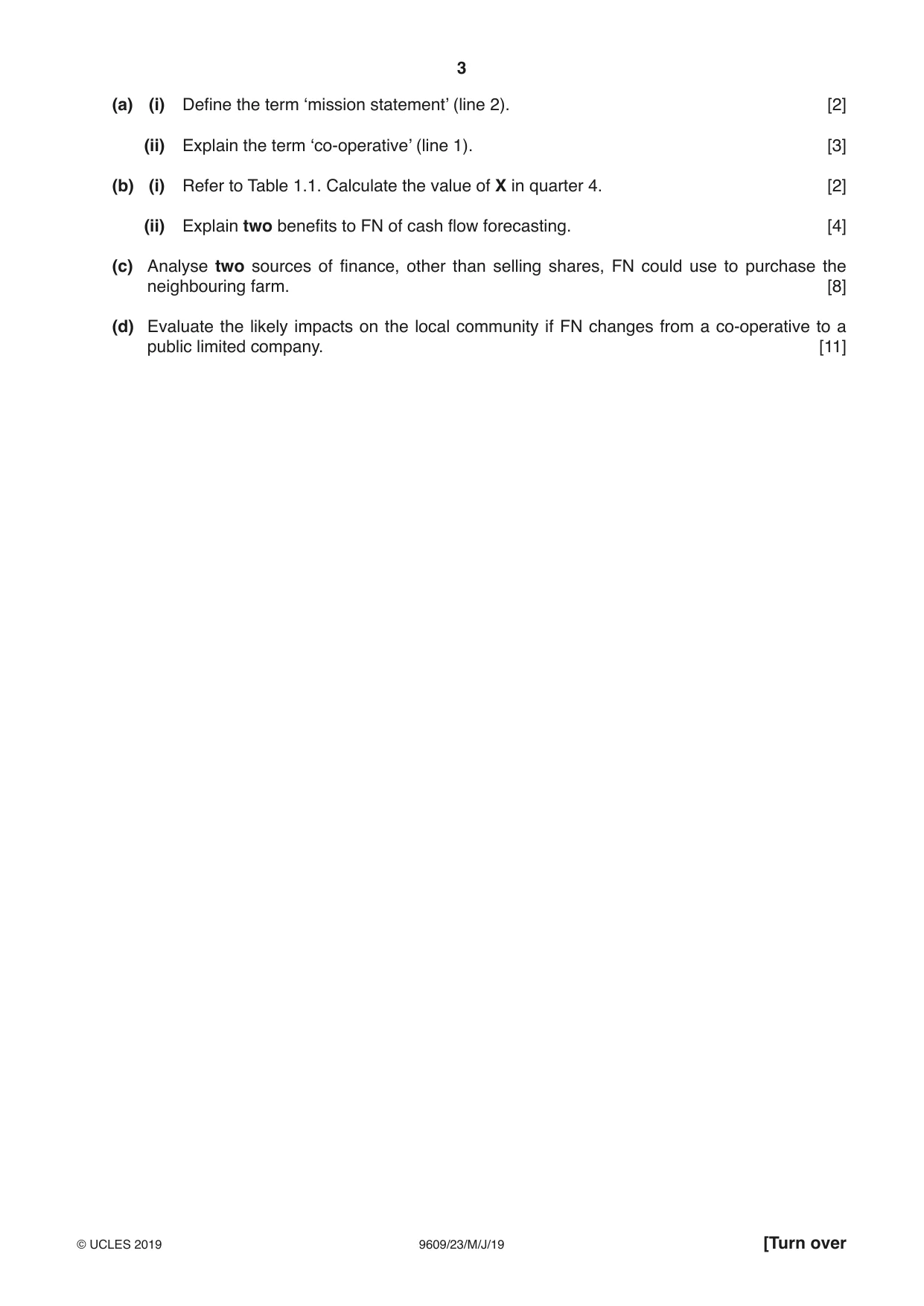
1 First Nature (FN) FN is a co-operative farm producing milk, beef and vegetables. Products are sold in its shop and at local farmers’ markets. FN’s mission statement is in Fig. 1.1. The sustainable production of food, to build strong relationships with members and customers and to contribute to the local community Fig. 1.1: FN’s mission statement 5 The co-operative has 20 members who work on the farm, in the shop and at the markets. Over the past 10 years FN has built up a loyal customer base. Recently, a neighbouring farm has become available to purchase for $80 000. FN has limited capital but would like to expand by purchasing the neighbouring farm. FN is considering sources of finance for the capital needed to buy the land. Giuseppe is 10 one of the original members of the co-operative and has accounting skills. He has prepared the cash flow forecast shown in Table 1.1 in the business plan for the neighbouring farm. Table 1.1: Cash flow forecast for the neighbouring farm Quarter 1 Quarter 2 Quarter 3 Quarter 4 ($000) ($000) ($000) ($000) 15 Cash Inflows Revenue 0 0 40 200 Total cash in 0 0 40 200 Cash Outflows Set-up costs 80 0 0 0 20 Equipment 20 10 0 10 Training 30 0 0 0 Total cash out 130 10 0 10 Opening balance 0 (130) (140) (100) Closing balance (130) (140) (100) X 25 FN will use the neighbouring farm to develop educational programmes for local schools and for putting on community events. The 20 members of the co-operative already work very long hours. The members are discussing whether they should allow more members or become a public limited company (plc) and employ the extra workers required. To become a public limited company would require the agreement of all 20 members. Some members 30 are in favour of the change to a public limited company as they would become quite wealthy through selling shares. However, other members feel that it would change the relationship with its customers. (a) (i) Define the term ‘mission statement’ (line 2). [2] (ii) Explain the term ‘co-operative’ (line 1). [3] (b) (i) Refer to Table 1.1. Calculate the value of X in quarter 4. [2] (ii) Explain two benefits to FN of cash flow forecasting. [4] (c) Analyse two sources of finance, other than selling shares, FN could use to purchase the neighbouring farm. [8] (d) Evaluate the likely impacts on the local community if FN changes from a co-operative to a public limited company. [11]
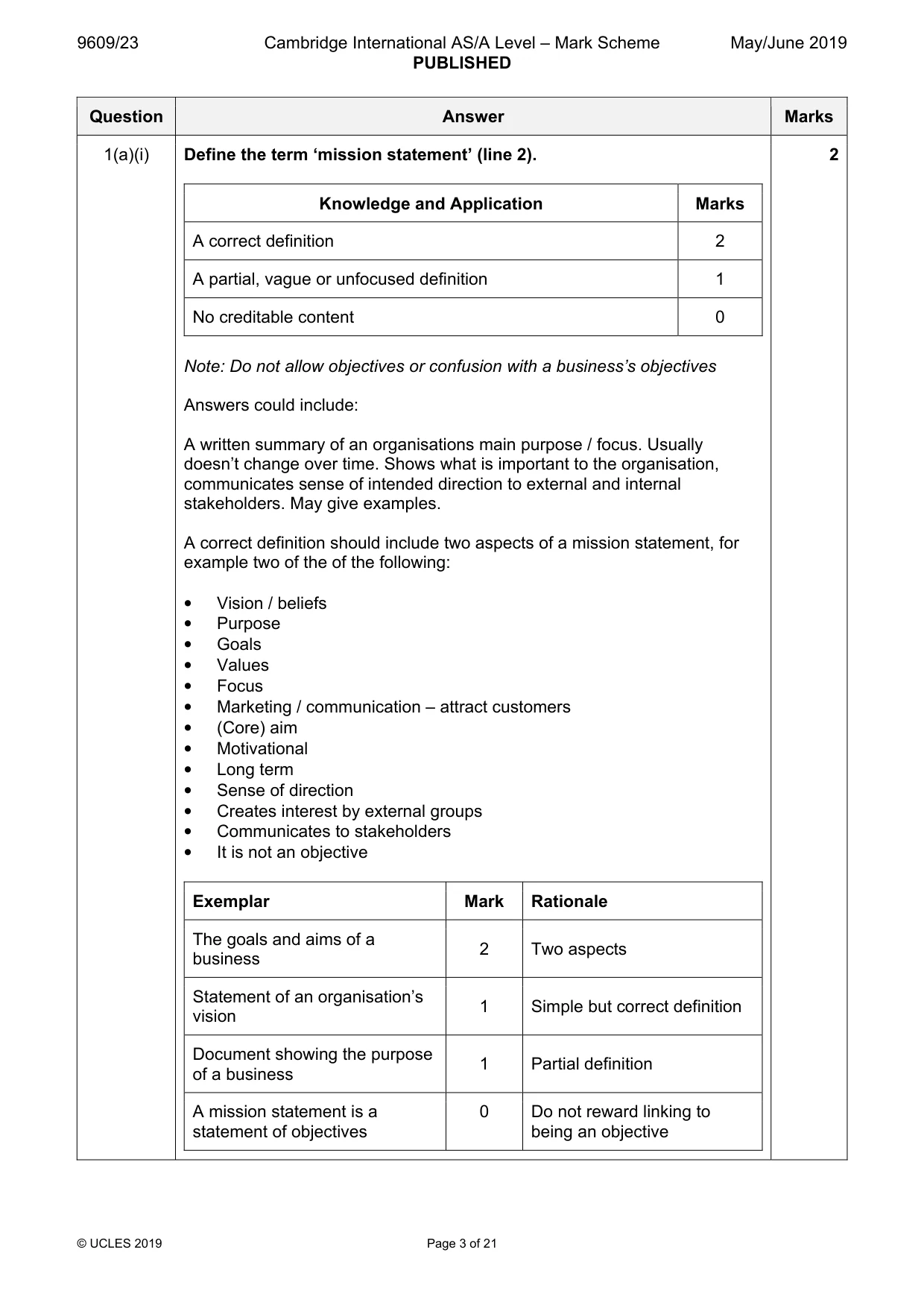
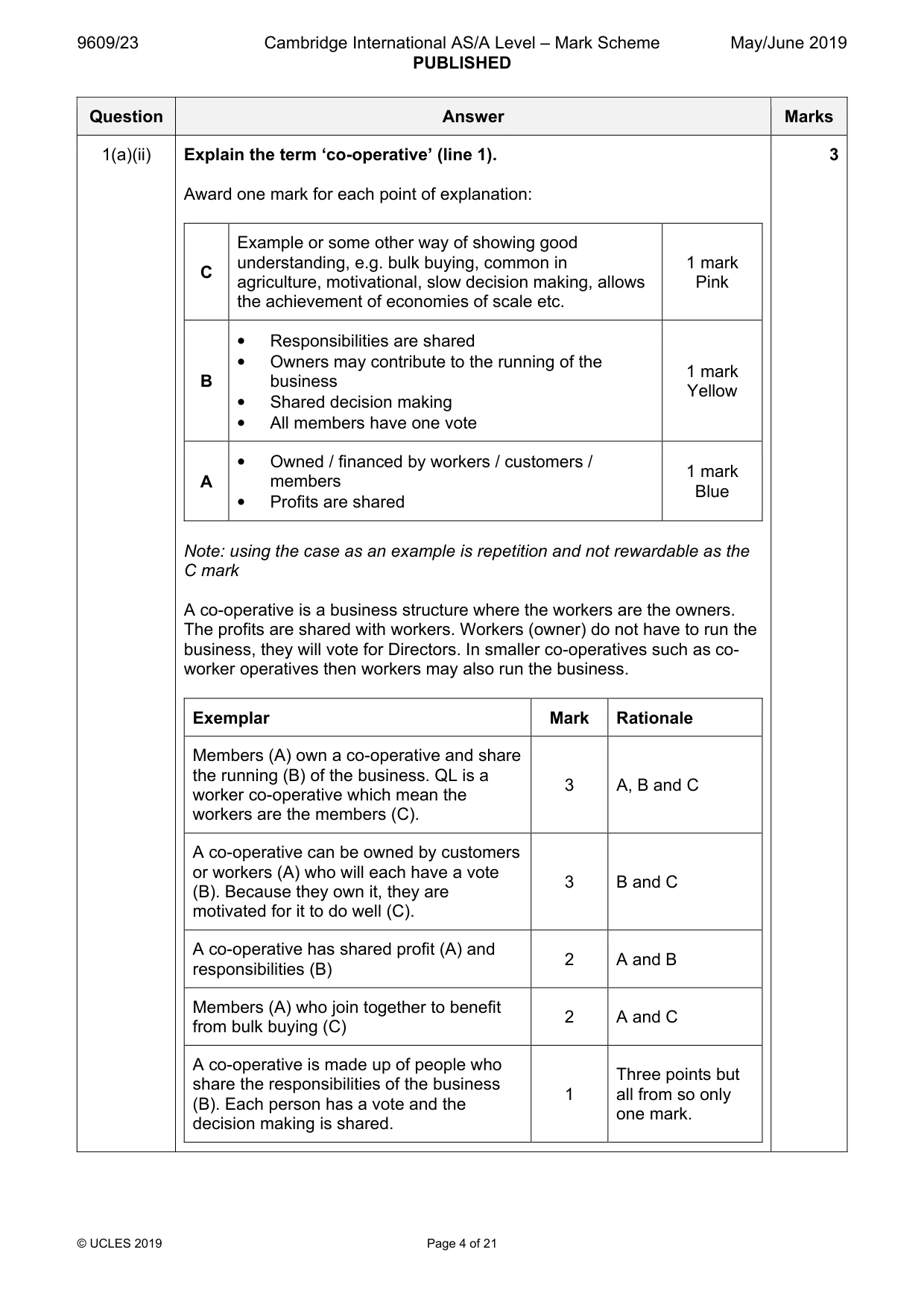
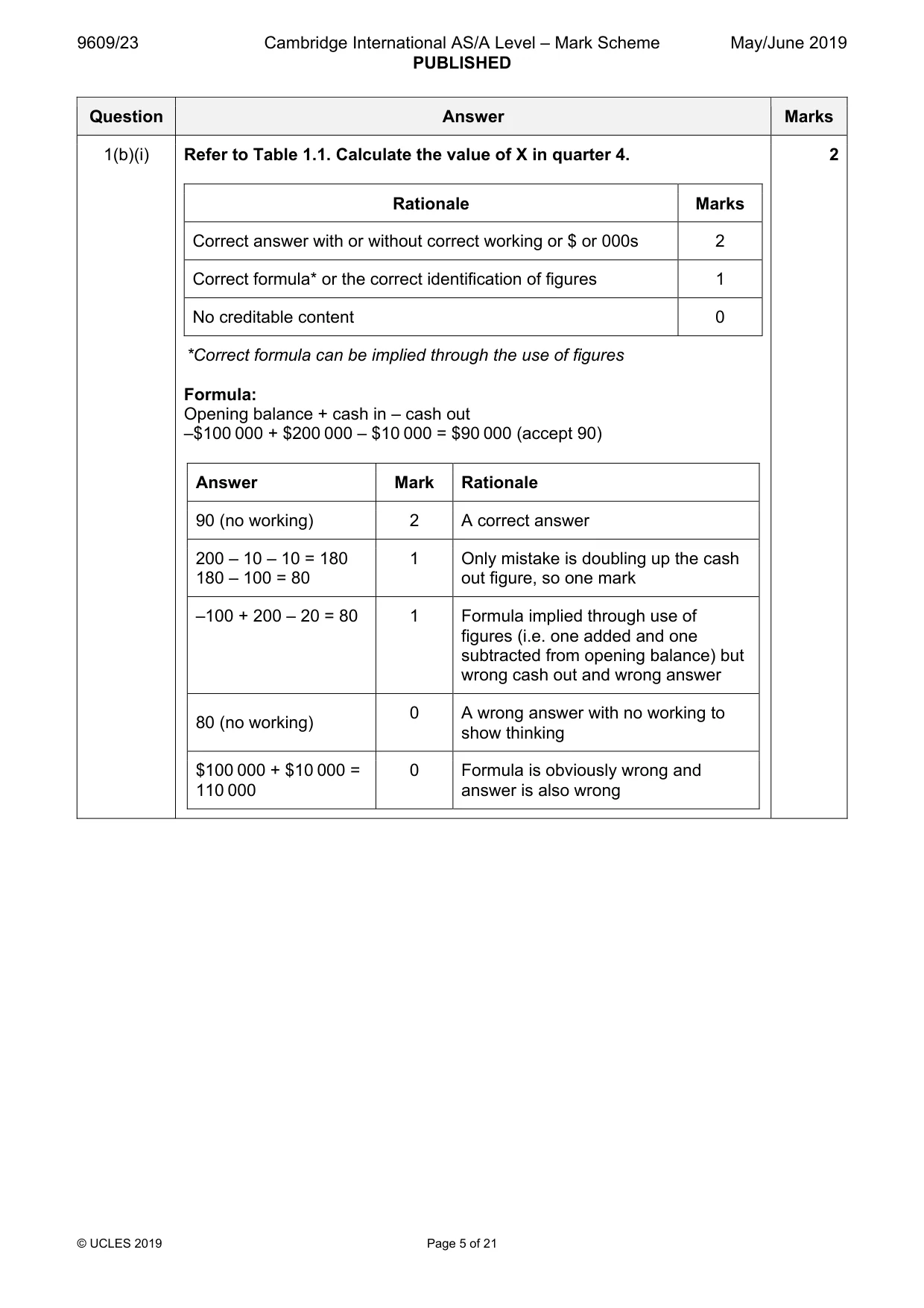
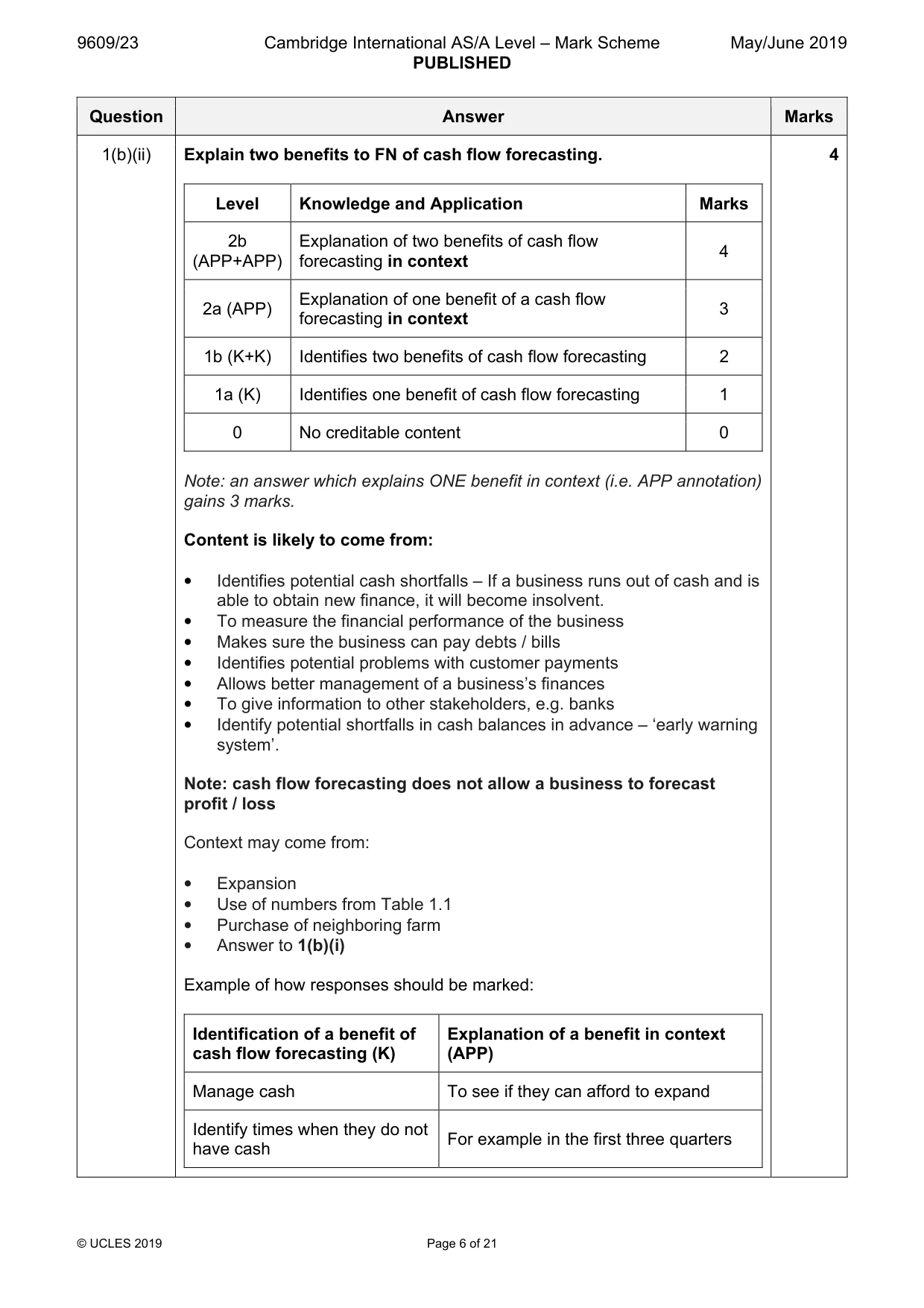
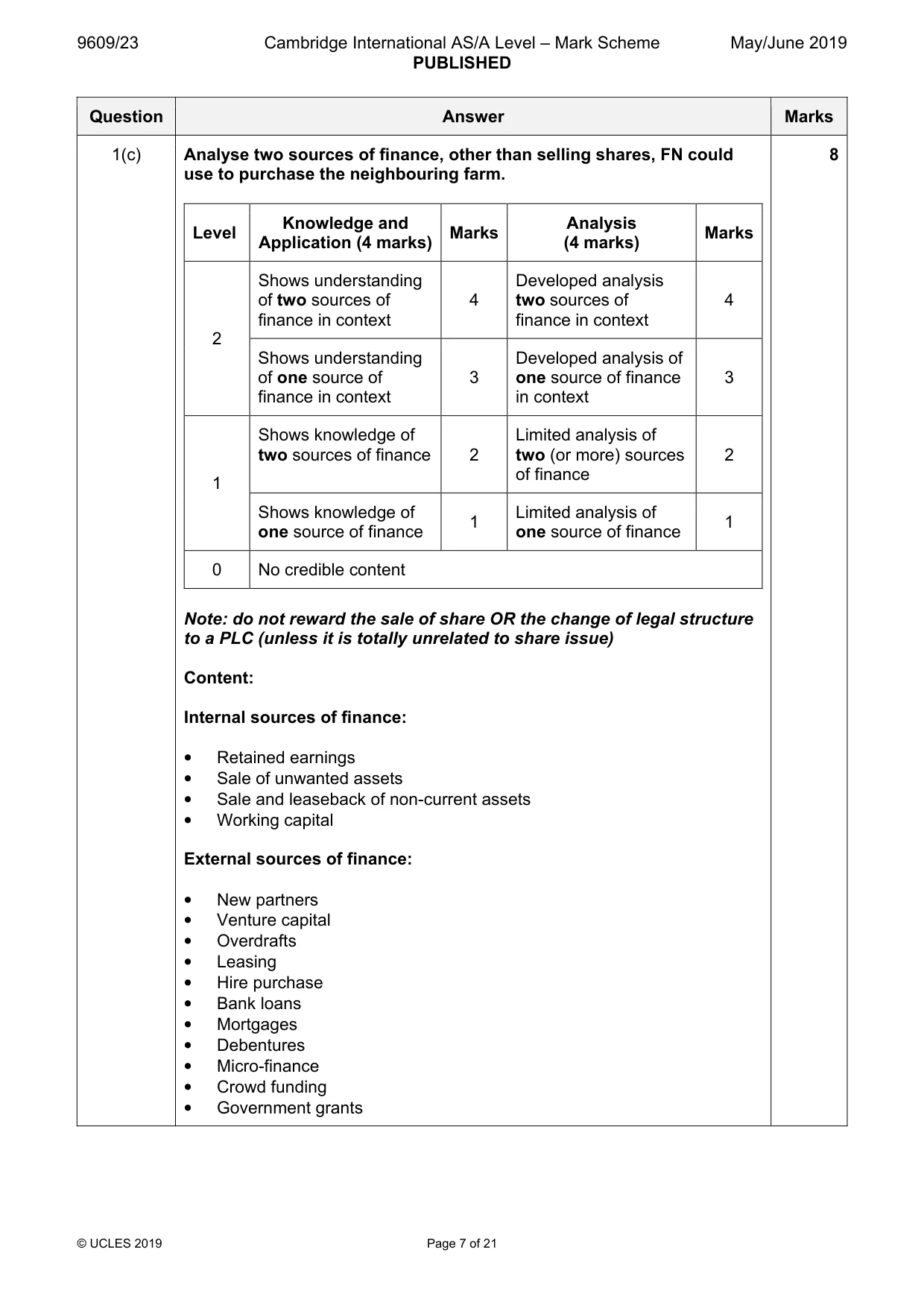
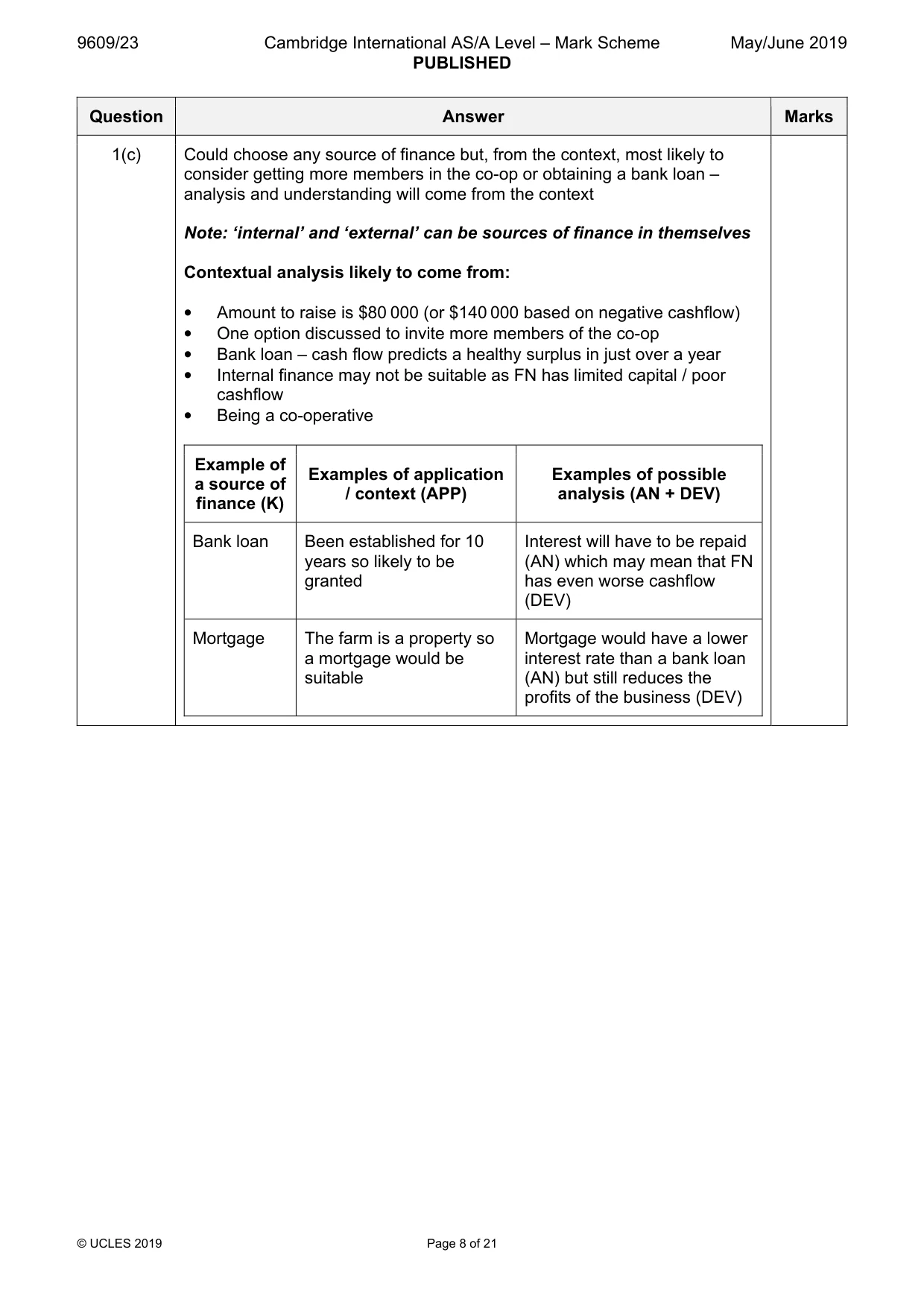
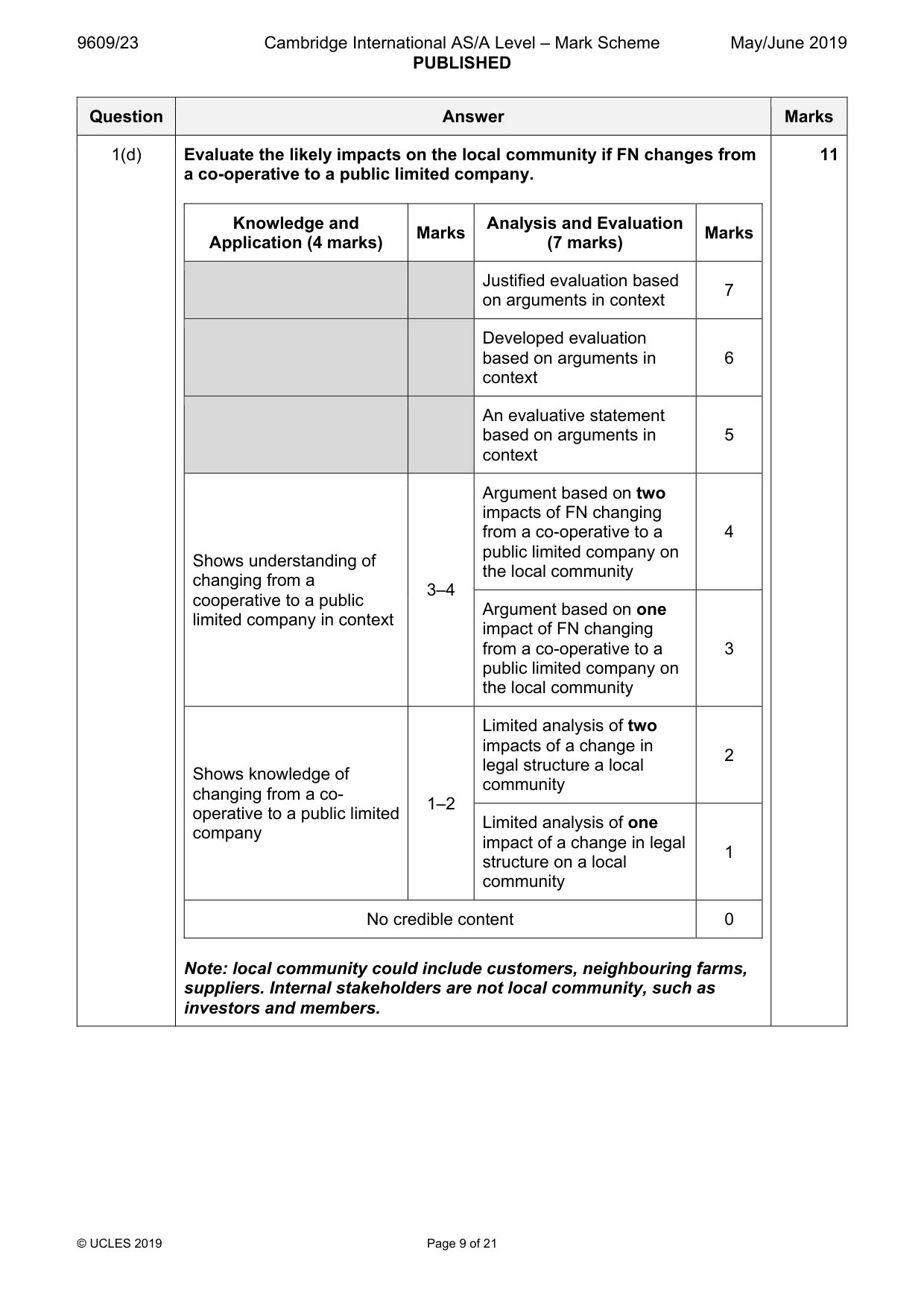
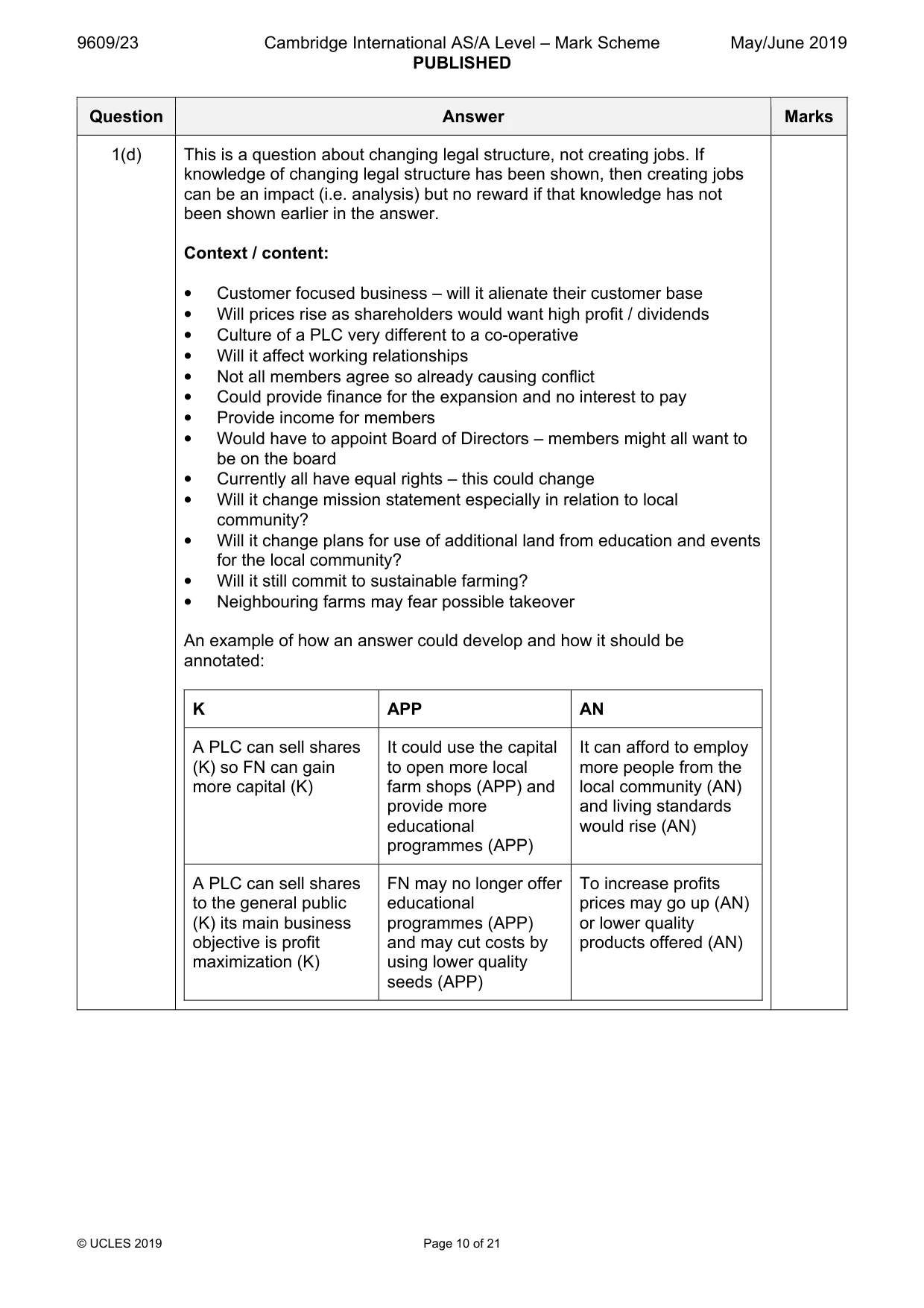
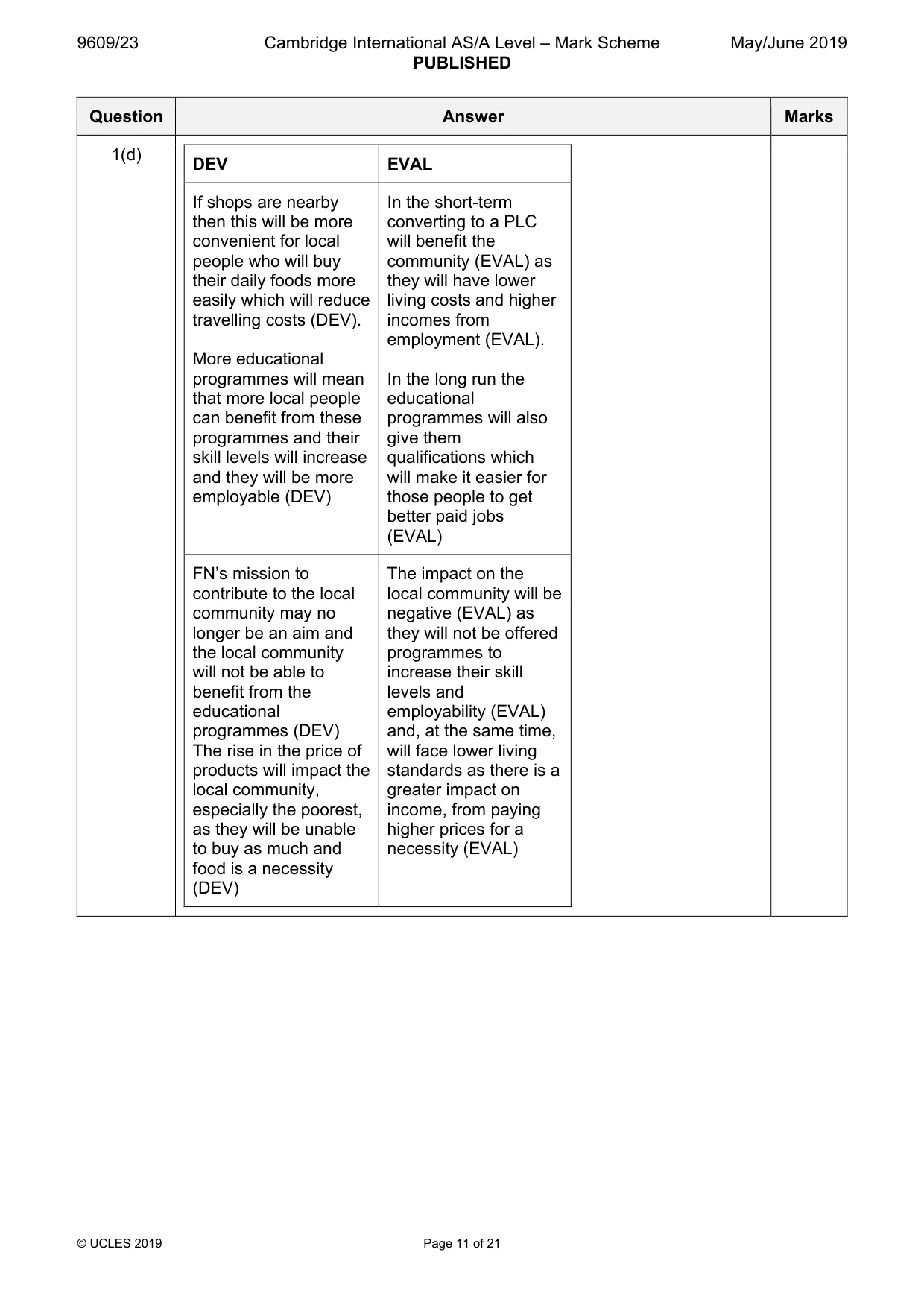
Mark scheme: Question Answer Marks 1(a)(i) Define the term ‘mission statement’ (line 2). 2 Knowledge and Application Marks A correct definition 2 A partial, vague or unfocused definition 1 No creditable content 0 Note: Do not allow objectives or confusion with a business’s objectives Answers could include: A written summary of an organisations main purpose / focus. Usually doesn’t change over time. Shows what is important to the organisation, communicates sense of intended direction to external and internal stakeholders. May give examples. A correct definition should include two aspects of a mission statement, for example two of the of the following: • Vision / beliefs • Purpose • Goals • Values • Focus • Marketing / communication – attract customers • (Core) aim • Motivational • Long term • Sense of direction • Creates interest by external groups • Communicates to stakeholders • It is not an objective Exemplar Mark Rationale The goals and aims of a 2 Two aspects business Statement of an organisation’s 1 Simple but correct definition vision Document showing the purpose 1 Partial definition of a business A mission statement is a 0 Do not reward linking to statement of objectives being an objective 1(a)(ii) Explain the term ‘co-operative’ (line 1). 3 Award one mark for each point of explanation: Example or some other way of showing good understanding, e.g. bulk buying, common in 1 mark C agriculture, motivational, slow decision making, allows Pink the achievement of economies of scale etc. • Responsibilities are shared • Owners may contribute to the running of the 1 mark B business Yellow • Shared decision making • All members have one vote • Owned / financed by workers / customers / 1 mark A members Blue • Profits are shared Note: using the case as an example is repetition and not rewardable as the C mark A co-operative is a business structure where the workers are the owners. The profits are shared with workers. Workers (owner) do not have to run the business, they will vote for Directors. In smaller co-operatives such as co- worker operatives then workers may also run the business. Exemplar Mark Rationale Members (A) own a co-operative and share the running (B) of the business. QL is a 3 A, B and C worker co-operative which mean the workers are the members (C). A co-operative can be owned by customers or workers (A) who will each have a vote 3 B and C (B). Because they own it, they are motivated for it to do well (C). A co-operative has shared profit (A) and 2 A and B responsibilities (B) Members (A) who join together to benefit 2 A and C from bulk buying (C) A co-operative is made up of people who Three points but share the responsibilities of the business 1 all from so only (B). Each person has a vote and the one mark. decision making is shared. 1(b)(i) Refer to Table 1.1. Calculate the value of X in quarter 4. 2 Rationale Marks Correct answer with or without correct working or $ or 000s 2 Correct formula* or the correct identification of figures 1 No creditable content 0 *Correct formula can be implied through the use of figures Formula: Opening balance + cash in – cash out –$100 000 + $200 000 – $10 000 = $90 000 (accept 90) Answer Mark Rationale 90 (no working) 2 A correct answer 200 – 10 – 10 = 180 1 Only mistake is doubling up the cash 180 – 100 = 80 out figure, so one mark –100 + 200 – 20 = 80 1 Formula implied through use of figures (i.e. one added and one subtracted from opening balance) but wrong cash out and wrong answer 0 A wrong answer with no working to 80 (no working) show thinking $100 000 + $10 000 = 0 Formula is obviously wrong and 110 000 answer is also wrong 1(b)(ii) Explain two benefits to FN of cash flow forecasting. 4 Level Knowledge and Application Marks 2b Explanation of two benefits of cash flow 4 (APP+APP) forecasting in context Explanation of one benefit of a cash flow 2a (APP) 3 forecasting in context 1b (K+K) Identifies two benefits of cash flow forecasting 2 1a (K) Identifies one benefit of cash flow forecasting 1 0 No creditable content 0 Note: an answer which explains ONE benefit in context (i.e. APP annotation) gains 3 marks. Content is likely to come from: • Identifies potential cash shortfalls – If a business runs out of cash and is able to obtain new finance, it will become insolvent. • To measure the financial performance of the business • Makes sure the business can pay debts / bills • Identifies potential problems with customer payments • Allows better management of a business’s finances • To give information to other stakeholders, e.g. banks • Identify potential shortfalls in cash balances in advance – ‘early warning system’. Note: cash flow forecasting does not allow a business to forecast profit / loss Context may come from: • Expansion • Use of numbers from Table 1.1 • Purchase of neighboring farm • Answer to 1(b)(i) Example of how responses should be marked: Identification of a benefit of Explanation of a benefit in context cash flow forecasting (K) (APP) Manage cash To see if they can afford to expand Identify times when they do not For example in the first three quarters have cash 1(c) Analyse two sources of finance, other than selling shares, FN could 8 use to purchase the neighbouring farm. Knowledge and Analysis Level Marks Marks Application (4 marks) (4 marks) Shows understanding Developed analysis of two sources of 4 two sources of 4 finance in context finance in context 2 Shows understanding Developed analysis of of one source of 3 one source of finance 3 finance in context in context Shows knowledge of Limited analysis of two sources of finance 2 two (or more) sources 2 of finance 1 Shows knowledge of Limited analysis of 1 1 one source of finance one source of finance 0 No credible content Note: do not reward the sale of share OR the change of legal structure to a PLC (unless it is totally unrelated to share issue) Content: Internal sources of finance: • Retained earnings • Sale of unwanted assets • Sale and leaseback of non-current assets • Working capital External sources of finance: • New partners • Venture capital • Overdrafts • Leasing • Hire purchase • Bank loans • Mortgages • Debentures • Micro-finance • Crowd funding • Government grants 1(c) Could choose any source of finance but, from the context, most likely to consider getting more members in the co-op or obtaining a bank loan – analysis and understanding will come from the context Note: ‘internal’ and ‘external’ can be sources of finance in themselves Contextual analysis likely to come from: • Amount to raise is $80 000 (or $140 000 based on negative cashflow) • One option discussed to invite more members of the co-op • Bank loan – cash flow predicts a healthy surplus in just over a year • Internal finance may not be suitable as FN has limited capital / poor cashflow • Being a co-operative Example of Examples of application Examples of possible a source of / context (APP) analysis (AN + DEV) finance (K) Bank loan Been established for 10 Interest will have to be repaid years so likely to be (AN) which may mean that FN granted has even worse cashflow (DEV) Mortgage The farm is a property so Mortgage would have a lower a mortgage would be interest rate than a bank loan suitable (AN) but still reduces the profits of the business (DEV) 1(d) Evaluate the likely impacts on the local community if FN changes from 11 a co-operative to a public limited company. Knowledge and Analysis and Evaluation Marks Marks Application (4 marks) (7 marks) Justified evaluation based 7 on arguments in context Developed evaluation based on arguments in 6 context An evaluative statement based on arguments in 5 context Argument based on two impacts of FN changing from a co-operative to a 4 public limited company on Shows understanding of the local community changing from a 3–4 cooperative to a public Argument based on one limited company in context impact of FN changing from a co-operative to a 3 public limited company on the local community Limited analysis of two impacts of a change in 2 legal structure a local Shows knowledge of community changing from a co- 1–2 operative to a public limited Limited analysis of one company impact of a change in legal 1 structure on a local community No credible content 0 Note: local community could include customers, neighbouring farms, suppliers. Internal stakeholders are not local community, such as investors and members. 1(d) This is a question about changing legal structure, not creating jobs. If knowledge of changing legal structure has been shown, then creating jobs can be an impact (i.e. analysis) but no reward if that knowledge has not been shown earlier in the answer. Context / content: • Customer focused business – will it alienate their customer base • Will prices rise as shareholders would want high profit / dividends • Culture of a PLC very different to a co-operative • Will it affect working relationships • Not all members agree so already causing conflict • Could provide finance for the expansion and no interest to pay • Provide income for members • Would have to appoint Board of Directors – members might all want to be on the board • Currently all have equal rights – this could change • Will it change mission statement especially in relation to local community? • Will it change plans for use of additional land from education and events for the local community? • Will it still commit to sustainable farming? • Neighbouring farms may fear possible takeover An example of how an answer could develop and how it should be annotated: K APP AN A PLC can sell shares It could use the capital It can afford to employ (K) so FN can gain to open more local more people from the more capital (K) farm shops (APP) and local community (AN) provide more and living standards educational would rise (AN) programmes (APP) A PLC can sell shares FN may no longer offer To increase profits to the general public educational prices may go up (AN) (K) its main business programmes (APP) or lower quality objective is profit and may cut costs by products offered (AN) maximization (K) using lower quality seeds (APP) 1(d) DEV EVAL If shops are nearby In the short-term then this will be more converting to a PLC convenient for local will benefit the people who will buy community (EVAL) as their daily foods more they will have lower easily which will reduce living costs and higher travelling costs (DEV). incomes from employment (EVAL). More educational programmes will mean In the long run the that more local people educational can benefit from these programmes will also programmes and their give them skill levels will increase qualifications which and they will be more will make it easier for employable (DEV) those people to get better paid jobs (EVAL) FN’s mission to The impact on the contribute to the local local community will be community may no negative (EVAL) as longer be an aim and they will not be offered the local community programmes to will not be able to increase their skill benefit from the levels and educational employability (EVAL) programmes (DEV) and, at the same time, The rise in the price of will face lower living products will impact the standards as there is a local community, greater impact on especially the poorest, income, from paying as they will be unable higher prices for a to buy as much and necessity (EVAL) food is a necessity (DEV)
Q2 · Fuzz Buzz Ltd (FBL) FBL is a small private limited company with 10 shareholders
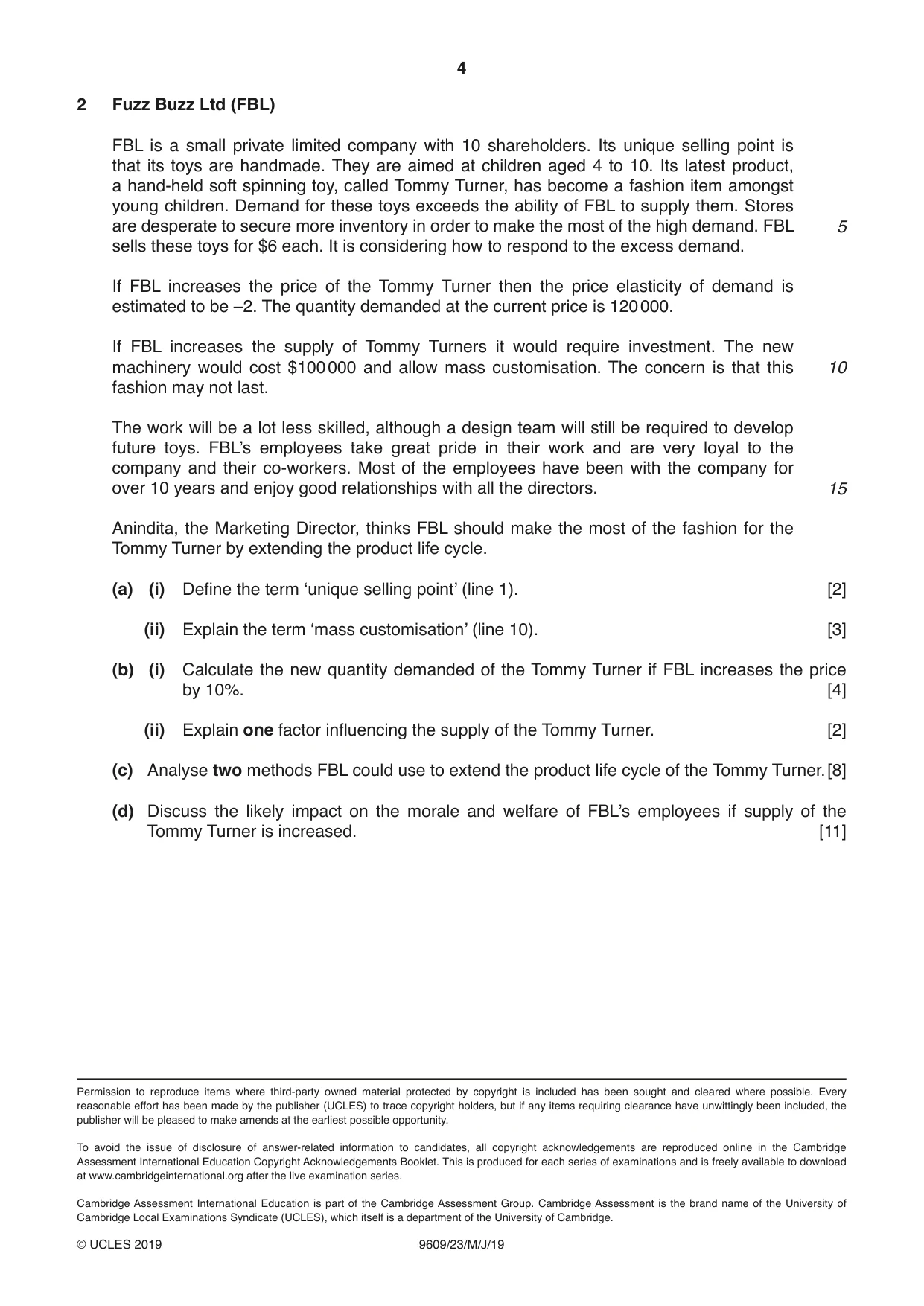
2 Fuzz Buzz Ltd (FBL) FBL is a small private limited company with 10 shareholders. Its unique selling point is that its toys are handmade. They are aimed at children aged 4 to 10. Its latest product, a hand-held soft spinning toy, called Tommy Turner, has become a fashion item amongst young children. Demand for these toys exceeds the ability of FBL to supply them. Stores are desperate to secure more inventory in order to make the most of the high demand. FBL 5 sells these toys for $6 each. It is considering how to respond to the excess demand. If FBL increases the price of the Tommy Turner then the price elasticity of demand is estimated to be –2. The quantity demanded at the current price is 120 000. If FBL increases the supply of Tommy Turners it would require investment. The new machinery would cost $100 000 and allow mass customisation. The concern is that this 10 fashion may not last. The work will be a lot less skilled, although a design team will still be required to develop future toys. FBL’s employees take great pride in their work and are very loyal to the company and their co-workers. Most of the employees have been with the company for over 10 years and enjoy good relationships with all the directors. 15 Anindita, the Marketing Director, thinks FBL should make the most of the fashion for the Tommy Turner by extending the product life cycle. (a) (i) Define the term ‘unique selling point’ (line 1). [2] (ii) Explain the term ‘mass customisation’ (line 10). [3] (b) (i) Calculate the new quantity demanded of the Tommy Turner if FBL increases the price by 10%. [4] (ii) Explain one factor influencing the supply of the Tommy Turner. [2] (c) Analyse two methods FBL could use to extend the product life cycle of the Tommy Turner. [8] (d) Discuss the likely impact on the morale and welfare of FBL’s employees if supply of the Tommy Turner is increased. [11]
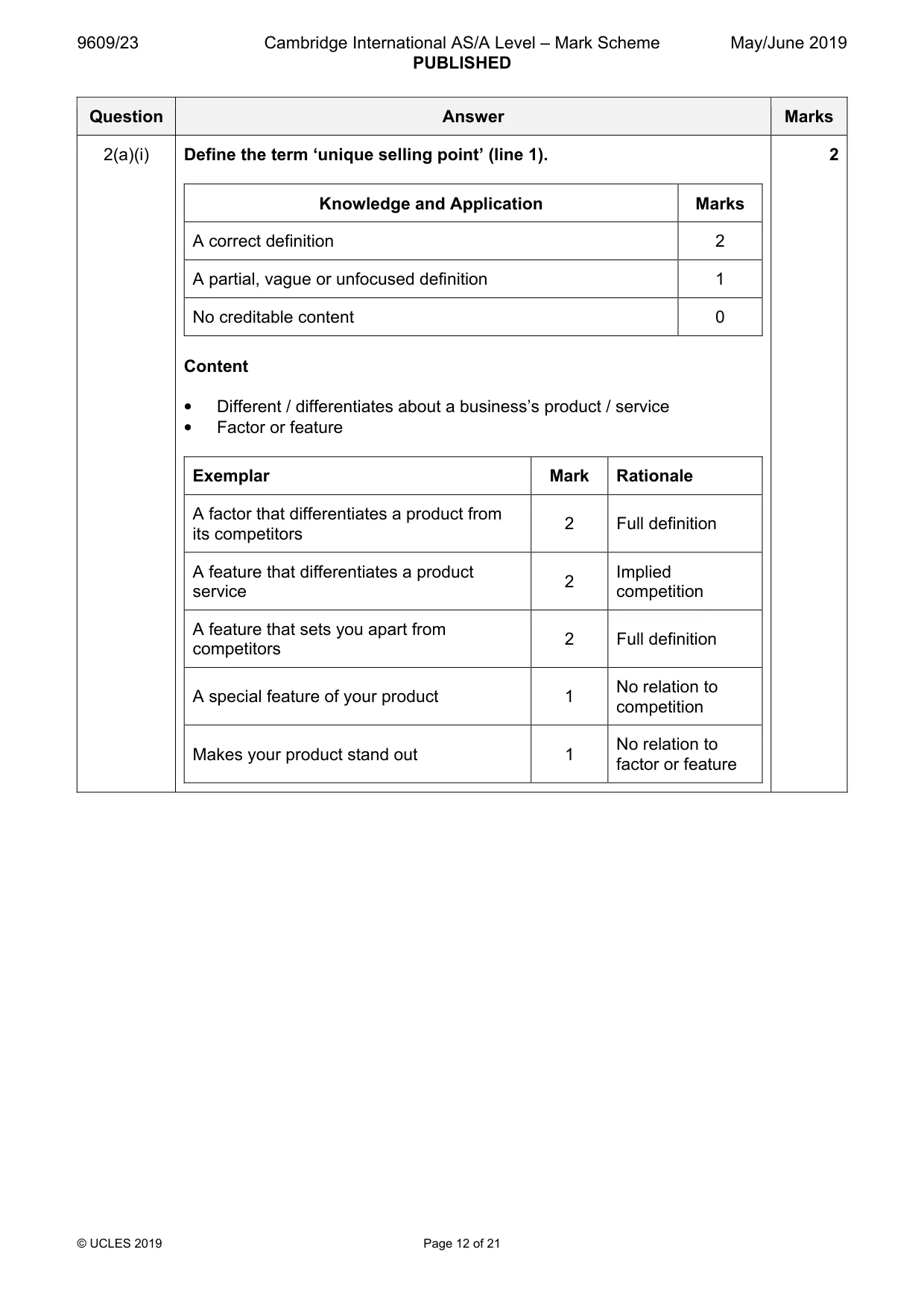
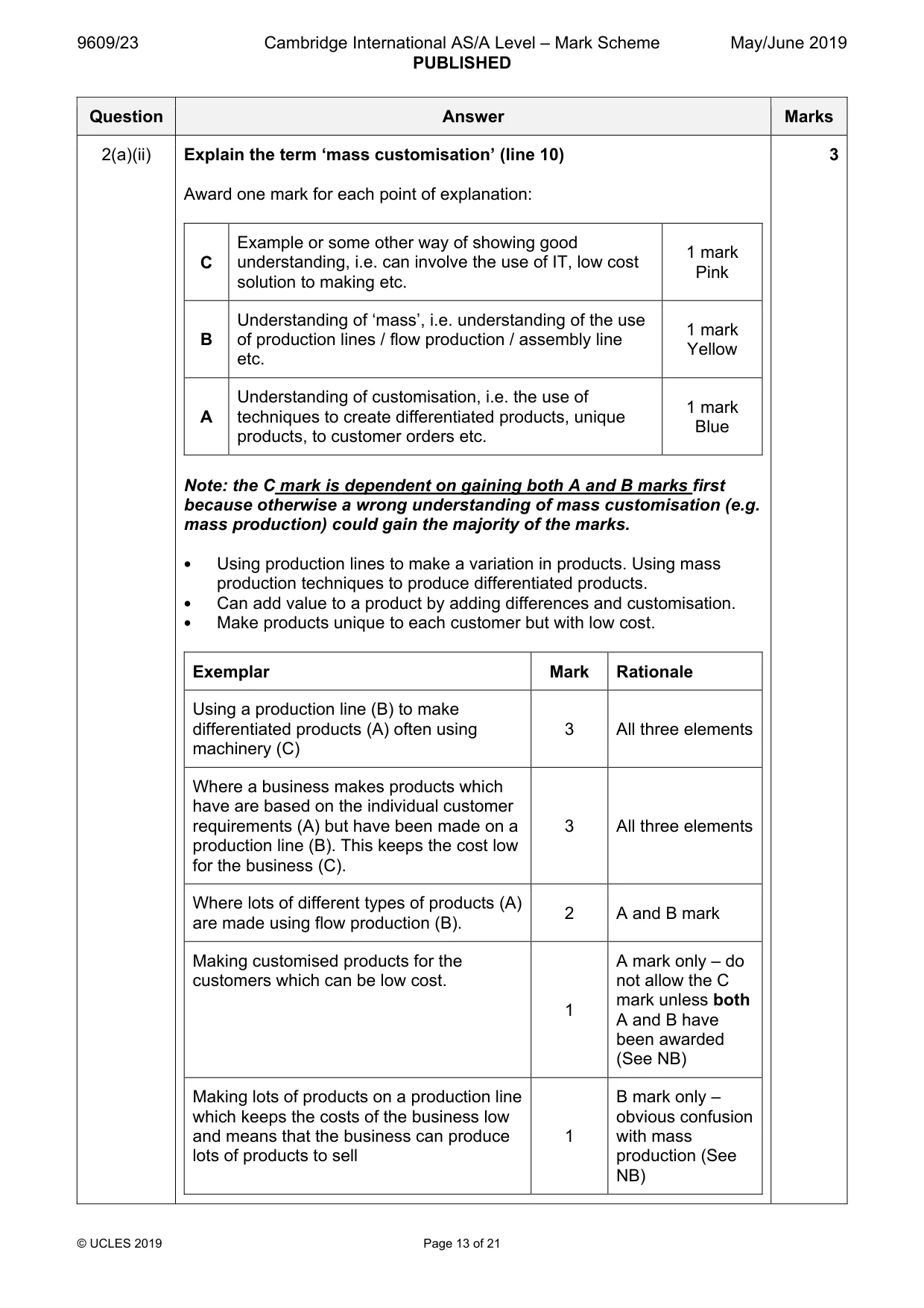
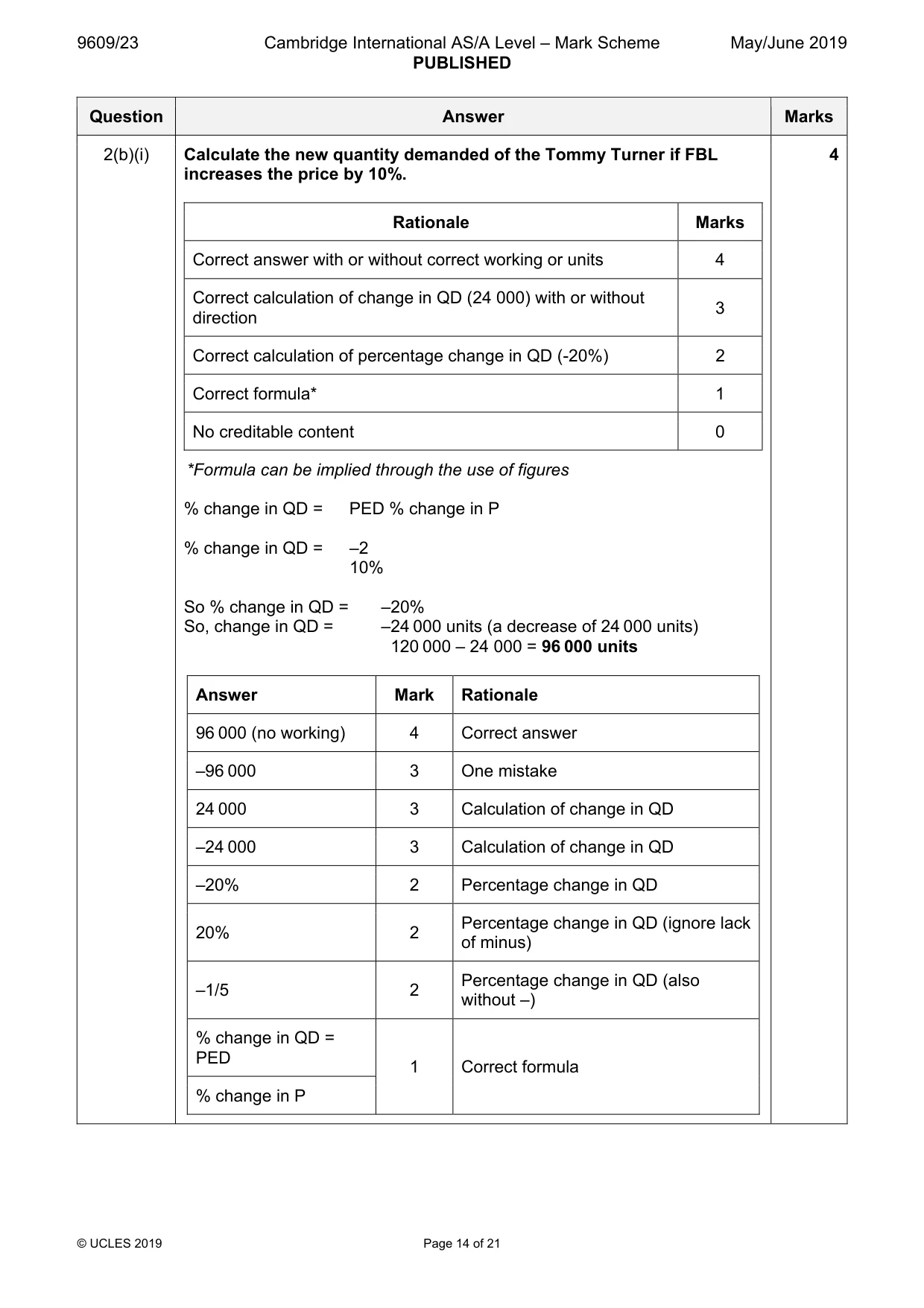
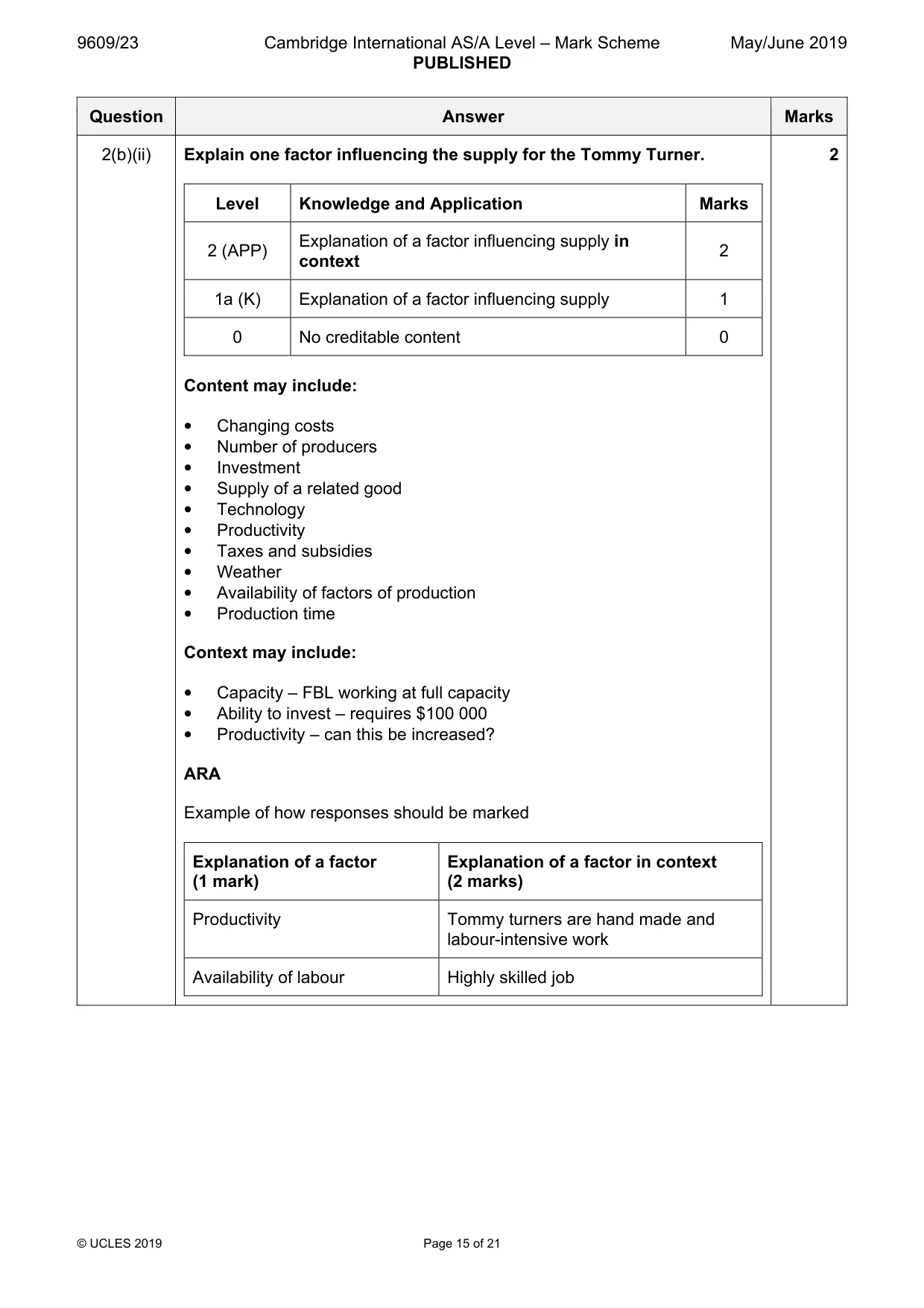
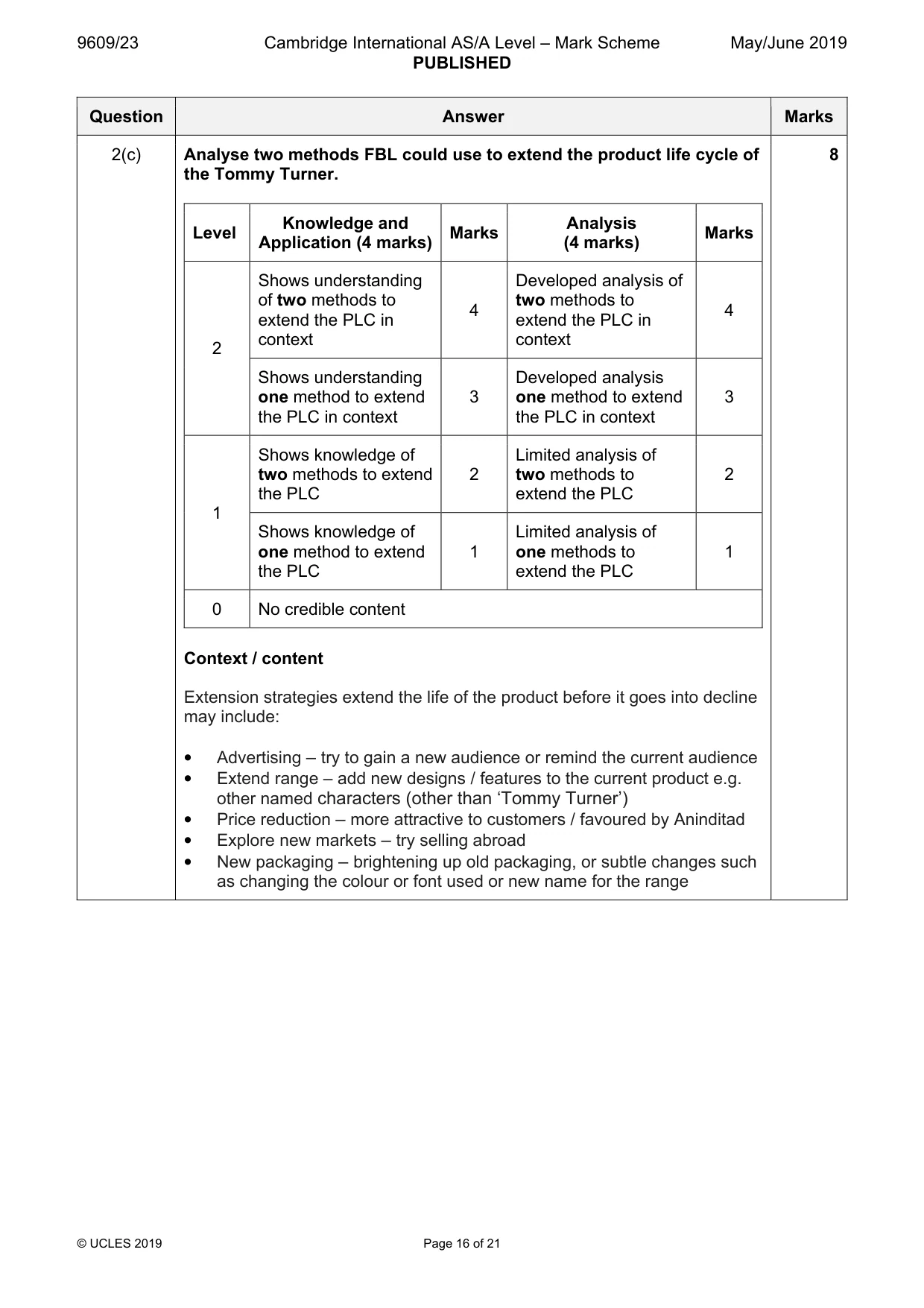
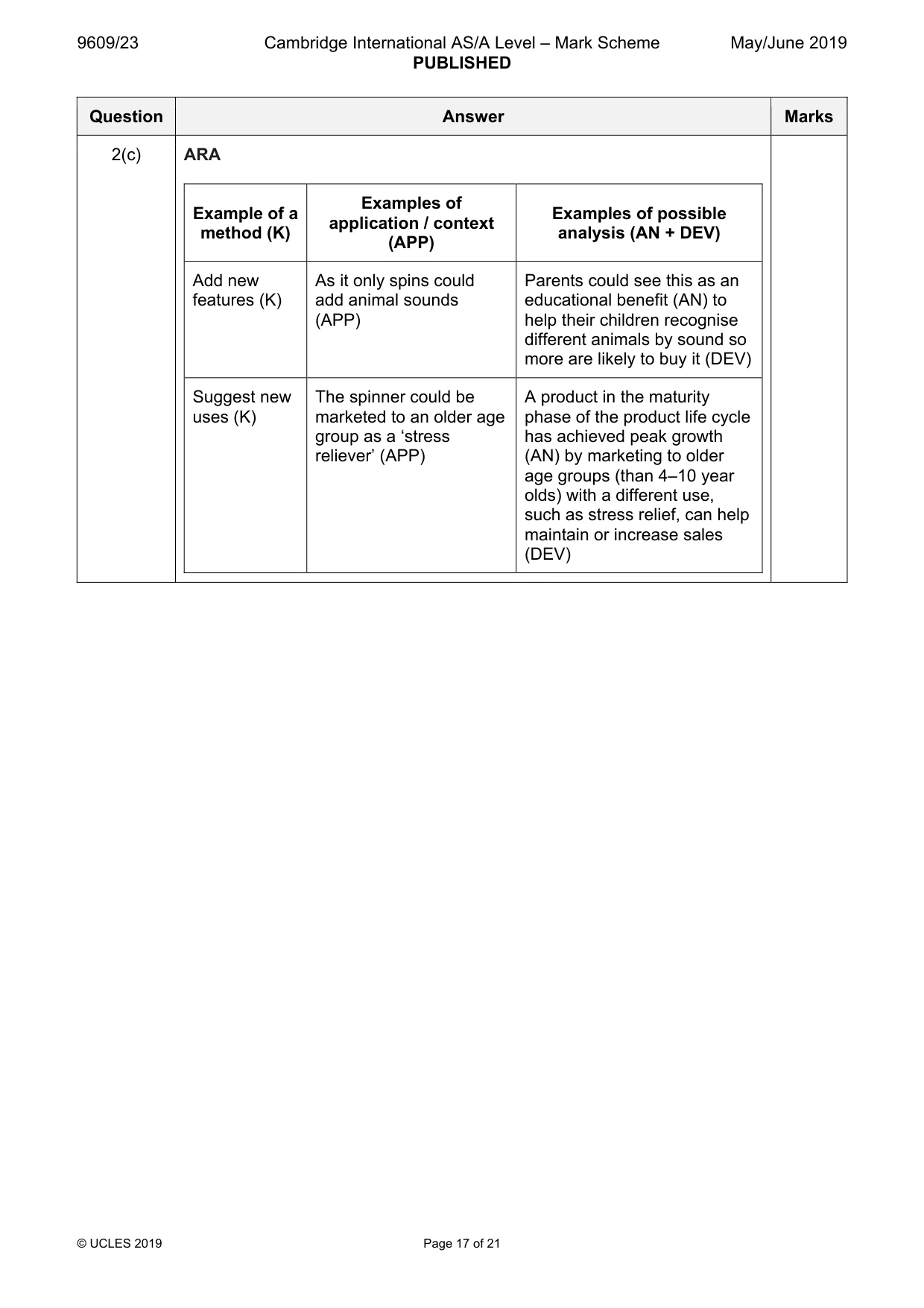
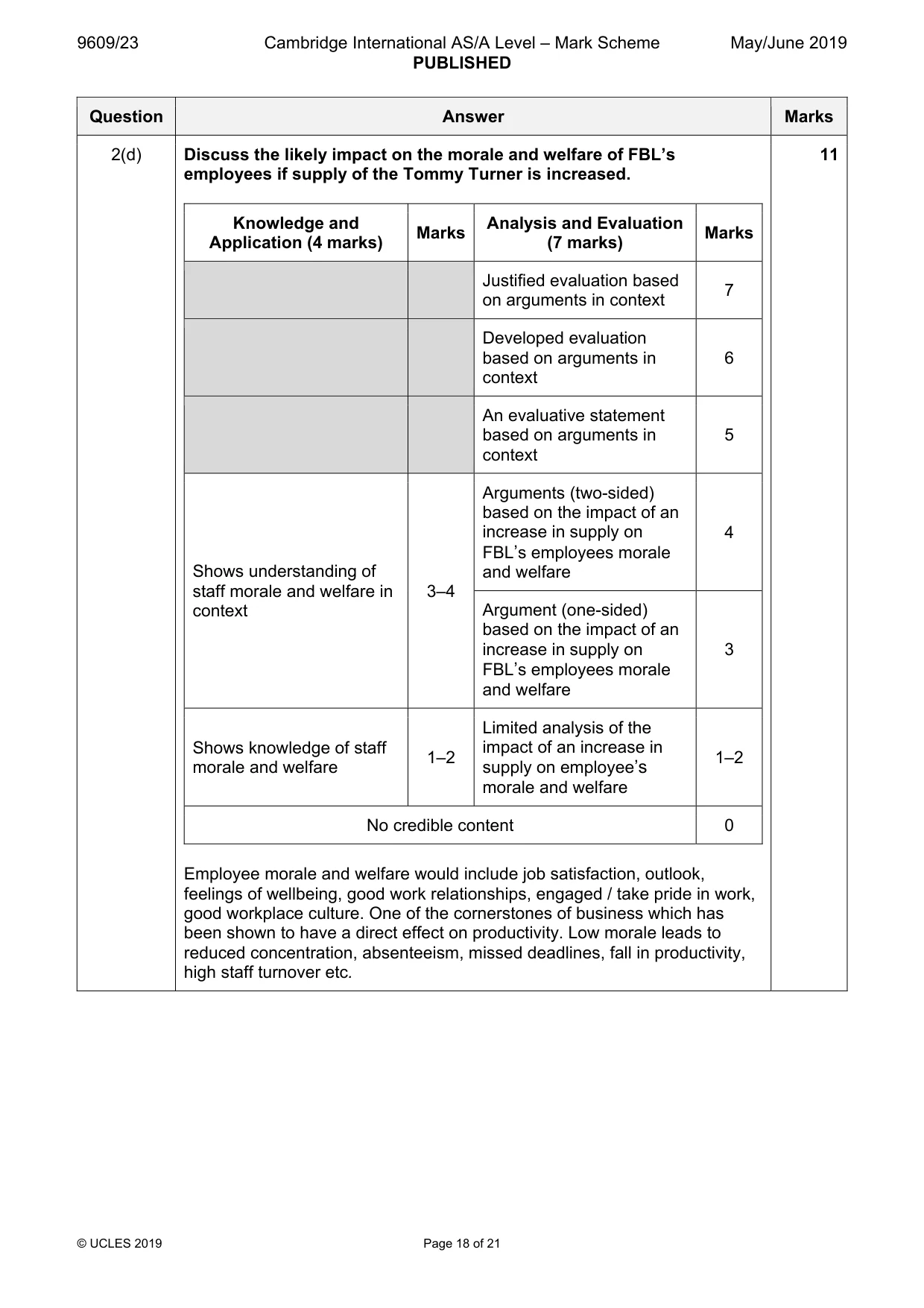
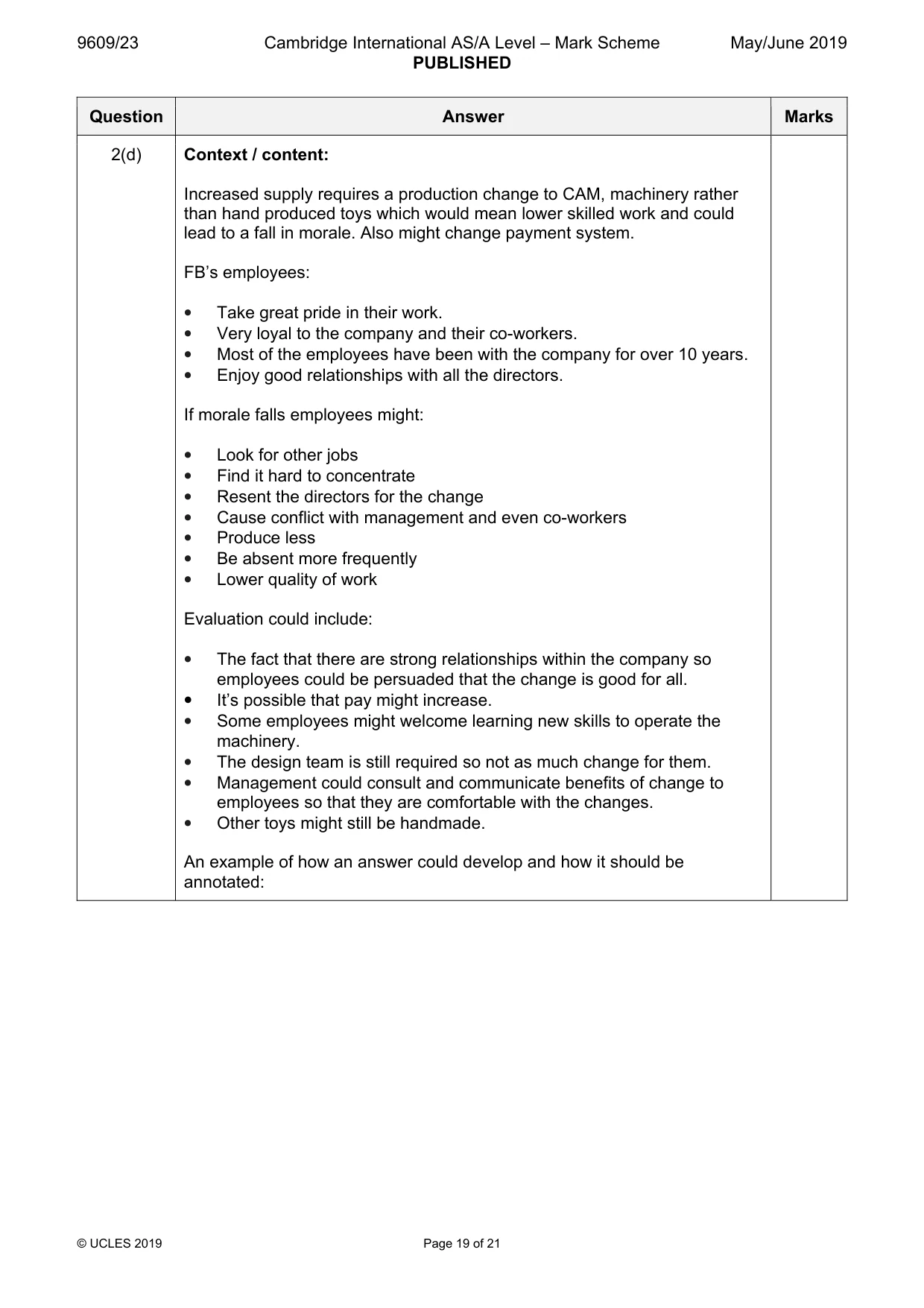
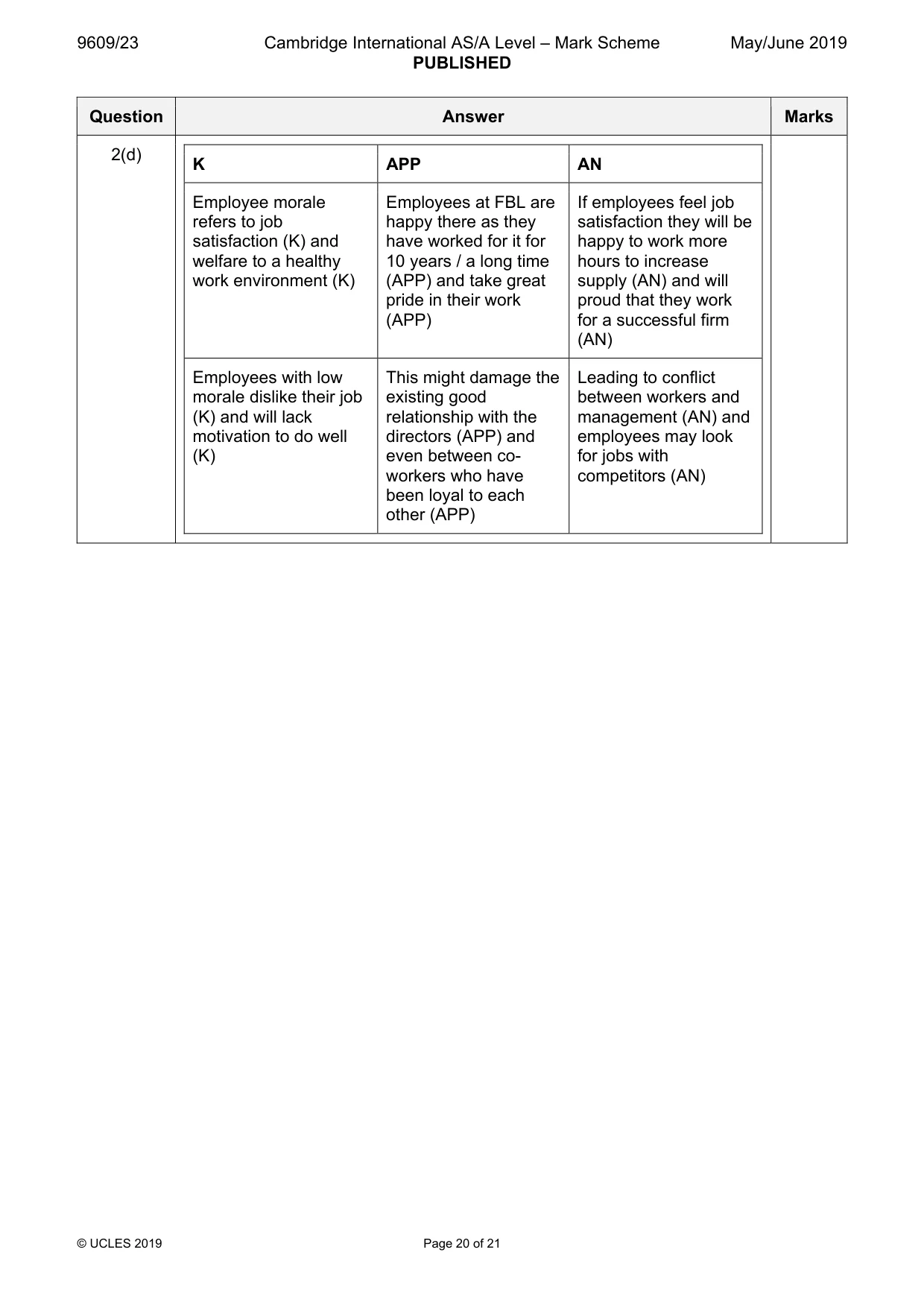
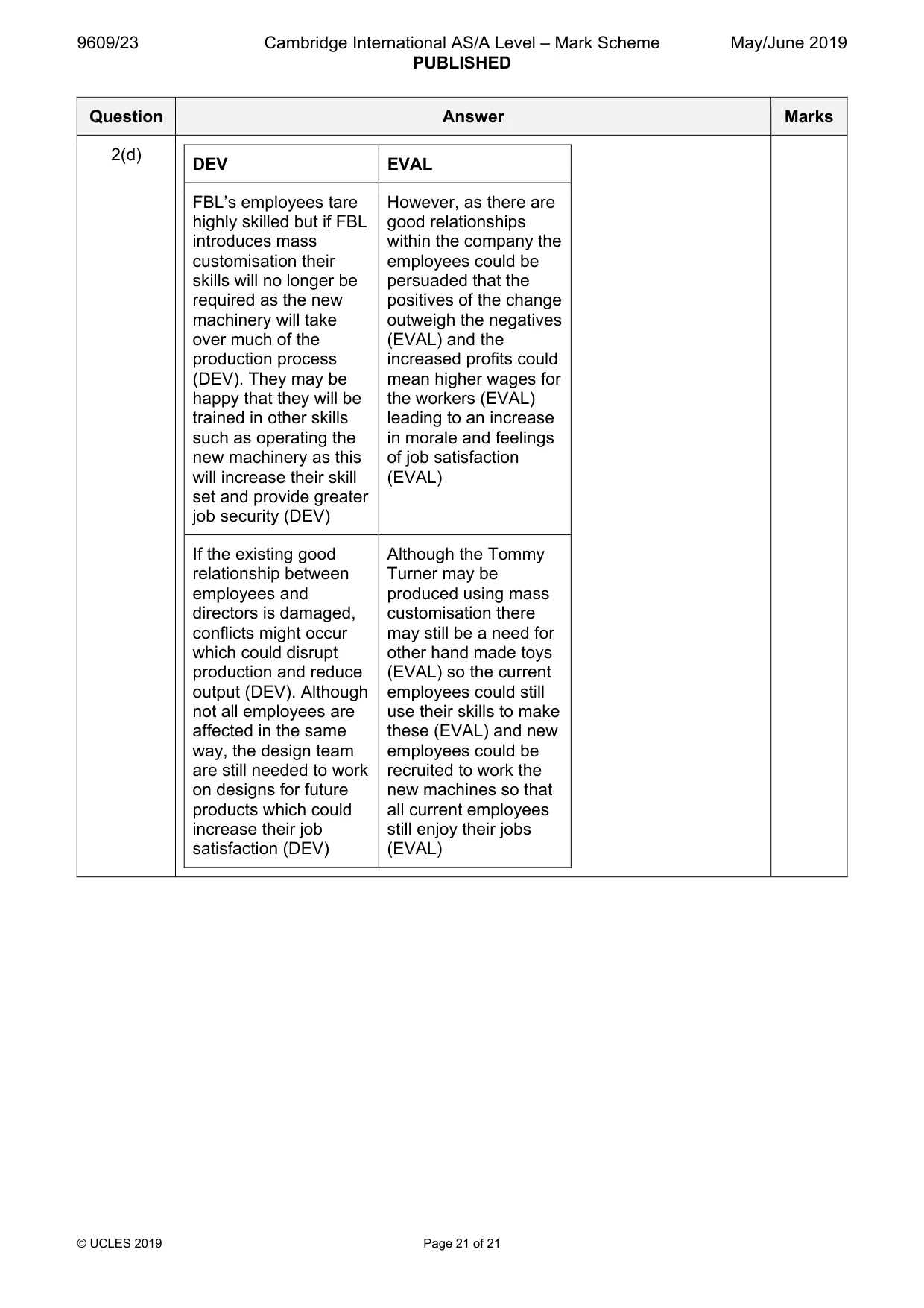
Mark scheme: 2(a)(i) Define the term ‘unique selling point’ (line 1). 2 Knowledge and Application Marks A correct definition 2 A partial, vague or unfocused definition 1 No creditable content 0 Content • Different / differentiates about a business’s product / service • Factor or feature Exemplar Mark Rationale A factor that differentiates a product from 2 Full definition its competitors A feature that differentiates a product Implied 2 service competition A feature that sets you apart from 2 Full definition competitors No relation to A special feature of your product 1 competition No relation to Makes your product stand out 1 factor or feature 2(a)(ii) Explain the term ‘mass customisation’ (line 10) 3 Award one mark for each point of explanation: Example or some other way of showing good 1 mark C understanding, i.e. can involve the use of IT, low cost Pink solution to making etc. Understanding of ‘mass’, i.e. understanding of the use 1 mark B of production lines / flow production / assembly line Yellow etc. Understanding of customisation, i.e. the use of 1 mark A techniques to create differentiated products, unique Blue products, to customer orders etc. Note: the C mark is dependent on gaining both A and B marks first because otherwise a wrong understanding of mass customisation (e.g. mass production) could gain the majority of the marks. • Using production lines to make a variation in products. Using mass production techniques to produce differentiated products. • Can add value to a product by adding differences and customisation. • Make products unique to each customer but with low cost. Exemplar Mark Rationale Using a production line (B) to make differentiated products (A) often using 3 All three elements machinery (C) Where a business makes products which have are based on the individual customer requirements (A) but have been made on a 3 All three elements production line (B). This keeps the cost low for the business (C). Where lots of different types of products (A) 2 A and B mark are made using flow production (B). Making customised products for the A mark only – do customers which can be low cost. not allow the C mark unless both 1 A and B have been awarded (See NB) Making lots of products on a production line B mark only – which keeps the costs of the business low obvious confusion and means that the business can produce 1 with mass lots of products to sell production (See NB) 2(b)(i) Calculate the new quantity demanded of the Tommy Turner if FBL 4 increases the price by 10%. Rationale Marks Correct answer with or without correct working or units 4 Correct calculation of change in QD (24 000) with or without 3 direction Correct calculation of percentage change in QD (-20%) 2 Correct formula* 1 No creditable content 0 *Formula can be implied through the use of figures % change in QD = PED % change in P % change in QD = –2 10% So % change in QD = –20% So, change in QD = –24 000 units (a decrease of 24 000 units) –120 000 – 24 000 = 96 000 units Answer Mark Rationale 96 000 (no working) 4 Correct answer –96 000 3 One mistake 24 000 3 Calculation of change in QD –24 000 3 Calculation of change in QD –20% 2 Percentage change in QD Percentage change in QD (ignore lack 20% 2 of minus) Percentage change in QD (also –1/5 2 without –) % change in QD = PED 1 Correct formula % change in P 2(b)(ii) Explain one factor influencing the supply for the Tommy Turner. 2 Level Knowledge and Application Marks Explanation of a factor influencing supply in 2 (APP) 2 context 1a (K) Explanation of a factor influencing supply 1 0 No creditable content 0 Content may include: • Changing costs • Number of producers • Investment • Supply of a related good • Technology • Productivity • Taxes and subsidies • Weather • Availability of factors of production • Production time Context may include: • Capacity – FBL working at full capacity • Ability to invest – requires $100 000 • Productivity – can this be increased? ARA Example of how responses should be marked Explanation of a factor Explanation of a factor in context (1 mark) (2 marks) Productivity Tommy turners are hand made and labour-intensive work Availability of labour Highly skilled job 2(c) Analyse two methods FBL could use to extend the product life cycle of 8 the Tommy Turner. Knowledge and Analysis Level Marks Marks Application (4 marks) (4 marks) Shows understanding Developed analysis of of two methods to two methods to 4 4 extend the PLC in extend the PLC in context context 2 Shows understanding Developed analysis one method to extend 3 one method to extend 3 the PLC in context the PLC in context Shows knowledge of Limited analysis of two methods to extend 2 two methods to 2 the PLC extend the PLC 1 Shows knowledge of Limited analysis of one method to extend 1 one methods to 1 the PLC extend the PLC 0 No credible content Context / content Extension strategies extend the life of the product before it goes into decline may include: • Advertising – try to gain a new audience or remind the current audience • Extend range – add new designs / features to the current product e.g. other named characters (other than ‘Tommy Turner’) • Price reduction – more attractive to customers / favoured by Aninditad • Explore new markets – try selling abroad • New packaging – brightening up old packaging, or subtle changes such as changing the colour or font used or new name for the range 2(c) ARA Examples of Example of a Examples of possible application / context method (K) analysis (AN + DEV) (APP) Add new As it only spins could Parents could see this as an features (K) add animal sounds educational benefit (AN) to (APP) help their children recognise different animals by sound so more are likely to buy it (DEV) Suggest new The spinner could be A product in the maturity uses (K) marketed to an older age phase of the product life cycle group as a ‘stress has achieved peak growth reliever’ (APP) (AN) by marketing to older age groups (than 4–10 year olds) with a different use, such as stress relief, can help maintain or increase sales (DEV) 2(d) Discuss the likely impact on the morale and welfare of FBL’s 11 employees if supply of the Tommy Turner is increased. Knowledge and Analysis and Evaluation Marks Marks Application (4 marks) (7 marks) Justified evaluation based 7 on arguments in context Developed evaluation based on arguments in 6 context An evaluative statement based on arguments in 5 context Arguments (two-sided) based on the impact of an increase in supply on 4 FBL’s employees morale Shows understanding of and welfare staff morale and welfare in 3–4 context Argument (one-sided) based on the impact of an increase in supply on 3 FBL’s employees morale and welfare Limited analysis of the Shows knowledge of staff impact of an increase in 1–2 1–2 morale and welfare supply on employee’s morale and welfare No credible content 0 Employee morale and welfare would include job satisfaction, outlook, feelings of wellbeing, good work relationships, engaged / take pride in work, good workplace culture. One of the cornerstones of business which has been shown to have a direct effect on productivity. Low morale leads to reduced concentration, absenteeism, missed deadlines, fall in productivity, high staff turnover etc. 2(d) Context / content: Increased supply requires a production change to CAM, machinery rather than hand produced toys which would mean lower skilled work and could lead to a fall in morale. Also might change payment system. FB’s employees: • Take great pride in their work. • Very loyal to the company and their co-workers. • Most of the employees have been with the company for over 10 years. • Enjoy good relationships with all the directors. If morale falls employees might: • Look for other jobs • Find it hard to concentrate • Resent the directors for the change • Cause conflict with management and even co-workers • Produce less • Be absent more frequently • Lower quality of work Evaluation could include: • The fact that there are strong relationships within the company so employees could be persuaded that the change is good for all. • It’s possible that pay might increase. • Some employees might welcome learning new skills to operate the machinery. • The design team is still required so not as much change for them. • Management could consult and communicate benefits of change to employees so that they are comfortable with the changes. • Other toys might still be handmade. An example of how an answer could develop and how it should be annotated: 2(d) K APP AN Employee morale Employees at FBL are If employees feel job refers to job happy there as they satisfaction they will be satisfaction (K) and have worked for it for happy to work more welfare to a healthy 10 years / a long time hours to increase work environment (K) (APP) and take great supply (AN) and will pride in their work proud that they work (APP) for a successful firm (AN) Employees with low This might damage the Leading to conflict morale dislike their job existing good between workers and (K) and will lack relationship with the management (AN) and motivation to do well directors (APP) and employees may look (K) even between co- for jobs with workers who have competitors (AN) been loyal to each other (APP) 2(d) DEV EVAL FBL’s employees tare However, as there are highly skilled but if FBL good relationships introduces mass within the company the customisation their employees could be skills will no longer be persuaded that the required as the new positives of the change machinery will take outweigh the negatives over much of the (EVAL) and the production process increased profits could (DEV). They may be mean higher wages for happy that they will be the workers (EVAL) trained in other skills leading to an increase such as operating the in morale and feelings new machinery as this of job satisfaction will increase their skill (EVAL) set and provide greater job security (DEV) If the existing good Although the Tommy relationship between Turner may be employees and produced using mass directors is damaged, customisation there conflicts might occur may still be a need for which could disrupt other hand made toys production and reduce (EVAL) so the current output (DEV). Although employees could still not all employees are use their skills to make affected in the same these (EVAL) and new way, the design team employees could be are still needed to work recruited to work the on designs for future new machines so that products which could all current employees increase their job still enjoy their jobs satisfaction (DEV) (EVAL)
What was in this paper
The subtopics covered by these 2 questions, and how many questions each got. Open one in a new tab to see every Cambridge question on it.
What you needed in this session
Cambridge’s own grade thresholds for 2019 May/June, Paper 2 · Variant 3. A higher threshold means an easier paper — the bar moves with how the cohort did.