Cambridge A Level Business (for first examination in 2016) 9609 — 2018 Oct/Nov Paper 2 · Variant 2
9609/22/O/N/18 · 2 questions · 60 marks · ≈68 min
The question paper and its mark scheme, free to read here and free to download. This is Cambridge’s own paper, exactly as it was sat.
Question paper4 pages
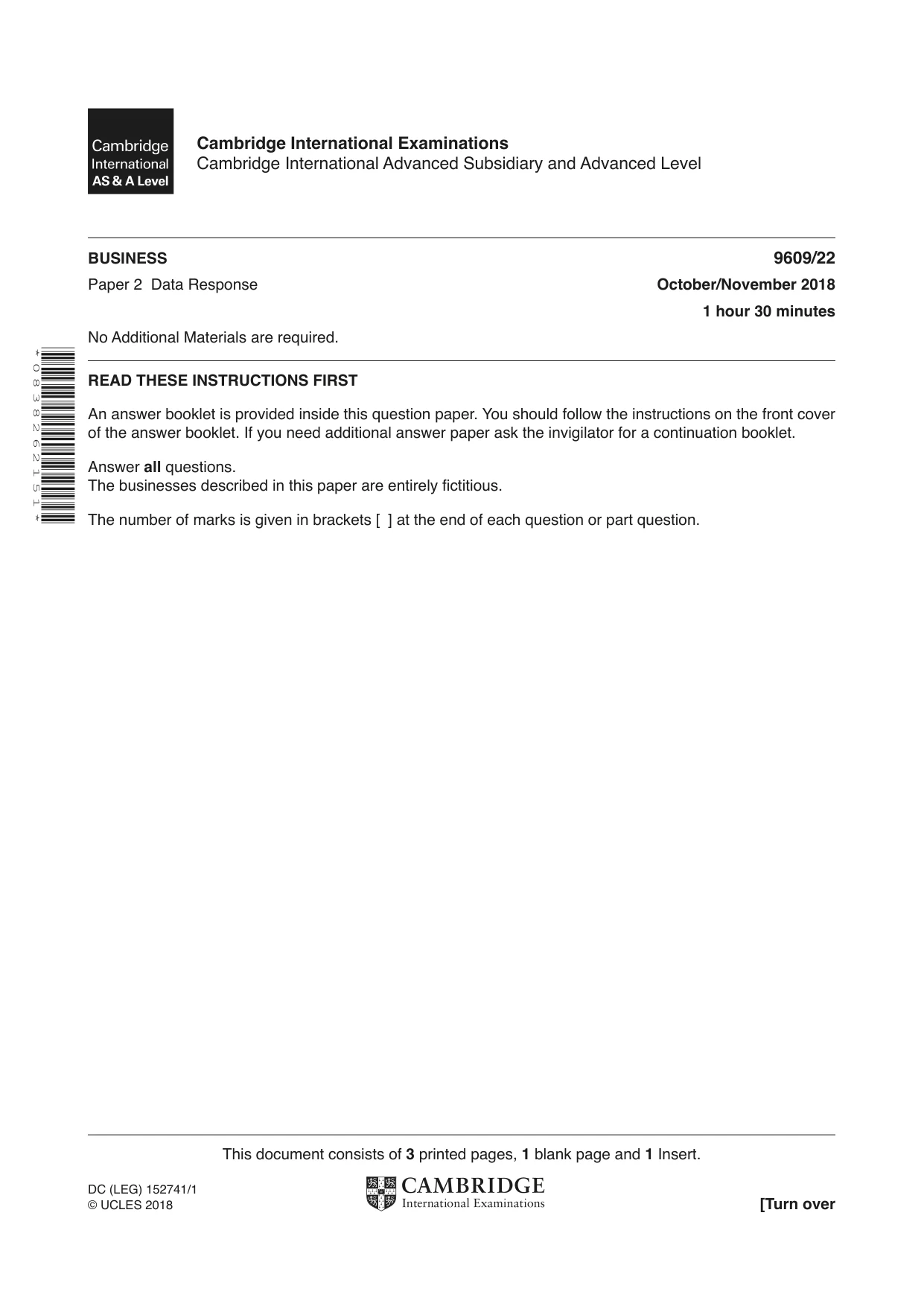

Mark scheme20 pages
Answers below. Sit the paper first if you are practising.
Questions as text
Q1 · Clothing Line (CL) Thamir is an entrepreneur who built up an international retail business
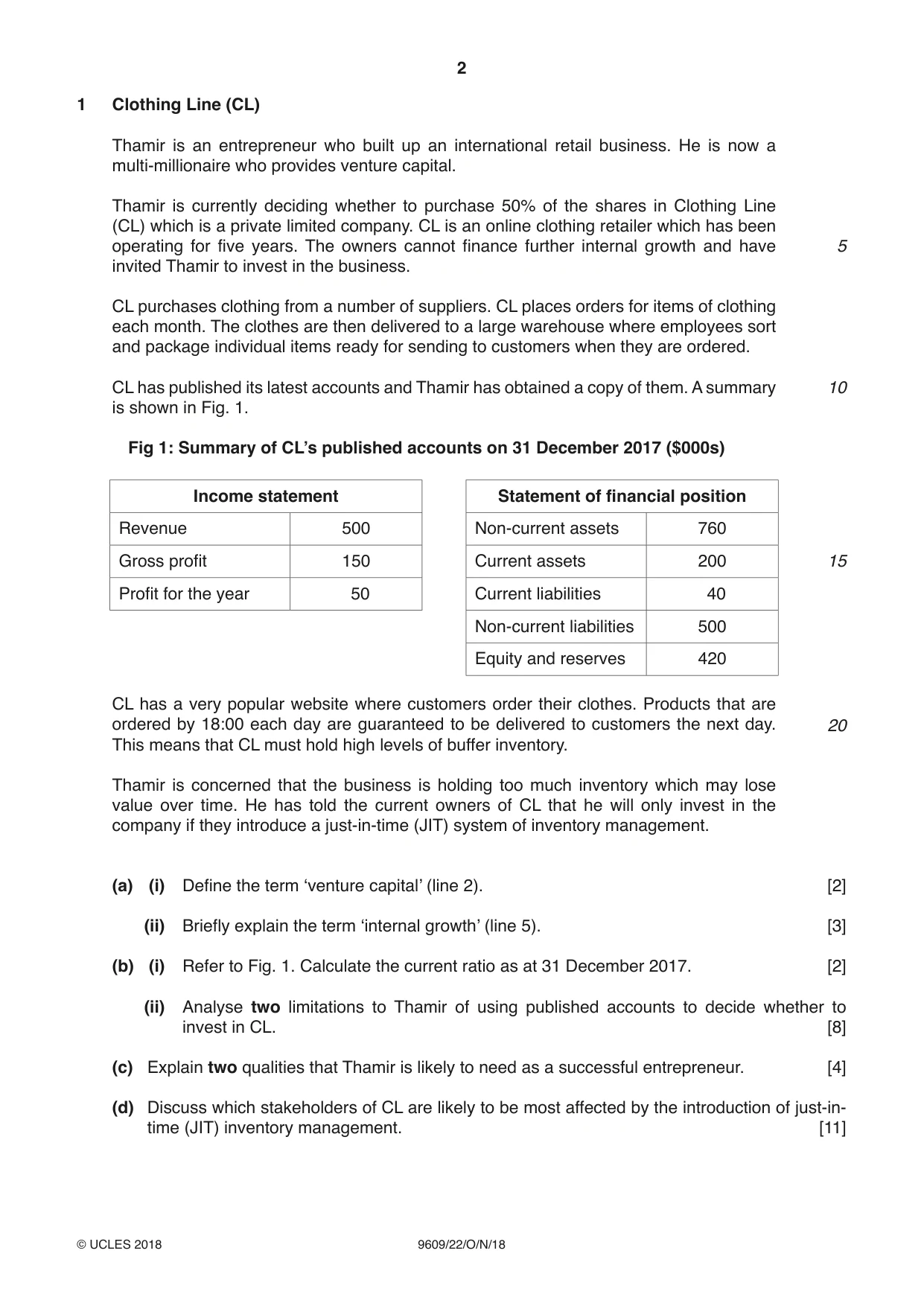
1 Clothing Line (CL) Thamir is an entrepreneur who built up an international retail business. He is now a multi-millionaire who provides venture capital. Thamir is currently deciding whether to purchase 50% of the shares in Clothing Line (CL) which is a private limited company. CL is an online clothing retailer which has been operating for five years. The owners cannot finance further internal growth and have 5 invited Thamir to invest in the business. CL purchases clothing from a number of suppliers. CL places orders for items of clothing each month. The clothes are then delivered to a large warehouse where employees sort and package individual items ready for sending to customers when they are ordered. CL has published its latest accounts and Thamir has obtained a copy of them. A summary 10 is shown in Fig. 1. Fig 1: Summary of CL’s published accounts on 31 December 2017 ($000s) Income statement Statement of financial position Revenue 500 Non-current assets 760 Gross profit 150 Current assets 200 15 Profit for the year 50 Current liabilities 40 Non-current liabilities 500 Equity and reserves 420 CL has a very popular website where customers order their clothes. Products that are ordered by 18:00 each day are guaranteed to be delivered to customers the next day. 20 This means that CL must hold high levels of buffer inventory. Thamir is concerned that the business is holding too much inventory which may lose value over time. He has told the current owners of CL that he will only invest in the company if they introduce a just-in-time (JIT) system of inventory management. (a) (i) Define the term ‘venture capital’ (line 2). [2] (ii) Briefly explain the term ‘internal growth’ (line 5). [3] (b) (i) Refer to Fig. 1. Calculate the current ratio as at 31 December 2017. [2] (ii) Analyse two limitations to Thamir of using published accounts to decide whether to invest in CL. [8] (c) Explain two qualities that Thamir is likely to need as a successful entrepreneur. [4] (d) Discuss which stakeholders of CL are likely to be most affected by the introduction of just-in- time (JIT) inventory management. [11]
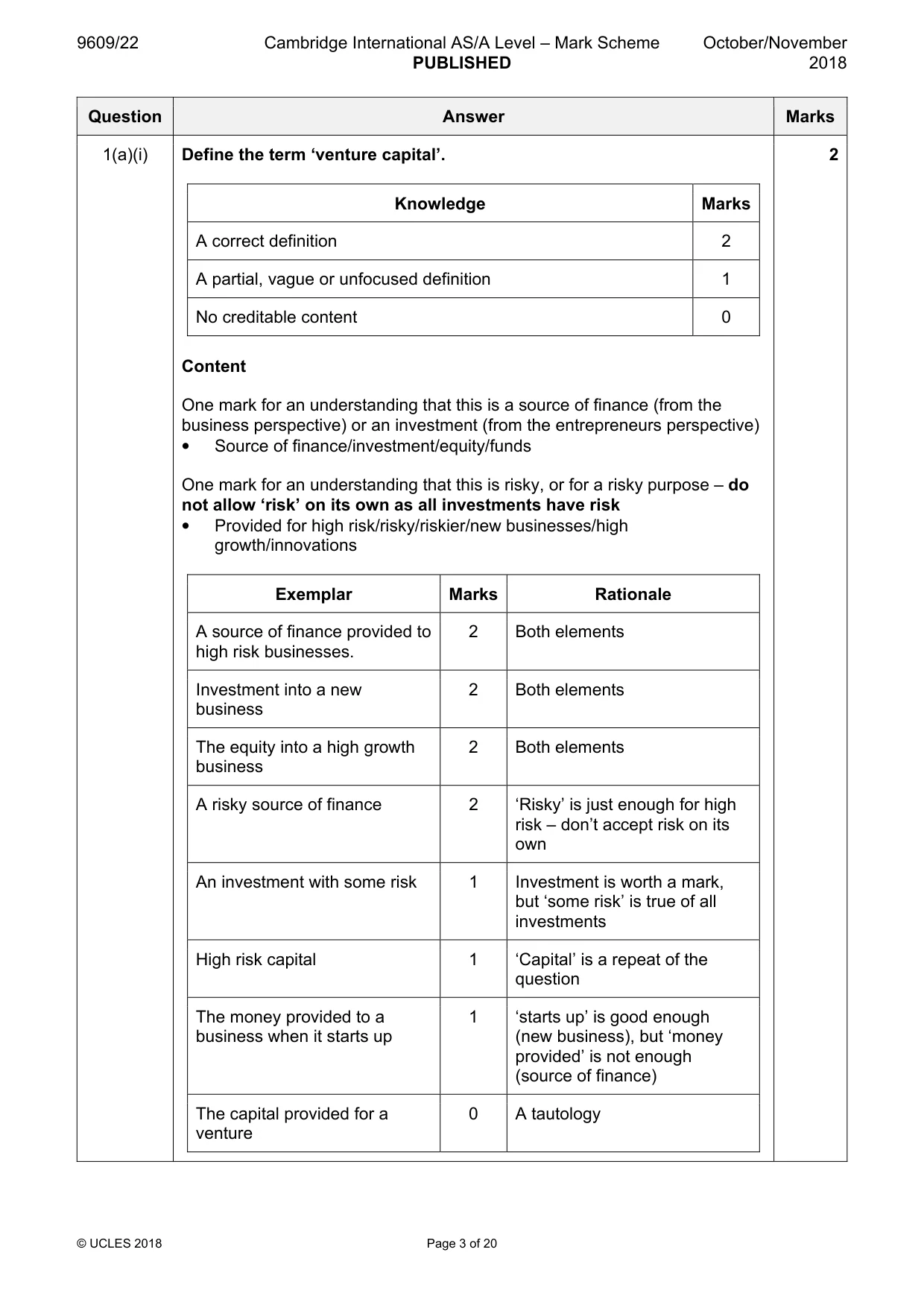
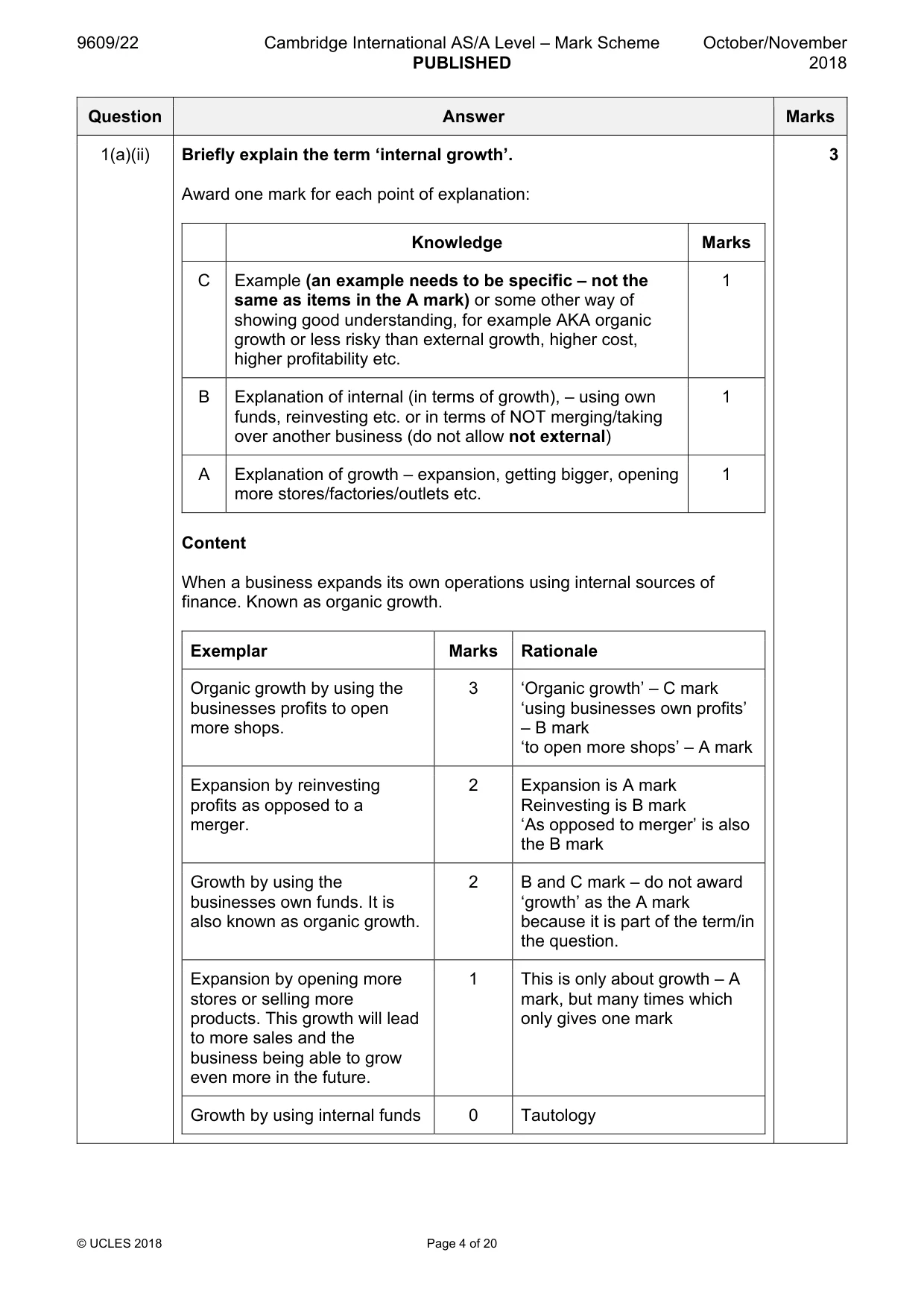
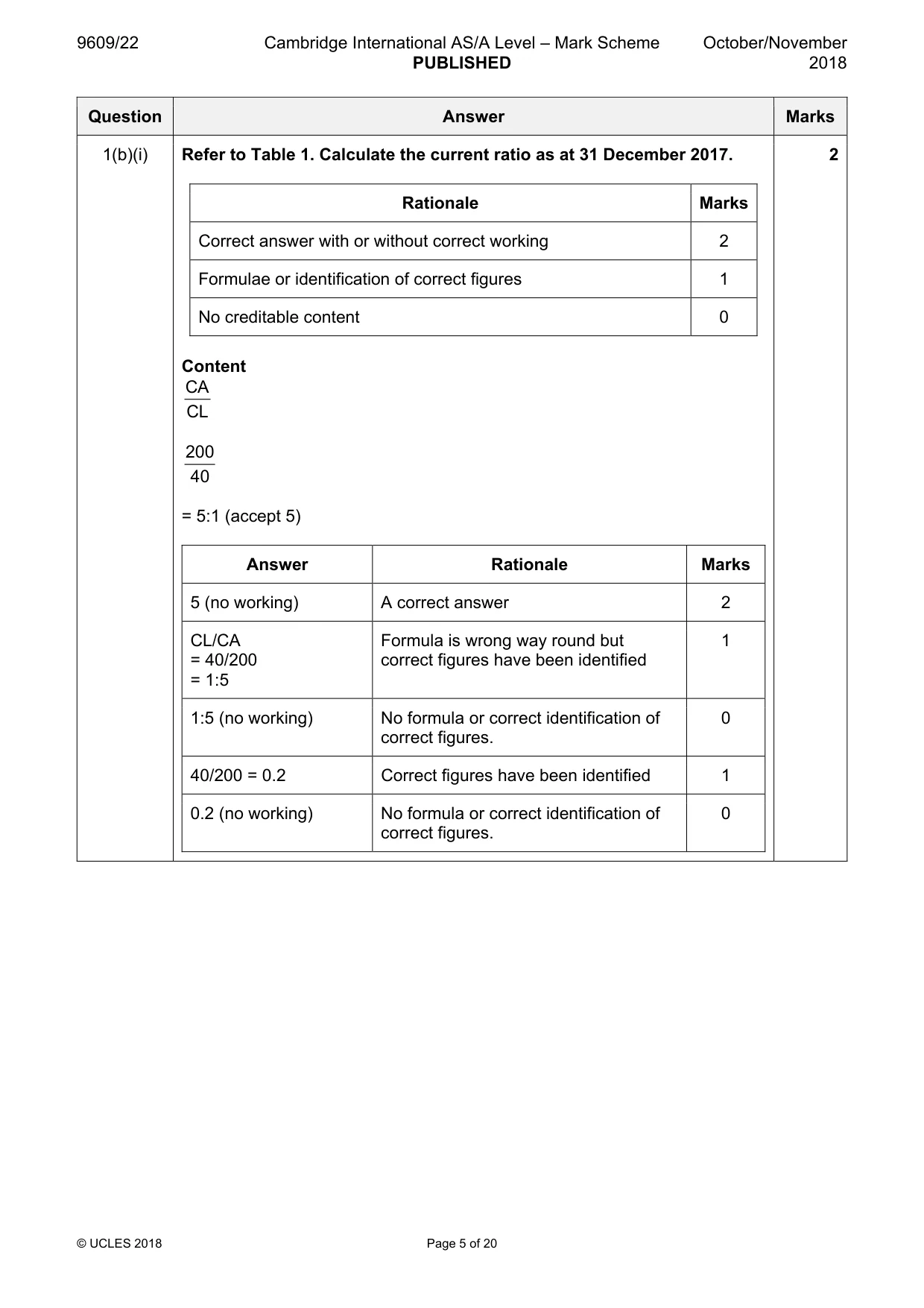
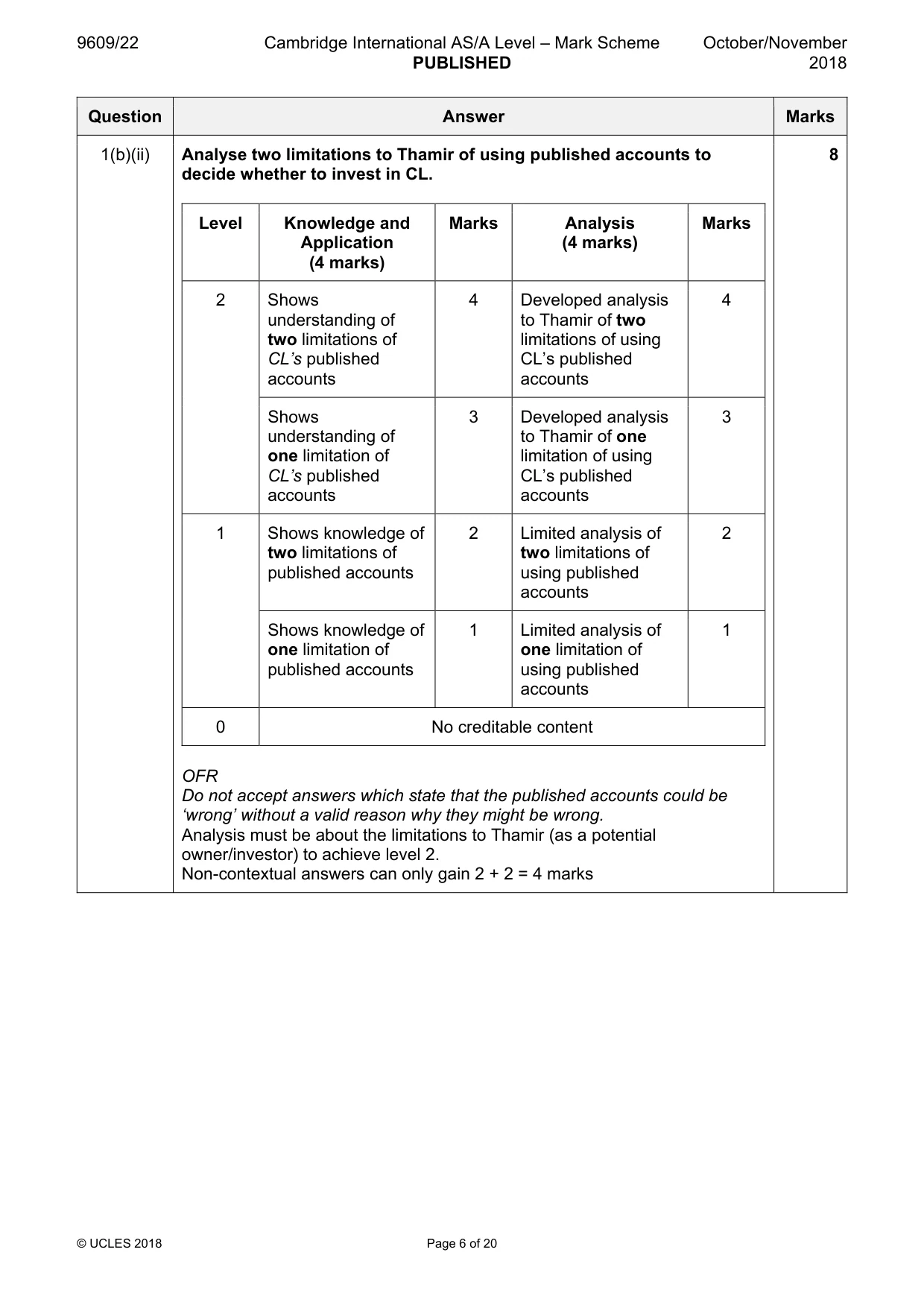
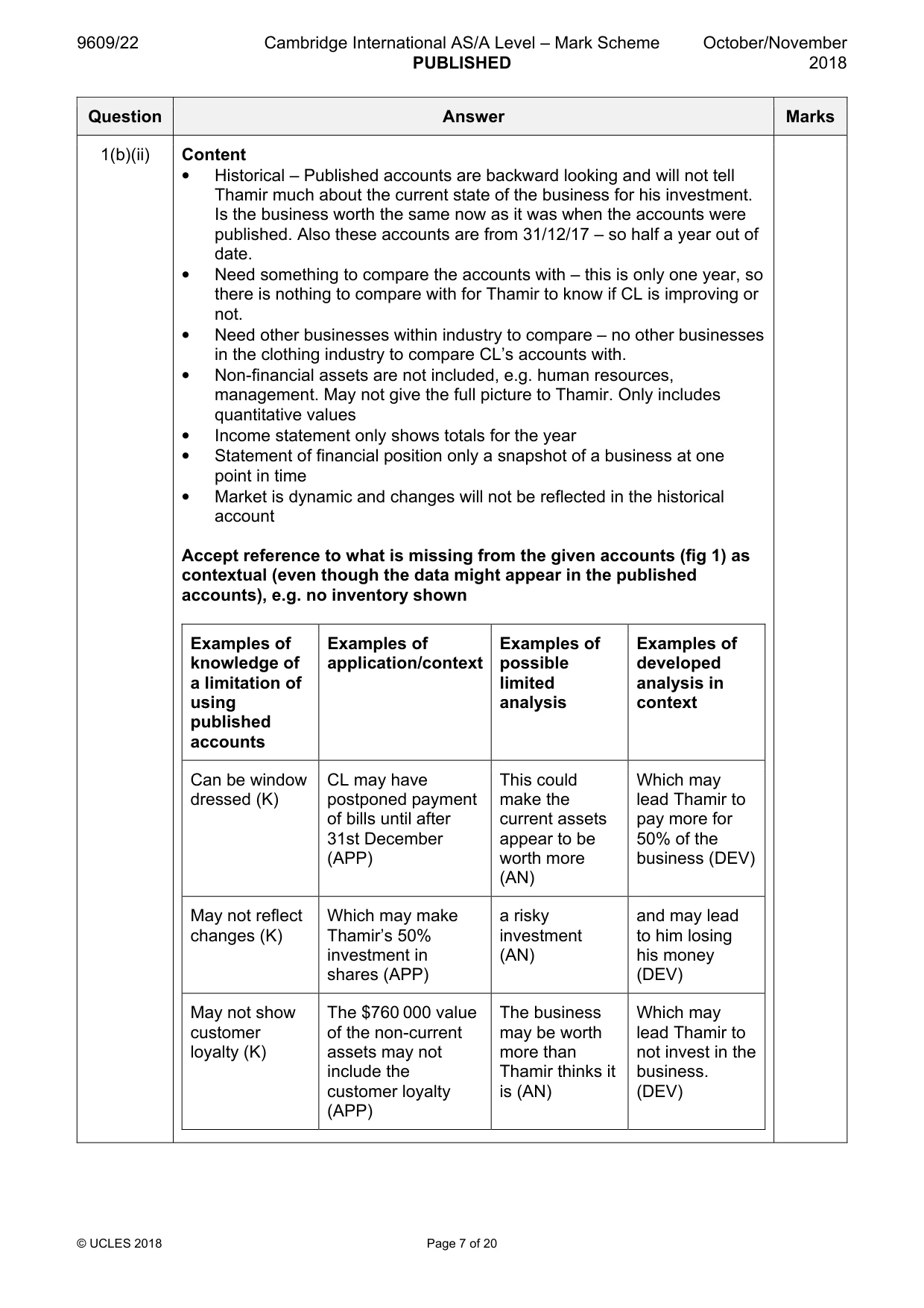
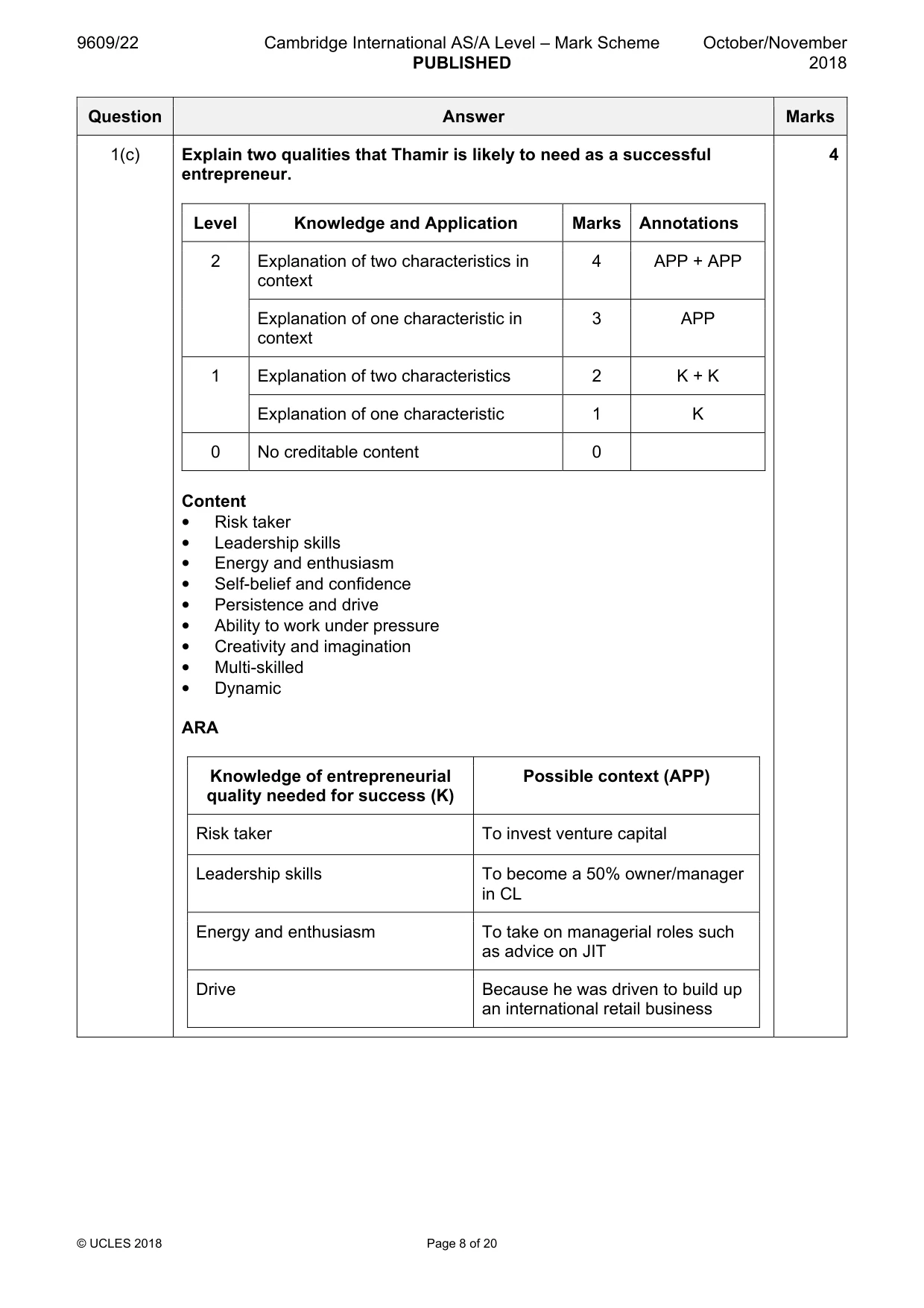
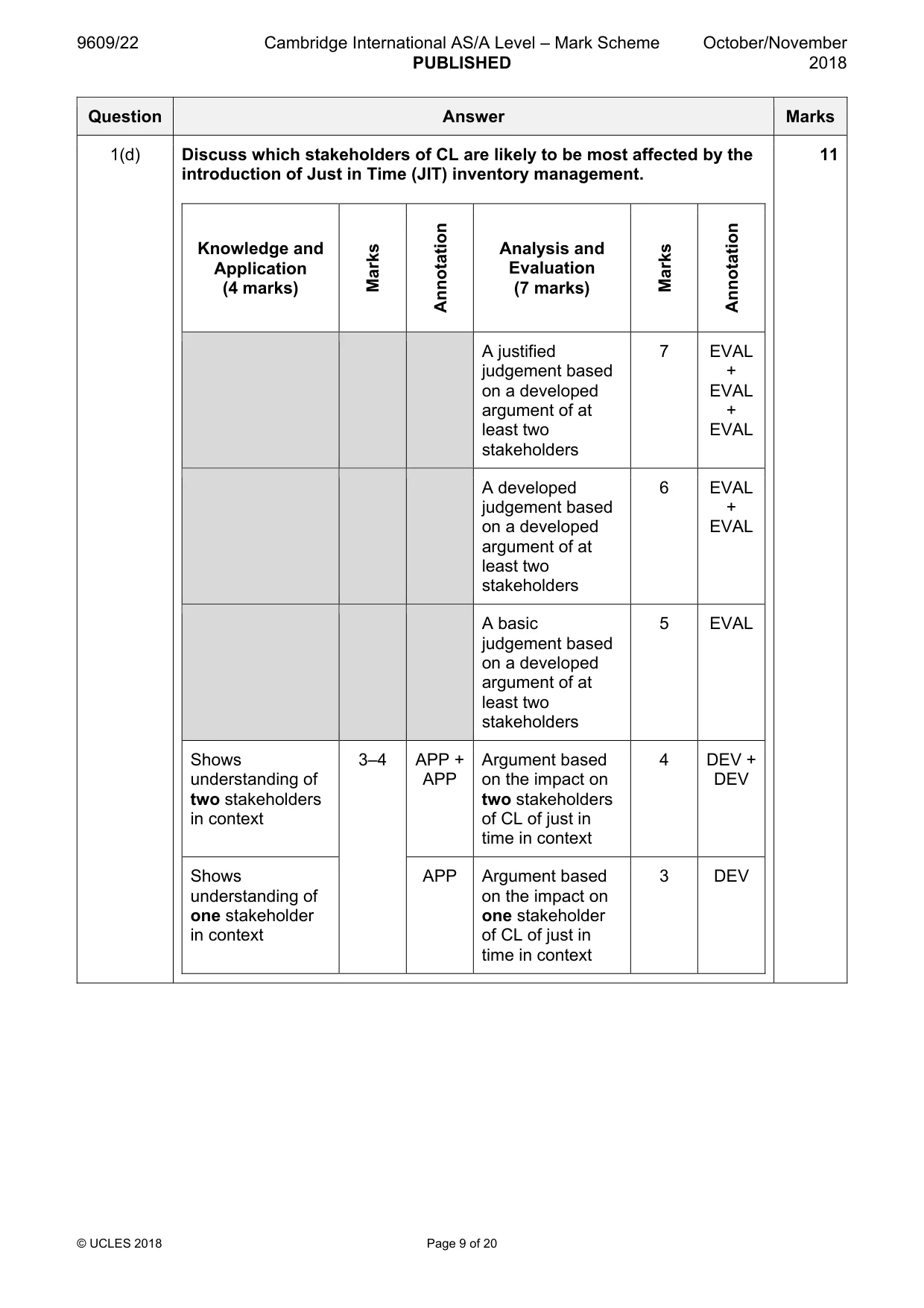
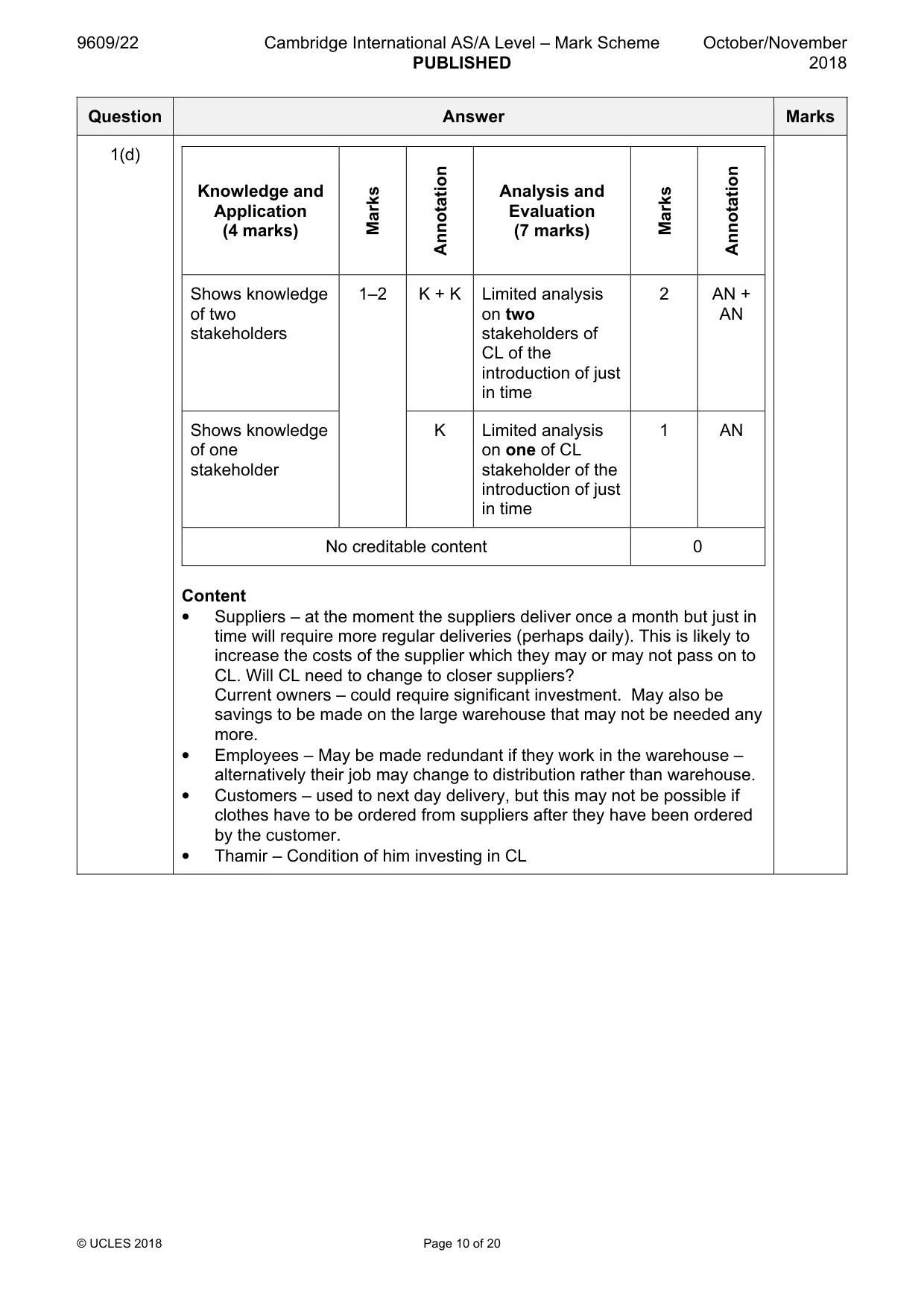
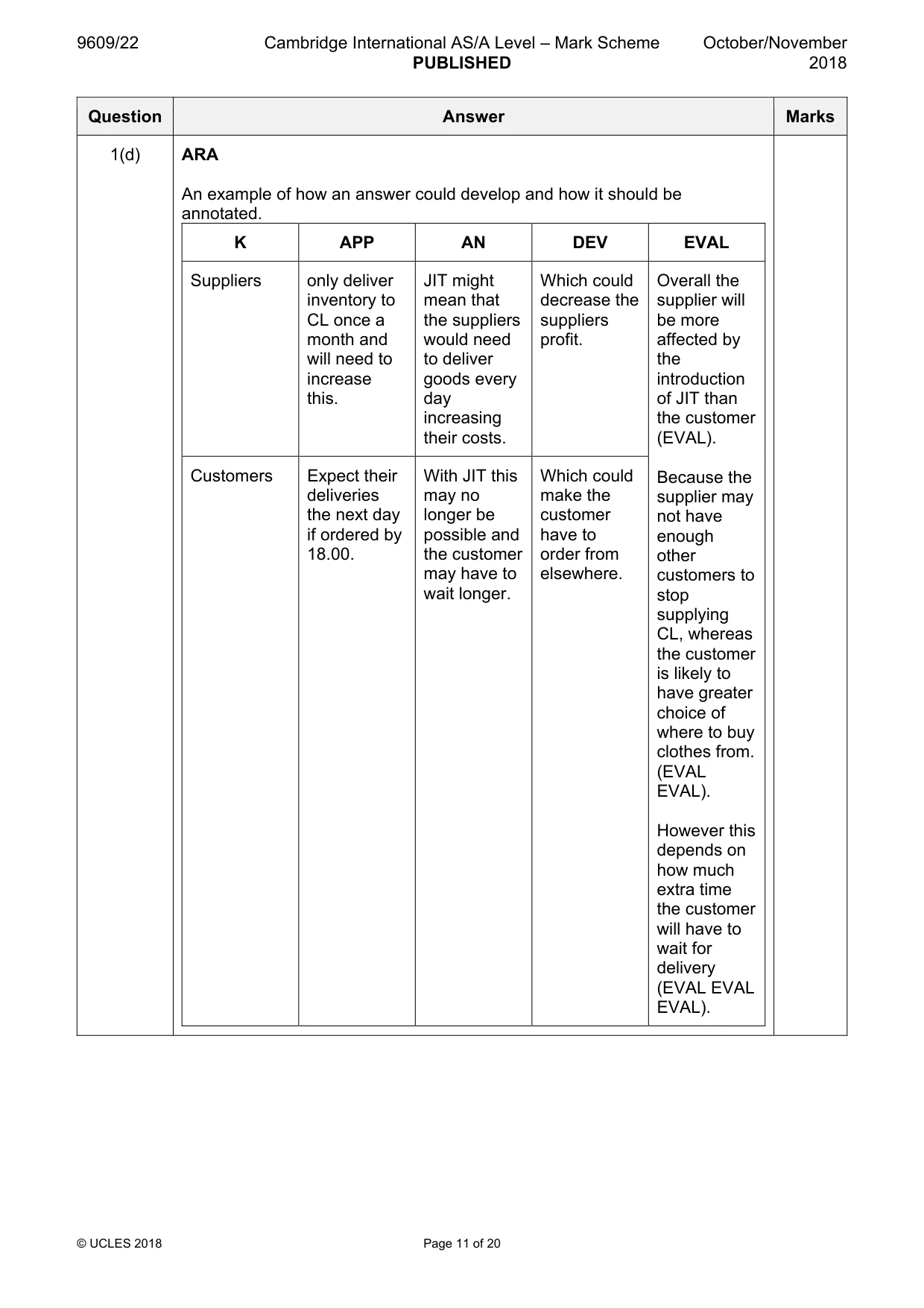
Mark scheme: Question Answer Marks 1(a)(i) Define the term ‘venture capital’. 2 Knowledge Marks A correct definition 2 A partial, vague or unfocused definition 1 No creditable content 0 Content One mark for an understanding that this is a source of finance (from the business perspective) or an investment (from the entrepreneurs perspective) • Source of finance/investment/equity/funds One mark for an understanding that this is risky, or for a risky purpose – do not allow ‘risk’ on its own as all investments have risk • Provided for high risk/risky/riskier/new businesses/high growth/innovations Exemplar Marks Rationale A source of finance provided to 2 Both elements high risk businesses. Investment into a new 2 Both elements business The equity into a high growth 2 Both elements business A risky source of finance 2 ‘Risky’ is just enough for high risk – don’t accept risk on its own An investment with some risk 1 Investment is worth a mark, but ‘some risk’ is true of all investments High risk capital 1 ‘Capital’ is a repeat of the question The money provided to a 1 ‘starts up’ is good enough business when it starts up (new business), but ‘money provided’ is not enough (source of finance) The capital provided for a 0 A tautology venture 1(a)(ii) Briefly explain the term ‘internal growth’. 3 Award one mark for each point of explanation: Knowledge Marks C Example (an example needs to be specific – not the 1 same as items in the A mark) or some other way of showing good understanding, for example AKA organic growth or less risky than external growth, higher cost, higher profitability etc. B Explanation of internal (in terms of growth), – using own 1 funds, reinvesting etc. or in terms of NOT merging/taking over another business (do not allow not external) A Explanation of growth – expansion, getting bigger, opening 1 more stores/factories/outlets etc. Content When a business expands its own operations using internal sources of finance. Known as organic growth. Exemplar Marks Rationale Organic growth by using the 3 ‘Organic growth’ – C mark businesses profits to open ‘using businesses own profits’ more shops. – B mark ‘to open more shops’ – A mark Expansion by reinvesting 2 Expansion is A mark profits as opposed to a Reinvesting is B mark merger. ‘As opposed to merger’ is also the B mark Growth by using the 2 B and C mark – do not award businesses own funds. It is ‘growth’ as the A mark also known as organic growth. because it is part of the term/in the question. Expansion by opening more 1 This is only about growth – A stores or selling more mark, but many times which products. This growth will lead only gives one mark to more sales and the business being able to grow even more in the future. Growth by using internal funds 0 Tautology 1(b)(i) Refer to Table 1. Calculate the current ratio as at 31 December 2017. 2 Rationale Marks Correct answer with or without correct working 2 Formulae or identification of correct figures 1 No creditable content 0 Content CA CL 200 40 = 5:1 (accept 5) Answer Rationale Marks 5 (no working) A correct answer 2 CL/CA Formula is wrong way round but 1 = 40/200 correct figures have been identified = 1:5 1:5 (no working) No formula or correct identification of 0 correct figures. 40/200 = 0.2 Correct figures have been identified 1 0.2 (no working) No formula or correct identification of 0 correct figures. 1(b)(ii) Analyse two limitations to Thamir of using published accounts to 8 decide whether to invest in CL. Level Knowledge and Marks Analysis Marks Application (4 marks) (4 marks) 2 Shows 4 Developed analysis 4 understanding of to Thamir of two two limitations of limitations of using CL’s published CL’s published accounts accounts Shows 3 Developed analysis 3 understanding of to Thamir of one one limitation of limitation of using CL’s published CL’s published accounts accounts 1 Shows knowledge of 2 Limited analysis of 2 two limitations of two limitations of published accounts using published accounts Shows knowledge of 1 Limited analysis of 1 one limitation of one limitation of published accounts using published accounts 0 No creditable content OFR Do not accept answers which state that the published accounts could be ‘wrong’ without a valid reason why they might be wrong. Analysis must be about the limitations to Thamir (as a potential owner/investor) to achieve level 2. Non-contextual answers can only gain 2 + 2 = 4 marks 1(b)(ii) Content • Historical – Published accounts are backward looking and will not tell Thamir much about the current state of the business for his investment. Is the business worth the same now as it was when the accounts were published. Also these accounts are from 31/12/17 – so half a year out of date. • Need something to compare the accounts with – this is only one year, so there is nothing to compare with for Thamir to know if CL is improving or not. • Need other businesses within industry to compare – no other businesses in the clothing industry to compare CL’s accounts with. • Non-financial assets are not included, e.g. human resources, management. May not give the full picture to Thamir. Only includes quantitative values • Income statement only shows totals for the year • Statement of financial position only a snapshot of a business at one point in time • Market is dynamic and changes will not be reflected in the historical account Accept reference to what is missing from the given accounts (fig 1) as contextual (even though the data might appear in the published accounts), e.g. no inventory shown Examples of Examples of Examples of Examples of knowledge of application/context possible developed a limitation of limited analysis in using analysis context published accounts Can be window CL may have This could Which may dressed (K) postponed payment make the lead Thamir to of bills until after current assets pay more for 31st December appear to be 50% of the (APP) worth more business (DEV) (AN) May not reflect Which may make a risky and may lead changes (K) Thamir’s 50% investment to him losing investment in (AN) his money shares (APP) (DEV) May not show The $760 000 value The business Which may customer of the non-current may be worth lead Thamir to loyalty (K) assets may not more than not invest in the include the Thamir thinks it business. customer loyalty is (AN) (DEV) (APP) 1(c) Explain two qualities that Thamir is likely to need as a successful 4 entrepreneur. Level Knowledge and Application Marks Annotations 2 Explanation of two characteristics in 4 APP + APP context Explanation of one characteristic in 3 APP context 1 Explanation of two characteristics 2 K + K Explanation of one characteristic 1 K 0 No creditable content 0 Content • Risk taker • Leadership skills • Energy and enthusiasm • Self-belief and confidence • Persistence and drive • Ability to work under pressure • Creativity and imagination • Multi-skilled • Dynamic ARA Knowledge of entrepreneurial Possible context (APP) quality needed for success (K) Risk taker To invest venture capital Leadership skills To become a 50% owner/manager in CL Energy and enthusiasm To take on managerial roles such as advice on JIT Drive Because he was driven to build up an international retail business 1(d) Discuss which stakeholders of CL are likely to be most affected by the 11 introduction of Just in Time (JIT) inventory management. Knowledge and Analysis and Application Evaluation (4 marks) Marks (7 marks) Marks Annotation Annotation A justified 7 EVAL judgement based + on a developed EVAL argument of at + least two EVAL stakeholders A developed 6 EVAL judgement based + on a developed EVAL argument of at least two stakeholders A basic 5 EVAL judgement based on a developed argument of at least two stakeholders Shows 3–4 APP + Argument based 4 DEV + understanding of APP on the impact on DEV two stakeholders two stakeholders in context of CL of just in time in context Shows APP Argument based 3 DEV understanding of on the impact on one stakeholder one stakeholder in context of CL of just in time in context 1(d) Knowledge and Analysis and Application Evaluation (4 marks) Marks (7 marks) Marks Annotation Annotation Shows knowledge 1–2 K + K Limited analysis 2 AN + of two on two AN stakeholders stakeholders of CL of the introduction of just in time Shows knowledge K Limited analysis 1 AN of one on one of CL stakeholder stakeholder of the introduction of just in time No creditable content 0 Content • Suppliers – at the moment the suppliers deliver once a month but just in time will require more regular deliveries (perhaps daily). This is likely to increase the costs of the supplier which they may or may not pass on to CL. Will CL need to change to closer suppliers? Current owners – could require significant investment. May also be savings to be made on the large warehouse that may not be needed any more. • Employees – May be made redundant if they work in the warehouse – alternatively their job may change to distribution rather than warehouse. • Customers – used to next day delivery, but this may not be possible if clothes have to be ordered from suppliers after they have been ordered by the customer. • Thamir – Condition of him investing in CL 1(d) ARA An example of how an answer could develop and how it should be annotated. K APP AN DEV EVAL Suppliers only deliver JIT might Which could Overall the inventory to mean that decrease the supplier will CL once a the suppliers suppliers be more month and would need profit. affected by will need to to deliver the increase goods every introduction this. day of JIT than increasing the customer their costs. (EVAL). Customers Expect their With JIT this Which could Because the deliveries may no make the supplier may the next day longer be customer not have if ordered by possible and have to enough 18.00. the customer order from other may have to elsewhere. customers to wait longer. stop supplying CL, whereas the customer is likely to have greater choice of where to buy clothes from. (EVAL EVAL). However this depends on how much extra time the customer will have to wait for delivery (EVAL EVAL EVAL).
Q2 · Wet Water (WW) WW is a new business set up by Puja
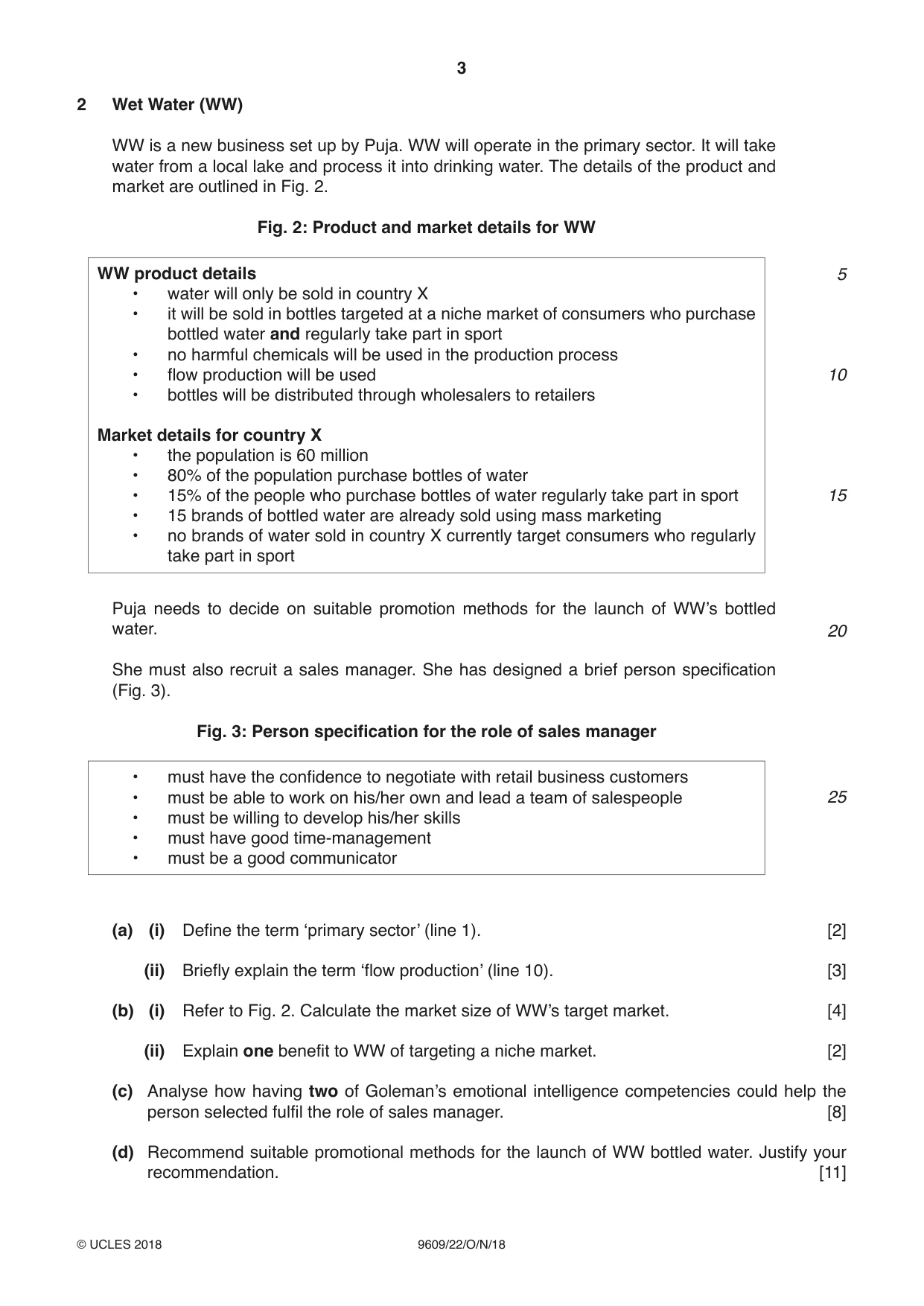
2 Wet Water (WW) WW is a new business set up by Puja. WW will operate in the primary sector. It will take water from a local lake and process it into drinking water. The details of the product and market are outlined in Fig. 2. Fig. 2: Product and market details for WW WW product details 5 • water will only be sold in country X • it will be sold in bottles targeted at a niche market of consumers who purchase bottled water and regularly take part in sport • no harmful chemicals will be used in the production process • flow production will be used 10 • bottles will be distributed through wholesalers to retailers Market details for country X • the population is 60 million • 80% of the population purchase bottles of water • 15% of the people who purchase bottles of water regularly take part in sport 15 • 15 brands of bottled water are already sold using mass marketing • no brands of water sold in country X currently target consumers who regularly take part in sport Puja needs to decide on suitable promotion methods for the launch of WW’s bottled water. 20 She must also recruit a sales manager. She has designed a brief person specification (Fig. 3). Fig. 3: Person specification for the role of sales manager • must have the confidence to negotiate with retail business customers • must be able to work on his/her own and lead a team of salespeople 25 • must be willing to develop his/her skills • must have good time-management • must be a good communicator (a) (i) Define the term ‘primary sector’ (line 1). [2] (ii) Briefly explain the term ‘flow production’ (line 10). [3] (b) (i) Refer to Fig. 2. Calculate the market size of WW’s target market. [4] (ii) Explain one benefit to WW of targeting a niche market. [2] (c) Analyse how having two of Goleman’s emotional intelligence competencies could help the person selected fulfil the role of sales manager. [8] (d) Recommend suitable promotional methods for the launch of WW bottled water. Justify your recommendation. [11]
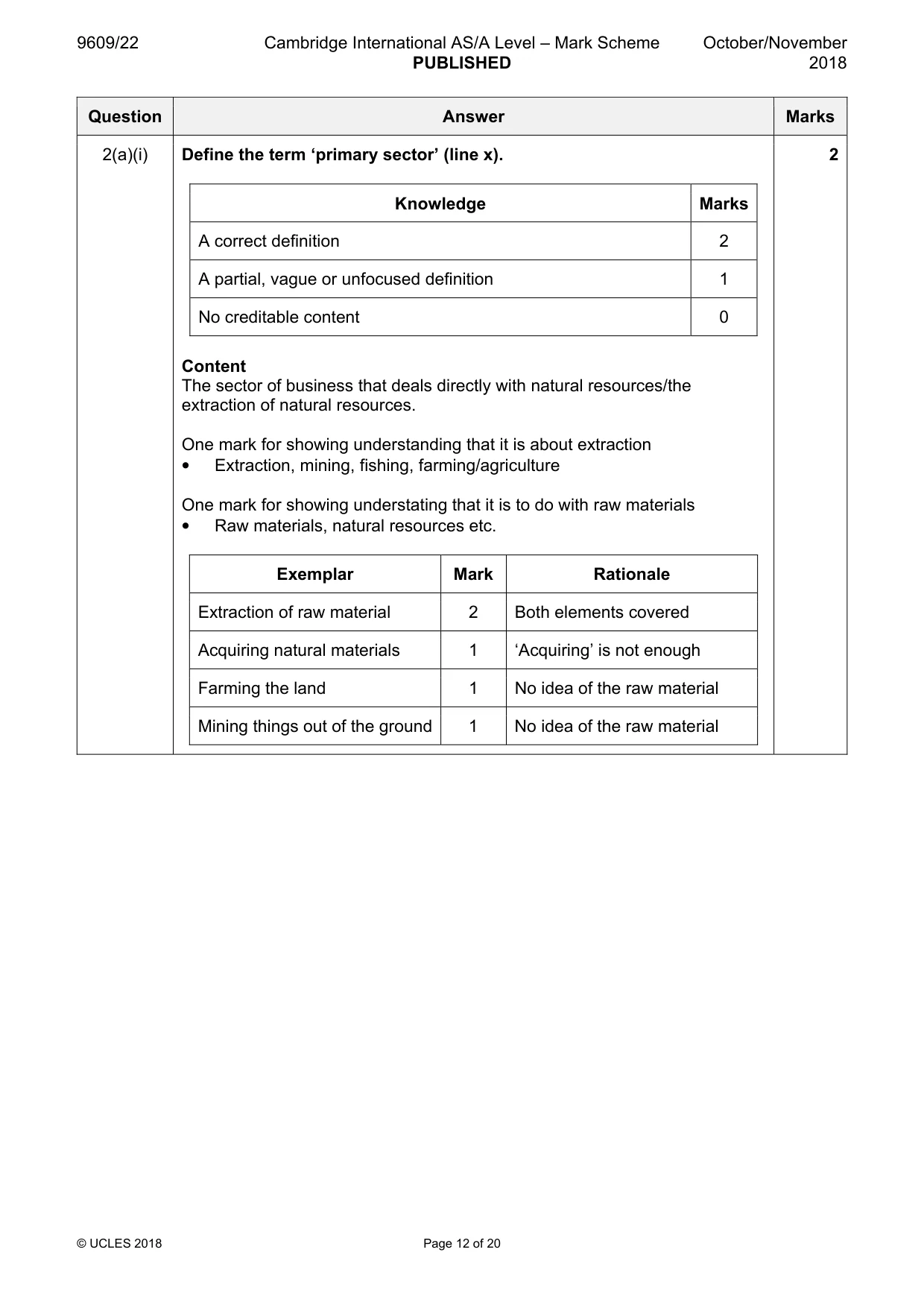
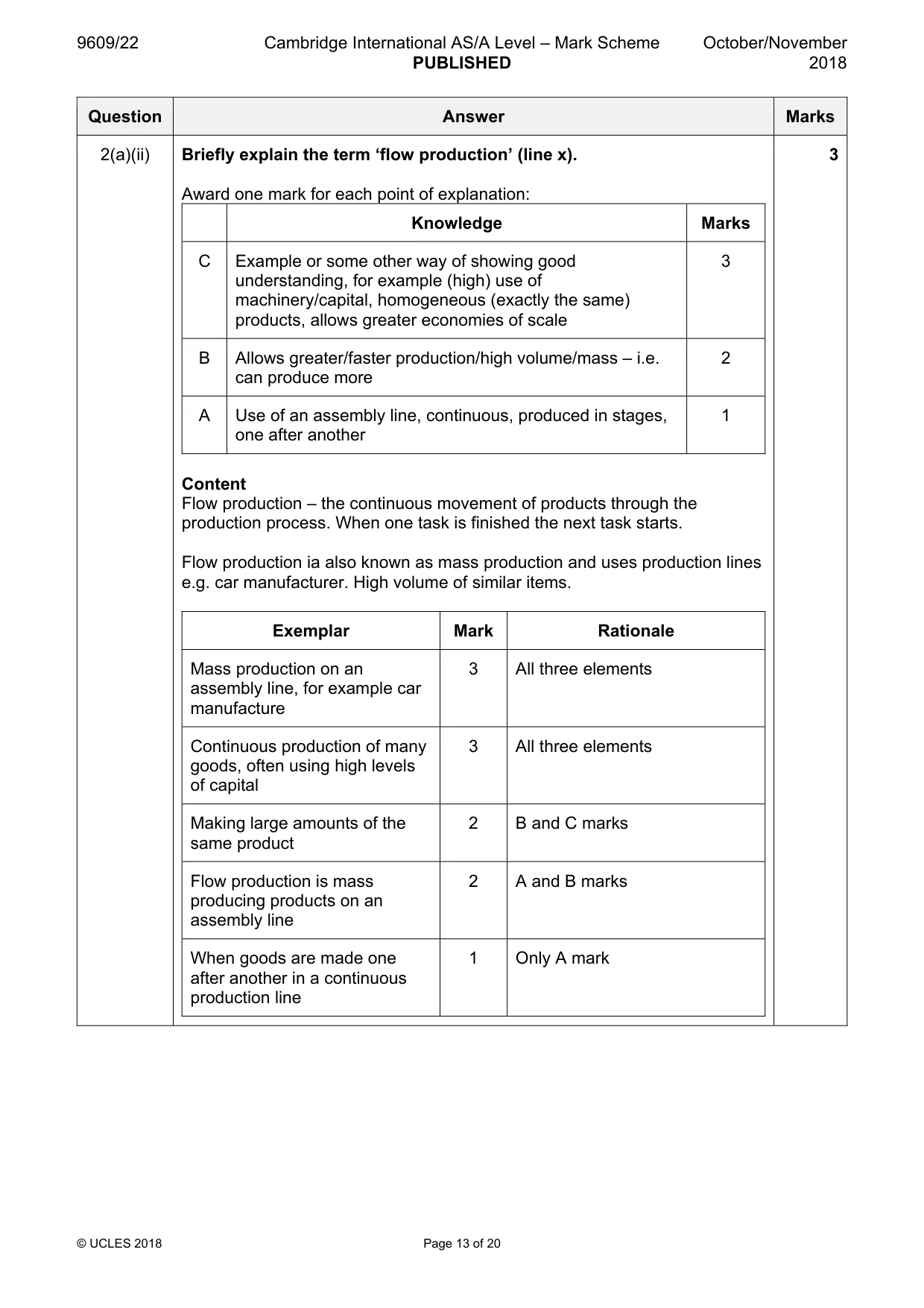
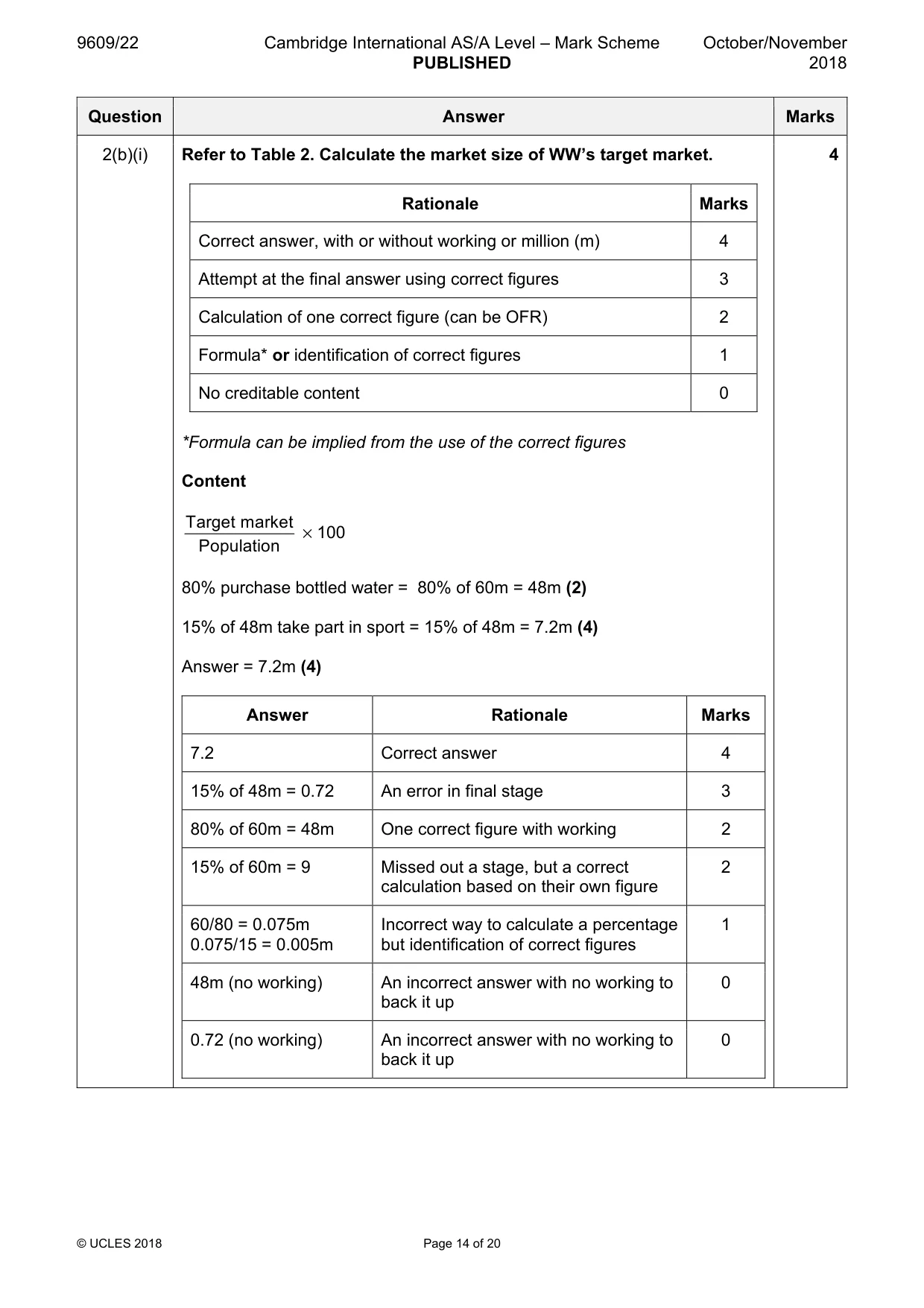
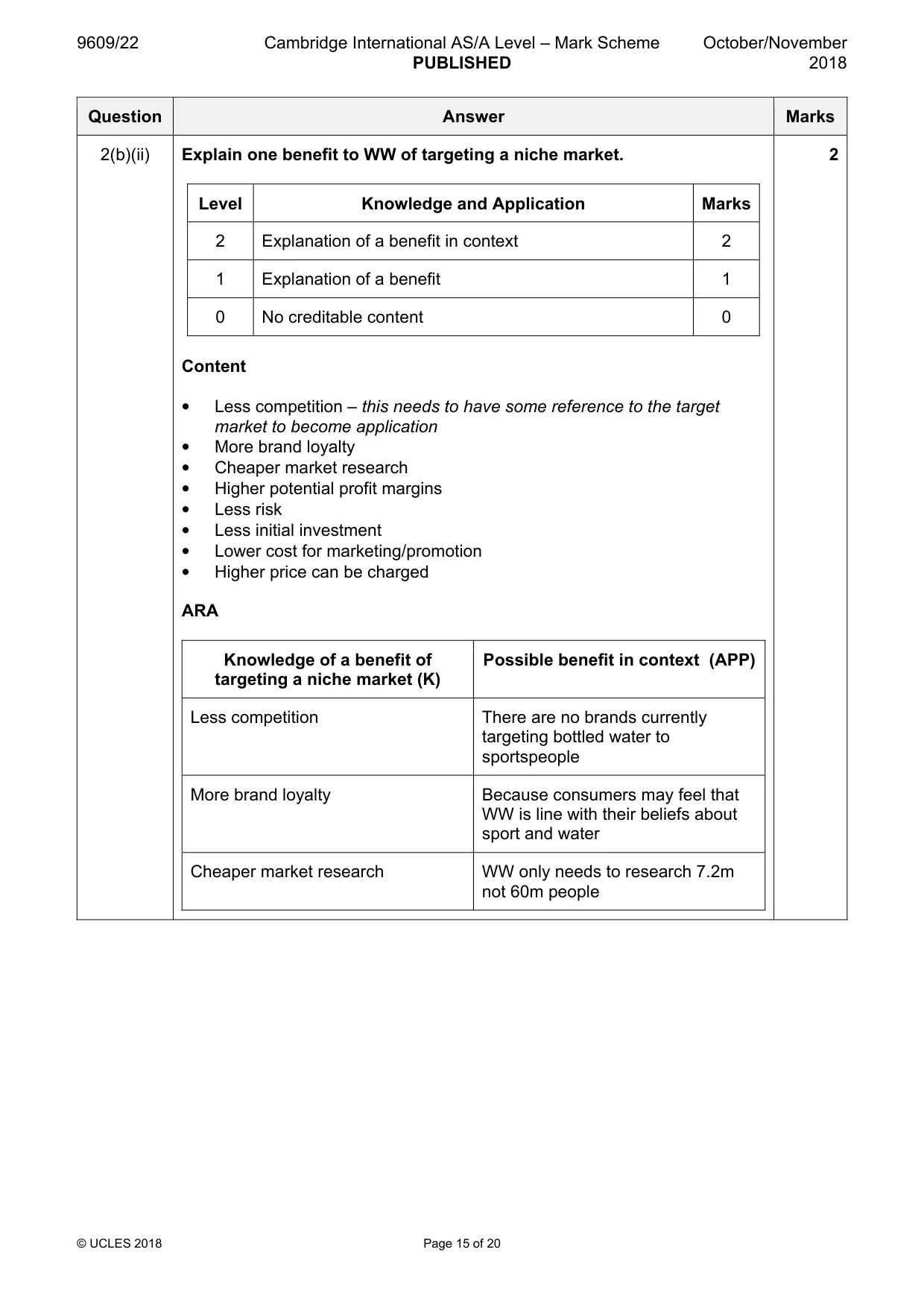
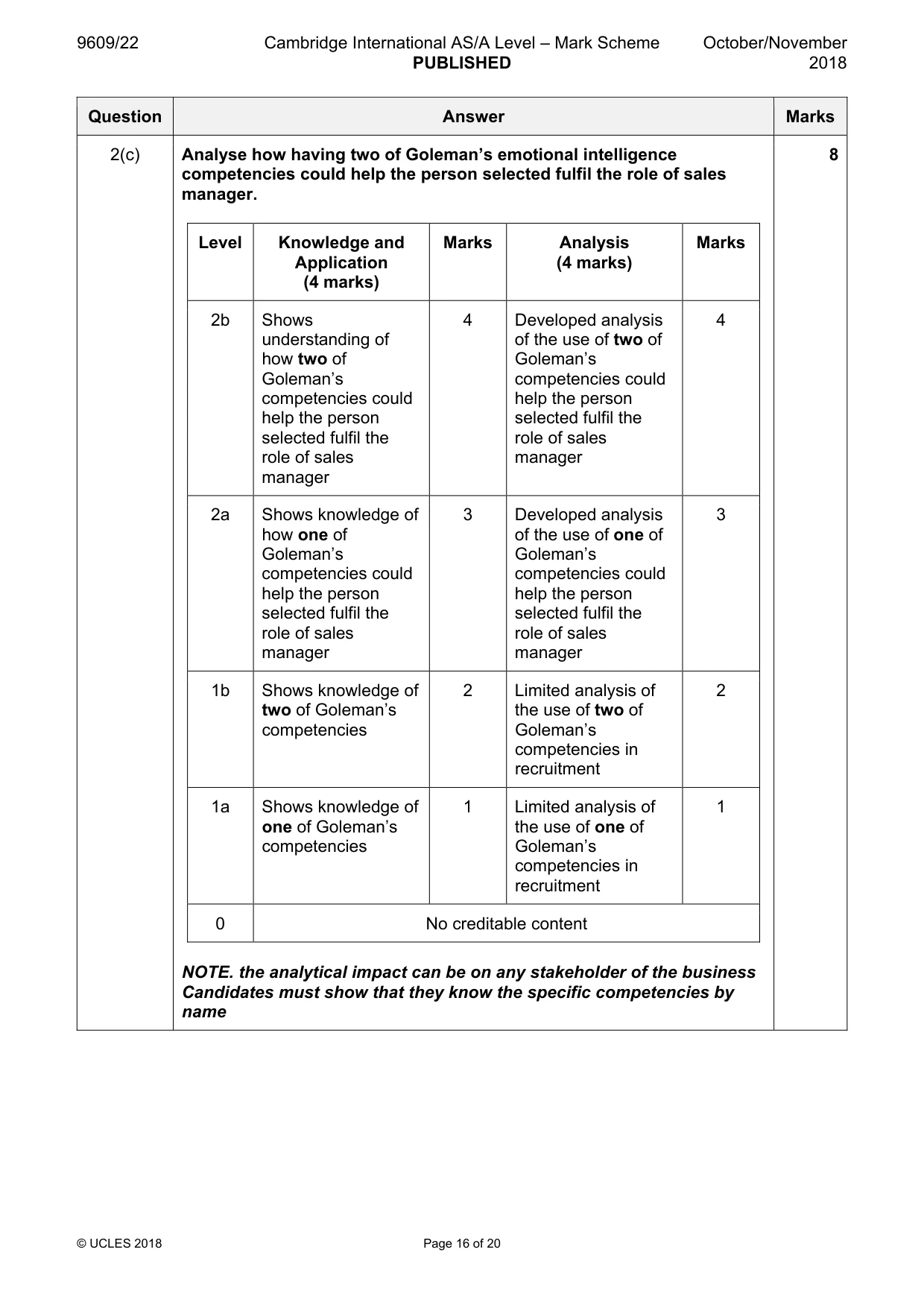
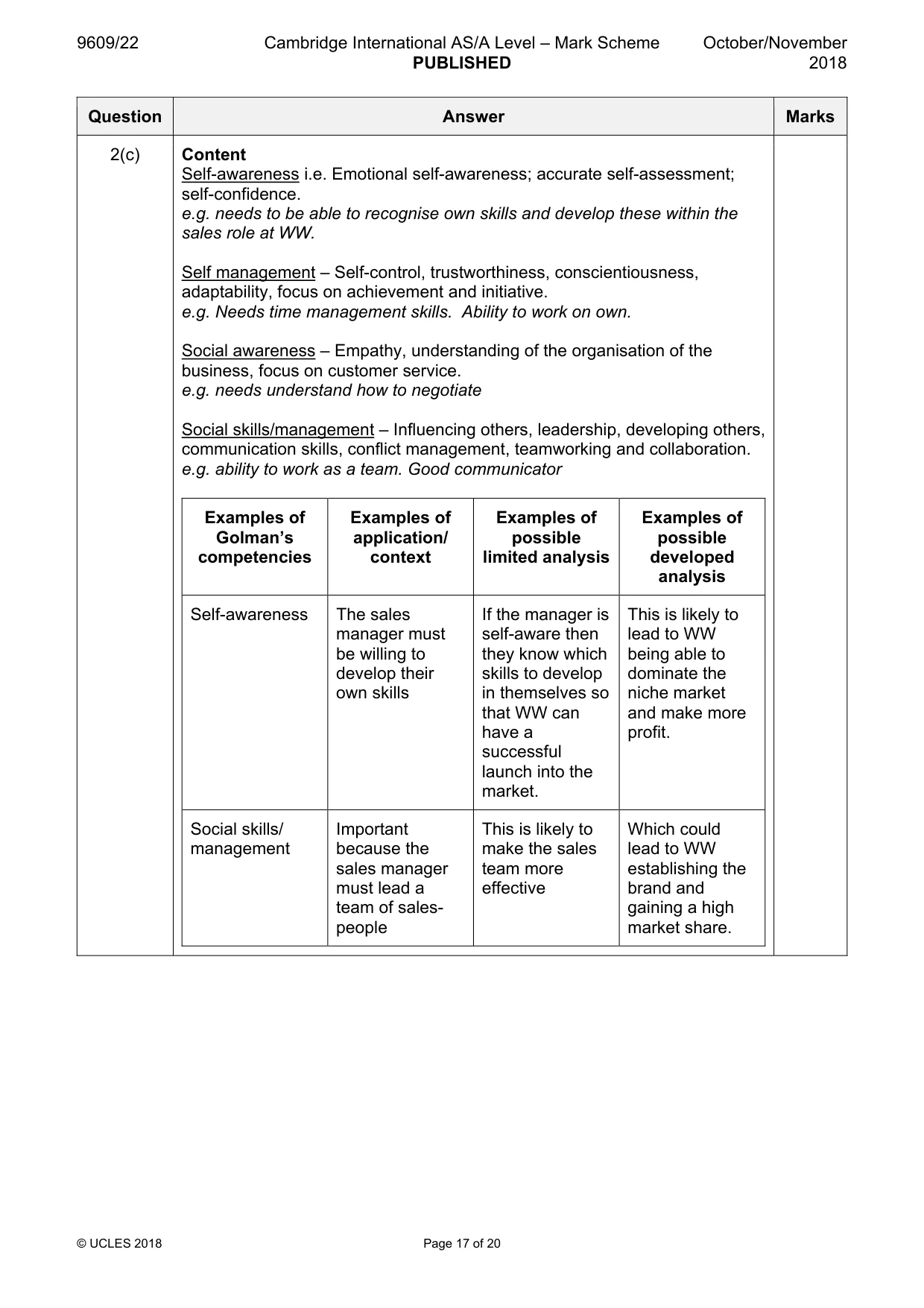
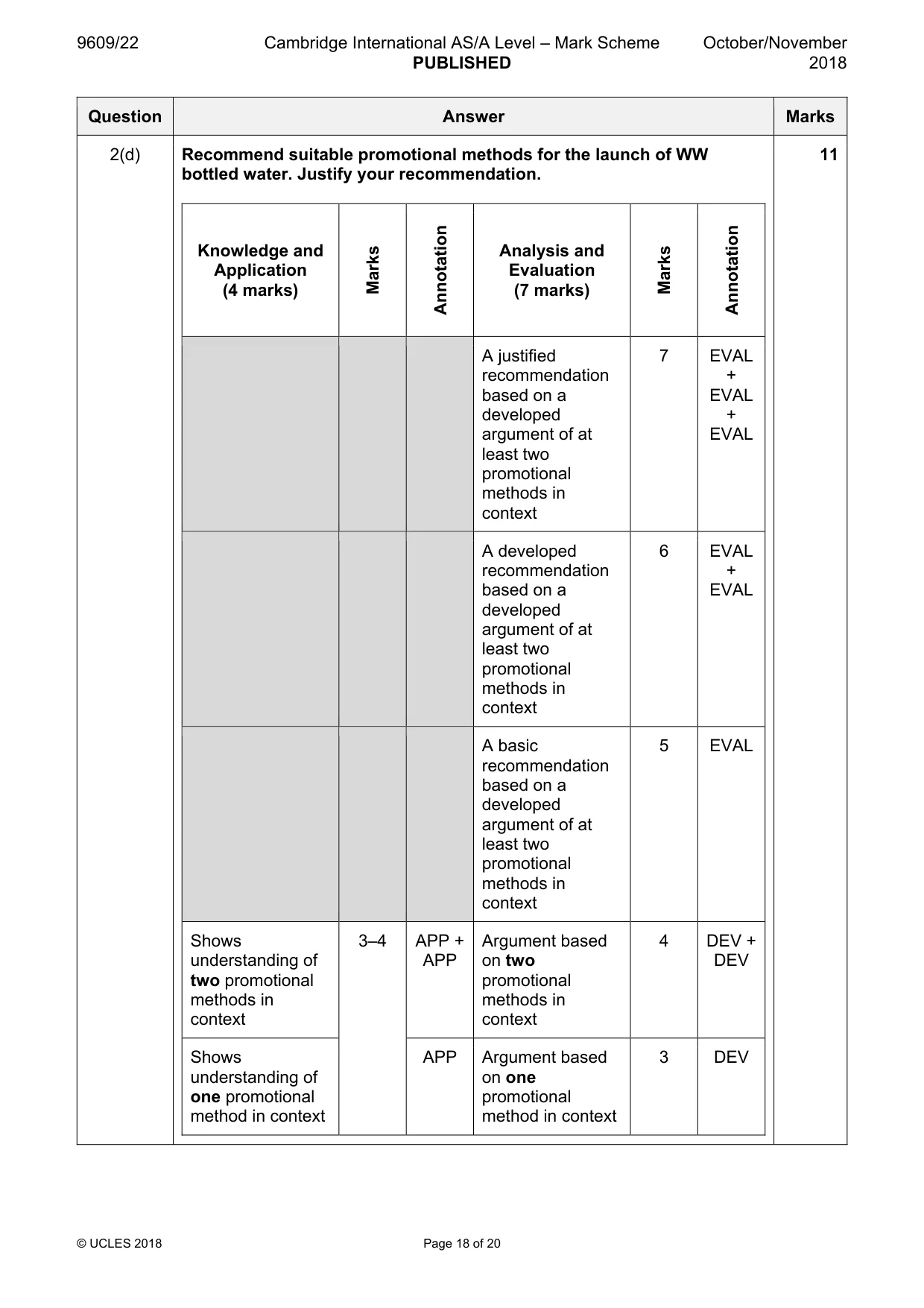
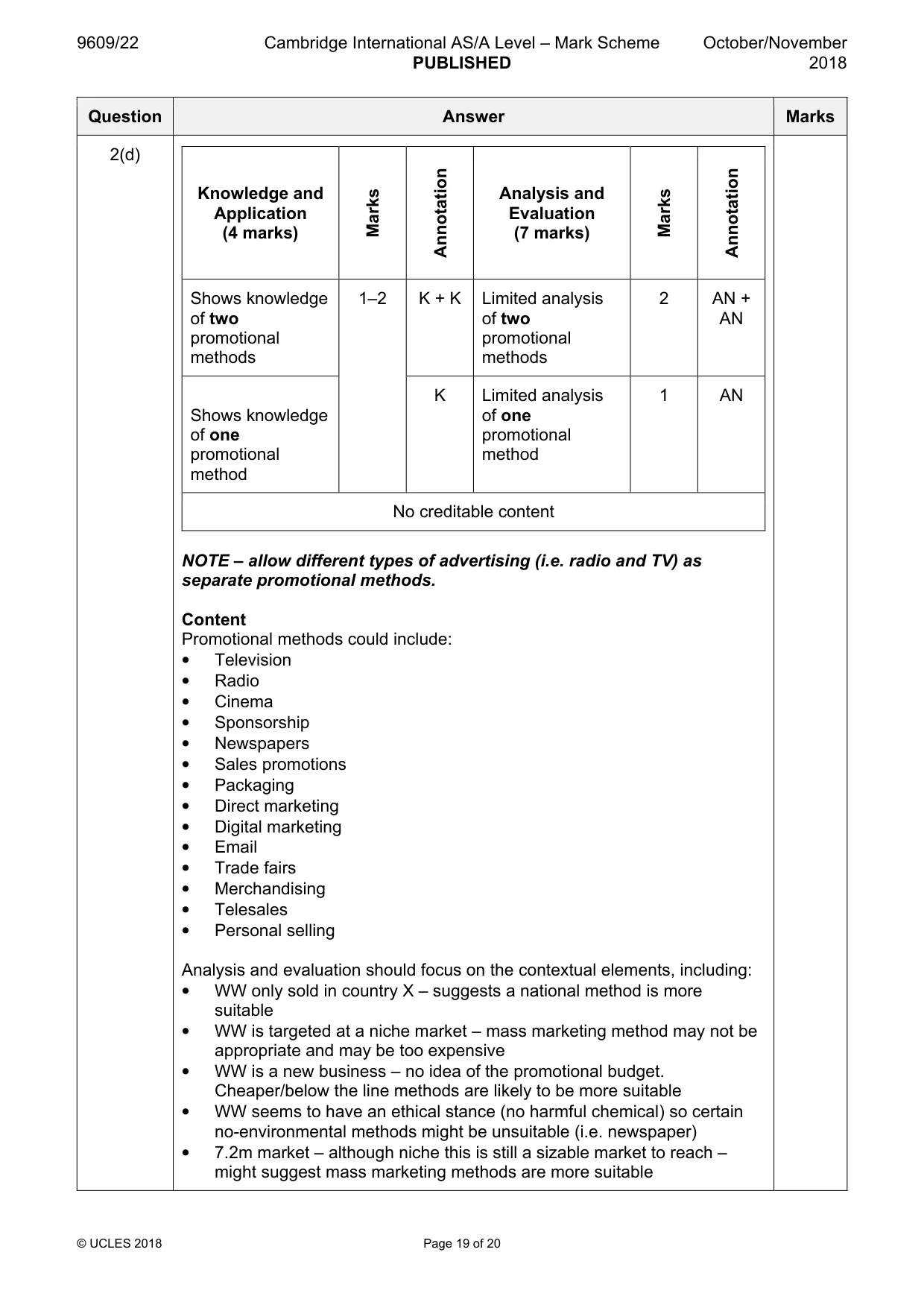
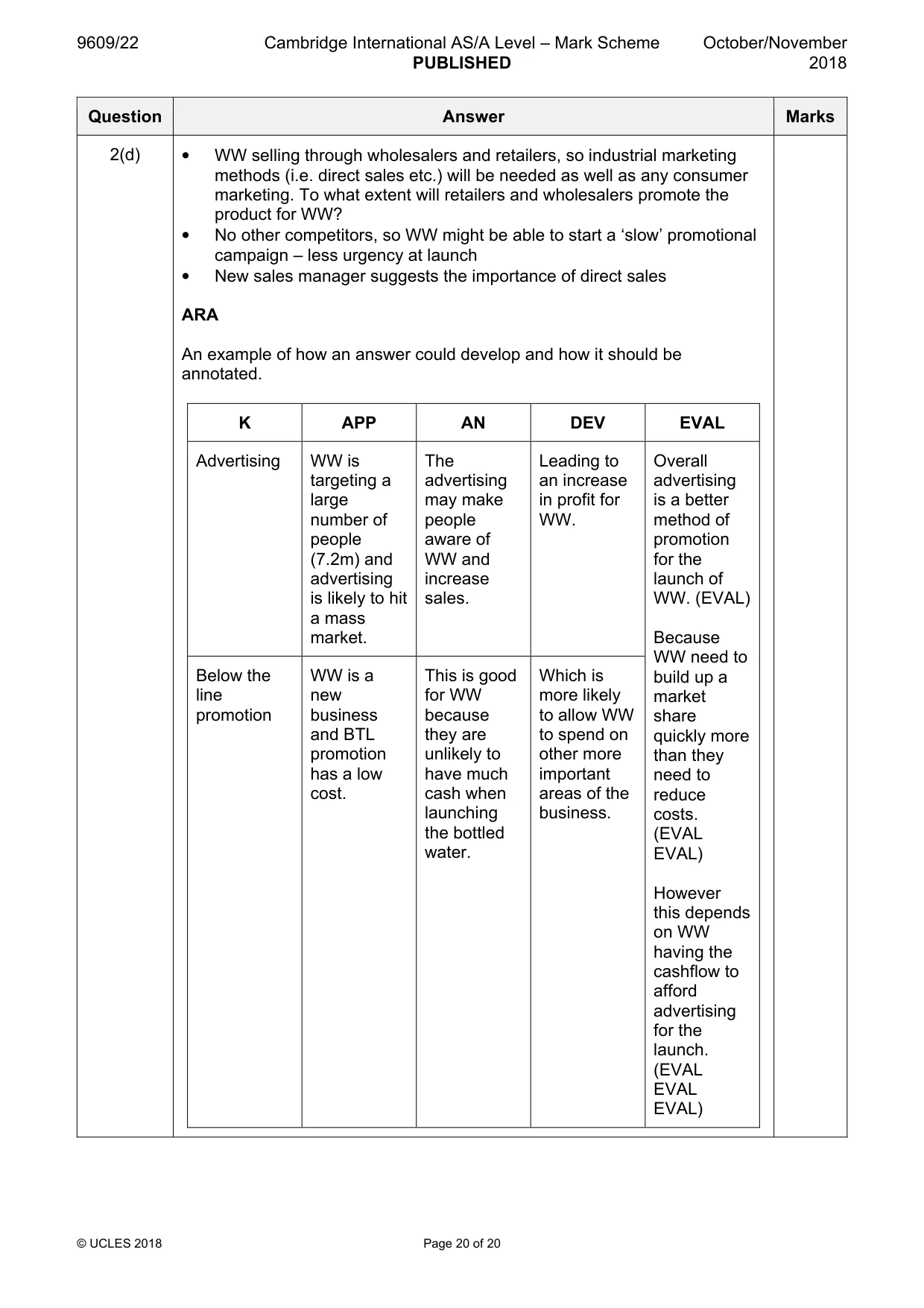
Mark scheme: 2(a)(i) Define the term ‘primary sector’ (line x). 2 Knowledge Marks A correct definition 2 A partial, vague or unfocused definition 1 No creditable content 0 Content The sector of business that deals directly with natural resources/the extraction of natural resources. One mark for showing understanding that it is about extraction • Extraction, mining, fishing, farming/agriculture One mark for showing understating that it is to do with raw materials • Raw materials, natural resources etc. Exemplar Mark Rationale Extraction of raw material 2 Both elements covered Acquiring natural materials 1 ‘Acquiring’ is not enough Farming the land 1 No idea of the raw material Mining things out of the ground 1 No idea of the raw material 2(a)(ii) Briefly explain the term ‘flow production’ (line x). 3 Award one mark for each point of explanation: Knowledge Marks C Example or some other way of showing good 3 understanding, for example (high) use of machinery/capital, homogeneous (exactly the same) products, allows greater economies of scale B Allows greater/faster production/high volume/mass – i.e. 2 can produce more A Use of an assembly line, continuous, produced in stages, 1 one after another Content Flow production – the continuous movement of products through the production process. When one task is finished the next task starts. Flow production ia also known as mass production and uses production lines e.g. car manufacturer. High volume of similar items. Exemplar Mark Rationale Mass production on an 3 All three elements assembly line, for example car manufacture Continuous production of many 3 All three elements goods, often using high levels of capital Making large amounts of the 2 B and C marks same product Flow production is mass 2 A and B marks producing products on an assembly line When goods are made one 1 Only A mark after another in a continuous production line 2(b)(i) Refer to Table 2. Calculate the market size of WW’s target market. 4 Rationale Marks Correct answer, with or without working or million (m) 4 Attempt at the final answer using correct figures 3 Calculation of one correct figure (can be OFR) 2 Formula* or identification of correct figures 1 No creditable content 0 *Formula can be implied from the use of the correct figures Content Target market × 100 Population 80% purchase bottled water = 80% of 60m = 48m (2) 15% of 48m take part in sport = 15% of 48m = 7.2m (4) Answer = 7.2m (4) Answer Rationale Marks 7.2 Correct answer 4 15% of 48m = 0.72 An error in final stage 3 80% of 60m = 48m One correct figure with working 2 15% of 60m = 9 Missed out a stage, but a correct 2 calculation based on their own figure 60/80 = 0.075m Incorrect way to calculate a percentage 1 0.075/15 = 0.005m but identification of correct figures 48m (no working) An incorrect answer with no working to 0 back it up 0.72 (no working) An incorrect answer with no working to 0 back it up 2(b)(ii) Explain one benefit to WW of targeting a niche market. 2 Level Knowledge and Application Marks 2 Explanation of a benefit in context 2 1 Explanation of a benefit 1 0 No creditable content 0 Content • Less competition – this needs to have some reference to the target market to become application • More brand loyalty • Cheaper market research • Higher potential profit margins • Less risk • Less initial investment • Lower cost for marketing/promotion • Higher price can be charged ARA Knowledge of a benefit of Possible benefit in context (APP) targeting a niche market (K) Less competition There are no brands currently targeting bottled water to sportspeople More brand loyalty Because consumers may feel that WW is line with their beliefs about sport and water Cheaper market research WW only needs to research 7.2m not 60m people 2(c) Analyse how having two of Goleman’s emotional intelligence 8 competencies could help the person selected fulfil the role of sales manager. Level Knowledge and Marks Analysis Marks Application (4 marks) (4 marks) 2b Shows 4 Developed analysis 4 understanding of of the use of two of how two of Goleman’s Goleman’s competencies could competencies could help the person help the person selected fulfil the selected fulfil the role of sales role of sales manager manager 2a Shows knowledge of 3 Developed analysis 3 how one of of the use of one of Goleman’s Goleman’s competencies could competencies could help the person help the person selected fulfil the selected fulfil the role of sales role of sales manager manager 1b Shows knowledge of 2 Limited analysis of 2 two of Goleman’s the use of two of competencies Goleman’s competencies in recruitment 1a Shows knowledge of 1 Limited analysis of 1 one of Goleman’s the use of one of competencies Goleman’s competencies in recruitment 0 No creditable content NOTE. the analytical impact can be on any stakeholder of the business Candidates must show that they know the specific competencies by name 2(c) Content Self-awareness i.e. Emotional self-awareness; accurate self-assessment; self-confidence. e.g. needs to be able to recognise own skills and develop these within the sales role at WW. Self management – Self-control, trustworthiness, conscientiousness, adaptability, focus on achievement and initiative. e.g. Needs time management skills. Ability to work on own. Social awareness – Empathy, understanding of the organisation of the business, focus on customer service. e.g. needs understand how to negotiate Social skills/management – Influencing others, leadership, developing others, communication skills, conflict management, teamworking and collaboration. e.g. ability to work as a team. Good communicator Examples of Examples of Examples of Examples of Golman’s application/ possible possible competencies context limited analysis developed analysis Self-awareness The sales If the manager is This is likely to manager must self-aware then lead to WW be willing to they know which being able to develop their skills to develop dominate the own skills in themselves so niche market that WW can and make more have a profit. successful launch into the market. Social skills/ Important This is likely to Which could management because the make the sales lead to WW sales manager team more establishing the must lead a effective brand and team of sales- gaining a high people market share. 2(d) Recommend suitable promotional methods for the launch of WW 11 bottled water. Justify your recommendation. Knowledge and Analysis and Application Evaluation Marks Marks (4 marks) (7 marks) Annotation Annotation A justified 7 EVAL recommendation + based on a EVAL developed + argument of at EVAL least two promotional methods in context A developed 6 EVAL recommendation + based on a EVAL developed argument of at least two promotional methods in context A basic 5 EVAL recommendation based on a developed argument of at least two promotional methods in context Shows 3–4 APP + Argument based 4 DEV + understanding of APP on two DEV two promotional promotional methods in methods in context context Shows APP Argument based 3 DEV understanding of on one one promotional promotional method in context method in context 2(d) Knowledge and Analysis and Application Evaluation (4 marks) Marks (7 marks) Marks Annotation Annotation Shows knowledge 1–2 K + K Limited analysis 2 AN + of two of two AN promotional promotional methods methods K Limited analysis 1 AN Shows knowledge of one of one promotional promotional method method No creditable content NOTE – allow different types of advertising (i.e. radio and TV) as separate promotional methods. Content Promotional methods could include: • Television • Radio • Cinema • Sponsorship • Newspapers • Sales promotions • Packaging • Direct marketing • Digital marketing • Email • Trade fairs • Merchandising • Telesales • Personal selling Analysis and evaluation should focus on the contextual elements, including: • WW only sold in country X – suggests a national method is more suitable • WW is targeted at a niche market – mass marketing method may not be appropriate and may be too expensive • WW is a new business – no idea of the promotional budget. Cheaper/below the line methods are likely to be more suitable • WW seems to have an ethical stance (no harmful chemical) so certain no-environmental methods might be unsuitable (i.e. newspaper) • 7.2m market – although niche this is still a sizable market to reach – might suggest mass marketing methods are more suitable 2(d) • WW selling through wholesalers and retailers, so industrial marketing methods (i.e. direct sales etc.) will be needed as well as any consumer marketing. To what extent will retailers and wholesalers promote the product for WW? • No other competitors, so WW might be able to start a ‘slow’ promotional campaign – less urgency at launch • New sales manager suggests the importance of direct sales ARA An example of how an answer could develop and how it should be annotated. K APP AN DEV EVAL Advertising WW is The Leading to Overall targeting a advertising an increase advertising large may make in profit for is a better number of people WW. method of people aware of promotion (7.2m) and WW and for the advertising increase launch of is likely to hit sales. WW. (EVAL) a mass market. Because WW need to Below the WW is a This is good Which is build up a line new for WW more likely market promotion business because to allow WW share and BTL they are to spend on quickly more promotion unlikely to other more than they has a low have much important need to cost. cash when areas of the reduce launching business. costs. the bottled (EVAL water. EVAL) However this depends on WW having the cashflow to afford advertising for the launch. (EVAL EVAL EVAL)
What was in this paper
The subtopics covered by these 2 questions, and how many questions each got. Open one in a new tab to see every Cambridge question on it.
What you needed in this session
Cambridge’s own grade thresholds for 2018 Oct/Nov, Paper 2 · Variant 2. A higher threshold means an easier paper — the bar moves with how the cohort did.