Cambridge A Level Business (for first examination in 2016) 9609 — 2018 Oct/Nov Paper 2 · Variant 3
9609/23/O/N/18 · 2 questions · 60 marks · ≈68 min
The question paper and its mark scheme, free to read here and free to download. This is Cambridge’s own paper, exactly as it was sat.
Question paper4 pages
Mark scheme16 pages
Answers below. Sit the paper first if you are practising.
Questions as text
Q1 · Ontime Taxis (OT) OT is a taxi business
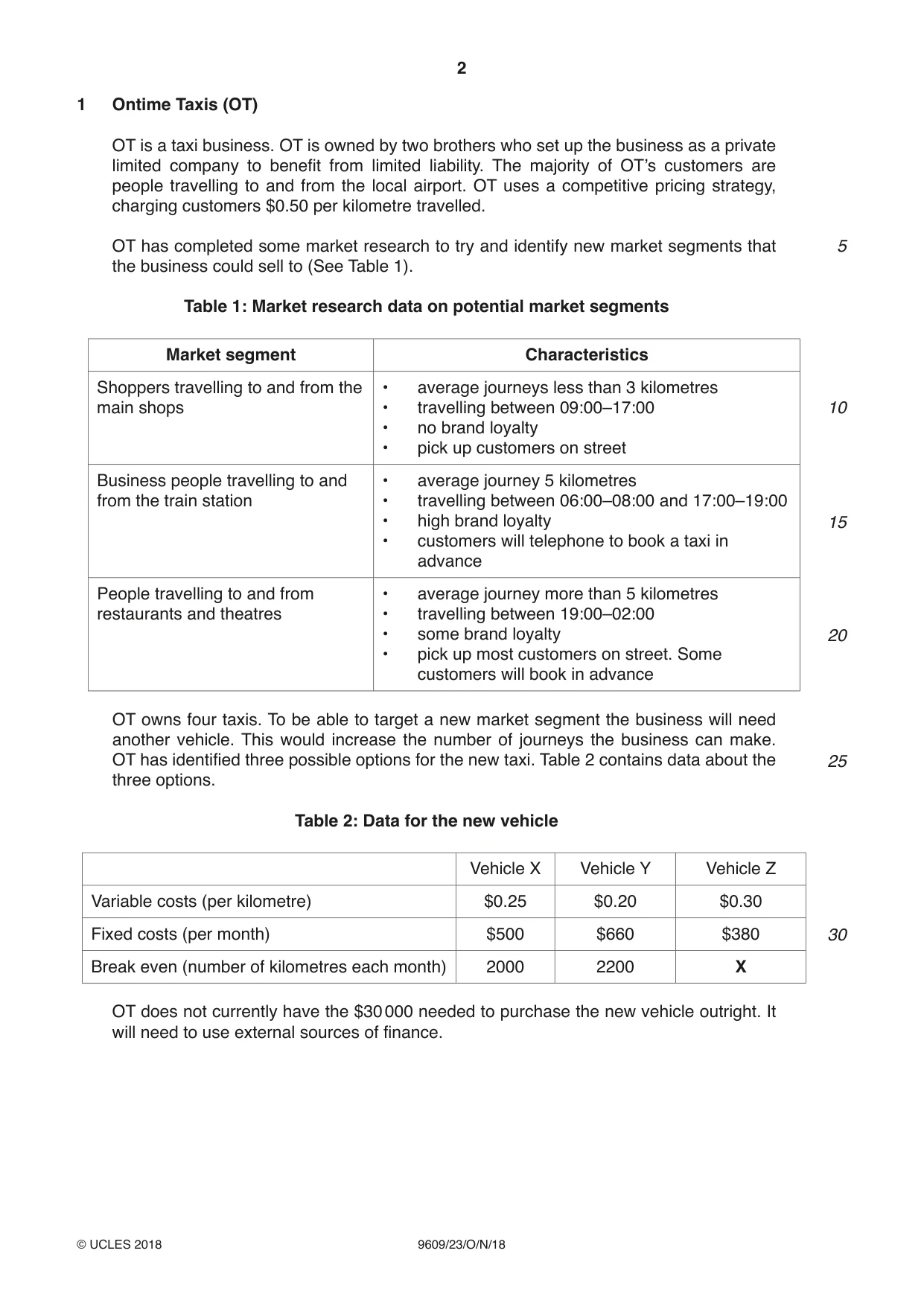
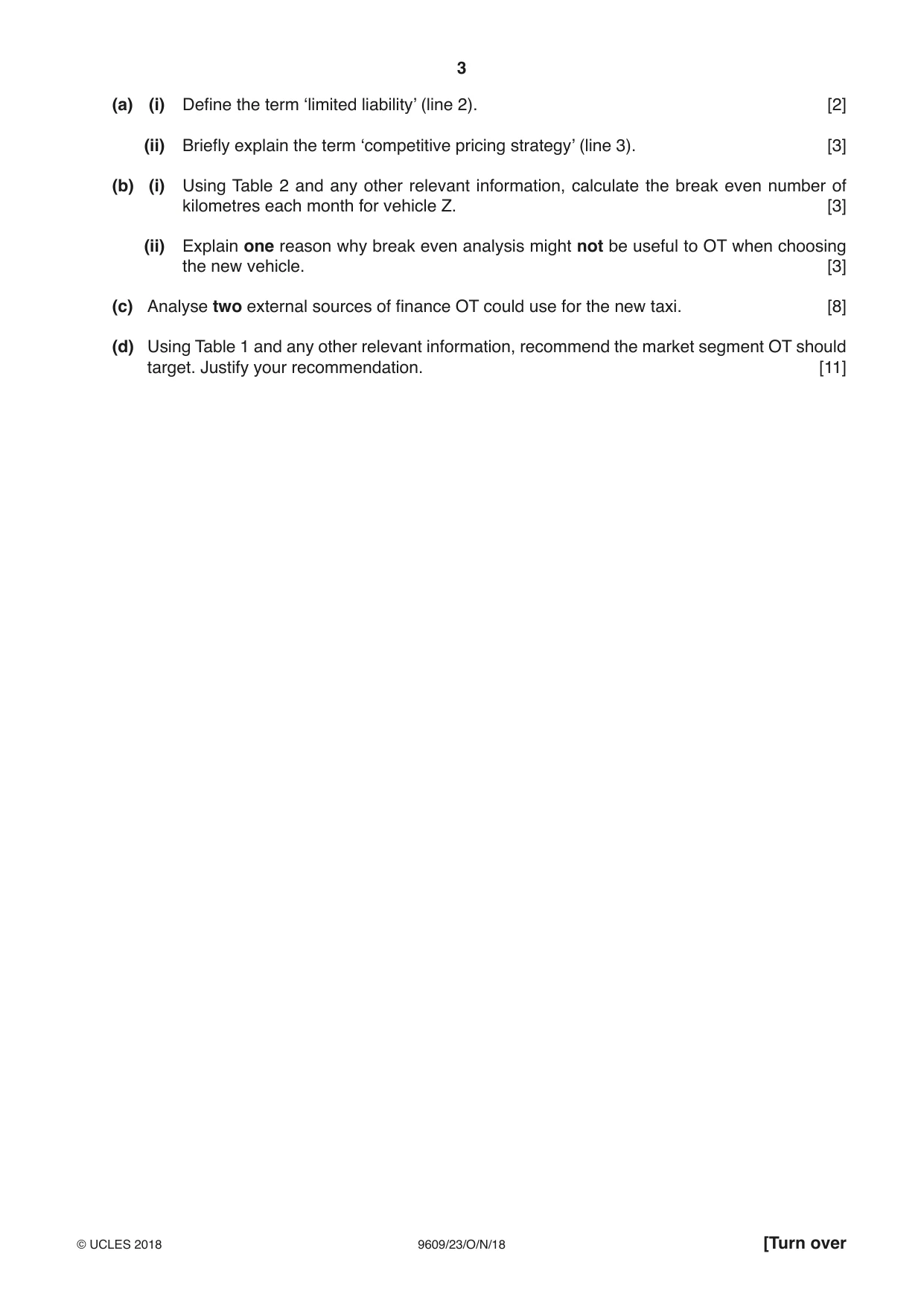
1 Ontime Taxis (OT) OT is a taxi business. OT is owned by two brothers who set up the business as a private limited company to benefit from limited liability. The majority of OT’s customers are people travelling to and from the local airport. OT uses a competitive pricing strategy, charging customers $0.50 per kilometre travelled. OT has completed some market research to try and identify new market segments that 5 the business could sell to (See Table 1). Table 1: Market research data on potential market segments Market segment Characteristics Shoppers travelling to and from the • average journeys less than 3 kilometres main shops • travelling between 09:00–17:00 10 • no brand loyalty • pick up customers on street Business people travelling to and • average journey 5 kilometres from the train station • travelling between 06:00–08:00 and 17:00–19:00 • high brand loyalty 15 • customers will telephone to book a taxi in advance People travelling to and from • average journey more than 5 kilometres restaurants and theatres • travelling between 19:00–02:00 • some brand loyalty 20 • pick up most customers on street. Some customers will book in advance OT owns four taxis. To be able to target a new market segment the business will need another vehicle. This would increase the number of journeys the business can make. OT has identified three possible options for the new taxi. Table 2 contains data about the 25 three options. Table 2: Data for the new vehicle Vehicle X Vehicle Y Vehicle Z Variable costs (per kilometre) $0.25 $0.20 $0.30 Fixed costs (per month) $500 $660 $380 30 Break even (number of kilometres each month) 2000 2200 X OT does not currently have the $30 000 needed to purchase the new vehicle outright. It will need to use external sources of finance. (a) (i) Define the term ‘limited liability’ (line 2). [2] (ii) Briefly explain the term ‘competitive pricing strategy’ (line 3). [3] (b) (i) Using Table 2 and any other relevant information, calculate the break even number of kilometres each month for vehicle Z. [3] (ii) Explain one reason why break even analysis might not be useful to OT when choosing the new vehicle. [3] (c) Analyse two external sources of finance OT could use for the new taxi. [8] (d) Using Table 1 and any other relevant information, recommend the market segment OT should target. Justify your recommendation. [11]
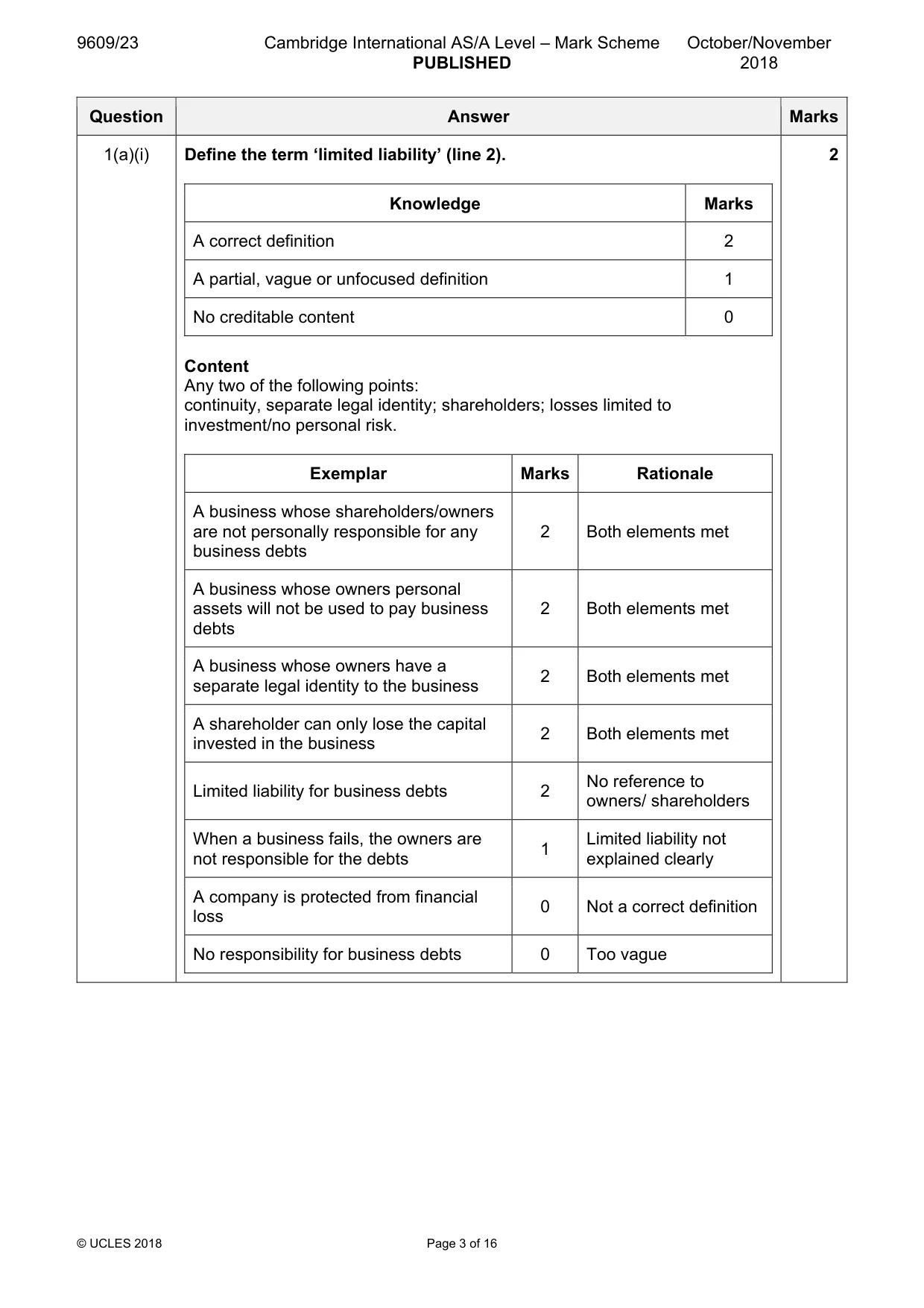
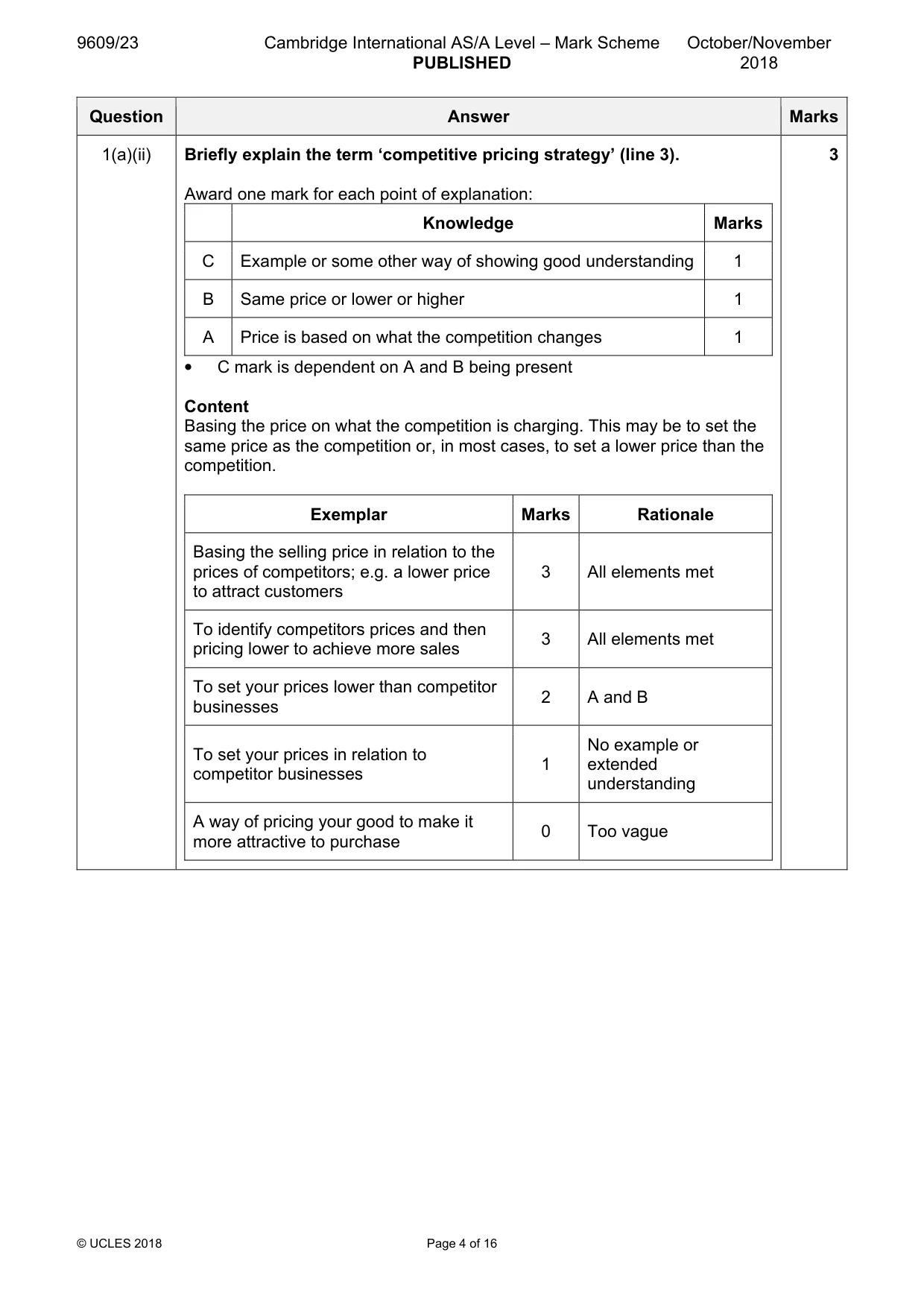
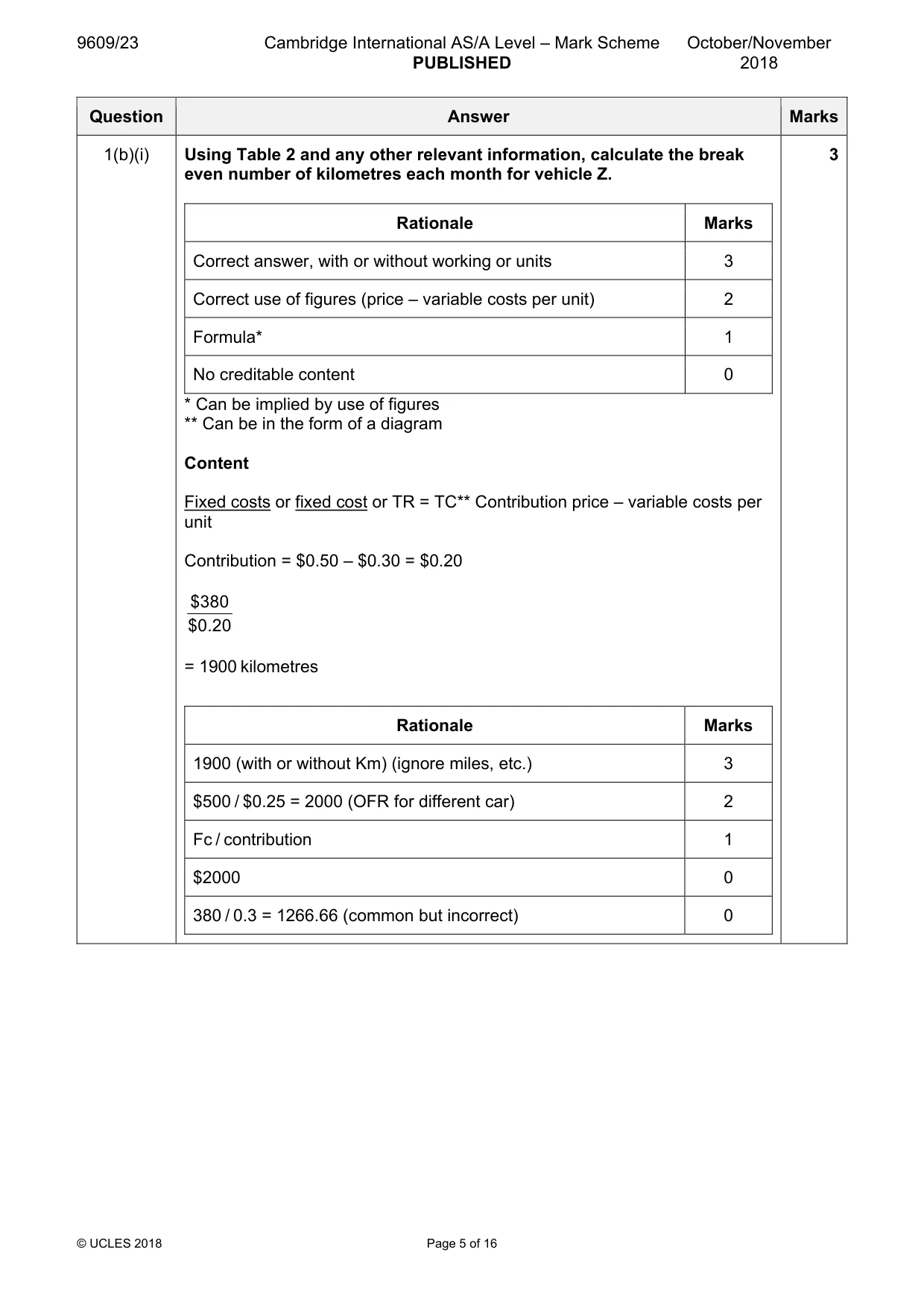
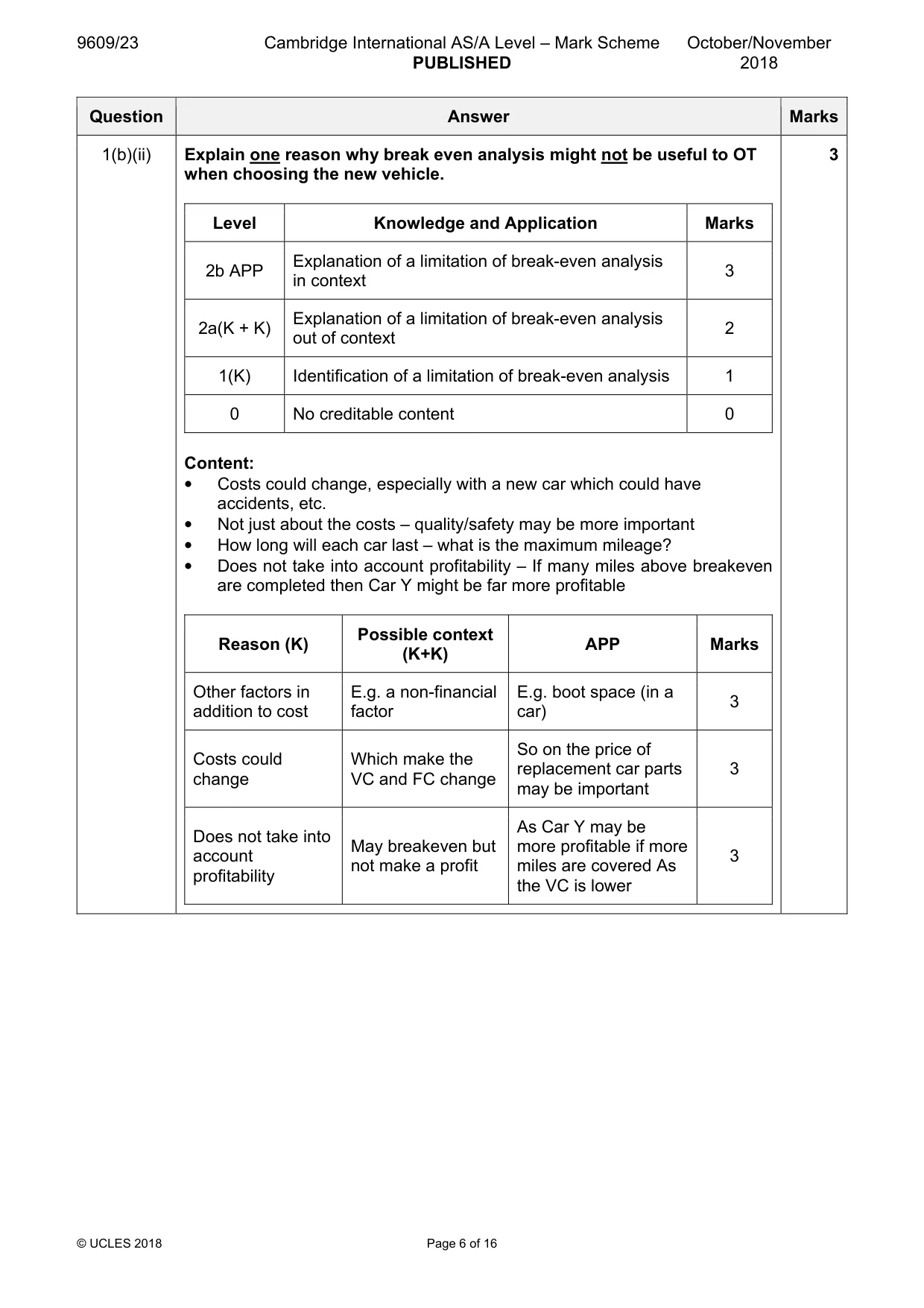
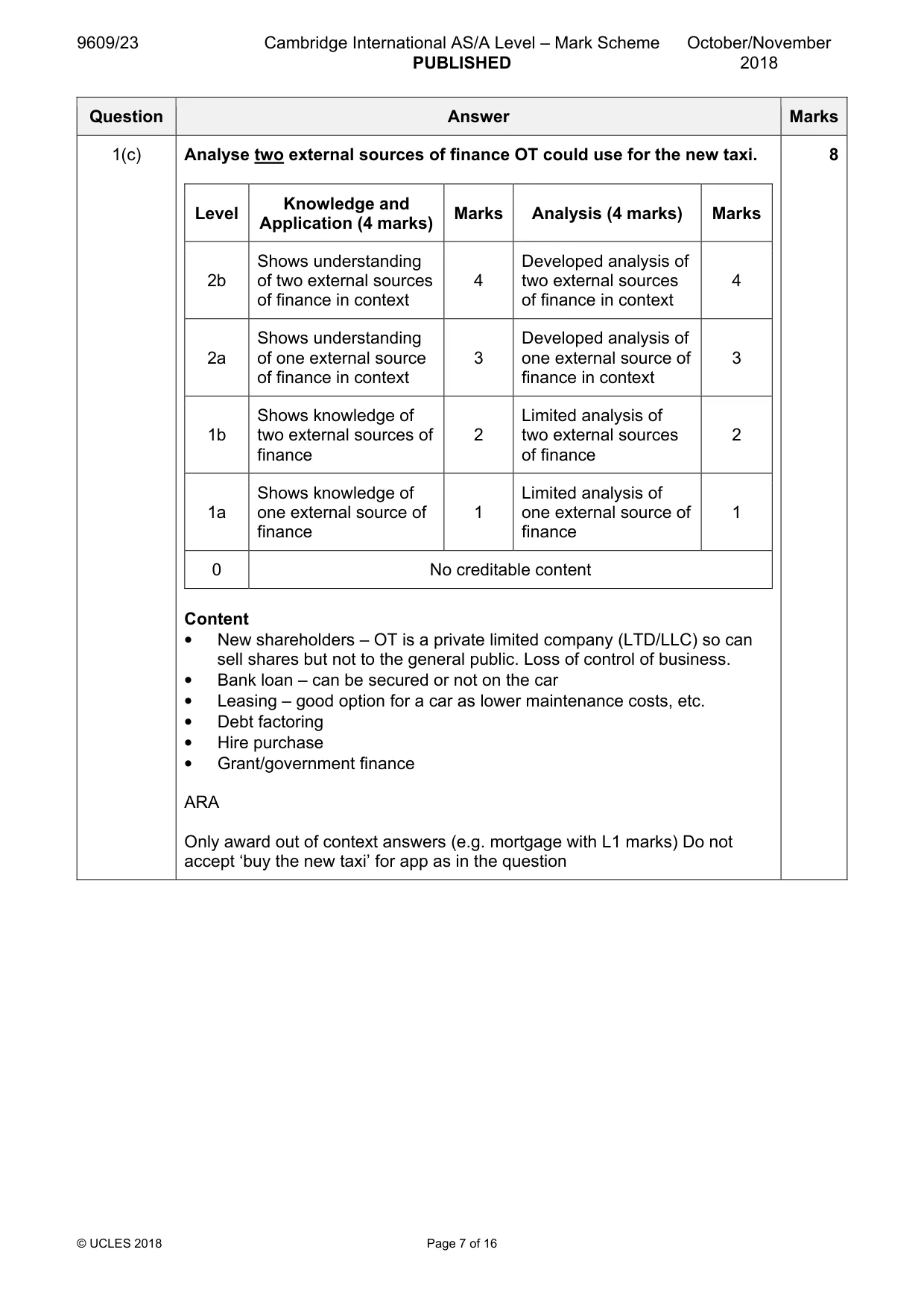
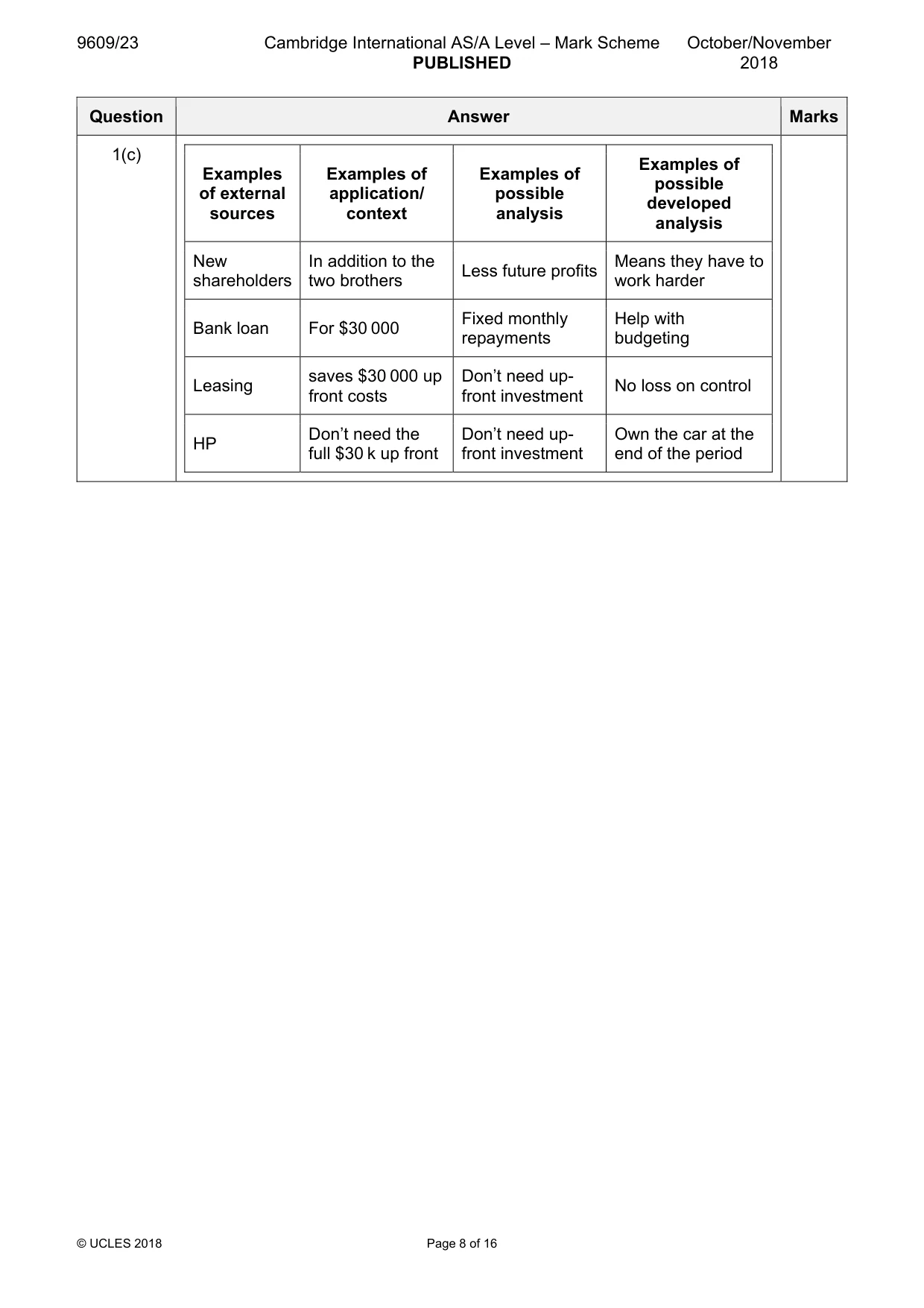
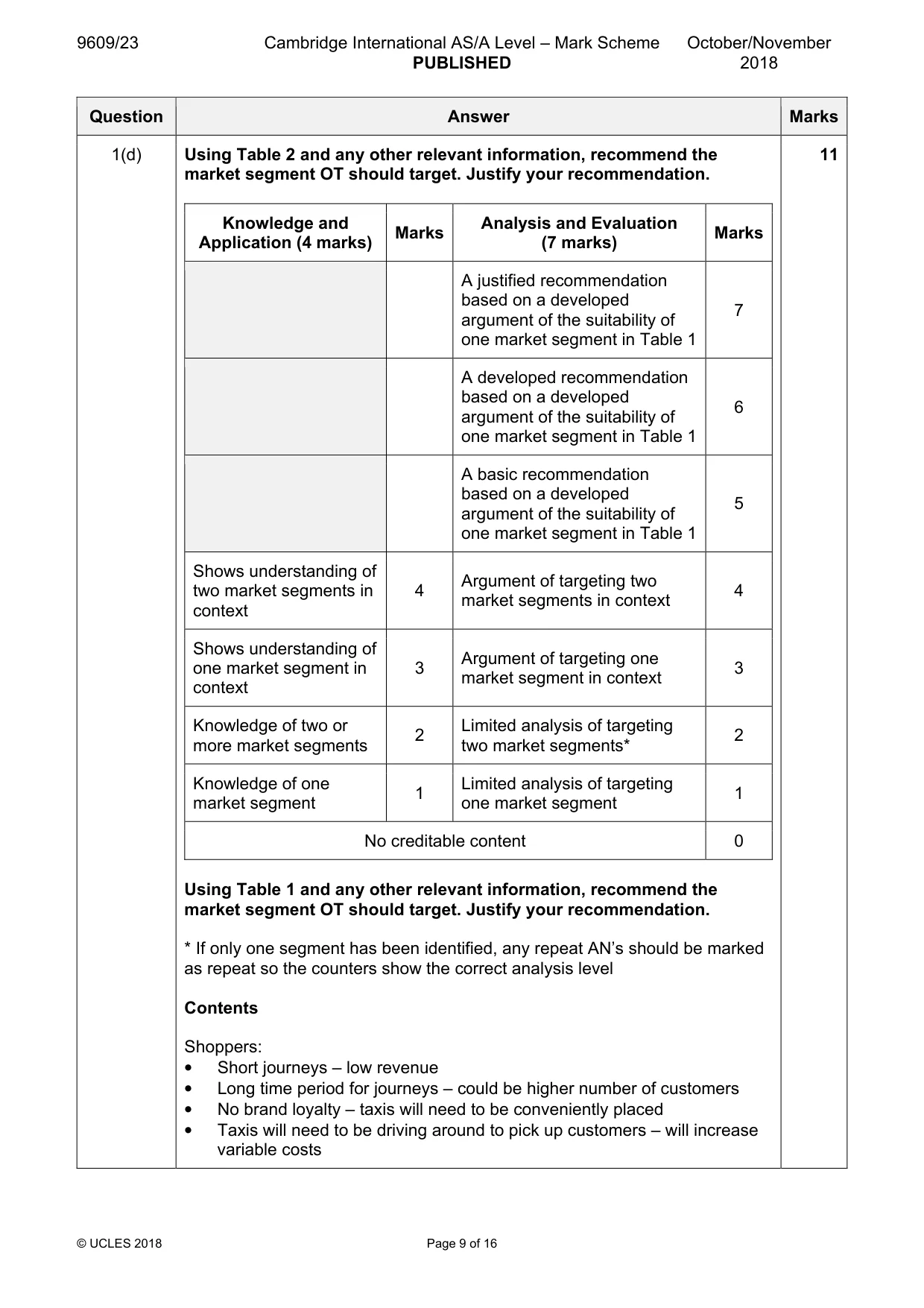
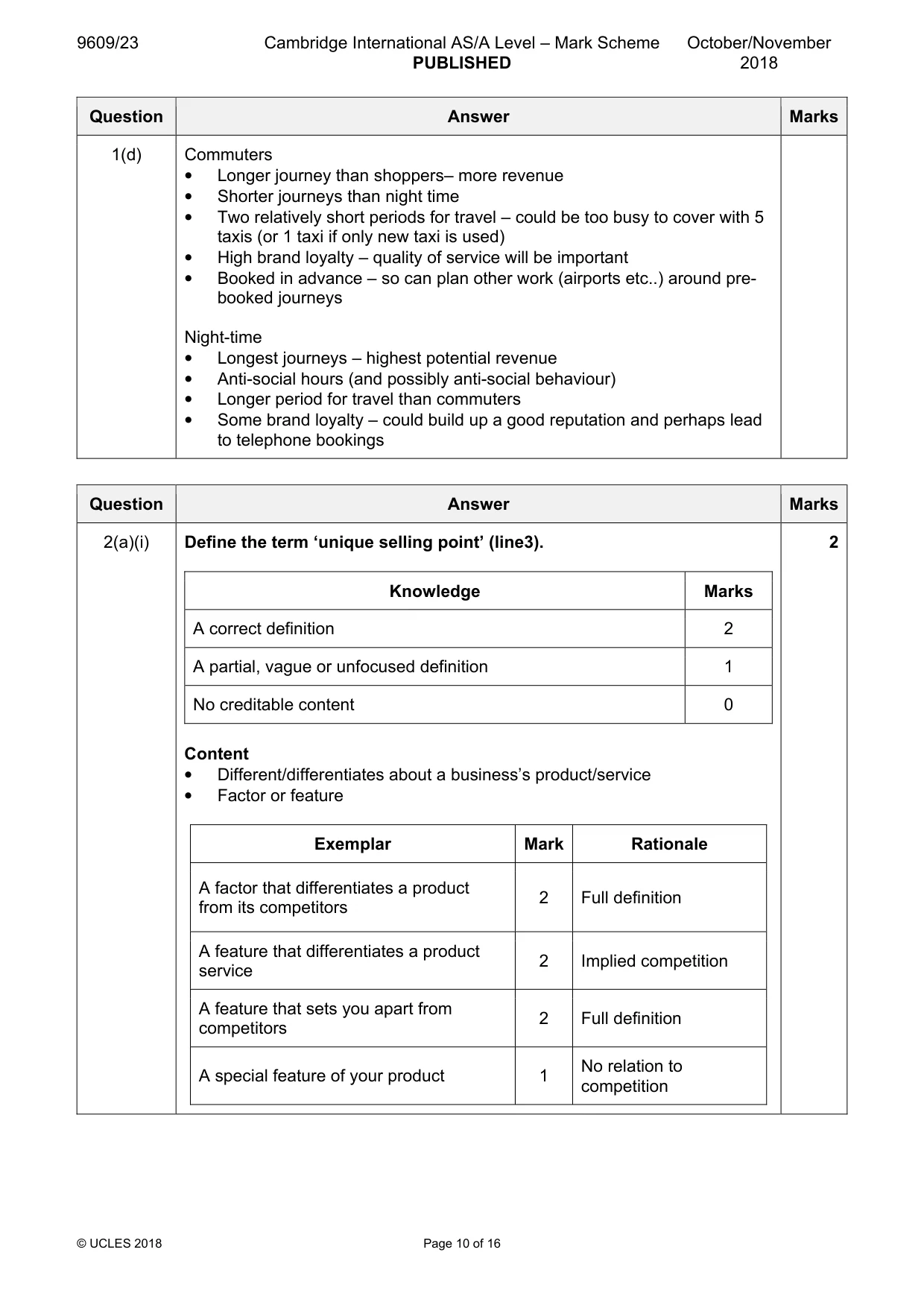
Mark scheme: Question Answer Marks 1(a)(i) Define the term ‘limited liability’ (line 2). 2 Knowledge Marks A correct definition 2 A partial, vague or unfocused definition 1 No creditable content 0 Content Any two of the following points: continuity, separate legal identity; shareholders; losses limited to investment/no personal risk. Exemplar Marks Rationale A business whose shareholders/owners are not personally responsible for any 2 Both elements met business debts A business whose owners personal assets will not be used to pay business 2 Both elements met debts A business whose owners have a 2 Both elements met separate legal identity to the business A shareholder can only lose the capital 2 Both elements met invested in the business No reference to Limited liability for business debts 2 owners/ shareholders When a business fails, the owners are Limited liability not 1 not responsible for the debts explained clearly A company is protected from financial 0 Not a correct definition loss No responsibility for business debts 0 Too vague 1(a)(ii) Briefly explain the term ‘competitive pricing strategy’ (line 3). 3 Award one mark for each point of explanation: Knowledge Marks C Example or some other way of showing good understanding 1 B Same price or lower or higher 1 A Price is based on what the competition changes 1 • C mark is dependent on A and B being present Content Basing the price on what the competition is charging. This may be to set the same price as the competition or, in most cases, to set a lower price than the competition. Exemplar Marks Rationale Basing the selling price in relation to the prices of competitors; e.g. a lower price 3 All elements met to attract customers To identify competitors prices and then 3 All elements met pricing lower to achieve more sales To set your prices lower than competitor 2 A and B businesses No example or To set your prices in relation to 1 extended competitor businesses understanding A way of pricing your good to make it 0 Too vague more attractive to purchase 1(b)(i) Using Table 2 and any other relevant information, calculate the break 3 even number of kilometres each month for vehicle Z. Rationale Marks Correct answer, with or without working or units 3 Correct use of figures (price – variable costs per unit) 2 Formula* 1 No creditable content 0 * Can be implied by use of figures ** Can be in the form of a diagram Content Fixed costs or fixed cost or TR = TC** Contribution price – variable costs per unit Contribution = $0.50 – $0.30 = $0.20 $380 $0.20 = 1900 kilometres Rationale Marks 1900 (with or without Km) (ignore miles, etc.) 3 $500 / $0.25 = 2000 (OFR for different car) 2 Fc / contribution 1 $2000 0 380 / 0.3 = 1266.66 (common but incorrect) 0 1(b)(ii) Explain one reason why break even analysis might not be useful to OT 3 when choosing the new vehicle. Level Knowledge and Application Marks Explanation of a limitation of break-even analysis 2b APP 3 in context Explanation of a limitation of break-even analysis 2a(K + K) 2 out of context 1(K) Identification of a limitation of break-even analysis 1 0 No creditable content 0 Content: • Costs could change, especially with a new car which could have accidents, etc. • Not just about the costs – quality/safety may be more important • How long will each car last – what is the maximum mileage? • Does not take into account profitability – If many miles above breakeven are completed then Car Y might be far more profitable Possible context Reason (K) APP Marks (K+K) Other factors in E.g. a non-financial E.g. boot space (in a 3 addition to cost factor car) So on the price of Costs could Which make the replacement car parts 3 change VC and FC change may be important As Car Y may be Does not take into May breakeven but more profitable if more account 3 not make a profit miles are covered As profitability the VC is lower 1(c) Analyse two external sources of finance OT could use for the new taxi. 8 Knowledge and Level Marks Analysis (4 marks) Marks Application (4 marks) Shows understanding Developed analysis of 2b of two external sources 4 two external sources 4 of finance in context of finance in context Shows understanding Developed analysis of 2a of one external source 3 one external source of 3 of finance in context finance in context Shows knowledge of Limited analysis of 1b two external sources of 2 two external sources 2 finance of finance Shows knowledge of Limited analysis of 1a one external source of 1 one external source of 1 finance finance 0 No creditable content Content • New shareholders – OT is a private limited company (LTD/LLC) so can sell shares but not to the general public. Loss of control of business. • Bank loan – can be secured or not on the car • Leasing – good option for a car as lower maintenance costs, etc. • Debt factoring • Hire purchase • Grant/government finance ARA Only award out of context answers (e.g. mortgage with L1 marks) Do not accept ‘buy the new taxi’ for app as in the question 1(c) Examples of Examples Examples of Examples of possible of external application/ possible developed sources context analysis analysis New In addition to the Means they have to Less future profits shareholders two brothers work harder Fixed monthly Help with Bank loan For $30 000 repayments budgeting saves $30 000 up Don’t need up- Leasing No loss on control front costs front investment Don’t need the Don’t need up- Own the car at the HP full $30 k up front front investment end of the period 1(d) Using Table 2 and any other relevant information, recommend the 11 market segment OT should target. Justify your recommendation. Knowledge and Analysis and Evaluation Marks Marks Application (4 marks) (7 marks) A justified recommendation based on a developed 7 argument of the suitability of one market segment in Table 1 A developed recommendation based on a developed 6 argument of the suitability of one market segment in Table 1 A basic recommendation based on a developed 5 argument of the suitability of one market segment in Table 1 Shows understanding of Argument of targeting two two market segments in 4 4 market segments in context context Shows understanding of Argument of targeting one one market segment in 3 3 market segment in context context Knowledge of two or Limited analysis of targeting 2 2 more market segments two market segments* Knowledge of one Limited analysis of targeting 1 1 market segment one market segment No creditable content 0 Using Table 1 and any other relevant information, recommend the market segment OT should target. Justify your recommendation. * If only one segment has been identified, any repeat AN’s should be marked as repeat so the counters show the correct analysis level Contents Shoppers: • Short journeys – low revenue • Long time period for journeys – could be higher number of customers • No brand loyalty – taxis will need to be conveniently placed • Taxis will need to be driving around to pick up customers – will increase variable costs
Q2 · Fish and Chips (FC) Min is a sole trader who is the owner and overall manager of FC
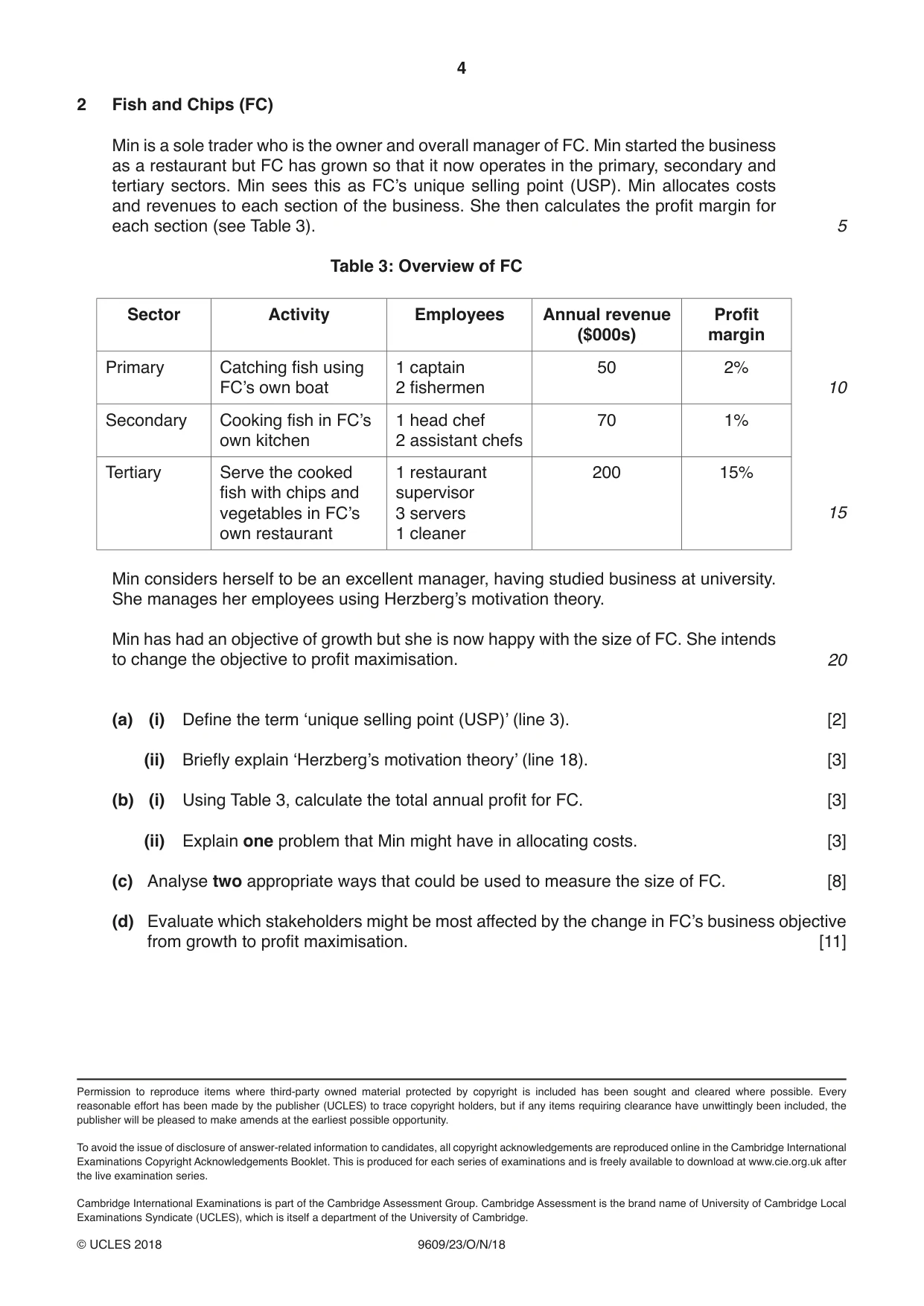
2 Fish and Chips (FC) Min is a sole trader who is the owner and overall manager of FC. Min started the business as a restaurant but FC has grown so that it now operates in the primary, secondary and tertiary sectors. Min sees this as FC’s unique selling point (USP). Min allocates costs and revenues to each section of the business. She then calculates the profit margin for each section (see Table 3). 5 Table 3: Overview of FC Sector Activity Employees Annual revenue Profit ($000s) margin Primary Catching fish using 1 captain 50 2% FC’s own boat 2 fishermen 10 Secondary Cooking fish in FC’s 1 head chef 70 1% own kitchen 2 assistant chefs Tertiary Serve the cooked 1 restaurant 200 15% fish with chips and supervisor vegetables in FC’s 3 servers 15 own restaurant 1 cleaner Min considers herself to be an excellent manager, having studied business at university. She manages her employees using Herzberg’s motivation theory. Min has had an objective of growth but she is now happy with the size of FC. She intends to change the objective to profit maximisation. 20 (a) (i) Define the term ‘unique selling point (USP)’ (line 3). [2] (ii) Briefly explain ‘Herzberg’s motivation theory’ (line 18). [3] (b) (i) Using Table 3, calculate the total annual profit for FC. [3] (ii) Explain one problem that Min might have in allocating costs. [3] (c) Analyse two appropriate ways that could be used to measure the size of FC. [8] (d) Evaluate which stakeholders might be most affected by the change in FC’s business objective from growth to profit maximisation. [11]
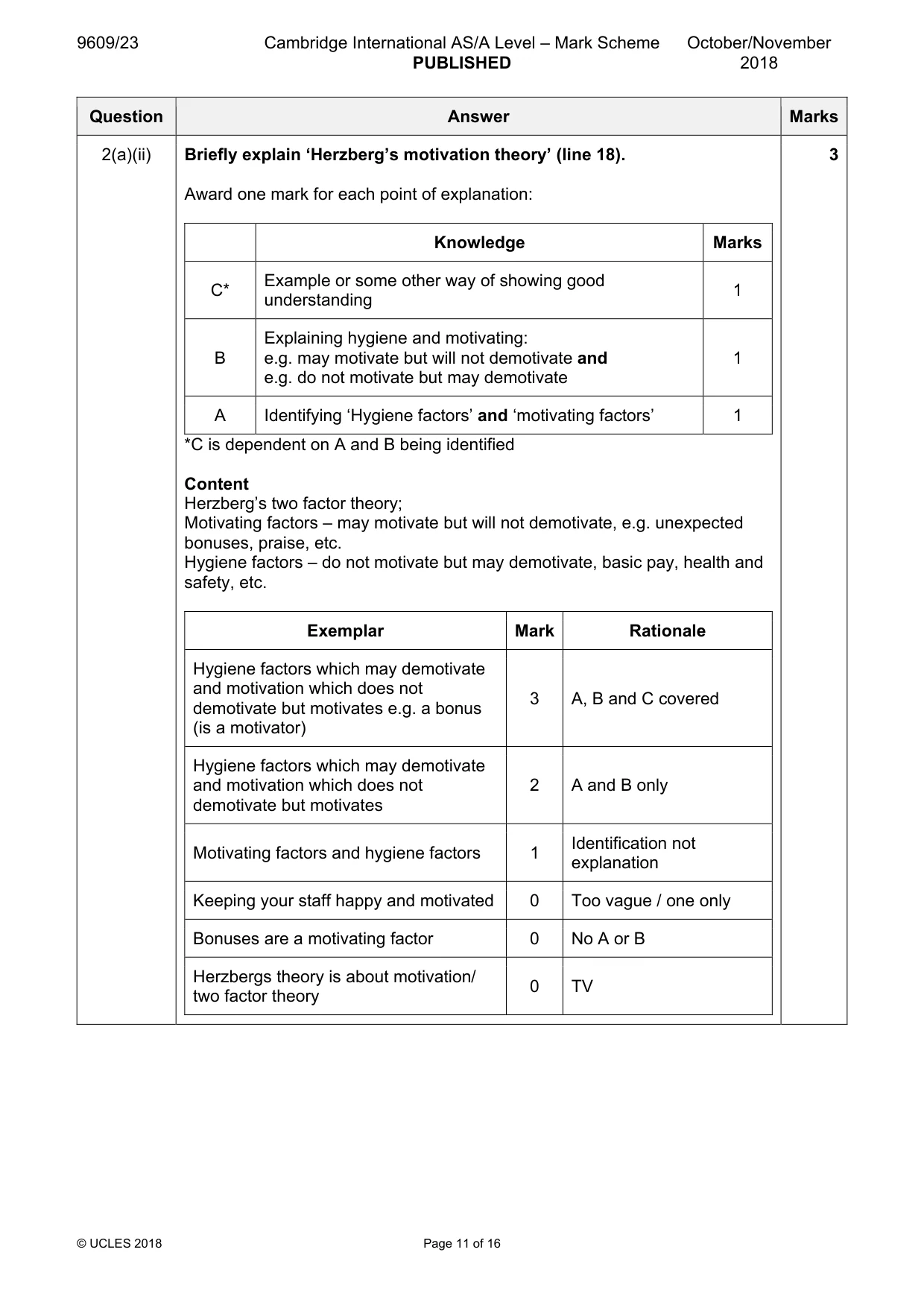
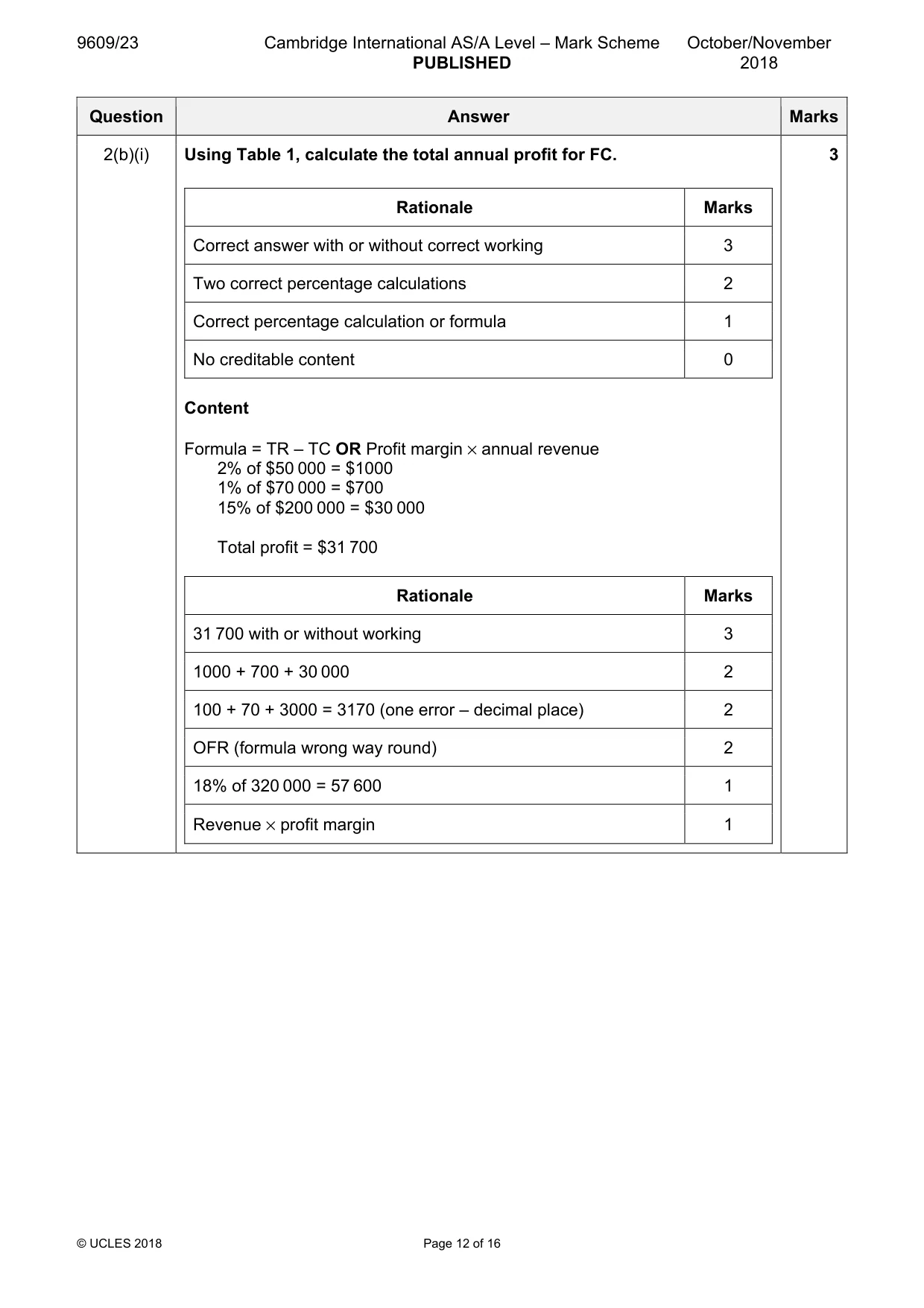
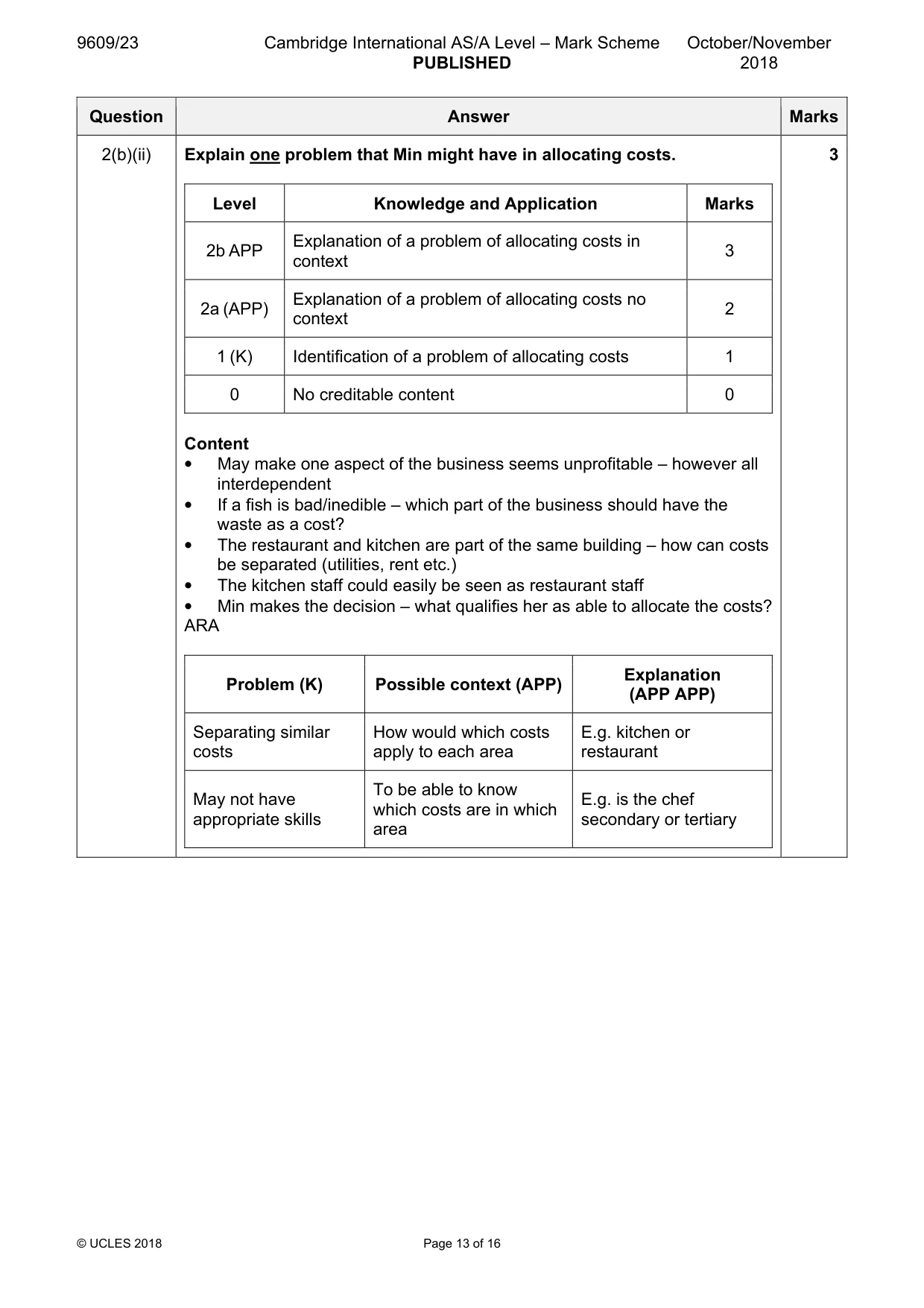
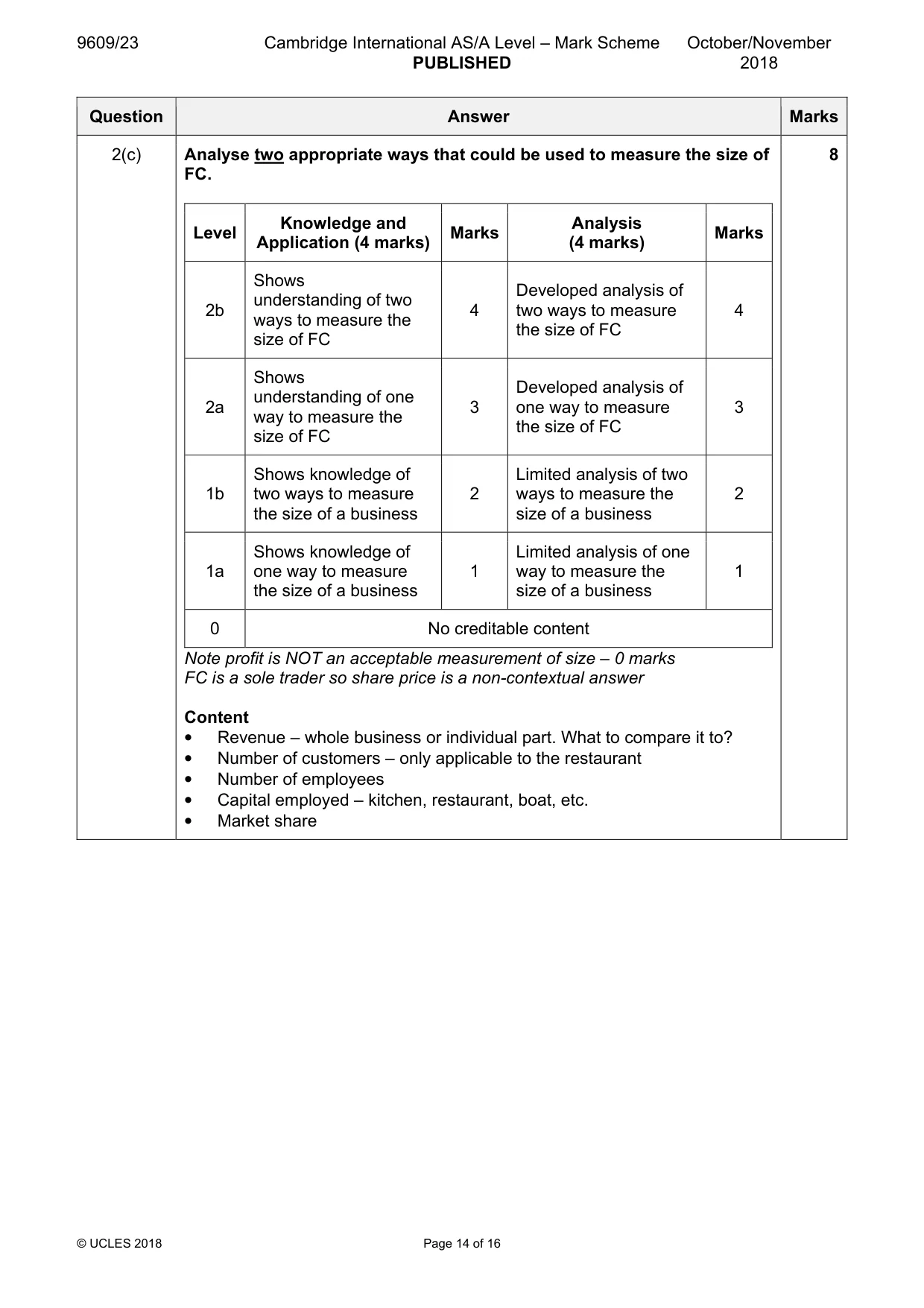
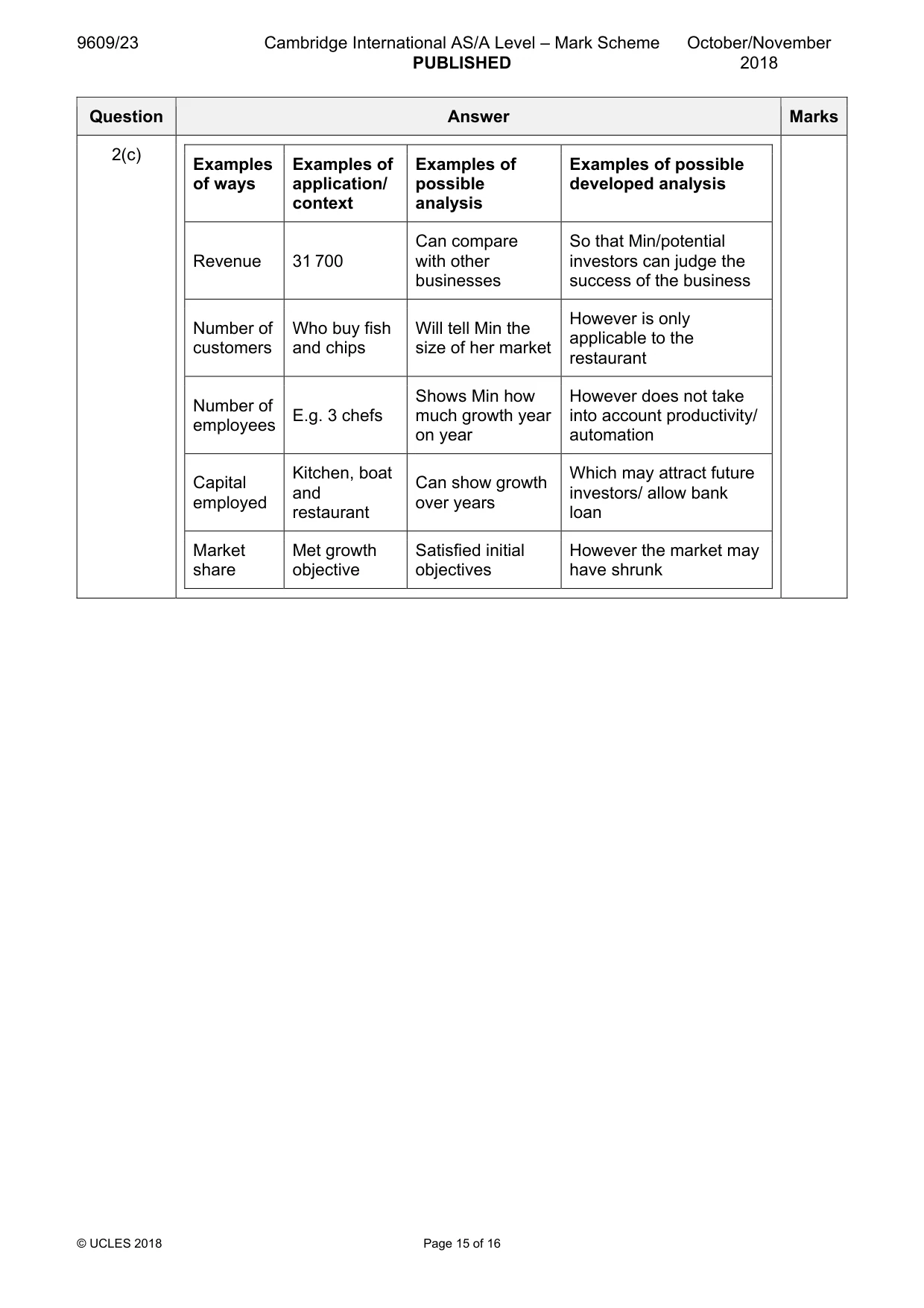
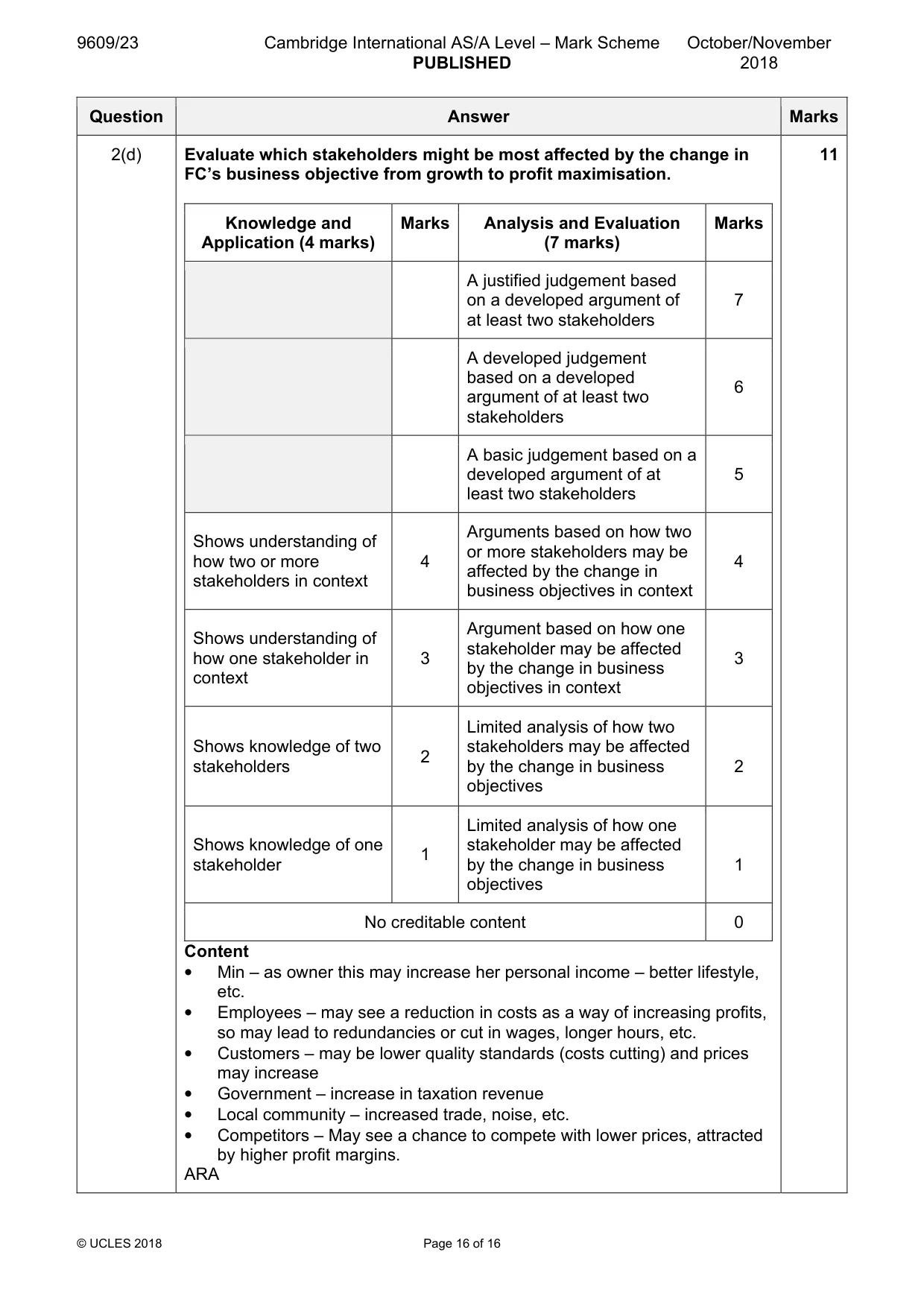
Mark scheme: 2(a)(i) Define the term ‘unique selling point’ (line3). 2 Knowledge Marks A correct definition 2 A partial, vague or unfocused definition 1 No creditable content 0 Content • Different/differentiates about a business’s product/service • Factor or feature Exemplar Mark Rationale A factor that differentiates a product 2 Full definition from its competitors A feature that differentiates a product 2 Implied competition service A feature that sets you apart from 2 Full definition competitors No relation to A special feature of your product 1 competition 2(a)(ii) Briefly explain ‘Herzberg’s motivation theory’ (line 18). 3 Award one mark for each point of explanation: Knowledge Marks Example or some other way of showing good C* 1 understanding Explaining hygiene and motivating: B e.g. may motivate but will not demotivate and 1 e.g. do not motivate but may demotivate A Identifying ‘Hygiene factors’ and ‘motivating factors’ 1 *C is dependent on A and B being identified Content Herzberg’s two factor theory; Motivating factors – may motivate but will not demotivate, e.g. unexpected bonuses, praise, etc. Hygiene factors – do not motivate but may demotivate, basic pay, health and safety, etc. Exemplar Mark Rationale Hygiene factors which may demotivate and motivation which does not 3 A, B and C covered demotivate but motivates e.g. a bonus (is a motivator) Hygiene factors which may demotivate and motivation which does not 2 A and B only demotivate but motivates Identification not Motivating factors and hygiene factors 1 explanation Keeping your staff happy and motivated 0 Too vague / one only Bonuses are a motivating factor 0 No A or B Herzbergs theory is about motivation/ 0 TV two factor theory 2(b)(i) Using Table 1, calculate the total annual profit for FC. 3 Rationale Marks Correct answer with or without correct working 3 Two correct percentage calculations 2 Correct percentage calculation or formula 1 No creditable content 0 Content Formula = TR – TC OR Profit margin × annual revenue 2% of $50 000 = $1000 1% of $70 000 = $700 15% of $200 000 = $30 000 Total profit = $31 700 Rationale Marks 31 700 with or without working 3 1000 + 700 + 30 000 2 100 + 70 + 3000 = 3170 (one error – decimal place) 2 OFR (formula wrong way round) 2 18% of 320 000 = 57 600 1 Revenue × profit margin 1 2(b)(ii) Explain one problem that Min might have in allocating costs. 3 Level Knowledge and Application Marks Explanation of a problem of allocating costs in 2b APP 3 context Explanation of a problem of allocating costs no 2a (APP) 2 context 1 (K) Identification of a problem of allocating costs 1 0 No creditable content 0 Content • May make one aspect of the business seems unprofitable – however all interdependent • If a fish is bad/inedible – which part of the business should have the waste as a cost? • The restaurant and kitchen are part of the same building – how can costs be separated (utilities, rent etc.) • The kitchen staff could easily be seen as restaurant staff • Min makes the decision – what qualifies her as able to allocate the costs? ARA Explanation Problem (K) Possible context (APP) (APP APP) Separating similar How would which costs E.g. kitchen or costs apply to each area restaurant To be able to know May not have E.g. is the chef which costs are in which appropriate skills secondary or tertiary area 2(c) Analyse two appropriate ways that could be used to measure the size of 8 FC. Knowledge and Analysis Level Marks Marks Application (4 marks) (4 marks) Shows Developed analysis of understanding of two 2b 4 two ways to measure 4 ways to measure the the size of FC size of FC Shows Developed analysis of understanding of one 2a 3 one way to measure 3 way to measure the the size of FC size of FC Shows knowledge of Limited analysis of two 1b two ways to measure 2 ways to measure the 2 the size of a business size of a business Shows knowledge of Limited analysis of one 1a one way to measure 1 way to measure the 1 the size of a business size of a business 0 No creditable content Note profit is NOT an acceptable measurement of size – 0 marks FC is a sole trader so share price is a non-contextual answer Content • Revenue – whole business or individual part. What to compare it to? • Number of customers – only applicable to the restaurant • Number of employees • Capital employed – kitchen, restaurant, boat, etc. • Market share 2(c) Examples Examples of Examples of Examples of possible of ways application/ possible developed analysis context analysis Can compare So that Min/potential Revenue 31 700 with other investors can judge the businesses success of the business However is only Number of Who buy fish Will tell Min the applicable to the customers and chips size of her market restaurant Shows Min how However does not take Number of E.g. 3 chefs much growth year into account productivity/ employees on year automation Kitchen, boat Which may attract future Capital Can show growth and investors/ allow bank employed over years restaurant loan Market Met growth Satisfied initial However the market may share objective objectives have shrunk 2(d) Evaluate which stakeholders might be most affected by the change in 11 FC’s business objective from growth to profit maximisation. Knowledge and Marks Analysis and Evaluation Marks Application (4 marks) (7 marks) A justified judgement based on a developed argument of 7 at least two stakeholders A developed judgement based on a developed 6 argument of at least two stakeholders A basic judgement based on a developed argument of at 5 least two stakeholders Arguments based on how two Shows understanding of or more stakeholders may be how two or more 4 4 affected by the change in stakeholders in context business objectives in context Argument based on how one Shows understanding of stakeholder may be affected how one stakeholder in 3 3 by the change in business context objectives in context Limited analysis of how two Shows knowledge of two stakeholders may be affected 2 stakeholders by the change in business 2 objectives Limited analysis of how one Shows knowledge of one stakeholder may be affected 1 stakeholder by the change in business 1 objectives No creditable content 0 Content • Min – as owner this may increase her personal income – better lifestyle, etc. • Employees – may see a reduction in costs as a way of increasing profits, so may lead to redundancies or cut in wages, longer hours, etc. • Customers – may be lower quality standards (costs cutting) and prices may increase • Government – increase in taxation revenue • Local community – increased trade, noise, etc. • Competitors – May see a chance to compete with lower prices, attracted by higher profit margins. ARA
What was in this paper
The subtopics covered by these 2 questions, and how many questions each got. Open one in a new tab to see every Cambridge question on it.
What you needed in this session
Cambridge’s own grade thresholds for 2018 Oct/Nov, Paper 2 · Variant 3. A higher threshold means an easier paper — the bar moves with how the cohort did.