Cambridge A Level Business (for first examination in 2016) 9609 — 2017 Oct/Nov Paper 2 · Variant 3
9609/23/O/N/17 · 2 questions · 60 marks · ≈68 min
The question paper and its mark scheme, free to read here and free to download. This is Cambridge’s own paper, exactly as it was sat.
Question paper4 pages


Mark scheme10 pages
Answers below. Sit the paper first if you are practising.

Questions as text
Q1 · Jones Sticky Labels (JS) JS is a private limited company that produces sticky labels for…
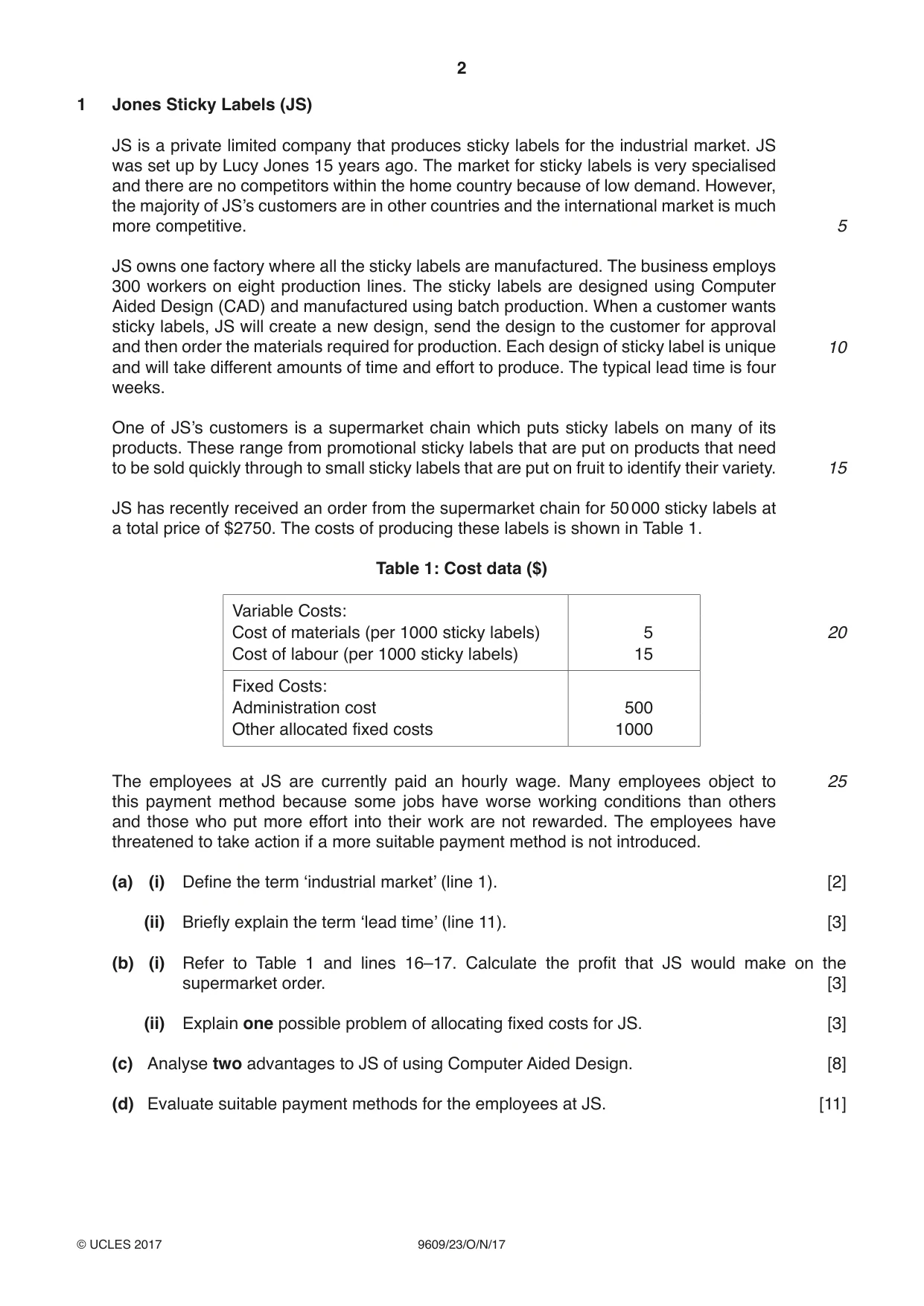
1 Jones Sticky Labels (JS) JS is a private limited company that produces sticky labels for the industrial market. JS was set up by Lucy Jones 15 years ago. The market for sticky labels is very specialised and there are no competitors within the home country because of low demand. However, the majority of JS’s customers are in other countries and the international market is much more competitive. 5 JS owns one factory where all the sticky labels are manufactured. The business employs 300 workers on eight production lines. The sticky labels are designed using Computer Aided Design (CAD) and manufactured using batch production. When a customer wants sticky labels, JS will create a new design, send the design to the customer for approval and then order the materials required for production. Each design of sticky label is unique 10 and will take different amounts of time and effort to produce. The typical lead time is four weeks. One of JS’s customers is a supermarket chain which puts sticky labels on many of its products. These range from promotional sticky labels that are put on products that need to be sold quickly through to small sticky labels that are put on fruit to identify their variety. 15 JS has recently received an order from the supermarket chain for 50 000 sticky labels at a total price of $2750. The costs of producing these labels is shown in Table 1. Table 1: Cost data ($) Variable Costs: Cost of materials (per 1000 sticky labels) 5 20 Cost of labour (per 1000 sticky labels) 15 Fixed Costs: Administration cost 500 Other allocated fixed costs 1000 The employees at JS are currently paid an hourly wage. Many employees object to 25 this payment method because some jobs have worse working conditions than others and those who put more effort into their work are not rewarded. The employees have threatened to take action if a more suitable payment method is not introduced. (a) (i) Define the term ‘industrial market’ (line 1). [2] (ii) Briefly explain the term ‘lead time’ (line 11). [3] (b) (i) Refer to Table 1 and lines 16–17. Calculate the profit that JS would make on the supermarket order. [3] (ii) Explain one possible problem of allocating fixed costs for JS. [3] (c) Analyse two advantages to JS of using Computer Aided Design. [8] (d) Evaluate suitable payment methods for the employees at JS. [11]
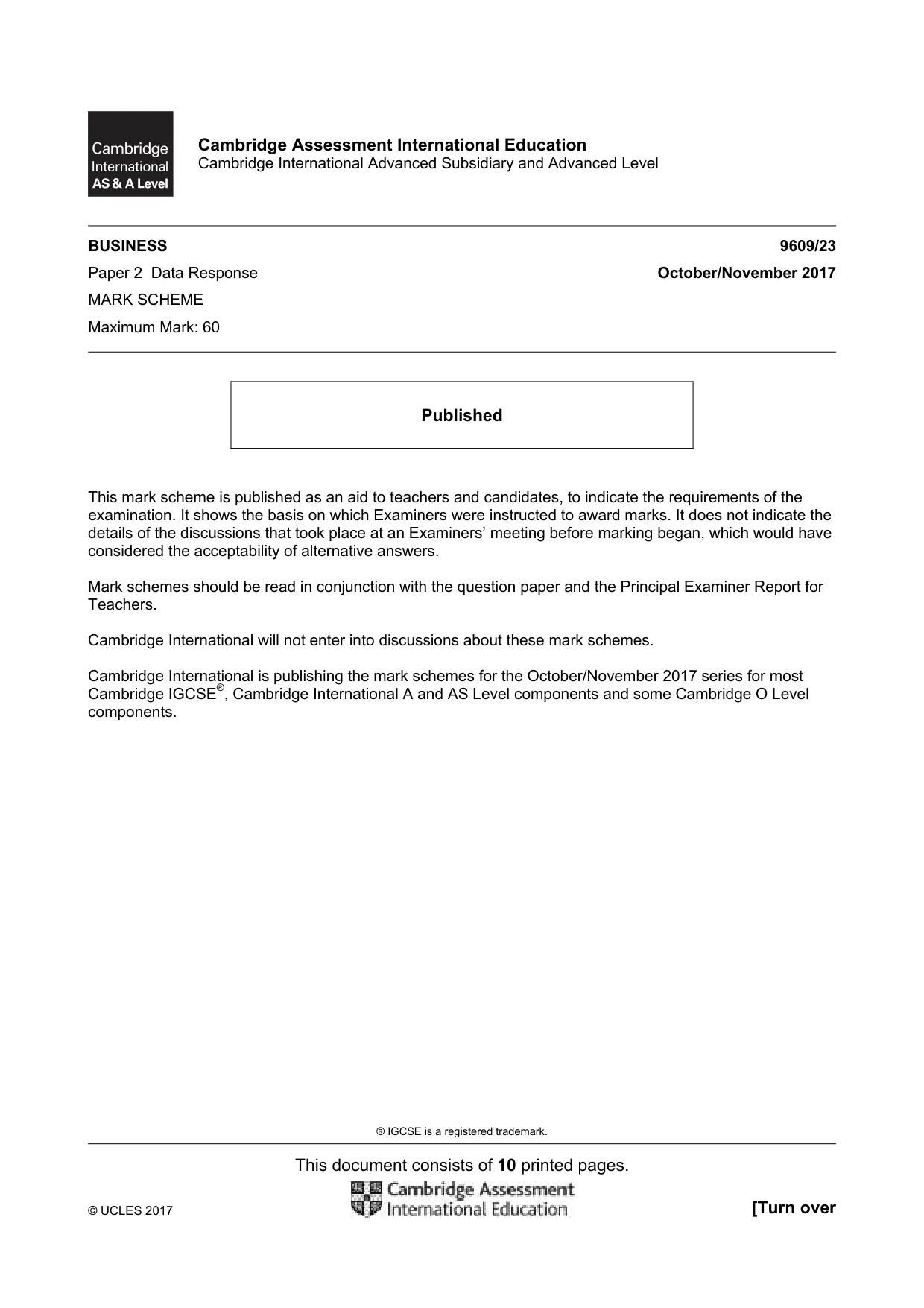
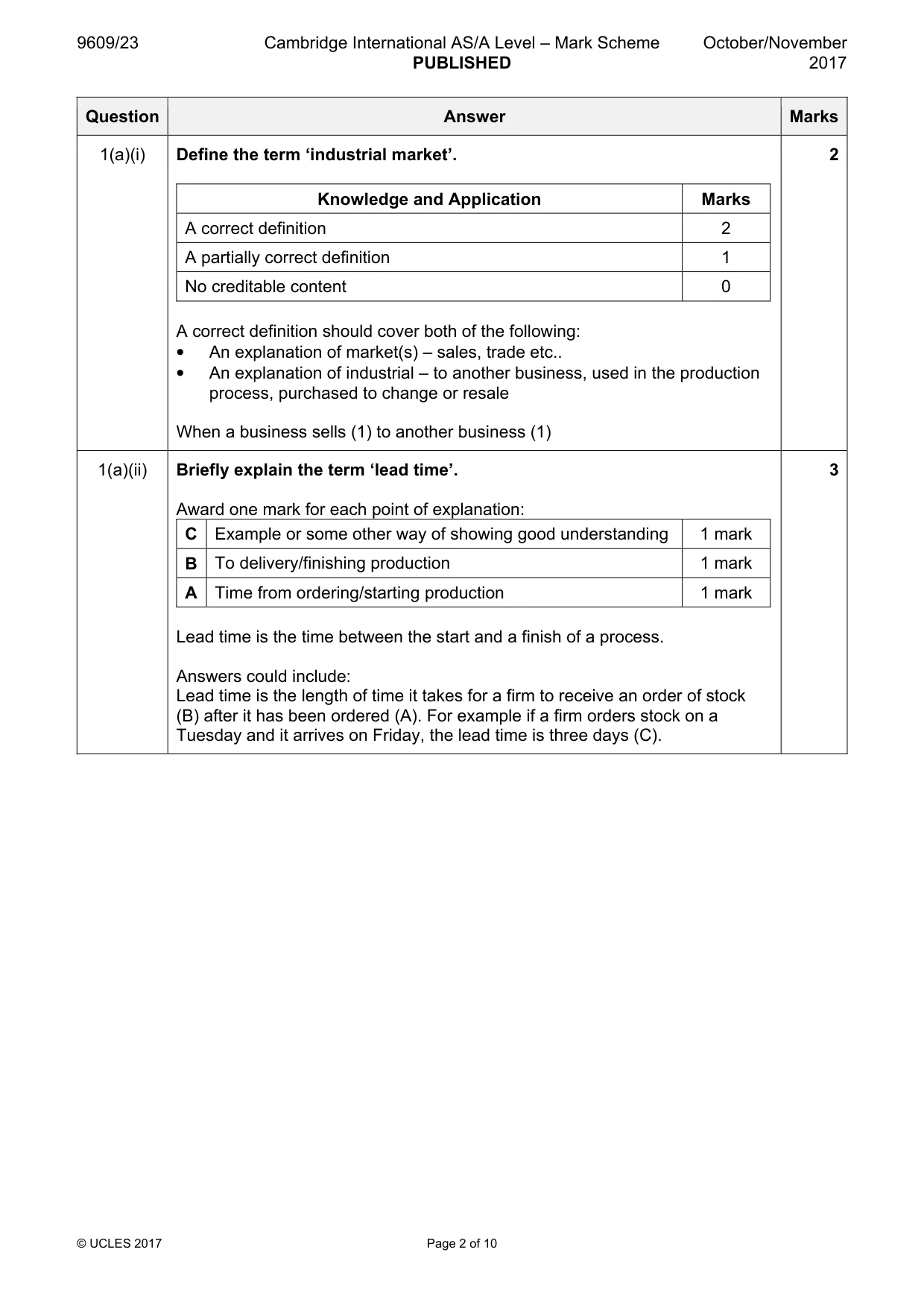
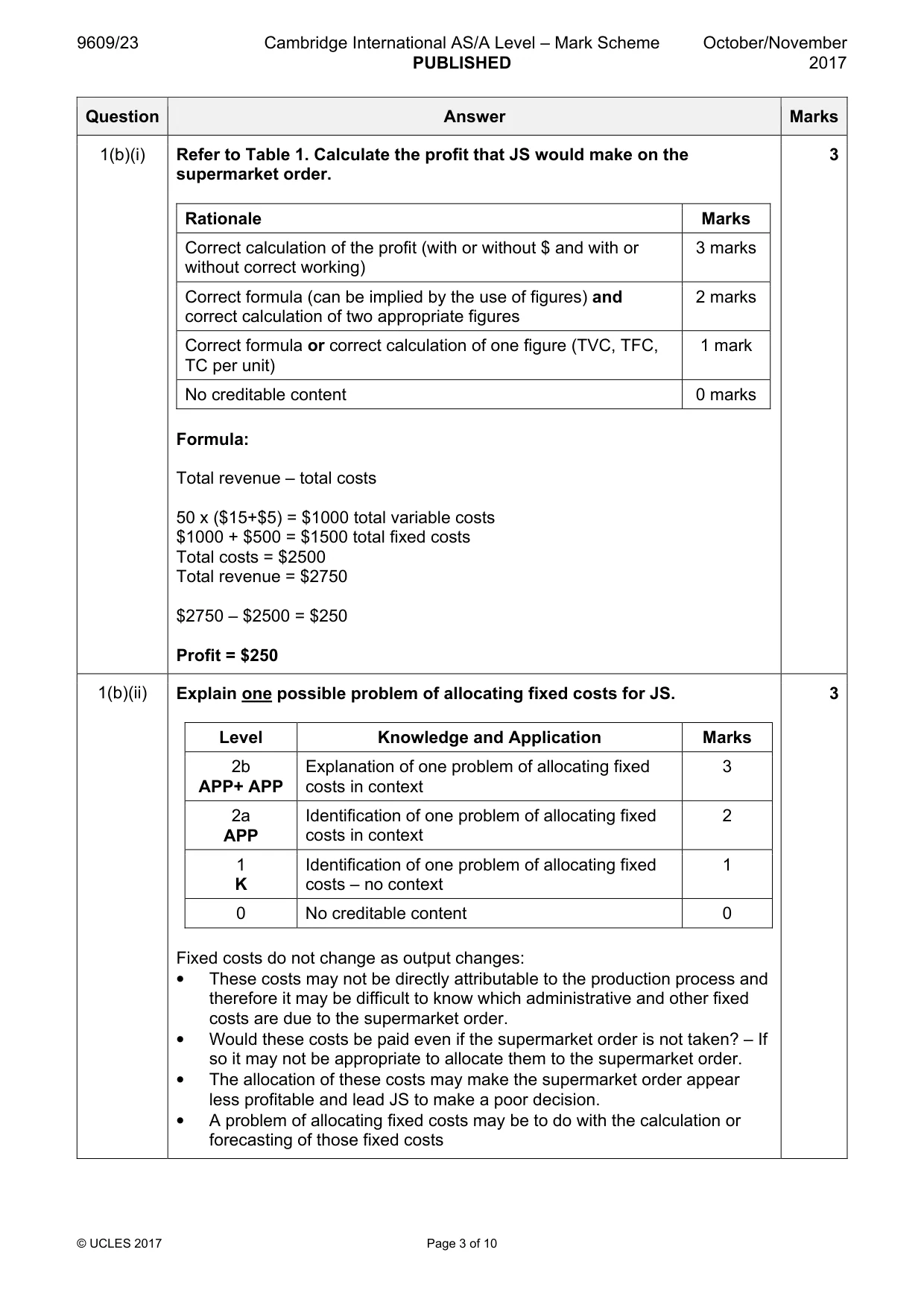
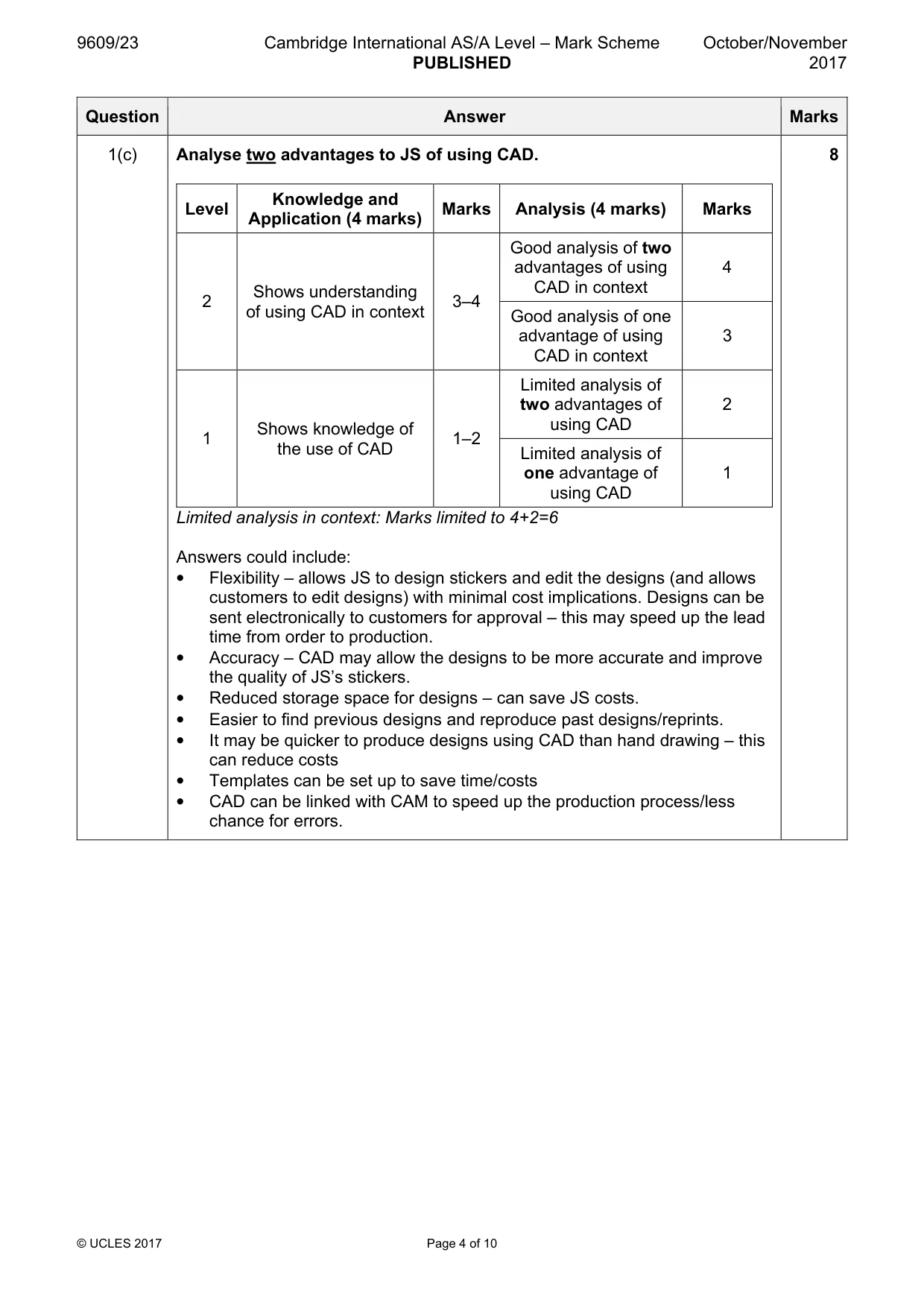
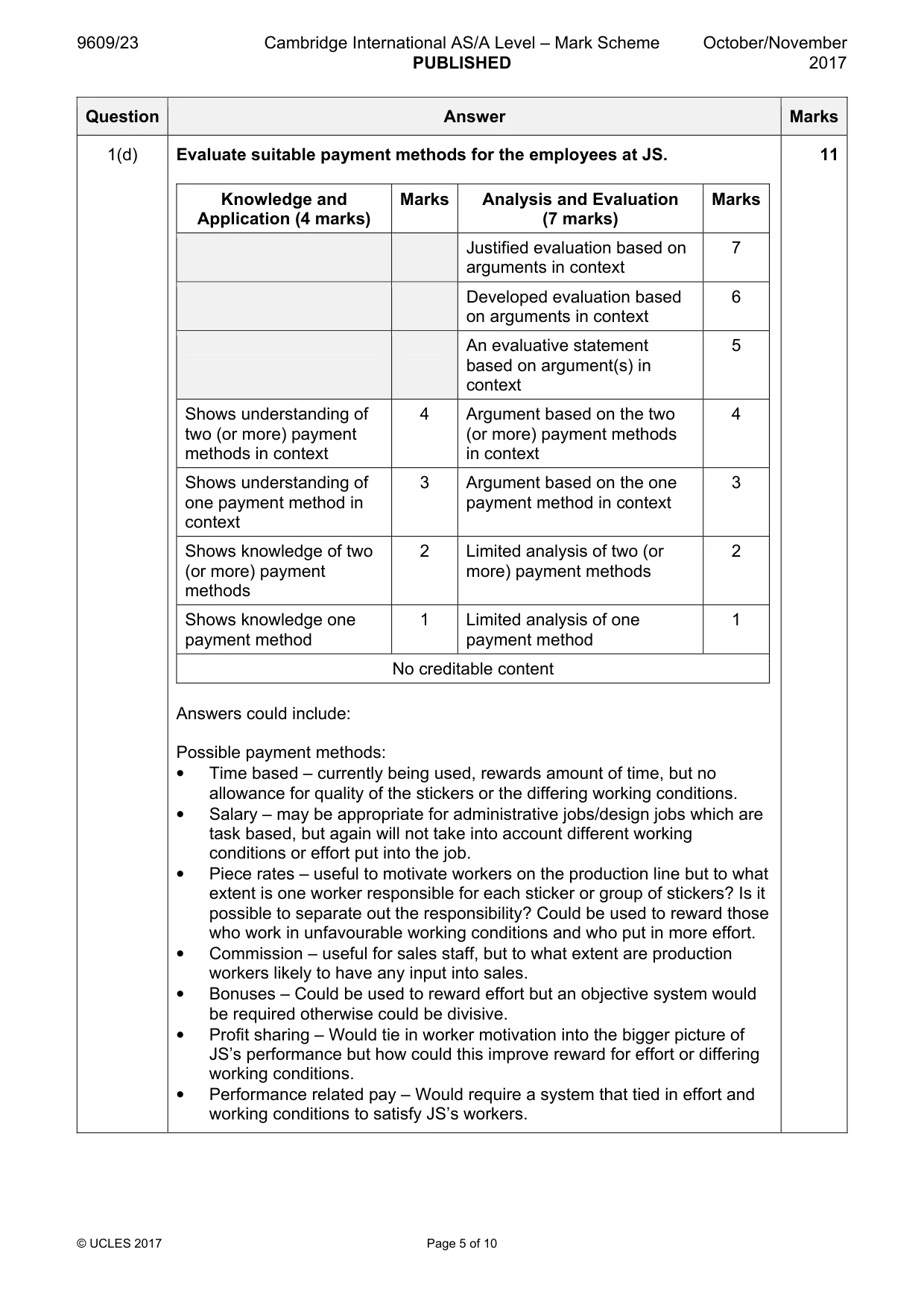
Mark scheme: Question Answer Marks 1(a)(i) Define the term ‘industrial market’. 2 Knowledge and Application Marks A correct definition 2 A partially correct definition 1 No creditable content 0 A correct definition should cover both of the following: • An explanation of market(s) – sales, trade etc.. • An explanation of industrial – to another business, used in the production process, purchased to change or resale When a business sells (1) to another business (1) 1(a)(ii) Briefly explain the term ‘lead time’. 3 Award one mark for each point of explanation: C Example or some other way of showing good understanding 1 mark B To delivery/finishing production 1 mark A Time from ordering/starting production 1 mark Lead time is the time between the start and a finish of a process. Answers could include: Lead time is the length of time it takes for a firm to receive an order of stock (B) after it has been ordered (A). For example if a firm orders stock on a Tuesday and it arrives on Friday, the lead time is three days (C). 1(b)(i) Refer to Table 1. Calculate the profit that JS would make on the 3 supermarket order. Rationale Marks Correct calculation of the profit (with or without $ and with or 3 marks without correct working) Correct formula (can be implied by the use of figures) and 2 marks correct calculation of two appropriate figures Correct formula or correct calculation of one figure (TVC, TFC, 1 mark TC per unit) No creditable content 0 marks Formula: Total revenue – total costs 50 x ($15+$5) = $1000 total variable costs $1000 + $500 = $1500 total fixed costs Total costs = $2500 Total revenue = $2750 $2750 – $2500 = $250 Profit = $250 1(b)(ii) Explain one possible problem of allocating fixed costs for JS. 3 Level Knowledge and Application Marks 2b Explanation of one problem of allocating fixed 3 APP+ APP costs in context 2a Identification of one problem of allocating fixed 2 APP costs in context 1 Identification of one problem of allocating fixed 1 K costs – no context 0 No creditable content 0 Fixed costs do not change as output changes: • These costs may not be directly attributable to the production process and therefore it may be difficult to know which administrative and other fixed costs are due to the supermarket order. • Would these costs be paid even if the supermarket order is not taken? – If so it may not be appropriate to allocate them to the supermarket order. • The allocation of these costs may make the supermarket order appear less profitable and lead JS to make a poor decision. • A problem of allocating fixed costs may be to do with the calculation or forecasting of those fixed costs 1(c) Analyse two advantages to JS of using CAD. 8 Knowledge and Level Marks Analysis (4 marks) Marks Application (4 marks) Good analysis of two advantages of using 4 CAD in context Shows understanding 2 3–4 of using CAD in context Good analysis of one advantage of using 3 CAD in context Limited analysis of two advantages of 2 using CAD Shows knowledge of 1 1–2 the use of CAD Limited analysis of one advantage of 1 using CAD Limited analysis in context: Marks limited to 4+2=6 Answers could include: • Flexibility – allows JS to design stickers and edit the designs (and allows customers to edit designs) with minimal cost implications. Designs can be sent electronically to customers for approval – this may speed up the lead time from order to production. • Accuracy – CAD may allow the designs to be more accurate and improve the quality of JS’s stickers. • Reduced storage space for designs – can save JS costs. • Easier to find previous designs and reproduce past designs/reprints. • It may be quicker to produce designs using CAD than hand drawing – this can reduce costs • Templates can be set up to save time/costs • CAD can be linked with CAM to speed up the production process/less chance for errors. 1(d) Evaluate suitable payment methods for the employees at JS. 11 Knowledge and Marks Analysis and Evaluation Marks Application (4 marks) (7 marks) Justified evaluation based on 7 arguments in context Developed evaluation based 6 on arguments in context An evaluative statement 5 based on argument(s) in context Shows understanding of 4 Argument based on the two 4 two (or more) payment (or more) payment methods methods in context in context Shows understanding of 3 Argument based on the one 3 one payment method in payment method in context context Shows knowledge of two 2 Limited analysis of two (or 2 (or more) payment more) payment methods methods Shows knowledge one 1 Limited analysis of one 1 payment method payment method No creditable content Answers could include: Possible payment methods: • Time based – currently being used, rewards amount of time, but no allowance for quality of the stickers or the differing working conditions. • Salary – may be appropriate for administrative jobs/design jobs which are task based, but again will not take into account different working conditions or effort put into the job. • Piece rates – useful to motivate workers on the production line but to what extent is one worker responsible for each sticker or group of stickers? Is it possible to separate out the responsibility? Could be used to reward those who work in unfavourable working conditions and who put in more effort. • Commission – useful for sales staff, but to what extent are production workers likely to have any input into sales. • Bonuses – Could be used to reward effort but an objective system would be required otherwise could be divisive. • Profit sharing – Would tie in worker motivation into the bigger picture of JS’s performance but how could this improve reward for effort or differing working conditions. • Performance related pay – Would require a system that tied in effort and working conditions to satisfy JS’s workers.
Q2 · Perfik Plumbing (PP) PP is a plumbing business owned and managed by Navpreet
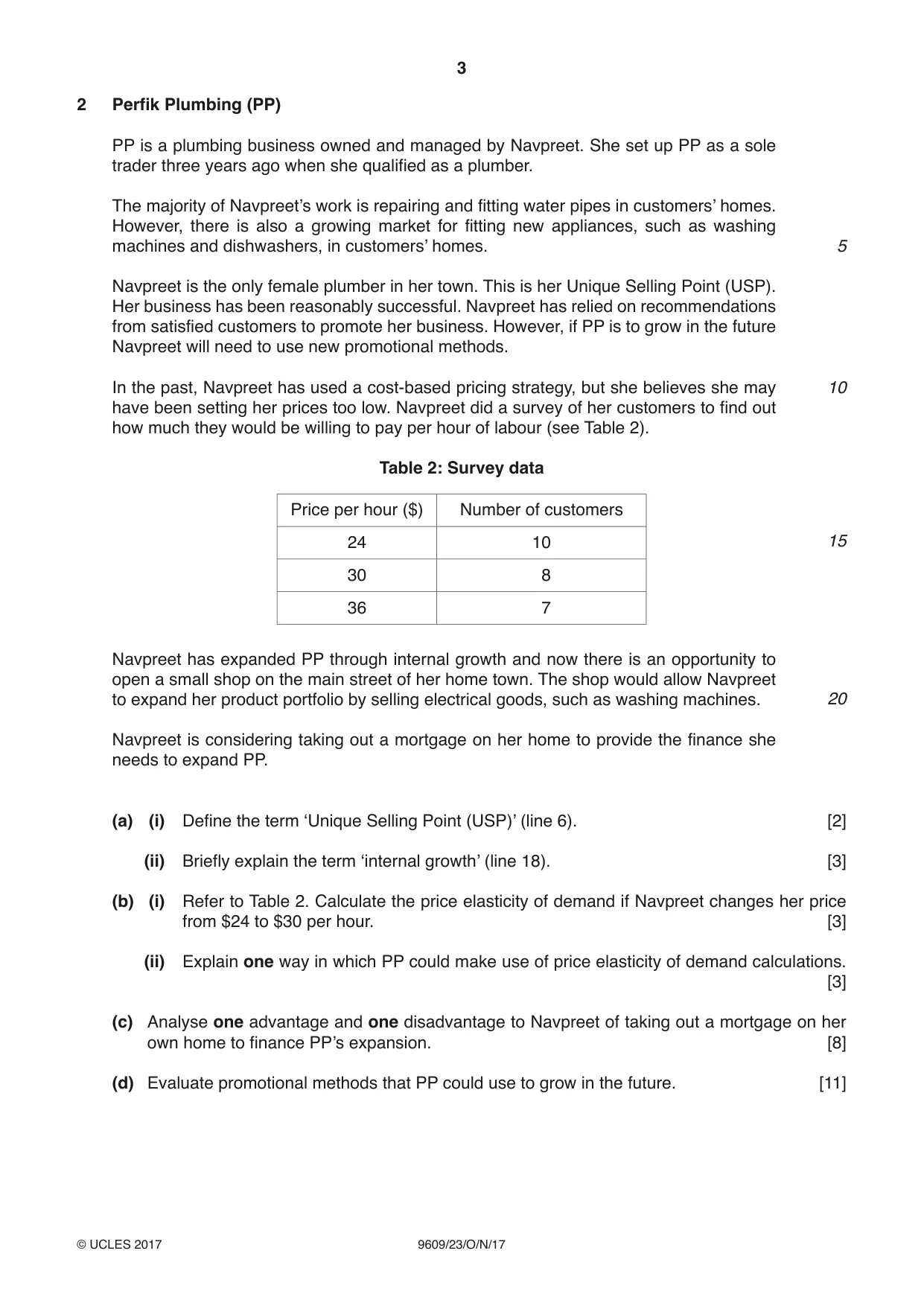
2 Perfik Plumbing (PP) PP is a plumbing business owned and managed by Navpreet. She set up PP as a sole trader three years ago when she qualified as a plumber. The majority of Navpreet’s work is repairing and fitting water pipes in customers’ homes. However, there is also a growing market for fitting new appliances, such as washing machines and dishwashers, in customers’ homes. 5 Navpreet is the only female plumber in her town. This is her Unique Selling Point (USP). Her business has been reasonably successful. Navpreet has relied on recommendations from satisfied customers to promote her business. However, if PP is to grow in the future Navpreet will need to use new promotional methods. In the past, Navpreet has used a cost-based pricing strategy, but she believes she may 10 have been setting her prices too low. Navpreet did a survey of her customers to find out how much they would be willing to pay per hour of labour (see Table 2). Table 2: Survey data Price per hour ($) Number of customers 24 10 15 30 8 36 7 Navpreet has expanded PP through internal growth and now there is an opportunity to open a small shop on the main street of her home town. The shop would allow Navpreet to expand her product portfolio by selling electrical goods, such as washing machines. 20 Navpreet is considering taking out a mortgage on her home to provide the finance she needs to expand PP. (a) (i) Define the term ‘Unique Selling Point (USP)’ (line 6). [2] (ii) Briefly explain the term ‘internal growth’ (line 18). [3] (b) (i) Refer to Table 2. Calculate the price elasticity of demand if Navpreet changes her price from $24 to $30 per hour. [3] (ii) Explain one way in which PP could make use of price elasticity of demand calculations. [3] (c) Analyse one advantage and one disadvantage to Navpreet of taking out a mortgage on her own home to finance PP’s expansion. [8] (d) Evaluate promotional methods that PP could use to grow in the future. [11]
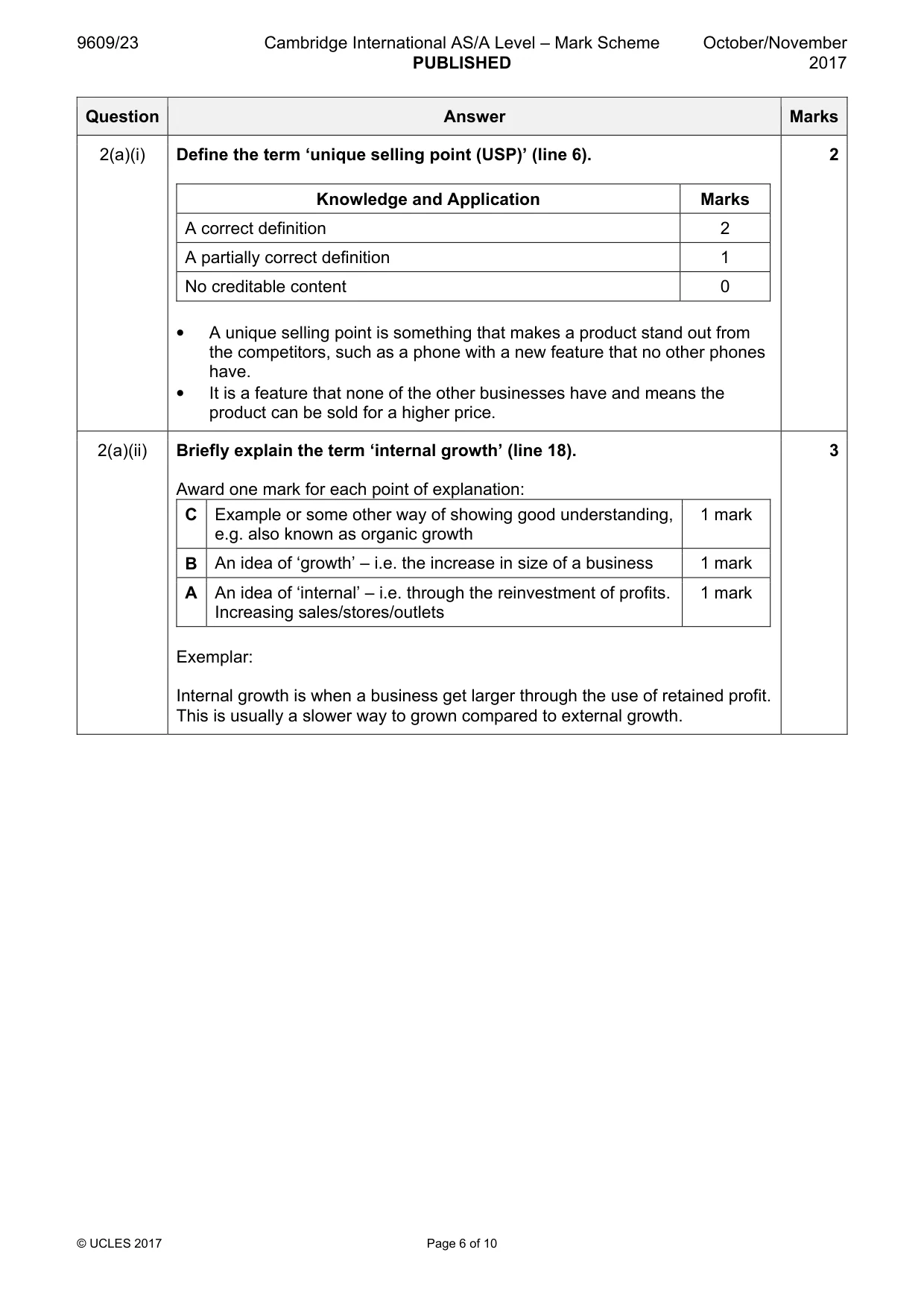
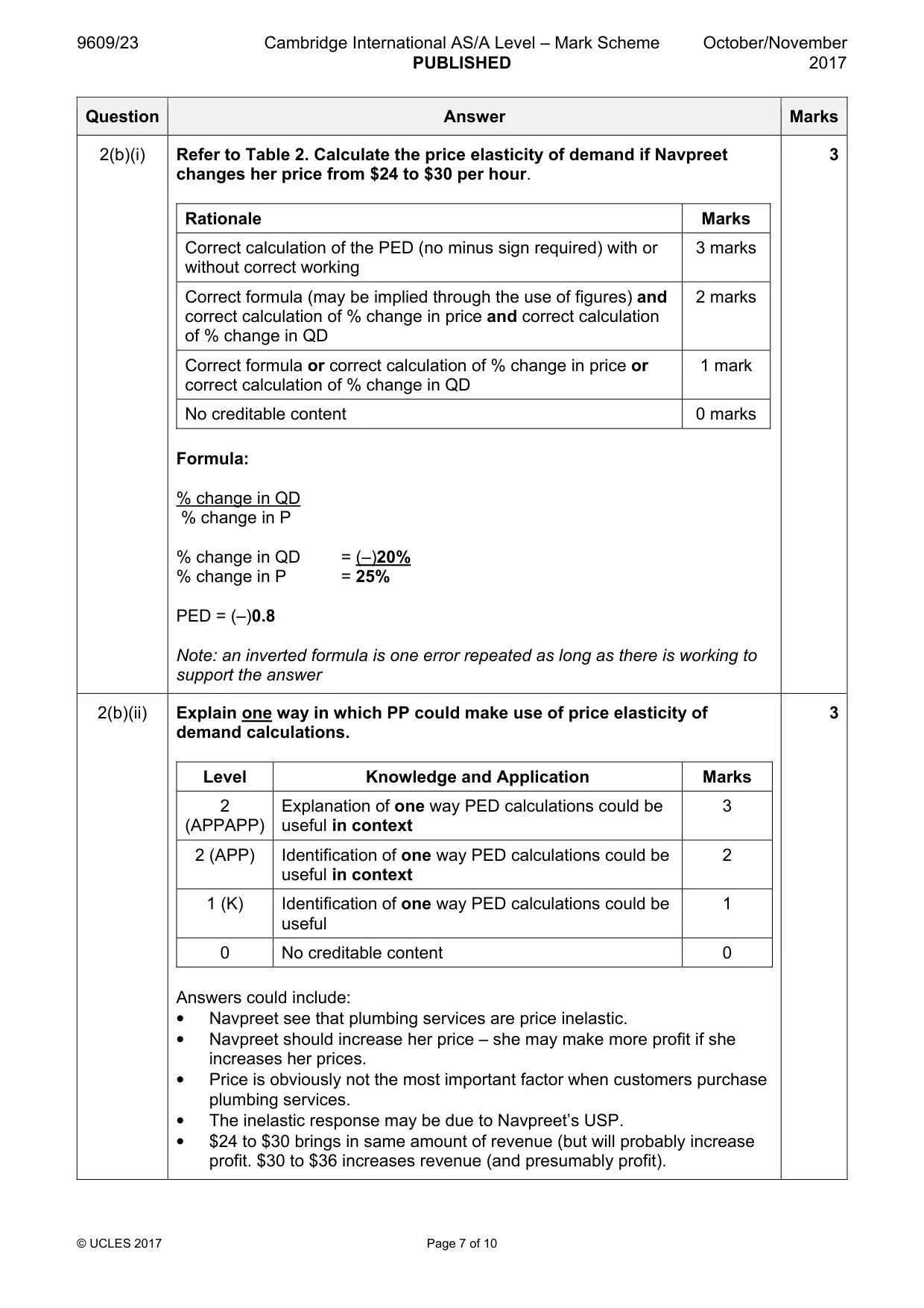
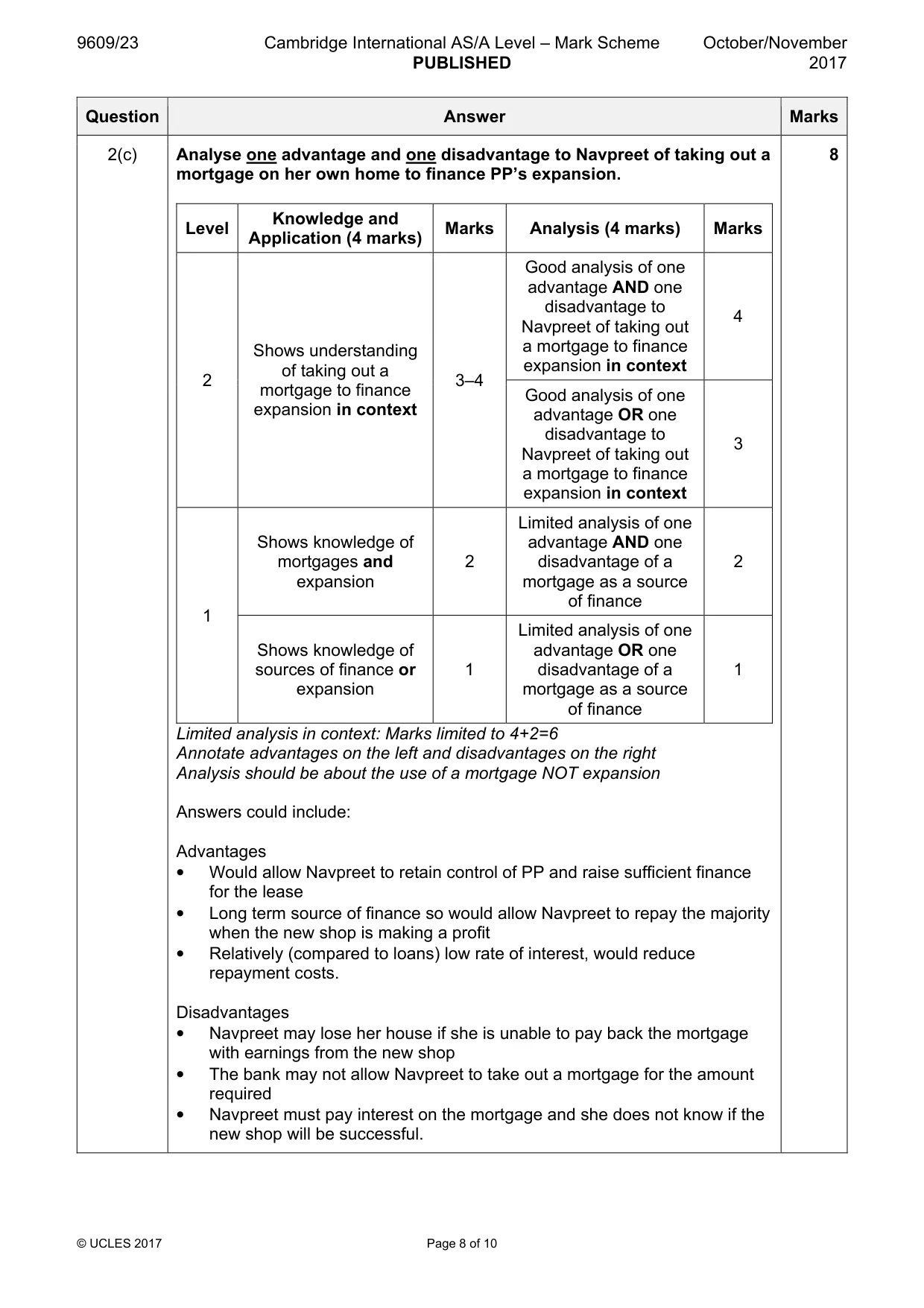
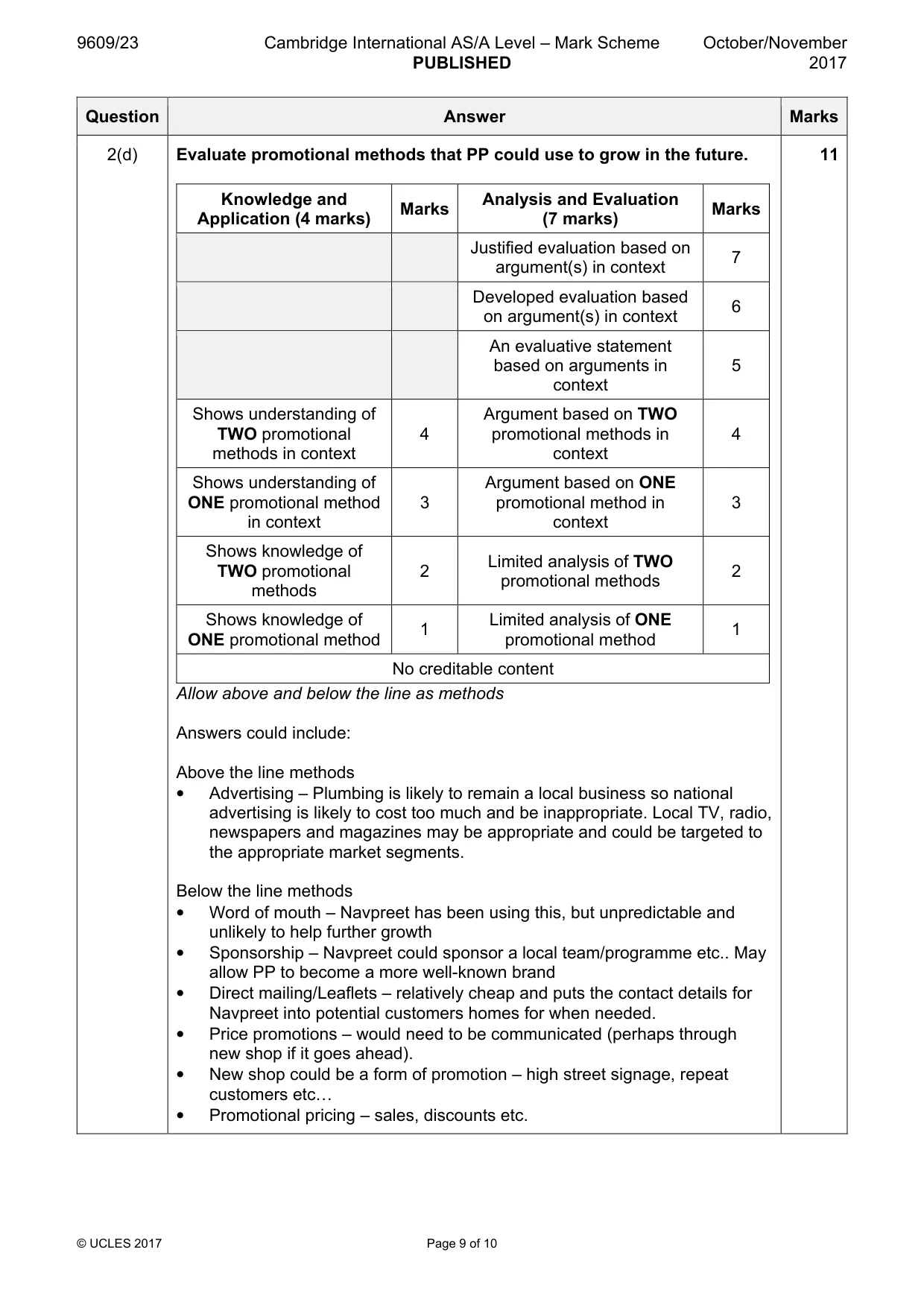
Mark scheme: 2(a)(i) Define the term ‘unique selling point (USP)’ (line 6). 2 Knowledge and Application Marks A correct definition 2 A partially correct definition 1 No creditable content 0 • A unique selling point is something that makes a product stand out from the competitors, such as a phone with a new feature that no other phones have. • It is a feature that none of the other businesses have and means the product can be sold for a higher price. 2(a)(ii) Briefly explain the term ‘internal growth’ (line 18). 3 Award one mark for each point of explanation: C Example or some other way of showing good understanding, 1 mark e.g. also known as organic growth B An idea of ‘growth’ – i.e. the increase in size of a business 1 mark A An idea of ‘internal’ – i.e. through the reinvestment of profits. 1 mark Increasing sales/stores/outlets Exemplar: Internal growth is when a business get larger through the use of retained profit. This is usually a slower way to grown compared to external growth. 2(b)(i) Refer to Table 2. Calculate the price elasticity of demand if Navpreet 3 changes her price from $24 to $30 per hour. Rationale Marks Correct calculation of the PED (no minus sign required) with or 3 marks without correct working Correct formula (may be implied through the use of figures) and 2 marks correct calculation of % change in price and correct calculation of % change in QD Correct formula or correct calculation of % change in price or 1 mark correct calculation of % change in QD No creditable content 0 marks Formula: % change in QD % change in P % change in QD = (–)20% % change in P = 25% PED = (–)0.8 Note: an inverted formula is one error repeated as long as there is working to support the answer 2(b)(ii) Explain one way in which PP could make use of price elasticity of 3 demand calculations. Level Knowledge and Application Marks 2 Explanation of one way PED calculations could be 3 (APPAPP) useful in context 2 (APP) Identification of one way PED calculations could be 2 useful in context 1 (K) Identification of one way PED calculations could be 1 useful 0 No creditable content 0 Answers could include: • Navpreet see that plumbing services are price inelastic. • Navpreet should increase her price – she may make more profit if she increases her prices. • Price is obviously not the most important factor when customers purchase plumbing services. • The inelastic response may be due to Navpreet’s USP. • $24 to $30 brings in same amount of revenue (but will probably increase profit. $30 to $36 increases revenue (and presumably profit). 2(c) Analyse one advantage and one disadvantage to Navpreet of taking out a 8 mortgage on her own home to finance PP’s expansion. Knowledge and Level Marks Analysis (4 marks) Marks Application (4 marks) Good analysis of one advantage AND one disadvantage to 4 Navpreet of taking out a mortgage to finance Shows understanding expansion in context of taking out a 2 3–4 mortgage to finance Good analysis of one expansion in context advantage OR one disadvantage to 3 Navpreet of taking out a mortgage to finance expansion in context Limited analysis of one Shows knowledge of advantage AND one mortgages and 2 disadvantage of a 2 expansion mortgage as a source of finance 1 Limited analysis of one Shows knowledge of advantage OR one sources of finance or 1 disadvantage of a 1 expansion mortgage as a source of finance Limited analysis in context: Marks limited to 4+2=6 Annotate advantages on the left and disadvantages on the right Analysis should be about the use of a mortgage NOT expansion Answers could include: Advantages • Would allow Navpreet to retain control of PP and raise sufficient finance for the lease • Long term source of finance so would allow Navpreet to repay the majority when the new shop is making a profit • Relatively (compared to loans) low rate of interest, would reduce repayment costs. Disadvantages • Navpreet may lose her house if she is unable to pay back the mortgage with earnings from the new shop • The bank may not allow Navpreet to take out a mortgage for the amount required • Navpreet must pay interest on the mortgage and she does not know if the new shop will be successful. 2(d) Evaluate promotional methods that PP could use to grow in the future. 11 Knowledge and Analysis and Evaluation Marks Marks Application (4 marks) (7 marks) Justified evaluation based on 7 argument(s) in context Developed evaluation based 6 on argument(s) in context An evaluative statement based on arguments in 5 context Shows understanding of Argument based on TWO TWO promotional 4 promotional methods in 4 methods in context context Shows understanding of Argument based on ONE ONE promotional method 3 promotional method in 3 in context context Shows knowledge of Limited analysis of TWO TWO promotional 2 2 promotional methods methods Shows knowledge of Limited analysis of ONE 1 1 ONE promotional method promotional method No creditable content Allow above and below the line as methods Answers could include: Above the line methods • Advertising – Plumbing is likely to remain a local business so national advertising is likely to cost too much and be inappropriate. Local TV, radio, newspapers and magazines may be appropriate and could be targeted to the appropriate market segments. Below the line methods • Word of mouth – Navpreet has been using this, but unpredictable and unlikely to help further growth • Sponsorship – Navpreet could sponsor a local team/programme etc.. May allow PP to become a more well-known brand • Direct mailing/Leaflets – relatively cheap and puts the contact details for Navpreet into potential customers homes for when needed. • Price promotions – would need to be communicated (perhaps through new shop if it goes ahead). • New shop could be a form of promotion – high street signage, repeat customers etc« • Promotional pricing – sales, discounts etc. 2(d) Branding • Navpreet has a USP and could build on this (perhaps with new shop) to make PP a household brand. Nature of the service is that it is not a day to day product, so a brand needs to be known for when it is needed. Packaging • Only appropriate for products sold through the shop. Could cross advertise using packaging.
What was in this paper
The subtopics covered by these 2 questions, and how many questions each got. Open one in a new tab to see every Cambridge question on it.
What you needed in this session
Cambridge’s own grade thresholds for 2017 Oct/Nov, Paper 2 · Variant 3. A higher threshold means an easier paper — the bar moves with how the cohort did.