Cambridge A Level Biology 9700 — 2025 May/June Paper 5 · Variant 3
9700/53/M/J/25 · 2 questions · 30 marks · 75 min
The question paper and its mark scheme, free to read here and free to download. This is Cambridge’s own paper, exactly as it was sat.
Question paper16 pages





Mark scheme10 pages
Answers below. Sit the paper first if you are practising.
Questions as text
Q1 · Drosophila melanogaster is a species of fruit fly
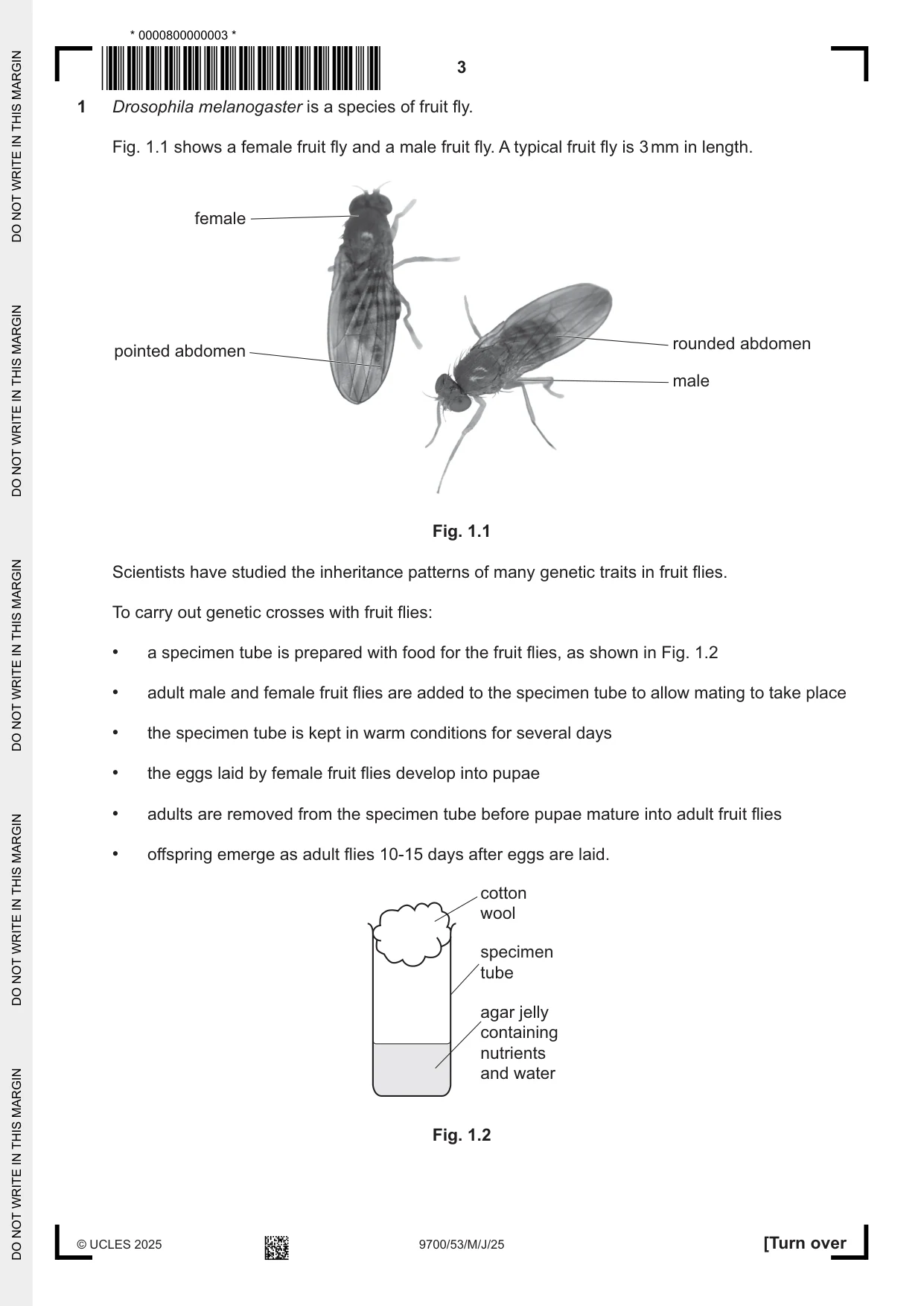
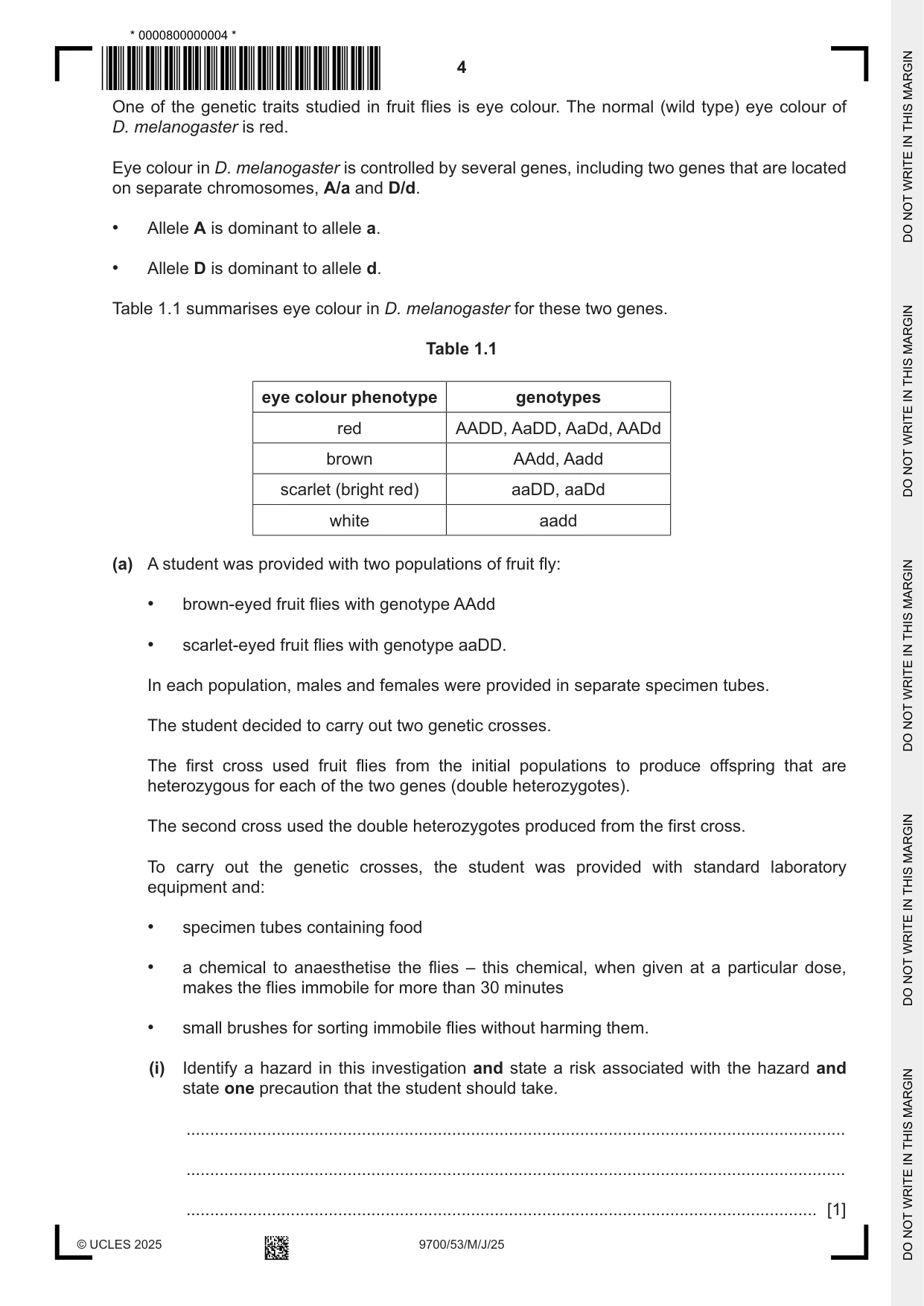
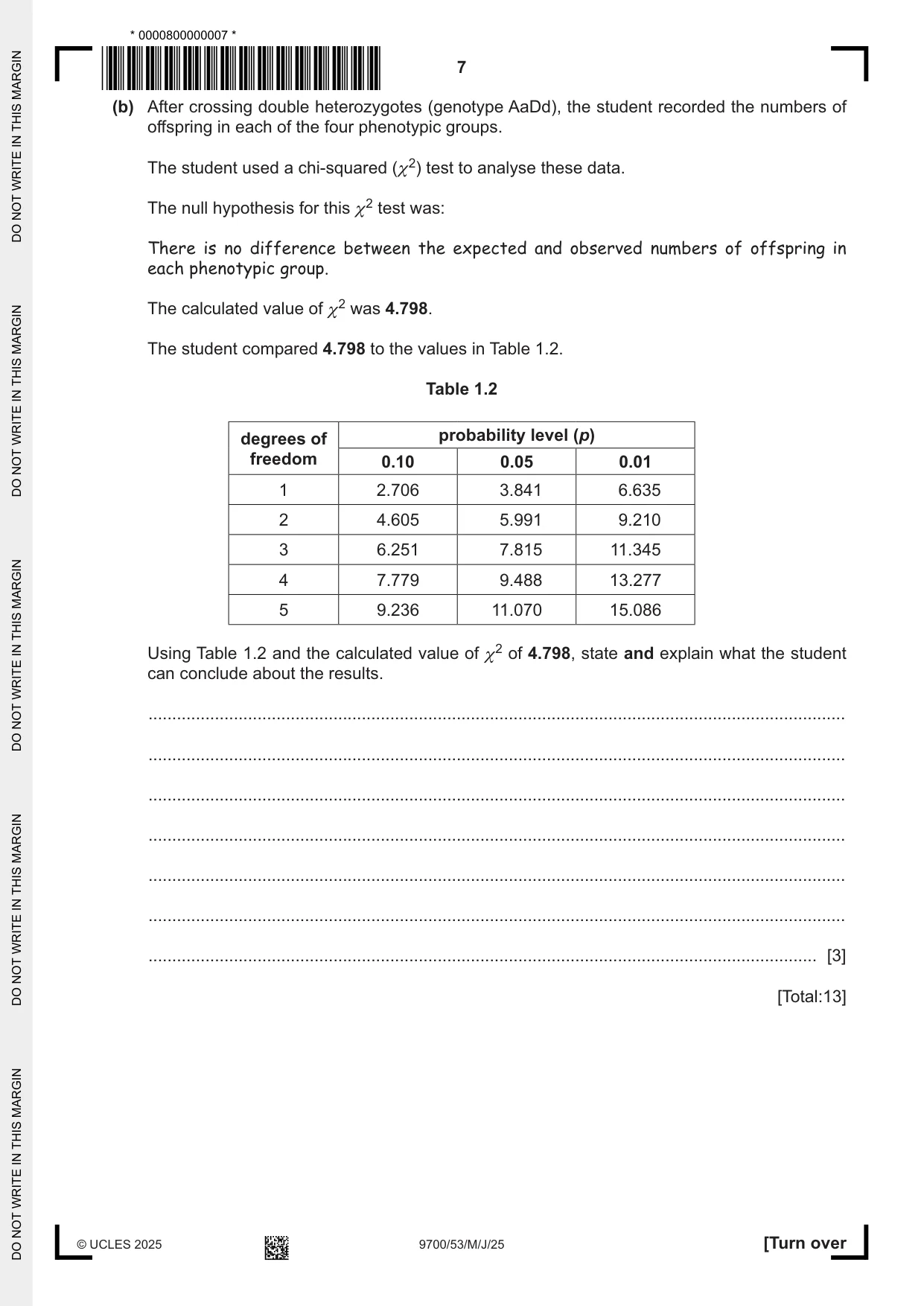
1 Drosophila melanogaster is a species of fruit fly. Fig. 1.1 shows a female fruit fly and a male fruit fly. A typical fruit fly is 3 mm in length. female rounded abdomen pointed abdomen male Fig. 1.1 Scientists have studied the inheritance patterns of many genetic traits in fruit flies. To carry out genetic crosses with fruit flies: • a specimen tube is prepared with food for the fruit flies, as shown in Fig. 1.2 • adult male and female fruit flies are added to the specimen tube to allow mating to take place • the specimen tube is kept in warm conditions for several days • the eggs laid by female fruit flies develop into pupae • adults are removed from the specimen tube before pupae mature into adult fruit flies • offspring emerge as adult flies 10-15 days after eggs are laid. cotton wool specimen tube agar jelly containing nutrients and water Fig. 1.2 One of the genetic traits studied in fruit flies is eye colour. The normal (wild type) eye colour of D. melanogaster is red. Eye colour in D. melanogaster is controlled by several genes, including two genes that are located on separate chromosomes, A/a and D/d. • Allele A is dominant to allele a. • Allele D is dominant to allele d. Table 1.1 summarises eye colour in D. melanogaster for these two genes. Table 1.1 eye colour phenotype genotypes red AADD, AaDD, AaDd, AADd brown AAdd, Aadd scarlet (bright red) aaDD, aaDd white aadd (a) A student was provided with two populations of fruit fly: • brown-eyed fruit flies with genotype AAdd • scarlet-eyed fruit flies with genotype aaDD. In each population, males and females were provided in separate specimen tubes. The student decided to carry out two genetic crosses. The first cross used fruit flies from the initial populations to produce offspring that are heterozygous for each of the two genes (double heterozygotes). The second cross used the double heterozygotes produced from the first cross. To carry out the genetic crosses, the student was provided with standard laboratory equipment and: • specimen tubes containing food • a chemical to anaesthetise the flies – this chemical, when given at a particular dose, makes the flies immobile for more than 30 minutes • small brushes for sorting immobile flies without harming them. (i) Identify a hazard in this investigation and state a risk associated with the hazard and state one precaution that the student should take. ........................................................................................................................................... ........................................................................................................................................... ..................................................................................................................................... [1] (ii) Describe a method the student could use to carry out: • the first cross using fruit flies from the initial two populations to produce double heterozygotes (genotype AaDd) • the second cross using the double heterozygotes produced from the first cross • an analysis of the offspring phenotype ratio from the second cross. The description of your method should be set out in a logical way and be detailed enough for another person to follow. The method should include a description of how offspring phenotypes would be identified. ........................................................................................................................................... ........................................................................................................................................... ........................................................................................................................................... ........................................................................................................................................... ........................................................................................................................................... ........................................................................................................................................... ........................................................................................................................................... ........................................................................................................................................... ........................................................................................................................................... ........................................................................................................................................... ........................................................................................................................................... ........................................................................................................................................... ........................................................................................................................................... ........................................................................................................................................... ........................................................................................................................................... ........................................................................................................................................... ........................................................................................................................................... ........................................................................................................................................... ........................................................................................................................................... ........................................................................................................................................... ..................................................................................................................................... [7] (iii) Predict the ratio of offspring phenotypes from the cross between parents that are heterozygous for the two genes (AaDd). You may use this space for any working. ratio .................................................................................................................................... phenotypes ......................................................................................................................... [2] (b) After crossing double heterozygotes (genotype AaDd), the student recorded the numbers of offspring in each of the four phenotypic groups. The student used a chi-squared (χ 2) test to analyse these data. The null hypothesis for this χ 2 test was: There is no difference between the expected and observed numbers of offspring in each phenotypic group. The calculated value of χ 2 was 4.798. The student compared 4.798 to the values in Table 1.2. Table 1.2 degrees of probability level (p) freedom 0.10 0.05 0.01 1 2.706 3.841 6.635 2 4.605 5.991 9.210 3 6.251 7.815 11.345 4 7.779 9.488 13.277 5 9.236 11.070 15.086 Using Table 1.2 and the calculated value of χ 2 of 4.798, state and explain what the student can conclude about the results. ................................................................................................................................................... ................................................................................................................................................... ................................................................................................................................................... ................................................................................................................................................... ................................................................................................................................................... ................................................................................................................................................... ............................................................................................................................................. [3] [Total:13]
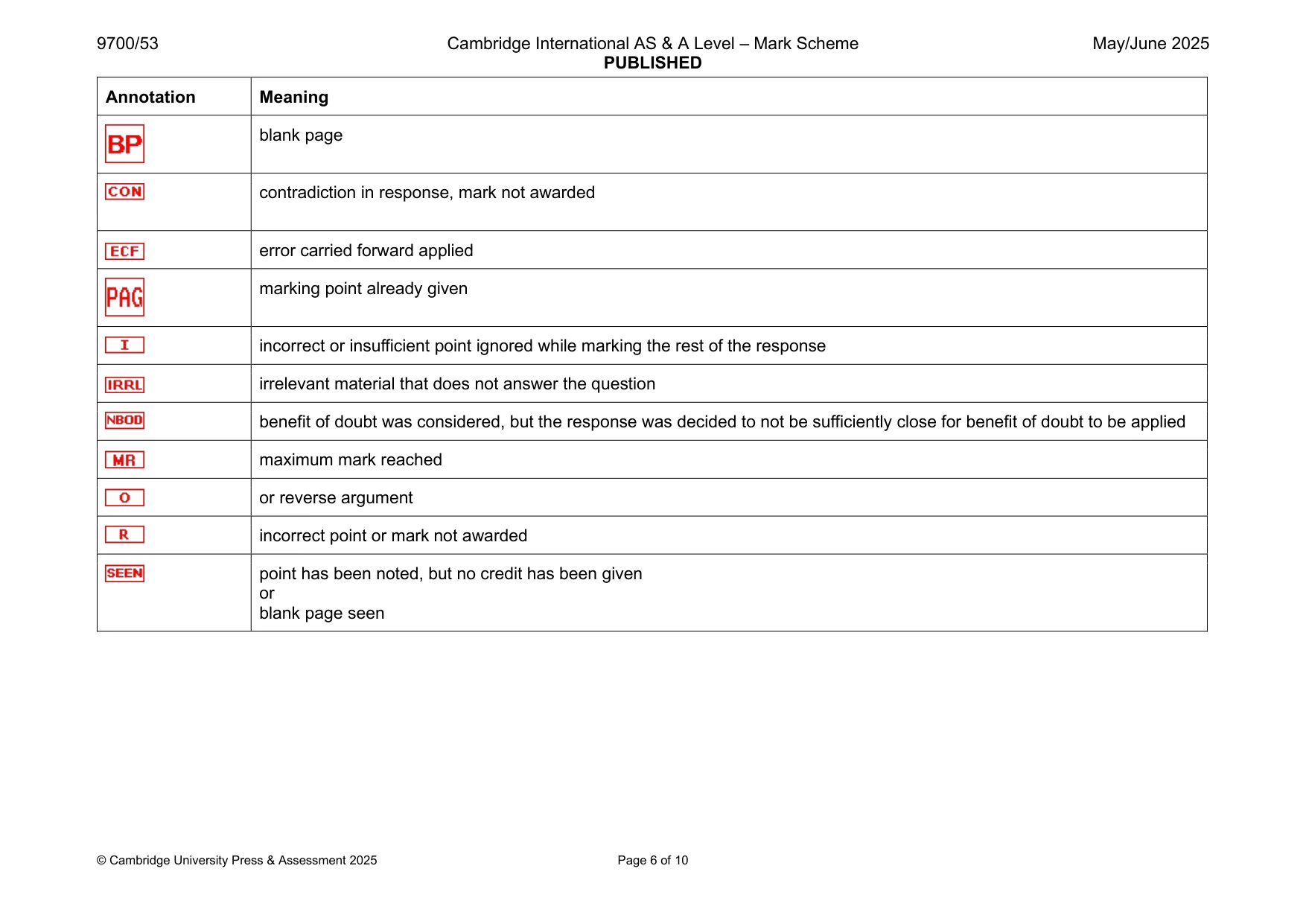
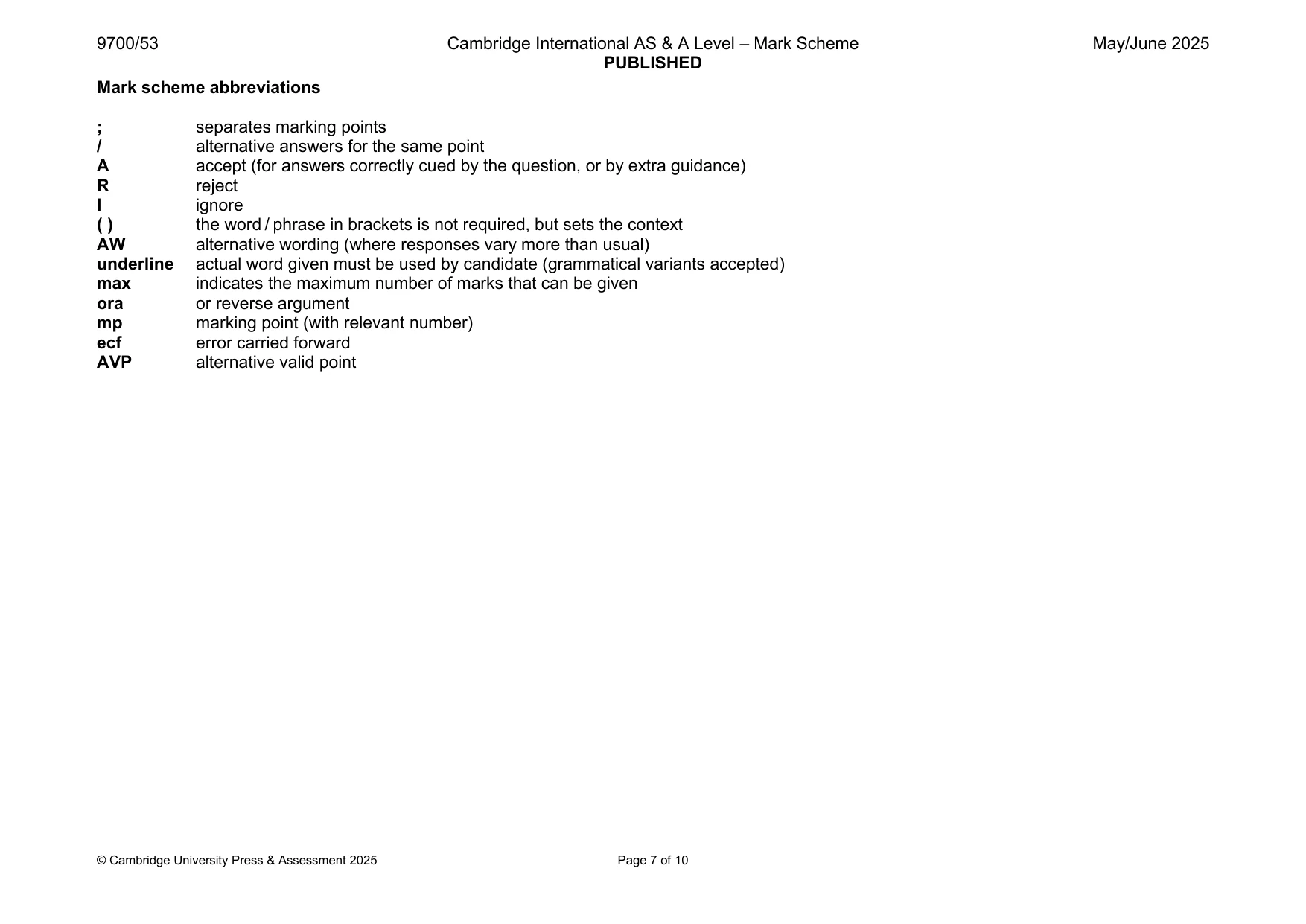
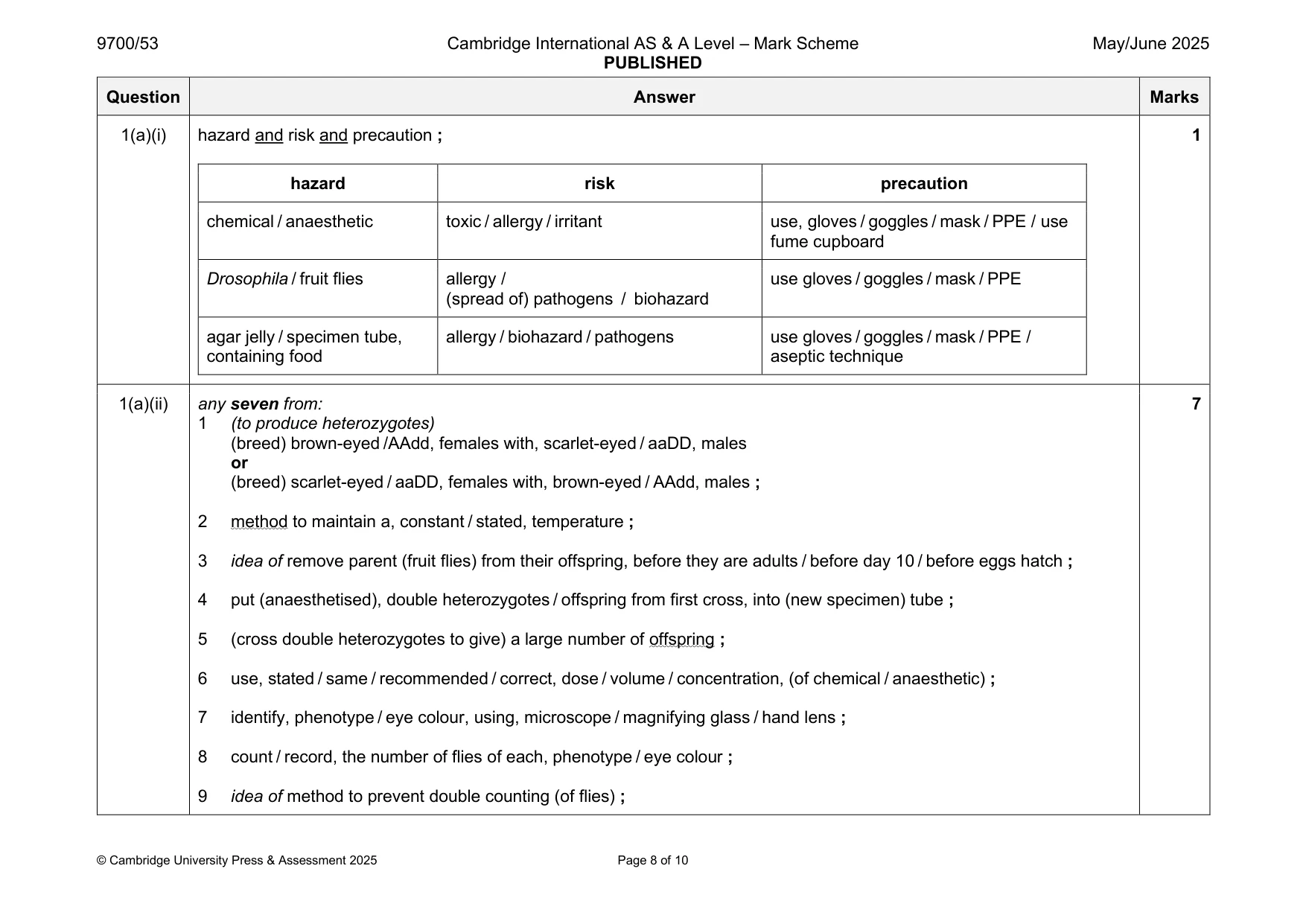
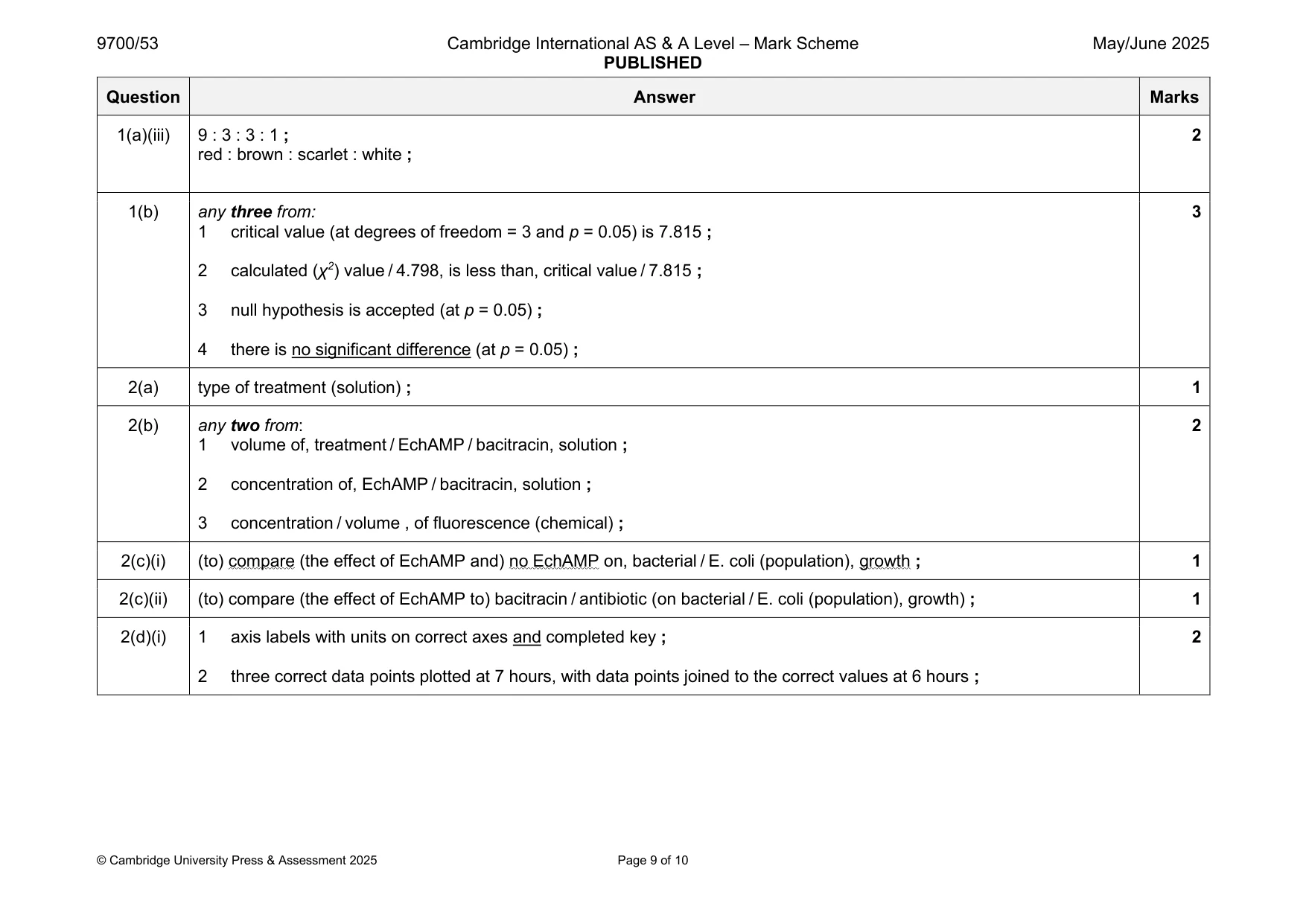
Mark scheme: Question Answer Marks 1(a)(i) hazard and risk and precaution ; 1 hazard risk precaution chemical / anaesthetic toxic / allergy / irritant use, gloves / goggles / mask / PPE / use fume cupboard Drosophila / fruit flies allergy / use gloves / goggles / mask / PPE (spread of) pathogens / biohazard agar jelly / specimen tube, allergy / biohazard / pathogens use gloves / goggles / mask / PPE / containing food aseptic technique 1(a)(ii) any seven from: 7 1 (to produce heterozygotes) (breed) brown-eyed /AAdd, females with, scarlet-eyed / aaDD, males or (breed) scarlet-eyed / aaDD, females with, brown-eyed / AAdd, males ; 2 method to maintain a, constant / stated, temperature ; 3 idea of remove parent (fruit flies) from their offspring, before they are adults / before day 10 / before eggs hatch ; 4 put (anaesthetised), double heterozygotes / offspring from first cross, into (new specimen) tube ; 5 (cross double heterozygotes to give) a large number of offspring ; 6 use, stated / same / recommended / correct, dose / volume / concentration, (of chemical / anaesthetic) ; 7 identify, phenotype / eye colour, using, microscope / magnifying glass / hand lens ; 8 count / record, the number of flies of each, phenotype / eye colour ; 9 idea of method to prevent double counting (of flies) ; 1(a)(iii) 9 : 3 : 3 : 1 ; 2 red : brown : scarlet : white ; 1(b) any three from: 3 1 critical value (at degrees of freedom = 3 and p = 0.05) is 7.815 ; 2 calculated (χ2) value / 4.798, is less than, critical value / 7.815 ; 3 null hypothesis is accepted (at p = 0.05) ; 4 there is no significant difference (at p = 0.05) ;
More questions on Passage of information from parents to offspring
Q2 · Echidnas are mammals that live in Australia and New Guinea
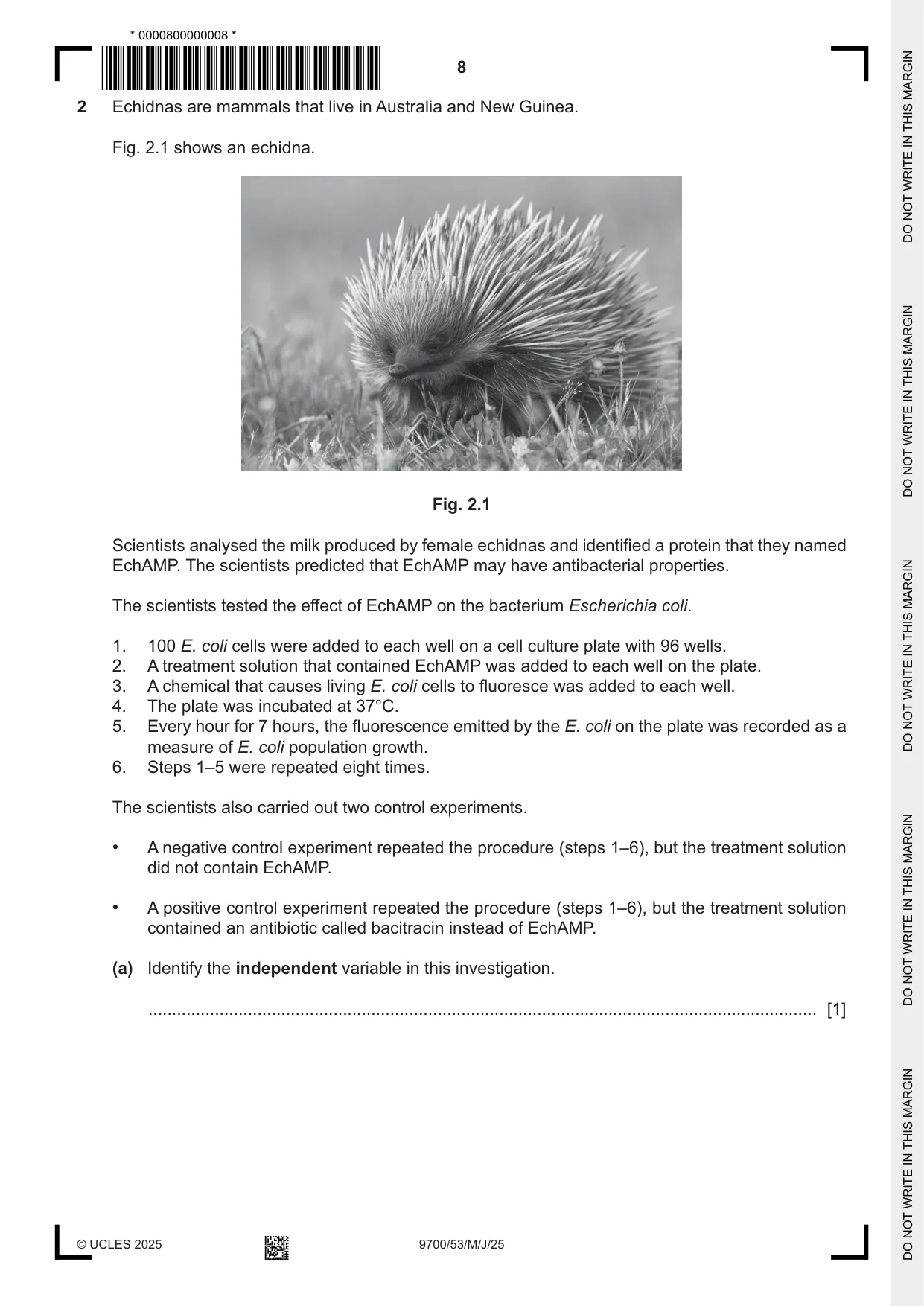
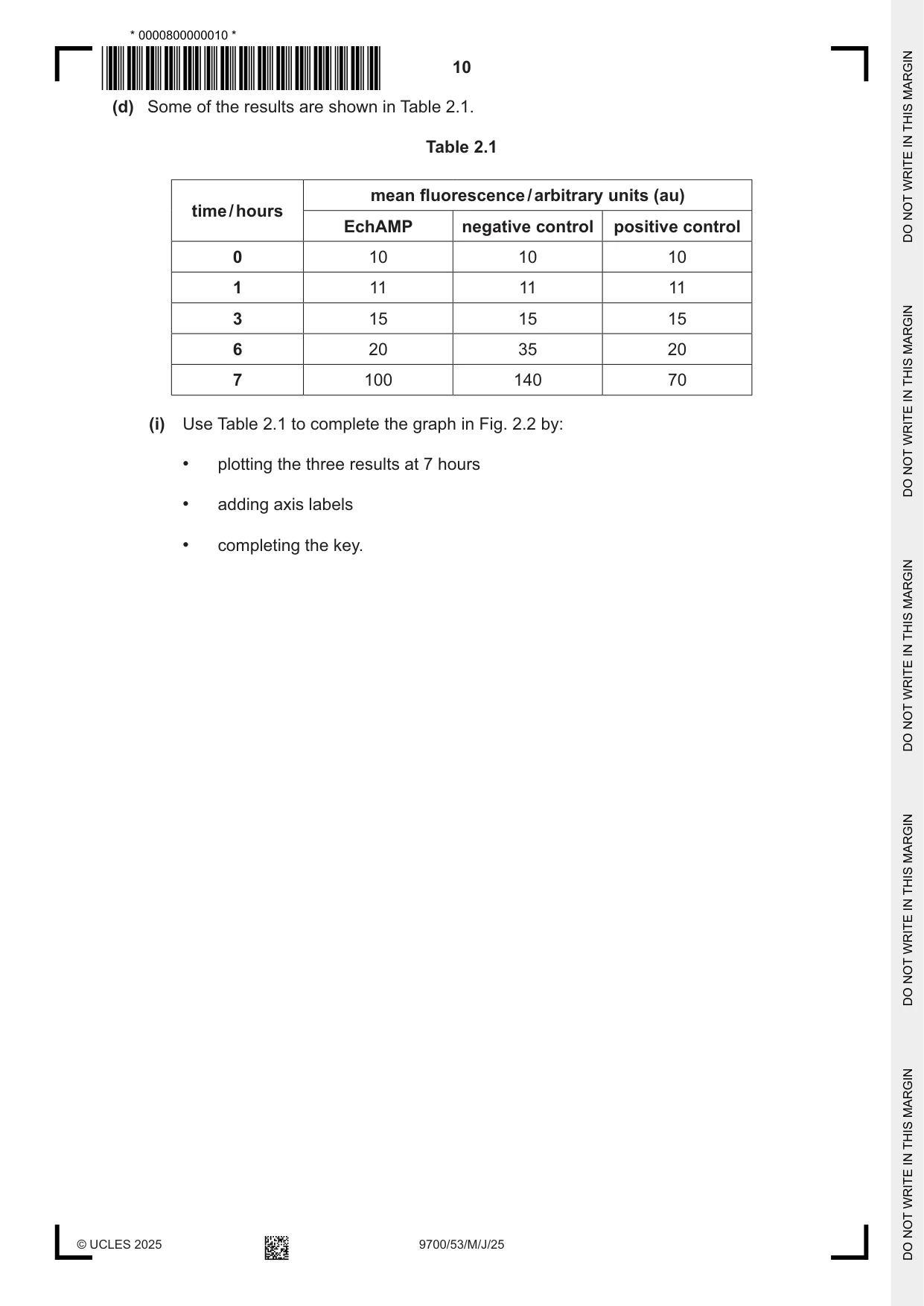
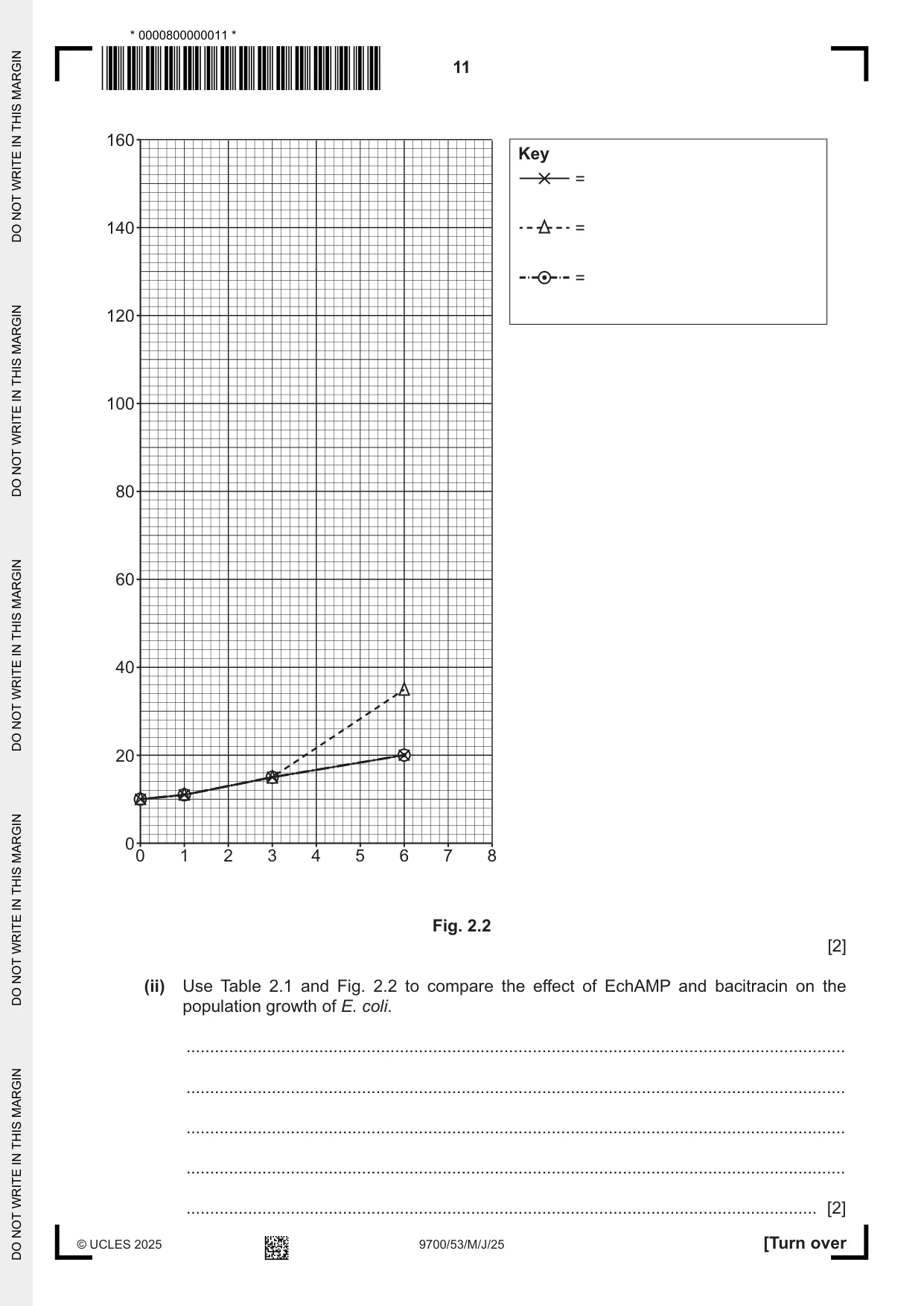
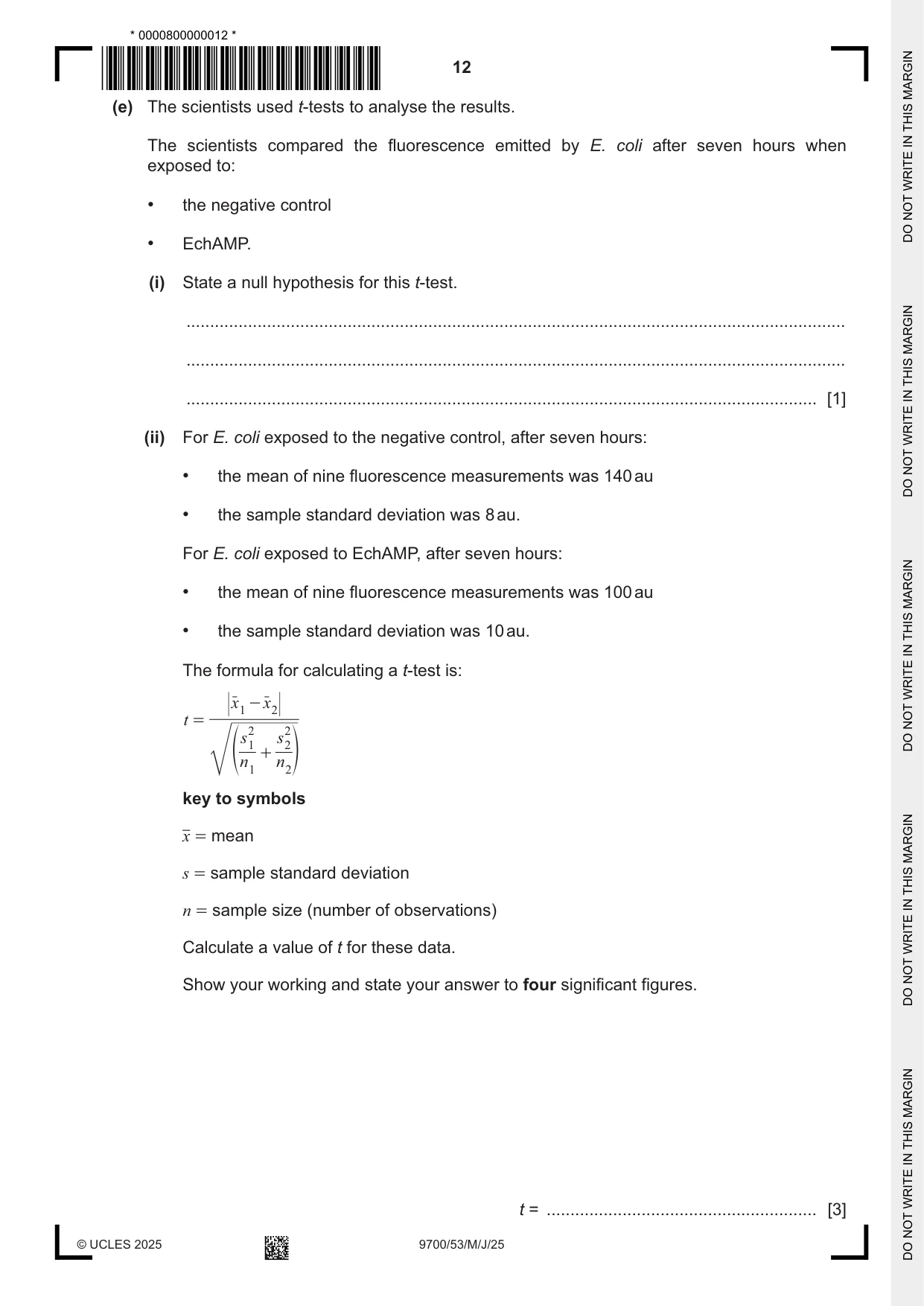
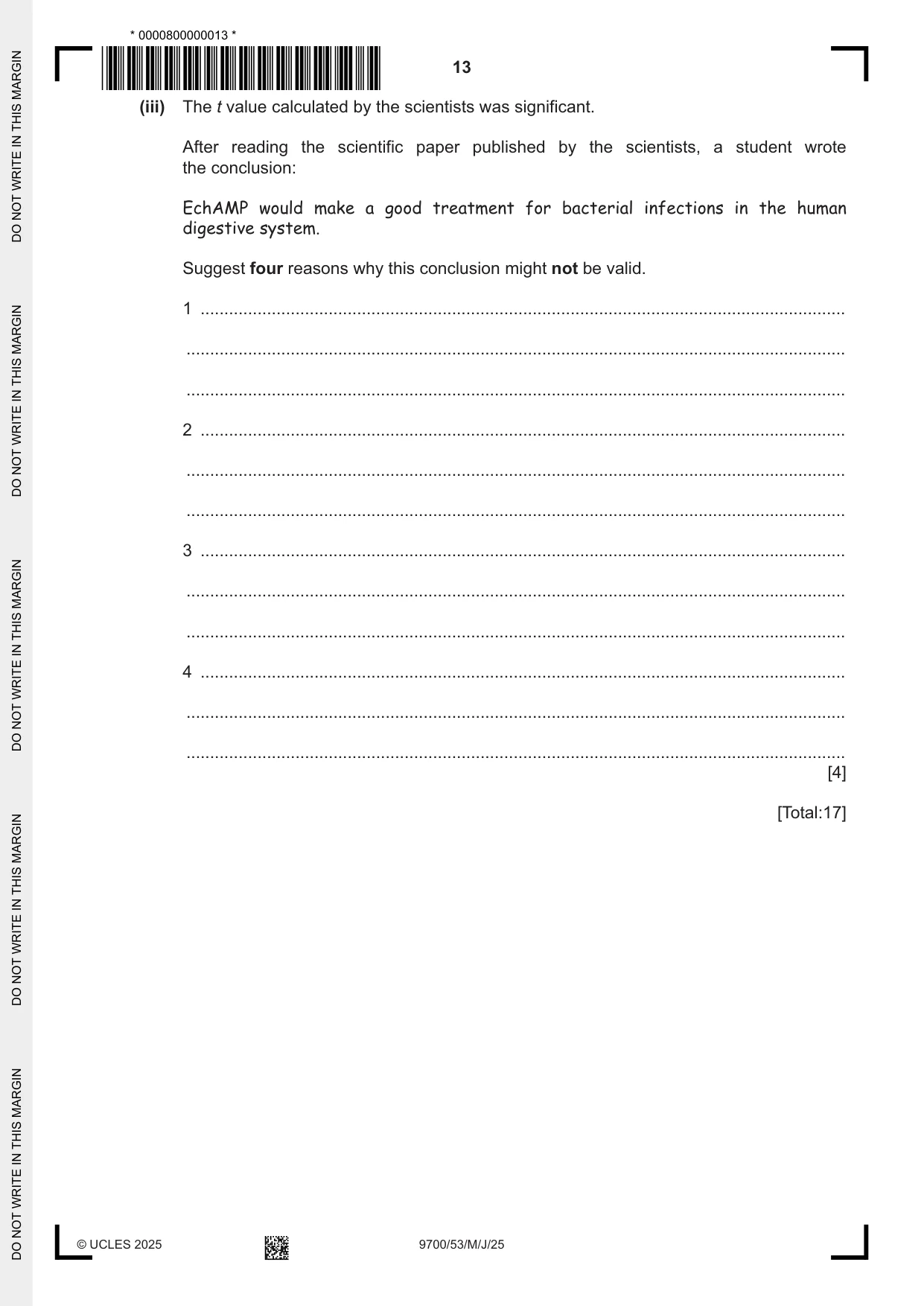
2 Echidnas are mammals that live in Australia and New Guinea. Fig. 2.1 shows an echidna. Fig. 2.1 Scientists analysed the milk produced by female echidnas and identified a protein that they named EchAMP. The scientists predicted that EchAMP may have antibacterial properties. The scientists tested the effect of EchAMP on the bacterium Escherichia coli. 1. 100 E. coli cells were added to each well on a cell culture plate with 96 wells. 2. A treatment solution that contained EchAMP was added to each well on the plate. 3. A chemical that causes living E. coli cells to fluoresce was added to each well. 4. The plate was incubated at 37°C. 5. Every hour for 7 hours, the fluorescence emitted by the E. coli on the plate was recorded as a measure of E. coli population growth. 6. Steps 1–5 were repeated eight times. The scientists also carried out two control experiments. • A negative control experiment repeated the procedure (steps 1–6), but the treatment solution did not contain EchAMP. • A positive control experiment repeated the procedure (steps 1–6), but the treatment solution contained an antibiotic called bacitracin instead of EchAMP. (a) Identify the independent variable in this investigation. ............................................................................................................................................. [1] (b) The scientists standardised the temperature and the initial number of E. coli cells. State two other variables that the scientists should standardise in this investigation. 1 ................................................................................................................................................ ................................................................................................................................................... 2 ................................................................................................................................................ ................................................................................................................................................... [2] (c) (i) Explain why the scientists included the negative control experiment in their investigation. ........................................................................................................................................... ........................................................................................................................................... ..................................................................................................................................... [1] (ii) Explain why the scientists included the positive control experiment in their investigation. ........................................................................................................................................... ........................................................................................................................................... ..................................................................................................................................... [1] (d) Some of the results are shown in Table 2.1. Table 2.1 mean fluorescence / arbitrary units (au) time / hours EchAMP negative control positive control 0 10 10 10 1 11 11 11 3 15 15 15 6 20 35 20 7 100 140 70 (i) Use Table 2.1 to complete the graph in Fig. 2.2 by: • plotting the three results at 7 hours • adding axis labels • completing the key.
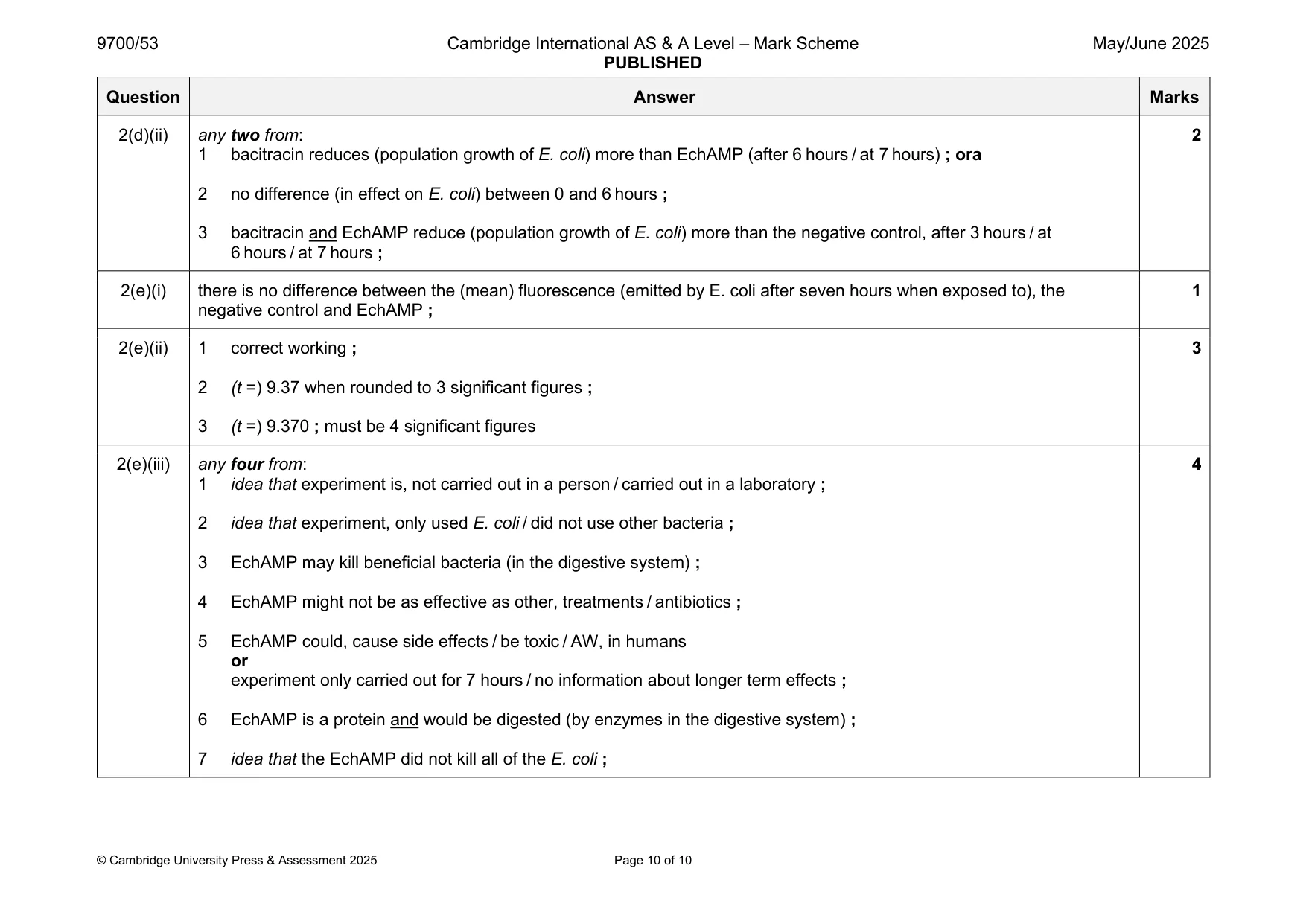
Mark scheme: 2(a) type of treatment (solution) ; 1 2(b) any two from: 2 1 volume of, treatment / EchAMP / bacitracin, solution ; 2 concentration of, EchAMP / bacitracin, solution ; 3 concentration / volume , of fluorescence (chemical) ; 2(c)(i) (to) compare (the effect of EchAMP and) no EchAMP on, bacterial / E. coli (population), growth ; 1 2(c)(ii) (to) compare (the effect of EchAMP to) bacitracin / antibiotic (on bacterial / E. coli (population), growth) ; 1 2(d)(i) 1 axis labels with units on correct axes and completed key ; 2 2 three correct data points plotted at 7 hours, with data points joined to the correct values at 6 hours ; 2(d)(ii) any two from: 2 1 bacitracin reduces (population growth of E. coli) more than EchAMP (after 6 hours / at 7 hours) ; ora 2 no difference (in effect on E. coli) between 0 and 6 hours ; 3 bacitracin and EchAMP reduce (population growth of E. coli) more than the negative control, after 3 hours / at 6 hours / at 7 hours ; 2(e)(i) there is no difference between the (mean) fluorescence (emitted by E. coli after seven hours when exposed to), the 1 negative control and EchAMP ; 2(e)(ii) 1 correct working ; 3 2 (t =) 9.37 when rounded to 3 significant figures ; 3 (t =) 9.370 ; must be 4 significant figures 2(e)(iii) any four from: 4 1 idea that experiment is, not carried out in a person / carried out in a laboratory ; 2 idea that experiment, only used E. coli / did not use other bacteria ; 3 EchAMP may kill beneficial bacteria (in the digestive system) ; 4 EchAMP might not be as effective as other, treatments / antibiotics ; 5 EchAMP could, cause side effects / be toxic / AW, in humans or experiment only carried out for 7 hours / no information about longer term effects ; 6 EchAMP is a protein and would be digested (by enzymes in the digestive system) ; 7 idea that the EchAMP did not kill all of the E. coli ;
What was in this paper
The subtopics covered by these 2 questions, and how many questions each got. Open one in a new tab to see every Cambridge question on it.
What you needed in this session
Cambridge’s own grade thresholds for 2025 May/June, Paper 5 · Variant 3. A higher threshold means an easier paper — the bar moves with how the cohort did.