Cambridge A Level Biology 9700 — 2025 Oct/Nov Paper 5 · Variant 3
9700/53/O/N/25 · 2 questions · 30 marks · 75 min
The question paper and its mark scheme, free to read here and free to download. This is Cambridge’s own paper, exactly as it was sat.
Question paper12 pages

Mark scheme12 pages
Answers below. Sit the paper first if you are practising.
Questions as text
Q1 · Juglone is a chemical produced by plants in the genus Juglans, which includes different…
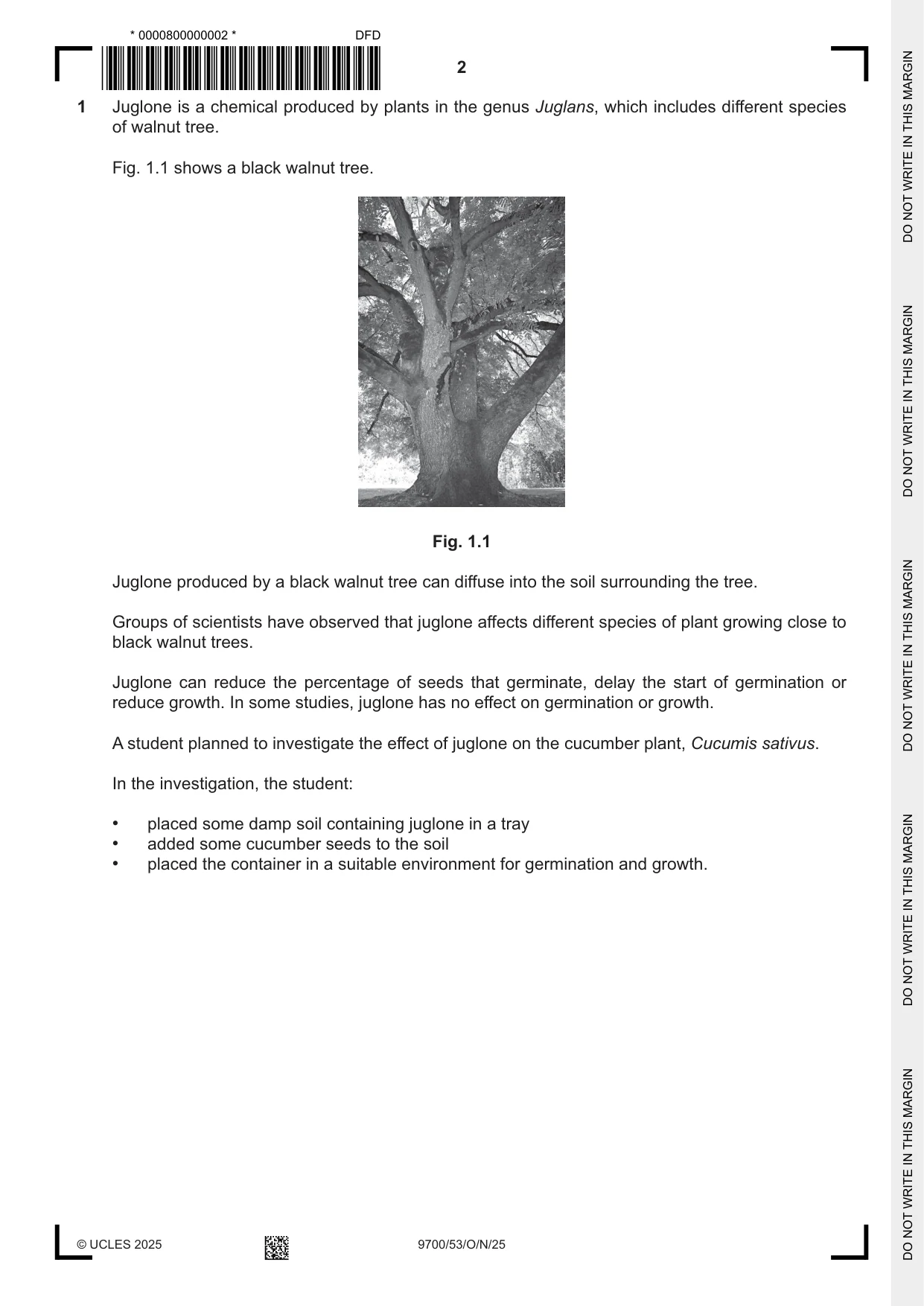
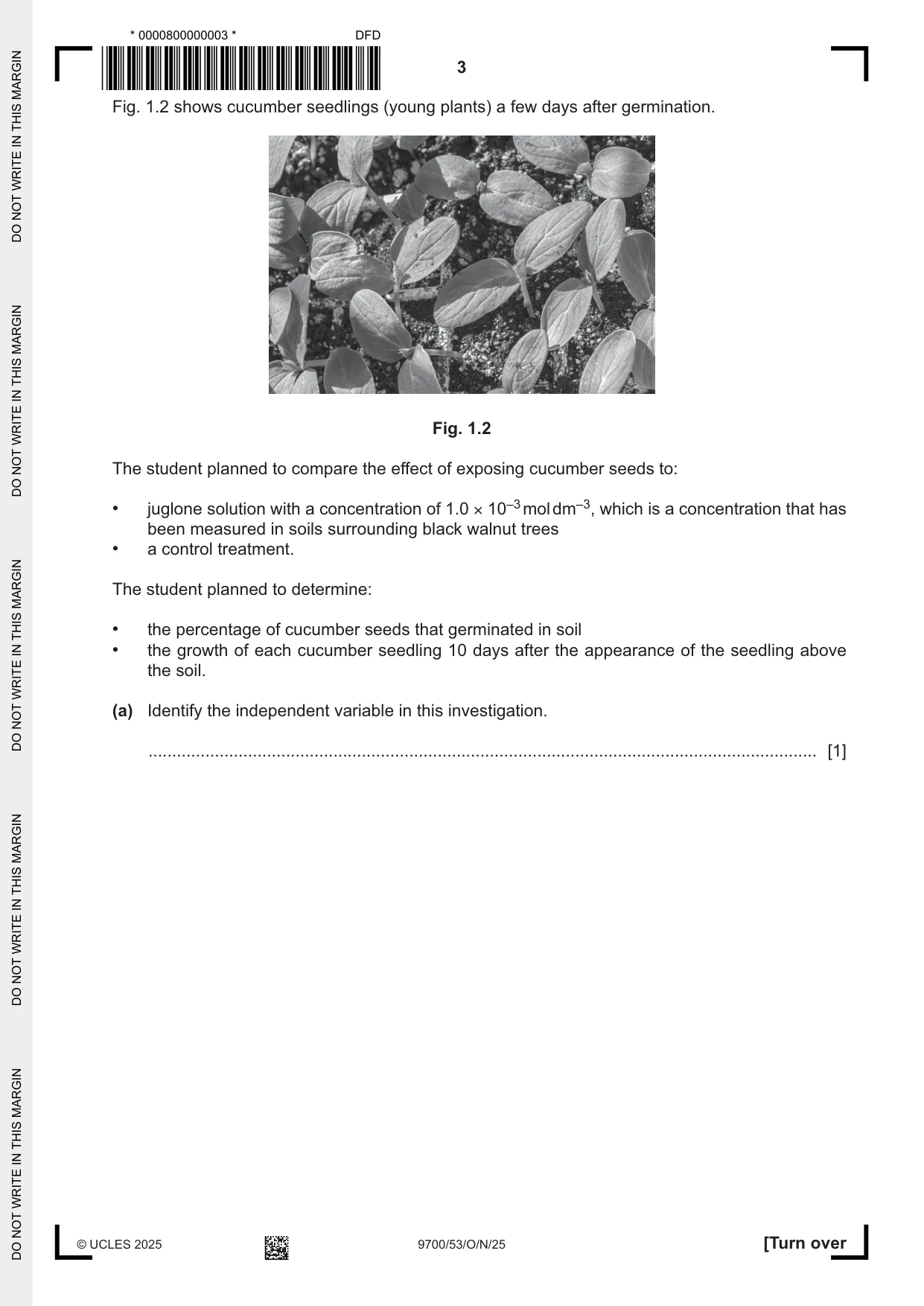
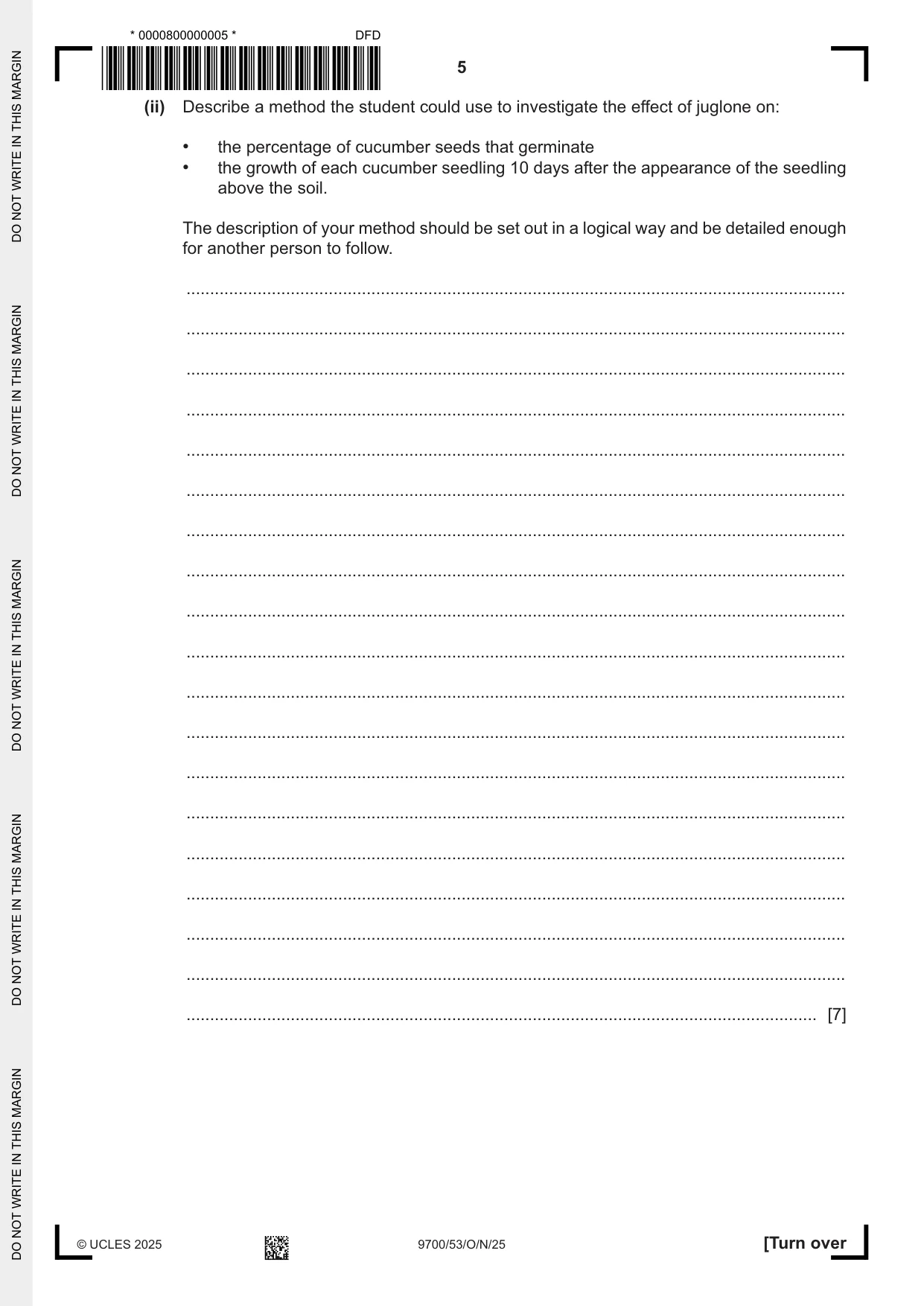
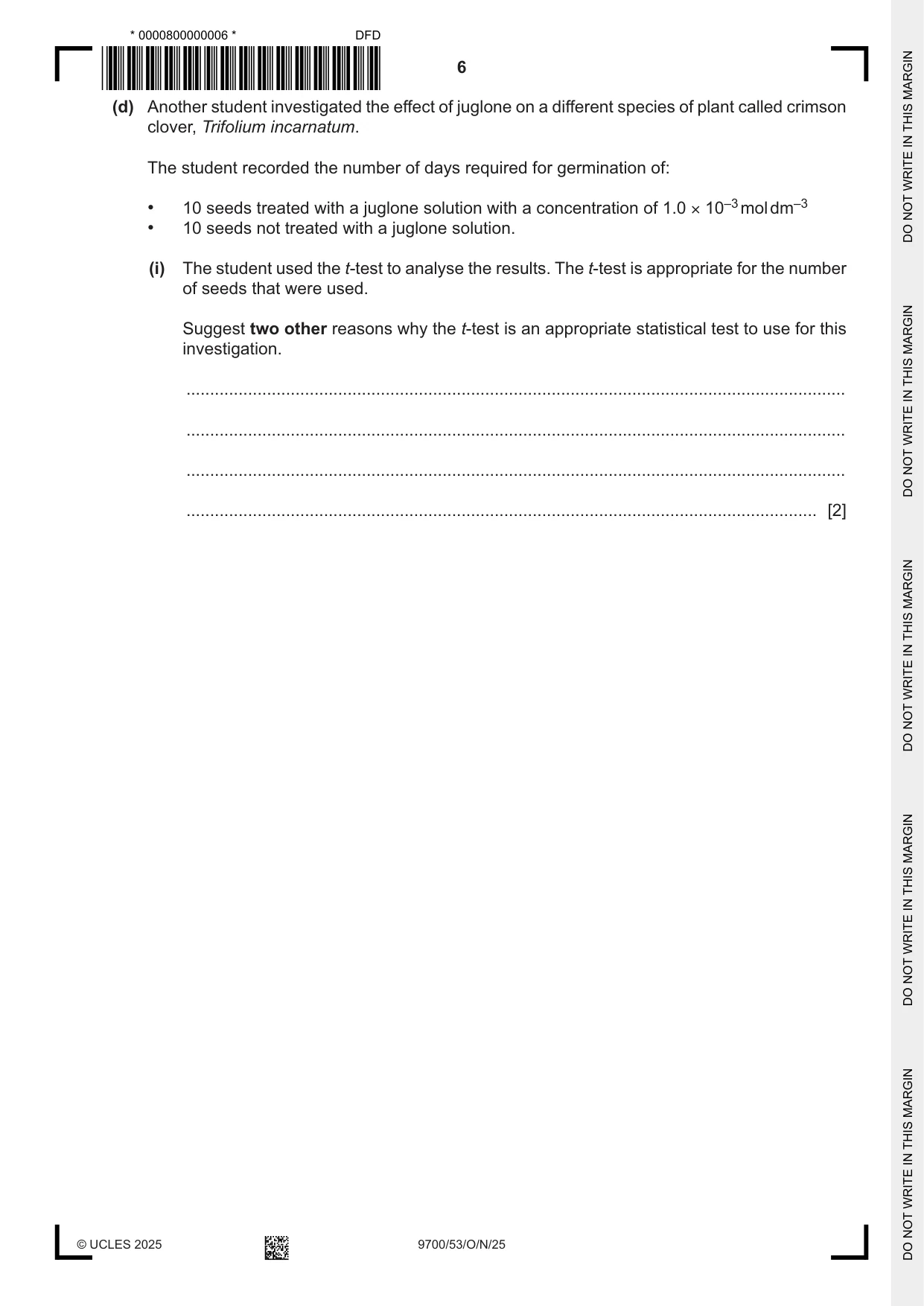
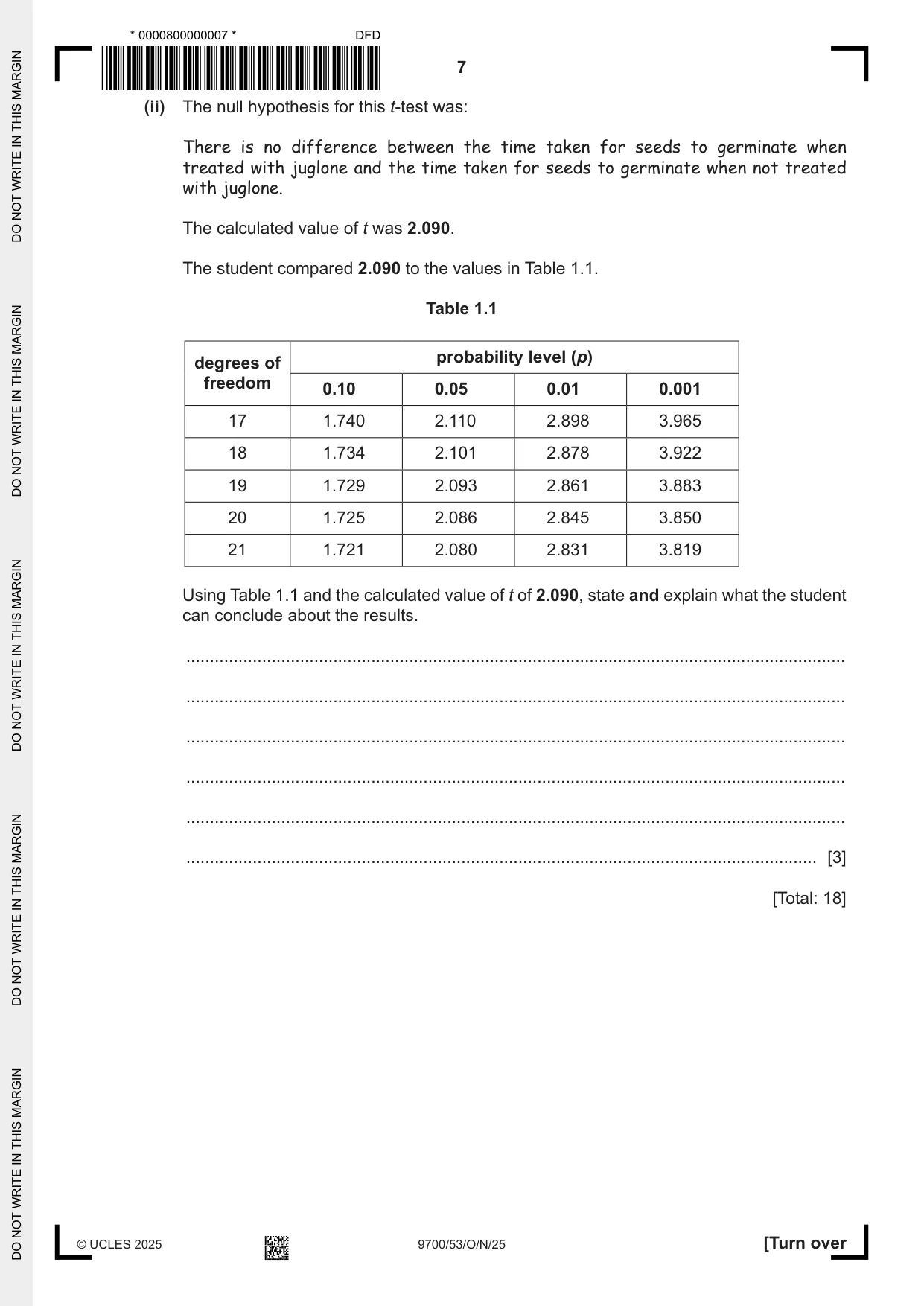
1 Juglone is a chemical produced by plants in the genus Juglans, which includes different species of walnut tree. Fig. 1.1 shows a black walnut tree. Fig. 1.1 Juglone produced by a black walnut tree can diffuse into the soil surrounding the tree. Groups of scientists have observed that juglone affects different species of plant growing close to black walnut trees. Juglone can reduce the percentage of seeds that germinate, delay the start of germination or reduce growth. In some studies, juglone has no effect on germination or growth. A student planned to investigate the effect of juglone on the cucumber plant, Cucumis sativus. In the investigation, the student: • placed some damp soil containing juglone in a tray • added some cucumber seeds to the soil • placed the container in a suitable environment for germination and growth. Fig. 1.2 shows cucumber seedlings (young plants) a few days after germination. Fig. 1.2 The student planned to compare the effect of exposing cucumber seeds to: • juglone solution with a concentration of 1.0 × 10⁻³ mol dm–3, which is a concentration that has been measured in soils surrounding black walnut trees • a control treatment. The student planned to determine: • the percentage of cucumber seeds that germinated in soil • the growth of each cucumber seedling 10 days after the appearance of the seedling above the soil. (a) Identify the independent variable in this investigation. ............................................................................................................................................. [1] (b) Juglone solutions are prepared using a mixture of solvents. The student was provided with: • a juglone solution with a concentration of 0.1 mol dm–3 • the mixture of solvents. Using the solution provided, the student prepared a juglone solution with a volume of 500 cm3 and a concentration of 1.0 × 10⁻³ mol dm–3. The student carried out 1 dilution to prepare the 1.0 × 10⁻³ mol dm–3 solution using measuring cylinders. (i) State the volumes that the student used to carry out the dilution to produce 500 cm3 of 1.0 × 10⁻³ mol dm–3 juglone solution. ........................................................................................................................................... ..................................................................................................................................... [2] (ii) Outline one improvement the student could make to reduce the percentage error while carrying out the dilution. ........................................................................................................................................... ........................................................................................................................................... ..................................................................................................................................... [1] (c) (i) State a suitable control that the student could use, and explain why the student decided to include a control in the investigation. control ............................................................................................................................... ........................................................................................................................................... explanation ........................................................................................................................ ........................................................................................................................................... ........................................................................................................................................... [2] (ii) Describe a method the student could use to investigate the effect of juglone on: • the percentage of cucumber seeds that germinate • the growth of each cucumber seedling 10 days after the appearance of the seedling above the soil. The description of your method should be set out in a logical way and be detailed enough for another person to follow. ........................................................................................................................................... ........................................................................................................................................... ........................................................................................................................................... ........................................................................................................................................... ........................................................................................................................................... ........................................................................................................................................... ........................................................................................................................................... ........................................................................................................................................... ........................................................................................................................................... ........................................................................................................................................... ........................................................................................................................................... ........................................................................................................................................... ........................................................................................................................................... ........................................................................................................................................... ........................................................................................................................................... ........................................................................................................................................... ........................................................................................................................................... ........................................................................................................................................... ..................................................................................................................................... [7] (d) Another student investigated the effect of juglone on a different species of plant called crimson clover, Trifolium incarnatum. The student recorded the number of days required for germination of: • 10 seeds treated with a juglone solution with a concentration of 1.0 × 10⁻³ mol dm–3 • 10 seeds not treated with a juglone solution. (i) The student used the t-test to analyse the results. The t-test is appropriate for the number of seeds that were used. Suggest two other reasons why the t-test is an appropriate statistical test to use for this investigation. ........................................................................................................................................... ........................................................................................................................................... ........................................................................................................................................... ..................................................................................................................................... [2] (ii) The null hypothesis for this t-test was: There is no difference between the time taken for seeds to germinate when treated with juglone and the time taken for seeds to germinate when not treated with juglone. The calculated value of t was 2.090. The student compared 2.090 to the values in Table 1.1. Table 1.1 probability level (p) degrees of freedom 0.10 0.05 0.01 0.001 17 1.740 2.110 2.898 3.965 18 1.734 2.101 2.878 3.922 19 1.729 2.093 2.861 3.883 20 1.725 2.086 2.845 3.850 21 1.721 2.080 2.831 3.819 Using Table 1.1 and the calculated value of t of 2.090, state and explain what the student can conclude about the results. ........................................................................................................................................... ........................................................................................................................................... ........................................................................................................................................... ........................................................................................................................................... ........................................................................................................................................... ..................................................................................................................................... [3] [Total: 18]
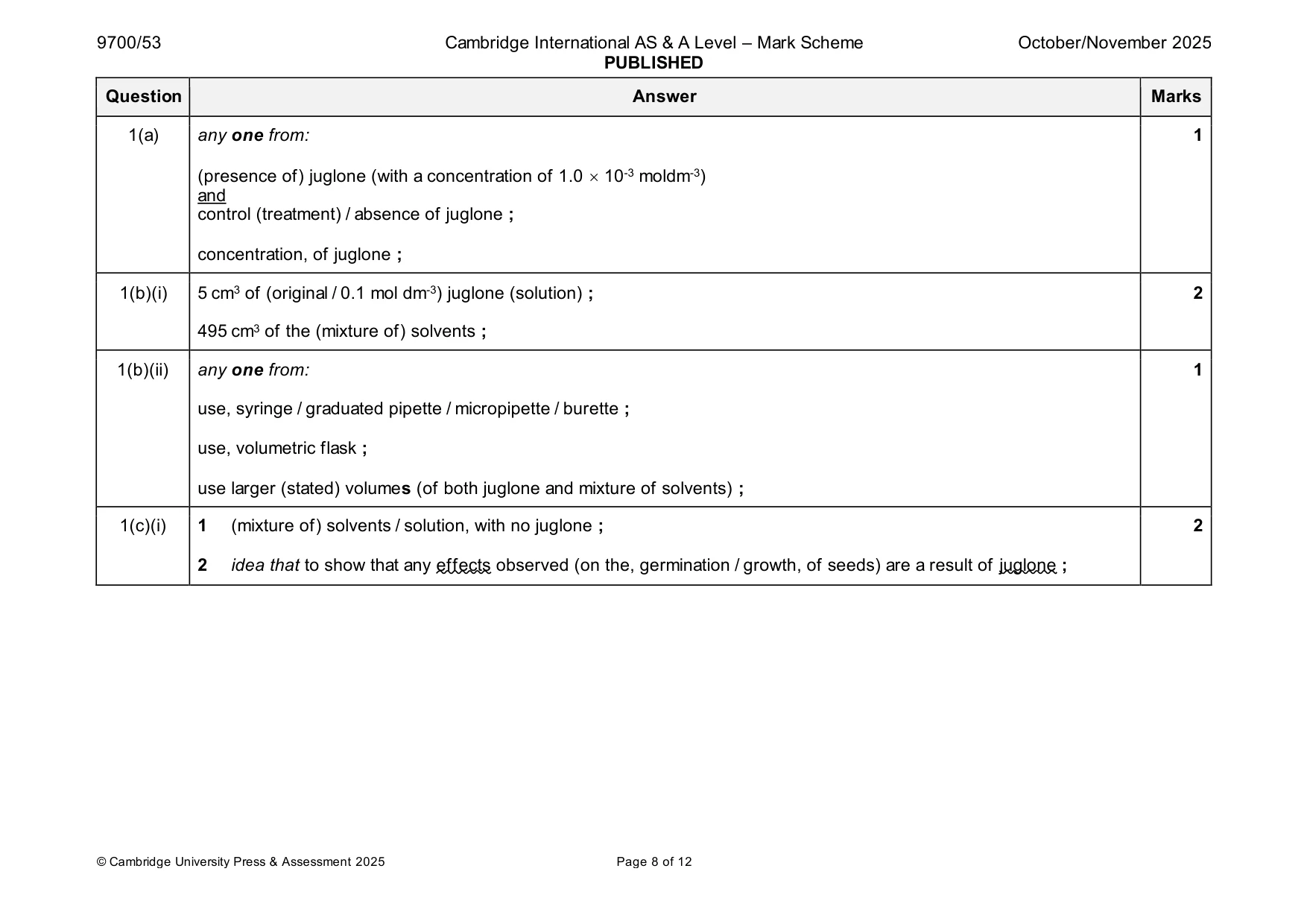
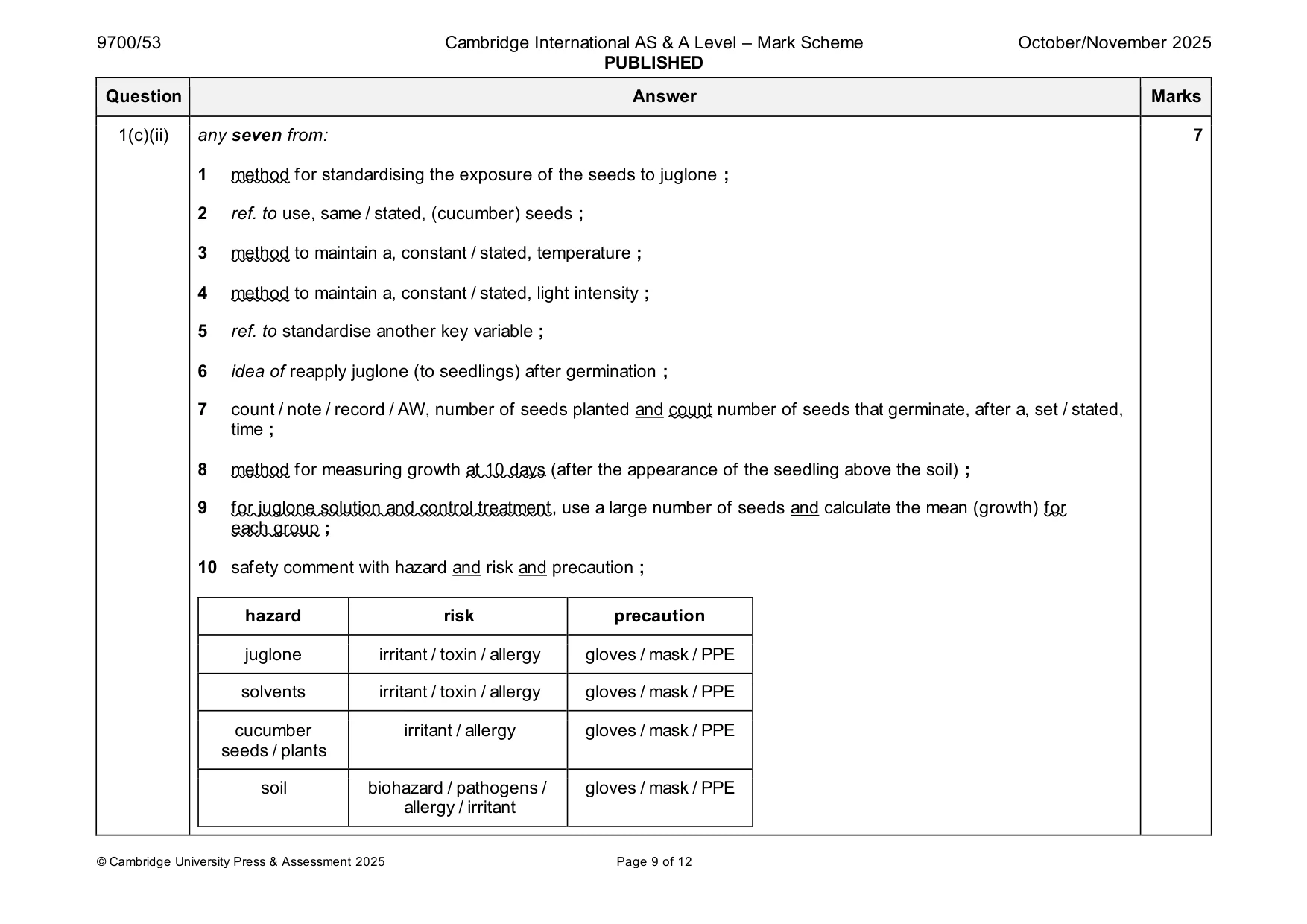
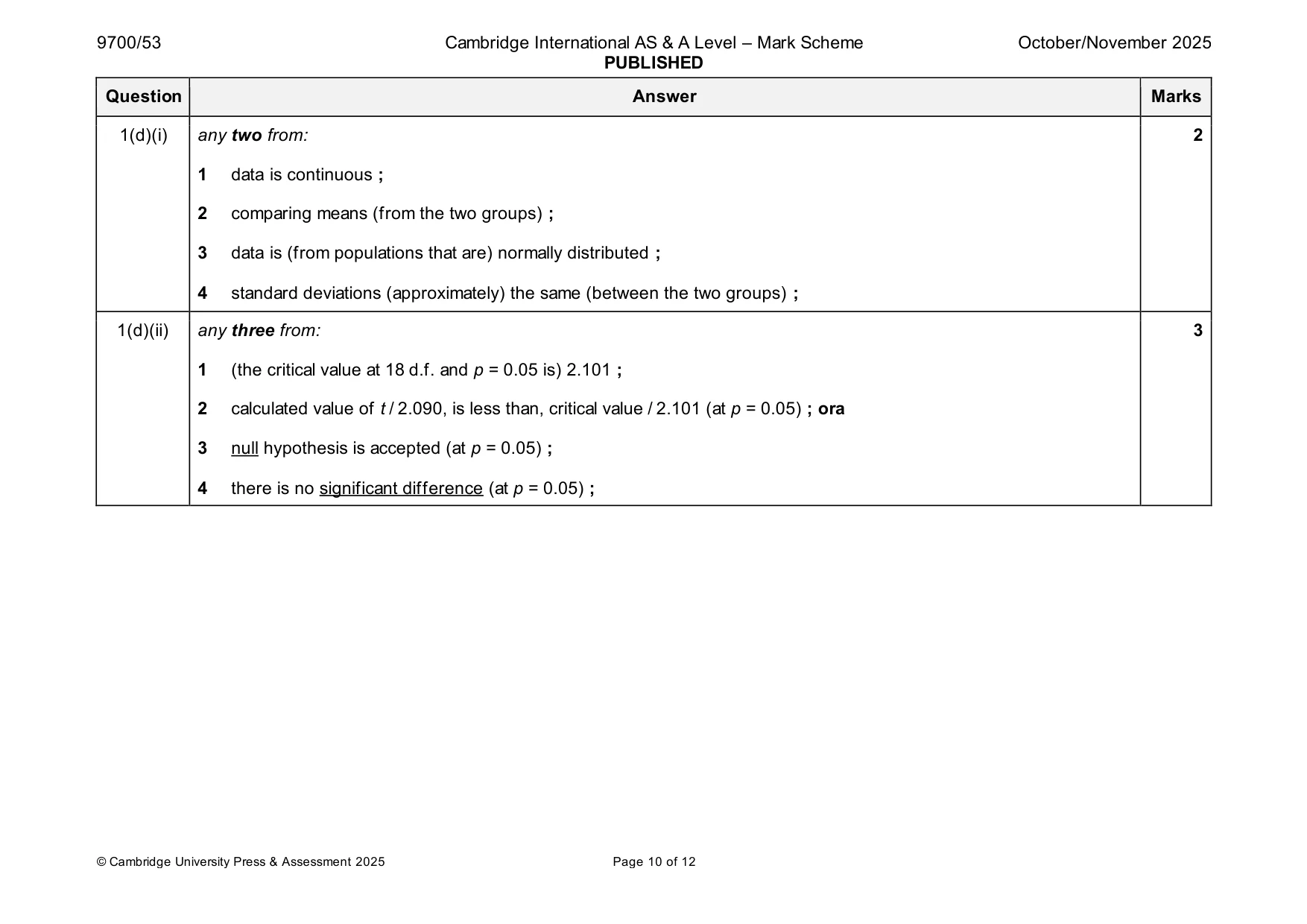
Mark scheme: Question Answer Marks 1(a) any one from: 1 (presence of) juglone (with a concentration of 1.0 10-3 moldm-3) and control (treatment) / absence of juglone ; concentration, of juglone ; 1(b)(i) 5 cm3 of (original / 0.1 mol dm-3) juglone (solution) ; 2 495 cm3 of the (mixture of) solvents ; 1(b)(ii) any one from: 1 use, syringe / graduated pipette / micropipette / burette ; use, volumetric flask ; use larger (stated) volumes (of both juglone and mixture of solvents) ; 1(c)(i) 1 (mixture of) solvents / solution, with no juglone ; 2 2 idea that to show that any effects observed (on the, germination / growth, of seeds) are a result of juglone ; 1(c)(ii) any seven from: 7 1 method for standardising the exposure of the seeds to juglone ; 2 ref. to use, same / stated, (cucumber) seeds ; 3 method to maintain a, constant / stated, temperature ; 4 method to maintain a, constant / stated, light intensity ; 5 ref. to standardise another key variable ; 6 idea of reapply juglone (to seedlings) after germination ; 7 count / note / record / AW, number of seeds planted and count number of seeds that germinate, after a, set / stated, time ; 8 method for measuring growth at 10 days (after the appearance of the seedling above the soil) ; 9 for juglone solution and control treatment, use a large number of seeds and calculate the mean (growth) for each group ; 10 safety comment with hazard and risk and precaution ; hazard risk precaution juglone irritant / toxin / allergy gloves / mask / PPE solvents irritant / toxin / allergy gloves / mask / PPE cucumber irritant / allergy gloves / mask / PPE seeds / plants soil biohazard / pathogens / gloves / mask / PPE allergy / irritant 1(d)(i) any two from: 2 1 data is continuous ; 2 comparing means (from the two groups) ; 3 data is (from populations that are) normally distributed ; 4 standard deviations (approximately) the same (between the two groups) ; 1(d)(ii) any three from: 3 1 (the critical value at 18 d.f. and p = 0.05 is) 2.101 ; 2 calculated value of t / 2.090, is less than, critical value / 2.101 (at p = 0.05) ; ora 3 null hypothesis is accepted (at p = 0.05) ; 4 there is no significant difference (at p = 0.05) ;
Q2 · Compounds containing nitrite ions (NO2–) are present in many foods eaten by humans
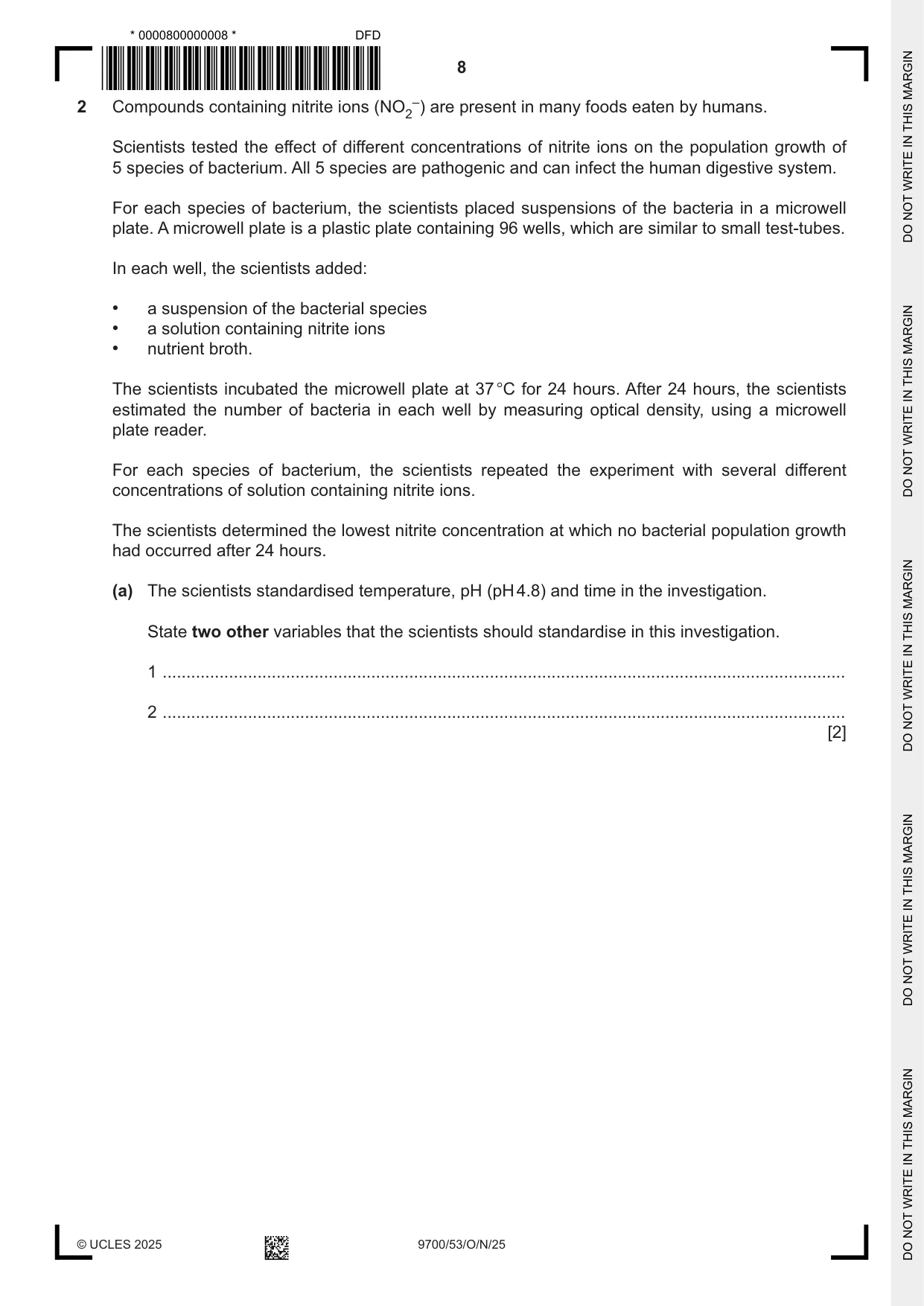
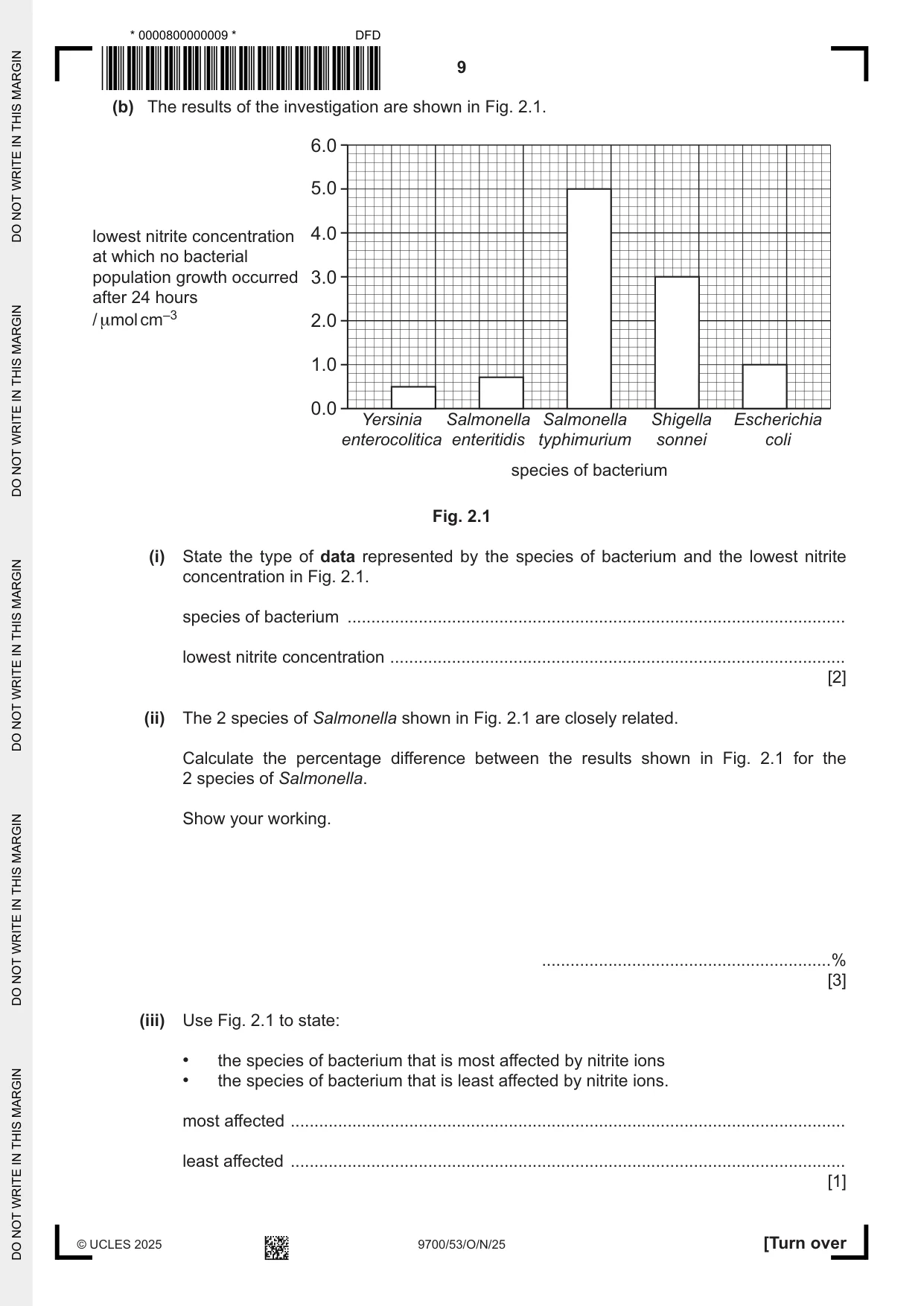
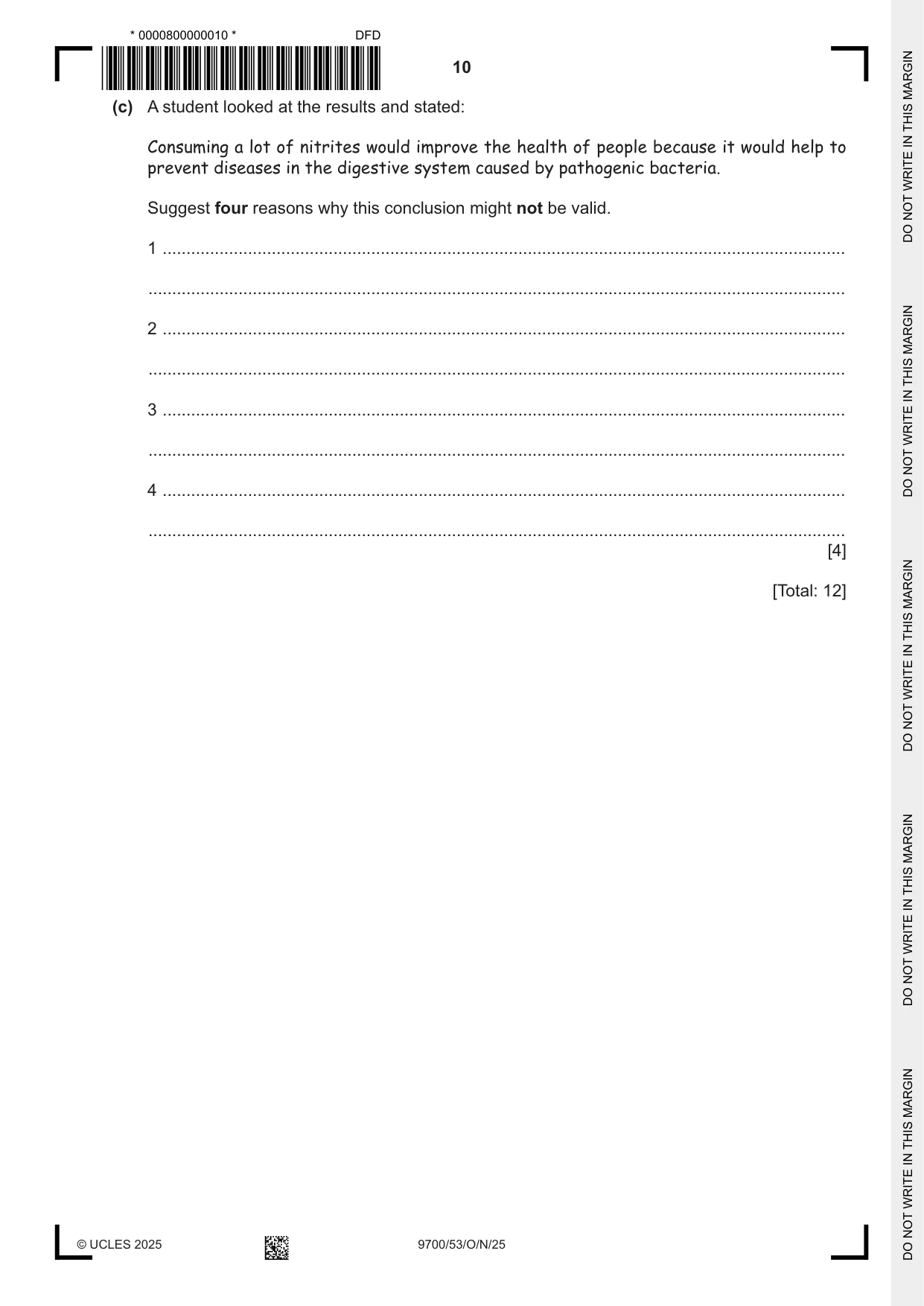
2 Compounds containing nitrite ions (NO2–) are present in many foods eaten by humans. Scientists tested the effect of different concentrations of nitrite ions on the population growth of 5 species of bacterium. All 5 species are pathogenic and can infect the human digestive system. For each species of bacterium, the scientists placed suspensions of the bacteria in a microwell plate. A microwell plate is a plastic plate containing 96 wells, which are similar to small test-tubes. In each well, the scientists added: • a suspension of the bacterial species • a solution containing nitrite ions • nutrient broth. The scientists incubated the microwell plate at 37 °C for 24 hours. After 24 hours, the scientists estimated the number of bacteria in each well by measuring optical density, using a microwell plate reader. For each species of bacterium, the scientists repeated the experiment with several different concentrations of solution containing nitrite ions. The scientists determined the lowest nitrite concentration at which no bacterial population growth had occurred after 24 hours. (a) The scientists standardised temperature, pH (pH 4.8) and time in the investigation. State two other variables that the scientists should standardise in this investigation. 1 ................................................................................................................................................ 2 ................................................................................................................................................ [2] (b) The results of the investigation are shown in Fig. 2.1. 6.0 5.0 lowest nitrite concentration 4.0 at which no bacterial population growth occurred 3.0 after 24 hours / μmol cm–3 2.0 1.0 0.0 Yersinia Salmonella Salmonella Shigella Escherichia enterocolitica enteritidis typhimurium sonnei coli species of bacterium Fig. 2.1 (i) State the type of data represented by the species of bacterium and the lowest nitrite concentration in Fig. 2.1. species of bacterium ......................................................................................................... lowest nitrite concentration ................................................................................................ [2] (ii) The 2 species of Salmonella shown in Fig. 2.1 are closely related. Calculate the percentage difference between the results shown in Fig. 2.1 for the 2 species of Salmonella. Show your working. .............................................................% [3] (iii) Use Fig. 2.1 to state: • the species of bacterium that is most affected by nitrite ions • the species of bacterium that is least affected by nitrite ions. most affected ..................................................................................................................... least affected ..................................................................................................................... [1] (c) A student looked at the results and stated: Consuming a lot of nitrites would improve the health of people because it would help to prevent diseases in the digestive system caused by pathogenic bacteria. Suggest four reasons why this conclusion might not be valid. 1 ................................................................................................................................................ ................................................................................................................................................... 2 ................................................................................................................................................ ................................................................................................................................................... 3 ................................................................................................................................................ ................................................................................................................................................... 4 ................................................................................................................................................ ................................................................................................................................................... [4] [Total: 12]
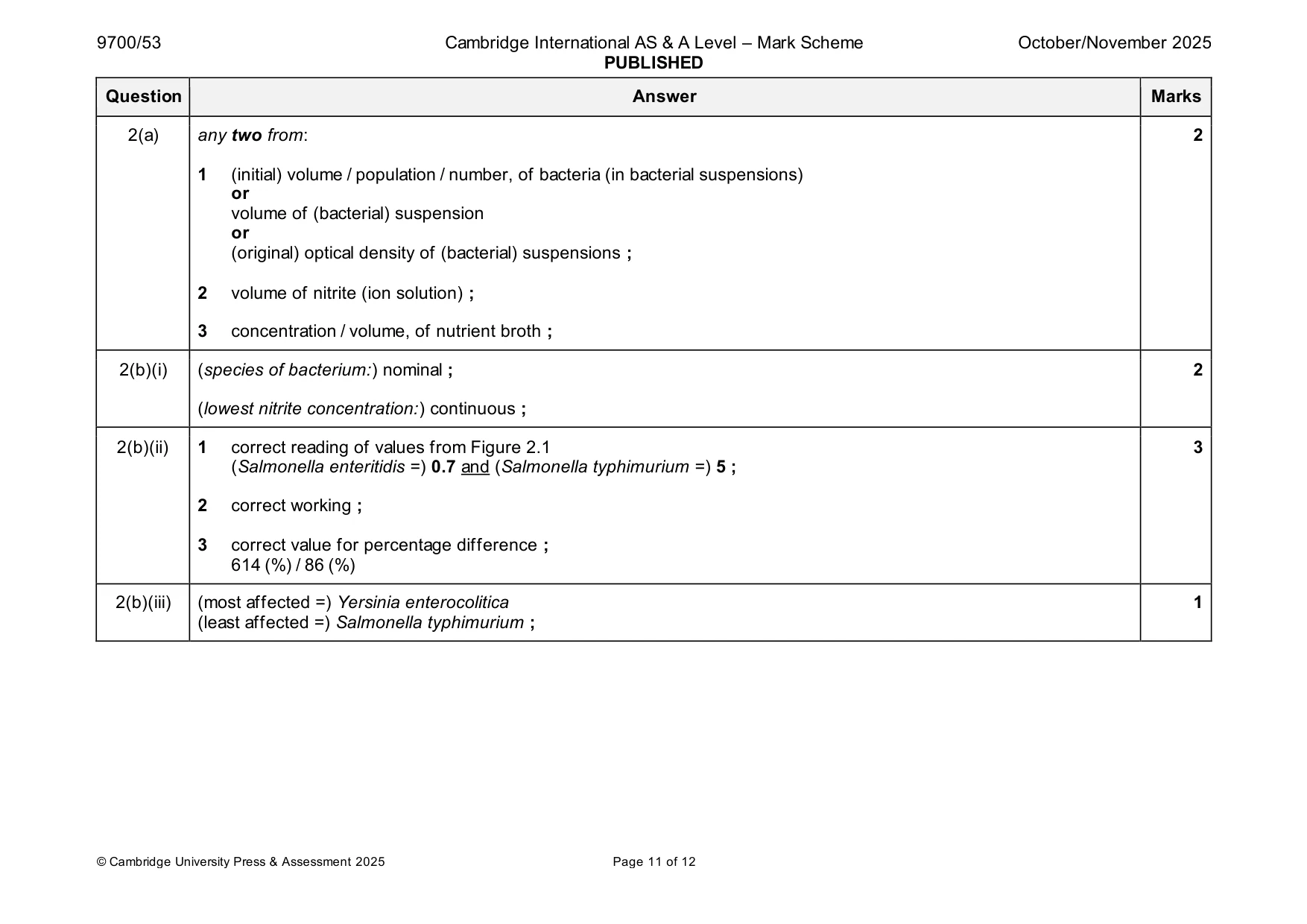
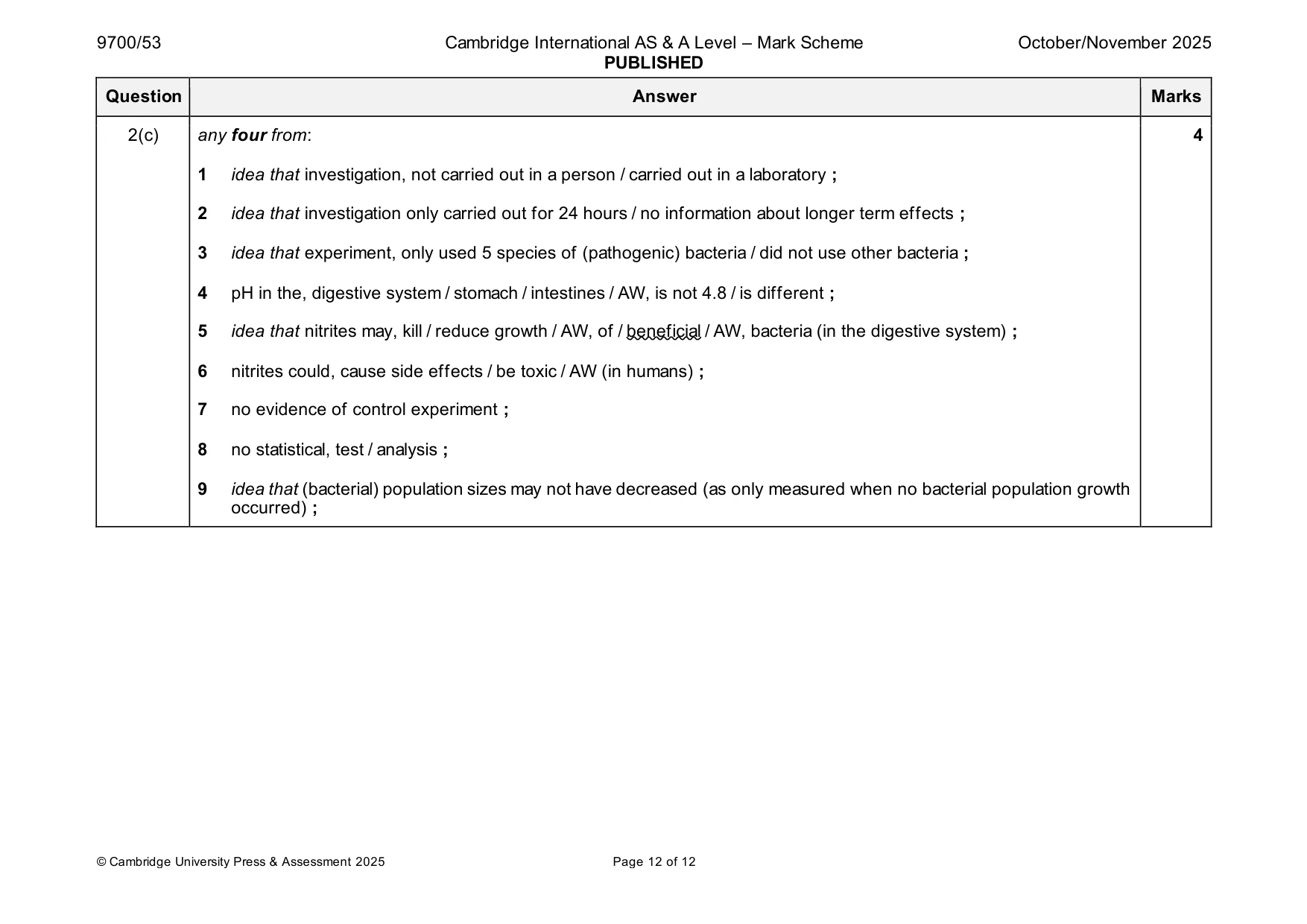
Mark scheme: 2(a) any two from: 2 1 (initial) volume / population / number, of bacteria (in bacterial suspensions) or volume of (bacterial) suspension or (original) optical density of (bacterial) suspensions ; 2 volume of nitrite (ion solution) ; 3 concentration / volume, of nutrient broth ; 2(b)(i) (species of bacterium:) nominal ; 2 (lowest nitrite concentration:) continuous ; 2(b)(ii) 1 correct reading of values from Figure 2.1 3 (Salmonella enteritidis =) 0.7 and (Salmonella typhimurium =) 5 ; 2 correct working ; 3 correct value for percentage difference ; 614 (%) / 86 (%) 2(b)(iii) (most affected =) Yersinia enterocolitica 1 (least affected =) Salmonella typhimurium ; 2(c) any four from: 4 1 idea that investigation, not carried out in a person / carried out in a laboratory ; 2 idea that investigation only carried out for 24 hours / no information about longer term effects ; 3 idea that experiment, only used 5 species of (pathogenic) bacteria / did not use other bacteria ; 4 pH in the, digestive system / stomach / intestines / AW, is not 4.8 / is different ; 5 idea that nitrites may, kill / reduce growth / AW, of / beneficial / AW, bacteria (in the digestive system) ; 6 nitrites could, cause side effects / be toxic / AW (in humans) ; 7 no evidence of control experiment ; 8 no statistical, test / analysis ; 9 idea that (bacterial) population sizes may not have decreased (as only measured when no bacterial population growth occurred) ;
What was in this paper
The subtopics covered by these 2 questions, and how many questions each got. Open one in a new tab to see every Cambridge question on it.
What you needed in this session
Cambridge’s own grade thresholds for 2025 Oct/Nov, Paper 5 · Variant 3. A higher threshold means an easier paper — the bar moves with how the cohort did.