Cambridge A Level Biology 9700 — 2024 May/June Paper 5 · Variant 3
9700/53/M/J/24 · 30 marks · ≈34 min
The question paper and its mark scheme, free to read here and free to download. This is Cambridge’s own paper, exactly as it was sat.
Question paper12 pages

Mark scheme11 pages
Answers below. Sit the paper first if you are practising.
Paper as text
Question paper, page 1
This document has 12 pages. Any blank pages are indicated. [Turn over Cambridge International AS & A Level * 6 4 9 0 8 4 2 5 0 0 * BIOLOGY 9700/53 Paper 5 Planning, Analysis and Evaluation May/June 2024 1 hour 15 minutes You must answer on the question paper. No additional materials are needed. INSTRUCTIONS ● Answer all questions. ● Use a black or dark blue pen. You may use an HB pencil for any diagrams or graphs. ● Write your name, centre number and candidate number in the boxes at the top of the page. ● Write your answer to each question in the space provided. ● Do not use an erasable pen or correction fluid. ● Do not write on any bar codes. ● You may use a calculator. ● You should show all your working and use appropriate units. INFORMATION ● The total mark for this paper is 30. ● The number of marks for each question or part question is shown in brackets [ ]. DC (PB/SG) 330393/2 © UCLES 2024
Question paper, page 2
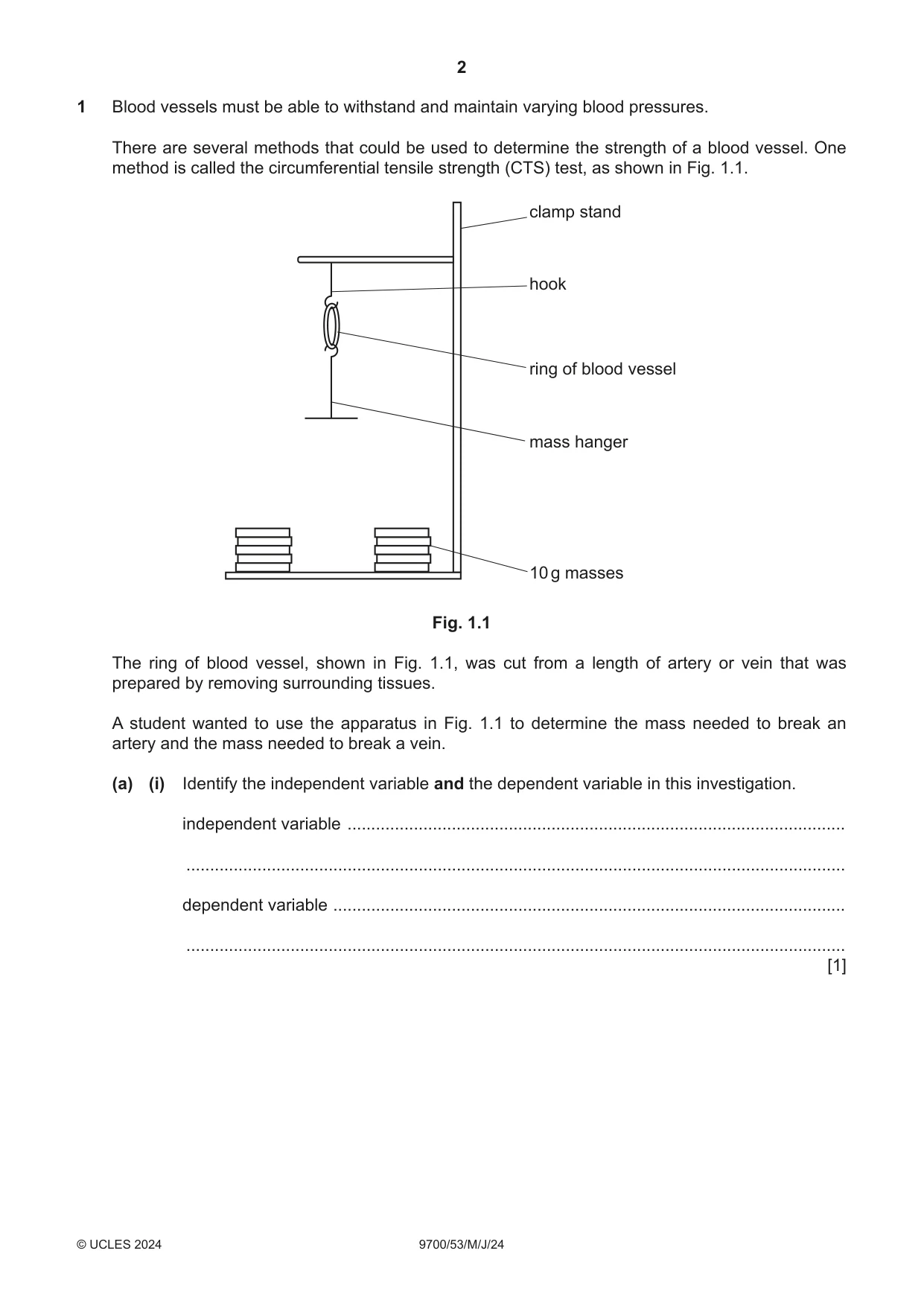
2 9700/53/M/J/24 © UCLES 2024 1 Blood vessels must be able to withstand and maintain varying blood pressures. There are several methods that could be used to determine the strength of a blood vessel. One method is called the circumferential tensile strength (CTS) test, as shown in Fig. 1.1. clamp stand hook ring of blood vessel mass hanger 10 g masses Fig. 1.1 The ring of blood vessel, shown in Fig. 1.1, was cut from a length of artery or vein that was prepared by removing surrounding tissues. A student wanted to use the apparatus in Fig. 1.1 to determine the mass needed to break an artery and the mass needed to break a vein. (a) (i) Identify the independent variable and the dependent variable in this investigation. independent variable … … dependent variable … … [1]
Question paper, page 3
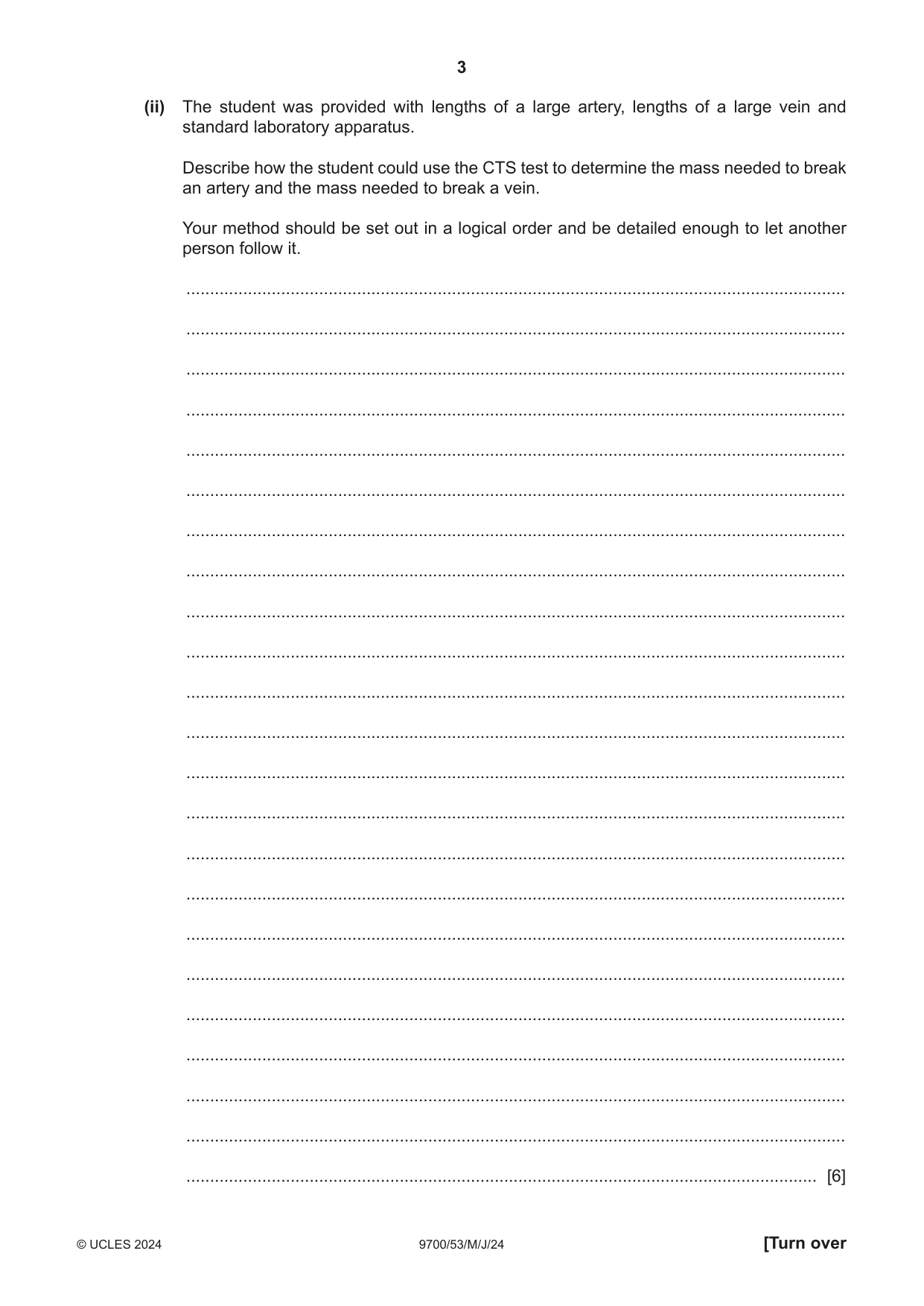
3 9700/53/M/J/24 © UCLES 2024 [Turn over (ii) The student was provided with lengths of a large artery, lengths of a large vein and standard laboratory apparatus. Describe how the student could use the CTS test to determine the mass needed to break an artery and the mass needed to break a vein. Your method should be set out in a logical order and be detailed enough to let another person follow it. … … … … … … … … … … … … … … … … … … … … … … … [6]
Question paper, page 4
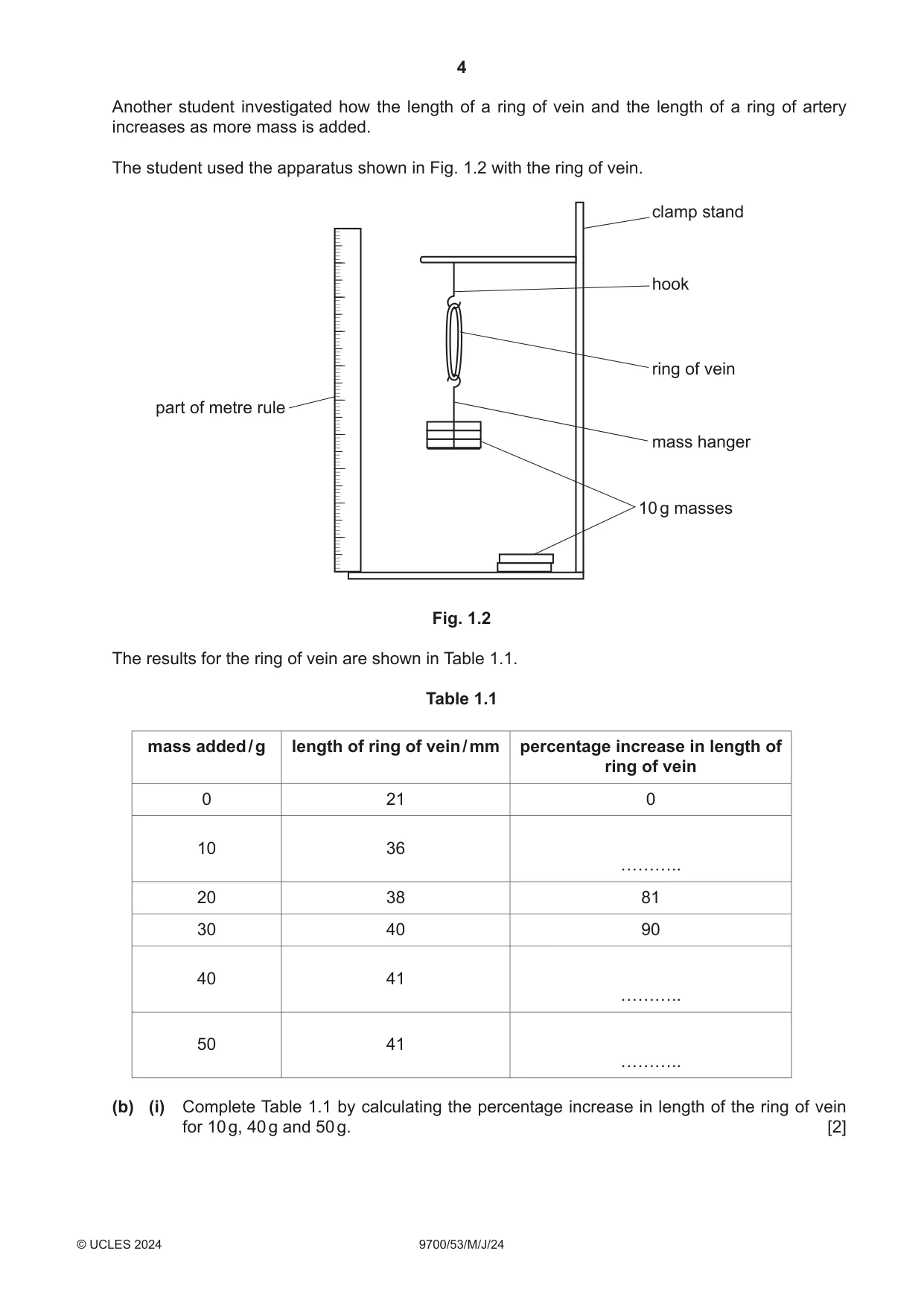
4 9700/53/M/J/24 © UCLES 2024 Another student investigated how the length of a ring of vein and the length of a ring of artery increases as more mass is added. The student used the apparatus shown in Fig. 1.2 with the ring of vein. clamp stand hook ring of vein mass hanger 10 g masses part of metre rule Fig. 1.2 The results for the ring of vein are shown in Table 1.1. Table 1.1 mass added / g length of ring of vein / mm percentage increase in length of ring of vein 0 21 0 10 36 ……….. 20 38 81 30 40 90 40 41 ……….. 50 41 ……….. (b) (i) Complete Table 1.1 by calculating the percentage increase in length of the ring of vein for 10 g, 40 g and 50 g. [2]
Question paper, page 5
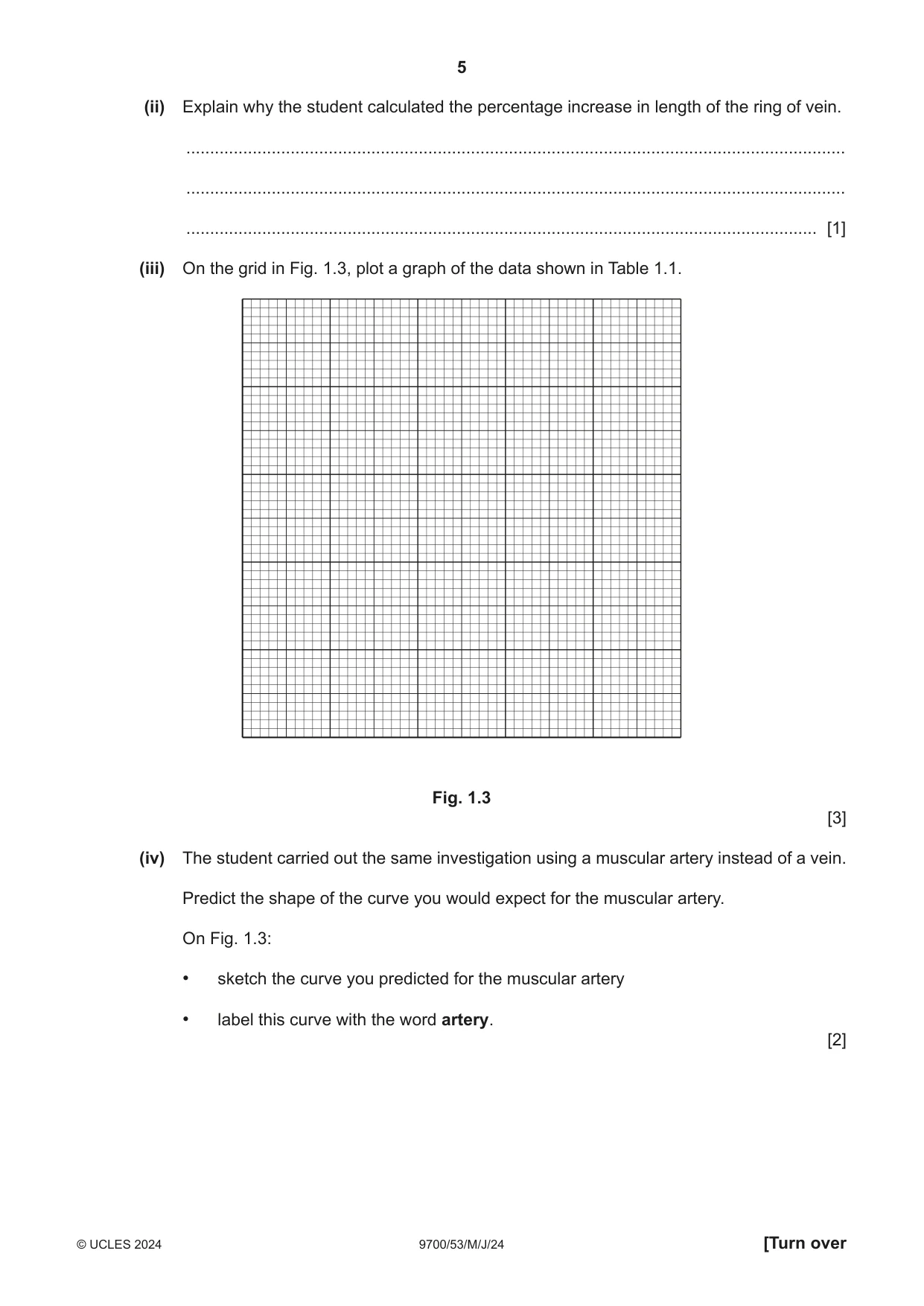
5 9700/53/M/J/24 © UCLES 2024 [Turn over (ii) Explain why the student calculated the percentage increase in length of the ring of vein. … … … [1] (iii) On the grid in Fig. 1.3, plot a graph of the data shown in Table 1.1. Fig. 1.3 [3] (iv) The student carried out the same investigation using a muscular artery instead of a vein. Predict the shape of the curve you would expect for the muscular artery. On Fig. 1.3: • sketch the curve you predicted for the muscular artery • label this curve with the word artery. [2]
Question paper, page 6
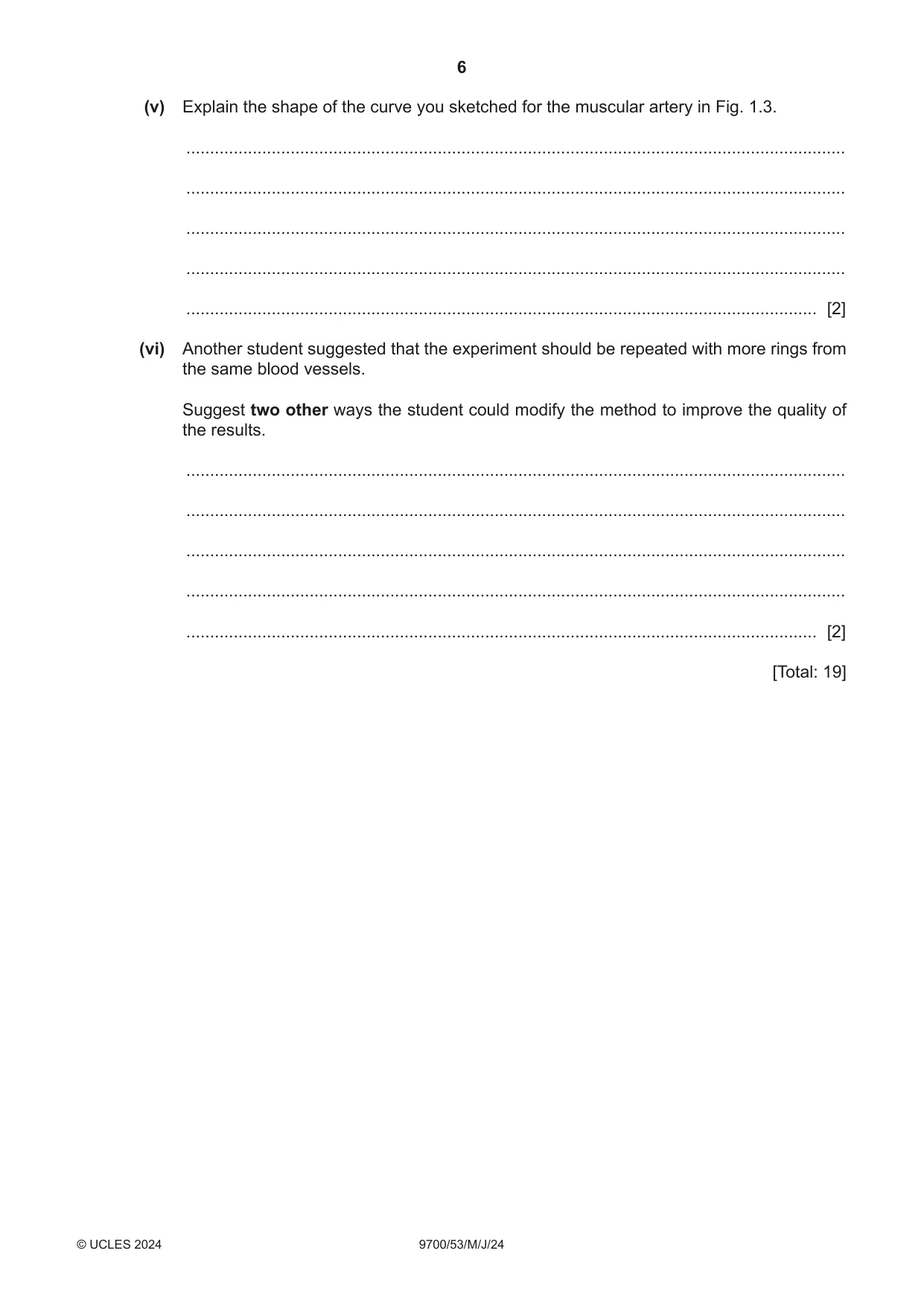
6 9700/53/M/J/24 © UCLES 2024 (v) Explain the shape of the curve you sketched for the muscular artery in Fig. 1.3. … … … … … [2] (vi) Another student suggested that the experiment should be repeated with more rings from the same blood vessels. Suggest two other ways the student could modify the method to improve the quality of the results. … … … … … [2] [Total: 19]
Question paper, page 7
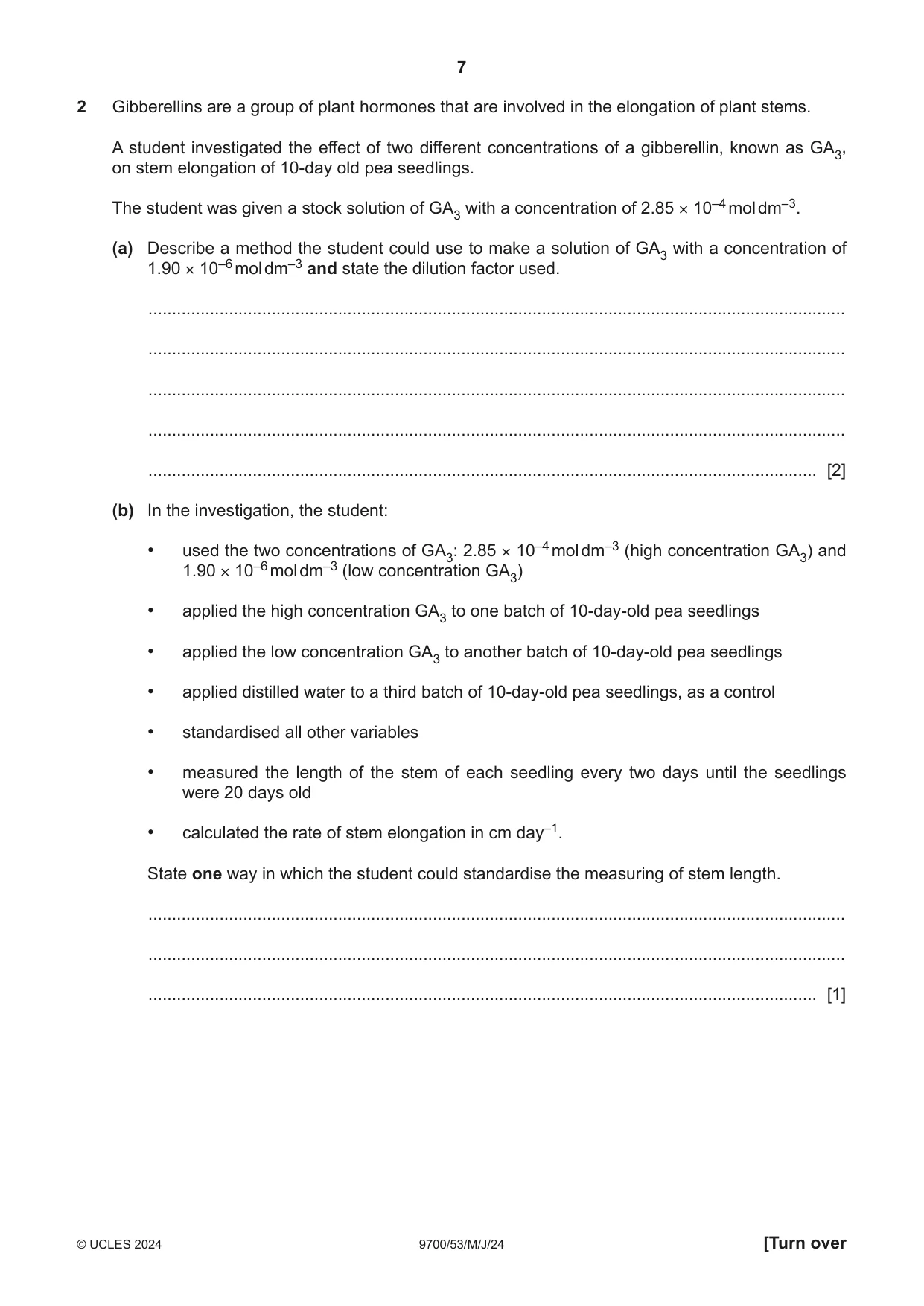
7 9700/53/M/J/24 © UCLES 2024 [Turn over 2 Gibberellins are a group of plant hormones that are involved in the elongation of plant stems. A student investigated the effect of two different concentrations of a gibberellin, known as GA3, on stem elongation of 10-day old pea seedlings. The student was given a stock solution of GA3 with a concentration of 2.85 × 10⁻⁴ mol dm–3. (a) Describe a method the student could use to make a solution of GA3 with a concentration of 1.90 × 10⁻⁶ mol dm–3 and state the dilution factor used. … … … … … [2] (b) In the investigation, the student: • used the two concentrations of GA3: 2.85 × 10⁻⁴ mol dm–3 (high concentration GA3) and 1.90 × 10⁻⁶ mol dm–3 (low concentration GA3) • applied the high concentration GA3 to one batch of 10-day-old pea seedlings • applied the low concentration GA3 to another batch of 10-day-old pea seedlings • applied distilled water to a third batch of 10-day-old pea seedlings, as a control • standardised all other variables • measured the length of the stem of each seedling every two days until the seedlings were 20 days old • calculated the rate of stem elongation in cm day–1. State one way in which the student could standardise the measuring of stem length. … … … [1]
Question paper, page 8
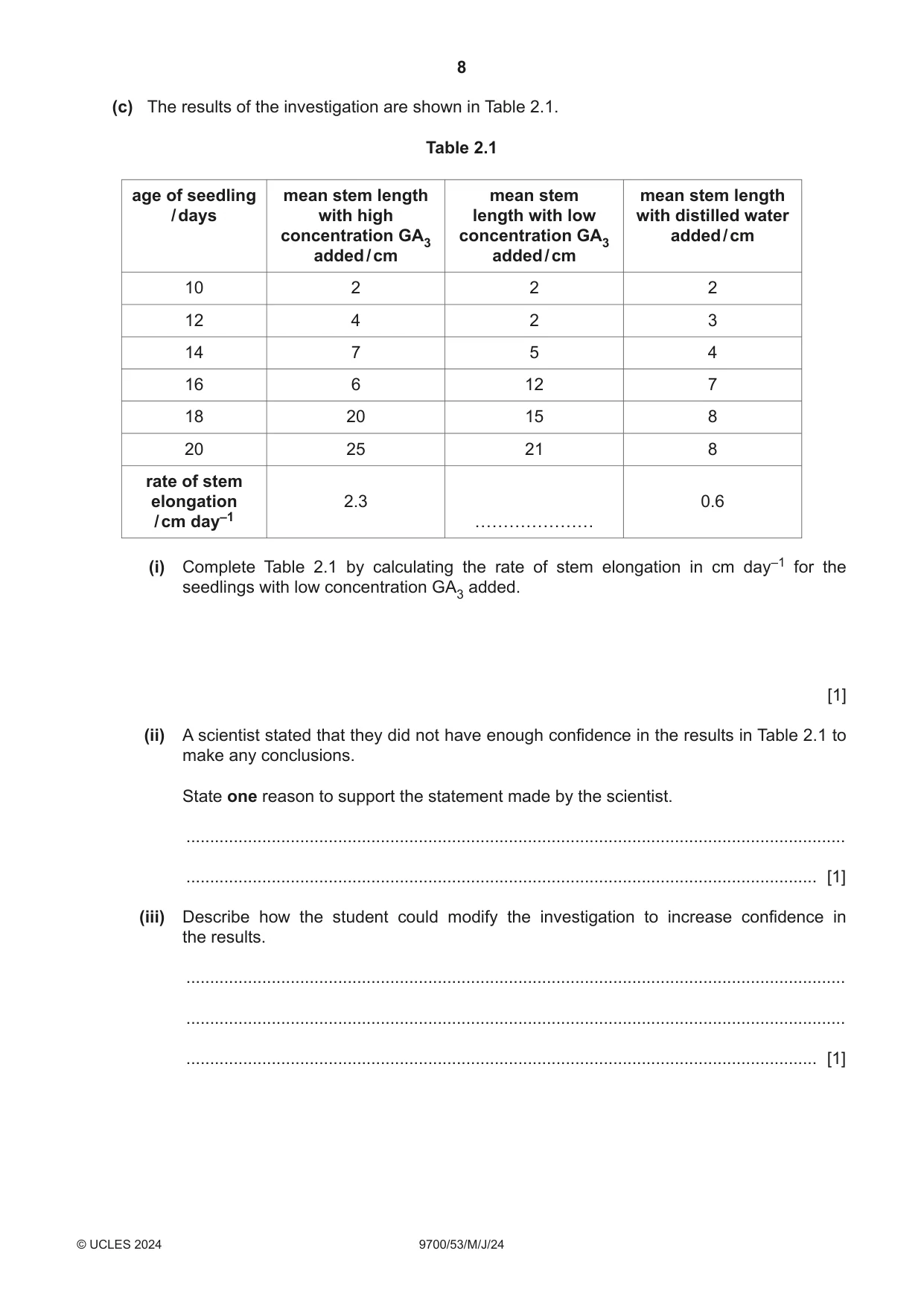
8 9700/53/M/J/24 © UCLES 2024 (c) The results of the investigation are shown in Table 2.1. Table 2.1 age of seedling / days mean stem length with high concentration GA3 added / cm mean stem length with low concentration GA3 added / cm mean stem length with distilled water added / cm 10 2 2 2 12 4 2 3 14 7 5 4 16 6 12 7 18 20 15 8 20 25 21 8 rate of stem elongation / cm day–1 2.3 ………………… 0.6 (i) Complete Table 2.1 by calculating the rate of stem elongation in cm day–1 for the seedlings with low concentration GA3 added. [1] (ii) A scientist stated that they did not have enough confidence in the results in Table 2.1 to make any conclusions. State one reason to support the statement made by the scientist. … … [1] (iii) Describe how the student could modify the investigation to increase confidence in the results. … … … [1]
Question paper, page 9
9 9700/53/M/J/24 © UCLES 2024 [Turn over (d) The student found a study on the internet that considered the effect of different wavelengths of light on the concentration of two types of gibberellins, GA1 and GA8, in pea plants. In the study, 60 pea seeds were germinated and kept in the dark (no light) for seven days. The pea seedlings were divided into four batches of 15: • batch 1 remained in the dark • batch 2 was exposed to blue light (470 nm) • batch 3 was exposed to red light (680 nm) • batch 4 was exposed to far-red light (750 nm). After 4 hours the concentrations of GA1 and GA8 in the seedlings were measured.
Question paper, page 10
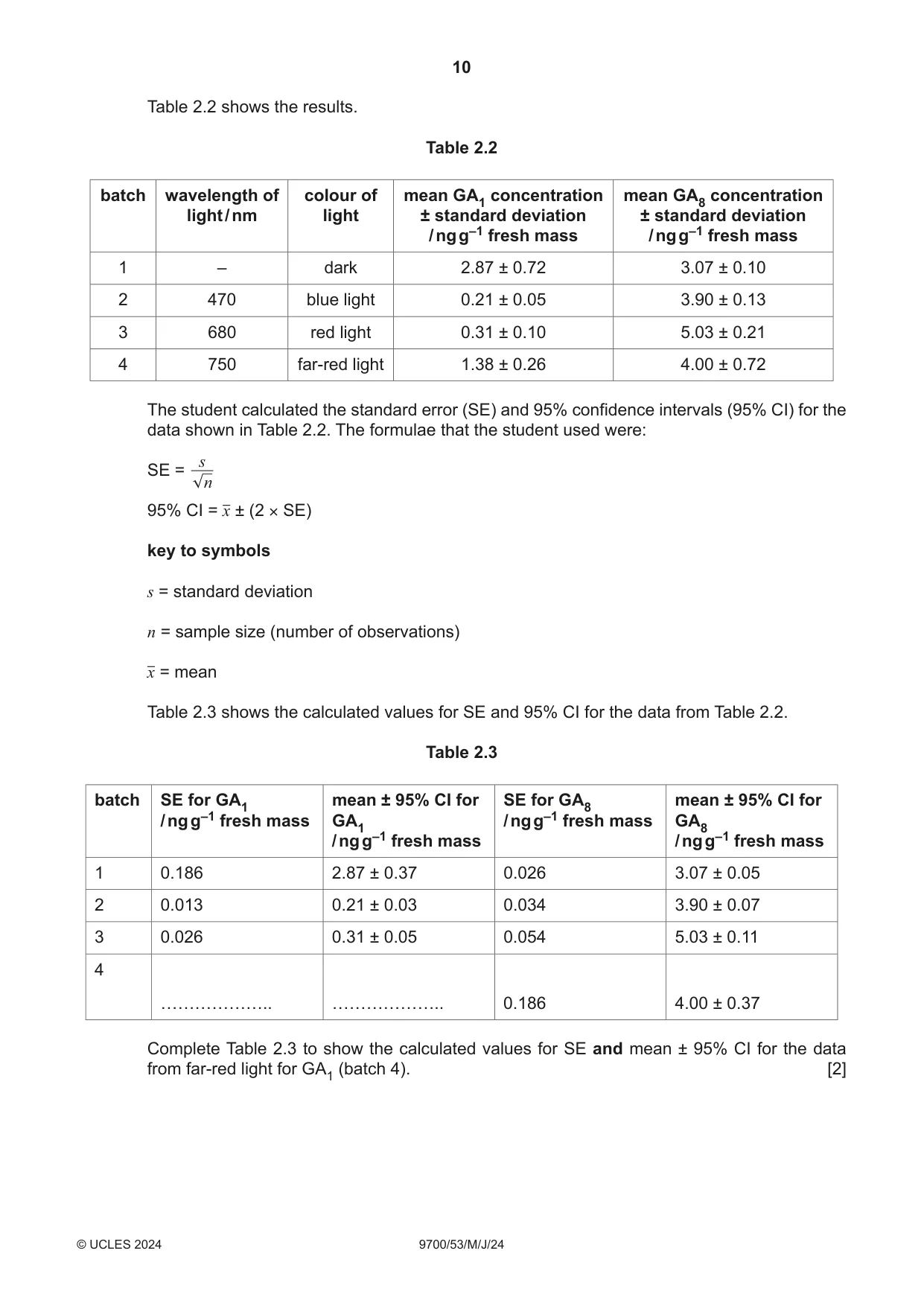
10 9700/53/M/J/24 © UCLES 2024 Table 2.2 shows the results. Table 2.2 batch wavelength of light / nm colour of light mean GA1 concentration ± standard deviation / ng g–1 fresh mass mean GA8 concentration ± standard deviation / ng g–1 fresh mass 1 – dark 2.87 ± 0.72 3.07 ± 0.10 2 470 blue light 0.21 ± 0.05 3.90 ± 0.13 3 680 red light 0.31 ± 0.10 5.03 ± 0.21 4 750 far-red light 1.38 ± 0.26 4.00 ± 0.72 The student calculated the standard error (SE) and 95% confidence intervals (95% CI) for the data shown in Table 2.2. The formulae that the student used were: SE = n s 95% CI = x ± (2 × SE) key to symbols s = standard deviation n = sample size (number of observations) x = mean Table 2.3 shows the calculated values for SE and 95% CI for the data from Table 2.2. Table 2.3 batch SE for GA1 / ng g–1 fresh mass mean ± 95% CI for GA1 / ng g–1 fresh mass SE for GA8 / ng g–1 fresh mass mean ± 95% CI for GA8 / ng g–1 fresh mass 1 0.186 2.87 ± 0.37 0.026 3.07 ± 0.05 2 0.013 0.21 ± 0.03 0.034 3.90 ± 0.07 3 0.026 0.31 ± 0.05 0.054 5.03 ± 0.11 4 ……………….. ……………….. 0.186 4.00 ± 0.37 Complete Table 2.3 to show the calculated values for SE and mean ± 95% CI for the data from far-red light for GA1 (batch 4). [2]
Question paper, page 11
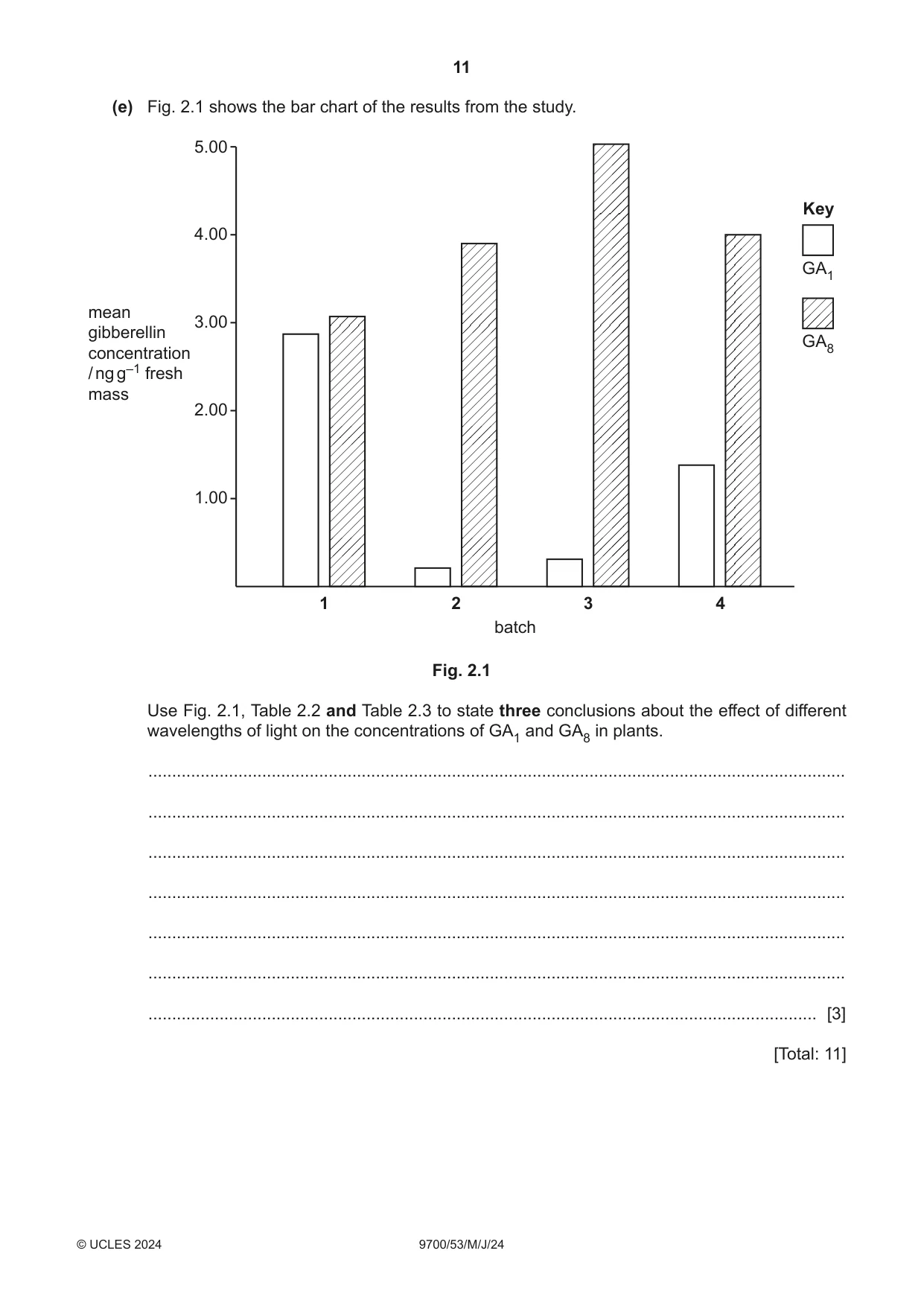
11 9700/53/M/J/24 © UCLES 2024 (e) Fig. 2.1 shows the bar chart of the results from the study. 1.00 2.00 3.00 4.00 5.00 1 2 batch GA1 3 4 Key GA8 mean gibberellin concentration / ng g–1 fresh mass Fig. 2.1 Use Fig. 2.1, Table 2.2 and Table 2.3 to state three conclusions about the effect of different wavelengths of light on the concentrations of GA1 and GA8 in plants. … … … … … … … [3] [Total: 11]
Question paper, page 12
12 9700/53/M/J/24 © UCLES 2024 The boundaries and names shown, the designations used and the presentation of material on any maps contained in this question paper/insert do not imply official endorsement or acceptance by Cambridge Assessment International Education concerning the legal status of any country, territory, or area or any of its authorities, or of the delimitation of its frontiers or boundaries. Permission to reproduce items where third-party owned material protected by copyright is included has been sought and cleared where possible. Every reasonable effort has been made by the publisher (UCLES) to trace copyright holders, but if any items requiring clearance have unwittingly been included, the publisher will be pleased to make amends at the earliest possible opportunity. To avoid the issue of disclosure of answer-related information to candidates, all copyright acknowledgements are reproduced online in the Cambridge Assessment International Education Copyright Acknowledgements Booklet. This is produced for each series of examinations and is freely available to download at www.cambridgeinternational.org after the live examination series. Cambridge Assessment International Education is part of Cambridge Assessment. Cambridge Assessment is the brand name of the University of Cambridge Local Examinations Syndicate (UCLES), which is a department of the University of Cambridge. BLANK PAGE
Mark scheme, page 1
This document consists of 11 printed pages. © Cambridge University Press & Assessment 2024 [Turn over Cambridge International AS & A Level BIOLOGY 9700/53 Paper 5 Planning, Analysis and Evaluation May/June 2024 MARK SCHEME Maximum Mark: 30 Published This mark scheme is published as an aid to teachers and candidates, to indicate the requirements of the examination. It shows the basis on which Examiners were instructed to award marks. It does not indicate the details of the discussions that took place at an Examiners’ meeting before marking began, which would have considered the acceptability of alternative answers. Mark schemes should be read in conjunction with the question paper and the Principal Examiner Report for Teachers. Cambridge International will not enter into discussions about these mark schemes. Cambridge International is publishing the mark schemes for the May/June 2024 series for most Cambridge IGCSE, Cambridge International A and AS Level and Cambridge Pre-U components, and some Cambridge O Level components.
Mark scheme, page 2
9700/53 Cambridge International AS & A Level – Mark Scheme PUBLISHED May/June 2024 © Cambridge University Press & Assessment 2024 Page 2 of 11 Generic Marking Principles These general marking principles must be applied by all examiners when marking candidate answers. They should be applied alongside the specific content of the mark scheme or generic level descriptions for a question. Each question paper and mark scheme will also comply with these marking principles. GENERIC MARKING PRINCIPLE 1: Marks must be awarded in line with: the specific content of the mark scheme or the generic level descriptors for the question the specific skills defined in the mark scheme or in the generic level descriptors for the question the standard of response required by a candidate as exemplified by the standardisation scripts. GENERIC MARKING PRINCIPLE 2: Marks awarded are always whole marks (not half marks, or other fractions). GENERIC MARKING PRINCIPLE 3: Marks must be awarded positively: marks are awarded for correct/valid answers, as defined in the mark scheme. However, credit is given for valid answers which go beyond the scope of the syllabus and mark scheme, referring to your Team Leader as appropriate marks are awarded when candidates clearly demonstrate what they know and can do marks are not deducted for errors marks are not deducted for omissions answers should only be judged on the quality of spelling, punctuation and grammar when these features are specifically assessed by the question as indicated by the mark scheme. The meaning, however, should be unambiguous. GENERIC MARKING PRINCIPLE 4: Rules must be applied consistently, e.g. in situations where candidates have not followed instructions or in the application of generic level descriptors.
Mark scheme, page 3
9700/53 Cambridge International AS & A Level – Mark Scheme PUBLISHED May/June 2024 © Cambridge University Press & Assessment 2024 Page 3 of 11 GENERIC MARKING PRINCIPLE 5: Marks should be awarded using the full range of marks defined in the mark scheme for the question (however; the use of the full mark range may be limited according to the quality of the candidate responses seen). GENERIC MARKING PRINCIPLE 6: Marks awarded are based solely on the requirements as defined in the mark scheme. Marks should not be awarded with grade thresholds or grade descriptors in mind. Science-Specific Marking Principles 1 Examiners should consider the context and scientific use of any keywords when awarding marks. Although keywords may be present, marks should not be awarded if the keywords are used incorrectly. 2 The examiner should not choose between contradictory statements given in the same question part, and credit should not be awarded for any correct statement that is contradicted within the same question part. Wrong science that is irrelevant to the question should be ignored. 3 Although spellings do not have to be correct, spellings of syllabus terms must allow for clear and unambiguous separation from other syllabus terms with which they may be confused (e.g. ethane / ethene, glucagon / glycogen, refraction / reflection). 4 The error carried forward (ecf) principle should be applied, where appropriate. If an incorrect answer is subsequently used in a scientifically correct way, the candidate should be awarded these subsequent marking points. Further guidance will be included in the mark scheme where necessary and any exceptions to this general principle will be noted. 5 ‘List rule’ guidance For questions that require n responses (e.g. State two reasons …): The response should be read as continuous prose, even when numbered answer spaces are provided. Any response marked ignore in the mark scheme should not count towards n. Incorrect responses should not be awarded credit but will still count towards n. Read the entire response to check for any responses that contradict those that would otherwise be credited. Credit should not be awarded for any responses that are contradicted within the rest of the response. Where two responses contradict one another, this should be treated as a single incorrect response. Non-contradictory responses after the first n responses may be ignored even if they include incorrect science.
Mark scheme, page 4
9700/53 Cambridge International AS & A Level – Mark Scheme PUBLISHED May/June 2024 © Cambridge University Press & Assessment 2024 Page 4 of 11 6 Calculation specific guidance Correct answers to calculations should be given full credit even if there is no working or incorrect working, unless the question states ‘show your working’. For questions in which the number of significant figures required is not stated, credit should be awarded for correct answers when rounded by the examiner to the number of significant figures given in the mark scheme. This may not apply to measured values. For answers given in standard form (e.g. a 10n) in which the convention of restricting the value of the coefficient (a) to a value between 1 and 10 is not followed, credit may still be awarded if the answer can be converted to the answer given in the mark scheme. Unless a separate mark is given for a unit, a missing or incorrect unit will normally mean that the final calculation mark is not awarded. Exceptions to this general principle will be noted in the mark scheme. 7 Guidance for chemical equations Multiples / fractions of coefficients used in chemical equations are acceptable unless stated otherwise in the mark scheme. State symbols given in an equation should be ignored unless asked for in the question or stated otherwise in the mark scheme.
Mark scheme, page 5
9700/53 Cambridge International AS & A Level – Mark Scheme PUBLISHED May/June 2024 © Cambridge University Press & Assessment 2024 Page 5 of 11 Mark scheme abbreviations: ; separates marking points / alternative answers for the same point A accept (for answers correctly cued by the question, or by extra guidance) R reject I ignore ( ) the word / phrase in brackets is not required, but sets the context AW alternative wording (where responses vary more than usual) underline actual word given must be used by candidate (grammatical variants accepted) max indicates the maximum number of marks that can be given ora or reverse argument mp marking point (with relevant number) ecf error carried forward AVP alternative valid point
Mark scheme, page 6
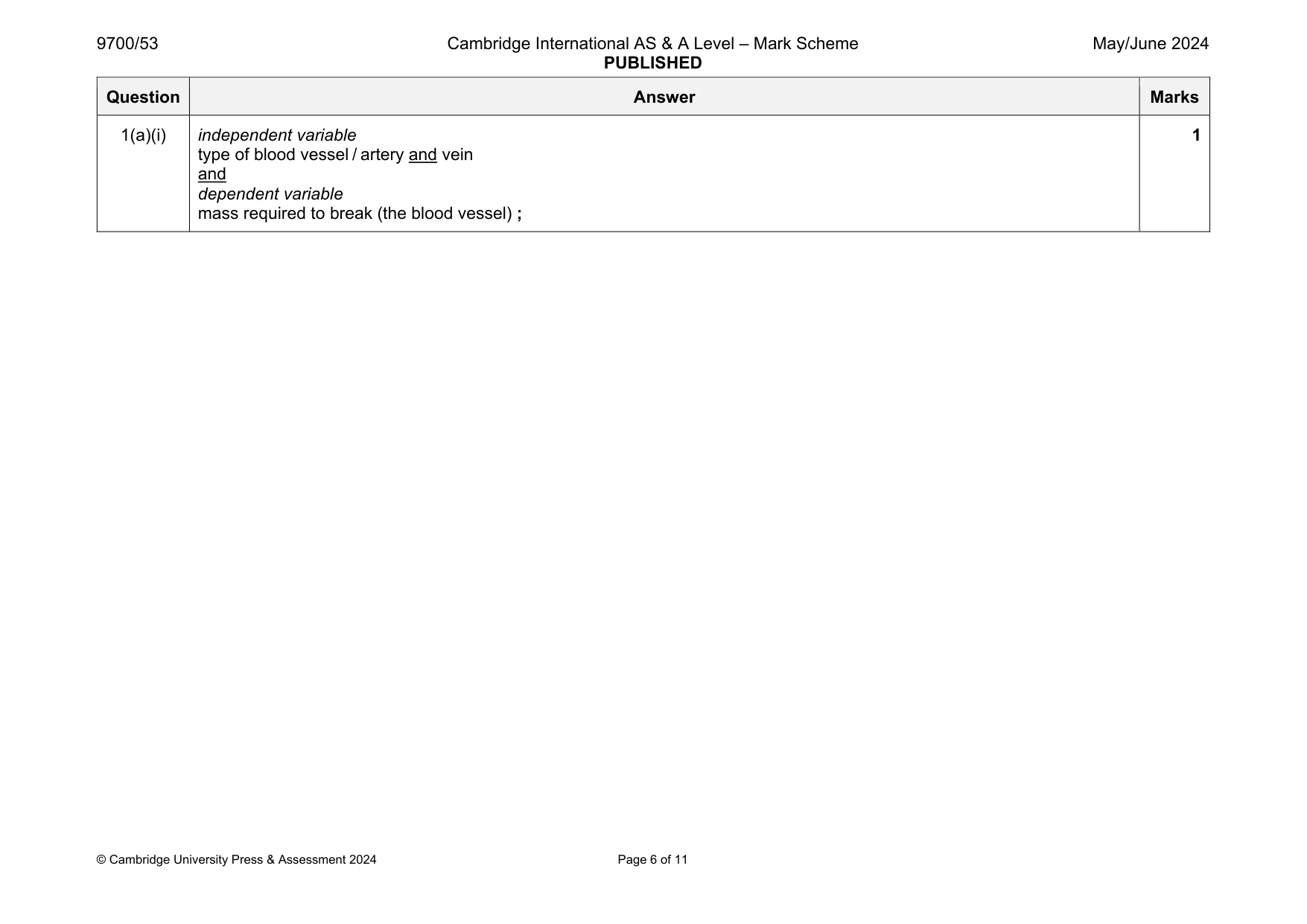
9700/53 Cambridge International AS & A Level – Mark Scheme PUBLISHED May/June 2024 © Cambridge University Press & Assessment 2024 Page 6 of 11 Question Answer Marks 1(a)(i) independent variable type of blood vessel / artery and vein and dependent variable mass required to break (the blood vessel) ; 1
Mark scheme, page 7
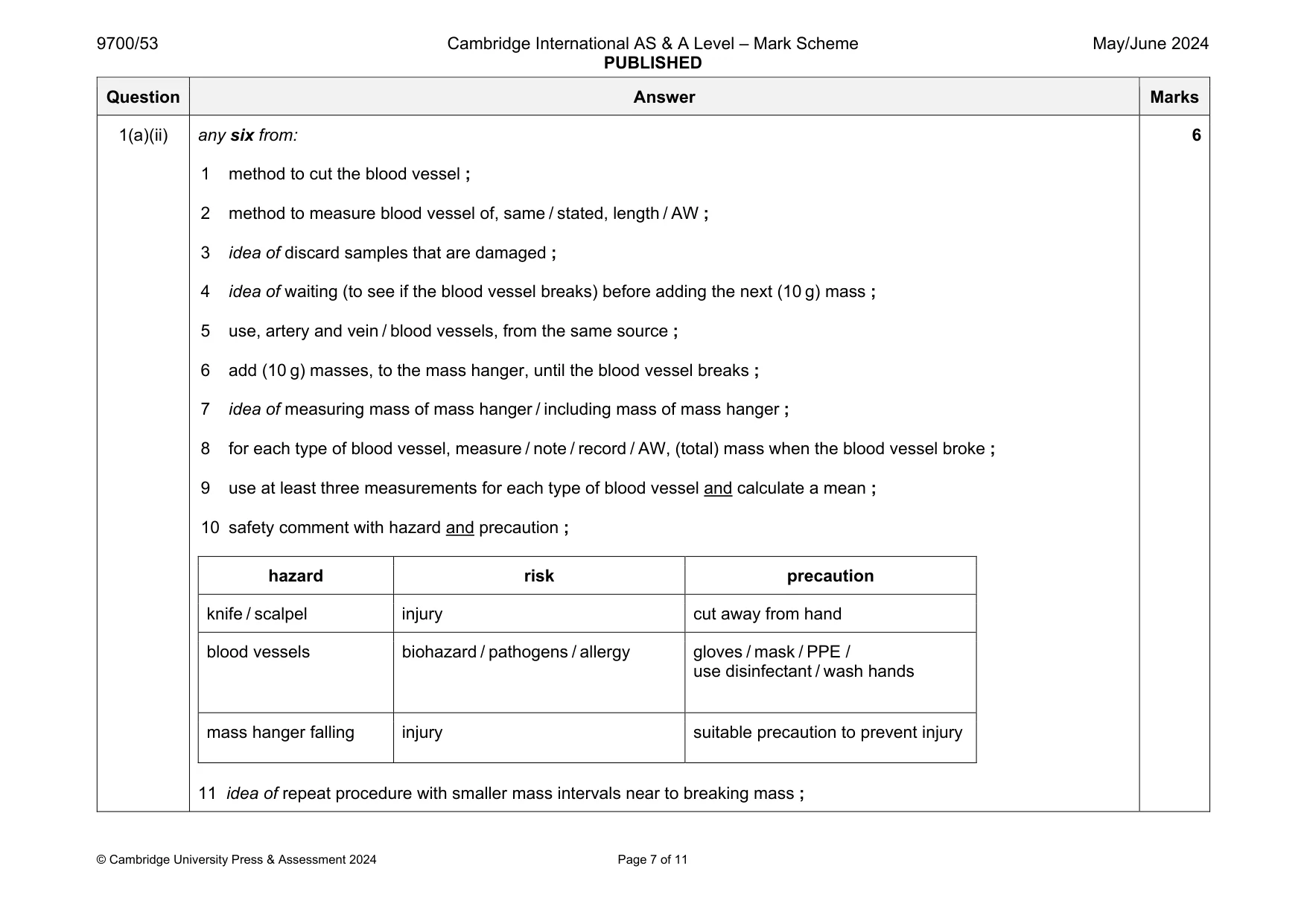
9700/53 Cambridge International AS & A Level – Mark Scheme PUBLISHED May/June 2024 © Cambridge University Press & Assessment 2024 Page 7 of 11 Question Answer Marks 1(a)(ii) any six from: 1 method to cut the blood vessel ; 2 method to measure blood vessel of, same / stated, length / AW ; 3 idea of discard samples that are damaged ; 4 idea of waiting (to see if the blood vessel breaks) before adding the next (10 g) mass ; 5 use, artery and vein / blood vessels, from the same source ; 6 add (10 g) masses, to the mass hanger, until the blood vessel breaks ; 7 idea of measuring mass of mass hanger / including mass of mass hanger ; 8 for each type of blood vessel, measure / note / record / AW, (total) mass when the blood vessel broke ; 9 use at least three measurements for each type of blood vessel and calculate a mean ; 10 safety comment with hazard and precaution ; hazard risk precaution knife / scalpel injury cut away from hand blood vessels biohazard / pathogens / allergy gloves / mask / PPE / use disinfectant / wash hands mass hanger falling injury suitable precaution to prevent injury 11 idea of repeat procedure with smaller mass intervals near to breaking mass ; 6
Mark scheme, page 8
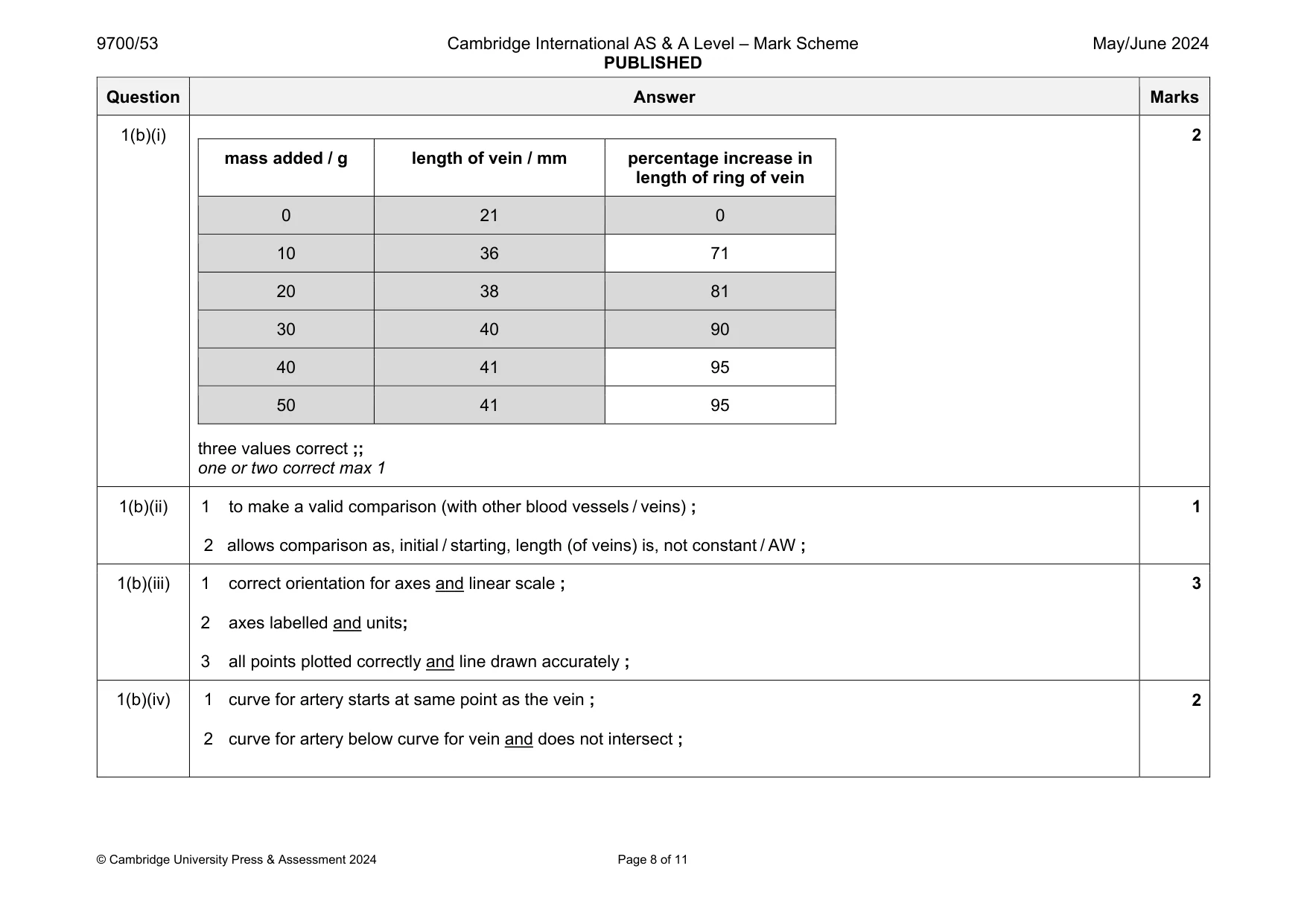
9700/53 Cambridge International AS & A Level – Mark Scheme PUBLISHED May/June 2024 © Cambridge University Press & Assessment 2024 Page 8 of 11 Question Answer Marks 1(b)(i) three values correct ;; one or two correct max 1 mass added / g length of vein / mm percentage increase in length of ring of vein 0 21 0 10 36 71 20 38 81 30 40 90 40 41 95 50 41 95 2 1(b)(ii) 1 to make a valid comparison (with other blood vessels / veins) ; 2 allows comparison as, initial / starting, length (of veins) is, not constant / AW ; 1 1(b)(iii) 1 correct orientation for axes and linear scale ; 2 axes labelled and units; 3 all points plotted correctly and line drawn accurately ; 3 1(b)(iv) 1 curve for artery starts at same point as the vein ; 2 curve for artery below curve for vein and does not intersect ; 2
Mark scheme, page 9
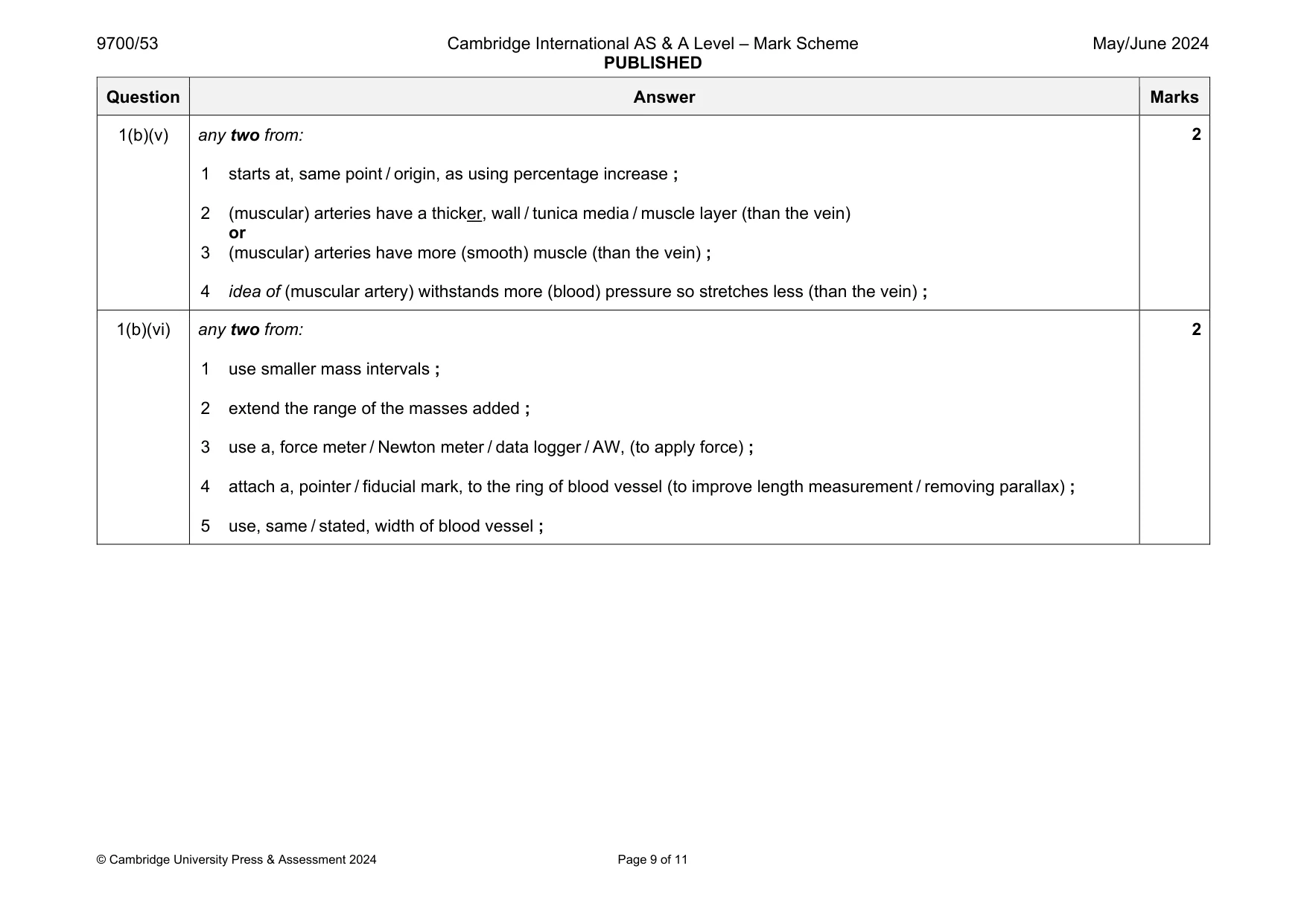
9700/53 Cambridge International AS & A Level – Mark Scheme PUBLISHED May/June 2024 © Cambridge University Press & Assessment 2024 Page 9 of 11 Question Answer Marks 1(b)(v) any two from: 1 starts at, same point / origin, as using percentage increase ; 2 (muscular) arteries have a thicker, wall / tunica media / muscle layer (than the vein) or 3 (muscular) arteries have more (smooth) muscle (than the vein) ; 4 idea of (muscular artery) withstands more (blood) pressure so stretches less (than the vein) ; 2 1(b)(vi) any two from: 1 use smaller mass intervals ; 2 extend the range of the masses added ; 3 use a, force meter / Newton meter / data logger / AW, (to apply force) ; 4 attach a, pointer / fiducial mark, to the ring of blood vessel (to improve length measurement / removing parallax) ; 5 use, same / stated, width of blood vessel ; 2
Mark scheme, page 10
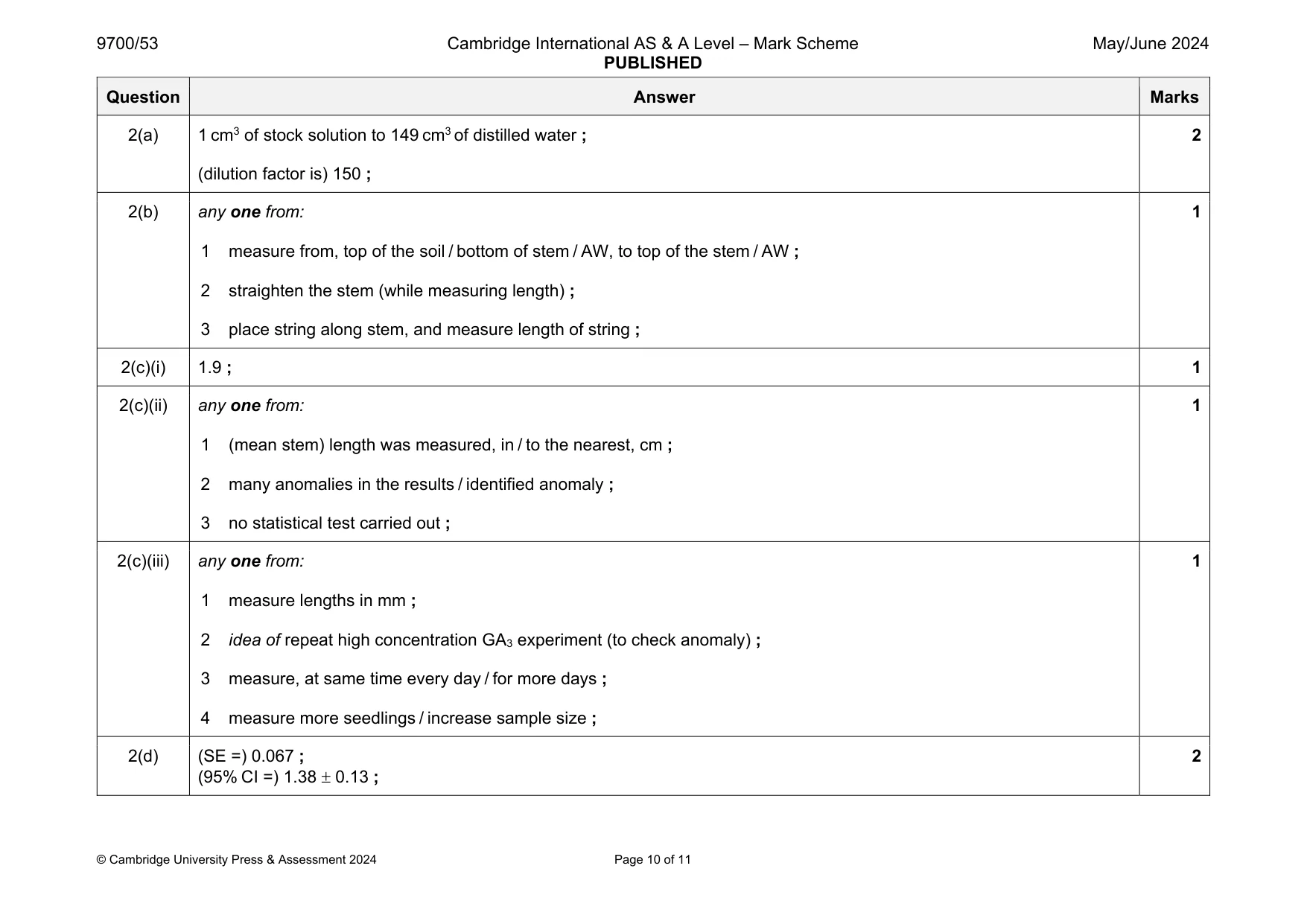
9700/53 Cambridge International AS & A Level – Mark Scheme PUBLISHED May/June 2024 © Cambridge University Press & Assessment 2024 Page 10 of 11 Question Answer Marks 2(a) 1 cm3 of stock solution to 149 cm3 of distilled water ; (dilution factor is) 150 ; 2 2(b) any one from: 1 measure from, top of the soil / bottom of stem / AW, to top of the stem / AW ; 2 straighten the stem (while measuring length) ; 3 place string along stem, and measure length of string ; 1 2(c)(i) 1.9 ; 1 2(c)(ii) any one from: 1 (mean stem) length was measured, in / to the nearest, cm ; 2 many anomalies in the results / identified anomaly ; 3 no statistical test carried out ; 1 2(c)(iii) any one from: 1 measure lengths in mm ; 2 idea of repeat high concentration GA3 experiment (to check anomaly) ; 3 measure, at same time every day / for more days ; 4 measure more seedlings / increase sample size ; 1 2(d) (SE =) 0.067 ; (95% CI =) 1.38 0.13 ; 2
Mark scheme, page 11
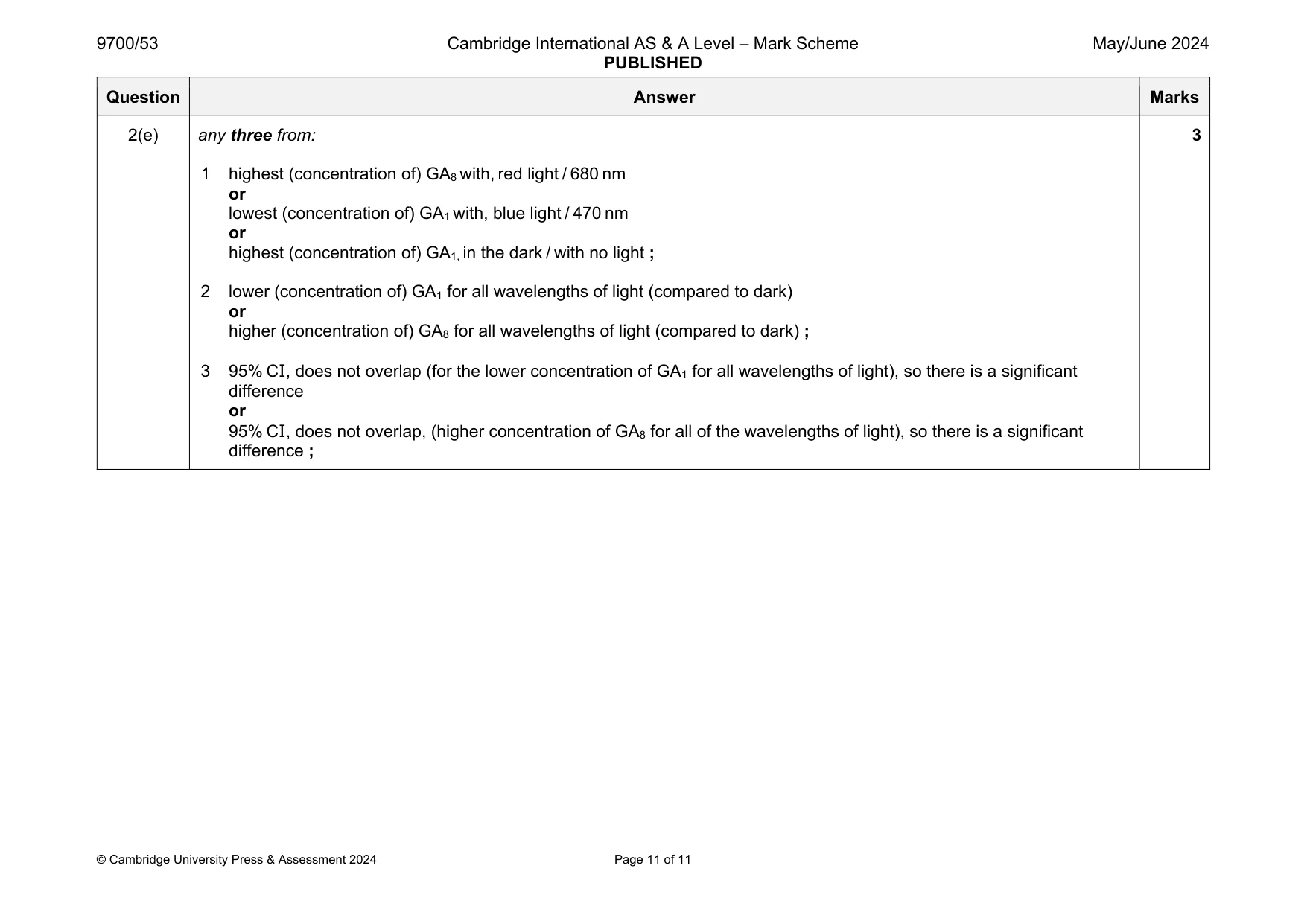
9700/53 Cambridge International AS & A Level – Mark Scheme PUBLISHED May/June 2024 © Cambridge University Press & Assessment 2024 Page 11 of 11 Question Answer Marks 2(e) any three from: 1 highest (concentration of) GA8 with, red light / 680 nm or lowest (concentration of) GA1 with, blue light / 470 nm or highest (concentration of) GA1, in the dark / with no light ; 2 lower (concentration of) GA1 for all wavelengths of light (compared to dark) or higher (concentration of) GA8 for all wavelengths of light (compared to dark) ; 3 95% CI, does not overlap (for the lower concentration of GA1 for all wavelengths of light), so there is a significant difference or 95% CI, does not overlap, (higher concentration of GA8 for all of the wavelengths of light), so there is a significant difference ; 3
What you needed in this session
Cambridge’s own grade thresholds for 2024 May/June, Paper 5 · Variant 3. A higher threshold means an easier paper — the bar moves with how the cohort did.