Cambridge A Level Biology 9700 — 2023 May/June Paper 4 · Variant 3
9700/43/M/J/23 · 10 questions · 100 marks · ≈113 min
The question paper and its mark scheme, free to read here and free to download. This is Cambridge’s own paper, exactly as it was sat.
Question paper28 pages




Mark scheme24 pages
Answers below. Sit the paper first if you are practising.
Questions as text
Q1 · The Krebs cycle was named after the biochemist Sir Hans Krebs, who worked out the…
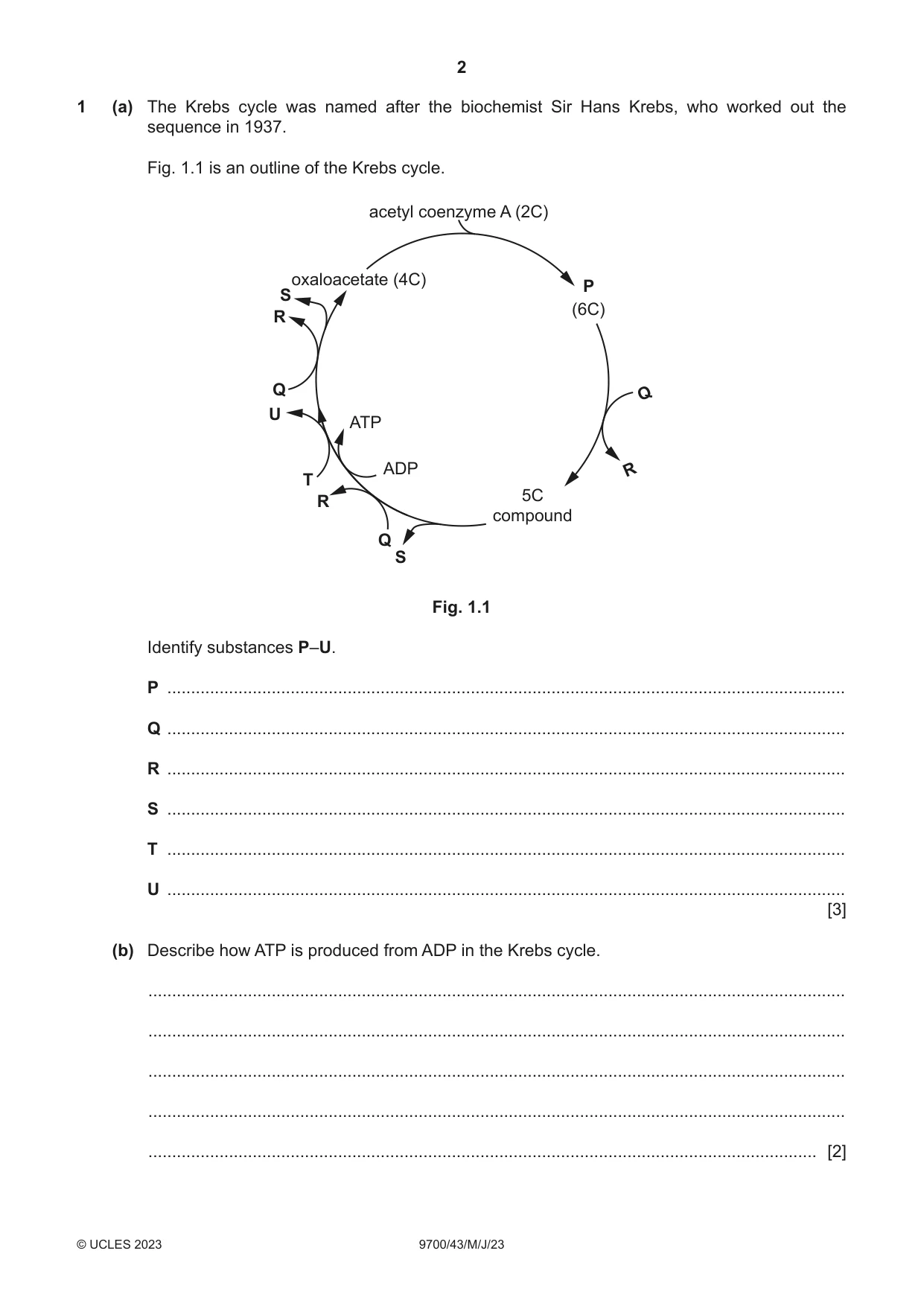
1 (a) The Krebs cycle was named after the biochemist Sir Hans Krebs, who worked out the sequence in 1937. Fig. 1.1 is an outline of the Krebs cycle. acetyl coenzyme A (2C) oxaloacetate (4C) P S (6C) R Q Q U ATP ADP R T 5C R compound Q S Fig. 1.1 Identify substances P–U. P ............................................................................................................................................... Q ............................................................................................................................................... R ............................................................................................................................................... S ............................................................................................................................................... T ............................................................................................................................................... U ............................................................................................................................................... [3] (b) Describe how ATP is produced from ADP in the Krebs cycle. ................................................................................................................................................... ................................................................................................................................................... ................................................................................................................................................... ................................................................................................................................................... ............................................................................................................................................. [2] (c) Describe and explain the features of ATP that make it suitable as the universal energy currency. ................................................................................................................................................... ................................................................................................................................................... ................................................................................................................................................... ................................................................................................................................................... ................................................................................................................................................... ................................................................................................................................................... ................................................................................................................................................... ................................................................................................................................................... ............................................................................................................................................. [4] [Total: 9]
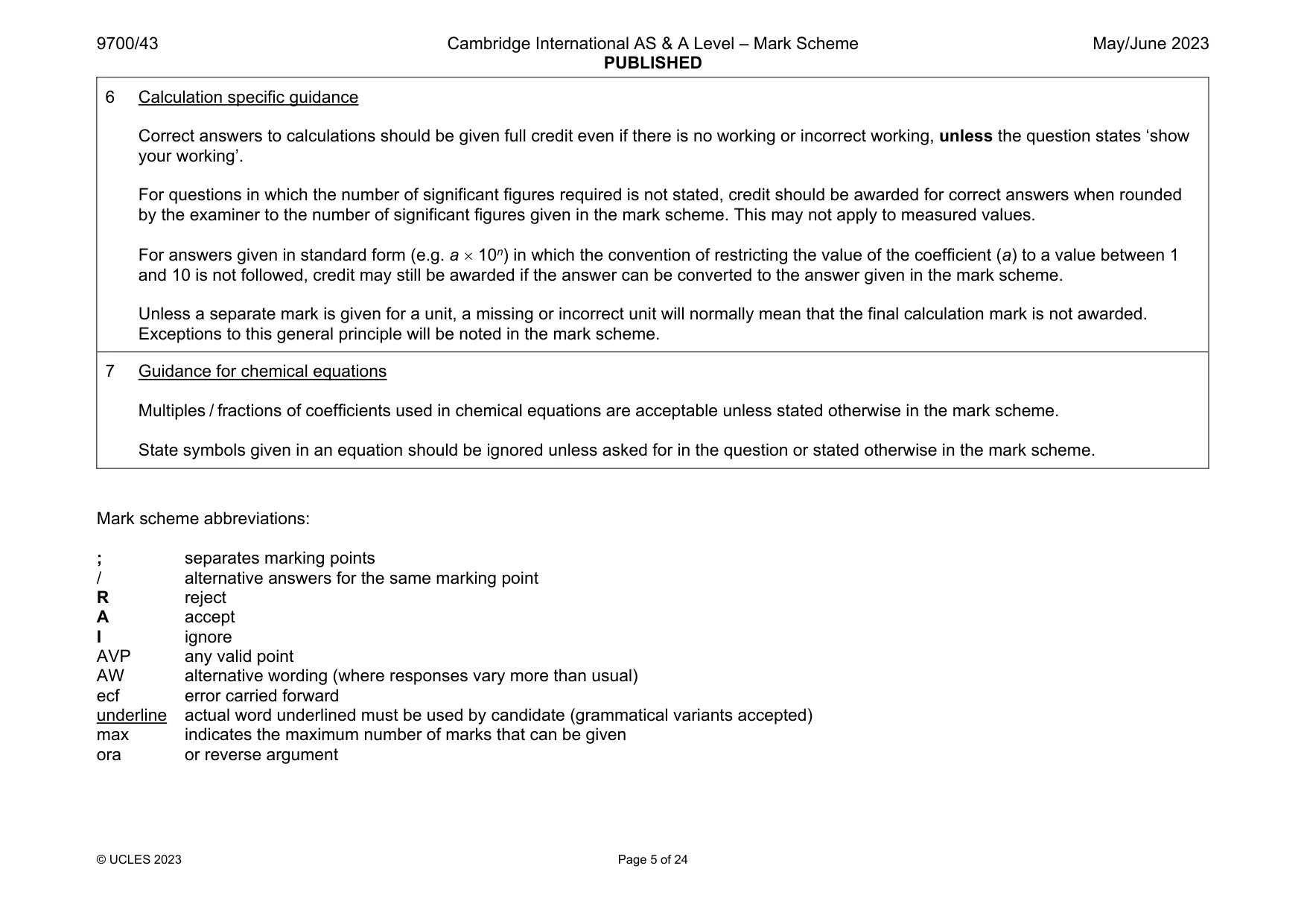
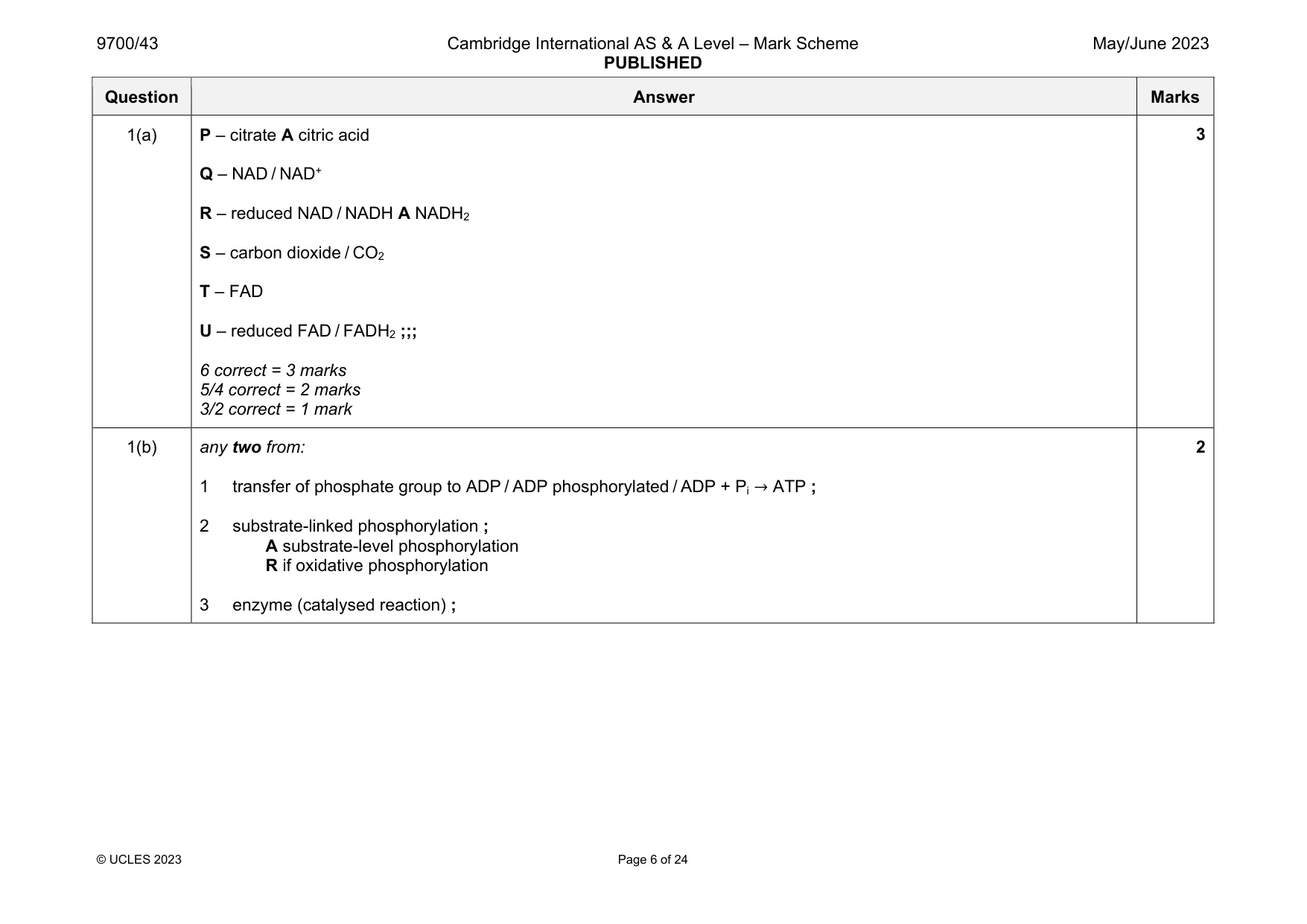
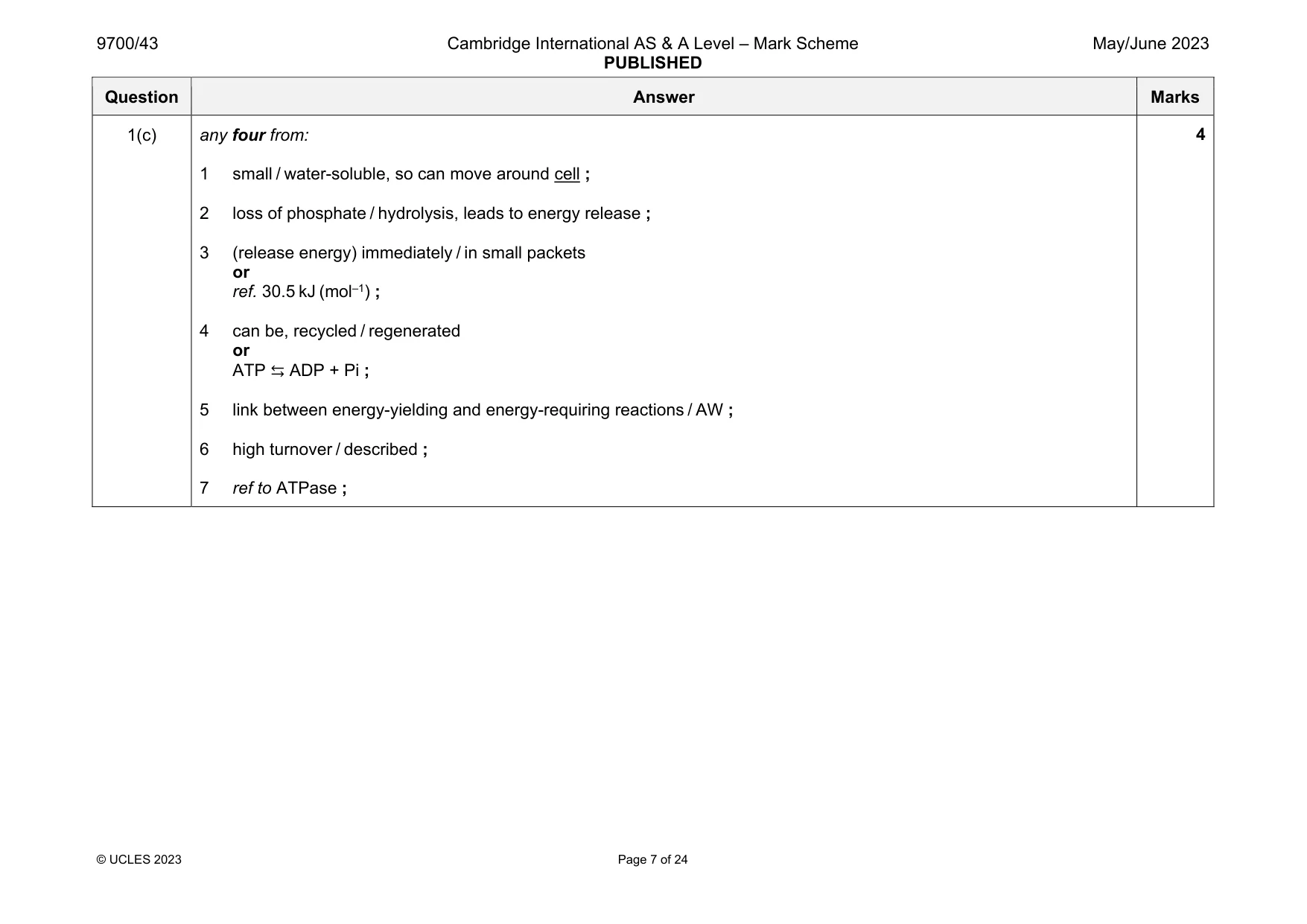
Mark scheme: 1(a) P – citrate A citric acid Q – NAD / NAD+ R – reduced NAD / NADH A NADH2 S – carbon dioxide / CO2 T – FAD U – reduced FAD / FADH2 ;;; 6 correct = 3 marks 5/4 correct = 2 marks 3/2 correct = 1 mark 1(b) any two from: 1 transfer of phosphate group to ADP / ADP phosphorylated / ADP + Pi → ATP ; 2 substrate-linked phosphorylation ; A substrate-level phosphorylation R if oxidative phosphorylation 3 enzyme (catalysed reaction) ; 2 Question Answer Marks 1(c) any four from: 1 small / water-soluble, so can move around cell ; 2 loss of phosphate / hydrolysis, leads to energy release ; 3 (release energy) immediately / in small packets or ref. 30.5 kJ (mol–1) ; 4 can be, recycled / regenerated or ATP ⇆ ADP + Pi ; 5 link between energy-yielding and energy-requiring reactions / AW ; 6 high turnover / described ; 7 ref to ATPase ; 4
Q2 · Humans use antibiotics to treat bacterial infections
2 Humans use antibiotics to treat bacterial infections. The increased use of antibiotics has led to an increase in the number of strains of bacteria that are resistant to antibiotics. The evolution of antibiotic resistance in bacteria has resulted from natural selection. Outline how bacteria become resistant to antibiotics. .......................................................................................................................................................... .......................................................................................................................................................... .......................................................................................................................................................... .......................................................................................................................................................... .......................................................................................................................................................... .......................................................................................................................................................... .......................................................................................................................................................... .......................................................................................................................................................... .......................................................................................................................................................... .......................................................................................................................................................... .......................................................................................................................................................... .......................................................................................................................................................... .......................................................................................................................................................... .......................................................................................................................................................... [Total: 7]
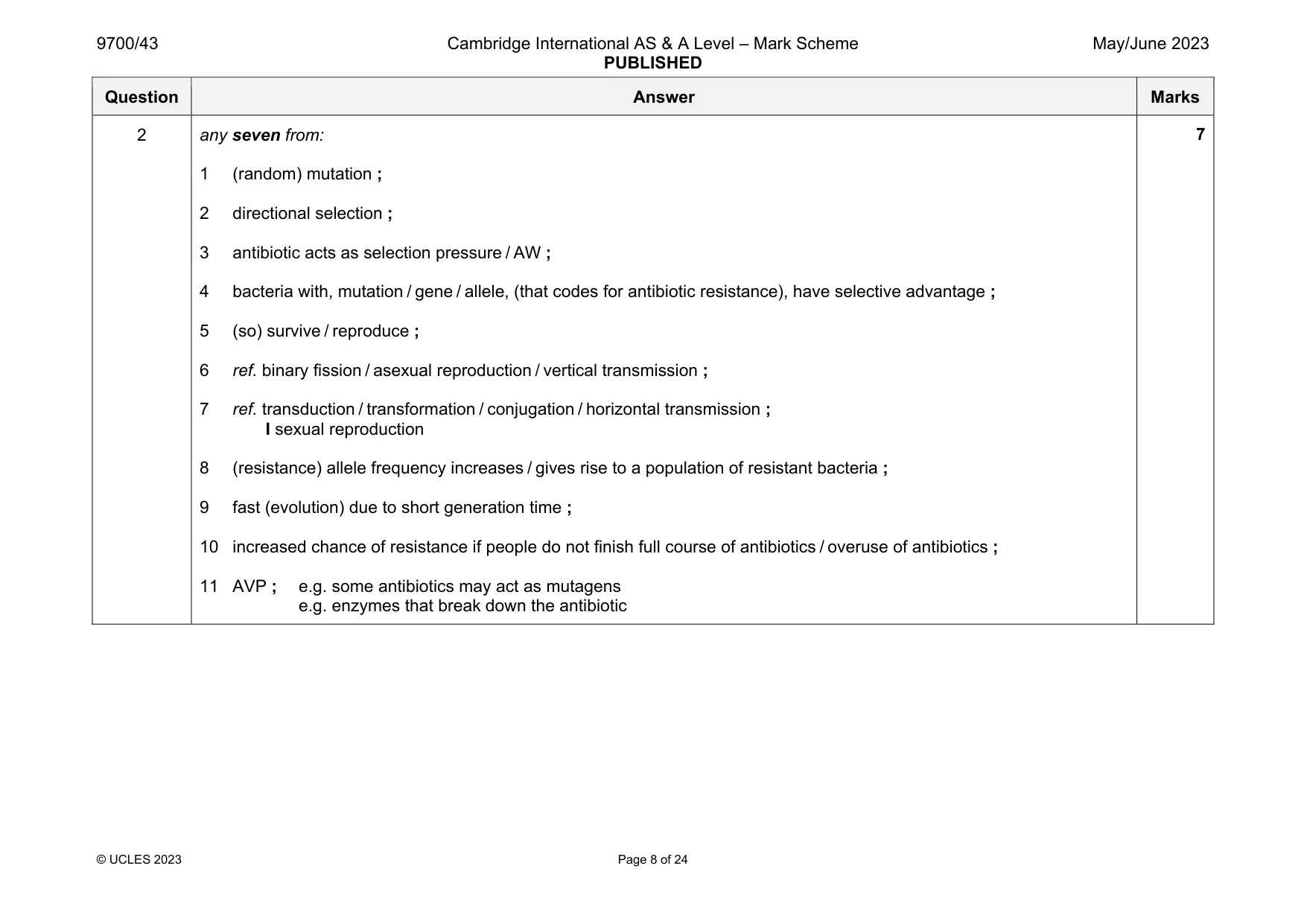
Mark scheme: 2 any seven from: 1 (random) mutation ; 2 directional selection ; 3 antibiotic acts as selection pressure / AW ; 4 bacteria with, mutation / gene / allele, (that codes for antibiotic resistance), have selective advantage ; 5 (so) survive / reproduce ; 6 ref. binary fission / asexual reproduction / vertical transmission ; 7 ref. transduction / transformation / conjugation / horizontal transmission ; I sexual reproduction 8 (resistance) allele frequency increases / gives rise to a population of resistant bacteria ; 9 fast (evolution) due to short generation time ; 10 increased chance of resistance if people do not finish full course of antibiotics / overuse of antibiotics ; 11 AVP ; e.g. some antibiotics may act as mutagens e.g. enzymes that break down the antibiotic
Q3 · Gene expression in a cell is controlled
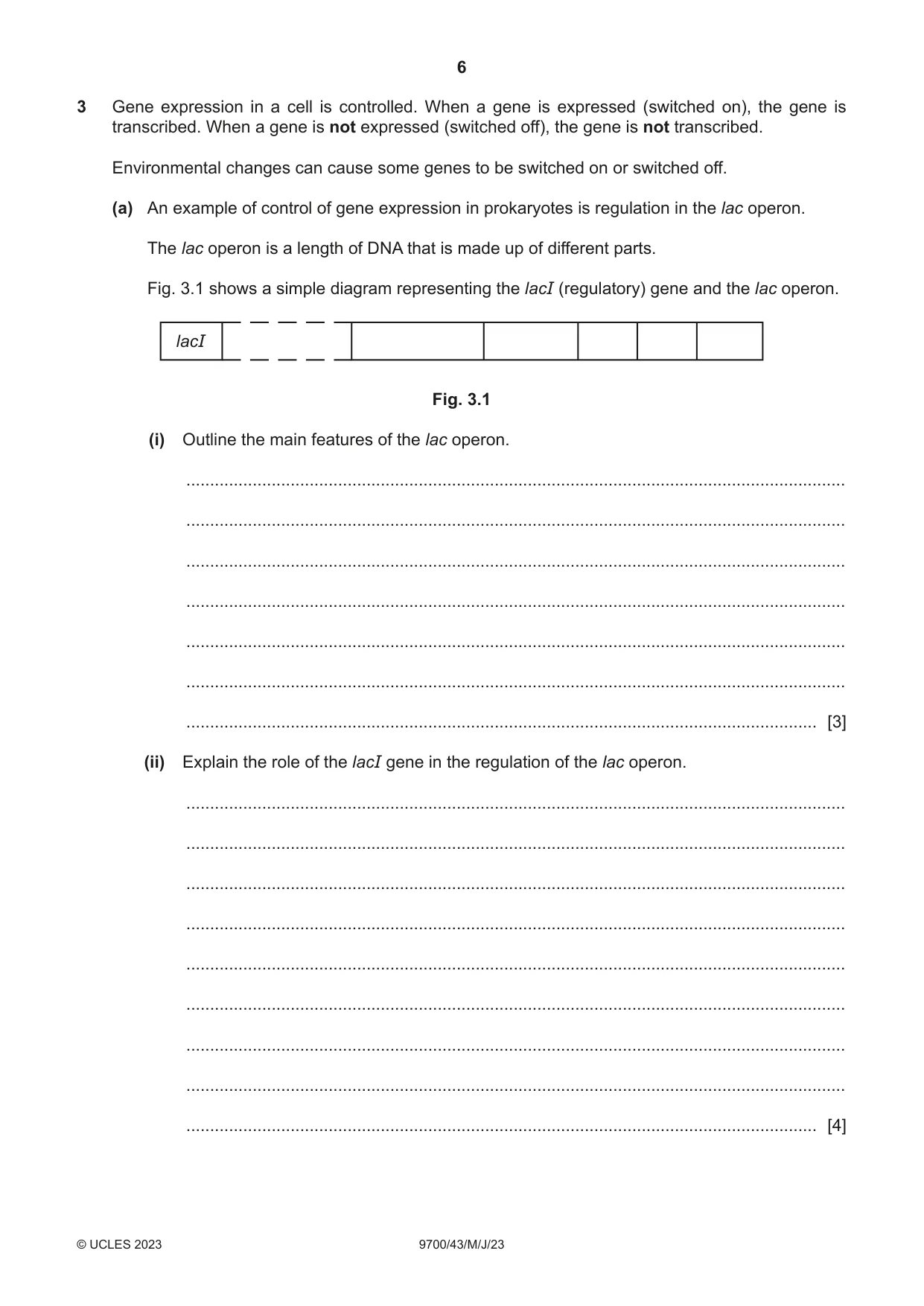
3 Gene expression in a cell is controlled. When a gene is expressed (switched on), the gene is transcribed. When a gene is not expressed (switched off), the gene is not transcribed. Environmental changes can cause some genes to be switched on or switched off. (a) An example of control of gene expression in prokaryotes is regulation in the lac operon. The lac operon is a length of DNA that is made up of different parts. Fig. 3.1 shows a simple diagram representing the lacI (regulatory) gene and the lac operon. lacI Fig. 3.1 (i) Outline the main features of the lac operon. ........................................................................................................................................... ........................................................................................................................................... ........................................................................................................................................... ........................................................................................................................................... ........................................................................................................................................... ........................................................................................................................................... ..................................................................................................................................... [3] (ii) Explain the role of the lacI gene in the regulation of the lac operon. ........................................................................................................................................... ........................................................................................................................................... ........................................................................................................................................... ........................................................................................................................................... ........................................................................................................................................... ........................................................................................................................................... ........................................................................................................................................... ........................................................................................................................................... ..................................................................................................................................... [4] (b) The lac operon codes for inducible enzymes. Repressible operons code for repressible enzymes. Suggest and explain why it is an advantage to a prokaryote to have a repressible operon. ................................................................................................................................................... ................................................................................................................................................... ................................................................................................................................................... ................................................................................................................................................... ................................................................................................................................................... ................................................................................................................................................... ............................................................................................................................................. [3] [Total: 10]
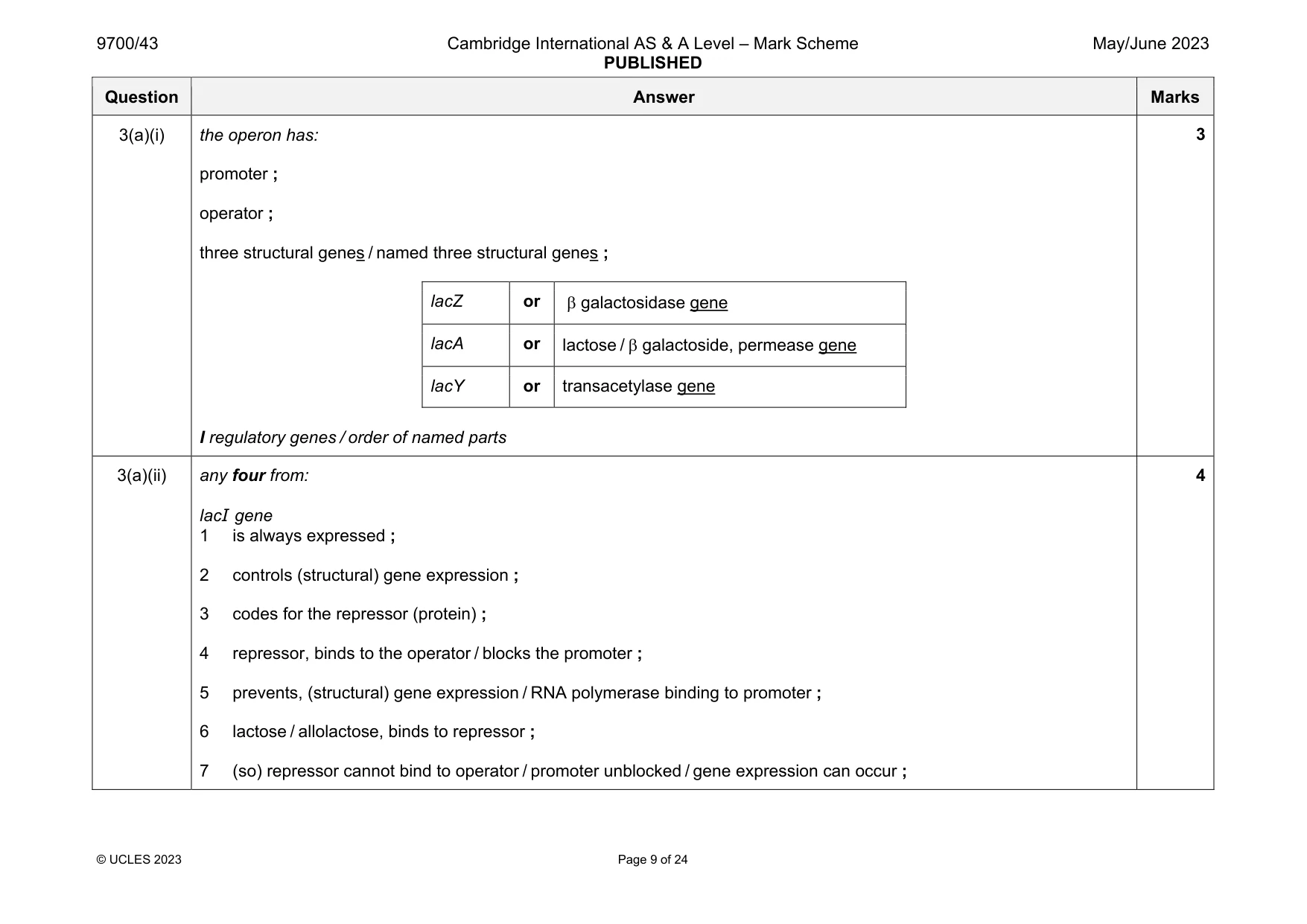
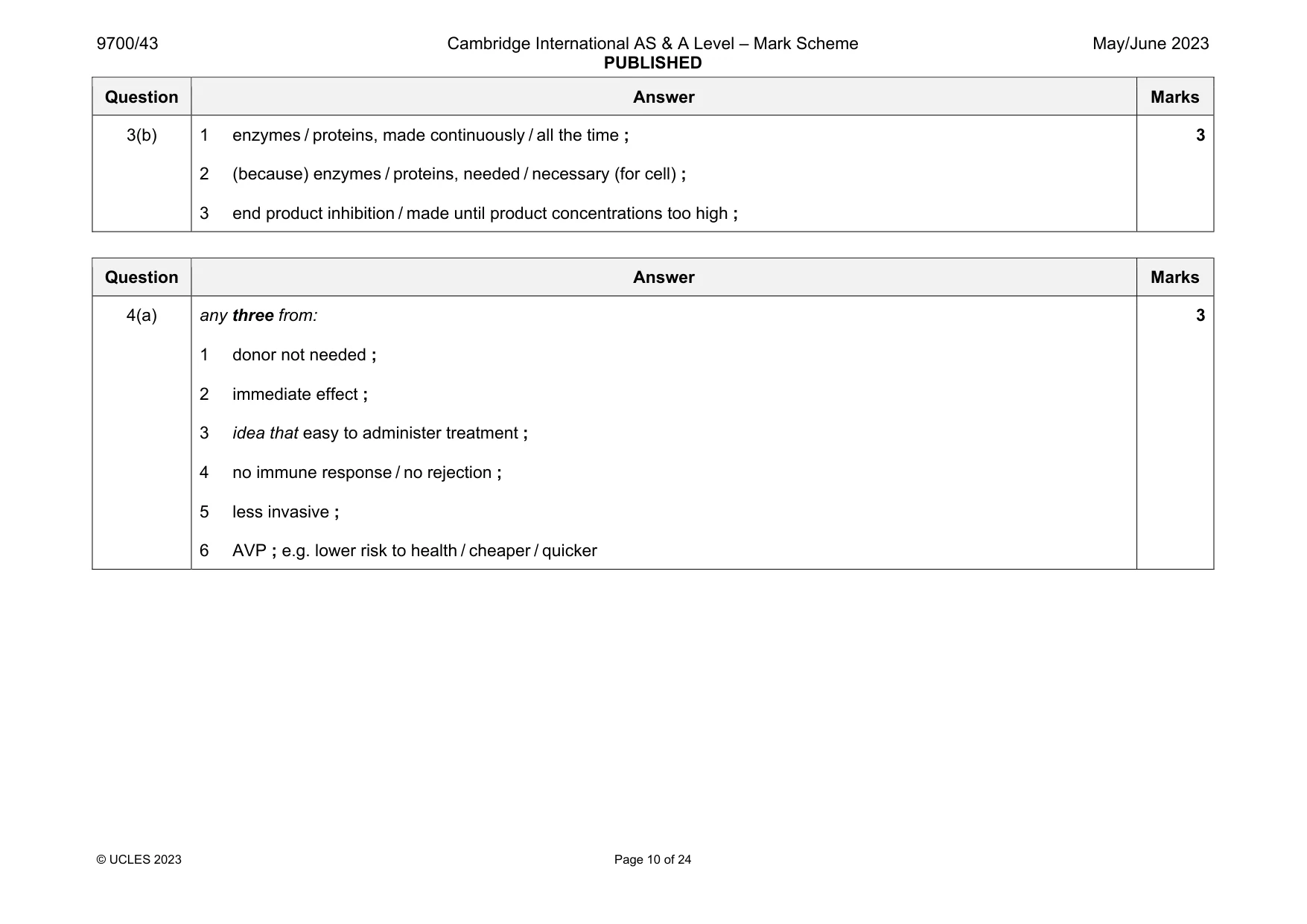
Mark scheme: 3(a)(i) the operon has: promoter ; operator ; three structural genes / named three structural genes ; lacZ or galactosidase gene lacA or lactose / galactoside, permease gene lacY or transacetylase gene I regulatory genes / order of named parts 3(a)(ii) any four from: lacI gene 1 is always expressed ; 2 controls (structural) gene expression ; 3 codes for the repressor (protein) ; 4 repressor, binds to the operator / blocks the promoter ; 5 prevents, (structural) gene expression / RNA polymerase binding to promoter ; 6 lactose / allolactose, binds to repressor ; 7 (so) repressor cannot bind to operator / promoter unblocked / gene expression can occur ; 4 Question Answer Marks 3(b) 1 enzymes / proteins, made continuously / all the time ; 2 (because) enzymes / proteins, needed / necessary (for cell) ; 3 end product inhibition / made until product concentrations too high ; 3
Q4 · One cause of the genetic disease severe combined immunodeficiency (SCID) is a mutation in…
4 One cause of the genetic disease severe combined immunodeficiency (SCID) is a mutation in the ADA gene. This mutation results in a deficiency of the enzyme adenosine deaminase (ADA). Although ADA is found throughout the body, it is especially active in lymphocytes. The absence of functional ADA causes the build-up of toxic metabolites that kill lymphocytes and damage organs. Babies are often diagnosed with SCID by six months old. Treatment can greatly improve the life expectancy of children with SCID. Some treatment options are available. • Enzyme replacement therapy with recombinant human ADA made by genetically modified (GM) Escherichia coli. Weekly intra-muscular injections are given. • Bone marrow transplant if a well-matched donor, such as a close relative, can be found. • Gene therapy. (a) Suggest and explain why it may be more appropriate to use enzyme replacement therapy to treat SCID instead of a bone marrow transplant. ................................................................................................................................................... ................................................................................................................................................... ................................................................................................................................................... ................................................................................................................................................... ................................................................................................................................................... ................................................................................................................................................... ................................................................................................................................................... ................................................................................................................................................... ............................................................................................................................................. [3] (b) Outline the procedure used for gene therapy treatment of a person with SCID. ................................................................................................................................................... ................................................................................................................................................... ................................................................................................................................................... ................................................................................................................................................... ................................................................................................................................................... ................................................................................................................................................... ................................................................................................................................................... ................................................................................................................................................... ............................................................................................................................................. [4] (c) Suggest the social and ethical implications of gene therapy for SCID that need to be considered before treatment is carried out. ................................................................................................................................................... ................................................................................................................................................... ................................................................................................................................................... ................................................................................................................................................... ................................................................................................................................................... ................................................................................................................................................... ............................................................................................................................................. [3] [Total: 10]
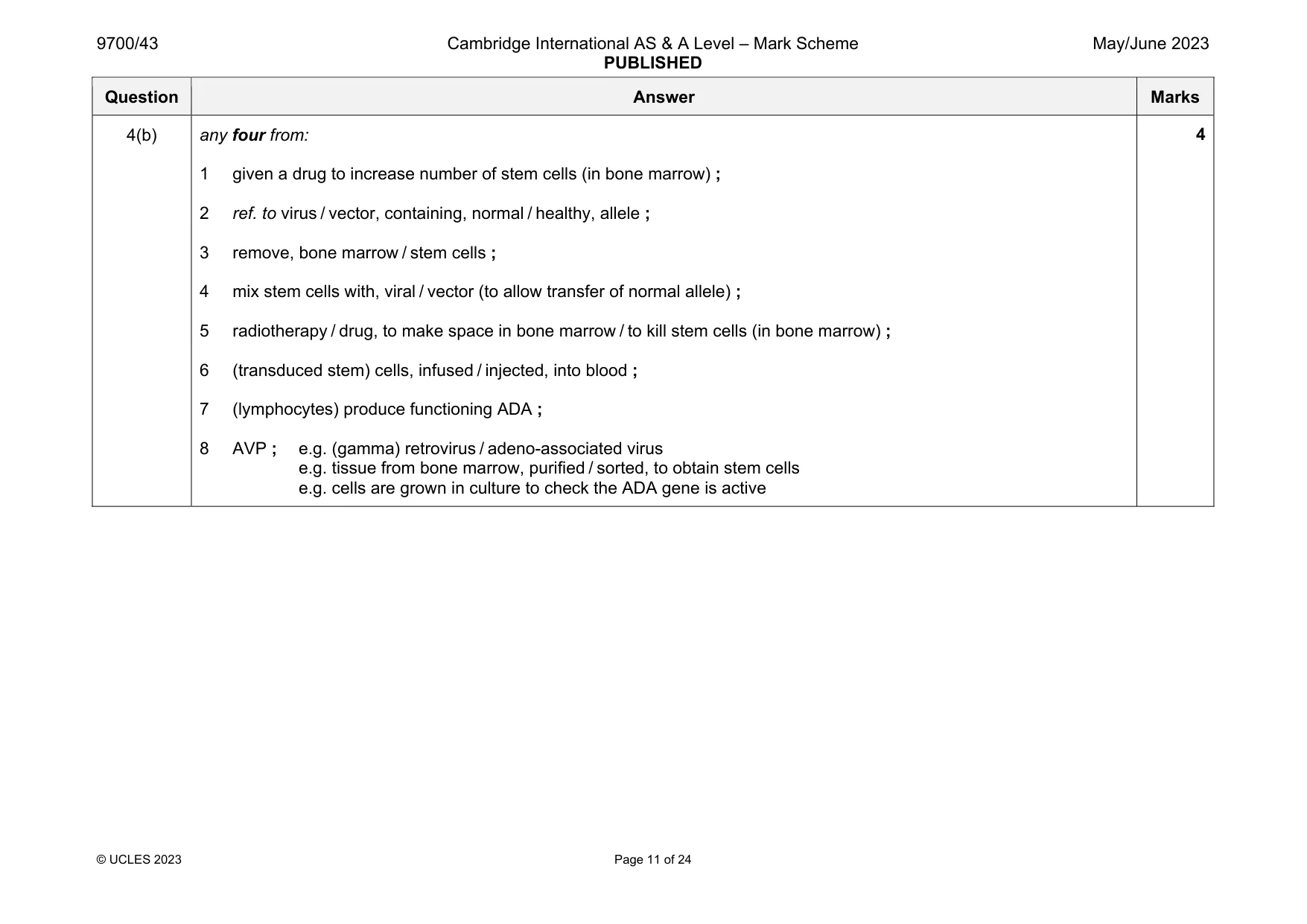
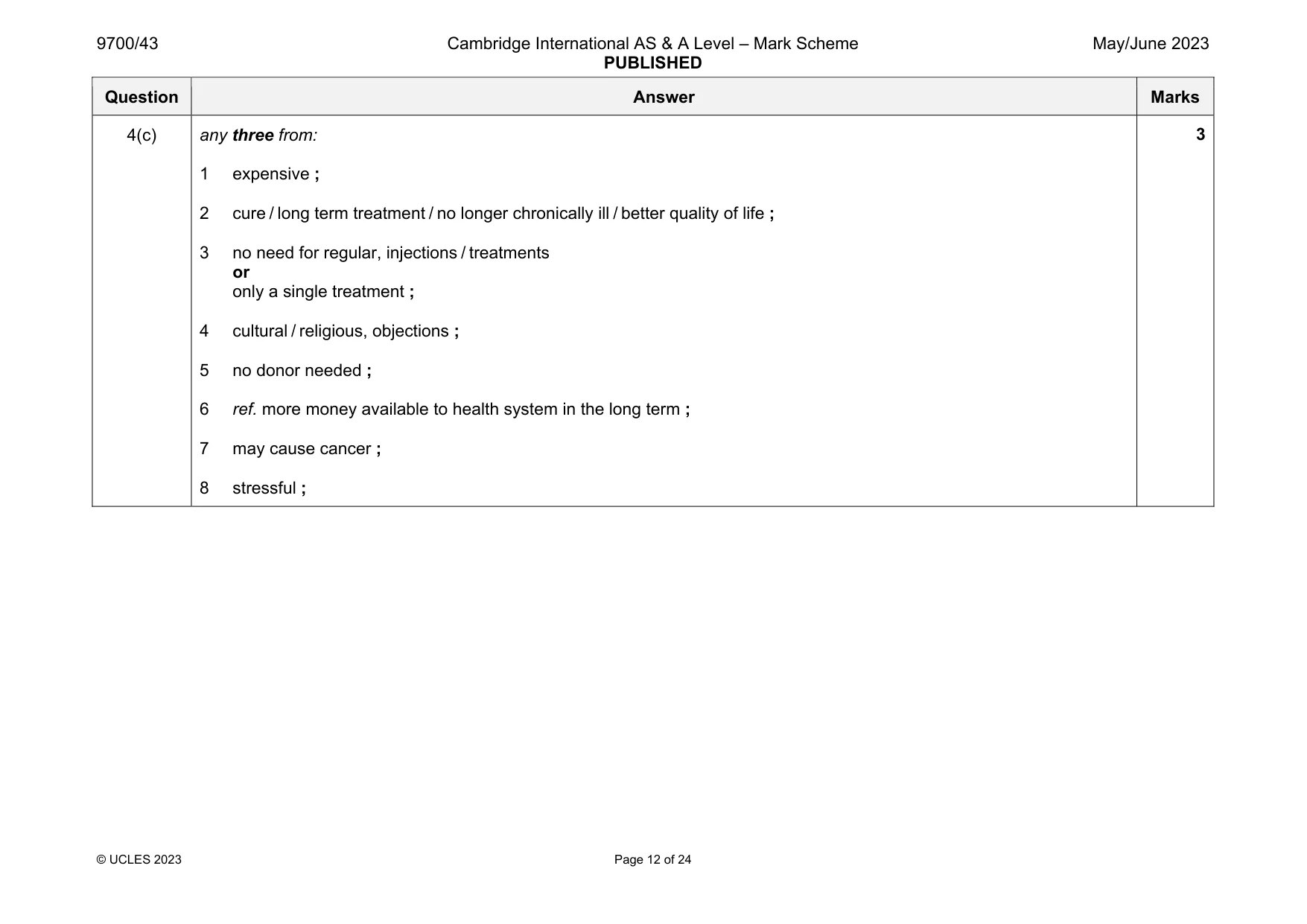
Mark scheme: 4(a) any three from: 1 donor not needed ; 2 immediate effect ; 3 idea that easy to administer treatment ; 4 no immune response / no rejection ; 5 less invasive ; 6 AVP ; e.g. lower risk to health / cheaper / quicker 3 Question Answer Marks 4(b) any four from: 1 given a drug to increase number of stem cells (in bone marrow) ; 2 ref. to virus / vector, containing, normal / healthy, allele ; 3 remove, bone marrow / stem cells ; 4 mix stem cells with, viral / vector (to allow transfer of normal allele) ; 5 radiotherapy / drug, to make space in bone marrow / to kill stem cells (in bone marrow) ; 6 (transduced stem) cells, infused / injected, into blood ; 7 (lymphocytes) produce functioning ADA ; 8 AVP ; e.g. (gamma) retrovirus / adeno-associated virus e.g. tissue from bone marrow, purified / sorted, to obtain stem cells e.g. cells are grown in culture to check the ADA gene is active 4 Question Answer Marks 4(c) any three from: 1 expensive ; 2 cure / long term treatment / no longer chronically ill / better quality of life ; 3 no need for regular, injections / treatments or only a single treatment ; 4 cultural / religious, objections ; 5 no donor needed ; 6 ref. more money available to health system in the long term ; 7 may cause cancer ; 8 stressful ; 3
Q5 · A freshwater fish species, Oryzias latipes, has individuals with four body colour…
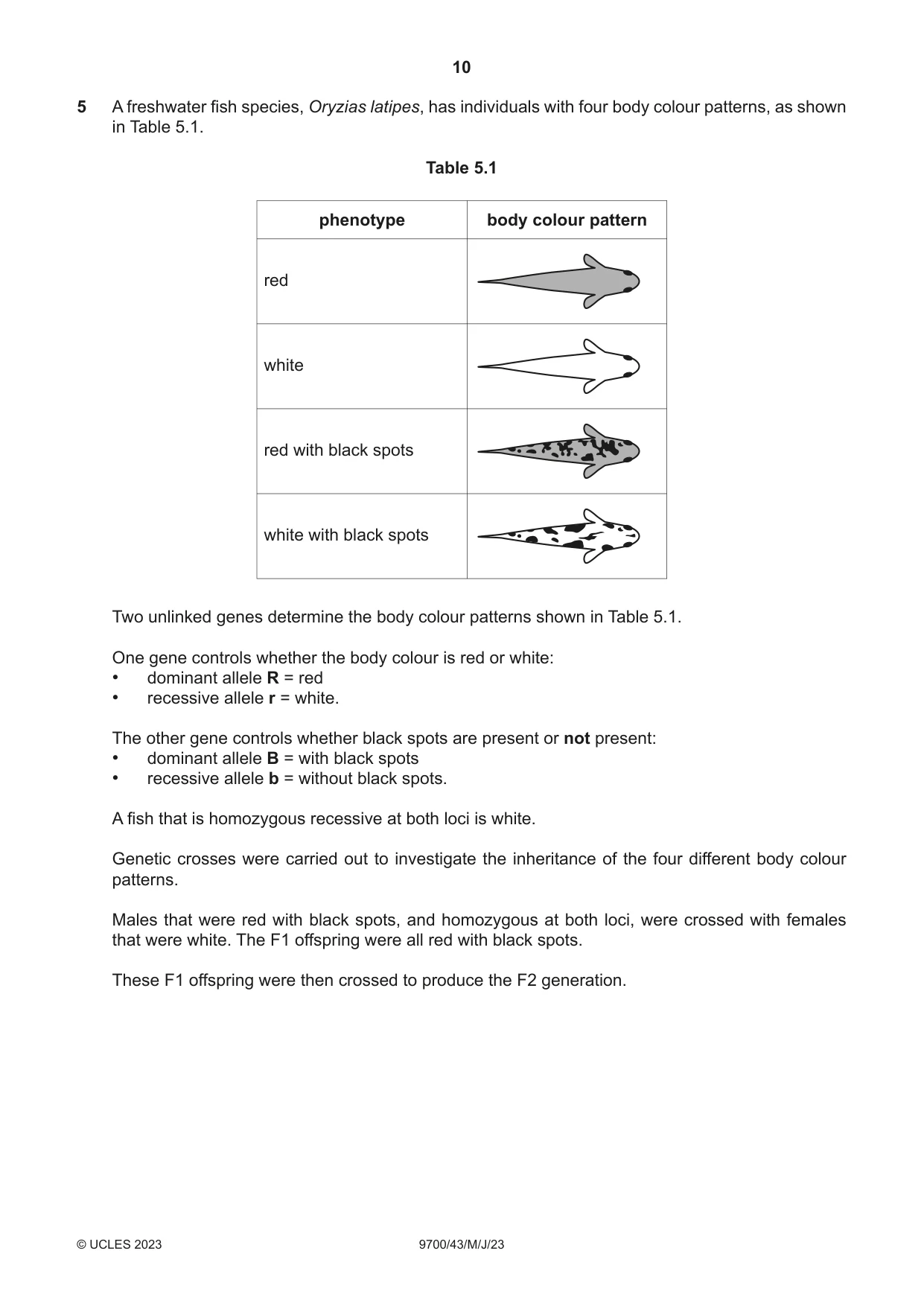
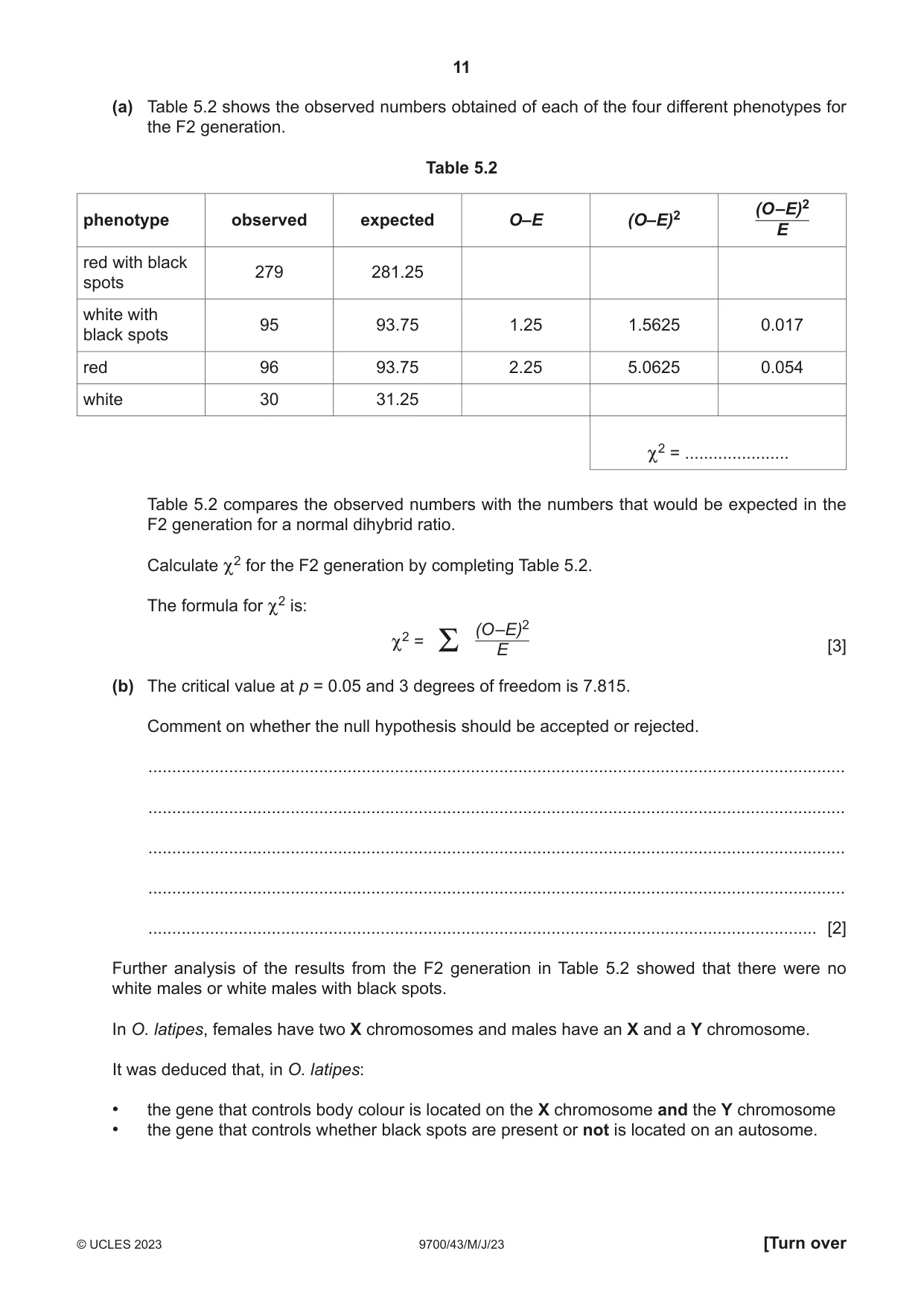
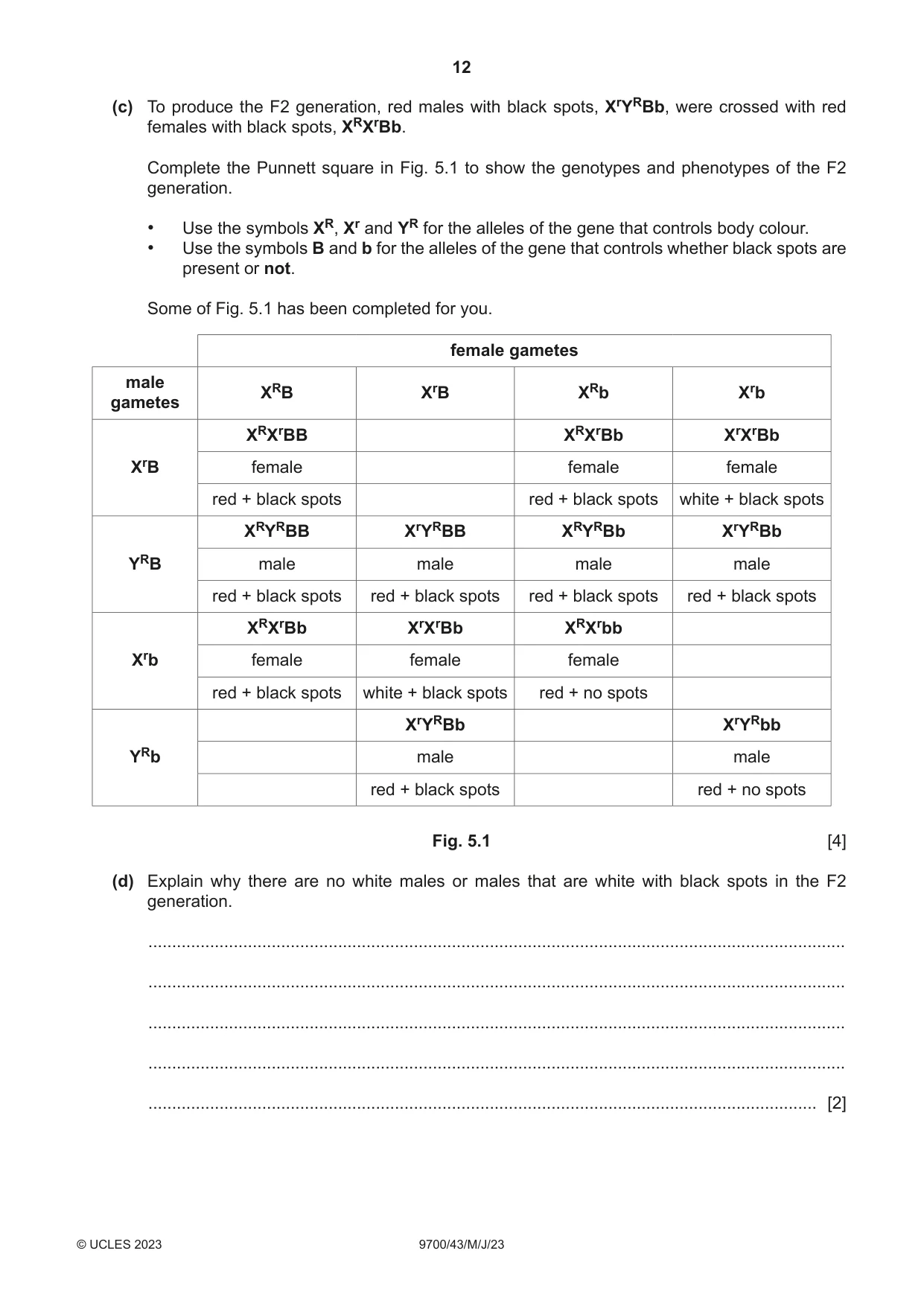
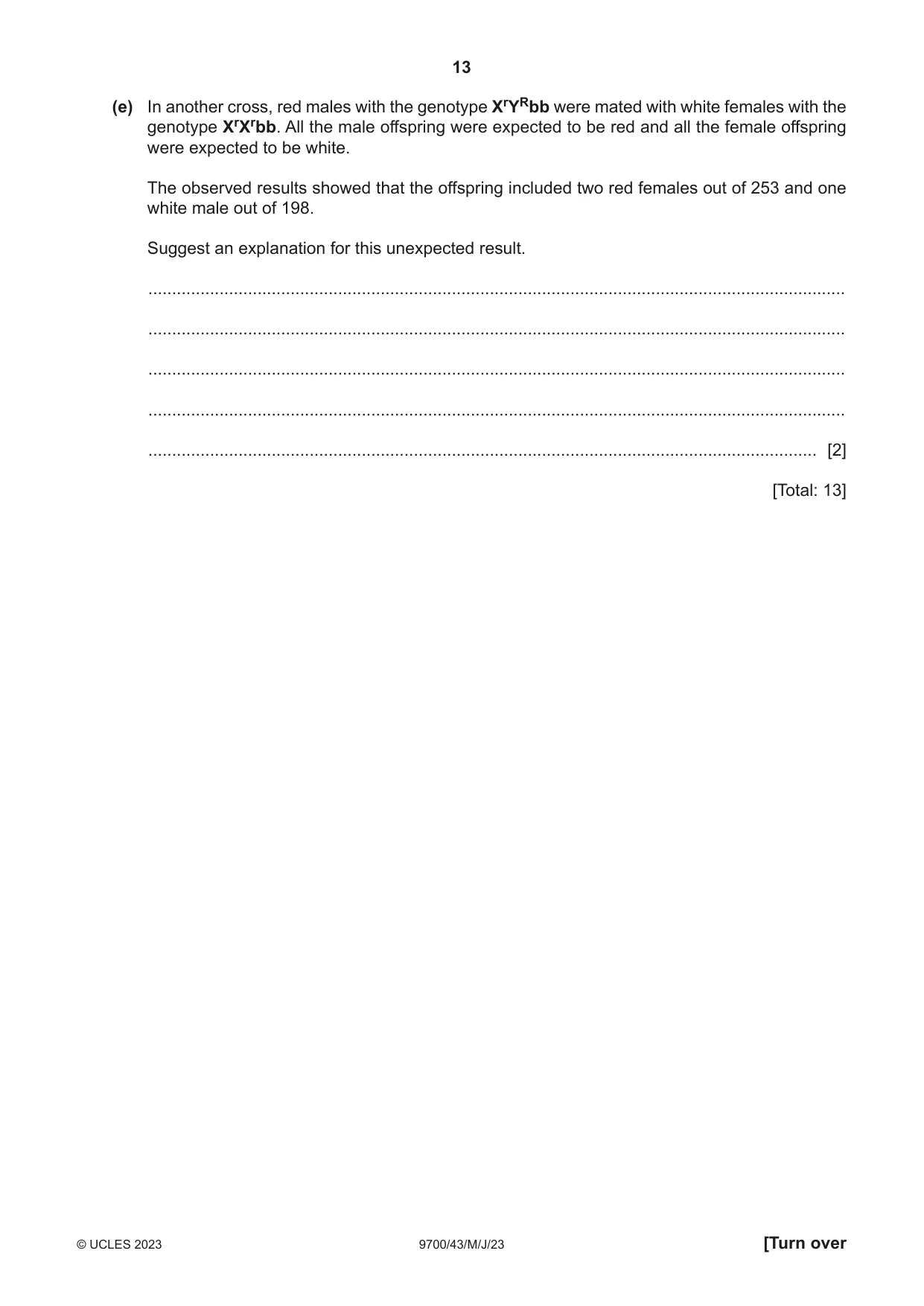
5 A freshwater fish species, Oryzias latipes, has individuals with four body colour patterns, as shown in Table 5.1. Table 5.1 phenotype body colour pattern red white red with black spots white with black spots Two unlinked genes determine the body colour patterns shown in Table 5.1. One gene controls whether the body colour is red or white: • dominant allele R = red • recessive allele r = white. The other gene controls whether black spots are present or not present: • dominant allele B = with black spots • recessive allele b = without black spots. A fish that is homozygous recessive at both loci is white. Genetic crosses were carried out to investigate the inheritance of the four different body colour patterns. Males that were red with black spots, and homozygous at both loci, were crossed with females that were white. The F1 offspring were all red with black spots. These F1 offspring were then crossed to produce the F2 generation. (a) Table 5.2 shows the observed numbers obtained of each of the four different phenotypes for the F2 generation. Table 5.2 (O –E)2phenotype observed expected O–E (O–E)2 E red with black 279 281.25spots white with 95 93.75 1.25 1.5625 0.017black spots red 96 93.75 2.25 5.0625 0.054 white 30 31.25 |2 = ...................... Table 5.2 compares the observed numbers with the numbers that would be expected in the F2 generation for a normal dihybrid ratio. Calculate |2 for the F2 generation by completing Table 5.2. The formula for |2 is: (O –E)2 |2 = Σ E [3] (b) The critical value at p = 0.05 and 3 degrees of freedom is 7.815. Comment on whether the null hypothesis should be accepted or rejected. ................................................................................................................................................... ................................................................................................................................................... ................................................................................................................................................... ................................................................................................................................................... ............................................................................................................................................. [2] Further analysis of the results from the F2 generation in Table 5.2 showed that there were no white males or white males with black spots. In O. latipes, females have two X chromosomes and males have an X and a Y chromosome. It was deduced that, in O. latipes: • the gene that controls body colour is located on the X chromosome and the Y chromosome • the gene that controls whether black spots are present or not is located on an autosome. (c) To produce the F2 generation, red males with black spots, XrYRBb, were crossed with red females with black spots, XRXrBb. Complete the Punnett square in Fig. 5.1 to show the genotypes and phenotypes of the F2 generation. • Use the symbols XR, Xr and YR for the alleles of the gene that controls body colour. • Use the symbols B and b for the alleles of the gene that controls whether black spots are present or not. Some of Fig. 5.1 has been completed for you. female gametes male XRB XrB XRb Xrbgametes XRXrBB XRXrBb XrXrBb XrB female female female red + black spots red + black spots white + black spots XRYRBB XrYRBB XRYRBb XrYRBb YRB male male male male red + black spots red + black spots red + black spots red + black spots XRXrBb XrXrBb XRXrbb Xrb female female female red + black spots white + black spots red + no spots XrYRBb XrYRbb YRb male male red + black spots red + no spots Fig. 5.1 [4] (d) Explain why there are no white males or males that are white with black spots in the F2 generation. ................................................................................................................................................... ................................................................................................................................................... ................................................................................................................................................... ................................................................................................................................................... ............................................................................................................................................. [2] (e) In another cross, red males with the genotype XrYRbb were mated with white females with the genotype XrXrbb. All the male offspring were expected to be red and all the female offspring were expected to be white. The observed results showed that the offspring included two red females out of 253 and one white male out of 198. Suggest an explanation for this unexpected result. ................................................................................................................................................... ................................................................................................................................................... ................................................................................................................................................... ................................................................................................................................................... ............................................................................................................................................. [2] [Total: 13]
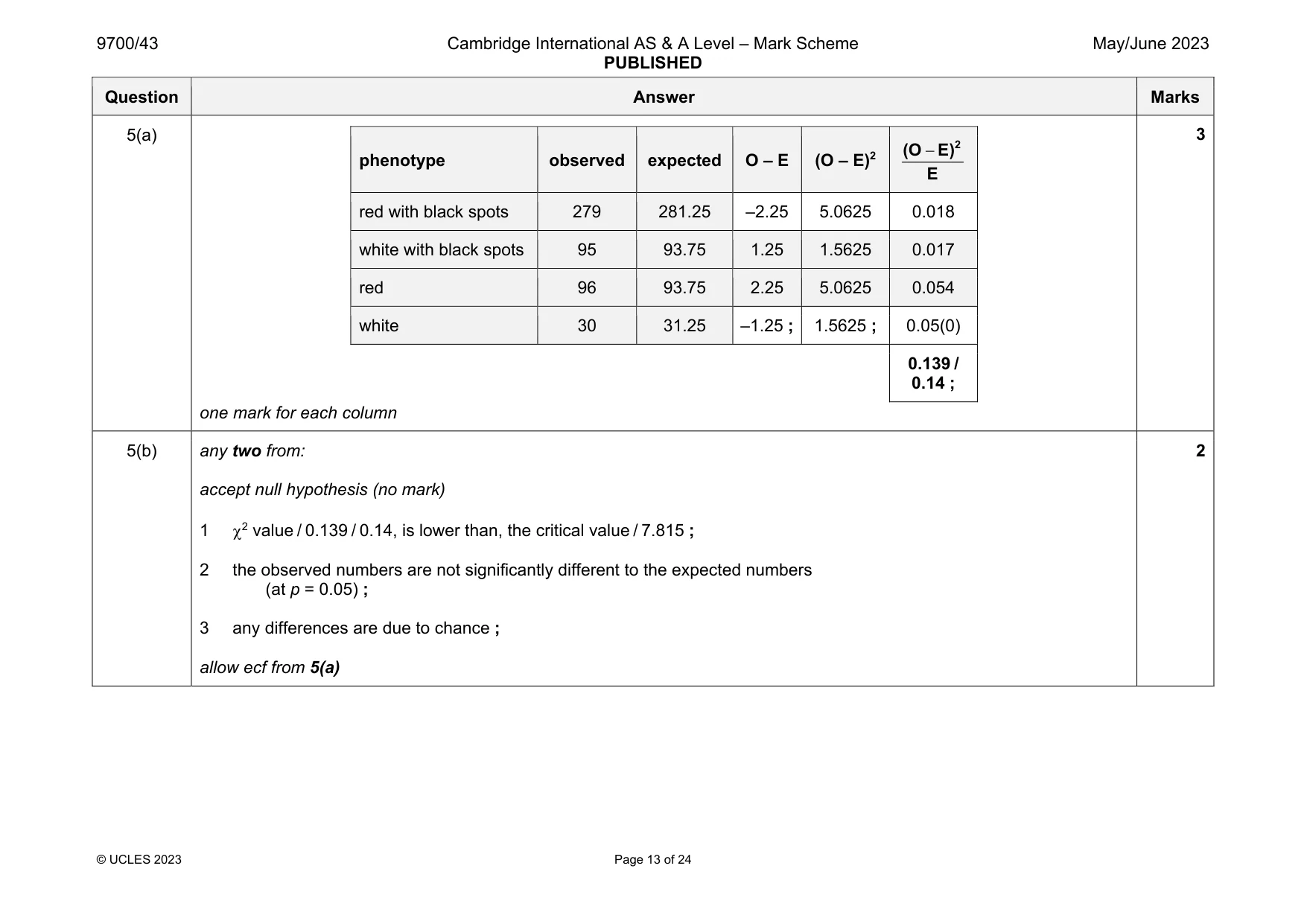
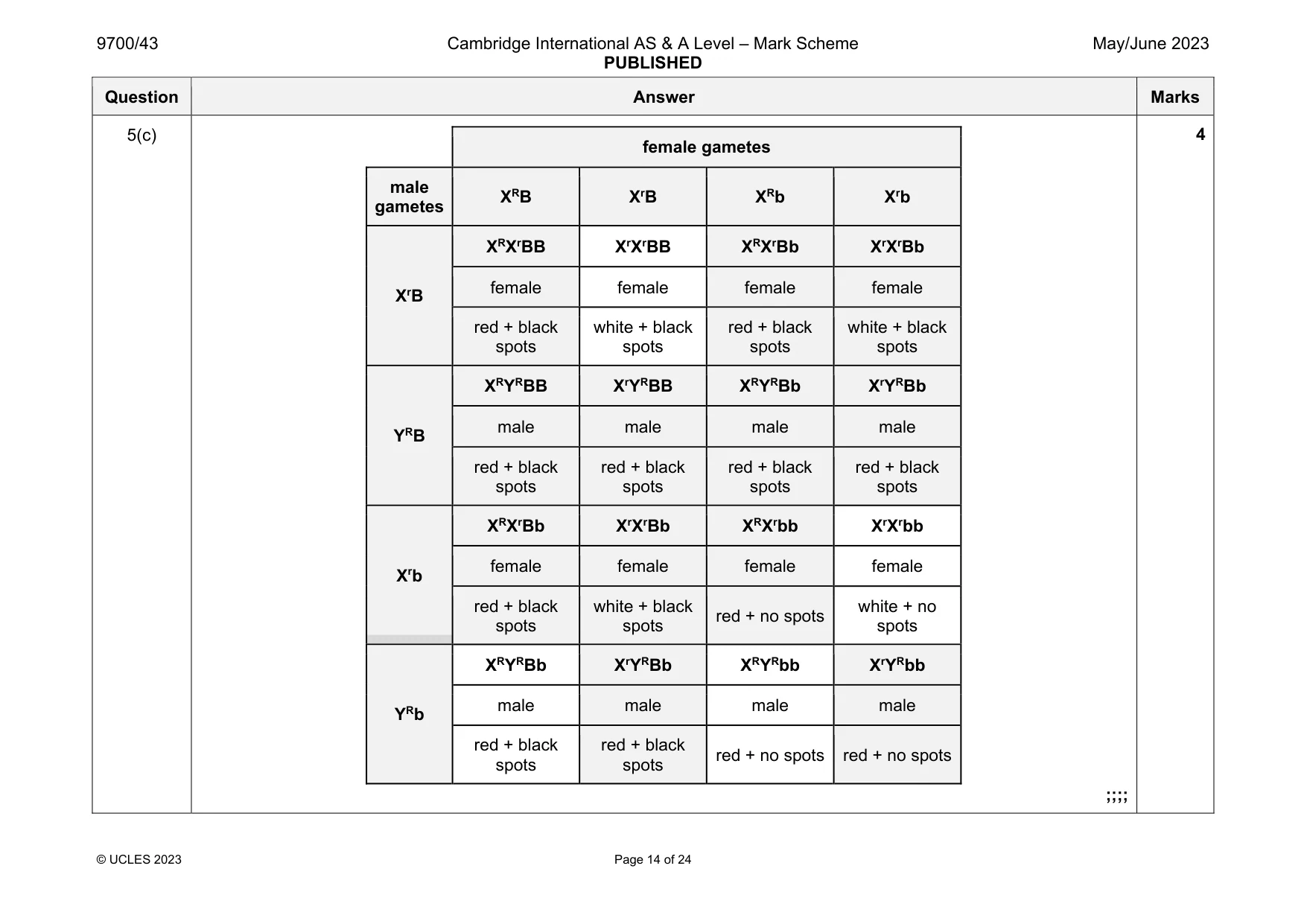
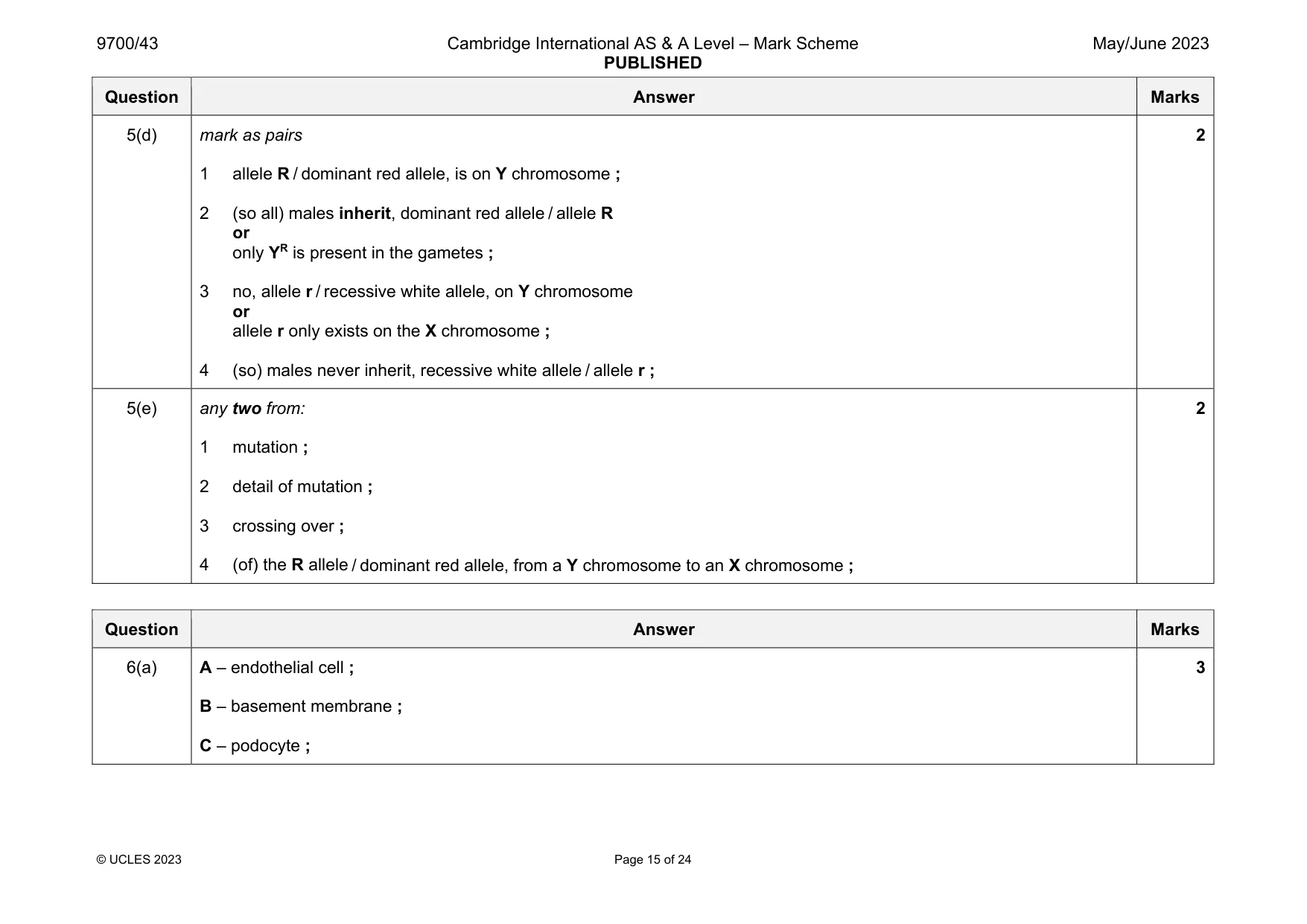
Mark scheme: 5(a) phenotype observed expected O – E (O – E)2 2 (O E) E red with black spots 279 281.25 –2.25 5.0625 0.018 white with black spots 95 93.75 1.25 1.5625 0.017 red 96 93.75 2.25 5.0625 0.054 white 30 31.25 –1.25 ; 1.5625 ; 0.05(0) 0.139 / 0.14 ; one mark for each column 5(b) any two from: accept null hypothesis (no mark) 1 2 value / 0.139 / 0.14, is lower than, the critical value / 7.815 ; 2 the observed numbers are not significantly different to the expected numbers (at p = 0.05) ; 3 any differences are due to chance ; allow ecf from 5(a) 2 Question Answer Marks 5(c) female gametes male gametes XRB XrB XRb Xrb XrB XRXrBB XrXrBB XRXrBb XrXrBb female female female female red + black spots white + black spots red + black spots white + black spots YRB XRYRBB XrYRBB XRYRBb XrYRBb male male male male red + black spots red + black spots red + black spots red + black spots Xrb XRXrBb XrXrBb XRXrbb XrXrbb female female female female red + black spots white + black spots red + no spots white + no spots YRb XRYRBb XrYRBb XRYRbb XrYRbb male male male male red + black spots red + black spots red + no spots red + no spots ;;;; 4 Question Answer Marks 5(d) mark as pairs 1 allele R / dominant red allele, is on Y chromosome ; 2 (so all) males inherit, dominant red allele / allele R or only YR is present in the gametes ; 3 no, allele r / recessive white allele, on Y chromosome or allele r only exists on the X chromosome ; 4 (so) males never inherit, recessive white allele / allele r ; 2 5(e) any two from: 1 mutation ; 2 detail of mutation ; 3 crossing over ; 4 (of) the R allele / dominant red allele, from a Y chromosome to an X chromosome ; 2
More questions on Passage of information from parents to offspring
Q6 · Part of the Bowman’s capsule of a kidney nephron
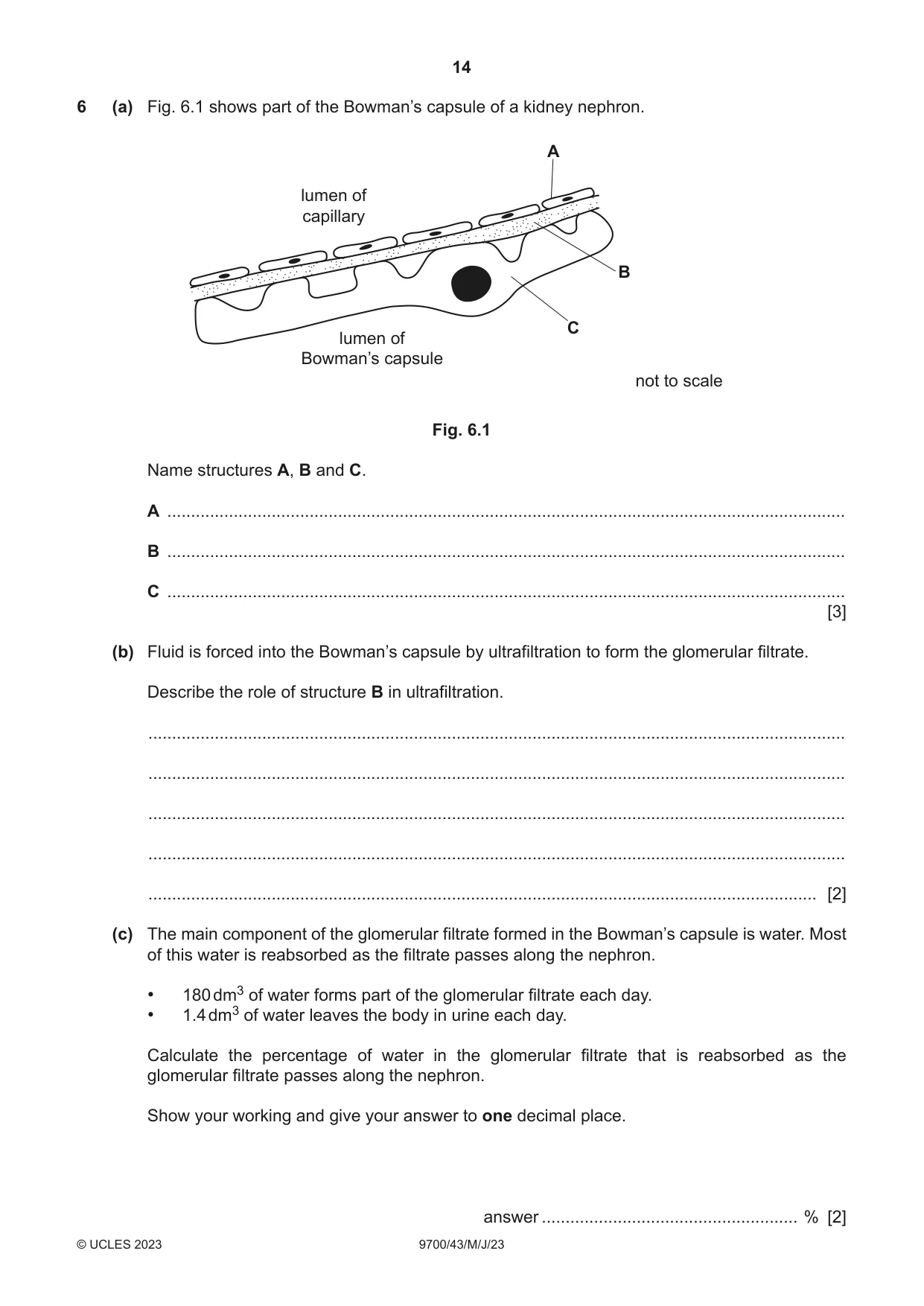
6 (a) Fig. 6.1 shows part of the Bowman’s capsule of a kidney nephron. A lumen of capillary B C lumen of Bowman’s capsule not to scale Fig. 6.1 Name structures A, B and C. A ............................................................................................................................................... B ............................................................................................................................................... C ............................................................................................................................................... [3] (b) Fluid is forced into the Bowman’s capsule by ultrafiltration to form the glomerular filtrate. Describe the role of structure B in ultrafiltration. ................................................................................................................................................... ................................................................................................................................................... ................................................................................................................................................... ................................................................................................................................................... ............................................................................................................................................. [2] (c) The main component of the glomerular filtrate formed in the Bowman’s capsule is water. Most of this water is reabsorbed as the filtrate passes along the nephron. • 180 dm3 of water forms part of the glomerular filtrate each day. • 1.4 dm3 of water leaves the body in urine each day. Calculate the percentage of water in the glomerular filtrate that is reabsorbed as the glomerular filtrate passes along the nephron. Show your working and give your answer to one decimal place. answer ...................................................... % [2] (d) Describe how the action of antidiuretic hormone (ADH) on the cells of the collecting duct leads to the reabsorption of water in the glomerular filtrate. ................................................................................................................................................... ................................................................................................................................................... ................................................................................................................................................... ................................................................................................................................................... ................................................................................................................................................... ................................................................................................................................................... ................................................................................................................................................... ................................................................................................................................................... ................................................................................................................................................... ................................................................................................................................................... ................................................................................................................................................... ................................................................................................................................................... ................................................................................................................................................... ................................................................................................................................................... ............................................................................................................................................. [7] [Total: 14]
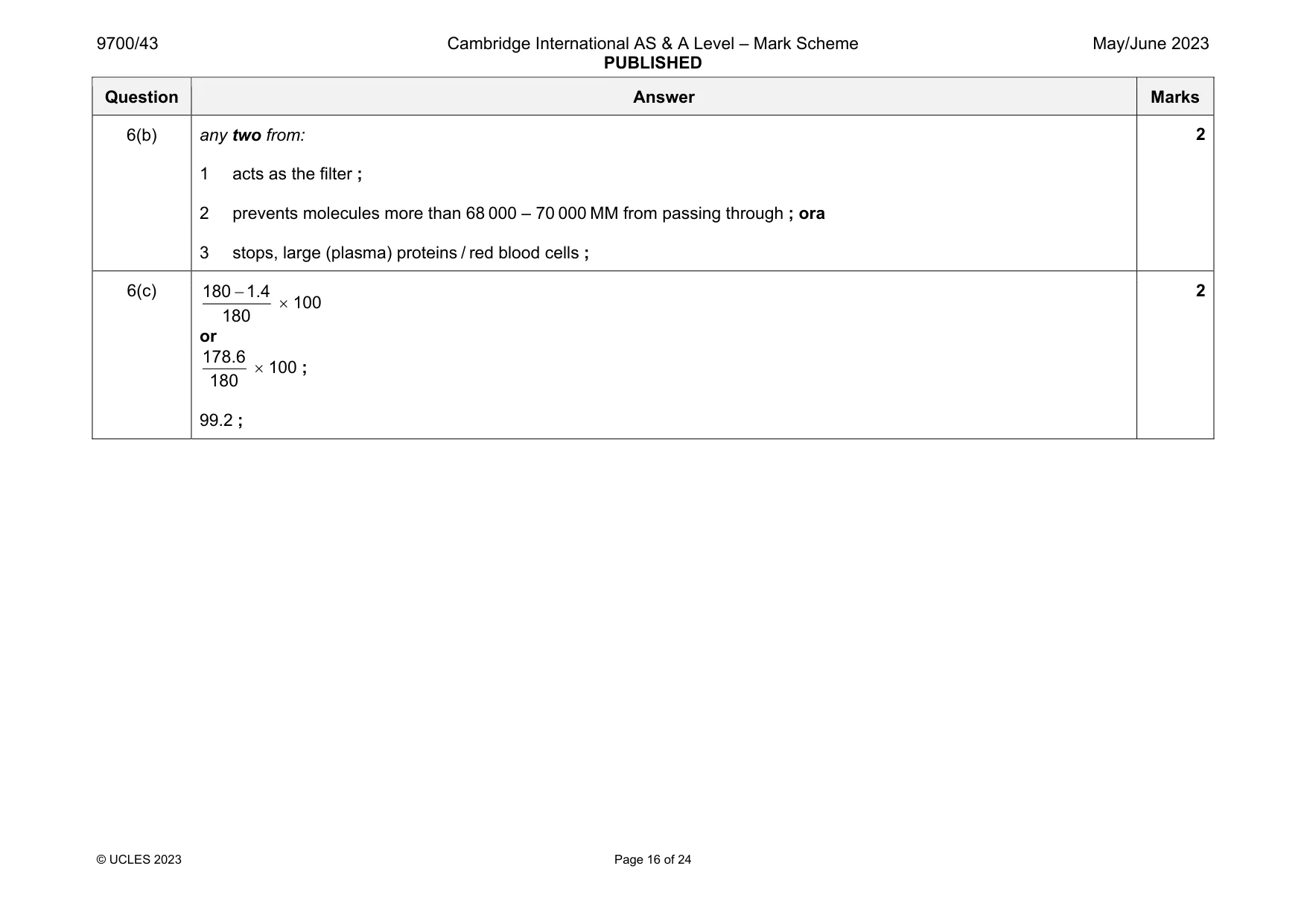
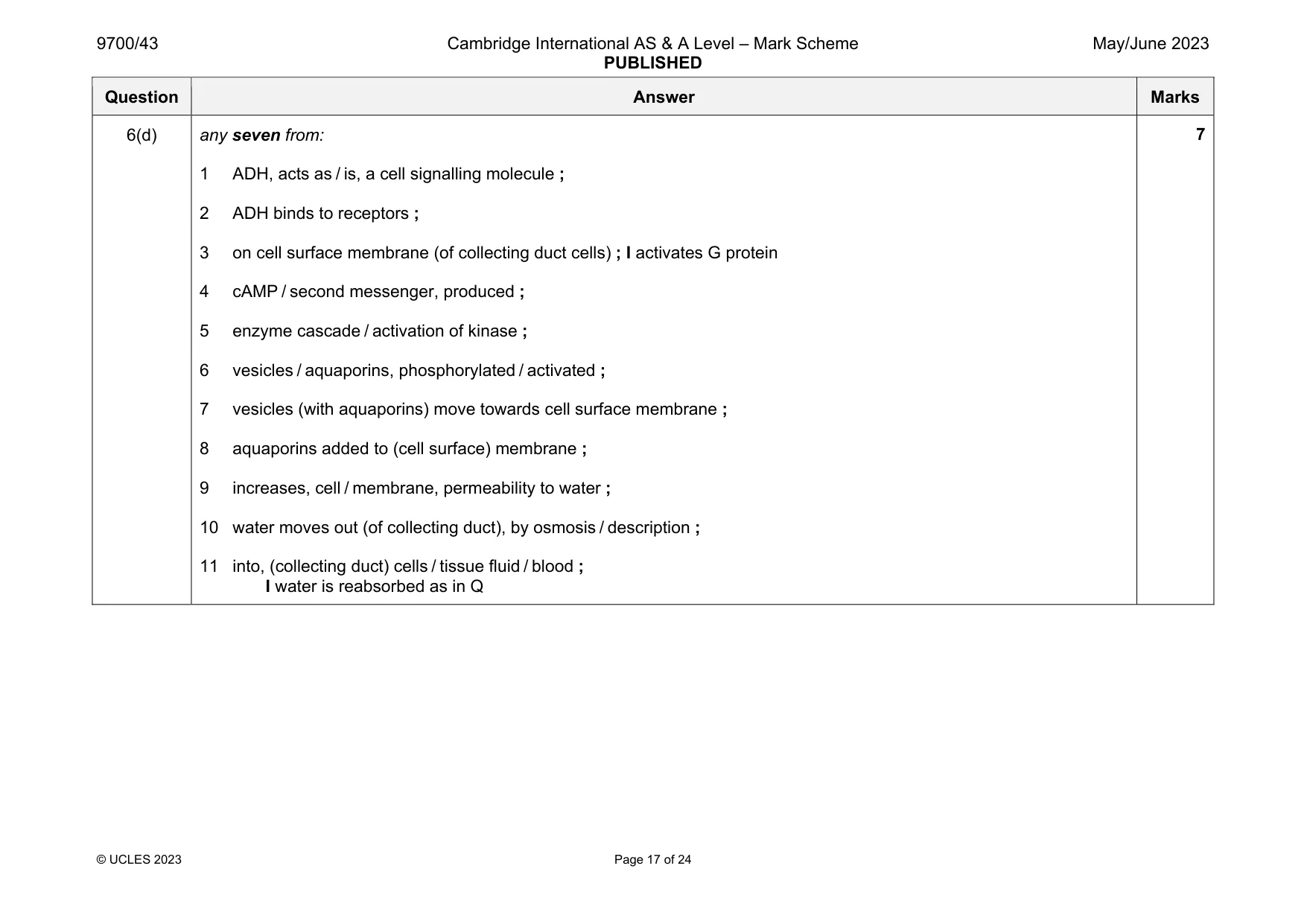
Mark scheme: 6(a) A – endothelial cell ; B – basement membrane ; C – podocyte ; Question Answer Marks 6(b) any two from: 1 acts as the filter ; 2 prevents molecules more than 68 000 – 70 000 MM from passing through ; ora 3 stops, large (plasma) proteins / red blood cells ; 2 6(c) 180 1.4 180 100 or 178.6 180 100 ; 99.2 ; 2 Question Answer Marks 6(d) any seven from: 1 ADH, acts as / is, a cell signalling molecule ; 2 ADH binds to receptors ; 3 on cell surface membrane (of collecting duct cells) ; I activates G protein 4 cAMP / second messenger, produced ; 5 enzyme cascade / activation of kinase ; 6 vesicles / aquaporins, phosphorylated / activated ; 7 vesicles (with aquaporins) move towards cell surface membrane ; 8 aquaporins added to (cell surface) membrane ; 9 increases, cell / membrane, permeability to water ; 10 water moves out (of collecting duct), by osmosis / description ; 11 into, (collecting duct) cells / tissue fluid / blood ; I water is reabsorbed as in Q 7
Q7 · Sarcomeres are the functioning units of the myofibrils of the muscle fibres (muscle…
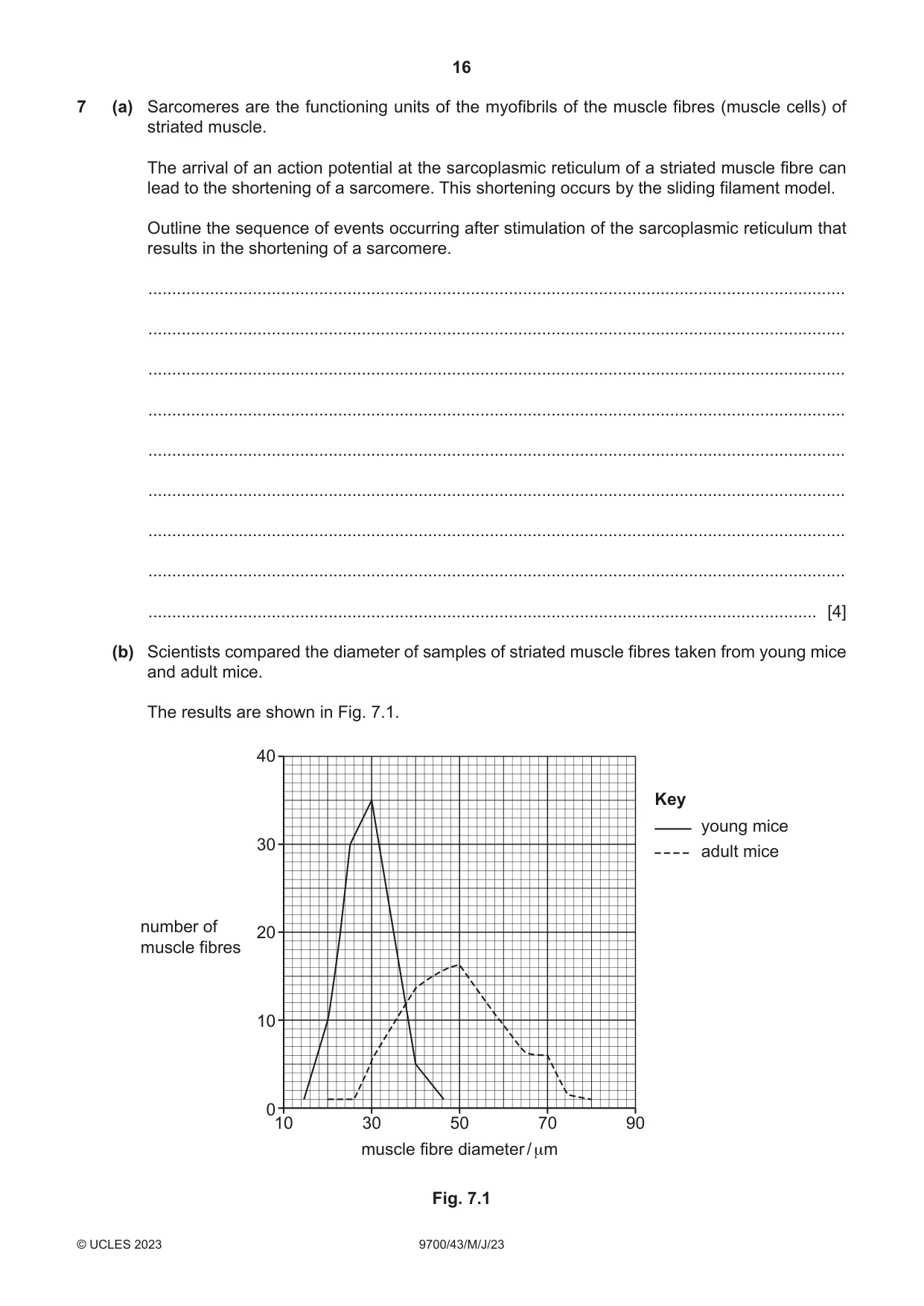
7 (a) Sarcomeres are the functioning units of the myofibrils of the muscle fibres (muscle cells) of striated muscle. The arrival of an action potential at the sarcoplasmic reticulum of a striated muscle fibre can lead to the shortening of a sarcomere. This shortening occurs by the sliding filament model. Outline the sequence of events occurring after stimulation of the sarcoplasmic reticulum that results in the shortening of a sarcomere. ................................................................................................................................................... ................................................................................................................................................... ................................................................................................................................................... ................................................................................................................................................... ................................................................................................................................................... ................................................................................................................................................... ................................................................................................................................................... ................................................................................................................................................... ............................................................................................................................................. [4] (b) Scientists compared the diameter of samples of striated muscle fibres taken from young mice and adult mice. The results are shown in Fig. 7.1. 40 Key young mice 30 adult mice number of 20 muscle fibres 10 0 10 30 50 70 90 muscle fibre diameter / μm Fig. 7.1 With reference to Fig. 7.1: • describe two differences between the muscle fibres of young mice and adult mice • suggest how these differences may affect the sliding filament model. ................................................................................................................................................... ................................................................................................................................................... ................................................................................................................................................... ................................................................................................................................................... ................................................................................................................................................... ................................................................................................................................................... ................................................................................................................................................... ............................................................................................................................................. [4] [Total: 8]
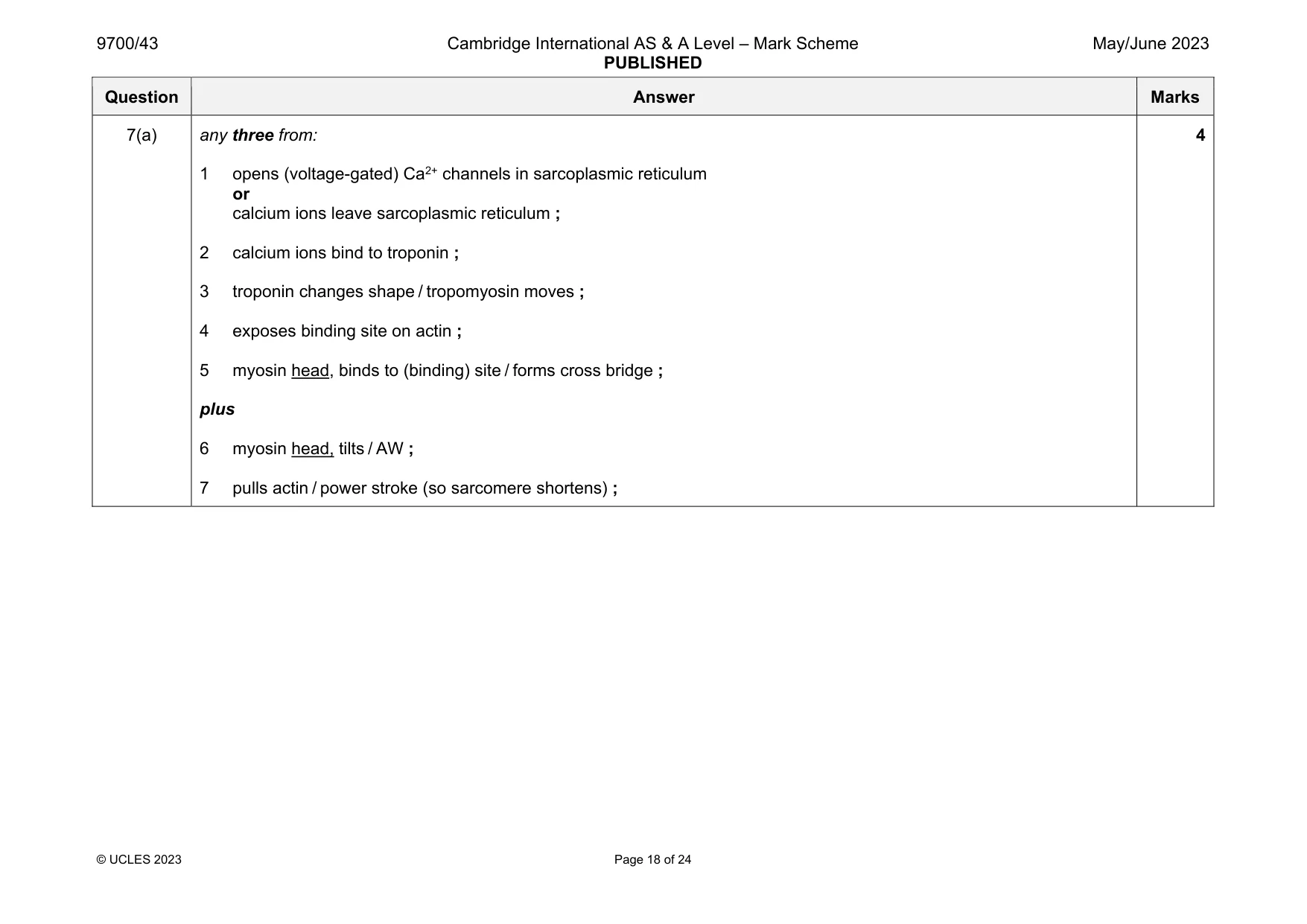
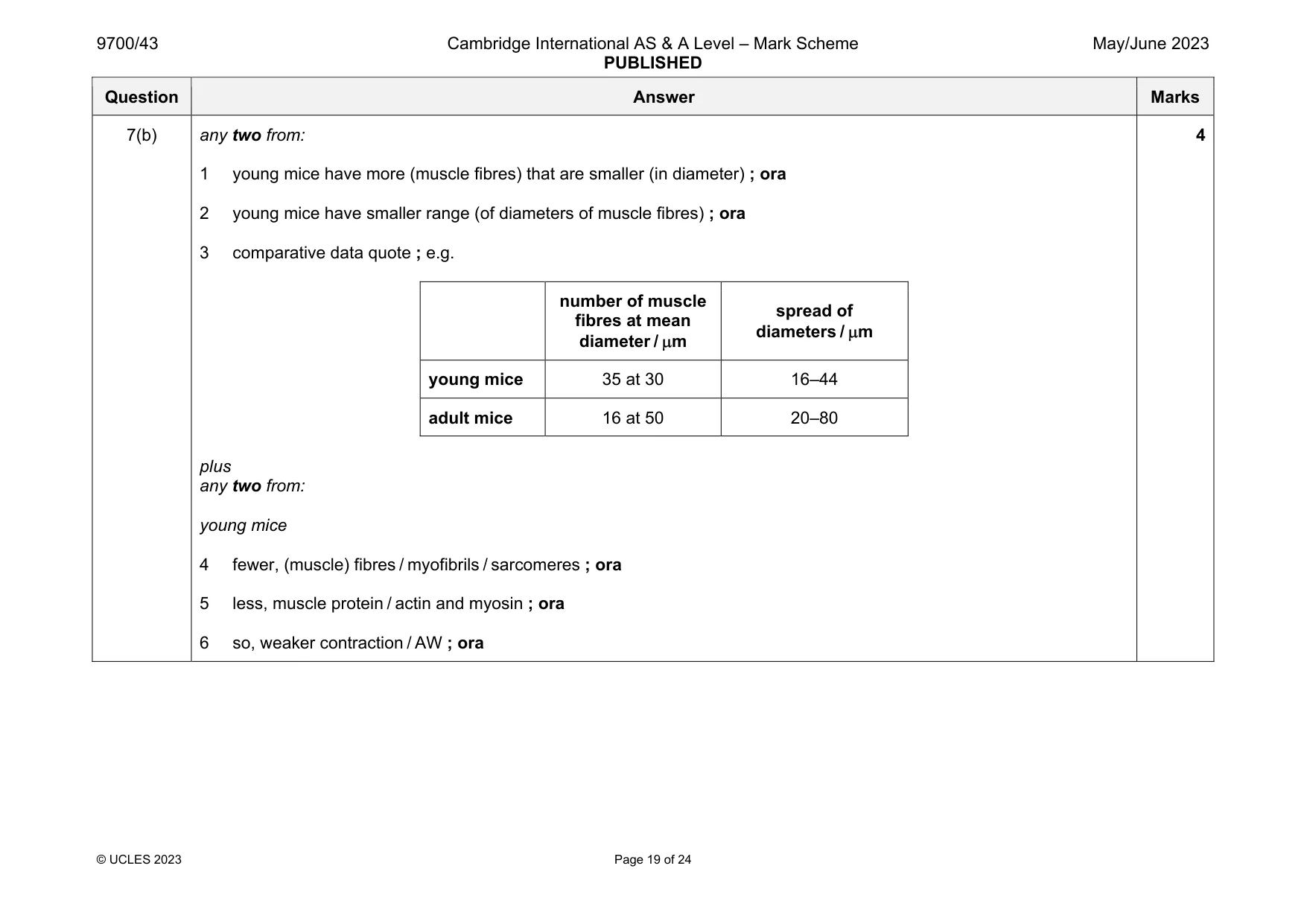
Mark scheme: 7(a) any three from: 1 opens (voltage-gated) Ca2+ channels in sarcoplasmic reticulum or calcium ions leave sarcoplasmic reticulum ; 2 calcium ions bind to troponin ; 3 troponin changes shape / tropomyosin moves ; 4 exposes binding site on actin ; 5 myosin head, binds to (binding) site / forms cross bridge ; plus 6 myosin head, tilts / AW ; 7 pulls actin / power stroke (so sarcomere shortens) ; 4 Question Answer Marks 7(b) any two from: 1 young mice have more (muscle fibres) that are smaller (in diameter) ; ora 2 young mice have smaller range (of diameters of muscle fibres) ; ora 3 comparative data quote ; e.g. number of muscle fibres at mean diameter / m spread of diameters / m young mice 35 at 30 16–44 adult mice 16 at 50 20–80 plus any two from: young mice 4 fewer, (muscle) fibres / myofibrils / sarcomeres ; ora 5 less, muscle protein / actin and myosin ; ora 6 so, weaker contraction / AW ; ora 4
Q8 · A diagram of a chloroplast
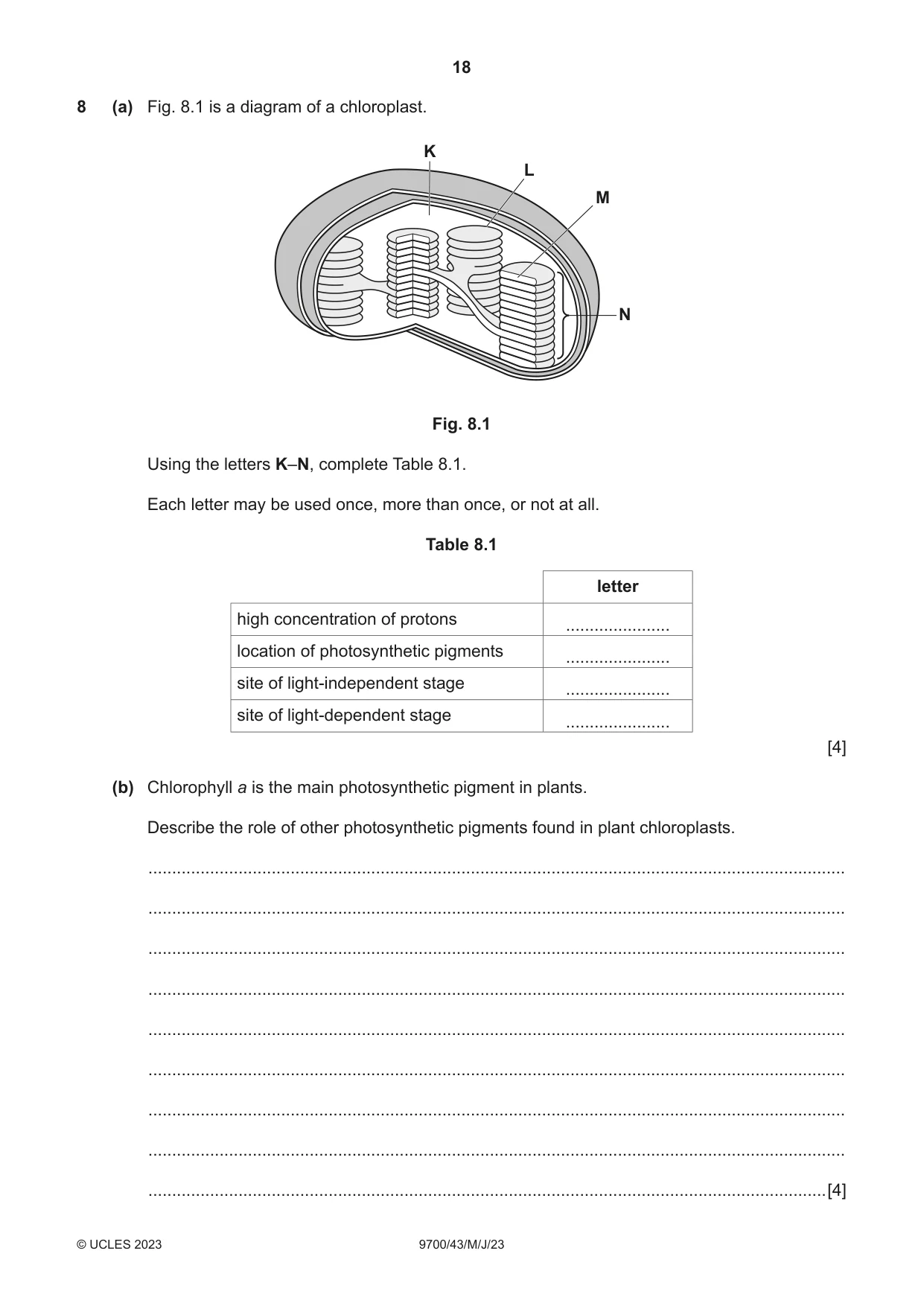
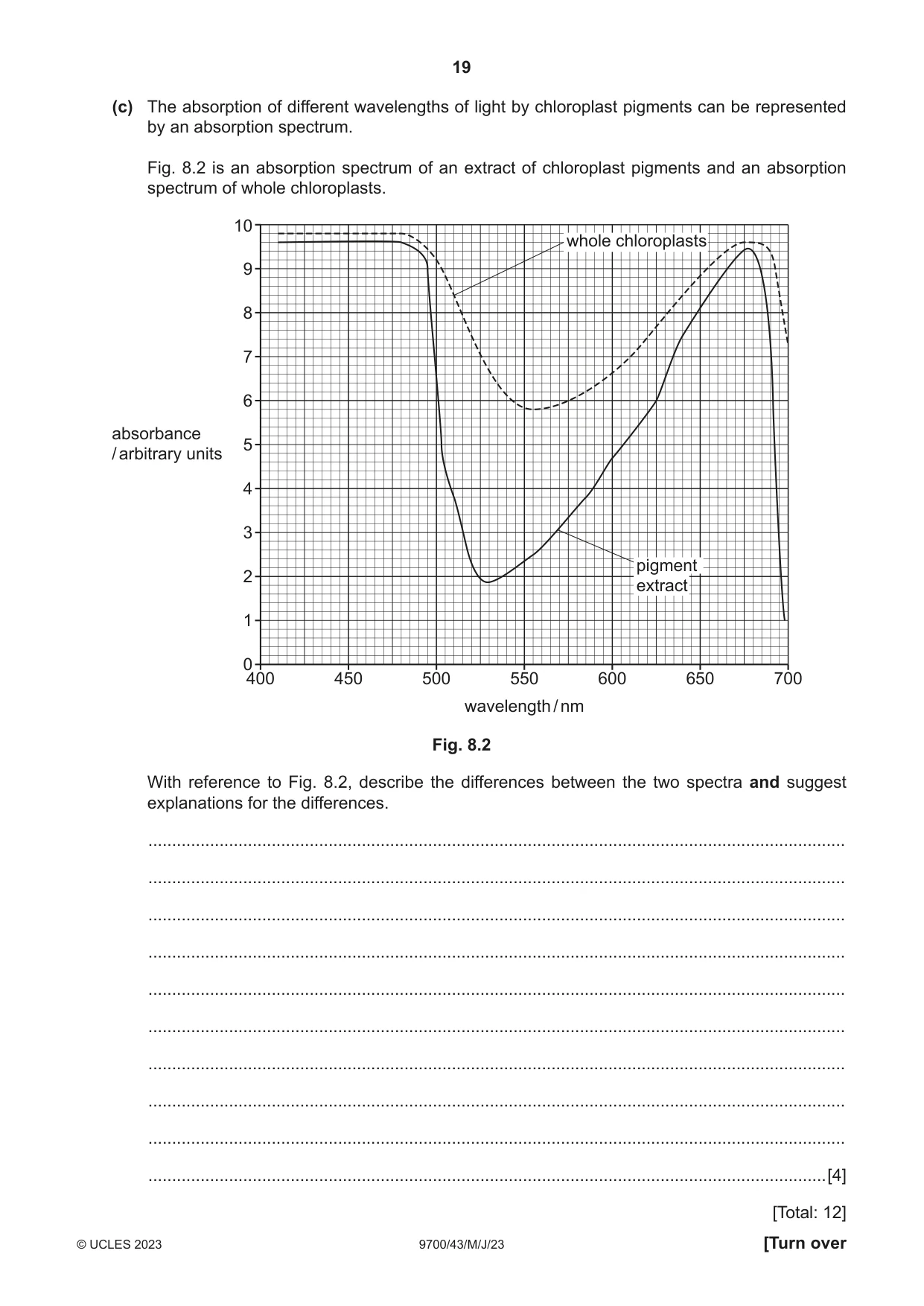
8 (a) Fig. 8.1 is a diagram of a chloroplast. K L M N Fig. 8.1 Using the letters K–N, complete Table 8.1. Each letter may be used once, more than once, or not at all. Table 8.1 letter high concentration of protons ...................... location of photosynthetic pigments ...................... site of light-independent stage ...................... site of light-dependent stage ...................... [4] (b) Chlorophyll a is the main photosynthetic pigment in plants. Describe the role of other photosynthetic pigments found in plant chloroplasts. ................................................................................................................................................... ................................................................................................................................................... ................................................................................................................................................... ................................................................................................................................................... ................................................................................................................................................... ................................................................................................................................................... ................................................................................................................................................... ................................................................................................................................................... ...............................................................................................................................................[4] (c) The absorption of different wavelengths of light by chloroplast pigments can be represented by an absorption spectrum. Fig. 8.2 is an absorption spectrum of an extract of chloroplast pigments and an absorption spectrum of whole chloroplasts. 10 whole chloroplasts 9 8 7 6 absorbance 5/ arbitrary units 4 3 pigment 2 extract 1 0 400 450 500 550 600 650 700 wavelength / nm Fig. 8.2 With reference to Fig. 8.2, describe the differences between the two spectra and suggest explanations for the differences. ................................................................................................................................................... ................................................................................................................................................... ................................................................................................................................................... ................................................................................................................................................... ................................................................................................................................................... ................................................................................................................................................... ................................................................................................................................................... ................................................................................................................................................... ................................................................................................................................................... ...............................................................................................................................................[4] [Total: 12]
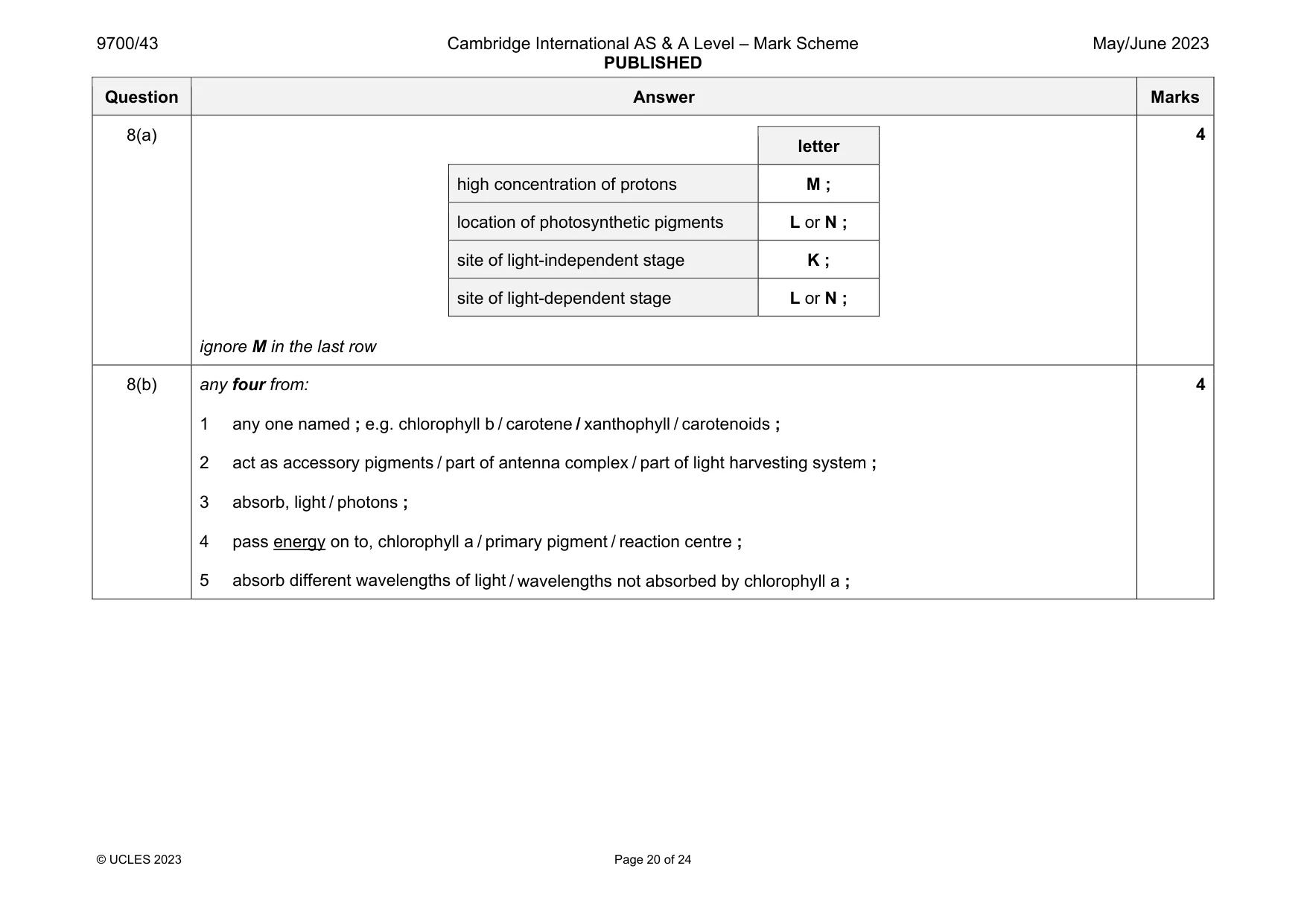
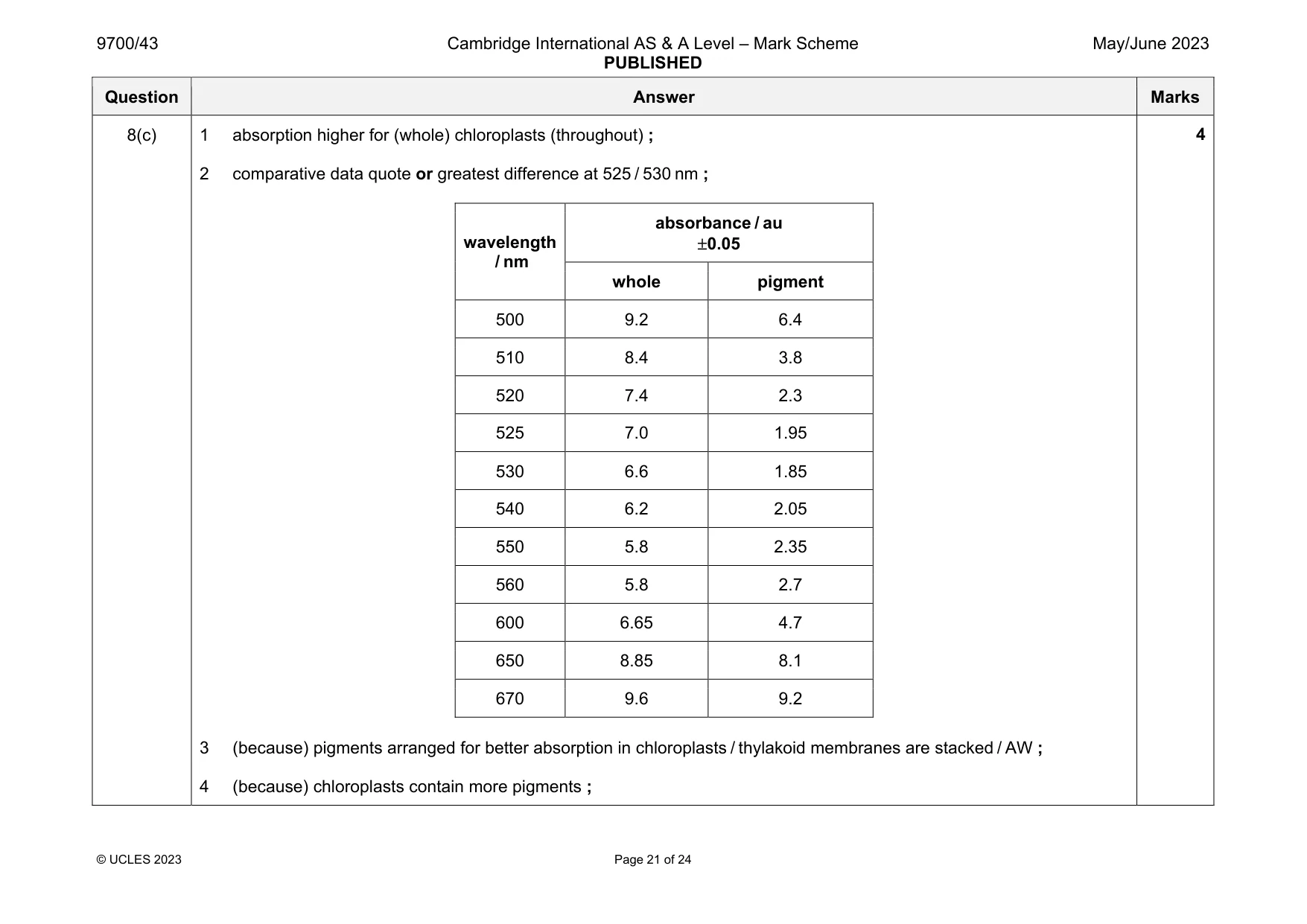
Mark scheme: 8(a) letter high concentration of protons M ; location of photosynthetic pigments L or N ; site of light-independent stage K ; site of light-dependent stage L or N ; ignore M in the last row 8(b) any four from: 1 any one named ; e.g. chlorophyll b / carotene / xanthophyll / carotenoids ; 2 act as accessory pigments / part of antenna complex / part of light harvesting system ; 3 absorb, light / photons ; 4 pass energy on to, chlorophyll a / primary pigment / reaction centre ; 5 absorb different wavelengths of light / wavelengths not absorbed by chlorophyll a ; 4 Question Answer Marks 8(c) 1 absorption higher for (whole) chloroplasts (throughout) ; 2 comparative data quote or greatest difference at 525 / 530 nm ; wavelength / nm absorbance / au 0.05 whole pigment 500 9.2 6.4 510 8.4 3.8 520 7.4 2.3 525 7.0 1.95 530 6.6 1.85 540 6.2 2.05 550 5.8 2.35 560 5.8 2.7 600 6.65 4.7 650 8.85 8.1 670 9.6 9.2 3 (because) pigments arranged for better absorption in chloroplasts / thylakoid membranes are stacked / AW ; 4 (because) chloroplasts contain more pigments ; 4
More questions on Photosynthesis as an energy transfer process
Q9 · Dopamine is a neurotransmitter released in some synapses in the brain
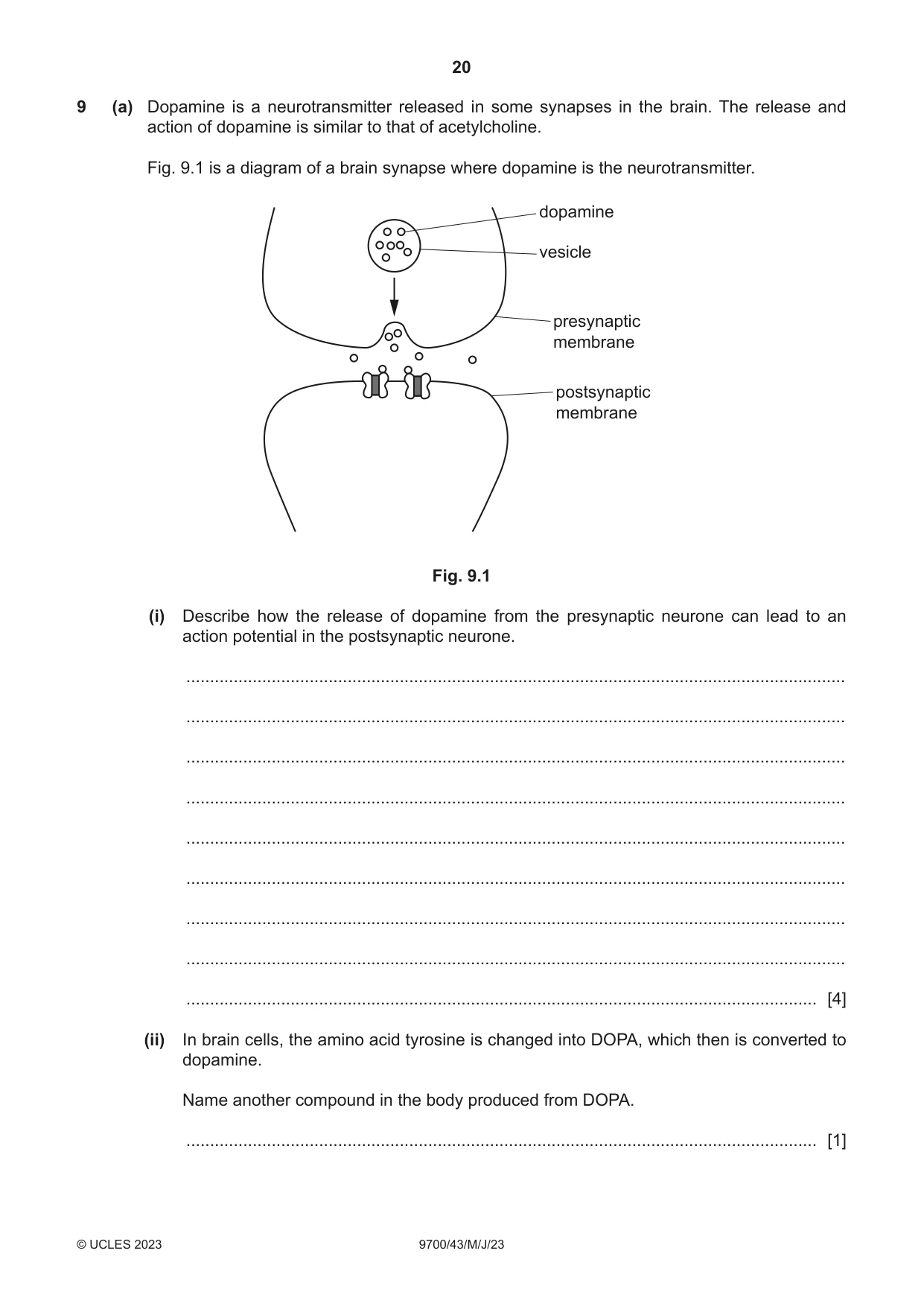
9 (a) Dopamine is a neurotransmitter released in some synapses in the brain. The release and action of dopamine is similar to that of acetylcholine. Fig. 9.1 is a diagram of a brain synapse where dopamine is the neurotransmitter. dopamine vesicle presynaptic membrane postsynaptic membrane Fig. 9.1 (i) Describe how the release of dopamine from the presynaptic neurone can lead to an action potential in the postsynaptic neurone. ........................................................................................................................................... ........................................................................................................................................... ........................................................................................................................................... ........................................................................................................................................... ........................................................................................................................................... ........................................................................................................................................... ........................................................................................................................................... ........................................................................................................................................... ..................................................................................................................................... [4] (ii) In brain cells, the amino acid tyrosine is changed into DOPA, which then is converted to dopamine. Name another compound in the body produced from DOPA. ..................................................................................................................................... [1] (b) In some brain synapses, the neurotransmitter gamma-aminobutyric acid (GABA) is released. This results in an influx of chloride ions into the postsynaptic neurone. Suggest and explain whether an action potential would be generated in the postsynaptic neurone if GABA is released into a brain synapse. ................................................................................................................................................... ................................................................................................................................................... ................................................................................................................................................... ................................................................................................................................................... ................................................................................................................................................... ................................................................................................................................................... ............................................................................................................................................. [3] [Total: 8]
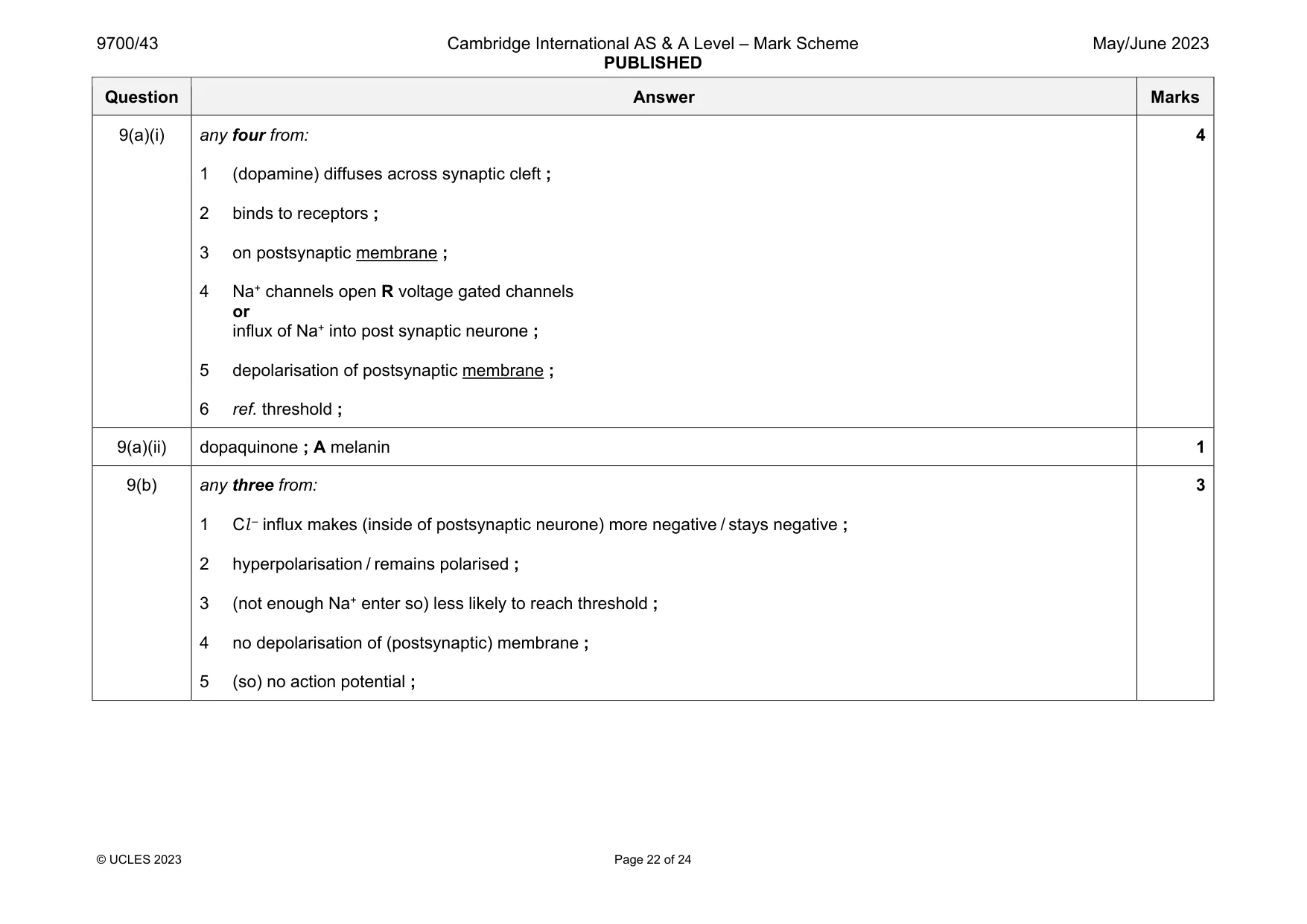
Mark scheme: 9(a)(i) any four from: 1 (dopamine) diffuses across synaptic cleft ; 2 binds to receptors ; 3 on postsynaptic membrane ; 4 Na+ channels open R voltage gated channels or influx of Na+ into post synaptic neurone ; 5 depolarisation of postsynaptic membrane ; 6 ref. threshold ; 4 9(a)(ii) dopaquinone ; A melanin 1 9(b) any three from: 1 Cl – influx makes (inside of postsynaptic neurone) more negative / stays negative ; 2 hyperpolarisation / remains polarised ; 3 (not enough Na+ enter so) less likely to reach threshold ; 4 no depolarisation of (postsynaptic) membrane ; 5 (so) no action potential ; 3
Q10 · The moose, Alces alces, is a large member of the deer family
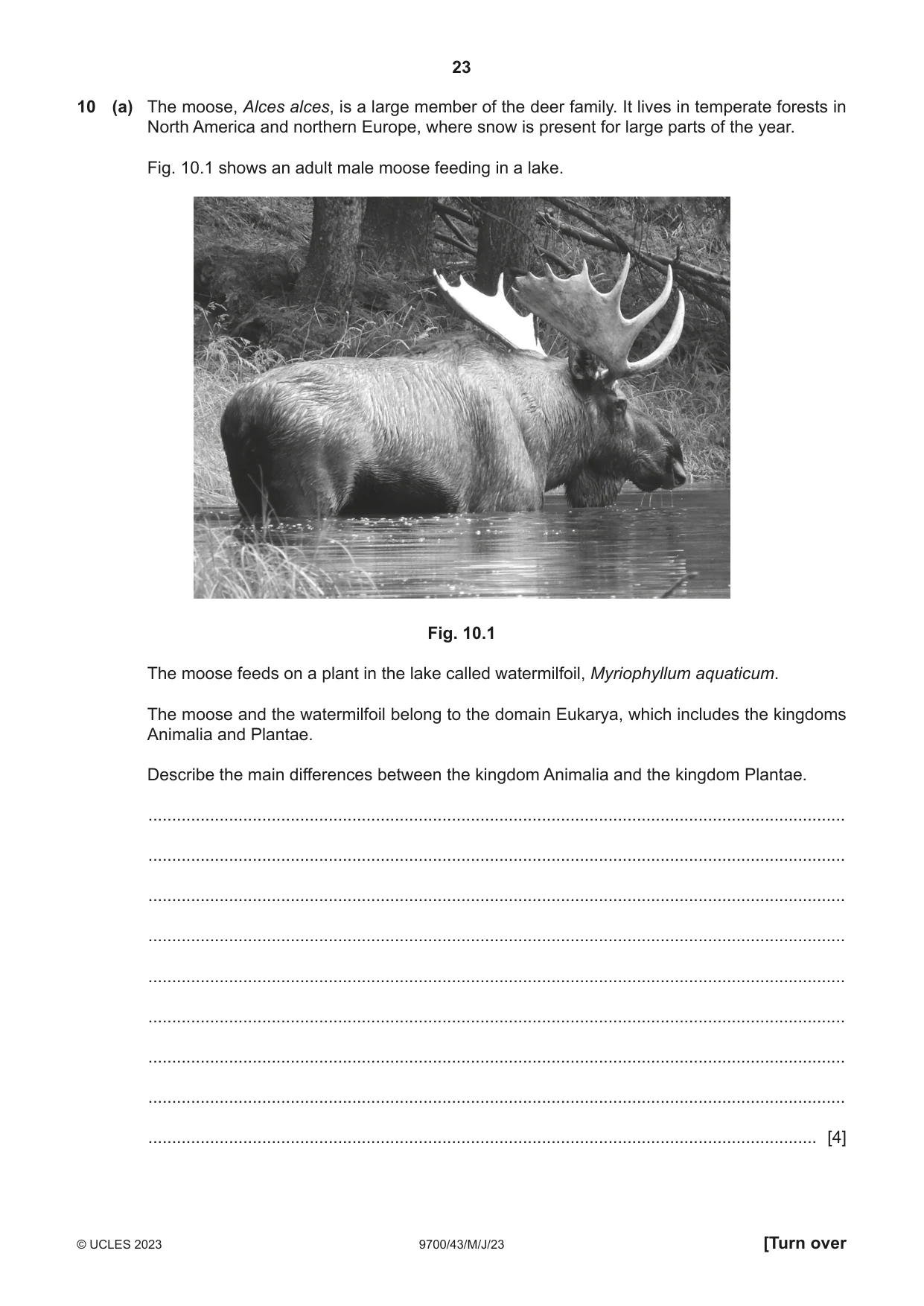
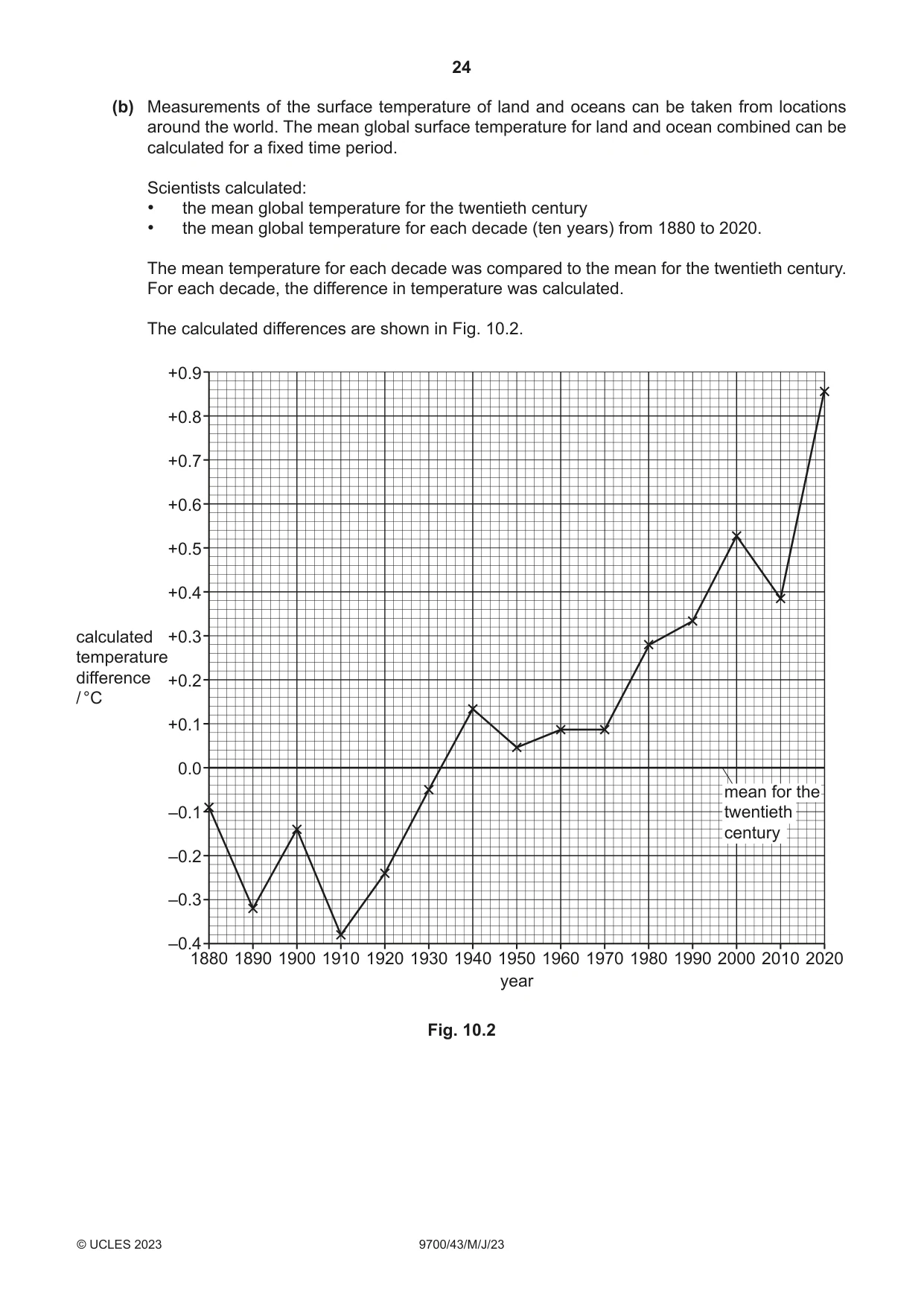
10 (a) The moose, Alces alces, is a large member of the deer family. It lives in temperate forests in North America and northern Europe, where snow is present for large parts of the year. Fig. 10.1 shows an adult male moose feeding in a lake. Fig. 10.1 The moose feeds on a plant in the lake called watermilfoil, Myriophyllum aquaticum. The moose and the watermilfoil belong to the domain Eukarya, which includes the kingdoms Animalia and Plantae. Describe the main differences between the kingdom Animalia and the kingdom Plantae. ................................................................................................................................................... ................................................................................................................................................... ................................................................................................................................................... ................................................................................................................................................... ................................................................................................................................................... ................................................................................................................................................... ................................................................................................................................................... ................................................................................................................................................... ............................................................................................................................................. [4] (b) Measurements of the surface temperature of land and oceans can be taken from locations around the world. The mean global surface temperature for land and ocean combined can be calculated for a fixed time period. Scientists calculated: • the mean global temperature for the twentieth century • the mean global temperature for each decade (ten years) from 1880 to 2020. The mean temperature for each decade was compared to the mean for the twentieth century. For each decade, the difference in temperature was calculated. The calculated differences are shown in Fig. 10.2. +0.9 +0.8 +0.7 +0.6 +0.5 +0.4 calculated +0.3 temperature difference +0.2 / °C +0.1 0.0 mean for the –0.1 twentieth century –0.2 –0.3 –0.4 1880 1890 1900 1910 1920 1930 1940 1950 1960 1970 1980 1990 2000 2010 2020 year Fig. 10.2 (i) Calculate the rate of increase in temperature per decade between 1980 and 2020. Show your working. Write your answer to two decimal places. answer ................................. °C per decade [2] (ii) Moose populations have decreased in North America since 1980. Suggest and explain reasons for the decrease in moose populations. ........................................................................................................................................... ........................................................................................................................................... ........................................................................................................................................... ........................................................................................................................................... ........................................................................................................................................... ........................................................................................................................................... ........................................................................................................................................... ..................................................................................................................................... [3] [Total: 9]
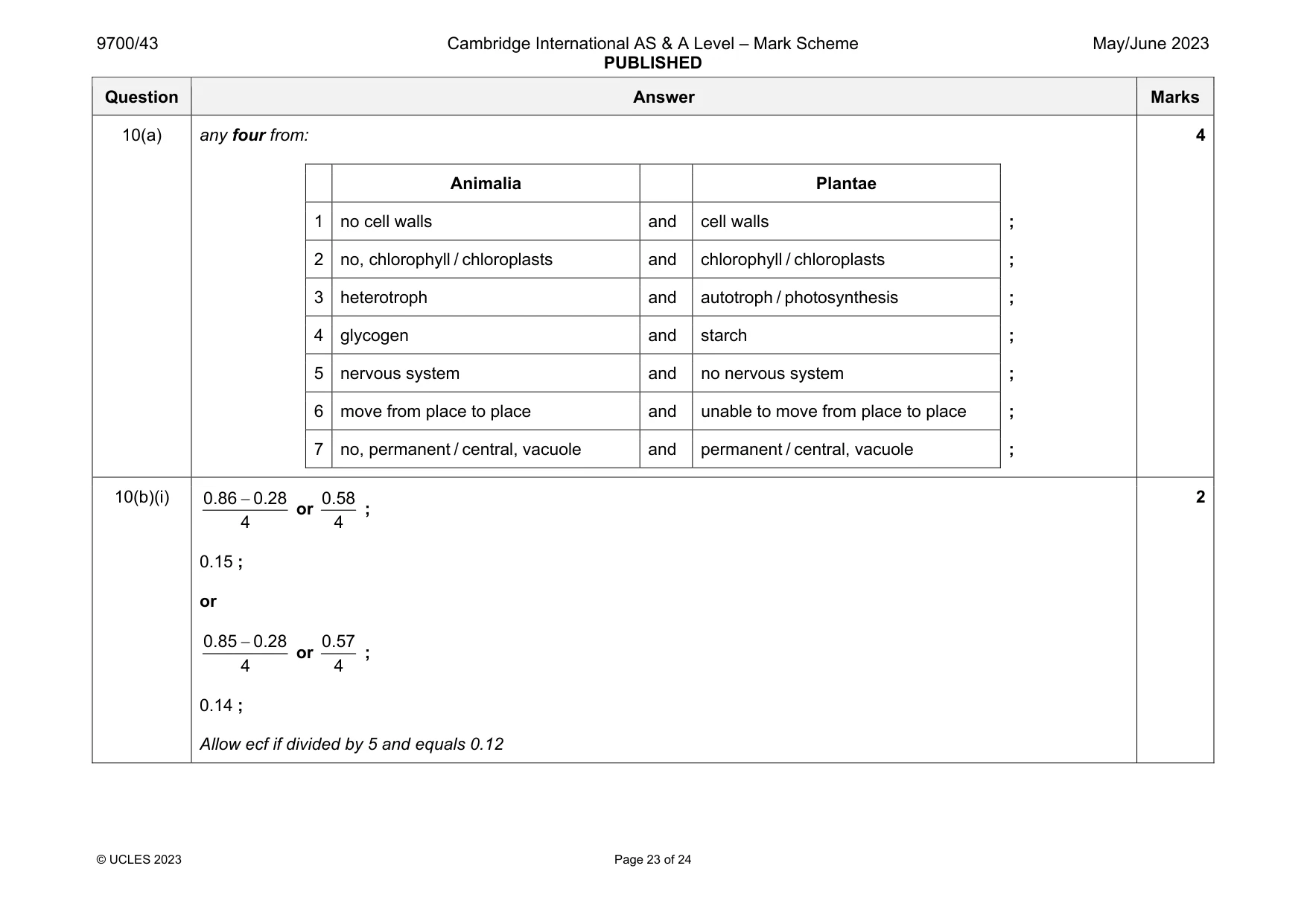
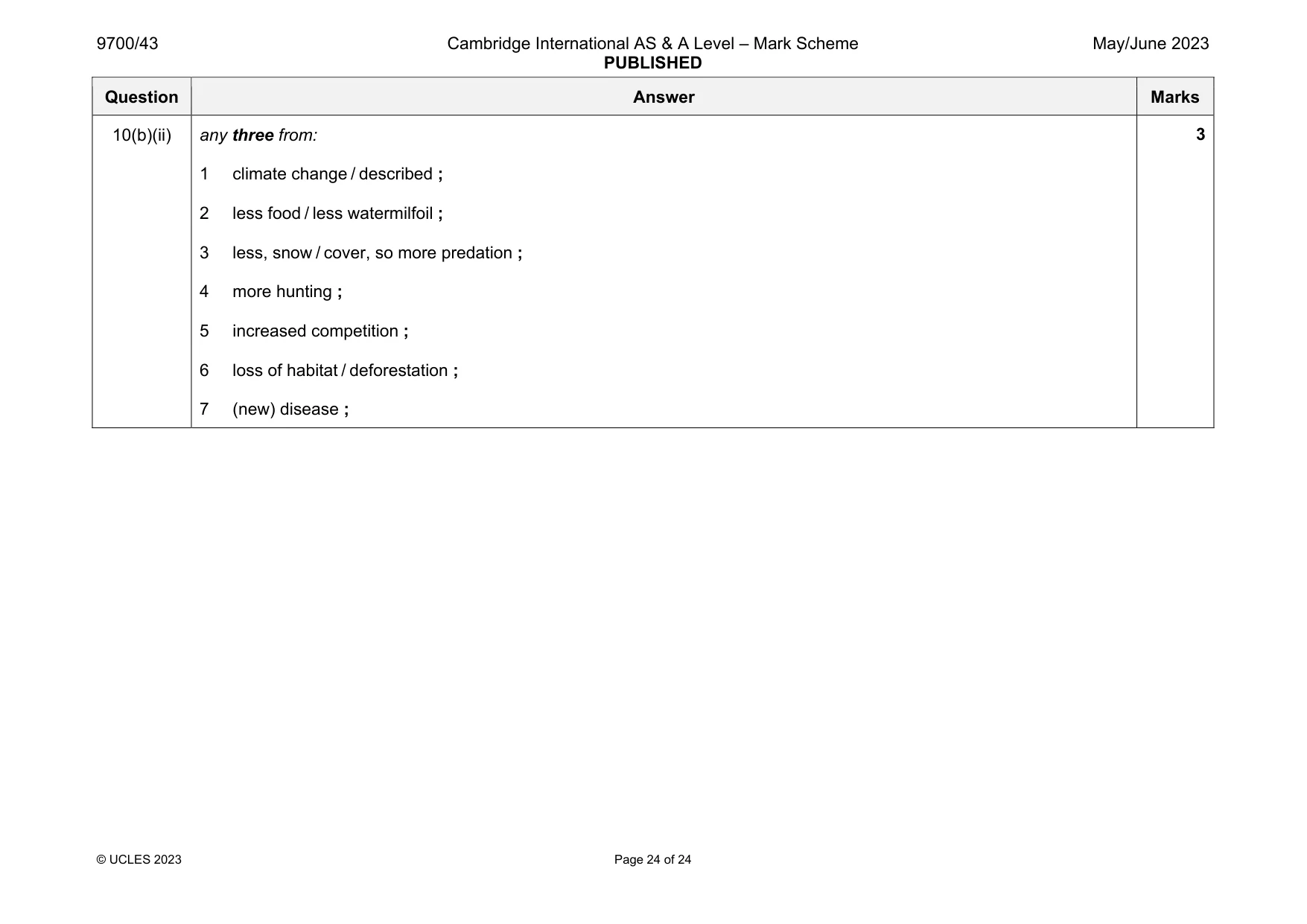
Mark scheme: 10(a) any four from: Animalia Plantae 1 no cell walls and cell walls ; 2 no, chlorophyll / chloroplasts and chlorophyll / chloroplasts ; 3 heterotroph and autotroph / photosynthesis ; 4 glycogen and starch ; 5 nervous system and no nervous system ; 6 move from place to place and unable to move from place to place ; 7 no, permanent / central, vacuole and permanent / central, vacuole ; 4 10(b)(i) 0.86 0.28 4 or 0.58 4 ; 0.15 ; or 0.85 0.28 4 or 0.57 4 ; 0.14 ; Allow ecf if divided by 5 and equals 0.12 2 Question Answer Marks 10(b)(ii) any three from: 1 climate change / described ; 2 less food / less watermilfoil ; 3 less, snow / cover, so more predation ; 4 more hunting ; 5 increased competition ; 6 loss of habitat / deforestation ; 7 (new) disease ; 3
What was in this paper
The subtopics covered by these 10 questions, and how many questions each got. Open one in a new tab to see every Cambridge question on it.
What you needed in this session
Cambridge’s own grade thresholds for 2023 May/June, Paper 4 · Variant 3. A higher threshold means an easier paper — the bar moves with how the cohort did.