Cambridge A Level Biology 9700 — 2021 Feb/March Paper 4 · Variant 2
9700/42/F/M/21 · 10 questions · 100 marks · ≈113 min
The question paper and its mark scheme, free to read here and free to download. This is Cambridge’s own paper, exactly as it was sat.
Question paper28 pages







Mark scheme22 pages
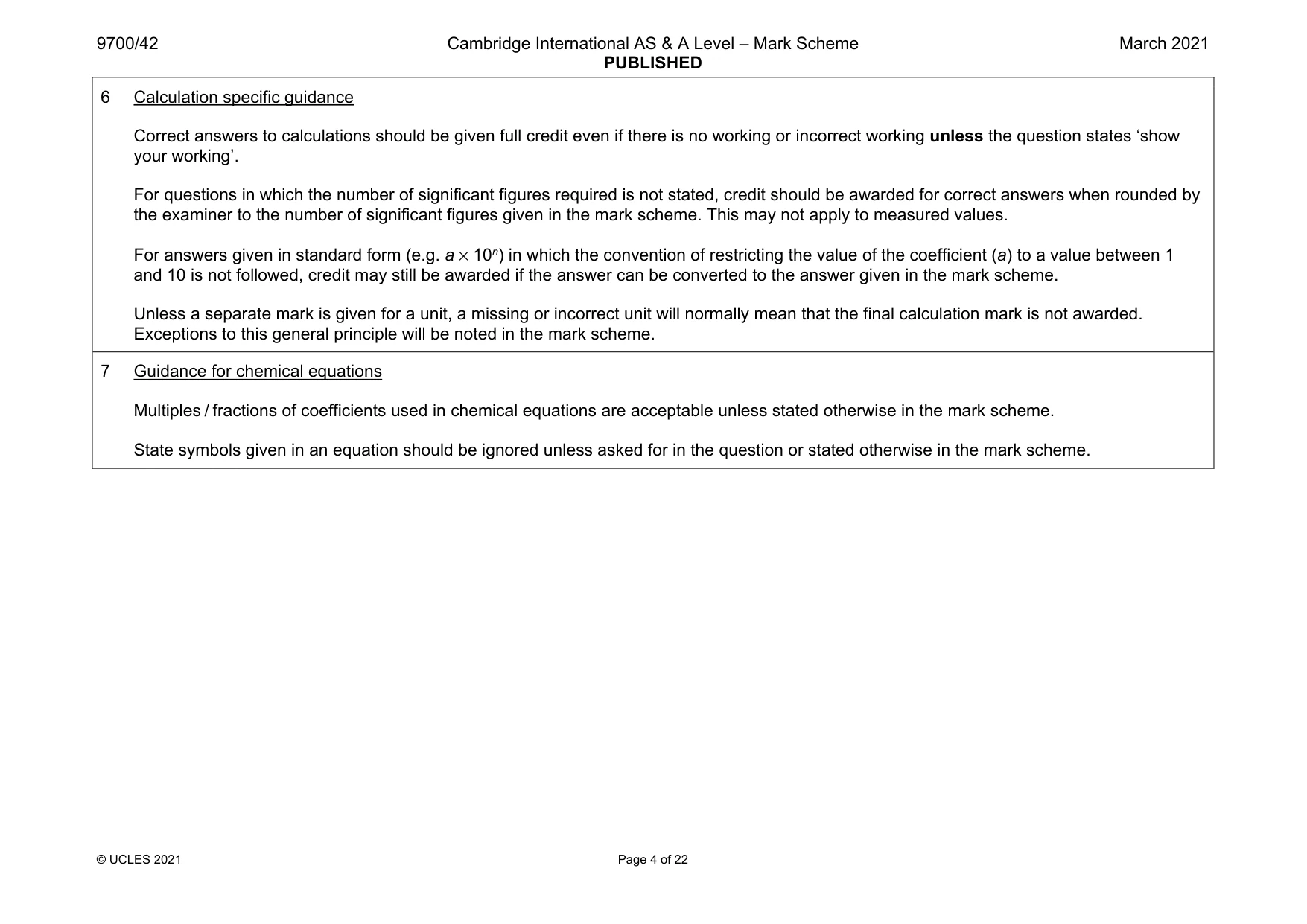
Answers below. Sit the paper first if you are practising.
Questions as text
Q1 · The European eel, Anguilla anguilla, is a fish
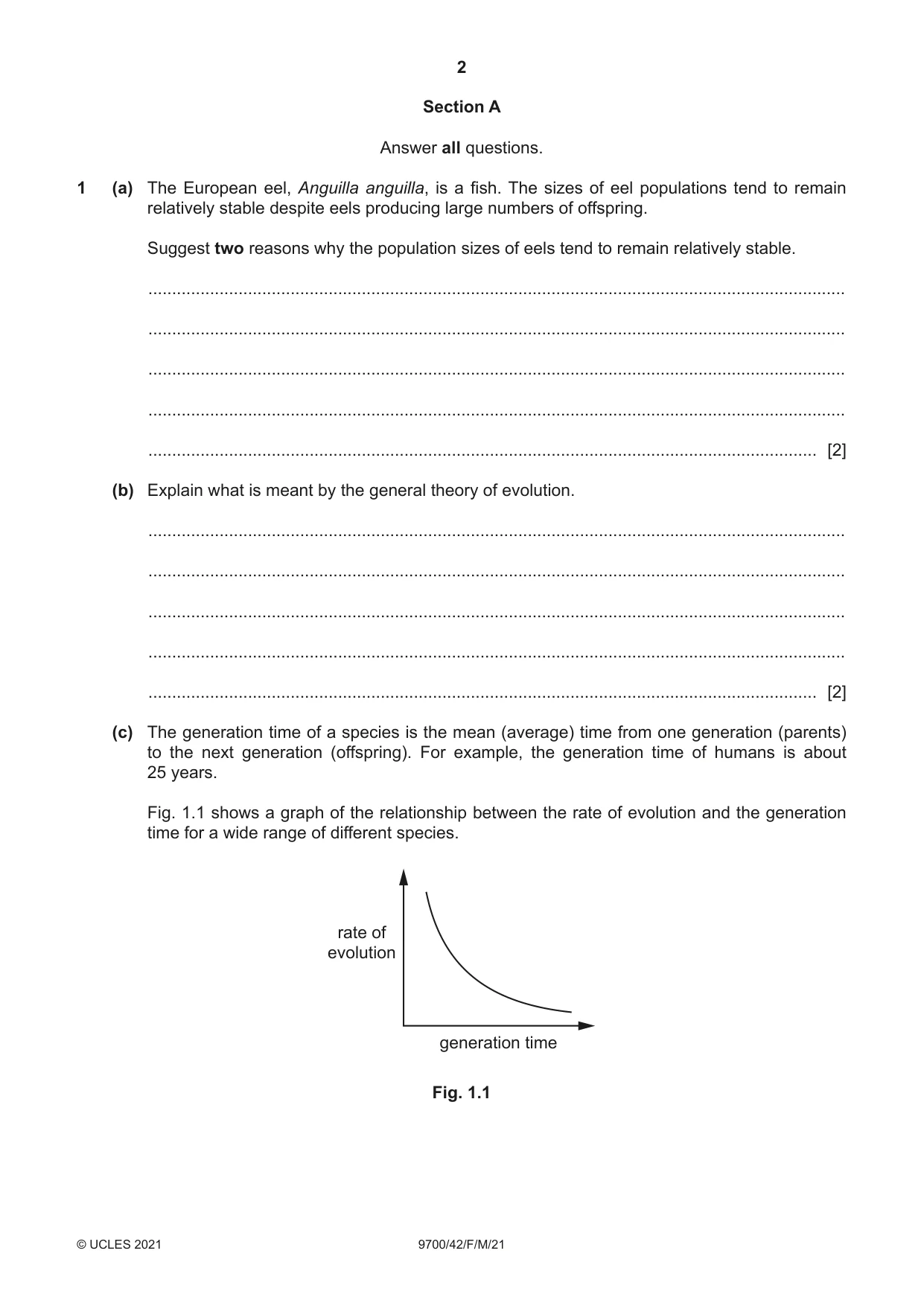
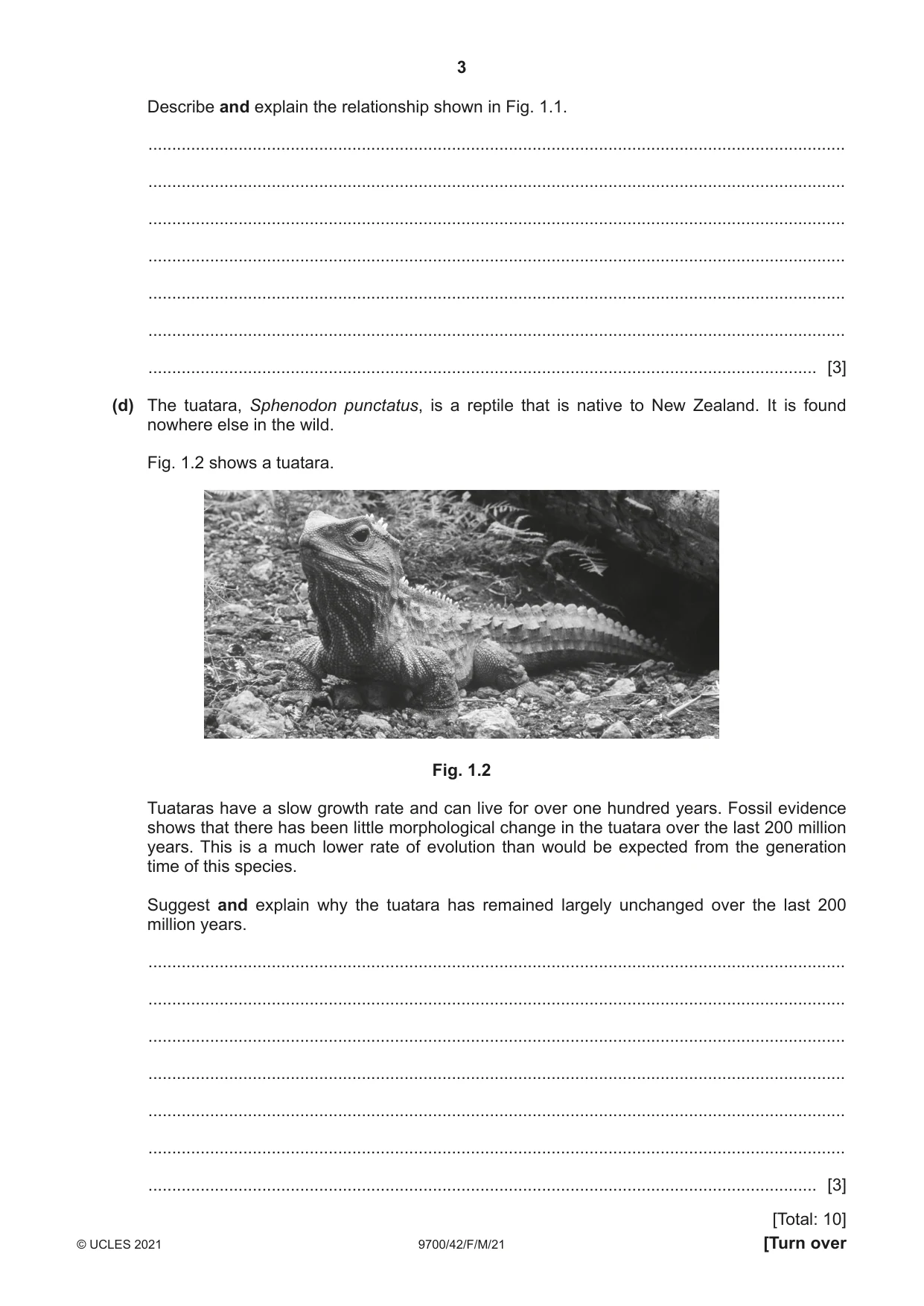
1 (a) The European eel, Anguilla anguilla, is a fish. The sizes of eel populations tend to remain relatively stable despite eels producing large numbers of offspring. Suggest two reasons why the population sizes of eels tend to remain relatively stable. ................................................................................................................................................... ................................................................................................................................................... ................................................................................................................................................... ................................................................................................................................................... ............................................................................................................................................. [2] (b) Explain what is meant by the general theory of evolution. ................................................................................................................................................... ................................................................................................................................................... ................................................................................................................................................... ................................................................................................................................................... ............................................................................................................................................. [2] (c) The generation time of a species is the mean (average) time from one generation (parents) to the next generation (offspring). For example, the generation time of humans is about 25 years. Fig. 1.1 shows a graph of the relationship between the rate of evolution and the generation time for a wide range of different species. rate of evolution generation time Fig. 1.1 Describe and explain the relationship shown in Fig. 1.1. ................................................................................................................................................... ................................................................................................................................................... ................................................................................................................................................... ................................................................................................................................................... ................................................................................................................................................... ................................................................................................................................................... ............................................................................................................................................. [3] (d) The tuatara, Sphenodon punctatus, is a reptile that is native to New Zealand. It is found nowhere else in the wild. Fig. 1.2 shows a tuatara. Fig. 1.2 Tuataras have a slow growth rate and can live for over one hundred years. Fossil evidence shows that there has been little morphological change in the tuatara over the last 200 million years. This is a much lower rate of evolution than would be expected from the generation time of this species. Suggest and explain why the tuatara has remained largely unchanged over the last 200 million years. ................................................................................................................................................... ................................................................................................................................................... ................................................................................................................................................... ................................................................................................................................................... ................................................................................................................................................... ................................................................................................................................................... ............................................................................................................................................. [3] [Total: 10]
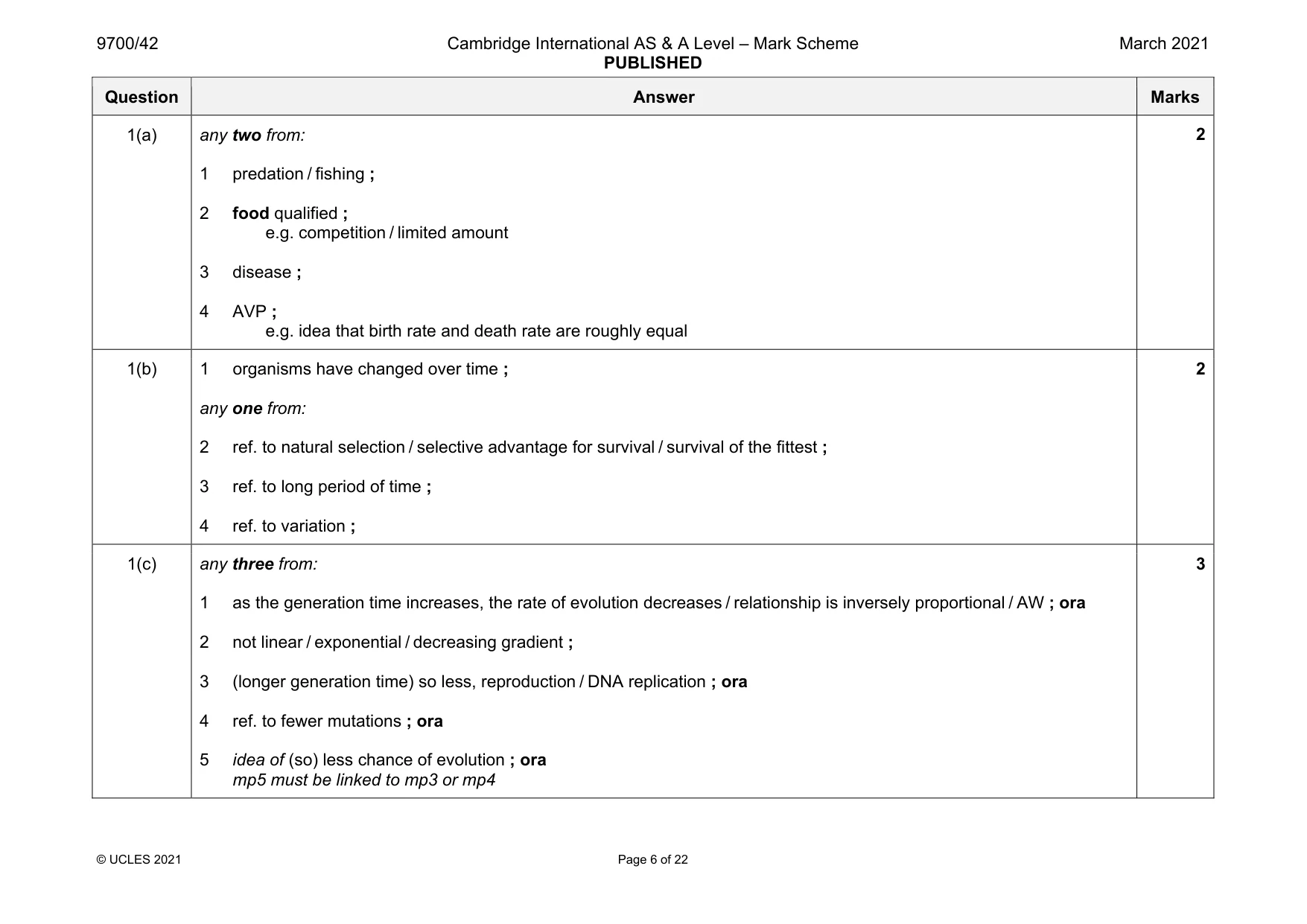
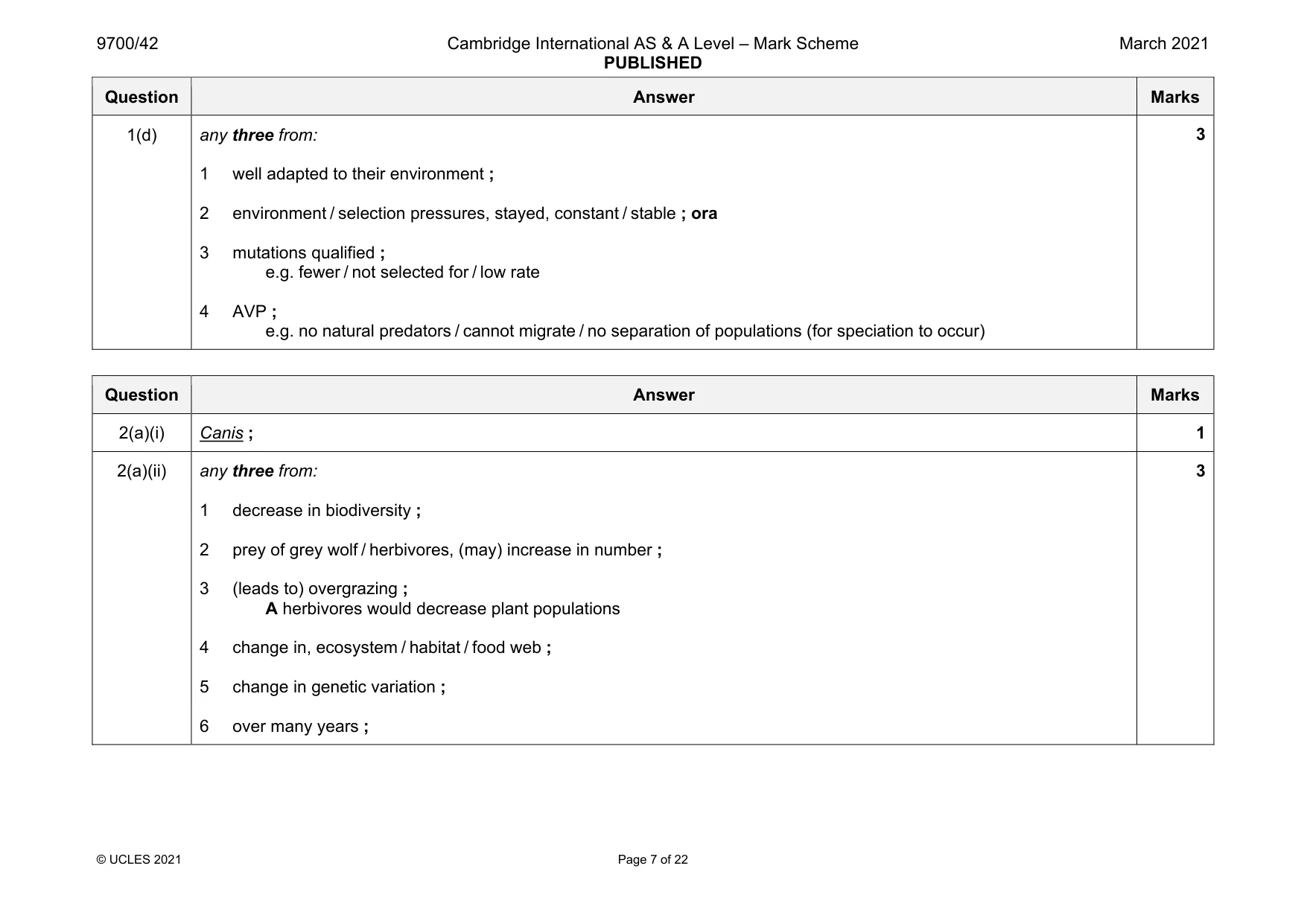
Mark scheme: 1(a) any two from: 1 predation / fishing ; 2 food qualified ; e.g. competition / limited amount 3 disease ; 4 AVP ; e.g. idea that birth rate and death rate are roughly equal 1(b) 1 organisms have changed over time ; any one from: 2 ref. to natural selection / selective advantage for survival / survival of the fittest ; 3 ref. to long period of time ; 4 ref. to variation ; 2 1(c) any three from: 1 as the generation time increases, the rate of evolution decreases / relationship is inversely proportional / AW ; ora 2 not linear / exponential / decreasing gradient ; 3 (longer generation time) so less, reproduction / DNA replication ; ora 4 ref. to fewer mutations ; ora 5 idea of (so) less chance of evolution ; ora mp5 must be linked to mp3 or mp4 3 Question Answer Marks 1(d) any three from: 1 well adapted to their environment ; 2 environment / selection pressures, stayed, constant / stable ; ora 3 mutations qualified ; e.g. fewer / not selected for / low rate 4 AVP ; e.g. no natural predators / cannot migrate / no separation of populations (for speciation to occur) 3
Q2 · The grey wolf, Canis lupus, is a large predator
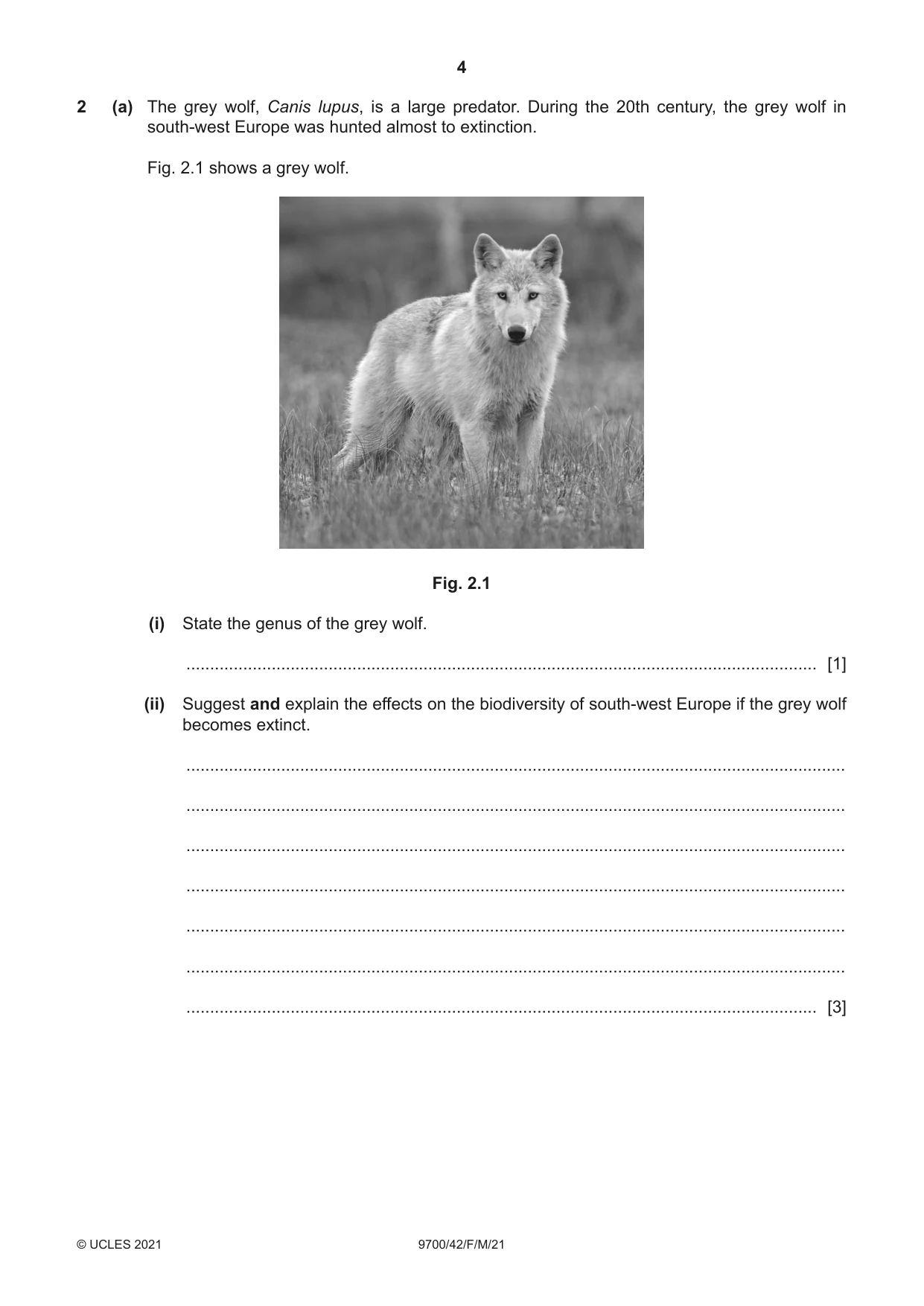
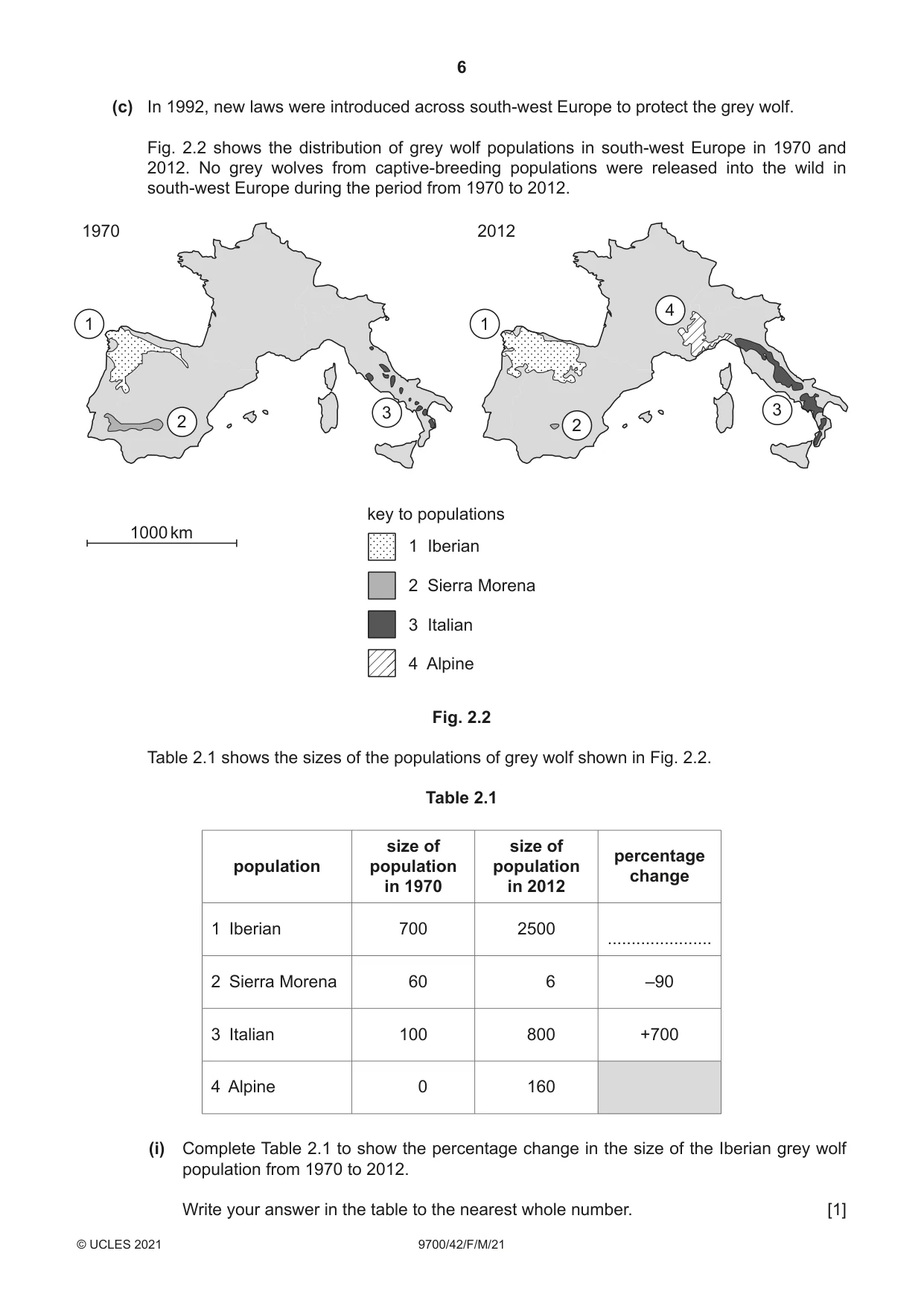
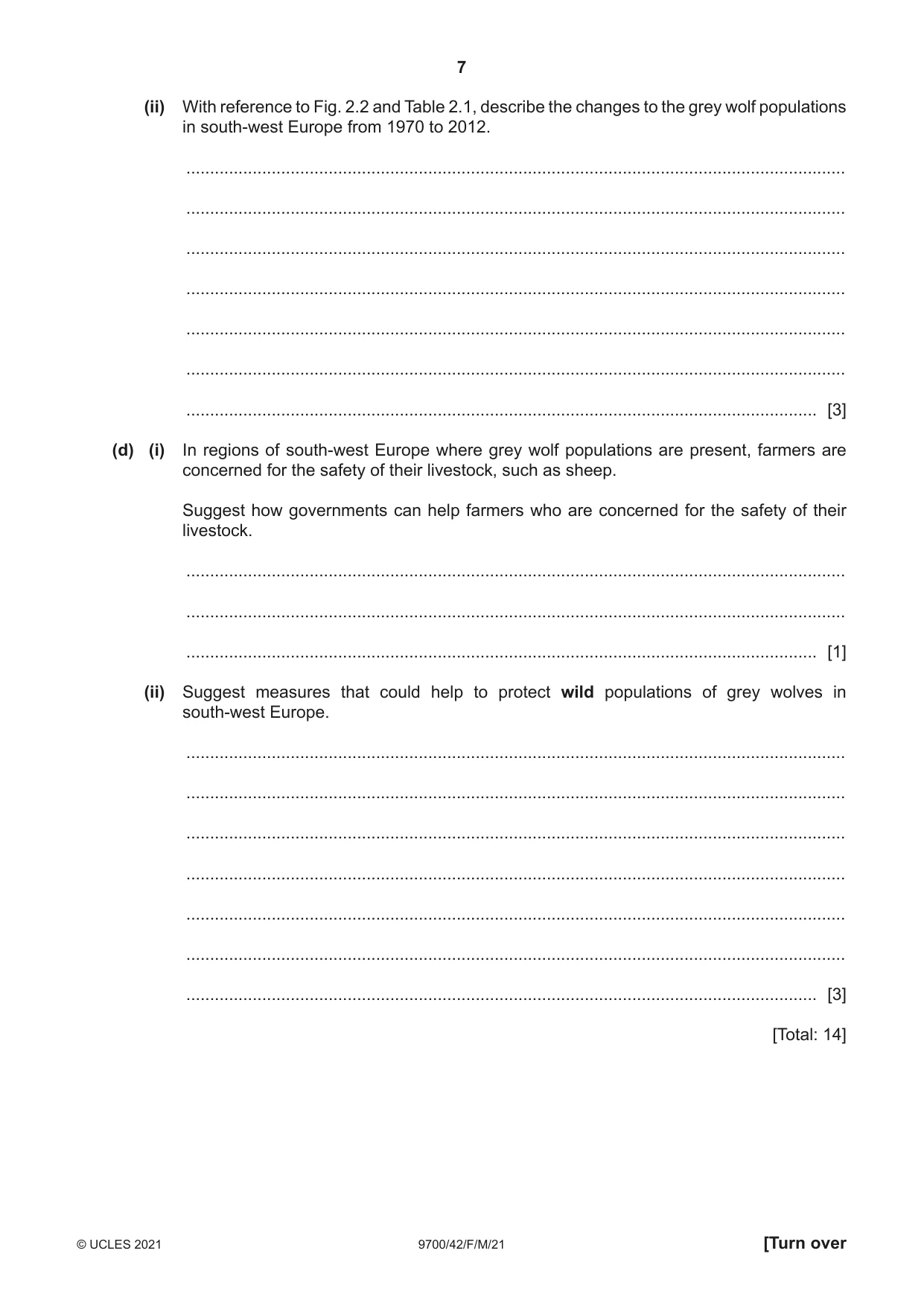
2 (a) The grey wolf, Canis lupus, is a large predator. During the 20th century, the grey wolf in south-west Europe was hunted almost to extinction. Fig. 2.1 shows a grey wolf. Fig. 2.1 (i) State the genus of the grey wolf. ..................................................................................................................................... [1] (ii) Suggest and explain the effects on the biodiversity of south-west Europe if the grey wolf becomes extinct. ........................................................................................................................................... ........................................................................................................................................... ........................................................................................................................................... ........................................................................................................................................... ........................................................................................................................................... ........................................................................................................................................... ..................................................................................................................................... [3] (b) Grey wolves can have territories of up to 950 km2. Grey wolves can travel up to 1000 km to start a new population. State reasons why the mark-release-recapture method is not suitable for estimating the size of a grey wolf population. ................................................................................................................................................... ................................................................................................................................................... ................................................................................................................................................... ................................................................................................................................................... ............................................................................................................................................. [2] (c) In 1992, new laws were introduced across south-west Europe to protect the grey wolf. Fig. 2.2 shows the distribution of grey wolf populations in south-west Europe in 1970 and 2012. No grey wolves from captive-breeding populations were released into the wild in south-west Europe during the period from 1970 to 2012. 1970 2012 4 1 1 3 3 2 2 key to populations 1000 km 1 Iberian 2 Sierra Morena 3 Italian 4 Alpine Fig. 2.2 Table 2.1 shows the sizes of the populations of grey wolf shown in Fig. 2.2. Table 2.1 size of size of percentage population population population change in 1970 in 2012 1 Iberian 700 2500 ...................... 2 Sierra Morena 60 6 –90 3 Italian 100 800 +700 4 Alpine 0 160 (i) Complete Table 2.1 to show the percentage change in the size of the Iberian grey wolf population from 1970 to 2012. Write your answer in the table to the nearest whole number. [1] (ii) With reference to Fig. 2.2 and Table 2.1, describe the changes to the grey wolf populations in south-west Europe from 1970 to 2012. ........................................................................................................................................... ........................................................................................................................................... ........................................................................................................................................... ........................................................................................................................................... ........................................................................................................................................... ........................................................................................................................................... ..................................................................................................................................... [3] (d) (i) In regions of south-west Europe where grey wolf populations are present, farmers are concerned for the safety of their livestock, such as sheep. Suggest how governments can help farmers who are concerned for the safety of their livestock. ........................................................................................................................................... ........................................................................................................................................... ..................................................................................................................................... [1] (ii) Suggest measures that could help to protect wild populations of grey wolves in south-west Europe. ........................................................................................................................................... ........................................................................................................................................... ........................................................................................................................................... ........................................................................................................................................... ........................................................................................................................................... ........................................................................................................................................... ..................................................................................................................................... [3] [Total: 14]
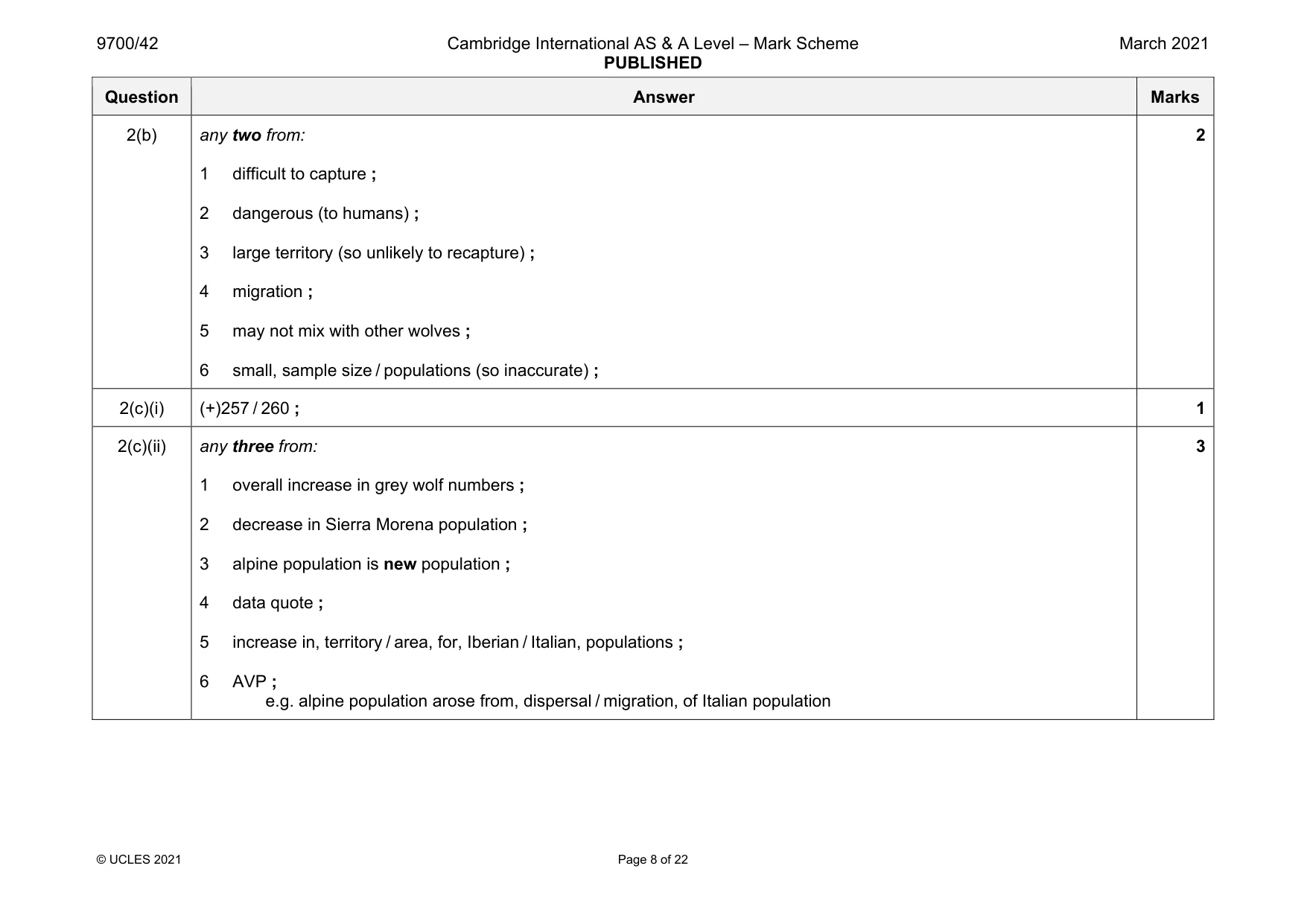
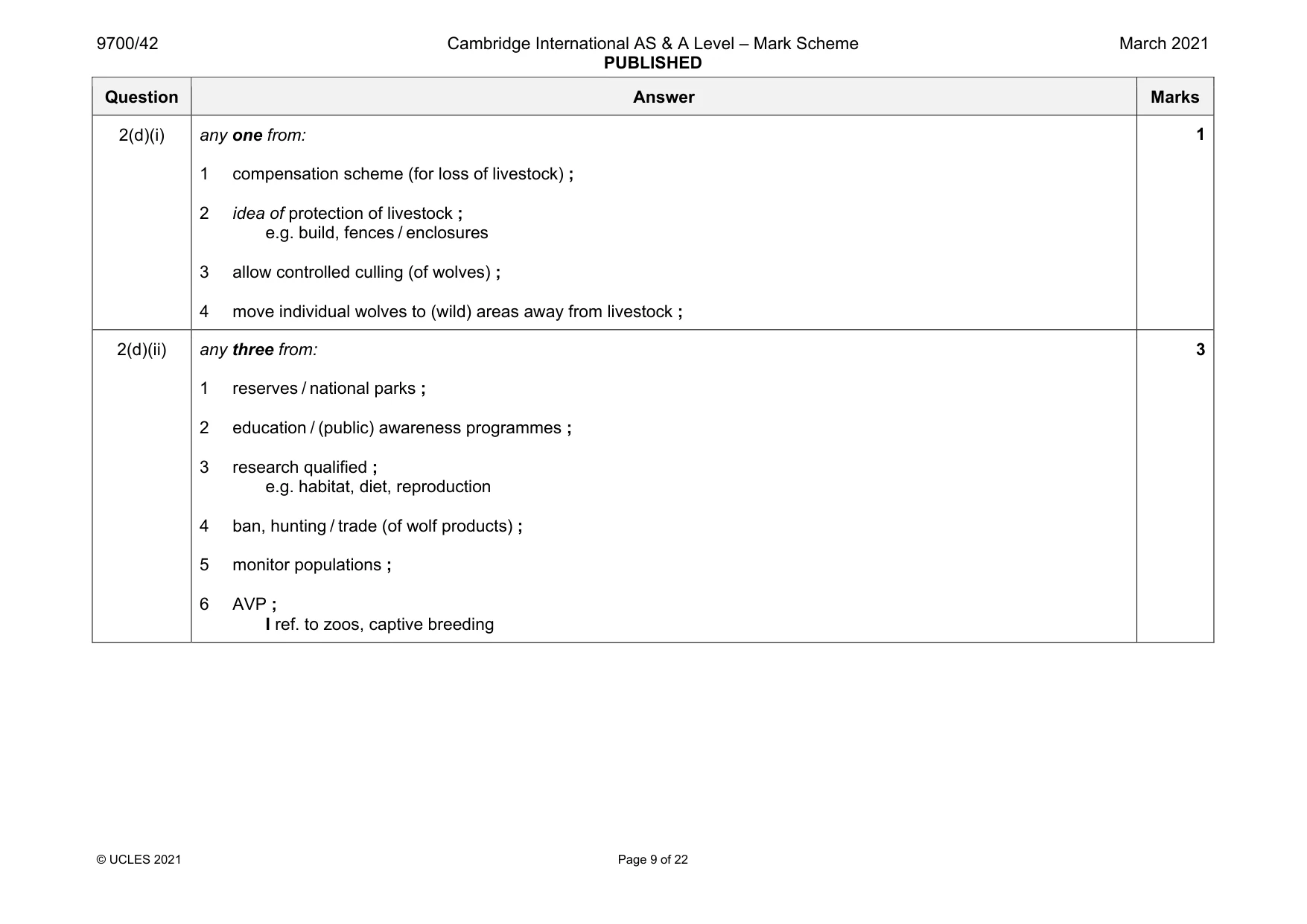
Mark scheme: 2(a)(i) Canis ; 1 2(a)(ii) any three from: 1 decrease in biodiversity ; 2 prey of grey wolf / herbivores, (may) increase in number ; 3 (leads to) overgrazing ; A herbivores would decrease plant populations 4 change in, ecosystem / habitat / food web ; 5 change in genetic variation ; 6 over many years ; 3 Question Answer Marks 2(b) any two from: 1 difficult to capture ; 2 dangerous (to humans) ; 3 large territory (so unlikely to recapture) ; 4 migration ; 5 may not mix with other wolves ; 6 small, sample size / populations (so inaccurate) ; 2 2(c)(i) (+)257 / 260 ; 1 2(c)(ii) any three from: 1 overall increase in grey wolf numbers ; 2 decrease in Sierra Morena population ; 3 alpine population is new population ; 4 data quote ; 5 increase in, territory / area, for, Iberian / Italian, populations ; 6 AVP ; e.g. alpine population arose from, dispersal / migration, of Italian population 3 Question Answer Marks 2(d)(i) any one from: 1 compensation scheme (for loss of livestock) ; 2 idea of protection of livestock ; e.g. build, fences / enclosures 3 allow controlled culling (of wolves) ; 4 move individual wolves to (wild) areas away from livestock ; 1 2(d)(ii) any three from: 1 reserves / national parks ; 2 education / (public) awareness programmes ; 3 research qualified ; e.g. habitat, diet, reproduction 4 ban, hunting / trade (of wolf products) ; 5 monitor populations ; 6 AVP ; I ref. to zoos, captive breeding 3
Q3 · Vitamin A deficiency is a widespread public health problem
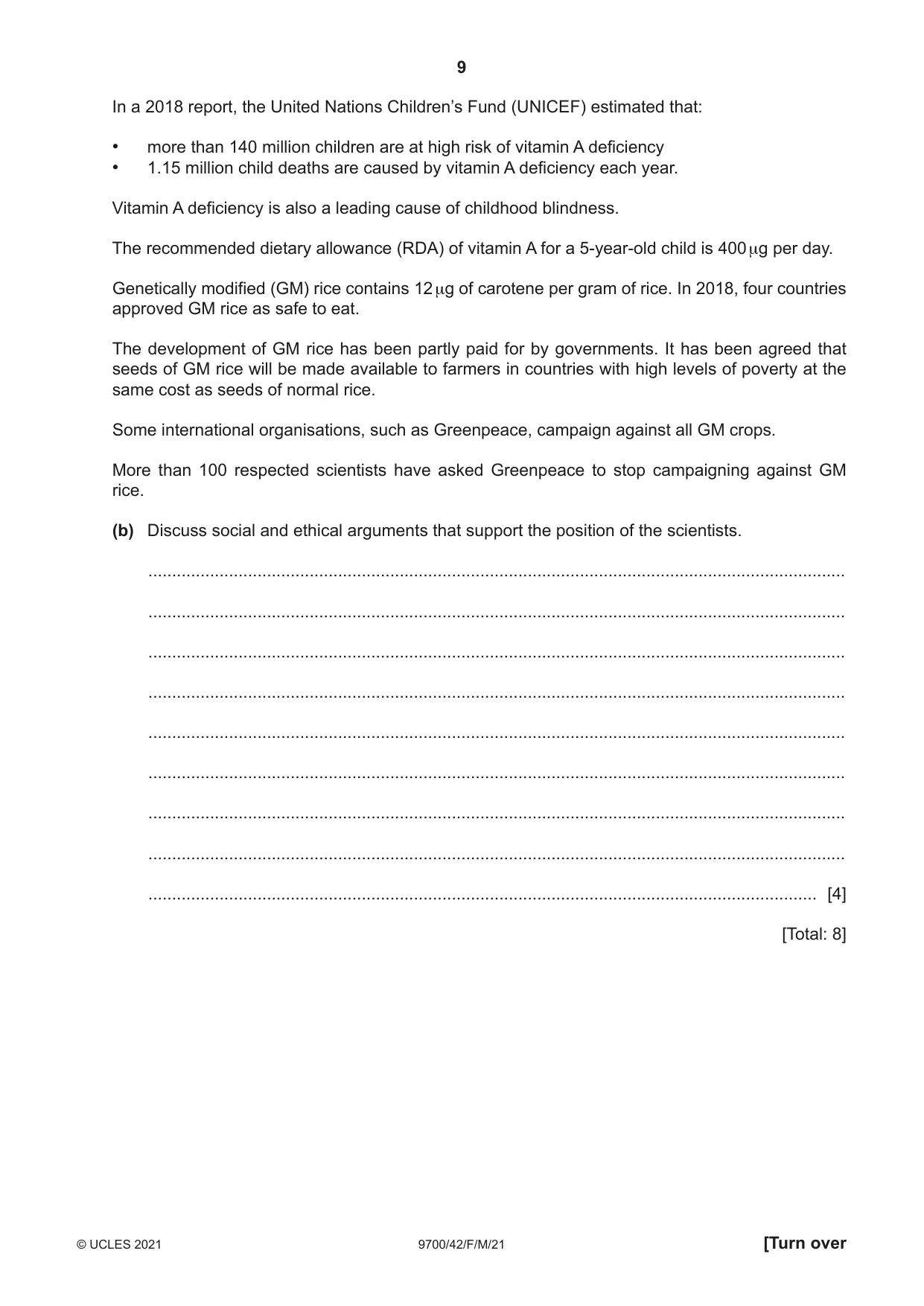
3 Vitamin A deficiency is a widespread public health problem. One source of vitamin A is carotene in the diet. Carotene can be converted to vitamin A in the body. White rice grains are not a dietary source of vitamin A because they do not contain carotene. Scientists have genetically modified a variety of rice to improve the diet of people who are vitamin A deficient. The grains of this genetically modified rice contain carotene. (a) Describe how genetic engineering could be used to modify a variety of rice so that the grains contain carotene. ................................................................................................................................................... ................................................................................................................................................... ................................................................................................................................................... ................................................................................................................................................... ................................................................................................................................................... ................................................................................................................................................... ................................................................................................................................................... ................................................................................................................................................... ................................................................................................................................................... ................................................................................................................................................... ................................................................................................................................................... ............................................................................................................................................. [4] In a 2018 report, the United Nations Children’s Fund (UNICEF) estimated that: • more than 140 million children are at high risk of vitamin A deficiency • 1.15 million child deaths are caused by vitamin A deficiency each year. Vitamin A deficiency is also a leading cause of childhood blindness. The recommended dietary allowance (RDA) of vitamin A for a 5-year-old child is 400 μg per day. Genetically modified (GM) rice contains 12 μg of carotene per gram of rice. In 2018, four countries approved GM rice as safe to eat. The development of GM rice has been partly paid for by governments. It has been agreed that seeds of GM rice will be made available to farmers in countries with high levels of poverty at the same cost as seeds of normal rice. Some international organisations, such as Greenpeace, campaign against all GM crops. More than 100 respected scientists have asked Greenpeace to stop campaigning against GM rice. (b) Discuss social and ethical arguments that support the position of the scientists. ................................................................................................................................................... ................................................................................................................................................... ................................................................................................................................................... ................................................................................................................................................... ................................................................................................................................................... ................................................................................................................................................... ................................................................................................................................................... ................................................................................................................................................... ............................................................................................................................................. [4] [Total: 8]
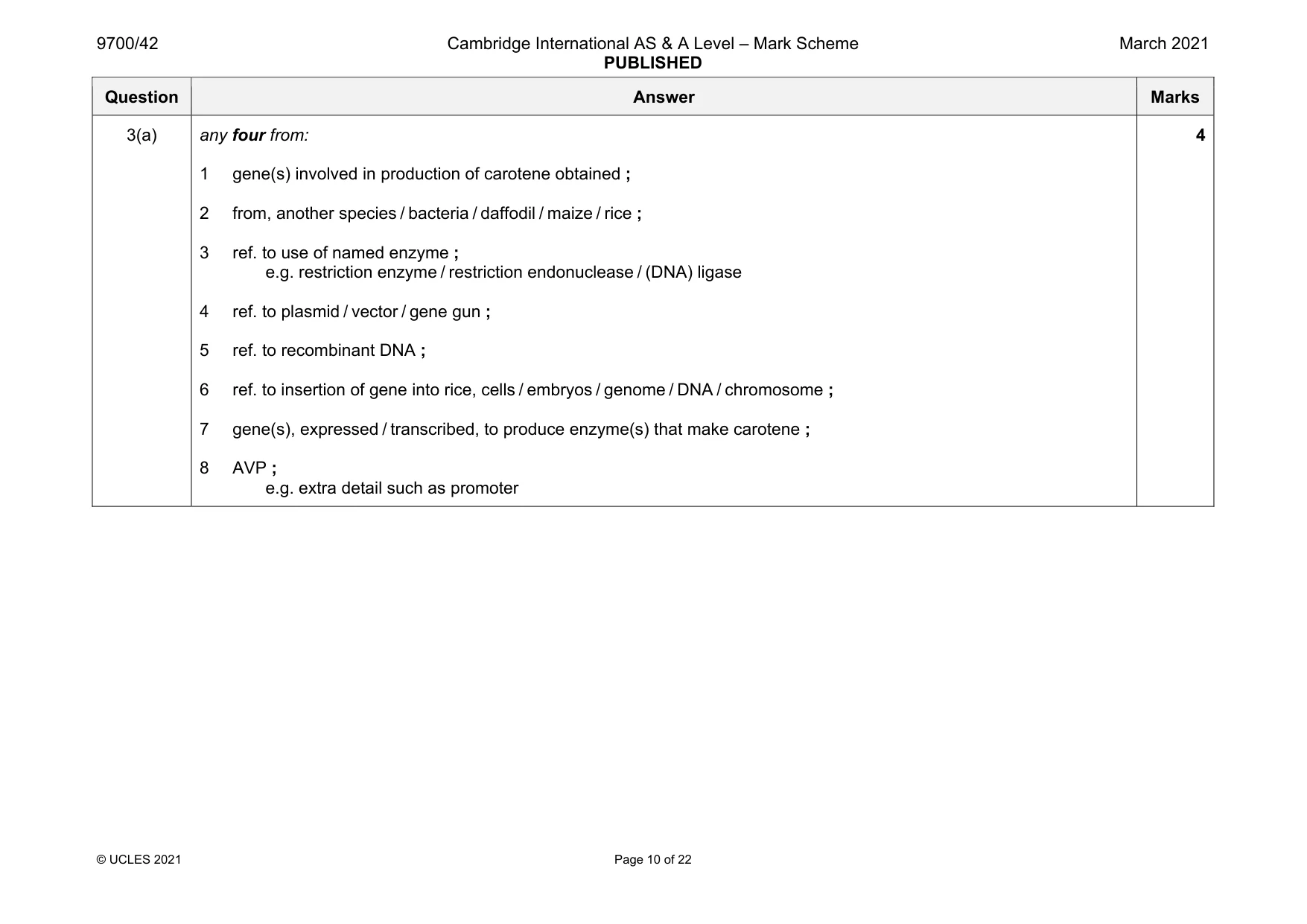
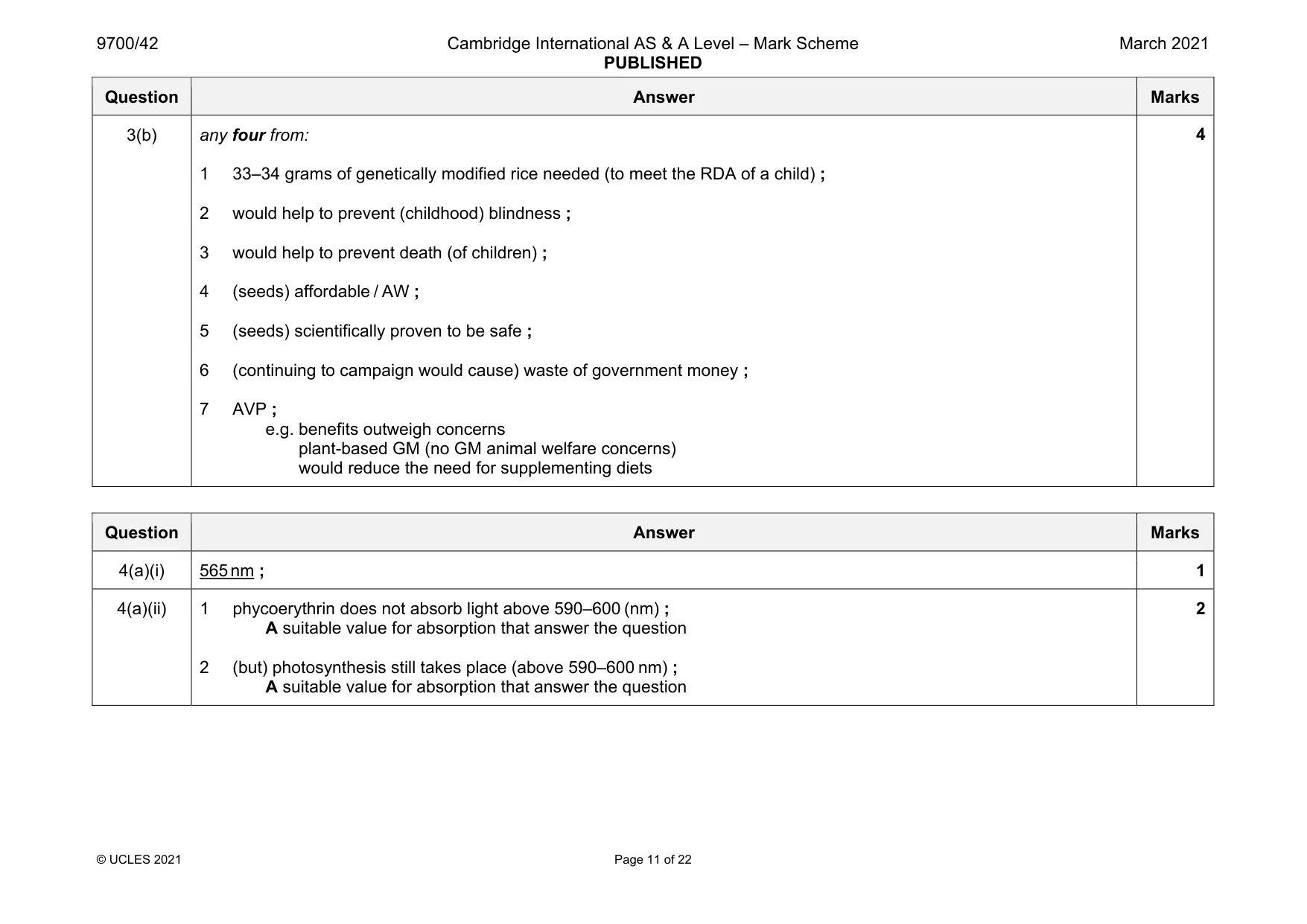
Mark scheme: 3(a) any four from: 1 gene(s) involved in production of carotene obtained ; 2 from, another species / bacteria / daffodil / maize / rice ; 3 ref. to use of named enzyme ; e.g. restriction enzyme / restriction endonuclease / (DNA) ligase 4 ref. to plasmid / vector / gene gun ; 5 ref. to recombinant DNA ; 6 ref. to insertion of gene into rice, cells / embryos / genome / DNA / chromosome ; 7 gene(s), expressed / transcribed, to produce enzyme(s) that make carotene ; 8 AVP ; e.g. extra detail such as promoter 4 Question Answer Marks 3(b) any four from: 1 33–34 grams of genetically modified rice needed (to meet the RDA of a child) ; 2 would help to prevent (childhood) blindness ; 3 would help to prevent death (of children) ; 4 (seeds) affordable / AW ; 5 (seeds) scientifically proven to be safe ; 6 (continuing to campaign would cause) waste of government money ; 7 AVP ; e.g. benefits outweigh concerns plant-based GM (no GM animal welfare concerns) would reduce the need for supplementing diets 4
Q4 · Red algae are multicellular photosynthetic protoctists that contain phycoerythrin
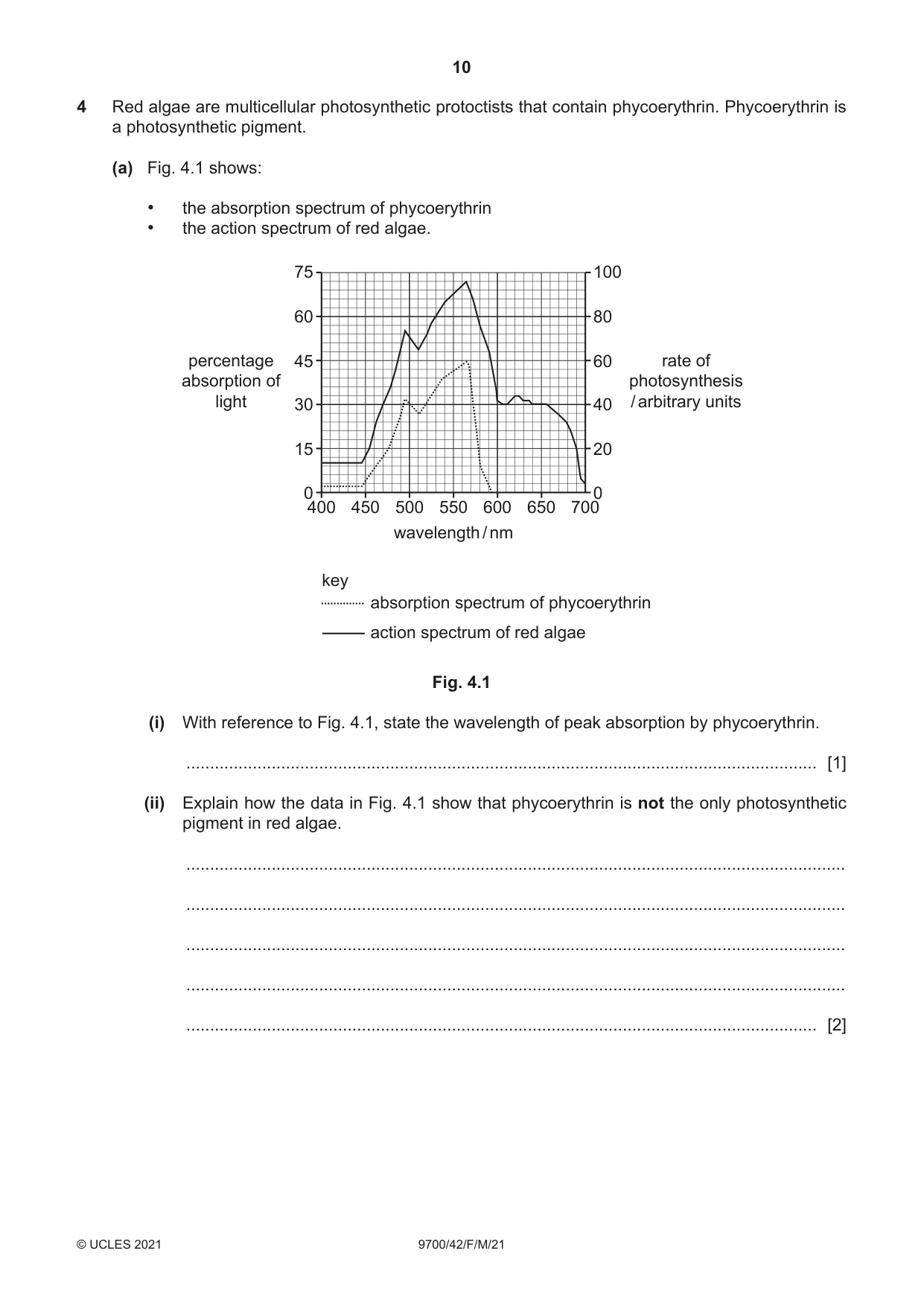
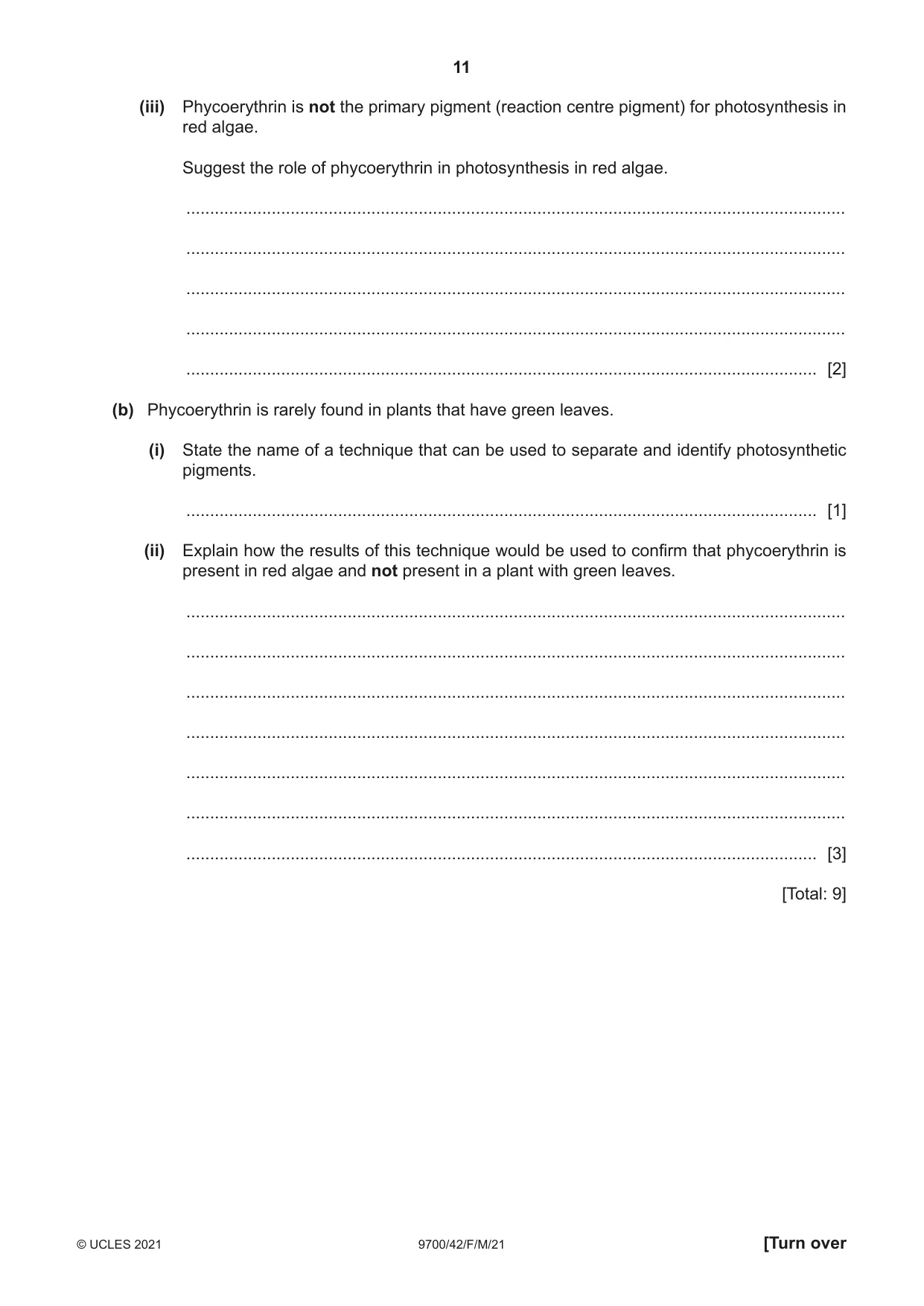
4 Red algae are multicellular photosynthetic protoctists that contain phycoerythrin. Phycoerythrin is a photosynthetic pigment. (a) Fig. 4.1 shows: • the absorption spectrum of phycoerythrin • the action spectrum of red algae. 75 100 60 80 percentage 45 60 rate of absorption of photosynthesis light 30 40 / arbitrary units 15 20 0 0 400 450 500 550 600 650 700 wavelength / nm key absorption spectrum of phycoerythrin action spectrum of red algae Fig. 4.1 (i) With reference to Fig. 4.1, state the wavelength of peak absorption by phycoerythrin. ..................................................................................................................................... [1] (ii) Explain how the data in Fig. 4.1 show that phycoerythrin is not the only photosynthetic pigment in red algae. ........................................................................................................................................... ........................................................................................................................................... ........................................................................................................................................... ........................................................................................................................................... ..................................................................................................................................... [2] (iii) Phycoerythrin is not the primary pigment (reaction centre pigment) for photosynthesis in red algae. Suggest the role of phycoerythrin in photosynthesis in red algae. ........................................................................................................................................... ........................................................................................................................................... ........................................................................................................................................... ........................................................................................................................................... ..................................................................................................................................... [2] (b) Phycoerythrin is rarely found in plants that have green leaves. (i) State the name of a technique that can be used to separate and identify photosynthetic pigments. ..................................................................................................................................... [1] (ii) Explain how the results of this technique would be used to confirm that phycoerythrin is present in red algae and not present in a plant with green leaves. ........................................................................................................................................... ........................................................................................................................................... ........................................................................................................................................... ........................................................................................................................................... ........................................................................................................................................... ........................................................................................................................................... ..................................................................................................................................... [3] [Total: 9]
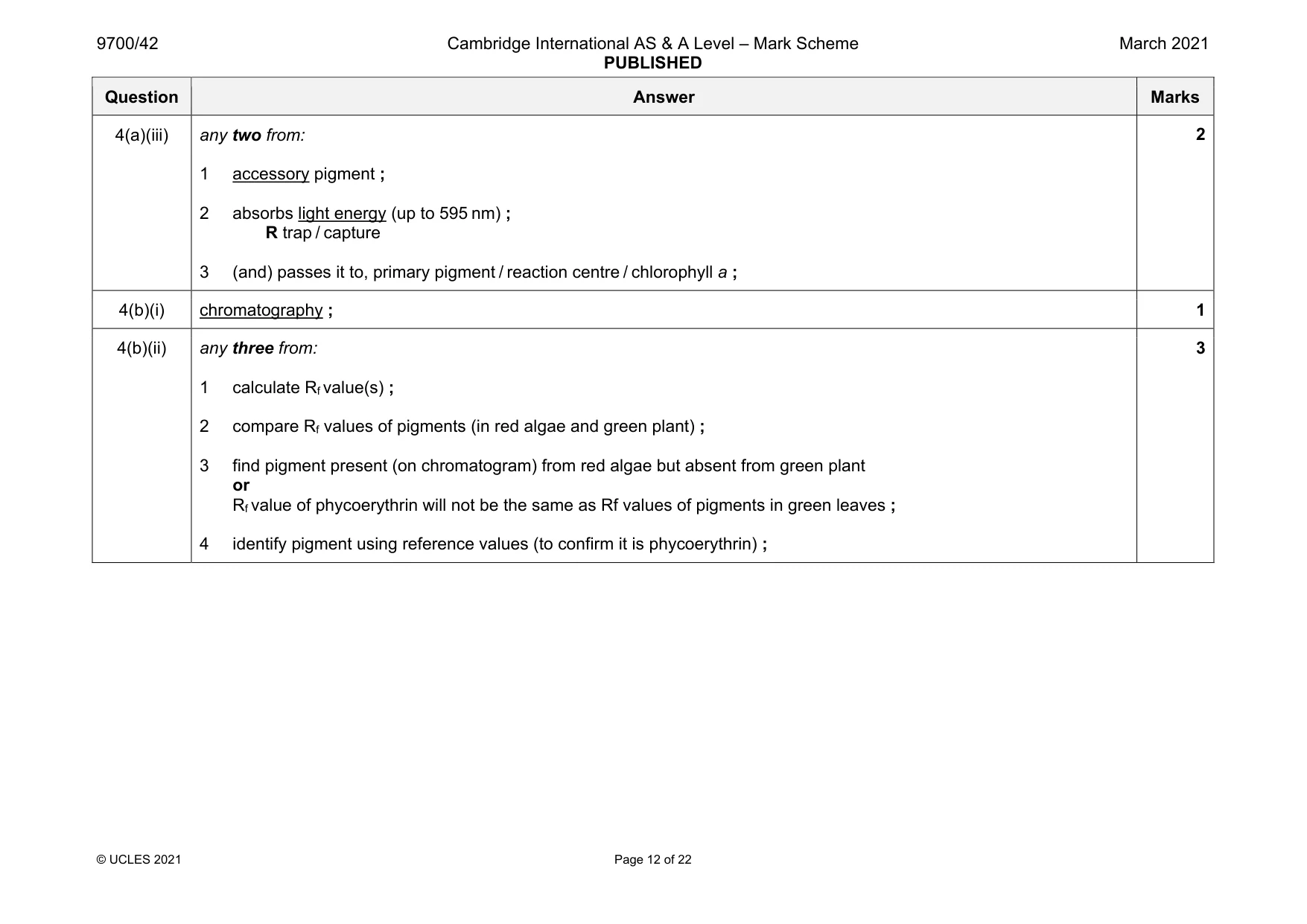
Mark scheme: 4(a)(i) 565 nm ; 1 4(a)(ii) 1 phycoerythrin does not absorb light above 590–600 (nm) ; A suitable value for absorption that answer the question 2 (but) photosynthesis still takes place (above 590–600 nm) ; A suitable value for absorption that answer the question 2 Question Answer Marks 4(a)(iii) any two from: 1 accessory pigment ; 2 absorbs light energy (up to 595 nm) ; R trap / capture 3 (and) passes it to, primary pigment / reaction centre / chlorophyll a ; 2 4(b)(i) chromatography ; 1 4(b)(ii) any three from: 1 calculate Rf value(s) ; 2 compare Rf values of pigments (in red algae and green plant) ; 3 find pigment present (on chromatogram) from red algae but absent from green plant or Rf value of phycoerythrin will not be the same as Rf values of pigments in green leaves ; 4 identify pigment using reference values (to confirm it is phycoerythrin) ; 3
More questions on Photosynthesis as an energy transfer process
Q5 · Many processes and actions in plants and animals are due to the movement of ions
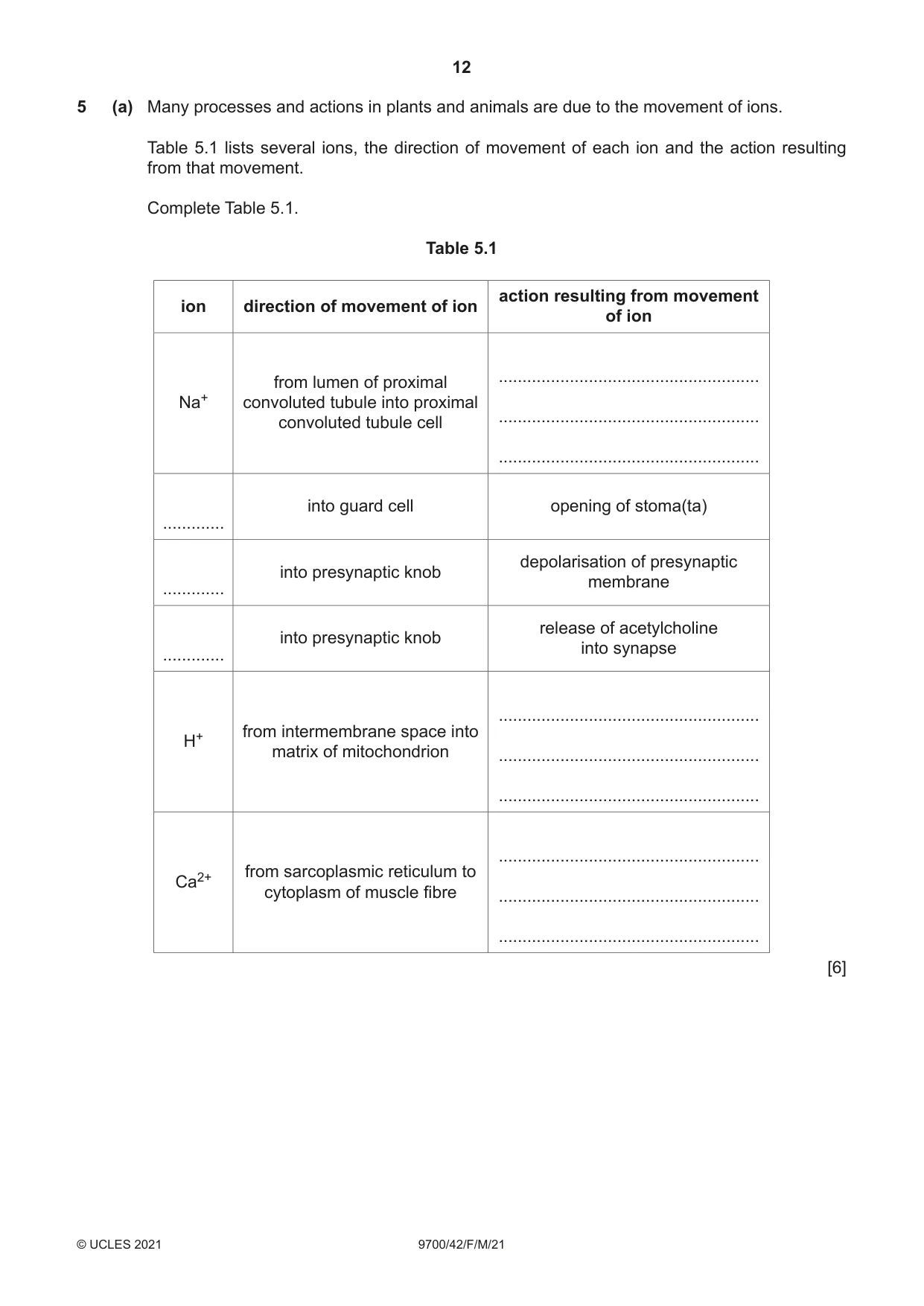
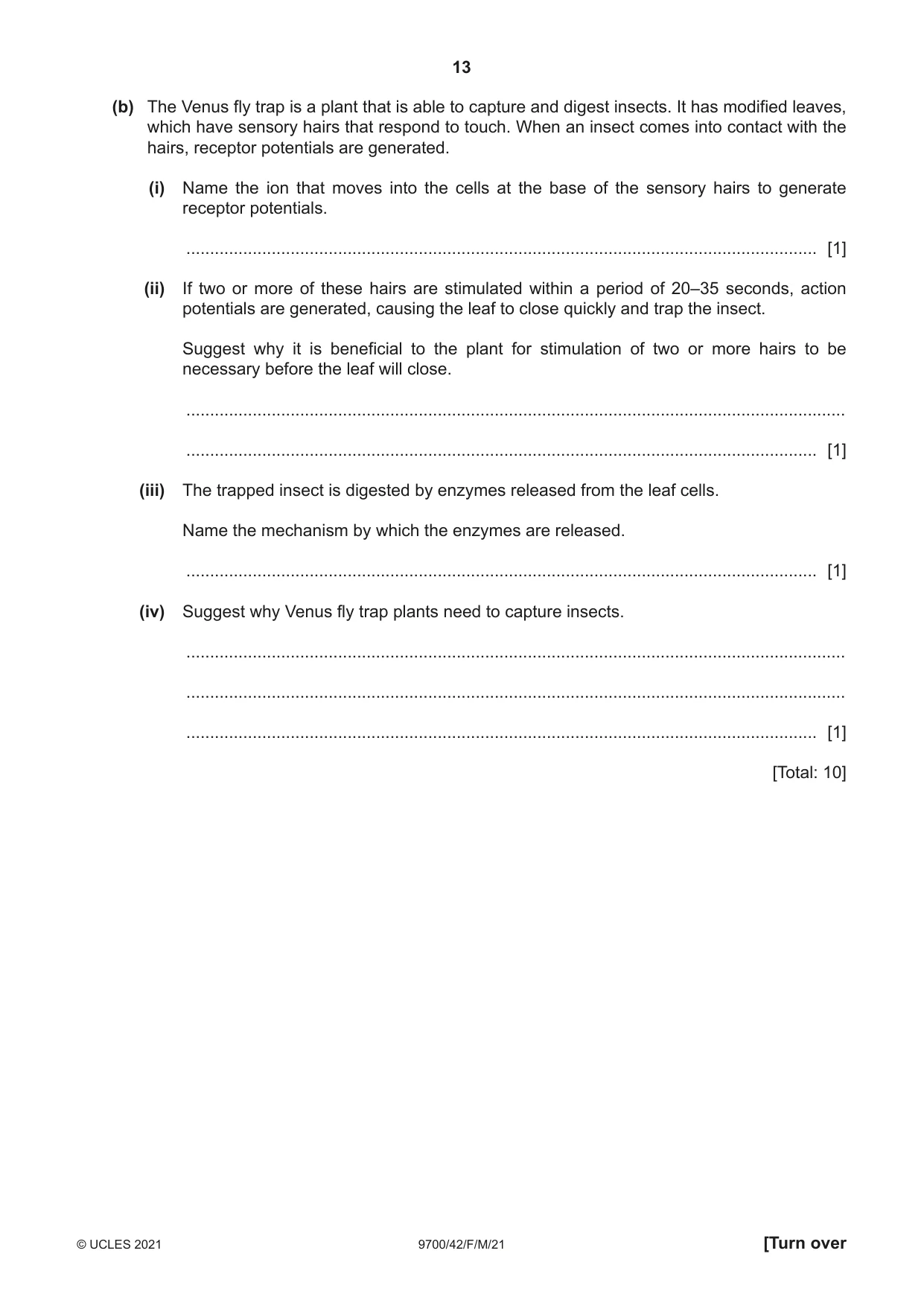
5 (a) Many processes and actions in plants and animals are due to the movement of ions. Table 5.1 lists several ions, the direction of movement of each ion and the action resulting from that movement. Complete Table 5.1. Table 5.1 action resulting from movement ion direction of movement of ion of ion ....................................................... from lumen of proximal Na+ convoluted tubule into proximal ....................................................... convoluted tubule cell ....................................................... into guard cell opening of stoma(ta) ............. depolarisation of presynaptic into presynaptic knob membrane ............. release of acetylcholine into presynaptic knob into synapse ............. ....................................................... from intermembrane space into H+ matrix of mitochondrion ....................................................... ....................................................... ....................................................... from sarcoplasmic reticulum to Ca2+ cytoplasm of muscle fibre ....................................................... ....................................................... [6] (b) The Venus fly trap is a plant that is able to capture and digest insects. It has modified leaves, which have sensory hairs that respond to touch. When an insect comes into contact with the hairs, receptor potentials are generated. (i) Name the ion that moves into the cells at the base of the sensory hairs to generate receptor potentials. ..................................................................................................................................... [1] (ii) If two or more of these hairs are stimulated within a period of 20–35 seconds, action potentials are generated, causing the leaf to close quickly and trap the insect. Suggest why it is beneficial to the plant for stimulation of two or more hairs to be necessary before the leaf will close. ........................................................................................................................................... ..................................................................................................................................... [1] (iii) The trapped insect is digested by enzymes released from the leaf cells. Name the mechanism by which the enzymes are released. ..................................................................................................................................... [1] (iv) Suggest why Venus fly trap plants need to capture insects. ........................................................................................................................................... ........................................................................................................................................... ..................................................................................................................................... [1] [Total: 10]
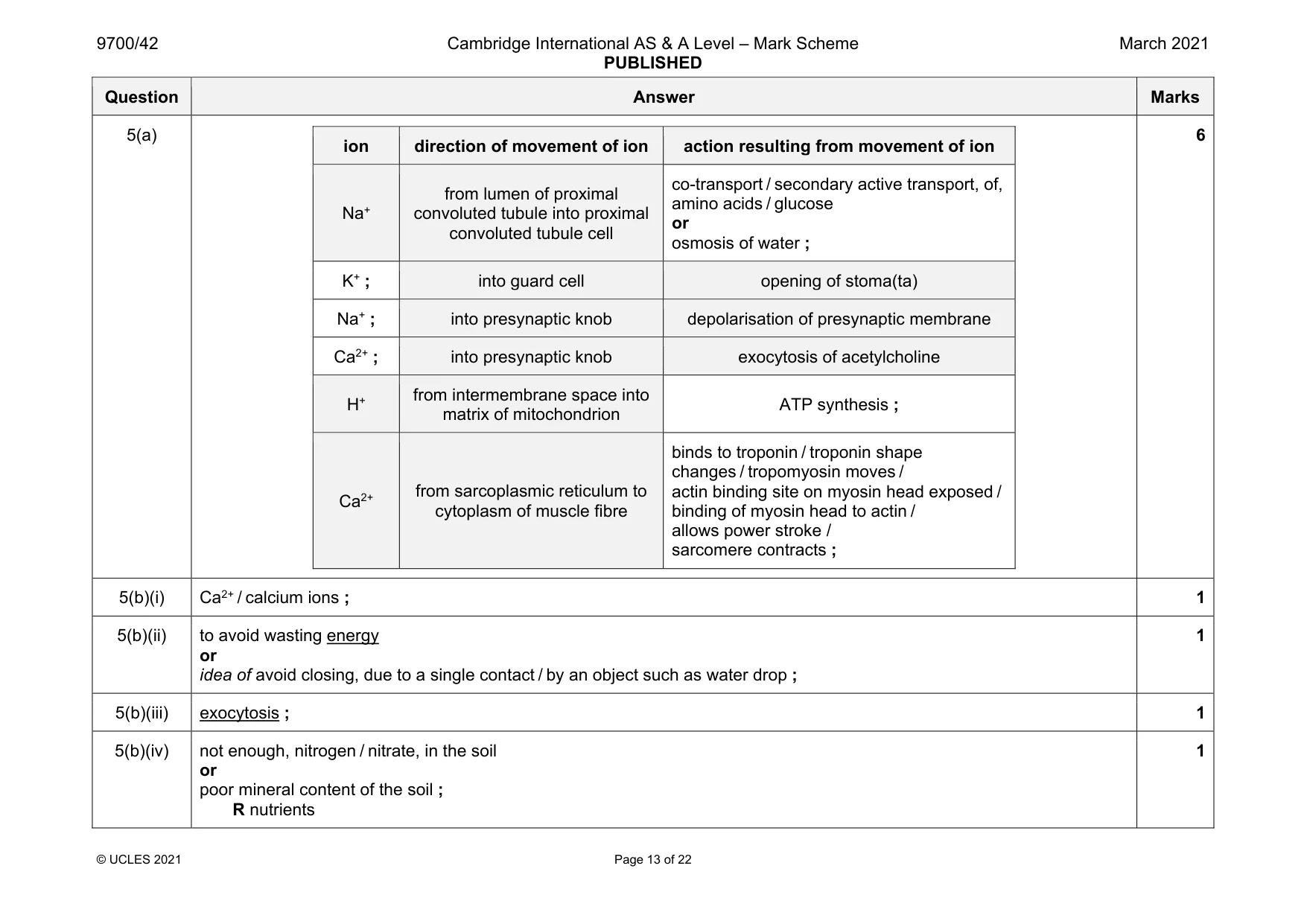
Mark scheme: 5(a) ion direction of movement of ion action resulting from movement of ion Na+ from lumen of proximal convoluted tubule into proximal convoluted tubule cell co-transport / secondary active transport, of, amino acids / glucose or osmosis of water ; K+ ; into guard cell opening of stoma(ta) Na+ ; into presynaptic knob depolarisation of presynaptic membrane Ca2+ ; into presynaptic knob exocytosis of acetylcholine H+ from intermembrane space into matrix of mitochondrion ATP synthesis ; Ca2+ from sarcoplasmic reticulum to cytoplasm of muscle fibre binds to troponin / troponin shape changes / tropomyosin moves / actin binding site on myosin head exposed / binding of myosin head to actin / allows power stroke / sarcomere contracts ; 6 5(b)(i) Ca2+ / calcium ions ; 1 5(b)(ii) to avoid wasting energy or idea of avoid closing, due to a single contact / by an object such as water drop ; 1 5(b)(iii) exocytosis ; 1 5(b)(iv) not enough, nitrogen / nitrate, in the soil or poor mineral content of the soil ; R nutrients 1
Q6 · Dogs have an exceptionally good sense of smell
6 Dogs have an exceptionally good sense of smell. They can detect molecules in the air with a concentration of one part per trillion (1012). (a) Olfactory receptor cells are the sensory receptors in the nasal cavity that respond to chemicals in the air. They function in a similar way to the chemoreceptor cells in the taste buds of the tongue. Describe how olfactory receptor cells in the nasal cavity of dogs respond to chemicals to generate an action potential. ................................................................................................................................................... ................................................................................................................................................... ................................................................................................................................................... ................................................................................................................................................... ................................................................................................................................................... ................................................................................................................................................... ................................................................................................................................................... ................................................................................................................................................... ................................................................................................................................................... ................................................................................................................................................... ................................................................................................................................................... ............................................................................................................................................. [5] (b) Dogs can use their sense of smell to detect differences between the breath of people with lung cancer and the breath of people without lung cancer. These differences are due to the presence of particular chemicals at very low concentrations in the breath of people with lung cancer. Dogs can be trained to sit when a person’s breath indicates that lung cancer is present. Screening people for lung cancer is important for early detection and treatment. Suggest two advantages of using dogs in this way to screen people for lung cancer. ................................................................................................................................................... ................................................................................................................................................... ................................................................................................................................................... ................................................................................................................................................... ............................................................................................................................................. [2] [Total: 7]
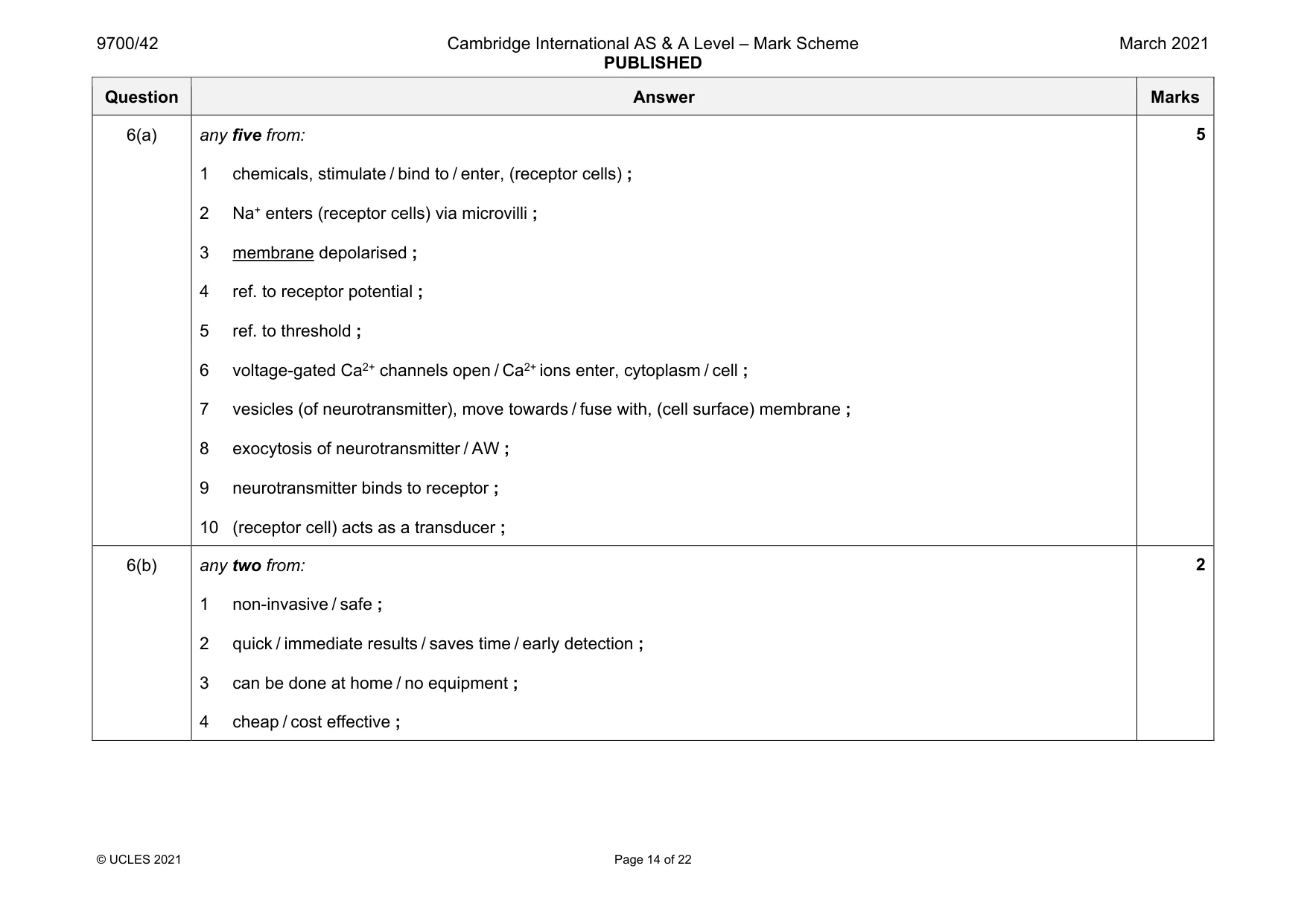
Mark scheme: 6(a) any five from: 1 chemicals, stimulate / bind to / enter, (receptor cells) ; 2 Na+ enters (receptor cells) via microvilli ; 3 membrane depolarised ; 4 ref. to receptor potential ; 5 ref. to threshold ; 6 voltage-gated Ca2+ channels open / Ca2+ ions enter, cytoplasm / cell ; 7 vesicles (of neurotransmitter), move towards / fuse with, (cell surface) membrane ; 8 exocytosis of neurotransmitter / AW ; 9 neurotransmitter binds to receptor ; 10 (receptor cell) acts as a transducer ; 6(b) any two from: 1 non-invasive / safe ; 2 quick / immediate results / saves time / early detection ; 3 can be done at home / no equipment ; 4 cheap / cost effective ; 2
Q7 · Two chromosomes in one stage of meiosis
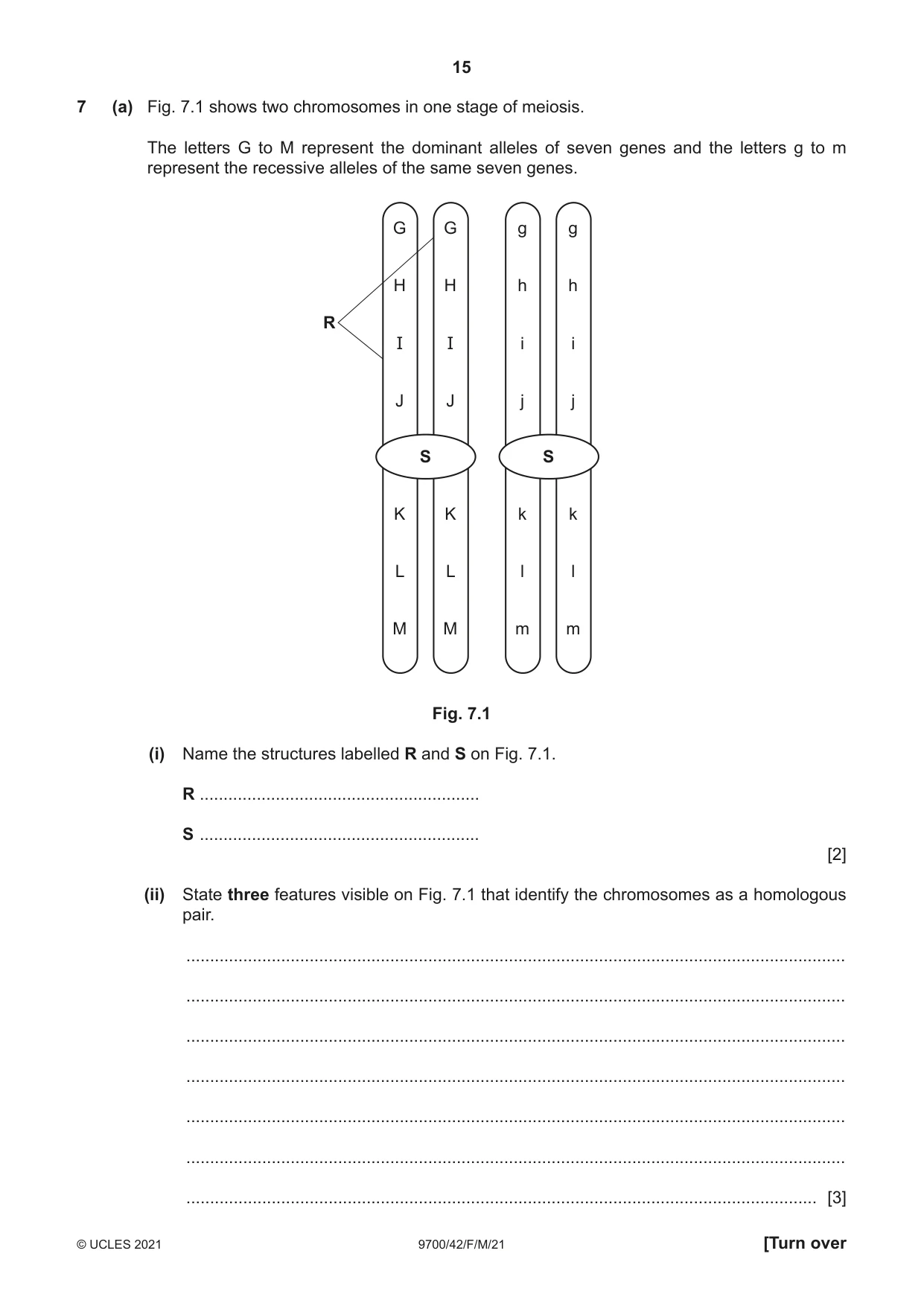
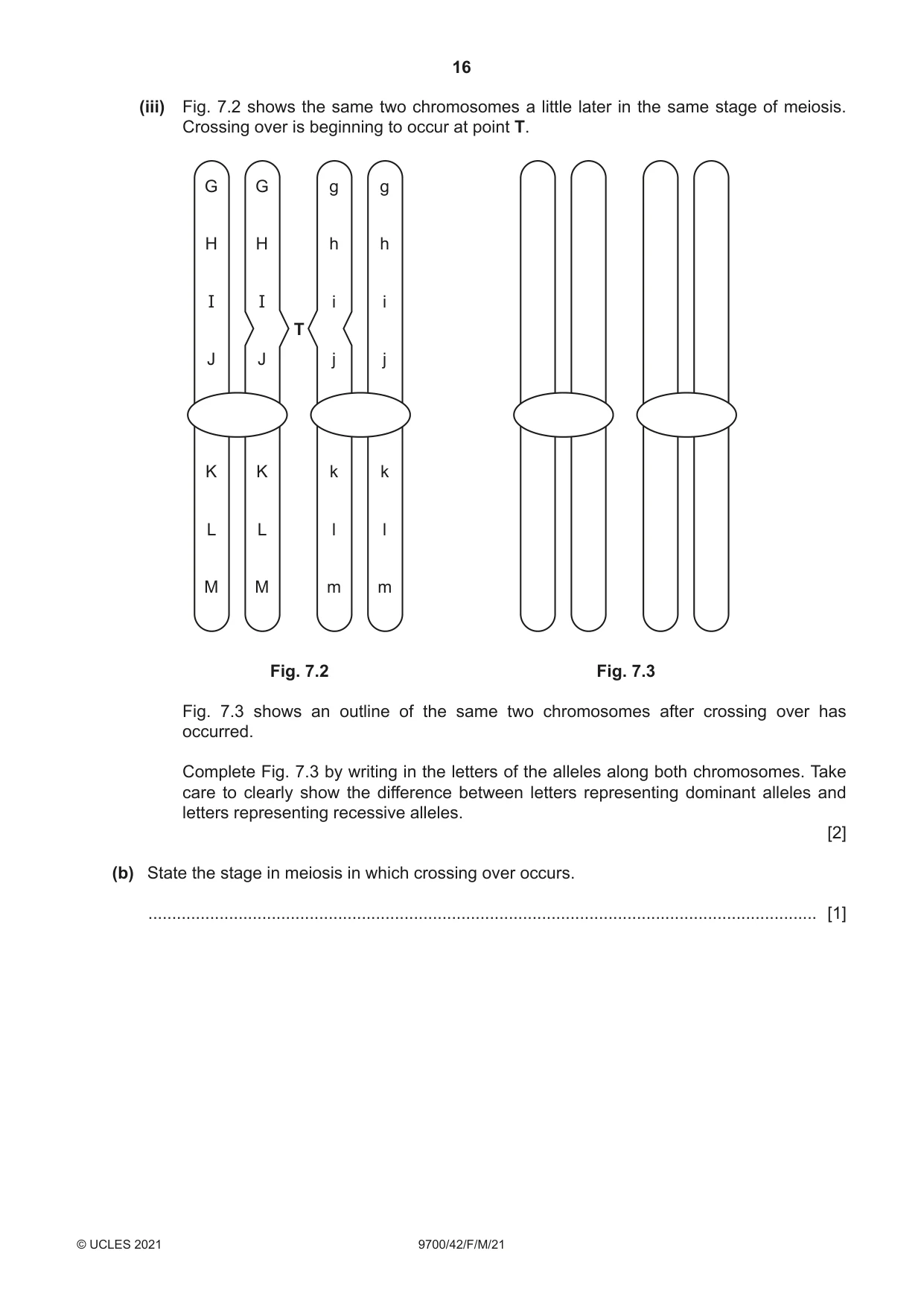
7 (a) Fig. 7.1 shows two chromosomes in one stage of meiosis. The letters G to M represent the dominant alleles of seven genes and the letters g to m represent the recessive alleles of the same seven genes. G G g g H H h h R I I i i J J j j S S K K k k L L l l M M m m Fig. 7.1 (i) Name the structures labelled R and S on Fig. 7.1. R ........................................................... S ........................................................... [2] (ii) State three features visible on Fig. 7.1 that identify the chromosomes as a homologous pair. ........................................................................................................................................... ........................................................................................................................................... ........................................................................................................................................... ........................................................................................................................................... ........................................................................................................................................... ........................................................................................................................................... ..................................................................................................................................... [3] (iii) Fig. 7.2 shows the same two chromosomes a little later in the same stage of meiosis. Crossing over is beginning to occur at point T. G G g g H H h h I I i i T J J j j K K k k L L l l M M m m Fig. 7.2 Fig. 7.3 Fig. 7.3 shows an outline of the same two chromosomes after crossing over has occurred. Complete Fig. 7.3 by writing in the letters of the alleles along both chromosomes. Take care to clearly show the difference between letters representing dominant alleles and letters representing recessive alleles. [2] (b) State the stage in meiosis in which crossing over occurs. ............................................................................................................................................. [1] (c) Crossing over results in genetic variation. Explain how random assortment of homologous chromosomes also results in genetic variation. ................................................................................................................................................... ................................................................................................................................................... ................................................................................................................................................... ................................................................................................................................................... ................................................................................................................................................... ................................................................................................................................................... ............................................................................................................................................. [3] [Total: 11]
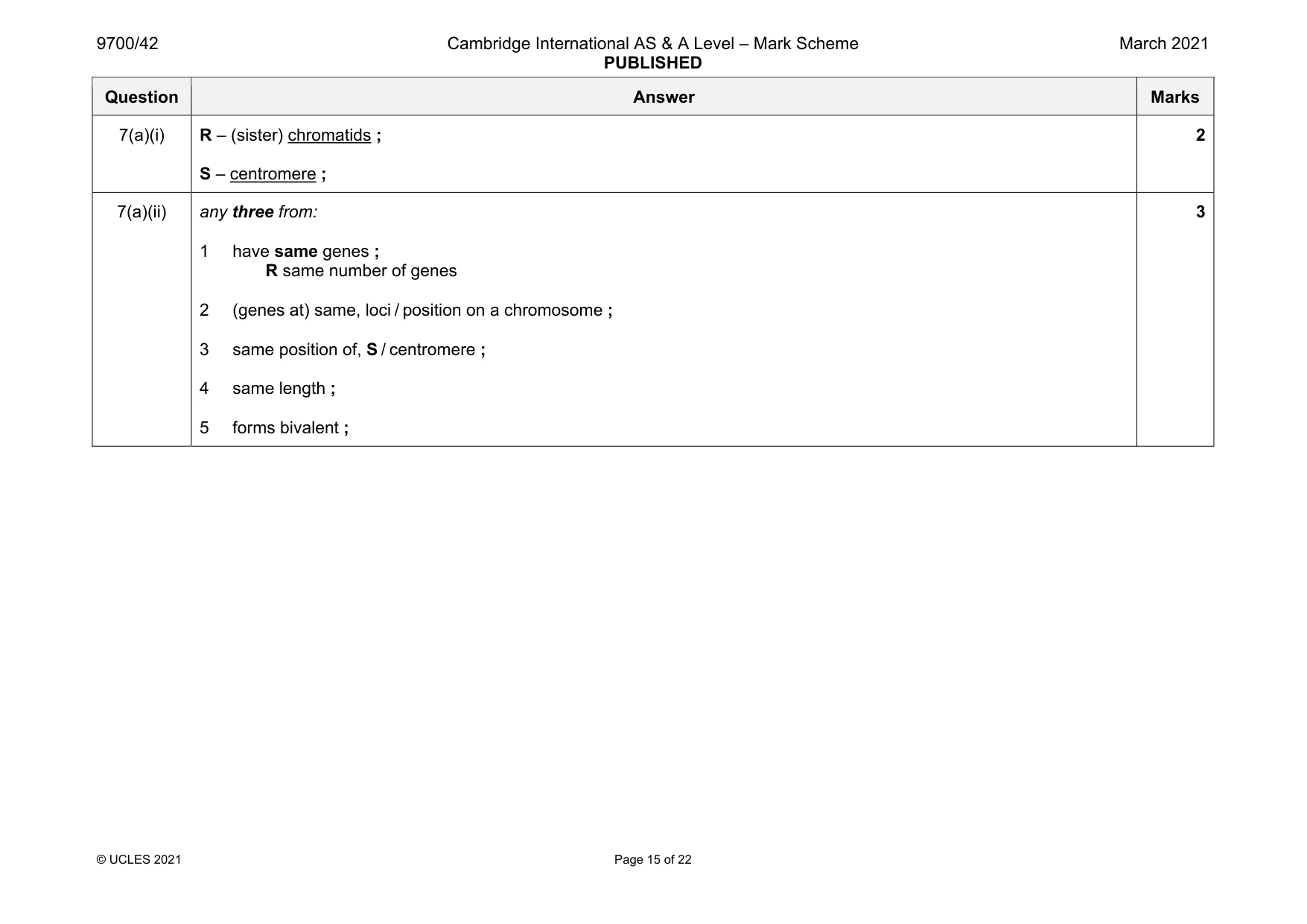
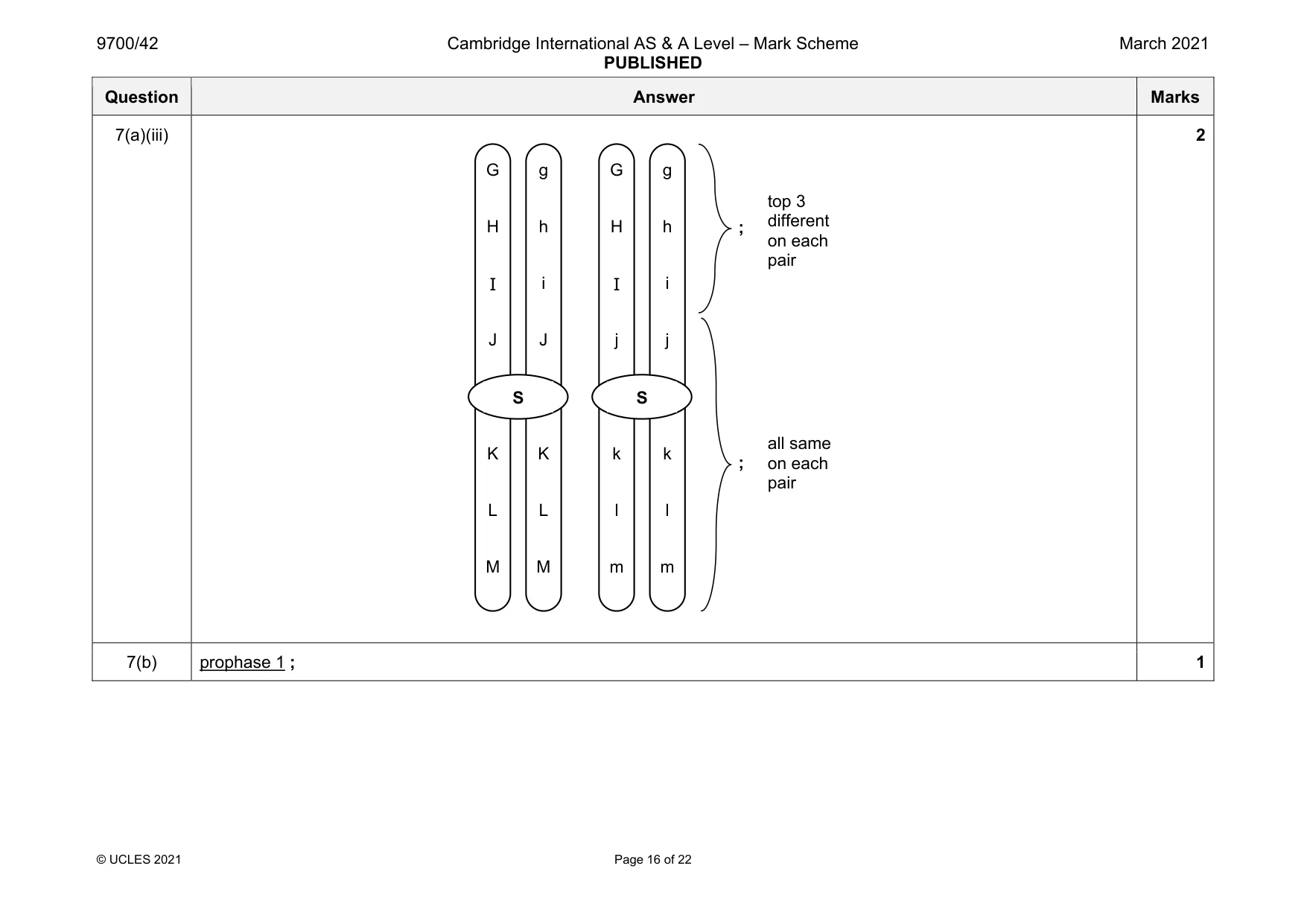
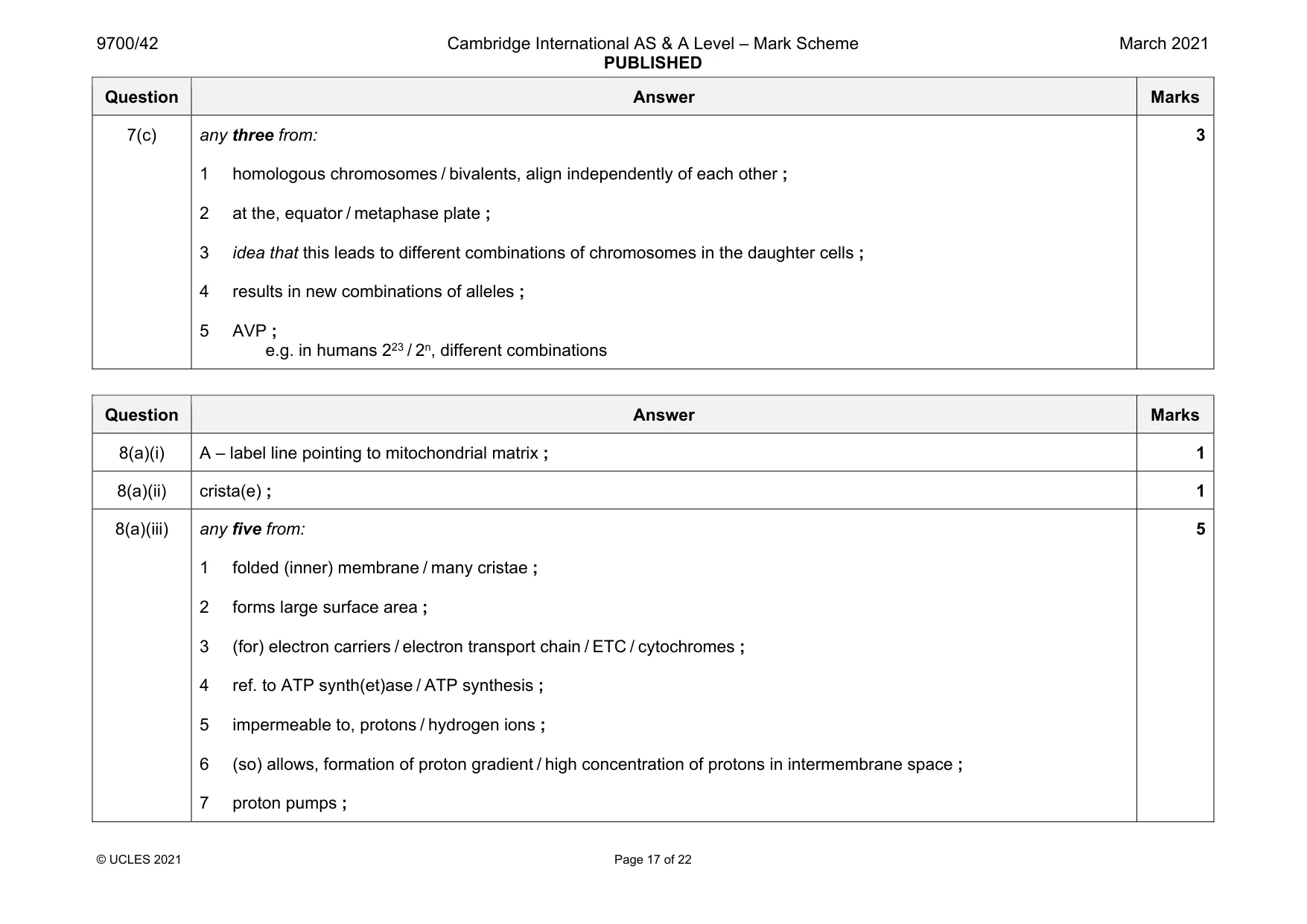
Mark scheme: 7(a)(i) R – (sister) chromatids ; S – centromere ; 2 7(a)(ii) any three from: 1 have same genes ; R same number of genes 2 (genes at) same, loci / position on a chromosome ; 3 same position of, S / centromere ; 4 same length ; 5 forms bivalent ; 3 Question Answer Marks 7(a)(iii) 2 7(b) prophase 1 ; 1 top 3 different on each pair all same on each pair S S G H K L g h K L G H k l g h k l I i I i J J j j M M m m ; ; Question Answer Marks 7(c) any three from: 1 homologous chromosomes / bivalents, align independently of each other ; 2 at the, equator / metaphase plate ; 3 idea that this leads to different combinations of chromosomes in the daughter cells ; 4 results in new combinations of alleles ; 5 AVP ; e.g. in humans 223 / 2n, different combinations 3
Q8 · A transmission electron micrograph of a mitochondrion
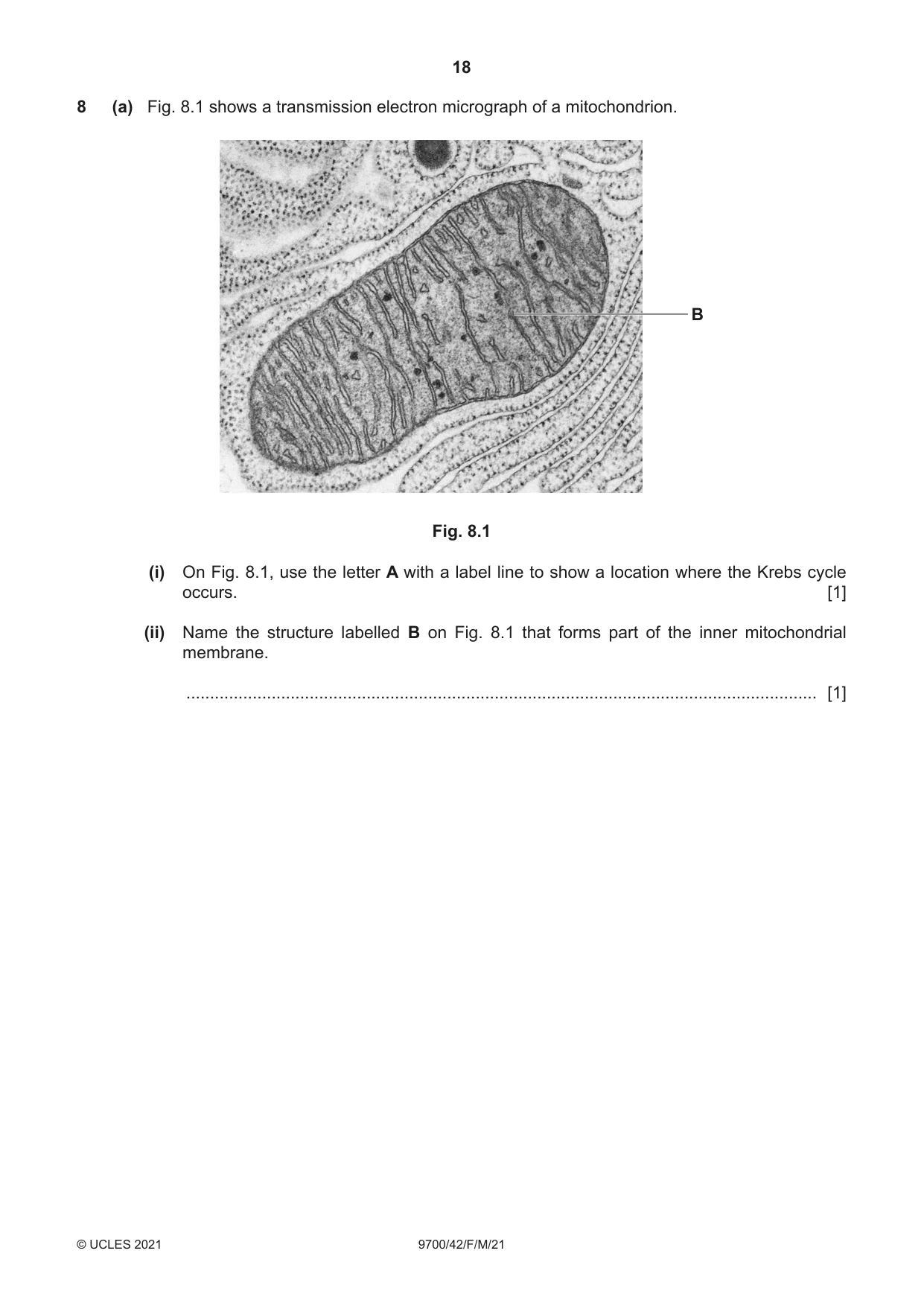
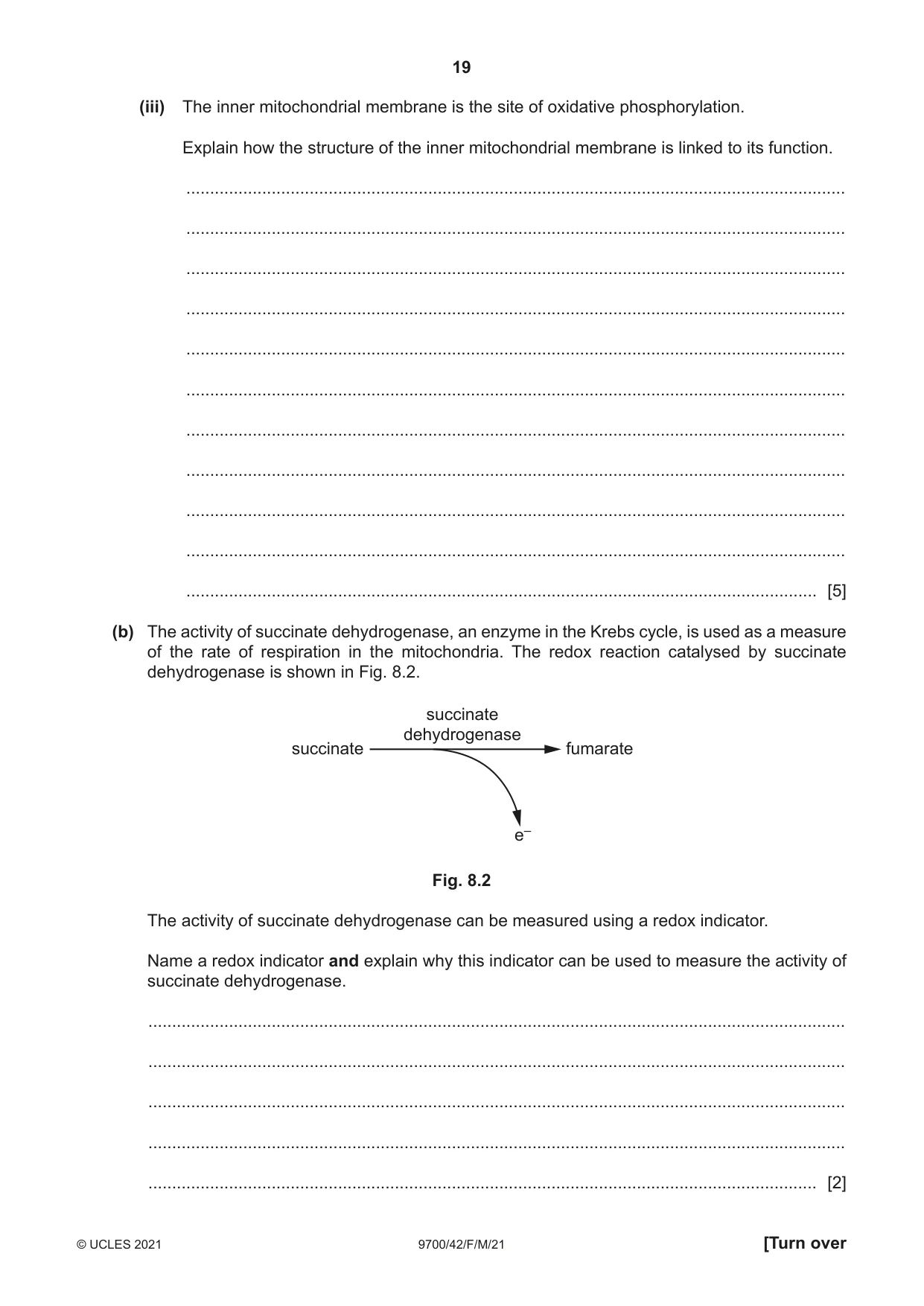
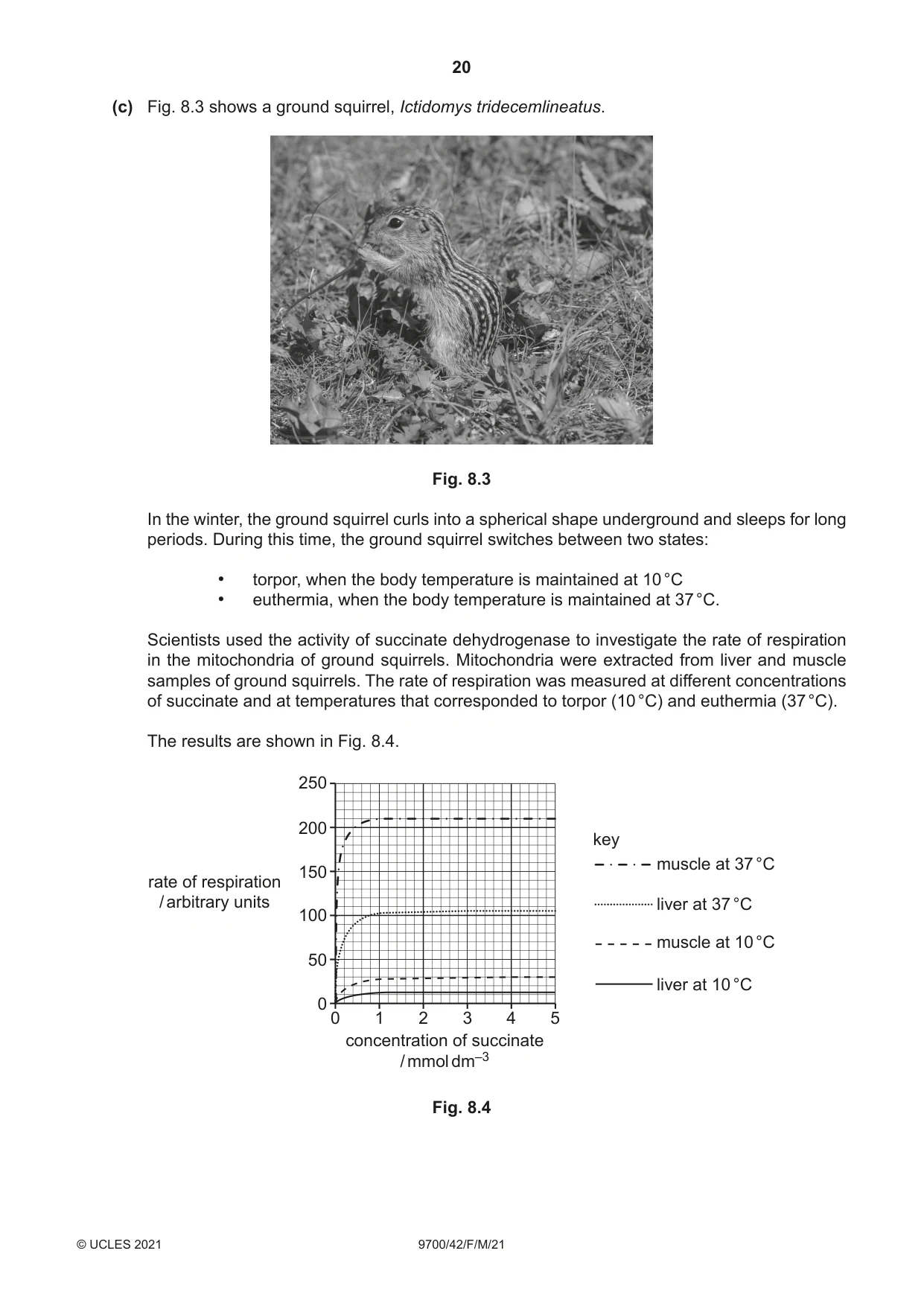
8 (a) Fig. 8.1 shows a transmission electron micrograph of a mitochondrion. B Fig. 8.1 (i) On Fig. 8.1, use the letter A with a label line to show a location where the Krebs cycle occurs. [1] (ii) Name the structure labelled B on Fig. 8.1 that forms part of the inner mitochondrial membrane. ..................................................................................................................................... [1] (iii) The inner mitochondrial membrane is the site of oxidative phosphorylation. Explain how the structure of the inner mitochondrial membrane is linked to its function. ........................................................................................................................................... ........................................................................................................................................... ........................................................................................................................................... ........................................................................................................................................... ........................................................................................................................................... ........................................................................................................................................... ........................................................................................................................................... ........................................................................................................................................... ........................................................................................................................................... ........................................................................................................................................... ..................................................................................................................................... [5] (b) The activity of succinate dehydrogenase, an enzyme in the Krebs cycle, is used as a measure of the rate of respiration in the mitochondria. The redox reaction catalysed by succinate dehydrogenase is shown in Fig. 8.2. succinate dehydrogenase succinate fumarate e– Fig. 8.2 The activity of succinate dehydrogenase can be measured using a redox indicator. Name a redox indicator and explain why this indicator can be used to measure the activity of succinate dehydrogenase. ................................................................................................................................................... ................................................................................................................................................... ................................................................................................................................................... ................................................................................................................................................... ............................................................................................................................................. [2] (c) Fig. 8.3 shows a ground squirrel, Ictidomys tridecemlineatus. Fig. 8.3 In the winter, the ground squirrel curls into a spherical shape underground and sleeps for long periods. During this time, the ground squirrel switches between two states: • torpor, when the body temperature is maintained at 10 °C • euthermia, when the body temperature is maintained at 37 °C. Scientists used the activity of succinate dehydrogenase to investigate the rate of respiration in the mitochondria of ground squirrels. Mitochondria were extracted from liver and muscle samples of ground squirrels. The rate of respiration was measured at different concentrations of succinate and at temperatures that corresponded to torpor (10 °C) and euthermia (37 °C). The results are shown in Fig. 8.4. 250 200 key muscle at 37 °C 150 rate of respiration / arbitrary units liver at 37 °C 100 muscle at 10 °C 50 liver at 10 °C 0 0 1 2 3 4 5 concentration of succinate / mmol dm–3 Fig. 8.4 (i) Describe the trends shown in Fig. 8.4. ........................................................................................................................................... ........................................................................................................................................... ........................................................................................................................................... ........................................................................................................................................... ........................................................................................................................................... ........................................................................................................................................... ..................................................................................................................................... [3] (ii) Explain the difference in the rates of respiration between liver at 37 °C and muscle at 37 °C. ........................................................................................................................................... ........................................................................................................................................... ........................................................................................................................................... ........................................................................................................................................... ........................................................................................................................................... ........................................................................................................................................... ..................................................................................................................................... [3] (iii) During torpor in ground squirrels, muscle tissue uses more energy than liver tissue. Suggest one reason for this difference. ........................................................................................................................................... ..................................................................................................................................... [1] [Total: 16]
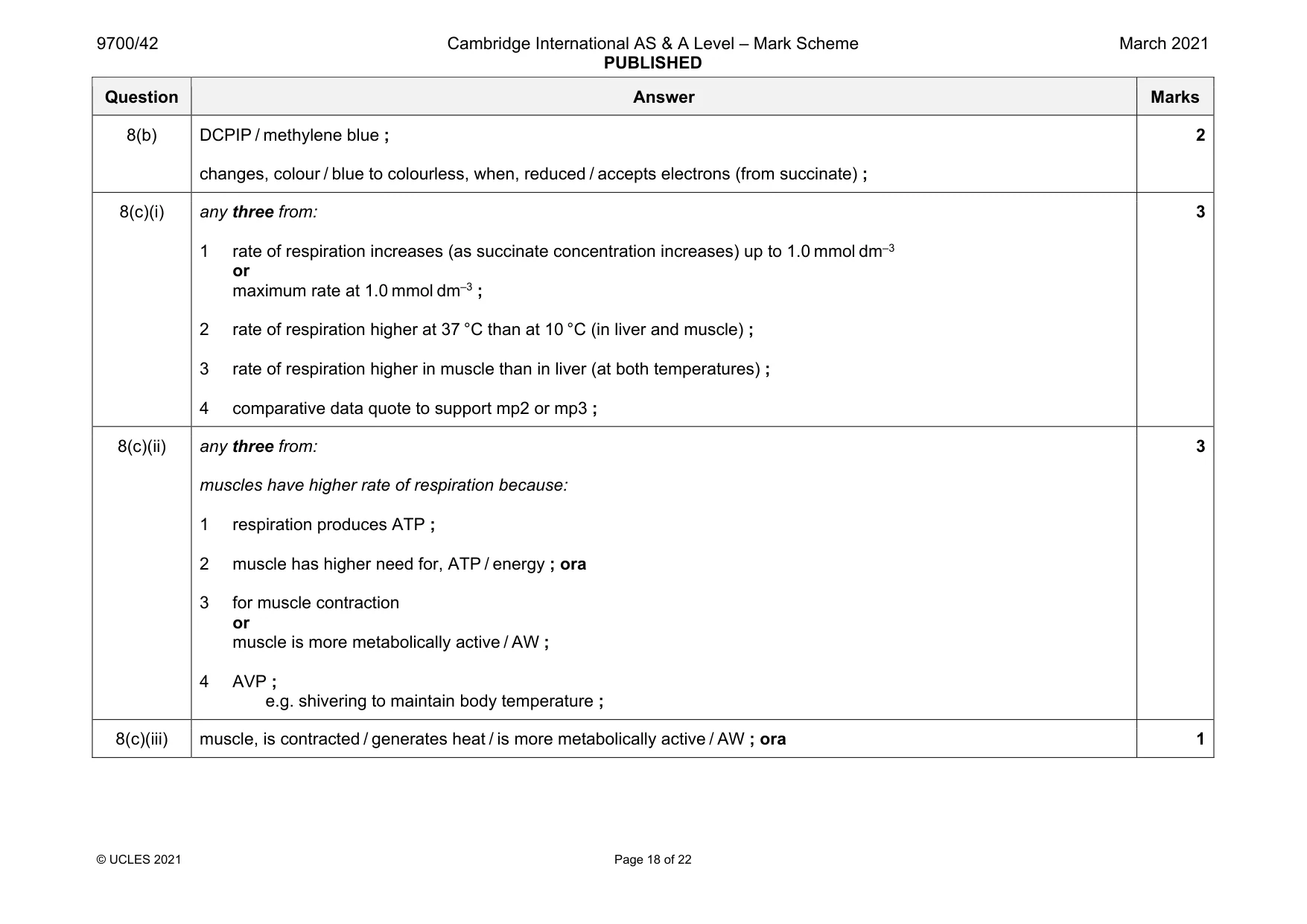
Mark scheme: 8(a)(i) A – label line pointing to mitochondrial matrix ; 1 8(a)(ii) crista(e) ; 1 8(a)(iii) any five from: 1 folded (inner) membrane / many cristae ; 2 forms large surface area ; 3 (for) electron carriers / electron transport chain / ETC / cytochromes ; 4 ref. to ATP synth(et)ase / ATP synthesis ; 5 impermeable to, protons / hydrogen ions ; 6 (so) allows, formation of proton gradient / high concentration of protons in intermembrane space ; 7 proton pumps ; 5 Question Answer Marks 8(b) DCPIP / methylene blue ; changes, colour / blue to colourless, when, reduced / accepts electrons (from succinate) ; 2 8(c)(i) any three from: 1 rate of respiration increases (as succinate concentration increases) up to 1.0 mmol dm–3 or maximum rate at 1.0 mmol dm–3 ; 2 rate of respiration higher at 37 °C than at 10 °C (in liver and muscle) ; 3 rate of respiration higher in muscle than in liver (at both temperatures) ; 4 comparative data quote to support mp2 or mp3 ; 3 8(c)(ii) any three from: muscles have higher rate of respiration because: 1 respiration produces ATP ; 2 muscle has higher need for, ATP / energy ; ora 3 for muscle contraction or muscle is more metabolically active / AW ; 4 AVP ; e.g. shivering to maintain body temperature ; 3 8(c)(iii) muscle, is contracted / generates heat / is more metabolically active / AW ; ora 1
Q9 · Compare the characteristic features of the domains Eukarya and Bacteria
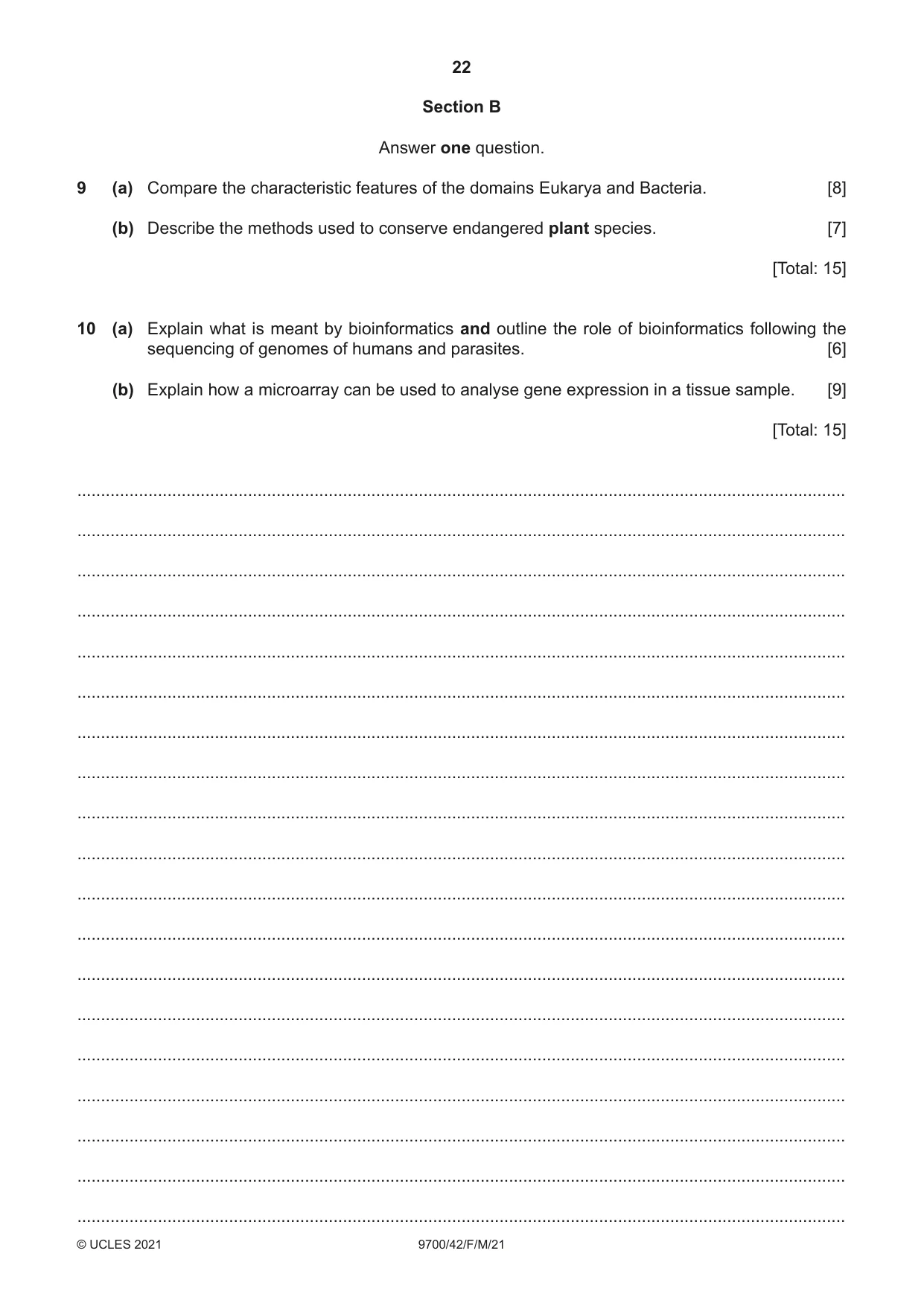
9 (a) Compare the characteristic features of the domains Eukarya and Bacteria. [8] (b) Describe the methods used to conserve endangered plant species. [7] [Total: 15]
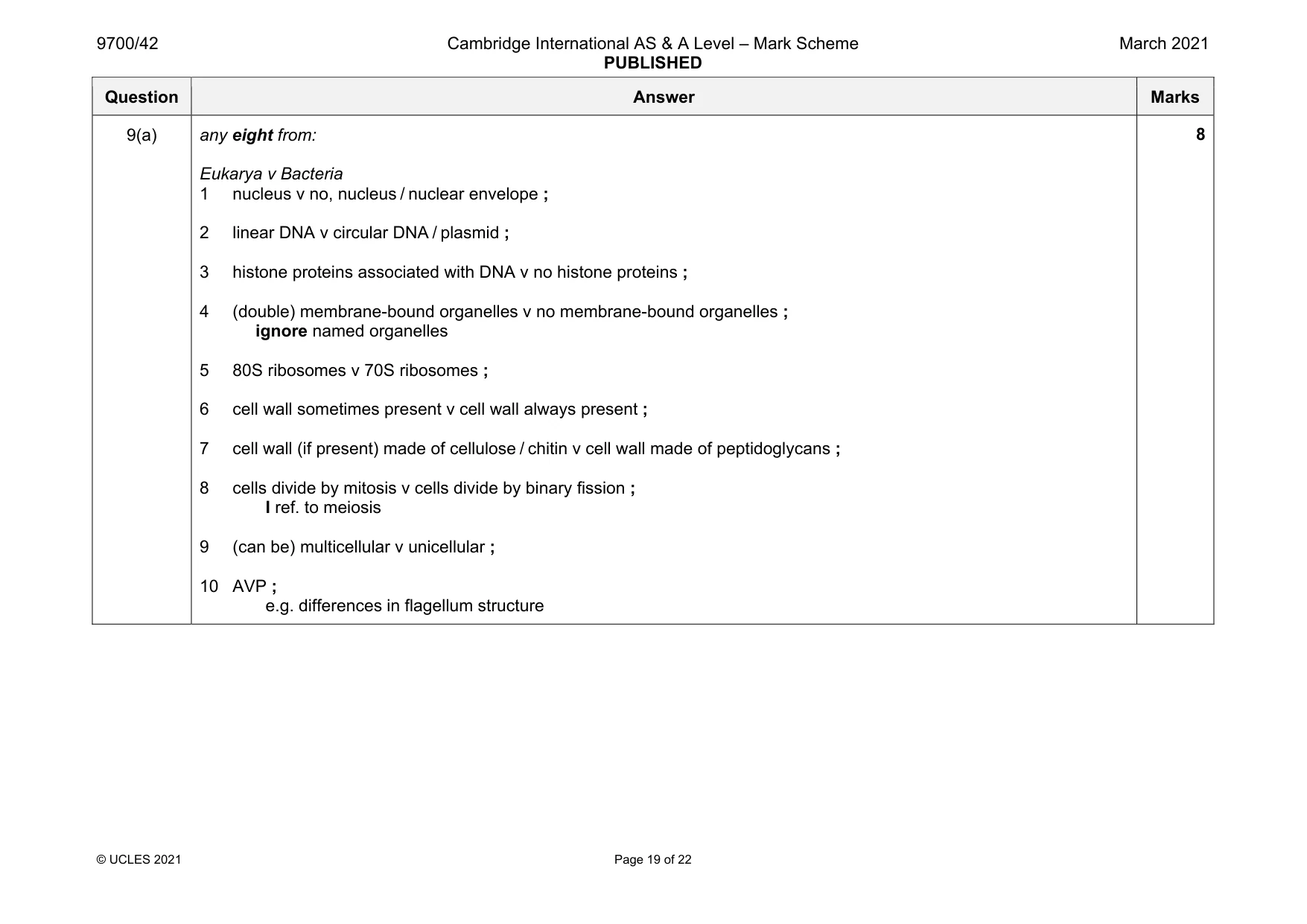
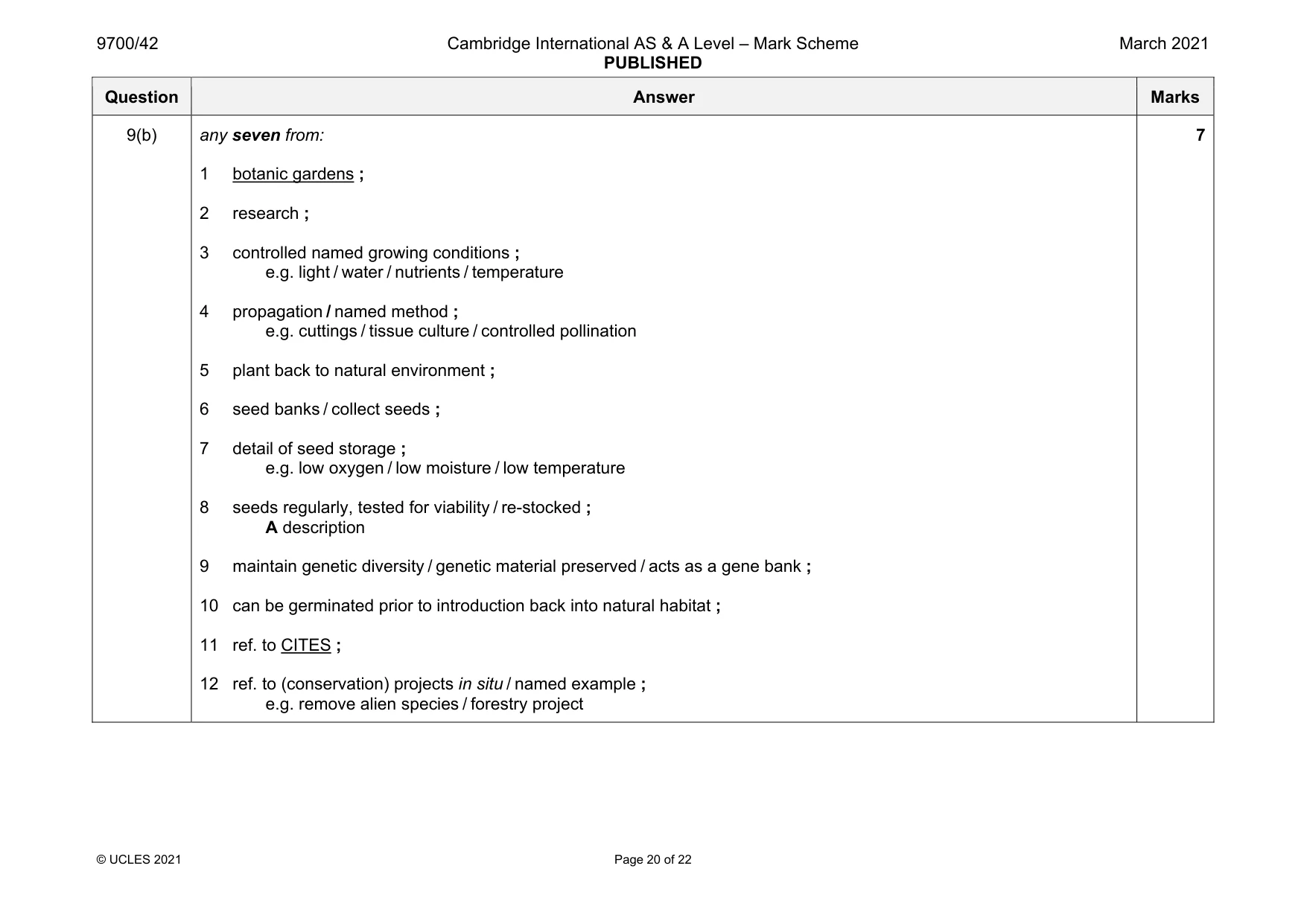
Mark scheme: 9(a) any eight from: Eukarya v Bacteria 1 nucleus v no, nucleus / nuclear envelope ; 2 linear DNA v circular DNA / plasmid ; 3 histone proteins associated with DNA v no histone proteins ; 4 (double) membrane-bound organelles v no membrane-bound organelles ; ignore named organelles 5 80S ribosomes v 70S ribosomes ; 6 cell wall sometimes present v cell wall always present ; 7 cell wall (if present) made of cellulose / chitin v cell wall made of peptidoglycans ; 8 cells divide by mitosis v cells divide by binary fission ; I ref. to meiosis 9 (can be) multicellular v unicellular ; 10 AVP ; e.g. differences in flagellum structure Question Answer Marks 9(b) any seven from: 1 botanic gardens ; 2 research ; 3 controlled named growing conditions ; e.g. light / water / nutrients / temperature 4 propagation / named method ; e.g. cuttings / tissue culture / controlled pollination 5 plant back to natural environment ; 6 seed banks / collect seeds ; 7 detail of seed storage ; e.g. low oxygen / low moisture / low temperature 8 seeds regularly, tested for viability / re-stocked ; A description 9 maintain genetic diversity / genetic material preserved / acts as a gene bank ; 10 can be germinated prior to introduction back into natural habitat ; 11 ref. to CITES ; 12 ref. to (conservation) projects in situ / named example ; e.g. remove alien species / forestry project 7
Q10 · Explain what is meant by bioinformatics and outline the role of bioinformatics following…
10 (a) Explain what is meant by bioinformatics and outline the role of bioinformatics following the sequencing of genomes of humans and parasites. [6] (b) Explain how a microarray can be used to analyse gene expression in a tissue sample. [9] [Total: 15] .................................................................................................................................................................. .................................................................................................................................................................. .................................................................................................................................................................. .................................................................................................................................................................. .................................................................................................................................................................. .................................................................................................................................................................. .................................................................................................................................................................. .................................................................................................................................................................. .................................................................................................................................................................. .................................................................................................................................................................. .................................................................................................................................................................. .................................................................................................................................................................. .................................................................................................................................................................. .................................................................................................................................................................. .................................................................................................................................................................. .................................................................................................................................................................. .................................................................................................................................................................. .................................................................................................................................................................. .................................................................................................................................................................. .................................................................................................................................................................. .................................................................................................................................................................. .................................................................................................................................................................. .................................................................................................................................................................. .................................................................................................................................................................. .................................................................................................................................................................. .................................................................................................................................................................. .................................................................................................................................................................. .................................................................................................................................................................. .................................................................................................................................................................. .................................................................................................................................................................. .................................................................................................................................................................. .................................................................................................................................................................. .................................................................................................................................................................. .................................................................................................................................................................. .................................................................................................................................................................. .................................................................................................................................................................. .................................................................................................................................................................. .................................................................................................................................................................. .................................................................................................................................................................. .................................................................................................................................................................. .................................................................................................................................................................. .................................................................................................................................................................. .................................................................................................................................................................. .................................................................................................................................................................. .................................................................................................................................................................. .................................................................................................................................................................. .................................................................................................................................................................. .................................................................................................................................................................. .................................................................................................................................................................. .................................................................................................................................................................. .................................................................................................................................................................. .................................................................................................................................................................. .................................................................................................................................................................. .................................................................................................................................................................. .................................................................................................................................................................. .................................................................................................................................................................. .................................................................................................................................................................. .................................................................................................................................................................. .................................................................................................................................................................. .................................................................................................................................................................. .................................................................................................................................................................. .................................................................................................................................................................. .................................................................................................................................................................. .................................................................................................................................................................. .................................................................................................................................................................. .................................................................................................................................................................. .................................................................................................................................................................. .................................................................................................................................................................. .................................................................................................................................................................. .................................................................................................................................................................. .................................................................................................................................................................. .................................................................................................................................................................. .................................................................................................................................................................. ..................................................................................................................................................................
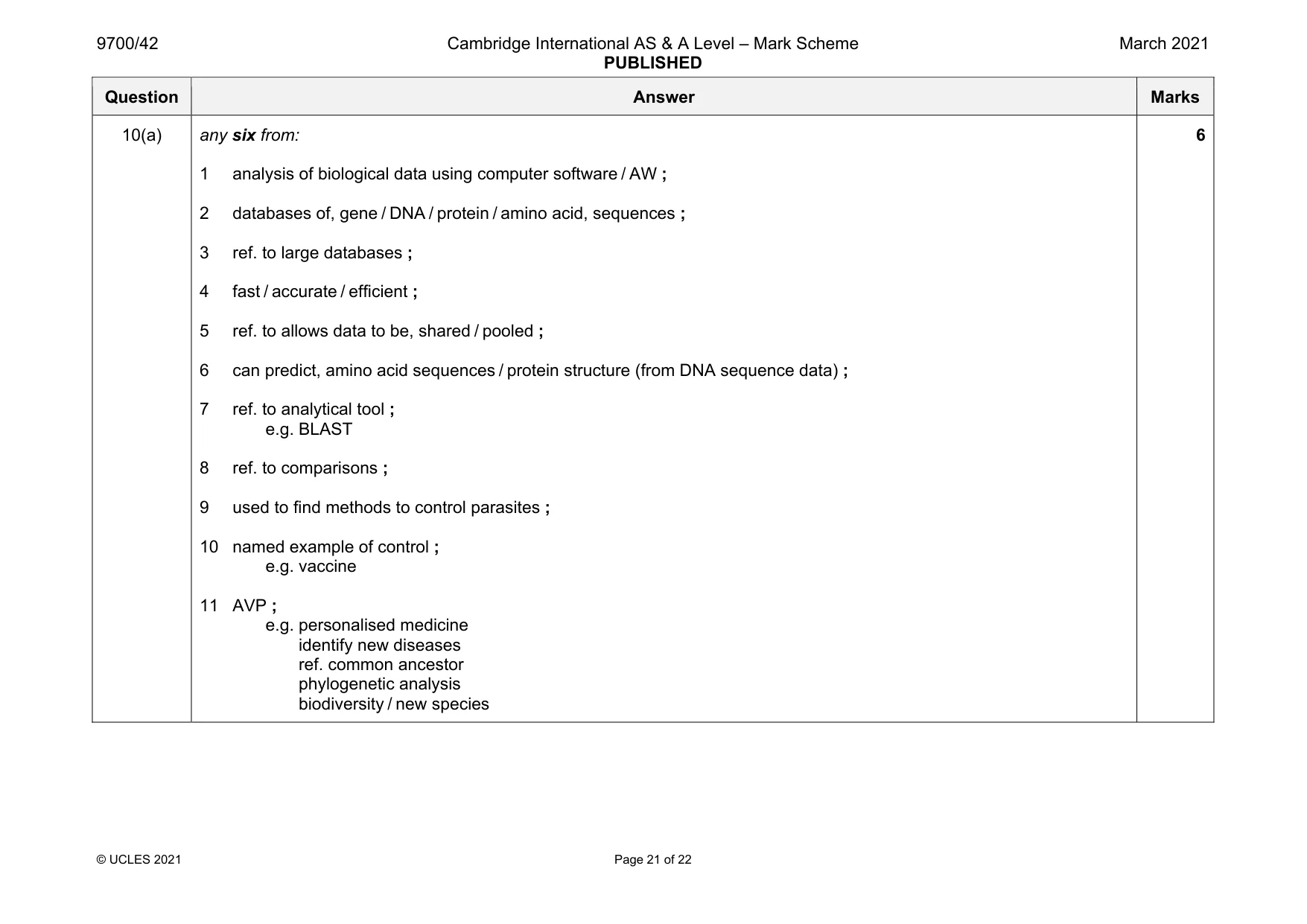
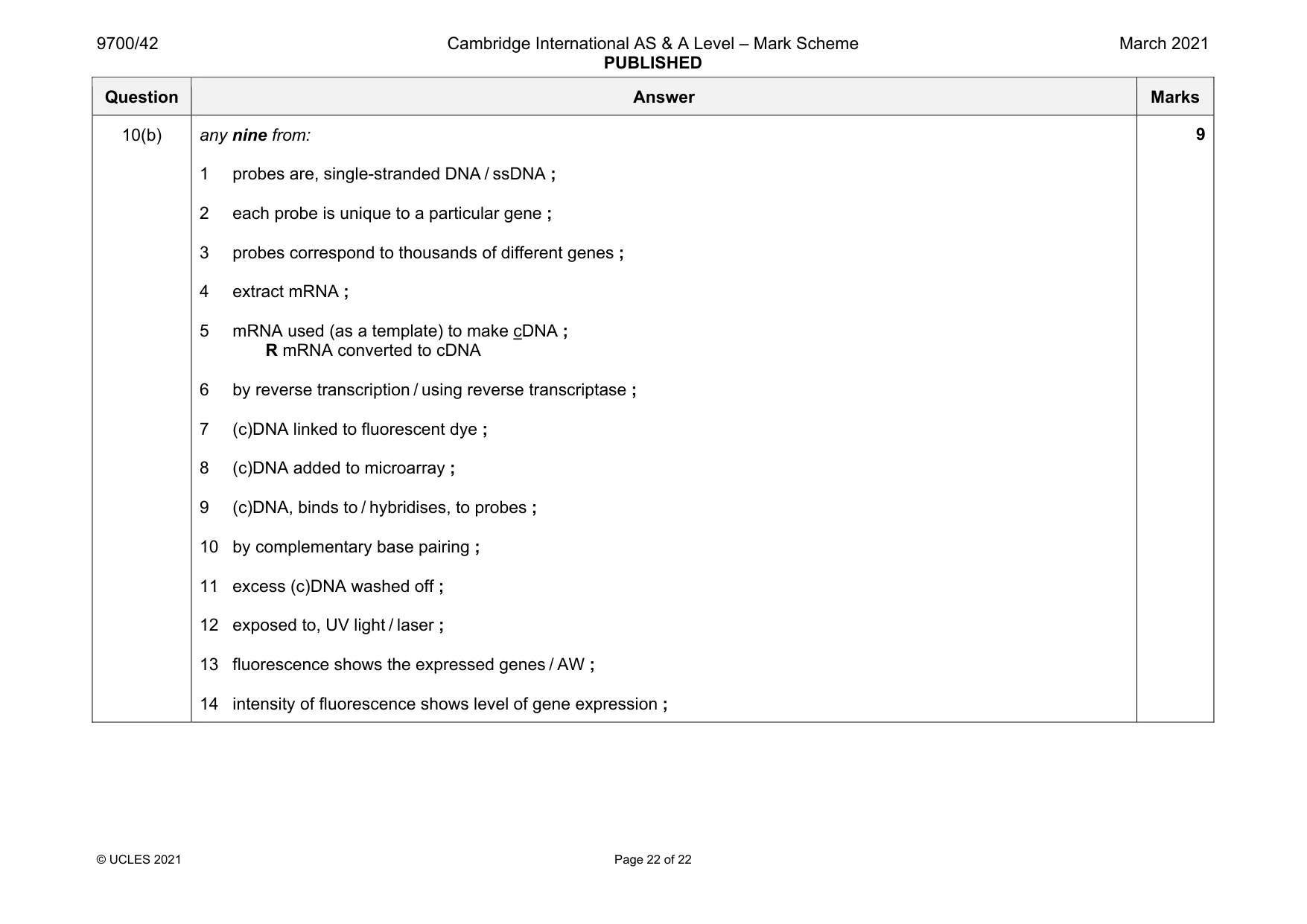
Mark scheme: 10(a) any six from: 1 analysis of biological data using computer software / AW ; 2 databases of, gene / DNA / protein / amino acid, sequences ; 3 ref. to large databases ; 4 fast / accurate / efficient ; 5 ref. to allows data to be, shared / pooled ; 6 can predict, amino acid sequences / protein structure (from DNA sequence data) ; 7 ref. to analytical tool ; e.g. BLAST 8 ref. to comparisons ; 9 used to find methods to control parasites ; 10 named example of control ; e.g. vaccine 11 AVP ; e.g. personalised medicine identify new diseases ref. common ancestor phylogenetic analysis biodiversity / new species 6 Question Answer Marks 10(b) any nine from: 1 probes are, single-stranded DNA / ssDNA ; 2 each probe is unique to a particular gene ; 3 probes correspond to thousands of different genes ; 4 extract mRNA ; 5 mRNA used (as a template) to make cDNA ; R mRNA converted to cDNA 6 by reverse transcription / using reverse transcriptase ; 7 (c)DNA linked to fluorescent dye ; 8 (c)DNA added to microarray ; 9 (c)DNA, binds to / hybridises, to probes ; 10 by complementary base pairing ; 11 excess (c)DNA washed off ; 12 exposed to, UV light / laser ; 13 fluorescence shows the expressed genes / AW ; 14 intensity of fluorescence shows level of gene expression ; 9
What was in this paper
The subtopics covered by these 10 questions, and how many questions each got. Open one in a new tab to see every Cambridge question on it.
What you needed in this session
Cambridge’s own grade thresholds for 2021 Feb/March, Paper 4 · Variant 2. A higher threshold means an easier paper — the bar moves with how the cohort did.