Cambridge A Level Biology 9700 — 2019 May/June Paper 4 · Variant 1
9700/41/M/J/19 · 10 questions · 100 marks · ≈113 min
The question paper and its mark scheme, free to read here and free to download. This is Cambridge’s own paper, exactly as it was sat.
Question paper24 pages




Mark scheme14 pages
Answers below. Sit the paper first if you are practising.
Questions as text
Q1 · Part of a cell in a growing region of a plant
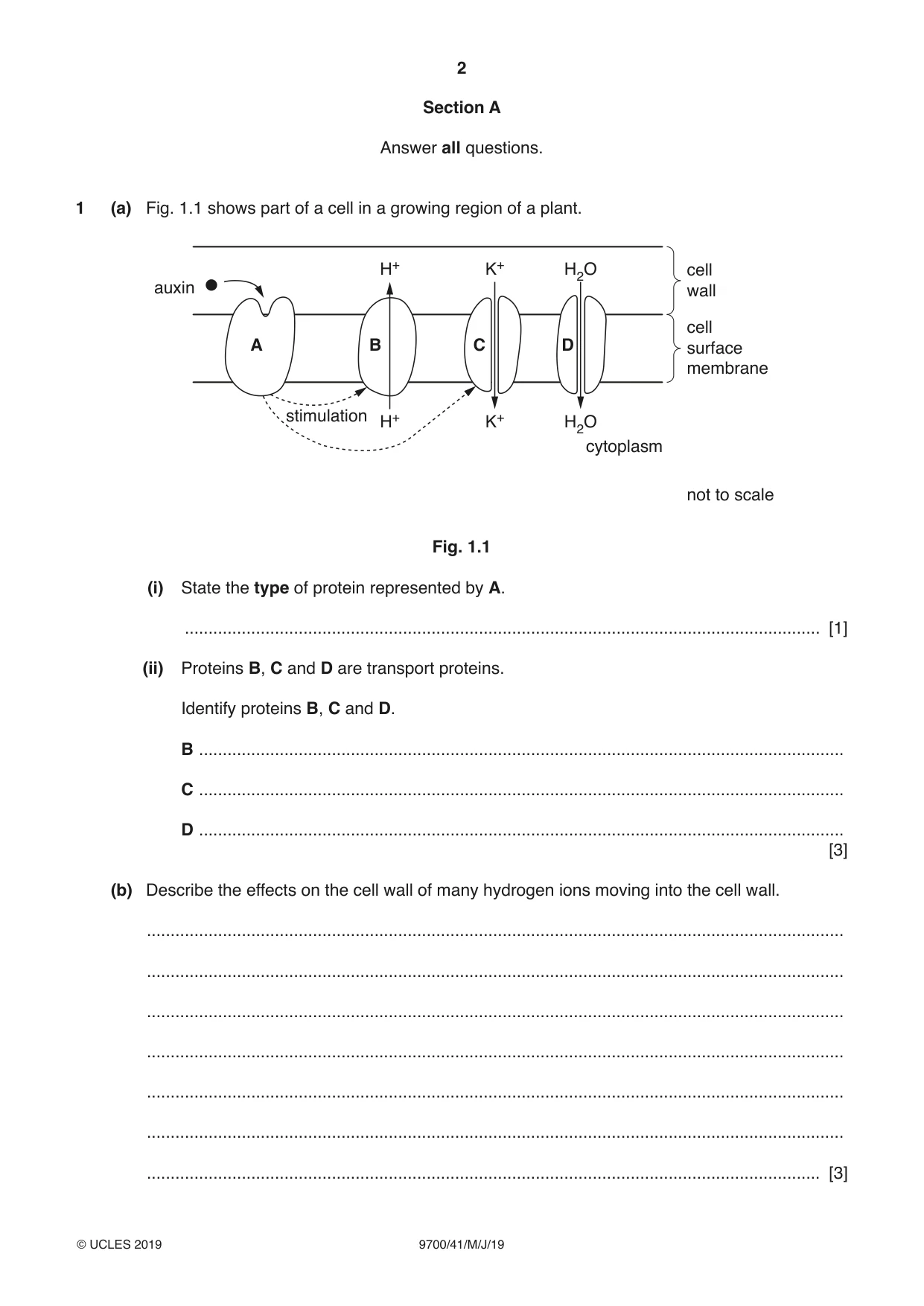
1 (a) Fig. 1.1 shows part of a cell in a growing region of a plant. H+ K+ H2O cell auxin wall cell A B C D surface membrane stimulation H+ K+ H2O cytoplasm not to scale Fig. 1.1 (i) State the type of protein represented by A. ...................................................................................................................................... [1] (ii) Proteins B, C and D are transport proteins. Identify proteins B, C and D. B ........................................................................................................................................ C ........................................................................................................................................ D ........................................................................................................................................ [3] (b) Describe the effects on the cell wall of many hydrogen ions moving into the cell wall. ................................................................................................................................................... ................................................................................................................................................... ................................................................................................................................................... ................................................................................................................................................... ................................................................................................................................................... ................................................................................................................................................... .............................................................................................................................................. [3] (c) Explain the consequences of an influx of potassium ions into the cell. ................................................................................................................................................... ................................................................................................................................................... ................................................................................................................................................... ................................................................................................................................................... ............................................................................................................................................. [2] [Total: 9]
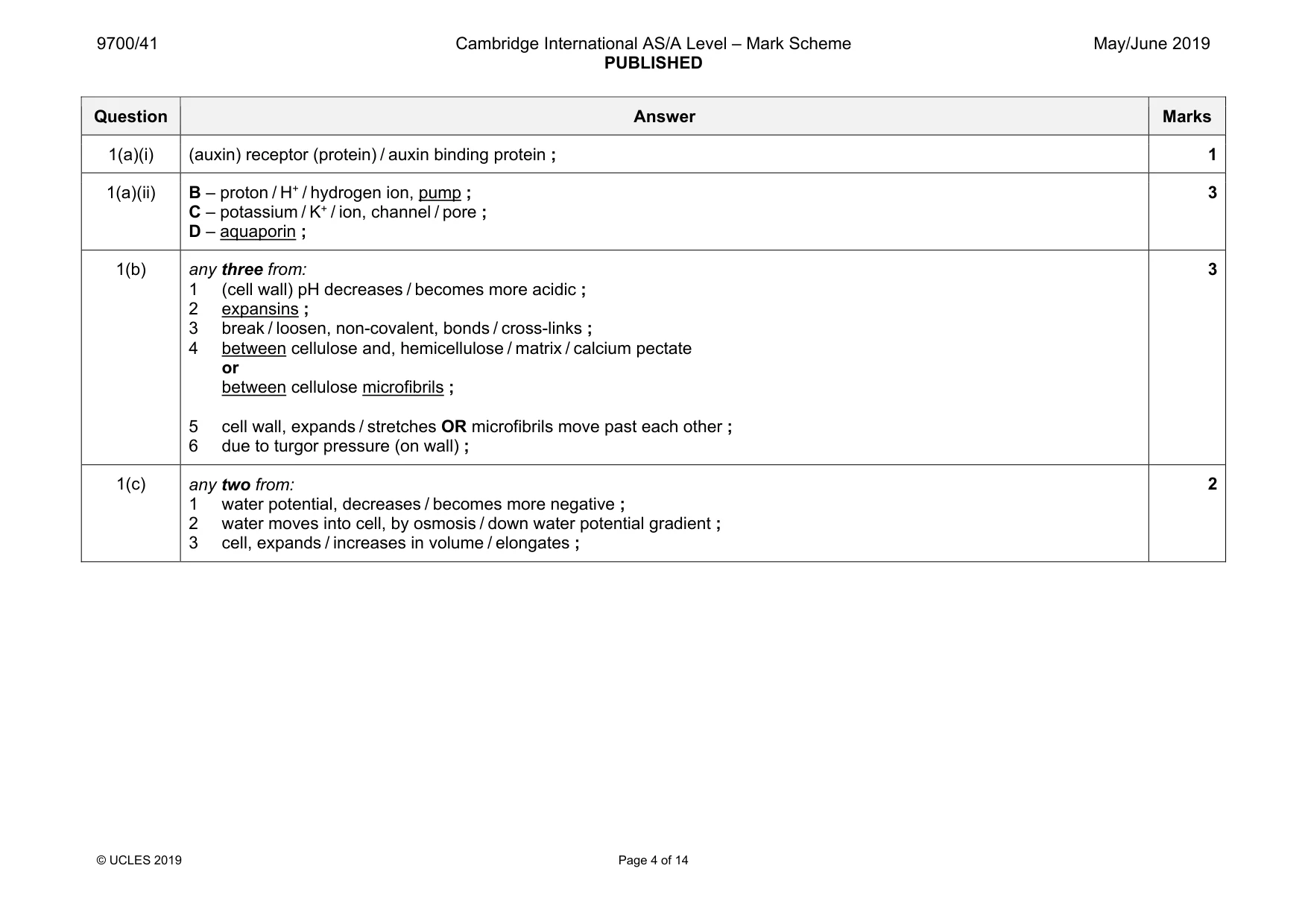
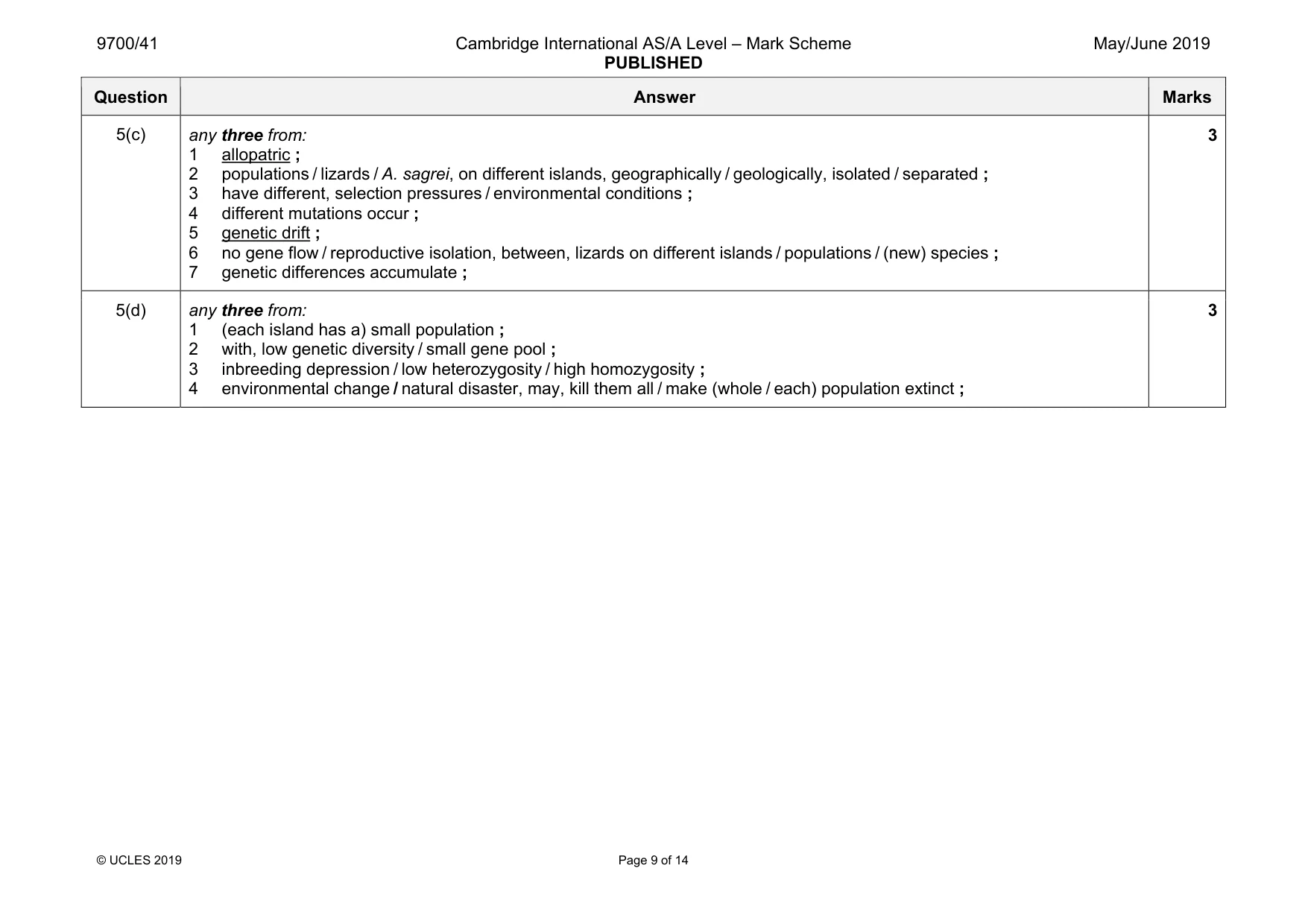
Mark scheme: 1(a)(i) (auxin) receptor (protein) / auxin binding protein ; 1 1(a)(ii) B – proton / H+ / hydrogen ion, pump ; C – potassium / K+ / ion, channel / pore ; D – aquaporin ; 3 1(b) any three from: 1 (cell wall) pH decreases / becomes more acidic ; 2 expansins ; 3 break / loosen, non-covalent, bonds / cross-links ; 4 between cellulose and, hemicellulose / matrix / calcium pectate or between cellulose microfibrils ; 5 cell wall, expands / stretches OR microfibrils move past each other ; 6 due to turgor pressure (on wall) ; 3 1(c) any two from: 1 water potential, decreases / becomes more negative ; 2 water moves into cell, by osmosis / down water potential gradient ; 3 cell, expands / increases in volume / elongates ; 2
Q2 · The interpupillary distance (IPD) is the distance in millimetres between the centres of…
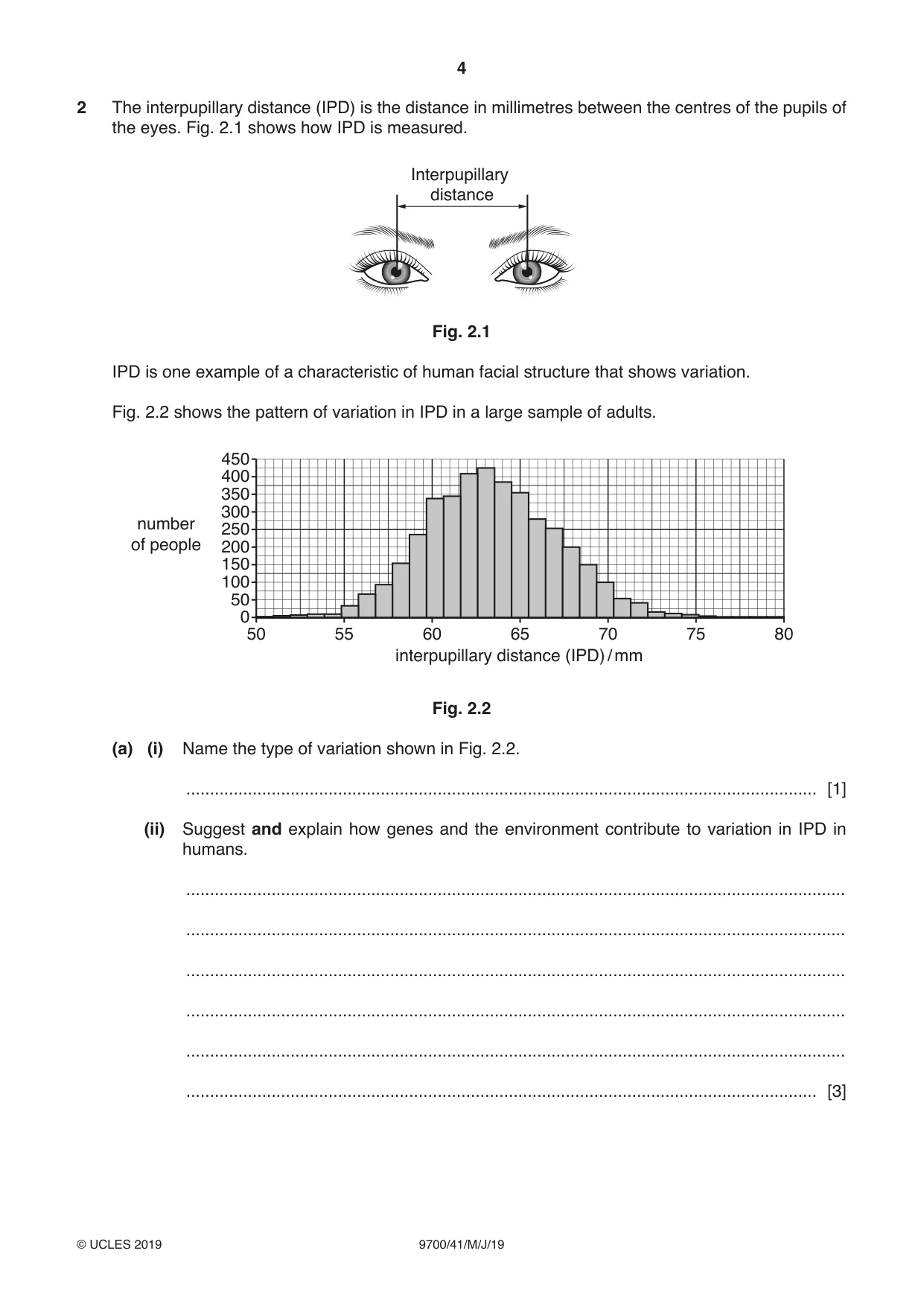
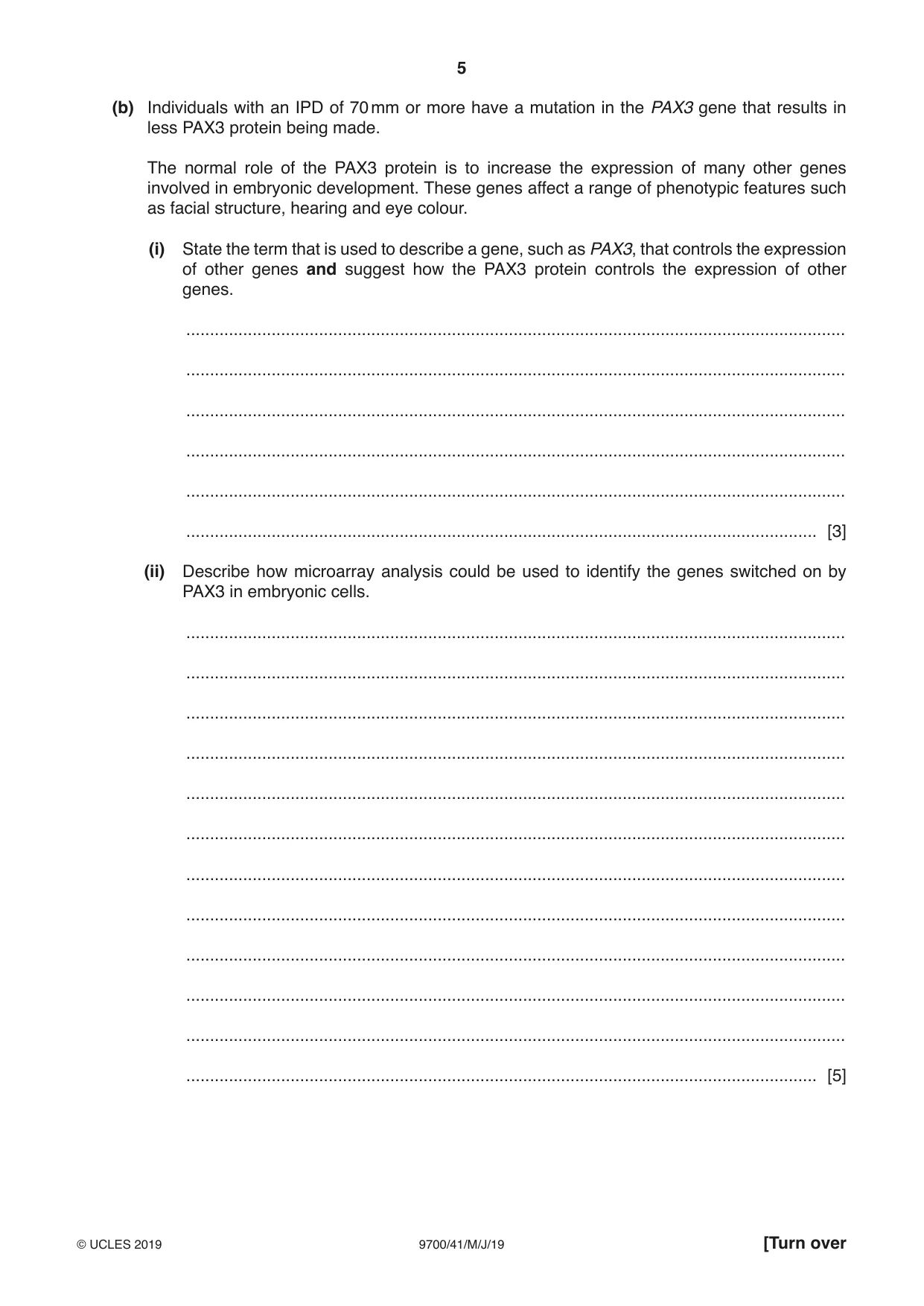
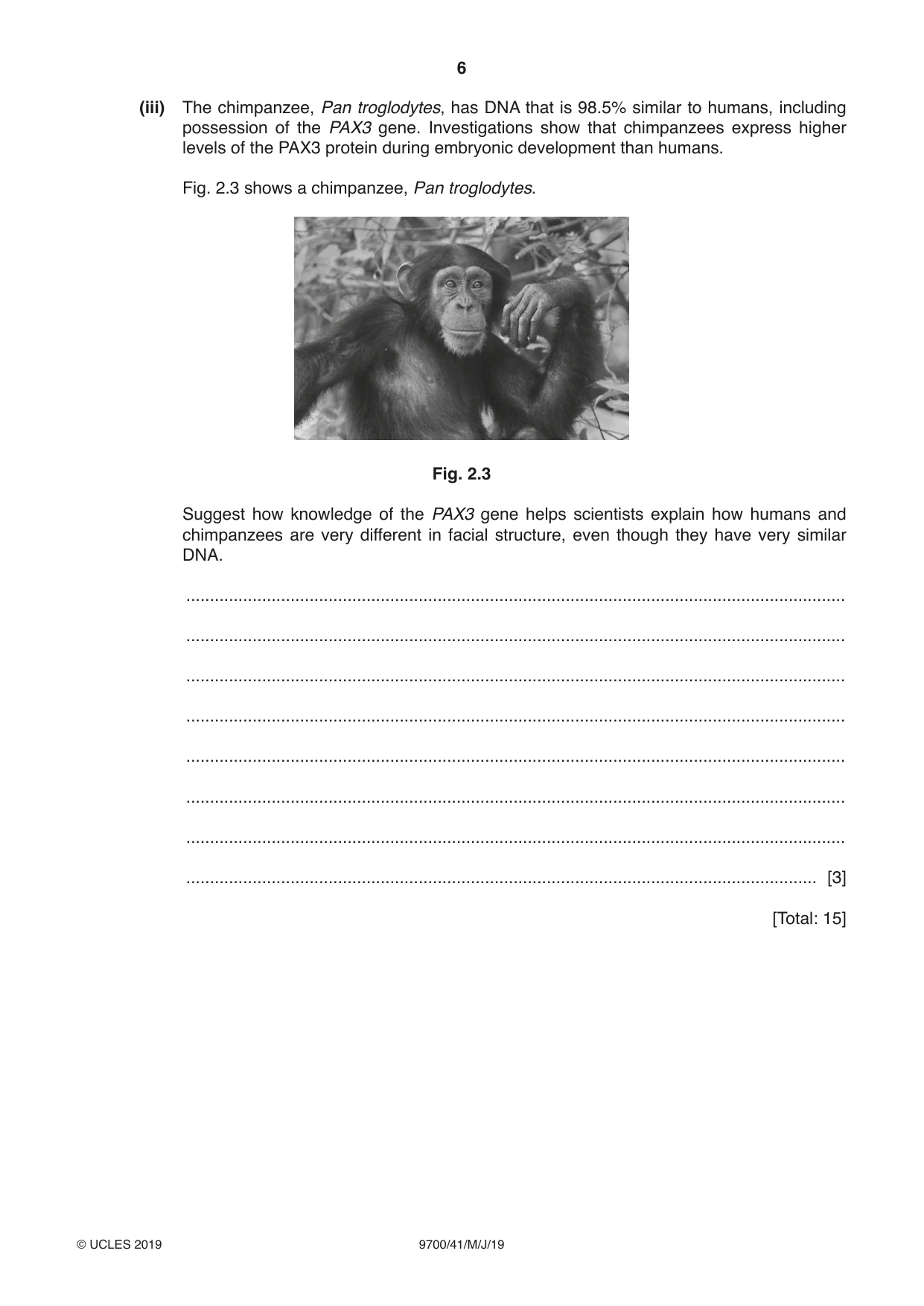
2 The interpupillary distance (IPD) is the distance in millimetres between the centres of the pupils of the eyes. Fig. 2.1 shows how IPD is measured. Interpupillary distance Fig. 2.1 IPD is one example of a characteristic of human facial structure that shows variation. Fig. 2.2 shows the pattern of variation in IPD in a large sample of adults. 450 400 350 300 number 250 of people 200 150 100 50 0 50 55 60 65 70 75 80 interpupillary distance (IPD) / mm Fig. 2.2 (a) (i) Name the type of variation shown in Fig. 2.2. ..................................................................................................................................... [1] (ii) Suggest and explain how genes and the environment contribute to variation in IPD in humans. ........................................................................................................................................... ........................................................................................................................................... ........................................................................................................................................... ........................................................................................................................................... ........................................................................................................................................... ..................................................................................................................................... [3] (b) Individuals with an IPD of 70 mm or more have a mutation in the PAX3 gene that results in less PAX3 protein being made. The normal role of the PAX3 protein is to increase the expression of many other genes involved in embryonic development. These genes affect a range of phenotypic features such as facial structure, hearing and eye colour. (i) State the term that is used to describe a gene, such as PAX3, that controls the expression of other genes and suggest how the PAX3 protein controls the expression of other genes. ........................................................................................................................................... ........................................................................................................................................... ........................................................................................................................................... ........................................................................................................................................... ........................................................................................................................................... ..................................................................................................................................... [3] (ii) Describe how microarray analysis could be used to identify the genes switched on by PAX3 in embryonic cells. ........................................................................................................................................... ........................................................................................................................................... ........................................................................................................................................... ........................................................................................................................................... ........................................................................................................................................... ........................................................................................................................................... ........................................................................................................................................... ........................................................................................................................................... ........................................................................................................................................... ........................................................................................................................................... ........................................................................................................................................... ..................................................................................................................................... [5] (iii) The chimpanzee, Pan troglodytes, has DNA that is 98.5% similar to humans, including possession of the PAX3 gene. Investigations show that chimpanzees express higher levels of the PAX3 protein during embryonic development than humans. Fig. 2.3 shows a chimpanzee, Pan troglodytes. Fig. 2.3 Suggest how knowledge of the PAX3 gene helps scientists explain how humans and chimpanzees are very different in facial structure, even though they have very similar DNA. ........................................................................................................................................... ........................................................................................................................................... ........................................................................................................................................... ........................................................................................................................................... ........................................................................................................................................... ........................................................................................................................................... ........................................................................................................................................... ..................................................................................................................................... [3] [Total: 15]
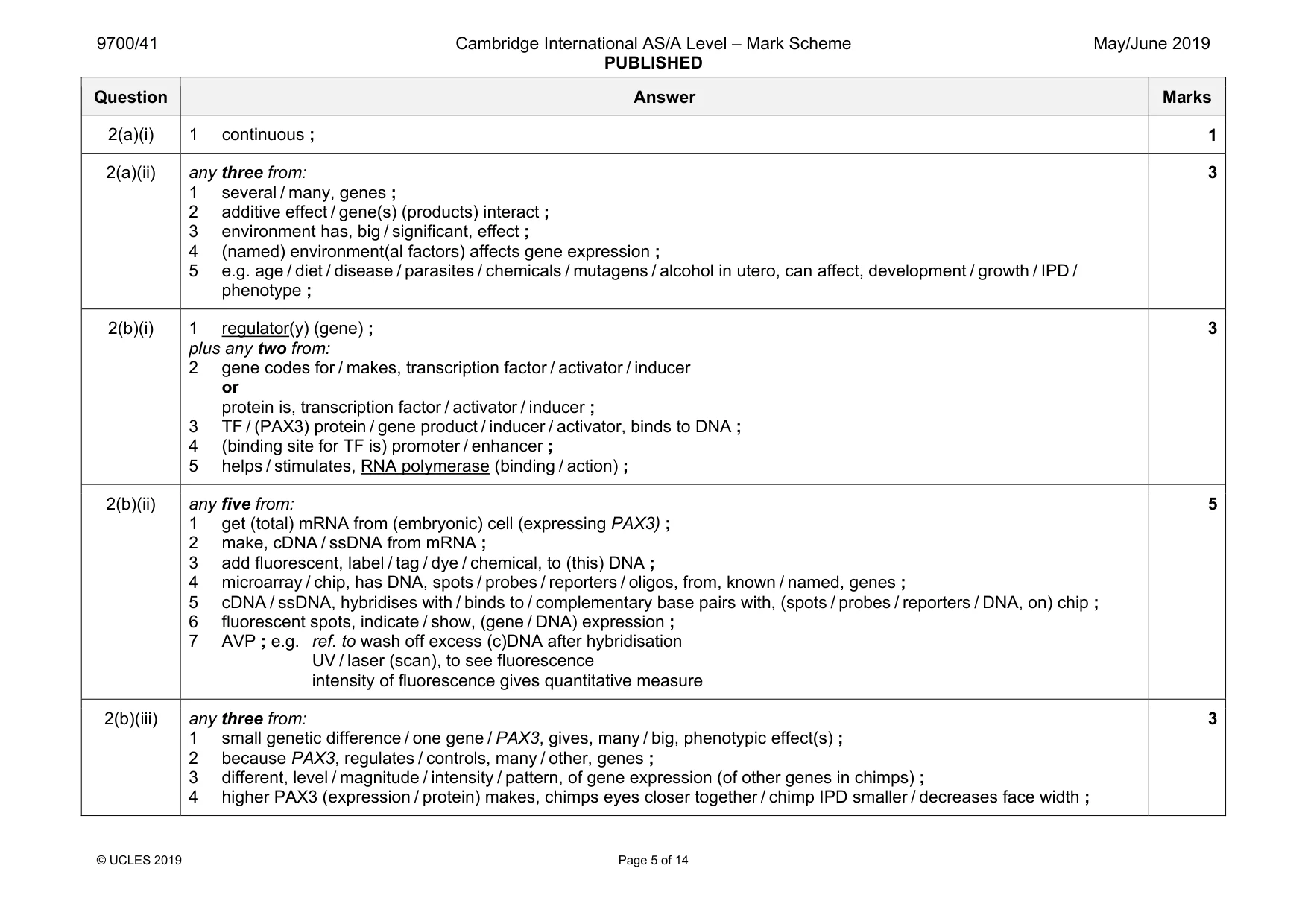
Mark scheme: 2(a)(i) 1 continuous ; 1 2(a)(ii) any three from: 1 several / many, genes ; 2 additive effect / gene(s) (products) interact ; 3 environment has, big / significant, effect ; 4 (named) environment(al factors) affects gene expression ; 5 e.g. age / diet / disease / parasites / chemicals / mutagens / alcohol in utero, can affect, development / growth / IPD / phenotype ; 3 2(b)(i) 1 regulator(y) (gene) ; plus any two from: 2 gene codes for / makes, transcription factor / activator / inducer or protein is, transcription factor / activator / inducer ; 3 TF / (PAX3) protein / gene product / inducer / activator, binds to DNA ; 4 (binding site for TF is) promoter / enhancer ; 5 helps / stimulates, RNA polymerase (binding / action) ; 3 2(b)(ii) any five from: 1 get (total) mRNA from (embryonic) cell (expressing PAX3) ; 2 make, cDNA / ssDNA from mRNA ; 3 add fluorescent, label / tag / dye / chemical, to (this) DNA ; 4 microarray / chip, has DNA, spots / probes / reporters / oligos, from, known / named, genes ; 5 cDNA / ssDNA, hybridises with / binds to / complementary base pairs with, (spots / probes / reporters / DNA, on) chip ; 6 fluorescent spots, indicate / show, (gene / DNA) expression ; 7 AVP ; e.g. ref. to wash off excess (c)DNA after hybridisation UV / laser (scan), to see fluorescence intensity of fluorescence gives quantitative measure 5 2(b)(iii) any three from: 1 small genetic difference / one gene / PAX3, gives, many / big, phenotypic effect(s) ; 2 because PAX3, regulates / controls, many / other, genes ; 3 different, level / magnitude / intensity / pattern, of gene expression (of other genes in chimps) ; 4 higher PAX3 (expression / protein) makes, chimps eyes closer together / chimp IPD smaller / decreases face width ; 3
Q3 · Some neurones in the brain produce a neurotransmitter known as dopamine
3 Some neurones in the brain produce a neurotransmitter known as dopamine. Parkinson’s disease occurs when the neurones that produce dopamine die. A person with the disease may experience difficulty in coordinating movement, often seen as tremors (shaking) in different parts of the body. Parkinson’s disease typically occurs in people older than 55 years. Younger people with these symptoms are said to have early onset Parkinson’s disease (EOPD). Recessive mutations in a gene known as PINK1, located on chromosome 1, an autosome, are believed to be one cause of EOPD. A person with this form of EOPD has a homozygous recessive genotype. (a) Draw a genetic diagram of a cross between two individuals who are heterozygous at the PINK1 gene locus. key to symbols used for alleles .................................... .................................... parental genotypes gametes offspring genotypes ratio of offspring phenotypes [4] (b) PINK1 codes for a protein kinase enzyme that is important in the functioning of mitochondria in neurones. Most recessive PINK1 mutations are base substitutions which lead to the production of a non-functioning protein kinase enzyme. Explain how a base substitution mutation can lead to the production of a non-functioning protein kinase. ................................................................................................................................................... ................................................................................................................................................... ................................................................................................................................................... ................................................................................................................................................... ................................................................................................................................................... ................................................................................................................................................... ................................................................................................................................................... ................................................................................................................................................... ................................................................................................................................................... ................................................................................................................................................... ................................................................................................................................................... ............................................................................................................................................. [5] (c) One rare, dominant mutation of the PINK1 gene codes for a product that inhibits the normal protein kinase. Explain how this mutation causes EOPD in a heterozygote. ................................................................................................................................................... ................................................................................................................................................... ................................................................................................................................................... ................................................................................................................................................... ............................................................................................................................................. [2] [Total: 11] Question 4 starts on page 10
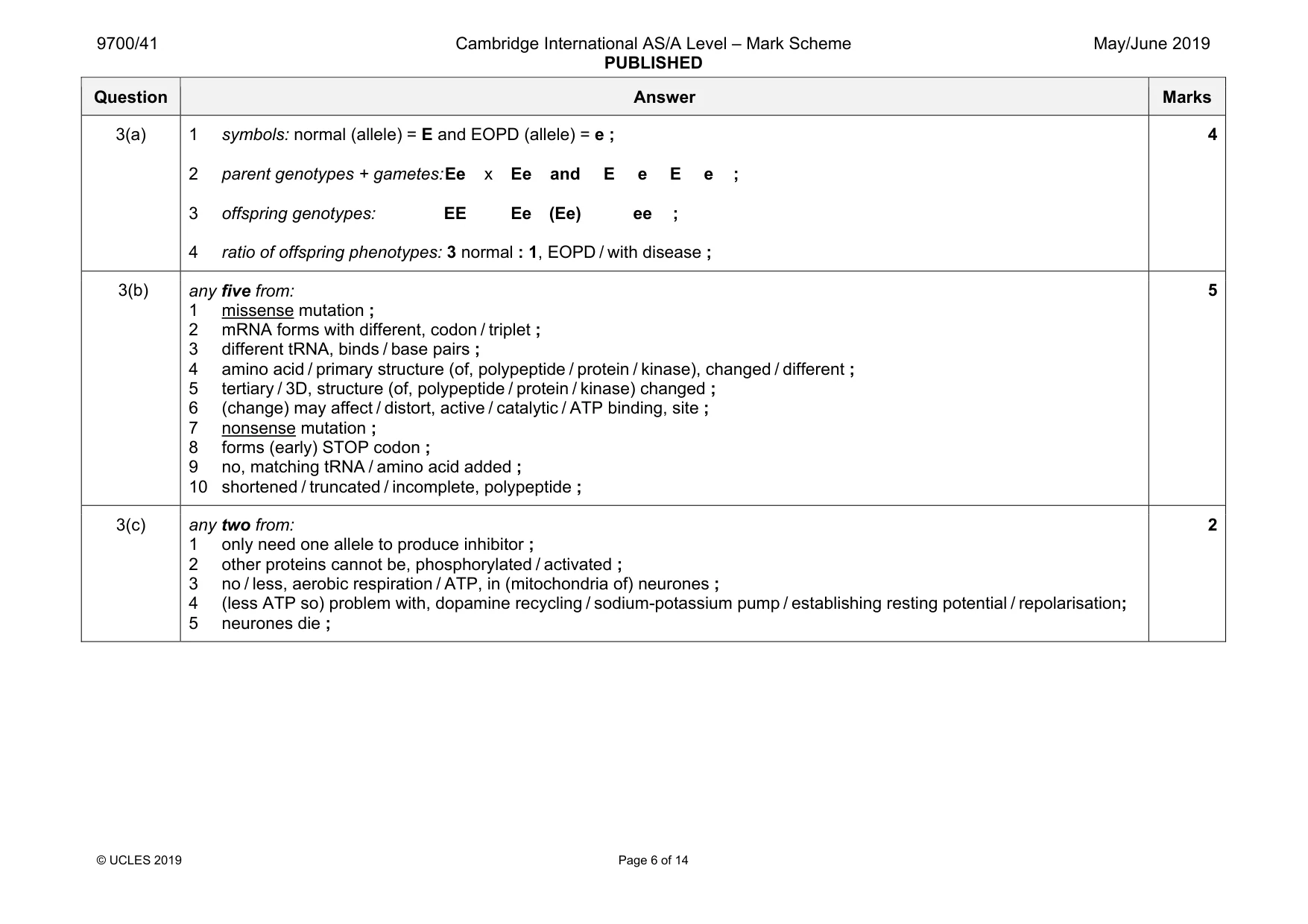
Mark scheme: 3(a) 1 symbols: normal (allele) = E and EOPD (allele) = e ; 2 parent genotypes + gametes: Ee x Ee and E e E e ; 3 offspring genotypes: EE Ee (Ee) ee ; 4 ratio of offspring phenotypes: 3 normal : 1, EOPD / with disease ; 4 3(b) any five from: 1 missense mutation ; 2 mRNA forms with different, codon / triplet ; 3 different tRNA, binds / base pairs ; 4 amino acid / primary structure (of, polypeptide / protein / kinase), changed / different ; 5 tertiary / 3D, structure (of, polypeptide / protein / kinase) changed ; 6 (change) may affect / distort, active / catalytic / ATP binding, site ; 7 nonsense mutation ; 8 forms (early) STOP codon ; 9 no, matching tRNA / amino acid added ; 10 shortened / truncated / incomplete, polypeptide ; 5 3(c) any two from: 1 only need one allele to produce inhibitor ; 2 other proteins cannot be, phosphorylated / activated ; 3 no / less, aerobic respiration / ATP, in (mitochondria of) neurones ; 4 (less ATP so) problem with, dopamine recycling / sodium-potassium pump / establishing resting potential / repolarisation; 5 neurones die ; 2
Q4 · The link reaction and Krebs cycle take place in the mitochondrion
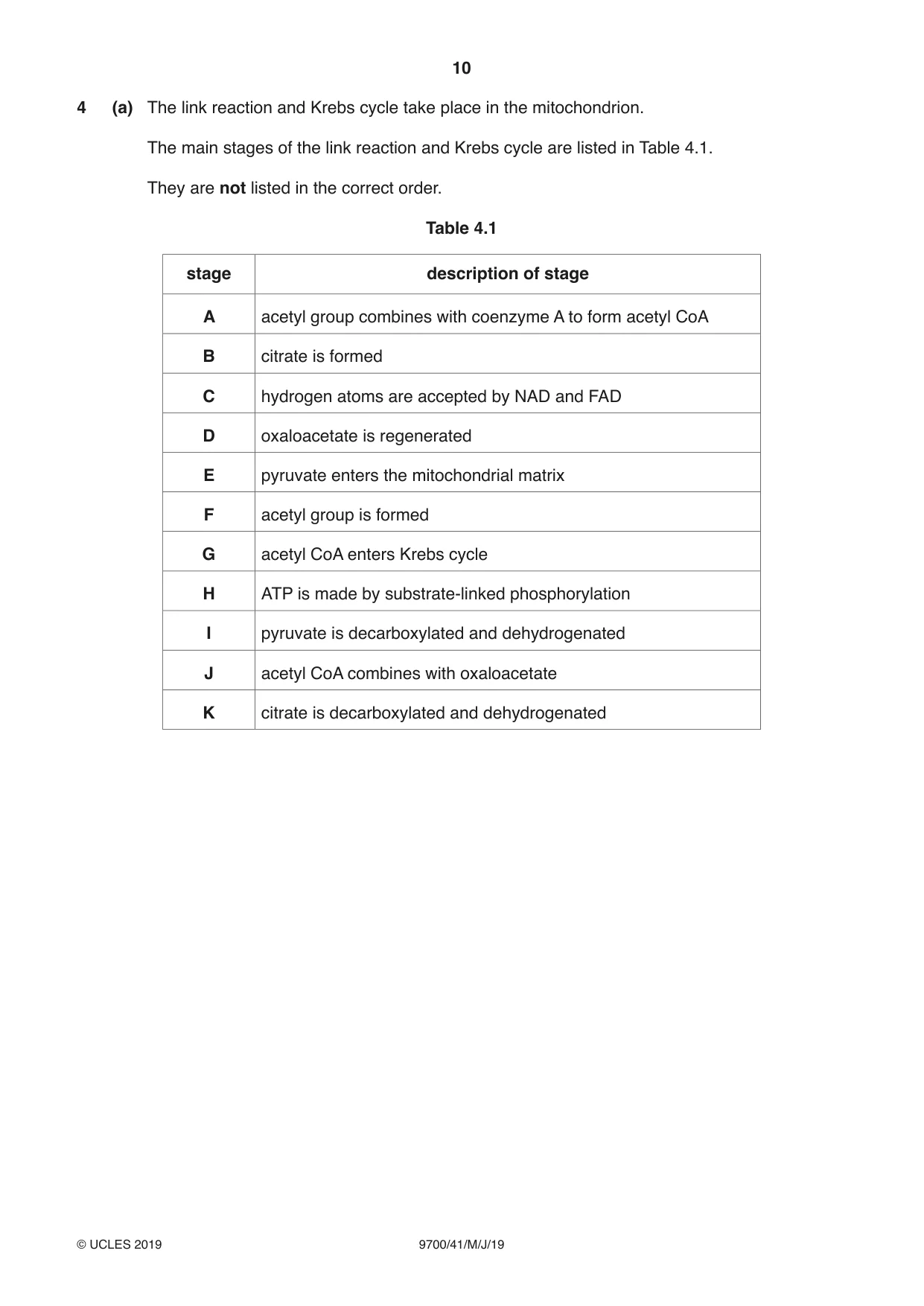
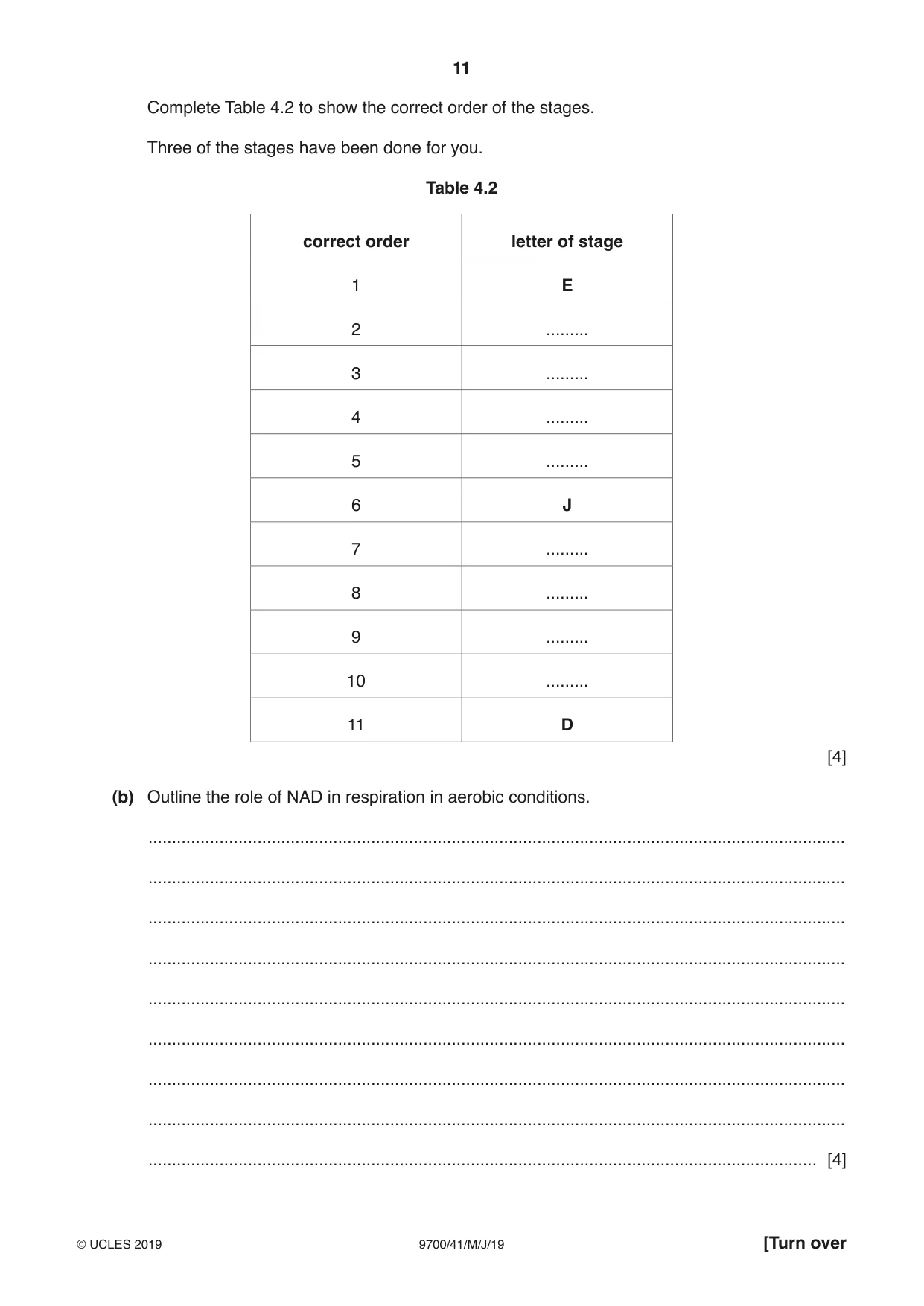
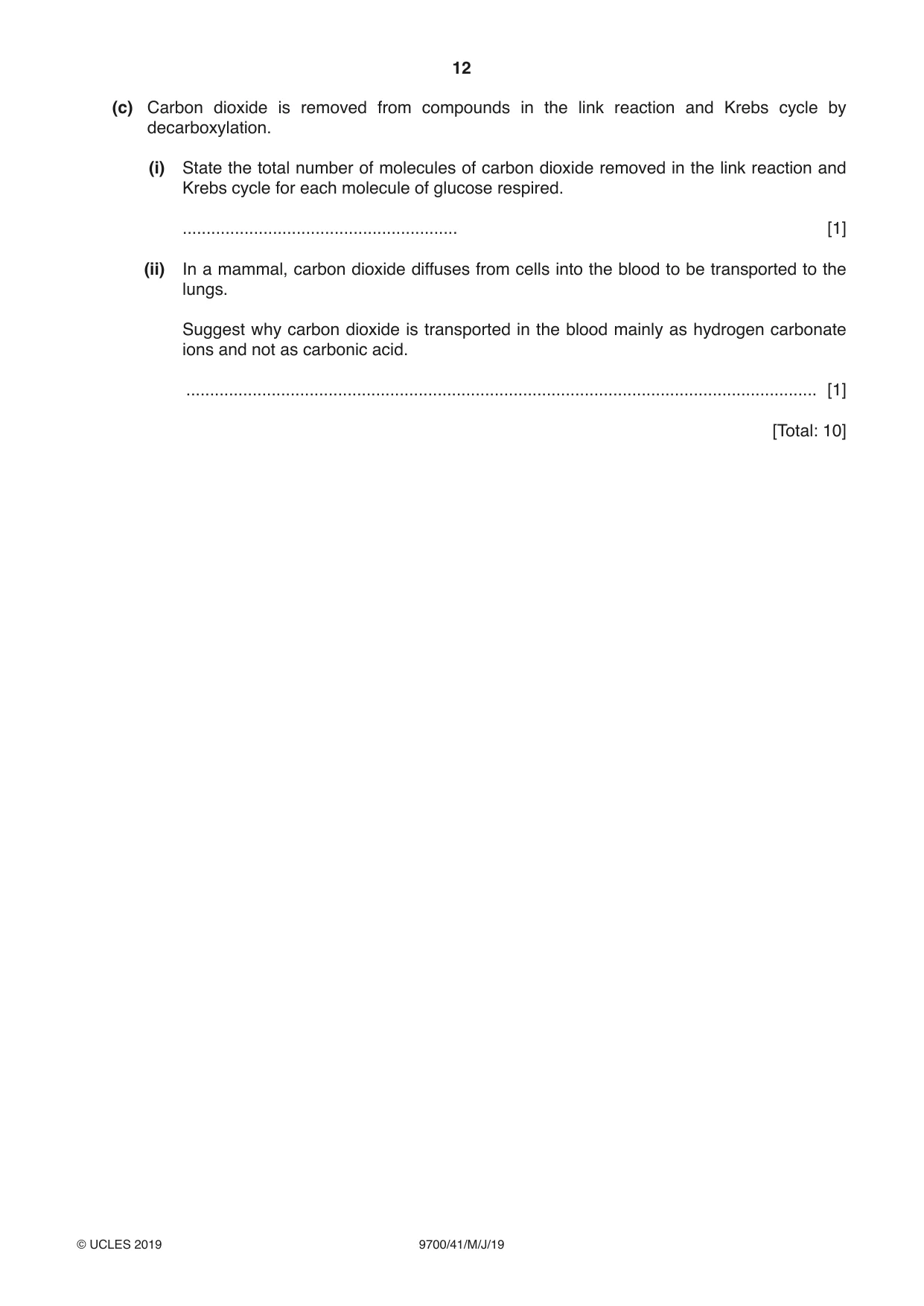
4 (a) The link reaction and Krebs cycle take place in the mitochondrion. The main stages of the link reaction and Krebs cycle are listed in Table 4.1. They are not listed in the correct order. Table 4.1 stage description of stage A acetyl group combines with coenzyme A to form acetyl CoA B citrate is formed C hydrogen atoms are accepted by NAD and FAD D oxaloacetate is regenerated E pyruvate enters the mitochondrial matrix F acetyl group is formed G acetyl CoA enters Krebs cycle H ATP is made by substrate-linked phosphorylation I pyruvate is decarboxylated and dehydrogenated J acetyl CoA combines with oxaloacetate K citrate is decarboxylated and dehydrogenated Complete Table 4.2 to show the correct order of the stages. Three of the stages have been done for you. Table 4.2 correct order letter of stage 1 E 2 ......... 3 ......... 4 ......... 5 ......... 6 J 7 ......... 8 ......... 9 ......... 10 ......... 11 D [4] (b) Outline the role of NAD in respiration in aerobic conditions. ................................................................................................................................................... ................................................................................................................................................... ................................................................................................................................................... ................................................................................................................................................... ................................................................................................................................................... ................................................................................................................................................... ................................................................................................................................................... ................................................................................................................................................... ............................................................................................................................................. [4] (c) Carbon dioxide is removed from compounds in the link reaction and Krebs cycle by decarboxylation. (i) State the total number of molecules of carbon dioxide removed in the link reaction and Krebs cycle for each molecule of glucose respired. .......................................................... [1] (ii) In a mammal, carbon dioxide diffuses from cells into the blood to be transported to the lungs. Suggest why carbon dioxide is transported in the blood mainly as hydrogen carbonate ions and not as carbonic acid. ..................................................................................................................................... [1] [Total: 10]
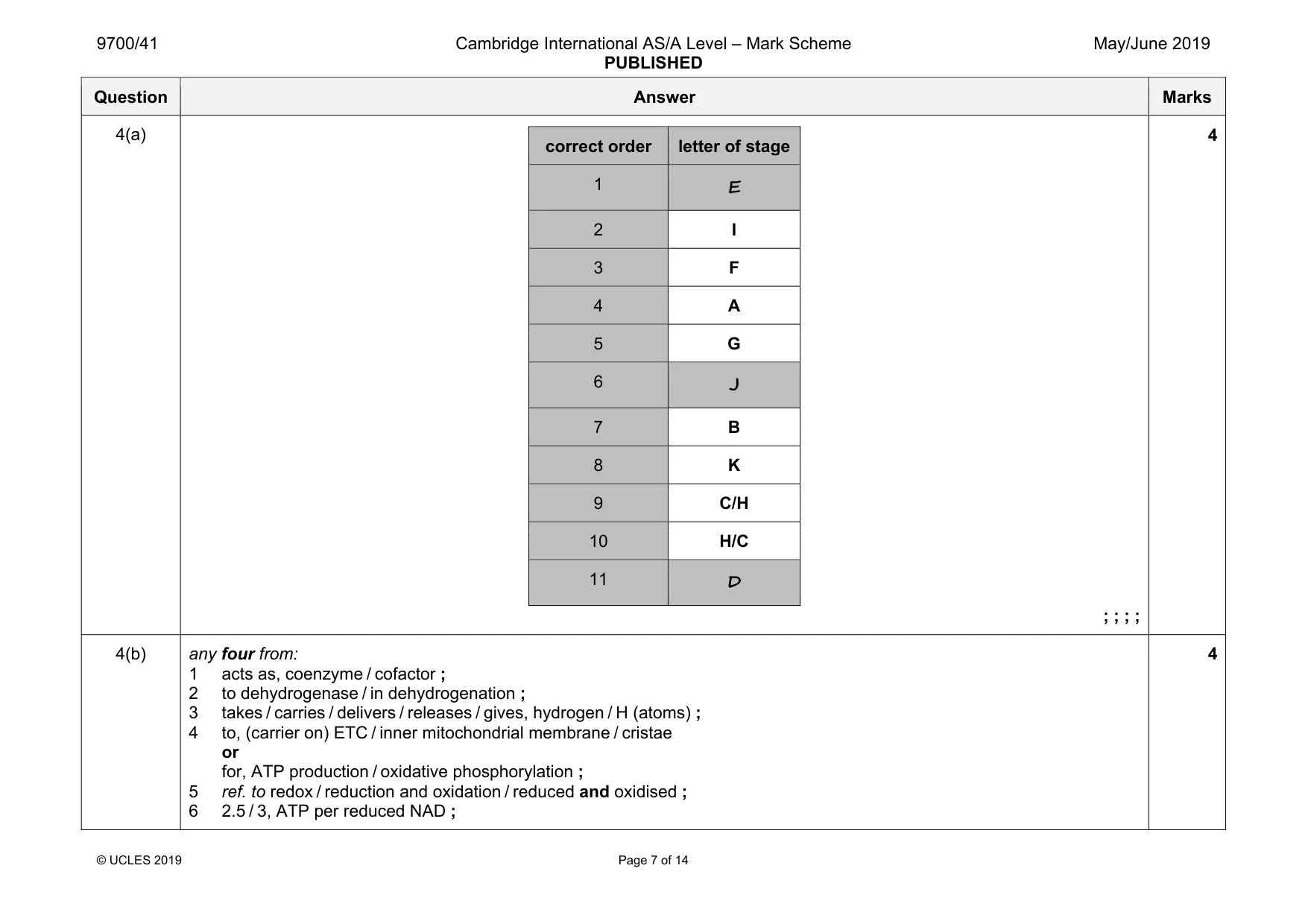
Mark scheme: 4(a) correct order letter of stage 1 E 2 I 3 F 4 A 5 G 6 J 7 B 8 K 9 C/H 10 H/C 11 D ; ; ; ; 4 4(b) any four from: 1 acts as, coenzyme / cofactor ; 2 to dehydrogenase / in dehydrogenation ; 3 takes / carries / delivers / releases / gives, hydrogen / H (atoms) ; 4 to, (carrier on) ETC / inner mitochondrial membrane / cristae or for, ATP production / oxidative phosphorylation ; 5 ref. to redox / reduction and oxidation / reduced and oxidised ; 6 2.5 / 3, ATP per reduced NAD ; 4 Question Answer Marks 4(c)(i) 6 ; 1 4(c)(ii) any one from: 1 hydrogen carbonate (ions) prevents decrease in (blood) pH ; 2 buffer system / carbonic acid dissociates / ref. to carbonic anhydrase ; 1
Q5 · Researchers investigated the extent to which the founder effect and natural selection…
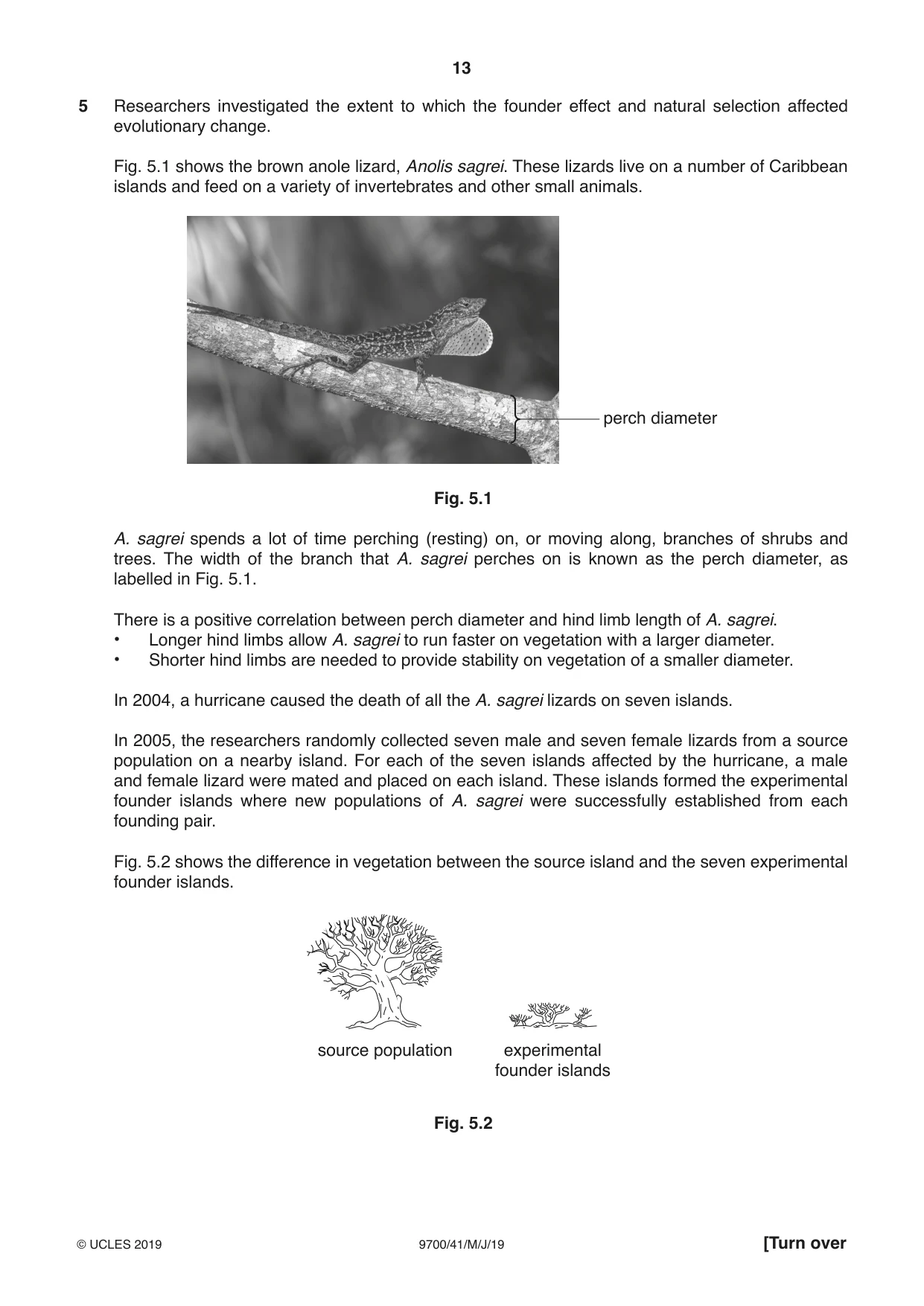
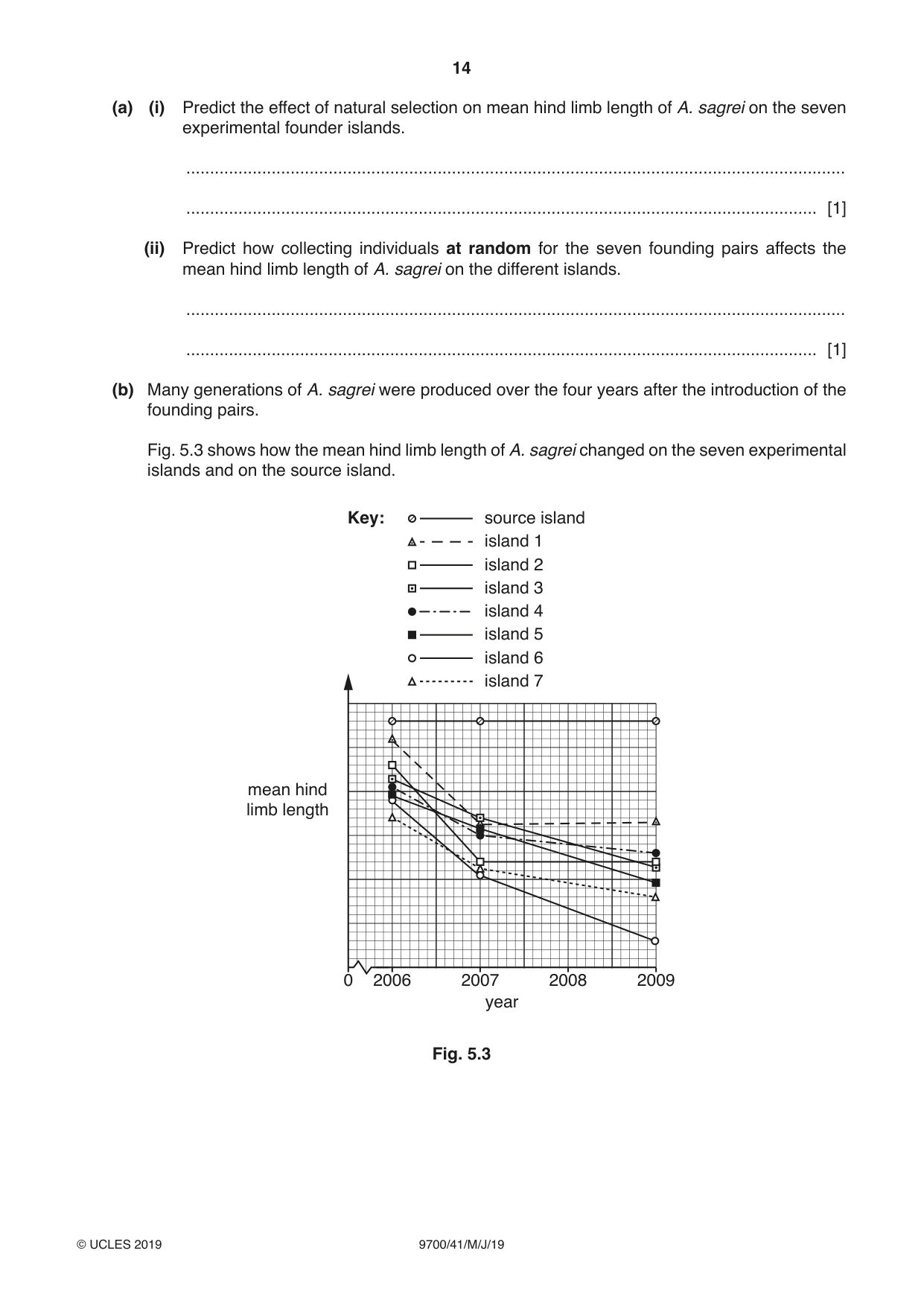
5 Researchers investigated the extent to which the founder effect and natural selection affected evolutionary change. Fig. 5.1 shows the brown anole lizard, Anolis sagrei. These lizards live on a number of Caribbean islands and feed on a variety of invertebrates and other small animals. perch diameter Fig. 5.1 A. sagrei spends a lot of time perching (resting) on, or moving along, branches of shrubs and trees. The width of the branch that A. sagrei perches on is known as the perch diameter, as labelled in Fig. 5.1. There is a positive correlation between perch diameter and hind limb length of A. sagrei. • Longer hind limbs allow A. sagrei to run faster on vegetation with a larger diameter. • Shorter hind limbs are needed to provide stability on vegetation of a smaller diameter. In 2004, a hurricane caused the death of all the A. sagrei lizards on seven islands. In 2005, the researchers randomly collected seven male and seven female lizards from a source population on a nearby island. For each of the seven islands affected by the hurricane, a male and female lizard were mated and placed on each island. These islands formed the experimental founder islands where new populations of A. sagrei were successfully established from each founding pair. Fig. 5.2 shows the difference in vegetation between the source island and the seven experimental founder islands. source population experimental founder islands Fig. 5.2 (a) (i) Predict the effect of natural selection on mean hind limb length of A. sagrei on the seven experimental founder islands. ........................................................................................................................................... ..................................................................................................................................... [1] (ii) Predict how collecting individuals at random for the seven founding pairs affects the mean hind limb length of A. sagrei on the different islands. ........................................................................................................................................... ..................................................................................................................................... [1] (b) Many generations of A. sagrei were produced over the four years after the introduction of the founding pairs. Fig. 5.3 shows how the mean hind limb length of A. sagrei changed on the seven experimental islands and on the source island. Key: source island island 1 island 2 island 3 island 4 island 5 island 6 island 7 mean hind limb length 0 2006 2007 2008 2009 year Fig. 5.3 With reference to Fig. 5.2 and Fig. 5.3, describe and suggest explanations for the results for the islands. ................................................................................................................................................... ................................................................................................................................................... ................................................................................................................................................... ................................................................................................................................................... ................................................................................................................................................... ................................................................................................................................................... ................................................................................................................................................... ................................................................................................................................................... ................................................................................................................................................... ............................................................................................................................................. [5] (c) In the investigation, one population of A. sagrei was established on each experimental founder island. Outline how speciation may occur on the seven experimental founder islands. ................................................................................................................................................... ................................................................................................................................................... ................................................................................................................................................... ................................................................................................................................................... ................................................................................................................................................... ............................................................................................................................................. [3] (d) Speciation is one possible outcome for the experimental founder populations, but there is also a high risk that they may become extinct. Explain why the experimental founder populations are at high risk of extinction. ................................................................................................................................................... ................................................................................................................................................... ................................................................................................................................................... ................................................................................................................................................... ................................................................................................................................................... ................................................................................................................................................... ............................................................................................................................................. [3] [Total: 13]
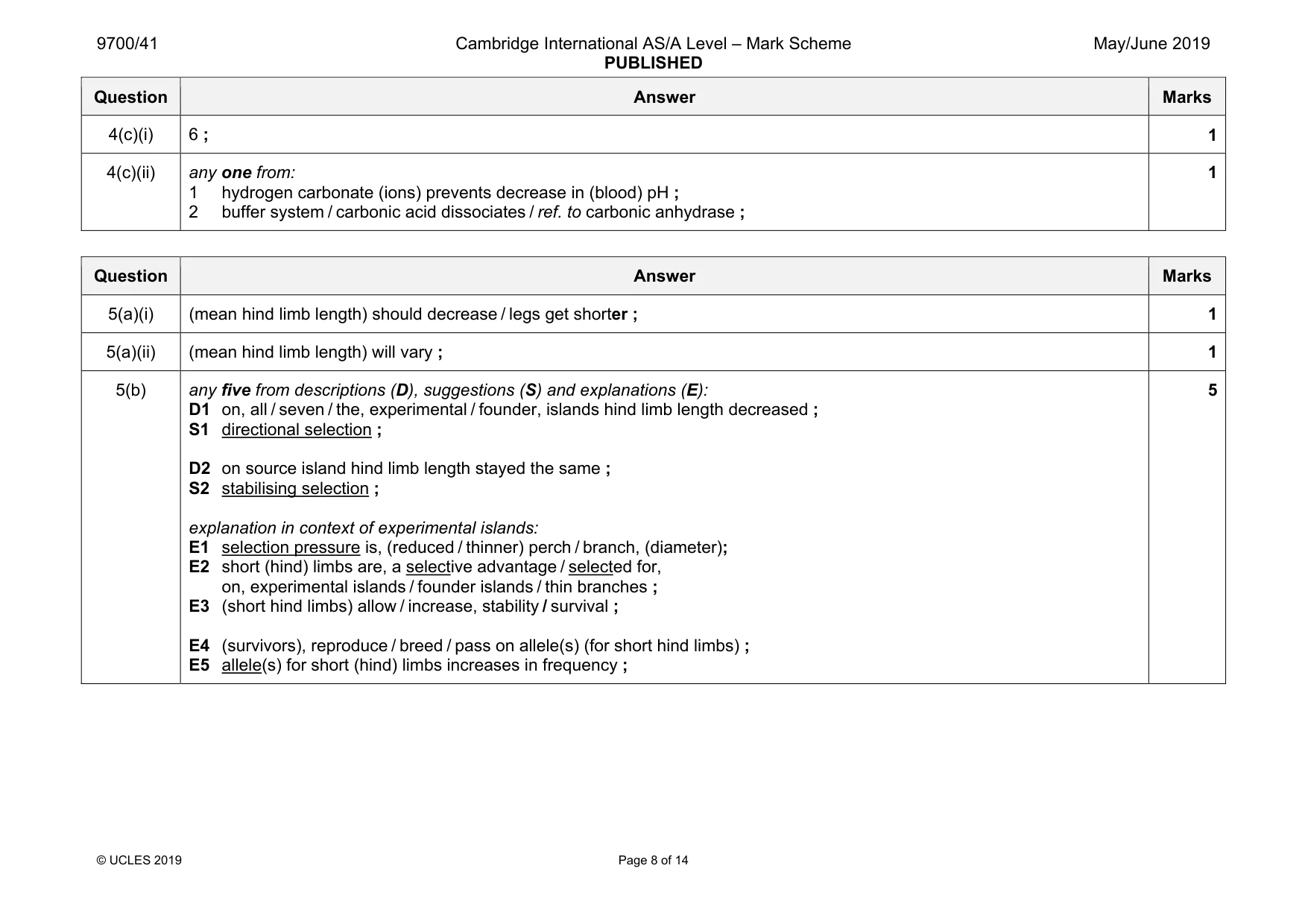
Mark scheme: 5(a)(i) (mean hind limb length) should decrease / legs get shorter ; 1 5(a)(ii) (mean hind limb length) will vary ; 1 5(b) any five from descriptions (D), suggestions (S) and explanations (E): D1 on, all / seven / the, experimental / founder, islands hind limb length decreased ; S1 directional selection ; D2 on source island hind limb length stayed the same ; S2 stabilising selection ; explanation in context of experimental islands: E1 selection pressure is, (reduced / thinner) perch / branch, (diameter); E2 short (hind) limbs are, a selective advantage / selected for, on, experimental islands / founder islands / thin branches ; E3 (short hind limbs) allow / increase, stability / survival ; E4 (survivors), reproduce / breed / pass on allele(s) (for short hind limbs) ; E5 allele(s) for short (hind) limbs increases in frequency ; 5 Question Answer Marks 5(c) any three from: 1 allopatric ; 2 populations / lizards / A. sagrei, on different islands, geographically / geologically, isolated / separated ; 3 have different, selection pressures / environmental conditions ; 4 different mutations occur ; 5 genetic drift ; 6 no gene flow / reproductive isolation, between, lizards on different islands / populations / (new) species ; 7 genetic differences accumulate ; 3 5(d) any three from: 1 (each island has a) small population ; 2 with, low genetic diversity / small gene pool ; 3 inbreeding depression / low heterozygosity / high homozygosity ; 4 environmental change / natural disaster, may, kill them all / make (whole / each) population extinct ; 3
Q6 · Maize, Zea mays, is an important food crop for human consumption and for feeding to…
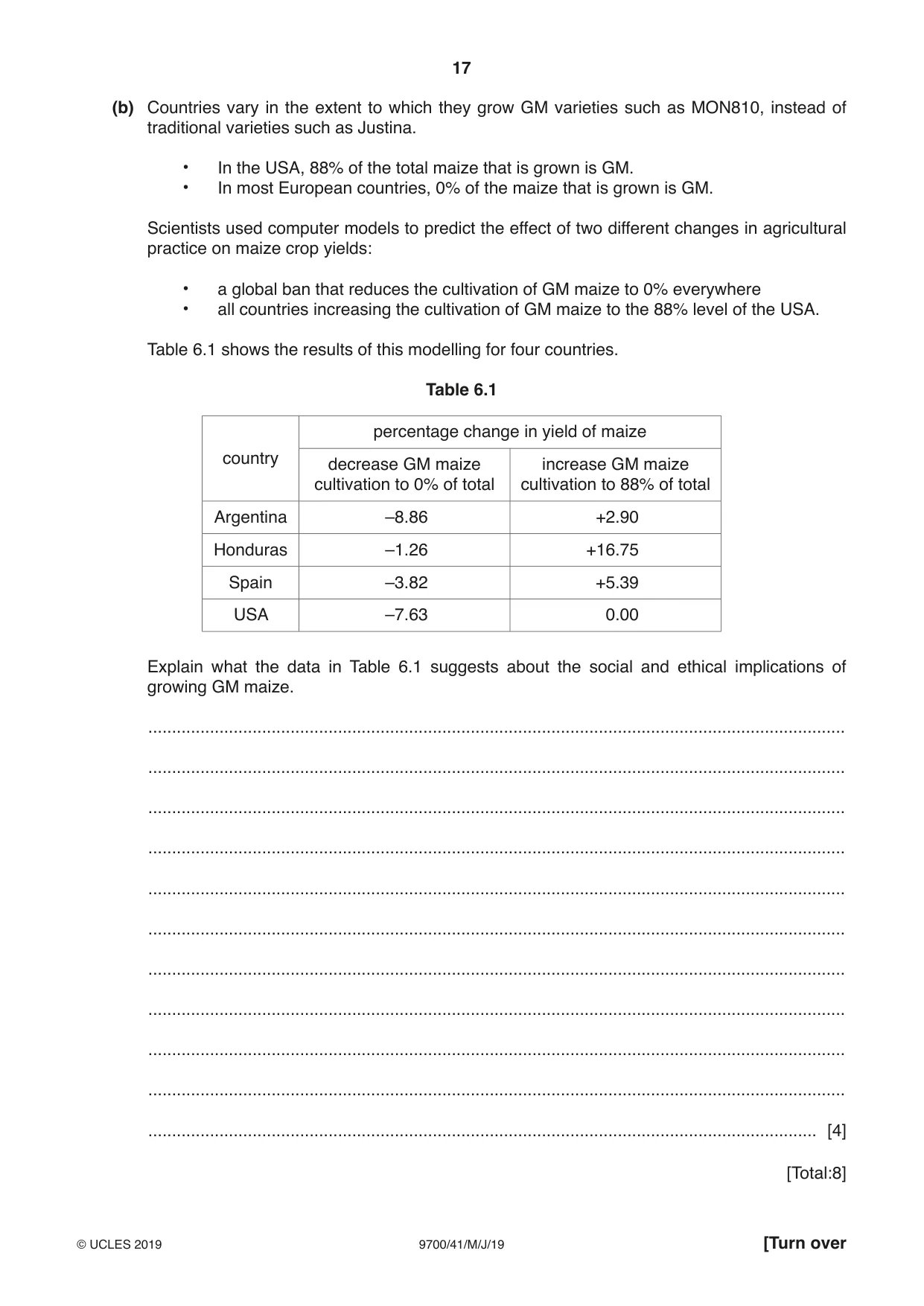
6 Maize, Zea mays, is an important food crop for human consumption and for feeding to animals. Two varieties of maize are MON810 and Justina. Justina has been developed in the traditional way by selective breeding (artificial selection) and MON810 is an example of a genetically modified (GM) organism. (a) MON810 produces a chemical that is toxic to insect pests. It is described as insect-resistant. Outline how genetic engineering gave MON810 the trait of insect resistance. ................................................................................................................................................... ................................................................................................................................................... ................................................................................................................................................... ................................................................................................................................................... ................................................................................................................................................... ................................................................................................................................................... ................................................................................................................................................... ................................................................................................................................................... ................................................................................................................................................... ................................................................................................................................................... ............................................................................................................................................. [4] (b) Countries vary in the extent to which they grow GM varieties such as MON810, instead of traditional varieties such as Justina. • In the USA, 88% of the total maize that is grown is GM. • In most European countries, 0% of the maize that is grown is GM. Scientists used computer models to predict the effect of two different changes in agricultural practice on maize crop yields: • a global ban that reduces the cultivation of GM maize to 0% everywhere • all countries increasing the cultivation of GM maize to the 88% level of the USA. Table 6.1 shows the results of this modelling for four countries. Table 6.1 percentage change in yield of maize country decrease GM maize increase GM maize cultivation to 0% of total cultivation to 88% of total Argentina –8.86 +2.90 Honduras –1.26 +16.75 Spain –3.82 +5.39 USA –7.63 0.00 Explain what the data in Table 6.1 suggests about the social and ethical implications of growing GM maize. ................................................................................................................................................... ................................................................................................................................................... ................................................................................................................................................... ................................................................................................................................................... ................................................................................................................................................... ................................................................................................................................................... ................................................................................................................................................... ................................................................................................................................................... ................................................................................................................................................... ................................................................................................................................................... ............................................................................................................................................. [4] [Total:8]
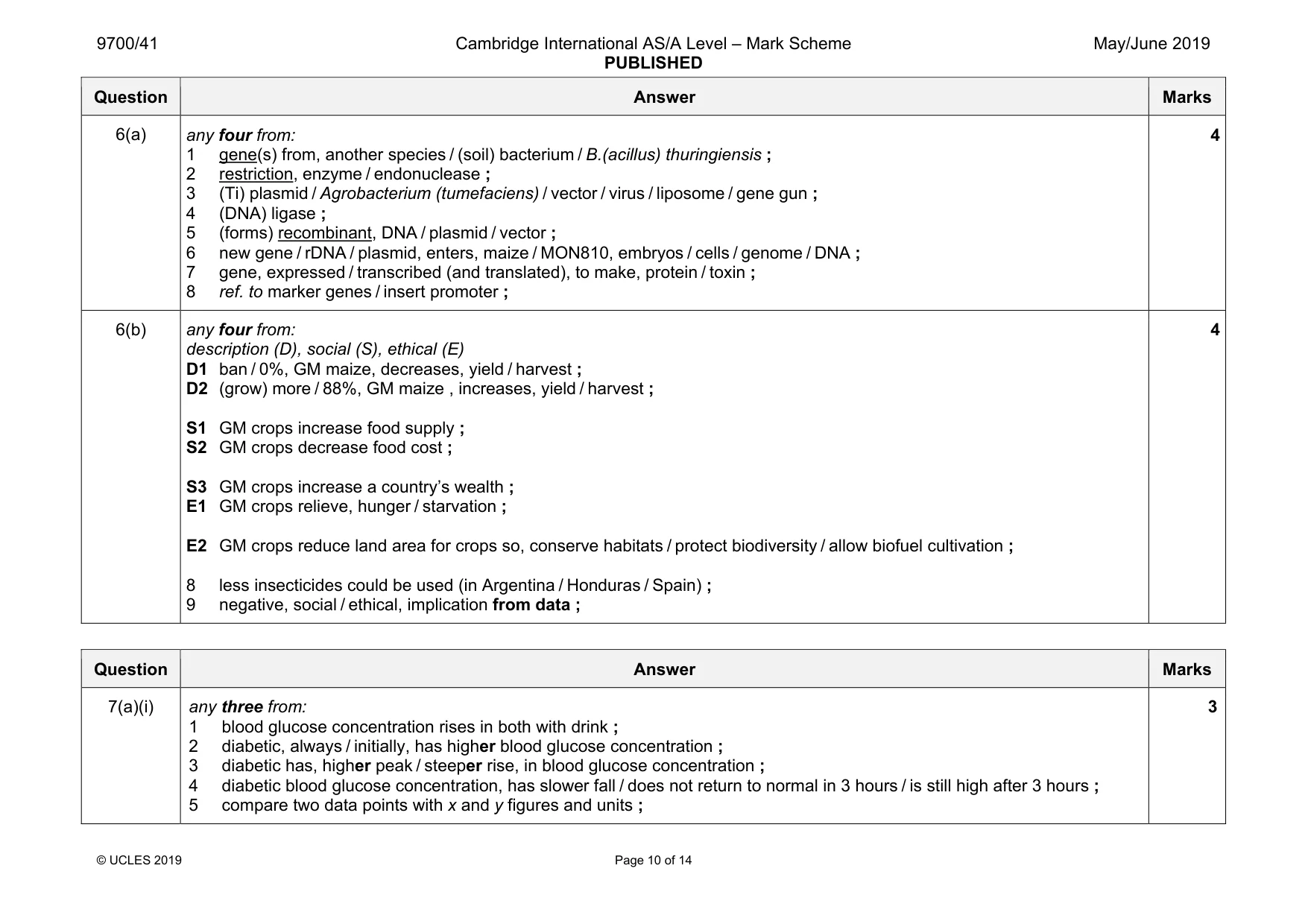
Mark scheme: 6(a) any four from: 1 gene(s) from, another species / (soil) bacterium / B.(acillus) thuringiensis ; 2 restriction, enzyme / endonuclease ; 3 (Ti) plasmid / Agrobacterium (tumefaciens) / vector / virus / liposome / gene gun ; 4 (DNA) ligase ; 5 (forms) recombinant, DNA / plasmid / vector ; 6 new gene / rDNA / plasmid, enters, maize / MON810, embryos / cells / genome / DNA ; 7 gene, expressed / transcribed (and translated), to make, protein / toxin ; 8 ref. to marker genes / insert promoter ; 4 6(b) any four from: description (D), social (S), ethical (E) D1 ban / 0%, GM maize, decreases, yield / harvest ; D2 (grow) more / 88%, GM maize , increases, yield / harvest ; S1 GM crops increase food supply ; S2 GM crops decrease food cost ; S3 GM crops increase a country’s wealth ; E1 GM crops relieve, hunger / starvation ; E2 GM crops reduce land area for crops so, conserve habitats / protect biodiversity / allow biofuel cultivation ; 8 less insecticides could be used (in Argentina / Honduras / Spain) ; 9 negative, social / ethical, implication from data ; 4
Q7 · Some people have a condition called diabetes
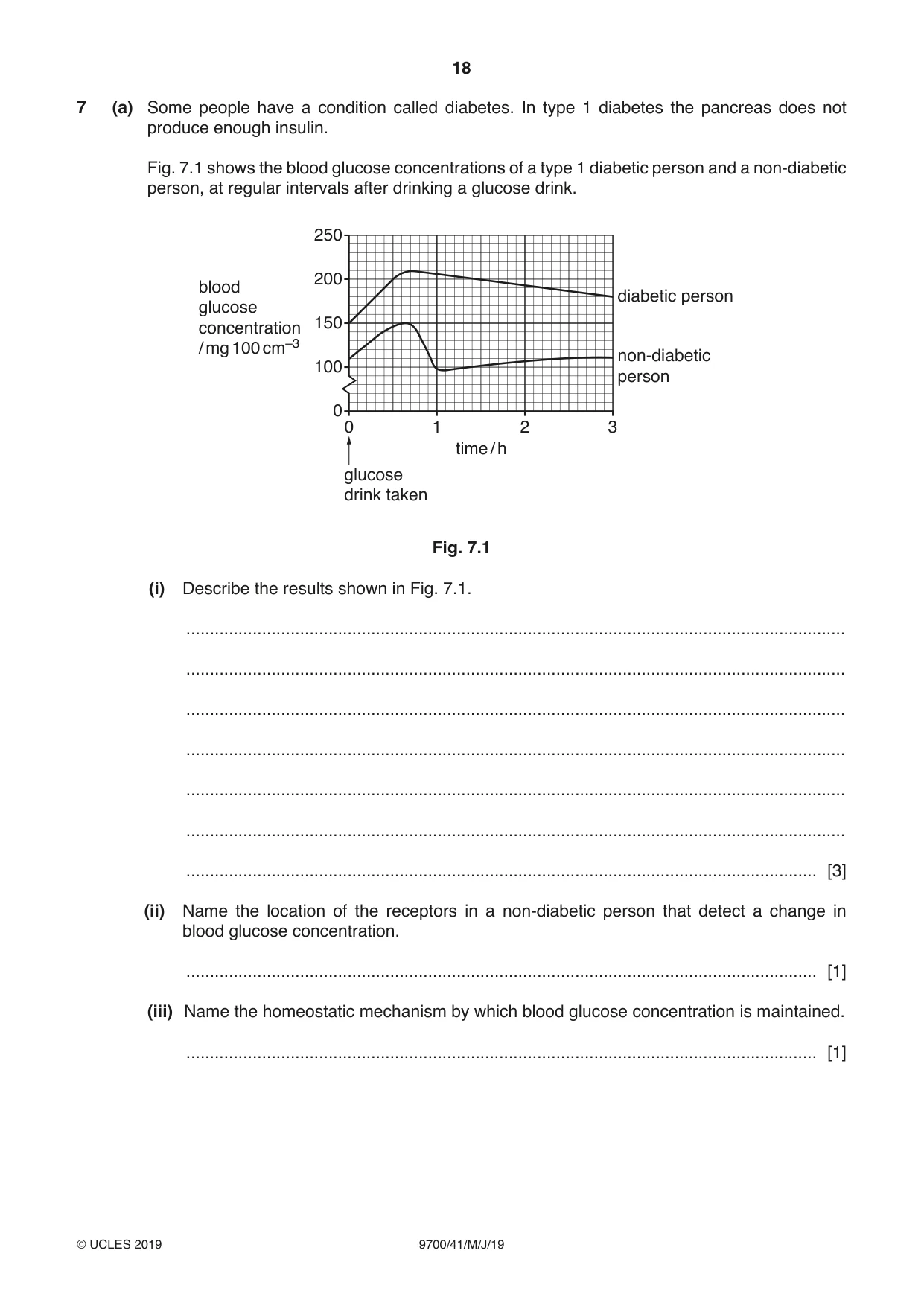
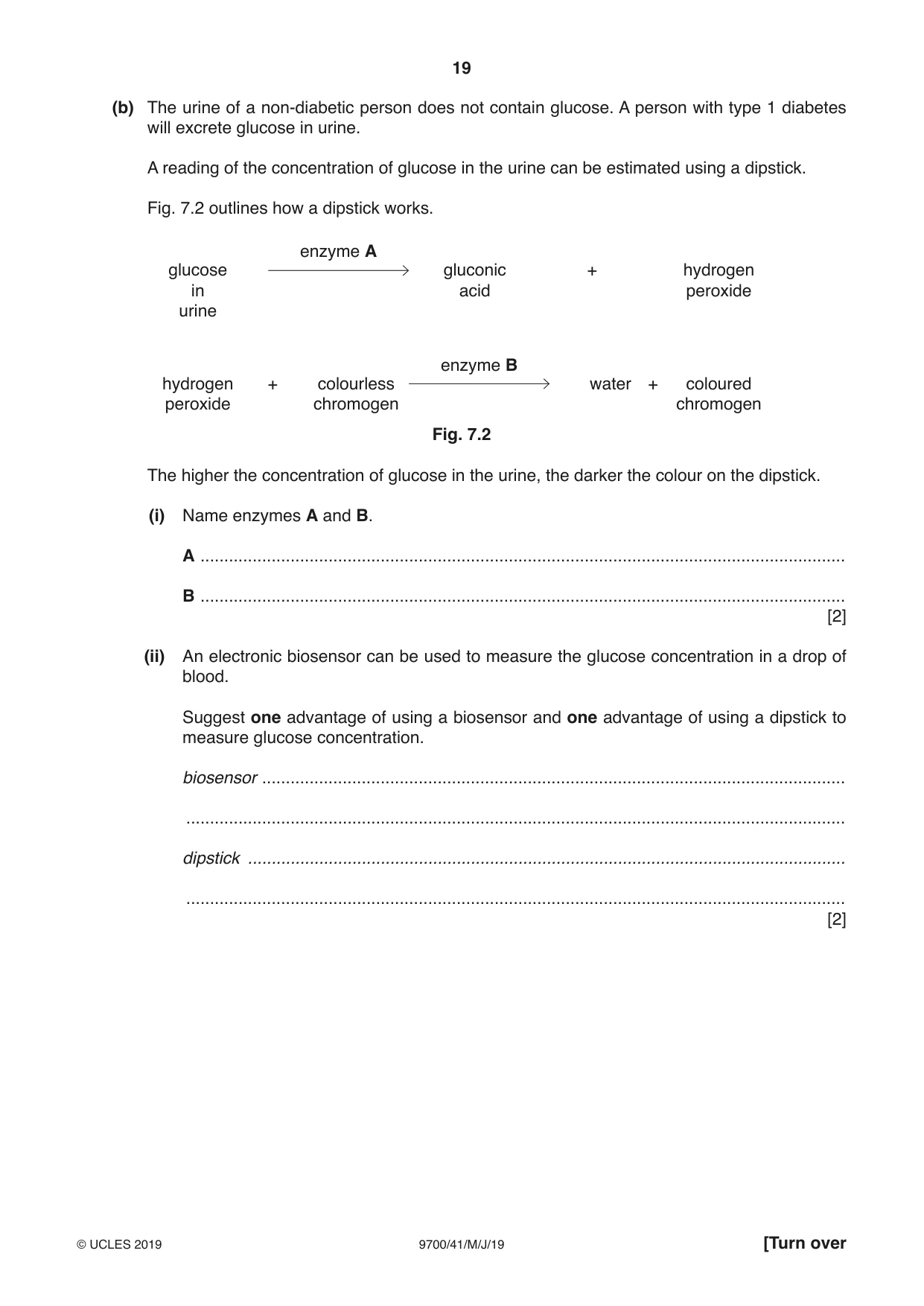
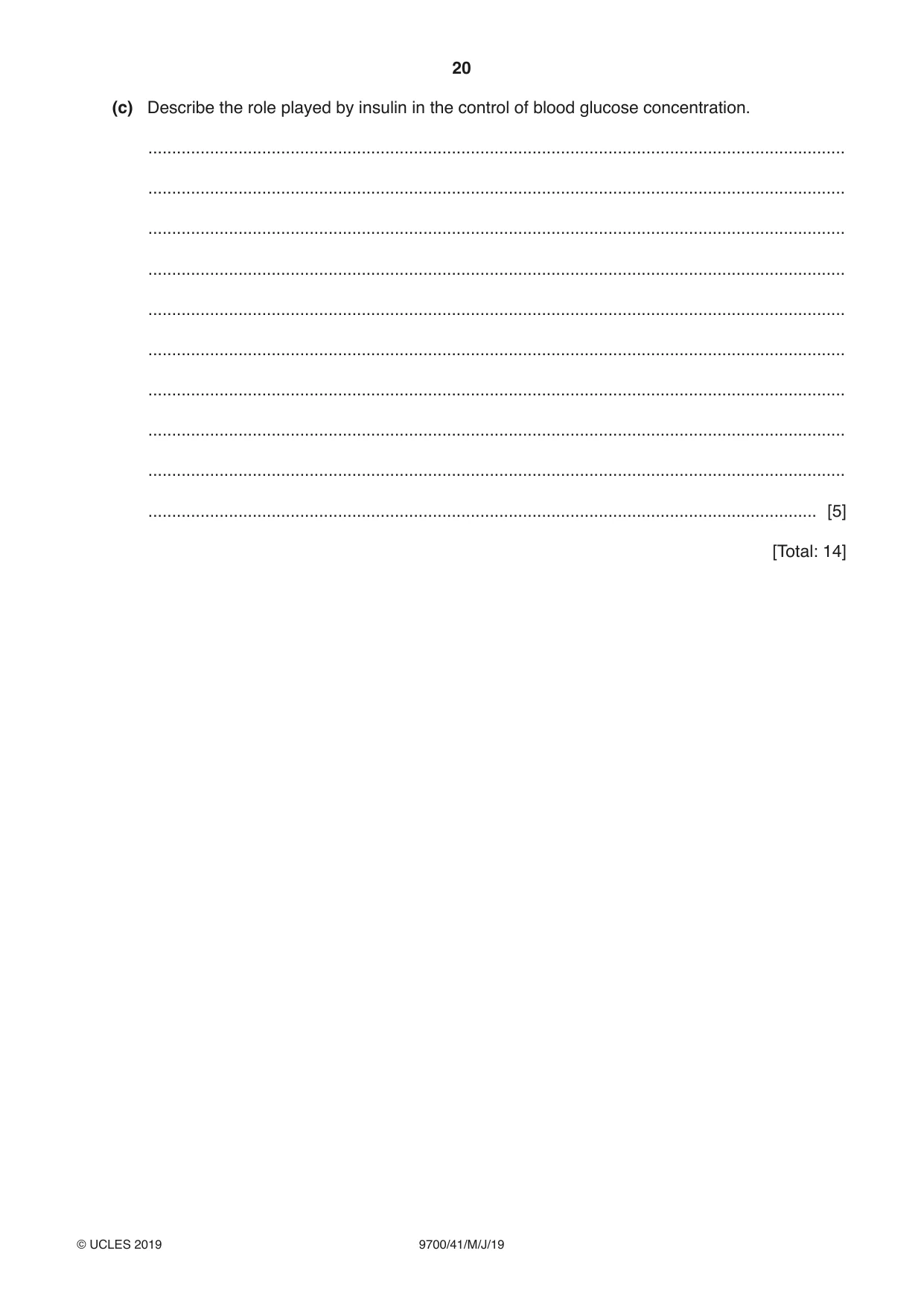
7 (a) Some people have a condition called diabetes. In type 1 diabetes the pancreas does not produce enough insulin. Fig. 7.1 shows the blood glucose concentrations of a type 1 diabetic person and a non-diabetic person, at regular intervals after drinking a glucose drink. 250 200 blood diabetic person glucose 150 concentration / mg 100 cm–3 non-diabetic 100 person 0 0 1 2 3 time / h glucose drink taken Fig. 7.1 (i) Describe the results shown in Fig. 7.1. ........................................................................................................................................... ........................................................................................................................................... ........................................................................................................................................... ........................................................................................................................................... ........................................................................................................................................... ........................................................................................................................................... ..................................................................................................................................... [3] (ii) Name the location of the receptors in a non-diabetic person that detect a change in blood glucose concentration. ..................................................................................................................................... [1] (iii) Name the homeostatic mechanism by which blood glucose concentration is maintained. ..................................................................................................................................... [1] (b) The urine of a non-diabetic person does not contain glucose. A person with type 1 diabetes will excrete glucose in urine. A reading of the concentration of glucose in the urine can be estimated using a dipstick. Fig. 7.2 outlines how a dipstick works. enzyme A glucose gluconic + hydrogen in acid peroxide urine enzyme B hydrogen + colourless water + coloured peroxide chromogen chromogen Fig. 7.2 The higher the concentration of glucose in the urine, the darker the colour on the dipstick. (i) Name enzymes A and B. A ........................................................................................................................................ B ........................................................................................................................................ [2] (ii) An electronic biosensor can be used to measure the glucose concentration in a drop of blood. Suggest one advantage of using a biosensor and one advantage of using a dipstick to measure glucose concentration. biosensor ........................................................................................................................... ........................................................................................................................................... dipstick .............................................................................................................................. ........................................................................................................................................... [2] (c) Describe the role played by insulin in the control of blood glucose concentration. ................................................................................................................................................... ................................................................................................................................................... ................................................................................................................................................... ................................................................................................................................................... ................................................................................................................................................... ................................................................................................................................................... ................................................................................................................................................... ................................................................................................................................................... ................................................................................................................................................... ............................................................................................................................................. [5] [Total: 14]
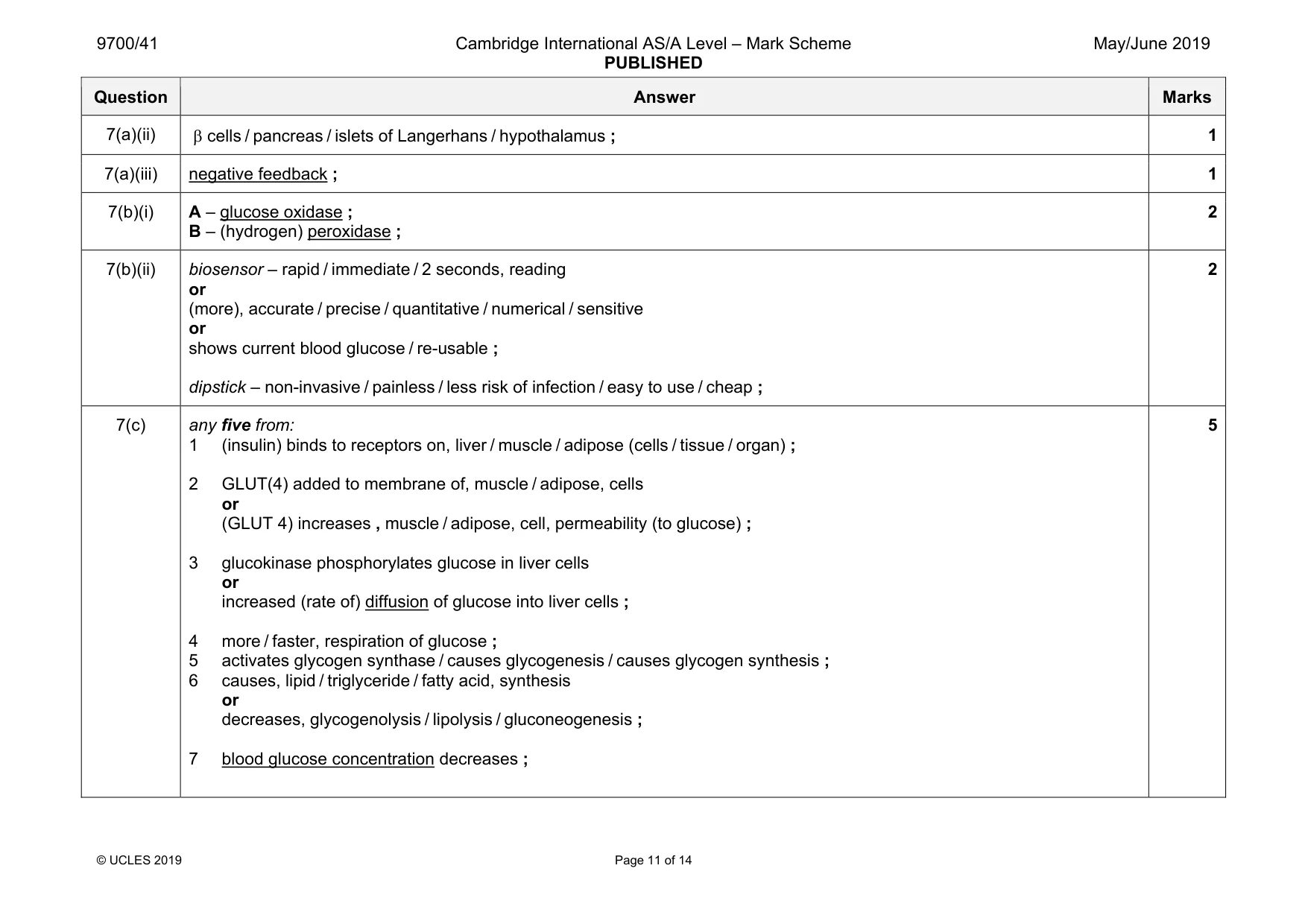
Mark scheme: 7(a)(i) any three from: 1 blood glucose concentration rises in both with drink ; 2 diabetic, always / initially, has higher blood glucose concentration ; 3 diabetic has, higher peak / steeper rise, in blood glucose concentration ; 4 diabetic blood glucose concentration, has slower fall / does not return to normal in 3 hours / is still high after 3 hours ; 5 compare two data points with x and y figures and units ; 3 Question Answer Marks 7(a)(ii) β cells / pancreas / islets of Langerhans / hypothalamus ; 1 7(a)(iii) negative feedback ; 1 7(b)(i) A – glucose oxidase ; B – (hydrogen) peroxidase ; 2 7(b)(ii) biosensor – rapid / immediate / 2 seconds, reading or (more), accurate / precise / quantitative / numerical / sensitive or shows current blood glucose / re-usable ; dipstick – non-invasive / painless / less risk of infection / easy to use / cheap ; 2 7(c) any five from: 1 (insulin) binds to receptors on, liver / muscle / adipose (cells / tissue / organ) ; 2 GLUT(4) added to membrane of, muscle / adipose, cells or (GLUT 4) increases , muscle / adipose, cell, permeability (to glucose) ; 3 glucokinase phosphorylates glucose in liver cells or increased (rate of) diffusion of glucose into liver cells ; 4 more / faster, respiration of glucose ; 5 activates glycogen synthase / causes glycogenesis / causes glycogen synthesis ; 6 causes, lipid / triglyceride / fatty acid, synthesis or decreases, glycogenolysis / lipolysis / gluconeogenesis ; 7 blood glucose concentration decreases ; 5
Q8 · The total number of plant species, the total number of insect species and the number of…
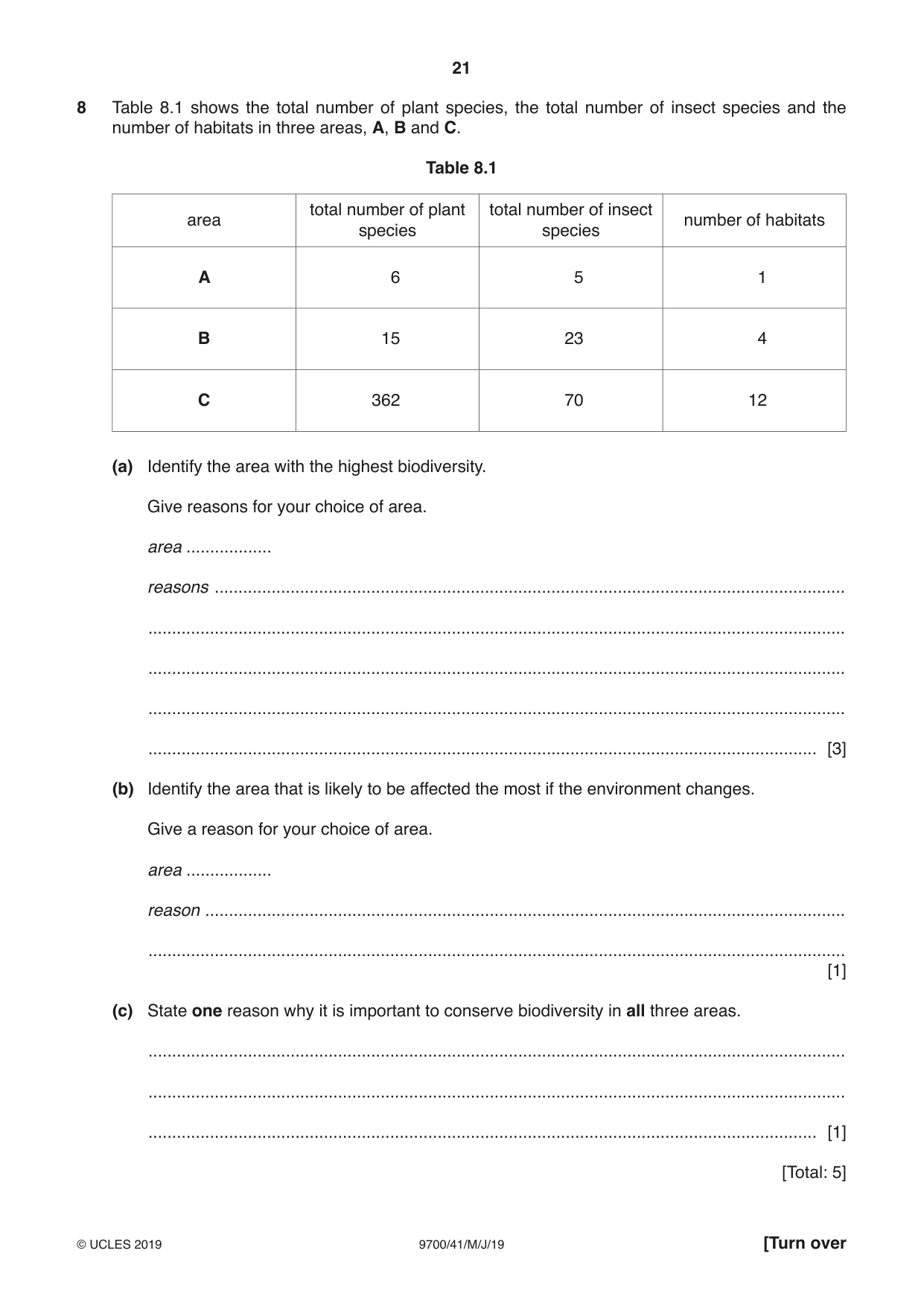
8 Table 8.1 shows the total number of plant species, the total number of insect species and the number of habitats in three areas, A, B and C. Table 8.1 total number of plant total number of insect area number of habitats species species A 6 5 1 B 15 23 4 C 362 70 12 (a) Identify the area with the highest biodiversity. Give reasons for your choice of area. area .................. reasons ..................................................................................................................................... ................................................................................................................................................... ................................................................................................................................................... ................................................................................................................................................... ............................................................................................................................................. [3] (b) Identify the area that is likely to be affected the most if the environment changes. Give a reason for your choice of area. area .................. reason ....................................................................................................................................... ................................................................................................................................................... [1] (c) State one reason why it is important to conserve biodiversity in all three areas. ................................................................................................................................................... ................................................................................................................................................... ............................................................................................................................................. [1] [Total: 5]
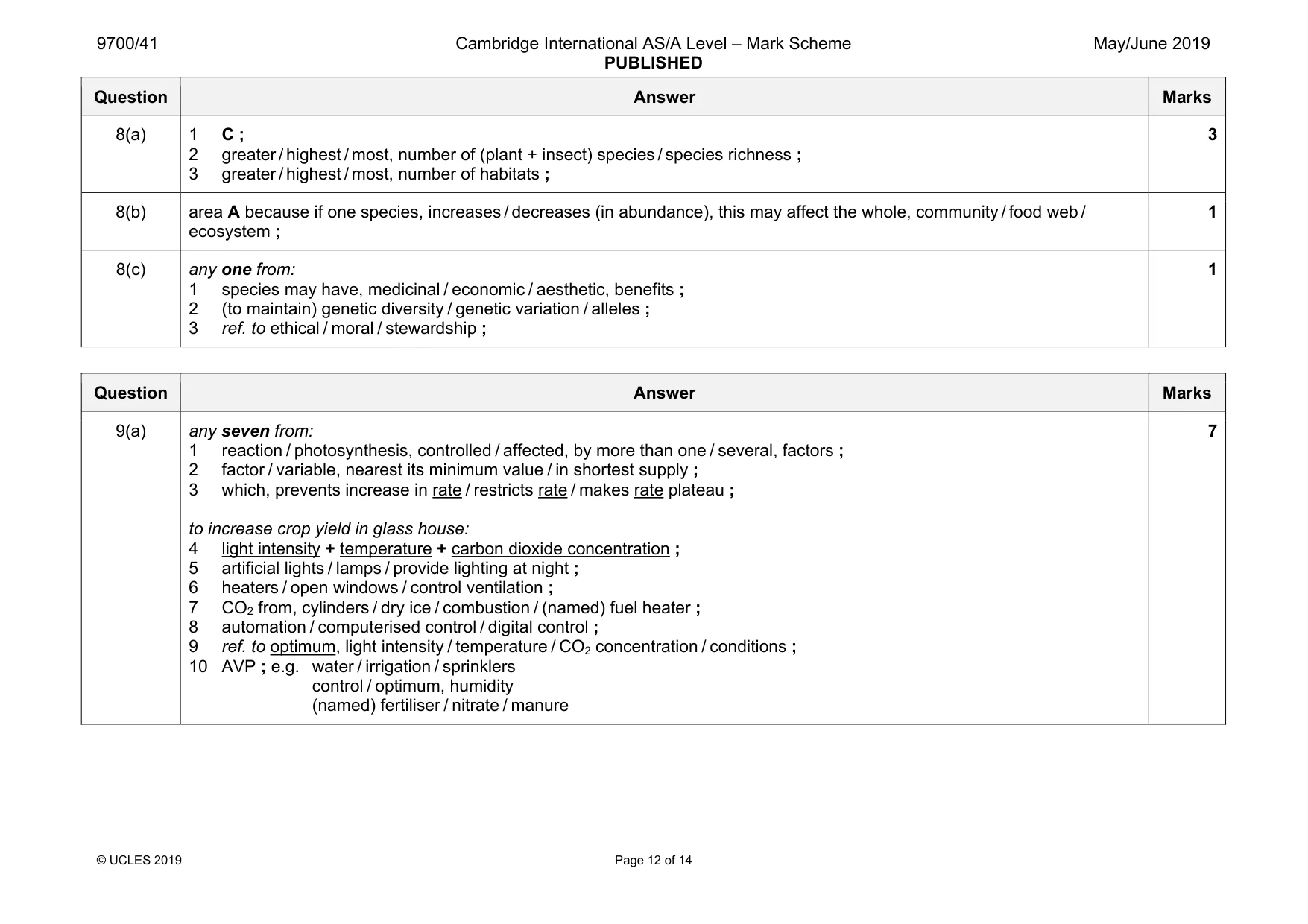
Mark scheme: 8(a) 1 C ; 2 greater / highest / most, number of (plant + insect) species / species richness ; 3 greater / highest / most, number of habitats ; 3 8(b) area A because if one species, increases / decreases (in abundance), this may affect the whole, community / food web / ecosystem ; 1 8(c) any one from: 1 species may have, medicinal / economic / aesthetic, benefits ; 2 (to maintain) genetic diversity / genetic variation / alleles ; 3 ref. to ethical / moral / stewardship ; 1
Q9 · Explain what is meant by the term limiting factor and explain how knowledge of limiting…
9 (a) Explain what is meant by the term limiting factor and explain how knowledge of limiting factors is used to increase crop yields in glasshouses. [7] (b) Describe the behaviour of chromosomes during meiosis. [8] [Total: 15]
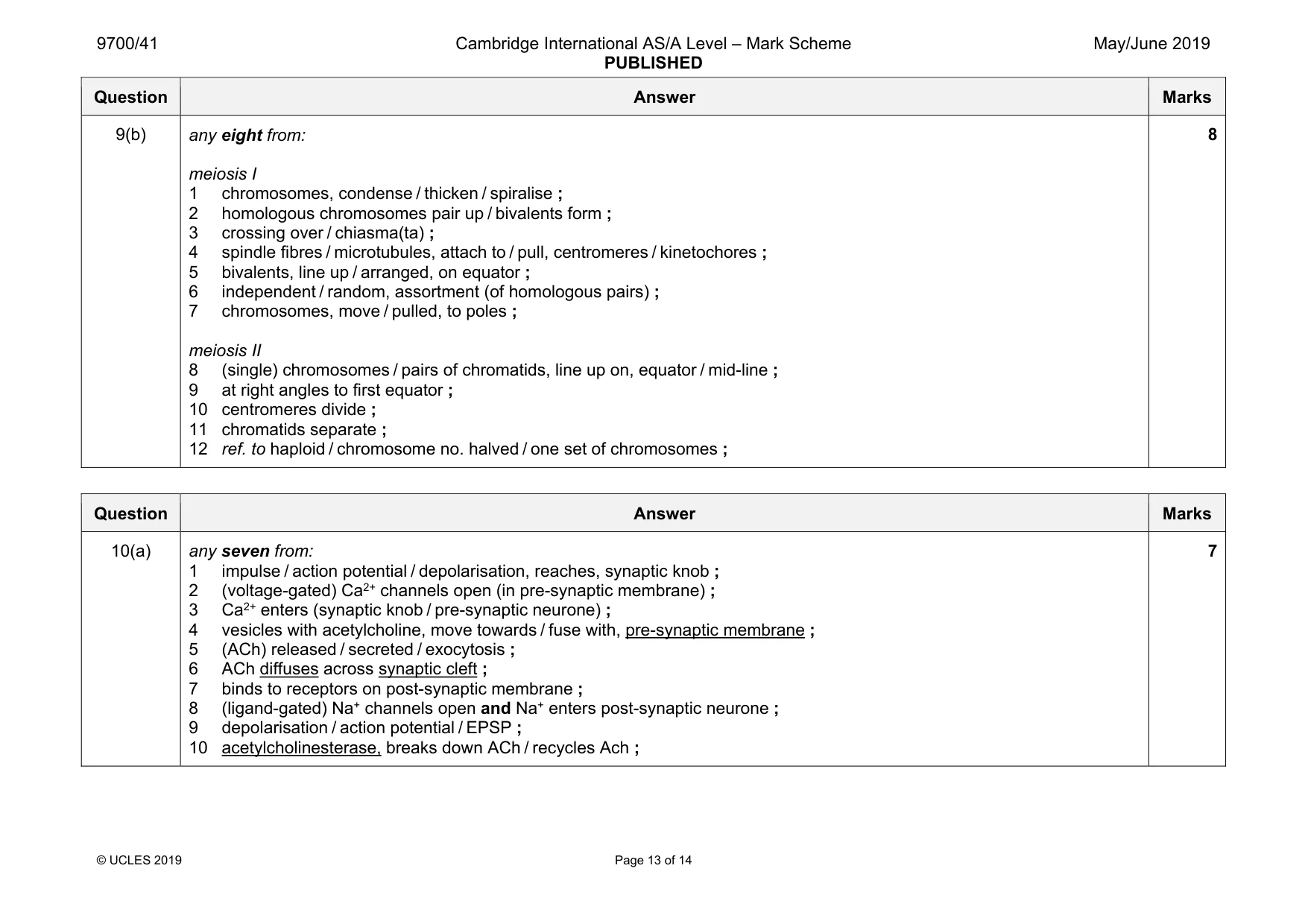
Mark scheme: 9(a) any seven from: 1 reaction / photosynthesis, controlled / affected, by more than one / several, factors ; 2 factor / variable, nearest its minimum value / in shortest supply ; 3 which, prevents increase in rate / restricts rate / makes rate plateau ; to increase crop yield in glass house: 4 light intensity + temperature + carbon dioxide concentration ; 5 artificial lights / lamps / provide lighting at night ; 6 heaters / open windows / control ventilation ; 7 CO2 from, cylinders / dry ice / combustion / (named) fuel heater ; 8 automation / computerised control / digital control ; 9 ref. to optimum, light intensity / temperature / CO2 concentration / conditions ; 10 AVP ; e.g. water / irrigation / sprinklers control / optimum, humidity (named) fertiliser / nitrate / manure 7 Question Answer Marks 9(b) any eight from: meiosis I 1 chromosomes, condense / thicken / spiralise ; 2 homologous chromosomes pair up / bivalents form ; 3 crossing over / chiasma(ta) ; 4 spindle fibres / microtubules, attach to / pull, centromeres / kinetochores ; 5 bivalents, line up / arranged, on equator ; 6 independent / random, assortment (of homologous pairs) ; 7 chromosomes, move / pulled, to poles ; meiosis II 8 (single) chromosomes / pairs of chromatids, line up on, equator / mid-line ; 9 at right angles to first equator ; 10 centromeres divide ; 11 chromatids separate ; 12 ref. to haploid / chromosome no. halved / one set of chromosomes ; 8
Q10 · Explain how a cholinergic synapse functions
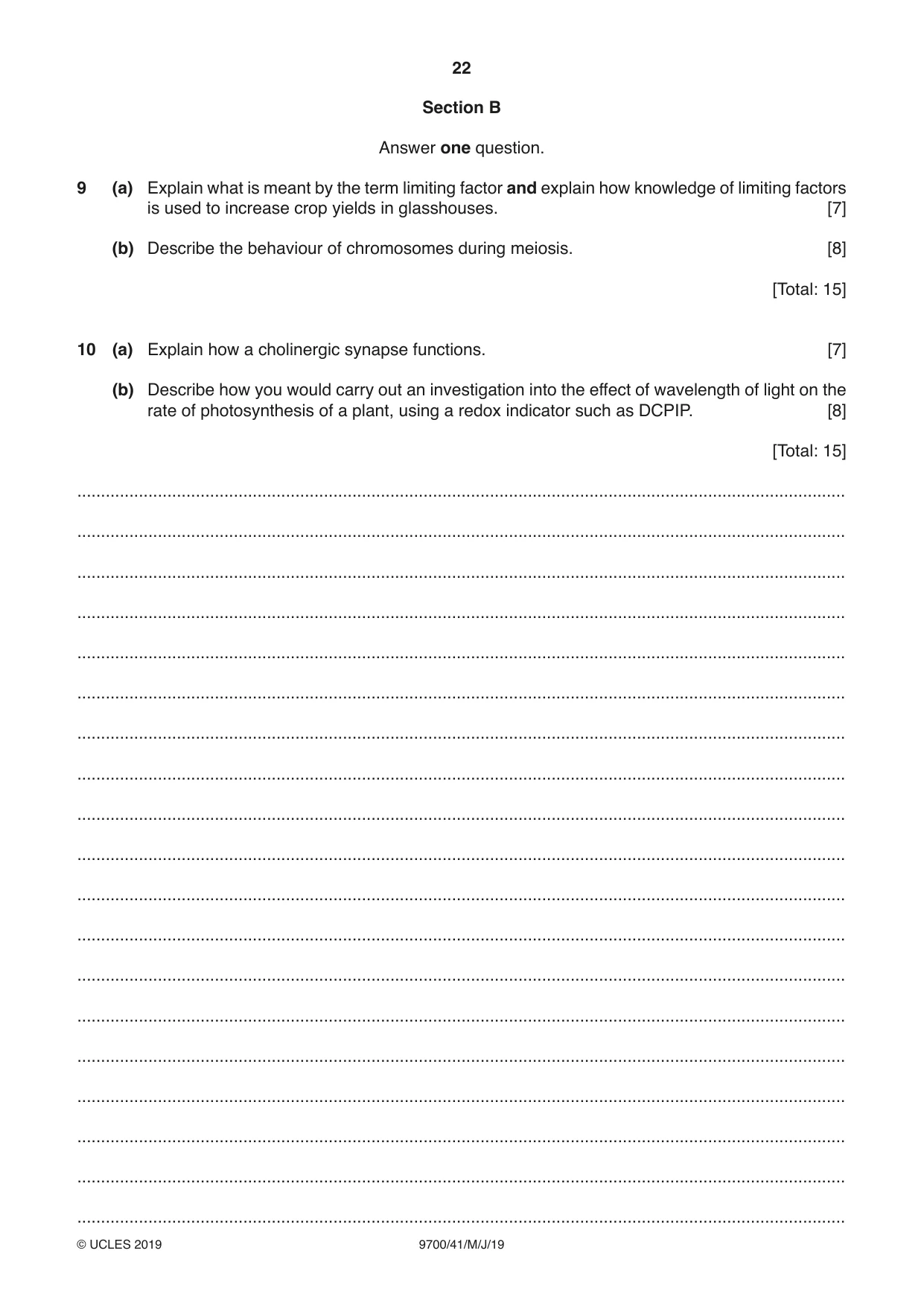
10 (a) Explain how a cholinergic synapse functions. [7] (b) Describe how you would carry out an investigation into the effect of wavelength of light on the rate of photosynthesis of a plant, using a redox indicator such as DCPIP. [8] [Total: 15] .................................................................................................................................................................. .................................................................................................................................................................. .................................................................................................................................................................. .................................................................................................................................................................. .................................................................................................................................................................. .................................................................................................................................................................. .................................................................................................................................................................. .................................................................................................................................................................. .................................................................................................................................................................. .................................................................................................................................................................. .................................................................................................................................................................. .................................................................................................................................................................. .................................................................................................................................................................. .................................................................................................................................................................. .................................................................................................................................................................. .................................................................................................................................................................. .................................................................................................................................................................. .................................................................................................................................................................. .................................................................................................................................................................. .................................................................................................................................................................. .................................................................................................................................................................. .................................................................................................................................................................. .................................................................................................................................................................. .................................................................................................................................................................. .................................................................................................................................................................. .................................................................................................................................................................. .................................................................................................................................................................. .................................................................................................................................................................. .................................................................................................................................................................. .................................................................................................................................................................. .................................................................................................................................................................. .................................................................................................................................................................. .................................................................................................................................................................. .................................................................................................................................................................. .................................................................................................................................................................. .................................................................................................................................................................. .................................................................................................................................................................. .................................................................................................................................................................. .................................................................................................................................................................. .................................................................................................................................................................. .................................................................................................................................................................. .................................................................................................................................................................. .................................................................................................................................................................. .................................................................................................................................................................. .................................................................................................................................................................. .................................................................................................................................................................. .................................................................................................................................................................. .................................................................................................................................................................. .................................................................................................................................................................. .................................................................................................................................................................. .................................................................................................................................................................. .................................................................................................................................................................. .................................................................................................................................................................. .................................................................................................................................................................. .................................................................................................................................................................. .................................................................................................................................................................. .................................................................................................................................................................. .................................................................................................................................................................. .................................................................................................................................................................. .................................................................................................................................................................. .................................................................................................................................................................. .................................................................................................................................................................. .................................................................................................................................................................. .................................................................................................................................................................. .................................................................................................................................................................. .................................................................................................................................................................. .................................................................................................................................................................. .................................................................................................................................................................. .................................................................................................................................................................. .................................................................................................................................................................. ..................................................................................................................................................................
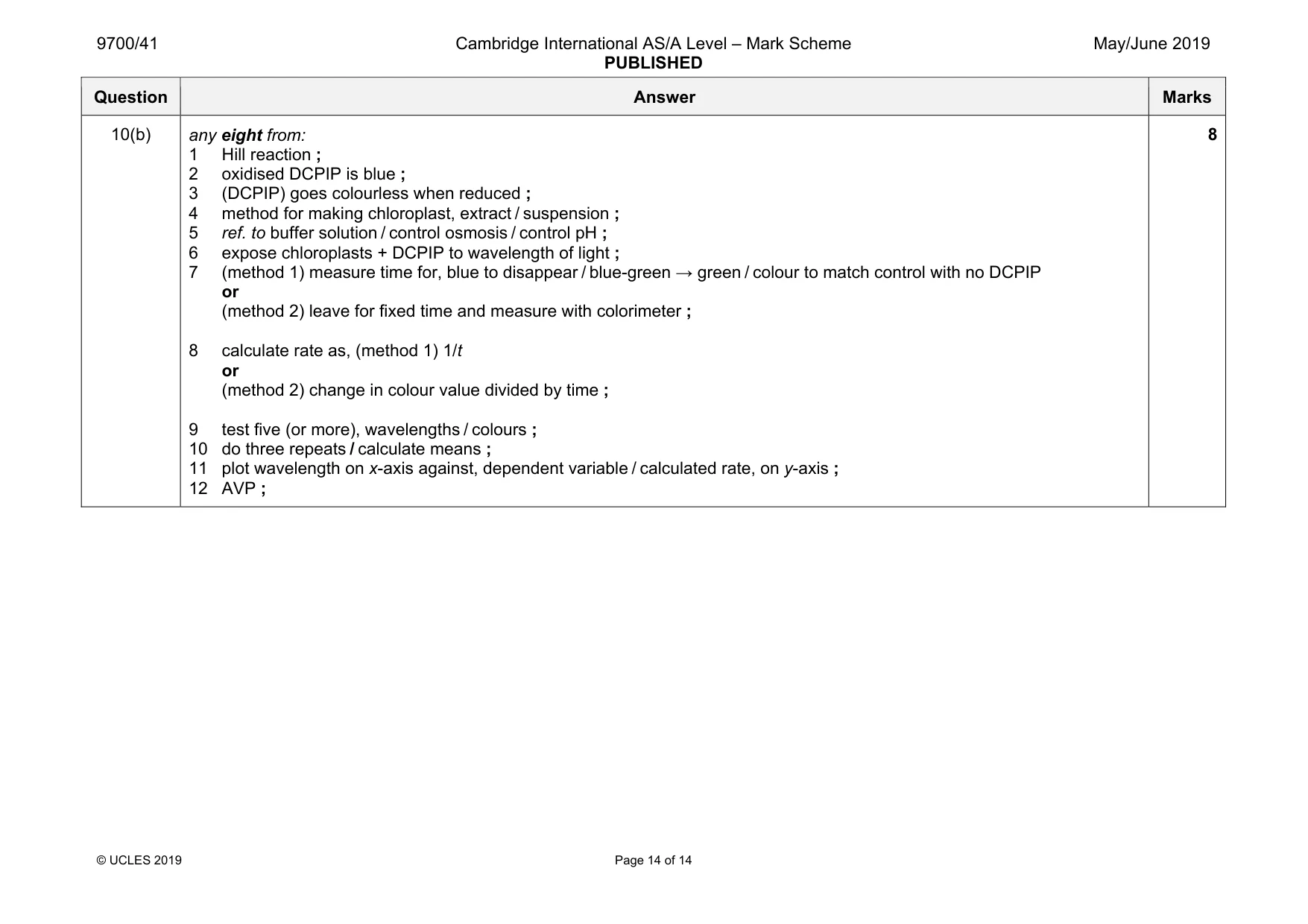
Mark scheme: 10(a) any seven from: 1 impulse / action potential / depolarisation, reaches, synaptic knob ; 2 (voltage-gated) Ca2+ channels open (in pre-synaptic membrane) ; 3 Ca2+ enters (synaptic knob / pre-synaptic neurone) ; 4 vesicles with acetylcholine, move towards / fuse with, pre-synaptic membrane ; 5 (ACh) released / secreted / exocytosis ; 6 ACh diffuses across synaptic cleft ; 7 binds to receptors on post-synaptic membrane ; 8 (ligand-gated) Na+ channels open and Na+ enters post-synaptic neurone ; 9 depolarisation / action potential / EPSP ; 10 acetylcholinesterase, breaks down ACh / recycles Ach ; 7 Question Answer Marks 10(b) any eight from: 1 Hill reaction ; 2 oxidised DCPIP is blue ; 3 (DCPIP) goes colourless when reduced ; 4 method for making chloroplast, extract / suspension ; 5 ref. to buffer solution / control osmosis / control pH ; 6 expose chloroplasts + DCPIP to wavelength of light ; 7 (method 1) measure time for, blue to disappear / blue-green → green / colour to match control with no DCPIP or (method 2) leave for fixed time and measure with colorimeter ; 8 calculate rate as, (method 1) 1/t or (method 2) change in colour value divided by time ; 9 test five (or more), wavelengths / colours ; 10 do three repeats / calculate means ; 11 plot wavelength on x-axis against, dependent variable / calculated rate, on y-axis ; 12 AVP ; 8
What was in this paper
The subtopics covered by these 10 questions, and how many questions each got. Open one in a new tab to see every Cambridge question on it.
What you needed in this session
Cambridge’s own grade thresholds for 2019 May/June, Paper 4 · Variant 1. A higher threshold means an easier paper — the bar moves with how the cohort did.