Cambridge A Level Biology 9700 — 2018 Oct/Nov Paper 4 · Variant 2
9700/42/O/N/18 · 10 questions · 100 marks · ≈113 min
The question paper and its mark scheme, free to read here and free to download. This is Cambridge’s own paper, exactly as it was sat.
Question paper24 pages






Mark scheme13 pages
Answers below. Sit the paper first if you are practising.
Questions as text
Q1 · The Visayan warty pig, Sus cebifrons, is found on two islands in the Philippines
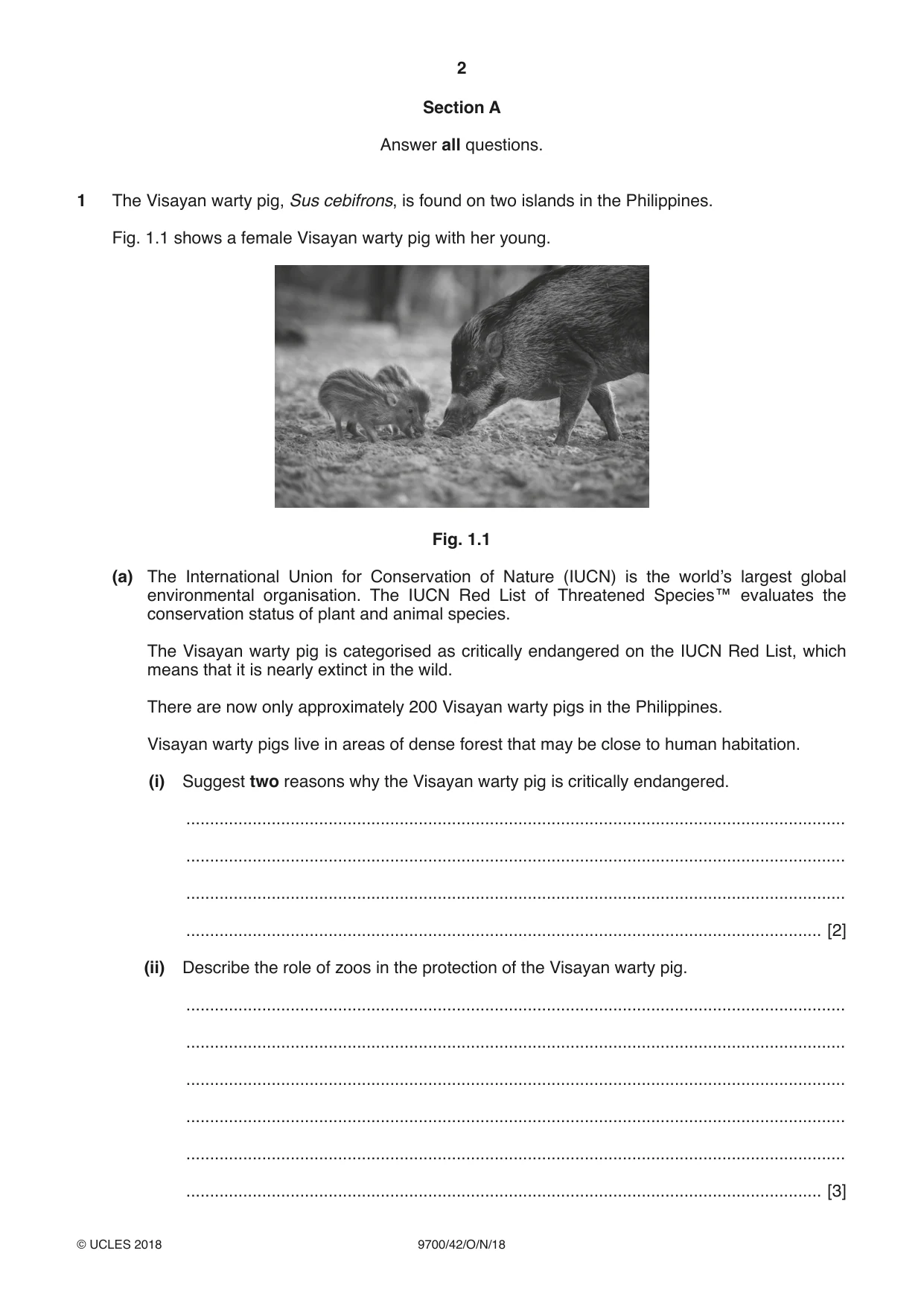
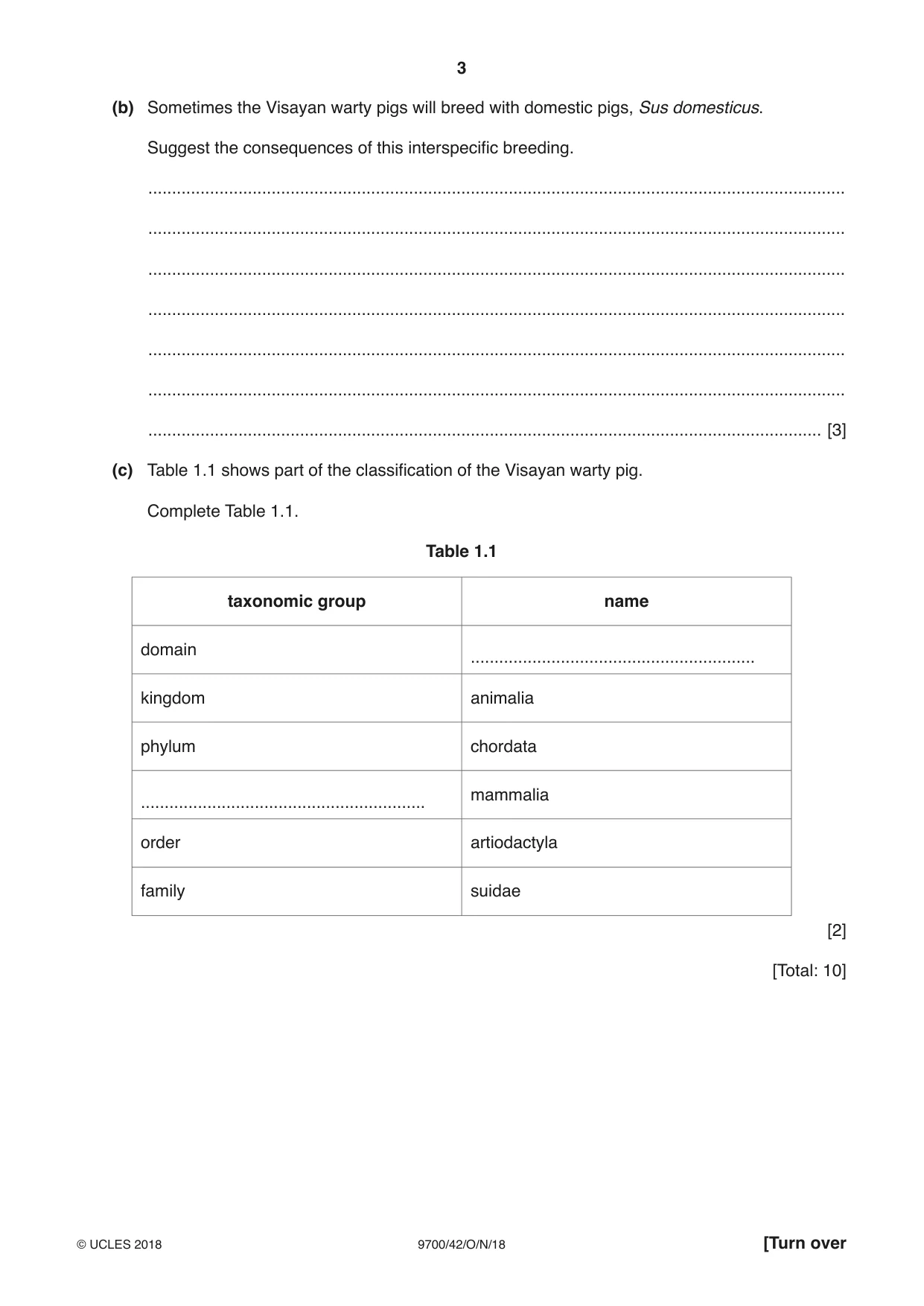
1 The Visayan warty pig, Sus cebifrons, is found on two islands in the Philippines. Fig. 1.1 shows a female Visayan warty pig with her young. Fig. 1.1 (a) The International Union for Conservation of Nature (IUCN) is the world’s largest global environmental organisation. The IUCN Red List of Threatened Species™ evaluates the conservation status of plant and animal species. The Visayan warty pig is categorised as critically endangered on the IUCN Red List, which means that it is nearly extinct in the wild. There are now only approximately 200 Visayan warty pigs in the Philippines. Visayan warty pigs live in areas of dense forest that may be close to human habitation. (i) Suggest two reasons why the Visayan warty pig is critically endangered. ........................................................................................................................................... ........................................................................................................................................... ........................................................................................................................................... ...................................................................................................................................... [2] (ii) Describe the role of zoos in the protection of the Visayan warty pig. ........................................................................................................................................... ........................................................................................................................................... ........................................................................................................................................... ........................................................................................................................................... ........................................................................................................................................... ...................................................................................................................................... [3] (b) Sometimes the Visayan warty pigs will breed with domestic pigs, Sus domesticus. Suggest the consequences of this interspecific breeding. ................................................................................................................................................... ................................................................................................................................................... ................................................................................................................................................... ................................................................................................................................................... ................................................................................................................................................... ................................................................................................................................................... .............................................................................................................................................. [3] (c) Table 1.1 shows part of the classification of the Visayan warty pig. Complete Table 1.1. Table 1.1 taxonomic group name domain ............................................................ kingdom animalia phylum chordata mammalia ............................................................ order artiodactyla family suidae [2] [Total: 10]
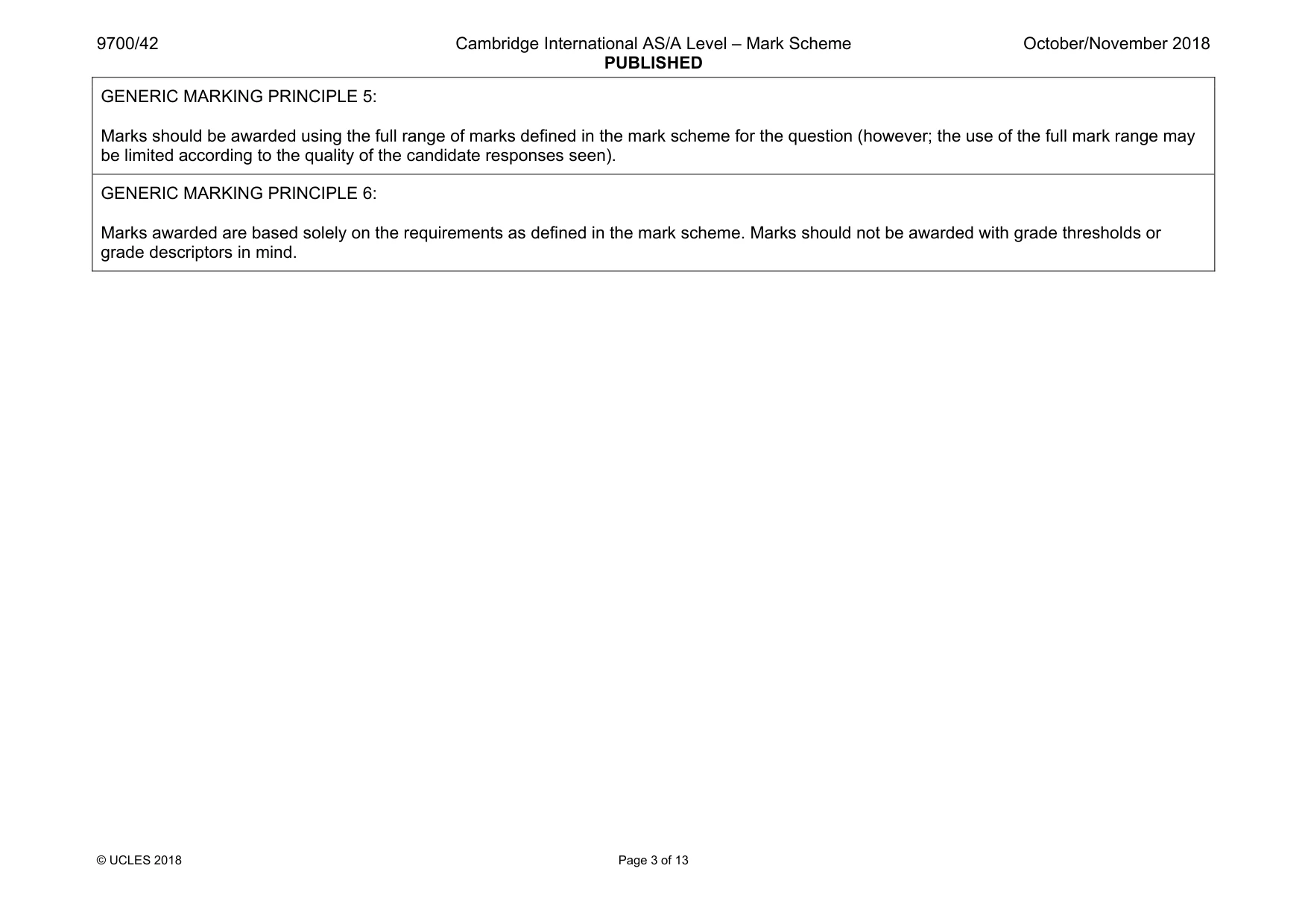
Mark scheme: 1(a)(i) any two from 1 deforestation or habitat, destruction / fragmentation ; 2 killed ; 3 disease ; 4 reduction in food supply ; 2 1(a)(ii) any three from 1 captive breeding / AI / IVF / surrogacy ; 2 release into the wild / insurance populations ; 3 education / awareness ; 4 (work with Philippine government to) set up reserves ; 5 research, diet / habitat / breeding / behaviour / genetic diversity ; 6 veterinary care / monitor health ; 3 1(b) any three from 1 hybrids formed / fewer warty pigs produced ; 2 may be sterile ; 3 genetically different (from warty pigs) ; 4 (hybrid) less adapted for natural environment ; 5 (hybrid) ref. to susceptibility to, diseases / parasites ; 3 1(c) Eukarya ; R eukaryote(s) / Eukaryota class ; 2
Q2 · Researchers have found evidence of natural selection in humans
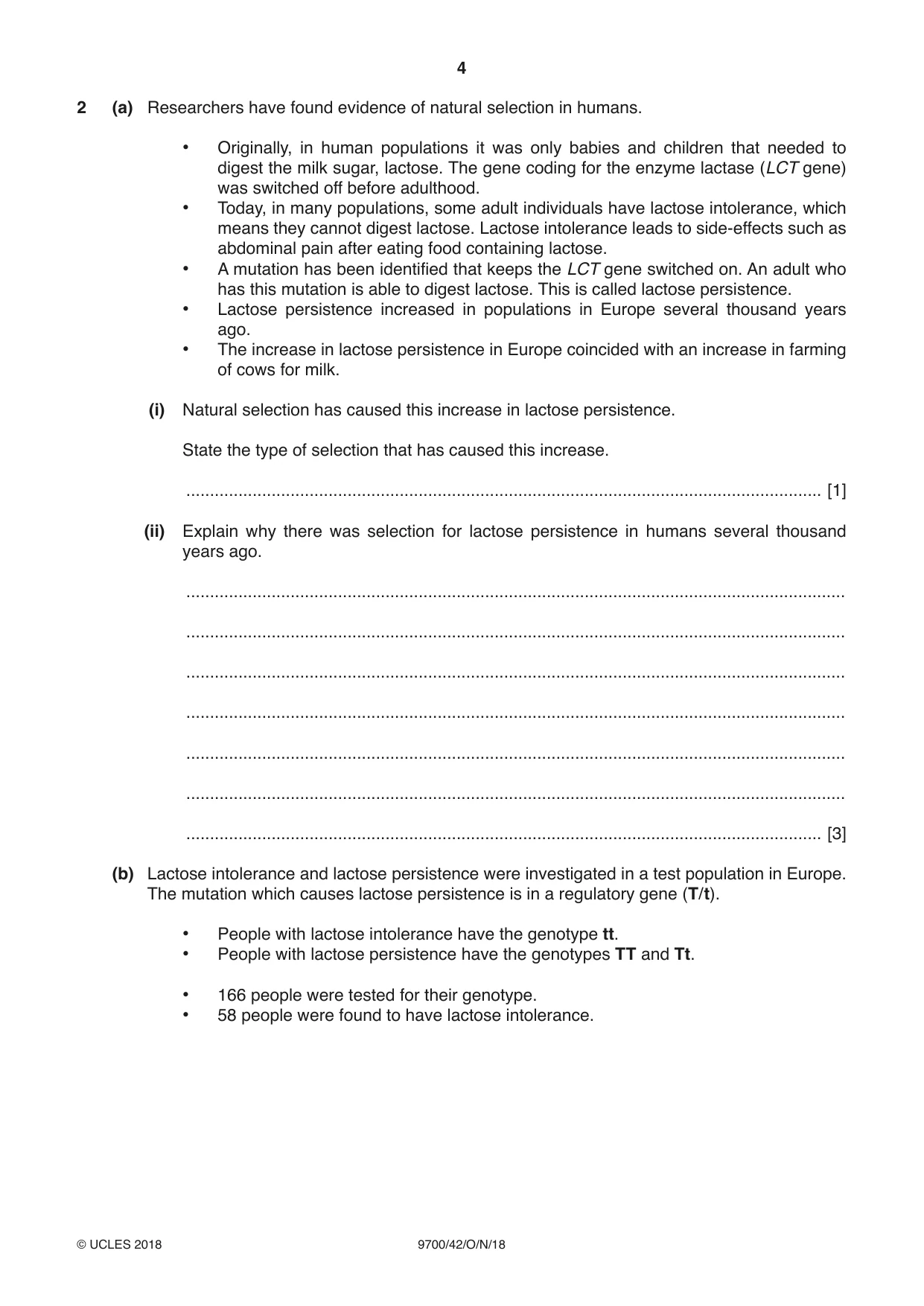
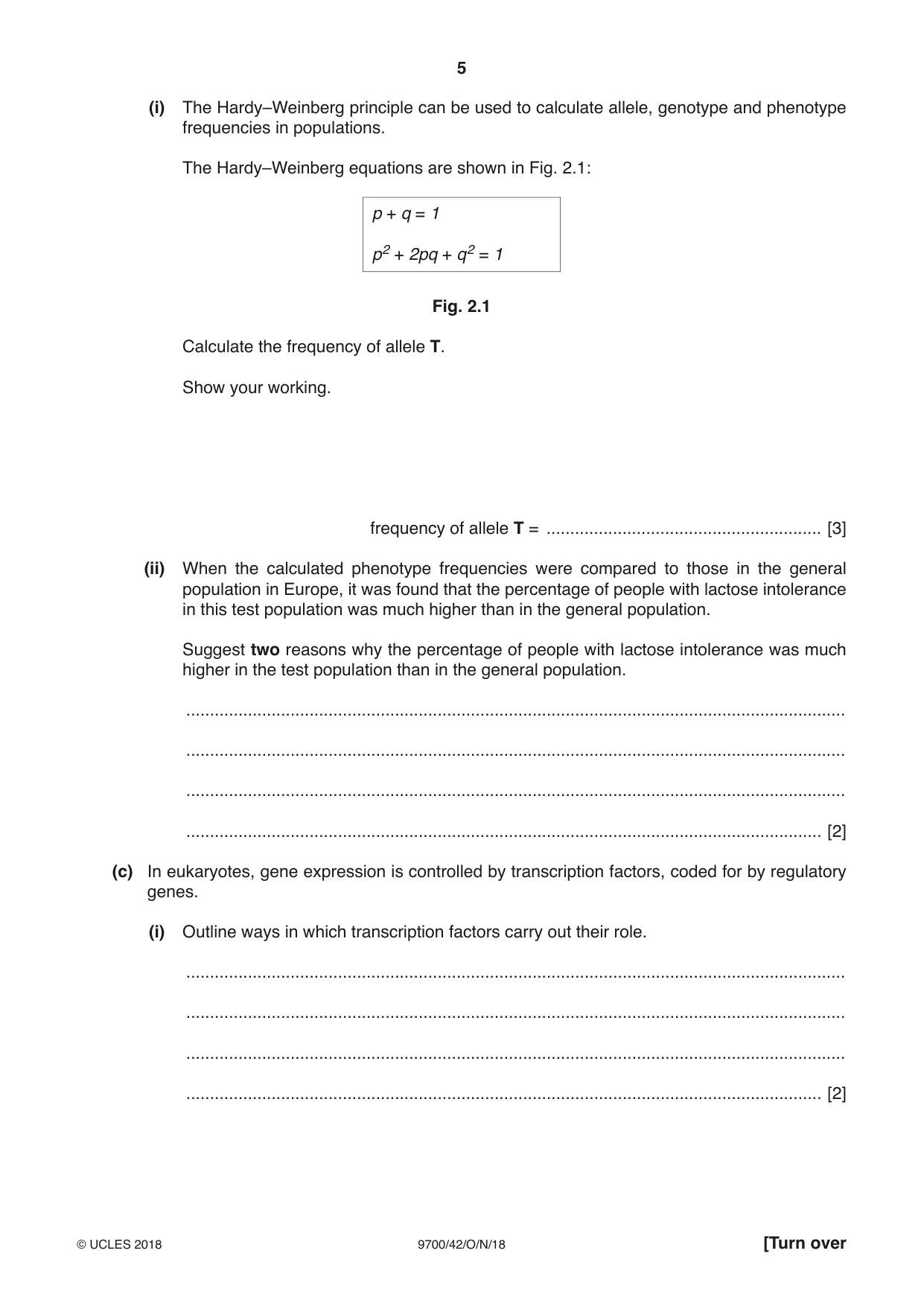
2 (a) Researchers have found evidence of natural selection in humans. • Originally, in human populations it was only babies and children that needed to digest the milk sugar, lactose. The gene coding for the enzyme lactase (LCT gene) was switched off before adulthood. • Today, in many populations, some adult individuals have lactose intolerance, which means they cannot digest lactose. Lactose intolerance leads to side-effects such as abdominal pain after eating food containing lactose. • A mutation has been identified that keeps the LCT gene switched on. An adult who has this mutation is able to digest lactose. This is called lactose persistence. • Lactose persistence increased in populations in Europe several thousand years ago. • The increase in lactose persistence in Europe coincided with an increase in farming of cows for milk. (i) Natural selection has caused this increase in lactose persistence. State the type of selection that has caused this increase. ...................................................................................................................................... [1] (ii) Explain why there was selection for lactose persistence in humans several thousand years ago. ........................................................................................................................................... ........................................................................................................................................... ........................................................................................................................................... ........................................................................................................................................... ........................................................................................................................................... ........................................................................................................................................... ...................................................................................................................................... [3] (b) Lactose intolerance and lactose persistence were investigated in a test population in Europe. The mutation which causes lactose persistence is in a regulatory gene (T/t). • People with lactose intolerance have the genotype tt. • People with lactose persistence have the genotypes TT and Tt. • 166 people were tested for their genotype. • 58 people were found to have lactose intolerance. (i) The Hardy–Weinberg principle can be used to calculate allele, genotype and phenotype frequencies in populations. The Hardy–Weinberg equations are shown in Fig. 2.1: p + q = 1 p2 + 2pq + q2 = 1 Fig. 2.1 Calculate the frequency of allele T. Show your working. frequency of allele T = .......................................................... [3] (ii) When the calculated phenotype frequencies were compared to those in the general population in Europe, it was found that the percentage of people with lactose intolerance in this test population was much higher than in the general population. Suggest two reasons why the percentage of people with lactose intolerance was much higher in the test population than in the general population. ........................................................................................................................................... ........................................................................................................................................... ........................................................................................................................................... ...................................................................................................................................... [2] (c) In eukaryotes, gene expression is controlled by transcription factors, coded for by regulatory genes. (i) Outline ways in which transcription factors carry out their role. ........................................................................................................................................... ........................................................................................................................................... ........................................................................................................................................... ...................................................................................................................................... [2] (ii) It is estimated that 2% of human DNA consists of genes coding for proteins (structural genes). Of the remaining 98%, some of the DNA consists of regulatory genes and control sequences that together control gene expression. State one type of control sequence found in human DNA. ...................................................................................................................................... [1] (iii) A study of human evolution identified the location of mutations that result in a change in human phenotype. The study found most examples of mutations had occurred in regulatory genes, not structural genes. Suggest and explain why most changes in human phenotype are due to mutations in regulatory genes. ........................................................................................................................................... ........................................................................................................................................... ........................................................................................................................................... ........................................................................................................................................... ...................................................................................................................................... [2] [Total: 14]
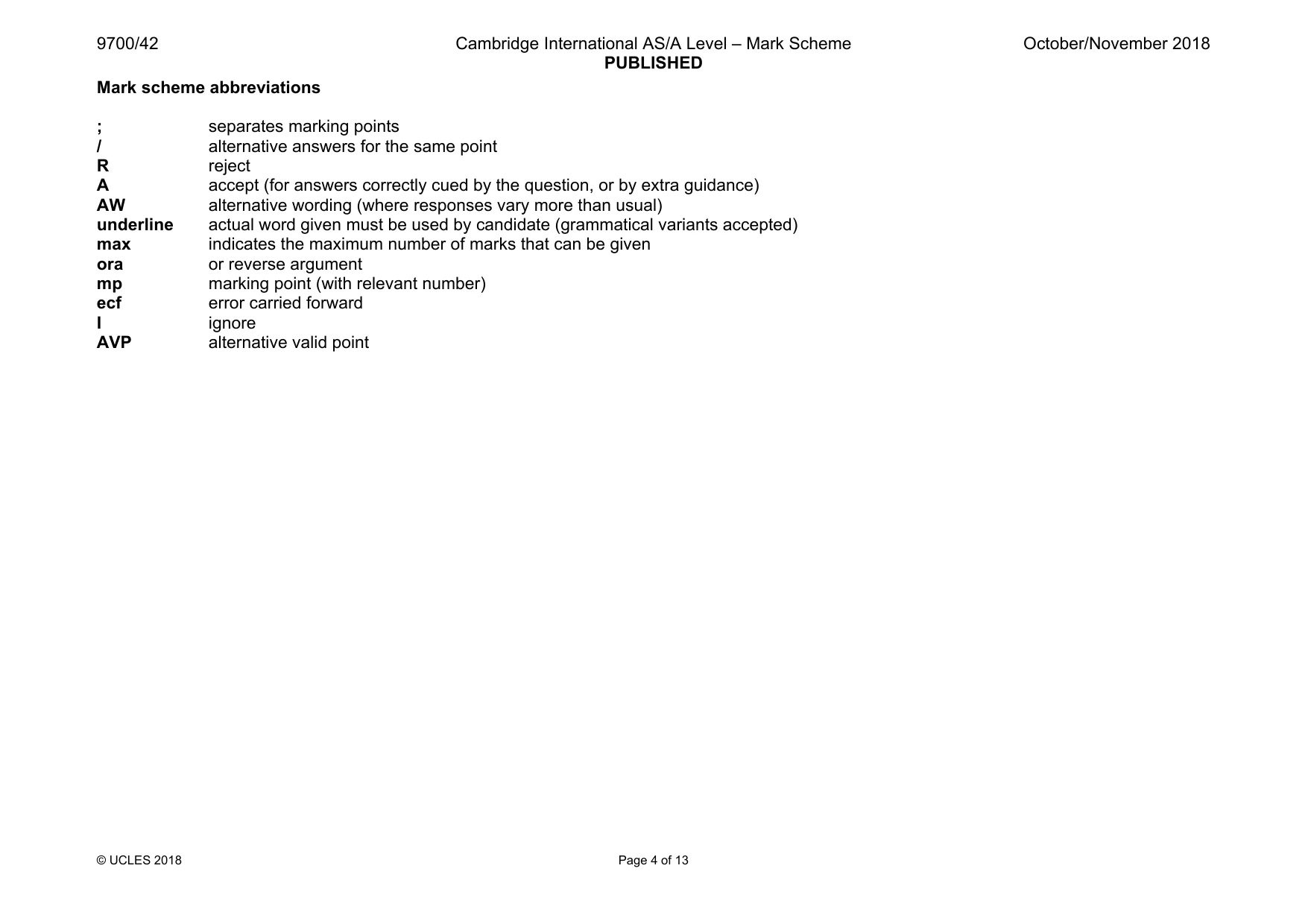
Mark scheme: 2(a)(i) directional ; 1 2(a)(ii) any three from 1 lactose / milk (products), acts as a selection pressure or ref. to reliance on milk (products) ; 2 (selective) advantage to digest, lactose / milk (products) or individuals with lactose persistence have a (selective) advantage ; 3 (those individuals) more likely to, survive / reproduce ; ora 4 passed on the (mutated) allele (to their offspring) ; 5 over, time / many generations, the allele frequency increased ; 3 2(b)(i) q2 = 58÷166 or 0.349 ; A 0.35 q = √0.349 or 0.591 ; A 0.59 p = 0.409 or 0.41 ; 3 2(b)(ii) any two from 1 test population is (too) small ; 2 test population, not representative of general population / not random / is biased ; 3 migration / ethnic origin ; 2 2(c)(i) any two from 1 proteins that bind to DNA ; 2 binds to the promoter ; A enhancers 3 control, gene expression / transcription / mRNA synthesis ; 4 allow attachment of RNA polymerase to DNA ; 2 2(c)(ii) promoter / enhancer / silencer / insulator ; 1 2(c)(iii) 1 most genes are regulatory genes (in the genome) ; ora 2 mutations in regulatory genes less likely to be, harmful / selected against / affect survival ; ora 2
Q3 · Mammals such as sheep, Ovis aries, and goats, Capra hircus, are important agricultural…
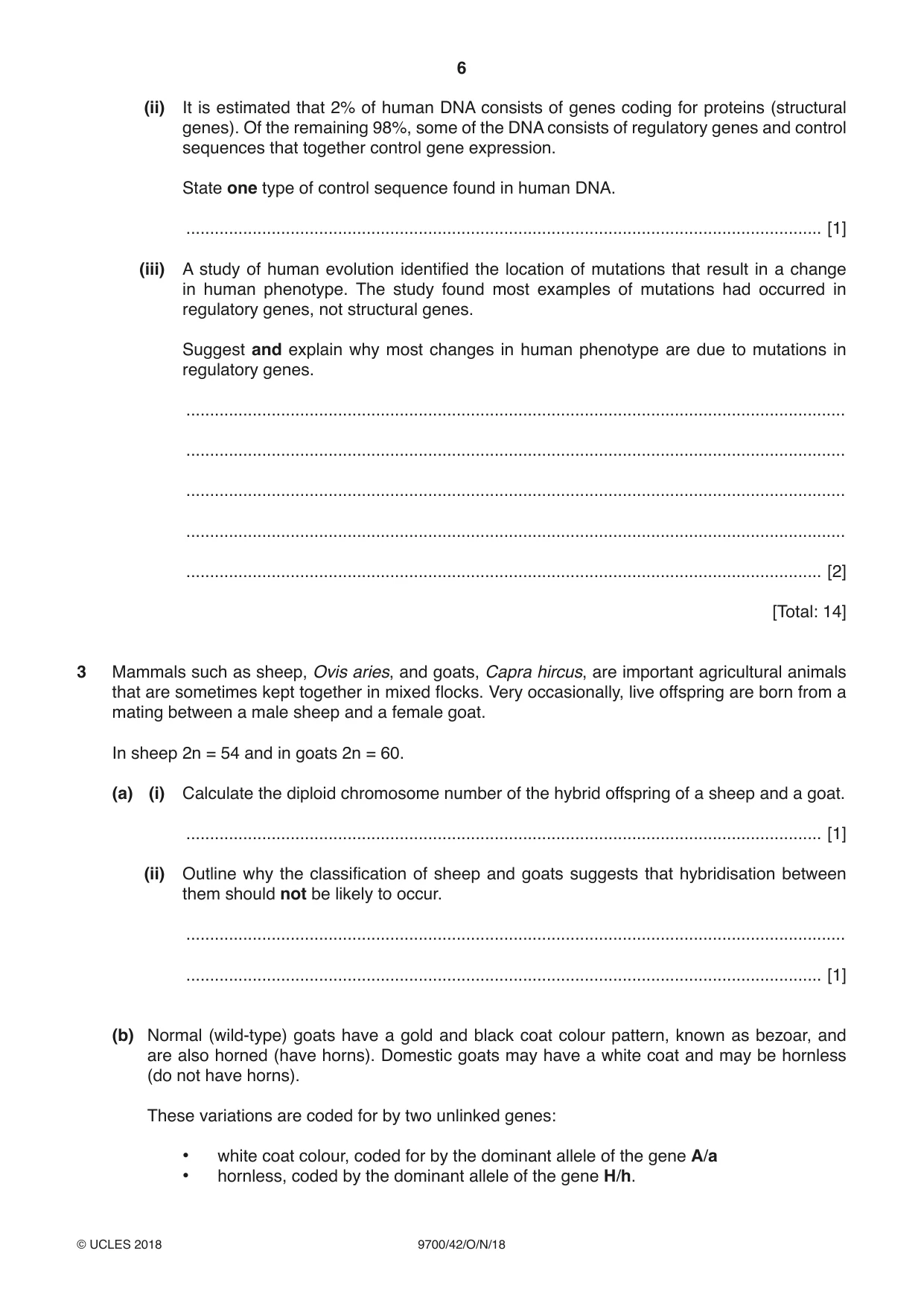
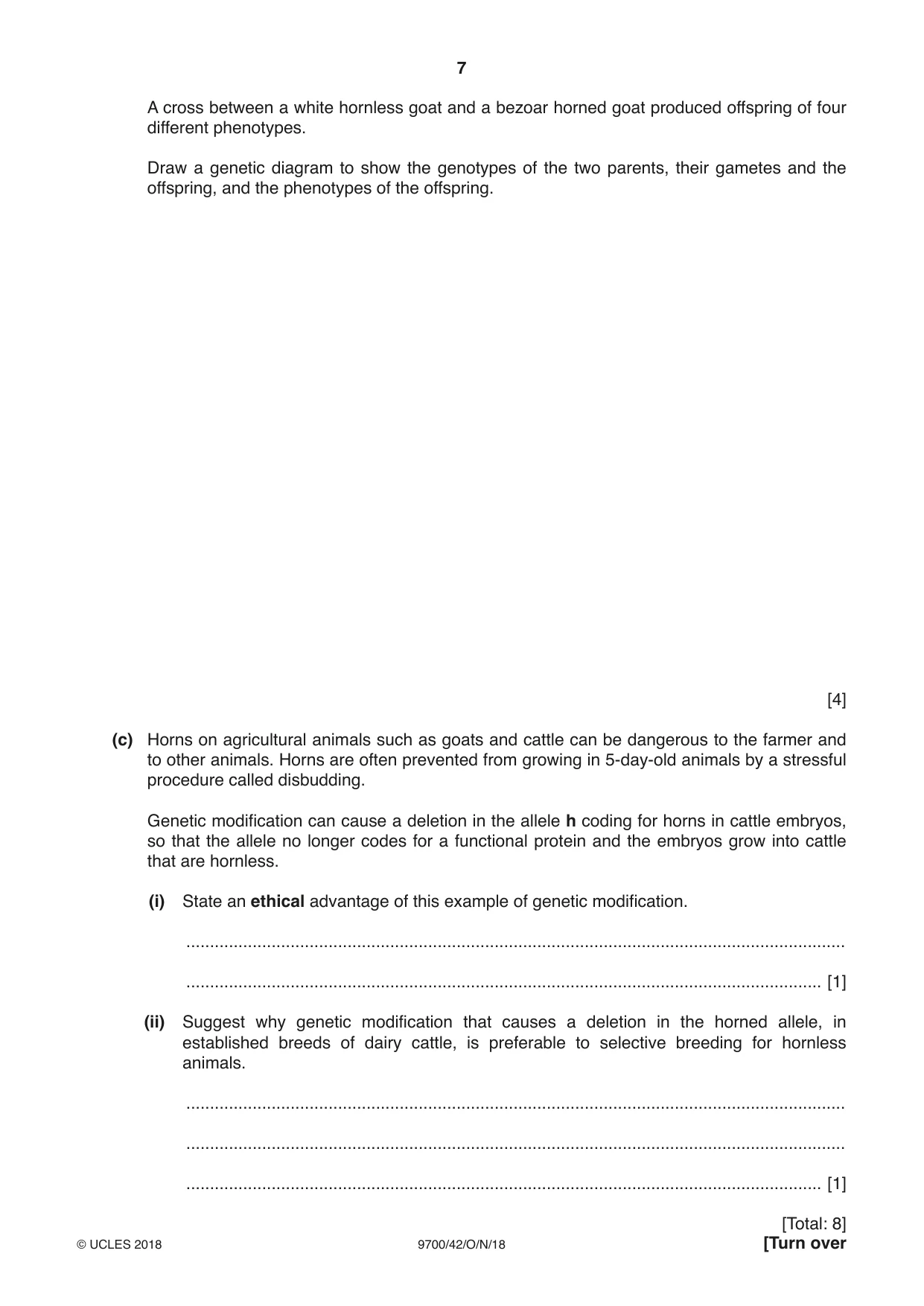
3 Mammals such as sheep, Ovis aries, and goats, Capra hircus, are important agricultural animals that are sometimes kept together in mixed flocks. Very occasionally, live offspring are born from a mating between a male sheep and a female goat. In sheep 2n = 54 and in goats 2n = 60. (a) (i) Calculate the diploid chromosome number of the hybrid offspring of a sheep and a goat. ...................................................................................................................................... [1] (ii) Outline why the classification of sheep and goats suggests that hybridisation between them should not be likely to occur. ........................................................................................................................................... ...................................................................................................................................... [1] (b) Normal (wild-type) goats have a gold and black coat colour pattern, known as bezoar, and are also horned (have horns). Domestic goats may have a white coat and may be hornless (do not have horns). These variations are coded for by two unlinked genes: • white coat colour, coded for by the dominant allele of the gene A/a • hornless, coded by the dominant allele of the gene H/h. A cross between a white hornless goat and a bezoar horned goat produced offspring of four different phenotypes. Draw a genetic diagram to show the genotypes of the two parents, their gametes and the offspring, and the phenotypes of the offspring. [4] (c) Horns on agricultural animals such as goats and cattle can be dangerous to the farmer and to other animals. Horns are often prevented from growing in 5-day-old animals by a stressful procedure called disbudding. Genetic modification can cause a deletion in the allele h coding for horns in cattle embryos, so that the allele no longer codes for a functional protein and the embryos grow into cattle that are hornless. (i) State an ethical advantage of this example of genetic modification. ........................................................................................................................................... ...................................................................................................................................... [1] (ii) Suggest why genetic modification that causes a deletion in the horned allele, in established breeds of dairy cattle, is preferable to selective breeding for hornless animals. ........................................................................................................................................... ........................................................................................................................................... ...................................................................................................................................... [1]
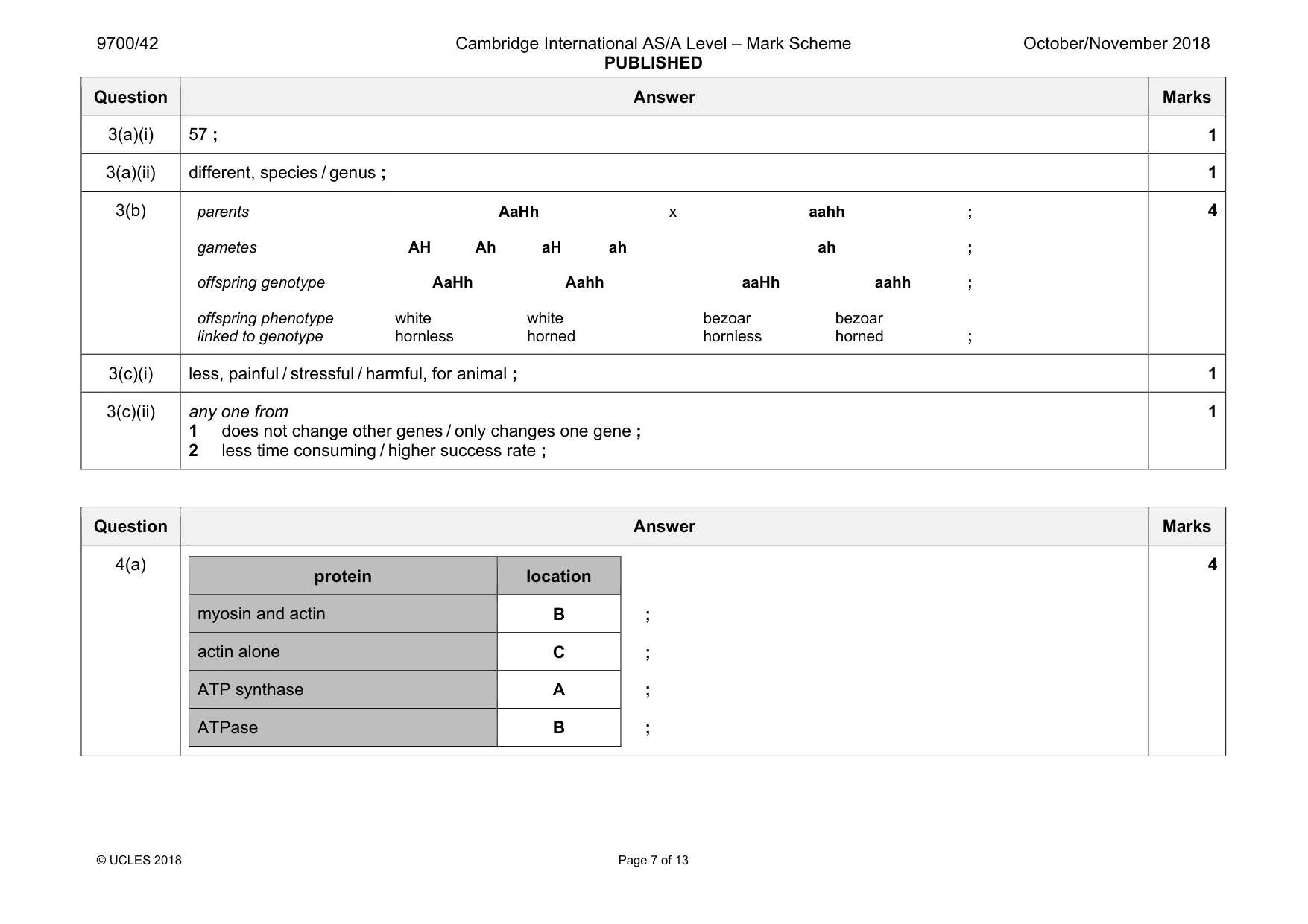
Mark scheme: 3(a)(i) 57 ; 1 3(a)(ii) different, species / genus ; 1 3(b) parents AaHh x aahh ; gametes AH Ah aH ah ah ; offspring genotype AaHh Aahh aaHh aahh ; offspring phenotype white white bezoar bezoar linked to genotype hornless horned hornless horned ; 4 3(c)(i) less, painful / stressful / harmful, for animal ; 1 3(c)(ii) any one from 1 does not change other genes / only changes one gene ; 2 less time consuming / higher success rate ; 1
Q4 · A transmission electron micrograph of a section through striated muscle
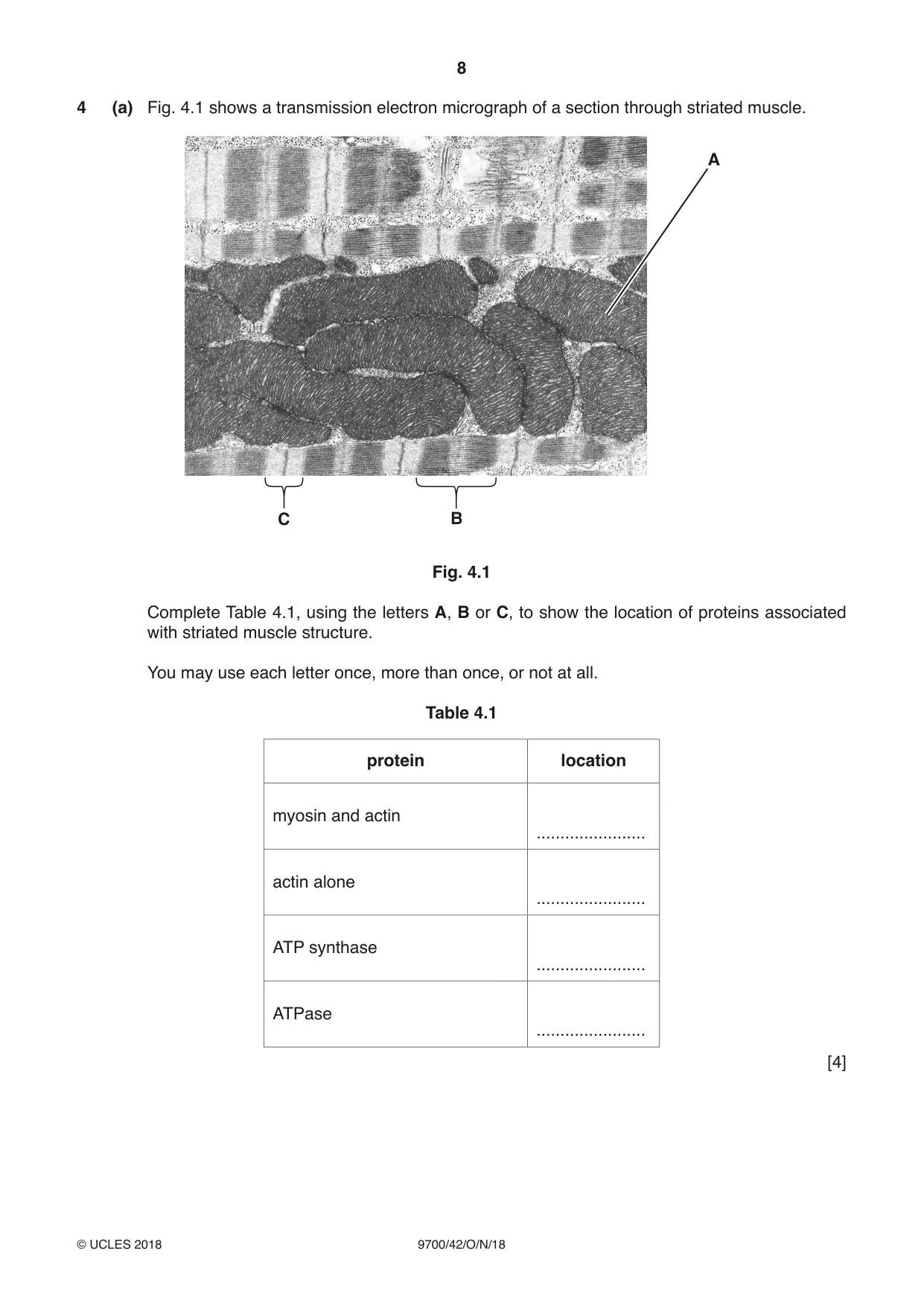
4 (a) Fig. 4.1 shows a transmission electron micrograph of a section through striated muscle. A C B Fig. 4.1 Complete Table 4.1, using the letters A, B or C, to show the location of proteins associated with striated muscle structure. You may use each letter once, more than once, or not at all. Table 4.1 protein location myosin and actin ....................... actin alone ....................... ATP synthase ....................... ATPase ....................... [4] (b) Explain the role of ATP in the contraction of striated muscle. ................................................................................................................................................... ................................................................................................................................................... ................................................................................................................................................... ................................................................................................................................................... ................................................................................................................................................... ................................................................................................................................................... ................................................................................................................................................... ................................................................................................................................................... ................................................................................................................................................... .............................................................................................................................................. [5] [Total: 9]
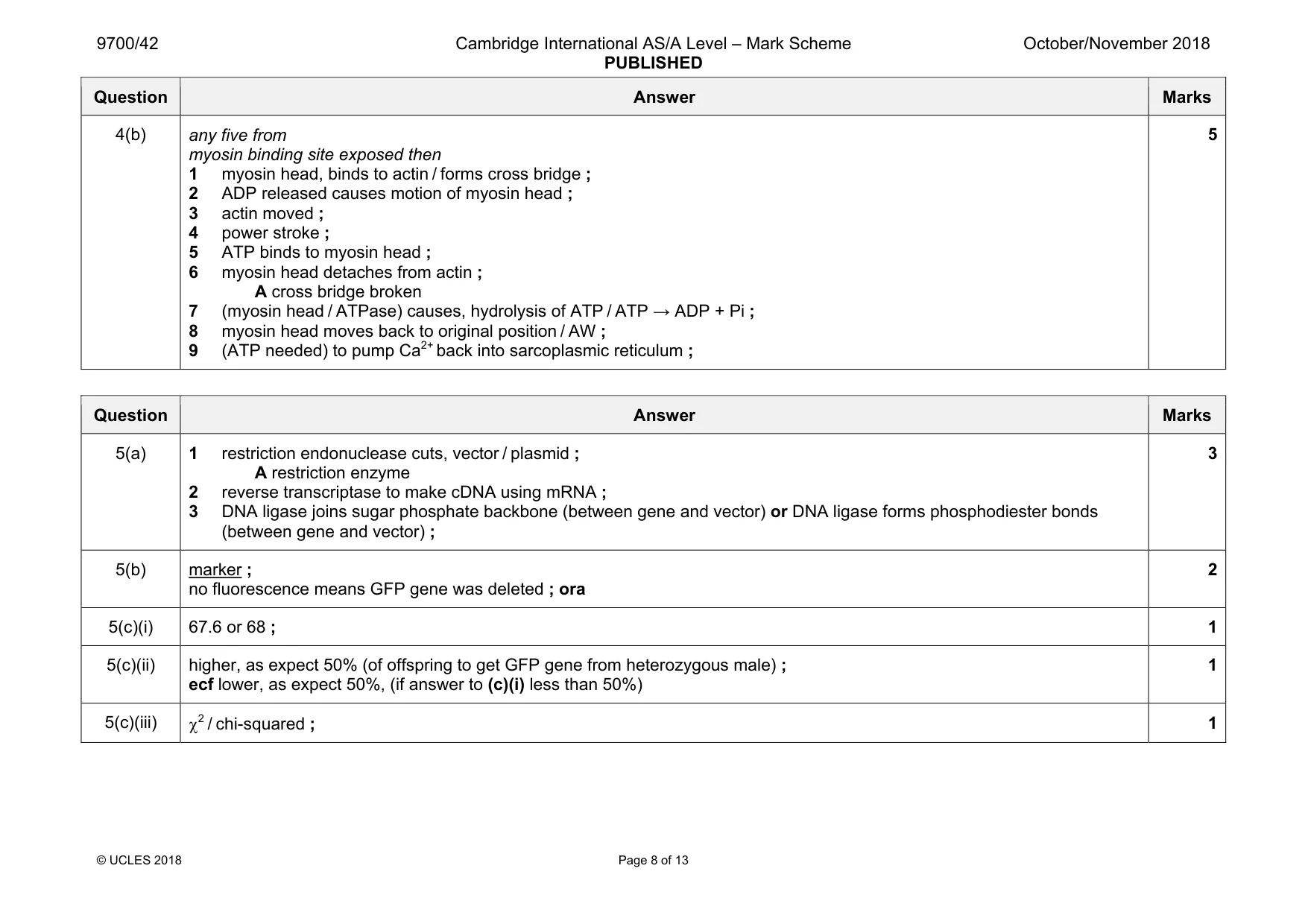
Mark scheme: 4(a) protein location myosin and actin B ; actin alone C ; ATP synthase A ; ATPase B ; 4 Question Answer Marks 4(b) any five from myosin binding site exposed then 1 myosin head, binds to actin / forms cross bridge ; 2 ADP released causes motion of myosin head ; 3 actin moved ; 4 power stroke ; 5 ATP binds to myosin head ; 6 myosin head detaches from actin ; A cross bridge broken 7 (myosin head / ATPase) causes, hydrolysis of ATP / ATP → ADP + Pi ; 8 myosin head moves back to original position / AW ; 9 (ATP needed) to pump Ca2+ back into sarcoplasmic reticulum ; 5
Q5 · Traditional techniques for genetically modifying organisms use three enzymes: •…
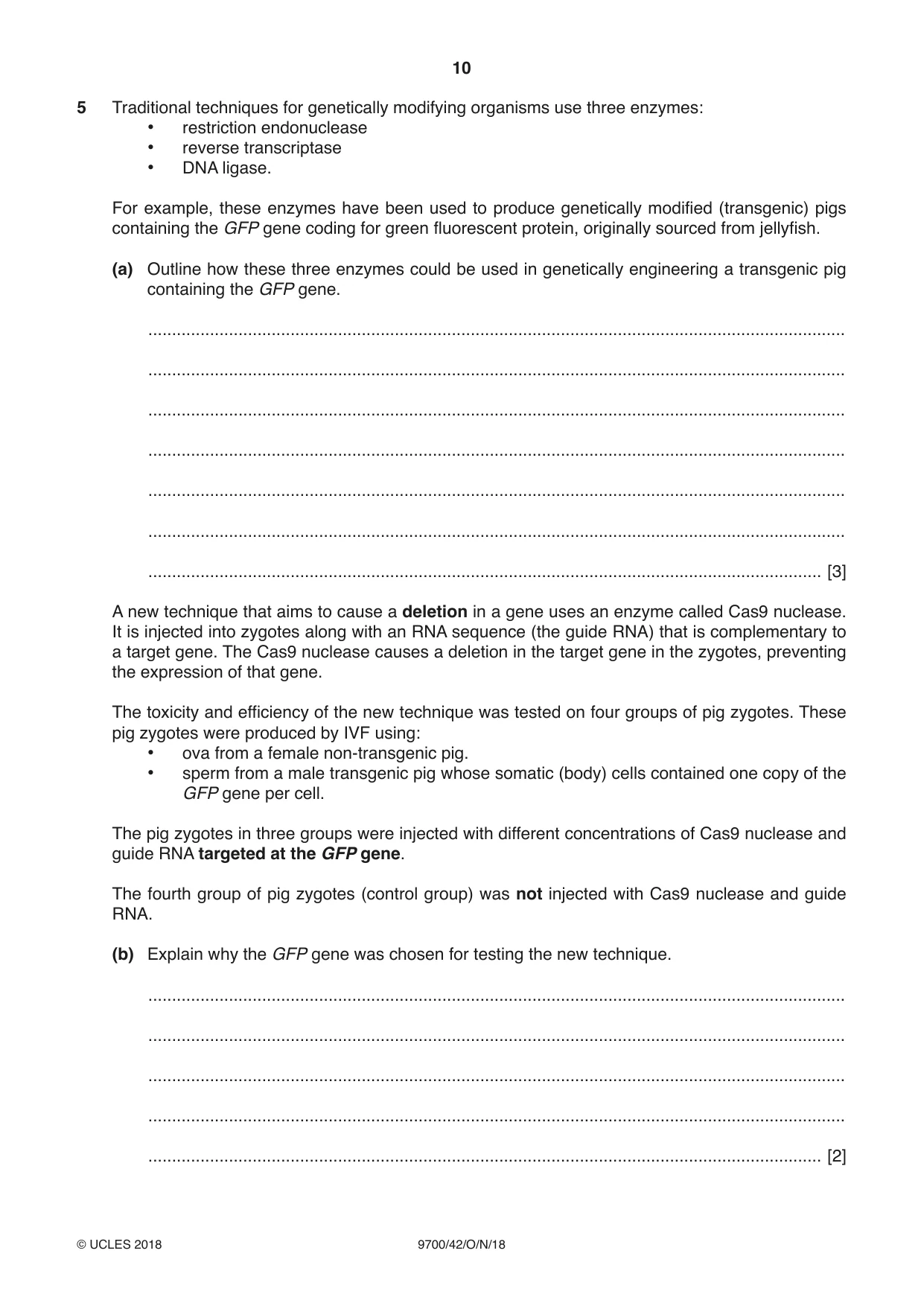
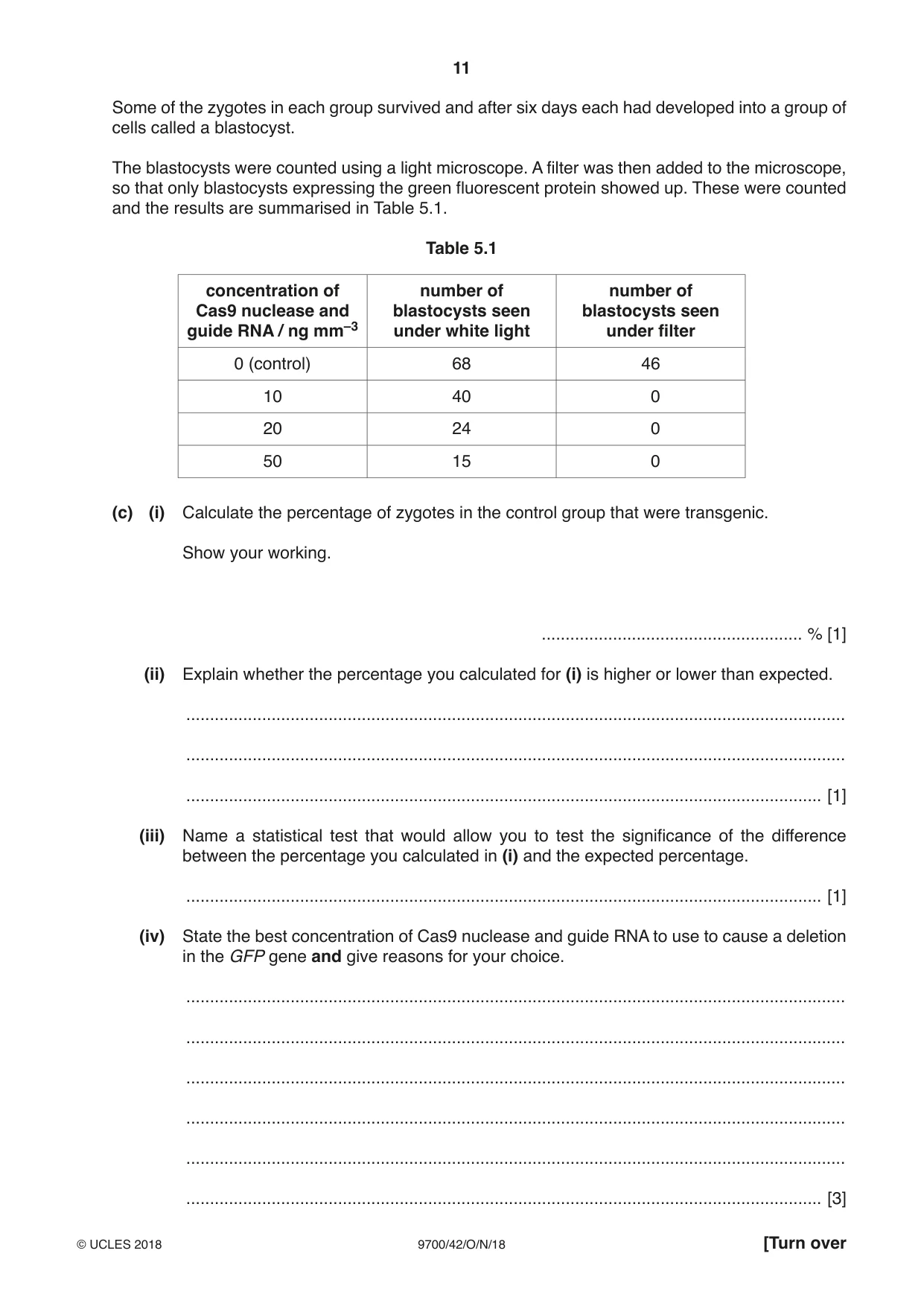
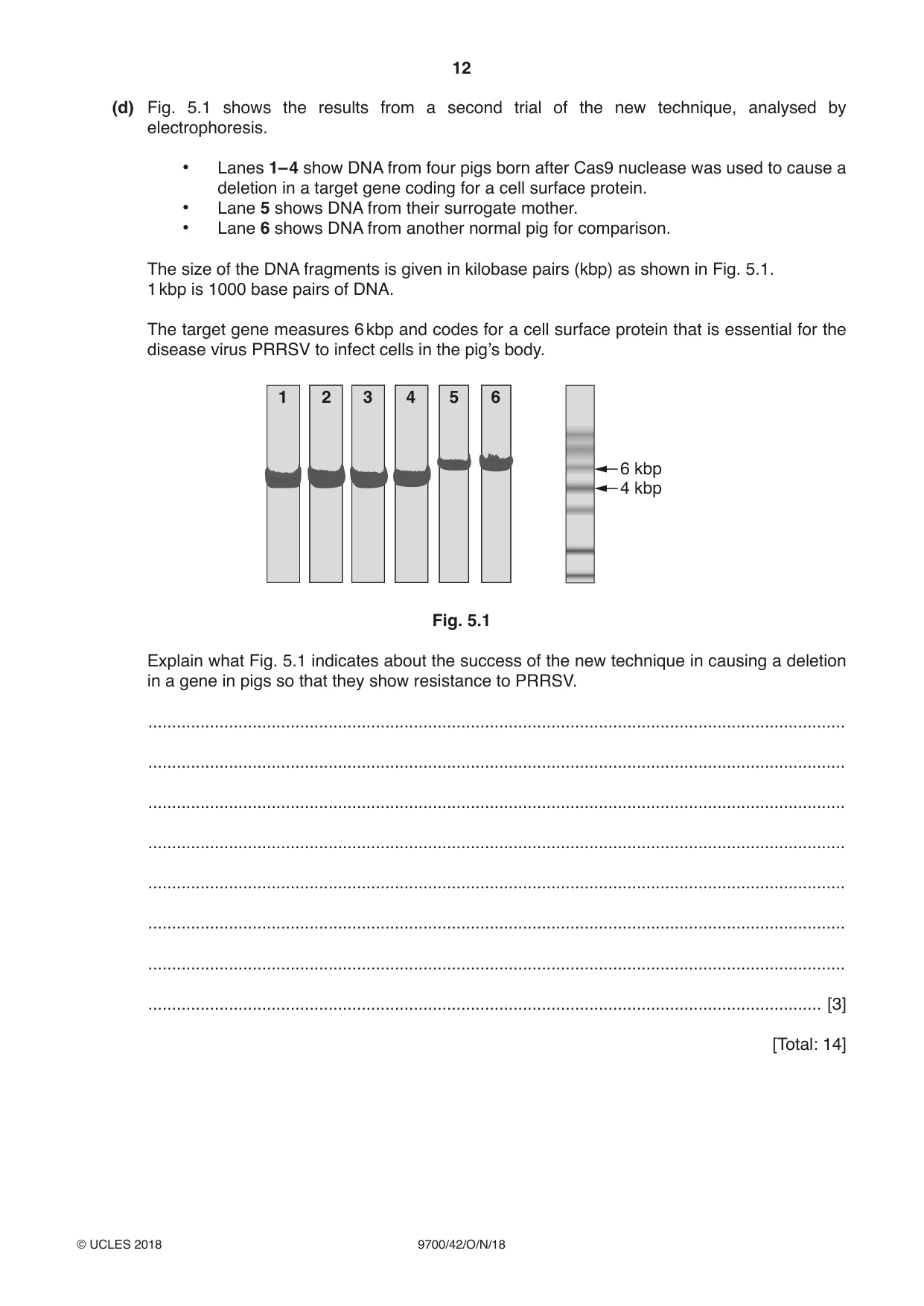
5 Traditional techniques for genetically modifying organisms use three enzymes: • restriction endonuclease • reverse transcriptase • DNA ligase. For example, these enzymes have been used to produce genetically modified (transgenic) pigs containing the GFP gene coding for green fluorescent protein, originally sourced from jellyfish. (a) Outline how these three enzymes could be used in genetically engineering a transgenic pig containing the GFP gene. ................................................................................................................................................... ................................................................................................................................................... ................................................................................................................................................... ................................................................................................................................................... ................................................................................................................................................... ................................................................................................................................................... .............................................................................................................................................. [3] A new technique that aims to cause a deletion in a gene uses an enzyme called Cas9 nuclease. It is injected into zygotes along with an RNA sequence (the guide RNA) that is complementary to a target gene. The Cas9 nuclease causes a deletion in the target gene in the zygotes, preventing the expression of that gene. The toxicity and efficiency of the new technique was tested on four groups of pig zygotes. These pig zygotes were produced by IVF using: • ova from a female non-transgenic pig. • sperm from a male transgenic pig whose somatic (body) cells contained one copy of the GFP gene per cell. The pig zygotes in three groups were injected with different concentrations of Cas9 nuclease and guide RNA targeted at the GFP gene. The fourth group of pig zygotes (control group) was not injected with Cas9 nuclease and guide RNA. (b) Explain why the GFP gene was chosen for testing the new technique. ................................................................................................................................................... ................................................................................................................................................... ................................................................................................................................................... ................................................................................................................................................... .............................................................................................................................................. [2] Some of the zygotes in each group survived and after six days each had developed into a group of cells called a blastocyst. The blastocysts were counted using a light microscope. A filter was then added to the microscope, so that only blastocysts expressing the green fluorescent protein showed up. These were counted and the results are summarised in Table 5.1. Table 5.1 concentration of number of number of Cas9 nuclease and blastocysts seen blastocysts seen guide RNA / ng mm–3 under white light under filter 0 (control) 68 46 10 40 0 20 24 0 50 15 0 (c) (i) Calculate the percentage of zygotes in the control group that were transgenic. Show your working. ....................................................... % [1] (ii) Explain whether the percentage you calculated for (i) is higher or lower than expected. ........................................................................................................................................... ........................................................................................................................................... ...................................................................................................................................... [1] (iii) Name a statistical test that would allow you to test the significance of the difference between the percentage you calculated in (i) and the expected percentage. ...................................................................................................................................... [1] (iv) State the best concentration of Cas9 nuclease and guide RNA to use to cause a deletion in the GFP gene and give reasons for your choice. ........................................................................................................................................... ........................................................................................................................................... ........................................................................................................................................... ........................................................................................................................................... ........................................................................................................................................... ...................................................................................................................................... [3] (d) Fig. 5.1 shows the results from a second trial of the new technique, analysed by electrophoresis. • Lanes 1–4 show DNA from four pigs born after Cas9 nuclease was used to cause a deletion in a target gene coding for a cell surface protein. • Lane 5 shows DNA from their surrogate mother. • Lane 6 shows DNA from another normal pig for comparison. The size of the DNA fragments is given in kilobase pairs (kbp) as shown in Fig. 5.1. 1 kbp is 1000 base pairs of DNA. The target gene measures 6 kbp and codes for a cell surface protein that is essential for the disease virus PRRSV to infect cells in the pig’s body. 1 2 3 4 5 6 6 kbp 4 kbp Fig. 5.1 Explain what Fig. 5.1 indicates about the success of the new technique in causing a deletion in a gene in pigs so that they show resistance to PRRSV. ................................................................................................................................................... ................................................................................................................................................... ................................................................................................................................................... ................................................................................................................................................... ................................................................................................................................................... ................................................................................................................................................... ................................................................................................................................................... .............................................................................................................................................. [3] [Total: 14] Question 6 starts on page 14
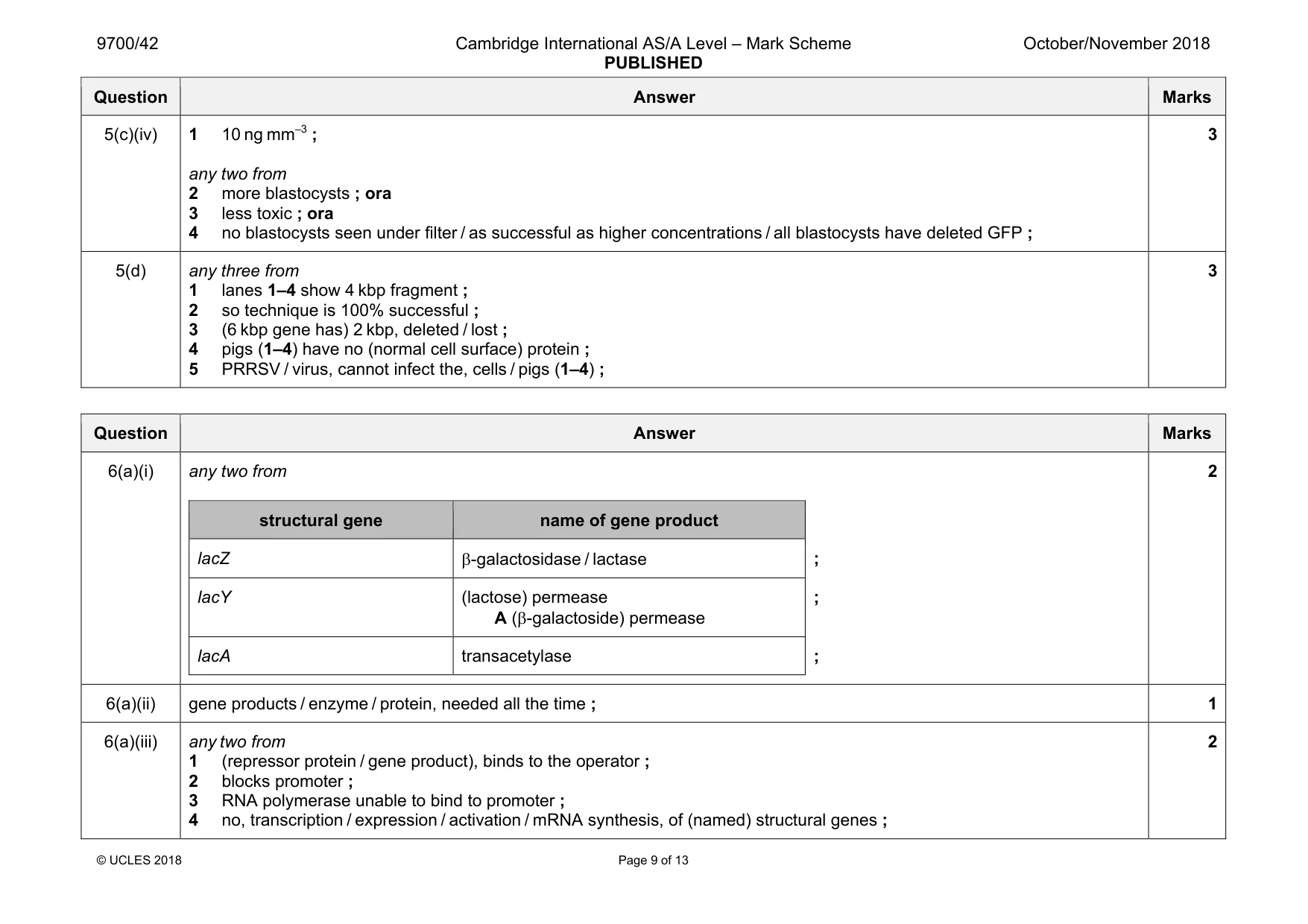
Mark scheme: 5(a) 1 restriction endonuclease cuts, vector / plasmid ; A restriction enzyme 2 reverse transcriptase to make cDNA using mRNA ; 3 DNA ligase joins sugar phosphate backbone (between gene and vector) or DNA ligase forms phosphodiester bonds (between gene and vector) ; 3 5(b) marker ; no fluorescence means GFP gene was deleted ; ora 2 5(c)(i) 67.6 or 68 ; 1 5(c)(ii) higher, as expect 50% (of offspring to get GFP gene from heterozygous male) ; ecf lower, as expect 50%, (if answer to (c)(i) less than 50%) 1 5(c)(iii) χ2 / chi-squared ; 1 Question Answer Marks 5(c)(iv) 1 10 ng mm–3 ; any two from 2 more blastocysts ; ora 3 less toxic ; ora 4 no blastocysts seen under filter / as successful as higher concentrations / all blastocysts have deleted GFP ; 3 5(d) any three from 1 lanes 1–4 show 4 kbp fragment ; 2 so technique is 100% successful ; 3 (6 kbp gene has) 2 kbp, deleted / lost ; 4 pigs (1–4) have no (normal cell surface) protein ; 5 PRRSV / virus, cannot infect the, cells / pigs (1–4) ; 3
Q6 · The lac operon is a section of DNA present in the genome of Escherichia coli
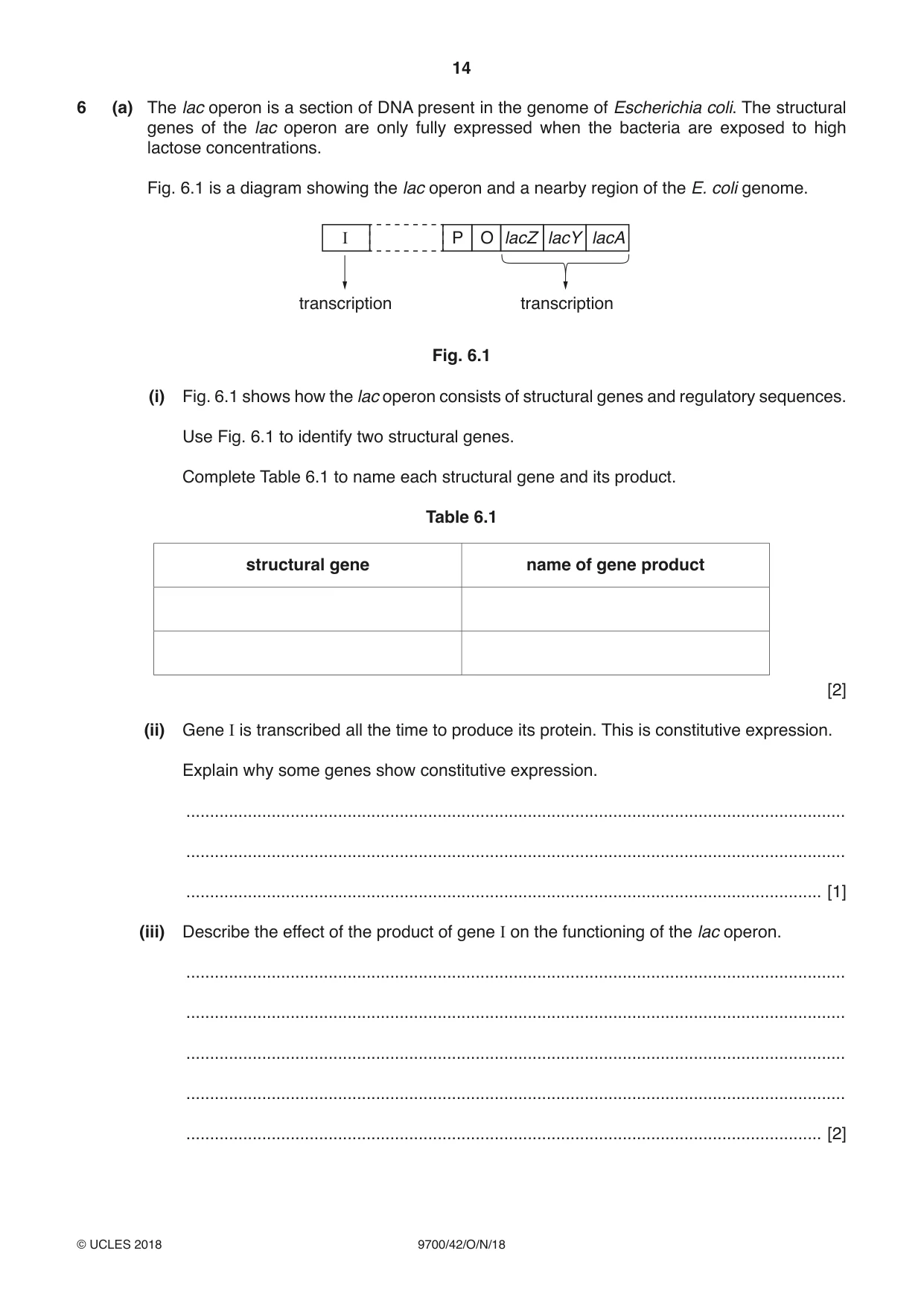
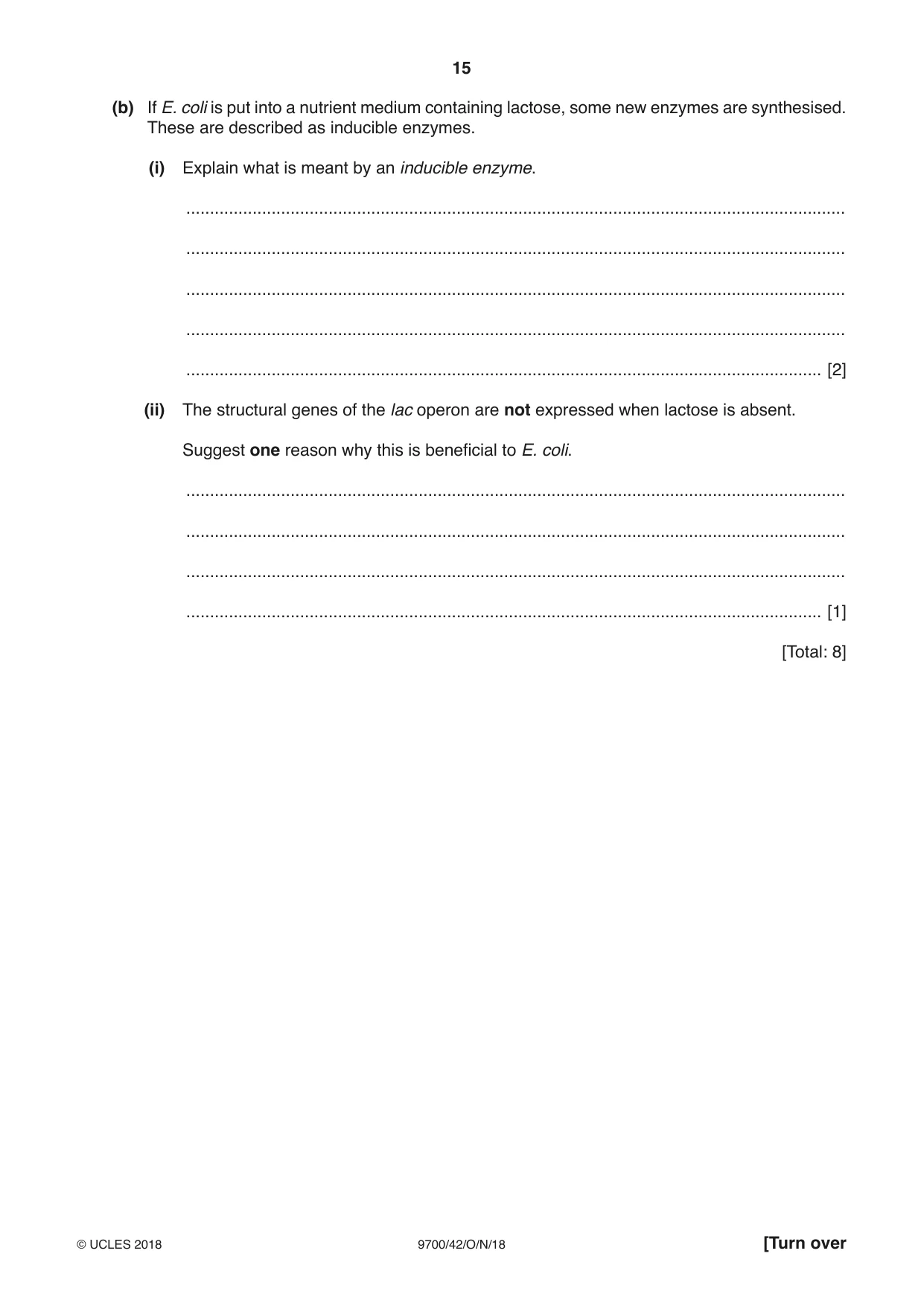
6 (a) The lac operon is a section of DNA present in the genome of Escherichia coli. The structural genes of the lac operon are only fully expressed when the bacteria are exposed to high lactose concentrations. Fig. 6.1 is a diagram showing the lac operon and a nearby region of the E. coli genome. I P O lacZ lacY lacA transcription transcription Fig. 6.1 (i) Fig. 6.1 shows how the lac operon consists of structural genes and regulatory sequences. Use Fig. 6.1 to identify two structural genes. Complete Table 6.1 to name each structural gene and its product. Table 6.1 structural gene name of gene product [2] (ii) Gene I is transcribed all the time to produce its protein. This is constitutive expression. Explain why some genes show constitutive expression. ........................................................................................................................................... ........................................................................................................................................... ...................................................................................................................................... [1] (iii) Describe the effect of the product of gene I on the functioning of the lac operon. ........................................................................................................................................... ........................................................................................................................................... ........................................................................................................................................... ........................................................................................................................................... ...................................................................................................................................... [2] (b) If E. coli is put into a nutrient medium containing lactose, some new enzymes are synthesised. These are described as inducible enzymes. (i) Explain what is meant by an inducible enzyme. ........................................................................................................................................... ........................................................................................................................................... ........................................................................................................................................... ........................................................................................................................................... ...................................................................................................................................... [2] (ii) The structural genes of the lac operon are not expressed when lactose is absent. Suggest one reason why this is beneficial to E. coli. ........................................................................................................................................... ........................................................................................................................................... ........................................................................................................................................... ...................................................................................................................................... [1] [Total: 8]
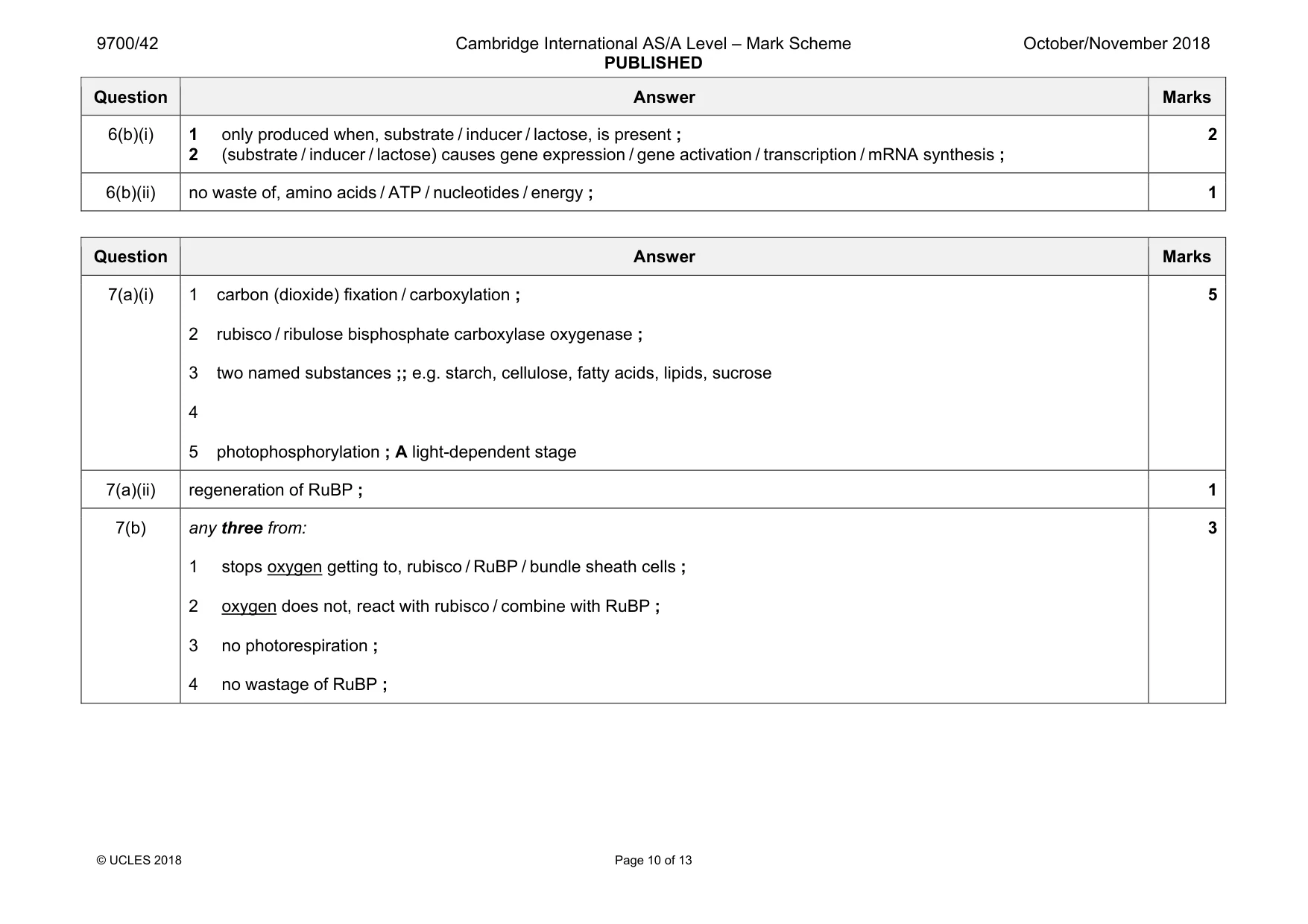
Mark scheme: 6(a)(i) any two from structural gene name of gene product lacZ β-galactosidase / lactase ; lacY (lactose) permease A (β-galactoside) permease ; lacA transacetylase ; 2 6(a)(ii) gene products / enzyme / protein, needed all the time ; 1 6(a)(iii) any two from 1 (repressor protein / gene product), binds to the operator ; 2 blocks promoter ; 3 RNA polymerase unable to bind to promoter ; 4 no, transcription / expression / activation / mRNA synthesis, of (named) structural genes ; 2 Question Answer Marks 6(b)(i) 1 only produced when, substrate / inducer / lactose, is present ; 2 (substrate / inducer / lactose) causes gene expression / gene activation / transcription / mRNA synthesis ; 2 6(b)(ii) no waste of, amino acids / ATP / nucleotides / energy ; 1
Q7 · An outline diagram of the Calvin cycle
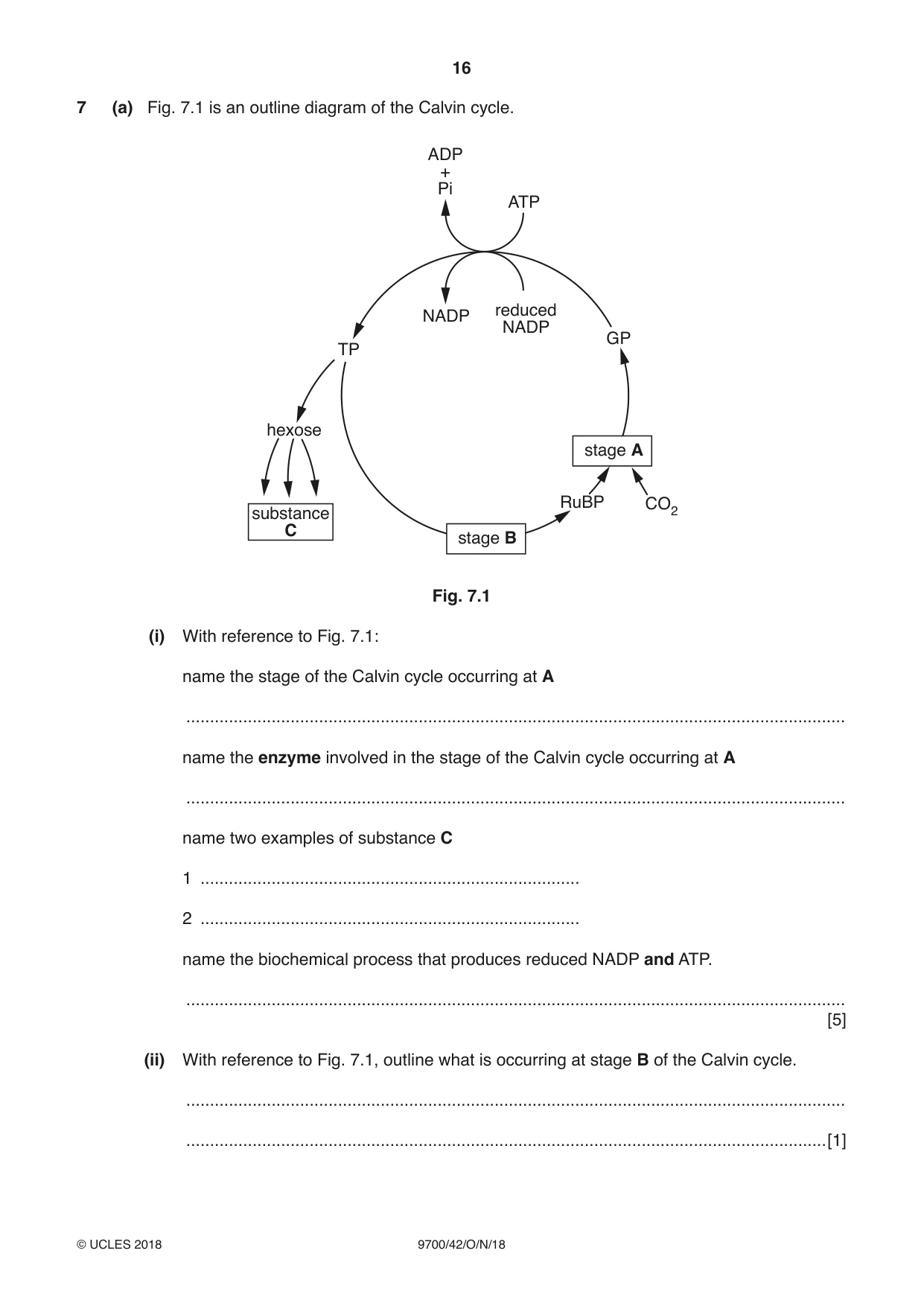
7 (a) Fig. 7.1 is an outline diagram of the Calvin cycle. ADP + Pi ATP reduced NADP NADP GP TP hexose stage A RuBP CO2 substance C stage B Fig. 7.1 (i) With reference to Fig. 7.1: name the stage of the Calvin cycle occurring at A ........................................................................................................................................... name the enzyme involved in the stage of the Calvin cycle occurring at A ........................................................................................................................................... name two examples of substance C 1 ................................................................................ 2 ................................................................................ name the biochemical process that produces reduced NADP and ATP. ........................................................................................................................................... [5] (ii) With reference to Fig. 7.1, outline what is occurring at stage B of the Calvin cycle. ........................................................................................................................................... .......................................................................................................................................[1] (b) Explain why there is a tight ring of mesophyll cells around the bundle sheath cells in the leaves of a C4 plant. ................................................................................................................................................... ................................................................................................................................................... ................................................................................................................................................... ................................................................................................................................................... ................................................................................................................................................... ................................................................................................................................................... .............................................................................................................................................. [3] [Total: 9]
Mark scheme: 7(a)(i) 1 carbon (dioxide) fixation / carboxylation ; 2 rubisco / ribulose bisphosphate carboxylase oxygenase ; 3 two named substances ;; e.g. starch, cellulose, fatty acids, lipids, sucrose 4 5 photophosphorylation ; A light-dependent stage 5 7(a)(ii) regeneration of RuBP ; 1 7(b) any three from: 1 stops oxygen getting to, rubisco / RuBP / bundle sheath cells ; 2 oxygen does not, react with rubisco / combine with RuBP ; 3 no photorespiration ; 4 no wastage of RuBP ; 3
More questions on Photosynthesis as an energy transfer process
Q8 · Gibberellin is a plant growth hormone that has a role in germination and in stem…
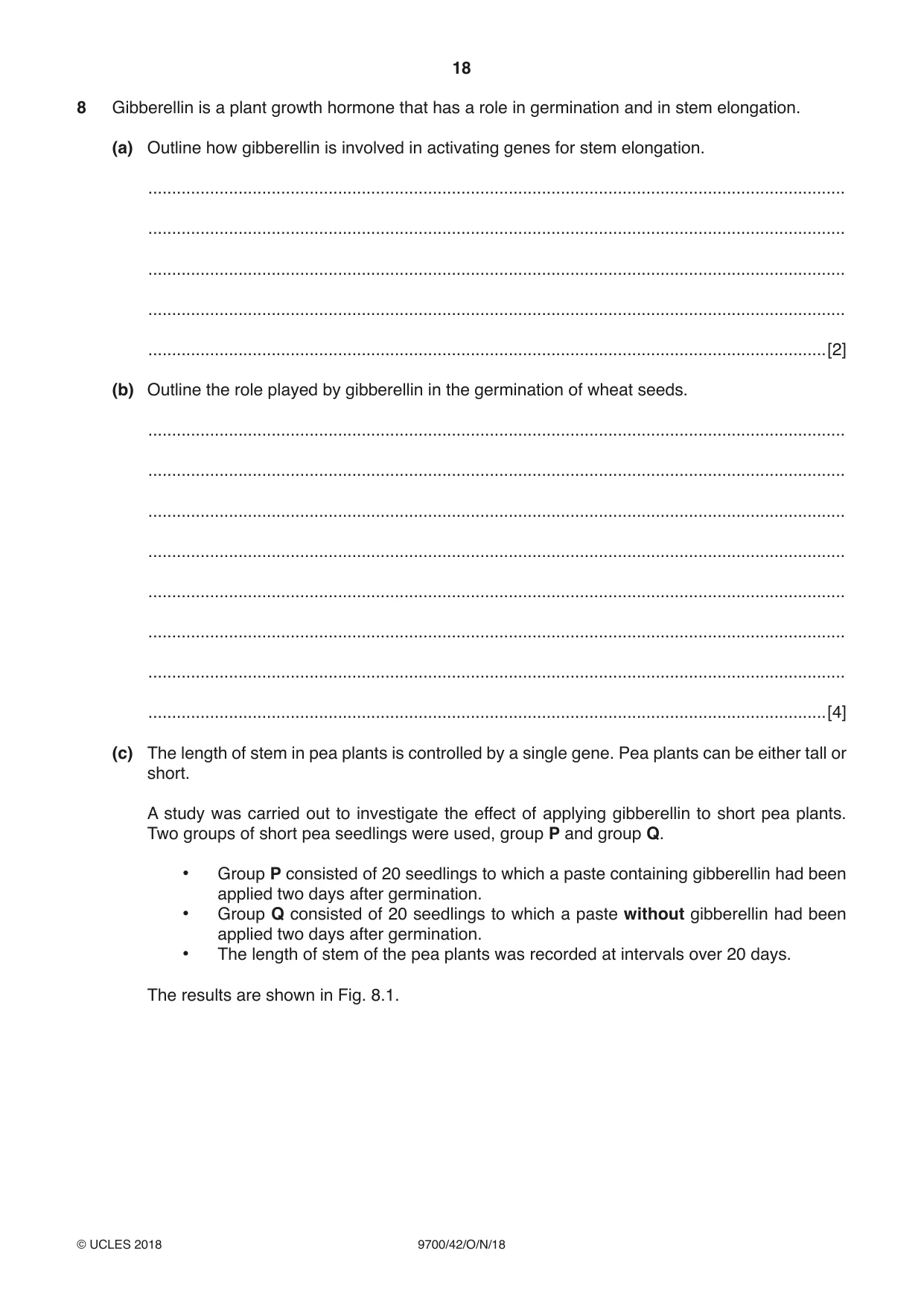
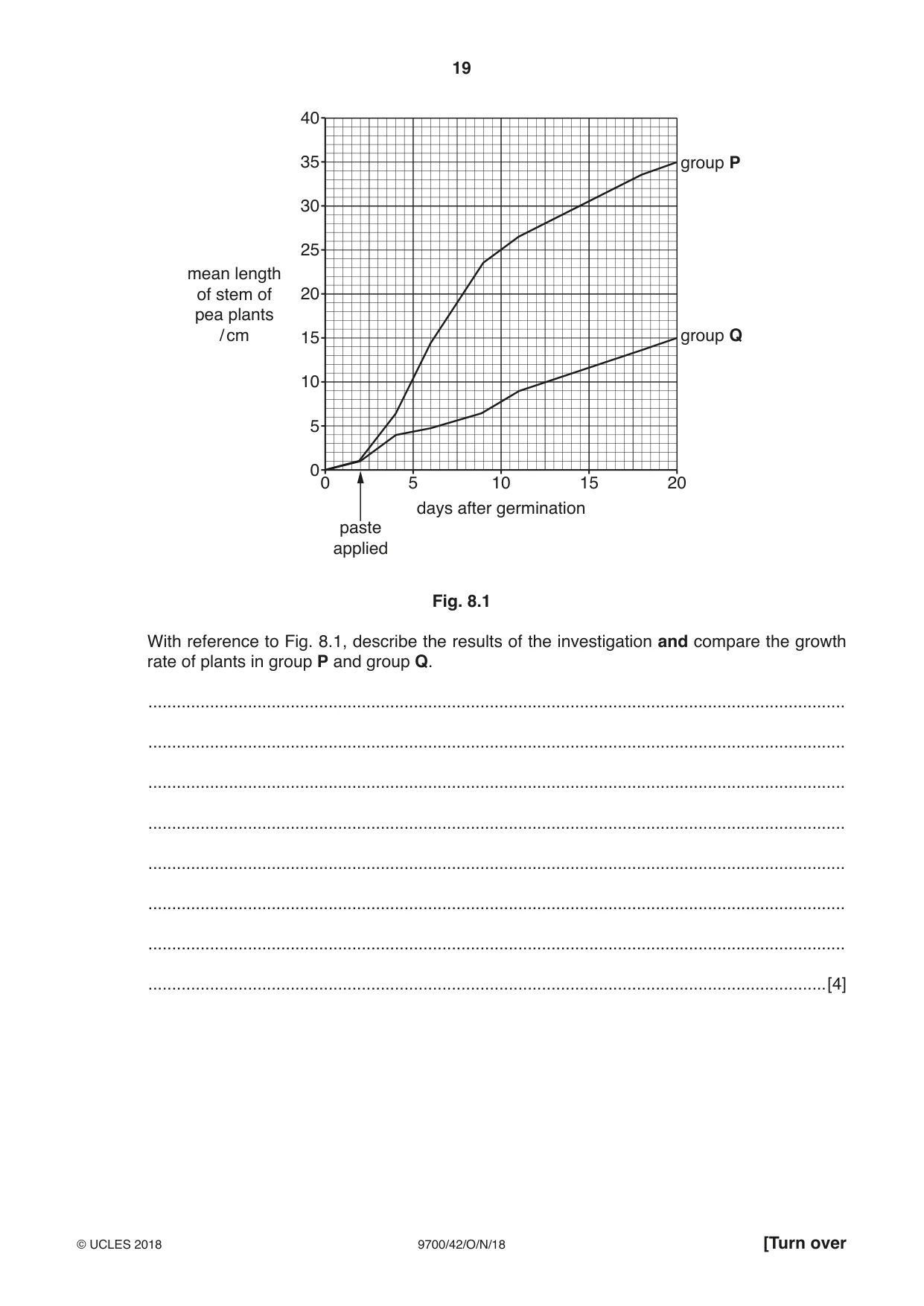
8 Gibberellin is a plant growth hormone that has a role in germination and in stem elongation. (a) Outline how gibberellin is involved in activating genes for stem elongation. ................................................................................................................................................... ................................................................................................................................................... ................................................................................................................................................... ................................................................................................................................................... ...............................................................................................................................................[2] (b) Outline the role played by gibberellin in the germination of wheat seeds. ................................................................................................................................................... ................................................................................................................................................... ................................................................................................................................................... ................................................................................................................................................... ................................................................................................................................................... ................................................................................................................................................... ................................................................................................................................................... ...............................................................................................................................................[4] (c) The length of stem in pea plants is controlled by a single gene. Pea plants can be either tall or short. A study was carried out to investigate the effect of applying gibberellin to short pea plants. Two groups of short pea seedlings were used, group P and group Q. • Group P consisted of 20 seedlings to which a paste containing gibberellin had been applied two days after germination. • Group Q consisted of 20 seedlings to which a paste without gibberellin had been applied two days after germination. • The length of stem of the pea plants was recorded at intervals over 20 days. The results are shown in Fig. 8.1. 40 35 group P 30 25 mean length of stem of 20 pea plants / cm 15 group Q 10 5 0 0 5 10 15 20 days after germination paste applied Fig. 8.1 With reference to Fig. 8.1, describe the results of the investigation and compare the growth rate of plants in group P and group Q. ................................................................................................................................................... ................................................................................................................................................... ................................................................................................................................................... ................................................................................................................................................... ................................................................................................................................................... ................................................................................................................................................... ................................................................................................................................................... ...............................................................................................................................................[4] (d) Explain the role of the gene controlling stem length in pea plants. ................................................................................................................................................... ................................................................................................................................................... ................................................................................................................................................... ................................................................................................................................................... ................................................................................................................................................... ...............................................................................................................................................[3] [Total: 13]
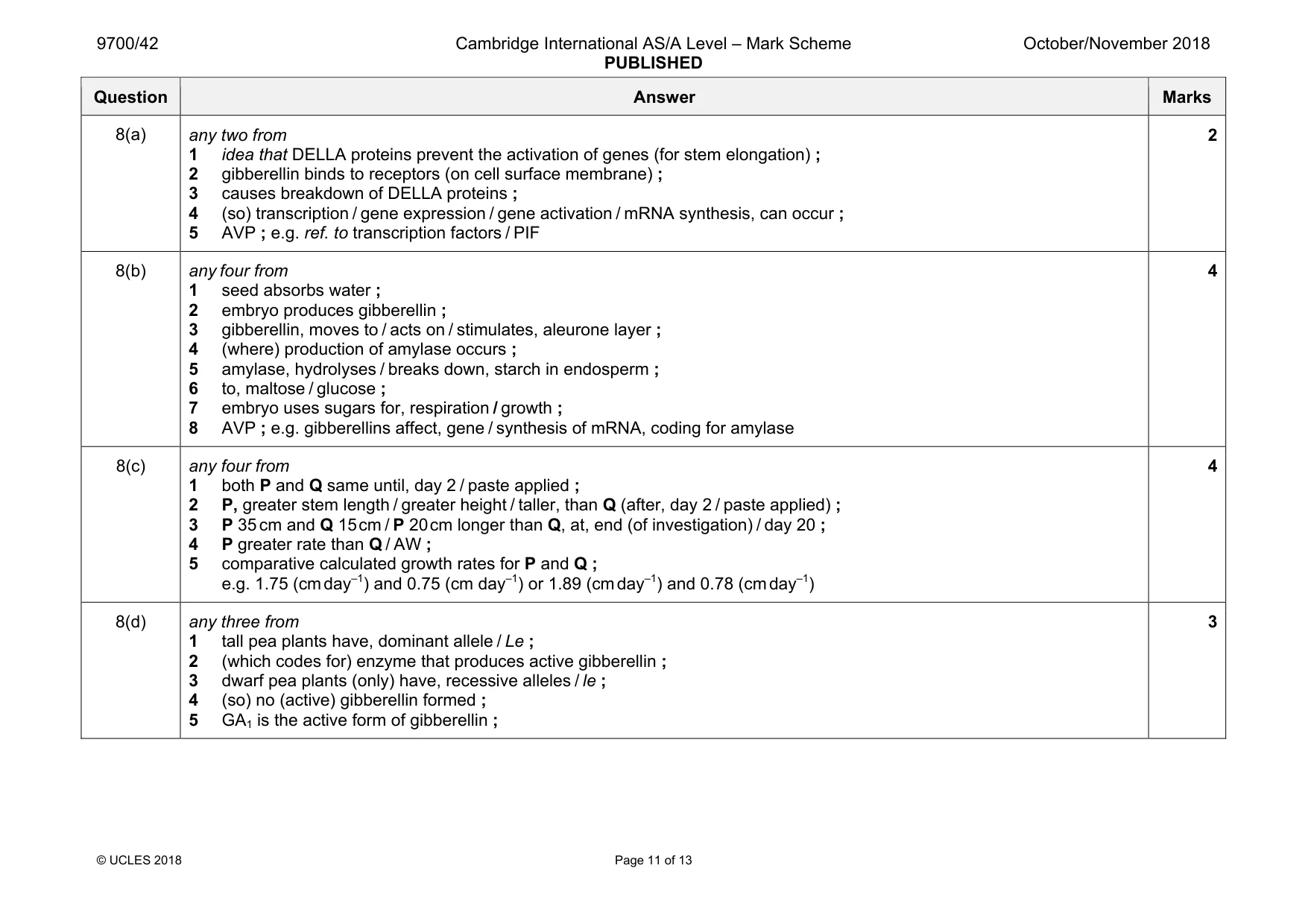
Mark scheme: 8(a) any two from 1 idea that DELLA proteins prevent the activation of genes (for stem elongation) ; 2 gibberellin binds to receptors (on cell surface membrane) ; 3 causes breakdown of DELLA proteins ; 4 (so) transcription / gene expression / gene activation / mRNA synthesis, can occur ; 5 AVP ; e.g. ref. to transcription factors / PIF 2 8(b) any four from 1 seed absorbs water ; 2 embryo produces gibberellin ; 3 gibberellin, moves to / acts on / stimulates, aleurone layer ; 4 (where) production of amylase occurs ; 5 amylase, hydrolyses / breaks down, starch in endosperm ; 6 to, maltose / glucose ; 7 embryo uses sugars for, respiration / growth ; 8 AVP ; e.g. gibberellins affect, gene / synthesis of mRNA, coding for amylase 4 8(c) any four from 1 both P and Q same until, day 2 / paste applied ; 2 P, greater stem length / greater height / taller, than Q (after, day 2 / paste applied) ; 3 P 35 cm and Q 15 cm / P 20 cm longer than Q, at, end (of investigation) / day 20 ; 4 P greater rate than Q / AW ; 5 comparative calculated growth rates for P and Q ; e.g. 1.75 (cm day–1) and 0.75 (cm day–1) or 1.89 (cm day–1) and 0.78 (cm day–1) 4 8(d) any three from 1 tall pea plants have, dominant allele / Le ; 2 (which codes for) enzyme that produces active gibberellin ; 3 dwarf pea plants (only) have, recessive alleles / le ; 4 (so) no (active) gibberellin formed ; 5 GA1 is the active form of gibberellin ; 3
Q9 · Explain why carbohydrates, lipids and proteins have different relative energy values as…
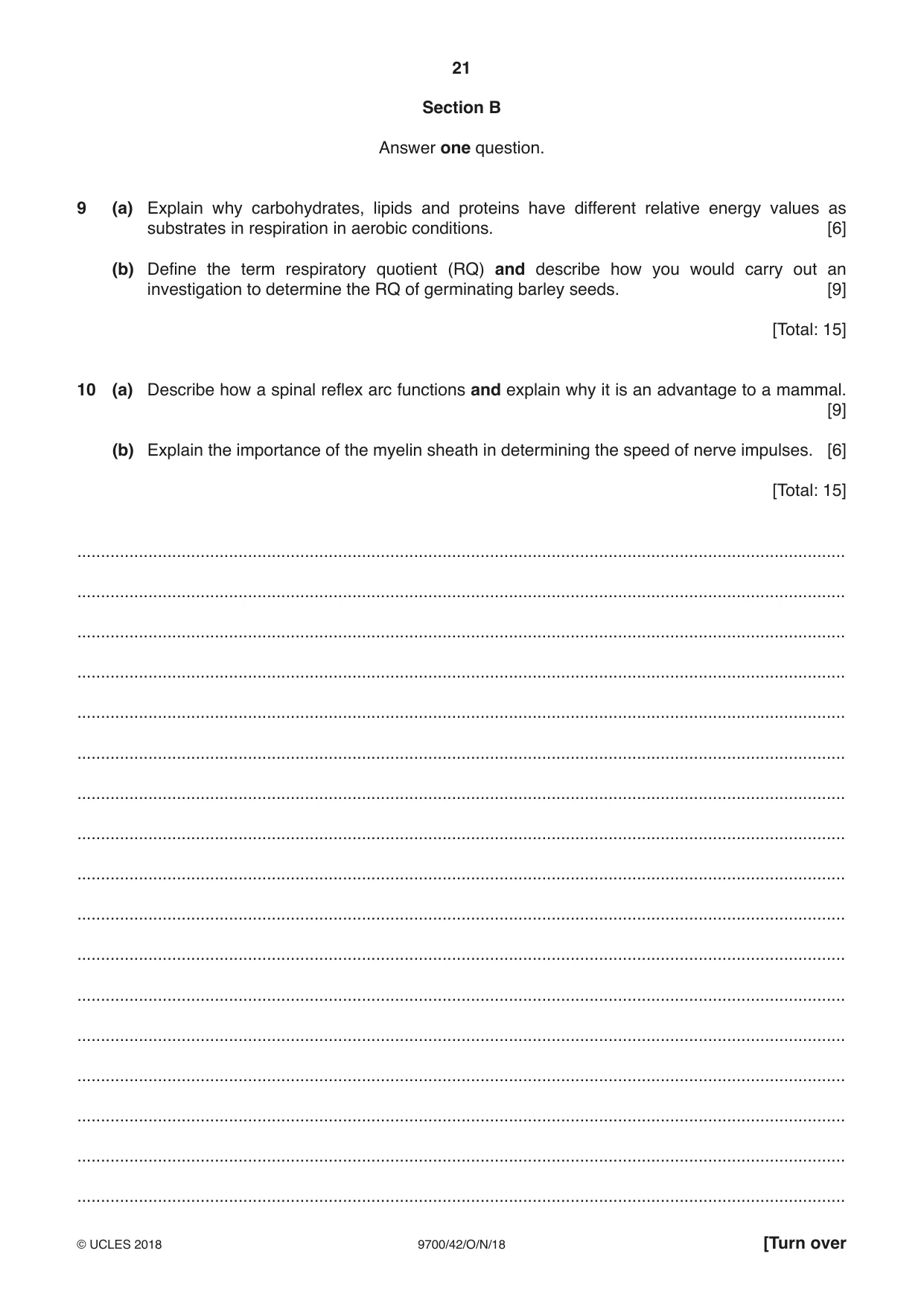
9 (a) Explain why carbohydrates, lipids and proteins have different relative energy values as substrates in respiration in aerobic conditions. [6] (b) Define the term respiratory quotient (RQ) and describe how you would carry out an investigation to determine the RQ of germinating barley seeds. [9] [Total: 15]
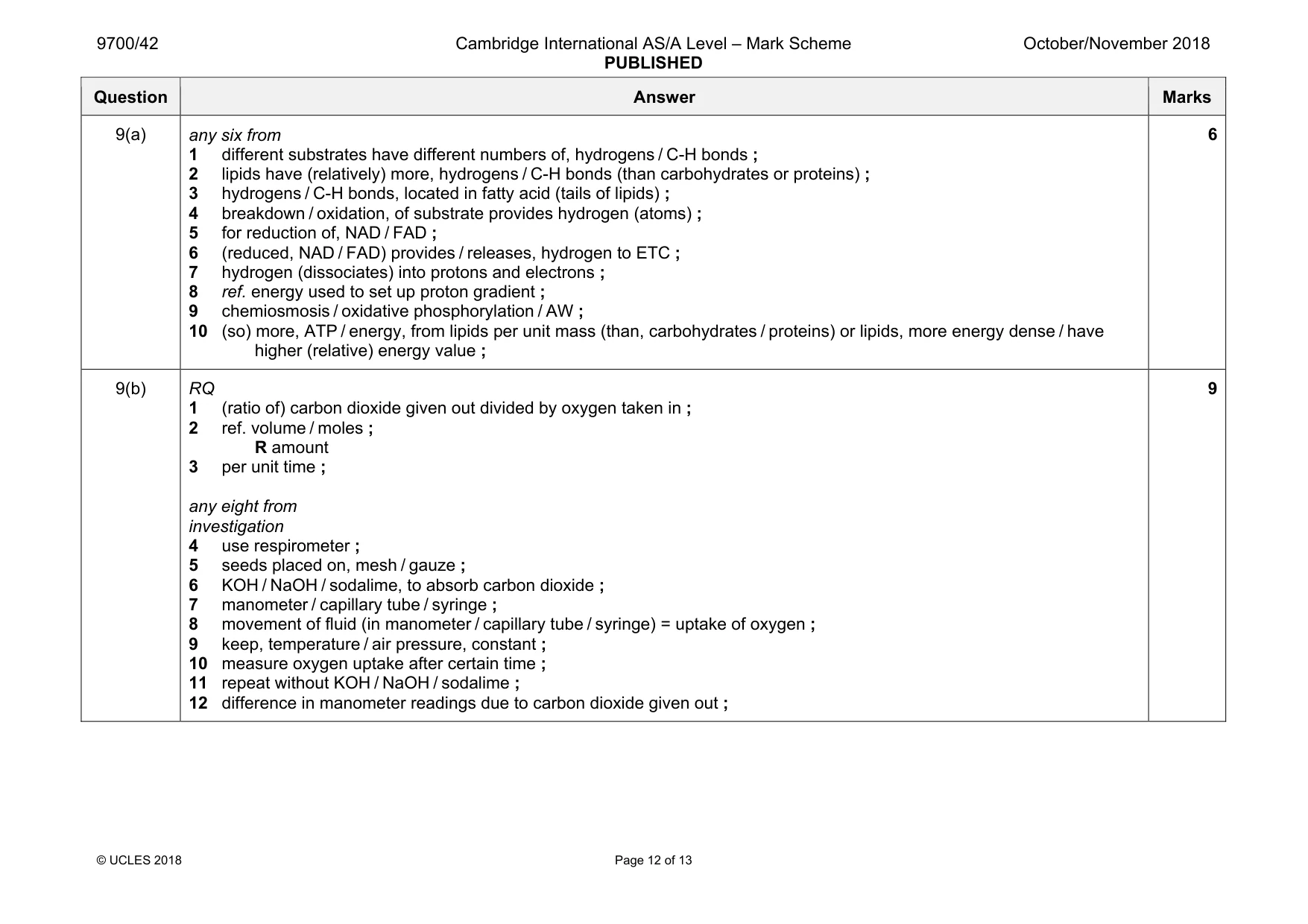
Mark scheme: 9(a) any six from 1 different substrates have different numbers of, hydrogens / C-H bonds ; 2 lipids have (relatively) more, hydrogens / C-H bonds (than carbohydrates or proteins) ; 3 hydrogens / C-H bonds, located in fatty acid (tails of lipids) ; 4 breakdown / oxidation, of substrate provides hydrogen (atoms) ; 5 for reduction of, NAD / FAD ; 6 (reduced, NAD / FAD) provides / releases, hydrogen to ETC ; 7 hydrogen (dissociates) into protons and electrons ; 8 ref. energy used to set up proton gradient ; 9 chemiosmosis / oxidative phosphorylation / AW ; 10 (so) more, ATP / energy, from lipids per unit mass (than, carbohydrates / proteins) or lipids, more energy dense / have higher (relative) energy value ; 6 9(b) RQ 1 (ratio of) carbon dioxide given out divided by oxygen taken in ; 2 ref. volume / moles ; R amount 3 per unit time ; any eight from investigation 4 use respirometer ; 5 seeds placed on, mesh / gauze ; 6 KOH / NaOH / sodalime, to absorb carbon dioxide ; 7 manometer / capillary tube / syringe ; 8 movement of fluid (in manometer / capillary tube / syringe) = uptake of oxygen ; 9 keep, temperature / air pressure, constant ; 10 measure oxygen uptake after certain time ; 11 repeat without KOH / NaOH / sodalime ; 12 difference in manometer readings due to carbon dioxide given out ; 9
Q10 · Describe how a spinal reflex arc functions and explain why it is an advantage to a mammal
10 (a) Describe how a spinal reflex arc functions and explain why it is an advantage to a mammal. [9] (b) Explain the importance of the myelin sheath in determining the speed of nerve impulses. [6] [Total: 15] .................................................................................................................................................................. .................................................................................................................................................................. .................................................................................................................................................................. .................................................................................................................................................................. .................................................................................................................................................................. .................................................................................................................................................................. .................................................................................................................................................................. .................................................................................................................................................................. .................................................................................................................................................................. .................................................................................................................................................................. .................................................................................................................................................................. .................................................................................................................................................................. .................................................................................................................................................................. .................................................................................................................................................................. .................................................................................................................................................................. .................................................................................................................................................................. .................................................................................................................................................................. .................................................................................................................................................................. .................................................................................................................................................................. .................................................................................................................................................................. .................................................................................................................................................................. .................................................................................................................................................................. .................................................................................................................................................................. .................................................................................................................................................................. .................................................................................................................................................................. .................................................................................................................................................................. .................................................................................................................................................................. .................................................................................................................................................................. .................................................................................................................................................................. .................................................................................................................................................................. .................................................................................................................................................................. .................................................................................................................................................................. .................................................................................................................................................................. .................................................................................................................................................................. .................................................................................................................................................................. .................................................................................................................................................................. .................................................................................................................................................................. .................................................................................................................................................................. .................................................................................................................................................................. .................................................................................................................................................................. .................................................................................................................................................................. .................................................................................................................................................................. .................................................................................................................................................................. .................................................................................................................................................................. .................................................................................................................................................................. .................................................................................................................................................................. .................................................................................................................................................................. .................................................................................................................................................................. .................................................................................................................................................................. .................................................................................................................................................................. .................................................................................................................................................................. .................................................................................................................................................................. .................................................................................................................................................................. .................................................................................................................................................................. .................................................................................................................................................................. .................................................................................................................................................................. .................................................................................................................................................................. .................................................................................................................................................................. .................................................................................................................................................................. .................................................................................................................................................................. .................................................................................................................................................................. .................................................................................................................................................................. .................................................................................................................................................................. .................................................................................................................................................................. .................................................................................................................................................................. .................................................................................................................................................................. .................................................................................................................................................................. .................................................................................................................................................................. .................................................................................................................................................................. .................................................................................................................................................................. .................................................................................................................................................................. ..................................................................................................................................................................
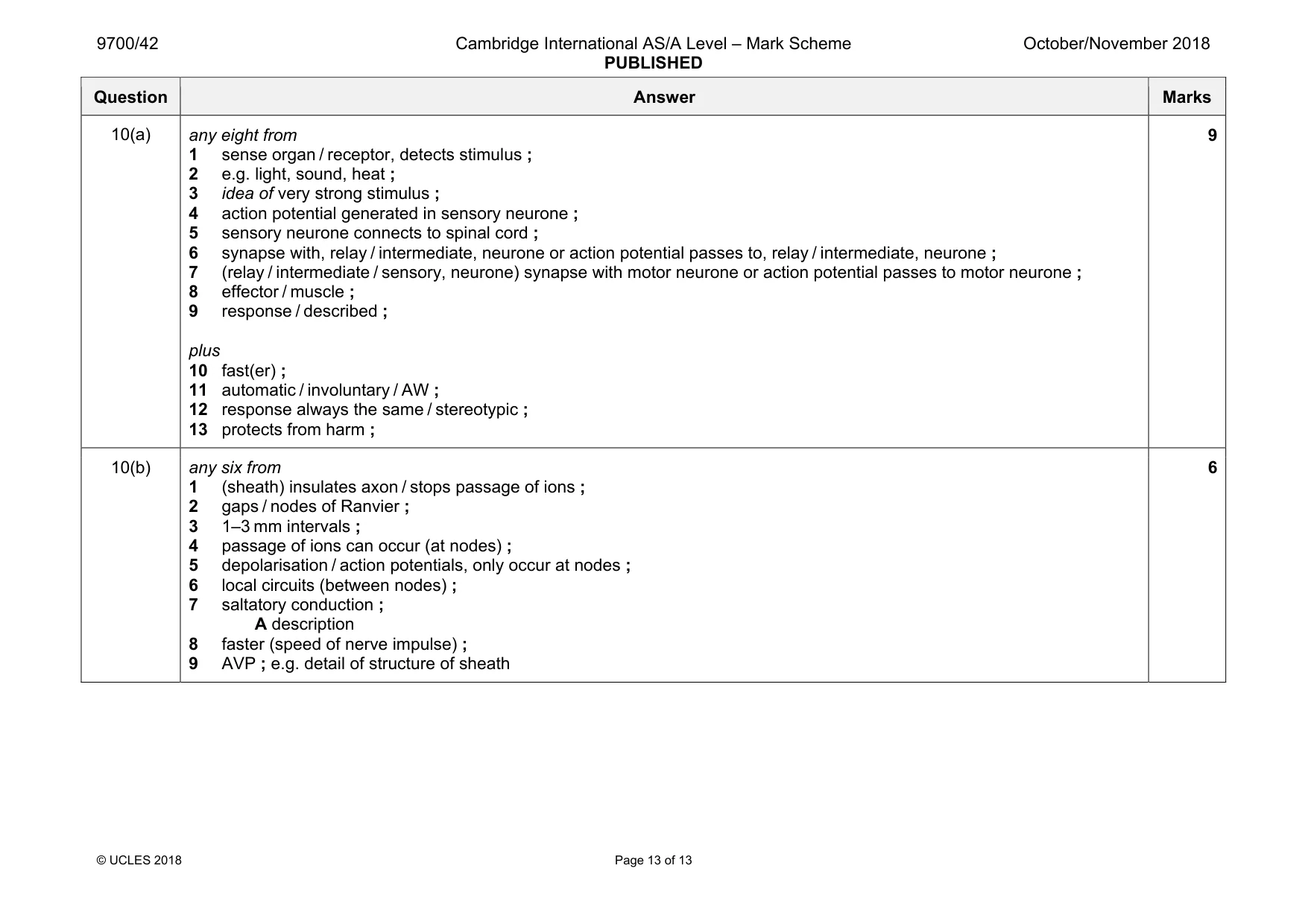
Mark scheme: 10(a) any eight from 1 sense organ / receptor, detects stimulus ; 2 e.g. light, sound, heat ; 3 idea of very strong stimulus ; 4 action potential generated in sensory neurone ; 5 sensory neurone connects to spinal cord ; 6 synapse with, relay / intermediate, neurone or action potential passes to, relay / intermediate, neurone ; 7 (relay / intermediate / sensory, neurone) synapse with motor neurone or action potential passes to motor neurone ; 8 effector / muscle ; 9 response / described ; plus 10 fast(er) ; 11 automatic / involuntary / AW ; 12 response always the same / stereotypic ; 13 protects from harm ; 9 10(b) any six from 1 (sheath) insulates axon / stops passage of ions ; 2 gaps / nodes of Ranvier ; 3 1–3 mm intervals ; 4 passage of ions can occur (at nodes) ; 5 depolarisation / action potentials, only occur at nodes ; 6 local circuits (between nodes) ; 7 saltatory conduction ; A description 8 faster (speed of nerve impulse) ; 9 AVP ; e.g. detail of structure of sheath 6
What was in this paper
The subtopics covered by these 10 questions, and how many questions each got. Open one in a new tab to see every Cambridge question on it.
What you needed in this session
Cambridge’s own grade thresholds for 2018 Oct/Nov, Paper 4 · Variant 2. A higher threshold means an easier paper — the bar moves with how the cohort did.