Cambridge A Level Biology 9700 — 2018 Feb/March Paper 2 · Variant 2
9700/22/F/M/18 · 6 questions · 60 marks · ≈68 min
The question paper and its mark scheme, free to read here and free to download. This is Cambridge’s own paper, exactly as it was sat.
Question paper16 pages


Mark scheme13 pages
Answers below. Sit the paper first if you are practising.
Questions as text
Q1 · An electron micrograph of part of a eukaryotic cell
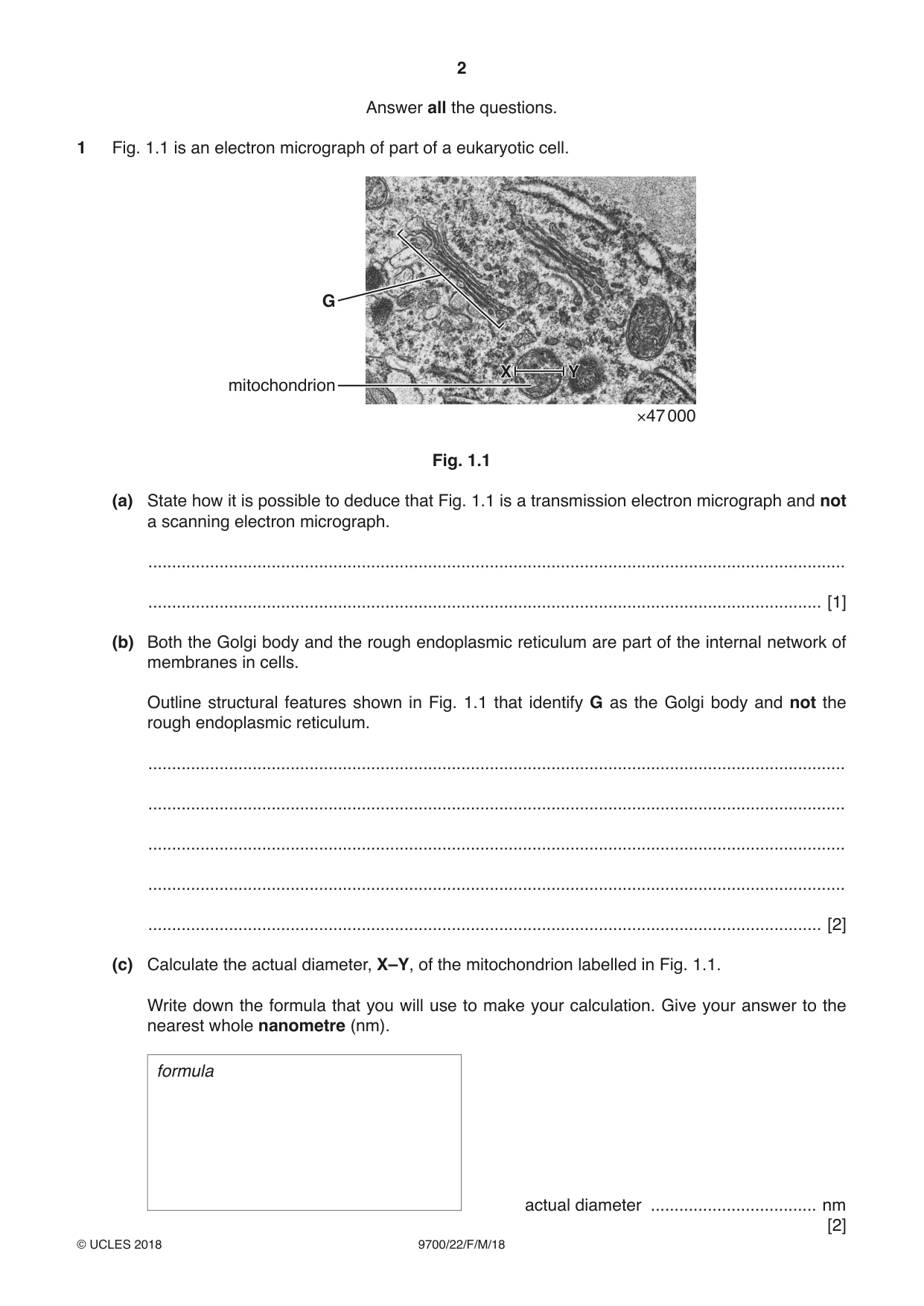
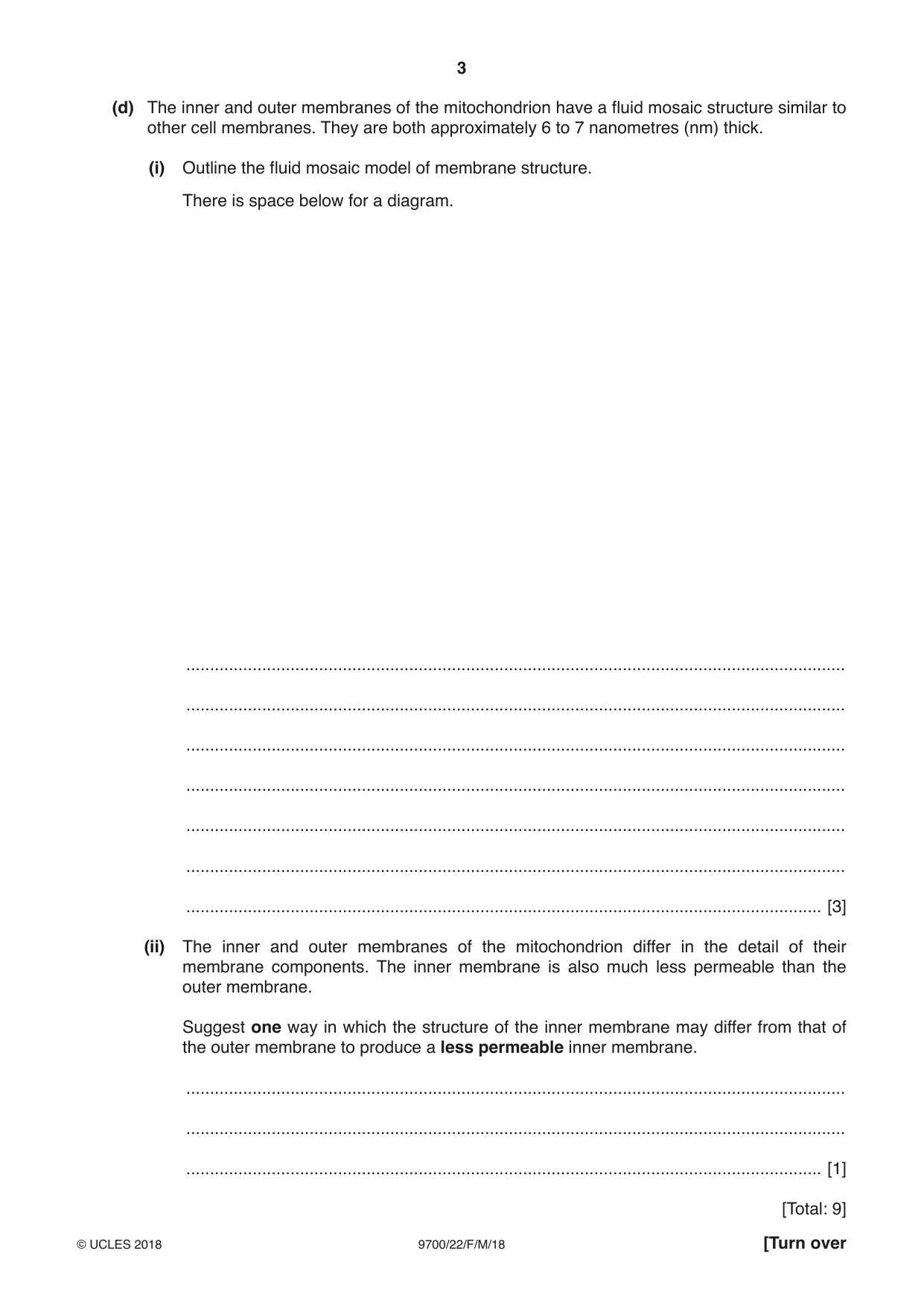
1 Fig. 1.1 is an electron micrograph of part of a eukaryotic cell. G X Y mitochondrion ×47 000 Fig. 1.1 (a) State how it is possible to deduce that Fig. 1.1 is a transmission electron micrograph and not a scanning electron micrograph. ................................................................................................................................................... .............................................................................................................................................. [1] (b) Both the Golgi body and the rough endoplasmic reticulum are part of the internal network of membranes in cells. Outline structural features shown in Fig. 1.1 that identify G as the Golgi body and not the rough endoplasmic reticulum. ................................................................................................................................................... ................................................................................................................................................... ................................................................................................................................................... ................................................................................................................................................... .............................................................................................................................................. [2] (c) Calculate the actual diameter, X–Y, of the mitochondrion labelled in Fig. 1.1. Write down the formula that you will use to make your calculation. Give your answer to the nearest whole nanometre (nm). formula actual diameter ................................... nm (d) The inner and outer membranes of the mitochondrion have a fluid mosaic structure similar to other cell membranes. They are both approximately 6 to 7 nanometres (nm) thick. (i) Outline the fluid mosaic model of membrane structure. There is space below for a diagram. ........................................................................................................................................... ........................................................................................................................................... ........................................................................................................................................... ........................................................................................................................................... ........................................................................................................................................... ........................................................................................................................................... ...................................................................................................................................... [3] (ii) The inner and outer membranes of the mitochondrion differ in the detail of their membrane components. The inner membrane is also much less permeable than the outer membrane. Suggest one way in which the structure of the inner membrane may differ from that of the outer membrane to produce a less permeable inner membrane. ........................................................................................................................................... ........................................................................................................................................... ...................................................................................................................................... [1] [Total: 9]
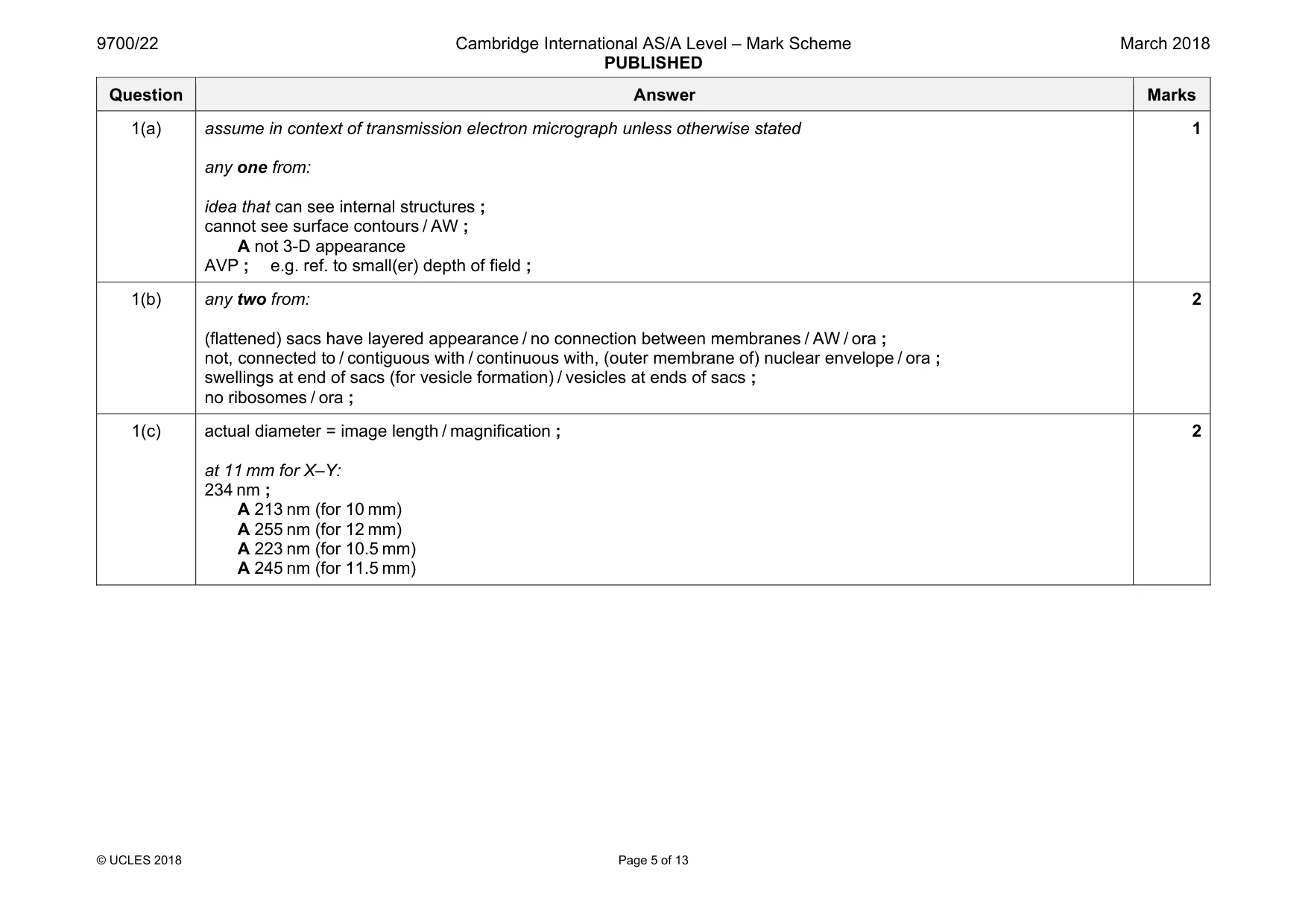
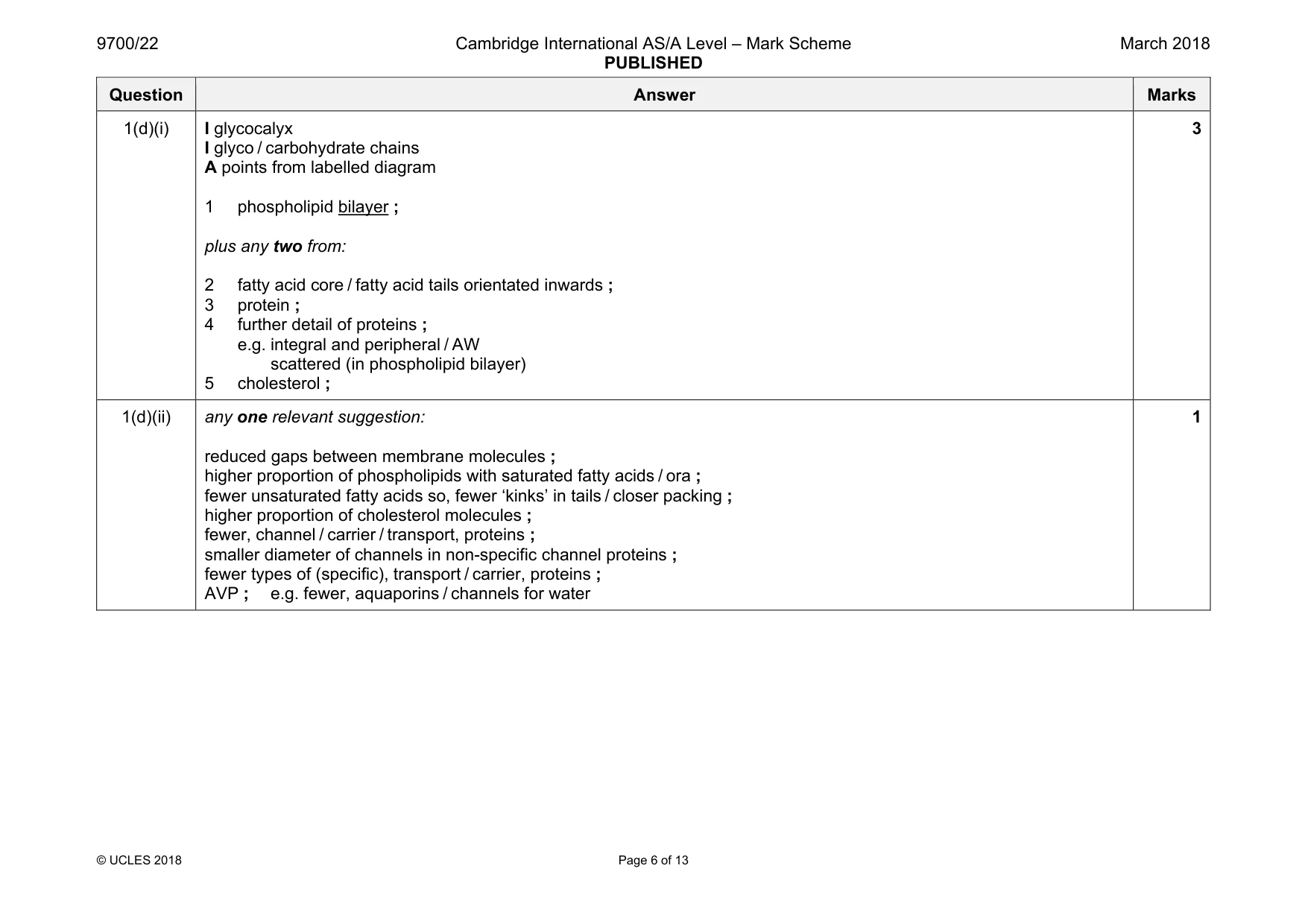
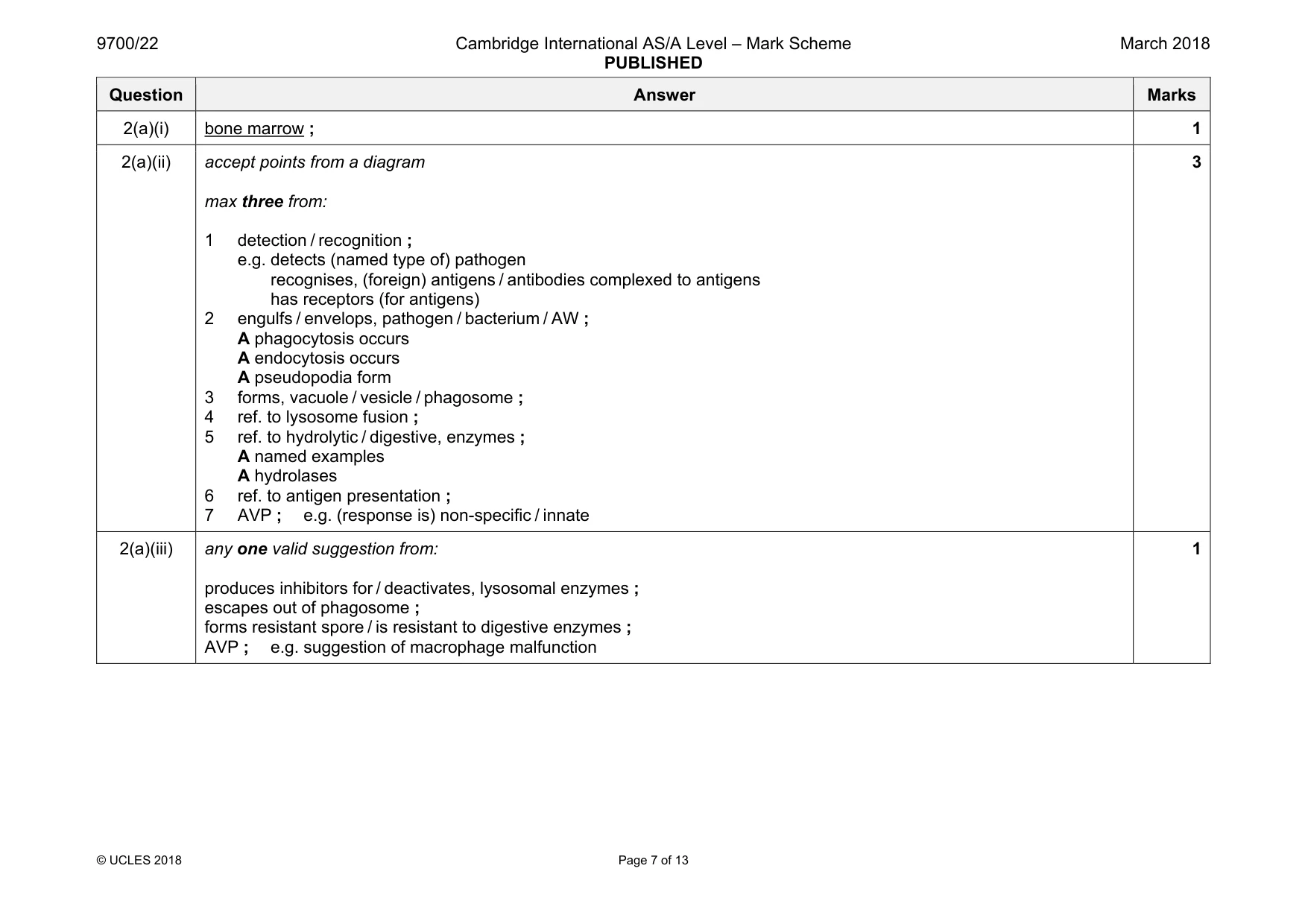
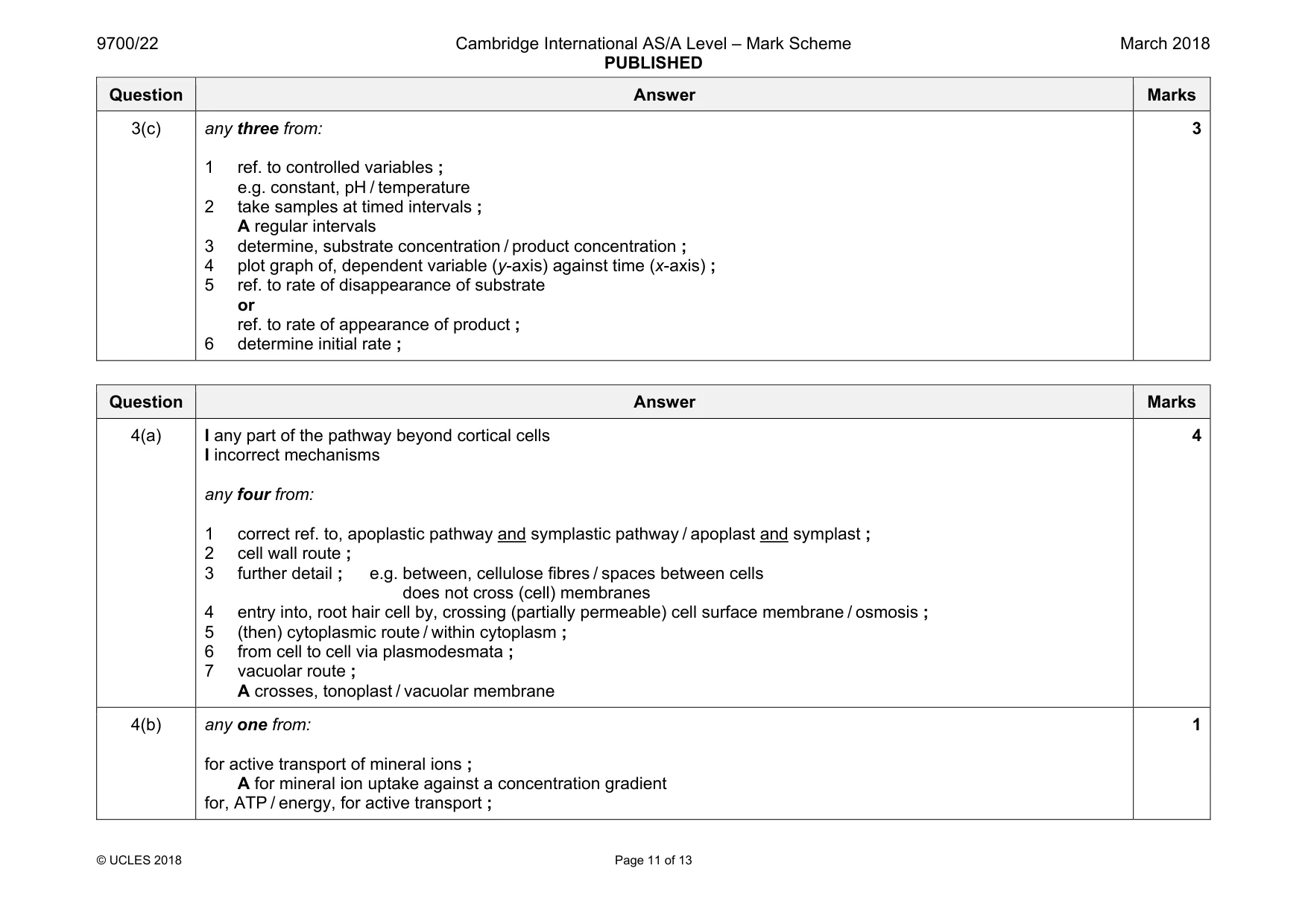
Mark scheme: 1(a) assume in context of transmission electron micrograph unless otherwise stated any one from: idea that can see internal structures ; cannot see surface contours / AW ; A not 3-D appearance AVP ; e.g. ref. to small(er) depth of field ; 1 1(b) any two from: (flattened) sacs have layered appearance / no connection between membranes / AW / ora ; not, connected to / contiguous with / continuous with, (outer membrane of) nuclear envelope / ora ; swellings at end of sacs (for vesicle formation) / vesicles at ends of sacs ; no ribosomes / ora ; 2 1(c) actual diameter = image length / magnification ; at 11 mm for X–Y: 234 nm ; A 213 nm (for 10 mm) A 255 nm (for 12 mm) A 223 nm (for 10.5 mm) A 245 nm (for 11.5 mm) 2 Question Answer Marks 1(d)(i) I glycocalyx I glyco / carbohydrate chains A points from labelled diagram 1 phospholipid bilayer ; plus any two from: 2 fatty acid core / fatty acid tails orientated inwards ; 3 protein ; 4 further detail of proteins ; e.g. integral and peripheral / AW scattered (in phospholipid bilayer) 5 cholesterol ; 3 1(d)(ii) any one relevant suggestion: reduced gaps between membrane molecules ; higher proportion of phospholipids with saturated fatty acids / ora ; fewer unsaturated fatty acids so, fewer ‘kinks’ in tails / closer packing ; higher proportion of cholesterol molecules ; fewer, channel / carrier / transport, proteins ; smaller diameter of channels in non-specific channel proteins ; fewer types of (specific), transport / carrier, proteins ; AVP ; e.g. fewer, aquaporins / channels for water 1
Q2 · The main cause of tuberculosis (TB) in humans is the bacterium Mycobacterium tuberculosis
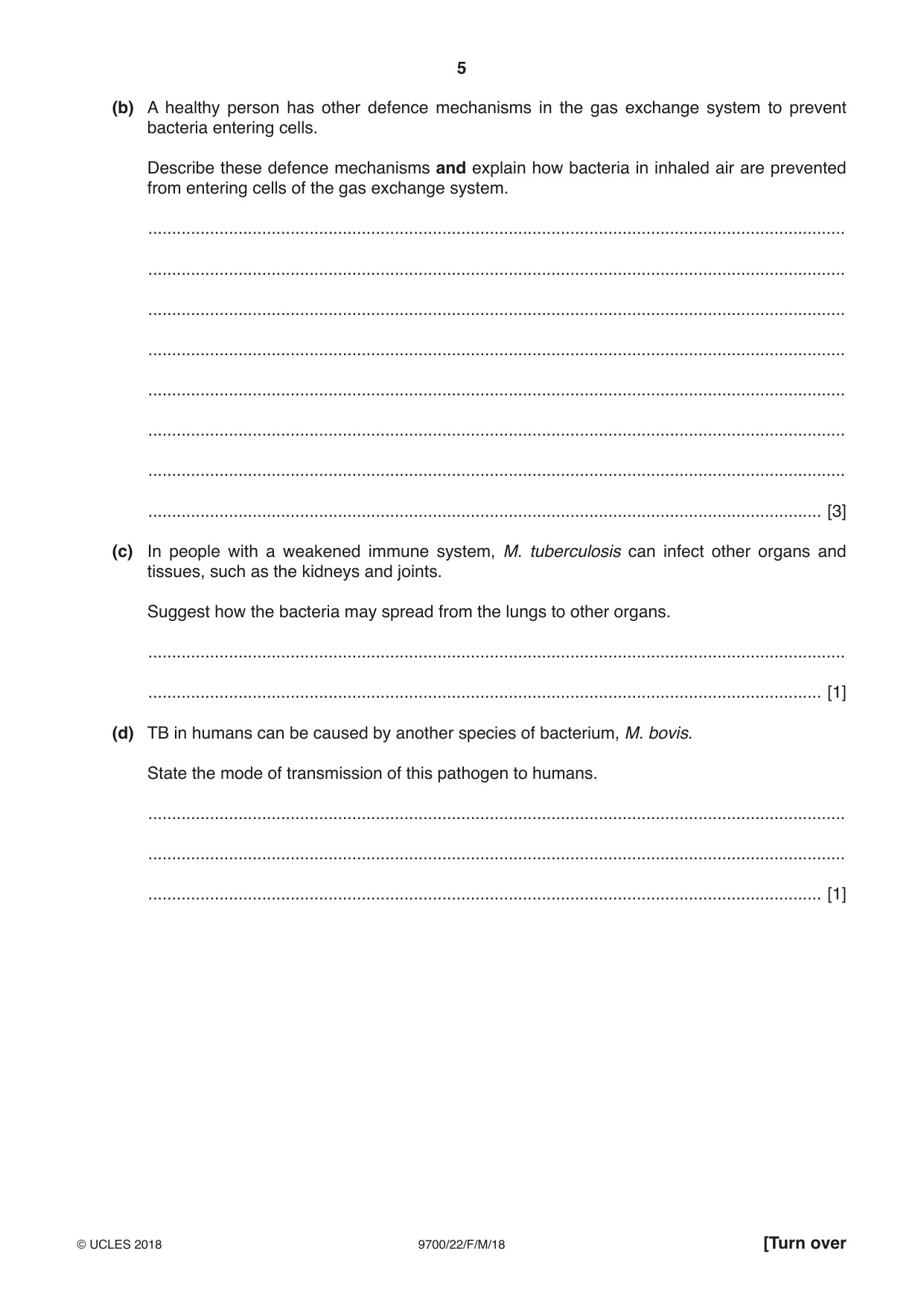
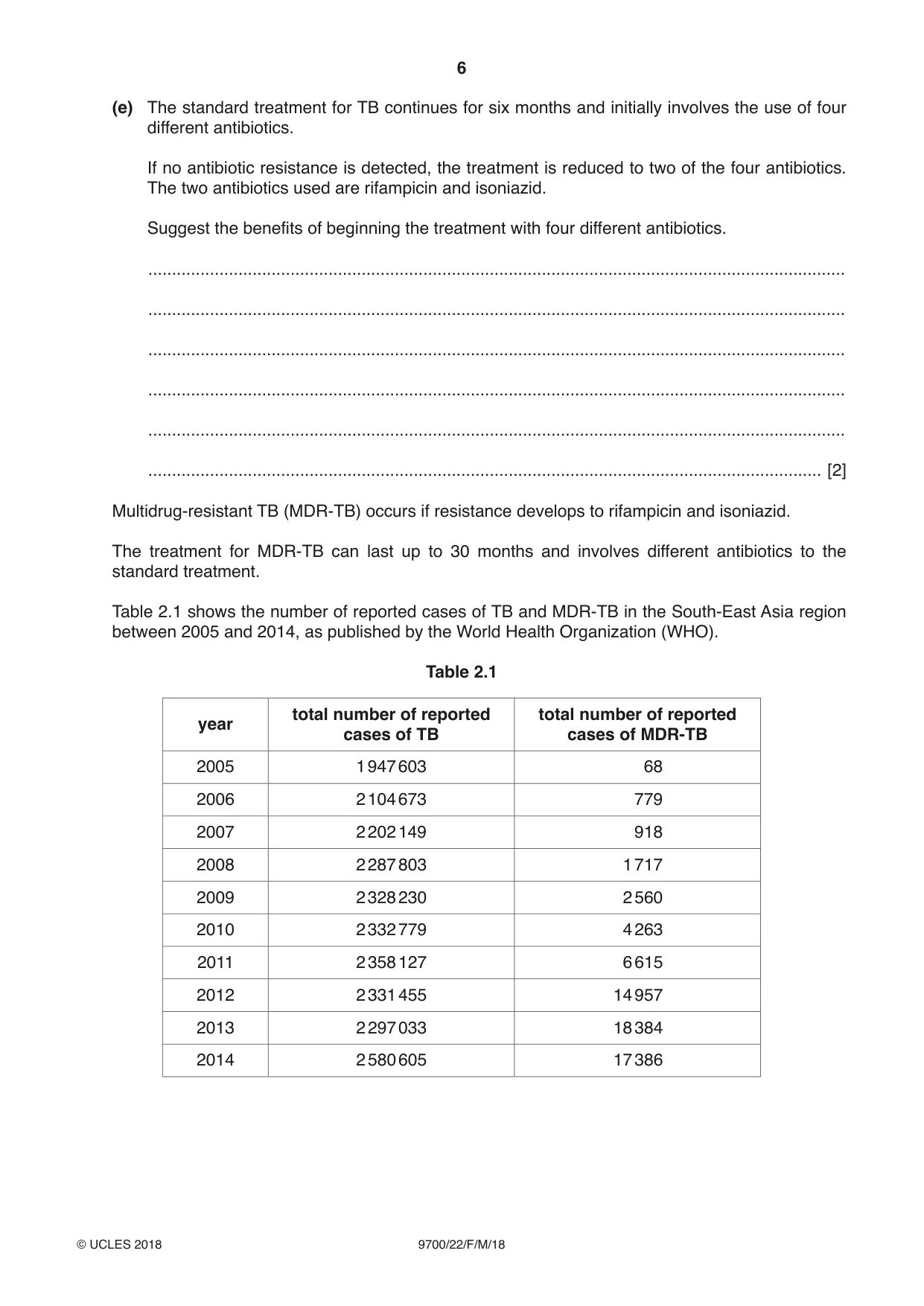
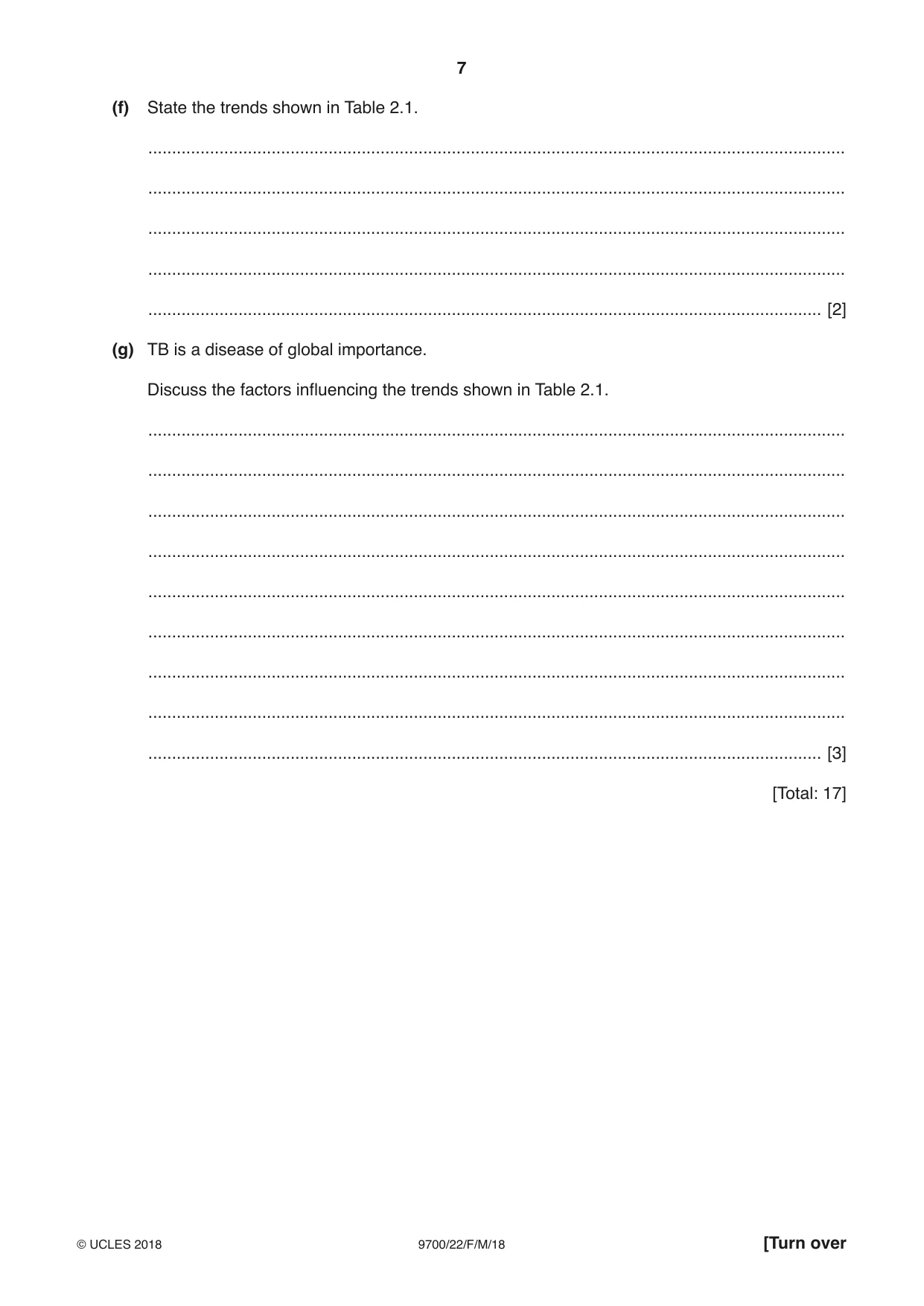
2 The main cause of tuberculosis (TB) in humans is the bacterium Mycobacterium tuberculosis. Most cases of the disease involve the lungs. The bacterium can enter cells and remain inactive in a latent (dormant) state. However, the bacterium can become active to produce symptoms of the disease. In a person with active TB, the pathogen can be present in airborne droplets that are exhaled. Generally, a healthy person who inhales these droplets has effective defence mechanisms in the gas exchange system to prevent infection. (a) One example of a defence mechanism against pathogens in the gas exchange system involves the action of macrophages. (i) State the location in the body where macrophages have their origin. ...................................................................................................................................... [1] (ii) Describe the mode of action of a macrophage. ........................................................................................................................................... ........................................................................................................................................... ........................................................................................................................................... ........................................................................................................................................... ........................................................................................................................................... ........................................................................................................................................... ........................................................................................................................................... ........................................................................................................................................... ...................................................................................................................................... [3] (iii) It is sometimes possible for M. tuberculosis to survive within macrophages. Suggest one way in which M. tuberculosis may survive within a macrophage. ........................................................................................................................................... ........................................................................................................................................... ...................................................................................................................................... [1] (b) A healthy person has other defence mechanisms in the gas exchange system to prevent bacteria entering cells. Describe these defence mechanisms and explain how bacteria in inhaled air are prevented from entering cells of the gas exchange system. ................................................................................................................................................... ................................................................................................................................................... ................................................................................................................................................... ................................................................................................................................................... ................................................................................................................................................... ................................................................................................................................................... ................................................................................................................................................... .............................................................................................................................................. [3] (c) In people with a weakened immune system, M. tuberculosis can infect other organs and tissues, such as the kidneys and joints. Suggest how the bacteria may spread from the lungs to other organs. ................................................................................................................................................... .............................................................................................................................................. [1] (d) TB in humans can be caused by another species of bacterium, M. bovis. State the mode of transmission of this pathogen to humans. ................................................................................................................................................... ................................................................................................................................................... .............................................................................................................................................. [1] (e) The standard treatment for TB continues for six months and initially involves the use of four different antibiotics. If no antibiotic resistance is detected, the treatment is reduced to two of the four antibiotics. The two antibiotics used are rifampicin and isoniazid. Suggest the benefits of beginning the treatment with four different antibiotics. ................................................................................................................................................... ................................................................................................................................................... ................................................................................................................................................... ................................................................................................................................................... ................................................................................................................................................... .............................................................................................................................................. [2] Multidrug-resistant TB (MDR-TB) occurs if resistance develops to rifampicin and isoniazid. The treatment for MDR-TB can last up to 30 months and involves different antibiotics to the standard treatment. Table 2.1 shows the number of reported cases of TB and MDR-TB in the South-East Asia region between 2005 and 2014, as published by the World Health Organization (WHO). Table 2.1 total number of reported total number of reported year cases of TB cases of MDR-TB 2005 1 947 603 68 2006 2 104 673 779 2007 2 202 149 918 2008 2 287 803 1 717 2009 2 328 230 2 560 2010 2 332 779 4 263 2011 2 358 127 6 615 2012 2 331 455 14 957 2013 2 297 033 18 384 2014 2 580 605 17 386 (f) State the trends shown in Table 2.1. ................................................................................................................................................... ................................................................................................................................................... ................................................................................................................................................... ................................................................................................................................................... .............................................................................................................................................. [2] (g) TB is a disease of global importance. Discuss the factors influencing the trends shown in Table 2.1. ................................................................................................................................................... ................................................................................................................................................... ................................................................................................................................................... ................................................................................................................................................... ................................................................................................................................................... ................................................................................................................................................... ................................................................................................................................................... ................................................................................................................................................... .............................................................................................................................................. [3] [Total: 17]
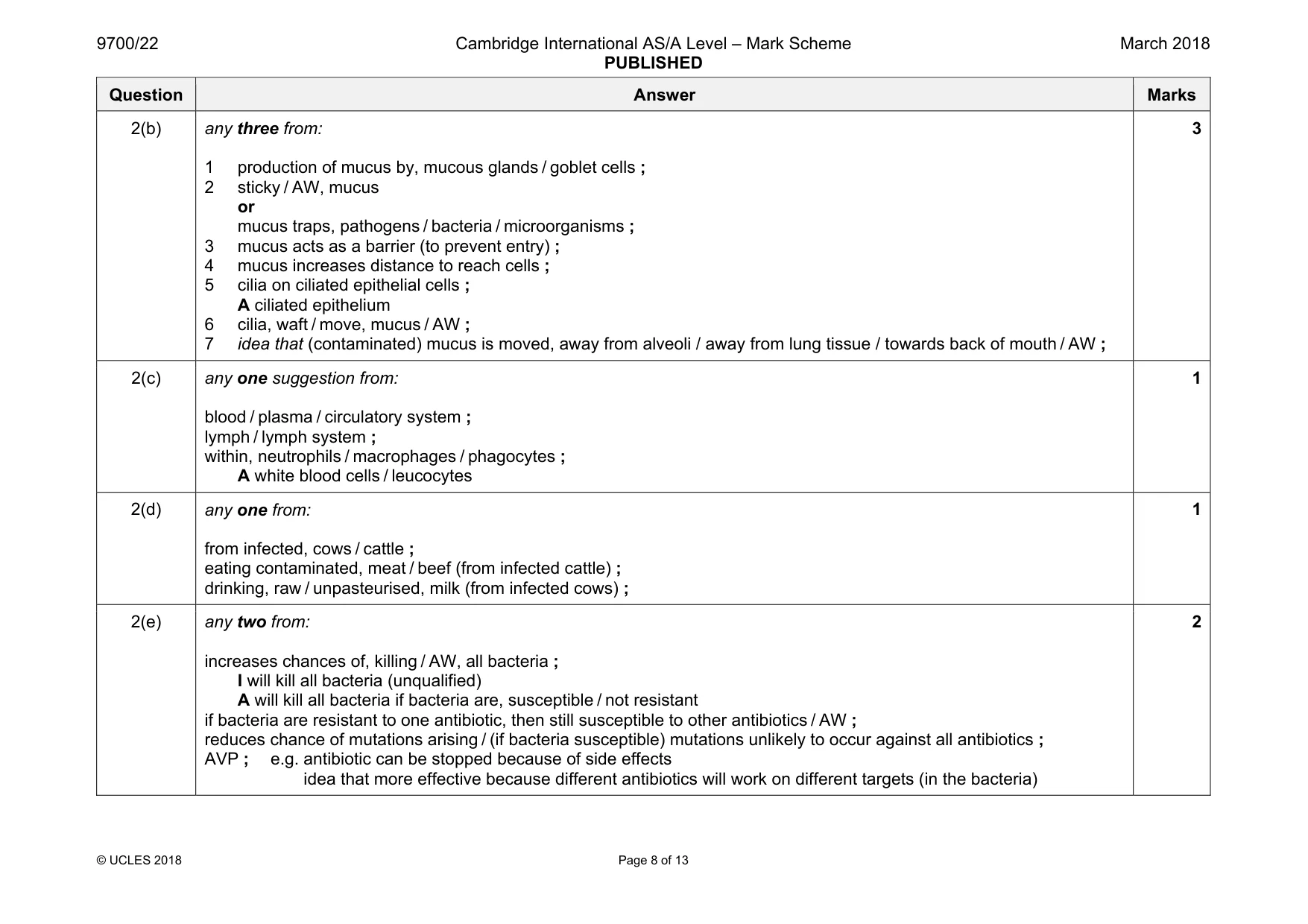
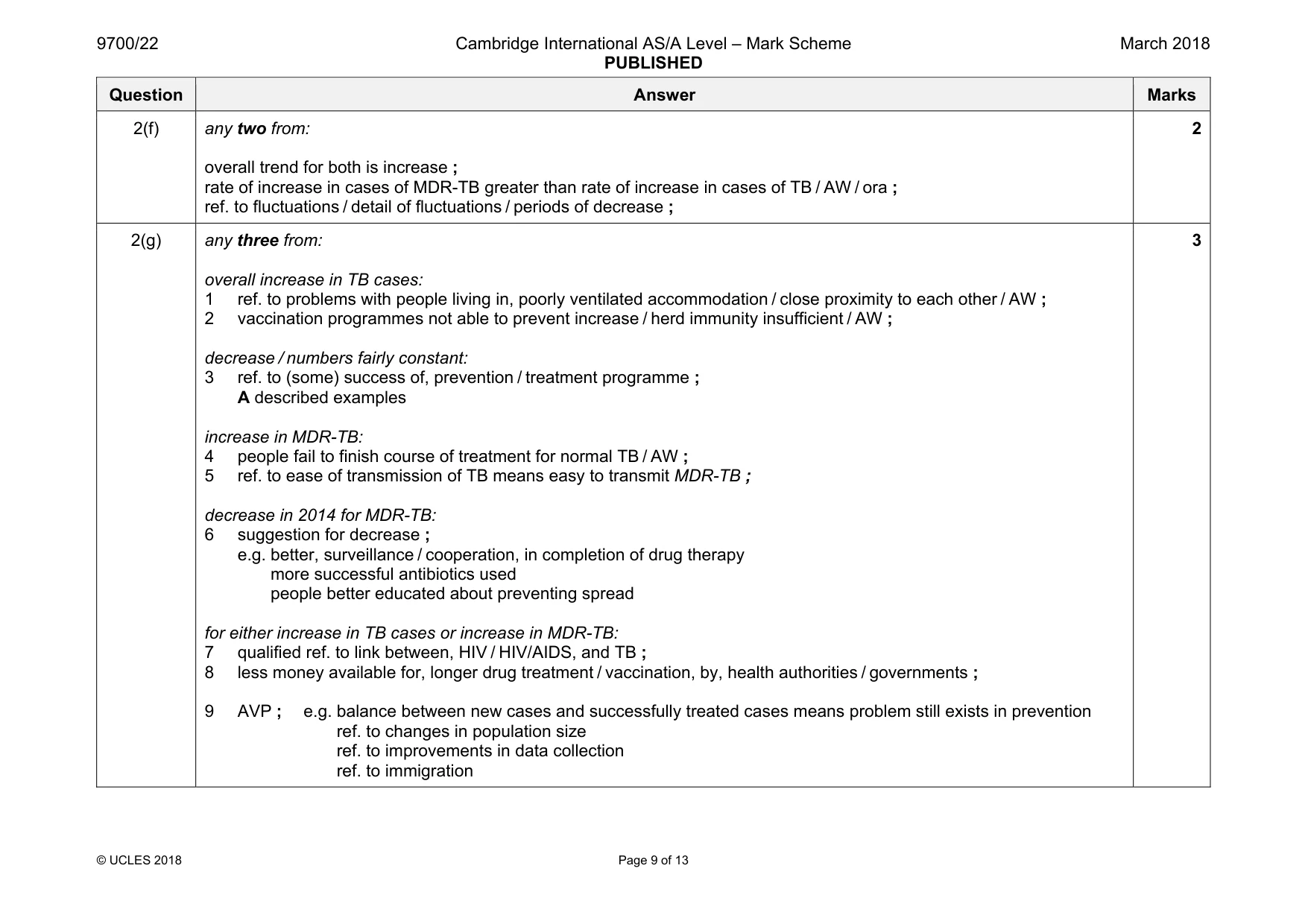
Mark scheme: 2(a)(i) bone marrow ; 1 2(a)(ii) accept points from a diagram max three from: 1 detection / recognition ; e.g. detects (named type of) pathogen recognises, (foreign) antigens / antibodies complexed to antigens has receptors (for antigens) 2 engulfs / envelops, pathogen / bacterium / AW ; A phagocytosis occurs A endocytosis occurs A pseudopodia form 3 forms, vacuole / vesicle / phagosome ; 4 ref. to lysosome fusion ; 5 ref. to hydrolytic / digestive, enzymes ; A named examples A hydrolases 6 ref. to antigen presentation ; 7 AVP ; e.g. (response is) non-specific / innate 3 2(a)(iii) any one valid suggestion from: produces inhibitors for / deactivates, lysosomal enzymes ; escapes out of phagosome ; forms resistant spore / is resistant to digestive enzymes ; AVP ; e.g. suggestion of macrophage malfunction 1 Question Answer Marks 2(b) any three from: 1 production of mucus by, mucous glands / goblet cells ; 2 sticky / AW, mucus or mucus traps, pathogens / bacteria / microorganisms ; 3 mucus acts as a barrier (to prevent entry) ; 4 mucus increases distance to reach cells ; 5 cilia on ciliated epithelial cells ; A ciliated epithelium 6 cilia, waft / move, mucus / AW ; 7 idea that (contaminated) mucus is moved, away from alveoli / away from lung tissue / towards back of mouth / AW ; 3 2(c) any one suggestion from: blood / plasma / circulatory system ; lymph / lymph system ; within, neutrophils / macrophages / phagocytes ; A white blood cells / leucocytes 1 2(d) any one from: from infected, cows / cattle ; eating contaminated, meat / beef (from infected cattle) ; drinking, raw / unpasteurised, milk (from infected cows) ; 1 2(e) any two from: increases chances of, killing / AW, all bacteria ; I will kill all bacteria (unqualified) A will kill all bacteria if bacteria are, susceptible / not resistant if bacteria are resistant to one antibiotic, then still susceptible to other antibiotics / AW ; reduces chance of mutations arising / (if bacteria susceptible) mutations unlikely to occur against all antibiotics ; AVP ; e.g. antibiotic can be stopped because of side effects idea that more effective because different antibiotics will work on different targets (in the bacteria) 2 Question Answer Marks 2(f) any two from: overall trend for both is increase ; rate of increase in cases of MDR-TB greater than rate of increase in cases of TB / AW / ora ; ref. to fluctuations / detail of fluctuations / periods of decrease ; 2 2(g) any three from: overall increase in TB cases: 1 ref. to problems with people living in, poorly ventilated accommodation / close proximity to each other / AW ; 2 vaccination programmes not able to prevent increase / herd immunity insufficient / AW ; decrease / numbers fairly constant: 3 ref. to (some) success of, prevention / treatment programme ; A described examples increase in MDR-TB: 4 people fail to finish course of treatment for normal TB / AW ; 5 ref. to ease of transmission of TB means easy to transmit MDR-TB ; decrease in 2014 for MDR-TB: 6 suggestion for decrease ; e.g. better, surveillance / cooperation, in completion of drug therapy more successful antibiotics used people better educated about preventing spread for either increase in TB cases or increase in MDR-TB: 7 qualified ref. to link between, HIV / HIV/AIDS, and TB ; 8 less money available for, longer drug treatment / vaccination, by, health authorities / governments ; 9 AVP ; e.g. balance between new cases and successfully treated cases means problem still exists in prevention ref. to changes in population size ref. to improvements in data collection ref. to immigration 3
Q3 · The unicellular fungus Kluyveromyces lactis is found in dairy products
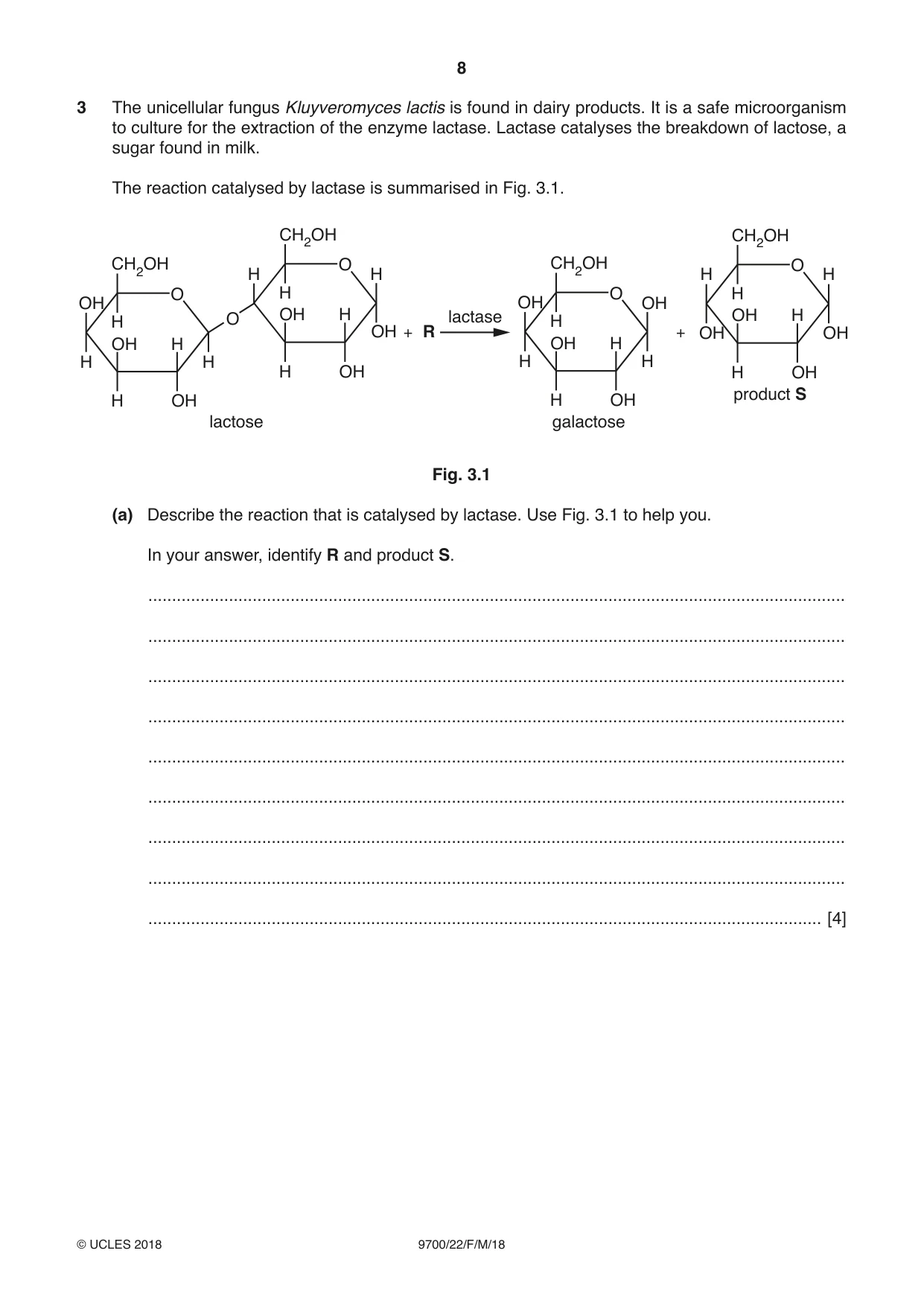
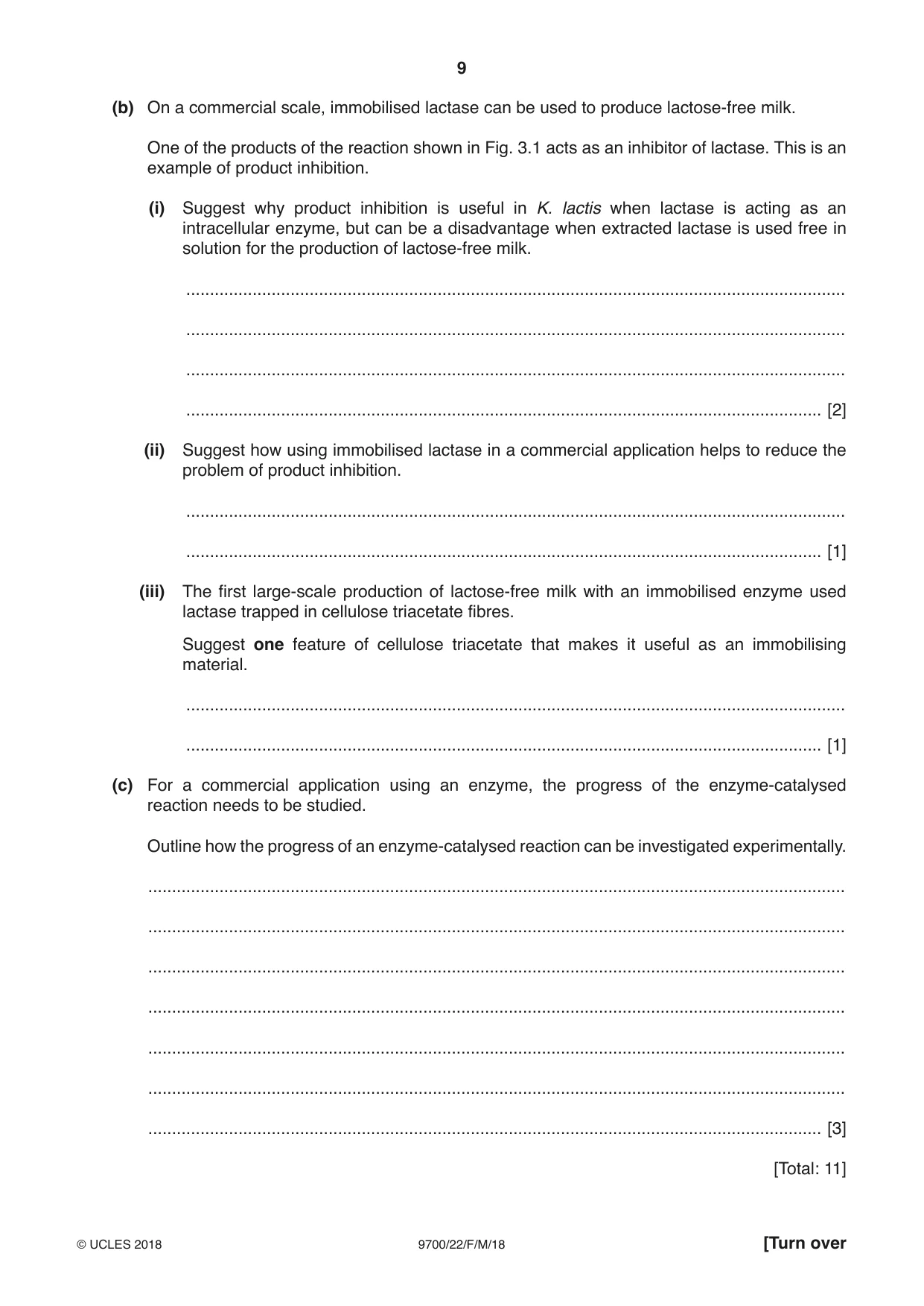
3 The unicellular fungus Kluyveromyces lactis is found in dairy products. It is a safe microorganism to culture for the extraction of the enzyme lactase. Lactase catalyses the breakdown of lactose, a sugar found in milk. The reaction catalysed by lactase is summarised in Fig. 3.1. CH2OH CH2OH CH2OH O CH2OH O H H H H O H O HOH OH OH H O OH H lactase H OH H OH + R + OH OH OH H OH H H H H H H OH H OH product S H OH H OH lactose galactose Fig. 3.1 (a) Describe the reaction that is catalysed by lactase. Use Fig. 3.1 to help you. In your answer, identify R and product S. ................................................................................................................................................... ................................................................................................................................................... ................................................................................................................................................... ................................................................................................................................................... ................................................................................................................................................... ................................................................................................................................................... ................................................................................................................................................... ................................................................................................................................................... .............................................................................................................................................. [4] (b) On a commercial scale, immobilised lactase can be used to produce lactose-free milk. One of the products of the reaction shown in Fig. 3.1 acts as an inhibitor of lactase. This is an example of product inhibition. (i) Suggest why product inhibition is useful in K. lactis when lactase is acting as an intracellular enzyme, but can be a disadvantage when extracted lactase is used free in solution for the production of lactose-free milk. ........................................................................................................................................... ........................................................................................................................................... ........................................................................................................................................... ...................................................................................................................................... [2] (ii) Suggest how using immobilised lactase in a commercial application helps to reduce the problem of product inhibition. ........................................................................................................................................... ...................................................................................................................................... [1] (iii) The first large-scale production of lactose-free milk with an immobilised enzyme used lactase trapped in cellulose triacetate fibres. Suggest one feature of cellulose triacetate that makes it useful as an immobilising material. ........................................................................................................................................... ...................................................................................................................................... [1] (c) For a commercial application using an enzyme, the progress of the enzyme-catalysed reaction needs to be studied. Outline how the progress of an enzyme-catalysed reaction can be investigated experimentally. ................................................................................................................................................... ................................................................................................................................................... ................................................................................................................................................... ................................................................................................................................................... ................................................................................................................................................... ................................................................................................................................................... .............................................................................................................................................. [3] [Total: 11]
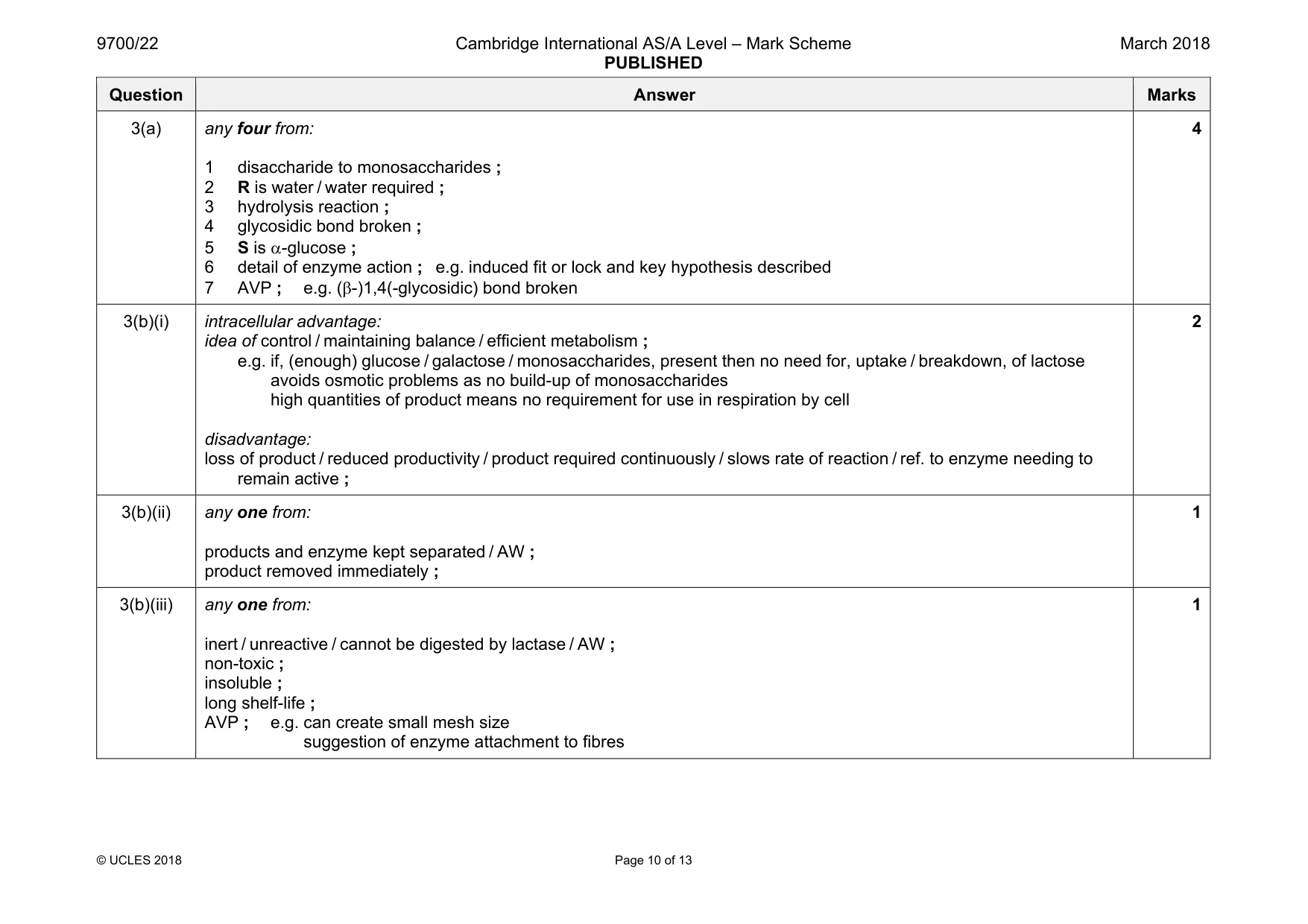
Mark scheme: 3(a) any four from: 1 disaccharide to monosaccharides ; 2 R is water / water required ; 3 hydrolysis reaction ; 4 glycosidic bond broken ; 5 S is α-glucose ; 6 detail of enzyme action ; e.g. induced fit or lock and key hypothesis described 7 AVP ; e.g. (β-)1,4(-glycosidic) bond broken 4 3(b)(i) intracellular advantage: idea of control / maintaining balance / efficient metabolism ; e.g. if, (enough) glucose / galactose / monosaccharides, present then no need for, uptake / breakdown, of lactose avoids osmotic problems as no build-up of monosaccharides high quantities of product means no requirement for use in respiration by cell disadvantage: loss of product / reduced productivity / product required continuously / slows rate of reaction / ref. to enzyme needing to remain active ; 2 3(b)(ii) any one from: products and enzyme kept separated / AW ; product removed immediately ; 1 3(b)(iii) any one from: inert / unreactive / cannot be digested by lactase / AW ; non-toxic ; insoluble ; long shelf-life ; AVP ; e.g. can create small mesh size suggestion of enzyme attachment to fibres 1 Question Answer Marks 3(c) any three from: 1 ref. to controlled variables ; e.g. constant, pH / temperature 2 take samples at timed intervals ; A regular intervals 3 determine, substrate concentration / product concentration ; 4 plot graph of, dependent variable (y-axis) against time (x-axis) ; 5 ref. to rate of disappearance of substrate or ref. to rate of appearance of product ; 6 determine initial rate ; 3
Q4 · A diagram of a section through part of a young root
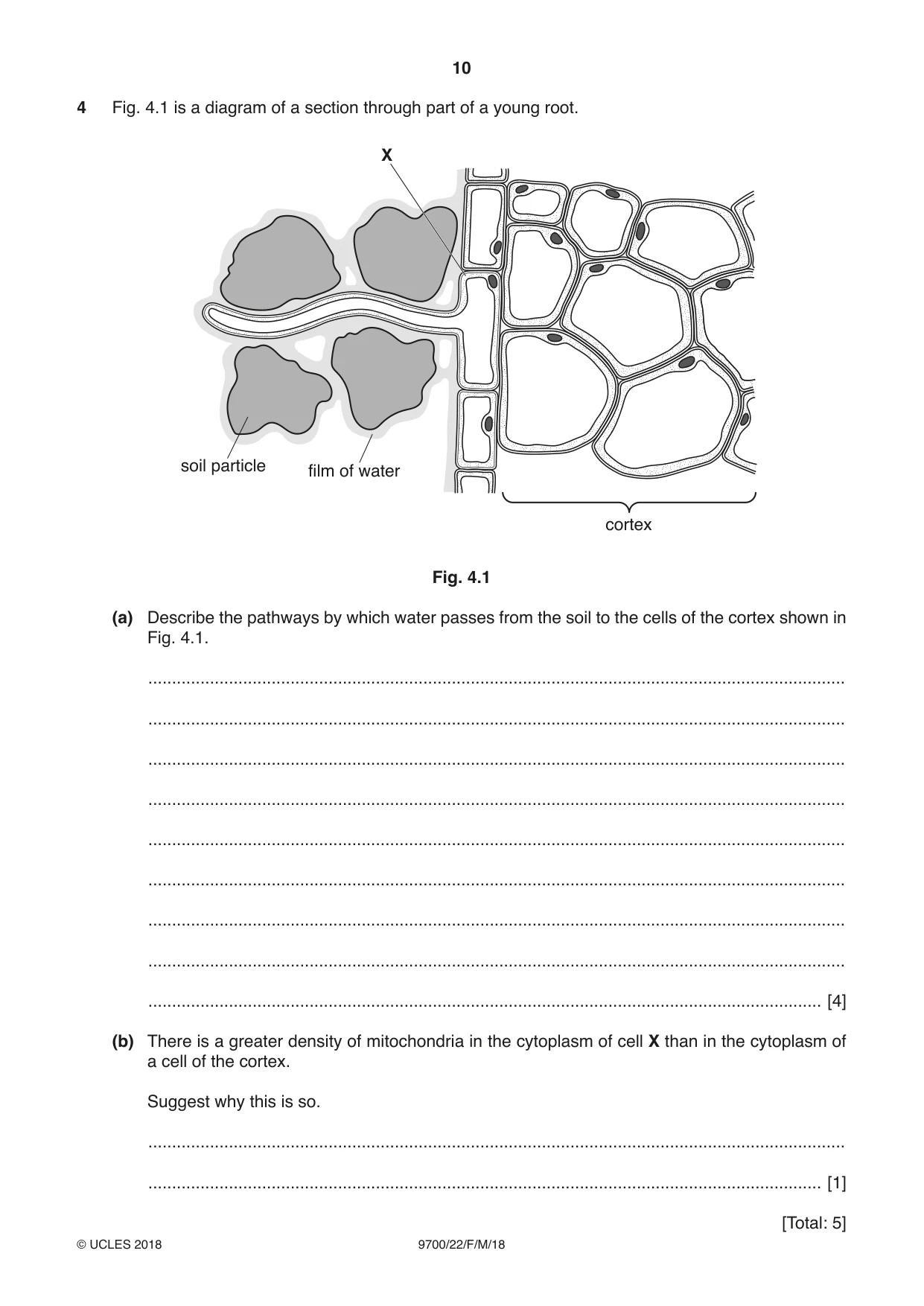
4 Fig. 4.1 is a diagram of a section through part of a young root. X soil particle film of water cortex Fig. 4.1 (a) Describe the pathways by which water passes from the soil to the cells of the cortex shown in Fig. 4.1. ................................................................................................................................................... ................................................................................................................................................... ................................................................................................................................................... ................................................................................................................................................... ................................................................................................................................................... ................................................................................................................................................... ................................................................................................................................................... ................................................................................................................................................... .............................................................................................................................................. [4] (b) There is a greater density of mitochondria in the cytoplasm of cell X than in the cytoplasm of a cell of the cortex. Suggest why this is so. ................................................................................................................................................... .............................................................................................................................................. [1] [Total: 5]
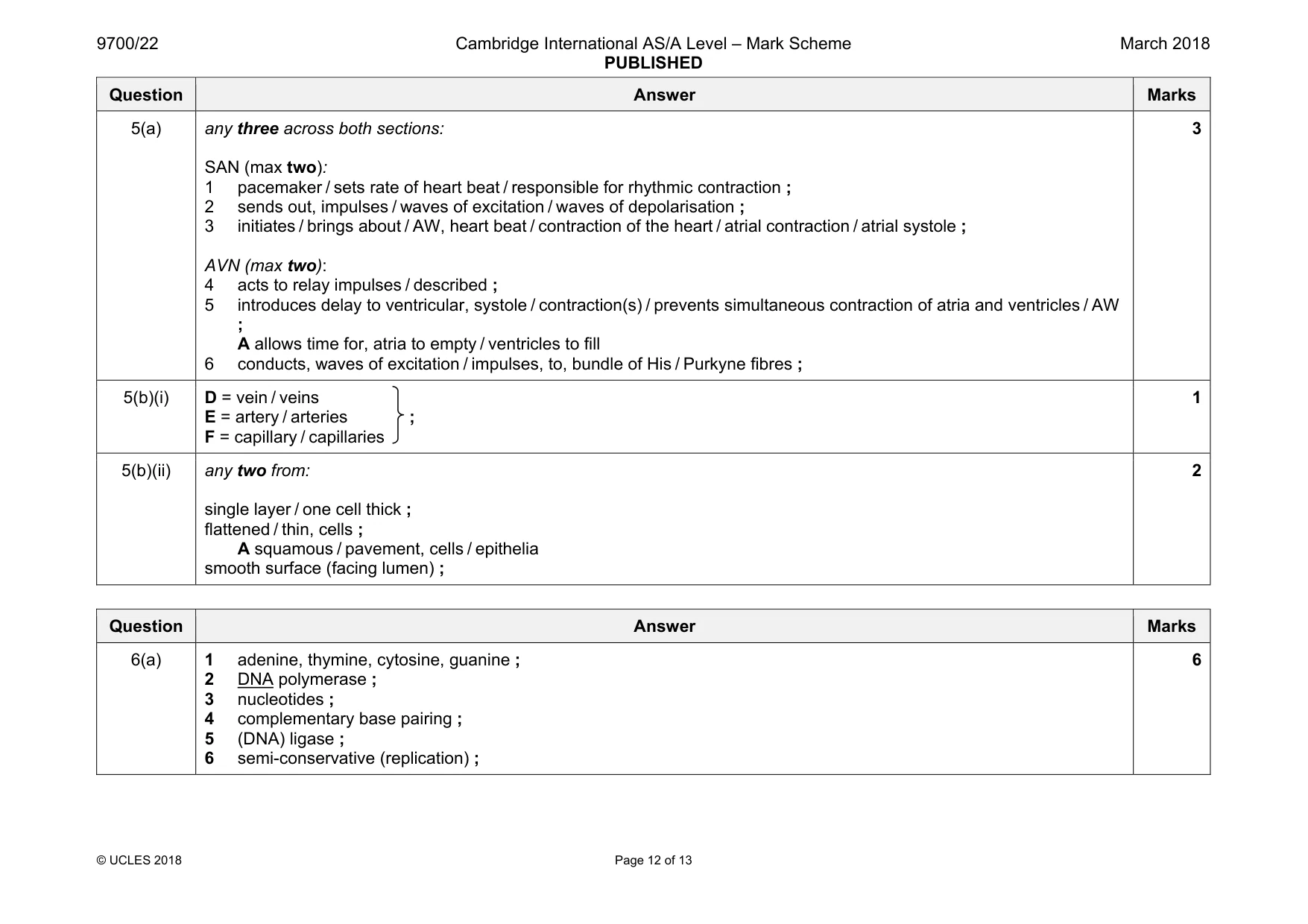
Mark scheme: 4(a) I any part of the pathway beyond cortical cells I incorrect mechanisms any four from: 1 correct ref. to, apoplastic pathway and symplastic pathway / apoplast and symplast ; 2 cell wall route ; 3 further detail ; e.g. between, cellulose fibres / spaces between cells does not cross (cell) membranes 4 entry into, root hair cell by, crossing (partially permeable) cell surface membrane / osmosis ; 5 (then) cytoplasmic route / within cytoplasm ; 6 from cell to cell via plasmodesmata ; 7 vacuolar route ; A crosses, tonoplast / vacuolar membrane 4 4(b) any one from: for active transport of mineral ions ; A for mineral ion uptake against a concentration gradient for, ATP / energy, for active transport ; 1
Q5 · The sinoatrial node (SAN) and the atrioventricular node (AVN) are two regions of the heart
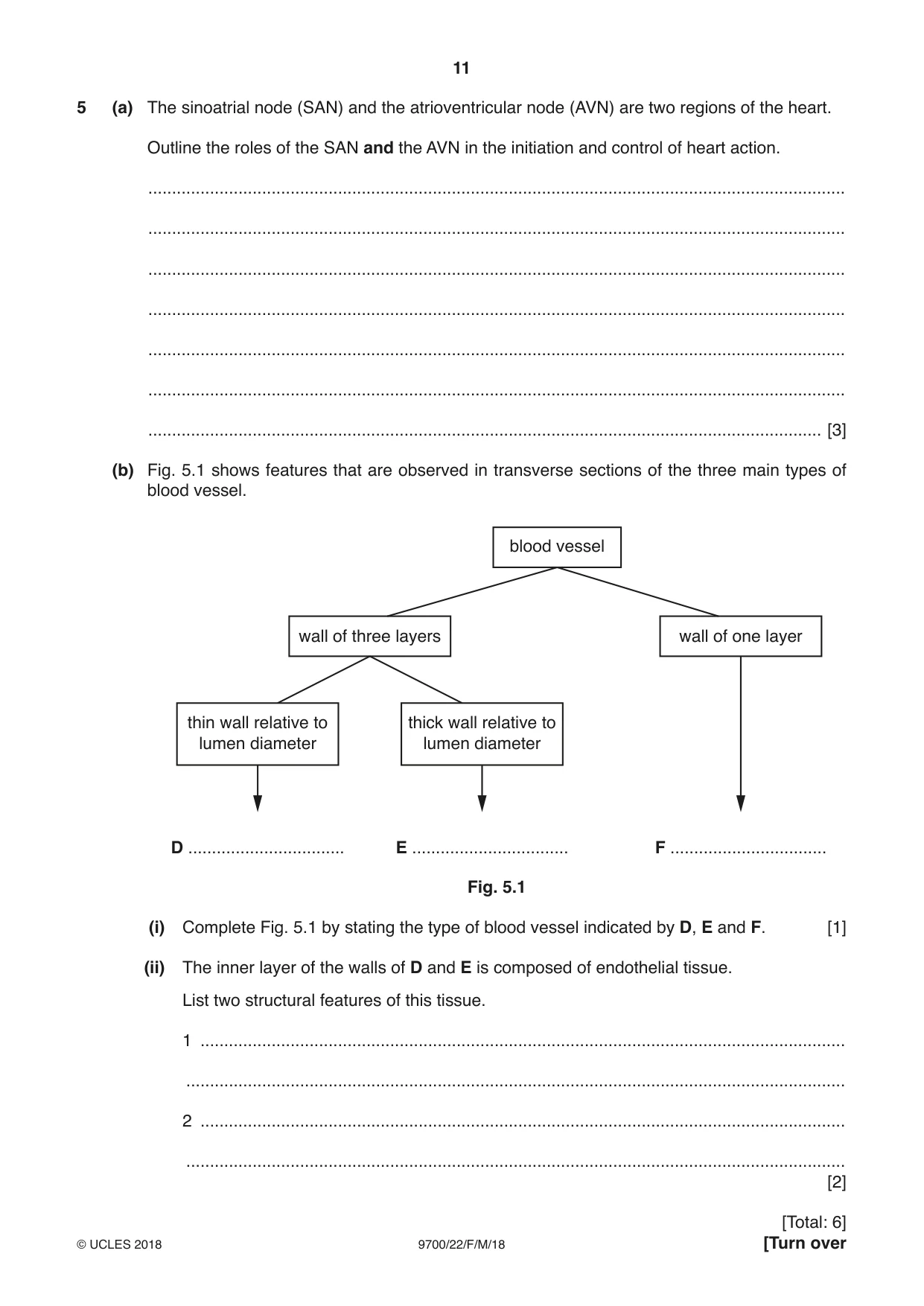
5 (a) The sinoatrial node (SAN) and the atrioventricular node (AVN) are two regions of the heart. Outline the roles of the SAN and the AVN in the initiation and control of heart action. ................................................................................................................................................... ................................................................................................................................................... ................................................................................................................................................... ................................................................................................................................................... ................................................................................................................................................... ................................................................................................................................................... .............................................................................................................................................. [3] (b) Fig. 5.1 shows features that are observed in transverse sections of the three main types of blood vessel. blood vessel wall of three layers wall of one layer thin wall relative to thick wall relative to lumen diameter lumen diameter D ................................. E ................................. F ................................. Fig. 5.1 (i) Complete Fig. 5.1 by stating the type of blood vessel indicated by D, E and F. [1] (ii) The inner layer of the walls of D and E is composed of endothelial tissue. List two structural features of this tissue. 1 ........................................................................................................................................ ........................................................................................................................................... 2 ........................................................................................................................................ ........................................................................................................................................... [2]
Mark scheme: 5(a) any three across both sections: SAN (max two): 1 pacemaker / sets rate of heart beat / responsible for rhythmic contraction ; 2 sends out, impulses / waves of excitation / waves of depolarisation ; 3 initiates / brings about / AW, heart beat / contraction of the heart / atrial contraction / atrial systole ; AVN (max two): 4 acts to relay impulses / described ; 5 introduces delay to ventricular, systole / contraction(s) / prevents simultaneous contraction of atria and ventricles / AW ; A allows time for, atria to empty / ventricles to fill 6 conducts, waves of excitation / impulses, to, bundle of His / Purkyne fibres ; 3 5(b)(i) D = vein / veins E = artery / arteries ; F = capillary / capillaries 1 5(b)(ii) any two from: single layer / one cell thick ; flattened / thin, cells ; A squamous / pavement, cells / epithelia smooth surface (facing lumen) ; 2
Q6 · In a dividing cell, DNA replication occurs before mitosis
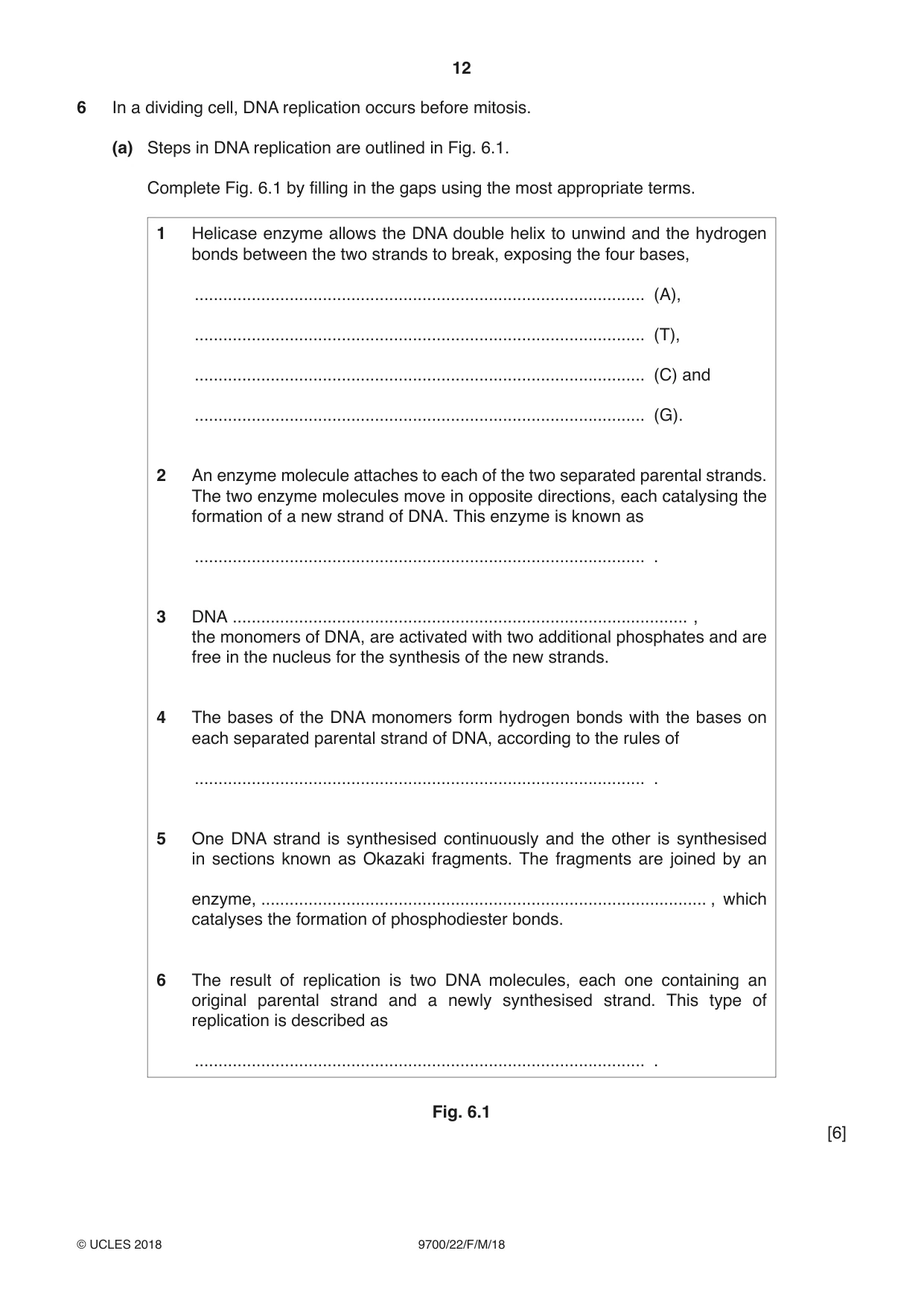
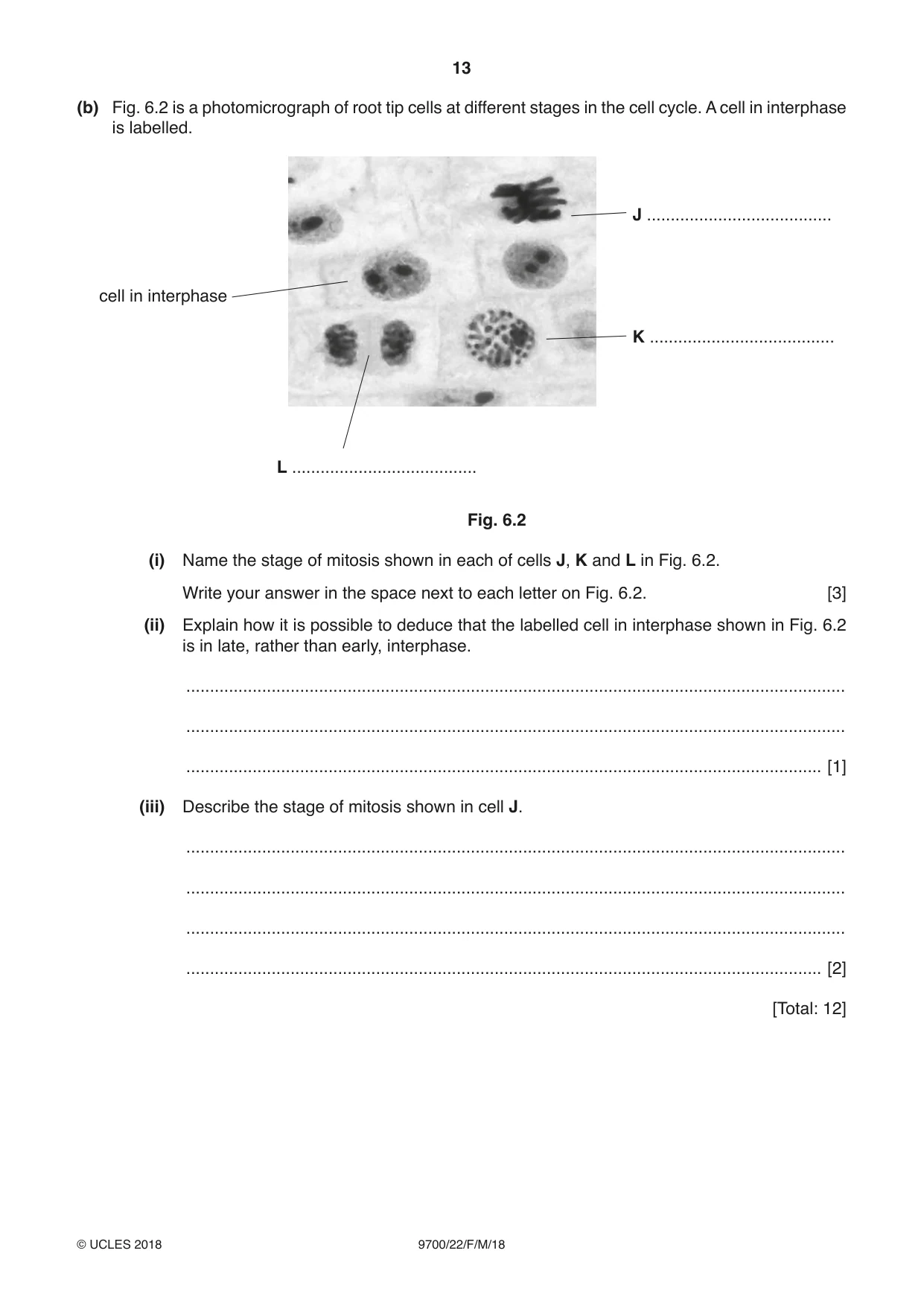
6 In a dividing cell, DNA replication occurs before mitosis. (a) Steps in DNA replication are outlined in Fig. 6.1. Complete Fig. 6.1 by filling in the gaps using the most appropriate terms. 1 Helicase enzyme allows the DNA double helix to unwind and the hydrogen bonds between the two strands to break, exposing the four bases, ............................................................................................... (A), ............................................................................................... (T), ............................................................................................... (C) and ............................................................................................... (G). 2 An enzyme molecule attaches to each of the two separated parental strands. The two enzyme molecules move in opposite directions, each catalysing the formation of a new strand of DNA. This enzyme is known as ............................................................................................... . 3 DNA ................................................................................................ , the monomers of DNA, are activated with two additional phosphates and are free in the nucleus for the synthesis of the new strands. 4 The bases of the DNA monomers form hydrogen bonds with the bases on each separated parental strand of DNA, according to the rules of ............................................................................................... . 5 One DNA strand is synthesised continuously and the other is synthesised in sections known as Okazaki fragments. The fragments are joined by an enzyme, .............................................................................................. , which catalyses the formation of phosphodiester bonds. 6 The result of replication is two DNA molecules, each one containing an original parental strand and a newly synthesised strand. This type of replication is described as ............................................................................................... . Fig. 6.1 [6] (b) Fig. 6.2 is a photomicrograph of root tip cells at different stages in the cell cycle. A cell in interphase is labelled. J ....................................... cell in interphase K ....................................... L ....................................... Fig. 6.2 (i) Name the stage of mitosis shown in each of cells J, K and L in Fig. 6.2. Write your answer in the space next to each letter on Fig. 6.2. [3] (ii) Explain how it is possible to deduce that the labelled cell in interphase shown in Fig. 6.2 is in late, rather than early, interphase. ........................................................................................................................................... ........................................................................................................................................... ...................................................................................................................................... [1] (iii) Describe the stage of mitosis shown in cell J. ........................................................................................................................................... ........................................................................................................................................... ........................................................................................................................................... ...................................................................................................................................... [2] [Total: 12]
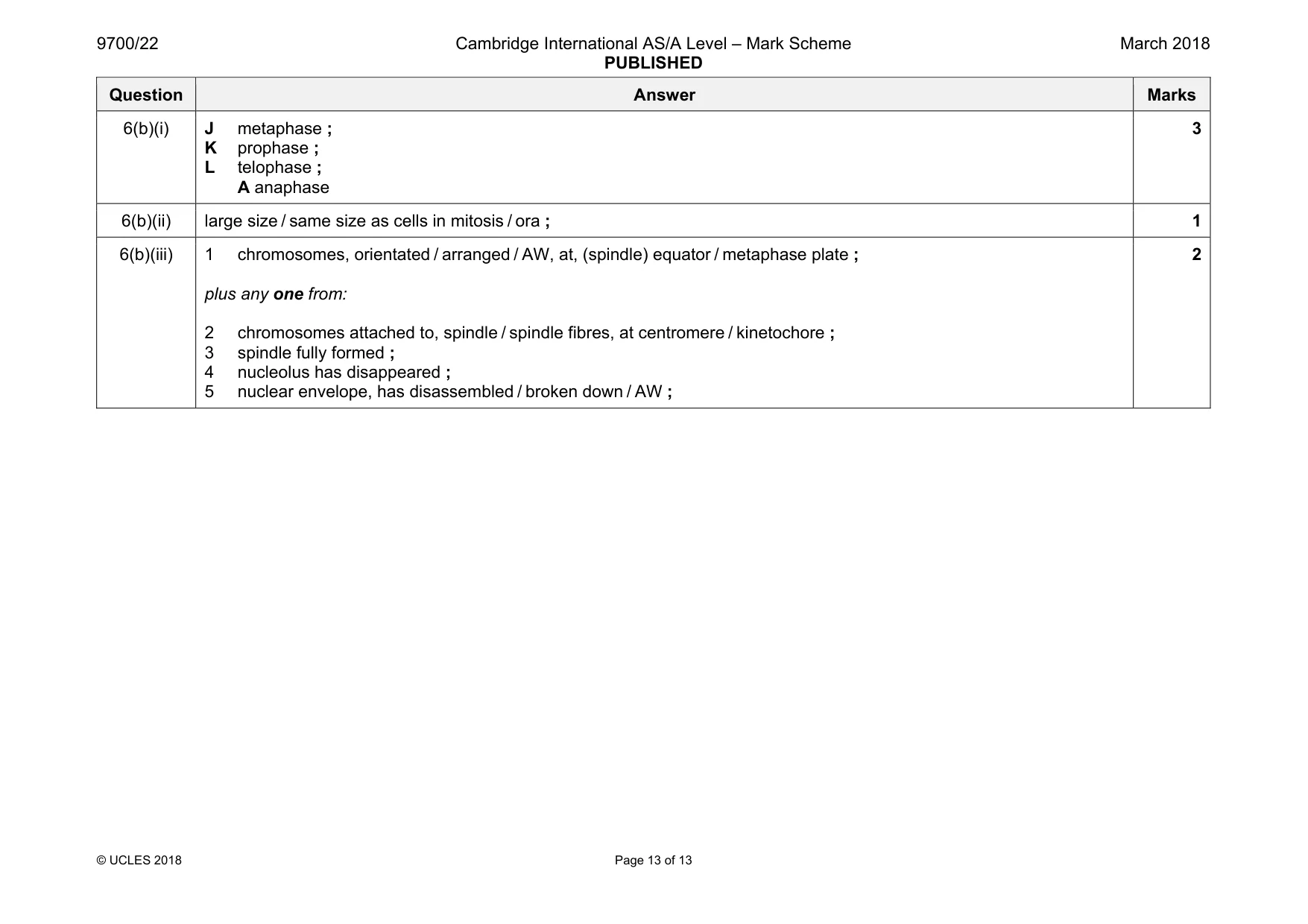
Mark scheme: 6(a) 1 adenine, thymine, cytosine, guanine ; 2 DNA polymerase ; 3 nucleotides ; 4 complementary base pairing ; 5 (DNA) ligase ; 6 semi-conservative (replication) ; 6 Question Answer Marks 6(b)(i) J metaphase ; K prophase ; L telophase ; A anaphase 3 6(b)(ii) large size / same size as cells in mitosis / ora ; 1 6(b)(iii) 1 chromosomes, orientated / arranged / AW, at, (spindle) equator / metaphase plate ; plus any one from: 2 chromosomes attached to, spindle / spindle fibres, at centromere / kinetochore ; 3 spindle fully formed ; 4 nucleolus has disappeared ; 5 nuclear envelope, has disassembled / broken down / AW ; 2
More questions on Structure of nucleic acids and replication of DNA
What was in this paper
The subtopics covered by these 6 questions, and how many questions each got. Open one in a new tab to see every Cambridge question on it.
What you needed in this session
Cambridge’s own grade thresholds for 2018 Feb/March, Paper 2 · Variant 2. A higher threshold means an easier paper — the bar moves with how the cohort did.