Cambridge A Level Biology 9700 — 2016 Oct/Nov Paper 5 · Variant 1
9700/51/O/N/16 · 30 marks · ≈34 min
The question paper and its mark scheme, free to read here and free to download. This is Cambridge’s own paper, exactly as it was sat.
Question paper12 pages

Mark scheme6 pages
Answers below. Sit the paper first if you are practising.
Paper as text
Question paper, page 1
This document consists of 10 printed pages and 2 blank pages. DC (LK/SW) 109114/4 © UCLES 2016 [Turn over Cambridge International Examinations Cambridge International Advanced Subsidiary and Advanced Level * 5 8 1 8 9 9 1 4 5 8 * BIOLOGY 9700/51 Paper 5 Planning, Analysis and Evaluation October/November 2016 1 hour 15 minutes Candidates answer on the Question Paper. No Additional Materials are required. READ THESE INSTRUCTIONS FIRST Write your Centre number, candidate number and name on all the work you hand in. Write in dark blue or black pen. You may use an HB pencil for any diagrams or graphs. Do not use staples, paper clips, glue or correction fluid. DO NOT WRITE IN ANY BARCODES. Answer all questions. Electronic calculators may be used. You may lose marks if you do not show your working or if you do not use appropriate units. At the end of the examination, fasten all your work securely together. The number of marks is given in brackets [ ] at the end of each question or part question.
Question paper, page 2
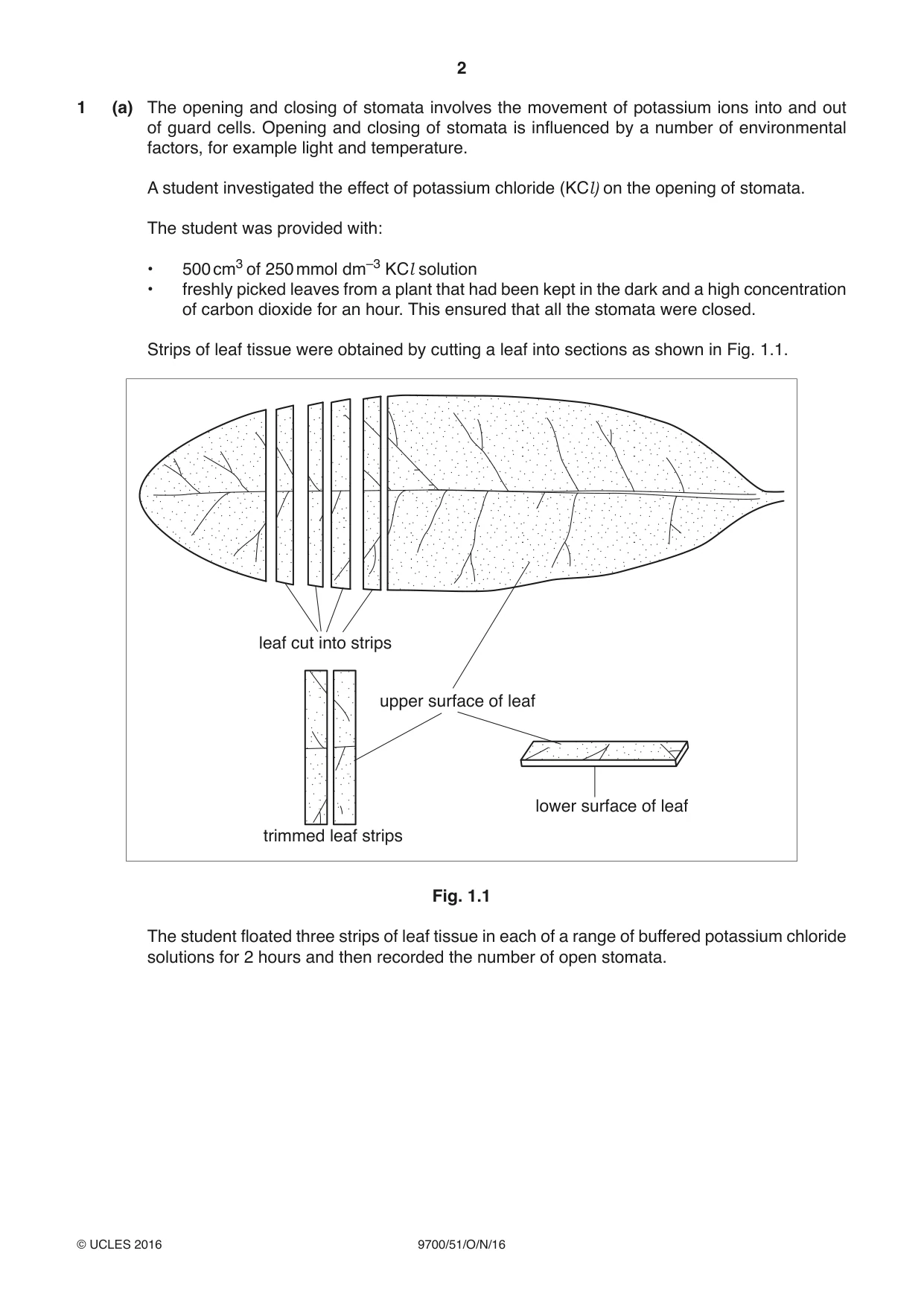
2 9700/51/O/N/16 © UCLES 2016 1 (a) The opening and closing of stomata involves the movement of potassium ions into and out of guard cells. Opening and closing of stomata is influenced by a number of environmental factors, for example light and temperature. A student investigated the effect of potassium chloride (KCl) on the opening of stomata. The student was provided with: • 500 cm3 of 250 mmol dm–3 KCl solution • freshly picked leaves from a plant that had been kept in the dark and a high concentration of carbon dioxide for an hour. This ensured that all the stomata were closed. Strips of leaf tissue were obtained by cutting a leaf into sections as shown in Fig. 1.1. leaf cut into strips upper surface of leaf trimmed leaf strips lower surface of leaf Fig. 1.1 The student floated three strips of leaf tissue in each of a range of buffered potassium chloride solutions for 2 hours and then recorded the number of open stomata.
Question paper, page 3
3 9700/51/O/N/16 © UCLES 2016 [Turn over (i) Identify the independent and dependent variables in this investigation. independent variable … … dependent variable … …[2] (ii) The student used the 250 mmol dm–3 KCl solution to make 100 cm3 of four other concentrations by reducing the concentration by 50 mmol dm–3 each time. Describe a procedure that the student could use to prepare these four concentrations. … … … … … … … … …[3] (b) (i) Suggest a hypothesis that the student could test about the effect of KCl on the opening and closing of stomata. … … …[1]
Question paper, page 4
4 9700/51/O/N/16 © UCLES 2016 (ii) Describe a method that the student could use to investigate the effect of different concentrations of KCl on the opening of stomata. The description of your method should be detailed enough for another person to follow and should not repeat the details from (a)(ii) of how to dilute the 250 mmol dm–3 solution of KCl. … … … … … … … … … … … … … … … … … … … … … … … … …[5]
Question paper, page 5
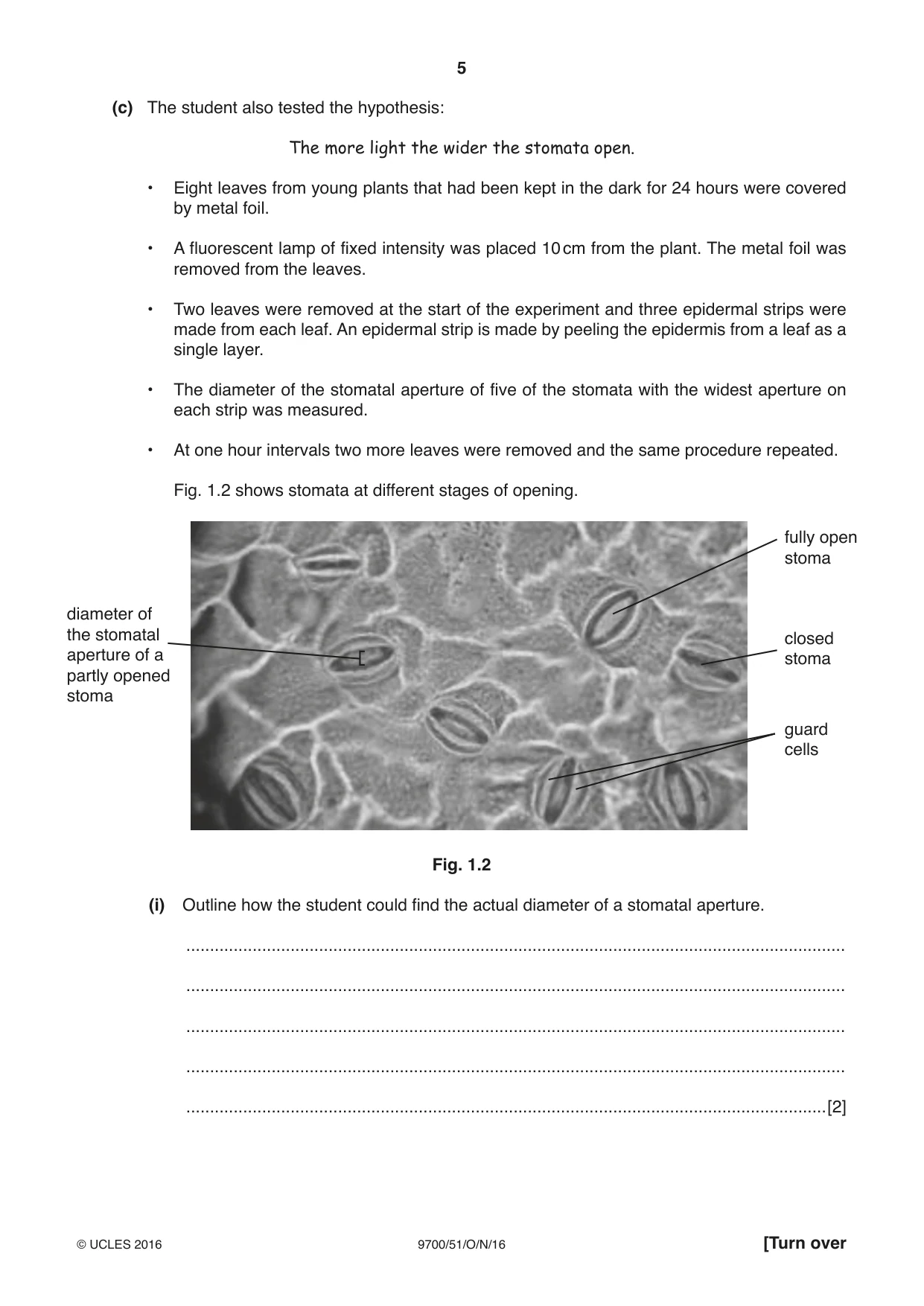
5 9700/51/O/N/16 © UCLES 2016 [Turn over (c) The student also tested the hypothesis: The more light the wider the stomata open. • Eight leaves from young plants that had been kept in the dark for 24 hours were covered by metal foil. • A fluorescent lamp of fixed intensity was placed 10 cm from the plant. The metal foil was removed from the leaves. • Two leaves were removed at the start of the experiment and three epidermal strips were made from each leaf. An epidermal strip is made by peeling the epidermis from a leaf as a single layer. • The diameter of the stomatal aperture of five of the stomata with the widest aperture on each strip was measured. • At one hour intervals two more leaves were removed and the same procedure repeated. Fig. 1.2 shows stomata at different stages of opening. diameter of the stomatal aperture of a partly opened stoma fully open stoma closed stoma guard cells Fig. 1.2 (i) Outline how the student could find the actual diameter of a stomatal aperture. … … … … …[2]
Question paper, page 6
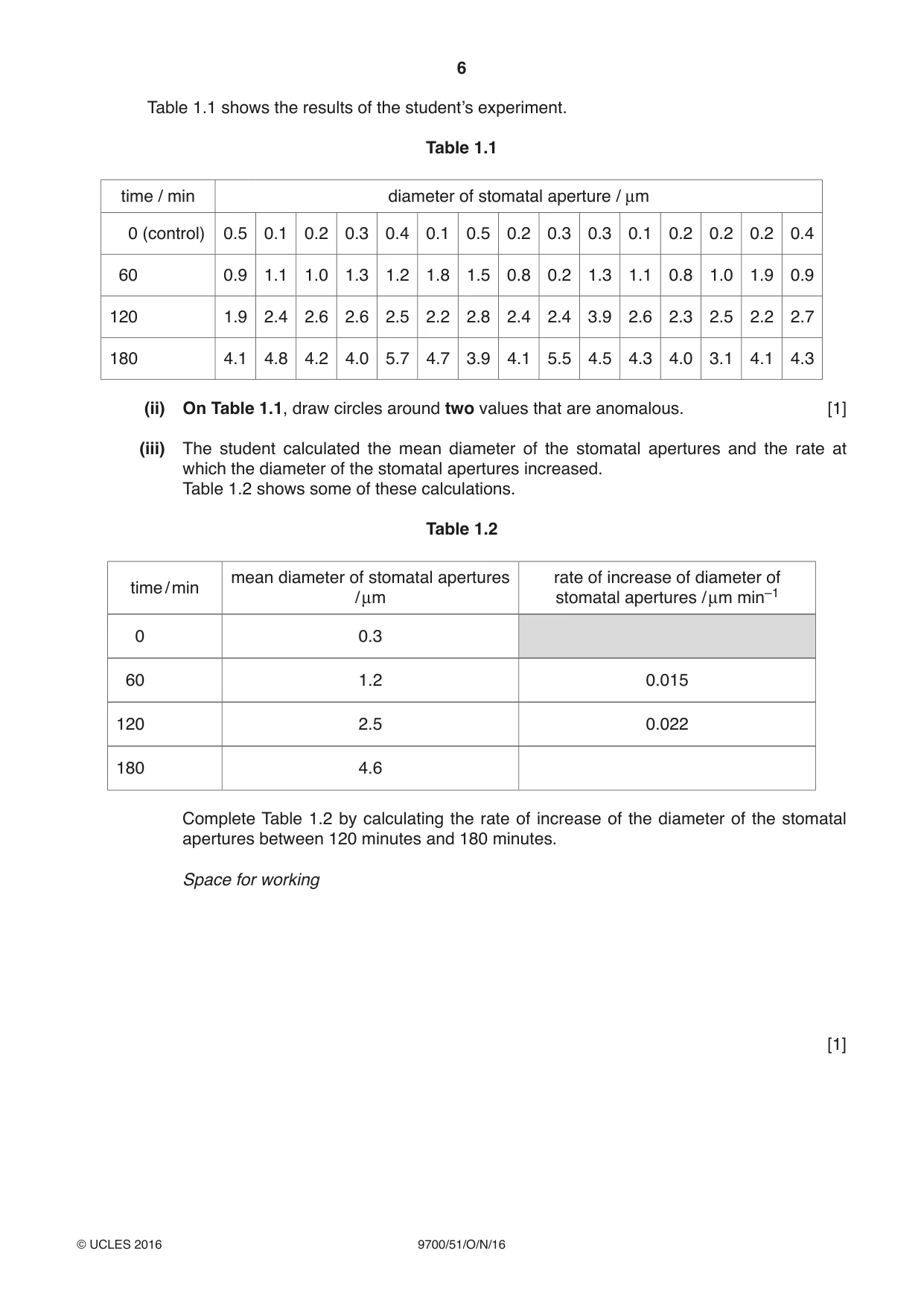
6 9700/51/O/N/16 © UCLES 2016 Table 1.1 shows the results of the student’s experiment. Table 1.1 time / min diameter of stomatal aperture / μm 0 (control) 0.5 0.1 0.2 0.3 0.4 0.1 0.5 0.2 0.3 0.3 0.1 0.2 0.2 0.2 0.4 60 0.9 1.1 1.0 1.3 1.2 1.8 1.5 0.8 0.2 1.3 1.1 0.8 1.0 1.9 0.9 120 1.9 2.4 2.6 2.6 2.5 2.2 2.8 2.4 2.4 3.9 2.6 2.3 2.5 2.2 2.7 180 4.1 4.8 4.2 4.0 5.7 4.7 3.9 4.1 5.5 4.5 4.3 4.0 3.1 4.1 4.3 (ii) On Table 1.1, draw circles around two values that are anomalous. [1] (iii) The student calculated the mean diameter of the stomatal apertures and the rate at which the diameter of the stomatal apertures increased. Table 1.2 shows some of these calculations. Table 1.2 time / min mean diameter of stomatal apertures / μm rate of increase of diameter of stomatal apertures / μm min–1 0 0.3 60 1.2 0.015 120 2.5 0.022 180 4.6 Complete Table 1.2 by calculating the rate of increase of the diameter of the stomatal apertures between 120 minutes and 180 minutes. Space for working [1]
Question paper, page 7
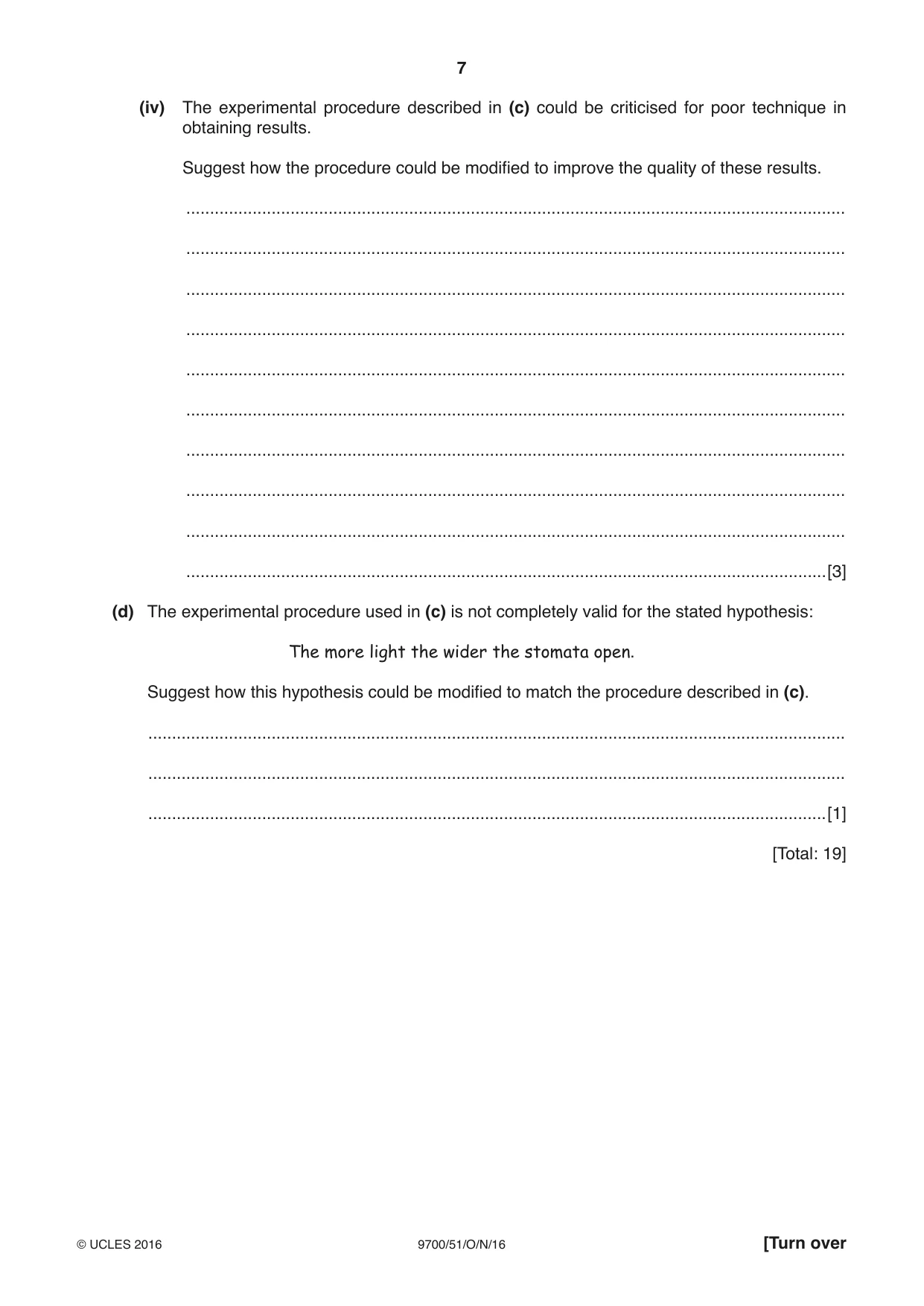
7 9700/51/O/N/16 © UCLES 2016 [Turn over (iv) The experimental procedure described in (c) could be criticised for poor technique in obtaining results. Suggest how the procedure could be modified to improve the quality of these results. … … … … … … … … … …[3] (d) The experimental procedure used in (c) is not completely valid for the stated hypothesis: The more light the wider the stomata open. Suggest how this hypothesis could be modified to match the procedure described in (c). … … …[1] [Total: 19]
Question paper, page 8
8 9700/51/O/N/16 © UCLES 2016 BLANK PAGE
Question paper, page 9
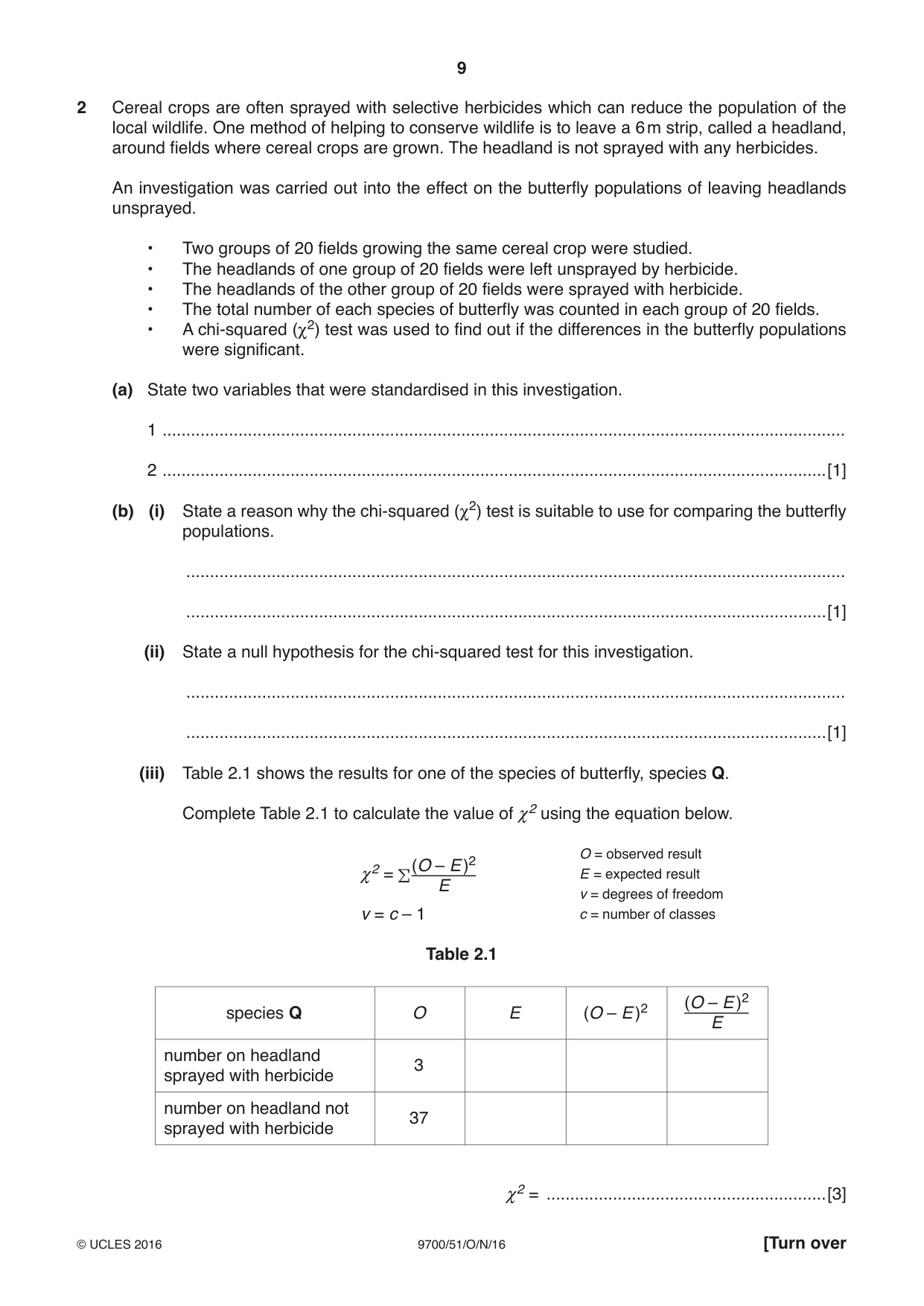
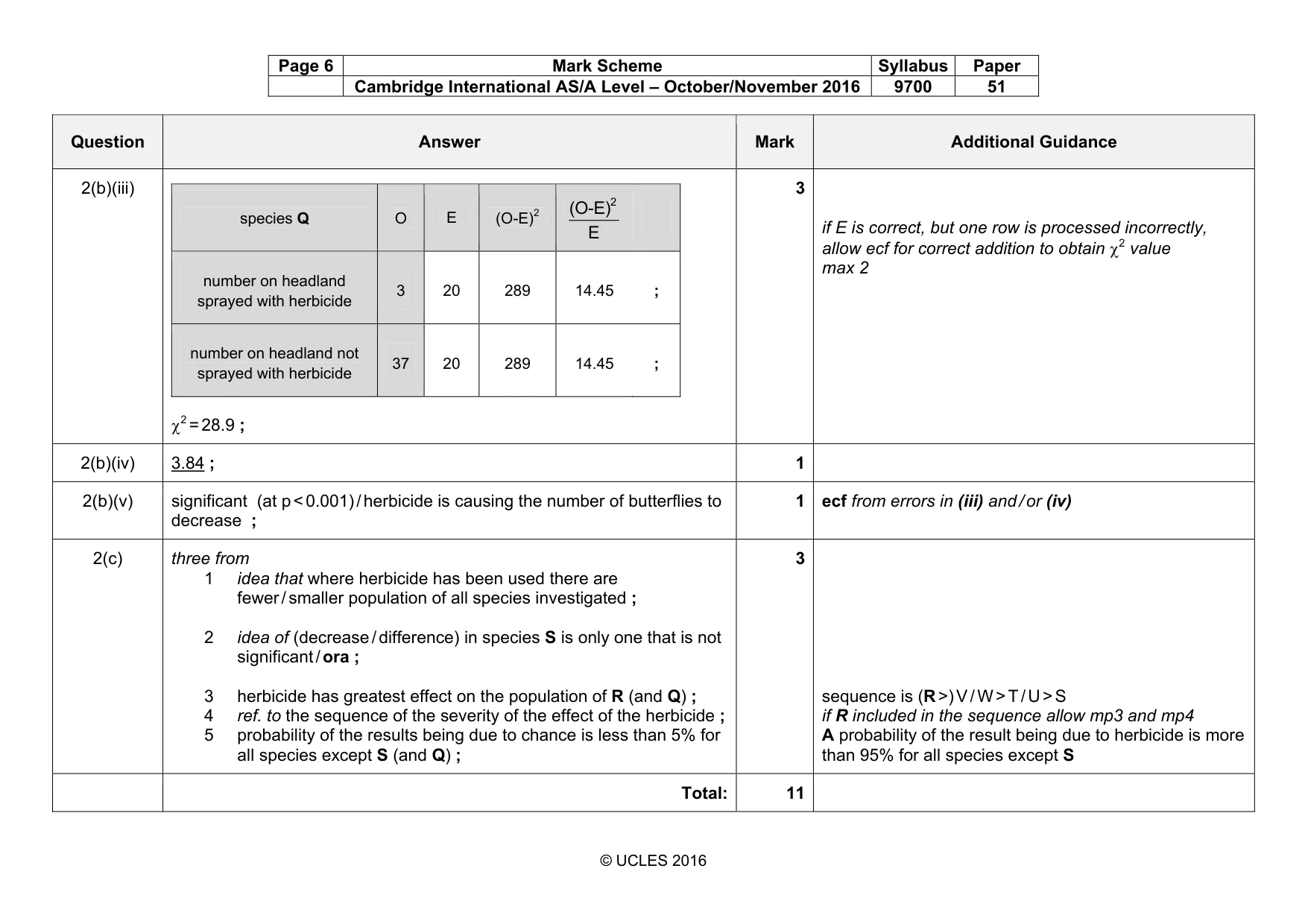
9 9700/51/O/N/16 © UCLES 2016 [Turn over 2 Cereal crops are often sprayed with selective herbicides which can reduce the population of the local wildlife. One method of helping to conserve wildlife is to leave a 6 m strip, called a headland, around fields where cereal crops are grown. The headland is not sprayed with any herbicides. An investigation was carried out into the effect on the butterfly populations of leaving headlands unsprayed. • Two groups of 20 fields growing the same cereal crop were studied. • The headlands of one group of 20 fields were left unsprayed by herbicide. • The headlands of the other group of 20 fields were sprayed with herbicide. • The total number of each species of butterfly was counted in each group of 20 fields. • A chi-squared (χ2) test was used to find out if the differences in the butterfly populations were significant. (a) State two variables that were standardised in this investigation. 1 … 2 …[1] (b) (i) State a reason why the chi-squared (χ2) test is suitable to use for comparing the butterfly populations. … …[1] (ii) State a null hypothesis for the chi-squared test for this investigation. … …[1] (iii) Table 2.1 shows the results for one of the species of butterfly, species Q. Complete Table 2.1 to calculate the value of χ 2 using the equation below. χ 2 = ! (O – E )2 E O = observed result E = expected result v = degrees of freedom c = number of classes v = c – 1 Table 2.1 species Q O E (O – E )2 (O – E )2 E number on headland sprayed with herbicide 3 number on headland not sprayed with herbicide 37 χ 2 = …[3]
Question paper, page 10
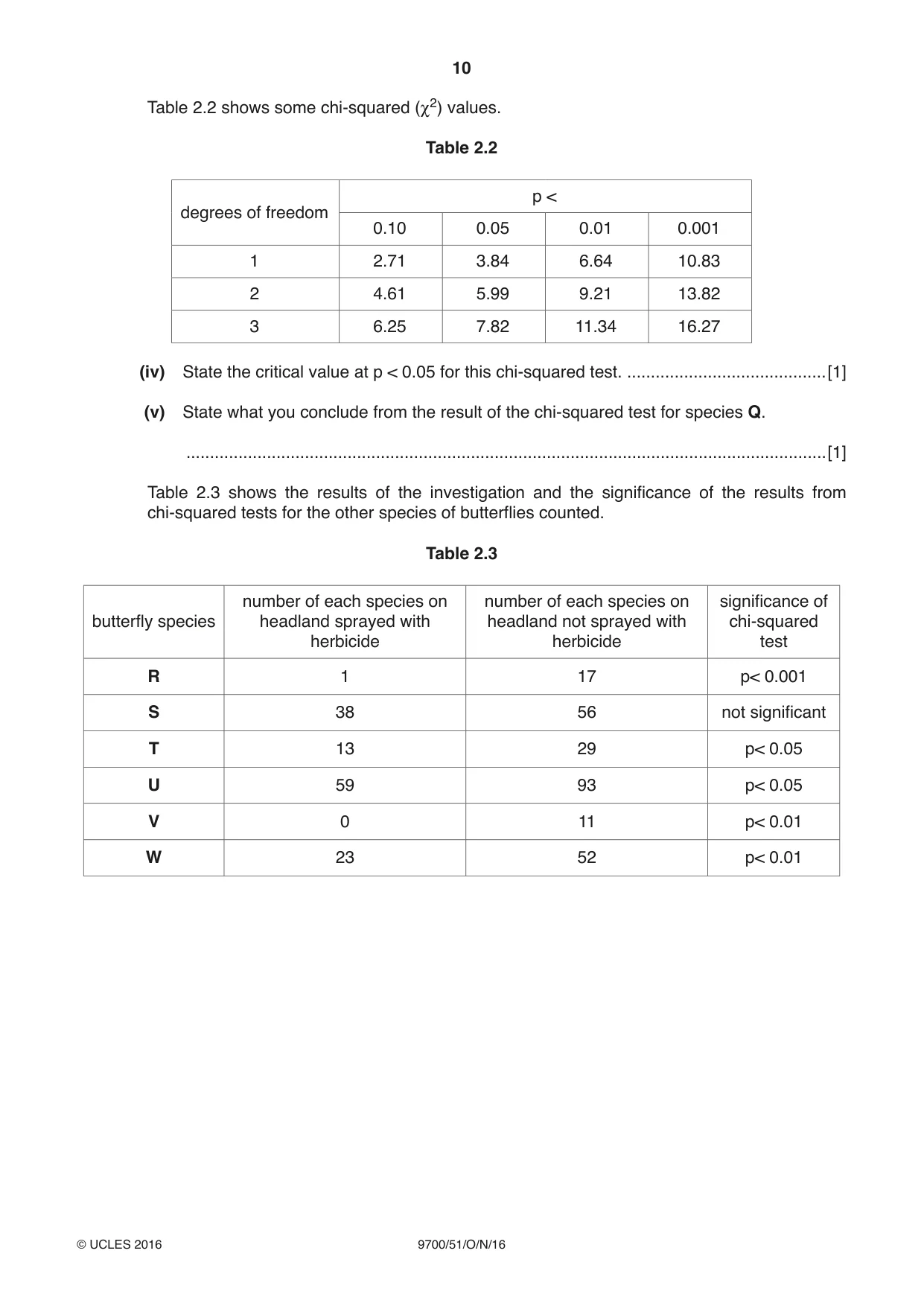
10 9700/51/O/N/16 © UCLES 2016 Table 2.2 shows some chi-squared (χ2) values. Table 2.2 degrees of freedom p < 0.10 0.05 0.01 0.001 1 2.71 3.84 6.64 10.83 2 4.61 5.99 9.21 13.82 3 6.25 7.82 11.34 16.27 (iv) State the critical value at p < 0.05 for this chi-squared test. …[1] (v) State what you conclude from the result of the chi-squared test for species Q. …[1] Table 2.3 shows the results of the investigation and the significance of the results from chi-squared tests for the other species of butterflies counted. Table 2.3 butterfly species number of each species on headland sprayed with herbicide number of each species on headland not sprayed with herbicide significance of chi-squared test R 1 17 p< 0.001 S 38 56 not significant T 13 29 p< 0.05 U 59 93 p< 0.05 V 0 11 p< 0.01 W 23 52 p< 0.01
Question paper, page 11
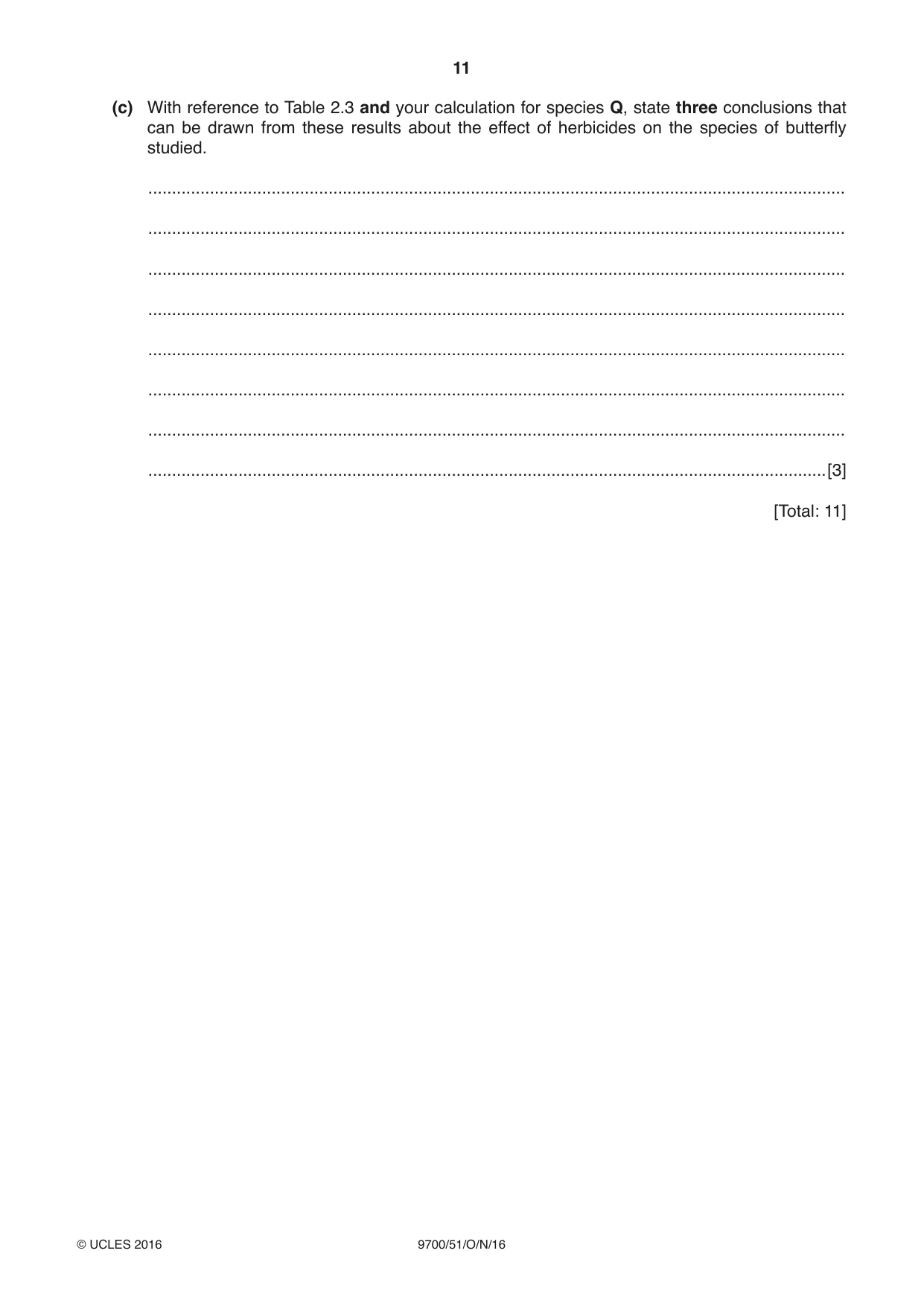
11 9700/51/O/N/16 © UCLES 2016 (c) With reference to Table 2.3 and your calculation for species Q, state three conclusions that can be drawn from these results about the effect of herbicides on the species of butterfly studied. … … … … … … … …[3] [Total: 11]
Question paper, page 12
12 9700/51/O/N/16 © UCLES 2016 BLANK PAGE Permission to reproduce items where third-party owned material protected by copyright is included has been sought and cleared where possible. Every reasonable effort has been made by the publisher (UCLES) to trace copyright holders, but if any items requiring clearance have unwittingly been included, the publisher will be pleased to make amends at the earliest possible opportunity. To avoid the issue of disclosure of answer-related information to candidates, all copyright acknowledgements are reproduced online in the Cambridge International Examinations Copyright Acknowledgements Booklet. This is produced for each series of examinations and is freely available to download at www.cie.org.uk after the live examination series. Cambridge International Examinations is part of the Cambridge Assessment Group. Cambridge Assessment is the brand name of University of Cambridge Local Examinations Syndicate (UCLES), which is itself a department of the University of Cambridge.
Mark scheme, page 1
® IGCSE is the registered trademark of Cambridge International Examinations. This document consists of 6 printed pages. © UCLES 2016 [Turn over Cambridge International Examinations Cambridge International Advanced Subsidiary and Advanced Level BIOLOGY 9700/51 Paper 5 Planning, Analysis and Evaluation October/November 2016 MARK SCHEME Maximum Mark: 30 Published This mark scheme is published as an aid to teachers and candidates, to indicate the requirements of the examination. It shows the basis on which Examiners were instructed to award marks. It does not indicate the details of the discussions that took place at an Examiners’ meeting before marking began, which would have considered the acceptability of alternative answers. Mark schemes should be read in conjunction with the question paper and the Principal Examiner Report for Teachers. Cambridge will not enter into discussions about these mark schemes. Cambridge is publishing the mark schemes for the October/November 2016 series for most Cambridge IGCSE®, Cambridge International A and AS Level components and some Cambridge O Level components.
Mark scheme, page 2
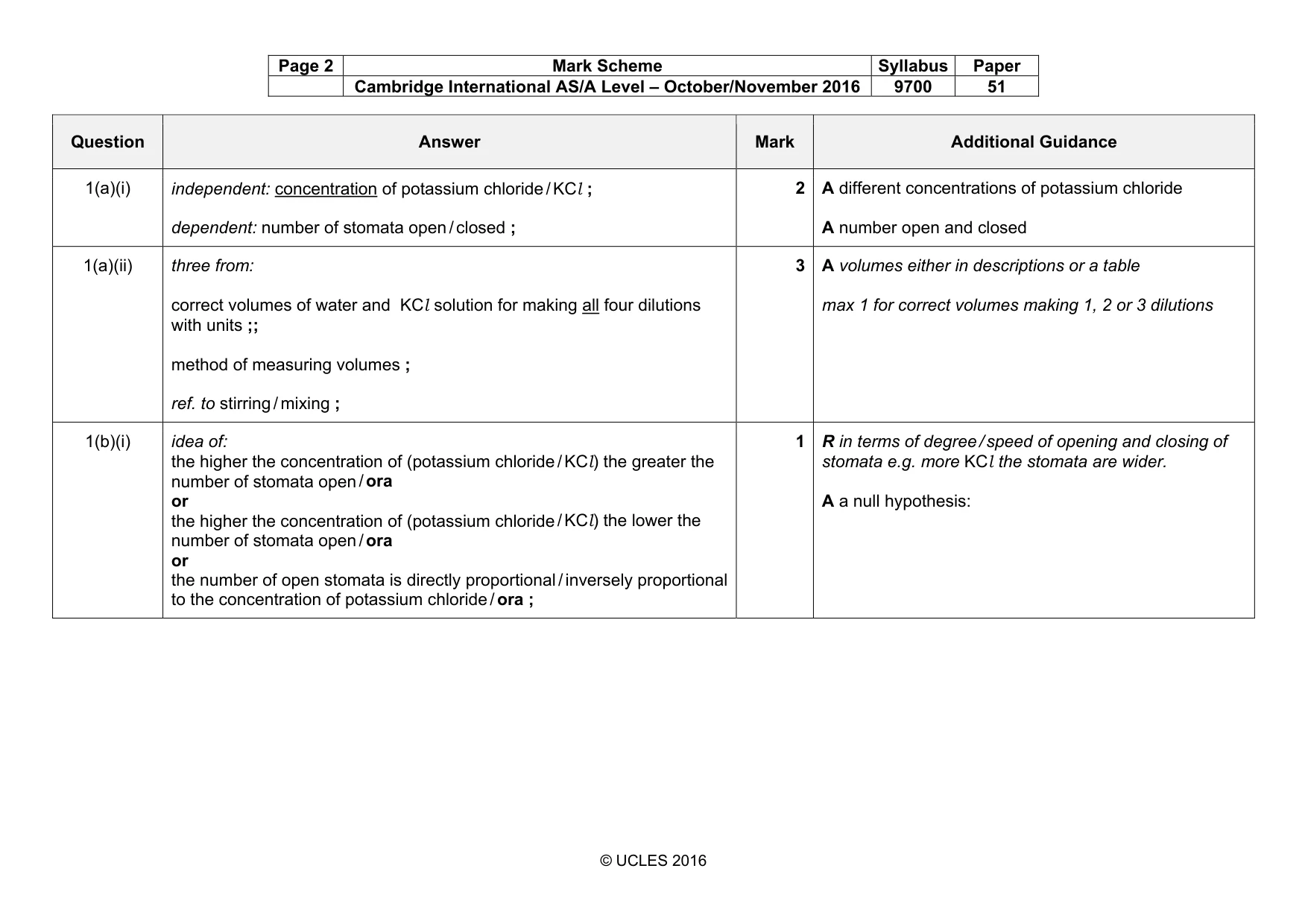
Page 2 Mark Scheme Syllabus Paper Cambridge International AS/A Level – October/November 2016 9700 51 © UCLES 2016 Question Answer Mark Additional Guidance 1(a)(i) independent: concentration of potassium chloride / KCl ; dependent: number of stomata open / closed ; 2 A different concentrations of potassium chloride A number open and closed 1(a)(ii) three from: correct volumes of water and KCl solution for making all four dilutions with units ;; method of measuring volumes ; ref. to stirring / mixing ; 3 A volumes either in descriptions or a table max 1 for correct volumes making 1, 2 or 3 dilutions 1(b)(i) idea of: the higher the concentration of (potassium chloride / KCl) the greater the number of stomata open / ora or the higher the concentration of (potassium chloride / KCl) the lower the number of stomata open / ora or the number of open stomata is directly proportional / inversely proportional to the concentration of potassium chloride / ora ; 1 R in terms of degree / speed of opening and closing of stomata e.g. more KCl the stomata are wider. A a null hypothesis:
Mark scheme, page 3
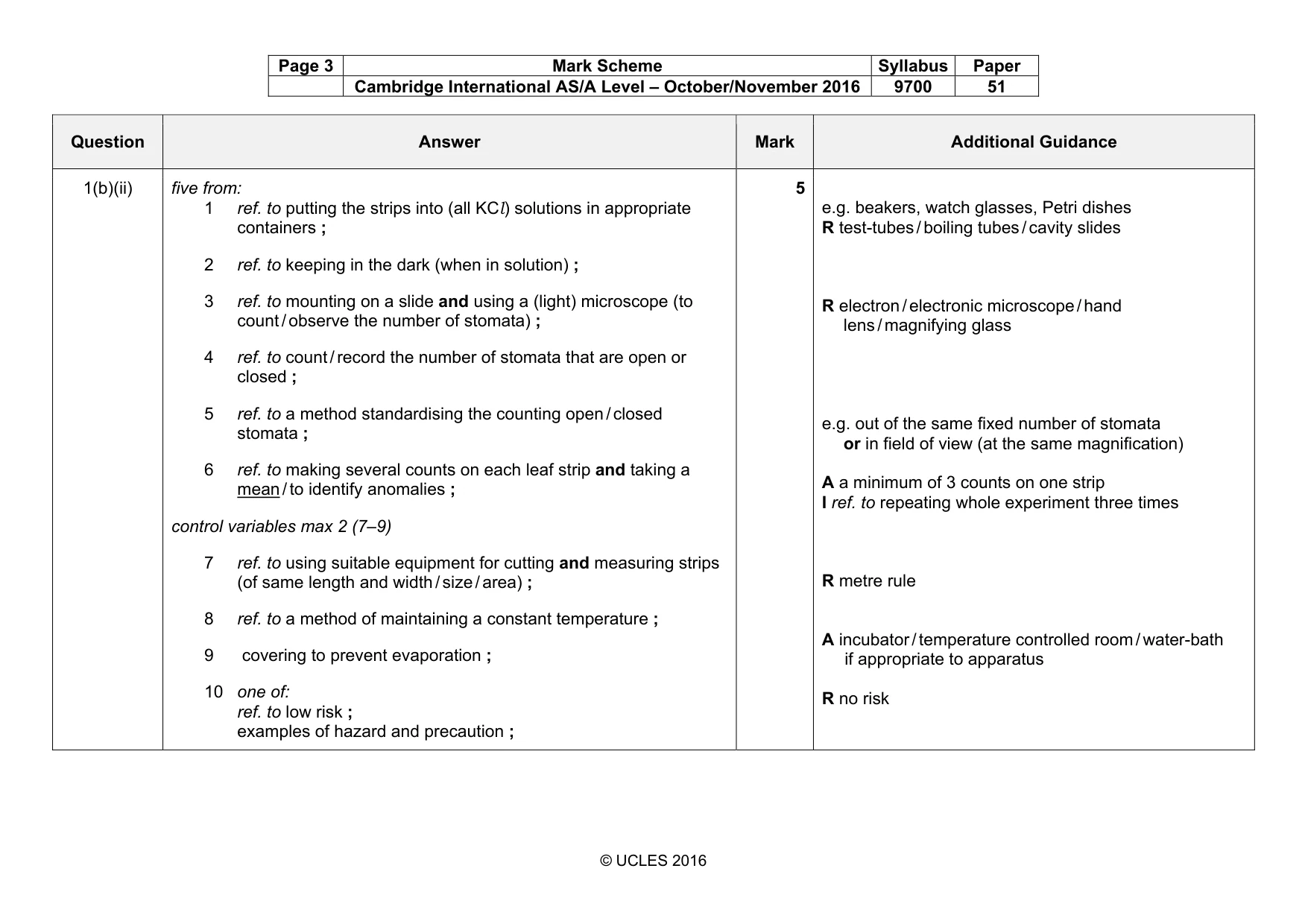
Page 3 Mark Scheme Syllabus Paper Cambridge International AS/A Level – October/November 2016 9700 51 © UCLES 2016 Question Answer Mark Additional Guidance 1(b)(ii) five from: 1 ref. to putting the strips into (all KCl) solutions in appropriate containers ; 2 ref. to keeping in the dark (when in solution) ; 3 ref. to mounting on a slide and using a (light) microscope (to count / observe the number of stomata) ; 4 ref. to count / record the number of stomata that are open or closed ; 5 ref. to a method standardising the counting open / closed stomata ; 6 ref. to making several counts on each leaf strip and taking a mean / to identify anomalies ; control variables max 2 (7–9) 7 ref. to using suitable equipment for cutting and measuring strips (of same length and width / size / area) ; 8 ref. to a method of maintaining a constant temperature ; 9 covering to prevent evaporation ; 10 one of: ref. to low risk ; examples of hazard and precaution ; 5 e.g. beakers, watch glasses, Petri dishes R test-tubes / boiling tubes / cavity slides R electron / electronic microscope / hand lens / magnifying glass e.g. out of the same fixed number of stomata or in field of view (at the same magnification) A a minimum of 3 counts on one strip I ref. to repeating whole experiment three times R metre rule A incubator / temperature controlled room / water-bath if appropriate to apparatus R no risk
Mark scheme, page 4
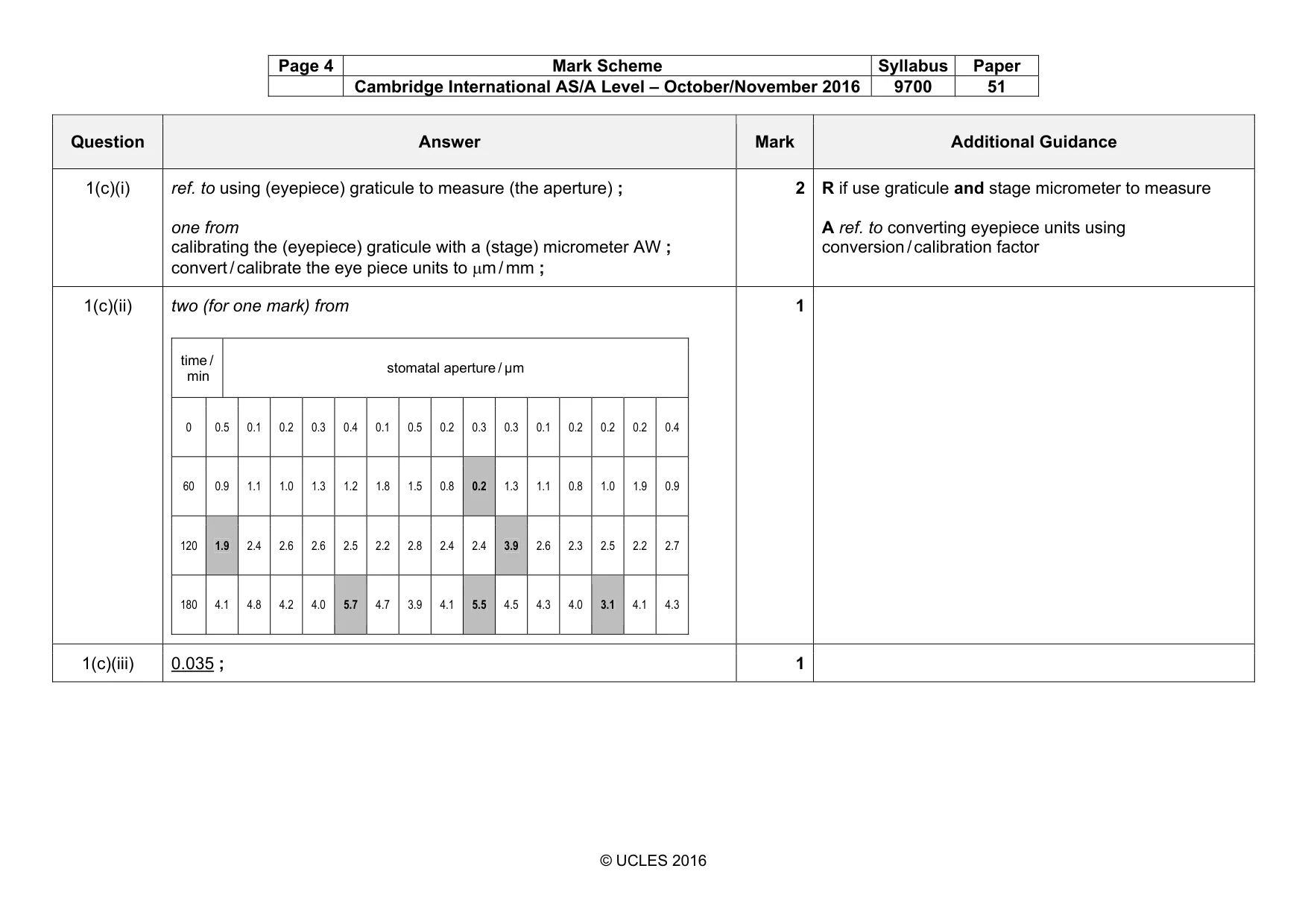
Page 4 Mark Scheme Syllabus Paper Cambridge International AS/A Level – October/November 2016 9700 51 © UCLES 2016 Question Answer Mark Additional Guidance 1(c)(i) ref. to using (eyepiece) graticule to measure (the aperture) ; one from calibrating the (eyepiece) graticule with a (stage) micrometer AW ; convert / calibrate the eye piece units to µm / mm ; 2 R if use graticule and stage micrometer to measure A ref. to converting eyepiece units using conversion / calibration factor 1(c)(ii) two (for one mark) from time / min stomatal aperture / µm 0 0.5 0.1 0.2 0.3 0.4 0.1 0.5 0.2 0.3 0.3 0.1 0.2 0.2 0.2 0.4 60 0.9 1.1 1.0 1.3 1.2 1.8 1.5 0.8 0.2 1.3 1.1 0.8 1.0 1.9 0.9 120 1.9 2.4 2.6 2.6 2.5 2.2 2.8 2.4 2.4 3.9 2.6 2.3 2.5 2.2 2.7 180 4.1 4.8 4.2 4.0 5.7 4.7 3.9 4.1 5.5 4.5 4.3 4.0 3.1 4.1 4.3 1 1(c)(iii) 0.035 ; 1
Mark scheme, page 5
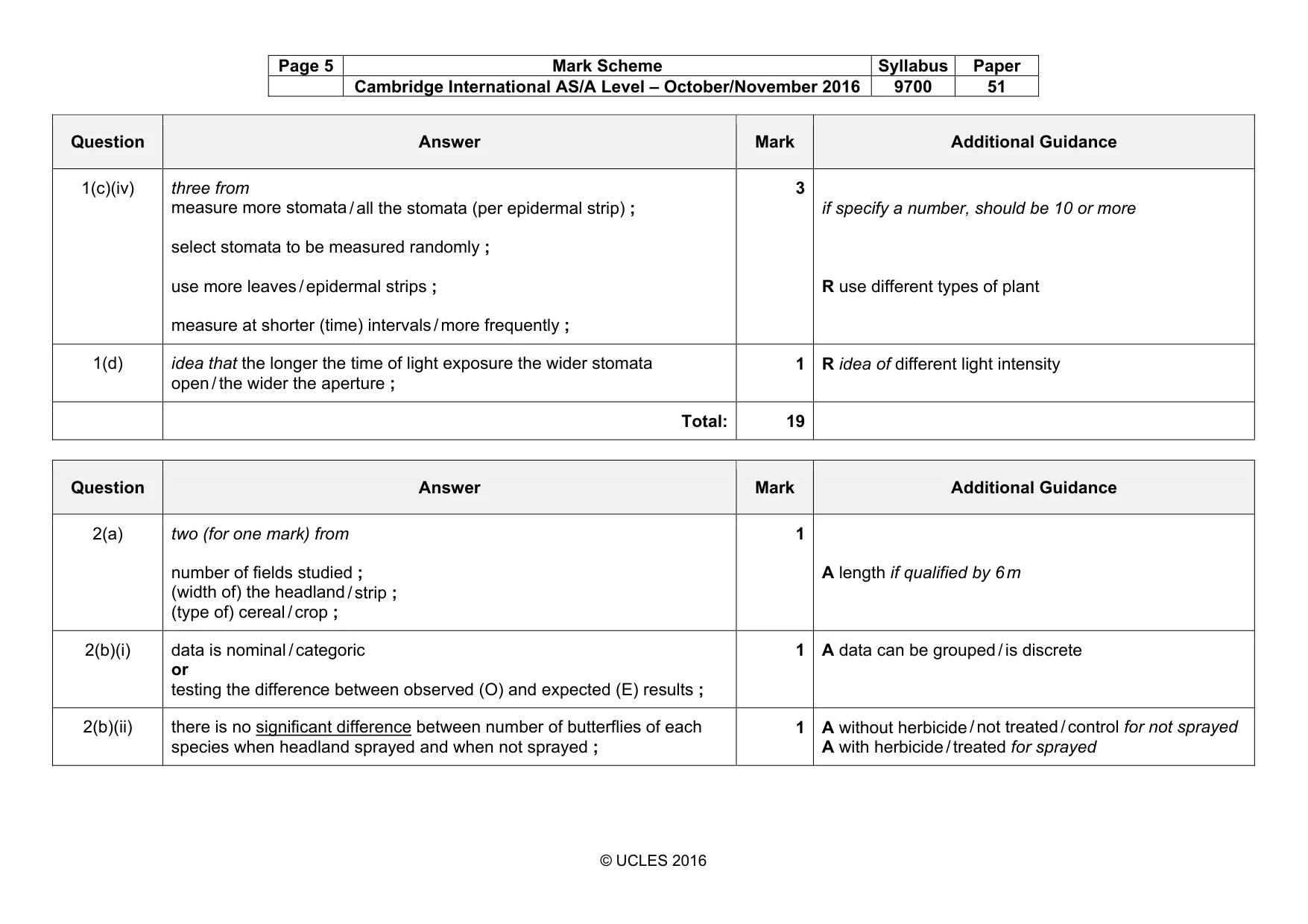
Page 5 Mark Scheme Syllabus Paper Cambridge International AS/A Level – October/November 2016 9700 51 © UCLES 2016 Question Answer Mark Additional Guidance 1(c)(iv) three from measure more stomata / all the stomata (per epidermal strip) ; select stomata to be measured randomly ; use more leaves / epidermal strips ; measure at shorter (time) intervals / more frequently ; 3 if specify a number, should be 10 or more R use different types of plant 1(d) idea that the longer the time of light exposure the wider stomata open / the wider the aperture ; 1 R idea of different light intensity Total: 19 Question Answer Mark Additional Guidance 2(a) two (for one mark) from number of fields studied ; (width of) the headland / strip ; (type of) cereal / crop ; 1 A length if qualified by 6 m 2(b)(i) data is nominal / categoric or testing the difference between observed (O) and expected (E) results ; 1 A data can be grouped / is discrete 2(b)(ii) there is no significant difference between number of butterflies of each species when headland sprayed and when not sprayed ; 1 A without herbicide / not treated / control for not sprayed A with herbicide / treated for sprayed
Mark scheme, page 6
Page 6 Mark Scheme Syllabus Paper Cambridge International AS/A Level – October/November 2016 9700 51 © UCLES 2016 Question Answer Mark Additional Guidance 2(b)(iii) χ2 = 28.9 ; species Q O E (O-E)2 2 (O-E) E number on headland sprayed with herbicide 3 20 289 14.45 ; number on headland not sprayed with herbicide 37 20 289 14.45 ; 3 if E is correct, but one row is processed incorrectly, allow ecf for correct addition to obtain χ2 value max 2 2(b)(iv) 3.84 ; 1 2(b)(v) significant (at p < 0.001) / herbicide is causing the number of butterflies to decrease ; 1 ecf from errors in (iii) and / or (iv) 2(c) three from 1 idea that where herbicide has been used there are fewer / smaller population of all species investigated ; 2 idea of (decrease / difference) in species S is only one that is not significant / ora ; 3 herbicide has greatest effect on the population of R (and Q) ; 4 ref. to the sequence of the severity of the effect of the herbicide ; 5 probability of the results being due to chance is less than 5% for all species except S (and Q) ; 3 sequence is (R >) V / W > T / U > S if R included in the sequence allow mp3 and mp4 A probability of the result being due to herbicide is more than 95% for all species except S Total: 11
What you needed in this session
Cambridge’s own grade thresholds for 2016 Oct/Nov, Paper 5 · Variant 1. A higher threshold means an easier paper — the bar moves with how the cohort did.