Cambridge A Level Biology 9700 — 2016 May/June Paper 4 · Variant 2
9700/42/M/J/16 · 100 marks · ≈113 min
The question paper and its mark scheme, free to read here and free to download. This is Cambridge’s own paper, exactly as it was sat.
Question paper24 pages


Mark scheme8 pages
Answers below. Sit the paper first if you are practising.
Paper as text
Question paper, page 1
This document consists of 22 printed pages and 2 lined pages. DC (NF/FD) 108515/3 © UCLES 2016 [Turn over Cambridge International Examinations Cambridge International Advanced Subsidiary and Advanced Level * 3 7 2 7 4 6 6 9 3 6 * BIOLOGY 9700/42 Paper 4 A Level Structured Questions May/June 2016 2 hours Candidates answer on the Question Paper. No Additional Materials are required. READ THESE INSTRUCTIONS FIRST Write your Centre number, candidate number and name on all the work you hand in. Write in dark blue or black pen. You may use an HB pencil for any diagrams or graphs. Do not use staples, paper clips, glue or correction fluid. DO NOT WRITE IN ANY BARCODES. Section A Answer all questions. Section B Answer one question. Electronic calculators may be used. You may lose marks if you do not show your working or if you do not use appropriate units. At the end of the examination, fasten all your work securely together. The number of marks is given in brackets [ ] at the end of each question or part question.
Question paper, page 2
2 9700/42/M/J/16 © UCLES 2016 Section A Answer all the questions. 1 (a) ATP and coenzyme A both play important roles in respiration. Fig. 1.1 represents the molecular structure of coenzyme A. mercapto - ethylamine P pantothenate P P Fig. 1.1 (i) With reference to Fig. 1.1, state two structural similarities between coenzyme A and ATP. 1 … 2 … [2] (ii) Describe the role of coenzyme A in respiration. … … … … … … … [3]
Question paper, page 3
3 9700/42/M/J/16 © UCLES 2016 [Turn over (b) Fig. 1.2 summarises the reactions that take place after glucose has entered a certain type of cell. glycogen phosphorylated glucose glucose other metabolic pathway cell reaction ) reaction * Fig. 1.2 (i) Suggest one type of cell in which the reactions shown in Fig. 1.2 could occur. … [1] (ii) State the mechanism by which glucose enters the cell. … [1] (iii) Name the type of reaction occurring at F and the type of reaction occurring at G. F … G … [2] (iv) With reference to Fig. 1.2, suggest one example of an ‘other metabolic pathway’ for phosphorylated glucose. … [1] [Total: 10]
Question paper, page 4
4 9700/42/M/J/16 © UCLES 2016 2 (a) Fig. 2.1 shows the effect of temperature on the rate of photosynthesis of a plant at low light intensity and at high light intensity. rate of photosynthesis high light intensity 0 5 10 15 20 low light intensity temperature / °C Fig. 2.1 With reference to Fig. 2.1, describe and explain the effect of temperature on the rate of photosynthesis. … … … … … … … … … … … [4]
Question paper, page 5
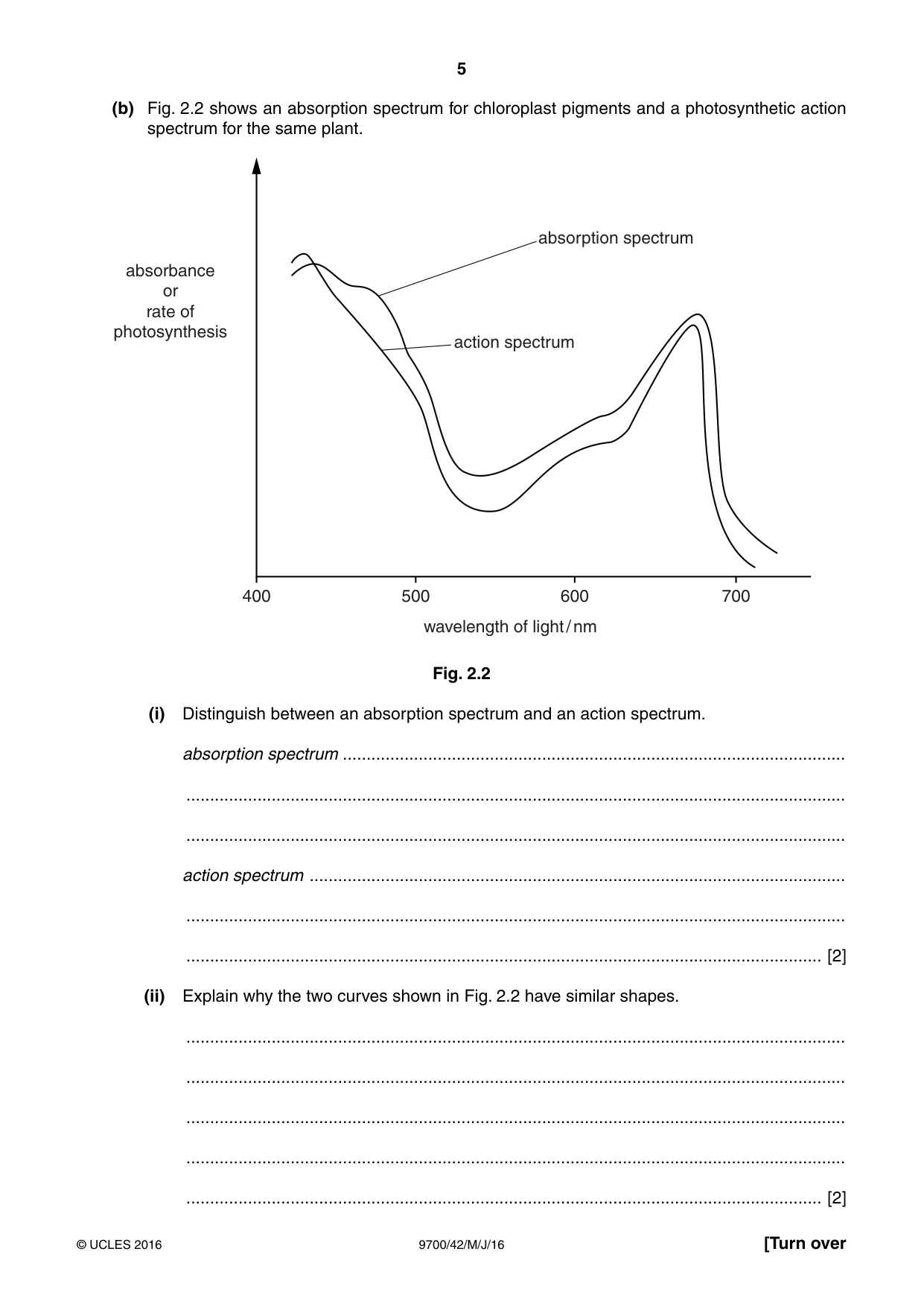
5 9700/42/M/J/16 © UCLES 2016 [Turn over (b) Fig. 2.2 shows an absorption spectrum for chloroplast pigments and a photosynthetic action spectrum for the same plant. 400 500 600 wavelength of light / nm action spectrum absorption spectrum absorbance or rate of photosynthesis 700 Fig. 2.2 (i) Distinguish between an absorption spectrum and an action spectrum. absorption spectrum … … … action spectrum … … … [2] (ii) Explain why the two curves shown in Fig. 2.2 have similar shapes. … … … … … [2]
Question paper, page 6
6 9700/42/M/J/16 © UCLES 2016 (c) Describe the role in photosynthesis of an accessory pigment, such as carotene. … … … … … [2] [Total: 10]
Question paper, page 7
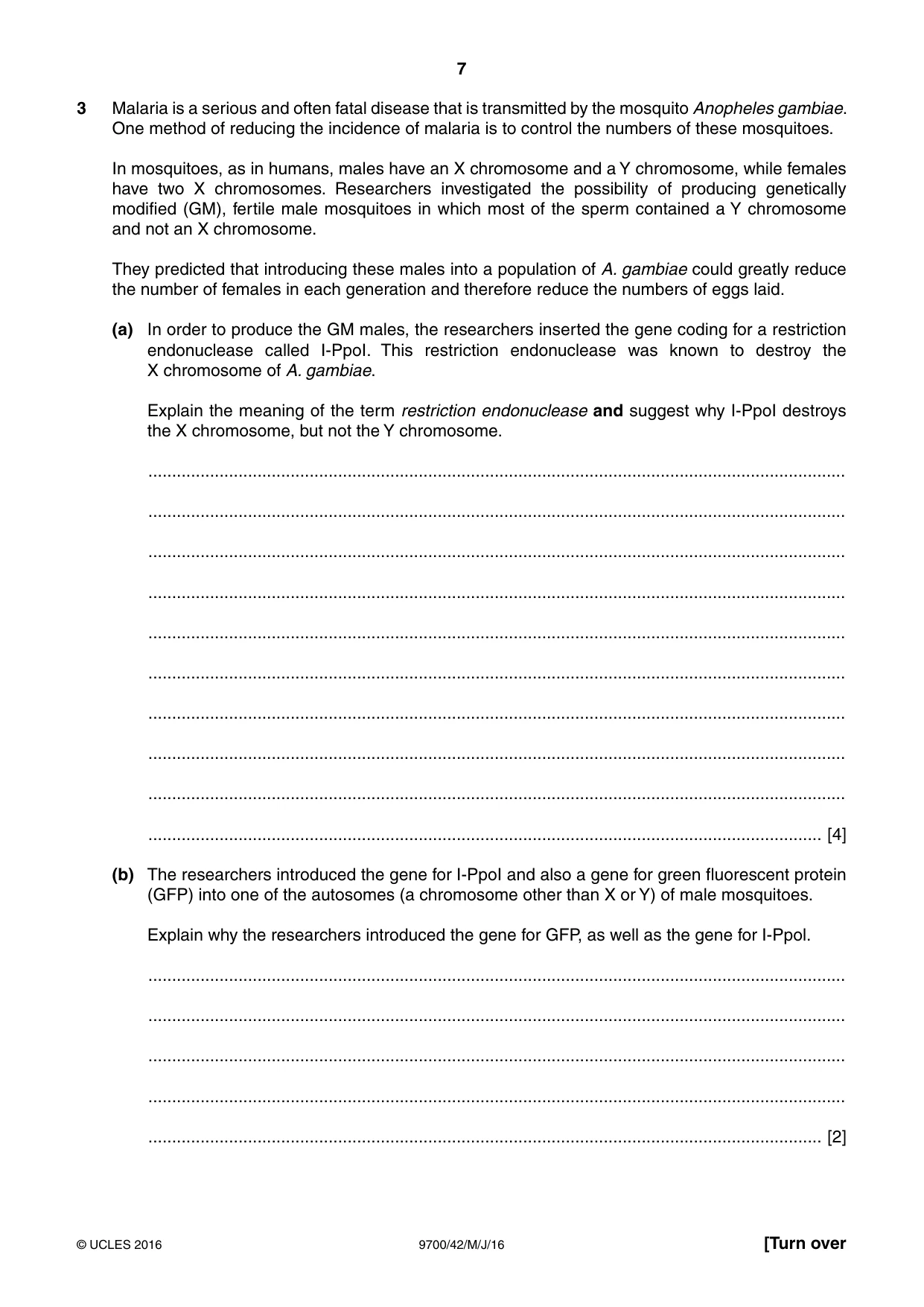
7 9700/42/M/J/16 © UCLES 2016 [Turn over 3 Malaria is a serious and often fatal disease that is transmitted by the mosquito Anopheles gambiae. One method of reducing the incidence of malaria is to control the numbers of these mosquitoes. In mosquitoes, as in humans, males have an X chromosome and a Y chromosome, while females have two X chromosomes. Researchers investigated the possibility of producing genetically modified (GM), fertile male mosquitoes in which most of the sperm contained a Y chromosome and not an X chromosome. They predicted that introducing these males into a population of A. gambiae could greatly reduce the number of females in each generation and therefore reduce the numbers of eggs laid. (a) In order to produce the GM males, the researchers inserted the gene coding for a restriction endonuclease called I-PpoI. This restriction endonuclease was known to destroy the X chromosome of A. gambiae. Explain the meaning of the term restriction endonuclease and suggest why I-PpoI destroys the X chromosome, but not the Y chromosome. … … … … … … … … … … [4] (b) The researchers introduced the gene for I-PpoI and also a gene for green fluorescent protein (GFP) into one of the autosomes (a chromosome other than X or Y) of male mosquitoes. Explain why the researchers introduced the gene for GFP, as well as the gene for I-Ppol. … … … … … [2]
Question paper, page 8
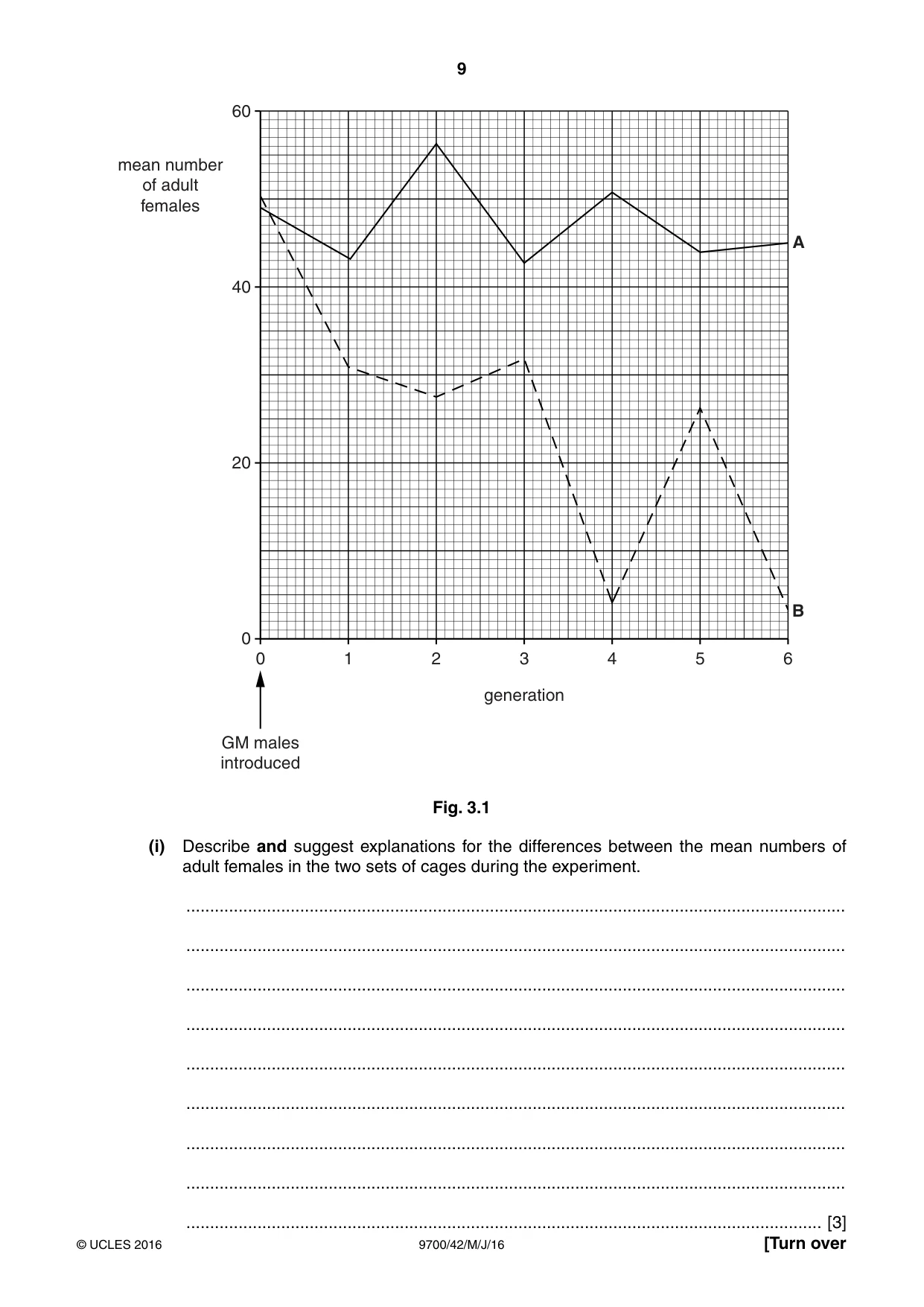
8 9700/42/M/J/16 © UCLES 2016 (c) The researchers found that I-Ppol destroyed the X chromosome during meiosis in the GM male mosquitoes. This prevented these males from producing sperm containing an X chromosome. However, I-PpoI was still active in zygotes produced by the fusion of female gametes with sperm containing a Y chromosome. Explain why this meant that the GM males produced no offspring at all. … … … … … [2] (d) The researchers modified the gene for I-Ppol, so that it produced a version of I-PpoI that was active only during meiosis in the males, and was not active in the zygote. They then tested the effect of introducing these GM males into a mosquito population. • Several cages were set up. 50 adult male mosquitoes and 50 adult female mosquitoes without the I-Ppol gene were placed in each cage. • 150 adult GM males were introduced into each cage. In half of the cages (A), these GM males had the normal gene for I-Ppol. In the rest of the cages (B), the GM males had the modified gene for I-Ppol. • The mean number of adult female offspring per cage was determined over the next six generations. Fig. 3.1 shows the results.
Question paper, page 9
9 9700/42/M/J/16 © UCLES 2016 [Turn over 0 0 20 40 60 mean number of adult females 1 2 3 generation GM males introduced 4 5 6 % $ Fig. 3.1 (i) Describe and suggest explanations for the differences between the mean numbers of adult females in the two sets of cages during the experiment. … … … … … … … … … [3]
Question paper, page 10
10 9700/42/M/J/16 © UCLES 2016 (ii) Suggest possible difficulties that might arise if the technique of releasing GM male mosquitoes with the modified I-Ppol gene were used to try to control populations of A. gambiae that occur naturally in the wild. … … … … … … [2] [Total: 13]
Question paper, page 11
11 9700/42/M/J/16 © UCLES 2016 [Turn over 4 Food crops like wheat may be improved by selective breeding and genetic modification. (a) Outline how wheat crops have been improved by selective breeding. … … … … … … … … … … [4] (b) Variation in height of a strain of wheat plants in a field shows a continuous pattern of variation. Explain what is meant by continuous variation and explain why this type of variation occurs in a population. … … … … … … … … [3]
Question paper, page 12
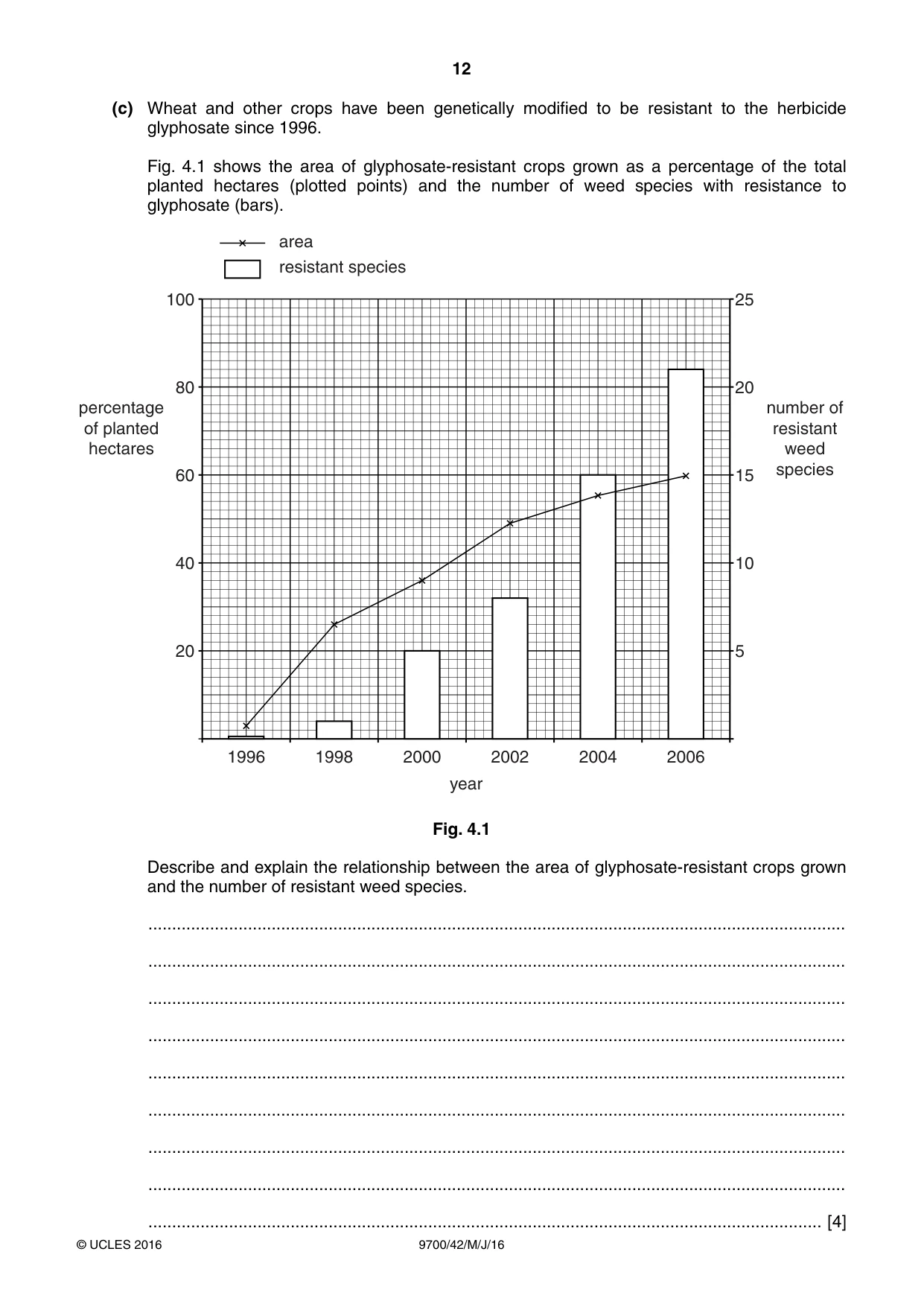
12 9700/42/M/J/16 © UCLES 2016 (c) Wheat and other crops have been genetically modified to be resistant to the herbicide glyphosate since 1996. Fig. 4.1 shows the area of glyphosate-resistant crops grown as a percentage of the total planted hectares (plotted points) and the number of weed species with resistance to glyphosate (bars). 1996 20 40 60 percentage of planted hectares number of resistant weed species 80 100 5 10 15 20 25 1998 2000 2002 year 2004 2006 area resistant species Fig. 4.1 Describe and explain the relationship between the area of glyphosate-resistant crops grown and the number of resistant weed species. … … … … … … … … … [4]
Question paper, page 13
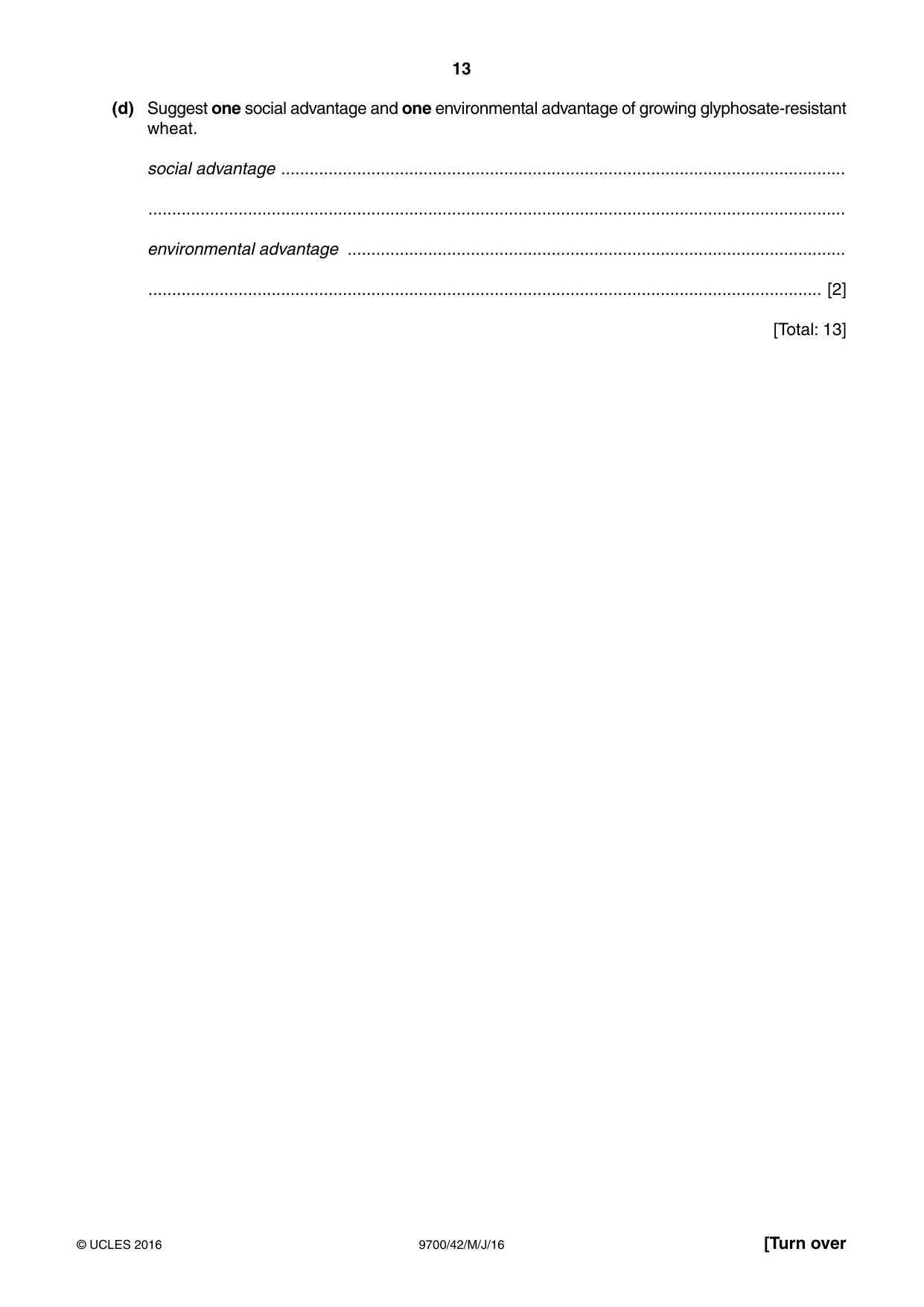
13 9700/42/M/J/16 © UCLES 2016 [Turn over (d) Suggest one social advantage and one environmental advantage of growing glyphosate-resistant wheat. social advantage … … environmental advantage … … [2] [Total: 13]
Question paper, page 14
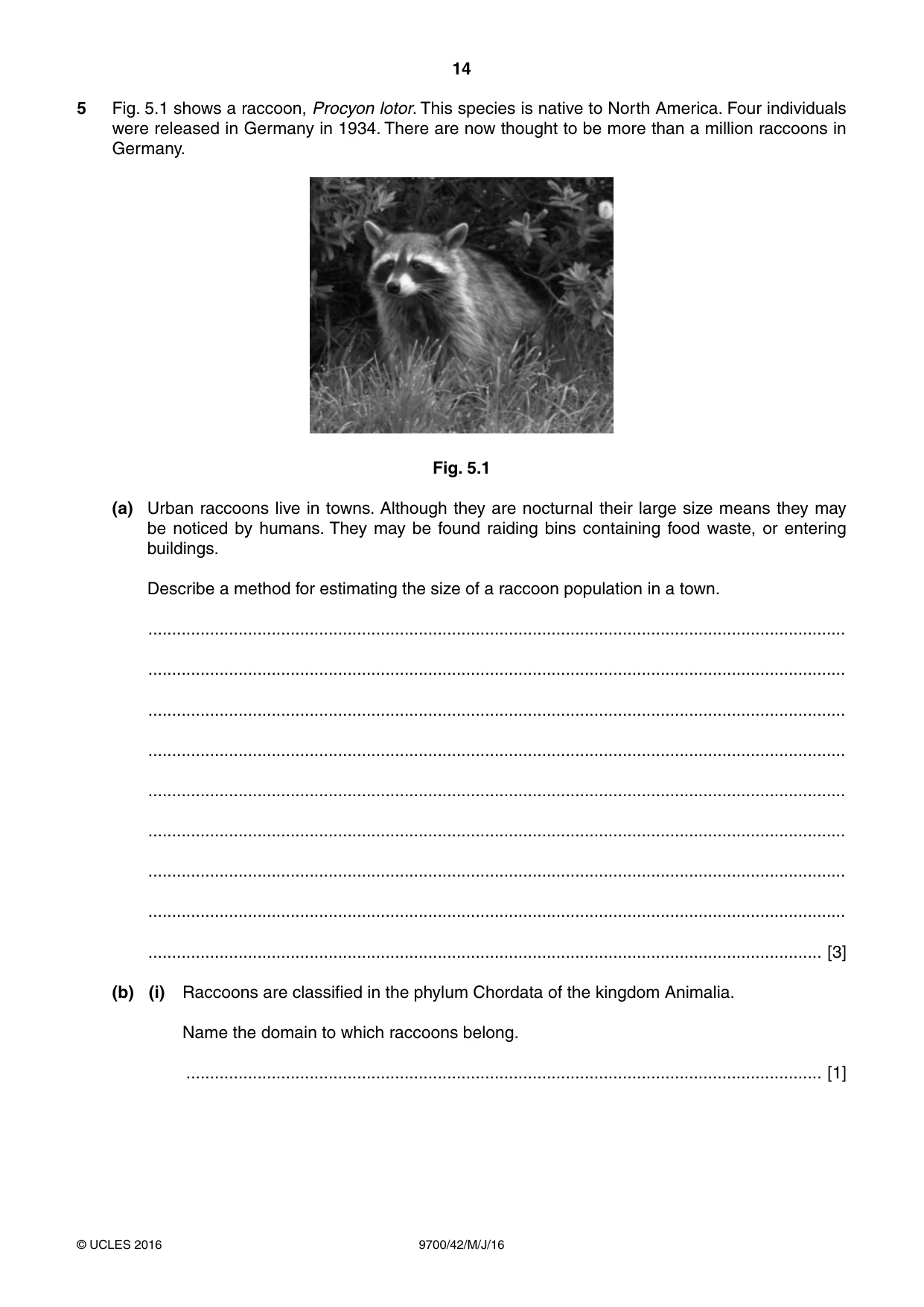
14 9700/42/M/J/16 © UCLES 2016 5 Fig. 5.1 shows a raccoon, Procyon lotor. This species is native to North America. Four individuals were released in Germany in 1934. There are now thought to be more than a million raccoons in Germany. Fig. 5.1 (a) Urban raccoons live in towns. Although they are nocturnal their large size means they may be noticed by humans. They may be found raiding bins containing food waste, or entering buildings. Describe a method for estimating the size of a raccoon population in a town. … … … … … … … … … [3] (b) (i) Raccoons are classified in the phylum Chordata of the kingdom Animalia. Name the domain to which raccoons belong. … [1]
Question paper, page 15
15 9700/42/M/J/16 © UCLES 2016 [Turn over (ii) Outline three characteristic features of members of this domain. 1 … … 2 … … 3 … … [3] (c) It has been suggested that raccoons may threaten biodiversity and pose a risk to human health in Germany. Explain how raccoons could cause problems for local biodiversity and for human health. local biodiversity … … … … … … human health … … … … … [3] [Total: 10]
Question paper, page 16
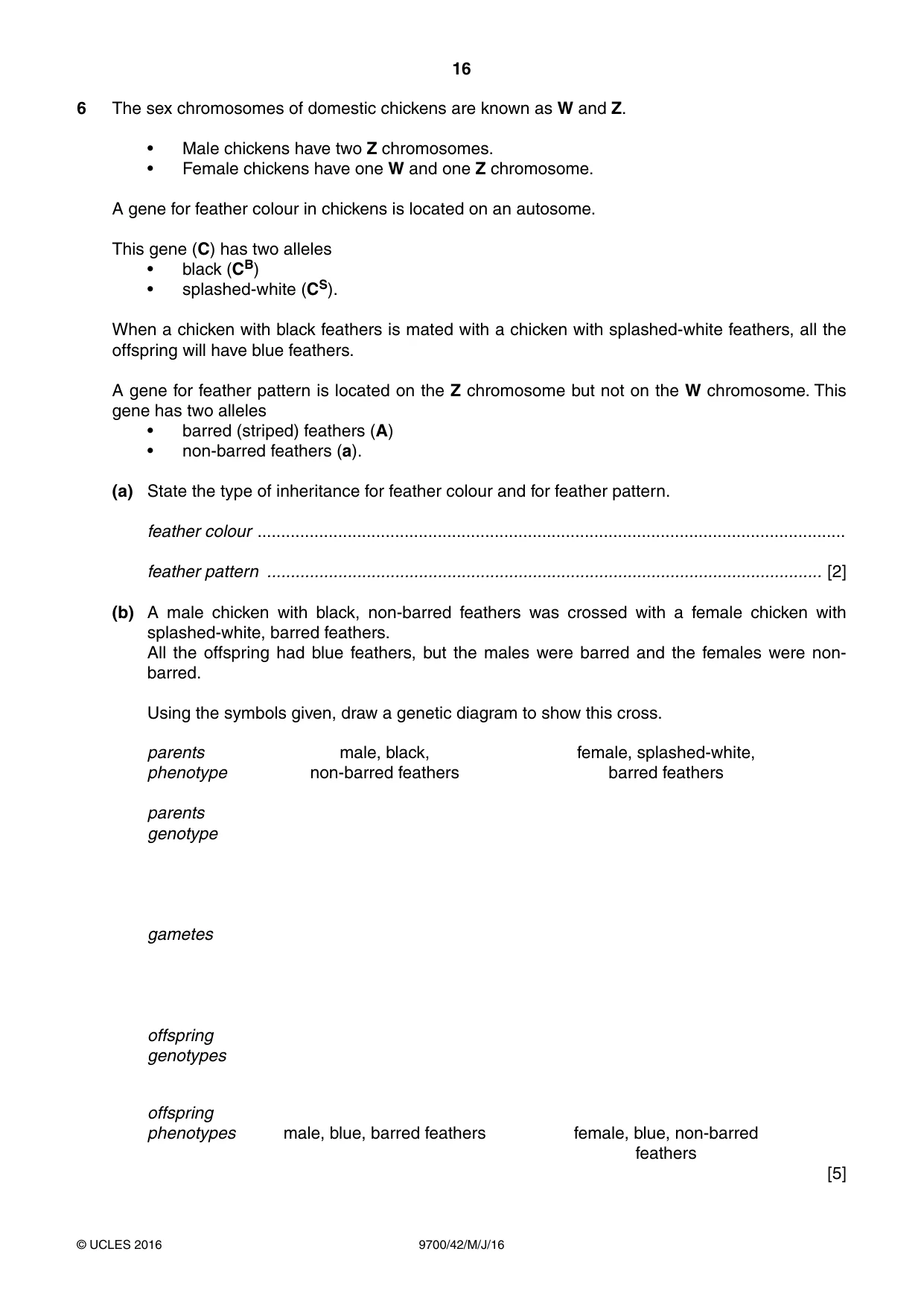
16 9700/42/M/J/16 © UCLES 2016 6 The sex chromosomes of domestic chickens are known as W and Z. • Male chickens have two Z chromosomes. • Female chickens have one W and one Z chromosome. A gene for feather colour in chickens is located on an autosome. This gene (C) has two alleles • black (CB) • splashed-white (CS). When a chicken with black feathers is mated with a chicken with splashed-white feathers, all the offspring will have blue feathers. A gene for feather pattern is located on the Z chromosome but not on the W chromosome. This gene has two alleles • barred (striped) feathers (A) • non-barred feathers (a). (a) State the type of inheritance for feather colour and for feather pattern. feather colour … feather pattern … [2] (b) A male chicken with black, non-barred feathers was crossed with a female chicken with splashed-white, barred feathers. All the offspring had blue feathers, but the males were barred and the females were non- barred. Using the symbols given, draw a genetic diagram to show this cross. parents phenotype male, black, non-barred feathers female, splashed-white, barred feathers parents genotype gametes offspring genotypes offspring phenotypes male, blue, barred feathers female, blue, non-barred feathers [5]
Question paper, page 17
17 9700/42/M/J/16 © UCLES 2016 [Turn over (c) Explain how the genotype of a male chicken with blue, barred feathers could be determined. … … … … … … … [3] [Total: 10]
Question paper, page 18
18 9700/42/M/J/16 © UCLES 2016 7 (a) In mammals, excess amino acids cannot be stored in the body. Outline the formation of urea from excess amino acids by liver cells. … … … … … … … [3] (b) The mammalian kidney is composed of many nephrons. Describe the process of ultrafiltration in the nephron. … … … … … … … … … … [4]
Question paper, page 19
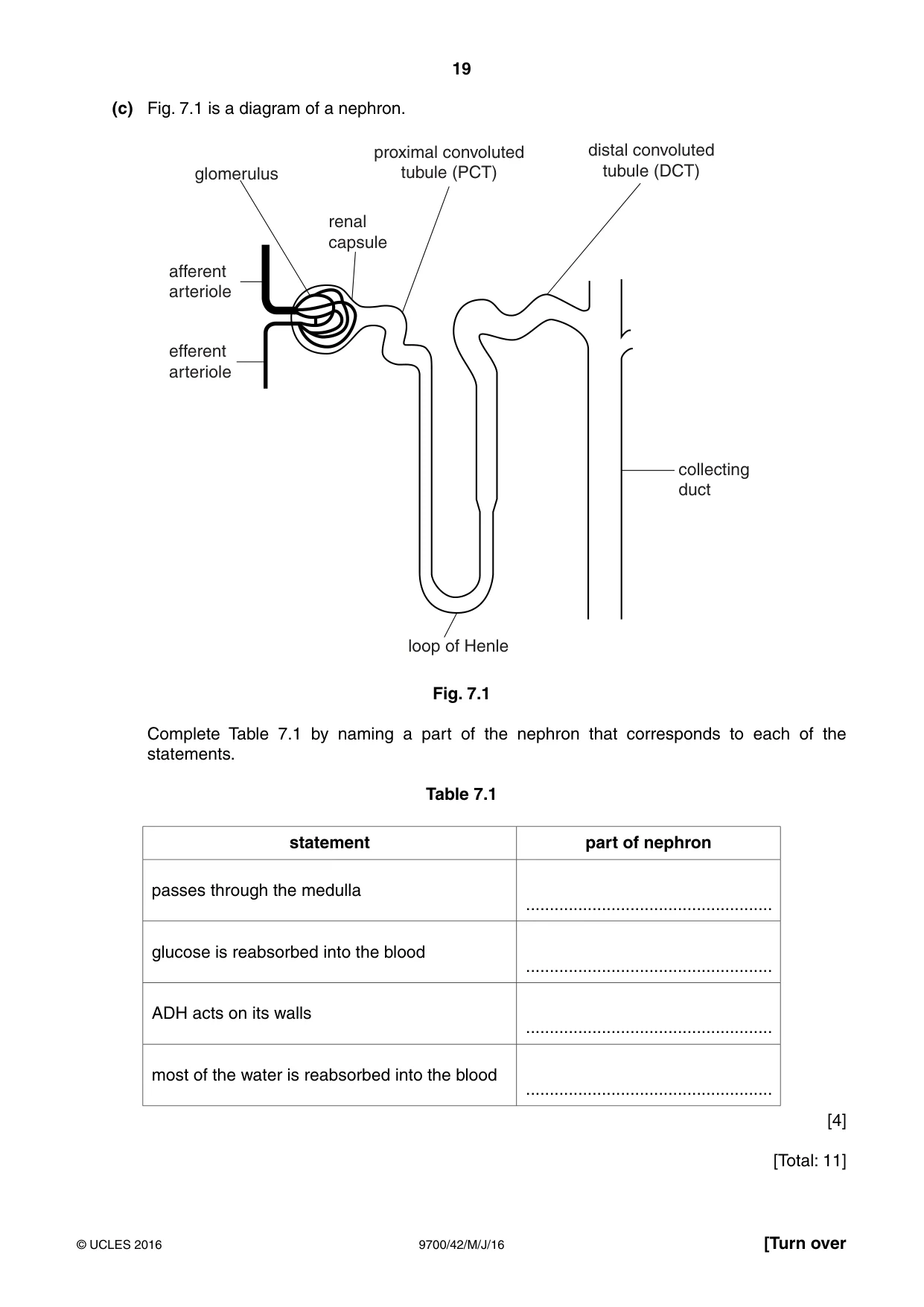
19 9700/42/M/J/16 © UCLES 2016 [Turn over (c) Fig. 7.1 is a diagram of a nephron. afferent arteriole efferent arteriole glomerulus proximal convoluted tubule (PCT) loop of Henle distal convoluted tubule (DCT) collecting duct renal capsule Fig. 7.1 Complete Table 7.1 by naming a part of the nephron that corresponds to each of the statements. Table 7.1 statement part of nephron passes through the medulla … glucose is reabsorbed into the blood … ADH acts on its walls … most of the water is reabsorbed into the blood … [4] [Total: 11]
Question paper, page 20
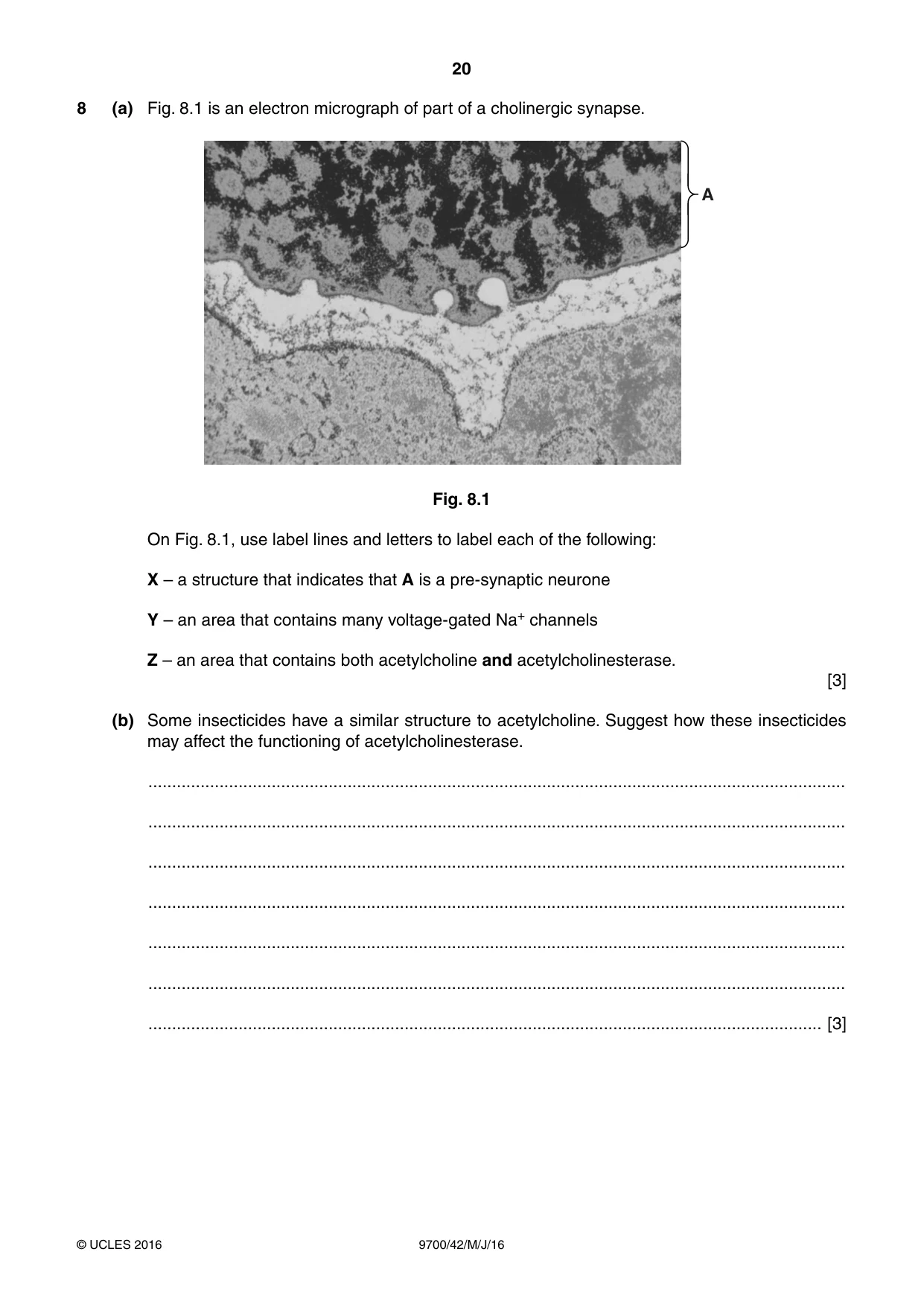
20 9700/42/M/J/16 © UCLES 2016 8 (a) Fig. 8.1 is an electron micrograph of part of a cholinergic synapse. $ Fig. 8.1 On Fig. 8.1, use label lines and letters to label each of the following: X – a structure that indicates that A is a pre-synaptic neurone Y – an area that contains many voltage-gated Na+ channels Z – an area that contains both acetylcholine and acetylcholinesterase. [3] (b) Some insecticides have a similar structure to acetylcholine. Suggest how these insecticides may affect the functioning of acetylcholinesterase. … … … … … … … [3]
Question paper, page 21
21 9700/42/M/J/16 © UCLES 2016 [Turn over (c) Outline the roles of synapses in the nervous system. … … … … … … [2] [Total: 8]
Question paper, page 22
22 9700/42/M/J/16 © UCLES 2016 Section B Answer one question. 9 (a) Outline the process of glycolysis. [6] (b) Describe the series of reactions that make up the Krebs cycle. [9] [Total: 15] 10 (a) Explain how meiosis and fertilisation can result in genetic variation amongst offspring. [8] (b) Describe the genetic control of protein production in a prokaryote using the lac operon. [7] [Total: 15] … … … … … … … … … … … … … … … … … … …
Question paper, page 23
23 9700/42/M/J/16 © UCLES 2016 [Turn over … … … … … … … … … … … … … … … … … … … … … … … … … … … …
Question paper, page 24
24 9700/42/M/J/16 © UCLES 2016 Permission to reproduce items where third-party owned material protected by copyright is included has been sought and cleared where possible. Every reasonable effort has been made by the publisher (UCLES) to trace copyright holders, but if any items requiring clearance have unwittingly been included, the publisher will be pleased to make amends at the earliest possible opportunity. To avoid the issue of disclosure of answer-related information to candidates, all copyright acknowledgements are reproduced online in the Cambridge International Examinations Copyright Acknowledgements Booklet. This is produced for each series of examinations and is freely available to download at www.cie.org.uk after the live examination series. Cambridge International Examinations is part of the Cambridge Assessment Group. Cambridge Assessment is the brand name of University of Cambridge Local Examinations Syndicate (UCLES), which is itself a department of the University of Cambridge. … … … … … … … … … … … … … … … … … … … … … … … …
Mark scheme, page 1
® IGCSE is the registered trademark of Cambridge International Examinations. This document consists of 8 printed pages. © UCLES 2016 [Turn over Cambridge International Examinations Cambridge International Advanced Subsidiary and Advanced Level BIOLOGY 9700/42 Paper 4 A Level Structured Questions May/June 2016 MARK SCHEME Maximum Mark: 100 Published This mark scheme is published as an aid to teachers and candidates, to indicate the requirements of the examination. It shows the basis on which Examiners were instructed to award marks. It does not indicate the details of the discussions that took place at an Examiners’ meeting before marking began, which would have considered the acceptability of alternative answers. Mark schemes should be read in conjunction with the question paper and the Principal Examiner Report for Teachers. Cambridge will not enter into discussions about these mark schemes. Cambridge is publishing the mark schemes for the May/June 2016 series for most Cambridge IGCSE®, Cambridge International A and AS Level components and some Cambridge O Level components.
Mark scheme, page 2
Page 2 Mark Scheme Syllabus Paper Cambridge International AS/A Level – May/June 2016 9700 42 © Cambridge International Examinations 2016 Mark scheme abbreviations: ; separates marking points / alternative answers for the same point R reject A accept (for answers correctly cued by the question, or by extra guidance) AW alternative wording (where responses vary more than usual) underline actual word given must be used by candidate (grammatical variants accepted) max indicates the maximum number of marks that can be given ora or reverse argument mp marking point (with relevant number) ecf error carried forward I ignore
Mark scheme, page 3
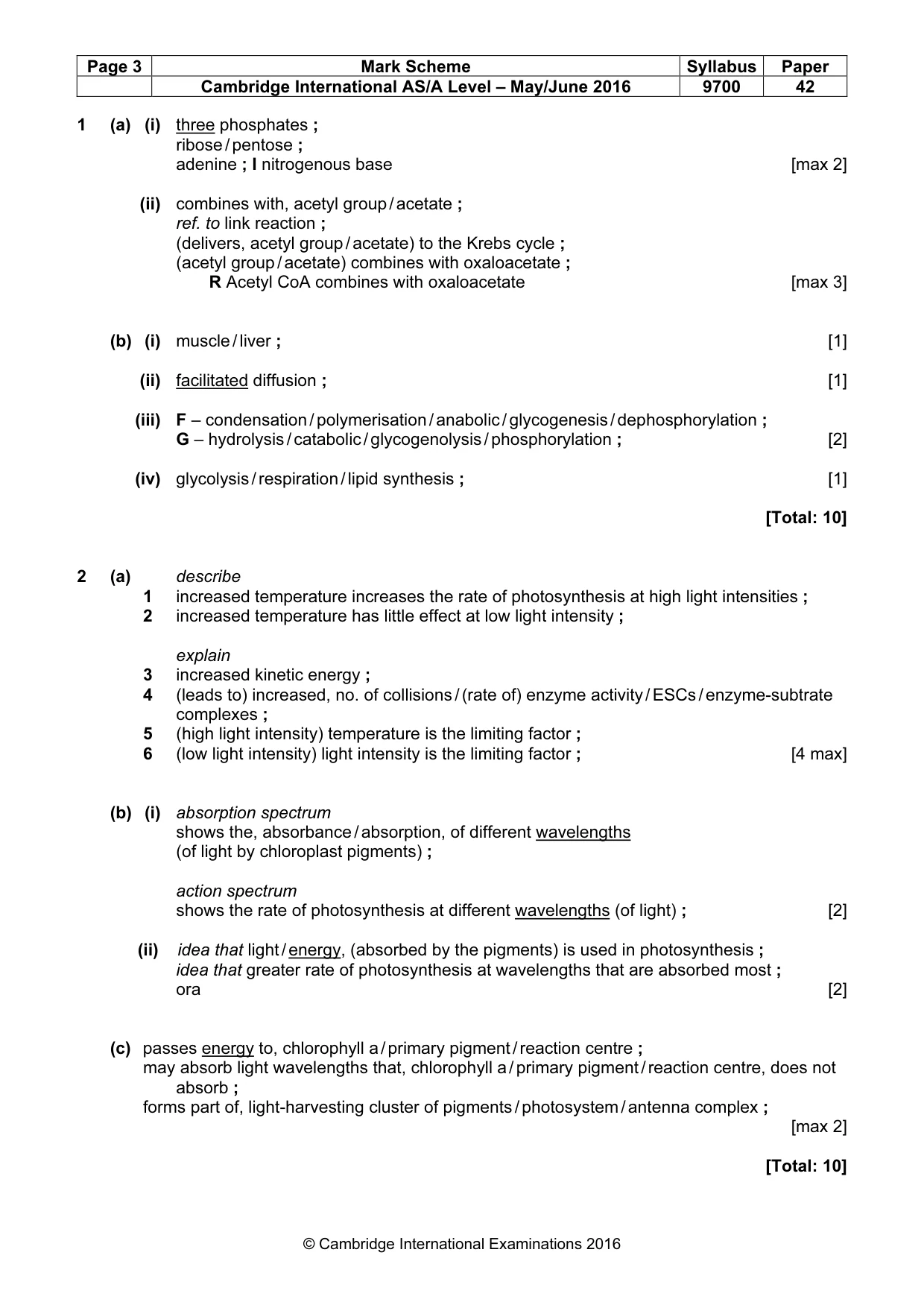
Page 3 Mark Scheme Syllabus Paper Cambridge International AS/A Level – May/June 2016 9700 42 © Cambridge International Examinations 2016 1 (a) (i) three phosphates ; ribose / pentose ; adenine ; I nitrogenous base [max 2] (ii) combines with, acetyl group / acetate ; ref. to link reaction ; (delivers, acetyl group / acetate) to the Krebs cycle ; (acetyl group / acetate) combines with oxaloacetate ; R Acetyl CoA combines with oxaloacetate [max 3] (b) (i) muscle / liver ; [1] (ii) facilitated diffusion ; [1] (iii) F – condensation / polymerisation / anabolic / glycogenesis / dephosphorylation ; G – hydrolysis / catabolic / glycogenolysis / phosphorylation ; [2] (iv) glycolysis / respiration / lipid synthesis ; [1] [Total: 10] 2 (a) describe 1 increased temperature increases the rate of photosynthesis at high light intensities ; 2 increased temperature has little effect at low light intensity ; explain 3 increased kinetic energy ; 4 (leads to) increased, no. of collisions / (rate of) enzyme activity / ESCs / enzyme-subtrate complexes ; 5 (high light intensity) temperature is the limiting factor ; 6 (low light intensity) light intensity is the limiting factor ; [4 max] (b) (i) absorption spectrum shows the, absorbance / absorption, of different wavelengths (of light by chloroplast pigments) ; action spectrum shows the rate of photosynthesis at different wavelengths (of light) ; [2] (ii) idea that light / energy, (absorbed by the pigments) is used in photosynthesis ; idea that greater rate of photosynthesis at wavelengths that are absorbed most ; ora [2] (c) passes energy to, chlorophyll a / primary pigment / reaction centre ; may absorb light wavelengths that, chlorophyll a / primary pigment / reaction centre, does not absorb ; forms part of, light-harvesting cluster of pigments / photosystem / antenna complex ; [max 2] [Total: 10]
Mark scheme, page 4
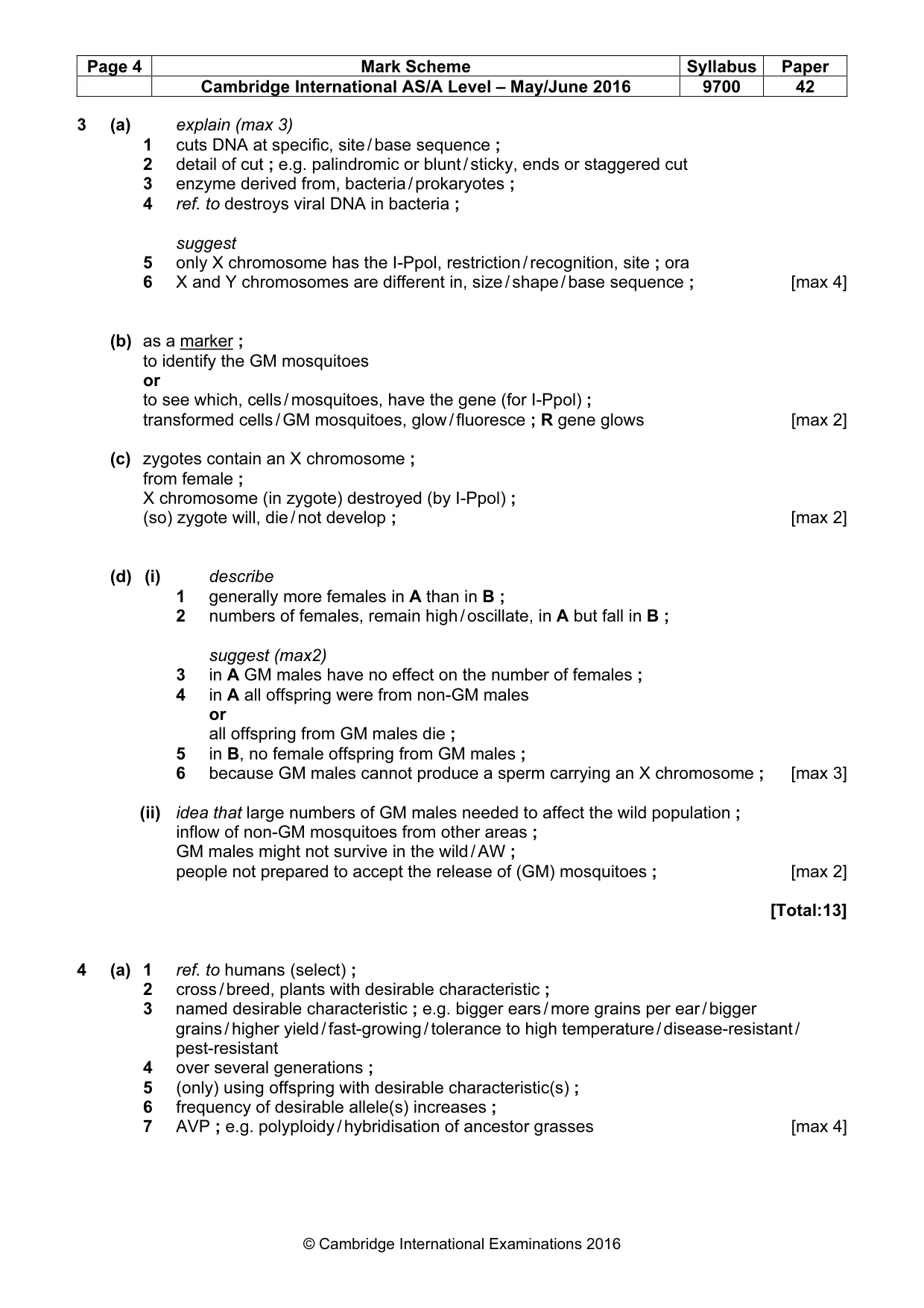
Page 4 Mark Scheme Syllabus Paper Cambridge International AS/A Level – May/June 2016 9700 42 © Cambridge International Examinations 2016 3 (a) explain (max 3) 1 cuts DNA at specific, site / base sequence ; 2 detail of cut ; e.g. palindromic or blunt / sticky, ends or staggered cut 3 enzyme derived from, bacteria / prokaryotes ; 4 ref. to destroys viral DNA in bacteria ; suggest 5 only X chromosome has the I-Ppol, restriction / recognition, site ; ora 6 X and Y chromosomes are different in, size / shape / base sequence ; [max 4] (b) as a marker ; to identify the GM mosquitoes or to see which, cells / mosquitoes, have the gene (for I-Ppol) ; transformed cells / GM mosquitoes, glow / fluoresce ; R gene glows [max 2] (c) zygotes contain an X chromosome ; from female ; X chromosome (in zygote) destroyed (by I-Ppol) ; (so) zygote will, die / not develop ; [max 2] (d) (i) describe 1 generally more females in A than in B ; 2 numbers of females, remain high / oscillate, in A but fall in B ; suggest (max2) 3 in A GM males have no effect on the number of females ; 4 in A all offspring were from non-GM males or all offspring from GM males die ; 5 in B, no female offspring from GM males ; 6 because GM males cannot produce a sperm carrying an X chromosome ; [max 3] (ii) idea that large numbers of GM males needed to affect the wild population ; inflow of non-GM mosquitoes from other areas ; GM males might not survive in the wild / AW ; people not prepared to accept the release of (GM) mosquitoes ; [max 2] [Total:13] 4 (a) 1 ref. to humans (select) ; 2 cross / breed, plants with desirable characteristic ; 3 named desirable characteristic ; e.g. bigger ears / more grains per ear / bigger grains / higher yield / fast-growing / tolerance to high temperature / disease-resistant / pest-resistant 4 over several generations ; 5 (only) using offspring with desirable characteristic(s) ; 6 frequency of desirable allele(s) increases ; 7 AVP ; e.g. polyploidy / hybridisation of ancestor grasses [max 4]
Mark scheme, page 5
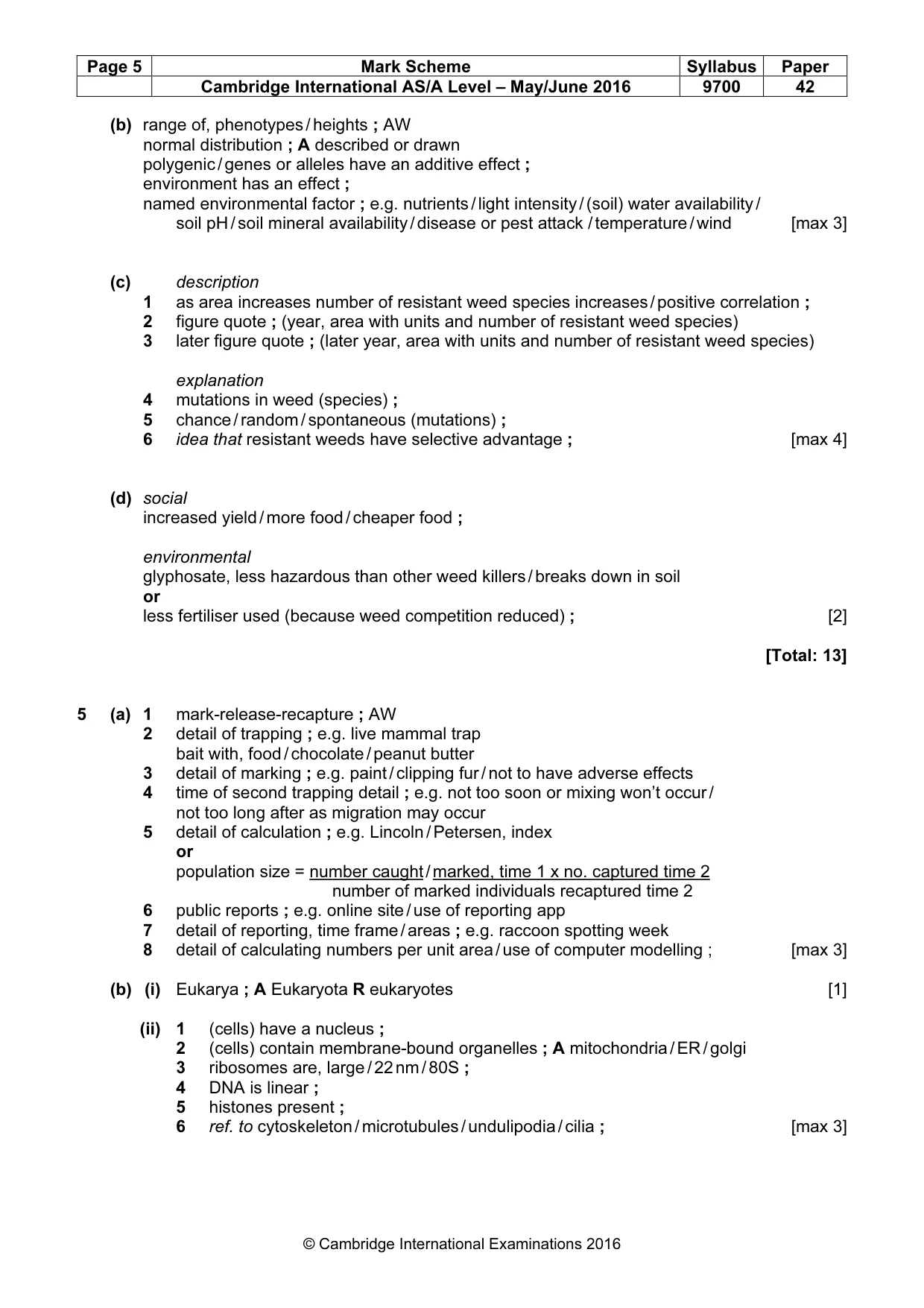
Page 5 Mark Scheme Syllabus Paper Cambridge International AS/A Level – May/June 2016 9700 42 © Cambridge International Examinations 2016 (b) range of, phenotypes / heights ; AW normal distribution ; A described or drawn polygenic / genes or alleles have an additive effect ; environment has an effect ; named environmental factor ; e.g. nutrients / light intensity / (soil) water availability / soil pH / soil mineral availability / disease or pest attack / temperature / wind [max 3] (c) description 1 as area increases number of resistant weed species increases / positive correlation ; 2 figure quote ; (year, area with units and number of resistant weed species) 3 later figure quote ; (later year, area with units and number of resistant weed species) explanation 4 mutations in weed (species) ; 5 chance / random / spontaneous (mutations) ; 6 idea that resistant weeds have selective advantage ; [max 4] (d) social increased yield / more food / cheaper food ; environmental glyphosate, less hazardous than other weed killers / breaks down in soil or less fertiliser used (because weed competition reduced) ; [2] [Total: 13] 5 (a) 1 mark-release-recapture ; AW 2 detail of trapping ; e.g. live mammal trap bait with, food / chocolate / peanut butter 3 detail of marking ; e.g. paint / clipping fur / not to have adverse effects 4 time of second trapping detail ; e.g. not too soon or mixing won’t occur / not too long after as migration may occur 5 detail of calculation ; e.g. Lincoln / Petersen, index or population size = number caught / marked, time 1 x no. captured time 2 number of marked individuals recaptured time 2 6 public reports ; e.g. online site / use of reporting app 7 detail of reporting, time frame / areas ; e.g. raccoon spotting week 8 detail of calculating numbers per unit area / use of computer modelling ; [max 3] (b) (i) Eukarya ; A Eukaryota R eukaryotes [1] (ii) 1 (cells) have a nucleus ; 2 (cells) contain membrane-bound organelles ; A mitochondria / ER / golgi 3 ribosomes are, large / 22 nm / 80S ; 4 DNA is linear ; 5 histones present ; 6 ref. to cytoskeleton / microtubules / undulipodia / cilia ; [max 3]
Mark scheme, page 6
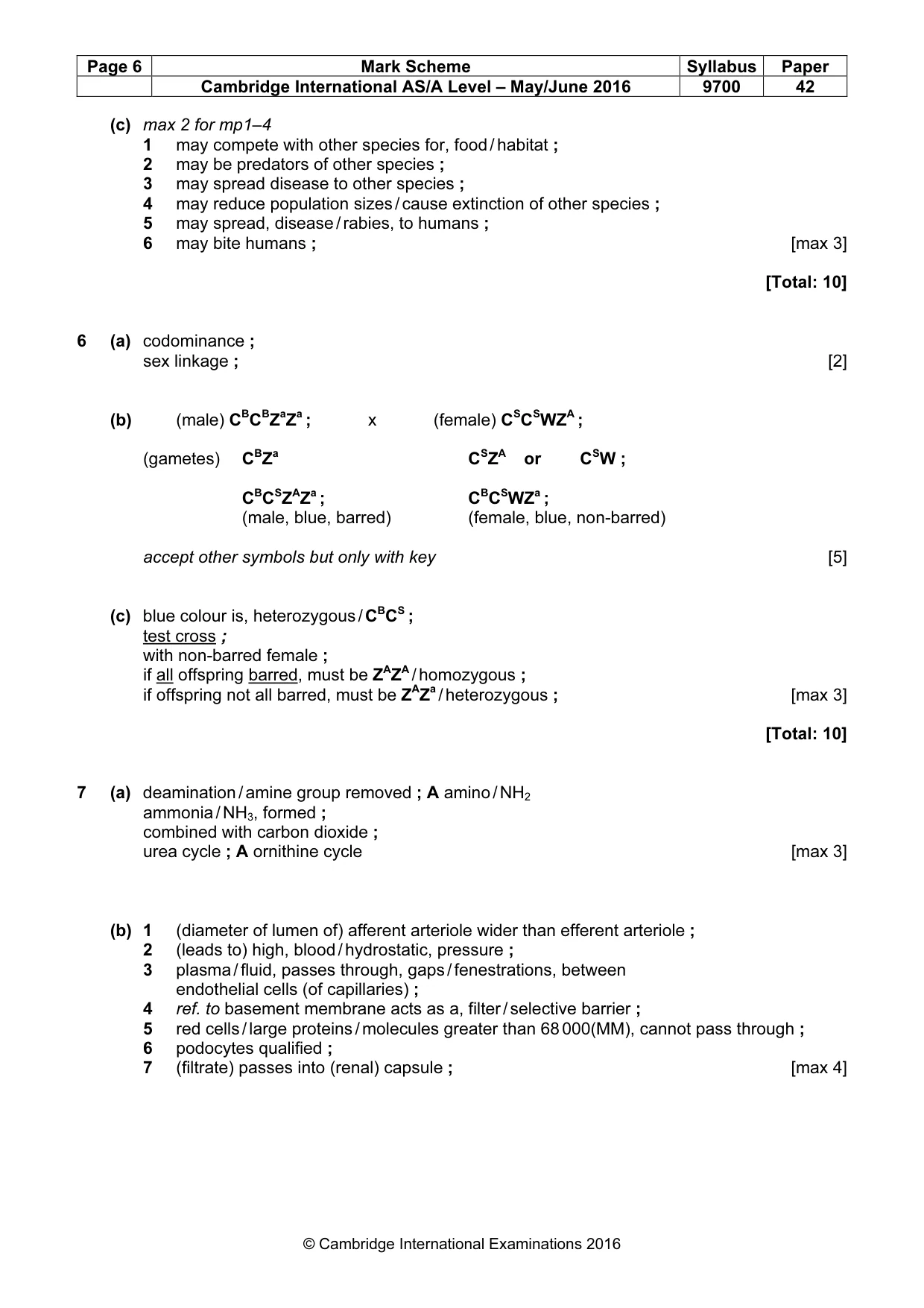
Page 6 Mark Scheme Syllabus Paper Cambridge International AS/A Level – May/June 2016 9700 42 © Cambridge International Examinations 2016 (c) max 2 for mp1–4 1 may compete with other species for, food / habitat ; 2 may be predators of other species ; 3 may spread disease to other species ; 4 may reduce population sizes / cause extinction of other species ; 5 may spread, disease / rabies, to humans ; 6 may bite humans ; [max 3] [Total: 10] 6 (a) codominance ; sex linkage ; [2] (b) (male) CBCBZaZa ; x (female) CSCSWZA ; (gametes) CBZa CSZA or CSW ; CBCSZAZa ; CBCSWZa ; (male, blue, barred) (female, blue, non-barred) accept other symbols but only with key [5] (c) blue colour is, heterozygous / CBCS ; test cross ; with non-barred female ; if all offspring barred, must be ZAZA / homozygous ; if offspring not all barred, must be ZAZa / heterozygous ; [max 3] [Total: 10] 7 (a) deamination / amine group removed ; A amino / NH2 ammonia / NH3, formed ; combined with carbon dioxide ; urea cycle ; A ornithine cycle [max 3] (b) 1 (diameter of lumen of) afferent arteriole wider than efferent arteriole ; 2 (leads to) high, blood / hydrostatic, pressure ; 3 plasma / fluid, passes through, gaps / fenestrations, between endothelial cells (of capillaries) ; 4 ref. to basement membrane acts as a, filter / selective barrier ; 5 red cells / large proteins / molecules greater than 68 000(MM), cannot pass through ; 6 podocytes qualified ; 7 (filtrate) passes into (renal) capsule ; [max 4]
Mark scheme, page 7
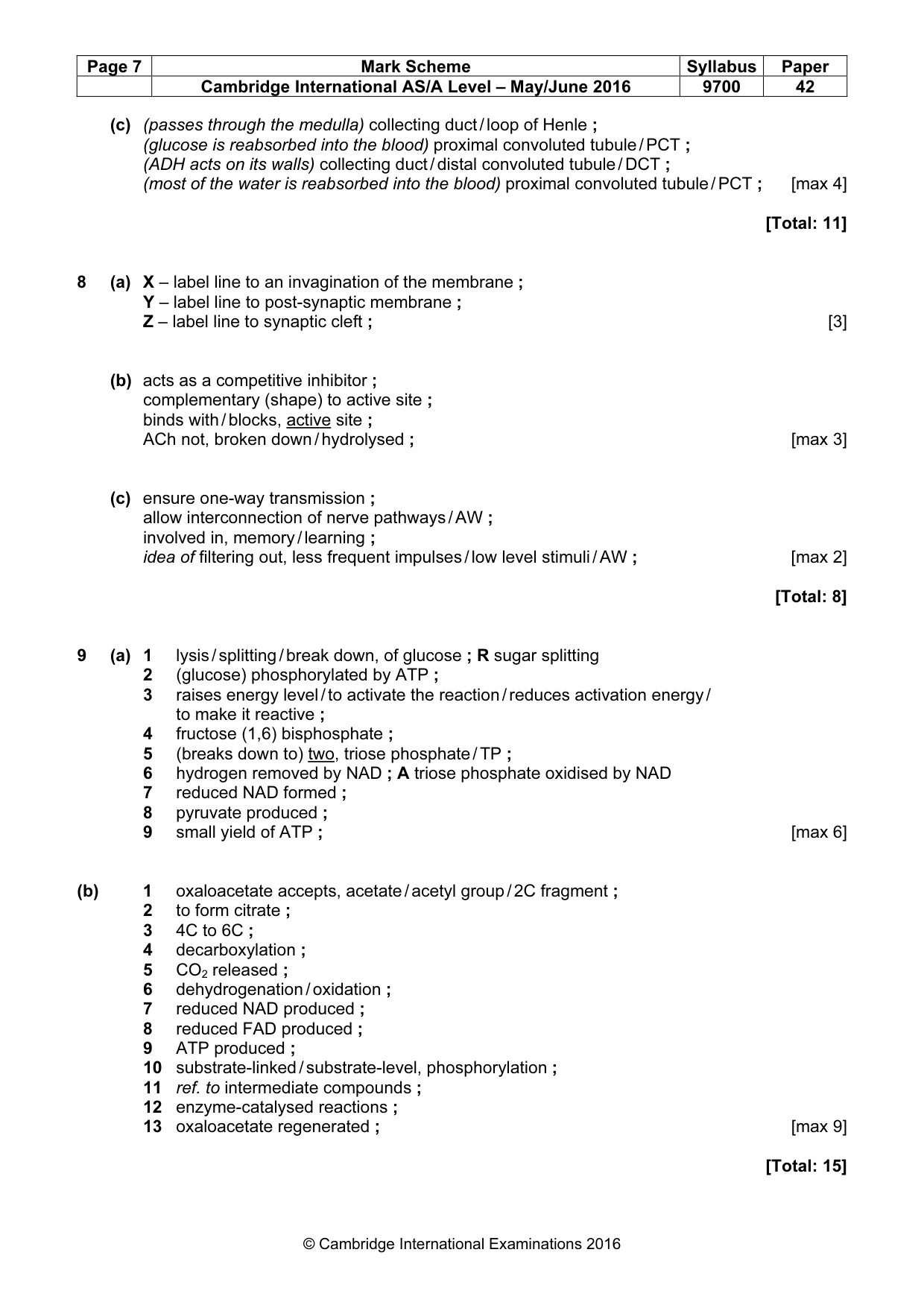
Page 7 Mark Scheme Syllabus Paper Cambridge International AS/A Level – May/June 2016 9700 42 © Cambridge International Examinations 2016 (c) (passes through the medulla) collecting duct / loop of Henle ; (glucose is reabsorbed into the blood) proximal convoluted tubule / PCT ; (ADH acts on its walls) collecting duct / distal convoluted tubule / DCT ; (most of the water is reabsorbed into the blood) proximal convoluted tubule / PCT ; [max 4] [Total: 11] 8 (a) X – label line to an invagination of the membrane ; Y – label line to post-synaptic membrane ; Z – label line to synaptic cleft ; [3] (b) acts as a competitive inhibitor ; complementary (shape) to active site ; binds with / blocks, active site ; ACh not, broken down / hydrolysed ; [max 3] (c) ensure one-way transmission ; allow interconnection of nerve pathways / AW ; involved in, memory / learning ; idea of filtering out, less frequent impulses / low level stimuli / AW ; [max 2] [Total: 8] 9 (a) 1 lysis / splitting / break down, of glucose ; R sugar splitting 2 (glucose) phosphorylated by ATP ; 3 raises energy level / to activate the reaction / reduces activation energy / to make it reactive ; 4 fructose (1,6) bisphosphate ; 5 (breaks down to) two, triose phosphate / TP ; 6 hydrogen removed by NAD ; A triose phosphate oxidised by NAD 7 reduced NAD formed ; 8 pyruvate produced ; 9 small yield of ATP ; [max 6] (b) 1 oxaloacetate accepts, acetate / acetyl group / 2C fragment ; 2 to form citrate ; 3 4C to 6C ; 4 decarboxylation ; 5 CO2 released ; 6 dehydrogenation / oxidation ; 7 reduced NAD produced ; 8 reduced FAD produced ; 9 ATP produced ; 10 substrate-linked / substrate-level, phosphorylation ; 11 ref. to intermediate compounds ; 12 enzyme-catalysed reactions ; 13 oxaloacetate regenerated ; [max 9] [Total: 15]
Mark scheme, page 8
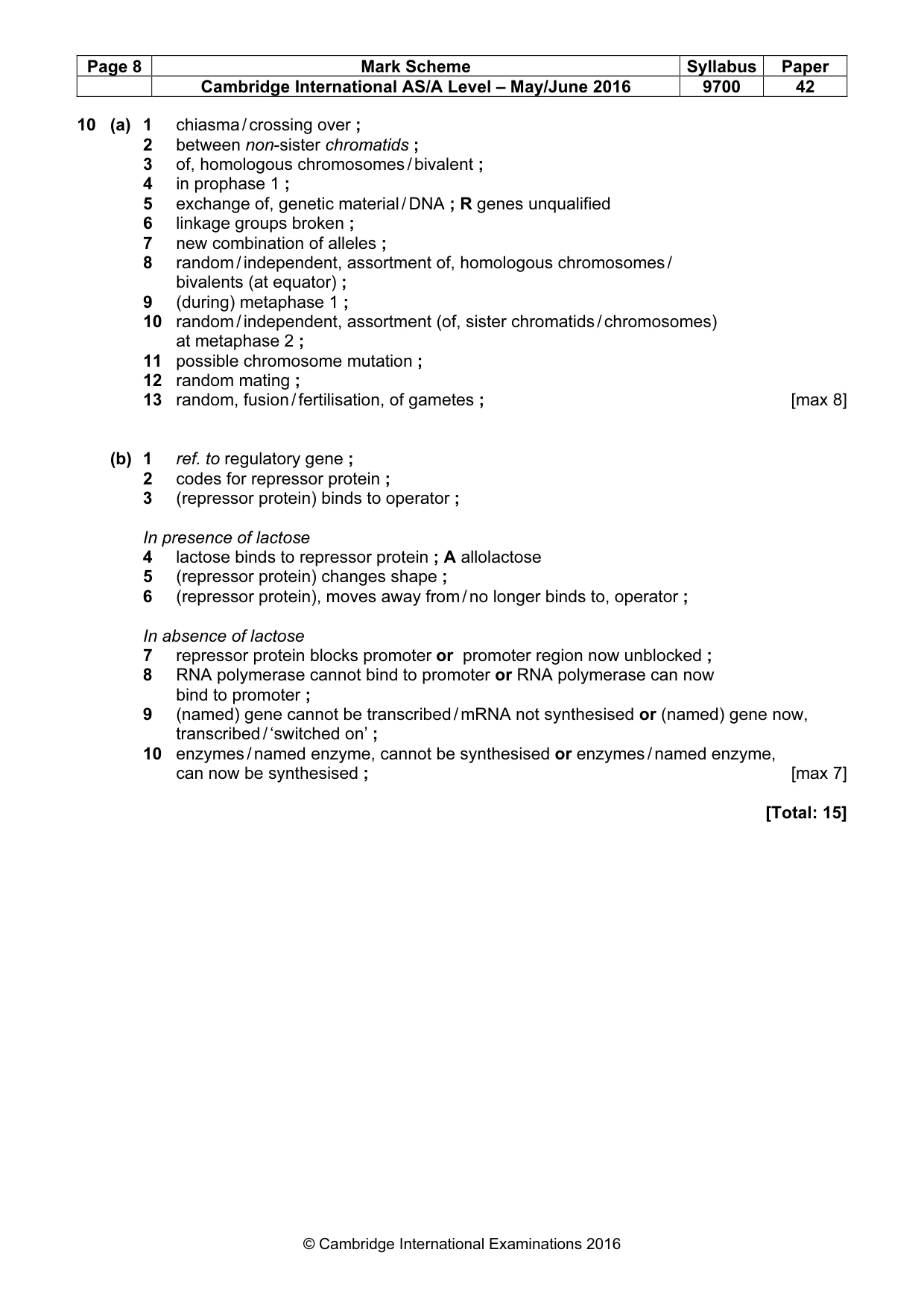
Page 8 Mark Scheme Syllabus Paper Cambridge International AS/A Level – May/June 2016 9700 42 © Cambridge International Examinations 2016 10 (a) 1 chiasma / crossing over ; 2 between non-sister chromatids ; 3 of, homologous chromosomes / bivalent ; 4 in prophase 1 ; 5 exchange of, genetic material / DNA ; R genes unqualified 6 linkage groups broken ; 7 new combination of alleles ; 8 random / independent, assortment of, homologous chromosomes / bivalents (at equator) ; 9 (during) metaphase 1 ; 10 random / independent, assortment (of, sister chromatids / chromosomes) at metaphase 2 ; 11 possible chromosome mutation ; 12 random mating ; 13 random, fusion / fertilisation, of gametes ; [max 8] (b) 1 ref. to regulatory gene ; 2 codes for repressor protein ; 3 (repressor protein) binds to operator ; In presence of lactose 4 lactose binds to repressor protein ; A allolactose 5 (repressor protein) changes shape ; 6 (repressor protein), moves away from / no longer binds to, operator ; In absence of lactose 7 repressor protein blocks promoter or promoter region now unblocked ; 8 RNA polymerase cannot bind to promoter or RNA polymerase can now bind to promoter ; 9 (named) gene cannot be transcribed / mRNA not synthesised or (named) gene now, transcribed / ‘switched on’ ; 10 enzymes / named enzyme, cannot be synthesised or enzymes / named enzyme, can now be synthesised ; [max 7] [Total: 15]
What you needed in this session
Cambridge’s own grade thresholds for 2016 May/June, Paper 4 · Variant 2. A higher threshold means an easier paper — the bar moves with how the cohort did.