Cambridge A Level Biology 9700 — 2016 May/June Paper 2 · Variant 3
9700/23/M/J/16 · 60 marks · ≈68 min
The question paper and its mark scheme, free to read here and free to download. This is Cambridge’s own paper, exactly as it was sat.
Question paper12 pages
Mark scheme6 pages
Answers below. Sit the paper first if you are practising.
Paper as text
Question paper, page 1
This document consists of 12 printed pages. DC (ST/FD) 109213/3 © UCLES 2016 [Turn over Cambridge International Examinations Cambridge International Advanced Subsidiary and Advanced Level * 0 7 1 4 8 5 6 1 7 6 * BIOLOGY 9700/23 Paper 2 Structured Questions AS May/June 2016 1 hour 15 minutes Candidates answer on the Question Paper. No Additional Materials are required. READ THESE INSTRUCTIONS FIRST Write your Centre number, candidate number and name on all the work you hand in. Write in dark blue or black pen. You may use an HB pencil for any diagrams or graphs. Do not use staples, paper clips, glue or correction fluid. DO NOT WRITE IN ANY BARCODES. Answer all questions. Electronic calculators may be used. You may lose marks if you do not show your working or if you do not use appropriate units. At the end of the examination, fasten all your work securely together. The number of marks is given in brackets [ ] at the end of each question or part question.
Question paper, page 2
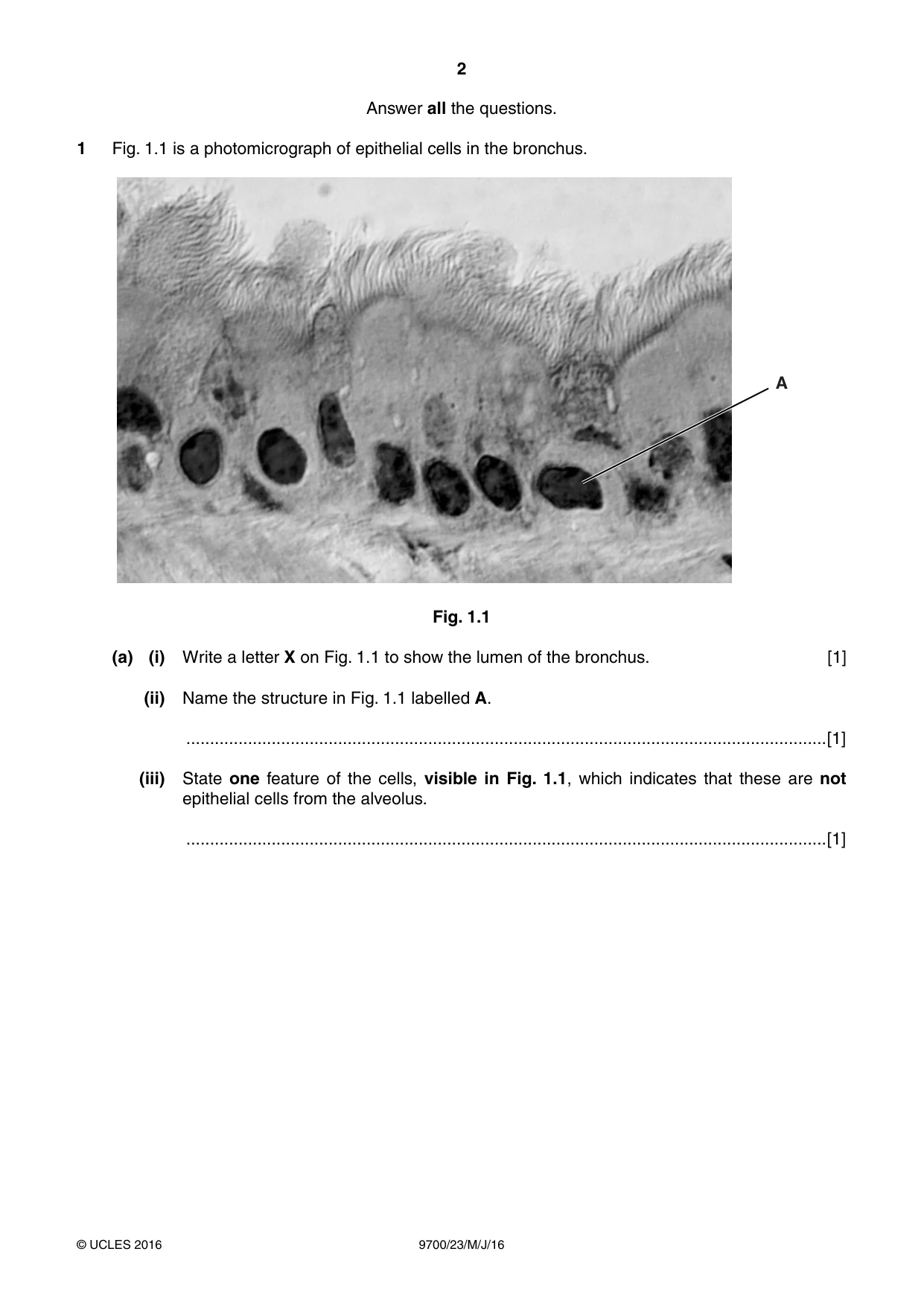
2 9700/23/M/J/16 © UCLES 2016 Answer all the questions. 1 Fig. 1.1 is a photomicrograph of epithelial cells in the bronchus. $ Fig. 1.1 (a) (i) Write a letter X on Fig. 1.1 to show the lumen of the bronchus. [1] (ii) Name the structure in Fig. 1.1 labelled A. …[1] (iii) State one feature of the cells, visible in Fig. 1.1, which indicates that these are not epithelial cells from the alveolus. …[1]
Question paper, page 3
3 9700/23/M/J/16 © UCLES 2016 [Turn over (b) Epithelial cells are replaced when they are damaged. (i) Name the type of cell division used to replace damaged epithelial cells. …[1] (ii) The cells shown in Fig. 1.1 are from a non-smoker. Smoking causes damage to the epithelial cells of the lungs. Describe the appearance of the lining of the bronchus in a long-term smoker. … … … … … … … …[3] [Total: 7]
Question paper, page 4
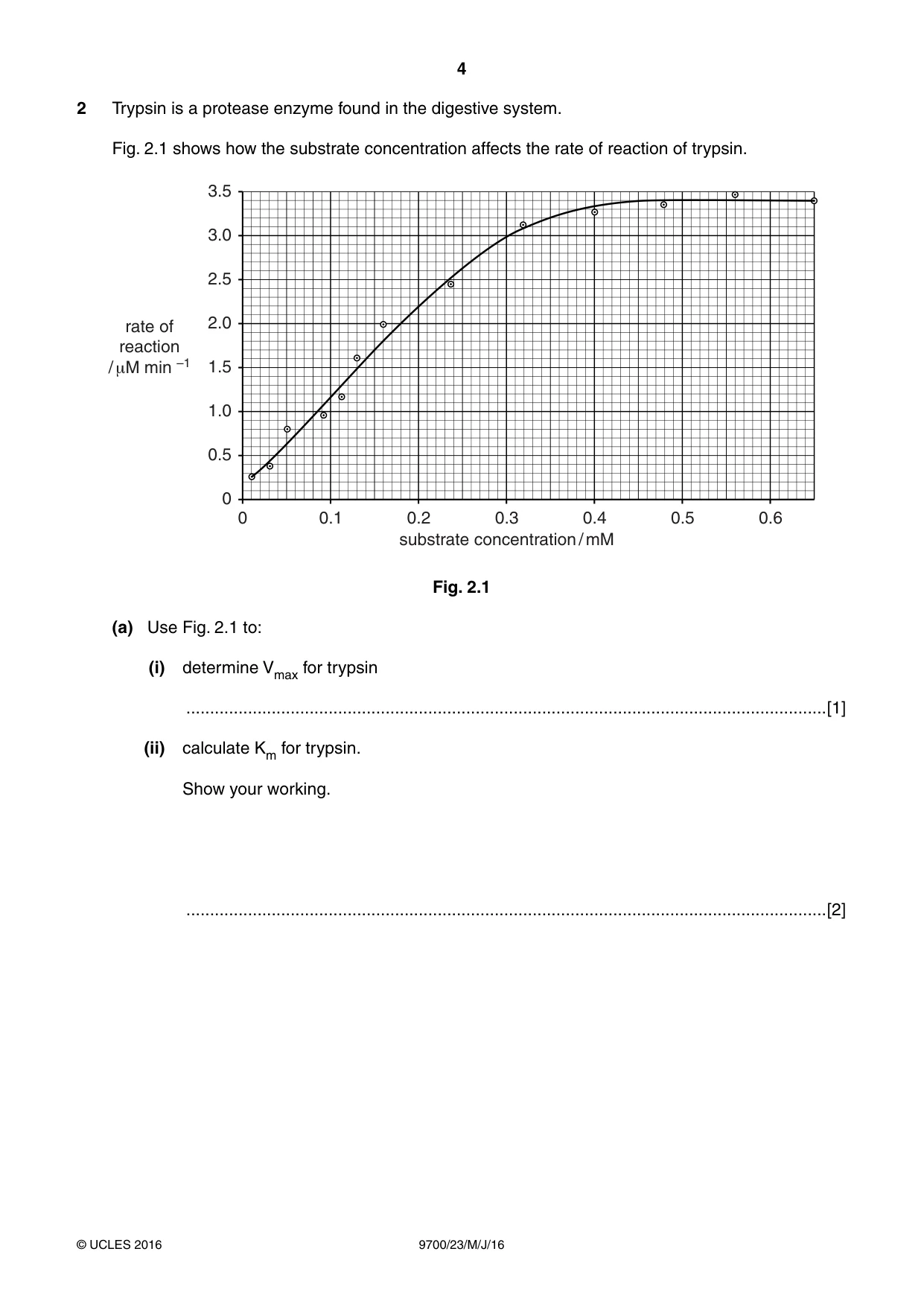
4 9700/23/M/J/16 © UCLES 2016 2 Trypsin is a protease enzyme found in the digestive system. Fig. 2.1 shows how the substrate concentration affects the rate of reaction of trypsin. 0.1 0 0 0.5 1.0 1.5 2.0 rate of reaction / +M min –1 2.5 3.0 3.5 0.2 0.3 substrate concentration / mM 0.4 0.5 0.6 Fig. 2.1 (a) Use Fig. 2.1 to: (i) determine Vmax for trypsin …[1] (ii) calculate Km for trypsin. Show your working. …[2]
Question paper, page 5
5 9700/23/M/J/16 © UCLES 2016 [Turn over (b) Describe and explain the shape of the curve in Fig. 2.1. … … … … … … … … …[4] (c) Trypsin is composed of one polypeptide chain of 223 amino acids. The active site of trypsin contains three amino acids which catalyse a hydrolysis reaction. These three amino acids occupy the following positions in the primary structure of trypsin: • histidine, position 57 • aspartate, position 102 • serine, position 195. (i) In the functioning enzyme, these three amino acids are close together in the active site. Explain how the structure of the protein makes this possible. … … … … … … … …[3] (ii) When trypsin acts on a substrate, another substance is required as a reactant. Name this other substance. …[1] [Total: 11]
Question paper, page 6
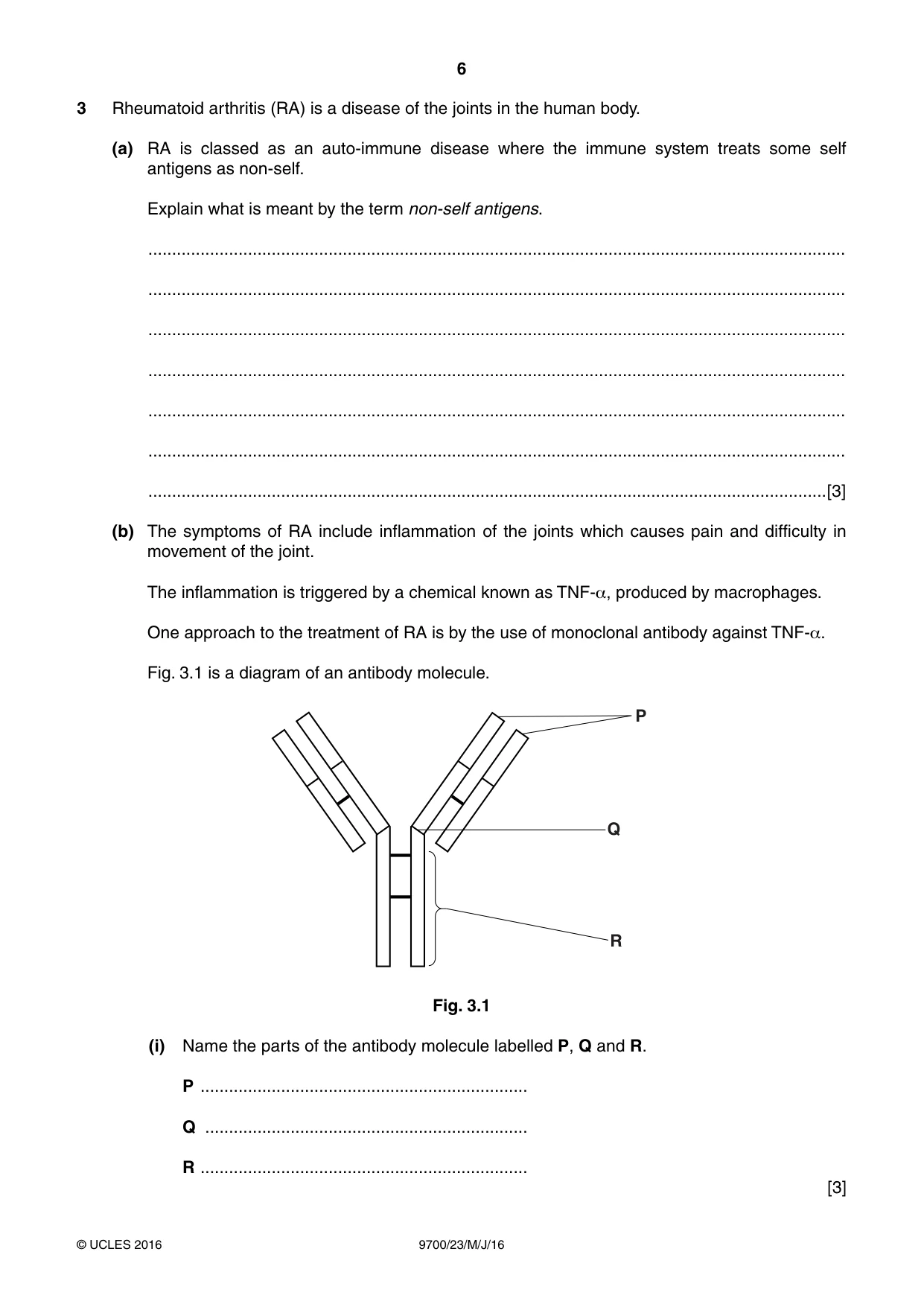
6 9700/23/M/J/16 © UCLES 2016 3 Rheumatoid arthritis (RA) is a disease of the joints in the human body. (a) RA is classed as an auto-immune disease where the immune system treats some self antigens as non-self. Explain what is meant by the term non-self antigens. … … … … … … …[3] (b) The symptoms of RA include inflammation of the joints which causes pain and difficulty in movement of the joint. The inflammation is triggered by a chemical known as TNF-α, produced by macrophages. One approach to the treatment of RA is by the use of monoclonal antibody against TNF-α. Fig. 3.1 is a diagram of an antibody molecule. Q R P Fig. 3.1 (i) Name the parts of the antibody molecule labelled P, Q and R. P … Q … R … [3]
Question paper, page 7
7 9700/23/M/J/16 © UCLES 2016 [Turn over (ii) Name the type of bonds that hold the polypeptide chains together in the antibody structure. …[1] (c) (i) Outline how monoclonal antibody against TNF-α is produced. … … … … … … …[3] (ii) Suggest how monoclonal antibody against TNF-α can reduce the symptoms of RA. … … … … …[2] [Total: 12]
Question paper, page 8
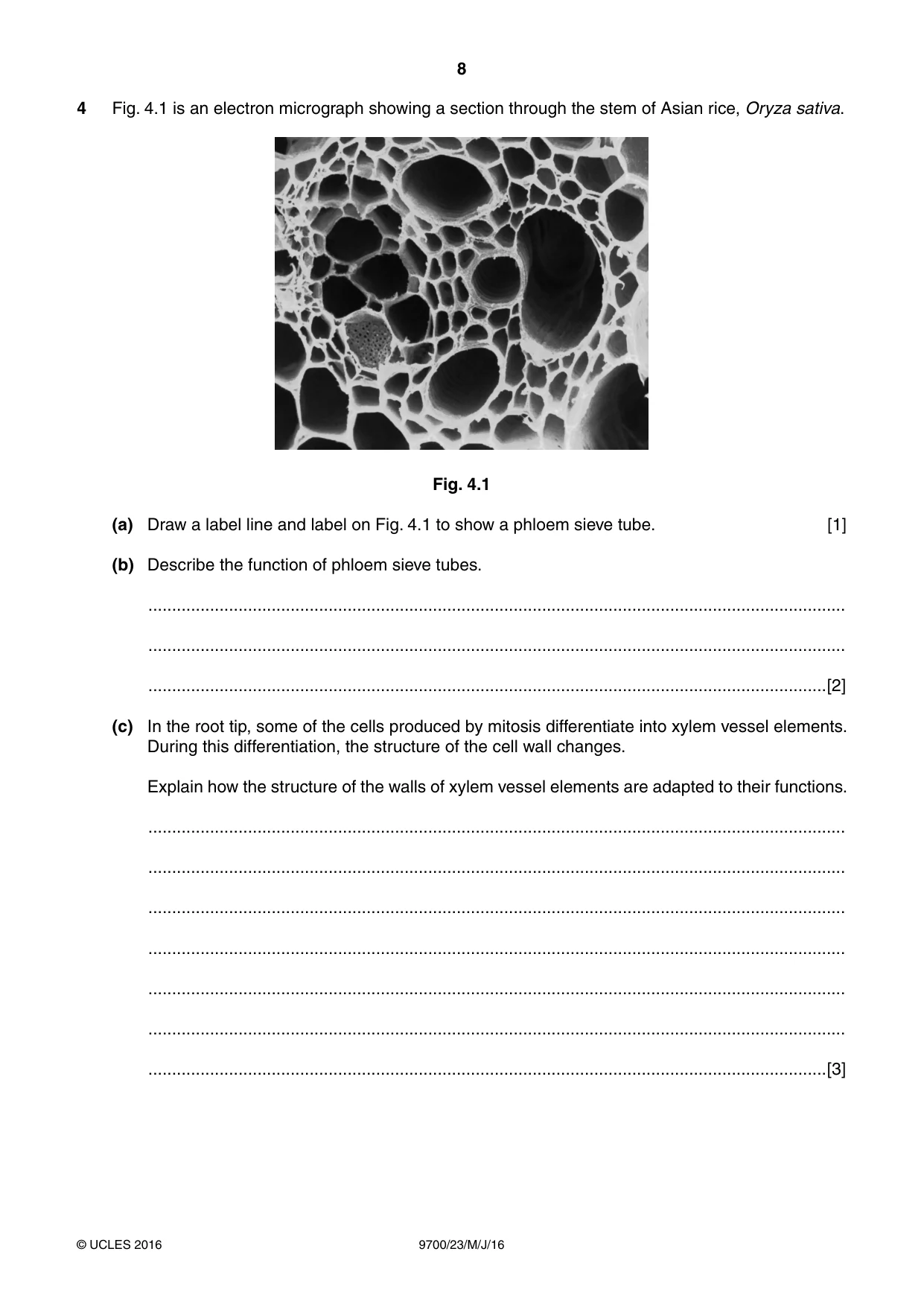
8 9700/23/M/J/16 © UCLES 2016 4 Fig. 4.1 is an electron micrograph showing a section through the stem of Asian rice, Oryza sativa. Fig. 4.1 (a) Draw a label line and label on Fig. 4.1 to show a phloem sieve tube. [1] (b) Describe the function of phloem sieve tubes. … … …[2] (c) In the root tip, some of the cells produced by mitosis differentiate into xylem vessel elements. During this differentiation, the structure of the cell wall changes. Explain how the structure of the walls of xylem vessel elements are adapted to their functions. … … … … … … …[3]
Question paper, page 9
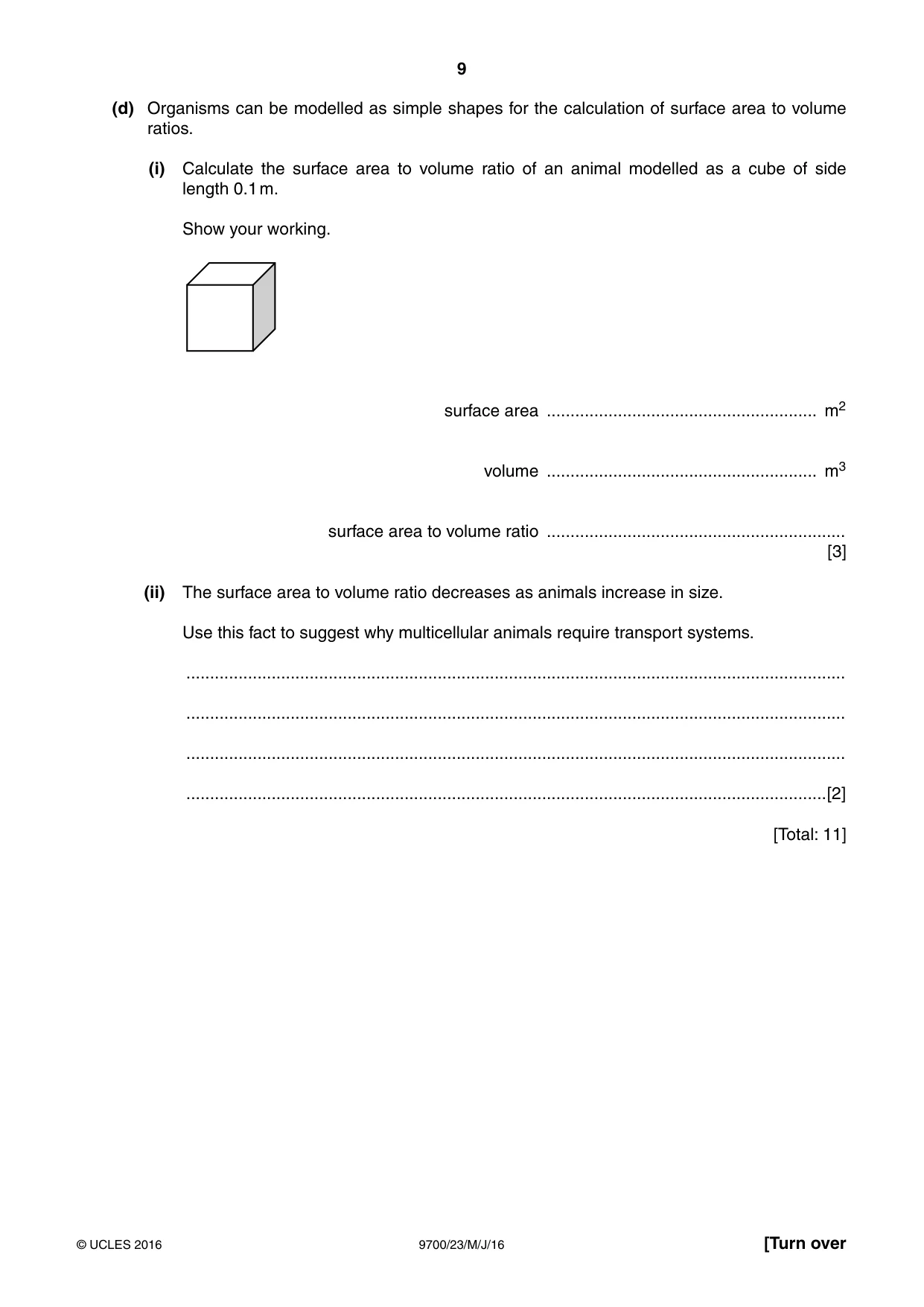
9 9700/23/M/J/16 © UCLES 2016 [Turn over (d) Organisms can be modelled as simple shapes for the calculation of surface area to volume ratios. (i) Calculate the surface area to volume ratio of an animal modelled as a cube of side length 0.1 m. Show your working. surface area … m2 volume … m3 surface area to volume ratio … [3] (ii) The surface area to volume ratio decreases as animals increase in size. Use this fact to suggest why multicellular animals require transport systems. … … … …[2] [Total: 11]
Question paper, page 10
10 9700/23/M/J/16 © UCLES 2016 5 Tuberculosis (TB) is an infectious disease caused by the bacterium Mycobacterium tuberculosis. (a) Describe how TB is transmitted. … … … …[2] (b) Streptomycin was the first antibiotic used to treat TB. During the first few years after the introduction of streptomycin treatment, an increasing number of M. tuberculosis bacteria developed resistance to streptomycin. Outline how this happened. … … … … … … … …[4]
Question paper, page 11
11 9700/23/M/J/16 © UCLES 2016 [Turn over (c) The antibiotic rifampicin was introduced as an alternative to streptomycin. Rifampicin acts by inhibiting the enzyme RNA polymerase. RNA polymerase is the enzyme used in transcription. (i) Explain what is meant by transcription. … … … …[2] (ii) M. tuberculosis and humans both use RNA polymerase for transcription. Suggest why rifampicin does not affect transcription in human cells. … …[1] (d) Other drugs such as isoniazid are also used in the treatment of TB. Some bacteria are now resistant to more than one of these drugs. These bacteria are known as multi-drug resistant (MDR) bacteria. Outline the steps that can be taken to reduce the impact of drug resistance in bacteria. … … … … … … …[3] (e) Explain why antibiotics can be used to treat bacterial infections and not viral infections. … … … …[2] [Total: 14]
Question paper, page 12
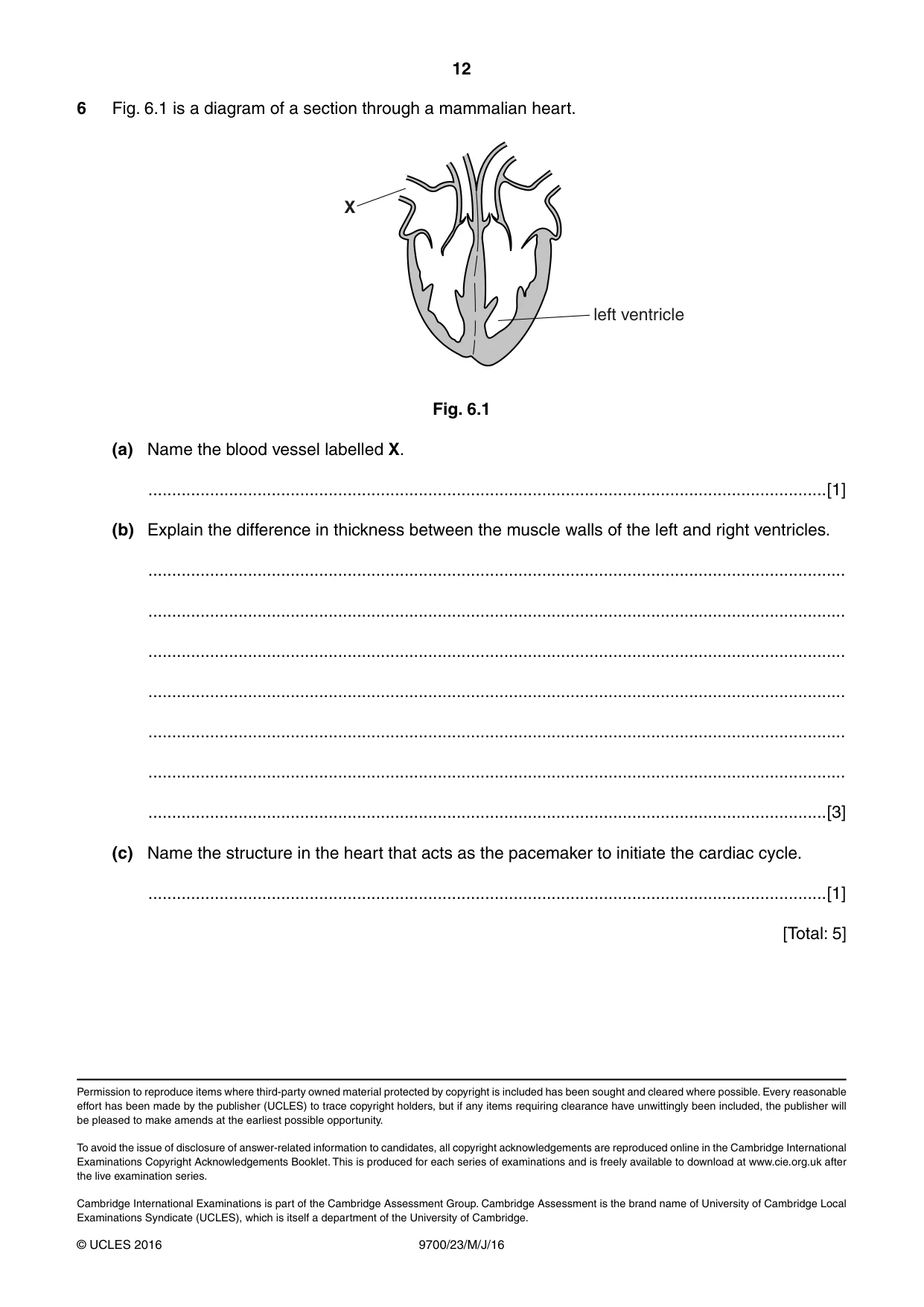
12 9700/23/M/J/16 © UCLES 2016 Permission to reproduce items where third-party owned material protected by copyright is included has been sought and cleared where possible. Every reasonable effort has been made by the publisher (UCLES) to trace copyright holders, but if any items requiring clearance have unwittingly been included, the publisher will be pleased to make amends at the earliest possible opportunity. To avoid the issue of disclosure of answer-related information to candidates, all copyright acknowledgements are reproduced online in the Cambridge International Examinations Copyright Acknowledgements Booklet. This is produced for each series of examinations and is freely available to download at www.cie.org.uk after the live examination series. Cambridge International Examinations is part of the Cambridge Assessment Group. Cambridge Assessment is the brand name of University of Cambridge Local Examinations Syndicate (UCLES), which is itself a department of the University of Cambridge. 6 Fig. 6.1 is a diagram of a section through a mammalian heart. X left ventricle Fig. 6.1 (a) Name the blood vessel labelled X. …[1] (b) Explain the difference in thickness between the muscle walls of the left and right ventricles. … … … … … … …[3] (c) Name the structure in the heart that acts as the pacemaker to initiate the cardiac cycle. …[1] [Total: 5]
Mark scheme, page 1
® IGCSE is the registered trademark of Cambridge International Examinations. This document consists of 6 printed pages. © UCLES 2016 [Turn over] Cambridge International Examinations Cambridge International Advanced Subsidiary and Advanced Level BIOLOGY 9700/23 Paper 2 AS Level Structured Questions May/June 2016 MARK SCHEME Maximum Mark: 60 Published This mark scheme is published as an aid to teachers and candidates, to indicate the requirements of the examination. It shows the basis on which Examiners were instructed to award marks. It does not indicate the details of the discussions that took place at an Examiners’ meeting before marking began, which would have considered the acceptability of alternative answers. Mark schemes should be read in conjunction with the question paper and the Principal Examiner Report for Teachers. Cambridge will not enter into discussions about these mark schemes. Cambridge is publishing the mark schemes for the May/June 2016 series for most Cambridge IGCSE®, Cambridge International A and AS Level components and some Cambridge O Level components.
Mark scheme, page 2
Page 2 Mark Scheme Syllabus Paper Cambridge International AS/A Level – May/June 2016 9700 23 © Cambridge International Examinations 2016 Mark scheme abbreviations: ; separates marking points / alternative answers for the same point R reject A accept (for answers correctly cued by the question, or by extra guidance) AW alternative wording (where responses vary more than usual) underline actual word given must be used by candidate (grammatical variants accepted) max indicates the maximum number of marks that can be given ora or reverse argument mp marking point (with relevant number) ecf error carried forward I ignore
Mark scheme, page 3
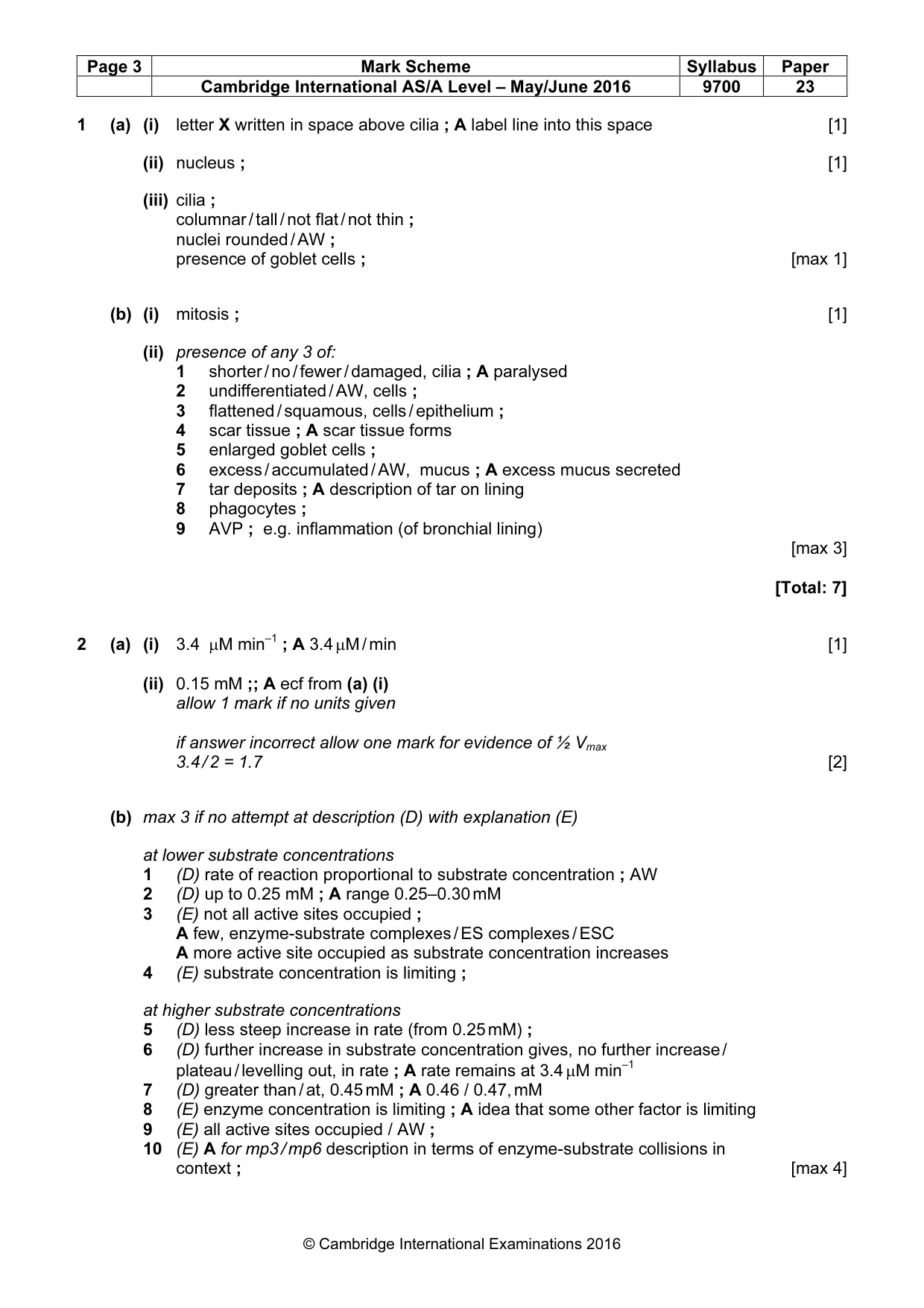
Page 3 Mark Scheme Syllabus Paper Cambridge International AS/A Level – May/June 2016 9700 23 © Cambridge International Examinations 2016 1 (a) (i) letter X written in space above cilia ; A label line into this space [1] (ii) nucleus ; [1] (iii) cilia ; columnar / tall / not flat / not thin ; nuclei rounded / AW ; presence of goblet cells ; [max 1] (b) (i) mitosis ; [1] (ii) presence of any 3 of: 1 shorter / no / fewer / damaged, cilia ; A paralysed 2 undifferentiated / AW, cells ; 3 flattened / squamous, cells / epithelium ; 4 scar tissue ; A scar tissue forms 5 enlarged goblet cells ; 6 excess / accumulated / AW, mucus ; A excess mucus secreted 7 tar deposits ; A description of tar on lining 8 phagocytes ; 9 AVP ; e.g. inflammation (of bronchial lining) [max 3] [Total: 7] 2 (a) (i) 3.4 µM min–1 ; A 3.4 µM / min [1] (ii) 0.15 mM ;; A ecf from (a) (i) allow 1 mark if no units given if answer incorrect allow one mark for evidence of ½ Vmax 3.4 / 2 = 1.7 [2] (b) max 3 if no attempt at description (D) with explanation (E) at lower substrate concentrations 1 (D) rate of reaction proportional to substrate concentration ; AW 2 (D) up to 0.25 mM ; A range 0.25–0.30 mM 3 (E) not all active sites occupied ; A few, enzyme-substrate complexes / ES complexes / ESC A more active site occupied as substrate concentration increases 4 (E) substrate concentration is limiting ; at higher substrate concentrations 5 (D) less steep increase in rate (from 0.25 mM) ; 6 (D) further increase in substrate concentration gives, no further increase / plateau / levelling out, in rate ; A rate remains at 3.4 µM min–1 7 (D) greater than / at, 0.45 mM ; A 0.46 / 0.47, mM 8 (E) enzyme concentration is limiting ; A idea that some other factor is limiting 9 (E) all active sites occupied / AW ; 10 (E) A for mp3 / mp6 description in terms of enzyme-substrate collisions in context ; [max 4]
Mark scheme, page 4
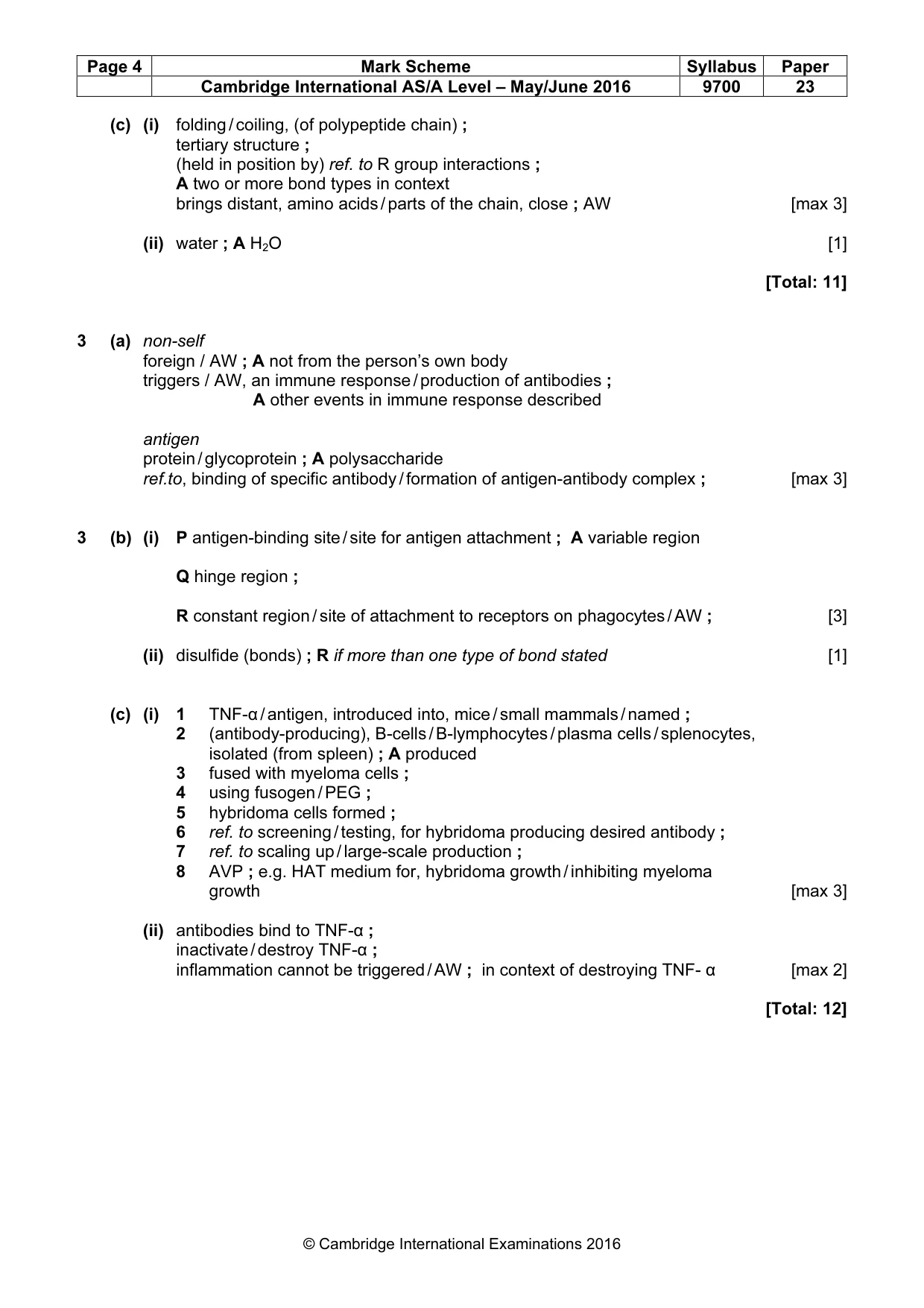
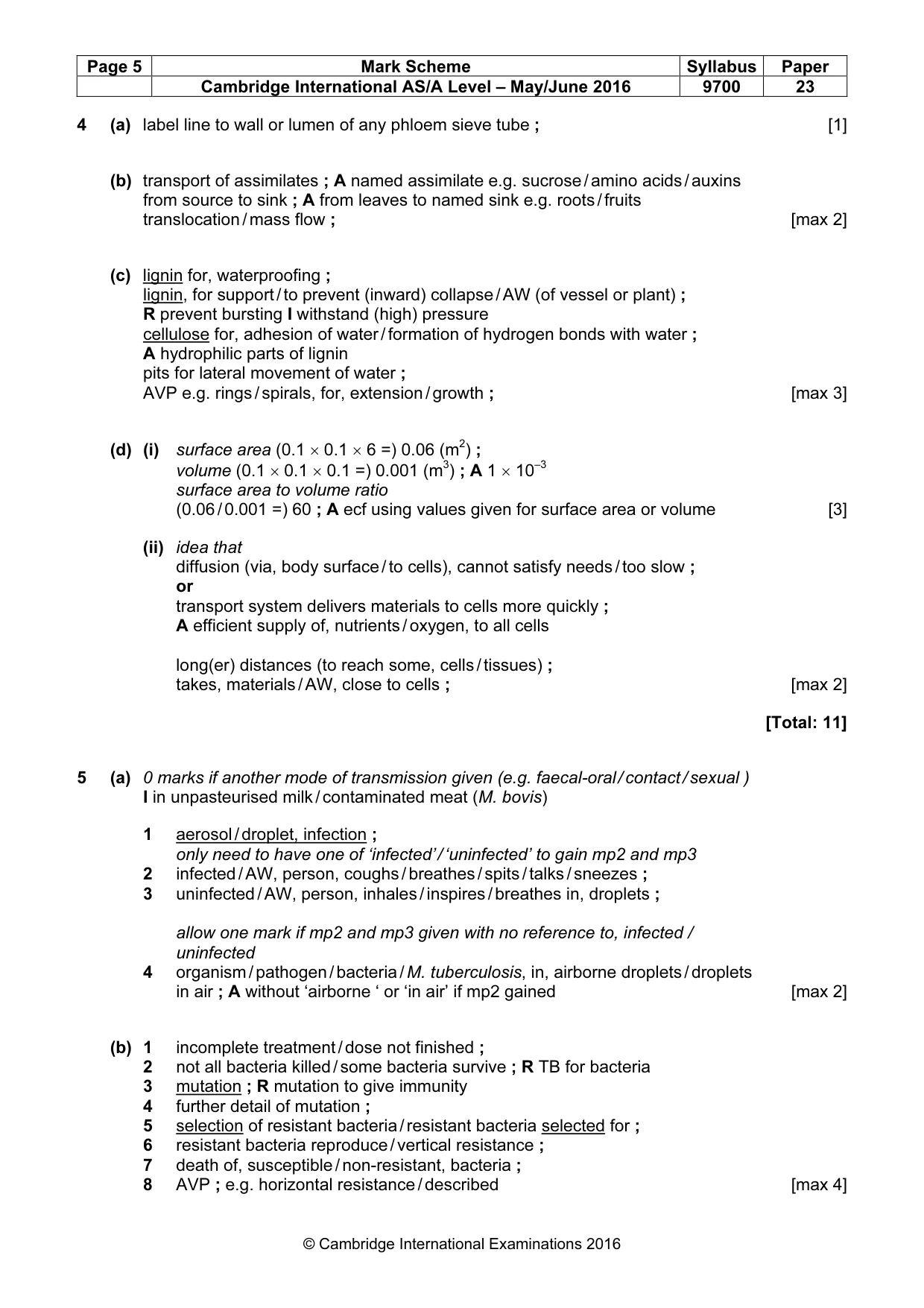
Page 4 Mark Scheme Syllabus Paper Cambridge International AS/A Level – May/June 2016 9700 23 © Cambridge International Examinations 2016 (c) (i) folding / coiling, (of polypeptide chain) ; tertiary structure ; (held in position by) ref. to R group interactions ; A two or more bond types in context brings distant, amino acids / parts of the chain, close ; AW [max 3] (ii) water ; A H2O [1] [Total: 11] 3 (a) non-self foreign / AW ; A not from the person’s own body triggers / AW, an immune response / production of antibodies ; A other events in immune response described antigen protein / glycoprotein ; A polysaccharide ref.to, binding of specific antibody / formation of antigen-antibody complex ; [max 3] 3 (b) (i) P antigen-binding site / site for antigen attachment ; A variable region Q hinge region ; R constant region / site of attachment to receptors on phagocytes / AW ; [3] (ii) disulfide (bonds) ; R if more than one type of bond stated [1] (c) (i) 1 TNF-α / antigen, introduced into, mice / small mammals / named ; 2 (antibody-producing), B-cells / B-lymphocytes / plasma cells / splenocytes, isolated (from spleen) ; A produced 3 fused with myeloma cells ; 4 using fusogen / PEG ; 5 hybridoma cells formed ; 6 ref. to screening / testing, for hybridoma producing desired antibody ; 7 ref. to scaling up / large-scale production ; 8 AVP ; e.g. HAT medium for, hybridoma growth / inhibiting myeloma growth [max 3] (ii) antibodies bind to TNF-α ; inactivate / destroy TNF-α ; inflammation cannot be triggered / AW ; in context of destroying TNF- α [max 2] [Total: 12]
Mark scheme, page 5
Page 5 Mark Scheme Syllabus Paper Cambridge International AS/A Level – May/June 2016 9700 23 © Cambridge International Examinations 2016 4 (a) label line to wall or lumen of any phloem sieve tube ; [1] (b) transport of assimilates ; A named assimilate e.g. sucrose / amino acids / auxins from source to sink ; A from leaves to named sink e.g. roots / fruits translocation / mass flow ; [max 2] (c) lignin for, waterproofing ; lignin, for support / to prevent (inward) collapse / AW (of vessel or plant) ; R prevent bursting I withstand (high) pressure cellulose for, adhesion of water / formation of hydrogen bonds with water ; A hydrophilic parts of lignin pits for lateral movement of water ; AVP e.g. rings / spirals, for, extension / growth ; [max 3] (d) (i) surface area (0.1 × 0.1 × 6 =) 0.06 (m2) ; volume (0.1 × 0.1 × 0.1 =) 0.001 (m3) ; A 1 × 10⁻³ surface area to volume ratio (0.06 / 0.001 =) 60 ; A ecf using values given for surface area or volume [3] (ii) idea that diffusion (via, body surface / to cells), cannot satisfy needs / too slow ; or transport system delivers materials to cells more quickly ; A efficient supply of, nutrients / oxygen, to all cells long(er) distances (to reach some, cells / tissues) ; takes, materials / AW, close to cells ; [max 2] [Total: 11] 5 (a) 0 marks if another mode of transmission given (e.g. faecal-oral / contact / sexual ) I in unpasteurised milk / contaminated meat (M. bovis) 1 aerosol / droplet, infection ; only need to have one of ‘infected’ / ‘uninfected’ to gain mp2 and mp3 2 infected / AW, person, coughs / breathes / spits / talks / sneezes ; 3 uninfected / AW, person, inhales / inspires / breathes in, droplets ; allow one mark if mp2 and mp3 given with no reference to, infected / uninfected 4 organism / pathogen / bacteria / M. tuberculosis, in, airborne droplets / droplets in air ; A without ‘airborne ‘ or ‘in air’ if mp2 gained [max 2] (b) 1 incomplete treatment / dose not finished ; 2 not all bacteria killed / some bacteria survive ; R TB for bacteria 3 mutation ; R mutation to give immunity 4 further detail of mutation ; 5 selection of resistant bacteria / resistant bacteria selected for ; 6 resistant bacteria reproduce / vertical resistance ; 7 death of, susceptible / non-resistant, bacteria ; 8 AVP ; e.g. horizontal resistance / described [max 4]
Mark scheme, page 6
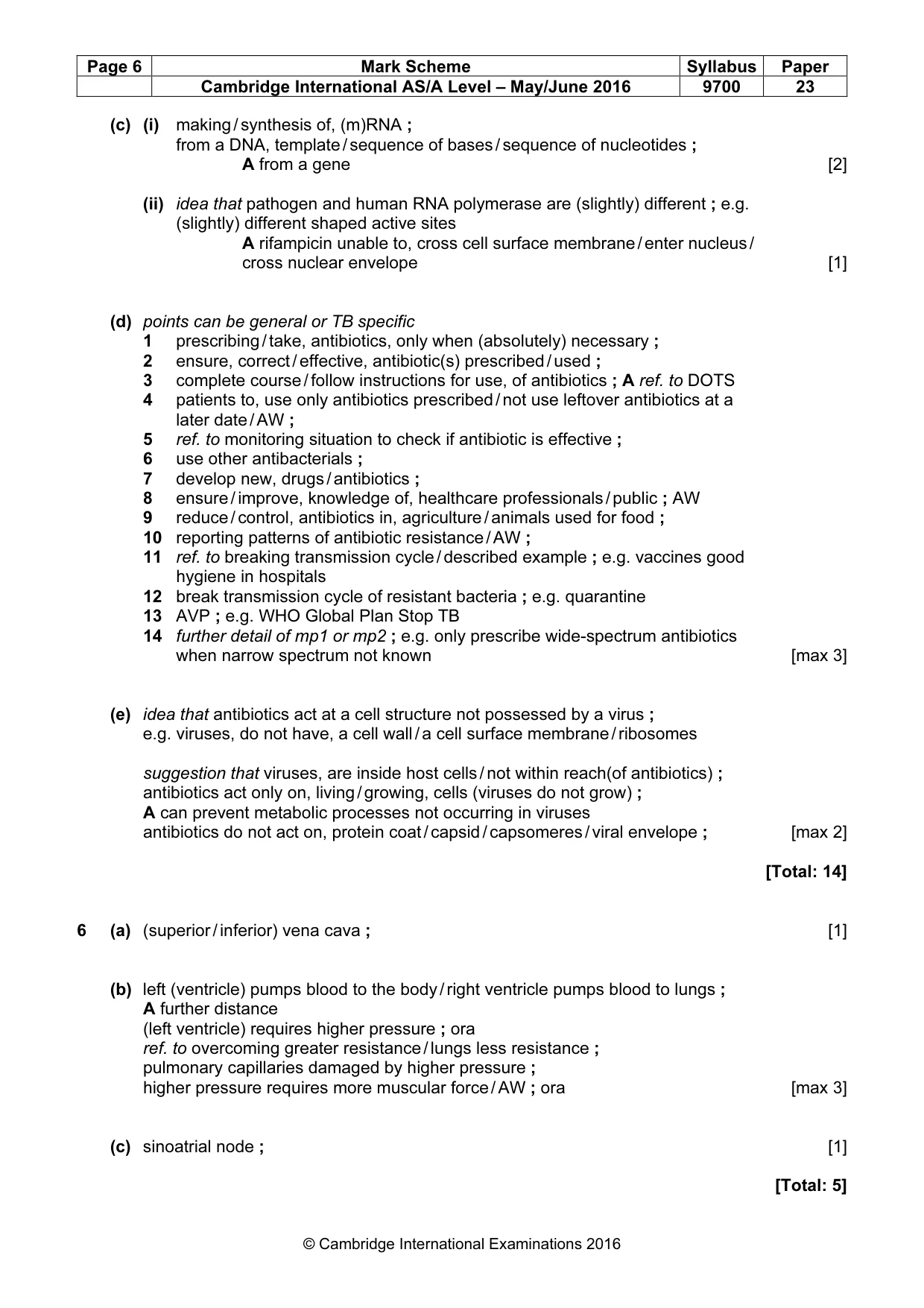
Page 6 Mark Scheme Syllabus Paper Cambridge International AS/A Level – May/June 2016 9700 23 © Cambridge International Examinations 2016 (c) (i) making / synthesis of, (m)RNA ; from a DNA, template / sequence of bases / sequence of nucleotides ; A from a gene [2] (ii) idea that pathogen and human RNA polymerase are (slightly) different ; e.g. (slightly) different shaped active sites A rifampicin unable to, cross cell surface membrane / enter nucleus / cross nuclear envelope [1] (d) points can be general or TB specific 1 prescribing / take, antibiotics, only when (absolutely) necessary ; 2 ensure, correct / effective, antibiotic(s) prescribed / used ; 3 complete course / follow instructions for use, of antibiotics ; A ref. to DOTS 4 patients to, use only antibiotics prescribed / not use leftover antibiotics at a later date / AW ; 5 ref. to monitoring situation to check if antibiotic is effective ; 6 use other antibacterials ; 7 develop new, drugs / antibiotics ; 8 ensure / improve, knowledge of, healthcare professionals / public ; AW 9 reduce / control, antibiotics in, agriculture / animals used for food ; 10 reporting patterns of antibiotic resistance / AW ; 11 ref. to breaking transmission cycle / described example ; e.g. vaccines good hygiene in hospitals 12 break transmission cycle of resistant bacteria ; e.g. quarantine 13 AVP ; e.g. WHO Global Plan Stop TB 14 further detail of mp1 or mp2 ; e.g. only prescribe wide-spectrum antibiotics when narrow spectrum not known [max 3] (e) idea that antibiotics act at a cell structure not possessed by a virus ; e.g. viruses, do not have, a cell wall / a cell surface membrane / ribosomes suggestion that viruses, are inside host cells / not within reach(of antibiotics) ; antibiotics act only on, living / growing, cells (viruses do not grow) ; A can prevent metabolic processes not occurring in viruses antibiotics do not act on, protein coat / capsid / capsomeres / viral envelope ; [max 2] [Total: 14] 6 (a) (superior / inferior) vena cava ; [1] (b) left (ventricle) pumps blood to the body / right ventricle pumps blood to lungs ; A further distance (left ventricle) requires higher pressure ; ora ref. to overcoming greater resistance / lungs less resistance ; pulmonary capillaries damaged by higher pressure ; higher pressure requires more muscular force / AW ; ora [max 3] (c) sinoatrial node ; [1] [Total: 5]
What you needed in this session
Cambridge’s own grade thresholds for 2016 May/June, Paper 2 · Variant 3. A higher threshold means an easier paper — the bar moves with how the cohort did.