Cambridge A Level Biology 9700 — 2016 Feb/March Paper 4 · Variant 2
9700/42/F/M/16 · 100 marks · ≈113 min
The question paper and its mark scheme, free to read here and free to download. This is Cambridge’s own paper, exactly as it was sat.
Question paper28 pages






Mark scheme10 pages
Answers below. Sit the paper first if you are practising.
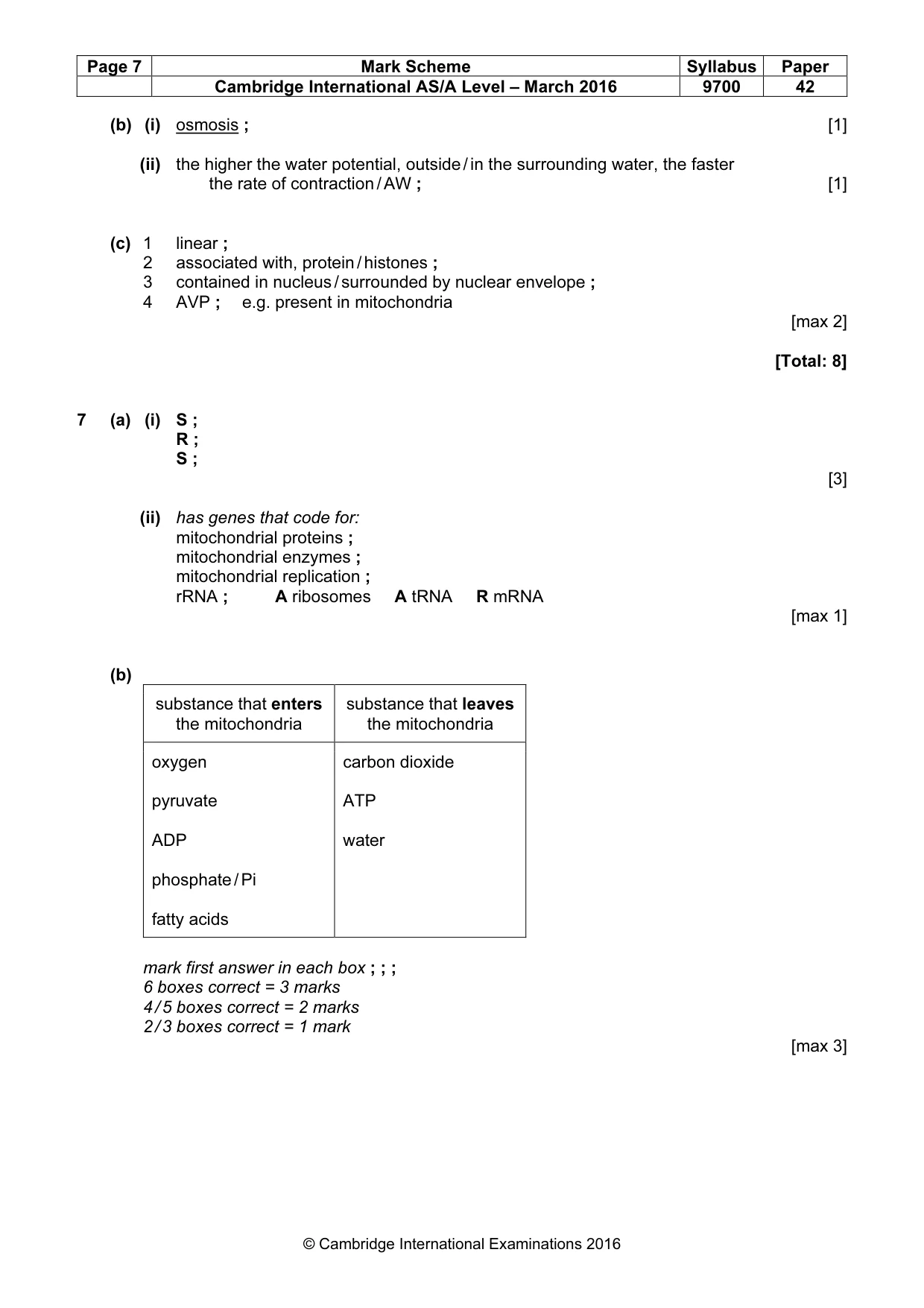
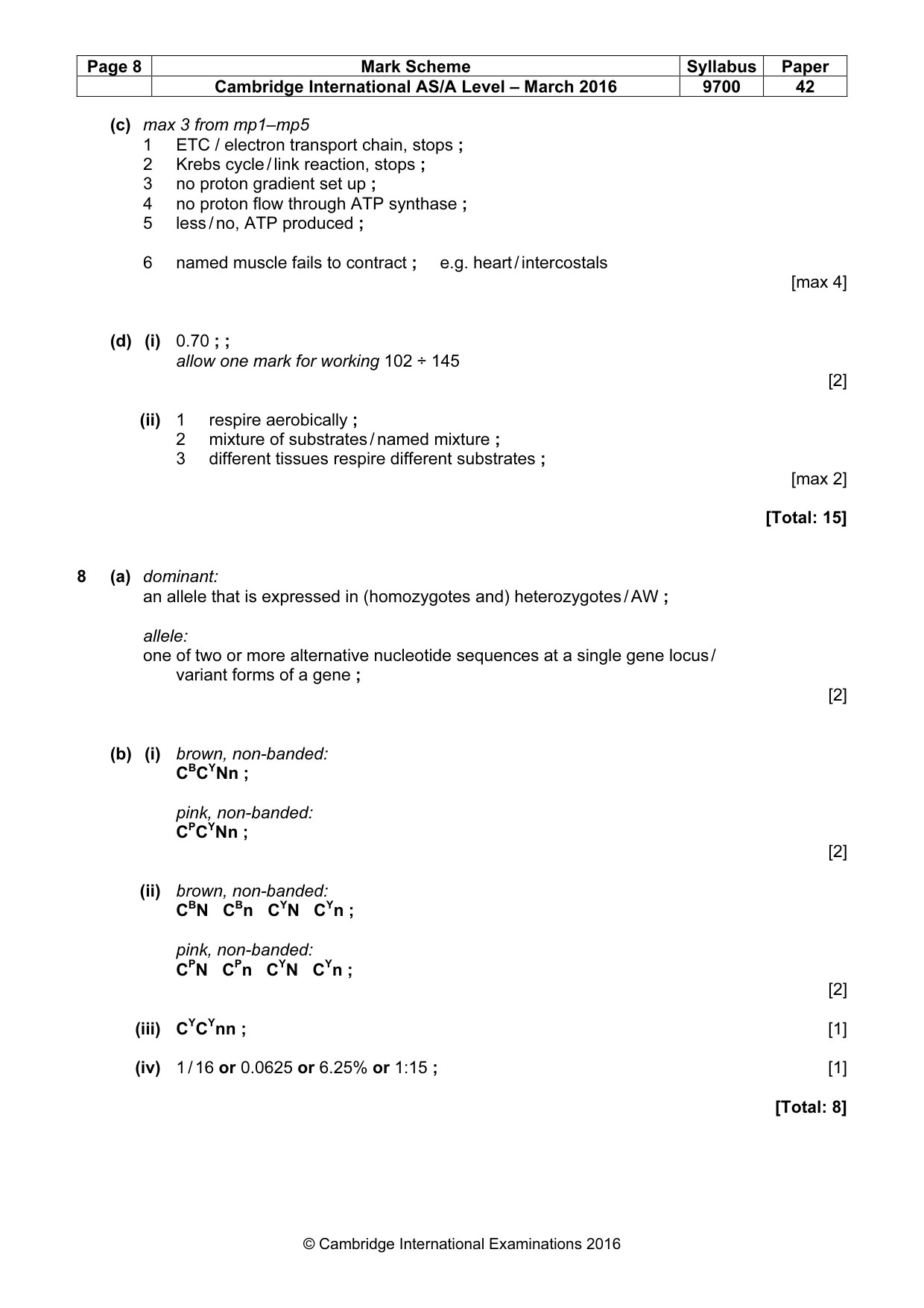
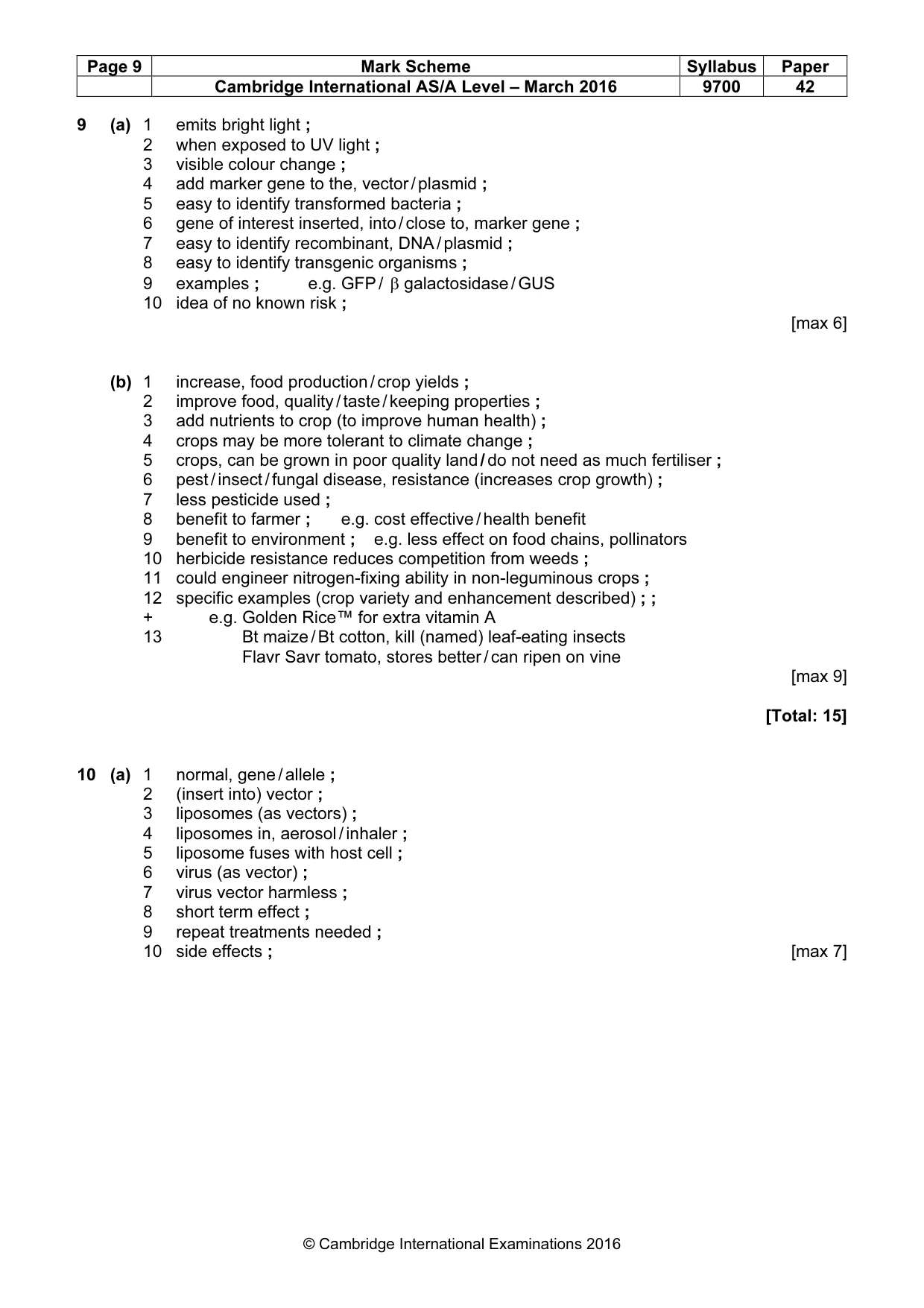
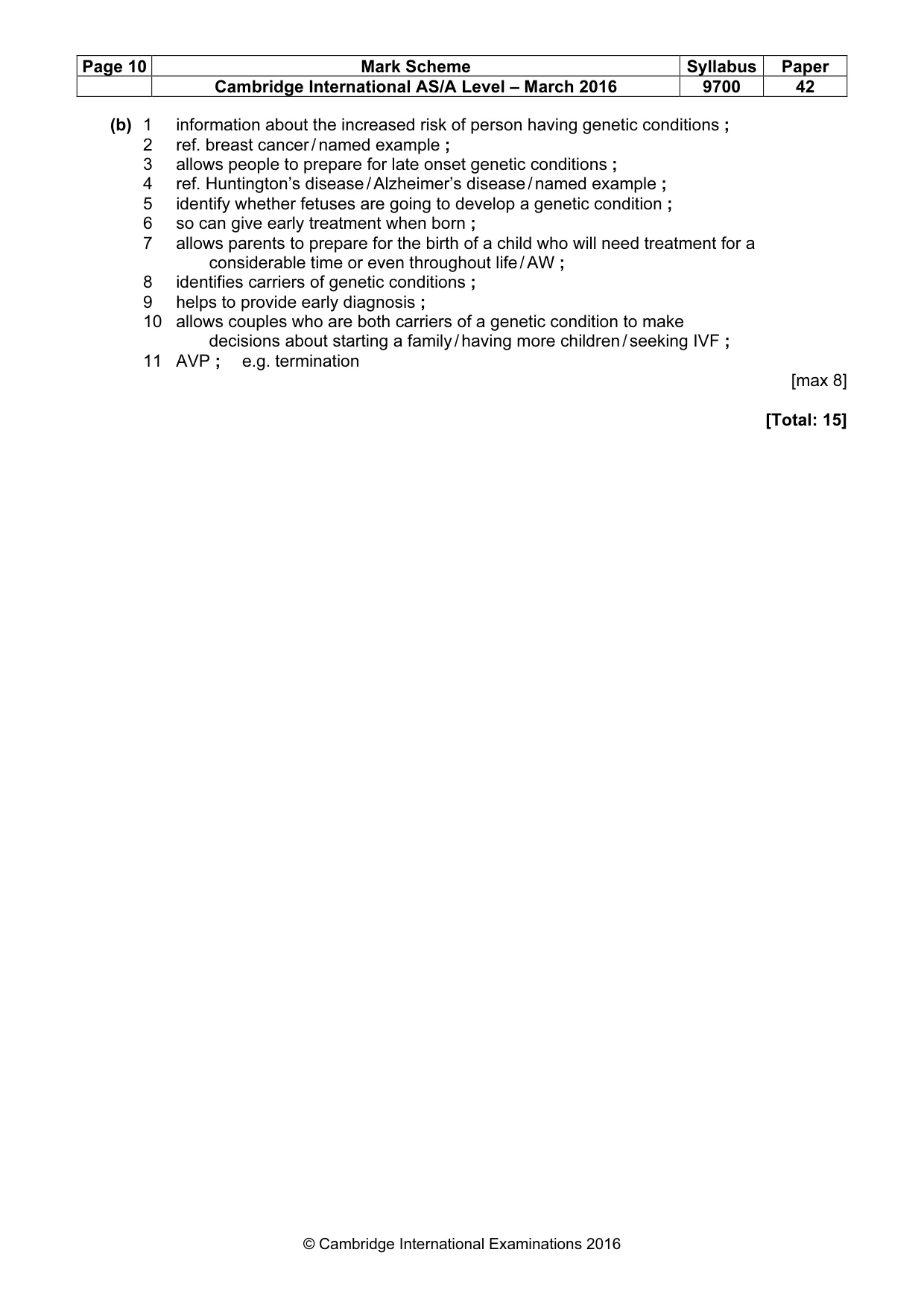
Paper as text
Question paper, page 1
This document consists of 24 printed pages, 1 blank page and 3 lined pages. DC (CW/SW) 122804/2 © UCLES 2016 [Turn over Cambridge International Examinations Cambridge International Advanced Subsidiary and Advanced Level * 2 7 6 8 8 2 0 3 8 9 * BIOLOGY 9700/42 Paper 4 A Level Structured Questions February/March 2016 2 hours Candidates answer on the Question Paper. Additional Materials: Answer Paper available on request. READ THESE INSTRUCTIONS FIRST Write your Centre number, candidate number and name on all the work you hand in. Write in dark blue or black pen. You may use an HB pencil for any diagrams or graphs. Do not use staples, paper clips, glue or correction fluid. DO NOT WRITE IN ANY BARCODES. Section A Answer all questions. Section B Answer one question. Electronic calculators may be used. You may lose marks if you do not show your working or if you do not use appropriate units. At the end of the examination, fasten all your work securely together. The number of marks is given in brackets [ ] at the end of each question or part question.
Question paper, page 2
2 9700/42/F/M/16 © UCLES 2016 Section A Answer all the questions. 1 (a) The rate of photosynthesis is affected by a number of environmental factors. Fig. 1.1 shows the effect of light intensity on the rate of photosynthesis. rate of photosynthesis light intensity C A B Fig. 1.1 (i) State the limiting factor in region A of the graph. … [1] (ii) Explain what is meant by the term limiting factor. … … … … … [2] (iii) Explain why there is no further increase in the rate of photosynthesis beyond point C. … … … … … [2]
Question paper, page 3
3 9700/42/F/M/16 © UCLES 2016 [Turn over (b) For many plants living in temperate regions, the optimum temperature for photosynthesis is approximately 25 °C. Suggest reasons why the rate of photosynthesis decreases at temperatures above 25 °C. … … … … … … … … … … [4] [Total: 9]
Question paper, page 4
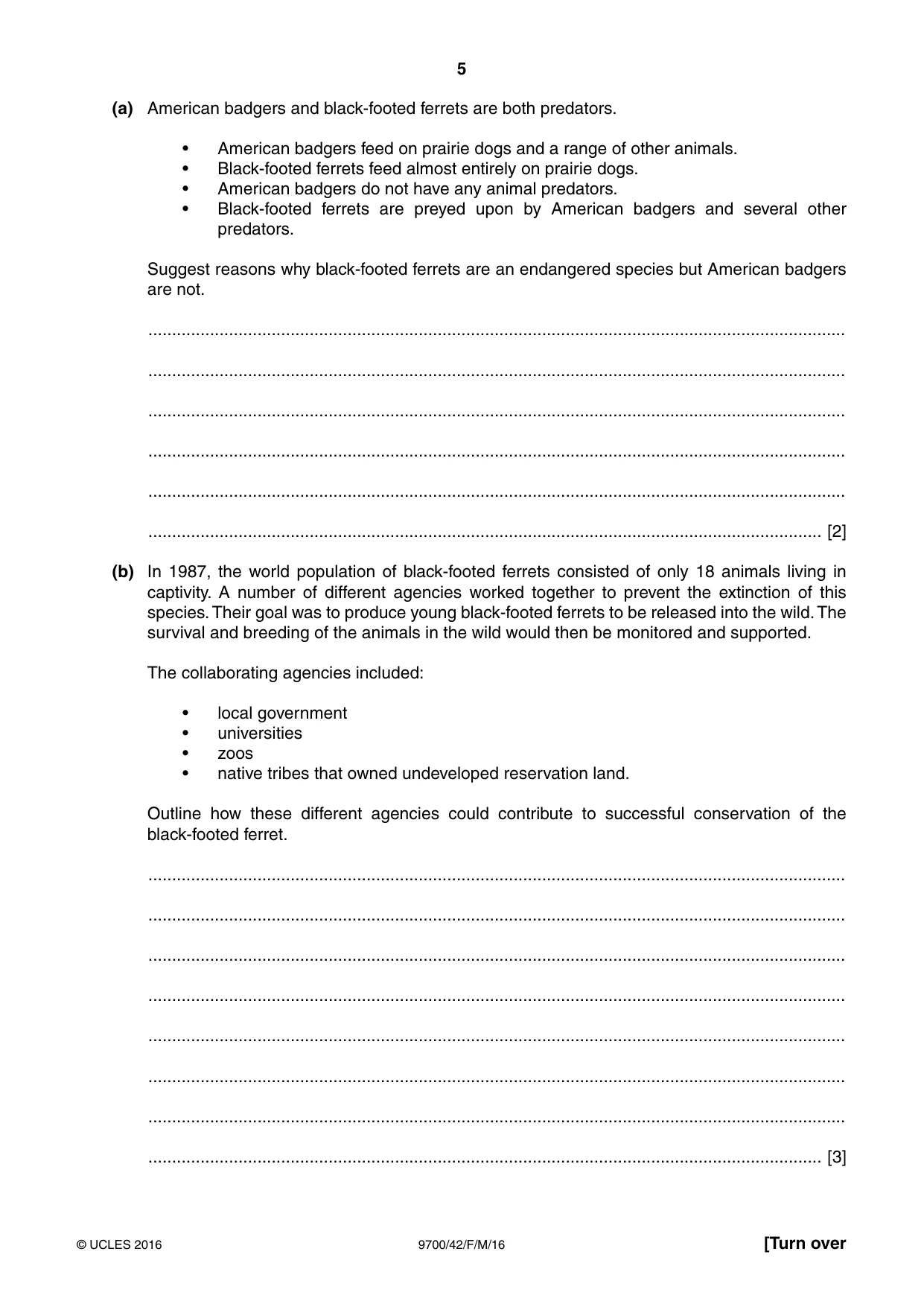
4 9700/42/F/M/16 © UCLES 2016 2 The IUCN Red List provides information about the conservation status of species throughout the world, including the American badger, Taxidea taxus, and the black-footed ferret, Mustela nigripes. Fig. 2.1 shows an American badger and Fig. 2.2 shows a black-footed ferret. Fig. 2.1 Fig. 2.2 Fig. 2.3 shows the IUCN conservation status of the American badger and the black-footed ferret in 1987 and in 2013. American badger, T. taxus 1987 conservation status 2013 American badger, T. taxus black-footed ferret, M. nigripes black-footed ferret, M. nigripes critically endangered extinct in the wild endangered vulnerable near threatened least concern Fig. 2.3
Question paper, page 5
5 9700/42/F/M/16 © UCLES 2016 [Turn over (a) American badgers and black-footed ferrets are both predators. • American badgers feed on prairie dogs and a range of other animals. • Black-footed ferrets feed almost entirely on prairie dogs. • American badgers do not have any animal predators. • Black-footed ferrets are preyed upon by American badgers and several other predators. Suggest reasons why black-footed ferrets are an endangered species but American badgers are not. … … … … … … [2] (b) In 1987, the world population of black-footed ferrets consisted of only 18 animals living in captivity. A number of different agencies worked together to prevent the extinction of this species. Their goal was to produce young black-footed ferrets to be released into the wild. The survival and breeding of the animals in the wild would then be monitored and supported. The collaborating agencies included: • local government • universities • zoos • native tribes that owned undeveloped reservation land. Outline how these different agencies could contribute to successful conservation of the black-footed ferret. … … … … … … … … [3]
Question paper, page 6
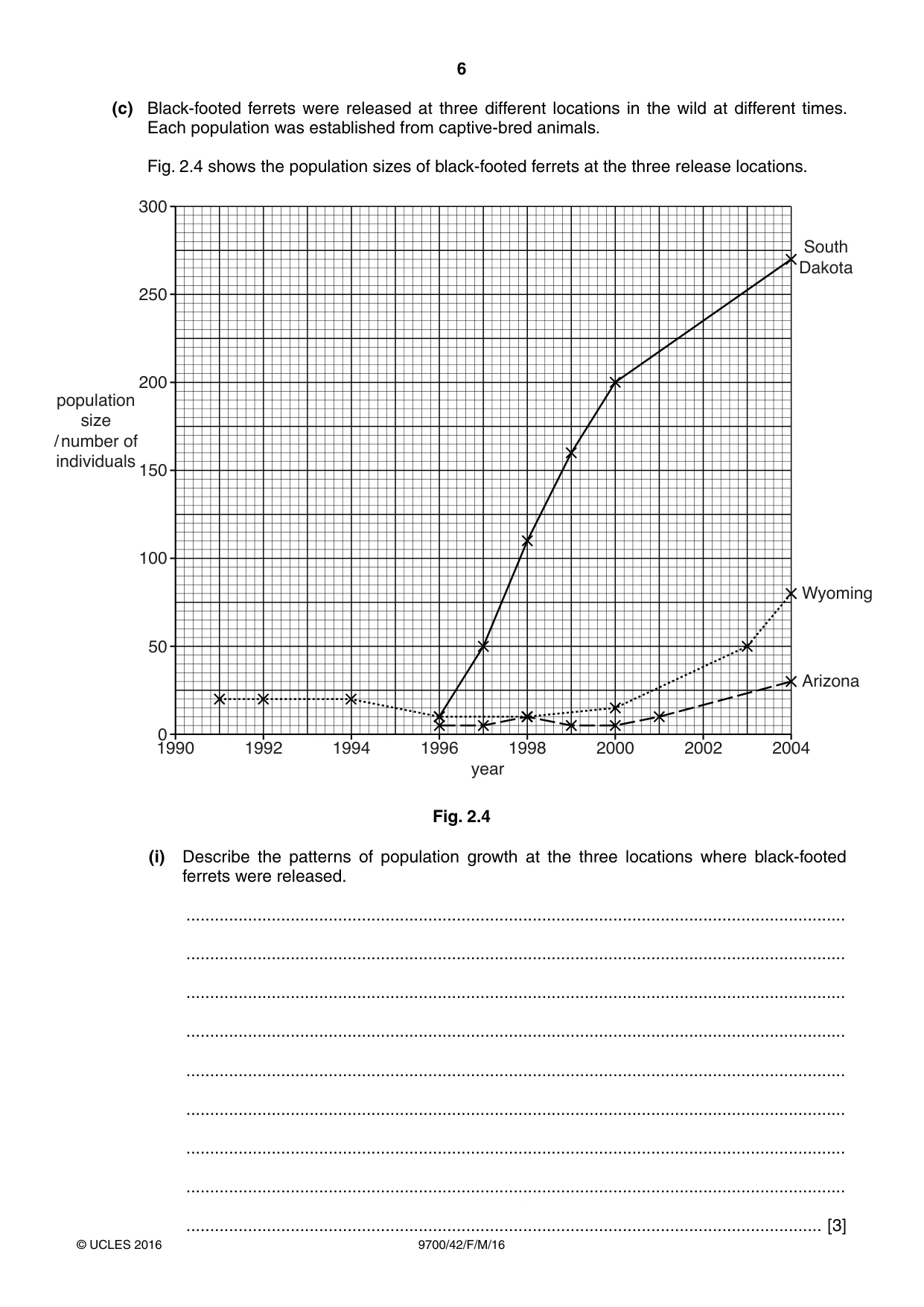
6 9700/42/F/M/16 © UCLES 2016 (c) Black-footed ferrets were released at three different locations in the wild at different times. Each population was established from captive-bred animals. Fig. 2.4 shows the population sizes of black-footed ferrets at the three release locations. 1990 0 100 200 300 50 150 250 1992 1994 1996 year population size / number of individuals 1998 2000 2002 2004 South Dakota Wyoming Arizona Fig. 2.4 (i) Describe the patterns of population growth at the three locations where black-footed ferrets were released. … … … … … … … … … [3]
Question paper, page 7
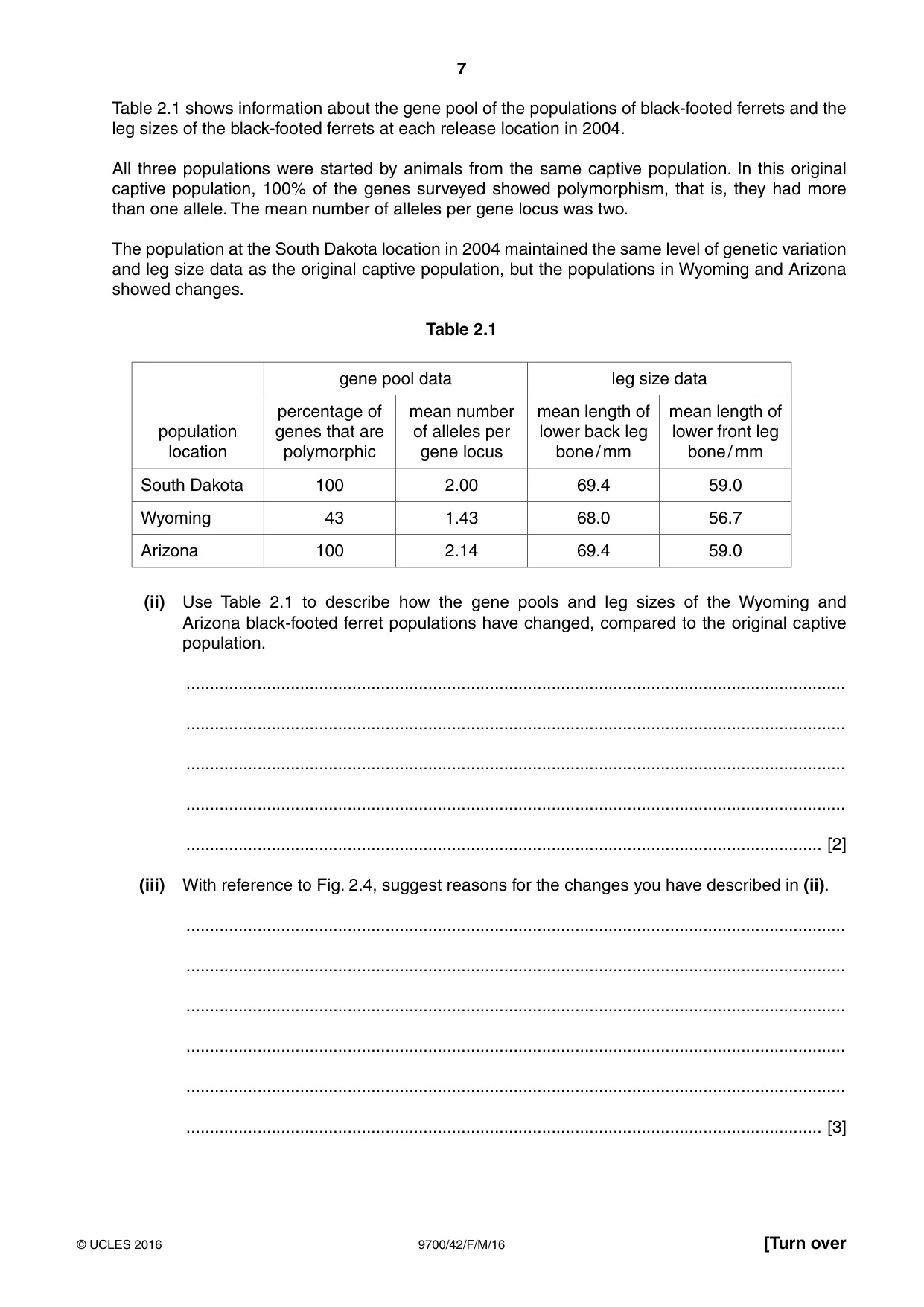
7 9700/42/F/M/16 © UCLES 2016 [Turn over Table 2.1 shows information about the gene pool of the populations of black-footed ferrets and the leg sizes of the black-footed ferrets at each release location in 2004. All three populations were started by animals from the same captive population. In this original captive population, 100% of the genes surveyed showed polymorphism, that is, they had more than one allele. The mean number of alleles per gene locus was two. The population at the South Dakota location in 2004 maintained the same level of genetic variation and leg size data as the original captive population, but the populations in Wyoming and Arizona showed changes. Table 2.1 population location gene pool data leg size data percentage of genes that are polymorphic mean number of alleles per gene locus mean length of lower back leg bone / mm mean length of lower front leg bone / mm South Dakota 100 2.00 69.4 59.0 Wyoming 43 1.43 68.0 56.7 Arizona 100 2.14 69.4 59.0 (ii) Use Table 2.1 to describe how the gene pools and leg sizes of the Wyoming and Arizona black-footed ferret populations have changed, compared to the original captive population. … … … … … [2] (iii) With reference to Fig. 2.4, suggest reasons for the changes you have described in (ii). … … … … … … [3]
Question paper, page 8
8 9700/42/F/M/16 © UCLES 2016 (d) In 2008 some black-footed ferrets were born in captivity as a result of IVF using frozen sperm that had been stored for several years. Explain the benefits of using frozen sperm in captive breeding programmes. … … … … … … … [3] [Total: 16]
Question paper, page 9
9 9700/42/F/M/16 © UCLES 2016 [Turn over Question 3 starts on page 10
Question paper, page 10
10 9700/42/F/M/16 © UCLES 2016 3 (a) Myofibrils in striated muscle consist of contractile units called sarcomeres. When an impulse stimulates striated muscles to contract, calcium ions are released from the sarcoplasmic reticulum. Describe how the release of calcium ions leads to the contraction of a sarcomere. … … … … … … … … … [4]
Question paper, page 11
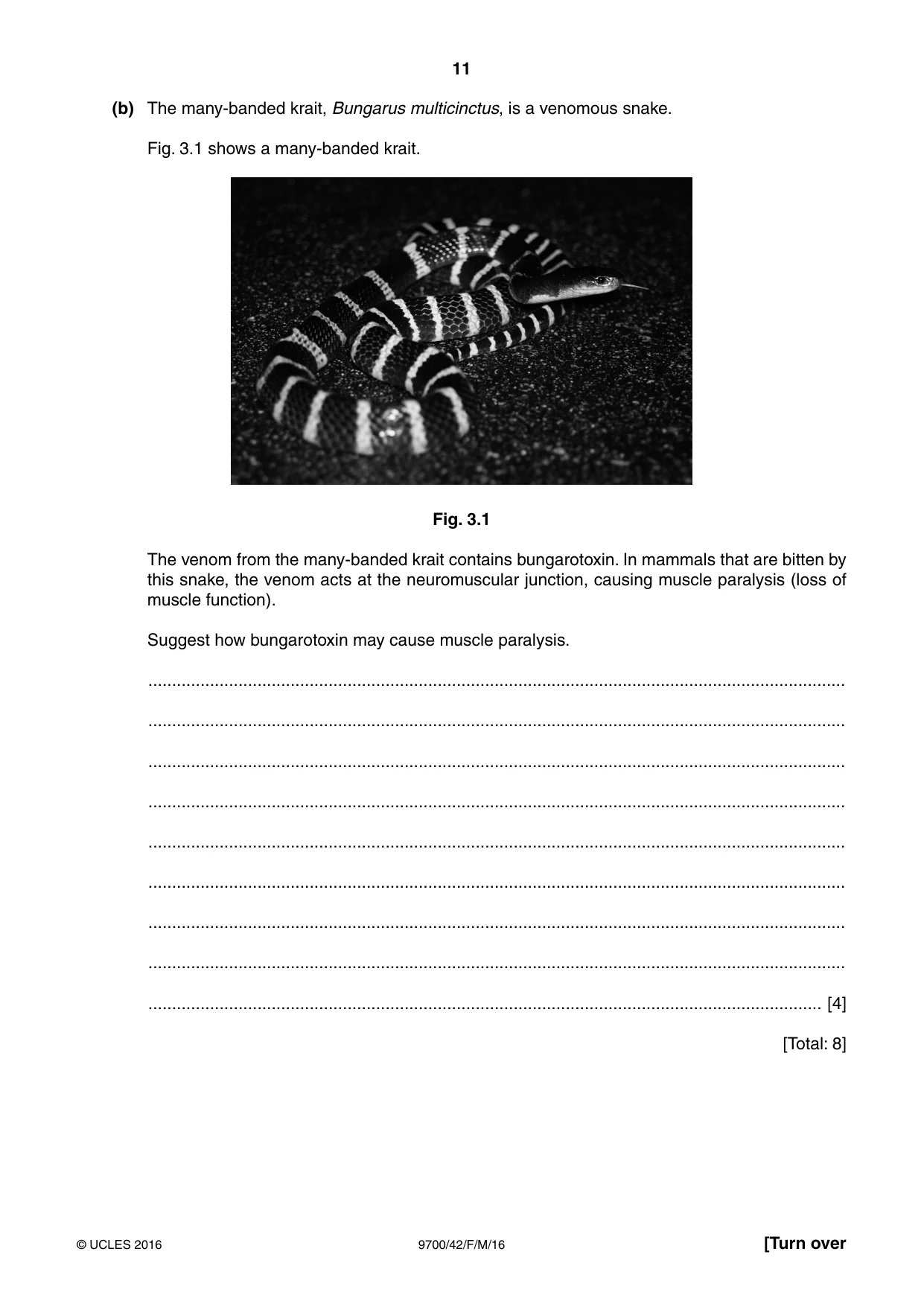
11 9700/42/F/M/16 © UCLES 2016 [Turn over (b) The many-banded krait, Bungarus multicinctus, is a venomous snake. Fig. 3.1 shows a many-banded krait. Fig. 3.1 The venom from the many-banded krait contains bungarotoxin. In mammals that are bitten by this snake, the venom acts at the neuromuscular junction, causing muscle paralysis (loss of muscle function). Suggest how bungarotoxin may cause muscle paralysis. … … … … … … … … … [4] [Total: 8]
Question paper, page 12
12 9700/42/F/M/16 © UCLES 2016 BLANK PAGE
Question paper, page 13
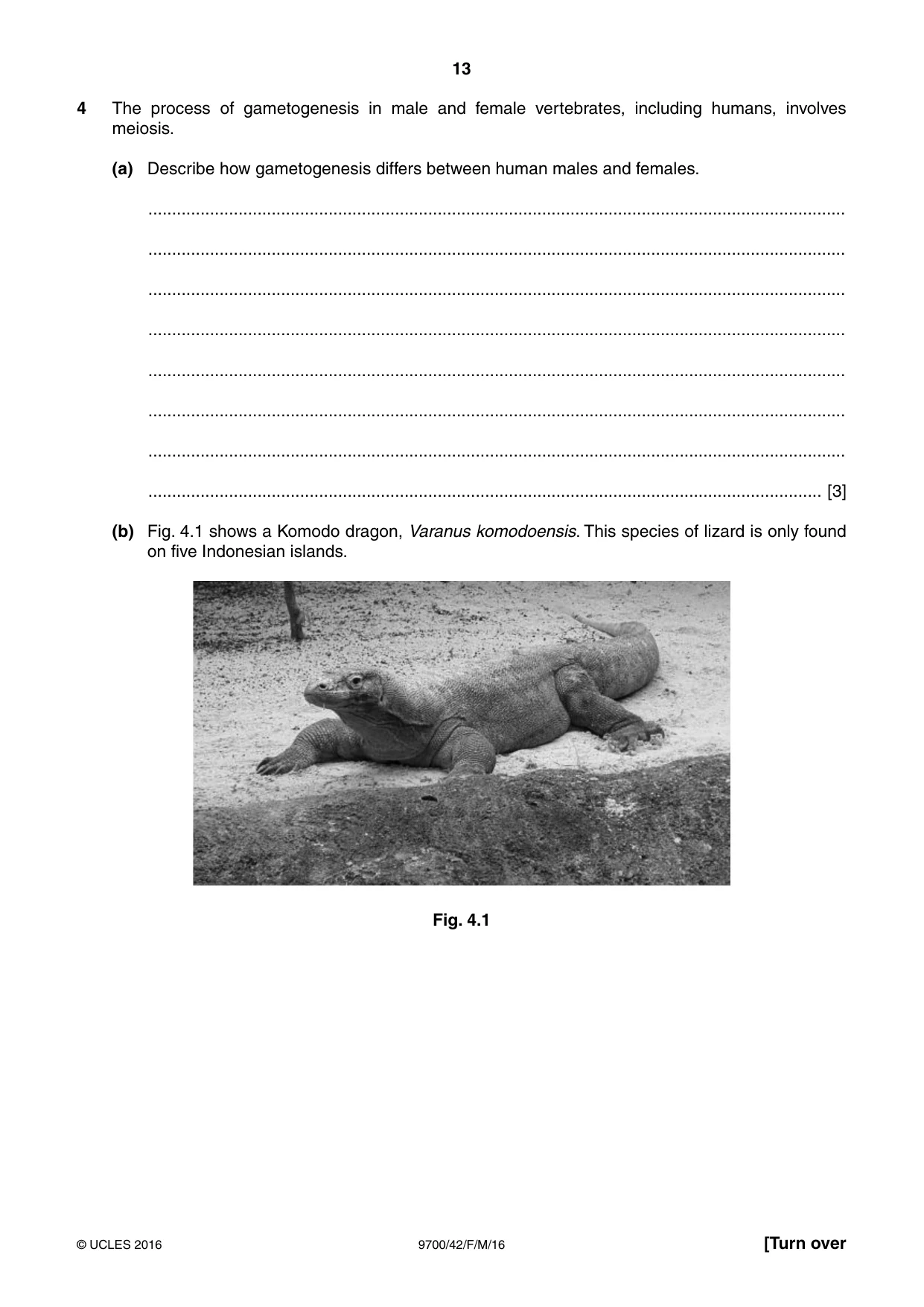
13 9700/42/F/M/16 © UCLES 2016 [Turn over 4 The process of gametogenesis in male and female vertebrates, including humans, involves meiosis. (a) Describe how gametogenesis differs between human males and females. … … … … … … … … [3] (b) Fig. 4.1 shows a Komodo dragon, Varanus komodoensis. This species of lizard is only found on five Indonesian islands. Fig. 4.1
Question paper, page 14
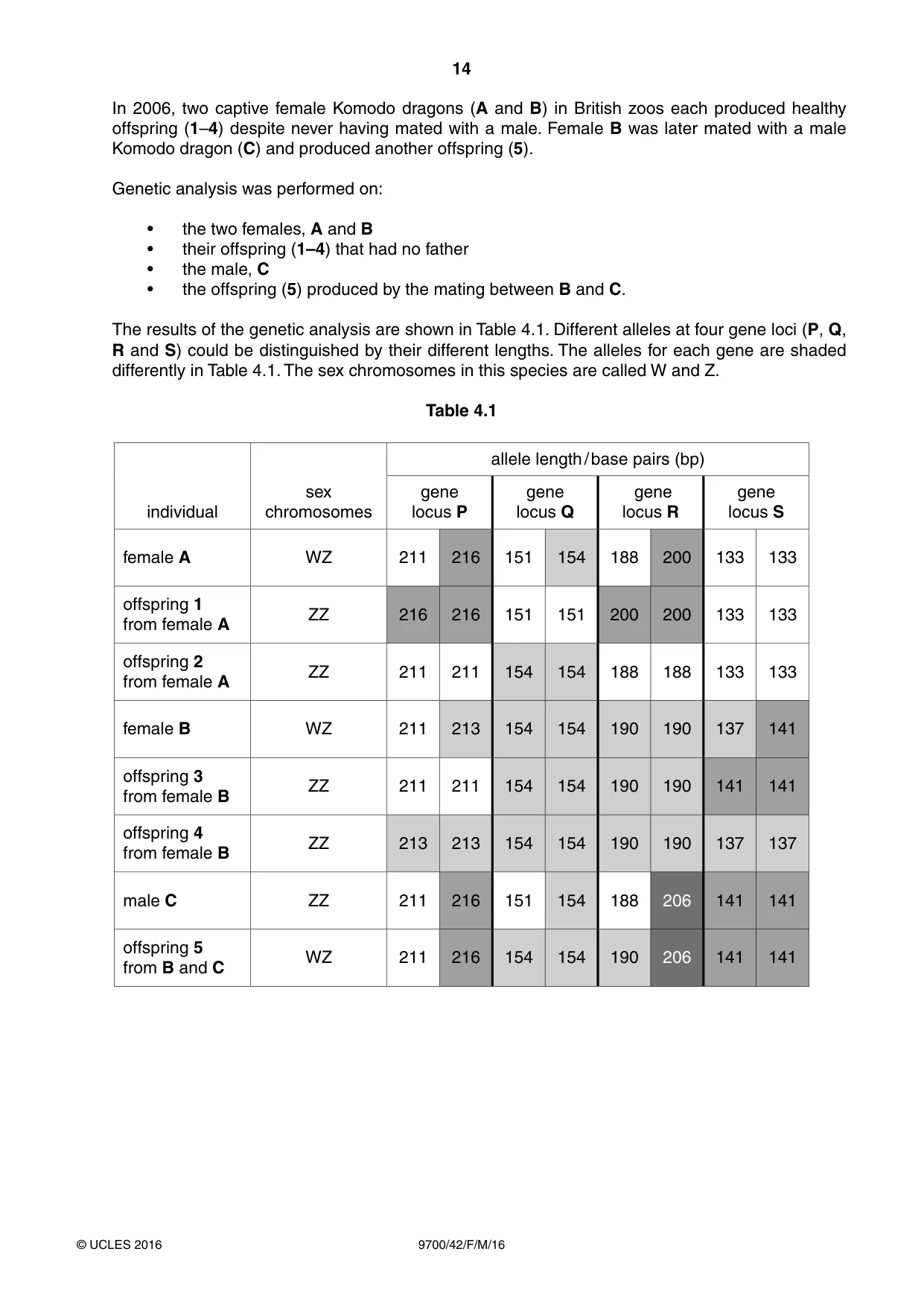
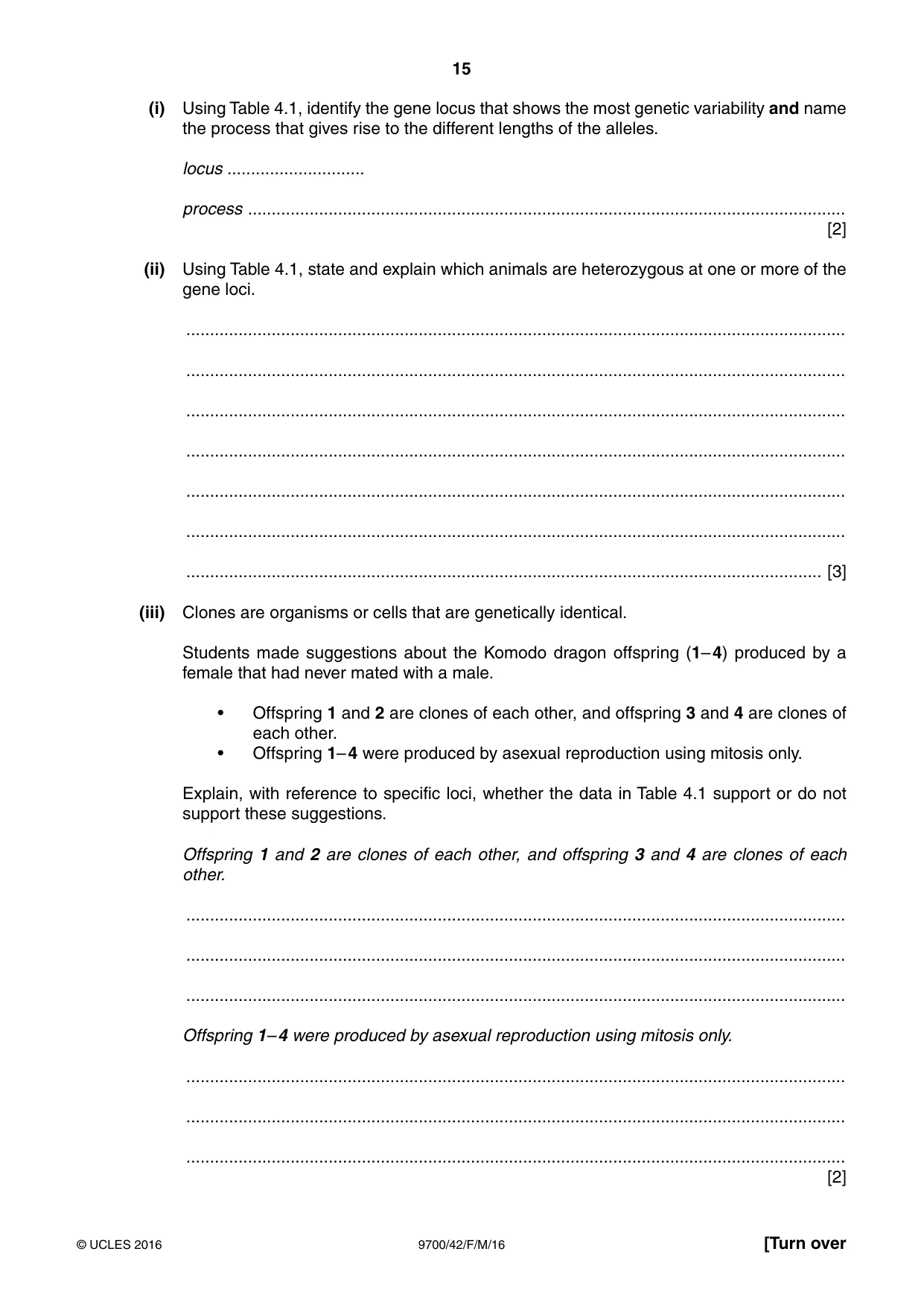
14 9700/42/F/M/16 © UCLES 2016 In 2006, two captive female Komodo dragons (A and B) in British zoos each produced healthy offspring (1–4) despite never having mated with a male. Female B was later mated with a male Komodo dragon (C) and produced another offspring (5). Genetic analysis was performed on: • the two females, A and B • their offspring (1–4) that had no father • the male, C • the offspring (5) produced by the mating between B and C. The results of the genetic analysis are shown in Table 4.1. Different alleles at four gene loci (P, Q, R and S) could be distinguished by their different lengths. The alleles for each gene are shaded differently in Table 4.1. The sex chromosomes in this species are called W and Z. Table 4.1 individual sex chromosomes allele length / base pairs (bp) gene locus P gene locus Q gene locus R gene locus S female A WZ 211 216 151 154 188 200 133 133 offspring 1 from female A ZZ 216 216 151 151 200 200 133 133 offspring 2 from female A ZZ 211 211 154 154 188 188 133 133 female B WZ 211 213 154 154 190 190 137 141 offspring 3 from female B ZZ 211 211 154 154 190 190 141 141 offspring 4 from female B ZZ 213 213 154 154 190 190 137 137 male C ZZ 211 216 151 154 188 206 141 141 offspring 5 from B and C WZ 211 216 154 154 190 206 141 141
Question paper, page 15
15 9700/42/F/M/16 © UCLES 2016 [Turn over (i) Using Table 4.1, identify the gene locus that shows the most genetic variability and name the process that gives rise to the different lengths of the alleles. locus … process … [2] (ii) Using Table 4.1, state and explain which animals are heterozygous at one or more of the gene loci. … … … … … … … [3] (iii) Clones are organisms or cells that are genetically identical. Students made suggestions about the Komodo dragon offspring (1– 4) produced by a female that had never mated with a male. • Offspring 1 and 2 are clones of each other, and offspring 3 and 4 are clones of each other. • Offspring 1– 4 were produced by asexual reproduction using mitosis only. Explain, with reference to specific loci, whether the data in Table 4.1 support or do not support these suggestions. Offspring 1 and 2 are clones of each other, and offspring 3 and 4 are clones of each other. … … … Offspring 1– 4 were produced by asexual reproduction using mitosis only. … … … [2]
Question paper, page 16
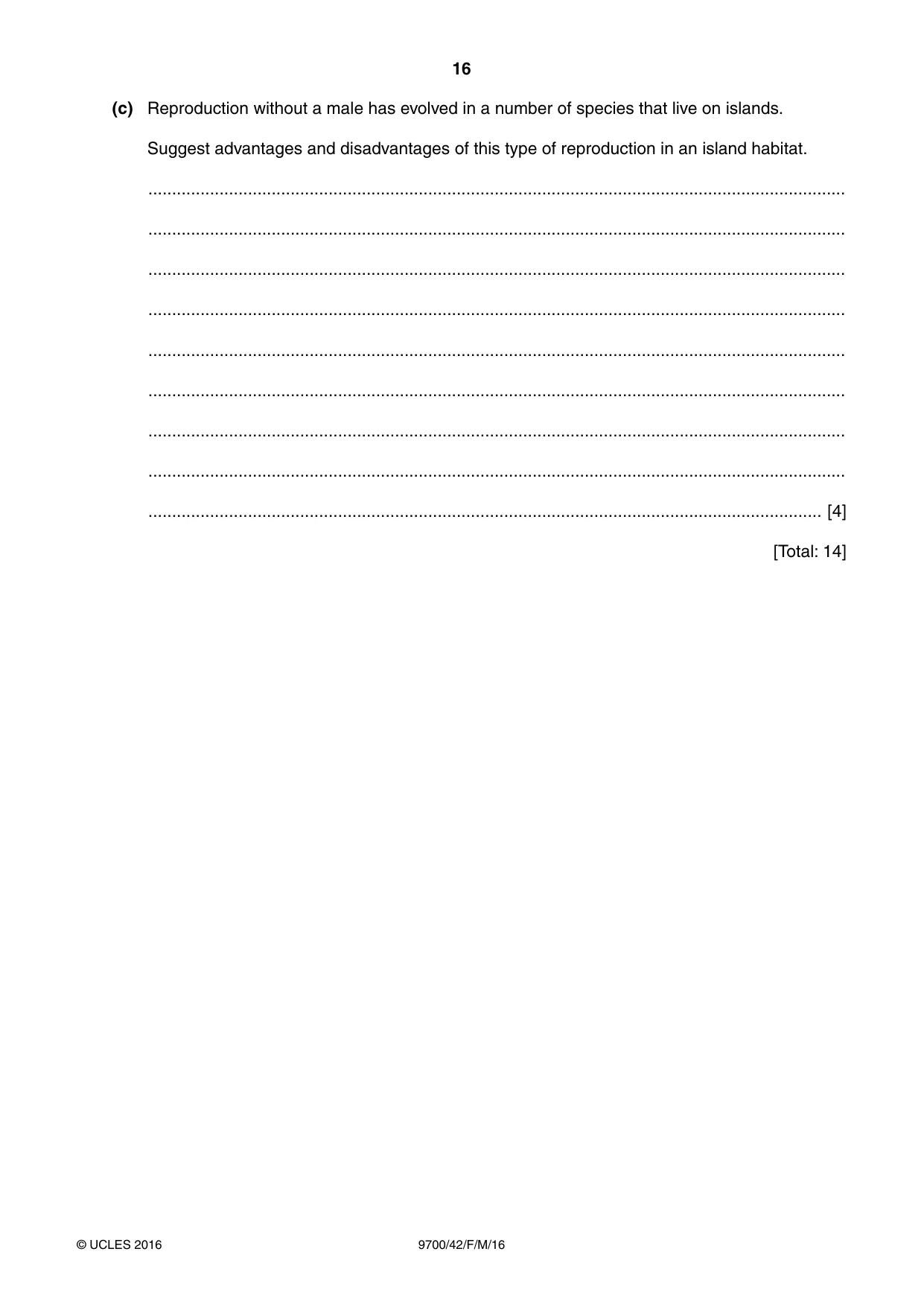
16 9700/42/F/M/16 © UCLES 2016 (c) Reproduction without a male has evolved in a number of species that live on islands. Suggest advantages and disadvantages of this type of reproduction in an island habitat. … … … … … … … … … [4] [Total: 14]
Question paper, page 17
17 9700/42/F/M/16 © UCLES 2016 [Turn over Question 5 starts on page 18
Question paper, page 18
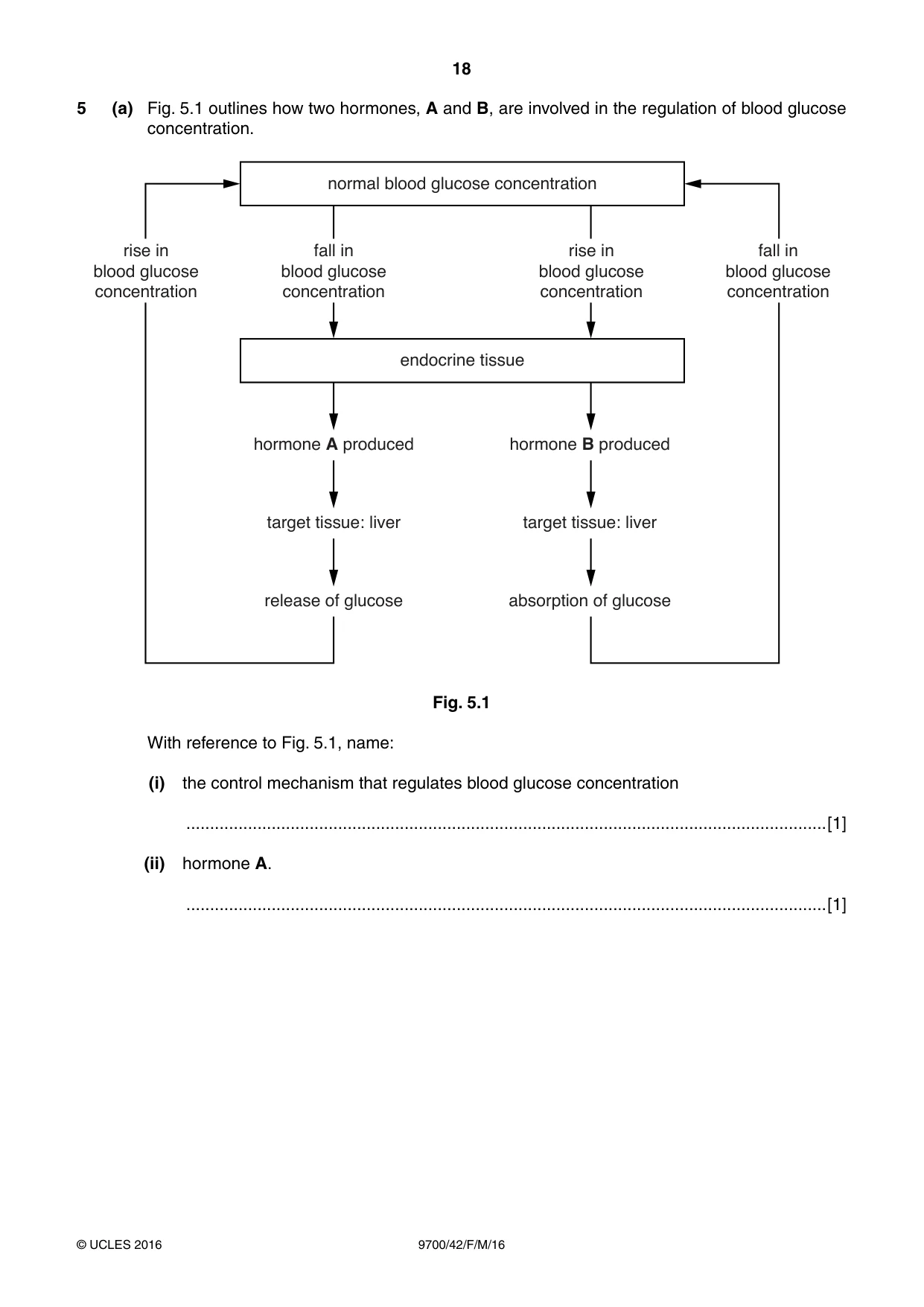
18 9700/42/F/M/16 © UCLES 2016 5 (a) Fig. 5.1 outlines how two hormones, A and B, are involved in the regulation of blood glucose concentration. normal blood glucose concentration endocrine tissue hormone A produced target tissue: liver release of glucose hormone B produced target tissue: liver absorption of glucose fall in blood glucose concentration fall in blood glucose concentration rise in blood glucose concentration rise in blood glucose concentration Fig. 5.1 With reference to Fig. 5.1, name: (i) the control mechanism that regulates blood glucose concentration …[1] (ii) hormone A. …[1]
Question paper, page 19
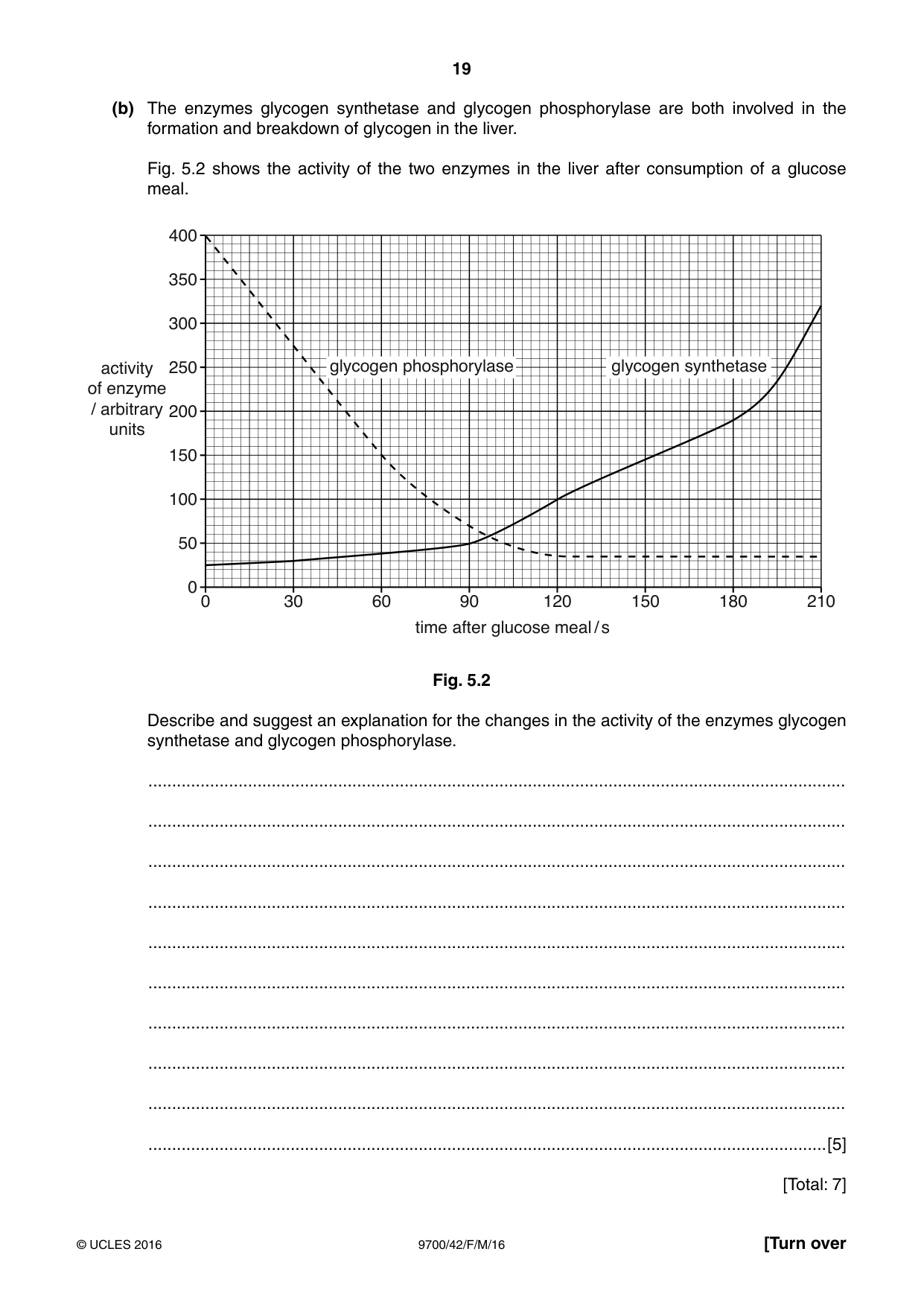
19 9700/42/F/M/16 © UCLES 2016 [Turn over (b) The enzymes glycogen synthetase and glycogen phosphorylase are both involved in the formation and breakdown of glycogen in the liver. Fig. 5.2 shows the activity of the two enzymes in the liver after consumption of a glucose meal. 0 0 30 60 90 120 150 180 210 200 400 100 300 150 350 50 250 time after glucose meal / s activity of enzyme / arbitrary units glycogen phosphorylase glycogen synthetase Fig. 5.2 Describe and suggest an explanation for the changes in the activity of the enzymes glycogen synthetase and glycogen phosphorylase. … … … … … … … … … …[5] [Total: 7]
Question paper, page 20
20 9700/42/F/M/16 © UCLES 2016 6 Paramecium is a ciliated, unicellular protoctist. The cilia are similar in structure to those found in the trachea of a human. The cilia beat to move Paramecium through the water in which it lives. Fig. 6.1 shows Paramecium. Fig. 6.1 (a) Paramecium has anterior and posterior ends. Generally the cilia beat so that the organism is moved forwards. Sometimes reverse movement is needed, for example when the Paramecium meets an obstacle. • The direction of beating of the cilia is linked to the difference in concentration of calcium ions inside and outside the cell. • There is usually a higher concentration of calcium ions outside than inside the cell. • When Paramecium touches an object, its cell surface membrane becomes deformed. • The membrane potential becomes more positive inside the cell. • The organism moves backwards for a short time. (i) Suggest the sequence of events that occurs to cause the Paramecium to move backwards when it touches an object. … … … … … [2]
Question paper, page 21
21 9700/42/F/M/16 © UCLES 2016 [Turn over (ii) Suggest how Paramecium ensures that there is usually a higher concentration of calcium ions in the surrounding water than inside the cell. … … … … … [2] (b) Paramecium has a contractile vacuole that fills up with water. When it is full, the contractile vacuole contracts to expel the water. The rate of contraction of the vacuole depends on the water potential of the surrounding water. (i) Name the process by which water enters Paramecium. … [1] (ii) Suggest the relationship between the rate of contraction of the contractile vacuole and the water potential of the surrounding water. … … … [1] (c) Describe how the DNA of Paramecium differs from that of a prokaryotic cell. … … … … … [2] [Total: 8]
Question paper, page 22
22 9700/42/F/M/16 © UCLES 2016 7 (a) Fig. 7.1 is a diagram of a section through a mitochondrion. circular DNA P Q R S Fig. 7.1 (i) Using Fig. 7.1, state the letter which indicates the site of: • the Krebs cycle … • oxidative phosphorylation … • decarboxylation. … [3] (ii) Suggest one function for the circular DNA in Fig. 7.1. … … … [1] (b) During respiration, exchange of substances takes place between the cytoplasm and the mitochondria. Complete the table below to list three substances that enter the mitochondria and three substances that leave the mitochondria. substance that enters the mitochondria substance that leaves the mitochondria 1 2 3 [3]
Question paper, page 23
23 9700/42/F/M/16 © UCLES 2016 [Turn over (c) The poison cyanide binds with cytochrome oxidase, one of the carriers in the electron transport system. Suggest how ingestion of cyanide by humans leads to death by muscle failure. … … … … … … … … … [4] (d) Tripalmitin is a triglyceride. The chemical equation for the aerobic respiration of tripalmitin is: 2C51H98O6 + 145O2 102CO2 + 98H2O (i) Calculate the RQ value for tripalmitin. Give your answer to 2 decimal places. Show your working. answer … [2] (ii) Explain why the usual RQ value for respiration in humans is between 0.7 and 1.0. … … … … … … [2] [Total: 15]
Question paper, page 24
24 9700/42/F/M/16 © UCLES 2016 8 In a species of snail, shell colour is controlled by a gene with three alleles: • allele CB codes for a brown shell • allele CP codes for a pink shell • allele CY codes for a yellow shell. Allele CB is dominant to both CP and CY. Allele CP is dominant to CY. The shells of this snail may be banded (have dark stripes) or non-banded. The allele for non-banded, N, is dominant to the allele for banded, n. (a) State what is meant by the terms dominant and allele. dominant … … … allele … … … [2] (b) A cross between a brown, non-banded snail and a pink, non-banded snail produces some offspring that are both yellow and banded. (i) State the genotypes of both parents. brown, non-banded … pink, non-banded … [2] (ii) List the parental gametes. brown, non-banded … … pink, non-banded … … [2] (iii) State the genotype of the offspring that are both yellow and banded. … [1] (iv) Suggest the proportion of offspring expected to be both yellow and banded. … [1] [Total: 8]
Question paper, page 25
25 9700/42/F/M/16 © UCLES 2016 [Turn over Section B Answer one question. 9 (a) Explain the use of genes for fluorescent or easily stained substances as markers in gene technology. [6] (b) Discuss the potential advantages of growing genetically modified crops, using examples to help your answer. [9] [Total: 15] 10 (a) Explain how genetic diseases may be treated using gene therapy. [7] (b) Discuss the advantages of screening for genetic conditions. [8] [Total: 15] … … … … … … … … … … … … … … … … …
Question paper, page 26
26 9700/42/F/M/16 © UCLES 2016 … … … … … … … … … … … … … … … … … … … … … … … … … … … …
Question paper, page 27
27 9700/42/F/M/16 © UCLES 2016 [Turn over … … … … … … … … … … … … … … … … … … … … … … … … … … … …
Question paper, page 28
28 9700/42/F/M/16 © UCLES 2016 Permission to reproduce items where third-party owned material protected by copyright is included has been sought and cleared where possible. Every reasonable effort has been made by the publisher (UCLES) to trace copyright holders, but if any items requiring clearance have unwittingly been included, the publisher will be pleased to make amends at the earliest possible opportunity. To avoid the issue of disclosure of answer-related information to candidates, all copyright acknowledgements are reproduced online in the Cambridge International Examinations Copyright Acknowledgements Booklet. This is produced for each series of examinations and is freely available to download at www.cie.org.uk after the live examination series. Cambridge International Examinations is part of the Cambridge Assessment Group. Cambridge Assessment is the brand name of University of Cambridge Local Examinations Syndicate (UCLES), which is itself a department of the University of Cambridge. … … … … … … … … … … … … … … … … … … … … … … … …
Mark scheme, page 1
® IGCSE is the registered trademark of Cambridge International Examinations. CAMBRIDGE INTERNATIONAL EXAMINATIONS Cambridge International Advanced Subsidiary and Advanced Level MARK SCHEME for the March 2016 series 9700 BIOLOGY 9700/42 Paper 4 (A Level Structured Questions), maximum raw mark 100 This mark scheme is published as an aid to teachers and candidates, to indicate the requirements of the examination. It shows the basis on which Examiners were instructed to award marks. It does not indicate the details of the discussions that took place at an Examiners’ meeting before marking began, which would have considered the acceptability of alternative answers. Mark schemes should be read in conjunction with the question paper and the Principal Examiner Report for Teachers. Cambridge will not enter into discussions about these mark schemes. Cambridge is publishing the mark schemes for the March 2016 series for most Cambridge IGCSE® and Cambridge International A and AS Level components.
Mark scheme, page 2
Page 2 Mark Scheme Syllabus Paper Cambridge International AS/A Level – March 2016 9700 42 © Cambridge International Examinations 2016 Mark scheme abbreviations: ; separates marking points / alternative answers for the same point R reject A accept (for answers correctly cued by the question or by extra guidance) AW alternative wording (where responses vary more than usual) underline actual word given must be used by candidate (grammatical variants accepted) max indicates the maximum number of marks that can be given ora or reverse argument mp marking point (with relevant number) ecf error carried forward I ignore AVP alternative valid point (examples given as guidance)
Mark scheme, page 3
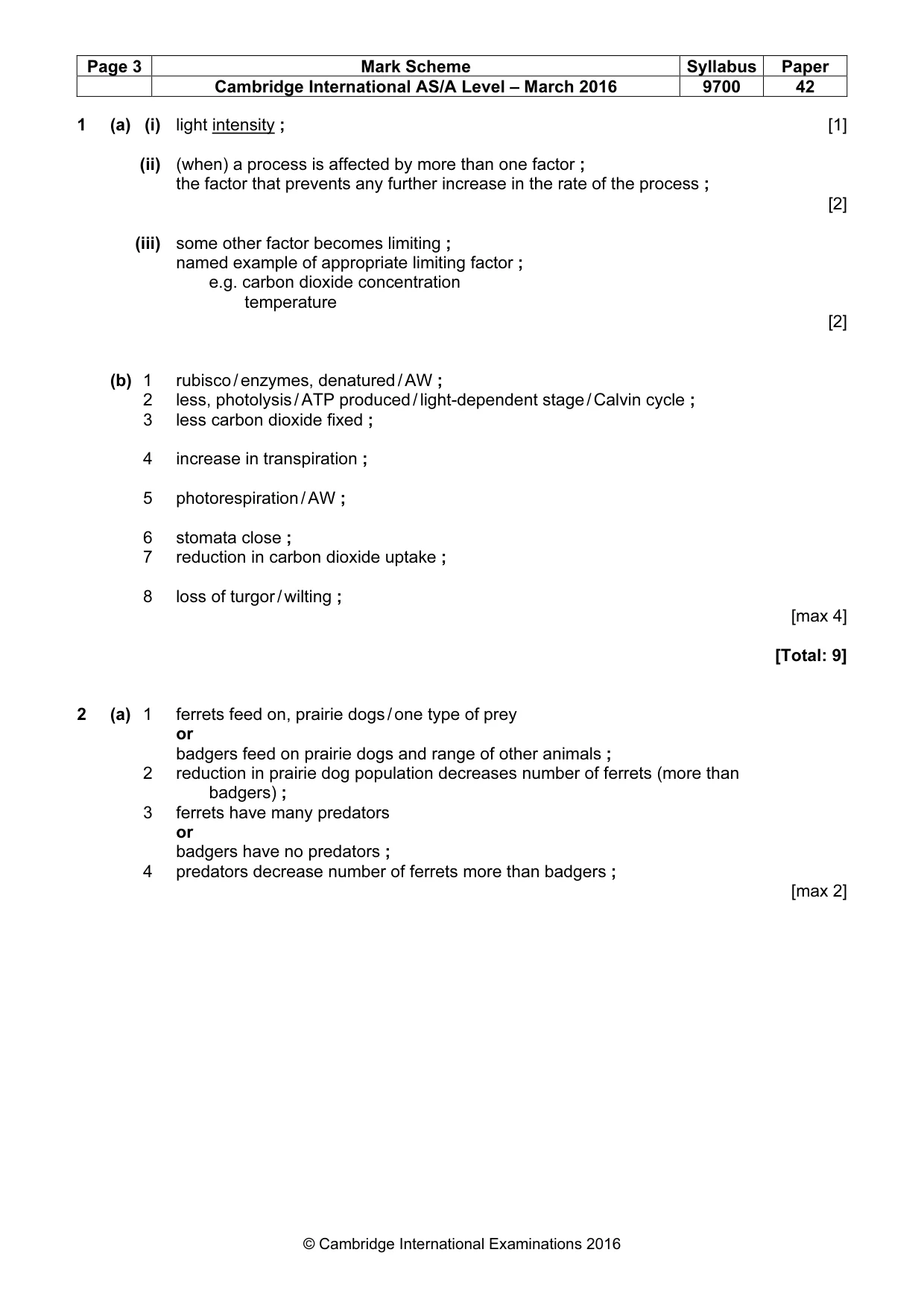
Page 3 Mark Scheme Syllabus Paper Cambridge International AS/A Level – March 2016 9700 42 © Cambridge International Examinations 2016 1 (a) (i) light intensity ; [1] (ii) (when) a process is affected by more than one factor ; the factor that prevents any further increase in the rate of the process ; [2] (iii) some other factor becomes limiting ; named example of appropriate limiting factor ; e.g. carbon dioxide concentration temperature [2] (b) 1 rubisco / enzymes, denatured / AW ; 2 less, photolysis / ATP produced / light-dependent stage / Calvin cycle ; 3 less carbon dioxide fixed ; 4 increase in transpiration ; 5 photorespiration / AW ; 6 stomata close ; 7 reduction in carbon dioxide uptake ; 8 loss of turgor / wilting ; [max 4] [Total: 9] 2 (a) 1 ferrets feed on, prairie dogs / one type of prey or badgers feed on prairie dogs and range of other animals ; 2 reduction in prairie dog population decreases number of ferrets (more than badgers) ; 3 ferrets have many predators or badgers have no predators ; 4 predators decrease number of ferrets more than badgers ; [max 2]
Mark scheme, page 4
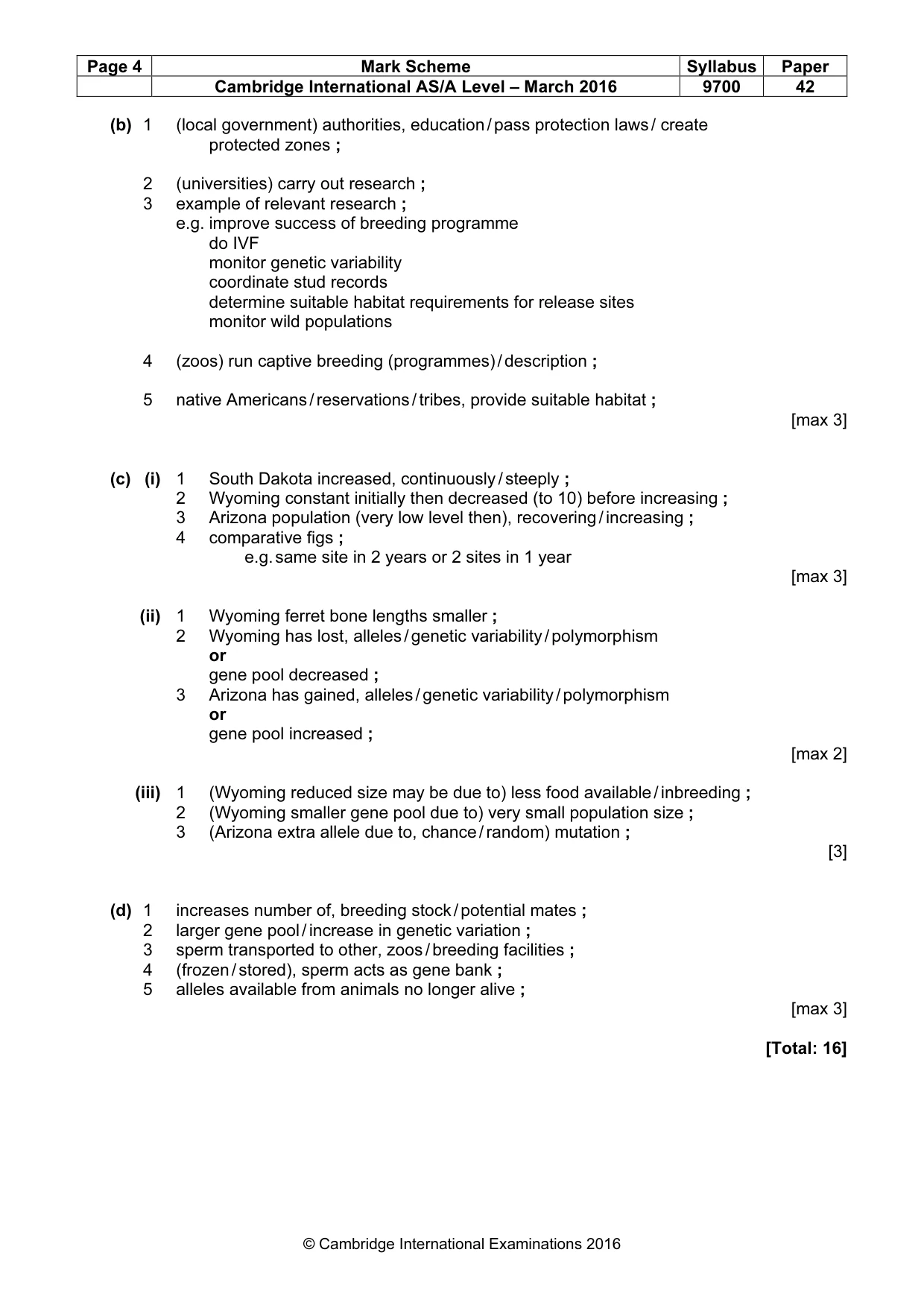
Page 4 Mark Scheme Syllabus Paper Cambridge International AS/A Level – March 2016 9700 42 © Cambridge International Examinations 2016 (b) 1 (local government) authorities, education / pass protection laws / create protected zones ; 2 (universities) carry out research ; 3 example of relevant research ; e.g. improve success of breeding programme do IVF monitor genetic variability coordinate stud records determine suitable habitat requirements for release sites monitor wild populations 4 (zoos) run captive breeding (programmes) / description ; 5 native Americans / reservations / tribes, provide suitable habitat ; [max 3] (c) (i) 1 South Dakota increased, continuously / steeply ; 2 Wyoming constant initially then decreased (to 10) before increasing ; 3 Arizona population (very low level then), recovering / increasing ; 4 comparative figs ; e.g. same site in 2 years or 2 sites in 1 year [max 3] (ii) 1 Wyoming ferret bone lengths smaller ; 2 Wyoming has lost, alleles / genetic variability / polymorphism or gene pool decreased ; 3 Arizona has gained, alleles / genetic variability / polymorphism or gene pool increased ; [max 2] (iii) 1 (Wyoming reduced size may be due to) less food available / inbreeding ; 2 (Wyoming smaller gene pool due to) very small population size ; 3 (Arizona extra allele due to, chance / random) mutation ; [3] (d) 1 increases number of, breeding stock / potential mates ; 2 larger gene pool / increase in genetic variation ; 3 sperm transported to other, zoos / breeding facilities ; 4 (frozen / stored), sperm acts as gene bank ; 5 alleles available from animals no longer alive ; [max 3] [Total: 16]
Mark scheme, page 5
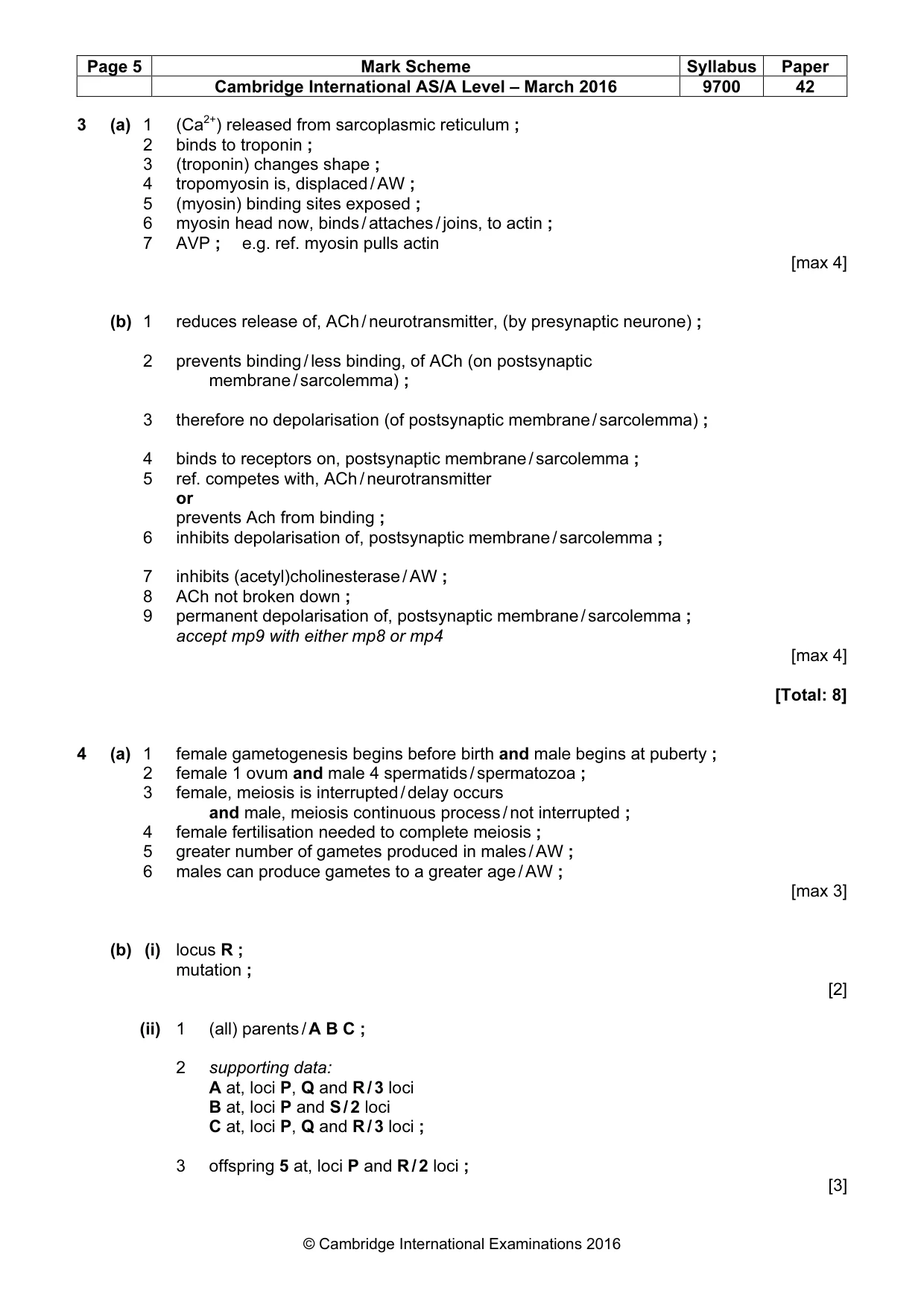
Page 5 Mark Scheme Syllabus Paper Cambridge International AS/A Level – March 2016 9700 42 © Cambridge International Examinations 2016 3 (a) 1 (Ca2+) released from sarcoplasmic reticulum ; 2 binds to troponin ; 3 (troponin) changes shape ; 4 tropomyosin is, displaced / AW ; 5 (myosin) binding sites exposed ; 6 myosin head now, binds / attaches / joins, to actin ; 7 AVP ; e.g. ref. myosin pulls actin [max 4] (b) 1 reduces release of, ACh / neurotransmitter, (by presynaptic neurone) ; 2 prevents binding / less binding, of ACh (on postsynaptic membrane / sarcolemma) ; 3 therefore no depolarisation (of postsynaptic membrane / sarcolemma) ; 4 binds to receptors on, postsynaptic membrane / sarcolemma ; 5 ref. competes with, ACh / neurotransmitter or prevents Ach from binding ; 6 inhibits depolarisation of, postsynaptic membrane / sarcolemma ; 7 inhibits (acetyl)cholinesterase / AW ; 8 ACh not broken down ; 9 permanent depolarisation of, postsynaptic membrane / sarcolemma ; accept mp9 with either mp8 or mp4 [max 4] [Total: 8] 4 (a) 1 female gametogenesis begins before birth and male begins at puberty ; 2 female 1 ovum and male 4 spermatids / spermatozoa ; 3 female, meiosis is interrupted / delay occurs and male, meiosis continuous process / not interrupted ; 4 female fertilisation needed to complete meiosis ; 5 greater number of gametes produced in males / AW ; 6 males can produce gametes to a greater age / AW ; [max 3] (b) (i) locus R ; mutation ; [2] (ii) 1 (all) parents / A B C ; 2 supporting data: A at, loci P, Q and R / 3 loci B at, loci P and S / 2 loci C at, loci P, Q and R / 3 loci ; 3 offspring 5 at, loci P and R / 2 loci ; [3]
Mark scheme, page 6
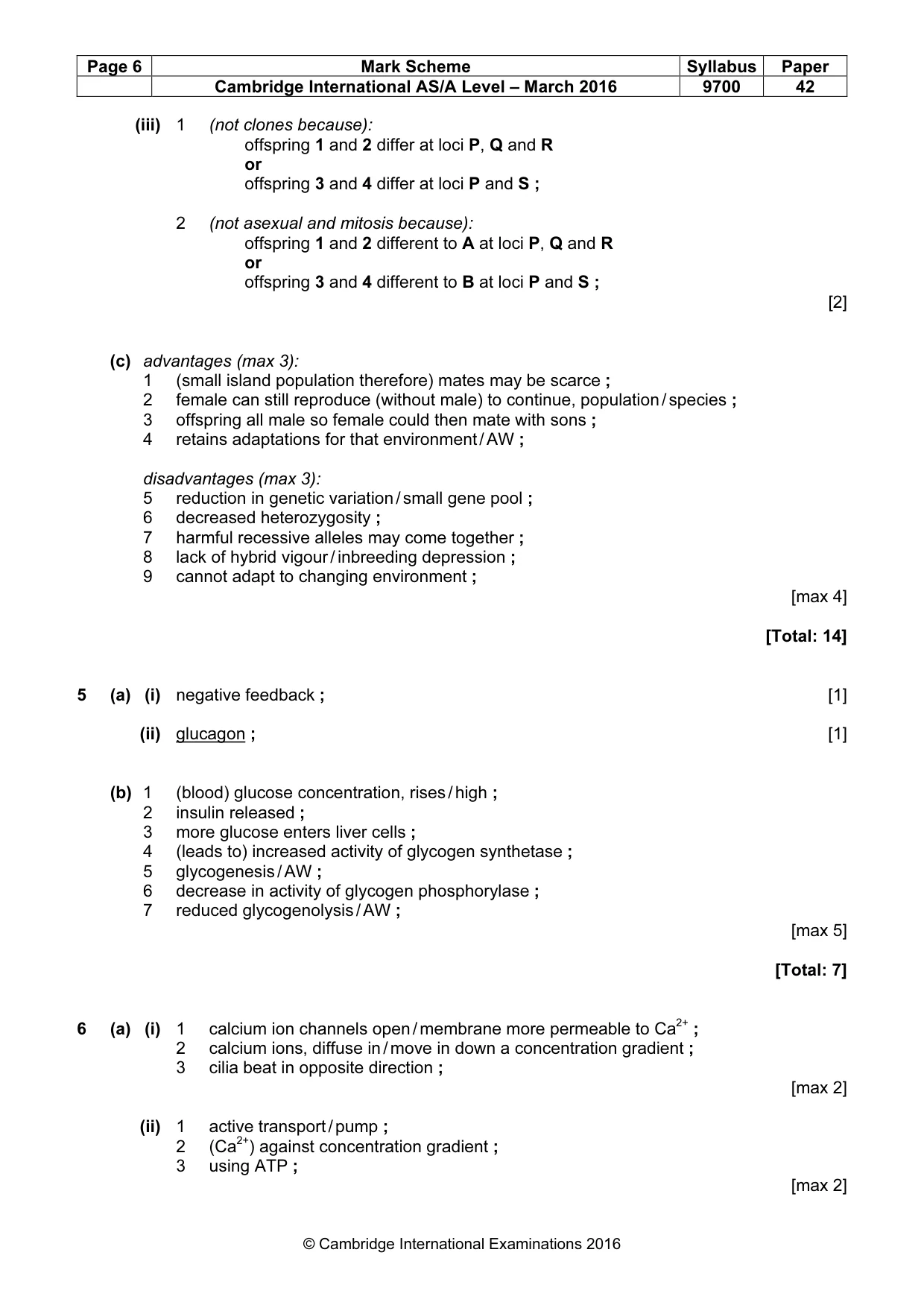
Page 6 Mark Scheme Syllabus Paper Cambridge International AS/A Level – March 2016 9700 42 © Cambridge International Examinations 2016 (iii) 1 (not clones because): offspring 1 and 2 differ at loci P, Q and R or offspring 3 and 4 differ at loci P and S ; 2 (not asexual and mitosis because): offspring 1 and 2 different to A at loci P, Q and R or offspring 3 and 4 different to B at loci P and S ; [2] (c) advantages (max 3): 1 (small island population therefore) mates may be scarce ; 2 female can still reproduce (without male) to continue, population / species ; 3 offspring all male so female could then mate with sons ; 4 retains adaptations for that environment / AW ; disadvantages (max 3): 5 reduction in genetic variation / small gene pool ; 6 decreased heterozygosity ; 7 harmful recessive alleles may come together ; 8 lack of hybrid vigour / inbreeding depression ; 9 cannot adapt to changing environment ; [max 4] [Total: 14] 5 (a) (i) negative feedback ; [1] (ii) glucagon ; [1] (b) 1 (blood) glucose concentration, rises / high ; 2 insulin released ; 3 more glucose enters liver cells ; 4 (leads to) increased activity of glycogen synthetase ; 5 glycogenesis / AW ; 6 decrease in activity of glycogen phosphorylase ; 7 reduced glycogenolysis / AW ; [max 5] [Total: 7] 6 (a) (i) 1 calcium ion channels open / membrane more permeable to Ca2+ ; 2 calcium ions, diffuse in / move in down a concentration gradient ; 3 cilia beat in opposite direction ; [max 2] (ii) 1 active transport / pump ; 2 (Ca2+) against concentration gradient ; 3 using ATP ; [max 2]
Mark scheme, page 7
Page 7 Mark Scheme Syllabus Paper Cambridge International AS/A Level – March 2016 9700 42 © Cambridge International Examinations 2016 (b) (i) osmosis ; [1] (ii) the higher the water potential, outside / in the surrounding water, the faster the rate of contraction / AW ; [1] (c) 1 linear ; 2 associated with, protein / histones ; 3 contained in nucleus / surrounded by nuclear envelope ; 4 AVP ; e.g. present in mitochondria [max 2] [Total: 8] 7 (a) (i) S ; R ; S ; [3] (ii) has genes that code for: mitochondrial proteins ; mitochondrial enzymes ; mitochondrial replication ; rRNA ; A ribosomes A tRNA R mRNA [max 1] (b) substance that enters the mitochondria substance that leaves the mitochondria oxygen pyruvate ADP phosphate / Pi fatty acids carbon dioxide ATP water mark first answer in each box ; ; ; 6 boxes correct = 3 marks 4 / 5 boxes correct = 2 marks 2 / 3 boxes correct = 1 mark [max 3]
Mark scheme, page 8
Page 8 Mark Scheme Syllabus Paper Cambridge International AS/A Level – March 2016 9700 42 © Cambridge International Examinations 2016 (c) max 3 from mp1–mp5 1 ETC / electron transport chain, stops ; 2 Krebs cycle / link reaction, stops ; 3 no proton gradient set up ; 4 no proton flow through ATP synthase ; 5 less / no, ATP produced ; 6 named muscle fails to contract ; e.g. heart / intercostals [max 4] (d) (i) 0.70 ; ; allow one mark for working 102 ÷ 145 [2] (ii) 1 respire aerobically ; 2 mixture of substrates / named mixture ; 3 different tissues respire different substrates ; [max 2] [Total: 15] 8 (a) dominant: an allele that is expressed in (homozygotes and) heterozygotes / AW ; allele: one of two or more alternative nucleotide sequences at a single gene locus / variant forms of a gene ; [2] (b) (i) brown, non-banded: CBCYNn ; pink, non-banded: CPCYNn ; [2] (ii) brown, non-banded: CBN CBn CYN CYn ; pink, non-banded: CPN CPn CYN CYn ; [2] (iii) CYCYnn ; [1] (iv) 1 / 16 or 0.0625 or 6.25% or 1:15 ; [1] [Total: 8]
Mark scheme, page 9
Page 9 Mark Scheme Syllabus Paper Cambridge International AS/A Level – March 2016 9700 42 © Cambridge International Examinations 2016 9 (a) 1 emits bright light ; 2 when exposed to UV light ; 3 visible colour change ; 4 add marker gene to the, vector / plasmid ; 5 easy to identify transformed bacteria ; 6 gene of interest inserted, into / close to, marker gene ; 7 easy to identify recombinant, DNA / plasmid ; 8 easy to identify transgenic organisms ; 9 examples ; e.g. GFP / β galactosidase / GUS 10 idea of no known risk ; [max 6] (b) 1 increase, food production / crop yields ; 2 improve food, quality / taste / keeping properties ; 3 add nutrients to crop (to improve human health) ; 4 crops may be more tolerant to climate change ; 5 crops, can be grown in poor quality land / do not need as much fertiliser ; 6 pest / insect / fungal disease, resistance (increases crop growth) ; 7 less pesticide used ; 8 benefit to farmer ; e.g. cost effective / health benefit 9 benefit to environment ; e.g. less effect on food chains, pollinators 10 herbicide resistance reduces competition from weeds ; 11 could engineer nitrogen-fixing ability in non-leguminous crops ; 12 specific examples (crop variety and enhancement described) ; ; + e.g. Golden Rice™ for extra vitamin A 13 Bt maize / Bt cotton, kill (named) leaf-eating insects Flavr Savr tomato, stores better / can ripen on vine [max 9] [Total: 15] 10 (a) 1 normal, gene / allele ; 2 (insert into) vector ; 3 liposomes (as vectors) ; 4 liposomes in, aerosol / inhaler ; 5 liposome fuses with host cell ; 6 virus (as vector) ; 7 virus vector harmless ; 8 short term effect ; 9 repeat treatments needed ; 10 side effects ; [max 7]
Mark scheme, page 10
Page 10 Mark Scheme Syllabus Paper Cambridge International AS/A Level – March 2016 9700 42 © Cambridge International Examinations 2016 (b) 1 information about the increased risk of person having genetic conditions ; 2 ref. breast cancer / named example ; 3 allows people to prepare for late onset genetic conditions ; 4 ref. Huntington’s disease / Alzheimer’s disease / named example ; 5 identify whether fetuses are going to develop a genetic condition ; 6 so can give early treatment when born ; 7 allows parents to prepare for the birth of a child who will need treatment for a considerable time or even throughout life / AW ; 8 identifies carriers of genetic conditions ; 9 helps to provide early diagnosis ; 10 allows couples who are both carriers of a genetic condition to make decisions about starting a family / having more children / seeking IVF ; 11 AVP ; e.g. termination [max 8] [Total: 15]
What you needed in this session
Cambridge’s own grade thresholds for 2016 Feb/March, Paper 4 · Variant 2. A higher threshold means an easier paper — the bar moves with how the cohort did.