Cambridge A Level Biology 9700 — 2015 Oct/Nov Paper 5 · Variant 2
9700/52/O/N/15 · 30 marks · ≈34 min
The question paper and its mark scheme, free to read here and free to download. This is Cambridge’s own paper, exactly as it was sat.
Question paper8 pages
Mark scheme8 pages
Answers below. Sit the paper first if you are practising.
Paper as text
Question paper, page 1
This document consists of 8 printed pages. DC (SLM) 114616 © UCLES 2015 [Turn over Cambridge International Examinations Cambridge International Advanced Level * 5 7 2 6 0 9 8 0 5 7 * BIOLOGY 9700/52 Paper 5 Planning, Analysis and Evaluation October/November 2015 1 hour 15 minutes Candidates answer on the Question Paper. No Additional Materials are required. READ THESE INSTRUCTIONS FIRST Write your Centre number, candidate number and name on all the work you hand in. Write in dark blue or black pen. You may use an HB pencil for any diagrams or graphs. Do not use staples, paper clips, glue or correction fluid. DO NOT WRITE IN ANY BARCODES. Answer all questions. Electronic calculators may be used. You may lose marks if you do not show your working or if you do not use appropriate units. At the end of the examination, fasten all your work securely together. The number of marks is given in brackets [ ] at the end of each question or part question.
Question paper, page 2
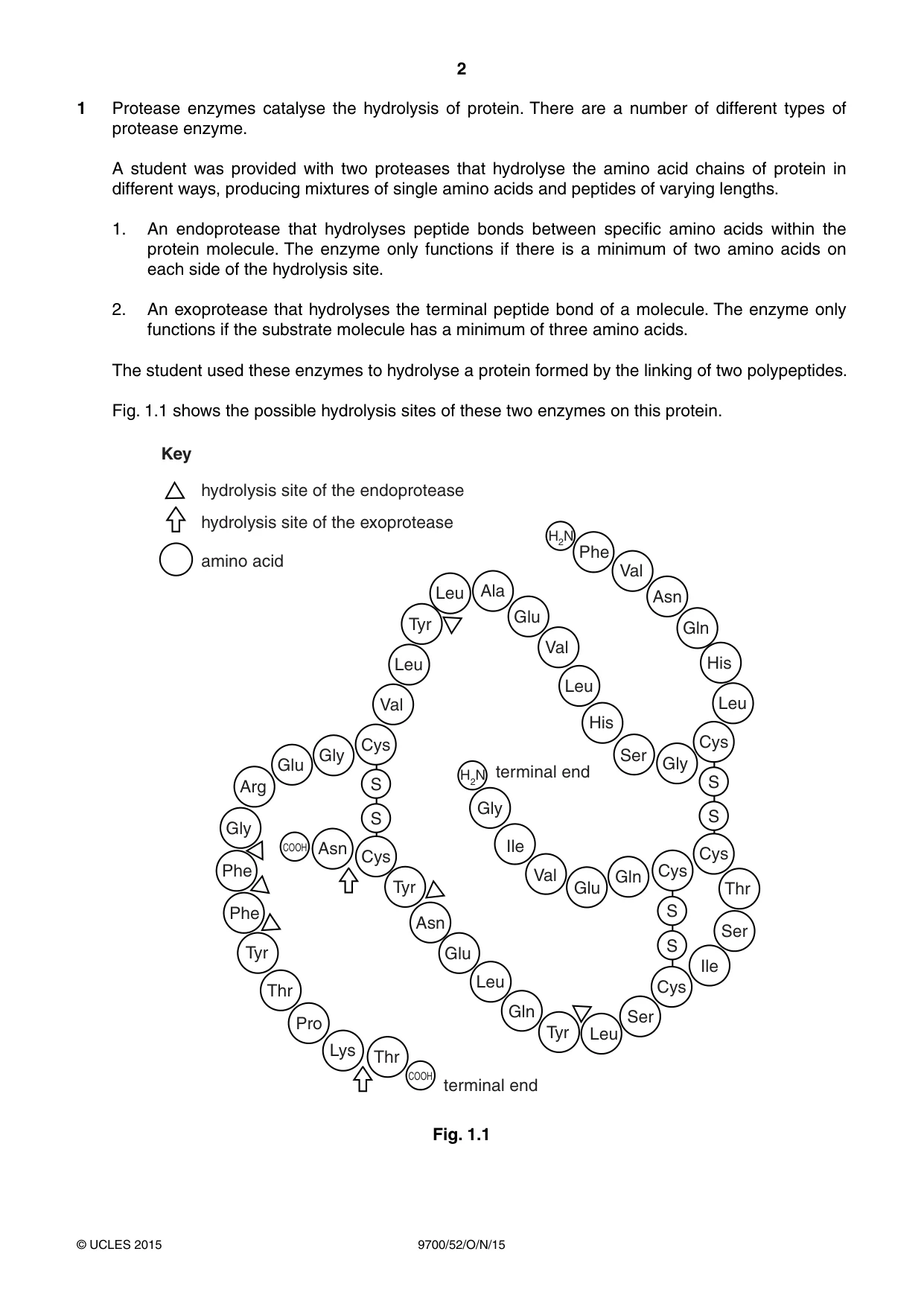
2 9700/52/O/N/15 © UCLES 2015 1 Protease enzymes catalyse the hydrolysis of protein. There are a number of different types of protease enzyme. A student was provided with two proteases that hydrolyse the amino acid chains of protein in different ways, producing mixtures of single amino acids and peptides of varying lengths. 1. An endoprotease that hydrolyses peptide bonds between specific amino acids within the protein molecule. The enzyme only functions if there is a minimum of two amino acids on each side of the hydrolysis site. 2. An exoprotease that hydrolyses the terminal peptide bond of a molecule. The enzyme only functions if the substrate molecule has a minimum of three amino acids. The student used these enzymes to hydrolyse a protein formed by the linking of two polypeptides. Fig. 1.1 shows the possible hydrolysis sites of these two enzymes on this protein. H2N S S S S S S H2N COOH COOH Phe Val Asn Gln His Leu Cys Cys Cys Gln Glu Val Ile Gly Thr Ser Ile Cys Ser Leu Tyr Gln Leu Glu Asn Gly Ser His Leu Val Glu Ala Leu Tyr Leu Val Cys Tyr Asn Cys Gly Glu Arg Gly Phe Phe Tyr Thr Pro Lys Thr terminal end hydrolysis site of the endoprotease hydrolysis site of the exoprotease amino acid terminal end Key Fig. 1.1
Question paper, page 3
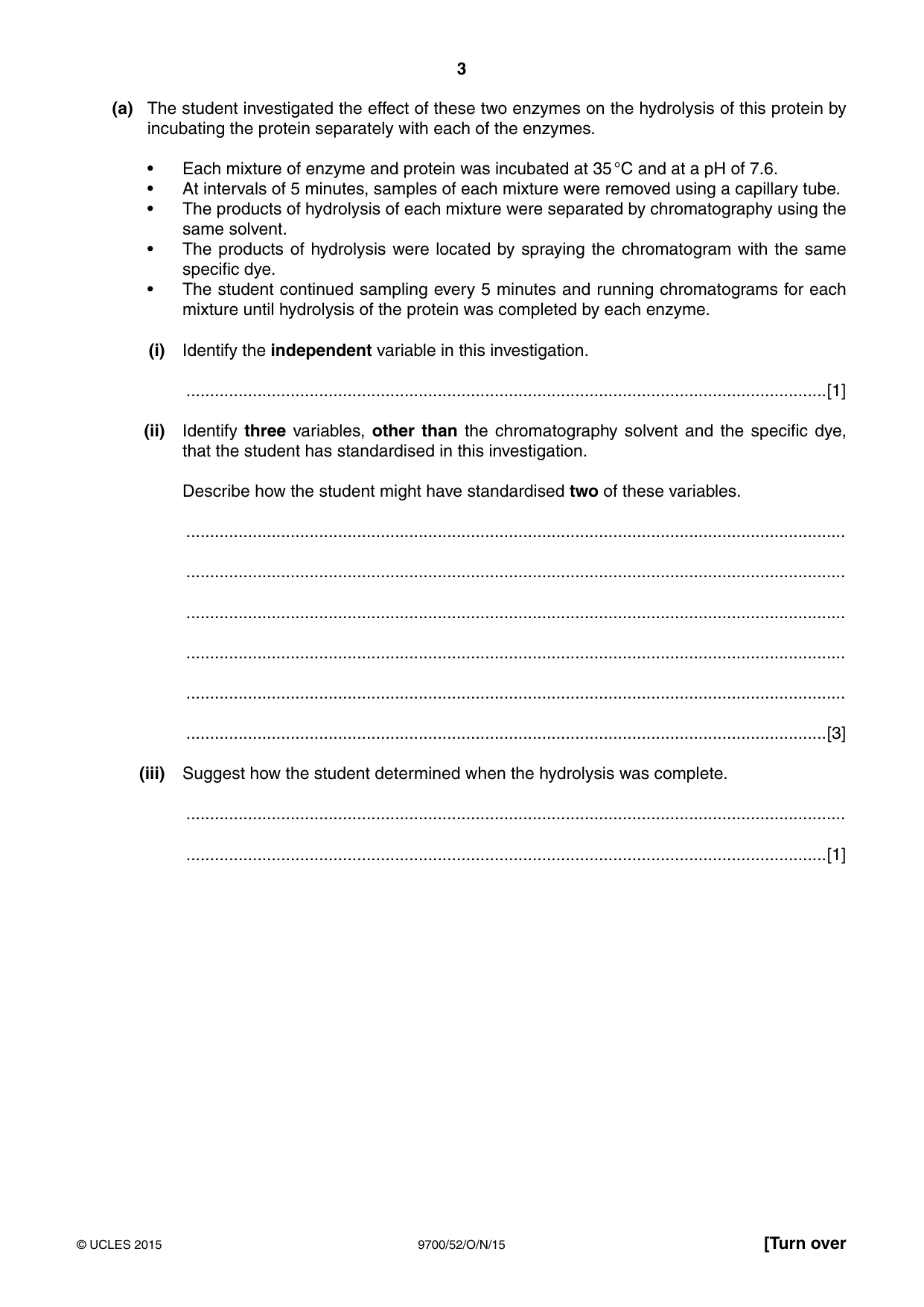
3 9700/52/O/N/15 © UCLES 2015 [Turn over (a) The student investigated the effect of these two enzymes on the hydrolysis of this protein by incubating the protein separately with each of the enzymes. • Each mixture of enzyme and protein was incubated at 35 °C and at a pH of 7.6. • At intervals of 5 minutes, samples of each mixture were removed using a capillary tube. • The products of hydrolysis of each mixture were separated by chromatography using the same solvent. • The products of hydrolysis were located by spraying the chromatogram with the same specific dye. • The student continued sampling every 5 minutes and running chromatograms for each mixture until hydrolysis of the protein was completed by each enzyme. (i) Identify the independent variable in this investigation. …[1] (ii) Identify three variables, other than the chromatography solvent and the specific dye, that the student has standardised in this investigation. Describe how the student might have standardised two of these variables. … … … … … …[3] (iii) Suggest how the student determined when the hydrolysis was complete. … …[1]
Question paper, page 4
4 9700/52/O/N/15 © UCLES 2015 (b) Describe a method that the student could use to prepare and use chromatograms to compare the changes in the products of hydrolysis of the protein by the two different proteases over time. Your method should be detailed enough for another person to follow. … … … … … … … … … … … … … … … … … … … … … … … … … …[8]
Question paper, page 5
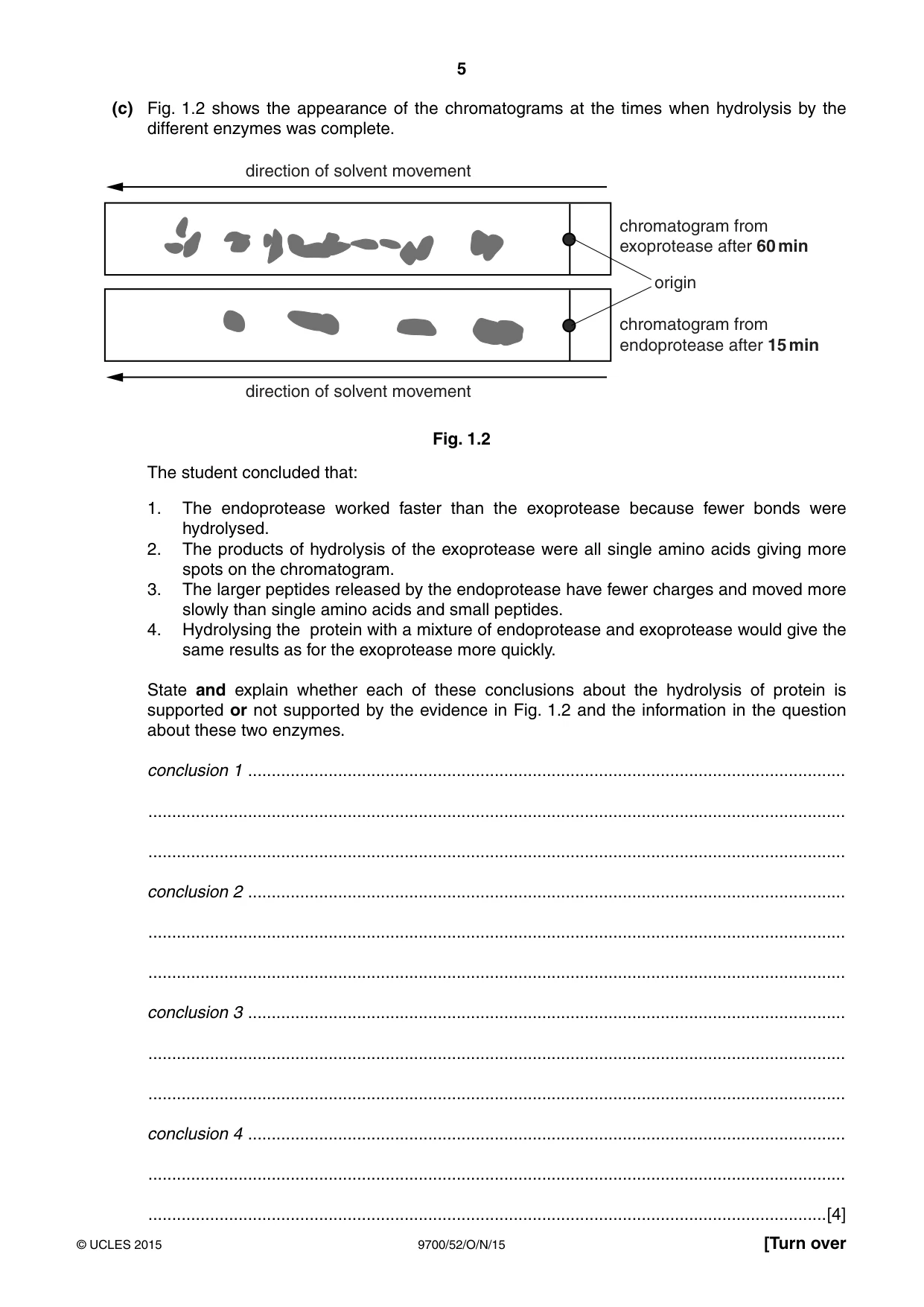
5 9700/52/O/N/15 © UCLES 2015 [Turn over (c) Fig. 1.2 shows the appearance of the chromatograms at the times when hydrolysis by the different enzymes was complete. direction of solvent movement direction of solvent movement origin chromatogram from exoprotease after 60 min chromatogram from endoprotease after 15 min Fig. 1.2 The student concluded that: 1. The endoprotease worked faster than the exoprotease because fewer bonds were hydrolysed. 2. The products of hydrolysis of the exoprotease were all single amino acids giving more spots on the chromatogram. 3. The larger peptides released by the endoprotease have fewer charges and moved more slowly than single amino acids and small peptides. 4. Hydrolysing the protein with a mixture of endoprotease and exoprotease would give the same results as for the exoprotease more quickly. State and explain whether each of these conclusions about the hydrolysis of protein is supported or not supported by the evidence in Fig. 1.2 and the information in the question about these two enzymes. conclusion 1 … … … conclusion 2 … … … conclusion 3 … … … conclusion 4 … … …[4]
Question paper, page 6
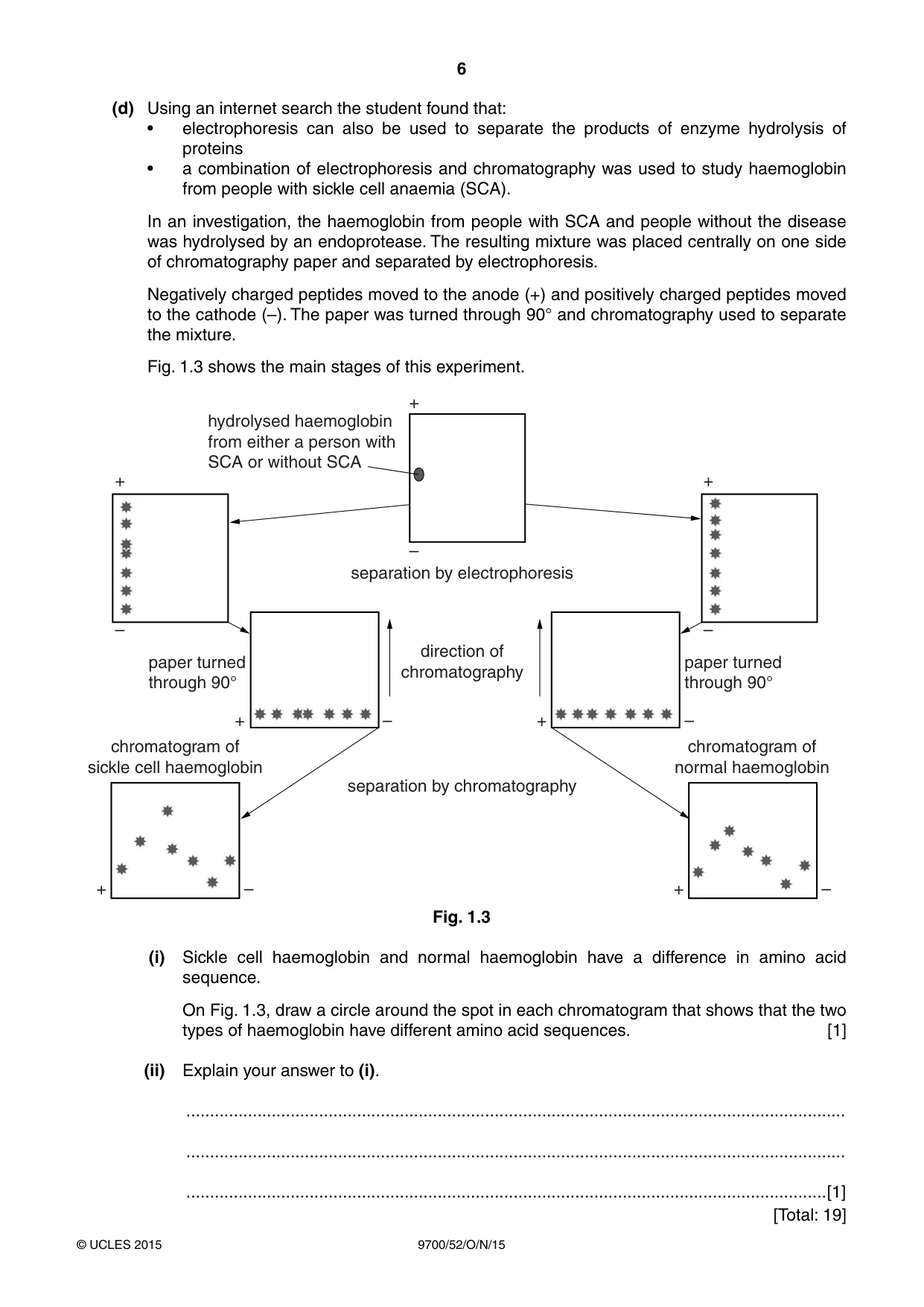
6 9700/52/O/N/15 © UCLES 2015 (d) Using an internet search the student found that: • electrophoresis can also be used to separate the products of enzyme hydrolysis of proteins • a combination of electrophoresis and chromatography was used to study haemoglobin from people with sickle cell anaemia (SCA). In an investigation, the haemoglobin from people with SCA and people without the disease was hydrolysed by an endoprotease. The resulting mixture was placed centrally on one side of chromatography paper and separated by electrophoresis. Negatively charged peptides moved to the anode (+) and positively charged peptides moved to the cathode (–). The paper was turned through 90° and chromatography used to separate the mixture. Fig. 1.3 shows the main stages of this experiment. + – + – + – – + – + – + – + direction of chromatography chromatogram of sickle cell haemoglobin chromatogram of normal haemoglobin separation by chromatography separation by electrophoresis paper turned through 90° paper turned through 90° hydrolysed haemoglobin from either a person with SCA or without SCA Fig. 1.3 (i) Sickle cell haemoglobin and normal haemoglobin have a difference in amino acid sequence. On Fig. 1.3, draw a circle around the spot in each chromatogram that shows that the two types of haemoglobin have different amino acid sequences. [1] (ii) Explain your answer to (i). … … …[1] [Total: 19]
Question paper, page 7
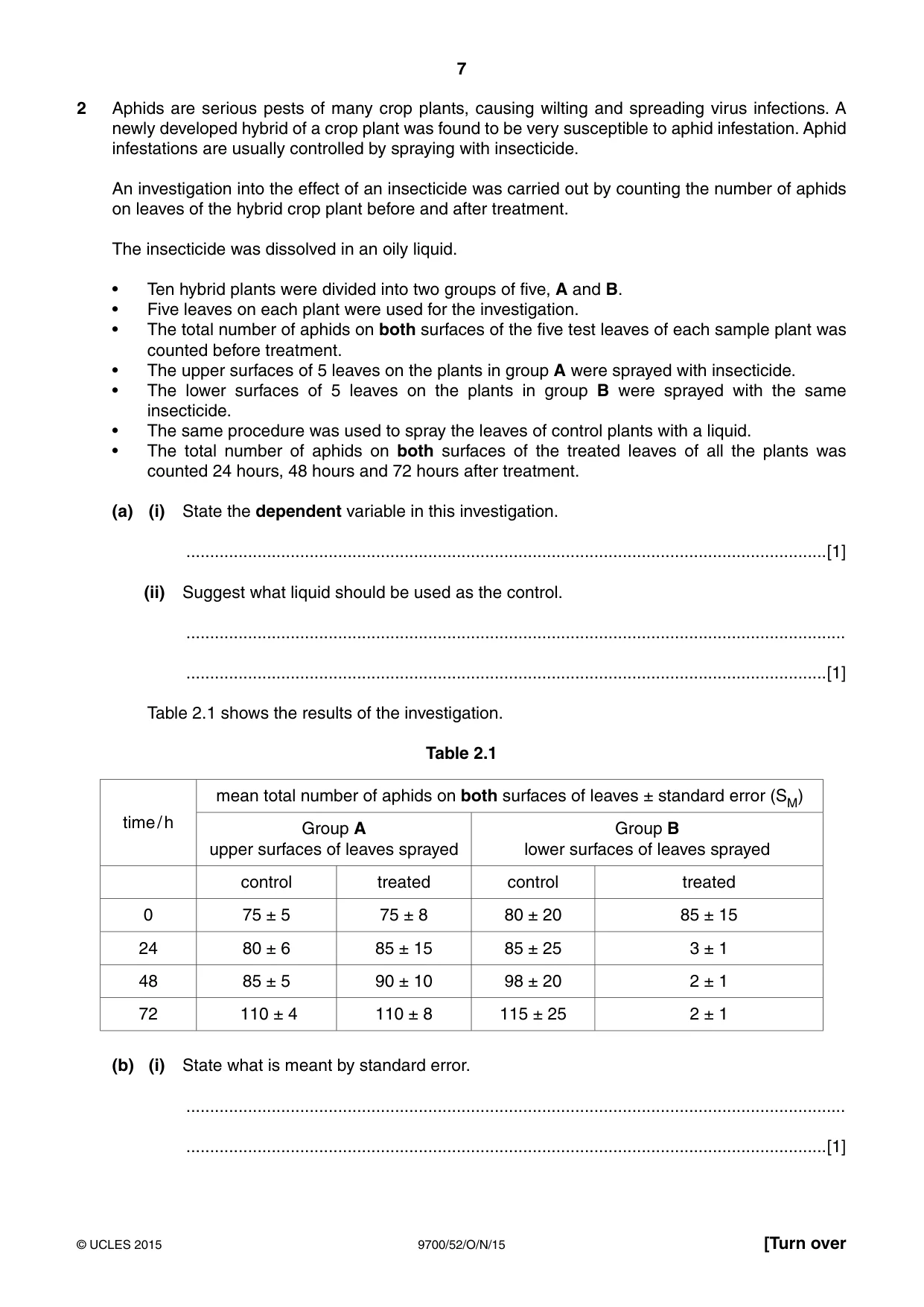
7 9700/52/O/N/15 © UCLES 2015 [Turn over 2 Aphids are serious pests of many crop plants, causing wilting and spreading virus infections. A newly developed hybrid of a crop plant was found to be very susceptible to aphid infestation. Aphid infestations are usually controlled by spraying with insecticide. An investigation into the effect of an insecticide was carried out by counting the number of aphids on leaves of the hybrid crop plant before and after treatment. The insecticide was dissolved in an oily liquid. • Ten hybrid plants were divided into two groups of five, A and B. • Five leaves on each plant were used for the investigation. • The total number of aphids on both surfaces of the five test leaves of each sample plant was counted before treatment. • The upper surfaces of 5 leaves on the plants in group A were sprayed with insecticide. • The lower surfaces of 5 leaves on the plants in group B were sprayed with the same insecticide. • The same procedure was used to spray the leaves of control plants with a liquid. • The total number of aphids on both surfaces of the treated leaves of all the plants was counted 24 hours, 48 hours and 72 hours after treatment. (a) (i) State the dependent variable in this investigation. …[1] (ii) Suggest what liquid should be used as the control. … …[1] Table 2.1 shows the results of the investigation. Table 2.1 time / h mean total number of aphids on both surfaces of leaves ± standard error (SM) Group A upper surfaces of leaves sprayed Group B lower surfaces of leaves sprayed control treated control treated 0 75 ± 5 75 ± 8 80 ± 20 85 ± 15 24 80 ± 6 85 ± 15 85 ± 25 3 ± 1 48 85 ± 5 90 ± 10 98 ± 20 2 ± 1 72 110 ± 4 110 ± 8 115 ± 25 2 ± 1 (b) (i) State what is meant by standard error. … …[1]
Question paper, page 8
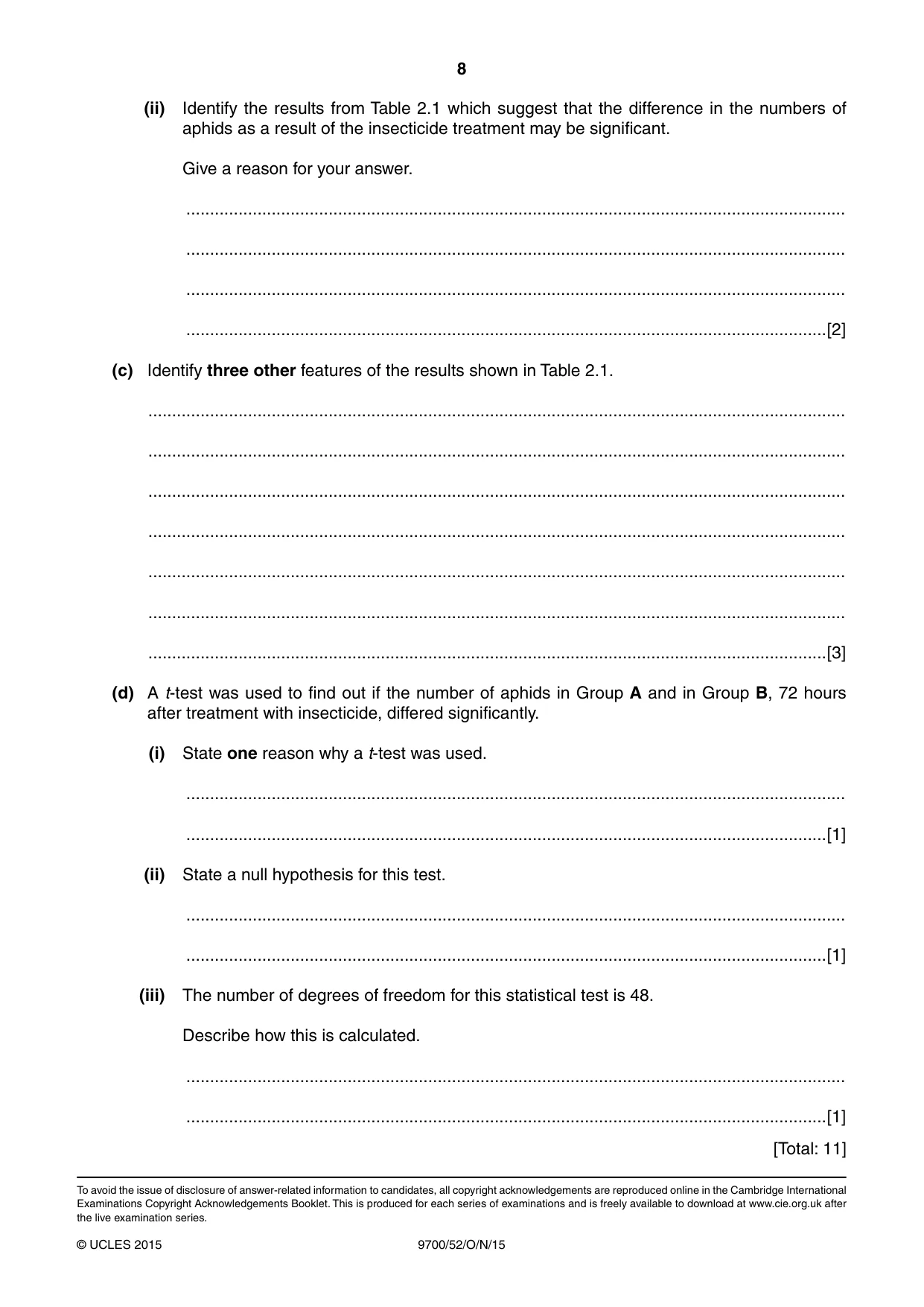
8 9700/52/O/N/15 © UCLES 2015 (ii) Identify the results from Table 2.1 which suggest that the difference in the numbers of aphids as a result of the insecticide treatment may be significant. Give a reason for your answer. … … … …[2] (c) Identify three other features of the results shown in Table 2.1. … … … … … … …[3] (d) A t-test was used to find out if the number of aphids in Group A and in Group B, 72 hours after treatment with insecticide, differed significantly. (i) State one reason why a t-test was used. … …[1] (ii) State a null hypothesis for this test. … …[1] (iii) The number of degrees of freedom for this statistical test is 48. Describe how this is calculated. … …[1] [Total: 11] To avoid the issue of disclosure of answer-related information to candidates, all copyright acknowledgements are reproduced online in the Cambridge International Examinations Copyright Acknowledgements Booklet. This is produced for each series of examinations and is freely available to download at www.cie.org.uk after the live examination series.
Mark scheme, page 1
® IGCSE is the registered trademark of Cambridge International Examinations. CAMBRIDGE INTERNATIONAL EXAMINATIONS Cambridge International Advanced Subsidiary and Advanced Level MARK SCHEME for the October/November 2015 series 9700 BIOLOGY 9700/52 Paper 5 (Planning, Analysis and Evaluation), maximum raw mark 30 This mark scheme is published as an aid to teachers and candidates, to indicate the requirements of the examination. It shows the basis on which Examiners were instructed to award marks. It does not indicate the details of the discussions that took place at an Examiners’ meeting before marking began, which would have considered the acceptability of alternative answers. Mark schemes should be read in conjunction with the question paper and the Principal Examiner Report for Teachers. Cambridge will not enter into discussions about these mark schemes. Cambridge is publishing the mark schemes for the October/November 2015 series for most Cambridge IGCSE®, Cambridge International A and AS Level components and some Cambridge O Level components.
Mark scheme, page 2
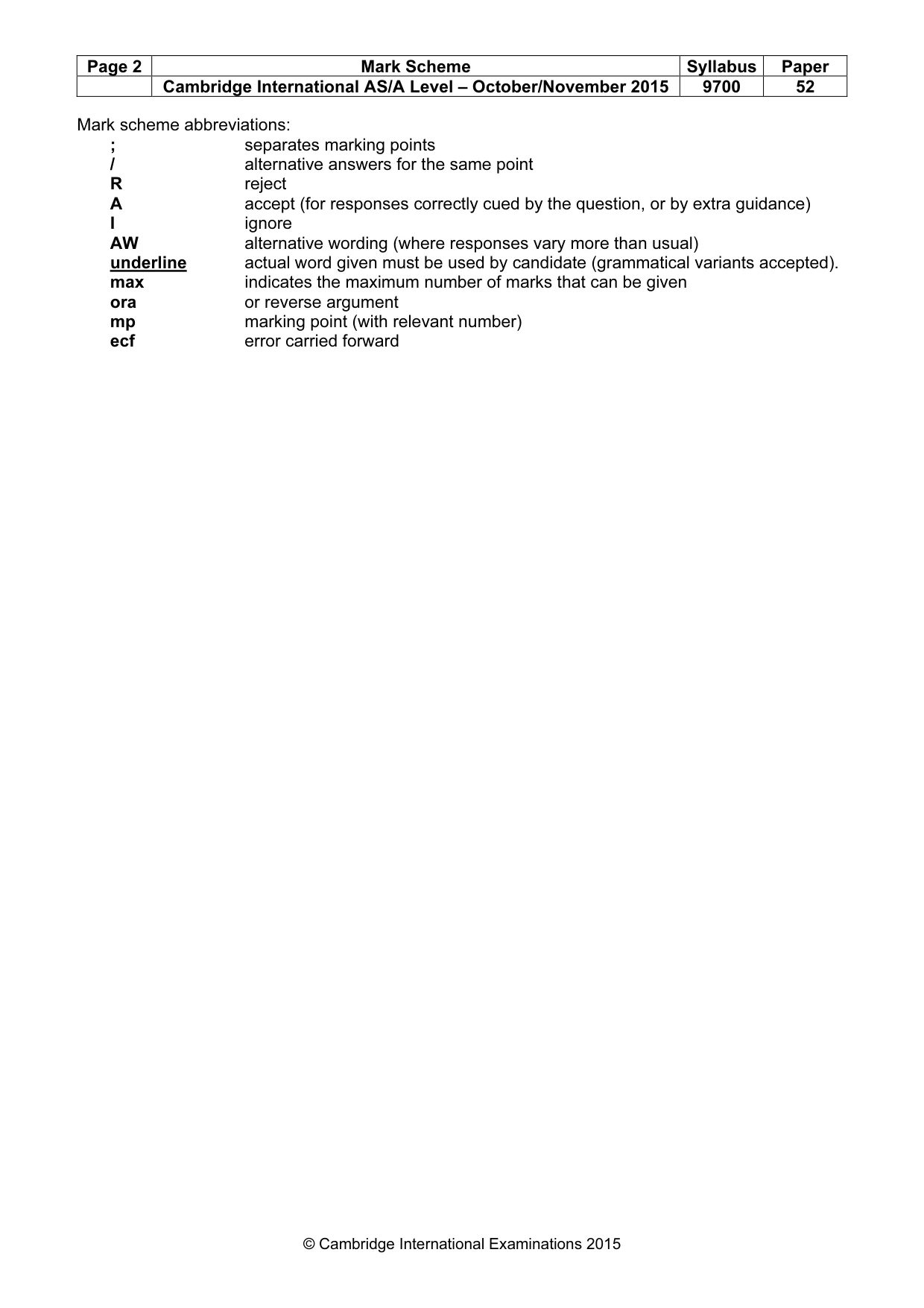
Page 2 Mark Scheme Syllabus Paper Cambridge International AS/A Level – October/November 2015 9700 52 © Cambridge International Examinations 2015 Mark scheme abbreviations: ; separates marking points / alternative answers for the same point R reject A accept (for responses correctly cued by the question, or by extra guidance) I ignore AW alternative wording (where responses vary more than usual) underline actual word given must be used by candidate (grammatical variants accepted). max indicates the maximum number of marks that can be given ora or reverse argument mp marking point (with relevant number) ecf error carried forward
Mark scheme, page 3
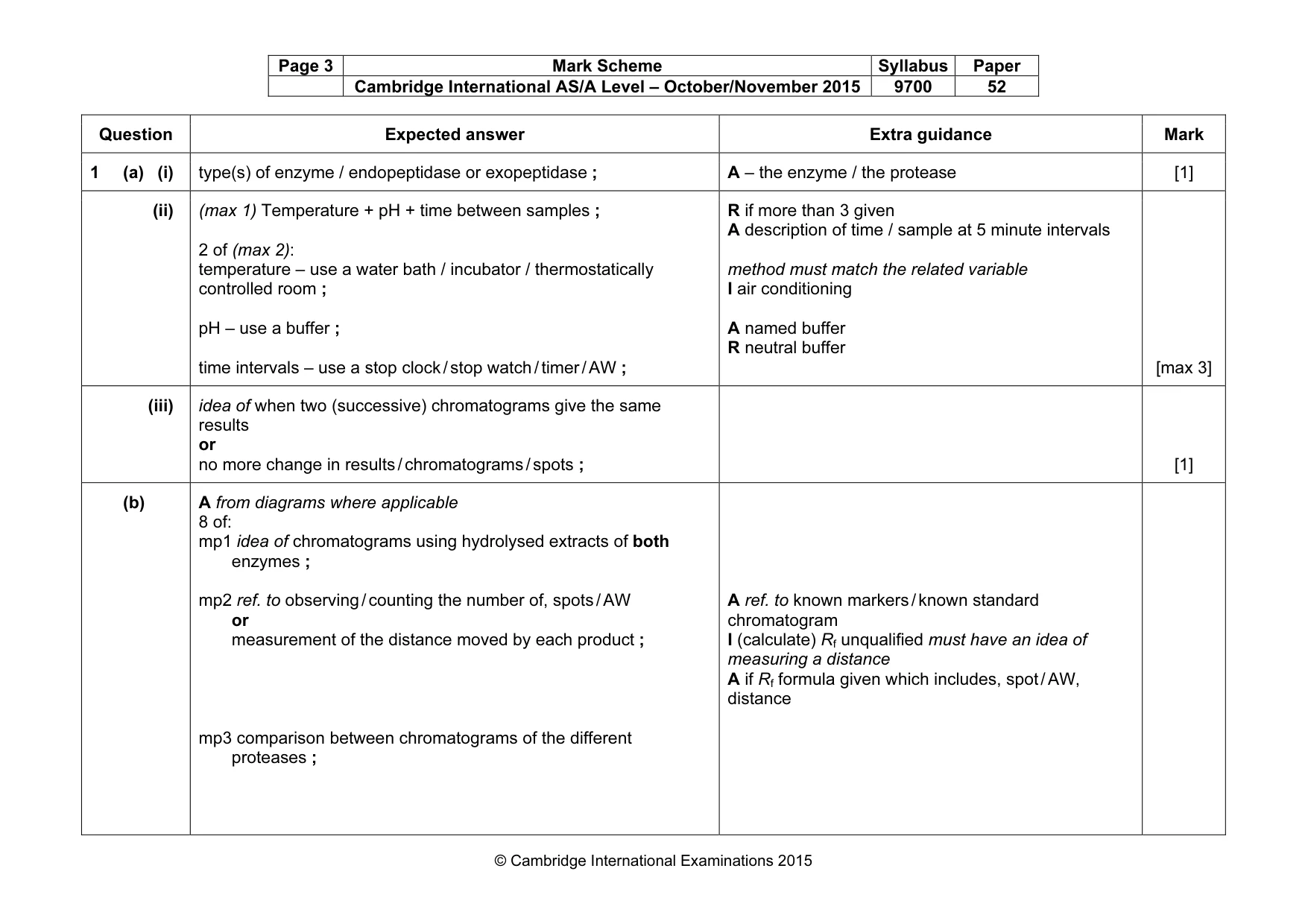
Page 3 Mark Scheme Syllabus Paper Cambridge International AS/A Level – October/November 2015 9700 52 © Cambridge International Examinations 2015 Question Expected answer Extra guidance Mark 1 (a) (i) type(s) of enzyme / endopeptidase or exopeptidase ; A – the enzyme / the protease [1] (ii) (max 1) Temperature + pH + time between samples ; 2 of (max 2): temperature – use a water bath / incubator / thermostatically controlled room ; pH – use a buffer ; time intervals – use a stop clock / stop watch / timer / AW ; R if more than 3 given A description of time / sample at 5 minute intervals method must match the related variable I air conditioning A named buffer R neutral buffer [max 3] (iii) idea of when two (successive) chromatograms give the same results or no more change in results / chromatograms / spots ; [1] (b) A from diagrams where applicable 8 of: mp1 idea of chromatograms using hydrolysed extracts of both enzymes ; mp2 ref. to observing / counting the number of, spots / AW or measurement of the distance moved by each product ; mp3 comparison between chromatograms of the different proteases ; A ref. to known markers / known standard chromatogram I (calculate) Rf unqualified must have an idea of measuring a distance A if Rf formula given which includes, spot / AW, distance
Mark scheme, page 4
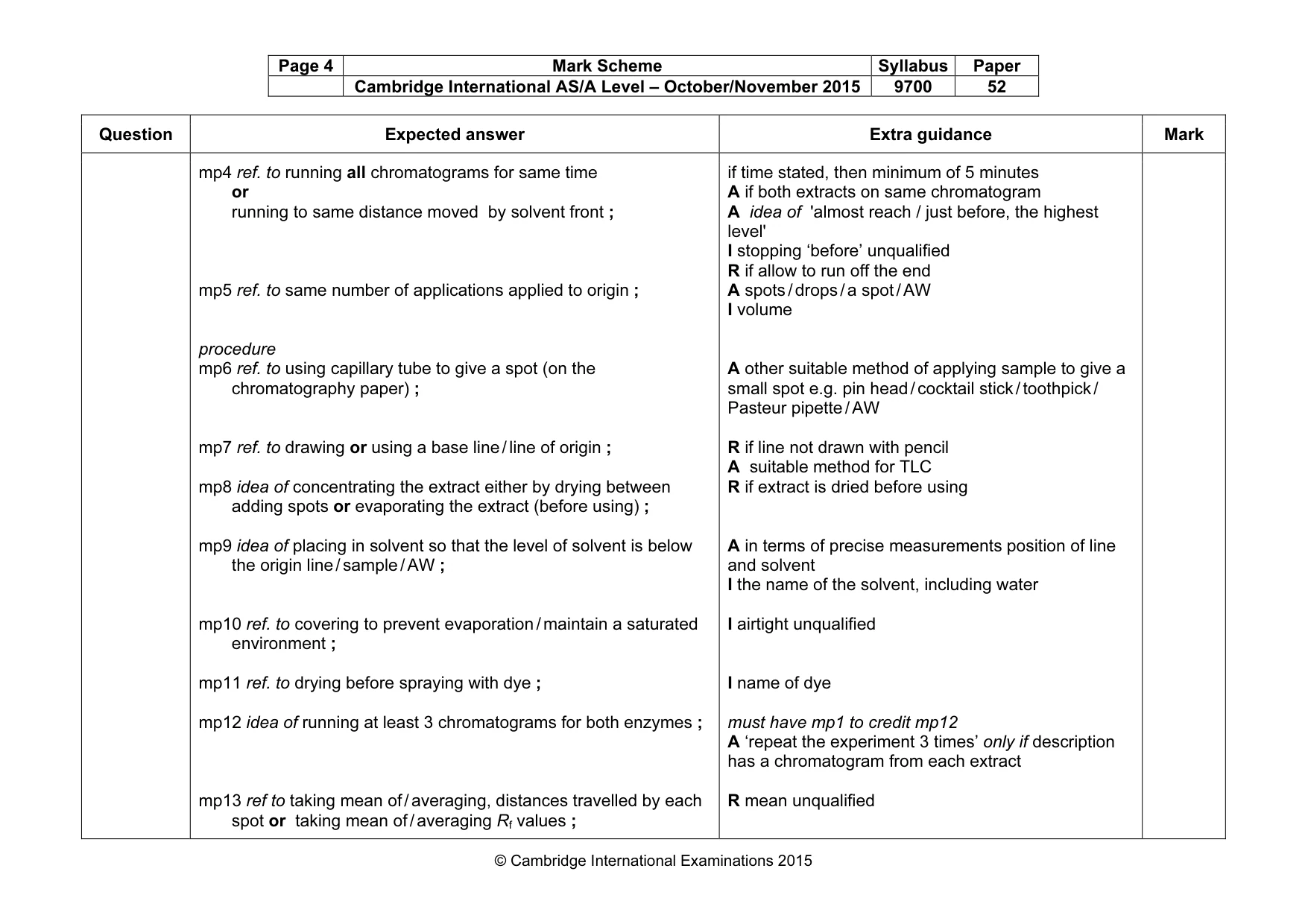
Page 4 Mark Scheme Syllabus Paper Cambridge International AS/A Level – October/November 2015 9700 52 © Cambridge International Examinations 2015 Question Expected answer Extra guidance Mark mp4 ref. to running all chromatograms for same time or running to same distance moved by solvent front ; mp5 ref. to same number of applications applied to origin ; procedure mp6 ref. to using capillary tube to give a spot (on the chromatography paper) ; mp7 ref. to drawing or using a base line / line of origin ; mp8 idea of concentrating the extract either by drying between adding spots or evaporating the extract (before using) ; mp9 idea of placing in solvent so that the level of solvent is below the origin line / sample / AW ; mp10 ref. to covering to prevent evaporation / maintain a saturated environment ; mp11 ref. to drying before spraying with dye ; mp12 idea of running at least 3 chromatograms for both enzymes ; mp13 ref to taking mean of / averaging, distances travelled by each spot or taking mean of / averaging Rf values ; if time stated, then minimum of 5 minutes A if both extracts on same chromatogram A idea of 'almost reach / just before, the highest level' I stopping ‘before’ unqualified R if allow to run off the end A spots / drops / a spot / AW I volume A other suitable method of applying sample to give a small spot e.g. pin head / cocktail stick / toothpick / Pasteur pipette / AW R if line not drawn with pencil A suitable method for TLC R if extract is dried before using A in terms of precise measurements position of line and solvent I the name of the solvent, including water I airtight unqualified I name of dye must have mp1 to credit mp12 A ‘repeat the experiment 3 times’ only if description has a chromatogram from each extract R mean unqualified
Mark scheme, page 5
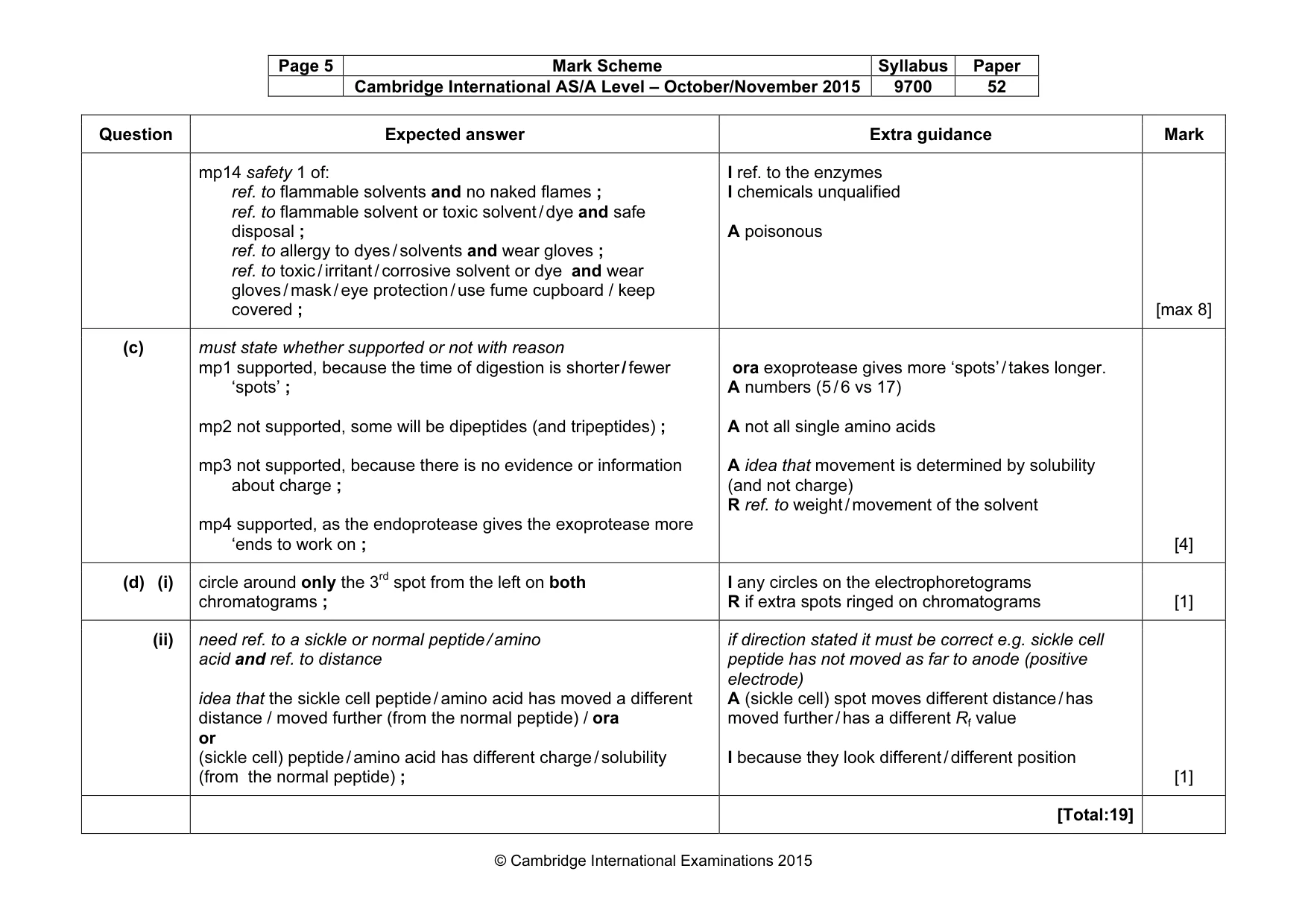
Page 5 Mark Scheme Syllabus Paper Cambridge International AS/A Level – October/November 2015 9700 52 © Cambridge International Examinations 2015 Question Expected answer Extra guidance Mark mp14 safety 1 of: ref. to flammable solvents and no naked flames ; ref. to flammable solvent or toxic solvent / dye and safe disposal ; ref. to allergy to dyes / solvents and wear gloves ; ref. to toxic / irritant / corrosive solvent or dye and wear gloves / mask / eye protection / use fume cupboard / keep covered ; I ref. to the enzymes I chemicals unqualified A poisonous [max 8] (c) must state whether supported or not with reason mp1 supported, because the time of digestion is shorter / fewer ‘spots’ ; mp2 not supported, some will be dipeptides (and tripeptides) ; mp3 not supported, because there is no evidence or information about charge ; mp4 supported, as the endoprotease gives the exoprotease more ‘ends to work on ; ora exoprotease gives more ‘spots’ / takes longer. A numbers (5 / 6 vs 17) A not all single amino acids A idea that movement is determined by solubility (and not charge) R ref. to weight / movement of the solvent [4] (d) (i) circle around only the 3rd spot from the left on both chromatograms ; I any circles on the electrophoretograms R if extra spots ringed on chromatograms [1] (ii) need ref. to a sickle or normal peptide / amino acid and ref. to distance idea that the sickle cell peptide / amino acid has moved a different distance / moved further (from the normal peptide) / ora or (sickle cell) peptide / amino acid has different charge / solubility (from the normal peptide) ; if direction stated it must be correct e.g. sickle cell peptide has not moved as far to anode (positive electrode) A (sickle cell) spot moves different distance / has moved further / has a different Rf value I because they look different / different position [1] [Total:19]
Mark scheme, page 6
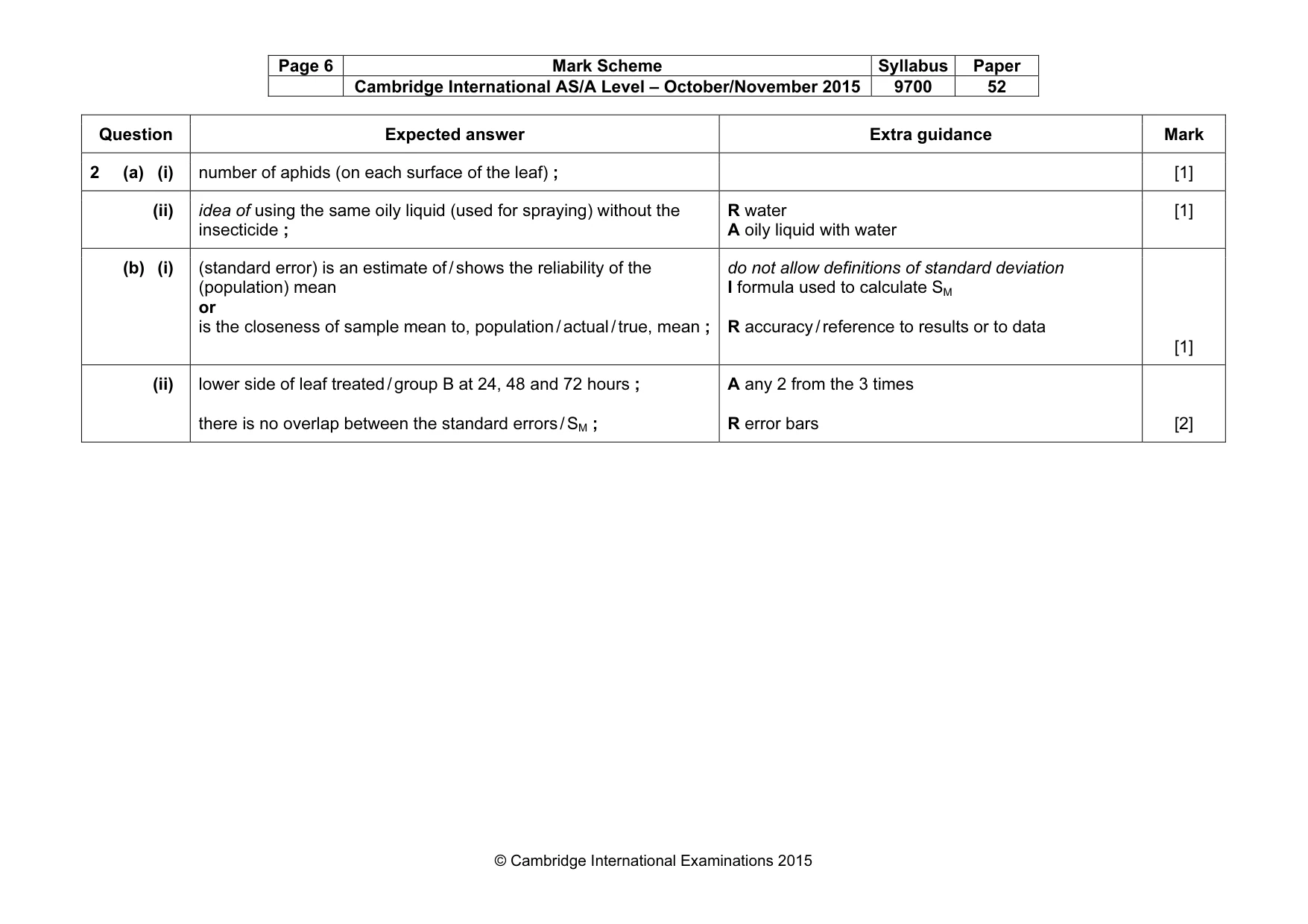
Page 6 Mark Scheme Syllabus Paper Cambridge International AS/A Level – October/November 2015 9700 52 © Cambridge International Examinations 2015 Question Expected answer Extra guidance Mark 2 (a) (i) number of aphids (on each surface of the leaf) ; [1] (ii) idea of using the same oily liquid (used for spraying) without the insecticide ; R water A oily liquid with water [1] (b) (i) (standard error) is an estimate of / shows the reliability of the (population) mean or is the closeness of sample mean to, population / actual / true, mean ; do not allow definitions of standard deviation I formula used to calculate SM R accuracy / reference to results or to data [1] (ii) lower side of leaf treated / group B at 24, 48 and 72 hours ; there is no overlap between the standard errors / SM ; A any 2 from the 3 times R error bars [2]
Mark scheme, page 7
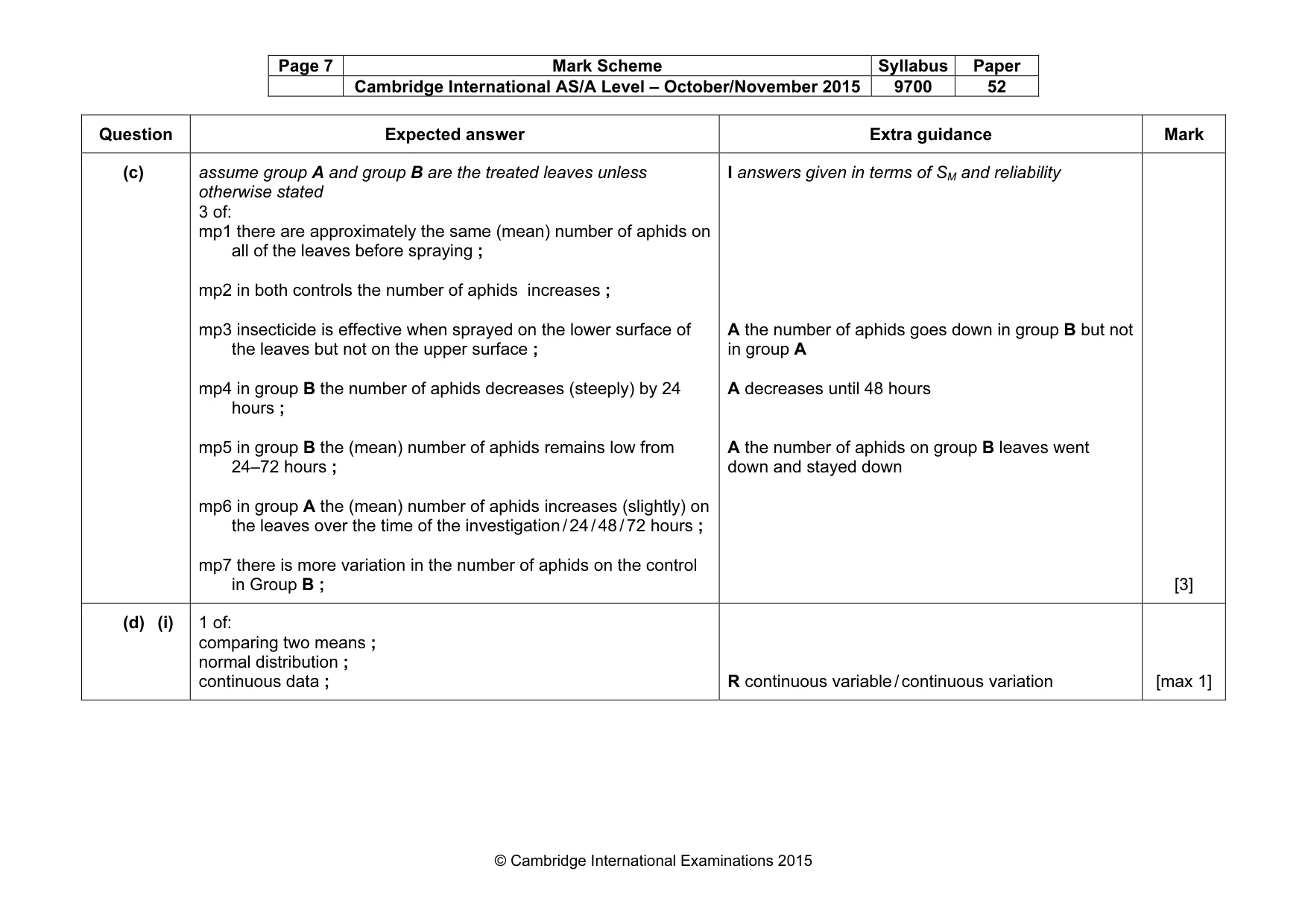
Page 7 Mark Scheme Syllabus Paper Cambridge International AS/A Level – October/November 2015 9700 52 © Cambridge International Examinations 2015 Question Expected answer Extra guidance Mark (c) assume group A and group B are the treated leaves unless otherwise stated 3 of: mp1 there are approximately the same (mean) number of aphids on all of the leaves before spraying ; mp2 in both controls the number of aphids increases ; mp3 insecticide is effective when sprayed on the lower surface of the leaves but not on the upper surface ; mp4 in group B the number of aphids decreases (steeply) by 24 hours ; mp5 in group B the (mean) number of aphids remains low from 24–72 hours ; mp6 in group A the (mean) number of aphids increases (slightly) on the leaves over the time of the investigation / 24 / 48 / 72 hours ; mp7 there is more variation in the number of aphids on the control in Group B ; I answers given in terms of SM and reliability A the number of aphids goes down in group B but not in group A A decreases until 48 hours A the number of aphids on group B leaves went down and stayed down [3] (d) (i) 1 of: comparing two means ; normal distribution ; continuous data ; R continuous variable / continuous variation [max 1]
Mark scheme, page 8
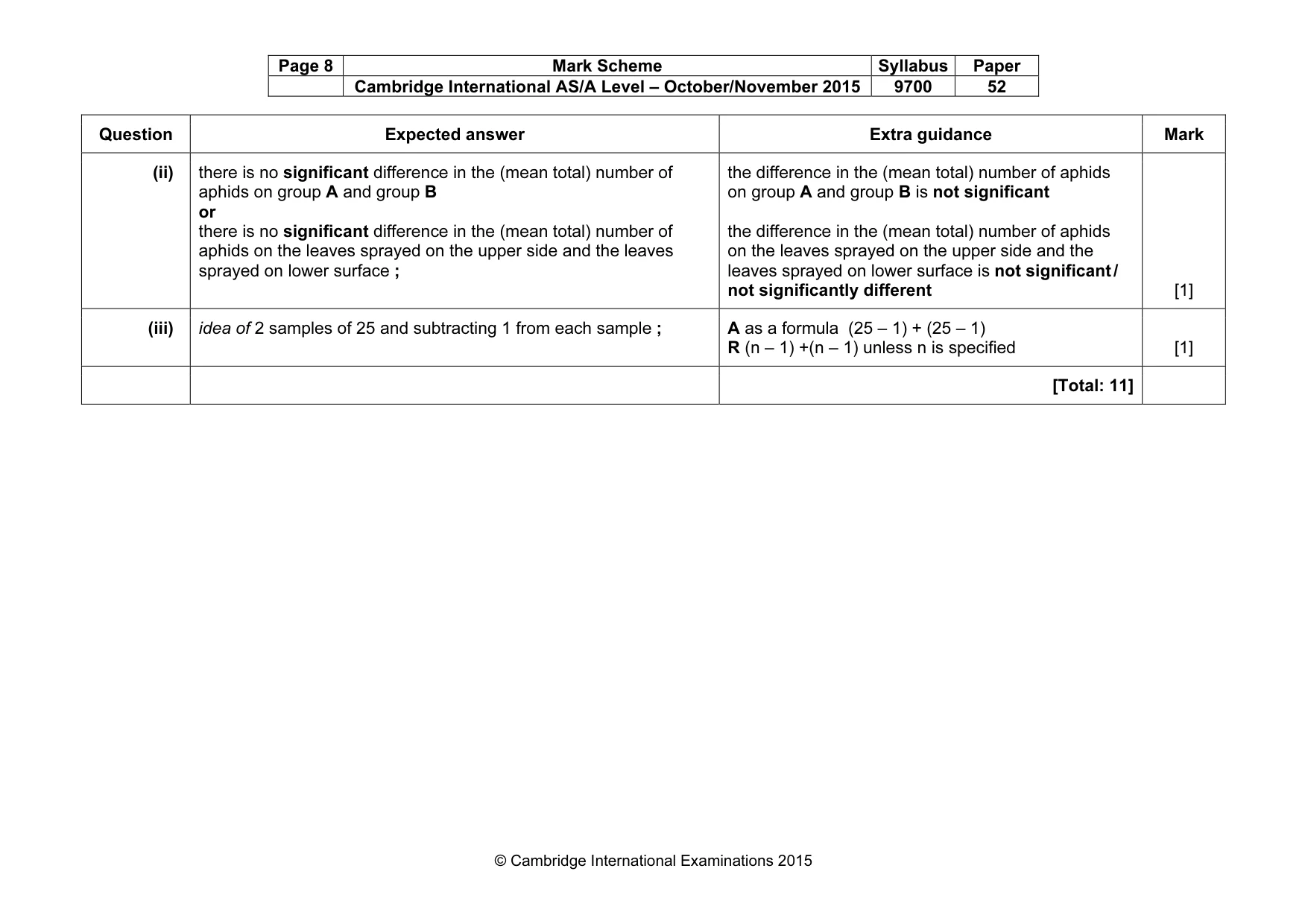
Page 8 Mark Scheme Syllabus Paper Cambridge International AS/A Level – October/November 2015 9700 52 © Cambridge International Examinations 2015 Question Expected answer Extra guidance Mark (ii) there is no significant difference in the (mean total) number of aphids on group A and group B or there is no significant difference in the (mean total) number of aphids on the leaves sprayed on the upper side and the leaves sprayed on lower surface ; the difference in the (mean total) number of aphids on group A and group B is not significant the difference in the (mean total) number of aphids on the leaves sprayed on the upper side and the leaves sprayed on lower surface is not significant / not significantly different [1] (iii) idea of 2 samples of 25 and subtracting 1 from each sample ; A as a formula (25 – 1) + (25 – 1) R (n – 1) +(n – 1) unless n is specified [1] [Total: 11]
What you needed in this session
Cambridge’s own grade thresholds for 2015 Oct/Nov, Paper 5 · Variant 2. A higher threshold means an easier paper — the bar moves with how the cohort did.