Cambridge A Level Biology 9700 — 2015 Oct/Nov Paper 5 · Variant 3
9700/53/O/N/15 · 30 marks · ≈34 min
The question paper and its mark scheme, free to read here and free to download. This is Cambridge’s own paper, exactly as it was sat.
Question paper8 pages
Mark scheme9 pages
Answers below. Sit the paper first if you are practising.
Paper as text
Question paper, page 1
This document consists of 8 printed pages. DC (KN/KN) 90320/3 © UCLES 2015 [Turn over Cambridge International Examinations Cambridge International Advanced Level * 1 4 3 8 3 7 4 9 9 4 * BIOLOGY 9700/53 Paper 5 Planning, Analysis and Evaluation October/November 2015 1 hour 15 minutes Candidates answer on the Question Paper. No Additional Materials are required. READ THESE INSTRUCTIONS FIRST Write your Centre number, candidate number and name on all the work you hand in. Write in dark blue or black pen. You may use an HB pencil for any diagrams or graphs. Do not use staples, paper clips, glue or correction fluid. DO NOT WRITE IN ANY BARCODES. Answer all questions. Electronic calculators may be used. You may lose marks if you do not show your working or if you do not use appropriate units. At the end of the examination, fasten all your work securely together. The number of marks is given in brackets [ ] at the end of each question or part question.
Question paper, page 2
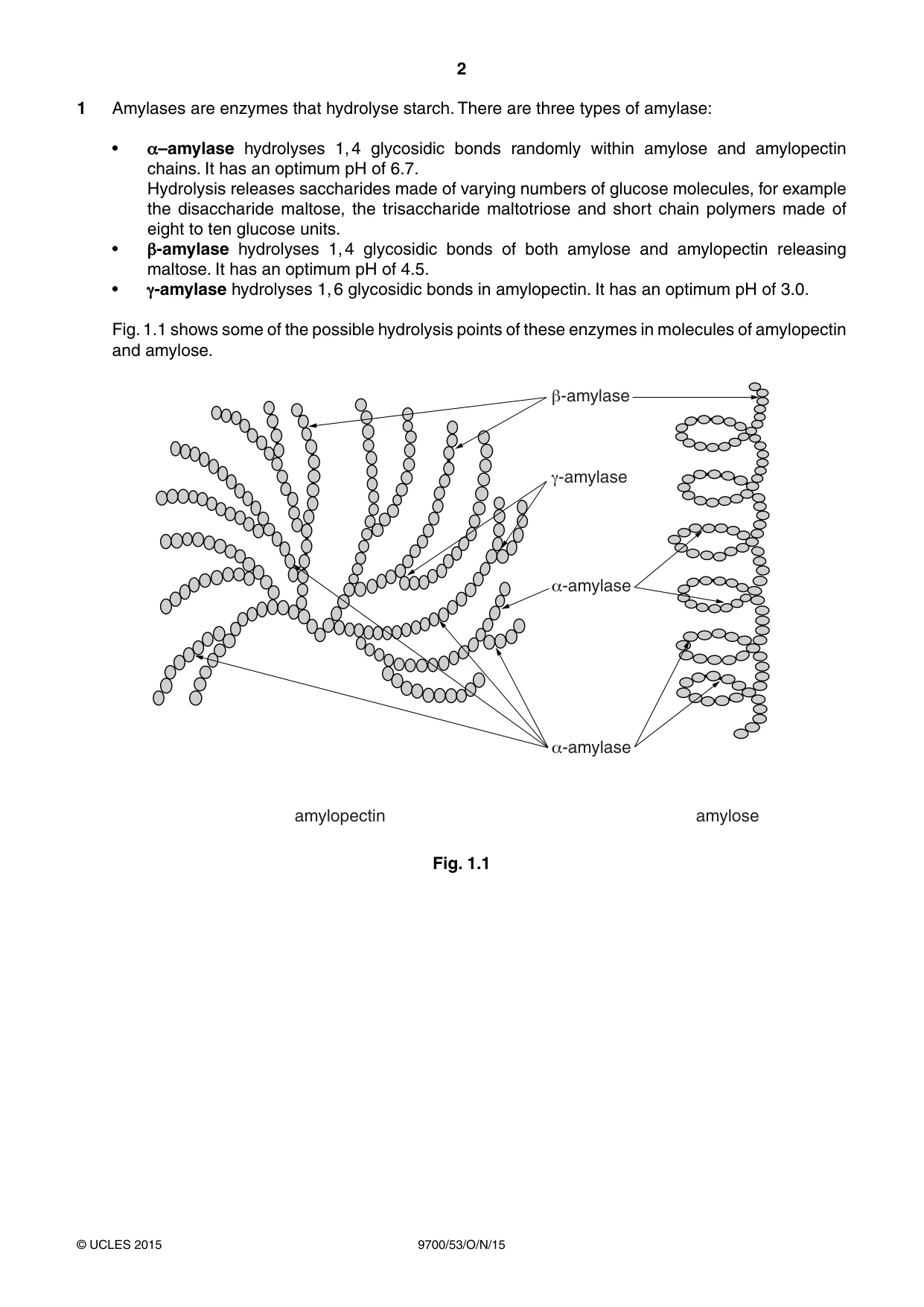
2 9700/53/O/N/15 © UCLES 2015 1 Amylases are enzymes that hydrolyse starch. There are three types of amylase: • α–amylase hydrolyses 1, 4 glycosidic bonds randomly within amylose and amylopectin chains. It has an optimum pH of 6.7. Hydrolysis releases saccharides made of varying numbers of glucose molecules, for example the disaccharide maltose, the trisaccharide maltotriose and short chain polymers made of eight to ten glucose units. • β-amylase hydrolyses 1, 4 glycosidic bonds of both amylose and amylopectin releasing maltose. It has an optimum pH of 4.5. • γ-amylase hydrolyses 1, 6 glycosidic bonds in amylopectin. It has an optimum pH of 3.0. Fig. 1.1 shows some of the possible hydrolysis points of these enzymes in molecules of amylopectin and amylose. `-amylase a-amylase _-amylase _-amylase amylopectin amylose Fig. 1.1
Question paper, page 3
3 9700/53/O/N/15 © UCLES 2015 [Turn over (a) A student investigated the effect of these enzymes on the hydrolysis of starch by incubating a 2% starch suspension separately with each of the enzymes. The mixtures were incubated for 60 minutes to allow all the reactions to be completed. • Each mixture of enzyme and starch was incubated at 35 °C and at the optimum pH of each enzyme. • After 60 minutes, samples of each mixture were removed using a capillary tube. • The products of hydrolysis of each mixture were separated by chromatography using the same solvent. • The products of hydrolysis were located by spraying the chromatogram with the same specific dye. (i) Identify the independent variable in this investigation. …[1] (ii) Identify three variables, other than the chromatography solvent and the specific dye, that the student has standardised in their investigation. Describe how the student might have standardised two of these variables. … … … … … … … …[3] (iii) Suggest a control that the students could use for this investigation. … …[1]
Question paper, page 4
4 9700/53/O/N/15 © UCLES 2015 (b) Describe a method that the student could use to prepare and use chromatograms to compare the changes in the products of hydrolysis of starch by the three different amylases over time. Your method should be detailed enough for another person to follow. … … … … … … … … … … … … … … … … … … … … … … … … … …[8]
Question paper, page 5
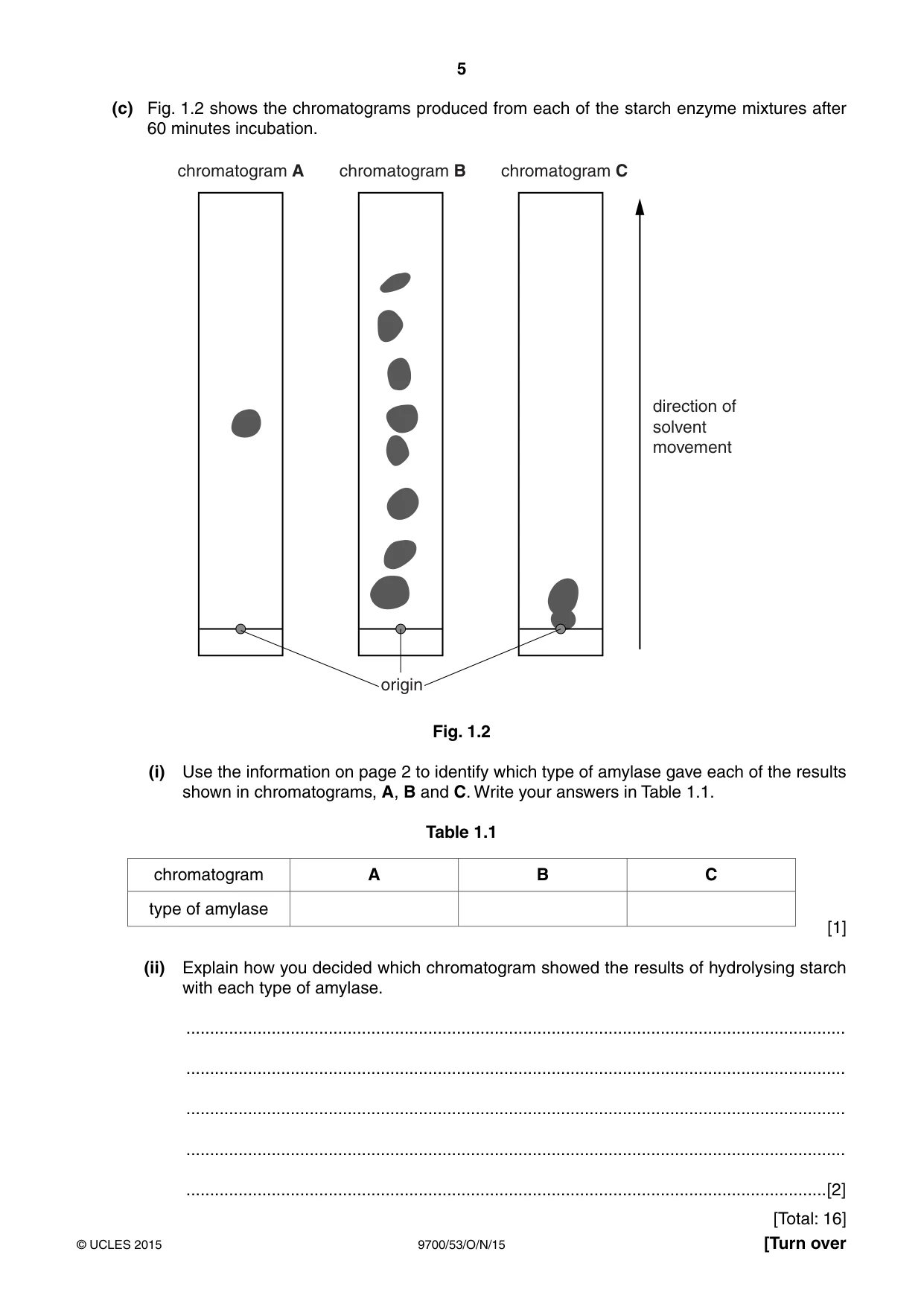
5 9700/53/O/N/15 © UCLES 2015 [Turn over (c) Fig. 1.2 shows the chromatograms produced from each of the starch enzyme mixtures after 60 minutes incubation. origin direction of solvent movement chromatogram A chromatogram B chromatogram C Fig. 1.2 (i) Use the information on page 2 to identify which type of amylase gave each of the results shown in chromatograms, A, B and C. Write your answers in Table 1.1. Table 1.1 chromatogram A B C type of amylase [1] (ii) Explain how you decided which chromatogram showed the results of hydrolysing starch with each type of amylase. … … … … …[2] [Total: 16]
Question paper, page 6
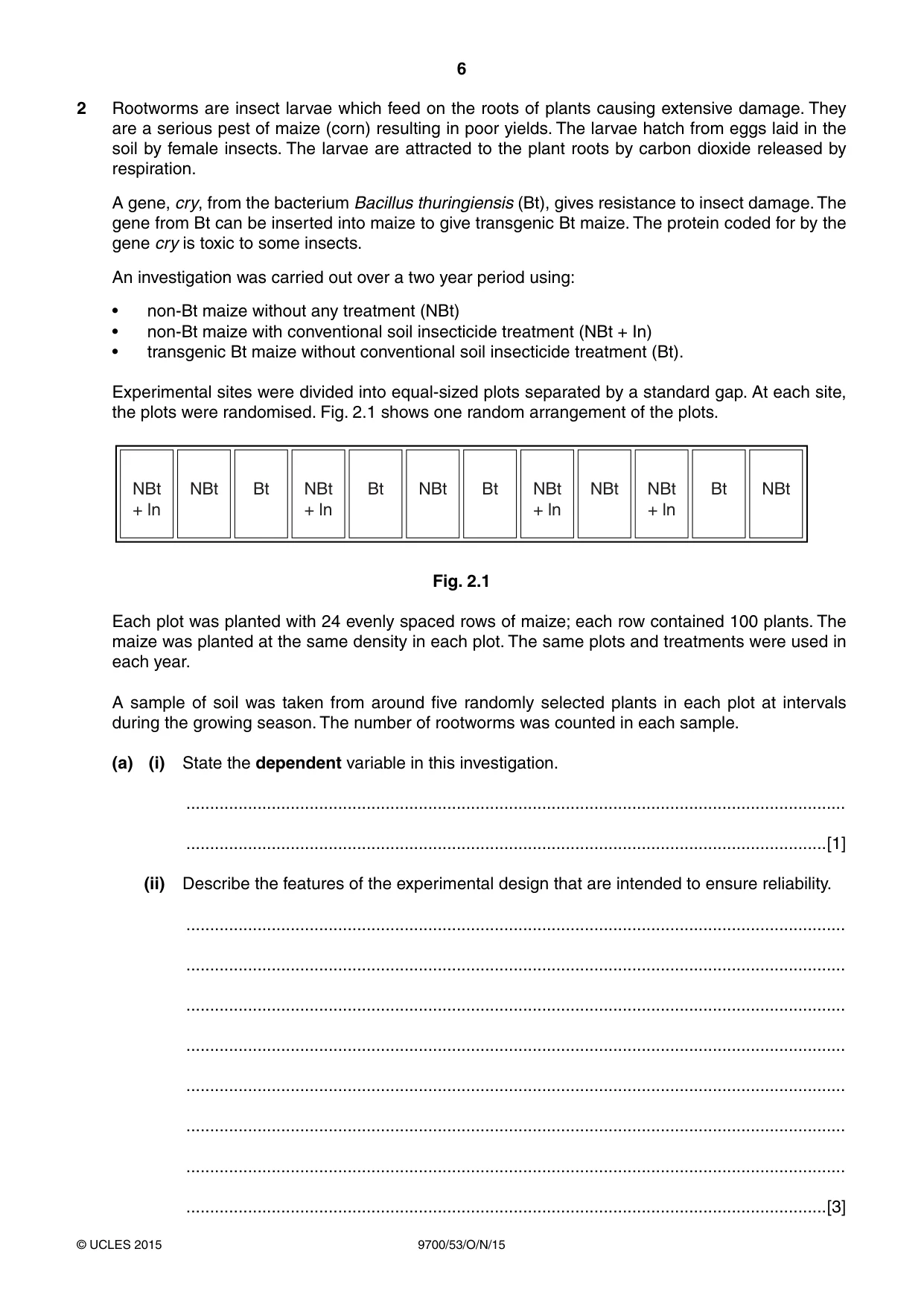
6 9700/53/O/N/15 © UCLES 2015 2 Rootworms are insect larvae which feed on the roots of plants causing extensive damage. They are a serious pest of maize (corn) resulting in poor yields. The larvae hatch from eggs laid in the soil by female insects. The larvae are attracted to the plant roots by carbon dioxide released by respiration. A gene, cry, from the bacterium Bacillus thuringiensis (Bt), gives resistance to insect damage. The gene from Bt can be inserted into maize to give transgenic Bt maize. The protein coded for by the gene cry is toxic to some insects. An investigation was carried out over a two year period using: • non-Bt maize without any treatment (NBt) • non-Bt maize with conventional soil insecticide treatment (NBt + In) • transgenic Bt maize without conventional soil insecticide treatment (Bt). Experimental sites were divided into equal-sized plots separated by a standard gap. At each site, the plots were randomised. Fig. 2.1 shows one random arrangement of the plots. NBt + ln NBt Bt NBt + ln Bt NBt Bt NBt + ln NBt NBt + ln Bt NBt Fig. 2.1 Each plot was planted with 24 evenly spaced rows of maize; each row contained 100 plants. The maize was planted at the same density in each plot. The same plots and treatments were used in each year. A sample of soil was taken from around five randomly selected plants in each plot at intervals during the growing season. The number of rootworms was counted in each sample. (a) (i) State the dependent variable in this investigation. … …[1] (ii) Describe the features of the experimental design that are intended to ensure reliability. … … … … … … … …[3]
Question paper, page 7
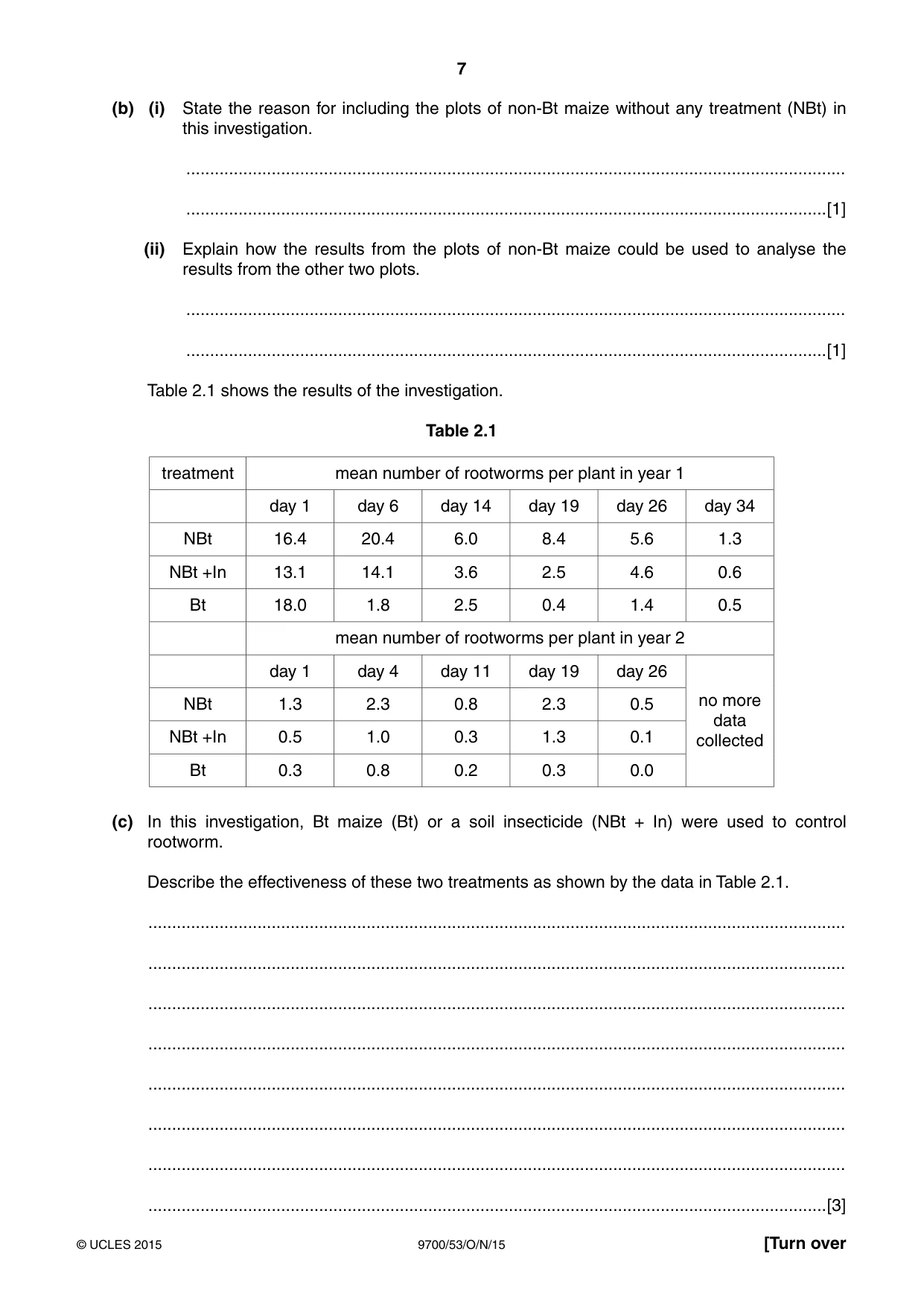
7 9700/53/O/N/15 © UCLES 2015 [Turn over (b) (i) State the reason for including the plots of non-Bt maize without any treatment (NBt) in this investigation. … …[1] (ii) Explain how the results from the plots of non-Bt maize could be used to analyse the results from the other two plots. … …[1] Table 2.1 shows the results of the investigation. Table 2.1 treatment mean number of rootworms per plant in year 1 day 1 day 6 day 14 day 19 day 26 day 34 NBt 16.4 20.4 6.0 8.4 5.6 1.3 NBt +In 13.1 14.1 3.6 2.5 4.6 0.6 Bt 18.0 1.8 2.5 0.4 1.4 0.5 mean number of rootworms per plant in year 2 day 1 day 4 day 11 day 19 day 26 no more data collected NBt 1.3 2.3 0.8 2.3 0.5 NBt +In 0.5 1.0 0.3 1.3 0.1 Bt 0.3 0.8 0.2 0.3 0.0 (c) In this investigation, Bt maize (Bt) or a soil insecticide (NBt + In) were used to control rootworm. Describe the effectiveness of these two treatments as shown by the data in Table 2.1. … … … … … … … …[3]
Question paper, page 8
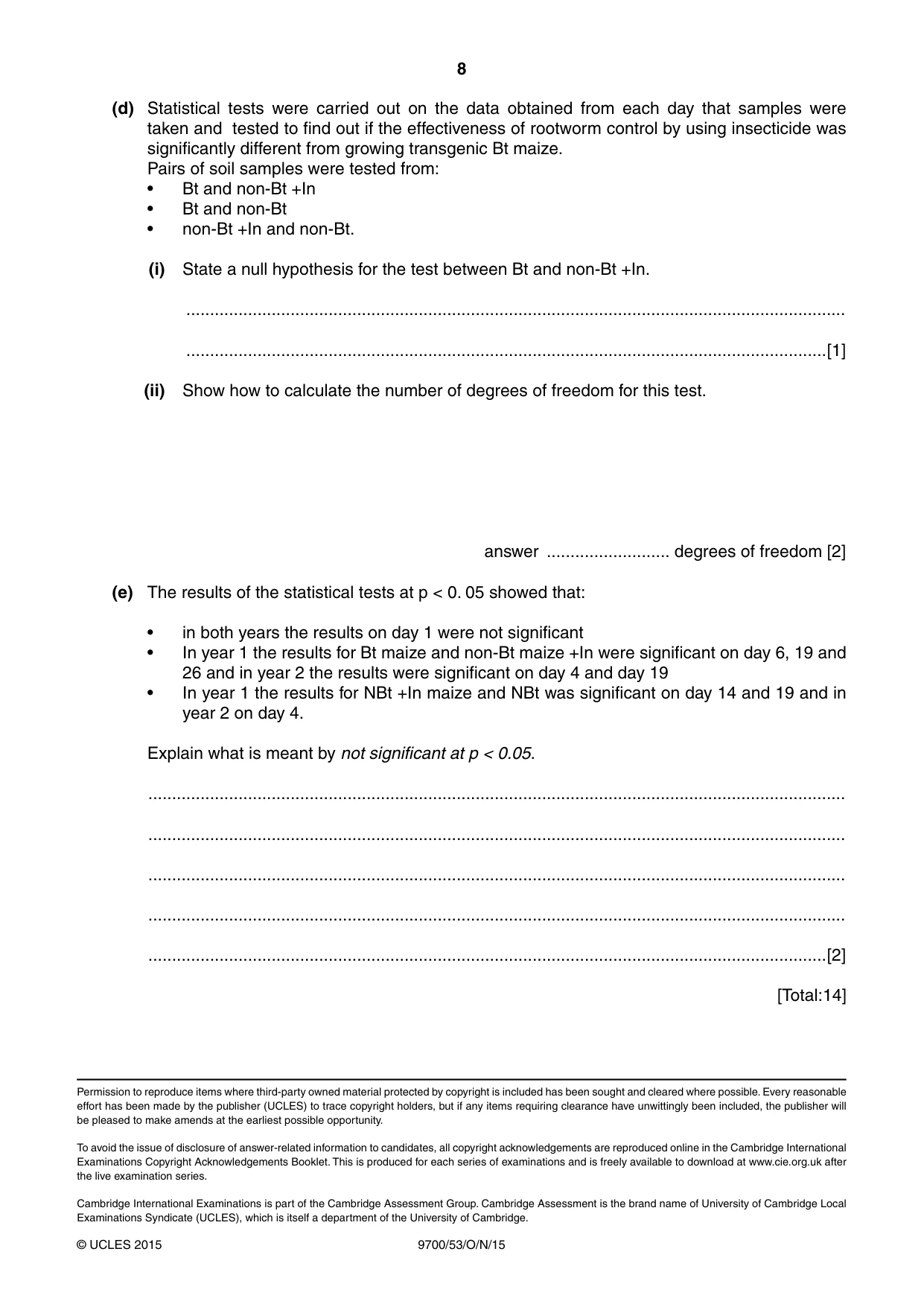
8 9700/53/O/N/15 © UCLES 2015 (d) Statistical tests were carried out on the data obtained from each day that samples were taken and tested to find out if the effectiveness of rootworm control by using insecticide was significantly different from growing transgenic Bt maize. Pairs of soil samples were tested from: • Bt and non-Bt +In • Bt and non-Bt • non-Bt +In and non-Bt. (i) State a null hypothesis for the test between Bt and non-Bt +In. … …[1] (ii) Show how to calculate the number of degrees of freedom for this test. answer … degrees of freedom [2] (e) The results of the statistical tests at p < 0. 05 showed that: • in both years the results on day 1 were not significant • In year 1 the results for Bt maize and non-Bt maize +In were significant on day 6, 19 and 26 and in year 2 the results were significant on day 4 and day 19 • In year 1 the results for NBt +In maize and NBt was significant on day 14 and 19 and in year 2 on day 4. Explain what is meant by not significant at p < 0.05. … … … … …[2] [Total:14] Permission to reproduce items where third-party owned material protected by copyright is included has been sought and cleared where possible. Every reasonable effort has been made by the publisher (UCLES) to trace copyright holders, but if any items requiring clearance have unwittingly been included, the publisher will be pleased to make amends at the earliest possible opportunity. To avoid the issue of disclosure of answer-related information to candidates, all copyright acknowledgements are reproduced online in the Cambridge International Examinations Copyright Acknowledgements Booklet. This is produced for each series of examinations and is freely available to download at www.cie.org.uk after the live examination series. Cambridge International Examinations is part of the Cambridge Assessment Group. Cambridge Assessment is the brand name of University of Cambridge Local Examinations Syndicate (UCLES), which is itself a department of the University of Cambridge.
Mark scheme, page 1
® IGCSE is the registered trademark of Cambridge International Examinations. CAMBRIDGE INTERNATIONAL EXAMINATIONS Cambridge International Advanced Subsidiary and Advanced Level MARK SCHEME for the October/November 2015 series 9700 BIOLOGY 9700/53 Paper 5 (Planning, Analysis and Evaluation), maximum raw mark 30 This mark scheme is published as an aid to teachers and candidates, to indicate the requirements of the examination. It shows the basis on which Examiners were instructed to award marks. It does not indicate the details of the discussions that took place at an Examiners’ meeting before marking began, which would have considered the acceptability of alternative answers. Mark schemes should be read in conjunction with the question paper and the Principal Examiner Report for Teachers. Cambridge will not enter into discussions about these mark schemes. Cambridge is publishing the mark schemes for the October/November 2015 series for most Cambridge IGCSE®, Cambridge International A and AS Level components and some Cambridge O Level components.
Mark scheme, page 2
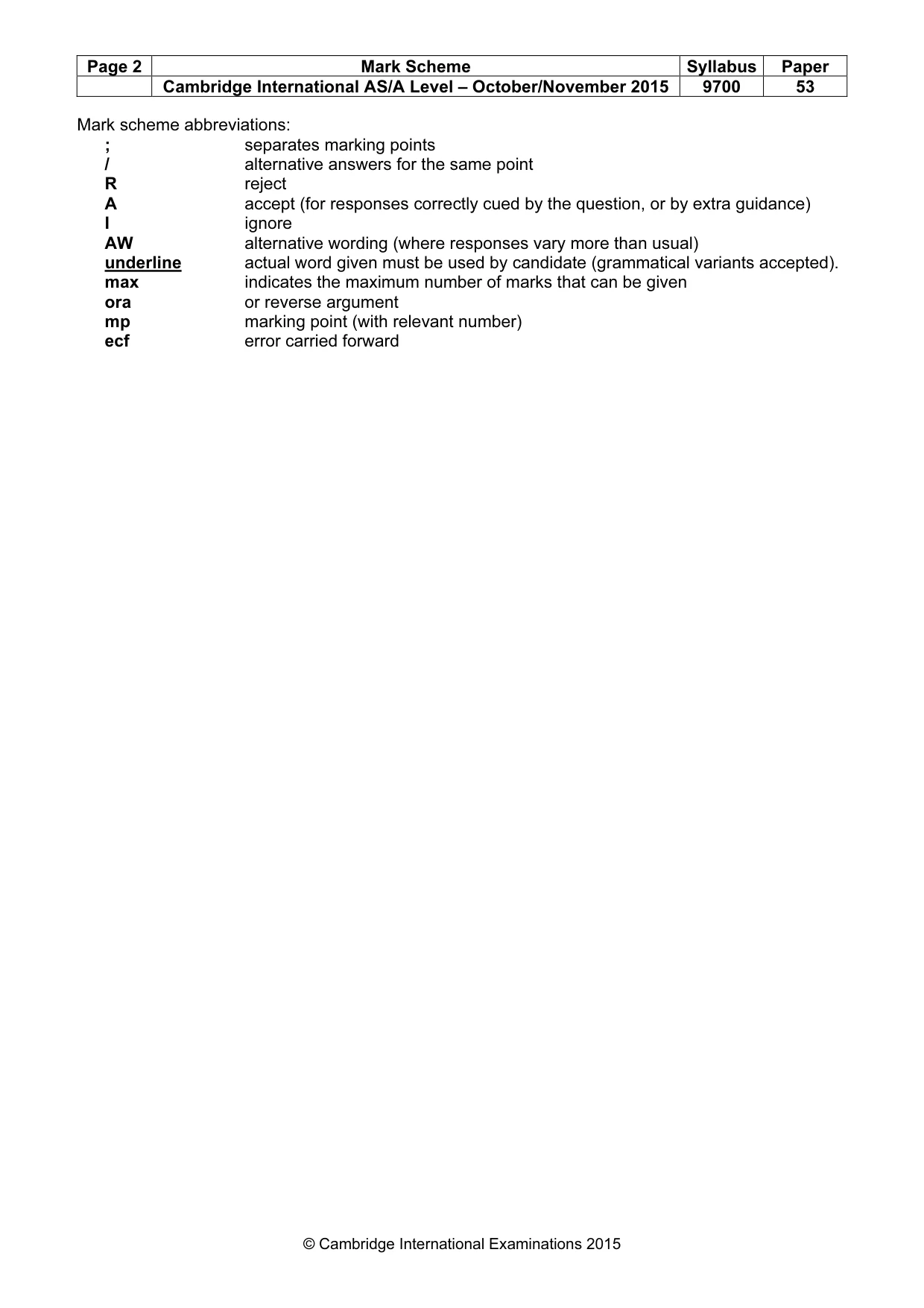
Page 2 Mark Scheme Syllabus Paper Cambridge International AS/A Level – October/November 2015 9700 53 © Cambridge International Examinations 2015 Mark scheme abbreviations: ; separates marking points / alternative answers for the same point R reject A accept (for responses correctly cued by the question, or by extra guidance) I ignore AW alternative wording (where responses vary more than usual) underline actual word given must be used by candidate (grammatical variants accepted). max indicates the maximum number of marks that can be given ora or reverse argument mp marking point (with relevant number) ecf error carried forward
Mark scheme, page 3
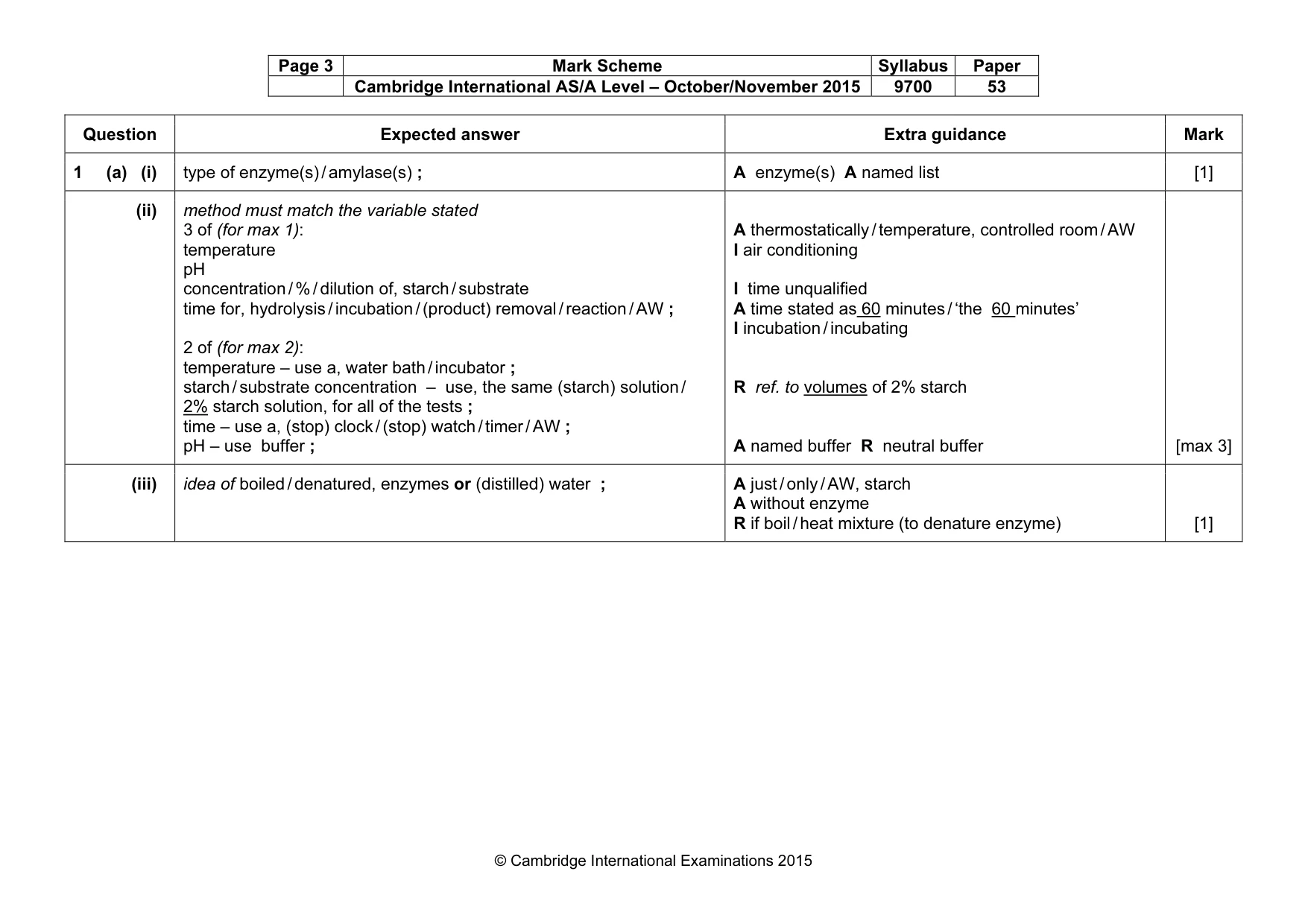
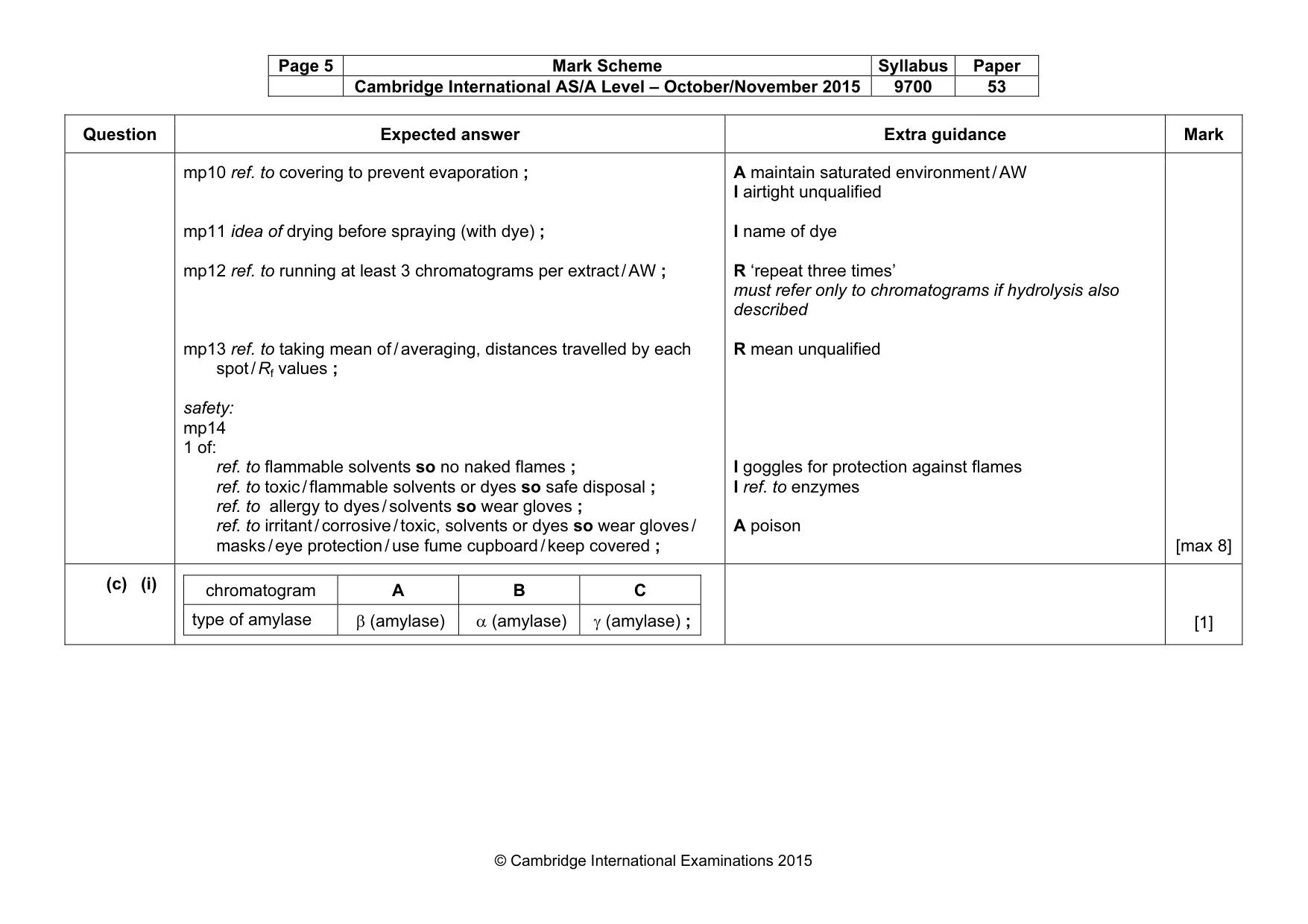
Page 3 Mark Scheme Syllabus Paper Cambridge International AS/A Level – October/November 2015 9700 53 © Cambridge International Examinations 2015 Question Expected answer Extra guidance Mark 1 (a) (i) type of enzyme(s) / amylase(s) ; A enzyme(s) A named list [1] (ii) method must match the variable stated 3 of (for max 1): temperature pH concentration / % / dilution of, starch / substrate time for, hydrolysis / incubation / (product) removal / reaction / AW ; 2 of (for max 2): temperature – use a, water bath / incubator ; starch / substrate concentration – use, the same (starch) solution / 2% starch solution, for all of the tests ; time – use a, (stop) clock / (stop) watch / timer / AW ; pH – use buffer ; A thermostatically / temperature, controlled room / AW I air conditioning I time unqualified A time stated as 60 minutes / ‘the 60 minutes’ I incubation / incubating R ref. to volumes of 2% starch A named buffer R neutral buffer [max 3] (iii) idea of boiled / denatured, enzymes or (distilled) water ; A just / only / AW, starch A without enzyme R if boil / heat mixture (to denature enzyme) [1]
Mark scheme, page 4
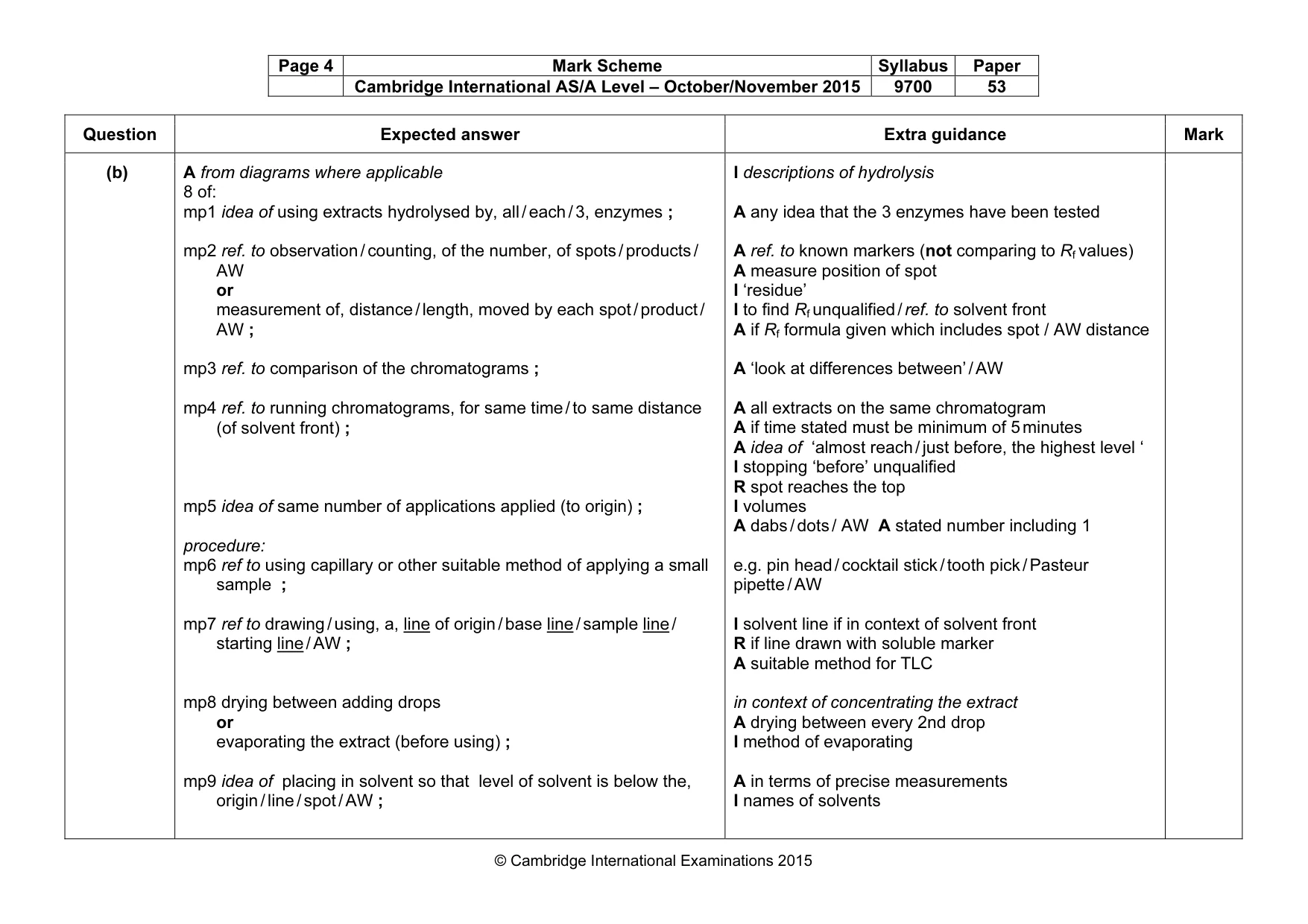
Page 4 Mark Scheme Syllabus Paper Cambridge International AS/A Level – October/November 2015 9700 53 © Cambridge International Examinations 2015 Question Expected answer Extra guidance Mark (b) A from diagrams where applicable 8 of: mp1 idea of using extracts hydrolysed by, all / each / 3, enzymes ; mp2 ref. to observation / counting, of the number, of spots / products / AW or measurement of, distance / length, moved by each spot / product / AW ; mp3 ref. to comparison of the chromatograms ; mp4 ref. to running chromatograms, for same time / to same distance (of solvent front) ; mp5 idea of same number of applications applied (to origin) ; procedure: mp6 ref to using capillary or other suitable method of applying a small sample ; mp7 ref to drawing / using, a, line of origin / base line / sample line / starting line / AW ; mp8 drying between adding drops or evaporating the extract (before using) ; mp9 idea of placing in solvent so that level of solvent is below the, origin / line / spot / AW ; I descriptions of hydrolysis A any idea that the 3 enzymes have been tested A ref. to known markers (not comparing to Rf values) A measure position of spot I ‘residue’ I to find Rf unqualified / ref. to solvent front A if Rf formula given which includes spot / AW distance A ‘look at differences between’ / AW A all extracts on the same chromatogram A if time stated must be minimum of 5 minutes A idea of ‘almost reach / just before, the highest level ‘ I stopping ‘before’ unqualified R spot reaches the top I volumes A dabs / dots / AW A stated number including 1 e.g. pin head / cocktail stick / tooth pick / Pasteur pipette / AW I solvent line if in context of solvent front R if line drawn with soluble marker A suitable method for TLC in context of concentrating the extract A drying between every 2nd drop I method of evaporating A in terms of precise measurements I names of solvents
Mark scheme, page 5
Page 5 Mark Scheme Syllabus Paper Cambridge International AS/A Level – October/November 2015 9700 53 © Cambridge International Examinations 2015 Question Expected answer Extra guidance Mark mp10 ref. to covering to prevent evaporation ; mp11 idea of drying before spraying (with dye) ; mp12 ref. to running at least 3 chromatograms per extract / AW ; mp13 ref. to taking mean of / averaging, distances travelled by each spot / Rf values ; safety: mp14 1 of: ref. to flammable solvents so no naked flames ; ref. to toxic / flammable solvents or dyes so safe disposal ; ref. to allergy to dyes / solvents so wear gloves ; ref. to irritant / corrosive / toxic, solvents or dyes so wear gloves / masks / eye protection / use fume cupboard / keep covered ; A maintain saturated environment / AW I airtight unqualified I name of dye R ‘repeat three times’ must refer only to chromatograms if hydrolysis also described R mean unqualified I goggles for protection against flames I ref. to enzymes A poison [max 8] (c) (i) chromatogram A B C type of amylase β (amylase) α (amylase) γ (amylase) ; [1]
Mark scheme, page 6
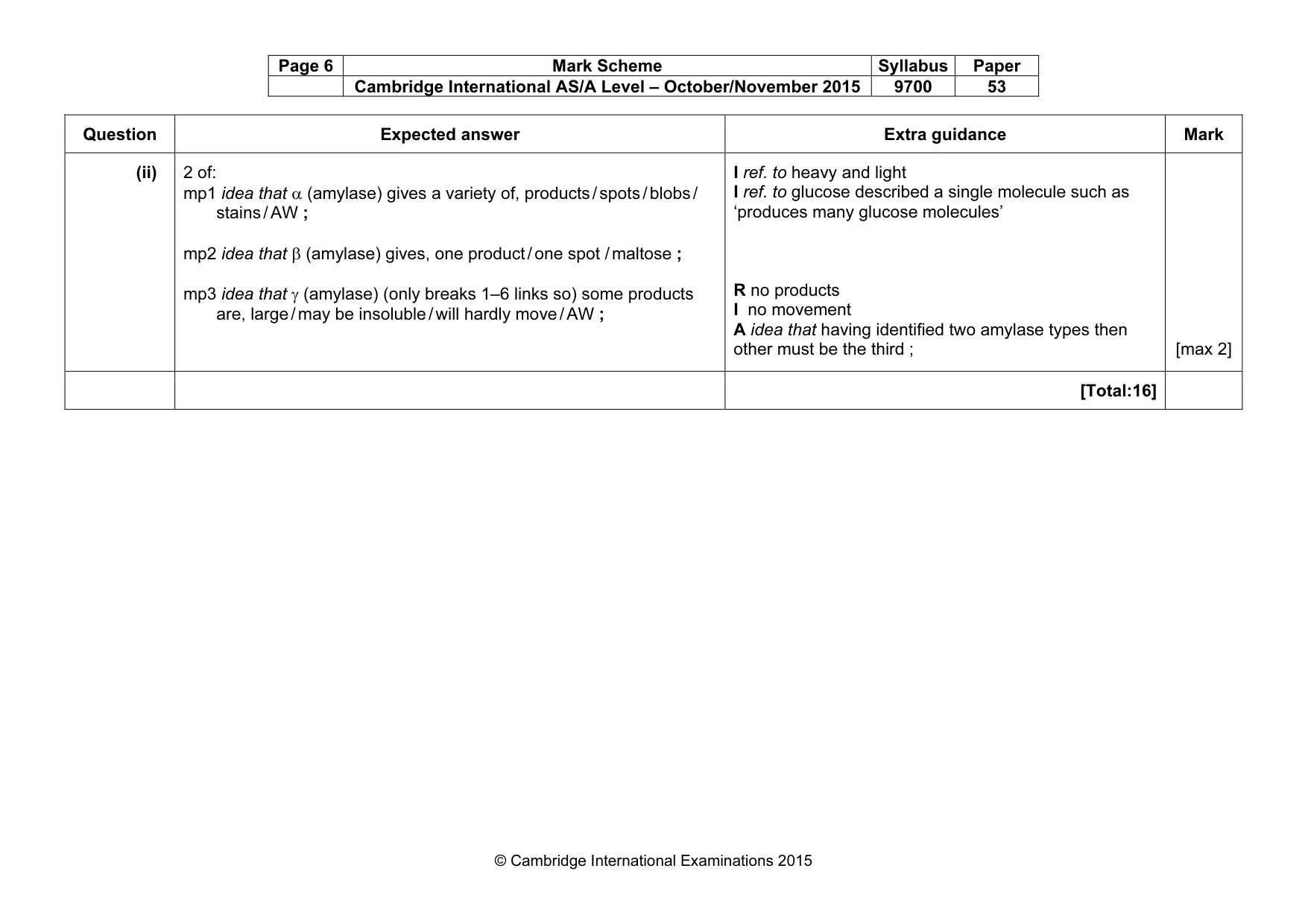
Page 6 Mark Scheme Syllabus Paper Cambridge International AS/A Level – October/November 2015 9700 53 © Cambridge International Examinations 2015 Question Expected answer Extra guidance Mark (ii) 2 of: mp1 idea that α (amylase) gives a variety of, products / spots / blobs / stains / AW ; mp2 idea that β (amylase) gives, one product / one spot / maltose ; mp3 idea that γ (amylase) (only breaks 1–6 links so) some products are, large / may be insoluble / will hardly move / AW ; I ref. to heavy and light I ref. to glucose described a single molecule such as ‘produces many glucose molecules’ R no products I no movement A idea that having identified two amylase types then other must be the third ; [max 2] [Total:16]
Mark scheme, page 7
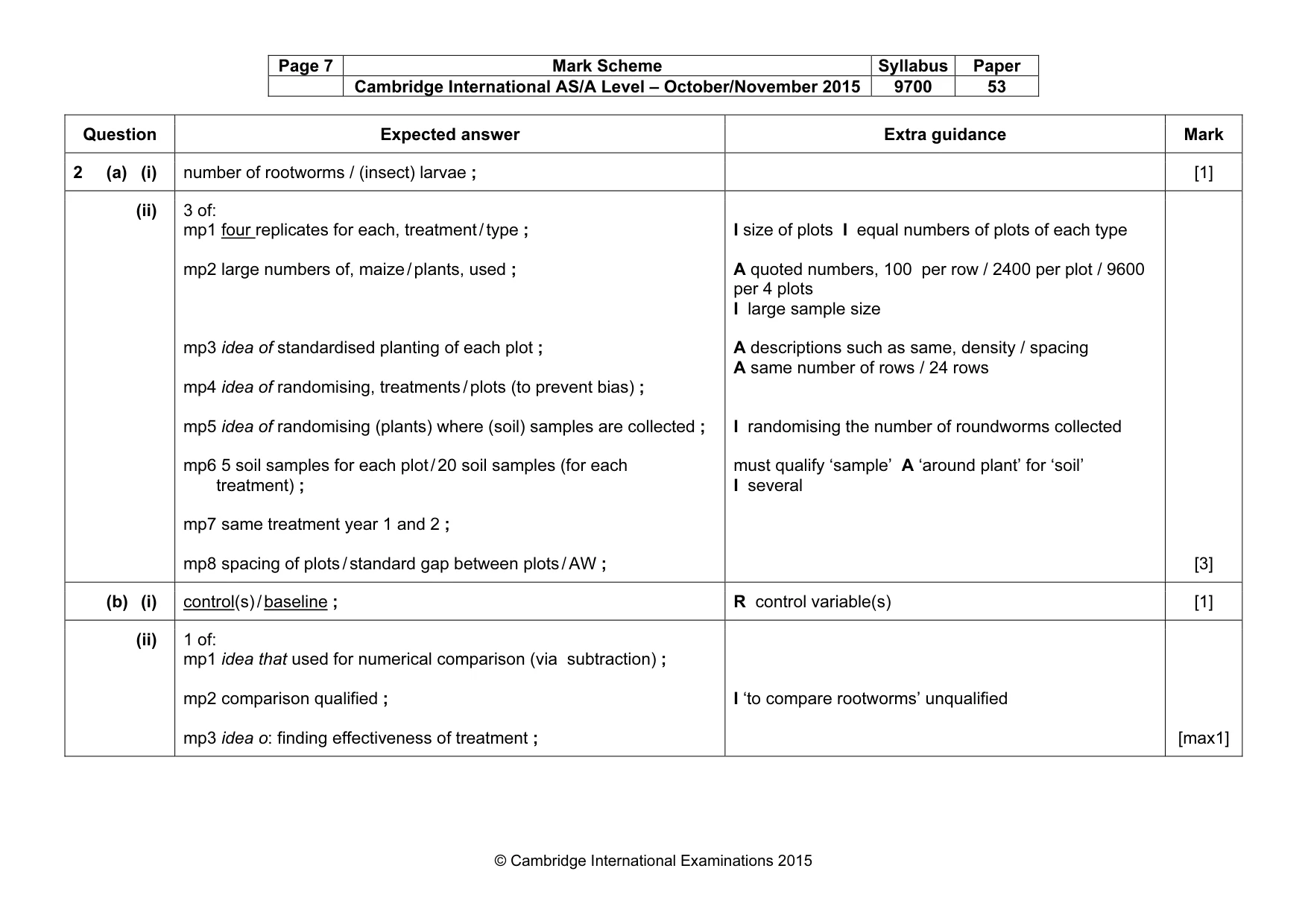
Page 7 Mark Scheme Syllabus Paper Cambridge International AS/A Level – October/November 2015 9700 53 © Cambridge International Examinations 2015 Question Expected answer Extra guidance Mark 2 (a) (i) number of rootworms / (insect) larvae ; [1] (ii) 3 of: mp1 four replicates for each, treatment / type ; mp2 large numbers of, maize / plants, used ; mp3 idea of standardised planting of each plot ; mp4 idea of randomising, treatments / plots (to prevent bias) ; mp5 idea of randomising (plants) where (soil) samples are collected ; mp6 5 soil samples for each plot / 20 soil samples (for each treatment) ; mp7 same treatment year 1 and 2 ; mp8 spacing of plots / standard gap between plots / AW ; I size of plots I equal numbers of plots of each type A quoted numbers, 100 per row / 2400 per plot / 9600 per 4 plots I large sample size A descriptions such as same, density / spacing A same number of rows / 24 rows I randomising the number of roundworms collected must qualify ‘sample’ A ‘around plant’ for ‘soil’ I several [3] (b) (i) control(s) / baseline ; R control variable(s) [1] (ii) 1 of: mp1 idea that used for numerical comparison (via subtraction) ; mp2 comparison qualified ; mp3 idea o: finding effectiveness of treatment ; I ‘to compare rootworms’ unqualified [max1]
Mark scheme, page 8
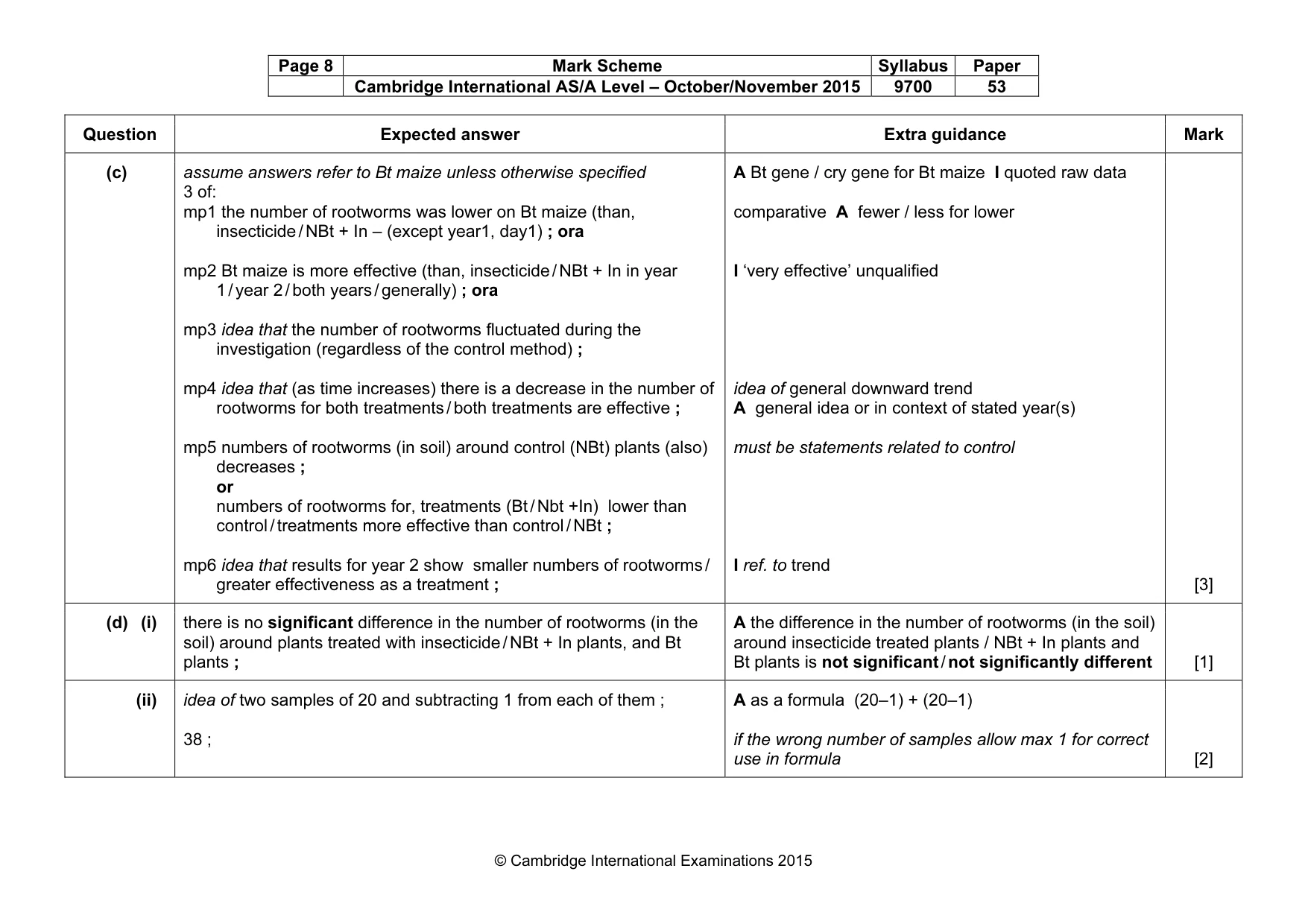
Page 8 Mark Scheme Syllabus Paper Cambridge International AS/A Level – October/November 2015 9700 53 © Cambridge International Examinations 2015 Question Expected answer Extra guidance Mark (c) assume answers refer to Bt maize unless otherwise specified 3 of: mp1 the number of rootworms was lower on Bt maize (than, insecticide / NBt + In – (except year1, day1) ; ora mp2 Bt maize is more effective (than, insecticide / NBt + In in year 1 / year 2 / both years / generally) ; ora mp3 idea that the number of rootworms fluctuated during the investigation (regardless of the control method) ; mp4 idea that (as time increases) there is a decrease in the number of rootworms for both treatments / both treatments are effective ; mp5 numbers of rootworms (in soil) around control (NBt) plants (also) decreases ; or numbers of rootworms for, treatments (Bt / Nbt +In) lower than control / treatments more effective than control / NBt ; mp6 idea that results for year 2 show smaller numbers of rootworms / greater effectiveness as a treatment ; A Bt gene / cry gene for Bt maize I quoted raw data comparative A fewer / less for lower I ‘very effective’ unqualified idea of general downward trend A general idea or in context of stated year(s) must be statements related to control I ref. to trend [3] (d) (i) there is no significant difference in the number of rootworms (in the soil) around plants treated with insecticide / NBt + In plants, and Bt plants ; A the difference in the number of rootworms (in the soil) around insecticide treated plants / NBt + In plants and Bt plants is not significant / not significantly different [1] (ii) idea of two samples of 20 and subtracting 1 from each of them ; 38 ; A as a formula (20–1) + (20–1) if the wrong number of samples allow max 1 for correct use in formula [2]
Mark scheme, page 9
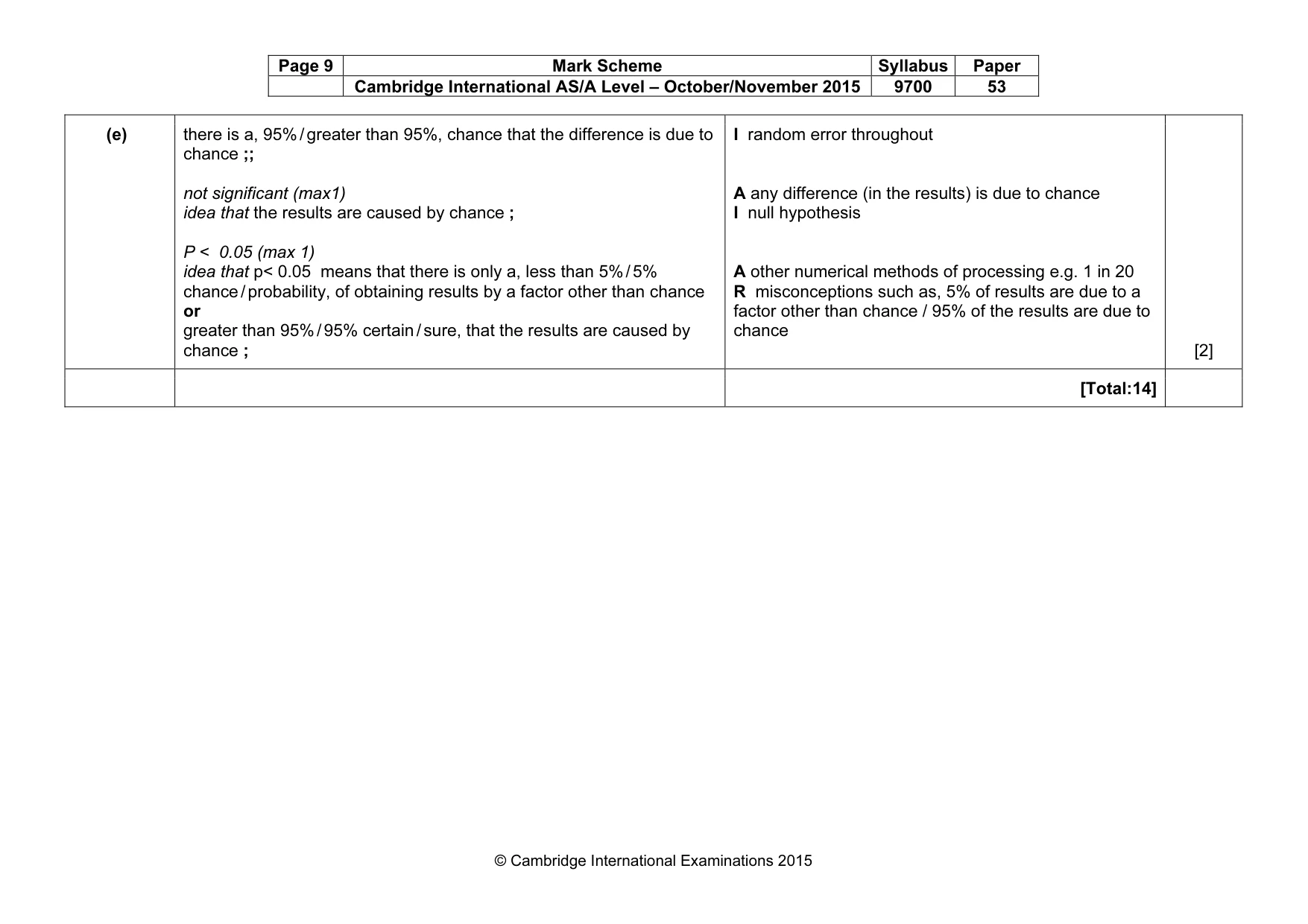
Page 9 Mark Scheme Syllabus Paper Cambridge International AS/A Level – October/November 2015 9700 53 © Cambridge International Examinations 2015 (e) there is a, 95% / greater than 95%, chance that the difference is due to chance ;; not significant (max1) idea that the results are caused by chance ; P < 0.05 (max 1) idea that p< 0.05 means that there is only a, less than 5% / 5% chance / probability, of obtaining results by a factor other than chance or greater than 95% / 95% certain / sure, that the results are caused by chance ; I random error throughout A any difference (in the results) is due to chance I null hypothesis A other numerical methods of processing e.g. 1 in 20 R misconceptions such as, 5% of results are due to a factor other than chance / 95% of the results are due to chance [2] [Total:14]
What you needed in this session
Cambridge’s own grade thresholds for 2015 Oct/Nov, Paper 5 · Variant 3. A higher threshold means an easier paper — the bar moves with how the cohort did.