Cambridge A Level Biology 9700 — 2015 May/June Paper 4 · Variant 2
9700/42/M/J/15 · 100 marks · ≈113 min
The question paper and its mark scheme, free to read here and free to download. This is Cambridge’s own paper, exactly as it was sat.
Question paper24 pages




Mark scheme11 pages
Answers below. Sit the paper first if you are practising.
Paper as text
Question paper, page 1
This document consists of 21 printed pages and 3 lined pages. DC (NF/SW) 95602/3 © UCLES 2015 [Turn over Cambridge International Examinations Cambridge International Advanced Level * 3 5 0 0 1 3 1 7 6 2 * BIOLOGY 9700/42 Paper 4 A2 Structured Questions May/June 2015 2 hours Candidates answer on the Question Paper. Additional Materials: Answer Paper available on request. READ THESE INSTRUCTIONS FIRST Write your Centre number, candidate number and name on all the work you hand in. Write in dark blue or black pen. You may use an HB pencil for any diagrams or graphs. Do not use staples, paper clips, glue or correction fluid. DO NOT WRITE IN ANY BARCODES. Section A Answer all questions. Section B Answer one question. Electronic calculators may be used. You may lose marks if you do not show your working or if you do not use appropriate units. At the end of the examination, fasten all your work securely together. The number of marks is given in brackets [ ] at the end of each question or part question. For Examiner’s Use Section A 1 2 3 4 5 6 7 8 Section B 9 or 10 Total
Question paper, page 2
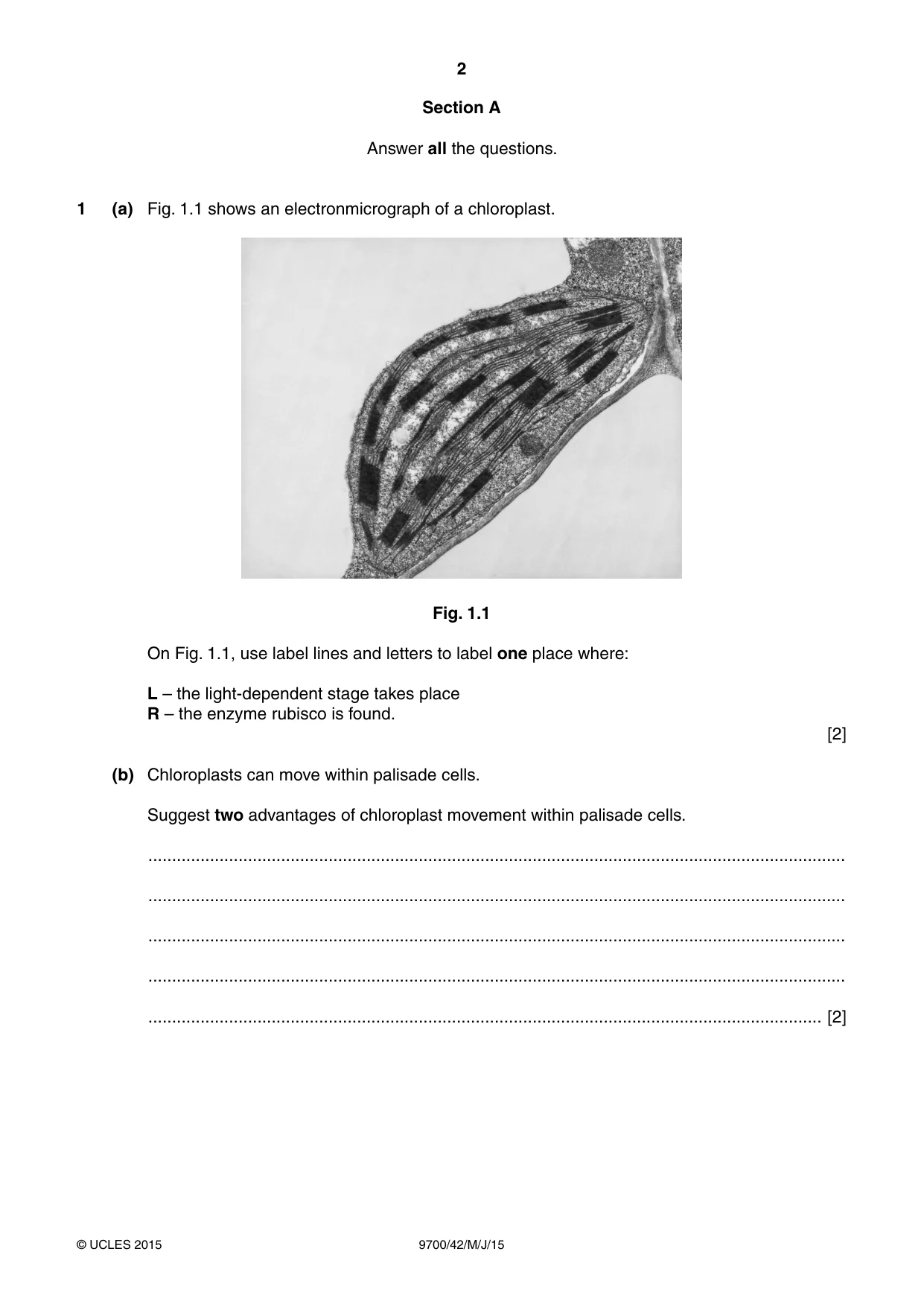
2 9700/42/M/J/15 © UCLES 2015 Section A Answer all the questions. 1 (a) Fig. 1.1 shows an electronmicrograph of a chloroplast. Fig. 1.1 On Fig. 1.1, use label lines and letters to label one place where: L – the light-dependent stage takes place R – the enzyme rubisco is found. [2] (b) Chloroplasts can move within palisade cells. Suggest two advantages of chloroplast movement within palisade cells. … … … … … [2]
Question paper, page 3
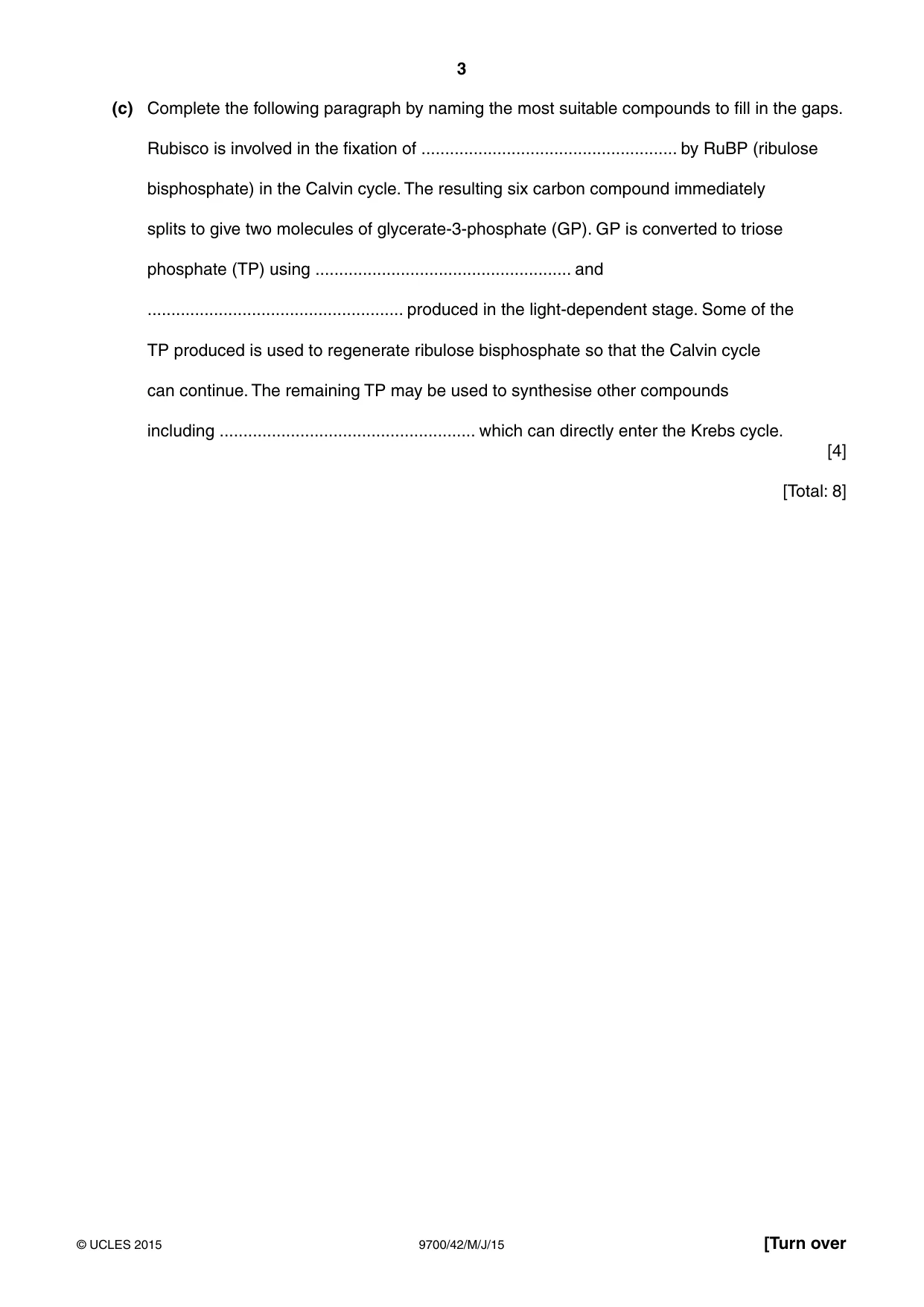
3 9700/42/M/J/15 © UCLES 2015 [Turn over (c) Complete the following paragraph by naming the most suitable compounds to fill in the gaps. Rubisco is involved in the fixation of … by RuBP (ribulose bisphosphate) in the Calvin cycle. The resulting six carbon compound immediately splits to give two molecules of glycerate-3-phosphate (GP). GP is converted to triose phosphate (TP) using … and … produced in the light-dependent stage. Some of the TP produced is used to regenerate ribulose bisphosphate so that the Calvin cycle can continue. The remaining TP may be used to synthesise other compounds including … which can directly enter the Krebs cycle. [4] [Total: 8]
Question paper, page 4
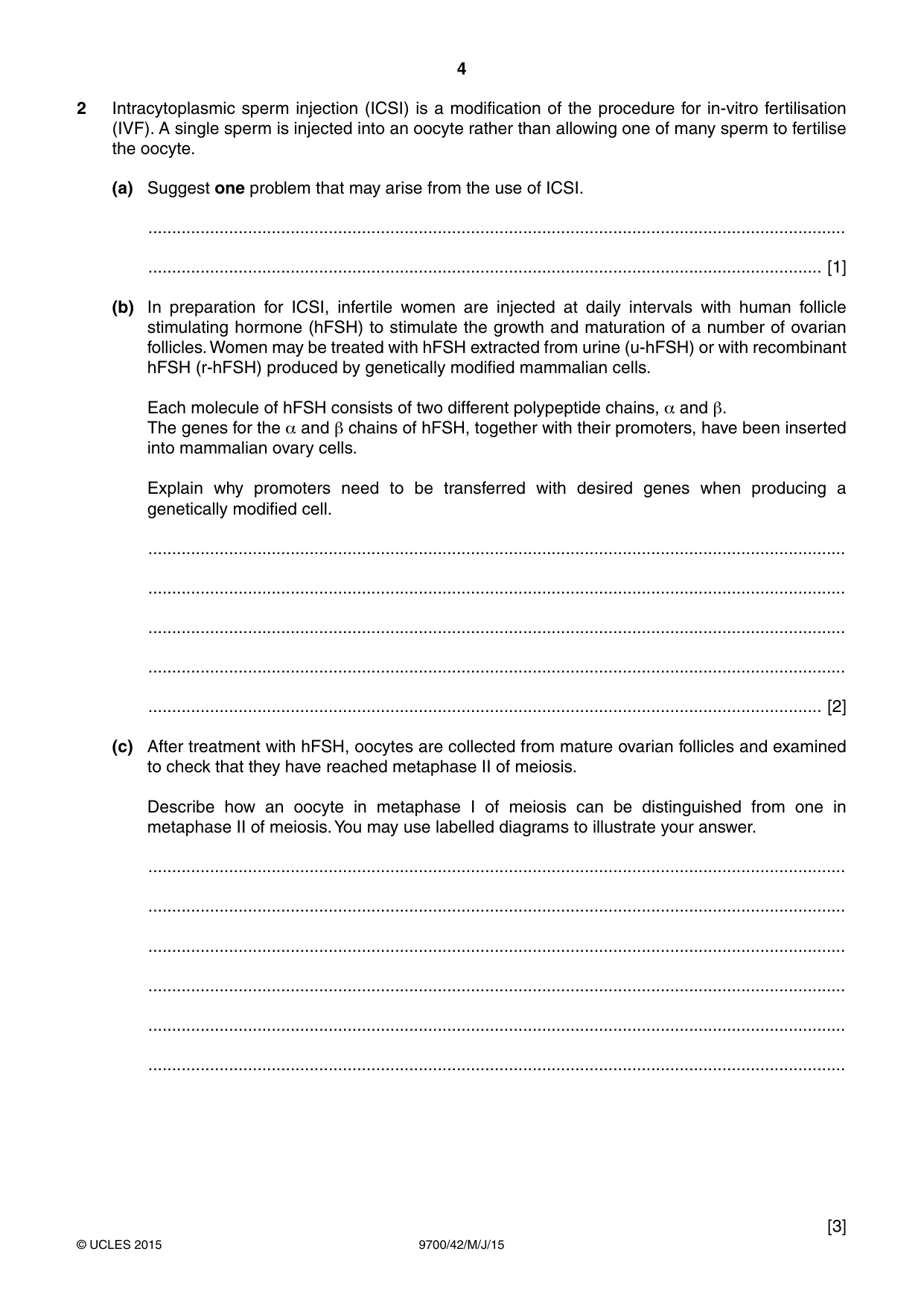
4 9700/42/M/J/15 © UCLES 2015 2 Intracytoplasmic sperm injection (ICSI) is a modification of the procedure for in-vitro fertilisation (IVF). A single sperm is injected into an oocyte rather than allowing one of many sperm to fertilise the oocyte. (a) Suggest one problem that may arise from the use of ICSI. … … [1] (b) In preparation for ICSI, infertile women are injected at daily intervals with human follicle stimulating hormone (hFSH) to stimulate the growth and maturation of a number of ovarian follicles. Women may be treated with hFSH extracted from urine (u-hFSH) or with recombinant hFSH (r-hFSH) produced by genetically modified mammalian cells. Each molecule of hFSH consists of two different polypeptide chains, α and β. The genes for the α and β chains of hFSH, together with their promoters, have been inserted into mammalian ovary cells. Explain why promoters need to be transferred with desired genes when producing a genetically modified cell. … … … … … [2] (c) After treatment with hFSH, oocytes are collected from mature ovarian follicles and examined to check that they have reached metaphase II of meiosis. Describe how an oocyte in metaphase I of meiosis can be distinguished from one in metaphase II of meiosis. You may use labelled diagrams to illustrate your answer. … … … … … … [3]
Question paper, page 5
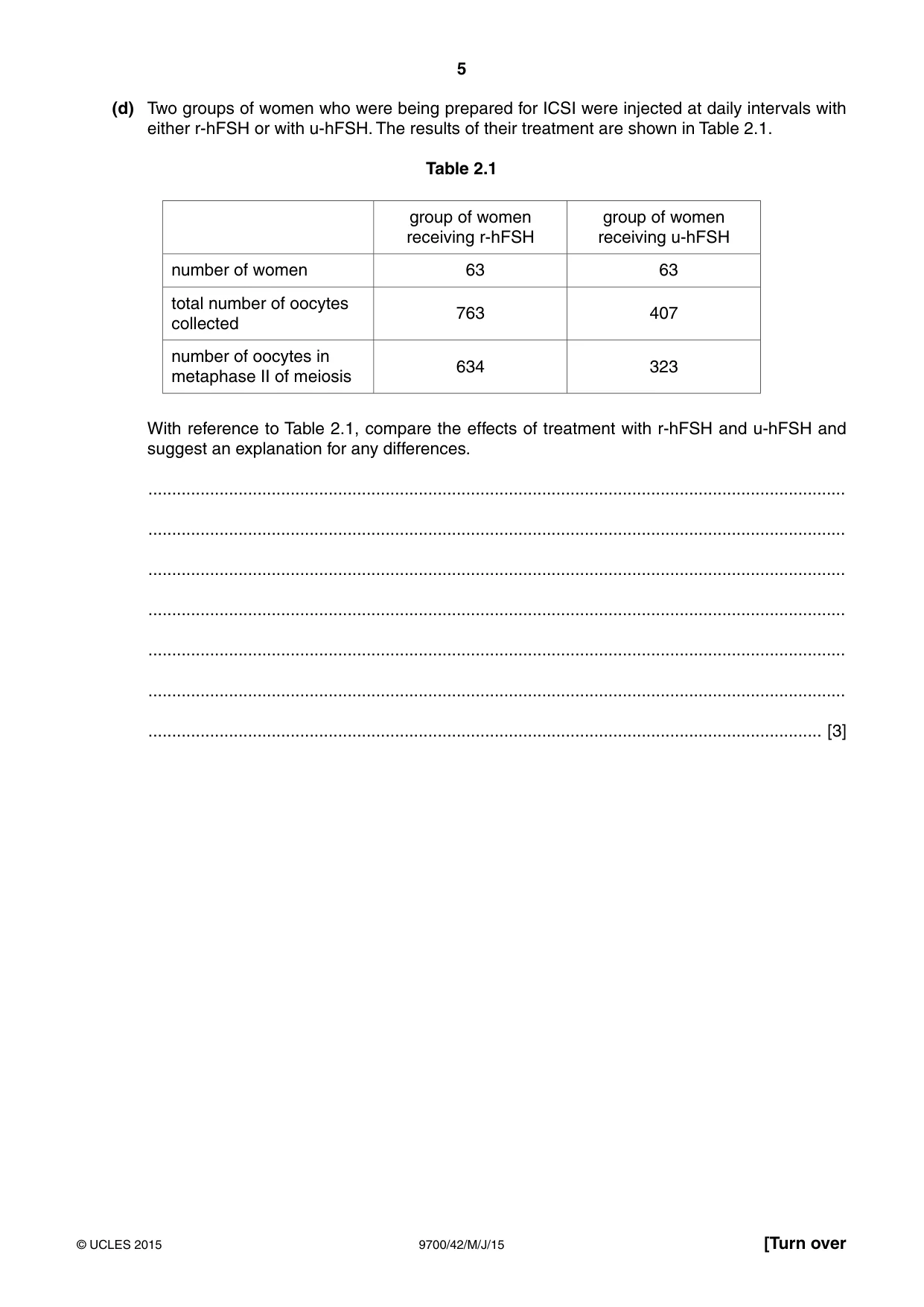
5 9700/42/M/J/15 © UCLES 2015 [Turn over (d) Two groups of women who were being prepared for ICSI were injected at daily intervals with either r-hFSH or with u-hFSH. The results of their treatment are shown in Table 2.1. Table 2.1 group of women receiving r-hFSH group of women receiving u-hFSH number of women 63 63 total number of oocytes collected 763 407 number of oocytes in metaphase II of meiosis 634 323 With reference to Table 2.1, compare the effects of treatment with r-hFSH and u-hFSH and suggest an explanation for any differences. … … … … … … … [3]
Question paper, page 6
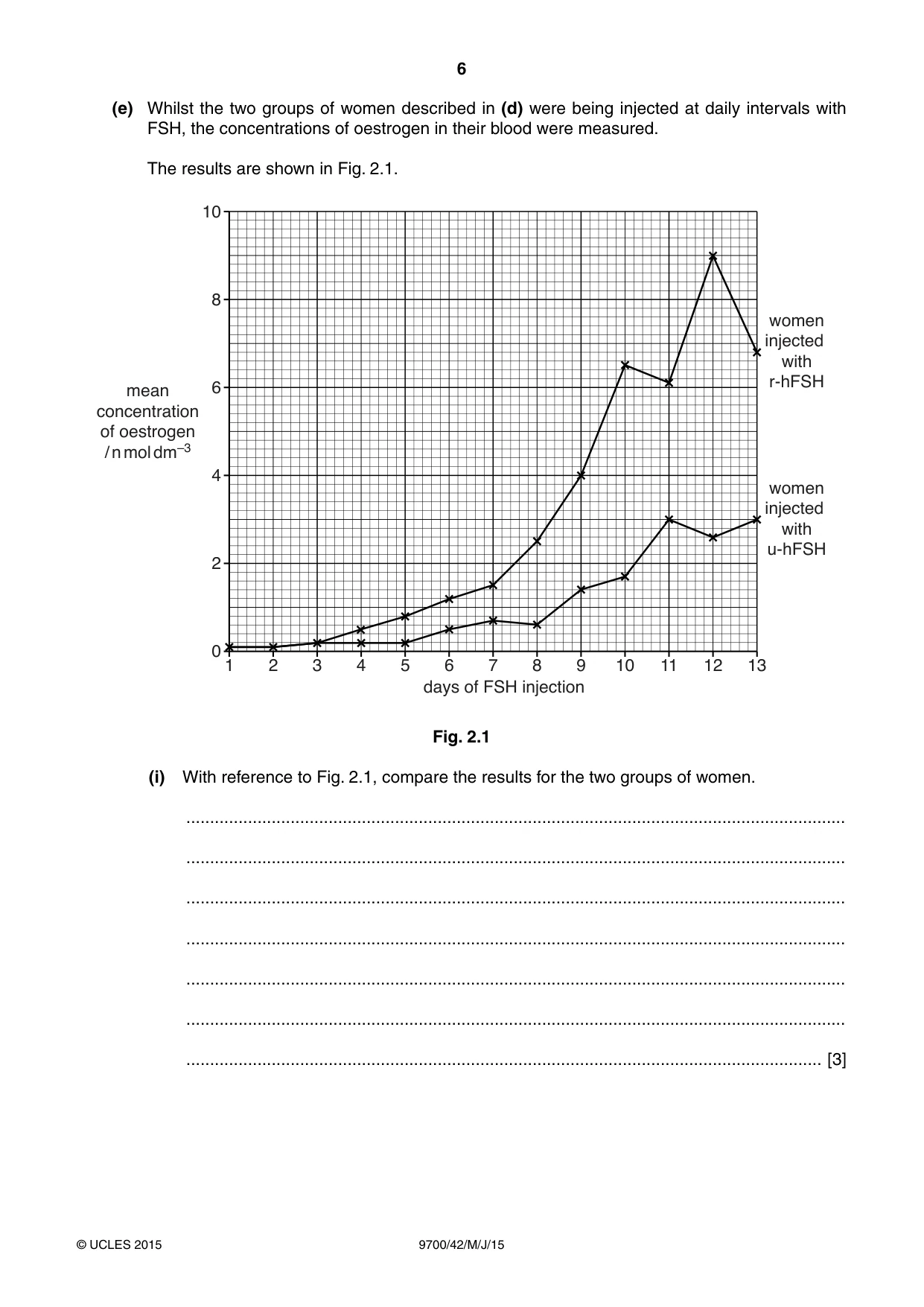
6 9700/42/M/J/15 © UCLES 2015 (e) Whilst the two groups of women described in (d) were being injected at daily intervals with FSH, the concentrations of oestrogen in their blood were measured. The results are shown in Fig. 2.1. 1 0 2 4 6 8 10 3 5 7 days of FSH injection mean concentration of oestrogen / n mol dm–3 9 11 12 13 2 4 6 8 10 women injected with r-hFSH women injected with u-hFSH Fig. 2.1 (i) With reference to Fig. 2.1, compare the results for the two groups of women. … … … … … … … [3]
Question paper, page 7
7 9700/42/M/J/15 © UCLES 2015 [Turn over (ii) Describe the role of oestrogen in the preparation of these women to receive an embryo. … … … … … [2] [Total: 14]
Question paper, page 8
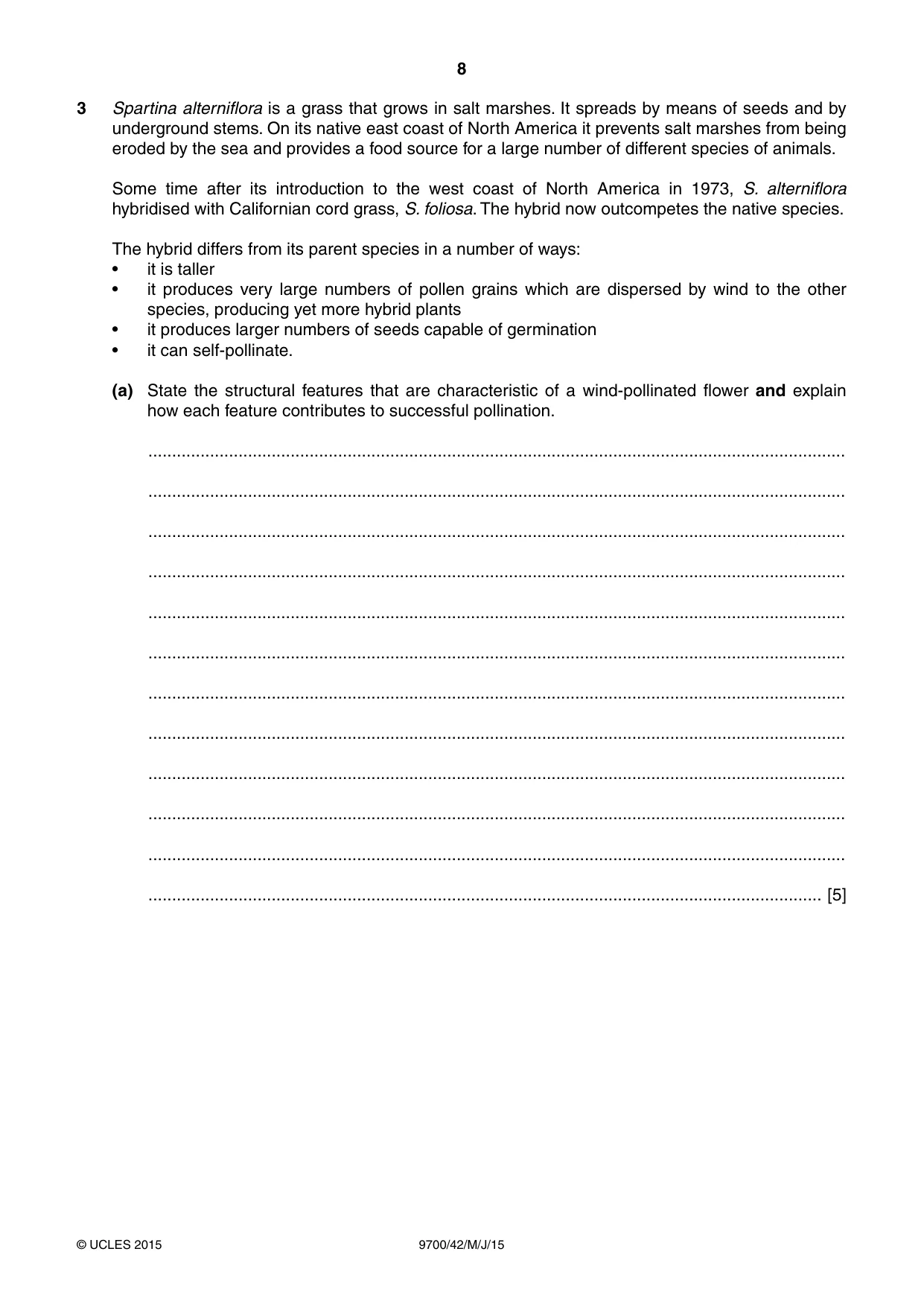
8 9700/42/M/J/15 © UCLES 2015 3 Spartina alterniflora is a grass that grows in salt marshes. It spreads by means of seeds and by underground stems. On its native east coast of North America it prevents salt marshes from being eroded by the sea and provides a food source for a large number of different species of animals. Some time after its introduction to the west coast of North America in 1973, S. alterniflora hybridised with Californian cord grass, S. foliosa. The hybrid now outcompetes the native species. The hybrid differs from its parent species in a number of ways: • it is taller • it produces very large numbers of pollen grains which are dispersed by wind to the other species, producing yet more hybrid plants • it produces larger numbers of seeds capable of germination • it can self-pollinate. (a) State the structural features that are characteristic of a wind-pollinated flower and explain how each feature contributes to successful pollination. … … … … … … … … … … … … [5]
Question paper, page 9
9 9700/42/M/J/15 © UCLES 2015 [Turn over (b) Suggest how self-pollination could help the population of hybrid plants to increase. … … … … … … … … [3] (c) Suggest why the hybrid plant is not considered to be a new species of Spartina. … … [1] [Total: 9]
Question paper, page 10
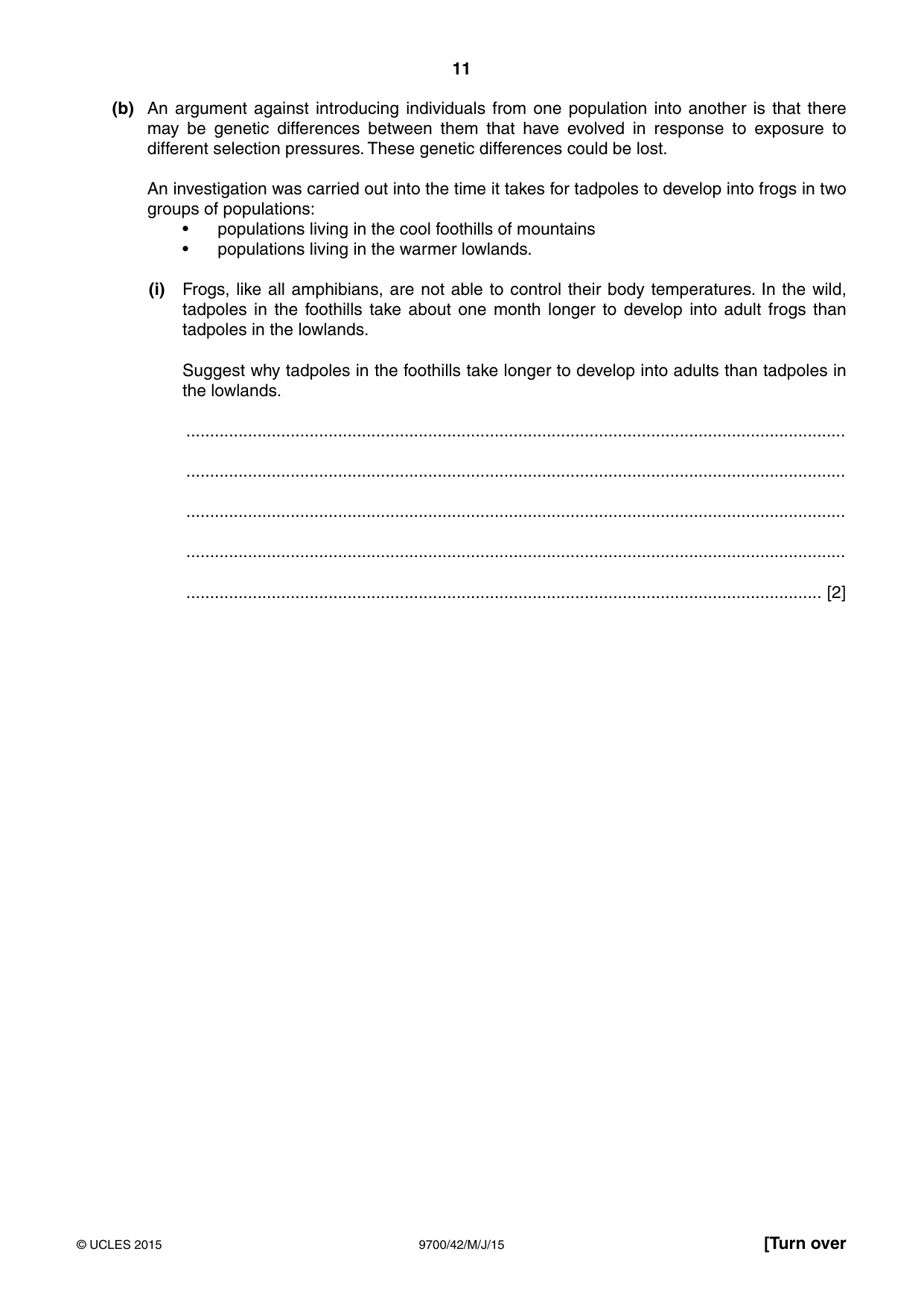
10 9700/42/M/J/15 © UCLES 2015 4 The Italian agile frog, Rana latastei, lives in woodlands in northern Italy. The adults breed by laying eggs in water in spring. The eggs hatch into tadpoles, which grow and develop for several weeks, before metamorphosing (changing) into adults and leaving the water. This must take place before cool weather arrives in autumn. Fig. 4.1 shows an adult agile frog. Fig. 4.1 This frog is now an endangered species. Many woodlands have been destroyed, leaving only isolated patches in which small populations of the frogs live. In order to try to prevent some of these small populations dying out completely, it has been suggested that tadpoles from larger populations could be introduced into the small populations, in order to increase genetic diversity. (a) Suggest why increasing genetic diversity could help to conserve populations of Italian agile frogs. … … … … … … … [3]
Question paper, page 11
11 9700/42/M/J/15 © UCLES 2015 [Turn over (b) An argument against introducing individuals from one population into another is that there may be genetic differences between them that have evolved in response to exposure to different selection pressures. These genetic differences could be lost. An investigation was carried out into the time it takes for tadpoles to develop into frogs in two groups of populations: • populations living in the cool foothills of mountains • populations living in the warmer lowlands. (i) Frogs, like all amphibians, are not able to control their body temperatures. In the wild, tadpoles in the foothills take about one month longer to develop into adult frogs than tadpoles in the lowlands. Suggest why tadpoles in the foothills take longer to develop into adults than tadpoles in the lowlands. … … … … … [2]
Question paper, page 12
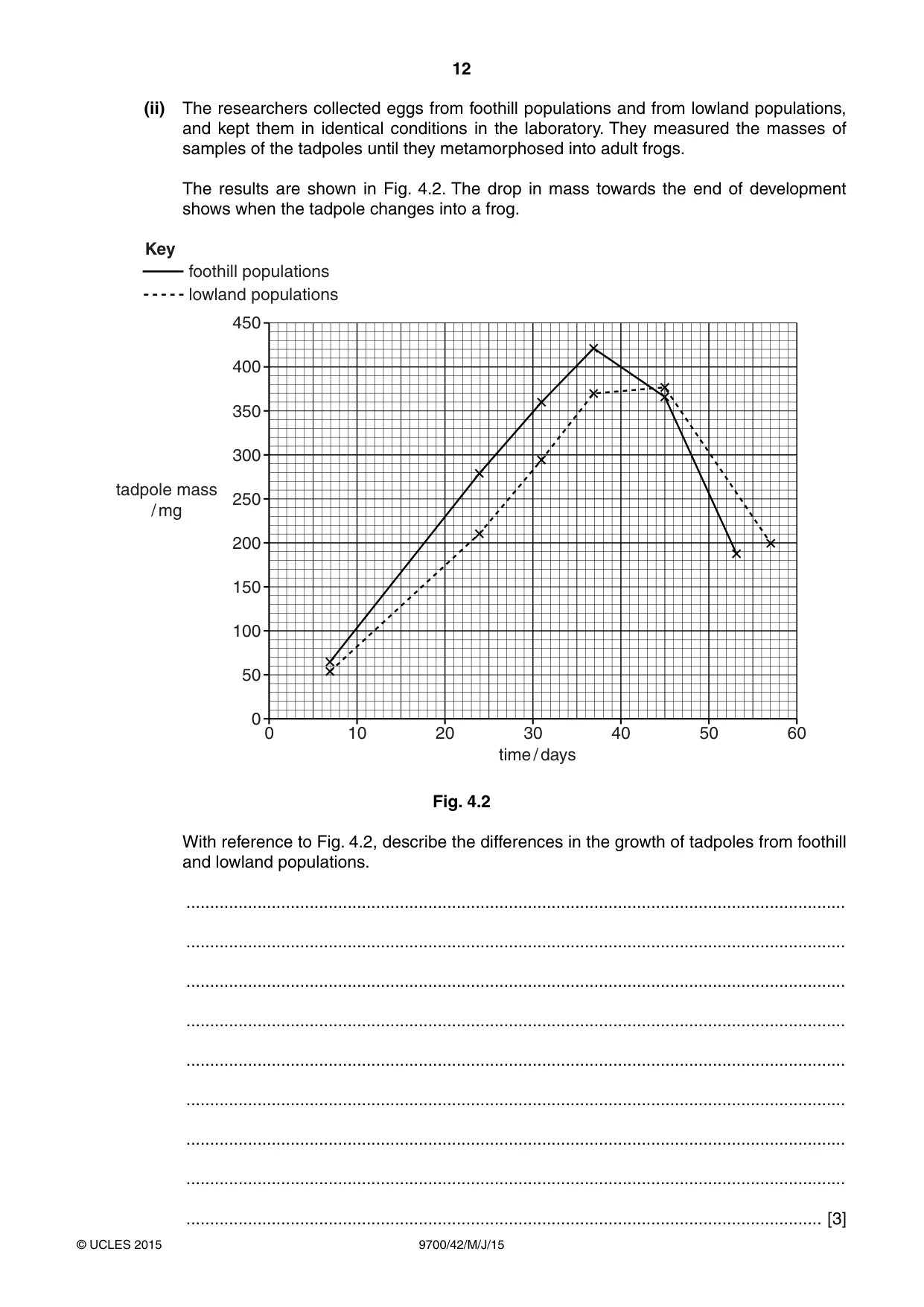
12 9700/42/M/J/15 © UCLES 2015 (ii) The researchers collected eggs from foothill populations and from lowland populations, and kept them in identical conditions in the laboratory. They measured the masses of samples of the tadpoles until they metamorphosed into adult frogs. The results are shown in Fig. 4.2. The drop in mass towards the end of development shows when the tadpole changes into a frog. 0 0 100 200 300 400 50 150 250 350 450 10 20 30 time / days tadpole mass / mg 40 50 60 foothill populations lowland populations Key Fig. 4.2 With reference to Fig. 4.2, describe the differences in the growth of tadpoles from foothill and lowland populations. … … … … … … … … … [3]
Question paper, page 13
13 9700/42/M/J/15 © UCLES 2015 [Turn over (iii) Explain how the results shown in Fig. 4.2 suggest that there are genetic differences between the foothill populations and the lowland populations of agile frogs. … … … … … [2] (iv) Suggest how these genetic differences may be important in increasing the chances of survival of the foothill populations in their natural habitat. … … … … … [2] (c) With reference to the evidence from this investigation, explain why it may not be good conservation policy to introduce tadpoles of agile frogs from lowland populations to foothill populations. … … … … … [2] [Total: 14]
Question paper, page 14
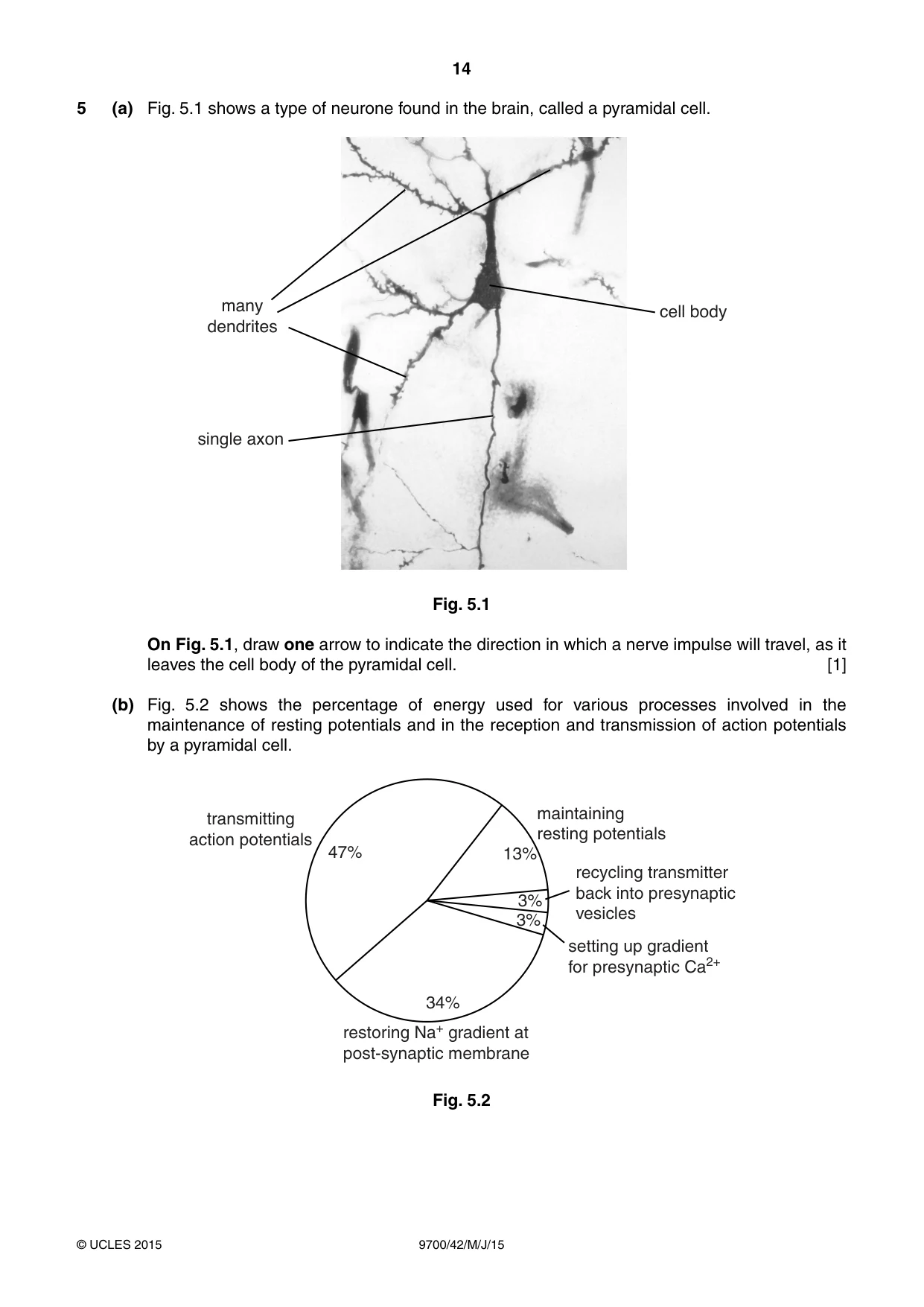
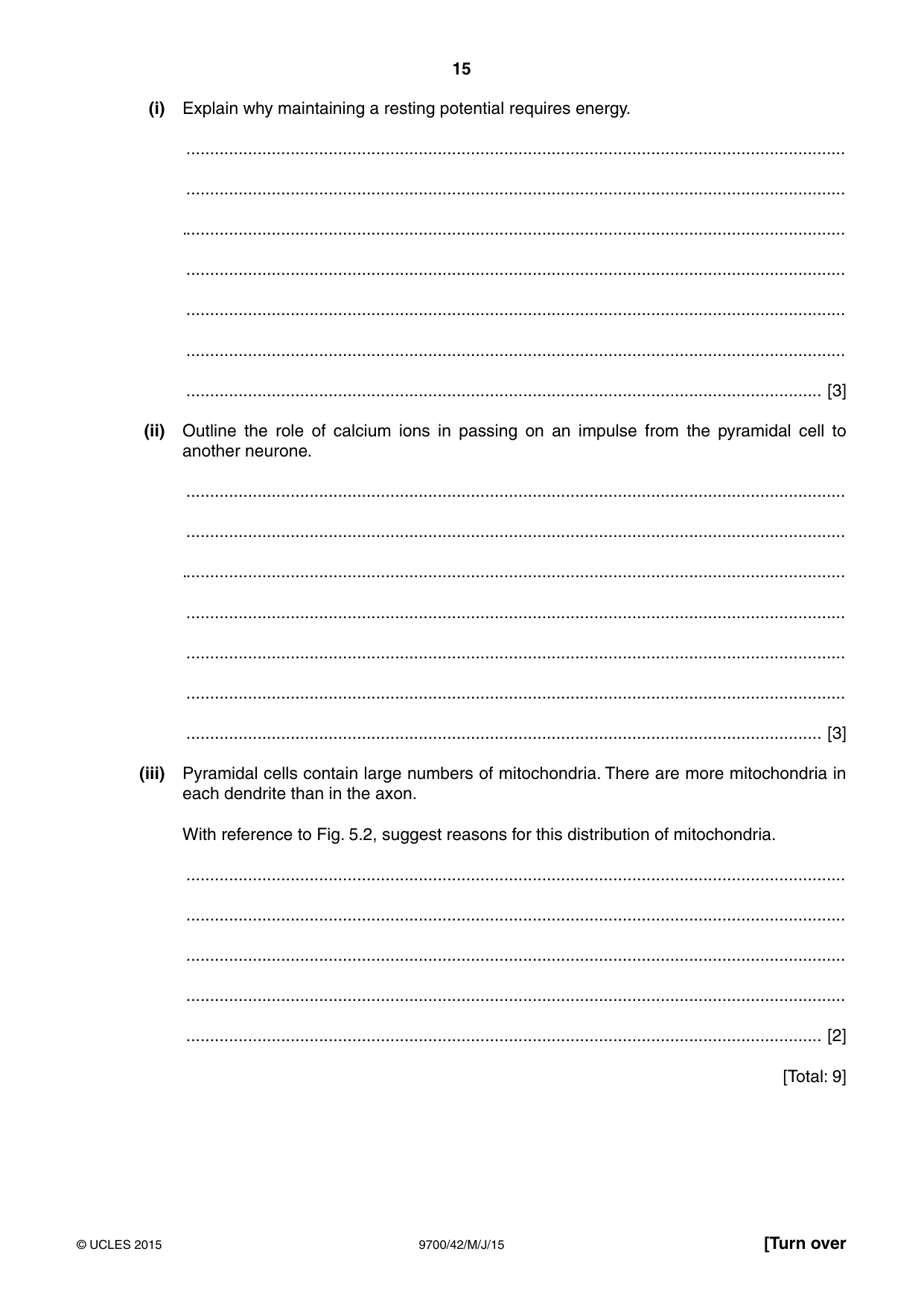
14 9700/42/M/J/15 © UCLES 2015 5 (a) Fig. 5.1 shows a type of neurone found in the brain, called a pyramidal cell. cell body many dendrites single axon Fig. 5.1 On Fig. 5.1, draw one arrow to indicate the direction in which a nerve impulse will travel, as it leaves the cell body of the pyramidal cell. [1] (b) Fig. 5.2 shows the percentage of energy used for various processes involved in the maintenance of resting potentials and in the reception and transmission of action potentials by a pyramidal cell. 34% 47% 3% maintaining resting potentials recycling transmitter back into presynaptic vesicles setting up gradient for presynaptic Ca2+ restoring Na+ gradient at post-synaptic membrane transmitting action potentials 3% 13% Fig. 5.2
Question paper, page 15
15 9700/42/M/J/15 © UCLES 2015 [Turn over (i) Explain why maintaining a resting potential requires energy. … … … … … … … [3] (ii) Outline the role of calcium ions in passing on an impulse from the pyramidal cell to another neurone. … … … … … … … [3] (iii) Pyramidal cells contain large numbers of mitochondria. There are more mitochondria in each dendrite than in the axon. With reference to Fig. 5.2, suggest reasons for this distribution of mitochondria. … … … … … [2] [Total: 9]
Question paper, page 16
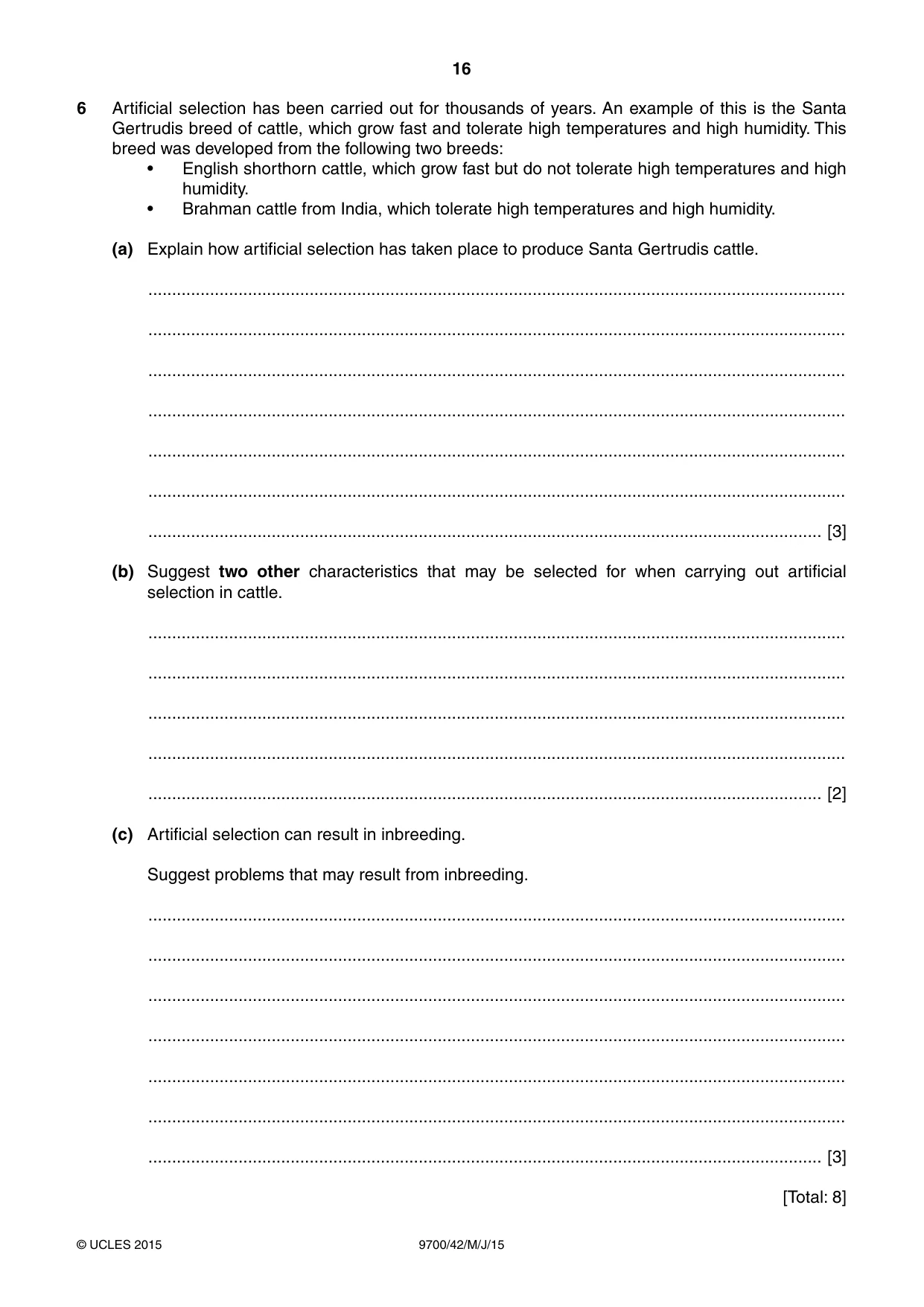
16 9700/42/M/J/15 © UCLES 2015 6 Artificial selection has been carried out for thousands of years. An example of this is the Santa Gertrudis breed of cattle, which grow fast and tolerate high temperatures and high humidity. This breed was developed from the following two breeds: • English shorthorn cattle, which grow fast but do not tolerate high temperatures and high humidity. • Brahman cattle from India, which tolerate high temperatures and high humidity. (a) Explain how artificial selection has taken place to produce Santa Gertrudis cattle. … … … … … … … [3] (b) Suggest two other characteristics that may be selected for when carrying out artificial selection in cattle. … … … … … [2] (c) Artificial selection can result in inbreeding. Suggest problems that may result from inbreeding. … … … … … … … [3] [Total: 8]
Question paper, page 17
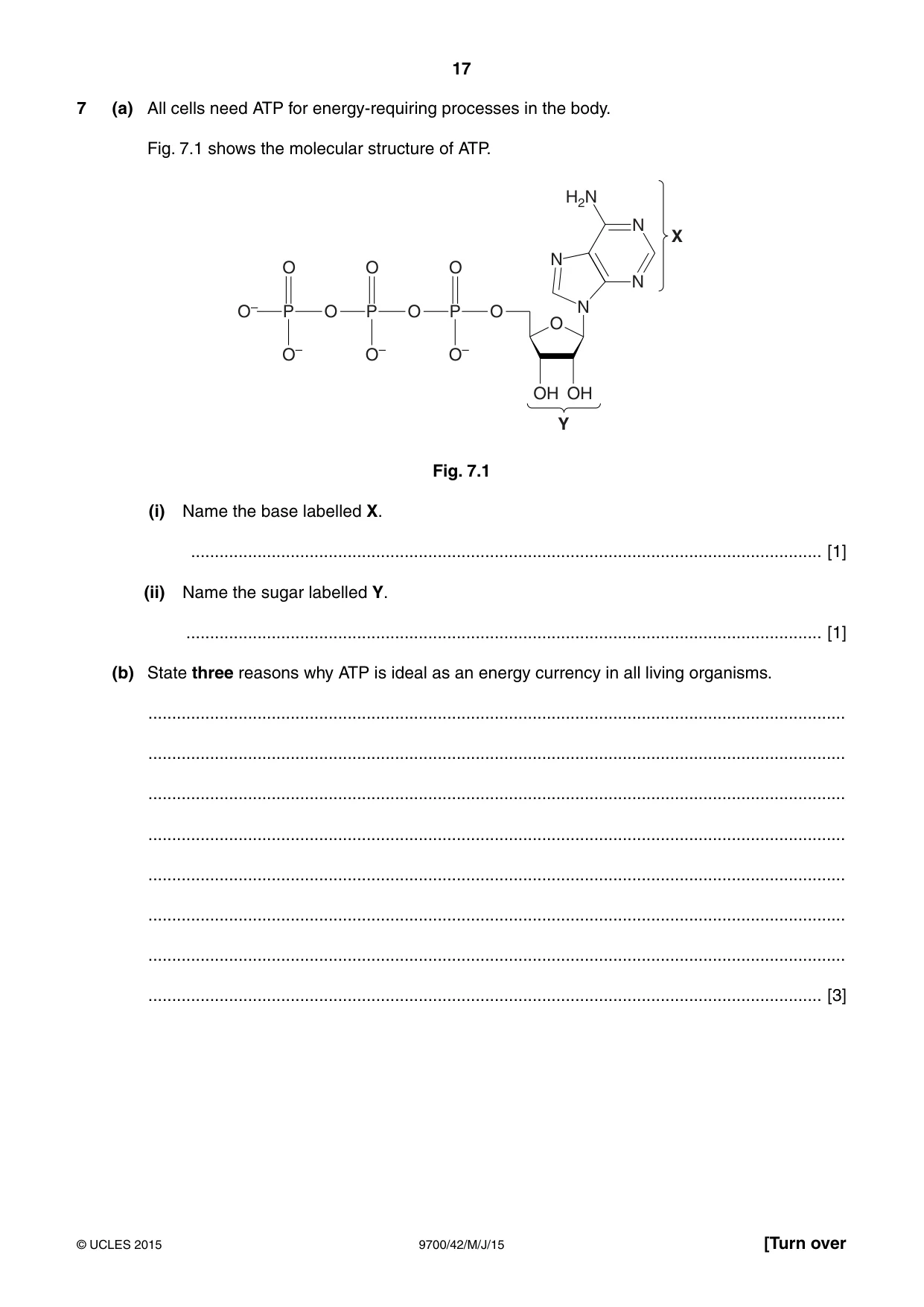
17 9700/42/M/J/15 © UCLES 2015 [Turn over 7 (a) All cells need ATP for energy-requiring processes in the body. Fig. 7.1 shows the molecular structure of ATP. O– O O– P O O O– P O O O O O– P OH OH Y X N N N N H2N Fig. 7.1 (i) Name the base labelled X. … [1] (ii) Name the sugar labelled Y. … [1] (b) State three reasons why ATP is ideal as an energy currency in all living organisms. … … … … … … … … [3]
Question paper, page 18
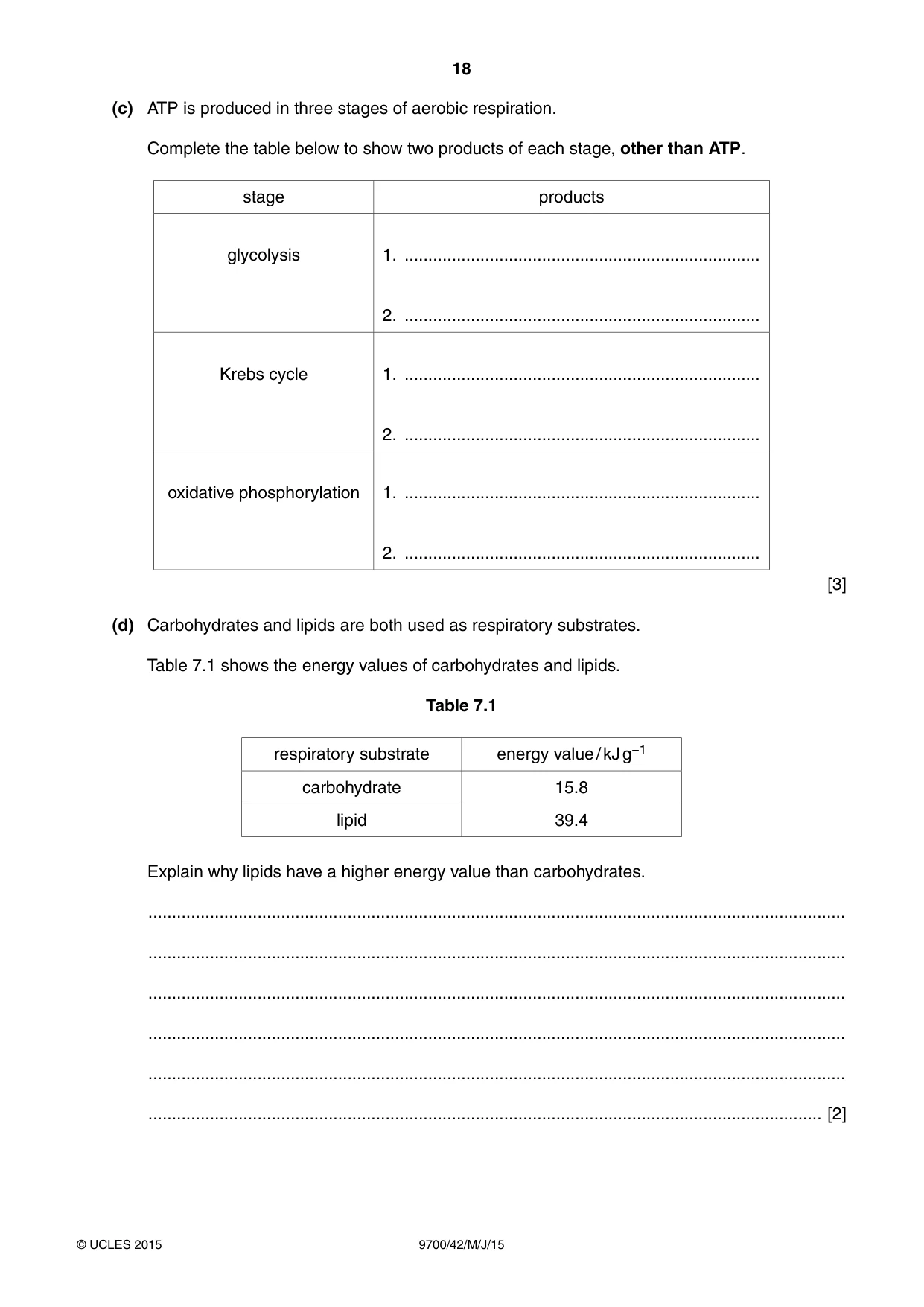
18 9700/42/M/J/15 © UCLES 2015 (c) ATP is produced in three stages of aerobic respiration. Complete the table below to show two products of each stage, other than ATP. stage products glycolysis 1. … 2. … Krebs cycle 1. … 2. … oxidative phosphorylation 1. … 2. … [3] (d) Carbohydrates and lipids are both used as respiratory substrates. Table 7.1 shows the energy values of carbohydrates and lipids. Table 7.1 respiratory substrate energy value / kJ g−1 carbohydrate 15.8 lipid 39.4 Explain why lipids have a higher energy value than carbohydrates. … … … … … … [2]
Question paper, page 19
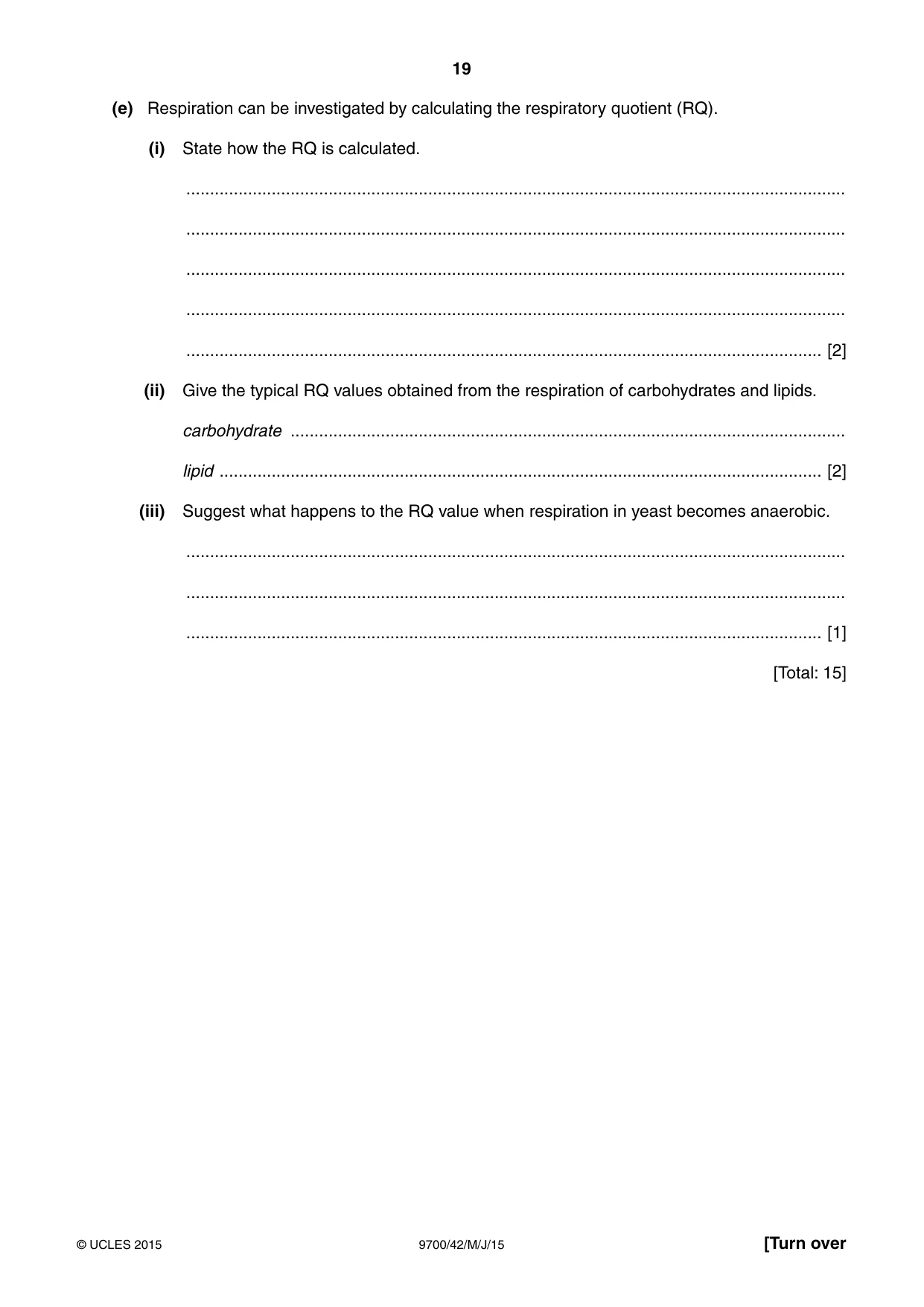
19 9700/42/M/J/15 © UCLES 2015 [Turn over (e) Respiration can be investigated by calculating the respiratory quotient (RQ). (i) State how the RQ is calculated. … … … … … [2] (ii) Give the typical RQ values obtained from the respiration of carbohydrates and lipids. carbohydrate … lipid … [2] (iii) Suggest what happens to the RQ value when respiration in yeast becomes anaerobic. … … … [1] [Total: 15]
Question paper, page 20
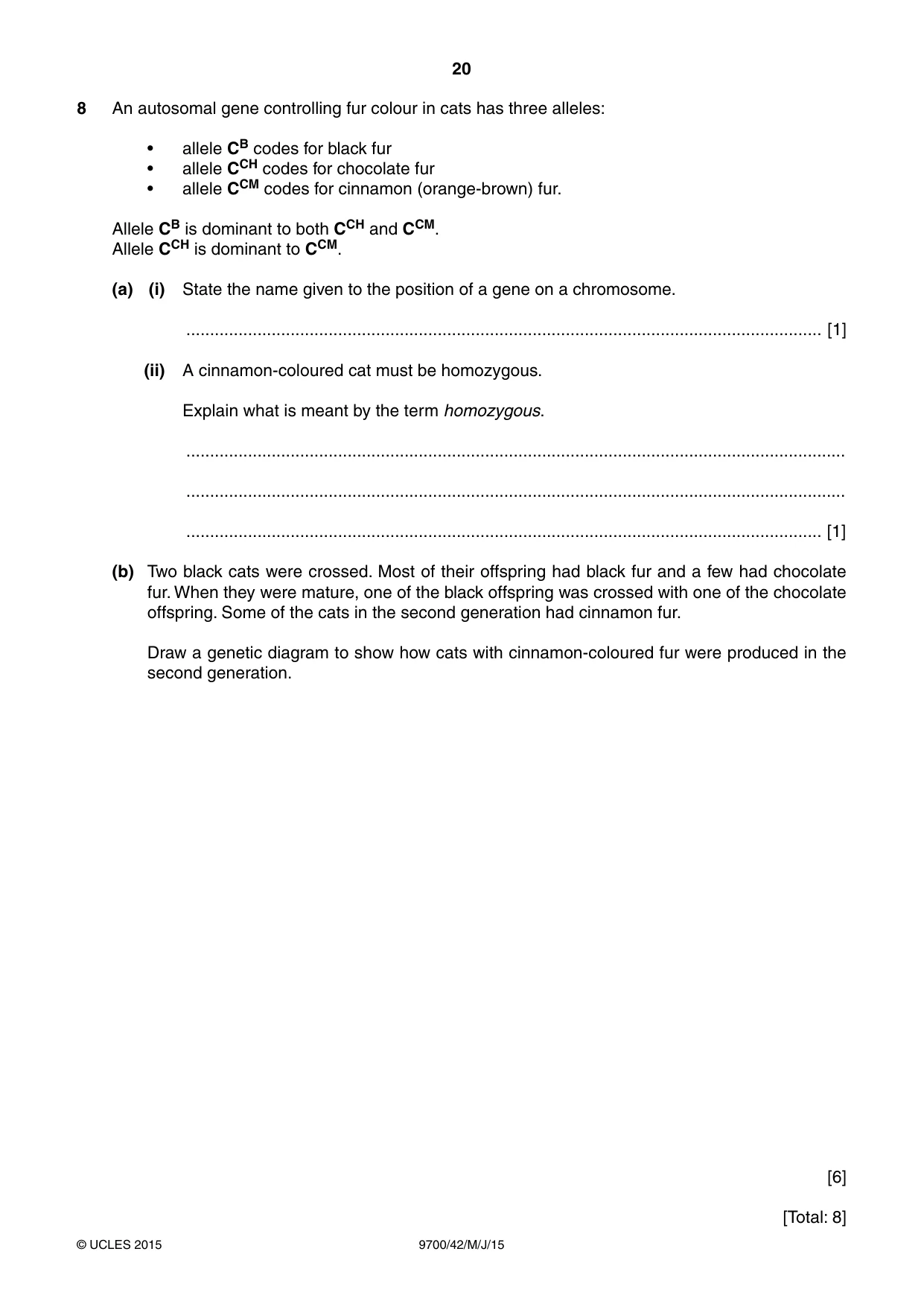
20 9700/42/M/J/15 © UCLES 2015 8 An autosomal gene controlling fur colour in cats has three alleles: • allele CB codes for black fur • allele CCH codes for chocolate fur • allele CCM codes for cinnamon (orange-brown) fur. Allele CB is dominant to both CCH and CCM. Allele CCH is dominant to CCM. (a) (i) State the name given to the position of a gene on a chromosome. … [1] (ii) A cinnamon-coloured cat must be homozygous. Explain what is meant by the term homozygous. … … … [1] (b) Two black cats were crossed. Most of their offspring had black fur and a few had chocolate fur. When they were mature, one of the black offspring was crossed with one of the chocolate offspring. Some of the cats in the second generation had cinnamon fur. Draw a genetic diagram to show how cats with cinnamon-coloured fur were produced in the second generation. [6] [Total: 8]
Question paper, page 21
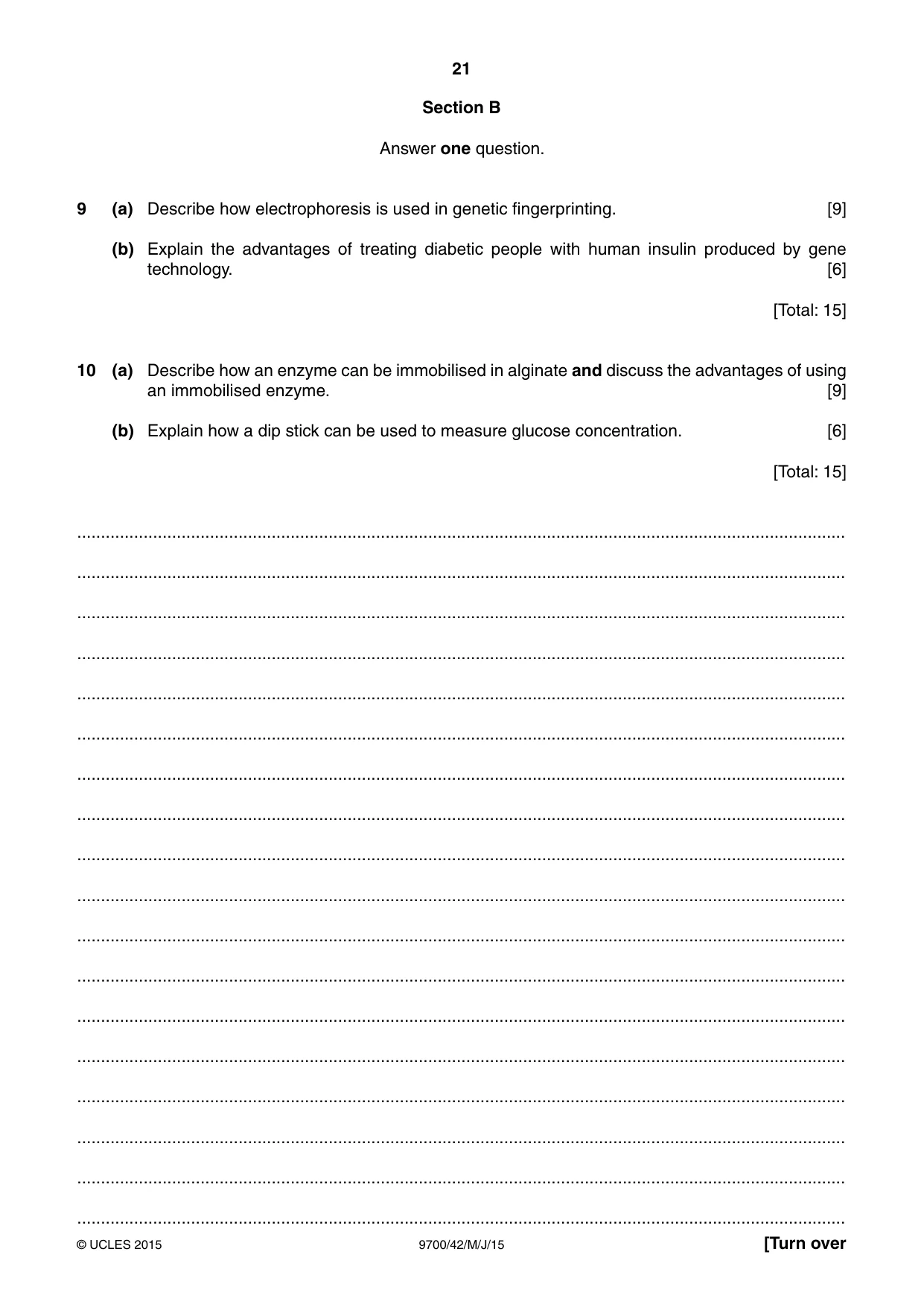
21 9700/42/M/J/15 © UCLES 2015 [Turn over Section B Answer one question. 9 (a) Describe how electrophoresis is used in genetic fingerprinting. [9] (b) Explain the advantages of treating diabetic people with human insulin produced by gene technology. [6] [Total: 15] 10 (a) Describe how an enzyme can be immobilised in alginate and discuss the advantages of using an immobilised enzyme. [9] (b) Explain how a dip stick can be used to measure glucose concentration. [6] [Total: 15] … … … … … … … … … … … … … … … … … …
Question paper, page 22
22 9700/42/M/J/15 © UCLES 2015 … … … … … … … … … … … … … … … … … … … … … … … … … … … …
Question paper, page 23
23 9700/42/M/J/15 © UCLES 2015 [Turn over … … … … … … … … … … … … … … … … … … … … … … … … … … … …
Question paper, page 24
24 9700/42/M/J/15 © UCLES 2015 Permission to reproduce items where third-party owned material protected by copyright is included has been sought and cleared where possible. Every reasonable effort has been made by the publisher (UCLES) to trace copyright holders, but if any items requiring clearance have unwittingly been included, the publisher will be pleased to make amends at the earliest possible opportunity. To avoid the issue of disclosure of answer-related information to candidates, all copyright acknowledgements are reproduced online in the Cambridge International Examinations Copyright Acknowledgements Booklet. This is produced for each series of examinations and is freely available to download at www.cie.org.uk after the live examination series. Cambridge International Examinations is part of the Cambridge Assessment Group. Cambridge Assessment is the brand name of University of Cambridge Local Examinations Syndicate (UCLES), which is itself a department of the University of Cambridge. … … … … … … … … … … … … … … … … … … … … … … … …
Mark scheme, page 1
® IGCSE is the registered trademark of Cambridge International Examinations. CAMBRIDGE INTERNATIONAL EXAMINATIONS Cambridge International Advanced Subsidiary and Advanced Level MARK SCHEME for the May/June 2015 series 9700 BIOLOGY 9700/42 Paper 4 (A2 Structured Questions), maximum raw mark 100 This mark scheme is published as an aid to teachers and candidates, to indicate the requirements of the examination. It shows the basis on which Examiners were instructed to award marks. It does not indicate the details of the discussions that took place at an Examiners’ meeting before marking began, which would have considered the acceptability of alternative answers. Mark schemes should be read in conjunction with the question paper and the Principal Examiner Report for Teachers. Cambridge will not enter into discussions about these mark schemes. Cambridge is publishing the mark schemes for the May/June 2015 series for most Cambridge IGCSE®, Cambridge International A and AS Level components and some Cambridge O Level components.
Mark scheme, page 2
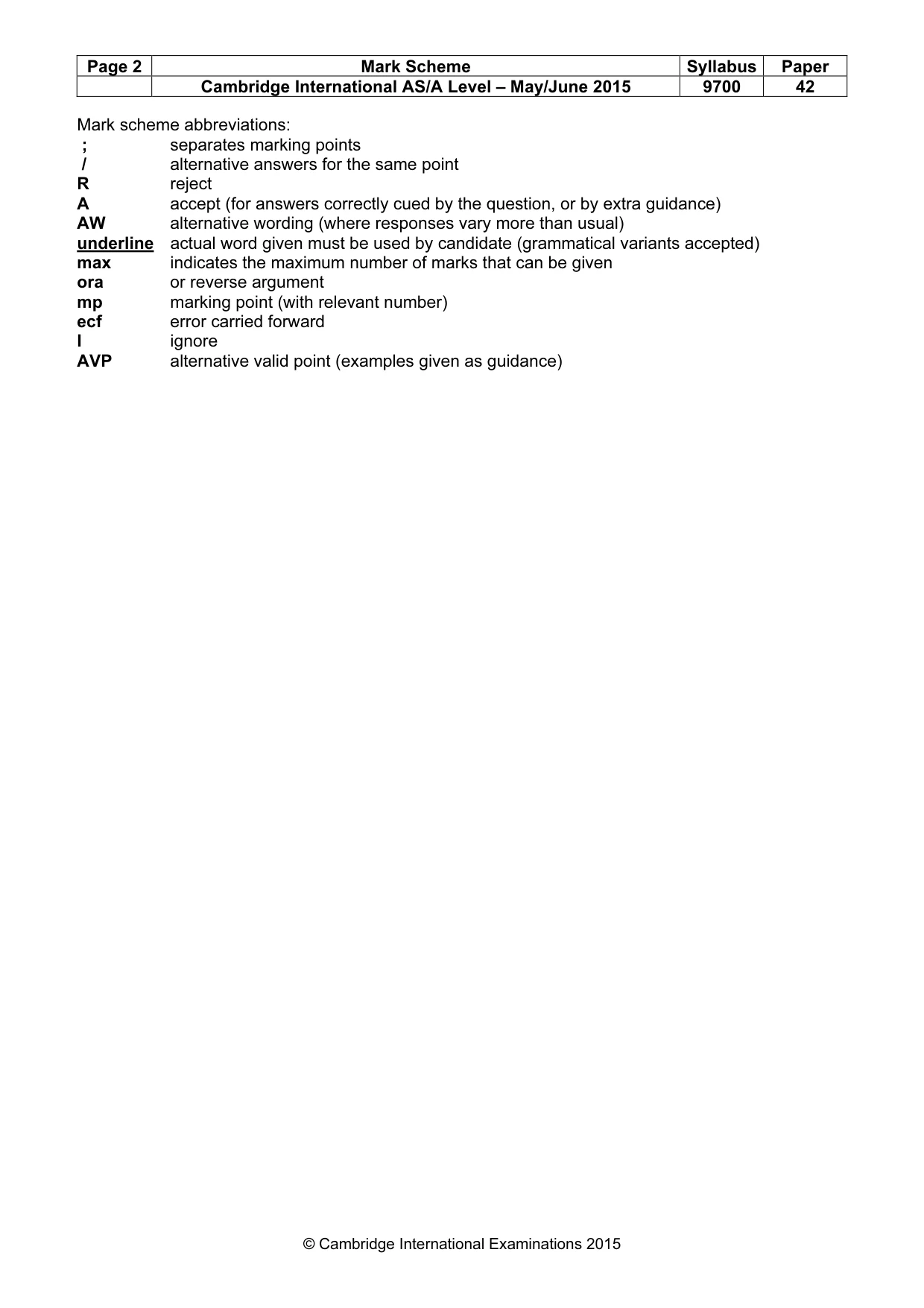
Page 2 Mark Scheme Syllabus Paper Cambridge International AS/A Level – May/June 2015 9700 42 © Cambridge International Examinations 2015 Mark scheme abbreviations: ; separates marking points / alternative answers for the same point R reject A accept (for answers correctly cued by the question, or by extra guidance) AW alternative wording (where responses vary more than usual) underline actual word given must be used by candidate (grammatical variants accepted) max indicates the maximum number of marks that can be given ora or reverse argument mp marking point (with relevant number) ecf error carried forward I ignore AVP alternative valid point (examples given as guidance)
Mark scheme, page 3
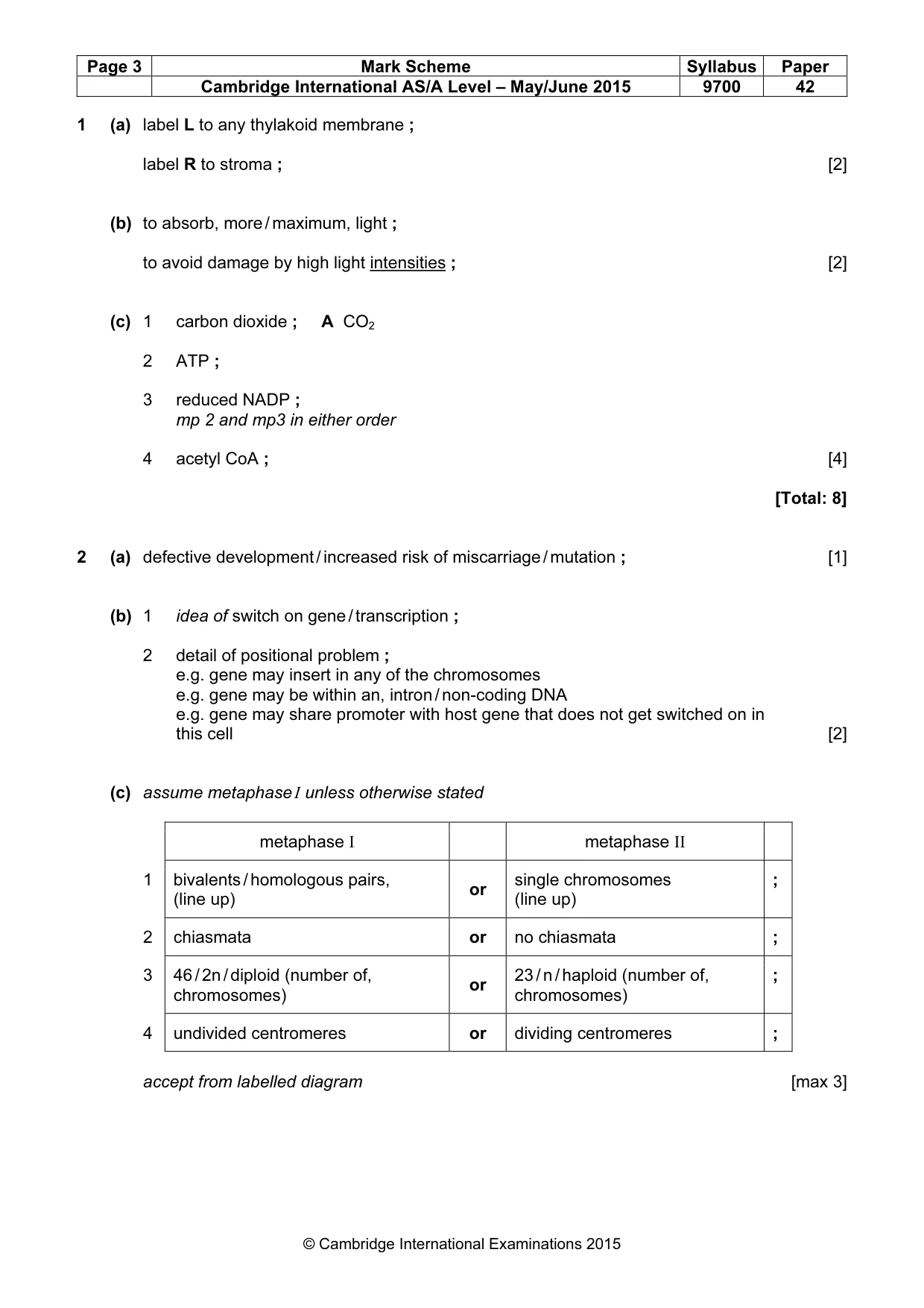
Page 3 Mark Scheme Syllabus Paper Cambridge International AS/A Level – May/June 2015 9700 42 © Cambridge International Examinations 2015 1 (a) label L to any thylakoid membrane ; label R to stroma ; [2] (b) to absorb, more / maximum, light ; to avoid damage by high light intensities ; [2] (c) 1 carbon dioxide ; A CO2 2 ATP ; 3 reduced NADP ; mp 2 and mp3 in either order 4 acetyl CoA ; [4] [Total: 8] 2 (a) defective development / increased risk of miscarriage / mutation ; [1] (b) 1 idea of switch on gene / transcription ; 2 detail of positional problem ; e.g. gene may insert in any of the chromosomes e.g. gene may be within an, intron / non-coding DNA e.g. gene may share promoter with host gene that does not get switched on in this cell [2] (c) assume metaphase I unless otherwise stated metaphase I metaphase II 1 bivalents / homologous pairs, (line up) or single chromosomes (line up) ; 2 chiasmata or no chiasmata ; 3 46 / 2n / diploid (number of, chromosomes) or 23 / n / haploid (number of, chromosomes) ; 4 undivided centromeres or dividing centromeres ; accept from labelled diagram [max 3]
Mark scheme, page 4
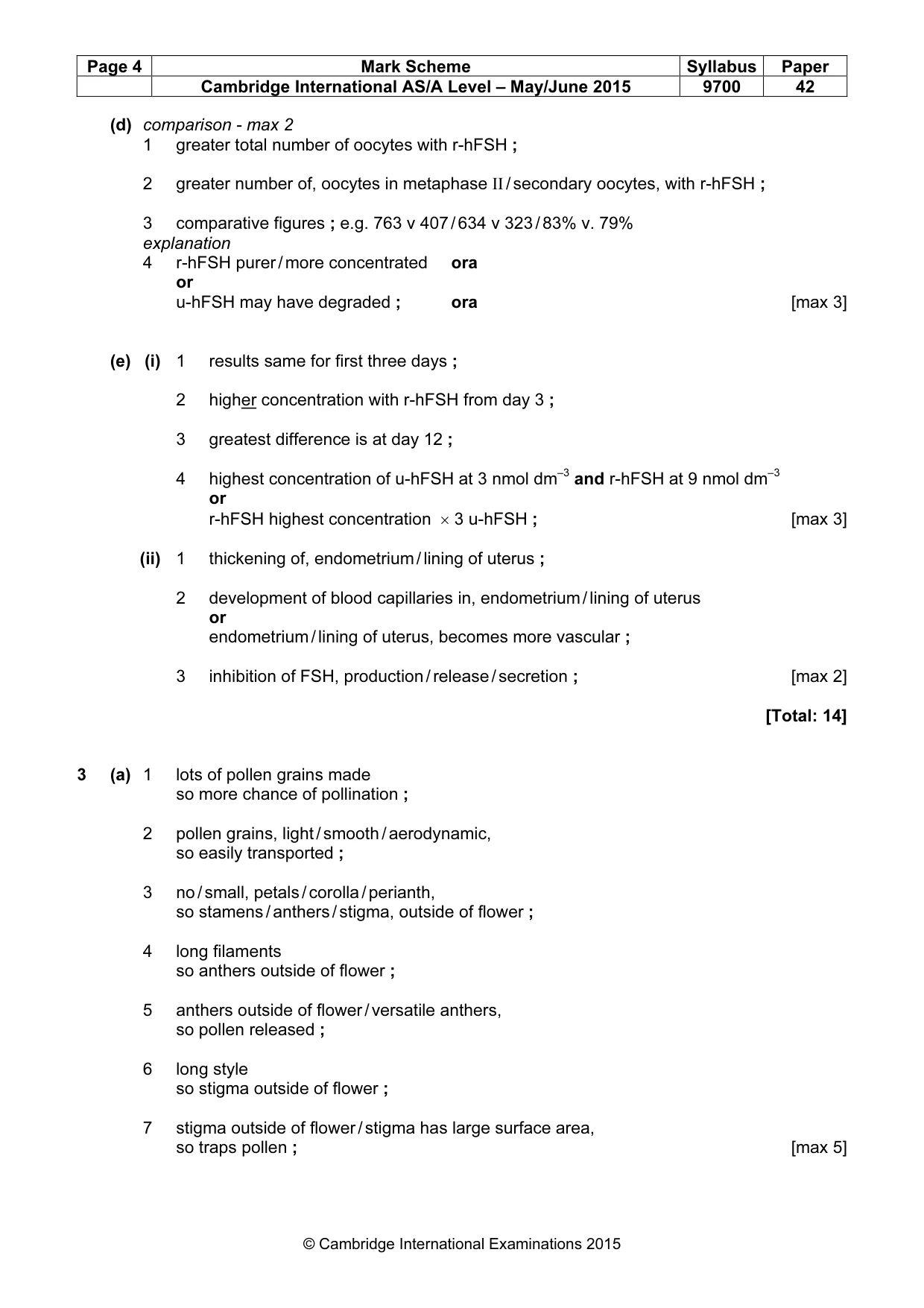
Page 4 Mark Scheme Syllabus Paper Cambridge International AS/A Level – May/June 2015 9700 42 © Cambridge International Examinations 2015 (d) comparison - max 2 1 greater total number of oocytes with r-hFSH ; 2 greater number of, oocytes in metaphase II / secondary oocytes, with r-hFSH ; 3 comparative figures ; e.g. 763 v 407 / 634 v 323 / 83% v. 79% explanation 4 r-hFSH purer / more concentrated ora or u-hFSH may have degraded ; ora [max 3] (e) (i) 1 results same for first three days ; 2 higher concentration with r-hFSH from day 3 ; 3 greatest difference is at day 12 ; 4 highest concentration of u-hFSH at 3 nmol dm–3 and r-hFSH at 9 nmol dm–3 or r-hFSH highest concentration × 3 u-hFSH ; [max 3] (ii) 1 thickening of, endometrium / lining of uterus ; 2 development of blood capillaries in, endometrium / lining of uterus or endometrium / lining of uterus, becomes more vascular ; 3 inhibition of FSH, production / release / secretion ; [max 2] [Total: 14] 3 (a) 1 lots of pollen grains made so more chance of pollination ; 2 pollen grains, light / smooth / aerodynamic, so easily transported ; 3 no / small, petals / corolla / perianth, so stamens / anthers / stigma, outside of flower ; 4 long filaments so anthers outside of flower ; 5 anthers outside of flower / versatile anthers, so pollen released ; 6 long style so stigma outside of flower ; 7 stigma outside of flower / stigma has large surface area, so traps pollen ; [max 5]
Mark scheme, page 5
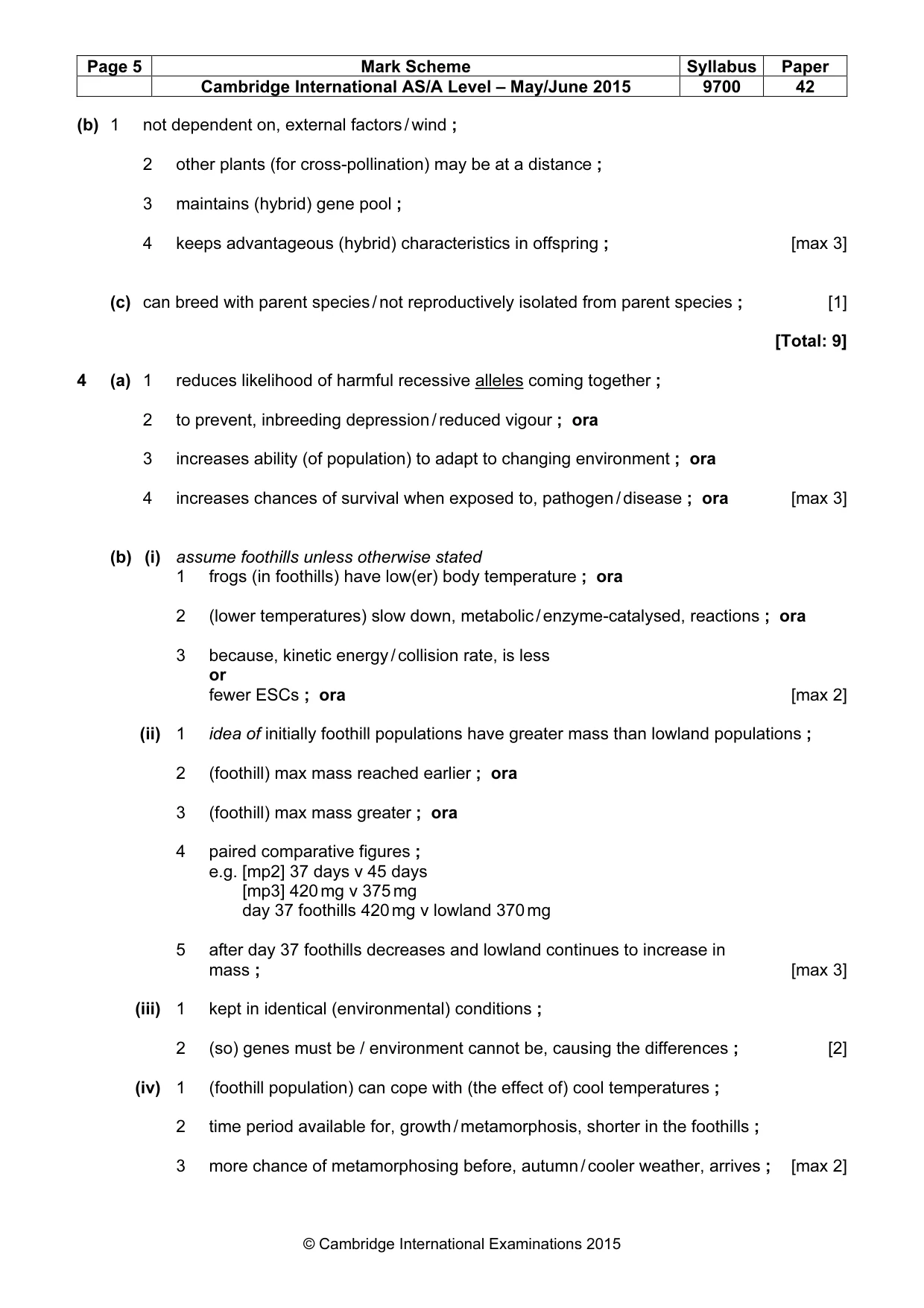
Page 5 Mark Scheme Syllabus Paper Cambridge International AS/A Level – May/June 2015 9700 42 © Cambridge International Examinations 2015 (b) 1 not dependent on, external factors / wind ; 2 other plants (for cross-pollination) may be at a distance ; 3 maintains (hybrid) gene pool ; 4 keeps advantageous (hybrid) characteristics in offspring ; [max 3] (c) can breed with parent species / not reproductively isolated from parent species ; [1] [Total: 9] 4 (a) 1 reduces likelihood of harmful recessive alleles coming together ; 2 to prevent, inbreeding depression / reduced vigour ; ora 3 increases ability (of population) to adapt to changing environment ; ora 4 increases chances of survival when exposed to, pathogen / disease ; ora [max 3] (b) (i) assume foothills unless otherwise stated 1 frogs (in foothills) have low(er) body temperature ; ora 2 (lower temperatures) slow down, metabolic / enzyme-catalysed, reactions ; ora 3 because, kinetic energy / collision rate, is less or fewer ESCs ; ora [max 2] (ii) 1 idea of initially foothill populations have greater mass than lowland populations ; 2 (foothill) max mass reached earlier ; ora 3 (foothill) max mass greater ; ora 4 paired comparative figures ; e.g. [mp2] 37 days v 45 days e.g. [mp3] 420 mg v 375 mg e.g. day 37 foothills 420 mg v lowland 370 mg 5 after day 37 foothills decreases and lowland continues to increase in mass ; [max 3] (iii) 1 kept in identical (environmental) conditions ; 2 (so) genes must be / environment cannot be, causing the differences ; [2] (iv) 1 (foothill population) can cope with (the effect of) cool temperatures ; 2 time period available for, growth / metamorphosis, shorter in the foothills ; 3 more chance of metamorphosing before, autumn / cooler weather, arrives ; [max 2]
Mark scheme, page 6
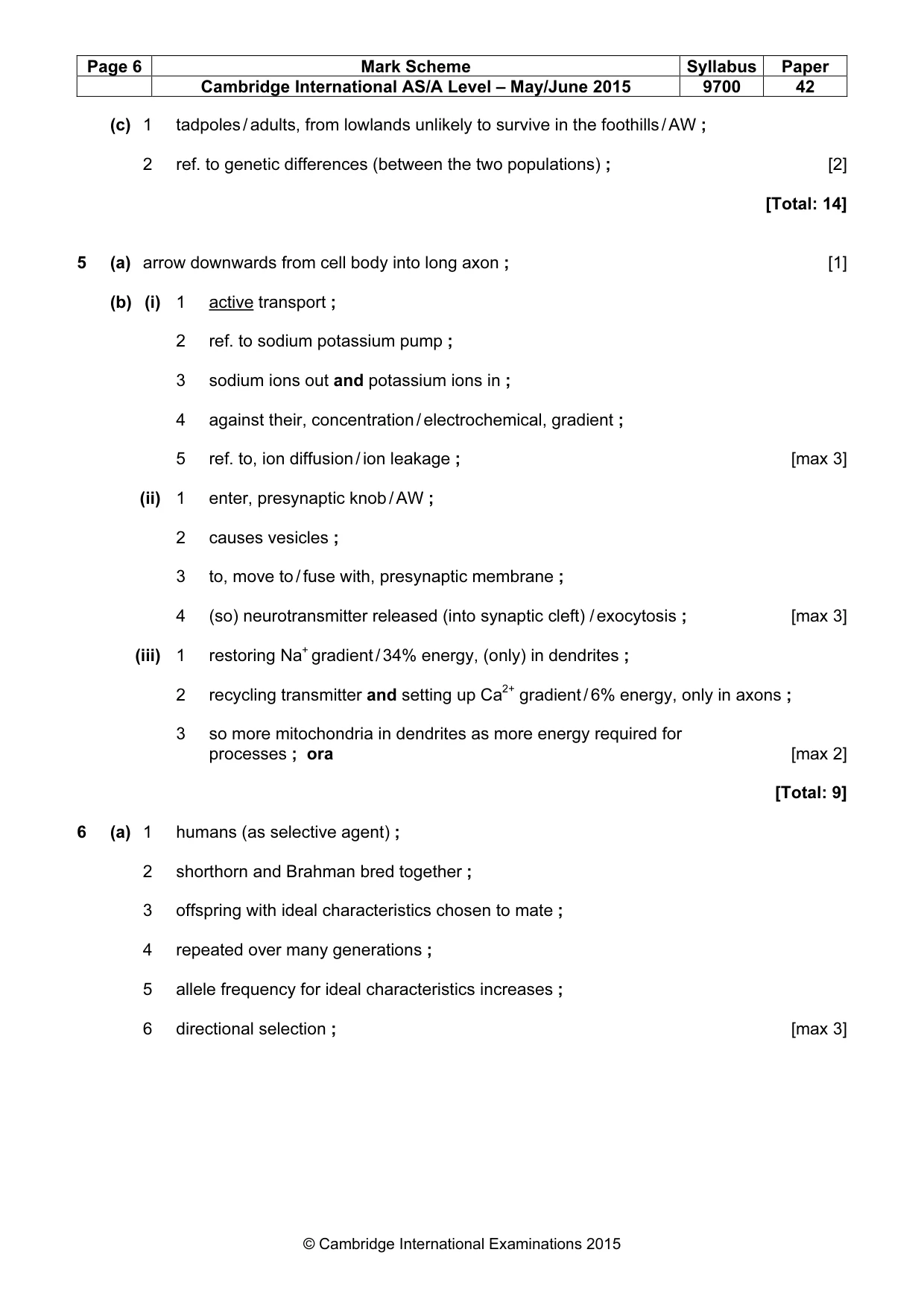
Page 6 Mark Scheme Syllabus Paper Cambridge International AS/A Level – May/June 2015 9700 42 © Cambridge International Examinations 2015 (c) 1 tadpoles / adults, from lowlands unlikely to survive in the foothills / AW ; 2 ref. to genetic differences (between the two populations) ; [2] [Total: 14] 5 (a) arrow downwards from cell body into long axon ; [1] (b) (i) 1 active transport ; 2 ref. to sodium potassium pump ; 3 sodium ions out and potassium ions in ; 4 against their, concentration / electrochemical, gradient ; 5 ref. to, ion diffusion / ion leakage ; [max 3] (ii) 1 enter, presynaptic knob / AW ; 2 causes vesicles ; 3 to, move to / fuse with, presynaptic membrane ; 4 (so) neurotransmitter released (into synaptic cleft) / exocytosis ; [max 3] (iii) 1 restoring Na+ gradient / 34% energy, (only) in dendrites ; 2 recycling transmitter and setting up Ca2+ gradient / 6% energy, only in axons ; 3 so more mitochondria in dendrites as more energy required for processes ; ora [max 2] [Total: 9] 6 (a) 1 humans (as selective agent) ; 2 shorthorn and Brahman bred together ; 3 offspring with ideal characteristics chosen to mate ; 4 repeated over many generations ; 5 allele frequency for ideal characteristics increases ; 6 directional selection ; [max 3]
Mark scheme, page 7
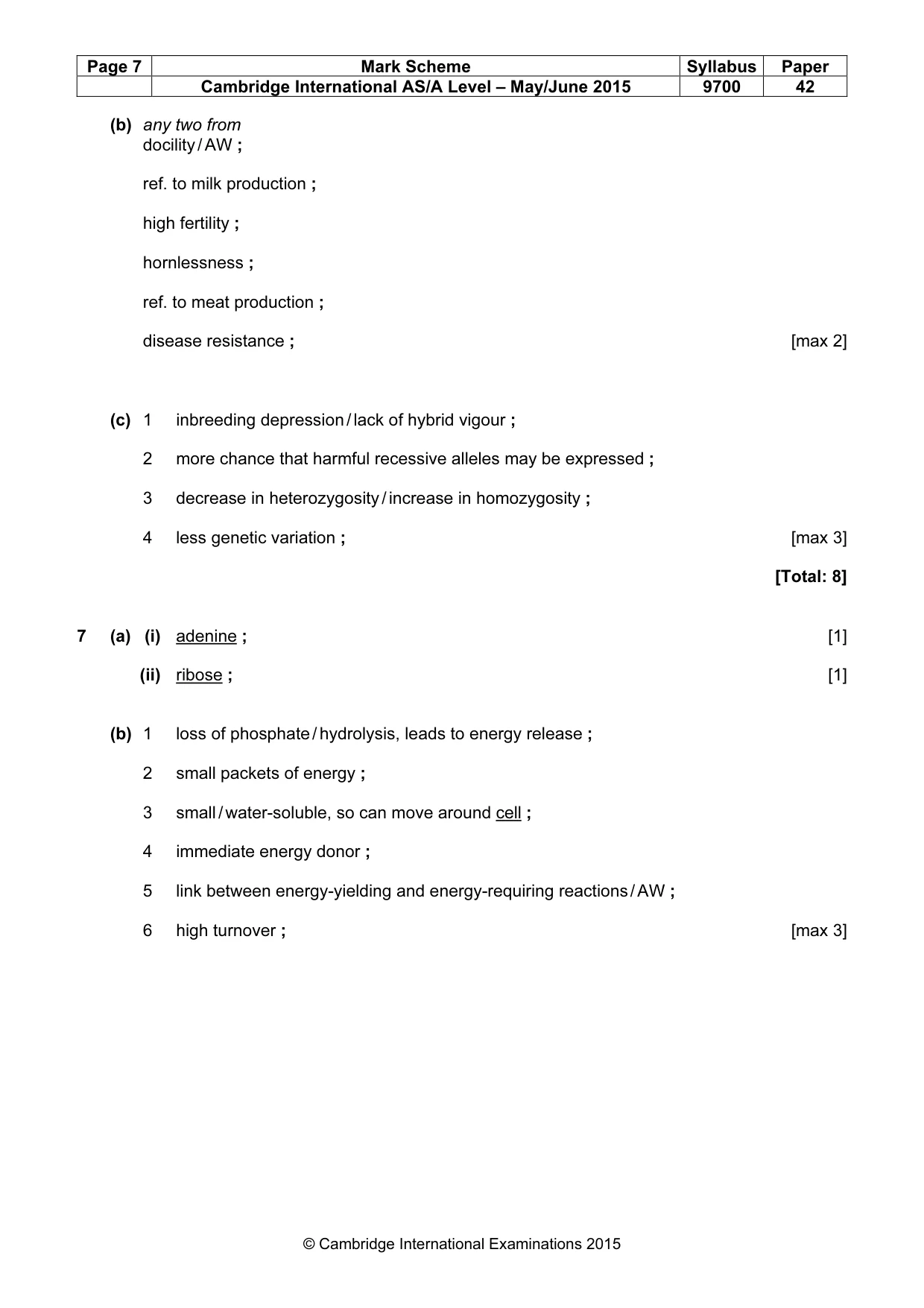
Page 7 Mark Scheme Syllabus Paper Cambridge International AS/A Level – May/June 2015 9700 42 © Cambridge International Examinations 2015 (b) any two from docility / AW ; ref. to milk production ; high fertility ; hornlessness ; ref. to meat production ; disease resistance ; [max 2] (c) 1 inbreeding depression / lack of hybrid vigour ; 2 more chance that harmful recessive alleles may be expressed ; 3 decrease in heterozygosity / increase in homozygosity ; 4 less genetic variation ; [max 3] [Total: 8] 7 (a) (i) adenine ; [1] (ii) ribose ; [1] (b) 1 loss of phosphate / hydrolysis, leads to energy release ; 2 small packets of energy ; 3 small / water-soluble, so can move around cell ; 4 immediate energy donor ; 5 link between energy-yielding and energy-requiring reactions / AW ; 6 high turnover ; [max 3]
Mark scheme, page 8
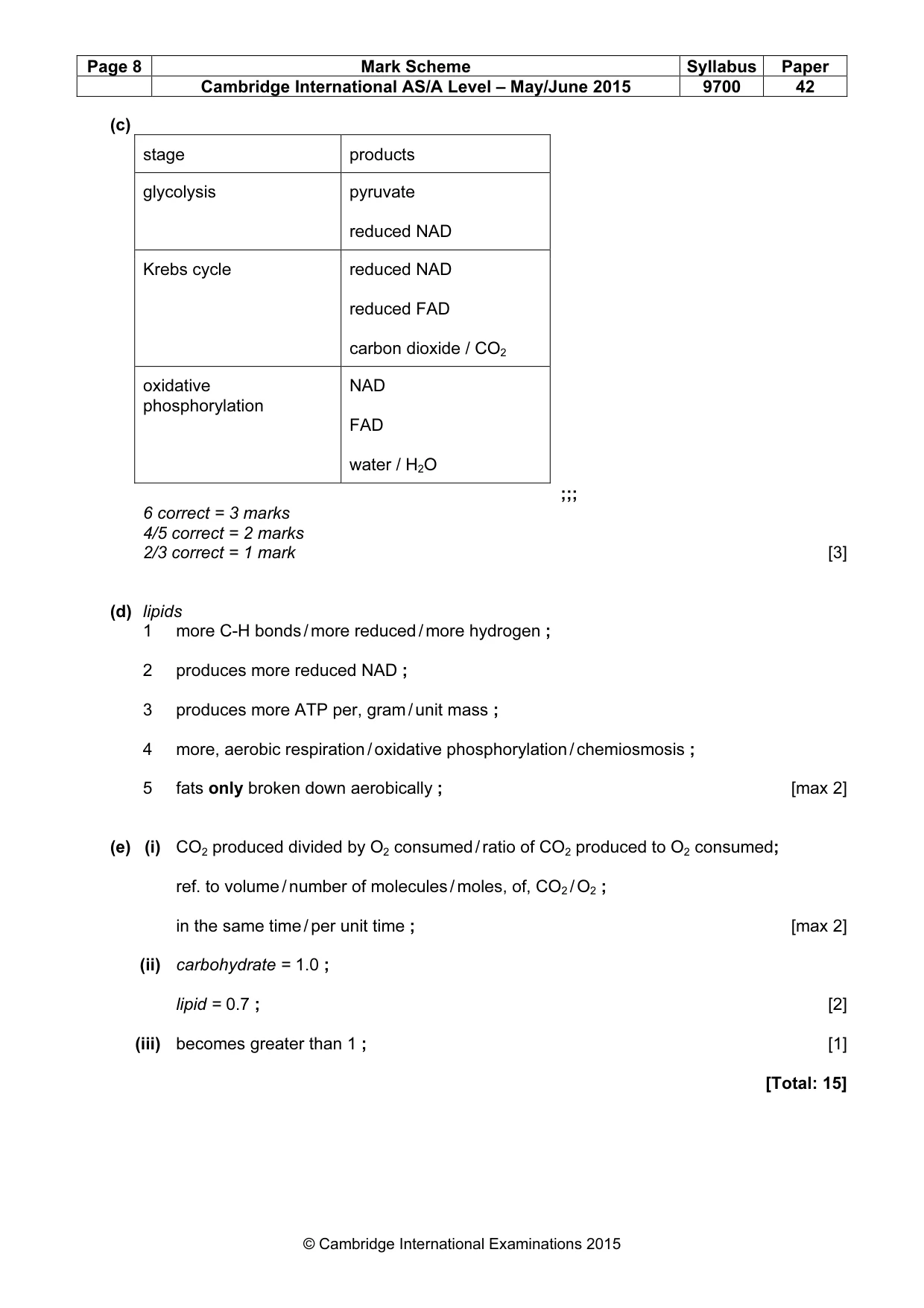
Page 8 Mark Scheme Syllabus Paper Cambridge International AS/A Level – May/June 2015 9700 42 © Cambridge International Examinations 2015 (c) stage products glycolysis pyruvate reduced NAD Krebs cycle reduced NAD reduced FAD carbon dioxide / CO2 oxidative phosphorylation NAD FAD water / H2O ;;; 6 correct = 3 marks 4/5 correct = 2 marks 2/3 correct = 1 mark [3] (d) lipids 1 more C-H bonds / more reduced / more hydrogen ; 2 produces more reduced NAD ; 3 produces more ATP per, gram / unit mass ; 4 more, aerobic respiration / oxidative phosphorylation / chemiosmosis ; 5 fats only broken down aerobically ; [max 2] (e) (i) CO2 produced divided by O2 consumed / ratio of CO2 produced to O2 consumed; ref. to volume / number of molecules / moles, of, CO2 / O2 ; in the same time / per unit time ; [max 2] (ii) carbohydrate = 1.0 ; lipid = 0.7 ; [2] (iii) becomes greater than 1 ; [1] [Total: 15]
Mark scheme, page 9
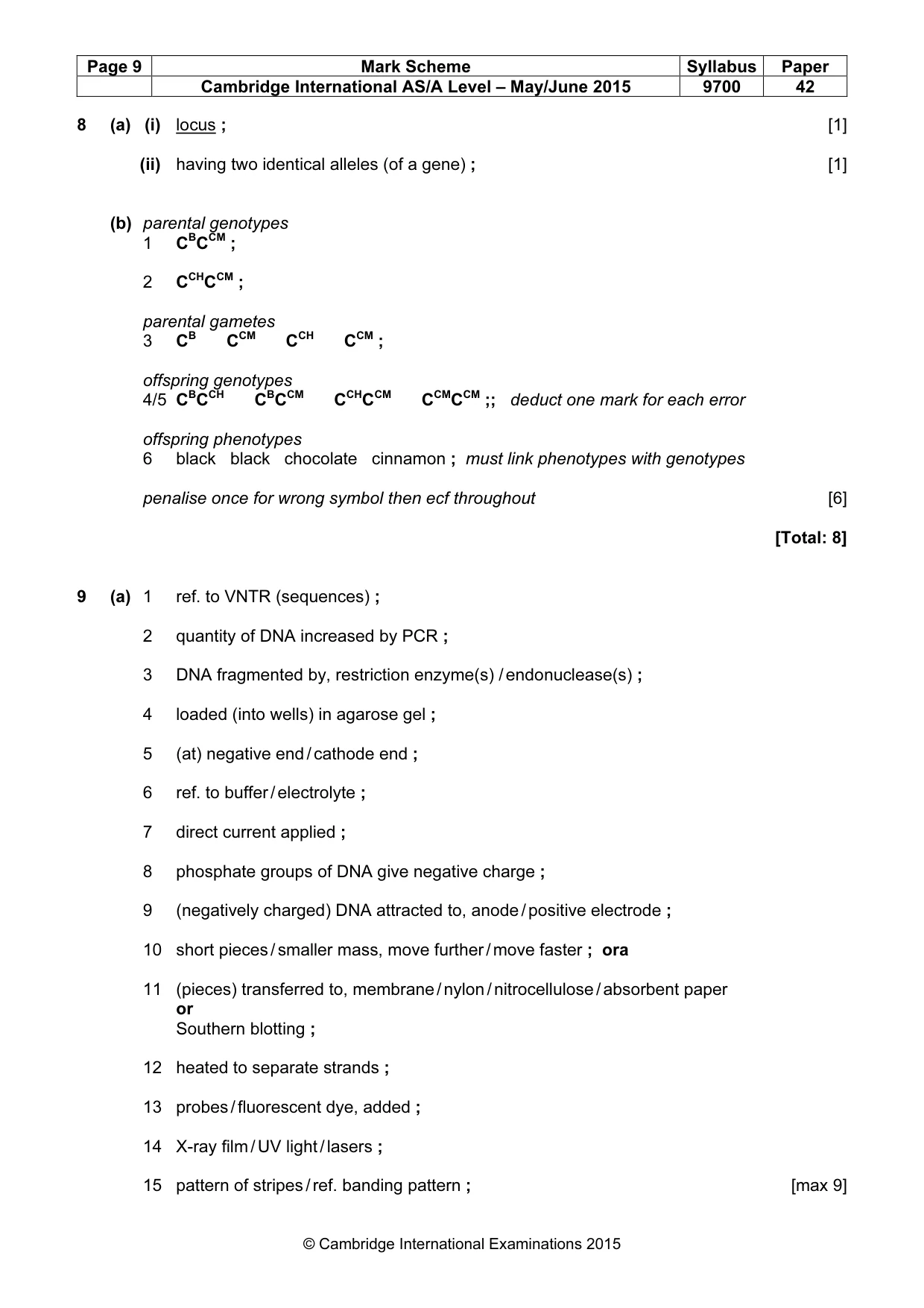
Page 9 Mark Scheme Syllabus Paper Cambridge International AS/A Level – May/June 2015 9700 42 © Cambridge International Examinations 2015 8 (a) (i) locus ; [1] (ii) having two identical alleles (of a gene) ; [1] (b) parental genotypes 1 CBCCM ; 2 CCHCCM ; parental gametes 3 CB CCM CCH CCM ; offspring genotypes 4/5 CBCCH CBCCM CCHCCM CCMCCM ;; deduct one mark for each error offspring phenotypes 6 black black chocolate cinnamon ; must link phenotypes with genotypes penalise once for wrong symbol then ecf throughout [6] [Total: 8] 9 (a) 1 ref. to VNTR (sequences) ; 2 quantity of DNA increased by PCR ; 3 DNA fragmented by, restriction enzyme(s) / endonuclease(s) ; 4 loaded (into wells) in agarose gel ; 5 (at) negative end / cathode end ; 6 ref. to buffer / electrolyte ; 7 direct current applied ; 8 phosphate groups of DNA give negative charge ; 9 (negatively charged) DNA attracted to, anode / positive electrode ; 10 short pieces / smaller mass, move further / move faster ; ora 11 (pieces) transferred to, membrane / nylon / nitrocellulose / absorbent paper or Southern blotting ; 12 heated to separate strands ; 13 probes / fluorescent dye, added ; 14 X-ray film / UV light / lasers ; 15 pattern of stripes / ref. banding pattern ; [max 9]
Mark scheme, page 10
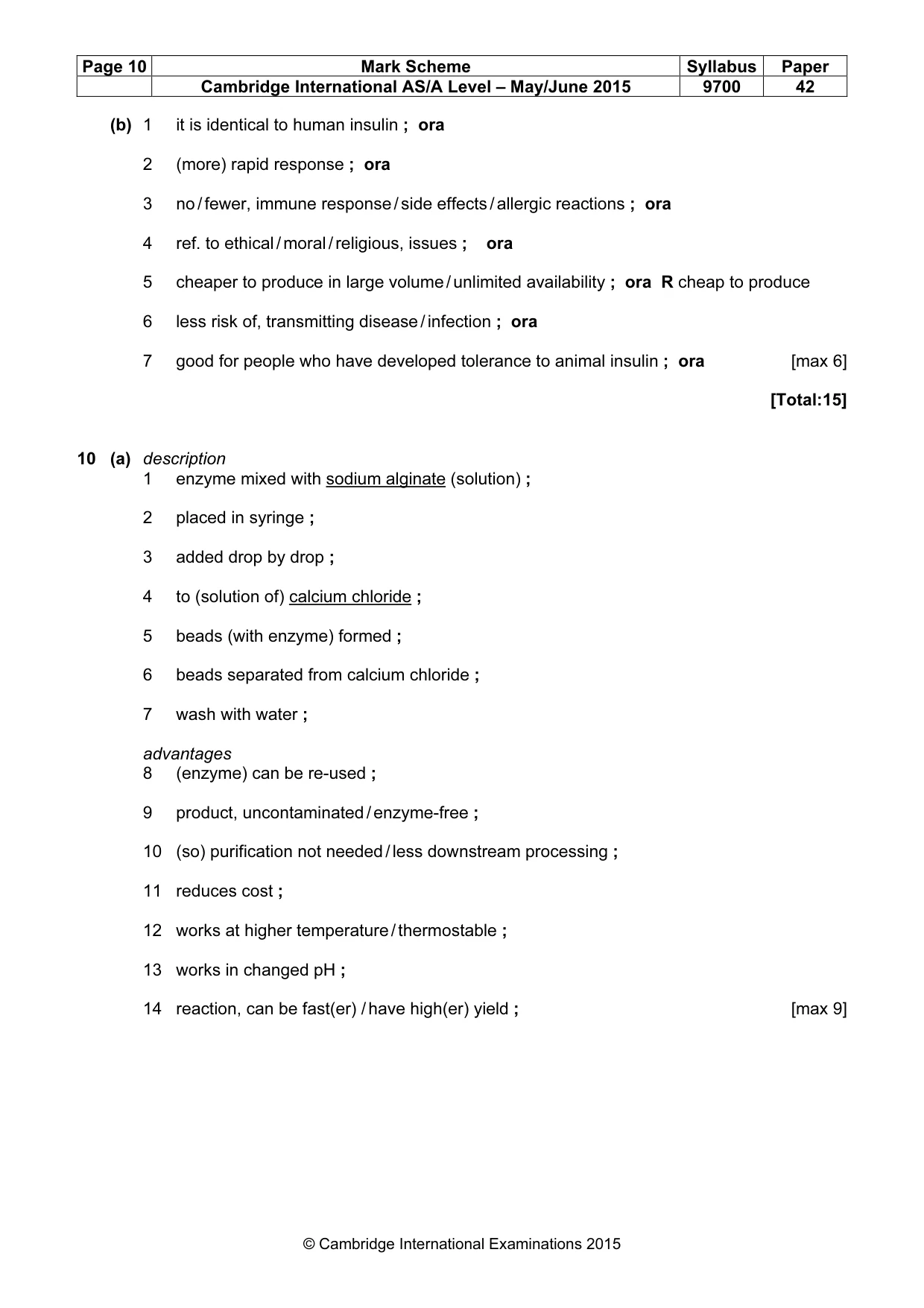
Page 10 Mark Scheme Syllabus Paper Cambridge International AS/A Level – May/June 2015 9700 42 © Cambridge International Examinations 2015 (b) 1 it is identical to human insulin ; ora 2 (more) rapid response ; ora 3 no / fewer, immune response / side effects / allergic reactions ; ora 4 ref. to ethical / moral / religious, issues ; ora 5 cheaper to produce in large volume / unlimited availability ; ora R cheap to produce 6 less risk of, transmitting disease / infection ; ora 7 good for people who have developed tolerance to animal insulin ; ora [max 6] [Total:15] 10 (a) description 1 enzyme mixed with sodium alginate (solution) ; 2 placed in syringe ; 3 added drop by drop ; 4 to (solution of) calcium chloride ; 5 beads (with enzyme) formed ; 6 beads separated from calcium chloride ; 7 wash with water ; advantages 8 (enzyme) can be re-used ; 9 product, uncontaminated / enzyme-free ; 10 (so) purification not needed / less downstream processing ; 11 reduces cost ; 12 works at higher temperature / thermostable ; 13 works in changed pH ; 14 reaction, can be fast(er) / have high(er) yield ; [max 9]
Mark scheme, page 11
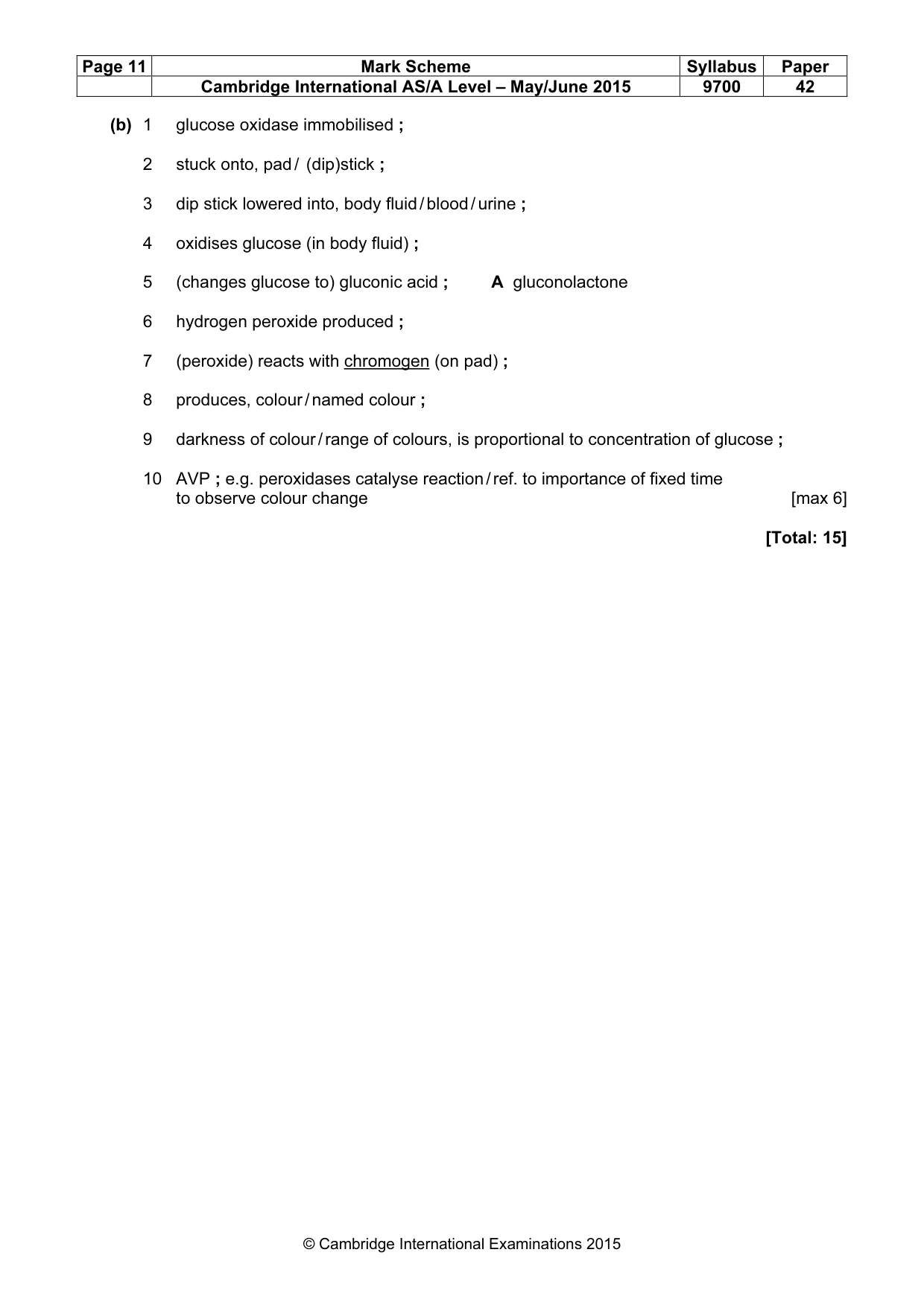
Page 11 Mark Scheme Syllabus Paper Cambridge International AS/A Level – May/June 2015 9700 42 © Cambridge International Examinations 2015 (b) 1 glucose oxidase immobilised ; 2 stuck onto, pad / (dip)stick ; 3 dip stick lowered into, body fluid / blood / urine ; 4 oxidises glucose (in body fluid) ; 5 (changes glucose to) gluconic acid ; A gluconolactone 6 hydrogen peroxide produced ; 7 (peroxide) reacts with chromogen (on pad) ; 8 produces, colour / named colour ; 9 darkness of colour / range of colours, is proportional to concentration of glucose ; 10 AVP ; e.g. peroxidases catalyse reaction / ref. to importance of fixed time to observe colour change [max 6] [Total: 15]
What you needed in this session
Cambridge’s own grade thresholds for 2015 May/June, Paper 4 · Variant 2. A higher threshold means an easier paper — the bar moves with how the cohort did.