Cambridge A Level Biology 9700 — 2014 Oct/Nov Paper 5 · Variant 2
9700/52/O/N/14 · 30 marks · ≈34 min
The question paper and its mark scheme, free to read here and free to download. This is Cambridge’s own paper, exactly as it was sat.
Question paper8 pages
Mark scheme8 pages
Answers below. Sit the paper first if you are practising.
Paper as text
Question paper, page 1
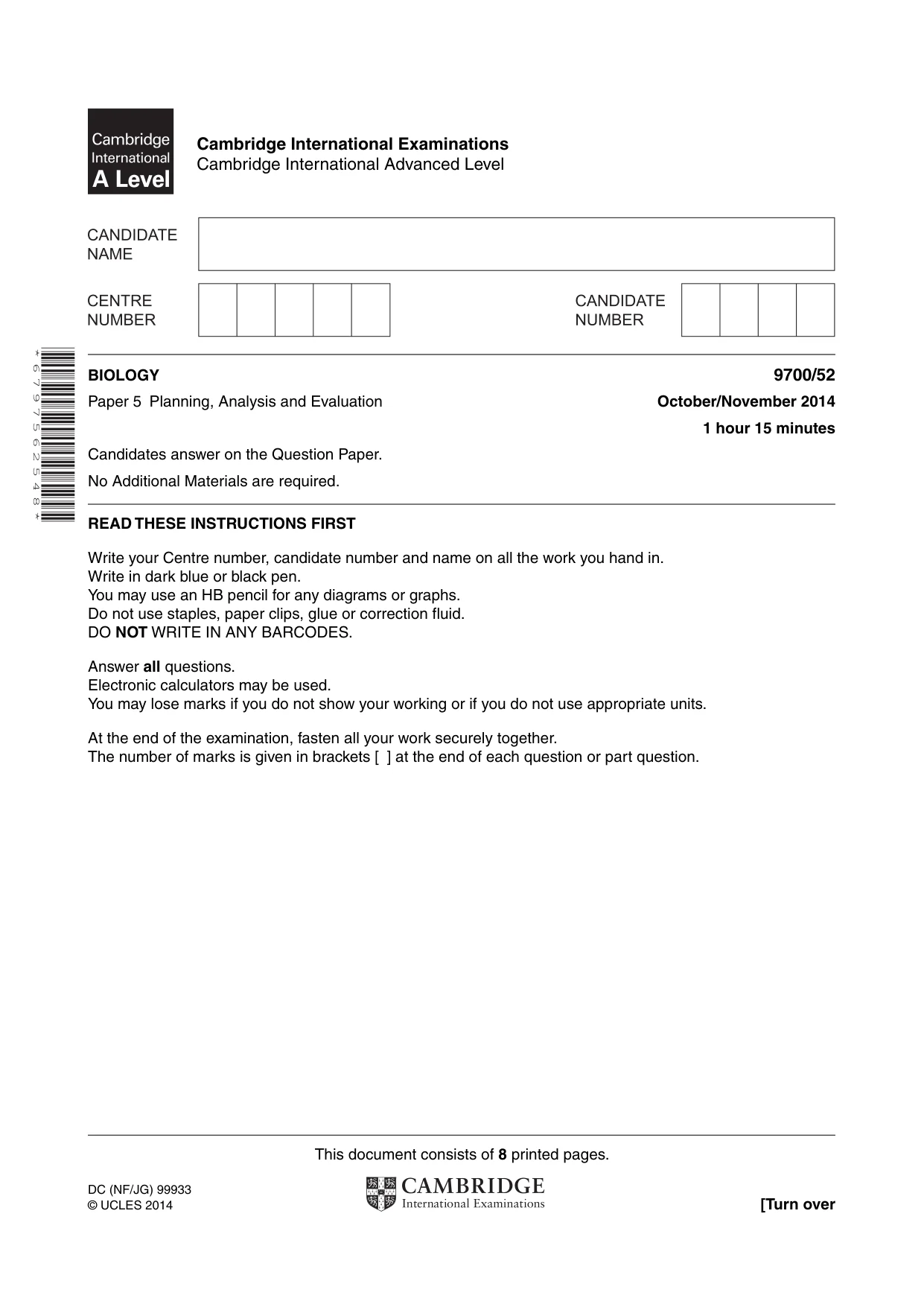
This document consists of 8 printed pages. DC (NF/JG) 99933 © UCLES 2014 [Turn over * 6 7 9 7 5 6 2 5 4 8 * BIOLOGY 9700/52 Paper 5 Planning, Analysis and Evaluation October/November 2014 1 hour 15 minutes Candidates answer on the Question Paper. No Additional Materials are required. READ THESE INSTRUCTIONS FIRST Write your Centre number, candidate number and name on all the work you hand in. Write in dark blue or black pen. You may use an HB pencil for any diagrams or graphs. Do not use staples, paper clips, glue or correction fluid. DO NOT WRITE IN ANY BARCODES. Answer all questions. Electronic calculators may be used. You may lose marks if you do not show your working or if you do not use appropriate units. At the end of the examination, fasten all your work securely together. The number of marks is given in brackets [ ] at the end of each question or part question. Cambridge International Examinations Cambridge International Advanced Level
Question paper, page 2
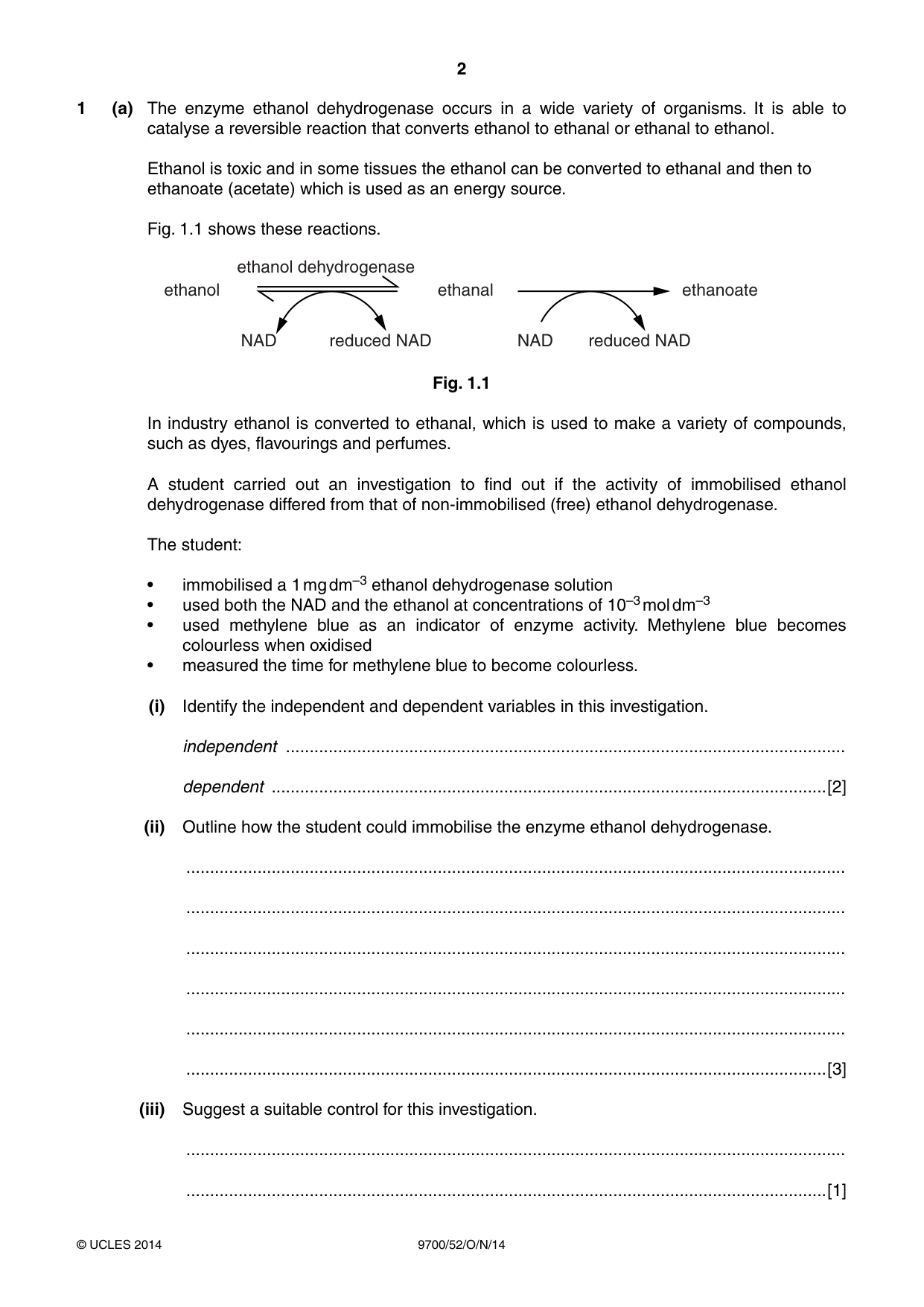
2 9700/52/O/N/14 © UCLES 2014 1 (a) The enzyme ethanol dehydrogenase occurs in a wide variety of organisms. It is able to catalyse a reversible reaction that converts ethanol to ethanal or ethanal to ethanol. Ethanol is toxic and in some tissues the ethanol can be converted to ethanal and then to ethanoate (acetate) which is used as an energy source. Fig. 1.1 shows these reactions. ethanol ethanal ethanoate ethanol dehydrogenase NAD reduced NAD NAD reduced NAD Fig. 1.1 In industry ethanol is converted to ethanal, which is used to make a variety of compounds, such as dyes, flavourings and perfumes. A student carried out an investigation to find out if the activity of immobilised ethanol dehydrogenase differed from that of non-immobilised (free) ethanol dehydrogenase. The student: • immobilised a 1 mg dm–3 ethanol dehydrogenase solution • used both the NAD and the ethanol at concentrations of 10–3 mol dm–3 • used methylene blue as an indicator of enzyme activity. Methylene blue becomes colourless when oxidised • measured the time for methylene blue to become colourless. (i) Identify the independent and dependent variables in this investigation. independent … dependent …[2] (ii) Outline how the student could immobilise the enzyme ethanol dehydrogenase. … … … … … …[3] (iii) Suggest a suitable control for this investigation. … …[1]
Question paper, page 3
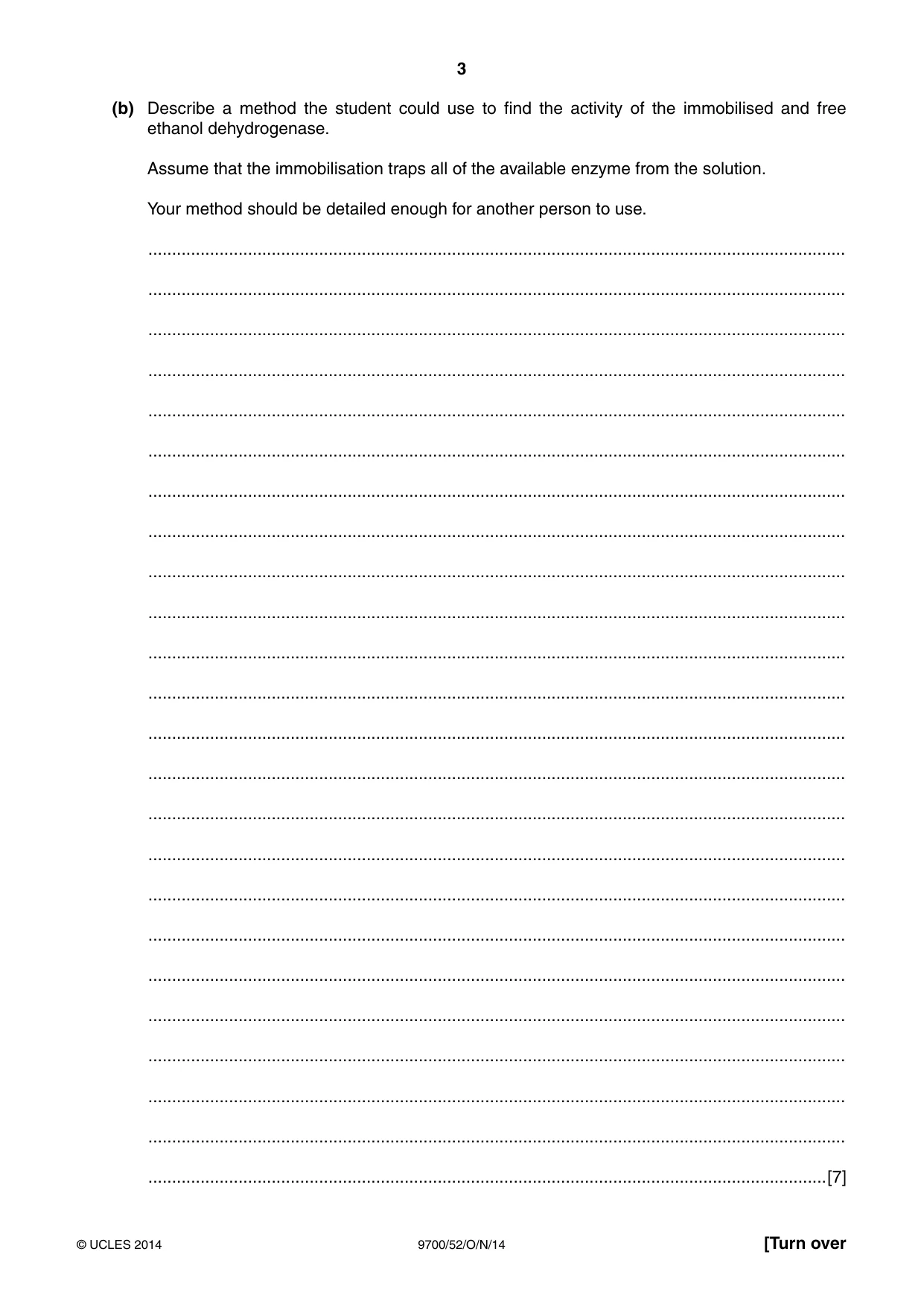
3 9700/52/O/N/14 © UCLES 2014 [Turn over (b) Describe a method the student could use to find the activity of the immobilised and free ethanol dehydrogenase. Assume that the immobilisation traps all of the available enzyme from the solution. Your method should be detailed enough for another person to use. … … … … … … … … … … … … … … … … … … … … … … … …[7]
Question paper, page 4
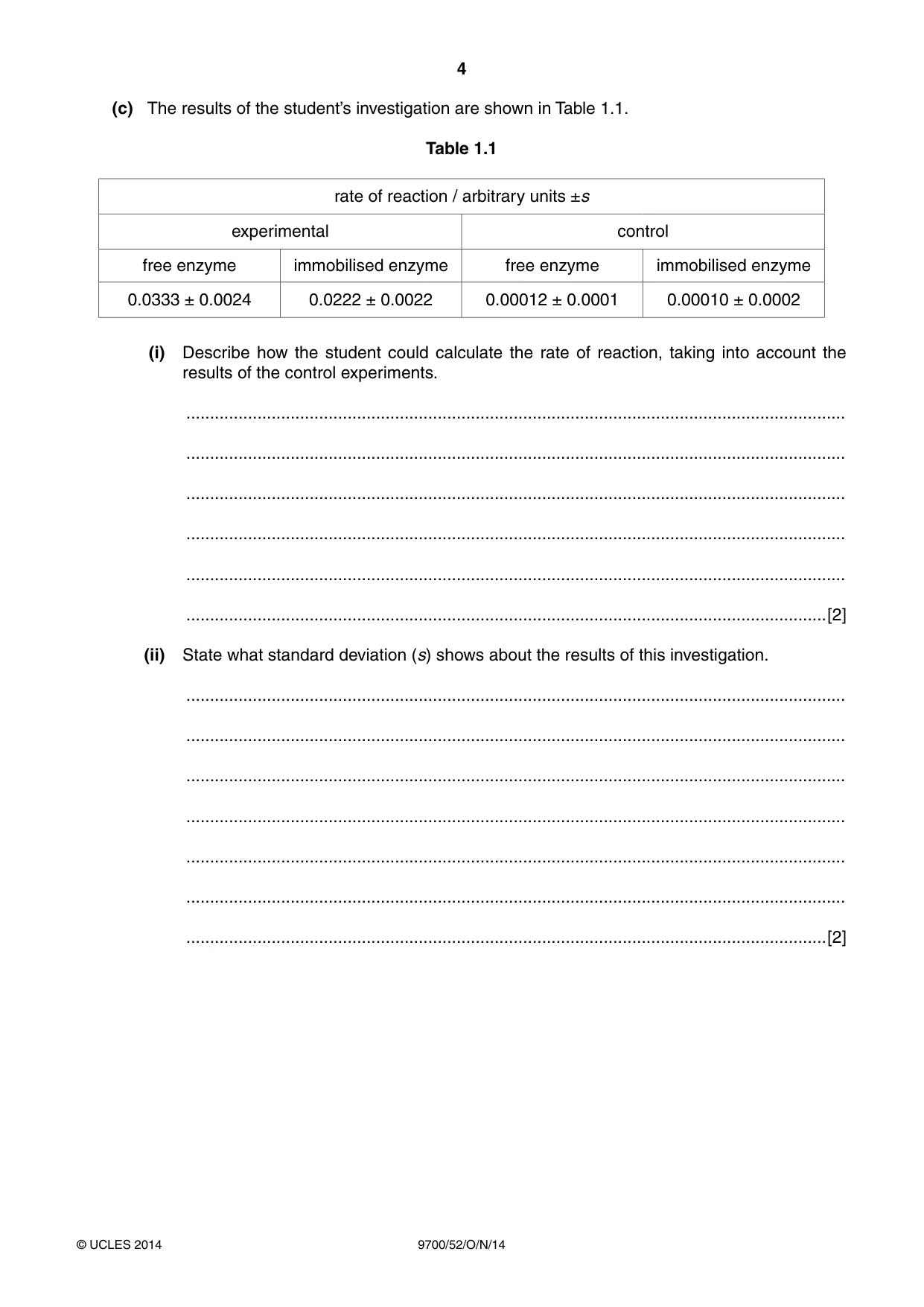
4 9700/52/O/N/14 © UCLES 2014 (c) The results of the student’s investigation are shown in Table 1.1. Table 1.1 rate of reaction / arbitrary units ±s experimental control free enzyme immobilised enzyme free enzyme immobilised enzyme 0.0333 ± 0.0024 0.0222 ± 0.0022 0.00012 ± 0.0001 0.00010 ± 0.0002 (i) Describe how the student could calculate the rate of reaction, taking into account the results of the control experiments. … … … … … …[2] (ii) State what standard deviation (s) shows about the results of this investigation. … … … … … … …[2]
Question paper, page 5
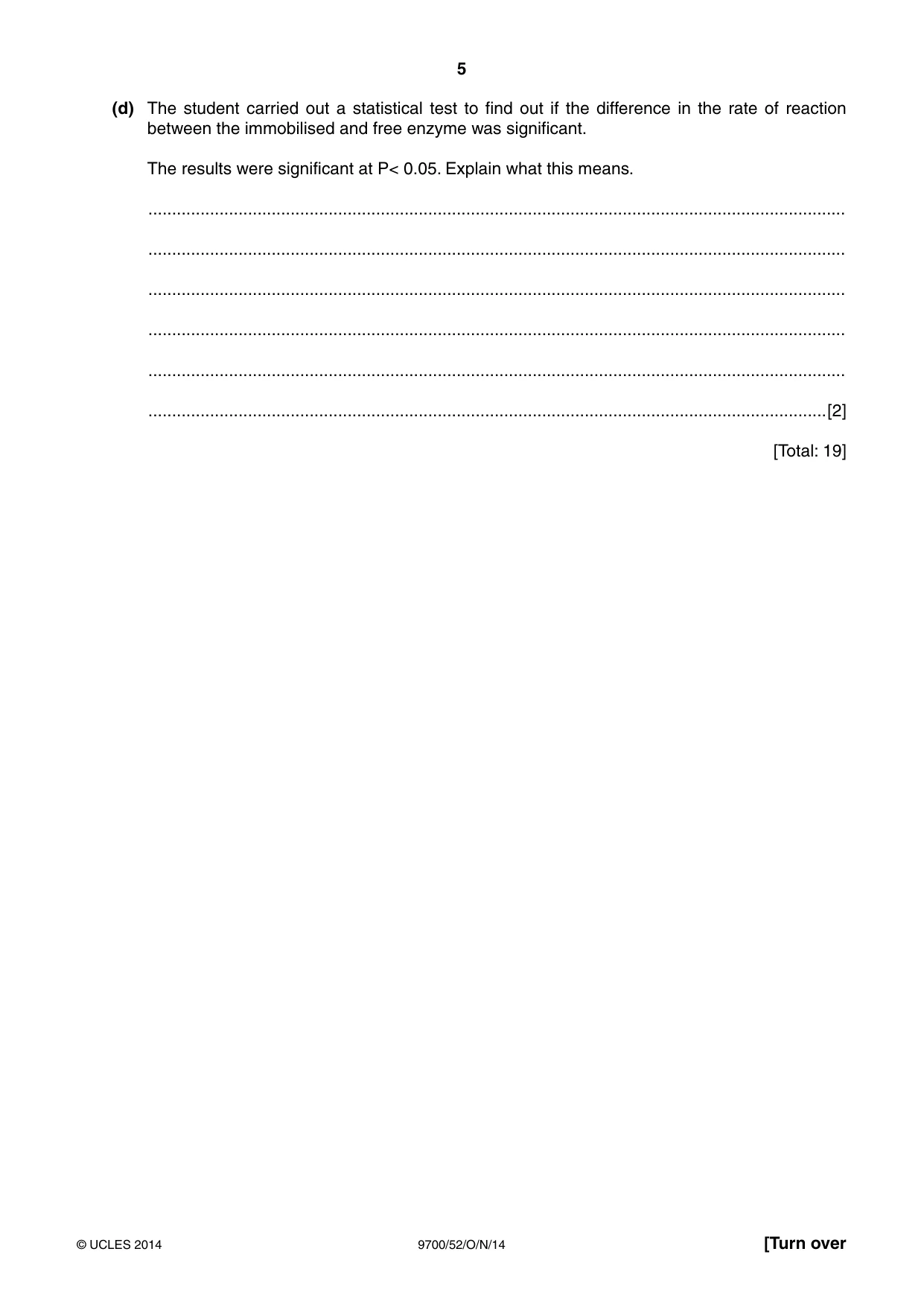
5 9700/52/O/N/14 © UCLES 2014 [Turn over (d) The student carried out a statistical test to find out if the difference in the rate of reaction between the immobilised and free enzyme was significant. The results were significant at P< 0.05. Explain what this means. … … … … … …[2] [Total: 19]
Question paper, page 6
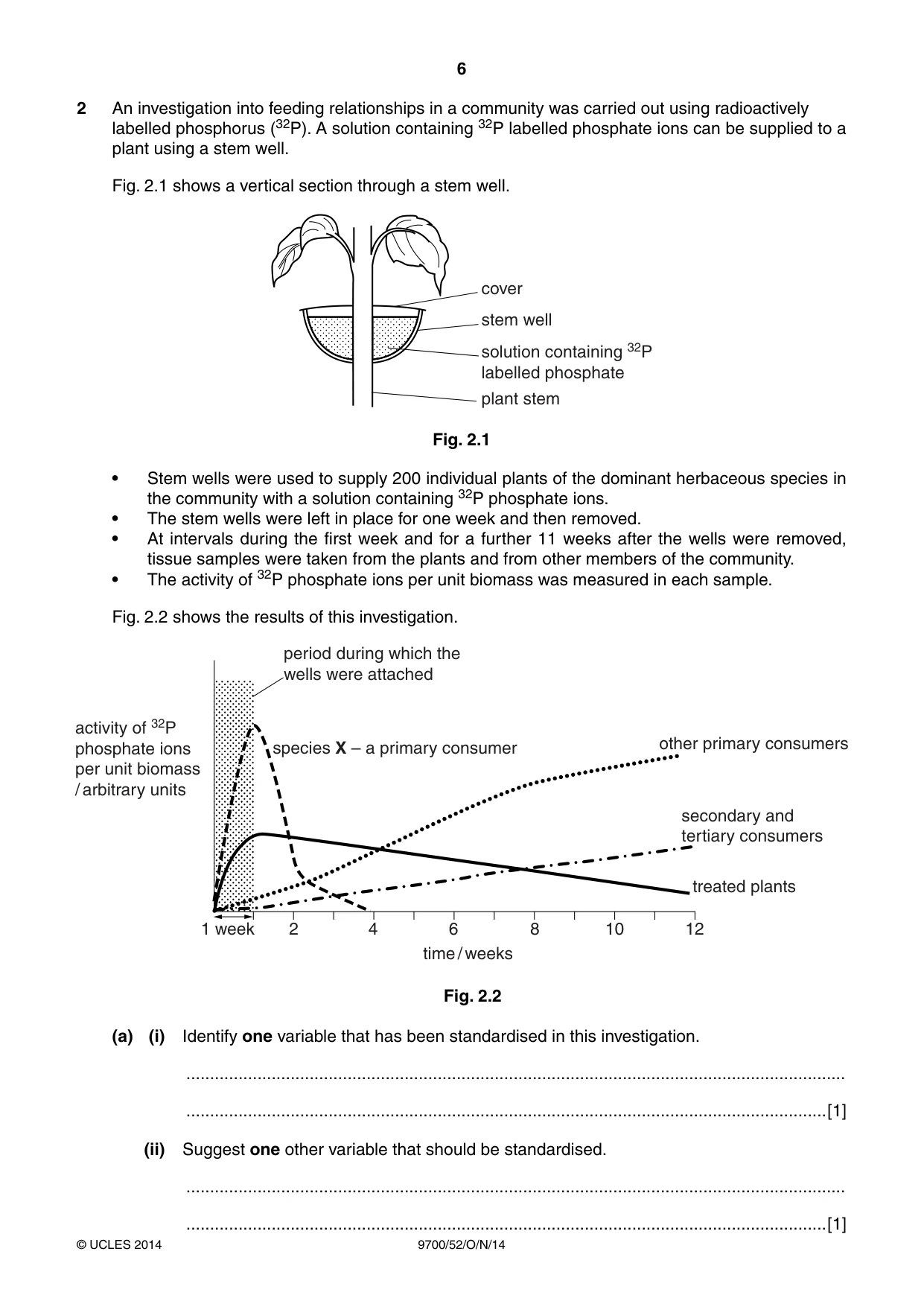
6 9700/52/O/N/14 © UCLES 2014 2 An investigation into feeding relationships in a community was carried out using radioactively labelled phosphorus (32P). A solution containing 32P labelled phosphate ions can be supplied to a plant using a stem well. Fig. 2.1 shows a vertical section through a stem well. cover stem well plant stem solution containing 32P labelled phosphate Fig. 2.1 • Stem wells were used to supply 200 individual plants of the dominant herbaceous species in the community with a solution containing 32P phosphate ions. • The stem wells were left in place for one week and then removed. • At intervals during the first week and for a further 11 weeks after the wells were removed, tissue samples were taken from the plants and from other members of the community. • The activity of 32P phosphate ions per unit biomass was measured in each sample. Fig. 2.2 shows the results of this investigation. 1 week 2 4 6 8 10 12 time / weeks period during which the wells were attached species X – a primary consumer other primary consumers secondary and tertiary consumers treated plants activity of 32P phosphate ions per unit biomass / arbitrary units Fig. 2.2 (a) (i) Identify one variable that has been standardised in this investigation. … …[1] (ii) Suggest one other variable that should be standardised. … …[1]
Question paper, page 7
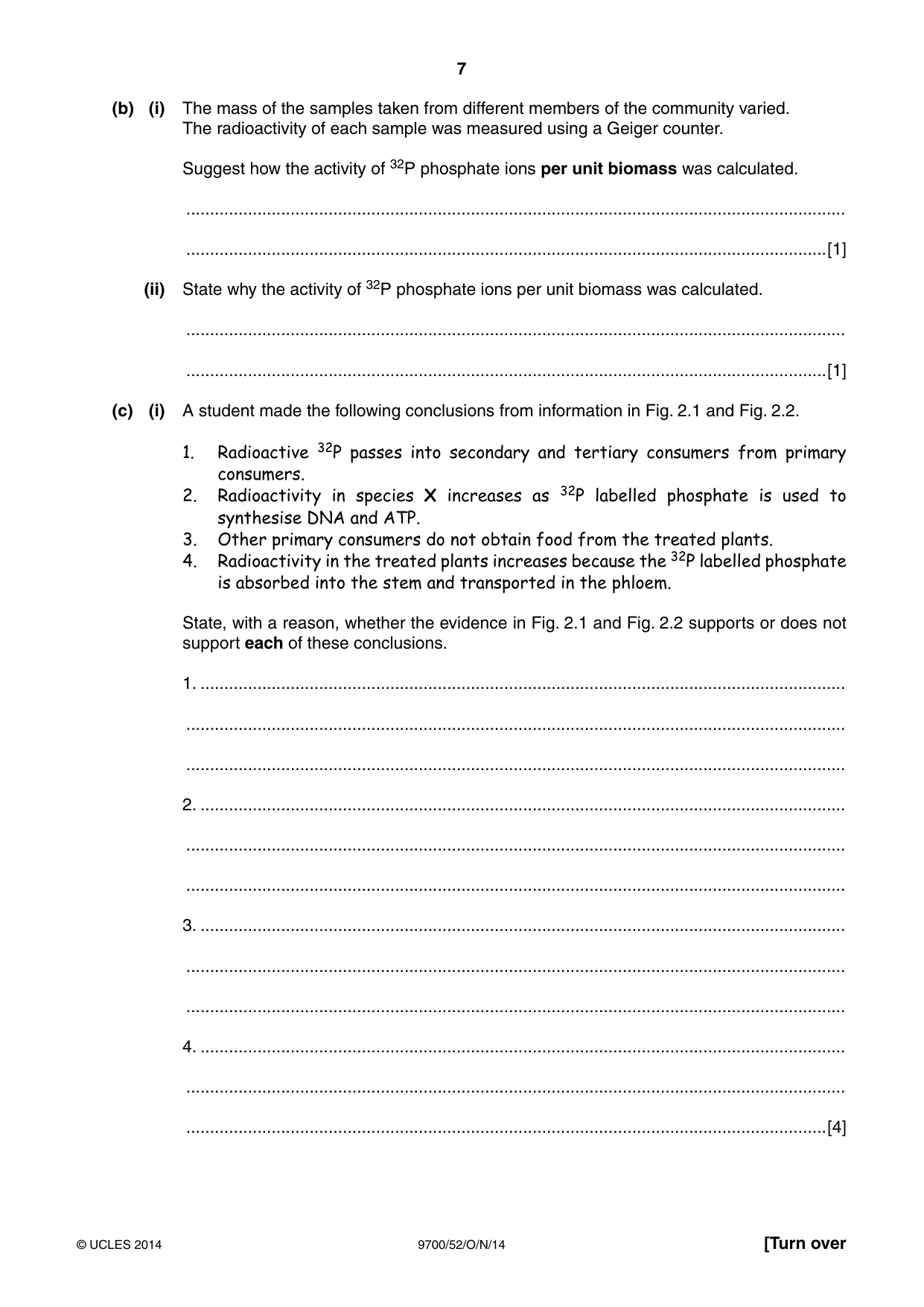
7 9700/52/O/N/14 © UCLES 2014 [Turn over (b) (i) The mass of the samples taken from different members of the community varied. The radioactivity of each sample was measured using a Geiger counter. Suggest how the activity of 32P phosphate ions per unit biomass was calculated. … …[1] (ii) State why the activity of 32P phosphate ions per unit biomass was calculated. … …[1] (c) (i) A student made the following conclusions from information in Fig. 2.1 and Fig. 2.2. 1. Radioactive 32P passes into secondary and tertiary consumers from primary consumers. 2. Radioactivity in species X increases as 32P labelled phosphate is used to synthesise DNA and ATP. 3. Other primary consumers do not obtain food from the treated plants. 4. Radioactivity in the treated plants increases because the 32P labelled phosphate is absorbed into the stem and transported in the phloem. State, with a reason, whether the evidence in Fig. 2.1 and Fig. 2.2 supports or does not support each of these conclusions. 1. … … … 2. … … … 3. … … … 4. … … …[4]
Question paper, page 8
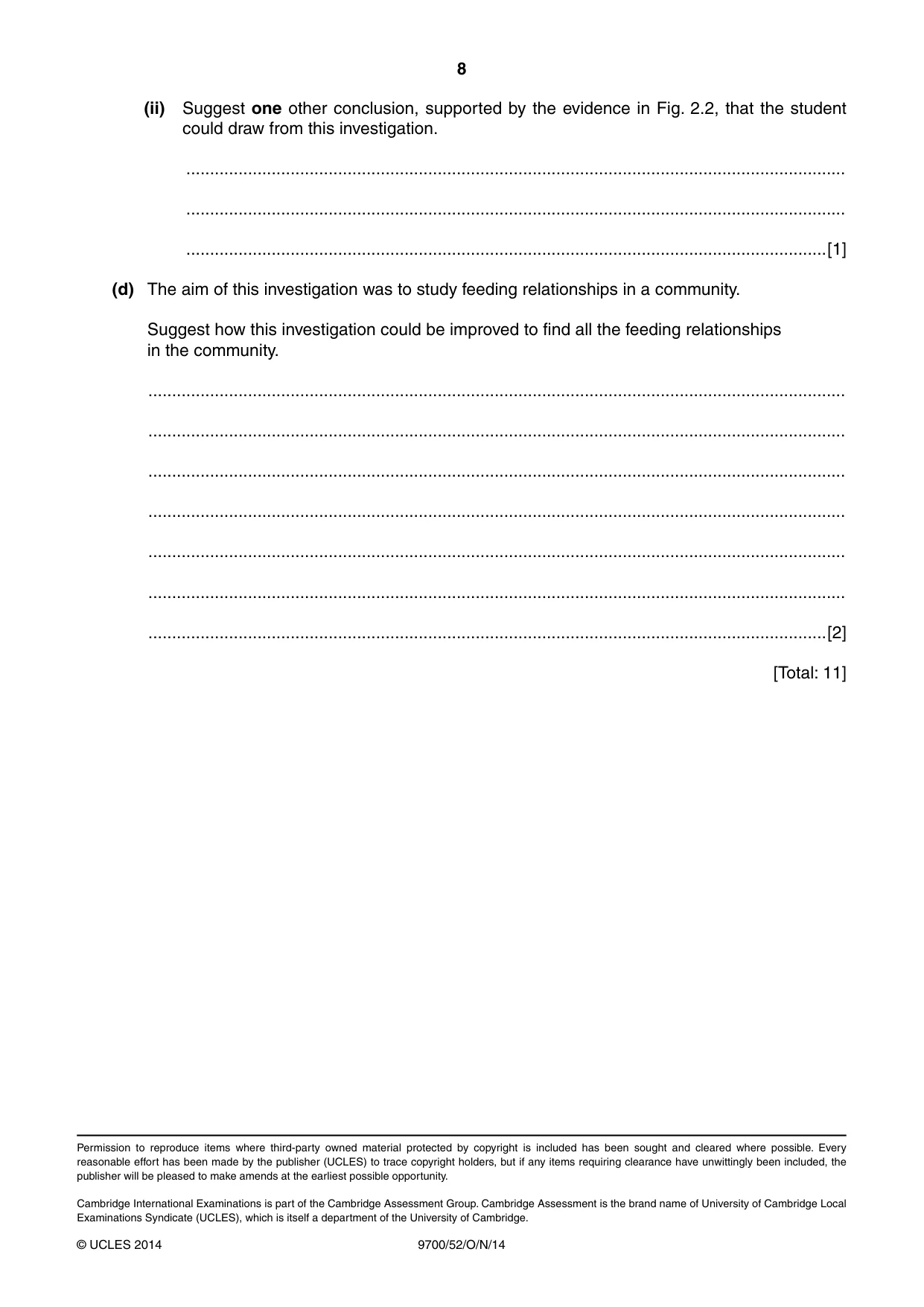
8 9700/52/O/N/14 © UCLES 2014 Permission to reproduce items where third-party owned material protected by copyright is included has been sought and cleared where possible. Every reasonable effort has been made by the publisher (UCLES) to trace copyright holders, but if any items requiring clearance have unwittingly been included, the publisher will be pleased to make amends at the earliest possible opportunity. Cambridge International Examinations is part of the Cambridge Assessment Group. Cambridge Assessment is the brand name of University of Cambridge Local Examinations Syndicate (UCLES), which is itself a department of the University of Cambridge. (ii) Suggest one other conclusion, supported by the evidence in Fig. 2.2, that the student could draw from this investigation. … … …[1] (d) The aim of this investigation was to study feeding relationships in a community. Suggest how this investigation could be improved to find all the feeding relationships in the community. … … … … … … …[2] [Total: 11]
Mark scheme, page 1
® IGCSE is the registered trademark of Cambridge International Examinations. CAMBRIDGE INTERNATIONAL EXAMINATIONS Cambridge International Advanced Subsidiary and Advanced Level MARK SCHEME for the October/November 2014 series 9700 BIOLOGY 9700/52 Paper 5 (Planning, Analysis and Evaluation), maximum raw mark 30 This mark scheme is published as an aid to teachers and candidates, to indicate the requirements of the examination. It shows the basis on which Examiners were instructed to award marks. It does not indicate the details of the discussions that took place at an Examiners’ meeting before marking began, which would have considered the acceptability of alternative answers. Mark schemes should be read in conjunction with the question paper and the Principal Examiner Report for Teachers. Cambridge will not enter into discussions about these mark schemes. Cambridge is publishing the mark schemes for the October/November 2014 series for most Cambridge IGCSE®, Cambridge International A and AS Level components and some Cambridge O Level components.
Mark scheme, page 2
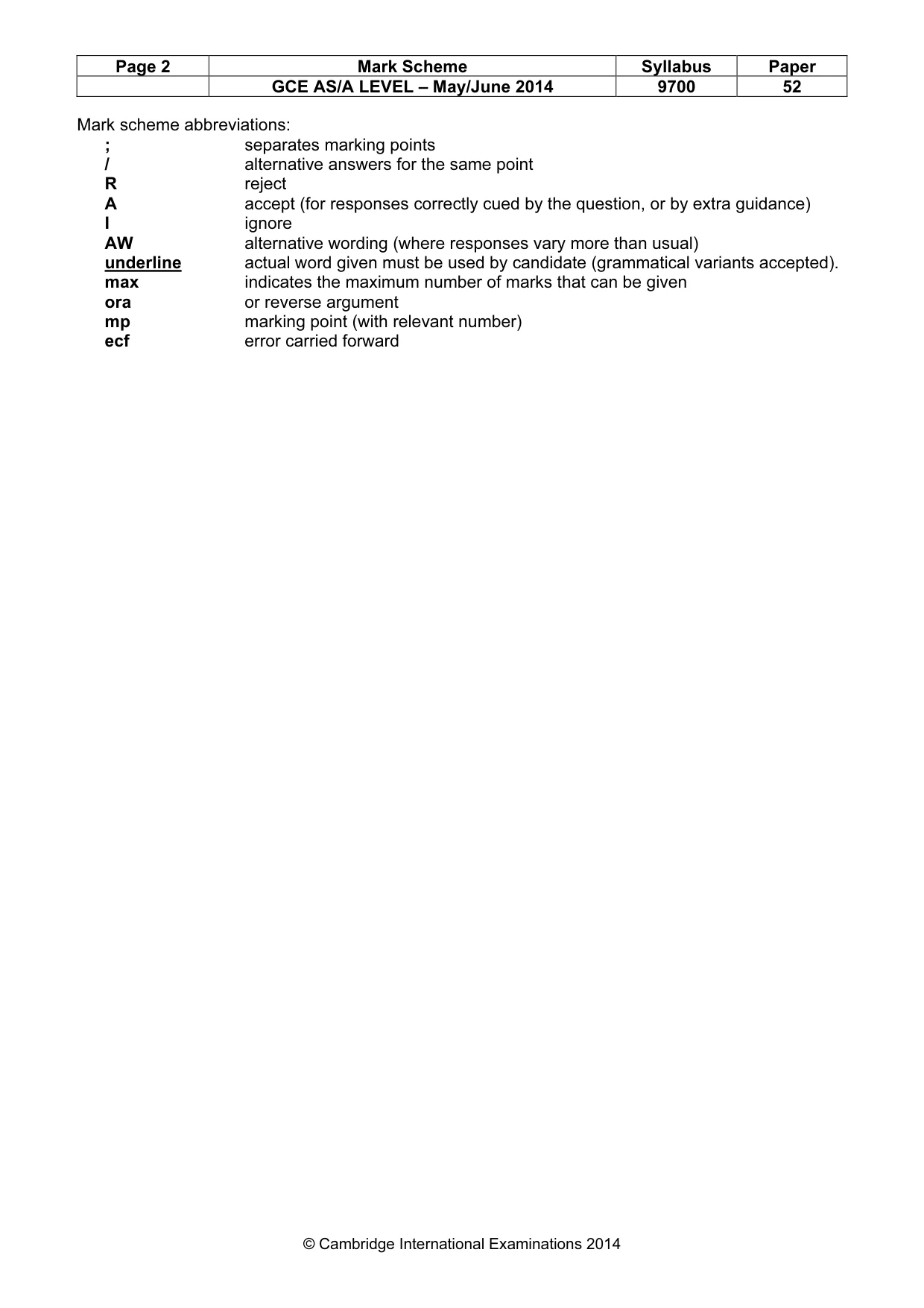
Page 2 Mark Scheme Syllabus Paper GCE AS/A LEVEL – May/June 2014 9700 52 © Cambridge International Examinations 2014 Mark scheme abbreviations: ; separates marking points / alternative answers for the same point R reject A accept (for responses correctly cued by the question, or by extra guidance) I ignore AW alternative wording (where responses vary more than usual) underline actual word given must be used by candidate (grammatical variants accepted). max indicates the maximum number of marks that can be given ora or reverse argument mp marking point (with relevant number) ecf error carried forward
Mark scheme, page 3
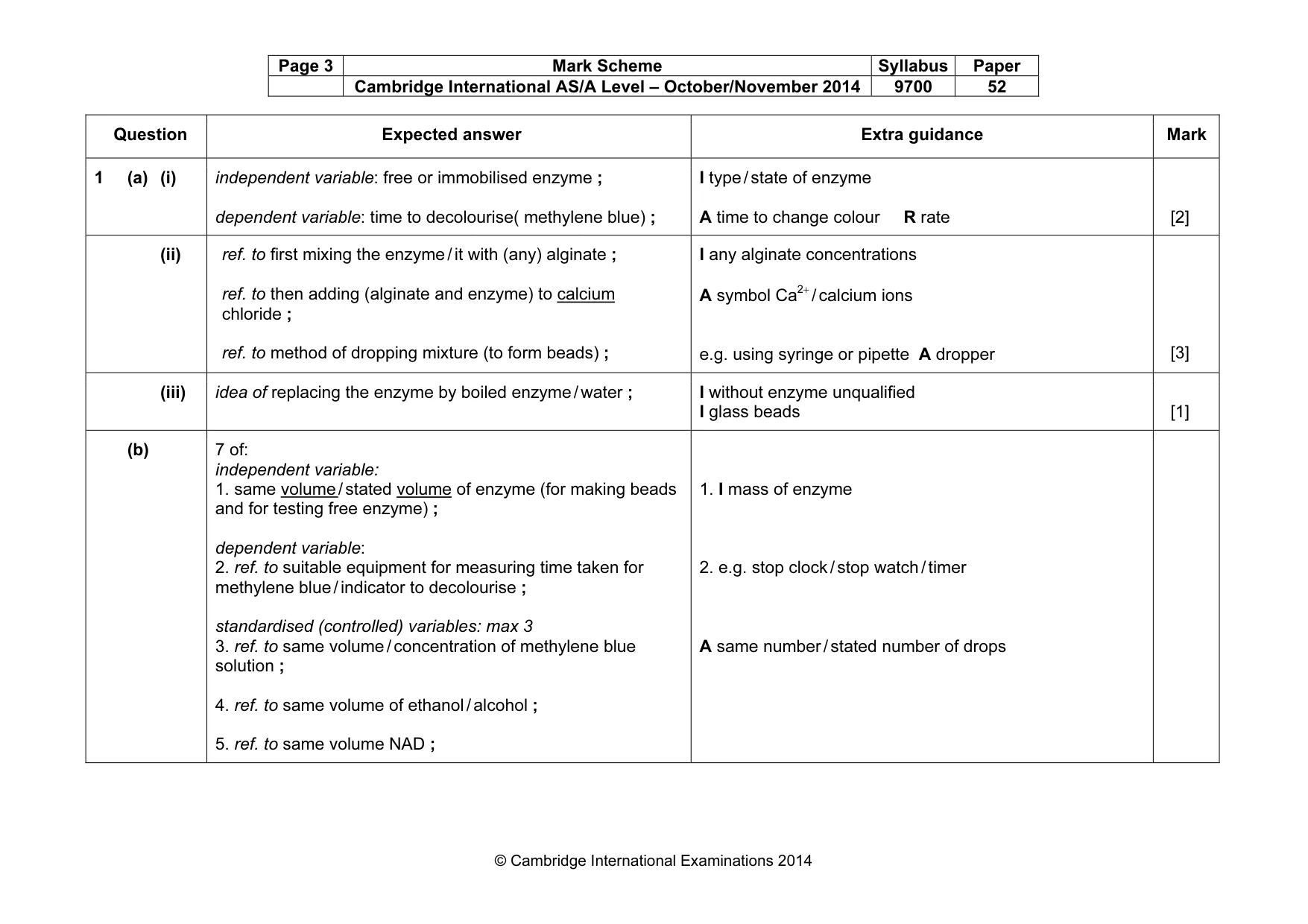
Page 3 Mark Scheme Syllabus Paper Cambridge International AS/A Level – October/November 2014 9700 52 © Cambridge International Examinations 2014 Question Expected answer Extra guidance Mark 1 (a) (i) independent variable: free or immobilised enzyme ; dependent variable: time to decolourise( methylene blue) ; I type / state of enzyme A time to change colour R rate [2] (ii) ref. to first mixing the enzyme / it with (any) alginate ; ref. to then adding (alginate and enzyme) to calcium chloride ; ref. to method of dropping mixture (to form beads) ; I any alginate concentrations A symbol Ca2+ / calcium ions e.g. using syringe or pipette A dropper [3] (iii) idea of replacing the enzyme by boiled enzyme / water ; I without enzyme unqualified I glass beads [1] (b) 7 of: independent variable: 1. same volume / stated volume of enzyme (for making beads and for testing free enzyme) ; dependent variable: 2. ref. to suitable equipment for measuring time taken for methylene blue / indicator to decolourise ; standardised (controlled) variables: max 3 3. ref. to same volume / concentration of methylene blue solution ; 4. ref. to same volume of ethanol / alcohol ; 5. ref. to same volume NAD ; 1. I mass of enzyme 2. e.g. stop clock / stop watch / timer A same number / stated number of drops
Mark scheme, page 4
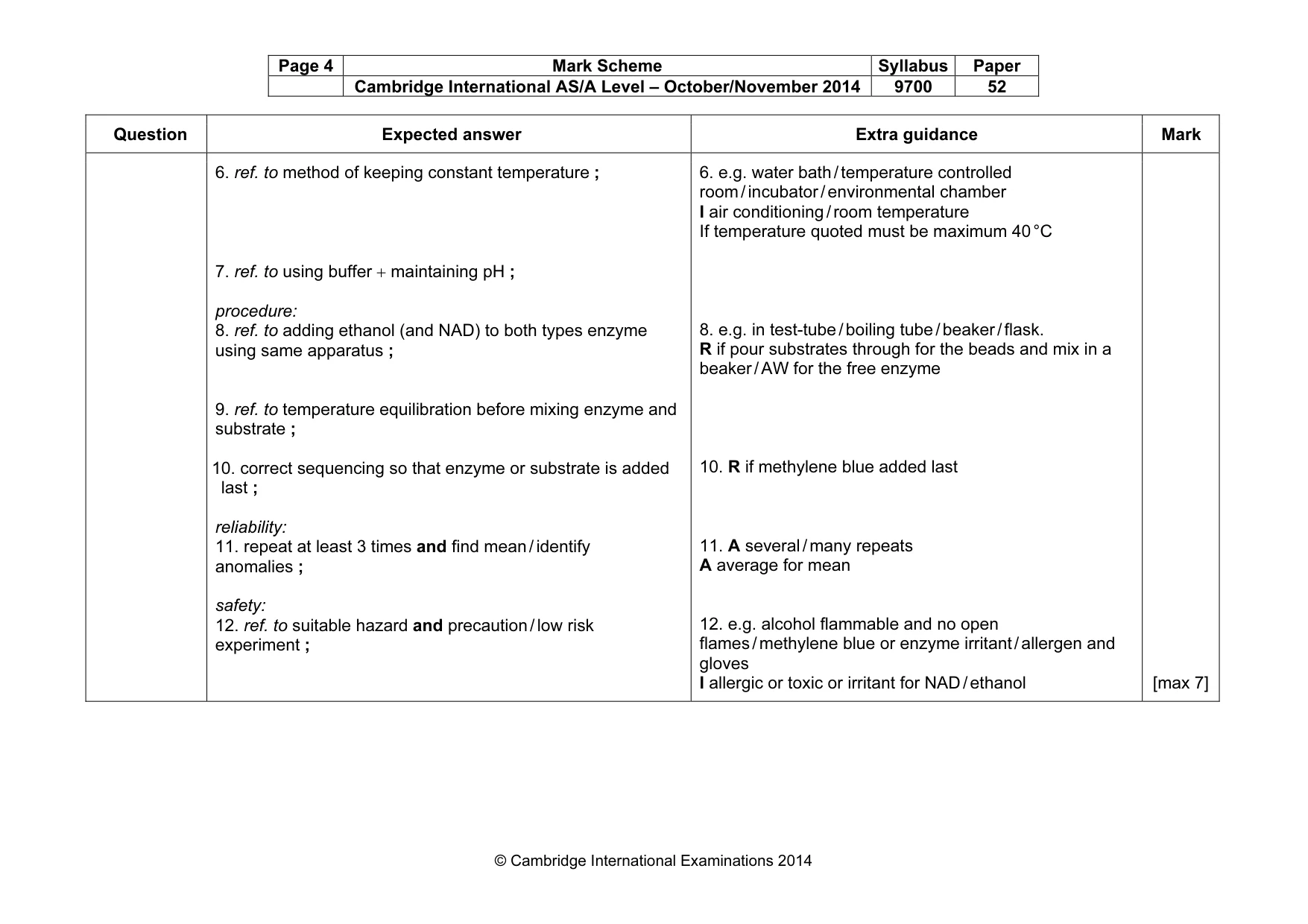
Page 4 Mark Scheme Syllabus Paper Cambridge International AS/A Level – October/November 2014 9700 52 © Cambridge International Examinations 2014 Question Expected answer Extra guidance Mark 6. ref. to method of keeping constant temperature ; 7. ref. to using buffer + maintaining pH ; procedure: 8. ref. to adding ethanol (and NAD) to both types enzyme using same apparatus ; 9. ref. to temperature equilibration before mixing enzyme and substrate ; 10. correct sequencing so that enzyme or substrate is added last ; reliability: 11. repeat at least 3 times and find mean / identify anomalies ; safety: 12. ref. to suitable hazard and precaution / low risk experiment ; 6. e.g. water bath / temperature controlled room / incubator / environmental chamber I air conditioning / room temperature If temperature quoted must be maximum 40 °C 8. e.g. in test-tube / boiling tube / beaker / flask. R if pour substrates through for the beads and mix in a beaker / AW for the free enzyme 10. R if methylene blue added last 11. A several / many repeats A average for mean 12. e.g. alcohol flammable and no open flames / methylene blue or enzyme irritant / allergen and gloves I allergic or toxic or irritant for NAD / ethanol [max 7]
Mark scheme, page 5
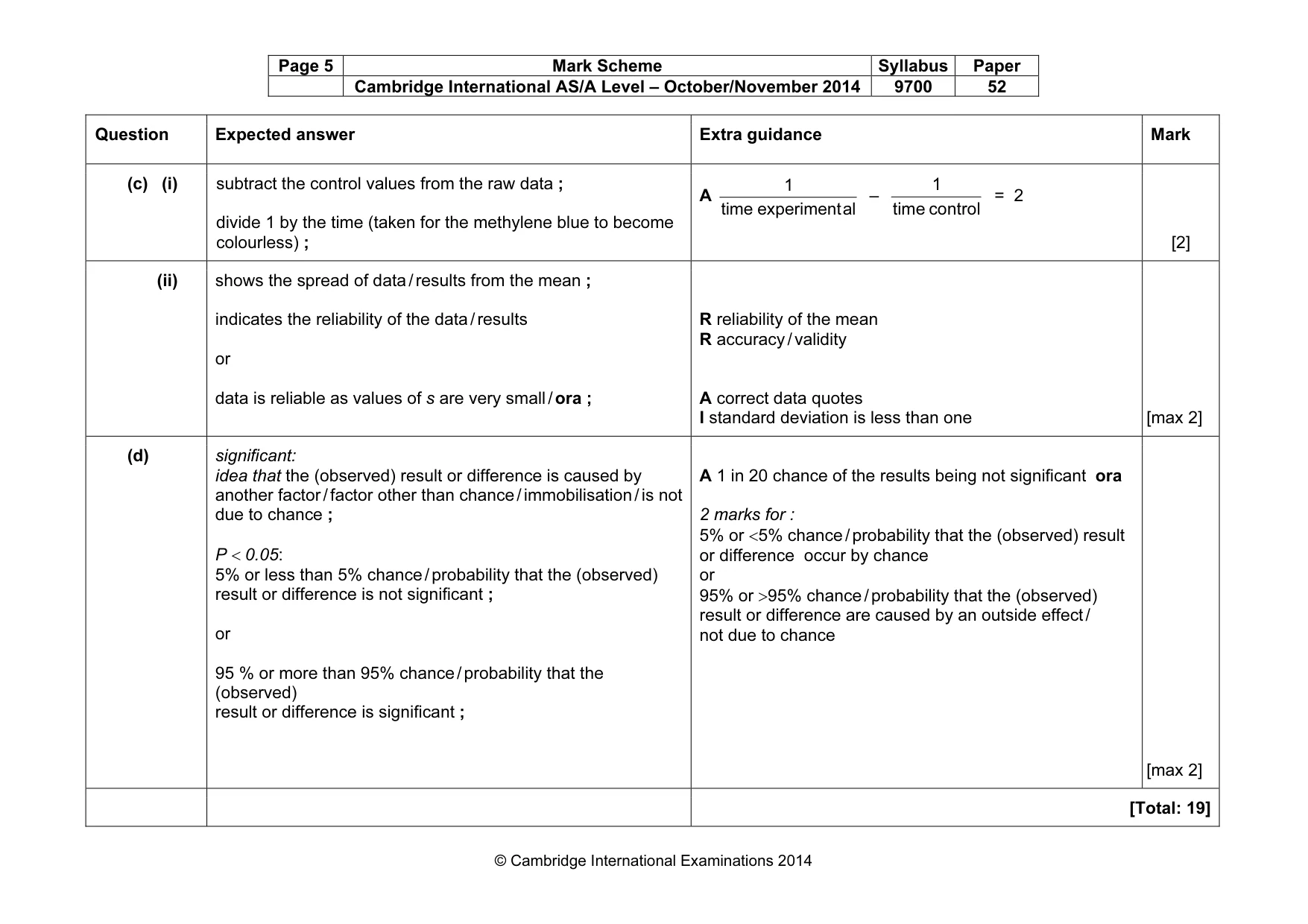
Page 5 Mark Scheme Syllabus Paper Cambridge International AS/A Level – October/November 2014 9700 52 © Cambridge International Examinations 2014 Question Expected answer Extra guidance Mark (c) (i) subtract the control values from the raw data ; divide 1 by the time (taken for the methylene blue to become colourless) ; A al experiment time 1 – control time 1 = 2 [2] (ii) shows the spread of data / results from the mean ; indicates the reliability of the data / results or data is reliable as values of s are very small / ora ; R reliability of the mean R accuracy / validity A correct data quotes I standard deviation is less than one [max 2] (d) significant: idea that the (observed) result or difference is caused by another factor / factor other than chance / immobilisation / is not due to chance ; P <=0.05: 5% or less than 5% chance / probability that the (observed) result or difference is not significant ; or 95 % or more than 95% chance / probability that the (observed) result or difference is significant ; A 1 in 20 chance of the results being not significant ora 2 marks for : 5% or <5% chance / probability that the (observed) result or difference occur by chance or 95% or >95% chance / probability that the (observed) result or difference are caused by an outside effect / not due to chance [max 2] [Total: 19]
Mark scheme, page 6
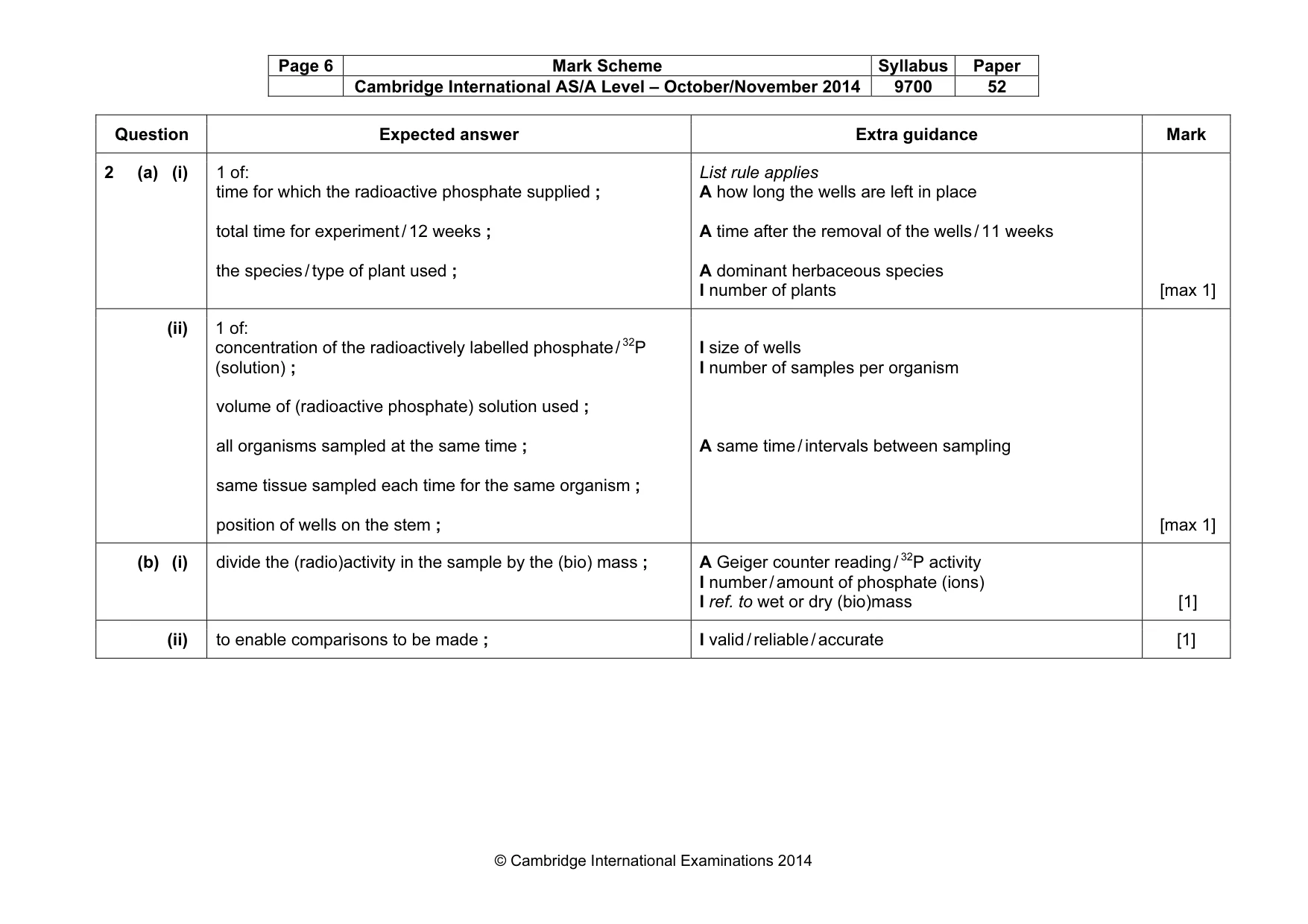
Page 6 Mark Scheme Syllabus Paper Cambridge International AS/A Level – October/November 2014 9700 52 © Cambridge International Examinations 2014 Question Expected answer Extra guidance Mark 2 (a) (i) 1 of: time for which the radioactive phosphate supplied ; total time for experiment / 12 weeks ; the species / type of plant used ; List rule applies A how long the wells are left in place A time after the removal of the wells / 11 weeks A dominant herbaceous species I number of plants [max 1] (ii) 1 of: concentration of the radioactively labelled phosphate / 32P (solution) ; volume of (radioactive phosphate) solution used ; all organisms sampled at the same time ; same tissue sampled each time for the same organism ; position of wells on the stem ; I size of wells I number of samples per organism A same time / intervals between sampling [max 1] (b) (i) divide the (radio)activity in the sample by the (bio) mass ; A Geiger counter reading / 32P activity I number / amount of phosphate (ions) I ref. to wet or dry (bio)mass [1] (ii) to enable comparisons to be made ; I valid / reliable / accurate [1]
Mark scheme, page 7
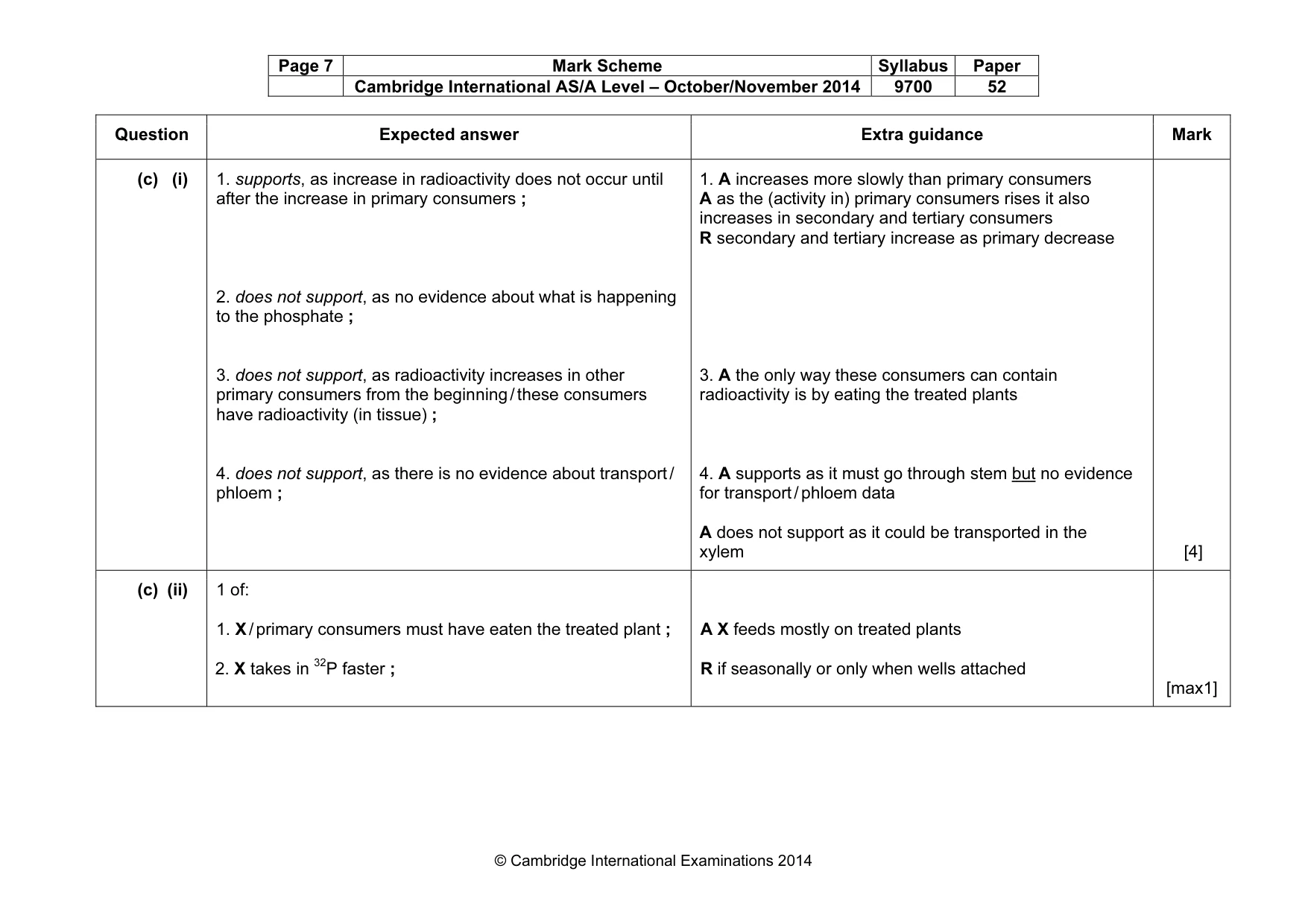
Page 7 Mark Scheme Syllabus Paper Cambridge International AS/A Level – October/November 2014 9700 52 © Cambridge International Examinations 2014 Question Expected answer Extra guidance Mark (c) (i) 1. supports, as increase in radioactivity does not occur until after the increase in primary consumers ; 2. does not support, as no evidence about what is happening to the phosphate ; 3. does not support, as radioactivity increases in other primary consumers from the beginning / these consumers have radioactivity (in tissue) ; 4. does not support, as there is no evidence about transport / phloem ; 1. A increases more slowly than primary consumers A as the (activity in) primary consumers rises it also increases in secondary and tertiary consumers R secondary and tertiary increase as primary decrease 3. A the only way these consumers can contain radioactivity is by eating the treated plants 4. A supports as it must go through stem but no evidence for transport / phloem data A does not support as it could be transported in the xylem [4] (c) (ii) 1 of: 1. X / primary consumers must have eaten the treated plant ; 2. X takes in 32P faster ; A X feeds mostly on treated plants R if seasonally or only when wells attached [max1]
Mark scheme, page 8
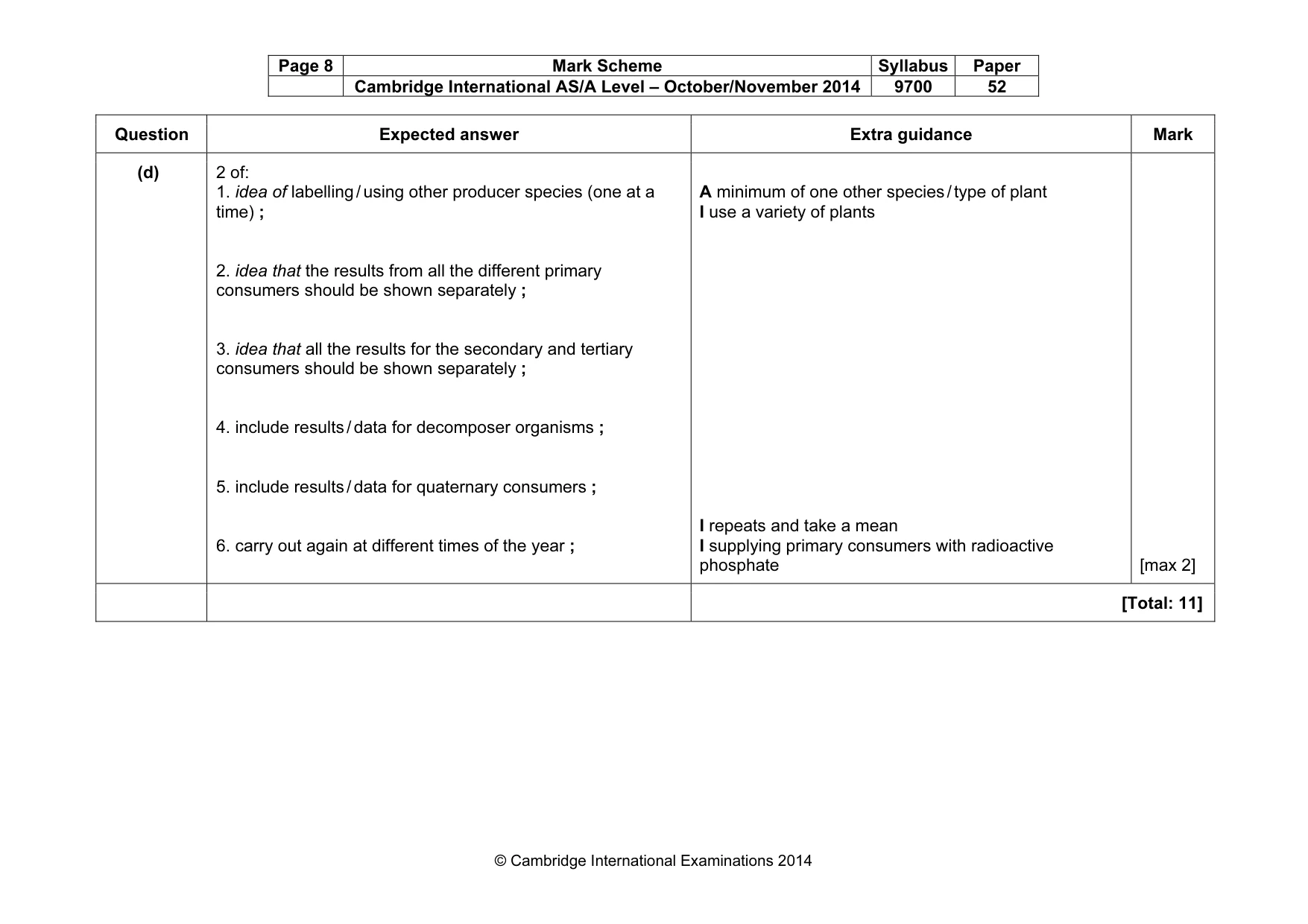
Page 8 Mark Scheme Syllabus Paper Cambridge International AS/A Level – October/November 2014 9700 52 © Cambridge International Examinations 2014 Question Expected answer Extra guidance Mark (d) 2 of: 1. idea of labelling / using other producer species (one at a time) ; 2. idea that the results from all the different primary consumers should be shown separately ; 3. idea that all the results for the secondary and tertiary consumers should be shown separately ; 4. include results / data for decomposer organisms ; 5. include results / data for quaternary consumers ; 6. carry out again at different times of the year ; A minimum of one other species / type of plant I use a variety of plants I repeats and take a mean I supplying primary consumers with radioactive phosphate [max 2] [Total: 11]
What you needed in this session
Cambridge’s own grade thresholds for 2014 Oct/Nov, Paper 5 · Variant 2. A higher threshold means an easier paper — the bar moves with how the cohort did.