Cambridge A Level Biology 9700 — 2014 Oct/Nov Paper 5 · Variant 3
9700/53/O/N/14 · 30 marks · ≈34 min
The question paper and its mark scheme, free to read here and free to download. This is Cambridge’s own paper, exactly as it was sat.
Question paper8 pages
Mark scheme9 pages
Answers below. Sit the paper first if you are practising.
Paper as text
Question paper, page 1
This document consists of 8 printed pages. DC (NH/JG) 81091/4 © UCLES 2014 [Turn over * 8 9 3 2 5 3 8 1 1 6 * BIOLOGY 9700/53 Paper 5 Planning, Analysis and Evaluation October/November 2014 1 hour 15 minutes Candidates answer on the Question Paper. No Additional Materials are required. READ THESE INSTRUCTIONS FIRST Write your Centre number, candidate number and name on all the work you hand in. Write in dark blue or black pen. You may use an HB pencil for any diagrams or graphs. Do not use staples, paper clips, glue or correction fluid. DO NOT WRITE IN ANY BARCODES. Answer all questions. Electronic calculators may be used. You may lose marks if you do not show your working or if you do not use appropriate units. At the end of the examination, fasten all your work securely together. The number of marks is given in brackets [ ] at the end of each question or part question. Cambridge International Examinations Cambridge International Advanced Level
Question paper, page 2
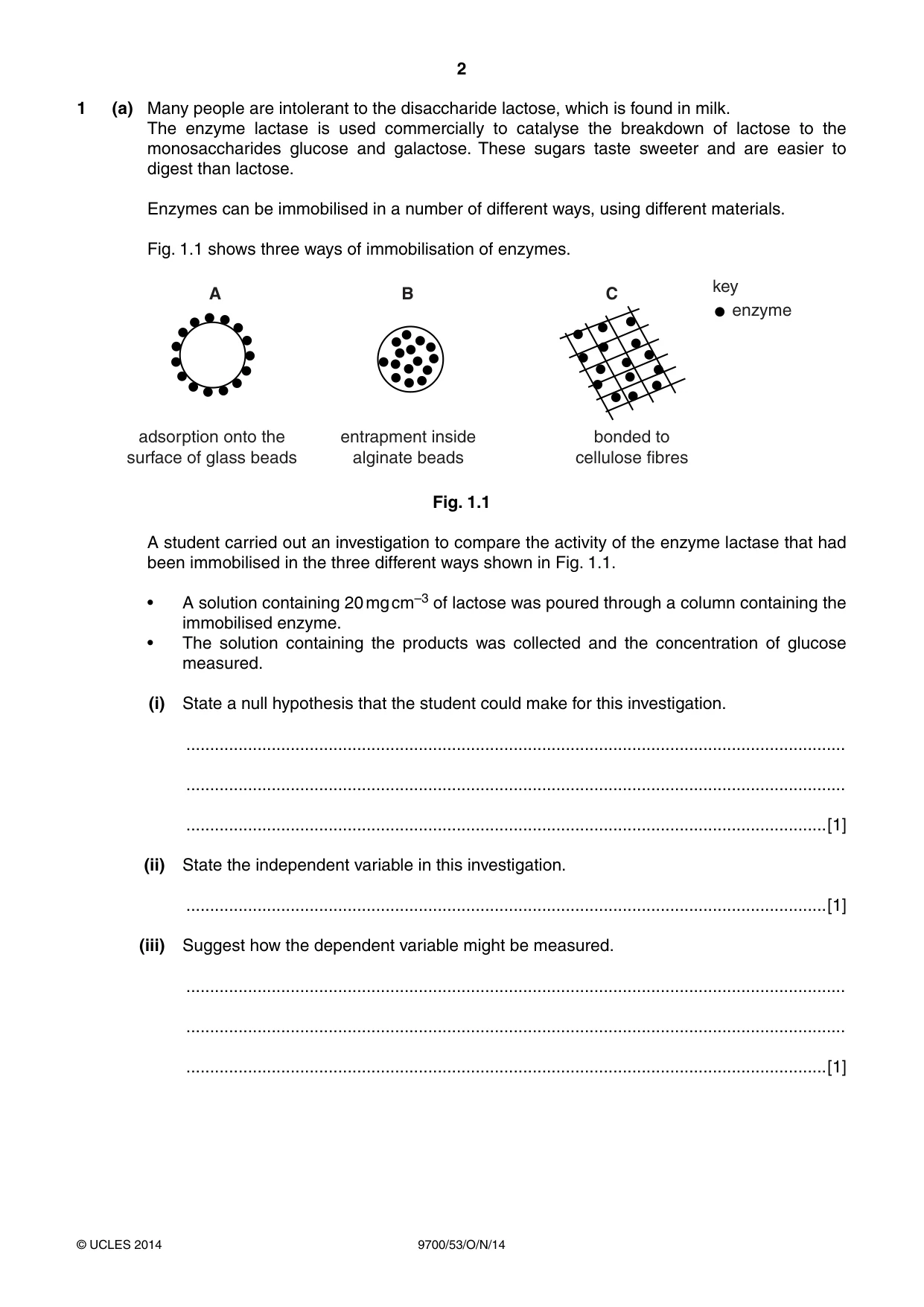
2 9700/53/O/N/14 © UCLES 2014 1 (a) Many people are intolerant to the disaccharide lactose, which is found in milk. The enzyme lactase is used commercially to catalyse the breakdown of lactose to the monosaccharides glucose and galactose. These sugars taste sweeter and are easier to digest than lactose. Enzymes can be immobilised in a number of different ways, using different materials. Fig. 1.1 shows three ways of immobilisation of enzymes. key enzyme bonded to cellulose fibres entrapment inside alginate beads adsorption onto the surface of glass beads A B C Fig. 1.1 A student carried out an investigation to compare the activity of the enzyme lactase that had been immobilised in the three different ways shown in Fig. 1.1. • A solution containing 20 mg cm–3 of lactose was poured through a column containing the immobilised enzyme. • The solution containing the products was collected and the concentration of glucose measured. (i) State a null hypothesis that the student could make for this investigation. … … …[1] (ii) State the independent variable in this investigation. …[1] (iii) Suggest how the dependent variable might be measured. … … …[1]
Question paper, page 3
3 9700/53/O/N/14 © UCLES 2014 [Turn over (b) Outline a procedure the student could use to compare the activity of lactase that has been immobilised in different ways. Your method should be detailed enough for another person to use. … … … … … … … … … … … … … … … … … … … … … … … … … …[7]
Question paper, page 4
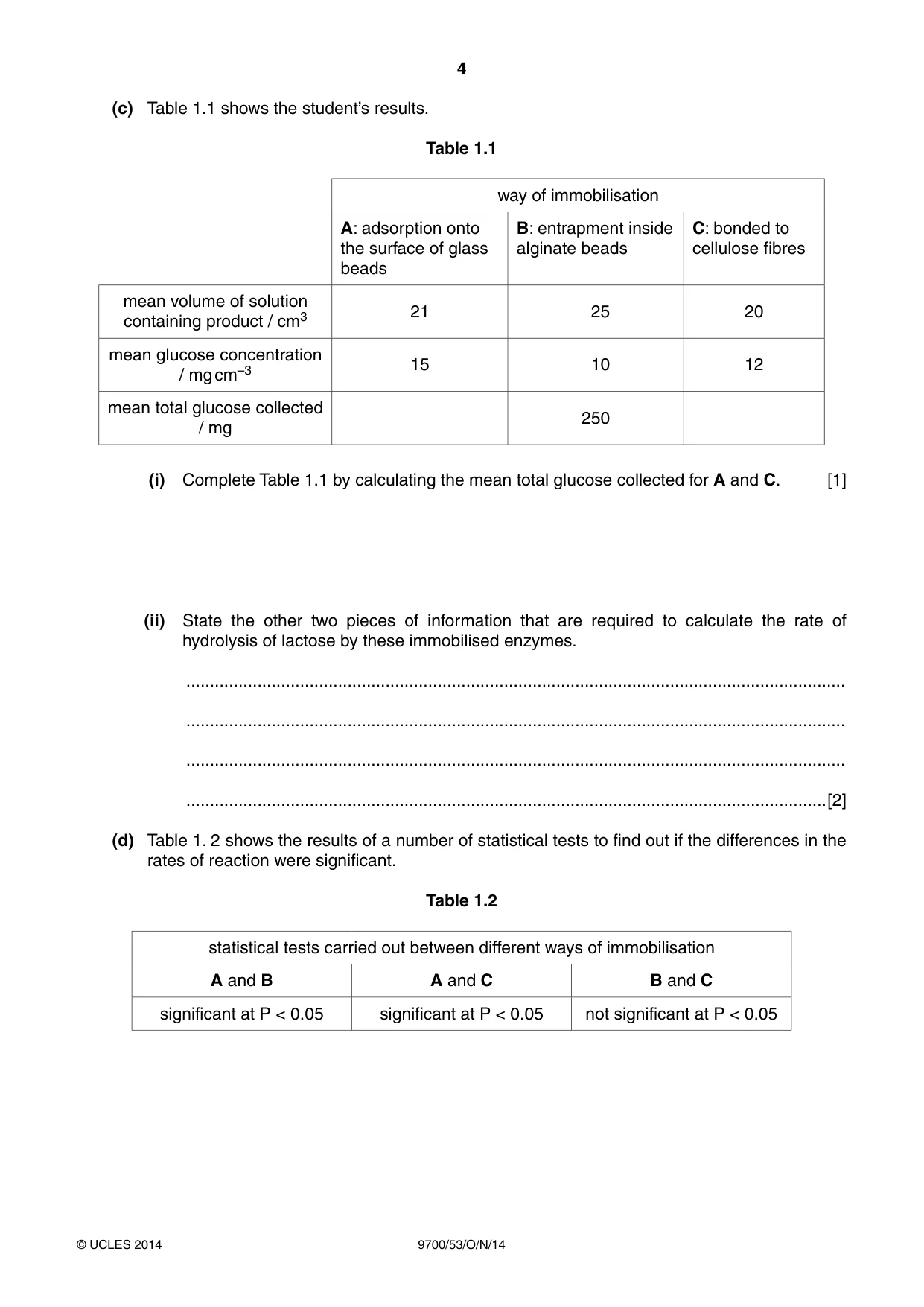
4 9700/53/O/N/14 © UCLES 2014 (c) Table 1.1 shows the student’s results. Table 1.1 way of immobilisation A: adsorption onto the surface of glass beads B: entrapment inside alginate beads C: bonded to cellulose fibres mean volume of solution containing product / cm3 21 25 20 mean glucose concentration / mg cm–3 15 10 12 mean total glucose collected / mg 250 (i) Complete Table 1.1 by calculating the mean total glucose collected for A and C. [1] (ii) State the other two pieces of information that are required to calculate the rate of hydrolysis of lactose by these immobilised enzymes. … … … …[2] (d) Table 1. 2 shows the results of a number of statistical tests to find out if the differences in the rates of reaction were significant. Table 1.2 statistical tests carried out between different ways of immobilisation A and B A and C B and C significant at P < 0.05 significant at P < 0.05 not significant at P < 0.05
Question paper, page 5
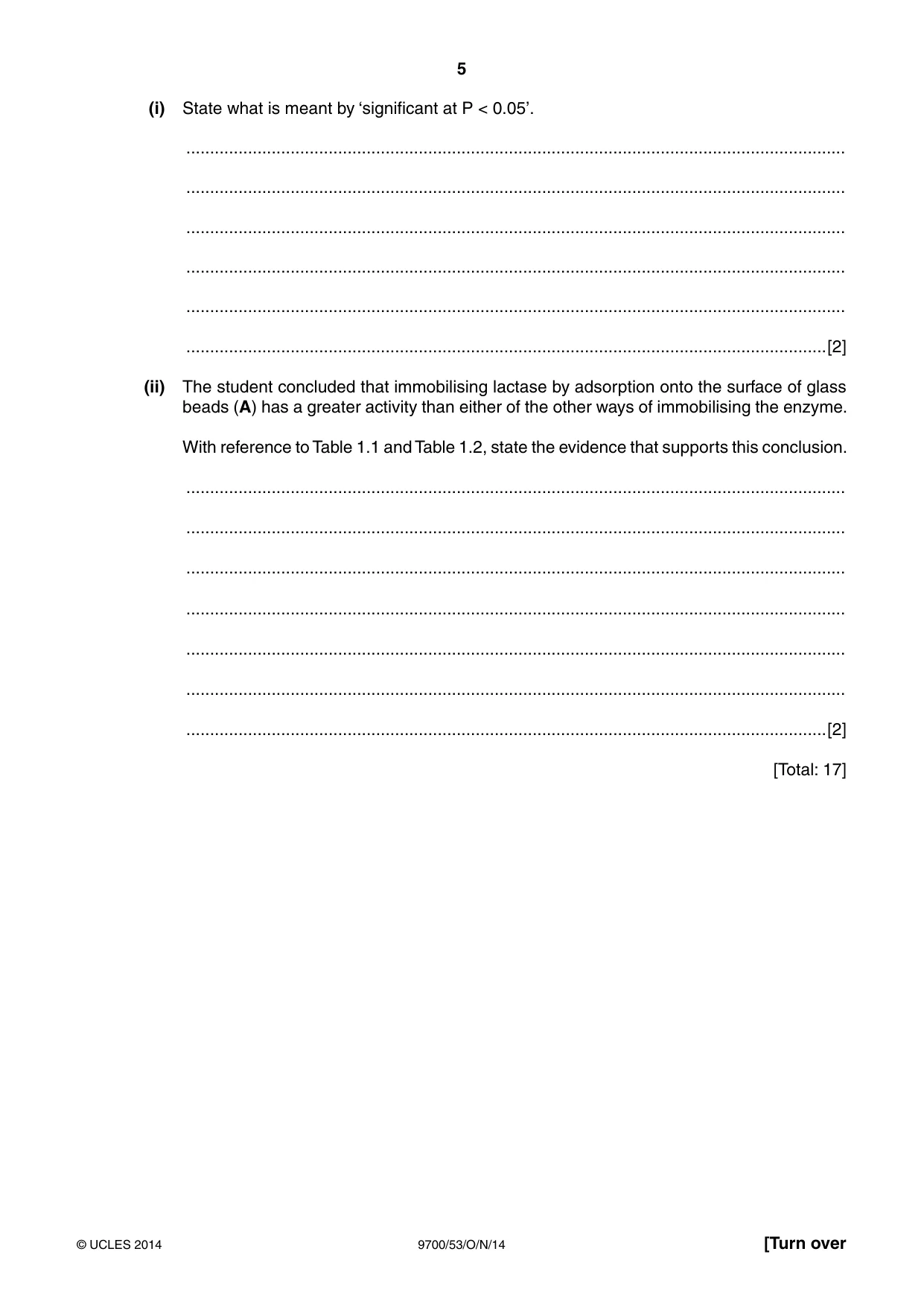
5 9700/53/O/N/14 © UCLES 2014 [Turn over (i) State what is meant by ‘significant at P < 0.05’. … … … … … …[2] (ii) The student concluded that immobilising lactase by adsorption onto the surface of glass beads (A) has a greater activity than either of the other ways of immobilising the enzyme. With reference to Table 1.1 and Table 1.2, state the evidence that supports this conclusion. … … … … … … …[2] [Total: 17]
Question paper, page 6
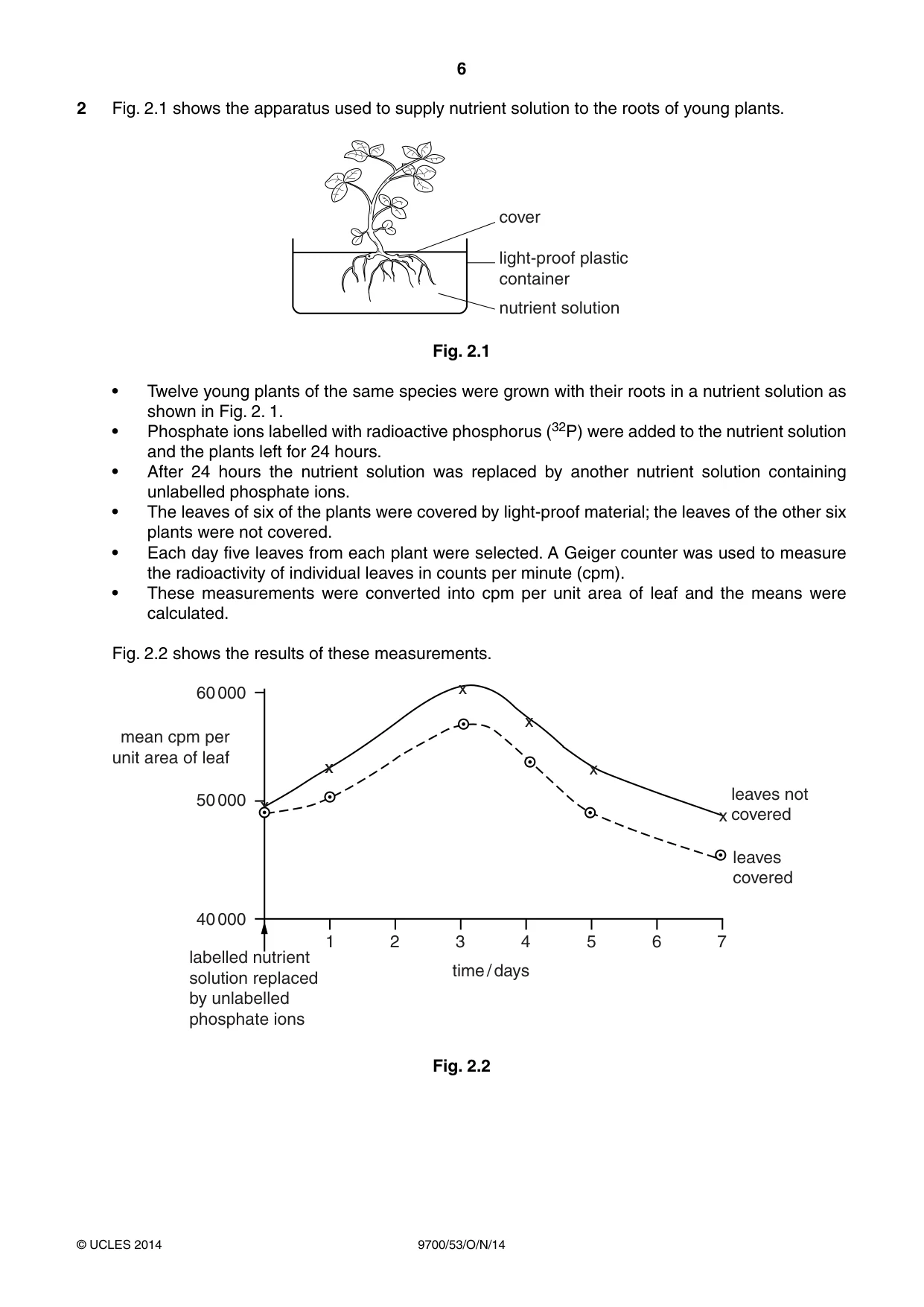
6 9700/53/O/N/14 © UCLES 2014 2 Fig. 2.1 shows the apparatus used to supply nutrient solution to the roots of young plants. cover nutrient solution light-proof plastic container Fig. 2.1 • Twelve young plants of the same species were grown with their roots in a nutrient solution as shown in Fig. 2. 1. • Phosphate ions labelled with radioactive phosphorus (32P) were added to the nutrient solution and the plants left for 24 hours. • After 24 hours the nutrient solution was replaced by another nutrient solution containing unlabelled phosphate ions. • The leaves of six of the plants were covered by light-proof material; the leaves of the other six plants were not covered. • Each day five leaves from each plant were selected. A Geiger counter was used to measure the radioactivity of individual leaves in counts per minute (cpm). • These measurements were converted into cpm per unit area of leaf and the means were calculated. Fig. 2.2 shows the results of these measurements. 1 labelled nutrient solution replaced by unlabelled phosphate ions 2 3 4 5 6 7 time / days 60 000 50 000 40 000 x x x x x x mean cpm per unit area of leaf leaves not covered leaves covered Fig. 2.2
Question paper, page 7
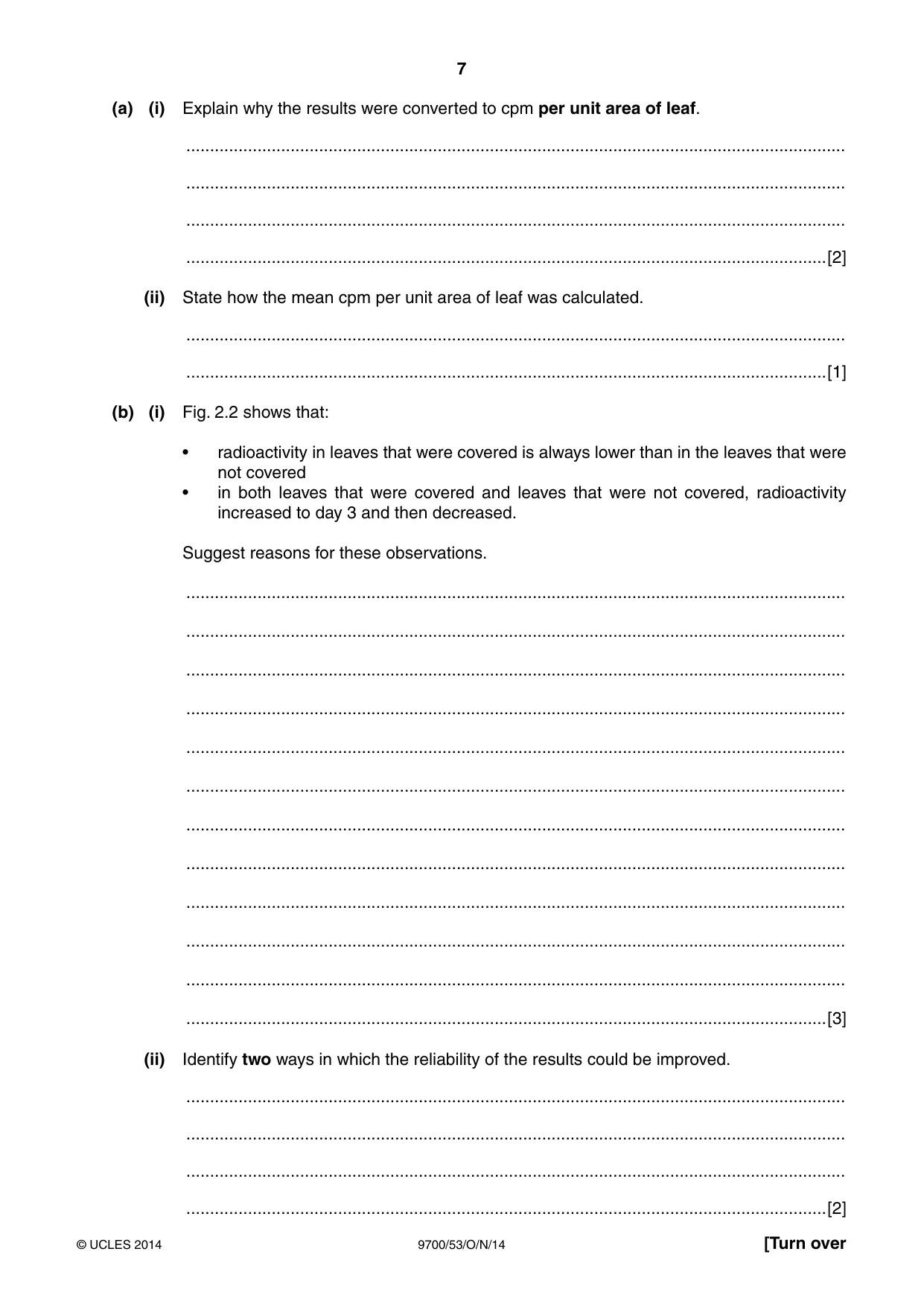
7 9700/53/O/N/14 © UCLES 2014 [Turn over (a) (i) Explain why the results were converted to cpm per unit area of leaf. … … … …[2] (ii) State how the mean cpm per unit area of leaf was calculated. … …[1] (b) (i) Fig. 2.2 shows that: • radioactivity in leaves that were covered is always lower than in the leaves that were not covered • in both leaves that were covered and leaves that were not covered, radioactivity increased to day 3 and then decreased. Suggest reasons for these observations. … … … … … … … … … … … …[3] (ii) Identify two ways in which the reliability of the results could be improved. … … … …[2]
Question paper, page 8
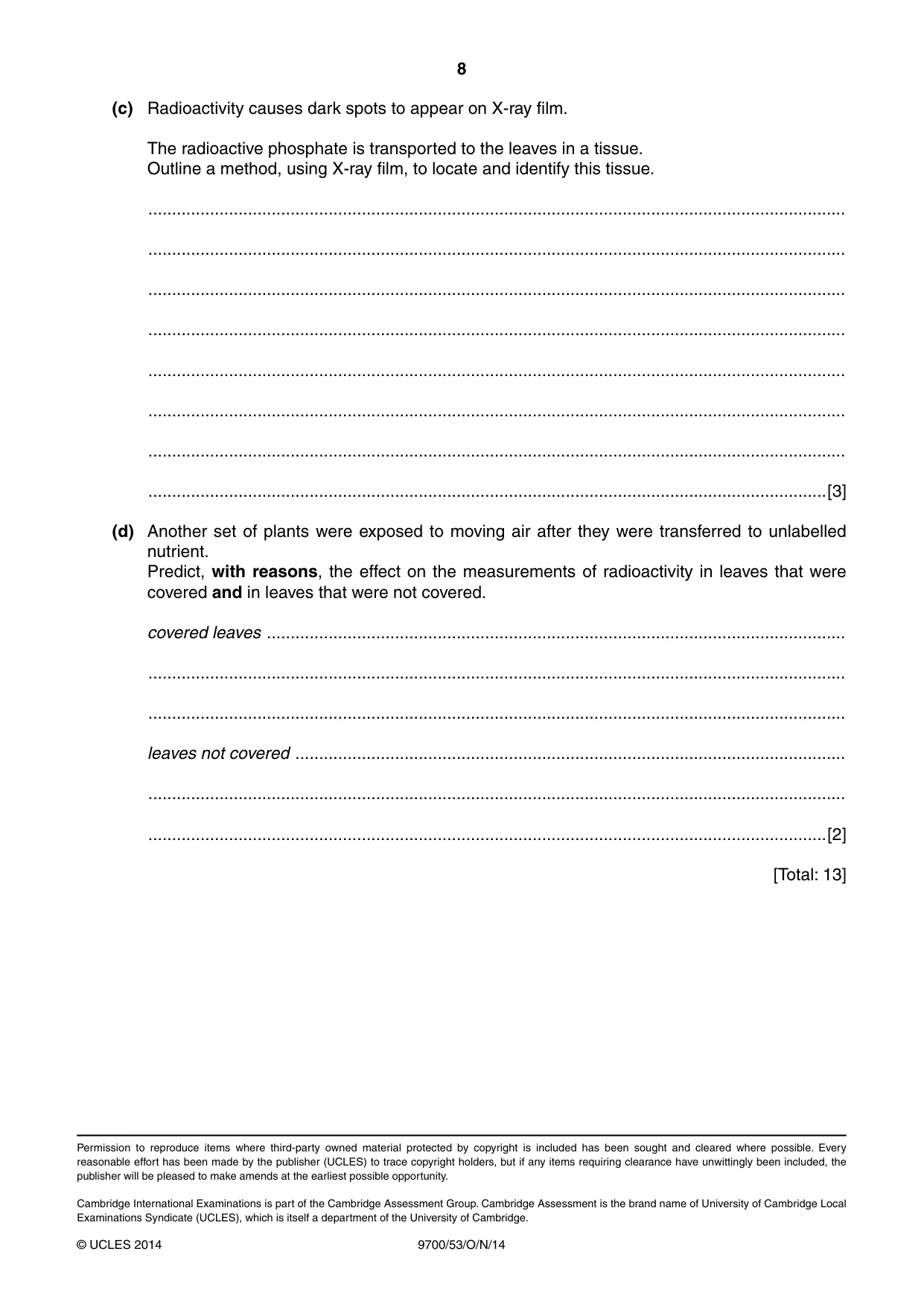
8 9700/53/O/N/14 © UCLES 2014 Permission to reproduce items where third-party owned material protected by copyright is included has been sought and cleared where possible. Every reasonable effort has been made by the publisher (UCLES) to trace copyright holders, but if any items requiring clearance have unwittingly been included, the publisher will be pleased to make amends at the earliest possible opportunity. Cambridge International Examinations is part of the Cambridge Assessment Group. Cambridge Assessment is the brand name of University of Cambridge Local Examinations Syndicate (UCLES), which is itself a department of the University of Cambridge. (c) Radioactivity causes dark spots to appear on X-ray film. The radioactive phosphate is transported to the leaves in a tissue. Outline a method, using X-ray film, to locate and identify this tissue. … … … … … … … …[3] (d) Another set of plants were exposed to moving air after they were transferred to unlabelled nutrient. Predict, with reasons, the effect on the measurements of radioactivity in leaves that were covered and in leaves that were not covered. covered leaves … … … leaves not covered … … …[2] [Total: 13]
Mark scheme, page 1
® IGCSE is the registered trademark of Cambridge International Examinations. CAMBRIDGE INTERNATIONAL EXAMINATIONS Cambridge International Advanced Subsidiary and Advanced Level MARK SCHEME for the October/November 2014 series 9700 BIOLOGY 9700/53 Paper 5 (Planning, Analysis and Evaluation), maximum raw mark 53 This mark scheme is published as an aid to teachers and candidates, to indicate the requirements of the examination. It shows the basis on which Examiners were instructed to award marks. It does not indicate the details of the discussions that took place at an Examiners’ meeting before marking began, which would have considered the acceptability of alternative answers. Mark schemes should be read in conjunction with the question paper and the Principal Examiner Report for Teachers. Cambridge will not enter into discussions about these mark schemes. Cambridge is publishing the mark schemes for the October/November 2014 series for most Cambridge IGCSE®, Cambridge International A and AS Level components and some Cambridge O Level components.
Mark scheme, page 2
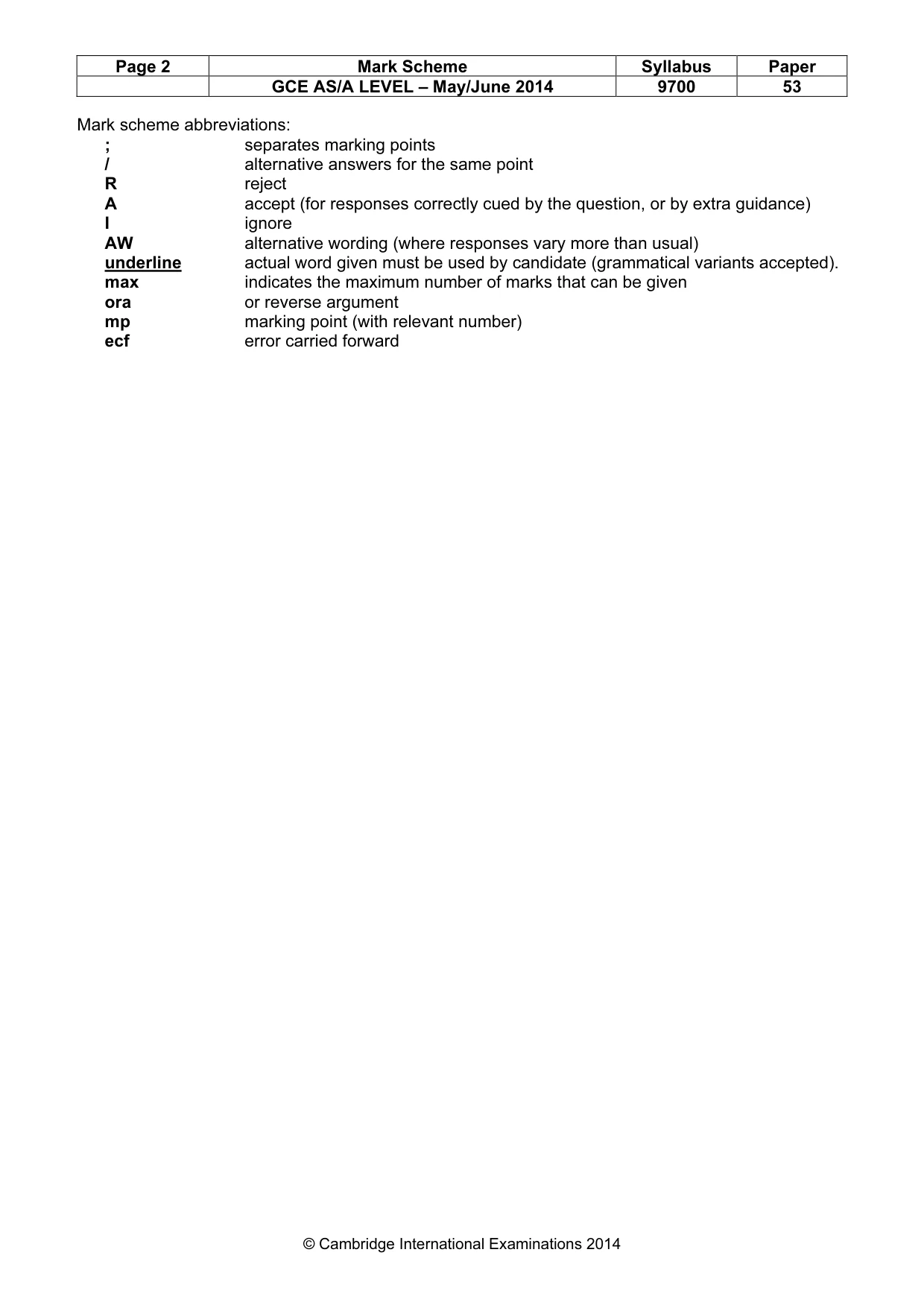
Page 2 Mark Scheme Syllabus Paper GCE AS/A LEVEL – May/June 2014 9700 53 © Cambridge International Examinations 2014 Mark scheme abbreviations: ; separates marking points / alternative answers for the same point R reject A accept (for responses correctly cued by the question, or by extra guidance) I ignore AW alternative wording (where responses vary more than usual) underline actual word given must be used by candidate (grammatical variants accepted). max indicates the maximum number of marks that can be given ora or reverse argument mp marking point (with relevant number) ecf error carried forward
Mark scheme, page 3
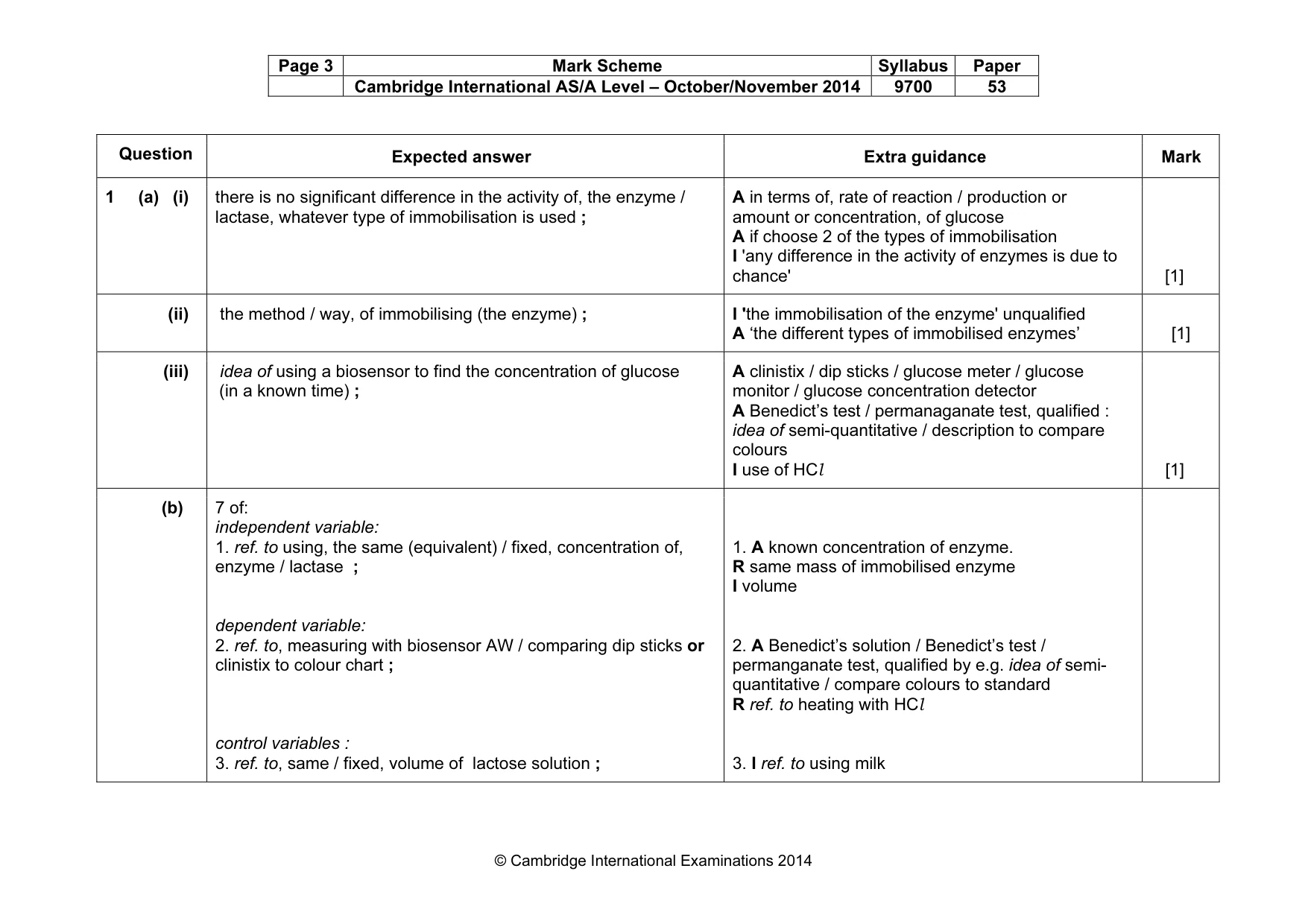
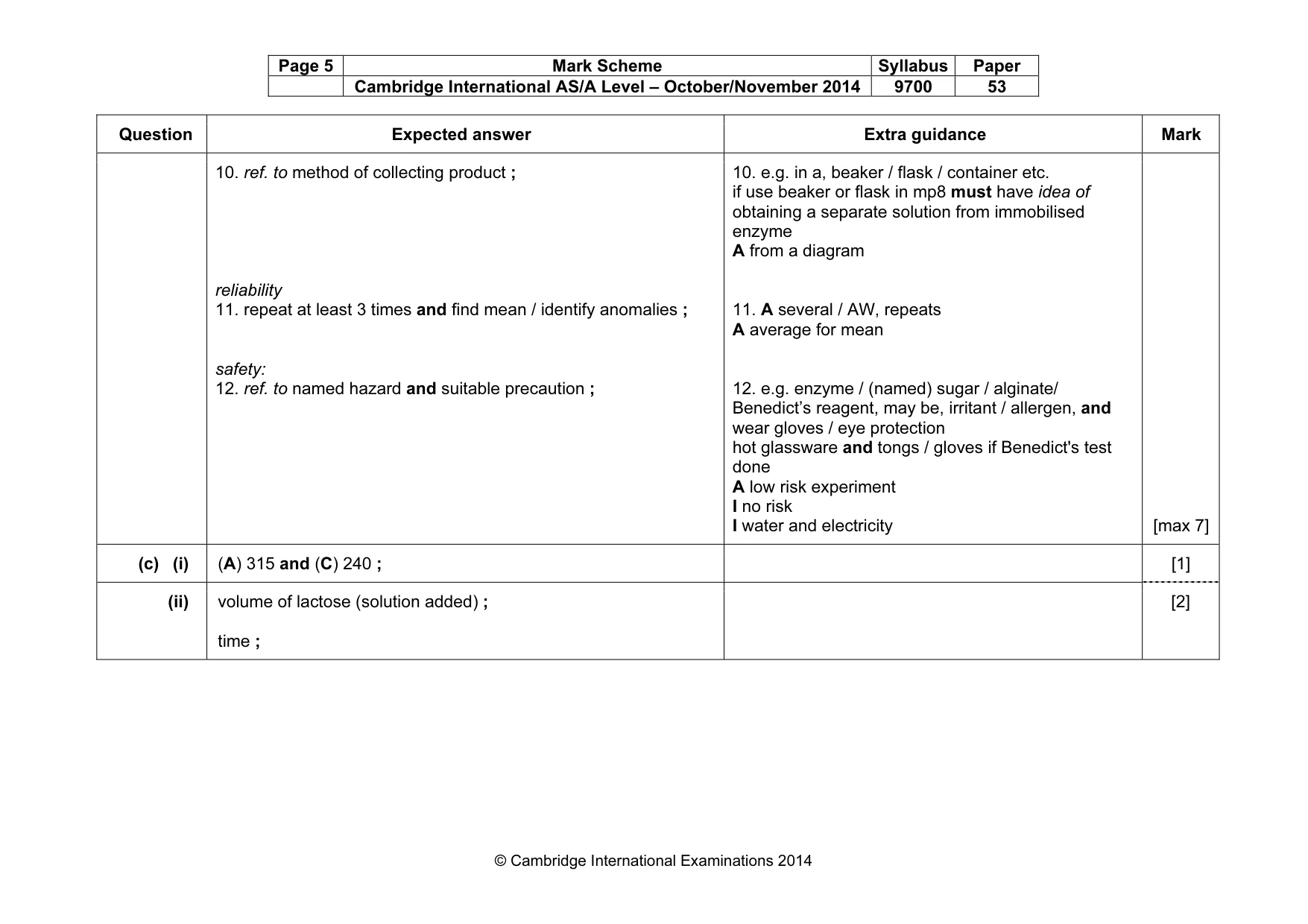
Page 3 Mark Scheme Syllabus Paper Cambridge International AS/A Level – October/November 2014 9700 53 © Cambridge International Examinations 2014 Question Expected answer Extra guidance Mark 1 (a) (i) there is no significant difference in the activity of, the enzyme / lactase, whatever type of immobilisation is used ; A in terms of, rate of reaction / production or amount or concentration, of glucose A if choose 2 of the types of immobilisation I 'any difference in the activity of enzymes is due to chance' [1] (ii) the method / way, of immobilising (the enzyme) ; I 'the immobilisation of the enzyme' unqualified A ‘the different types of immobilised enzymes’ [1] (iii) idea of using a biosensor to find the concentration of glucose (in a known time) ; A clinistix / dip sticks / glucose meter / glucose monitor / glucose concentration detector A Benedict’s test / permanaganate test, qualified : idea of semi-quantitative / description to compare colours I use of HCl [1] (b) 7 of: independent variable: 1. ref. to using, the same (equivalent) / fixed, concentration of, enzyme / lactase ; dependent variable: 2. ref. to, measuring with biosensor AW / comparing dip sticks or clinistix to colour chart ; control variables : 3. ref. to, same / fixed, volume of lactose solution ; 1. A known concentration of enzyme. R same mass of immobilised enzyme I volume 2. A Benedict’s solution / Benedict’s test / permanganate test, qualified by e.g. idea of semi- quantitative / compare colours to standard R ref. to heating with HCl 3. I ref. to using milk
Mark scheme, page 4
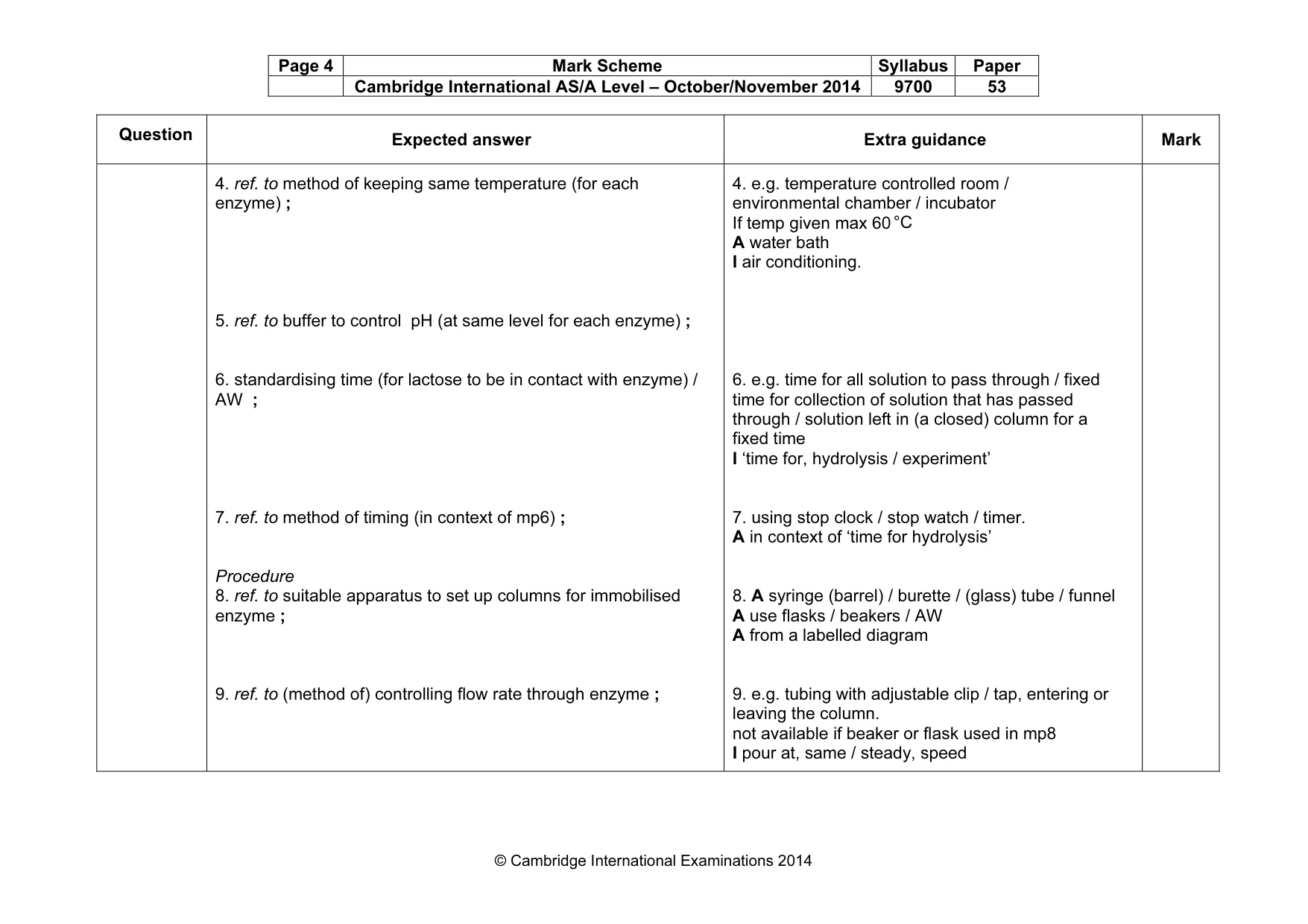
Page 4 Mark Scheme Syllabus Paper Cambridge International AS/A Level – October/November 2014 9700 53 © Cambridge International Examinations 2014 Question Expected answer Extra guidance Mark 4. ref. to method of keeping same temperature (for each enzyme) ; 5. ref. to buffer to control pH (at same level for each enzyme) ; 6. standardising time (for lactose to be in contact with enzyme) / AW ; 7. ref. to method of timing (in context of mp6) ; Procedure 8. ref. to suitable apparatus to set up columns for immobilised enzyme ; 9. ref. to (method of) controlling flow rate through enzyme ; 4. e.g. temperature controlled room / environmental chamber / incubator If temp given max 60 °C A water bath I air conditioning. 6. e.g. time for all solution to pass through / fixed time for collection of solution that has passed through / solution left in (a closed) column for a fixed time I ‘time for, hydrolysis / experiment’ 7. using stop clock / stop watch / timer. A in context of ‘time for hydrolysis’ 8. A syringe (barrel) / burette / (glass) tube / funnel A use flasks / beakers / AW A from a labelled diagram 9. e.g. tubing with adjustable clip / tap, entering or leaving the column. not available if beaker or flask used in mp8 I pour at, same / steady, speed
Mark scheme, page 5
Page 5 Mark Scheme Syllabus Paper Cambridge International AS/A Level – October/November 2014 9700 53 © Cambridge International Examinations 2014 Question Expected answer Extra guidance Mark 10. ref. to method of collecting product ; reliability 11. repeat at least 3 times and find mean / identify anomalies ; safety: 12. ref. to named hazard and suitable precaution ; 10. e.g. in a, beaker / flask / container etc. if use beaker or flask in mp8 must have idea of obtaining a separate solution from immobilised enzyme A from a diagram 11. A several / AW, repeats A average for mean 12. e.g. enzyme / (named) sugar / alginate/ Benedict’s reagent, may be, irritant / allergen, and wear gloves / eye protection hot glassware and tongs / gloves if Benedict's test done A low risk experiment I no risk I water and electricity [max 7] (c) (i) (A) 315 and (C) 240 ; [1] (ii) volume of lactose (solution added) ; time ; [2]
Mark scheme, page 6
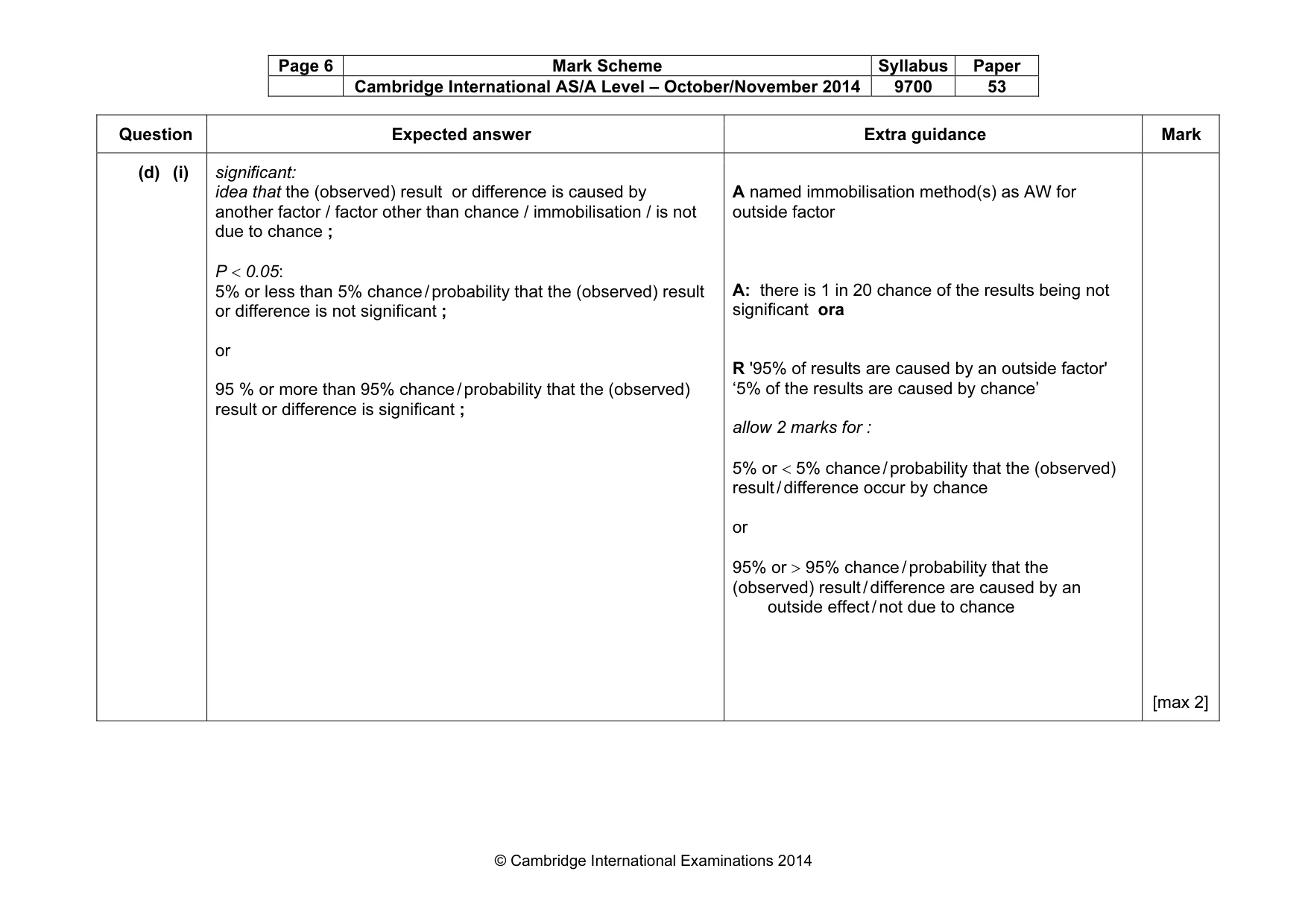
Page 6 Mark Scheme Syllabus Paper Cambridge International AS/A Level – October/November 2014 9700 53 © Cambridge International Examinations 2014 Question Expected answer Extra guidance Mark (d) (i) significant: idea that the (observed) result or difference is caused by another factor / factor other than chance / immobilisation / is not due to chance ; P < 0.05: 5% or less than 5% chance / probability that the (observed) result or difference is not significant ; or 95 % or more than 95% chance / probability that the (observed) result or difference is significant ; A named immobilisation method(s) as AW for outside factor A: there is 1 in 20 chance of the results being not significant ora R '95% of results are caused by an outside factor' ‘5% of the results are caused by chance’ allow 2 marks for : 5% or < 5% chance / probability that the (observed) result / difference occur by chance or 95% or > 95% chance / probability that the (observed) result / difference are caused by an outside effect / not due to chance [max 2]
Mark scheme, page 7
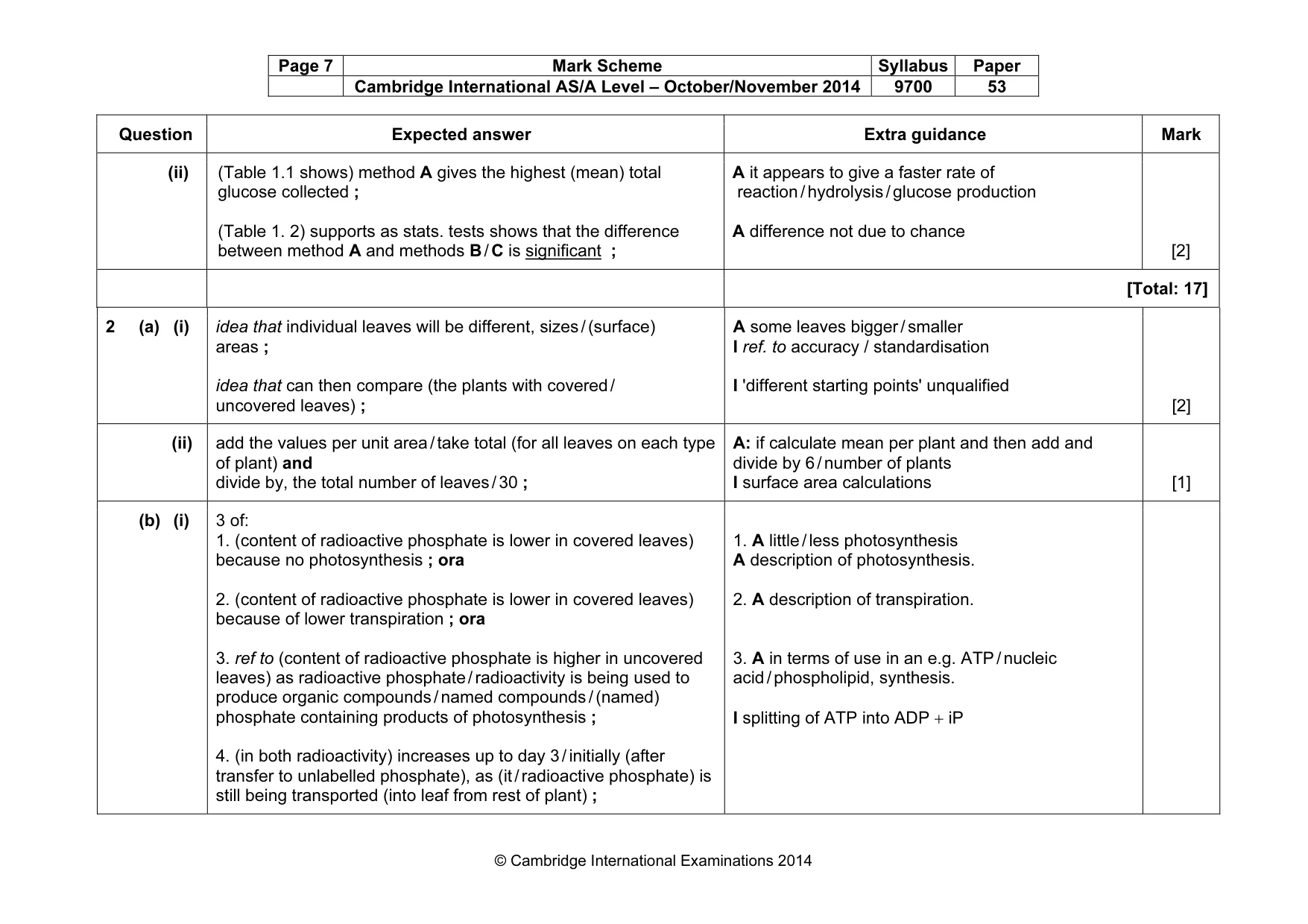
Page 7 Mark Scheme Syllabus Paper Cambridge International AS/A Level – October/November 2014 9700 53 © Cambridge International Examinations 2014 Question Expected answer Extra guidance Mark (ii) (Table 1.1 shows) method A gives the highest (mean) total glucose collected ; (Table 1. 2) supports as stats. tests shows that the difference between method A and methods B / C is significant ; A it appears to give a faster rate of reaction / hydrolysis / glucose production A difference not due to chance [2] [Total: 17] 2 (a) (i) idea that individual leaves will be different, sizes / (surface) areas ; idea that can then compare (the plants with covered / uncovered leaves) ; A some leaves bigger / smaller I ref. to accuracy / standardisation I 'different starting points' unqualified [2] (ii) add the values per unit area / take total (for all leaves on each type of plant) and divide by, the total number of leaves / 30 ; A: if calculate mean per plant and then add and divide by 6 / number of plants I surface area calculations [1] (b) (i) 3 of: 1. (content of radioactive phosphate is lower in covered leaves) because no photosynthesis ; ora 2. (content of radioactive phosphate is lower in covered leaves) because of lower transpiration ; ora 3. ref to (content of radioactive phosphate is higher in uncovered leaves) as radioactive phosphate / radioactivity is being used to produce organic compounds / named compounds / (named) phosphate containing products of photosynthesis ; 4. (in both radioactivity) increases up to day 3 / initially (after transfer to unlabelled phosphate), as (it / radioactive phosphate) is still being transported (into leaf from rest of plant) ; 1. A little / less photosynthesis A description of photosynthesis. 2. A description of transpiration. 3. A in terms of use in an e.g. ATP / nucleic acid / phospholipid, synthesis. I splitting of ATP into ADP + iP
Mark scheme, page 8
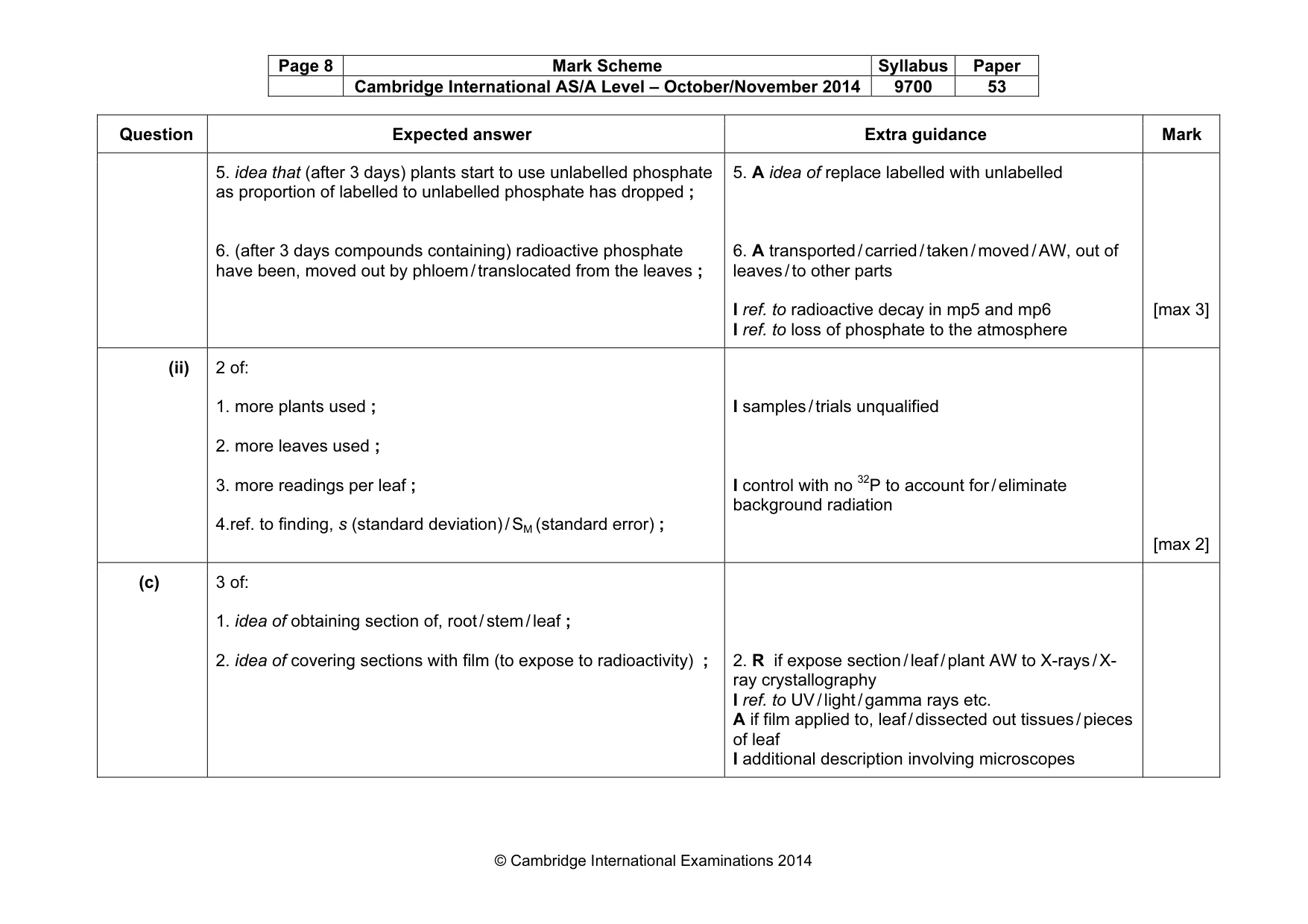
Page 8 Mark Scheme Syllabus Paper Cambridge International AS/A Level – October/November 2014 9700 53 © Cambridge International Examinations 2014 Question Expected answer Extra guidance Mark 5. idea that (after 3 days) plants start to use unlabelled phosphate as proportion of labelled to unlabelled phosphate has dropped ; 6. (after 3 days compounds containing) radioactive phosphate have been, moved out by phloem / translocated from the leaves ; 5. A idea of replace labelled with unlabelled 6. A transported / carried / taken / moved / AW, out of leaves / to other parts I ref. to radioactive decay in mp5 and mp6 I ref. to loss of phosphate to the atmosphere [max 3] (ii) 2 of: 1. more plants used ; 2. more leaves used ; 3. more readings per leaf ; 4.ref. to finding, s (standard deviation) / SM (standard error) ; I samples / trials unqualified I control with no 32P to account for / eliminate background radiation [max 2] (c) 3 of: 1. idea of obtaining section of, root / stem / leaf ; 2. idea of covering sections with film (to expose to radioactivity) ; 2. R if expose section / leaf / plant AW to X-rays / X- ray crystallography I ref. to UV / light / gamma rays etc. A if film applied to, leaf / dissected out tissues / pieces of leaf I additional description involving microscopes
Mark scheme, page 9
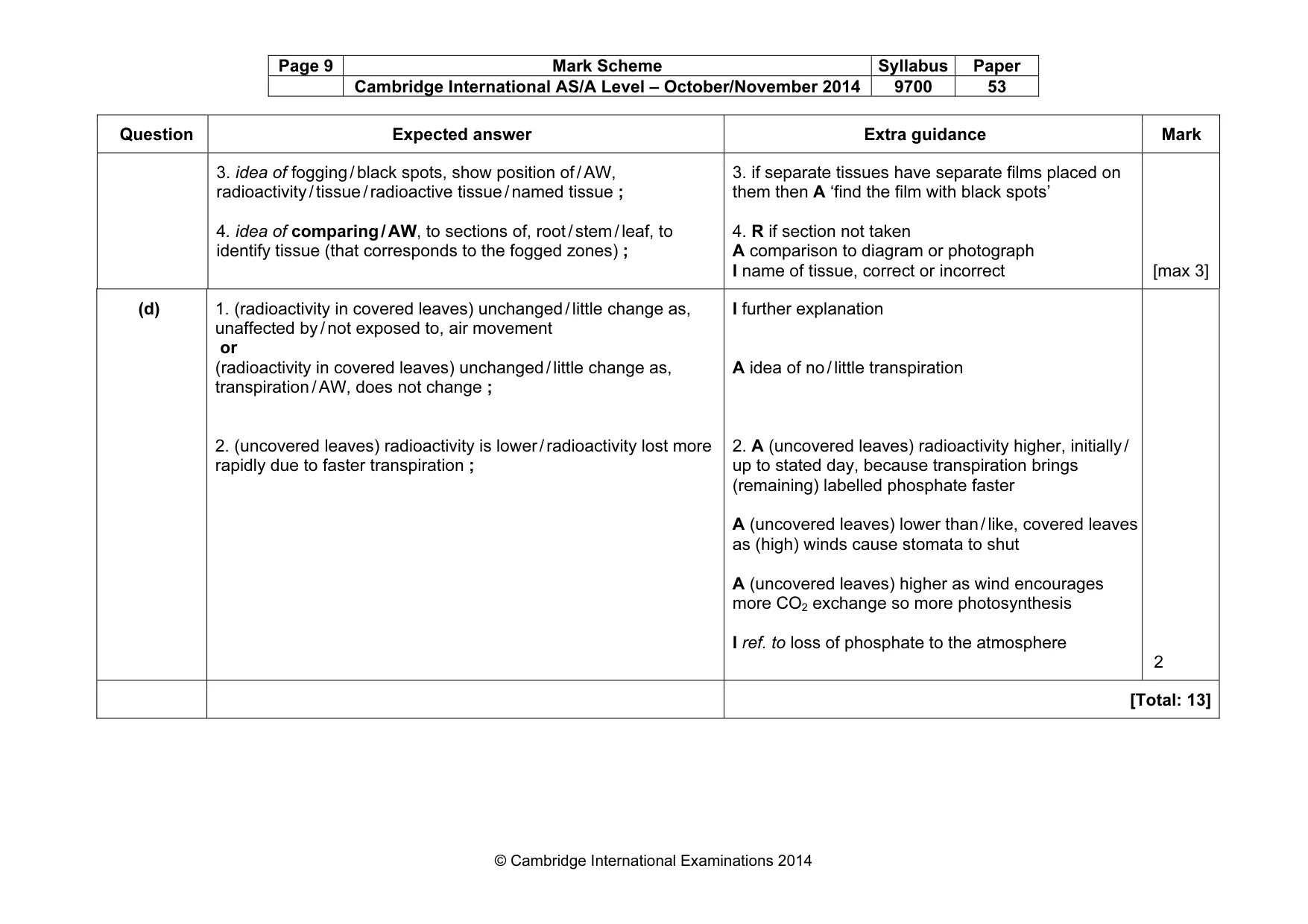
Page 9 Mark Scheme Syllabus Paper Cambridge International AS/A Level – October/November 2014 9700 53 © Cambridge International Examinations 2014 Question Expected answer Extra guidance Mark 3. idea of fogging / black spots, show position of / AW, radioactivity / tissue / radioactive tissue / named tissue ; 4. idea of comparing / AW, to sections of, root / stem / leaf, to identify tissue (that corresponds to the fogged zones) ; 3. if separate tissues have separate films placed on them then A ‘find the film with black spots’ 4. R if section not taken A comparison to diagram or photograph I name of tissue, correct or incorrect [max 3] (d) 1. (radioactivity in covered leaves) unchanged / little change as, unaffected by / not exposed to, air movement or (radioactivity in covered leaves) unchanged / little change as, transpiration / AW, does not change ; 2. (uncovered leaves) radioactivity is lower / radioactivity lost more rapidly due to faster transpiration ; I further explanation A idea of no / little transpiration 2. A (uncovered leaves) radioactivity higher, initially / up to stated day, because transpiration brings (remaining) labelled phosphate faster A (uncovered leaves) lower than / like, covered leaves as (high) winds cause stomata to shut A (uncovered leaves) higher as wind encourages more CO2 exchange so more photosynthesis I ref. to loss of phosphate to the atmosphere 2 [Total: 13]
What you needed in this session
Cambridge’s own grade thresholds for 2014 Oct/Nov, Paper 5 · Variant 3. A higher threshold means an easier paper — the bar moves with how the cohort did.