Cambridge A Level Biology 9700 — 2014 May/June Paper 5 · Variant 1
9700/51/M/J/14 · 30 marks · ≈34 min
The question paper and its mark scheme, free to read here and free to download. This is Cambridge’s own paper, exactly as it was sat.
Question paper8 pages
Mark scheme11 pages
Answers below. Sit the paper first if you are practising.
Paper as text
Question paper, page 1
This document consists of 8 printed pages. DC (SLM/SW) 79188/2 © UCLES 2014 [Turn over Cambridge International Examinations Cambridge International Advanced Level * 1 2 7 7 4 7 1 1 2 3 * BIOLOGY 9700/51 Paper 5 Planning, Analysis and Evaluation May/June 2014 1 hour 15 minutes Candidates answer on the Question Paper. No Additional Materials are required. READ THESE INSTRUCTIONS FIRST Write your Centre number, candidate number and name on all the work you hand in. Write in dark blue or black ink. You may use a soft pencil for any diagrams, graphs or rough working. Do not use staples, paper clips, highlighters, glue or correction fluid. DO NOT WRITE IN ANY BARCODES. Answer all questions. Electronic calculators may be used. At the end of the examination, fasten all your work securely together. The number of marks is given in brackets [ ] at the end of each question or part question.
Question paper, page 2
2 9700/51//M/J/14 © UCLES 2014 1 (a) In an investigation to study genetic variation, DNA was obtained from four varieties of the same invertebrate species. The following technique was used: • DNA was digested using a number of different restriction enzymes to obtain fragments of between 200 – 700 base pairs in length, each of which have sticky ends. • Known RNA sequences (RNA probes) were used to select DNA fragments with specific sticky ends and to separate them from the rest of the DNA. • Multiple copies of the DNA fragments that hybridised with the DNA were made (DNA amplification). • The fragments were separated by gel electrophoresis to give a genetic fingerprint called an amplified fragment length polymorphism (AFLP). (i) Explain how RNA probes, used in this technique, select fragments of DNA. … … … … … … …[2] (ii) This technique is able to separate small DNA fragments that may differ by only one nucleotide. Suggest why this technique is used to study genetic variation within species. … … … … … … … …[2]
Question paper, page 3
3 9700/51//M/J/14 © UCLES 2014 [Turn over (b) Describe the main stages used in gel electrophoresis to separate and locate the amplified DNA fragments. … … … … … … … … … … … … … … … …[5] (c) Three groups of students used gel electrophoresis to separate a set of DNA fragments from each of the four varieties. State two variables that the students should standardise to ensure that their results from gel electrophoresis can be compared. 1. … … 2. … …[2]
Question paper, page 4
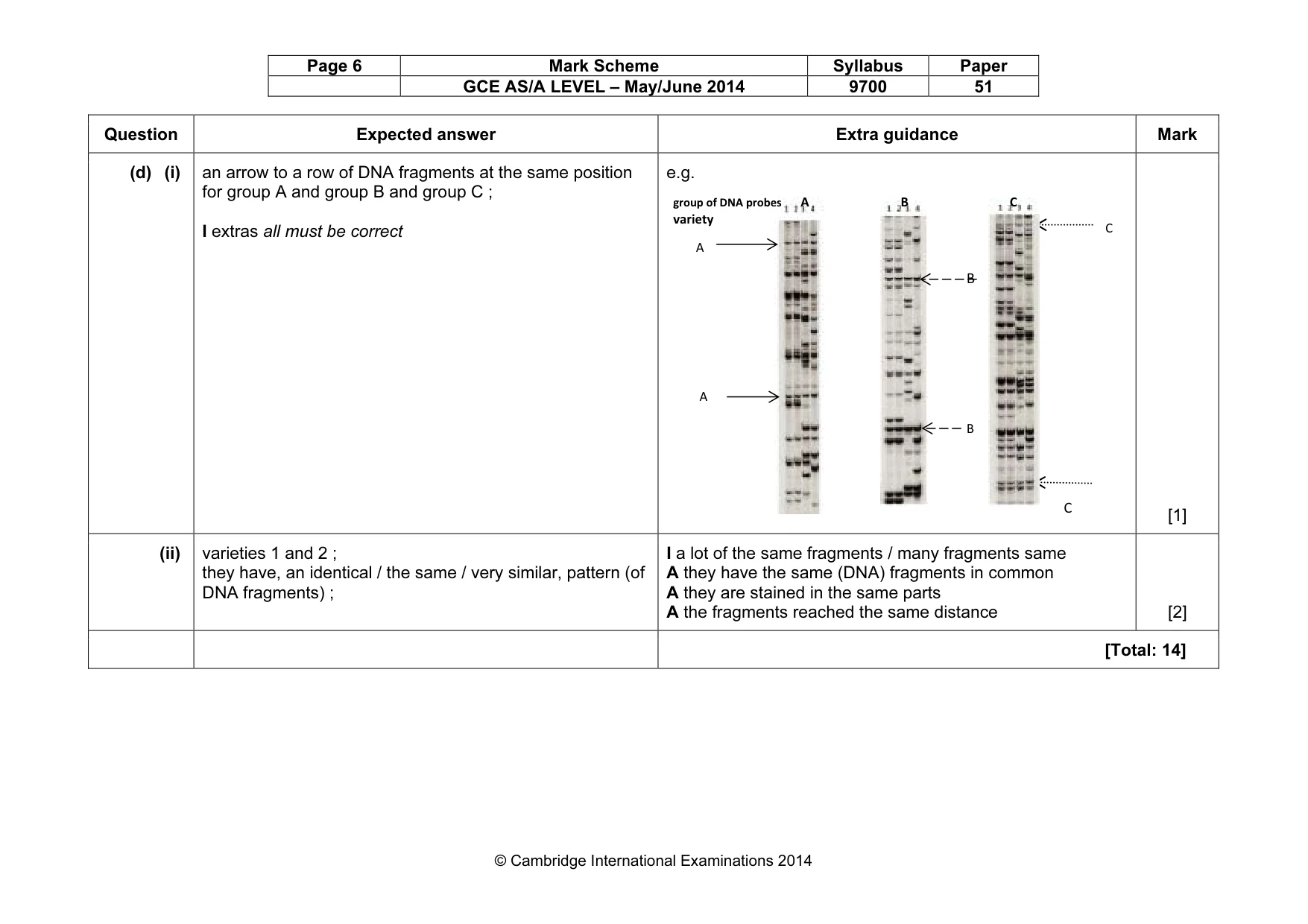
4 9700/51//M/J/14 © UCLES 2014 (d) Three different groups of RNA probes, A, B and C, were used to select different DNA fragments from all four varieties of the invertebrate species, 1, 2, 3 and 4. Gel electrophoresis was then used to separate the fragments. Fig. 1.1 shows the results. 1 2 3 4 A group of RNA probes variety B C 1 2 3 4 1 2 3 4 Fig. 1.1 (i) Fig. 1.1 shows that some DNA fragments are present in the genetic fingerprints of all four varieties, 1, 2, 3 and 4, when the different groups of RNA probes, A, B and C, are used. On Fig. 1.1: • draw an arrow ( ) to indicate one DNA fragment found in all four varieties when RNA probes in group A were used. • draw a second arrow for the RNA probes used in group B • draw a third arrow for the RNA probes used in group C. [1] (ii) State the varieties that appear to have the same genetic fingerprint. Give the evidence for your answer. … … … …[2] [Total: 14]
Question paper, page 5
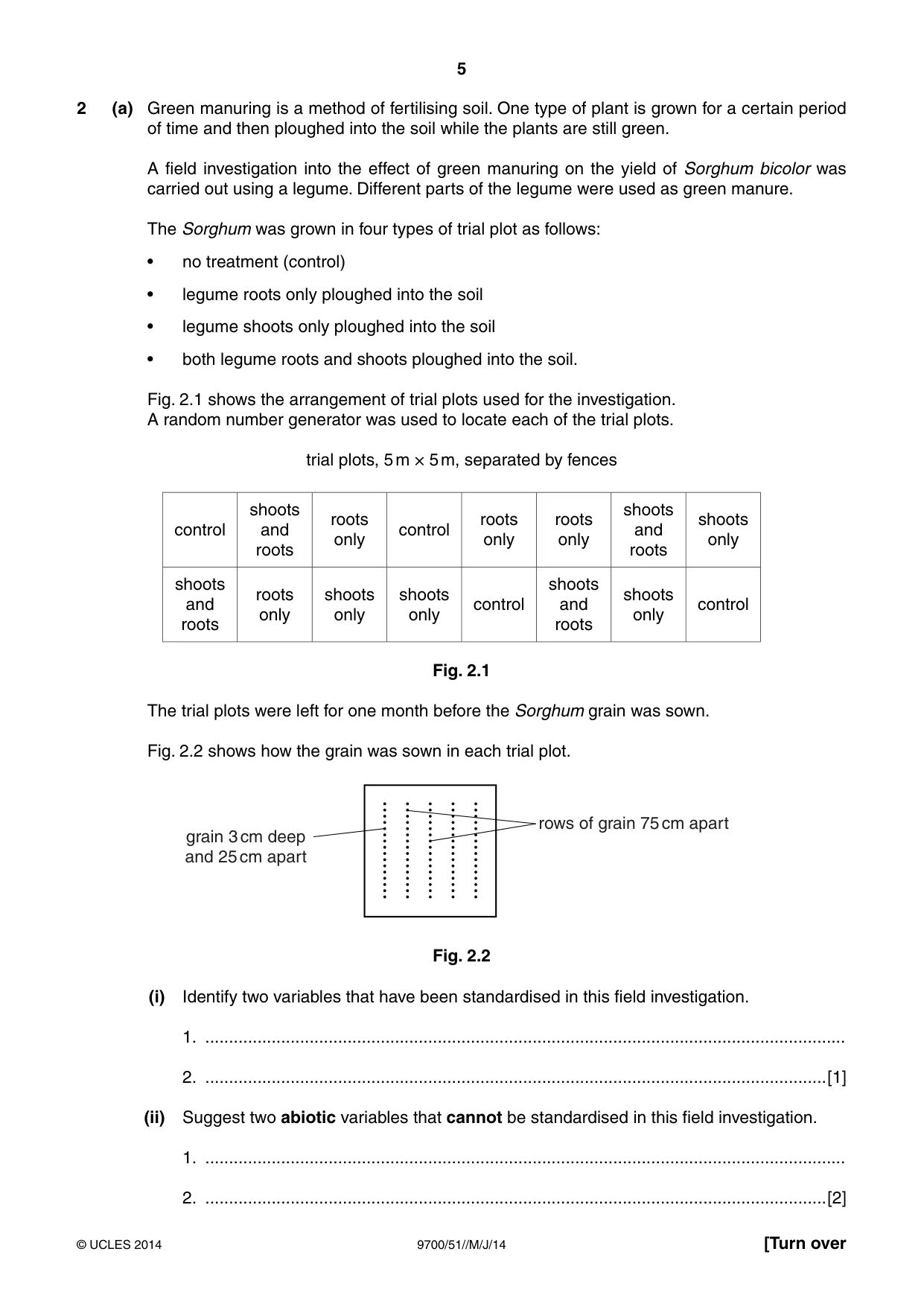
5 9700/51//M/J/14 © UCLES 2014 [Turn over 2 (a) Green manuring is a method of fertilising soil. One type of plant is grown for a certain period of time and then ploughed into the soil while the plants are still green. A field investigation into the effect of green manuring on the yield of Sorghum bicolor was carried out using a legume. Different parts of the legume were used as green manure. The Sorghum was grown in four types of trial plot as follows: • no treatment (control) • legume roots only ploughed into the soil • legume shoots only ploughed into the soil • both legume roots and shoots ploughed into the soil. Fig. 2.1 shows the arrangement of trial plots used for the investigation. A random number generator was used to locate each of the trial plots. trial plots, 5 m × 5 m, separated by fences control shoots and roots roots only control roots only roots only shoots and roots shoots only shoots and roots roots only shoots only shoots only control shoots and roots shoots only control Fig. 2.1 The trial plots were left for one month before the Sorghum grain was sown. Fig. 2.2 shows how the grain was sown in each trial plot. rows of grain 75 cm apart grain 3 cm deep and 25 cm apart Fig. 2.2 (i) Identify two variables that have been standardised in this field investigation. 1. … 2. …[1] (ii) Suggest two abiotic variables that cannot be standardised in this field investigation. 1. … 2. …[2]
Question paper, page 6
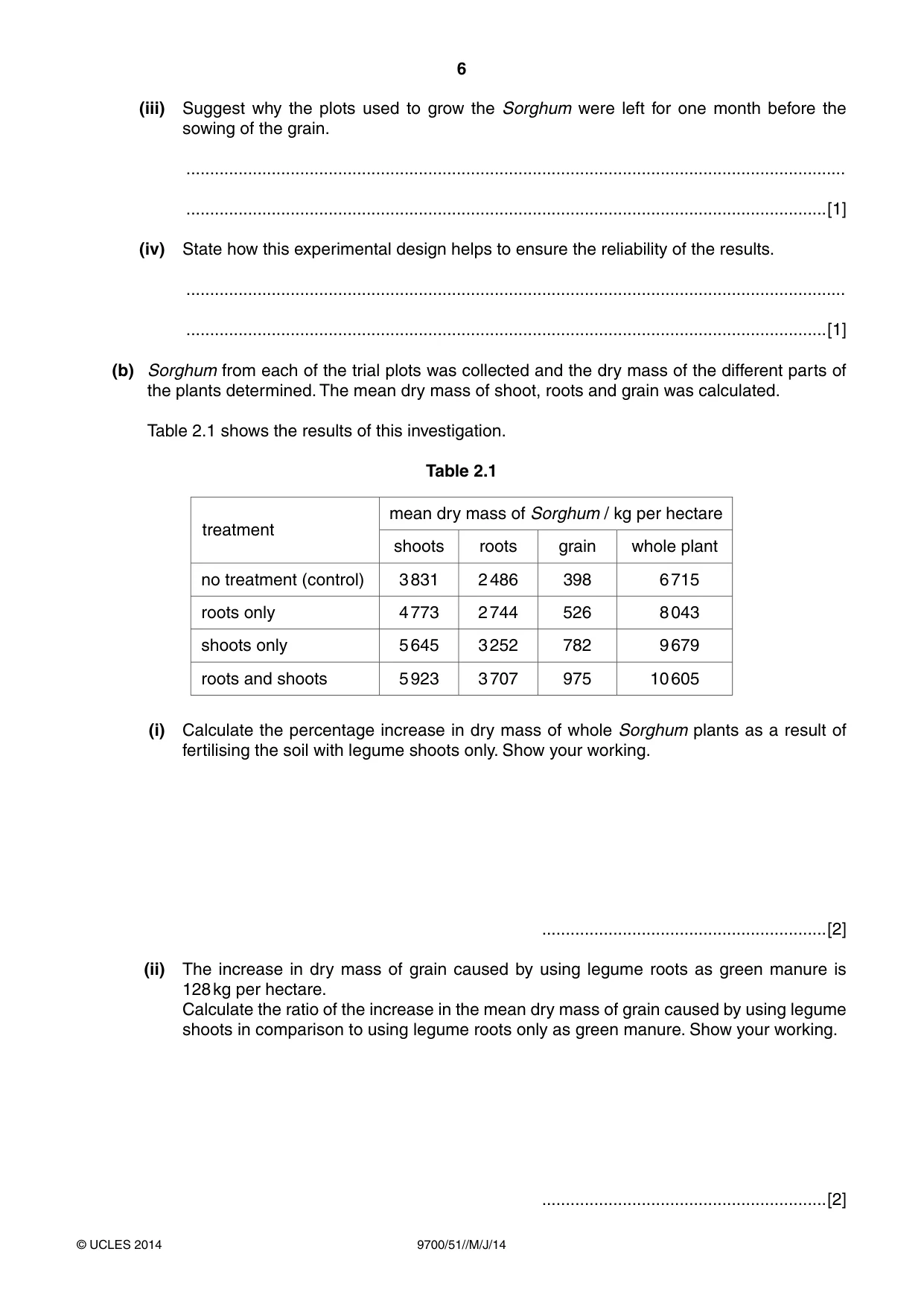
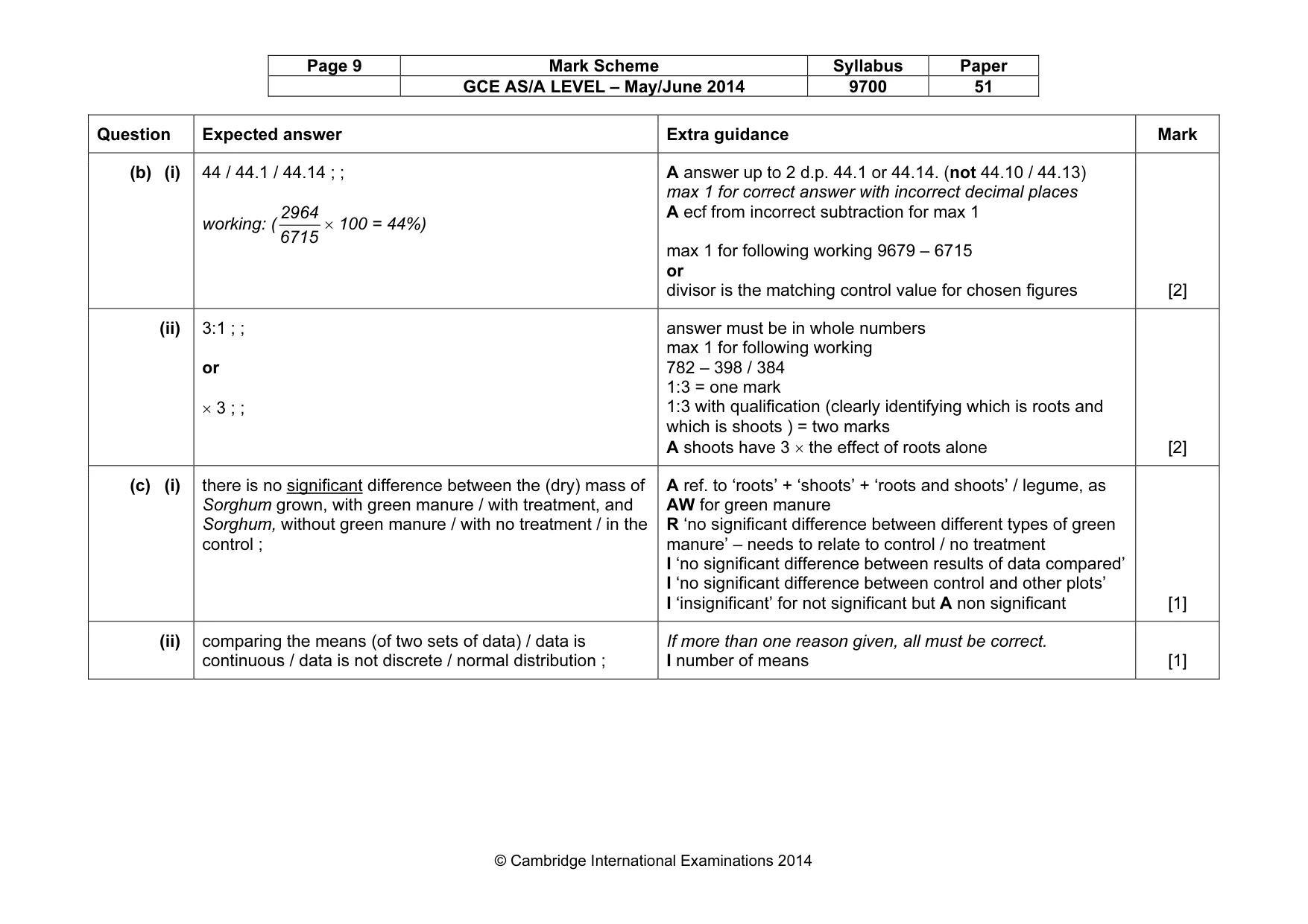
6 9700/51//M/J/14 © UCLES 2014 (iii) Suggest why the plots used to grow the Sorghum were left for one month before the sowing of the grain. … …[1] (iv) State how this experimental design helps to ensure the reliability of the results. … …[1] (b) Sorghum from each of the trial plots was collected and the dry mass of the different parts of the plants determined. The mean dry mass of shoot, roots and grain was calculated. Table 2.1 shows the results of this investigation. Table 2.1 treatment mean dry mass of Sorghum / kg per hectare shoots roots grain whole plant no treatment (control) 3 831 2 486 398 6 715 roots only 4 773 2 744 526 8 043 shoots only 5 645 3 252 782 9 679 roots and shoots 5 923 3 707 975 10 605 (i) Calculate the percentage increase in dry mass of whole Sorghum plants as a result of fertilising the soil with legume shoots only. Show your working. …[2] (ii) The increase in dry mass of grain caused by using legume roots as green manure is 128 kg per hectare. Calculate the ratio of the increase in the mean dry mass of grain caused by using legume shoots in comparison to using legume roots only as green manure. Show your working. …[2]
Question paper, page 7
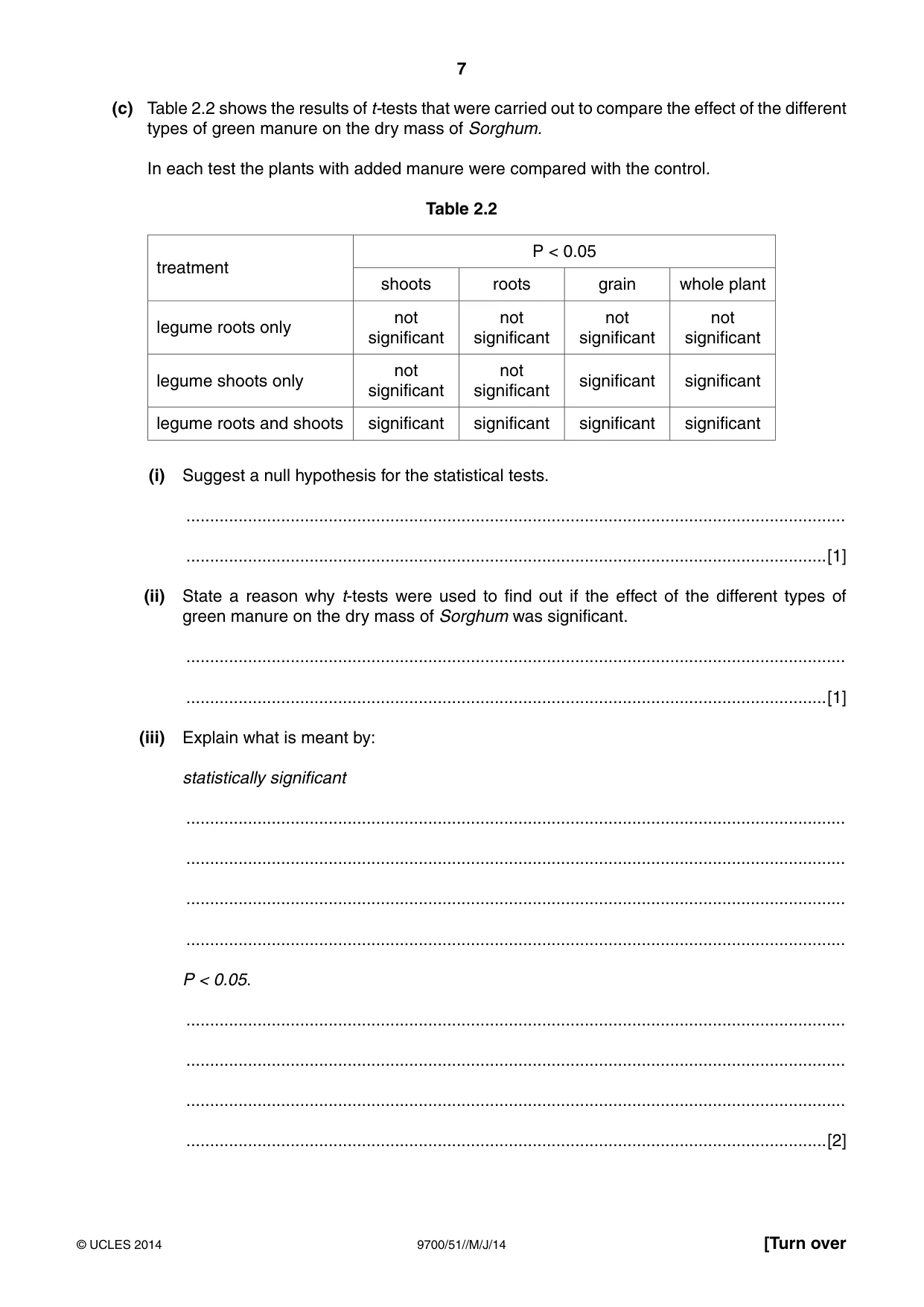
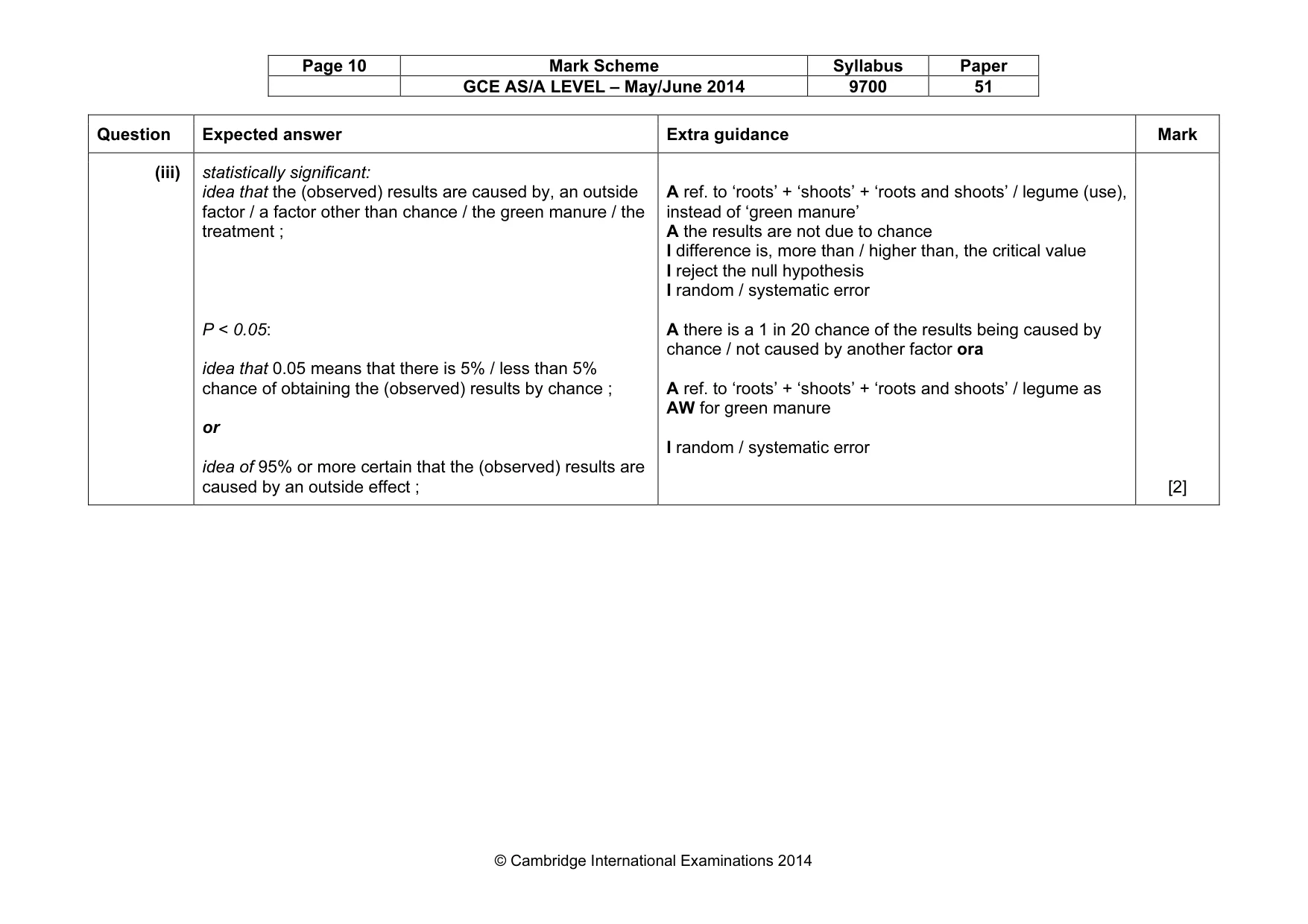
7 9700/51//M/J/14 © UCLES 2014 [Turn over (c) Table 2.2 shows the results of t-tests that were carried out to compare the effect of the different types of green manure on the dry mass of Sorghum. In each test the plants with added manure were compared with the control. Table 2.2 treatment P < 0.05 shoots roots grain whole plant legume roots only not significant not significant not significant not significant legume shoots only not significant not significant significant significant legume roots and shoots significant significant significant significant (i) Suggest a null hypothesis for the statistical tests. … …[1] (ii) State a reason why t-tests were used to find out if the effect of the different types of green manure on the dry mass of Sorghum was significant. … …[1] (iii) Explain what is meant by: statistically significant … … … … P < 0.05. … … … …[2]
Question paper, page 8
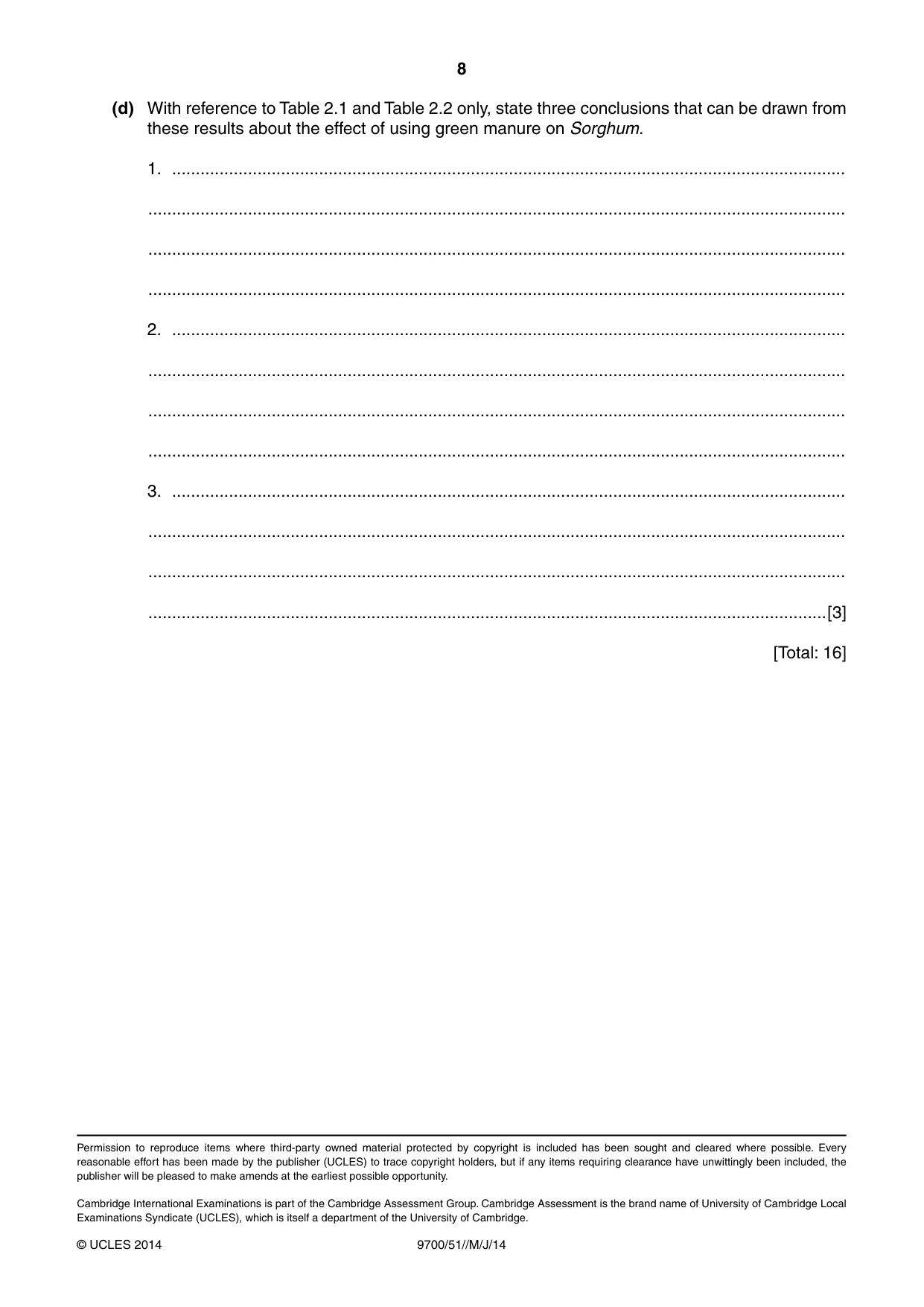
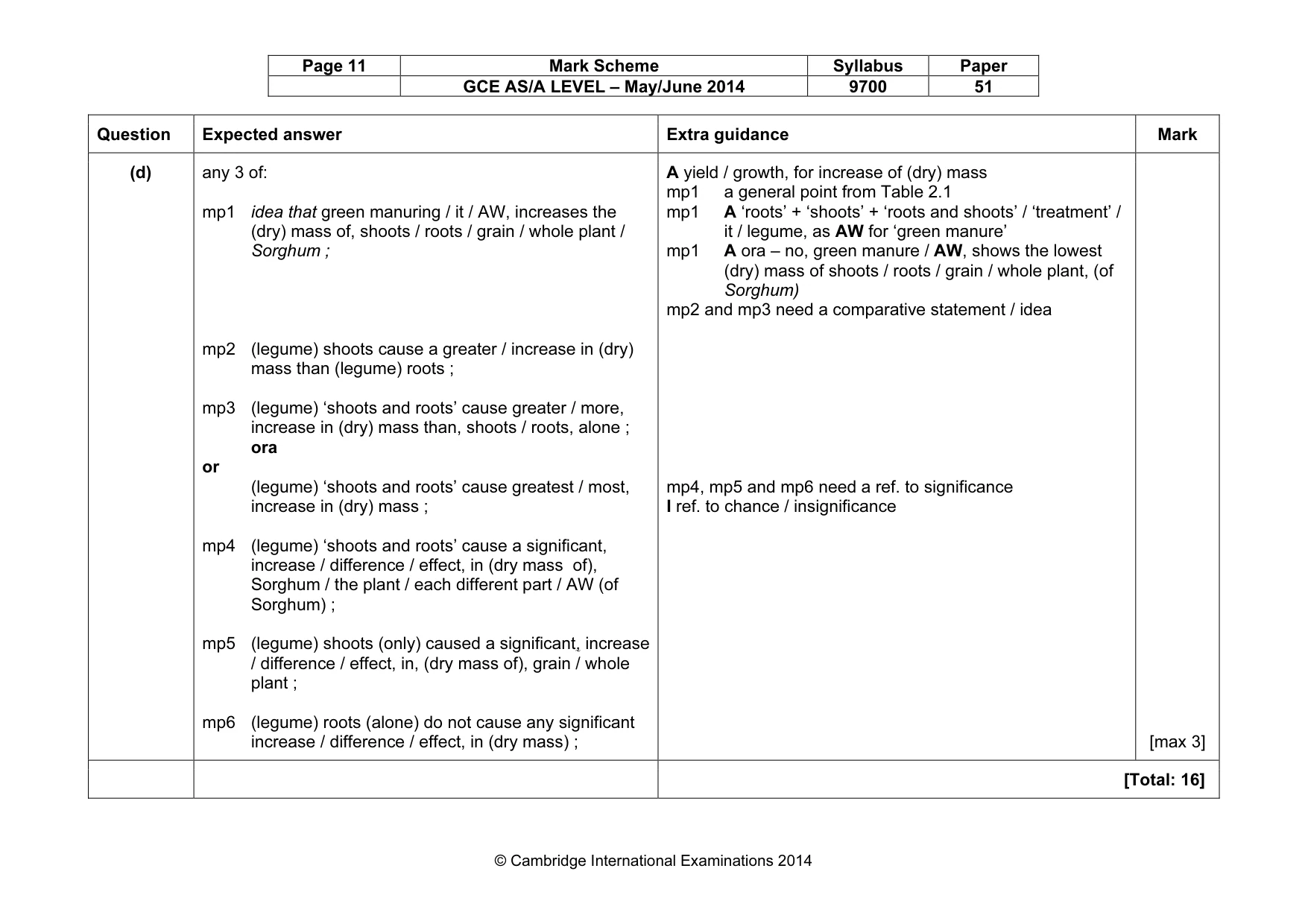
8 9700/51//M/J/14 © UCLES 2014 Permission to reproduce items where third-party owned material protected by copyright is included has been sought and cleared where possible. Every reasonable effort has been made by the publisher (UCLES) to trace copyright holders, but if any items requiring clearance have unwittingly been included, the publisher will be pleased to make amends at the earliest possible opportunity. Cambridge International Examinations is part of the Cambridge Assessment Group. Cambridge Assessment is the brand name of University of Cambridge Local Examinations Syndicate (UCLES), which is itself a department of the University of Cambridge. (d) With reference to Table 2.1 and Table 2.2 only, state three conclusions that can be drawn from these results about the effect of using green manure on Sorghum. 1. … … … … 2. … … … … 3. … … … …[3] [Total: 16]
Mark scheme, page 1
CAMBRIDGE INTERNATIONAL EXAMINATIONS GCE Advanced Subsidiary Level and GCE Advanced Level MARK SCHEME for the May/June 2014 series 9700 BIOLOGY 9700/51 Paper 5 (Planning, Analysis and Evaluation), maximum raw mark 30 This mark scheme is published as an aid to teachers and candidates, to indicate the requirements of the examination. It shows the basis on which Examiners were instructed to award marks. It does not indicate the details of the discussions that took place at an Examiners’ meeting before marking began, which would have considered the acceptability of alternative answers. Mark schemes should be read in conjunction with the question paper and the Principal Examiner Report for Teachers. Cambridge will not enter into discussions about these mark schemes. Cambridge is publishing the mark schemes for the May/June 2014 series for most IGCSE, GCE Advanced Level and Advanced Subsidiary Level components and some Ordinary Level components.
Mark scheme, page 2
Page 2 Mark Scheme Syllabus Paper GCE AS/A LEVEL – May/June 2014 9700 51 © Cambridge International Examinations 2014 Mark scheme abbreviations: ; separates marking points / alternatives answers for the same point R reject A accept (for answers correctly cued by the question, or extra guidance) AW alternative wording (where responses vary more than usual) underline actual word given must be used by candidate (grammatical variants accepted) max indicates the maximum number of marks that can be given ora or reverse argument ecf error carried forward I ignore mp marking point (with relevant number)
Mark scheme, page 3
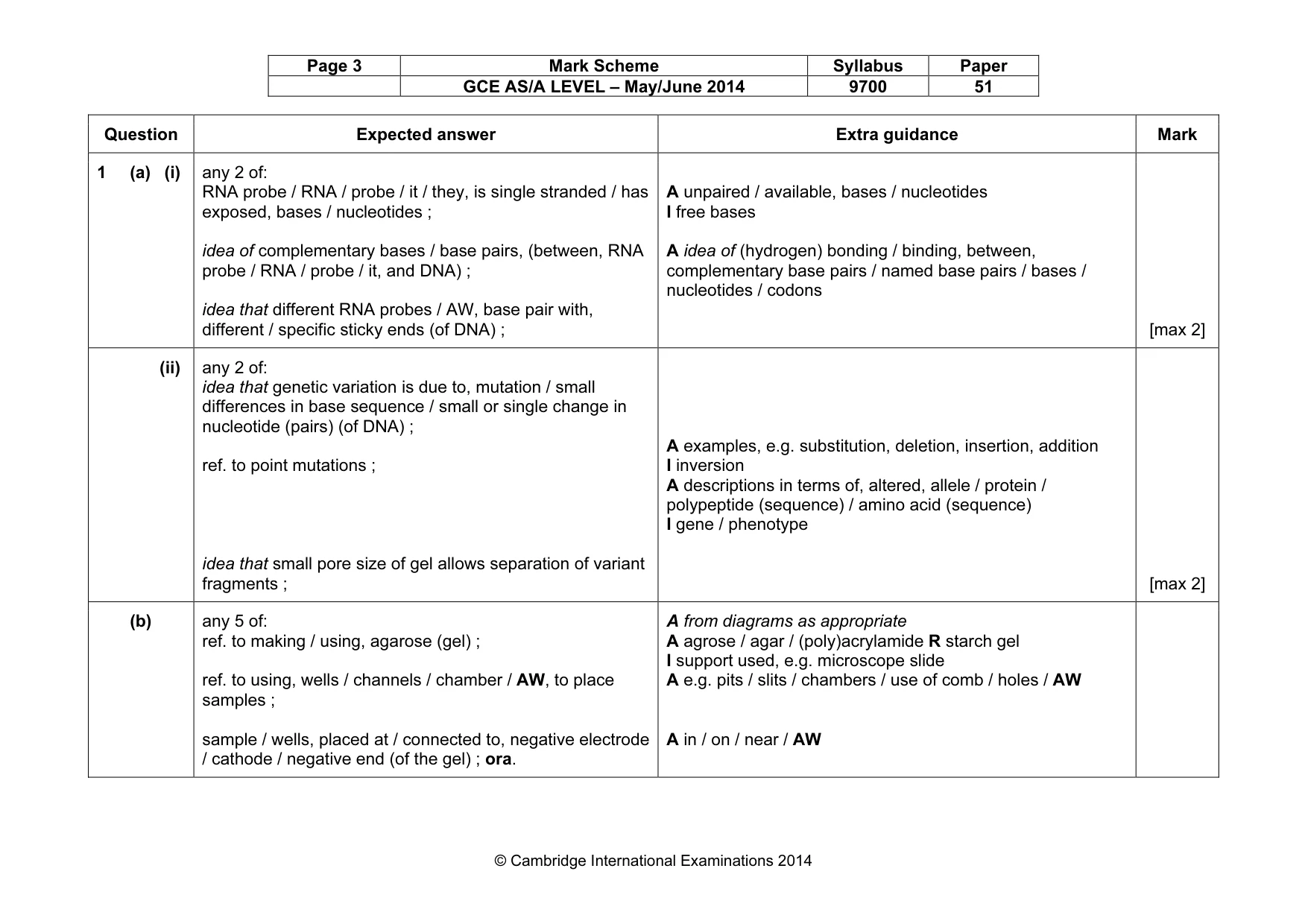
Page 3 Mark Scheme Syllabus Paper GCE AS/A LEVEL – May/June 2014 9700 51 © Cambridge International Examinations 2014 Question Expected answer Extra guidance Mark 1 (a) (i) any 2 of: RNA probe / RNA / probe / it / they, is single stranded / has exposed, bases / nucleotides ; idea of complementary bases / base pairs, (between, RNA probe / RNA / probe / it, and DNA) ; idea that different RNA probes / AW, base pair with, different / specific sticky ends (of DNA) ; A unpaired / available, bases / nucleotides I free bases A idea of (hydrogen) bonding / binding, between, complementary base pairs / named base pairs / bases / nucleotides / codons [max 2] (ii) any 2 of: idea that genetic variation is due to, mutation / small differences in base sequence / small or single change in nucleotide (pairs) (of DNA) ; ref. to point mutations ; idea that small pore size of gel allows separation of variant fragments ; A examples, e.g. substitution, deletion, insertion, addition I inversion A descriptions in terms of, altered, allele / protein / polypeptide (sequence) / amino acid (sequence) I gene / phenotype [max 2] (b) any 5 of: ref. to making / using, agarose (gel) ; ref. to using, wells / channels / chamber / AW, to place samples ; sample / wells, placed at / connected to, negative electrode / cathode / negative end (of the gel) ; ora. A from diagrams as appropriate A agrose / agar / (poly)acrylamide R starch gel I support used, e.g. microscope slide A e.g. pits / slits / chambers / use of comb / holes / AW A in / on / near / AW
Mark scheme, page 4
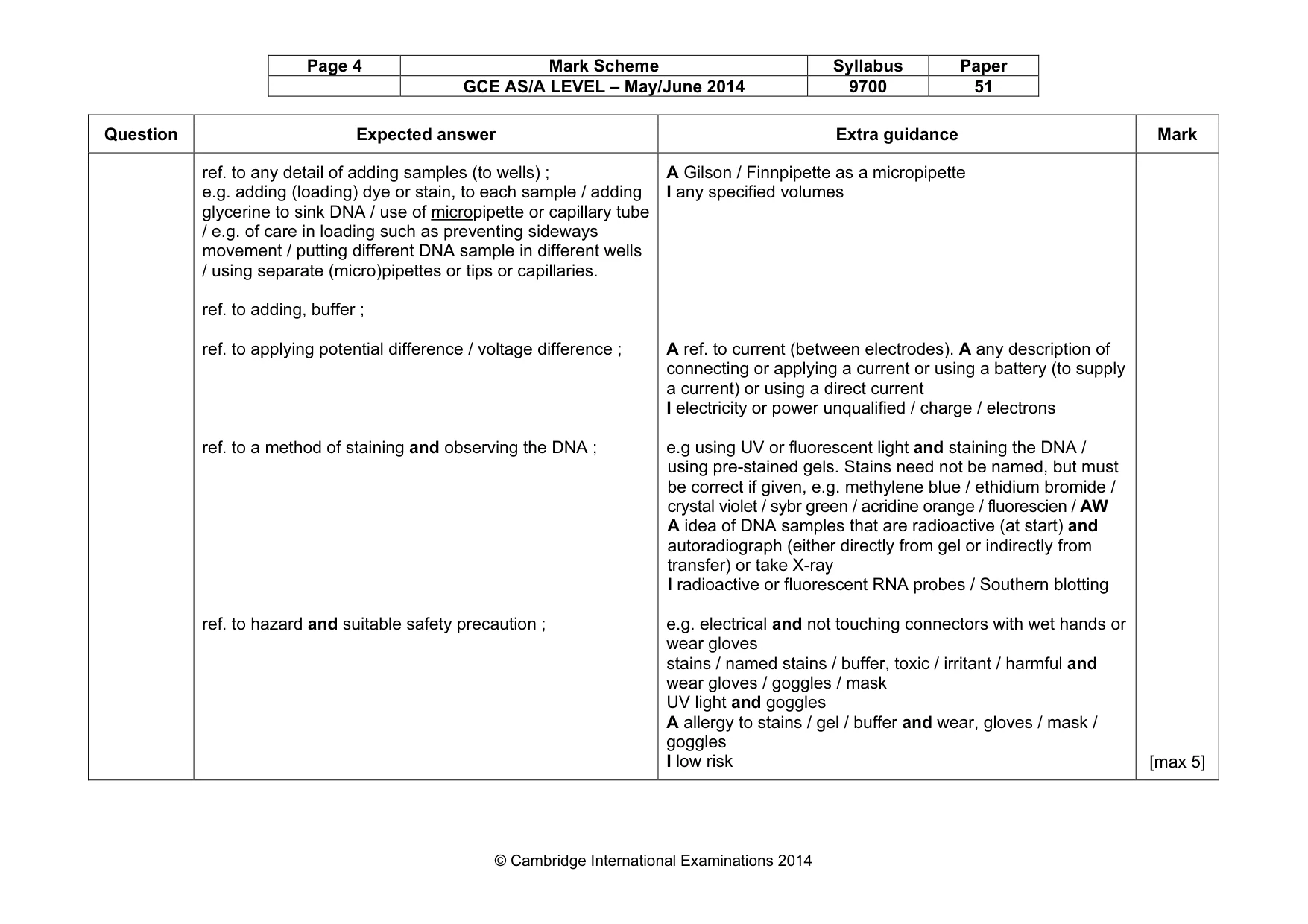
Page 4 Mark Scheme Syllabus Paper GCE AS/A LEVEL – May/June 2014 9700 51 © Cambridge International Examinations 2014 Question Expected answer Extra guidance Mark ref. to any detail of adding samples (to wells) ; e.g. adding (loading) dye or stain, to each sample / adding glycerine to sink DNA / use of micropipette or capillary tube / e.g. of care in loading such as preventing sideways movement / putting different DNA sample in different wells / using separate (micro)pipettes or tips or capillaries. ref. to adding, buffer ; ref. to applying potential difference / voltage difference ; ref. to a method of staining and observing the DNA ; ref. to hazard and suitable safety precaution ; A Gilson / Finnpipette as a micropipette I any specified volumes A ref. to current (between electrodes). A any description of connecting or applying a current or using a battery (to supply a current) or using a direct current I electricity or power unqualified / charge / electrons e.g using UV or fluorescent light and staining the DNA / using pre-stained gels. Stains need not be named, but must be correct if given, e.g. methylene blue / ethidium bromide / crystal violet / sybr green / acridine orange / fluorescien / AW A idea of DNA samples that are radioactive (at start) and autoradiograph (either directly from gel or indirectly from transfer) or take X-ray I radioactive or fluorescent RNA probes / Southern blotting e.g. electrical and not touching connectors with wet hands or wear gloves stains / named stains / buffer, toxic / irritant / harmful and wear gloves / goggles / mask UV light and goggles A allergy to stains / gel / buffer and wear, gloves / mask / goggles I low risk [max 5]
Mark scheme, page 5
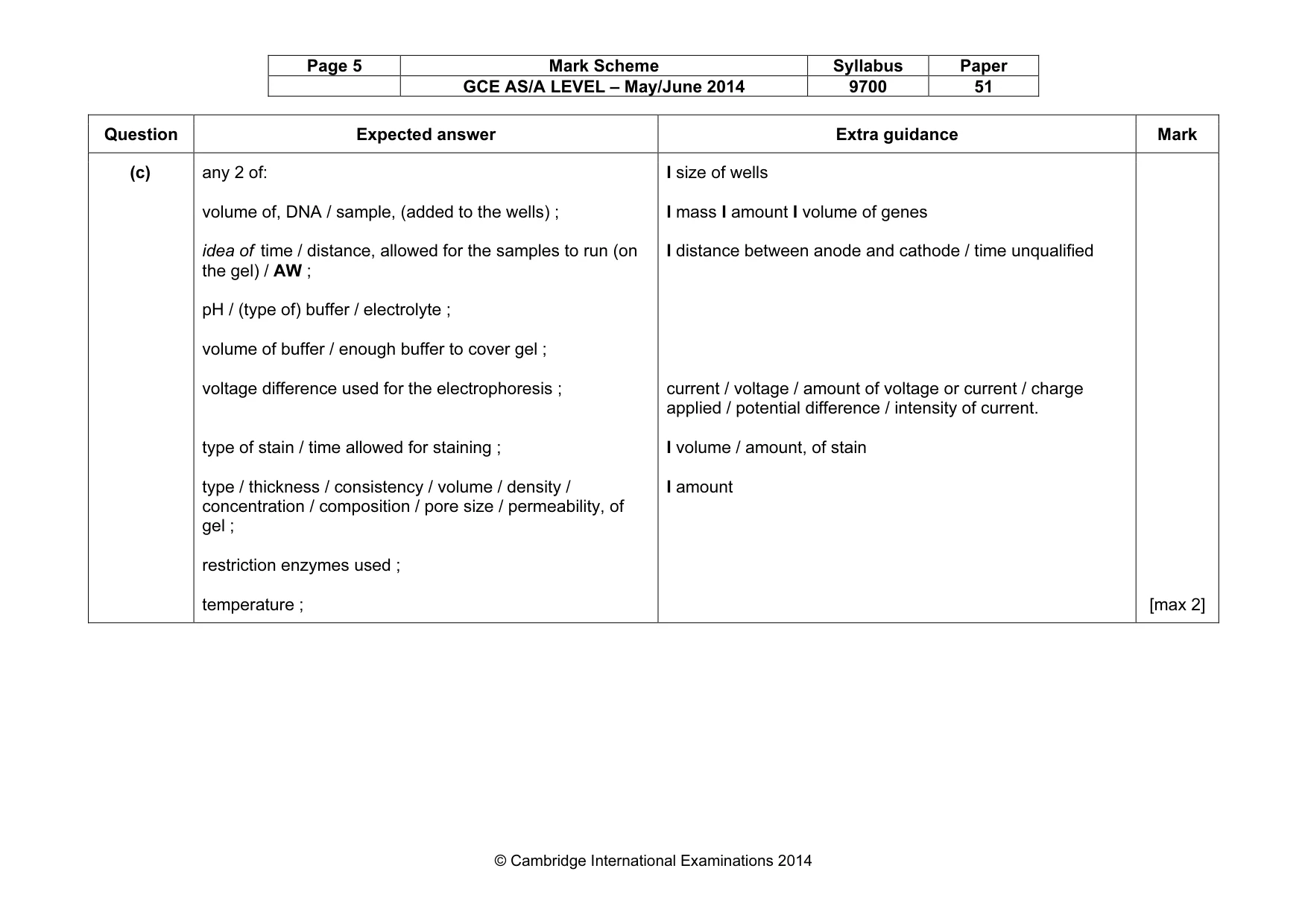
Page 5 Mark Scheme Syllabus Paper GCE AS/A LEVEL – May/June 2014 9700 51 © Cambridge International Examinations 2014 Question Expected answer Extra guidance Mark (c) any 2 of: volume of, DNA / sample, (added to the wells) ; idea of time / distance, allowed for the samples to run (on the gel) / AW ; pH / (type of) buffer / electrolyte ; volume of buffer / enough buffer to cover gel ; voltage difference used for the electrophoresis ; type of stain / time allowed for staining ; type / thickness / consistency / volume / density / concentration / composition / pore size / permeability, of gel ; restriction enzymes used ; temperature ; I size of wells I mass I amount I volume of genes I distance between anode and cathode / time unqualified current / voltage / amount of voltage or current / charge applied / potential difference / intensity of current. I volume / amount, of stain I amount [max 2]
Mark scheme, page 6
Page 6 Mark Scheme Syllabus Paper GCE AS/A LEVEL – May/June 2014 9700 51 © Cambridge International Examinations 2014 Question Expected answer Extra guidance Mark (d) (i) an arrow to a row of DNA fragments at the same position for group A and group B and group C ; I extras all must be correct e.g. [1] (ii) varieties 1 and 2 ; they have, an identical / the same / very similar, pattern (of DNA fragments) ; I a lot of the same fragments / many fragments same A they have the same (DNA) fragments in common A they are stained in the same parts A the fragments reached the same distance [2] [Total: 14] A A B B C C group of DNA probes A B C variety
Mark scheme, page 7
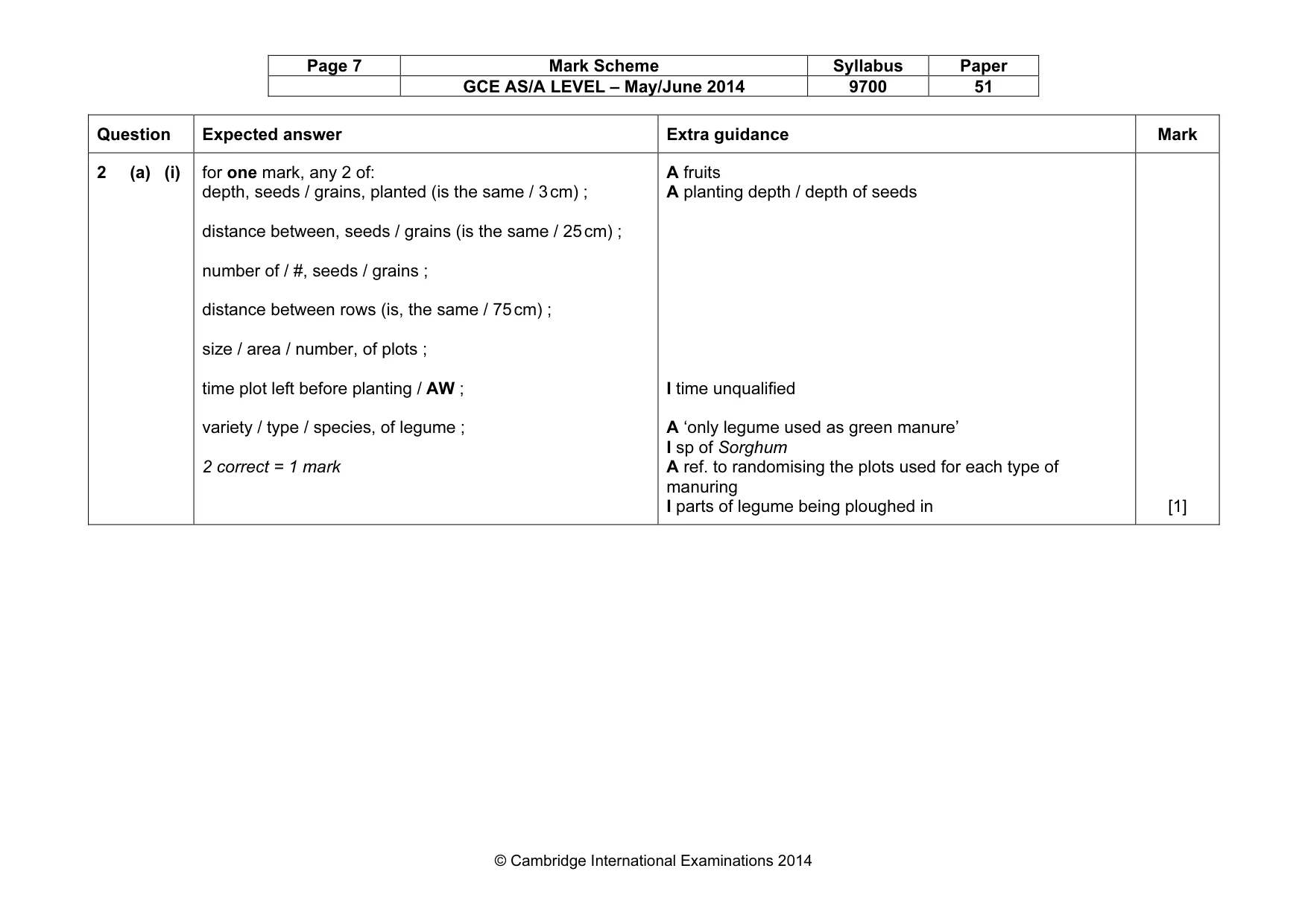
Page 7 Mark Scheme Syllabus Paper GCE AS/A LEVEL – May/June 2014 9700 51 © Cambridge International Examinations 2014 Question Expected answer Extra guidance Mark 2 (a) (i) for one mark, any 2 of: depth, seeds / grains, planted (is the same / 3 cm) ; distance between, seeds / grains (is the same / 25 cm) ; number of / #, seeds / grains ; distance between rows (is, the same / 75 cm) ; size / area / number, of plots ; time plot left before planting / AW ; variety / type / species, of legume ; 2 correct = 1 mark A fruits A planting depth / depth of seeds I time unqualified A ‘only legume used as green manure’ I sp of Sorghum A ref. to randomising the plots used for each type of manuring I parts of legume being ploughed in [1]
Mark scheme, page 8
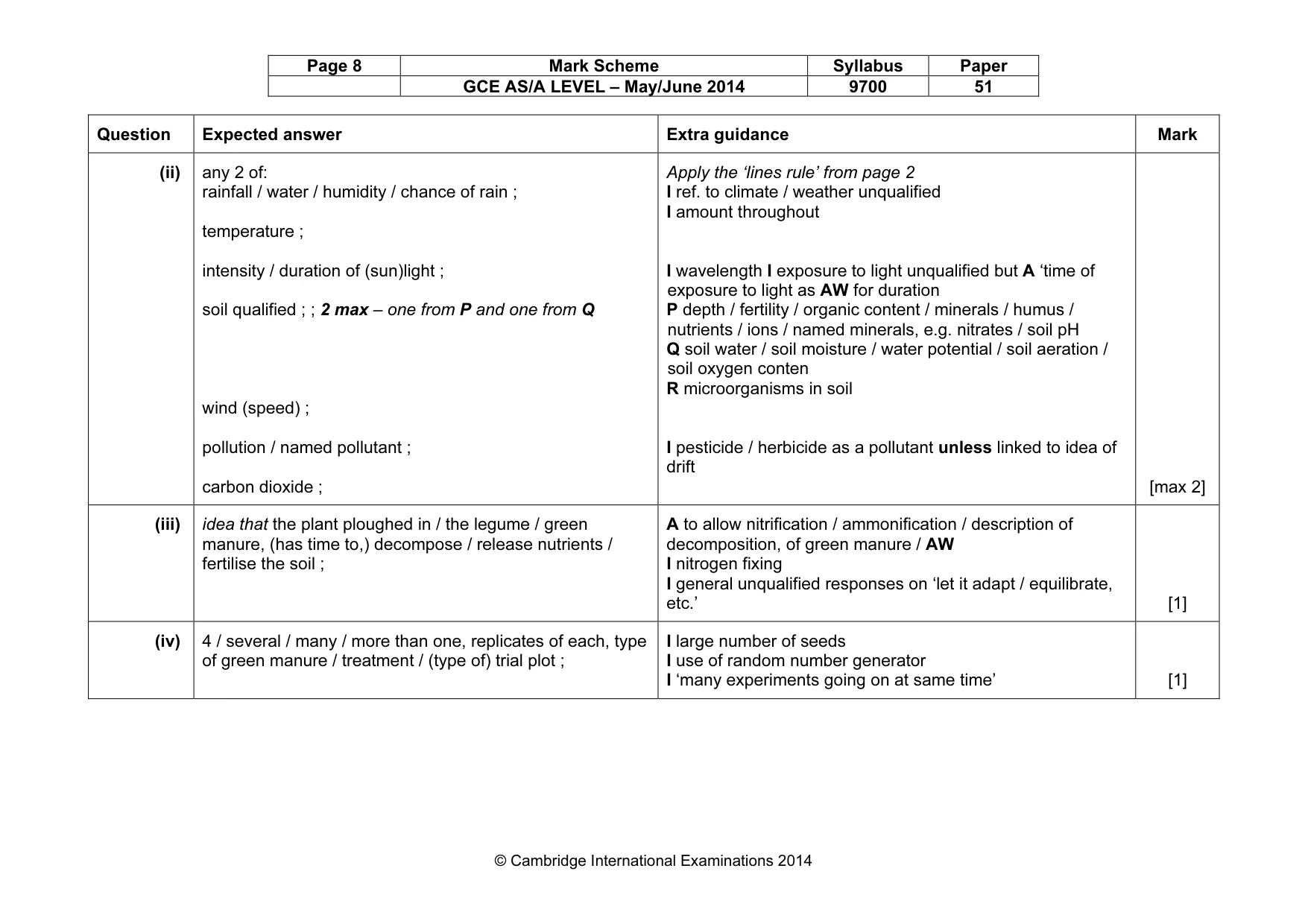
Page 8 Mark Scheme Syllabus Paper GCE AS/A LEVEL – May/June 2014 9700 51 © Cambridge International Examinations 2014 Question Expected answer Extra guidance Mark (ii) any 2 of: rainfall / water / humidity / chance of rain ; temperature ; intensity / duration of (sun)light ; soil qualified ; ; 2 max – one from P and one from Q wind (speed) ; pollution / named pollutant ; carbon dioxide ; Apply the ‘lines rule’ from page 2 I ref. to climate / weather unqualified I amount throughout I wavelength I exposure to light unqualified but A ‘time of exposure to light as AW for duration P depth / fertility / organic content / minerals / humus / nutrients / ions / named minerals, e.g. nitrates / soil pH Q soil water / soil moisture / water potential / soil aeration / soil oxygen conten R microorganisms in soil I pesticide / herbicide as a pollutant unless linked to idea of drift [max 2] (iii) idea that the plant ploughed in / the legume / green manure, (has time to,) decompose / release nutrients / fertilise the soil ; A to allow nitrification / ammonification / description of decomposition, of green manure / AW I nitrogen fixing I general unqualified responses on ‘let it adapt / equilibrate, etc.’ [1] (iv) 4 / several / many / more than one, replicates of each, type of green manure / treatment / (type of) trial plot ; I large number of seeds I use of random number generator I ‘many experiments going on at same time’ [1]
Mark scheme, page 9
Page 9 Mark Scheme Syllabus Paper GCE AS/A LEVEL – May/June 2014 9700 51 © Cambridge International Examinations 2014 Question Expected answer Extra guidance Mark (b) (i) 44 / 44.1 / 44.14 ; ; working: ( 6715 2964 × 100 = 44%) A answer up to 2 d.p. 44.1 or 44.14. (not 44.10 / 44.13) max 1 for correct answer with incorrect decimal places A ecf from incorrect subtraction for max 1 max 1 for following working 9679 – 6715 or divisor is the matching control value for chosen figures [2] (ii) 3:1 ; ; or × 3 ; ; answer must be in whole numbers max 1 for following working 782 – 398 / 384 1:3 = one mark 1:3 with qualification (clearly identifying which is roots and which is shoots ) = two marks A shoots have 3 × the effect of roots alone [2] (c) (i) there is no significant difference between the (dry) mass of Sorghum grown, with green manure / with treatment, and Sorghum, without green manure / with no treatment / in the control ; A ref. to ‘roots’ + ‘shoots’ + ‘roots and shoots’ / legume, as AW for green manure R ‘no significant difference between different types of green manure’ – needs to relate to control / no treatment I ‘no significant difference between results of data compared’ I ‘no significant difference between control and other plots’ I ‘insignificant’ for not significant but A non significant [1] (ii) comparing the means (of two sets of data) / data is continuous / data is not discrete / normal distribution ; If more than one reason given, all must be correct. I number of means [1]
Mark scheme, page 10
Page 10 Mark Scheme Syllabus Paper GCE AS/A LEVEL – May/June 2014 9700 51 © Cambridge International Examinations 2014 Question Expected answer Extra guidance Mark (iii) statistically significant: idea that the (observed) results are caused by, an outside factor / a factor other than chance / the green manure / the treatment ; P < 0.05: idea that 0.05 means that there is 5% / less than 5% chance of obtaining the (observed) results by chance ; or idea of 95% or more certain that the (observed) results are caused by an outside effect ; A ref. to ‘roots’ + ‘shoots’ + ‘roots and shoots’ / legume (use), instead of ‘green manure’ A the results are not due to chance I difference is, more than / higher than, the critical value I reject the null hypothesis I random / systematic error A there is a 1 in 20 chance of the results being caused by chance / not caused by another factor ora A ref. to ‘roots’ + ‘shoots’ + ‘roots and shoots’ / legume as AW for green manure I random / systematic error [2]
Mark scheme, page 11
Page 11 Mark Scheme Syllabus Paper GCE AS/A LEVEL – May/June 2014 9700 51 © Cambridge International Examinations 2014 Question Expected answer Extra guidance Mark (d) any 3 of: mp1 idea that green manuring / it / AW, increases the (dry) mass of, shoots / roots / grain / whole plant / Sorghum ; mp2 (legume) shoots cause a greater / increase in (dry) mass than (legume) roots ; mp3 (legume) ‘shoots and roots’ cause greater / more, increase in (dry) mass than, shoots / roots, alone ; ora or (legume) ‘shoots and roots’ cause greatest / most, increase in (dry) mass ; mp4 (legume) ‘shoots and roots’ cause a significant, increase / difference / effect, in (dry mass of), Sorghum / the plant / each different part / AW (of Sorghum) ; mp5 (legume) shoots (only) caused a significant, increase / difference / effect, in, (dry mass of), grain / whole plant ; mp6 (legume) roots (alone) do not cause any significant increase / difference / effect, in (dry mass) ; A yield / growth, for increase of (dry) mass mp1 a general point from Table 2.1 mp1 A ‘roots’ + ‘shoots’ + ‘roots and shoots’ / ‘treatment’ / it / legume, as AW for ‘green manure’ mp1 A ora – no, green manure / AW, shows the lowest (dry) mass of shoots / roots / grain / whole plant, (of Sorghum) mp2 and mp3 need a comparative statement / idea mp4, mp5 and mp6 need a ref. to significance I ref. to chance / insignificance [max 3] [Total: 16]
What you needed in this session
Cambridge’s own grade thresholds for 2014 May/June, Paper 5 · Variant 1. A higher threshold means an easier paper — the bar moves with how the cohort did.