Cambridge A Level Biology 9700 — 2013 Oct/Nov Paper 2 · Variant 3
9700/23/O/N/13 · 60 marks · ≈68 min
The question paper and its mark scheme, free to read here and free to download. This is Cambridge’s own paper, exactly as it was sat.
Question paper12 pages
Mark scheme9 pages
Answers below. Sit the paper first if you are practising.
Paper as text
Question paper, page 1
This document consists of 12 printed pages. DC (NF/JG) 62328/2 © UCLES 2013 [Turn over UNIVERSITY OF CAMBRIDGE INTERNATIONAL EXAMINATIONS General Certificate of Education Advanced Subsidiary Level and Advanced Level * 5 3 9 2 7 6 0 3 7 3 * BIOLOGY 9700/23 Paper 2 Structured Questions AS October/November 2013 1 hour 15 minutes Candidates answer on the Question Paper. No Additional Materials are required. READ THESE INSTRUCTIONS FIRST Write your Centre number, candidate number and name in the spaces provided at the top of this page. Write in dark blue or black ink. You may use a soft pencil for any diagrams, graphs or rough working. Do not use staples, paper clips, highlighters, glue or correction fluid. DO NOT WRITE IN ANY BARCODES. Answer all questions. Electronic calculators may be used. At the end of the examination, fasten all your work securely together. The number of marks is given in brackets [ ] at the end of each question or part question.
Question paper, page 2
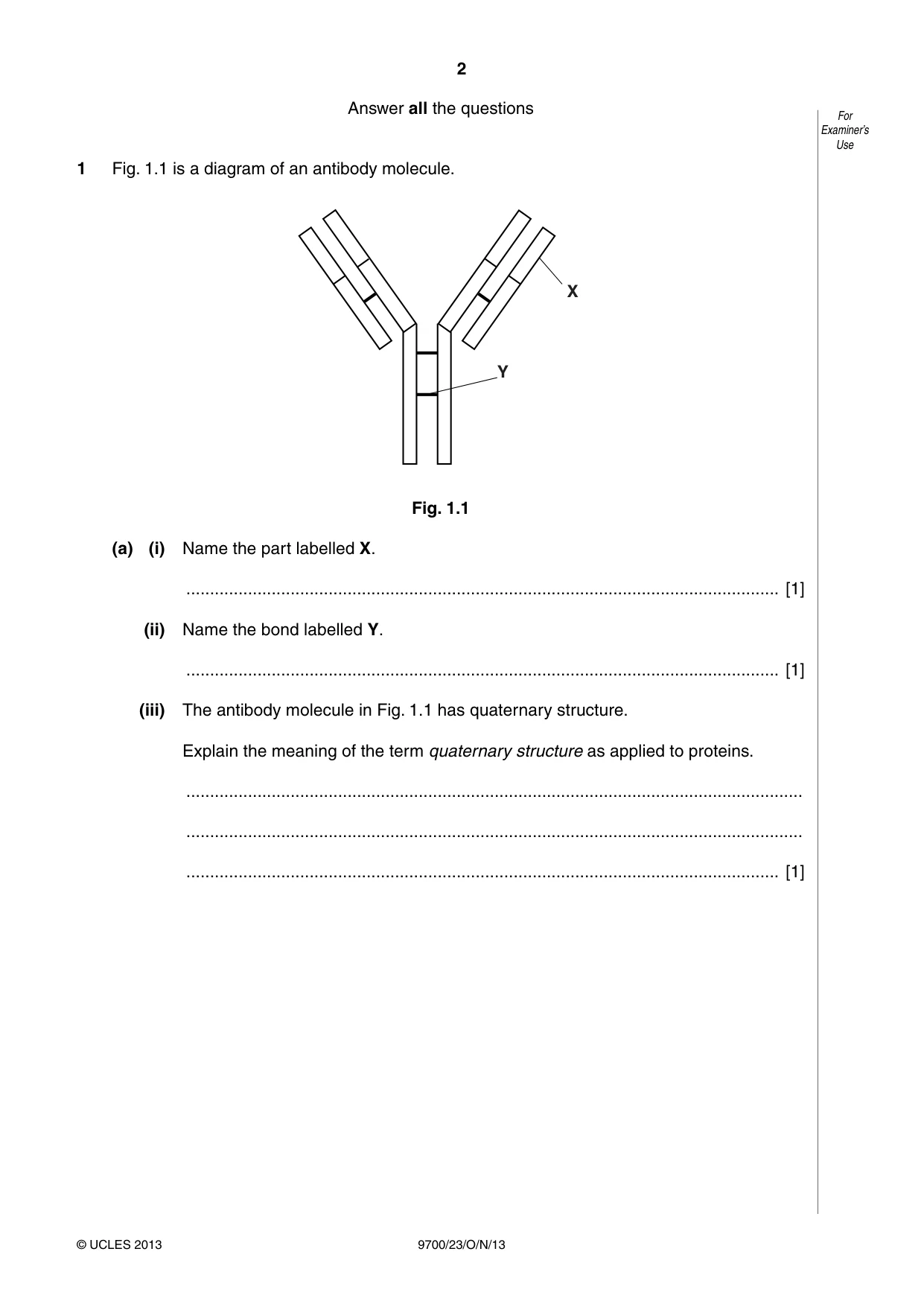
2 9700/23/O/N/13 © UCLES 2013 For Examiner’s Use Answer all the questions 1 Fig. 1.1 is a diagram of an antibody molecule. Y X Fig. 1.1 (a) (i) Name the part labelled X. … [1] (ii) Name the bond labelled Y. … [1] (iii) The antibody molecule in Fig. 1.1 has quaternary structure. Explain the meaning of the term quaternary structure as applied to proteins. … … … [1]
Question paper, page 3
3 9700/23/O/N/13 © UCLES 2013 [Turn over For Examiner’s Use (b) When a pathogen enters the body, a primary immune response occurs. This response includes the production of antibodies. Describe the stages in the immune response that lead to antibody being produced against a specific antigen. … … … … … … … … … … … [4] (c) Vaccination was used in the eradication of smallpox. Explain, in terms of antigens, why it has not been possible to do the same for malaria. … … … … … … [2] [Total: 9]
Question paper, page 4
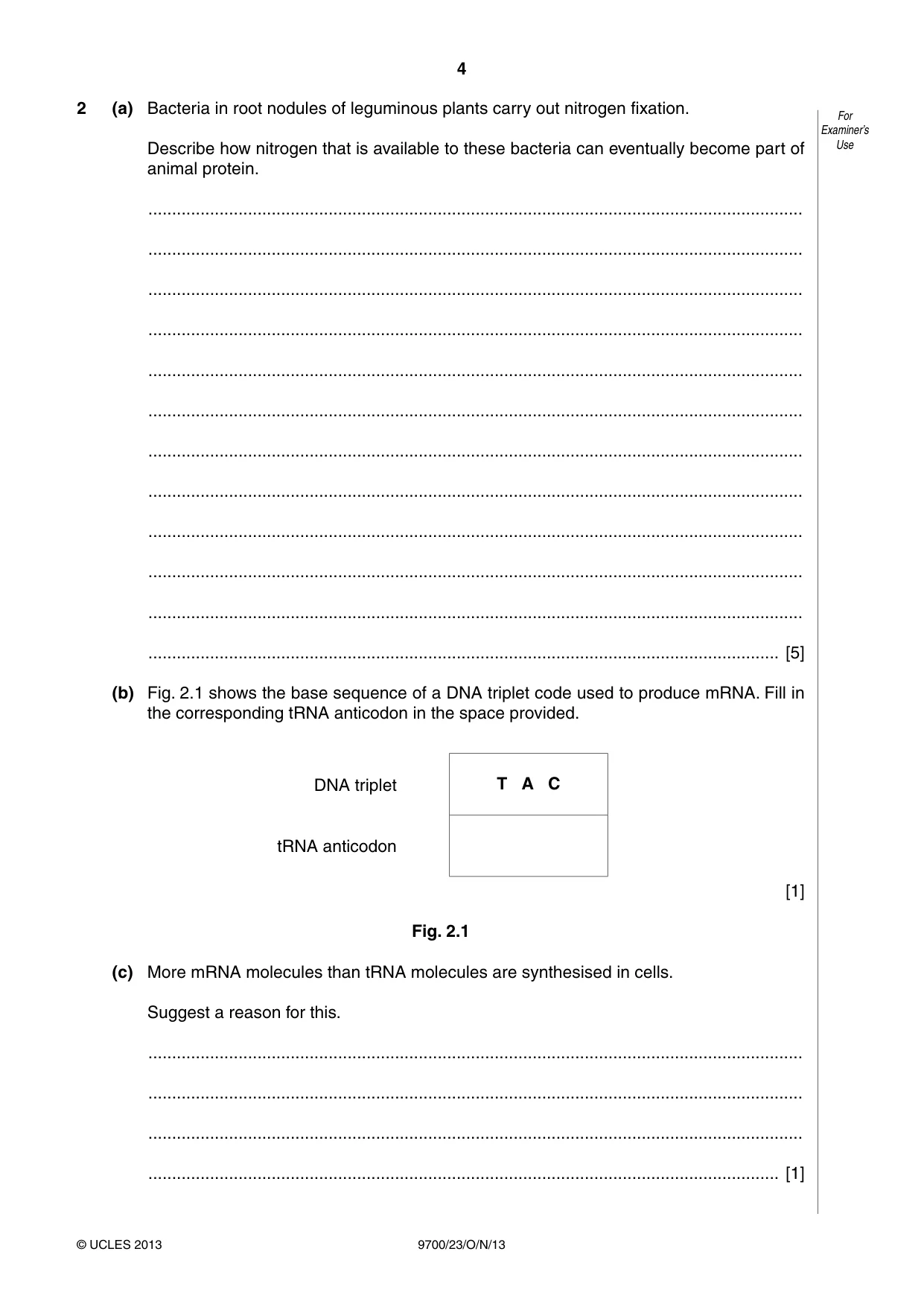
4 9700/23/O/N/13 © UCLES 2013 For Examiner’s Use 2 (a) Bacteria in root nodules of leguminous plants carry out nitrogen fixation. Describe how nitrogen that is available to these bacteria can eventually become part of animal protein. … … … … … … … … … … … … [5] (b) Fig. 2.1 shows the base sequence of a DNA triplet code used to produce mRNA. Fill in the corresponding tRNA anticodon in the space provided. DNA triplet T A C tRNA anticodon [1] Fig. 2.1 (c) More mRNA molecules than tRNA molecules are synthesised in cells. Suggest a reason for this. … … … … [1]
Question paper, page 5
5 9700/23/O/N/13 © UCLES 2013 [Turn over For Examiner’s Use (d) Describe the role of ribosomes in protein synthesis. … … … … … … … … [3] [Total: 10]
Question paper, page 6
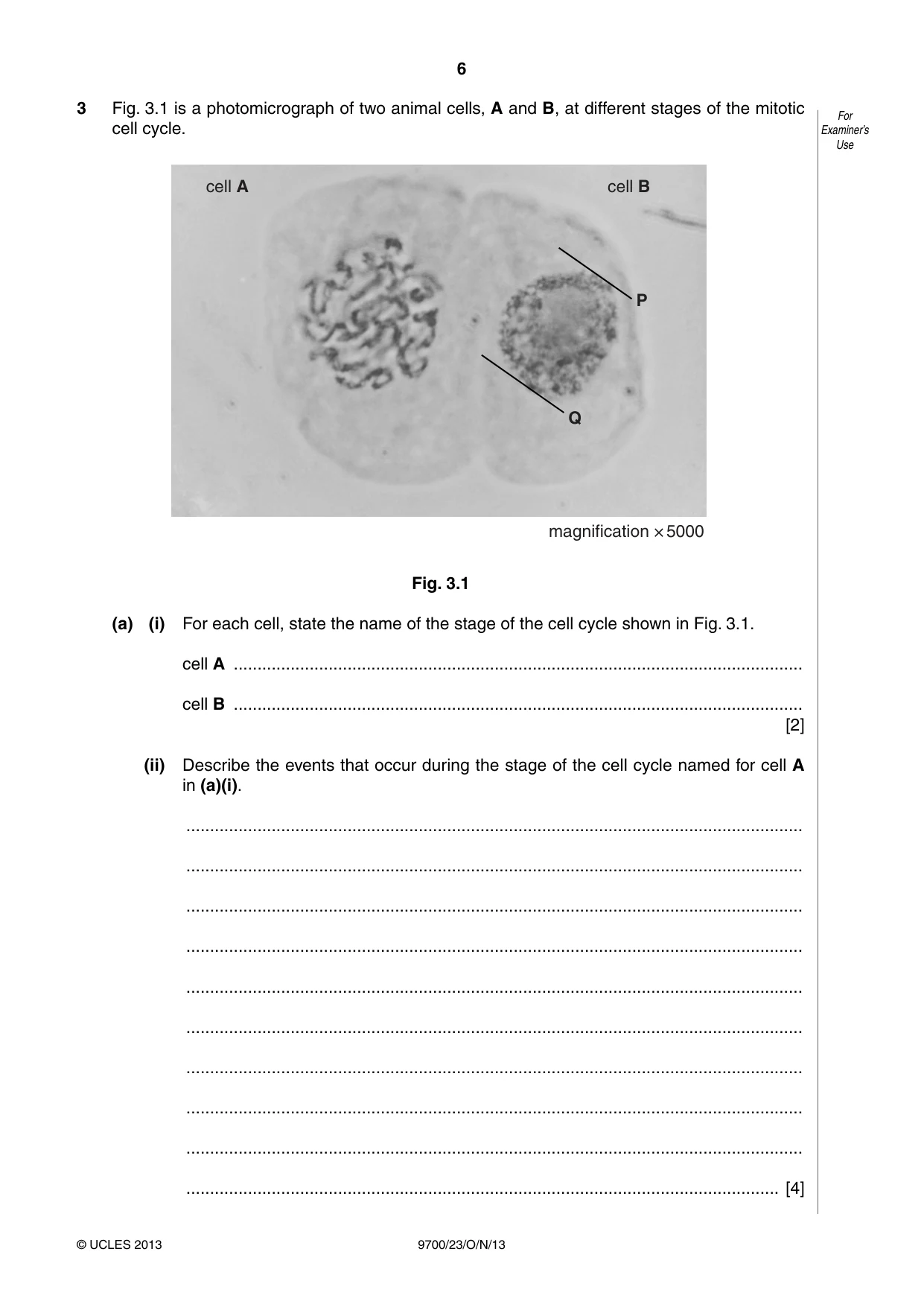
6 9700/23/O/N/13 © UCLES 2013 For Examiner’s Use 3 Fig. 3.1 is a photomicrograph of two animal cells, A and B, at different stages of the mitotic cell cycle. P Q cell A cell B magnification × 5000 Fig. 3.1 (a) (i) For each cell, state the name of the stage of the cell cycle shown in Fig. 3.1. cell A … cell B … [2] (ii) Describe the events that occur during the stage of the cell cycle named for cell A in (a)(i). … … … … … … … … … … [4]
Question paper, page 7
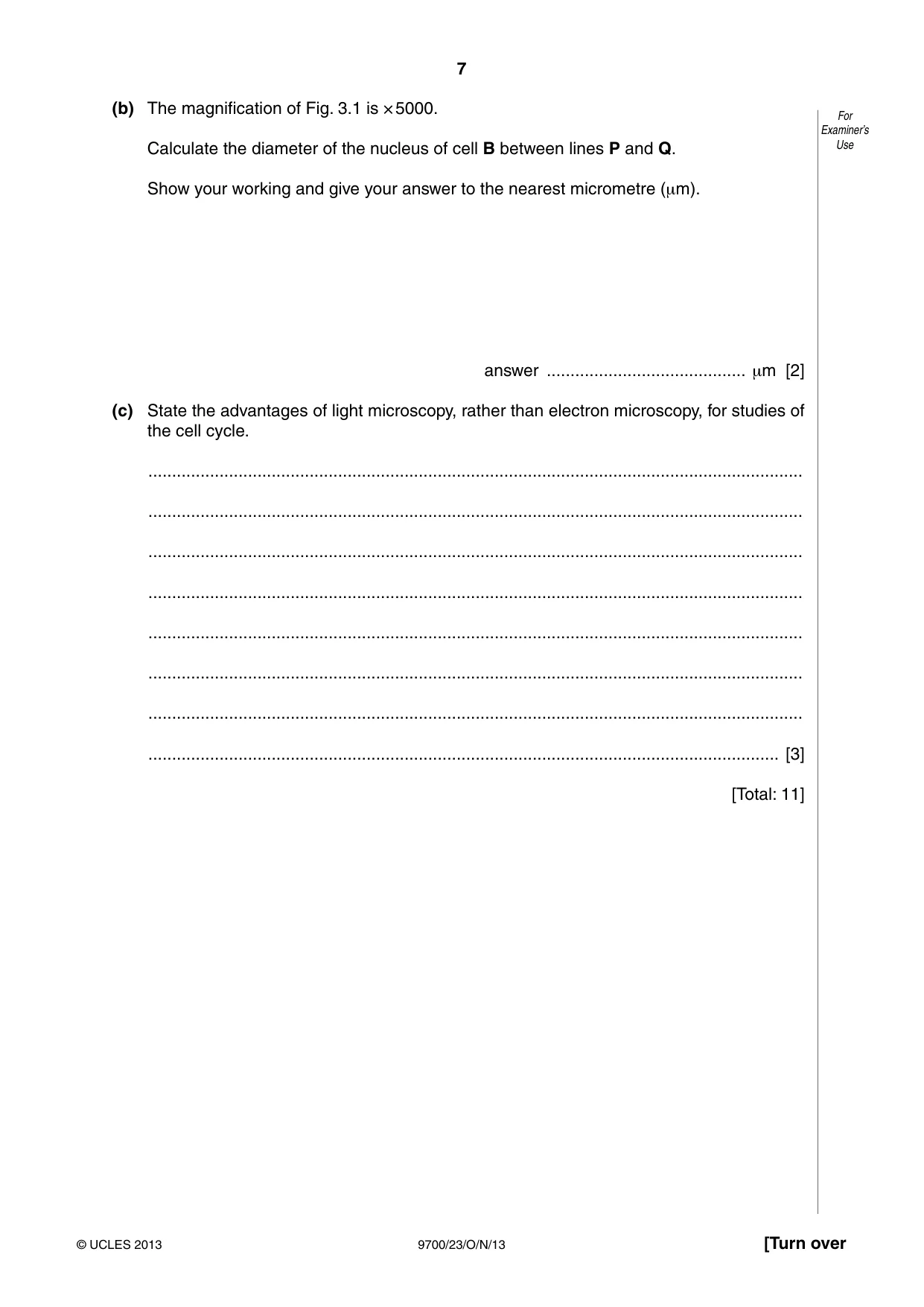
7 9700/23/O/N/13 © UCLES 2013 [Turn over For Examiner’s Use (b) The magnification of Fig. 3.1 is × 5000. Calculate the diameter of the nucleus of cell B between lines P and Q. Show your working and give your answer to the nearest micrometre (μm). answer … μm [2] (c) State the advantages of light microscopy, rather than electron microscopy, for studies of the cell cycle. … … … … … … … … [3] [Total: 11]
Question paper, page 8
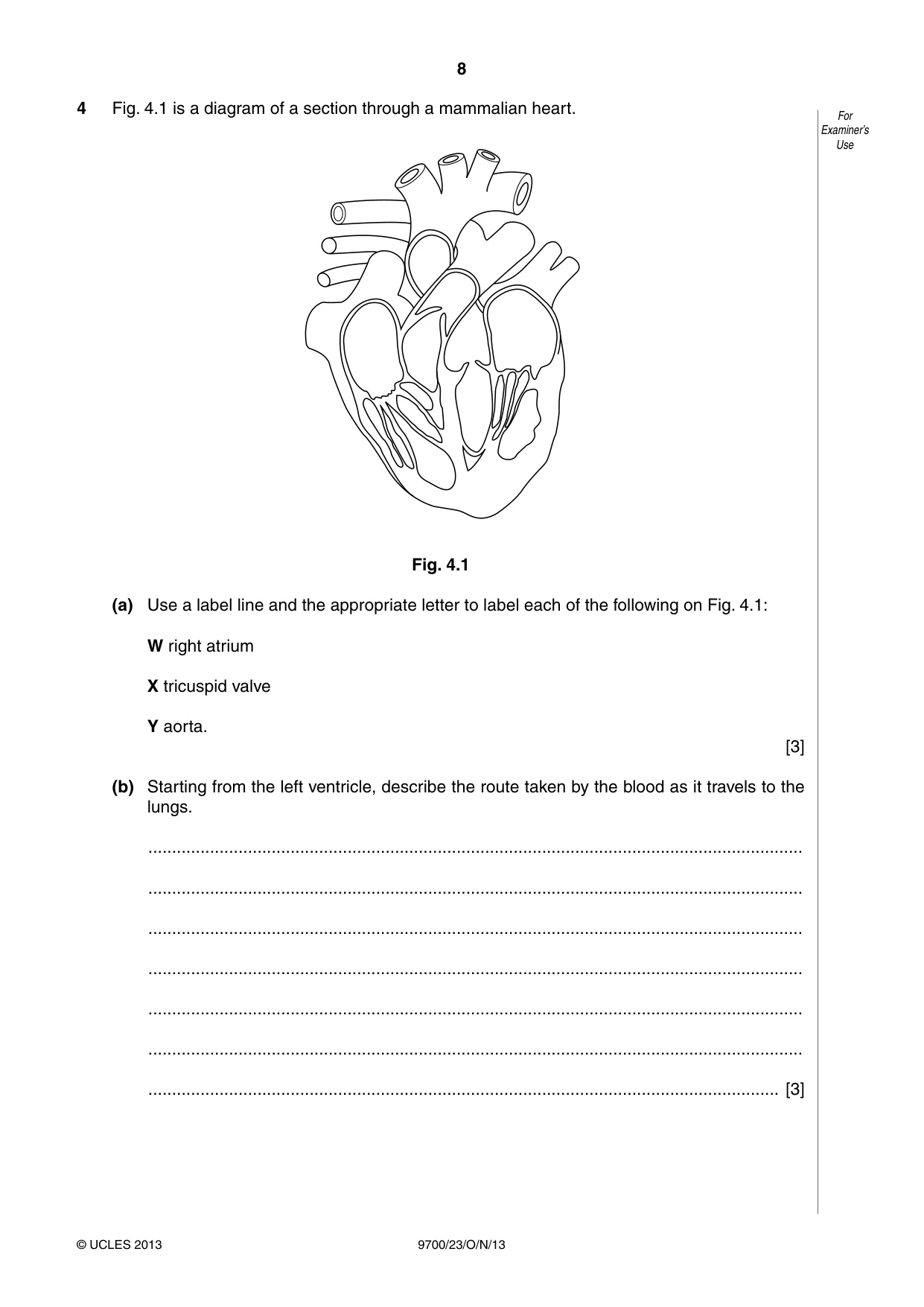
8 9700/23/O/N/13 © UCLES 2013 For Examiner’s Use 4 Fig. 4.1 is a diagram of a section through a mammalian heart. Fig. 4.1 (a) Use a label line and the appropriate letter to label each of the following on Fig. 4.1: W right atrium X tricuspid valve Y aorta. [3] (b) Starting from the left ventricle, describe the route taken by the blood as it travels to the lungs. … … … … … … … [3]
Question paper, page 9
9 9700/23/O/N/13 © UCLES 2013 [Turn over For Examiner’s Use (c) Describe and explain how the structure of the human gas exchange surface is adapted for maximum efficiency. … … … … … … … … … … [4] [Total: 10]
Question paper, page 10
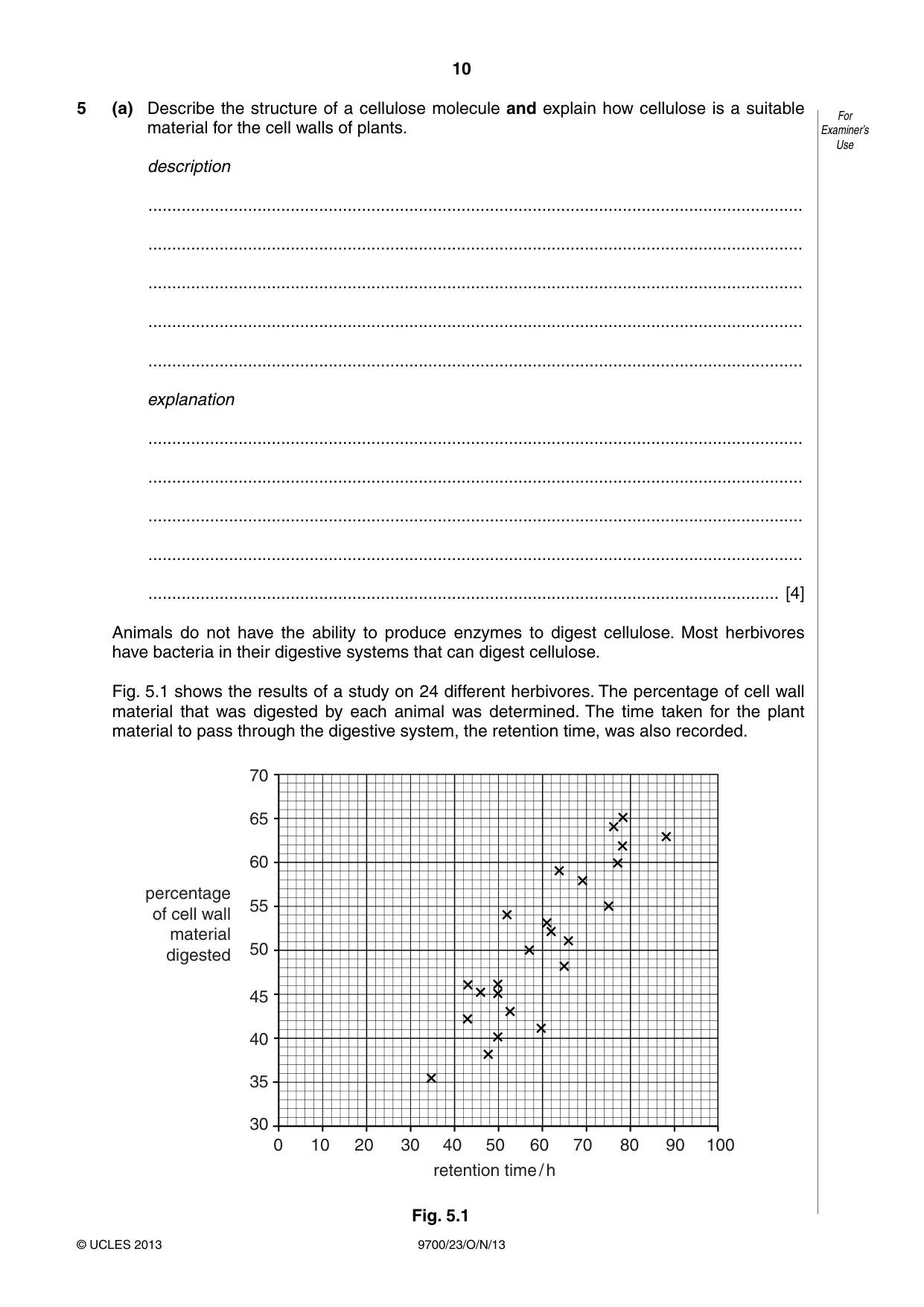
10 9700/23/O/N/13 © UCLES 2013 For Examiner’s Use 5 (a) Describe the structure of a cellulose molecule and explain how cellulose is a suitable material for the cell walls of plants. description … … … … … explanation … … … … … [4] Animals do not have the ability to produce enzymes to digest cellulose. Most herbivores have bacteria in their digestive systems that can digest cellulose. Fig. 5.1 shows the results of a study on 24 different herbivores. The percentage of cell wall material that was digested by each animal was determined. The time taken for the plant material to pass through the digestive system, the retention time, was also recorded. 30 20 10 0 30 35 40 50 60 70 45 65 55 40 50 60 70 80 90 100 percentage of cell wall material digested retention time / h Fig. 5.1
Question paper, page 11
11 9700/23/O/N/13 © UCLES 2013 [Turn over For Examiner’s Use (b) (i) With reference to Fig. 5.1, describe the results of this study. … … … … … … … … [3] (ii) Explain, in terms of energy flow in ecosystems, the importance of the results in Fig. 5.1. … … … … … [2] (c) Digested material in animals is absorbed using both facilitated diffusion and active transport. State two similarities and two differences between facilitated diffusion and active transport. similarities: 1. … 2. … differences: 1. … 2. … [4] [Total: 13] Question 6 starts on page 12
Question paper, page 12
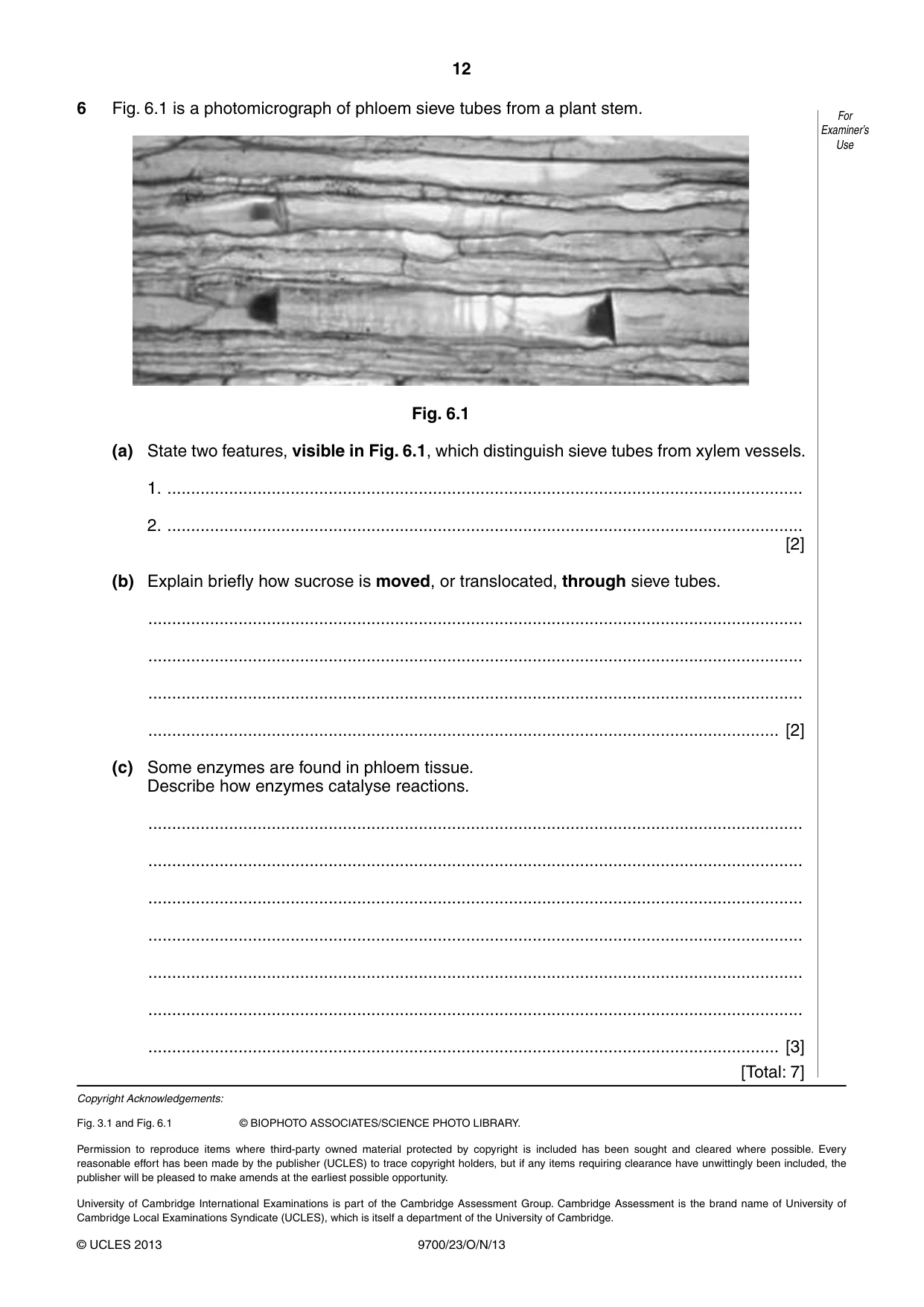
12 9700/23/O/N/13 © UCLES 2013 For Examiner’s Use 6 Fig. 6.1 is a photomicrograph of phloem sieve tubes from a plant stem. Fig. 6.1 (a) State two features, visible in Fig. 6.1, which distinguish sieve tubes from xylem vessels. 1. … 2. … [2] (b) Explain briefly how sucrose is moved, or translocated, through sieve tubes. … … … … [2] (c) Some enzymes are found in phloem tissue. Describe how enzymes catalyse reactions. … … … … … … … [3] [Total: 7] Copyright Acknowledgements: Fig. 3.1 and Fig. 6.1 © BIOPHOTO ASSOCIATES/SCIENCE PHOTO LIBRARY. Permission to reproduce items where third-party owned material protected by copyright is included has been sought and cleared where possible. Every reasonable effort has been made by the publisher (UCLES) to trace copyright holders, but if any items requiring clearance have unwittingly been included, the publisher will be pleased to make amends at the earliest possible opportunity. University of Cambridge International Examinations is part of the Cambridge Assessment Group. Cambridge Assessment is the brand name of University of Cambridge Local Examinations Syndicate (UCLES), which is itself a department of the University of Cambridge.
Mark scheme, page 1
CAMBRIDGE INTERNATIONAL EXAMINATIONS GCE Advanced Subsidiary Level MARK SCHEME for the October/November 2013 series 9700 BIOLOGY 9700/23 Paper 2 (AS Structured Question), maximum raw mark 60 This mark scheme is published as an aid to teachers and candidates, to indicate the requirements of the examination. It shows the basis on which Examiners were instructed to award marks. It does not indicate the details of the discussions that took place at an Examiners’ meeting before marking began, which would have considered the acceptability of alternative answers. Mark schemes should be read in conjunction with the question paper and the Principal Examiner Report for Teachers. Cambridge will not enter into discussions about these mark schemes. Cambridge is publishing the mark schemes for the October/November 2013 series for most IGCSE, GCE Advanced Level and Advanced Subsidiary Level components and some Ordinary Level components.
Mark scheme, page 2
Page 2 Mark Scheme Syllabus Paper GCE AS LEVEL – October/November 2013 9700 23 © Cambridge International Examinations 2013 Mark scheme abbreviations: ; separates marking points / alternative answers for the same point R reject A accept (for answers correctly cued by the question, or by extra guidance) AW alternative wording (where responses vary more than usual) underline actual word given must be used by candidate (grammatical variants excepted) max indicates the maximum number of marks that can be given ora or reverse argument mp marking point (with relevant number) ecf error carried forward I ignore AVP alternative valid point (examples given)
Mark scheme, page 3
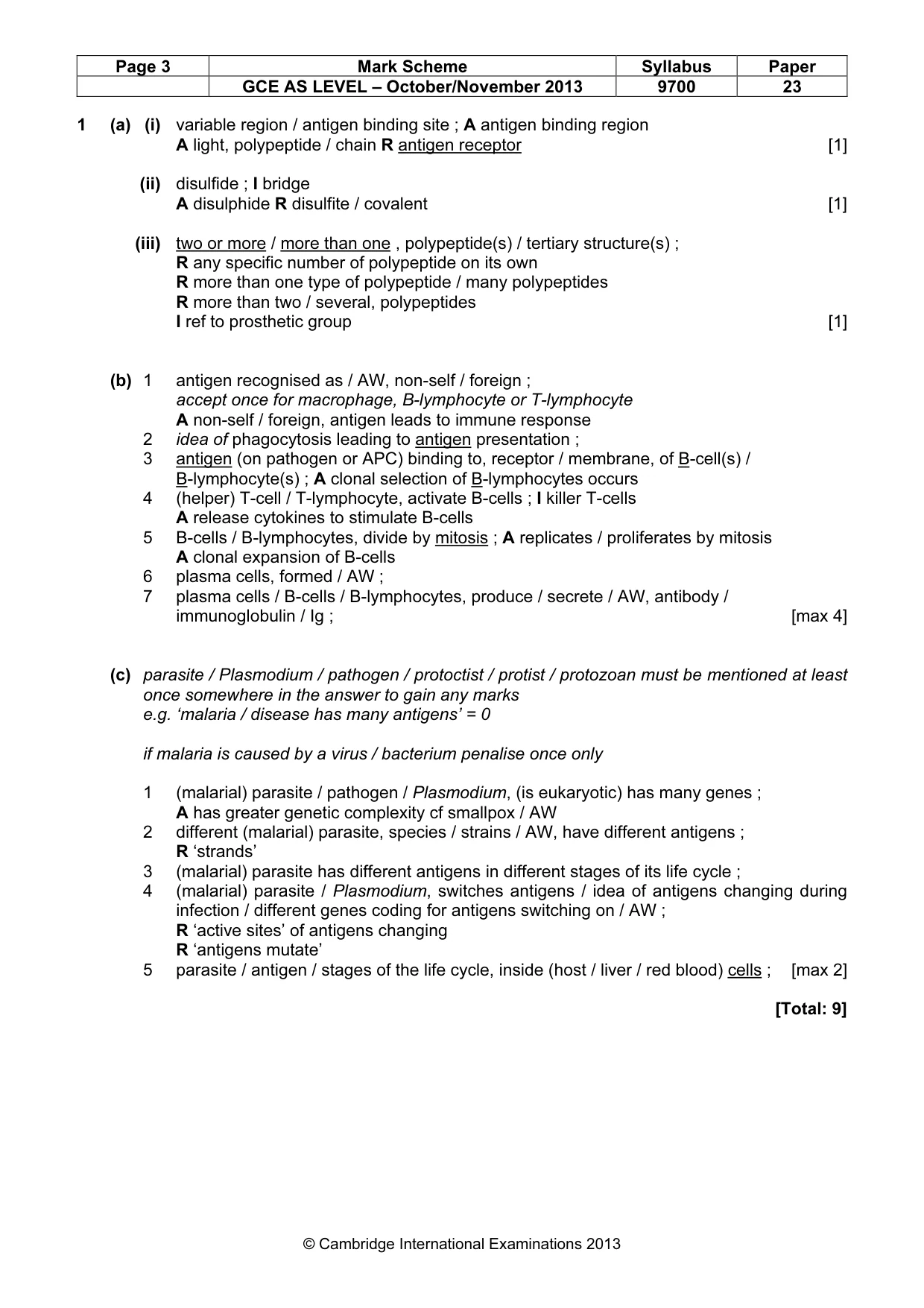
Page 3 Mark Scheme Syllabus Paper GCE AS LEVEL – October/November 2013 9700 23 © Cambridge International Examinations 2013 1 (a) (i) variable region / antigen binding site ; A antigen binding region A light, polypeptide / chain R antigen receptor [1] (ii) disulfide ; I bridge A disulphide R disulfite / covalent [1] (iii) two or more / more than one , polypeptide(s) / tertiary structure(s) ; R any specific number of polypeptide on its own R more than one type of polypeptide / many polypeptides R more than two / several, polypeptides I ref to prosthetic group [1] (b) 1 antigen recognised as / AW, non-self / foreign ; accept once for macrophage, B-lymphocyte or T-lymphocyte A non-self / foreign, antigen leads to immune response 2 idea of phagocytosis leading to antigen presentation ; 3 antigen (on pathogen or APC) binding to, receptor / membrane, of B-cell(s) / B-lymphocyte(s) ; A clonal selection of B-lymphocytes occurs 4 (helper) T-cell / T-lymphocyte, activate B-cells ; I killer T-cells A release cytokines to stimulate B-cells 5 B-cells / B-lymphocytes, divide by mitosis ; A replicates / proliferates by mitosis A clonal expansion of B-cells 6 plasma cells, formed / AW ; 7 plasma cells / B-cells / B-lymphocytes, produce / secrete / AW, antibody / immunoglobulin / Ig ; [max 4] (c) parasite / Plasmodium / pathogen / protoctist / protist / protozoan must be mentioned at least once somewhere in the answer to gain any marks e.g. ‘malaria / disease has many antigens’ = 0 if malaria is caused by a virus / bacterium penalise once only 1 (malarial) parasite / pathogen / Plasmodium, (is eukaryotic) has many genes ; A has greater genetic complexity cf smallpox / AW 2 different (malarial) parasite, species / strains / AW, have different antigens ; R ‘strands’ 3 (malarial) parasite has different antigens in different stages of its life cycle ; 4 (malarial) parasite / Plasmodium, switches antigens / idea of antigens changing during infection / different genes coding for antigens switching on / AW ; R ‘active sites’ of antigens changing R ‘antigens mutate’ 5 parasite / antigen / stages of the life cycle, inside (host / liver / red blood) cells ; [max 2] [Total: 9]
Mark scheme, page 4
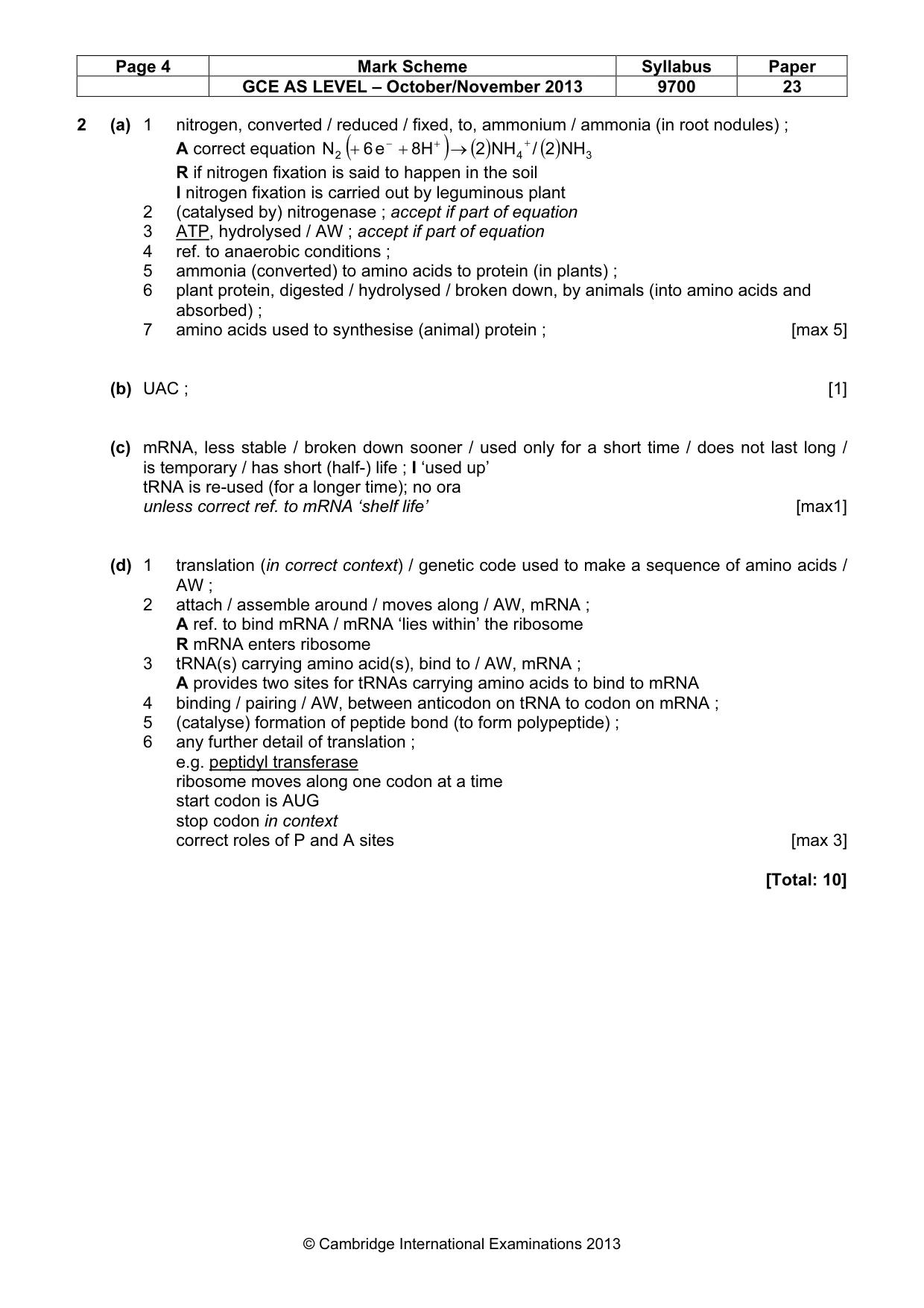
Page 4 Mark Scheme Syllabus Paper GCE AS LEVEL – October/November 2013 9700 23 © Cambridge International Examinations 2013 2 (a) 1 nitrogen, converted / reduced / fixed, to, ammonium / ammonia (in root nodules) ; A correct equation ( ) ( ) ( ) 3 4 2 NH 2 / NH 2 8H e 6 N + + − → + + R if nitrogen fixation is said to happen in the soil I nitrogen fixation is carried out by leguminous plant 2 (catalysed by) nitrogenase ; accept if part of equation 3 ATP, hydrolysed / AW ; accept if part of equation 4 ref. to anaerobic conditions ; 5 ammonia (converted) to amino acids to protein (in plants) ; 6 plant protein, digested / hydrolysed / broken down, by animals (into amino acids and absorbed) ; 7 amino acids used to synthesise (animal) protein ; [max 5] (b) UAC ; [1] (c) mRNA, less stable / broken down sooner / used only for a short time / does not last long / is temporary / has short (half-) life ; I ‘used up’ tRNA is re-used (for a longer time); no ora unless correct ref. to mRNA ‘shelf life’ [max1] (d) 1 translation (in correct context) / genetic code used to make a sequence of amino acids / AW ; 2 attach / assemble around / moves along / AW, mRNA ; A ref. to bind mRNA / mRNA ‘lies within’ the ribosome R mRNA enters ribosome 3 tRNA(s) carrying amino acid(s), bind to / AW, mRNA ; A provides two sites for tRNAs carrying amino acids to bind to mRNA 4 binding / pairing / AW, between anticodon on tRNA to codon on mRNA ; 5 (catalyse) formation of peptide bond (to form polypeptide) ; 6 any further detail of translation ; e.g. peptidyl transferase ribosome moves along one codon at a time start codon is AUG stop codon in context correct roles of P and A sites [max 3] [Total: 10]
Mark scheme, page 5
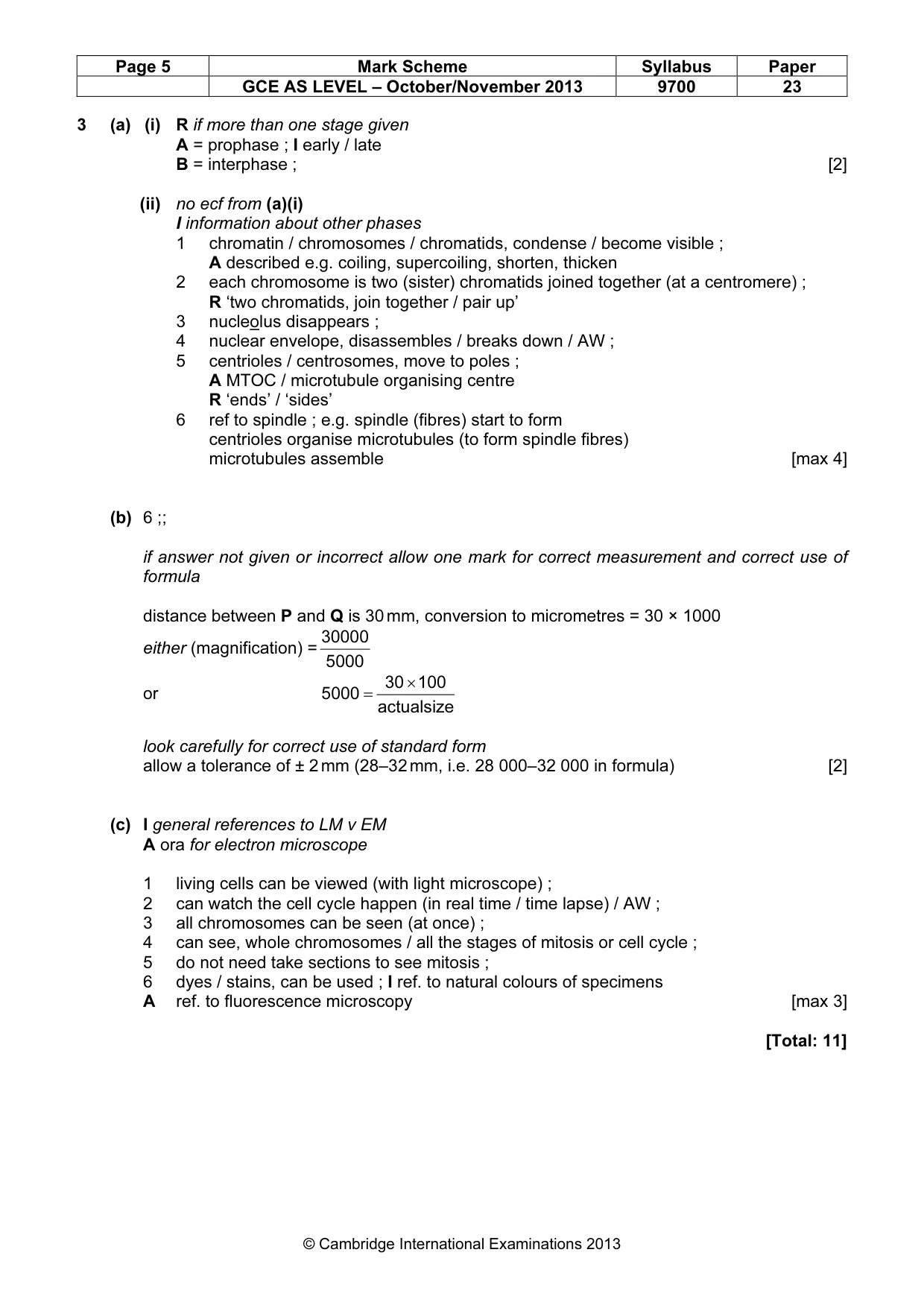
Page 5 Mark Scheme Syllabus Paper GCE AS LEVEL – October/November 2013 9700 23 © Cambridge International Examinations 2013 3 (a) (i) R if more than one stage given A = prophase ; I early / late B = interphase ; [2] (ii) no ecf from (a)(i) I information about other phases 1 chromatin / chromosomes / chromatids, condense / become visible ; A described e.g. coiling, supercoiling, shorten, thicken 2 each chromosome is two (sister) chromatids joined together (at a centromere) ; R ‘two chromatids, join together / pair up’ 3 nucleolus disappears ; 4 nuclear envelope, disassembles / breaks down / AW ; 5 centrioles / centrosomes, move to poles ; A MTOC / microtubule organising centre R ‘ends’ / ‘sides’ 6 ref to spindle ; e.g. spindle (fibres) start to form centrioles organise microtubules (to form spindle fibres) microtubules assemble [max 4] (b) 6 ;; if answer not given or incorrect allow one mark for correct measurement and correct use of formula distance between P and Q is 30 mm, conversion to micrometres = 30 × 1000 either (magnification) = 5000 30000 or actualsize 100 30 5000 × = look carefully for correct use of standard form allow a tolerance of ± 2 mm (28–32 mm, i.e. 28 000–32 000 in formula) [2] (c) I general references to LM v EM A ora for electron microscope 1 living cells can be viewed (with light microscope) ; 2 can watch the cell cycle happen (in real time / time lapse) / AW ; 3 all chromosomes can be seen (at once) ; 4 can see, whole chromosomes / all the stages of mitosis or cell cycle ; 5 do not need take sections to see mitosis ; 6 dyes / stains, can be used ; I ref. to natural colours of specimens A ref. to fluorescence microscopy [max 3] [Total: 11]
Mark scheme, page 6
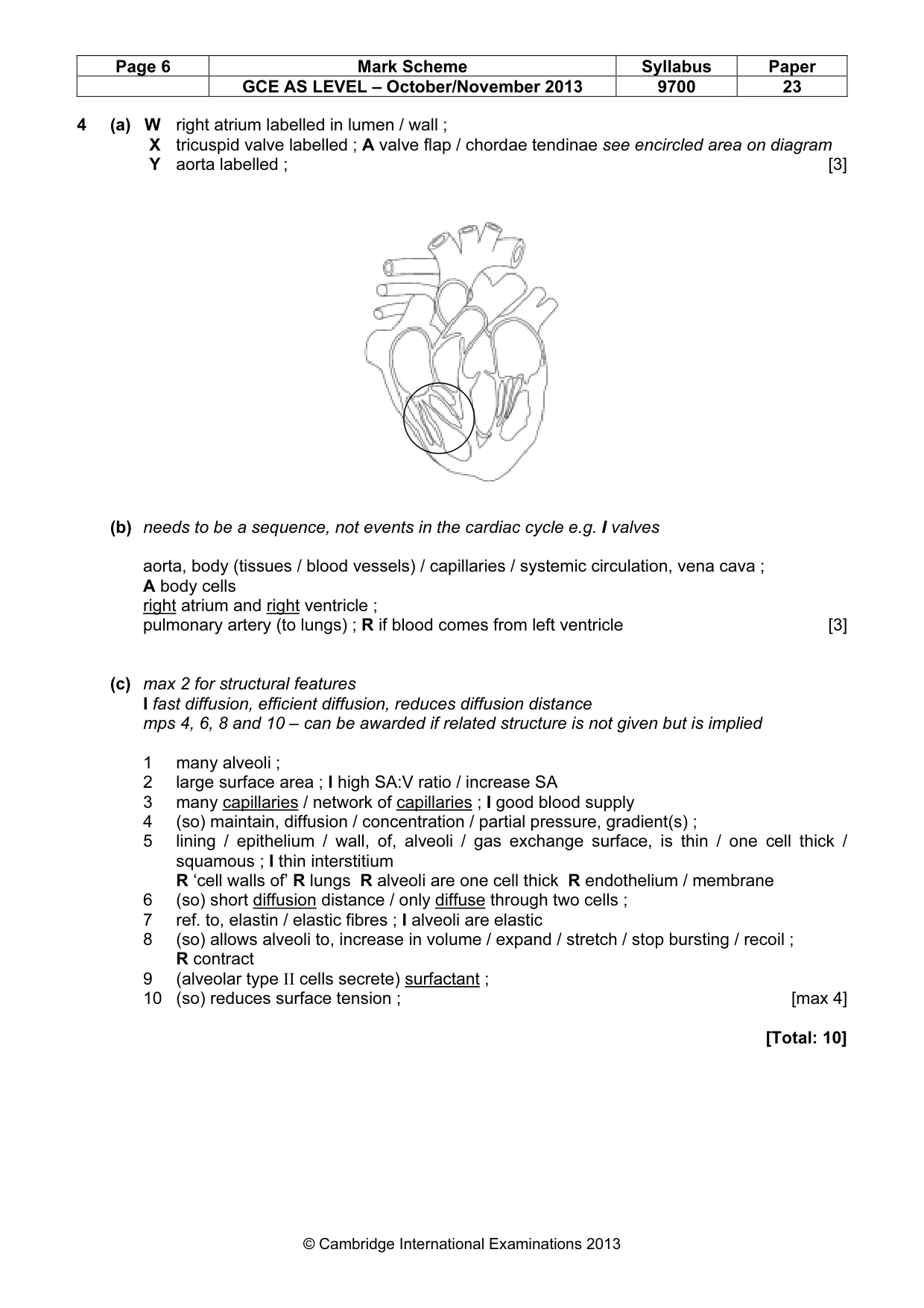
Page 6 Mark Scheme Syllabus Paper GCE AS LEVEL – October/November 2013 9700 23 © Cambridge International Examinations 2013 4 (a) W right atrium labelled in lumen / wall ; X tricuspid valve labelled ; A valve flap / chordae tendinae see encircled area on diagram Y aorta labelled ; [3] (b) needs to be a sequence, not events in the cardiac cycle e.g. I valves aorta, body (tissues / blood vessels) / capillaries / systemic circulation, vena cava ; A body cells right atrium and right ventricle ; pulmonary artery (to lungs) ; R if blood comes from left ventricle [3] (c) max 2 for structural features I fast diffusion, efficient diffusion, reduces diffusion distance mps 4, 6, 8 and 10 – can be awarded if related structure is not given but is implied 1 many alveoli ; 2 large surface area ; I high SA:V ratio / increase SA 3 many capillaries / network of capillaries ; I good blood supply 4 (so) maintain, diffusion / concentration / partial pressure, gradient(s) ; 5 lining / epithelium / wall, of, alveoli / gas exchange surface, is thin / one cell thick / squamous ; I thin interstitium R ‘cell walls of’ R lungs R alveoli are one cell thick R endothelium / membrane 6 (so) short diffusion distance / only diffuse through two cells ; 7 ref. to, elastin / elastic fibres ; I alveoli are elastic 8 (so) allows alveoli to, increase in volume / expand / stretch / stop bursting / recoil ; R contract 9 (alveolar type II cells secrete) surfactant ; 10 (so) reduces surface tension ; [max 4] [Total: 10]
Mark scheme, page 7
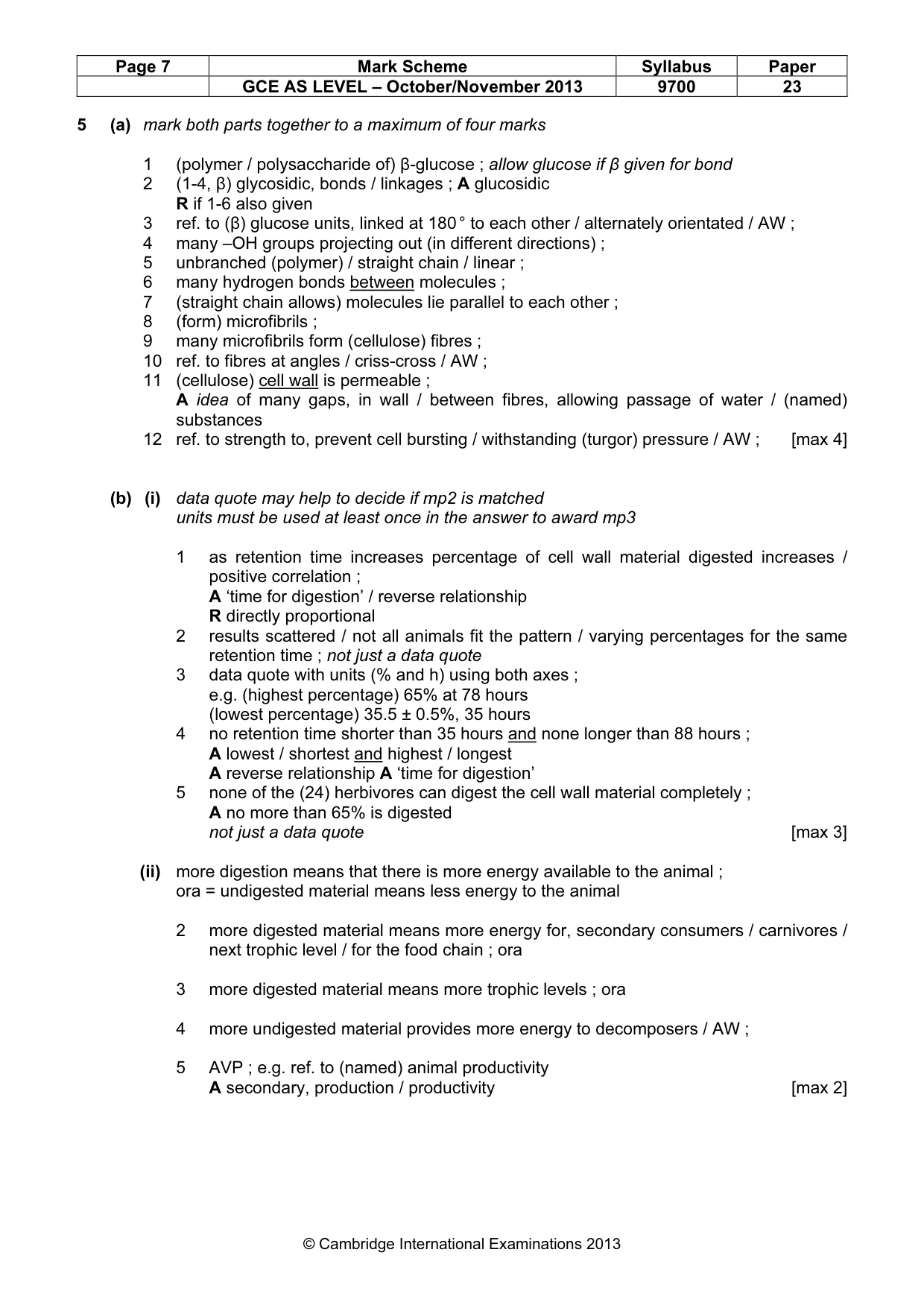
Page 7 Mark Scheme Syllabus Paper GCE AS LEVEL – October/November 2013 9700 23 © Cambridge International Examinations 2013 5 (a) mark both parts together to a maximum of four marks 1 (polymer / polysaccharide of) β-glucose ; allow glucose if β given for bond 2 (1-4, β) glycosidic, bonds / linkages ; A glucosidic R if 1-6 also given 3 ref. to (β) glucose units, linked at 180 ° to each other / alternately orientated / AW ; 4 many –OH groups projecting out (in different directions) ; 5 unbranched (polymer) / straight chain / linear ; 6 many hydrogen bonds between molecules ; 7 (straight chain allows) molecules lie parallel to each other ; 8 (form) microfibrils ; 9 many microfibrils form (cellulose) fibres ; 10 ref. to fibres at angles / criss-cross / AW ; 11 (cellulose) cell wall is permeable ; A idea of many gaps, in wall / between fibres, allowing passage of water / (named) substances 12 ref. to strength to, prevent cell bursting / withstanding (turgor) pressure / AW ; [max 4] (b) (i) data quote may help to decide if mp2 is matched units must be used at least once in the answer to award mp3 1 as retention time increases percentage of cell wall material digested increases / positive correlation ; A ‘time for digestion’ / reverse relationship R directly proportional 2 results scattered / not all animals fit the pattern / varying percentages for the same retention time ; not just a data quote 3 data quote with units (% and h) using both axes ; e.g. (highest percentage) 65% at 78 hours (lowest percentage) 35.5 ± 0.5%, 35 hours 4 no retention time shorter than 35 hours and none longer than 88 hours ; A lowest / shortest and highest / longest A reverse relationship A ‘time for digestion’ 5 none of the (24) herbivores can digest the cell wall material completely ; A no more than 65% is digested not just a data quote [max 3] (ii) more digestion means that there is more energy available to the animal ; ora = undigested material means less energy to the animal 2 more digested material means more energy for, secondary consumers / carnivores / next trophic level / for the food chain ; ora 3 more digested material means more trophic levels ; ora 4 more undigested material provides more energy to decomposers / AW ; 5 AVP ; e.g. ref. to (named) animal productivity A secondary, production / productivity [max 2]
Mark scheme, page 8
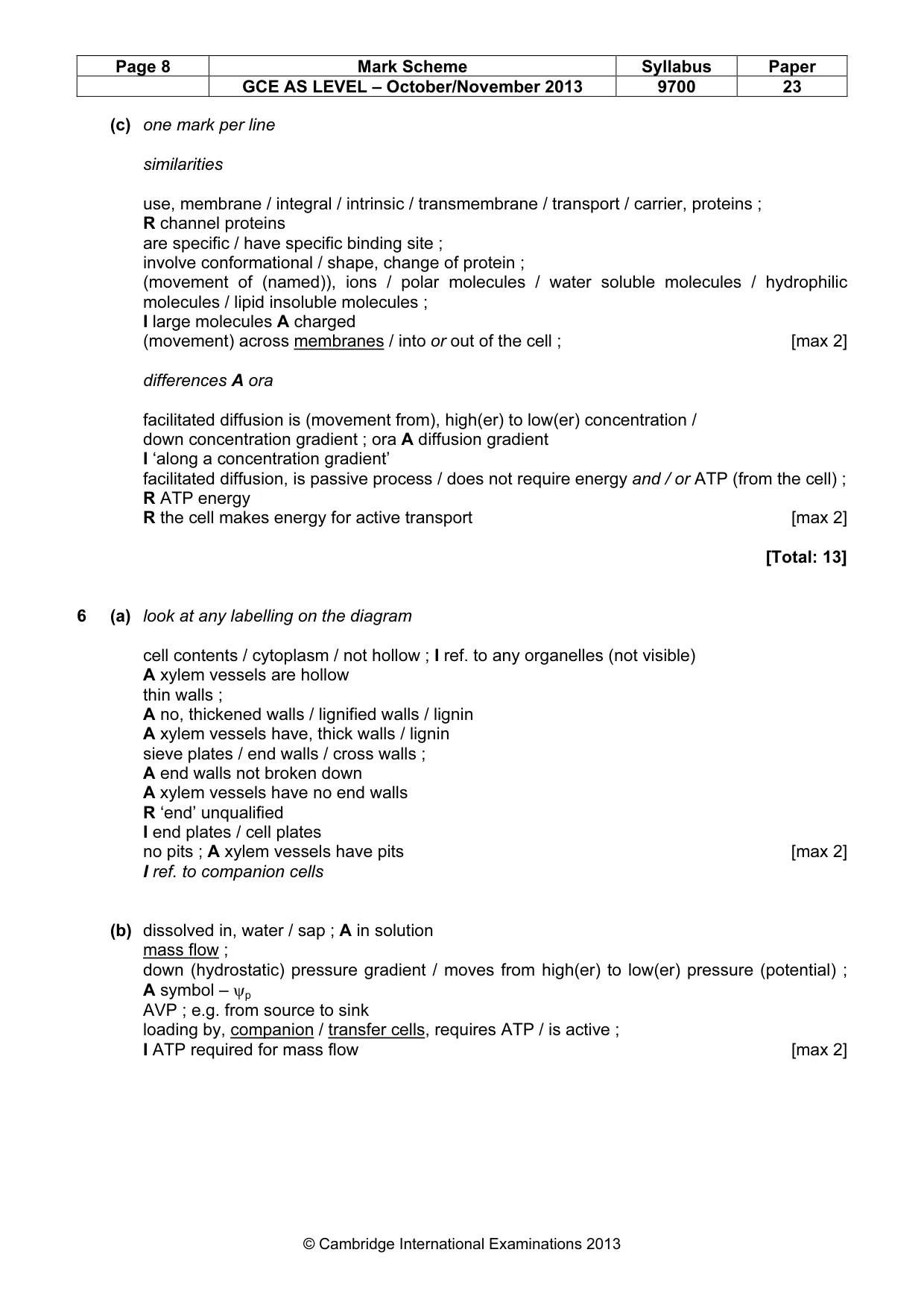
Page 8 Mark Scheme Syllabus Paper GCE AS LEVEL – October/November 2013 9700 23 © Cambridge International Examinations 2013 (c) one mark per line similarities use, membrane / integral / intrinsic / transmembrane / transport / carrier, proteins ; R channel proteins are specific / have specific binding site ; involve conformational / shape, change of protein ; (movement of (named)), ions / polar molecules / water soluble molecules / hydrophilic molecules / lipid insoluble molecules ; I large molecules A charged (movement) across membranes / into or out of the cell ; [max 2] differences A ora facilitated diffusion is (movement from), high(er) to low(er) concentration / down concentration gradient ; ora A diffusion gradient I ‘along a concentration gradient’ facilitated diffusion, is passive process / does not require energy and / or ATP (from the cell) ; R ATP energy R the cell makes energy for active transport [max 2] [Total: 13] 6 (a) look at any labelling on the diagram cell contents / cytoplasm / not hollow ; I ref. to any organelles (not visible) A xylem vessels are hollow thin walls ; A no, thickened walls / lignified walls / lignin A xylem vessels have, thick walls / lignin sieve plates / end walls / cross walls ; A end walls not broken down A xylem vessels have no end walls R ‘end’ unqualified I end plates / cell plates no pits ; A xylem vessels have pits [max 2] I ref. to companion cells (b) dissolved in, water / sap ; A in solution mass flow ; down (hydrostatic) pressure gradient / moves from high(er) to low(er) pressure (potential) ; A symbol – ψp AVP ; e.g. from source to sink loading by, companion / transfer cells, requires ATP / is active ; I ATP required for mass flow [max 2]
Mark scheme, page 9
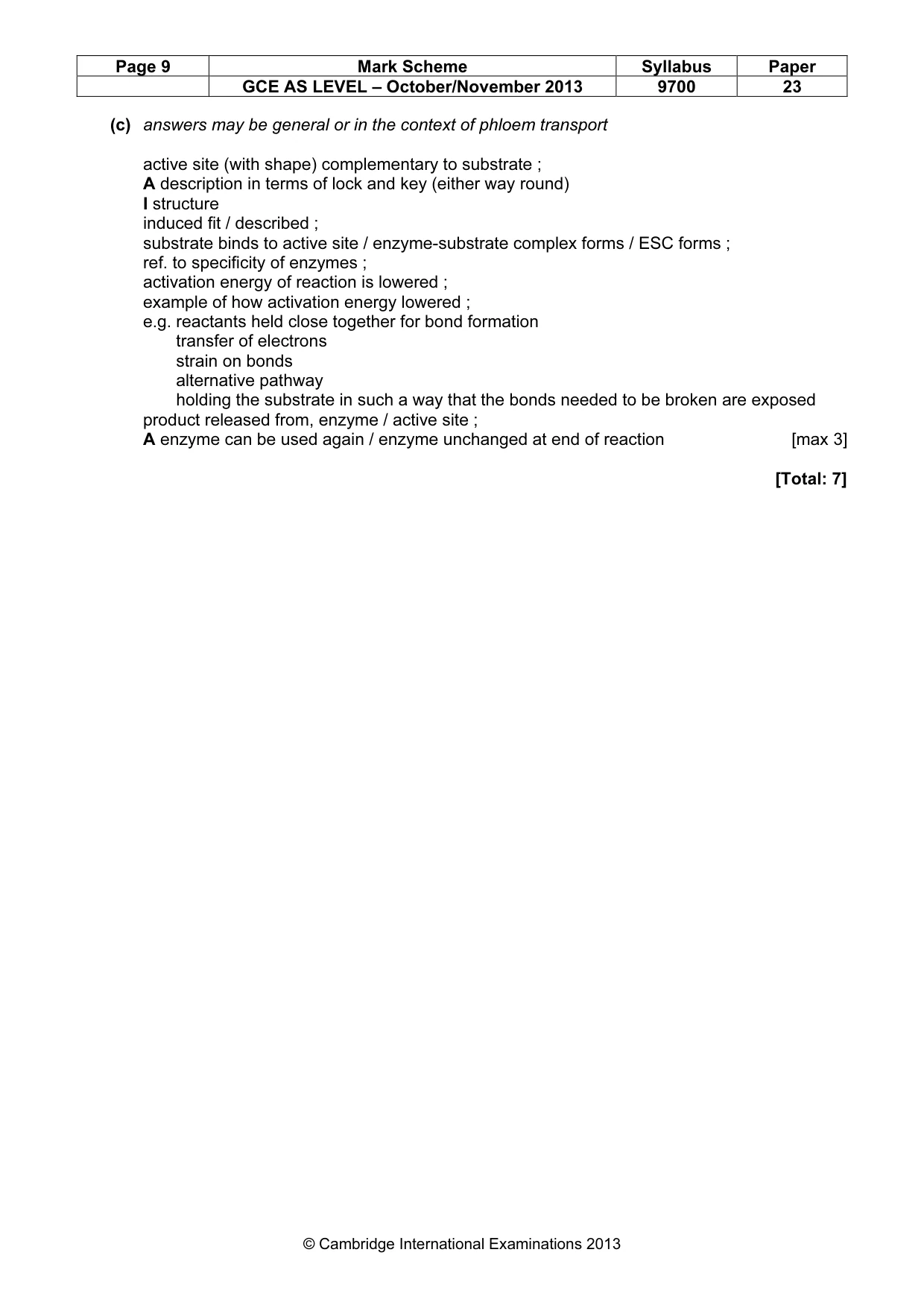
Page 9 Mark Scheme Syllabus Paper GCE AS LEVEL – October/November 2013 9700 23 © Cambridge International Examinations 2013 (c) answers may be general or in the context of phloem transport active site (with shape) complementary to substrate ; A description in terms of lock and key (either way round) I structure induced fit / described ; substrate binds to active site / enzyme-substrate complex forms / ESC forms ; ref. to specificity of enzymes ; activation energy of reaction is lowered ; example of how activation energy lowered ; e.g. reactants held close together for bond formation transfer of electrons strain on bonds alternative pathway holding the substrate in such a way that the bonds needed to be broken are exposed product released from, enzyme / active site ; A enzyme can be used again / enzyme unchanged at end of reaction [max 3] [Total: 7]
What you needed in this session
Cambridge’s own grade thresholds for 2013 Oct/Nov, Paper 2 · Variant 3. A higher threshold means an easier paper — the bar moves with how the cohort did.