Cambridge A Level Biology 9700 — 2013 May/June Paper 5 · Variant 2
9700/52/M/J/13 · 30 marks · ≈34 min
The question paper and its mark scheme, free to read here and free to download. This is Cambridge’s own paper, exactly as it was sat.
Question paper8 pages
Mark scheme8 pages
Answers below. Sit the paper first if you are practising.
Paper as text
Question paper, page 1
This document consists of 8 printed pages. DC (AC/CGW) 62465/3 © UCLES 2013 [Turn over UNIVERSITY OF CAMBRIDGE INTERNATIONAL EXAMINATIONS General Certificate of Education Advanced Level * 2 2 3 6 7 6 0 8 1 9 * BIOLOGY 9700/52 Paper 5 Planning, Analysis and Evaluation May/June 2013 1 hour 15 minutes Candidates answer on the Question Paper. No Additional Materials are required. READ THESE INSTRUCTIONS FIRST Write your Centre number, candidate number and name on all the work you hand in. Write in dark blue or black ink. You may use a soft pencil for any diagrams, graphs or rough working. Do not use staples, paper clips, highlighters, glue or correction fluid. DO NOT WRITE IN ANY BARCODES. Answer all questions. Electronic calculators may be used. At the end of the examination, fasten all your work securely together. The number of marks is given in brackets [ ] at the end of each question or part question. For Examiner’s Use 1 2 Total
Question paper, page 2
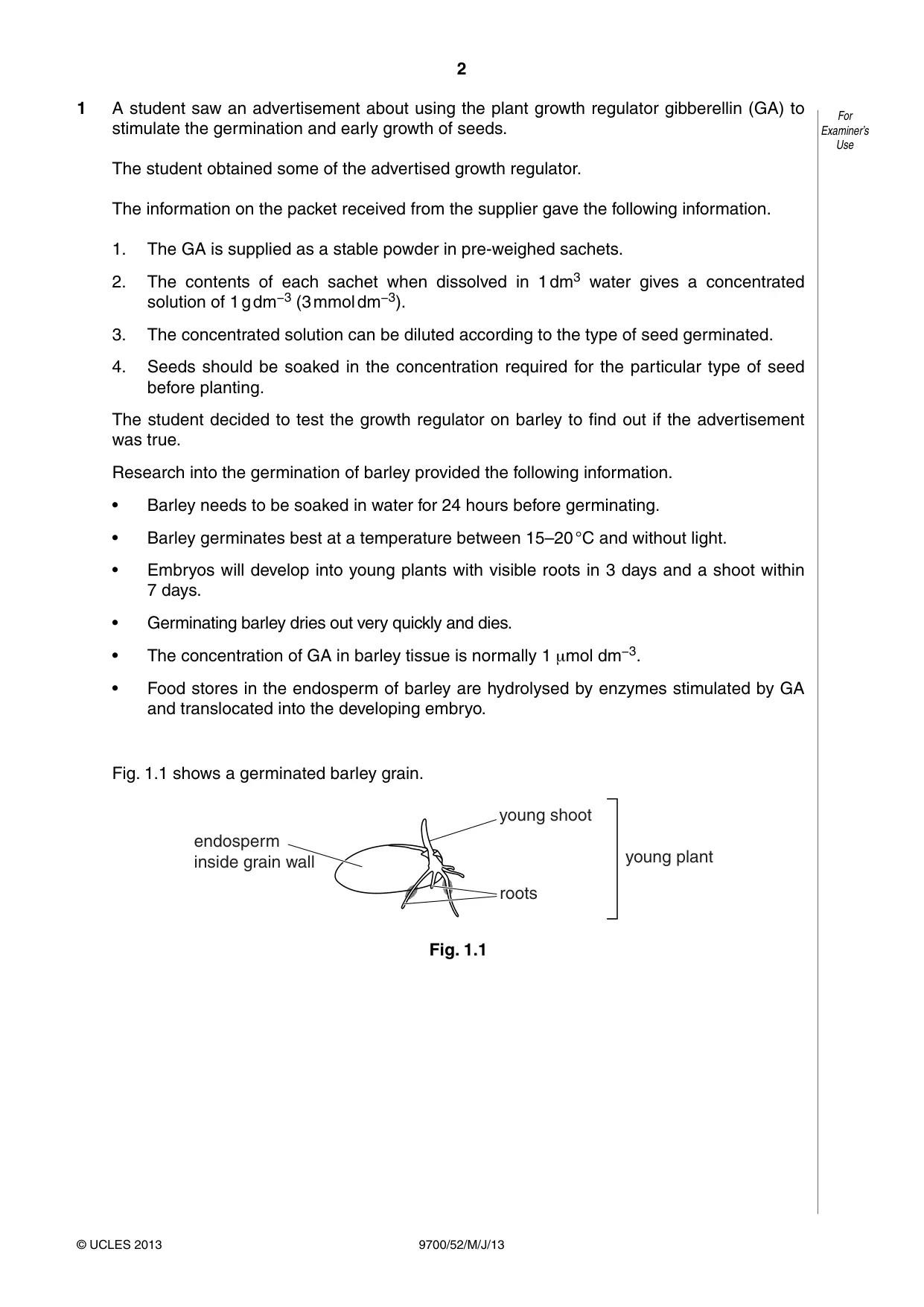
2 9700/52/M/J/13 © UCLES 2013 For Examiner’s Use 1 A student saw an advertisement about using the plant growth regulator gibberellin (GA) to stimulate the germination and early growth of seeds. The student obtained some of the advertised growth regulator. The information on the packet received from the supplier gave the following information. 1. The GA is supplied as a stable powder in pre-weighed sachets. 2. The contents of each sachet when dissolved in 1 dm3 water gives a concentrated solution of 1 g dm−3 (3 mmol dm−3). 3. The concentrated solution can be diluted according to the type of seed germinated. 4. Seeds should be soaked in the concentration required for the particular type of seed before planting. The student decided to test the growth regulator on barley to find out if the advertisement was true. Research into the germination of barley provided the following information. • Barley needs to be soaked in water for 24 hours before germinating. • Barley germinates best at a temperature between 15–20 °C and without light. • Embryos will develop into young plants with visible roots in 3 days and a shoot within 7 days. • Germinating barley dries out very quickly and dies. • The concentration of GA in barley tissue is normally 1 μmol dm−3. • Food stores in the endosperm of barley are hydrolysed by enzymes stimulated by GA and translocated into the developing embryo. Fig. 1.1 shows a germinated barley grain. roots young shoot young plant endosperm inside grain wall Fig. 1.1
Question paper, page 3
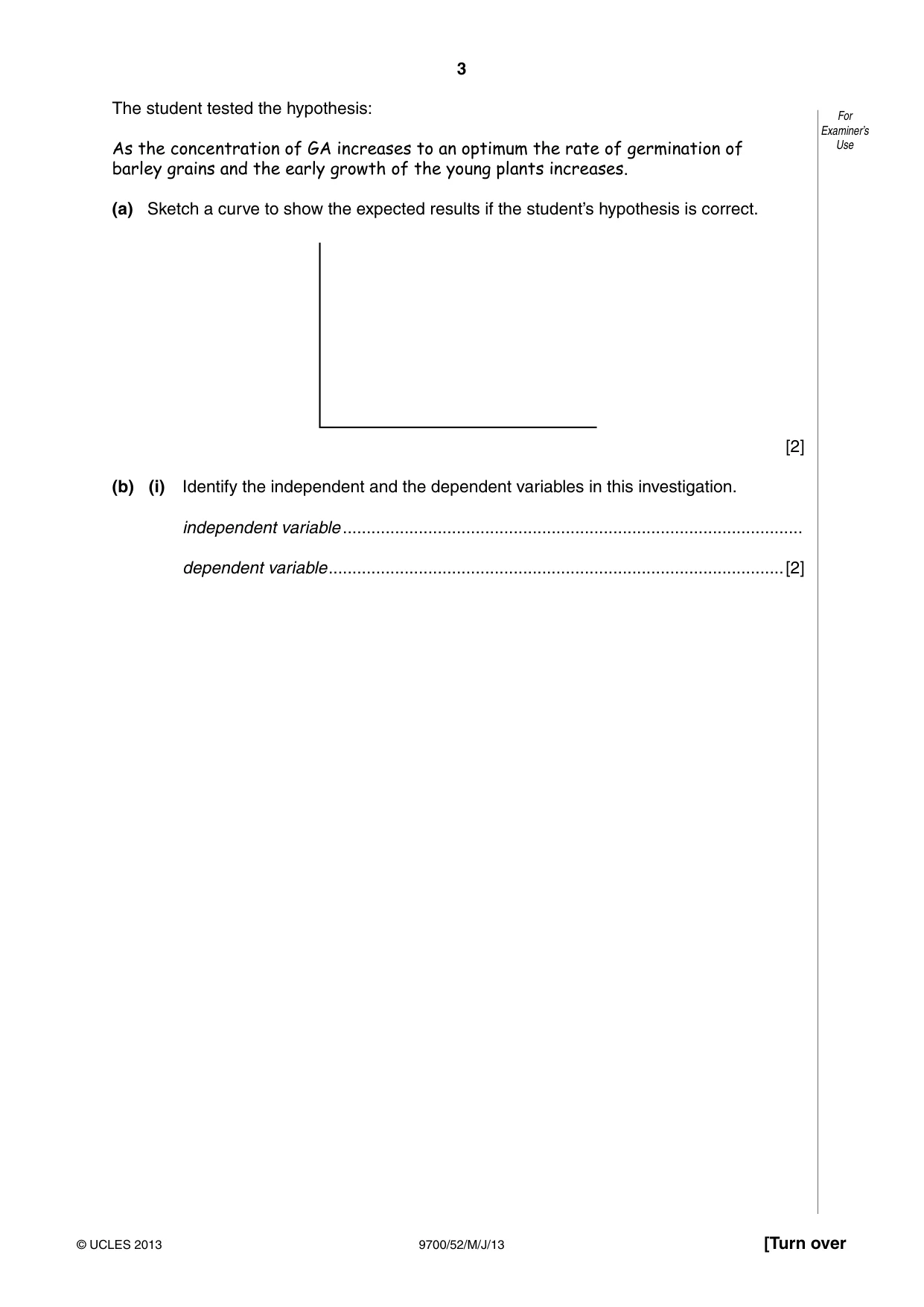
3 9700/52/M/J/13 © UCLES 2013 [Turn over For Examiner’s Use The student tested the hypothesis: As the concentration of GA increases to an optimum the rate of germination of barley grains and the early growth of the young plants increases. (a) Sketch a curve to show the expected results if the student’s hypothesis is correct. [2] (b) (i) Identify the independent and the dependent variables in this investigation. independent variable … dependent variable …[2]
Question paper, page 4
4 9700/52/M/J/13 © UCLES 2013 For Examiner’s Use (ii) Describe a method the student could use to test the hypothesis. Your method should be detailed enough for another person to use. … … … … … … … … … … … … … … … … … … … … … … … … … …[7]
Question paper, page 5
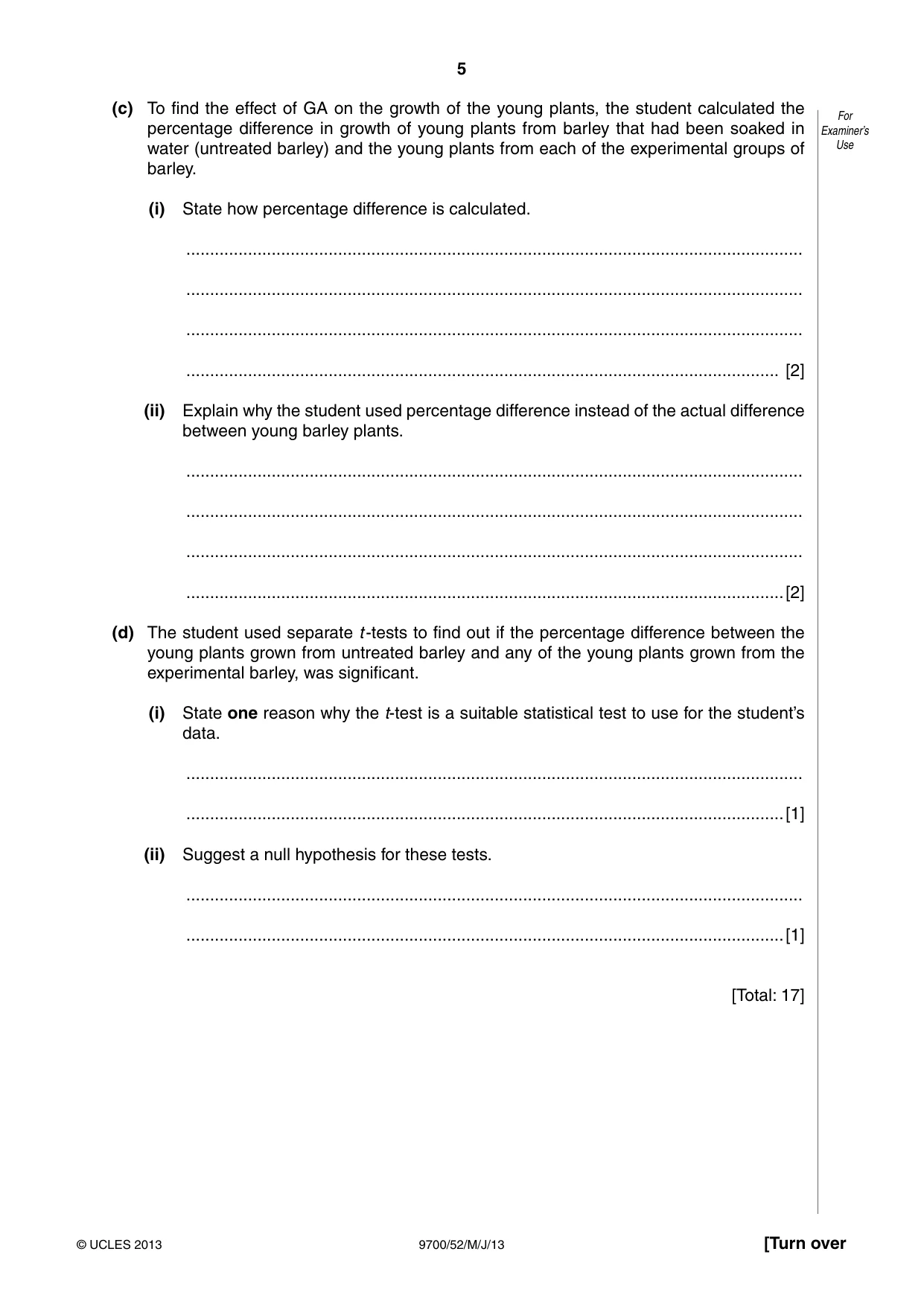
5 9700/52/M/J/13 © UCLES 2013 [Turn over For Examiner’s Use (c) To find the effect of GA on the growth of the young plants, the student calculated the percentage difference in growth of young plants from barley that had been soaked in water (untreated barley) and the young plants from each of the experimental groups of barley. (i) State how percentage difference is calculated. … … … … [2] (ii) Explain why the student used percentage difference instead of the actual difference between young barley plants. … … … …[2] (d) The student used separate t -tests to find out if the percentage difference between the young plants grown from untreated barley and any of the young plants grown from the experimental barley, was significant. (i) State one reason why the t-test is a suitable statistical test to use for the student’s data. … …[1] (ii) Suggest a null hypothesis for these tests. … …[1] [Total: 17]
Question paper, page 6
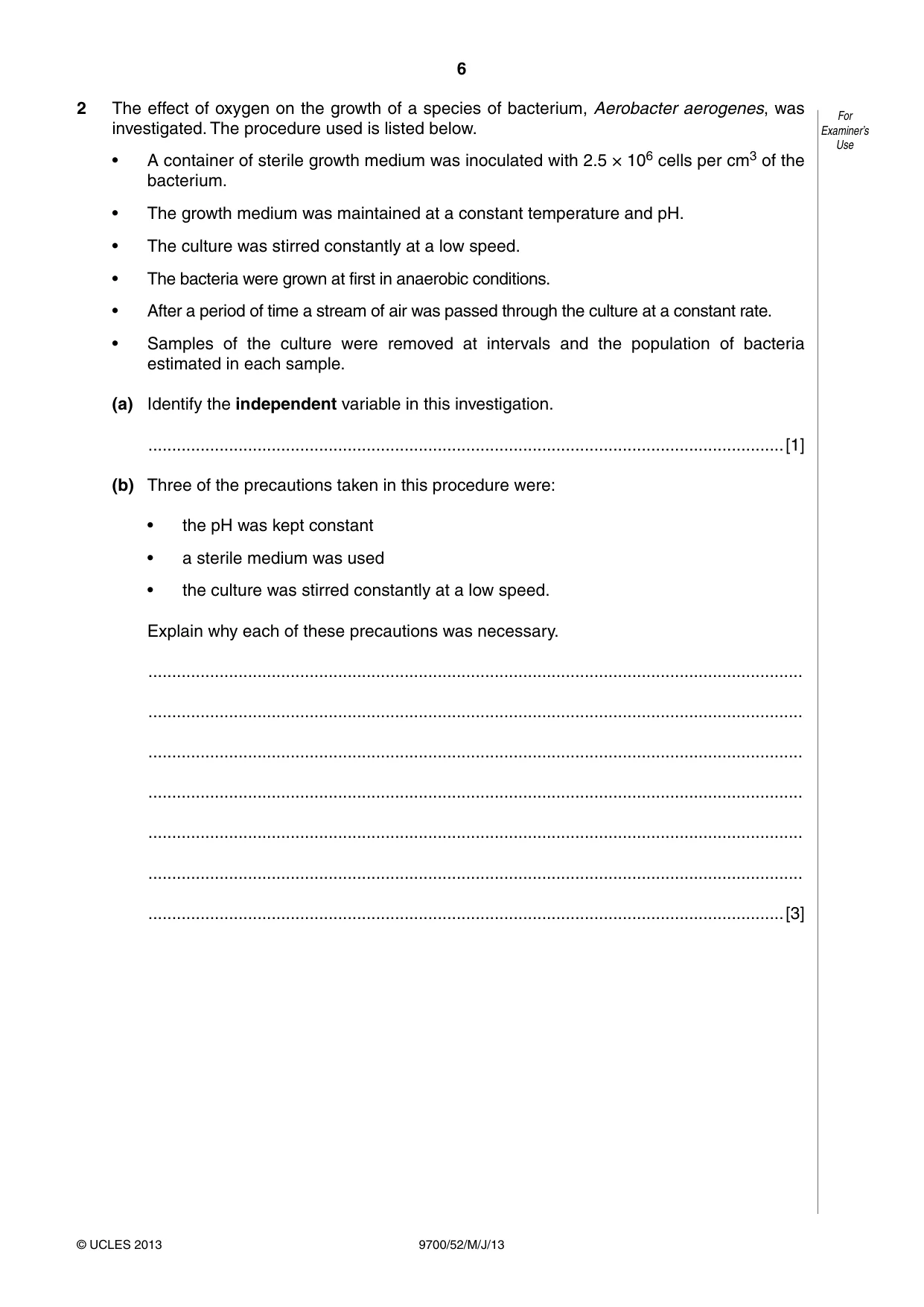
6 9700/52/M/J/13 © UCLES 2013 For Examiner’s Use 2 The effect of oxygen on the growth of a species of bacterium, Aerobacter aerogenes, was investigated. The procedure used is listed below. • A container of sterile growth medium was inoculated with 2.5 × 10⁶ cells per cm3 of the bacterium. • The growth medium was maintained at a constant temperature and pH. • The culture was stirred constantly at a low speed. • The bacteria were grown at first in anaerobic conditions. • After a period of time a stream of air was passed through the culture at a constant rate. • Samples of the culture were removed at intervals and the population of bacteria estimated in each sample. (a) Identify the independent variable in this investigation. …[1] (b) Three of the precautions taken in this procedure were: • the pH was kept constant • a sterile medium was used • the culture was stirred constantly at a low speed. Explain why each of these precautions was necessary. … … … … … … …[3]
Question paper, page 7
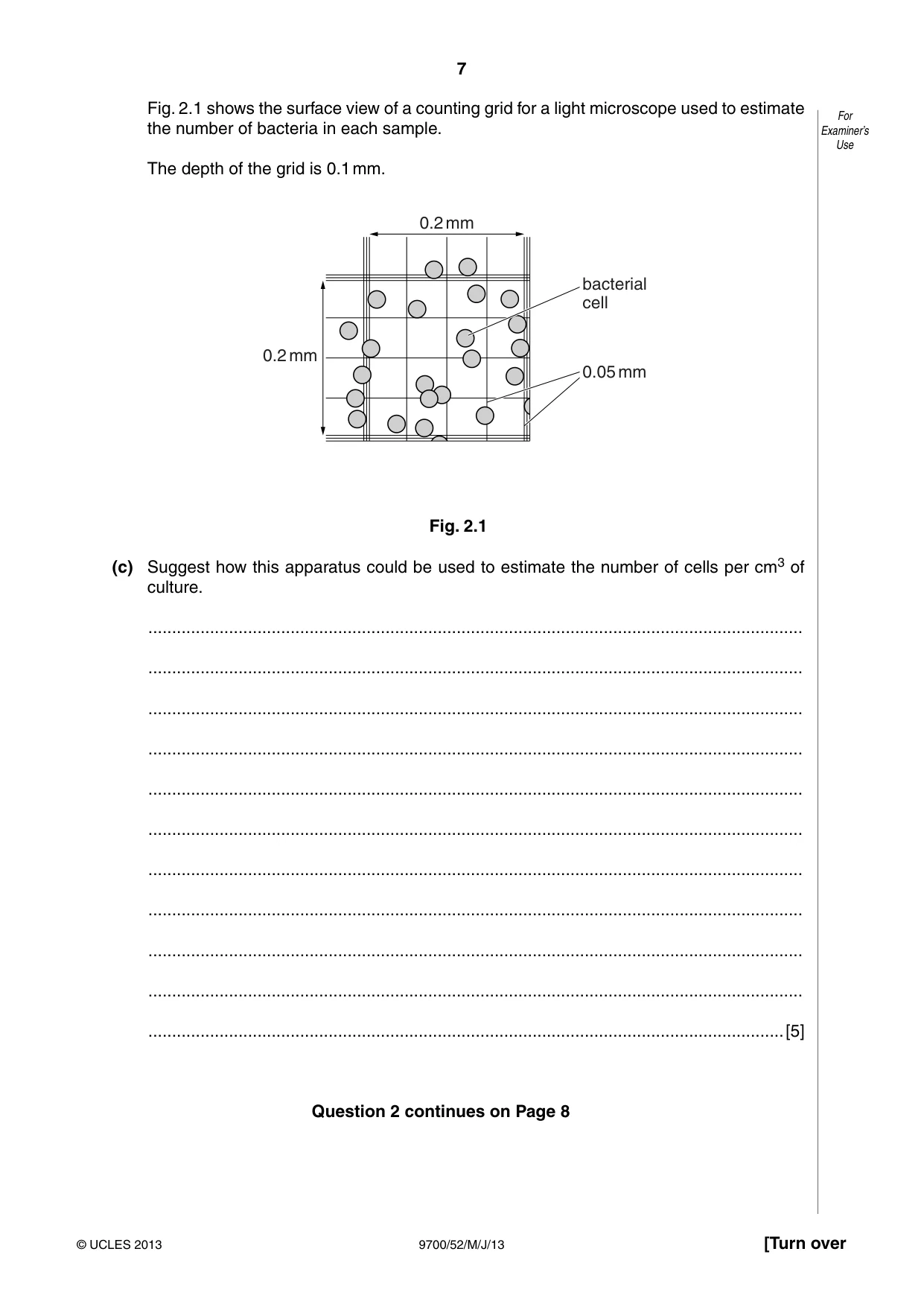
7 9700/52/M/J/13 © UCLES 2013 [Turn over For Examiner’s Use Fig. 2.1 shows the surface view of a counting grid for a light microscope used to estimate the number of bacteria in each sample. The depth of the grid is 0.1 mm. 0.2 mm 0.2 mm 0.05 mm bacterial cell Fig. 2.1 (c) Suggest how this apparatus could be used to estimate the number of cells per cm3 of culture. … … … … … … … … … … …[5] Question 2 continues on Page 8
Question paper, page 8
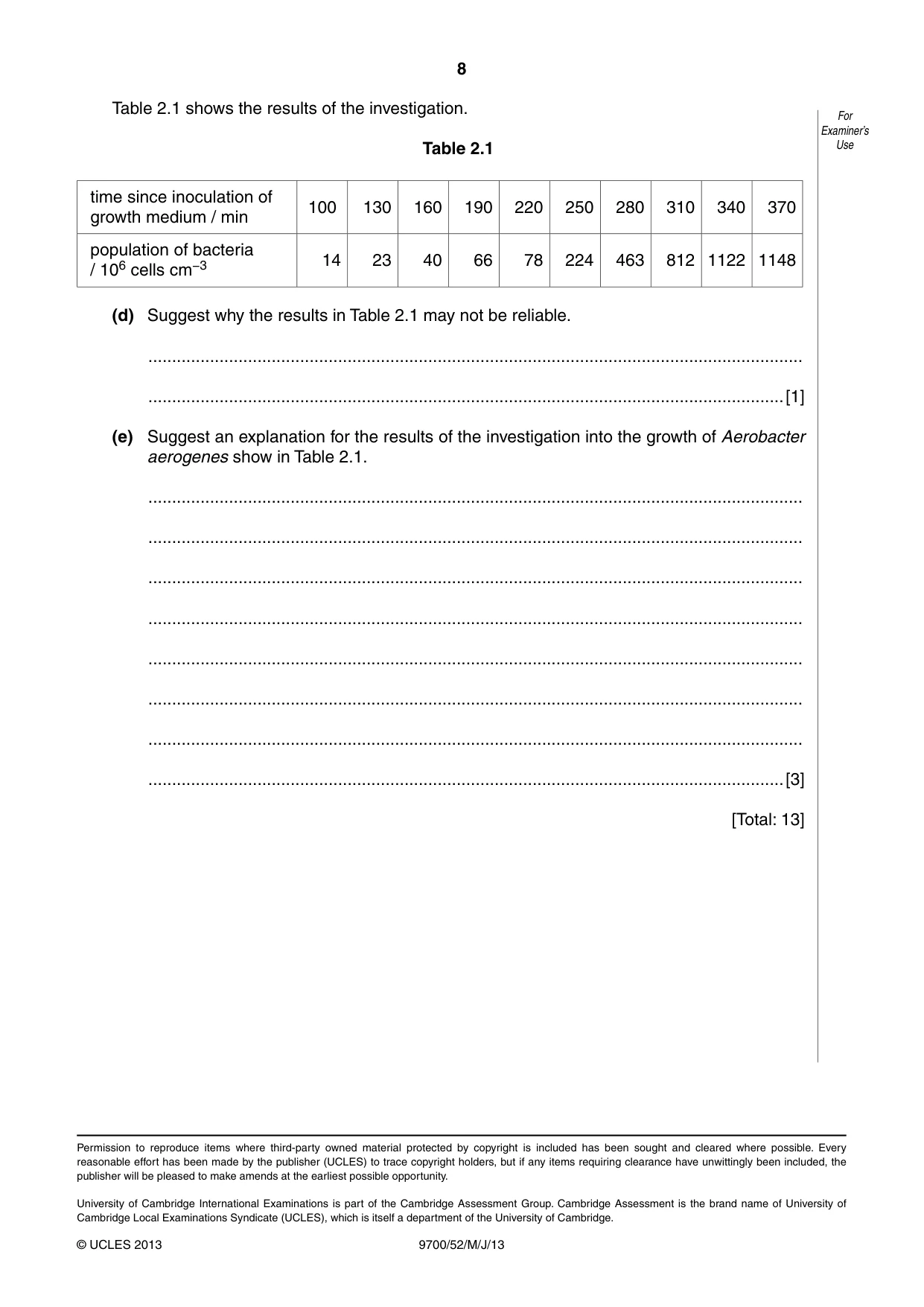
8 9700/52/M/J/13 © UCLES 2013 For Examiner’s Use Permission to reproduce items where third-party owned material protected by copyright is included has been sought and cleared where possible. Every reasonable effort has been made by the publisher (UCLES) to trace copyright holders, but if any items requiring clearance have unwittingly been included, the publisher will be pleased to make amends at the earliest possible opportunity. University of Cambridge International Examinations is part of the Cambridge Assessment Group. Cambridge Assessment is the brand name of University of Cambridge Local Examinations Syndicate (UCLES), which is itself a department of the University of Cambridge. Table 2.1 shows the results of the investigation. Table 2.1 time since inoculation of growth medium / min 100 130 160 190 220 250 280 310 340 370 population of bacteria / 106 cells cm−3 14 23 40 66 78 224 463 812 1122 1148 (d) Suggest why the results in Table 2.1 may not be reliable. … …[1] (e) Suggest an explanation for the results of the investigation into the growth of Aerobacter aerogenes show in Table 2.1. … … … … … … … …[3] [Total: 13]
Mark scheme, page 1
CAMBRIDGE INTERNATIONAL EXAMINATIONS GCE Advanced Subsidiary Level and GCE Advanced Level MARK SCHEME for the May/June 2013 series 9700 BIOLOGY 9700/52 Paper 5 (Planning, Analysis and Evaluation), maximum raw mark 30 This mark scheme is published as an aid to teachers and candidates, to indicate the requirements of the examination. It shows the basis on which Examiners were instructed to award marks. It does not indicate the details of the discussions that took place at an Examiners’ meeting before marking began, which would have considered the acceptability of alternative answers. Mark schemes should be read in conjunction with the question paper and the Principal Examiner Report for Teachers. Cambridge will not enter into discussions about these mark schemes. Cambridge is publishing the mark schemes for the May/June 2013 series for most IGCSE, GCE Advanced Level and Advanced Subsidiary Level components and some Ordinary Level components.
Mark scheme, page 2
Page 2 Mark Scheme Syllabus Paper GCE AS/A LEVEL – May/June 2013 9700 52 © Cambridge International Examinations 2013 Mark schemes abbreviations: ; separates marking points / alternatives answers for the same point R do not allow A allow (for answers correctly cued by the question, or guidance for examiners) AW alternative wording (where responses vary more than usual) underline actual word given must be used by candidate (grammatical variants excepted) max indicates the maximum number of marks that can be given ecf error carried forward
Mark scheme, page 3
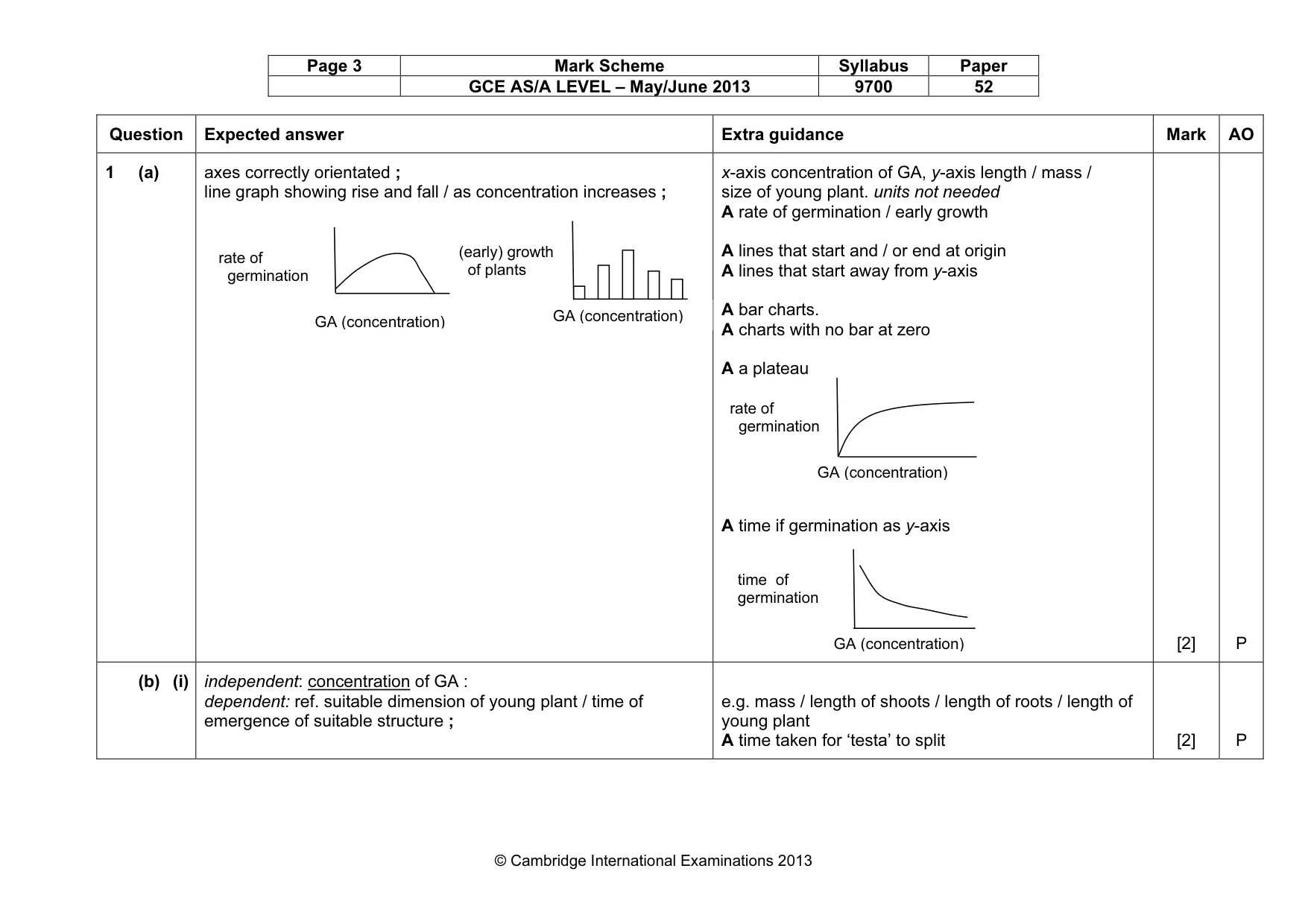
Page 3 Mark Scheme Syllabus Paper GCE AS/A LEVEL – May/June 2013 9700 52 © Cambridge International Examinations 2013 Question Expected answer Extra guidance Mark AO 1 (a) axes correctly orientated ; line graph showing rise and fall / as concentration increases ; x-axis concentration of GA, y-axis length / mass / size of young plant. units not needed A rate of germination / early growth A lines that start and / or end at origin A lines that start away from y-axis A bar charts. A charts with no bar at zero A a plateau A time if germination as y-axis [2] P (b) (i) independent: concentration of GA : dependent: ref. suitable dimension of young plant / time of emergence of suitable structure ; e.g. mass / length of shoots / length of roots / length of young plant A time taken for ‘testa’ to split [2] P GA (concentration) (early) growth of plants GA (concentration) rate of germination GA (concentration) time of germination GA (concentration) rate of germination
Mark scheme, page 4
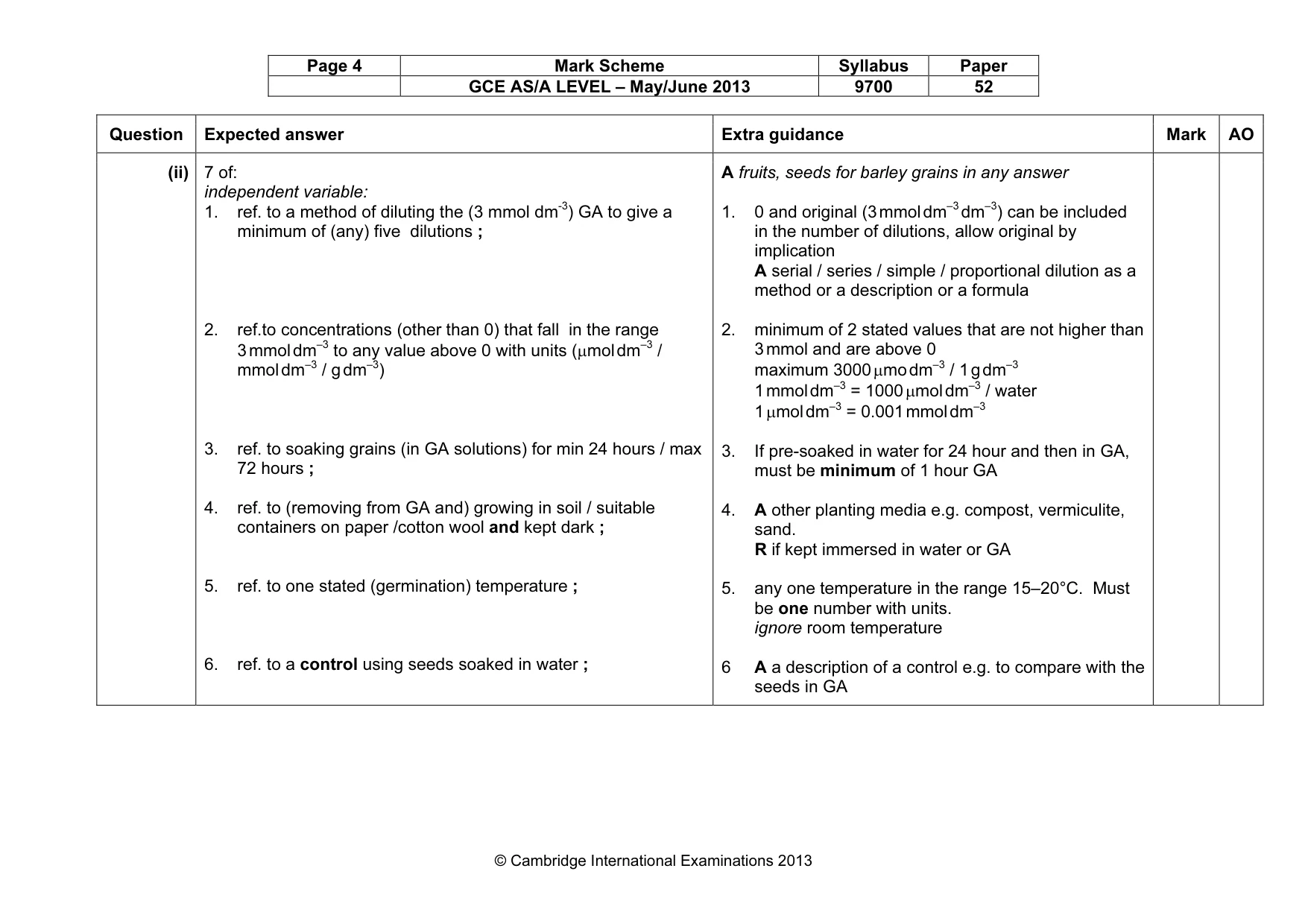
Page 4 Mark Scheme Syllabus Paper GCE AS/A LEVEL – May/June 2013 9700 52 © Cambridge International Examinations 2013 Question Expected answer Extra guidance Mark AO (ii) 7 of: independent variable: 1. ref. to a method of diluting the (3 mmol dm-3) GA to give a minimum of (any) five dilutions ; 2. ref.to concentrations (other than 0) that fall in the range 3 mmol dm–3 to any value above 0 with units (µmol dm–3 / mmol dm–3 / g dm–3) 3. ref. to soaking grains (in GA solutions) for min 24 hours / max 72 hours ; 4. ref. to (removing from GA and) growing in soil / suitable containers on paper /cotton wool and kept dark ; 5. ref. to one stated (germination) temperature ; 6. ref. to a control using seeds soaked in water ; A fruits, seeds for barley grains in any answer 1. 0 and original (3 mmol dm–3 dm–3) can be included in the number of dilutions, allow original by implication A serial / series / simple / proportional dilution as a method or a description or a formula 2. minimum of 2 stated values that are not higher than 3 mmol and are above 0 maximum 3000 µmo dm–3 / 1 g dm–3 1 mmol dm–3 = 1000 µmol dm–3 / water 1 µmol dm–3 = 0.001 mmol dm–3 3. If pre-soaked in water for 24 hour and then in GA, must be minimum of 1 hour GA 4. A other planting media e.g. compost, vermiculite, sand. R if kept immersed in water or GA 5. any one temperature in the range 15–20°C. Must be one number with units. ignore room temperature 6 A a description of a control e.g. to compare with the seeds in GA
Mark scheme, page 5
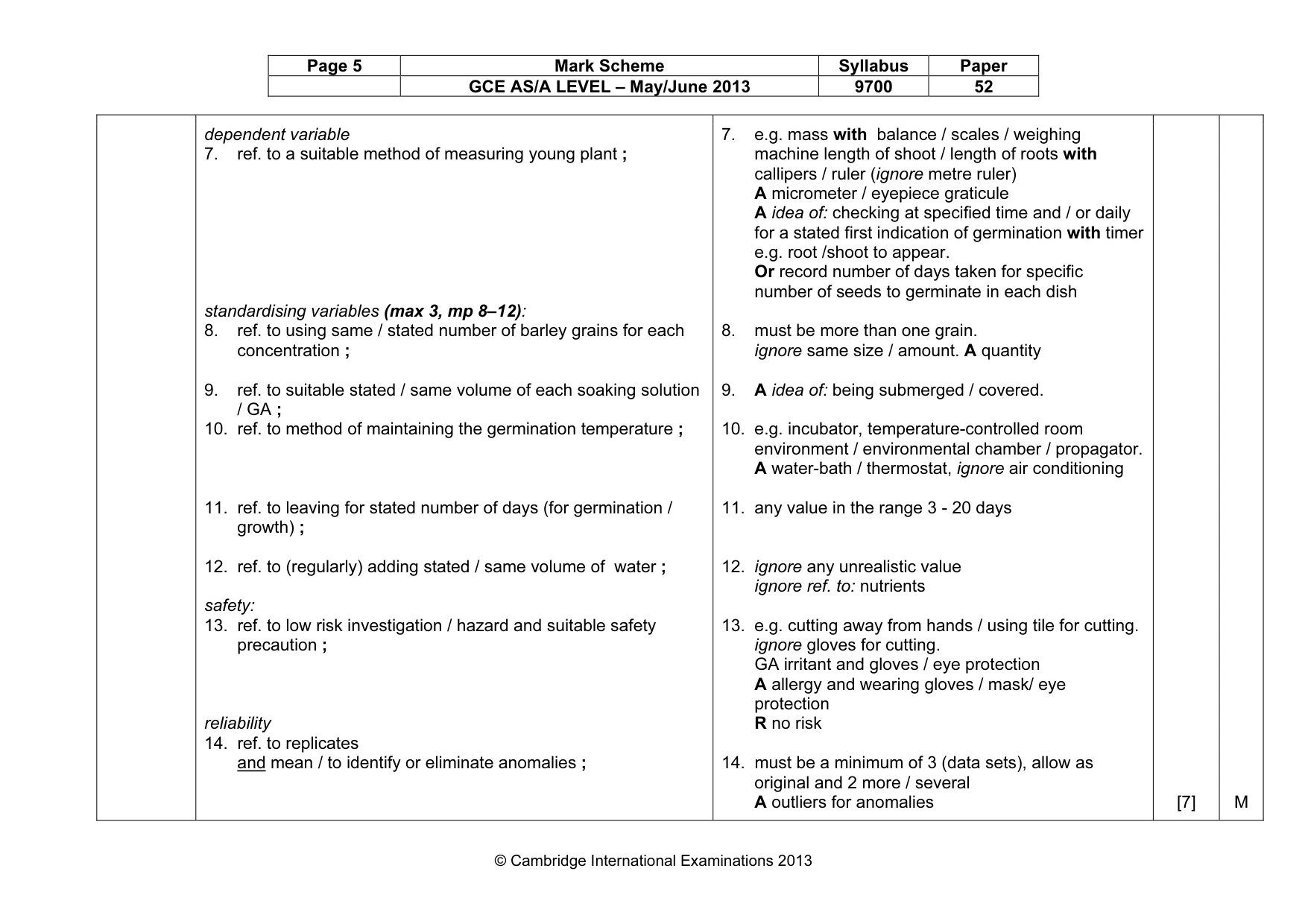
Page 5 Mark Scheme Syllabus Paper GCE AS/A LEVEL – May/June 2013 9700 52 © Cambridge International Examinations 2013 dependent variable 7. ref. to a suitable method of measuring young plant ; standardising variables (max 3, mp 8–12): 8. ref. to using same / stated number of barley grains for each concentration ; 9. ref. to suitable stated / same volume of each soaking solution / GA ; 10. ref. to method of maintaining the germination temperature ; 11. ref. to leaving for stated number of days (for germination / growth) ; 12. ref. to (regularly) adding stated / same volume of water ; safety: 13. ref. to low risk investigation / hazard and suitable safety precaution ; reliability 14. ref. to replicates and mean / to identify or eliminate anomalies ; 7. e.g. mass with balance / scales / weighing machine length of shoot / length of roots with callipers / ruler (ignore metre ruler) A micrometer / eyepiece graticule A idea of: checking at specified time and / or daily for a stated first indication of germination with timer e.g. root /shoot to appear. Or record number of days taken for specific number of seeds to germinate in each dish 8. must be more than one grain. ignore same size / amount. A quantity 9. A idea of: being submerged / covered. 10. e.g. incubator, temperature-controlled room environment / environmental chamber / propagator. A water-bath / thermostat, ignore air conditioning 11. any value in the range 3 - 20 days 12. ignore any unrealistic value ignore ref. to: nutrients 13. e.g. cutting away from hands / using tile for cutting. ignore gloves for cutting. GA irritant and gloves / eye protection A allergy and wearing gloves / mask/ eye protection R no risk 14. must be a minimum of 3 (data sets), allow as original and 2 more / several A outliers for anomalies [7] M
Mark scheme, page 6
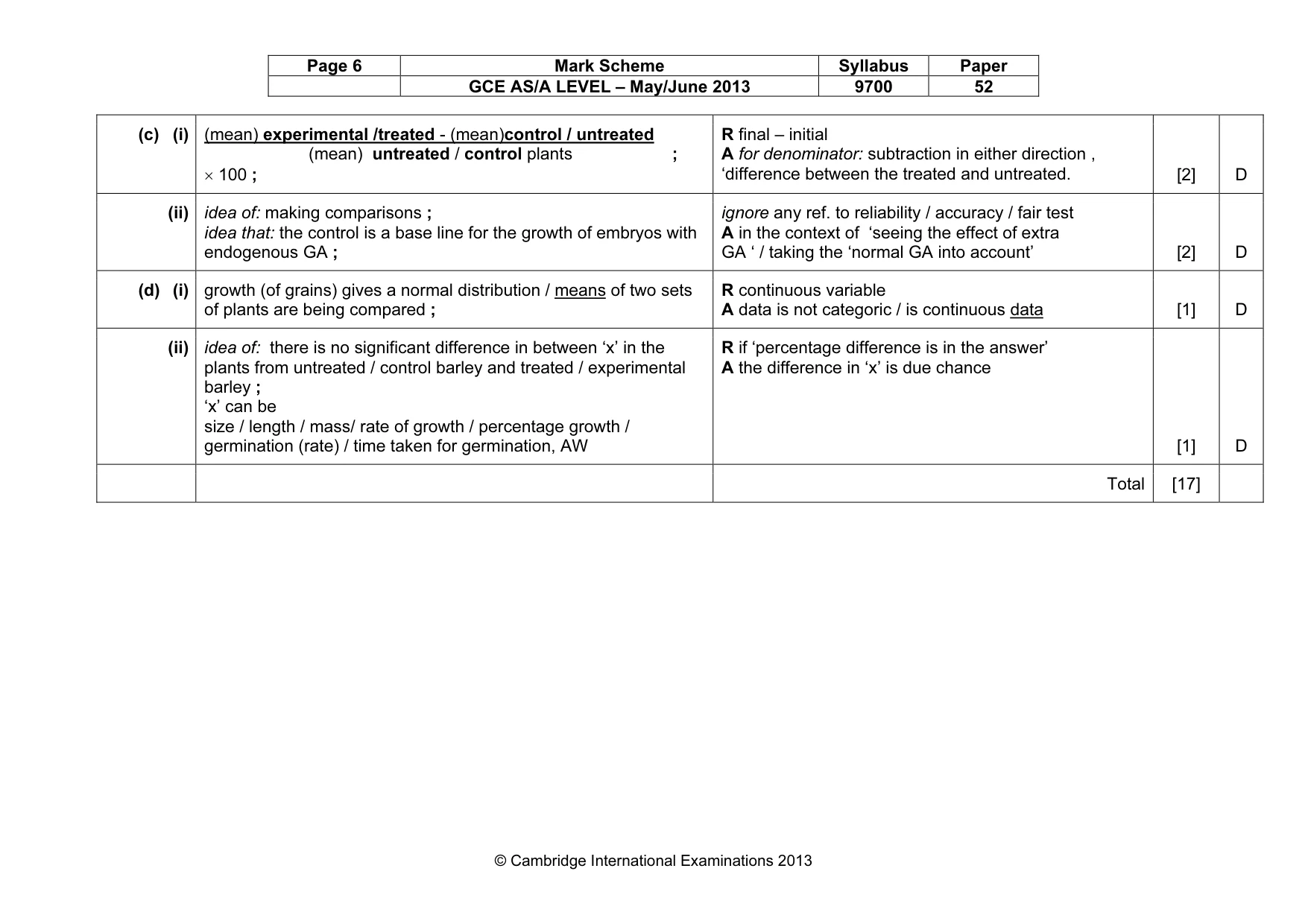
Page 6 Mark Scheme Syllabus Paper GCE AS/A LEVEL – May/June 2013 9700 52 © Cambridge International Examinations 2013 (c) (i) (mean) experimental /treated - (mean)control / untreated (mean) untreated / control plants ; × 100 ; R final – initial A for denominator: subtraction in either direction , ‘difference between the treated and untreated. [2] D (ii) idea of: making comparisons ; idea that: the control is a base line for the growth of embryos with endogenous GA ; ignore any ref. to reliability / accuracy / fair test A in the context of ‘seeing the effect of extra GA ‘ / taking the ‘normal GA into account’ [2] D (d) (i) growth (of grains) gives a normal distribution / means of two sets of plants are being compared ; R continuous variable A data is not categoric / is continuous data [1] D (ii) idea of: there is no significant difference in between ‘x’ in the plants from untreated / control barley and treated / experimental barley ; ‘x’ can be size / length / mass/ rate of growth / percentage growth / germination (rate) / time taken for germination, AW R if ‘percentage difference is in the answer’ A the difference in ‘x’ is due chance [1] D Total [17]
Mark scheme, page 7
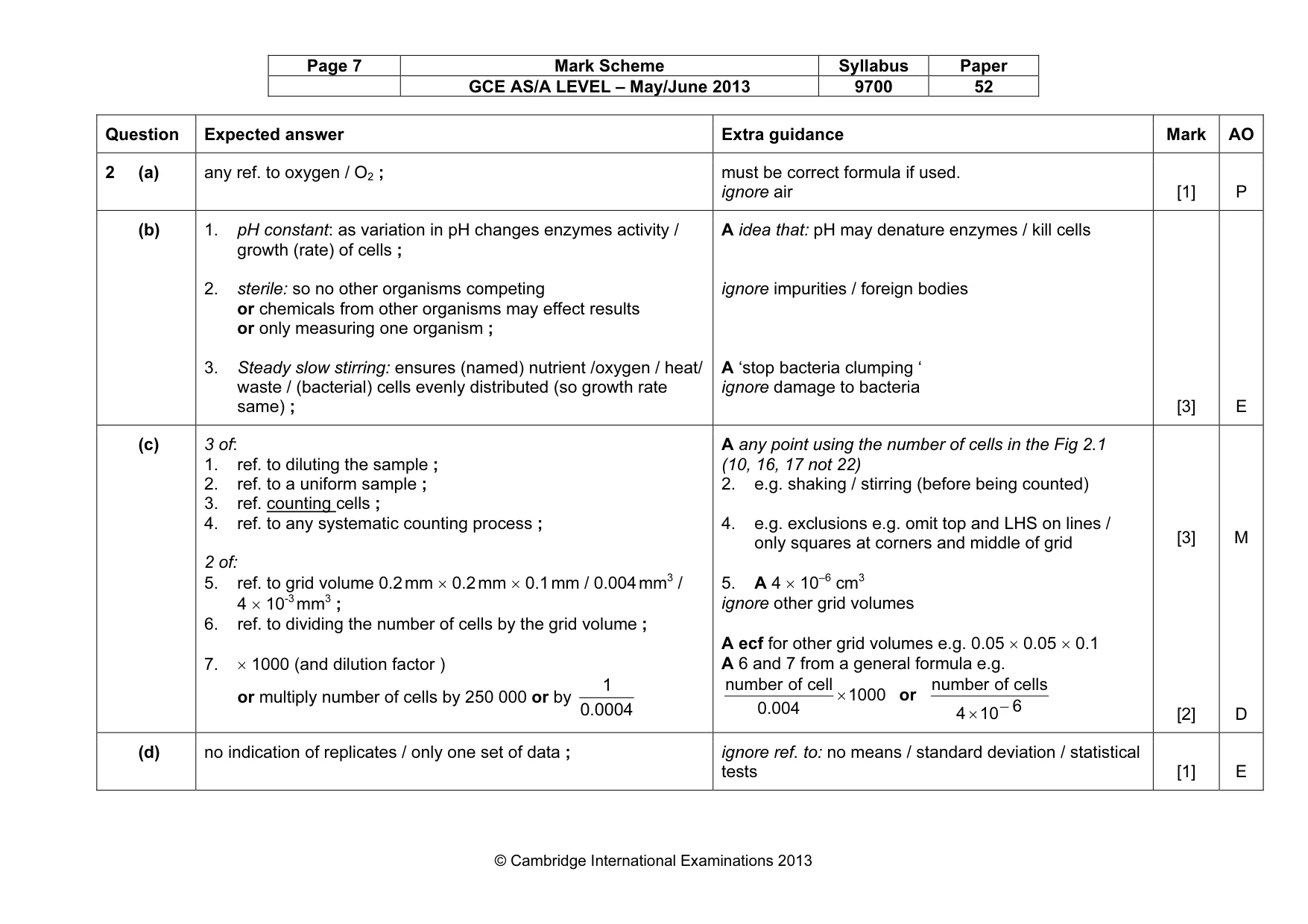
Page 7 Mark Scheme Syllabus Paper GCE AS/A LEVEL – May/June 2013 9700 52 © Cambridge International Examinations 2013 Question Expected answer Extra guidance Mark AO 2 (a) any ref. to oxygen / O2 ; must be correct formula if used. ignore air [1] P (b) 1. pH constant: as variation in pH changes enzymes activity / growth (rate) of cells ; 2. sterile: so no other organisms competing or chemicals from other organisms may effect results or only measuring one organism ; 3. Steady slow stirring: ensures (named) nutrient /oxygen / heat/ waste / (bacterial) cells evenly distributed (so growth rate same) ; A idea that: pH may denature enzymes / kill cells ignore impurities / foreign bodies A ‘stop bacteria clumping ‘ ignore damage to bacteria [3] E (c) 3 of: 1. ref. to diluting the sample ; 2. ref. to a uniform sample ; 3. ref. counting cells ; 4. ref. to any systematic counting process ; 2 of: 5. ref. to grid volume 0.2 mm × 0.2 mm × 0.1 mm / 0.004 mm3 / 4 × 10⁻³ mm3 ; 6. ref. to dividing the number of cells by the grid volume ; 7. × 1000 (and dilution factor ) or multiply number of cells by 250 000 or by 0.0004 1 A any point using the number of cells in the Fig 2.1 (10, 16, 17 not 22) 2. e.g. shaking / stirring (before being counted) 4. e.g. exclusions e.g. omit top and LHS on lines / only squares at corners and middle of grid 5. A 4 × 10⁻⁶ cm3 ignore other grid volumes A ecf for other grid volumes e.g. 0.05 × 0.05 × 0.1 A 6 and 7 from a general formula e.g. 6 10 4 cells of number 1000 0.004 cell of number − × × or [3] [2] M D (d) no indication of replicates / only one set of data ; ignore ref. to: no means / standard deviation / statistical tests [1] E
Mark scheme, page 8
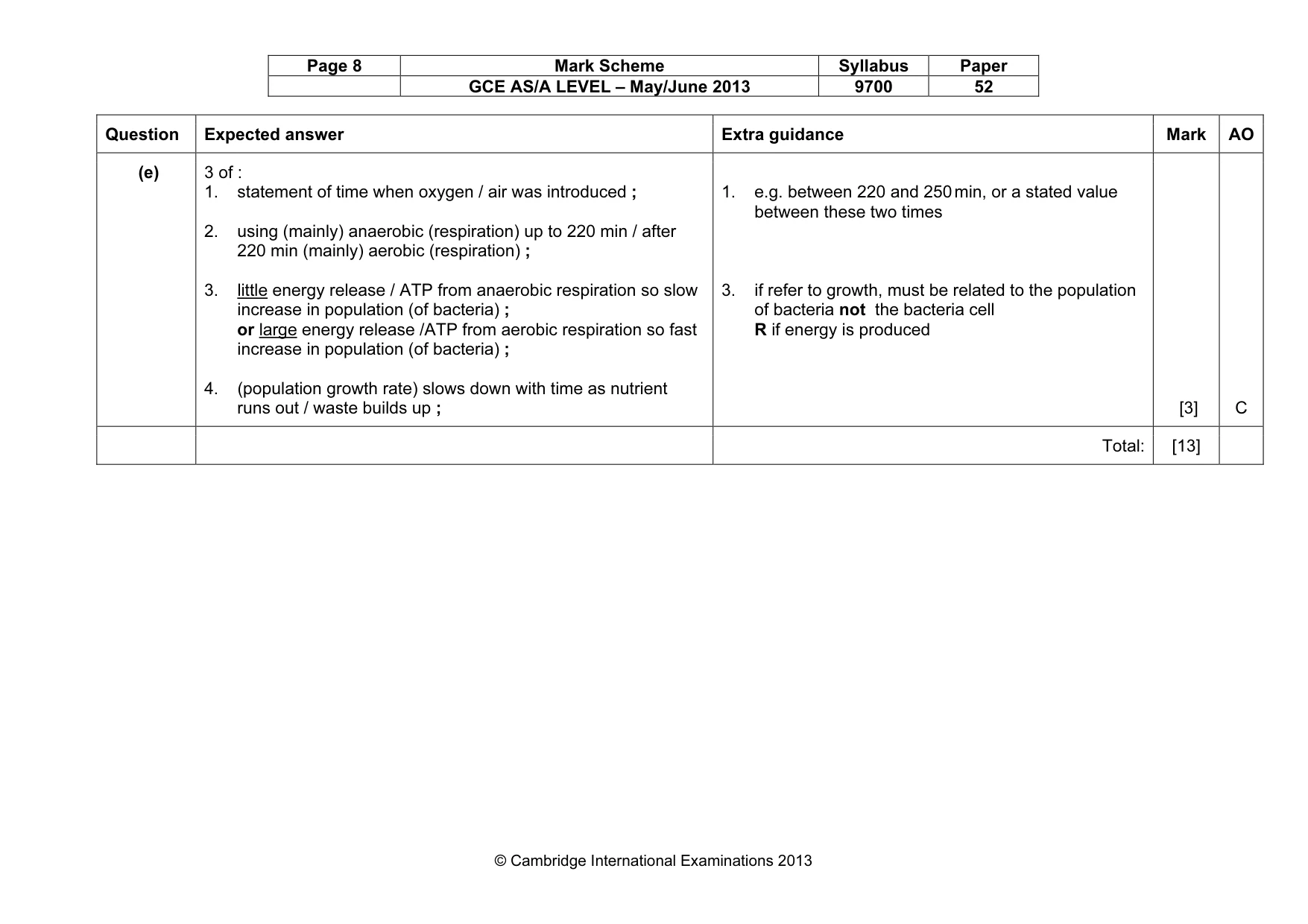
Page 8 Mark Scheme Syllabus Paper GCE AS/A LEVEL – May/June 2013 9700 52 © Cambridge International Examinations 2013 Question Expected answer Extra guidance Mark AO (e) 3 of : 1. statement of time when oxygen / air was introduced ; 2. using (mainly) anaerobic (respiration) up to 220 min / after 220 min (mainly) aerobic (respiration) ; 3. little energy release / ATP from anaerobic respiration so slow increase in population (of bacteria) ; or large energy release /ATP from aerobic respiration so fast increase in population (of bacteria) ; 4. (population growth rate) slows down with time as nutrient runs out / waste builds up ; 1. e.g. between 220 and 250 min, or a stated value between these two times 3. if refer to growth, must be related to the population of bacteria not the bacteria cell R if energy is produced [3] C Total: [13]
What you needed in this session
Cambridge’s own grade thresholds for 2013 May/June, Paper 5 · Variant 2. A higher threshold means an easier paper — the bar moves with how the cohort did.