Cambridge A Level Biology 9700 — 2012 Oct/Nov Paper 3 · Variant 6
9700/36/O/N/12 · 40 marks · ≈45 min
The question paper and its mark scheme, free to read here and free to download. This is Cambridge’s own paper, exactly as it was sat.
Question paper12 pages
Mark scheme10 pages
Answers below. Sit the paper first if you are practising.
Paper as text
Question paper, page 1
This document consists of 11 printed pages and 1 blank page. DC (SJF/SW) 47067/4 © UCLES 2012 [Turn over UNIVERSITY OF CAMBRIDGE INTERNATIONAL EXAMINATIONS General Certificate of Education Advanced Subsidiary Level and Advanced Level READ THESE INSTRUCTIONS FIRST Write your Centre number, candidate number and name on all the work you hand in. Write in dark blue or black ink. You may use a pencil for any diagrams, graphs or rough working. Do not use red ink, staples, paper clips, highlighters, glue or correction fluid. DO NOT WRITE IN ANY BARCODES. Answer both questions. You may lose marks if you do not show your working or if you do not use appropriate units. At the end of the examination, fasten all your work securely together. The number of marks is given in brackets [ ] at the end of each question or part question. * 5 6 7 5 2 5 9 0 8 4 * BIOLOGY 9700/36 Advanced Practical Skills 2 October/November 2012 2 hours Candidates answer on the Question Paper. Additional Materials: As listed in the Confidential Instructions. For Examiner’s Use 1 2 Total
Question paper, page 2
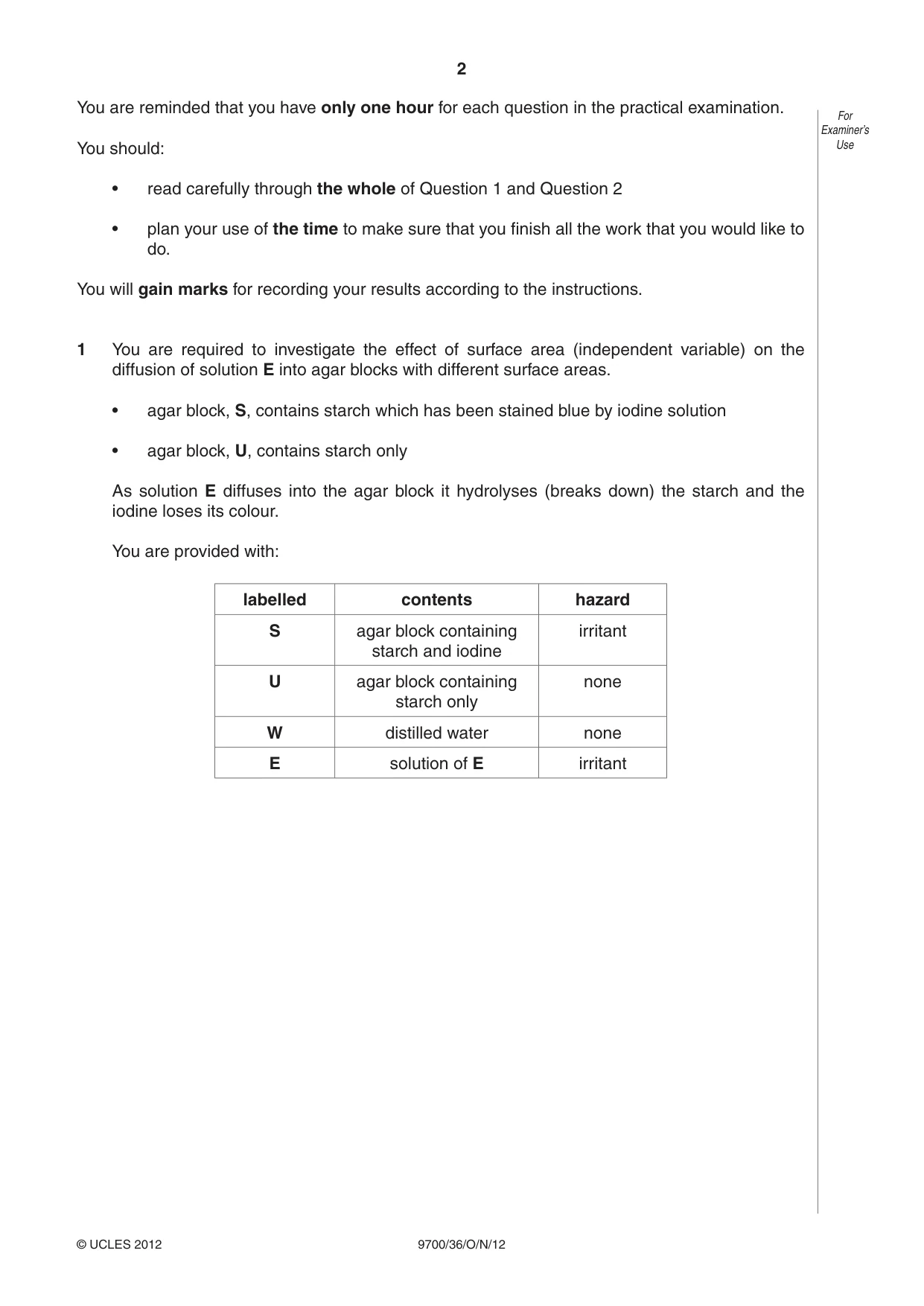
2 © UCLES 2012 9700/36/O/N/12 For Examiner’s Use You are reminded that you have only one hour for each question in the practical examination. You should: • read carefully through the whole of Question 1 and Question 2 • plan your use of the time to make sure that you finish all the work that you would like to do. You will gain marks for recording your results according to the instructions. 1 You are required to investigate the effect of surface area (independent variable) on the diffusion of solution E into agar blocks with different surface areas. • agar block, S, contains starch which has been stained blue by iodine solution • agar block, U, contains starch only As solution E diffuses into the agar block it hydrolyses (breaks down) the starch and the iodine loses its colour. You are provided with: labelled contents hazard S agar block containing starch and iodine irritant U agar block containing starch only none W distilled water none E solution of E irritant
Question paper, page 3
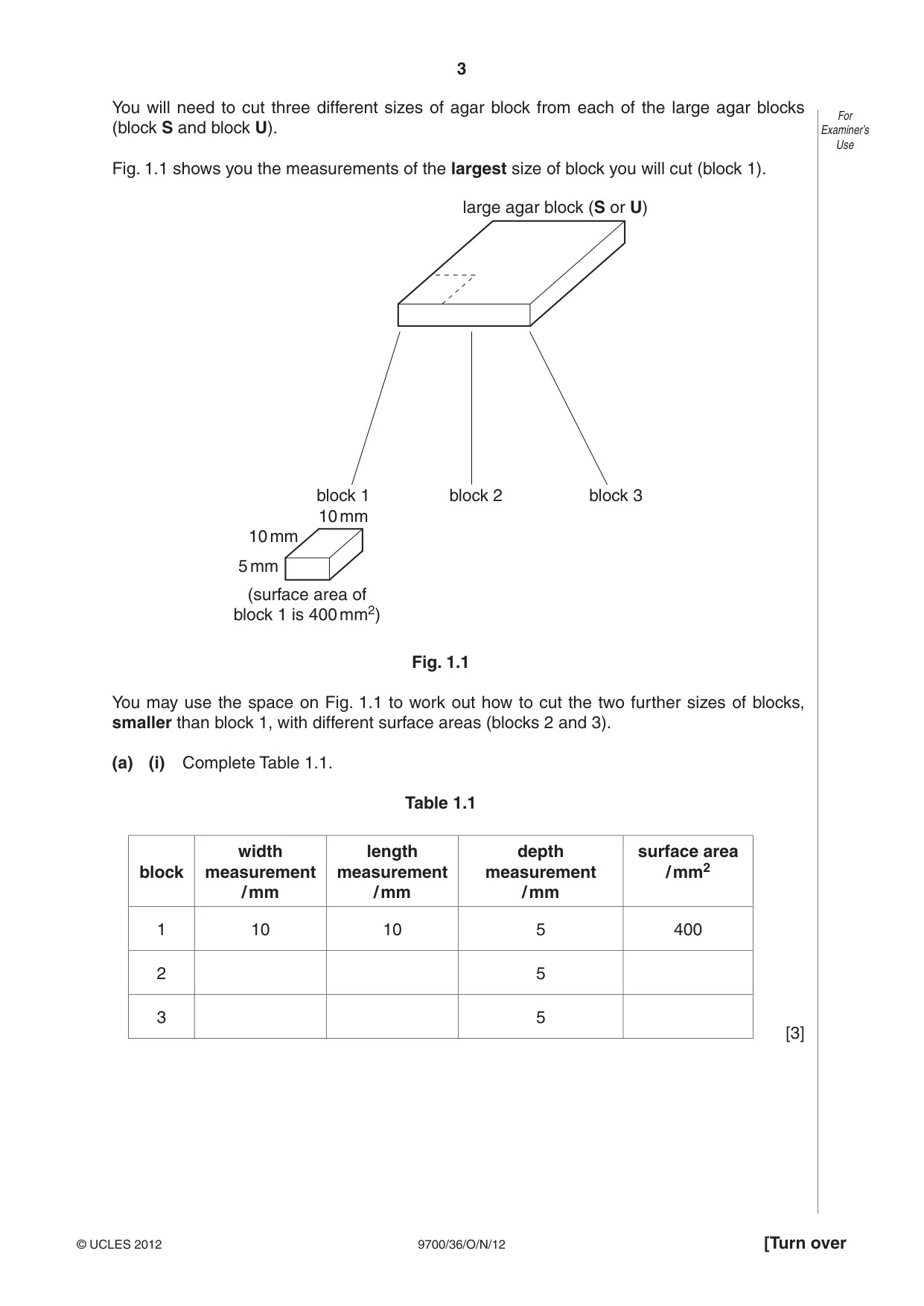
3 [Turn over © UCLES 2012 9700/36/O/N/12 For Examiner’s Use You will need to cut three different sizes of agar block from each of the large agar blocks (block S and block U). Fig. 1.1 shows you the measurements of the largest size of block you will cut (block 1). 10 mm block 1 10 mm (surface area of block 1 is 400 mm2) block 2 large agar block (S or U) block 3 5 mm Fig. 1.1 You may use the space on Fig. 1.1 to work out how to cut the two further sizes of blocks, smaller than block 1, with different surface areas (blocks 2 and 3). (a) (i) Complete Table 1.1. Table 1.1 block width measurement / mm length measurement / mm depth measurement / mm surface area / mm2 1 10 10 5 400 2 5 3 5 [3]
Question paper, page 4
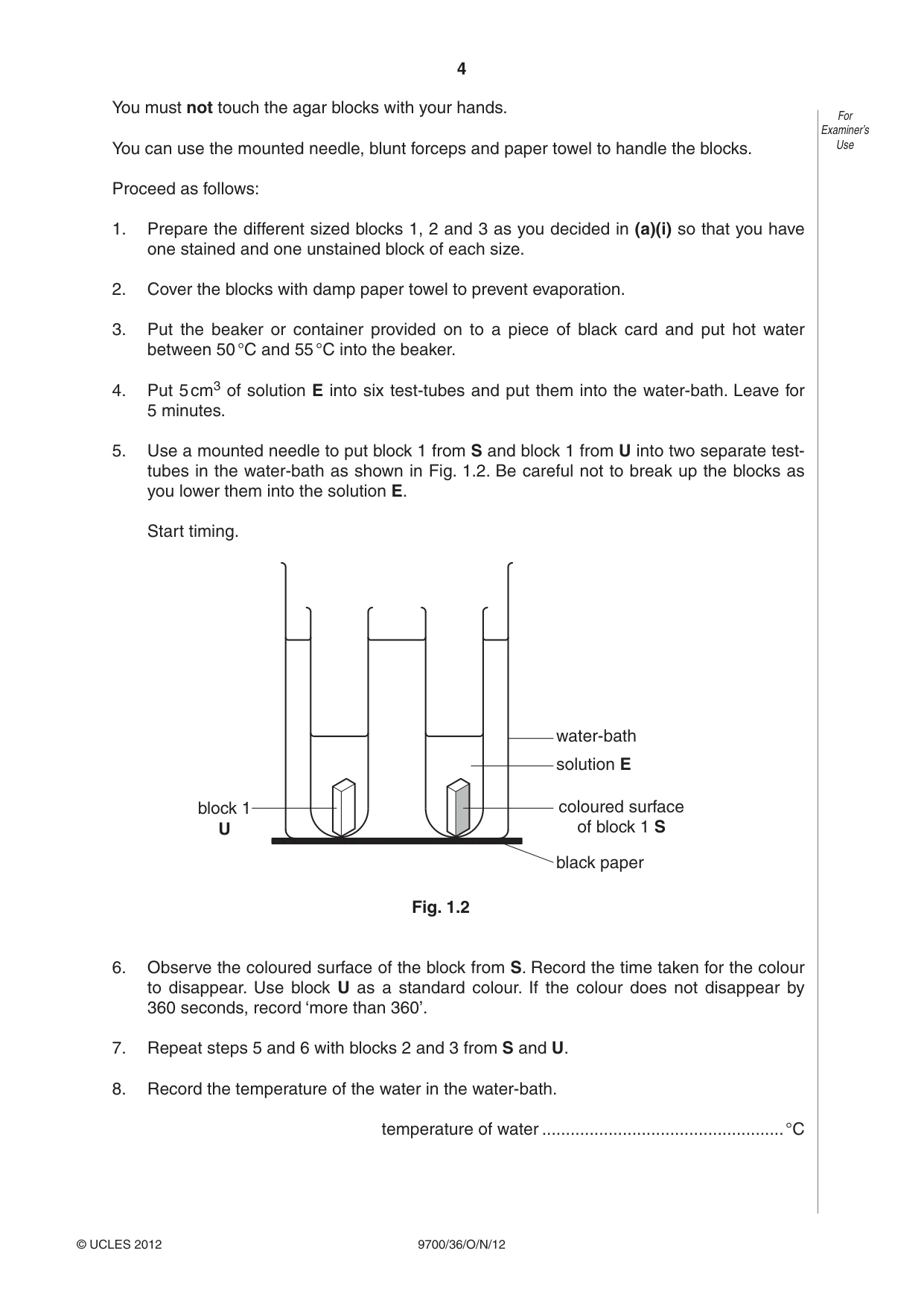
4 © UCLES 2012 9700/36/O/N/12 For Examiner’s Use You must not touch the agar blocks with your hands. You can use the mounted needle, blunt forceps and paper towel to handle the blocks. Proceed as follows: 1. Prepare the different sized blocks 1, 2 and 3 as you decided in (a)(i) so that you have one stained and one unstained block of each size. 2. Cover the blocks with damp paper towel to prevent evaporation. 3. Put the beaker or container provided on to a piece of black card and put hot water between 50 °C and 55 °C into the beaker. 4. Put 5 cm3 of solution E into six test-tubes and put them into the water-bath. Leave for 5 minutes. 5. Use a mounted needle to put block 1 from S and block 1 from U into two separate test- tubes in the water-bath as shown in Fig. 1.2. Be careful not to break up the blocks as you lower them into the solution E. Start timing. water-bath solution E coloured surface of block 1 S block 1 U black paper Fig. 1.2 6. Observe the coloured surface of the block from S. Record the time taken for the colour to disappear. Use block U as a standard colour. If the colour does not disappear by 360 seconds, record ‘more than 360’. 7. Repeat steps 5 and 6 with blocks 2 and 3 from S and U. 8. Record the temperature of the water in the water-bath. temperature of water …°C
Question paper, page 5
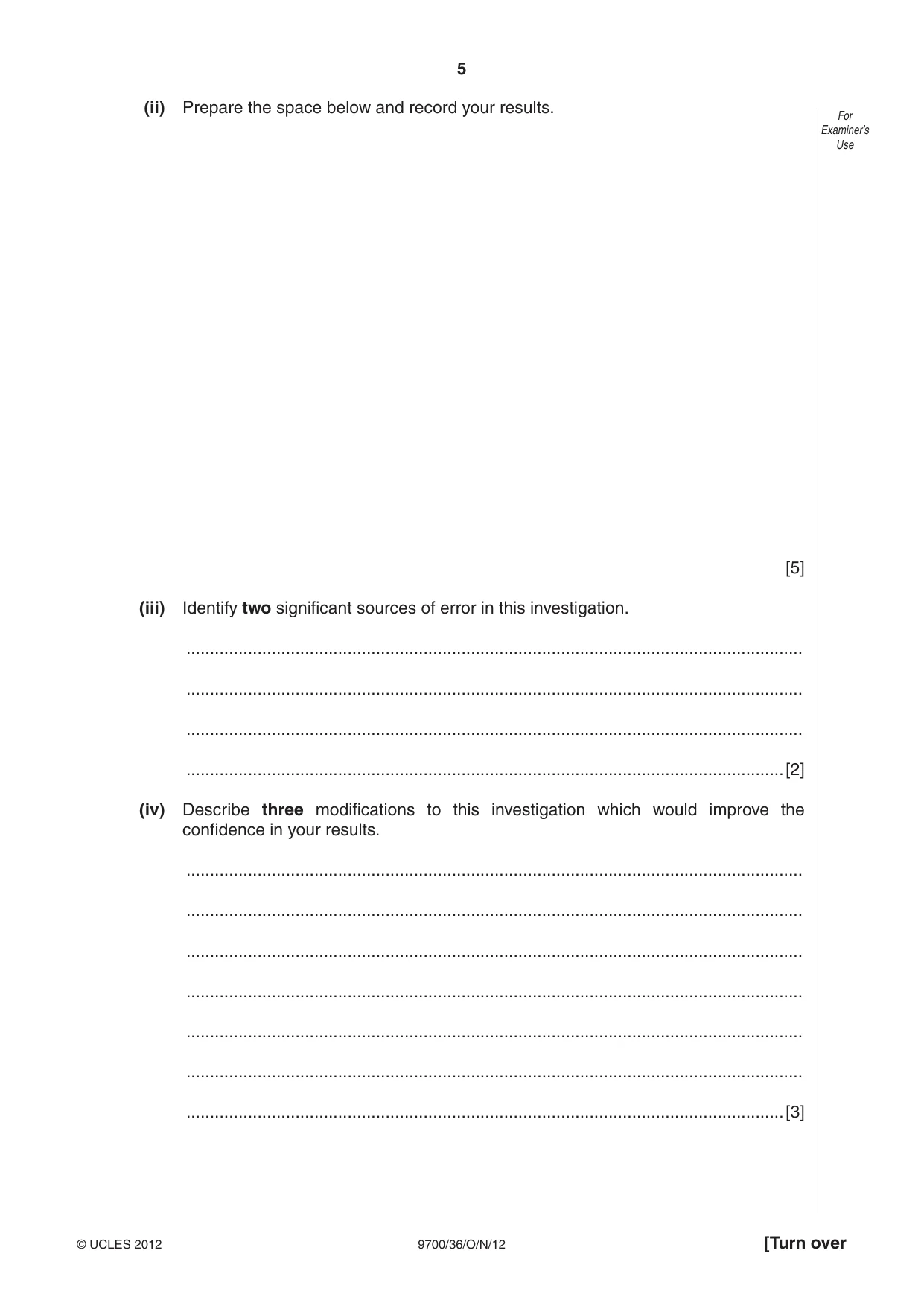
5 [Turn over © UCLES 2012 9700/36/O/N/12 For Examiner’s Use (ii) Prepare the space below and record your results. [5] (iii) Identify two significant sources of error in this investigation. … … … …[2] (iv) Describe three modifications to this investigation which would improve the confidence in your results. … … … … … … …[3]
Question paper, page 6
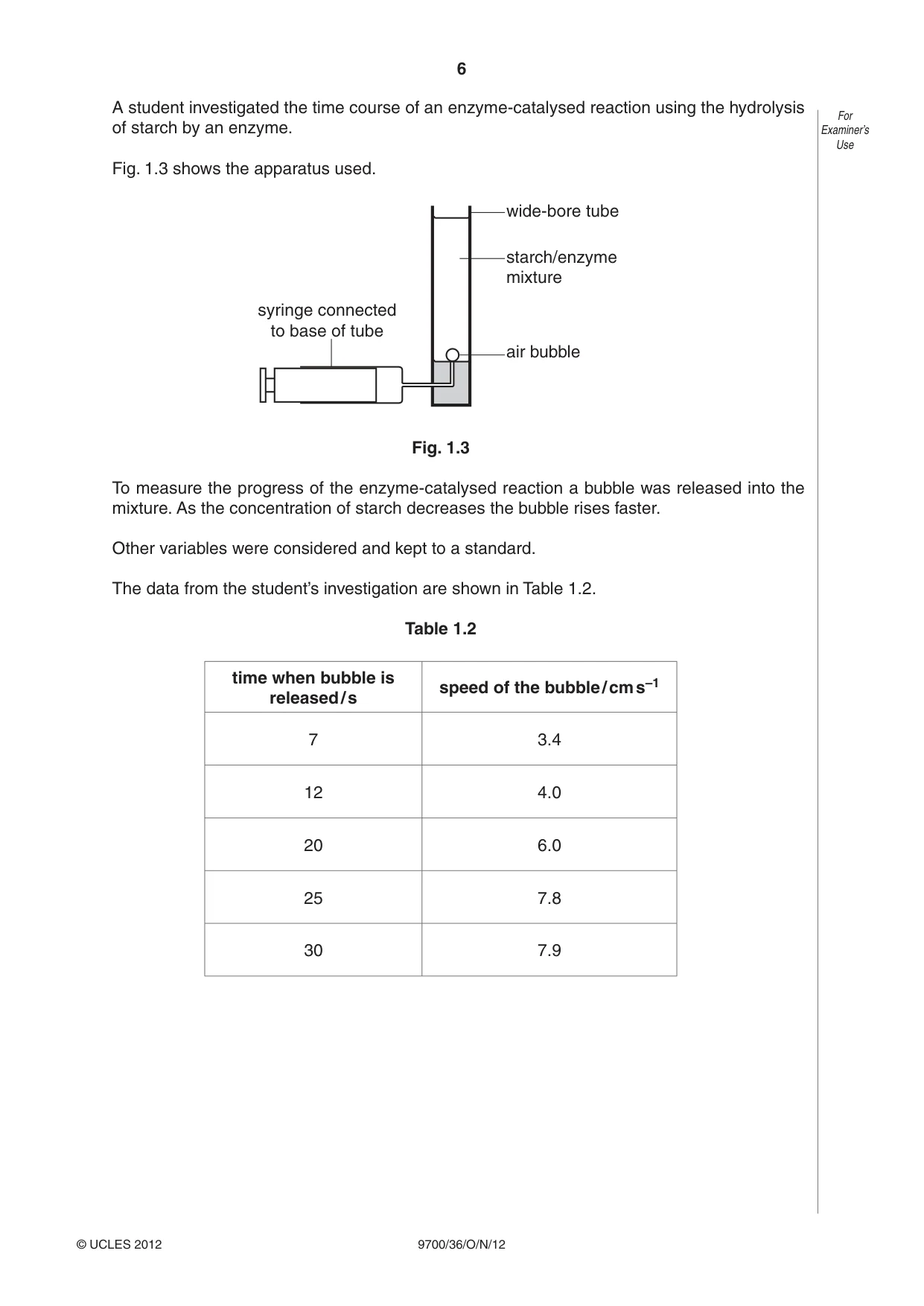
6 © UCLES 2012 9700/36/O/N/12 For Examiner’s Use A student investigated the time course of an enzyme-catalysed reaction using the hydrolysis of starch by an enzyme. Fig. 1.3 shows the apparatus used. syringe connected to base of tube wide-bore tube starch/enzyme mixture air bubble Fig. 1.3 To measure the progress of the enzyme-catalysed reaction a bubble was released into the mixture. As the concentration of starch decreases the bubble rises faster. Other variables were considered and kept to a standard. The data from the student’s investigation are shown in Table 1.2. Table 1.2 time when bubble is released / s speed of the bubble / cm s–1 7 3.4 12 4.0 20 6.0 25 7.8 30 7.9
Question paper, page 7
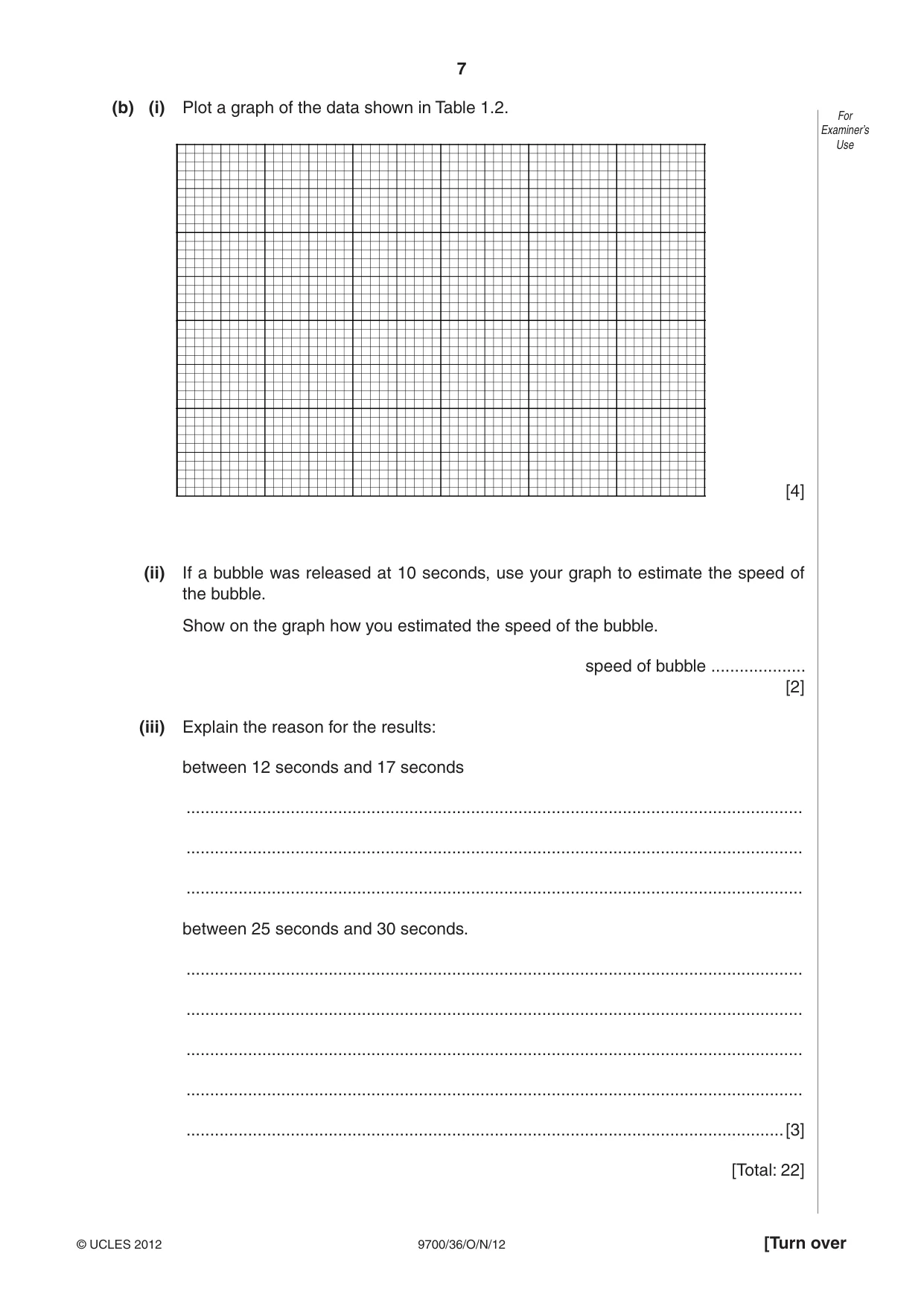
7 [Turn over © UCLES 2012 9700/36/O/N/12 For Examiner’s Use (b) (i) Plot a graph of the data shown in Table 1.2. [4] (ii) If a bubble was released at 10 seconds, use your graph to estimate the speed of the bubble. Show on the graph how you estimated the speed of the bubble. speed of bubble … [2] (iii) Explain the reason for the results: between 12 seconds and 17 seconds … … … between 25 seconds and 30 seconds. … … … … …[3] [Total: 22]
Question paper, page 8
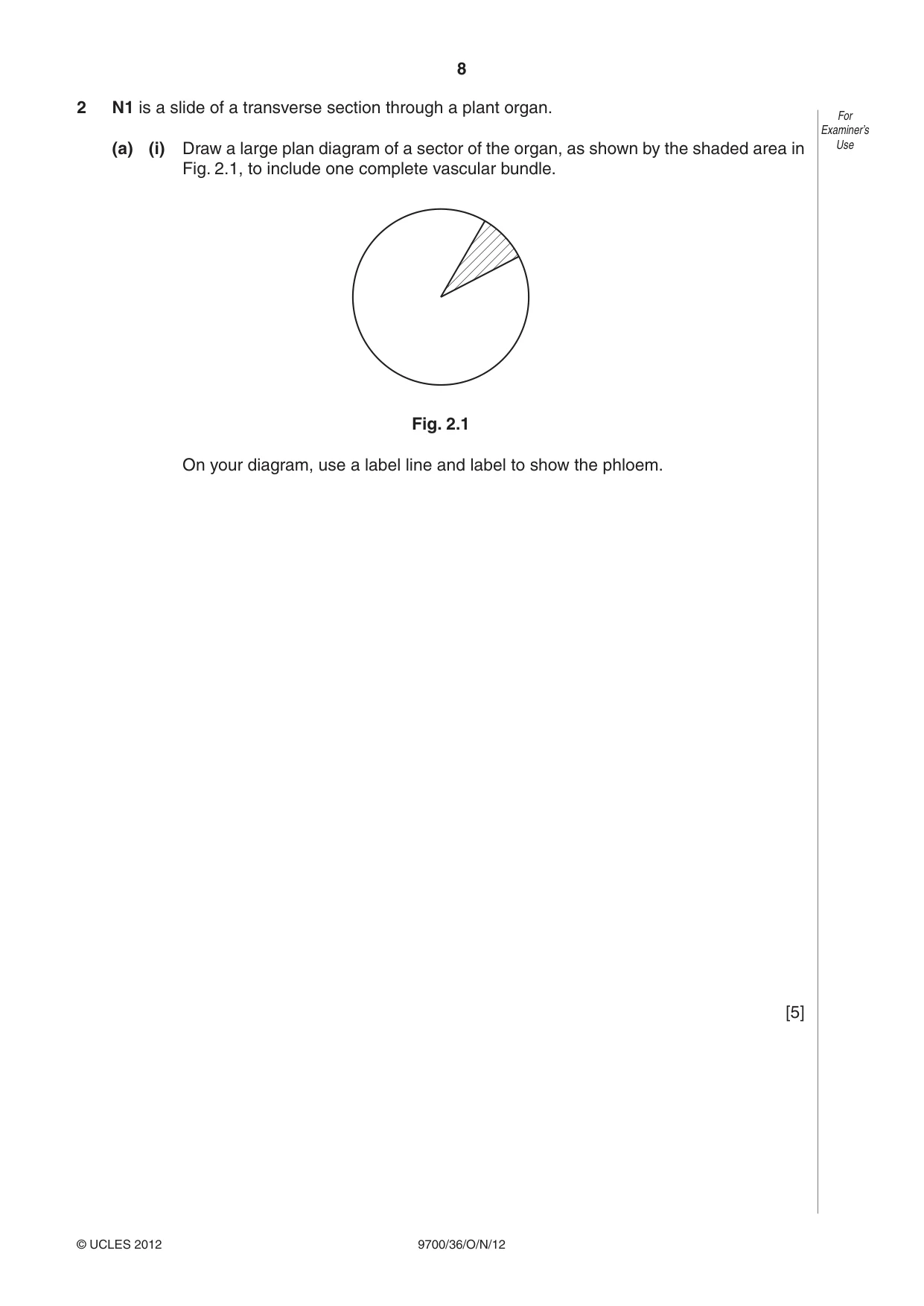
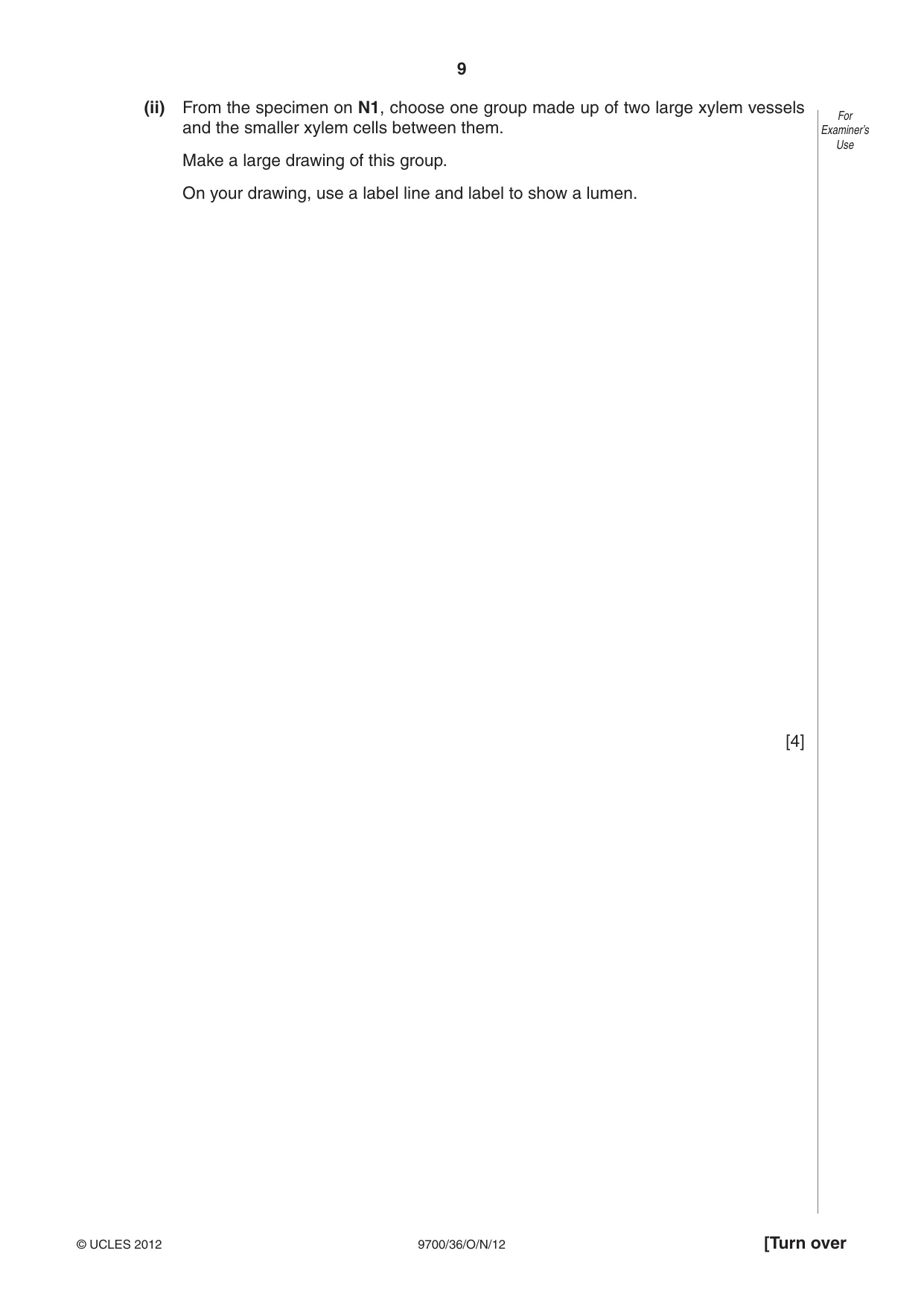
8 © UCLES 2012 9700/36/O/N/12 For Examiner’s Use 2 N1 is a slide of a transverse section through a plant organ. (a) (i) Draw a large plan diagram of a sector of the organ, as shown by the shaded area in Fig. 2.1, to include one complete vascular bundle. Fig. 2.1 On your diagram, use a label line and label to show the phloem. [5]
Question paper, page 9
9 [Turn over © UCLES 2012 9700/36/O/N/12 For Examiner’s Use (ii) From the specimen on N1, choose one group made up of two large xylem vessels and the smaller xylem cells between them. Make a large drawing of this group. On your drawing, use a label line and label to show a lumen. [4]
Question paper, page 10
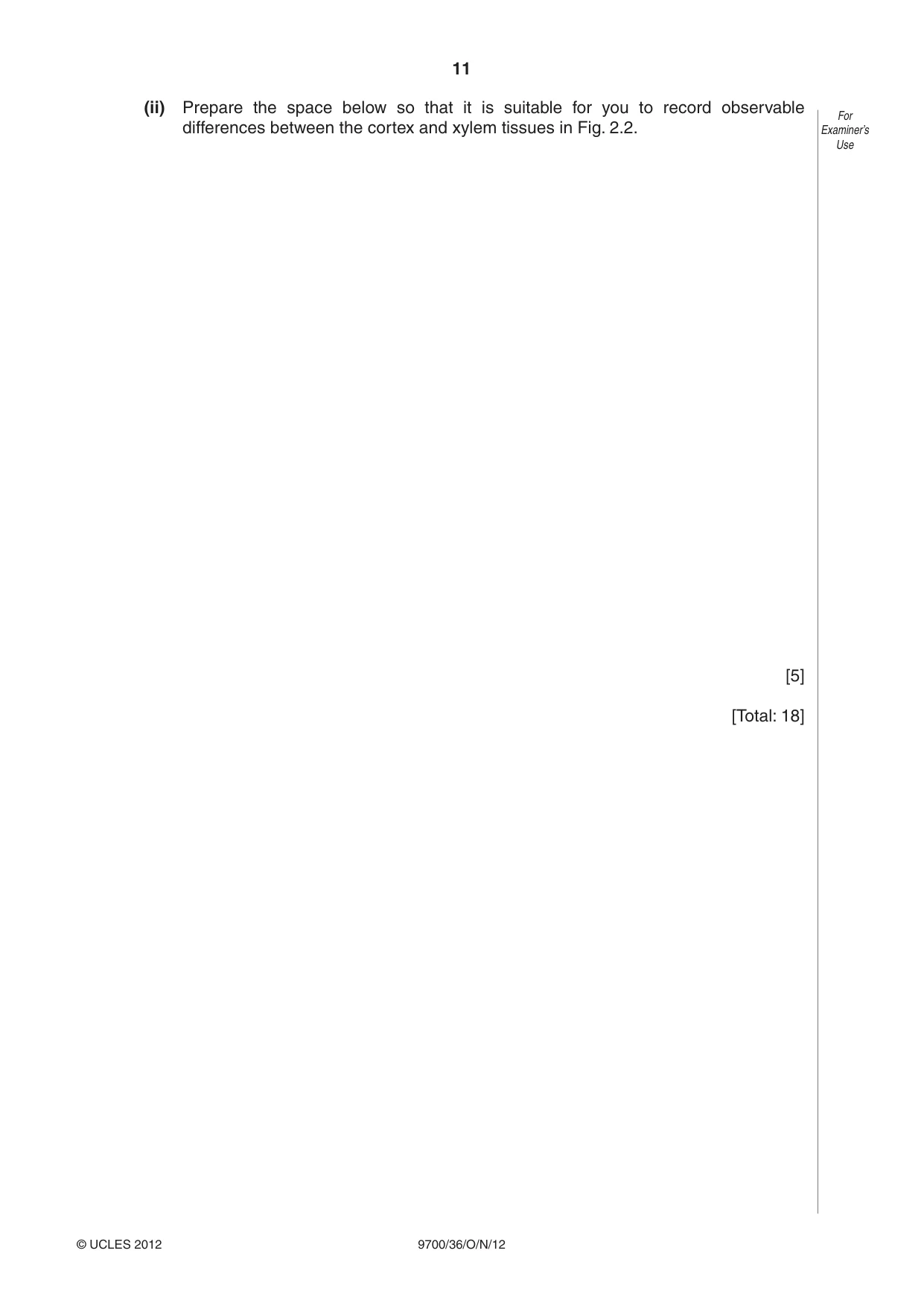
10 © UCLES 2012 9700/36/O/N/12 For Examiner’s Use Fig. 2.2 is a photomicrograph showing a longitudinal section of a root from a different plant species. Fig. 2.2 (b) (i) Calculate the ratio of the mean length to the mean width of cells in the cortex. [4]
Question paper, page 11
11 © UCLES 2012 9700/36/O/N/12 For Examiner’s Use (ii) Prepare the space below so that it is suitable for you to record observable differences between the cortex and xylem tissues in Fig. 2.2. [5] [Total: 18]
Question paper, page 12
12 9700/36/O/N/12 © UCLES 2012 BLANK PAGE Permission to reproduce items where third-party owned material protected by copyright is included has been sought and cleared where possible. Every reasonable effort has been made by the publisher (UCLES) to trace copyright holders, but if any items requiring clearance have unwittingly been included, the publisher will be pleased to make amends at the earliest possible opportunity. University of Cambridge International Examinations is part of the Cambridge Assessment Group. Cambridge Assessment is the brand name of University of Cambridge Local Examinations Syndicate (UCLES), which is itself a department of the University of Cambridge.
Mark scheme, page 1
CAMBRIDGE INTERNATIONAL EXAMINATIONS GCE Advanced Subsidiary Level and GCE Advanced Level MARK SCHEME for the October/November 2012 series 9700 BIOLOGY 9700/36 Paper 3 (Advanced Practical Skills 2), maximum raw mark 40 This mark scheme is published as an aid to teachers and candidates, to indicate the requirements of the examination. It shows the basis on which Examiners were instructed to award marks. It does not indicate the details of the discussions that took place at an Examiners’ meeting before marking began, which would have considered the acceptability of alternative answers. Mark schemes should be read in conjunction with the question paper and the Principal Examiner Report for Teachers. Cambridge will not enter into discussions about these mark schemes. Cambridge is publishing the mark schemes for the October/November 2012 series for most IGCSE, GCE Advanced Level and Advanced Subsidiary Level components and some Ordinary Level components.
Mark scheme, page 2
Page 2 Mark Scheme Syllabus Paper GCE AS/A LEVEL – October/November 2012 9700 36 © Cambridge International Examinations 2012 Mark scheme abbreviations: ; separates marking points / alternative answers for the same point R reject A accept (for answers correctly cued by the question, or by extra guidance) AW alternative wording (where responses vary more than usual) underline actual word given must be used by candidate (grammatical variants excepted) max indicates the maximum number of marks that can be given ora or reverse argument mp marking point (with relevant number) ecf error carried forward I ignore ACE Analysis, Conclusions and Evaluation (skills) MMO Manipulations, Measurement and Observation (skills) PDO Presentation of Data and Observations (skills)
Mark scheme, page 3
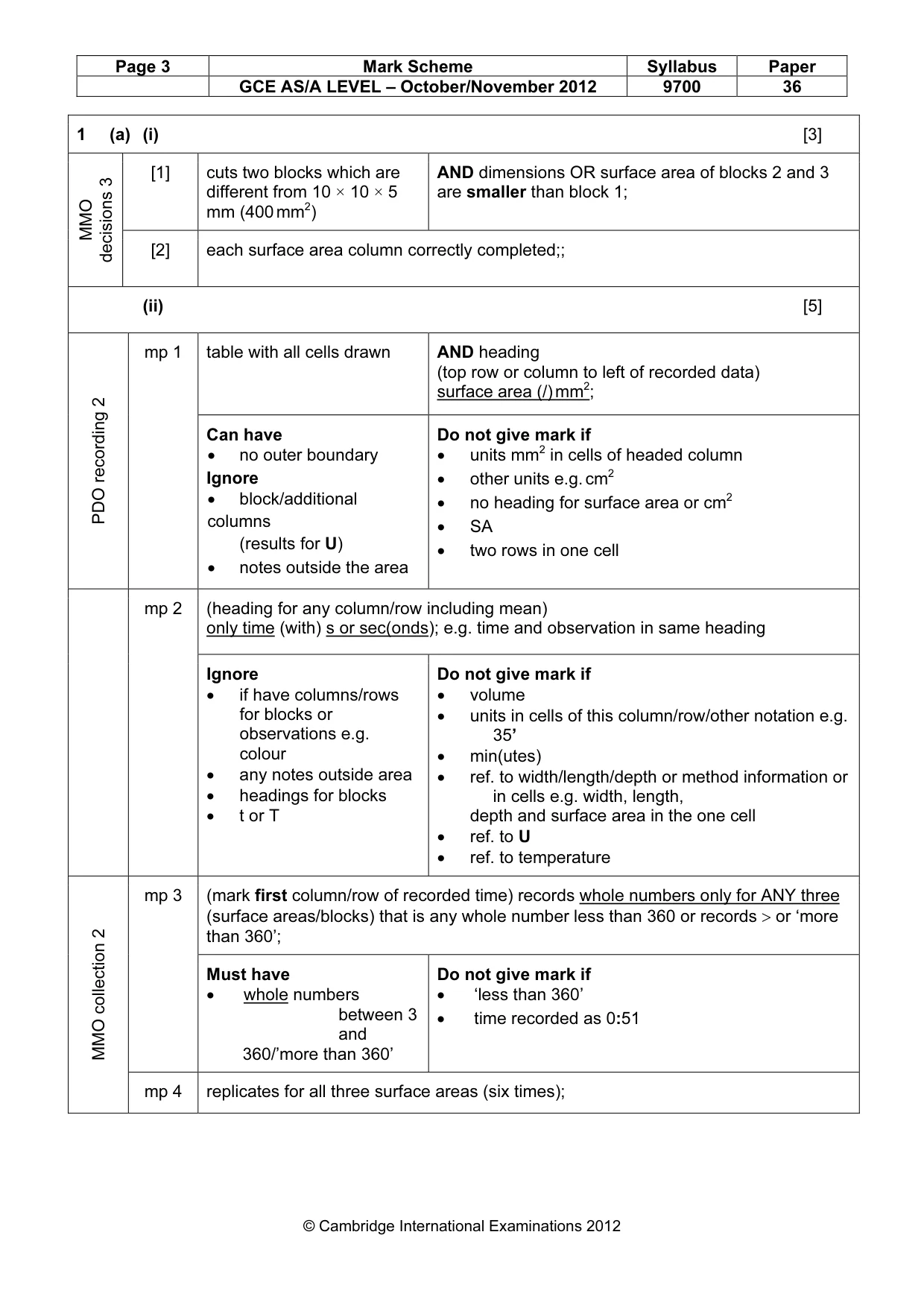
Page 3 Mark Scheme Syllabus Paper GCE AS/A LEVEL – October/November 2012 9700 36 © Cambridge International Examinations 2012 1 (a) (i) [3] [1] cuts two blocks which are different from 10 × 10 × 5 mm (400 mm2) AND dimensions OR surface area of blocks 2 and 3 are smaller than block 1; MMO decisions 3 [2] each surface area column correctly completed;; (ii) [5] table with all cells drawn AND heading (top row or column to left of recorded data) surface area (/) mm2; PDO recording 2 mp 1 Can have • no outer boundary Ignore • block/additional columns (results for U) • notes outside the area Do not give mark if • units mm2 in cells of headed column • other units e.g. cm2 • no heading for surface area or cm2 • SA • two rows in one cell (heading for any column/row including mean) only time (with) s or sec(onds); e.g. time and observation in same heading mp 2 Ignore • if have columns/rows for blocks or observations e.g. colour • any notes outside area • headings for blocks • t or T Do not give mark if • volume • units in cells of this column/row/other notation e.g. 35’ • min(utes) • ref. to width/length/depth or method information or in cells e.g. width, length, depth and surface area in the one cell • ref. to U • ref. to temperature (mark first column/row of recorded time) records whole numbers only for ANY three (surface areas/blocks) that is any whole number less than 360 or records > or ‘more than 360’; mp 3 Must have • whole numbers between 3 and 360/’more than 360’ Do not give mark if • ‘less than 360’ • time recorded as 0:51 MMO collection 2 mp 4 replicates for all three surface areas (six times);
Mark scheme, page 4
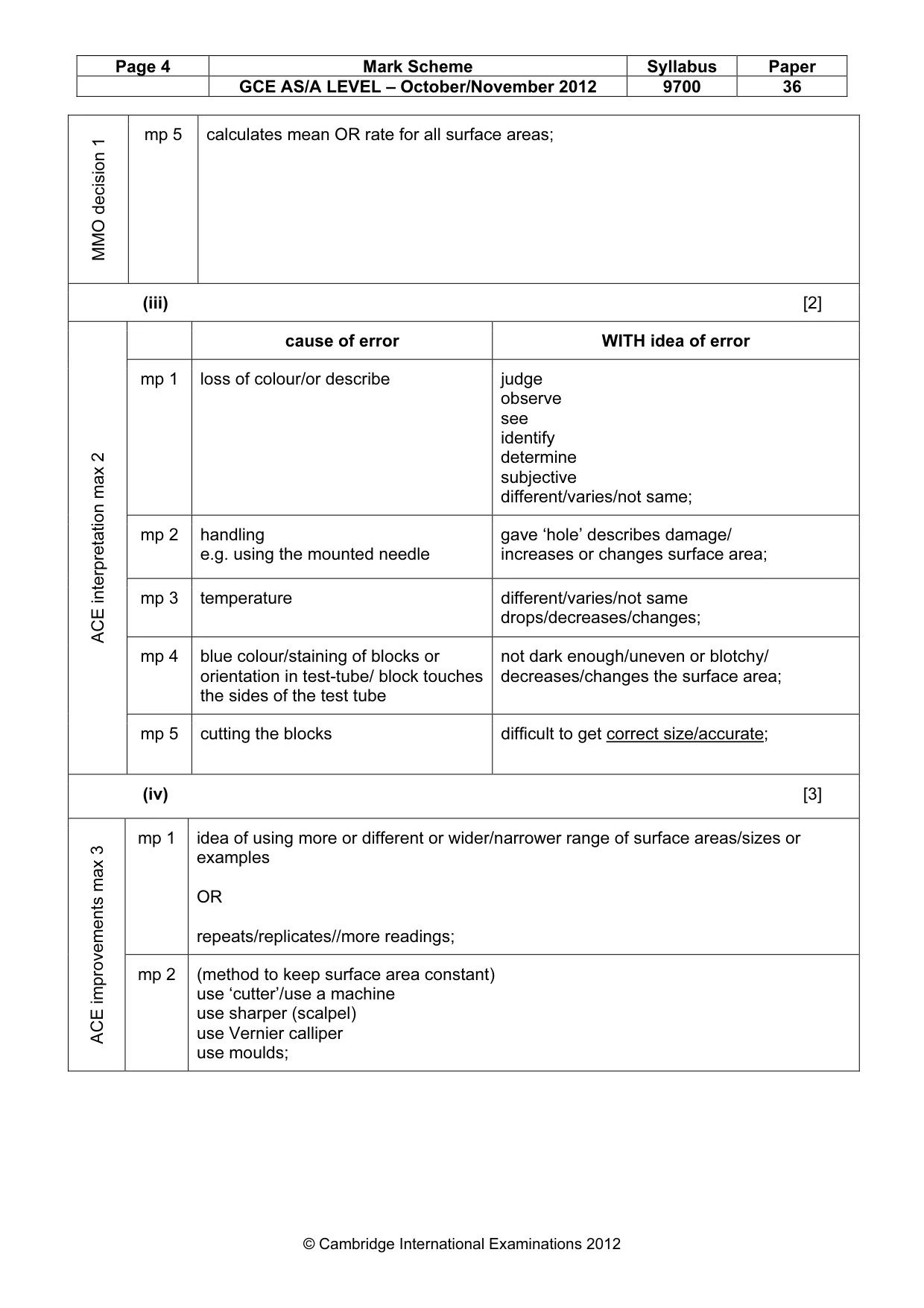
Page 4 Mark Scheme Syllabus Paper GCE AS/A LEVEL – October/November 2012 9700 36 © Cambridge International Examinations 2012 MMO decision 1 mp 5 calculates mean OR rate for all surface areas; (iii) [2] cause of error WITH idea of error mp 1 loss of colour/or describe judge observe see identify determine subjective different/varies/not same; mp 2 handling e.g. using the mounted needle gave ‘hole’ describes damage/ increases or changes surface area; mp 3 temperature different/varies/not same drops/decreases/changes; mp 4 blue colour/staining of blocks or orientation in test-tube/ block touches the sides of the test tube not dark enough/uneven or blotchy/ decreases/changes the surface area; ACE interpretation max 2 mp 5 cutting the blocks difficult to get correct size/accurate; (iv) [3] mp 1 idea of using more or different or wider/narrower range of surface areas/sizes or examples OR repeats/replicates//more readings; ACE improvements max 3 mp 2 (method to keep surface area constant) use ‘cutter’/use a machine use sharper (scalpel) use Vernier calliper use moulds;
Mark scheme, page 5
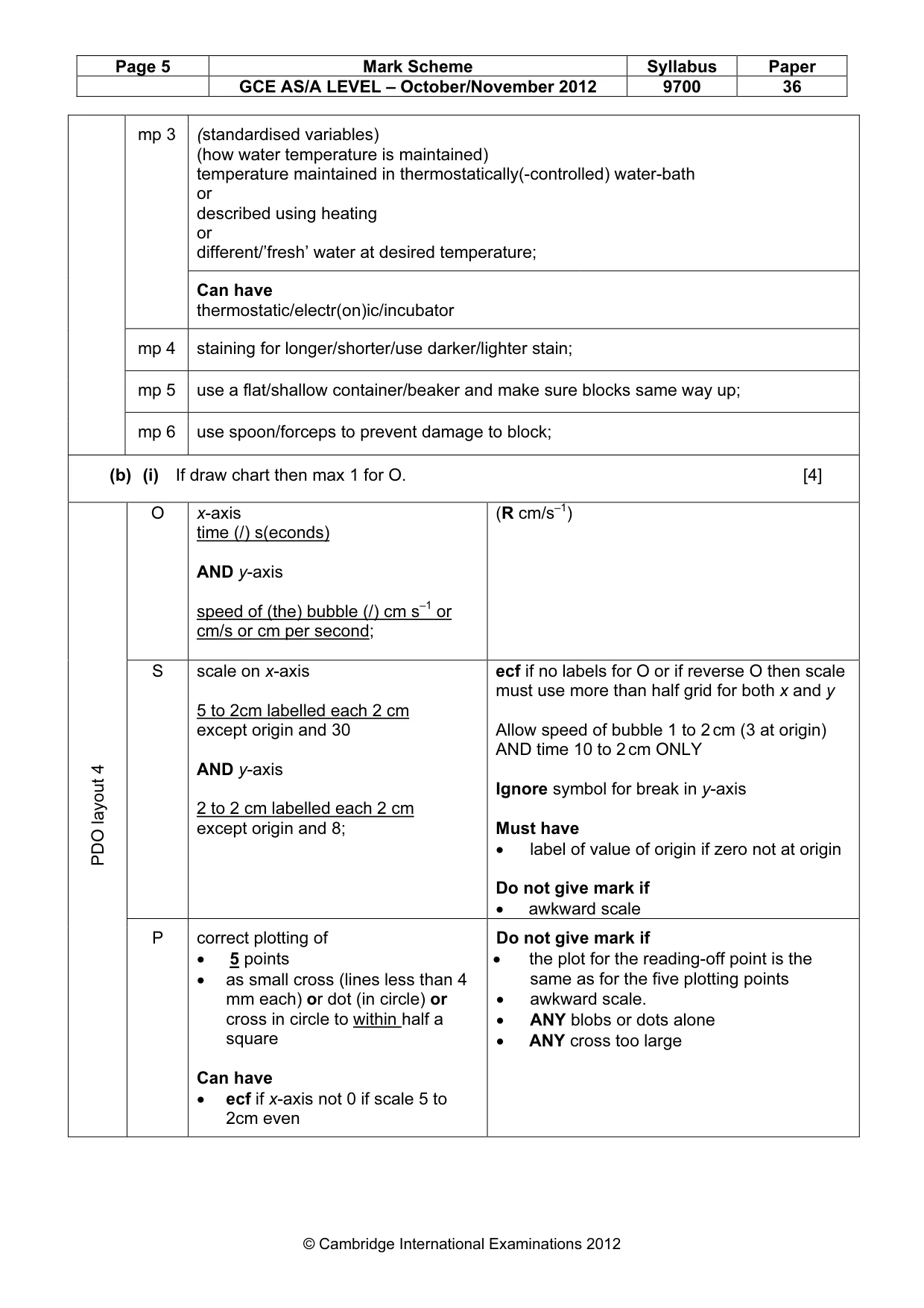
Page 5 Mark Scheme Syllabus Paper GCE AS/A LEVEL – October/November 2012 9700 36 © Cambridge International Examinations 2012 (standardised variables) (how water temperature is maintained) temperature maintained in thermostatically(-controlled) water-bath or described using heating or different/’fresh’ water at desired temperature; mp 3 Can have thermostatic/electr(on)ic/incubator mp 4 staining for longer/shorter/use darker/lighter stain; mp 5 use a flat/shallow container/beaker and make sure blocks same way up; mp 6 use spoon/forceps to prevent damage to block; (b) (i) If draw chart then max 1 for O. [4] O x-axis time (/) s(econds) AND y-axis speed of (the) bubble (/) cm s–1 or cm/s or cm per second; (R cm/s–1) S scale on x-axis 5 to 2cm labelled each 2 cm except origin and 30 AND y-axis 2 to 2 cm labelled each 2 cm except origin and 8; ecf if no labels for O or if reverse O then scale must use more than half grid for both x and y Allow speed of bubble 1 to 2 cm (3 at origin) AND time 10 to 2 cm ONLY Ignore symbol for break in y-axis Must have • label of value of origin if zero not at origin Do not give mark if • awkward scale PDO layout 4 P correct plotting of • 5 points • as small cross (lines less than 4 mm each) or dot (in circle) or cross in circle to within half a square Can have • ecf if x-axis not 0 if scale 5 to 2cm even Do not give mark if • the plot for the reading-off point is the same as for the five plotting points • awkward scale. • ANY blobs or dots alone • ANY cross too large
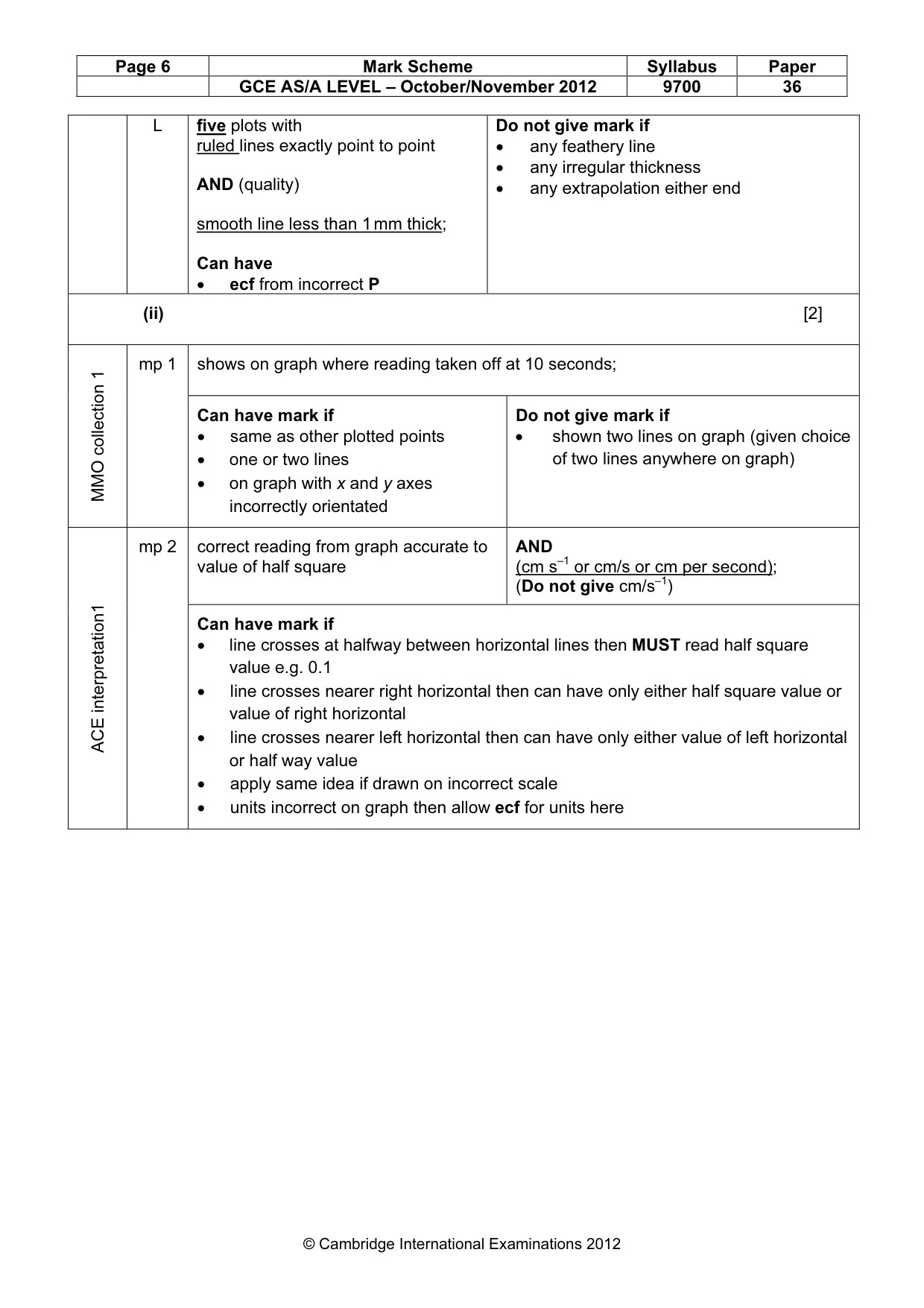
Mark scheme, page 6
Page 6 Mark Scheme Syllabus Paper GCE AS/A LEVEL – October/November 2012 9700 36 © Cambridge International Examinations 2012 L five plots with ruled lines exactly point to point AND (quality) smooth line less than 1 mm thick; Can have • ecf from incorrect P Do not give mark if • any feathery line • any irregular thickness • any extrapolation either end (ii) [2] shows on graph where reading taken off at 10 seconds; MMO collection 1 mp 1 Can have mark if • same as other plotted points • one or two lines • on graph with x and y axes incorrectly orientated Do not give mark if • shown two lines on graph (given choice of two lines anywhere on graph) correct reading from graph accurate to value of half square AND (cm s–1 or cm/s or cm per second); (Do not give cm/s–1) ACE interpretation1 mp 2 Can have mark if • line crosses at halfway between horizontal lines then MUST read half square value e.g. 0.1 • line crosses nearer right horizontal then can have only either half square value or value of right horizontal • line crosses nearer left horizontal then can have only either value of left horizontal or half way value • apply same idea if drawn on incorrect scale • units incorrect on graph then allow ecf for units here
Mark scheme, page 7
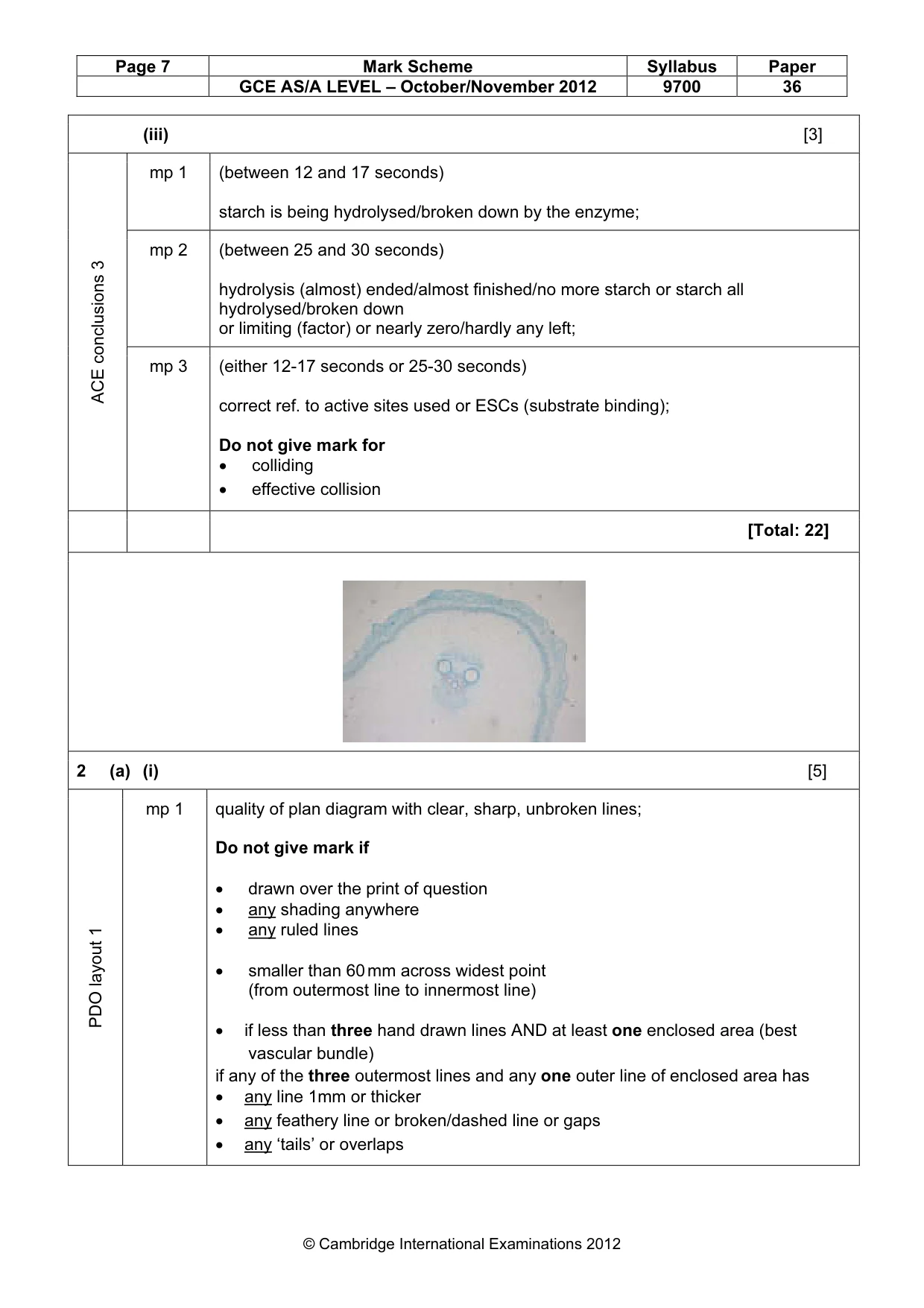
Page 7 Mark Scheme Syllabus Paper GCE AS/A LEVEL – October/November 2012 9700 36 © Cambridge International Examinations 2012 (iii) [3] mp 1 (between 12 and 17 seconds) starch is being hydrolysed/broken down by the enzyme; mp 2 (between 25 and 30 seconds) hydrolysis (almost) ended/almost finished/no more starch or starch all hydrolysed/broken down or limiting (factor) or nearly zero/hardly any left; ACE conclusions 3 mp 3 (either 12-17 seconds or 25-30 seconds) correct ref. to active sites used or ESCs (substrate binding); Do not give mark for • colliding • effective collision [Total: 22] 2 (a) (i) [5] PDO layout 1 mp 1 quality of plan diagram with clear, sharp, unbroken lines; Do not give mark if • drawn over the print of question • any shading anywhere • any ruled lines • smaller than 60 mm across widest point (from outermost line to innermost line) • if less than three hand drawn lines AND at least one enclosed area (best vascular bundle) if any of the three outermost lines and any one outer line of enclosed area has • any line 1mm or thicker • any feathery line or broken/dashed line or gaps • any ‘tails’ or overlaps
Mark scheme, page 8
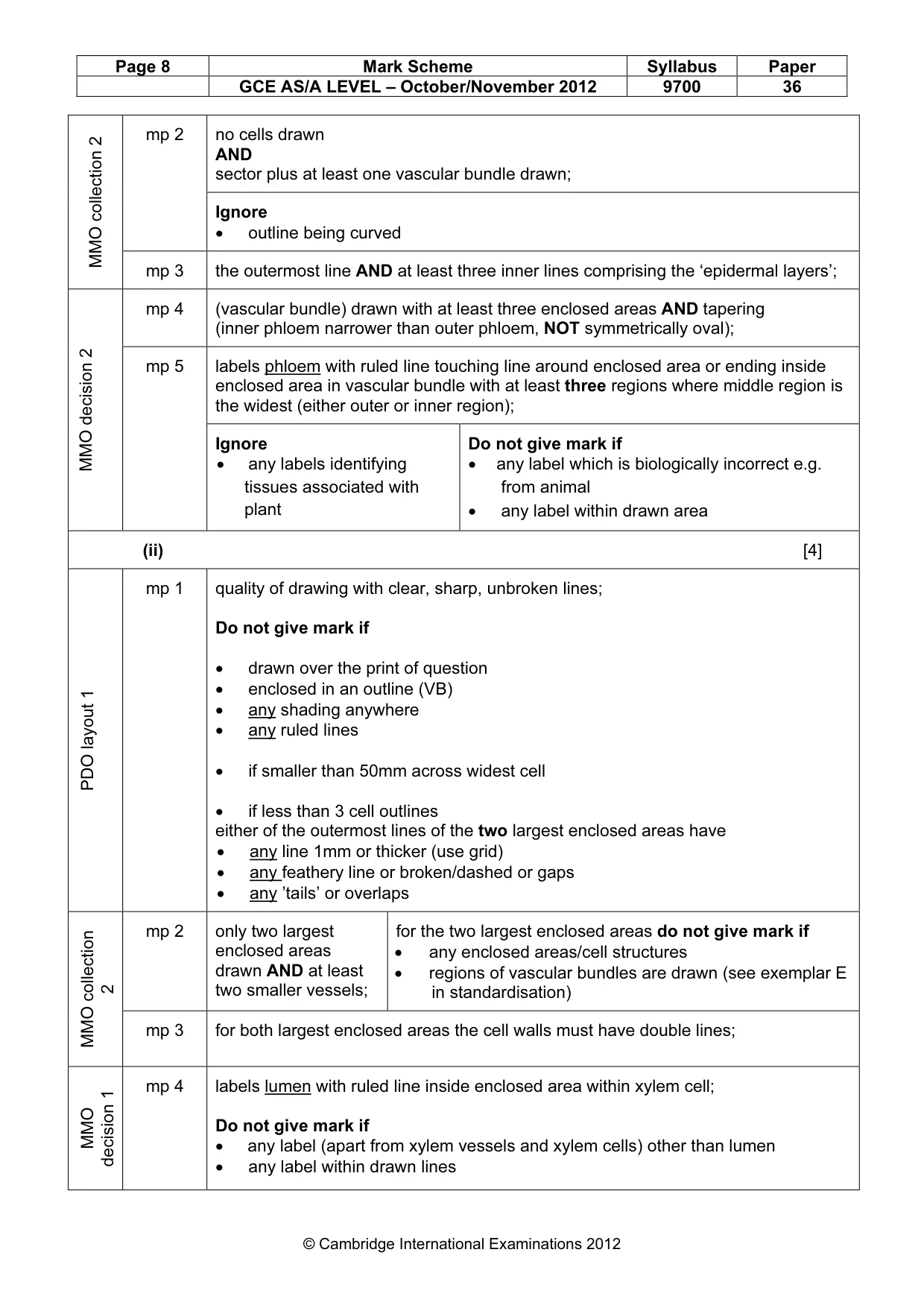
Page 8 Mark Scheme Syllabus Paper GCE AS/A LEVEL – October/November 2012 9700 36 © Cambridge International Examinations 2012 no cells drawn AND sector plus at least one vascular bundle drawn; mp 2 Ignore • outline being curved MMO collection 2 mp 3 the outermost line AND at least three inner lines comprising the ‘epidermal layers’; mp 4 (vascular bundle) drawn with at least three enclosed areas AND tapering (inner phloem narrower than outer phloem, NOT symmetrically oval); labels phloem with ruled line touching line around enclosed area or ending inside enclosed area in vascular bundle with at least three regions where middle region is the widest (either outer or inner region); MMO decision 2 mp 5 Ignore • any labels identifying tissues associated with plant Do not give mark if • any label which is biologically incorrect e.g. from animal • any label within drawn area (ii) [4] PDO layout 1 mp 1 quality of drawing with clear, sharp, unbroken lines; Do not give mark if • drawn over the print of question • enclosed in an outline (VB) • any shading anywhere • any ruled lines • if smaller than 50mm across widest cell • if less than 3 cell outlines either of the outermost lines of the two largest enclosed areas have • any line 1mm or thicker (use grid) • any feathery line or broken/dashed or gaps • any ’tails’ or overlaps mp 2 only two largest enclosed areas drawn AND at least two smaller vessels; for the two largest enclosed areas do not give mark if • any enclosed areas/cell structures • regions of vascular bundles are drawn (see exemplar E in standardisation) MMO collection 2 mp 3 for both largest enclosed areas the cell walls must have double lines; MMO decision 1 mp 4 labels lumen with ruled line inside enclosed area within xylem cell; Do not give mark if • any label (apart from xylem vessels and xylem cells) other than lumen • any label within drawn lines
Mark scheme, page 9
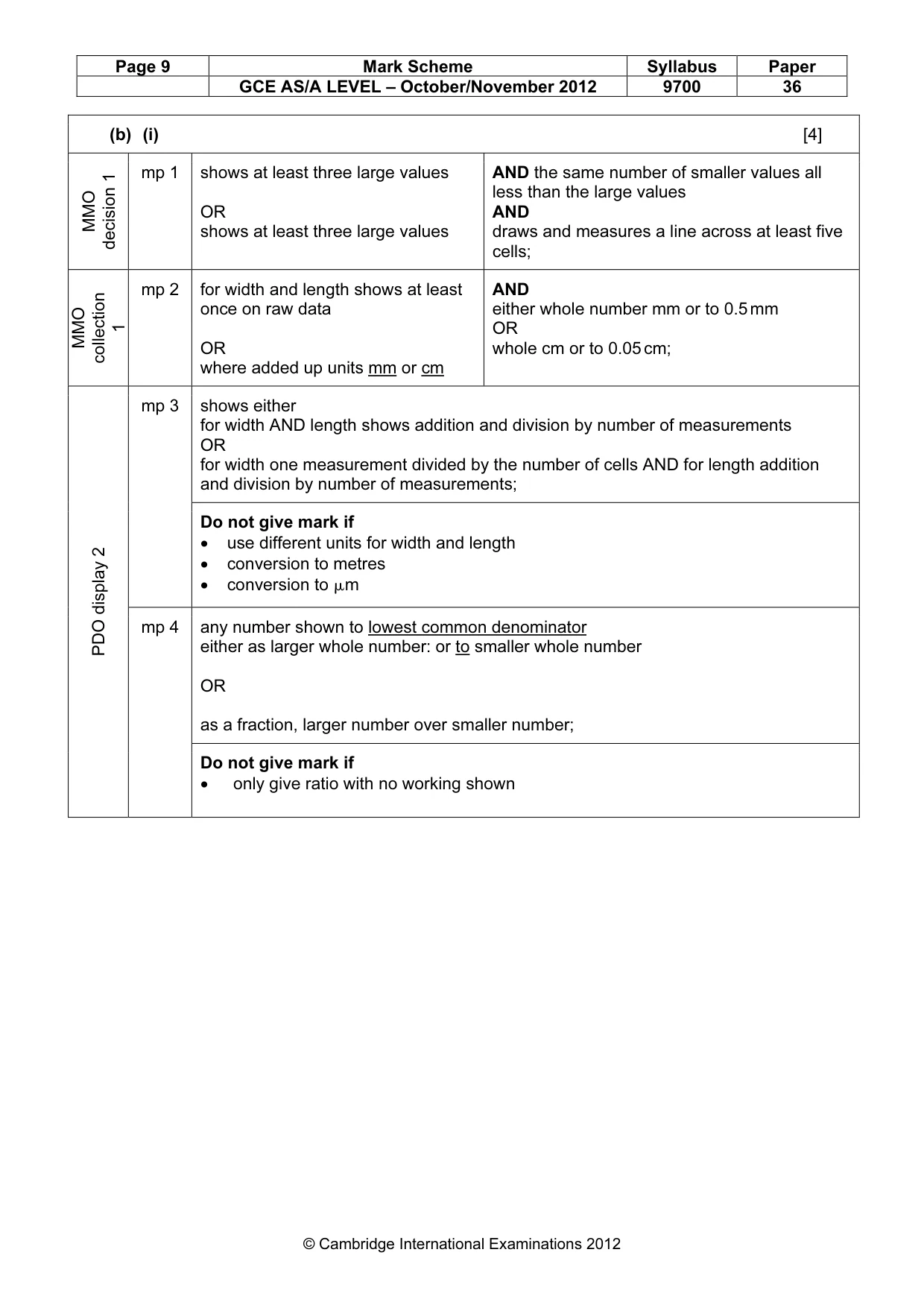
Page 9 Mark Scheme Syllabus Paper GCE AS/A LEVEL – October/November 2012 9700 36 © Cambridge International Examinations 2012 (b) (i) [4] MMO decision 1 mp 1 shows at least three large values OR shows at least three large values AND the same number of smaller values all less than the large values AND draws and measures a line across at least five cells; MMO collection 1 mp 2 for width and length shows at least once on raw data OR where added up units mm or cm AND either whole number mm or to 0.5 mm OR whole cm or to 0.05 cm; shows either for width AND length shows addition and division by number of measurements OR for width one measurement divided by the number of cells AND for length addition and division by number of measurements; mp 3 Do not give mark if • use different units for width and length • conversion to metres • conversion to ãm any number shown to lowest common denominator either as larger whole number: or to smaller whole number OR as a fraction, larger number over smaller number; PDO display 2 mp 4 Do not give mark if • only give ratio with no working shown
Mark scheme, page 10
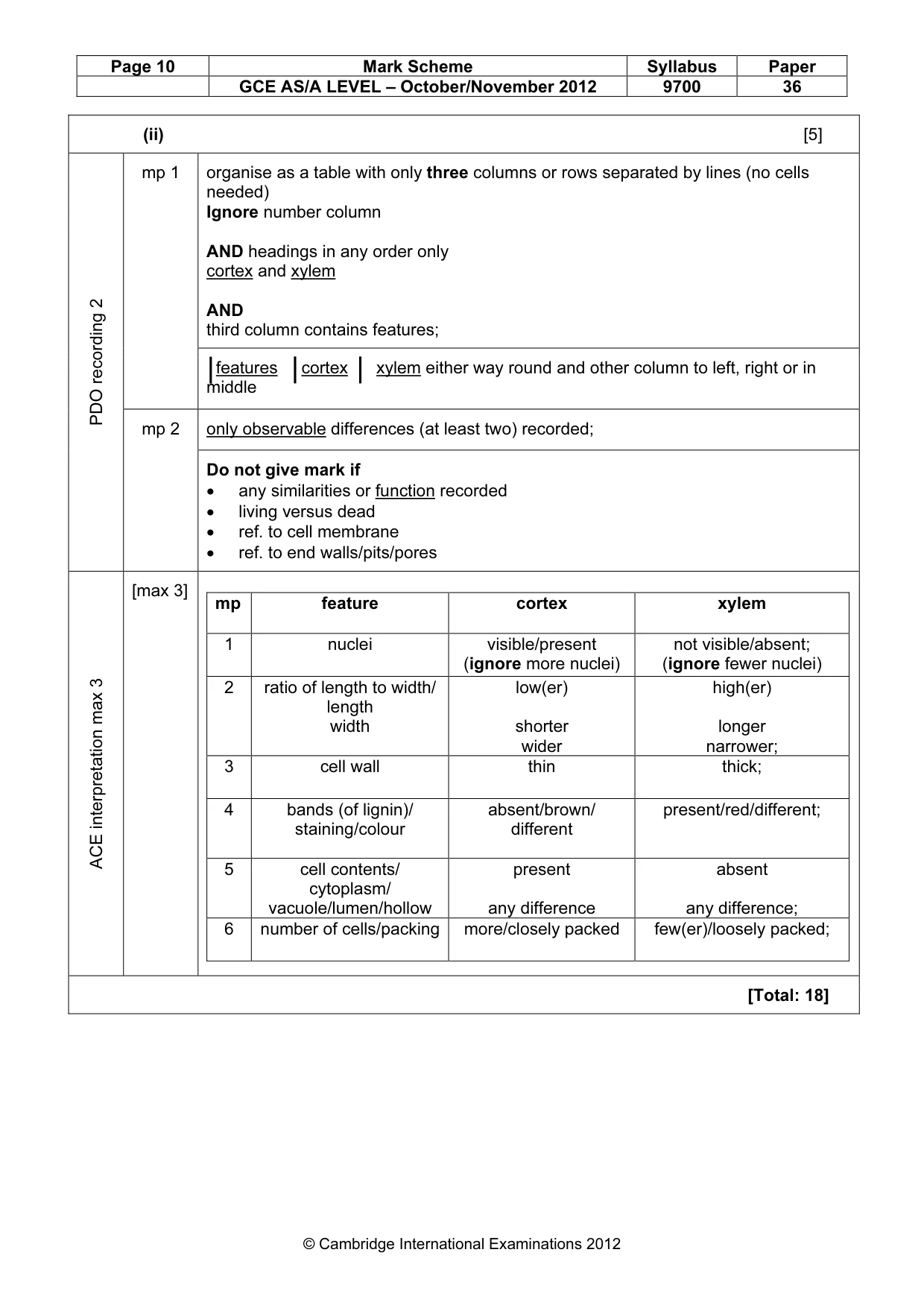
Page 10 Mark Scheme Syllabus Paper GCE AS/A LEVEL – October/November 2012 9700 36 © Cambridge International Examinations 2012 (ii) [5] organise as a table with only three columns or rows separated by lines (no cells needed) Ignore number column AND headings in any order only cortex and xylem AND third column contains features; mp 1 features cortex xylem either way round and other column to left, right or in middle only observable differences (at least two) recorded; PDO recording 2 mp 2 Do not give mark if • any similarities or function recorded • living versus dead • ref. to cell membrane • ref. to end walls/pits/pores ACE interpretation max 3 [max 3] mp feature cortex xylem 1 nuclei visible/present (ignore more nuclei) not visible/absent; (ignore fewer nuclei) 2 ratio of length to width/ length width low(er) shorter wider high(er) longer narrower; 3 cell wall thin thick; 4 bands (of lignin)/ staining/colour absent/brown/ different present/red/different; 5 cell contents/ cytoplasm/ vacuole/lumen/hollow present any difference absent any difference; 6 number of cells/packing more/closely packed few(er)/loosely packed; [Total: 18]
What you needed in this session
Cambridge’s own grade thresholds for 2012 Oct/Nov, Paper 3 · Variant 6. A higher threshold means an easier paper — the bar moves with how the cohort did.