Cambridge A Level Biology 9700 — 2012 Oct/Nov Paper 3 · Variant 1
9700/31/O/N/12 · 40 marks · ≈45 min
The question paper and its mark scheme, free to read here and free to download. This is Cambridge’s own paper, exactly as it was sat.
Question paper12 pages
Mark scheme8 pages
Answers below. Sit the paper first if you are practising.
Paper as text
Question paper, page 1
This document consists of 12 printed pages. DC (SJF/SW) 47052/6 © UCLES 2012 [Turn over UNIVERSITY OF CAMBRIDGE INTERNATIONAL EXAMINATIONS General Certificate of Education Advanced Subsidiary Level and Advanced Level READ THESE INSTRUCTIONS FIRST Write your Centre number, candidate number and name on all the work you hand in. Write in dark blue or black ink. You may use a pencil for any diagrams, graphs or rough working. Do not use red ink, staples, paper clips, highlighters, glue or correction fluid. DO NOT WRITE IN ANY BARCODES. Answer all questions. You may lose marks if you do not show your working or if you do not use appropriate units. At the end of the examination, fasten all your work securely together. The number of marks is given in brackets [ ] at the end of each question or part question. * 5 6 5 7 5 9 7 1 2 0 * BIOLOGY 9700/31 Advanced Practical Skills 1 October/November 2012 2 hours Candidates answer on the Question Paper. Additional Materials: As listed in the Confidential Instructions. For Examiner’s Use 1 2 Total
Question paper, page 2
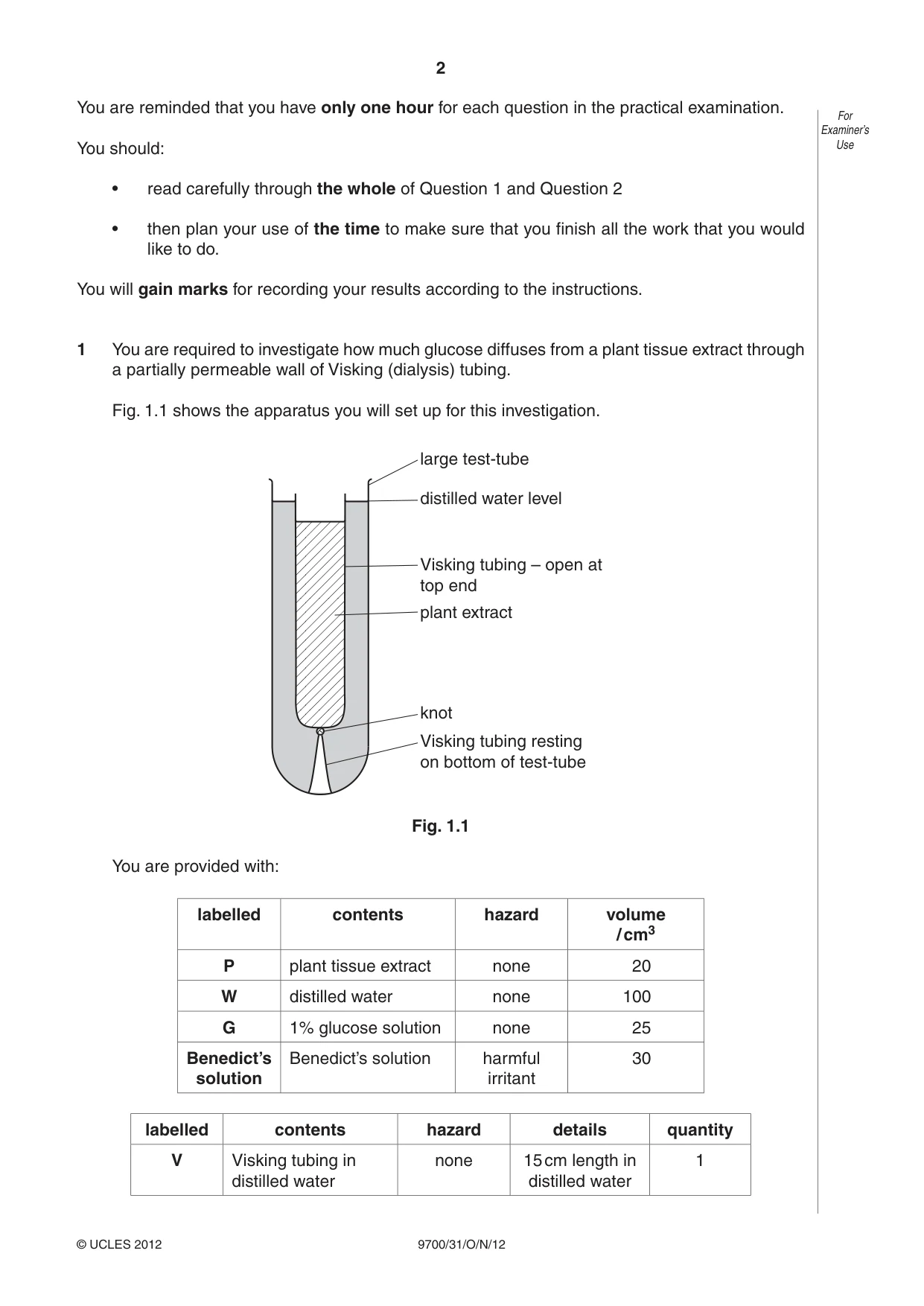
© UCLES 2012 9700/31/O/N/12 For Examiner’s Use You are reminded that you have only one hour for each question in the practical examination. You should: • read carefully through the whole of Question 1 and Question 2 • then plan your use of the time to make sure that you finish all the work that you would like to do. You will gain marks for recording your results according to the instructions. 1 You are required to investigate how much glucose diffuses from a plant tissue extract through a partially permeable wall of Visking (dialysis) tubing. Fig. 1.1 shows the apparatus you will set up for this investigation. knot plant extract Visking tubing resting on bottom of test-tube Visking tubing – open at top end large test-tube distilled water level Fig. 1.1 You are provided with: labelled contents hazard volume / cm3 P plant tissue extract none 20 W distilled water none 100 G 1% glucose solution none 25 Benedict’s solution Benedict’s solution harmful irritant 30 labelled contents hazard details quantity V Visking tubing in distilled water none 15 cm length in distilled water 1 2
Question paper, page 3
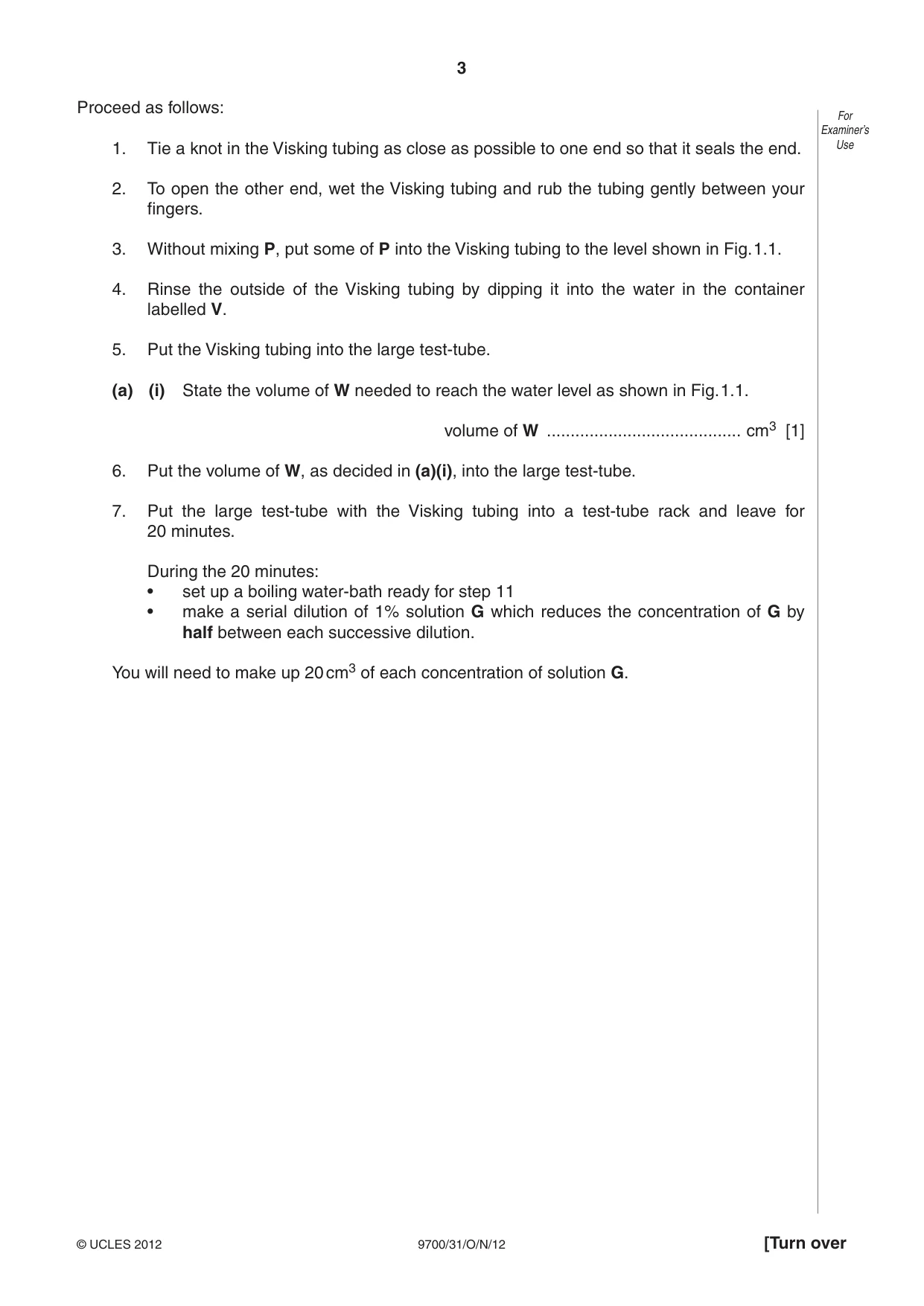
3 [Turn over © UCLES 2012 9700/31/O/N/12 For Examiner’s Use Proceed as follows: 1. Tie a knot in the Visking tubing as close as possible to one end so that it seals the end. 2. To open the other end, wet the Visking tubing and rub the tubing gently between your fingers. 3. Without mixing P, put some of P into the Visking tubing to the level shown in Fig. 1.1. 4. Rinse the outside of the Visking tubing by dipping it into the water in the container labelled V. 5. Put the Visking tubing into the large test-tube. (a) (i) State the volume of W needed to reach the water level as shown in Fig. 1.1. volume of W … cm3 [1] 6. Put the volume of W, as decided in (a)(i), into the large test-tube. 7. Put the large test-tube with the Visking tubing into a test-tube rack and leave for 20 minutes. During the 20 minutes: • set up a boiling water-bath ready for step 11 • make a serial dilution of 1% solution G which reduces the concentration of G by half between each successive dilution. You will need to make up 20 cm3 of each concentration of solution G.
Question paper, page 4
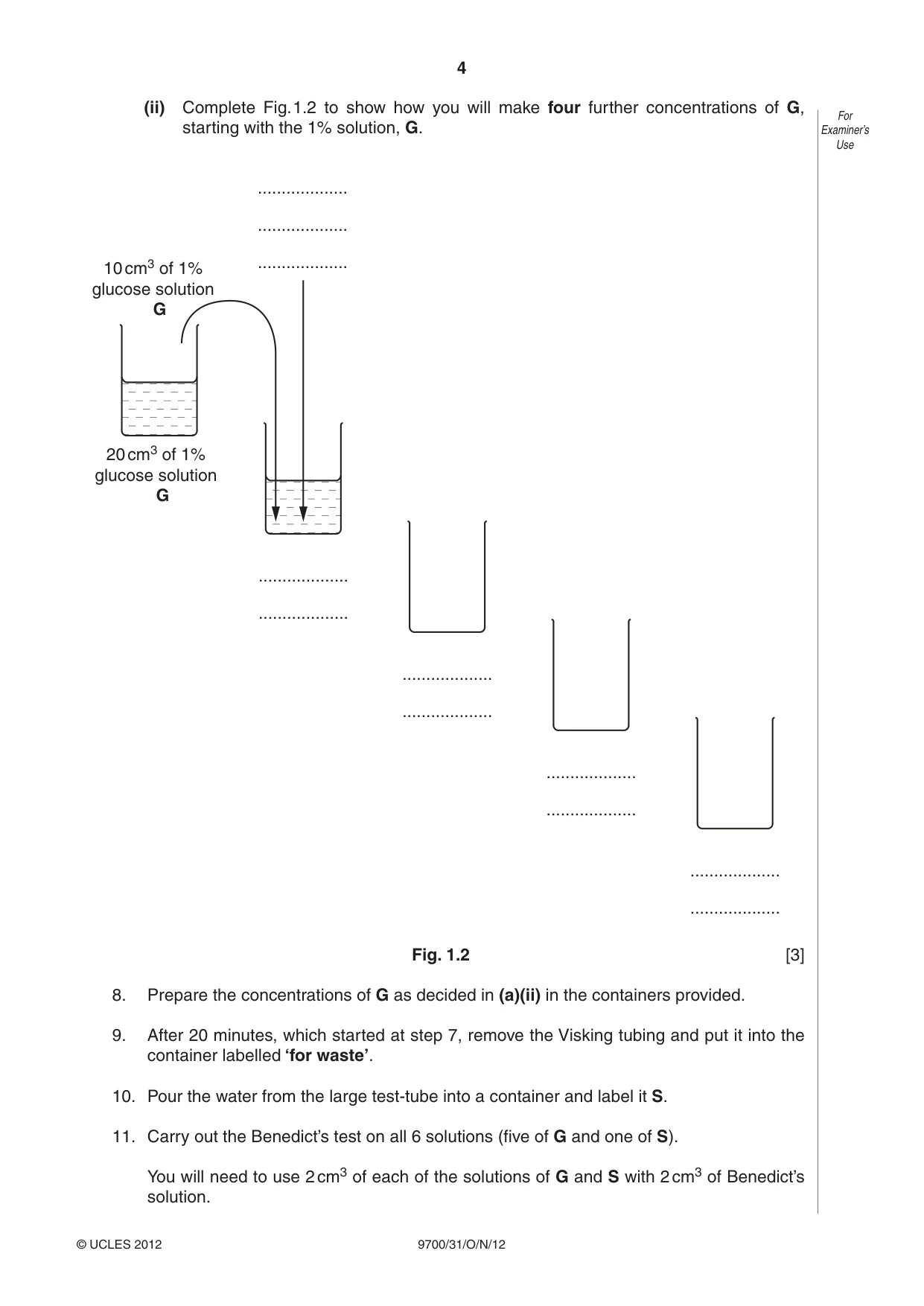
4 © UCLES 2012 9700/31/O/N/12 For Examiner’s Use (ii) Complete Fig. 1.2 to show how you will make four further concentrations of G, starting with the 1% solution, G. … … … … … … … … … … … 10 cm3 of 1% glucose solution G 20 cm3 of 1% glucose solution G Fig. 1.2 [3] 8. Prepare the concentrations of G as decided in (a)(ii) in the containers provided. 9. After 20 minutes, which started at step 7, remove the Visking tubing and put it into the container labelled ‘for waste’. 10. Pour the water from the large test-tube into a container and label it S. 11. Carry out the Benedict’s test on all 6 solutions (five of G and one of S). You will need to use 2 cm3 of each of the solutions of G and S with 2 cm3 of Benedict’s solution.
Question paper, page 5
5 [Turn over © UCLES 2012 9700/31/O/N/12 For Examiner’s Use 12. Test each solution separately and record the time taken for the first appearance of any colour change. If there is no colour change after 120 seconds record ‘more than 120’. (iii) Prepare the space below and record your results. [4]
Question paper, page 6
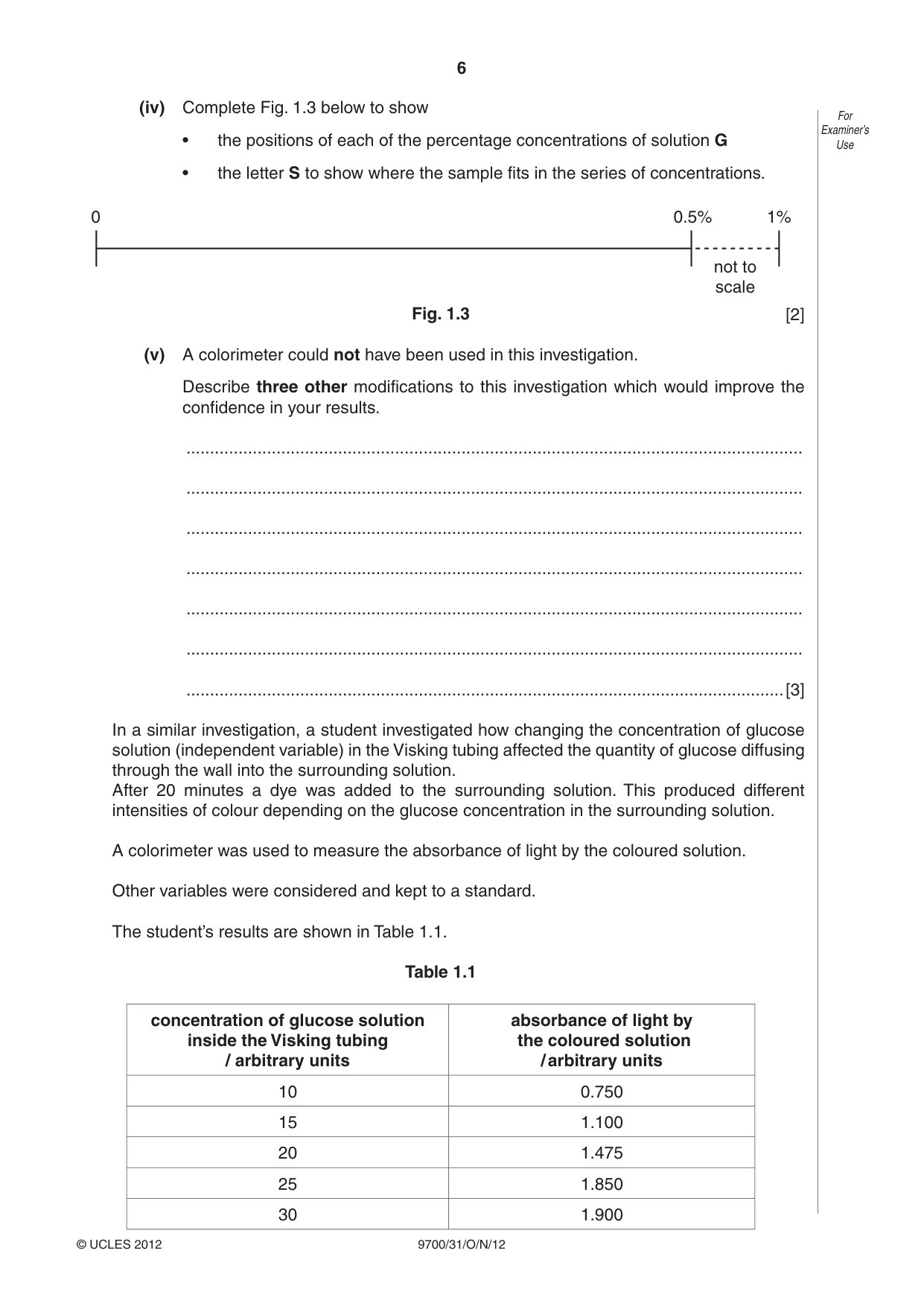
6 © UCLES 2012 9700/31/O/N/12 For Examiner’s Use (iv) Complete Fig. 1.3 below to show • the positions of each of the percentage concentrations of solution G • the letter S to show where the sample fits in the series of concentrations. 0.5% not to scale 0 1% Fig. 1.3 [2] (v) A colorimeter could not have been used in this investigation. Describe three other modifications to this investigation which would improve the confidence in your results. … … … … … … …[3] In a similar investigation, a student investigated how changing the concentration of glucose solution (independent variable) in the Visking tubing affected the quantity of glucose diffusing through the wall into the surrounding solution. After 20 minutes a dye was added to the surrounding solution. This produced different intensities of colour depending on the glucose concentration in the surrounding solution. A colorimeter was used to measure the absorbance of light by the coloured solution. Other variables were considered and kept to a standard. The student’s results are shown in Table 1.1. Table 1.1 concentration of glucose solution inside the Visking tubing / arbitrary units absorbance of light by the coloured solution / arbitrary units 10 0.750 15 1.100 20 1.475 25 1.850 30 1.900
Question paper, page 7
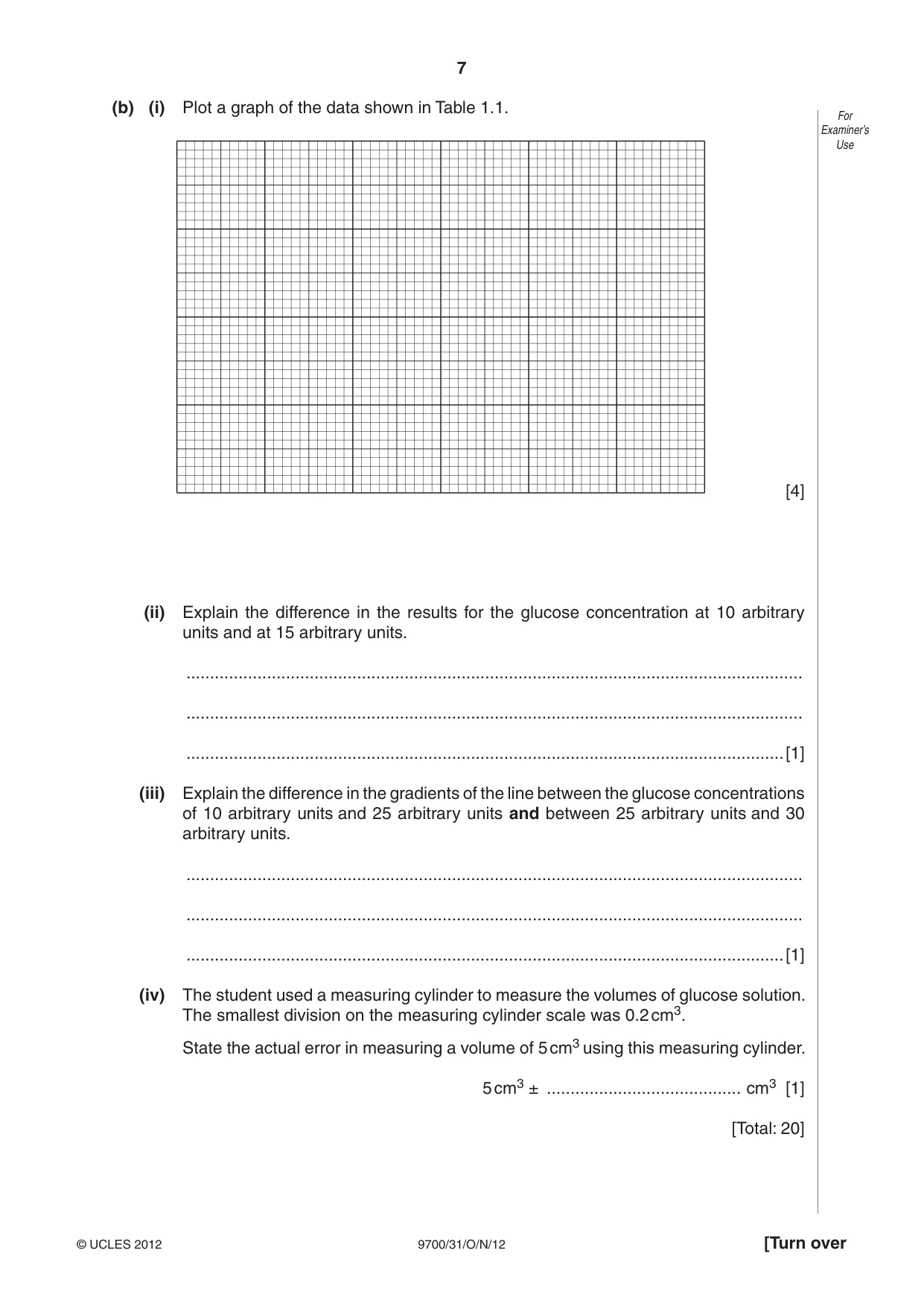
7 [Turn over © UCLES 2012 9700/31/O/N/12 For Examiner’s Use (b) (i) Plot a graph of the data shown in Table 1.1. [4] (ii) Explain the difference in the results for the glucose concentration at 10 arbitrary units and at 15 arbitrary units. … … …[1] (iii) Explain the difference in the gradients of the line between the glucose concentrations of 10 arbitrary units and 25 arbitrary units and between 25 arbitrary units and 30 arbitrary units. … … …[1] (iv) The student used a measuring cylinder to measure the volumes of glucose solution. The smallest division on the measuring cylinder scale was 0.2 cm3. State the actual error in measuring a volume of 5 cm3 using this measuring cylinder. 5 cm3 ± … cm3 [1] [Total: 20]
Question paper, page 8
8 © UCLES 2012 9700/31/O/N/12 For Examiner’s Use 2 J1 is a slide of a transverse section through a plant root. (a) (i) Describe one observable feature on J1 which identifies this specimen as a root. … …[1] (ii) Draw a large plan diagram of the whole specimen on J1. On your diagram, use a label line and label to show the cortex. [4]
Question paper, page 9
9 [Turn over © UCLES 2012 9700/31/O/N/12 For Examiner’s Use (iii) Make a large drawing of one group of four complete touching xylem vessels as observed on the specimen on J1. On your drawing, use a label line and label to show one lumen. Annotate your drawing with one observable feature. [5]
Question paper, page 10
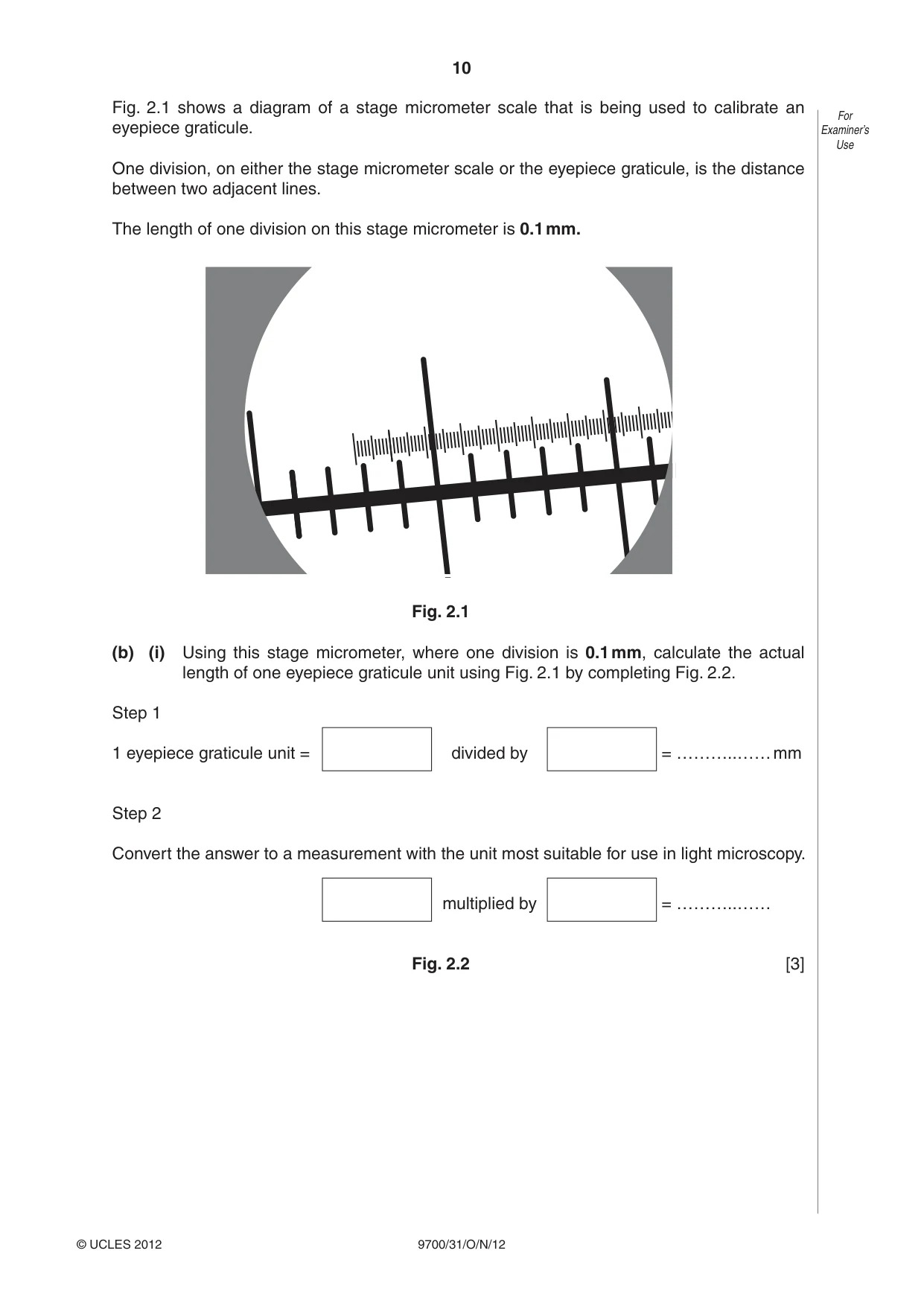
10 © UCLES 2012 9700/31/O/N/12 For Examiner’s Use Fig. 2.1 shows a diagram of a stage micrometer scale that is being used to calibrate an eyepiece graticule. One division, on either the stage micrometer scale or the eyepiece graticule, is the distance between two adjacent lines. The length of one division on this stage micrometer is 0.1 mm. Fig. 2.1 (b) (i) Using this stage micrometer, where one division is 0.1 mm, calculate the actual length of one eyepiece graticule unit using Fig. 2.1 by completing Fig. 2.2. Step 1 1 eyepiece graticule unit = divided by = ………..…… mm Step 2 Convert the answer to a measurement with the unit most suitable for use in light microscopy. multiplied by = ………..…… Fig. 2.2 [3]
Question paper, page 11
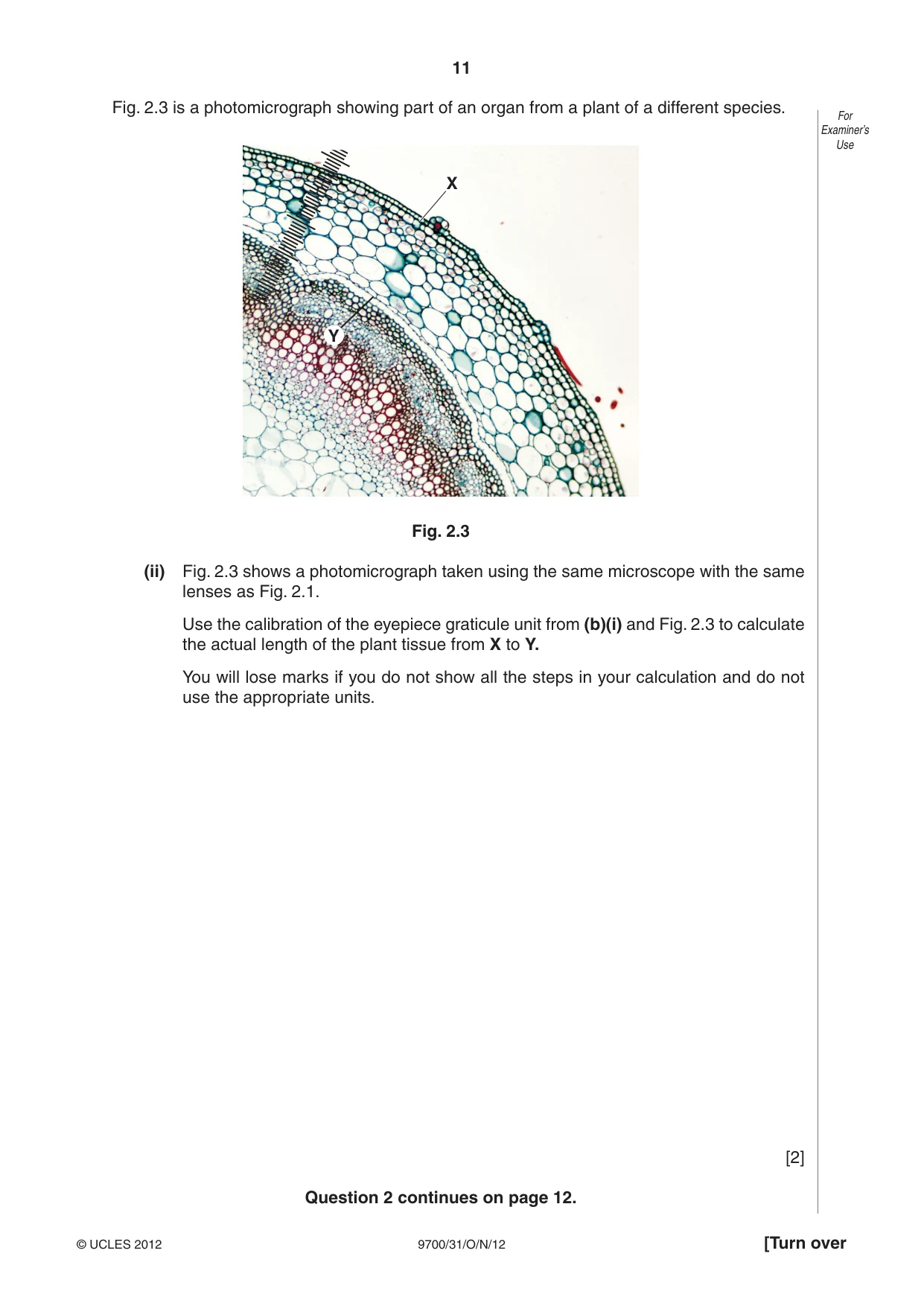
11 [Turn over © UCLES 2012 9700/31/O/N/12 For Examiner’s Use Fig. 2.3 is a photomicrograph showing part of an organ from a plant of a different species. Y X Fig. 2.3 (ii) Fig. 2.3 shows a photomicrograph taken using the same microscope with the same lenses as Fig. 2.1. Use the calibration of the eyepiece graticule unit from (b)(i) and Fig. 2.3 to calculate the actual length of the plant tissue from X to Y. You will lose marks if you do not show all the steps in your calculation and do not use the appropriate units. [2] Question 2 continues on page 12.
Question paper, page 12
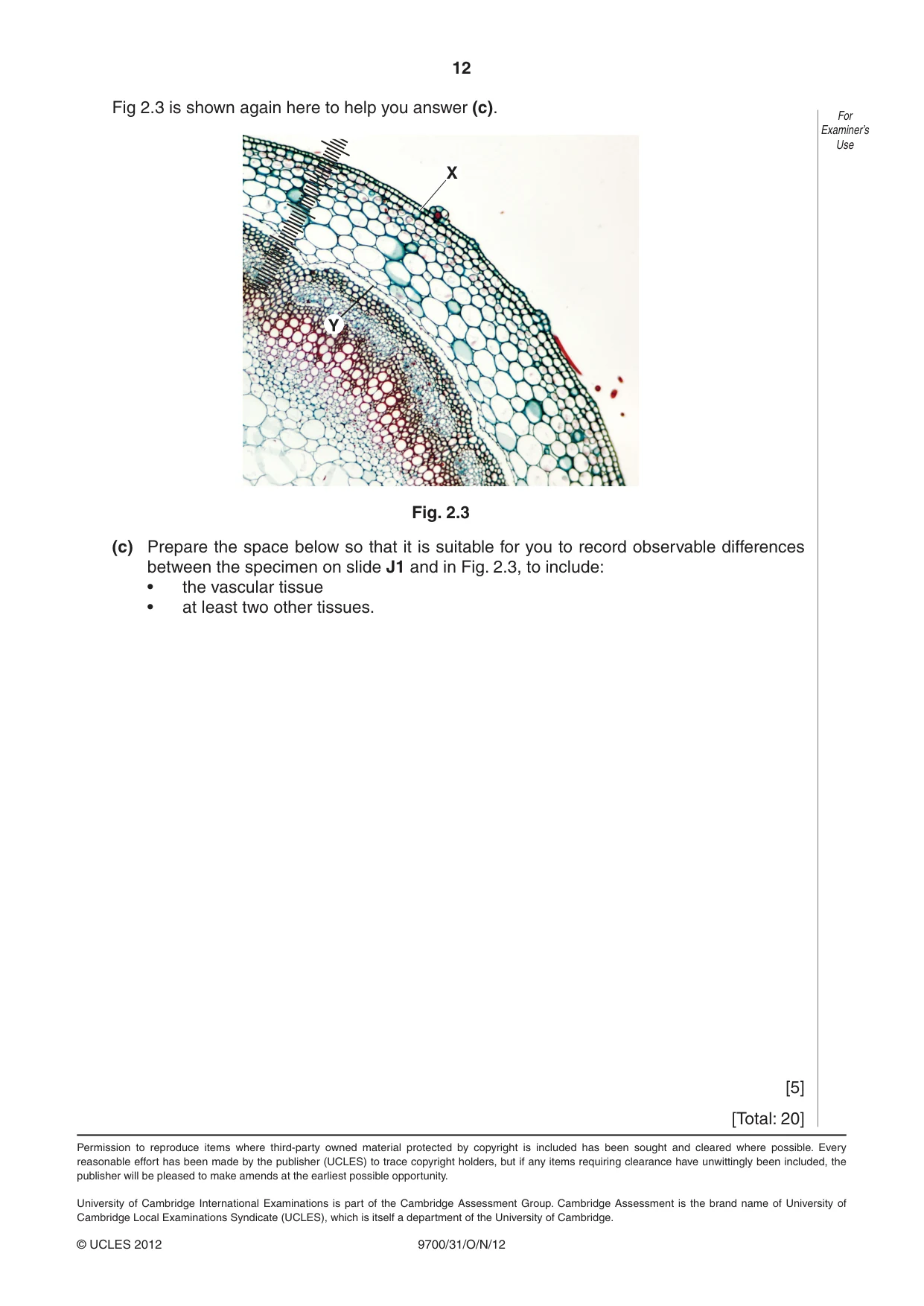
12 © UCLES 2012 9700/31/O/N/12 For Examiner’s Use Permission to reproduce items where third-party owned material protected by copyright is included has been sought and cleared where possible. Every reasonable effort has been made by the publisher (UCLES) to trace copyright holders, but if any items requiring clearance have unwittingly been included, the publisher will be pleased to make amends at the earliest possible opportunity. University of Cambridge International Examinations is part of the Cambridge Assessment Group. Cambridge Assessment is the brand name of University of Cambridge Local Examinations Syndicate (UCLES), which is itself a department of the University of Cambridge. Fig 2.3 is shown again here to help you answer (c). Y X Fig. 2.3 (c) Prepare the space below so that it is suitable for you to record observable differences between the specimen on slide J1 and in Fig. 2.3, to include: • the vascular tissue • at least two other tissues. [5] [Total: 20]
Mark scheme, page 1
CAMBRIDGE INTERNATIONAL EXAMINATIONS GCE Advanced Subsidiary Level and GCE Advanced Level MARK SCHEME for the October/November 2012 series 9700 BIOLOGY 9700/31 Paper 3 (Advanced Practical Skills 1), maximum raw mark 40 This mark scheme is published as an aid to teachers and candidates, to indicate the requirements of the examination. It shows the basis on which Examiners were instructed to award marks. It does not indicate the details of the discussions that took place at an Examiners’ meeting before marking began, which would have considered the acceptability of alternative answers. Mark schemes should be read in conjunction with the question paper and the Principal Examiner Report for Teachers. Cambridge will not enter into discussions about these mark schemes. Cambridge is publishing the mark schemes for the October/November 2012 series for most IGCSE, GCE Advanced Level and Advanced Subsidiary Level components and some Ordinary Level components.
Mark scheme, page 2
Page 2 Mark Scheme Syllabus Paper GCE AS/A LEVEL – October/November 2012 9700 31 © Cambridge International Examinations 2012 Mark scheme abbreviations: ; separates marking points / alternative answers for the same point R reject A accept (for answers correctly cued by the question, or by extra guidance) AW alternative wording (where responses vary more than usual) underline actual word given must be used by candidate (grammatical variants excepted) max indicates the maximum number of marks that can be given ora or reverse argument mp marking point (with relevant number) ecf error carried forward I ignore ACE Analysis, Conclusions and Evaluation (skills) MMO Manipulations, Measurement and Observation (skills) PDO Presentation of Data and Observations (skills)
Mark scheme, page 3
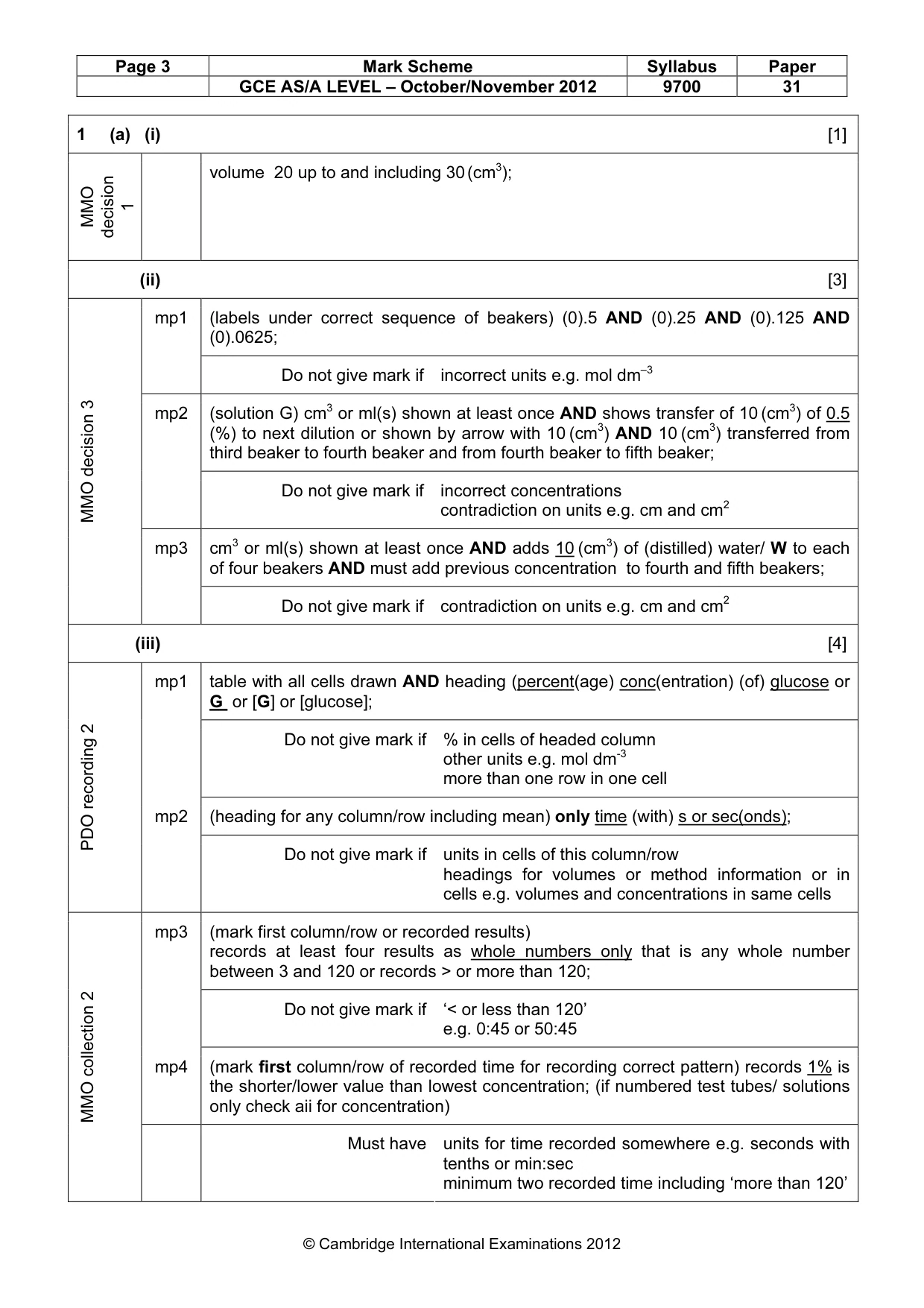
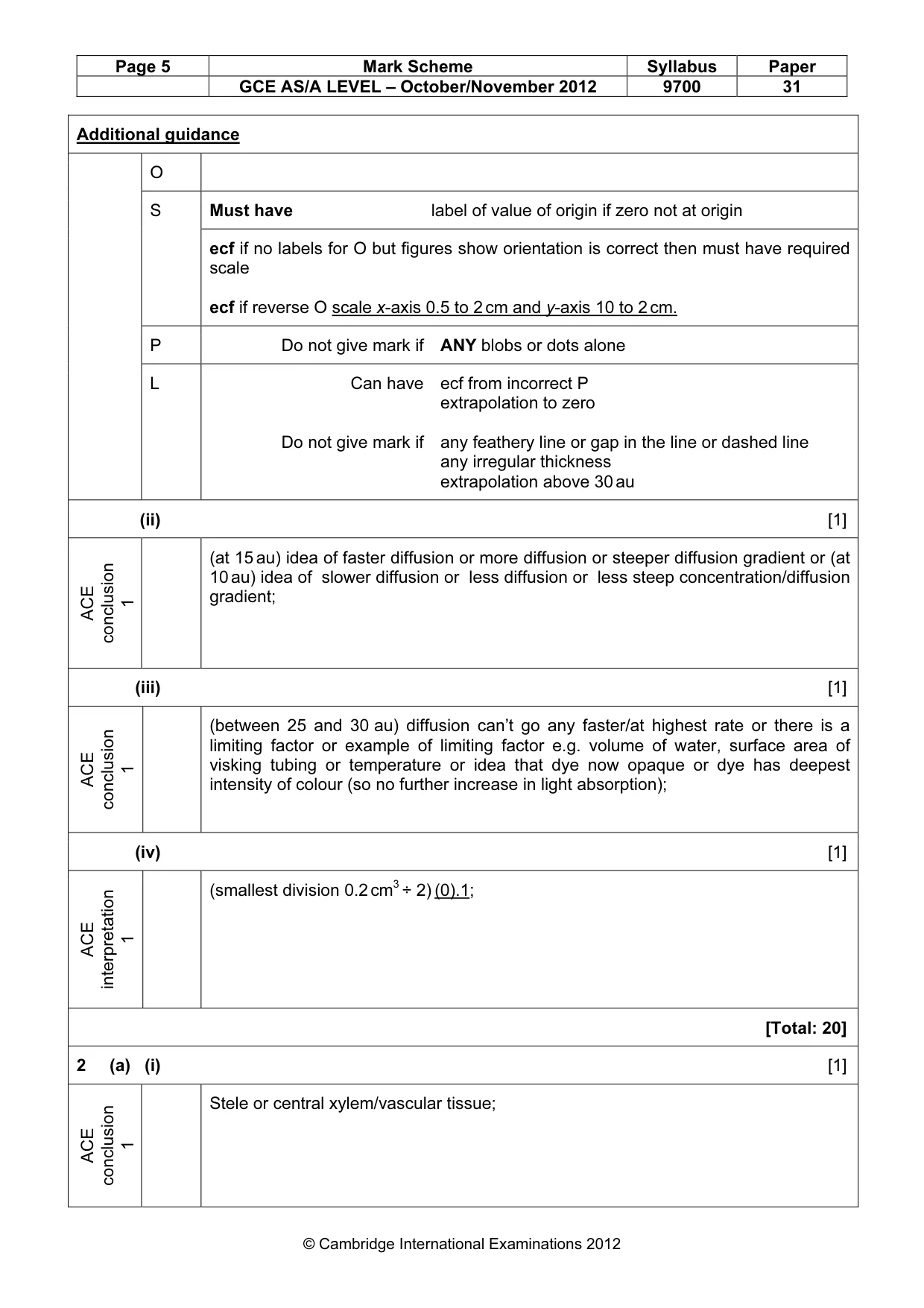
Page 3 Mark Scheme Syllabus Paper GCE AS/A LEVEL – October/November 2012 9700 31 © Cambridge International Examinations 2012 1 (a) (i) [1] MMO decision 1 volume 20 up to and including 30 (cm3); (ii) [3] (labels under correct sequence of beakers) (0).5 AND (0).25 AND (0).125 AND (0).0625; mp1 Do not give mark if incorrect units e.g. mol dm–3 (solution G) cm3 or ml(s) shown at least once AND shows transfer of 10 (cm3) of 0.5 (%) to next dilution or shown by arrow with 10 (cm3) AND 10 (cm3) transferred from third beaker to fourth beaker and from fourth beaker to fifth beaker; mp2 Do not give mark if incorrect concentrations contradiction on units e.g. cm and cm2 cm3 or ml(s) shown at least once AND adds 10 (cm3) of (distilled) water/ W to each of four beakers AND must add previous concentration to fourth and fifth beakers; MMO decision 3 mp3 Do not give mark if contradiction on units e.g. cm and cm2 (iii) [4] mp1 table with all cells drawn AND heading (percent(age) conc(entration) (of) glucose or G or [G] or [glucose]; Do not give mark if % in cells of headed column other units e.g. mol dm-3 more than one row in one cell mp2 (heading for any column/row including mean) only time (with) s or sec(onds); PDO recording 2 Do not give mark if units in cells of this column/row headings for volumes or method information or in cells e.g. volumes and concentrations in same cells mp3 (mark first column/row or recorded results) records at least four results as whole numbers only that is any whole number between 3 and 120 or records > or more than 120; Do not give mark if ‘< or less than 120’ e.g. 0:45 or 50:45 mp4 (mark first column/row of recorded time for recording correct pattern) records 1% is the shorter/lower value than lowest concentration; (if numbered test tubes/ solutions only check aii for concentration) MMO collection 2 Must have units for time recorded somewhere e.g. seconds with tenths or min:sec minimum two recorded time including ‘more than 120’
Mark scheme, page 4
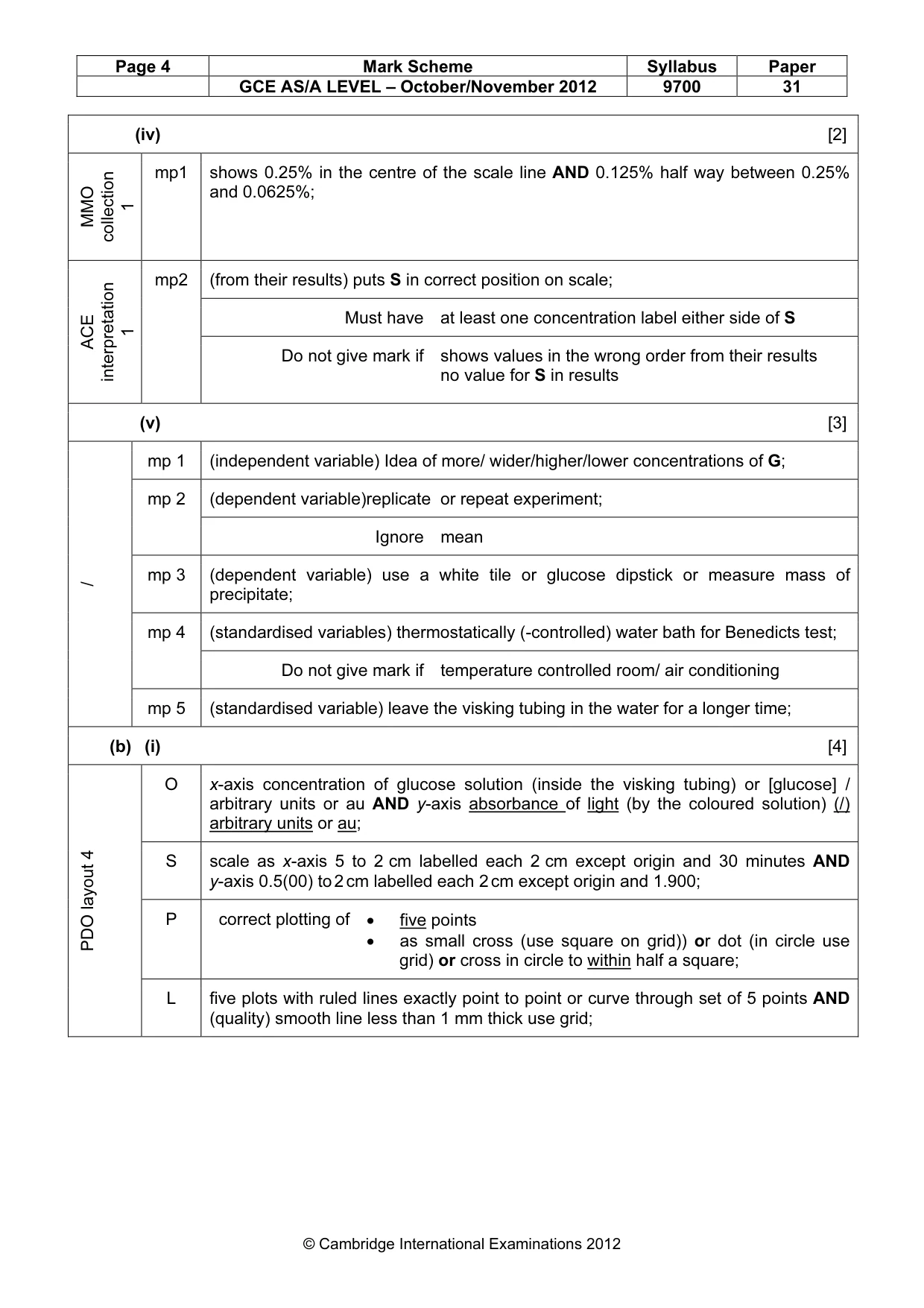
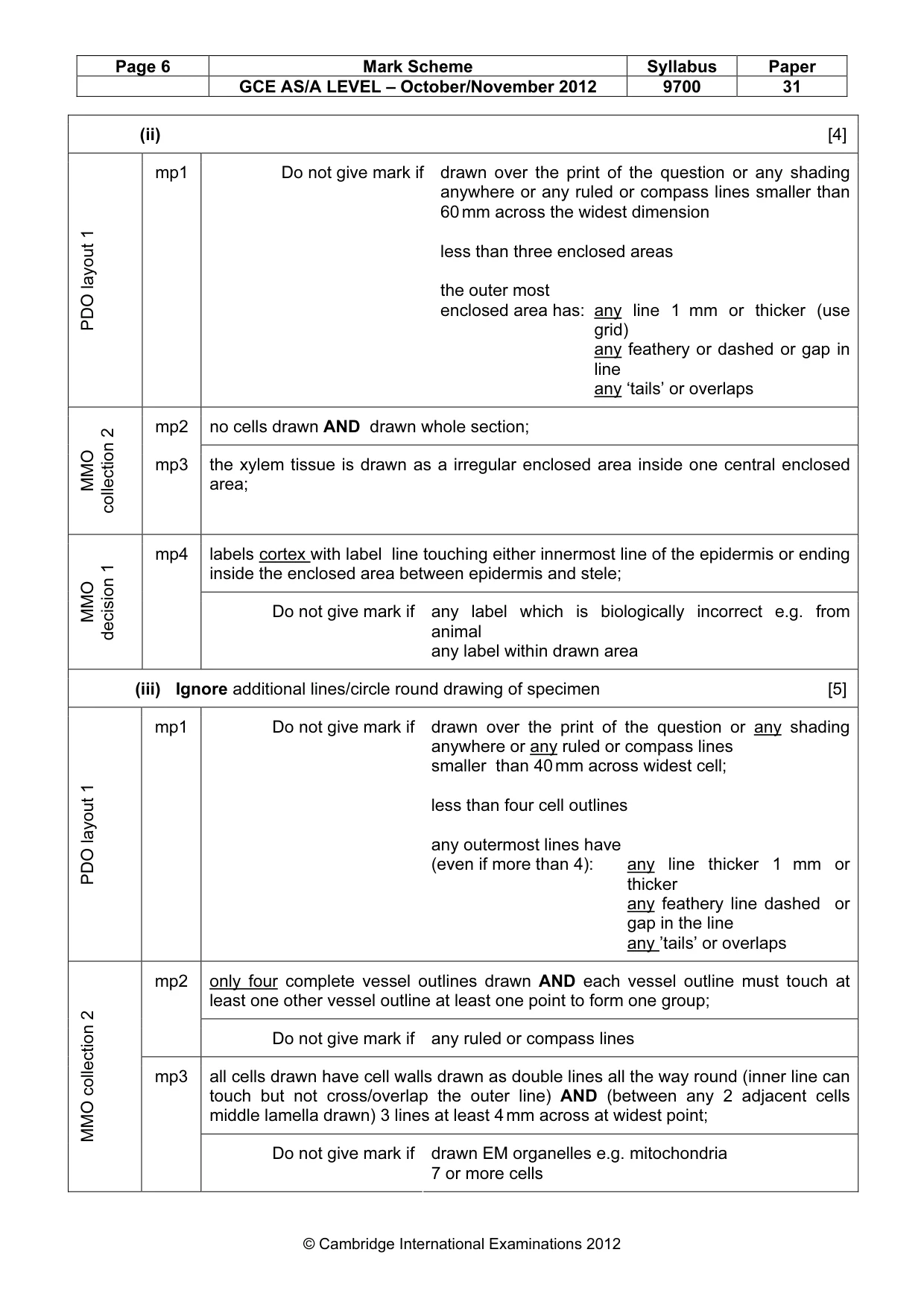
Page 4 Mark Scheme Syllabus Paper GCE AS/A LEVEL – October/November 2012 9700 31 © Cambridge International Examinations 2012 (iv) [2] MMO collection 1 mp1 shows 0.25% in the centre of the scale line AND 0.125% half way between 0.25% and 0.0625%; (from their results) puts S in correct position on scale; Must have at least one concentration label either side of S ACE interpretation 1 mp2 Do not give mark if shows values in the wrong order from their results no value for S in results (v) [3] mp 1 (independent variable) Idea of more/ wider/higher/lower concentrations of G; (dependent variable)replicate or repeat experiment; mp 2 Ignore mean mp 3 (dependent variable) use a white tile or glucose dipstick or measure mass of precipitate; (standardised variables) thermostatically (-controlled) water bath for Benedicts test; mp 4 Do not give mark if temperature controlled room/ air conditioning / mp 5 (standardised variable) leave the visking tubing in the water for a longer time; (b) (i) [4] O x-axis concentration of glucose solution (inside the visking tubing) or [glucose] / arbitrary units or au AND y-axis absorbance of light (by the coloured solution) (/) arbitrary units or au; S scale as x-axis 5 to 2 cm labelled each 2 cm except origin and 30 minutes AND y-axis 0.5(00) to 2 cm labelled each 2 cm except origin and 1.900; P correct plotting of • five points • as small cross (use square on grid)) or dot (in circle use grid) or cross in circle to within half a square; PDO layout 4 L five plots with ruled lines exactly point to point or curve through set of 5 points AND (quality) smooth line less than 1 mm thick use grid;
Mark scheme, page 5
Page 5 Mark Scheme Syllabus Paper GCE AS/A LEVEL – October/November 2012 9700 31 © Cambridge International Examinations 2012 Additional guidance O Must have label of value of origin if zero not at origin S ecf if no labels for O but figures show orientation is correct then must have required scale ecf if reverse O scale x-axis 0.5 to 2 cm and y-axis 10 to 2 cm. P Do not give mark if ANY blobs or dots alone L Can have Do not give mark if ecf from incorrect P extrapolation to zero any feathery line or gap in the line or dashed line any irregular thickness extrapolation above 30 au (ii) [1] ACE conclusion 1 (at 15 au) idea of faster diffusion or more diffusion or steeper diffusion gradient or (at 10 au) idea of slower diffusion or less diffusion or less steep concentration/diffusion gradient; (iii) [1] ACE conclusion 1 (between 25 and 30 au) diffusion can’t go any faster/at highest rate or there is a limiting factor or example of limiting factor e.g. volume of water, surface area of visking tubing or temperature or idea that dye now opaque or dye has deepest intensity of colour (so no further increase in light absorption); (iv) [1] ACE interpretation 1 (smallest division 0.2 cm3 ÷ 2) (0).1; [Total: 20] 2 (a) (i) [1] ACE conclusion 1 Stele or central xylem/vascular tissue;
Mark scheme, page 6
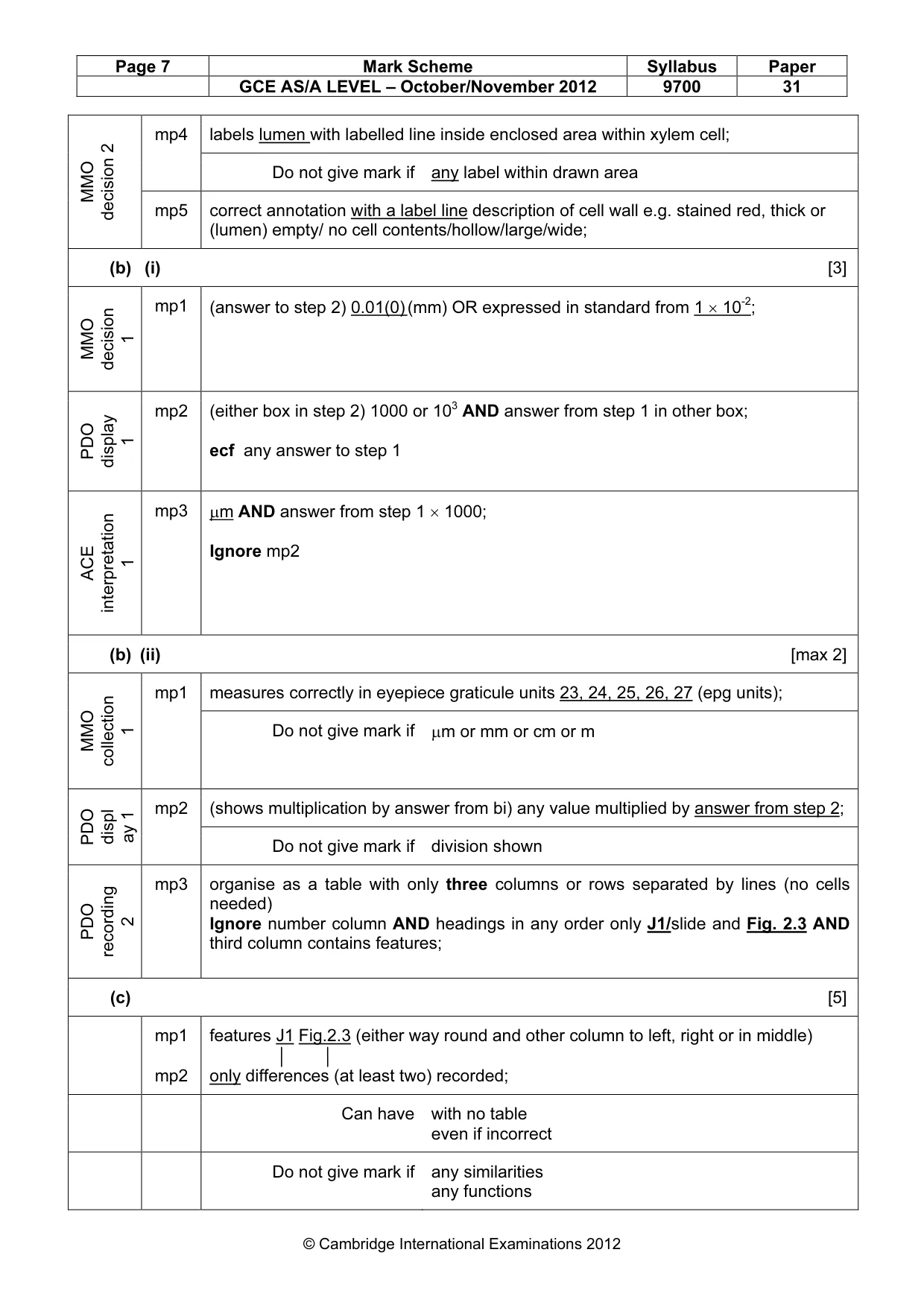
Page 6 Mark Scheme Syllabus Paper GCE AS/A LEVEL – October/November 2012 9700 31 © Cambridge International Examinations 2012 (ii) [4] PDO layout 1 mp1 Do not give mark if drawn over the print of the question or any shading anywhere or any ruled or compass lines smaller than 60 mm across the widest dimension less than three enclosed areas the outer most enclosed area has: any line 1 mm or thicker (use grid) any feathery or dashed or gap in line any ‘tails’ or overlaps mp2 no cells drawn AND drawn whole section; MMO collection 2 mp3 the xylem tissue is drawn as a irregular enclosed area inside one central enclosed area; labels cortex with label line touching either innermost line of the epidermis or ending inside the enclosed area between epidermis and stele; MMO decision 1 mp4 Do not give mark if any label which is biologically incorrect e.g. from animal any label within drawn area (iii) Ignore additional lines/circle round drawing of specimen [5] PDO layout 1 mp1 Do not give mark if drawn over the print of the question or any shading anywhere or any ruled or compass lines smaller than 40 mm across widest cell; less than four cell outlines any outermost lines have (even if more than 4): any line thicker 1 mm or thicker any feathery line dashed or gap in the line any ’tails’ or overlaps only four complete vessel outlines drawn AND each vessel outline must touch at least one other vessel outline at least one point to form one group; mp2 Do not give mark if any ruled or compass lines all cells drawn have cell walls drawn as double lines all the way round (inner line can touch but not cross/overlap the outer line) AND (between any 2 adjacent cells middle lamella drawn) 3 lines at least 4 mm across at widest point; MMO collection 2 mp3 Do not give mark if drawn EM organelles e.g. mitochondria 7 or more cells
Mark scheme, page 7
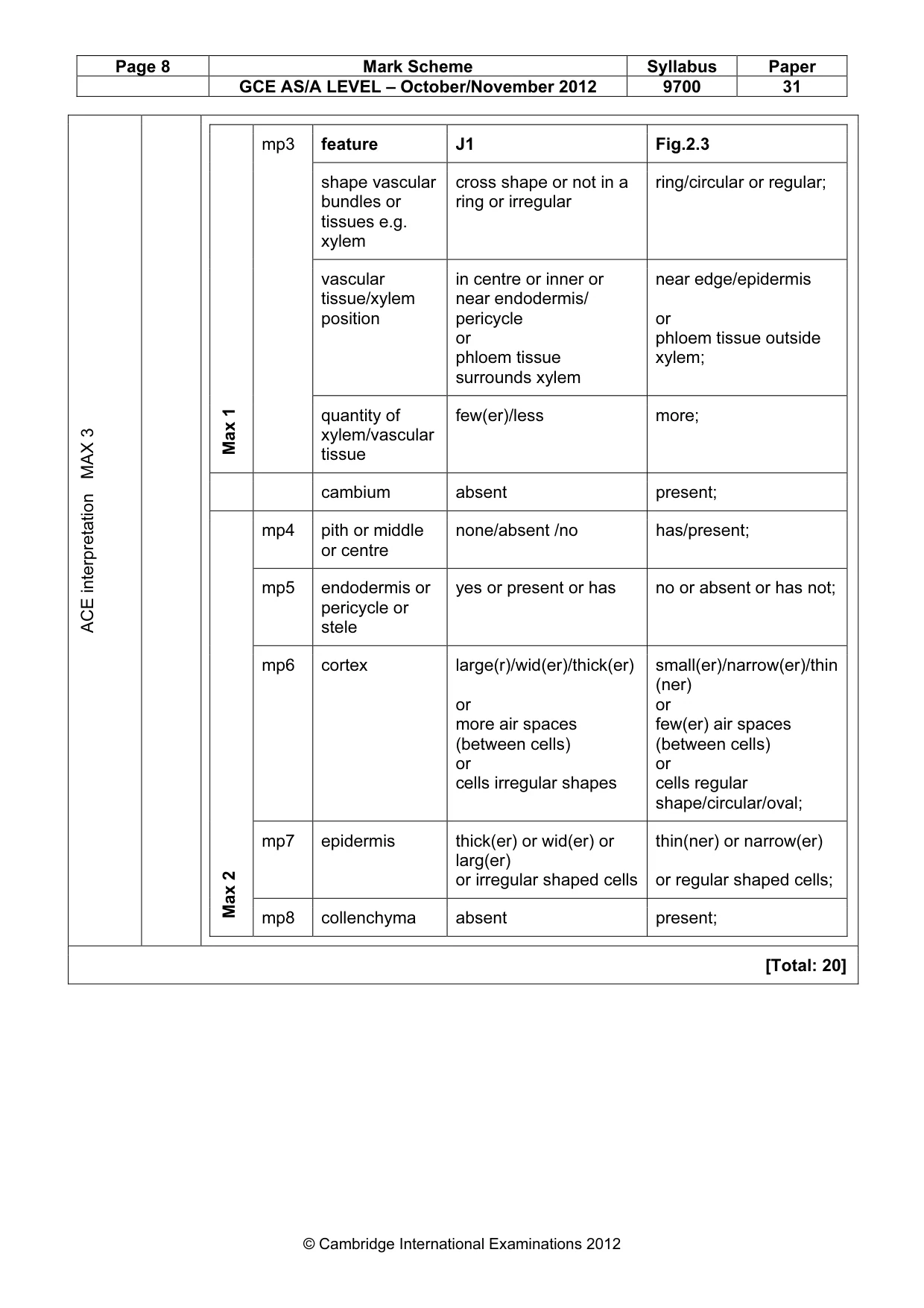
Page 7 Mark Scheme Syllabus Paper GCE AS/A LEVEL – October/November 2012 9700 31 © Cambridge International Examinations 2012 labels lumen with labelled line inside enclosed area within xylem cell; mp4 Do not give mark if any label within drawn area MMO decision 2 mp5 correct annotation with a label line description of cell wall e.g. stained red, thick or (lumen) empty/ no cell contents/hollow/large/wide; (b) (i) [3] MMO decision 1 mp1 (answer to step 2) 0.01(0) (mm) OR expressed in standard from 1 × 10⁻²; PDO display 1 mp2 (either box in step 2) 1000 or 103 AND answer from step 1 in other box; ecf any answer to step 1 ACE interpretation 1 mp3 µm AND answer from step 1 × 1000; Ignore mp2 (b) (ii) [max 2] measures correctly in eyepiece graticule units 23, 24, 25, 26, 27 (epg units); MMO collection 1 mp1 Do not give mark if µm or mm or cm or m (shows multiplication by answer from bi) any value multiplied by answer from step 2; PDO displ ay 1 mp2 Do not give mark if division shown PDO recording 2 mp3 organise as a table with only three columns or rows separated by lines (no cells needed) Ignore number column AND headings in any order only J1/slide and Fig. 2.3 AND third column contains features; (c) [5] mp1 features J1 Fig.2.3 (either way round and other column to left, right or in middle) mp2 only differences (at least two) recorded; Can have with no table even if incorrect Do not give mark if any similarities any functions
Mark scheme, page 8
Page 8 Mark Scheme Syllabus Paper GCE AS/A LEVEL – October/November 2012 9700 31 © Cambridge International Examinations 2012 ACE interpretation MAX 3 feature J1 Fig.2.3 shape vascular bundles or tissues e.g. xylem cross shape or not in a ring or irregular ring/circular or regular; vascular tissue/xylem position in centre or inner or near endodermis/ pericycle or phloem tissue surrounds xylem near edge/epidermis or phloem tissue outside xylem; Max 1 mp3 quantity of xylem/vascular tissue few(er)/less more; cambium absent present; mp4 pith or middle or centre none/absent /no has/present; mp5 endodermis or pericycle or stele yes or present or has no or absent or has not; mp6 cortex large(r)/wid(er)/thick(er) or more air spaces (between cells) or cells irregular shapes small(er)/narrow(er)/thin (ner) or few(er) air spaces (between cells) or cells regular shape/circular/oval; mp7 epidermis thick(er) or wid(er) or larg(er) or irregular shaped cells thin(ner) or narrow(er) or regular shaped cells; Max 2 mp8 collenchyma absent present; [Total: 20]
What you needed in this session
Cambridge’s own grade thresholds for 2012 Oct/Nov, Paper 3 · Variant 1. A higher threshold means an easier paper — the bar moves with how the cohort did.