Cambridge A Level Biology 9700 — 2012 May/June Paper 5 · Variant 2
9700/52/M/J/12 · 30 marks · ≈34 min
The question paper and its mark scheme, free to read here and free to download. This is Cambridge’s own paper, exactly as it was sat.
Question paper8 pages
Mark scheme6 pages
Answers below. Sit the paper first if you are practising.
Paper as text
Question paper, page 1
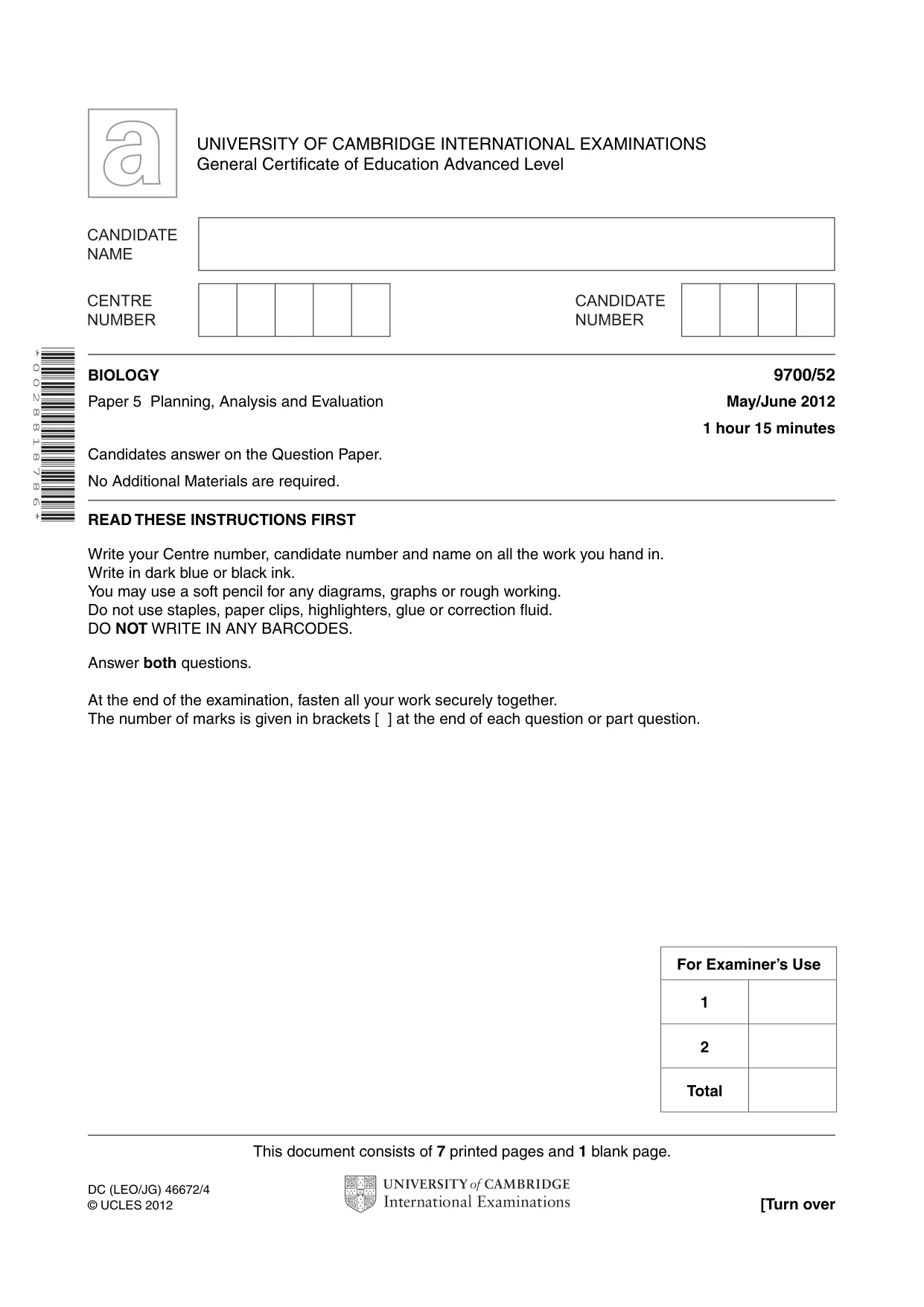
This document consists of 7 printed pages and 1 blank page. DC (LEO/JG) 46672/4 © UCLES 2012 [Turn over UNIVERSITY OF CAMBRIDGE INTERNATIONAL EXAMINATIONS General Certificate of Education Advanced Level READ THESE INSTRUCTIONS FIRST Write your Centre number, candidate number and name on all the work you hand in. Write in dark blue or black ink. You may use a soft pencil for any diagrams, graphs or rough working. Do not use staples, paper clips, highlighters, glue or correction fluid. DO NOT WRITE IN ANY BARCODES. Answer both questions. At the end of the examination, fasten all your work securely together. The number of marks is given in brackets [ ] at the end of each question or part question. * 0 0 2 8 8 1 8 7 8 6 * BIOLOGY 9700/52 Paper 5 Planning, Analysis and Evaluation May/June 2012 1 hour 15 minutes Candidates answer on the Question Paper. No Additional Materials are required. For Examiner’s Use 1 2 Total
Question paper, page 2
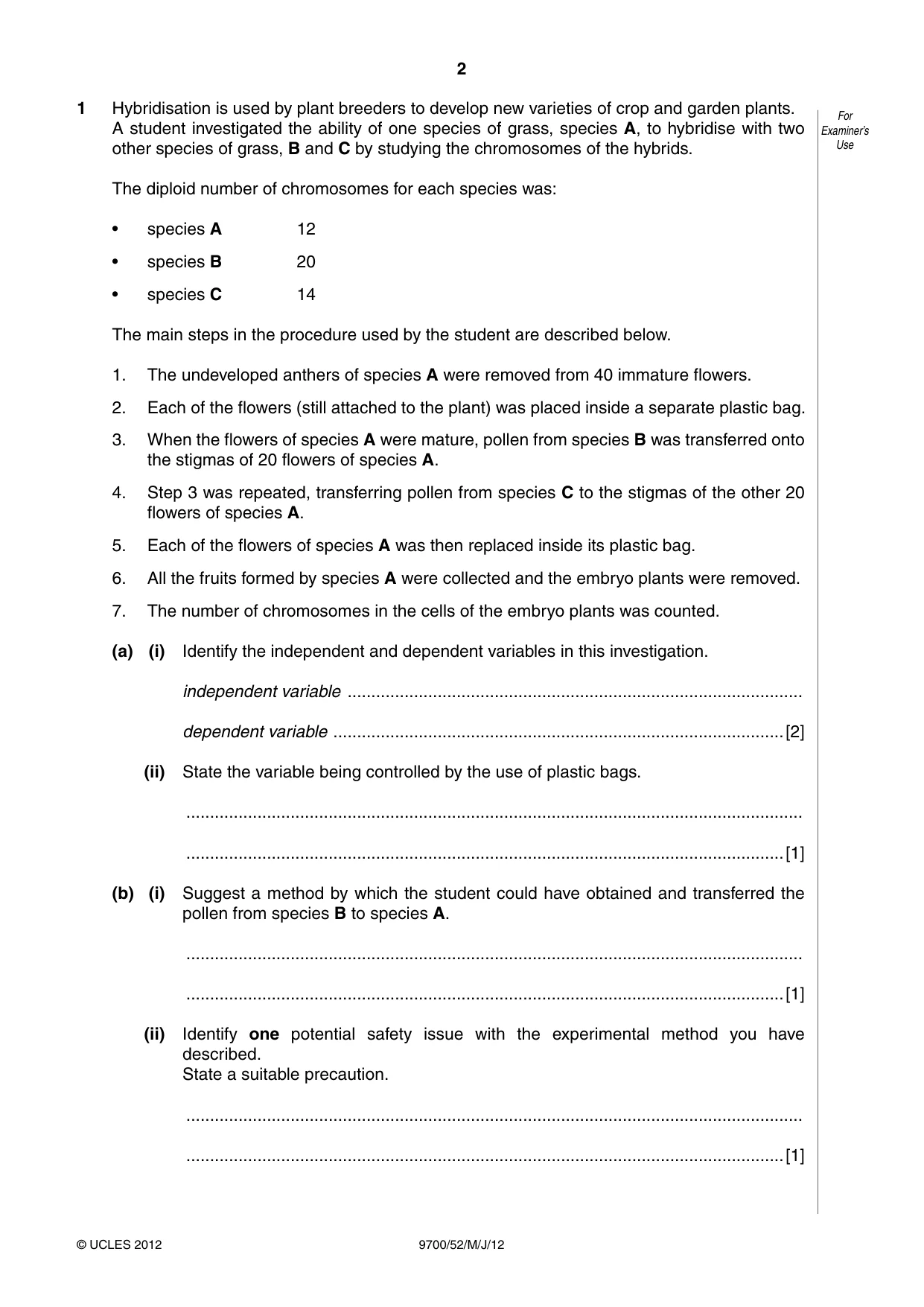
2 9700/52/M/J/12 © UCLES 2012 For Examiner’s Use 1 Hybridisation is used by plant breeders to develop new varieties of crop and garden plants. A student investigated the ability of one species of grass, species A, to hybridise with two other species of grass, B and C by studying the chromosomes of the hybrids. The diploid number of chromosomes for each species was: • species A 12 • species B 20 • species C 14 The main steps in the procedure used by the student are described below. 1. The undeveloped anthers of species A were removed from 40 immature flowers. 2. Each of the flowers (still attached to the plant) was placed inside a separate plastic bag. 3. When the flowers of species A were mature, pollen from species B was transferred onto the stigmas of 20 flowers of species A. 4. Step 3 was repeated, transferring pollen from species C to the stigmas of the other 20 flowers of species A. 5. Each of the flowers of species A was then replaced inside its plastic bag. 6. All the fruits formed by species A were collected and the embryo plants were removed. 7. The number of chromosomes in the cells of the embryo plants was counted. (a) (i) Identify the independent and dependent variables in this investigation. independent variable … dependent variable …[2] (ii) State the variable being controlled by the use of plastic bags. … …[1] (b) (i) Suggest a method by which the student could have obtained and transferred the pollen from species B to species A. … …[1] (ii) Identify one potential safety issue with the experimental method you have described. State a suitable precaution. … …[1]
Question paper, page 3
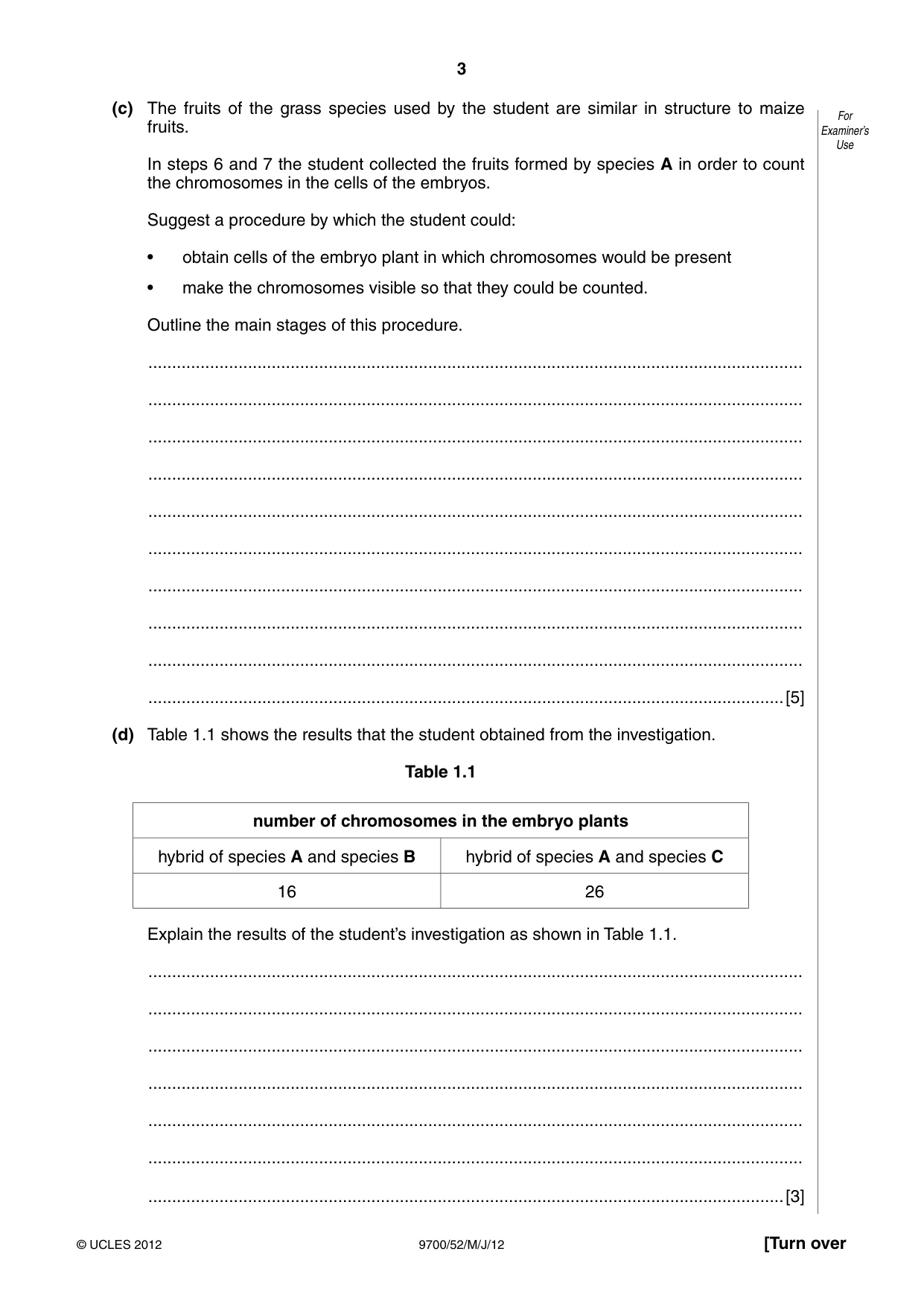
3 9700/52/M/J/12 © UCLES 2012 [Turn over For Examiner’s Use (c) The fruits of the grass species used by the student are similar in structure to maize fruits. In steps 6 and 7 the student collected the fruits formed by species A in order to count the chromosomes in the cells of the embryos. Suggest a procedure by which the student could: • obtain cells of the embryo plant in which chromosomes would be present • make the chromosomes visible so that they could be counted. Outline the main stages of this procedure. … … … … … … … … … …[5] (d) Table 1.1 shows the results that the student obtained from the investigation. Table 1.1 number of chromosomes in the embryo plants hybrid of species A and species B hybrid of species A and species C 16 26 Explain the results of the student’s investigation as shown in Table 1.1. … … … … … … …[3]
Question paper, page 4
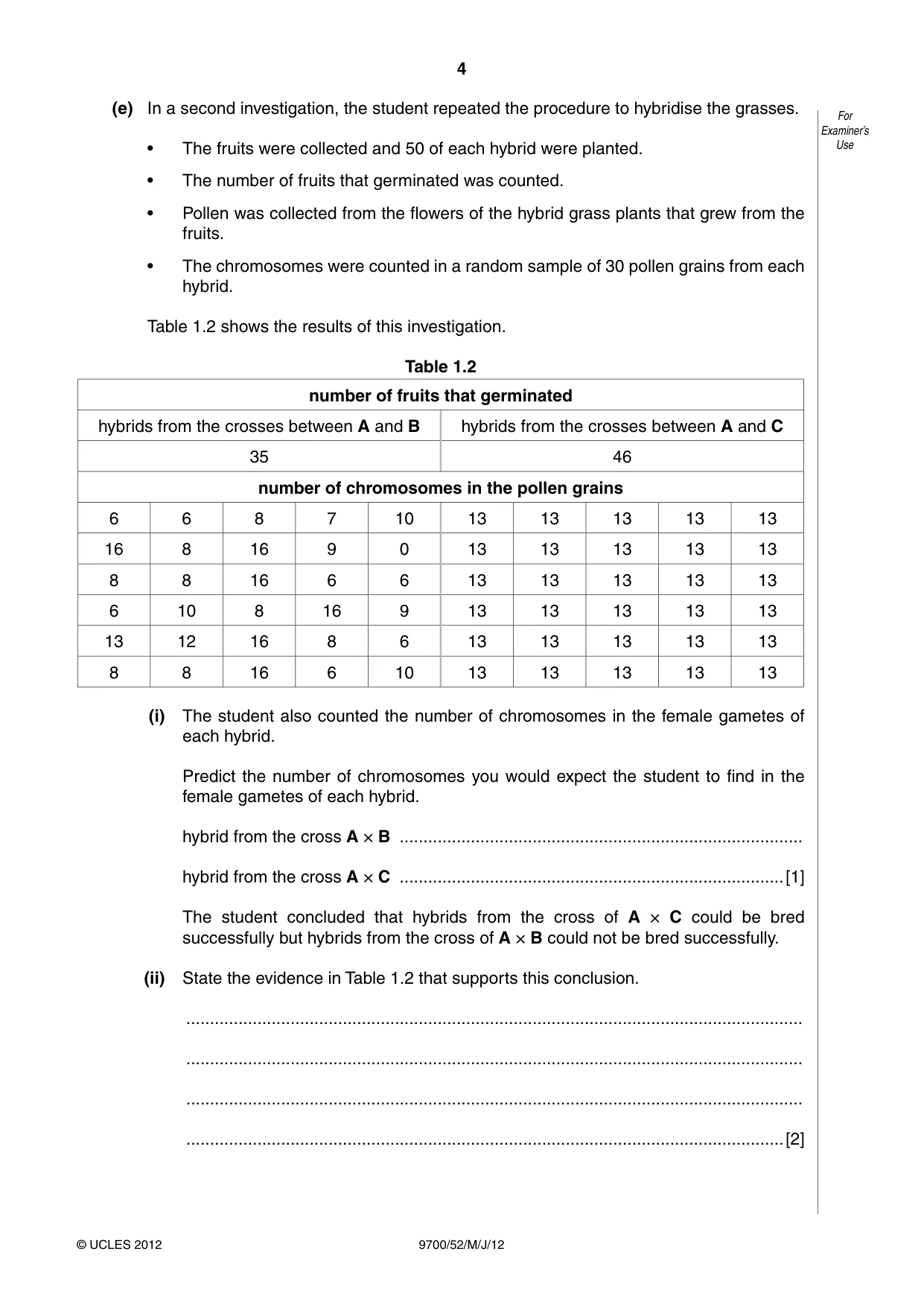
4 9700/52/M/J/12 © UCLES 2012 For Examiner’s Use (e) In a second investigation, the student repeated the procedure to hybridise the grasses. • The fruits were collected and 50 of each hybrid were planted. • The number of fruits that germinated was counted. • Pollen was collected from the flowers of the hybrid grass plants that grew from the fruits. • The chromosomes were counted in a random sample of 30 pollen grains from each hybrid. Table 1.2 shows the results of this investigation. Table 1.2 number of fruits that germinated hybrids from the crosses between A and B hybrids from the crosses between A and C 35 46 number of chromosomes in the pollen grains 6 6 8 7 10 13 13 13 13 13 16 8 16 9 0 13 13 13 13 13 8 8 16 6 6 13 13 13 13 13 6 10 8 16 9 13 13 13 13 13 13 12 16 8 6 13 13 13 13 13 8 8 16 6 10 13 13 13 13 13 (i) The student also counted the number of chromosomes in the female gametes of each hybrid. Predict the number of chromosomes you would expect the student to find in the female gametes of each hybrid. hybrid from the cross A × B … hybrid from the cross A × C …[1] The student concluded that hybrids from the cross of A × C could be bred successfully but hybrids from the cross of A × B could not be bred successfully. (ii) State the evidence in Table 1.2 that supports this conclusion. … … … …[2]
Question paper, page 5
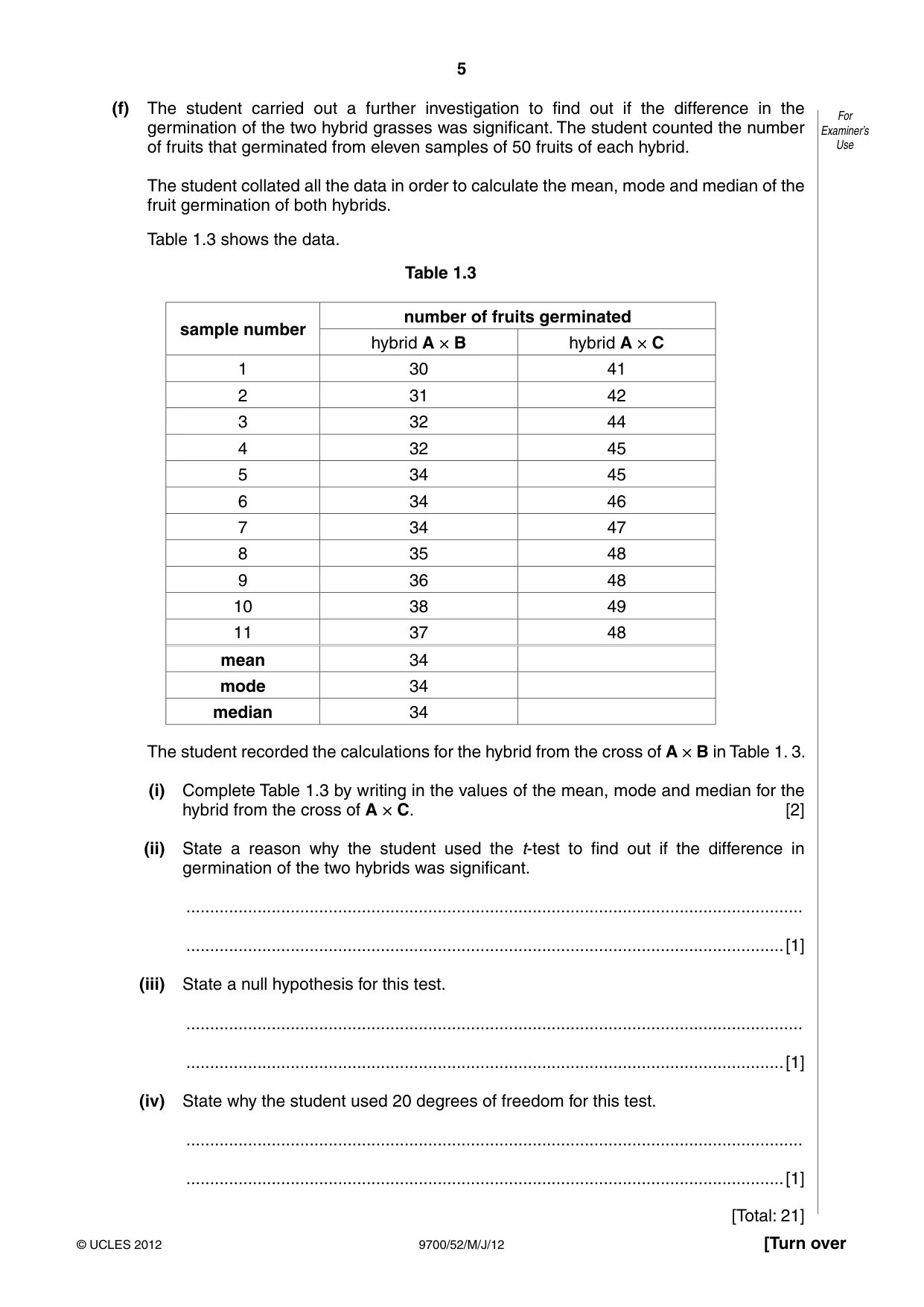
5 9700/52/M/J/12 © UCLES 2012 [Turn over For Examiner’s Use (f) The student carried out a further investigation to find out if the difference in the germination of the two hybrid grasses was significant. The student counted the number of fruits that germinated from eleven samples of 50 fruits of each hybrid. The student collated all the data in order to calculate the mean, mode and median of the fruit germination of both hybrids. Table 1.3 shows the data. Table 1.3 sample number number of fruits germinated hybrid A × B hybrid A × C 1 30 41 2 31 42 3 32 44 4 32 45 5 34 45 6 34 46 7 34 47 8 35 48 9 36 48 10 38 49 11 37 48 mean 34 mode 34 median 34 The student recorded the calculations for the hybrid from the cross of A × B in Table 1. 3. (i) Complete Table 1.3 by writing in the values of the mean, mode and median for the hybrid from the cross of A × C. [2] (ii) State a reason why the student used the t-test to find out if the difference in germination of the two hybrids was significant. … …[1] (iii) State a null hypothesis for this test. … …[1] (iv) State why the student used 20 degrees of freedom for this test. … …[1] [Total: 21]
Question paper, page 6
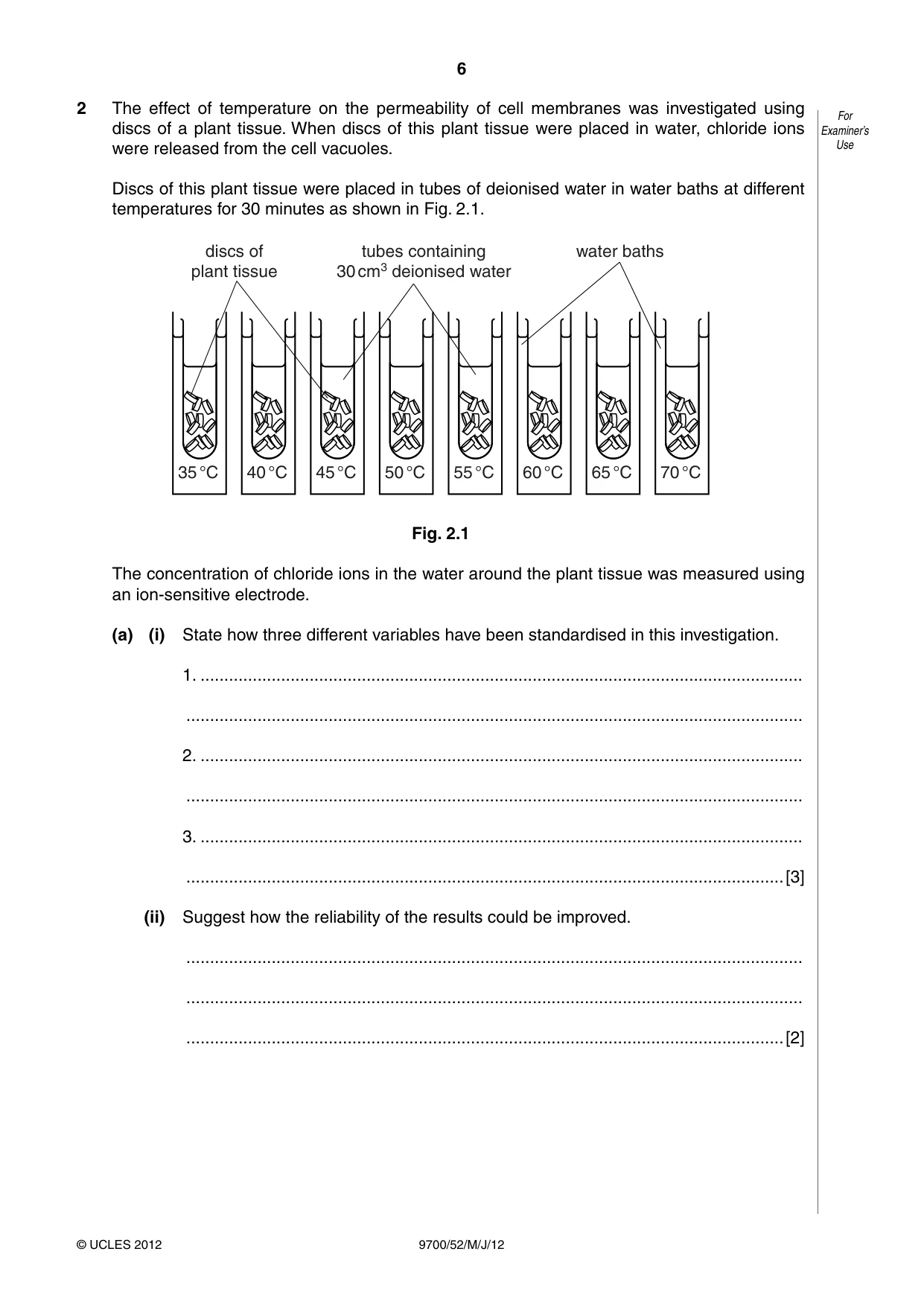
6 9700/52/M/J/12 © UCLES 2012 For Examiner’s Use 2 The effect of temperature on the permeability of cell membranes was investigated using discs of a plant tissue. When discs of this plant tissue were placed in water, chloride ions were released from the cell vacuoles. Discs of this plant tissue were placed in tubes of deionised water in water baths at different temperatures for 30 minutes as shown in Fig. 2.1. 35 °C 40 °C 45 °C 50 °C 55 °C 60 °C 65 °C 70 °C discs of plant tissue water baths tubes containing 30 cm3 deionised water Fig. 2.1 The concentration of chloride ions in the water around the plant tissue was measured using an ion-sensitive electrode. (a) (i) State how three different variables have been standardised in this investigation. 1. … … 2. … … 3. … …[3] (ii) Suggest how the reliability of the results could be improved. … … …[2]
Question paper, page 7
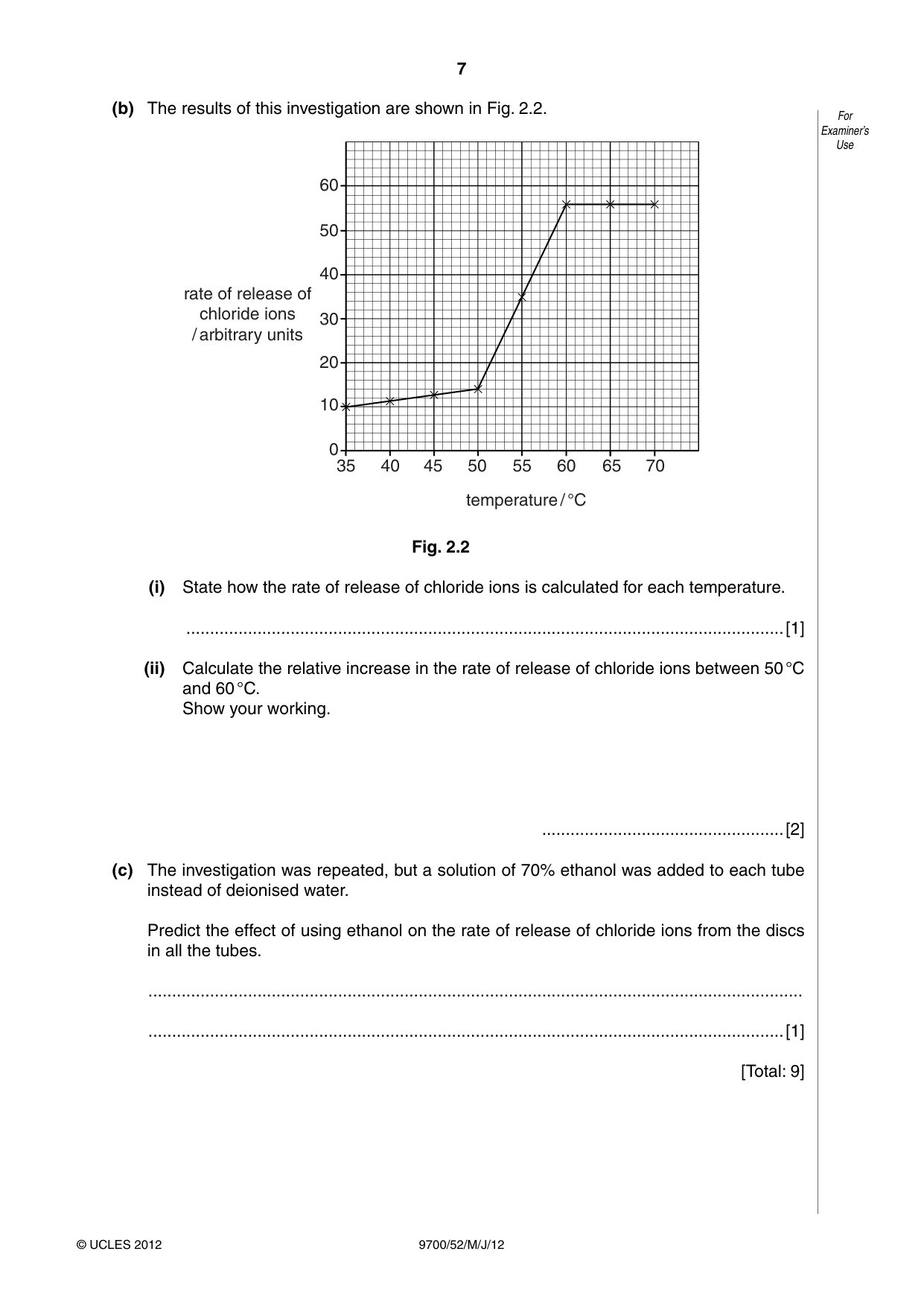
7 9700/52/M/J/12 © UCLES 2012 For Examiner’s Use (b) The results of this investigation are shown in Fig. 2.2. 60 50 40 30 20 10 0 35 40 45 50 55 60 65 70 temperature / °C rate of release of chloride ions / arbitrary units Fig. 2.2 (i) State how the rate of release of chloride ions is calculated for each temperature. …[1] (ii) Calculate the relative increase in the rate of release of chloride ions between 50 °C and 60 °C. Show your working. …[2] (c) The investigation was repeated, but a solution of 70% ethanol was added to each tube instead of deionised water. Predict the effect of using ethanol on the rate of release of chloride ions from the discs in all the tubes. … …[1] [Total: 9]
Question paper, page 8
8 9700/52/M/J/12 © UCLES 2012 BLANK PAGE Permission to reproduce items where third-party owned material protected by copyright is included has been sought and cleared where possible. Every reasonable effort has been made by the publisher (UCLES) to trace copyright holders, but if any items requiring clearance have unwittingly been included, the publisher will be pleased to make amends at the earliest possible opportunity. University of Cambridge International Examinations is part of the Cambridge Assessment Group. Cambridge Assessment is the brand name of University of Cambridge Local Examinations Syndicate (UCLES), which is itself a department of the University of Cambridge.
Mark scheme, page 1
UNIVERSITY OF CAMBRIDGE INTERNATIONAL EXAMINATIONS GCE Advanced Subsidiary Level and GCE Advanced Level MARK SCHEME for the May/June 2012 question paper for the guidance of teachers 9700 BIOLOGY 9700/52 Paper 5 (Planning, Analysis and Evaluation), maximum raw mark 30 This mark scheme is published as an aid to teachers and candidates, to indicate the requirements of the examination. It shows the basis on which Examiners were instructed to award marks. It does not indicate the details of the discussions that took place at an Examiners’ meeting before marking began, which would have considered the acceptability of alternative answers. Mark schemes must be read in conjunction with the question papers and the report on the examination. • Cambridge will not enter into discussions or correspondence in connection with these mark schemes. Cambridge is publishing the mark schemes for the May/June 2012 question papers for most IGCSE, GCE Advanced Level and Advanced Subsidiary Level syllabuses and some Ordinary Level syllabuses.
Mark scheme, page 2
Page 2 Mark Scheme: Teachers’ version Syllabus Paper GCE AS/A LEVEL – May/June 2012 9700 52 © University of Cambridge International Examinations 2012 Mark scheme abbreviations: ; separates marking points / alternative answers for the same point R reject A accept (for answers correctly cued by the question, or by extra guidance) AW alternative wording (where responses vary more than usual) underline actual word given must be used by candidate (grammatical variants excepted) max indicates the maximum number of marks that can be given ora or reverse argument mp marking point (with relevant number) ecf error carried forward I ignore
Mark scheme, page 3
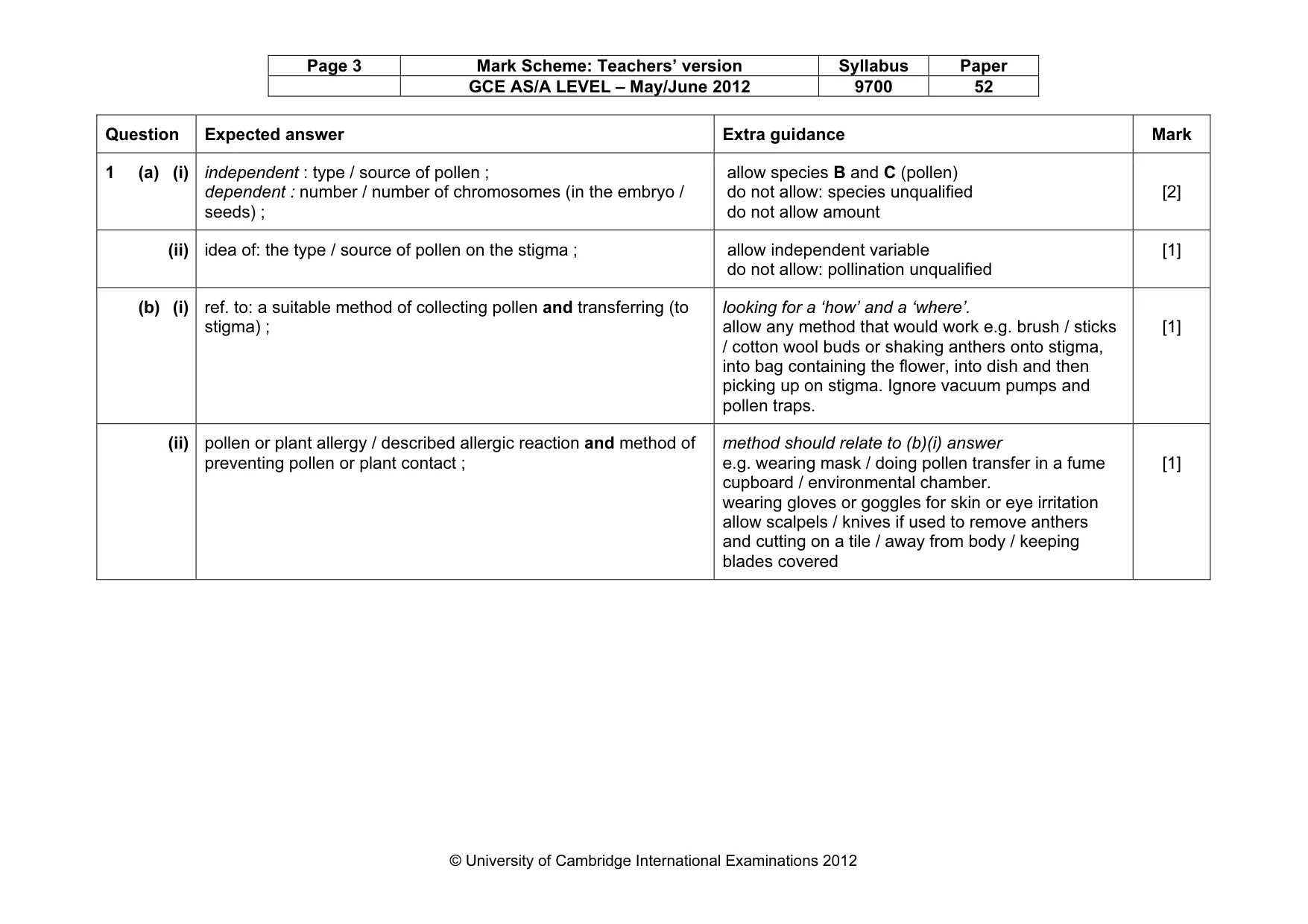
Page 3 Mark Scheme: Teachers’ version Syllabus Paper GCE AS/A LEVEL – May/June 2012 9700 52 © University of Cambridge International Examinations 2012 Question Expected answer Extra guidance Mark 1 (a) (i) independent : type / source of pollen ; dependent : number / number of chromosomes (in the embryo / seeds) ; allow species B and C (pollen) do not allow: species unqualified do not allow amount [2] (ii) idea of: the type / source of pollen on the stigma ; allow independent variable do not allow: pollination unqualified [1] (b) (i) ref. to: a suitable method of collecting pollen and transferring (to stigma) ; looking for a ‘how’ and a ‘where’. allow any method that would work e.g. brush / sticks / cotton wool buds or shaking anthers onto stigma, into bag containing the flower, into dish and then picking up on stigma. Ignore vacuum pumps and pollen traps. [1] (ii) pollen or plant allergy / described allergic reaction and method of preventing pollen or plant contact ; method should relate to (b)(i) answer e.g. wearing mask / doing pollen transfer in a fume cupboard / environmental chamber. wearing gloves or goggles for skin or eye irritation allow scalpels / knives if used to remove anthers and cutting on a tile / away from body / keeping blades covered [1]
Mark scheme, page 4
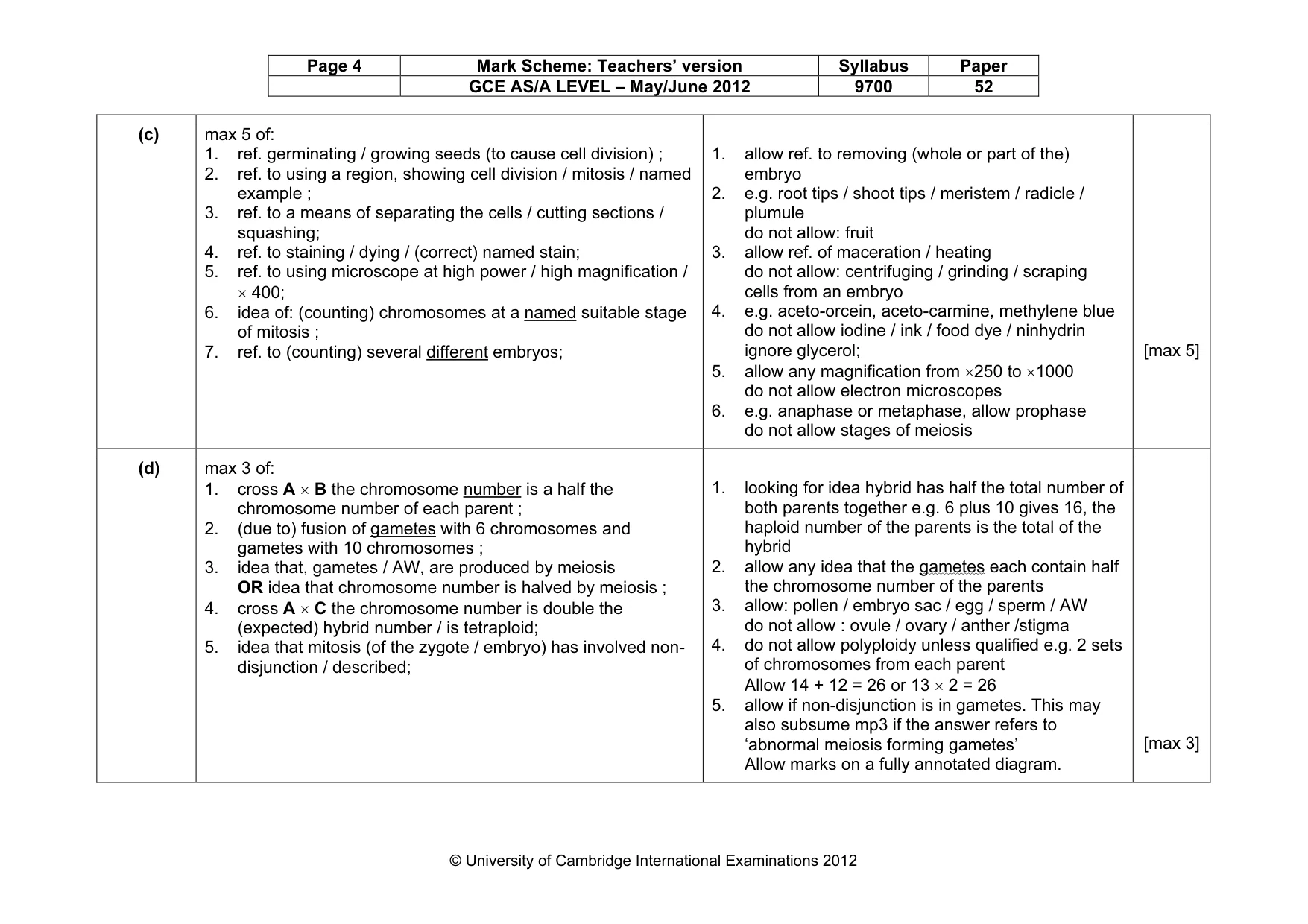
Page 4 Mark Scheme: Teachers’ version Syllabus Paper GCE AS/A LEVEL – May/June 2012 9700 52 © University of Cambridge International Examinations 2012 (c) max 5 of: 1. ref. germinating / growing seeds (to cause cell division) ; 2. ref. to using a region, showing cell division / mitosis / named example ; 3. ref. to a means of separating the cells / cutting sections / squashing; 4. ref. to staining / dying / (correct) named stain; 5. ref. to using microscope at high power / high magnification / × 400; 6. idea of: (counting) chromosomes at a named suitable stage of mitosis ; 7. ref. to (counting) several different embryos; 1. allow ref. to removing (whole or part of the) embryo 2. e.g. root tips / shoot tips / meristem / radicle / plumule do not allow: fruit 3. allow ref. of maceration / heating do not allow: centrifuging / grinding / scraping cells from an embryo 4. e.g. aceto-orcein, aceto-carmine, methylene blue do not allow iodine / ink / food dye / ninhydrin ignore glycerol; 5. allow any magnification from ×250 to ×1000 do not allow electron microscopes 6. e.g. anaphase or metaphase, allow prophase do not allow stages of meiosis [max 5] (d) max 3 of: 1. cross A × B the chromosome number is a half the chromosome number of each parent ; 2. (due to) fusion of gametes with 6 chromosomes and gametes with 10 chromosomes ; 3. idea that, gametes / AW, are produced by meiosis OR idea that chromosome number is halved by meiosis ; 4. cross A × C the chromosome number is double the (expected) hybrid number / is tetraploid; 5. idea that mitosis (of the zygote / embryo) has involved non- disjunction / described; 1. looking for idea hybrid has half the total number of both parents together e.g. 6 plus 10 gives 16, the haploid number of the parents is the total of the hybrid 2. allow any idea that the gametes each contain half the chromosome number of the parents 3. allow: pollen / embryo sac / egg / sperm / AW do not allow : ovule / ovary / anther /stigma 4. do not allow polyploidy unless qualified e.g. 2 sets of chromosomes from each parent Allow 14 + 12 = 26 or 13 × 2 = 26 5. allow if non-disjunction is in gametes. This may also subsume mp3 if the answer refers to ‘abnormal meiosis forming gametes’ Allow marks on a fully annotated diagram. [max 3]
Mark scheme, page 5
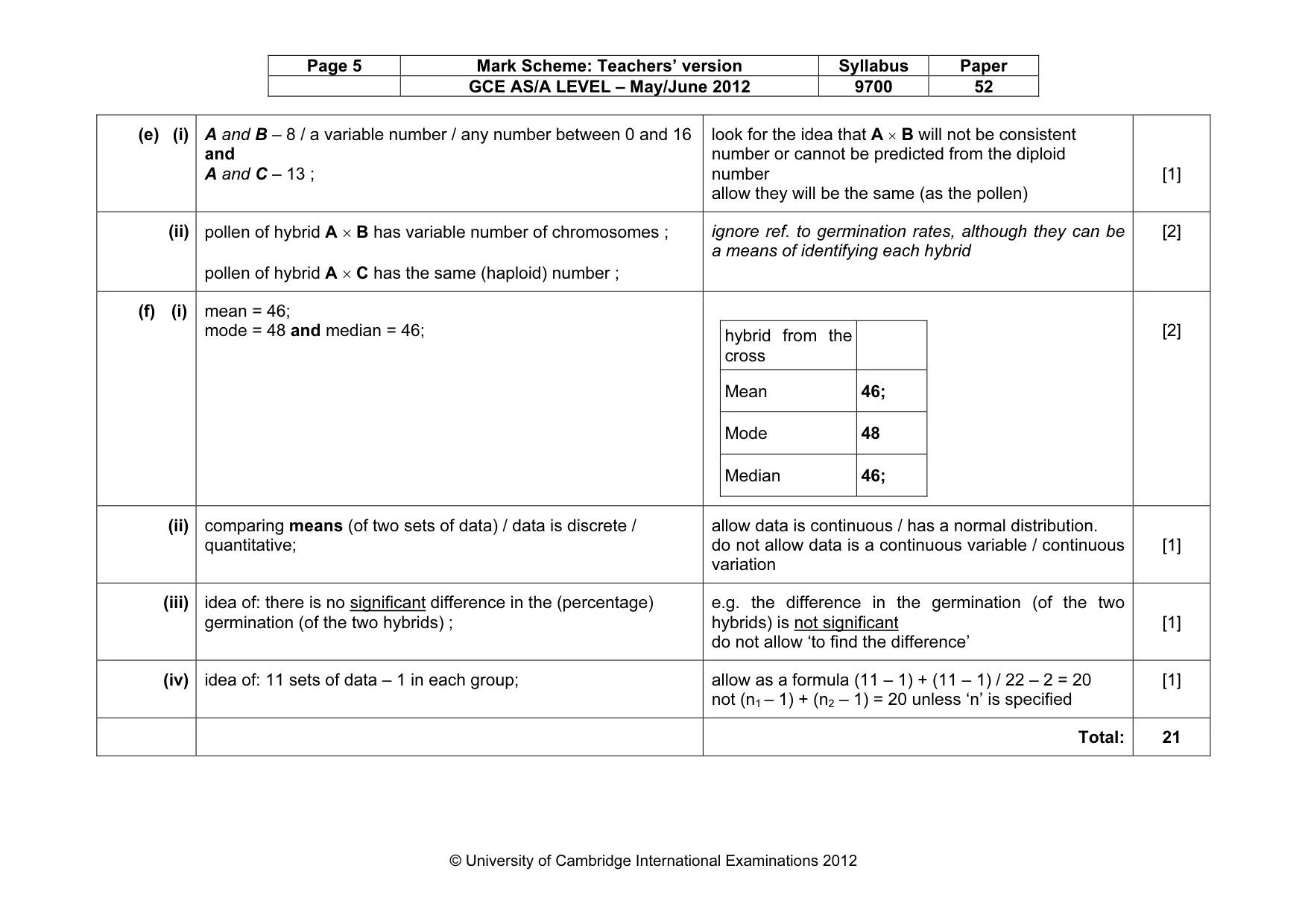
Page 5 Mark Scheme: Teachers’ version Syllabus Paper GCE AS/A LEVEL – May/June 2012 9700 52 © University of Cambridge International Examinations 2012 (e) (i) A and B – 8 / a variable number / any number between 0 and 16 and A and C – 13 ; look for the idea that A × B will not be consistent number or cannot be predicted from the diploid number allow they will be the same (as the pollen) [1] (ii) pollen of hybrid A × B has variable number of chromosomes ; pollen of hybrid A × C has the same (haploid) number ; ignore ref. to germination rates, although they can be a means of identifying each hybrid [2] (f) (i) mean = 46; mode = 48 and median = 46; hybrid from the cross Mean 46; Mode 48 Median 46; [2] (ii) comparing means (of two sets of data) / data is discrete / quantitative; allow data is continuous / has a normal distribution. do not allow data is a continuous variable / continuous variation [1] (iii) idea of: there is no significant difference in the (percentage) germination (of the two hybrids) ; e.g. the difference in the germination (of the two hybrids) is not significant do not allow ‘to find the difference’ [1] (iv) idea of: 11 sets of data – 1 in each group; allow as a formula (11 – 1) + (11 – 1) / 22 – 2 = 20 not (n1 – 1) + (n2 – 1) = 20 unless ‘n’ is specified [1] Total: 21
Mark scheme, page 6
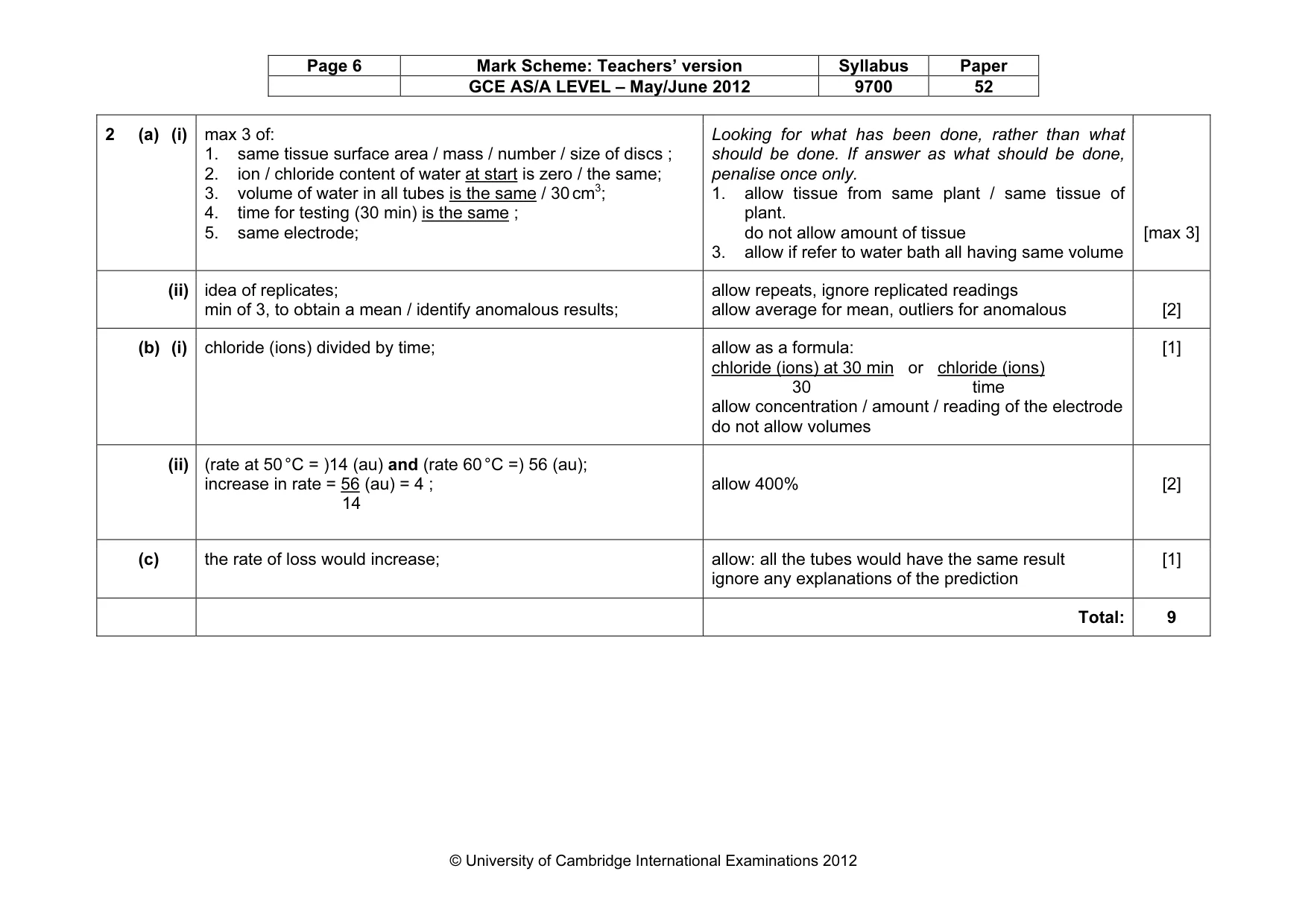
Page 6 Mark Scheme: Teachers’ version Syllabus Paper GCE AS/A LEVEL – May/June 2012 9700 52 © University of Cambridge International Examinations 2012 2 (a) (i) max 3 of: 1. same tissue surface area / mass / number / size of discs ; 2. ion / chloride content of water at start is zero / the same; 3. volume of water in all tubes is the same / 30 cm3; 4. time for testing (30 min) is the same ; 5. same electrode; Looking for what has been done, rather than what should be done. If answer as what should be done, penalise once only. 1. allow tissue from same plant / same tissue of plant. do not allow amount of tissue 3. allow if refer to water bath all having same volume [max 3] (ii) idea of replicates; min of 3, to obtain a mean / identify anomalous results; allow repeats, ignore replicated readings allow average for mean, outliers for anomalous [2] (b) (i) chloride (ions) divided by time; allow as a formula: chloride (ions) at 30 min or chloride (ions) 30 time allow concentration / amount / reading of the electrode do not allow volumes [1] (ii) (rate at 50 °C = )14 (au) and (rate 60 °C =) 56 (au); increase in rate = 56 (au) = 4 ; 14 allow 400% [2] (c) the rate of loss would increase; allow: all the tubes would have the same result ignore any explanations of the prediction [1] Total: 9
What you needed in this session
Cambridge’s own grade thresholds for 2012 May/June, Paper 5 · Variant 2. A higher threshold means an easier paper — the bar moves with how the cohort did.