Cambridge A Level Biology 9700 — 2012 May/June Paper 5 · Variant 1
9700/51/M/J/12 · 30 marks · ≈34 min
The question paper and its mark scheme, free to read here and free to download. This is Cambridge’s own paper, exactly as it was sat.
Question paper8 pages
Mark scheme6 pages
Answers below. Sit the paper first if you are practising.
Paper as text
Question paper, page 1
This document consists of 7 printed pages and 1 blank page. DC (LEO/JG) 46674/4 © UCLES 2012 [Turn over UNIVERSITY OF CAMBRIDGE INTERNATIONAL EXAMINATIONS General Certificate of Education Advanced Level READ THESE INSTRUCTIONS FIRST Write your Centre number, candidate number and name on all the work you hand in. Write in dark blue or black ink. You may use a soft pencil for any diagrams, graphs or rough working. Do not use staples, paper clips, highlighters, glue or correction fluid. DO NOT WRITE IN ANY BARCODES. Answer both questions. At the end of the examination, fasten all your work securely together. The number of marks is given in brackets [ ] at the end of each question or part question. * 4 2 9 3 3 2 2 3 4 7 * BIOLOGY 9700/51 Paper 5 Planning, Analysis and Evaluation May/June 2012 1 hour 15 minutes Candidates answer on the Question Paper. No Additional Materials are required. For Examiner’s Use 1 2 Total
Question paper, page 2
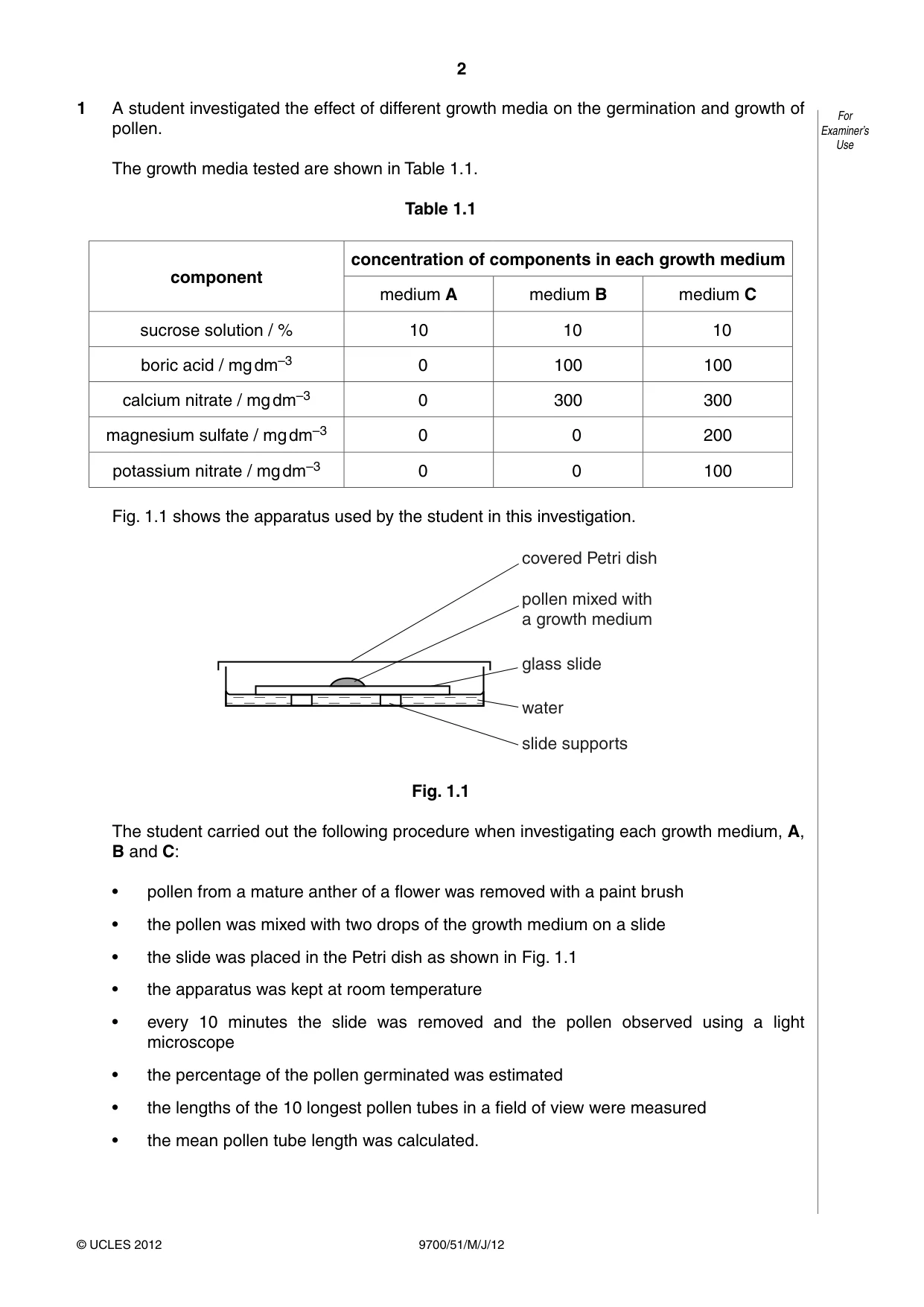
2 9700/51/M/J/12 © UCLES 2012 For Examiner’s Use 1 A student investigated the effect of different growth media on the germination and growth of pollen. The growth media tested are shown in Table 1.1. Table 1.1 component concentration of components in each growth medium medium A medium B medium C sucrose solution / % 10 10 10 boric acid / mg dm–3 0 100 100 calcium nitrate / mg dm–3 0 300 300 magnesium sulfate / mg dm–3 0 0 200 potassium nitrate / mg dm–3 0 0 100 Fig. 1.1 shows the apparatus used by the student in this investigation. covered Petri dish glass slide water slide supports pollen mixed with a growth medium Fig. 1.1 The student carried out the following procedure when investigating each growth medium, A, B and C: • pollen from a mature anther of a flower was removed with a paint brush • the pollen was mixed with two drops of the growth medium on a slide • the slide was placed in the Petri dish as shown in Fig. 1.1 • the apparatus was kept at room temperature • every 10 minutes the slide was removed and the pollen observed using a light microscope • the percentage of the pollen germinated was estimated • the lengths of the 10 longest pollen tubes in a field of view were measured • the mean pollen tube length was calculated.
Question paper, page 3
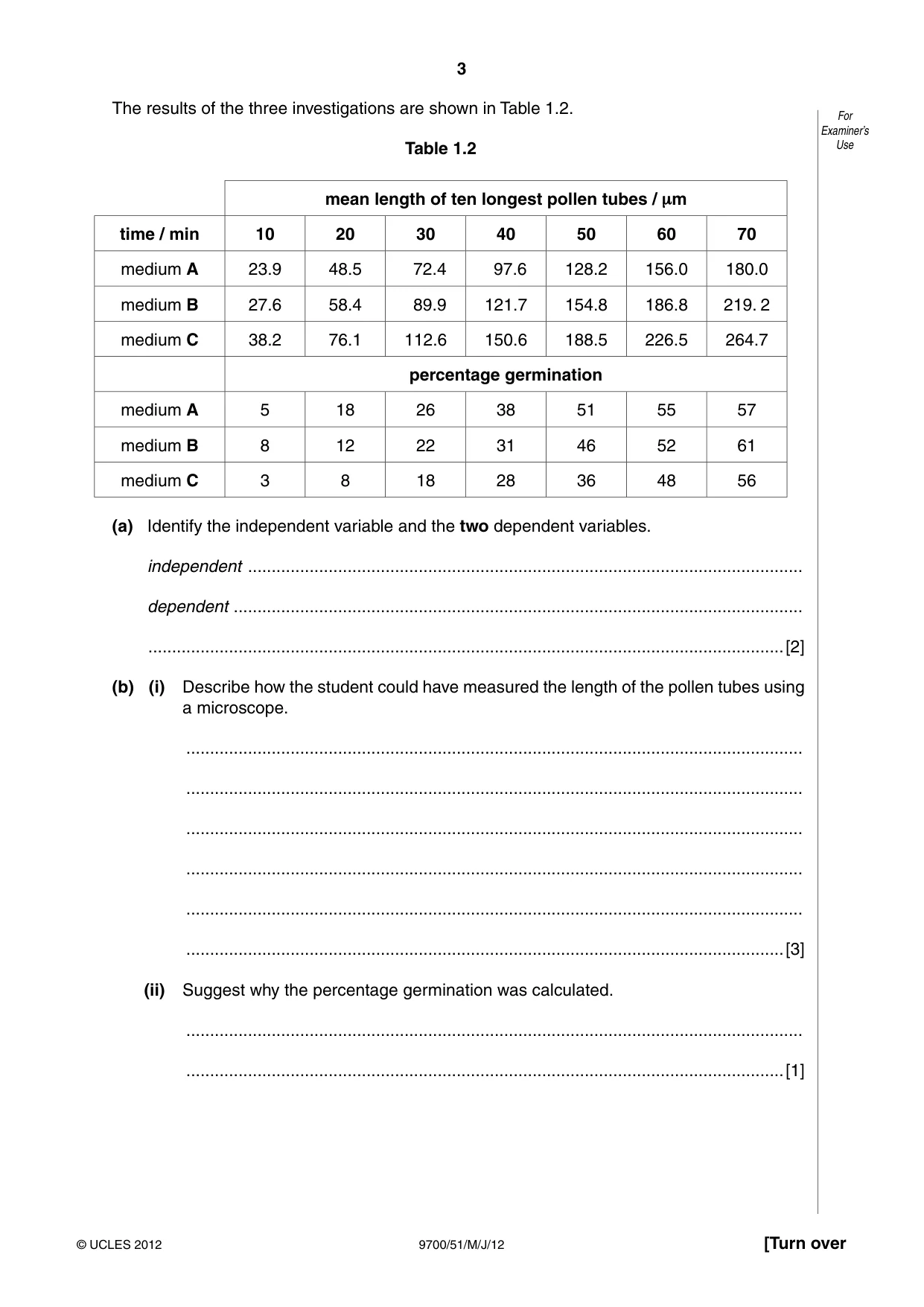
3 9700/51/M/J/12 © UCLES 2012 [Turn over For Examiner’s Use The results of the three investigations are shown in Table 1.2. Table 1.2 mean length of ten longest pollen tubes / μm time / min 10 20 30 40 50 60 70 medium A 23.9 48.5 72.4 97.6 128.2 156.0 180.0 medium B 27.6 58.4 89.9 121.7 154.8 186.8 219. 2 medium C 38.2 76.1 112.6 150.6 188.5 226.5 264.7 percentage germination medium A 5 18 26 38 51 55 57 medium B 8 12 22 31 46 52 61 medium C 3 8 18 28 36 48 56 (a) Identify the independent variable and the two dependent variables. independent … dependent … …[2] (b) (i) Describe how the student could have measured the length of the pollen tubes using a microscope. … … … … … …[3] (ii) Suggest why the percentage germination was calculated. … …[1]
Question paper, page 4
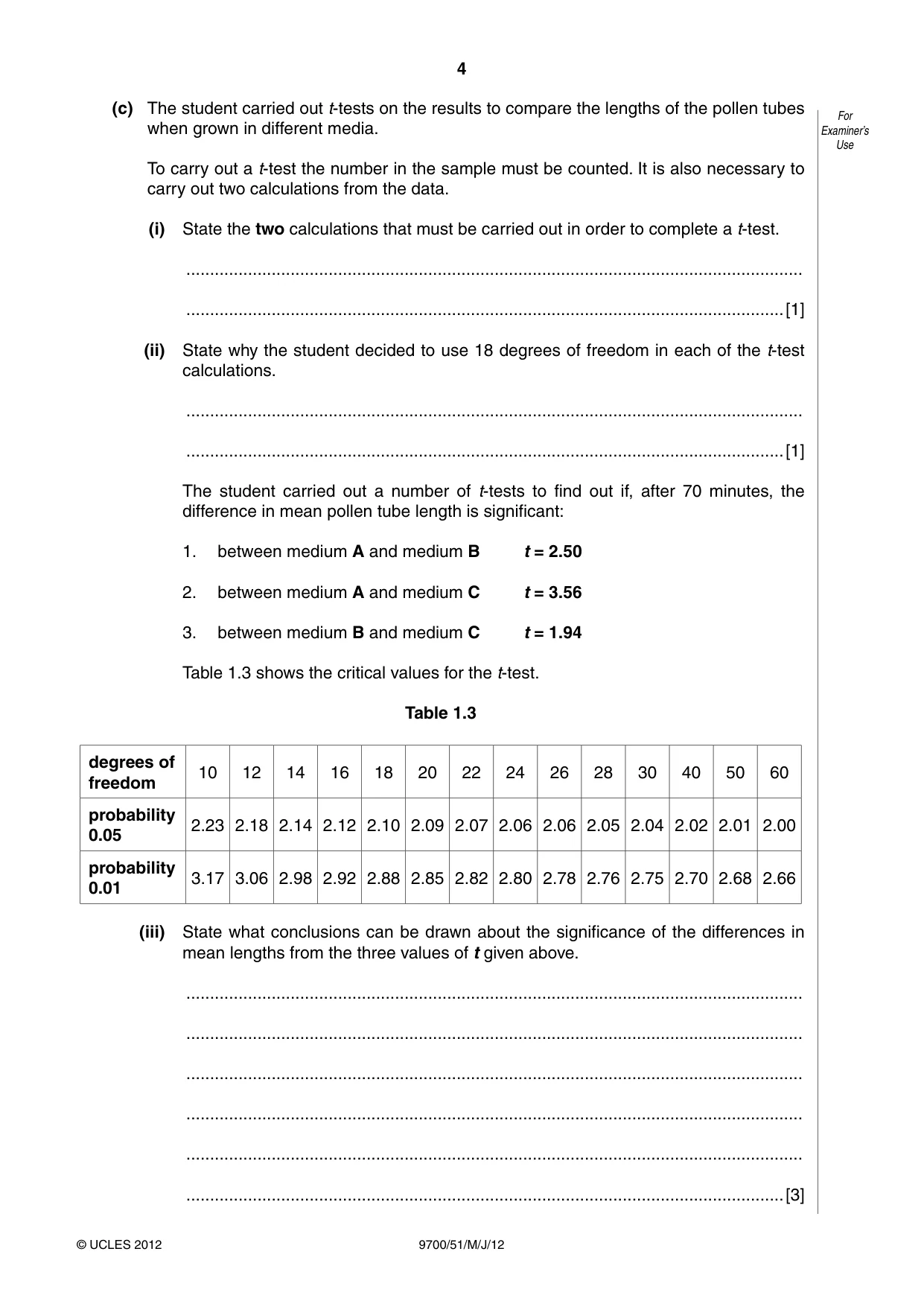
4 9700/51/M/J/12 © UCLES 2012 For Examiner’s Use (c) The student carried out t-tests on the results to compare the lengths of the pollen tubes when grown in different media. To carry out a t-test the number in the sample must be counted. It is also necessary to carry out two calculations from the data. (i) State the two calculations that must be carried out in order to complete a t-test. … …[1] (ii) State why the student decided to use 18 degrees of freedom in each of the t-test calculations. … …[1] The student carried out a number of t-tests to find out if, after 70 minutes, the difference in mean pollen tube length is significant: 1. between medium A and medium B t = 2.50 2. between medium A and medium C t = 3.56 3. between medium B and medium C t = 1.94 Table 1.3 shows the critical values for the t-test. Table 1.3 degrees of freedom 10 12 14 16 18 20 22 24 26 28 30 40 50 60 probability 0.05 2.23 2.18 2.14 2.12 2.10 2.09 2.07 2.06 2.06 2.05 2.04 2.02 2.01 2.00 probability 0.01 3.17 3.06 2.98 2.92 2.88 2.85 2.82 2.80 2.78 2.76 2.75 2.70 2.68 2.66 (iii) State what conclusions can be drawn about the significance of the differences in mean lengths from the three values of t given above. … … … … … …[3]
Question paper, page 5
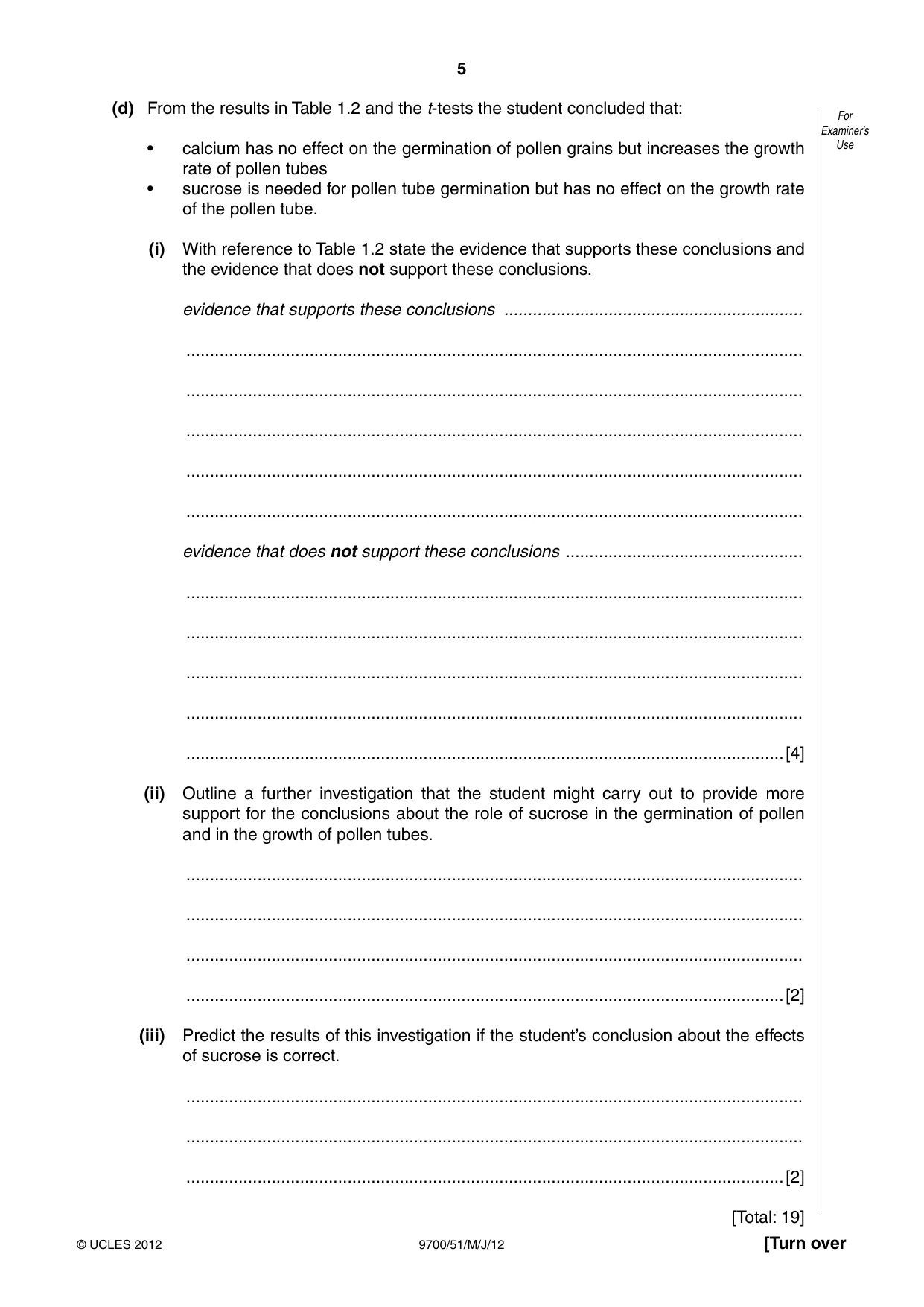
5 9700/51/M/J/12 © UCLES 2012 [Turn over For Examiner’s Use (d) From the results in Table 1.2 and the t-tests the student concluded that: • calcium has no effect on the germination of pollen grains but increases the growth rate of pollen tubes • sucrose is needed for pollen tube germination but has no effect on the growth rate of the pollen tube. (i) With reference to Table 1.2 state the evidence that supports these conclusions and the evidence that does not support these conclusions. evidence that supports these conclusions … … … … … … evidence that does not support these conclusions … … … … … …[4] (ii) Outline a further investigation that the student might carry out to provide more support for the conclusions about the role of sucrose in the germination of pollen and in the growth of pollen tubes. … … … …[2] (iii) Predict the results of this investigation if the student’s conclusion about the effects of sucrose is correct. … … …[2] [Total: 19]
Question paper, page 6
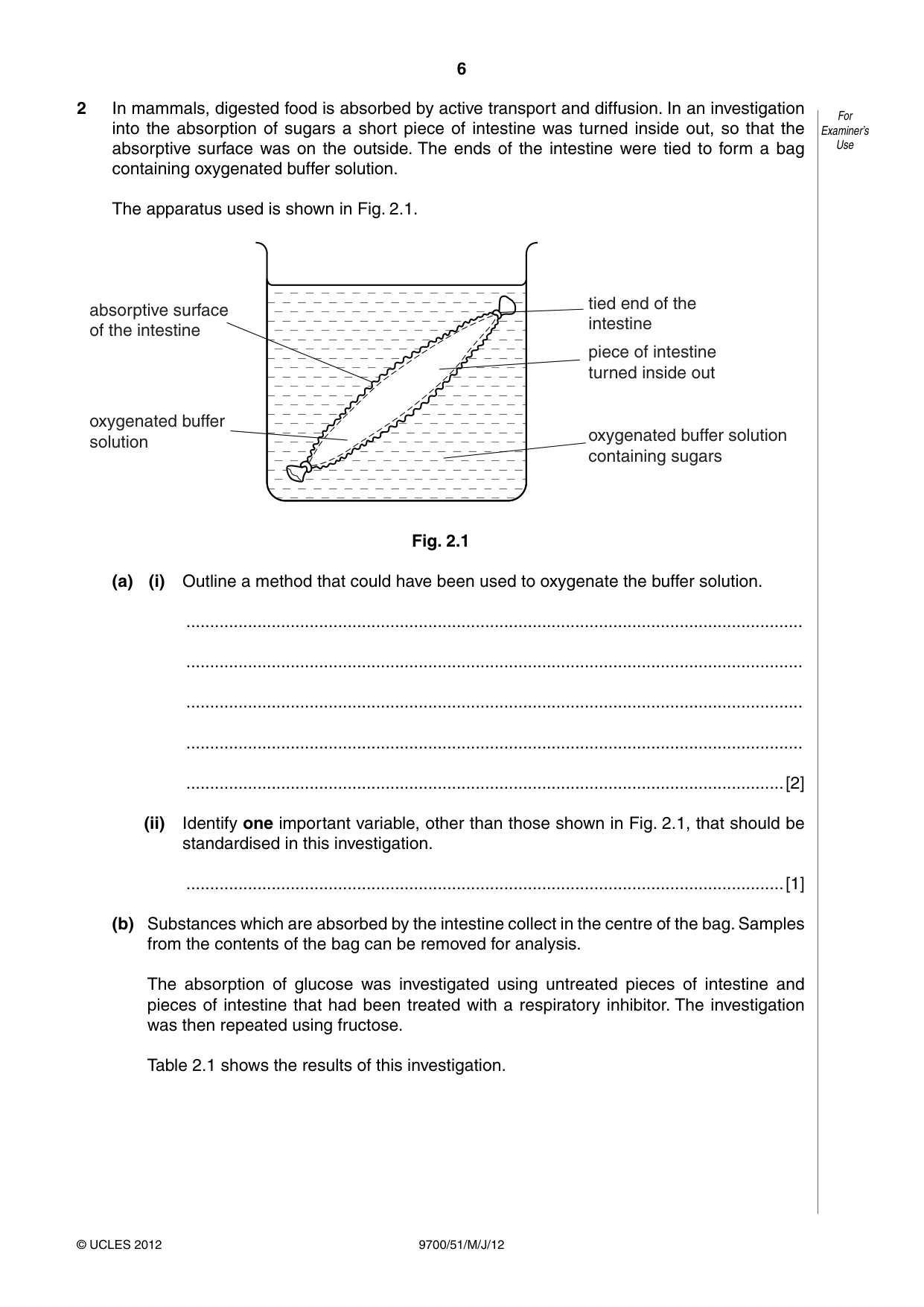
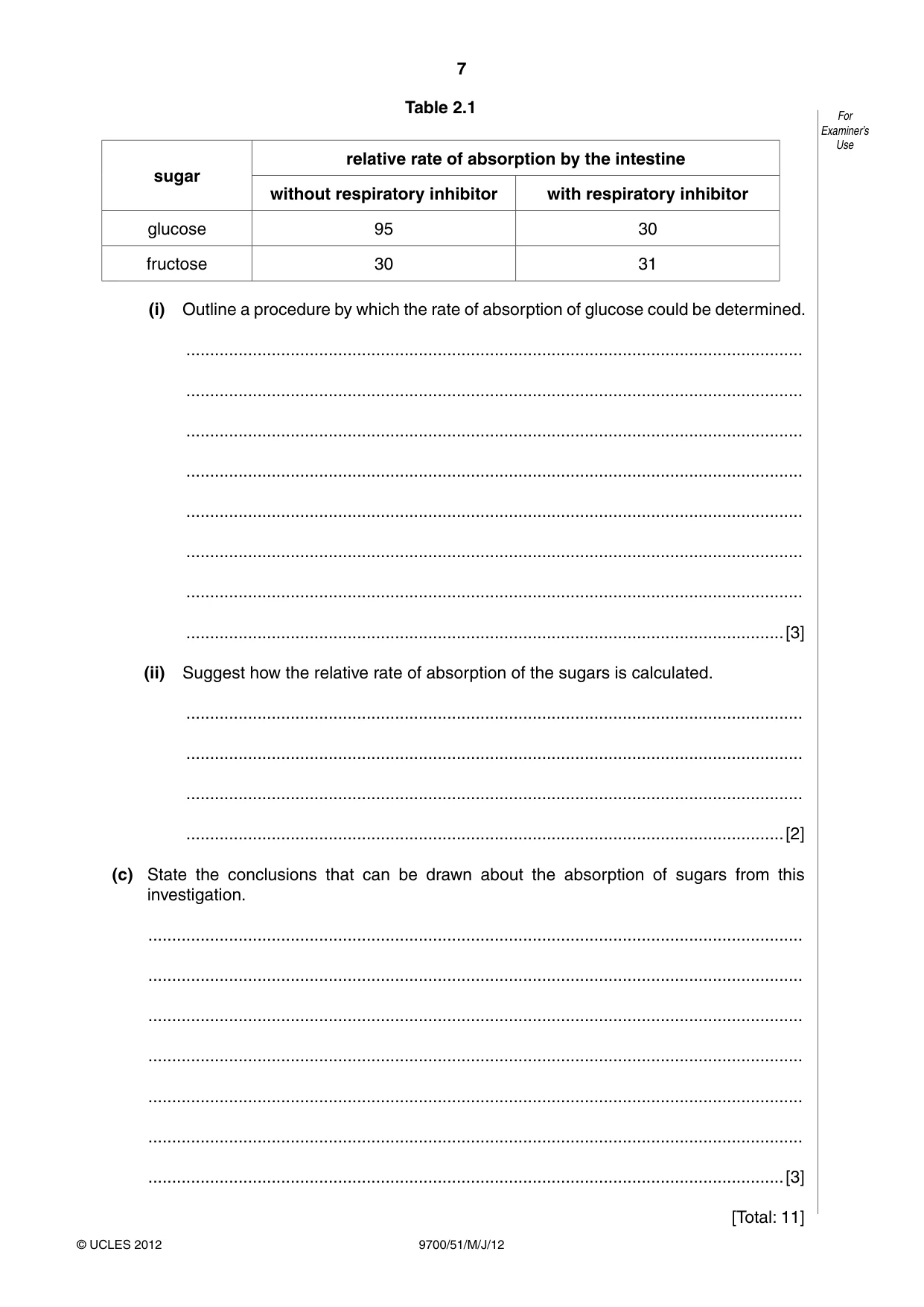
6 9700/51/M/J/12 © UCLES 2012 For Examiner’s Use 2 In mammals, digested food is absorbed by active transport and diffusion. In an investigation into the absorption of sugars a short piece of intestine was turned inside out, so that the absorptive surface was on the outside. The ends of the intestine were tied to form a bag containing oxygenated buffer solution. The apparatus used is shown in Fig. 2.1. tied end of the intestine piece of intestine turned inside out oxygenated buffer solution containing sugars absorptive surface of the intestine oxygenated buffer solution Fig. 2.1 (a) (i) Outline a method that could have been used to oxygenate the buffer solution. … … … … …[2] (ii) Identify one important variable, other than those shown in Fig. 2.1, that should be standardised in this investigation. …[1] (b) Substances which are absorbed by the intestine collect in the centre of the bag. Samples from the contents of the bag can be removed for analysis. The absorption of glucose was investigated using untreated pieces of intestine and pieces of intestine that had been treated with a respiratory inhibitor. The investigation was then repeated using fructose. Table 2.1 shows the results of this investigation.
Question paper, page 7
7 9700/51/M/J/12 © UCLES 2012 For Examiner’s Use Table 2.1 sugar relative rate of absorption by the intestine without respiratory inhibitor with respiratory inhibitor glucose 95 30 fructose 30 31 (i) Outline a procedure by which the rate of absorption of glucose could be determined. … … … … … … … …[3] (ii) Suggest how the relative rate of absorption of the sugars is calculated. … … … …[2] (c) State the conclusions that can be drawn about the absorption of sugars from this investigation. … … … … … … …[3] [Total: 11]
Question paper, page 8
8 9700/51/M/J/12 © UCLES 2012 BLANK PAGE Permission to reproduce items where third-party owned material protected by copyright is included has been sought and cleared where possible. Every reasonable effort has been made by the publisher (UCLES) to trace copyright holders, but if any items requiring clearance have unwittingly been included, the publisher will be pleased to make amends at the earliest possible opportunity. University of Cambridge International Examinations is part of the Cambridge Assessment Group. Cambridge Assessment is the brand name of University of Cambridge Local Examinations Syndicate (UCLES), which is itself a department of the University of Cambridge.
Mark scheme, page 1
UNIVERSITY OF CAMBRIDGE INTERNATIONAL EXAMINATIONS GCE Advanced Subsidiary Level and GCE Advanced Level MARK SCHEME for the May/June 2012 question paper for the guidance of teachers 9700 BIOLOGY 9700/51 Paper 5 (Planning, Analysis and Evaluation), maximum raw mark 30 This mark scheme is published as an aid to teachers and candidates, to indicate the requirements of the examination. It shows the basis on which Examiners were instructed to award marks. It does not indicate the details of the discussions that took place at an Examiners’ meeting before marking began, which would have considered the acceptability of alternative answers. Mark schemes must be read in conjunction with the question papers and the report on the examination. • Cambridge will not enter into discussions or correspondence in connection with these mark schemes. Cambridge is publishing the mark schemes for the May/June 2012 question papers for most IGCSE, GCE Advanced Level and Advanced Subsidiary Level syllabuses and some Ordinary Level syllabuses.
Mark scheme, page 2
Page 2 Mark Scheme: Teachers’ version Syllabus Paper GCE AS/A LEVEL – May/June 2012 9700 51 © University of Cambridge International Examinations 2012 Mark scheme abbreviations: ; separates marking points / alternative answers for the same point R reject A accept (for answers correctly cued by the question, or by extra guidance) AW alternative wording (where responses vary more than usual) underline actual word given must be used by candidate (grammatical variants excepted) max indicates the maximum number of marks that can be given ora or reverse argument mp marking point (with relevant number) ecf error carried forward I ignore
Mark scheme, page 3
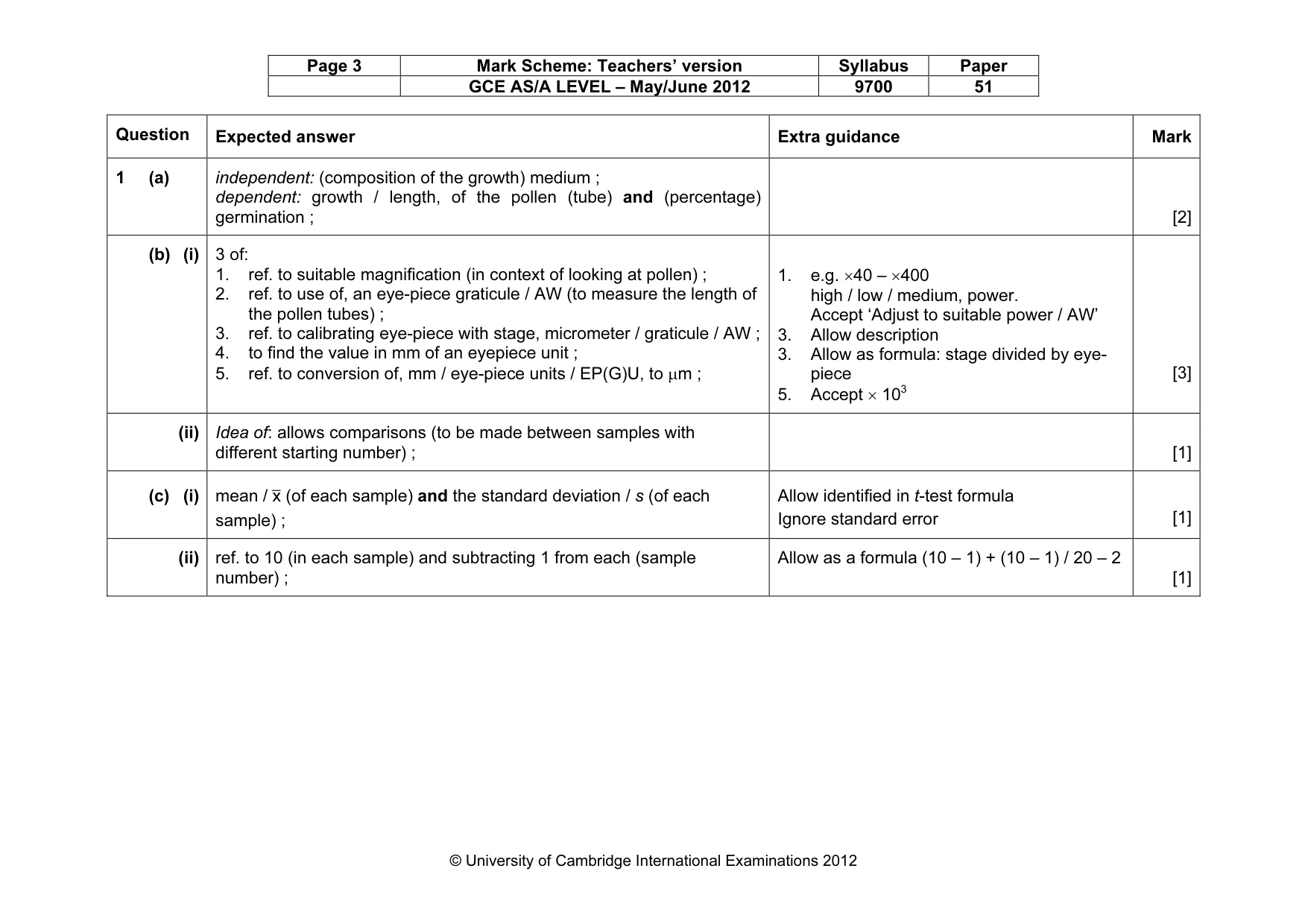
Page 3 Mark Scheme: Teachers’ version Syllabus Paper GCE AS/A LEVEL – May/June 2012 9700 51 © University of Cambridge International Examinations 2012 Question Expected answer Extra guidance Mark 1 (a) independent: (composition of the growth) medium ; dependent: growth / length, of the pollen (tube) and (percentage) germination ; [2] (b) (i) 3 of: 1. ref. to suitable magnification (in context of looking at pollen) ; 2. ref. to use of, an eye-piece graticule / AW (to measure the length of the pollen tubes) ; 3. ref. to calibrating eye-piece with stage, micrometer / graticule / AW ; 4. to find the value in mm of an eyepiece unit ; 5. ref. to conversion of, mm / eye-piece units / EP(G)U, to µm ; 1. e.g. ×40 – ×400 high / low / medium, power. Accept ‘Adjust to suitable power / AW’ 3. Allow description 3. Allow as formula: stage divided by eye- piece 5. Accept × 103 [3] (ii) Idea of: allows comparisons (to be made between samples with different starting number) ; [1] (c) (i) mean / x̅ (of each sample) and the standard deviation / s (of each sample) ; Allow identified in t-test formula Ignore standard error [1] (ii) ref. to 10 (in each sample) and subtracting 1 from each (sample number) ; Allow as a formula (10 – 1) + (10 – 1) / 20 – 2 [1]
Mark scheme, page 4
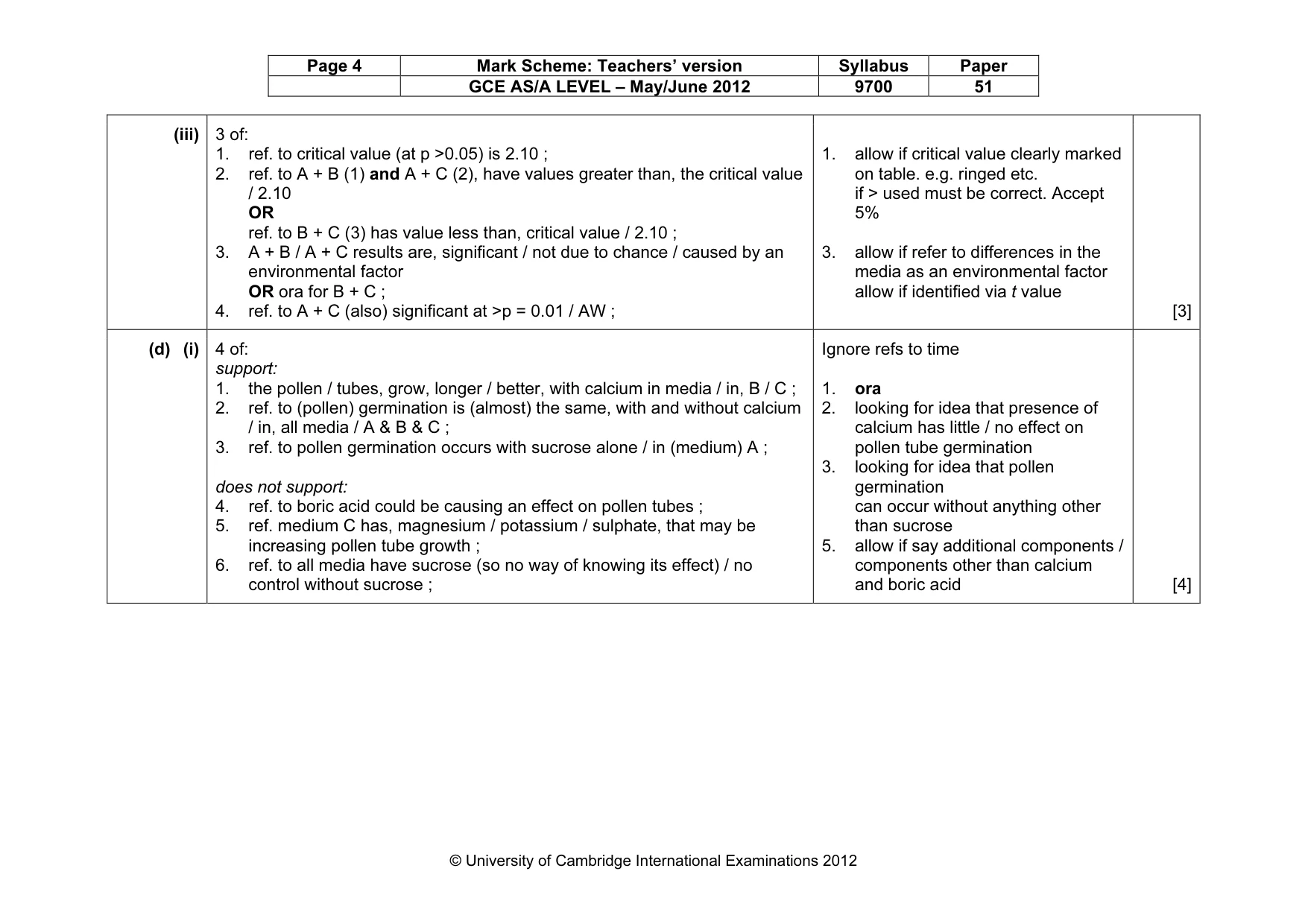
Page 4 Mark Scheme: Teachers’ version Syllabus Paper GCE AS/A LEVEL – May/June 2012 9700 51 © University of Cambridge International Examinations 2012 (iii) 3 of: 1. ref. to critical value (at p >0.05) is 2.10 ; 2. ref. to A + B (1) and A + C (2), have values greater than, the critical value / 2.10 OR ref. to B + C (3) has value less than, critical value / 2.10 ; 3. A + B / A + C results are, significant / not due to chance / caused by an environmental factor OR ora for B + C ; 4. ref. to A + C (also) significant at >p = 0.01 / AW ; 1. allow if critical value clearly marked on table. e.g. ringed etc. if > used must be correct. Accept 5% 3. allow if refer to differences in the media as an environmental factor allow if identified via t value [3] (d) (i) 4 of: support: 1. the pollen / tubes, grow, longer / better, with calcium in media / in, B / C ; 2. ref. to (pollen) germination is (almost) the same, with and without calcium / in, all media / A & B & C ; 3. ref. to pollen germination occurs with sucrose alone / in (medium) A ; does not support: 4. ref. to boric acid could be causing an effect on pollen tubes ; 5. ref. medium C has, magnesium / potassium / sulphate, that may be increasing pollen tube growth ; 6. ref. to all media have sucrose (so no way of knowing its effect) / no control without sucrose ; Ignore refs to time 1. ora 2. looking for idea that presence of calcium has little / no effect on pollen tube germination 3. looking for idea that pollen germination can occur without anything other than sucrose 5. allow if say additional components / components other than calcium and boric acid [4]
Mark scheme, page 5
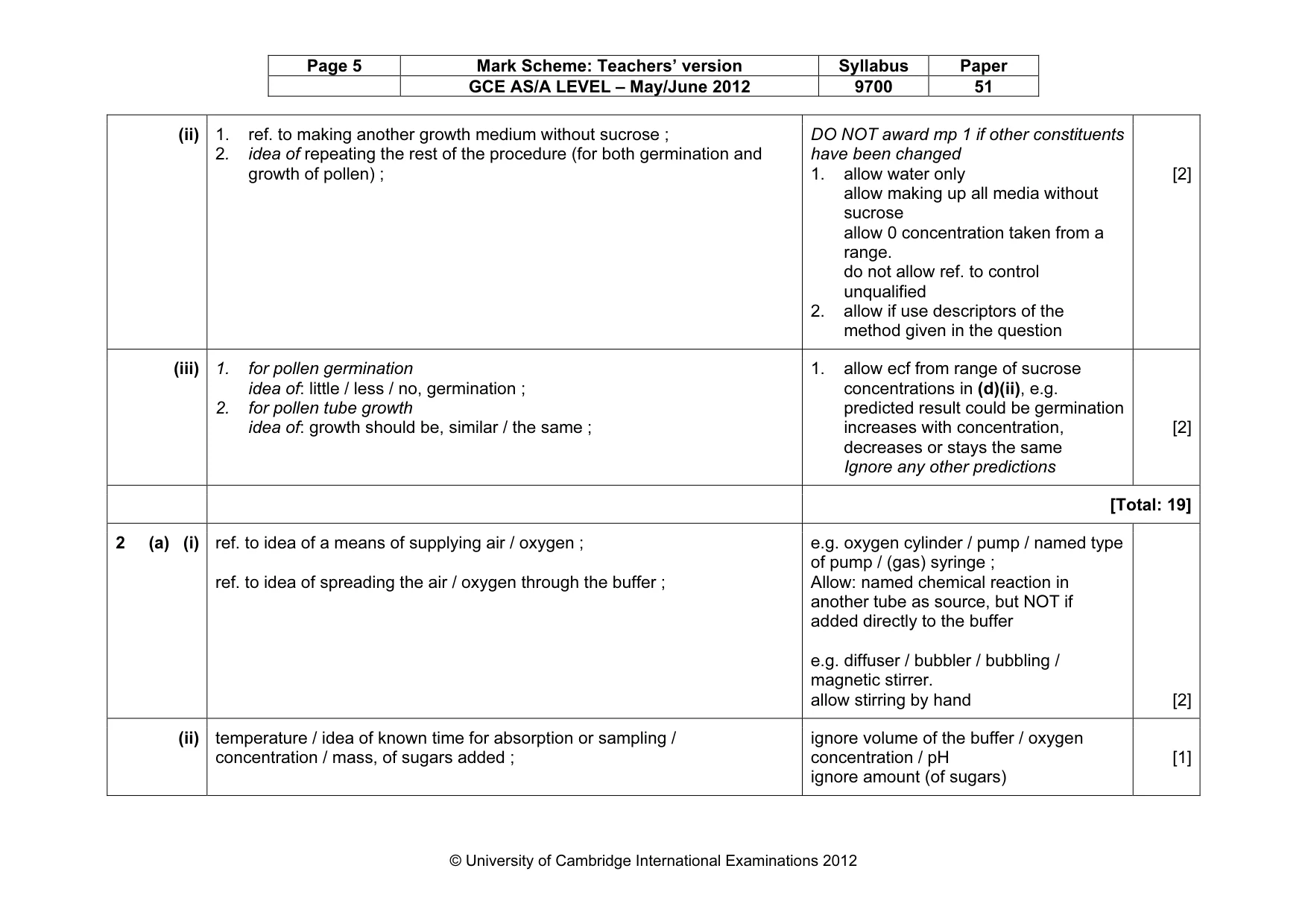
Page 5 Mark Scheme: Teachers’ version Syllabus Paper GCE AS/A LEVEL – May/June 2012 9700 51 © University of Cambridge International Examinations 2012 (ii) 1. ref. to making another growth medium without sucrose ; 2. idea of repeating the rest of the procedure (for both germination and growth of pollen) ; DO NOT award mp 1 if other constituents have been changed 1. allow water only allow making up all media without sucrose allow 0 concentration taken from a range. do not allow ref. to control unqualified 2. allow if use descriptors of the method given in the question [2] (iii) 1. for pollen germination idea of: little / less / no, germination ; 2. for pollen tube growth idea of: growth should be, similar / the same ; 1. allow ecf from range of sucrose concentrations in (d)(ii), e.g. predicted result could be germination increases with concentration, decreases or stays the same Ignore any other predictions [2] [Total: 19] 2 (a) (i) ref. to idea of a means of supplying air / oxygen ; ref. to idea of spreading the air / oxygen through the buffer ; e.g. oxygen cylinder / pump / named type of pump / (gas) syringe ; Allow: named chemical reaction in another tube as source, but NOT if added directly to the buffer e.g. diffuser / bubbler / bubbling / magnetic stirrer. allow stirring by hand [2] (ii) temperature / idea of known time for absorption or sampling / concentration / mass, of sugars added ; ignore volume of the buffer / oxygen concentration / pH ignore amount (of sugars) [1]
Mark scheme, page 6
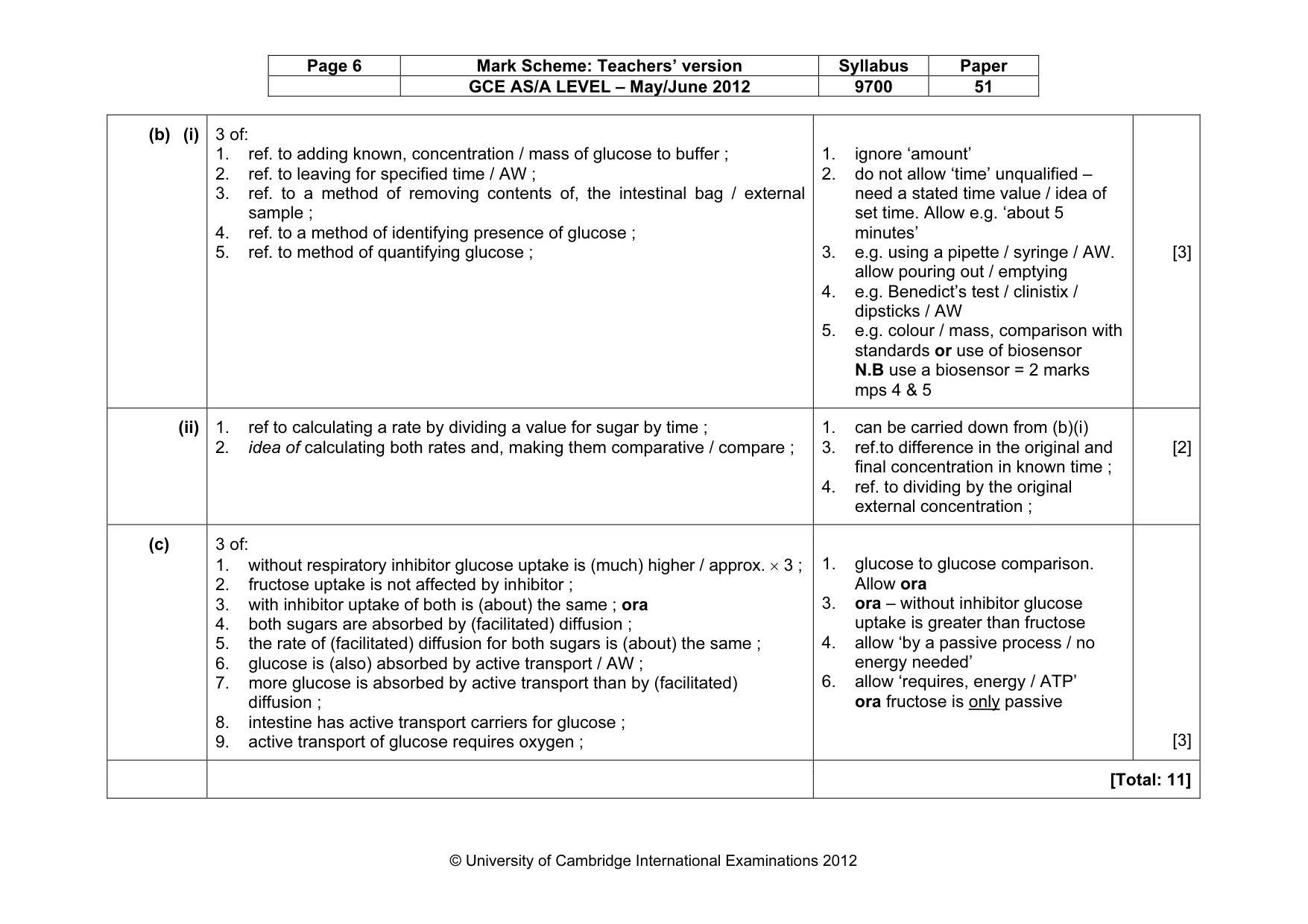
Page 6 Mark Scheme: Teachers’ version Syllabus Paper GCE AS/A LEVEL – May/June 2012 9700 51 © University of Cambridge International Examinations 2012 (b) (i) 3 of: 1. ref. to adding known, concentration / mass of glucose to buffer ; 2. ref. to leaving for specified time / AW ; 3. ref. to a method of removing contents of, the intestinal bag / external sample ; 4. ref. to a method of identifying presence of glucose ; 5. ref. to method of quantifying glucose ; 1. ignore ‘amount’ 2. do not allow ‘time’ unqualified – need a stated time value / idea of set time. Allow e.g. ‘about 5 minutes’ 3. e.g. using a pipette / syringe / AW. allow pouring out / emptying 4. e.g. Benedict’s test / clinistix / dipsticks / AW 5. e.g. colour / mass, comparison with standards or use of biosensor N.B use a biosensor = 2 marks mps 4 & 5 [3] (ii) 1. ref to calculating a rate by dividing a value for sugar by time ; 2. idea of calculating both rates and, making them comparative / compare ; 1. can be carried down from (b)(i) 3. ref.to difference in the original and final concentration in known time ; 4. ref. to dividing by the original external concentration ; [2] (c) 3 of: 1. without respiratory inhibitor glucose uptake is (much) higher / approx. × 3 ; 2. fructose uptake is not affected by inhibitor ; 3. with inhibitor uptake of both is (about) the same ; ora 4. both sugars are absorbed by (facilitated) diffusion ; 5. the rate of (facilitated) diffusion for both sugars is (about) the same ; 6. glucose is (also) absorbed by active transport / AW ; 7. more glucose is absorbed by active transport than by (facilitated) diffusion ; 8. intestine has active transport carriers for glucose ; 9. active transport of glucose requires oxygen ; 1. glucose to glucose comparison. Allow ora 3. ora – without inhibitor glucose uptake is greater than fructose 4. allow ‘by a passive process / no energy needed’ 6. allow ‘requires, energy / ATP’ ora fructose is only passive [3] [Total: 11]
What you needed in this session
Cambridge’s own grade thresholds for 2012 May/June, Paper 5 · Variant 1. A higher threshold means an easier paper — the bar moves with how the cohort did.