Cambridge A Level Biology 9700 — 2011 Oct/Nov Paper 3 · Variant 4
9700/34/O/N/11 · 40 marks · ≈45 min
The question paper and its mark scheme, free to read here and free to download. This is Cambridge’s own paper, exactly as it was sat.
Question paper12 pages
Mark scheme13 pages
Answers below. Sit the paper first if you are practising.
Paper as text
Question paper, page 1
This document consists of 11 printed pages and 1 blank page. DC (LEO/DJ) 34185/6 © UCLES 2011 [Turn over UNIVERSITY OF CAMBRIDGE INTERNATIONAL EXAMINATIONS General Certificate of Education Advanced Subsidiary Level and Advanced Level READ THESE INSTRUCTIONS FIRST Write your Centre number, candidate number and name on all the work you hand in. Write in dark blue or black ink. You may use a pencil for any diagrams, graphs or rough working. Do not use red ink, staples, paper clips, highlighters, glue or correction fluid. DO NOT WRITE IN ANY BARCODES. Answer all questions. You may lose marks if you do not show your working or if you do not use appropriate units. At the end of the examination, fasten all your work securely together. The number of marks is given in brackets [ ] at the end of each question or part question. * 8 5 8 3 0 6 8 5 4 9 * BIOLOGY 9700/34 Advanced Practical Skills 2 October/November 2011 2 hours Candidates answer on the Question Paper. Additional Materials: As listed in the Confidential Instructions. For Examiner’s Use 1 2 Total
Question paper, page 2
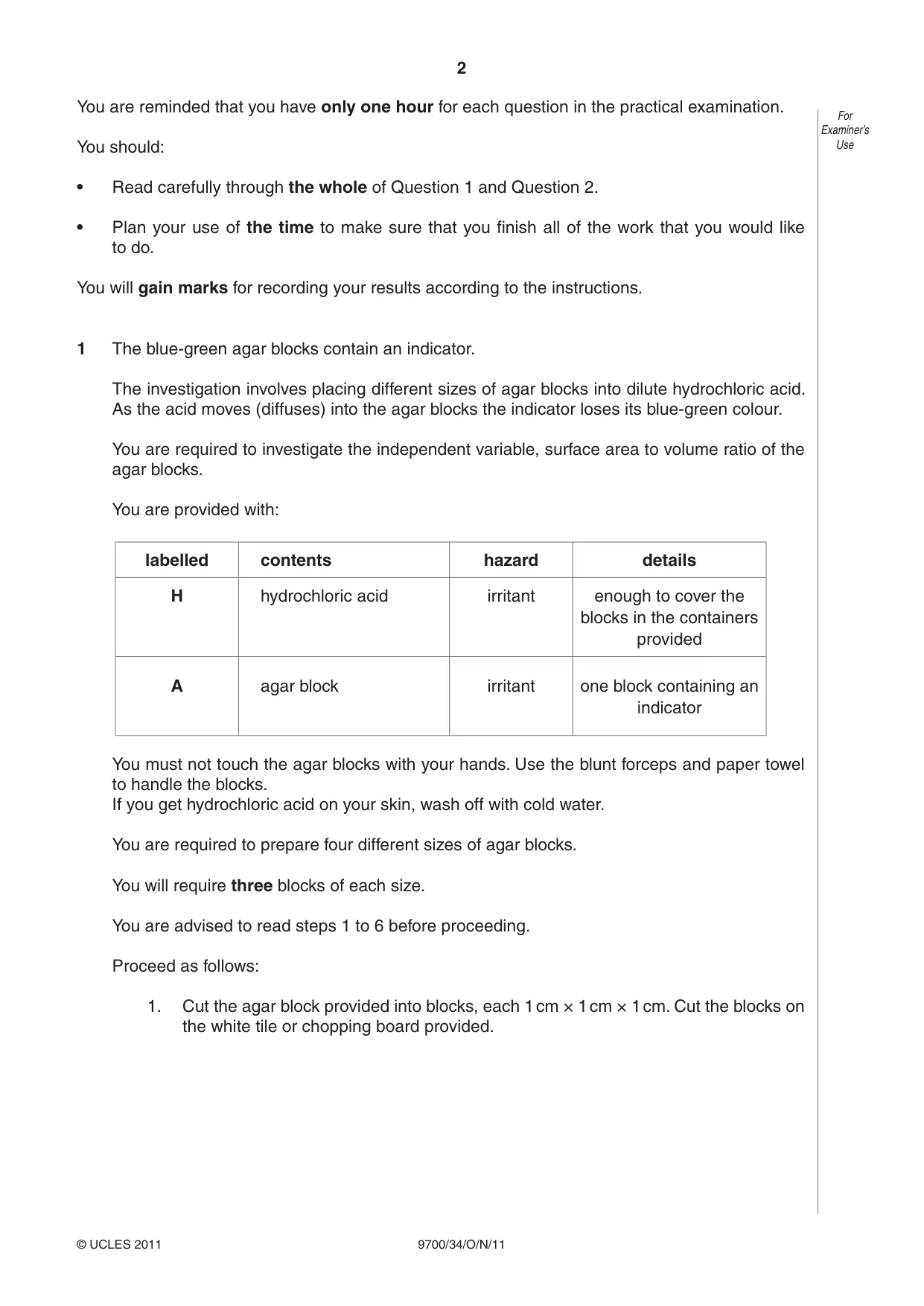
2 9700/34/O/N/11 © UCLES 2011 For Examiner’s Use You are reminded that you have only one hour for each question in the practical examination. You should: • Read carefully through the whole of Question 1 and Question 2. • Plan your use of the time to make sure that you finish all of the work that you would like to do. You will gain marks for recording your results according to the instructions. 1 The blue-green agar blocks contain an indicator. The investigation involves placing different sizes of agar blocks into dilute hydrochloric acid. As the acid moves (diffuses) into the agar blocks the indicator loses its blue-green colour. You are required to investigate the independent variable, surface area to volume ratio of the agar blocks. You are provided with: labelled contents hazard details H hydrochloric acid irritant enough to cover the blocks in the containers provided A agar block irritant one block containing an indicator You must not touch the agar blocks with your hands. Use the blunt forceps and paper towel to handle the blocks. If you get hydrochloric acid on your skin, wash off with cold water. You are required to prepare four different sizes of agar blocks. You will require three blocks of each size. You are advised to read steps 1 to 6 before proceeding. Proceed as follows: 1. Cut the agar block provided into blocks, each 1 cm × 1 cm × 1 cm. Cut the blocks on the white tile or chopping board provided.
Question paper, page 3
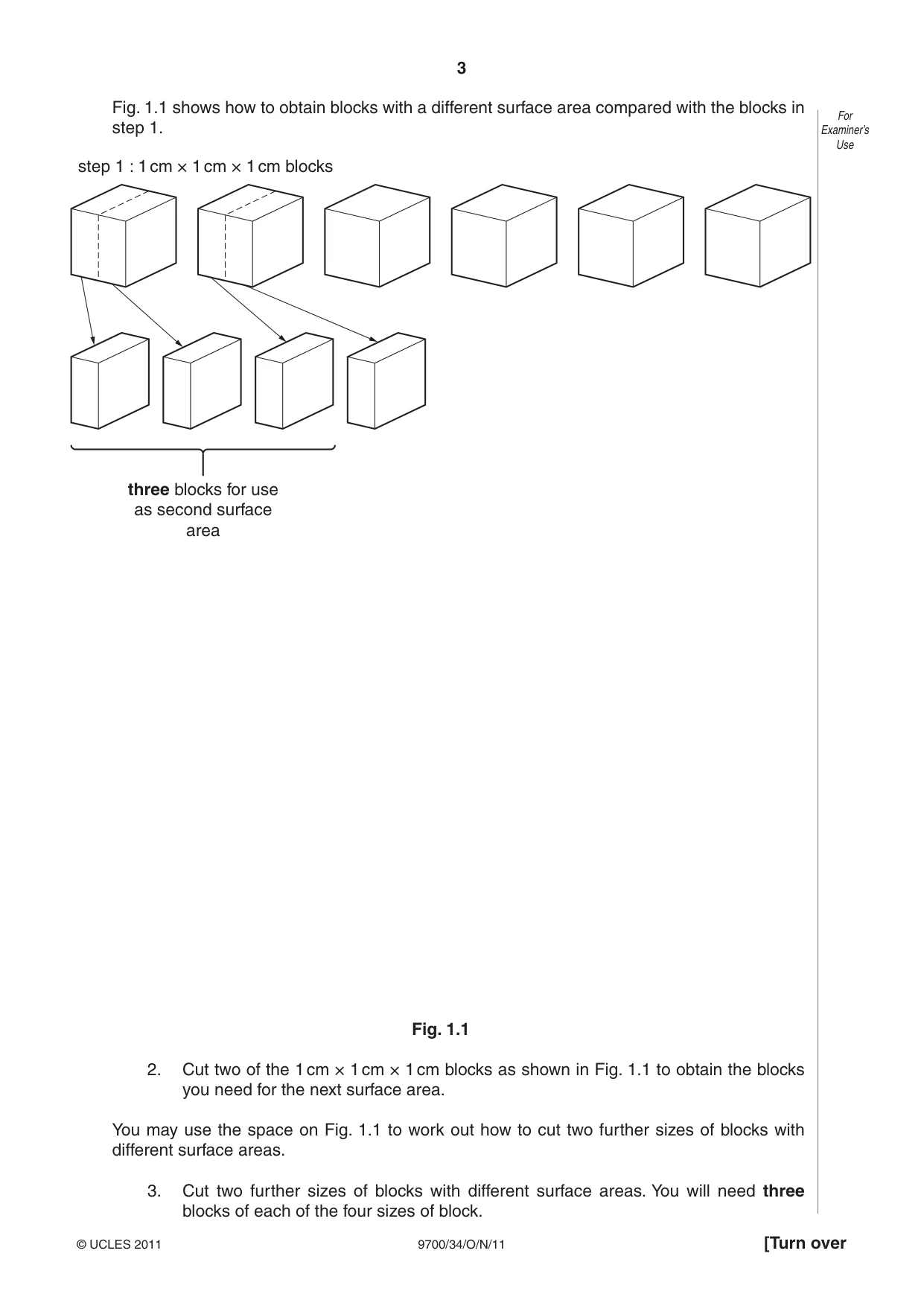
3 [Turn over 9700/34/O/N/11 © UCLES 2011 For Examiner’s Use Fig. 1.1 shows how to obtain blocks with a different surface area compared with the blocks in step 1. step 1 : 1 cm × 1 cm × 1 cm blocks three blocks for use as second surface area Fig. 1.1 2. Cut two of the 1 cm × 1 cm × 1 cm blocks as shown in Fig. 1.1 to obtain the blocks you need for the next surface area. You may use the space on Fig. 1.1 to work out how to cut two further sizes of blocks with different surface areas. 3. Cut two further sizes of blocks with different surface areas. You will need three blocks of each of the four sizes of block.
Question paper, page 4
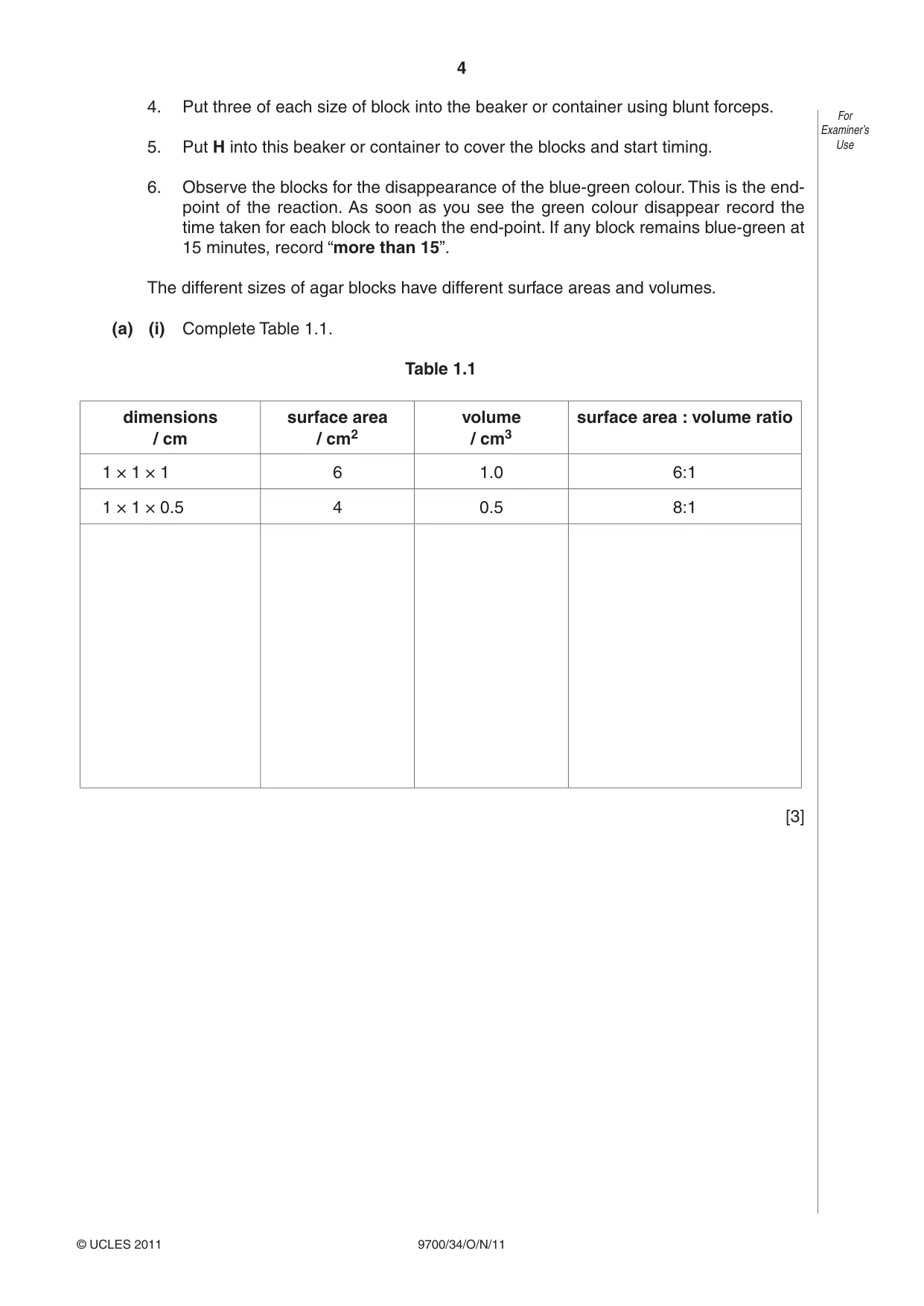
4 9700/34/O/N/11 © UCLES 2011 For Examiner’s Use 4. Put three of each size of block into the beaker or container using blunt forceps. 5. Put H into this beaker or container to cover the blocks and start timing. 6. Observe the blocks for the disappearance of the blue-green colour. This is the end- point of the reaction. As soon as you see the green colour disappear record the time taken for each block to reach the end-point. If any block remains blue-green at 15 minutes, record “more than 15”. The different sizes of agar blocks have different surface areas and volumes. (a) (i) Complete Table 1.1. Table 1.1 dimensions / cm surface area / cm2 volume / cm3 surface area : volume ratio 1 × 1 × 1 6 1.0 6:1 1 × 1 × 0.5 4 0.5 8:1 [3]
Question paper, page 5
5 [Turn over 9700/34/O/N/11 © UCLES 2011 For Examiner’s Use (ii) Prepare the space below and record your results. [5] (iii) Identify two significant sources of error in your investigation. … … … … … … …[2]
Question paper, page 6
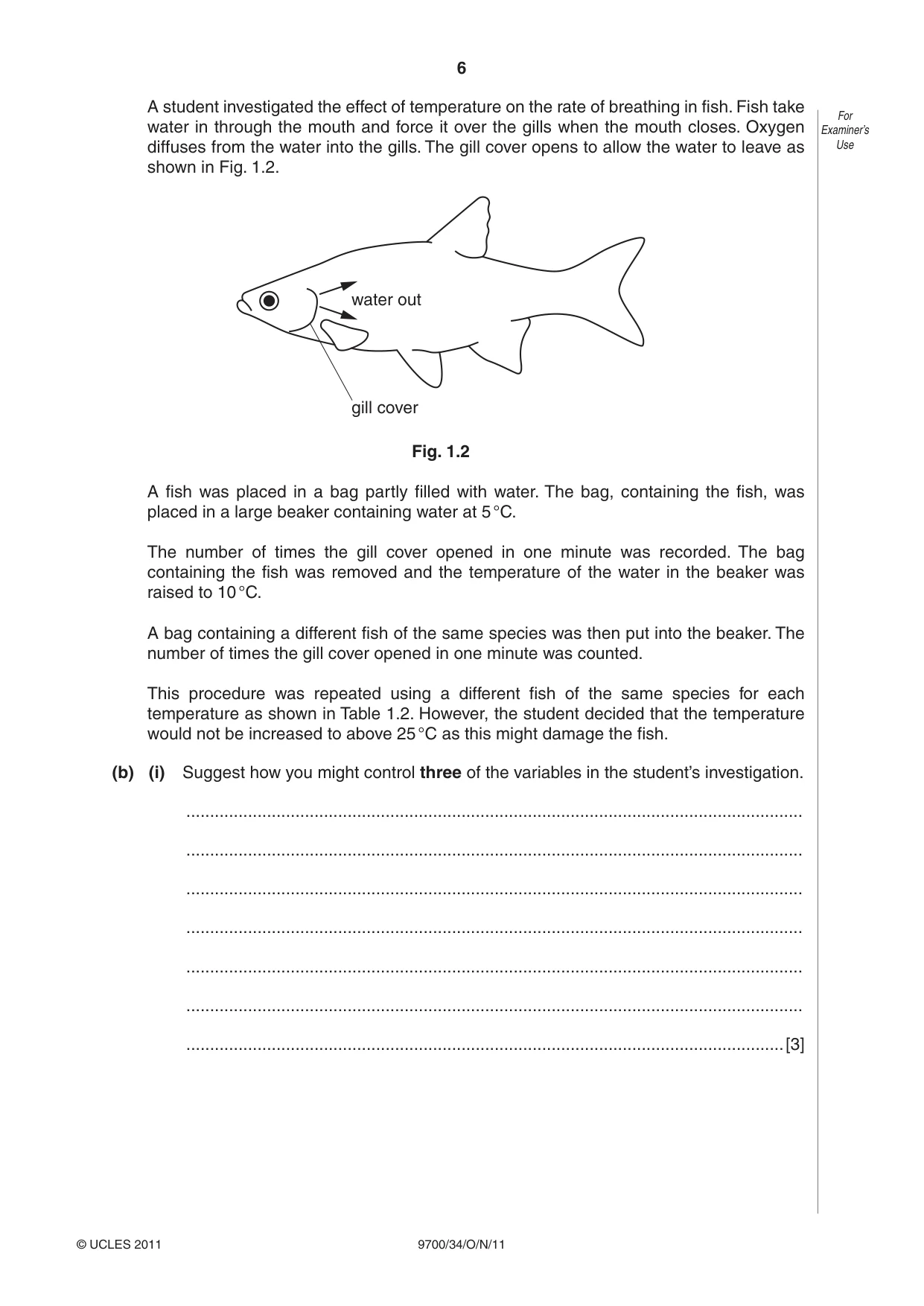
6 9700/34/O/N/11 © UCLES 2011 For Examiner’s Use A student investigated the effect of temperature on the rate of breathing in fish. Fish take water in through the mouth and force it over the gills when the mouth closes. Oxygen diffuses from the water into the gills. The gill cover opens to allow the water to leave as shown in Fig. 1.2. gill cover water out Fig. 1.2 A fish was placed in a bag partly filled with water. The bag, containing the fish, was placed in a large beaker containing water at 5 °C. The number of times the gill cover opened in one minute was recorded. The bag containing the fish was removed and the temperature of the water in the beaker was raised to 10 °C. A bag containing a different fish of the same species was then put into the beaker. The number of times the gill cover opened in one minute was counted. This procedure was repeated using a different fish of the same species for each temperature as shown in Table 1.2. However, the student decided that the temperature would not be increased to above 25 °C as this might damage the fish. (b) (i) Suggest how you might control three of the variables in the student’s investigation. … … … … … … …[3]
Question paper, page 7
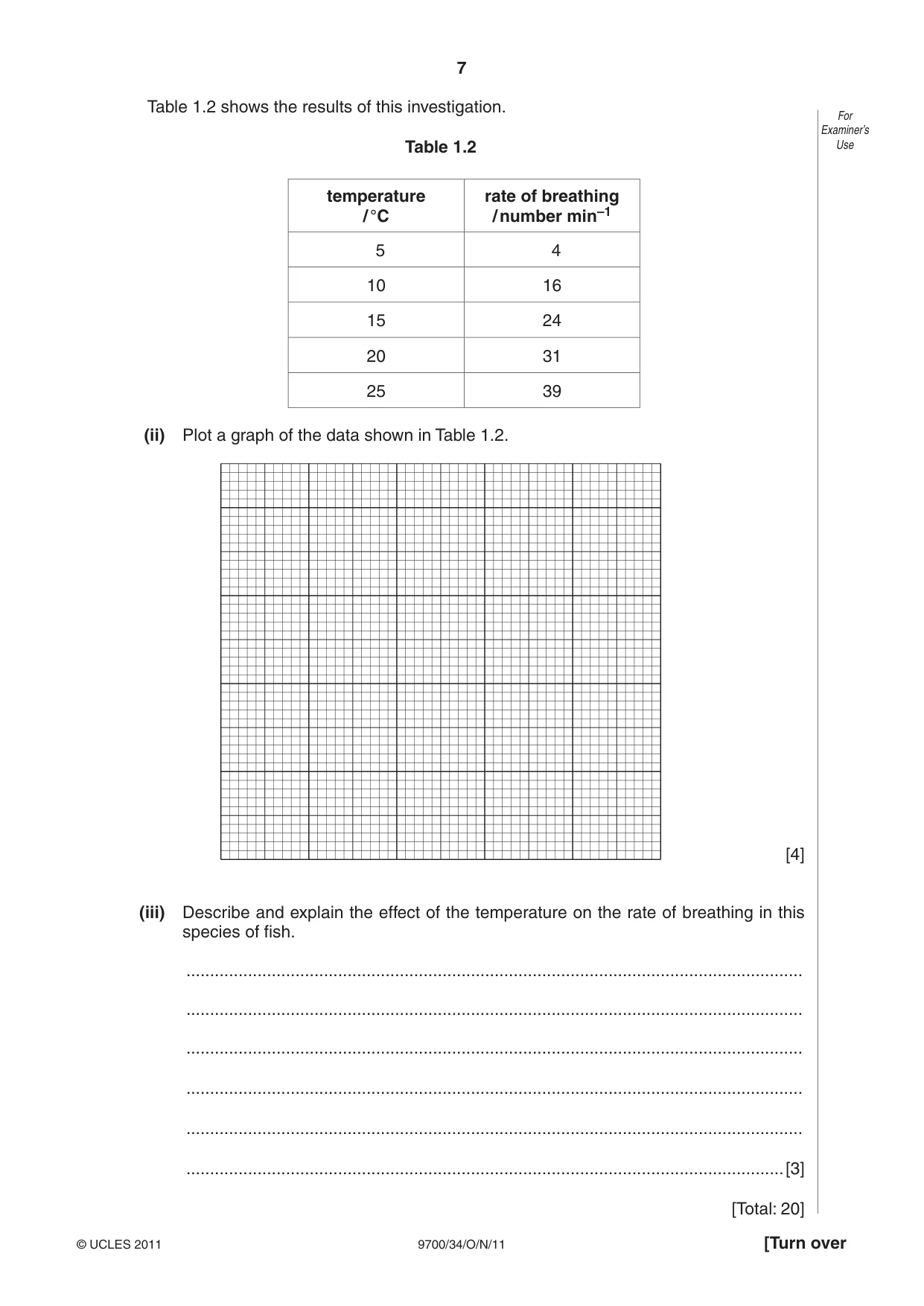
7 [Turn over 9700/34/O/N/11 © UCLES 2011 For Examiner’s Use Table 1.2 shows the results of this investigation. Table 1.2 temperature / °C rate of breathing / number min–1 5 4 10 16 15 24 20 31 25 39 (ii) Plot a graph of the data shown in Table 1.2. [4] (iii) Describe and explain the effect of the temperature on the rate of breathing in this species of fish. … … … … … …[3] [Total: 20]
Question paper, page 8
8 9700/34/O/N/11 © UCLES 2011 BLANK PAGE Question 2 starts on page 9
Question paper, page 9
9 [Turn over 9700/34/O/N/11 © UCLES 2011 For Examiner’s Use 2 M1 is a slide of a stained transverse section showing part of a tube of a mammal from the gas exchange system. (a) (i) Draw a large plan diagram of the whole of the transverse section. Label the cartilage. [5]
Question paper, page 10
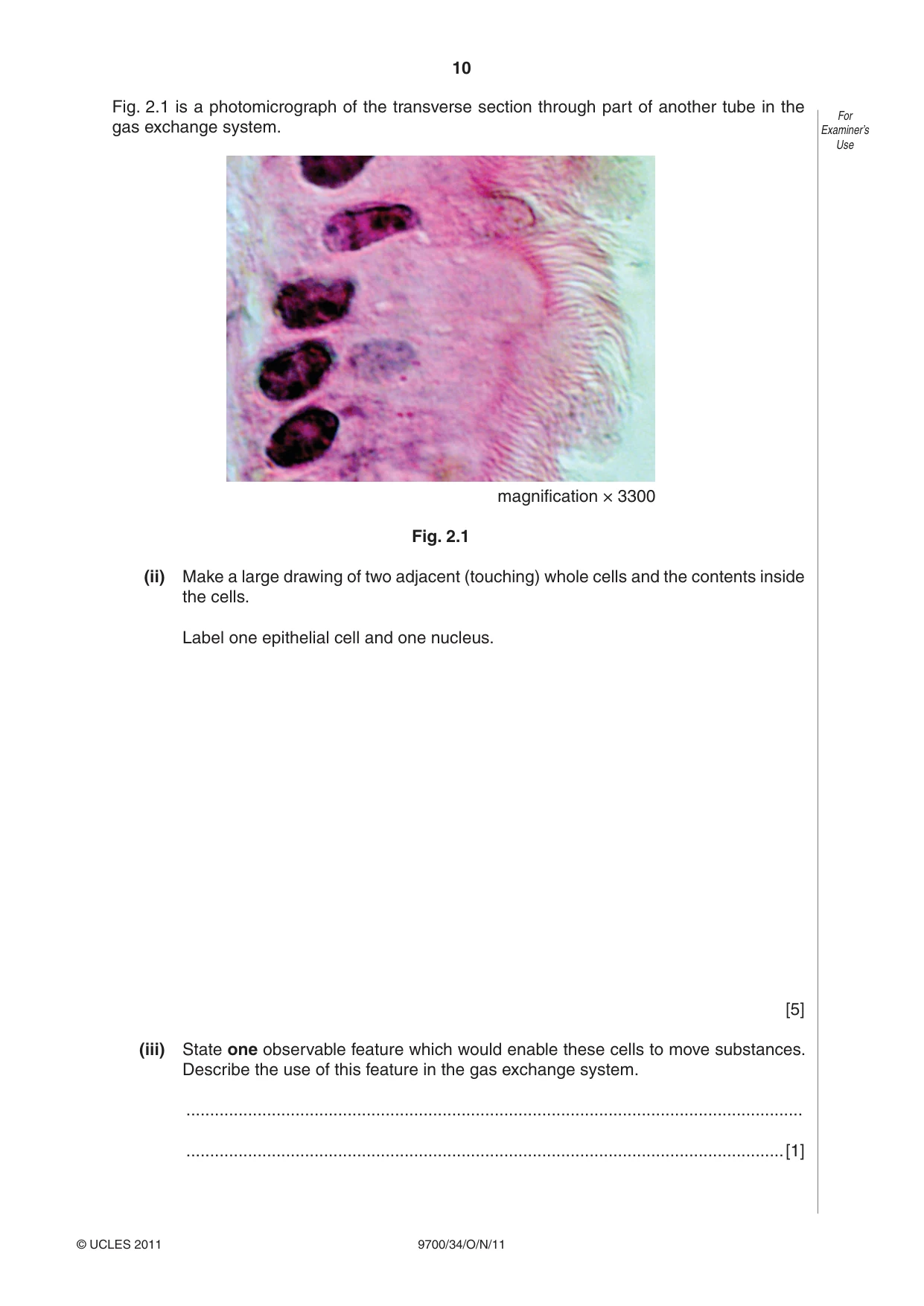
10 9700/34/O/N/11 © UCLES 2011 For Examiner’s Use Fig. 2.1 is a photomicrograph of the transverse section through part of another tube in the gas exchange system. magnification × 3300 Fig. 2.1 (ii) Make a large drawing of two adjacent (touching) whole cells and the contents inside the cells. Label one epithelial cell and one nucleus. [5] (iii) State one observable feature which would enable these cells to move substances. Describe the use of this feature in the gas exchange system. … …[1]
Question paper, page 11
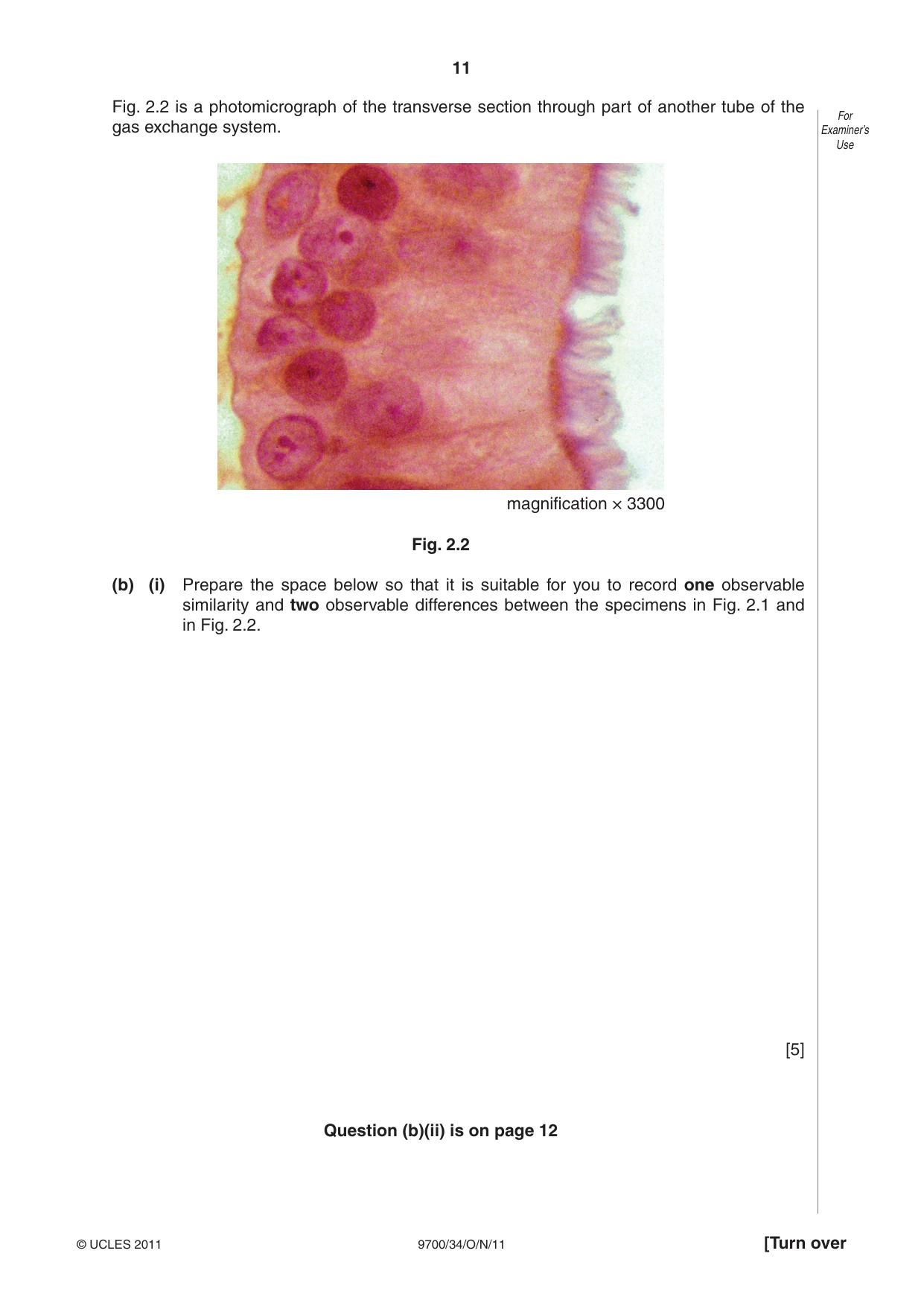
11 [Turn over 9700/34/O/N/11 © UCLES 2011 For Examiner’s Use Fig. 2.2 is a photomicrograph of the transverse section through part of another tube of the gas exchange system. magnification × 3300 Fig. 2.2 (b) (i) Prepare the space below so that it is suitable for you to record one observable similarity and two observable differences between the specimens in Fig. 2.1 and in Fig. 2.2. [5] Question (b)(ii) is on page 12
Question paper, page 12
12 9700/34/O/N/11 © UCLES 2011 For Examiner’s Use (ii) Calculate the ratio of the mean length of the epithelial cell to the mean length of the cilia shown in Fig. 2.2. You may lose marks if you do not show your working or if you do not use appropriate units. [4] [Total: 20] Copyright Acknowledgements: Question 2, Fig 2.1 Science Photo Library Question 2, Fig 2.2 Steve Gschmeissner/Science Photo Library Permission to reproduce items where third-party owned material protected by copyright is included has been sought and cleared where possible. Every reasonable effort has been made by the publisher (UCLES) to trace copyright holders, but if any items requiring clearance have unwittingly been included, the publisher will be pleased to make amends at the earliest possible opportunity. University of Cambridge International Examinations is part of the Cambridge Assessment Group. Cambridge Assessment is the brand name of University of Cambridge Local Examinations Syndicate (UCLES), which is itself a department of the University of Cambridge.
Mark scheme, page 1
UNIVERSITY OF CAMBRIDGE INTERNATIONAL EXAMINATIONS GCE Advanced Subsidiary Level and GCE Advanced Level MARK SCHEME for the October/November 2011 question paper for the guidance of teachers 9700 BIOLOGY 9700/34 Paper 3 (Advanced Practical Skills 2), maximum raw mark 40 This mark scheme is published as an aid to teachers and candidates, to indicate the requirements of the examination. It shows the basis on which Examiners were instructed to award marks. It does not indicate the details of the discussions that took place at an Examiners’ meeting before marking began, which would have considered the acceptability of alternative answers. Mark schemes must be read in conjunction with the question papers and the report on the examination. • Cambridge will not enter into discussions or correspondence in connection with these mark schemes. Cambridge is publishing the mark schemes for the October/November 2011 question papers for most IGCSE, GCE Advanced Level and Advanced Subsidiary Level syllabuses and some Ordinary Level syllabuses.
Mark scheme, page 2
Page 2 Mark Scheme: Teachers’ version Syllabus Paper GCE AS/A LEVEL – October/November 2011 9700 34 © University of Cambridge International Examinations 2011 Mark scheme abbreviations: ; separates marking points / alternative answers for the same point R reject A accept (for answers correctly cued by the question, or by extra guidance) AW alternative wording (where responses vary more than usual) underline actual word given must be used by candidate (grammatical variants excepted) max indicates the maximum number of marks that can be given ora or reverse argument mp marking point (with relevant number) ecf error carried forward I ignore ACE Analysis, Conclusions and Evaluation (skills) MMO Manipulations, Measurement and Observation (skills) PDO Presentation of Data and Observations (skills)
Mark scheme, page 3
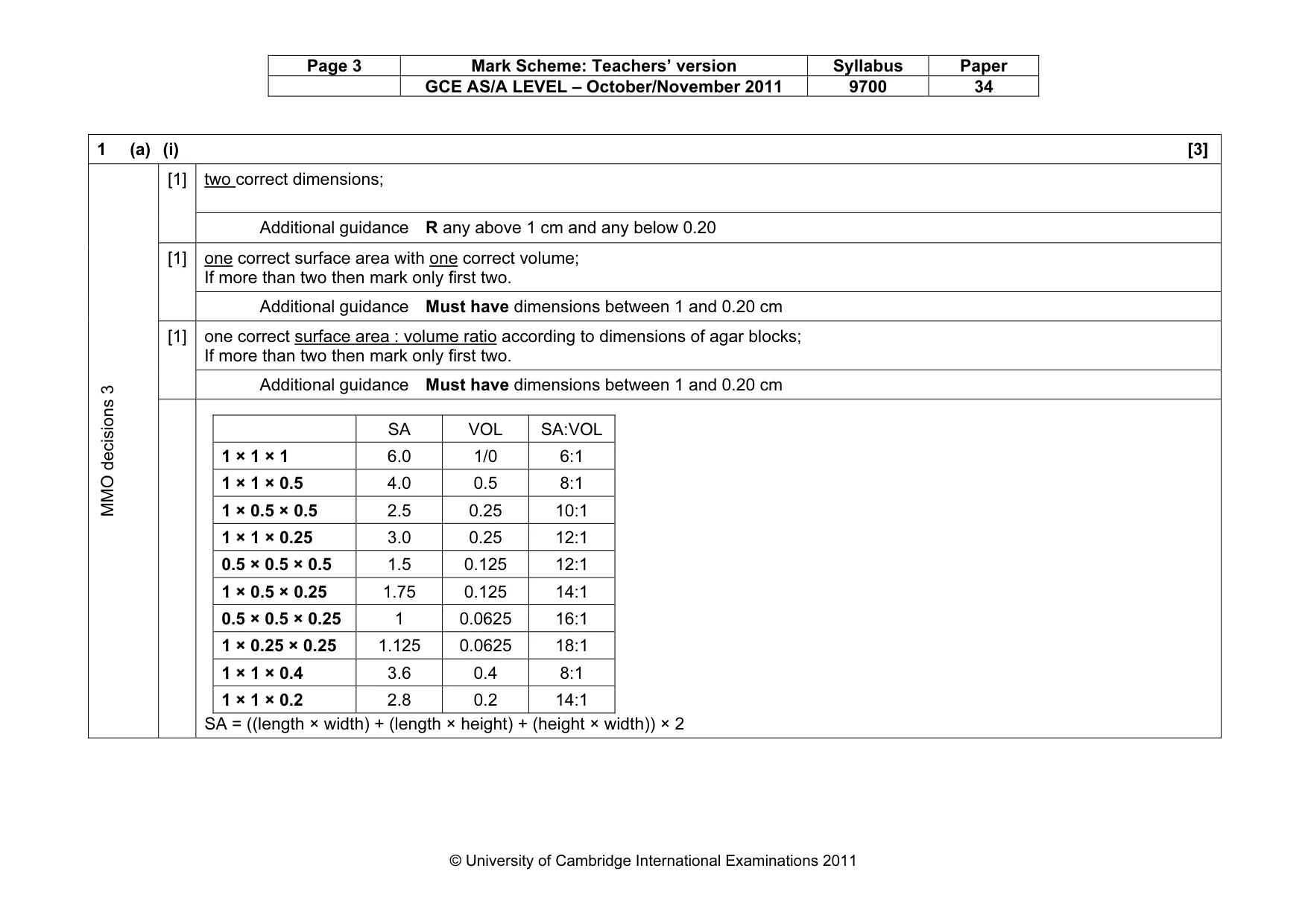
Page 3 Mark Scheme: Teachers’ version Syllabus Paper GCE AS/A LEVEL – October/November 2011 9700 34 © University of Cambridge International Examinations 2011 1 (a) (i) [3] two correct dimensions; [1] Additional guidance R any above 1 cm and any below 0.20 one correct surface area with one correct volume; If more than two then mark only first two. [1] Additional guidance Must have dimensions between 1 and 0.20 cm one correct surface area : volume ratio according to dimensions of agar blocks; If more than two then mark only first two. [1] Additional guidance Must have dimensions between 1 and 0.20 cm MMO decisions 3 SA VOL SA:VOL 1 × 1 × 1 6.0 1/0 6:1 1 × 1 × 0.5 4.0 0.5 8:1 1 × 0.5 × 0.5 2.5 0.25 10:1 1 × 1 × 0.25 3.0 0.25 12:1 0.5 × 0.5 × 0.5 1.5 0.125 12:1 1 × 0.5 × 0.25 1.75 0.125 14:1 0.5 × 0.5 × 0.25 1 0.0625 16:1 1 × 0.25 × 0.25 1.125 0.0625 18:1 1 × 1 × 0.4 3.6 0.4 8:1 1 × 1 × 0.2 2.8 0.2 14:1 SA = ((length × width) + (length × height) + (height × width)) × 2
Mark scheme, page 4
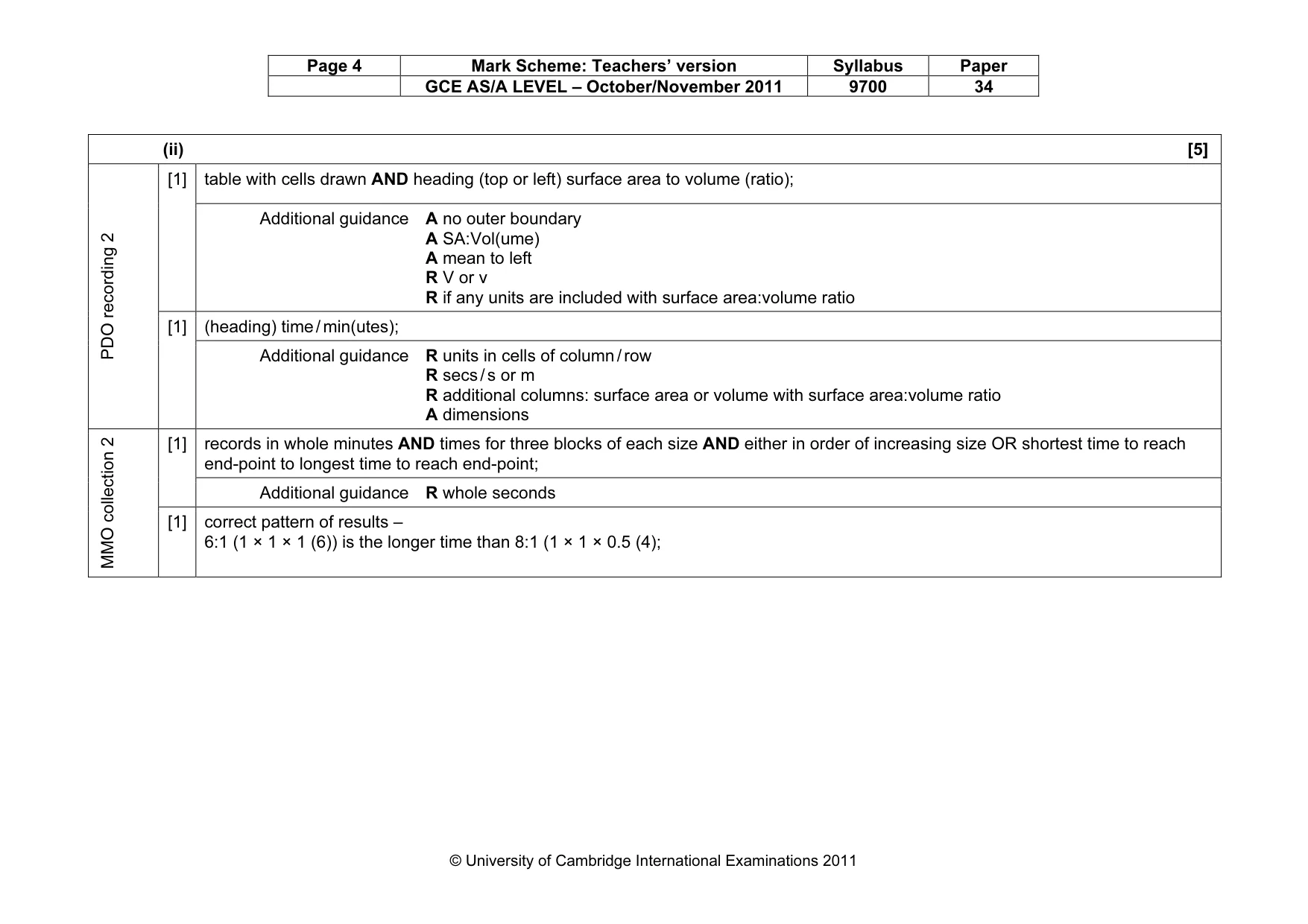
Page 4 Mark Scheme: Teachers’ version Syllabus Paper GCE AS/A LEVEL – October/November 2011 9700 34 © University of Cambridge International Examinations 2011 (ii) [5] table with cells drawn AND heading (top or left) surface area to volume (ratio); [1] Additional guidance A no outer boundary A SA:Vol(ume) A mean to left R V or v R if any units are included with surface area:volume ratio (heading) time / min(utes); PDO recording 2 [1] Additional guidance R units in cells of column / row R secs / s or m R additional columns: surface area or volume with surface area:volume ratio A dimensions records in whole minutes AND times for three blocks of each size AND either in order of increasing size OR shortest time to reach end-point to longest time to reach end-point; [1] Additional guidance R whole seconds MMO collection 2 [1] correct pattern of results – 6:1 (1 × 1 × 1 (6)) is the longer time than 8:1 (1 × 1 × 0.5 (4);
Mark scheme, page 5
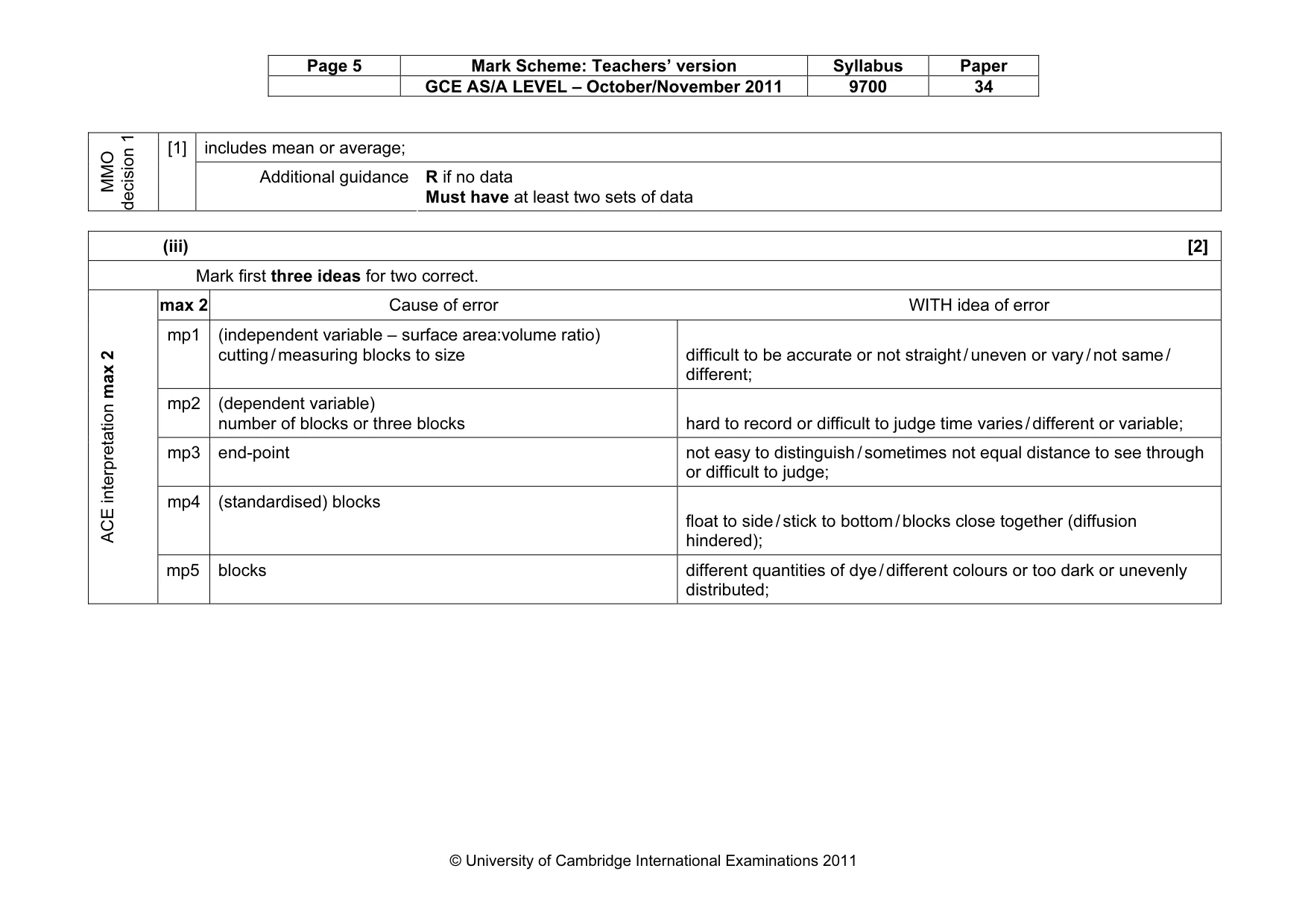
Page 5 Mark Scheme: Teachers’ version Syllabus Paper GCE AS/A LEVEL – October/November 2011 9700 34 © University of Cambridge International Examinations 2011 includes mean or average; MMO decision 1 [1] Additional guidance R if no data Must have at least two sets of data (iii) [2] Mark first three ideas for two correct. max 2 Cause of error WITH idea of error mp1 (independent variable – surface area:volume ratio) cutting / measuring blocks to size difficult to be accurate or not straight / uneven or vary / not same / different; mp2 (dependent variable) number of blocks or three blocks hard to record or difficult to judge time varies / different or variable; mp3 end-point not easy to distinguish / sometimes not equal distance to see through or difficult to judge; mp4 (standardised) blocks float to side / stick to bottom / blocks close together (diffusion hindered); ACE interpretation max 2 mp5 blocks different quantities of dye / different colours or too dark or unevenly distributed;
Mark scheme, page 6
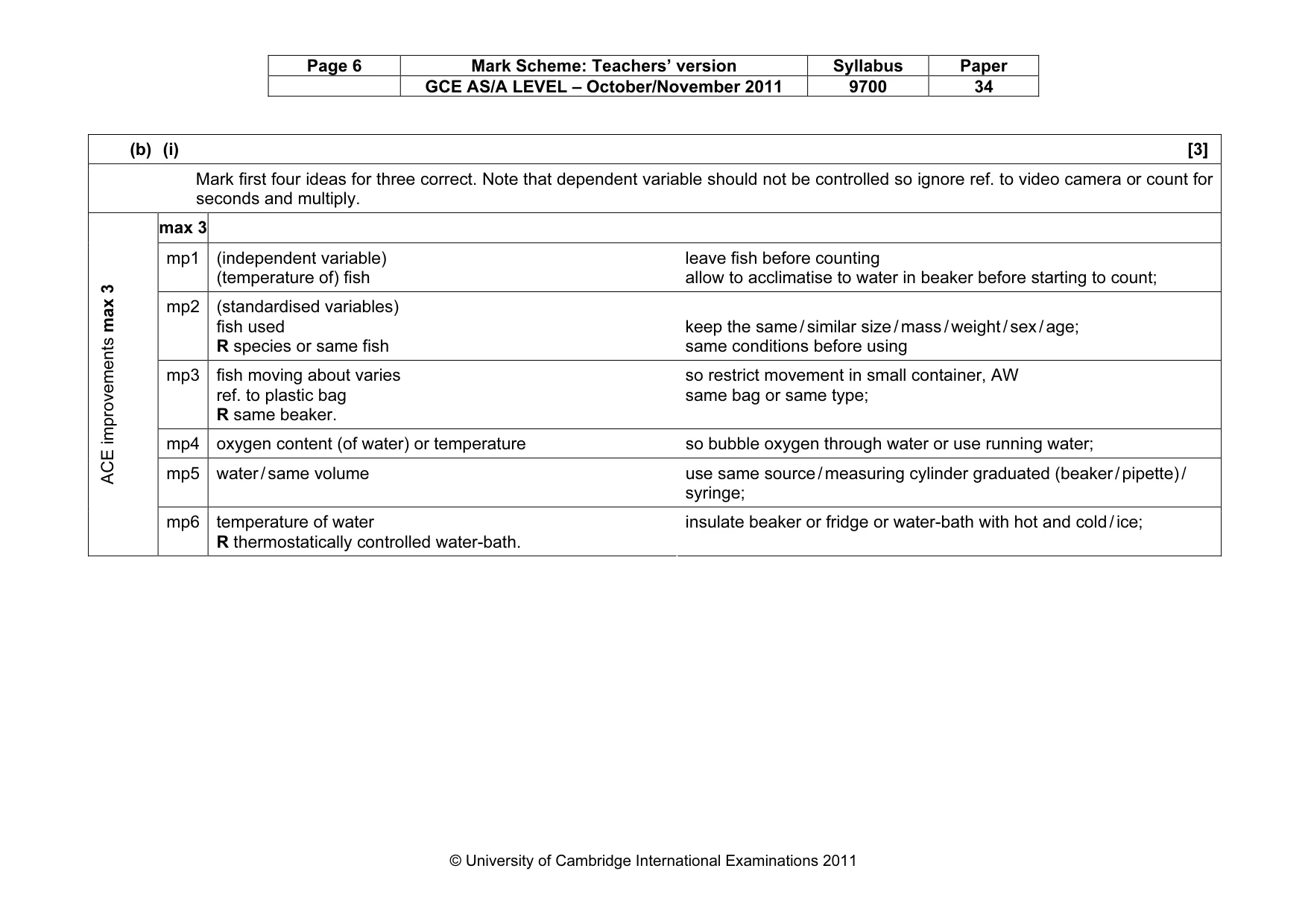
Page 6 Mark Scheme: Teachers’ version Syllabus Paper GCE AS/A LEVEL – October/November 2011 9700 34 © University of Cambridge International Examinations 2011 (b) (i) [3] Mark first four ideas for three correct. Note that dependent variable should not be controlled so ignore ref. to video camera or count for seconds and multiply. max 3 mp1 (independent variable) (temperature of) fish leave fish before counting allow to acclimatise to water in beaker before starting to count; mp2 (standardised variables) fish used R species or same fish keep the same / similar size / mass / weight / sex / age; same conditions before using mp3 fish moving about varies ref. to plastic bag R same beaker. so restrict movement in small container, AW same bag or same type; mp4 oxygen content (of water) or temperature so bubble oxygen through water or use running water; mp5 water / same volume use same source / measuring cylinder graduated (beaker / pipette) / syringe; ACE improvements max 3 mp6 temperature of water R thermostatically controlled water-bath. insulate beaker or fridge or water-bath with hot and cold / ice;
Mark scheme, page 7
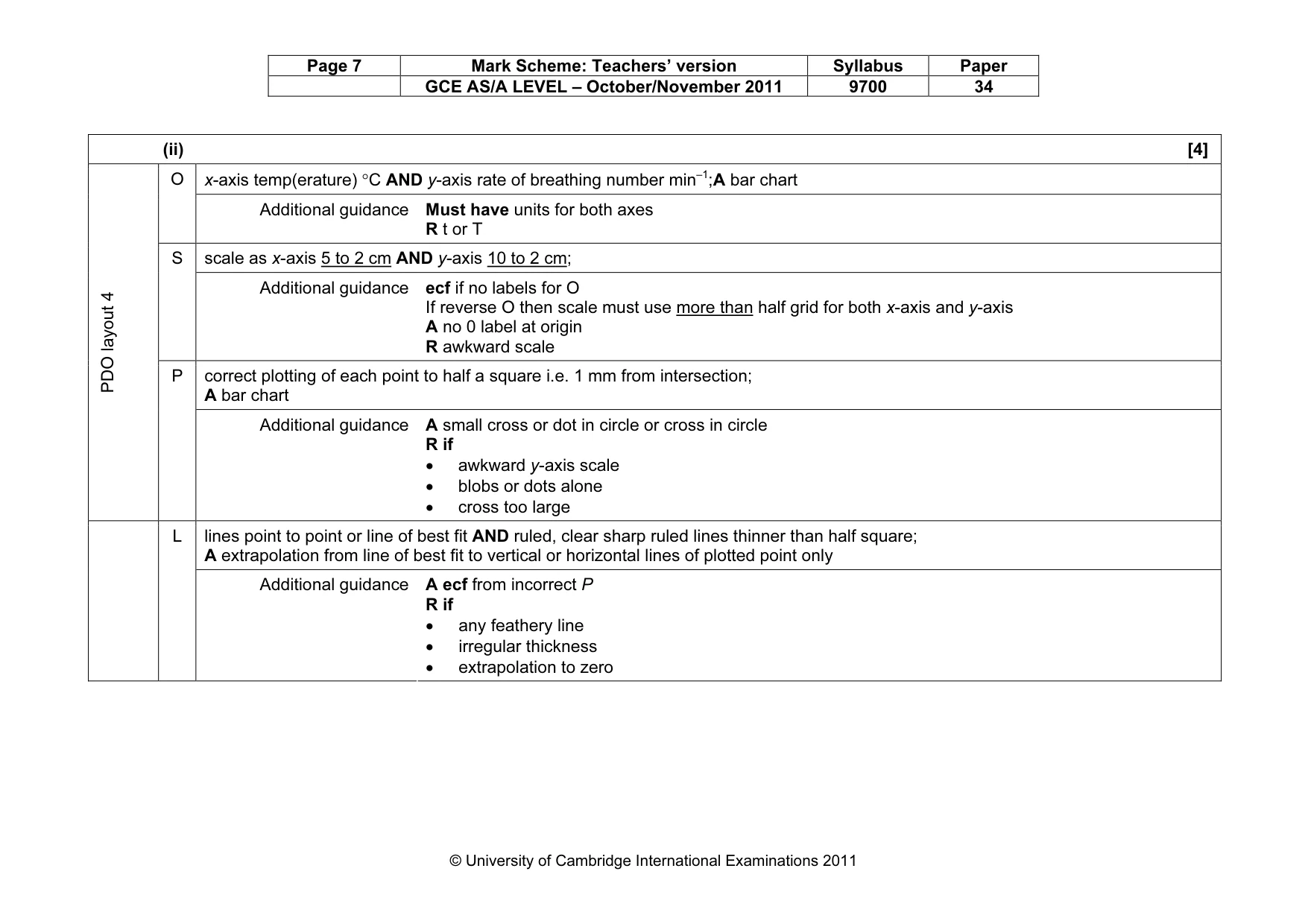
Page 7 Mark Scheme: Teachers’ version Syllabus Paper GCE AS/A LEVEL – October/November 2011 9700 34 © University of Cambridge International Examinations 2011 (ii) [4] x-axis temp(erature) °C AND y-axis rate of breathing number min–1;A bar chart O Additional guidance Must have units for both axes R t or T scale as x-axis 5 to 2 cm AND y-axis 10 to 2 cm; S Additional guidance ecf if no labels for O If reverse O then scale must use more than half grid for both x-axis and y-axis A no 0 label at origin R awkward scale correct plotting of each point to half a square i.e. 1 mm from intersection; A bar chart PDO layout 4 P Additional guidance A small cross or dot in circle or cross in circle R if • awkward y-axis scale • blobs or dots alone • cross too large lines point to point or line of best fit AND ruled, clear sharp ruled lines thinner than half square; A extrapolation from line of best fit to vertical or horizontal lines of plotted point only L Additional guidance A ecf from incorrect P R if • any feathery line • irregular thickness • extrapolation to zero
Mark scheme, page 8
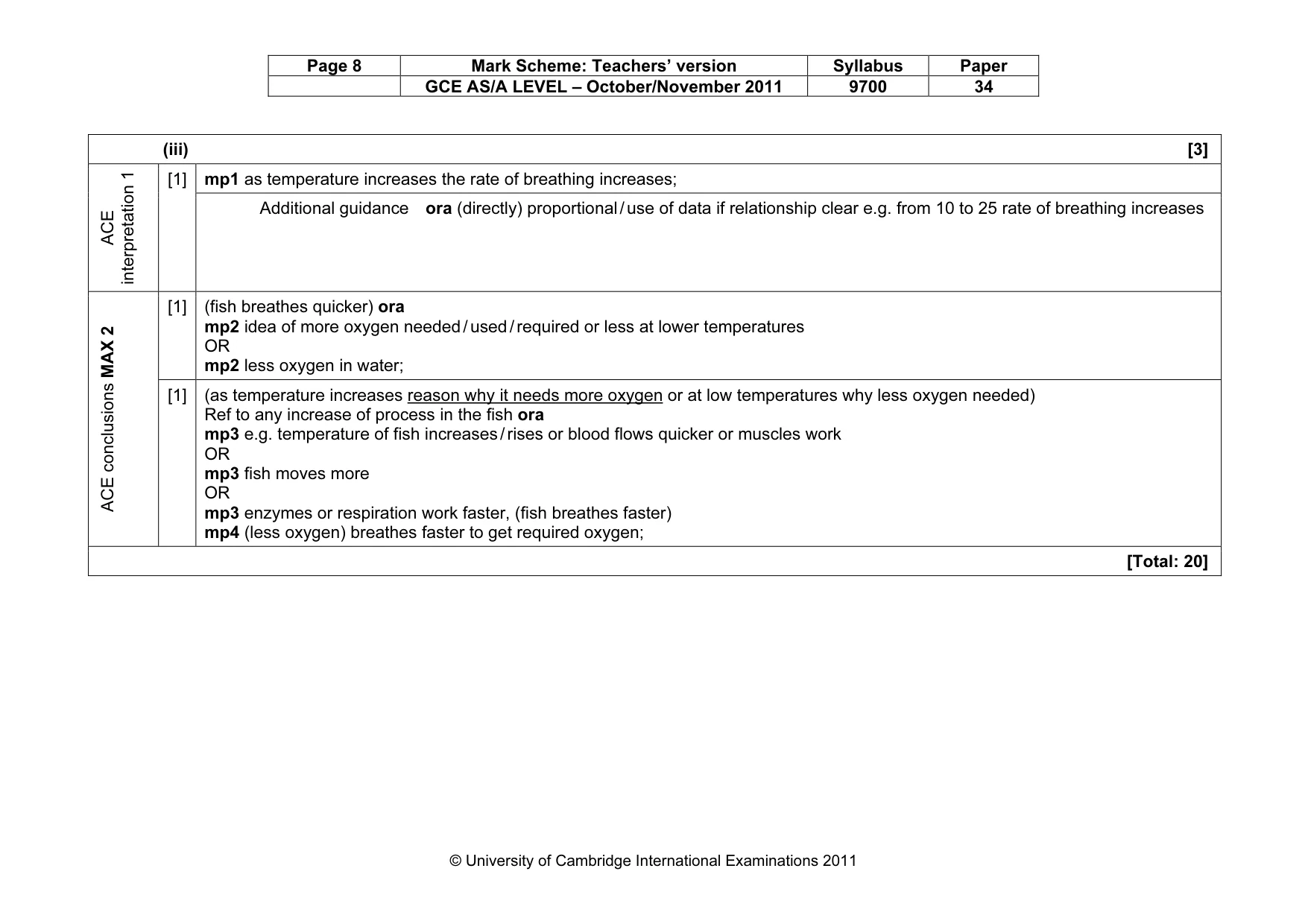
Page 8 Mark Scheme: Teachers’ version Syllabus Paper GCE AS/A LEVEL – October/November 2011 9700 34 © University of Cambridge International Examinations 2011 (iii) [3] mp1 as temperature increases the rate of breathing increases; ACE interpretation 1 [1] Additional guidance ora (directly) proportional / use of data if relationship clear e.g. from 10 to 25 rate of breathing increases [1] (fish breathes quicker) ora mp2 idea of more oxygen needed / used / required or less at lower temperatures OR mp2 less oxygen in water; ACE conclusions MAX 2 [1] (as temperature increases reason why it needs more oxygen or at low temperatures why less oxygen needed) Ref to any increase of process in the fish ora mp3 e.g. temperature of fish increases / rises or blood flows quicker or muscles work OR mp3 fish moves more OR mp3 enzymes or respiration work faster, (fish breathes faster) mp4 (less oxygen) breathes faster to get required oxygen; [Total: 20]
Mark scheme, page 9
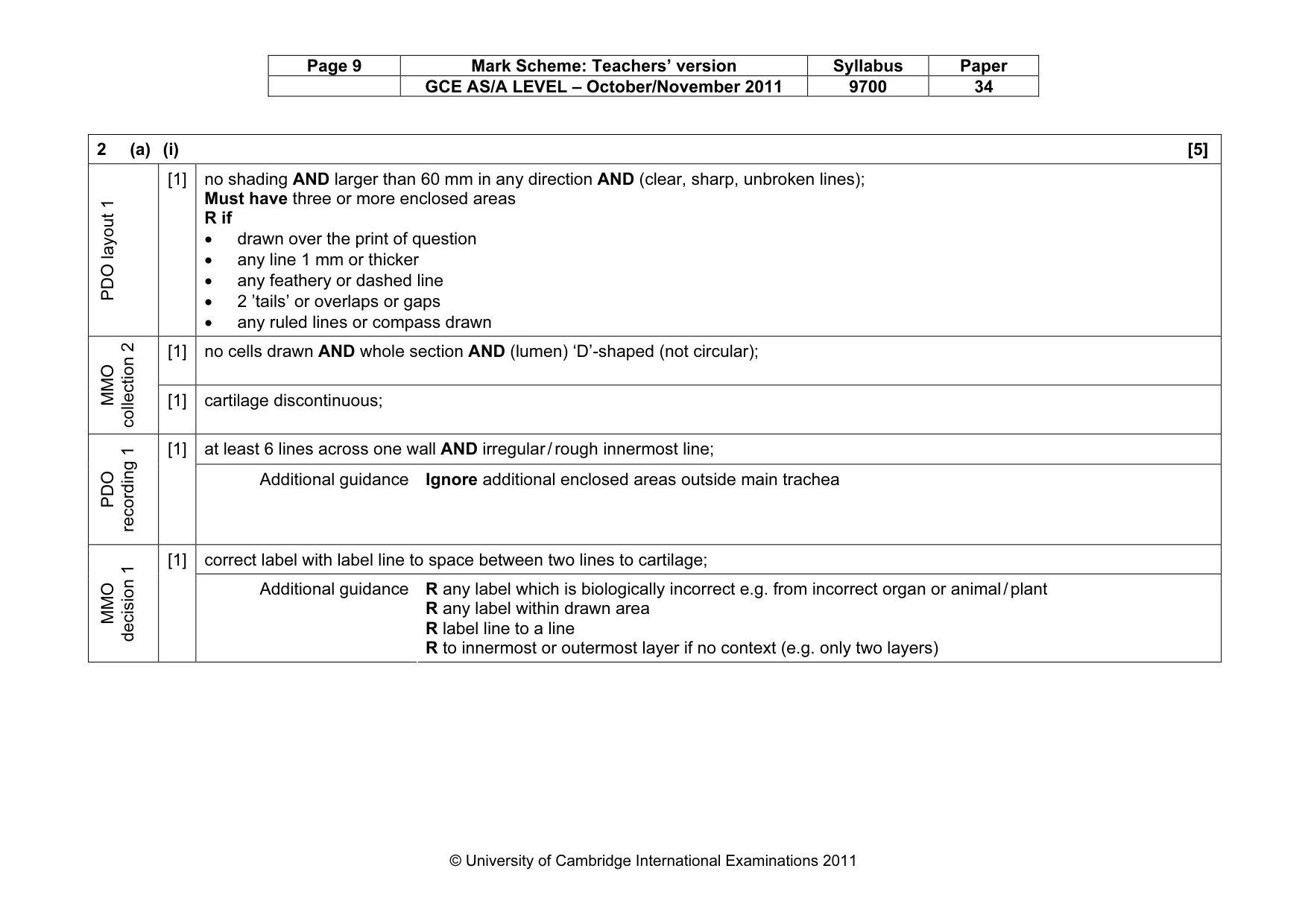
Page 9 Mark Scheme: Teachers’ version Syllabus Paper GCE AS/A LEVEL – October/November 2011 9700 34 © University of Cambridge International Examinations 2011 2 (a) (i) [5] PDO layout 1 [1] no shading AND larger than 60 mm in any direction AND (clear, sharp, unbroken lines); Must have three or more enclosed areas R if • drawn over the print of question • any line 1 mm or thicker • any feathery or dashed line • 2 ’tails’ or overlaps or gaps • any ruled lines or compass drawn [1] no cells drawn AND whole section AND (lumen) ‘D’-shaped (not circular); MMO collection 2 [1] cartilage discontinuous; at least 6 lines across one wall AND irregular / rough innermost line; PDO recording 1 [1] Additional guidance Ignore additional enclosed areas outside main trachea correct label with label line to space between two lines to cartilage; MMO decision 1 [1] Additional guidance R any label which is biologically incorrect e.g. from incorrect organ or animal / plant R any label within drawn area R label line to a line R to innermost or outermost layer if no context (e.g. only two layers)
Mark scheme, page 10
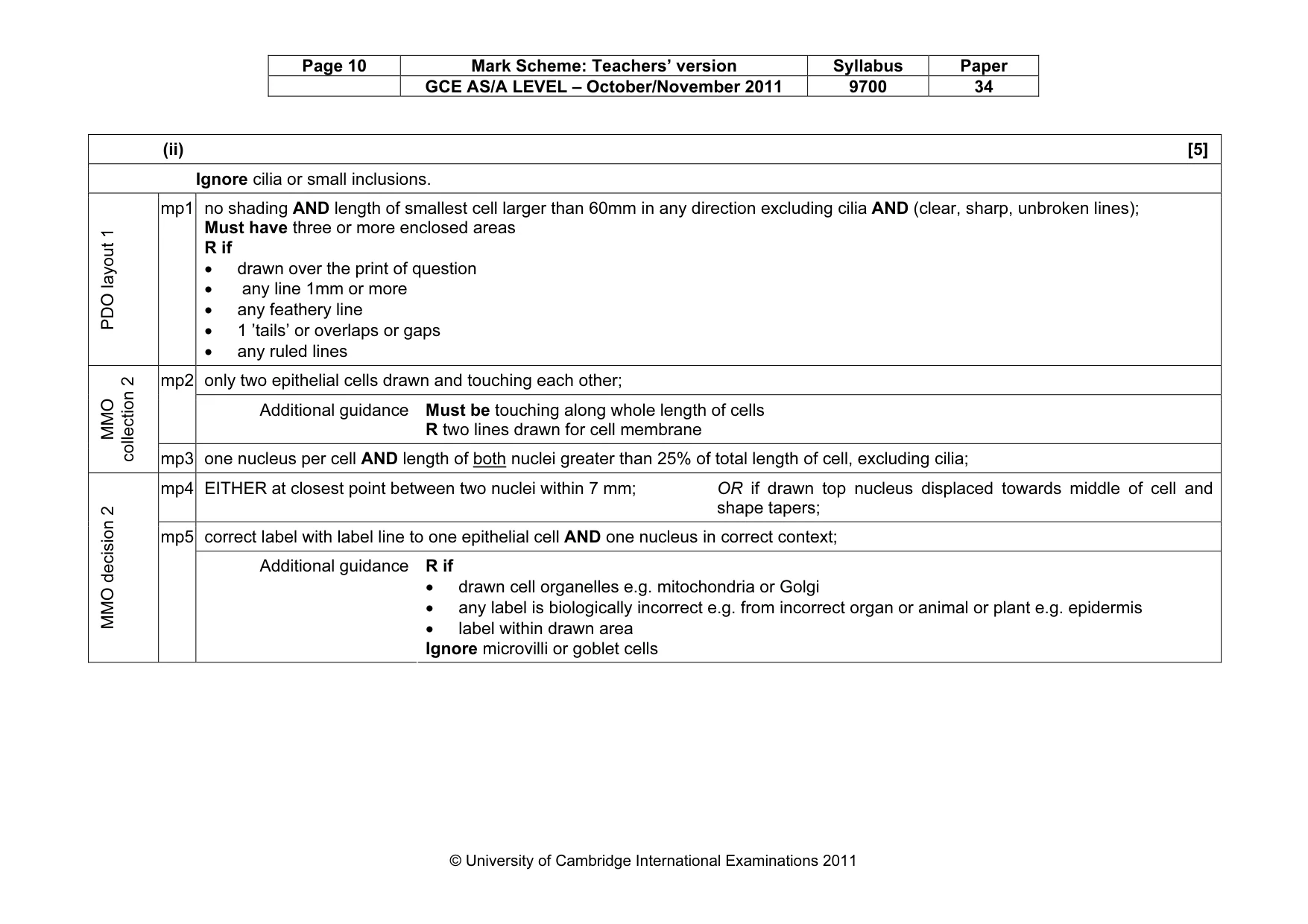
Page 10 Mark Scheme: Teachers’ version Syllabus Paper GCE AS/A LEVEL – October/November 2011 9700 34 © University of Cambridge International Examinations 2011 (ii) [5] Ignore cilia or small inclusions. PDO layout 1 mp1 no shading AND length of smallest cell larger than 60mm in any direction excluding cilia AND (clear, sharp, unbroken lines); Must have three or more enclosed areas R if • drawn over the print of question • any line 1mm or more • any feathery line • 1 ’tails’ or overlaps or gaps • any ruled lines only two epithelial cells drawn and touching each other; mp2 Additional guidance Must be touching along whole length of cells R two lines drawn for cell membrane MMO collection 2 mp3 one nucleus per cell AND length of both nuclei greater than 25% of total length of cell, excluding cilia; mp4 EITHER at closest point between two nuclei within 7 mm; OR if drawn top nucleus displaced towards middle of cell and shape tapers; correct label with label line to one epithelial cell AND one nucleus in correct context; MMO decision 2 mp5 Additional guidance R if • drawn cell organelles e.g. mitochondria or Golgi • any label is biologically incorrect e.g. from incorrect organ or animal or plant e.g. epidermis • label within drawn area Ignore microvilli or goblet cells
Mark scheme, page 11
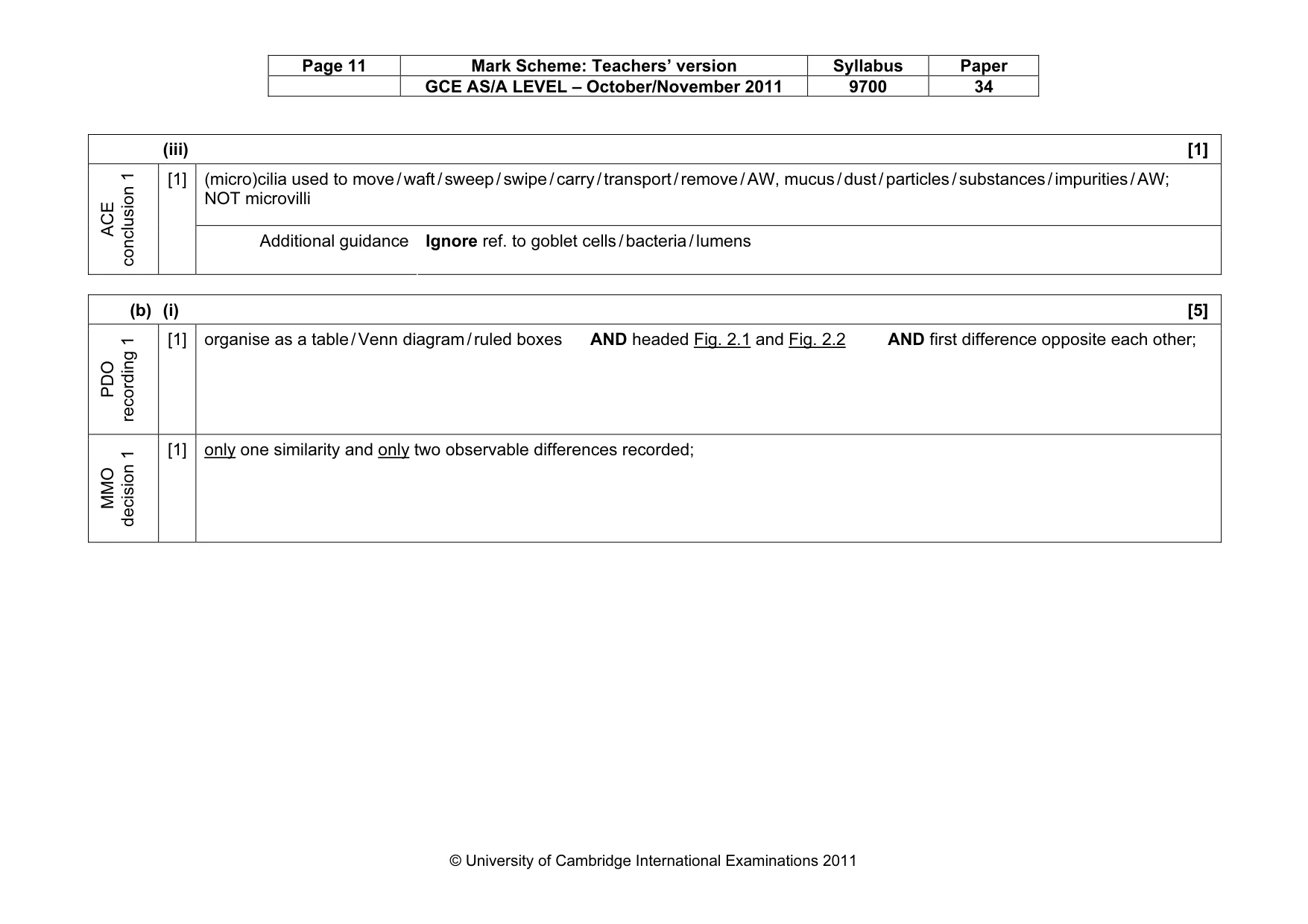
Page 11 Mark Scheme: Teachers’ version Syllabus Paper GCE AS/A LEVEL – October/November 2011 9700 34 © University of Cambridge International Examinations 2011 (iii) [1] (micro)cilia used to move / waft / sweep / swipe / carry / transport / remove / AW, mucus / dust / particles / substances / impurities / AW; NOT microvilli ACE conclusion 1 [1] Additional guidance Ignore ref. to goblet cells / bacteria / lumens (b) (i) [5] PDO recording 1 [1] organise as a table / Venn diagram / ruled boxes AND headed Fig. 2.1 and Fig. 2.2 AND first difference opposite each other; MMO decision 1 [1] only one similarity and only two observable differences recorded;
Mark scheme, page 12
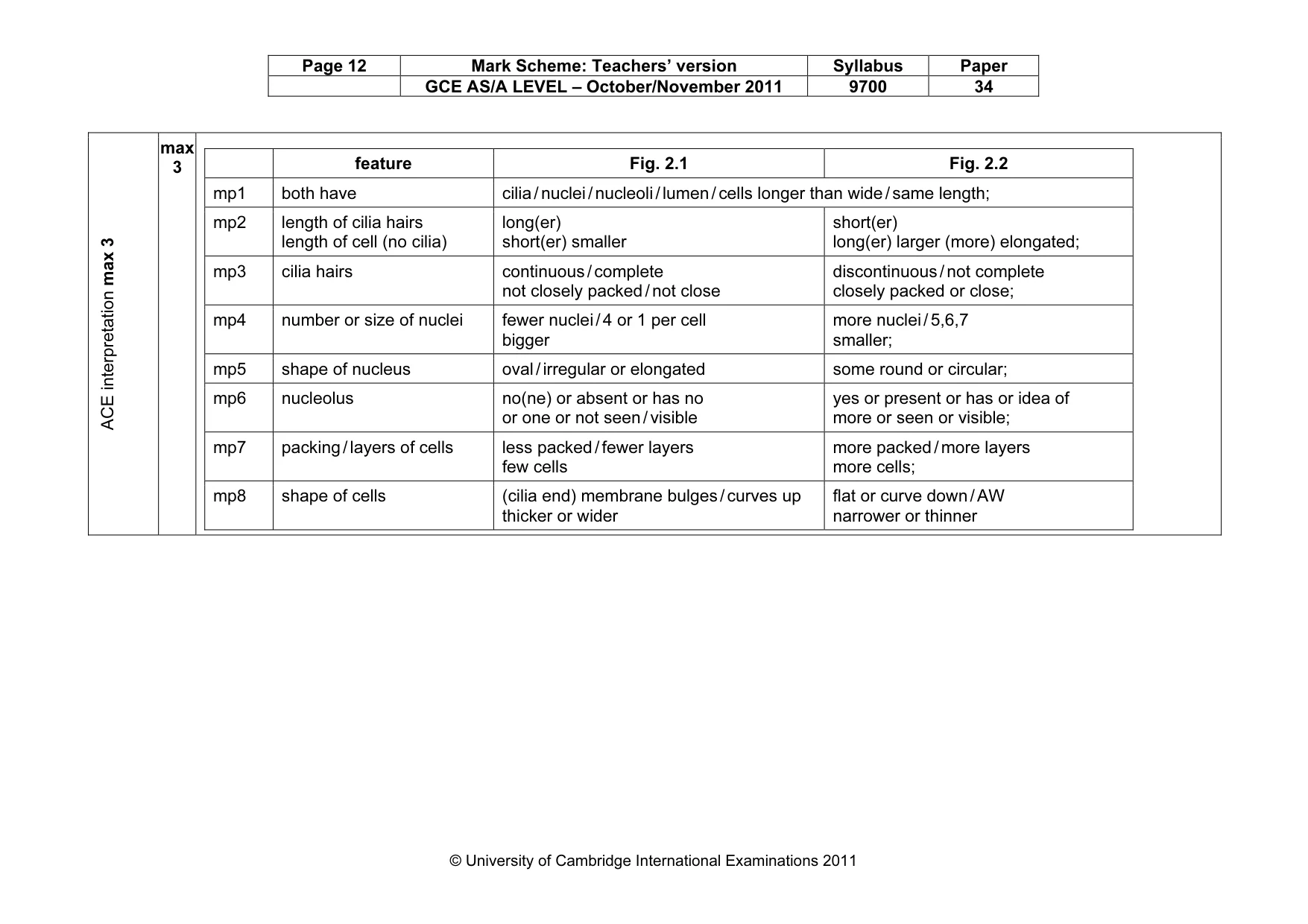
Page 12 Mark Scheme: Teachers’ version Syllabus Paper GCE AS/A LEVEL – October/November 2011 9700 34 © University of Cambridge International Examinations 2011 ACE interpretation max 3 max 3 feature Fig. 2.1 Fig. 2.2 mp1 both have cilia / nuclei / nucleoli / lumen / cells longer than wide / same length; mp2 length of cilia hairs length of cell (no cilia) long(er) short(er) smaller short(er) long(er) larger (more) elongated; mp3 cilia hairs continuous / complete not closely packed / not close discontinuous / not complete closely packed or close; mp4 number or size of nuclei fewer nuclei / 4 or 1 per cell bigger more nuclei / 5,6,7 smaller; mp5 shape of nucleus oval / irregular or elongated some round or circular; mp6 nucleolus no(ne) or absent or has no or one or not seen / visible yes or present or has or idea of more or seen or visible; mp7 packing / layers of cells less packed / fewer layers few cells more packed / more layers more cells; mp8 shape of cells (cilia end) membrane bulges / curves up thicker or wider flat or curve down / AW narrower or thinner
Mark scheme, page 13
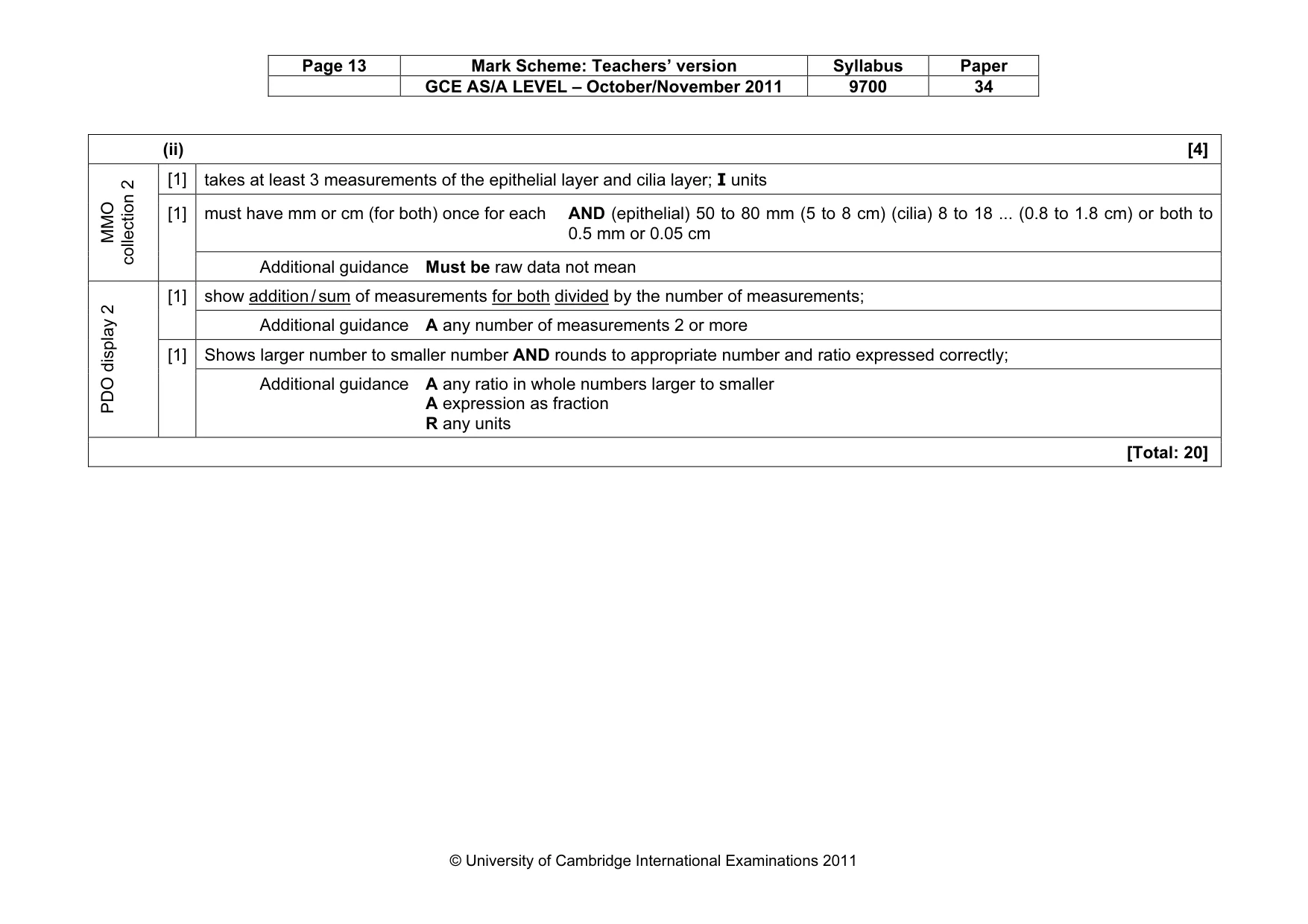
Page 13 Mark Scheme: Teachers’ version Syllabus Paper GCE AS/A LEVEL – October/November 2011 9700 34 © University of Cambridge International Examinations 2011 (ii) [4] [1] takes at least 3 measurements of the epithelial layer and cilia layer; I units must have mm or cm (for both) once for each AND (epithelial) 50 to 80 mm (5 to 8 cm) (cilia) 8 to 18 ... (0.8 to 1.8 cm) or both to 0.5 mm or 0.05 cm MMO collection 2 [1] Additional guidance Must be raw data not mean show addition / sum of measurements for both divided by the number of measurements; [1] Additional guidance A any number of measurements 2 or more Shows larger number to smaller number AND rounds to appropriate number and ratio expressed correctly; PDO display 2 [1] Additional guidance A any ratio in whole numbers larger to smaller A expression as fraction R any units [Total: 20]
What you needed in this session
Cambridge’s own grade thresholds for 2011 Oct/Nov, Paper 3 · Variant 4. A higher threshold means an easier paper — the bar moves with how the cohort did.