Cambridge A Level Biology 9700 — 2011 Oct/Nov Paper 3 · Variant 1
9700/31/O/N/11 · 40 marks · ≈45 min
The question paper and its mark scheme, free to read here and free to download. This is Cambridge’s own paper, exactly as it was sat.
Question paper12 pages
Mark scheme12 pages
Answers below. Sit the paper first if you are practising.
Paper as text
Question paper, page 1
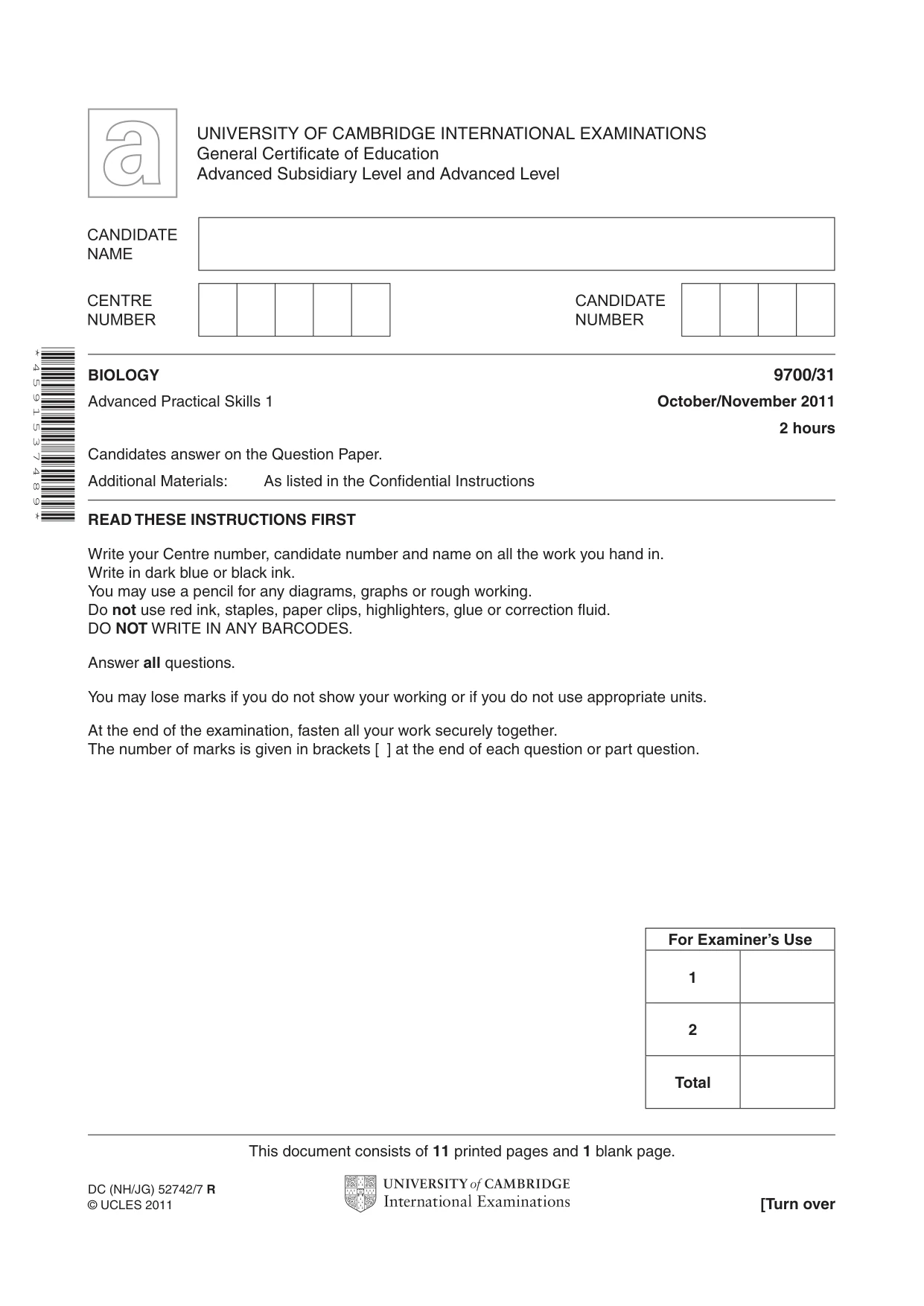
This document consists of 11 printed pages and 1 blank page. DC (NH/JG) 52742/7 R © UCLES 2011 [Turn over UNIVERSITY OF CAMBRIDGE INTERNATIONAL EXAMINATIONS General Certificate of Education Advanced Subsidiary Level and Advanced Level READ THESE INSTRUCTIONS FIRST Write your Centre number, candidate number and name on all the work you hand in. Write in dark blue or black ink. You may use a pencil for any diagrams, graphs or rough working. Do not use red ink, staples, paper clips, highlighters, glue or correction fluid. DO NOT WRITE IN ANY BARCODES. Answer all questions. You may lose marks if you do not show your working or if you do not use appropriate units. At the end of the examination, fasten all your work securely together. The number of marks is given in brackets [ ] at the end of each question or part question. * 4 5 9 1 5 3 7 4 8 9 * BIOLOGY 9700/31 Advanced Practical Skills 1 October/November 2011 2 hours Candidates answer on the Question Paper. Additional Materials: As listed in the Confidential Instructions For Examiner’s Use 1 2 Total
Question paper, page 2
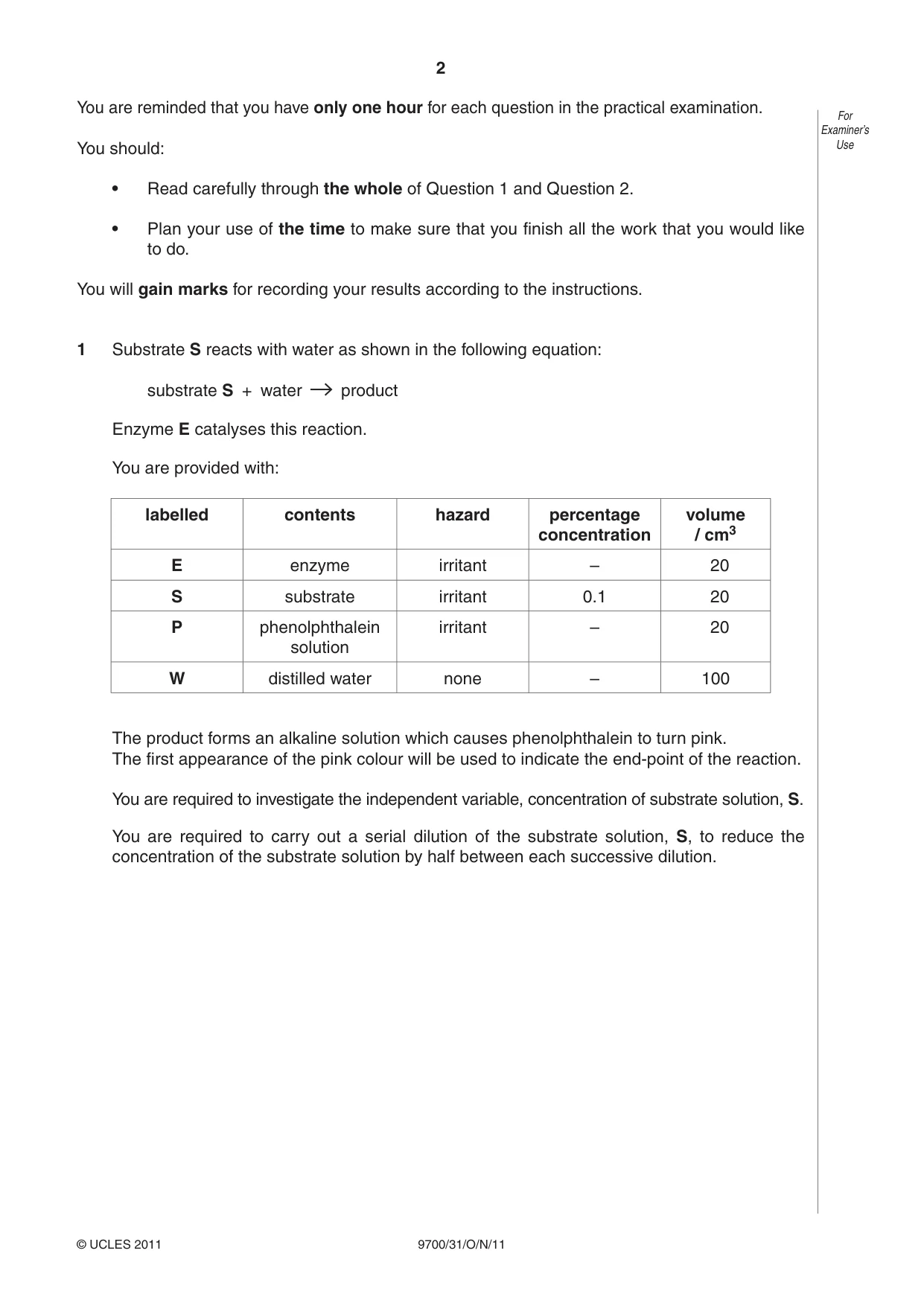
© UCLES 2011 9700/31/O/N/11 For Examiner’s Use You are reminded that you have only one hour for each question in the practical examination. You should: • Read carefully through the whole of Question 1 and Question 2. • Plan your use of the time to make sure that you finish all the work that you would like to do. You will gain marks for recording your results according to the instructions. 1 Substrate S reacts with water as shown in the following equation: substrate S + water product Enzyme E catalyses this reaction. You are provided with: labelled contents hazard percentage concentration volume / cm3 E enzyme irritant – 20 S substrate irritant 0.1 20 P phenolphthalein solution irritant – 20 W distilled water none – 100 The product forms an alkaline solution which causes phenolphthalein to turn pink. The first appearance of the pink colour will be used to indicate the end-point of the reaction. You are required to investigate the independent variable, concentration of substrate solution, S. You are required to carry out a serial dilution of the substrate solution, S, to reduce the concentration of the substrate solution by half between each successive dilution. 2
Question paper, page 3
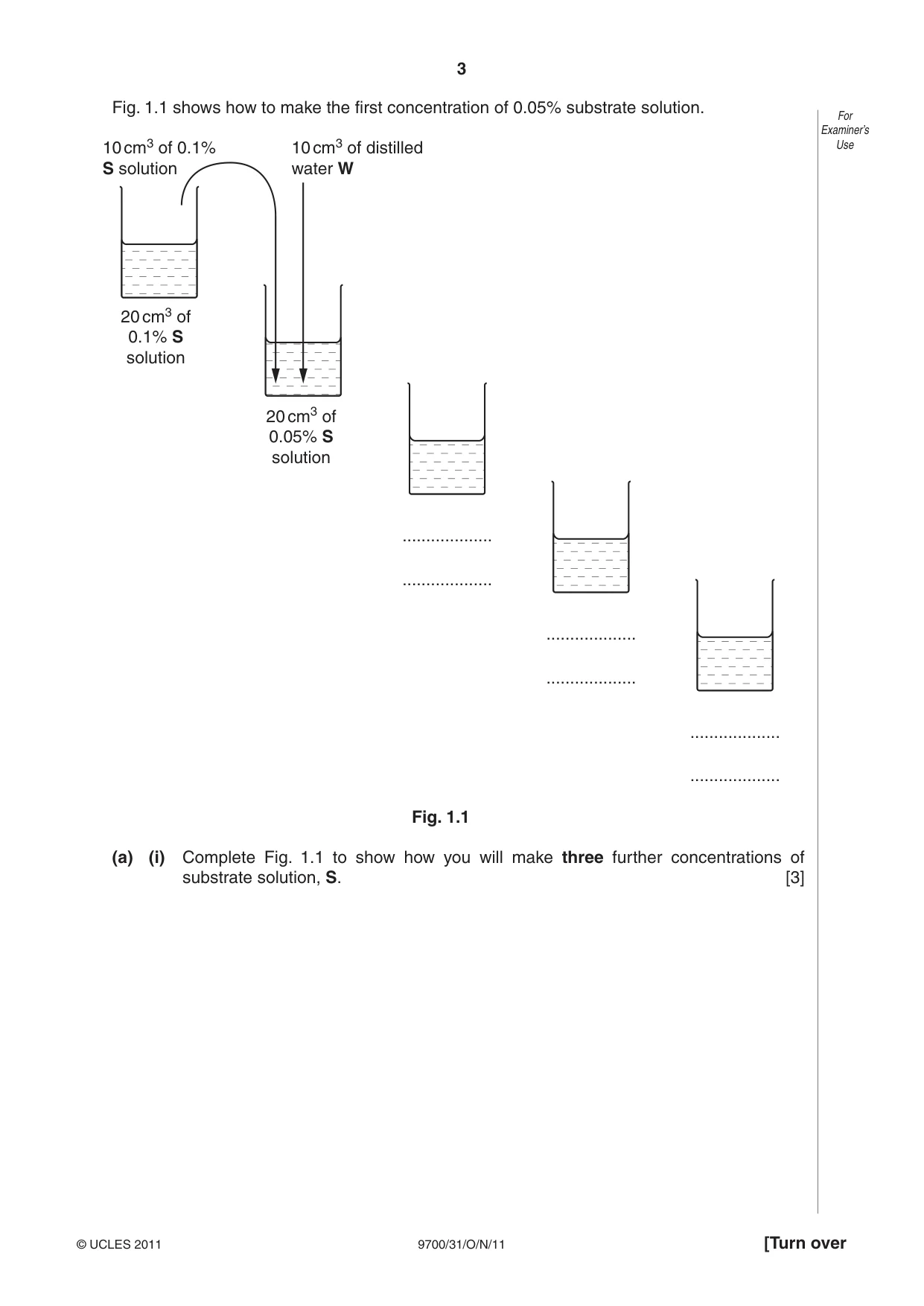
3 [Turn over © UCLES 2011 9700/31/O/N/11 For Examiner’s Use Fig. 1.1 shows how to make the first concentration of 0.05% substrate solution. … … … … … … 10 cm3 of 0.1% S solution 20 cm3 of 0.1% S solution 20 cm3 of 0.05% S solution 10 cm3 of distilled water W Fig. 1.1 (a) (i) Complete Fig. 1.1 to show how you will make three further concentrations of substrate solution, S. [3]
Question paper, page 4
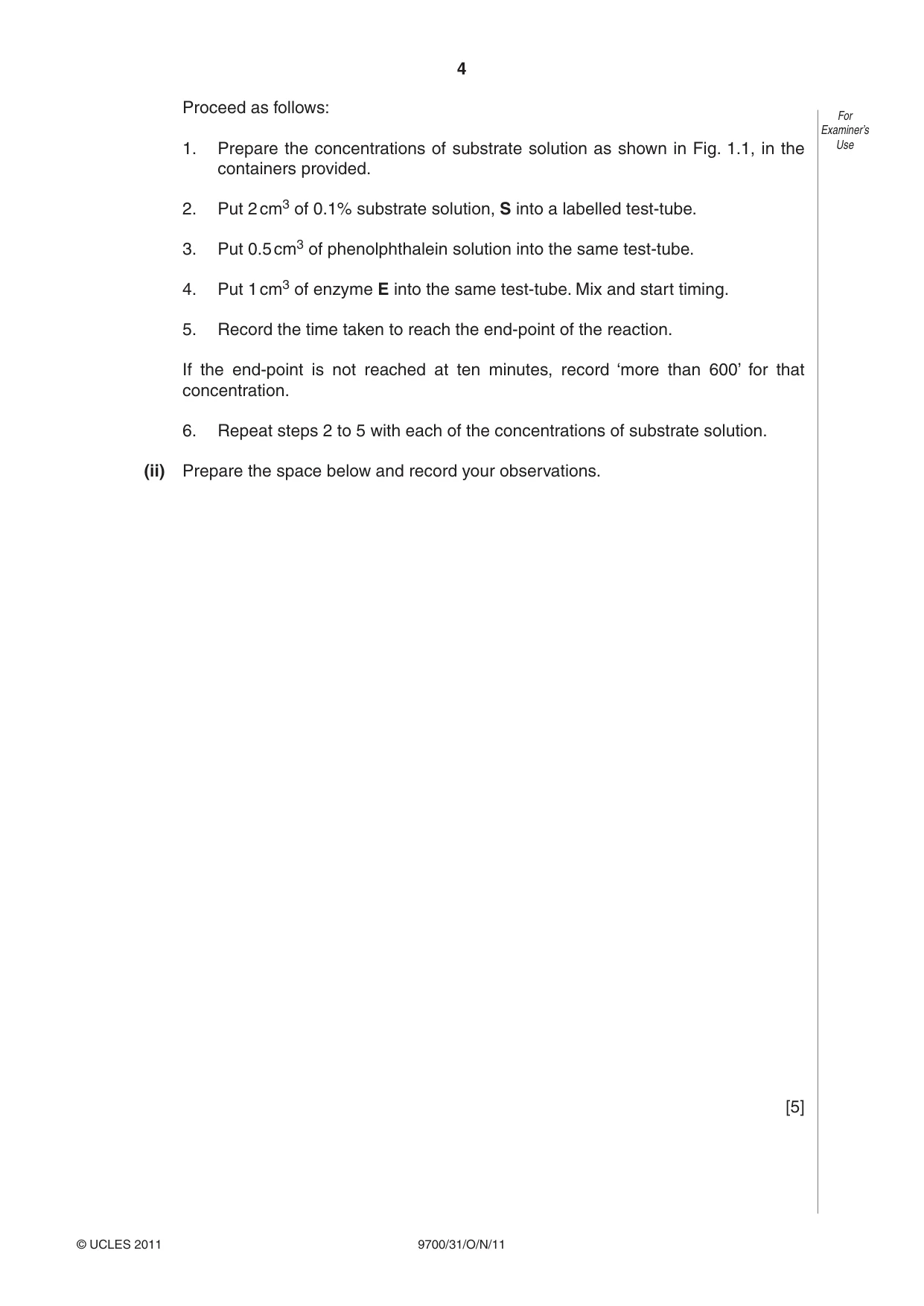
4 © UCLES 2011 9700/31/O/N/11 For Examiner’s Use Proceed as follows: 1. Prepare the concentrations of substrate solution as shown in Fig. 1.1, in the containers provided. 2. Put 2 cm3 of 0.1% substrate solution, S into a labelled test-tube. 3. Put 0.5 cm3 of phenolphthalein solution into the same test-tube. 4. Put 1 cm3 of enzyme E into the same test-tube. Mix and start timing. 5. Record the time taken to reach the end-point of the reaction. If the end-point is not reached at ten minutes, record ‘more than 600’ for that concentration. 6. Repeat steps 2 to 5 with each of the concentrations of substrate solution. (ii) Prepare the space below and record your observations. [5]
Question paper, page 5
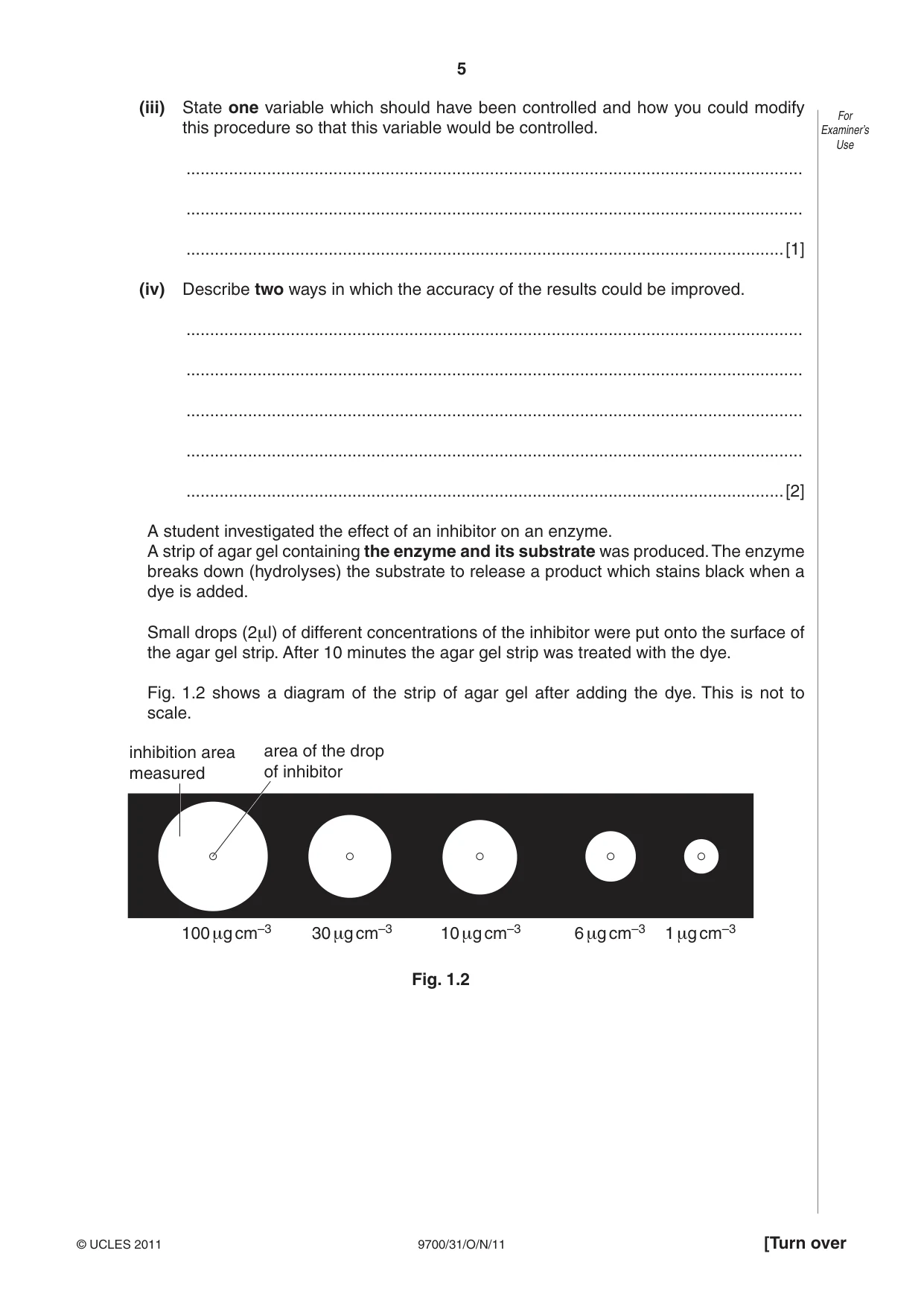
5 [Turn over © UCLES 2011 9700/31/O/N/11 For Examiner’s Use (iii) State one variable which should have been controlled and how you could modify this procedure so that this variable would be controlled. … … …[1] (iv) Describe two ways in which the accuracy of the results could be improved. … … … … …[2] A student investigated the effect of an inhibitor on an enzyme. A strip of agar gel containing the enzyme and its substrate was produced. The enzyme breaks down (hydrolyses) the substrate to release a product which stains black when a dye is added. Small drops (2μl) of different concentrations of the inhibitor were put onto the surface of the agar gel strip. After 10 minutes the agar gel strip was treated with the dye. Fig. 1.2 shows a diagram of the strip of agar gel after adding the dye. This is not to scale. 100 μg cm–3 30 μg cm–3 10 μg cm–3 6 μg cm–3 1 μg cm–3 area of the drop of inhibitor inhibition area measured Fig. 1.2
Question paper, page 6
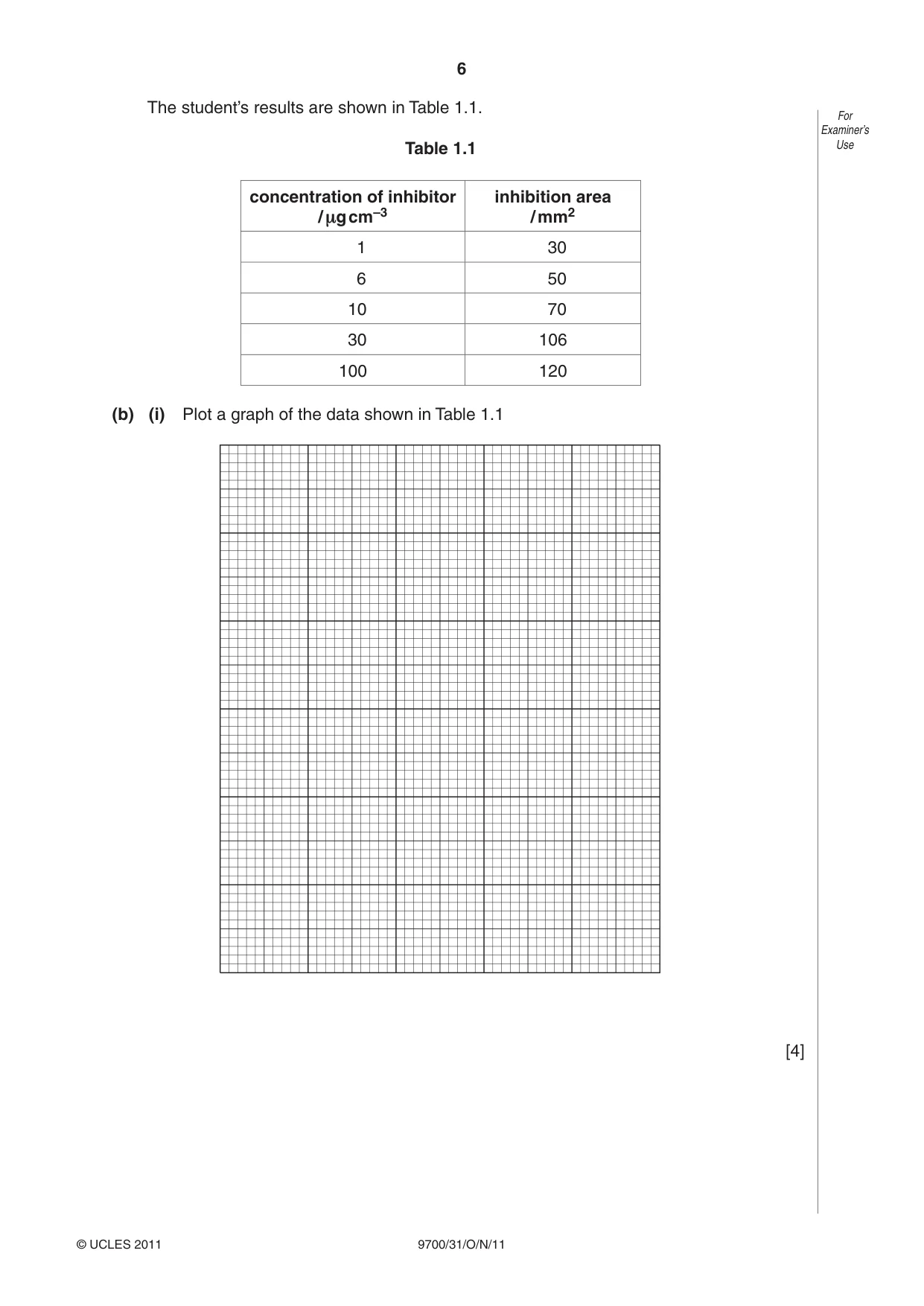
6 © UCLES 2011 9700/31/O/N/11 For Examiner’s Use The student’s results are shown in Table 1.1. Table 1.1 concentration of inhibitor / μg cm–3 inhibition area / mm2 1 30 6 50 10 70 30 106 100 120 (b) (i) Plot a graph of the data shown in Table 1.1 [4]
Question paper, page 7
7 [Turn over © UCLES 2011 9700/31/O/N/11 For Examiner’s Use (ii) Estimate the concentration of inhibitor which would produce an inhibition area of 100 mm2. Show on your graph where you obtained the estimate. concentration … μg cm–3 [1] (iii) Describe the trend shown in your graph. … … … … …[2] (iv) Explain the effect of changing the concentration of the inhibitor. … … … … …[2] [Total: 20]
Question paper, page 8
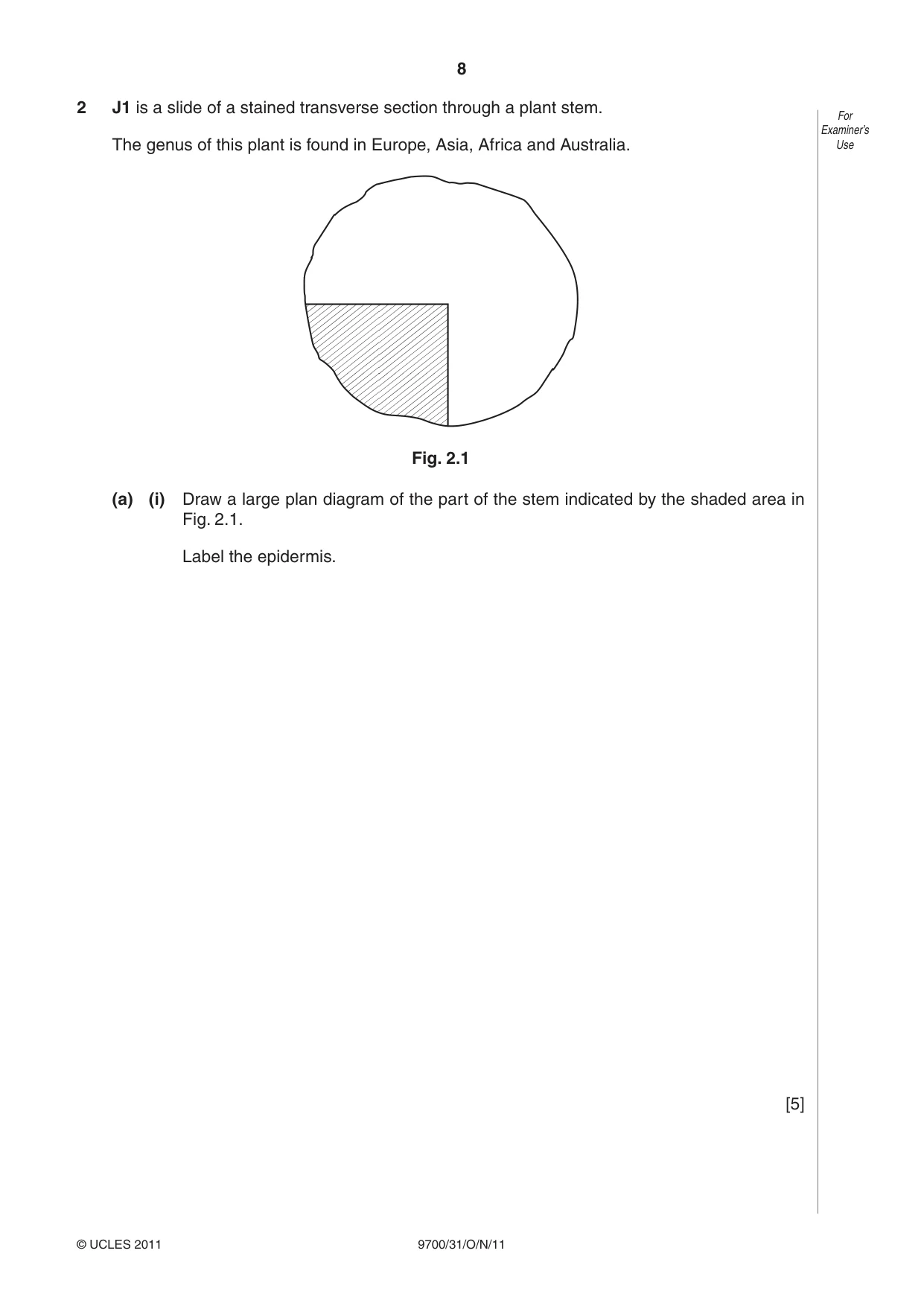
8 © UCLES 2011 9700/31/O/N/11 For Examiner’s Use 2 J1 is a slide of a stained transverse section through a plant stem. The genus of this plant is found in Europe, Asia, Africa and Australia. Fig. 2.1 (a) (i) Draw a large plan diagram of the part of the stem indicated by the shaded area in Fig. 2.1. Label the epidermis. [5]
Question paper, page 9
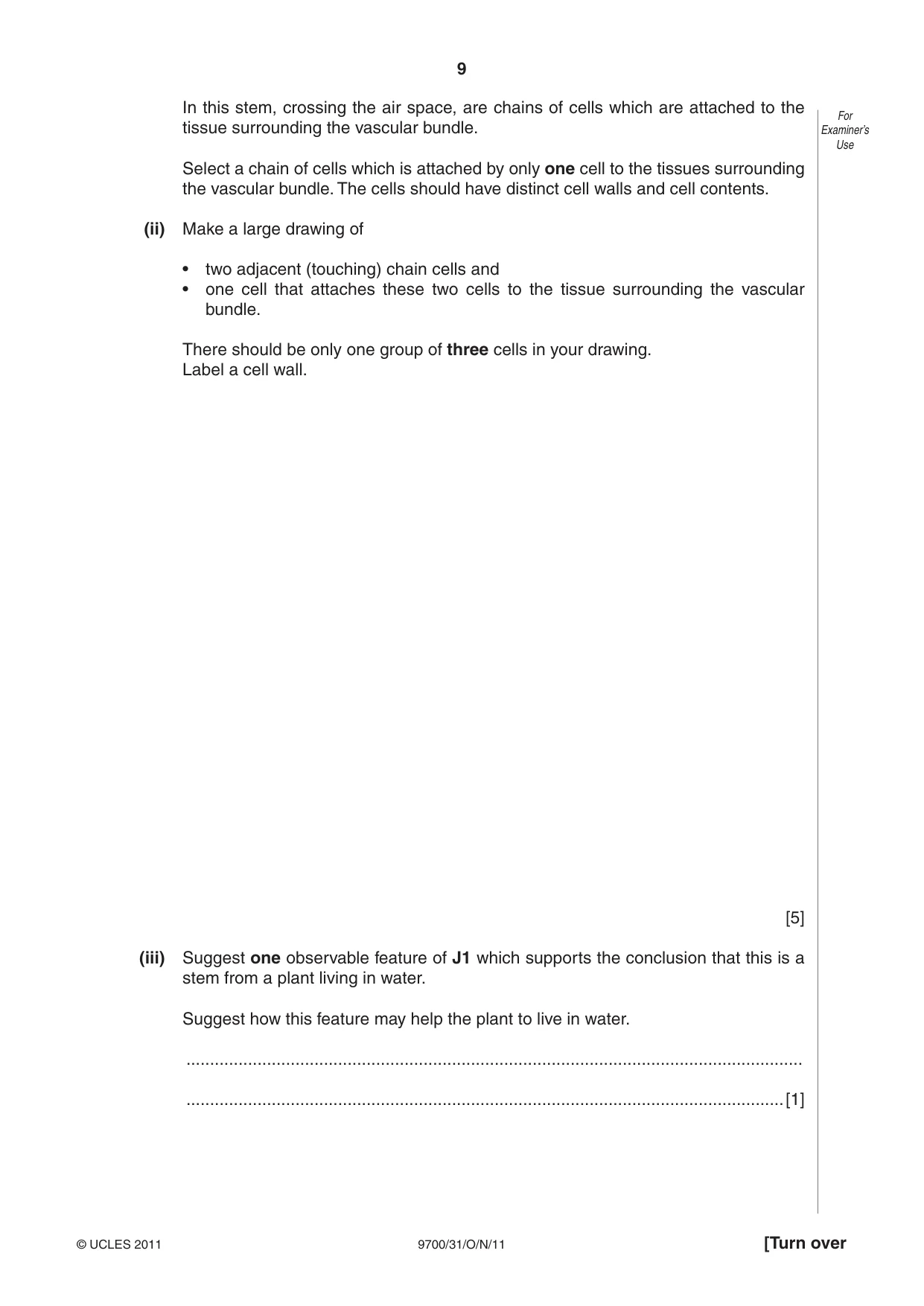
9 [Turn over © UCLES 2011 9700/31/O/N/11 For Examiner’s Use In this stem, crossing the air space, are chains of cells which are attached to the tissue surrounding the vascular bundle. Select a chain of cells which is attached by only one cell to the tissues surrounding the vascular bundle. The cells should have distinct cell walls and cell contents. (ii) Make a large drawing of • two adjacent (touching) chain cells and • one cell that attaches these two cells to the tissue surrounding the vascular bundle. There should be only one group of three cells in your drawing. Label a cell wall. [5] (iii) Suggest one observable feature of J1 which supports the conclusion that this is a stem from a plant living in water. Suggest how this feature may help the plant to live in water. … …[1]
Question paper, page 10
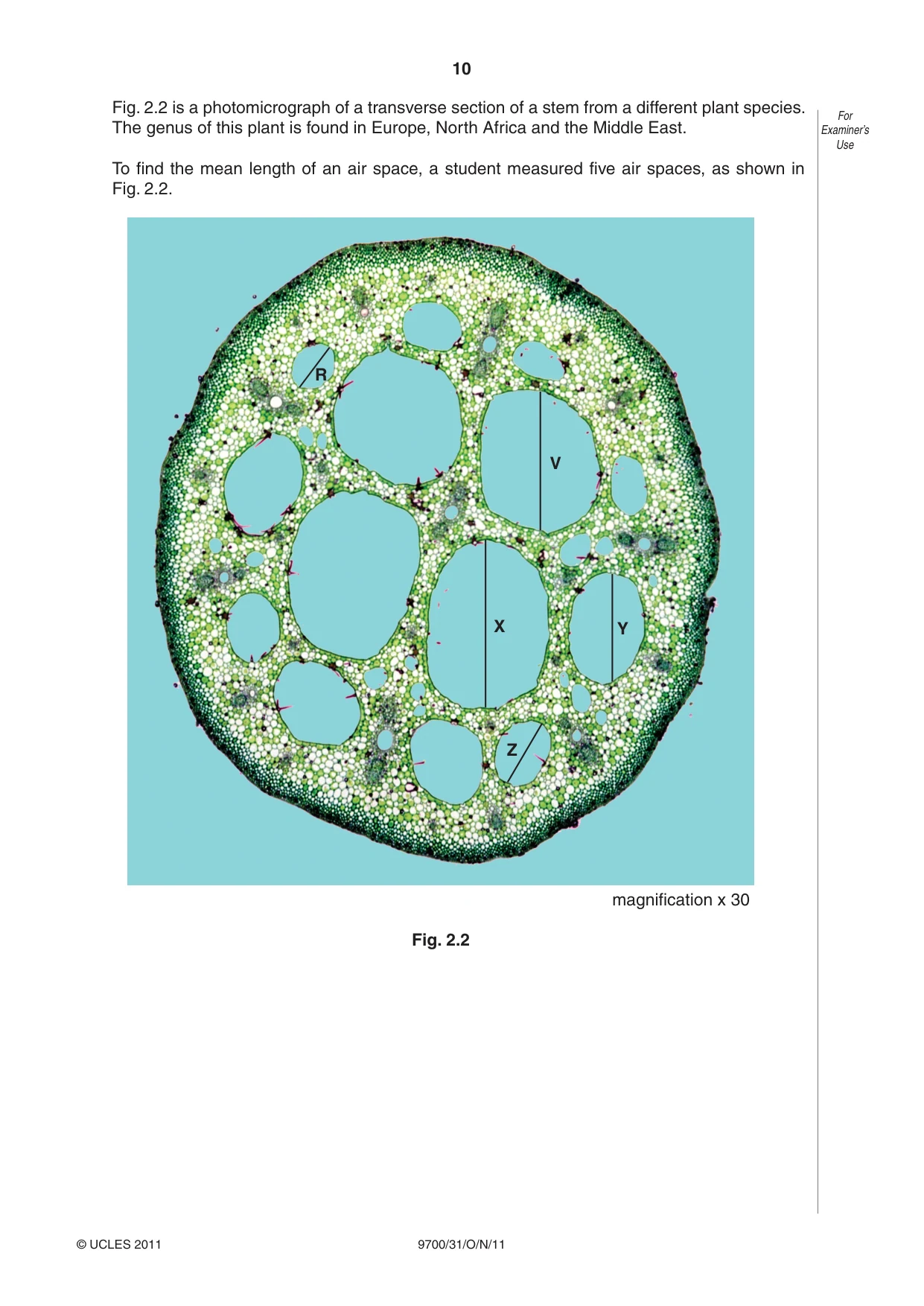
10 © UCLES 2011 9700/31/O/N/11 For Examiner’s Use Fig. 2.2 is a photomicrograph of a transverse section of a stem from a different plant species. The genus of this plant is found in Europe, North Africa and the Middle East. To find the mean length of an air space, a student measured five air spaces, as shown in Fig. 2.2. V R X Y Z magnification x 30 Fig. 2.2
Question paper, page 11
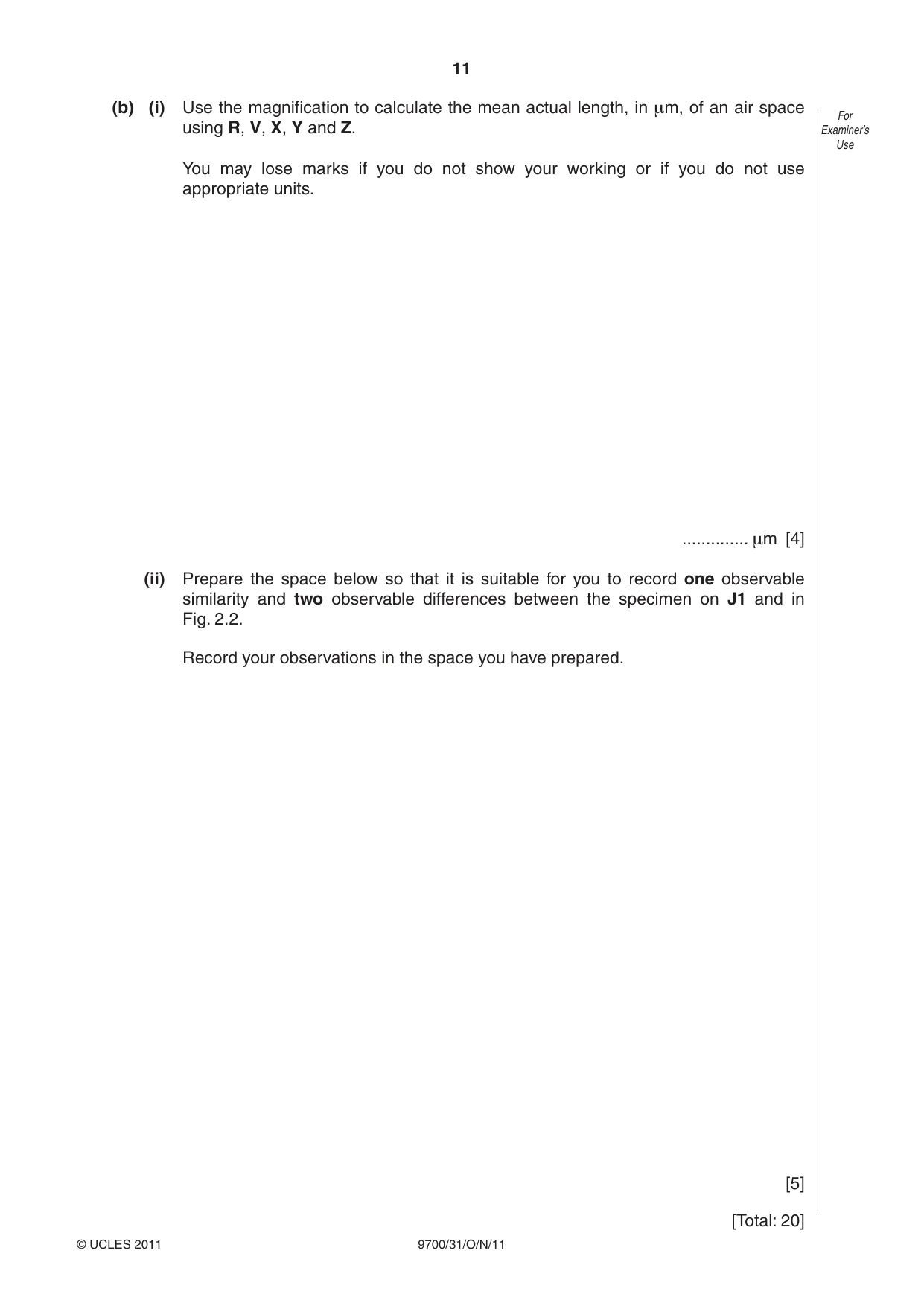
11 © UCLES 2011 9700/31/O/N/11 For Examiner’s Use (b) (i) Use the magnification to calculate the mean actual length, in μm, of an air space using R, V, X, Y and Z. You may lose marks if you do not show your working or if you do not use appropriate units. … μm [4] (ii) Prepare the space below so that it is suitable for you to record one observable similarity and two observable differences between the specimen on J1 and in Fig. 2.2. Record your observations in the space you have prepared. [5] [Total: 20]
Question paper, page 12
12 9700/31/O/N/11 © UCLES 2011 BLANK PAGE Copyright Acknowledgements: Question 2, Fig. 2.2 DR. KEITH WHEELER/SCIENCE PHOTO LIBRARY Permission to reproduce items where third-party owned material protected by copyright is included has been sought and cleared where possible. Every reasonable effort has been made by the publisher (UCLES) to trace copyright holders, but if any items requiring clearance have unwittingly been included, the publisher will be pleased to make amends at the earliest possible opportunity. University of Cambridge International Examinations is part of the Cambridge Assessment Group. Cambridge Assessment is the brand name of University of Cambridge Local Examinations Syndicate (UCLES), which is itself a department of the University of Cambridge.
Mark scheme, page 1
UNIVERSITY OF CAMBRIDGE INTERNATIONAL EXAMINATIONS GCE Advanced Subsidiary Level and GCE Advanced Level MARK SCHEME for the October/November 2011 question paper for the guidance of teachers 9700 BIOLOGY 9700/31 Paper 3 (Advanced Practical Skills 1), maximum raw mark 40 This mark scheme is published as an aid to teachers and candidates, to indicate the requirements of the examination. It shows the basis on which Examiners were instructed to award marks. It does not indicate the details of the discussions that took place at an Examiners’ meeting before marking began, which would have considered the acceptability of alternative answers. Mark schemes must be read in conjunction with the question papers and the report on the examination. • Cambridge will not enter into discussions or correspondence in connection with these mark schemes. Cambridge is publishing the mark schemes for the October/November 2011 question papers for most IGCSE, GCE Advanced Level and Advanced Subsidiary Level syllabuses and some Ordinary Level syllabuses.
Mark scheme, page 2
Page 2 Mark Scheme: Teachers’ version Syllabus Paper GCE AS/A LEVEL – October/November 2011 9700 31 © University of Cambridge International Examinations 2011 Mark scheme abbreviations: ; separates marking points / alternative answers for the same point R reject A accept (for answers correctly cued by the question, or by extra guidance) AW alternative wording (where responses vary more than usual) underline actual word given must be used by candidate (grammatical variants excepted) max indicates the maximum number of marks that can be given ora or reverse argument mp marking point (with relevant number) ecf error carried forward I ignore ACE Analysis, Conclusions and Evaluation (skills) MMO Manipulations, Measurement and Observation (skills) PDO Presentation of Data and Observations (skills)
Mark scheme, page 3
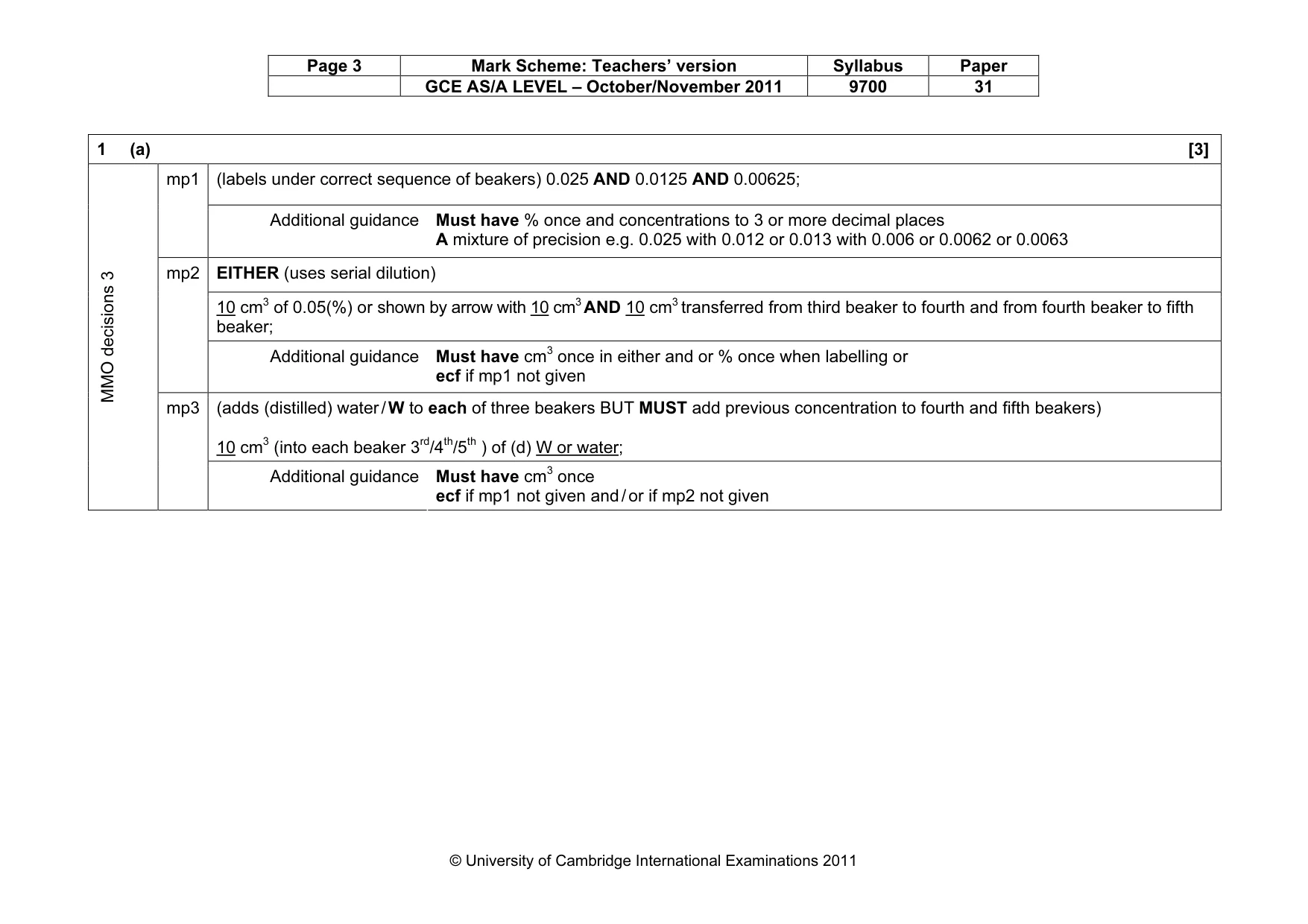
Page 3 Mark Scheme: Teachers’ version Syllabus Paper GCE AS/A LEVEL – October/November 2011 9700 31 © University of Cambridge International Examinations 2011 1 (a) [3] (labels under correct sequence of beakers) 0.025 AND 0.0125 AND 0.00625; mp1 Additional guidance Must have % once and concentrations to 3 or more decimal places A mixture of precision e.g. 0.025 with 0.012 or 0.013 with 0.006 or 0.0062 or 0.0063 EITHER (uses serial dilution) 10 cm3 of 0.05(%) or shown by arrow with 10 cm3 AND 10 cm3 transferred from third beaker to fourth and from fourth beaker to fifth beaker; mp2 Additional guidance Must have cm3 once in either and or % once when labelling or ecf if mp1 not given (adds (distilled) water / W to each of three beakers BUT MUST add previous concentration to fourth and fifth beakers) 10 cm3 (into each beaker 3rd/4th/5th ) of (d) W or water; MMO decisions 3 mp3 Additional guidance Must have cm3 once ecf if mp1 not given and / or if mp2 not given
Mark scheme, page 4
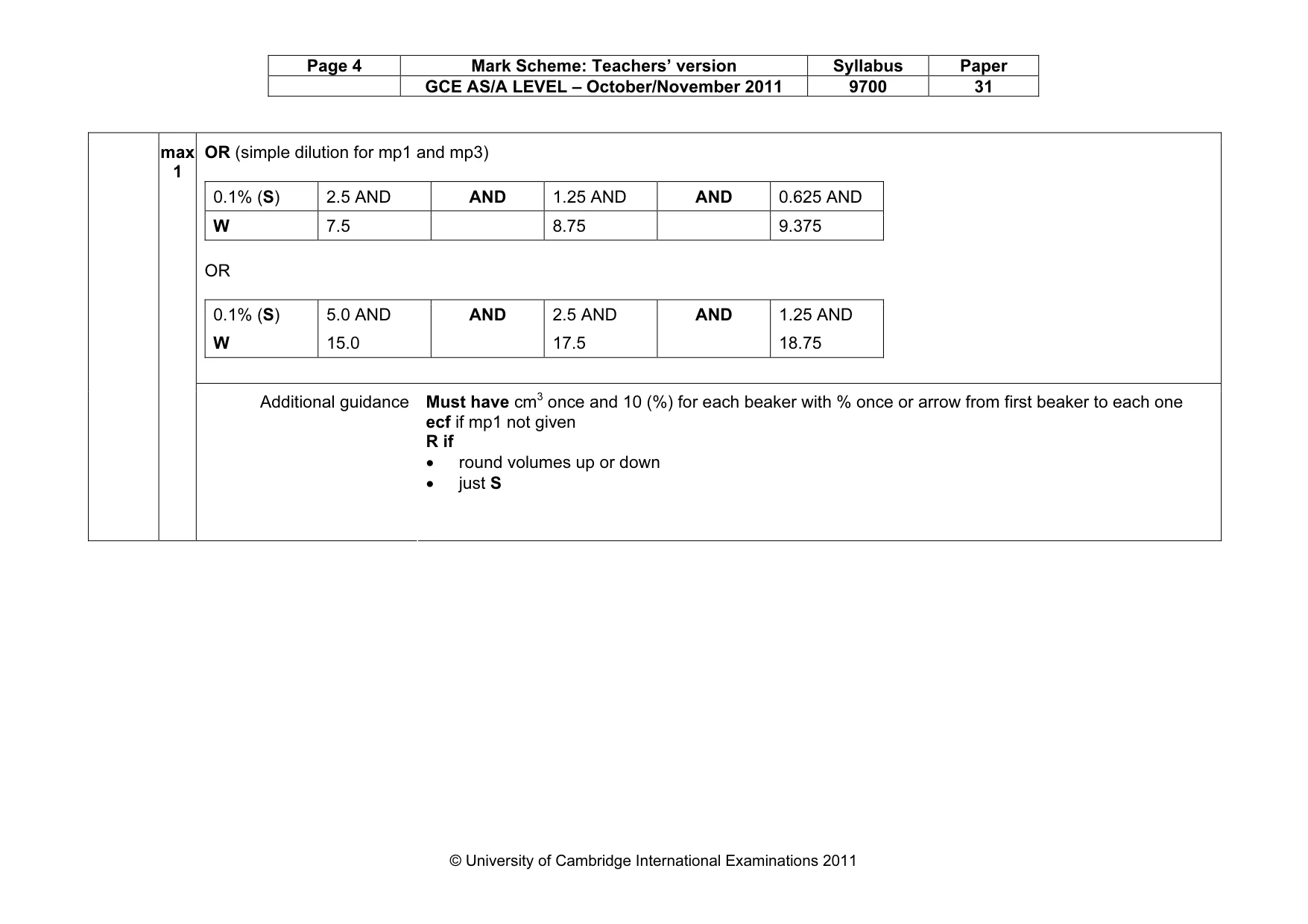
Page 4 Mark Scheme: Teachers’ version Syllabus Paper GCE AS/A LEVEL – October/November 2011 9700 31 © University of Cambridge International Examinations 2011 OR (simple dilution for mp1 and mp3) 0.1% (S) 2.5 AND AND 1.25 AND AND 0.625 AND W 7.5 8.75 9.375 OR 0.1% (S) 5.0 AND AND 2.5 AND AND 1.25 AND W 15.0 17.5 18.75 max 1 Additional guidance Must have cm3 once and 10 (%) for each beaker with % once or arrow from first beaker to each one ecf if mp1 not given R if • round volumes up or down • just S
Mark scheme, page 5
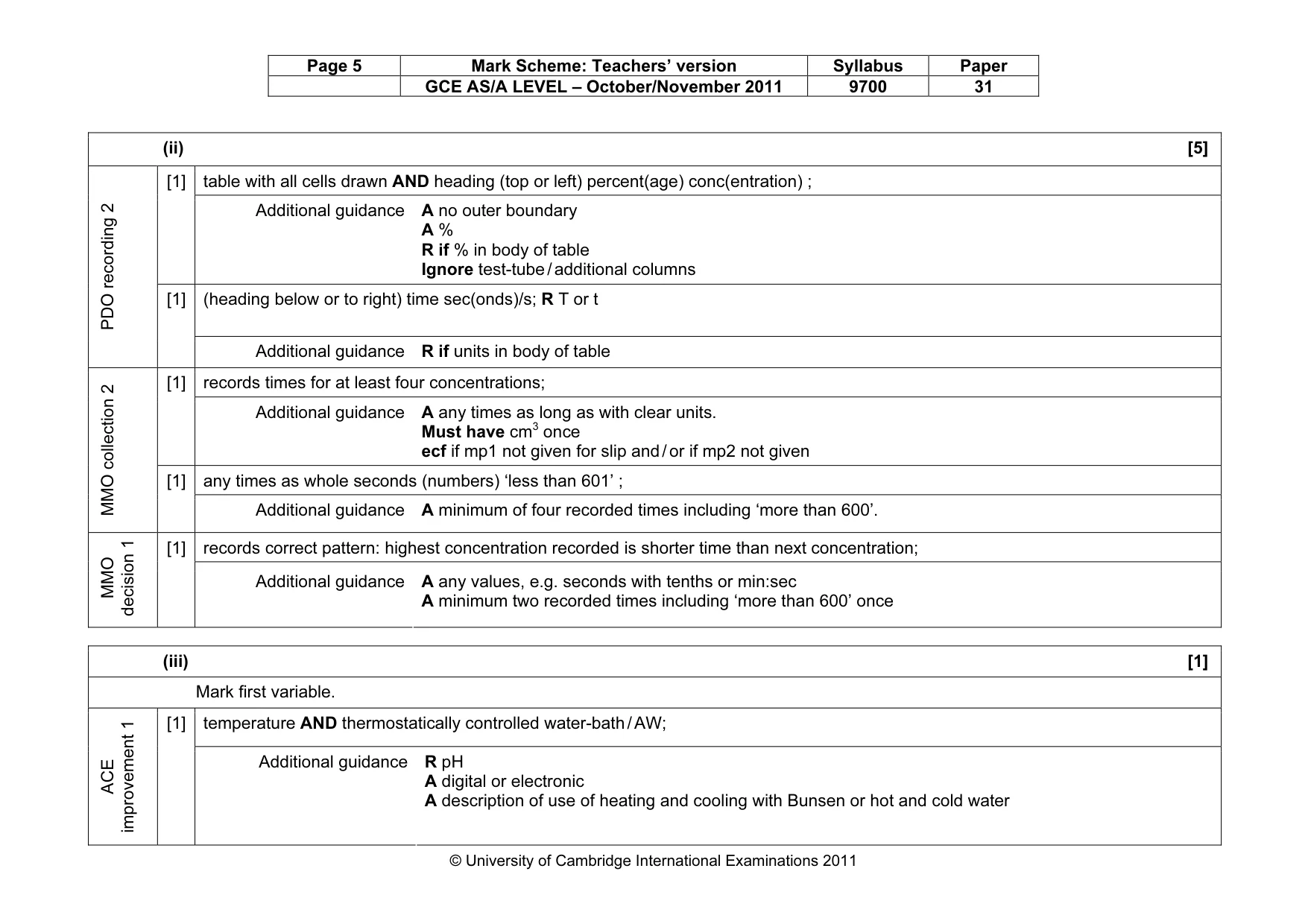
Page 5 Mark Scheme: Teachers’ version Syllabus Paper GCE AS/A LEVEL – October/November 2011 9700 31 © University of Cambridge International Examinations 2011 (ii) [5] table with all cells drawn AND heading (top or left) percent(age) conc(entration) ; [1] Additional guidance A no outer boundary A % R if % in body of table Ignore test-tube / additional columns (heading below or to right) time sec(onds)/s; R T or t PDO recording 2 [1] Additional guidance R if units in body of table records times for at least four concentrations; [1] Additional guidance A any times as long as with clear units. Must have cm3 once ecf if mp1 not given for slip and / or if mp2 not given any times as whole seconds (numbers) ‘less than 601’ ; MMO collection 2 [1] Additional guidance A minimum of four recorded times including ‘more than 600’. records correct pattern: highest concentration recorded is shorter time than next concentration; MMO decision 1 [1] Additional guidance A any values, e.g. seconds with tenths or min:sec A minimum two recorded times including ‘more than 600’ once (iii) [1] Mark first variable. temperature AND thermostatically controlled water-bath / AW; ACE improvement 1 [1] Additional guidance R pH A digital or electronic A description of use of heating and cooling with Bunsen or hot and cold water
Mark scheme, page 6
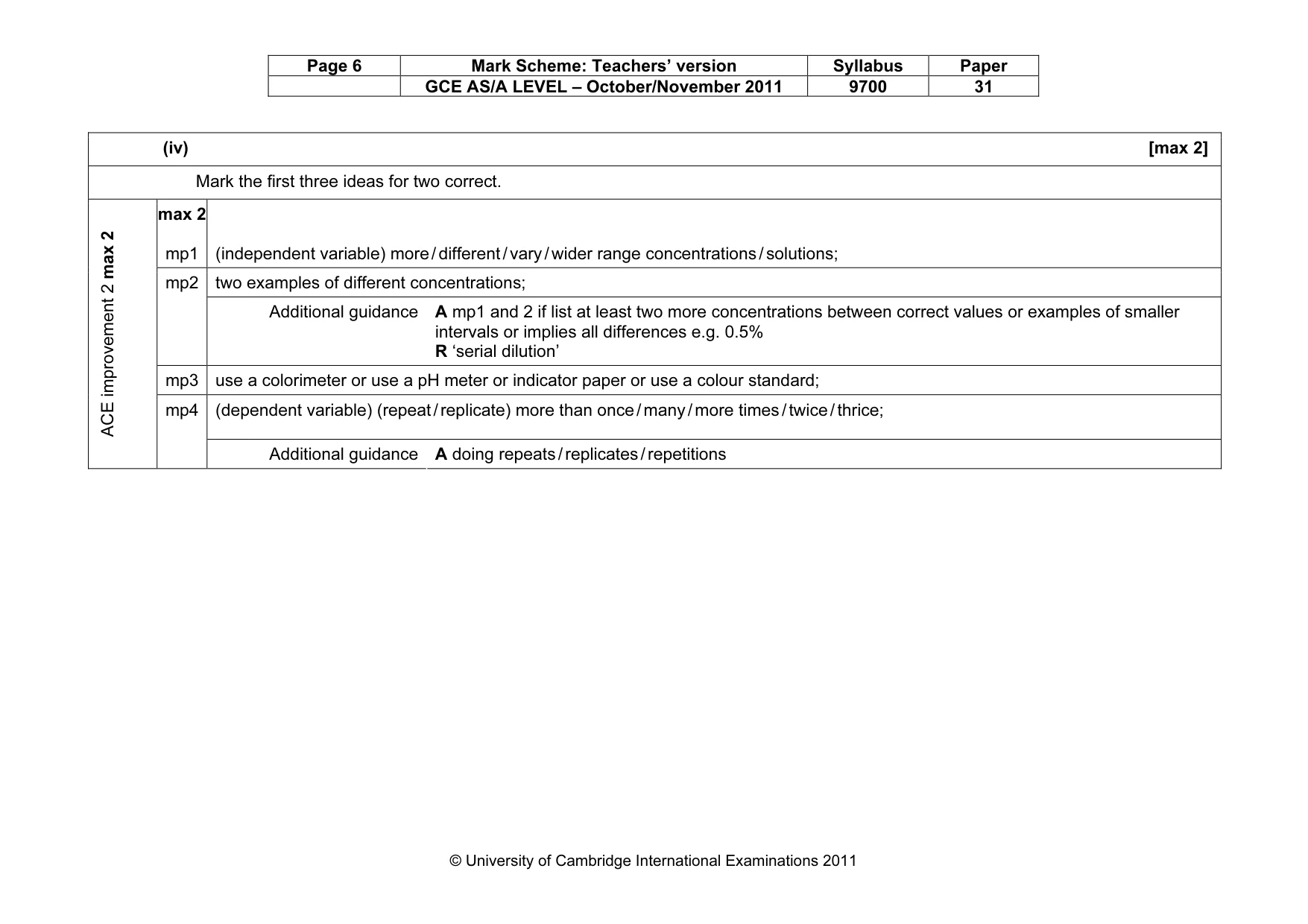
Page 6 Mark Scheme: Teachers’ version Syllabus Paper GCE AS/A LEVEL – October/November 2011 9700 31 © University of Cambridge International Examinations 2011 (iv) [max 2] Mark the first three ideas for two correct. max 2 mp1 (independent variable) more / different / vary / wider range concentrations / solutions; two examples of different concentrations; mp2 Additional guidance A mp1 and 2 if list at least two more concentrations between correct values or examples of smaller intervals or implies all differences e.g. 0.5% R ‘serial dilution’ mp3 use a colorimeter or use a pH meter or indicator paper or use a colour standard; (dependent variable) (repeat / replicate) more than once / many / more times / twice / thrice; ACE improvement 2 max 2 mp4 Additional guidance A doing repeats / replicates / repetitions
Mark scheme, page 7
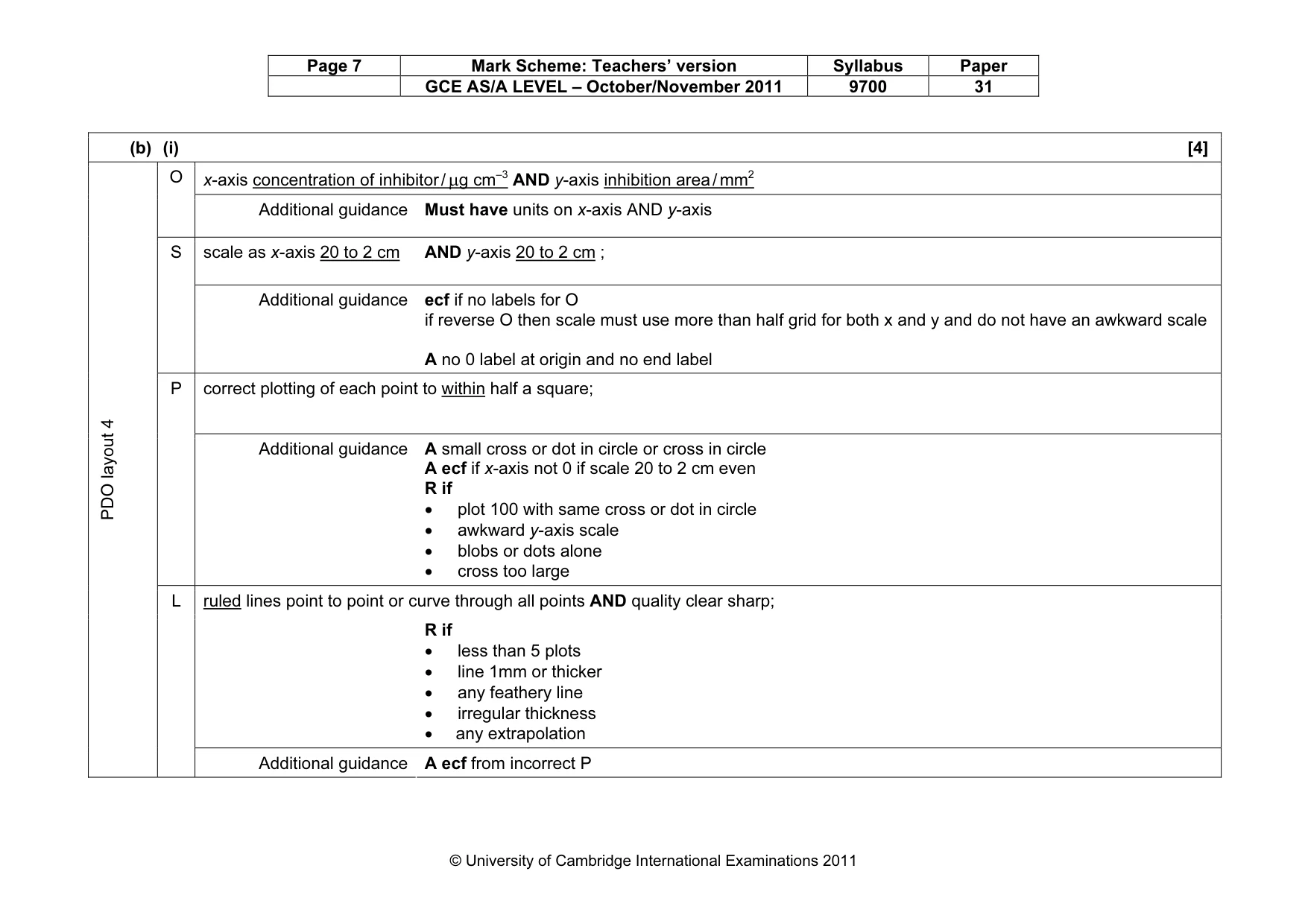
Page 7 Mark Scheme: Teachers’ version Syllabus Paper GCE AS/A LEVEL – October/November 2011 9700 31 © University of Cambridge International Examinations 2011 (b) (i) [4] x-axis concentration of inhibitor / µg cm–3 AND y-axis inhibition area / mm2 O Additional guidance Must have units on x-axis AND y-axis scale as x-axis 20 to 2 cm AND y-axis 20 to 2 cm ; S Additional guidance ecf if no labels for O if reverse O then scale must use more than half grid for both x and y and do not have an awkward scale A no 0 label at origin and no end label correct plotting of each point to within half a square; P Additional guidance A small cross or dot in circle or cross in circle A ecf if x-axis not 0 if scale 20 to 2 cm even R if • plot 100 with same cross or dot in circle • awkward y-axis scale • blobs or dots alone • cross too large ruled lines point to point or curve through all points AND quality clear sharp; R if • less than 5 plots • line 1mm or thicker • any feathery line • irregular thickness • any extrapolation PDO layout 4 L Additional guidance A ecf from incorrect P
Mark scheme, page 8
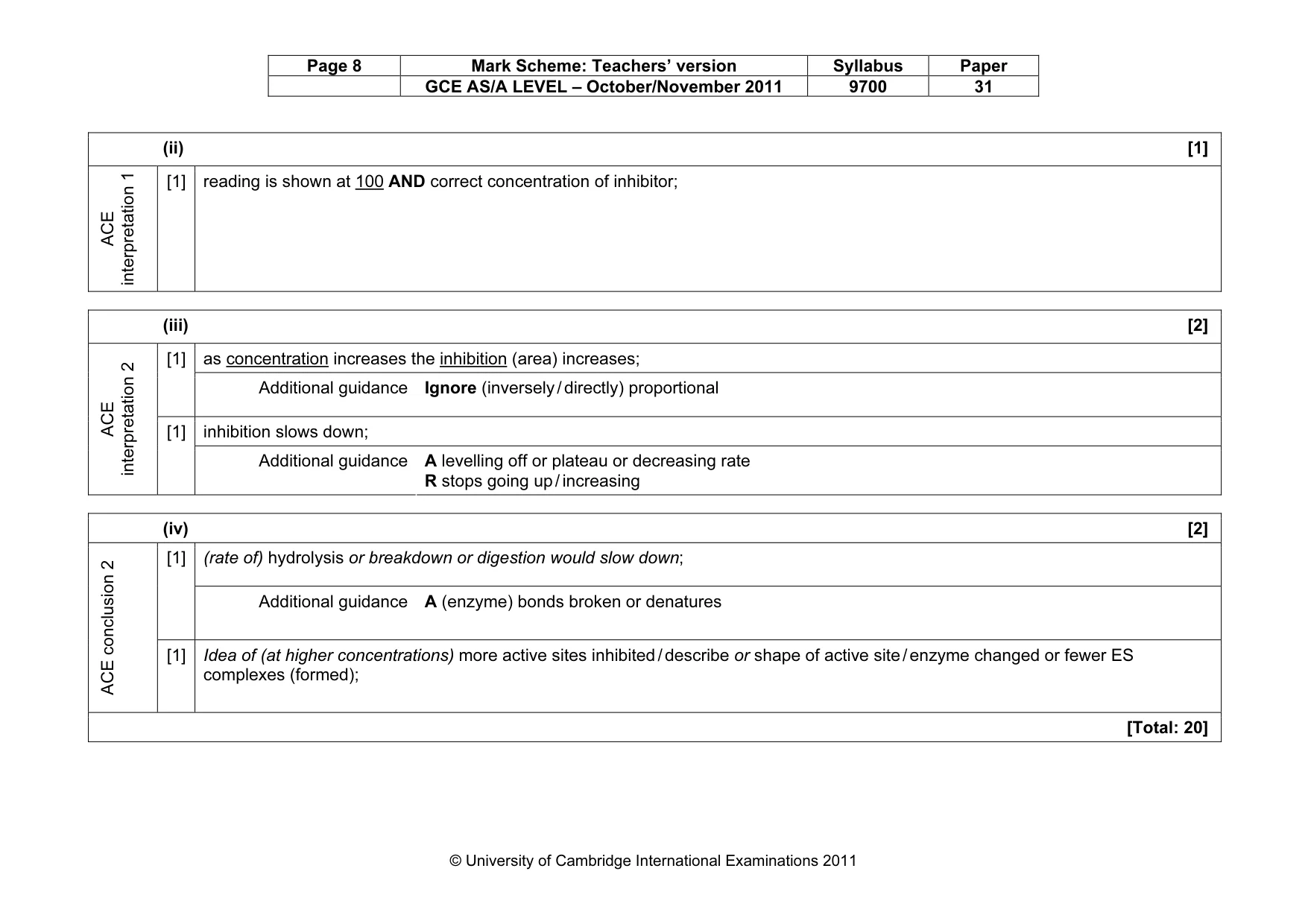
Page 8 Mark Scheme: Teachers’ version Syllabus Paper GCE AS/A LEVEL – October/November 2011 9700 31 © University of Cambridge International Examinations 2011 (ii) [1] ACE interpretation 1 [1] reading is shown at 100 AND correct concentration of inhibitor; (iii) [2] as concentration increases the inhibition (area) increases; [1] Additional guidance Ignore (inversely / directly) proportional inhibition slows down; ACE interpretation 2 [1] Additional guidance A levelling off or plateau or decreasing rate R stops going up / increasing (iv) [2] (rate of) hydrolysis or breakdown or digestion would slow down; [1] Additional guidance A (enzyme) bonds broken or denatures ACE conclusion 2 [1] Idea of (at higher concentrations) more active sites inhibited / describe or shape of active site / enzyme changed or fewer ES complexes (formed); [Total: 20]
Mark scheme, page 9
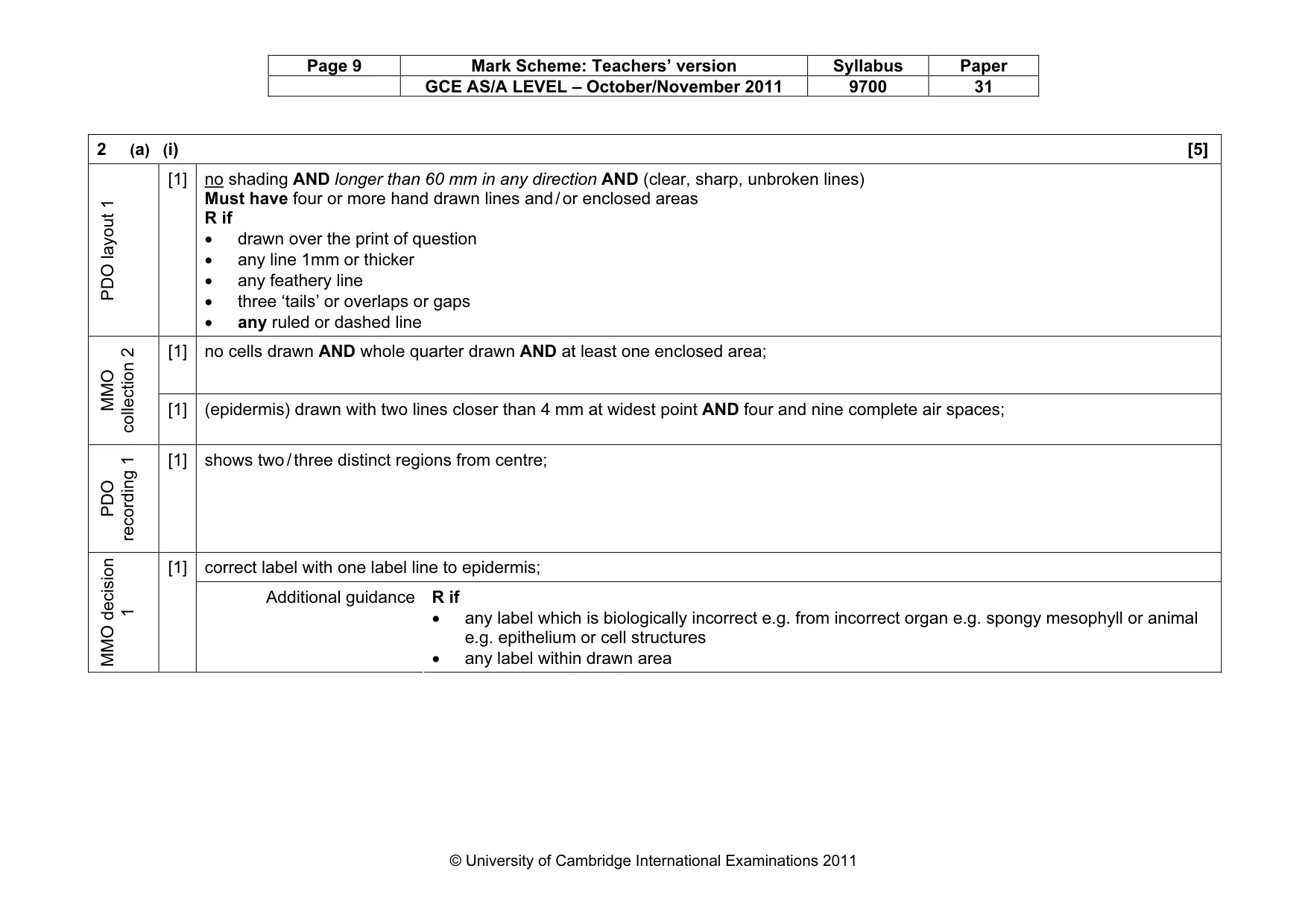
Page 9 Mark Scheme: Teachers’ version Syllabus Paper GCE AS/A LEVEL – October/November 2011 9700 31 © University of Cambridge International Examinations 2011 2 (a) (i) [5] PDO layout 1 [1] no shading AND longer than 60 mm in any direction AND (clear, sharp, unbroken lines) Must have four or more hand drawn lines and / or enclosed areas R if • drawn over the print of question • any line 1mm or thicker • any feathery line • three ‘tails’ or overlaps or gaps • any ruled or dashed line [1] no cells drawn AND whole quarter drawn AND at least one enclosed area; MMO collection 2 [1] (epidermis) drawn with two lines closer than 4 mm at widest point AND four and nine complete air spaces; PDO recording 1 [1] shows two / three distinct regions from centre; correct label with one label line to epidermis; MMO decision 1 [1] Additional guidance R if • any label which is biologically incorrect e.g. from incorrect organ e.g. spongy mesophyll or animal e.g. epithelium or cell structures • any label within drawn area
Mark scheme, page 10
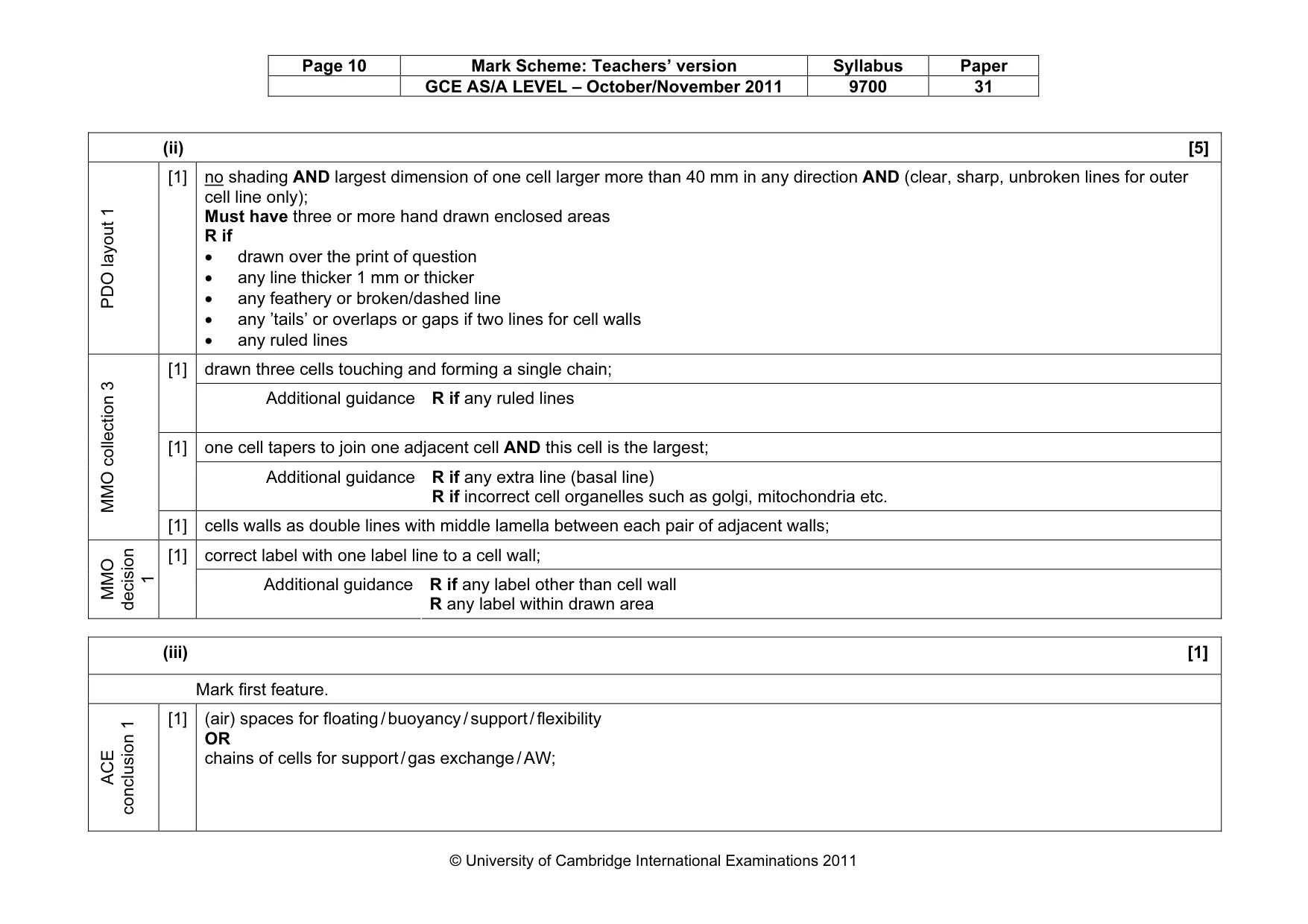
Page 10 Mark Scheme: Teachers’ version Syllabus Paper GCE AS/A LEVEL – October/November 2011 9700 31 © University of Cambridge International Examinations 2011 (ii) [5] PDO layout 1 [1] no shading AND largest dimension of one cell larger more than 40 mm in any direction AND (clear, sharp, unbroken lines for outer cell line only); Must have three or more hand drawn enclosed areas R if • drawn over the print of question • any line thicker 1 mm or thicker • any feathery or broken/dashed line • any ’tails’ or overlaps or gaps if two lines for cell walls • any ruled lines drawn three cells touching and forming a single chain; [1] Additional guidance R if any ruled lines one cell tapers to join one adjacent cell AND this cell is the largest; [1] Additional guidance R if any extra line (basal line) R if incorrect cell organelles such as golgi, mitochondria etc. MMO collection 3 [1] cells walls as double lines with middle lamella between each pair of adjacent walls; correct label with one label line to a cell wall; MMO decision 1 [1] Additional guidance R if any label other than cell wall R any label within drawn area (iii) [1] Mark first feature. ACE conclusion 1 [1] (air) spaces for floating / buoyancy / support / flexibility OR chains of cells for support / gas exchange / AW;
Mark scheme, page 11
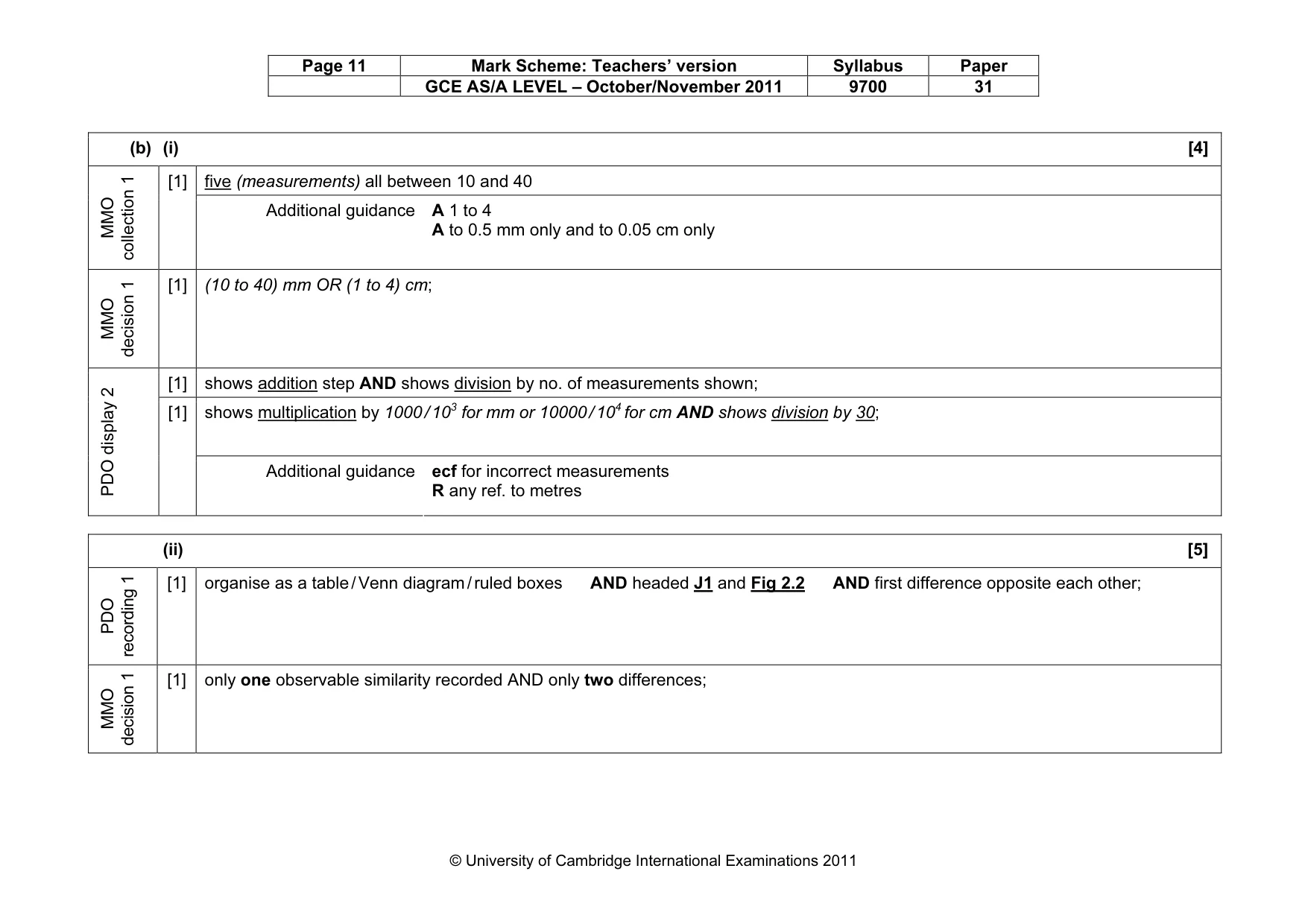
Page 11 Mark Scheme: Teachers’ version Syllabus Paper GCE AS/A LEVEL – October/November 2011 9700 31 © University of Cambridge International Examinations 2011 (b) (i) [4] five (measurements) all between 10 and 40 MMO collection 1 [1] Additional guidance A 1 to 4 A to 0.5 mm only and to 0.05 cm only MMO decision 1 [1] (10 to 40) mm OR (1 to 4) cm; [1] shows addition step AND shows division by no. of measurements shown; shows multiplication by 1000 / 103 for mm or 10000 / 104 for cm AND shows division by 30; PDO display 2 [1] Additional guidance ecf for incorrect measurements R any ref. to metres (ii) [5] PDO recording 1 [1] organise as a table / Venn diagram / ruled boxes AND headed J1 and Fig 2.2 AND first difference opposite each other; MMO decision 1 [1] only one observable similarity recorded AND only two differences;
Mark scheme, page 12
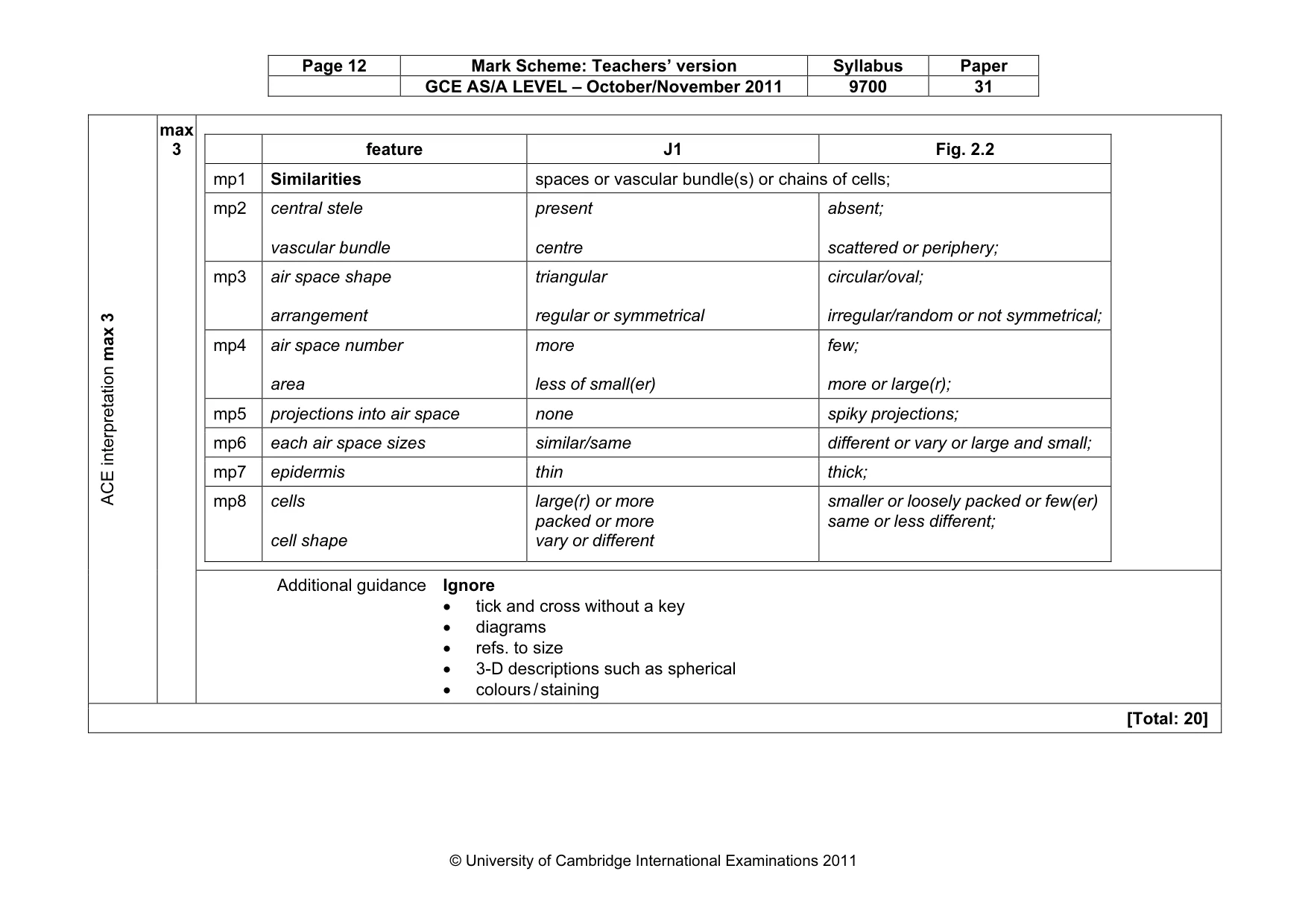
Page 12 Mark Scheme: Teachers’ version Syllabus Paper GCE AS/A LEVEL – October/November 2011 9700 31 © University of Cambridge International Examinations 2011 feature J1 Fig. 2.2 mp1 Similarities spaces or vascular bundle(s) or chains of cells; mp2 central stele vascular bundle present centre absent; scattered or periphery; mp3 air space shape arrangement triangular regular or symmetrical circular/oval; irregular/random or not symmetrical; mp4 air space number area more less of small(er) few; more or large(r); mp5 projections into air space none spiky projections; mp6 each air space sizes similar/same different or vary or large and small; mp7 epidermis thin thick; mp8 cells cell shape large(r) or more packed or more vary or different smaller or loosely packed or few(er) same or less different; ACE interpretation max 3 max 3 Additional guidance Ignore • tick and cross without a key • diagrams • refs. to size • 3-D descriptions such as spherical • colours / staining [Total: 20]
What you needed in this session
Cambridge’s own grade thresholds for 2011 Oct/Nov, Paper 3 · Variant 1. A higher threshold means an easier paper — the bar moves with how the cohort did.