Cambridge A Level Biology 9700 — 2011 May/June Paper 5 · Variant 1
9700/51/M/J/11 · 30 marks · ≈34 min
The question paper and its mark scheme, free to read here and free to download. This is Cambridge’s own paper, exactly as it was sat.
Question paper12 pages
Mark scheme6 pages
Answers below. Sit the paper first if you are practising.
Paper as text
Question paper, page 1
This document consists of 9 printed pages and 3 blank pages. DC (SJF/DJ) 34867/6 © UCLES 2011 [Turn over UNIVERSITY OF CAMBRIDGE INTERNATIONAL EXAMINATIONS General Certificate of Education Advanced Level READ THESE INSTRUCTIONS FIRST Write your Centre number, candidate number and name on all the work you hand in. Write in dark blue or black ink. You may use a soft pencil for any diagrams, graphs or rough working. Do not use staples, paper clips, highlighters, glue or correction fluid. DO NOT WRITE IN ANY BARCODES. Answer both questions. At the end of the examination, fasten all your work securely together. The number of marks is given in brackets [ ] at the end of each question or part question. * 8 8 1 4 4 6 0 5 8 2 * BIOLOGY 9700/51 Paper 5 Planning, Analysis and Evaluation May/June 2011 1 hour 15 minutes Candidates answer on the Question Paper. No Additional Materials are required. For Examiner’s Use 1 2 Total
Question paper, page 2
2 9700/51/M/J/11 © UCLES 2011 BLANK PAGE Question 1 starts on page 3
Question paper, page 3
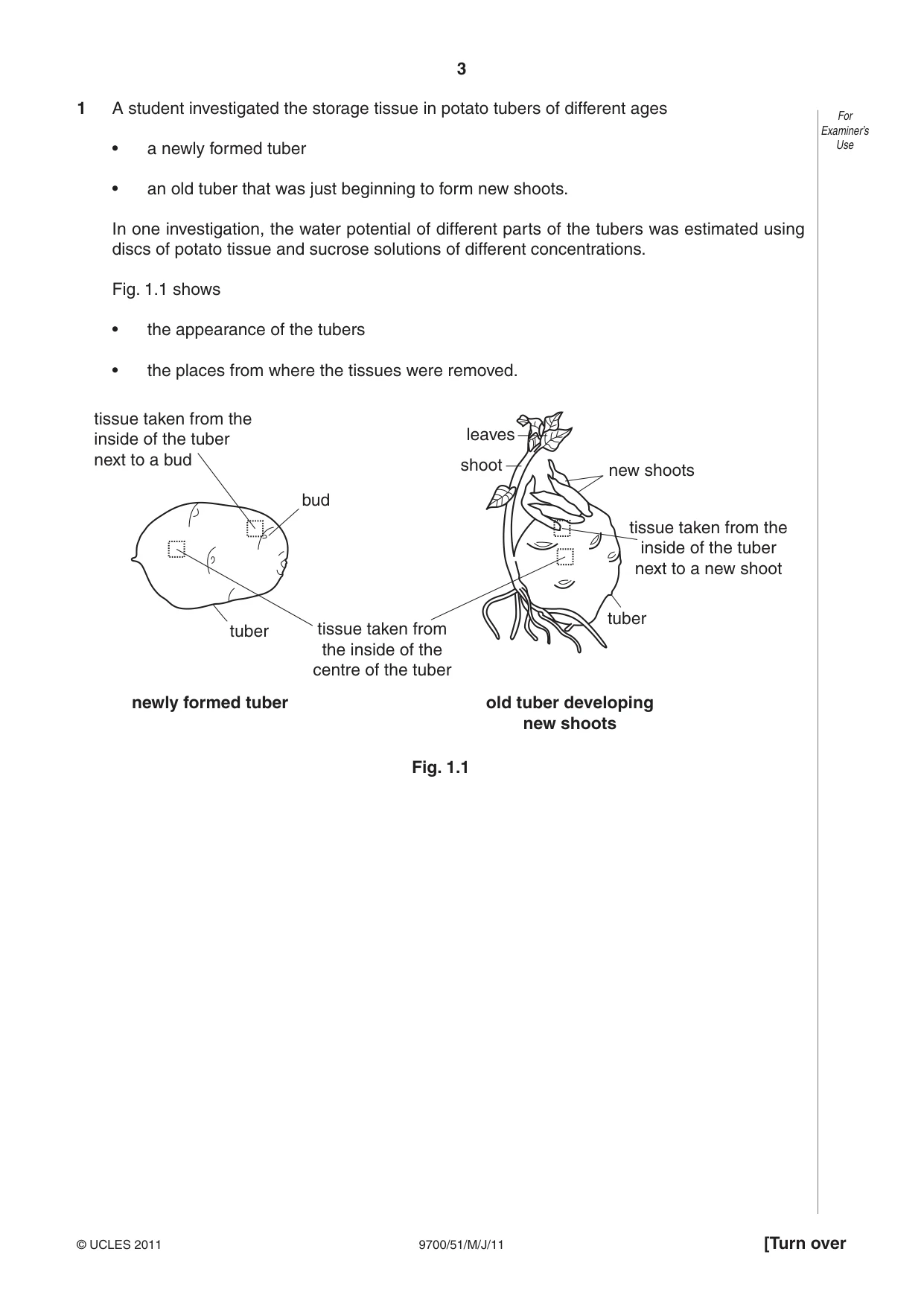
3 9700/51/M/J/11 © UCLES 2011 [Turn over For Examiner’s Use 1 A student investigated the storage tissue in potato tubers of different ages • a newly formed tuber • an old tuber that was just beginning to form new shoots. In one investigation, the water potential of different parts of the tubers was estimated using discs of potato tissue and sucrose solutions of different concentrations. Fig. 1.1 shows • the appearance of the tubers • the places from where the tissues were removed. tissue taken from the inside of the tuber next to a bud bud tuber tissue taken from the inside of the centre of the tuber newly formed tuber old tuber developing new shoots leaves shoot new shoots tissue taken from the inside of the tuber next to a new shoot tuber Fig. 1.1
Question paper, page 4
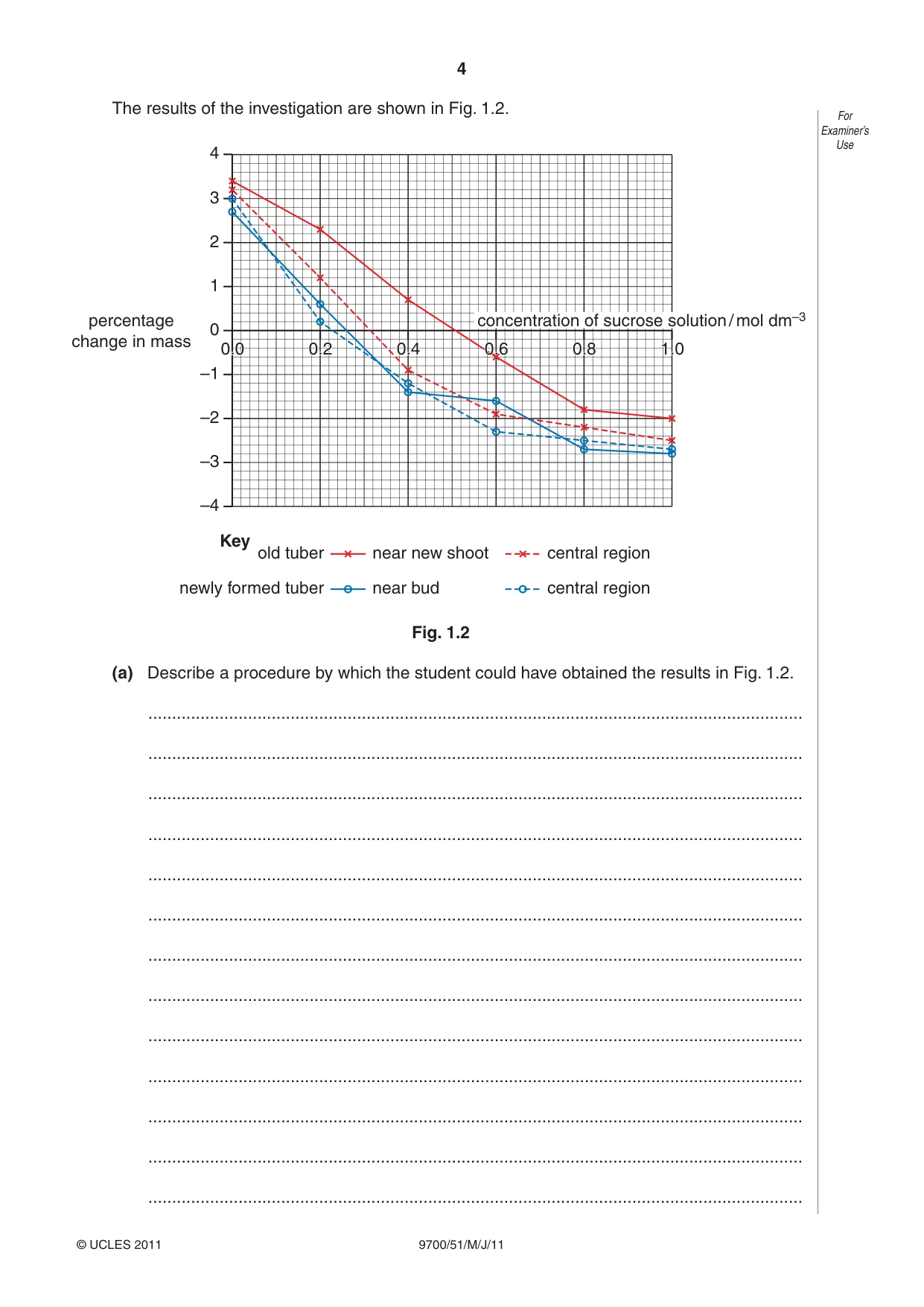
4 9700/51/M/J/11 © UCLES 2011 For Examiner’s Use The results of the investigation are shown in Fig. 1.2. 4 3 2 1 0 0.0 0.0 0.2 0.2 0.4 0.4 0.8 0.8 1.0 1.0 0.0 0.2 0.4 0.8 1.0 percentage change in mass –1 –2 –3 –4 0.6 0.6 0.6 old tuber Key near new shoot central region newly formed tuber near bud central region concentration of sucrose solution / mol dm–3 Fig. 1.2 (a) Describe a procedure by which the student could have obtained the results in Fig. 1.2. … … … … … … … … … … … … …
Question paper, page 5
5 9700/51/M/J/11 © UCLES 2011 [Turn over For Examiner’s Use … … … … … … … … … … … …[8] (b) (i) State how the percentage change in mass is calculated. … …[1] (ii) Explain why the student used percentage change in mass rather than actual mass. … …[1]
Question paper, page 6
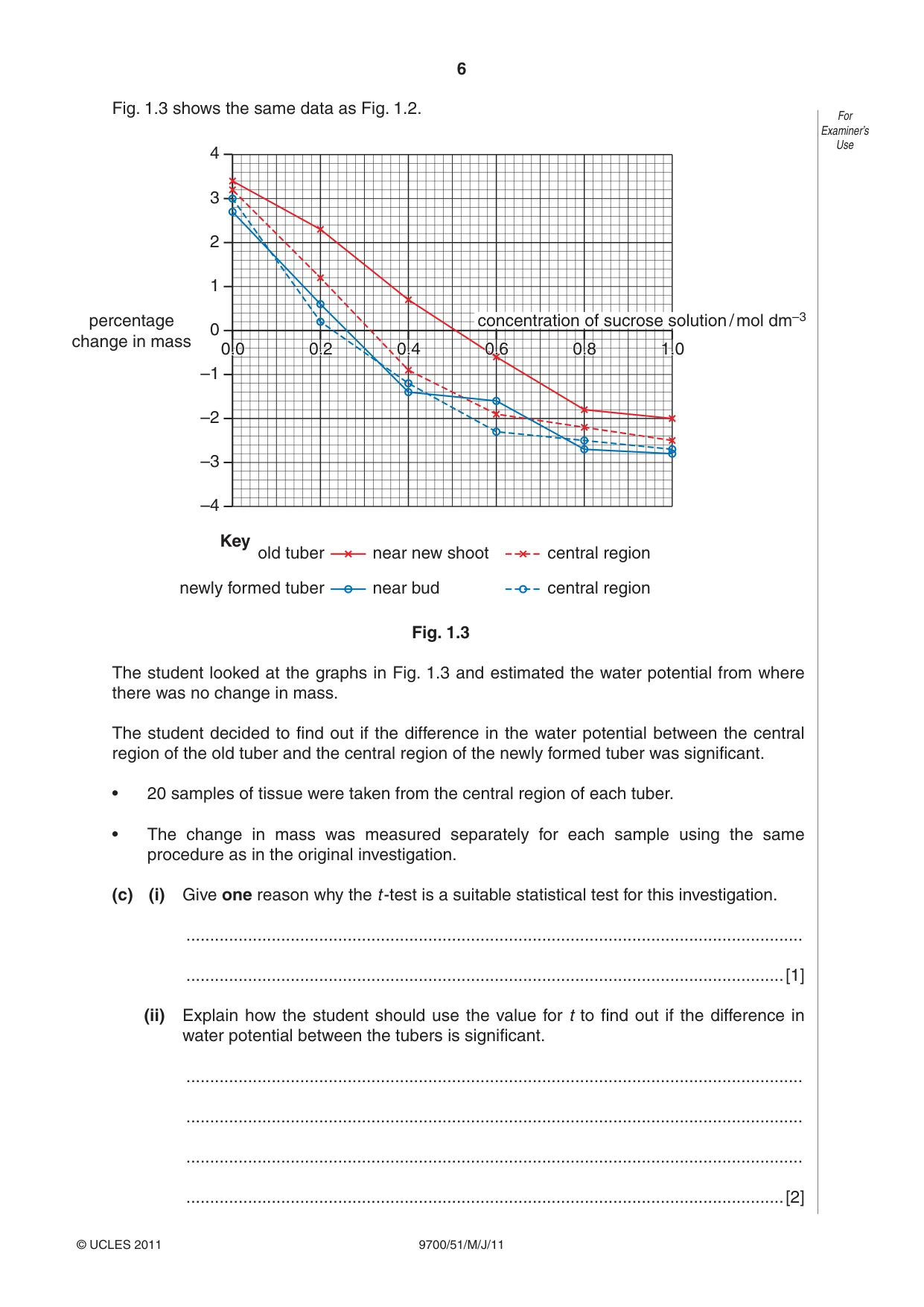
6 9700/51/M/J/11 © UCLES 2011 For Examiner’s Use Fig. 1.3 shows the same data as Fig. 1.2. 4 3 2 1 0 0.0 0.0 0.2 0.2 0.4 0.4 0.8 0.8 1.0 1.0 0.0 0.2 0.4 0.8 1.0 percentage change in mass –1 –2 –3 –4 0.6 0.6 0.6 old tuber Key near new shoot central region newly formed tuber near bud central region concentration of sucrose solution / mol dm–3 Fig. 1.3 The student looked at the graphs in Fig. 1.3 and estimated the water potential from where there was no change in mass. The student decided to find out if the difference in the water potential between the central region of the old tuber and the central region of the newly formed tuber was significant. • 20 samples of tissue were taken from the central region of each tuber. • The change in mass was measured separately for each sample using the same procedure as in the original investigation. (c) (i) Give one reason why the t -test is a suitable statistical test for this investigation. … …[1] (ii) Explain how the student should use the value for t to find out if the difference in water potential between the tubers is significant. … … … …[2]
Question paper, page 7
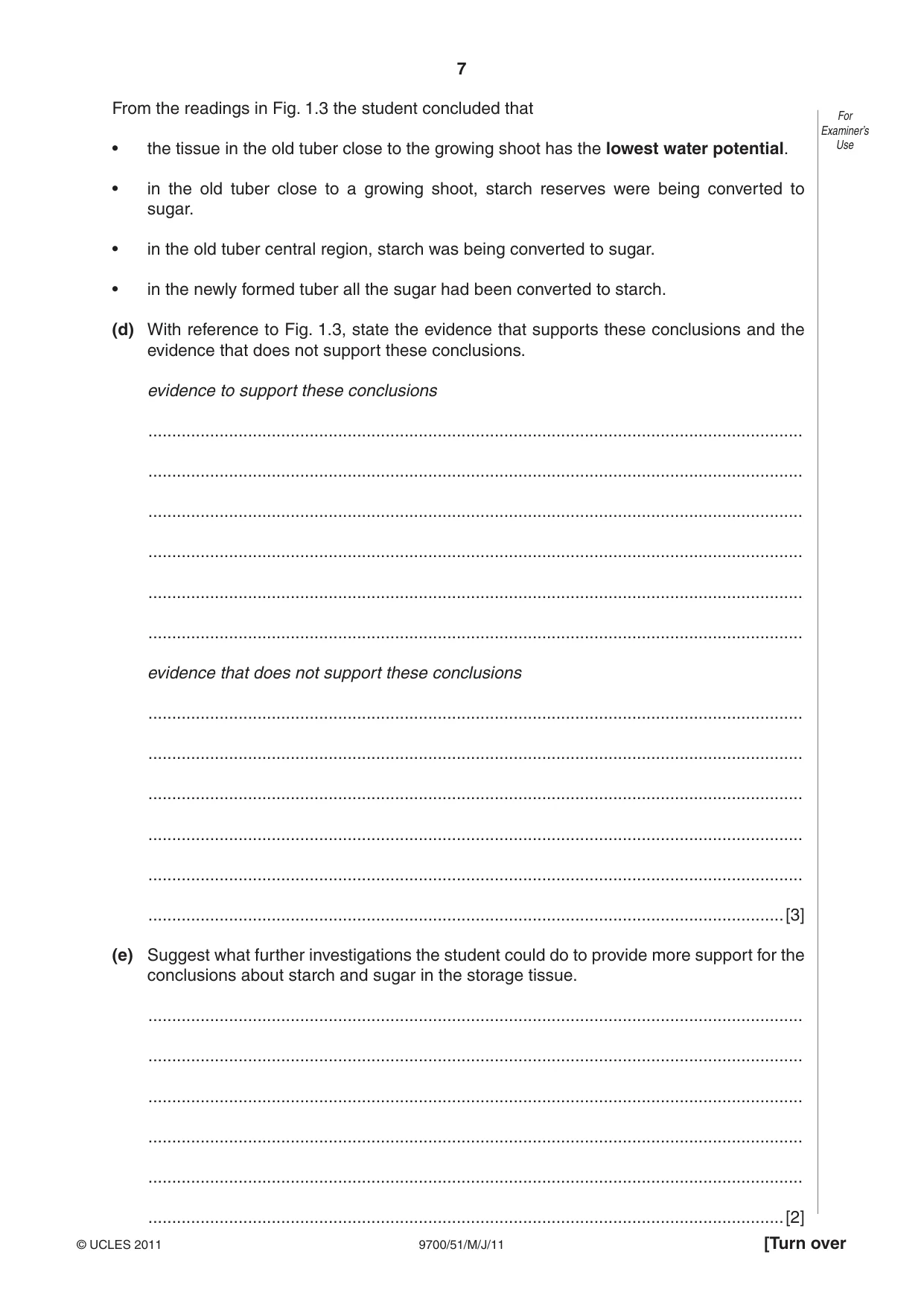
7 9700/51/M/J/11 © UCLES 2011 [Turn over For Examiner’s Use From the readings in Fig. 1.3 the student concluded that • the tissue in the old tuber close to the growing shoot has the lowest water potential. • in the old tuber close to a growing shoot, starch reserves were being converted to sugar. • in the old tuber central region, starch was being converted to sugar. • in the newly formed tuber all the sugar had been converted to starch. (d) With reference to Fig. 1.3, state the evidence that supports these conclusions and the evidence that does not support these conclusions. evidence to support these conclusions … … … … … … evidence that does not support these conclusions … … … … … …[3] (e) Suggest what further investigations the student could do to provide more support for the conclusions about starch and sugar in the storage tissue. … … … … … …[2]
Question paper, page 8
8 9700/51/M/J/11 © UCLES 2011 For Examiner’s Use (f) The student found that newly formed tubers do not form shoots until a period of dormancy lasting several months has occurred. The student investigated tissues taken from tubers of different ages to test the hypothesis Dormancy in tubers is caused by an inhibitory growth regulator. Suggest what results would be obtained if this hypothesis was valid. … … …[2] [Total: 20]
Question paper, page 9
9 9700/51/M/J/11 © UCLES 2011 [Turn over BLANK PAGE Question 2 starts on page 10
Question paper, page 10
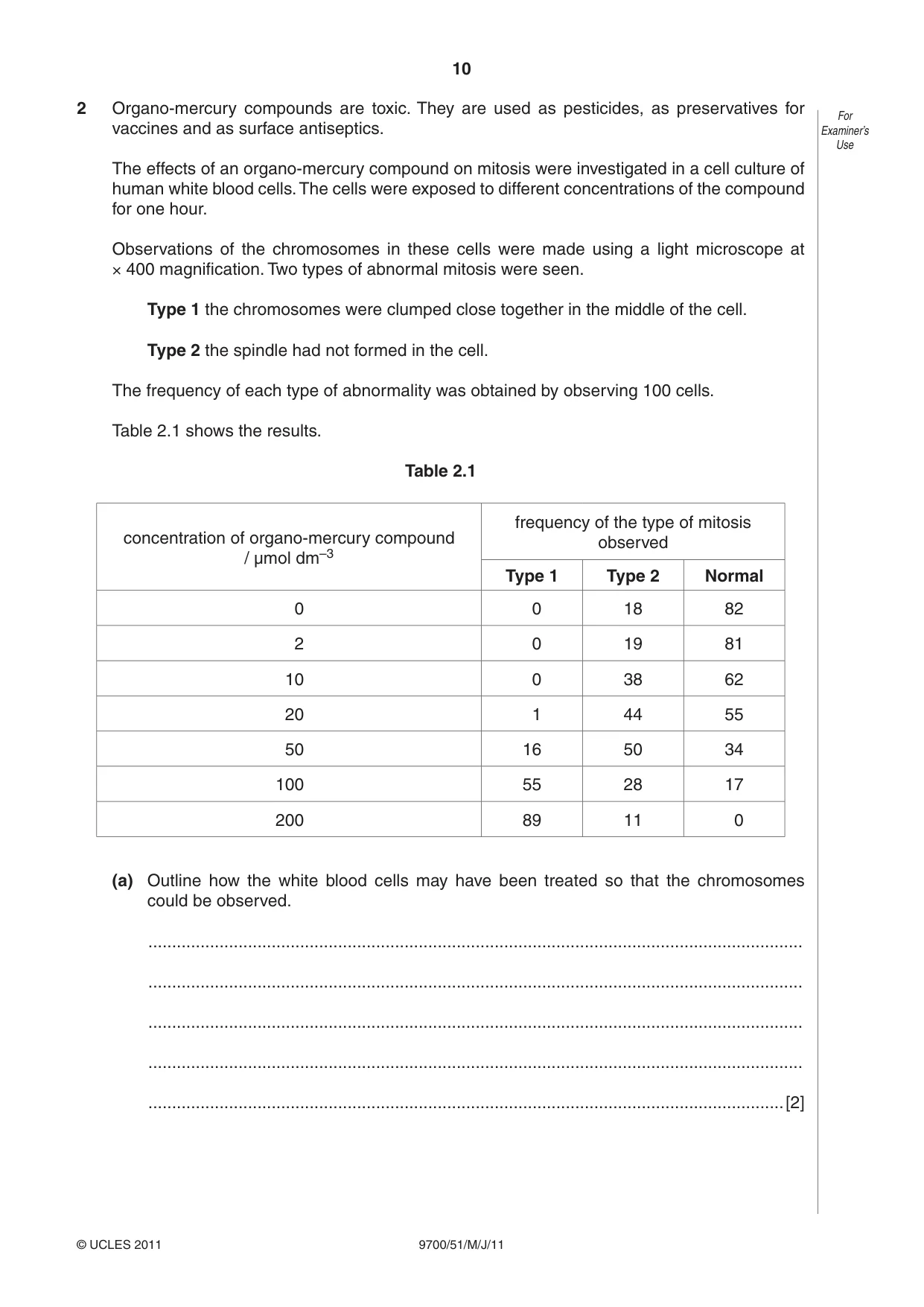
10 9700/51/M/J/11 © UCLES 2011 For Examiner’s Use 2 Organo-mercury compounds are toxic. They are used as pesticides, as preservatives for vaccines and as surface antiseptics. The effects of an organo-mercury compound on mitosis were investigated in a cell culture of human white blood cells. The cells were exposed to different concentrations of the compound for one hour. Observations of the chromosomes in these cells were made using a light microscope at × 400 magnification. Two types of abnormal mitosis were seen. Type 1 the chromosomes were clumped close together in the middle of the cell. Type 2 the spindle had not formed in the cell. The frequency of each type of abnormality was obtained by observing 100 cells. Table 2.1 shows the results. Table 2.1 concentration of organo-mercury compound / µmol dm–3 frequency of the type of mitosis observed Type 1 Type 2 Normal 0 0 18 82 2 0 19 81 10 0 38 62 20 1 44 55 50 16 50 34 100 55 28 17 200 89 11 0 (a) Outline how the white blood cells may have been treated so that the chromosomes could be observed. … … … … …[2]
Question paper, page 11
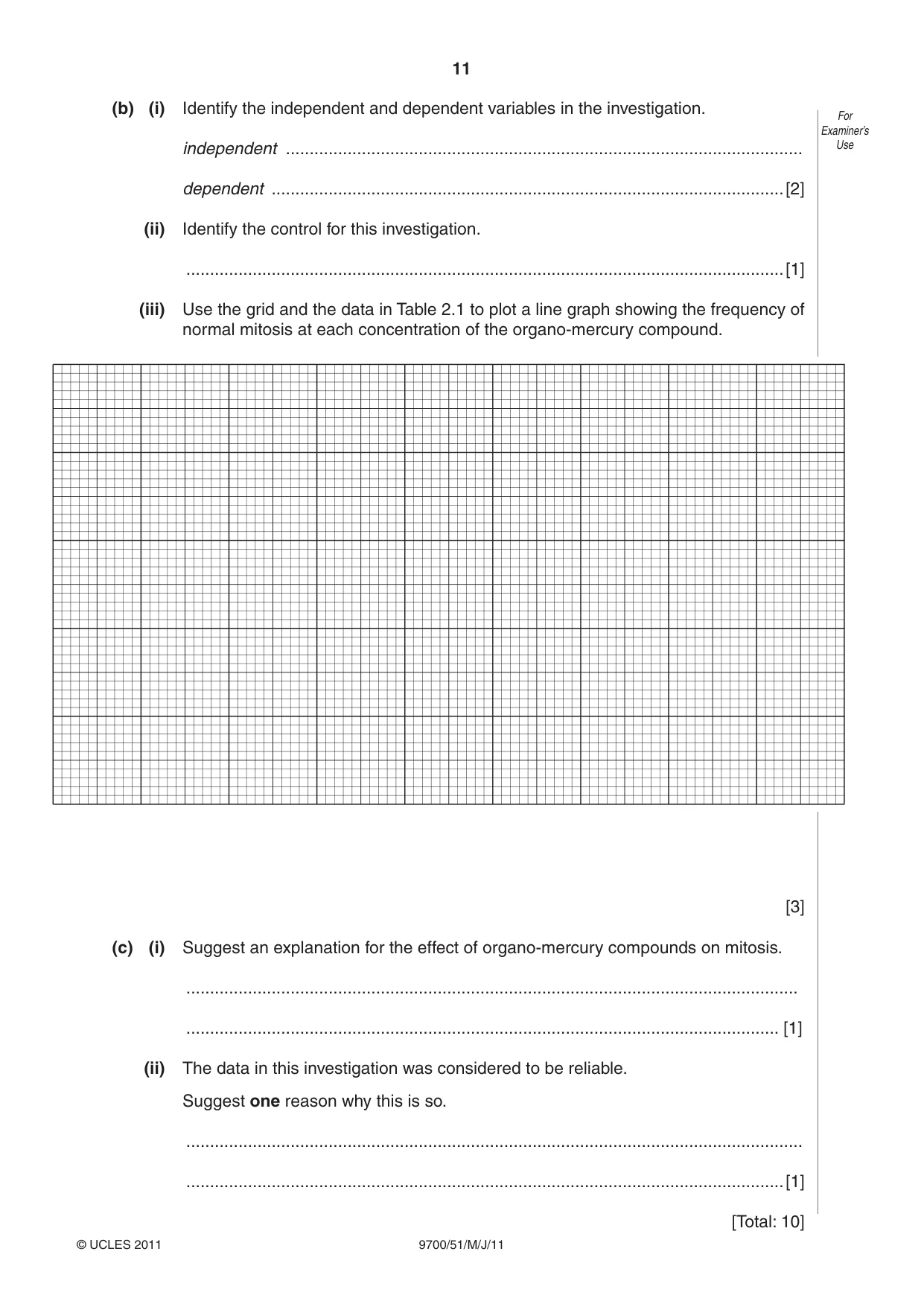
11 9700/51/M/J/11 © UCLES 2011 For Examiner’s Use (b) (i) Identify the independent and dependent variables in the investigation. independent … dependent …[2] (ii) Identify the control for this investigation. …[1] (iii) Use the grid and the data in Table 2.1 to plot a line graph showing the frequency of normal mitosis at each concentration of the organo-mercury compound. [3] (c) (i) Suggest an explanation for the effect of organo-mercury compounds on mitosis. … … [1] (ii) The data in this investigation was considered to be reliable. Suggest one reason why this is so. … …[1] [Total: 10]
Question paper, page 12
12 9700/51/M/J/11 © UCLES 2011 BLANK PAGE Permission to reproduce items where third-party owned material protected by copyright is included has been sought and cleared where possible. Every reasonable effort has been made by the publisher (UCLES) to trace copyright holders, but if any items requiring clearance have unwittingly been included, the publisher will be pleased to make amends at the earliest possible opportunity. University of Cambridge International Examinations is part of the Cambridge Assessment Group. Cambridge Assessment is the brand name of University of Cambridge Local Examinations Syndicate (UCLES), which is itself a department of the University of Cambridge.
Mark scheme, page 1
UNIVERSITY OF CAMBRIDGE INTERNATIONAL EXAMINATIONS GCE Advanced Subsidiary Level and GCE Advanced Level MARK SCHEME for the May/June 2011 question paper for the guidance of teachers 9700 BIOLOGY 9700/51 Paper 5 (Planning, Analysis and Evaluation), maximum raw mark 30 This mark scheme is published as an aid to teachers and candidates, to indicate the requirements of the examination. It shows the basis on which Examiners were instructed to award marks. It does not indicate the details of the discussions that took place at an Examiners’ meeting before marking began, which would have considered the acceptability of alternative answers. Mark schemes must be read in conjunction with the question papers and the report on the examination. • Cambridge will not enter into discussions or correspondence in connection with these mark schemes. Cambridge is publishing the mark schemes for the May/June 2011 question papers for most IGCSE, GCE Advanced Level and Advanced Subsidiary Level syllabuses and some Ordinary Level syllabuses.
Mark scheme, page 2
Page 2 Mark Scheme: Teachers’ version Syllabus Paper GCE AS/A LEVEL – May/June 2011 9700 51 © University of Cambridge International Examinations 2011 Mark scheme abbreviations: ; separates marking points / alternative answers for the same point R reject A accept (for answers correctly cued by the question, or by extra guidance) AW alternative wording (where responses vary more than usual) underline actual word given must be used by candidate (grammatical variants excepted) max indicates the maximum number of marks that can be given ora or reverse argument mp marking point (with relevant number) ecf error carried forward I ignore
Mark scheme, page 3
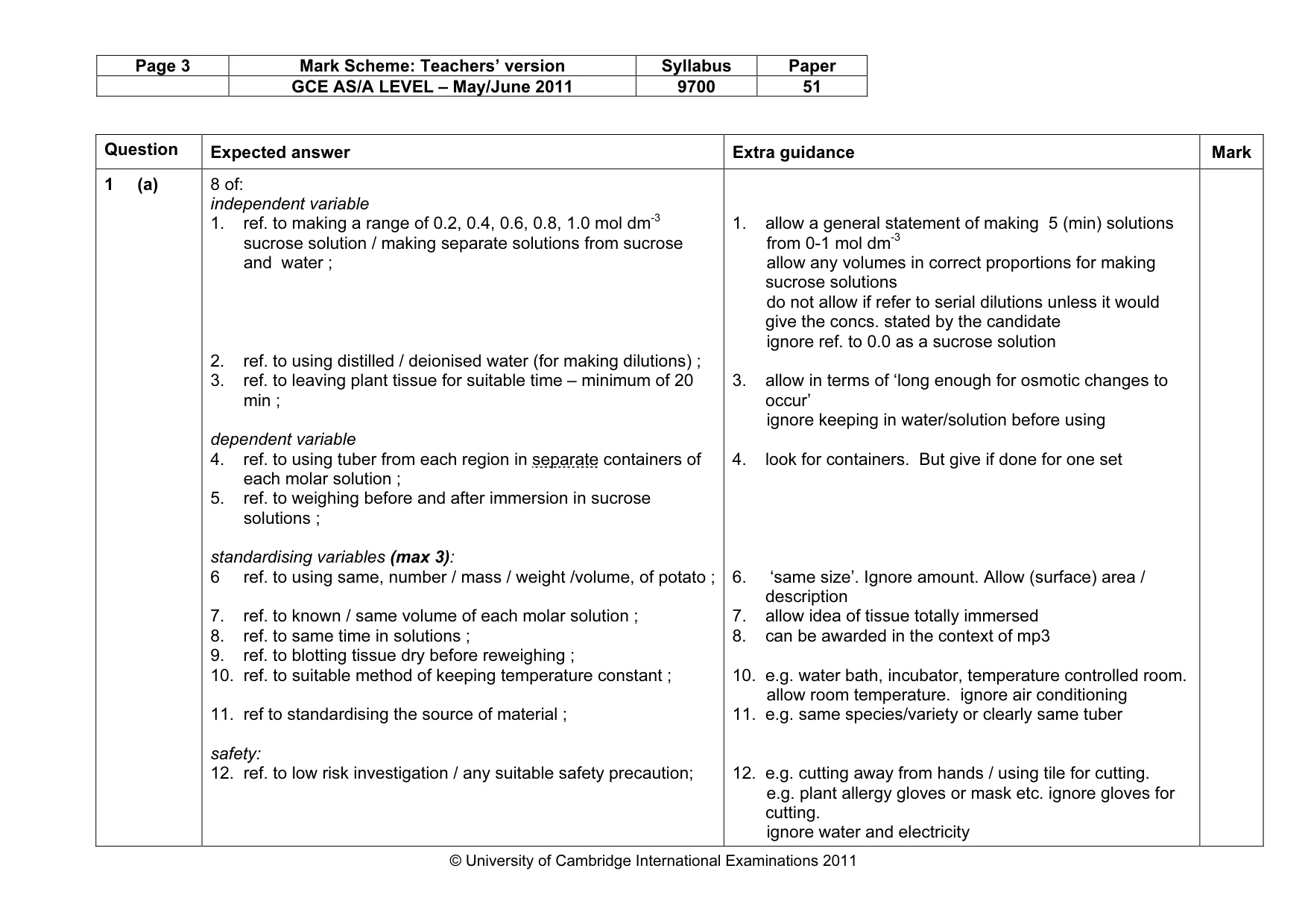
Page 3 Mark Scheme: Teachers’ version Syllabus Paper GCE AS/A LEVEL – May/June 2011 9700 51 © University of Cambridge International Examinations 2011 Question Expected answer Extra guidance Mark 1 (a) 8 of: independent variable 1. ref. to making a range of 0.2, 0.4, 0.6, 0.8, 1.0 mol dm-3 sucrose solution / making separate solutions from sucrose and water ; 2. ref. to using distilled / deionised water (for making dilutions) ; 3. ref. to leaving plant tissue for suitable time – minimum of 20 min ; dependent variable 4. ref. to using tuber from each region in separate containers of each molar solution ; 5. ref. to weighing before and after immersion in sucrose solutions ; standardising variables (max 3): 6 ref. to using same, number / mass / weight /volume, of potato ; 7. ref. to known / same volume of each molar solution ; 8. ref. to same time in solutions ; 9. ref. to blotting tissue dry before reweighing ; 10. ref. to suitable method of keeping temperature constant ; 11. ref to standardising the source of material ; safety: 12. ref. to low risk investigation / any suitable safety precaution; 1. allow a general statement of making 5 (min) solutions from 0-1 mol dm-3 allow any volumes in correct proportions for making sucrose solutions do not allow if refer to serial dilutions unless it would give the concs. stated by the candidate ignore ref. to 0.0 as a sucrose solution 3. allow in terms of ‘long enough for osmotic changes to occur’ ignore keeping in water/solution before using 4. look for containers. But give if done for one set 6. ‘same size’. Ignore amount. Allow (surface) area / description 7. allow idea of tissue totally immersed 8. can be awarded in the context of mp3 10. e.g. water bath, incubator, temperature controlled room. allow room temperature. ignore air conditioning 11. e.g. same species/variety or clearly same tuber 12. e.g. cutting away from hands / using tile for cutting. e.g. plant allergy gloves or mask etc. ignore gloves for cutting. ignore water and electricity
Mark scheme, page 4
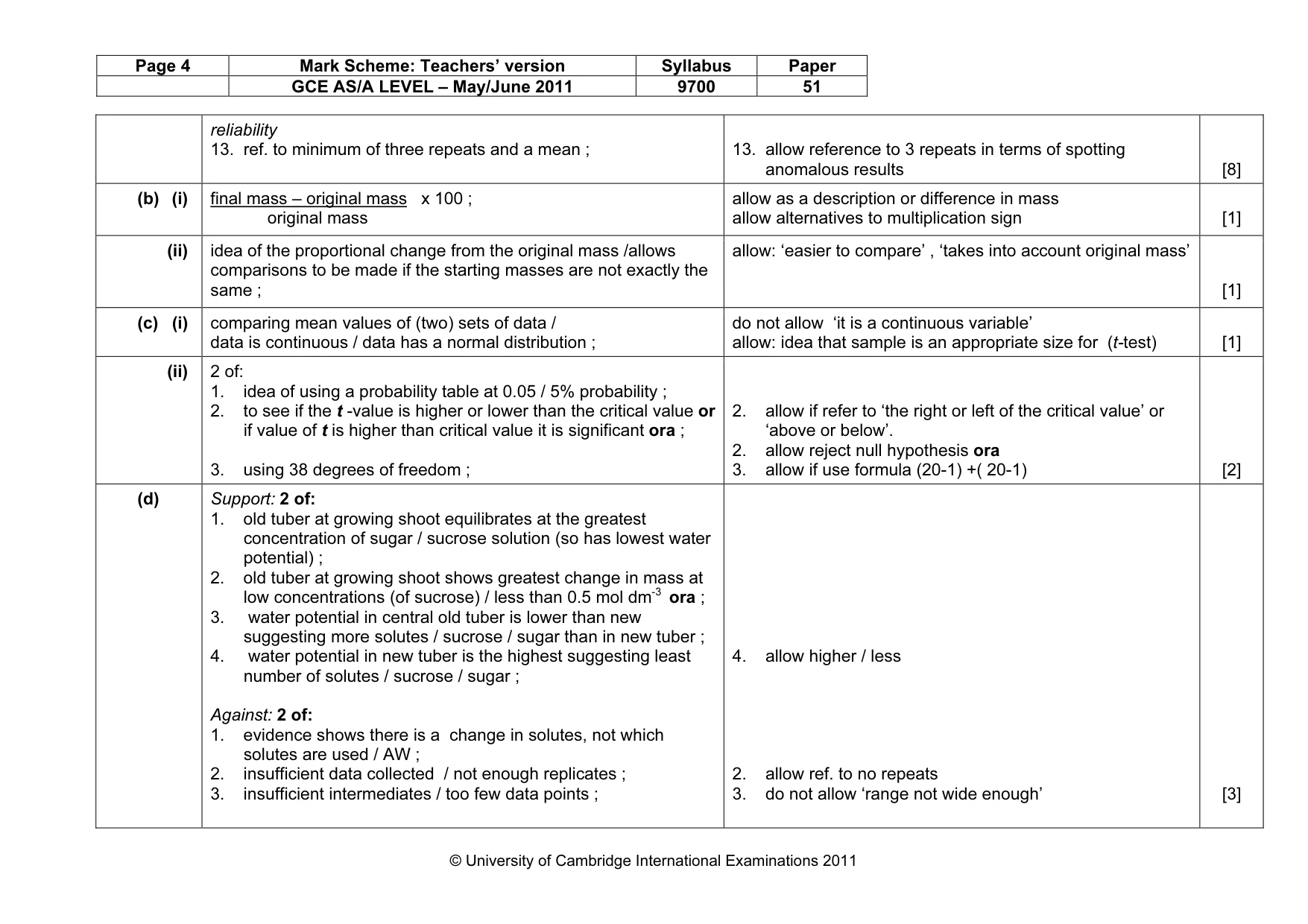
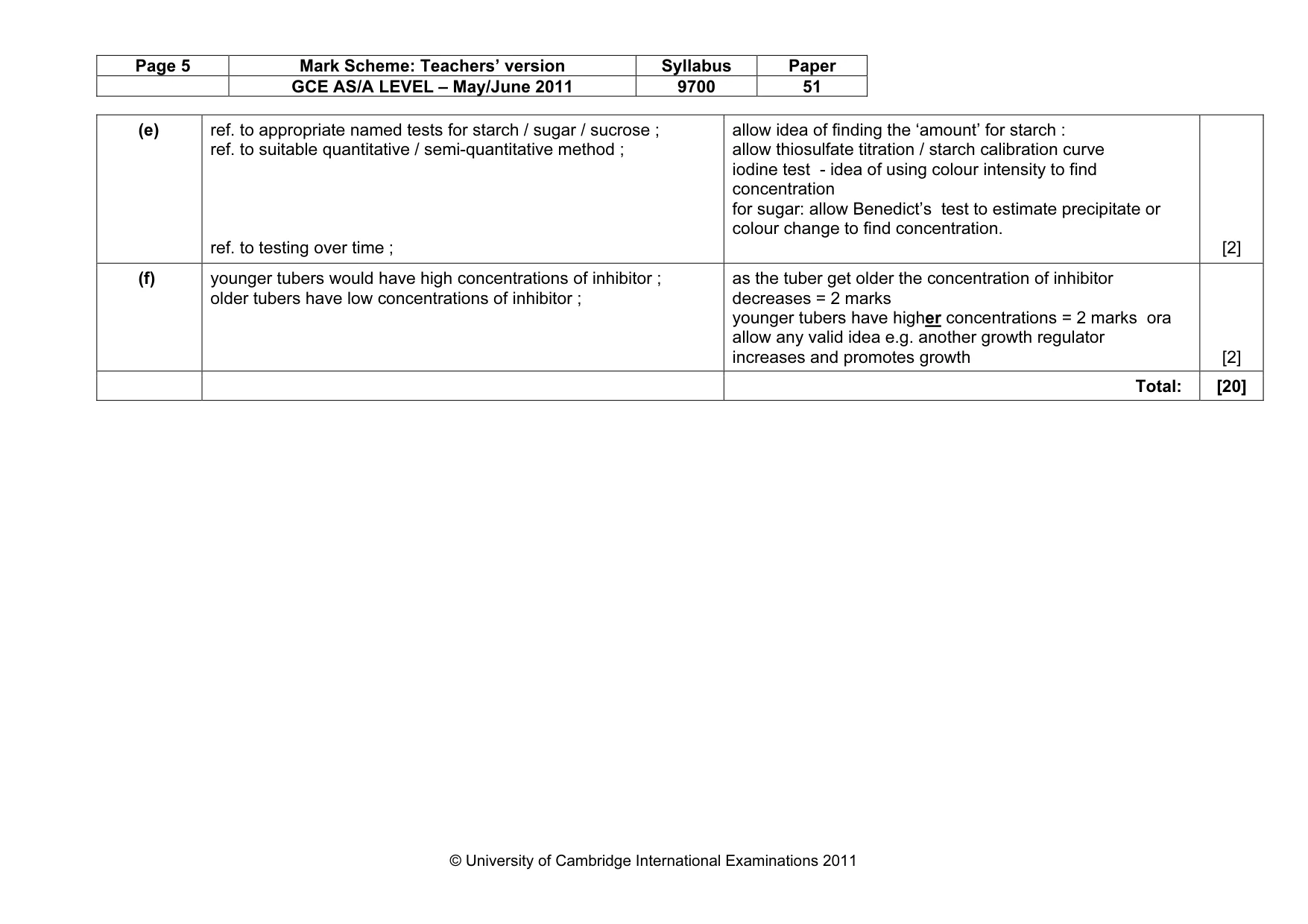
Page 4 Mark Scheme: Teachers’ version Syllabus Paper GCE AS/A LEVEL – May/June 2011 9700 51 © University of Cambridge International Examinations 2011 reliability 13. ref. to minimum of three repeats and a mean ; 13. allow reference to 3 repeats in terms of spotting anomalous results [8] (b) (i) final mass – original mass x 100 ; original mass allow as a description or difference in mass allow alternatives to multiplication sign [1] (ii) idea of the proportional change from the original mass /allows comparisons to be made if the starting masses are not exactly the same ; allow: ‘easier to compare’ , ‘takes into account original mass’ [1] (c) (i) comparing mean values of (two) sets of data / data is continuous / data has a normal distribution ; do not allow ‘it is a continuous variable’ allow: idea that sample is an appropriate size for (t-test) [1] (ii) 2 of: 1. idea of using a probability table at 0.05 / 5% probability ; 2. to see if the t -value is higher or lower than the critical value or if value of t is higher than critical value it is significant ora ; 3. using 38 degrees of freedom ; 2. allow if refer to ‘the right or left of the critical value’ or ‘above or below’. 2. allow reject null hypothesis ora 3. allow if use formula (20-1) +( 20-1) [2] (d) Support: 2 of: 1. old tuber at growing shoot equilibrates at the greatest concentration of sugar / sucrose solution (so has lowest water potential) ; 2. old tuber at growing shoot shows greatest change in mass at low concentrations (of sucrose) / less than 0.5 mol dm-3 ora ; 3. water potential in central old tuber is lower than new suggesting more solutes / sucrose / sugar than in new tuber ; 4. water potential in new tuber is the highest suggesting least number of solutes / sucrose / sugar ; Against: 2 of: 1. evidence shows there is a change in solutes, not which solutes are used / AW ; 2. insufficient data collected / not enough replicates ; 3. insufficient intermediates / too few data points ; 4. allow higher / less 2. allow ref. to no repeats 3. do not allow ‘range not wide enough’ [3]
Mark scheme, page 5
Page 5 Mark Scheme: Teachers’ version Syllabus Paper GCE AS/A LEVEL – May/June 2011 9700 51 © University of Cambridge International Examinations 2011 (e) ref. to appropriate named tests for starch / sugar / sucrose ; ref. to suitable quantitative / semi-quantitative method ; ref. to testing over time ; allow idea of finding the ‘amount’ for starch : allow thiosulfate titration / starch calibration curve iodine test - idea of using colour intensity to find concentration for sugar: allow Benedict’s test to estimate precipitate or colour change to find concentration. [2] (f) younger tubers would have high concentrations of inhibitor ; older tubers have low concentrations of inhibitor ; as the tuber get older the concentration of inhibitor decreases = 2 marks younger tubers have higher concentrations = 2 marks ora allow any valid idea e.g. another growth regulator increases and promotes growth [2] Total: [20]
Mark scheme, page 6
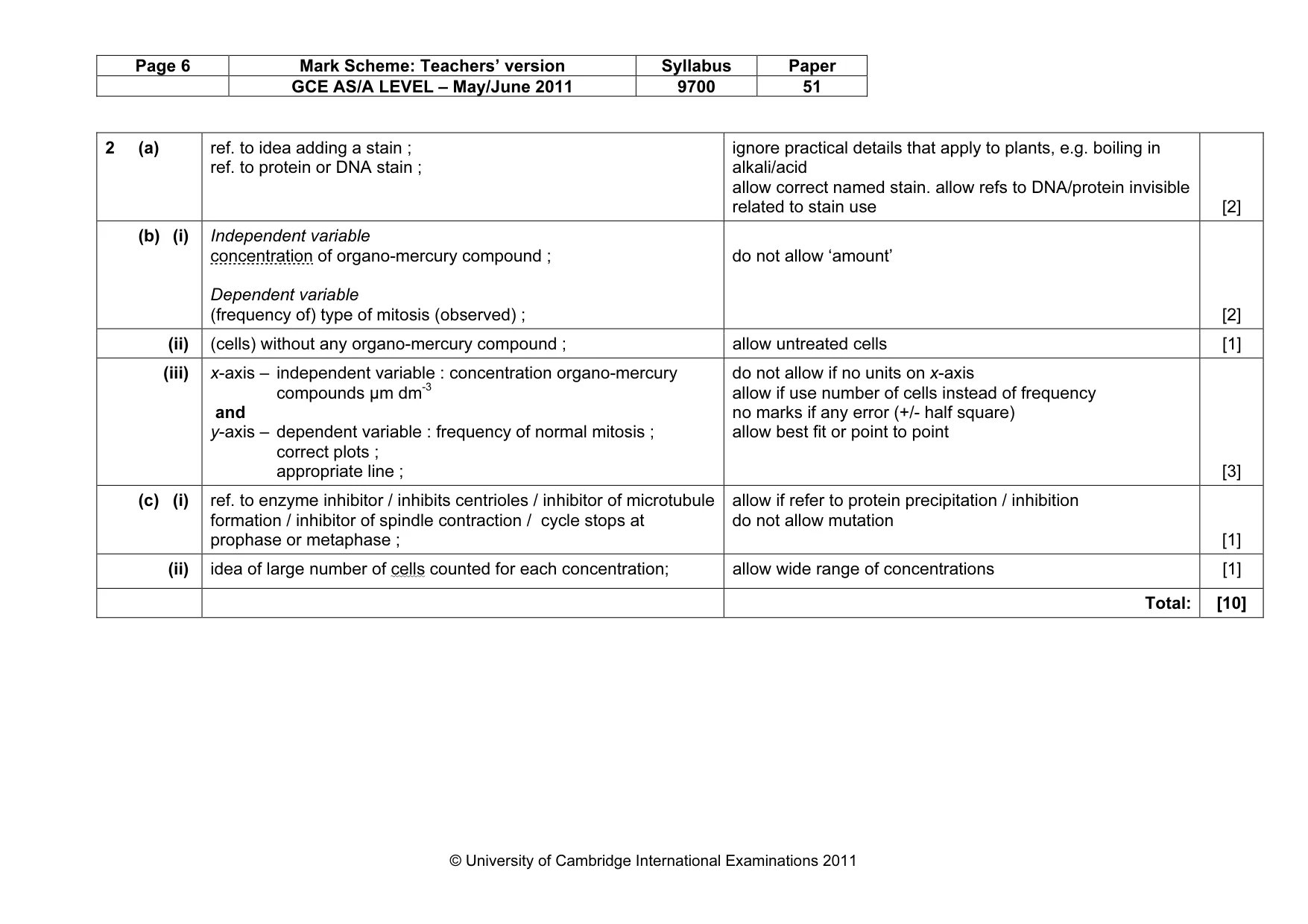
Page 6 Mark Scheme: Teachers’ version Syllabus Paper GCE AS/A LEVEL – May/June 2011 9700 51 © University of Cambridge International Examinations 2011 2 (a) ref. to idea adding a stain ; ref. to protein or DNA stain ; ignore practical details that apply to plants, e.g. boiling in alkali/acid allow correct named stain. allow refs to DNA/protein invisible related to stain use [2] (b) (i) Independent variable concentration of organo-mercury compound ; Dependent variable (frequency of) type of mitosis (observed) ; do not allow ‘amount’ [2] (ii) (cells) without any organo-mercury compound ; allow untreated cells [1] (iii) x-axis – independent variable : concentration organo-mercury compounds µm dm-3 and y-axis – dependent variable : frequency of normal mitosis ; correct plots ; appropriate line ; do not allow if no units on x-axis allow if use number of cells instead of frequency no marks if any error (+/- half square) allow best fit or point to point [3] (c) (i) ref. to enzyme inhibitor / inhibits centrioles / inhibitor of microtubule formation / inhibitor of spindle contraction / cycle stops at prophase or metaphase ; allow if refer to protein precipitation / inhibition do not allow mutation [1] (ii) idea of large number of cells counted for each concentration; allow wide range of concentrations [1] Total: [10]
What you needed in this session
Cambridge’s own grade thresholds for 2011 May/June, Paper 5 · Variant 1. A higher threshold means an easier paper — the bar moves with how the cohort did.