Cambridge A Level Biology 9700 — 2011 May/June Paper 5 · Variant 3
9700/53/M/J/11 · 30 marks · ≈34 min
The question paper and its mark scheme, free to read here and free to download. This is Cambridge’s own paper, exactly as it was sat.
Question paper8 pages
Mark scheme7 pages
Answers below. Sit the paper first if you are practising.
Paper as text
Question paper, page 1
This document consists of 7 printed pages and 1 blank page. DC (NH/DJ) 43384 © UCLES 2011 [Turn over UNIVERSITY OF CAMBRIDGE INTERNATIONAL EXAMINATIONS General Certificate of Education Advanced Level READ THESE INSTRUCTIONS FIRST Write your Centre number, candidate number and name on all the work you hand in. Write in dark blue or black ink. You may use a soft pencil for any diagrams, graphs or rough working. Do not use staples, paper clips, highlighters, glue or correction fluid. DO NOT WRITE IN ANY BARCODES. Answer both questions. At the end of the examination, fasten all your work securely together. The number of marks is given in brackets [ ] at the end of each question or part question. * 6 7 4 8 6 3 7 2 8 4 * BIOLOGY 9700/53 Paper 5 Planning, Analysis and Evaluation May/June 2011 1 hour 15 minutes Candidates answer on the Question Paper. No Additional Materials are required. For Examiner’s Use 1 2 Total
Question paper, page 2
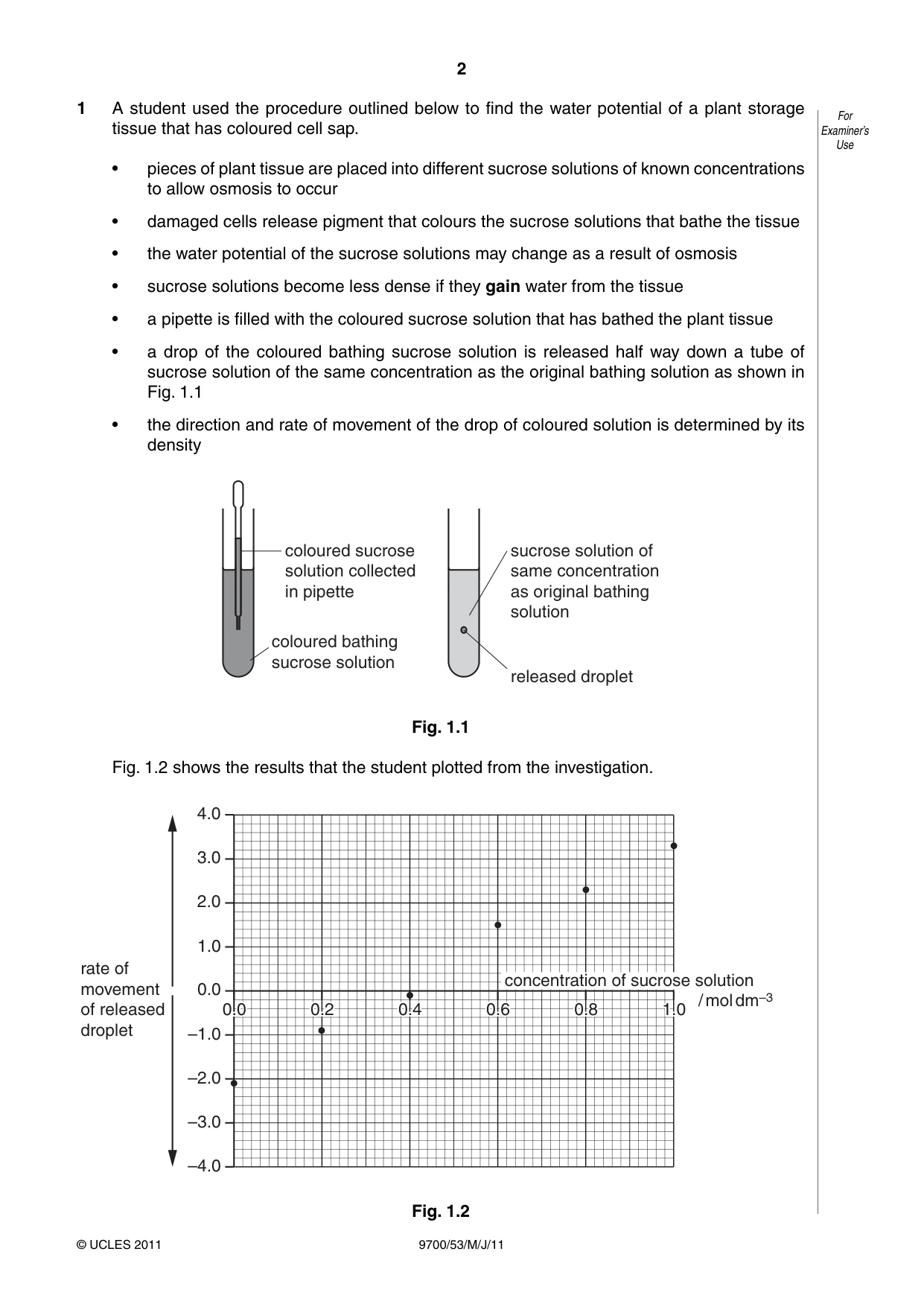
2 9700/53/M/J/11 © UCLES 2011 For Examiner’s Use 1 A student used the procedure outlined below to find the water potential of a plant storage tissue that has coloured cell sap. • pieces of plant tissue are placed into different sucrose solutions of known concentrations to allow osmosis to occur • damaged cells release pigment that colours the sucrose solutions that bathe the tissue • the water potential of the sucrose solutions may change as a result of osmosis • sucrose solutions become less dense if they gain water from the tissue • a pipette is filled with the coloured sucrose solution that has bathed the plant tissue • a drop of the coloured bathing sucrose solution is released half way down a tube of sucrose solution of the same concentration as the original bathing solution as shown in Fig. 1.1 • the direction and rate of movement of the drop of coloured solution is determined by its density coloured sucrose solution collected in pipette sucrose solution of same concentration as original bathing solution released droplet coloured bathing sucrose solution Fig. 1.1 Fig. 1.2 shows the results that the student plotted from the investigation. 0.0 0.0 0.2 0.2 0.4 0.4 0.8 0.8 1.0 1.0 0.0 0.0 1.0 2.0 3.0 4.0 –1.0 –2.0 –3.0 –4.0 0.2 0.4 0.8 1.0 rate of movement of released droplet 0.6 0.6 0.6 concentration of sucrose solution / mol dm–3 Fig. 1.2
Question paper, page 3
3 9700/53/M/J/11 © UCLES 2011 [Turn over For Examiner’s Use (a) Describe how the student could use this procedure to find the water potential of the plant storage tissue that has coloured cell sap. … … … … … … … … … … … … … … … … … … … … … … … … … … …[8]
Question paper, page 4
4 9700/53/M/J/11 © UCLES 2011 For Examiner’s Use (b) (i) Suggest suitable units for the rate of movement of the drop. …[1] (ii) State how the student would estimate the water potential of the plant tissue. … … …[2] (c) (i) Identify the independent and dependent variables in this investigation. independent … … dependent … …[2] (ii) Identify two variables which the student may not have adequately controlled during the investigation. 1. … 2. …[2] (iii) State how one of the variables you have identified in (c)(ii) may have influenced the results. … … …[1]
Question paper, page 5
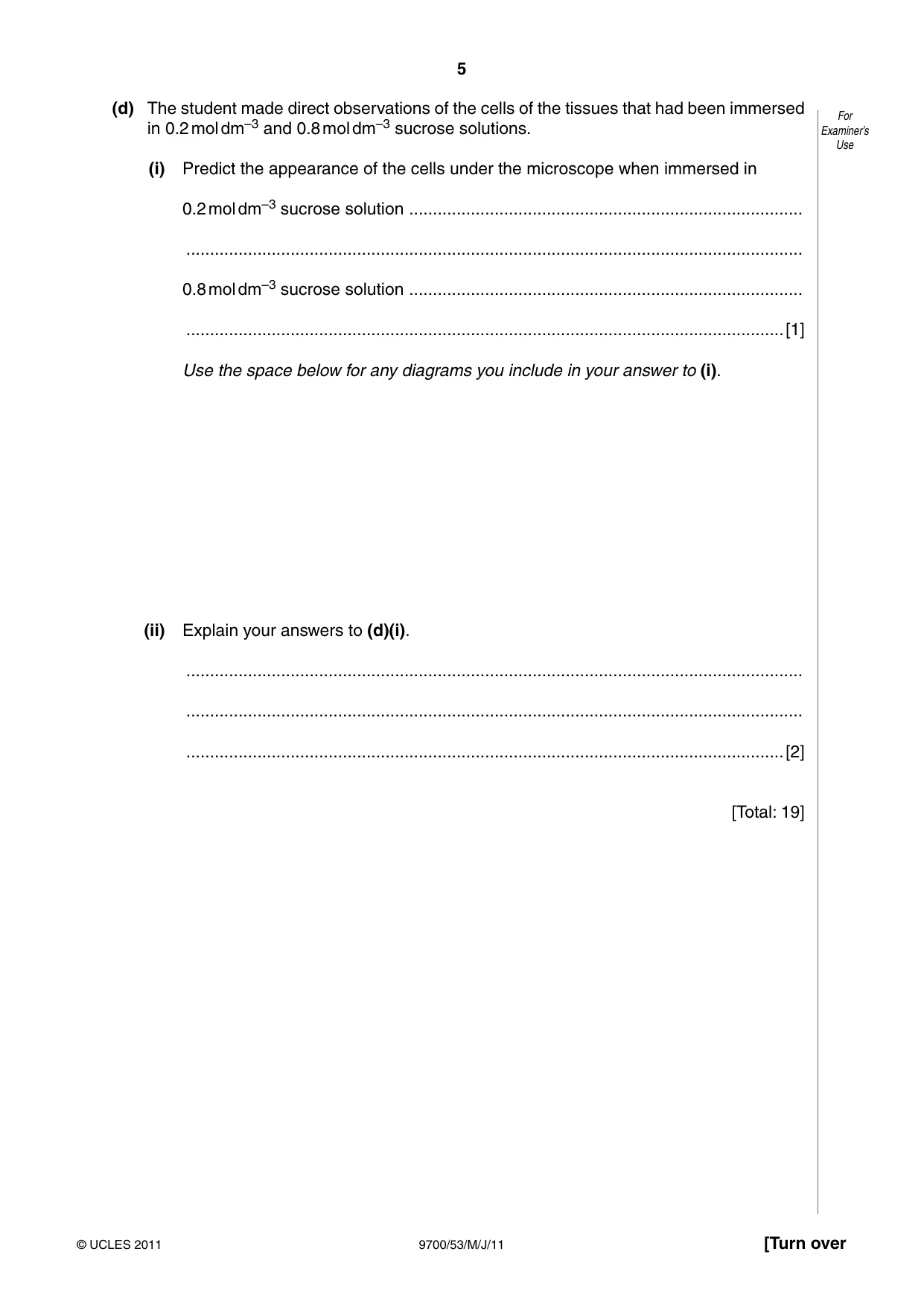
5 9700/53/M/J/11 © UCLES 2011 [Turn over For Examiner’s Use (d) The student made direct observations of the cells of the tissues that had been immersed in 0.2 mol dm–3 and 0.8 mol dm–3 sucrose solutions. (i) Predict the appearance of the cells under the microscope when immersed in 0.2 mol dm–3 sucrose solution … … 0.8 mol dm–3 sucrose solution … …[1] Use the space below for any diagrams you include in your answer to (i). (ii) Explain your answers to (d)(i). … … …[2] [Total: 19]
Question paper, page 6
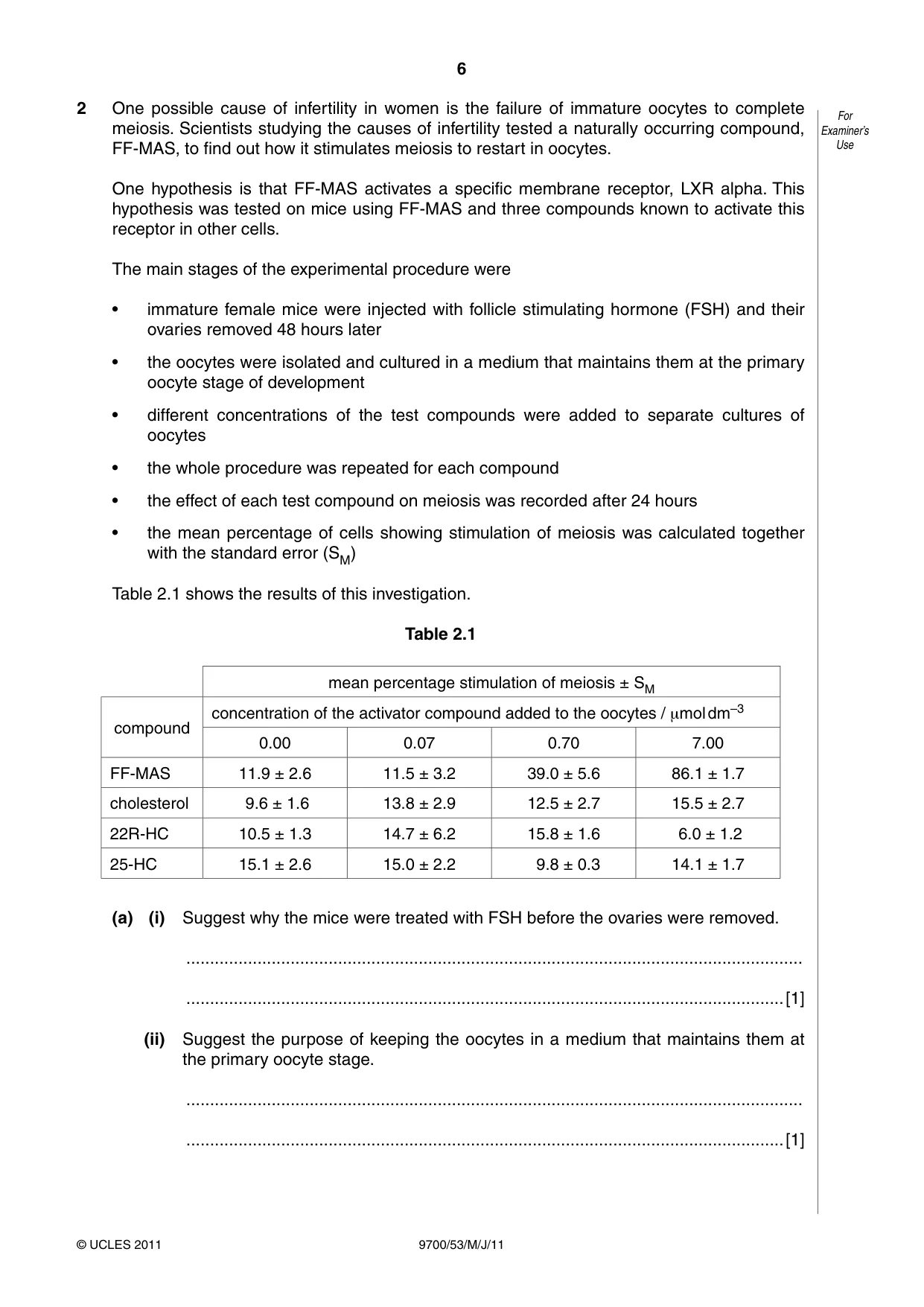
6 9700/53/M/J/11 © UCLES 2011 For Examiner’s Use 2 One possible cause of infertility in women is the failure of immature oocytes to complete meiosis. Scientists studying the causes of infertility tested a naturally occurring compound, FF-MAS, to find out how it stimulates meiosis to restart in oocytes. One hypothesis is that FF-MAS activates a specific membrane receptor, LXR alpha. This hypothesis was tested on mice using FF-MAS and three compounds known to activate this receptor in other cells. The main stages of the experimental procedure were • immature female mice were injected with follicle stimulating hormone (FSH) and their ovaries removed 48 hours later • the oocytes were isolated and cultured in a medium that maintains them at the primary oocyte stage of development • different concentrations of the test compounds were added to separate cultures of oocytes • the whole procedure was repeated for each compound • the effect of each test compound on meiosis was recorded after 24 hours • the mean percentage of cells showing stimulation of meiosis was calculated together with the standard error (SM) Table 2.1 shows the results of this investigation. Table 2.1 mean percentage stimulation of meiosis ± SM compound concentration of the activator compound added to the oocytes / μmol dm–3 0.00 0.07 0.70 7.00 FF-MAS 11.9 ± 2.6 11.5 ± 3.2 39.0 ± 5.6 86.1 ± 1.7 cholesterol 9.6 ± 1.6 13.8 ± 2.9 12.5 ± 2.7 15.5 ± 2.7 22R-HC 10.5 ± 1.3 14.7 ± 6.2 15.8 ± 1.6 6.0 ± 1.2 25-HC 15.1 ± 2.6 15.0 ± 2.2 9.8 ± 0.3 14.1 ± 1.7 (a) (i) Suggest why the mice were treated with FSH before the ovaries were removed. … …[1] (ii) Suggest the purpose of keeping the oocytes in a medium that maintains them at the primary oocyte stage. … …[1]
Question paper, page 7
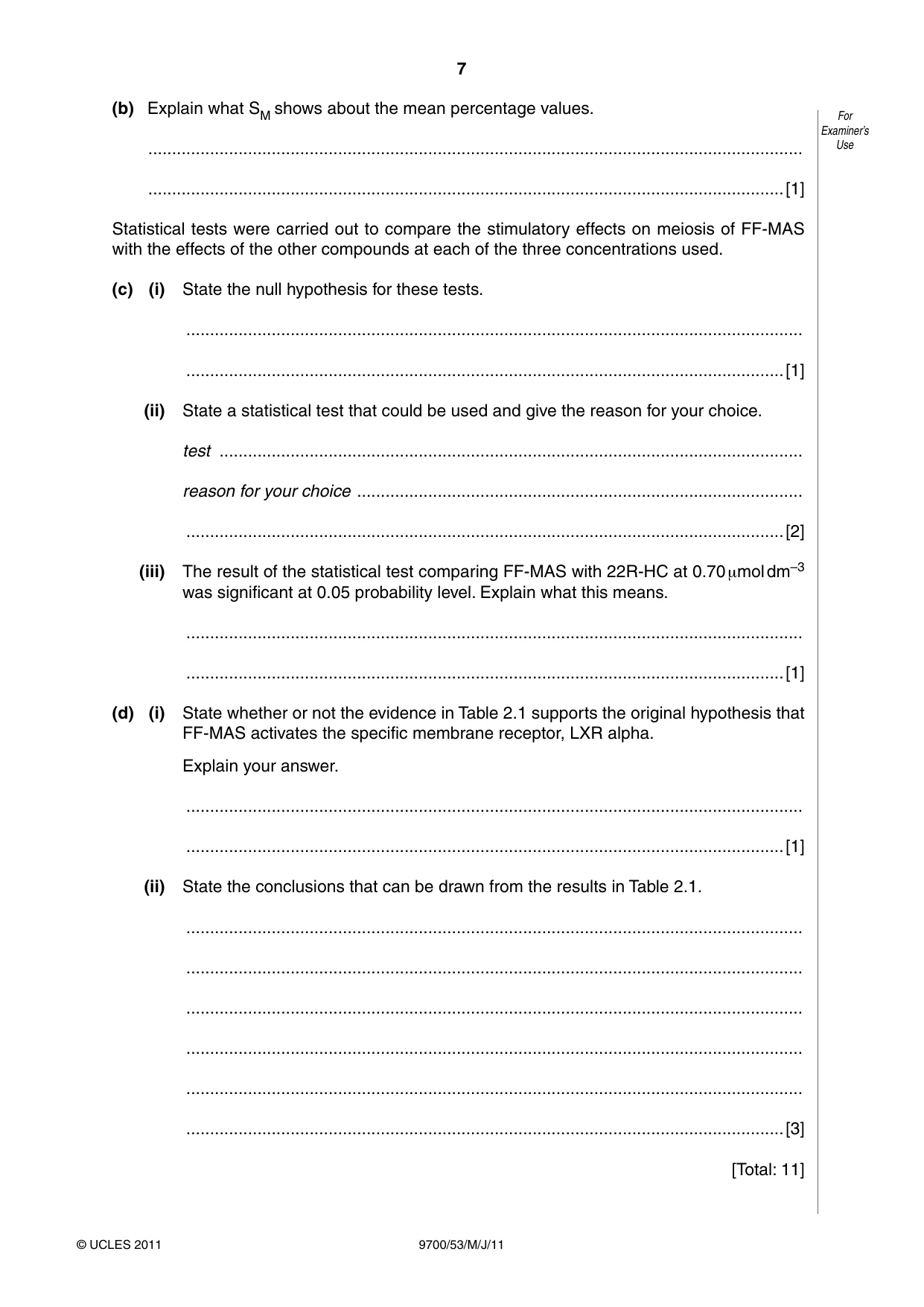
7 9700/53/M/J/11 © UCLES 2011 For Examiner’s Use (b) Explain what SM shows about the mean percentage values. … …[1] Statistical tests were carried out to compare the stimulatory effects on meiosis of FF-MAS with the effects of the other compounds at each of the three concentrations used. (c) (i) State the null hypothesis for these tests. … …[1] (ii) State a statistical test that could be used and give the reason for your choice. test … reason for your choice … …[2] (iii) The result of the statistical test comparing FF-MAS with 22R-HC at 0.70 μmol dm–3 was significant at 0.05 probability level. Explain what this means. … …[1] (d) (i) State whether or not the evidence in Table 2.1 supports the original hypothesis that FF-MAS activates the specific membrane receptor, LXR alpha. Explain your answer. … …[1] (ii) State the conclusions that can be drawn from the results in Table 2.1. … … … … … …[3] [Total: 11]
Question paper, page 8
8 9700/53/M/J/11 © UCLES 2011 BLANK PAGE Permission to reproduce items where third-party owned material protected by copyright is included has been sought and cleared where possible. Every reasonable effort has been made by the publisher (UCLES) to trace copyright holders, but if any items requiring clearance have unwittingly been included, the publisher will be pleased to make amends at the earliest possible opportunity. University of Cambridge International Examinations is part of the Cambridge Assessment Group. Cambridge Assessment is the brand name of University of Cambridge Local Examinations Syndicate (UCLES), which is itself a department of the University of Cambridge.
Mark scheme, page 1
UNIVERSITY OF CAMBRIDGE INTERNATIONAL EXAMINATIONS GCE Advanced Subsidiary Level and GCE Advanced Level MARK SCHEME for the May/June 2011 question paper for the guidance of teachers 9700 BIOLOGY 9700/53 Paper 5 (Planning, Analysis and Evaluation), maximum raw mark 30 This mark scheme is published as an aid to teachers and candidates, to indicate the requirements of the examination. It shows the basis on which Examiners were instructed to award marks. It does not indicate the details of the discussions that took place at an Examiners’ meeting before marking began, which would have considered the acceptability of alternative answers. Mark schemes must be read in conjunction with the question papers and the report on the examination. • Cambridge will not enter into discussions or correspondence in connection with these mark schemes. Cambridge is publishing the mark schemes for the May/June 2011 question papers for most IGCSE, GCE Advanced Level and Advanced Subsidiary Level syllabuses and some Ordinary Level syllabuses.
Mark scheme, page 2
Page 2 Mark Scheme: Teachers’ version Syllabus Paper GCE AS/A LEVEL – May/June 2011 9700 53 © University of Cambridge International Examinations 2011 Mark scheme abbreviations: ; separates marking points / alternative answers for the same point R reject A accept (for answers correctly cued by the question, or by extra guidance) AW alternative wording (where responses vary more than usual) underline actual word given must be used by candidate (grammatical variants excepted) max indicates the maximum number of marks that can be given ora or reverse argument mp marking point (with relevant number) ecf error carried forward I ignore
Mark scheme, page 3
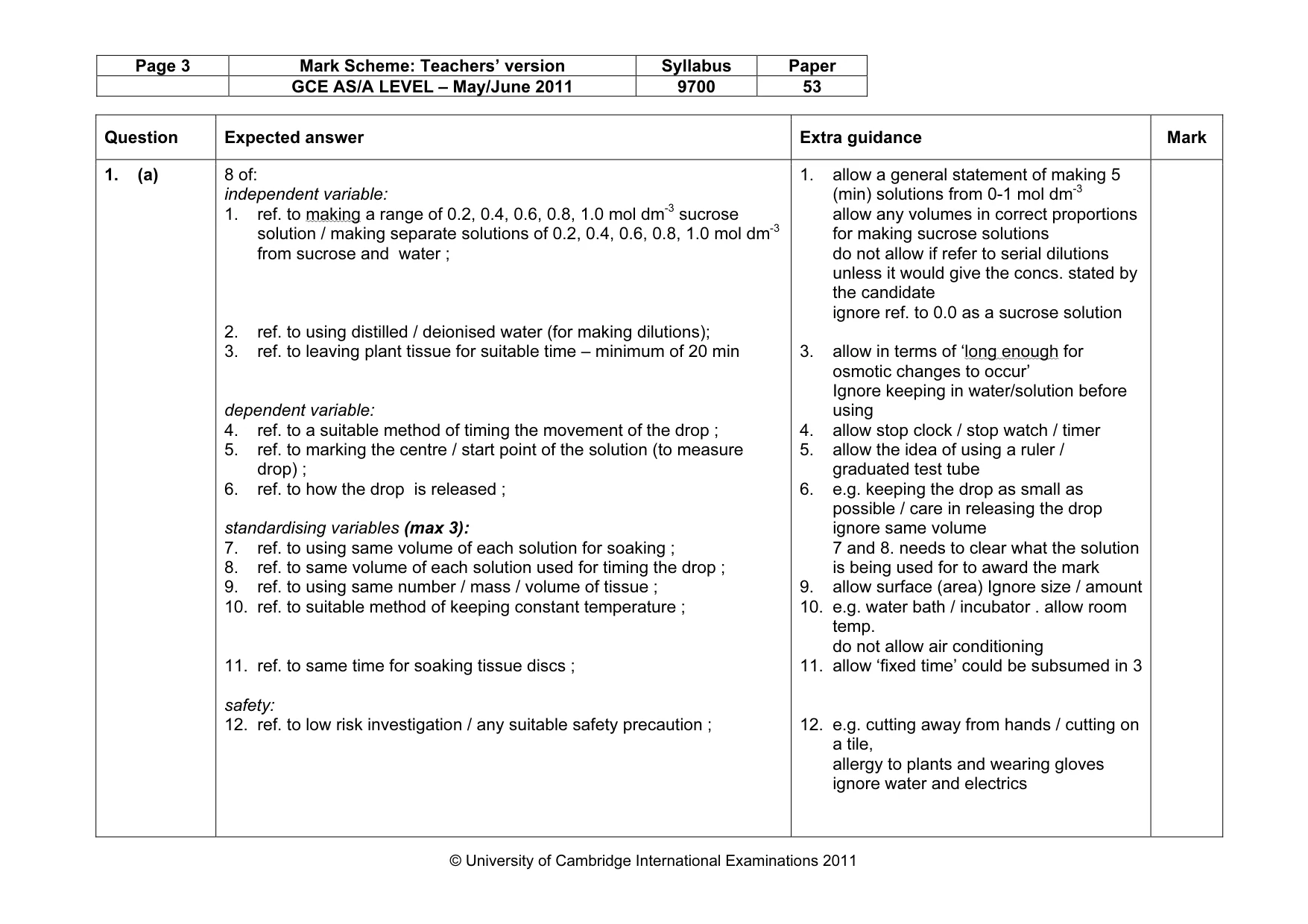
Page 3 Mark Scheme: Teachers’ version Syllabus Paper GCE AS/A LEVEL – May/June 2011 9700 53 © University of Cambridge International Examinations 2011 Question Expected answer Extra guidance Mark 1. (a) 8 of: independent variable: 1. ref. to making a range of 0.2, 0.4, 0.6, 0.8, 1.0 mol dm-3 sucrose solution / making separate solutions of 0.2, 0.4, 0.6, 0.8, 1.0 mol dm-3 from sucrose and water ; 2. ref. to using distilled / deionised water (for making dilutions); 3. ref. to leaving plant tissue for suitable time – minimum of 20 min dependent variable: 4. ref. to a suitable method of timing the movement of the drop ; 5. ref. to marking the centre / start point of the solution (to measure drop) ; 6. ref. to how the drop is released ; standardising variables (max 3): 7. ref. to using same volume of each solution for soaking ; 8. ref. to same volume of each solution used for timing the drop ; 9. ref. to using same number / mass / volume of tissue ; 10. ref. to suitable method of keeping constant temperature ; 11. ref. to same time for soaking tissue discs ; safety: 12. ref. to low risk investigation / any suitable safety precaution ; 1. allow a general statement of making 5 (min) solutions from 0-1 mol dm-3 allow any volumes in correct proportions for making sucrose solutions do not allow if refer to serial dilutions unless it would give the concs. stated by the candidate ignore ref. to 0.0 as a sucrose solution 3. allow in terms of ‘long enough for osmotic changes to occur’ Ignore keeping in water/solution before using 4. allow stop clock / stop watch / timer 5. allow the idea of using a ruler / graduated test tube 6. e.g. keeping the drop as small as possible / care in releasing the drop ignore same volume 7 and 8. needs to clear what the solution is being used for to award the mark 9. allow surface (area) Ignore size / amount 10. e.g. water bath / incubator . allow room temp. do not allow air conditioning 11. allow ‘fixed time’ could be subsumed in 3 12. e.g. cutting away from hands / cutting on a tile, allergy to plants and wearing gloves ignore water and electrics
Mark scheme, page 4
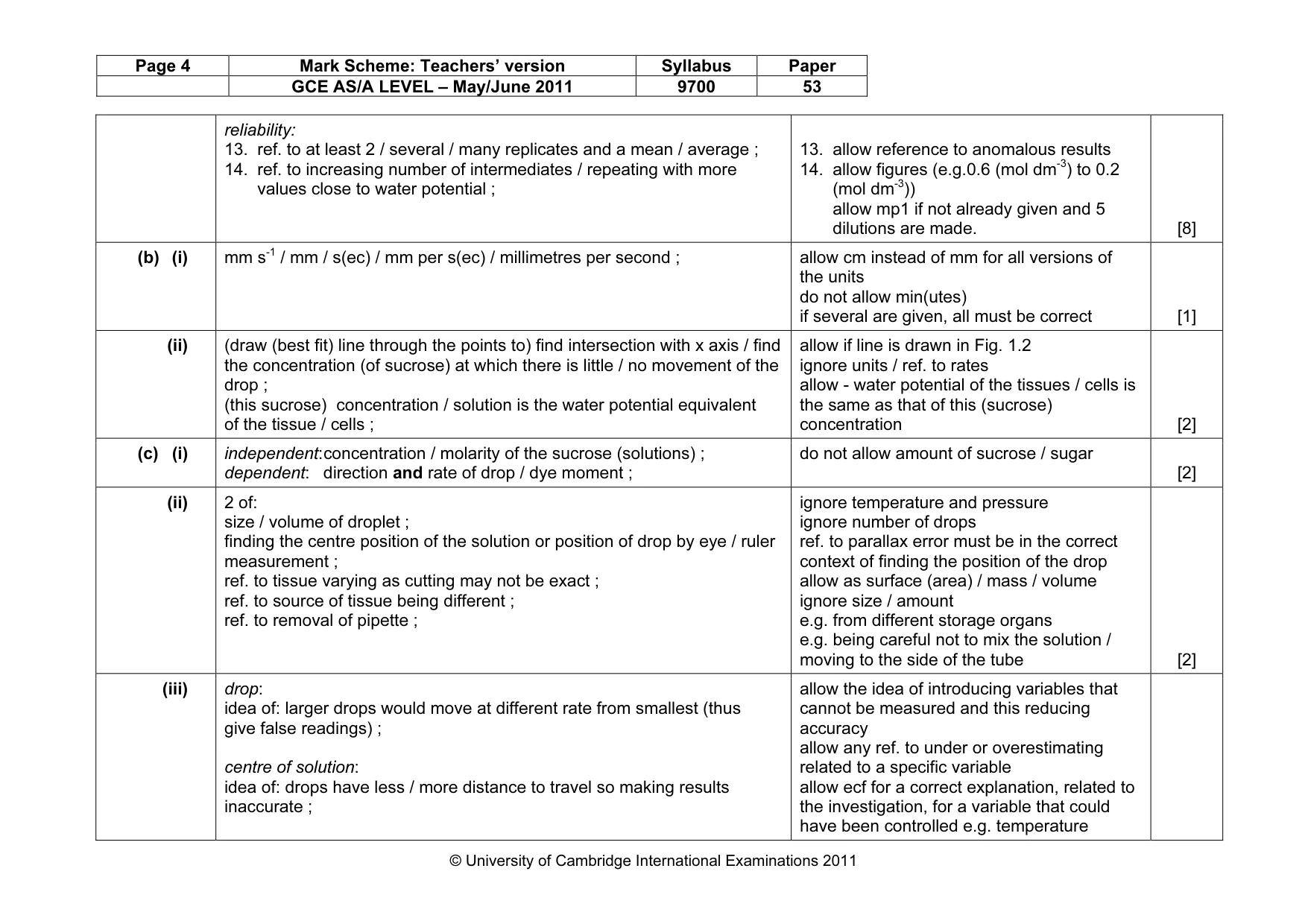
Page 4 Mark Scheme: Teachers’ version Syllabus Paper GCE AS/A LEVEL – May/June 2011 9700 53 © University of Cambridge International Examinations 2011 reliability: 13. ref. to at least 2 / several / many replicates and a mean / average ; 14. ref. to increasing number of intermediates / repeating with more values close to water potential ; 13. allow reference to anomalous results 14. allow figures (e.g.0.6 (mol dm-3) to 0.2 (mol dm-3)) allow mp1 if not already given and 5 dilutions are made. [8] (b) (i) mm s-1 / mm / s(ec) / mm per s(ec) / millimetres per second ; allow cm instead of mm for all versions of the units do not allow min(utes) if several are given, all must be correct [1] (ii) (draw (best fit) line through the points to) find intersection with x axis / find the concentration (of sucrose) at which there is little / no movement of the drop ; (this sucrose) concentration / solution is the water potential equivalent of the tissue / cells ; allow if line is drawn in Fig. 1.2 ignore units / ref. to rates allow - water potential of the tissues / cells is the same as that of this (sucrose) concentration [2] (c) (i) independent: concentration / molarity of the sucrose (solutions) ; dependent: direction and rate of drop / dye moment ; do not allow amount of sucrose / sugar [2] (ii) 2 of: size / volume of droplet ; finding the centre position of the solution or position of drop by eye / ruler measurement ; ref. to tissue varying as cutting may not be exact ; ref. to source of tissue being different ; ref. to removal of pipette ; ignore temperature and pressure ignore number of drops ref. to parallax error must be in the correct context of finding the position of the drop allow as surface (area) / mass / volume ignore size / amount e.g. from different storage organs e.g. being careful not to mix the solution / moving to the side of the tube [2] (iii) drop: idea of: larger drops would move at different rate from smallest (thus give false readings) ; centre of solution: idea of: drops have less / more distance to travel so making results inaccurate ; allow the idea of introducing variables that cannot be measured and this reducing accuracy allow any ref. to under or overestimating related to a specific variable allow ecf for a correct explanation, related to the investigation, for a variable that could have been controlled e.g. temperature
Mark scheme, page 5
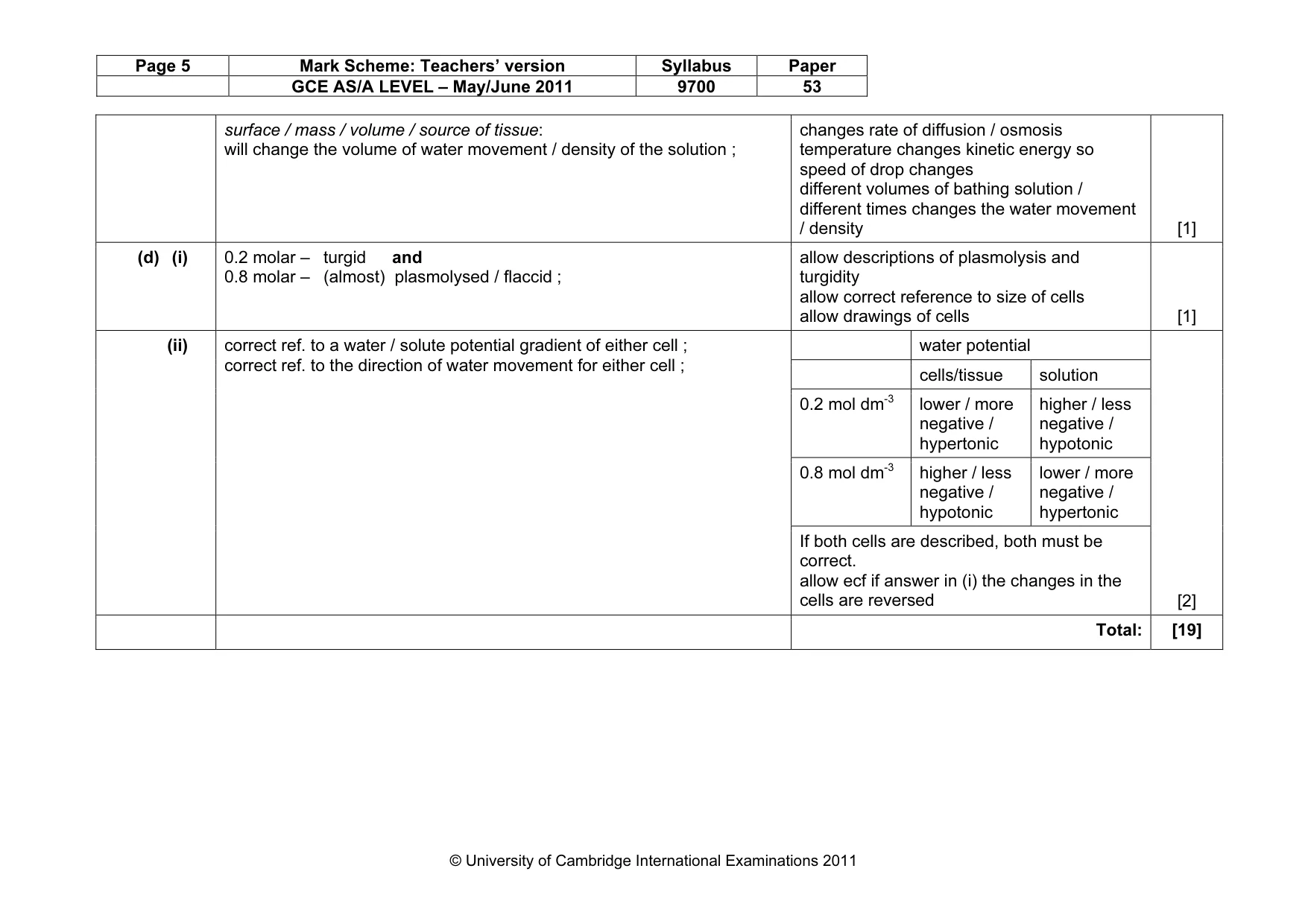
Page 5 Mark Scheme: Teachers’ version Syllabus Paper GCE AS/A LEVEL – May/June 2011 9700 53 © University of Cambridge International Examinations 2011 surface / mass / volume / source of tissue: will change the volume of water movement / density of the solution ; changes rate of diffusion / osmosis temperature changes kinetic energy so speed of drop changes different volumes of bathing solution / different times changes the water movement / density [1] (d) (i) 0.2 molar – turgid and 0.8 molar – (almost) plasmolysed / flaccid ; allow descriptions of plasmolysis and turgidity allow correct reference to size of cells allow drawings of cells [1] water potential cells/tissue solution 0.2 mol dm-3 lower / more negative / hypertonic higher / less negative / hypotonic 0.8 mol dm-3 higher / less negative / hypotonic lower / more negative / hypertonic (ii) correct ref. to a water / solute potential gradient of either cell ; correct ref. to the direction of water movement for either cell ; If both cells are described, both must be correct. allow ecf if answer in (i) the changes in the cells are reversed [2] Total: [19]
Mark scheme, page 6
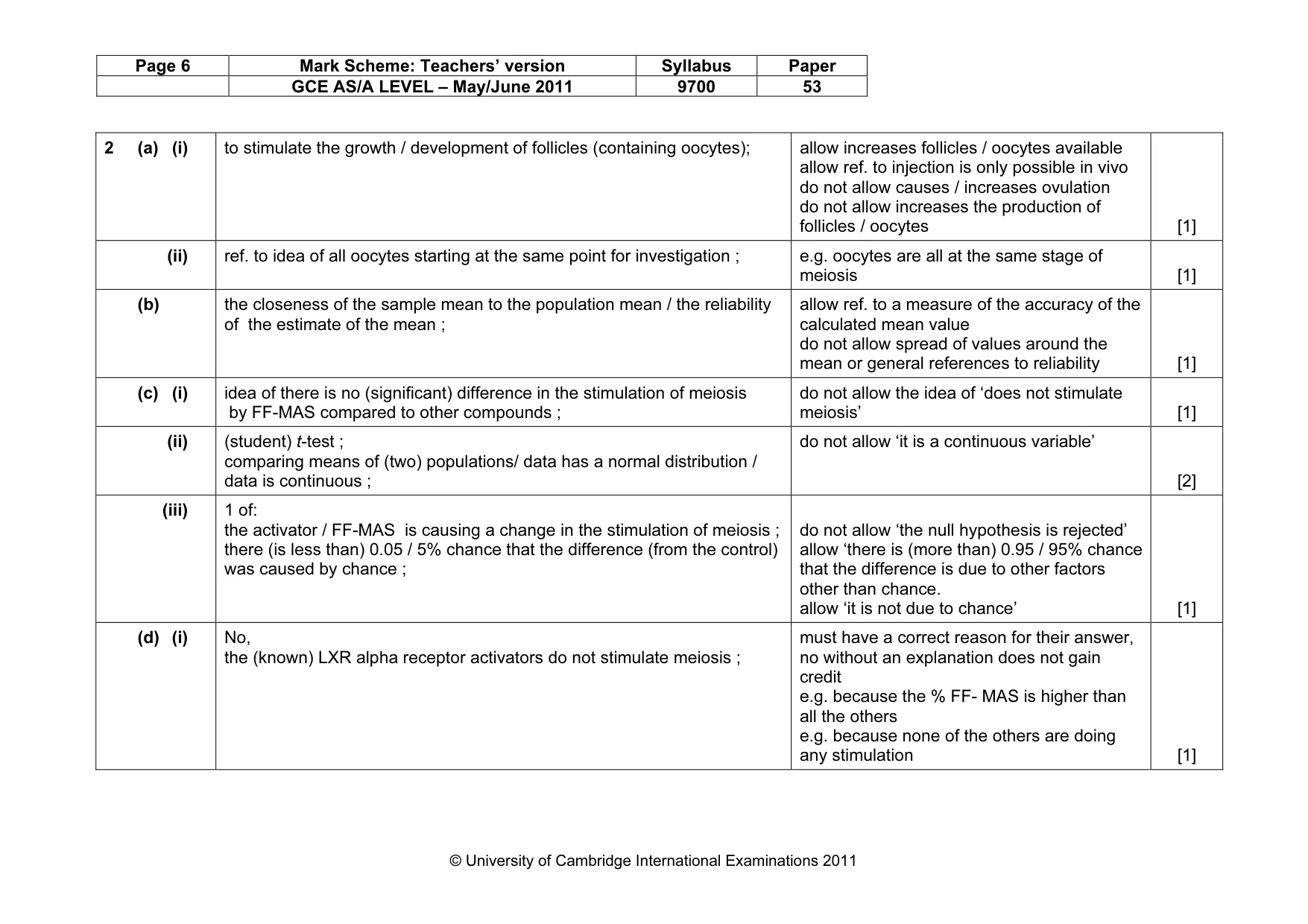
Page 6 Mark Scheme: Teachers’ version Syllabus Paper GCE AS/A LEVEL – May/June 2011 9700 53 © University of Cambridge International Examinations 2011 2 (a) (i) to stimulate the growth / development of follicles (containing oocytes); allow increases follicles / oocytes available allow ref. to injection is only possible in vivo do not allow causes / increases ovulation do not allow increases the production of follicles / oocytes [1] (ii) ref. to idea of all oocytes starting at the same point for investigation ; e.g. oocytes are all at the same stage of meiosis [1] (b) the closeness of the sample mean to the population mean / the reliability of the estimate of the mean ; allow ref. to a measure of the accuracy of the calculated mean value do not allow spread of values around the mean or general references to reliability [1] (c) (i) idea of there is no (significant) difference in the stimulation of meiosis by FF-MAS compared to other compounds ; do not allow the idea of ‘does not stimulate meiosis’ [1] (ii) (student) t-test ; comparing means of (two) populations/ data has a normal distribution / data is continuous ; do not allow ‘it is a continuous variable’ [2] (iii) 1 of: the activator / FF-MAS is causing a change in the stimulation of meiosis ; there (is less than) 0.05 / 5% chance that the difference (from the control) was caused by chance ; do not allow ‘the null hypothesis is rejected’ allow ‘there is (more than) 0.95 / 95% chance that the difference is due to other factors other than chance. allow ‘it is not due to chance’ [1] (d) (i) No, the (known) LXR alpha receptor activators do not stimulate meiosis ; must have a correct reason for their answer, no without an explanation does not gain credit e.g. because the % FF- MAS is higher than all the others e.g. because none of the others are doing any stimulation [1]
Mark scheme, page 7
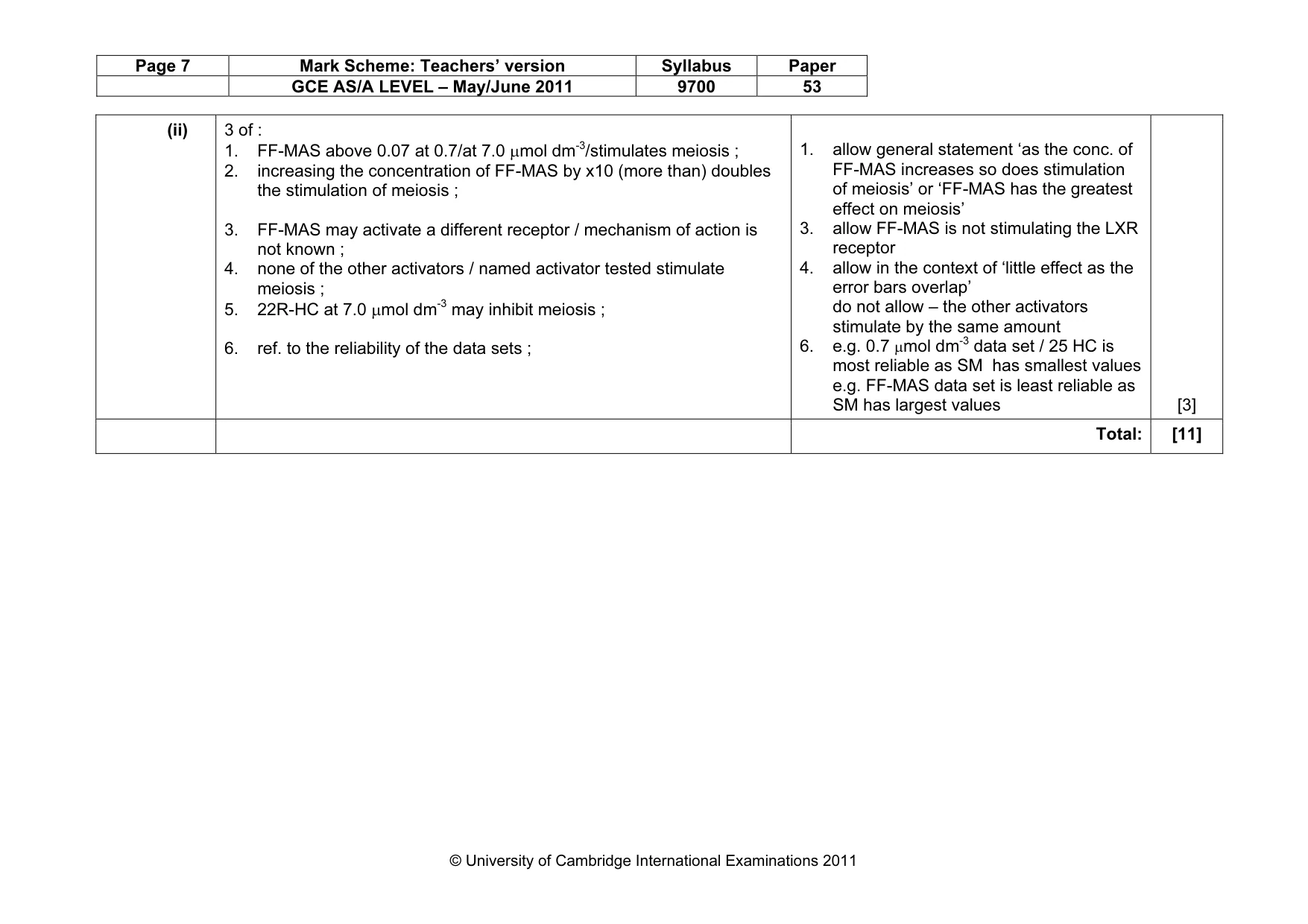
Page 7 Mark Scheme: Teachers’ version Syllabus Paper GCE AS/A LEVEL – May/June 2011 9700 53 © University of Cambridge International Examinations 2011 (ii) 3 of : 1. FF-MAS above 0.07 at 0.7/at 7.0 µmol dm-3/stimulates meiosis ; 2. increasing the concentration of FF-MAS by x10 (more than) doubles the stimulation of meiosis ; 3. FF-MAS may activate a different receptor / mechanism of action is not known ; 4. none of the other activators / named activator tested stimulate meiosis ; 5. 22R-HC at 7.0 µmol dm-3 may inhibit meiosis ; 6. ref. to the reliability of the data sets ; 1. allow general statement ‘as the conc. of FF-MAS increases so does stimulation of meiosis’ or ‘FF-MAS has the greatest effect on meiosis’ 3. allow FF-MAS is not stimulating the LXR receptor 4. allow in the context of ‘little effect as the error bars overlap’ do not allow – the other activators stimulate by the same amount 6. e.g. 0.7 µmol dm-3 data set / 25 HC is most reliable as SM has smallest values e.g. FF-MAS data set is least reliable as SM has largest values [3] Total: [11]
What you needed in this session
Cambridge’s own grade thresholds for 2011 May/June, Paper 5 · Variant 3. A higher threshold means an easier paper — the bar moves with how the cohort did.