Cambridge A Level Biology 9700 — 2011 May/June Paper 4 · Variant 2
9700/42/M/J/11 · 100 marks · ≈113 min
The question paper and its mark scheme, free to read here and free to download. This is Cambridge’s own paper, exactly as it was sat.
Question paper24 pages




Mark scheme9 pages
Answers below. Sit the paper first if you are practising.
Paper as text
Question paper, page 1
This document consists of 20 printed pages, 2 lined pages and 2 blank pages. DC (NH/JG) 50624/6 R © UCLES 2011 [Turn over UNIVERSITY OF CAMBRIDGE INTERNATIONAL EXAMINATIONS General Certificate of Education Advanced Level READ THESE INSTRUCTIONS FIRST Write your Centre number, candidate number and name in the spaces provided at the top of this page. Write in dark blue or black ink. Do not use staples, paper clips, highlighters, glue or correction fluid. DO NOT WRITE IN ANY BARCODES. Section A Answer all questions. Section B Answer one question Circle the number of the Section B question you have answered in the grid below. At the end of the examination, fasten all your work securely together. The number of marks is given in brackets [ ] at the end of each question or part question. * 4 6 6 5 7 8 8 7 5 0 * BIOLOGY 9700/42 Paper 4 A2 Structured Questions May/June 2011 2 hours Candidates answer on the Question Paper. No Additional Materials are required. For Examiner’s Use Section A 1 2 3 4 5 6 7 8 9 Section B 10 or 11 Total
Question paper, page 2
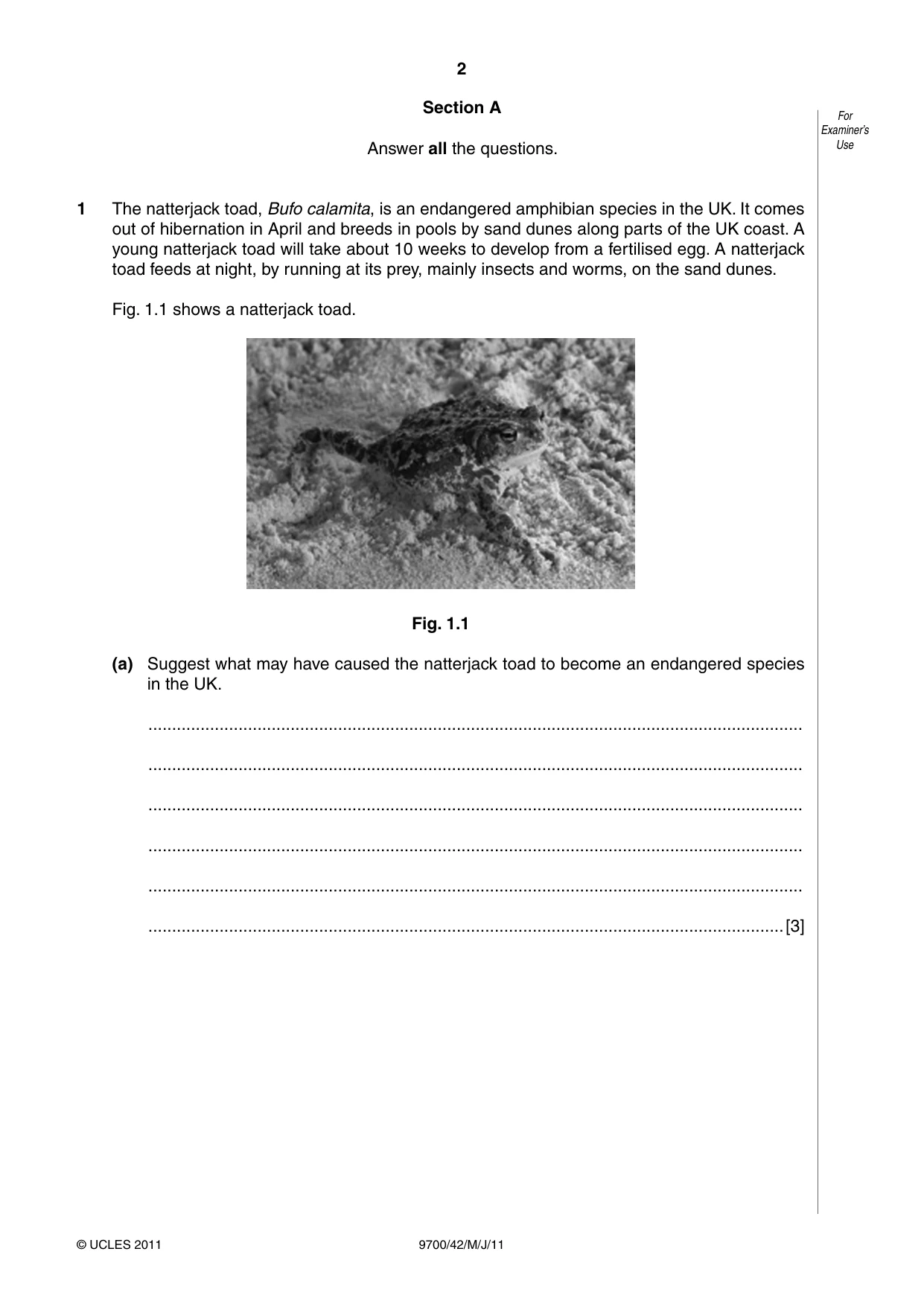
2 © UCLES 2011 9700/42/M/J/11 For Examiner’s Use Section A Answer all the questions. 1 The natterjack toad, Bufo calamita, is an endangered amphibian species in the UK. It comes out of hibernation in April and breeds in pools by sand dunes along parts of the UK coast. A young natterjack toad will take about 10 weeks to develop from a fertilised egg. A natterjack toad feeds at night, by running at its prey, mainly insects and worms, on the sand dunes. Fig. 1.1 shows a natterjack toad. Fig. 1.1 (a) Suggest what may have caused the natterjack toad to become an endangered species in the UK. … … … … … …[3]
Question paper, page 3
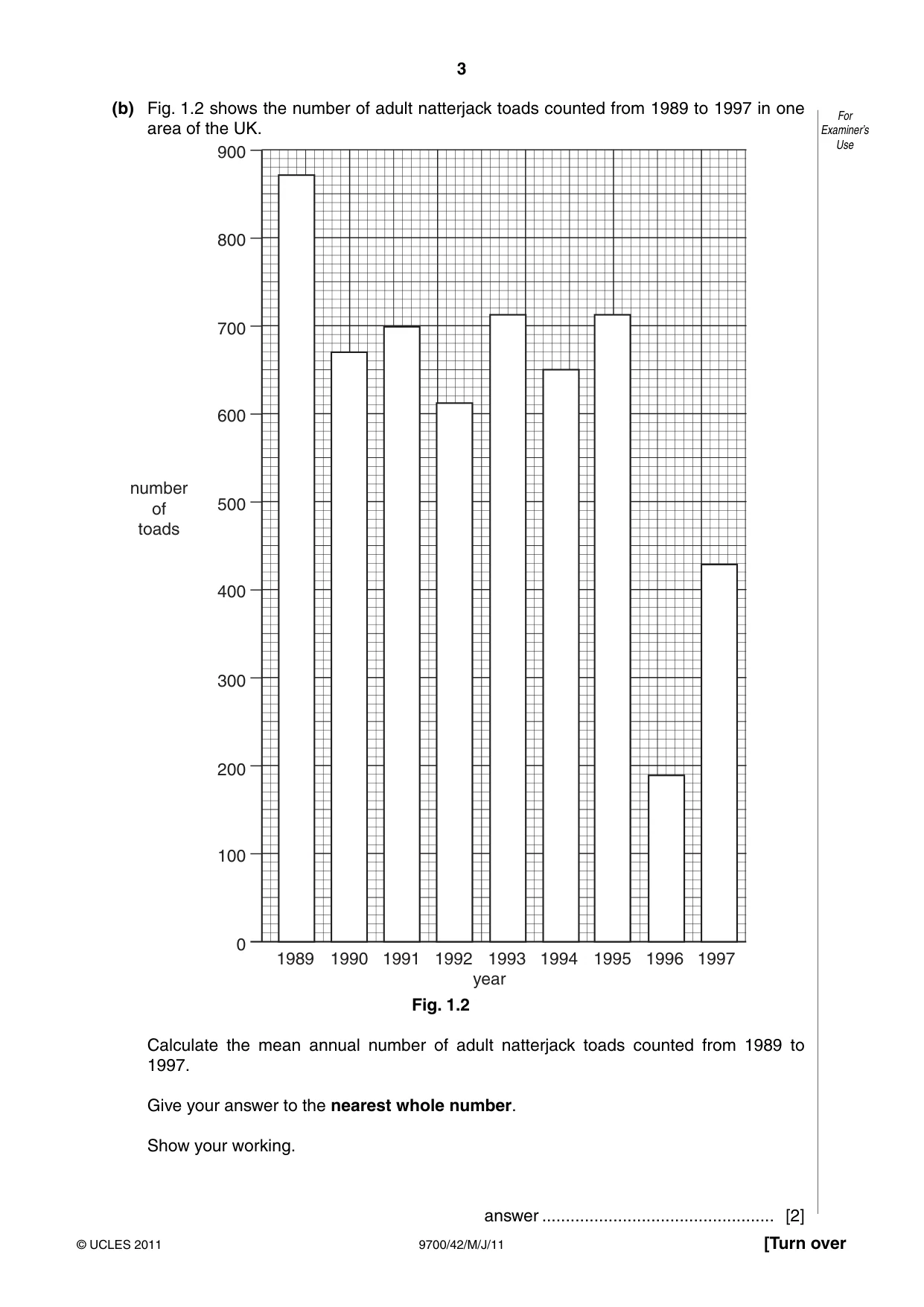
3 © UCLES 2011 [Turn over 9700/42/M/J/11 For Examiner’s Use (b) Fig. 1.2 shows the number of adult natterjack toads counted from 1989 to 1997 in one area of the UK. 1989 1990 1991 1992 1993 1994 1995 1996 1997 0 100 200 300 400 500 600 700 800 900 year number of toads Fig. 1.2 Calculate the mean annual number of adult natterjack toads counted from 1989 to 1997. Give your answer to the nearest whole number. Show your working. answer … [2]
Question paper, page 4
4 © UCLES 2011 9700/42/M/J/11 For Examiner’s Use (c) The natterjack toad is heterotrophic. (i) Explain what is meant by heterotrophic. … … … …[2] (ii) Name two kingdoms that are exclusively heterotrophic. 1. … 2. …[1] (d) Each year the International Union for the Conservation of Nature and Natural Resources (IUCN) publishes a list of endangered species called the Red List. The Red List has a very high proportion of vertebrates compared to invertebrates. Suggest one reason why the Red List has many more vertebrates than invertebrates. … …[1] [Total: 9]
Question paper, page 5
5 9700/42/M/J/11 © UCLES 2011 [Turn over BLANK PAGE Question 2 starts on page 6
Question paper, page 6
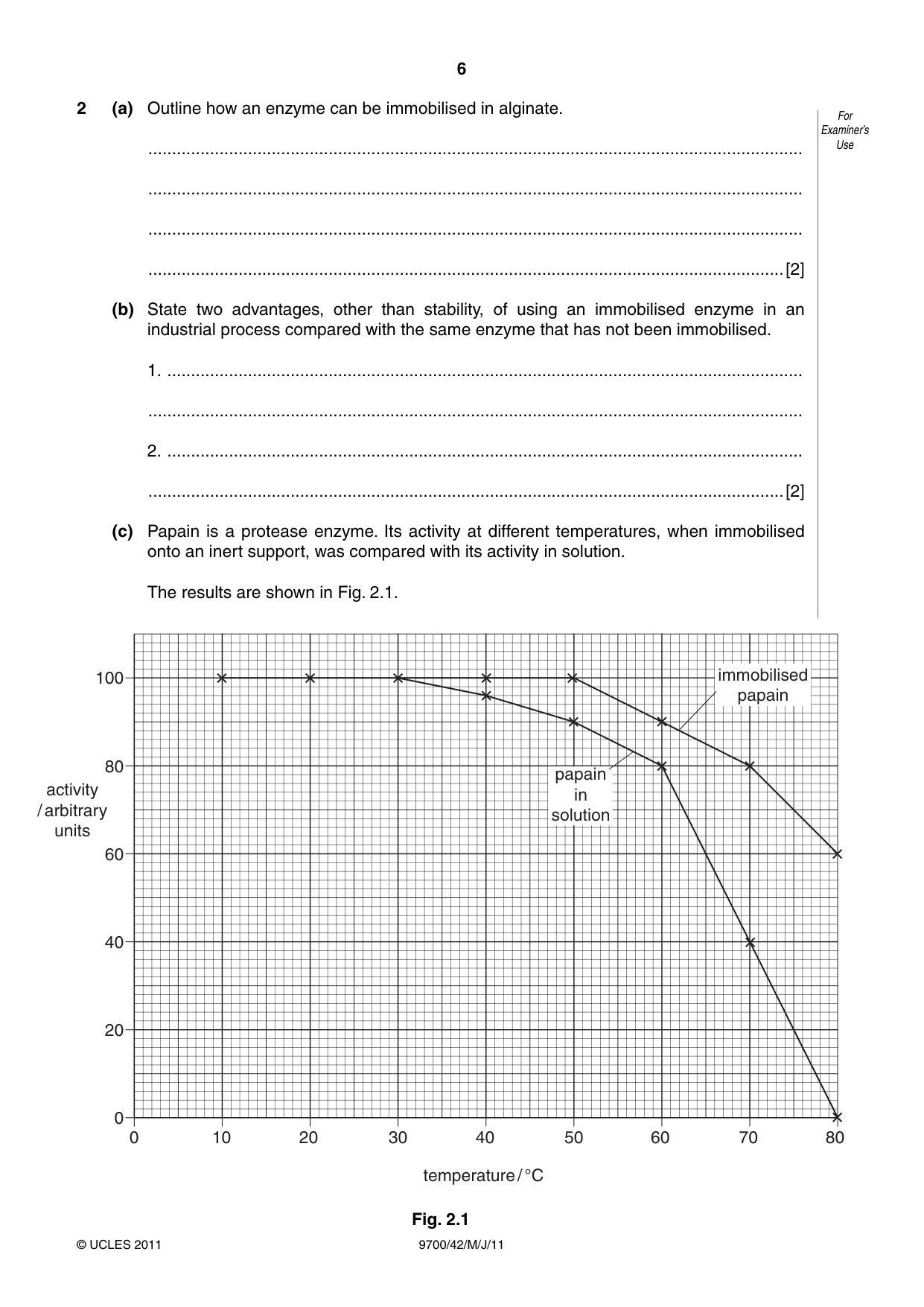
6 © UCLES 2011 9700/42/M/J/11 For Examiner’s Use 2 (a) Outline how an enzyme can be immobilised in alginate. … … … …[2] (b) State two advantages, other than stability, of using an immobilised enzyme in an industrial process compared with the same enzyme that has not been immobilised. 1. … … 2. … …[2] (c) Papain is a protease enzyme. Its activity at different temperatures, when immobilised onto an inert support, was compared with its activity in solution. The results are shown in Fig. 2.1. 0 20 40 60 80 100 0 10 20 30 40 50 60 70 80 papain in solution temperature / °C immobilised papain activity / arbitrary units Fig. 2.1
Question paper, page 7
7 © UCLES 2011 [Turn over 9700/42/M/J/11 For Examiner’s Use With reference to Fig. 2.1, describe and explain the differences in activity of immobilised papain and papain in solution. … … … … … … … …[4] [Total: 8]
Question paper, page 8
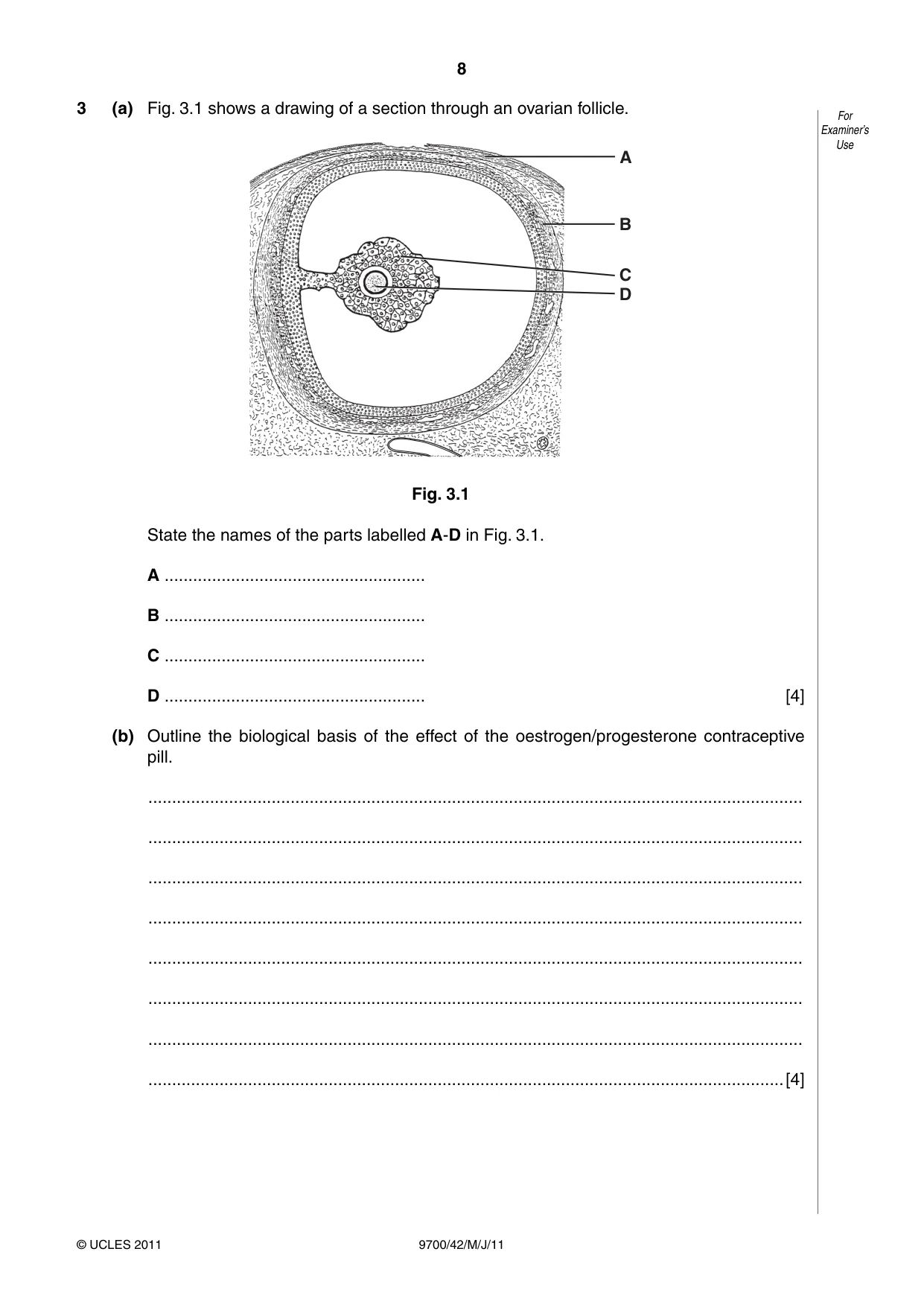
8 © UCLES 2011 9700/42/M/J/11 For Examiner’s Use 3 (a) Fig. 3.1 shows a drawing of a section through an ovarian follicle. A B C D Fig. 3.1 State the names of the parts labelled A-D in Fig. 3.1. A … B … C … D … [4] (b) Outline the biological basis of the effect of the oestrogen/progesterone contraceptive pill. … … … … … … … …[4]
Question paper, page 9
9 © UCLES 2011 [Turn over 9700/42/M/J/11 For Examiner’s Use (c) The zona pellucida of an oocyte is made up of ZP proteins. ZP3, which does not occur anywhere else in the body, has a complex tertiary structure and acts as a receptor for sperm during fertilisation. A new method of contraception, which does not involve the use of hormones, is in the early stages of development. It involves blocking the expression of the gene coding for ZP3. (i) Explain how blocking the expression of the gene coding for ZP3 acts as a contraceptive. … … … … … …[3] (ii) Explain why it is desirable to devise a method of contraception that does not involve oestrogen and progesterone. … … … …[2] (iii) Explain why it is important, when blocking the expression of the gene coding for ZP3, that ZP3 is only found in the zona pellucida. … … … …[2] [Total: 15]
Question paper, page 10
10 9700/42/M/J/11 © UCLES 2011 BLANK PAGE
Question paper, page 11
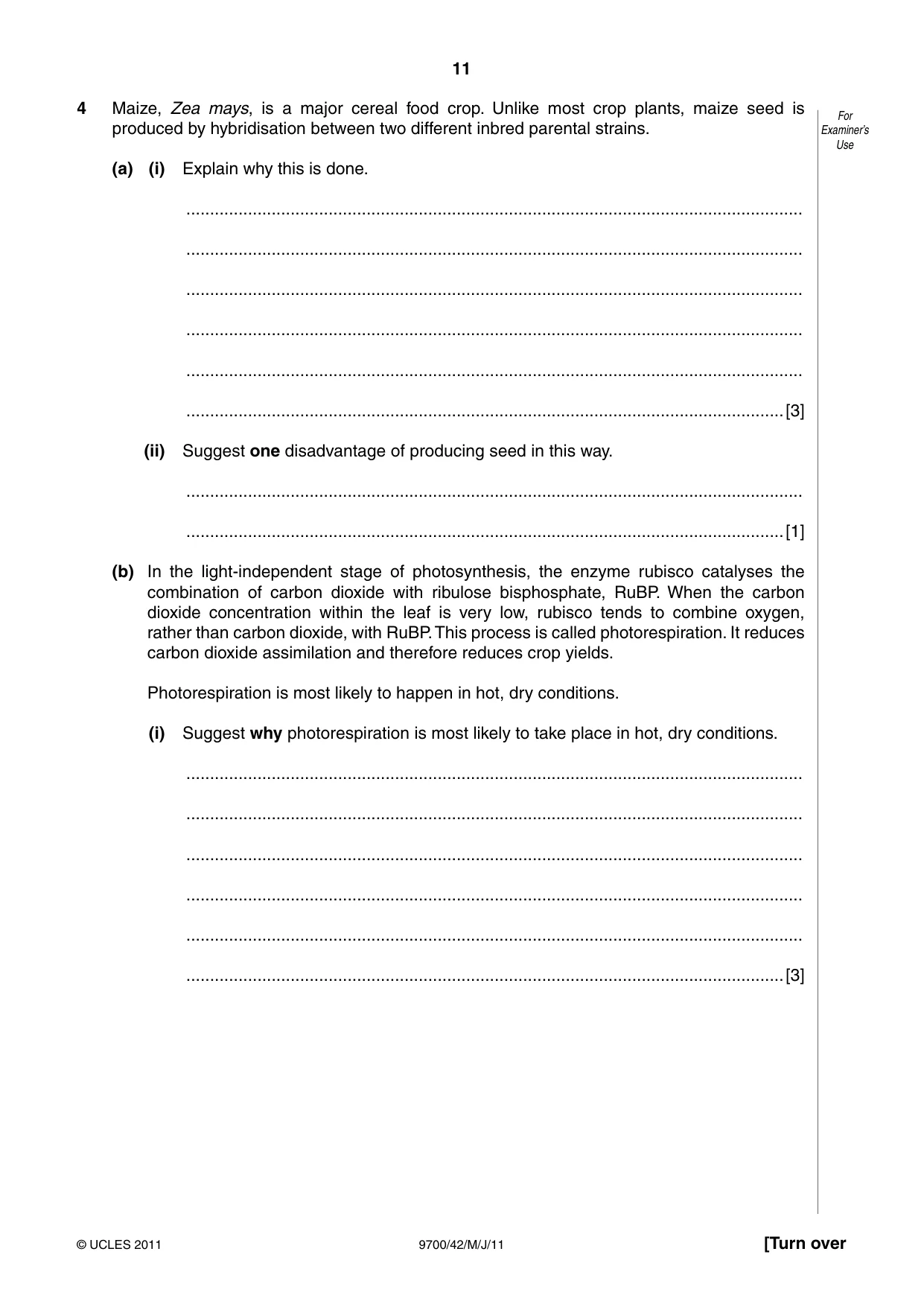
11 © UCLES 2011 [Turn over 9700/42/M/J/11 For Examiner’s Use 4 Maize, Zea mays, is a major cereal food crop. Unlike most crop plants, maize seed is produced by hybridisation between two different inbred parental strains. (a) (i) Explain why this is done. … … … … … …[3] (ii) Suggest one disadvantage of producing seed in this way. … …[1] (b) In the light-independent stage of photosynthesis, the enzyme rubisco catalyses the combination of carbon dioxide with ribulose bisphosphate, RuBP. When the carbon dioxide concentration within the leaf is very low, rubisco tends to combine oxygen, rather than carbon dioxide, with RuBP. This process is called photorespiration. It reduces carbon dioxide assimilation and therefore reduces crop yields. Photorespiration is most likely to happen in hot, dry conditions. (i) Suggest why photorespiration is most likely to take place in hot, dry conditions. … … … … … …[3]
Question paper, page 12
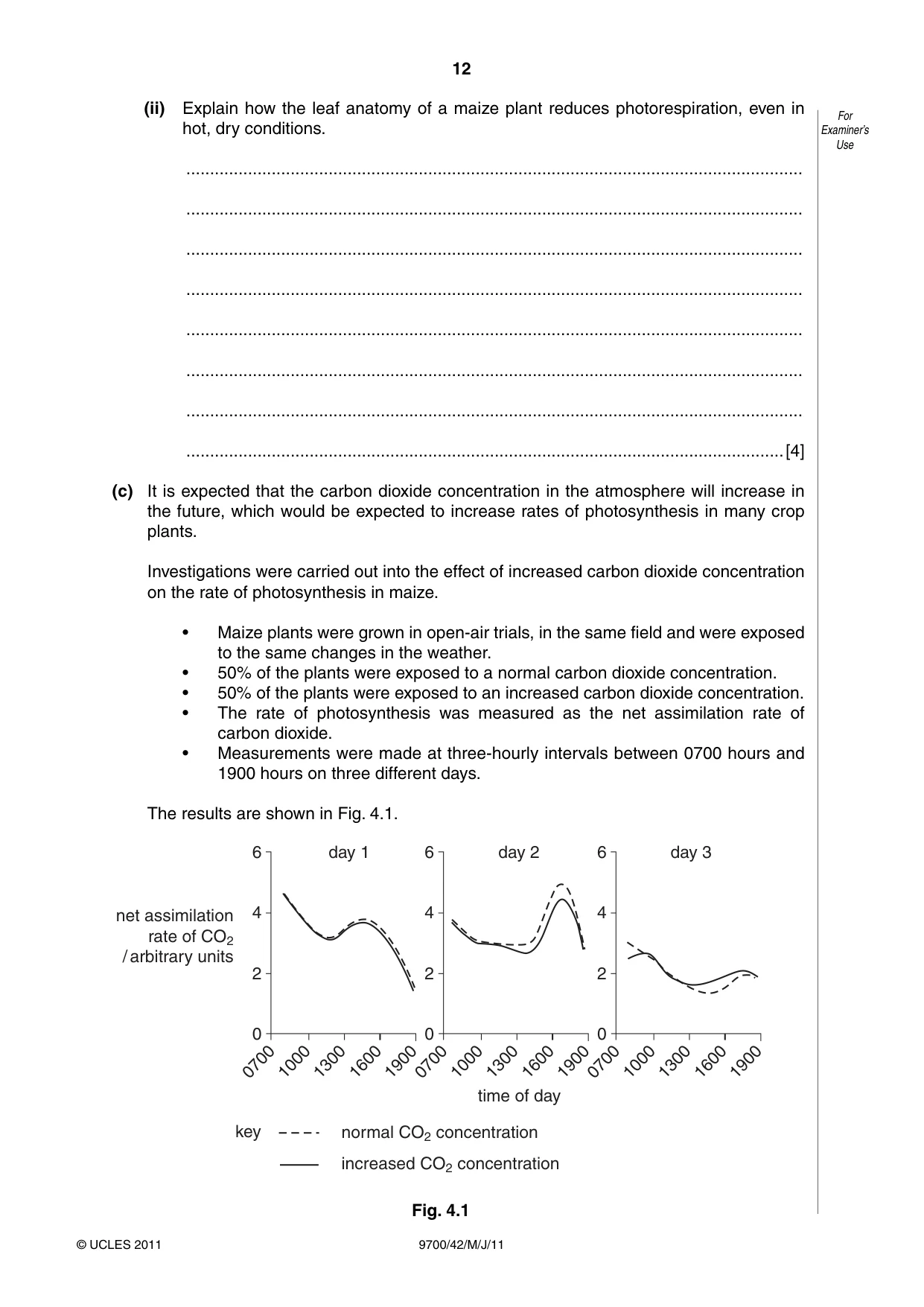
12 © UCLES 2011 9700/42/M/J/11 For Examiner’s Use (ii) Explain how the leaf anatomy of a maize plant reduces photorespiration, even in hot, dry conditions. … … … … … … … …[4] (c) It is expected that the carbon dioxide concentration in the atmosphere will increase in the future, which would be expected to increase rates of photosynthesis in many crop plants. Investigations were carried out into the effect of increased carbon dioxide concentration on the rate of photosynthesis in maize. • Maize plants were grown in open-air trials, in the same field and were exposed to the same changes in the weather. • 50% of the plants were exposed to a normal carbon dioxide concentration. • 50% of the plants were exposed to an increased carbon dioxide concentration. • The rate of photosynthesis was measured as the net assimilation rate of carbon dioxide. • Measurements were made at three-hourly intervals between 0700 hours and 1900 hours on three different days. The results are shown in Fig. 4.1. 6 day 1 day 2 day 3 4 2 0 0700 1000 1300 1600 1900 6 4 2 0 net assimilation rate of CO2 / arbitrary units 0700 1000 1300 1600 1900 6 4 2 0 0700 1000 1300 1600 1900 time of day normal CO2 concentration increased CO2 concentration key Fig. 4.1
Question paper, page 13
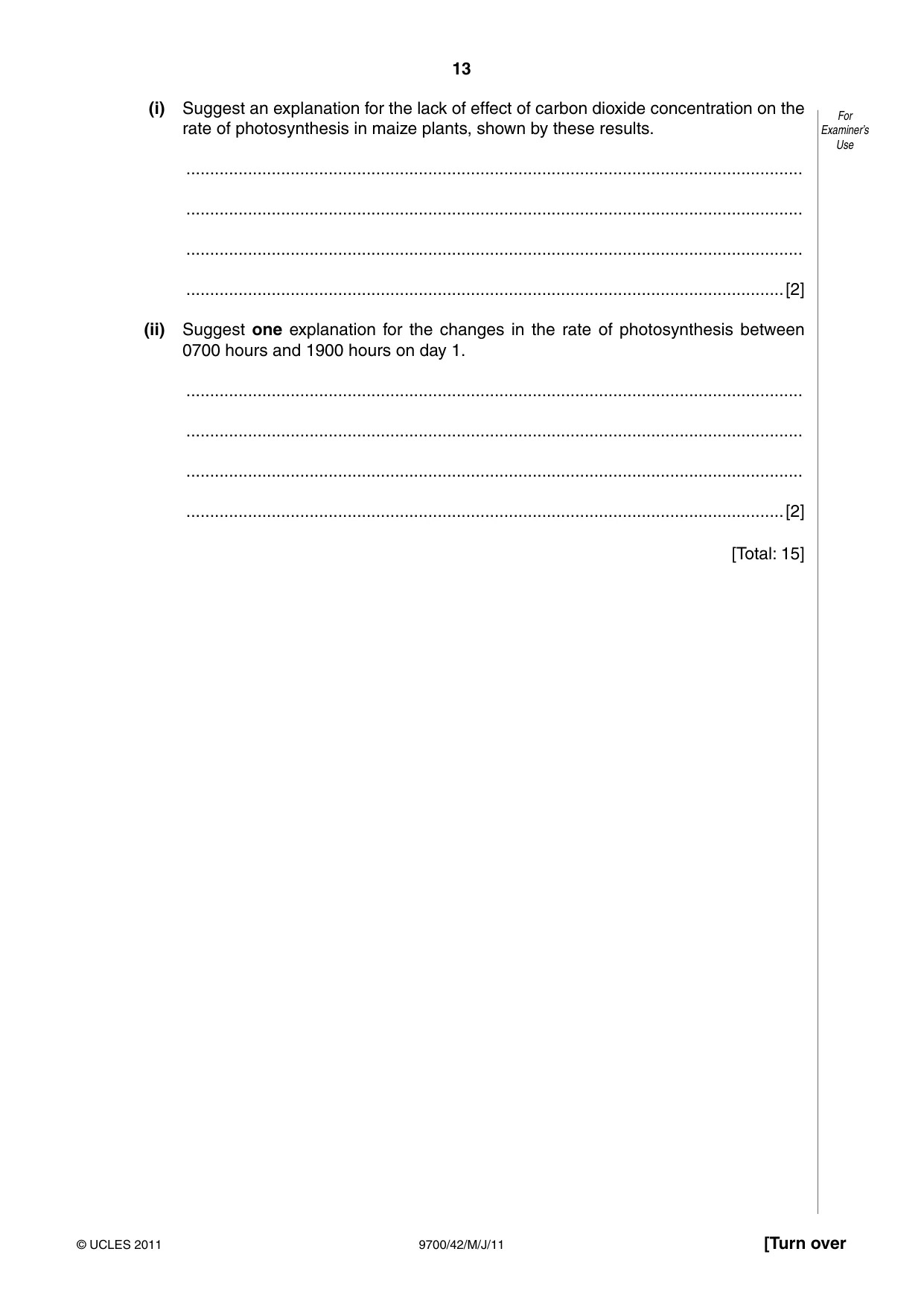
13 © UCLES 2011 [Turn over 9700/42/M/J/11 For Examiner’s Use (i) Suggest an explanation for the lack of effect of carbon dioxide concentration on the rate of photosynthesis in maize plants, shown by these results. … … … …[2] (ii) Suggest one explanation for the changes in the rate of photosynthesis between 0700 hours and 1900 hours on day 1. … … … …[2] [Total: 15]
Question paper, page 14
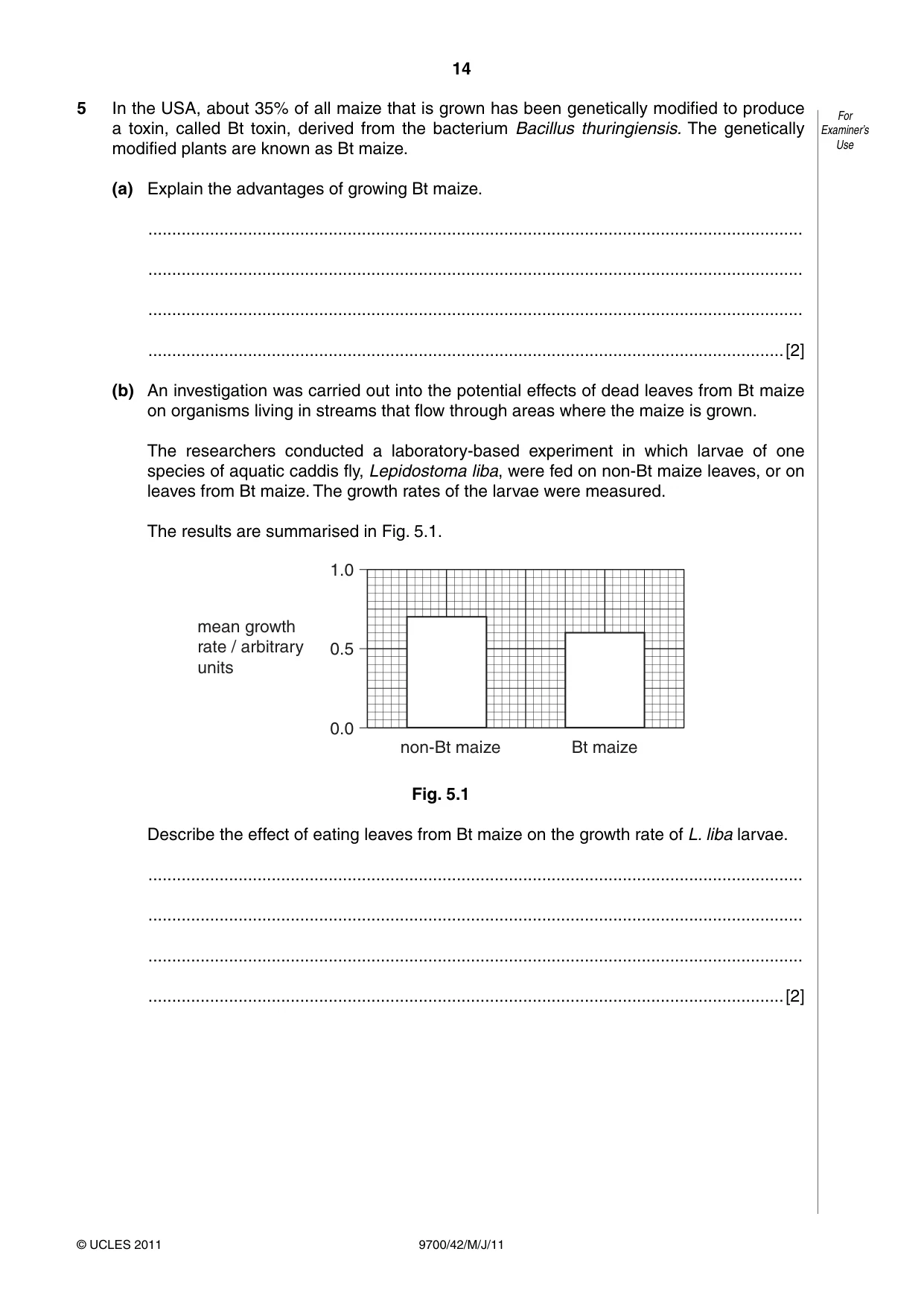
14 © UCLES 2011 9700/42/M/J/11 For Examiner’s Use 5 In the USA, about 35% of all maize that is grown has been genetically modified to produce a toxin, called Bt toxin, derived from the bacterium Bacillus thuringiensis. The genetically modified plants are known as Bt maize. (a) Explain the advantages of growing Bt maize. … … … …[2] (b) An investigation was carried out into the potential effects of dead leaves from Bt maize on organisms living in streams that flow through areas where the maize is grown. The researchers conducted a laboratory-based experiment in which larvae of one species of aquatic caddis fly, Lepidostoma liba, were fed on non-Bt maize leaves, or on leaves from Bt maize. The growth rates of the larvae were measured. The results are summarised in Fig. 5.1. 0.0 0.5 1.0 non-Bt maize Bt maize mean growth rate / arbitrary units Fig. 5.1 Describe the effect of eating leaves from Bt maize on the growth rate of L. liba larvae. … … … …[2]
Question paper, page 15
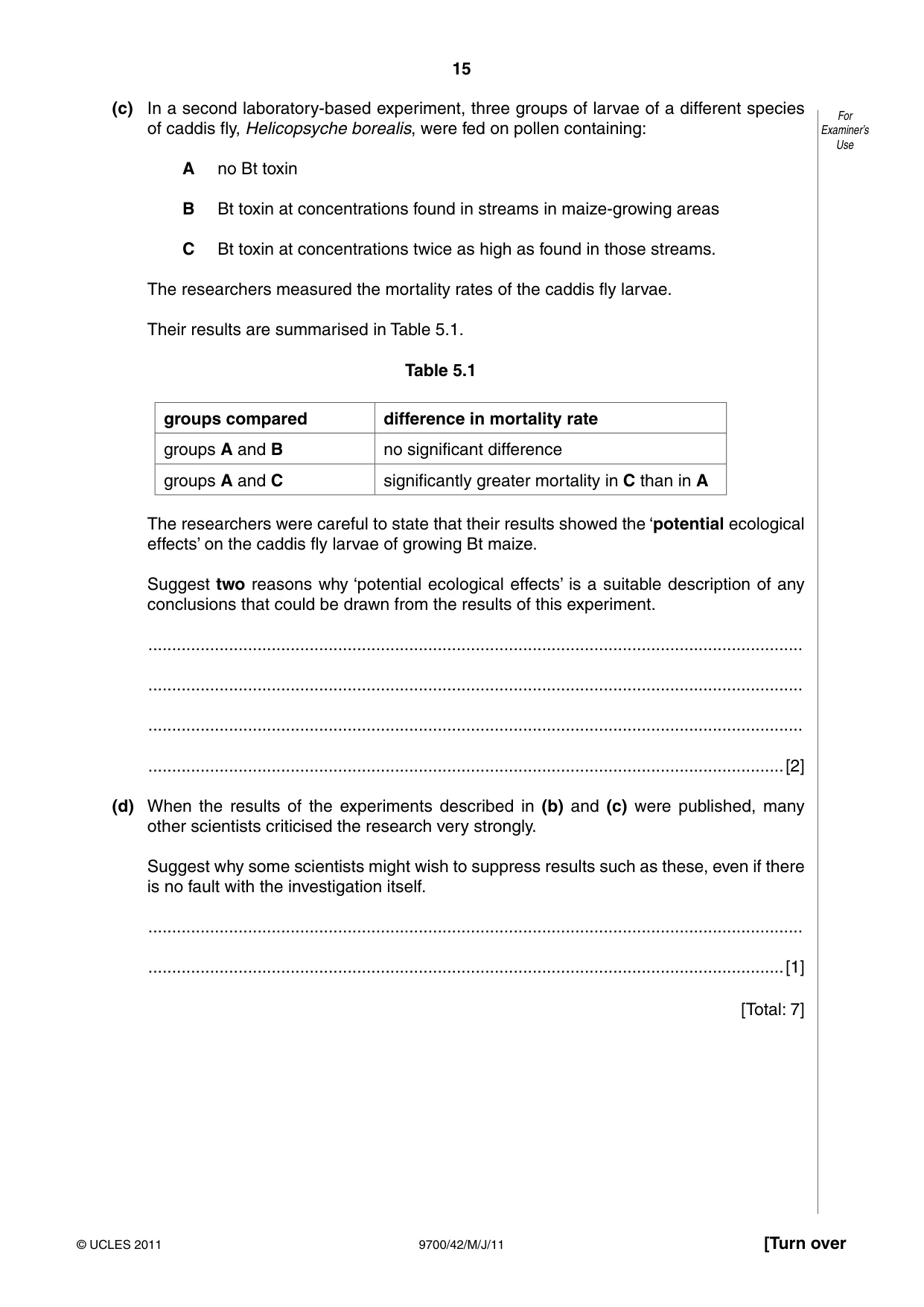
15 © UCLES 2011 [Turn over 9700/42/M/J/11 For Examiner’s Use (c) In a second laboratory-based experiment, three groups of larvae of a different species of caddis fly, Helicopsyche borealis, were fed on pollen containing: A no Bt toxin B Bt toxin at concentrations found in streams in maize-growing areas C Bt toxin at concentrations twice as high as found in those streams. The researchers measured the mortality rates of the caddis fly larvae. Their results are summarised in Table 5.1. Table 5.1 groups compared difference in mortality rate groups A and B no significant difference groups A and C significantly greater mortality in C than in A The researchers were careful to state that their results showed the ‘potential ecological effects’ on the caddis fly larvae of growing Bt maize. Suggest two reasons why ‘potential ecological effects’ is a suitable description of any conclusions that could be drawn from the results of this experiment. … … … …[2] (d) When the results of the experiments described in (b) and (c) were published, many other scientists criticised the research very strongly. Suggest why some scientists might wish to suppress results such as these, even if there is no fault with the investigation itself. … …[1] [Total: 7]
Question paper, page 16
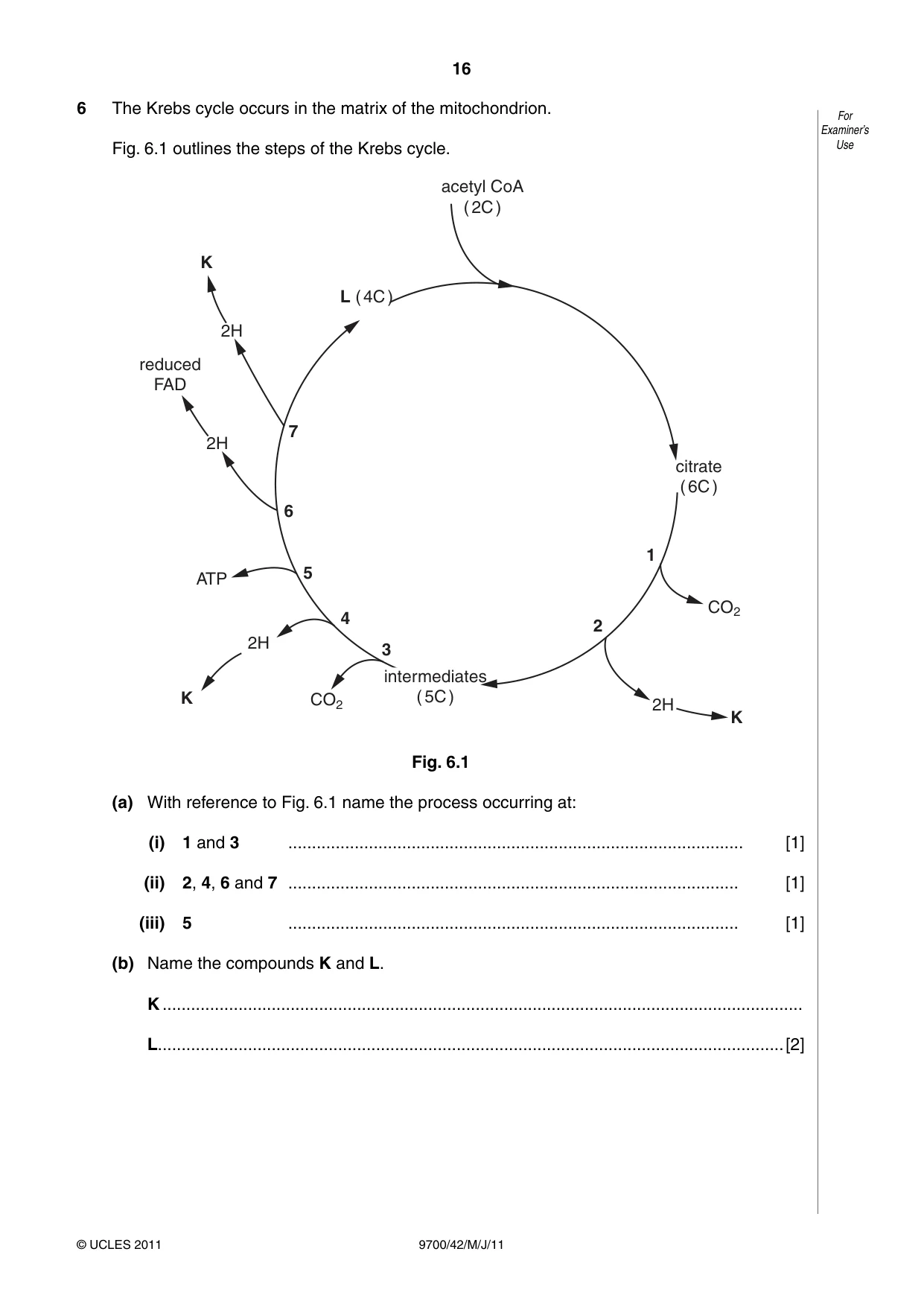
16 © UCLES 2011 9700/42/M/J/11 For Examiner’s Use 6 The Krebs cycle occurs in the matrix of the mitochondrion. Fig. 6.1 outlines the steps of the Krebs cycle. acetyl CoA ( 2C ) CO2 CO2 2H 2H K K 3 2 1 4 5 6 7 intermediates ( 5C ) K reduced FAD ATP 2H 2H citrate ( 6C ) L ( 4C ) Fig. 6.1 (a) With reference to Fig. 6.1 name the process occurring at: (i) 1 and 3 … [1] (ii) 2, 4, 6 and 7 … [1] (iii) 5 … [1] (b) Name the compounds K and L. K … L…[2]
Question paper, page 17
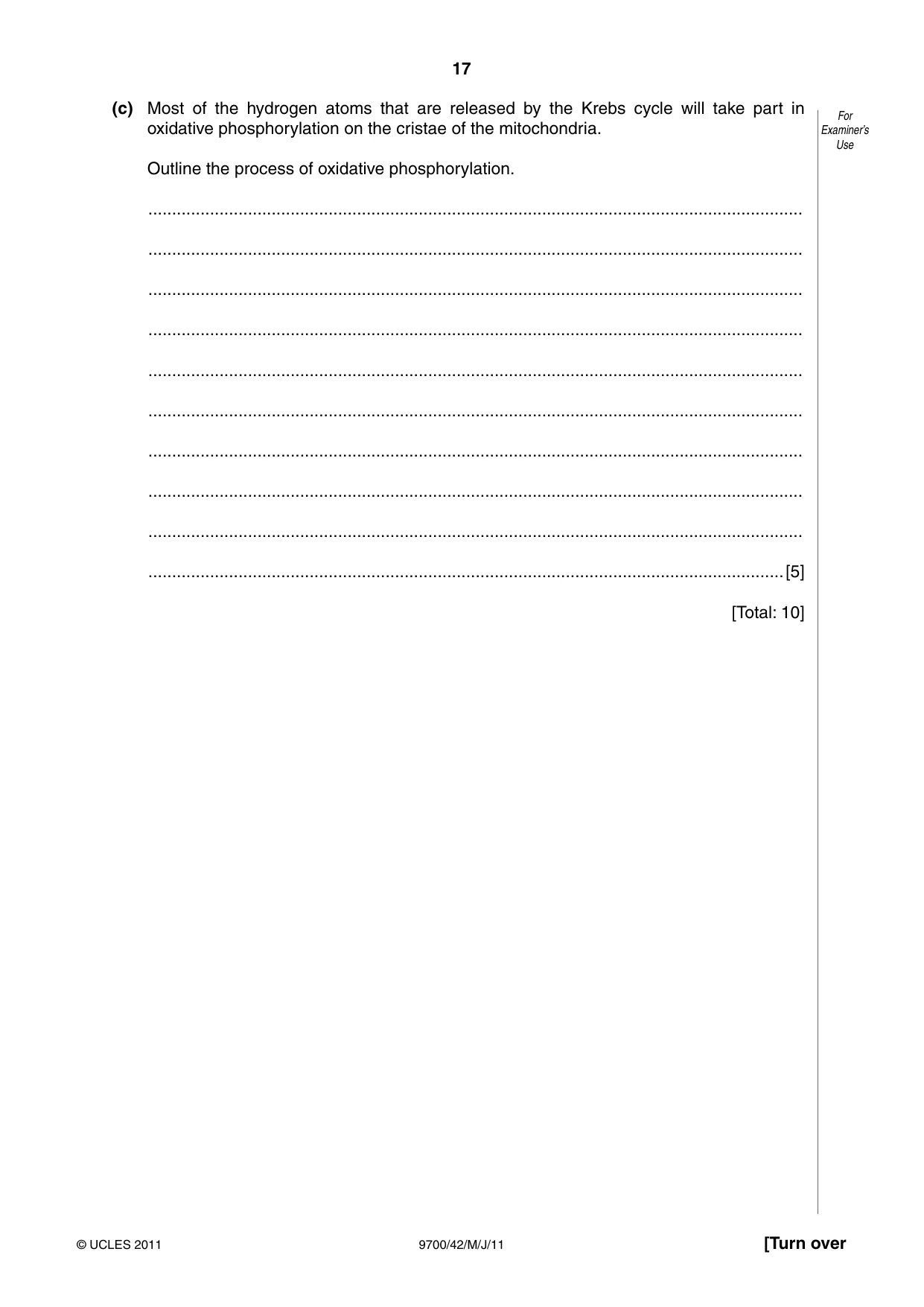
17 © UCLES 2011 [Turn over 9700/42/M/J/11 For Examiner’s Use (c) Most of the hydrogen atoms that are released by the Krebs cycle will take part in oxidative phosphorylation on the cristae of the mitochondria. Outline the process of oxidative phosphorylation. … … … … … … … … … …[5] [Total: 10]
Question paper, page 18
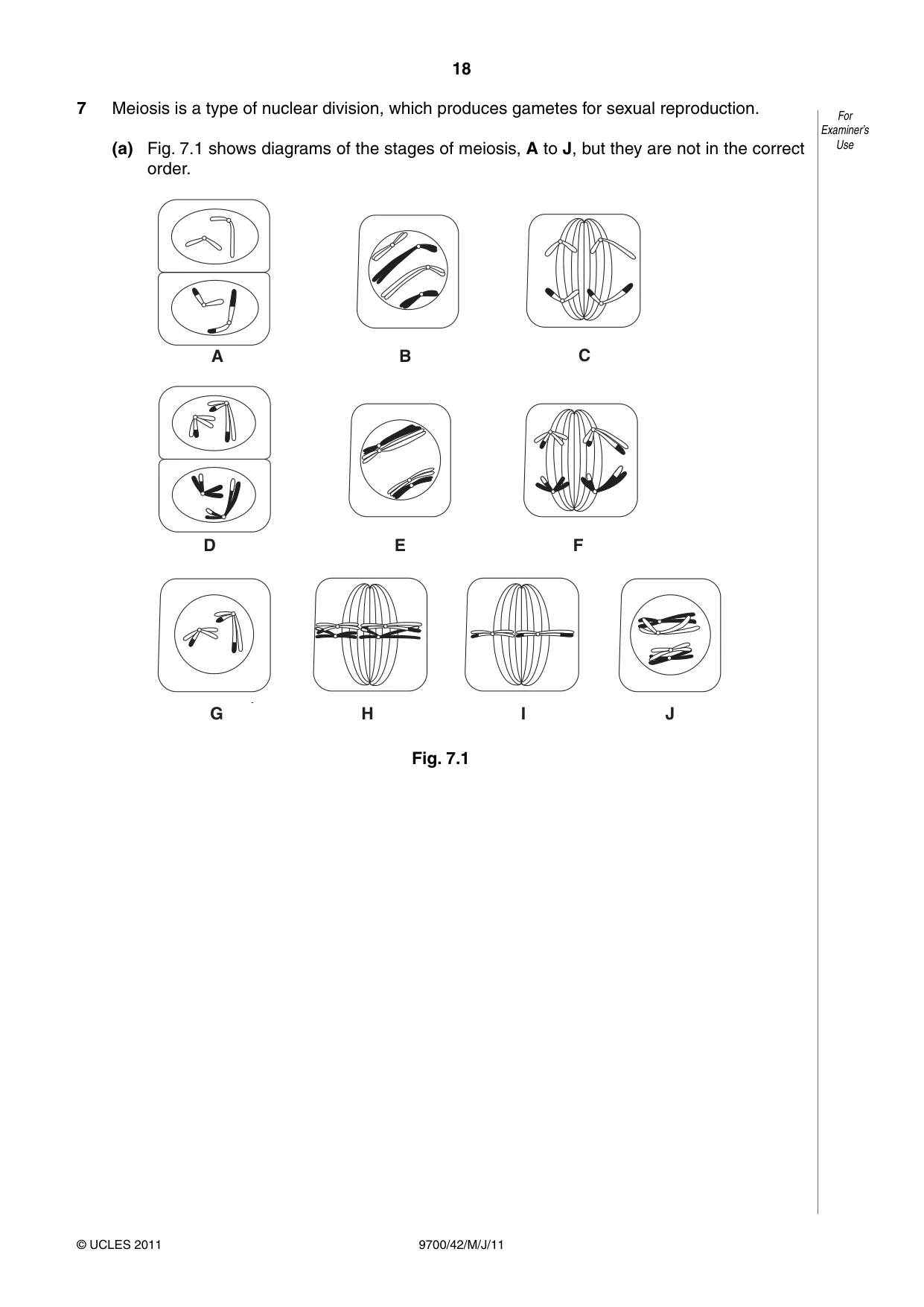
18 © UCLES 2011 9700/42/M/J/11 For Examiner’s Use 7 Meiosis is a type of nuclear division, which produces gametes for sexual reproduction. (a) Fig. 7.1 shows diagrams of the stages of meiosis, A to J, but they are not in the correct order. A B C D E F G H I J Fig. 7.1
Question paper, page 19
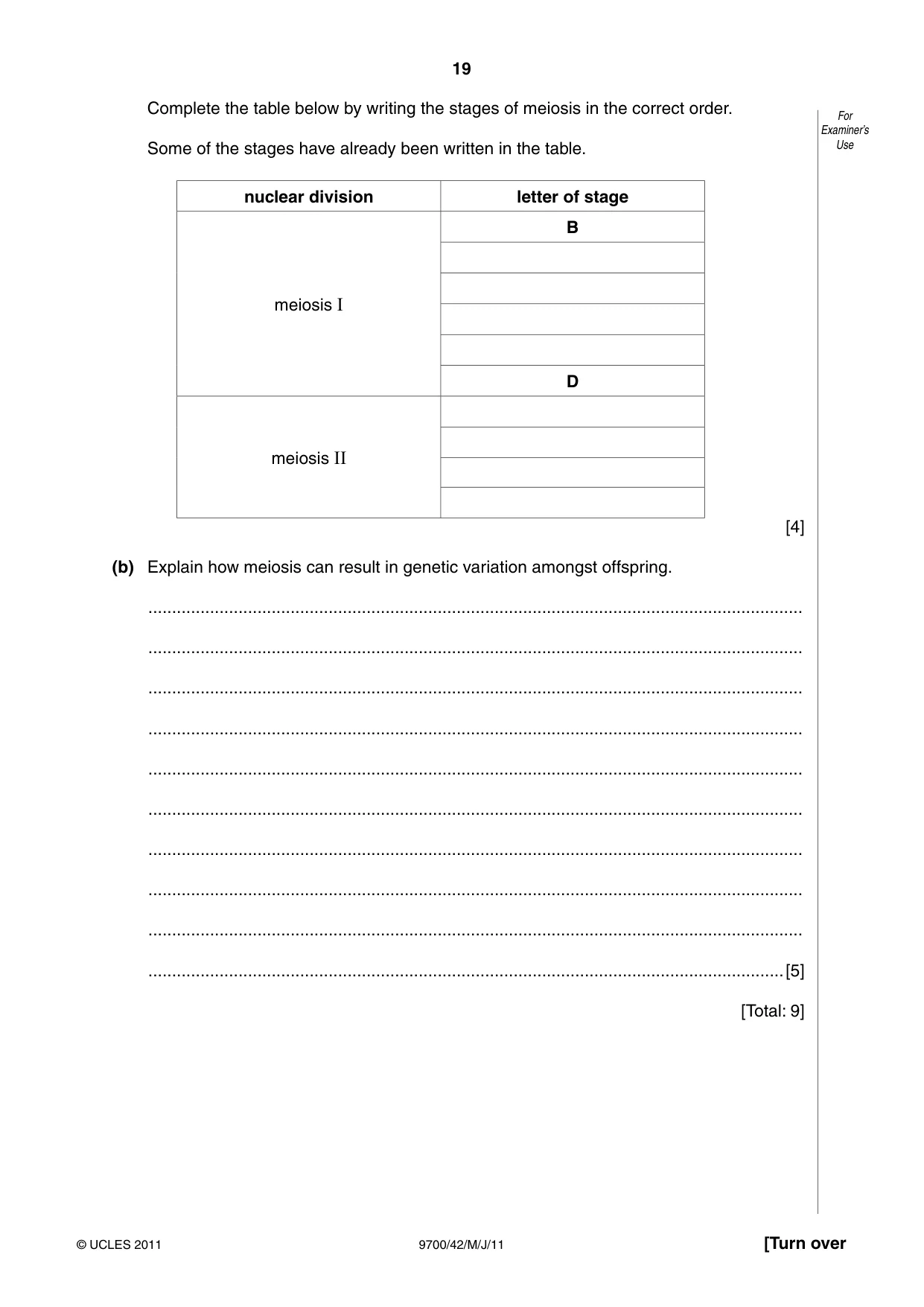
19 © UCLES 2011 [Turn over 9700/42/M/J/11 For Examiner’s Use Complete the table below by writing the stages of meiosis in the correct order. Some of the stages have already been written in the table. nuclear division letter of stage meiosis I B D meiosis II [4] (b) Explain how meiosis can result in genetic variation amongst offspring. … … … … … … … … … …[5] [Total: 9]
Question paper, page 20
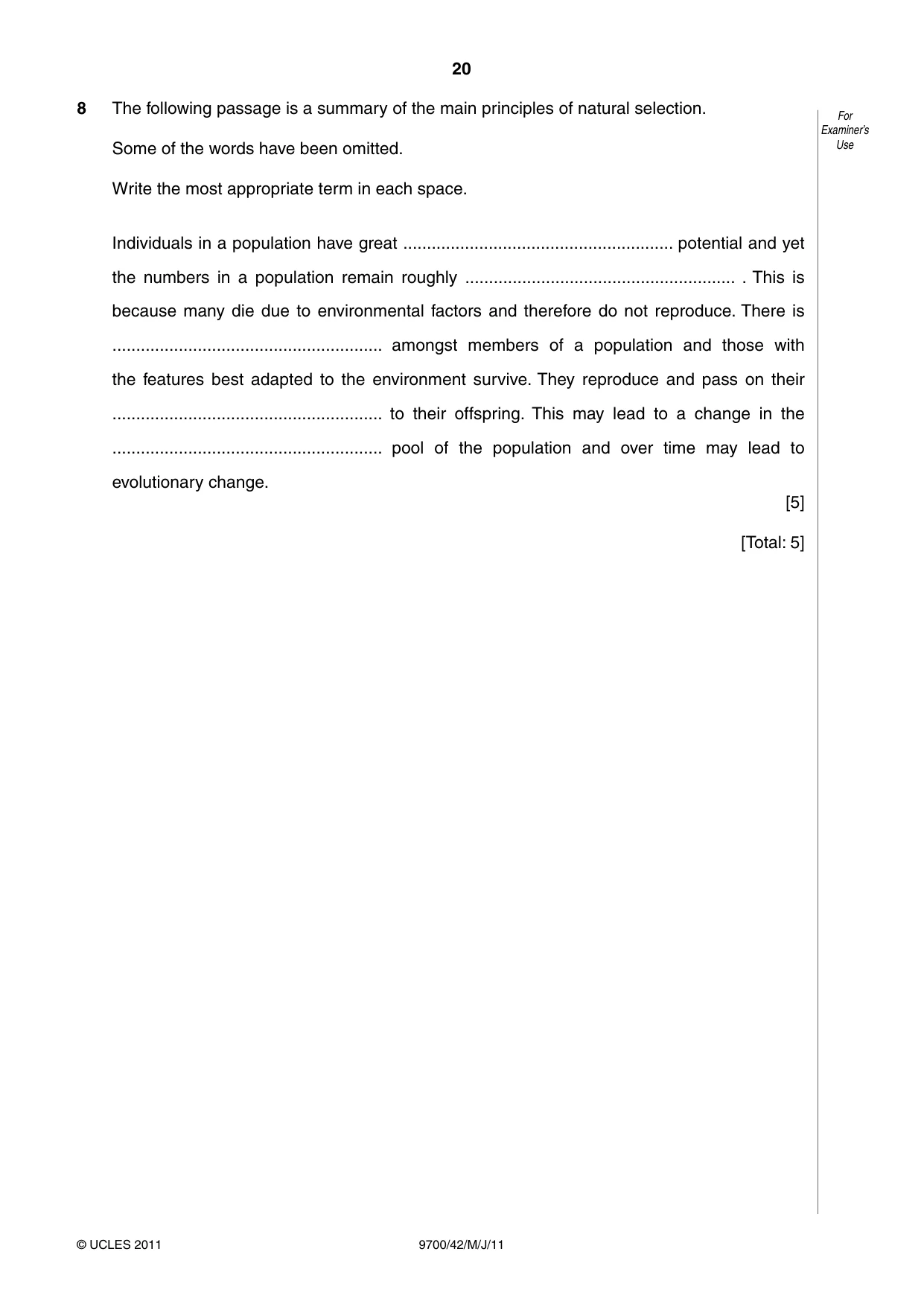
20 © UCLES 2011 9700/42/M/J/11 For Examiner’s Use 8 The following passage is a summary of the main principles of natural selection. Some of the words have been omitted. Write the most appropriate term in each space. Individuals in a population have great … potential and yet the numbers in a population remain roughly … . This is because many die due to environmental factors and therefore do not reproduce. There is … amongst members of a population and those with the features best adapted to the environment survive. They reproduce and pass on their … to their offspring. This may lead to a change in the … pool of the population and over time may lead to evolutionary change. [5] [Total: 5]
Question paper, page 21
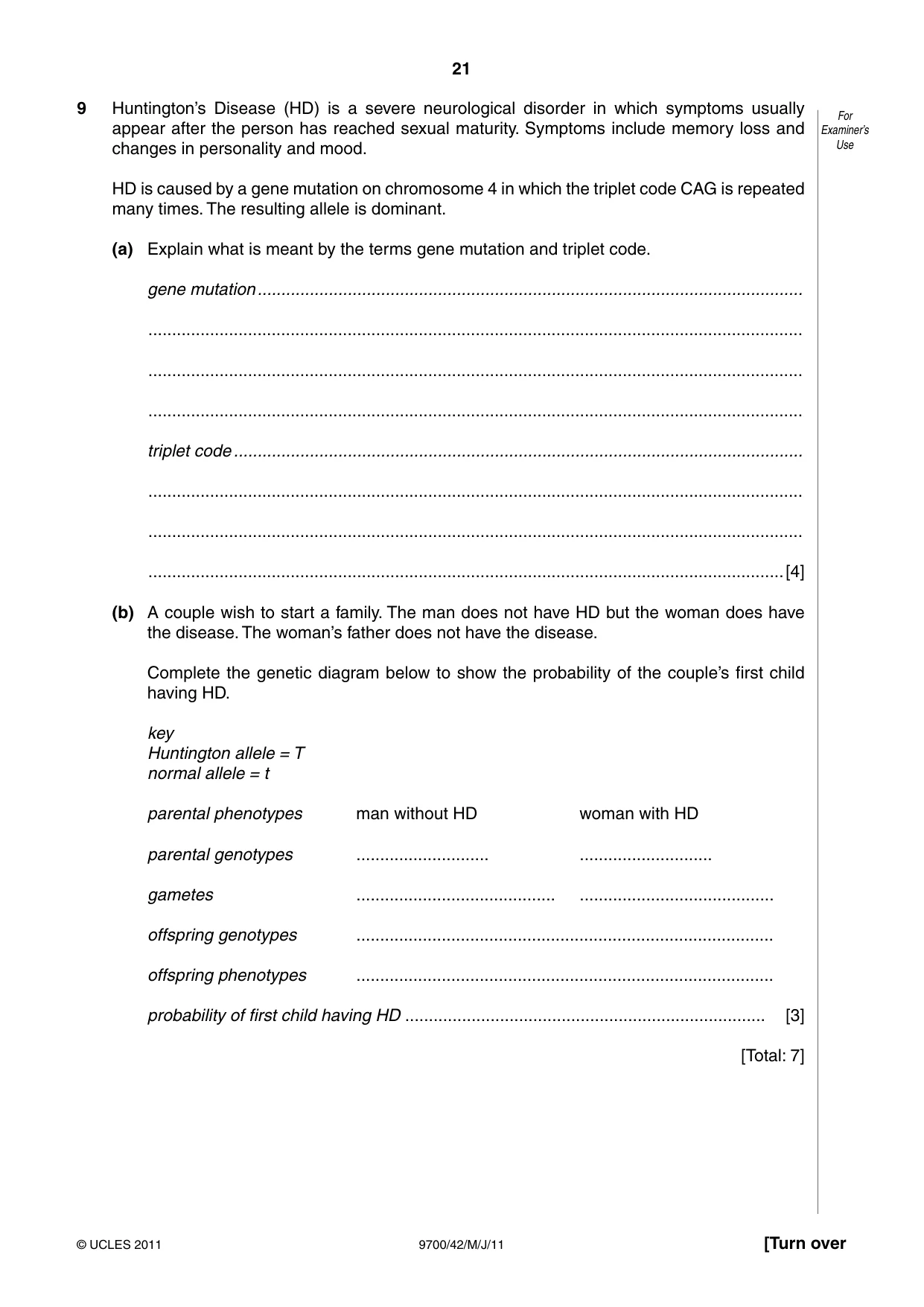
21 © UCLES 2011 [Turn over 9700/42/M/J/11 For Examiner’s Use 9 Huntington’s Disease (HD) is a severe neurological disorder in which symptoms usually appear after the person has reached sexual maturity. Symptoms include memory loss and changes in personality and mood. HD is caused by a gene mutation on chromosome 4 in which the triplet code CAG is repeated many times. The resulting allele is dominant. (a) Explain what is meant by the terms gene mutation and triplet code. gene mutation … … … … triplet code … … … …[4] (b) A couple wish to start a family. The man does not have HD but the woman does have the disease. The woman’s father does not have the disease. Complete the genetic diagram below to show the probability of the couple’s first child having HD. key Huntington allele = T normal allele = t parental phenotypes man without HD woman with HD parental genotypes … … gametes … … offspring genotypes … offspring phenotypes … probability of first child having HD … [3] [Total: 7]
Question paper, page 22
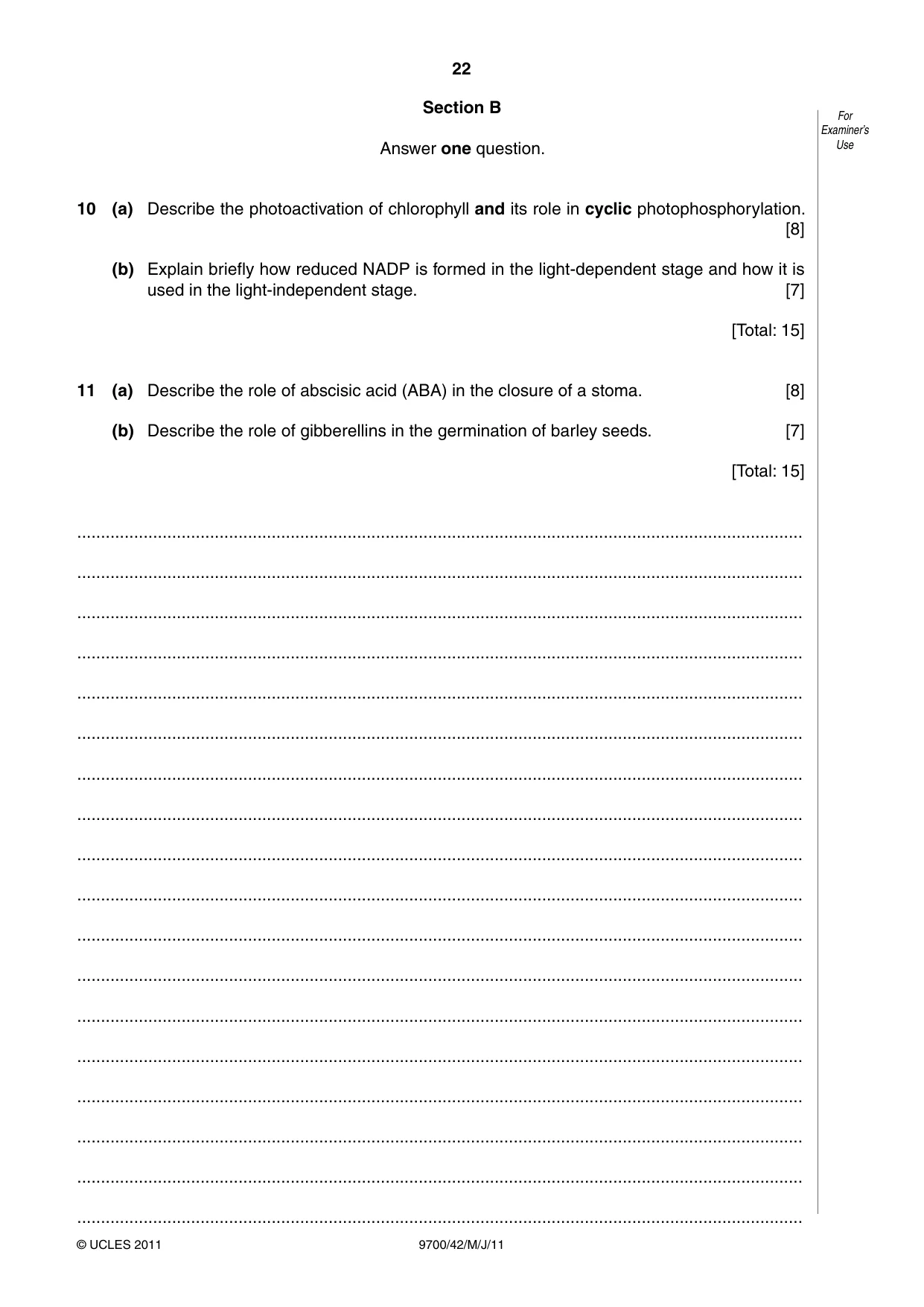
22 © UCLES 2011 9700/42/M/J/11 For Examiner’s Use Section B Answer one question. 10 (a) Describe the photoactivation of chlorophyll and its role in cyclic photophosphorylation. [8] (b) Explain briefly how reduced NADP is formed in the light-dependent stage and how it is used in the light-independent stage. [7] [Total: 15] 11 (a) Describe the role of abscisic acid (ABA) in the closure of a stoma. [8] (b) Describe the role of gibberellins in the germination of barley seeds. [7] [Total: 15] … … … … … … … … … … … … … … … … … …
Question paper, page 23
23 © UCLES 2011 [Turn over 9700/42/M/J/11 For Examiner’s Use … … … … … … … … … … … … … … … … … … … … … … … … … … … …
Question paper, page 24
24 © UCLES 2011 9700/42/M/J/11 For Examiner’s Use … … … … … … … … … … … … … … … … … … … … … … … … Copyright Acknowledgements: Question 1 © Stephen Dalton; www.nhpa.co.uk Permission to reproduce items where third-party owned material protected by copyright is included has been sought and cleared where possible. Every reasonable effort has been made by the publisher (UCLES) to trace copyright holders, but if any items requiring clearance have unwittingly been included, the publisher will be pleased to make amends at the earliest possible opportunity. University of Cambridge International Examinations is part of the Cambridge Assessment Group. Cambridge Assessment is the brand name of University of Cambridge Local Examinations Syndicate (UCLES), which is itself a department of the University of Cambridge.
Mark scheme, page 1
UNIVERSITY OF CAMBRIDGE INTERNATIONAL EXAMINATIONS GCE Advanced Subsidiary Level and GCE Advanced Level MARK SCHEME for the May/June 2011 question paper for the guidance of teachers 9700 BIOLOGY 9700/42 Paper 4 (A2 Structured Questions), maximum raw mark 100 This mark scheme is published as an aid to teachers and candidates, to indicate the requirements of the examination. It shows the basis on which Examiners were instructed to award marks. It does not indicate the details of the discussions that took place at an Examiners’ meeting before marking began, which would have considered the acceptability of alternative answers. Mark schemes must be read in conjunction with the question papers and the report on the examination. • Cambridge will not enter into discussions or correspondence in connection with these mark schemes. Cambridge is publishing the mark schemes for the May/June 2011 question papers for most IGCSE, GCE Advanced Level and Advanced Subsidiary Level syllabuses and some Ordinary Level syllabuses.
Mark scheme, page 2
Page 2 Mark Scheme: Teachers’ version Syllabus Paper GCE AS/A LEVEL – May/June 2011 9700 42 © University of Cambridge International Examinations 2011 Mark scheme abbreviations: ; separates marking points / alternative answers for the same point R reject A accept (for answers correctly cued by the question, or by extra guidance) AW alternative wording (where responses vary more than usual) underline actual word given must be used by candidate (grammatical variants excepted) max indicates the maximum number of marks that can be given ora or reverse argument mp marking point (with relevant number) ecf error carried forward I ignore AVP Alternative valid point (examples given as guidance)
Mark scheme, page 3
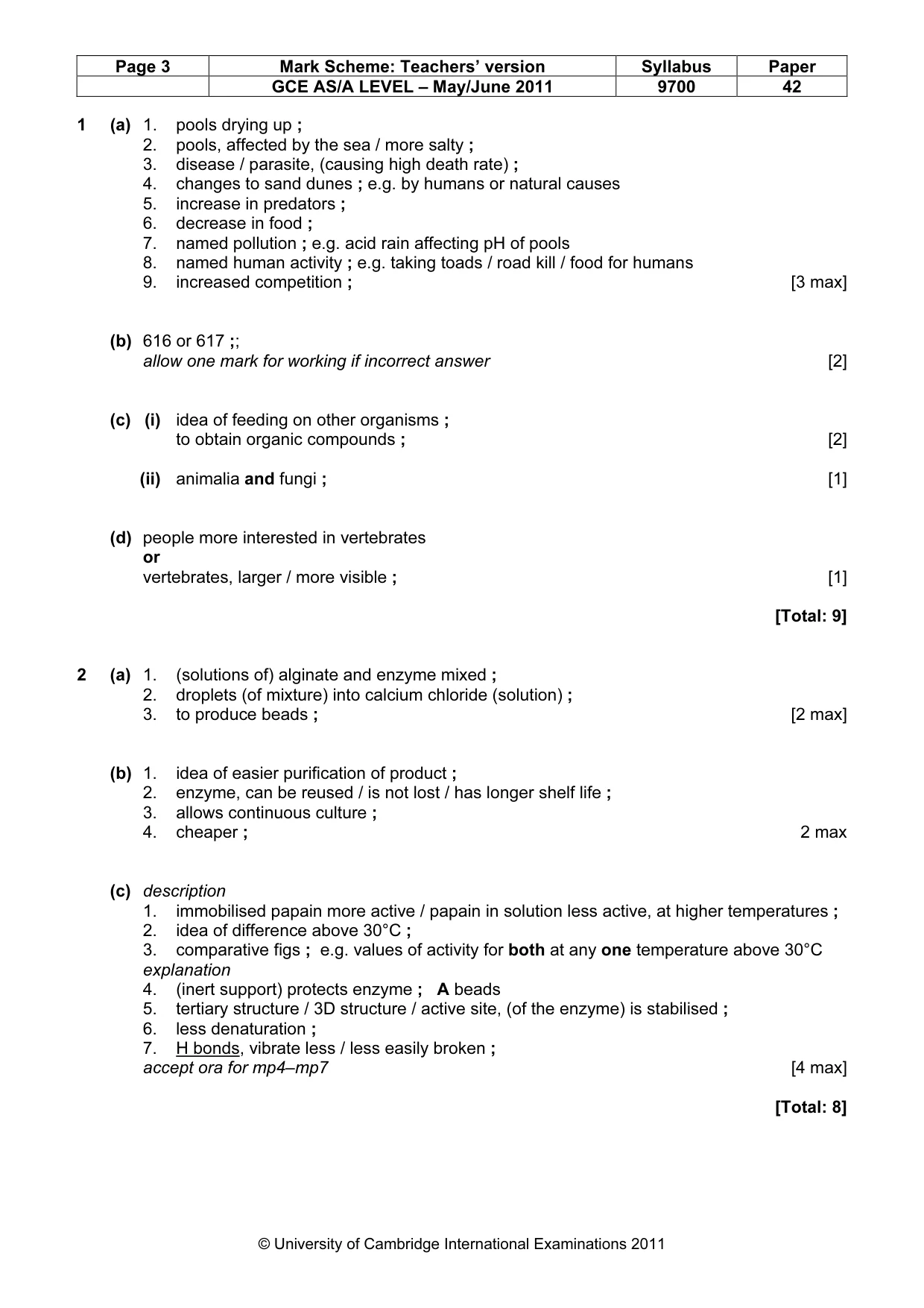
Page 3 Mark Scheme: Teachers’ version Syllabus Paper GCE AS/A LEVEL – May/June 2011 9700 42 © University of Cambridge International Examinations 2011 1 (a) 1. pools drying up ; 2. pools, affected by the sea / more salty ; 3. disease / parasite, (causing high death rate) ; 4. changes to sand dunes ; e.g. by humans or natural causes 5. increase in predators ; 6. decrease in food ; 7. named pollution ; e.g. acid rain affecting pH of pools 8. named human activity ; e.g. taking toads / road kill / food for humans 9. increased competition ; [3 max] (b) 616 or 617 ;; allow one mark for working if incorrect answer [2] (c) (i) idea of feeding on other organisms ; to obtain organic compounds ; [2] (ii) animalia and fungi ; [1] (d) people more interested in vertebrates or vertebrates, larger / more visible ; [1] [Total: 9] 2 (a) 1. (solutions of) alginate and enzyme mixed ; 2. droplets (of mixture) into calcium chloride (solution) ; 3. to produce beads ; [2 max] (b) 1. idea of easier purification of product ; 2. enzyme, can be reused / is not lost / has longer shelf life ; 3. allows continuous culture ; 4. cheaper ; 2 max (c) description 1. immobilised papain more active / papain in solution less active, at higher temperatures ; 2. idea of difference above 30°C ; 3. comparative figs ; e.g. values of activity for both at any one temperature above 30°C explanation 4. (inert support) protects enzyme ; A beads 5. tertiary structure / 3D structure / active site, (of the enzyme) is stabilised ; 6. less denaturation ; 7. H bonds, vibrate less / less easily broken ; accept ora for mp4–mp7 [4 max] [Total: 8]
Mark scheme, page 4
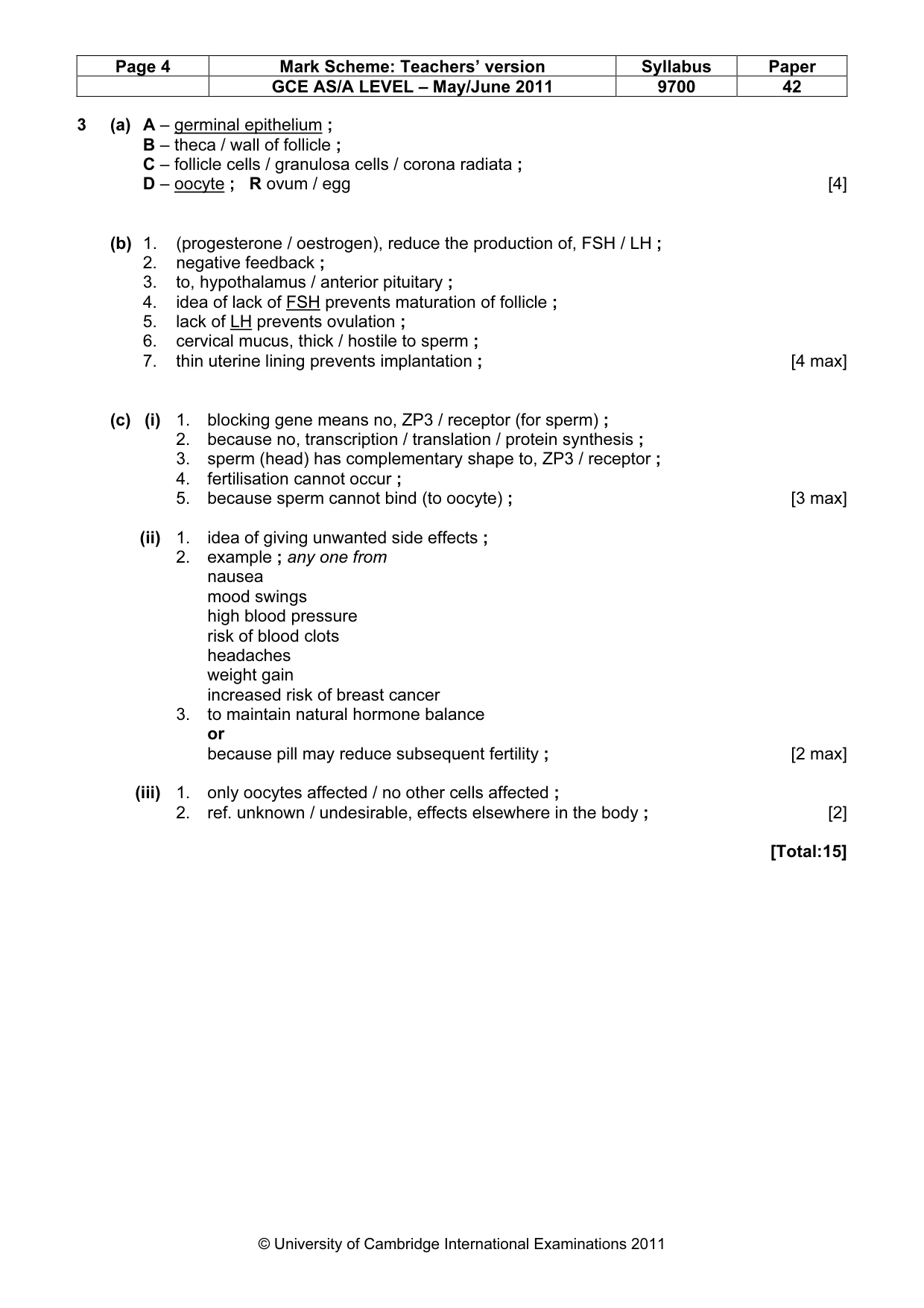
Page 4 Mark Scheme: Teachers’ version Syllabus Paper GCE AS/A LEVEL – May/June 2011 9700 42 © University of Cambridge International Examinations 2011 3 (a) A – germinal epithelium ; B – theca / wall of follicle ; C – follicle cells / granulosa cells / corona radiata ; D – oocyte ; R ovum / egg [4] (b) 1. (progesterone / oestrogen), reduce the production of, FSH / LH ; 2. negative feedback ; 3. to, hypothalamus / anterior pituitary ; 4. idea of lack of FSH prevents maturation of follicle ; 5. lack of LH prevents ovulation ; 6. cervical mucus, thick / hostile to sperm ; 7. thin uterine lining prevents implantation ; [4 max] (c) (i) 1. blocking gene means no, ZP3 / receptor (for sperm) ; 2. because no, transcription / translation / protein synthesis ; 3. sperm (head) has complementary shape to, ZP3 / receptor ; 4. fertilisation cannot occur ; 5. because sperm cannot bind (to oocyte) ; [3 max] (ii) 1. idea of giving unwanted side effects ; 2. example ; any one from nausea mood swings high blood pressure risk of blood clots headaches weight gain increased risk of breast cancer 3. to maintain natural hormone balance or because pill may reduce subsequent fertility ; [2 max] (iii) 1. only oocytes affected / no other cells affected ; 2. ref. unknown / undesirable, effects elsewhere in the body ; [2] [Total:15]
Mark scheme, page 5
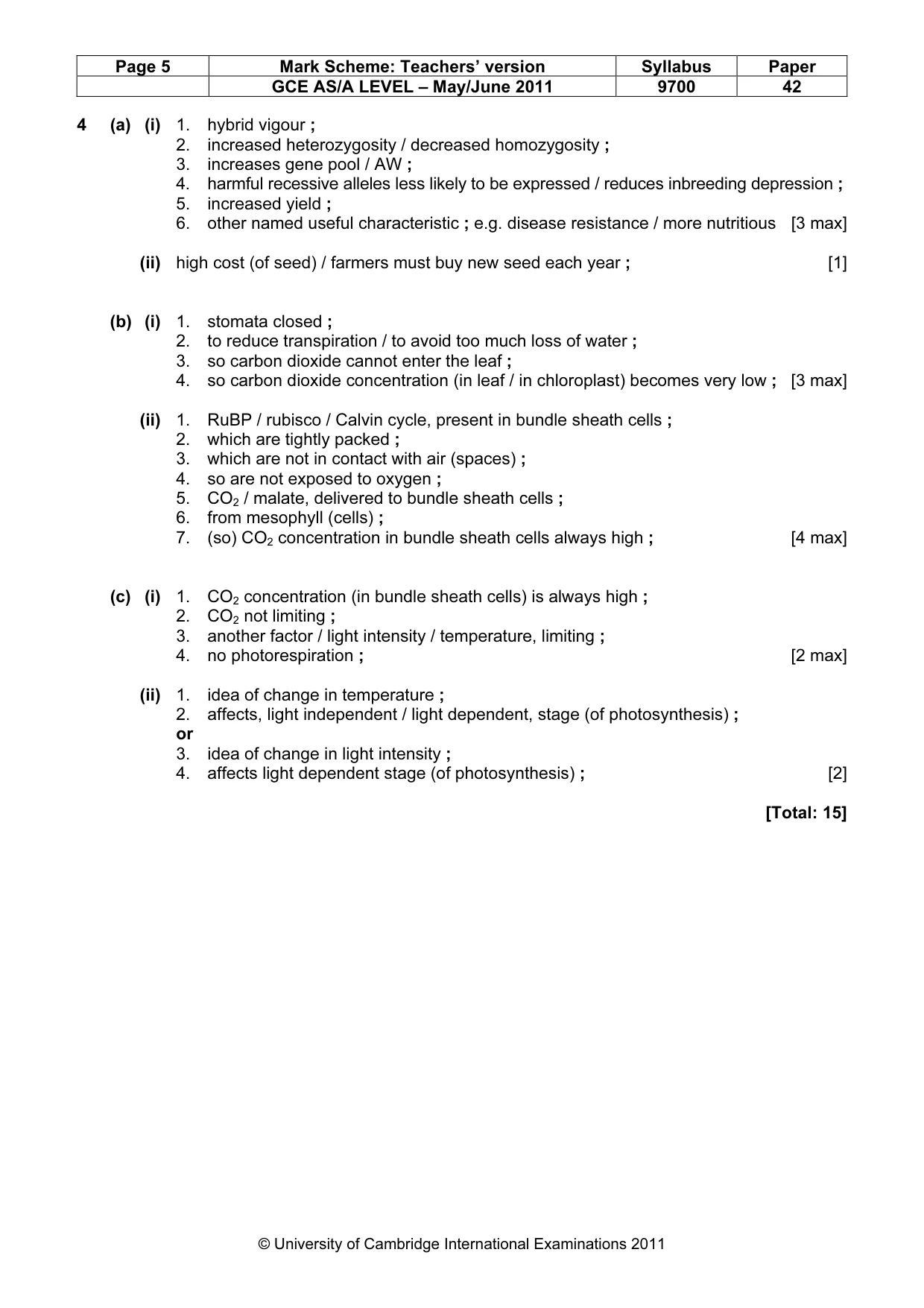
Page 5 Mark Scheme: Teachers’ version Syllabus Paper GCE AS/A LEVEL – May/June 2011 9700 42 © University of Cambridge International Examinations 2011 4 (a) (i) 1. hybrid vigour ; 2. increased heterozygosity / decreased homozygosity ; 3. increases gene pool / AW ; 4. harmful recessive alleles less likely to be expressed / reduces inbreeding depression ; 5. increased yield ; 6. other named useful characteristic ; e.g. disease resistance / more nutritious [3 max] (ii) high cost (of seed) / farmers must buy new seed each year ; [1] (b) (i) 1. stomata closed ; 2. to reduce transpiration / to avoid too much loss of water ; 3. so carbon dioxide cannot enter the leaf ; 4. so carbon dioxide concentration (in leaf / in chloroplast) becomes very low ; [3 max] (ii) 1. RuBP / rubisco / Calvin cycle, present in bundle sheath cells ; 2. which are tightly packed ; 3. which are not in contact with air (spaces) ; 4. so are not exposed to oxygen ; 5. CO2 / malate, delivered to bundle sheath cells ; 6. from mesophyll (cells) ; 7. (so) CO2 concentration in bundle sheath cells always high ; [4 max] (c) (i) 1. CO2 concentration (in bundle sheath cells) is always high ; 2. CO2 not limiting ; 3. another factor / light intensity / temperature, limiting ; 4. no photorespiration ; [2 max] (ii) 1. idea of change in temperature ; 2. affects, light independent / light dependent, stage (of photosynthesis) ; or 3. idea of change in light intensity ; 4. affects light dependent stage (of photosynthesis) ; [2] [Total: 15]
Mark scheme, page 6
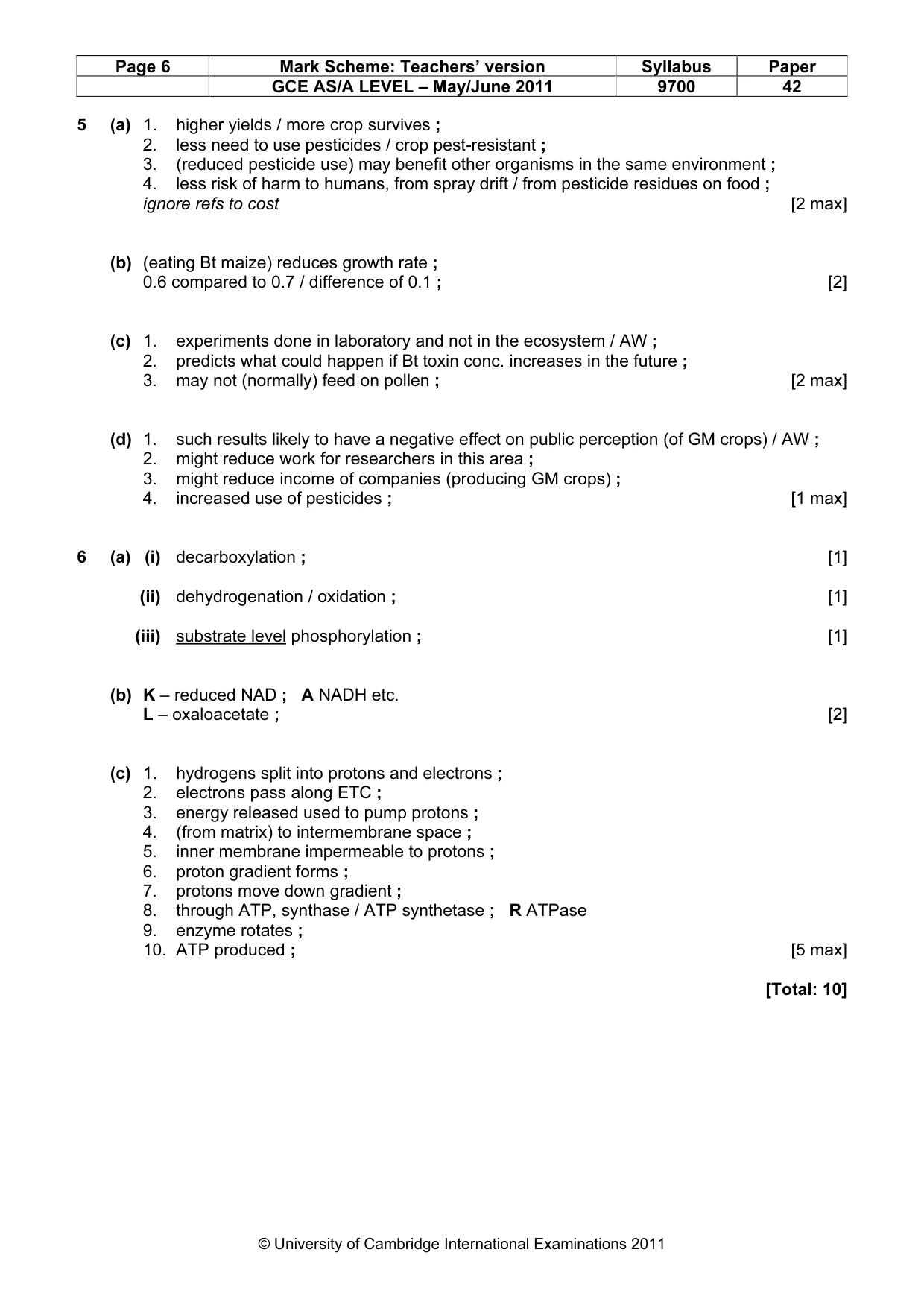
Page 6 Mark Scheme: Teachers’ version Syllabus Paper GCE AS/A LEVEL – May/June 2011 9700 42 © University of Cambridge International Examinations 2011 5 (a) 1. higher yields / more crop survives ; 2. less need to use pesticides / crop pest-resistant ; 3. (reduced pesticide use) may benefit other organisms in the same environment ; 4. less risk of harm to humans, from spray drift / from pesticide residues on food ; ignore refs to cost [2 max] (b) (eating Bt maize) reduces growth rate ; 0.6 compared to 0.7 / difference of 0.1 ; [2] (c) 1. experiments done in laboratory and not in the ecosystem / AW ; 2. predicts what could happen if Bt toxin conc. increases in the future ; 3. may not (normally) feed on pollen ; [2 max] (d) 1. such results likely to have a negative effect on public perception (of GM crops) / AW ; 2. might reduce work for researchers in this area ; 3. might reduce income of companies (producing GM crops) ; 4. increased use of pesticides ; [1 max] 6 (a) (i) decarboxylation ; [1] (ii) dehydrogenation / oxidation ; [1] (iii) substrate level phosphorylation ; [1] (b) K – reduced NAD ; A NADH etc. L – oxaloacetate ; [2] (c) 1. hydrogens split into protons and electrons ; 2. electrons pass along ETC ; 3. energy released used to pump protons ; 4. (from matrix) to intermembrane space ; 5. inner membrane impermeable to protons ; 6. proton gradient forms ; 7. protons move down gradient ; 8. through ATP, synthase / ATP synthetase ; R ATPase 9. enzyme rotates ; 10. ATP produced ; [5 max] [Total: 10]
Mark scheme, page 7
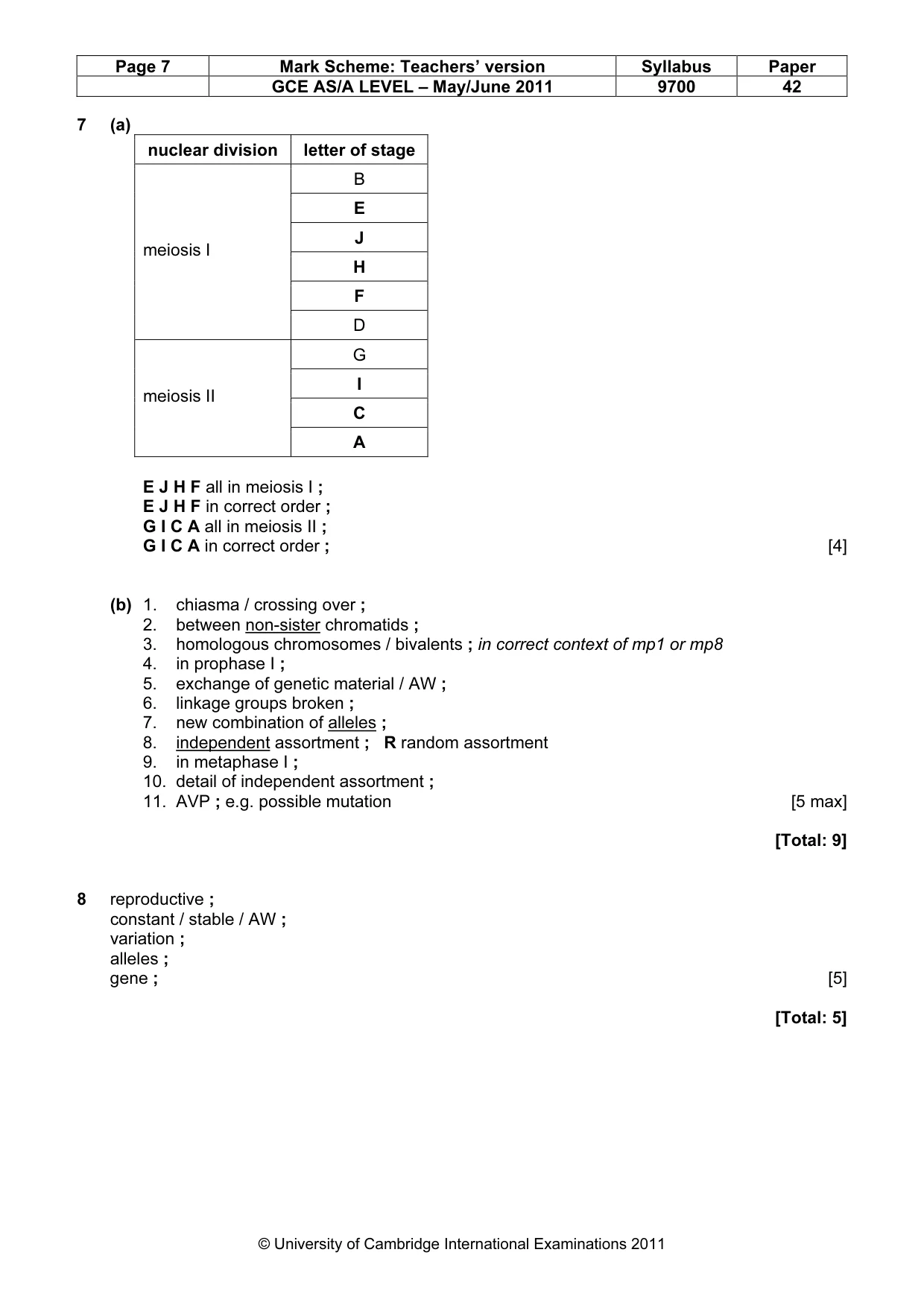
Page 7 Mark Scheme: Teachers’ version Syllabus Paper GCE AS/A LEVEL – May/June 2011 9700 42 © University of Cambridge International Examinations 2011 7 (a) nuclear division letter of stage B E J H F meiosis I D G I C meiosis II A E J H F all in meiosis I ; E J H F in correct order ; G I C A all in meiosis II ; G I C A in correct order ; [4] (b) 1. chiasma / crossing over ; 2. between non-sister chromatids ; 3. homologous chromosomes / bivalents ; in correct context of mp1 or mp8 4. in prophase I ; 5. exchange of genetic material / AW ; 6. linkage groups broken ; 7. new combination of alleles ; 8. independent assortment ; R random assortment 9. in metaphase I ; 10. detail of independent assortment ; 11. AVP ; e.g. possible mutation [5 max] [Total: 9] 8 reproductive ; constant / stable / AW ; variation ; alleles ; gene ; [5] [Total: 5]
Mark scheme, page 8
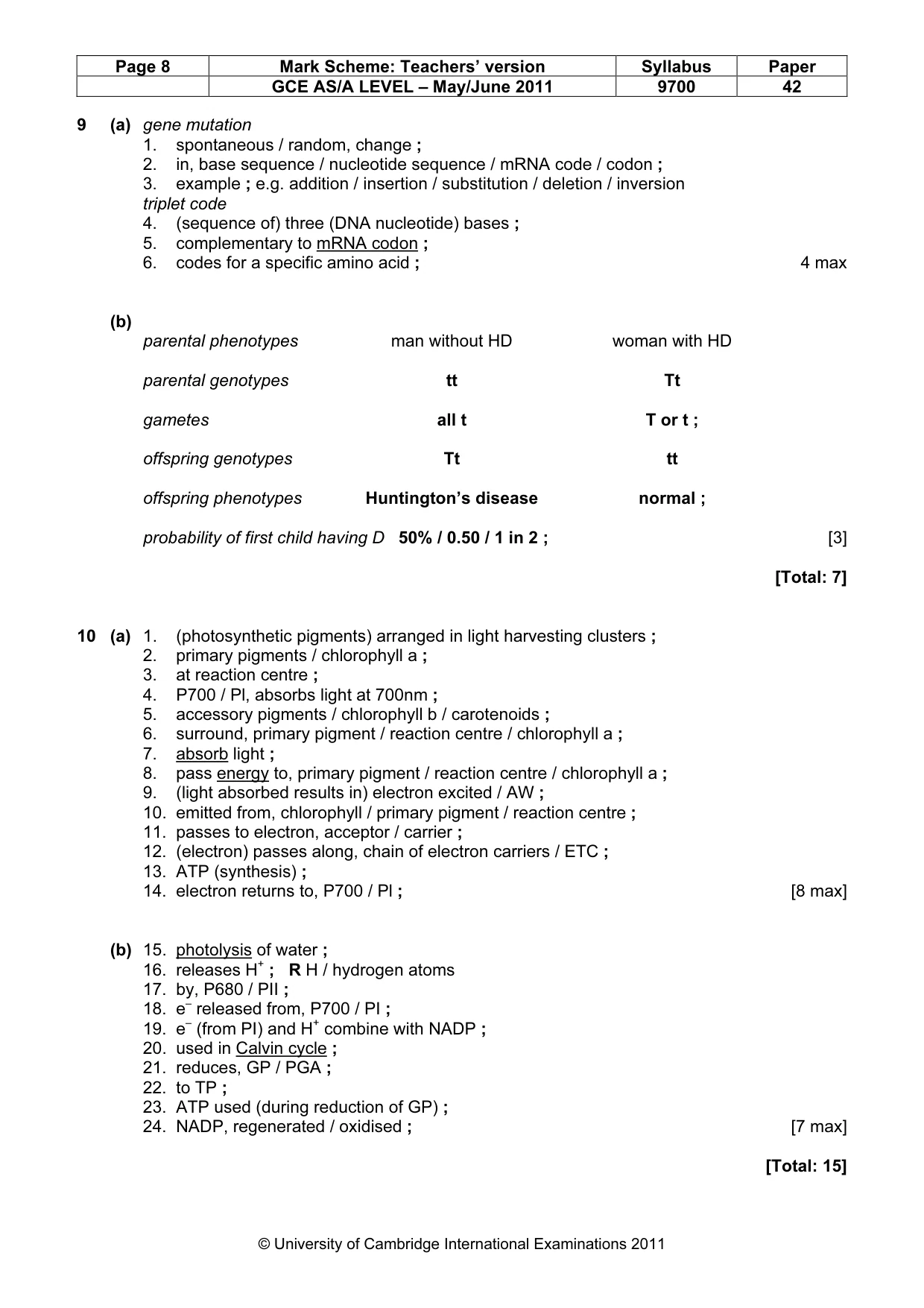
Page 8 Mark Scheme: Teachers’ version Syllabus Paper GCE AS/A LEVEL – May/June 2011 9700 42 © University of Cambridge International Examinations 2011 9 (a) gene mutation 1. spontaneous / random, change ; 2. in, base sequence / nucleotide sequence / mRNA code / codon ; 3. example ; e.g. addition / insertion / substitution / deletion / inversion triplet code 4. (sequence of) three (DNA nucleotide) bases ; 5. complementary to mRNA codon ; 6. codes for a specific amino acid ; 4 max (b) parental phenotypes man without HD woman with HD parental genotypes tt Tt gametes all t T or t ; offspring genotypes Tt tt offspring phenotypes Huntington’s disease normal ; probability of first child having D 50% / 0.50 / 1 in 2 ; [3] [Total: 7] 10 (a) 1. (photosynthetic pigments) arranged in light harvesting clusters ; 2. primary pigments / chlorophyll a ; 3. at reaction centre ; 4. P700 / Pl, absorbs light at 700nm ; 5. accessory pigments / chlorophyll b / carotenoids ; 6. surround, primary pigment / reaction centre / chlorophyll a ; 7. absorb light ; 8. pass energy to, primary pigment / reaction centre / chlorophyll a ; 9. (light absorbed results in) electron excited / AW ; 10. emitted from, chlorophyll / primary pigment / reaction centre ; 11. passes to electron, acceptor / carrier ; 12. (electron) passes along, chain of electron carriers / ETC ; 13. ATP (synthesis) ; 14. electron returns to, P700 / Pl ; [8 max] (b) 15. photolysis of water ; 16. releases H+ ; R H / hydrogen atoms 17. by, P680 / PII ; 18. e– released from, P700 / PI ; 19. e– (from PI) and H+ combine with NADP ; 20. used in Calvin cycle ; 21. reduces, GP / PGA ; 22. to TP ; 23. ATP used (during reduction of GP) ; 24. NADP, regenerated / oxidised ; [7 max] [Total: 15]
Mark scheme, page 9
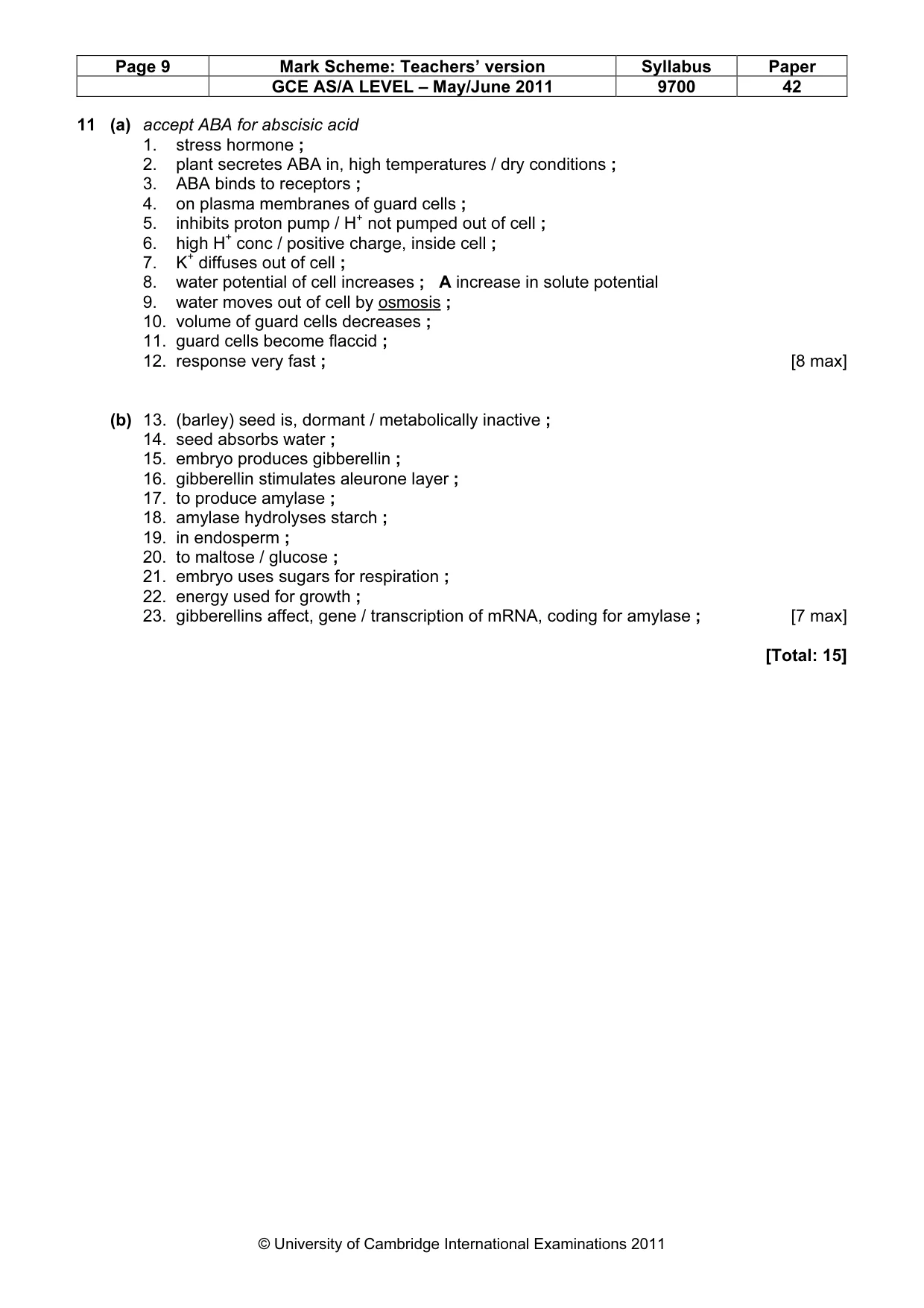
Page 9 Mark Scheme: Teachers’ version Syllabus Paper GCE AS/A LEVEL – May/June 2011 9700 42 © University of Cambridge International Examinations 2011 11 (a) accept ABA for abscisic acid 1. stress hormone ; 2. plant secretes ABA in, high temperatures / dry conditions ; 3. ABA binds to receptors ; 4. on plasma membranes of guard cells ; 5. inhibits proton pump / H+ not pumped out of cell ; 6. high H+ conc / positive charge, inside cell ; 7. K+ diffuses out of cell ; 8. water potential of cell increases ; A increase in solute potential 9. water moves out of cell by osmosis ; 10. volume of guard cells decreases ; 11. guard cells become flaccid ; 12. response very fast ; [8 max] (b) 13. (barley) seed is, dormant / metabolically inactive ; 14. seed absorbs water ; 15. embryo produces gibberellin ; 16. gibberellin stimulates aleurone layer ; 17. to produce amylase ; 18. amylase hydrolyses starch ; 19. in endosperm ; 20. to maltose / glucose ; 21. embryo uses sugars for respiration ; 22. energy used for growth ; 23. gibberellins affect, gene / transcription of mRNA, coding for amylase ; [7 max] [Total: 15]
What you needed in this session
Cambridge’s own grade thresholds for 2011 May/June, Paper 4 · Variant 2. A higher threshold means an easier paper — the bar moves with how the cohort did.