Cambridge A Level Biology 9700 — 2010 May/June Paper 4 · Variant 2
9700/42/M/J/10 · 100 marks · ≈113 min
The question paper and its mark scheme, free to read here and free to download. This is Cambridge’s own paper, exactly as it was sat.
Question paper24 pages
Mark scheme10 pages
Answers below. Sit the paper first if you are practising.
Paper as text
Question paper, page 1
This document consists of 20 printed pages, 3 lined pages and 1 blank page. DC (LEO/DJ) 18520/4 © UCLES 2010 [Turn over UNIVERSITY OF CAMBRIDGE INTERNATIONAL EXAMINATIONS General Certificate of Education Advanced Level READ THESE INSTRUCTIONS FIRST Write your Centre number, candidate number and name on all the work you hand in. Write in dark blue or black pen. You may use a pencil for any diagrams, graphs, or rough working. Do not use staples, paper clips, highlighters, glue or correction fluid. DO NOT WRITE IN ANY BARCODES. Answer all questions in Section A and one question from Section B. Circle the number of the Section B question you have answered in the grid below. At the end of the examination, fasten all your work securely together. The number of marks is given in brackets [ ] at the end of each question or part question. * 6 9 4 5 6 1 7 6 3 5 * BIOLOGY 9700/42 Paper 4 A2 Structured Questions May/June 2010 2 hours Candidates answer on the Question Paper. Additional Materials: Answer Paper available on request. For Examiner’s Use Section A 1 2 3 4 5 6 7 8 Section B 9 or 10 Total
Question paper, page 2
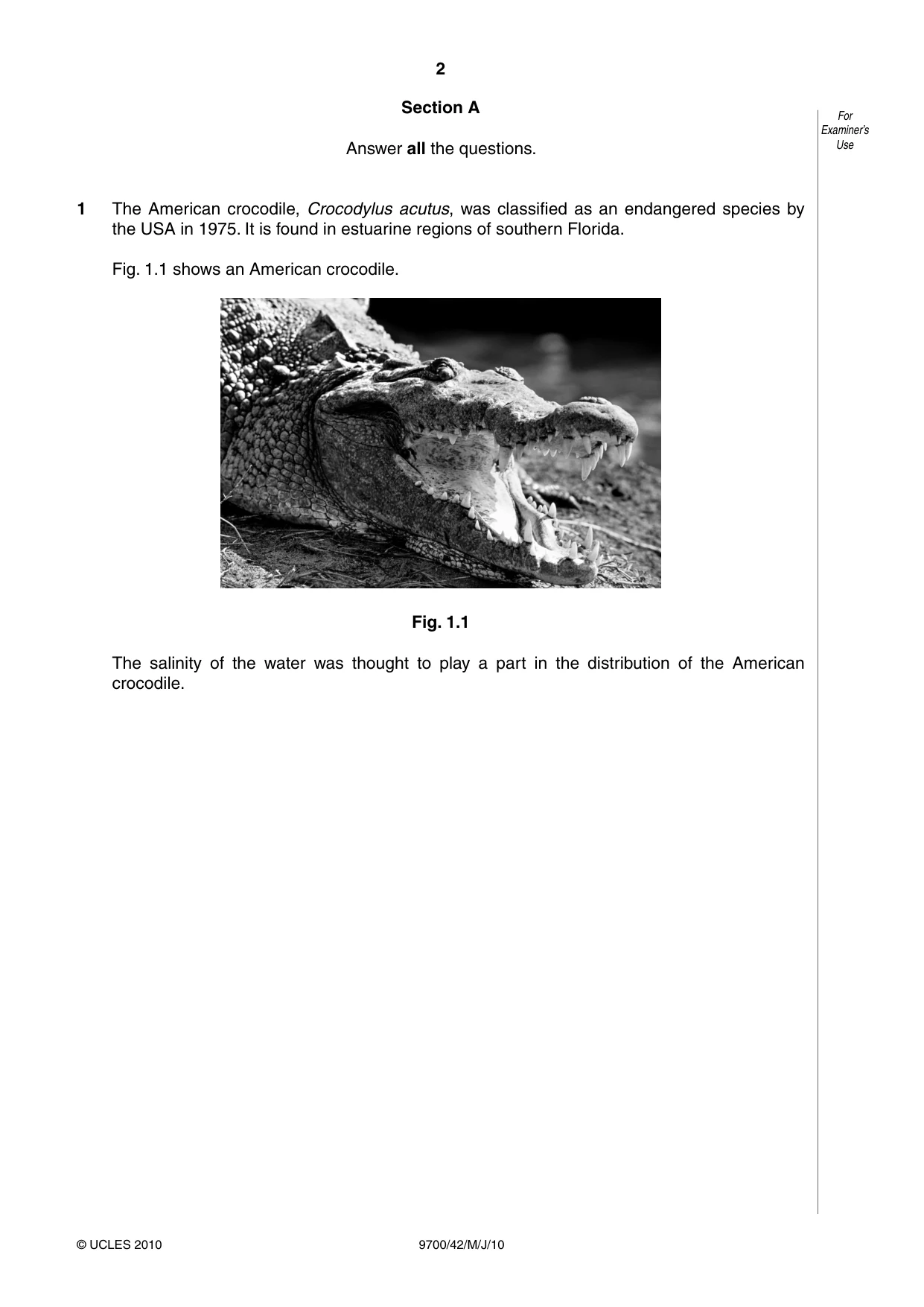
9700/42/M/J/10 © UCLES 2010 For Examiner’s Use Section A Answer all the questions. 1 The American crocodile, Crocodylus acutus, was classified as an endangered species by the USA in 1975. It is found in estuarine regions of southern Florida. Fig. 1.1 shows an American crocodile. Fig. 1.1 The salinity of the water was thought to play a part in the distribution of the American crocodile. 2
Question paper, page 3
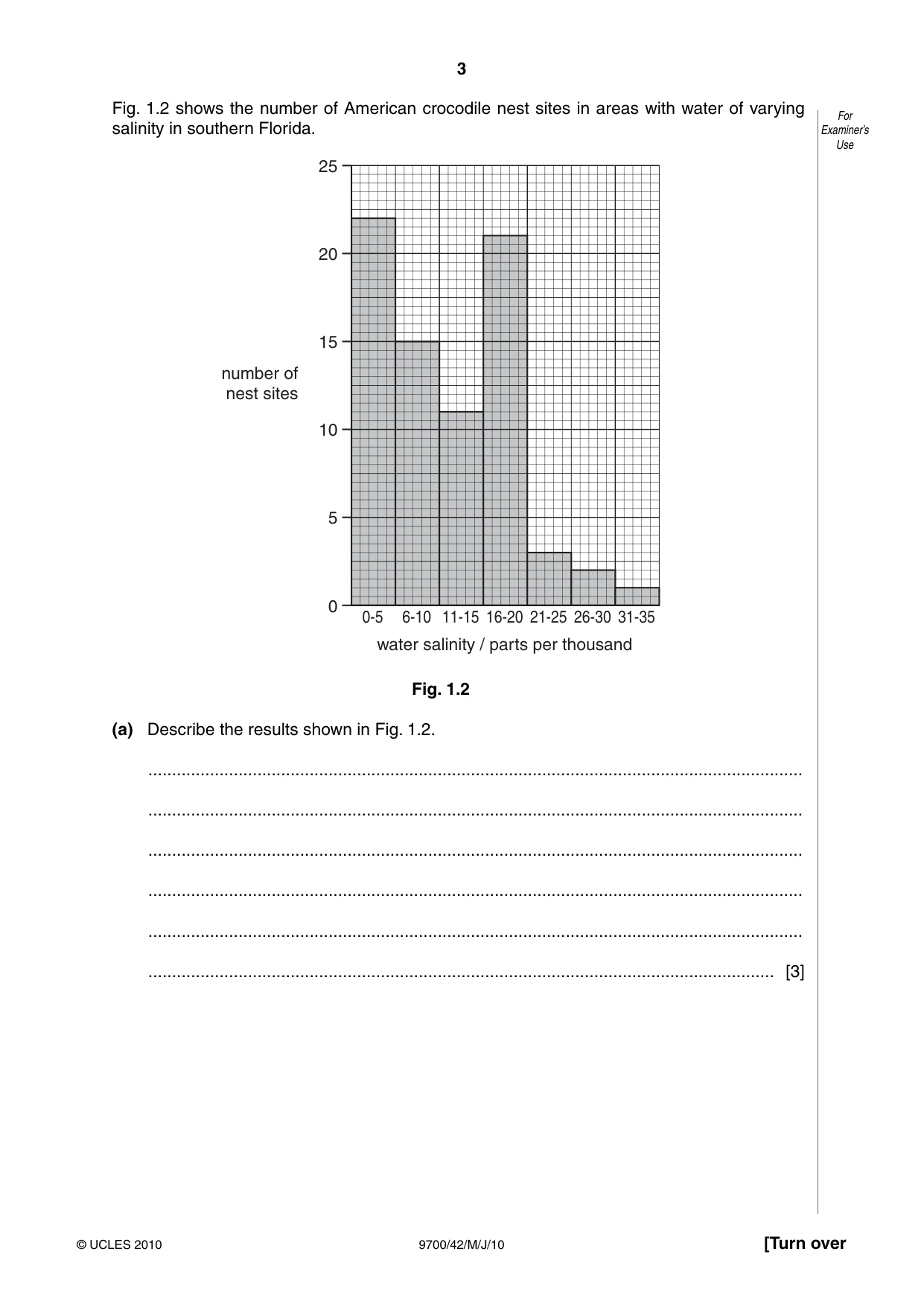
3 9700/42/M/J/10 © UCLES 2010 [Turn over For Examiner’s Use Fig. 1.2 shows the number of American crocodile nest sites in areas with water of varying salinity in southern Florida. 25 20 15 number of nest sites 10 5 0 0-5 6-10 11-15 16-20 water salinity / parts per thousand 21-25 26-30 31-35 Fig. 1.2 (a) Describe the results shown in Fig. 1.2. … … … … … … [3]
Question paper, page 4
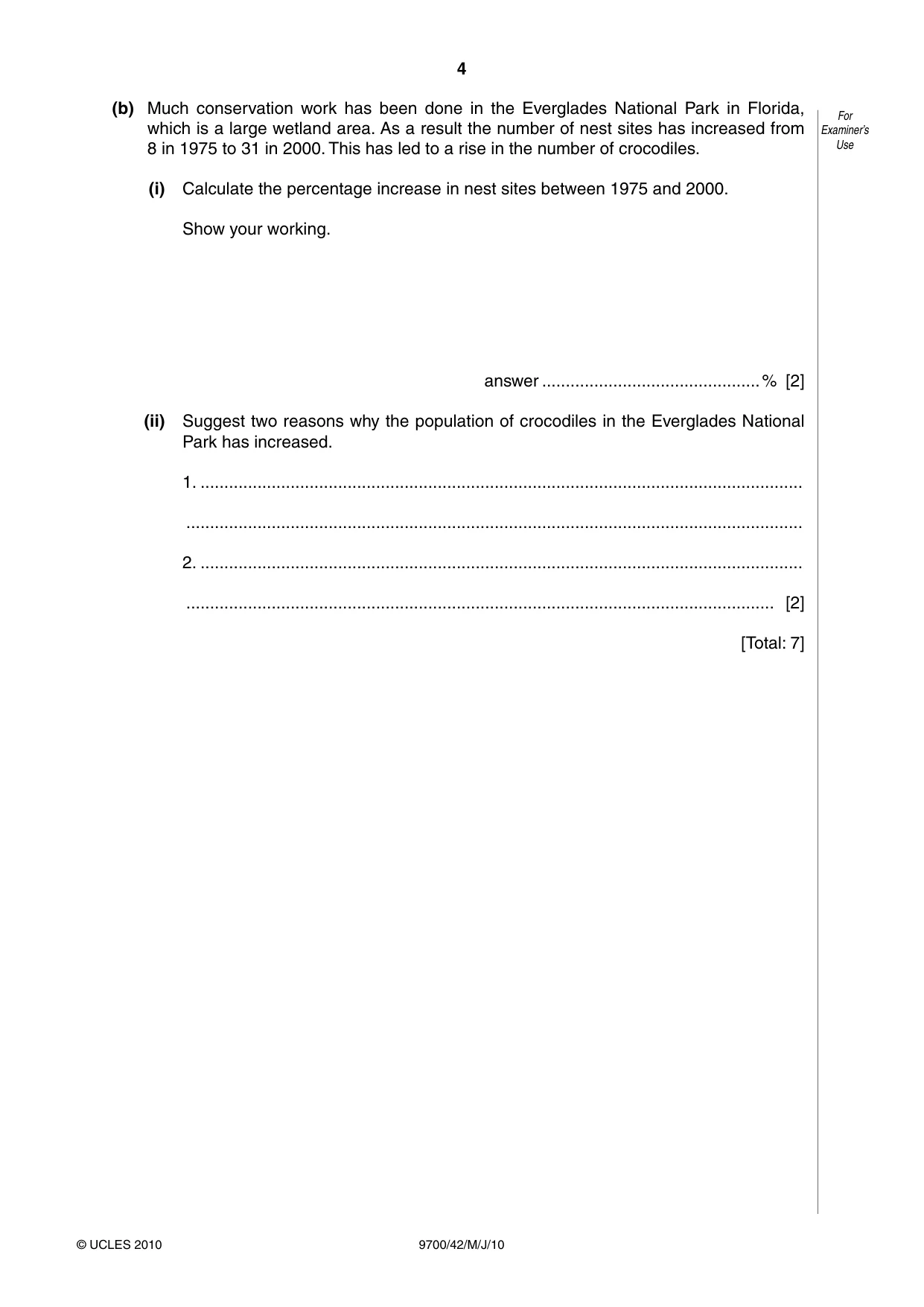
4 9700/42/M/J/10 © UCLES 2010 For Examiner’s Use (b) Much conservation work has been done in the Everglades National Park in Florida, which is a large wetland area. As a result the number of nest sites has increased from 8 in 1975 to 31 in 2000. This has led to a rise in the number of crocodiles. (i) Calculate the percentage increase in nest sites between 1975 and 2000. Show your working. answer …% [2] (ii) Suggest two reasons why the population of crocodiles in the Everglades National Park has increased. 1. … … 2. … … [2] [Total: 7]
Question paper, page 5
5 9700/42/M/J/10 © UCLES 2010 [Turn over For Examiner’s Use 2 Follicle stimulating hormone (FSH) and luteinising hormone (LH) both consist of two polypeptide chains, the α and β chains. • The α chains of FSH and LH are identical. • The β chain of FSH has 111 amino acids and that of LH 121 amino acids. • FSH and LH bind to different receptors in the cell surface membranes of their target cells. • This binding leads to steroid synthesis by the target cells. (a) Explain why FSH does not bind to a LH receptor. … … … … … … [3] (b) Name the cells of a human female that carry (i) FSH receptors … … [1] (ii) LH receptors. … … [1] (c) Describe what happens when FSH binds to its receptors on its target cells. … … … … … … [3] [Total: 8]
Question paper, page 6
6 9700/42/M/J/10 © UCLES 2010 For Examiner’s Use 3 The sensitivity of bacteria to antibiotics can be tested using the disc diffusion method. An inoculum of the bacteria is spread onto agar culture plates and then filter paper discs impregnated with antibiotic are pressed onto the surface of the agar. The plates are incubated. Bacteria grow as a ‘lawn’ across the agar, but a circular zone (the zone of inhibition) appears around any disc where bacterial growth is inhibited. Two species of bacteria, A and B, were grown on separate culture plates in the presence of three types of filter paper disc: 1 – no antibiotic (control) 2 – penicillin V, a natural penicillin 3 – carboxypenicillin, a synthetic penicillin. The appearance of the incubated plates is shown in Fig. 3.1. bacterium A bacterium B 1 2 3 1 2 3 Fig. 3.1 (a) With reference to Fig. 3.1, explain the effect of penicillin V on bacterium A. … … … … … … [3]
Question paper, page 7
7 9700/42/M/J/10 © UCLES 2010 [Turn over For Examiner’s Use Bacteria A and B have different outer layers, as shown in Fig. 3.2. bacterium A cell surface membrane peptidoglycan wall outer membrane bacterium B Fig. 3.2 (b) With reference to Fig. 3.1 and Fig. 3.2 (i) describe how the outer layers of bacterium B differ from those of bacterium A … … … … [2] (ii) explain the different effects of penicillin V on bacteria A and B … … … … [2] (iii) suggest how the synthetic penicillin, carboxypenicillin, is able to affect the growth of bacterium B. … … … … [2]
Question paper, page 8
8 9700/42/M/J/10 © UCLES 2010 For Examiner’s Use (c) Distinguish between batch culture and continuous culture of microorganisms. … … … … … … [3] (d) Explain why batch culture rather than continuous culture is used in the production of penicillin. … … … … … … [3] [Total: 15]
Question paper, page 9
9 9700/42/M/J/10 © UCLES 2010 [Turn over BLANK PAGE Question 4 starts on page 10
Question paper, page 10
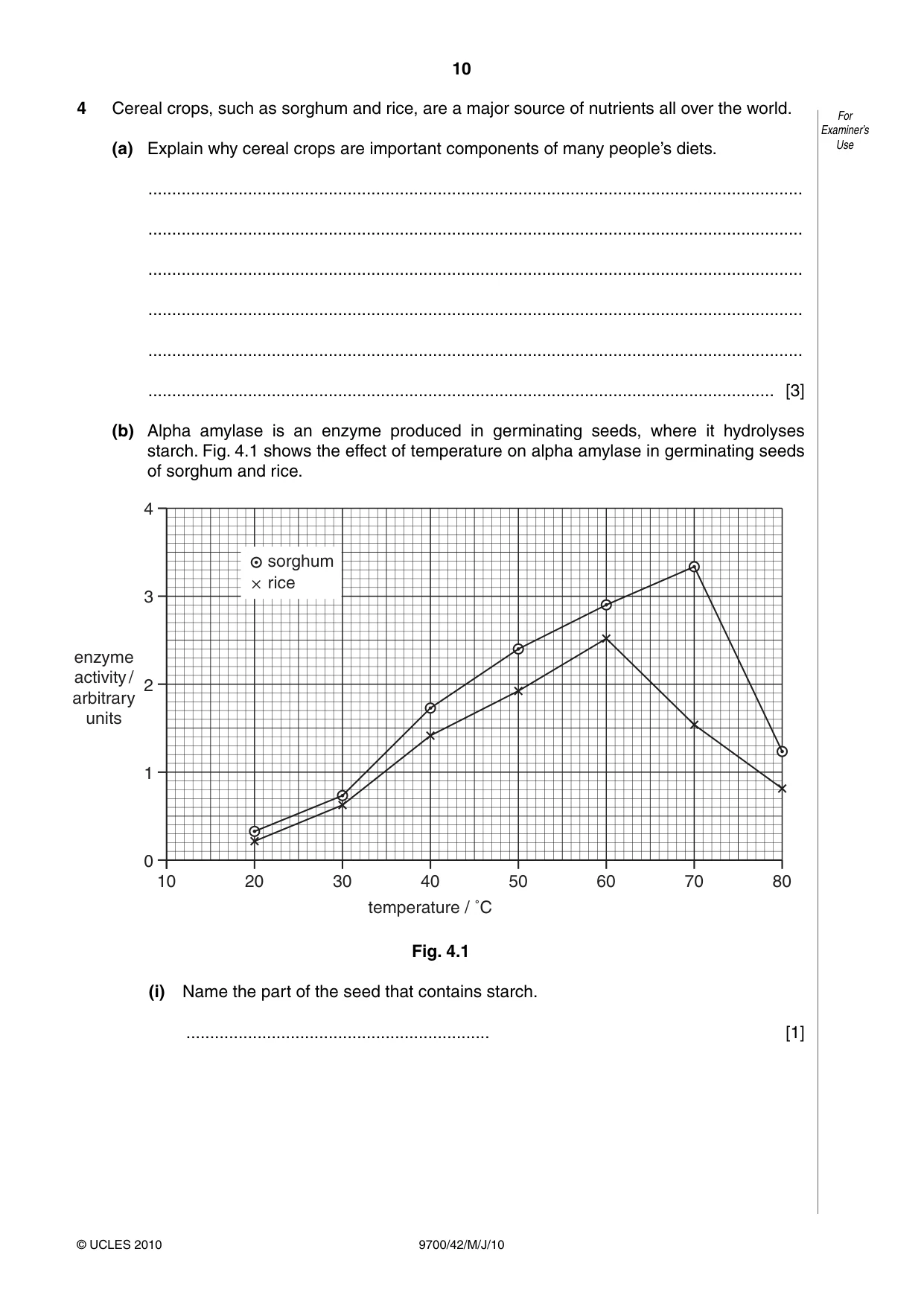
10 9700/42/M/J/10 © UCLES 2010 For Examiner’s Use 4 Cereal crops, such as sorghum and rice, are a major source of nutrients all over the world. (a) Explain why cereal crops are important components of many people’s diets. … … … … … … [3] (b) Alpha amylase is an enzyme produced in germinating seeds, where it hydrolyses starch. Fig. 4.1 shows the effect of temperature on alpha amylase in germinating seeds of sorghum and rice. 4 3 2 enzyme activity / arbitrary units 1 0 10 20 30 40 temperature / ˚C 50 60 70 80 sorghum rice Fig. 4.1 (i) Name the part of the seed that contains starch. … [1]
Question paper, page 11
11 9700/42/M/J/10 © UCLES 2010 [Turn over For Examiner’s Use (ii) With reference to Fig. 4.1, compare the effects of temperature on alpha amylase in sorghum and rice. … … … … … … [3] (iii) With reference to the types of bonding in proteins, suggest how differences in the tertiary structure of alpha amylase in rice and sorghum could explain the differences in their activities shown in Fig. 4.1. … … … … … … [3]
Question paper, page 12
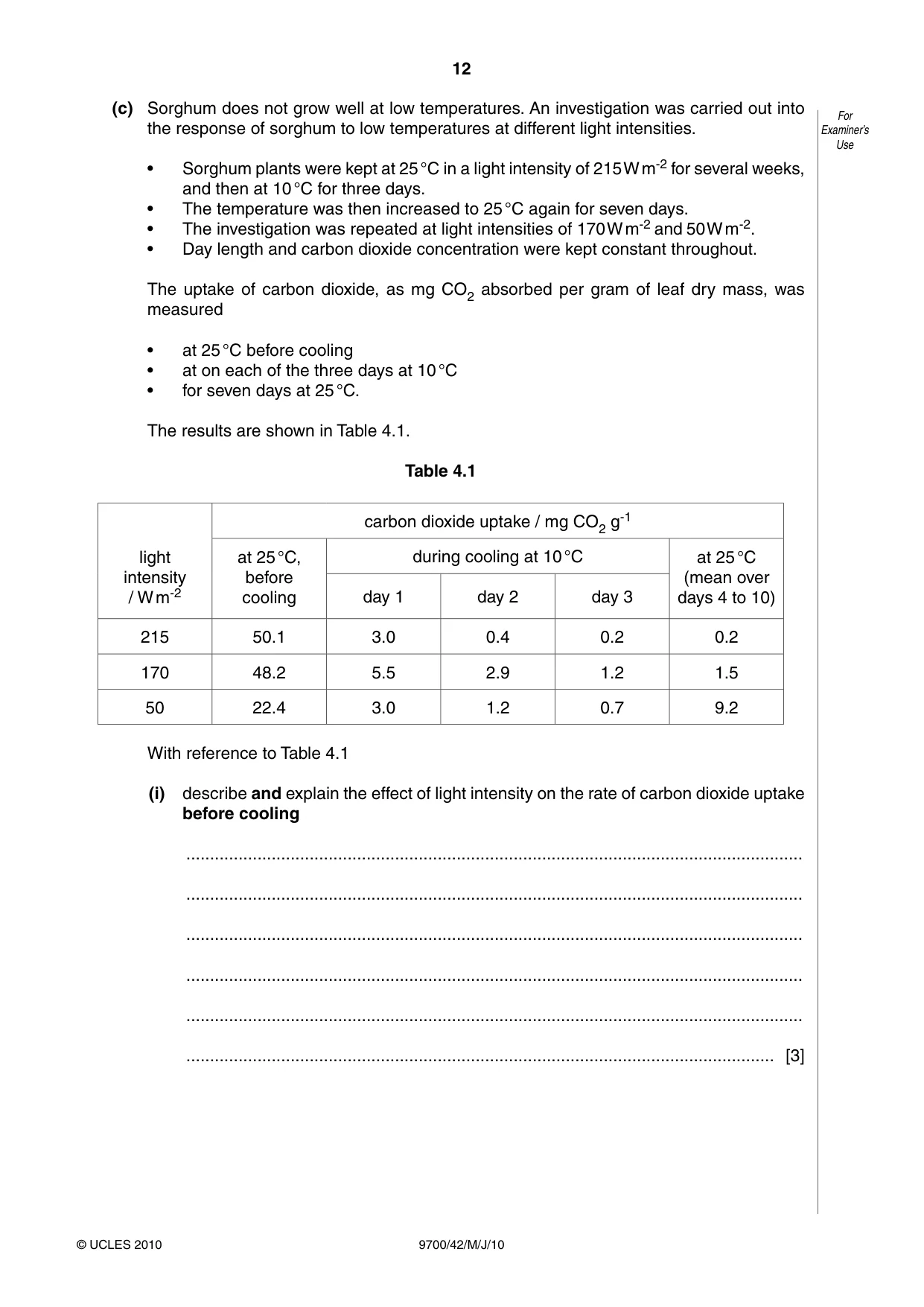
12 9700/42/M/J/10 © UCLES 2010 For Examiner’s Use (c) Sorghum does not grow well at low temperatures. An investigation was carried out into the response of sorghum to low temperatures at different light intensities. • Sorghum plants were kept at 25 °C in a light intensity of 215 W m-2 for several weeks, and then at 10 °C for three days. • The temperature was then increased to 25 °C again for seven days. • The investigation was repeated at light intensities of 170 W m-2 and 50 W m-2. • Day length and carbon dioxide concentration were kept constant throughout. The uptake of carbon dioxide, as mg CO2 absorbed per gram of leaf dry mass, was measured • at 25 °C before cooling • at on each of the three days at 10 °C • for seven days at 25 °C. The results are shown in Table 4.1. Table 4.1 light intensity / W m-2 carbon dioxide uptake / mg CO2 g-1 at 25 °C, before cooling during cooling at 10 °C at 25 °C (mean over days 4 to 10) day 1 day 2 day 3 215 50.1 3.0 0.4 0.2 0.2 170 48.2 5.5 2.9 1.2 1.5 50 22.4 3.0 1.2 0.7 9.2 With reference to Table 4.1 (i) describe and explain the effect of light intensity on the rate of carbon dioxide uptake before cooling … … … … … … [3]
Question paper, page 13
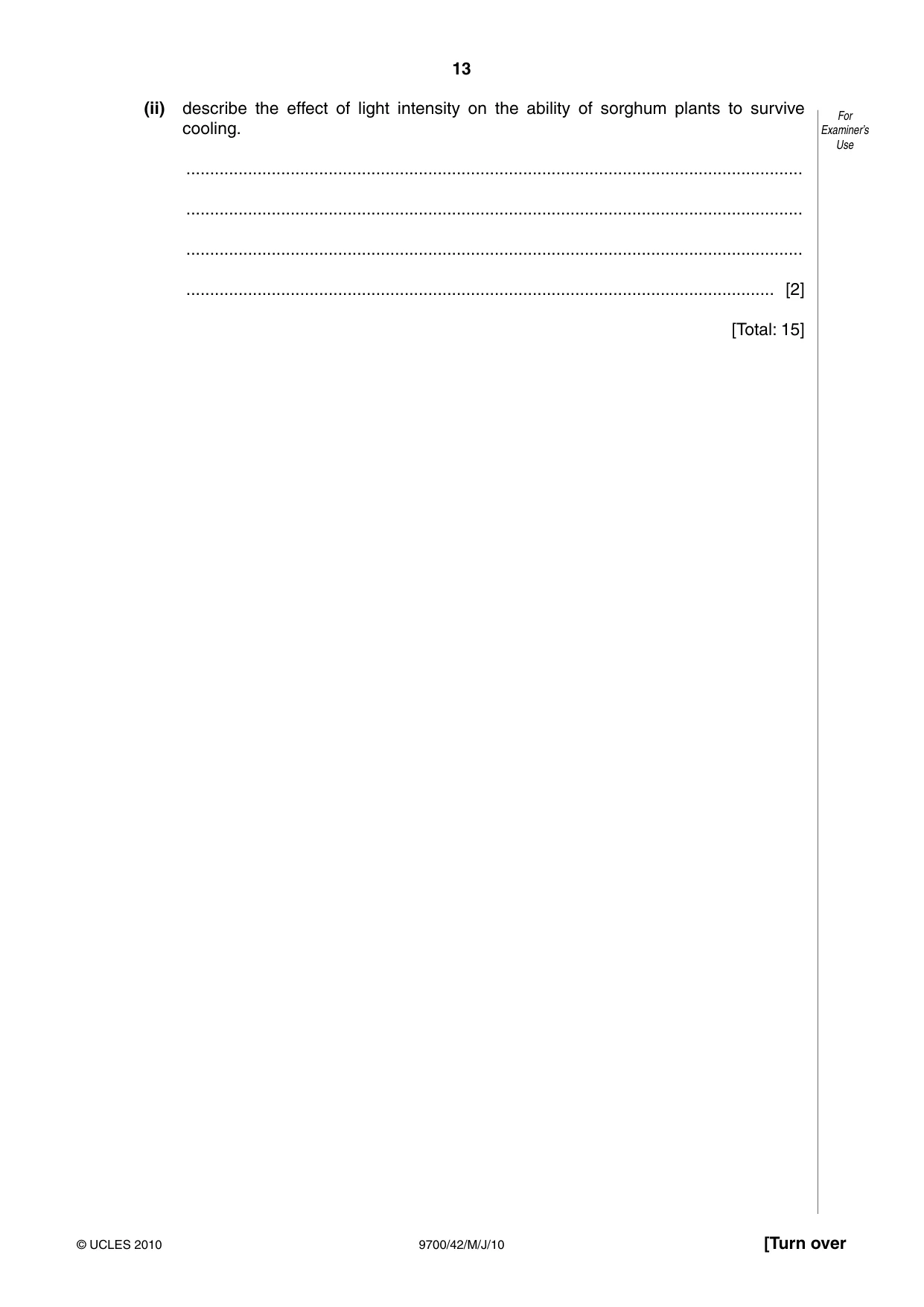
13 9700/42/M/J/10 © UCLES 2010 [Turn over For Examiner’s Use (ii) describe the effect of light intensity on the ability of sorghum plants to survive cooling. … … … … [2] [Total: 15]
Question paper, page 14
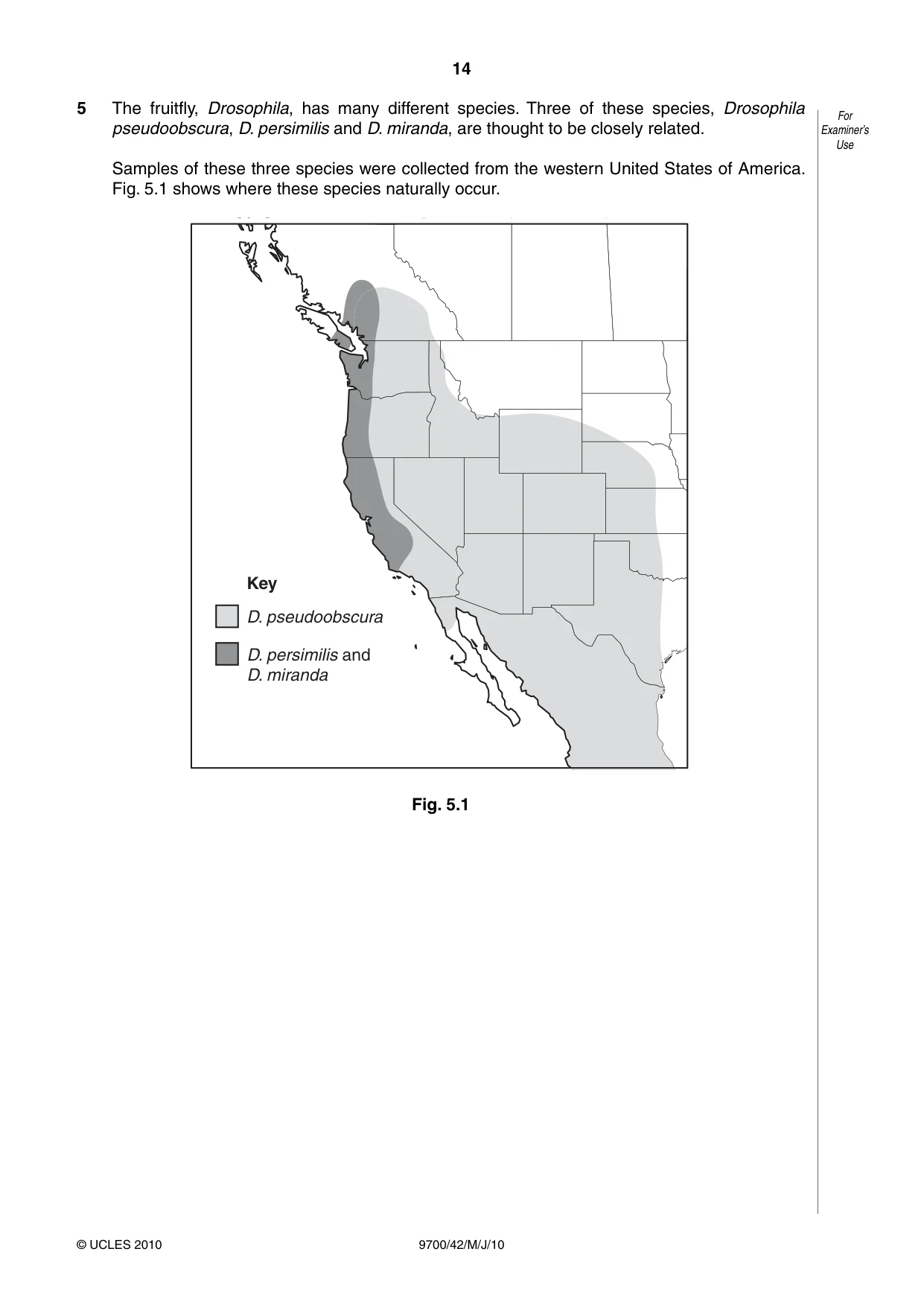
14 9700/42/M/J/10 © UCLES 2010 For Examiner’s Use 5 The fruitfly, Drosophila, has many different species. Three of these species, Drosophila pseudoobscura, D. persimilis and D. miranda, are thought to be closely related. Samples of these three species were collected from the western United States of America. Fig. 5.1 shows where these species naturally occur. Key D. pseudoobscura D. persimilis and D. miranda Fig. 5.1
Question paper, page 15
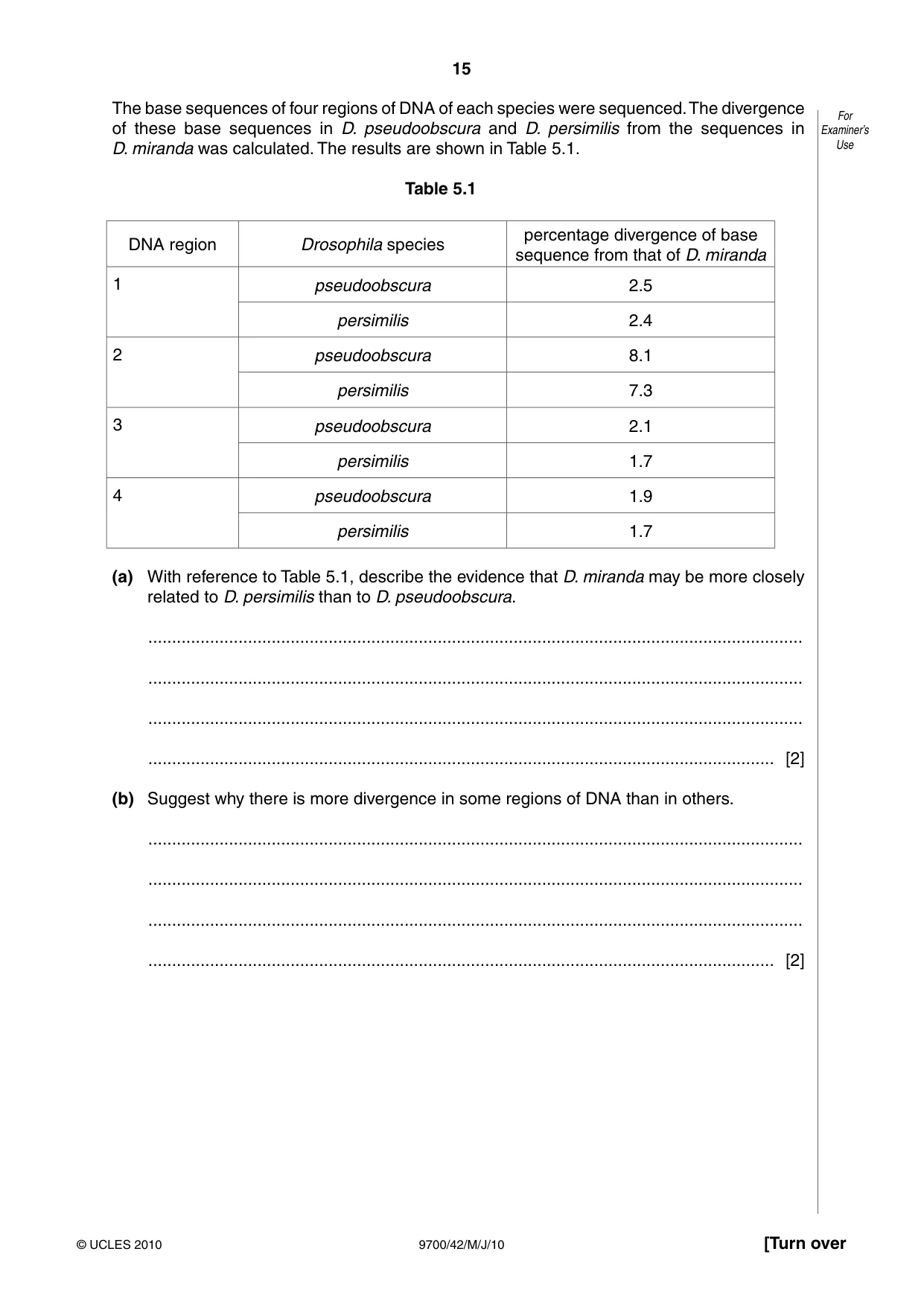
15 9700/42/M/J/10 © UCLES 2010 [Turn over For Examiner’s Use The base sequences of four regions of DNA of each species were sequenced. The divergence of these base sequences in D. pseudoobscura and D. persimilis from the sequences in D. miranda was calculated. The results are shown in Table 5.1. Table 5.1 DNA region Drosophila species percentage divergence of base sequence from that of D. miranda 1 pseudoobscura 2.5 persimilis 2.4 2 pseudoobscura 8.1 persimilis 7.3 3 pseudoobscura 2.1 persimilis 1.7 4 pseudoobscura 1.9 persimilis 1.7 (a) With reference to Table 5.1, describe the evidence that D. miranda may be more closely related to D. persimilis than to D. pseudoobscura. … … … … [2] (b) Suggest why there is more divergence in some regions of DNA than in others. … … … … [2]
Question paper, page 16
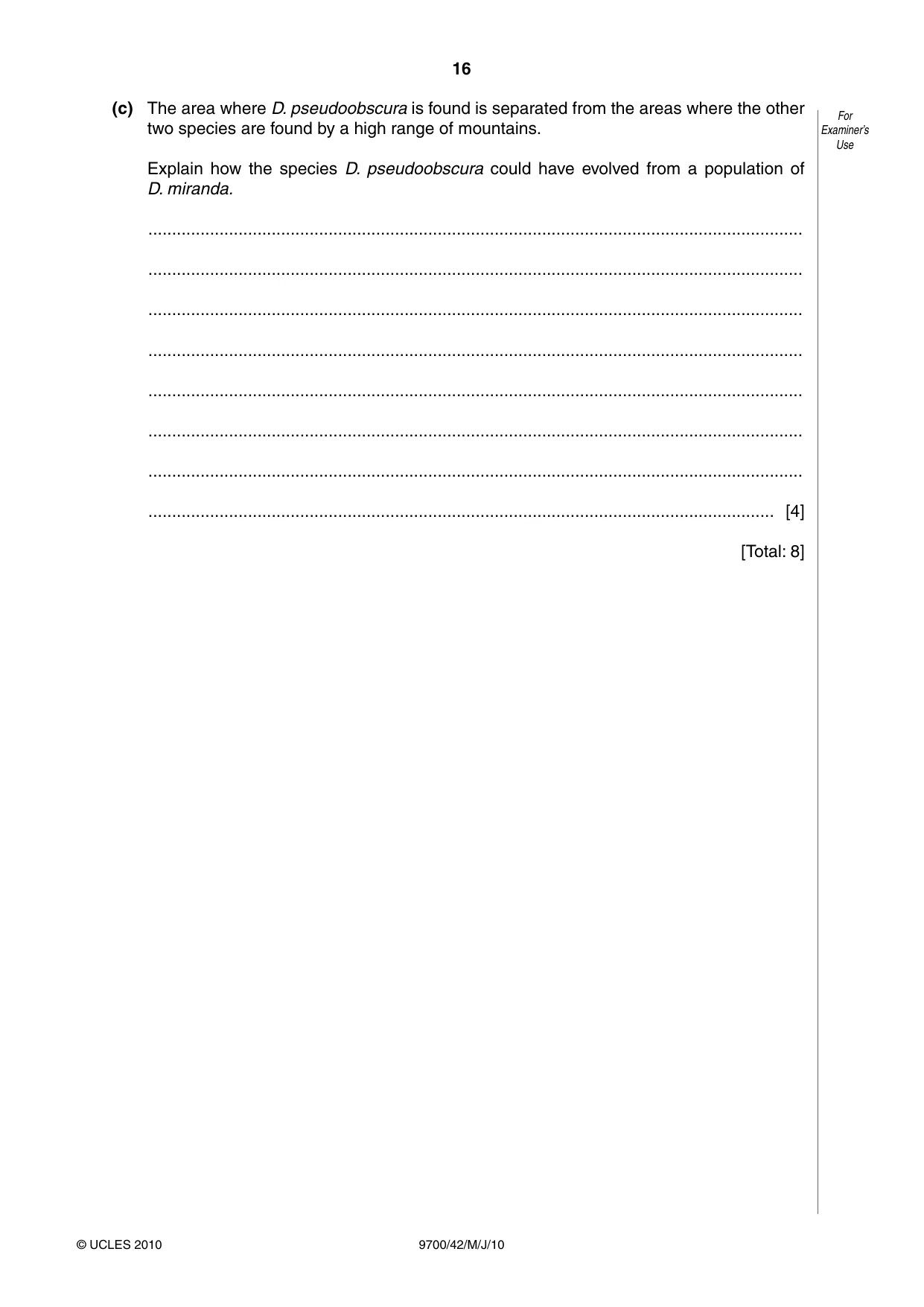
16 9700/42/M/J/10 © UCLES 2010 For Examiner’s Use (c) The area where D. pseudoobscura is found is separated from the areas where the other two species are found by a high range of mountains. Explain how the species D. pseudoobscura could have evolved from a population of D. miranda. … … … … … … … … [4] [Total: 8]
Question paper, page 17
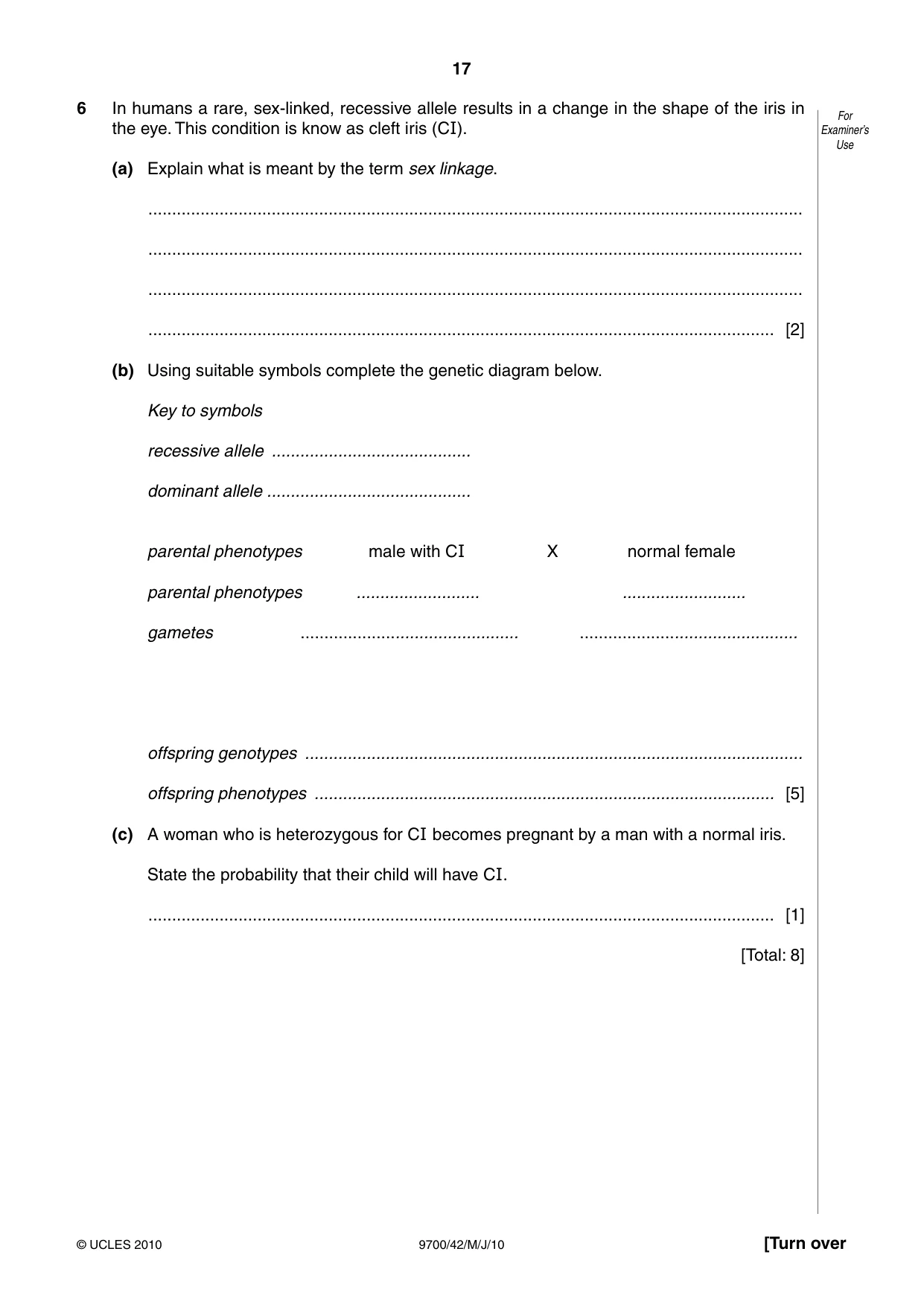
17 9700/42/M/J/10 © UCLES 2010 [Turn over For Examiner’s Use 6 In humans a rare, sex-linked, recessive allele results in a change in the shape of the iris in the eye. This condition is know as cleft iris (CI). (a) Explain what is meant by the term sex linkage. … … … … [2] (b) Using suitable symbols complete the genetic diagram below. Key to symbols recessive allele … dominant allele … parental phenotypes male with CI X normal female parental phenotypes … … gametes … … offspring genotypes … offspring phenotypes … [5] (c) A woman who is heterozygous for CI becomes pregnant by a man with a normal iris. State the probability that their child will have CI. … [1] [Total: 8]
Question paper, page 18
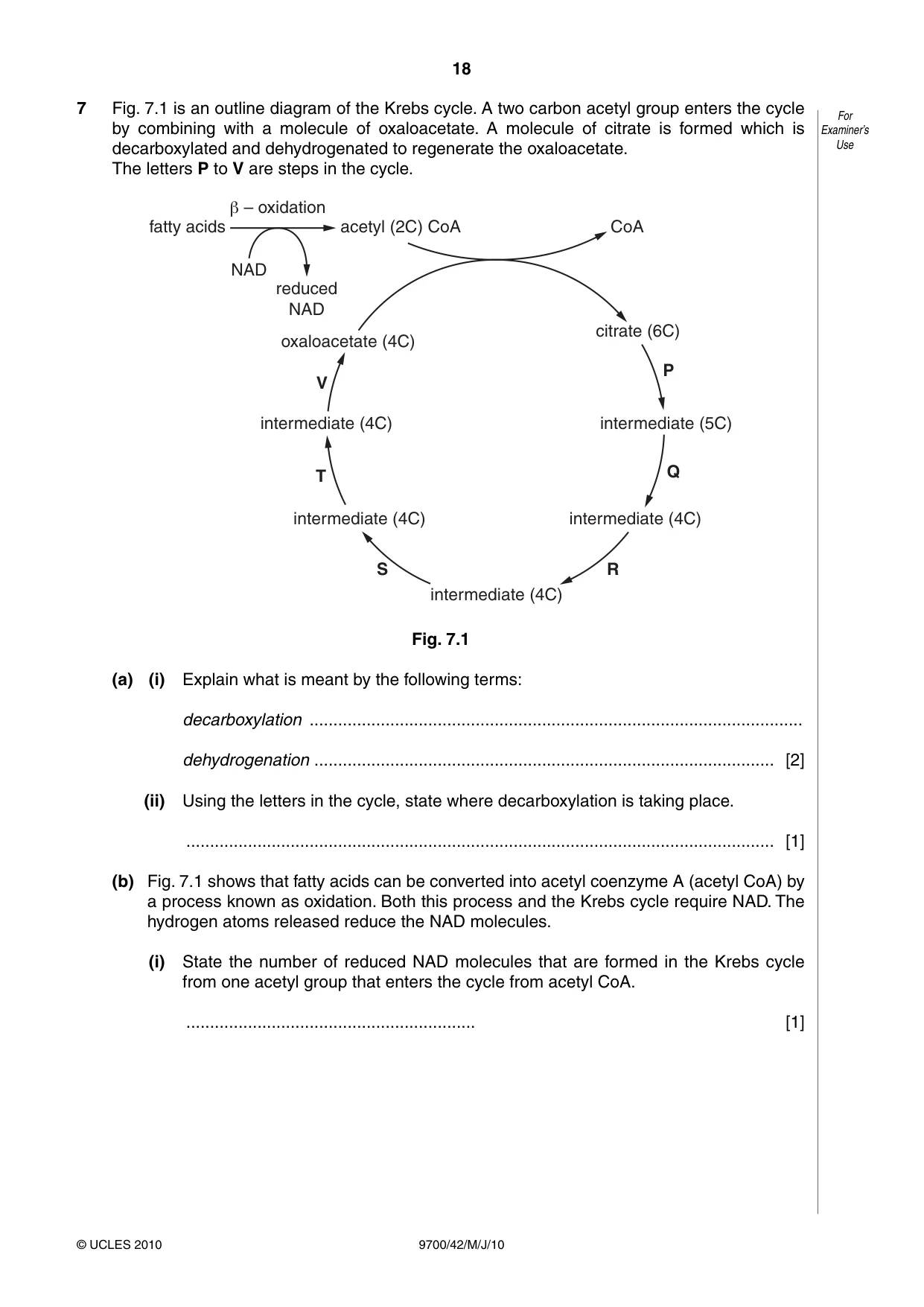
18 9700/42/M/J/10 © UCLES 2010 For Examiner’s Use 7 Fig. 7.1 is an outline diagram of the Krebs cycle. A two carbon acetyl group enters the cycle by combining with a molecule of oxaloacetate. A molecule of citrate is formed which is decarboxylated and dehydrogenated to regenerate the oxaloacetate. The letters P to V are steps in the cycle. fatty acids acetyl (2C) CoA CoA citrate (6C) intermediate (5C) intermediate (4C) intermediate (4C) intermediate (4C) intermediate (4C) oxaloacetate (4C) P Q R S T V NAD reduced NAD β – oxidation Fig. 7.1 (a) (i) Explain what is meant by the following terms: decarboxylation … dehydrogenation … [2] (ii) Using the letters in the cycle, state where decarboxylation is taking place. … [1] (b) Fig. 7.1 shows that fatty acids can be converted into acetyl coenzyme A (acetyl CoA) by a process known as oxidation. Both this process and the Krebs cycle require NAD. The hydrogen atoms released reduce the NAD molecules. (i) State the number of reduced NAD molecules that are formed in the Krebs cycle from one acetyl group that enters the cycle from acetyl CoA. … [1]
Question paper, page 19
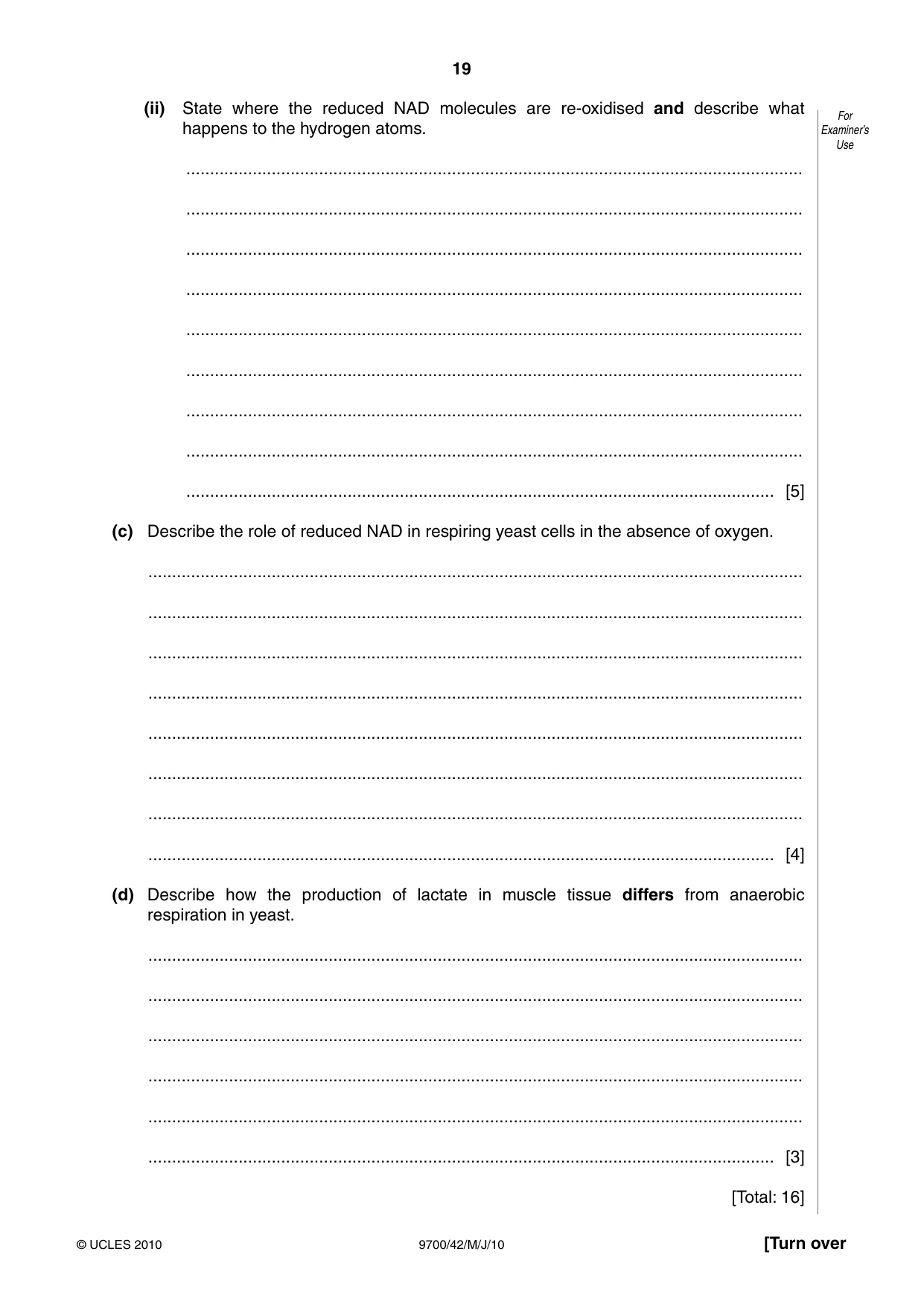
19 9700/42/M/J/10 © UCLES 2010 [Turn over For Examiner’s Use (ii) State where the reduced NAD molecules are re-oxidised and describe what happens to the hydrogen atoms. … … … … … … … … … [5] (c) Describe the role of reduced NAD in respiring yeast cells in the absence of oxygen. … … … … … … … … [4] (d) Describe how the production of lactate in muscle tissue differs from anaerobic respiration in yeast. … … … … … … [3] [Total: 16]
Question paper, page 20
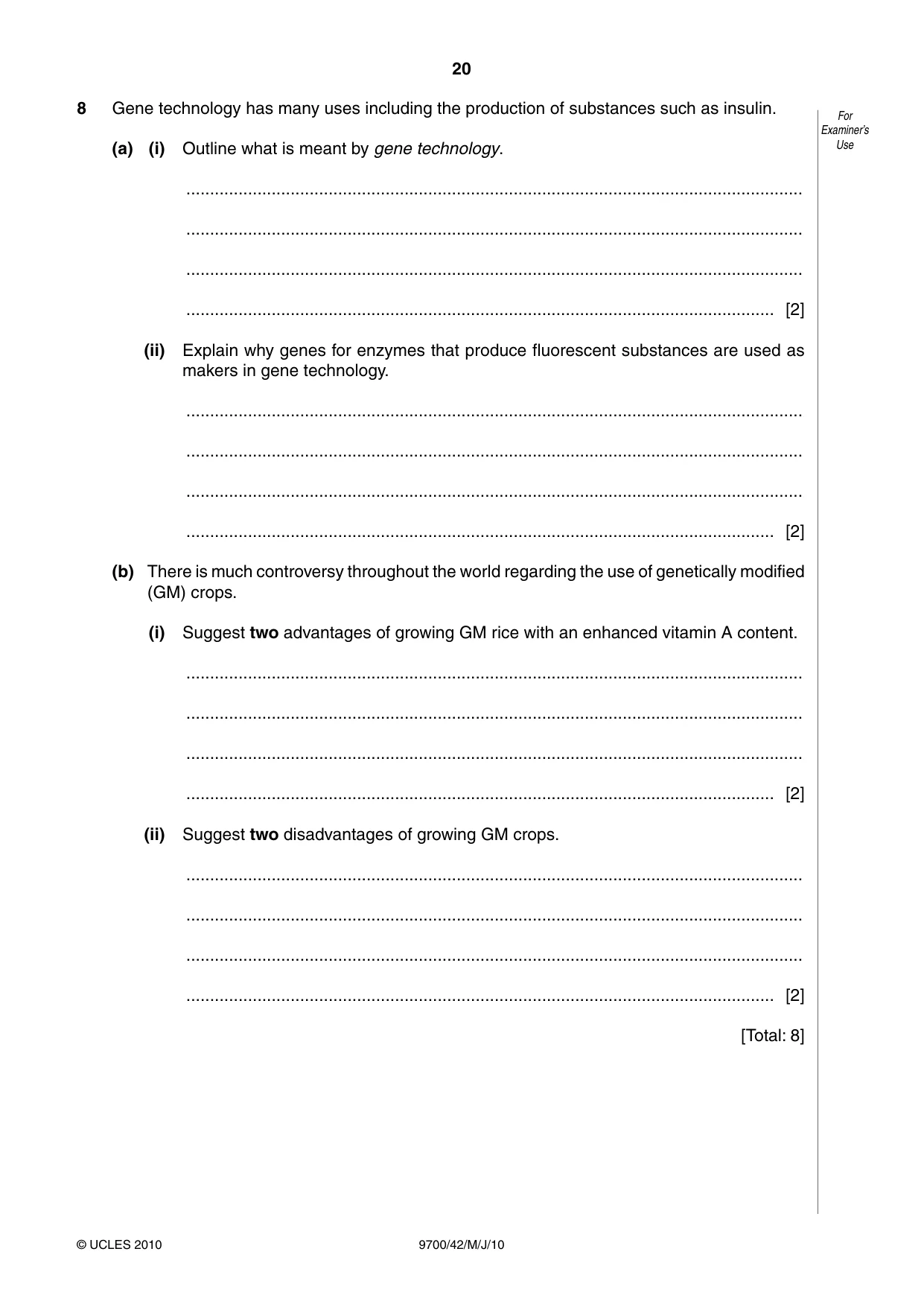
20 9700/42/M/J/10 © UCLES 2010 For Examiner’s Use 8 Gene technology has many uses including the production of substances such as insulin. (a) (i) Outline what is meant by gene technology. … … … … [2] (ii) Explain why genes for enzymes that produce fluorescent substances are used as makers in gene technology. … … … … [2] (b) There is much controversy throughout the world regarding the use of genetically modified (GM) crops. (i) Suggest two advantages of growing GM rice with an enhanced vitamin A content. … … … … [2] (ii) Suggest two disadvantages of growing GM crops. … … … … [2] [Total: 8]
Question paper, page 21
21 9700/42/M/J/10 © UCLES 2010 [Turn over For Examiner’s Use Section B Answer one question. 9 (a) Describe the structure of photosystems and explain how a photosystem functions in cyclic photophosphorylation. [8] (b) Explain briefly how reduced NADP is formed in the light-dependent stage and how it is used in the light-independent stage. [7] [Total: 15] 10 (a) Describe the structure of a myelinated sensory neurone. [7] (b) Explain how an action potential is transmitted along a sensory neurone. [8] [Total: 15] … … … … … … … … … … … … … … … … … …
Question paper, page 22
22 9700/42/M/J/10 © UCLES 2010 For Examiner’s Use … … … … … … … … … … … … … … … … … … … … … … … … … … … …
Question paper, page 23
23 9700/42/M/J/10 © UCLES 2010 [Turn over For Examiner’s Use … … … … … … … … … … … … … … … … … … … … … … … … … … … …
Question paper, page 24
24 9700/42/M/J/10 © UCLES 2010 For Examiner’s Use … … … … … … … … … … … … … … … … … … … … … … … … Copyright Acknowledgements: Question 1 Figure 1.1 © Pat & Tom Leeson; Science Photo Library. Permission to reproduce items where third-party owned material protected by copyright is included has been sought and cleared where possible. Every reasonable effort has been made by the publisher (UCLES) to trace copyright holders, but if any items requiring clearance have unwittingly been included, the publisher will be pleased to make amends at the earliest possible opportunity. University of Cambridge International Examinations is part of the Cambridge Assessment Group. Cambridge Assessment is the brand name of University of Cambridge Local Examinations Syndicate (UCLES), which is itself a department of the University of Cambridge.
Mark scheme, page 1
UNIVERSITY OF CAMBRIDGE INTERNATIONAL EXAMINATIONS GCE Advanced Subsidiary Level and GCE Advanced Level MARK SCHEME for the May/June 2010 question paper for the guidance of teachers 9700 BIOLOGY 9700/42 Paper 4 (A2 Structured Questions), maximum raw mark 100 This mark scheme is published as an aid to teachers and candidates, to indicate the requirements of the examination. It shows the basis on which Examiners were instructed to award marks. It does not indicate the details of the discussions that took place at an Examiners’ meeting before marking began, which would have considered the acceptability of alternative answers. Mark schemes must be read in conjunction with the question papers and the report on the examination. • CIE will not enter into discussions or correspondence in connection with these mark schemes. CIE is publishing the mark schemes for the May/June 2010 question papers for most IGCSE, GCE Advanced Level and Advanced Subsidiary Level syllabuses and some Ordinary Level syllabuses.
Mark scheme, page 2
Page 2 Mark Scheme: Teachers’ version Syllabus Paper GCE AS/A LEVEL – May/June 2010 9700 42 © UCLES 2010 1 (a) 1 more nests in, areas of low salinity/less salty areas ; ora 2 comment about result for salinity 16-20 not following trend ; 3 2 paired figs with units ; linked to 1 [3] (b) (i) (31 – 8) (× 100) 8 287.5/288 ;; allow one mark for suitable working if incorrect answer [2] (ii) any two from 1 (ensure) low salinity or more freshwater ; 2 nest sites protected ; 3 education/ecotourism ; 4 assisted breeding ; 5 ban on hunting ; 6 preventing pollution ; [2 max] [Total: 7] 2 (a) 1 receptor or binding site not, complementary/specific, to FSH ; 2 FSH has shorter β chain than LH ; ora 3 FSH has different, primary structure/sequence of amino acids ; 4 FSH has different, tertiary structure/3D shape ; [3 max] (b) (i) follicle (cells) ; A granulosa (cells) [1] (ii) corpus luteal (cells) ; A granulosa (cells) [1] (c) 1 (binding to a receptor), acts as a signal to the cells/stimulates cells ; 2 to, start/increase, synthesis of hormone ; A cells start to divide 3 oestrogen secreted ; A mature follicle formed (oestrogen), 4 stimulates thickening of endometrium/inhibits FSH (production) ; [3 max] [Total: 8]
Mark scheme, page 3
Page 3 Mark Scheme: Teachers’ version Syllabus Paper GCE AS/A LEVEL – May/June 2010 9700 42 © UCLES 2010 3 (a) 1 penicillin inhibits enzyme ; ignore name of enzyme 2 peptidoglycan chains cannot link up/stops cross-links forming ; 3 cell wall becomes weaker/AW ; 4 turgor of cell not resisted (by cell wall)/AW ; 5 cell/wall, bursts ; [3 max] (b) (i) B has, an outer membrane/channel proteins ; B has thinner (peptidoglycan) wall ; accept ora for A [2] (ii) 1 penicillin V can reach the, wall/(cell surface) membrane, of A ; ora 2 outer membrane of B stops penicillin V getting through ; ora 3 penicillin V cannot get through pores of outer membrane of B ; [2 max] (iii) can penetrate outer membrane ; through pores/directly through as non-polar ; [2] (c) batch culture 1 set up and allowed to proceed ; 2 nutrients not added or products removed, (during fermentation) ; 3 air allowed in/waste gas allowed out ; 4 at end of each process, product harvested/fermenter cleaned out ; max 2 continuous culture 5 nutrients added (all the time) ; 6 products removed (all the time) ; 7 no down time/AW ; max 2 [3 max] (d) 1 (Penicillium/fungus), does not make penicillin all the time/penicillin is made in the later stages of growth ; 2 when beginning to run out of nutrients ; 3 (penicillin) is a secondary metabolite ; 4 continuous culture has no yield of penicillin ; 5 continuous culture, never reaches stationary phase of growth/always exponential growth ; [3 max] [Total: 15]
Mark scheme, page 4
Page 4 Mark Scheme: Teachers’ version Syllabus Paper GCE AS/A LEVEL – May/June 2010 9700 42 © UCLES 2010 4 (a) 1 can be grown in many different environments/AW ; 2 (grains) contain variety of nutrients ; A list of 3+ nutrients 3 detail of nutrient content ; e.g. high in calcium/vitamin B/protein 4 (grains) have high, energy/fibre, content ; 5 (grains) store well ; [3 max] (b) (i) endosperm ; [1] (ii) 1 both rise and then fall ; 2 sorghum (enzyme) has higher activity (at all temperatures) ; 3 sorghum (enzyme) has higher maximum activity ; 4 sorghum (enzyme) has higher optimum temperature ; A 70° and 60° 5 comparative figures to illustrate points 2 or 3 ; [3 max] (iii) 1 (rice) tertiary structure/active site, of amylase is altered more by high temperature ; 2 (therefore) fewer ES/enzyme-substrate complexes formed/AW ; 3 high temperatures affect H bonds (more than other bonds) ; 4 amylase in rice may have more H bonds ; ora 5 correct ref. to other named bond ; [3 max] (c) (i) 1 higher CO2 uptake at higher light intensity ; ora 2 comparative figures ; using columns 1 and 2 3 CO2 used in, Calvin cycle/light independent reaction ; 4 photophosphorylation/light dependent stage provides, ATP/reduced NADP ; 5 for use in, Calvin cycle/light independent reaction ; 6 light is a limiting factor ; [3 max] (ii) 1 survive better at low light intensities ; 2 comparative figures ; using columns 1 and 6 [2] [Total: 15]
Mark scheme, page 5
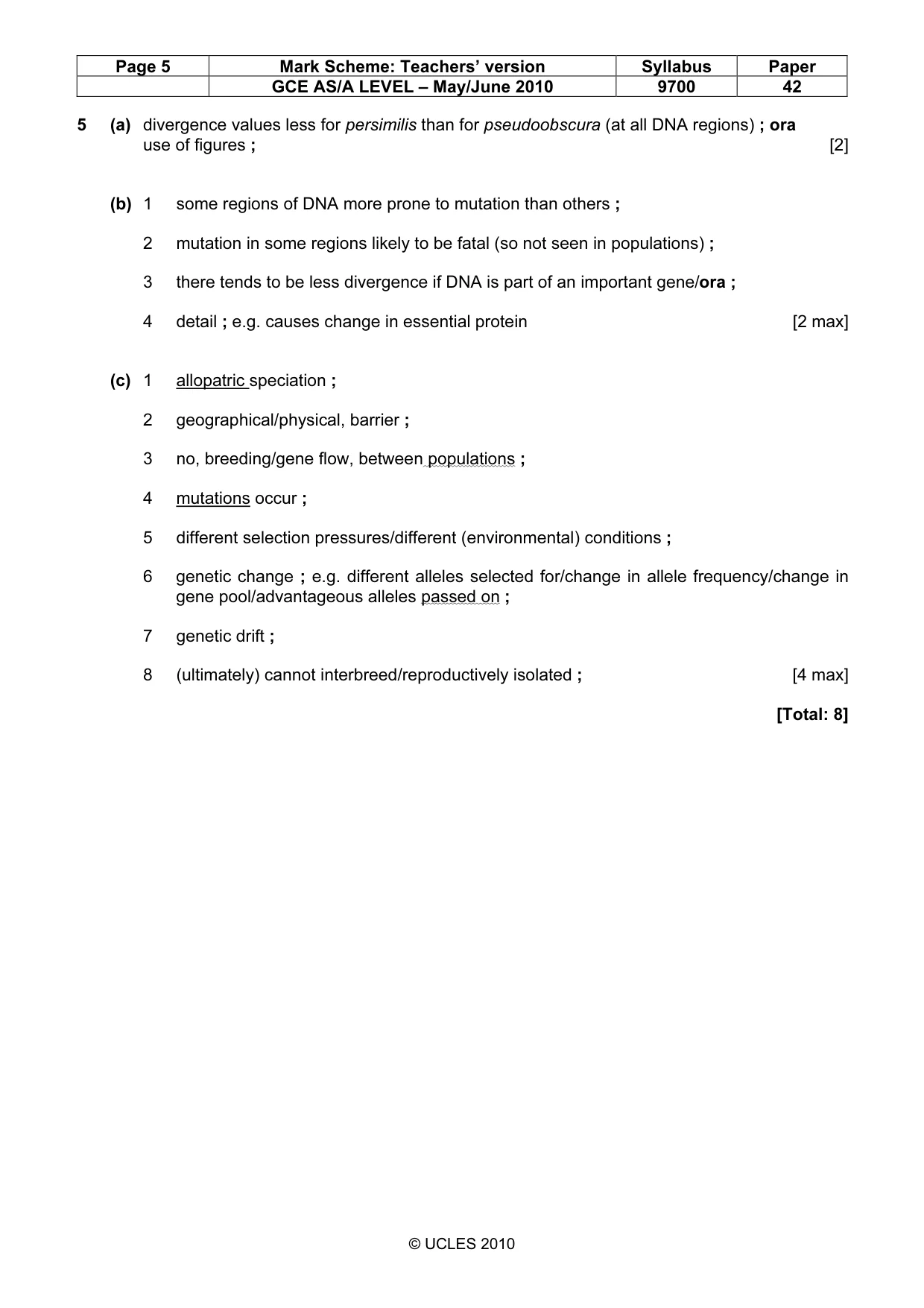
Page 5 Mark Scheme: Teachers’ version Syllabus Paper GCE AS/A LEVEL – May/June 2010 9700 42 © UCLES 2010 5 (a) divergence values less for persimilis than for pseudoobscura (at all DNA regions) ; ora use of figures ; [2] (b) 1 some regions of DNA more prone to mutation than others ; 2 mutation in some regions likely to be fatal (so not seen in populations) ; 3 there tends to be less divergence if DNA is part of an important gene/ora ; 4 detail ; e.g. causes change in essential protein [2 max] (c) 1 allopatric speciation ; 2 geographical/physical, barrier ; 3 no, breeding/gene flow, between populations ; 4 mutations occur ; 5 different selection pressures/different (environmental) conditions ; 6 genetic change ; e.g. different alleles selected for/change in allele frequency/change in gene pool/advantageous alleles passed on ; 7 genetic drift ; 8 (ultimately) cannot interbreed/reproductively isolated ; [4 max] [Total: 8]
Mark scheme, page 6
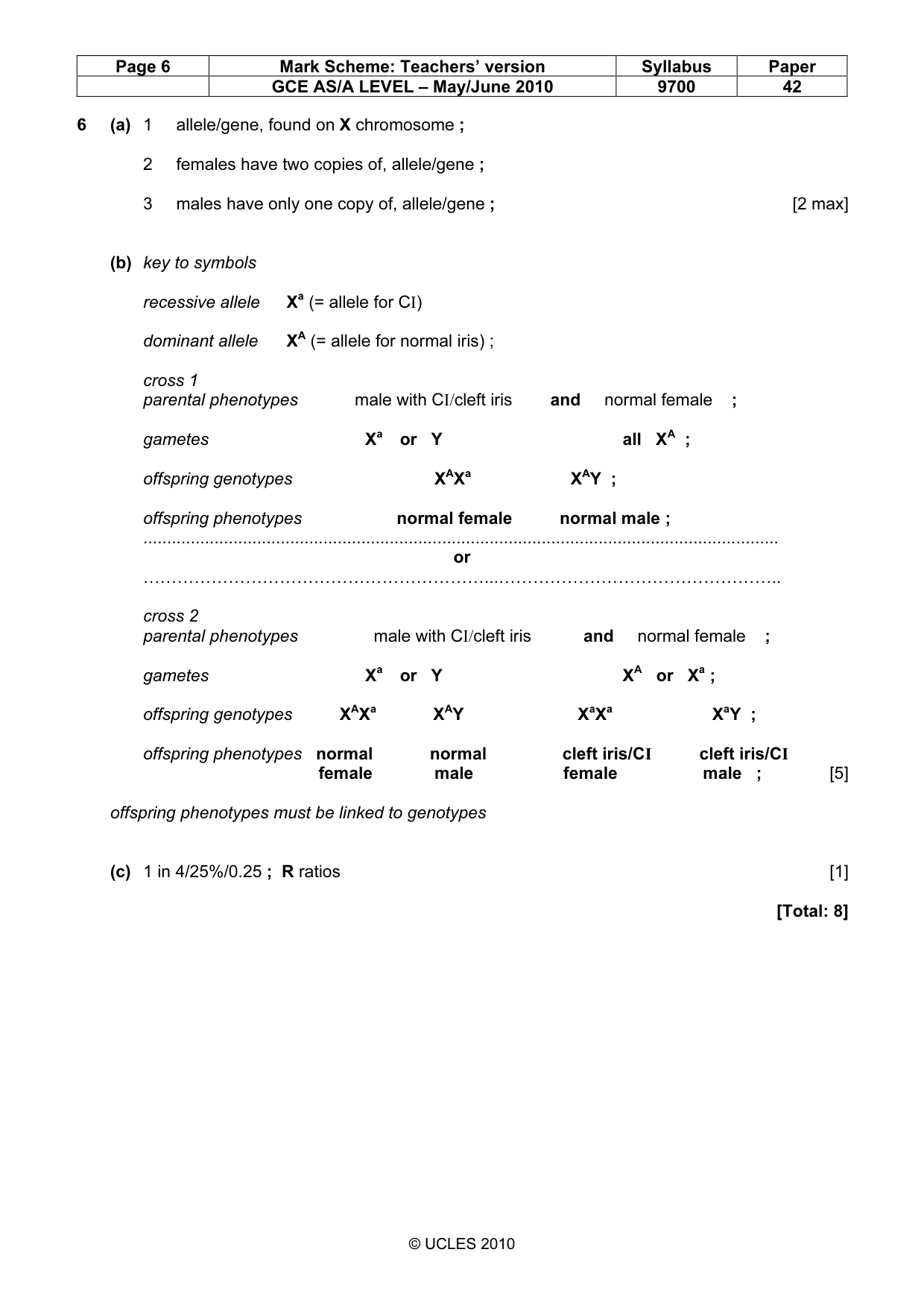
Page 6 Mark Scheme: Teachers’ version Syllabus Paper GCE AS/A LEVEL – May/June 2010 9700 42 © UCLES 2010 6 (a) 1 allele/gene, found on X chromosome ; 2 females have two copies of, allele/gene ; 3 males have only one copy of, allele/gene ; [2 max] (b) key to symbols recessive allele Xa (= allele for CI) dominant allele XA (= allele for normal iris) ; cross 1 parental phenotypes male with CI/cleft iris and normal female ; gametes Xa or Y all XA ; offspring genotypes XAXa XAY ; offspring phenotypes normal female normal male ; … or ……………………………………………………...………………………………………….. cross 2 parental phenotypes male with CI/cleft iris and normal female ; gametes Xa or Y XA or Xa ; offspring genotypes XAXa XAY XaXa XaY ; offspring phenotypes normal normal cleft iris/CI cleft iris/CI female male female male ; [5] offspring phenotypes must be linked to genotypes (c) 1 in 4/25%/0.25 ; R ratios [1] [Total: 8]
Mark scheme, page 7
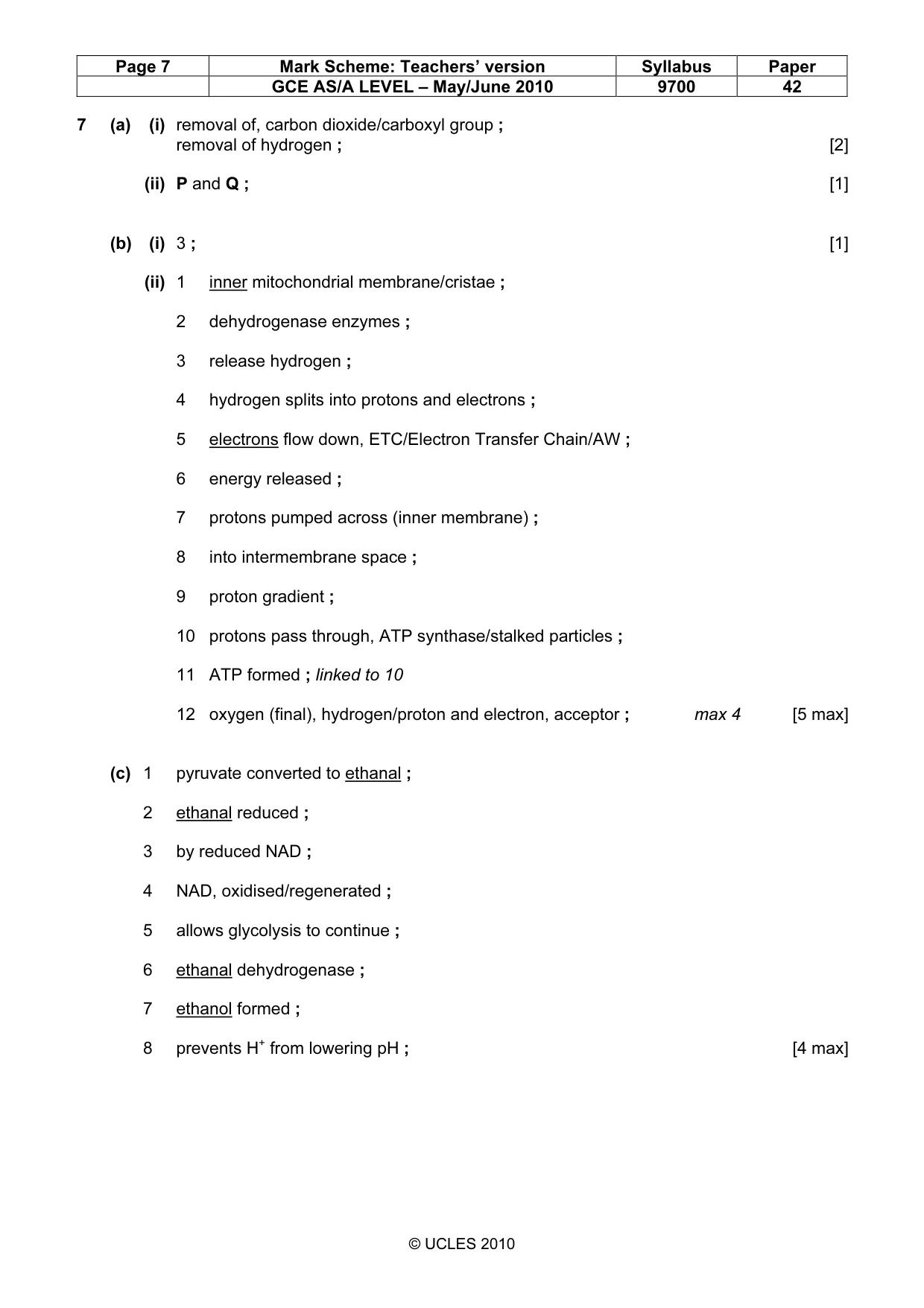
Page 7 Mark Scheme: Teachers’ version Syllabus Paper GCE AS/A LEVEL – May/June 2010 9700 42 © UCLES 2010 7 (a) (i) removal of, carbon dioxide/carboxyl group ; removal of hydrogen ; [2] (ii) P and Q ; [1] (b) (i) 3 ; [1] (ii) 1 inner mitochondrial membrane/cristae ; 2 dehydrogenase enzymes ; 3 release hydrogen ; 4 hydrogen splits into protons and electrons ; 5 electrons flow down, ETC/Electron Transfer Chain/AW ; 6 energy released ; 7 protons pumped across (inner membrane) ; 8 into intermembrane space ; 9 proton gradient ; 10 protons pass through, ATP synthase/stalked particles ; 11 ATP formed ; linked to 10 12 oxygen (final), hydrogen/proton and electron, acceptor ; max 4 [5 max] (c) 1 pyruvate converted to ethanal ; 2 ethanal reduced ; 3 by reduced NAD ; 4 NAD, oxidised/regenerated ; 5 allows glycolysis to continue ; 6 ethanal dehydrogenase ; 7 ethanol formed ; 8 prevents H+ from lowering pH ; [4 max]
Mark scheme, page 8
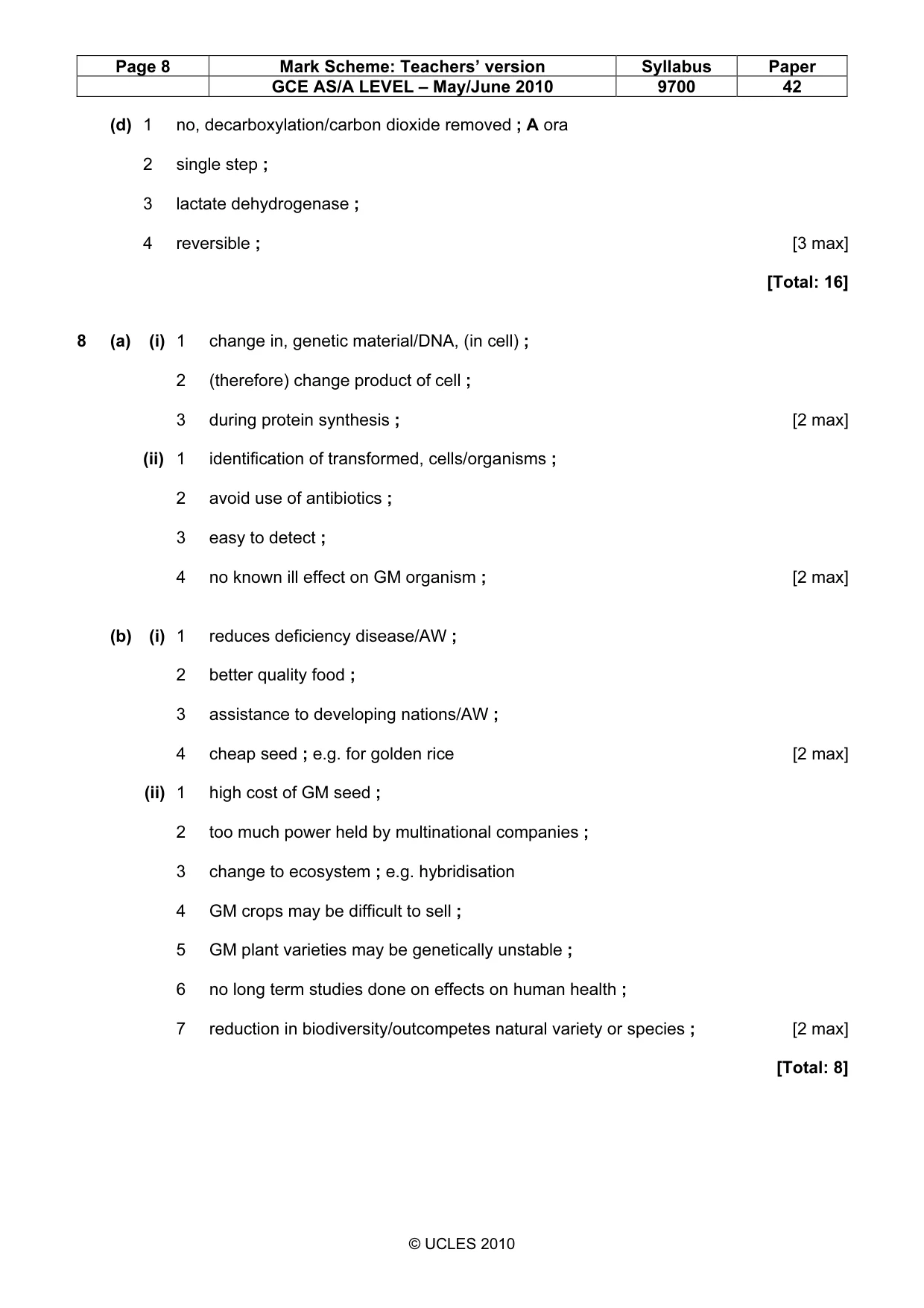
Page 8 Mark Scheme: Teachers’ version Syllabus Paper GCE AS/A LEVEL – May/June 2010 9700 42 © UCLES 2010 (d) 1 no, decarboxylation/carbon dioxide removed ; A ora 2 single step ; 3 lactate dehydrogenase ; 4 reversible ; [3 max] [Total: 16] 8 (a) (i) 1 change in, genetic material/DNA, (in cell) ; 2 (therefore) change product of cell ; 3 during protein synthesis ; [2 max] (ii) 1 identification of transformed, cells/organisms ; 2 avoid use of antibiotics ; 3 easy to detect ; 4 no known ill effect on GM organism ; [2 max] (b) (i) 1 reduces deficiency disease/AW ; 2 better quality food ; 3 assistance to developing nations/AW ; 4 cheap seed ; e.g. for golden rice [2 max] (ii) 1 high cost of GM seed ; 2 too much power held by multinational companies ; 3 change to ecosystem ; e.g. hybridisation 4 GM crops may be difficult to sell ; 5 GM plant varieties may be genetically unstable ; 6 no long term studies done on effects on human health ; 7 reduction in biodiversity/outcompetes natural variety or species ; [2 max] [Total: 8]
Mark scheme, page 9
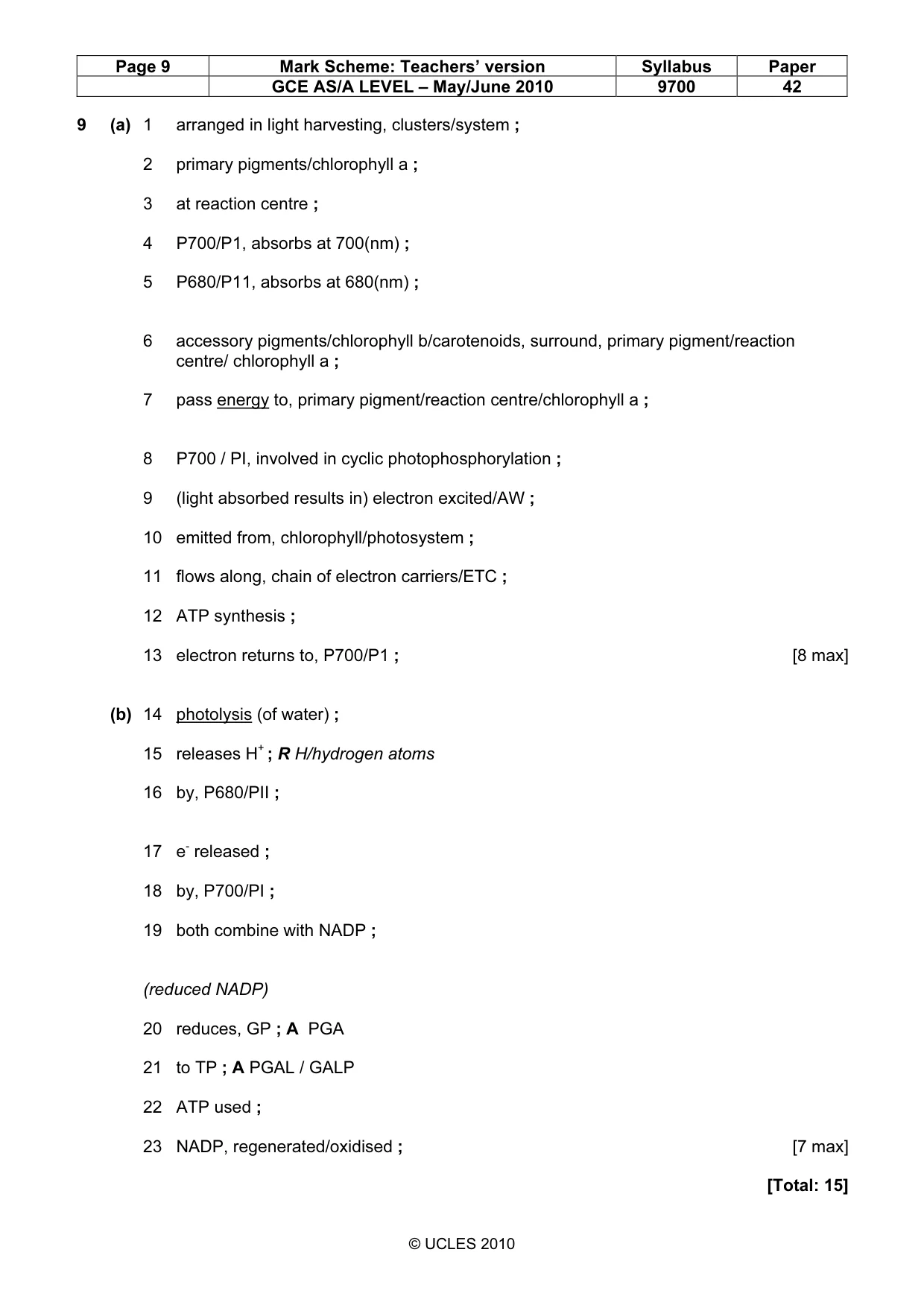
Page 9 Mark Scheme: Teachers’ version Syllabus Paper GCE AS/A LEVEL – May/June 2010 9700 42 © UCLES 2010 9 (a) 1 arranged in light harvesting, clusters/system ; 2 primary pigments/chlorophyll a ; 3 at reaction centre ; 4 P700/P1, absorbs at 700(nm) ; 5 P680/P11, absorbs at 680(nm) ; 6 accessory pigments/chlorophyll b/carotenoids, surround, primary pigment/reaction centre/ chlorophyll a ; 7 pass energy to, primary pigment/reaction centre/chlorophyll a ; 8 P700 / PI, involved in cyclic photophosphorylation ; 9 (light absorbed results in) electron excited/AW ; 10 emitted from, chlorophyll/photosystem ; 11 flows along, chain of electron carriers/ETC ; 12 ATP synthesis ; 13 electron returns to, P700/P1 ; [8 max] (b) 14 photolysis (of water) ; 15 releases H+ ; R H/hydrogen atoms 16 by, P680/PII ; 17 e- released ; 18 by, P700/PI ; 19 both combine with NADP ; (reduced NADP) 20 reduces, GP ; A PGA 21 to TP ; A PGAL / GALP 22 ATP used ; 23 NADP, regenerated/oxidised ; [7 max] [Total: 15]
Mark scheme, page 10
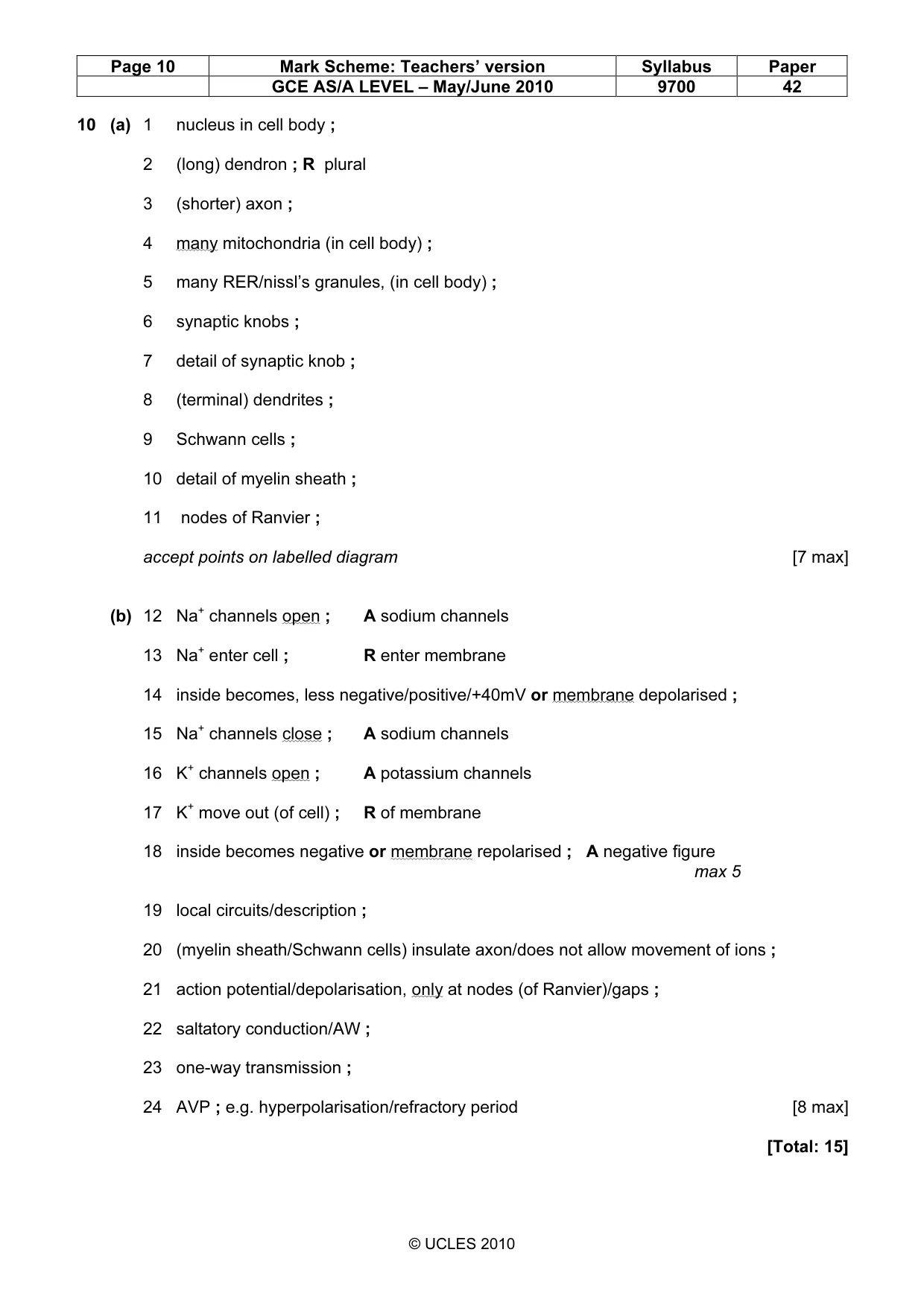
Page 10 Mark Scheme: Teachers’ version Syllabus Paper GCE AS/A LEVEL – May/June 2010 9700 42 © UCLES 2010 10 (a) 1 nucleus in cell body ; 2 (long) dendron ; R plural 3 (shorter) axon ; 4 many mitochondria (in cell body) ; 5 many RER/nissl’s granules, (in cell body) ; 6 synaptic knobs ; 7 detail of synaptic knob ; 8 (terminal) dendrites ; 9 Schwann cells ; 10 detail of myelin sheath ; 11 nodes of Ranvier ; accept points on labelled diagram [7 max] (b) 12 Na+ channels open ; A sodium channels 13 Na+ enter cell ; R enter membrane 14 inside becomes, less negative/positive/+40mV or membrane depolarised ; 15 Na+ channels close ; A sodium channels 16 K+ channels open ; A potassium channels 17 K+ move out (of cell) ; R of membrane 18 inside becomes negative or membrane repolarised ; A negative figure max 5 19 local circuits/description ; 20 (myelin sheath/Schwann cells) insulate axon/does not allow movement of ions ; 21 action potential/depolarisation, only at nodes (of Ranvier)/gaps ; 22 saltatory conduction/AW ; 23 one-way transmission ; 24 AVP ; e.g. hyperpolarisation/refractory period [8 max] [Total: 15]
What you needed in this session
Cambridge’s own grade thresholds for 2010 May/June, Paper 4 · Variant 2. A higher threshold means an easier paper — the bar moves with how the cohort did.