Cambridge A Level Biology 9700 — 2009 May/June Paper 2 · Variant 1
9700/21/M/J/09
The question paper and its mark scheme, free to read here and free to download. This is Cambridge’s own paper, exactly as it was sat.
Question paper41 pages





Mark scheme13 pages
Answers below. Sit the paper first if you are practising.
Paper as text
Question paper, page 1
Location Entry Codes As part of CIE’s continual commitment to maintaining best practice in assessment, CIE uses different variants of some question papers for our most popular assessments with large and widespread candidature. The question papers are closely related and the relationships between them have been thoroughly established using our assessment expertise. All versions of the paper give assessment of equal standard. The content assessed by the examination papers and the type of questions is unchanged. This change means that for this component there are now two variant Question Papers, Mark Schemes and Principal Examiner’s Reports where previously there was only one. For any individual country, it is intended that only one variant is used. This document contains both variants which will give all Centres access to even more past examination material than is usually the case. The diagram shows the relationship between the Question Papers, Mark Schemes and Principal Examiners’ Reports that are available. Question Paper Mark Scheme Principal Examiner’s Report Introduction Introduction Introduction First variant Question Paper First variant Mark Scheme First variant Principal Examiner’s Report Second variant Question Paper Second variant Mark Scheme Second variant Principal Examiner’s Report Who can I contact for further information on these changes? Please direct any questions about this to CIE’s Customer Services team at: international@cie.org.uk The titles for the variant items should correspond with the table above, so that at the top of the first page of the relevant part of the document and on the header, it has the words: • First variant Question Paper / Mark Scheme / Principal Examiner’s Report or • Second variant Question Paper / Mark Scheme / Principal Examiner’s Report as appropriate.
Question paper, page 2
This document consists of 16 printed pages and 4 blank pages. SP (DR/DR) V00657/5 © UCLES 2009 [Turn over UNIVERSITY OF CAMBRIDGE INTERNATIONAL EXAMINATIONS General Certificate of Education Advanced Subsidiary Level and Advanced Level READ THESE INSTRUCTIONS FIRST Write your Centre number, candidate number and name in the spaces provided at the top of this page. Write in dark blue or black pen. You may use a soft pencil for any diagrams, graphs, or rough working. Do not use staples, paper clips, highlighters, glue or correction fluid. DO NOT WRITE IN ANY BARCODES. Answer all questions. At the end of the examination, fasten all your work securely together. The number of marks is given in brackets [ ] at the end of each question or part question. * 2 7 0 9 7 6 6 0 7 7 * BIOLOGY 9700/21 Paper 2 Structured Questions AS May/June 2009 1 hour 15 minutes Candidates answer on the Question Paper. Additional Materials: Electronic calculator Ruler For Examiner’s Use 1 2 3 4 5 6 Total First Variant Question Paper
Question paper, page 3
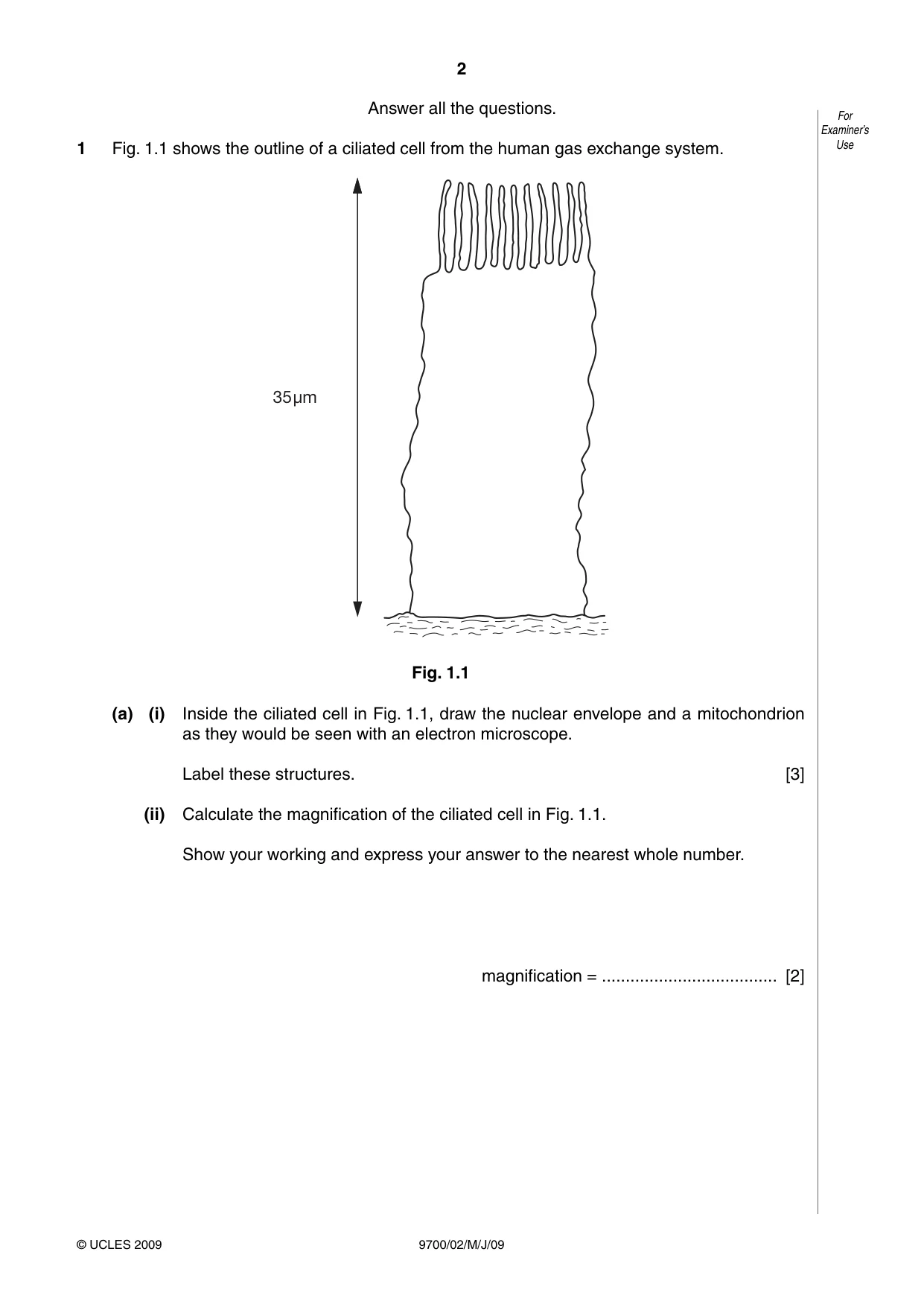
2 9700/02/M/J/09 For Examiner’s Use © UCLES 2009 Answer all the questions. 1 Fig. 1.1 shows the outline of a ciliated cell from the human gas exchange system. 35µm Fig. 1.1 (a) (i) Inside the ciliated cell in Fig. 1.1, draw the nuclear envelope and a mitochondrion as they would be seen with an electron microscope. Label these structures. [3] (ii) Calculate the magnification of the ciliated cell in Fig. 1.1. Show your working and express your answer to the nearest whole number. magnification = … [2]
Question paper, page 4
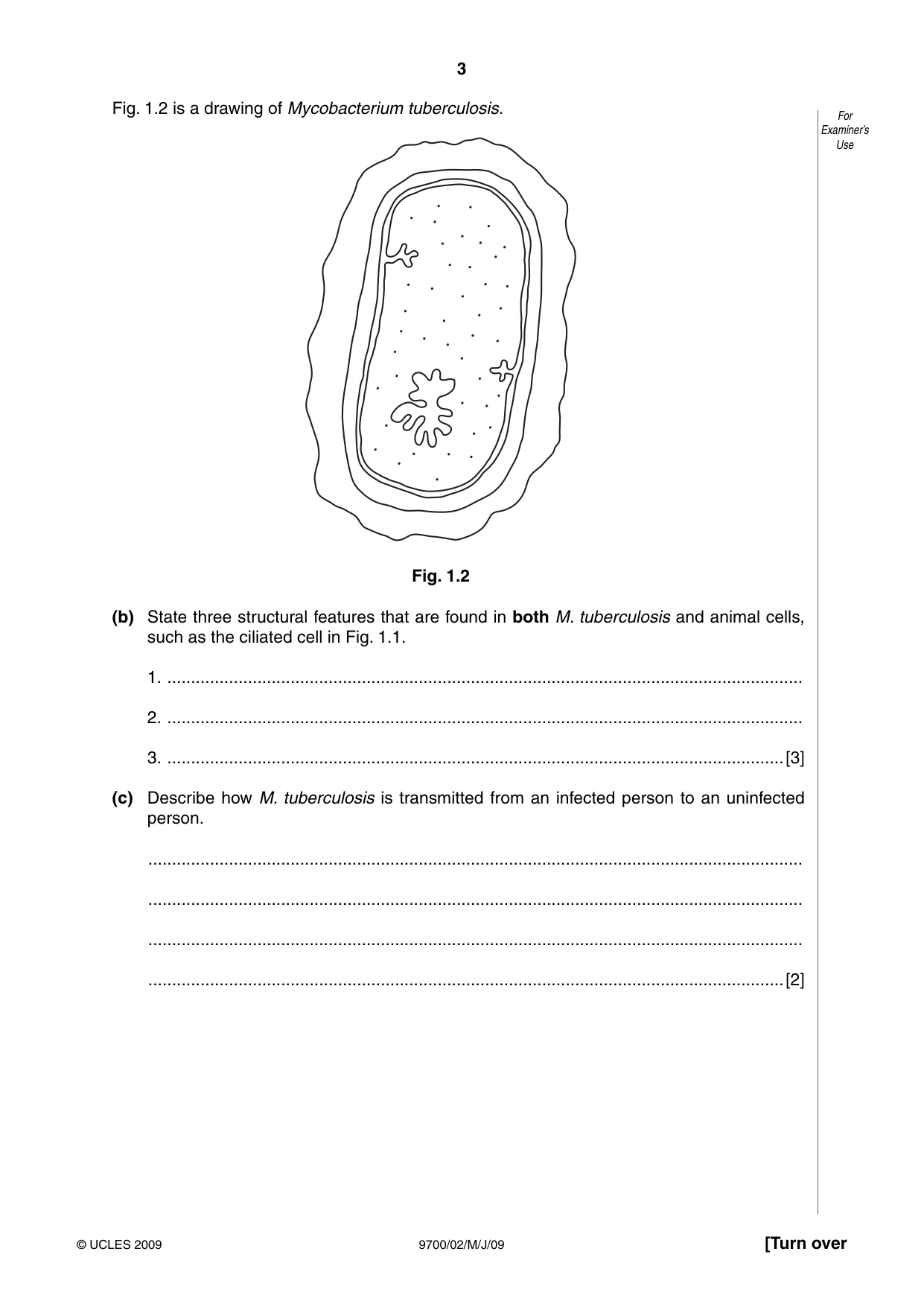
3 9700/02/M/J/09 [Turn over For Examiner’s Use © UCLES 2009 Fig. 1.2 is a drawing of Mycobacterium tuberculosis. Fig. 1.2 (b) State three structural features that are found in both M. tuberculosis and animal cells, such as the ciliated cell in Fig. 1.1. 1. … 2. … 3. …[3] (c) Describe how M. tuberculosis is transmitted from an infected person to an uninfected person. … … … …[2]
Question paper, page 5
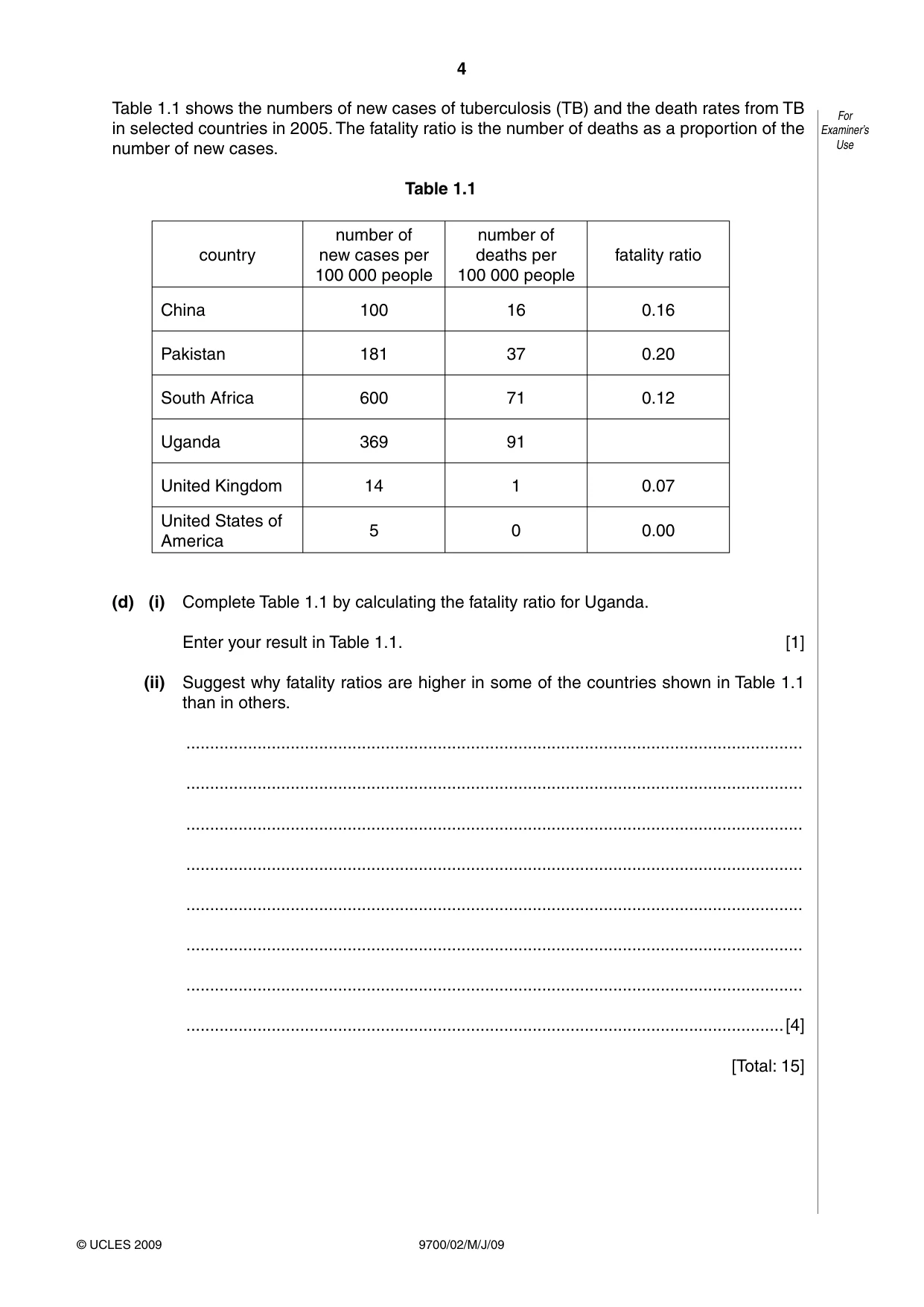
4 9700/02/M/J/09 For Examiner’s Use © UCLES 2009 Table 1.1 shows the numbers of new cases of tuberculosis (TB) and the death rates from TB in selected countries in 2005. The fatality ratio is the number of deaths as a proportion of the number of new cases. Table 1.1 country number of new cases per 100 000 people number of deaths per 100 000 people fatality ratio China 100 16 0.16 Pakistan 181 37 0.20 South Africa 600 71 0.12 Uganda 369 91 United Kingdom 14 1 0.07 United States of America 5 0 0.00 (d) (i) Complete Table 1.1 by calculating the fatality ratio for Uganda. Enter your result in Table 1.1. [1] (ii) Suggest why fatality ratios are higher in some of the countries shown in Table 1.1 than in others. … … … … … … … …[4] [Total: 15]
Question paper, page 6
5 9700/02/M/J/09 [Turn over BLANK PAGE QUESTION 2 STARTS ON PAGE 6
Question paper, page 7
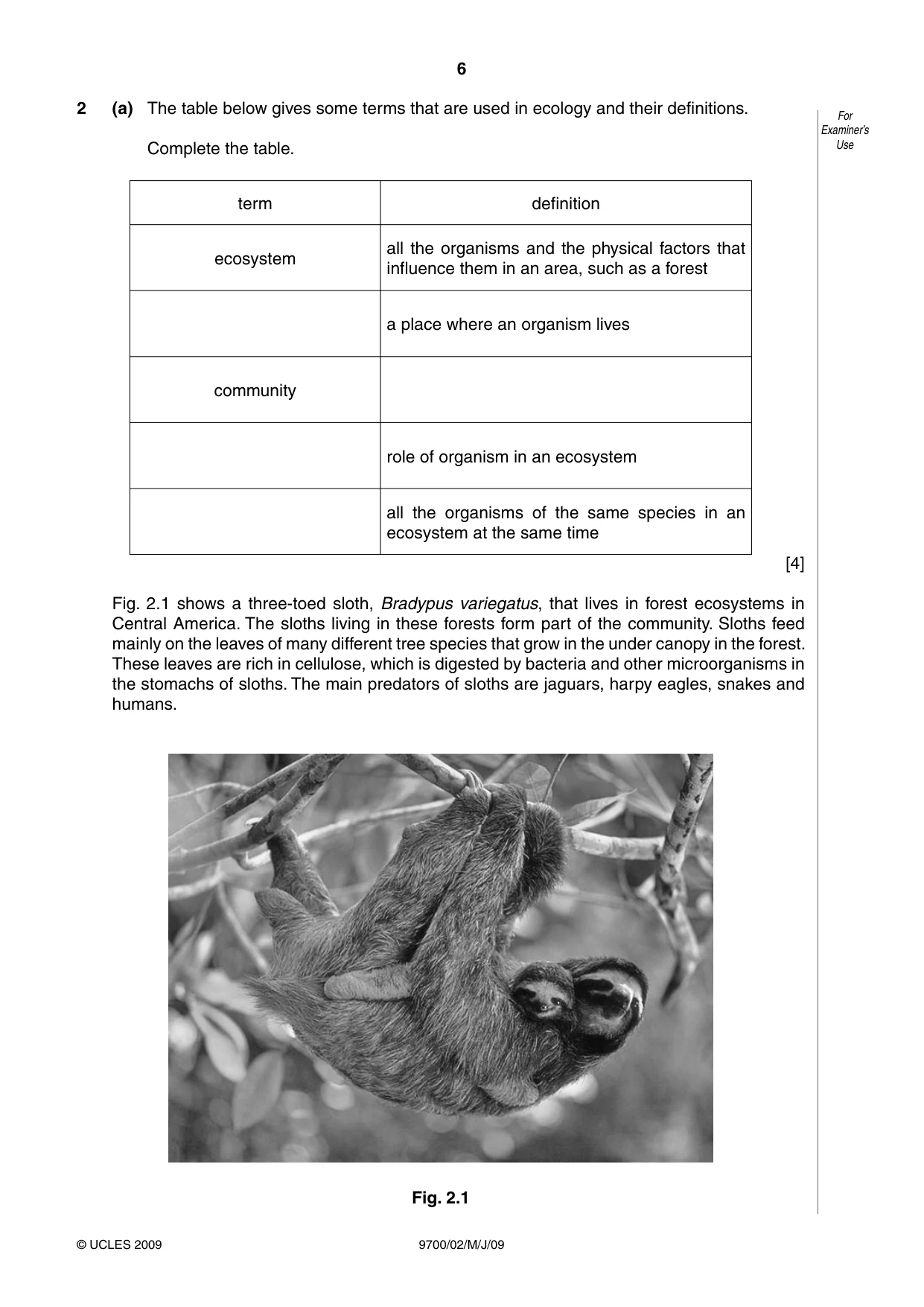
6 9700/02/M/J/09 For Examiner’s Use © UCLES 2009 2 (a) The table below gives some terms that are used in ecology and their definitions. Complete the table. term definition ecosystem all the organisms and the physical factors that influence them in an area, such as a forest a place where an organism lives community role of organism in an ecosystem all the organisms of the same species in an ecosystem at the same time [4] Fig. 2.1 shows a three-toed sloth, Bradypus variegatus, that lives in forest ecosystems in Central America. The sloths living in these forests form part of the community. Sloths feed mainly on the leaves of many different tree species that grow in the under canopy in the forest. These leaves are rich in cellulose, which is digested by bacteria and other microorganisms in the stomachs of sloths. The main predators of sloths are jaguars, harpy eagles, snakes and humans. Fig. 2.1
Question paper, page 8
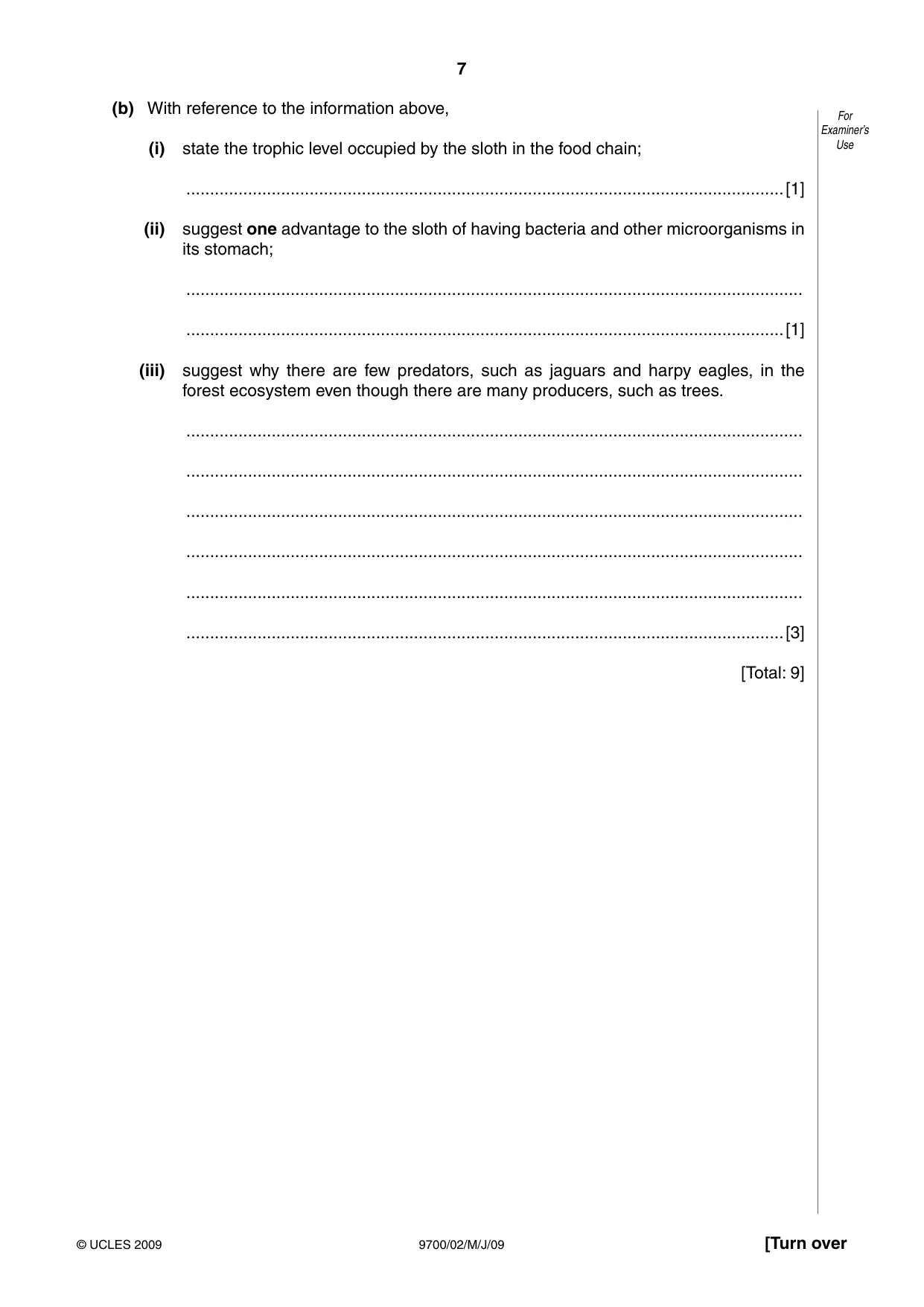
7 9700/02/M/J/09 [Turn over For Examiner’s Use © UCLES 2009 (b) With reference to the information above, (i) state the trophic level occupied by the sloth in the food chain; …[1] (ii) suggest one advantage to the sloth of having bacteria and other microorganisms in its stomach; … …[1] (iii) suggest why there are few predators, such as jaguars and harpy eagles, in the forest ecosystem even though there are many producers, such as trees. … … … … … …[3] [Total: 9]
Question paper, page 9
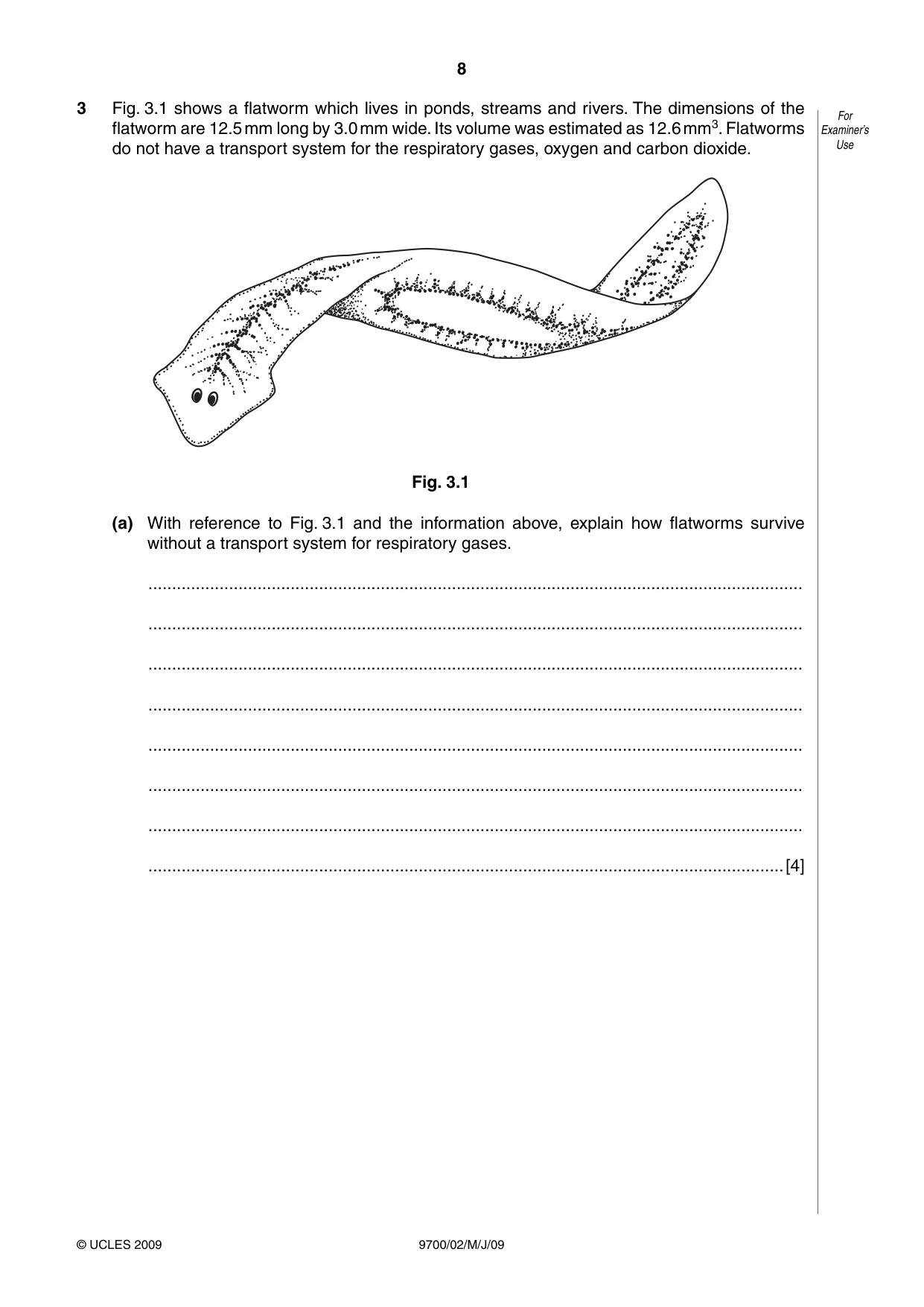
8 9700/02/M/J/09 For Examiner’s Use © UCLES 2009 3 Fig. 3.1 shows a flatworm which lives in ponds, streams and rivers. The dimensions of the flatworm are 12.5 mm long by 3.0 mm wide. Its volume was estimated as 12.6 mm3. Flatworms do not have a transport system for the respiratory gases, oxygen and carbon dioxide. Fig. 3.1 (a) With reference to Fig. 3.1 and the information above, explain how flatworms survive without a transport system for respiratory gases. … … … … … … … …[4]
Question paper, page 10
9 9700/02/M/J/09 [Turn over For Examiner’s Use © UCLES 2009 (b) This flatworm lives in freshwater that has a low concentration of sodium ions. The flatworm’s body fluids have a higher concentration of sodium ions than the surrounding water. (i) Suggest how the flatworm retains sodium ions in its body fluids. … … … …[2] (ii) State one role of sodium ions in organisms. … …[1] [Total: 7]
Question paper, page 11
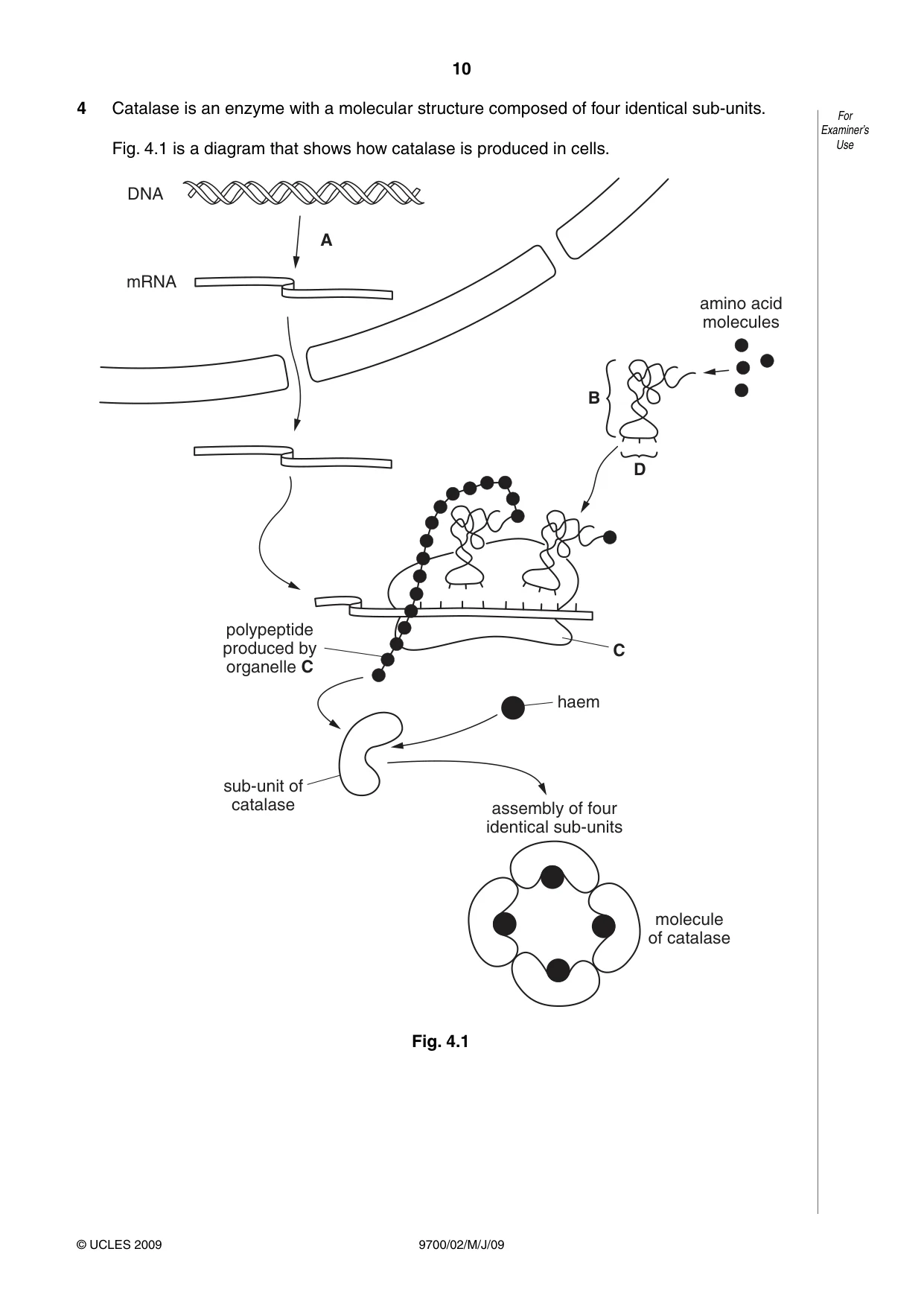
10 9700/02/M/J/09 For Examiner’s Use © UCLES 2009 4 Catalase is an enzyme with a molecular structure composed of four identical sub-units. Fig. 4.1 is a diagram that shows how catalase is produced in cells. DNA mRNA polypeptide produced by organelle C amino acid molecules haem sub-unit of catalase assembly of four identical sub-units molecule of catalase A B D C Fig. 4.1
Question paper, page 12
11 9700/02/M/J/09 [Turn over For Examiner’s Use © UCLES 2009 (a) With reference to Fig. 4.1, (i) name process A … molecule B … structure C ……………………………………………………………………………….. .. sequence of bases D …[4] (ii) state two ways in which the structure of catalase is similar to the structure of haemoglobin and one way in which it differs structural similarities 1. … 2. …[2] structural difference …[1] (iii) State why it is possible for a catalase molecule to bind to four substrate molecules at the same time. …[1] (b) The enzyme amylase catalyses the following reaction: starch + water → maltose The progress of this reaction may be followed by measuring either the starch concentration or the maltose concentration at intervals of time. State which chemicals you would use to detect the disappearance of the substrate and the appearance of the product, in order to follow the progress of the reaction. disappearance of substrate … … appearance of product … …[2] [Total: 10]
Question paper, page 13
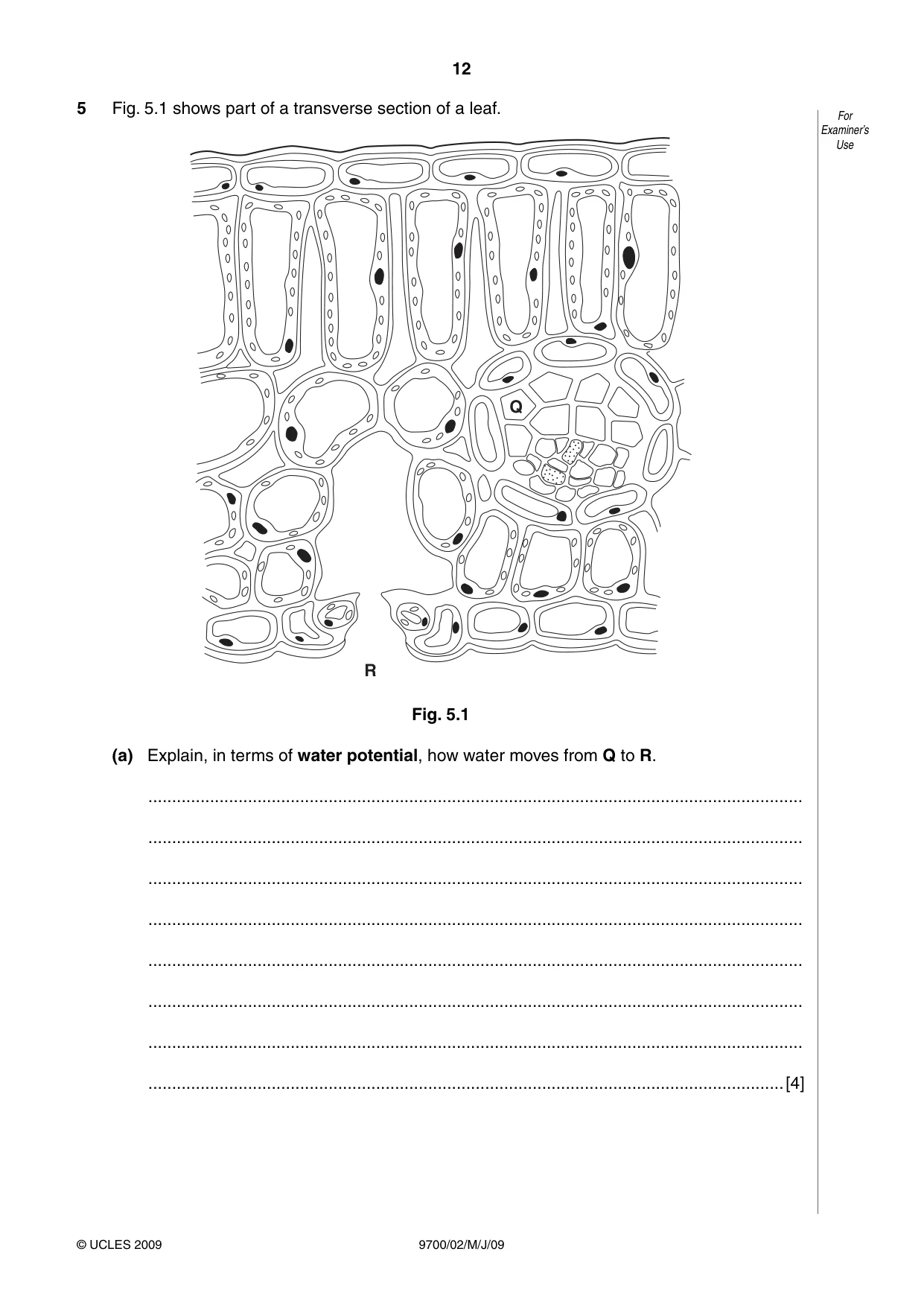
12 9700/02/M/J/09 For Examiner’s Use © UCLES 2009 5 Fig. 5.1 shows part of a transverse section of a leaf. Q R Fig. 5.1 (a) Explain, in terms of water potential, how water moves from Q to R. … … … … … … … …[4]
Question paper, page 14
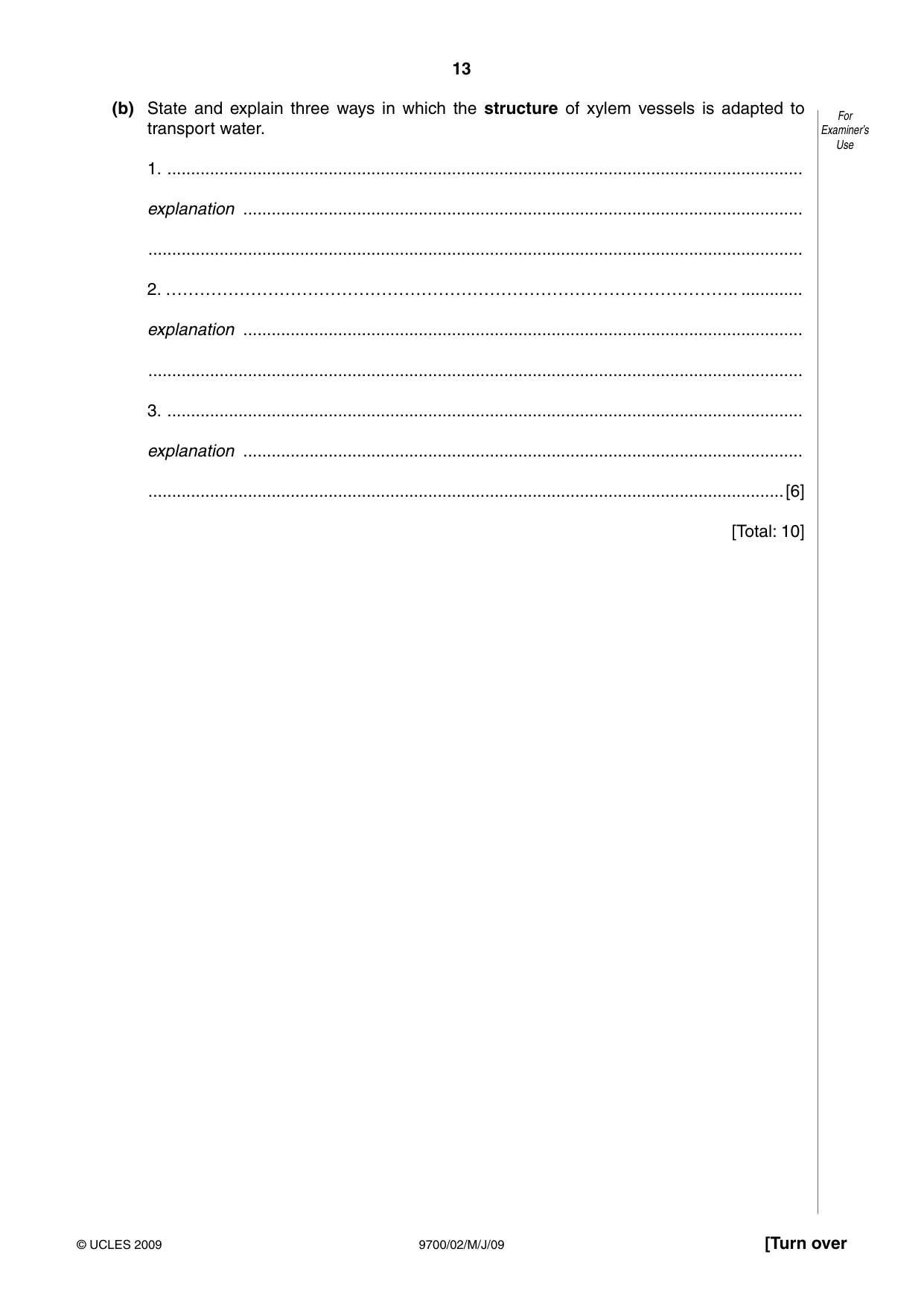
13 9700/02/M/J/09 [Turn over For Examiner’s Use © UCLES 2009 (b) State and explain three ways in which the structure of xylem vessels is adapted to transport water. 1. … explanation … … 2. ……………………………………………………………………………………….. … explanation … … 3. … explanation … …[6] [Total: 10]
Question paper, page 15
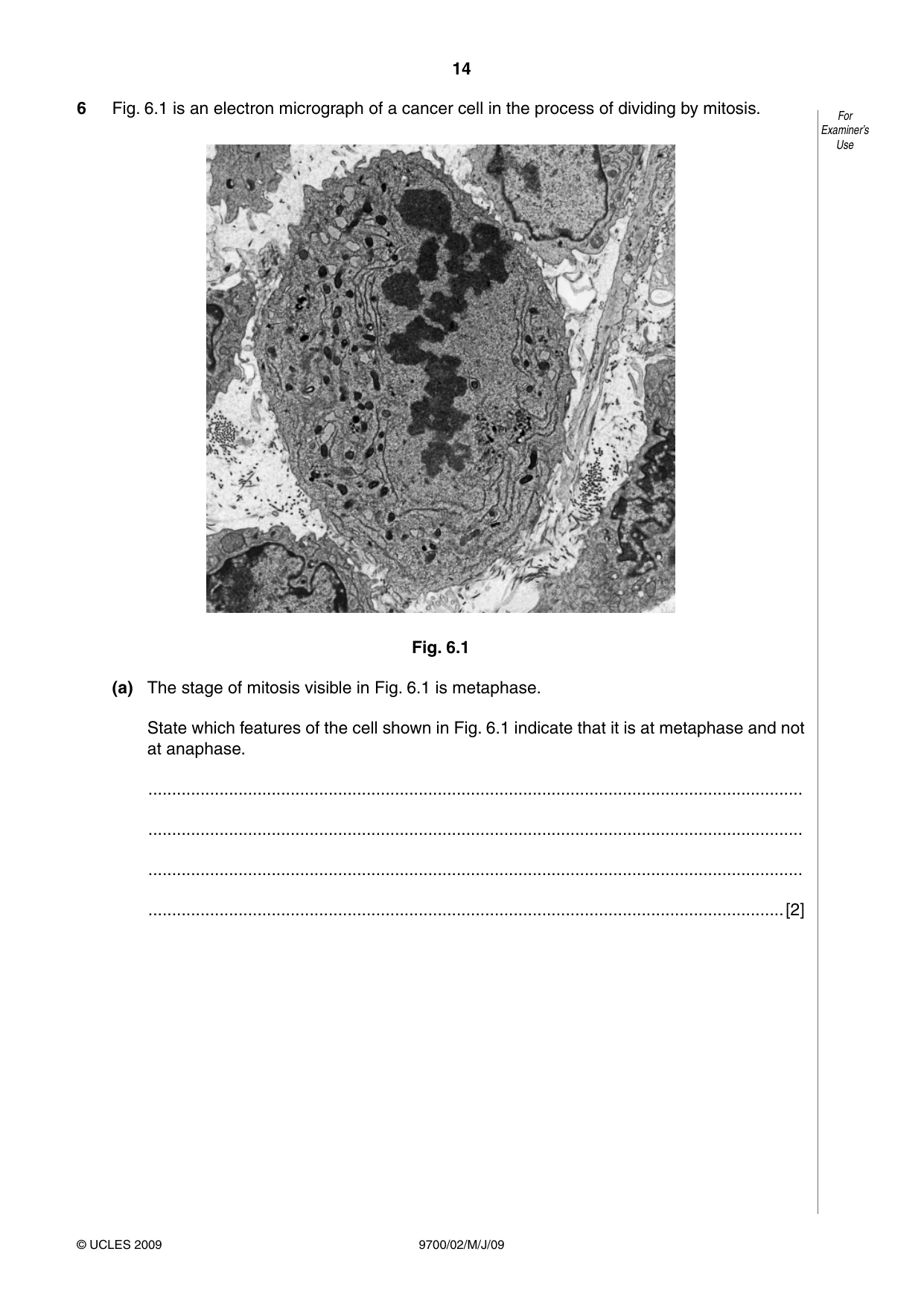
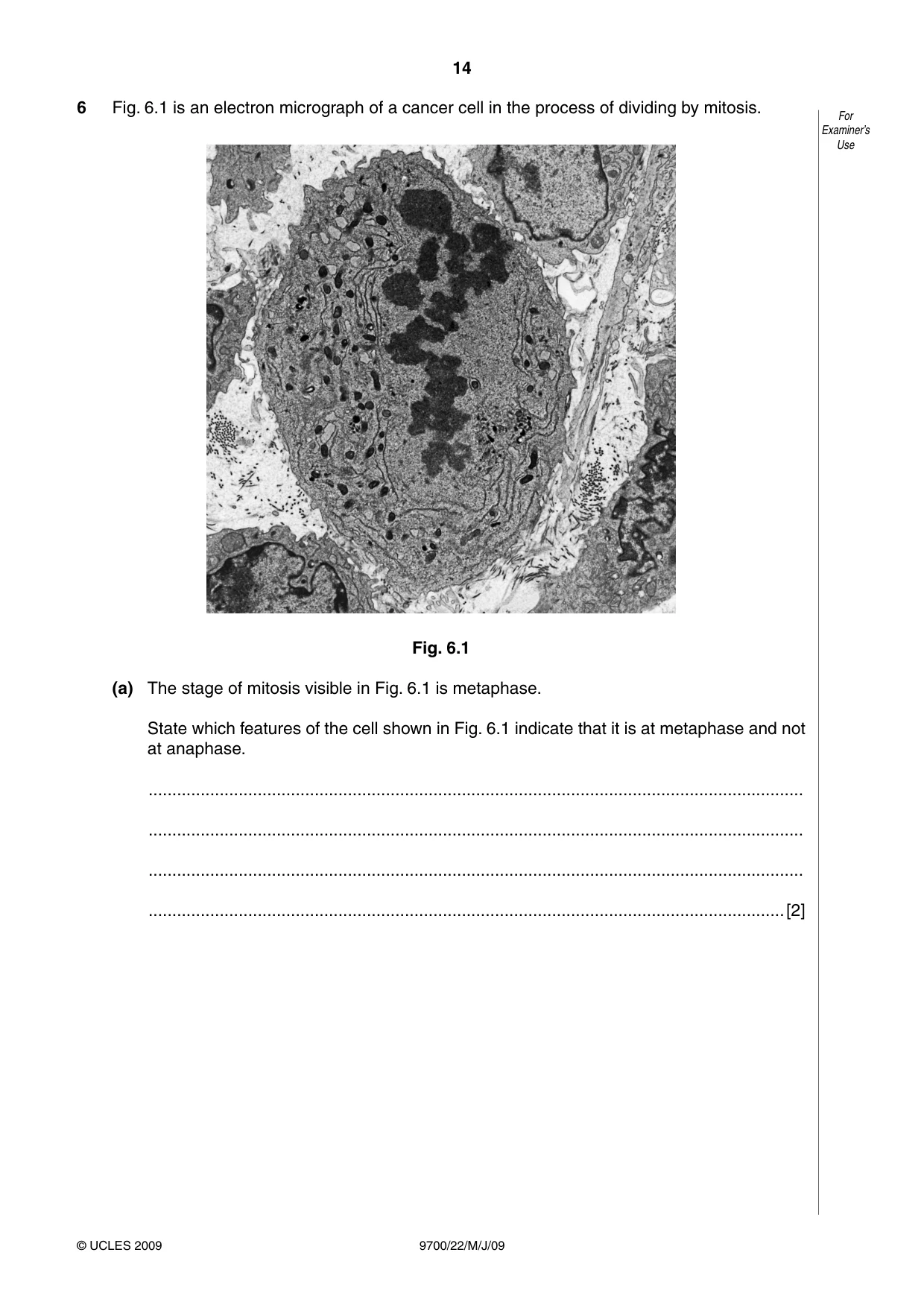
14 9700/02/M/J/09 For Examiner’s Use © UCLES 2009 6 Fig. 6.1 is an electron micrograph of a cancer cell in the process of dividing by mitosis. Fig. 6.1 (a) The stage of mitosis visible in Fig. 6.1 is metaphase. State which features of the cell shown in Fig. 6.1 indicate that it is at metaphase and not at anaphase. … … … …[2]
Question paper, page 16
15 9700/02/M/J/09 [Turn over For Examiner’s Use © UCLES 2009 (b) People who have smoked cigarettes for many years are at risk of developing lung cancer. Describe how cigarette smoke is responsible for the development of lung cancer. … … … … … … … …[4]
Question paper, page 17
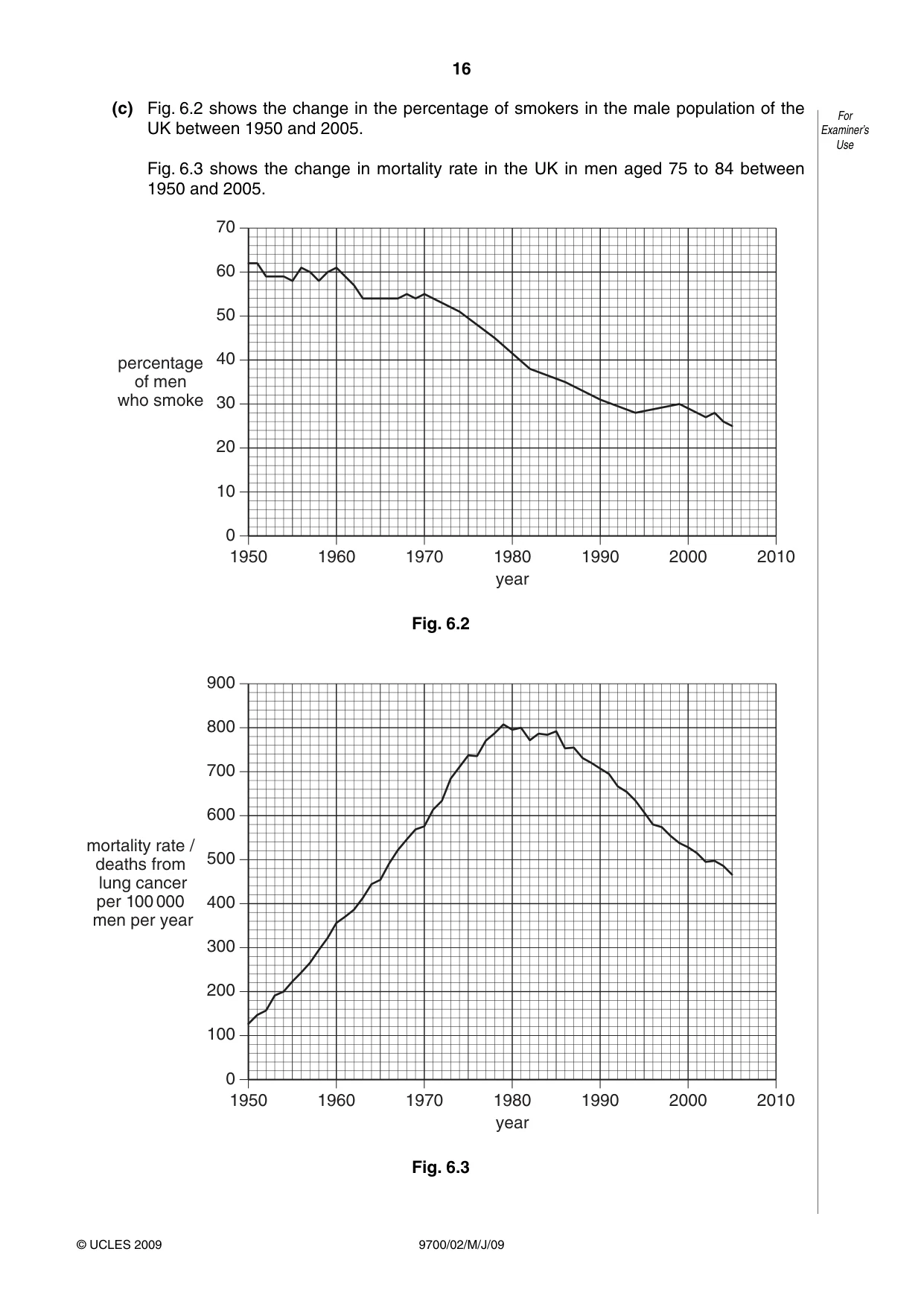
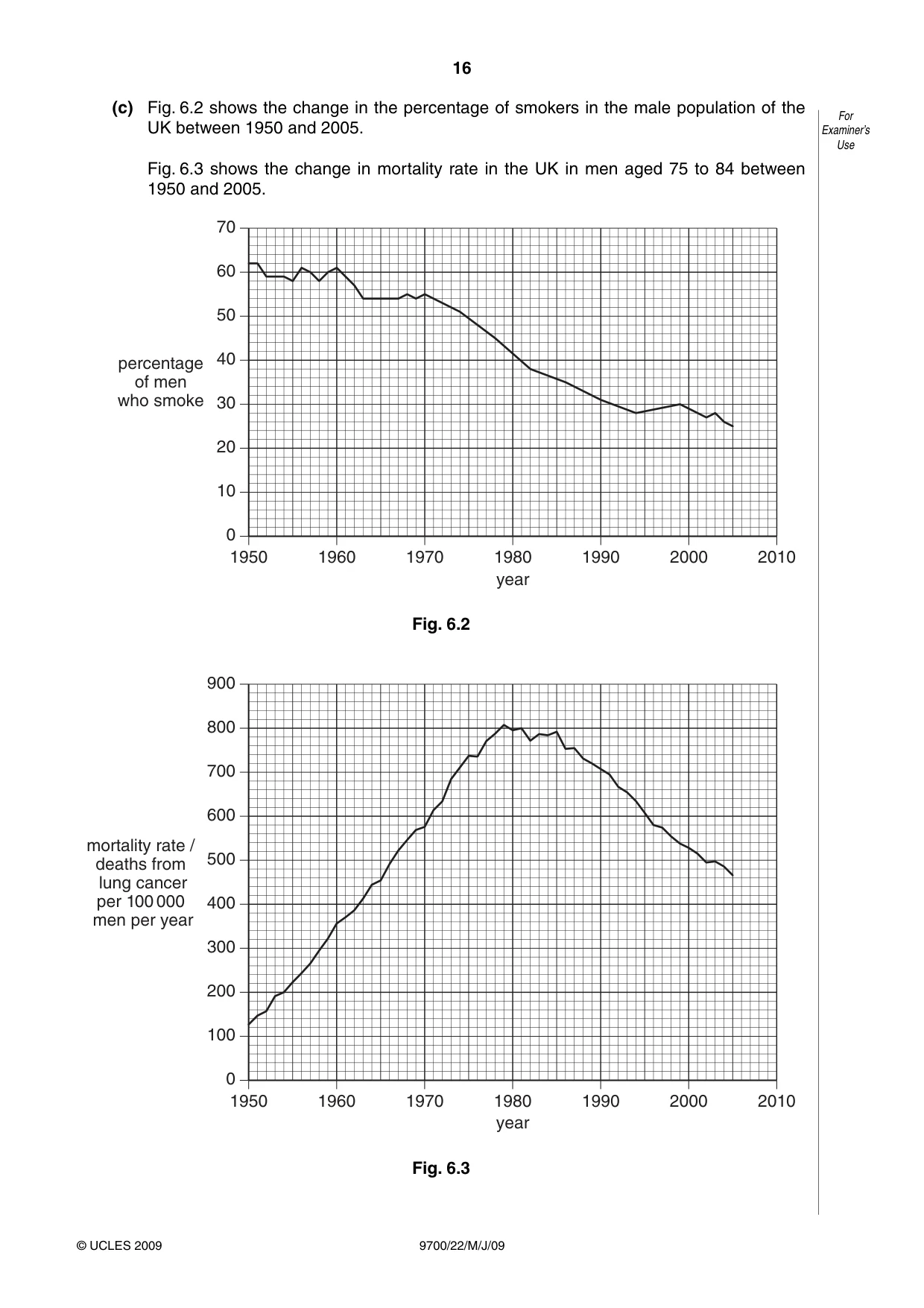
16 9700/02/M/J/09 For Examiner’s Use © UCLES 2009 (c) Fig. 6.2 shows the change in the percentage of smokers in the male population of the UK between 1950 and 2005. Fig. 6.3 shows the change in mortality rate in the UK in men aged 75 to 84 between 1950 and 2005. 1950 1960 1970 1980 1990 2000 2010 year 0 10 20 30 40 50 60 70 percentage of men who smoke Fig. 6.2 1950 1960 1970 1980 1990 2000 2010 year 0 100 200 300 400 500 600 700 800 900 mortality rate / deaths from lung cancer per 100 000 men per year Fig. 6.3
Question paper, page 18
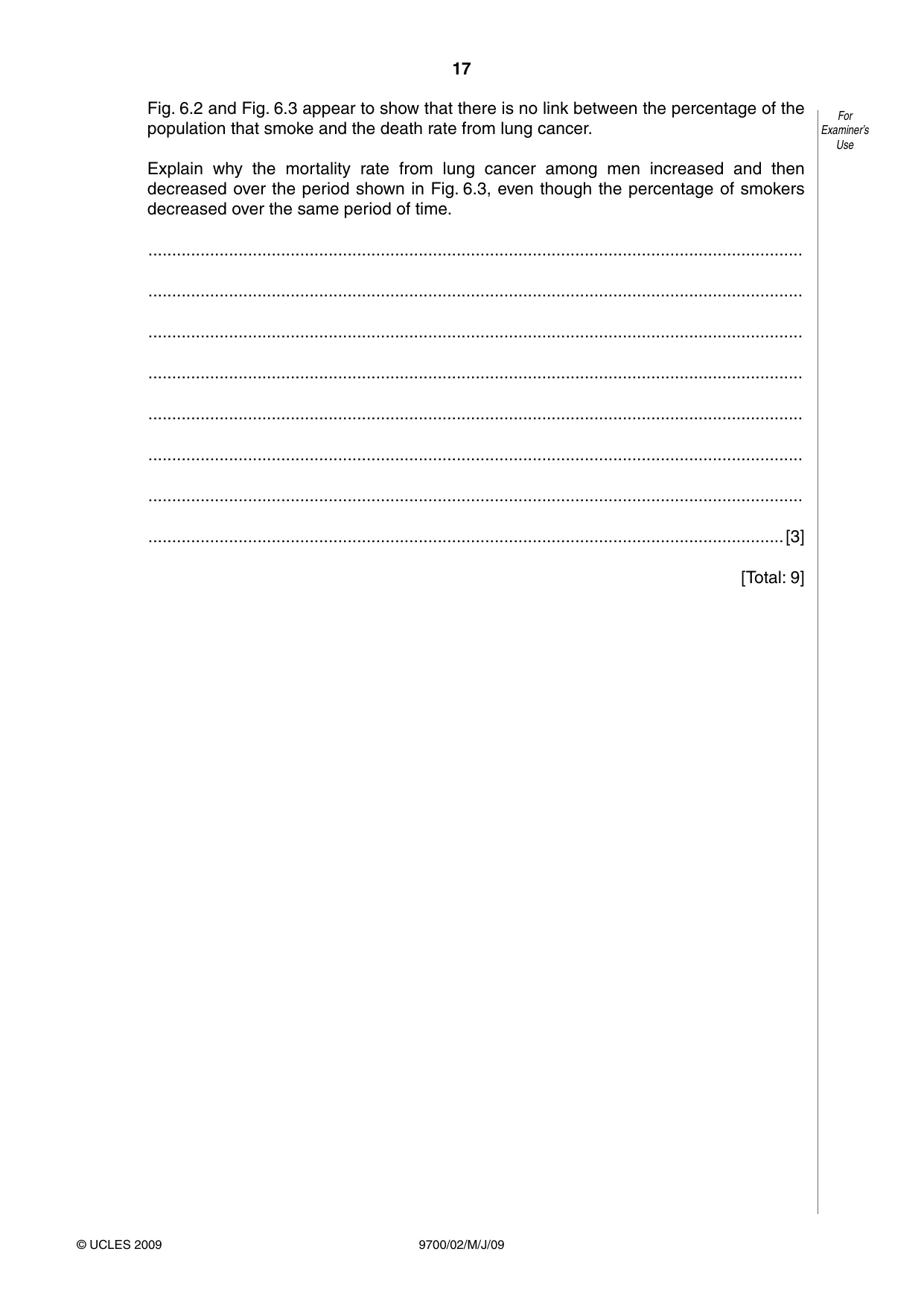
17 9700/02/M/J/09 For Examiner’s Use © UCLES 2009 Fig. 6.2 and Fig. 6.3 appear to show that there is no link between the percentage of the population that smoke and the death rate from lung cancer. Explain why the mortality rate from lung cancer among men increased and then decreased over the period shown in Fig. 6.3, even though the percentage of smokers decreased over the same period of time. … … … … … … … …[3] [Total: 9]
Question paper, page 21
20 9700/02/M/J/09 BLANK PAGE Copyright Acknowledgements: Figure 4.1 © Electron Micrograph of Senecio minor vein, from ‘Plant Cell Biology on DVD’; 2007 by B E S Gunning; www.plantcellbiologyonDVD.com Permission to reproduce items where third-party owned material protected by copyright is included has been sought and cleared where possible. Every reasonable effort has been made by the publisher (UCLES) to trace copyright holders, but if any items requiring clearance have unwittingly been included, the publisher will be pleased to make amends at the earliest possible opportunity. University of Cambridge International Examinations is part of the Cambridge Assessment Group. Cambridge Assessment is the brand name of University of Cambridge Local Examinations Syndicate (UCLES), which is itself a department of the University of Cambridge.
Question paper, page 22
This document consists of 16 printed pages and 4 blank pages. SP (SLM/SW) V05597/1 © UCLES 2009 [Turn over UNIVERSITY OF CAMBRIDGE INTERNATIONAL EXAMINATIONS General Certificate of Education Advanced Subsidiary Level and Advanced Level READ THESE INSTRUCTIONS FIRST Write your Centre number, candidate number and name in the spaces provided at the top of this page. Write in dark blue or black pen. You may use a soft pencil for any diagrams, graphs, or rough working. Do not use staples, paper clips, highlighters, glue or correction fluid. DO NOT WRITE IN ANY BARCODES. Answer all questions. At the end of the examination, fasten all your work securely together. The number of marks is given in brackets [ ] at the end of each question or part question. * 6 1 0 3 0 8 8 7 2 7 * BIOLOGY 9700/22 Paper 2 Structured Questions AS May/June 2009 1 hour 15 minutes Candidates answer on the Question Paper. Additional Materials: Electronic calculator Ruler For Examiner’s Use 1 2 3 4 5 6 Total Second Variant Question Paper
Question paper, page 23
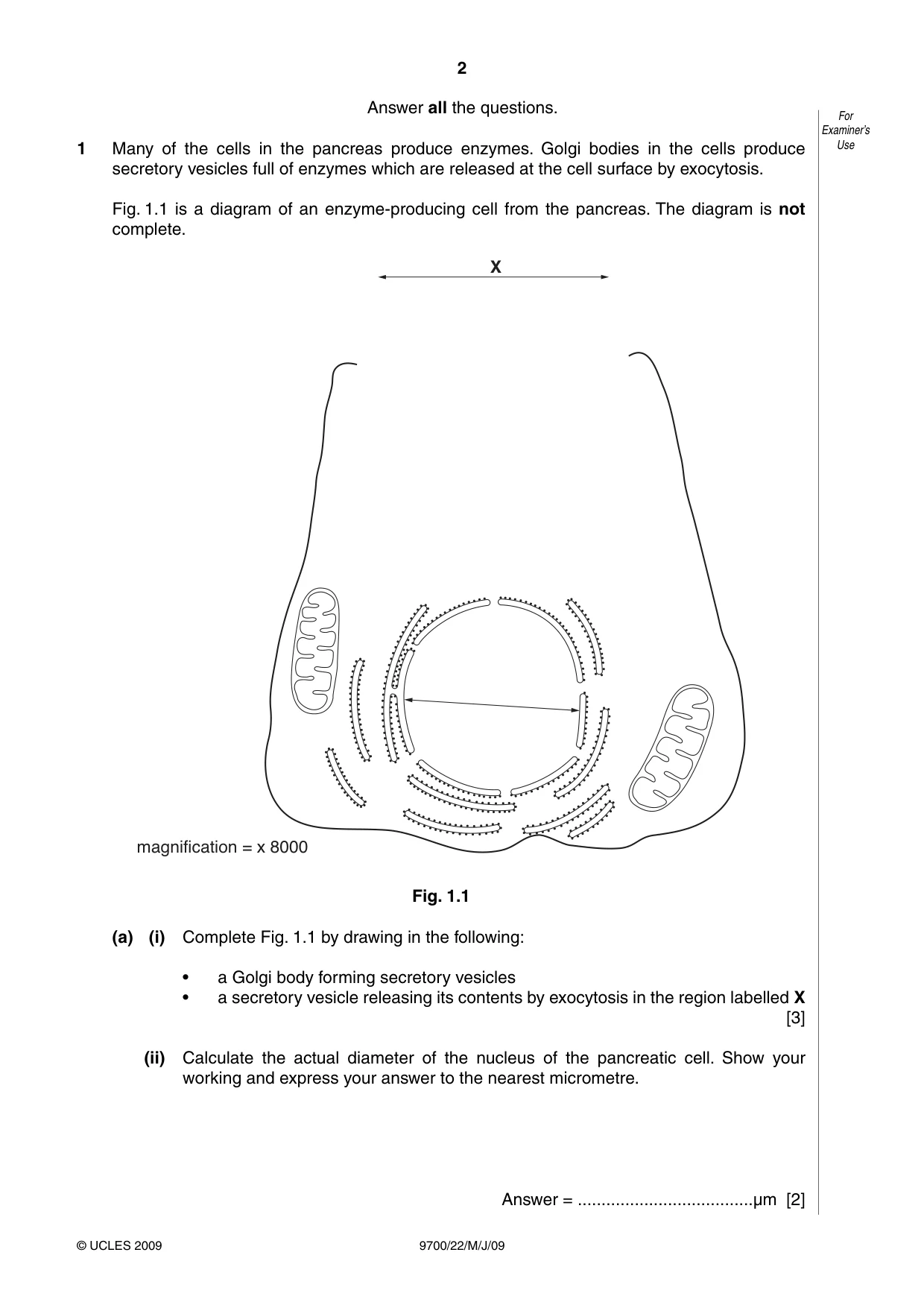
2 9700/22/M/J/09 © UCLES 2009 For Examiner’s Use Answer all the questions. 1 Many of the cells in the pancreas produce enzymes. Golgi bodies in the cells produce secretory vesicles full of enzymes which are released at the cell surface by exocytosis. Fig. 1.1 is a diagram of an enzyme-producing cell from the pancreas. The diagram is not complete. X magnification = x 8000 Fig. 1.1 (a) (i) Complete Fig. 1.1 by drawing in the following: a Golgi body forming secretory vesicles a secretory vesicle releasing its contents by exocytosis in the region labelled X [3] (ii) Calculate the actual diameter of the nucleus of the pancreatic cell. Show your working and express your answer to the nearest micrometre. Answer = …µm [2] • •
Question paper, page 24
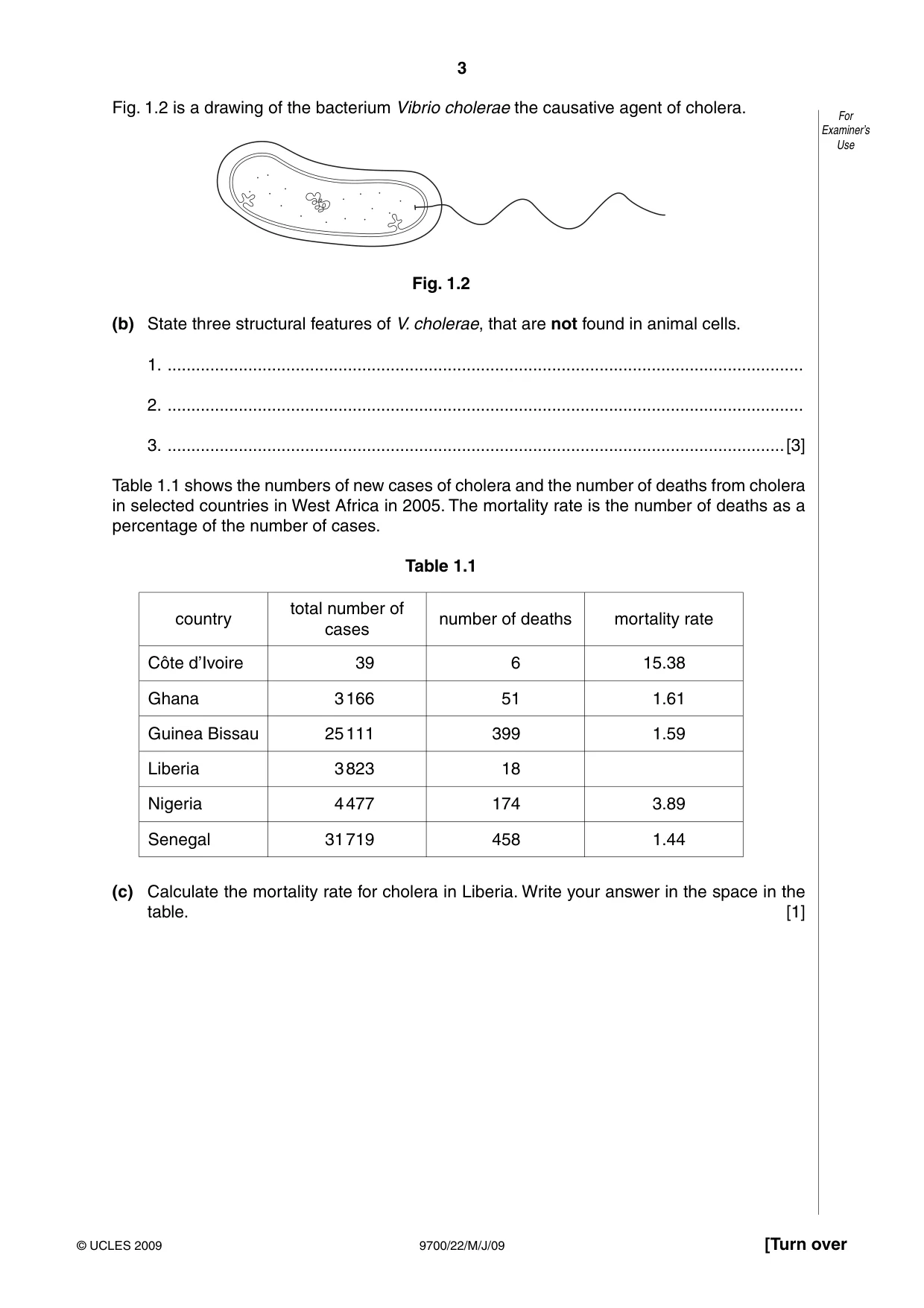
3 9700/22/M/J/09 © UCLES 2009 [Turn over For Examiner’s Use Fig. 1.2 is a drawing of the bacterium Vibrio cholerae the causative agent of cholera. Fig. 1.2 (b) State three structural features of V. cholerae, that are not found in animal cells. 1. … 2. … 3. …[3] Table 1.1 shows the numbers of new cases of cholera and the number of deaths from cholera in selected countries in West Africa in 2005. The mortality rate is the number of deaths as a percentage of the number of cases. Table 1.1 country total number of cases number of deaths mortality rate Côte d’Ivoire 39 6 15.38 Ghana 3 166 51 1.61 Guinea Bissau 25 111 399 1.59 Liberia 3 823 18 Nigeria 4 477 174 3.89 Senegal 31 719 458 1.44 (c) Calculate the mortality rate for cholera in Liberia. Write your answer in the space in the table. [1]
Question paper, page 25
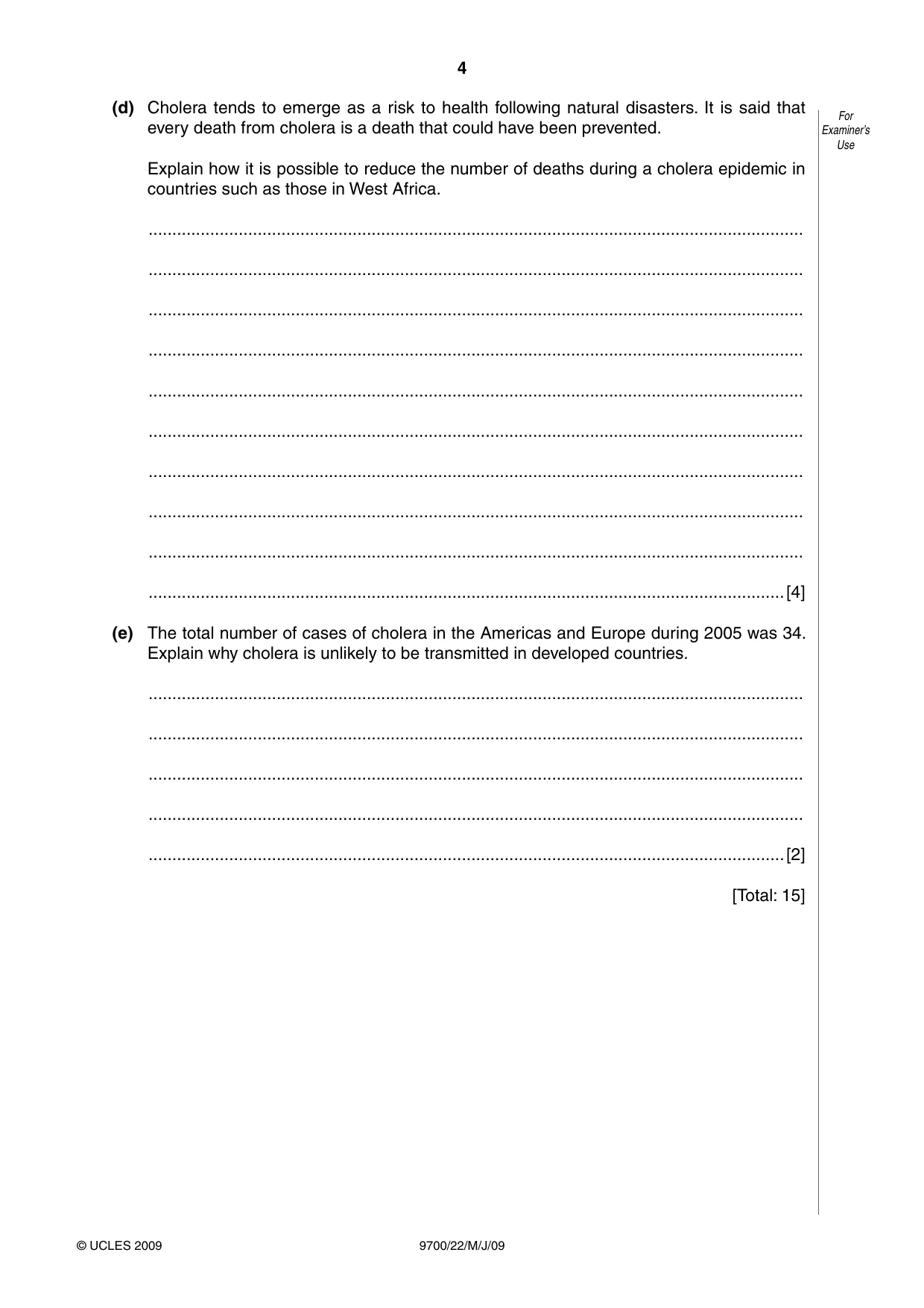
4 9700/22/M/J/09 © UCLES 2009 For Examiner’s Use (d) Cholera tends to emerge as a risk to health following natural disasters. It is said that every death from cholera is a death that could have been prevented. Explain how it is possible to reduce the number of deaths during a cholera epidemic in countries such as those in West Africa. … … … … … … … … … …[4] (e) The total number of cases of cholera in the Americas and Europe during 2005 was 34. Explain why cholera is unlikely to be transmitted in developed countries. … … … … …[2] [Total: 15]
Question paper, page 26
5 9700/22/M/J/09 [Turn over BLANK PAGE QUESTION 2 STARTS ON PAGE 6
Question paper, page 27
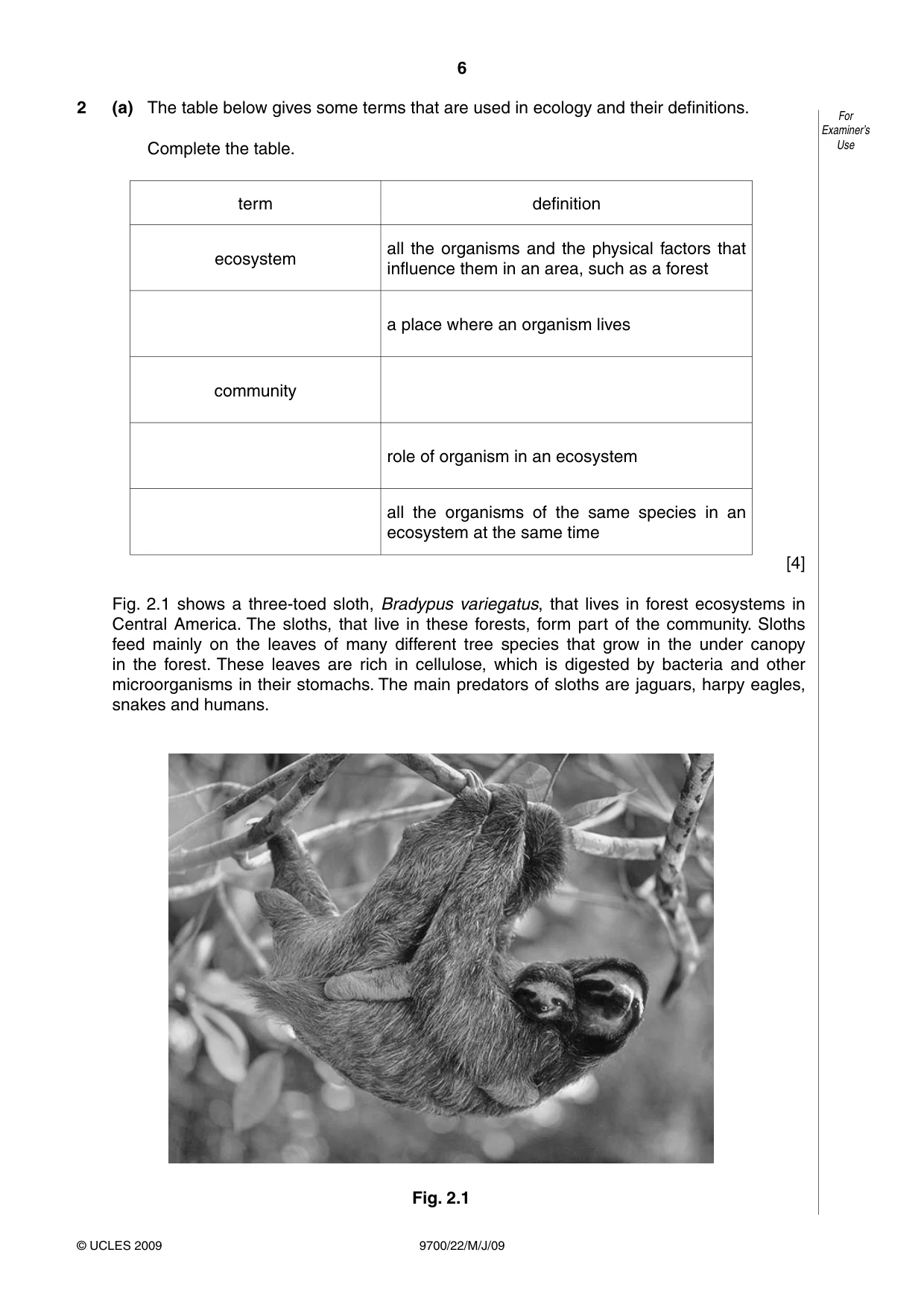
6 9700/22/M/J/09 © UCLES 2009 For Examiner’s Use 2 (a) The table below gives some terms that are used in ecology and their definitions. Complete the table. term definition ecosystem all the organisms and the physical factors that influence them in an area, such as a forest a place where an organism lives community role of organism in an ecosystem all the organisms of the same species in an ecosystem at the same time [4] Fig. 2.1 shows a three-toed sloth, Bradypus variegatus, that lives in forest ecosystems in Central America. The sloths, that live in these forests, form part of the community. Sloths feed mainly on the leaves of many different tree species that grow in the under canopy in the forest. These leaves are rich in cellulose, which is digested by bacteria and other microorganisms in their stomachs. The main predators of sloths are jaguars, harpy eagles, snakes and humans. Fig. 2.1
Question paper, page 28
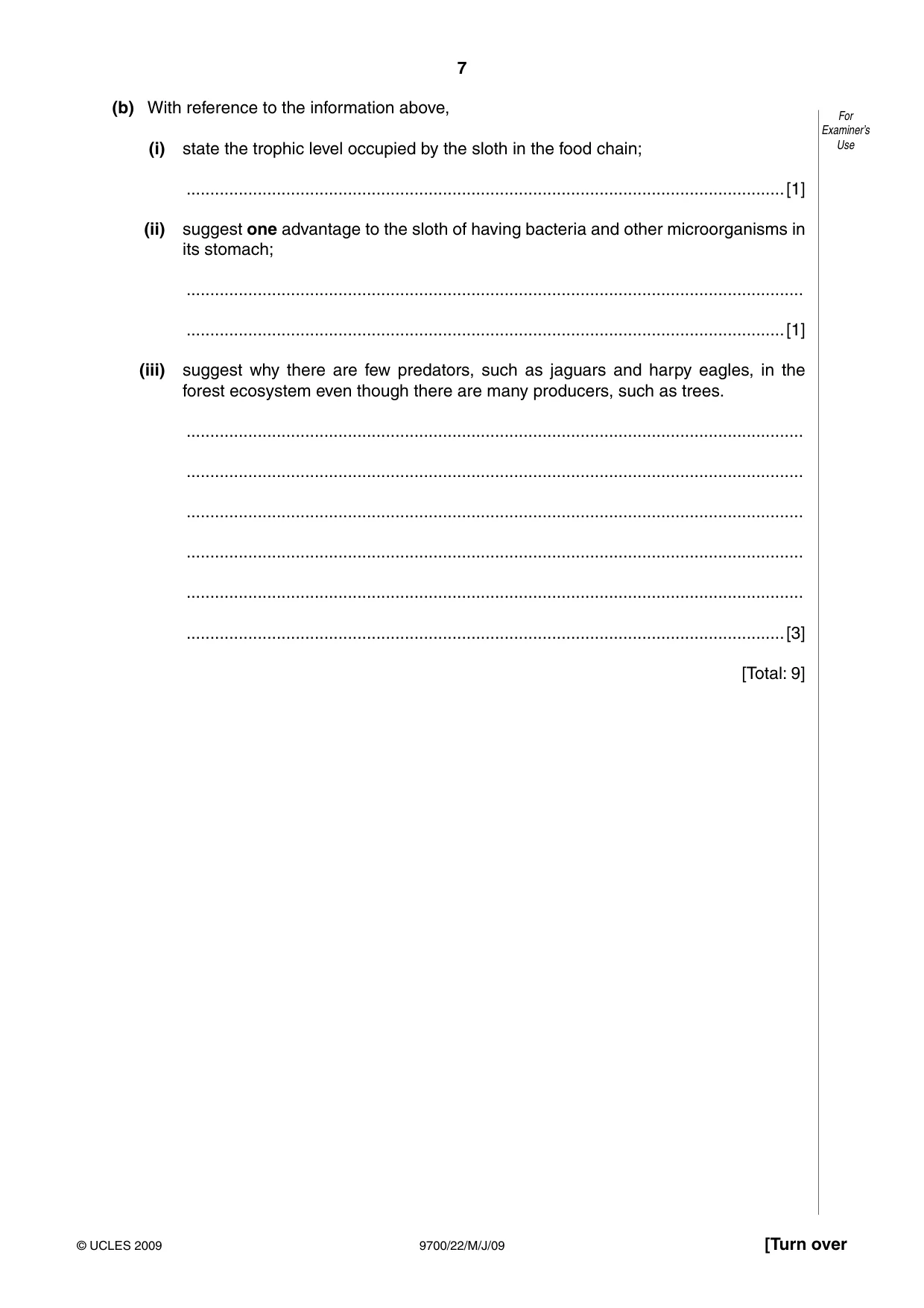
7 9700/22/M/J/09 © UCLES 2009 [Turn over For Examiner’s Use (b) With reference to the information above, (i) state the trophic level occupied by the sloth in the food chain; …[1] (ii) suggest one advantage to the sloth of having bacteria and other microorganisms in its stomach; … …[1] (iii) suggest why there are few predators, such as jaguars and harpy eagles, in the forest ecosystem even though there are many producers, such as trees. … … … … … …[3] [Total: 9]
Question paper, page 29
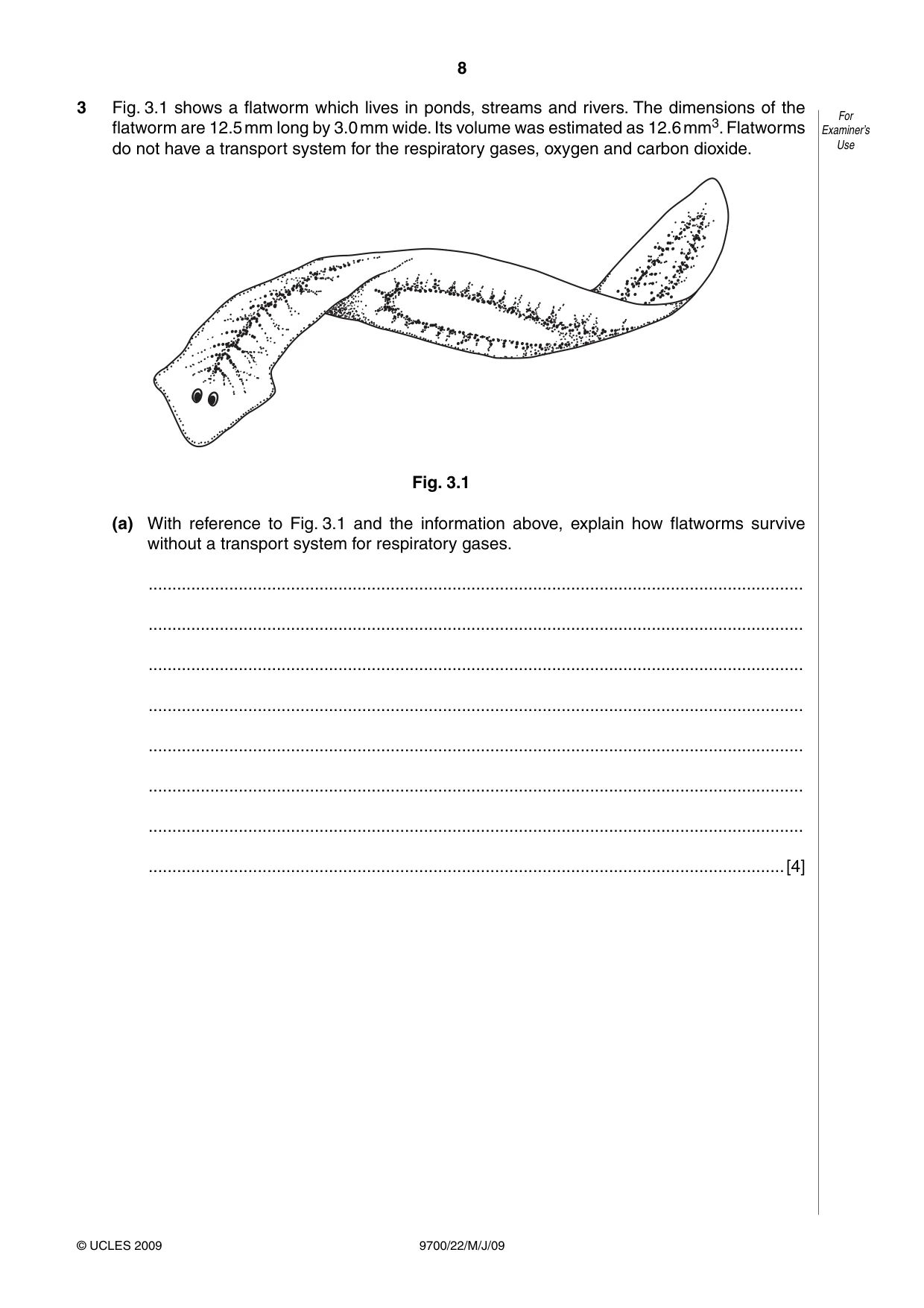
8 9700/22/M/J/09 © UCLES 2009 For Examiner’s Use 3 Fig. 3.1 shows a flatworm which lives in ponds, streams and rivers. The dimensions of the flatworm are 12.5 mm long by 3.0 mm wide. Its volume was estimated as 12.6 mm3. Flatworms do not have a transport system for the respiratory gases, oxygen and carbon dioxide. Fig. 3.1 (a) With reference to Fig. 3.1 and the information above, explain how flatworms survive without a transport system for respiratory gases. … … … … … … … …[4]
Question paper, page 30
9 9700/22/M/J/09 © UCLES 2009 [Turn over For Examiner’s Use (b) This flatworm lives in freshwater which has a low concentration of sodium ions. The flatworm’s body fluids have a higher concentration of sodium ions than the surrounding water. (i) Suggest how the flatworm retains sodium ions in its body fluids. … … … …[2] (ii) State one role of sodium ions in organisms. … …[1] [Total: 7]
Question paper, page 31
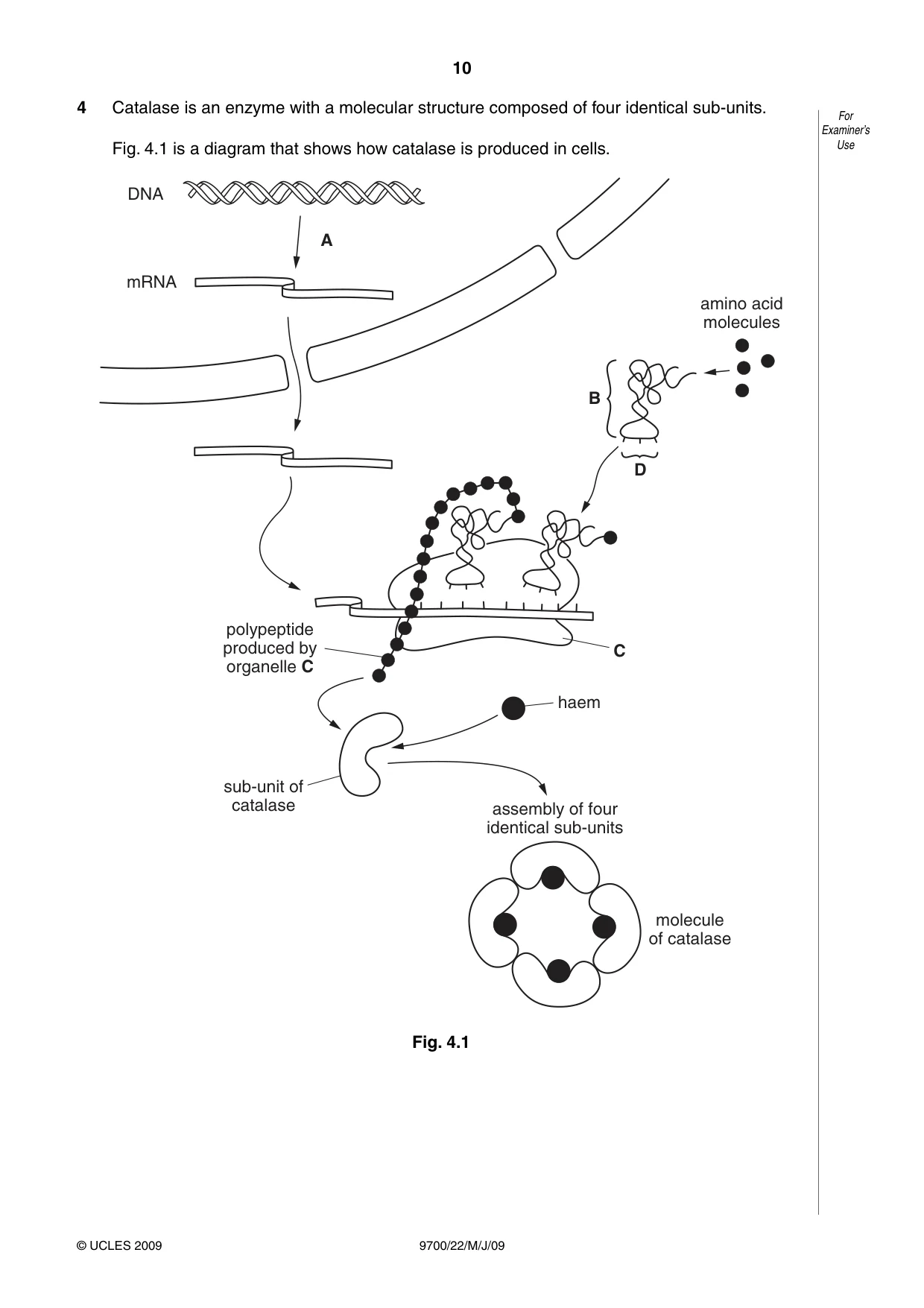
10 9700/22/M/J/09 © UCLES 2009 For Examiner’s Use 4 Catalase is an enzyme with a molecular structure composed of four identical sub-units. Fig. 4.1 is a diagram that shows how catalase is produced in cells. DNA mRNA polypeptide produced by organelle C amino acid molecules haem sub-unit of catalase assembly of four identical sub-units molecule of catalase A B D C Fig. 4.1
Question paper, page 32
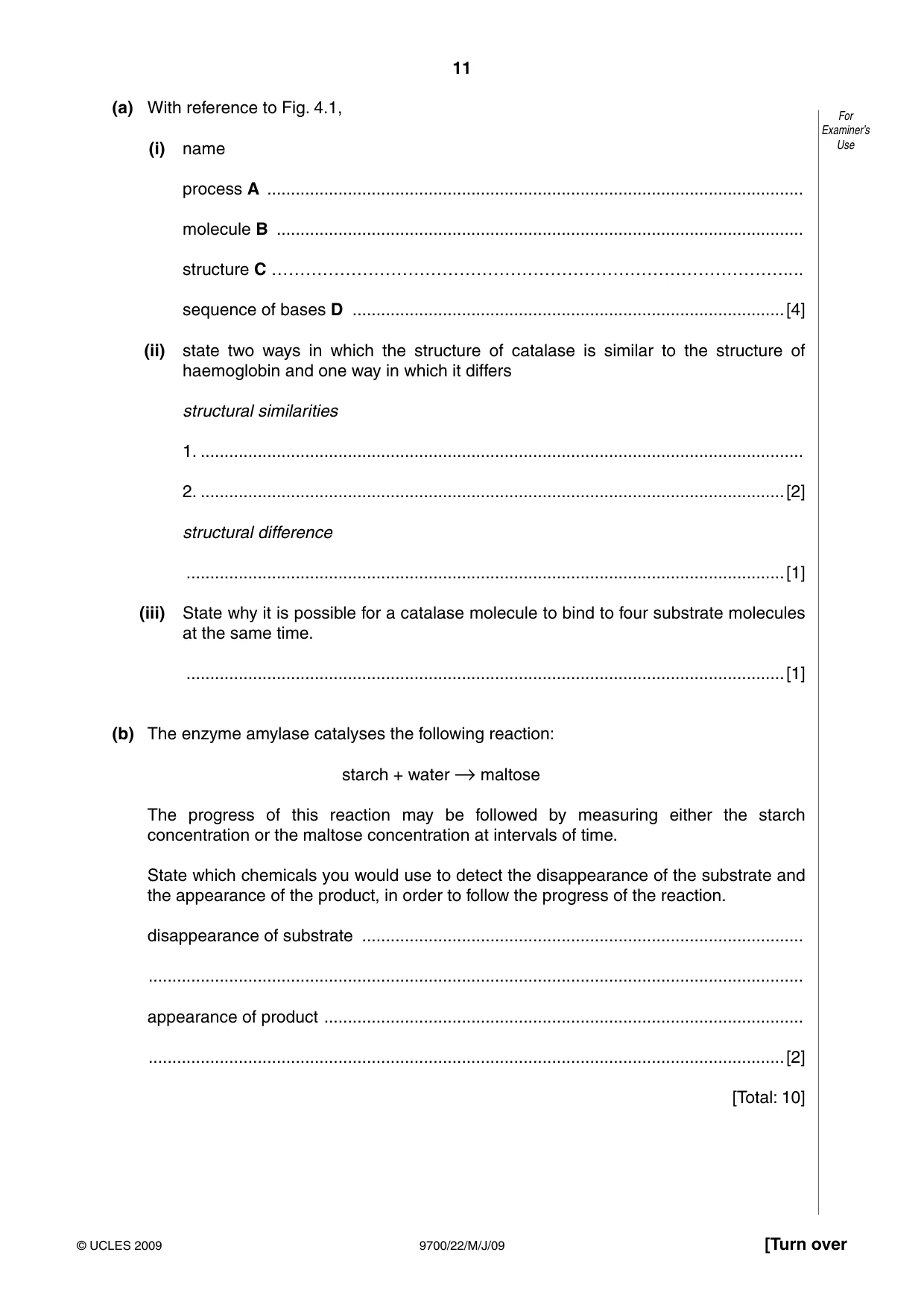
11 9700/22/M/J/09 © UCLES 2009 [Turn over For Examiner’s Use (a) With reference to Fig. 4.1, (i) name process A … molecule B … structure C ……………………………………………………………………………….. .. sequence of bases D …[4] (ii) state two ways in which the structure of catalase is similar to the structure of haemoglobin and one way in which it differs structural similarities 1. … 2. …[2] structural difference …[1] (iii) State why it is possible for a catalase molecule to bind to four substrate molecules at the same time. …[1] (b) The enzyme amylase catalyses the following reaction: starch + water → maltose The progress of this reaction may be followed by measuring either the starch concentration or the maltose concentration at intervals of time. State which chemicals you would use to detect the disappearance of the substrate and the appearance of the product, in order to follow the progress of the reaction. disappearance of substrate … … appearance of product … …[2] [Total: 10]
Question paper, page 33
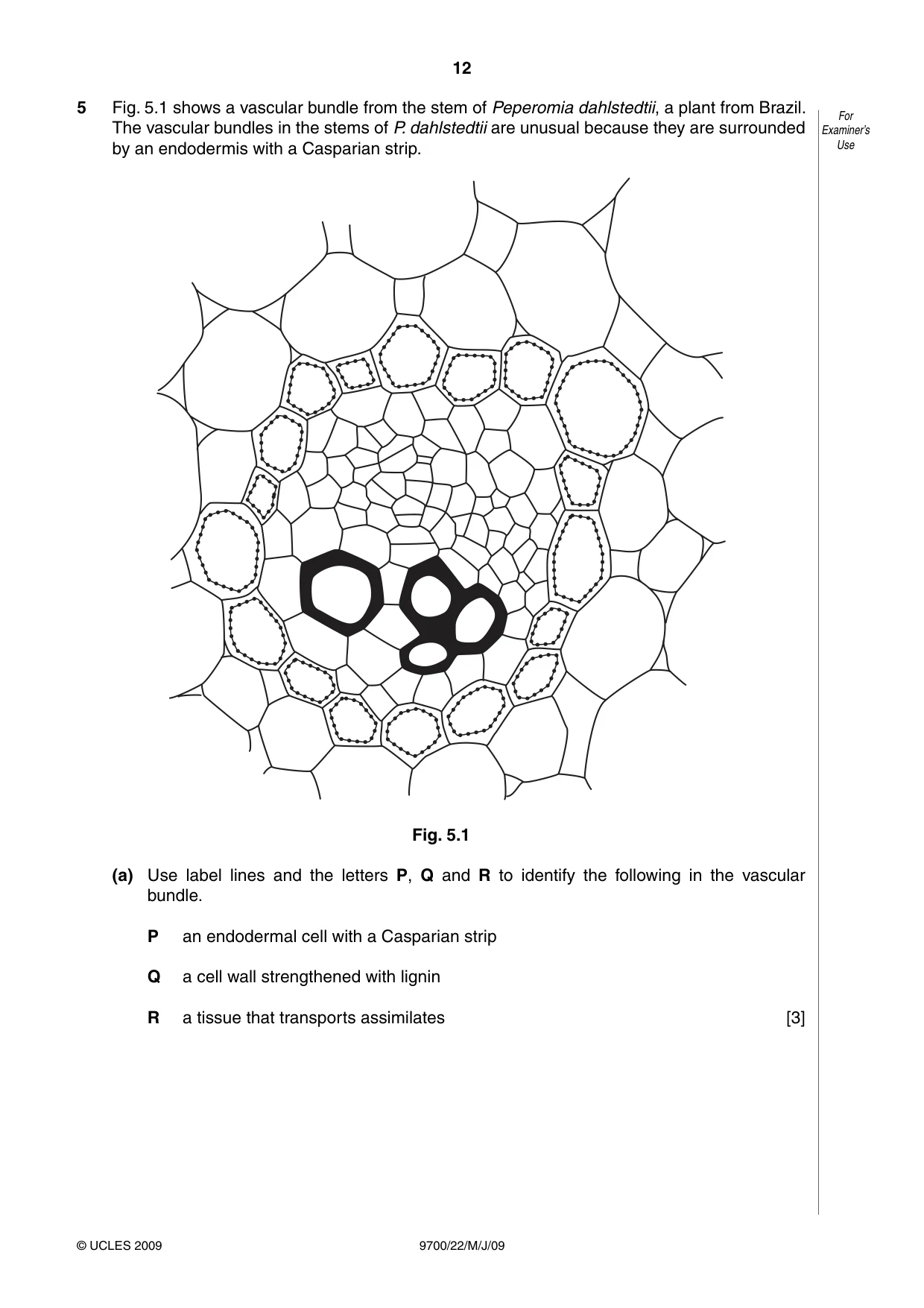
12 9700/22/M/J/09 © UCLES 2009 For Examiner’s Use 5 Fig. 5.1 shows a vascular bundle from the stem of Peperomia dahlstedtii, a plant from Brazil. The vascular bundles in the stems of P. dahlstedtii are unusual because they are surrounded by an endodermis with a Casparian strip. Fig. 5.1 (a) Use label lines and the letters P, Q and R to identify the following in the vascular bundle. P an endodermal cell with a Casparian strip Q a cell wall strengthened with lignin R a tissue that transports assimilates [3]
Question paper, page 34
13 9700/22/M/J/09 © UCLES 2009 [Turn over For Examiner’s Use (b) Vascular tissue in roots is surrounded by an endodermis. Describe the function of the endodermis in roots. … … … … … …[3] (c) State and explain two ways in which the structure of a phloem sieve tube is adapted for the transport of assimilates. 1. … explanation … … 2. … explanation … …[4] [Total: 10]
Question paper, page 35
14 9700/22/M/J/09 © UCLES 2009 For Examiner’s Use 6 Fig. 6.1 is an electron micrograph of a cancer cell in the process of dividing by mitosis. Fig. 6.1 (a) The stage of mitosis visible in Fig. 6.1 is metaphase. State which features of the cell shown in Fig. 6.1 indicate that it is at metaphase and not at anaphase. … … … …[2]
Question paper, page 36
15 9700/22/M/J/09 © UCLES 2009 [Turn over For Examiner’s Use (b) People who have smoked cigarettes for many years are at risk of developing lung cancer. Describe how cigarette smoke is responsible for the development of lung cancer. … … … … … … … …[4]
Question paper, page 37
16 9700/22/M/J/09 © UCLES 2009 For Examiner’s Use (c) Fig. 6.2 shows the change in the percentage of smokers in the male population of the UK between 1950 and 2005. Fig. 6.3 shows the change in mortality rate in the UK in men aged 75 to 84 between 1950 and 2005. 1950 1960 1970 1980 1990 2000 2010 year 0 10 20 30 40 50 60 70 percentage of men who smoke Fig. 6.2 1950 1960 1970 1980 1990 2000 2010 year 0 100 200 300 400 500 600 700 800 900 mortality rate / deaths from lung cancer per 100 000 men per year Fig. 6.3
Question paper, page 38
17 9700/22/M/J/09 © UCLES 2009 For Examiner’s Use Fig. 6.2 and Fig. 6.3 appear to show that there is no link between the percentage of the population that smoke and the death rate from lung cancer. Explain why the mortality rate from lung cancer among men increased and then decreased over the period shown in Fig. 6.3, even though the percentage of smokers decreased over the same period of time. … … … … … … … …[3] [Total: 9]
Question paper, page 41
20 9700/22/M/J/09 BLANK PAGE Permission to reproduce items where third-party owned material protected by copyright is included has been sought and cleared where possible. Every reasonable effort has been made by the publisher (UCLES) to trace copyright holders, but if any items requiring clearance have unwittingly been included, the publisher will be pleased to make amends at the earliest possible opportunity. University of Cambridge International Examinations is part of the Cambridge Assessment Group. Cambridge Assessment is the brand name of University of Cambridge Local Examinations Syndicate (UCLES), which is itself a department of the University of Cambridge.
Mark scheme, page 1
Location Entry Codes As part of CIE’s continual commitment to maintaining best practice in assessment, CIE has begun to use different variants of some question papers for our most popular assessments with extremely large and widespread candidature, The question papers are closely related and the relationships between them have been thoroughly established using our assessment expertise. All versions of the paper give assessment of equal standard. The content assessed by the examination papers and the type of questions are unchanged. This change means that for this component there are now two variant Question Papers, Mark Schemes and Principal Examiner’s Reports where previously there was only one. For any individual country, it is intended that only one variant is used. This document contains both variants which will give all Centres access to even more past examination material than is usually the case. The diagram shows the relationship between the Question Papers, Mark Schemes and Principal Examiner’s Reports. Question Paper Mark Scheme Principal Examiner’s Report Introduction Introduction Introduction First variant Question Paper First variant Mark Scheme First variant Principal Examiner’s Report Second variant Question Paper Second variant Mark Scheme Second variant Principal Examiner’s Report Who can I contact for further information on these changes? Please direct any questions about this to CIE’s Customer Services team at: international@cie.org.uk
Mark scheme, page 2
UNIVERSITY OF CAMBRIDGE INTERNATIONAL EXAMINATIONS GCE Advanced Subsidiary Level and GCE Advanced Level MARK SCHEME for the May/June 2009 question paper for the guidance of teachers 9700 BIOLOGY 9700/21 Paper 21 (AS Structured Questions), maximum raw mark 60 This mark scheme is published as an aid to teachers and candidates, to indicate the requirements of the examination. It shows the basis on which Examiners were instructed to award marks. It does not indicate the details of the discussions that took place at an Examiners’ meeting before marking began, which would have considered the acceptability of alternative answers. Mark schemes must be read in conjunction with the question papers and the report on the examination. • CIE will not enter into discussions or correspondence in connection with these mark schemes. CIE is publishing the mark schemes for the May/June 2009 question papers for most IGCSE, GCE Advanced Level and Advanced Subsidiary Level syllabuses and some Ordinary Level syllabuses. First variant Mark Scheme
Mark scheme, page 3
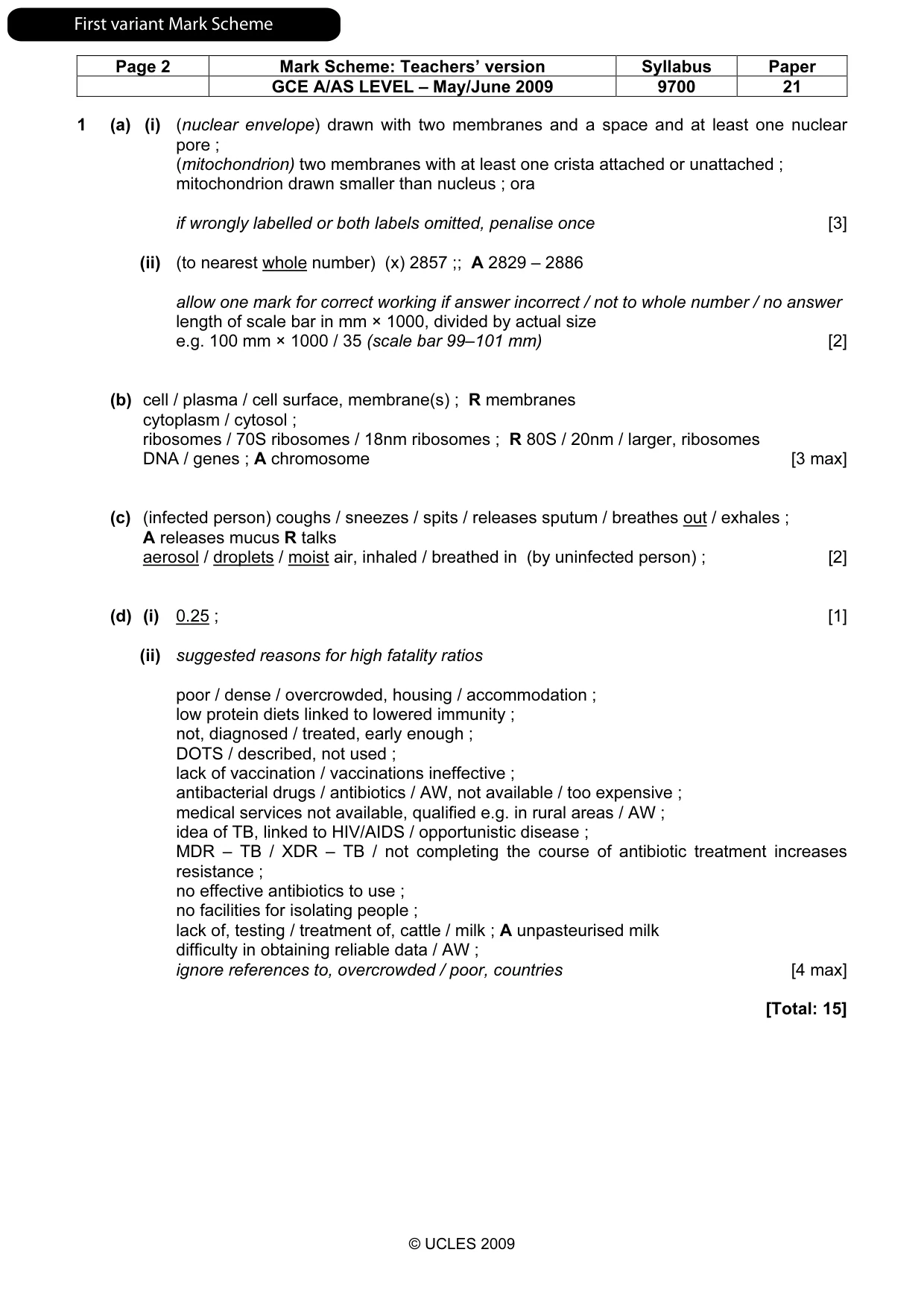
Page 2 Mark Scheme: Teachers’ version Syllabus Paper GCE A/AS LEVEL – May/June 2009 9700 21 © UCLES 2009 1 (a) (i) (nuclear envelope) drawn with two membranes and a space and at least one nuclear pore ; (mitochondrion) two membranes with at least one crista attached or unattached ; mitochondrion drawn smaller than nucleus ; ora if wrongly labelled or both labels omitted, penalise once [3] (ii) (to nearest whole number) (x) 2857 ;; A 2829 – 2886 allow one mark for correct working if answer incorrect / not to whole number / no answer length of scale bar in mm × 1000, divided by actual size e.g. 100 mm × 1000 / 35 (scale bar 99–101 mm) [2] (b) cell / plasma / cell surface, membrane(s) ; R membranes cytoplasm / cytosol ; ribosomes / 70S ribosomes / 18nm ribosomes ; R 80S / 20nm / larger, ribosomes DNA / genes ; A chromosome [3 max] (c) (infected person) coughs / sneezes / spits / releases sputum / breathes out / exhales ; A releases mucus R talks aerosol / droplets / moist air, inhaled / breathed in (by uninfected person) ; [2] (d) (i) 0.25 ; [1] (ii) suggested reasons for high fatality ratios poor / dense / overcrowded, housing / accommodation ; low protein diets linked to lowered immunity ; not, diagnosed / treated, early enough ; DOTS / described, not used ; lack of vaccination / vaccinations ineffective ; antibacterial drugs / antibiotics / AW, not available / too expensive ; medical services not available, qualified e.g. in rural areas / AW ; idea of TB, linked to HIV/AIDS / opportunistic disease ; MDR – TB / XDR – TB / not completing the course of antibiotic treatment increases resistance ; no effective antibiotics to use ; no facilities for isolating people ; lack of, testing / treatment of, cattle / milk ; A unpasteurised milk difficulty in obtaining reliable data / AW ; ignore references to, overcrowded / poor, countries [4 max] [Total: 15] First variant Mark Scheme
Mark scheme, page 4
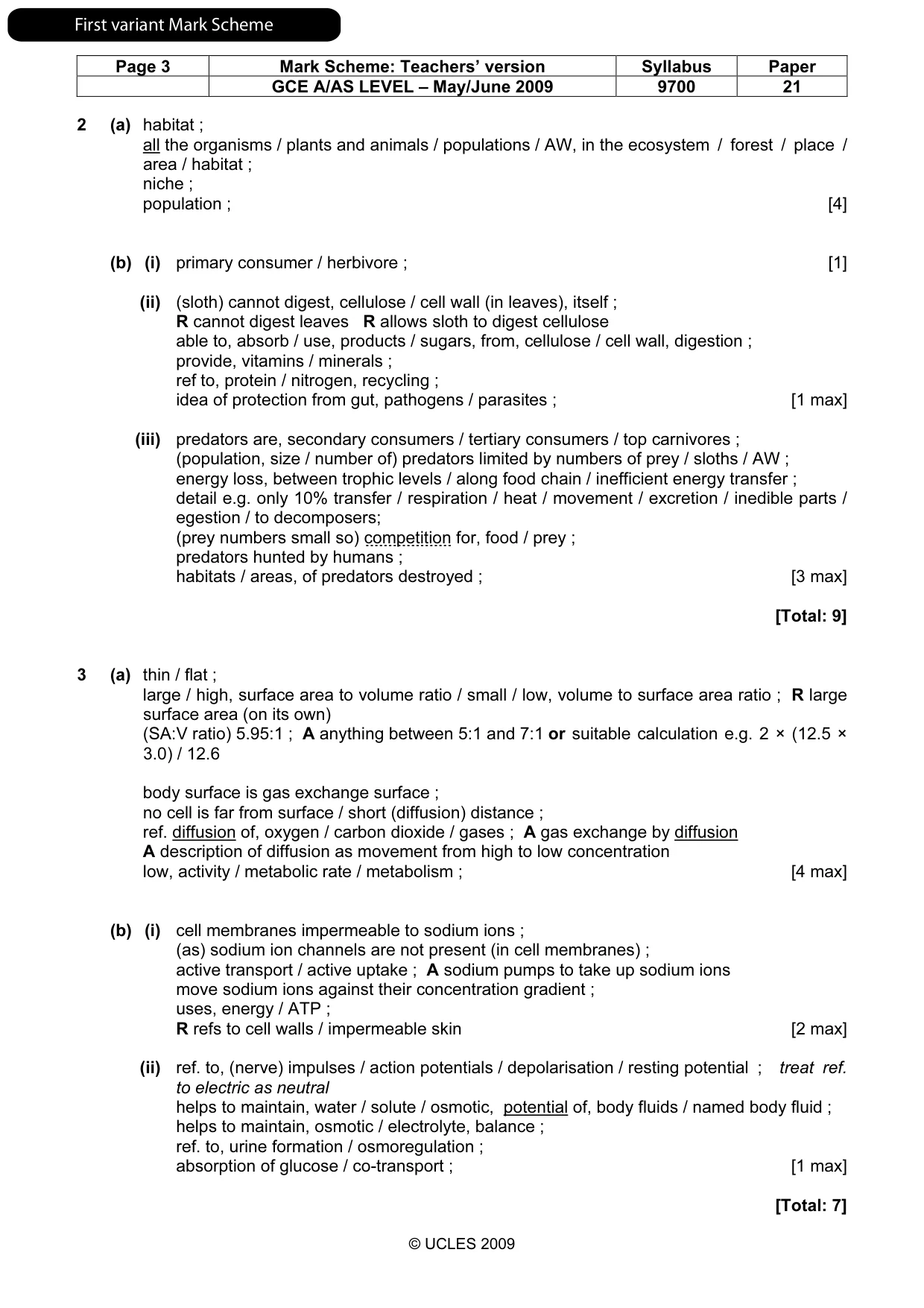
Page 3 Mark Scheme: Teachers’ version Syllabus Paper GCE A/AS LEVEL – May/June 2009 9700 21 © UCLES 2009 2 (a) habitat ; all the organisms / plants and animals / populations / AW, in the ecosystem / forest / place / area / habitat ; niche ; population ; [4] (b) (i) primary consumer / herbivore ; [1] (ii) (sloth) cannot digest, cellulose / cell wall (in leaves), itself ; R cannot digest leaves R allows sloth to digest cellulose able to, absorb / use, products / sugars, from, cellulose / cell wall, digestion ; provide, vitamins / minerals ; ref to, protein / nitrogen, recycling ; idea of protection from gut, pathogens / parasites ; [1 max] (iii) predators are, secondary consumers / tertiary consumers / top carnivores ; (population, size / number of) predators limited by numbers of prey / sloths / AW ; energy loss, between trophic levels / along food chain / inefficient energy transfer ; detail e.g. only 10% transfer / respiration / heat / movement / excretion / inedible parts / egestion / to decomposers; (prey numbers small so) competition for, food / prey ; predators hunted by humans ; habitats / areas, of predators destroyed ; [3 max] [Total: 9] 3 (a) thin / flat ; large / high, surface area to volume ratio / small / low, volume to surface area ratio ; R large surface area (on its own) (SA:V ratio) 5.95:1 ; A anything between 5:1 and 7:1 or suitable calculation e.g. 2 × (12.5 × 3.0) / 12.6 body surface is gas exchange surface ; no cell is far from surface / short (diffusion) distance ; ref. diffusion of, oxygen / carbon dioxide / gases ; A gas exchange by diffusion A description of diffusion as movement from high to low concentration low, activity / metabolic rate / metabolism ; [4 max] (b) (i) cell membranes impermeable to sodium ions ; (as) sodium ion channels are not present (in cell membranes) ; active transport / active uptake ; A sodium pumps to take up sodium ions move sodium ions against their concentration gradient ; uses, energy / ATP ; R refs to cell walls / impermeable skin [2 max] (ii) ref. to, (nerve) impulses / action potentials / depolarisation / resting potential ; treat ref. to electric as neutral helps to maintain, water / solute / osmotic, potential of, body fluids / named body fluid ; helps to maintain, osmotic / electrolyte, balance ; ref. to, urine formation / osmoregulation ; absorption of glucose / co-transport ; [1 max] [Total: 7] First variant Mark Scheme
Mark scheme, page 5
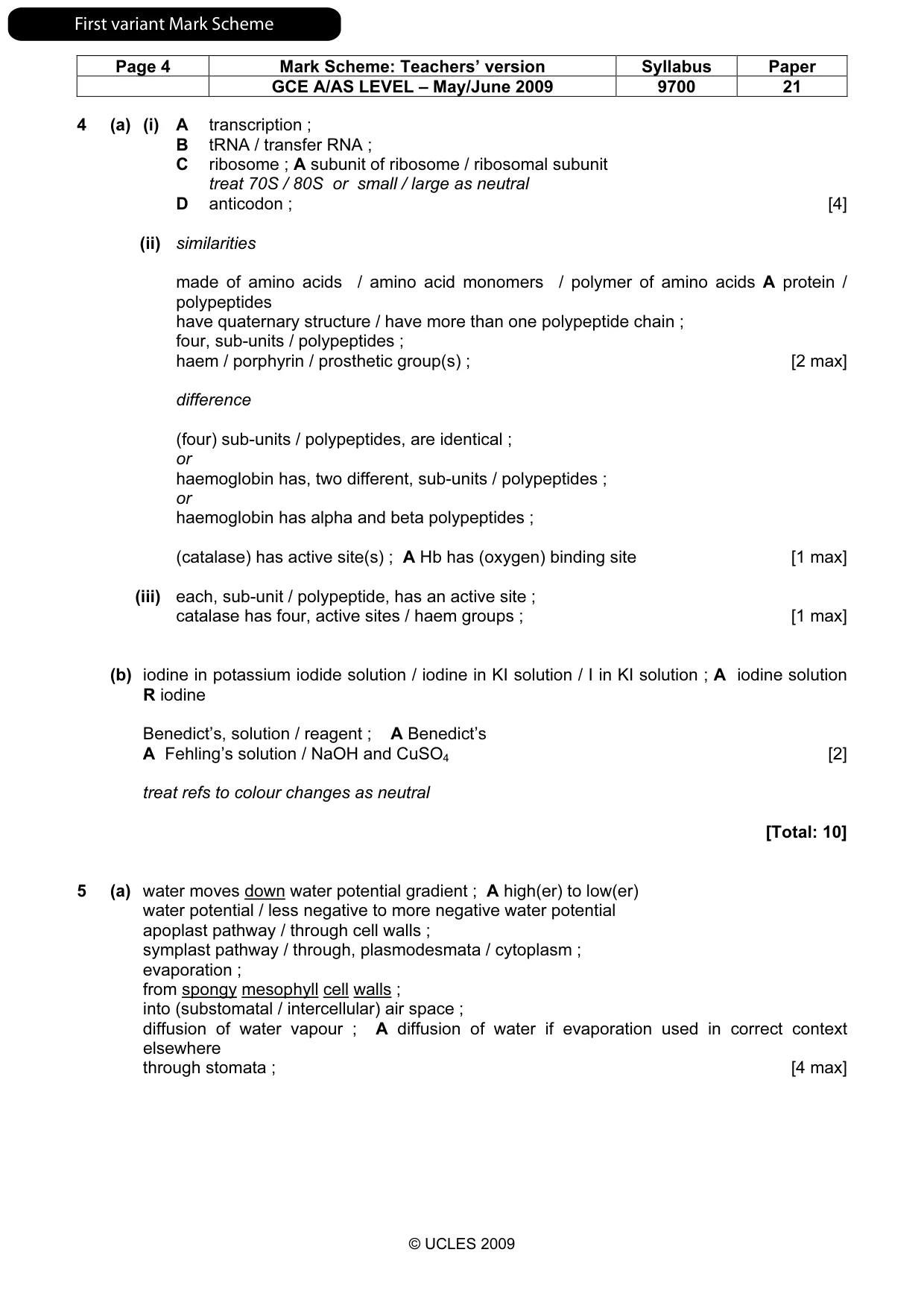
Page 4 Mark Scheme: Teachers’ version Syllabus Paper GCE A/AS LEVEL – May/June 2009 9700 21 © UCLES 2009 4 (a) (i) A transcription ; B tRNA / transfer RNA ; C ribosome ; A subunit of ribosome / ribosomal subunit treat 70S / 80S or small / large as neutral D anticodon ; [4] (ii) similarities made of amino acids / amino acid monomers / polymer of amino acids A protein / polypeptides have quaternary structure / have more than one polypeptide chain ; four, sub-units / polypeptides ; haem / porphyrin / prosthetic group(s) ; [2 max] difference (four) sub-units / polypeptides, are identical ; or haemoglobin has, two different, sub-units / polypeptides ; or haemoglobin has alpha and beta polypeptides ; (catalase) has active site(s) ; A Hb has (oxygen) binding site [1 max] (iii) each, sub-unit / polypeptide, has an active site ; catalase has four, active sites / haem groups ; [1 max] (b) iodine in potassium iodide solution / iodine in KI solution / I in KI solution ; A iodine solution R iodine Benedict’s, solution / reagent ; A Benedict’s A Fehling’s solution / NaOH and CuSO4 [2] treat refs to colour changes as neutral [Total: 10] 5 (a) water moves down water potential gradient ; A high(er) to low(er) water potential / less negative to more negative water potential apoplast pathway / through cell walls ; symplast pathway / through, plasmodesmata / cytoplasm ; evaporation ; from spongy mesophyll cell walls ; into (substomatal / intercellular) air space ; diffusion of water vapour ; A diffusion of water if evaporation used in correct context elsewhere through stomata ; [4 max] First variant Mark Scheme
Mark scheme, page 6
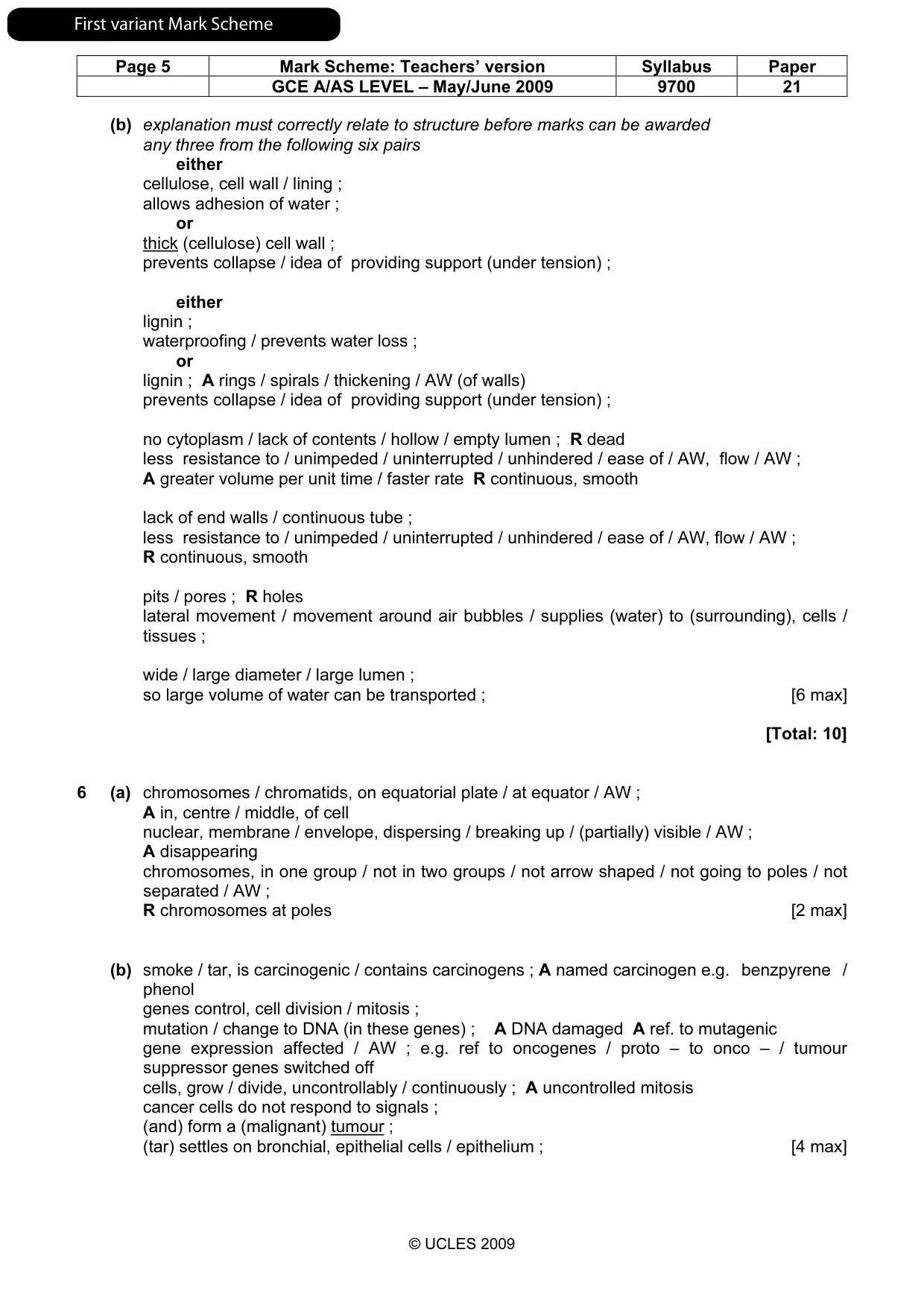
Page 5 Mark Scheme: Teachers’ version Syllabus Paper GCE A/AS LEVEL – May/June 2009 9700 21 © UCLES 2009 (b) explanation must correctly relate to structure before marks can be awarded any three from the following six pairs either cellulose, cell wall / lining ; allows adhesion of water ; or thick (cellulose) cell wall ; prevents collapse / idea of providing support (under tension) ; either lignin ; waterproofing / prevents water loss ; or lignin ; A rings / spirals / thickening / AW (of walls) prevents collapse / idea of providing support (under tension) ; no cytoplasm / lack of contents / hollow / empty lumen ; R dead less resistance to / unimpeded / uninterrupted / unhindered / ease of / AW, flow / AW ; A greater volume per unit time / faster rate R continuous, smooth lack of end walls / continuous tube ; less resistance to / unimpeded / uninterrupted / unhindered / ease of / AW, flow / AW ; R continuous, smooth pits / pores ; R holes lateral movement / movement around air bubbles / supplies (water) to (surrounding), cells / tissues ; wide / large diameter / large lumen ; so large volume of water can be transported ; [6 max] [Total: 10] 6 (a) chromosomes / chromatids, on equatorial plate / at equator / AW ; A in, centre / middle, of cell nuclear, membrane / envelope, dispersing / breaking up / (partially) visible / AW ; A disappearing chromosomes, in one group / not in two groups / not arrow shaped / not going to poles / not separated / AW ; R chromosomes at poles [2 max] (b) smoke / tar, is carcinogenic / contains carcinogens ; A named carcinogen e.g. benzpyrene / phenol genes control, cell division / mitosis ; mutation / change to DNA (in these genes) ; A DNA damaged A ref. to mutagenic gene expression affected / AW ; e.g. ref to oncogenes / proto – to onco – / tumour suppressor genes switched off cells, grow / divide, uncontrollably / continuously ; A uncontrolled mitosis cancer cells do not respond to signals ; (and) form a (malignant) tumour ; (tar) settles on bronchial, epithelial cells / epithelium ; [4 max] First variant Mark Scheme
Mark scheme, page 7
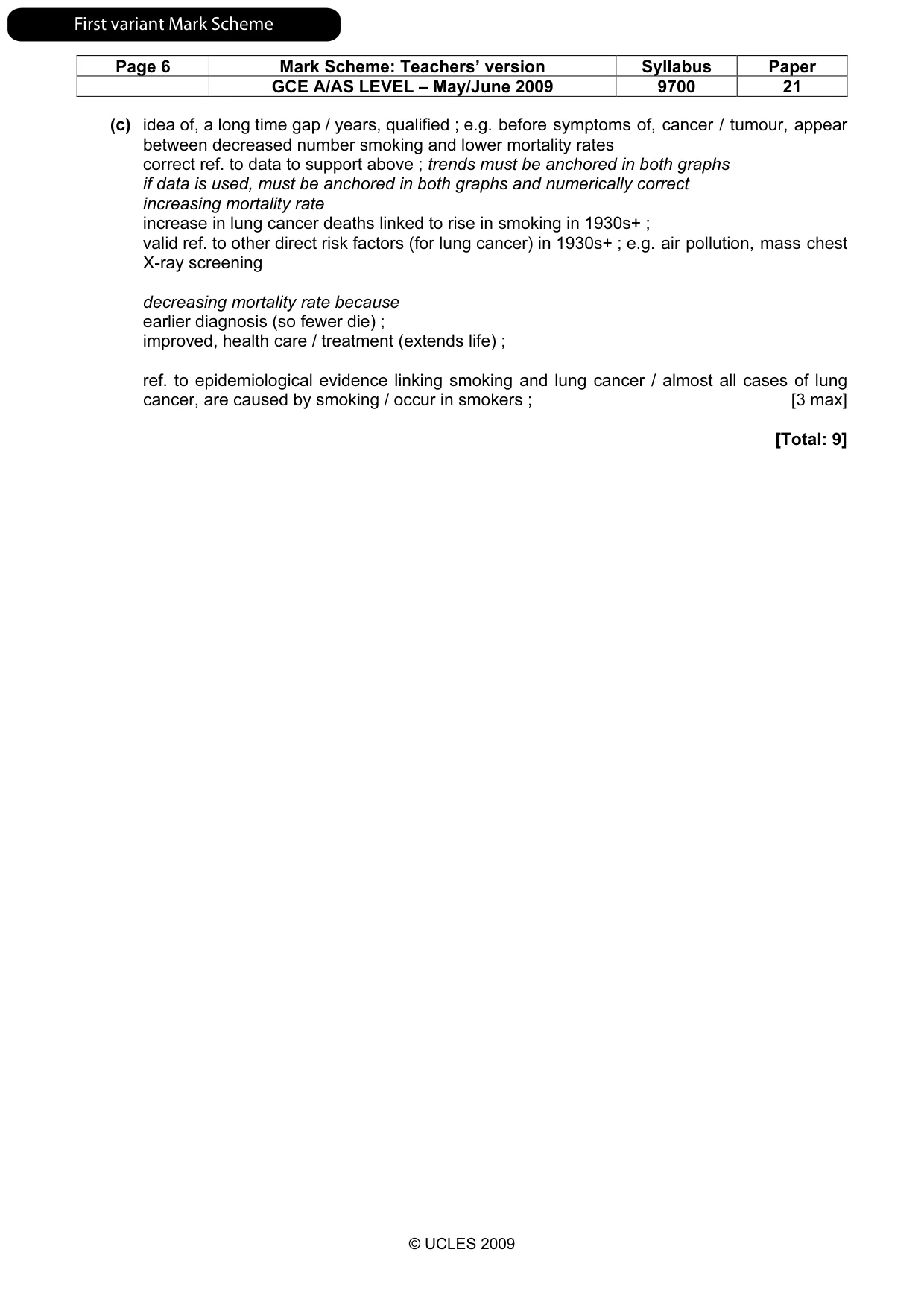
Page 6 Mark Scheme: Teachers’ version Syllabus Paper GCE A/AS LEVEL – May/June 2009 9700 21 © UCLES 2009 (c) idea of, a long time gap / years, qualified ; e.g. before symptoms of, cancer / tumour, appear between decreased number smoking and lower mortality rates correct ref. to data to support above ; trends must be anchored in both graphs if data is used, must be anchored in both graphs and numerically correct increasing mortality rate increase in lung cancer deaths linked to rise in smoking in 1930s+ ; valid ref. to other direct risk factors (for lung cancer) in 1930s+ ; e.g. air pollution, mass chest X-ray screening decreasing mortality rate because earlier diagnosis (so fewer die) ; improved, health care / treatment (extends life) ; ref. to epidemiological evidence linking smoking and lung cancer / almost all cases of lung cancer, are caused by smoking / occur in smokers ; [3 max] [Total: 9] First variant Mark Scheme
Mark scheme, page 8
UNIVERSITY OF CAMBRIDGE INTERNATIONAL EXAMINATIONS GCE Advanced Subsidiary Level and GCE Advanced Level MARK SCHEME for the May/June 2009 question paper for the guidance of teachers 9700 BIOLOGY 9700/22 Paper 22 (AS Structured Questions), maximum raw mark 60 This mark scheme is published as an aid to teachers and candidates, to indicate the requirements of the examination. It shows the basis on which Examiners were instructed to award marks. It does not indicate the details of the discussions that took place at an Examiners’ meeting before marking began, which would have considered the acceptability of alternative answers. Mark schemes must be read in conjunction with the question papers and the report on the examination. • CIE will not enter into discussions or correspondence in connection with these mark schemes. CIE is publishing the mark schemes for the May/June 2009 question papers for most IGCSE, GCE Advanced Level and Advanced Subsidiary Level syllabuses and some Ordinary Level syllabuses. Second variant Mark Scheme
Mark scheme, page 9
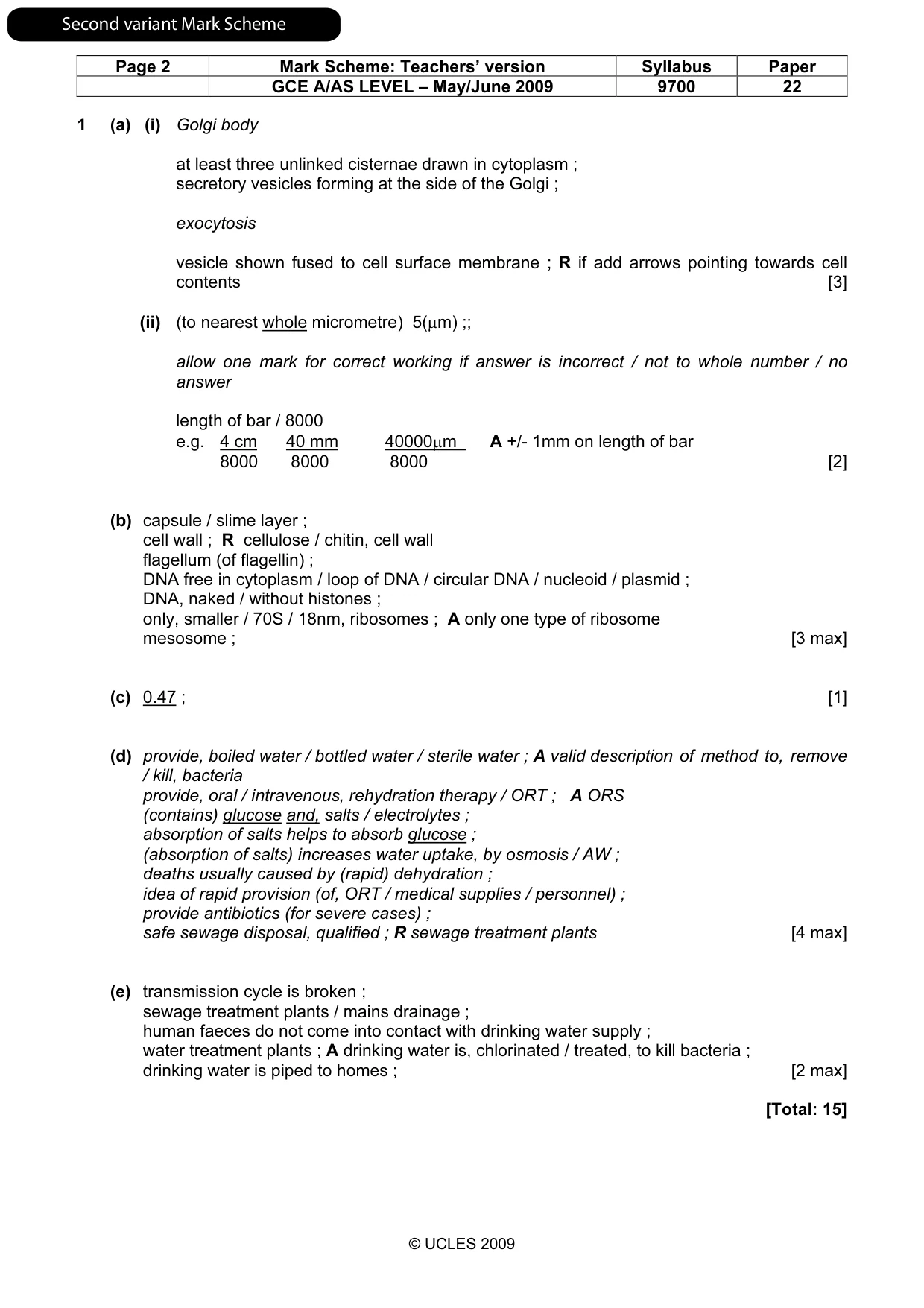
Page 2 Mark Scheme: Teachers’ version Syllabus Paper GCE A/AS LEVEL – May/June 2009 9700 22 © UCLES 2009 1 (a) (i) Golgi body at least three unlinked cisternae drawn in cytoplasm ; secretory vesicles forming at the side of the Golgi ; exocytosis vesicle shown fused to cell surface membrane ; R if add arrows pointing towards cell contents [3] (ii) (to nearest whole micrometre) 5(µm) ;; allow one mark for correct working if answer is incorrect / not to whole number / no answer length of bar / 8000 e.g. 4 cm 40 mm 40000µm A +/- 1mm on length of bar 8000 8000 8000 [2] (b) capsule / slime layer ; cell wall ; R cellulose / chitin, cell wall flagellum (of flagellin) ; DNA free in cytoplasm / loop of DNA / circular DNA / nucleoid / plasmid ; DNA, naked / without histones ; only, smaller / 70S / 18nm, ribosomes ; A only one type of ribosome mesosome ; [3 max] (c) 0.47 ; [1] (d) provide, boiled water / bottled water / sterile water ; A valid description of method to, remove / kill, bacteria provide, oral / intravenous, rehydration therapy / ORT ; A ORS (contains) glucose and, salts / electrolytes ; absorption of salts helps to absorb glucose ; (absorption of salts) increases water uptake, by osmosis / AW ; deaths usually caused by (rapid) dehydration ; idea of rapid provision (of, ORT / medical supplies / personnel) ; provide antibiotics (for severe cases) ; safe sewage disposal, qualified ; R sewage treatment plants [4 max] (e) transmission cycle is broken ; sewage treatment plants / mains drainage ; human faeces do not come into contact with drinking water supply ; water treatment plants ; A drinking water is, chlorinated / treated, to kill bacteria ; drinking water is piped to homes ; [2 max] [Total: 15] Second variant Mark Scheme
Mark scheme, page 10
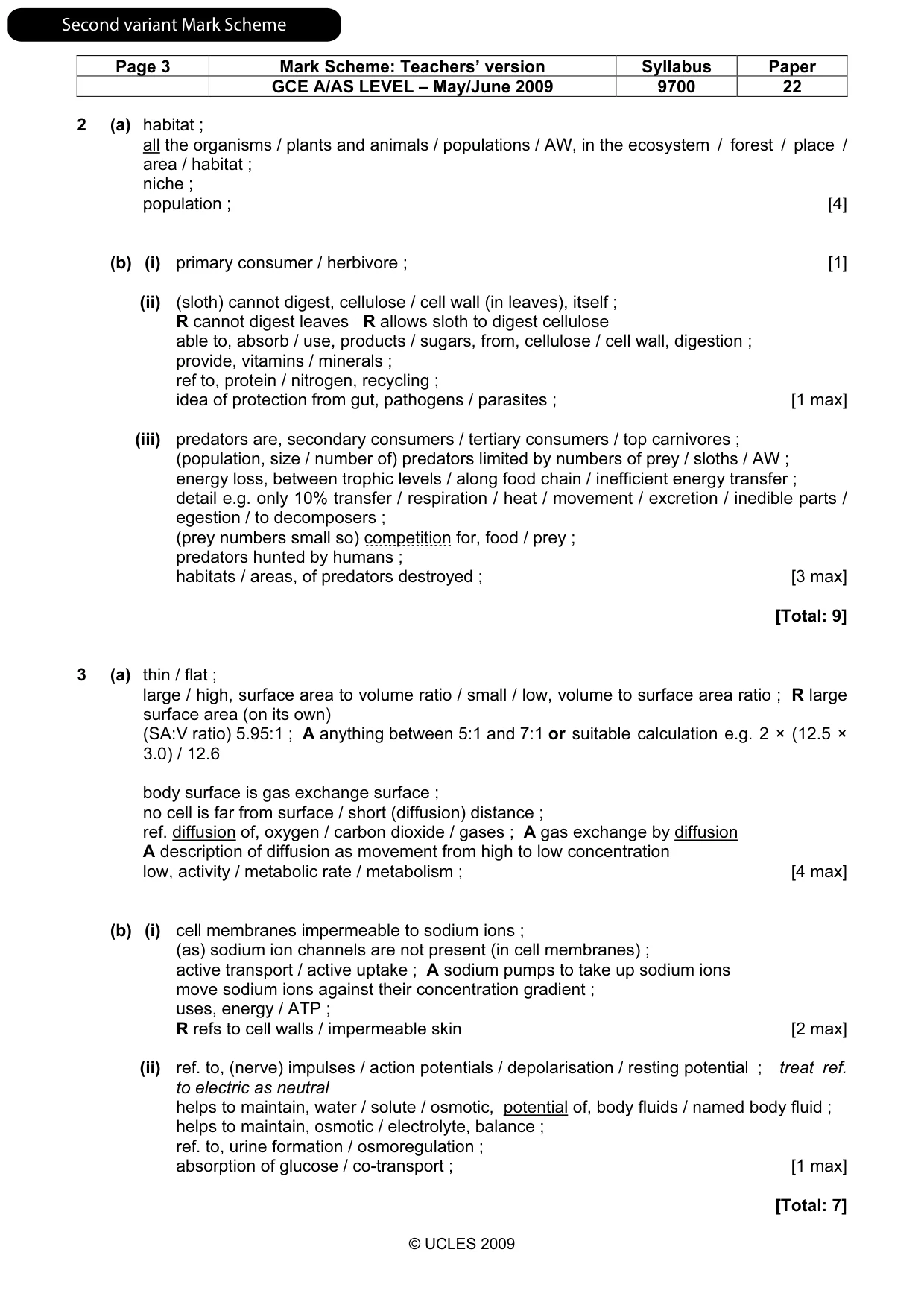
Page 3 Mark Scheme: Teachers’ version Syllabus Paper GCE A/AS LEVEL – May/June 2009 9700 22 © UCLES 2009 2 (a) habitat ; all the organisms / plants and animals / populations / AW, in the ecosystem / forest / place / area / habitat ; niche ; population ; [4] (b) (i) primary consumer / herbivore ; [1] (ii) (sloth) cannot digest, cellulose / cell wall (in leaves), itself ; R cannot digest leaves R allows sloth to digest cellulose able to, absorb / use, products / sugars, from, cellulose / cell wall, digestion ; provide, vitamins / minerals ; ref to, protein / nitrogen, recycling ; idea of protection from gut, pathogens / parasites ; [1 max] (iii) predators are, secondary consumers / tertiary consumers / top carnivores ; (population, size / number of) predators limited by numbers of prey / sloths / AW ; energy loss, between trophic levels / along food chain / inefficient energy transfer ; detail e.g. only 10% transfer / respiration / heat / movement / excretion / inedible parts / egestion / to decomposers ; (prey numbers small so) competition for, food / prey ; predators hunted by humans ; habitats / areas, of predators destroyed ; [3 max] [Total: 9] 3 (a) thin / flat ; large / high, surface area to volume ratio / small / low, volume to surface area ratio ; R large surface area (on its own) (SA:V ratio) 5.95:1 ; A anything between 5:1 and 7:1 or suitable calculation e.g. 2 × (12.5 × 3.0) / 12.6 body surface is gas exchange surface ; no cell is far from surface / short (diffusion) distance ; ref. diffusion of, oxygen / carbon dioxide / gases ; A gas exchange by diffusion A description of diffusion as movement from high to low concentration low, activity / metabolic rate / metabolism ; [4 max] (b) (i) cell membranes impermeable to sodium ions ; (as) sodium ion channels are not present (in cell membranes) ; active transport / active uptake ; A sodium pumps to take up sodium ions move sodium ions against their concentration gradient ; uses, energy / ATP ; R refs to cell walls / impermeable skin [2 max] (ii) ref. to, (nerve) impulses / action potentials / depolarisation / resting potential ; treat ref. to electric as neutral helps to maintain, water / solute / osmotic, potential of, body fluids / named body fluid ; helps to maintain, osmotic / electrolyte, balance ; ref. to, urine formation / osmoregulation ; absorption of glucose / co-transport ; [1 max] [Total: 7] Second variant Mark Scheme
Mark scheme, page 11
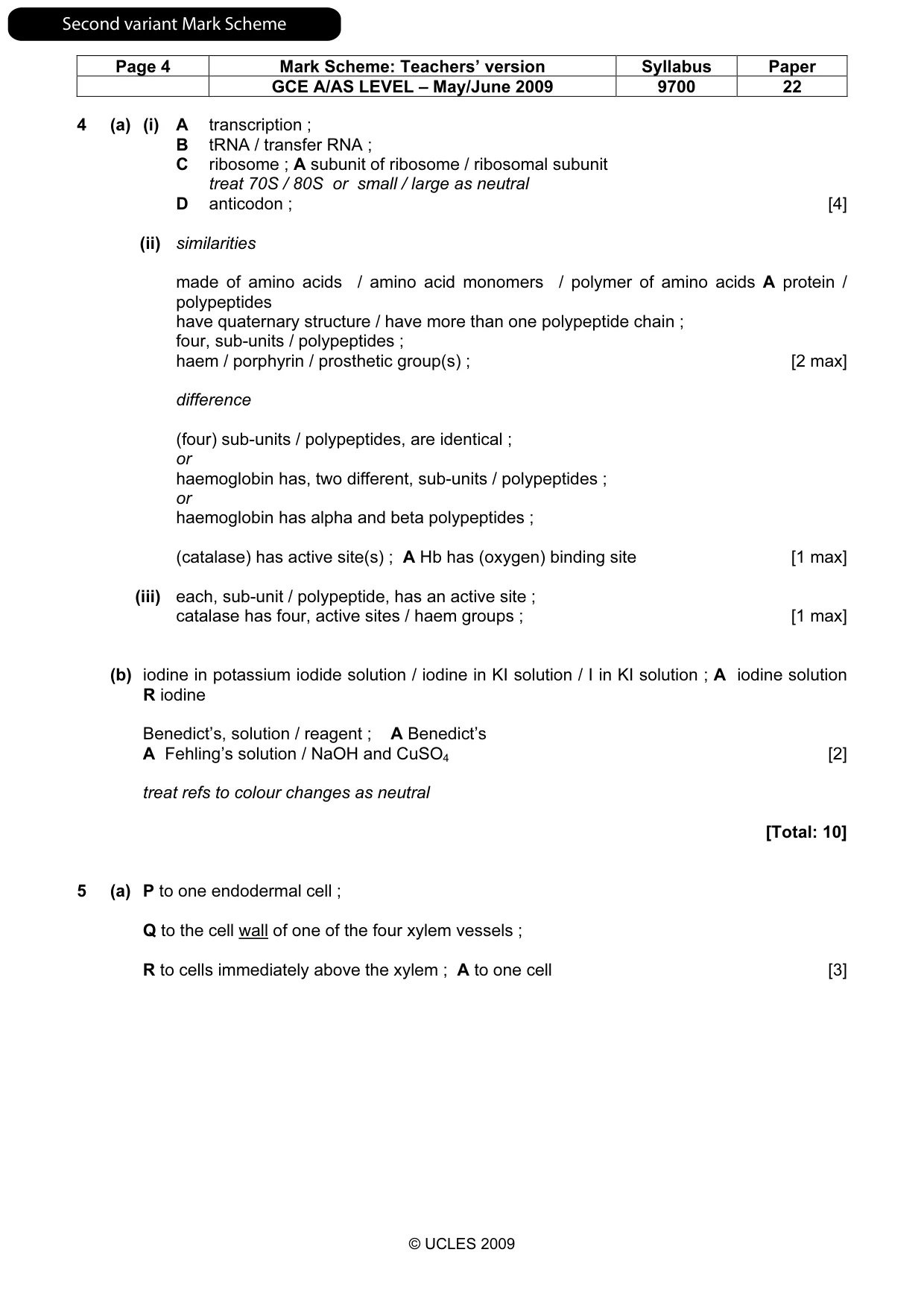
Page 4 Mark Scheme: Teachers’ version Syllabus Paper GCE A/AS LEVEL – May/June 2009 9700 22 © UCLES 2009 4 (a) (i) A transcription ; B tRNA / transfer RNA ; C ribosome ; A subunit of ribosome / ribosomal subunit treat 70S / 80S or small / large as neutral D anticodon ; [4] (ii) similarities made of amino acids / amino acid monomers / polymer of amino acids A protein / polypeptides have quaternary structure / have more than one polypeptide chain ; four, sub-units / polypeptides ; haem / porphyrin / prosthetic group(s) ; [2 max] difference (four) sub-units / polypeptides, are identical ; or haemoglobin has, two different, sub-units / polypeptides ; or haemoglobin has alpha and beta polypeptides ; (catalase) has active site(s) ; A Hb has (oxygen) binding site [1 max] (iii) each, sub-unit / polypeptide, has an active site ; catalase has four, active sites / haem groups ; [1 max] (b) iodine in potassium iodide solution / iodine in KI solution / I in KI solution ; A iodine solution R iodine Benedict’s, solution / reagent ; A Benedict’s A Fehling’s solution / NaOH and CuSO4 [2] treat refs to colour changes as neutral [Total: 10] 5 (a) P to one endodermal cell ; Q to the cell wall of one of the four xylem vessels ; R to cells immediately above the xylem ; A to one cell [3] Second variant Mark Scheme
Mark scheme, page 12
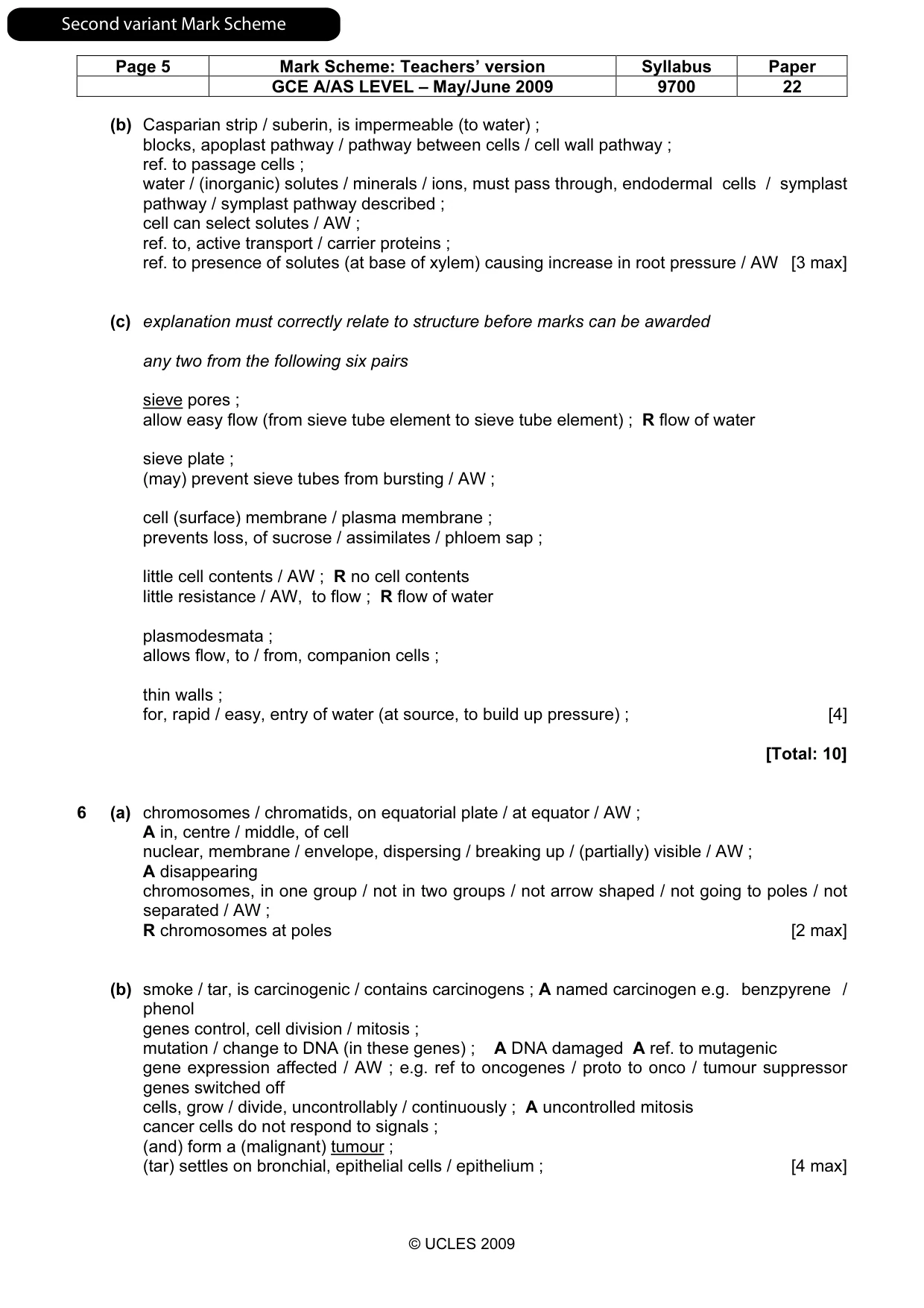
Page 5 Mark Scheme: Teachers’ version Syllabus Paper GCE A/AS LEVEL – May/June 2009 9700 22 © UCLES 2009 (b) Casparian strip / suberin, is impermeable (to water) ; blocks, apoplast pathway / pathway between cells / cell wall pathway ; ref. to passage cells ; water / (inorganic) solutes / minerals / ions, must pass through, endodermal cells / symplast pathway / symplast pathway described ; cell can select solutes / AW ; ref. to, active transport / carrier proteins ; ref. to presence of solutes (at base of xylem) causing increase in root pressure / AW [3 max] (c) explanation must correctly relate to structure before marks can be awarded any two from the following six pairs sieve pores ; allow easy flow (from sieve tube element to sieve tube element) ; R flow of water sieve plate ; (may) prevent sieve tubes from bursting / AW ; cell (surface) membrane / plasma membrane ; prevents loss, of sucrose / assimilates / phloem sap ; little cell contents / AW ; R no cell contents little resistance / AW, to flow ; R flow of water plasmodesmata ; allows flow, to / from, companion cells ; thin walls ; for, rapid / easy, entry of water (at source, to build up pressure) ; [4] [Total: 10] 6 (a) chromosomes / chromatids, on equatorial plate / at equator / AW ; A in, centre / middle, of cell nuclear, membrane / envelope, dispersing / breaking up / (partially) visible / AW ; A disappearing chromosomes, in one group / not in two groups / not arrow shaped / not going to poles / not separated / AW ; R chromosomes at poles [2 max] (b) smoke / tar, is carcinogenic / contains carcinogens ; A named carcinogen e.g. benzpyrene / phenol genes control, cell division / mitosis ; mutation / change to DNA (in these genes) ; A DNA damaged A ref. to mutagenic gene expression affected / AW ; e.g. ref to oncogenes / proto to onco / tumour suppressor genes switched off cells, grow / divide, uncontrollably / continuously ; A uncontrolled mitosis cancer cells do not respond to signals ; (and) form a (malignant) tumour ; (tar) settles on bronchial, epithelial cells / epithelium ; [4 max] Second variant Mark Scheme
Mark scheme, page 13
Page 6 Mark Scheme: Teachers’ version Syllabus Paper GCE A/AS LEVEL – May/June 2009 9700 22 © UCLES 2009 (c) idea of, a long time gap / years, qualified ; e.g. before symptoms of, cancer / tumour, appear between decreased number smoking and lower mortality rates correct ref. to data to support above ; trends must be anchored in both graphs if data is used, must be anchored in both graphs and numerically correct increasing mortality rate increase in lung cancer deaths linked to rise in smoking in 1930s+ ; valid ref. to other direct risk factors (for lung cancer) in 1930s+ ; e.g. air pollution, mass chest X-ray screening decreasing mortality rate because earlier diagnosis (so fewer die) ; improved, health care / treatment (extends life) ; ref. to epidemiological evidence linking smoking and lung cancer / almost all cases of lung cancer, are caused by smoking / occur in smokers ; [3 max] [Total: 9] Second variant Mark Scheme