Cambridge A Level Biology 9700 — 2008 Oct/Nov Paper 2 · Variant 1
9700/21/O/N/08 · 60 marks · ≈68 min
The question paper and its mark scheme, free to read here and free to download. This is Cambridge’s own paper, exactly as it was sat.
Question paper29 pages

Mark scheme12 pages
Answers below. Sit the paper first if you are practising.
Paper as text
Question paper, page 1
Location Entry Codes As part of CIE’s continual commitment to maintaining best practice in assessment, CIE uses different variants of some question papers for our most popular assessments with large and widespread candidature. The question papers are closely related and the relationships between them have been thoroughly established using our assessment expertise. All versions of the paper give assessment of equal standard. The content assessed by the examination papers and the type of questions is unchanged. This change means that for this component there are now two variant Question Papers, Mark Schemes and Principal Examiner’s Reports where previously there was only one. For any individual country, it is intended that only one variant is used. This document contains both variants which will give all Centres access to even more past examination material than is usually the case. The diagram shows the relationship between the Question Papers, Mark Schemes and Principal Examiners’ Reports that are available. Question Paper Mark Scheme Principal Examiner’s Report Introduction Introduction Introduction First variant Question Paper First variant Mark Scheme First variant Principal Examiner’s Report Second variant Question Paper Second variant Mark Scheme Second variant Principal Examiner’s Report Who can I contact for further information on these changes? Please direct any questions about this to CIE’s Customer Services team at: international@cie.org.uk The titles for the variant items should correspond with the table above, so that at the top of the first page of the relevant part of the document and on the header, it has the words: • First variant Question Paper / Mark Scheme / Principal Examiner’s Report or • Second variant Question Paper / Mark Scheme / Principal Examiner’s Report as appropriate.
Question paper, page 2
This document consists of 12 printed pages. SPA (FF/CG) T52856/2 © UCLES 2008 [Turn over UNIVERSITY OF CAMBRIDGE INTERNATIONAL EXAMINATIONS General Certificate of Education Advanced Subsidiary Level and Advanced Level READ THESE INSTRUCTIONS FIRST Write your Centre number, candidate number and name in the spaces provided at the top of this page. Write in dark blue or black pen. You may use a soft pencil for any diagrams, graphs or rough working. Do not use staples, paper clips, highlighters, glue or correction fluid. DO NOT WRITE IN ANY BARCODES. Answer all questions. At the end of the examination, fasten all your work securely together. The number of marks is given in brackets [ ] at the end of each question or part question. * 6 4 6 4 5 4 9 6 2 8 * BIOLOGY 9700/02 Paper 2 Structured Questions AS October/November 2008 1 hour 15 minutes Candidates answer on the Question Paper. No Additional Materials are required. For Examiner’s Use 1 2 3 4 5 Total First Variant Question Paper
Question paper, page 3
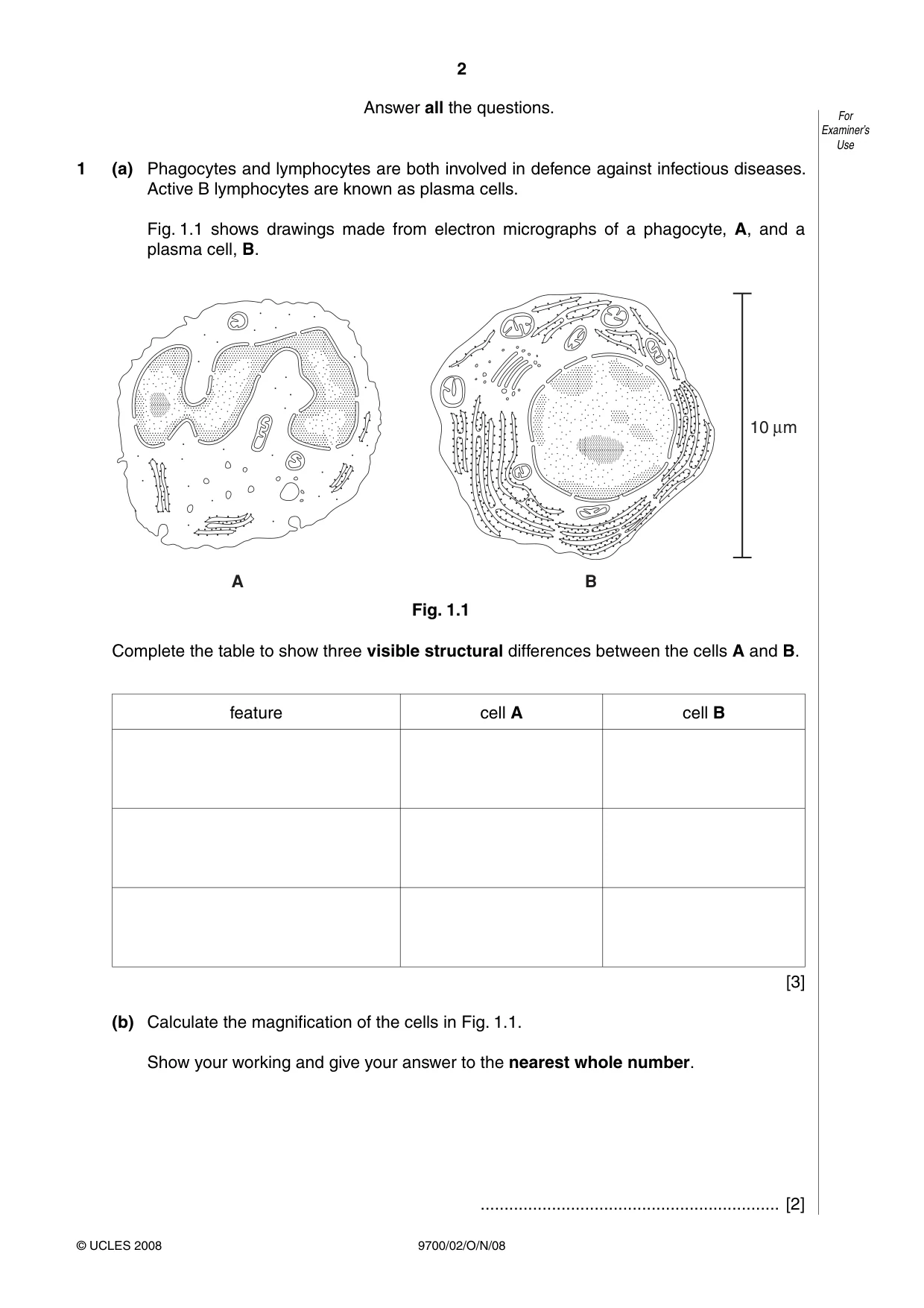
2 © UCLES 2008 For Examiner’s Use 9700/02/O/N/08 Answer all the questions. 1 (a) Phagocytes and lymphocytes are both involved in defence against infectious diseases. Active B lymphocytes are known as plasma cells. Fig. 1.1 shows drawings made from electron micrographs of a phagocyte, A, and a plasma cell, B. A B 10 m Fig. 1.1 Complete the table to show three visible structural differences between the cells A and B. feature cell A cell B [3] (b) Calculate the magnification of the cells in Fig. 1.1. Show your working and give your answer to the nearest whole number. … [2]
Question paper, page 4
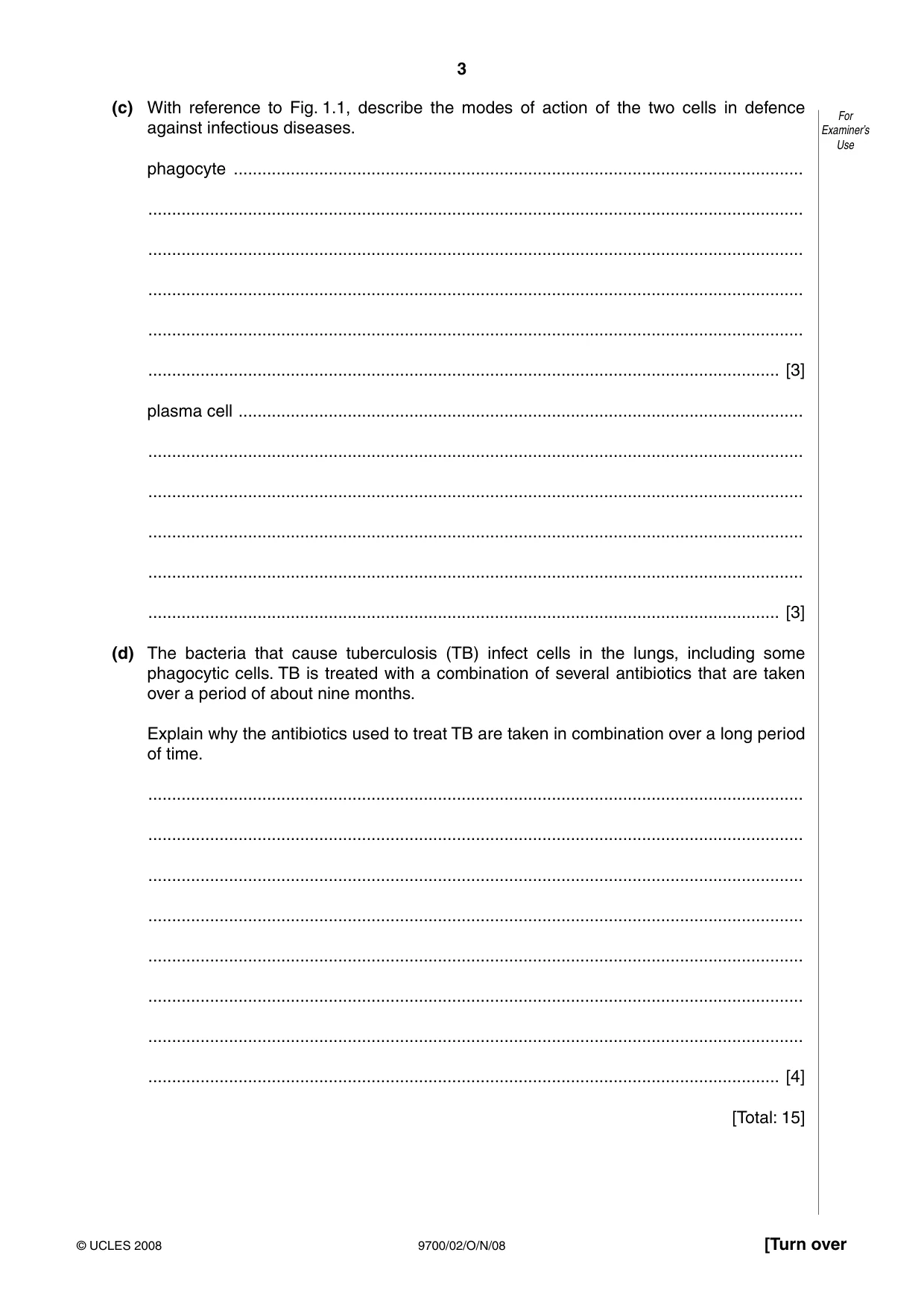
3 © UCLES 2008 [Turn over For Examiner’s Use 9700/02/O/N/08 (c) With reference to Fig. 1.1, describe the modes of action of the two cells in defence against infectious diseases. phagocyte … … … … … … [3] plasma cell … … … … … … [3] (d) The bacteria that cause tuberculosis (TB) infect cells in the lungs, including some phagocytic cells. TB is treated with a combination of several antibiotics that are taken over a period of about nine months. Explain why the antibiotics used to treat TB are taken in combination over a long period of time. … … … … … … … … [4] [Total: 15]
Question paper, page 5
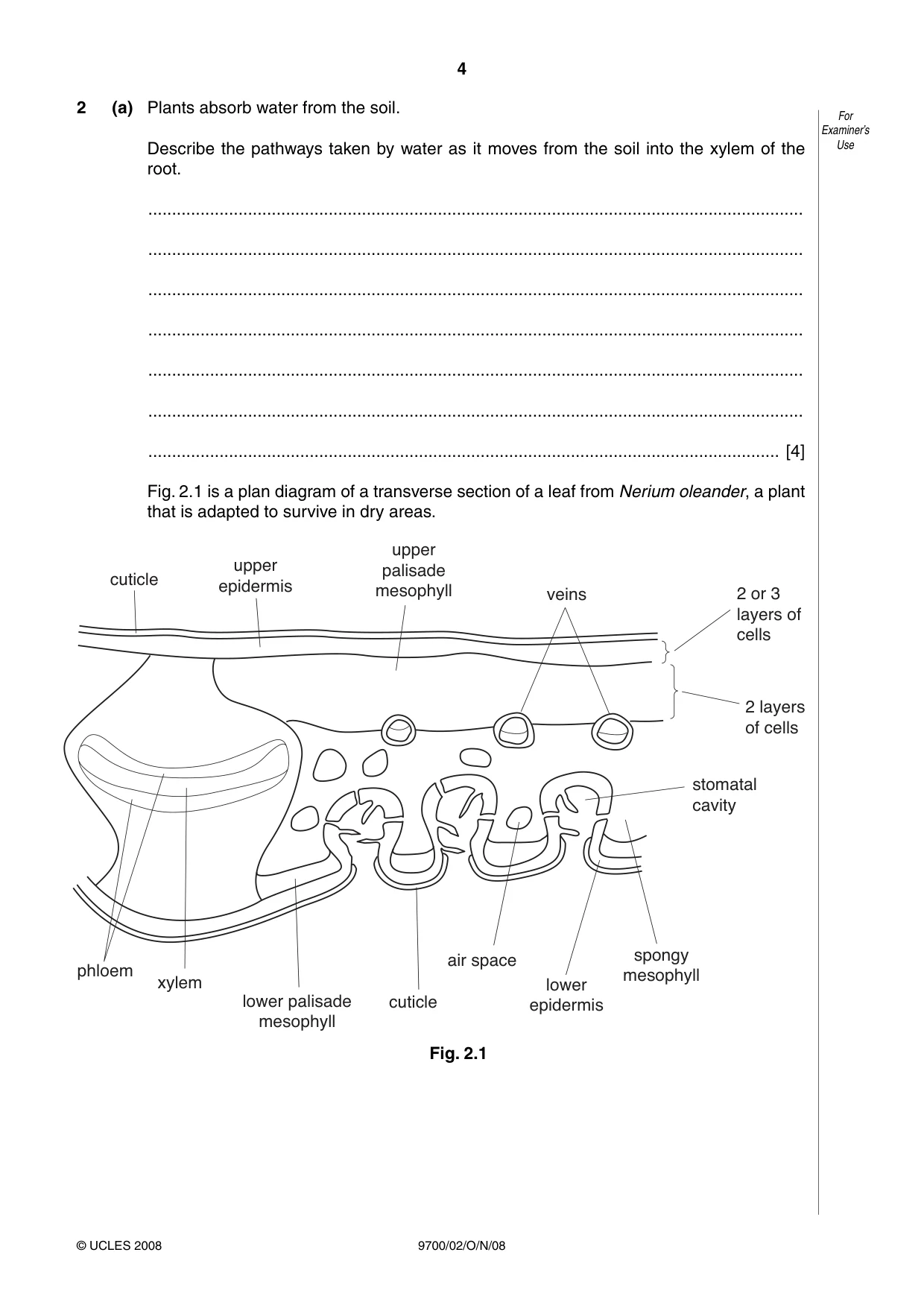
4 © UCLES 2008 For Examiner’s Use 9700/02/O/N/08 2 (a) Plants absorb water from the soil. Describe the pathways taken by water as it moves from the soil into the xylem of the root. … … … … … … … [4] Fig. 2.1 is a plan diagram of a transverse section of a leaf from Nerium oleander, a plant that is adapted to survive in dry areas. cuticle phloem xylem lower palisade mesophyll air space cuticle lower epidermis spongy mesophyll upper epidermis upper palisade mesophyll veins 2 or 3 layers of cells 2 layers of cells stomatal cavity Fig. 2.1
Question paper, page 6
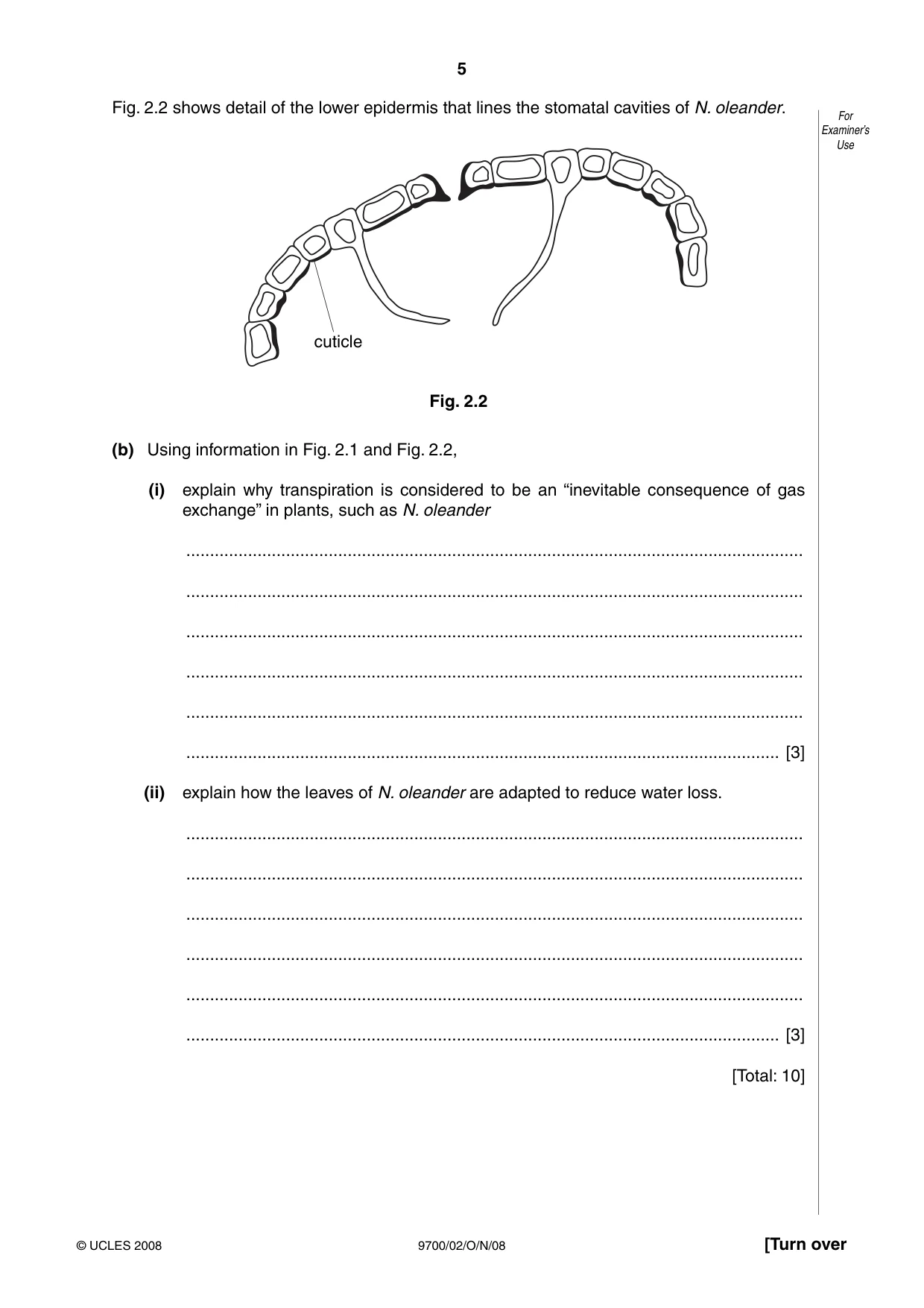
5 © UCLES 2008 [Turn over For Examiner’s Use 9700/02/O/N/08 Fig. 2.2 shows detail of the lower epidermis that lines the stomatal cavities of N. oleander. cuticle Fig. 2.2 (b) Using information in Fig. 2.1 and Fig. 2.2, (i) explain why transpiration is considered to be an “inevitable consequence of gas exchange” in plants, such as N. oleander … … … … … … [3] (ii) explain how the leaves of N. oleander are adapted to reduce water loss. … … … … … … [3] [Total: 10]
Question paper, page 7
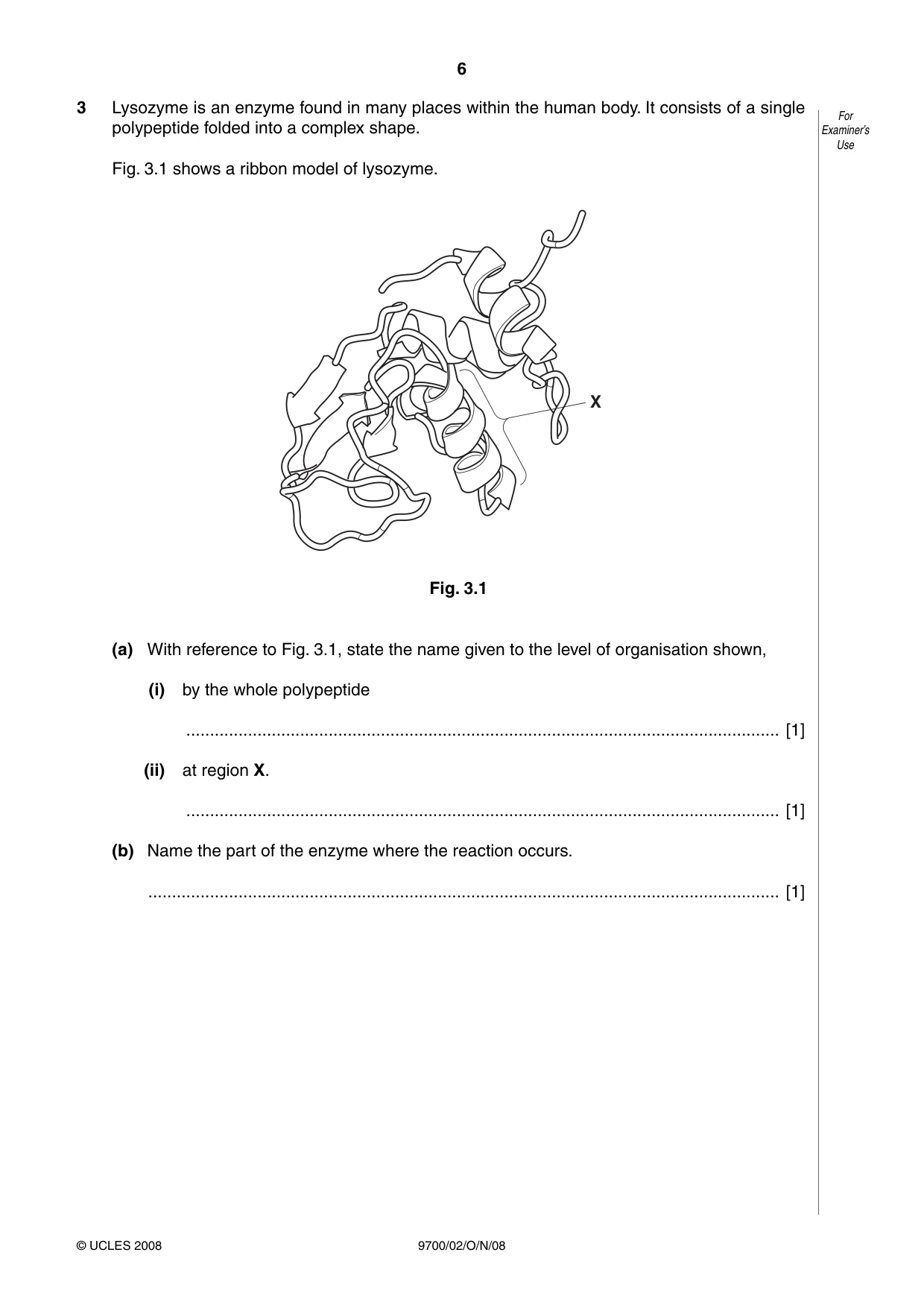
6 © UCLES 2008 For Examiner’s Use 9700/02/O/N/08 3 Lysozyme is an enzyme found in many places within the human body. It consists of a single polypeptide folded into a complex shape. Fig. 3.1 shows a ribbon model of lysozyme. X Fig. 3.1 (a) With reference to Fig. 3.1, state the name given to the level of organisation shown, (i) by the whole polypeptide … [1] (ii) at region X. … [1] (b) Name the part of the enzyme where the reaction occurs. … [1]
Question paper, page 8
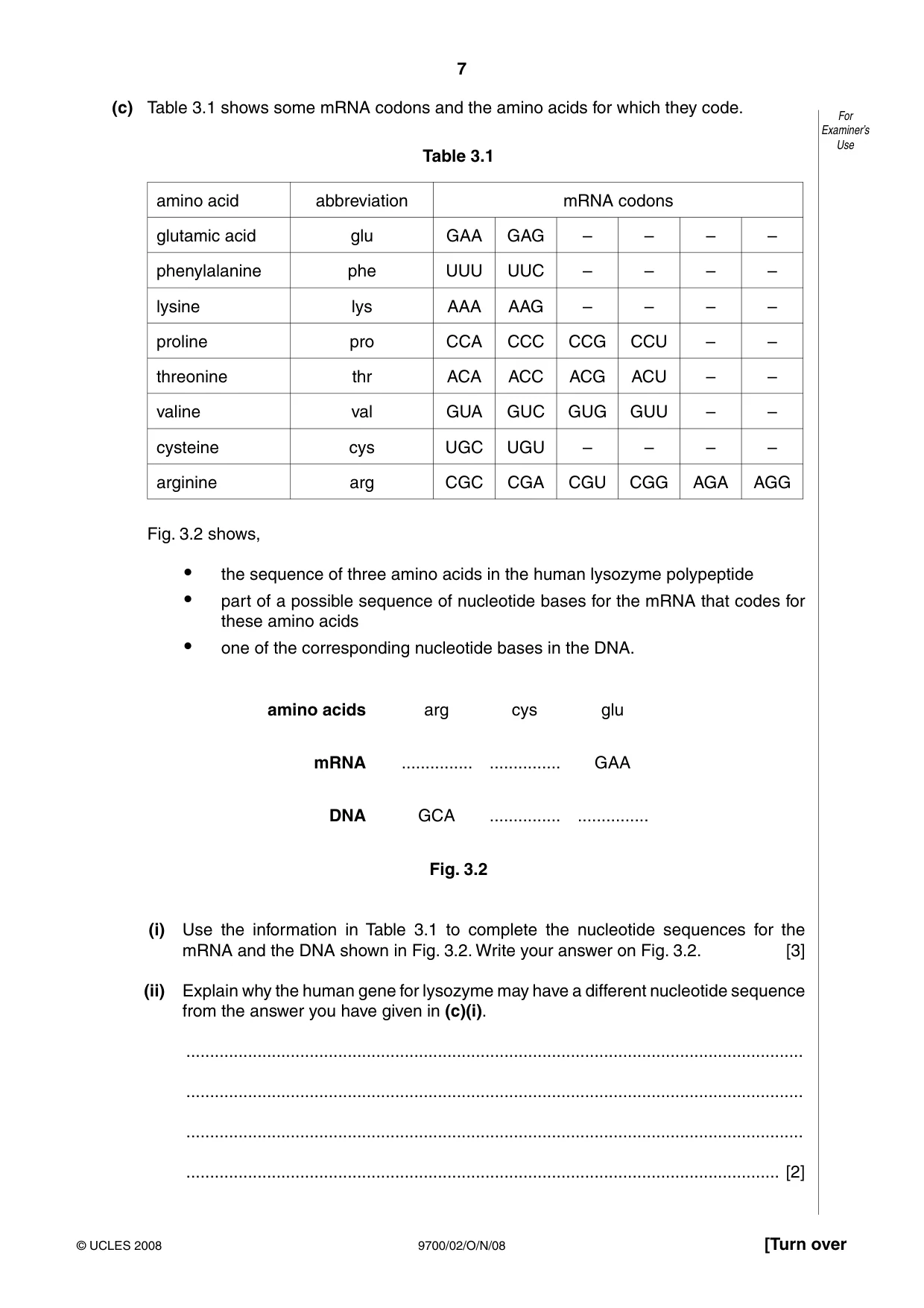
7 © UCLES 2008 [Turn over For Examiner’s Use 9700/02/O/N/08 (c) Table 3.1 shows some mRNA codons and the amino acids for which they code. Table 3.1 amino acid abbreviation mRNA codons glutamic acid glu GAA GAG – – – – phenylalanine phe UUU UUC – – – – lysine lys AAA AAG – – – – proline pro CCA CCC CCG CCU – – threonine thr ACA ACC ACG ACU – – valine val GUA GUC GUG GUU – – cysteine cys UGC UGU – – – – arginine arg CGC CGA CGU CGG AGA AGG Fig. 3.2 shows, • the sequence of three amino acids in the human lysozyme polypeptide • part of a possible sequence of nucleotide bases for the mRNA that codes for these amino acids • one of the corresponding nucleotide bases in the DNA. amino acids arg cys glu mRNA … … GAA DNA GCA … … Fig. 3.2 (i) Use the information in Table 3.1 to complete the nucleotide sequences for the mRNA and the DNA shown in Fig. 3.2. Write your answer on Fig. 3.2. [3] (ii) Explain why the human gene for lysozyme may have a different nucleotide sequence from the answer you have given in (c)(i). … … … … [2]
Question paper, page 9
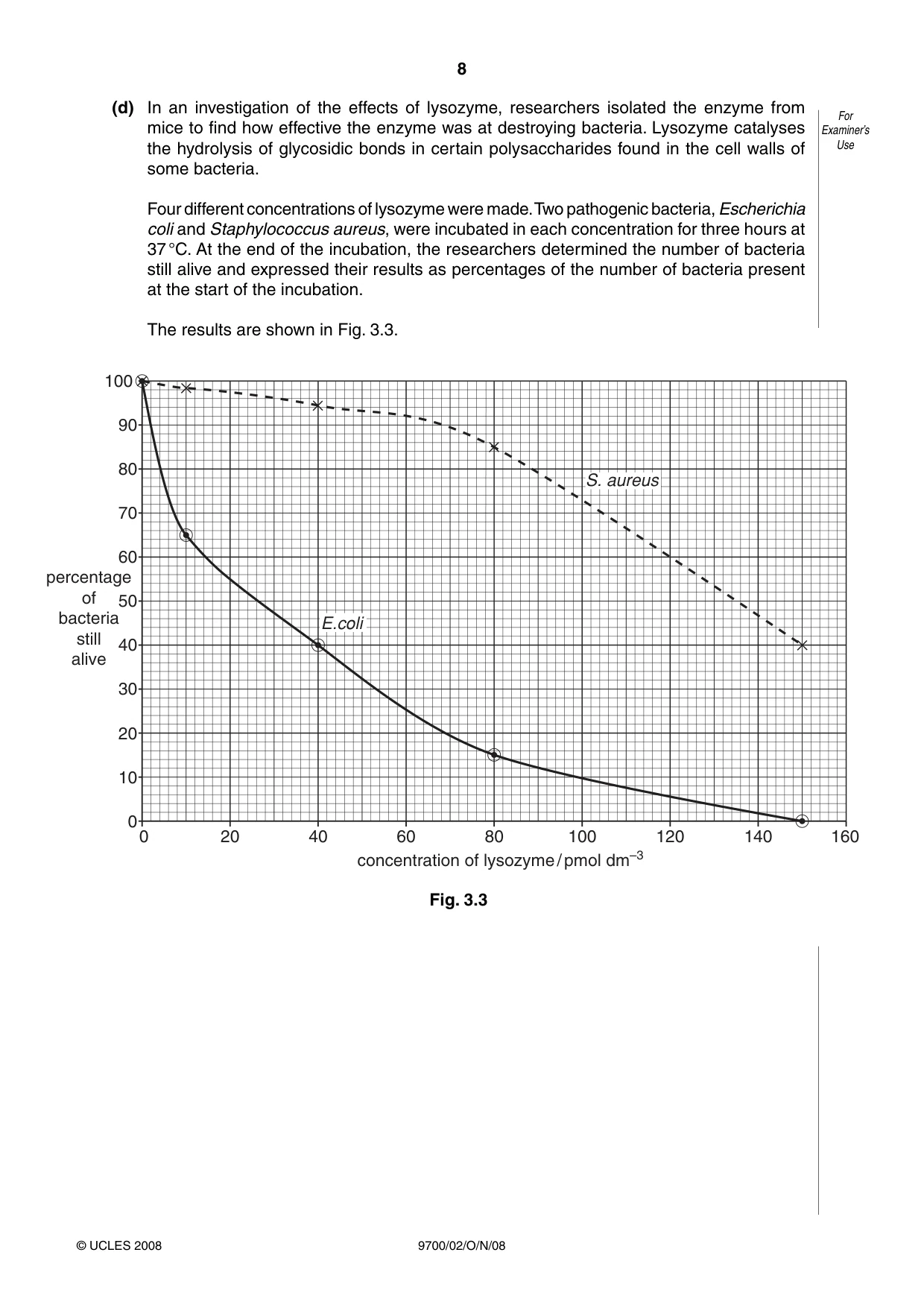
8 © UCLES 2008 9700/02/O/N/08 (d) In an investigation of the effects of lysozyme, researchers isolated the enzyme from mice to find how effective the enzyme was at destroying bacteria. Lysozyme catalyses the hydrolysis of glycosidic bonds in certain polysaccharides found in the cell walls of some bacteria. Four different concentrations of lysozyme were made. Two pathogenic bacteria, Escherichia coli and Staphylococcus aureus, were incubated in each concentration for three hours at 37 °C. At the end of the incubation, the researchers determined the number of bacteria still alive and expressed their results as percentages of the number of bacteria present at the start of the incubation. The results are shown in Fig. 3.3. 0 0 20 40 60 80 100 120 140 160 10 20 30 40 50 60 70 80 90 100 percentage of bacteria still alive concentration of lysozyme / pmol dm–3 S. aureus E.coli For Examiner’s Use Fig. 3.3
Question paper, page 10
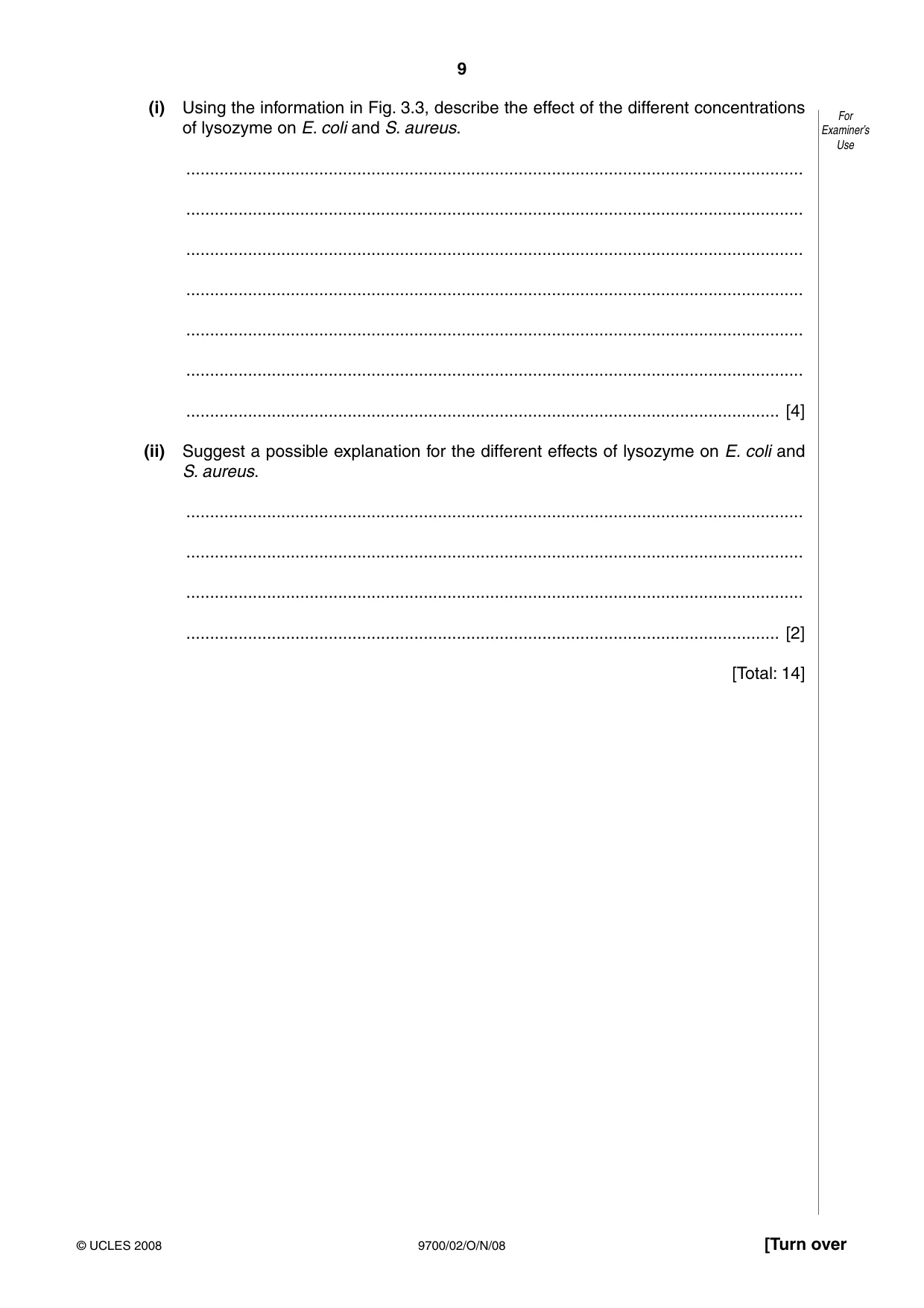
9 © UCLES 2008 [Turn over For Examiner’s Use 9700/02/O/N/08 (i) Using the information in Fig. 3.3, describe the effect of the different concentrations of lysozyme on E. coli and S. aureus. … … … … … … … [4] (ii) Suggest a possible explanation for the different effects of lysozyme on E. coli and S. aureus. … … … … [2] [Total: 14]
Question paper, page 11
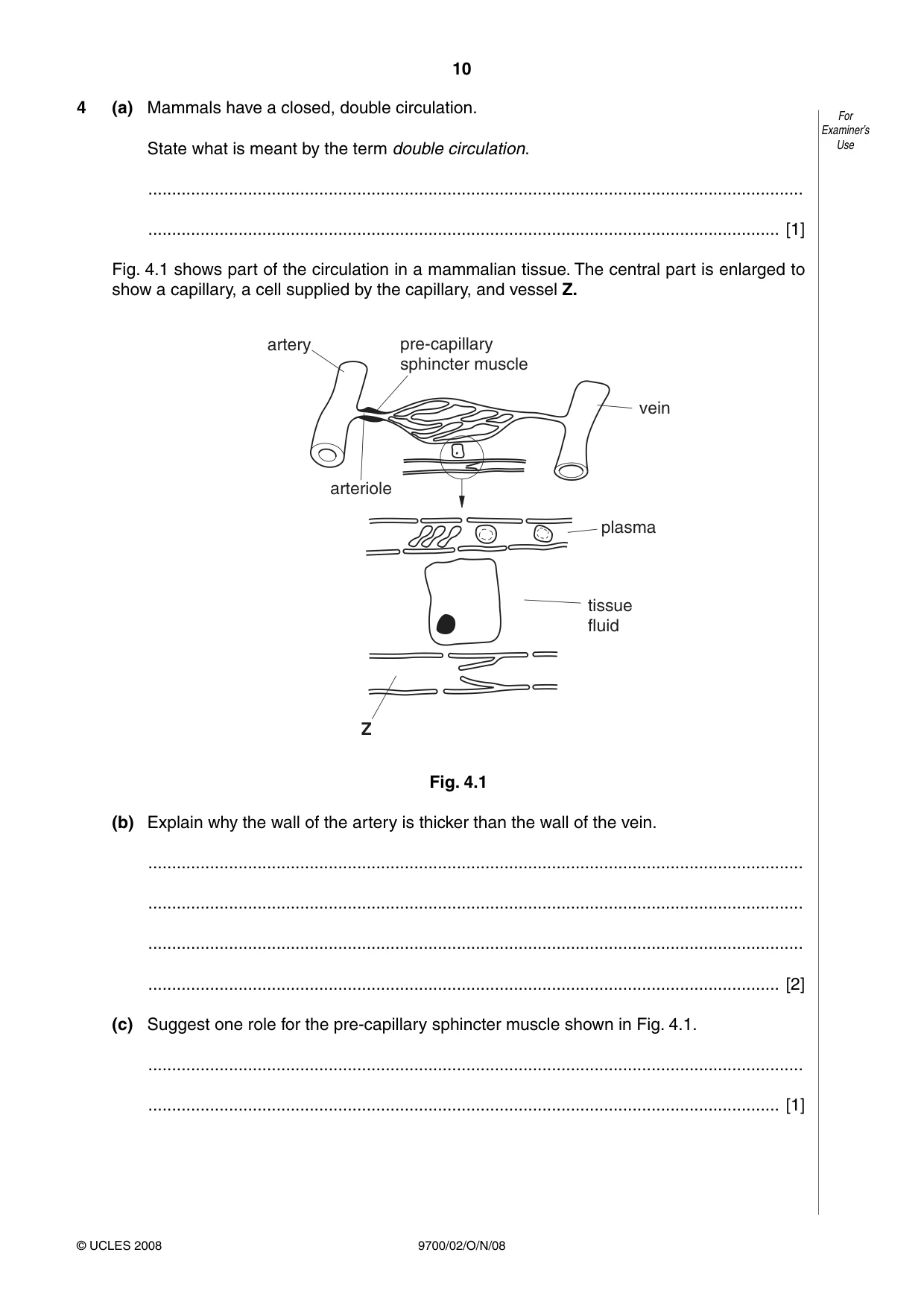
10 © UCLES 2008 For Examiner’s Use 9700/02/O/N/08 4 (a) Mammals have a closed, double circulation. State what is meant by the term double circulation. … … [1] Fig. 4.1 shows part of the circulation in a mammalian tissue. The central part is enlarged to show a capillary, a cell supplied by the capillary, and vessel Z. artery pre-capillary sphincter muscle arteriole vein plasma tissue fluid Z Fig. 4.1 (b) Explain why the wall of the artery is thicker than the wall of the vein. … … … … [2] (c) Suggest one role for the pre-capillary sphincter muscle shown in Fig. 4.1. … … [1]
Question paper, page 12
11 © UCLES 2008 [Turn over For Examiner’s Use 9700/02/O/N/08 (d) With reference to Fig. 4.1, describe the role of capillaries in forming tissue fluid. … … … … … … [3] (e) (i) Describe three ways in which plasma differs from tissue fluid. 1. … … 2. … … 3. … … [3] (ii) Name the fluid in vessel Z. … [1] [Total: 11]
Question paper, page 13
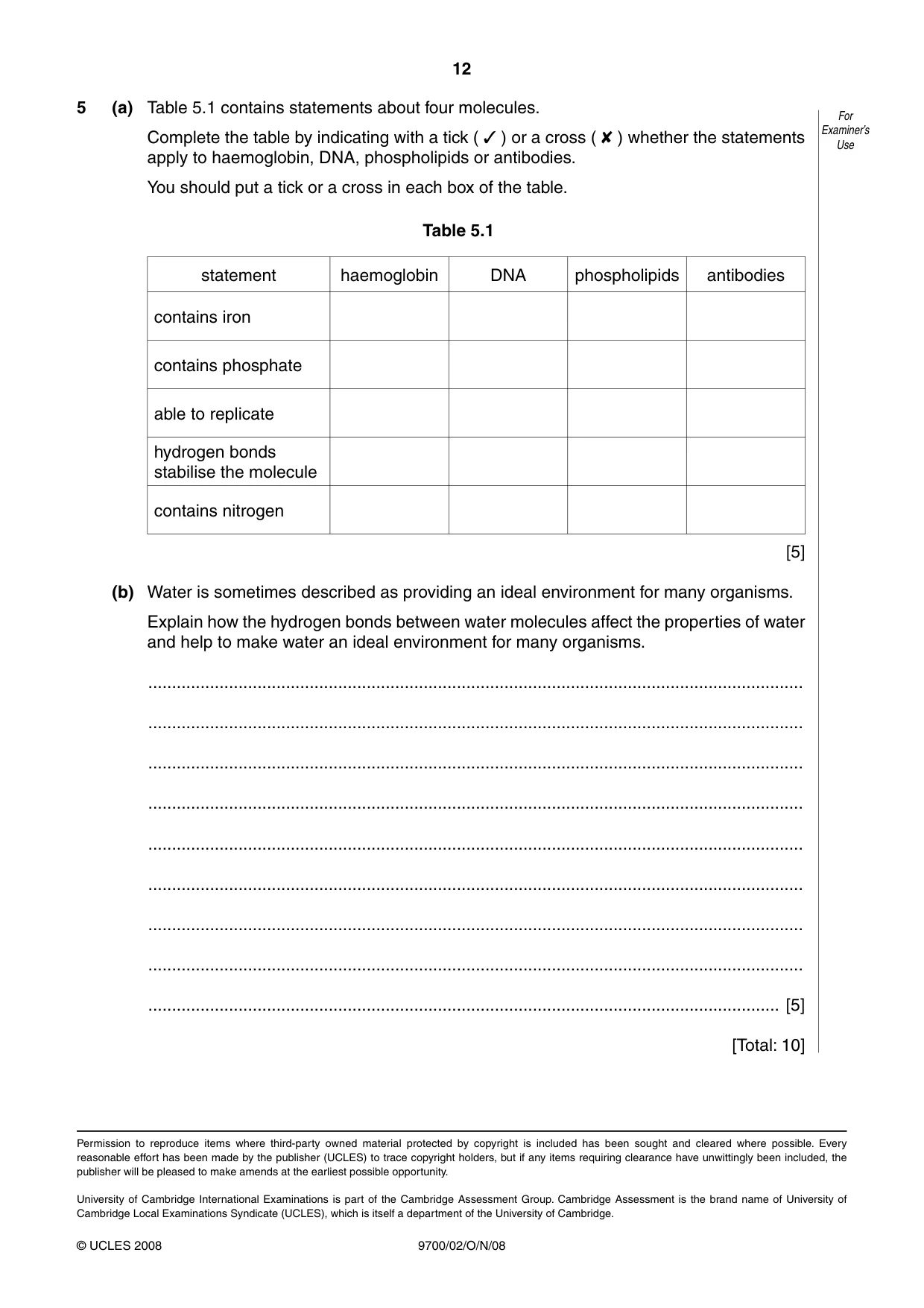
12 © UCLES 2008 9700/02/O/N/08 5 (a) Table 5.1 contains statements about four molecules. Complete the table by indicating with a tick ( ✓ ) or a cross ( ✘ ) whether the statements apply to haemoglobin, DNA, phospholipids or antibodies. You should put a tick or a cross in each box of the table. Table 5.1 statement haemoglobin DNA phospholipids antibodies contains iron contains phosphate able to replicate hydrogen bonds stabilise the molecule contains nitrogen [5] (b) Water is sometimes described as providing an ideal environment for many organisms. Explain how the hydrogen bonds between water molecules affect the properties of water and help to make water an ideal environment for many organisms. … … … … … … … … … [5] [Total: 10] For Examiner’s Use Permission to reproduce items where third-party owned material protected by copyright is included has been sought and cleared where possible. Every reasonable effort has been made by the publisher (UCLES) to trace copyright holders, but if any items requiring clearance have unwittingly been included, the publisher will be pleased to make amends at the earliest possible opportunity. University of Cambridge International Examinations is part of the Cambridge Assessment Group. Cambridge Assessment is the brand name of University of Cambridge Local Examinations Syndicate (UCLES), which is itself a department of the University of Cambridge.
Question paper, page 14
This document consists of 15 printed pages and 1 blank page. SP (SHW 00336 7/08) V00741/2 © UCLES 2008 [Turn over UNIVERSITY OF CAMBRIDGE INTERNATIONAL EXAMINATIONS General Certificate of Education Advanced Subsidiary Level and Advanced Level READ THESE INSTRUCTIONS FIRST Write your Centre number, candidate number and name in the spaces provided at the top of this page. Write in dark blue or black pen. You may use a soft pencil for any diagrams, graphs or rough working. Do not use staples, paper clips, highlighters, glue or correction fluid. DO NOT WRITE IN ANY BARCODES. Answer all questions. At the end of the examination, fasten all your work securely together. The number of marks is given in brackets [ ] at the end of each question or part question. * 2 1 5 4 7 6 0 1 3 5 * BIOLOGY 9700/02 Paper 2 Structured Questions AS October/November 2008 1 hour 15 minutes Candidates answer on the Question Paper. Additional Materials: Electronic calculator Ruler (cm/mm) For Examiner’s Use 1 2 3 4 5 6 Total Second Variant Question Paper
Question paper, page 15
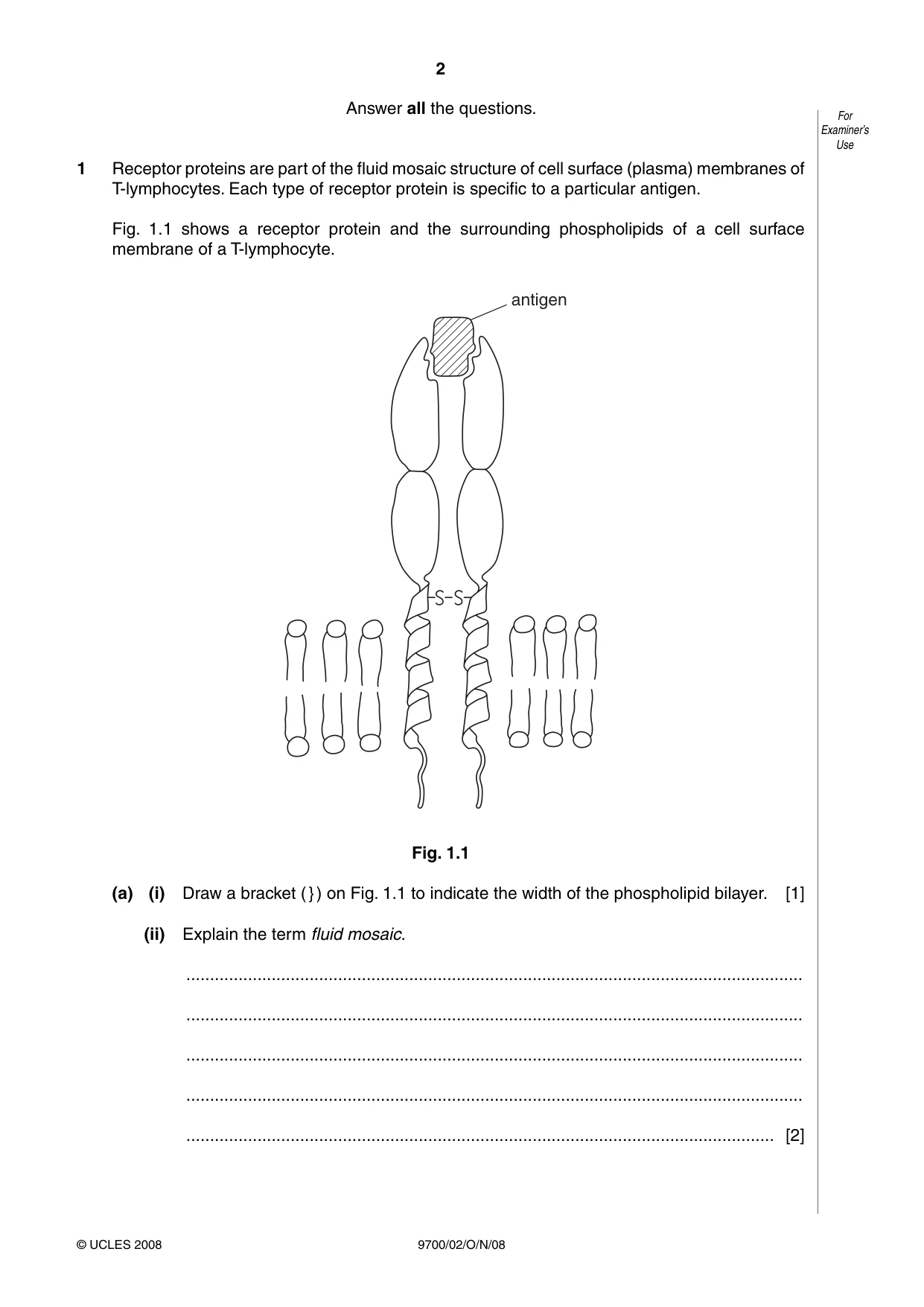
9700/02/O/N/08 © UCLES 2008 For Examiner’s Use Answer all the questions. 1 Receptor proteins are part of the fluid mosaic structure of cell surface (plasma) membranes of T-lymphocytes. Each type of receptor protein is specific to a particular antigen. Fig. 1.1 shows a receptor protein and the surrounding phospholipids of a cell surface membrane of a T-lymphocyte. antigen Fig. 1.1 (a) (i) Draw a bracket ( } ) on Fig. 1.1 to indicate the width of the phospholipid bilayer. [1] (ii) Explain the term fluid mosaic. … … … … … [2] 2
Question paper, page 16
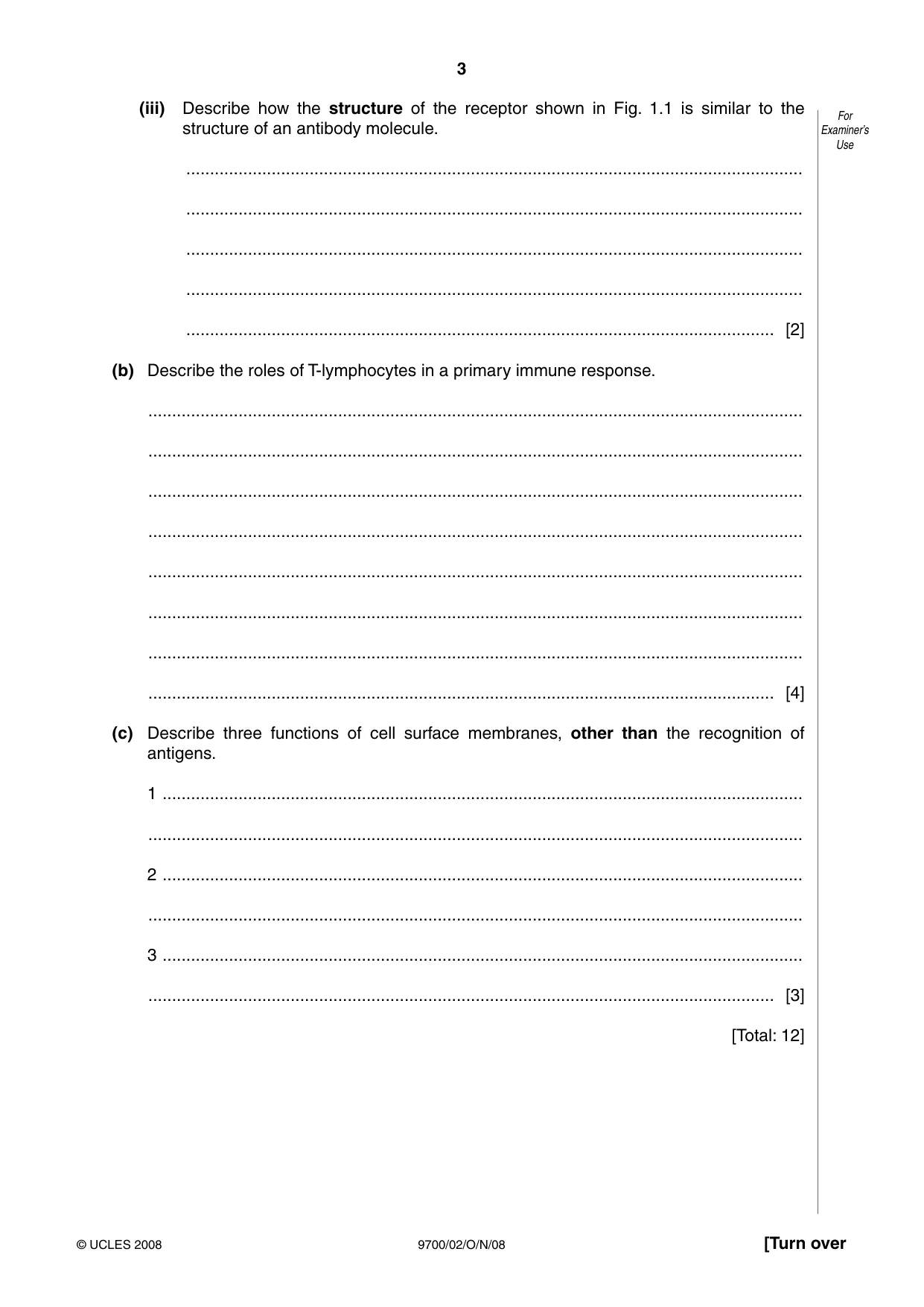
3 9700/02/O/N/08 © UCLES 2008 [Turn over For Examiner’s Use (iii) Describe how the structure of the receptor shown in Fig. 1.1 is similar to the structure of an antibody molecule. … … … … … [2] (b) Describe the roles of T-lymphocytes in a primary immune response. … … … … … … … … [4] (c) Describe three functions of cell surface membranes, other than the recognition of antigens. 1 … … 2 … … 3 … … [3] [Total: 12]
Question paper, page 17
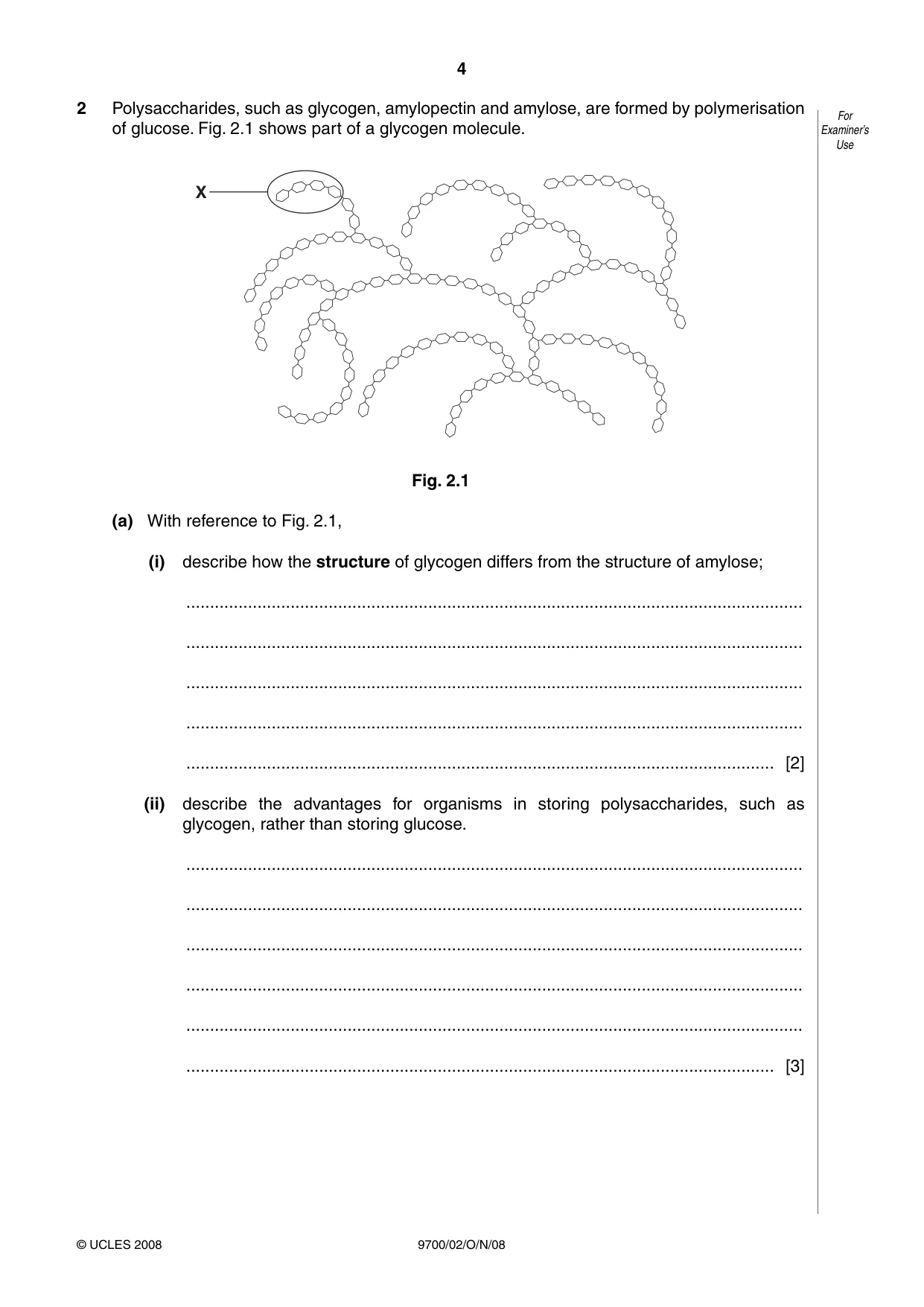
4 9700/02/O/N/08 © UCLES 2008 For Examiner’s Use 2 Polysaccharides, such as glycogen, amylopectin and amylose, are formed by polymerisation of glucose. Fig. 2.1 shows part of a glycogen molecule. X Fig. 2.1 (a) With reference to Fig. 2.1, (i) describe how the structure of glycogen differs from the structure of amylose; … … … … … [2] (ii) describe the advantages for organisms in storing polysaccharides, such as glycogen, rather than storing glucose. … … … … … … [3]
Question paper, page 18
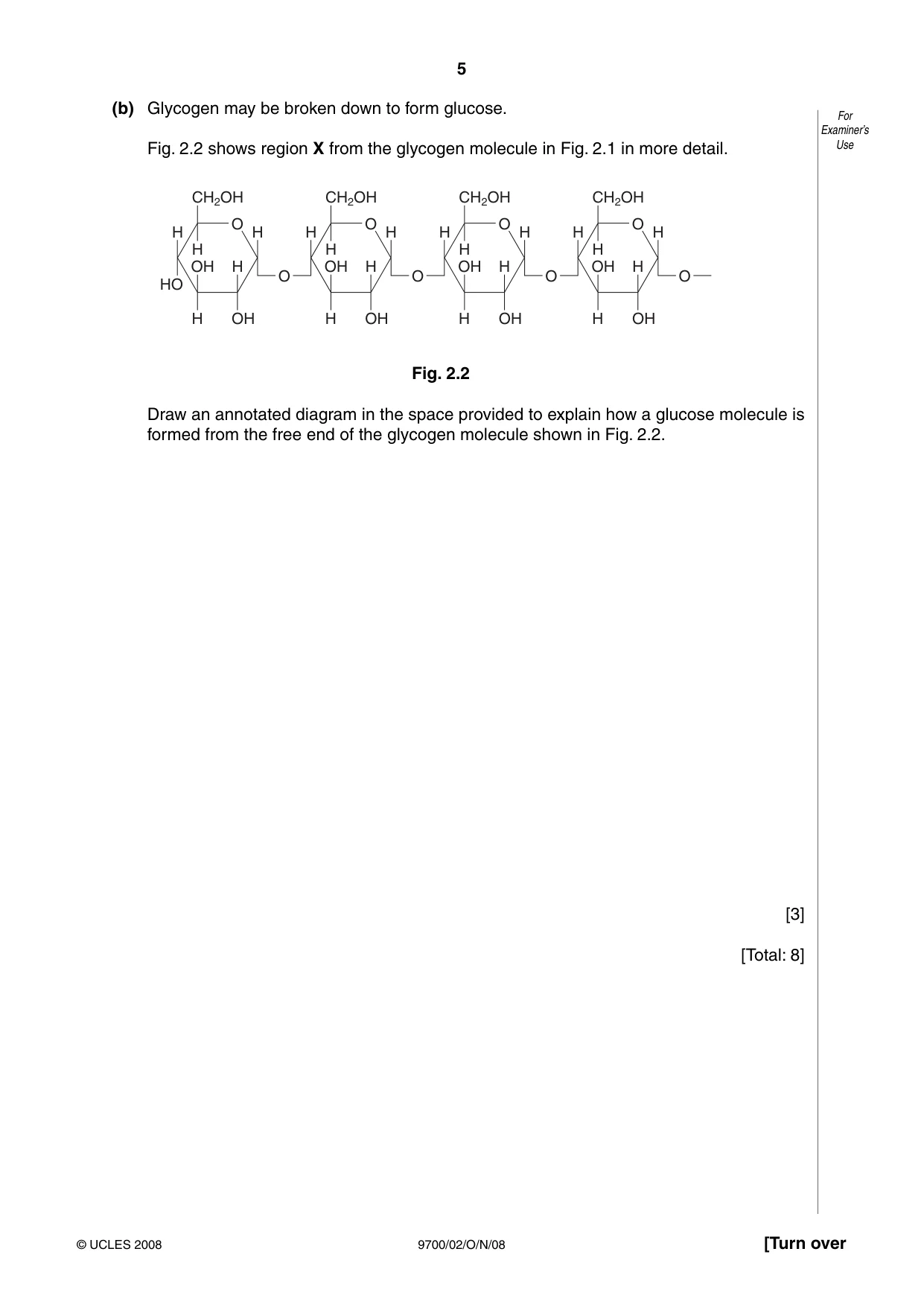
5 9700/02/O/N/08 © UCLES 2008 [Turn over For Examiner’s Use (b) Glycogen may be broken down to form glucose. Fig. 2.2 shows region X from the glycogen molecule in Fig. 2.1 in more detail. OH H OH CH2OH HO H H H H O O OH H OH CH2OH H H H H O O OH H OH CH2OH H H H H O O OH H OH CH2OH H H H H O O Fig. 2.2 Draw an annotated diagram in the space provided to explain how a glucose molecule is formed from the free end of the glycogen molecule shown in Fig. 2.2. [3] [Total: 8]
Question paper, page 19
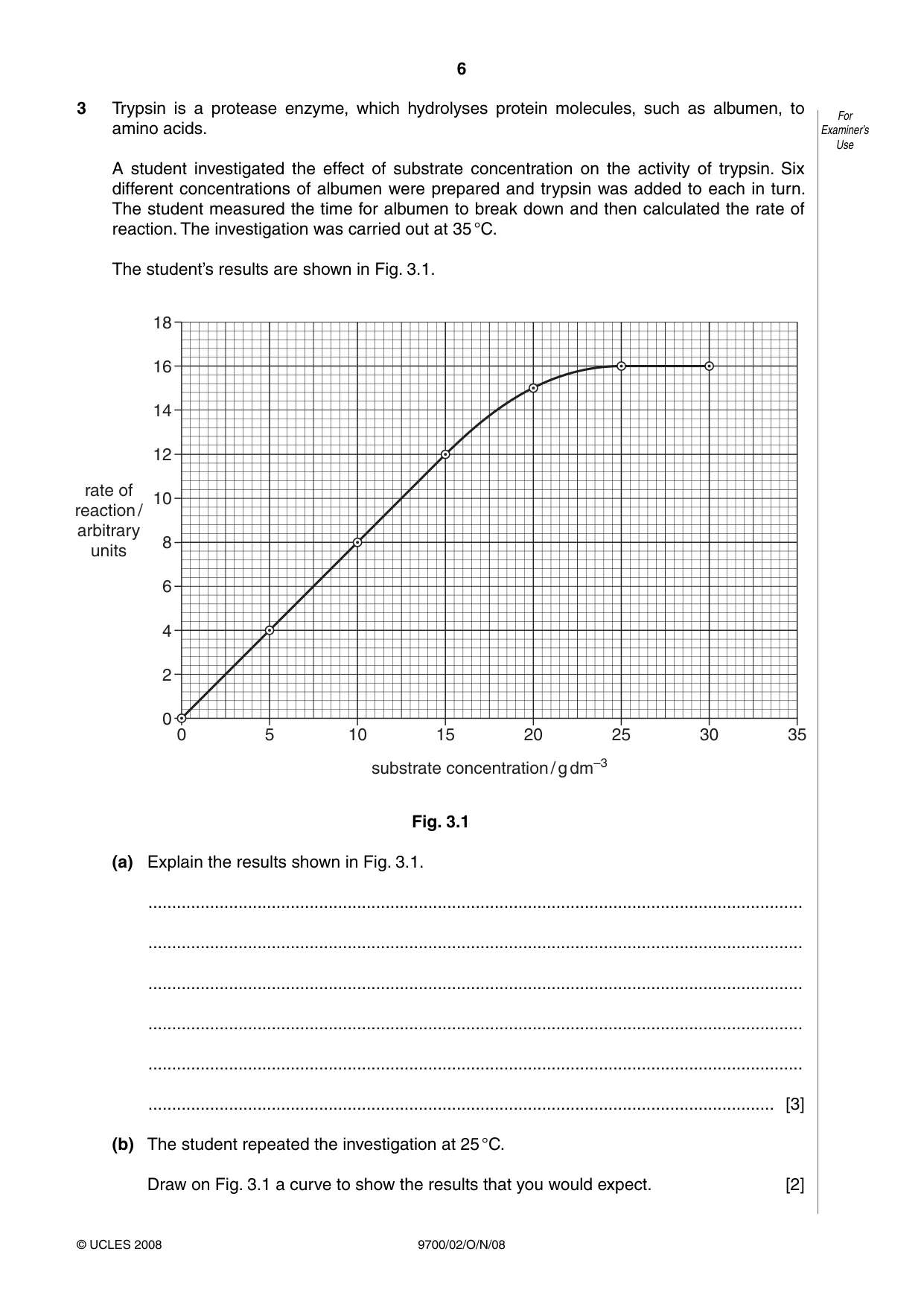
6 9700/02/O/N/08 © UCLES 2008 For Examiner’s Use 3 Trypsin is a protease enzyme, which hydrolyses protein molecules, such as albumen, to amino acids. A student investigated the effect of substrate concentration on the activity of trypsin. Six different concentrations of albumen were prepared and trypsin was added to each in turn. The student measured the time for albumen to break down and then calculated the rate of reaction. The investigation was carried out at 35 °C. The student’s results are shown in Fig. 3.1. 0 0 substrate concentration / g dm–3 rate of reaction / arbitrary units 5 10 15 20 25 30 35 2 4 6 8 10 12 14 16 18 Fig. 3.1 (a) Explain the results shown in Fig. 3.1. … … … … … … [3] (b) The student repeated the investigation at 25 °C. Draw on Fig. 3.1 a curve to show the results that you would expect. [2]
Question paper, page 20
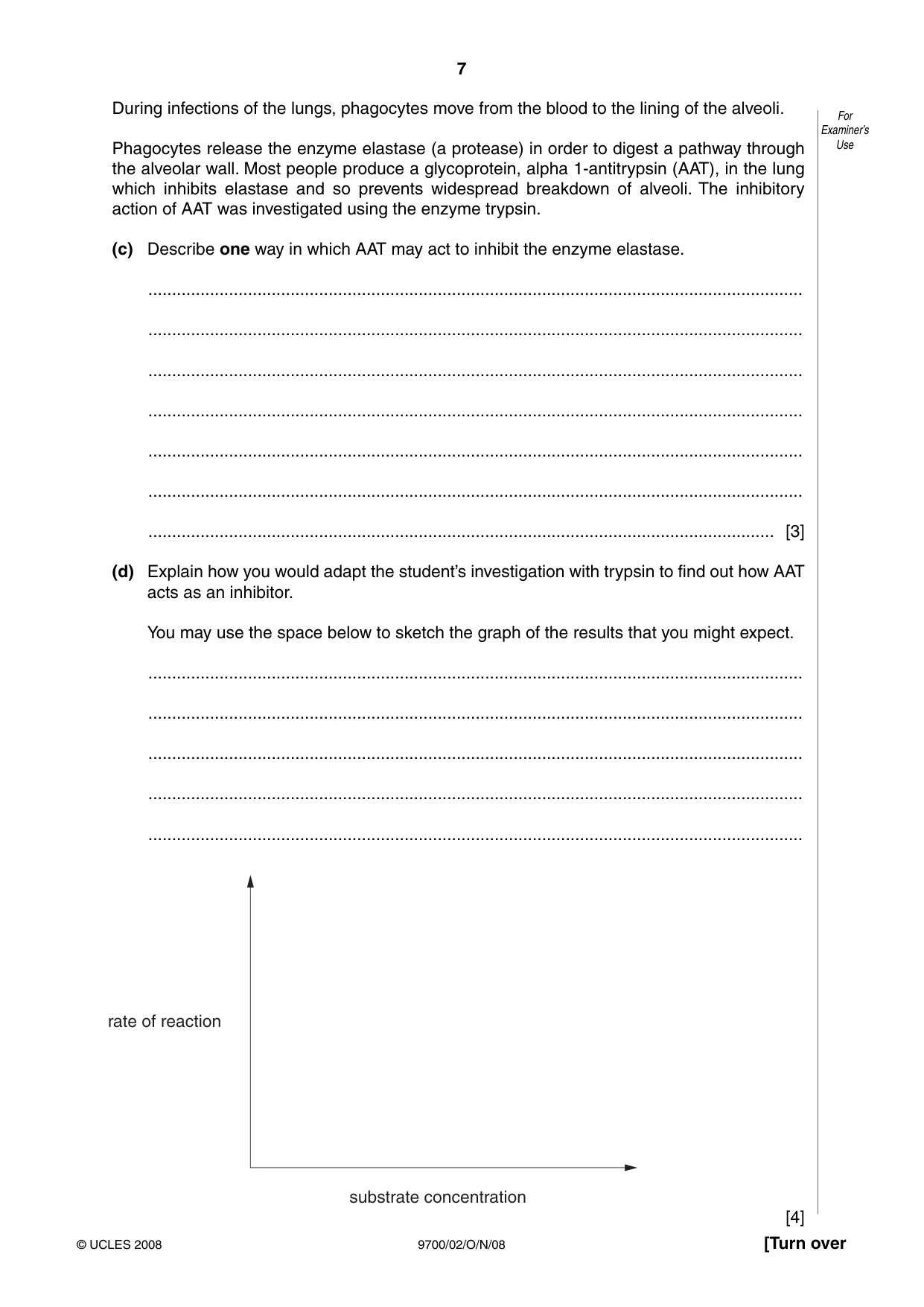
7 9700/02/O/N/08 © UCLES 2008 [Turn over For Examiner’s Use During infections of the lungs, phagocytes move from the blood to the lining of the alveoli. Phagocytes release the enzyme elastase (a protease) in order to digest a pathway through the alveolar wall. Most people produce a glycoprotein, alpha 1-antitrypsin (AAT), in the lung which inhibits elastase and so prevents widespread breakdown of alveoli. The inhibitory action of AAT was investigated using the enzyme trypsin. (c) Describe one way in which AAT may act to inhibit the enzyme elastase. … … … … … … … [3] (d) Explain how you would adapt the student’s investigation with trypsin to find out how AAT acts as an inhibitor. You may use the space below to sketch the graph of the results that you might expect. … … … … … substrate concentration rate of reaction [4]
Question paper, page 21
8 9700/02/O/N/08 © UCLES 2008 For Examiner’s Use (e) Elastase breaks down the protein elastin. Describe the function of elastin in the lungs. … … … … … [2] (f) Tobacco smoke inactivates AAT. In long-term smokers this can result in the breakdown of much of the elastin in the lungs. State the name of the condition that results from breakdown of elastin that occurs in some long-term smokers. … [1] [Total: 15]
Question paper, page 22
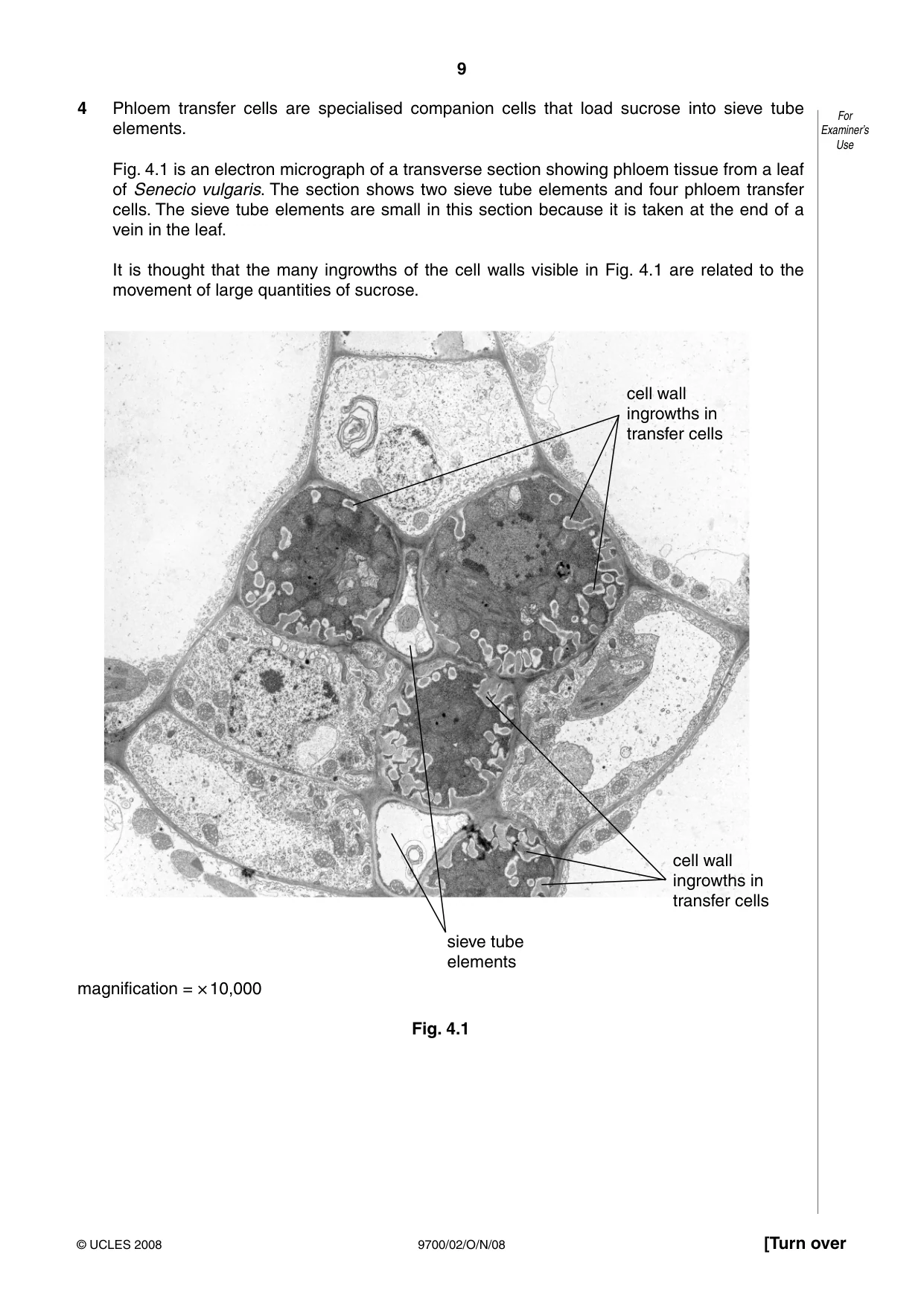
9 9700/02/O/N/08 © UCLES 2008 [Turn over For Examiner’s Use 4 Phloem transfer cells are specialised companion cells that load sucrose into sieve tube elements. Fig. 4.1 is an electron micrograph of a transverse section showing phloem tissue from a leaf of Senecio vulgaris. The section shows two sieve tube elements and four phloem transfer cells. The sieve tube elements are small in this section because it is taken at the end of a vein in the leaf. It is thought that the many ingrowths of the cell walls visible in Fig. 4.1 are related to the movement of large quantities of sucrose. cell wall ingrowths in transfer cells cell wall ingrowths in transfer cells sieve tube elements magnification = × 10,000 Fig. 4.1
Question paper, page 23
10 9700/02/O/N/08 © UCLES 2008 For Examiner’s Use (a) Describe how companion cells load sucrose into phloem sieve tubes. … … … … … … … … [4] (b) Transfer cells move large quantities of sucrose into phloem sieve tubes. Suggest why these cells have cell wall ingrowths as shown in Fig. 4.1. … … … … … [2] (c) (i) Explain the advantage of studying cells, such as transfer cells, with the electron microscope rather than the light microscope. … … … … … [2] (ii) Describe the appearance of the phloem sieve tubes when viewed in longitudinal section. … … … … … [2] [Total: 10]
Question paper, page 24
11 9700/02/O/N/08 © UCLES 2008 [Turn over For Examiner’s Use 5 Plasmodium falciparum is the causative agent of the most severe form of malaria. It is distributed throughout the tropics. (a) Explain why malaria is restricted to the tropics. … … … … … [2]
Question paper, page 25
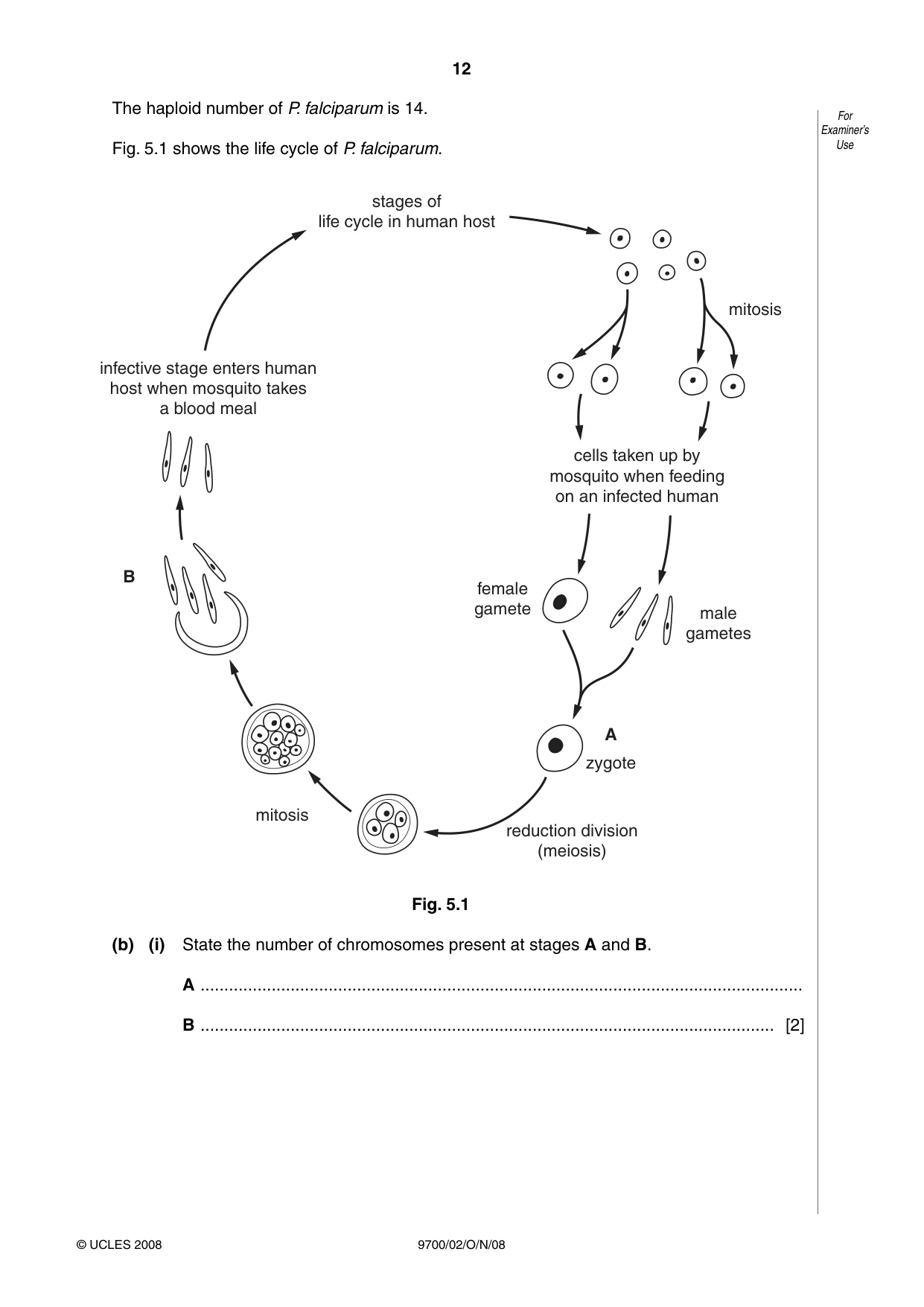
12 9700/02/O/N/08 © UCLES 2008 For Examiner’s Use The haploid number of P. falciparum is 14. Fig. 5.1 shows the life cycle of P. falciparum. stages of life cycle in human host mitosis cells taken up by mosquito when feeding on an infected human female gamete male gametes zygote reduction division (meiosis) A B mitosis infective stage enters human host when mosquito takes a blood meal Fig. 5.1 (b) (i) State the number of chromosomes present at stages A and B. A … B … [2]
Question paper, page 26
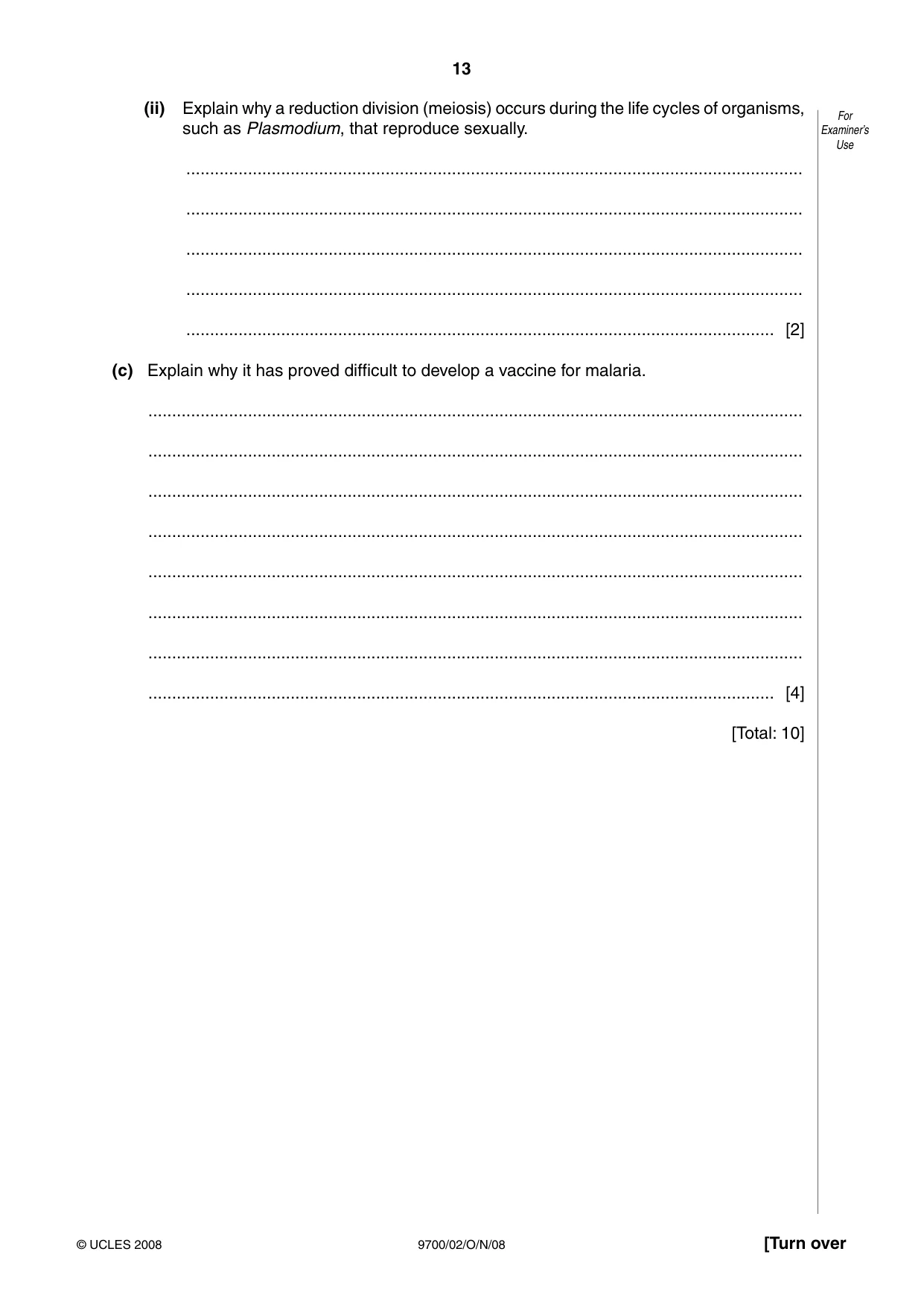
13 9700/02/O/N/08 © UCLES 2008 [Turn over For Examiner’s Use (ii) Explain why a reduction division (meiosis) occurs during the life cycles of organisms, such as Plasmodium, that reproduce sexually. … … … … … [2] (c) Explain why it has proved difficult to develop a vaccine for malaria. … … … … … … … … [4] [Total: 10]
Question paper, page 27
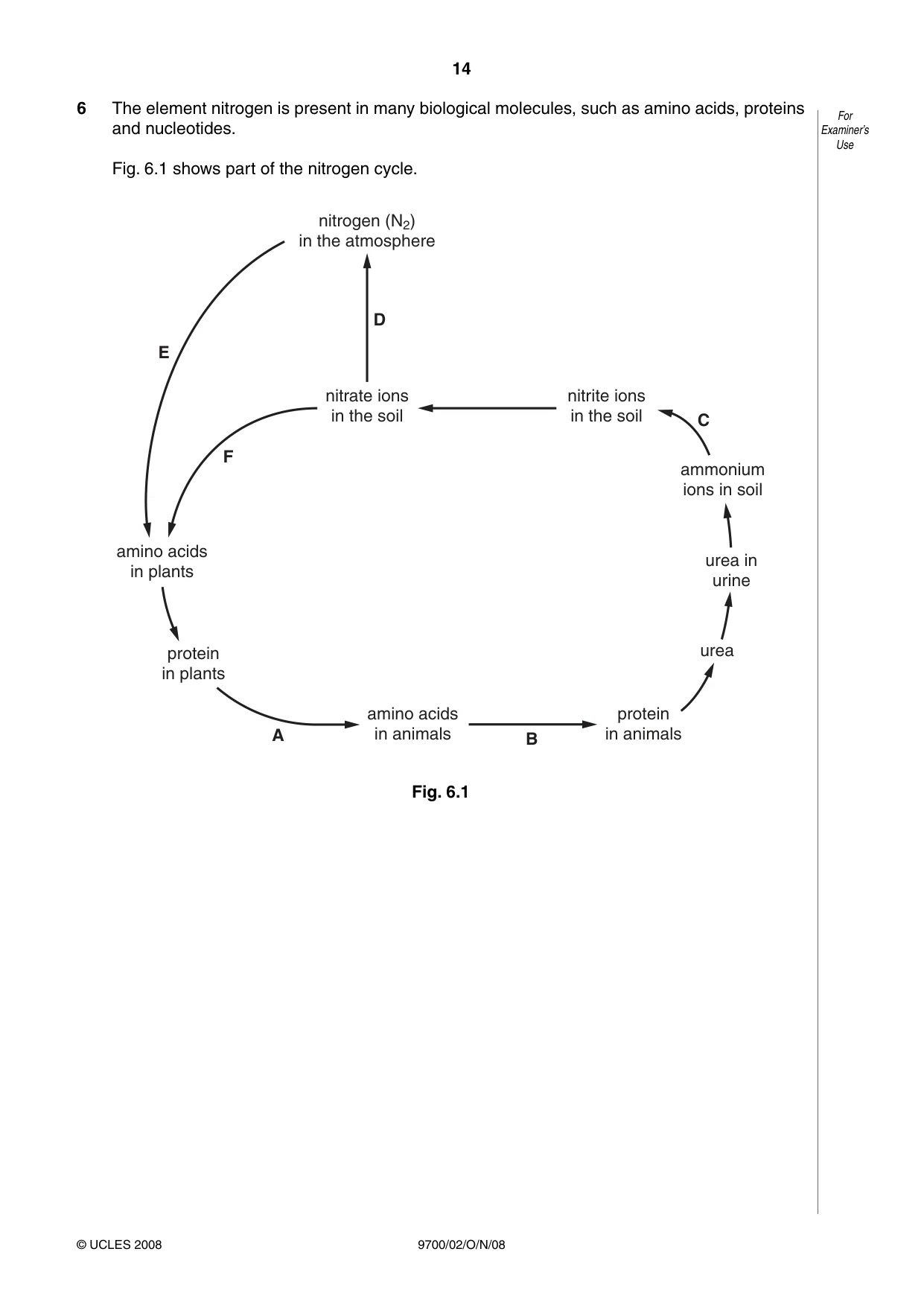
14 9700/02/O/N/08 © UCLES 2008 For Examiner’s Use 6 The element nitrogen is present in many biological molecules, such as amino acids, proteins and nucleotides. Fig. 6.1 shows part of the nitrogen cycle. nitrogen (N2) in the atmosphere nitrate ions in the soil nitrite ions in the soil ammonium ions in soil urea in urine urea protein in animals protein in plants amino acids in animals amino acids in plants E F A B C D Fig. 6.1
Question paper, page 28
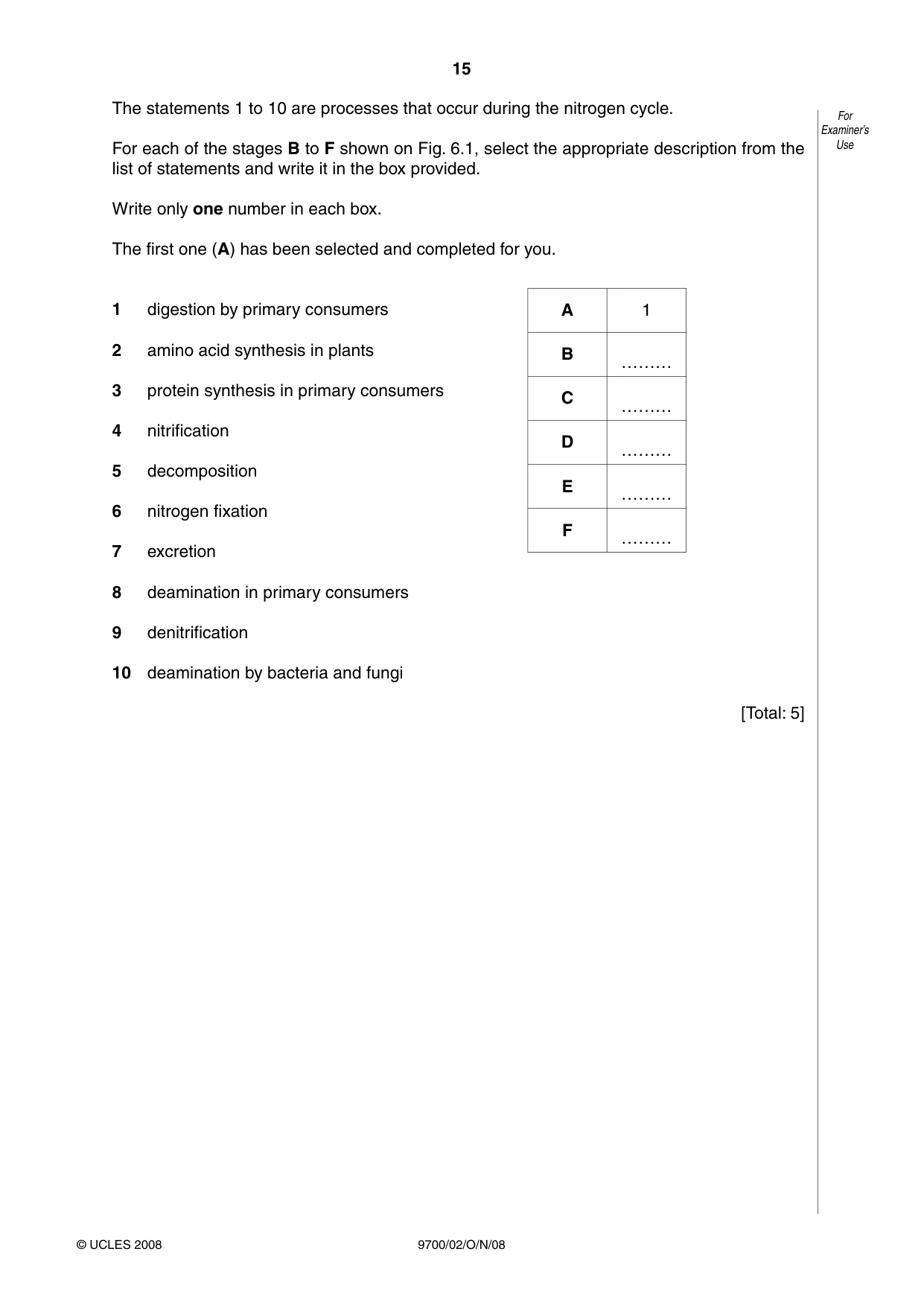
15 9700/02/O/N/08 © UCLES 2008 For Examiner’s Use The statements 1 to 10 are processes that occur during the nitrogen cycle. For each of the stages B to F shown on Fig. 6.1, select the appropriate description from the list of statements and write it in the box provided. Write only one number in each box. The first one (A) has been selected and completed for you. 1 digestion by primary consumers 2 amino acid synthesis in plants 3 protein synthesis in primary consumers 4 nitrification 5 decomposition 6 nitrogen fixation 7 excretion 8 deamination in primary consumers 9 denitrification 10 deamination by bacteria and fungi [Total: 5] A 1 B ……… C ……… D ……… E ……… F ………
Question paper, page 29
16 9700/02/O/N/08 BLANK PAGE Permission to reproduce items where third-party owned material protected by copyright is included has been sought and cleared where possible. Every reasonable effort has been made by the publisher (UCLES) to trace copyright holders, but if any items requiring clearance have unwittingly been included, the publisher will be pleased to make amends at the earliest possible opportunity. University of Cambridge International Examinations is part of the Cambridge Assessment Group. Cambridge Assessment is the brand name of University of Cambridge Local Examinations Syndicate (UCLES), which is itself a department of the University of Cambridge.
Mark scheme, page 1
Location Entry Codes As part of CIE’s continual commitment to maintaining best practice in assessment, CIE has begun to use different variants of some question papers for our most popular assessments with extremely large and widespread candidature, The question papers are closely related and the relationships between them have been thoroughly established using our assessment expertise. All versions of the paper give assessment of equal standard. The content assessed by the examination papers and the type of questions are unchanged. This change means that for this component there are now two variant Question Papers, Mark Schemes and Principal Examiner’s Reports where previously there was only one. For any individual country, it is intended that only one variant is used. This document contains both variants which will give all Centres access to even more past examination material than is usually the case. The diagram shows the relationship between the Question Papers, Mark Schemes and Principal Examiner’s Reports. Question Paper Mark Scheme Principal Examiner’s Report Introduction Introduction Introduction First variant Question Paper First variant Mark Scheme First variant Principal Examiner’s Report Second variant Question Paper Second variant Mark Scheme Second variant Principal Examiner’s Report Who can I contact for further information on these changes? Please direct any questions about this to CIE’s Customer Services team at: international@cie.org.uk
Mark scheme, page 2
UNIVERSITY OF CAMBRIDGE INTERNATIONAL EXAMINATIONS GCE Advanced Subsidiary Level and GCE Advanced Level MARK SCHEME for the October/November 2008 question paper 9700 BIOLOGY 9700/02 Paper 2 (Theory 1), maximum raw mark 60 This mark scheme is published as an aid to teachers and candidates, to indicate the requirements of the examination. It shows the basis on which Examiners were instructed to award marks. It does not indicate the details of the discussions that took place at an Examiners’ meeting before marking began. All Examiners are instructed that alternative correct answers and unexpected approaches in candidates’ scripts must be given marks that fairly reflect the relevant knowledge and skills demonstrated. Mark schemes must be read in conjunction with the question papers and the report on the examination. • CIE will not enter into discussions or correspondence in connection with these mark schemes. CIE is publishing the mark schemes for the October/November 2008 question papers for most IGCSE, GCE Advanced Level and Advanced Subsidiary Level syllabuses and some Ordinary Level syllabuses. First variant Mark Scheme
Mark scheme, page 3
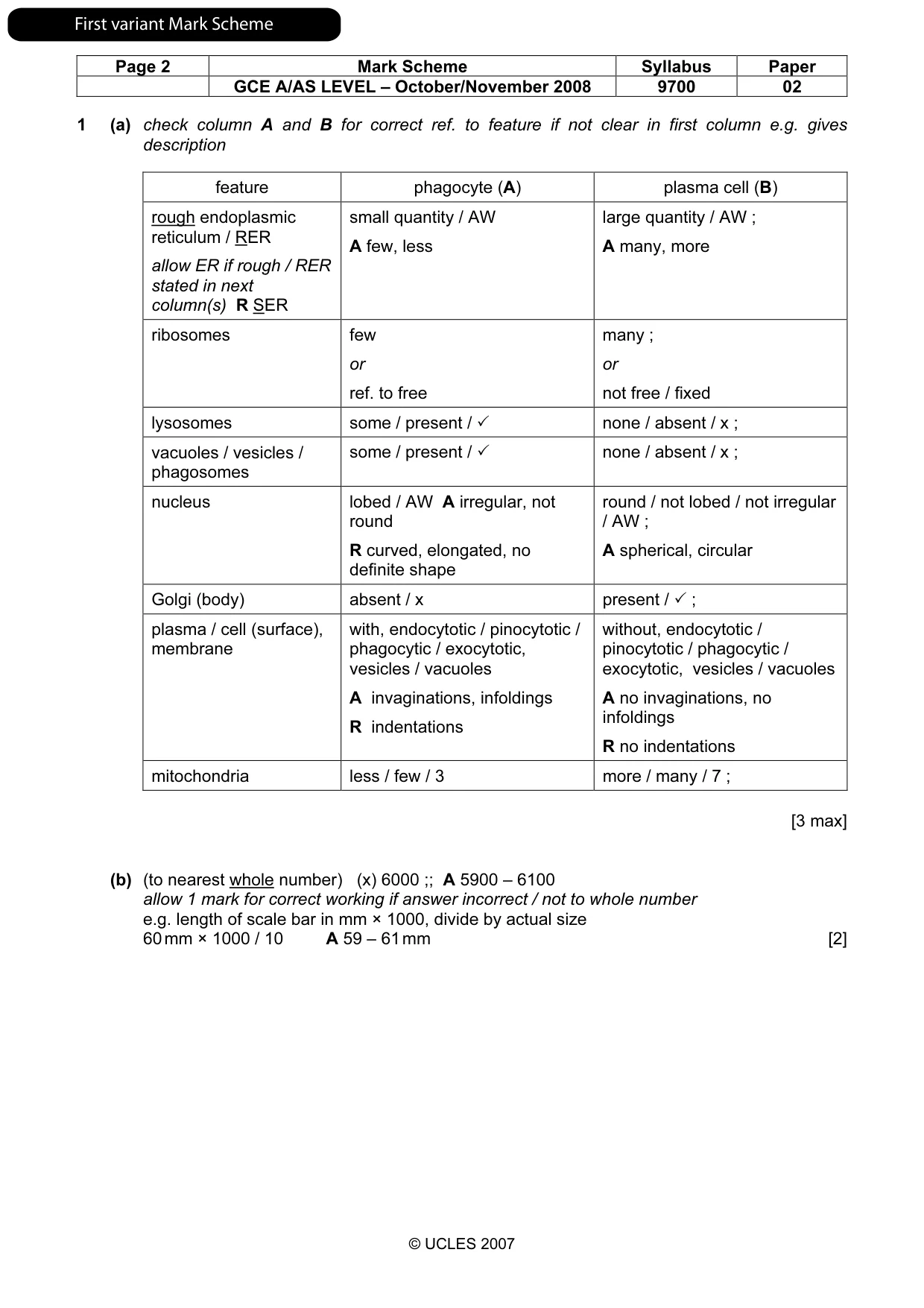
Page 2 Mark Scheme Syllabus Paper GCE A/AS LEVEL – October/November 2008 9700 02 © UCLES 2007 1 (a) check column A and B for correct ref. to feature if not clear in first column e.g. gives description feature phagocyte (A) plasma cell (B) rough endoplasmic reticulum / RER allow ER if rough / RER stated in next column(s) R SER small quantity / AW A few, less large quantity / AW ; A many, more ribosomes few or ref. to free many ; or not free / fixed lysosomes some / present / ✓ none / absent / x ; vacuoles / vesicles / phagosomes some / present / ✓ none / absent / x ; nucleus lobed / AW A irregular, not round R curved, elongated, no definite shape round / not lobed / not irregular / AW ; A spherical, circular Golgi (body) absent / x present / ✓ ; plasma / cell (surface), membrane with, endocytotic / pinocytotic / phagocytic / exocytotic, vesicles / vacuoles A invaginations, infoldings R indentations without, endocytotic / pinocytotic / phagocytic / exocytotic, vesicles / vacuoles A no invaginations, no infoldings R no indentations mitochondria less / few / 3 more / many / 7 ; [3 max] (b) (to nearest whole number) (x) 6000 ;; A 5900 – 6100 allow 1 mark for correct working if answer incorrect / not to whole number e.g. length of scale bar in mm × 1000, divide by actual size 60 mm × 1000 / 10 A 59 – 61 mm [2] First variant Mark Scheme
Mark scheme, page 4
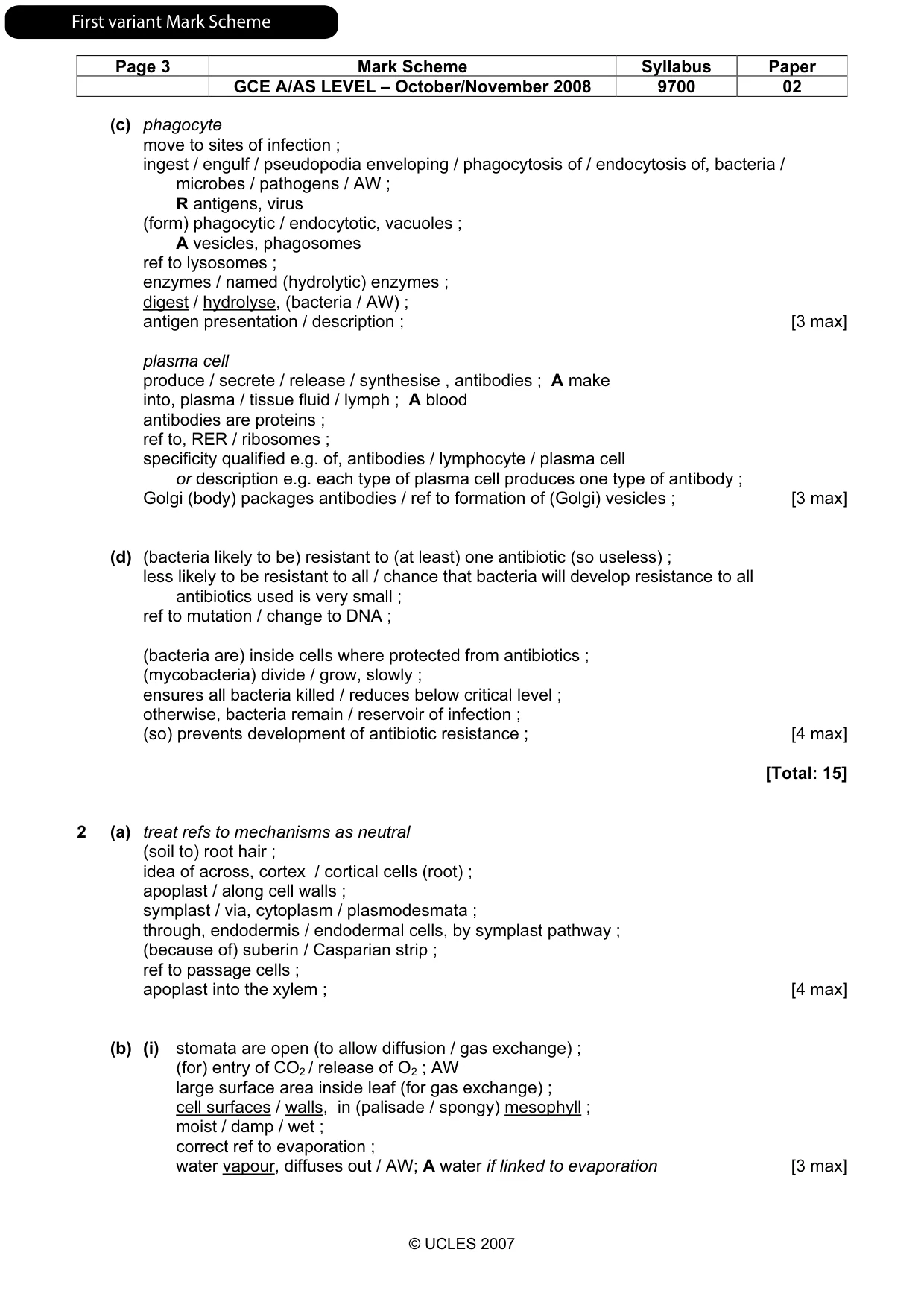
Page 3 Mark Scheme Syllabus Paper GCE A/AS LEVEL – October/November 2008 9700 02 © UCLES 2007 (c) phagocyte move to sites of infection ; ingest / engulf / pseudopodia enveloping / phagocytosis of / endocytosis of, bacteria / microbes / pathogens / AW ; R antigens, virus (form) phagocytic / endocytotic, vacuoles ; A vesicles, phagosomes ref to lysosomes ; enzymes / named (hydrolytic) enzymes ; digest / hydrolyse, (bacteria / AW) ; antigen presentation / description ; [3 max] plasma cell produce / secrete / release / synthesise , antibodies ; A make into, plasma / tissue fluid / lymph ; A blood antibodies are proteins ; ref to, RER / ribosomes ; specificity qualified e.g. of, antibodies / lymphocyte / plasma cell or description e.g. each type of plasma cell produces one type of antibody ; Golgi (body) packages antibodies / ref to formation of (Golgi) vesicles ; [3 max] (d) (bacteria likely to be) resistant to (at least) one antibiotic (so useless) ; less likely to be resistant to all / chance that bacteria will develop resistance to all antibiotics used is very small ; ref to mutation / change to DNA ; (bacteria are) inside cells where protected from antibiotics ; (mycobacteria) divide / grow, slowly ; ensures all bacteria killed / reduces below critical level ; otherwise, bacteria remain / reservoir of infection ; (so) prevents development of antibiotic resistance ; [4 max] [Total: 15] 2 (a) treat refs to mechanisms as neutral (soil to) root hair ; idea of across, cortex / cortical cells (root) ; apoplast / along cell walls ; symplast / via, cytoplasm / plasmodesmata ; through, endodermis / endodermal cells, by symplast pathway ; (because of) suberin / Casparian strip ; ref to passage cells ; apoplast into the xylem ; [4 max] (b) (i) stomata are open (to allow diffusion / gas exchange) ; (for) entry of CO2 / release of O2 ; AW large surface area inside leaf (for gas exchange) ; cell surfaces / walls, in (palisade / spongy) mesophyll ; moist / damp / wet ; correct ref to evaporation ; water vapour, diffuses out / AW; A water if linked to evaporation [3 max] First variant Mark Scheme
Mark scheme, page 5
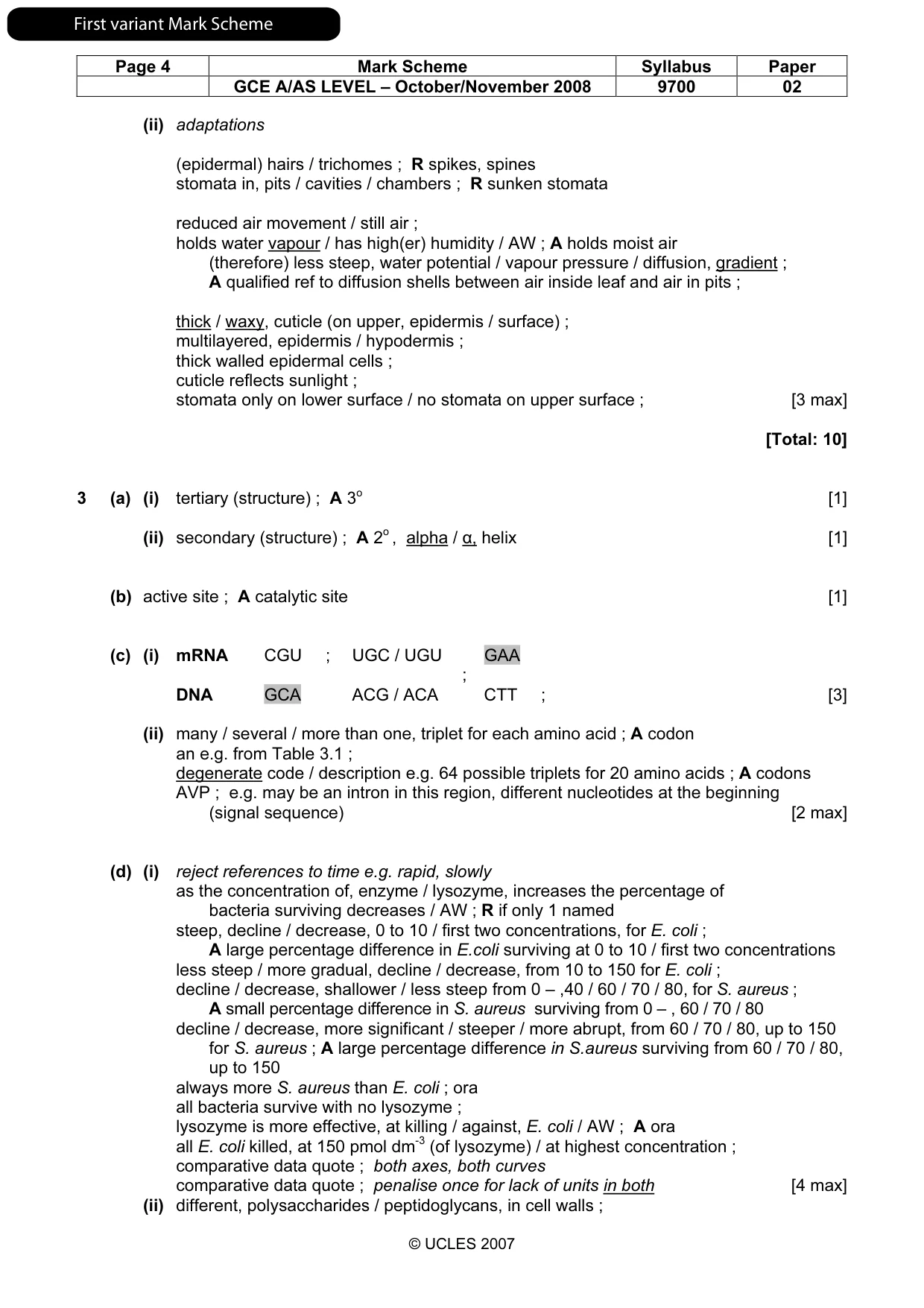
Page 4 Mark Scheme Syllabus Paper GCE A/AS LEVEL – October/November 2008 9700 02 © UCLES 2007 (ii) adaptations (epidermal) hairs / trichomes ; R spikes, spines stomata in, pits / cavities / chambers ; R sunken stomata reduced air movement / still air ; holds water vapour / has high(er) humidity / AW ; A holds moist air (therefore) less steep, water potential / vapour pressure / diffusion, gradient ; A qualified ref to diffusion shells between air inside leaf and air in pits ; thick / waxy, cuticle (on upper, epidermis / surface) ; multilayered, epidermis / hypodermis ; thick walled epidermal cells ; cuticle reflects sunlight ; stomata only on lower surface / no stomata on upper surface ; [3 max] [Total: 10] 3 (a) (i) tertiary (structure) ; A 3o [1] (ii) secondary (structure) ; A 2o , alpha / α, helix [1] (b) active site ; A catalytic site [1] (c) (i) mRNA CGU ; UGC / UGU GAA ; DNA GCA ACG / ACA CTT ; [3] (ii) many / several / more than one, triplet for each amino acid ; A codon an e.g. from Table 3.1 ; degenerate code / description e.g. 64 possible triplets for 20 amino acids ; A codons AVP ; e.g. may be an intron in this region, different nucleotides at the beginning (signal sequence) [2 max] (d) (i) reject references to time e.g. rapid, slowly as the concentration of, enzyme / lysozyme, increases the percentage of bacteria surviving decreases / AW ; R if only 1 named steep, decline / decrease, 0 to 10 / first two concentrations, for E. coli ; A large percentage difference in E.coli surviving at 0 to 10 / first two concentrations less steep / more gradual, decline / decrease, from 10 to 150 for E. coli ; decline / decrease, shallower / less steep from 0 – ,40 / 60 / 70 / 80, for S. aureus ; A small percentage difference in S. aureus surviving from 0 – , 60 / 70 / 80 decline / decrease, more significant / steeper / more abrupt, from 60 / 70 / 80, up to 150 for S. aureus ; A large percentage difference in S.aureus surviving from 60 / 70 / 80, up to 150 always more S. aureus than E. coli ; ora all bacteria survive with no lysozyme ; lysozyme is more effective, at killing / against, E. coli / AW ; A ora all E. coli killed, at 150 pmol dm-3 (of lysozyme) / at highest concentration ; comparative data quote ; both axes, both curves comparative data quote ; penalise once for lack of units in both [4 max] (ii) different, polysaccharides / peptidoglycans, in cell walls ; First variant Mark Scheme
Mark scheme, page 6
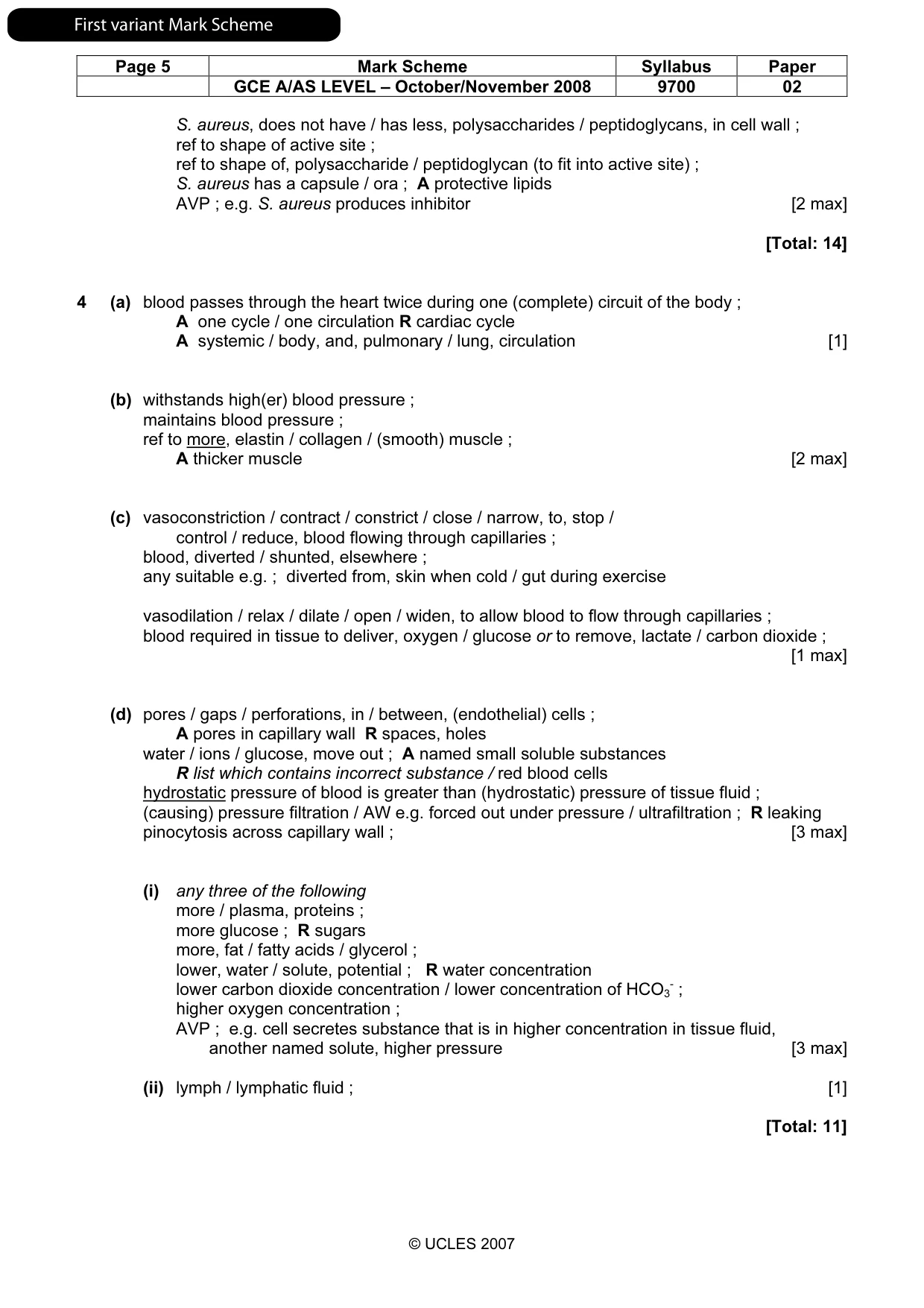
Page 5 Mark Scheme Syllabus Paper GCE A/AS LEVEL – October/November 2008 9700 02 © UCLES 2007 S. aureus, does not have / has less, polysaccharides / peptidoglycans, in cell wall ; ref to shape of active site ; ref to shape of, polysaccharide / peptidoglycan (to fit into active site) ; S. aureus has a capsule / ora ; A protective lipids AVP ; e.g. S. aureus produces inhibitor [2 max] [Total: 14] 4 (a) blood passes through the heart twice during one (complete) circuit of the body ; A one cycle / one circulation R cardiac cycle A systemic / body, and, pulmonary / lung, circulation [1] (b) withstands high(er) blood pressure ; maintains blood pressure ; ref to more, elastin / collagen / (smooth) muscle ; A thicker muscle [2 max] (c) vasoconstriction / contract / constrict / close / narrow, to, stop / control / reduce, blood flowing through capillaries ; blood, diverted / shunted, elsewhere ; any suitable e.g. ; diverted from, skin when cold / gut during exercise vasodilation / relax / dilate / open / widen, to allow blood to flow through capillaries ; blood required in tissue to deliver, oxygen / glucose or to remove, lactate / carbon dioxide ; [1 max] (d) pores / gaps / perforations, in / between, (endothelial) cells ; A pores in capillary wall R spaces, holes water / ions / glucose, move out ; A named small soluble substances R list which contains incorrect substance / red blood cells hydrostatic pressure of blood is greater than (hydrostatic) pressure of tissue fluid ; (causing) pressure filtration / AW e.g. forced out under pressure / ultrafiltration ; R leaking pinocytosis across capillary wall ; [3 max] (i) any three of the following more / plasma, proteins ; more glucose ; R sugars more, fat / fatty acids / glycerol ; lower, water / solute, potential ; R water concentration lower carbon dioxide concentration / lower concentration of HCO3 - ; higher oxygen concentration ; AVP ; e.g. cell secretes substance that is in higher concentration in tissue fluid, another named solute, higher pressure [3 max] (ii) lymph / lymphatic fluid ; [1] [Total: 11] First variant Mark Scheme
Mark scheme, page 7
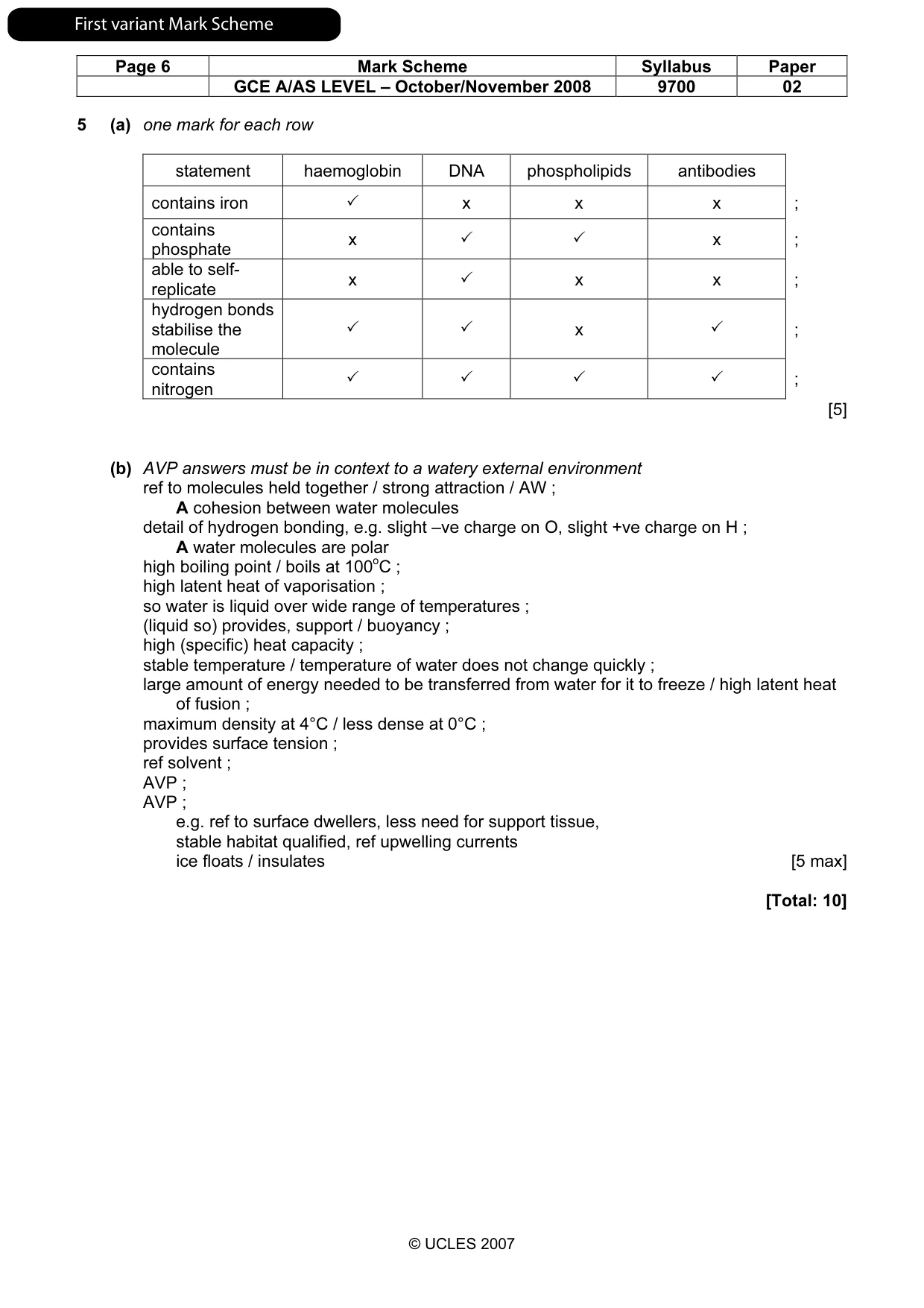
Page 6 Mark Scheme Syllabus Paper GCE A/AS LEVEL – October/November 2008 9700 02 © UCLES 2007 5 (a) one mark for each row statement haemoglobin DNA phospholipids antibodies contains iron ✓ x x x ; contains phosphate x ✓ ✓ x ; able to self- replicate x ✓ x x ; hydrogen bonds stabilise the molecule ✓ ✓ x ✓ ; contains nitrogen ✓ ✓ ✓ ✓ ; [5] (b) AVP answers must be in context to a watery external environment ref to molecules held together / strong attraction / AW ; A cohesion between water molecules detail of hydrogen bonding, e.g. slight –ve charge on O, slight +ve charge on H ; A water molecules are polar high boiling point / boils at 100oC ; high latent heat of vaporisation ; so water is liquid over wide range of temperatures ; (liquid so) provides, support / buoyancy ; high (specific) heat capacity ; stable temperature / temperature of water does not change quickly ; large amount of energy needed to be transferred from water for it to freeze / high latent heat of fusion ; maximum density at 4°C / less dense at 0°C ; provides surface tension ; ref solvent ; AVP ; AVP ; e.g. ref to surface dwellers, less need for support tissue, stable habitat qualified, ref upwelling currents ice floats / insulates [5 max] [Total: 10] First variant Mark Scheme
Mark scheme, page 8
UNIVERSITY OF CAMBRIDGE INTERNATIONAL EXAMINATIONS GCE Advanced Subsidiary Level and GCE Advanced Level MARK SCHEME for the October/November 2008 question paper 9700 BIOLOGY 9700/02 Paper 2 (Theory 1), maximum raw mark 60 This mark scheme is published as an aid to teachers and candidates, to indicate the requirements of the examination. It shows the basis on which Examiners were instructed to award marks. It does not indicate the details of the discussions that took place at an Examiners’ meeting before marking began. All Examiners are instructed that alternative correct answers and unexpected approaches in candidates’ scripts must be given marks that fairly reflect the relevant knowledge and skills demonstrated. Mark schemes must be read in conjunction with the question papers and the report on the examination. • CIE will not enter into discussions or correspondence in connection with these mark schemes. CIE is publishing the mark schemes for the October/November 2008 question papers for most IGCSE, GCE Advanced Level and Advanced Subsidiary Level syllabuses and some Ordinary Level syllabuses. Second variant Mark Scheme
Mark scheme, page 9
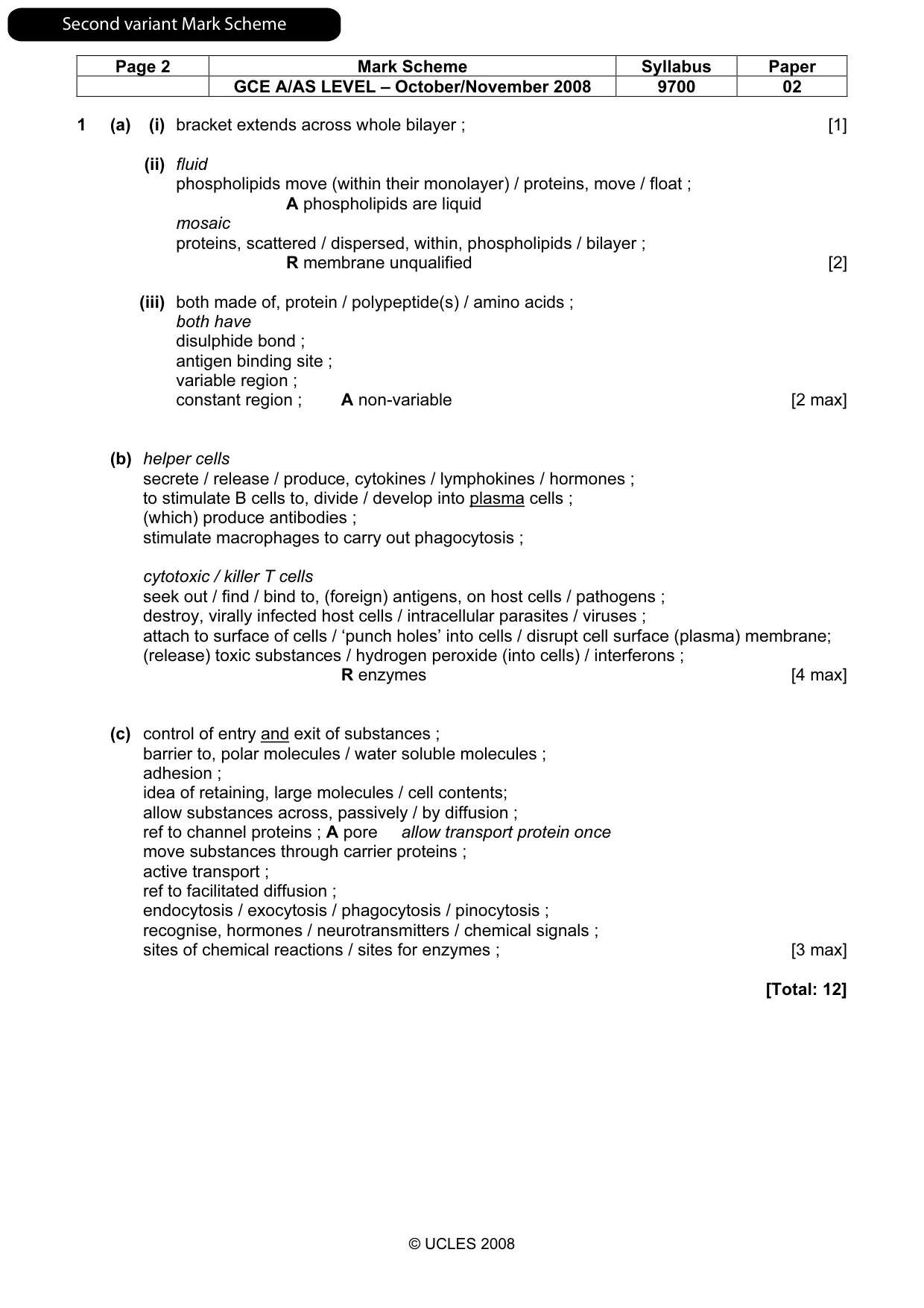
Page 2 Mark Scheme Syllabus Paper GCE A/AS LEVEL – October/November 2008 9700 02 © UCLES 2008 1 (a) (i) bracket extends across whole bilayer ; [1] (ii) fluid phospholipids move (within their monolayer) / proteins, move / float ; A phospholipids are liquid mosaic proteins, scattered / dispersed, within, phospholipids / bilayer ; R membrane unqualified [2] (iii) both made of, protein / polypeptide(s) / amino acids ; both have disulphide bond ; antigen binding site ; variable region ; constant region ; A non-variable [2 max] (b) helper cells secrete / release / produce, cytokines / lymphokines / hormones ; to stimulate B cells to, divide / develop into plasma cells ; (which) produce antibodies ; stimulate macrophages to carry out phagocytosis ; cytotoxic / killer T cells seek out / find / bind to, (foreign) antigens, on host cells / pathogens ; destroy, virally infected host cells / intracellular parasites / viruses ; attach to surface of cells / ‘punch holes’ into cells / disrupt cell surface (plasma) membrane; (release) toxic substances / hydrogen peroxide (into cells) / interferons ; R enzymes [4 max] (c) control of entry and exit of substances ; barrier to, polar molecules / water soluble molecules ; adhesion ; idea of retaining, large molecules / cell contents; allow substances across, passively / by diffusion ; ref to channel proteins ; A pore allow transport protein once move substances through carrier proteins ; active transport ; ref to facilitated diffusion ; endocytosis / exocytosis / phagocytosis / pinocytosis ; recognise, hormones / neurotransmitters / chemical signals ; sites of chemical reactions / sites for enzymes ; [3 max] [Total: 12] Second variant Mark Scheme
Mark scheme, page 10
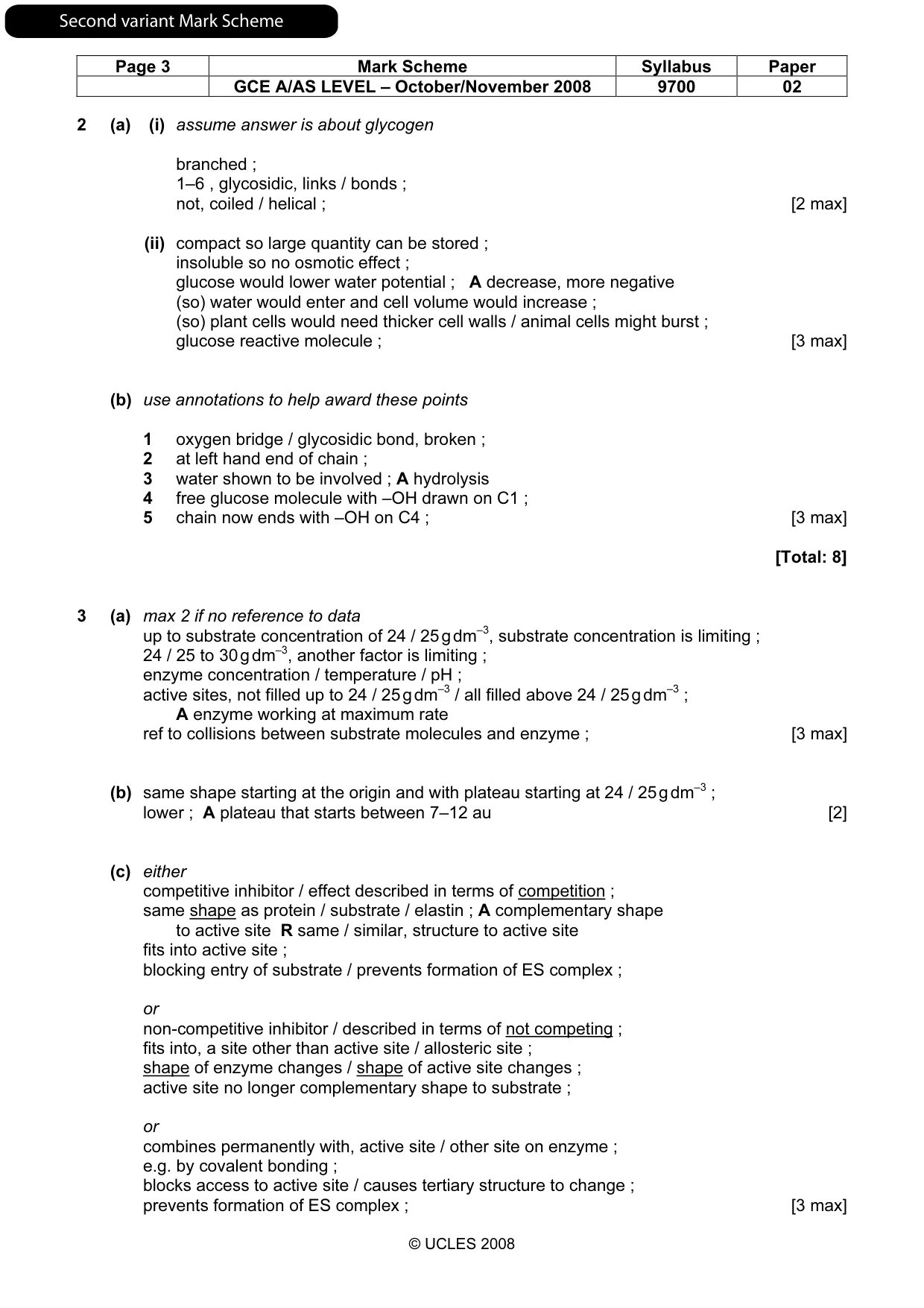
Page 3 Mark Scheme Syllabus Paper GCE A/AS LEVEL – October/November 2008 9700 02 © UCLES 2008 2 (a) (i) assume answer is about glycogen branched ; 1–6 , glycosidic, links / bonds ; not, coiled / helical ; [2 max] (ii) compact so large quantity can be stored ; insoluble so no osmotic effect ; glucose would lower water potential ; A decrease, more negative (so) water would enter and cell volume would increase ; (so) plant cells would need thicker cell walls / animal cells might burst ; glucose reactive molecule ; [3 max] (b) use annotations to help award these points 1 oxygen bridge / glycosidic bond, broken ; 2 at left hand end of chain ; 3 water shown to be involved ; A hydrolysis 4 free glucose molecule with –OH drawn on C1 ; 5 chain now ends with –OH on C4 ; [3 max] [Total: 8] 3 (a) max 2 if no reference to data up to substrate concentration of 24 / 25 g dm–3, substrate concentration is limiting ; 24 / 25 to 30 g dm–3, another factor is limiting ; enzyme concentration / temperature / pH ; active sites, not filled up to 24 / 25 g dm–3 / all filled above 24 / 25 g dm–3 ; A enzyme working at maximum rate ref to collisions between substrate molecules and enzyme ; [3 max] (b) same shape starting at the origin and with plateau starting at 24 / 25 g dm–3 ; lower ; A plateau that starts between 7–12 au [2] (c) either competitive inhibitor / effect described in terms of competition ; same shape as protein / substrate / elastin ; A complementary shape to active site R same / similar, structure to active site fits into active site ; blocking entry of substrate / prevents formation of ES complex ; or non-competitive inhibitor / described in terms of not competing ; fits into, a site other than active site / allosteric site ; shape of enzyme changes / shape of active site changes ; active site no longer complementary shape to substrate ; or combines permanently with, active site / other site on enzyme ; e.g. by covalent bonding ; blocks access to active site / causes tertiary structure to change ; prevents formation of ES complex ; [3 max] Second variant Mark Scheme
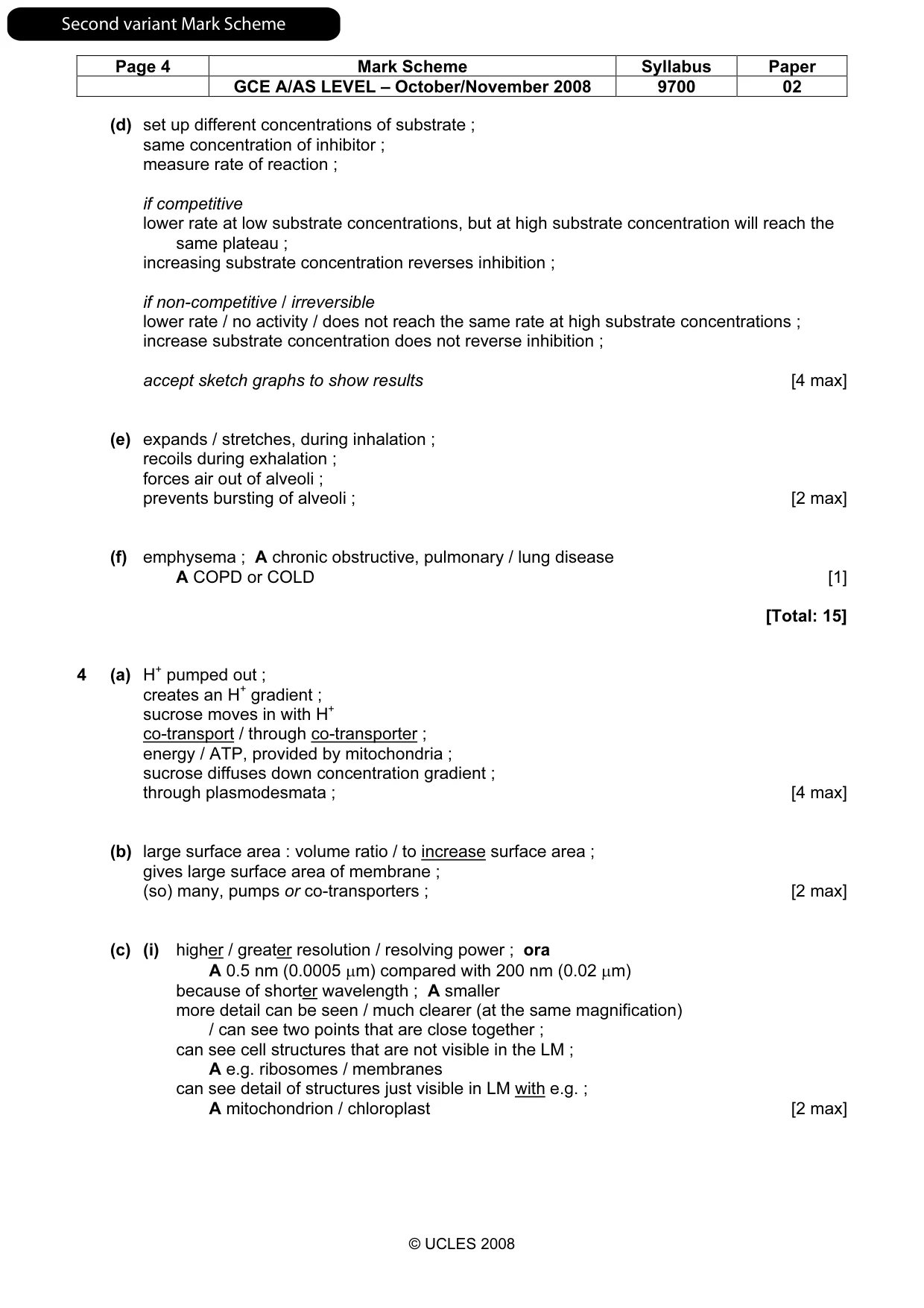
Mark scheme, page 11
Page 4 Mark Scheme Syllabus Paper GCE A/AS LEVEL – October/November 2008 9700 02 © UCLES 2008 (d) set up different concentrations of substrate ; same concentration of inhibitor ; measure rate of reaction ; if competitive lower rate at low substrate concentrations, but at high substrate concentration will reach the same plateau ; increasing substrate concentration reverses inhibition ; if non-competitive / irreversible lower rate / no activity / does not reach the same rate at high substrate concentrations ; increase substrate concentration does not reverse inhibition ; accept sketch graphs to show results [4 max] (e) expands / stretches, during inhalation ; recoils during exhalation ; forces air out of alveoli ; prevents bursting of alveoli ; [2 max] (f) emphysema ; A chronic obstructive, pulmonary / lung disease A COPD or COLD [1] [Total: 15] 4 (a) H+ pumped out ; creates an H+ gradient ; sucrose moves in with H+ co-transport / through co-transporter ; energy / ATP, provided by mitochondria ; sucrose diffuses down concentration gradient ; through plasmodesmata ; [4 max] (b) large surface area : volume ratio / to increase surface area ; gives large surface area of membrane ; (so) many, pumps or co-transporters ; [2 max] (c) (i) higher / greater resolution / resolving power ; ora A 0.5 nm (0.0005 µm) compared with 200 nm (0.02 µm) because of shorter wavelength ; A smaller more detail can be seen / much clearer (at the same magnification) / can see two points that are close together ; can see cell structures that are not visible in the LM ; A e.g. ribosomes / membranes can see detail of structures just visible in LM with e.g. ; A mitochondrion / chloroplast [2 max] Second variant Mark Scheme
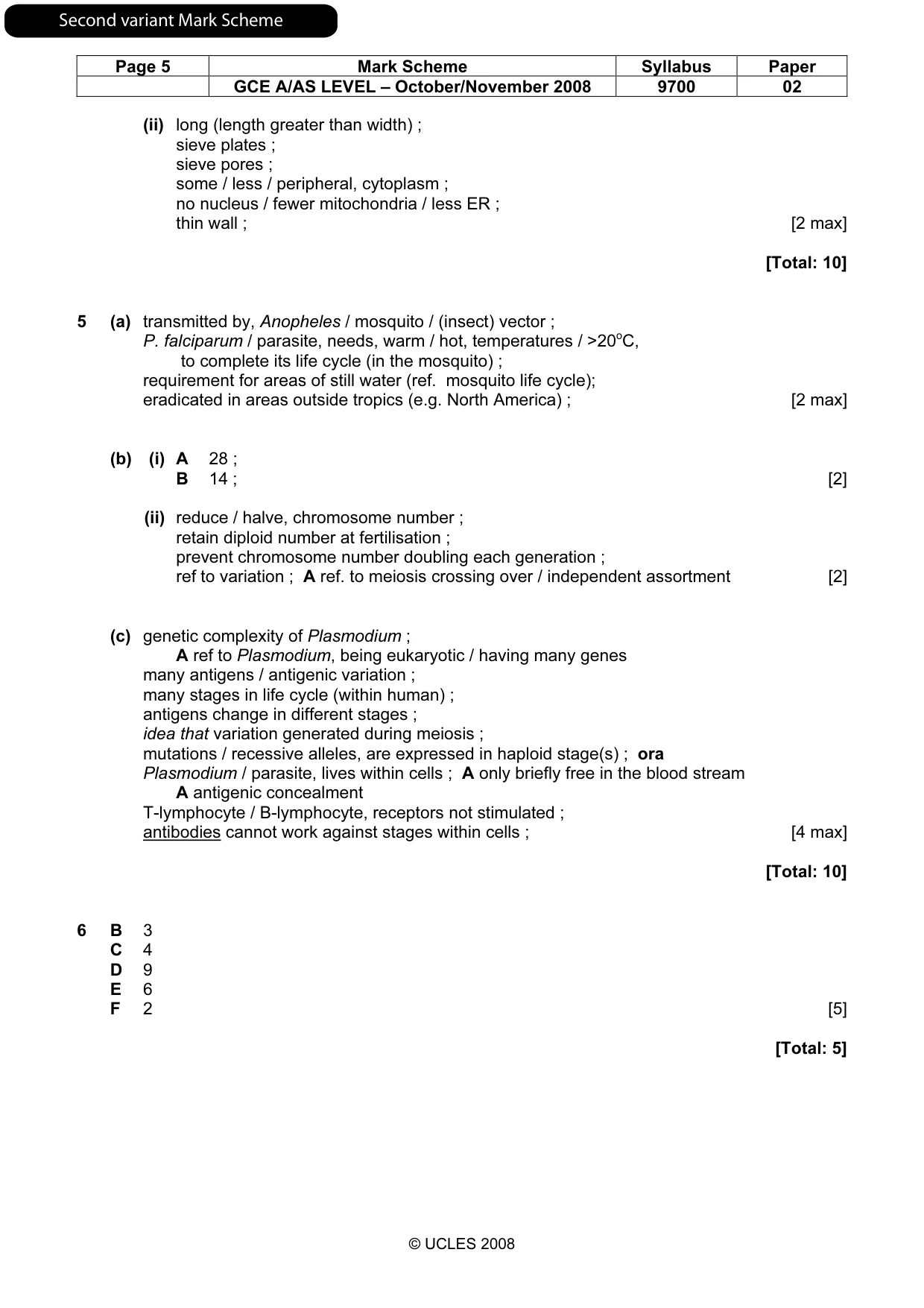
Mark scheme, page 12
Page 5 Mark Scheme Syllabus Paper GCE A/AS LEVEL – October/November 2008 9700 02 © UCLES 2008 (ii) long (length greater than width) ; sieve plates ; sieve pores ; some / less / peripheral, cytoplasm ; no nucleus / fewer mitochondria / less ER ; thin wall ; [2 max] [Total: 10] 5 (a) transmitted by, Anopheles / mosquito / (insect) vector ; P. falciparum / parasite, needs, warm / hot, temperatures / >20oC, to complete its life cycle (in the mosquito) ; requirement for areas of still water (ref. mosquito life cycle); eradicated in areas outside tropics (e.g. North America) ; [2 max] (b) (i) A 28 ; B 14 ; [2] (ii) reduce / halve, chromosome number ; retain diploid number at fertilisation ; prevent chromosome number doubling each generation ; ref to variation ; A ref. to meiosis crossing over / independent assortment [2] (c) genetic complexity of Plasmodium ; A ref to Plasmodium, being eukaryotic / having many genes many antigens / antigenic variation ; many stages in life cycle (within human) ; antigens change in different stages ; idea that variation generated during meiosis ; mutations / recessive alleles, are expressed in haploid stage(s) ; ora Plasmodium / parasite, lives within cells ; A only briefly free in the blood stream A antigenic concealment T-lymphocyte / B-lymphocyte, receptors not stimulated ; antibodies cannot work against stages within cells ; [4 max] [Total: 10] 6 B 3 C 4 D 9 E 6 F 2 [5] [Total: 5] Second variant Mark Scheme
What you needed in this session
Cambridge’s own grade thresholds for 2008 Oct/Nov, Paper 2 · Variant 1. A higher threshold means an easier paper — the bar moves with how the cohort did.