Cambridge A Level Biology 9700 — 2008 May/June Paper 4 · Variant 1
9700/41/M/J/08
The question paper and its mark scheme, free to read here and free to download. This is Cambridge’s own paper, exactly as it was sat.
Question paper28 pages








Mark scheme9 pages
Answers below. Sit the paper first if you are practising.
Paper as text
Question paper, page 1
This document consists of 20 printed pages, 4 lined pages and 4 blank pages. SP (CW/CGW) T52858/2 © UCLES 2008 [Turn over UNIVERSITY OF CAMBRIDGE INTERNATIONAL EXAMINATIONS General Certificate of Education Advanced Level READ THESE INSTRUCTIONS FIRST Write your Centre number, candidate number and name on all the work you hand in. Write in dark blue or black pen. You may use a pencil for any diagrams, graphs, or rough working. Do not use staples, paper clips, highlighters, glue or correction fluid. DO NOT WRITE IN ANY BARCODES. Answer all questions in Section A and one question from Section B. Circle the number of the Section B question you have answered in the grid below. At the end of the examination, fasten all your work securely together. The number of marks is given in brackets [ ] at the end of each question or part question. * 4 7 0 0 1 6 2 3 2 2 * BIOLOGY 9700/04 Paper 4 A2 Structured Questions May/June 2008 2 hours Candidates answer on the Question Paper. Additional Materials: Answer Paper available on request. For Examiner’s Use Section A 1 2 3 4 5 6 7 8 Section B 9 or 10 Total
Question paper, page 2
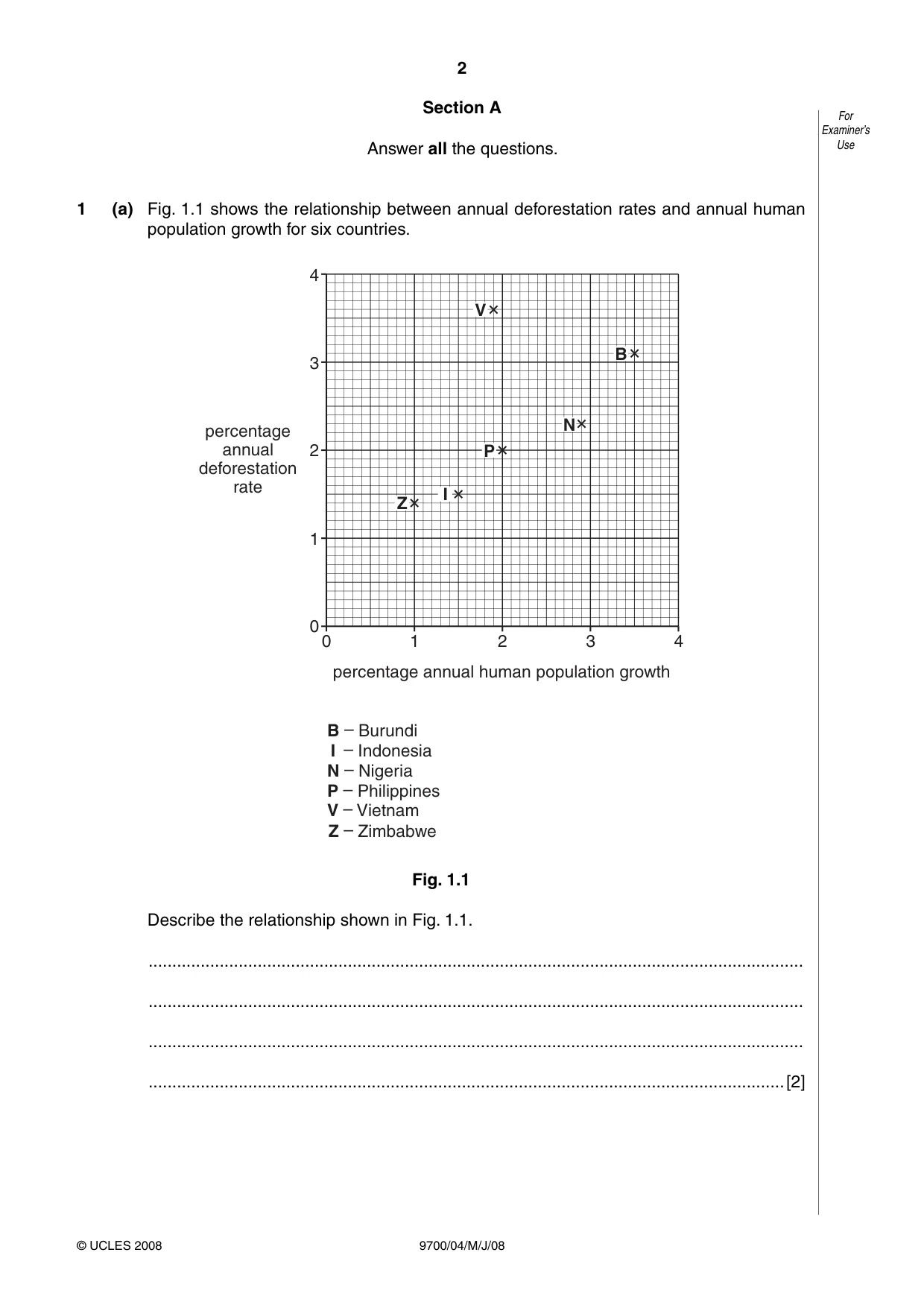
2 © UCLES 2008 For Examiner’s Use 9700/04/M/J/08 Section A Answer all the questions. 1 (a) Fig. 1.1 shows the relationship between annual deforestation rates and annual human population growth for six countries. 4 3 2 percentage annual deforestation rate percentage annual human population growth 1 0 1 2 3 4 0 V B N P I Z B – Burundi P – Philippines N – Nigeria I – Indonesia Z – Zimbabwe V – Vietnam Fig. 1.1 Describe the relationship shown in Fig. 1.1. … … … …[2]
Question paper, page 3
3 © UCLES 2008 [Turn over For Examiner’s Use 9700/04/M/J/08 (b) Over half of the species of plants and animals comprising the biodiversity of the Earth are thought to exist in tropical rainforests. (i) Explain the meaning of the term biodiversity. … … …[2] (ii) Explain the economic reasons for maintaining biodiversity. … … … … … … …[4] [Total: 8]
Question paper, page 4
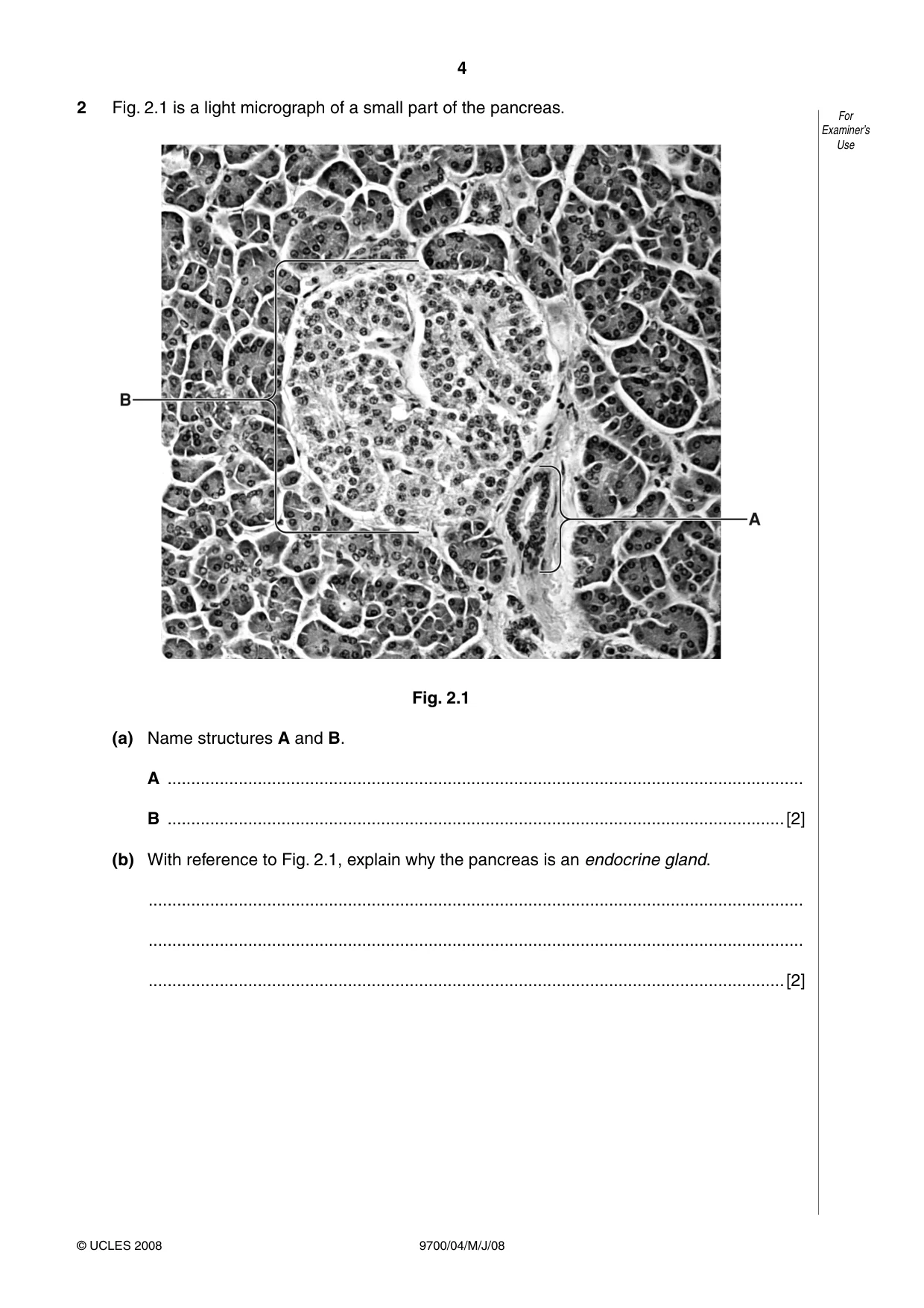
4 © UCLES 2008 For Examiner’s Use 9700/04/M/J/08 2 Fig. 2.1 is a light micrograph of a small part of the pancreas. Fig. 2.1 (a) Name structures A and B. A … B …[2] (b) With reference to Fig. 2.1, explain why the pancreas is an endocrine gland. … … …[2]
Question paper, page 5
5 © UCLES 2008 [Turn over For Examiner’s Use 9700/04/M/J/08 (c) Insulin and glucagon are involved in the control of blood glucose concentration. When blood glucose concentration rises, secretion of insulin increases. Outline two ways in which insulin affects the activity of cells in the liver. 1. … … 2. … …[2] (d) Some forms of diabetes are caused by an inability to secrete insulin and can be controlled by regular injections of insulin. Most of this insulin is now produced using genetically modified Escherichia coli. Explain the advantages of using this type of insulin, rather than insulin obtained from animal sources. … … … …[2] [Total: 8]
Question paper, page 6
6 9700/04/M/J/08 © UCLES 2008 BLANK PAGE
Question paper, page 7
7 © UCLES 2008 [Turn over For Examiner’s Use 9700/04/M/J/08 3 (a) Fig. 3.1 shows the male and female flowers of maize. Fig. 3.1 (i) With reference to Fig. 3.1, describe how the flowering habit of maize encourages wind-pollination. … … … … …[3] (ii) In a maize plant, the anthers normally ripen before the stigmas are mature and ready to receive pollen. This encourages cross-pollination. Explain the potential advantages of cross-pollination to a plant species. … … … …[3]
Question paper, page 8
8 © UCLES 2008 For Examiner’s Use 9700/04/M/J/08 (b) Cultivated maize is related to a wild Mexican grass, teosinte. Teosinte looks very different from maize. In particular, teosinte has a very hard layer surrounding the fruit, making it impossible to use as an edible grain. Archaeological excavations have found that maize in its edible form dates back at least 4000 years. It has been argued that the structural differences between teosinte and maize grains are so great that it is unlikely that maize could have been bred from teosinte so long ago. Investigations have been carried out into the genetic differences between teosinte and maize. A gene on chromosome 4, tga 1, containing 1042 base pairs, was found to be responsible for all of the structural differences between teosinte and maize. Fig. 3.2 shows the DNA base sequence of the only part of tga 1 that always differs between teosinte and maize. teosinte GAT TGG GAT CTC AAG GCG GCG GGC GCG TGG maize GAT TGG GAT CTC AAC GCG GCG GGC GCG TGG Fig. 3.2 (i) Outline the principles of electrophoresis as used in sequencing this DNA. … … … … … … …[4]
Question paper, page 9
9 © UCLES 2008 [Turn over For Examiner’s Use 9700/04/M/J/08 (ii) Suggest how the difference in the base sequence of the tga 1 gene shown in Fig. 3.2 could cause large differences in phenotype between teosinte and maize. … … …[2] (iii) With reference to Fig. 3.2, explain how these results support the suggestion that it would have been relatively easy for early farmers in Mexico to have bred maize from teosinte. … … … … …[3] [Total: 15]
Question paper, page 10
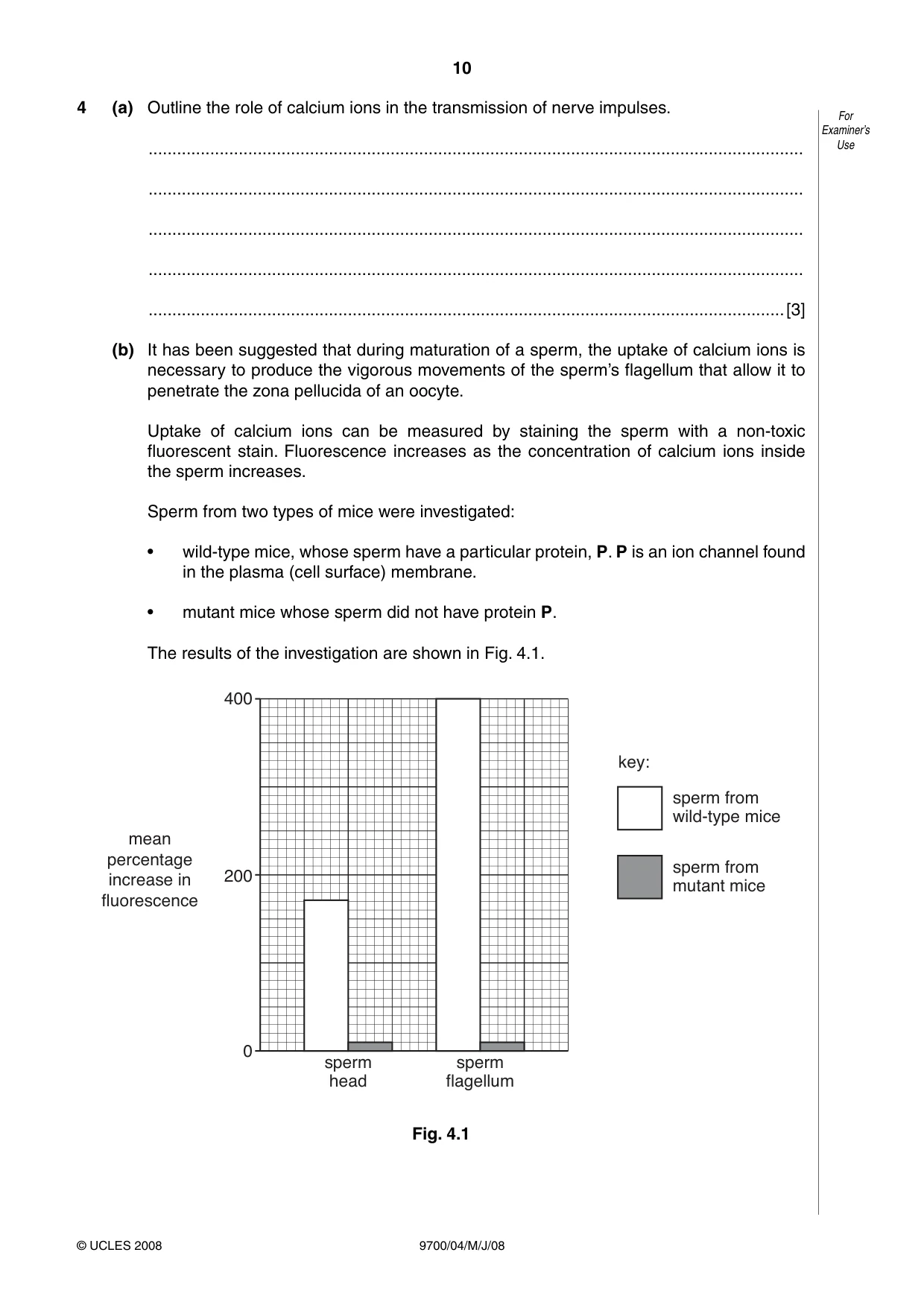
10 © UCLES 2008 For Examiner’s Use 9700/04/M/J/08 4 (a) Outline the role of calcium ions in the transmission of nerve impulses. … … … … …[3] (b) It has been suggested that during maturation of a sperm, the uptake of calcium ions is necessary to produce the vigorous movements of the sperm’s flagellum that allow it to penetrate the zona pellucida of an oocyte. Uptake of calcium ions can be measured by staining the sperm with a non-toxic fluorescent stain. Fluorescence increases as the concentration of calcium ions inside the sperm increases. Sperm from two types of mice were investigated: • wild-type mice, whose sperm have a particular protein, P. P is an ion channel found in the plasma (cell surface) membrane. • mutant mice whose sperm did not have protein P. The results of the investigation are shown in Fig. 4.1. 0 200 sperm head sperm flagellum sperm from wild-type mice sperm from mutant mice mean percentage increase in fluorescence 400 key: Fig. 4.1
Question paper, page 11
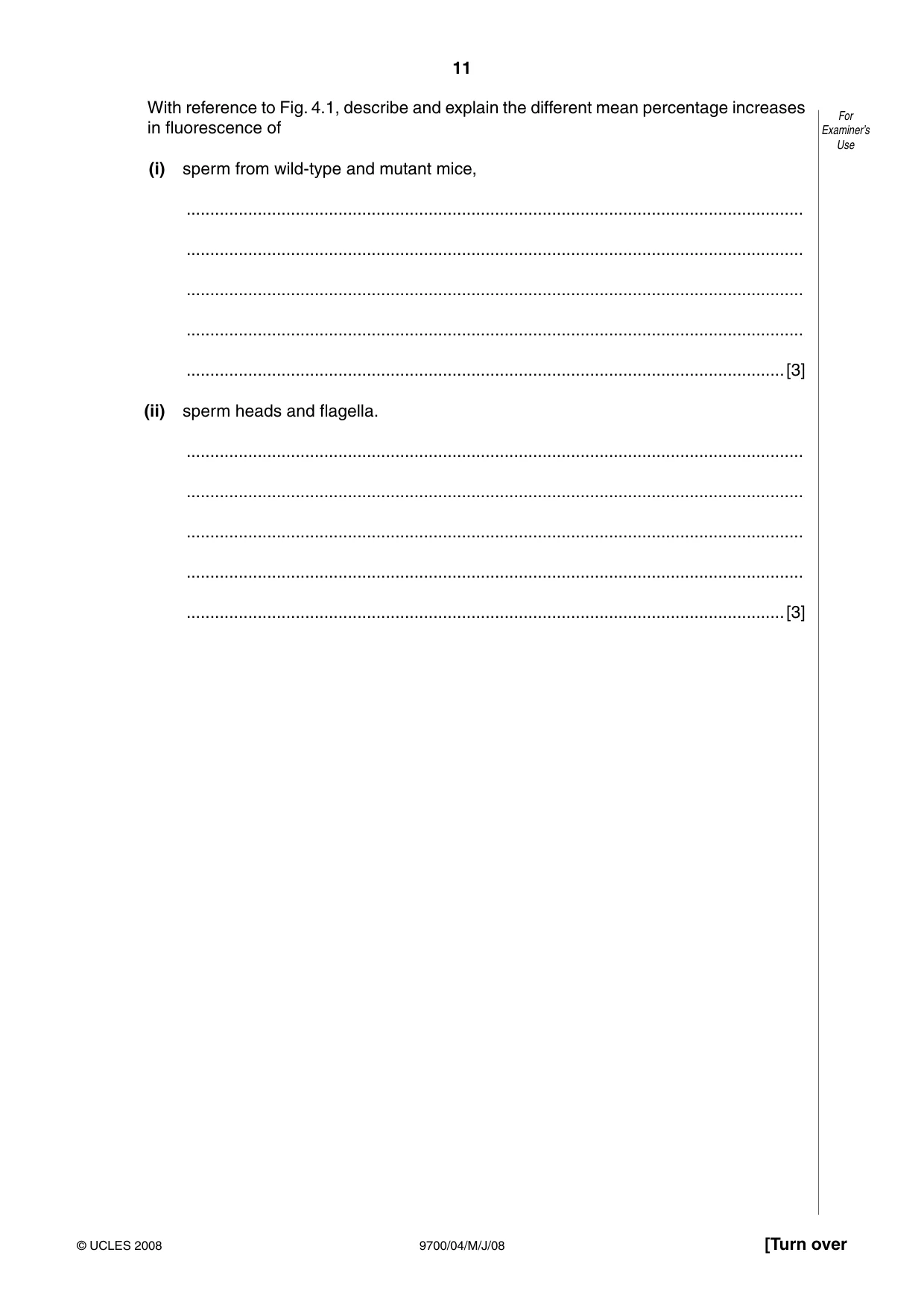
11 © UCLES 2008 [Turn over For Examiner’s Use 9700/04/M/J/08 With reference to Fig. 4.1, describe and explain the different mean percentage increases in fluorescence of (i) sperm from wild-type and mutant mice, … … … … …[3] (ii) sperm heads and flagella. … … … … …[3]
Question paper, page 12
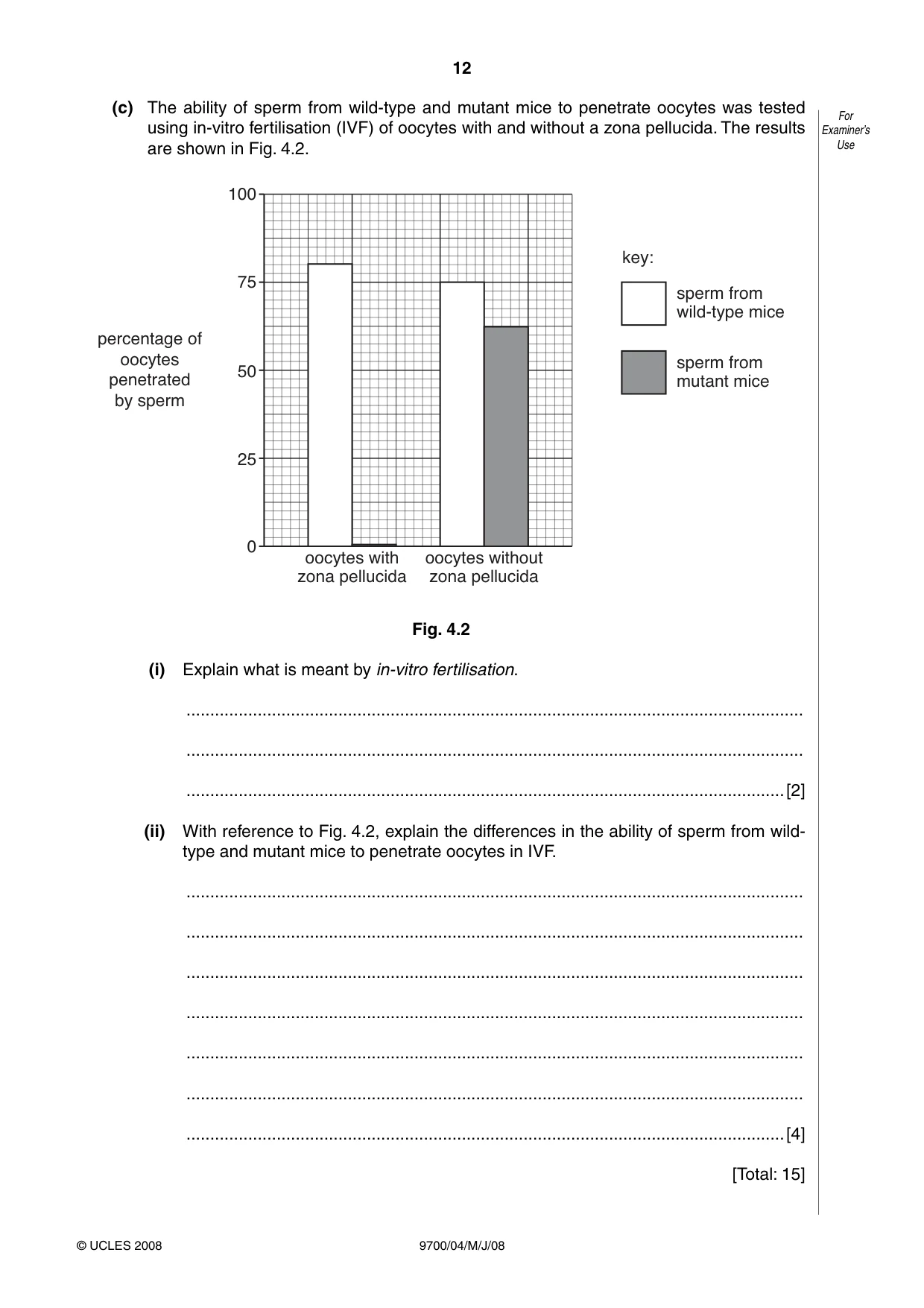
12 © UCLES 2008 For Examiner’s Use 9700/04/M/J/08 (c) The ability of sperm from wild-type and mutant mice to penetrate oocytes was tested using in-vitro fertilisation (IVF) of oocytes with and without a zona pellucida. The results are shown in Fig. 4.2. 0 50 oocytes with zona pellucida oocytes without zona pellucida sperm from wild-type mice key: sperm from mutant mice percentage of oocytes penetrated by sperm 100 25 75 Fig. 4.2 (i) Explain what is meant by in-vitro fertilisation. … … …[2] (ii) With reference to Fig. 4.2, explain the differences in the ability of sperm from wild- type and mutant mice to penetrate oocytes in IVF. … … … … … … …[4] [Total: 15]
Question paper, page 13
13 9700/04/M/J/08 © UCLES 2008 [Turn over BLANK PAGE Question 5 starts on page 14
Question paper, page 14
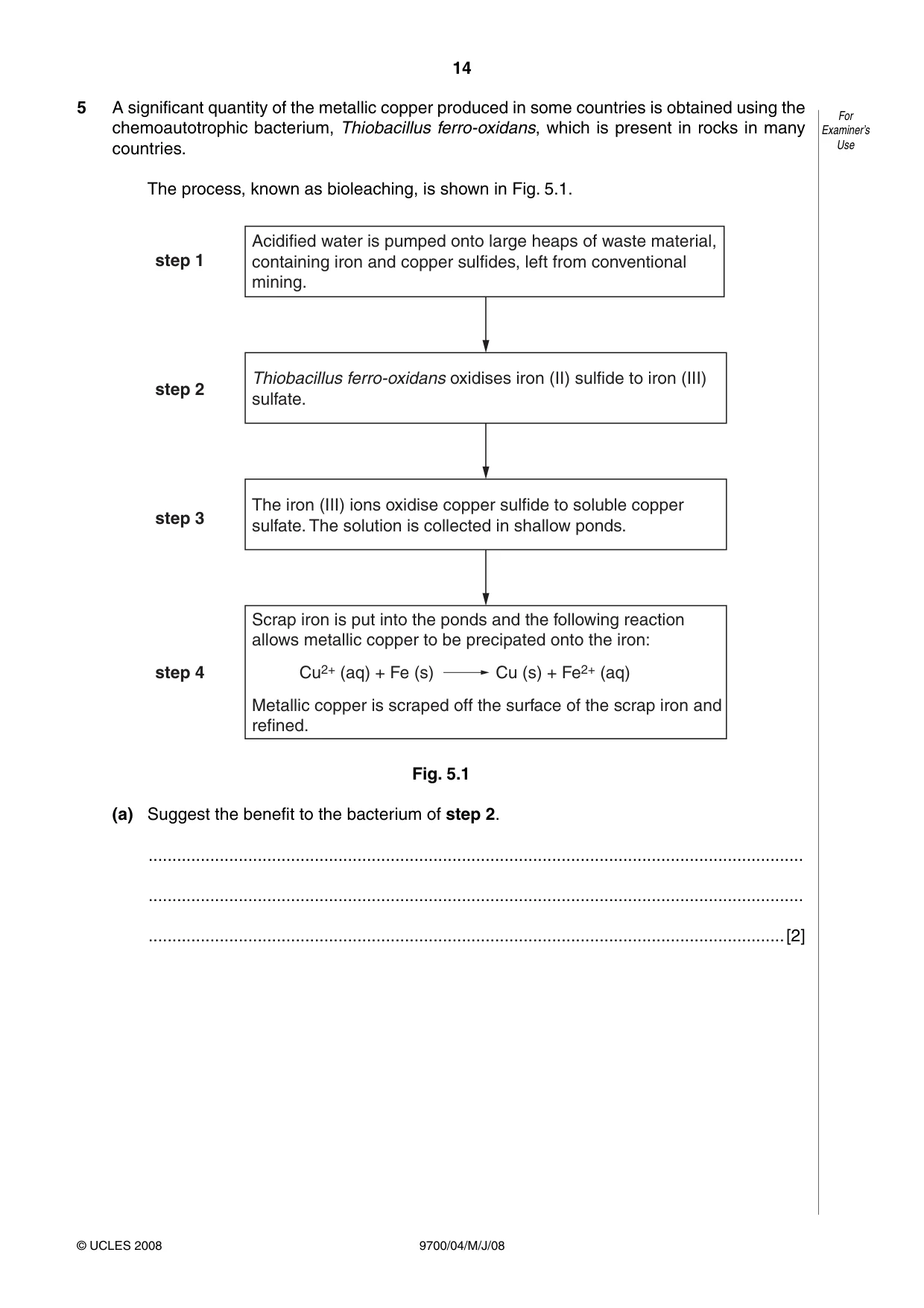
14 © UCLES 2008 For Examiner’s Use 9700/04/M/J/08 5 A significant quantity of the metallic copper produced in some countries is obtained using the chemoautotrophic bacterium, Thiobacillus ferro-oxidans, which is present in rocks in many countries. The process, known as bioleaching, is shown in Fig. 5.1. Acidified water is pumped onto large heaps of waste material, containing iron and copper sulfides, left from conventional mining. Thiobacillus ferro-oxidans oxidises iron (II) sulfide to iron (III) sulfate. The iron (III) ions oxidise copper sulfide to soluble copper sulfate. The solution is collected in shallow ponds. step 1 step 2 step 3 step 4 Scrap iron is put into the ponds and the following reaction allows metallic copper to be precipated onto the iron: Cu2+ (aq) + Fe (s) Cu (s) + Fe2+ (aq) Metallic copper is scraped off the surface of the scrap iron and refined. Fig. 5.1 (a) Suggest the benefit to the bacterium of step 2. … … …[2]
Question paper, page 15
15 © UCLES 2008 [Turn over For Examiner’s Use 9700/04/M/J/08 (b) State two environmental disadvantages of extracting metals by bioleaching. 1. … … 2. … …[2] (c) Explain why the production of metallic copper by bioleaching can be cheaper than using conventional mining methods. … … … … … … …[4] [Total: 8]
Question paper, page 16
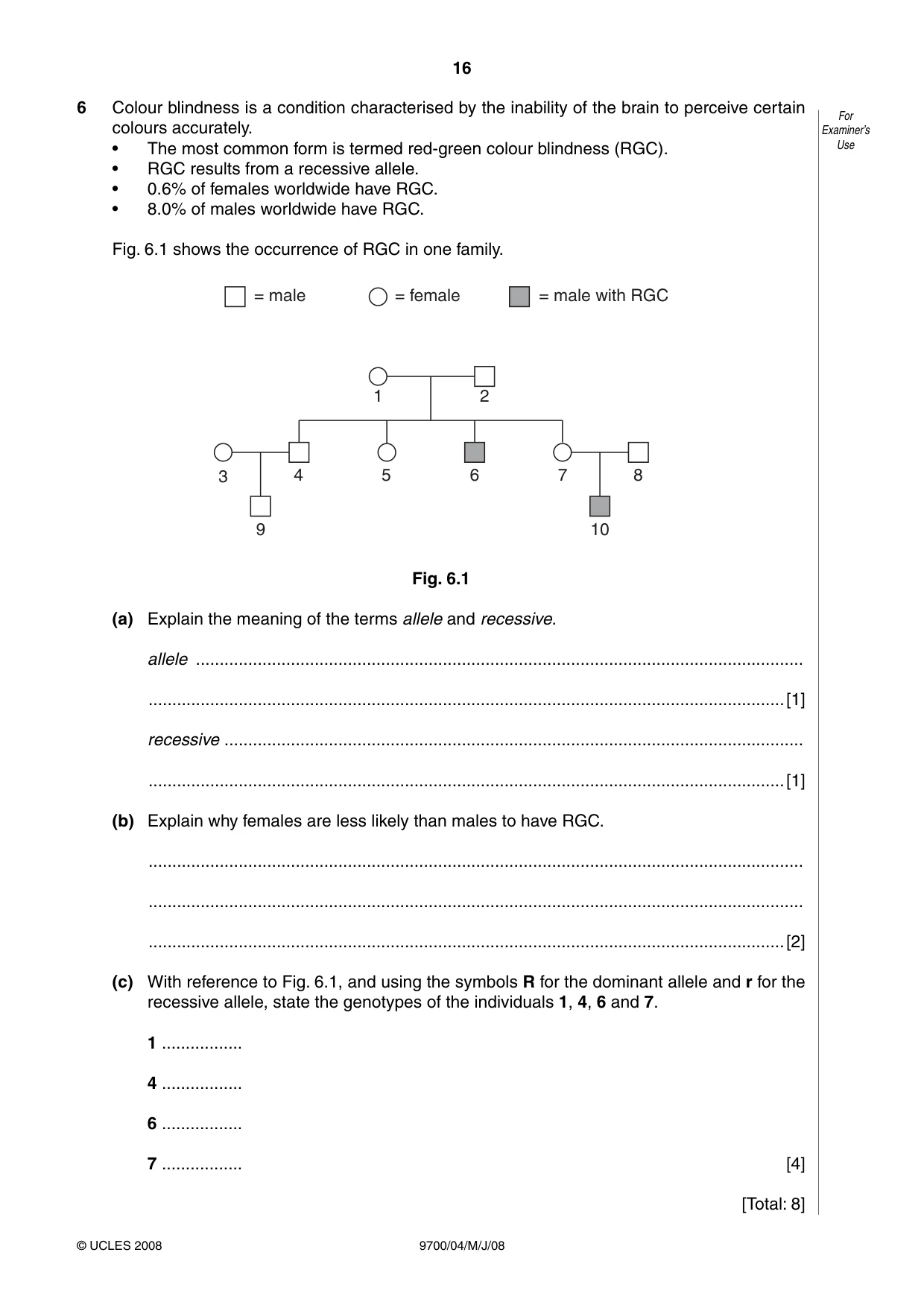
16 © UCLES 2008 For Examiner’s Use 9700/04/M/J/08 6 Colour blindness is a condition characterised by the inability of the brain to perceive certain colours accurately. • The most common form is termed red-green colour blindness (RGC). • RGC results from a recessive allele. • 0.6% of females worldwide have RGC. • 8.0% of males worldwide have RGC. Fig. 6.1 shows the occurrence of RGC in one family. = male = female 1 2 4 6 5 9 10 3 7 8 = male with RGC Fig. 6.1 (a) Explain the meaning of the terms allele and recessive. allele … …[1] recessive … …[1] (b) Explain why females are less likely than males to have RGC. … … …[2] (c) With reference to Fig. 6.1, and using the symbols R for the dominant allele and r for the recessive allele, state the genotypes of the individuals 1, 4, 6 and 7. 1 … 4 … 6 … 7 … [4] [Total: 8]
Question paper, page 17
17 9700/04/M/J/08 © UCLES 2008 [Turn over BLANK PAGE Question 7 begins on page 18
Question paper, page 18
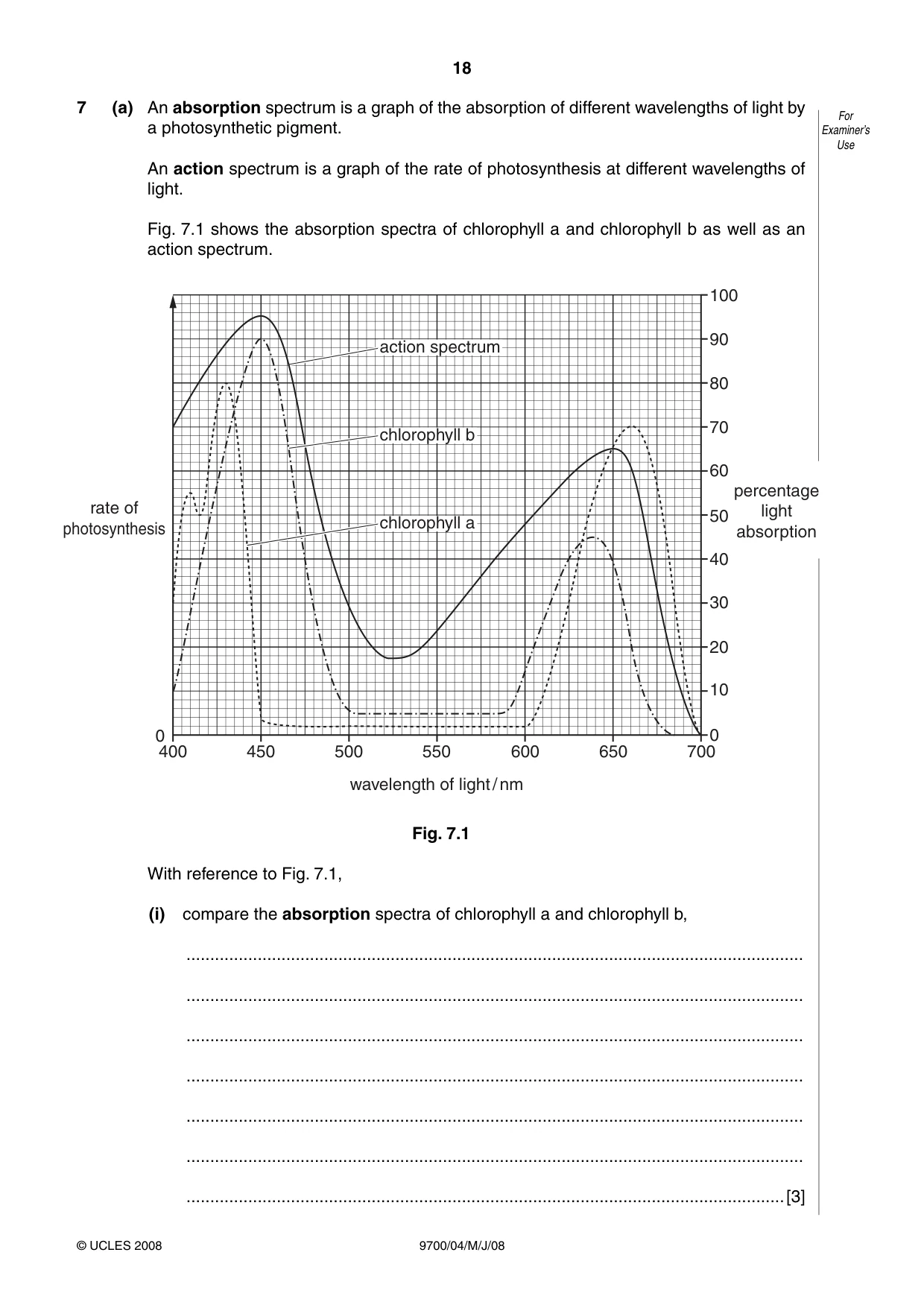
18 © UCLES 2008 9700/04/M/J/08 7 (a) An absorption spectrum is a graph of the absorption of different wavelengths of light by a photosynthetic pigment. An action spectrum is a graph of the rate of photosynthesis at different wavelengths of light. Fig. 7.1 shows the absorption spectra of chlorophyll a and chlorophyll b as well as an action spectrum. 400 0 450 500 550 wavelength of light / nm rate of photosynthesis percentage light absorption 600 650 700 0 10 20 30 40 50 60 70 80 90 100 action spectrum chlorophyll b chlorophyll a Fig. 7.1 With reference to Fig. 7.1, (i) compare the absorption spectra of chlorophyll a and chlorophyll b, … … … … … … …[3] For Examiner’s Use
Question paper, page 19
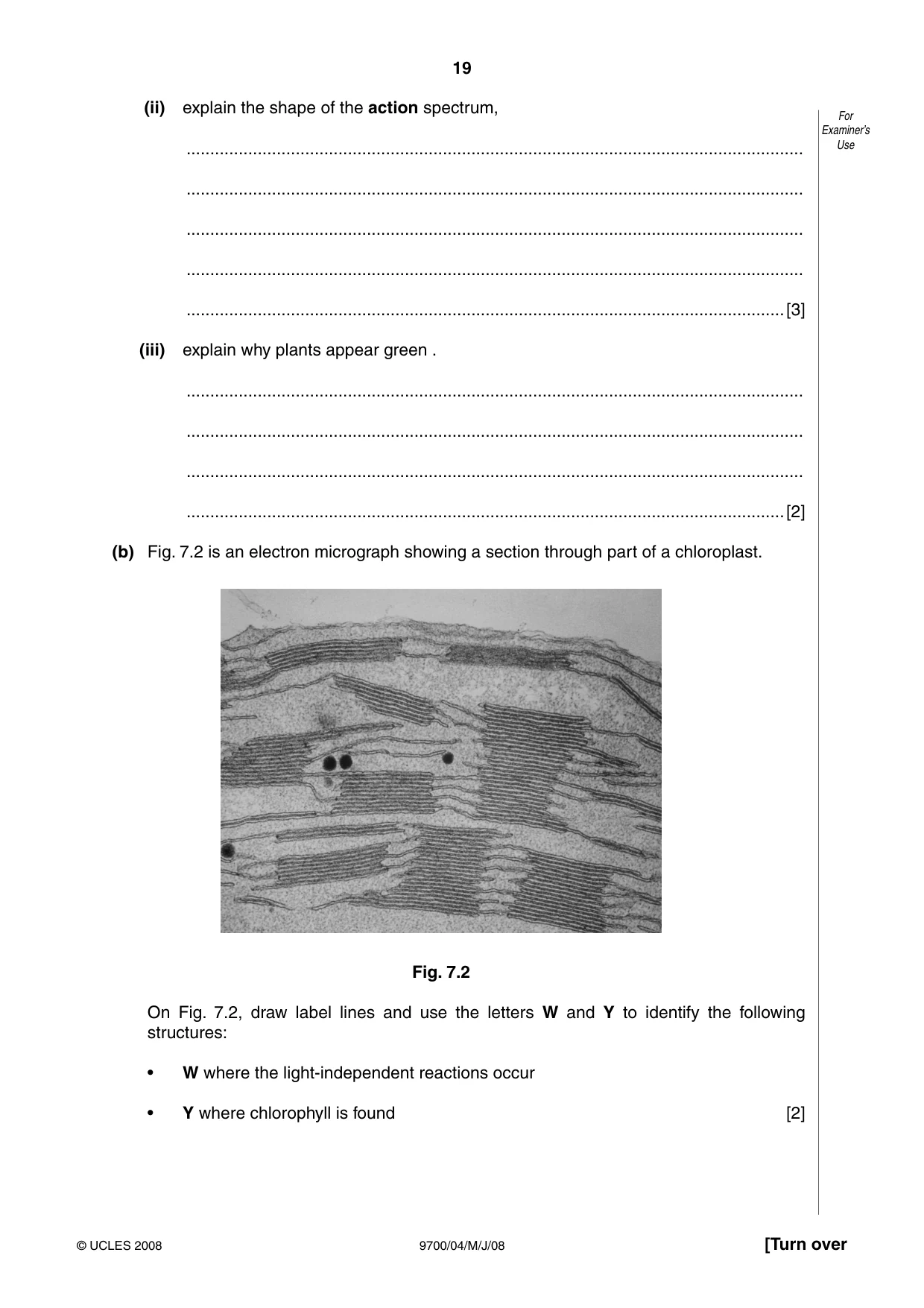
19 © UCLES 2008 [Turn over For Examiner’s Use 9700/04/M/J/08 (ii) explain the shape of the action spectrum, … … … … …[3] (iii) explain why plants appear green . … … … …[2] (b) Fig. 7.2 is an electron micrograph showing a section through part of a chloroplast. Fig. 7.2 On Fig. 7.2, draw label lines and use the letters W and Y to identify the following structures: • W where the light-independent reactions occur • Y where chlorophyll is found [2]
Question paper, page 20
20 © UCLES 2008 For Examiner’s Use 9700/04/M/J/08 (c) Explain why increasing the concentration of carbon dioxide may increase the rate of production of carbohydrates at high light intensities. … … … … … … … … … … …[5] [Total: 15]
Question paper, page 21
21 9700/04/M/J/08 © UCLES 2008 [Turn over BLANK PAGE Question 8 begins on page 22
Question paper, page 22
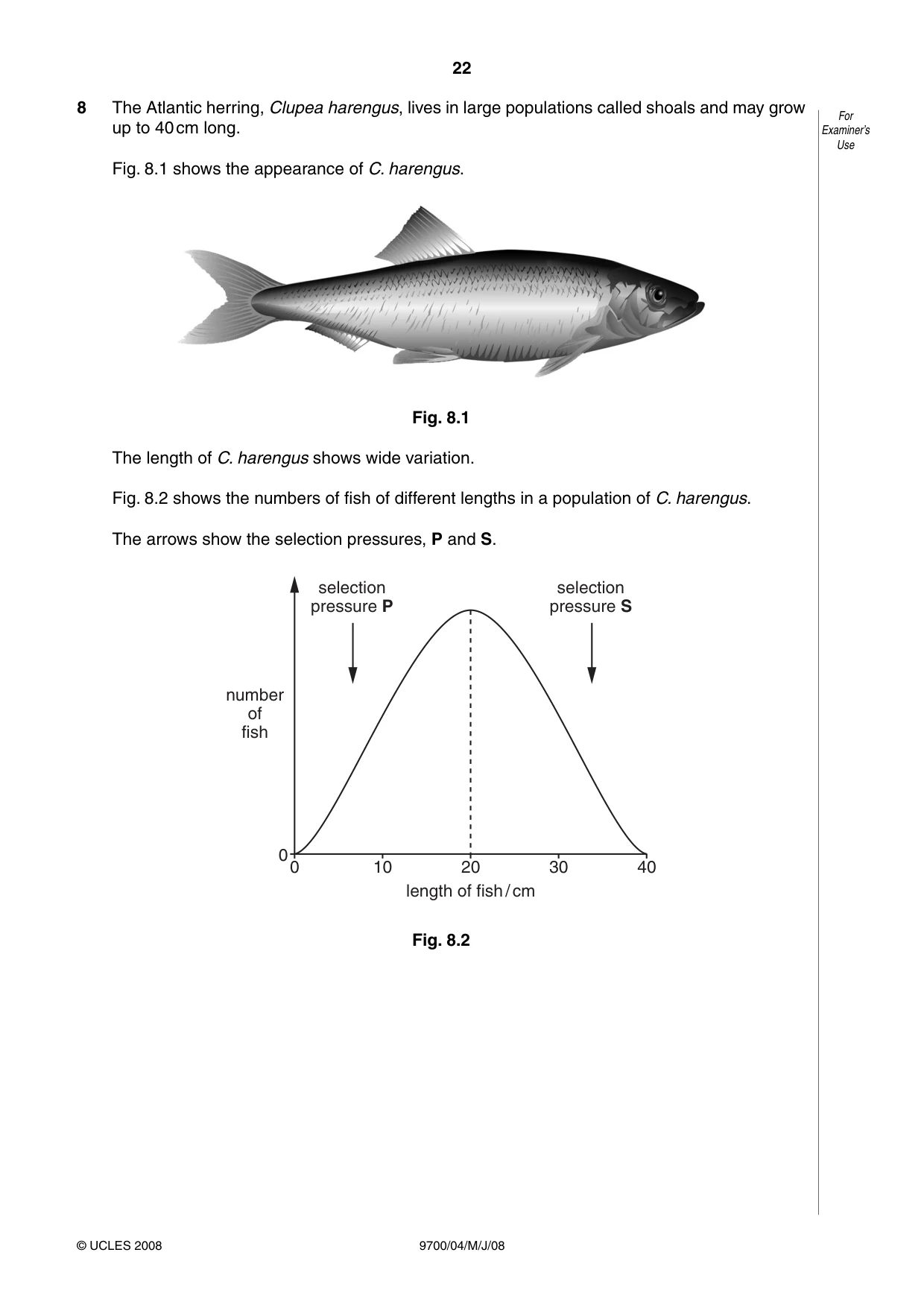
22 © UCLES 2008 For Examiner’s Use 9700/04/M/J/08 8 The Atlantic herring, Clupea harengus, lives in large populations called shoals and may grow up to 40 cm long. Fig. 8.1 shows the appearance of C. harengus. Fig. 8.1 The length of C. harengus shows wide variation. Fig. 8.2 shows the numbers of fish of different lengths in a population of C. harengus. The arrows show the selection pressures, P and S. 0 0 10 20 length of fish / cm number of fish selection pressure P selection pressure S 30 40 Fig. 8.2
Question paper, page 23
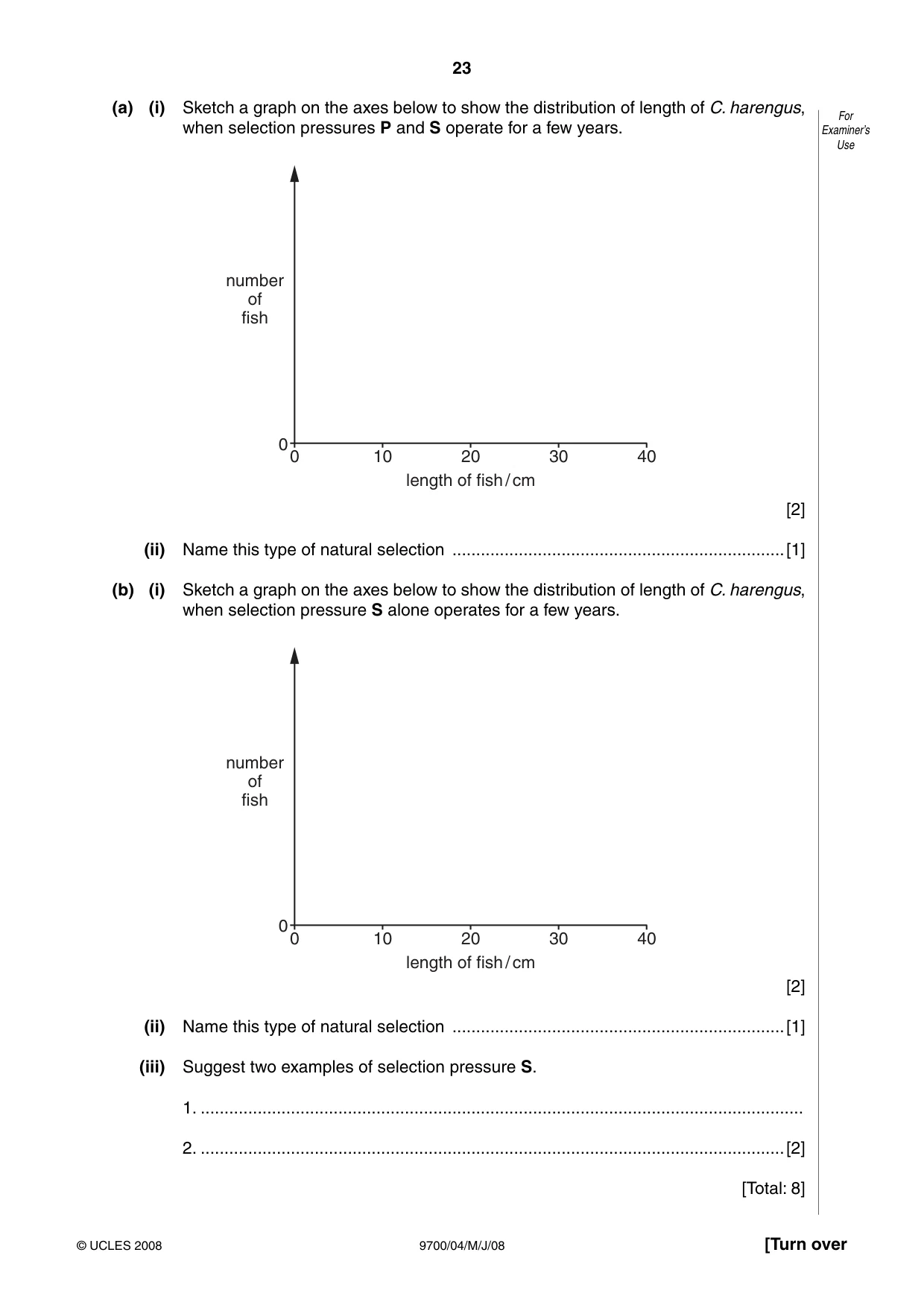
23 © UCLES 2008 [Turn over For Examiner’s Use 9700/04/M/J/08 (a) (i) Sketch a graph on the axes below to show the distribution of length of C. harengus, when selection pressures P and S operate for a few years. 0 0 10 20 length of fish / cm number of fish 30 40 [2] (ii) Name this type of natural selection …[1] (b) (i) Sketch a graph on the axes below to show the distribution of length of C. harengus, when selection pressure S alone operates for a few years. 0 0 10 20 length of fish / cm number of fish 30 40 [2] (ii) Name this type of natural selection …[1] (iii) Suggest two examples of selection pressure S. 1. … 2. …[2] [Total: 8]
Question paper, page 24
24 © UCLES 2008 For Examiner’s Use 9700/04/M/J/08 Section B Answer one question. 9 (a) Describe the process of oxidative phosphorylation in the mitochondrion. [9] (b) Explain the roles of NAD in anaerobic respiration in both plants and animals. [6] [Total: 15] 10 (a) Compare the roles of the endocrine and nervous systems in control and coordination in animals. [8] (b) Describe the part played by auxins in apical dominance in a plant shoot. [7] [Total: 15] … … … … … … … … … … … … … … … … … …
Question paper, page 25
25 © UCLES 2008 [Turn over For Examiner’s Use 9700/04/M/J/08 … … … … … … … … … … … … … … … … … … … … … … … … … … … …
Question paper, page 26
26 © UCLES 2008 For Examiner’s Use 9700/04/M/J/08 … … … … … … … … … … … … … … … … … … … … … … … … … … … …
Question paper, page 27
27 © UCLES 2008 [Turn over For Examiner’s Use 9700/04/M/J/08 … … … … … … … … … … … … … … … … … … … … … … … … … … … …
Question paper, page 28
28 © UCLES 2008 9700/04/M/J/08 … … … … … … … … … … … … … … … … … … … … … … … … For Examiner’s Use Copyright Acknowledgements: Question 7 Fig. 7.2 © DR KENETH R. MILLER / SCIENCE PHOTO LIBRARY. Question 8 Fig. 8.1 © Gulf of Maine Research Institute www.gmri.org Permission to reproduce items where third-party owned material protected by copyright is included has been sought and cleared where possible. Every reasonable effort has been made by the publisher (UCLES) to trace copyright holders, but if any items requiring clearance have unwittingly been included, the publisher will be pleased to make amends at the earliest possible opportunity. University of Cambridge International Examinations is part of the Cambridge Assessment Group. Cambridge Assessment is the brand name of University of Cambridge Local Examinations Syndicate (UCLES), which is itself a department of the University of Cambridge.
Mark scheme, page 1
UNIVERSITY OF CAMBRIDGE INTERNATIONAL EXAMINATIONS GCE Advanced Subsidiary Level and GCE Advanced Level MARK SCHEME for the May/June 2008 question paper 9700 BIOLOGY 9700/04 Paper 4 (A2 Structured Questions), maximum raw mark 100 This mark scheme is published as an aid to teachers and candidates, to indicate the requirements of the examination. It shows the basis on which Examiners were instructed to award marks. It does not indicate the details of the discussions that took place at an Examiners’ meeting before marking began. All Examiners are instructed that alternative correct answers and unexpected approaches in candidates’ scripts must be given marks that fairly reflect the relevant knowledge and skills demonstrated. Mark schemes must be read in conjunction with the question papers and the report on the examination. • CIE will not enter into discussions or correspondence in connection with these mark schemes. CIE is publishing the mark schemes for the May/June 2008 question papers for most IGCSE, GCE Advanced Level and Advanced Subsidiary Level syllabuses and some Ordinary Level syllabuses.
Mark scheme, page 2
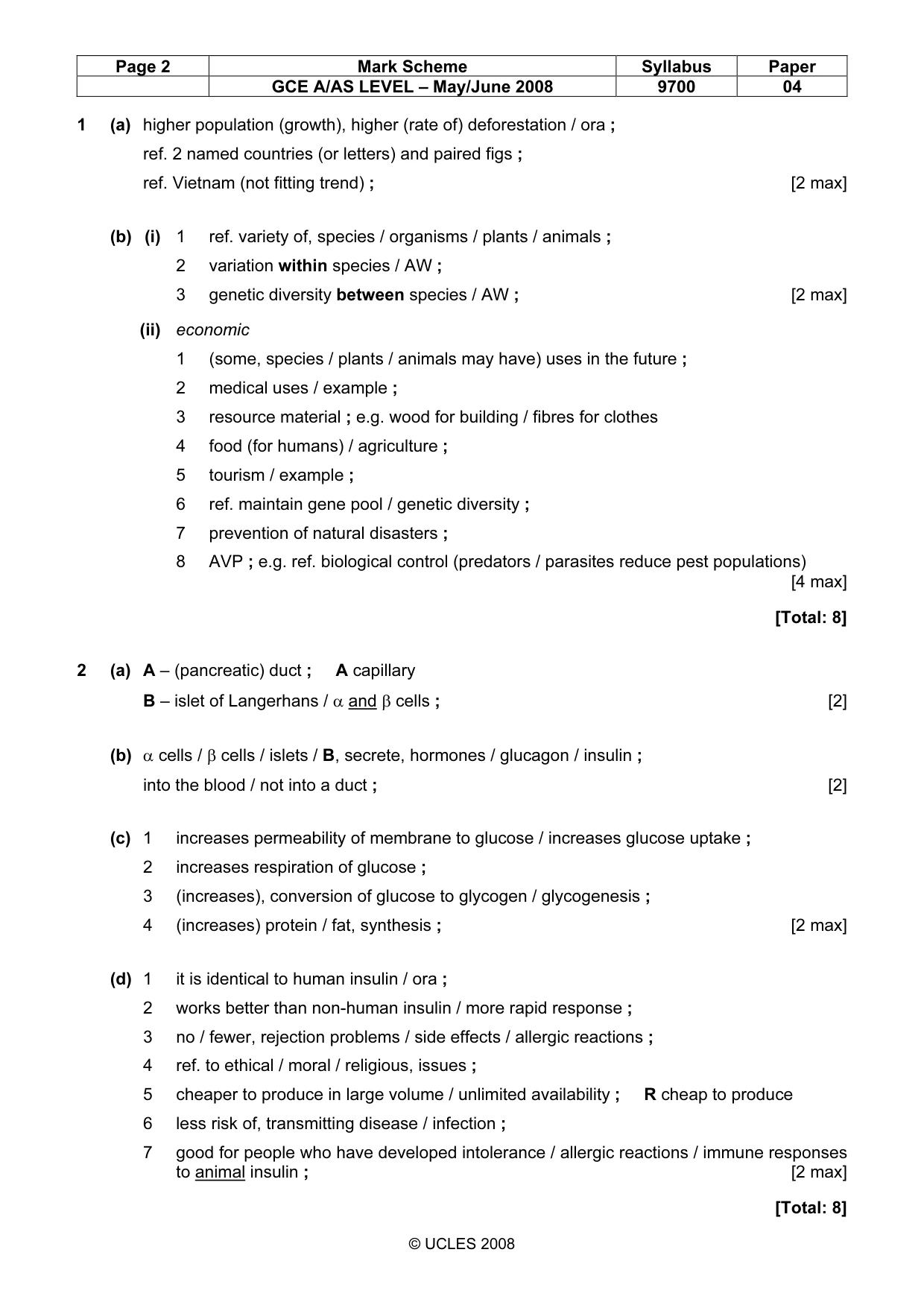
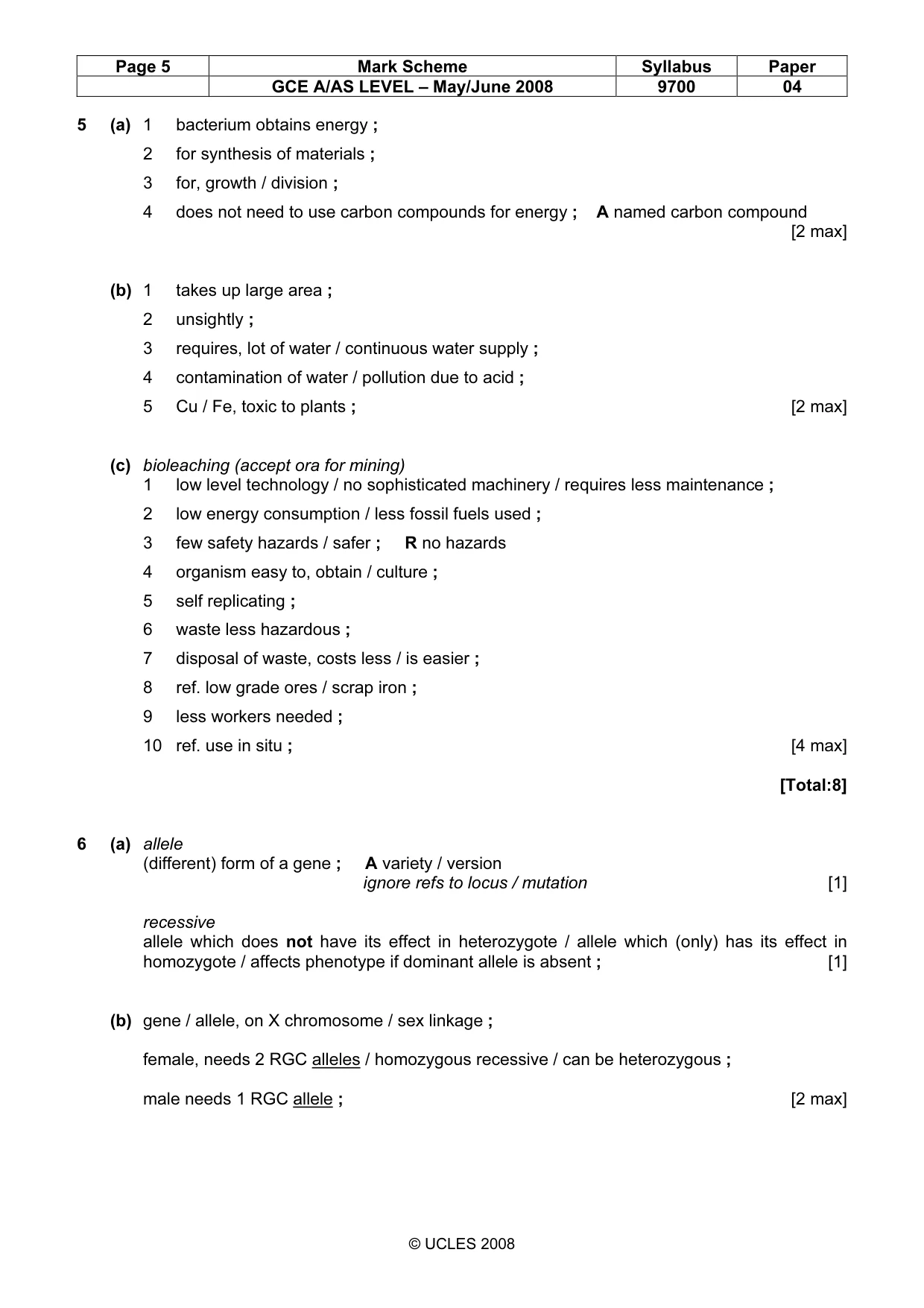
Page 2 Mark Scheme Syllabus Paper GCE A/AS LEVEL – May/June 2008 9700 04 © UCLES 2008 1 (a) higher population (growth), higher (rate of) deforestation / ora ; ref. 2 named countries (or letters) and paired figs ; ref. Vietnam (not fitting trend) ; [2 max] (b) (i) 1 ref. variety of, species / organisms / plants / animals ; 2 variation within species / AW ; 3 genetic diversity between species / AW ; [2 max] (ii) economic 1 (some, species / plants / animals may have) uses in the future ; 2 medical uses / example ; 3 resource material ; e.g. wood for building / fibres for clothes 4 food (for humans) / agriculture ; 5 tourism / example ; 6 ref. maintain gene pool / genetic diversity ; 7 prevention of natural disasters ; 8 AVP ; e.g. ref. biological control (predators / parasites reduce pest populations) [4 max] [Total: 8] 2 (a) A – (pancreatic) duct ; A capillary B – islet of Langerhans / α and β cells ; [2] (b) α cells / β cells / islets / B, secrete, hormones / glucagon / insulin ; into the blood / not into a duct ; [2] (c) 1 increases permeability of membrane to glucose / increases glucose uptake ; 2 increases respiration of glucose ; 3 (increases), conversion of glucose to glycogen / glycogenesis ; 4 (increases) protein / fat, synthesis ; [2 max] (d) 1 it is identical to human insulin / ora ; 2 works better than non-human insulin / more rapid response ; 3 no / fewer, rejection problems / side effects / allergic reactions ; 4 ref. to ethical / moral / religious, issues ; 5 cheaper to produce in large volume / unlimited availability ; R cheap to produce 6 less risk of, transmitting disease / infection ; 7 good for people who have developed intolerance / allergic reactions / immune responses to animal insulin ; [2 max] [Total: 8]
Mark scheme, page 3
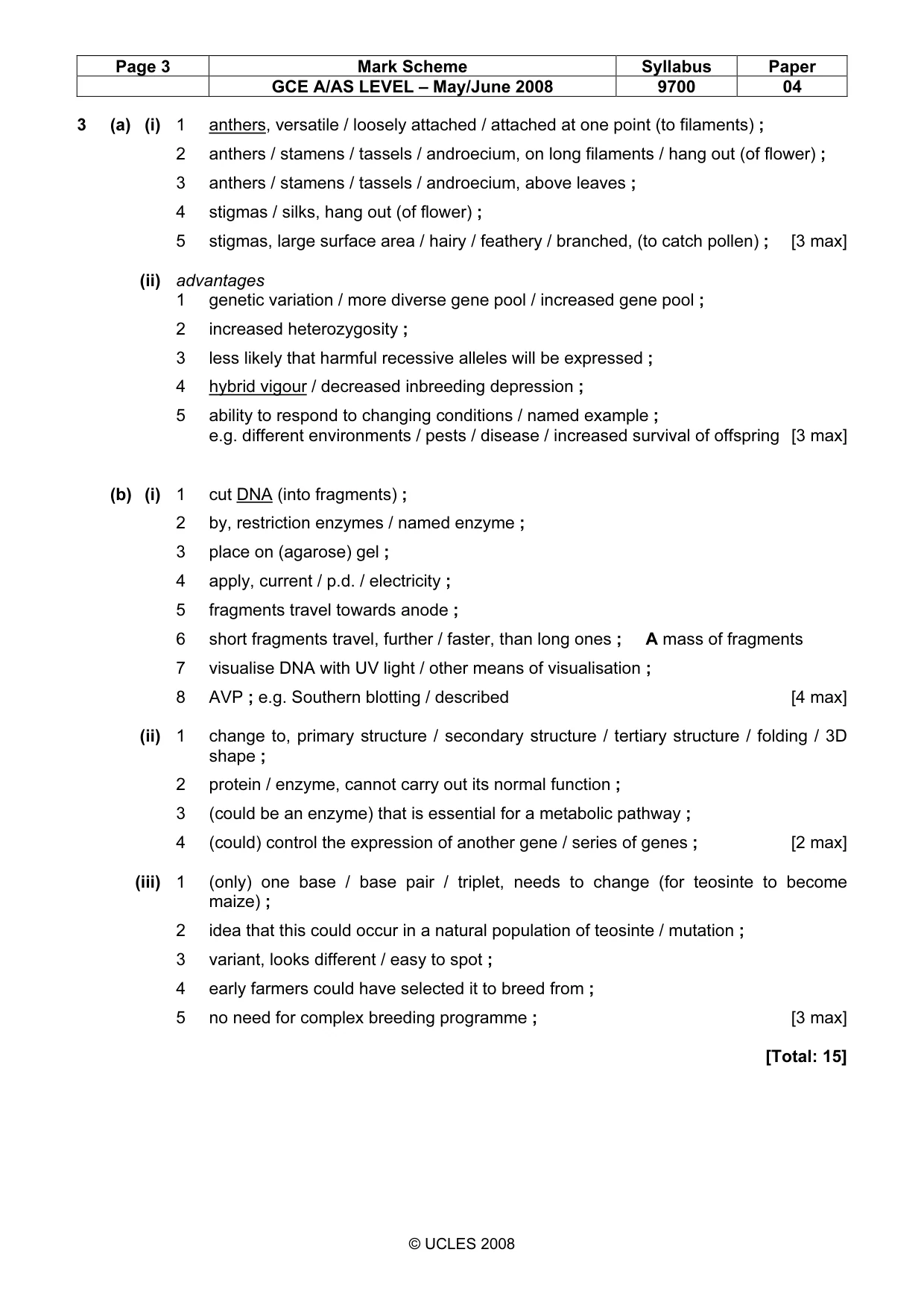
Page 3 Mark Scheme Syllabus Paper GCE A/AS LEVEL – May/June 2008 9700 04 © UCLES 2008 3 (a) (i) 1 anthers, versatile / loosely attached / attached at one point (to filaments) ; 2 anthers / stamens / tassels / androecium, on long filaments / hang out (of flower) ; 3 anthers / stamens / tassels / androecium, above leaves ; 4 stigmas / silks, hang out (of flower) ; 5 stigmas, large surface area / hairy / feathery / branched, (to catch pollen) ; [3 max] (ii) advantages 1 genetic variation / more diverse gene pool / increased gene pool ; 2 increased heterozygosity ; 3 less likely that harmful recessive alleles will be expressed ; 4 hybrid vigour / decreased inbreeding depression ; 5 ability to respond to changing conditions / named example ; e.g. different environments / pests / disease / increased survival of offspring [3 max] (b) (i) 1 cut DNA (into fragments) ; 2 by, restriction enzymes / named enzyme ; 3 place on (agarose) gel ; 4 apply, current / p.d. / electricity ; 5 fragments travel towards anode ; 6 short fragments travel, further / faster, than long ones ; A mass of fragments 7 visualise DNA with UV light / other means of visualisation ; 8 AVP ; e.g. Southern blotting / described [4 max] (ii) 1 change to, primary structure / secondary structure / tertiary structure / folding / 3D shape ; 2 protein / enzyme, cannot carry out its normal function ; 3 (could be an enzyme) that is essential for a metabolic pathway ; 4 (could) control the expression of another gene / series of genes ; [2 max] (iii) 1 (only) one base / base pair / triplet, needs to change (for teosinte to become maize) ; 2 idea that this could occur in a natural population of teosinte / mutation ; 3 variant, looks different / easy to spot ; 4 early farmers could have selected it to breed from ; 5 no need for complex breeding programme ; [3 max] [Total: 15]
Mark scheme, page 4
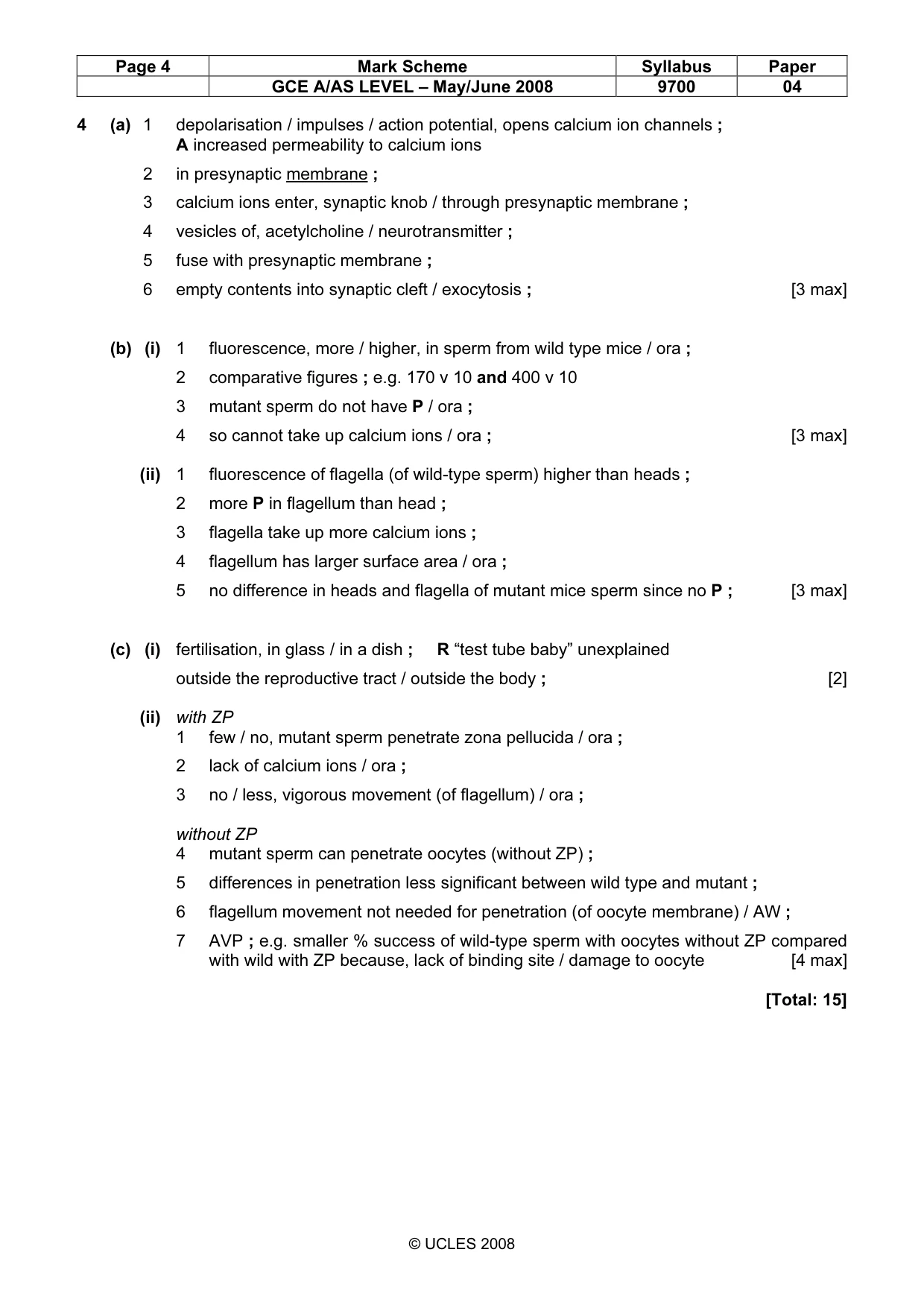
Page 4 Mark Scheme Syllabus Paper GCE A/AS LEVEL – May/June 2008 9700 04 © UCLES 2008 4 (a) 1 depolarisation / impulses / action potential, opens calcium ion channels ; A increased permeability to calcium ions 2 in presynaptic membrane ; 3 calcium ions enter, synaptic knob / through presynaptic membrane ; 4 vesicles of, acetylcholine / neurotransmitter ; 5 fuse with presynaptic membrane ; 6 empty contents into synaptic cleft / exocytosis ; [3 max] (b) (i) 1 fluorescence, more / higher, in sperm from wild type mice / ora ; 2 comparative figures ; e.g. 170 v 10 and 400 v 10 3 mutant sperm do not have P / ora ; 4 so cannot take up calcium ions / ora ; [3 max] (ii) 1 fluorescence of flagella (of wild-type sperm) higher than heads ; 2 more P in flagellum than head ; 3 flagella take up more calcium ions ; 4 flagellum has larger surface area / ora ; 5 no difference in heads and flagella of mutant mice sperm since no P ; [3 max] (c) (i) fertilisation, in glass / in a dish ; R “test tube baby” unexplained outside the reproductive tract / outside the body ; [2] (ii) with ZP 1 few / no, mutant sperm penetrate zona pellucida / ora ; 2 lack of calcium ions / ora ; 3 no / less, vigorous movement (of flagellum) / ora ; without ZP 4 mutant sperm can penetrate oocytes (without ZP) ; 5 differences in penetration less significant between wild type and mutant ; 6 flagellum movement not needed for penetration (of oocyte membrane) / AW ; 7 AVP ; e.g. smaller % success of wild-type sperm with oocytes without ZP compared with wild with ZP because, lack of binding site / damage to oocyte [4 max] [Total: 15]
Mark scheme, page 5
Page 5 Mark Scheme Syllabus Paper GCE A/AS LEVEL – May/June 2008 9700 04 © UCLES 2008 5 (a) 1 bacterium obtains energy ; 2 for synthesis of materials ; 3 for, growth / division ; 4 does not need to use carbon compounds for energy ; A named carbon compound [2 max] (b) 1 takes up large area ; 2 unsightly ; 3 requires, lot of water / continuous water supply ; 4 contamination of water / pollution due to acid ; 5 Cu / Fe, toxic to plants ; [2 max] (c) bioleaching (accept ora for mining) 1 low level technology / no sophisticated machinery / requires less maintenance ; 2 low energy consumption / less fossil fuels used ; 3 few safety hazards / safer ; R no hazards 4 organism easy to, obtain / culture ; 5 self replicating ; 6 waste less hazardous ; 7 disposal of waste, costs less / is easier ; 8 ref. low grade ores / scrap iron ; 9 less workers needed ; 10 ref. use in situ ; [4 max] [Total:8] 6 (a) allele (different) form of a gene ; A variety / version ignore refs to locus / mutation [1] recessive allele which does not have its effect in heterozygote / allele which (only) has its effect in homozygote / affects phenotype if dominant allele is absent ; [1] (b) gene / allele, on X chromosome / sex linkage ; female, needs 2 RGC alleles / homozygous recessive / can be heterozygous ; male needs 1 RGC allele ; [2 max]
Mark scheme, page 6
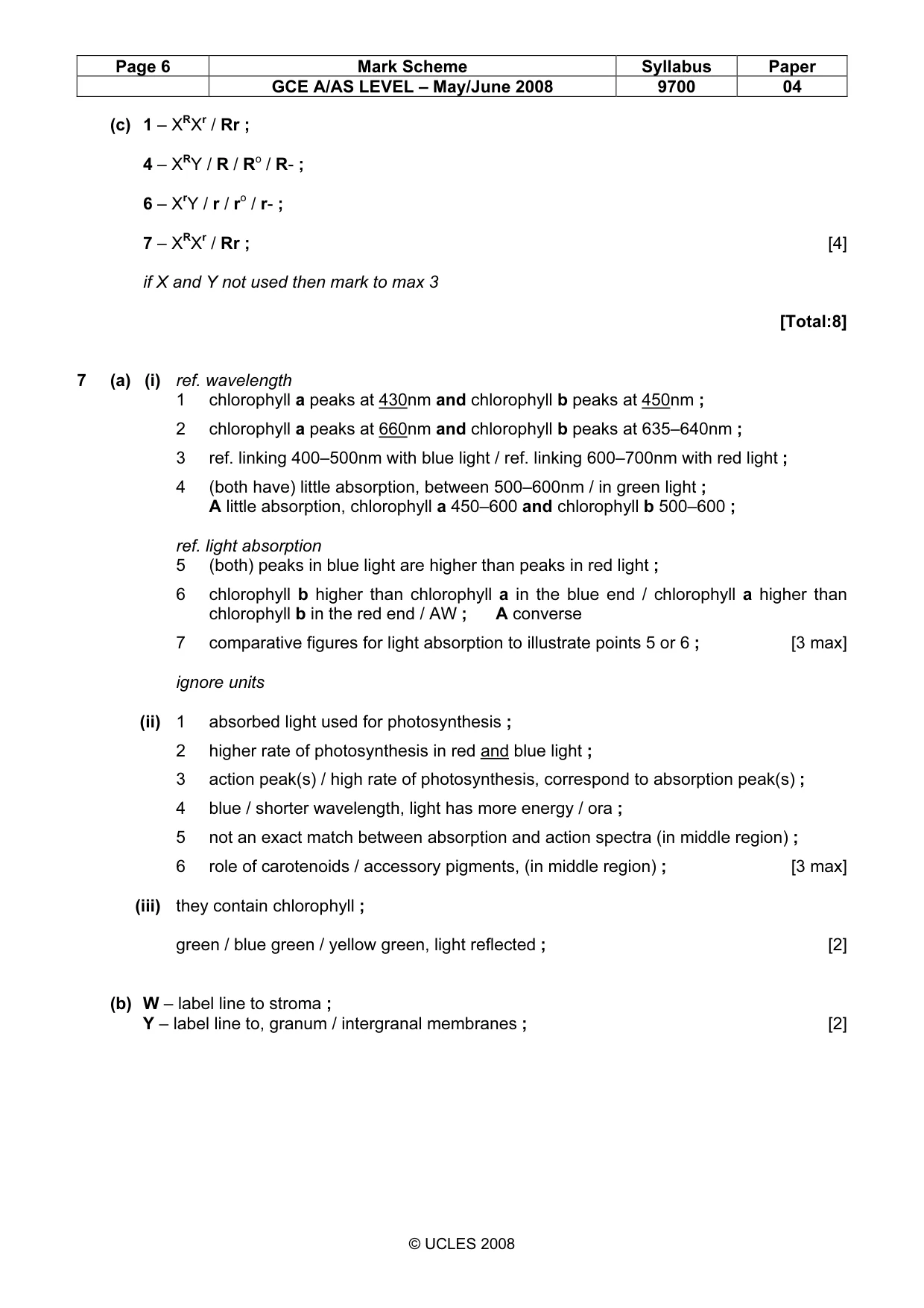
Page 6 Mark Scheme Syllabus Paper GCE A/AS LEVEL – May/June 2008 9700 04 © UCLES 2008 (c) 1 – XRXr / Rr ; 4 – XRY / R / Ro / R- ; 6 – XrY / r / ro / r- ; 7 – XRXr / Rr ; [4] if X and Y not used then mark to max 3 [Total:8] 7 (a) (i) ref. wavelength 1 chlorophyll a peaks at 430nm and chlorophyll b peaks at 450nm ; 2 chlorophyll a peaks at 660nm and chlorophyll b peaks at 635–640nm ; 3 ref. linking 400–500nm with blue light / ref. linking 600–700nm with red light ; 4 (both have) little absorption, between 500–600nm / in green light ; A little absorption, chlorophyll a 450–600 and chlorophyll b 500–600 ; ref. light absorption 5 (both) peaks in blue light are higher than peaks in red light ; 6 chlorophyll b higher than chlorophyll a in the blue end / chlorophyll a higher than chlorophyll b in the red end / AW ; A converse 7 comparative figures for light absorption to illustrate points 5 or 6 ; [3 max] ignore units (ii) 1 absorbed light used for photosynthesis ; 2 higher rate of photosynthesis in red and blue light ; 3 action peak(s) / high rate of photosynthesis, correspond to absorption peak(s) ; 4 blue / shorter wavelength, light has more energy / ora ; 5 not an exact match between absorption and action spectra (in middle region) ; 6 role of carotenoids / accessory pigments, (in middle region) ; [3 max] (iii) they contain chlorophyll ; green / blue green / yellow green, light reflected ; [2] (b) W – label line to stroma ; Y – label line to, granum / intergranal membranes ; [2]
Mark scheme, page 7
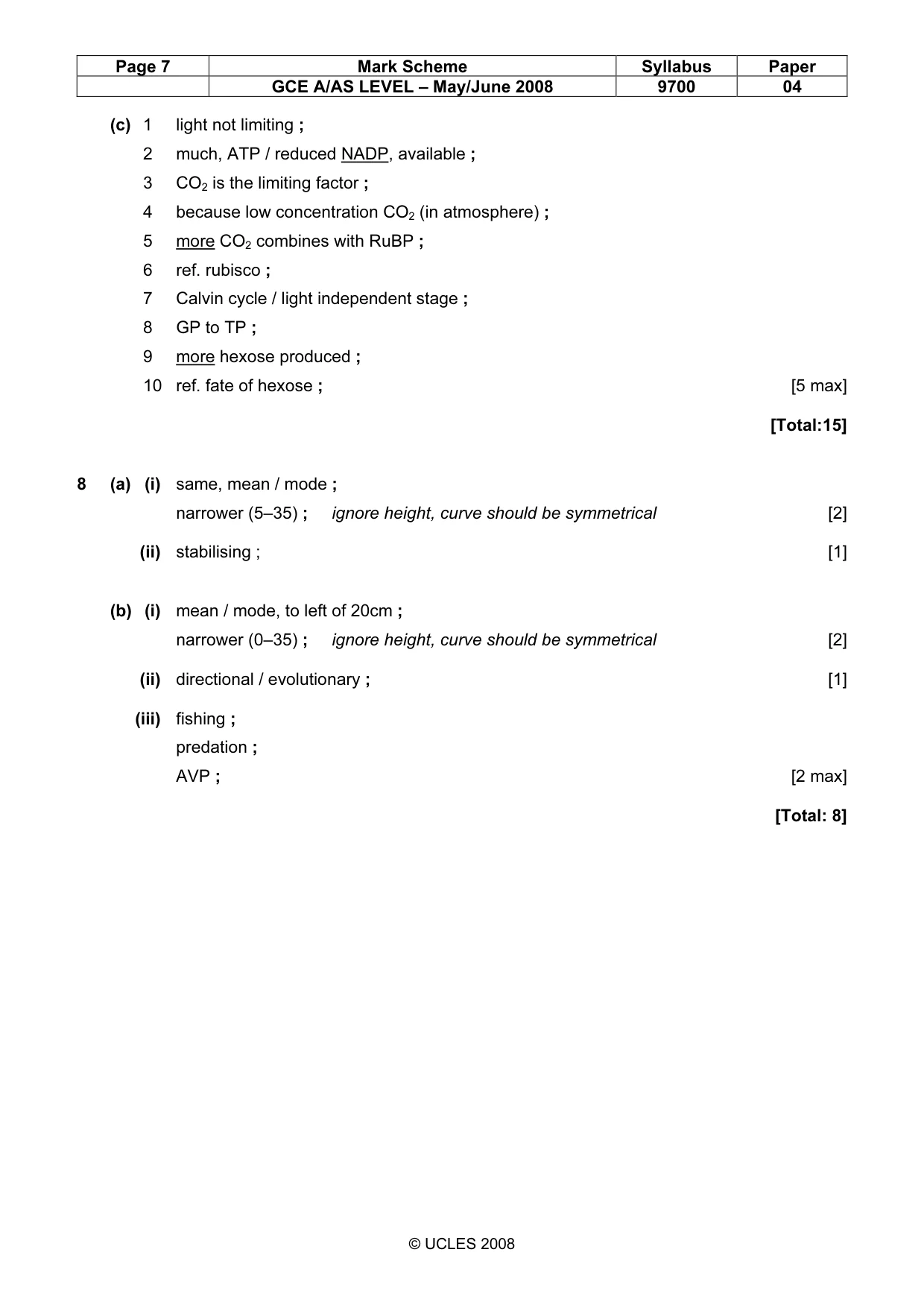
Page 7 Mark Scheme Syllabus Paper GCE A/AS LEVEL – May/June 2008 9700 04 © UCLES 2008 (c) 1 light not limiting ; 2 much, ATP / reduced NADP, available ; 3 CO2 is the limiting factor ; 4 because low concentration CO2 (in atmosphere) ; 5 more CO2 combines with RuBP ; 6 ref. rubisco ; 7 Calvin cycle / light independent stage ; 8 GP to TP ; 9 more hexose produced ; 10 ref. fate of hexose ; [5 max] [Total:15] 8 (a) (i) same, mean / mode ; narrower (5–35) ; ignore height, curve should be symmetrical [2] (ii) stabilising ; [1] (b) (i) mean / mode, to left of 20cm ; narrower (0–35) ; ignore height, curve should be symmetrical [2] (ii) directional / evolutionary ; [1] (iii) fishing ; predation ; AVP ; [2 max] [Total: 8]
Mark scheme, page 8
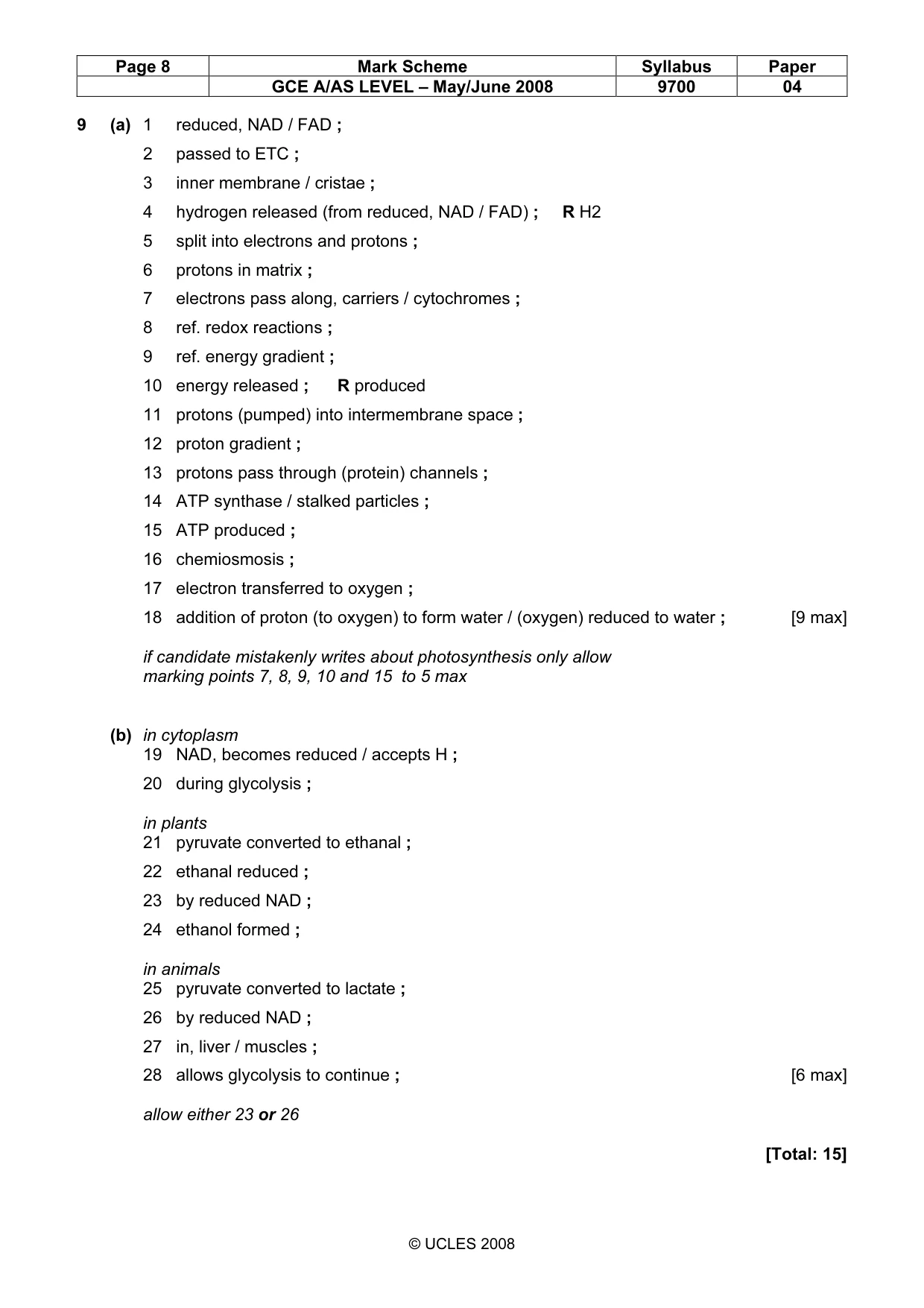
Page 8 Mark Scheme Syllabus Paper GCE A/AS LEVEL – May/June 2008 9700 04 © UCLES 2008 9 (a) 1 reduced, NAD / FAD ; 2 passed to ETC ; 3 inner membrane / cristae ; 4 hydrogen released (from reduced, NAD / FAD) ; R H2 5 split into electrons and protons ; 6 protons in matrix ; 7 electrons pass along, carriers / cytochromes ; 8 ref. redox reactions ; 9 ref. energy gradient ; 10 energy released ; R produced 11 protons (pumped) into intermembrane space ; 12 proton gradient ; 13 protons pass through (protein) channels ; 14 ATP synthase / stalked particles ; 15 ATP produced ; 16 chemiosmosis ; 17 electron transferred to oxygen ; 18 addition of proton (to oxygen) to form water / (oxygen) reduced to water ; [9 max] if candidate mistakenly writes about photosynthesis only allow marking points 7, 8, 9, 10 and 15 to 5 max (b) in cytoplasm 19 NAD, becomes reduced / accepts H ; 20 during glycolysis ; in plants 21 pyruvate converted to ethanal ; 22 ethanal reduced ; 23 by reduced NAD ; 24 ethanol formed ; in animals 25 pyruvate converted to lactate ; 26 by reduced NAD ; 27 in, liver / muscles ; 28 allows glycolysis to continue ; [6 max] allow either 23 or 26 [Total: 15]
Mark scheme, page 9
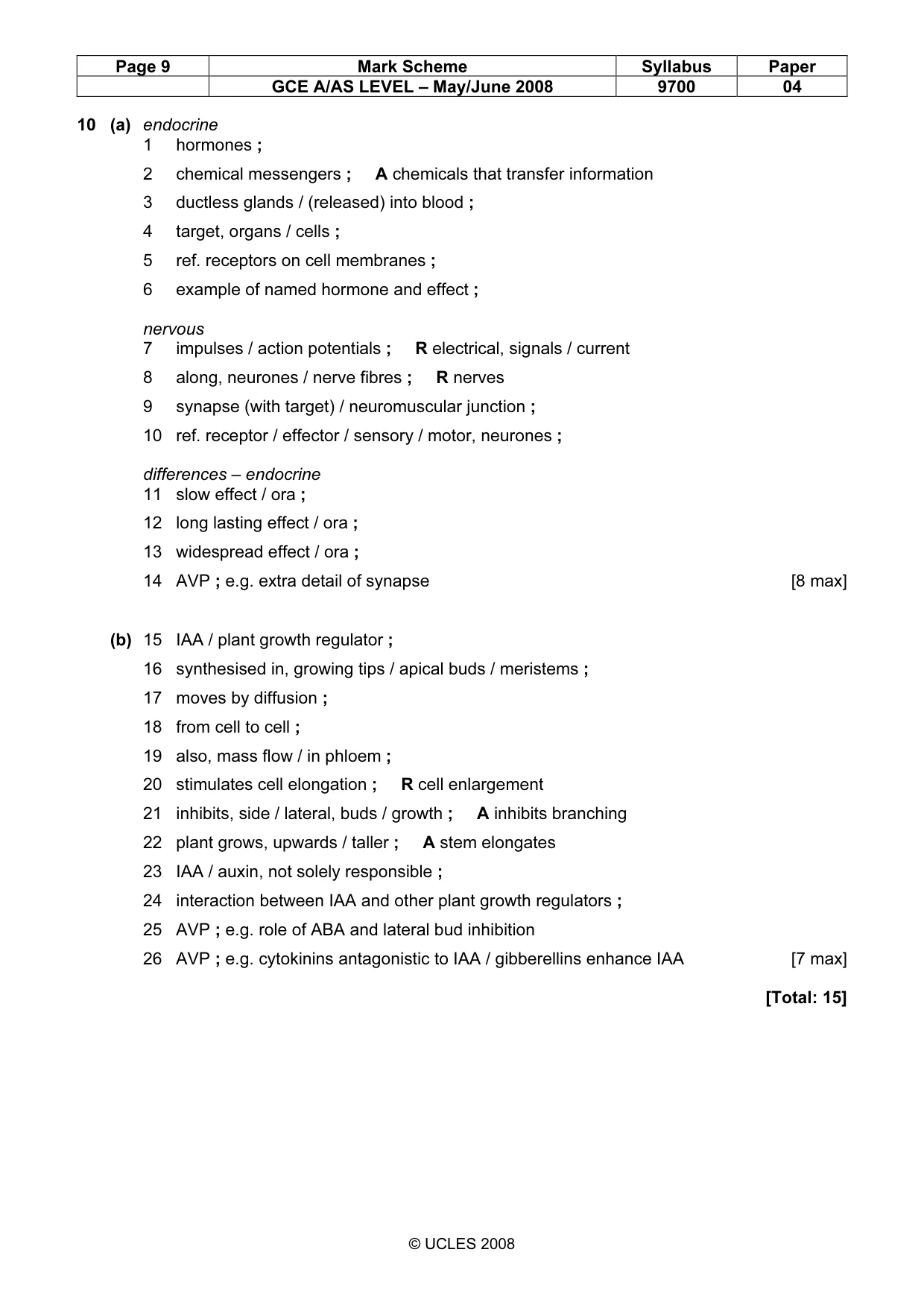
Page 9 Mark Scheme Syllabus Paper GCE A/AS LEVEL – May/June 2008 9700 04 © UCLES 2008 10 (a) endocrine 1 hormones ; 2 chemical messengers ; A chemicals that transfer information 3 ductless glands / (released) into blood ; 4 target, organs / cells ; 5 ref. receptors on cell membranes ; 6 example of named hormone and effect ; nervous 7 impulses / action potentials ; R electrical, signals / current 8 along, neurones / nerve fibres ; R nerves 9 synapse (with target) / neuromuscular junction ; 10 ref. receptor / effector / sensory / motor, neurones ; differences – endocrine 11 slow effect / ora ; 12 long lasting effect / ora ; 13 widespread effect / ora ; 14 AVP ; e.g. extra detail of synapse [8 max] (b) 15 IAA / plant growth regulator ; 16 synthesised in, growing tips / apical buds / meristems ; 17 moves by diffusion ; 18 from cell to cell ; 19 also, mass flow / in phloem ; 20 stimulates cell elongation ; R cell enlargement 21 inhibits, side / lateral, buds / growth ; A inhibits branching 22 plant grows, upwards / taller ; A stem elongates 23 IAA / auxin, not solely responsible ; 24 interaction between IAA and other plant growth regulators ; 25 AVP ; e.g. role of ABA and lateral bud inhibition 26 AVP ; e.g. cytokinins antagonistic to IAA / gibberellins enhance IAA [7 max] [Total: 15]