Cambridge A Level Biology 9700 — 2008 May/June Paper 2 · Variant 1
9700/21/M/J/08
The question paper and its mark scheme, free to read here and free to download. This is Cambridge’s own paper, exactly as it was sat.
Question paper16 pages
Mark scheme8 pages
Answers below. Sit the paper first if you are practising.
Paper as text
Question paper, page 1
This document consists of 15 printed pages and 1 blank page. SPA (FF/DT) T60104/3 © UCLES 2008 [Turn over UNIVERSITY OF CAMBRIDGE INTERNATIONAL EXAMINATIONS General Certificate of Education Advanced Subsidiary Level and Advanced Level READ THESE INSTRUCTIONS FIRST Write your Centre number, candidate number and name on all the work you hand in. Write in dark blue or black pen. You may use a soft pencil for any diagrams, graphs or rough working. Do not use staples, paper clips, highlighters, glue or correction fluid. DO NOT WRITE IN ANY BARCODES. Answer all questions. At the end of the examination, fasten all your work together. The number of marks is given in brackets [ ] at the end of each question or part question. * 2 6 7 9 2 7 1 4 0 8 * BIOLOGY 9700/02 Paper 2 Structured Questions AS May/June 2008 1 hour 15 minutes Candidates answer on the Question Paper. No Additional Materials are required. For Examiner’s Use 1 2 3 4 5 6 Total
Question paper, page 2
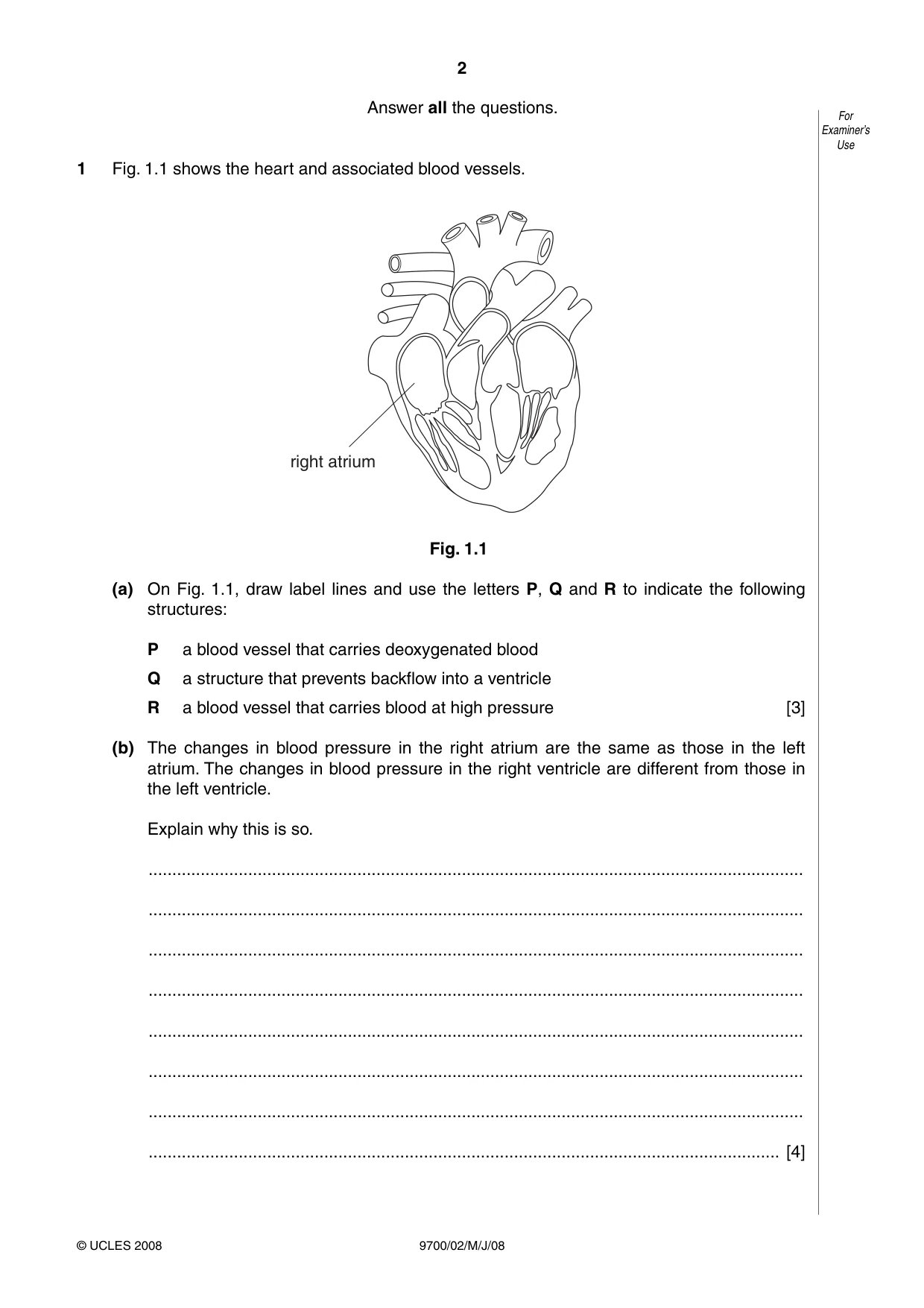
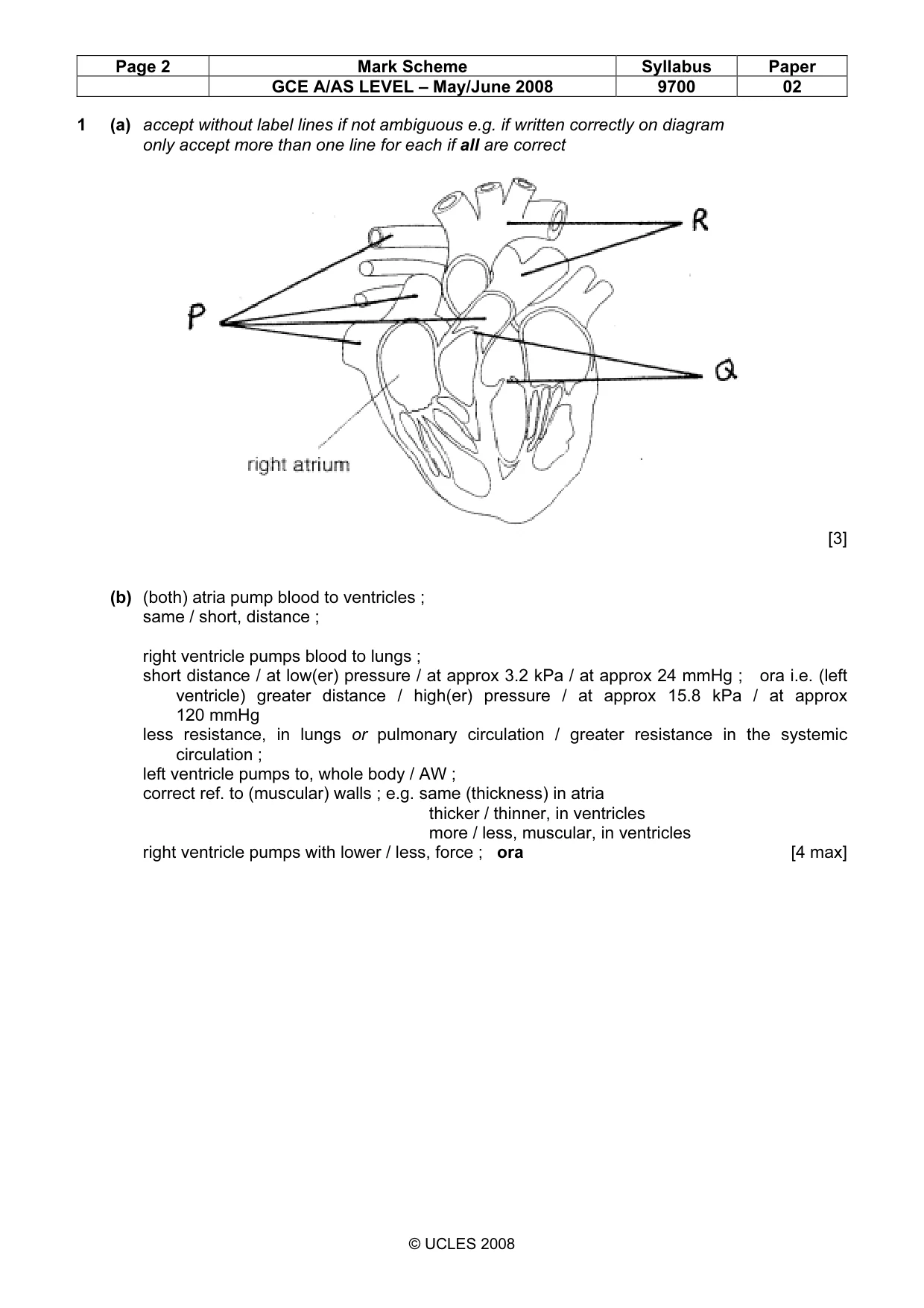
2 9700/02/M/J/08 © UCLES 2008 For Examiner’s Use Answer all the questions. 1 Fig. 1.1 shows the heart and associated blood vessels. right atrium Fig. 1.1 (a) On Fig. 1.1, draw label lines and use the letters P, Q and R to indicate the following structures: P a blood vessel that carries deoxygenated blood Q a structure that prevents backflow into a ventricle R a blood vessel that carries blood at high pressure [3] (b) The changes in blood pressure in the right atrium are the same as those in the left atrium. The changes in blood pressure in the right ventricle are different from those in the left ventricle. Explain why this is so. … … … … … … … … [4]
Question paper, page 3
3 9700/02/M/J/08 © UCLES 2008 [Turn over For Examiner’s Use (c) Some components of tobacco smoke are absorbed into the blood stream and affect the cardiovascular system. Describe the effects of nicotine and carbon monoxide on the cardiovascular system. nicotine … … … … carbon monoxide … … … … [4] [Total: 11]
Question paper, page 4
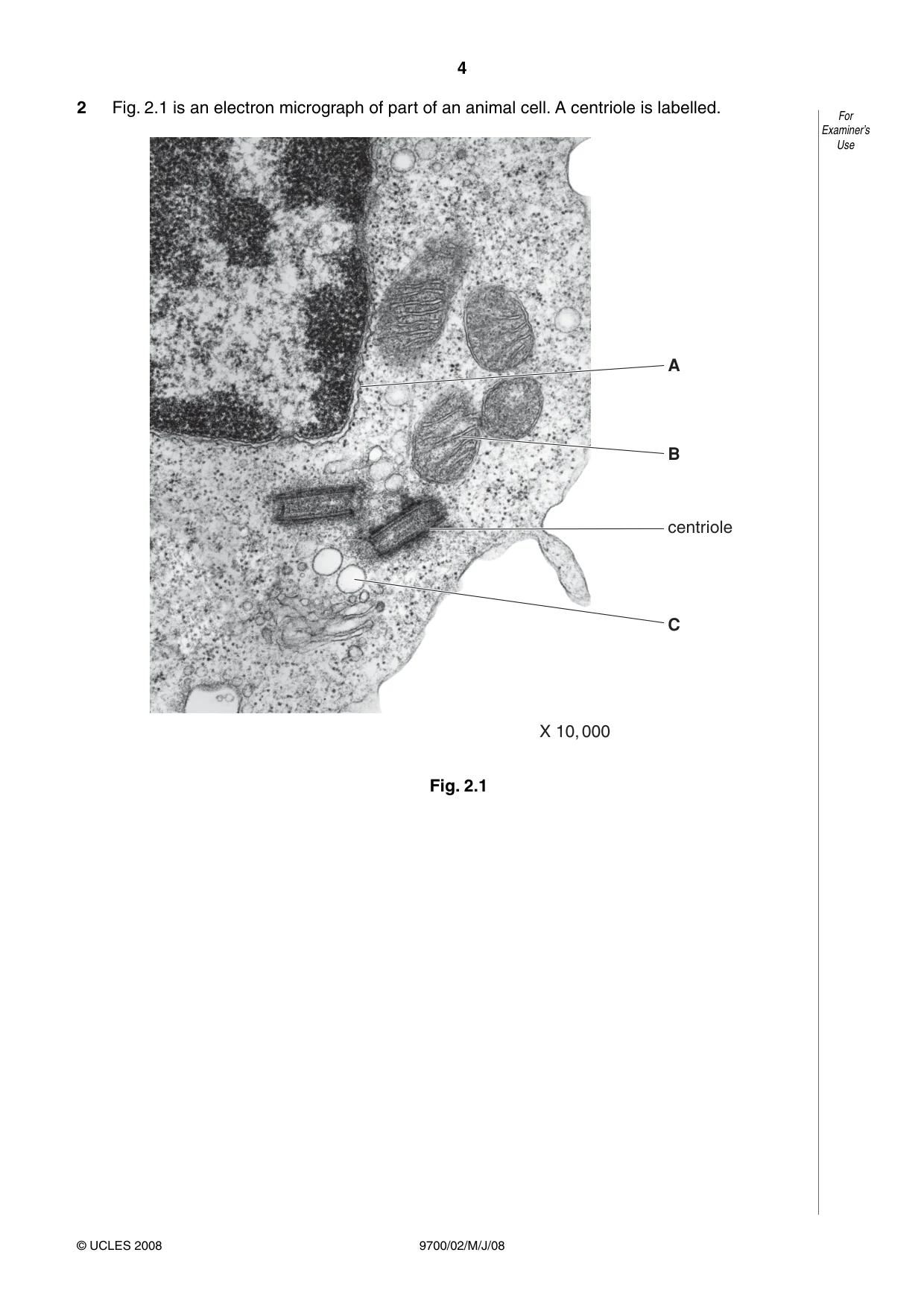
4 9700/02/M/J/08 © UCLES 2008 For Examiner’s Use 2 Fig. 2.1 is an electron micrograph of part of an animal cell. A centriole is labelled. A B centriole X 10, 000 C Fig. 2.1
Question paper, page 5
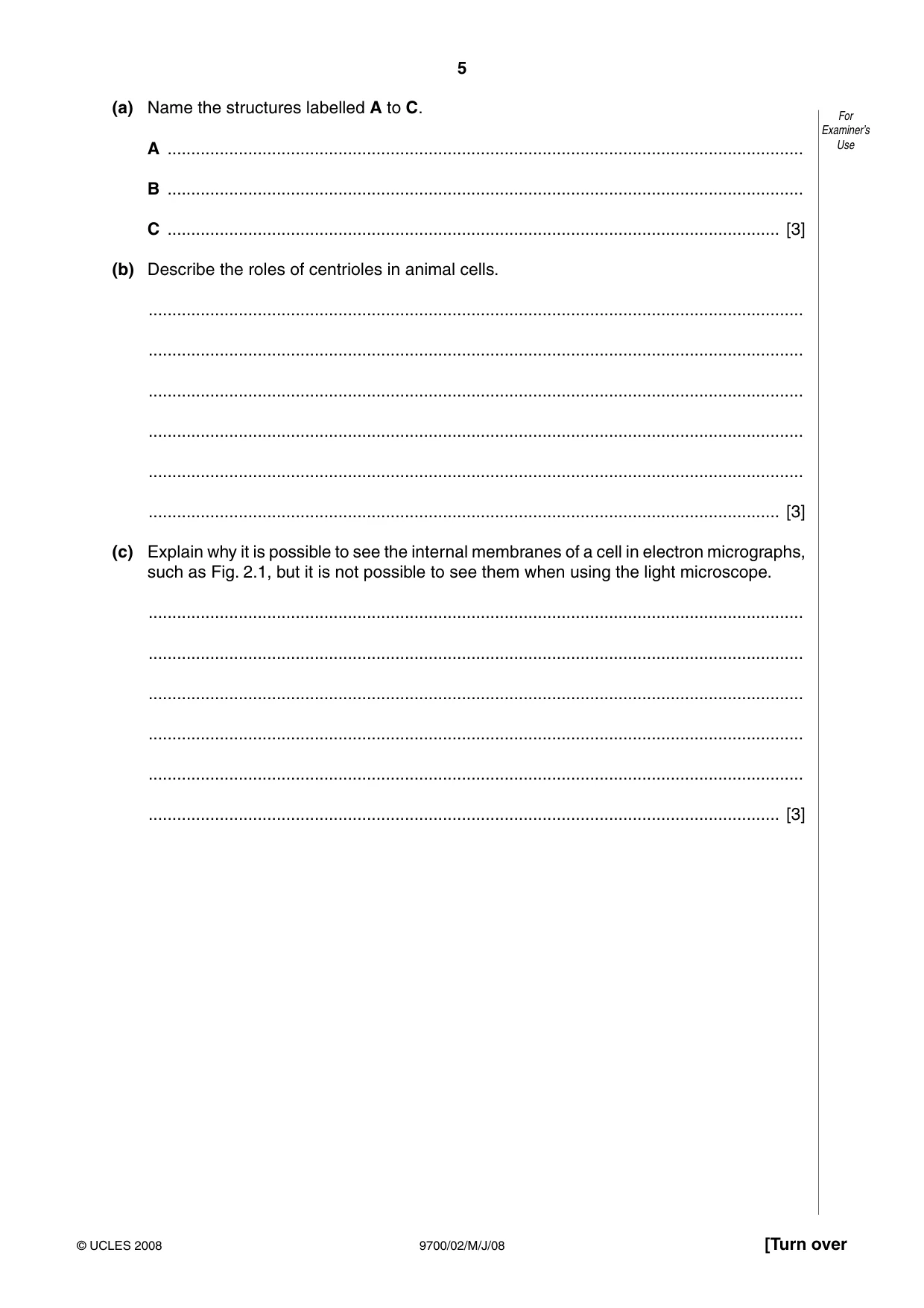
5 9700/02/M/J/08 © UCLES 2008 [Turn over For Examiner’s Use (a) Name the structures labelled A to C. A … B … C … [3] (b) Describe the roles of centrioles in animal cells. … … … … … … [3] (c) Explain why it is possible to see the internal membranes of a cell in electron micrographs, such as Fig. 2.1, but it is not possible to see them when using the light microscope. … … … … … … [3]
Question paper, page 6
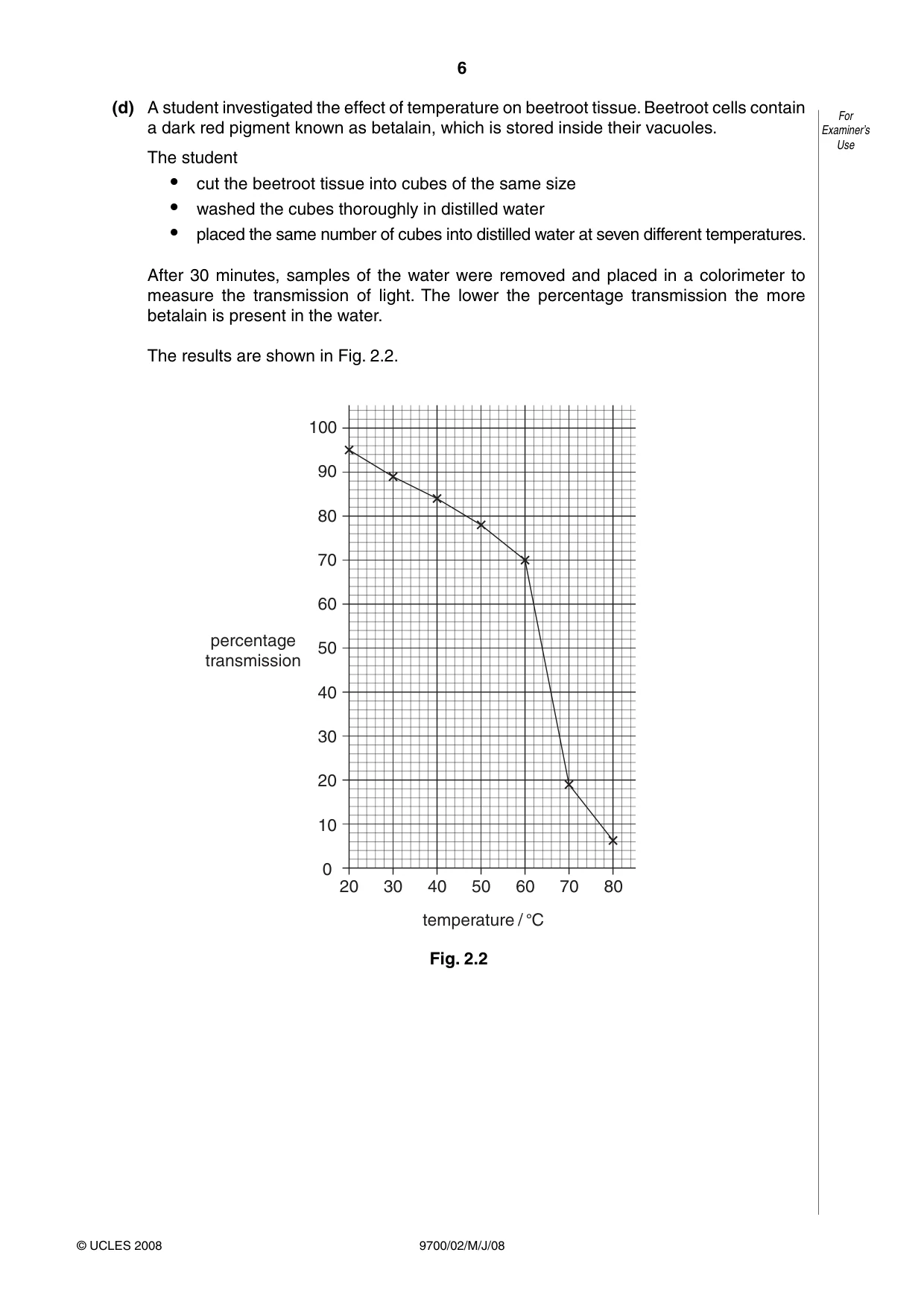
6 9700/02/M/J/08 © UCLES 2008 For Examiner’s Use (d) A student investigated the effect of temperature on beetroot tissue. Beetroot cells contain a dark red pigment known as betalain, which is stored inside their vacuoles. The student • cut the beetroot tissue into cubes of the same size • washed the cubes thoroughly in distilled water • placed the same number of cubes into distilled water at seven different temperatures. After 30 minutes, samples of the water were removed and placed in a colorimeter to measure the transmission of light. The lower the percentage transmission the more betalain is present in the water. The results are shown in Fig. 2.2. temperature / °C 0 10 20 20 30 40 50 60 70 80 30 40 50 60 70 80 90 100 percentage transmission Fig. 2.2
Question paper, page 7
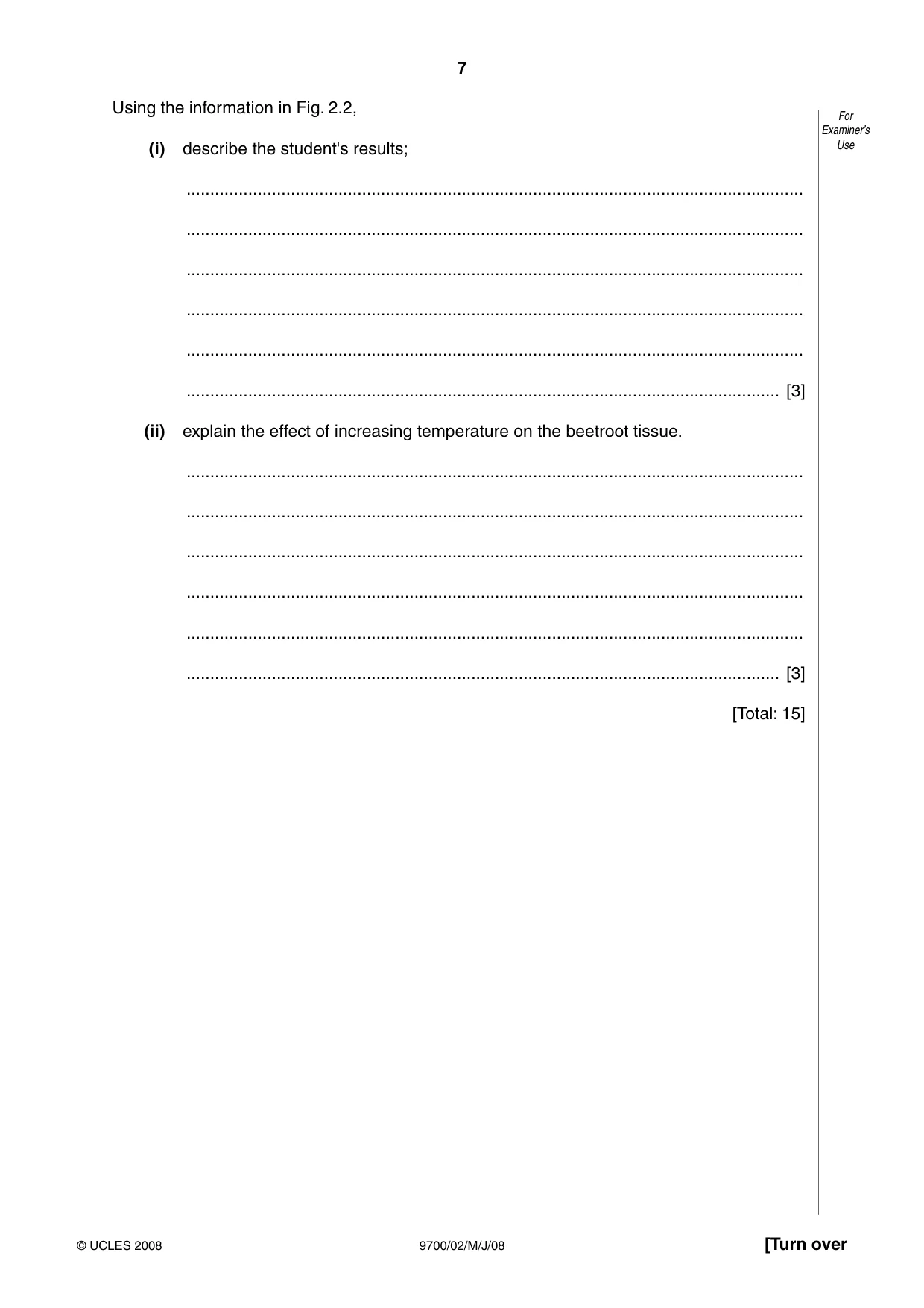
7 9700/02/M/J/08 © UCLES 2008 [Turn over For Examiner’s Use Using the information in Fig. 2.2, (i) describe the student's results; … … … … … … [3] (ii) explain the effect of increasing temperature on the beetroot tissue. … … … … … … [3] [Total: 15]
Question paper, page 8
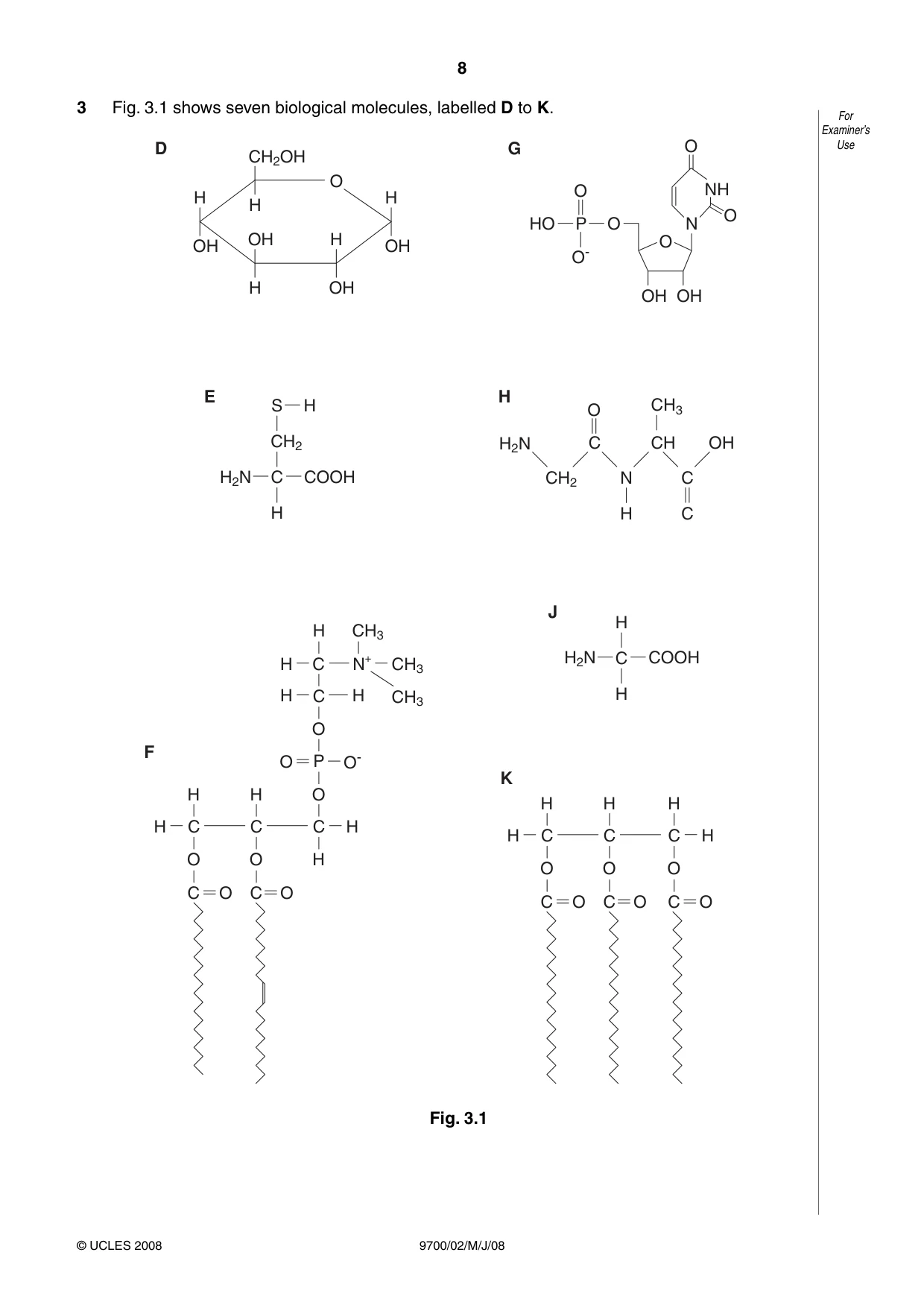
8 9700/02/M/J/08 © UCLES 2008 For Examiner’s Use 3 Fig. 3.1 shows seven biological molecules, labelled D to K. H OH H OH O CH2OH H OH H H OH D CH2 H2N H S C H COOH E C H H O O O H O C O P H C N+ H O C H O C C C H H H O- CH3 CH3 CH3 H F HO O N O O O- P OH OH NH O O G CH OH CH2 CH3 H2N O C C H N C H O O H O C H O C C C H O H O C C K H2N C H H COOH J Fig. 3.1
Question paper, page 9
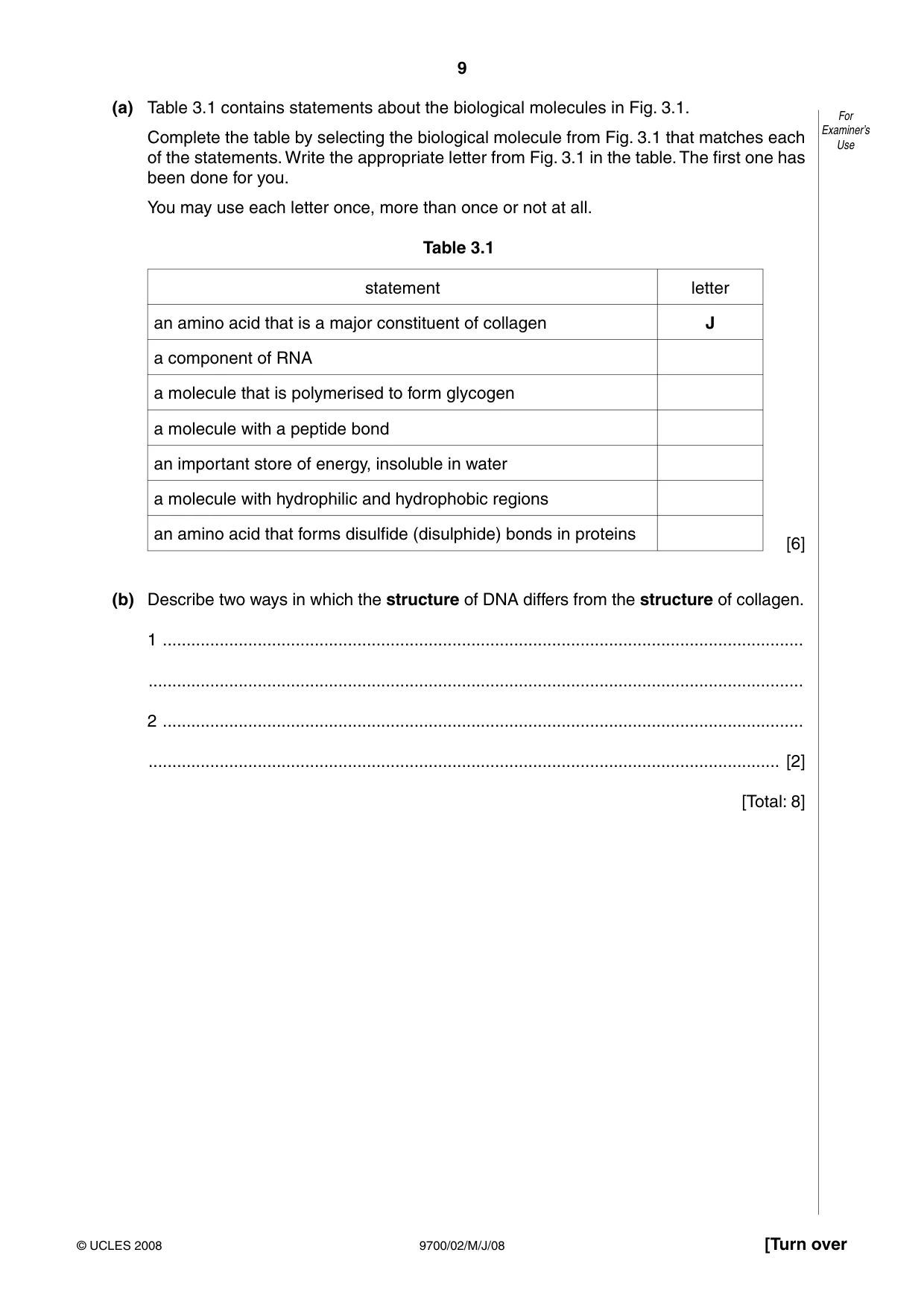
9 9700/02/M/J/08 © UCLES 2008 [Turn over For Examiner’s Use (a) Table 3.1 contains statements about the biological molecules in Fig. 3.1. Complete the table by selecting the biological molecule from Fig. 3.1 that matches each of the statements. Write the appropriate letter from Fig. 3.1 in the table. The first one has been done for you. You may use each letter once, more than once or not at all. Table 3.1 statement letter an amino acid that is a major constituent of collagen J a component of RNA a molecule that is polymerised to form glycogen a molecule with a peptide bond an important store of energy, insoluble in water a molecule with hydrophilic and hydrophobic regions an amino acid that forms disulfide (disulphide) bonds in proteins [6] (b) Describe two ways in which the structure of DNA differs from the structure of collagen. 1 … … 2 … … [2] [Total: 8]
Question paper, page 10
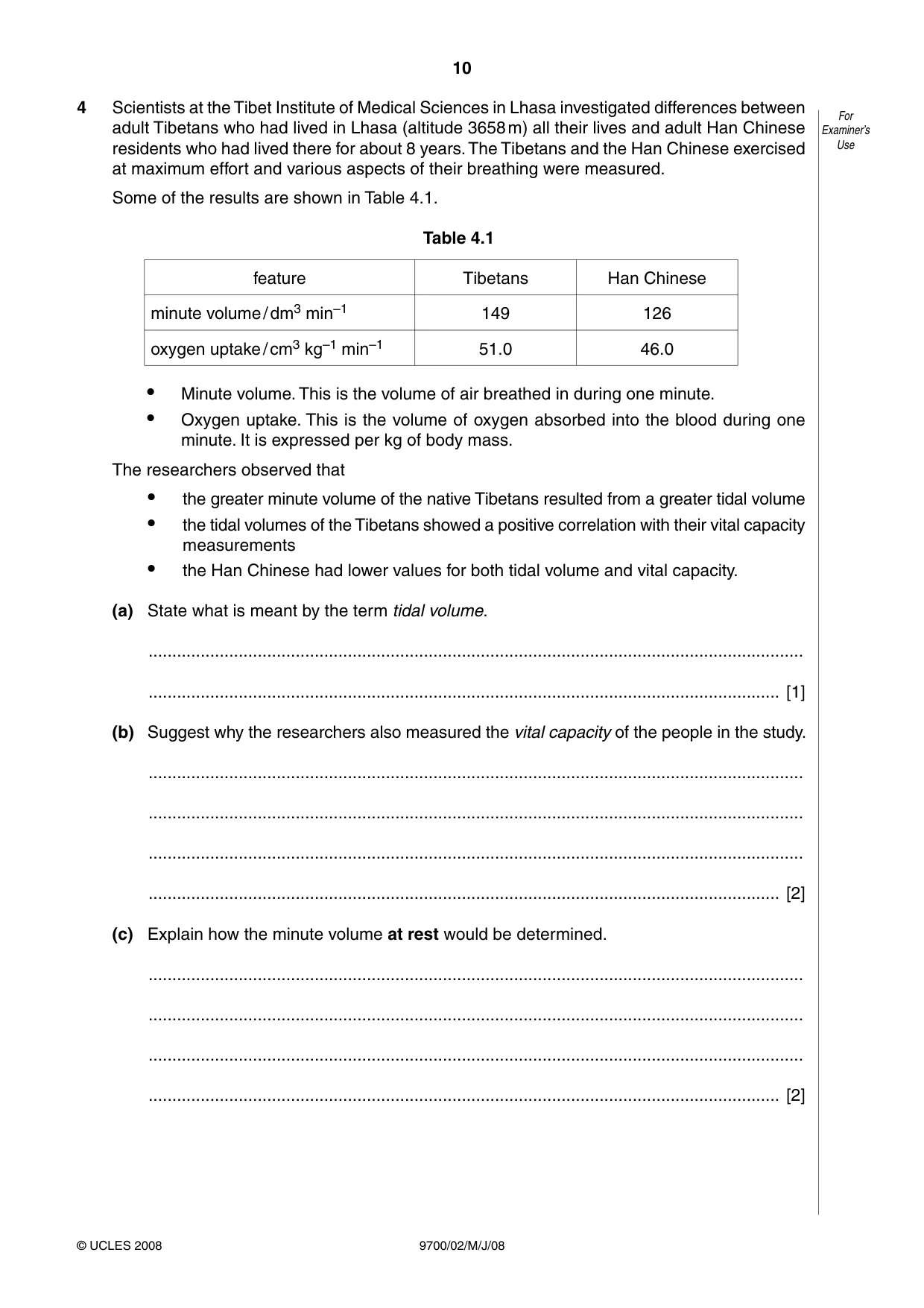
10 9700/02/M/J/08 © UCLES 2008 For Examiner’s Use 4 Scientists at the Tibet Institute of Medical Sciences in Lhasa investigated differences between adult Tibetans who had lived in Lhasa (altitude 3658 m) all their lives and adult Han Chinese residents who had lived there for about 8 years. The Tibetans and the Han Chinese exercised at maximum effort and various aspects of their breathing were measured. Some of the results are shown in Table 4.1. Table 4.1 feature Tibetans Han Chinese minute volume / dm3 min–1 149 126 oxygen uptake / cm3 kg–1 min–1 51.0 46.0 • Minute volume. This is the volume of air breathed in during one minute. • Oxygen uptake. This is the volume of oxygen absorbed into the blood during one minute. It is expressed per kg of body mass. The researchers observed that • the greater minute volume of the native Tibetans resulted from a greater tidal volume • the tidal volumes of the Tibetans showed a positive correlation with their vital capacity measurements • the Han Chinese had lower values for both tidal volume and vital capacity. (a) State what is meant by the term tidal volume. … … [1] (b) Suggest why the researchers also measured the vital capacity of the people in the study. … … … … [2] (c) Explain how the minute volume at rest would be determined. … … … … [2]
Question paper, page 11
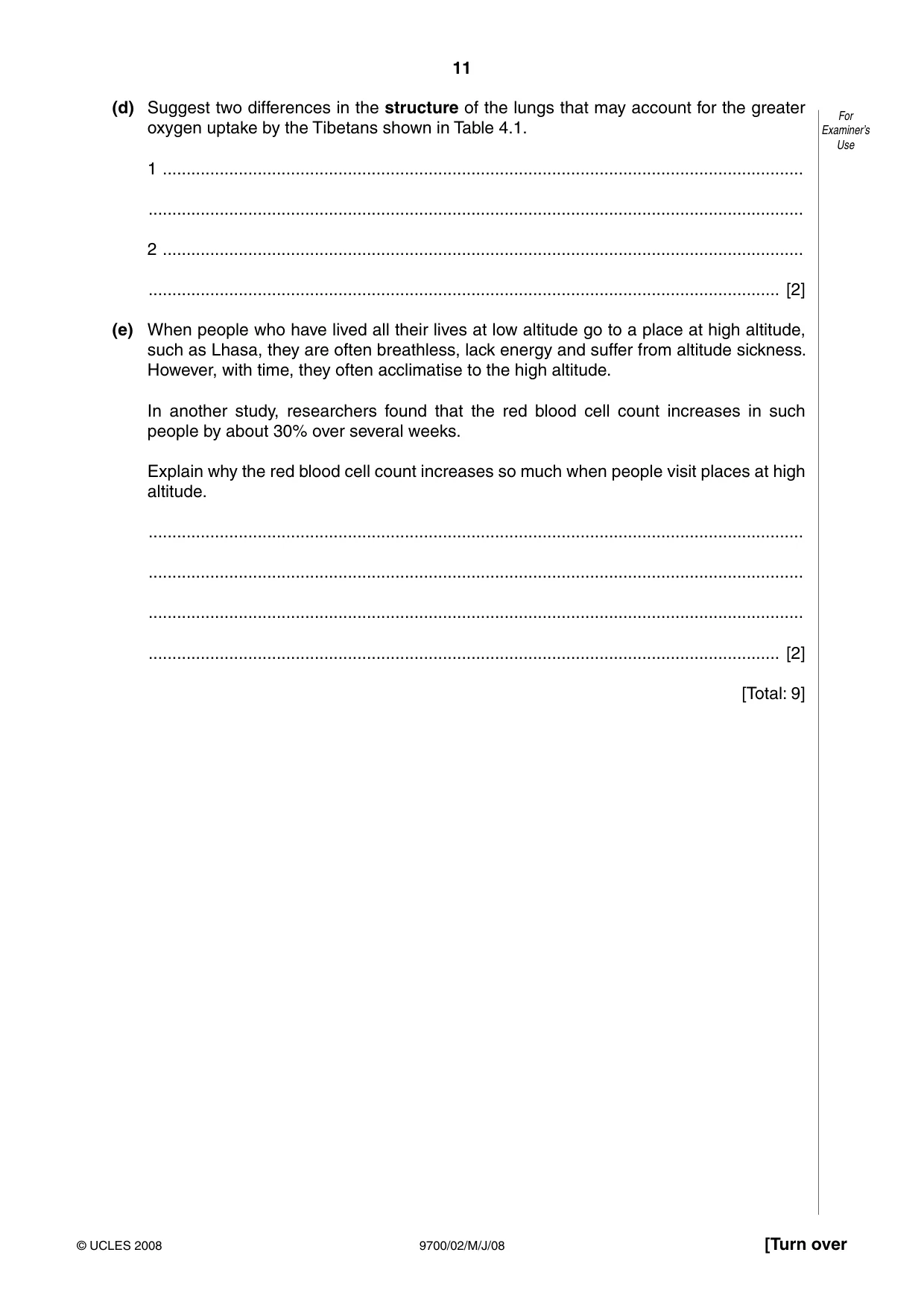
11 9700/02/M/J/08 © UCLES 2008 [Turn over For Examiner’s Use (d) Suggest two differences in the structure of the lungs that may account for the greater oxygen uptake by the Tibetans shown in Table 4.1. 1 … … 2 … … [2] (e) When people who have lived all their lives at low altitude go to a place at high altitude, such as Lhasa, they are often breathless, lack energy and suffer from altitude sickness. However, with time, they often acclimatise to the high altitude. In another study, researchers found that the red blood cell count increases in such people by about 30% over several weeks. Explain why the red blood cell count increases so much when people visit places at high altitude. … … … … [2] [Total: 9]
Question paper, page 12
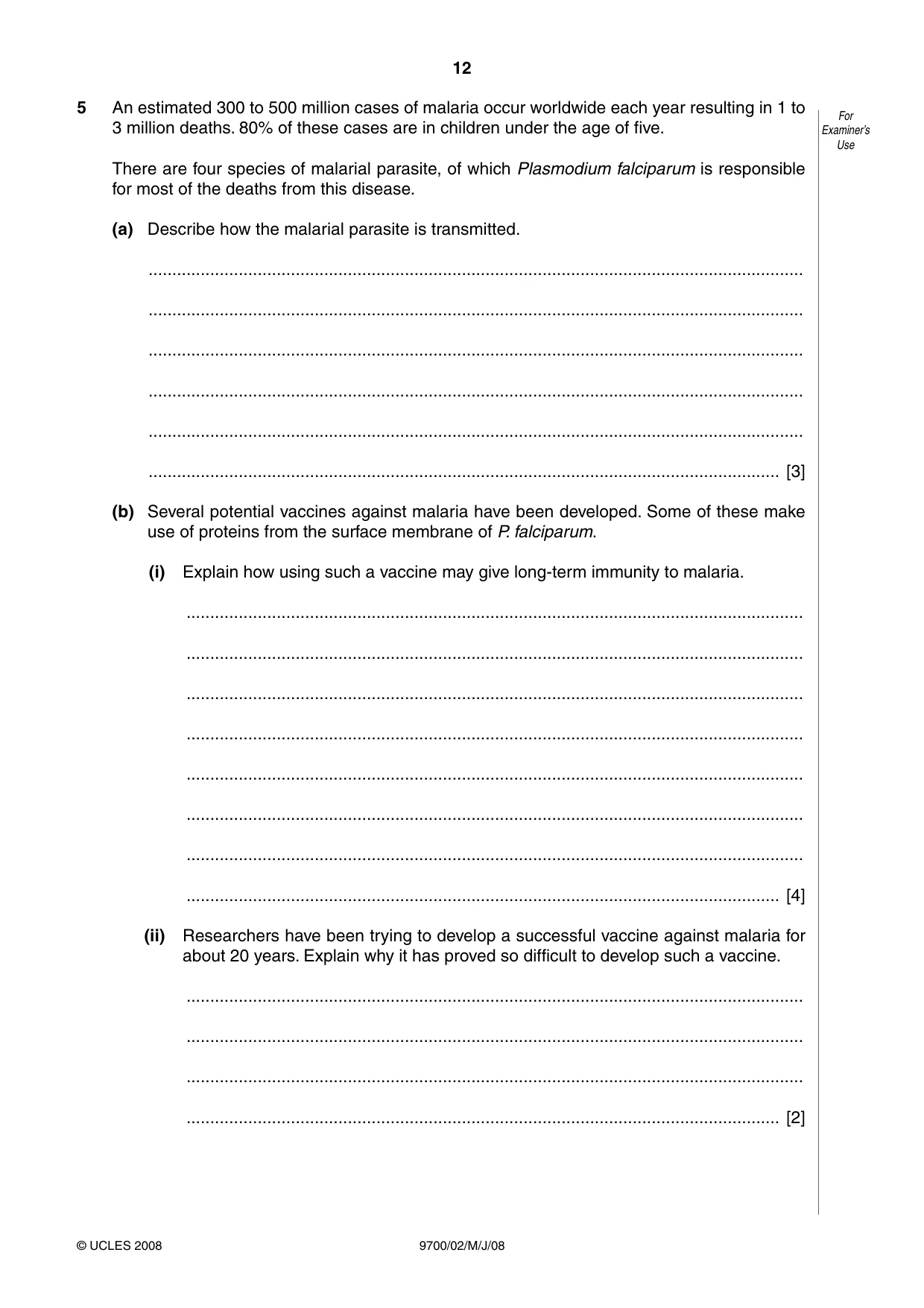
12 9700/02/M/J/08 © UCLES 2008 For Examiner’s Use 5 An estimated 300 to 500 million cases of malaria occur worldwide each year resulting in 1 to 3 million deaths. 80% of these cases are in children under the age of five. There are four species of malarial parasite, of which Plasmodium falciparum is responsible for most of the deaths from this disease. (a) Describe how the malarial parasite is transmitted. … … … … … … [3] (b) Several potential vaccines against malaria have been developed. Some of these make use of proteins from the surface membrane of P. falciparum. (i) Explain how using such a vaccine may give long-term immunity to malaria. … … … … … … … … [4] (ii) Researchers have been trying to develop a successful vaccine against malaria for about 20 years. Explain why it has proved so difficult to develop such a vaccine. … … … … [2]
Question paper, page 13
13 9700/02/M/J/08 © UCLES 2008 [Turn over For Examiner’s Use (c) Proteins on the surface of the parasite are responsible for binding to surface receptors on the red blood cells. These are removed when the parasites enter the red blood cells. An enzyme has recently been discovered in P. falciparum that is responsible for the removal of these proteins. If the enzyme does not function then the parasites cannot enter red blood cells. It has been suggested that a drug could be developed to inhibit this enzyme. Describe one possible way in which such a drug might act on the enzyme to prevent it from functioning. … … … … … … [3] [Total: 12]
Question paper, page 14
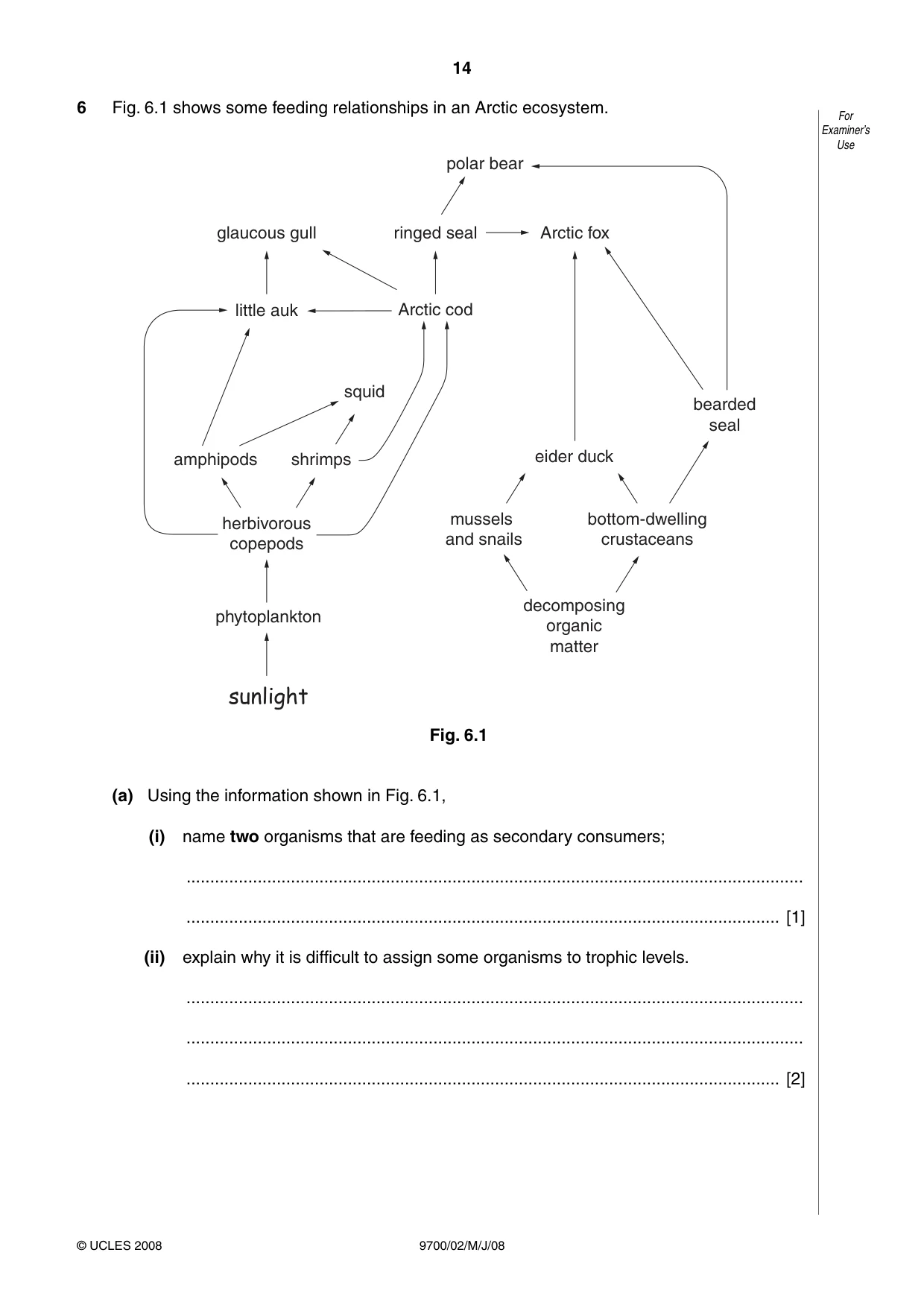
14 9700/02/M/J/08 © UCLES 2008 For Examiner’s Use 6 Fig. 6.1 shows some feeding relationships in an Arctic ecosystem. glaucous gull little auk amphipods herbivorous copepods phytoplankton shrimps squid polar bear ringed seal Arctic fox Arctic cod eider duck bearded seal mussels and snails bottom-dwelling crustaceans decomposing organic matter Fig. 6.1 (a) Using the information shown in Fig. 6.1, (i) name two organisms that are feeding as secondary consumers; … … [1] (ii) explain why it is difficult to assign some organisms to trophic levels. … … … [2]
Question paper, page 15
15 9700/02/M/J/08 © UCLES 2008 For Examiner’s Use (b) The efficiency of energy transfer through a trophic level is calculated by comparing the energy available to that trophic level with the energy available to the next trophic level. It has been estimated that the efficiency of energy transfer by herbivorous copepods is about 17%. State two factors that are likely to influence the efficiency of energy transfer by herbivorous copepods. 1 … … 2 … … [2] [Total: 5]
Question paper, page 16
16 9700/02/M/J/08 Copyright Acknowledgements: Question 2 Fig. 2.1 © Dr. Don W. Fawcett / Visuals Unlimited. Permission to reproduce items where third-party owned material protected by copyright is included has been sought and cleared where possible. Every reasonable effort has been made by the publisher (UCLES) to trace copyright holders, but if any items requiring clearance have unwittingly been included, the publisher will be pleased to make amends at the earliest possible opportunity. University of Cambridge International Examinations is part of the Cambridge Assessment Group. Cambridge Assessment is the brand name of University of Cambridge Local Examinations Syndicate (UCLES), which is itself a department of the University of Cambridge. BLANK PAGE
Mark scheme, page 1
UNIVERSITY OF CAMBRIDGE INTERNATIONAL EXAMINATIONS GCE Advanced Subsidiary Level and GCE Advanced Level MARK SCHEME for the May/June 2008 question paper 9700 BIOLOGY 9700/02 Paper 2 (AS Structured Questions), maximum raw mark 60 This mark scheme is published as an aid to teachers and candidates, to indicate the requirements of the examination. It shows the basis on which Examiners were instructed to award marks. It does not indicate the details of the discussions that took place at an Examiners’ meeting before marking began. All Examiners are instructed that alternative correct answers and unexpected approaches in candidates’ scripts must be given marks that fairly reflect the relevant knowledge and skills demonstrated. Mark schemes must be read in conjunction with the question papers and the report on the examination. • CIE will not enter into discussions or correspondence in connection with these mark schemes. CIE is publishing the mark schemes for the May/June 2008 question papers for most IGCSE, GCE Advanced Level and Advanced Subsidiary Level syllabuses and some Ordinary Level syllabuses.
Mark scheme, page 2
Page 2 Mark Scheme Syllabus Paper GCE A/AS LEVEL – May/June 2008 9700 02 © UCLES 2008 1 (a) accept without label lines if not ambiguous e.g. if written correctly on diagram only accept more than one line for each if all are correct [3] (b) (both) atria pump blood to ventricles ; same / short, distance ; right ventricle pumps blood to lungs ; short distance / at low(er) pressure / at approx 3.2 kPa / at approx 24 mmHg ; ora i.e. (left ventricle) greater distance / high(er) pressure / at approx 15.8 kPa / at approx 120 mmHg less resistance, in lungs or pulmonary circulation / greater resistance in the systemic circulation ; left ventricle pumps to, whole body / AW ; correct ref. to (muscular) walls ; e.g. same (thickness) in atria thicker / thinner, in ventricles more / less, muscular, in ventricles right ventricle pumps with lower / less, force ; ora [4 max]
Mark scheme, page 3
Page 3 Mark Scheme Syllabus Paper GCE A/AS LEVEL – May/June 2008 9700 02 © UCLES 2008 (c) accept once only for either nicotine or carbon monoxide damages lining of arteries ; promotes, atheroma / atheromatous plaques / fatty plaques / arteriosclerosis / atherosclerosis ; nicotine increases heart rate ; increases blood pressure ; makes platelets ‘sticky’ ; increases chance of blood clotting / promotes thrombosis ; decreases flow of blood to, extremities / AW ; constriction of blood vessels ; R contraction R capillaries (2 max) carbon monoxide combines with haemoglobin / forms carboxyhaemoglobin / higher affinity for haemoglobin (than oxygen); R absorbed, reacts with, bonds to reduces oxygen carrying capacity (in context of, haemoglobin / blood) ; promotes release of damaging free radicals / peroxides / super oxides / oxidising agents ; causes platelets and neutrophils to stick together / platelets to stick to endothelium ; hypoxia can damage heart muscle ; (2 max) [4 max] [Total: 11]
Mark scheme, page 4
Page 4 Mark Scheme Syllabus Paper GCE A/AS LEVEL – May/June 2008 9700 02 © UCLES 2008 2 (a) A – nuclear, membrane / envelope ; R nucleus (unqualified) B – mitochondrion ; A crista(e) C – (Golgi) vesicle / (small) vacuole ; A lysosome [3] (b) (during), mitosis / meiosis / nuclear division ; ignore ‘cell division’ / phases replicate, after / before, each division ; A at interphase move / separate, to poles ; assemble / organise, microtubules ; centre for growth of / forms, spindle fibres / for formation of spindle / AW ; modified centrioles found elsewhere such as in flagella / cilia ; [3 max] (c) (EM has) greater / higher, resolution / resolving power ; ora explanation of resolution as ability to differentiate between two points (close together) ; width of membranes is 7 nm (±1) ; (resolution of) LM is 200 nm (0.2 µm) and EM is 0.5 nm (0.0005 µm) ; A 0.5 to 1 nm (0.001 µm) ref to shorter wavelength ; ora resolution is equal to half the wavelength ; [3 max] (d) (i) general trend described linking temperature and percentage transmission ; A negative correlation (with link) R inversely proportional use of comparative figures (using data from both axes) to support trend ; between 20 °C and 60 °C percentage transmission decreases, from 95% to 70% ; between 60 °C and 70 °C, decrease is, significant / steep / from 70% to 19% ; between 70 °C and 80 °C, decrease is, less steep / more steeply than initial temperature range / from 19% to 6% ; [3 max] (ii) at (temperatures above) 60 °C, cell / vacuolar, membranes damaged / AW; A tonoplast (membrane ) proteins, denatured / altered tertiary structure ; increased fluidity (of membrane) / phospholipid bilayer more fluid ; (so) diffusion / AW, of, betalain / pigment (out) ; as temperature increases, rate of diffusion increases / diffusion occurs more quickly ; [3 max] [Total: 15]
Mark scheme, page 5
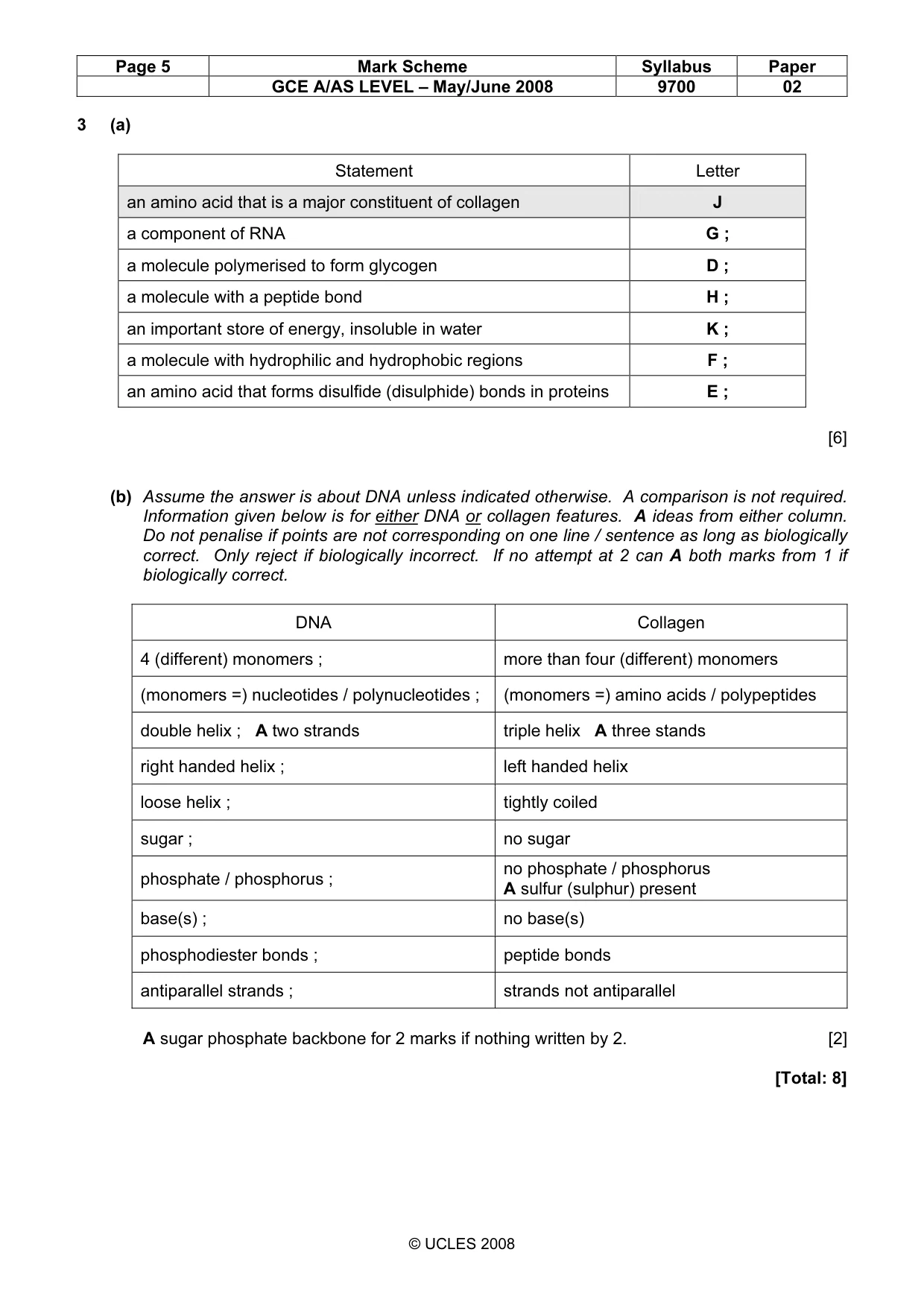
Page 5 Mark Scheme Syllabus Paper GCE A/AS LEVEL – May/June 2008 9700 02 © UCLES 2008 3 (a) Statement Letter an amino acid that is a major constituent of collagen J a component of RNA G ; a molecule polymerised to form glycogen D ; a molecule with a peptide bond H ; an important store of energy, insoluble in water K ; a molecule with hydrophilic and hydrophobic regions F ; an amino acid that forms disulfide (disulphide) bonds in proteins E ; [6] (b) Assume the answer is about DNA unless indicated otherwise. A comparison is not required. Information given below is for either DNA or collagen features. A ideas from either column. Do not penalise if points are not corresponding on one line / sentence as long as biologically correct. Only reject if biologically incorrect. If no attempt at 2 can A both marks from 1 if biologically correct. DNA Collagen 4 (different) monomers ; more than four (different) monomers (monomers =) nucleotides / polynucleotides ; (monomers =) amino acids / polypeptides double helix ; A two strands triple helix A three stands right handed helix ; left handed helix loose helix ; tightly coiled sugar ; no sugar phosphate / phosphorus ; no phosphate / phosphorus A sulfur (sulphur) present base(s) ; no base(s) phosphodiester bonds ; peptide bonds antiparallel strands ; strands not antiparallel A sugar phosphate backbone for 2 marks if nothing written by 2. [2] [Total: 8]
Mark scheme, page 6
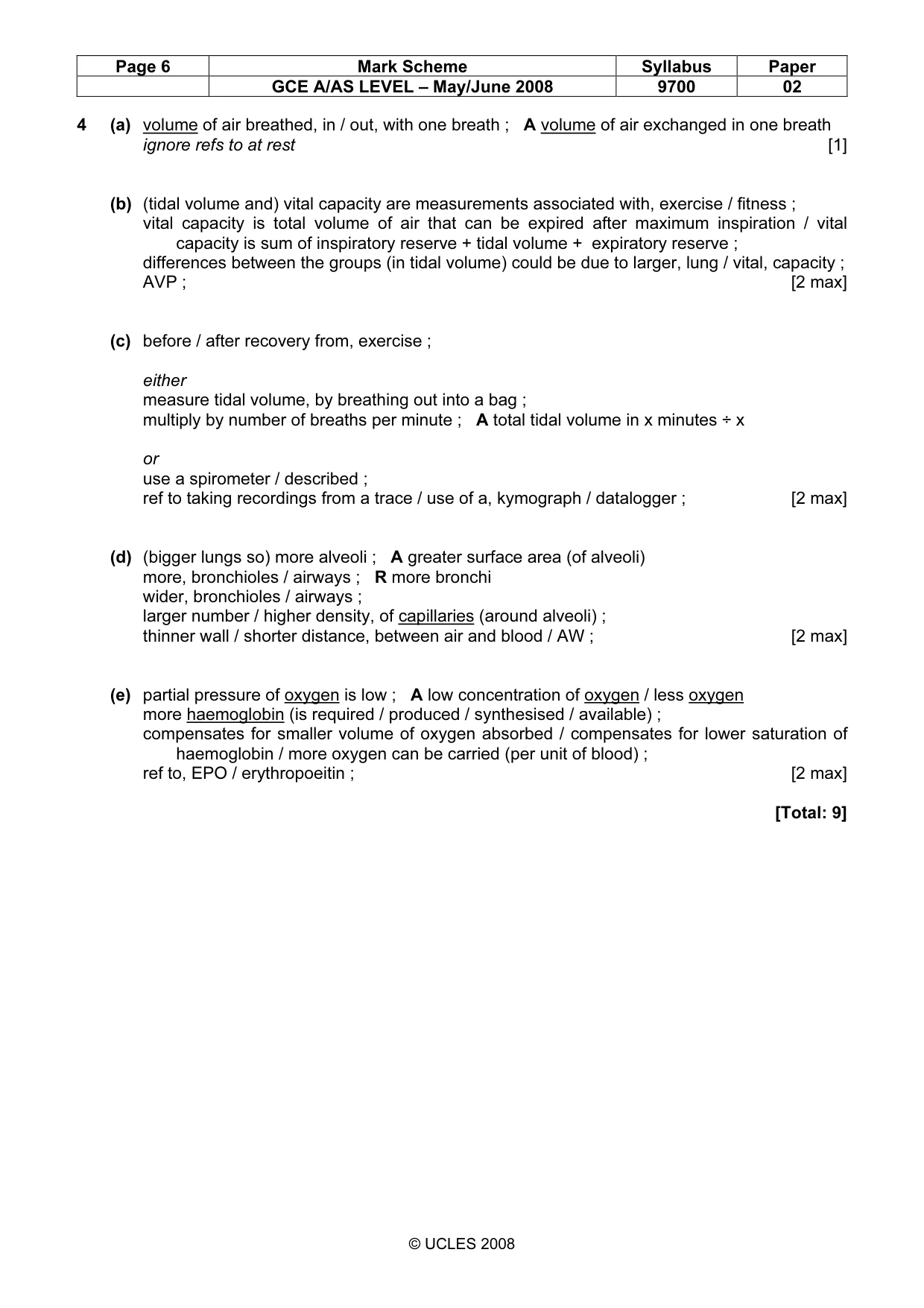
Page 6 Mark Scheme Syllabus Paper GCE A/AS LEVEL – May/June 2008 9700 02 © UCLES 2008 4 (a) volume of air breathed, in / out, with one breath ; A volume of air exchanged in one breath ignore refs to at rest [1] (b) (tidal volume and) vital capacity are measurements associated with, exercise / fitness ; vital capacity is total volume of air that can be expired after maximum inspiration / vital capacity is sum of inspiratory reserve + tidal volume + expiratory reserve ; differences between the groups (in tidal volume) could be due to larger, lung / vital, capacity ; AVP ; [2 max] (c) before / after recovery from, exercise ; either measure tidal volume, by breathing out into a bag ; multiply by number of breaths per minute ; A total tidal volume in x minutes ÷ x or use a spirometer / described ; ref to taking recordings from a trace / use of a, kymograph / datalogger ; [2 max] (d) (bigger lungs so) more alveoli ; A greater surface area (of alveoli) more, bronchioles / airways ; R more bronchi wider, bronchioles / airways ; larger number / higher density, of capillaries (around alveoli) ; thinner wall / shorter distance, between air and blood / AW ; [2 max] (e) partial pressure of oxygen is low ; A low concentration of oxygen / less oxygen more haemoglobin (is required / produced / synthesised / available) ; compensates for smaller volume of oxygen absorbed / compensates for lower saturation of haemoglobin / more oxygen can be carried (per unit of blood) ; ref to, EPO / erythropoeitin ; [2 max] [Total: 9]
Mark scheme, page 7
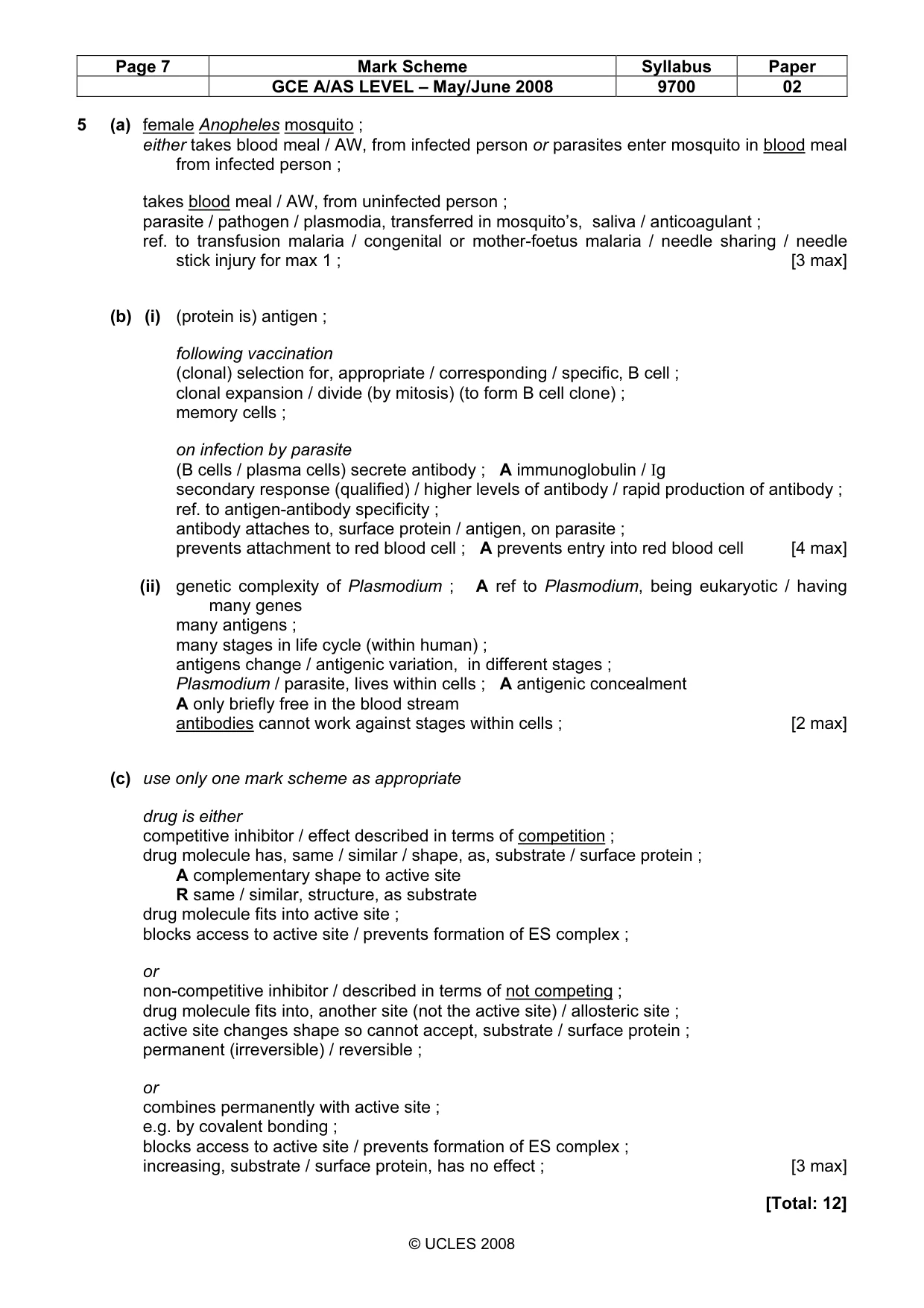
Page 7 Mark Scheme Syllabus Paper GCE A/AS LEVEL – May/June 2008 9700 02 © UCLES 2008 5 (a) female Anopheles mosquito ; either takes blood meal / AW, from infected person or parasites enter mosquito in blood meal from infected person ; takes blood meal / AW, from uninfected person ; parasite / pathogen / plasmodia, transferred in mosquito’s, saliva / anticoagulant ; ref. to transfusion malaria / congenital or mother-foetus malaria / needle sharing / needle stick injury for max 1 ; [3 max] (b) (i) (protein is) antigen ; following vaccination (clonal) selection for, appropriate / corresponding / specific, B cell ; clonal expansion / divide (by mitosis) (to form B cell clone) ; memory cells ; on infection by parasite (B cells / plasma cells) secrete antibody ; A immunoglobulin / Ig secondary response (qualified) / higher levels of antibody / rapid production of antibody ; ref. to antigen-antibody specificity ; antibody attaches to, surface protein / antigen, on parasite ; prevents attachment to red blood cell ; A prevents entry into red blood cell [4 max] (ii) genetic complexity of Plasmodium ; A ref to Plasmodium, being eukaryotic / having many genes many antigens ; many stages in life cycle (within human) ; antigens change / antigenic variation, in different stages ; Plasmodium / parasite, lives within cells ; A antigenic concealment A only briefly free in the blood stream antibodies cannot work against stages within cells ; [2 max] (c) use only one mark scheme as appropriate drug is either competitive inhibitor / effect described in terms of competition ; drug molecule has, same / similar / shape, as, substrate / surface protein ; A complementary shape to active site R same / similar, structure, as substrate drug molecule fits into active site ; blocks access to active site / prevents formation of ES complex ; or non-competitive inhibitor / described in terms of not competing ; drug molecule fits into, another site (not the active site) / allosteric site ; active site changes shape so cannot accept, substrate / surface protein ; permanent (irreversible) / reversible ; or combines permanently with active site ; e.g. by covalent bonding ; blocks access to active site / prevents formation of ES complex ; increasing, substrate / surface protein, has no effect ; [3 max] [Total: 12]
Mark scheme, page 8
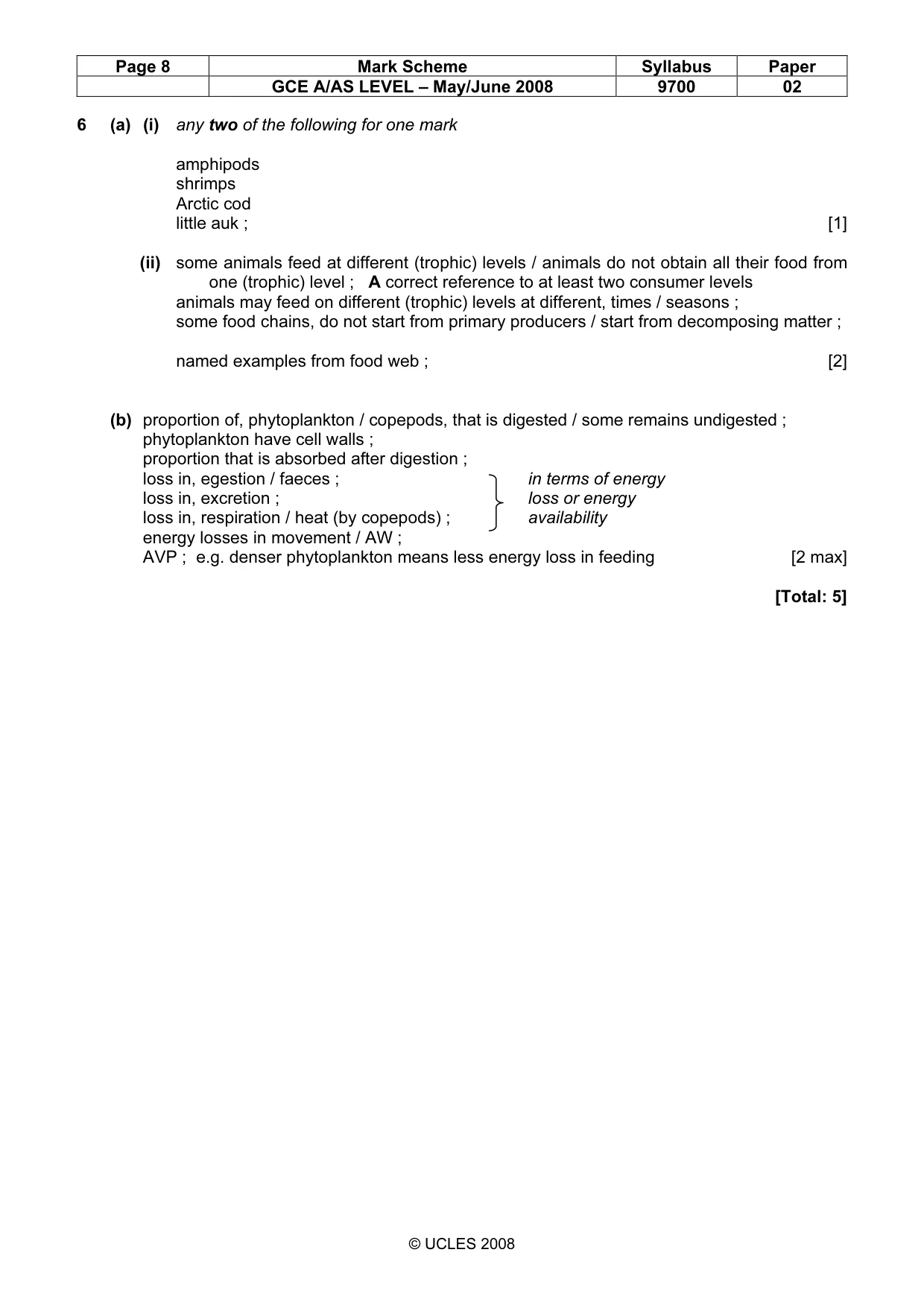
Page 8 Mark Scheme Syllabus Paper GCE A/AS LEVEL – May/June 2008 9700 02 © UCLES 2008 6 (a) (i) any two of the following for one mark amphipods shrimps Arctic cod little auk ; [1] (ii) some animals feed at different (trophic) levels / animals do not obtain all their food from one (trophic) level ; A correct reference to at least two consumer levels animals may feed on different (trophic) levels at different, times / seasons ; some food chains, do not start from primary producers / start from decomposing matter ; named examples from food web ; [2] (b) proportion of, phytoplankton / copepods, that is digested / some remains undigested ; phytoplankton have cell walls ; proportion that is absorbed after digestion ; loss in, egestion / faeces ; in terms of energy loss in, excretion ; loss or energy loss in, respiration / heat (by copepods) ; availability energy losses in movement / AW ; AVP ; e.g. denser phytoplankton means less energy loss in feeding [2 max] [Total: 5]