Cambridge A Level Biology 9700 — 2007 Oct/Nov Paper 4 · Variant 1
9700/41/O/N/07 · 100 marks · ≈113 min
The question paper and its mark scheme, free to read here and free to download. This is Cambridge’s own paper, exactly as it was sat.
Question paper24 pages

Mark scheme9 pages
Answers below. Sit the paper first if you are practising.
Paper as text
Question paper, page 1
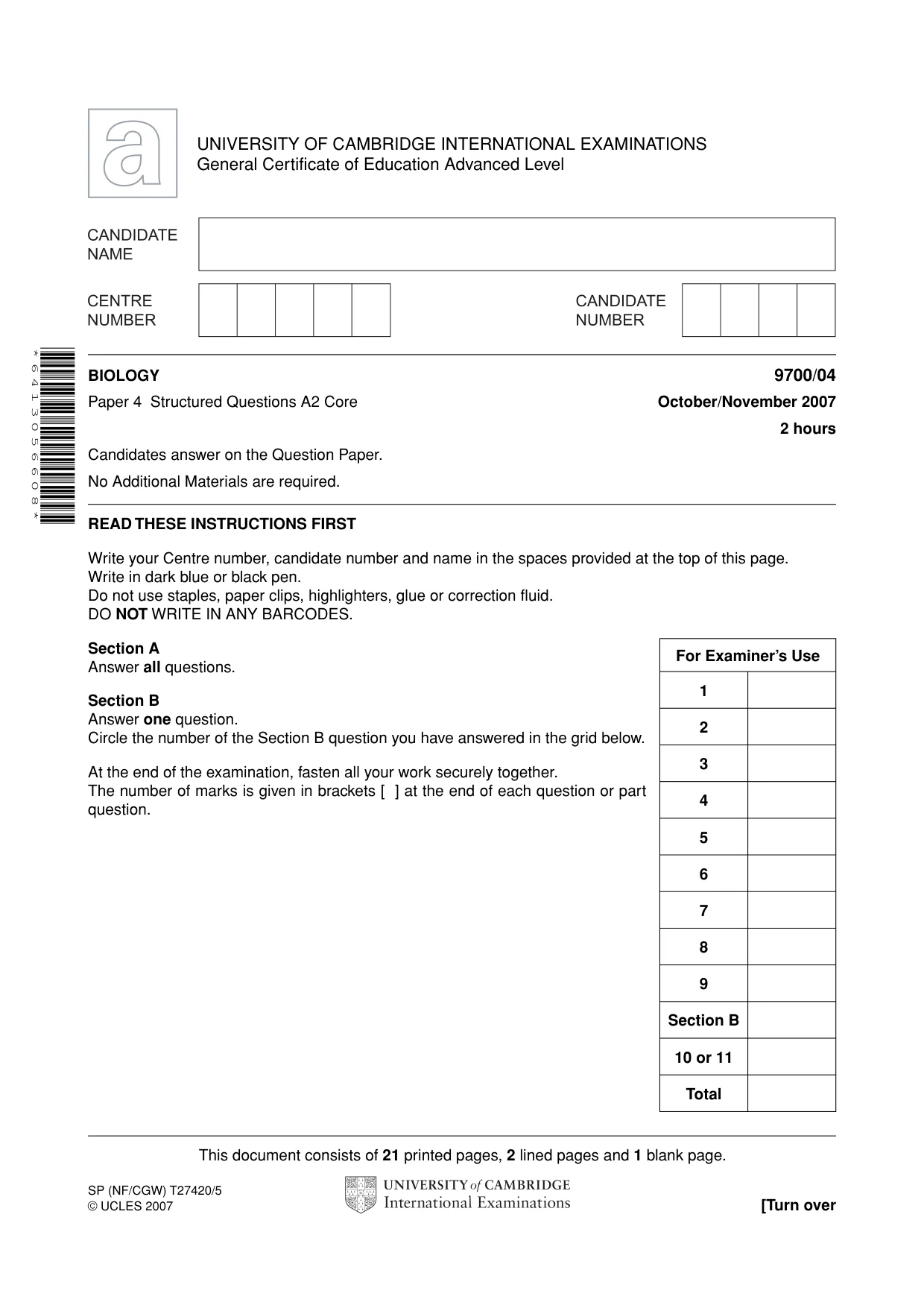
This document consists of 21 printed pages, 2 lined pages and 1 blank page. SP (NF/CGW) T27420/5 © UCLES 2007 [Turn over UNIVERSITY OF CAMBRIDGE INTERNATIONAL EXAMINATIONS General Certificate of Education Advanced Level READ THESE INSTRUCTIONS FIRST Write your Centre number, candidate number and name in the spaces provided at the top of this page. Write in dark blue or black pen. Do not use staples, paper clips, highlighters, glue or correction fluid. DO NOT WRITE IN ANY BARCODES. Section A Answer all questions. Section B Answer one question. Circle the number of the Section B question you have answered in the grid below. At the end of the examination, fasten all your work securely together. The number of marks is given in brackets [ ] at the end of each question or part question. * 6 4 1 3 0 5 6 6 0 8 * BIOLOGY 9700/04 Paper 4 Structured Questions A2 Core October/November 2007 2 hours Candidates answer on the Question Paper. No Additional Materials are required. For Examiner’s Use 1 2 3 4 5 6 7 8 9 Section B 10 or 11 Total
Question paper, page 2
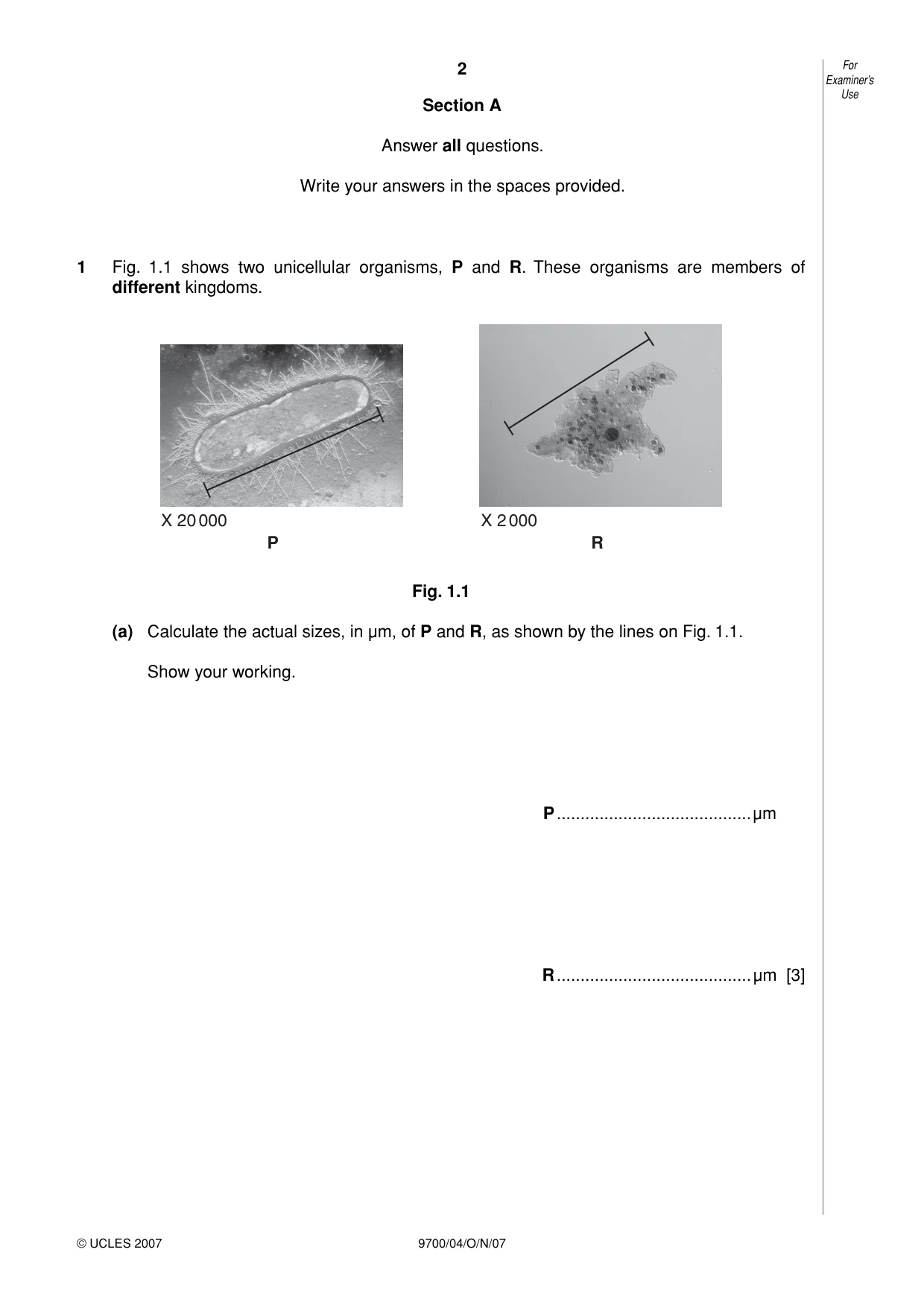
2 9700/04/O/N/07 For Examiner’s Use © UCLES 2007 Section A Answer all questions. Write your answers in the spaces provided. 1 Fig. 1.1 shows two unicellular organisms, P and R. These organisms are members of different kingdoms. X 20 000 P R X 2 000 Fig. 1.1 (a) Calculate the actual sizes, in µm, of P and R, as shown by the lines on Fig. 1.1. Show your working. P …µm R …µm [3]
Question paper, page 3
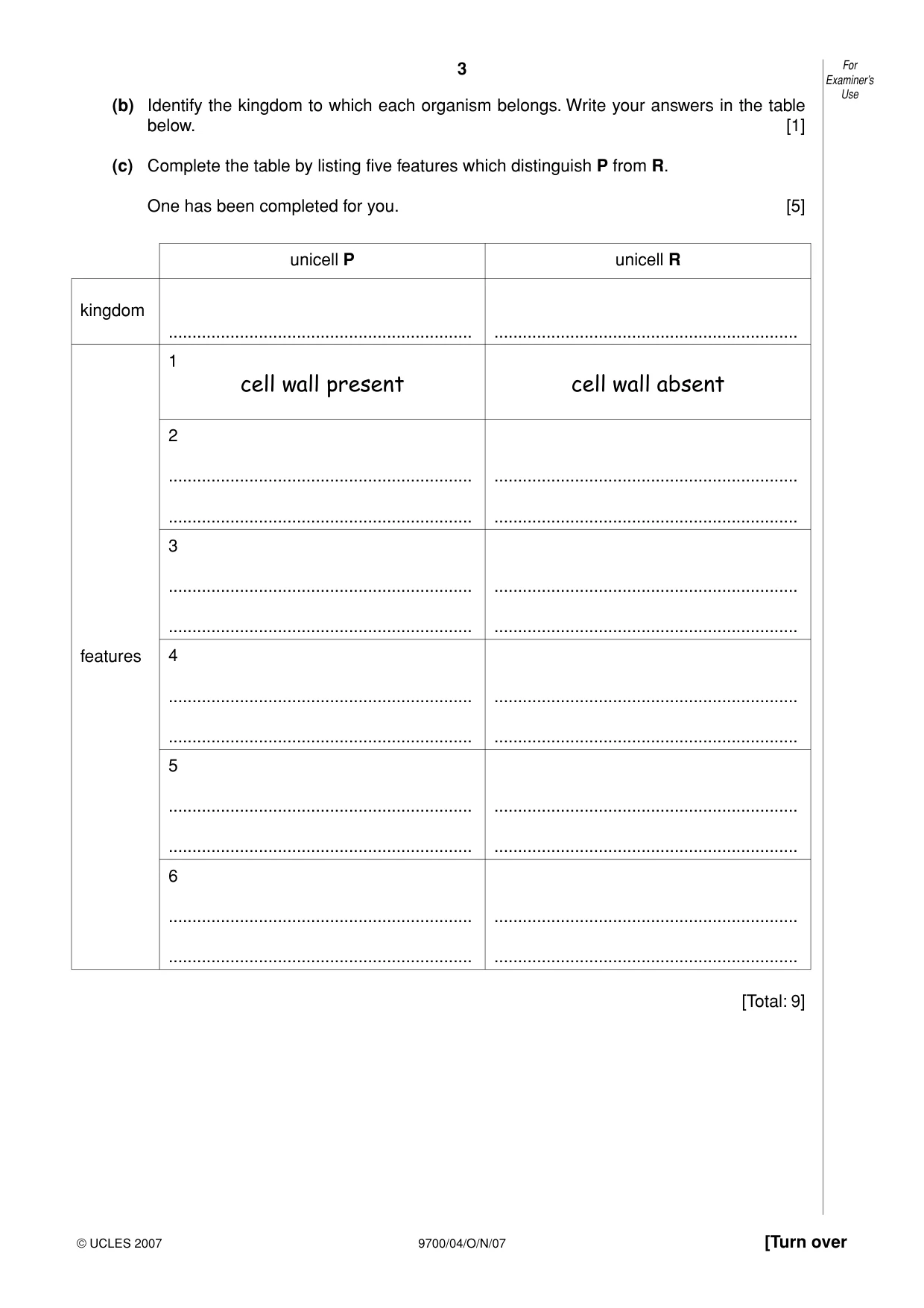
3 9700/04/O/N/07 [Turn over For Examiner’s Use © UCLES 2007 (b) Identify the kingdom to which each organism belongs. Write your answers in the table below. [1] (c) Complete the table by listing five features which distinguish P from R. One has been completed for you. [5] unicell P unicell R kingdom … … features 1 cell wall present cell wall absent 2 … … … … 3 … … … … 4 … … … … 5 … … … … 6 … … … … [Total: 9]
Question paper, page 4
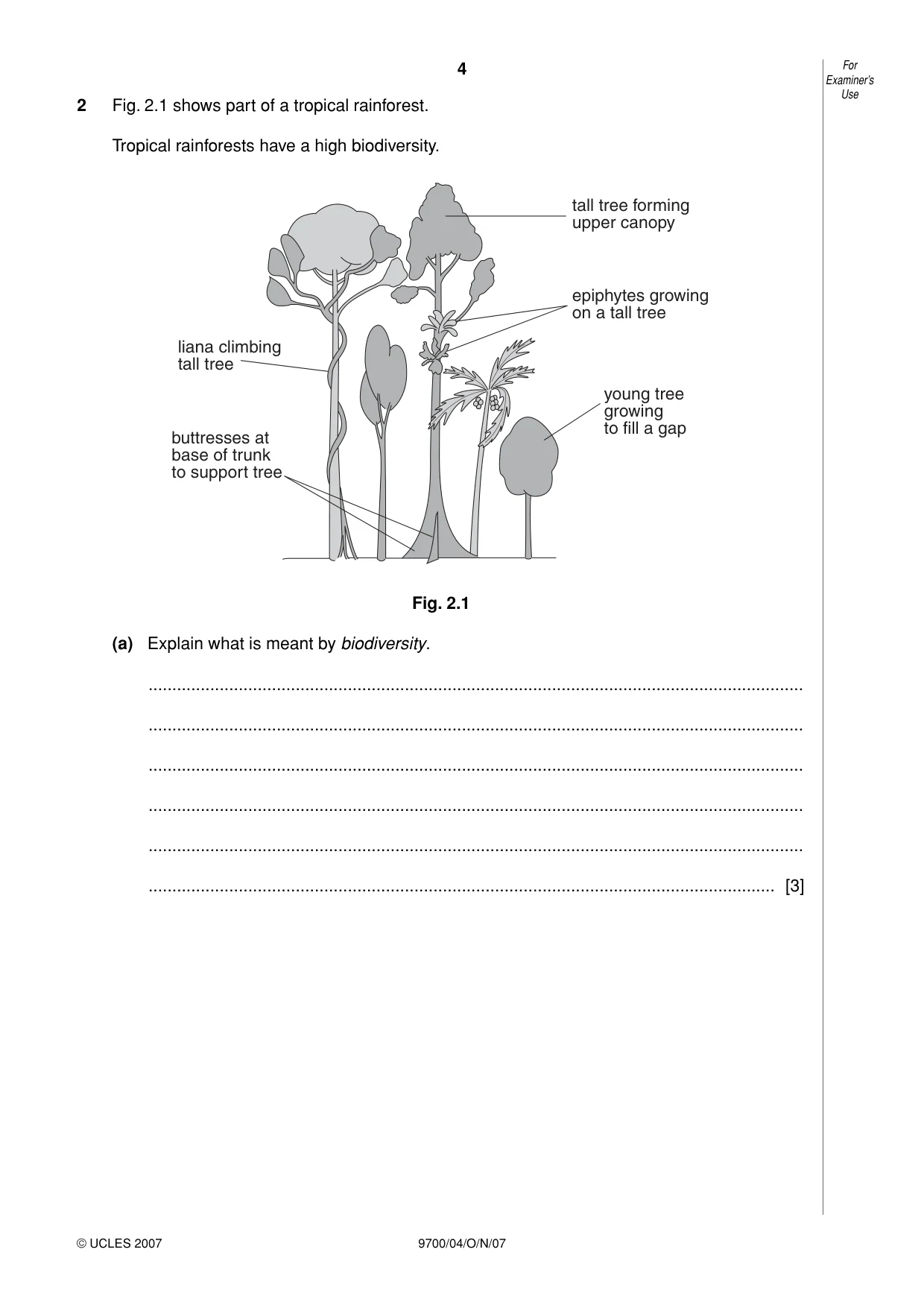
4 9700/04/O/N/07 For Examiner’s Use © UCLES 2007 2 Fig. 2.1 shows part of a tropical rainforest. Tropical rainforests have a high biodiversity. tall tree forming upper canopy epiphytes growing on a tall tree liana climbing tall tree buttresses at base of trunk to support tree young tree growing to fill a gap Fig. 2.1 (a) Explain what is meant by biodiversity. … … … … … … [3]
Question paper, page 5
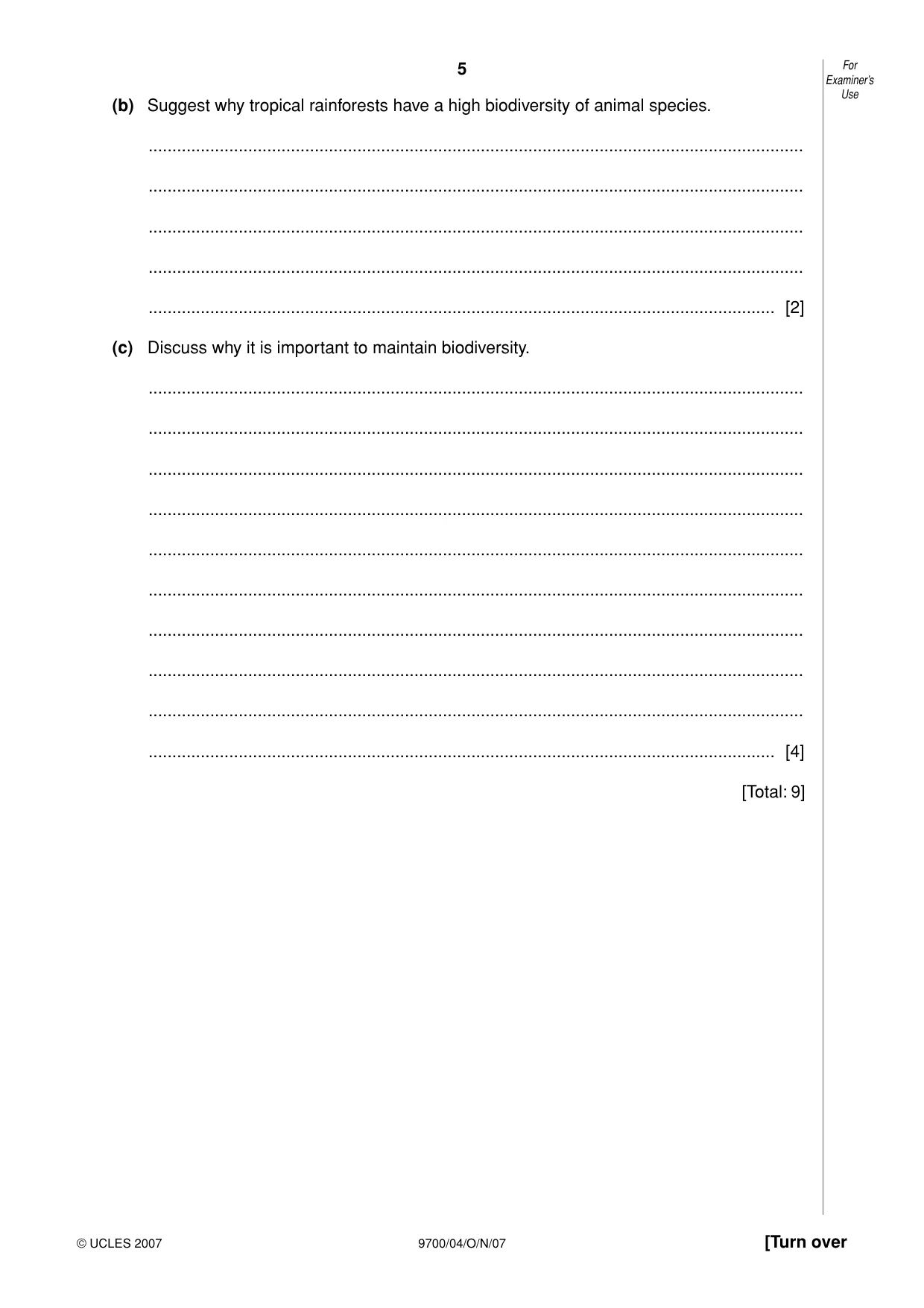
5 9700/04/O/N/07 [Turn over For Examiner’s Use © UCLES 2007 (b) Suggest why tropical rainforests have a high biodiversity of animal species. … … … … … [2] (c) Discuss why it is important to maintain biodiversity. … … … … … … … … … … [4] [Total: 9]
Question paper, page 6
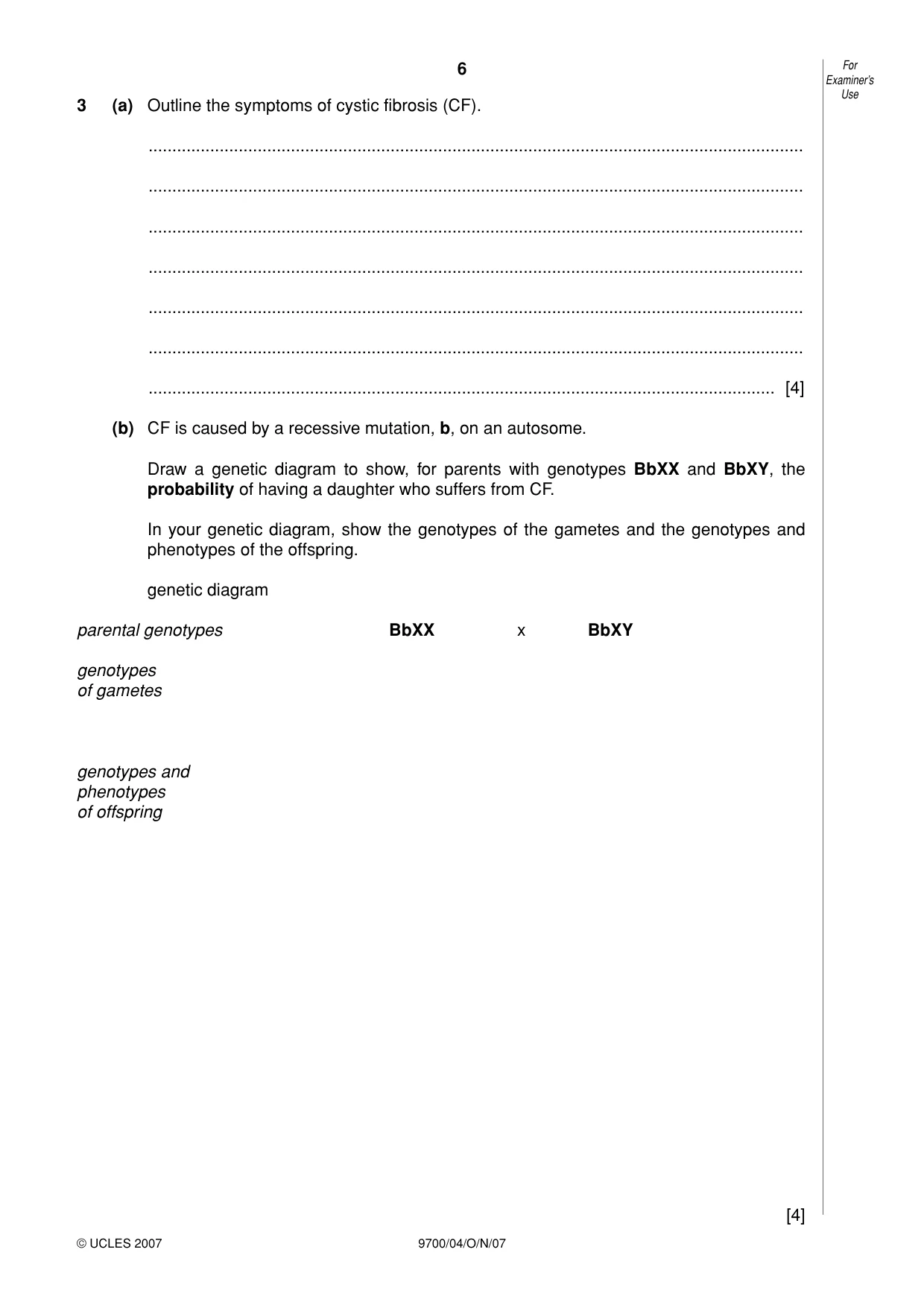
6 9700/04/O/N/07 For Examiner’s Use © UCLES 2007 3 (a) Outline the symptoms of cystic fibrosis (CF). … … … … … … … [4] (b) CF is caused by a recessive mutation, b, on an autosome. Draw a genetic diagram to show, for parents with genotypes BbXX and BbXY, the probability of having a daughter who suffers from CF. In your genetic diagram, show the genotypes of the gametes and the genotypes and phenotypes of the offspring. genetic diagram parental genotypes BbXX x BbXY genotypes of gametes genotypes and phenotypes of offspring [4]
Question paper, page 7
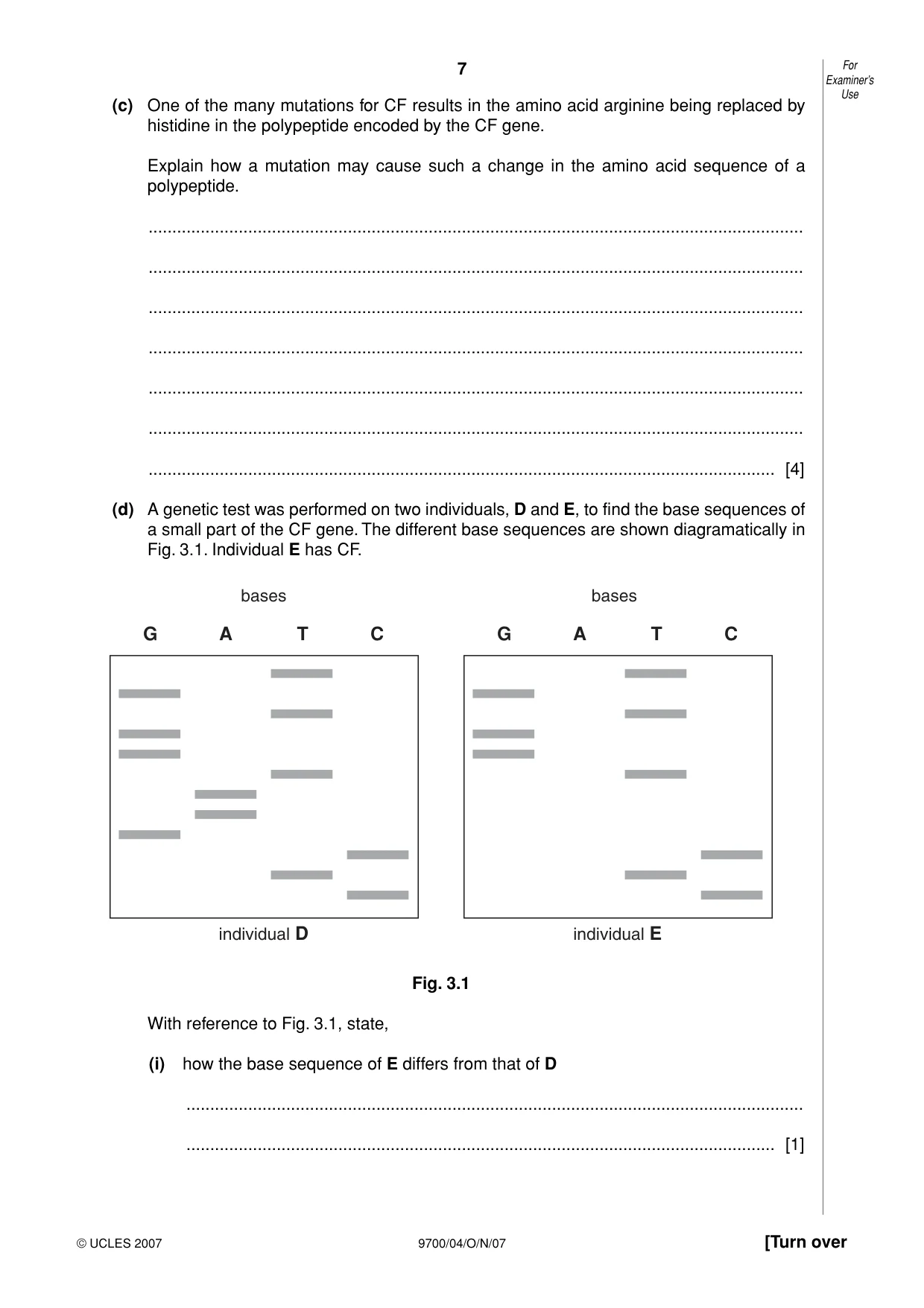
7 9700/04/O/N/07 [Turn over For Examiner’s Use © UCLES 2007 (c) One of the many mutations for CF results in the amino acid arginine being replaced by histidine in the polypeptide encoded by the CF gene. Explain how a mutation may cause such a change in the amino acid sequence of a polypeptide. … … … … … … … [4] (d) A genetic test was performed on two individuals, D and E, to find the base sequences of a small part of the CF gene. The different base sequences are shown diagramatically in Fig. 3.1. Individual E has CF. G T A individual D bases bases C G T A individual E C Fig. 3.1 With reference to Fig. 3.1, state, (i) how the base sequence of E differs from that of D … … [1]
Question paper, page 8
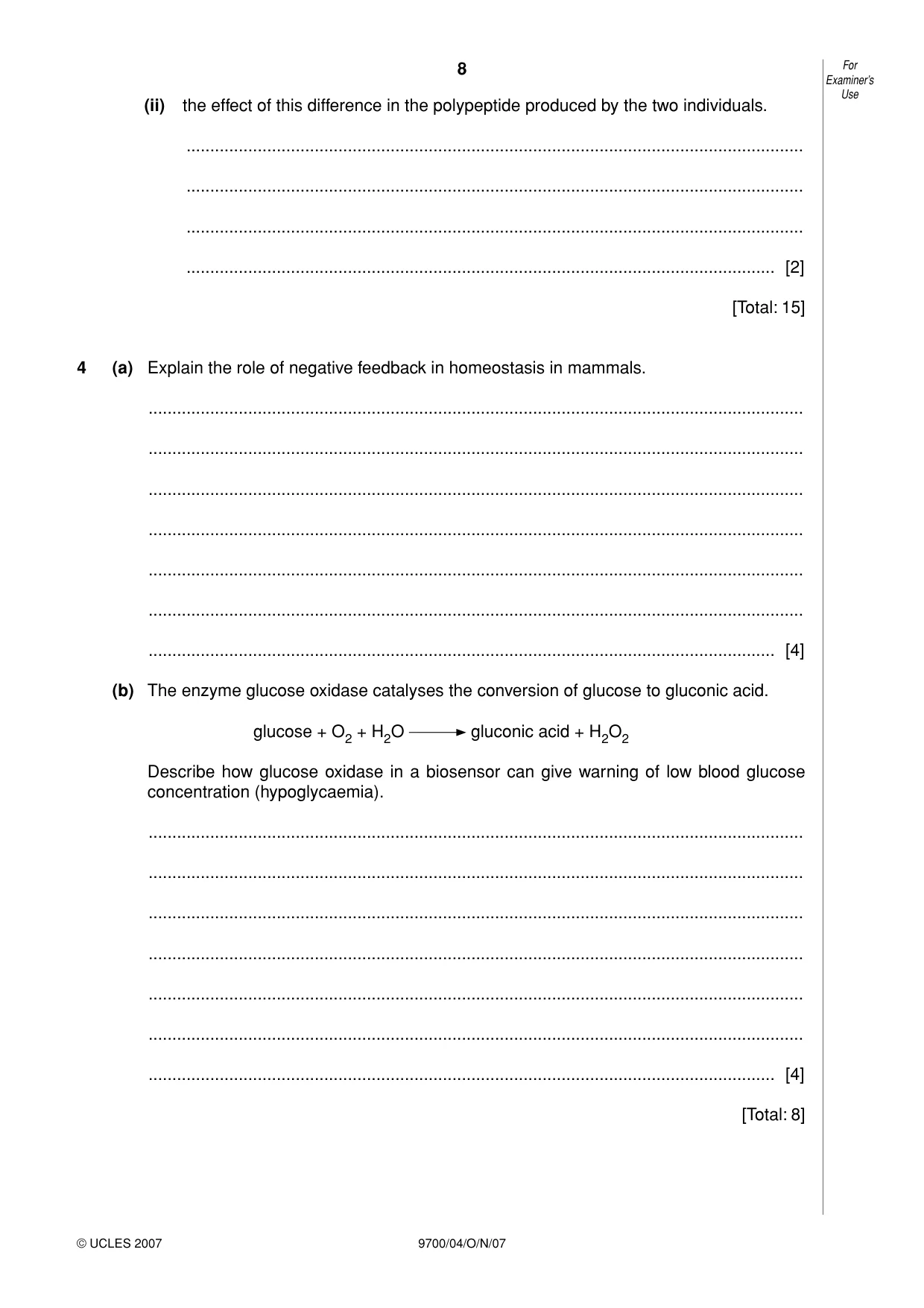
8 9700/04/O/N/07 For Examiner’s Use © UCLES 2007 (ii) the effect of this difference in the polypeptide produced by the two individuals. … … … … [2] [Total: 15] 4 (a) Explain the role of negative feedback in homeostasis in mammals. … … … … … … … [4] (b) The enzyme glucose oxidase catalyses the conversion of glucose to gluconic acid. glucose + O2 + H2O gluconic acid + H2O2 Describe how glucose oxidase in a biosensor can give warning of low blood glucose concentration (hypoglycaemia). … … … … … … … [4] [Total: 8]
Question paper, page 9
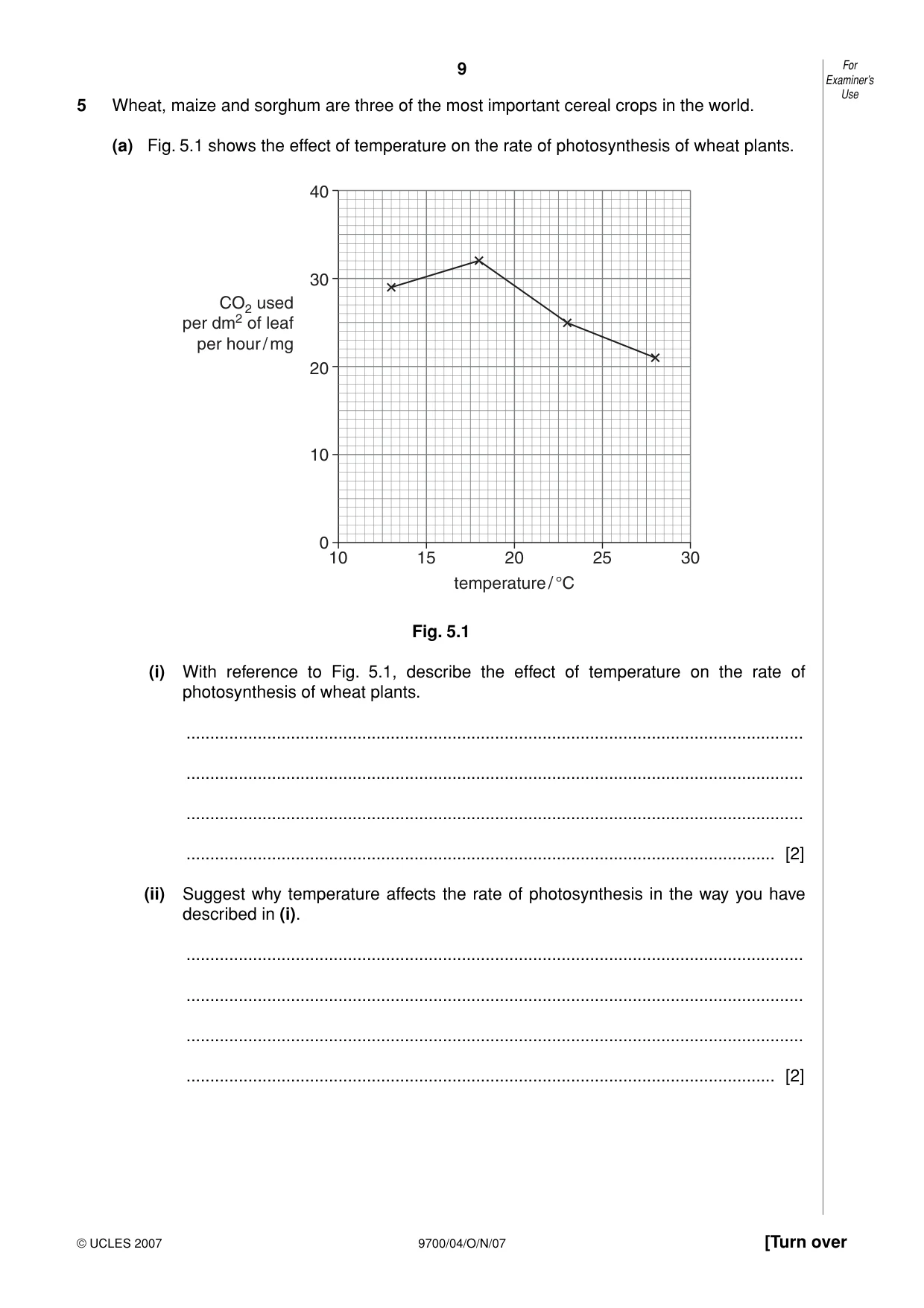
9 9700/04/O/N/07 [Turn over For Examiner’s Use © UCLES 2007 5 Wheat, maize and sorghum are three of the most important cereal crops in the world. (a) Fig. 5.1 shows the effect of temperature on the rate of photosynthesis of wheat plants. 15 10 10 0 20 CO2 used per dm2 of leaf per hour / mg 30 40 20 temperature / °C 25 30 Fig. 5.1 (i) With reference to Fig. 5.1, describe the effect of temperature on the rate of photosynthesis of wheat plants. … … … … [2] (ii) Suggest why temperature affects the rate of photosynthesis in the way you have described in (i). … … … … [2]
Question paper, page 10
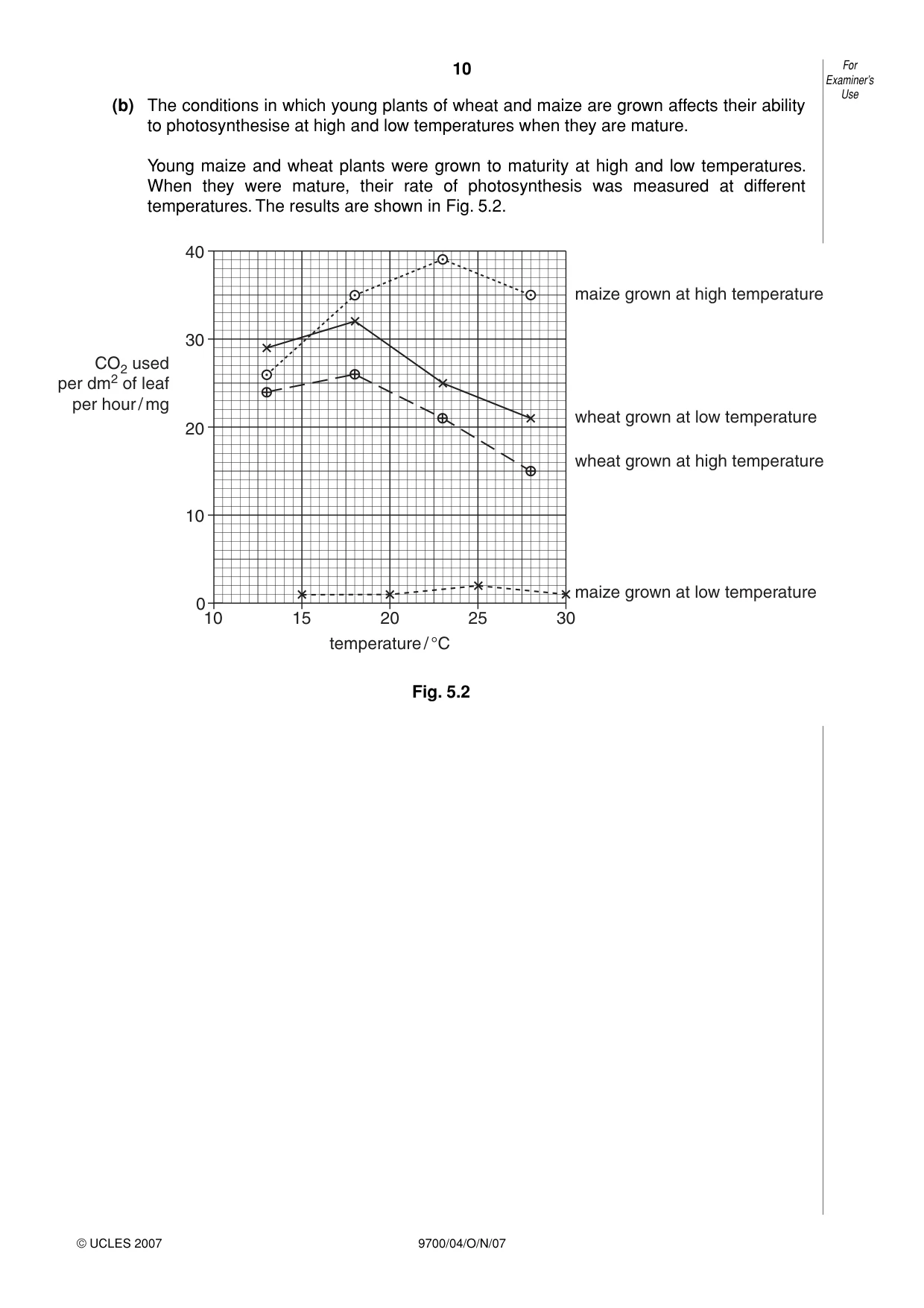
10 9700/04/O/N/07 For Examiner’s Use © UCLES 2007 (b) The conditions in which young plants of wheat and maize are grown affects their ability to photosynthesise at high and low temperatures when they are mature. Young maize and wheat plants were grown to maturity at high and low temperatures. When they were mature, their rate of photosynthesis was measured at different temperatures. The results are shown in Fig. 5.2. 15 10 10 20 CO2 used per dm2 of leaf per hour / mg 30 maize grown at high temperature wheat grown at low temperature wheat grown at high temperature maize grown at low temperature 40 0 20 temperature / °C 25 30 Fig. 5.2
Question paper, page 11
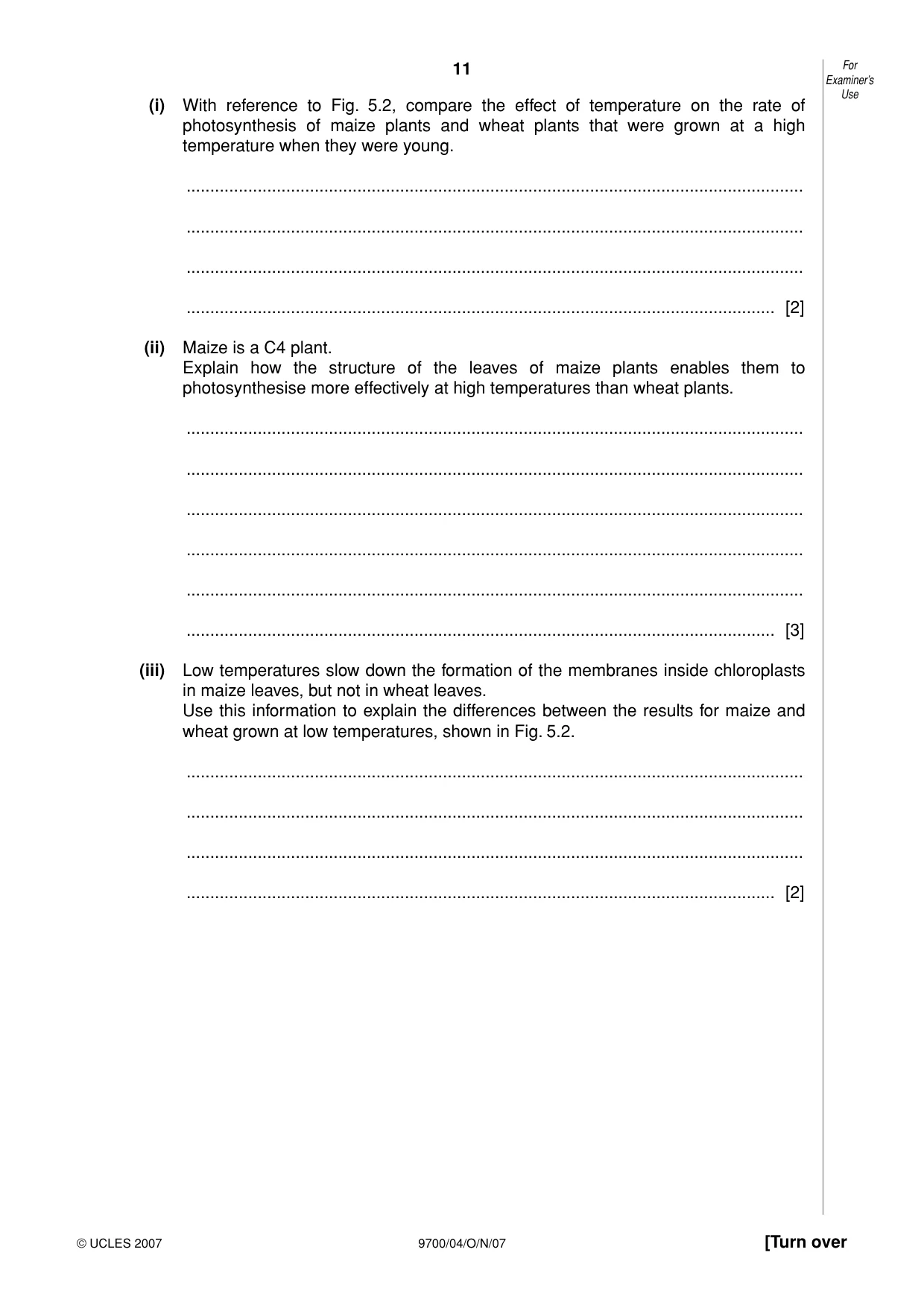
11 9700/04/O/N/07 [Turn over For Examiner’s Use © UCLES 2007 (i) With reference to Fig. 5.2, compare the effect of temperature on the rate of photosynthesis of maize plants and wheat plants that were grown at a high temperature when they were young. … … … … [2] (ii) Maize is a C4 plant. Explain how the structure of the leaves of maize plants enables them to photosynthesise more effectively at high temperatures than wheat plants. … … … … … … [3] (iii) Low temperatures slow down the formation of the membranes inside chloroplasts in maize leaves, but not in wheat leaves. Use this information to explain the differences between the results for maize and wheat grown at low temperatures, shown in Fig. 5.2. … … … … [2]
Question paper, page 12
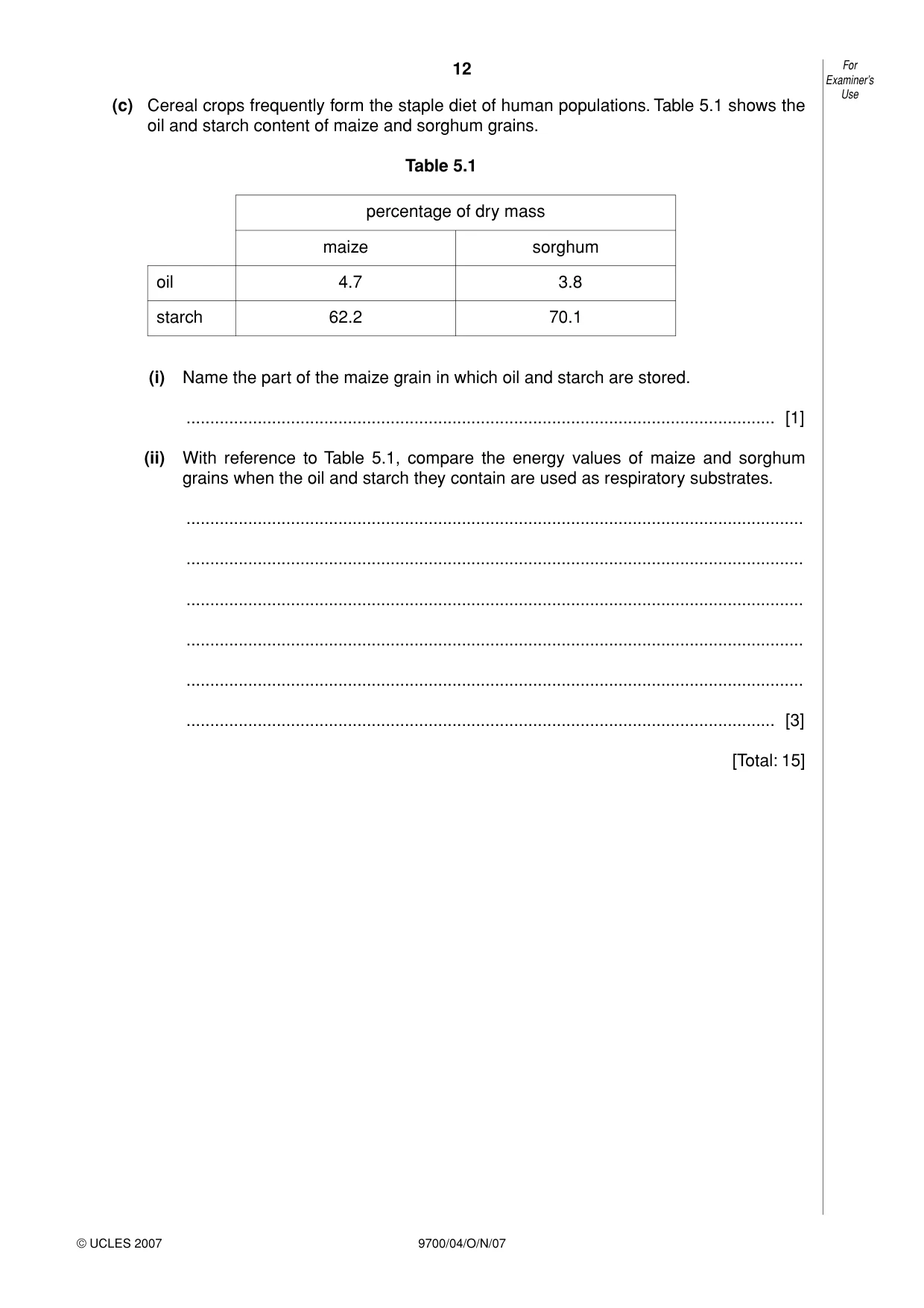
12 9700/04/O/N/07 For Examiner’s Use © UCLES 2007 (c) Cereal crops frequently form the staple diet of human populations. Table 5.1 shows the oil and starch content of maize and sorghum grains. Table 5.1 percentage of dry mass maize sorghum oil 4.7 3.8 starch 62.2 70.1 (i) Name the part of the maize grain in which oil and starch are stored. … [1] (ii) With reference to Table 5.1, compare the energy values of maize and sorghum grains when the oil and starch they contain are used as respiratory substrates. … … … … … … [3] [Total: 15]
Question paper, page 14
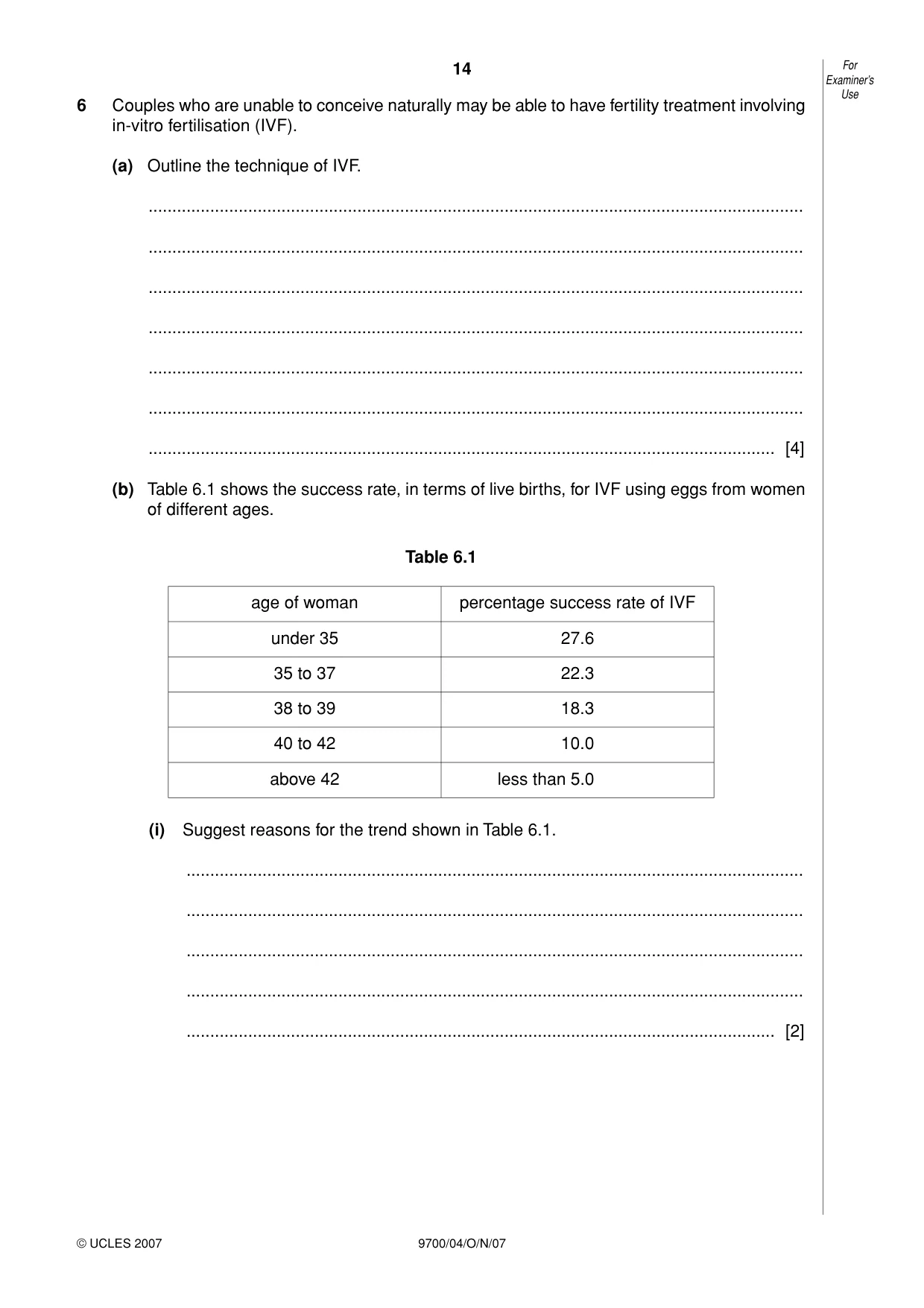
14 9700/04/O/N/07 For Examiner’s Use © UCLES 2007 6 Couples who are unable to conceive naturally may be able to have fertility treatment involving in-vitro fertilisation (IVF). (a) Outline the technique of IVF. … … … … … … … [4] (b) Table 6.1 shows the success rate, in terms of live births, for IVF using eggs from women of different ages. Table 6.1 age of woman percentage success rate of IVF under 35 27.6 35 to 37 22.3 38 to 39 18.3 40 to 42 10.0 above 42 less than 5.0 (i) Suggest reasons for the trend shown in Table 6.1. … … … … … [2]
Question paper, page 15
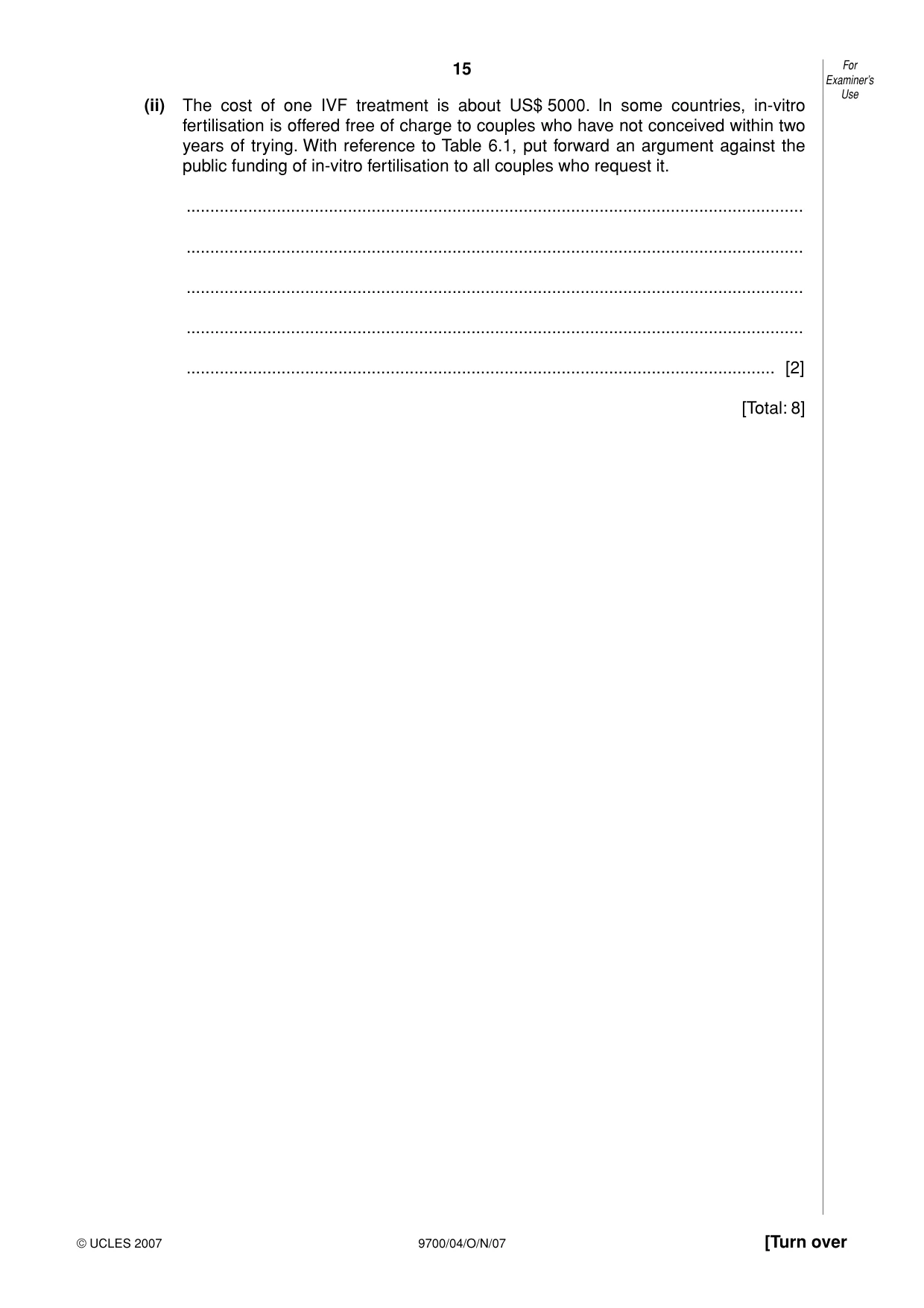
15 9700/04/O/N/07 [Turn over For Examiner’s Use © UCLES 2007 (ii) The cost of one IVF treatment is about US$ 5000. In some countries, in-vitro fertilisation is offered free of charge to couples who have not conceived within two years of trying. With reference to Table 6.1, put forward an argument against the public funding of in-vitro fertilisation to all couples who request it. … … … … … [2] [Total: 8]
Question paper, page 16
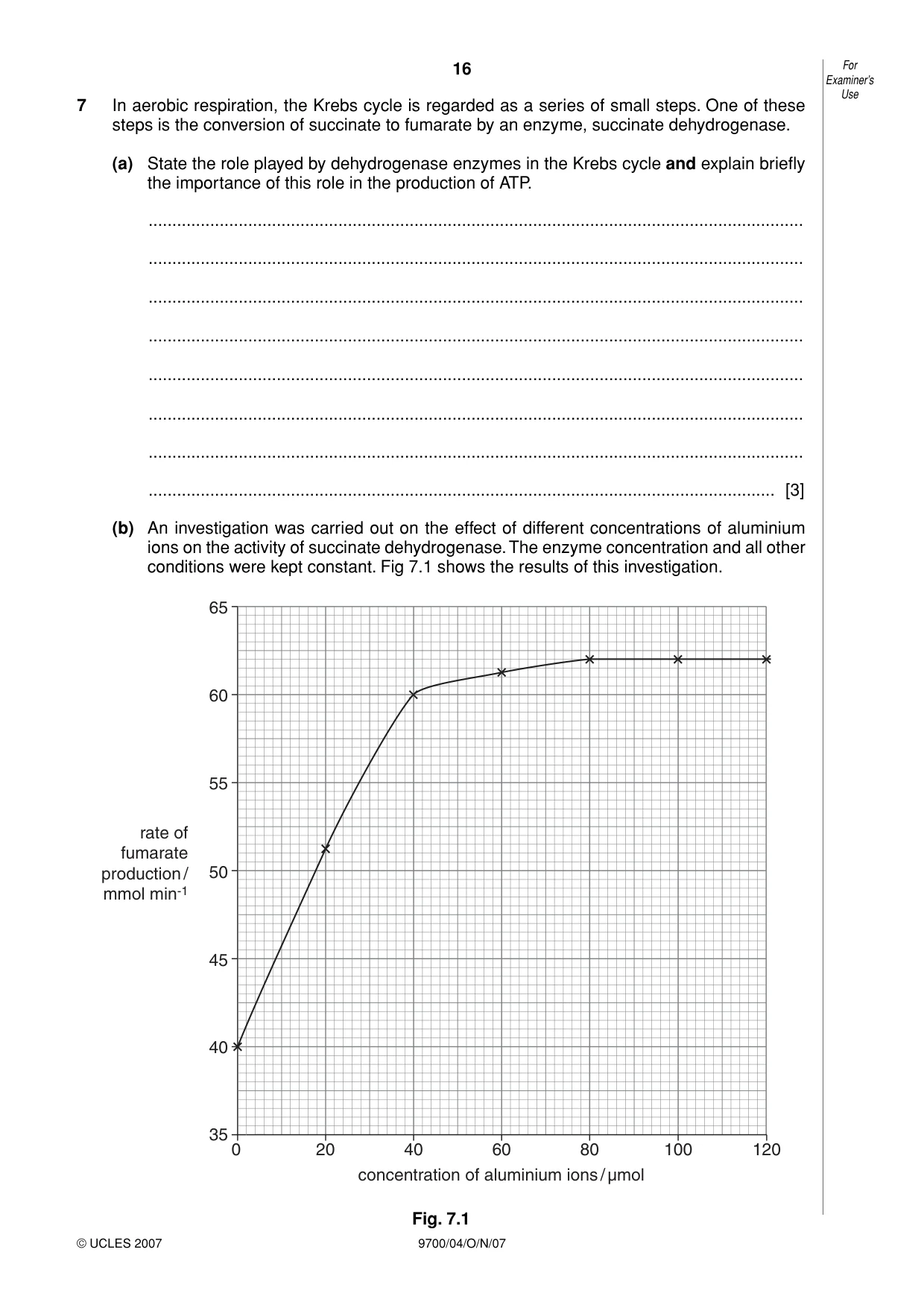
16 9700/04/O/N/07 For Examiner’s Use © UCLES 2007 7 In aerobic respiration, the Krebs cycle is regarded as a series of small steps. One of these steps is the conversion of succinate to fumarate by an enzyme, succinate dehydrogenase. (a) State the role played by dehydrogenase enzymes in the Krebs cycle and explain briefly the importance of this role in the production of ATP. … … … … … … … … [3] (b) An investigation was carried out on the effect of different concentrations of aluminium ions on the activity of succinate dehydrogenase. The enzyme concentration and all other conditions were kept constant. Fig 7.1 shows the results of this investigation. 20 0 40 35 45 rate of fumarate production / mmol min-1 50 55 40 concentration of aluminium ions / µmol 60 80 60 65 100 120 Fig. 7.1
Question paper, page 17
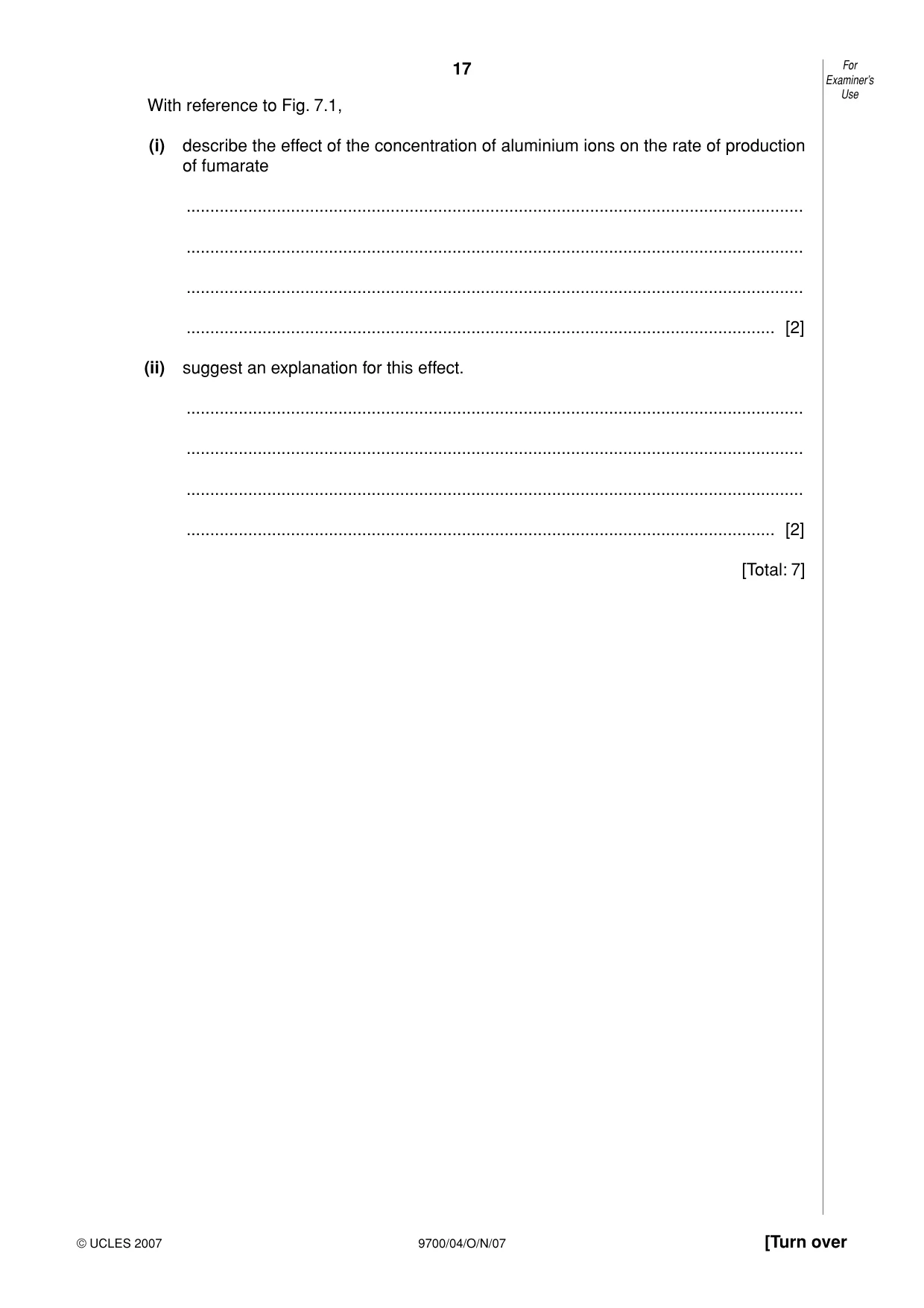
17 9700/04/O/N/07 [Turn over For Examiner’s Use © UCLES 2007 With reference to Fig. 7.1, (i) describe the effect of the concentration of aluminium ions on the rate of production of fumarate … … … … [2] (ii) suggest an explanation for this effect. … … … … [2] [Total: 7]
Question paper, page 18
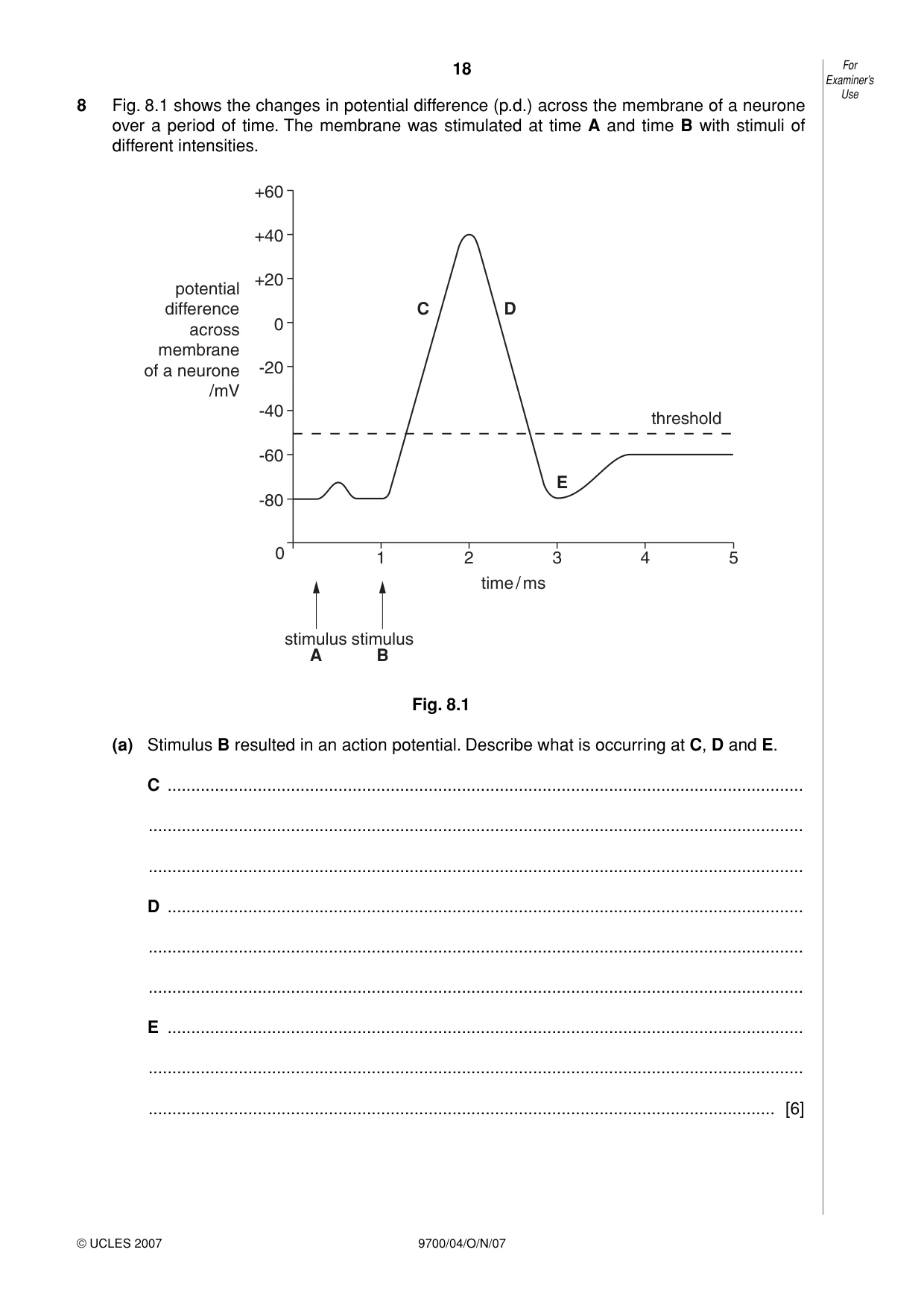
18 9700/04/O/N/07 For Examiner’s Use © UCLES 2007 8 Fig. 8.1 shows the changes in potential difference (p.d.) across the membrane of a neurone over a period of time. The membrane was stimulated at time A and time B with stimuli of different intensities. 1 -40 0 potential difference across membrane of a neurone /mV +40 0 2 time / ms stimulus A stimulus B 3 4 +60 +20 -20 -60 -80 5 threshold C D E Fig. 8.1 (a) Stimulus B resulted in an action potential. Describe what is occurring at C, D and E. C … … … D … … … E … … … [6]
Question paper, page 19
19 9700/04/O/N/07 [Turn over For Examiner’s Use © UCLES 2007 (b) Suggest why stimulus A did not result in an action potential being produced whereas stimulus B did. … … … … … … [2] [Total: 8]
Question paper, page 20
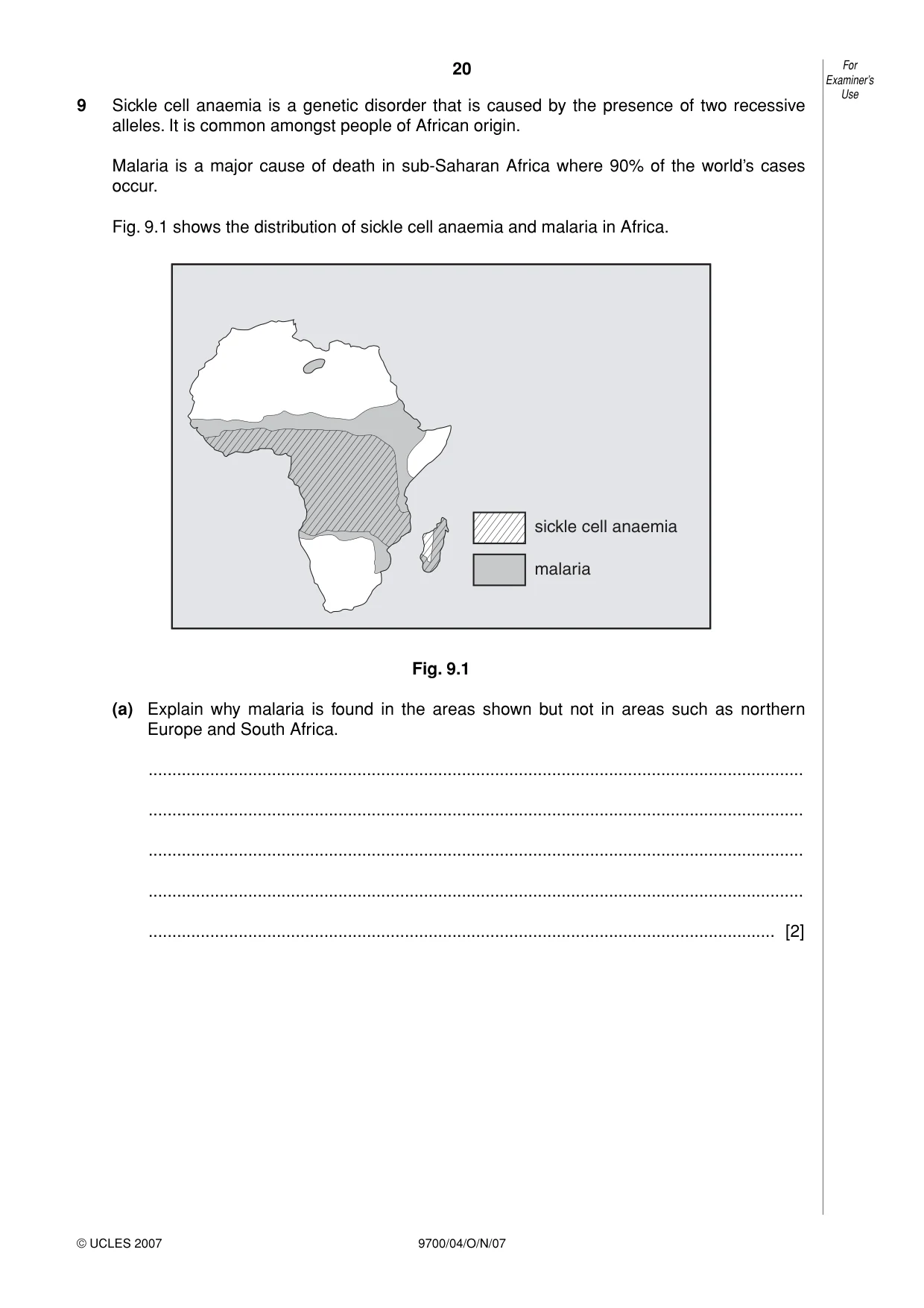
20 9700/04/O/N/07 For Examiner’s Use © UCLES 2007 9 Sickle cell anaemia is a genetic disorder that is caused by the presence of two recessive alleles. It is common amongst people of African origin. Malaria is a major cause of death in sub-Saharan Africa where 90% of the world’s cases occur. Fig. 9.1 shows the distribution of sickle cell anaemia and malaria in Africa. sickle cell anaemia malaria Fig. 9.1 (a) Explain why malaria is found in the areas shown but not in areas such as northern Europe and South Africa. … … … … … [2]
Question paper, page 21
21 9700/04/O/N/07 [Turn over For Examiner’s Use © UCLES 2007 (b) With reference to Fig. 9.1, explain the relationship between the distribution of sickle cell anaemia and malaria. … … … … … … … … … [4] [Total: 6]
Question paper, page 22
22 9700/04/O/N/07 For Examiner’s Use © UCLES 2007 Section B Answer one question. Circle the number of the question you have answered in the grid on the front cover. 10 (a) Describe the structure of photosystems and explain how a photosystem functions in cyclic photophosphorylation. [9] (b) Explain briefly how reduced NADP is formed in the light-dependent stage of photosynthesis and is used in the light-independent stage. [6] [Total: 15] 11 (a) Explain how meiosis and fertilisation can result in genetic variation amongst offspring. [7] (b) Explain, using examples, how the environment may affect the phenotype of an organism. [8] [Total: 15] … … … … … … … … … … … … … … … …
Question paper, page 23
23 9700/04/O/N/07 [Turn over For Examiner’s Use © UCLES 2007 … … … … … … … … … … … … … … … … … … … … … … … … … … … …
Question paper, page 24
24 9700/04/O/N/07 © UCLES 2007 … … … … … … … … … … … … … … … … … … … … … … … For Examiner’s Use Copyright Acknowledgements: Question 1 © Fig. 1.1 © BSIP, SERCOMI / SCIENCE PHOTO LIBRARY Question 1 © Fig. 1.1 © EYE OF SCIENCE / SCIENCE PHOTO LIBRARY Permission to reproduce items where third-party owned material protected by copyright is included has been sought and cleared where possible. Every reasonable effort has been made by the publisher (UCLES) to trace copyright holders, but if any items requiring clearance have unwittingly been included, the publisher will be pleased to make amends at the earliest possible opportunity. University of Cambridge International Examinations is part of the Cambridge Assessment Group. Cambridge Assessment is the brand name of University of Cambridge Local Examinations Syndicate (UCLES), which is itself a department of the University of Cambridge.
Mark scheme, page 1
UNIVERSITY OF CAMBRIDGE INTERNATIONAL EXAMINATIONS GCE Advanced Subsidiary Level and GCE Advanced Level MARK SCHEME for the October/November 2007 question paper 9700 BIOLOGY 9700/04 Paper 4 (Theory 2), maximum raw mark 100 This mark scheme is published as an aid to teachers and candidates, to indicate the requirements of the examination. It shows the basis on which Examiners were instructed to award marks. It does not indicate the details of the discussions that took place at an Examiners’ meeting before marking began. All Examiners are instructed that alternative correct answers and unexpected approaches in candidates’ scripts must be given marks that fairly reflect the relevant knowledge and skills demonstrated. Mark schemes must be read in conjunction with the question papers and the report on the examination. • CIE will not enter into discussions or correspondence in connection with these mark schemes. CIE is publishing the mark schemes for the October/November 2007 question papers for most IGCSE, GCE Advanced Level and Advanced Subsidiary Level syllabuses and some Ordinary Level syllabuses.
Mark scheme, page 2
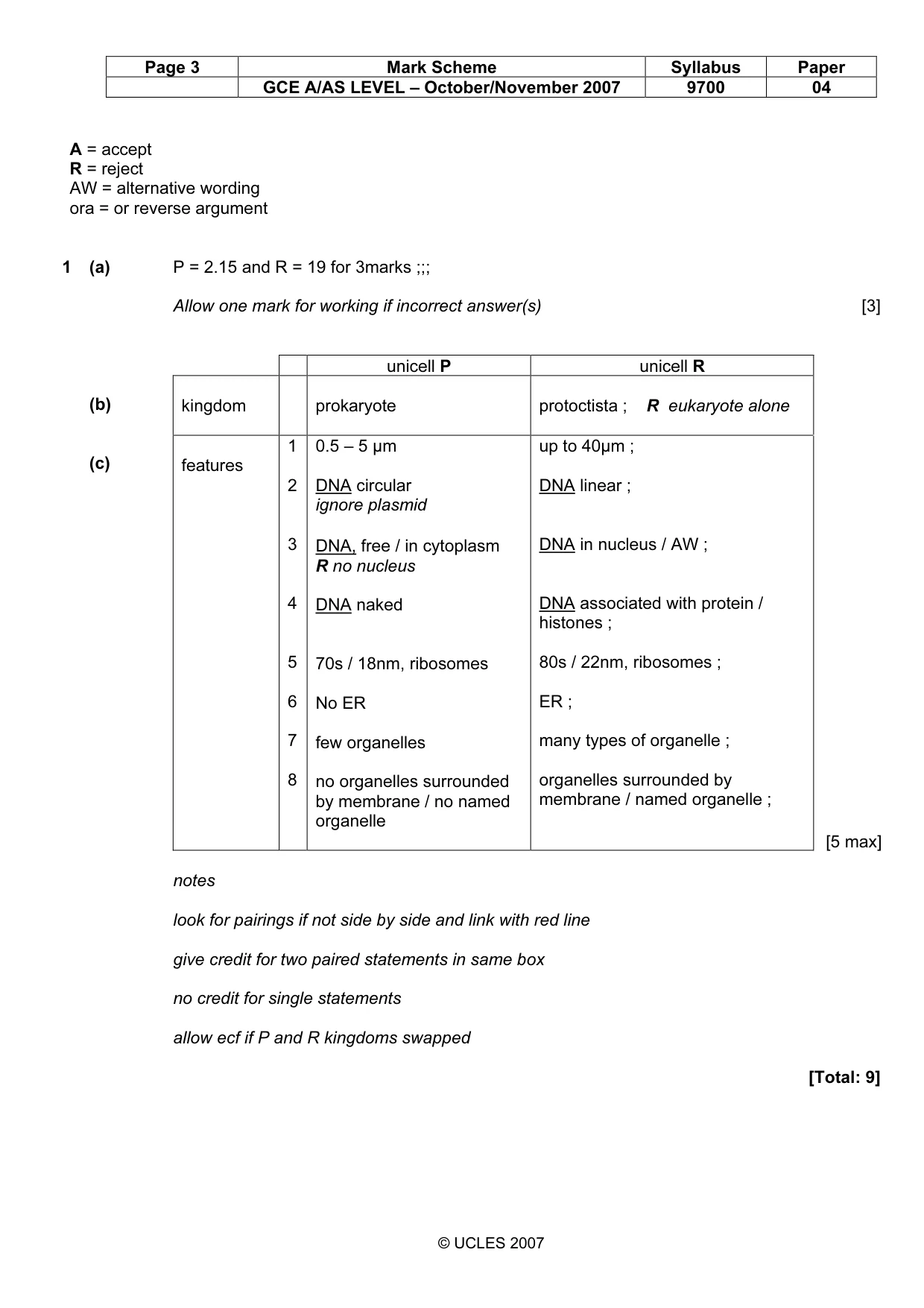
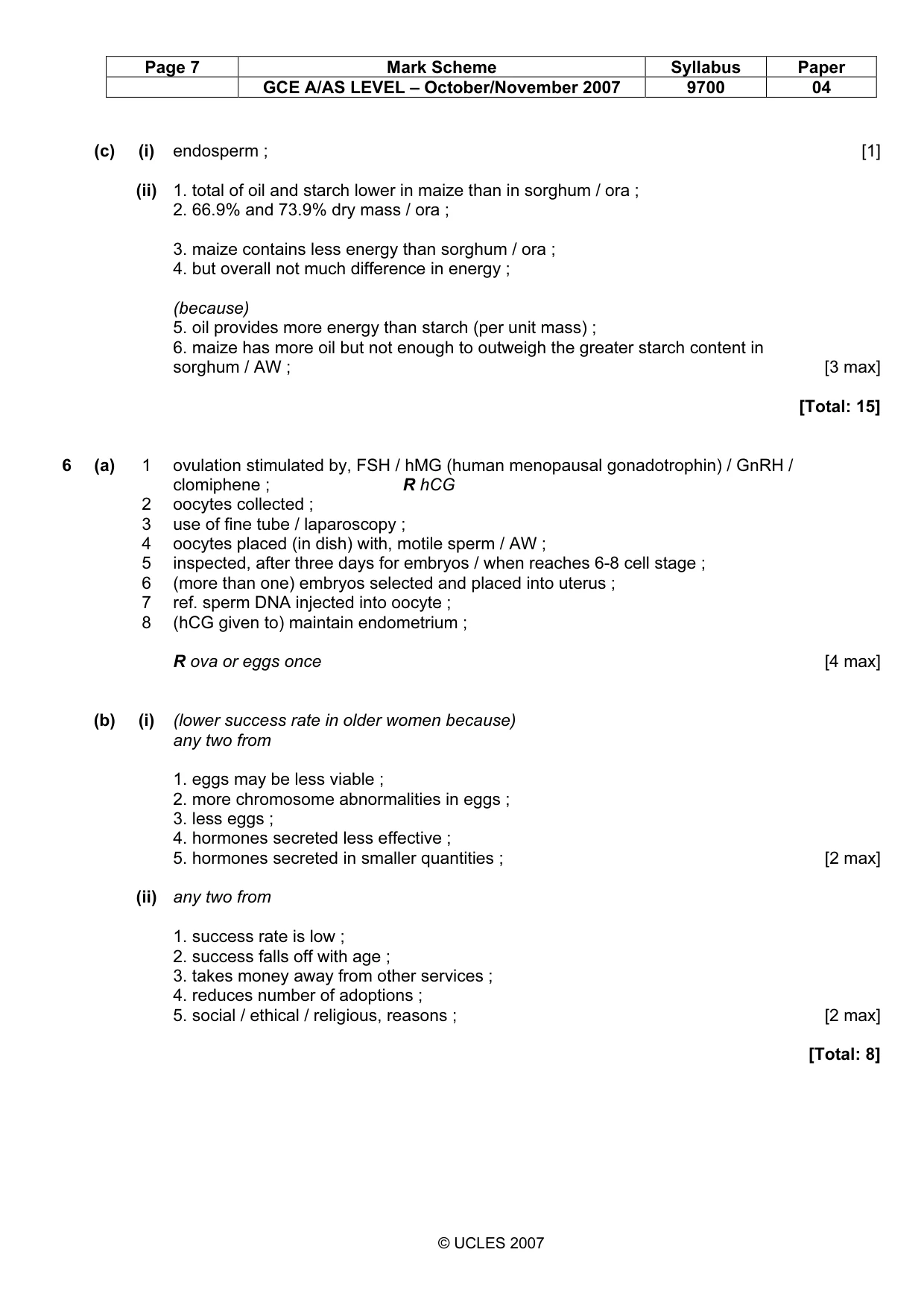
Page 3 Mark Scheme Syllabus Paper GCE A/AS LEVEL – October/November 2007 9700 04 © UCLES 2007 A = accept R = reject AW = alternative wording ora = or reverse argument 1 (a) P = 2.15 and R = 19 for 3marks ;;; Allow one mark for working if incorrect answer(s) [3] (b) (c) unicell P unicell R kingdom prokaryote protoctista ; R eukaryote alone features 1 2 3 4 5 6 7 8 0.5 – 5 µm DNA circular ignore plasmid DNA, free / in cytoplasm R no nucleus DNA naked 70s / 18nm, ribosomes No ER few organelles no organelles surrounded by membrane / no named organelle up to 40µm ; DNA linear ; DNA in nucleus / AW ; DNA associated with protein / histones ; 80s / 22nm, ribosomes ; ER ; many types of organelle ; organelles surrounded by membrane / named organelle ; [5 max] notes look for pairings if not side by side and link with red line give credit for two paired statements in same box no credit for single statements allow ecf if P and R kingdoms swapped [Total: 9]
Mark scheme, page 3
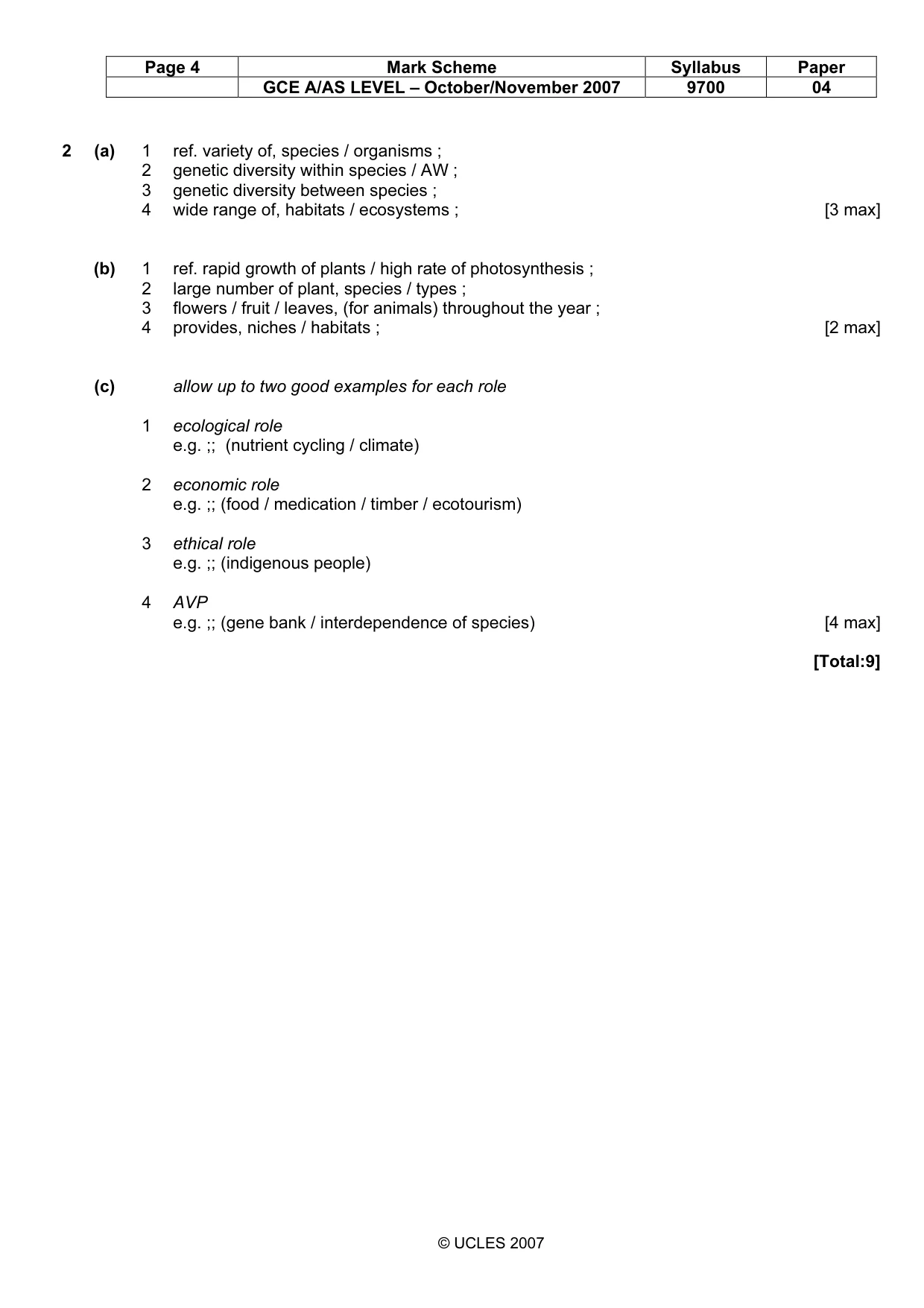
Page 4 Mark Scheme Syllabus Paper GCE A/AS LEVEL – October/November 2007 9700 04 © UCLES 2007 2 (a) 1 2 3 4 ref. variety of, species / organisms ; genetic diversity within species / AW ; genetic diversity between species ; wide range of, habitats / ecosystems ; [3 max] (b) 1 2 3 4 ref. rapid growth of plants / high rate of photosynthesis ; large number of plant, species / types ; flowers / fruit / leaves, (for animals) throughout the year ; provides, niches / habitats ; [2 max] (c) 1 2 3 4 allow up to two good examples for each role ecological role e.g. ;; (nutrient cycling / climate) economic role e.g. ;; (food / medication / timber / ecotourism) ethical role e.g. ;; (indigenous people) AVP e.g. ;; (gene bank / interdependence of species) [4 max] [Total:9]
Mark scheme, page 4
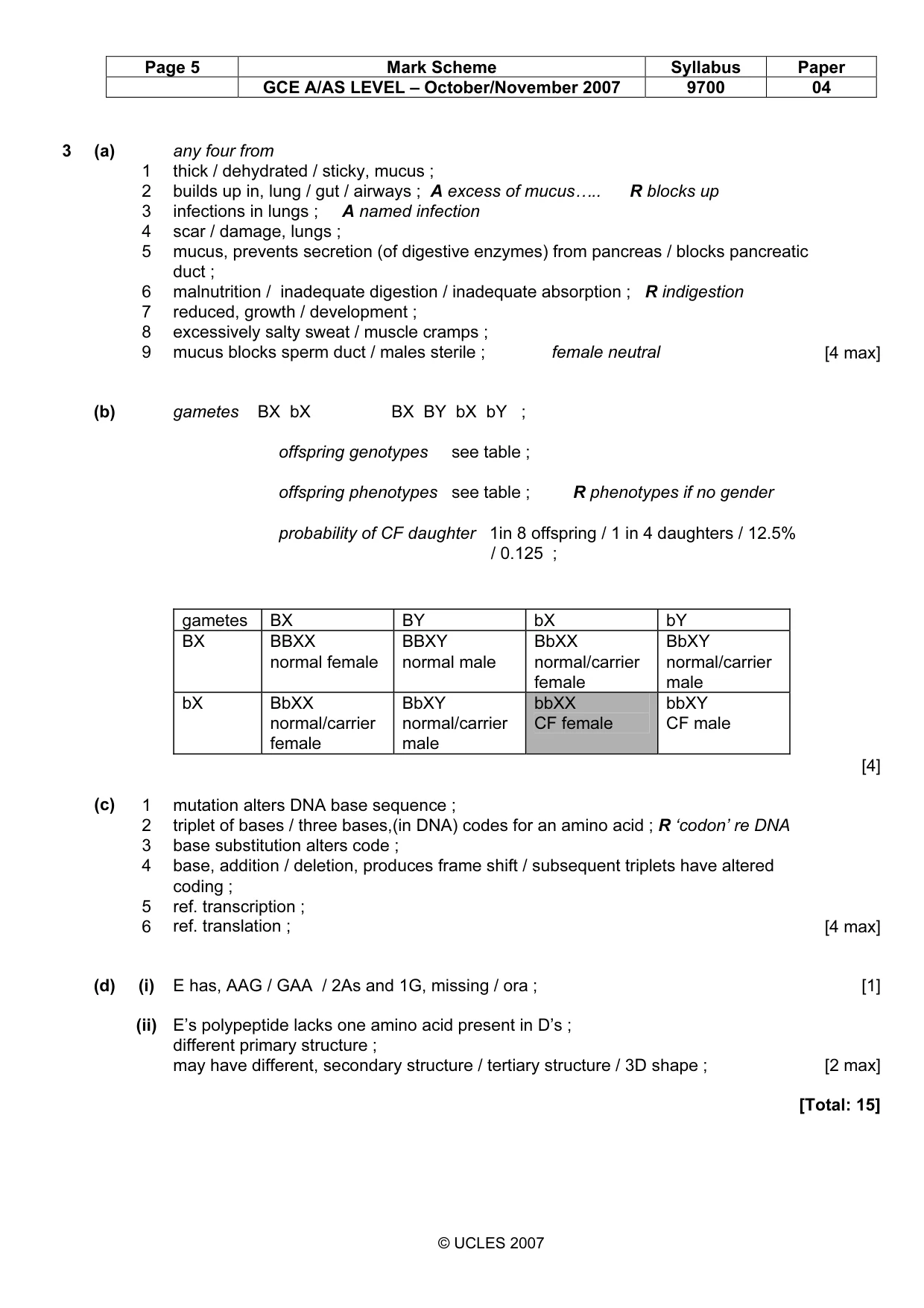
Page 5 Mark Scheme Syllabus Paper GCE A/AS LEVEL – October/November 2007 9700 04 © UCLES 2007 3 (a) 1 2 3 4 5 6 7 8 9 any four from thick / dehydrated / sticky, mucus ; builds up in, lung / gut / airways ; A excess of mucus….. R blocks up infections in lungs ; A named infection scar / damage, lungs ; mucus, prevents secretion (of digestive enzymes) from pancreas / blocks pancreatic duct ; malnutrition / inadequate digestion / inadequate absorption ; R indigestion reduced, growth / development ; excessively salty sweat / muscle cramps ; mucus blocks sperm duct / males sterile ; female neutral [4 max] (b) gametes BX bX BX BY bX bY ; offspring genotypes see table ; offspring phenotypes see table ; R phenotypes if no gender probability of CF daughter 1in 8 offspring / 1 in 4 daughters / 12.5% / 0.125 ; gametes BX BY bX bY BX BBXX normal female BBXY normal male BbXX normal/carrier female BbXY normal/carrier male bX BbXX normal/carrier female BbXY normal/carrier male bbXX CF female bbXY CF male [4] (c) 1 2 3 4 5 6 mutation alters DNA base sequence ; triplet of bases / three bases,(in DNA) codes for an amino acid ; R ‘codon’ re DNA base substitution alters code ; base, addition / deletion, produces frame shift / subsequent triplets have altered coding ; ref. transcription ; ref. translation ; [4 max] (d) (i) E has, AAG / GAA / 2As and 1G, missing / ora ; [1] (ii) E’s polypeptide lacks one amino acid present in D’s ; different primary structure ; may have different, secondary structure / tertiary structure / 3D shape ; [2 max] [Total: 15]
Mark scheme, page 5
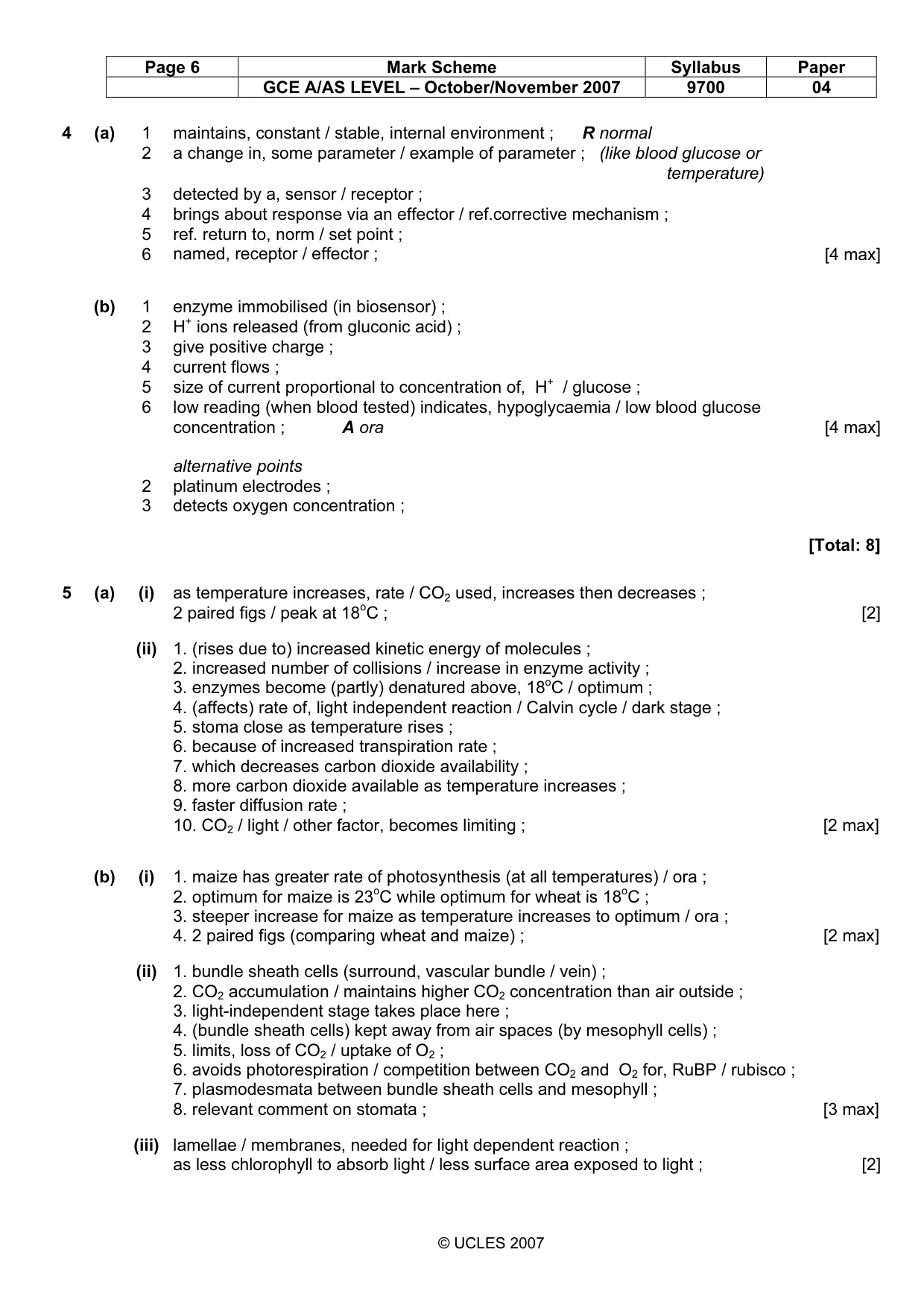
Page 6 Mark Scheme Syllabus Paper GCE A/AS LEVEL – October/November 2007 9700 04 © UCLES 2007 4 (a) 1 2 3 4 5 6 maintains, constant / stable, internal environment ; R normal a change in, some parameter / example of parameter ; (like blood glucose or temperature) detected by a, sensor / receptor ; brings about response via an effector / ref.corrective mechanism ; ref. return to, norm / set point ; named, receptor / effector ; [4 max] (b) 1 2 3 4 5 6 enzyme immobilised (in biosensor) ; H+ ions released (from gluconic acid) ; give positive charge ; current flows ; size of current proportional to concentration of, H+ / glucose ; low reading (when blood tested) indicates, hypoglycaemia / low blood glucose concentration ; A ora [4 max] 2 3 alternative points platinum electrodes ; detects oxygen concentration ; [Total: 8] 5 (a) (i) as temperature increases, rate / CO2 used, increases then decreases ; 2 paired figs / peak at 18oC ; [2] (ii) 1. (rises due to) increased kinetic energy of molecules ; 2. increased number of collisions / increase in enzyme activity ; 3. enzymes become (partly) denatured above, 18oC / optimum ; 4. (affects) rate of, light independent reaction / Calvin cycle / dark stage ; 5. stoma close as temperature rises ; 6. because of increased transpiration rate ; 7. which decreases carbon dioxide availability ; 8. more carbon dioxide available as temperature increases ; 9. faster diffusion rate ; 10. CO2 / light / other factor, becomes limiting ; [2 max] (b) (i) 1. maize has greater rate of photosynthesis (at all temperatures) / ora ; 2. optimum for maize is 23oC while optimum for wheat is 18oC ; 3. steeper increase for maize as temperature increases to optimum / ora ; 4. 2 paired figs (comparing wheat and maize) ; [2 max] (ii) 1. bundle sheath cells (surround, vascular bundle / vein) ; 2. CO2 accumulation / maintains higher CO2 concentration than air outside ; 3. light-independent stage takes place here ; 4. (bundle sheath cells) kept away from air spaces (by mesophyll cells) ; 5. limits, loss of CO2 / uptake of O2 ; 6. avoids photorespiration / competition between CO2 and O2 for, RuBP / rubisco ; 7. plasmodesmata between bundle sheath cells and mesophyll ; 8. relevant comment on stomata ; [3 max] (iii) lamellae / membranes, needed for light dependent reaction ; as less chlorophyll to absorb light / less surface area exposed to light ; [2]
Mark scheme, page 6
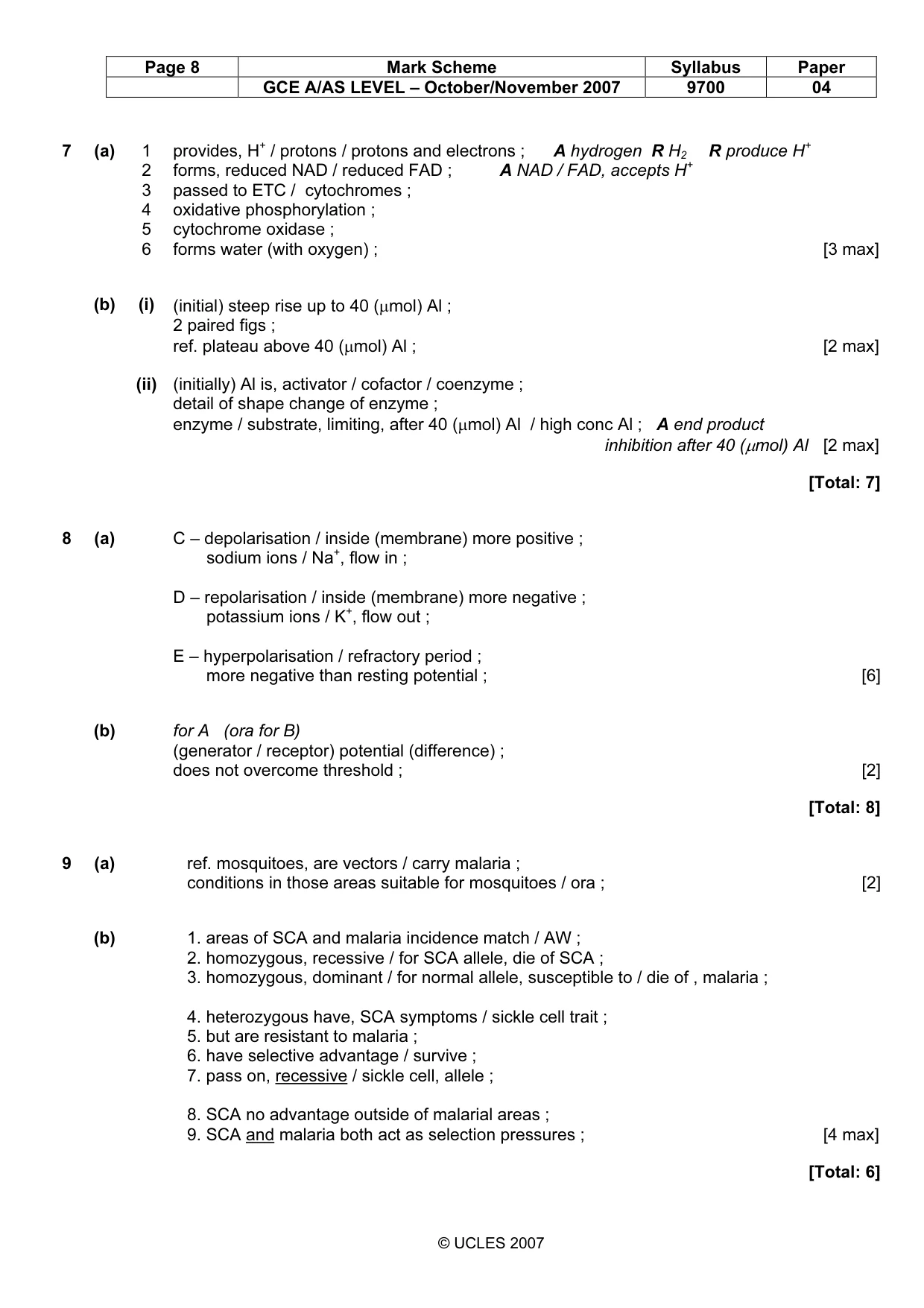
Page 7 Mark Scheme Syllabus Paper GCE A/AS LEVEL – October/November 2007 9700 04 © UCLES 2007 (c) (i) endosperm ; [1] (ii) 1. total of oil and starch lower in maize than in sorghum / ora ; 2. 66.9% and 73.9% dry mass / ora ; 3. maize contains less energy than sorghum / ora ; 4. but overall not much difference in energy ; (because) 5. oil provides more energy than starch (per unit mass) ; 6. maize has more oil but not enough to outweigh the greater starch content in sorghum / AW ; [3 max] [Total: 15] 6 (a) 1 2 3 4 5 6 7 8 ovulation stimulated by, FSH / hMG (human menopausal gonadotrophin) / GnRH / clomiphene ; R hCG oocytes collected ; use of fine tube / laparoscopy ; oocytes placed (in dish) with, motile sperm / AW ; inspected, after three days for embryos / when reaches 6-8 cell stage ; (more than one) embryos selected and placed into uterus ; ref. sperm DNA injected into oocyte ; (hCG given to) maintain endometrium ; R ova or eggs once [4 max] (b) (i) (lower success rate in older women because) any two from 1. eggs may be less viable ; 2. more chromosome abnormalities in eggs ; 3. less eggs ; 4. hormones secreted less effective ; 5. hormones secreted in smaller quantities ; [2 max] (ii) any two from 1. success rate is low ; 2. success falls off with age ; 3. takes money away from other services ; 4. reduces number of adoptions ; 5. social / ethical / religious, reasons ; [2 max] [Total: 8]
Mark scheme, page 7
Page 8 Mark Scheme Syllabus Paper GCE A/AS LEVEL – October/November 2007 9700 04 © UCLES 2007 7 (a) 1 2 3 4 5 6 provides, H+ / protons / protons and electrons ; A hydrogen R H2 R produce H+ forms, reduced NAD / reduced FAD ; A NAD / FAD, accepts H+ passed to ETC / cytochromes ; oxidative phosphorylation ; cytochrome oxidase ; forms water (with oxygen) ; [3 max] (b) (i) (initial) steep rise up to 40 (µmol) Al ; 2 paired figs ; ref. plateau above 40 (µmol) Al ; [2 max] (ii) (initially) Al is, activator / cofactor / coenzyme ; detail of shape change of enzyme ; enzyme / substrate, limiting, after 40 (µmol) Al / high conc Al ; A end product inhibition after 40 (µmol) Al [2 max] [Total: 7] 8 (a) C – depolarisation / inside (membrane) more positive ; sodium ions / Na+, flow in ; D – repolarisation / inside (membrane) more negative ; potassium ions / K+, flow out ; E – hyperpolarisation / refractory period ; more negative than resting potential ; [6] (b) for A (ora for B) (generator / receptor) potential (difference) ; does not overcome threshold ; [2] [Total: 8] 9 (a) ref. mosquitoes, are vectors / carry malaria ; conditions in those areas suitable for mosquitoes / ora ; [2] (b) 1. areas of SCA and malaria incidence match / AW ; 2. homozygous, recessive / for SCA allele, die of SCA ; 3. homozygous, dominant / for normal allele, susceptible to / die of , malaria ; 4. heterozygous have, SCA symptoms / sickle cell trait ; 5. but are resistant to malaria ; 6. have selective advantage / survive ; 7. pass on, recessive / sickle cell, allele ; 8. SCA no advantage outside of malarial areas ; 9. SCA and malaria both act as selection pressures ; [4 max] [Total: 6]
Mark scheme, page 8
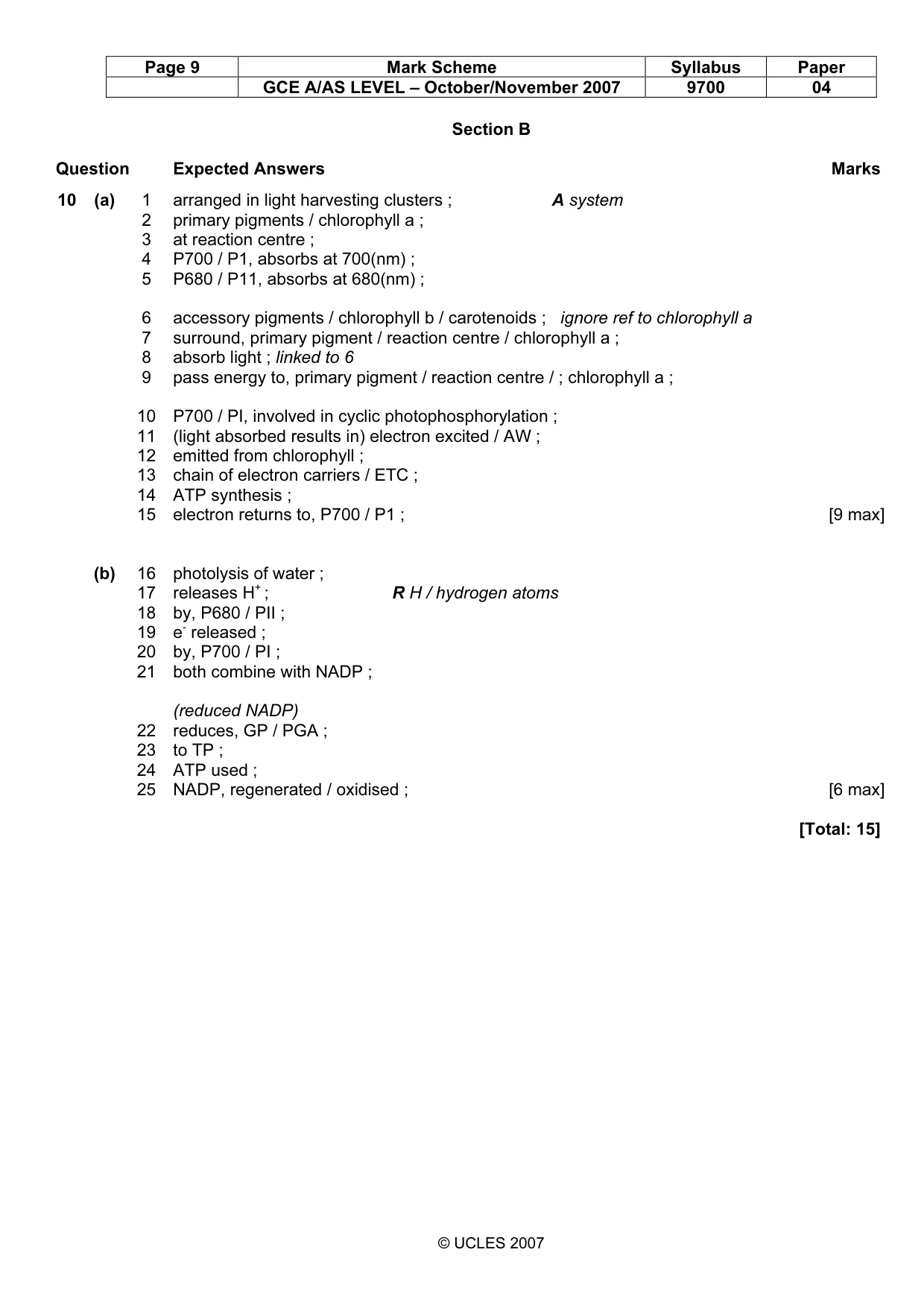
Page 9 Mark Scheme Syllabus Paper GCE A/AS LEVEL – October/November 2007 9700 04 © UCLES 2007 Section B Question Expected Answers Marks 10 (a) 1 2 3 4 5 6 7 8 9 10 11 12 13 14 15 arranged in light harvesting clusters ; A system primary pigments / chlorophyll a ; at reaction centre ; P700 / P1, absorbs at 700(nm) ; P680 / P11, absorbs at 680(nm) ; accessory pigments / chlorophyll b / carotenoids ; ignore ref to chlorophyll a surround, primary pigment / reaction centre / chlorophyll a ; absorb light ; linked to 6 pass energy to, primary pigment / reaction centre / ; chlorophyll a ; P700 / PI, involved in cyclic photophosphorylation ; (light absorbed results in) electron excited / AW ; emitted from chlorophyll ; chain of electron carriers / ETC ; ATP synthesis ; electron returns to, P700 / P1 ; [9 max] (b) 16 17 18 19 20 21 22 23 24 25 photolysis of water ; releases H+ ; R H / hydrogen atoms by, P680 / PII ; e- released ; by, P700 / PI ; both combine with NADP ; (reduced NADP) reduces, GP / PGA ; to TP ; ATP used ; NADP, regenerated / oxidised ; [6 max] [Total: 15]
Mark scheme, page 9
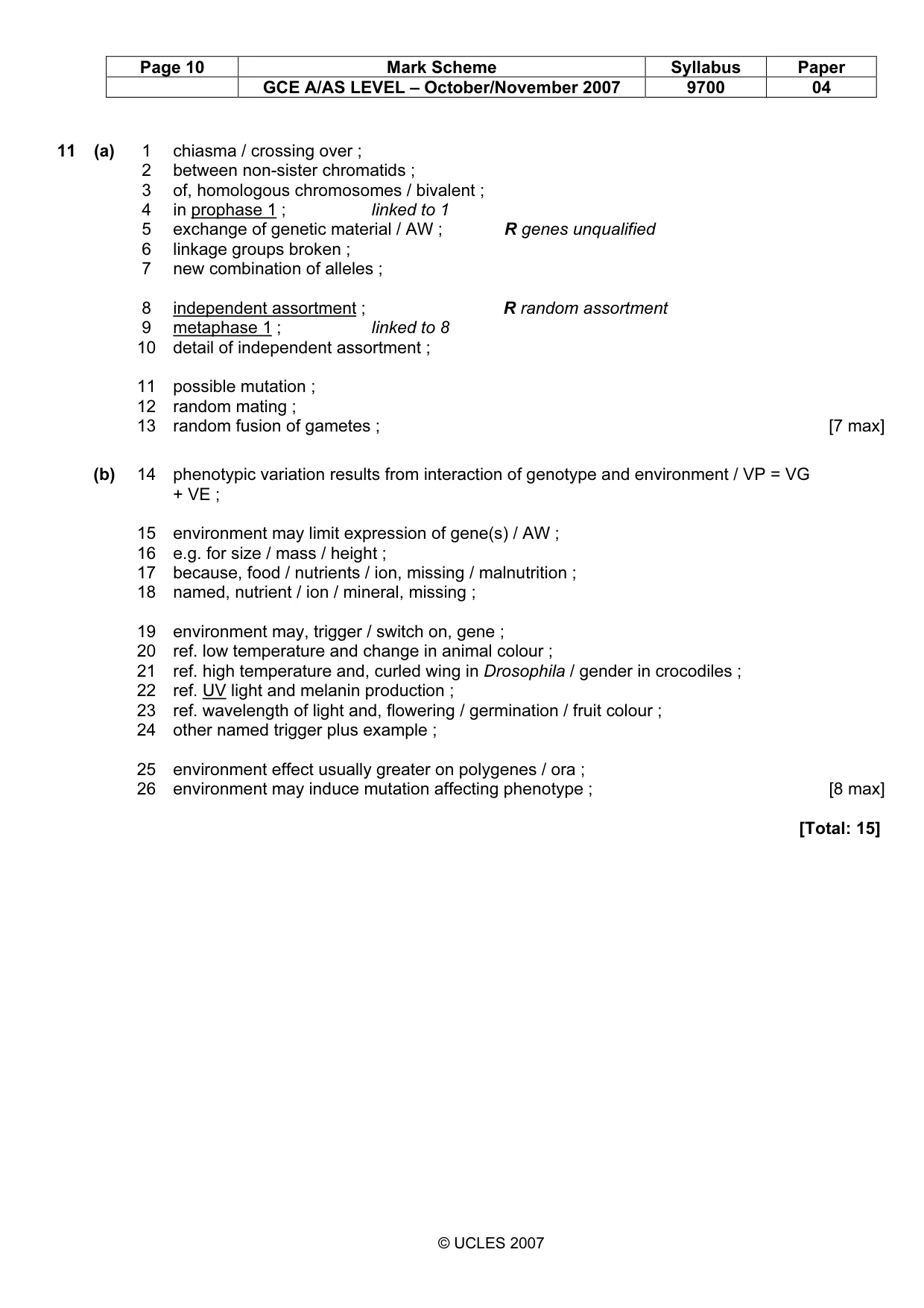
Page 10 Mark Scheme Syllabus Paper GCE A/AS LEVEL – October/November 2007 9700 04 © UCLES 2007 11 (a) 1 2 3 4 5 6 7 8 9 10 11 12 13 chiasma / crossing over ; between non-sister chromatids ; of, homologous chromosomes / bivalent ; in prophase 1 ; linked to 1 exchange of genetic material / AW ; R genes unqualified linkage groups broken ; new combination of alleles ; independent assortment ; R random assortment metaphase 1 ; linked to 8 detail of independent assortment ; possible mutation ; random mating ; random fusion of gametes ; [7 max] (b) 14 15 16 17 18 19 20 21 22 23 24 25 26 phenotypic variation results from interaction of genotype and environment / VP = VG + VE ; environment may limit expression of gene(s) / AW ; e.g. for size / mass / height ; because, food / nutrients / ion, missing / malnutrition ; named, nutrient / ion / mineral, missing ; environment may, trigger / switch on, gene ; ref. low temperature and change in animal colour ; ref. high temperature and, curled wing in Drosophila / gender in crocodiles ; ref. UV light and melanin production ; ref. wavelength of light and, flowering / germination / fruit colour ; other named trigger plus example ; environment effect usually greater on polygenes / ora ; environment may induce mutation affecting phenotype ; [8 max] [Total: 15]
What you needed in this session
Cambridge’s own grade thresholds for 2007 Oct/Nov, Paper 4 · Variant 1. A higher threshold means an easier paper — the bar moves with how the cohort did.