Cambridge A Level Biology 9700 — 2007 May/June Paper 2 · Variant 1
9700/21/M/J/07 · 60 marks · ≈68 min
The question paper and its mark scheme, free to read here and free to download. This is Cambridge’s own paper, exactly as it was sat.
Question paper16 pages

Mark scheme7 pages
Answers below. Sit the paper first if you are practising.
Paper as text
Question paper, page 1
This document consists of 14 printed pages and 2 blank pages. SP (CW/KS) T25599/4 © UCLES 2007 [Turn over UNIVERSITY OF CAMBRIDGE INTERNATIONAL EXAMINATIONS General Certificate of Education Advanced Subsidiary Level and Advanced Level READ THESE INSTRUCTIONS FIRST Write your Centre number, candidate number and name on all the work you hand in. Write in dark blue or black pen. You may use a soft pencil for any diagrams, graphs, or rough working. Do not use staples, paper clips, highlighters, glue or correction fluid. DO NOT WRITE IN ANY BARCODES. Answer all questions. At the end of the examination, fasten all your work together. The number of marks is given in brackets [ ] at the end of each question or part question. * 4 0 7 6 5 6 3 9 3 9 * BIOLOGY 9700/02 Paper 2 Structured Questions AS May/June 2007 1 hour 15 minutes Candidates answer on the Question Paper. No Additional Materials are required. For Examiner’s Use 1 2 3 4 5 6 Total
Question paper, page 2
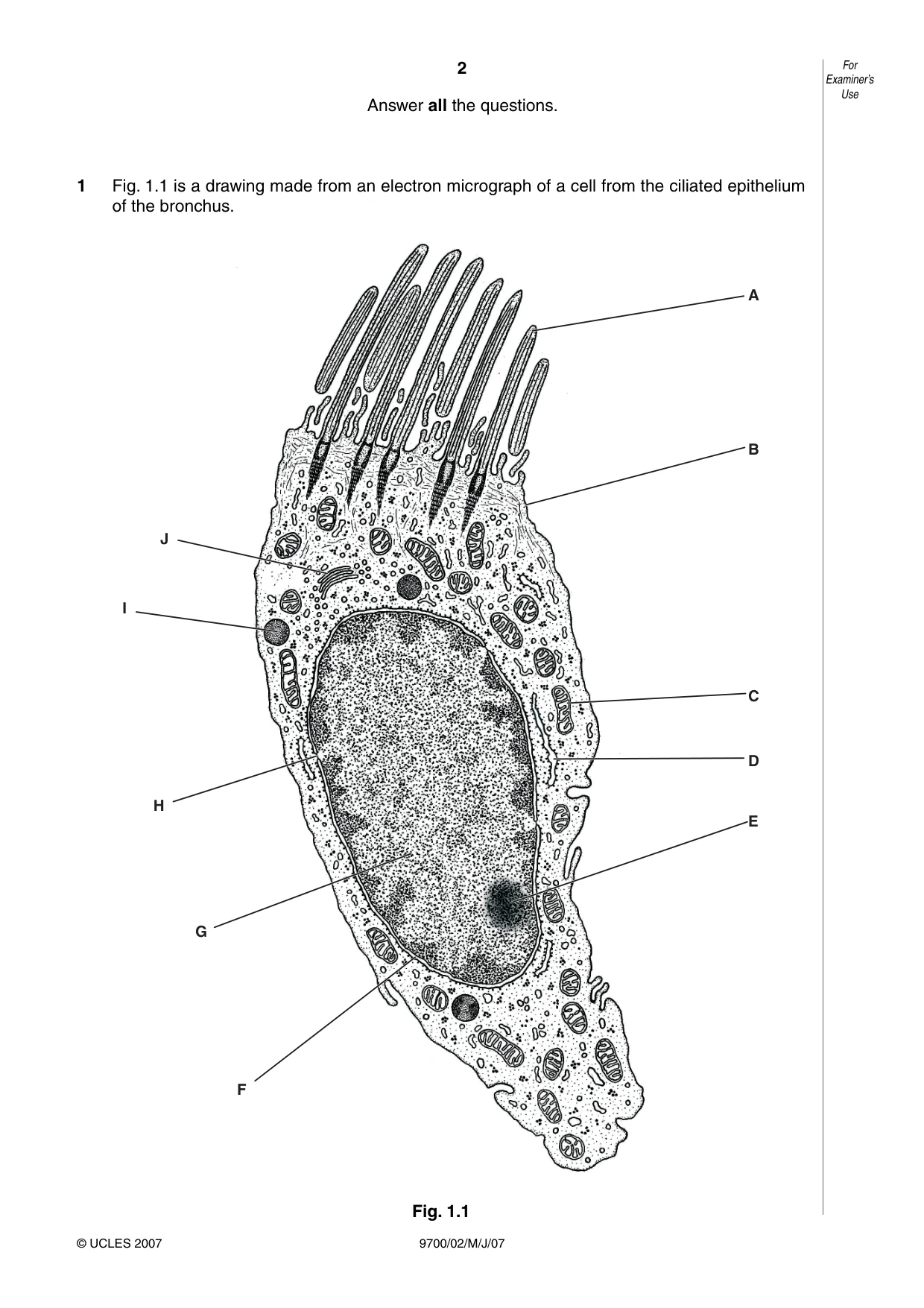
2 9700/02/M/J/07 For Examiner’s Use © UCLES 2007 Answer all the questions. 1 Fig. 1.1 is a drawing made from an electron micrograph of a cell from the ciliated epithelium of the bronchus. A B C D E F G H I J A B C D E F G H I J Fig. 1.1
Question paper, page 3
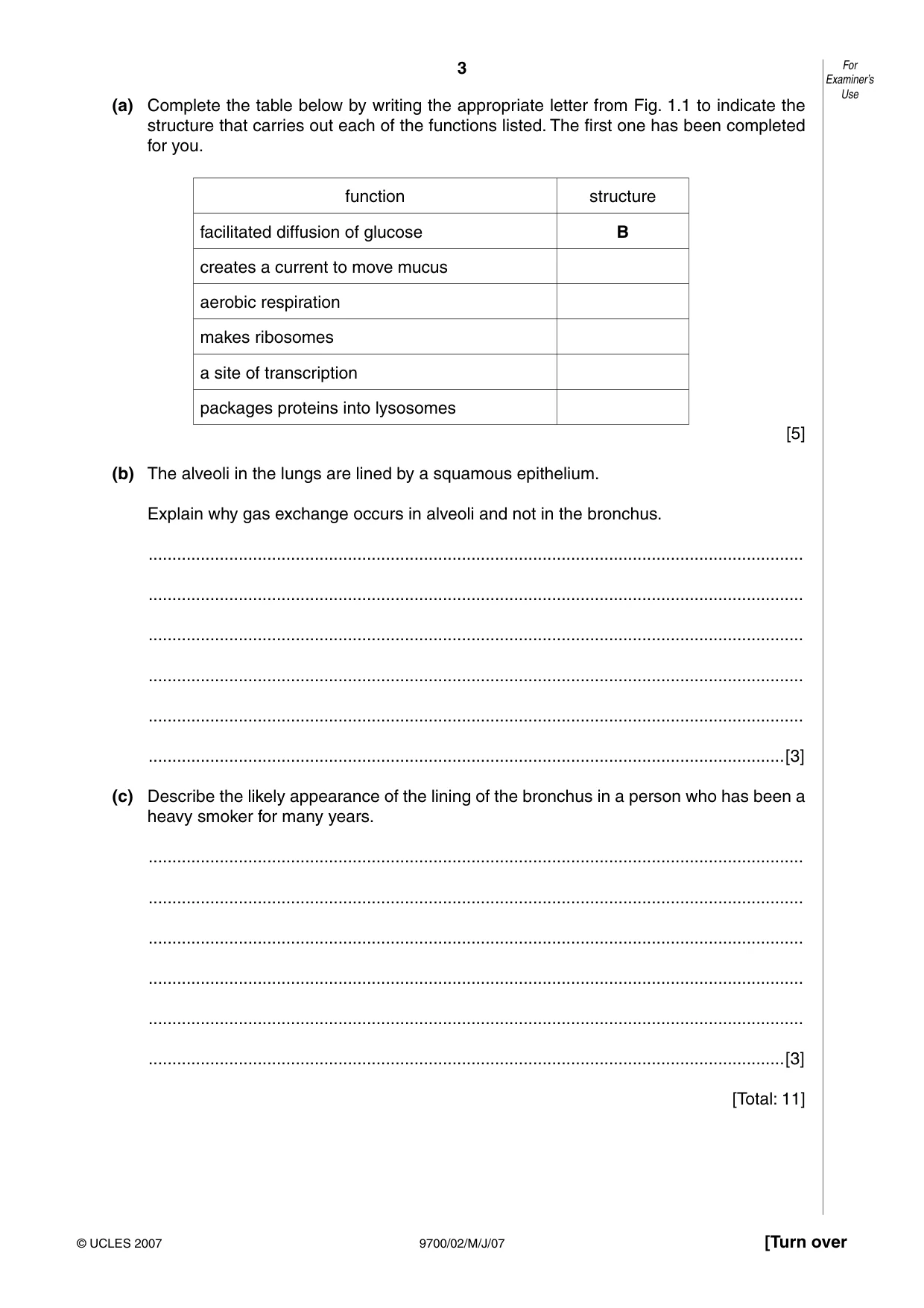
3 9700/02/M/J/07 [Turn over For Examiner’s Use © UCLES 2007 (a) Complete the table below by writing the appropriate letter from Fig. 1.1 to indicate the structure that carries out each of the functions listed. The first one has been completed for you. function structure facilitated diffusion of glucose B creates a current to move mucus aerobic respiration makes ribosomes a site of transcription packages proteins into lysosomes [5] (b) The alveoli in the lungs are lined by a squamous epithelium. Explain why gas exchange occurs in alveoli and not in the bronchus. … … … … … …[3] (c) Describe the likely appearance of the lining of the bronchus in a person who has been a heavy smoker for many years. … … … … … …[3] [Total: 11]
Question paper, page 4
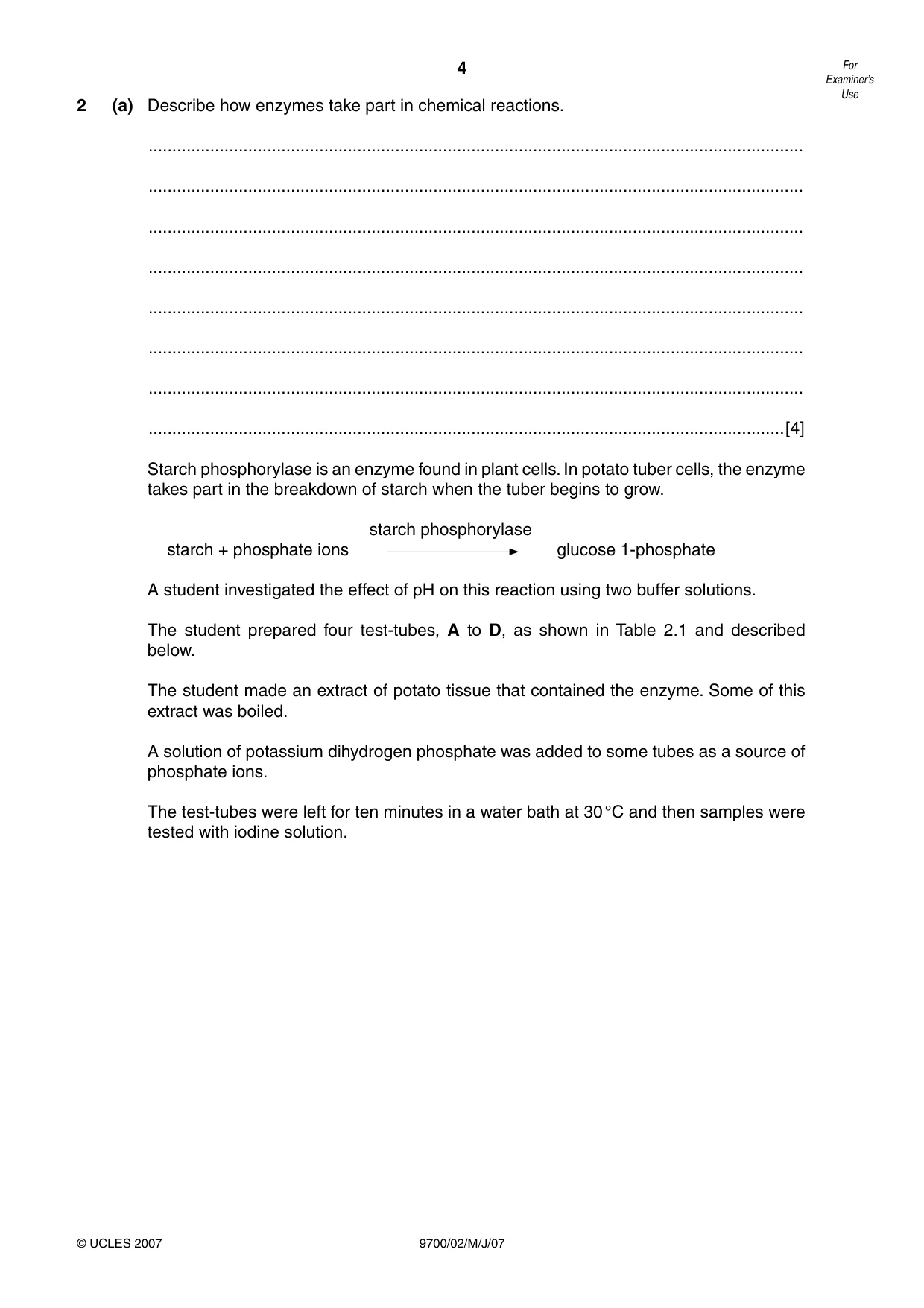
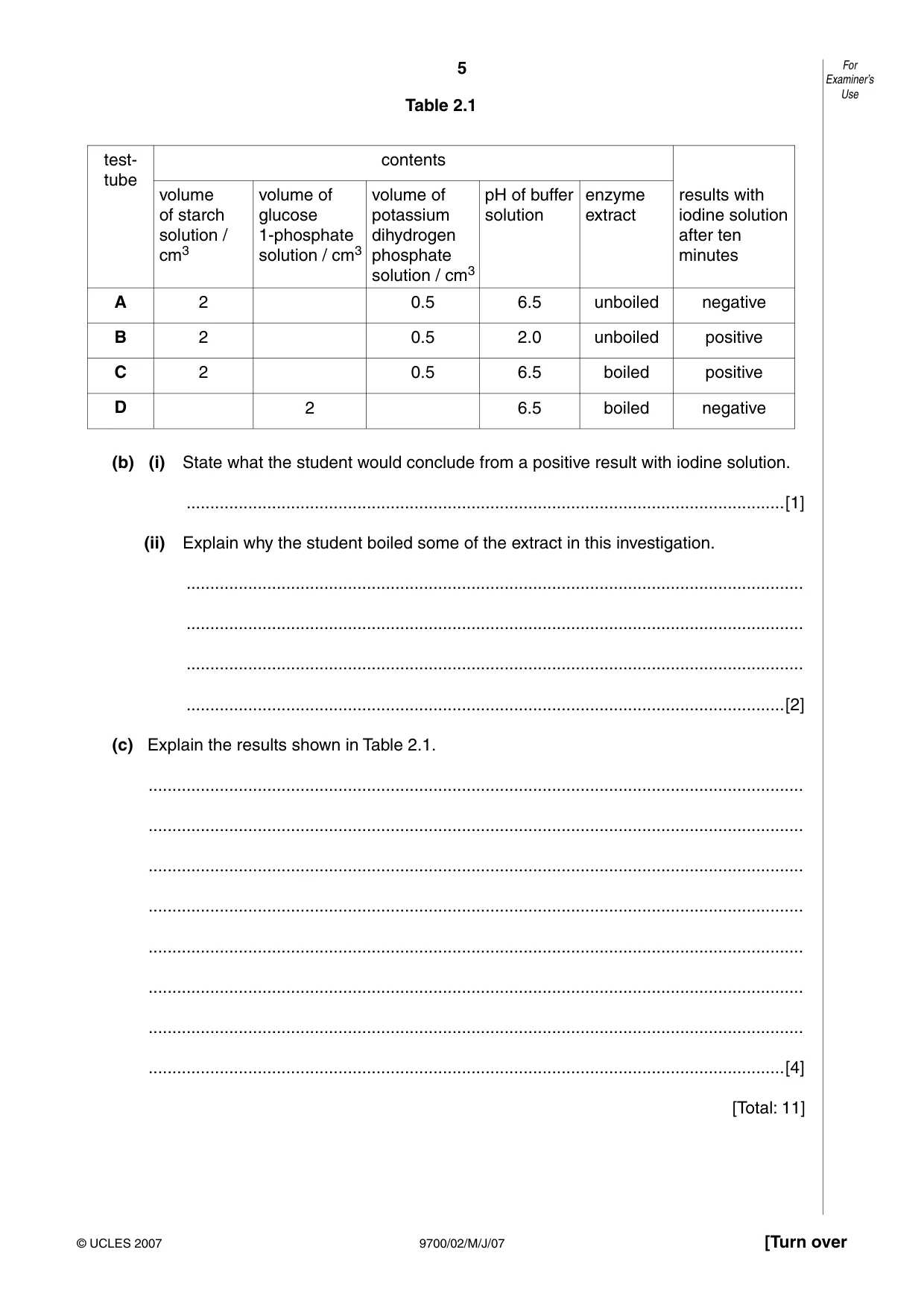
4 9700/02/M/J/07 For Examiner’s Use © UCLES 2007 2 (a) Describe how enzymes take part in chemical reactions. … … … … … … … …[4] Starch phosphorylase is an enzyme found in plant cells. In potato tuber cells, the enzyme takes part in the breakdown of starch when the tuber begins to grow. starch phosphorylase starch + phosphate ions glucose 1-phosphate A student investigated the effect of pH on this reaction using two buffer solutions. The student prepared four test-tubes, A to D, as shown in Table 2.1 and described below. The student made an extract of potato tissue that contained the enzyme. Some of this extract was boiled. A solution of potassium dihydrogen phosphate was added to some tubes as a source of phosphate ions. The test-tubes were left for ten minutes in a water bath at 30 °C and then samples were tested with iodine solution.
Question paper, page 5
5 9700/02/M/J/07 [Turn over For Examiner’s Use © UCLES 2007 Table 2.1 test- tube contents volume of starch solution / cm3 volume of glucose 1-phosphate solution / cm3 volume of potassium dihydrogen phosphate solution / cm3 pH of buffer solution enzyme extract results with iodine solution after ten minutes A 2 0.5 6.5 unboiled negative B 2 0.5 2.0 unboiled positive C 2 0.5 6.5 boiled positive D 2 6.5 boiled negative (b) (i) State what the student would conclude from a positive result with iodine solution. …[1] (ii) Explain why the student boiled some of the extract in this investigation. … … … …[2] (c) Explain the results shown in Table 2.1. … … … … … … … …[4] [Total: 11]
Question paper, page 6
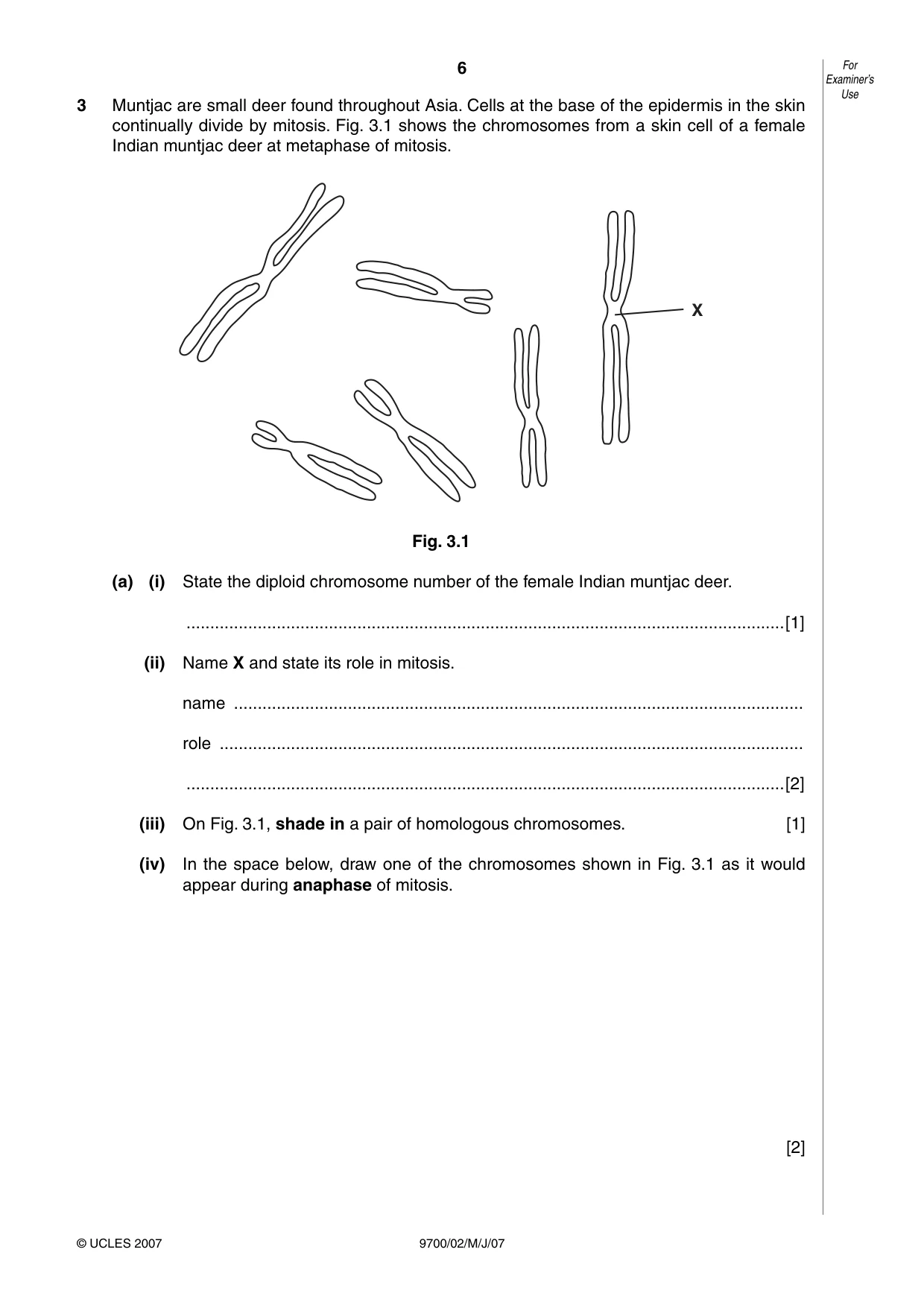
6 9700/02/M/J/07 For Examiner’s Use © UCLES 2007 3 Muntjac are small deer found throughout Asia. Cells at the base of the epidermis in the skin continually divide by mitosis. Fig. 3.1 shows the chromosomes from a skin cell of a female Indian muntjac deer at metaphase of mitosis. X Fig. 3.1 (a) (i) State the diploid chromosome number of the female Indian muntjac deer. …[1] (ii) Name X and state its role in mitosis. name … role … …[2] (iii) On Fig. 3.1, shade in a pair of homologous chromosomes. [1] (iv) In the space below, draw one of the chromosomes shown in Fig. 3.1 as it would appear during anaphase of mitosis. [2]
Question paper, page 7
7 9700/02/M/J/07 [Turn over For Examiner’s Use © UCLES 2007 (b) Outline what happens to a chromosome between the end of anaphase and the start of the next mitosis. … … … … … …[3] (c) During the formation of eggs in the ovary of the female Indian muntjac deer, the chromosome number changes. State what happens to the chromosome number and explain why this change is necessary. … … … …[2] [Total: 11]
Question paper, page 8
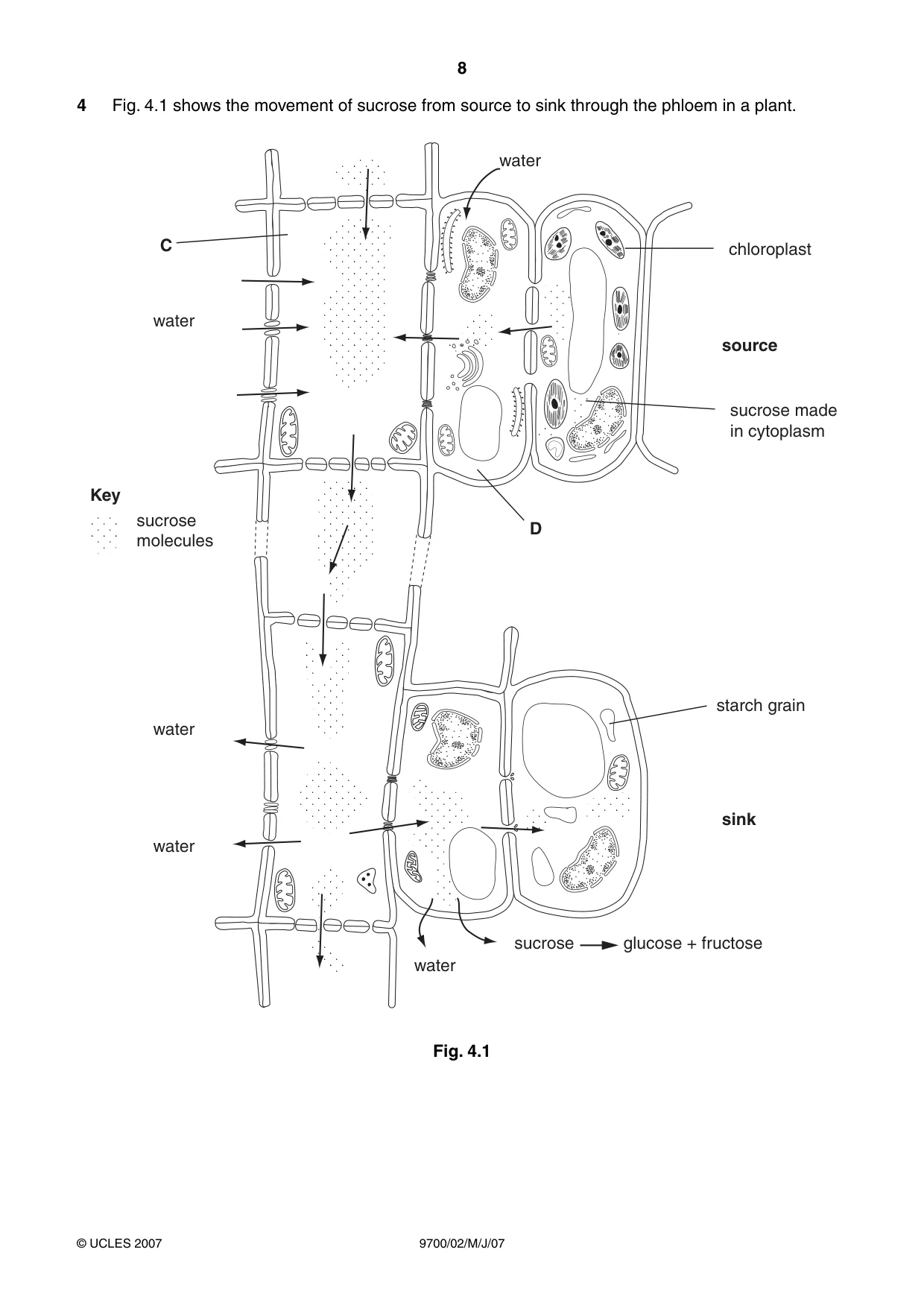
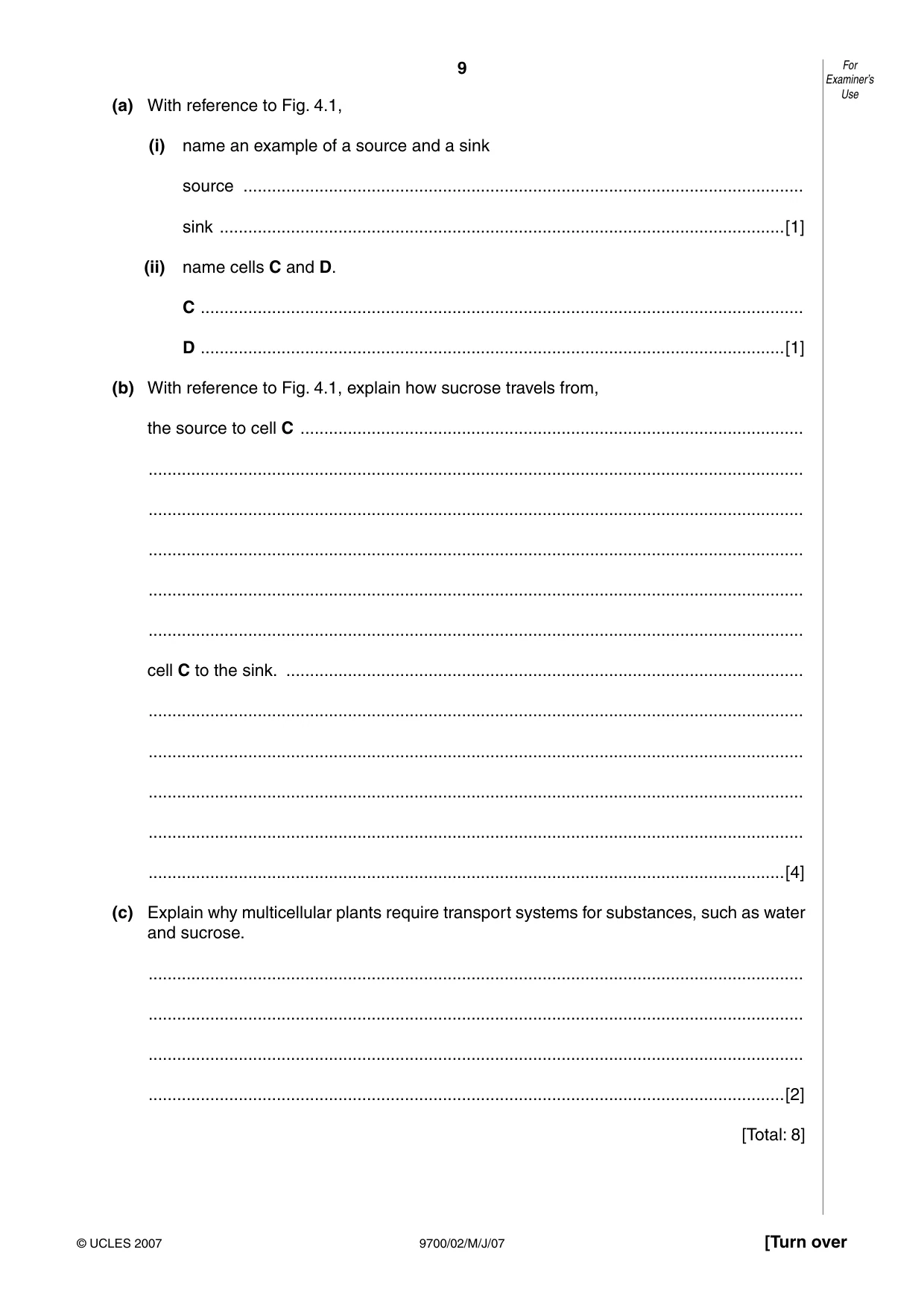
8 9700/02/M/J/07 © UCLES 2007 4 Fig. 4.1 shows the movement of sucrose from source to sink through the phloem in a plant. water water water water Key C source sink sucrose molecules chloroplast sucrose made in cytoplasm starch grain sucrose glucose + fructose water D Fig. 4.1
Question paper, page 9
9 9700/02/M/J/07 [Turn over For Examiner’s Use © UCLES 2007 (a) With reference to Fig. 4.1, (i) name an example of a source and a sink source … sink …[1] (ii) name cells C and D. C … D …[1] (b) With reference to Fig. 4.1, explain how sucrose travels from, the source to cell C … … … … … … cell C to the sink. … … … … … …[4] (c) Explain why multicellular plants require transport systems for substances, such as water and sucrose. … … … …[2] [Total: 8]
Question paper, page 10
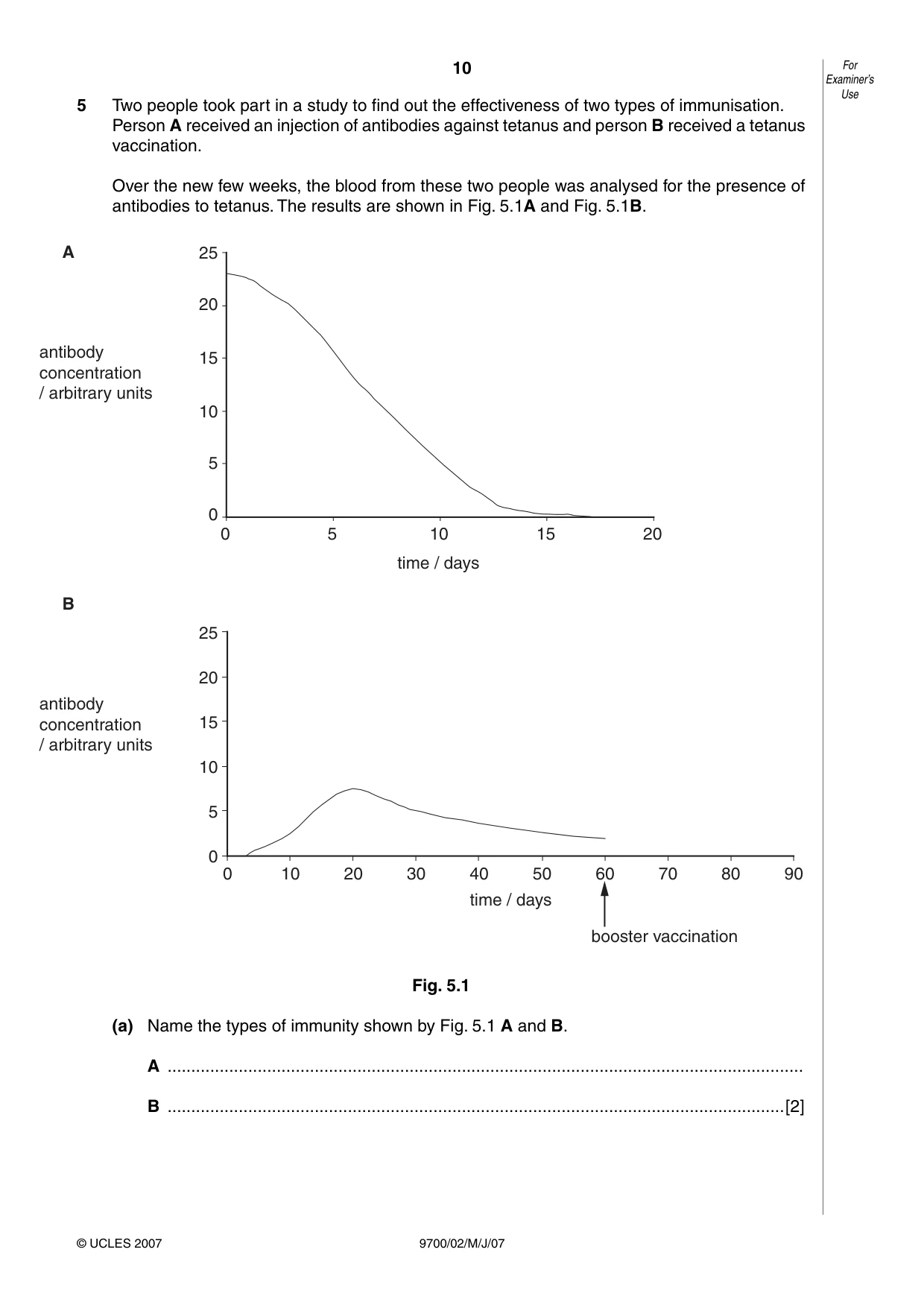
10 9700/02/M/J/07 For Examiner’s Use © UCLES 2007 5 Two people took part in a study to find out the effectiveness of two types of immunisation. Person A received an injection of antibodies against tetanus and person B received a tetanus vaccination. Over the new few weeks, the blood from these two people was analysed for the presence of antibodies to tetanus. The results are shown in Fig. 5.1A and Fig. 5.1B. antibody concentration / arbitrary units time / days B antibody concentration / arbitrary units 25 20 15 10 5 0 0 5 10 15 20 25 0 5 10 15 20 time / days A 0 10 20 30 40 50 60 70 80 90 booster vaccination Fig. 5.1 (a) Name the types of immunity shown by Fig. 5.1 A and B. A … B …[2]
Question paper, page 11
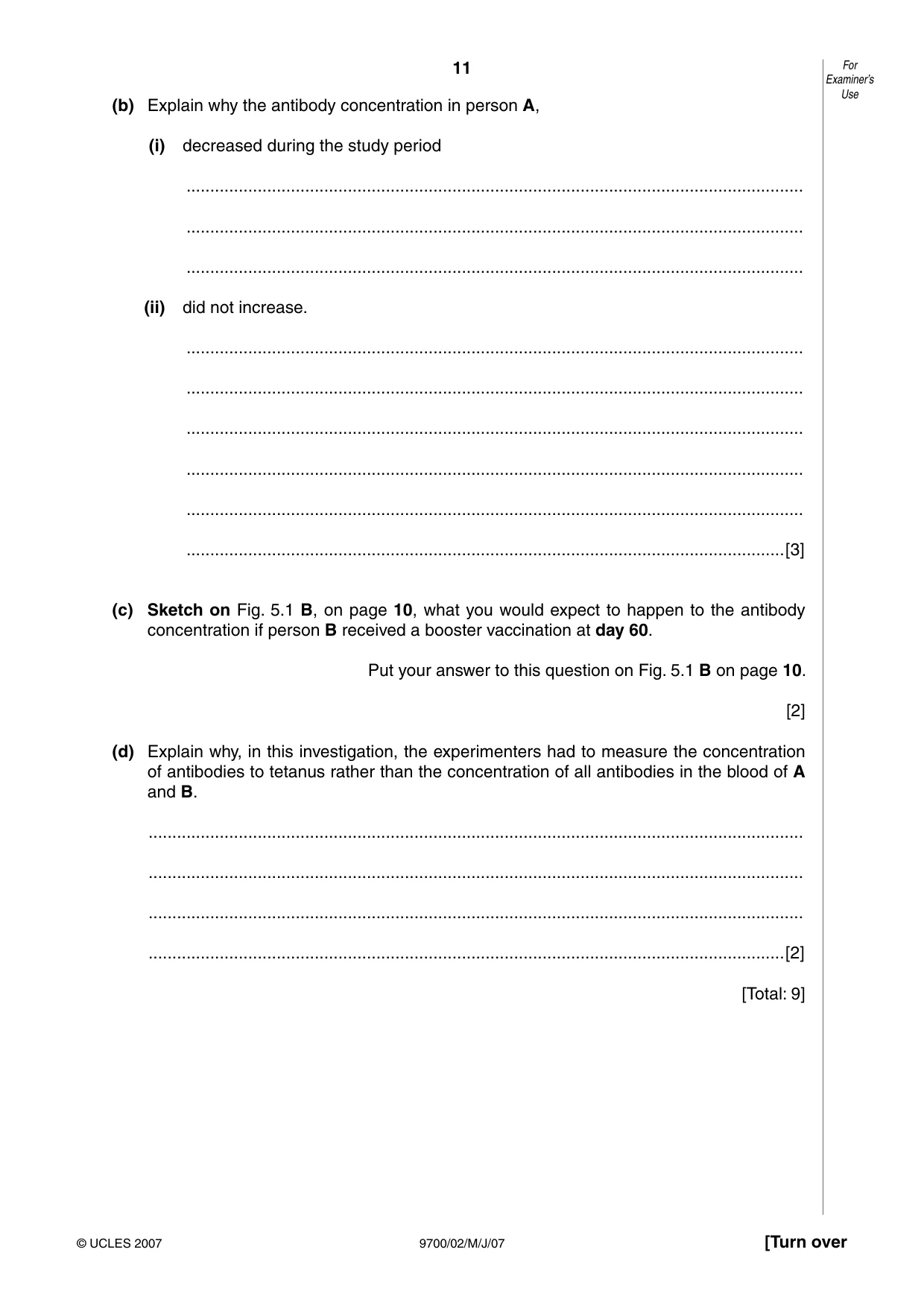
11 9700/02/M/J/07 [Turn over For Examiner’s Use © UCLES 2007 (b) Explain why the antibody concentration in person A, (i) decreased during the study period … … … (ii) did not increase. … … … … … …[3] (c) Sketch on Fig. 5.1 B, on page 10, what you would expect to happen to the antibody concentration if person B received a booster vaccination at day 60. Put your answer to this question on Fig. 5.1 B on page 10. [2] (d) Explain why, in this investigation, the experimenters had to measure the concentration of antibodies to tetanus rather than the concentration of all antibodies in the blood of A and B. … … … …[2] [Total: 9]
Question paper, page 12
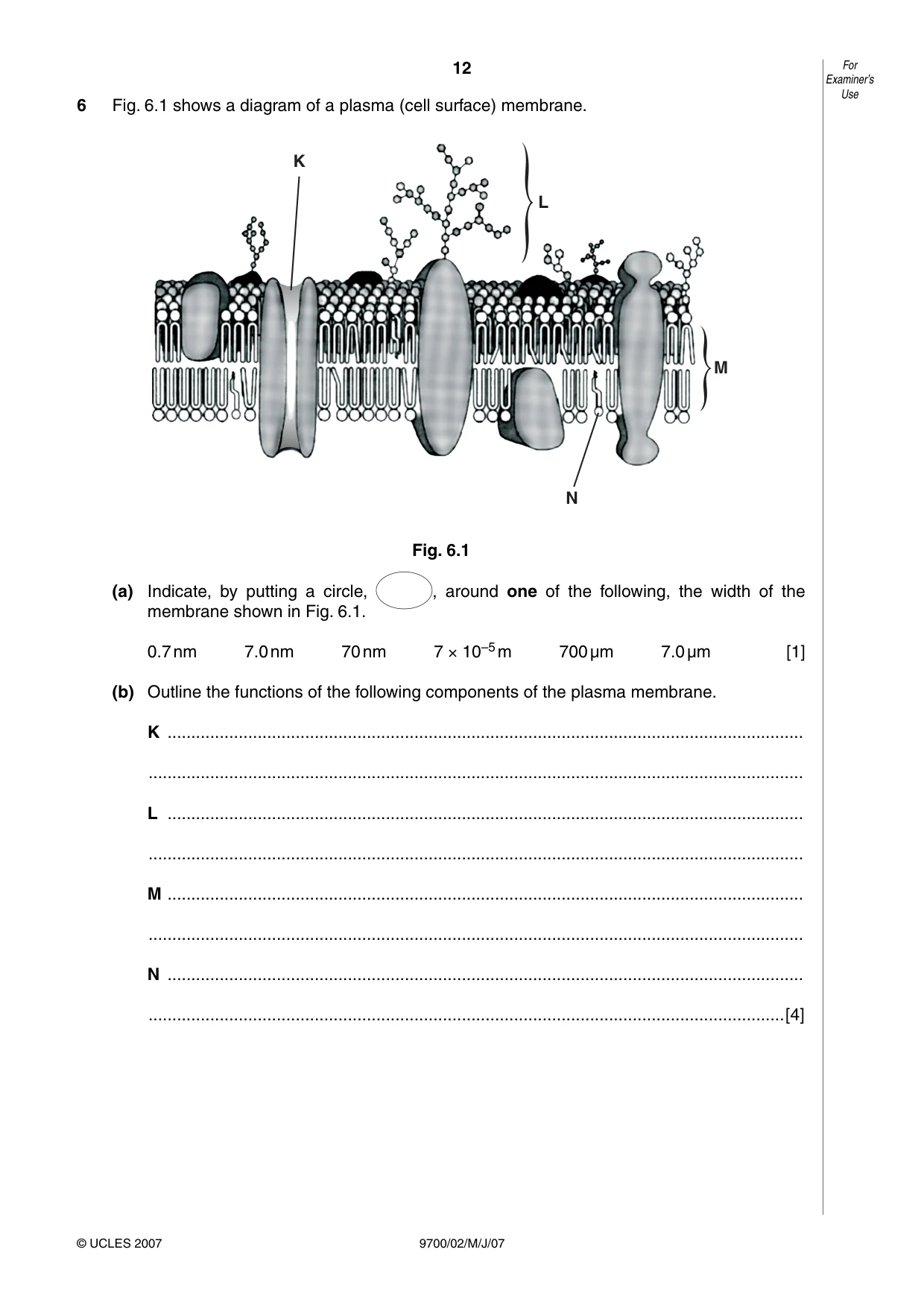
12 9700/02/M/J/07 For Examiner’s Use © UCLES 2007 6 Fig. 6.1 shows a diagram of a plasma (cell surface) membrane. K L N M Fig. 6.1 (a) Indicate, by putting a circle, , around one of the following, the width of the membrane shown in Fig. 6.1. 0.7 nm 7.0 nm 70 nm 7 × 10⁻⁵ m 700 µm 7.0 µm [1] (b) Outline the functions of the following components of the plasma membrane. K … … L … … M … … N … …[4]
Question paper, page 13
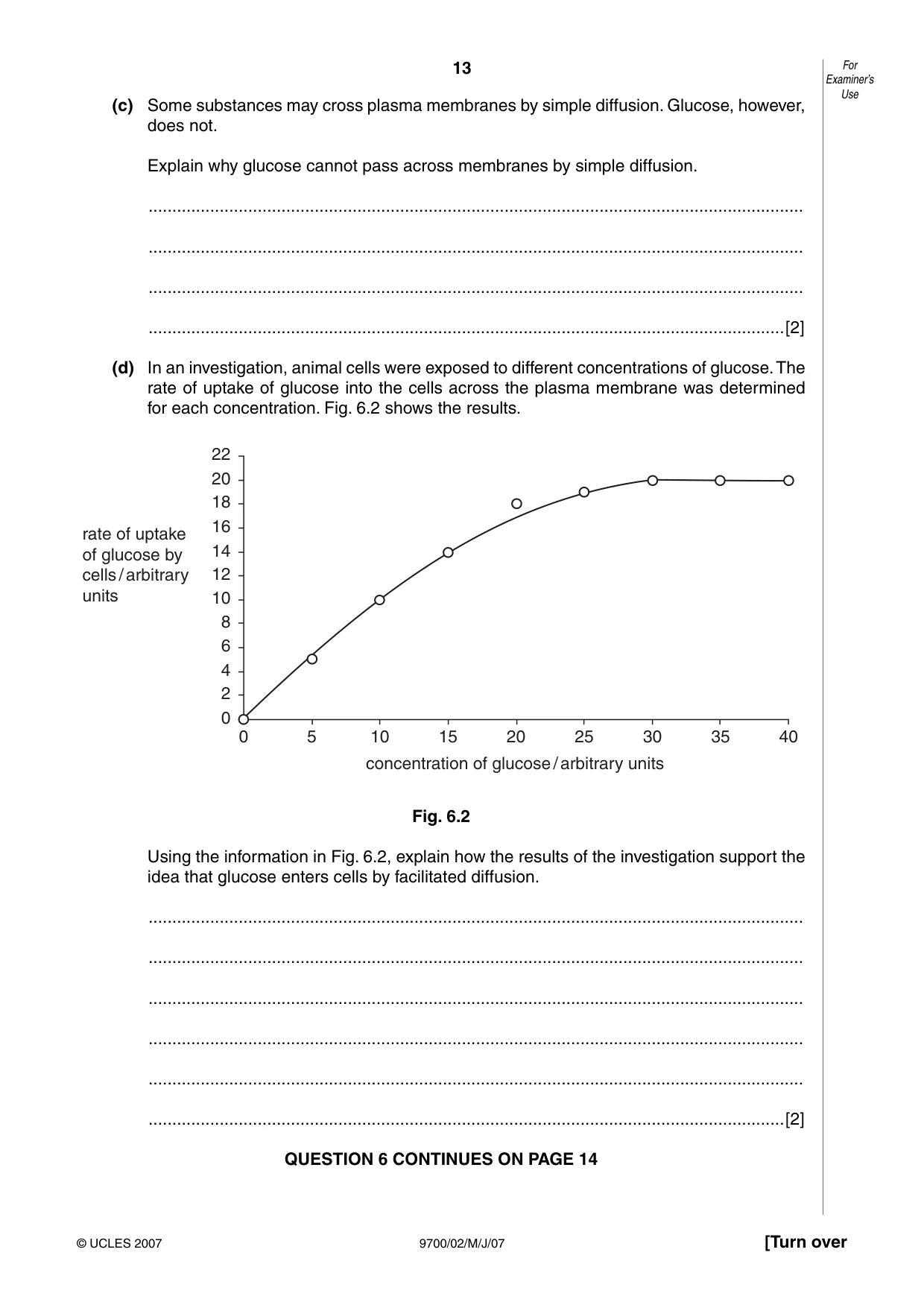
13 9700/02/M/J/07 [Turn over For Examiner’s Use © UCLES 2007 (c) Some substances may cross plasma membranes by simple diffusion. Glucose, however, does not. Explain why glucose cannot pass across membranes by simple diffusion. … … … …[2] (d) In an investigation, animal cells were exposed to different concentrations of glucose. The rate of uptake of glucose into the cells across the plasma membrane was determined for each concentration. Fig. 6.2 shows the results. 0 2 4 6 8 10 12 14 16 18 20 22 0 5 10 15 20 25 30 35 40 concentration of glucose / arbitrary units rate of uptake of glucose by cells / arbitrary units Fig. 6.2 Using the information in Fig. 6.2, explain how the results of the investigation support the idea that glucose enters cells by facilitated diffusion. … … … … … …[2] QUESTION 6 CONTINUES ON PAGE 14
Question paper, page 14
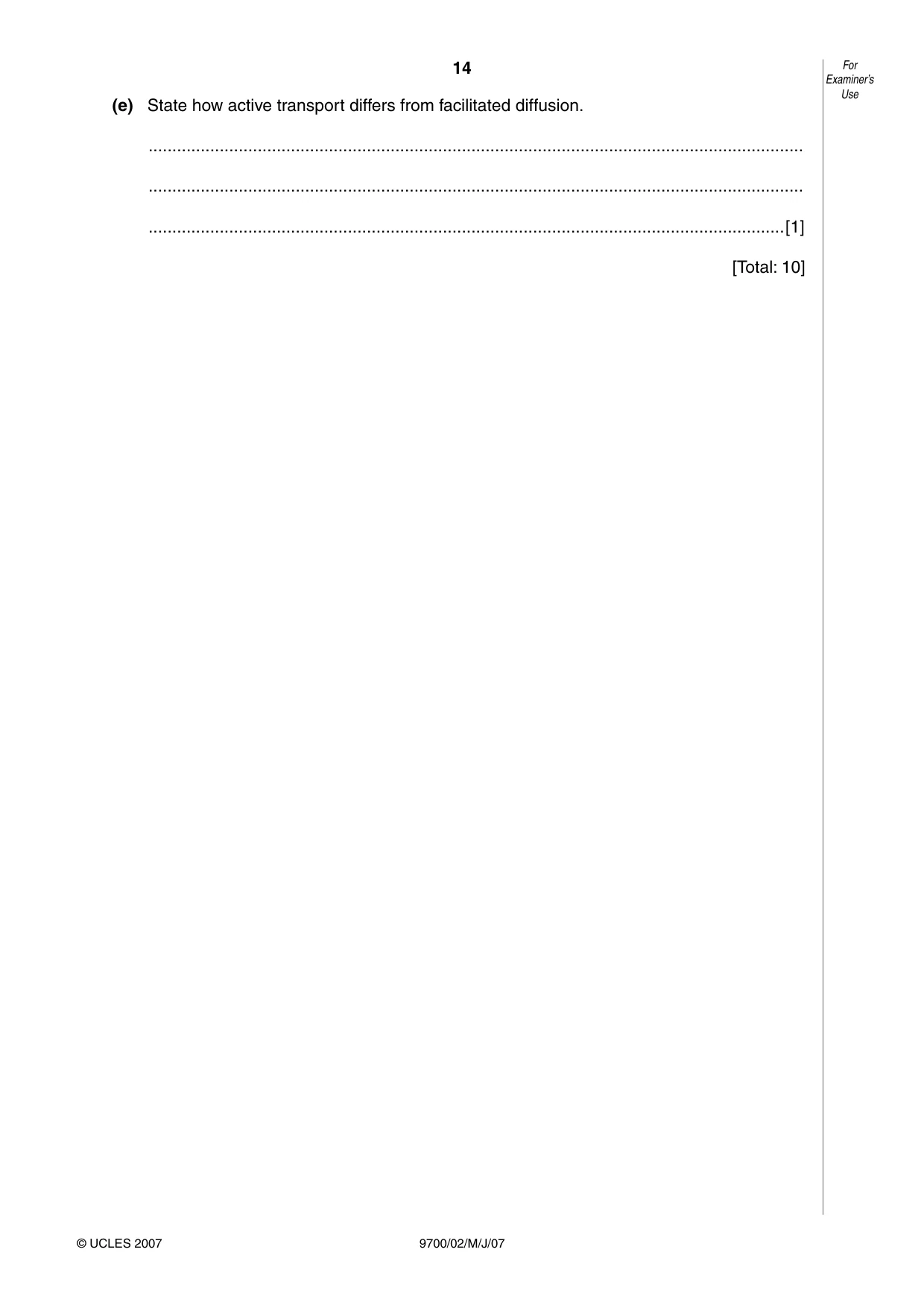
14 9700/02/M/J/07 For Examiner’s Use © UCLES 2007 (e) State how active transport differs from facilitated diffusion. … … …[1] [Total: 10]
Question paper, page 16
16 9700/02/M/J/07 BLANK PAGE Copyright Acknowledgements: Question 1 Fig. 1.1 © http://n2.bioeng5.bioeng.auckland.ac.nz/ontology/anatomy/ontology_instance_view?instance_uri=http%3A//physiome.bioeng.auckland. ac.nz/anatomy/all%23cellsonly%2000167 Permission to reproduce items where third-party owned material protected by copyright is included has been sought and cleared where possible. Every reasonable effort has been made by the publisher (UCLES) to trace copyright holders, but if any items requiring clearance have unwittingly been included, the publisher will be pleased to make amends at the earliest possible opportunity. University of Cambridge International Examinations is part of the Cambridge Assessment Group. Cambridge Assessment is the brand name of University of Cambridge Local Examinations Syndicate (UCLES), which is itself a department of the University of Cambridge.
Mark scheme, page 1
UNIVERSITY OF CAMBRIDGE INTERNATIONAL EXAMINATIONS GCE Advanced Subsidiary Level and GCE Advanced Level MARK SCHEME for the May/June 2007 question paper 9700 BIOLOGY 9700/02 Paper 2 (AS Structured Questions), maximum raw mark 60 This mark scheme is published as an aid to teachers and candidates, to indicate the requirements of the examination. It shows the basis on which Examiners were instructed to award marks. It does not indicate the details of the discussions that took place at an Examiners’ meeting before marking began. All Examiners are instructed that alternative correct answers and unexpected approaches in candidates’ scripts must be given marks that fairly reflect the relevant knowledge and skills demonstrated. Mark schemes must be read in conjunction with the question papers and the report on the examination. • CIE will not enter into discussions or correspondence in connection with these mark schemes. CIE is publishing the mark schemes for the May/June 2007 question papers for most IGCSE, GCE Advanced Level and Advanced Subsidiary Level syllabuses and some Ordinary Level syllabuses.
Mark scheme, page 2
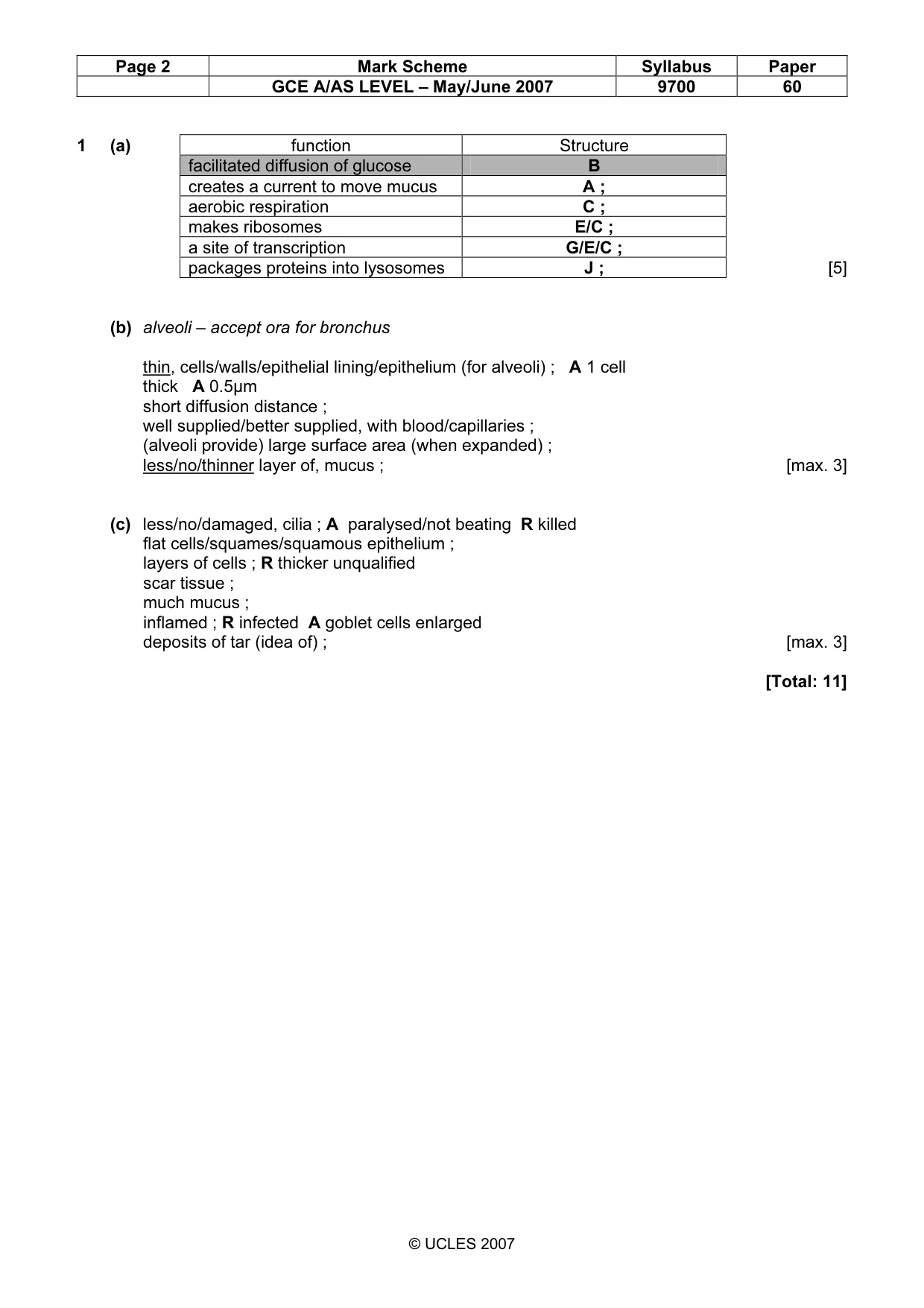
Page 2 Mark Scheme Syllabus Paper GCE A/AS LEVEL – May/June 2007 9700 60 © UCLES 2007 1 (a) function Structure facilitated diffusion of glucose B creates a current to move mucus A ; aerobic respiration C ; makes ribosomes E/C ; a site of transcription G/E/C ; packages proteins into lysosomes J ; [5] (b) alveoli – accept ora for bronchus thin, cells/walls/epithelial lining/epithelium (for alveoli) ; A 1 cell thick A 0.5µm short diffusion distance ; well supplied/better supplied, with blood/capillaries ; (alveoli provide) large surface area (when expanded) ; less/no/thinner layer of, mucus ; [max. 3] (c) less/no/damaged, cilia ; A paralysed/not beating R killed flat cells/squames/squamous epithelium ; layers of cells ; R thicker unqualified scar tissue ; much mucus ; inflamed ; R infected A goblet cells enlarged deposits of tar (idea of) ; [max. 3] [Total: 11]
Mark scheme, page 3
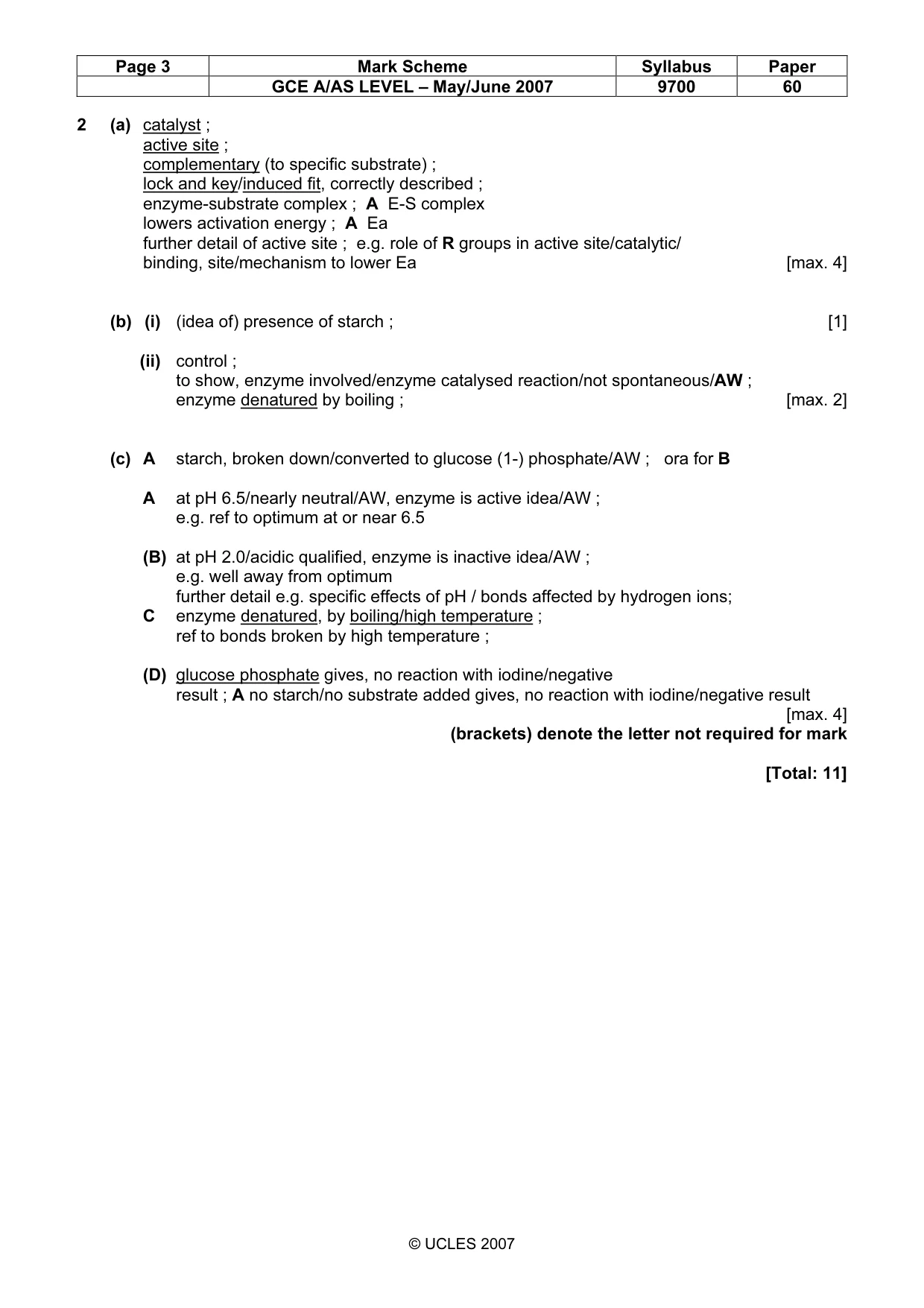
Page 3 Mark Scheme Syllabus Paper GCE A/AS LEVEL – May/June 2007 9700 60 © UCLES 2007 2 (a) catalyst ; active site ; complementary (to specific substrate) ; lock and key/induced fit, correctly described ; enzyme-substrate complex ; A E-S complex lowers activation energy ; A Ea further detail of active site ; e.g. role of R groups in active site/catalytic/ binding, site/mechanism to lower Ea [max. 4] (b) (i) (idea of) presence of starch ; [1] (ii) control ; to show, enzyme involved/enzyme catalysed reaction/not spontaneous/AW ; enzyme denatured by boiling ; [max. 2] (c) A starch, broken down/converted to glucose (1-) phosphate/AW ; ora for B A at pH 6.5/nearly neutral/AW, enzyme is active idea/AW ; e.g. ref to optimum at or near 6.5 (B) at pH 2.0/acidic qualified, enzyme is inactive idea/AW ; e.g. well away from optimum further detail e.g. specific effects of pH / bonds affected by hydrogen ions; C enzyme denatured, by boiling/high temperature ; ref to bonds broken by high temperature ; (D) glucose phosphate gives, no reaction with iodine/negative result ; A no starch/no substrate added gives, no reaction with iodine/negative result [max. 4] (brackets) denote the letter not required for mark [Total: 11]
Mark scheme, page 4
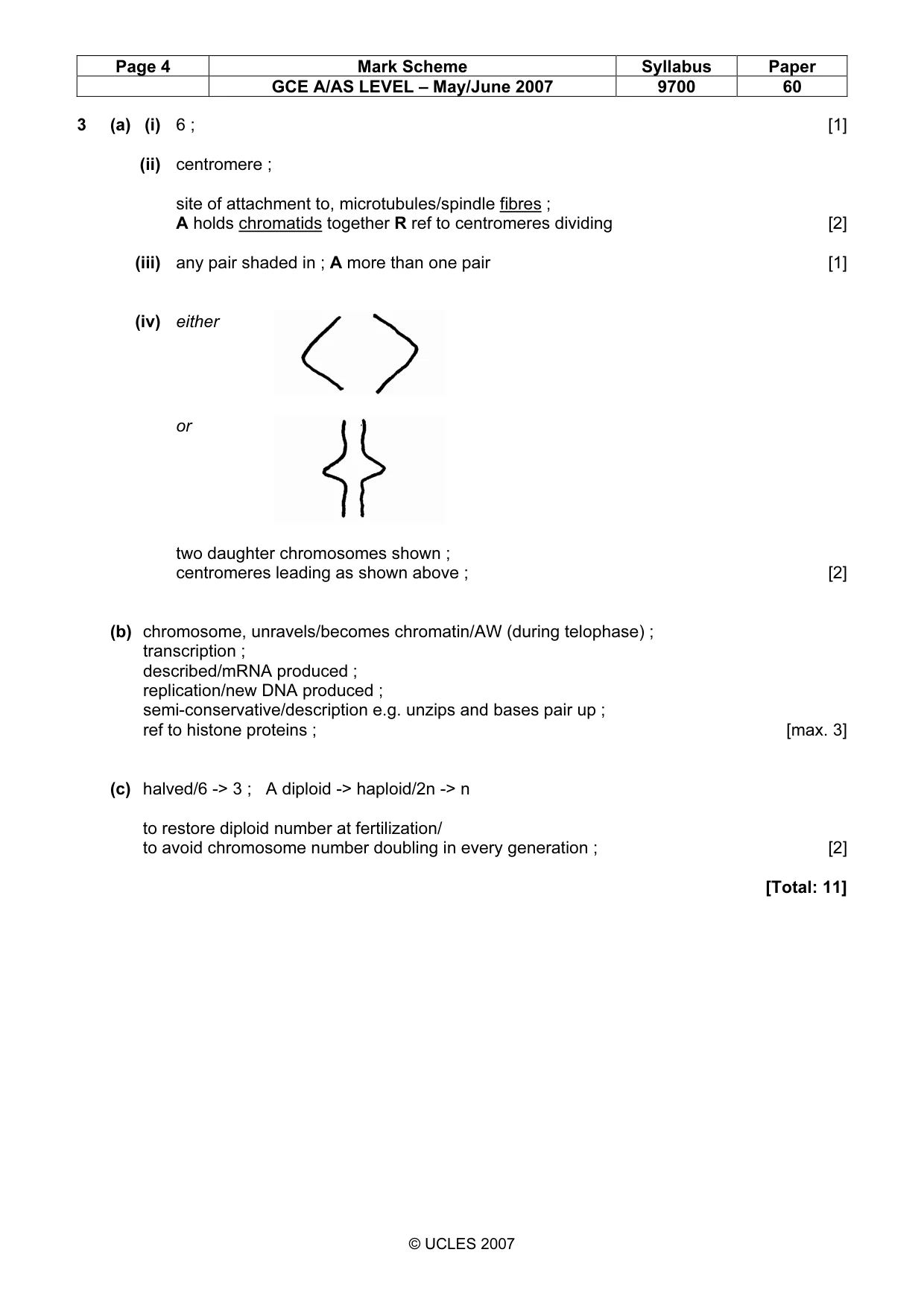
Page 4 Mark Scheme Syllabus Paper GCE A/AS LEVEL – May/June 2007 9700 60 © UCLES 2007 3 (a) (i) 6 ; [1] (ii) centromere ; site of attachment to, microtubules/spindle fibres ; A holds chromatids together R ref to centromeres dividing [2] (iii) any pair shaded in ; A more than one pair [1] (iv) either or two daughter chromosomes shown ; centromeres leading as shown above ; [2] (b) chromosome, unravels/becomes chromatin/AW (during telophase) ; transcription ; described/mRNA produced ; replication/new DNA produced ; semi-conservative/description e.g. unzips and bases pair up ; ref to histone proteins ; [max. 3] (c) halved/6 -> 3 ; A diploid -> haploid/2n -> n to restore diploid number at fertilization/ to avoid chromosome number doubling in every generation ; [2] [Total: 11]
Mark scheme, page 5
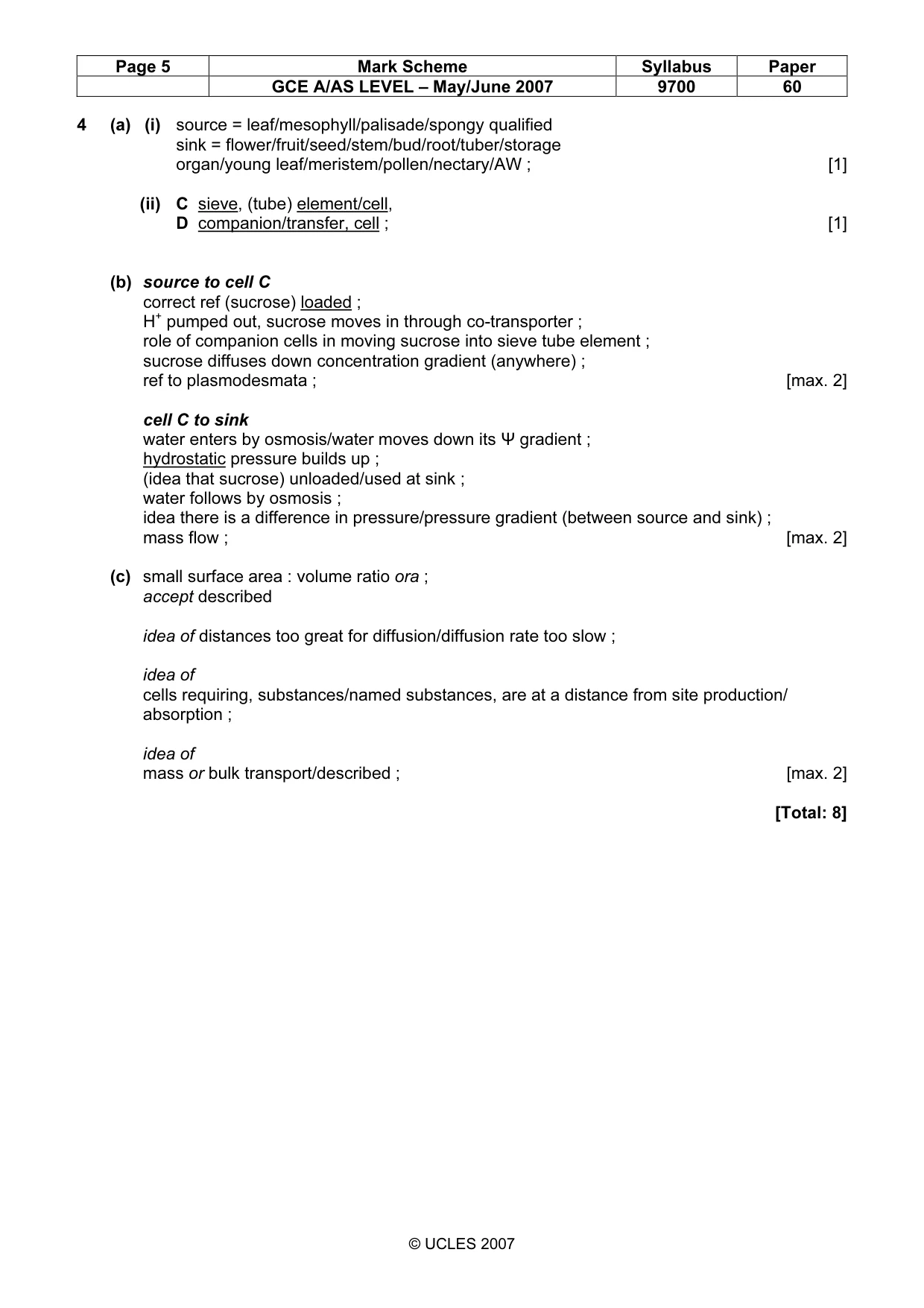
Page 5 Mark Scheme Syllabus Paper GCE A/AS LEVEL – May/June 2007 9700 60 © UCLES 2007 4 (a) (i) source = leaf/mesophyll/palisade/spongy qualified sink = flower/fruit/seed/stem/bud/root/tuber/storage organ/young leaf/meristem/pollen/nectary/AW ; [1] (ii) C sieve, (tube) element/cell, D companion/transfer, cell ; [1] (b) source to cell C correct ref (sucrose) loaded ; H+ pumped out, sucrose moves in through co-transporter ; role of companion cells in moving sucrose into sieve tube element ; sucrose diffuses down concentration gradient (anywhere) ; ref to plasmodesmata ; [max. 2] cell C to sink water enters by osmosis/water moves down its Ψ gradient ; hydrostatic pressure builds up ; (idea that sucrose) unloaded/used at sink ; water follows by osmosis ; idea there is a difference in pressure/pressure gradient (between source and sink) ; mass flow ; [max. 2] (c) small surface area : volume ratio ora ; accept described idea of distances too great for diffusion/diffusion rate too slow ; idea of cells requiring, substances/named substances, are at a distance from site production/ absorption ; idea of mass or bulk transport/described ; [max. 2] [Total: 8]
Mark scheme, page 6
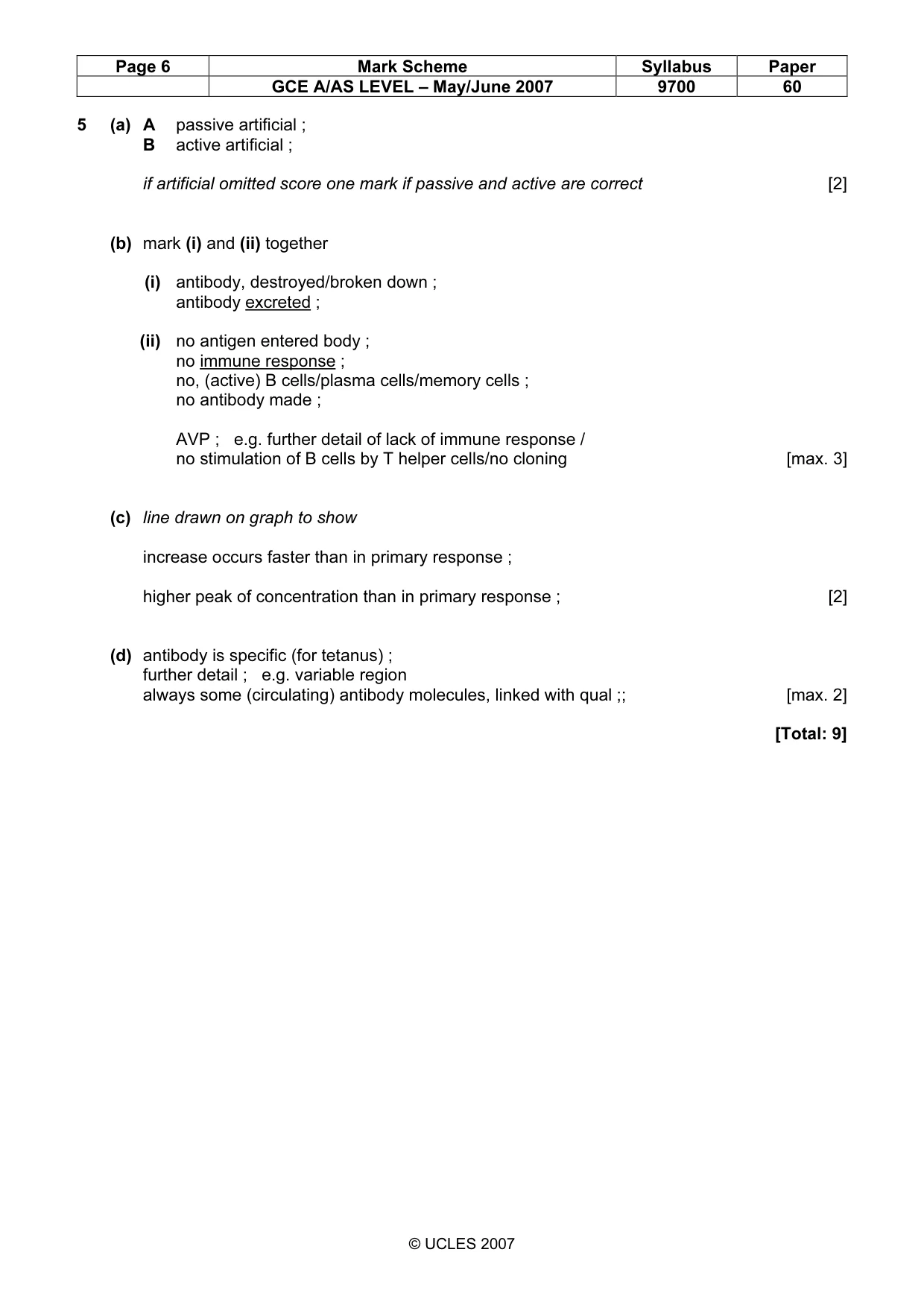
Page 6 Mark Scheme Syllabus Paper GCE A/AS LEVEL – May/June 2007 9700 60 © UCLES 2007 5 (a) A passive artificial ; B active artificial ; if artificial omitted score one mark if passive and active are correct [2] (b) mark (i) and (ii) together (i) antibody, destroyed/broken down ; antibody excreted ; (ii) no antigen entered body ; no immune response ; no, (active) B cells/plasma cells/memory cells ; no antibody made ; AVP ; e.g. further detail of lack of immune response / no stimulation of B cells by T helper cells/no cloning [max. 3] (c) line drawn on graph to show increase occurs faster than in primary response ; higher peak of concentration than in primary response ; [2] (d) antibody is specific (for tetanus) ; further detail ; e.g. variable region always some (circulating) antibody molecules, linked with qual ;; [max. 2] [Total: 9]
Mark scheme, page 7
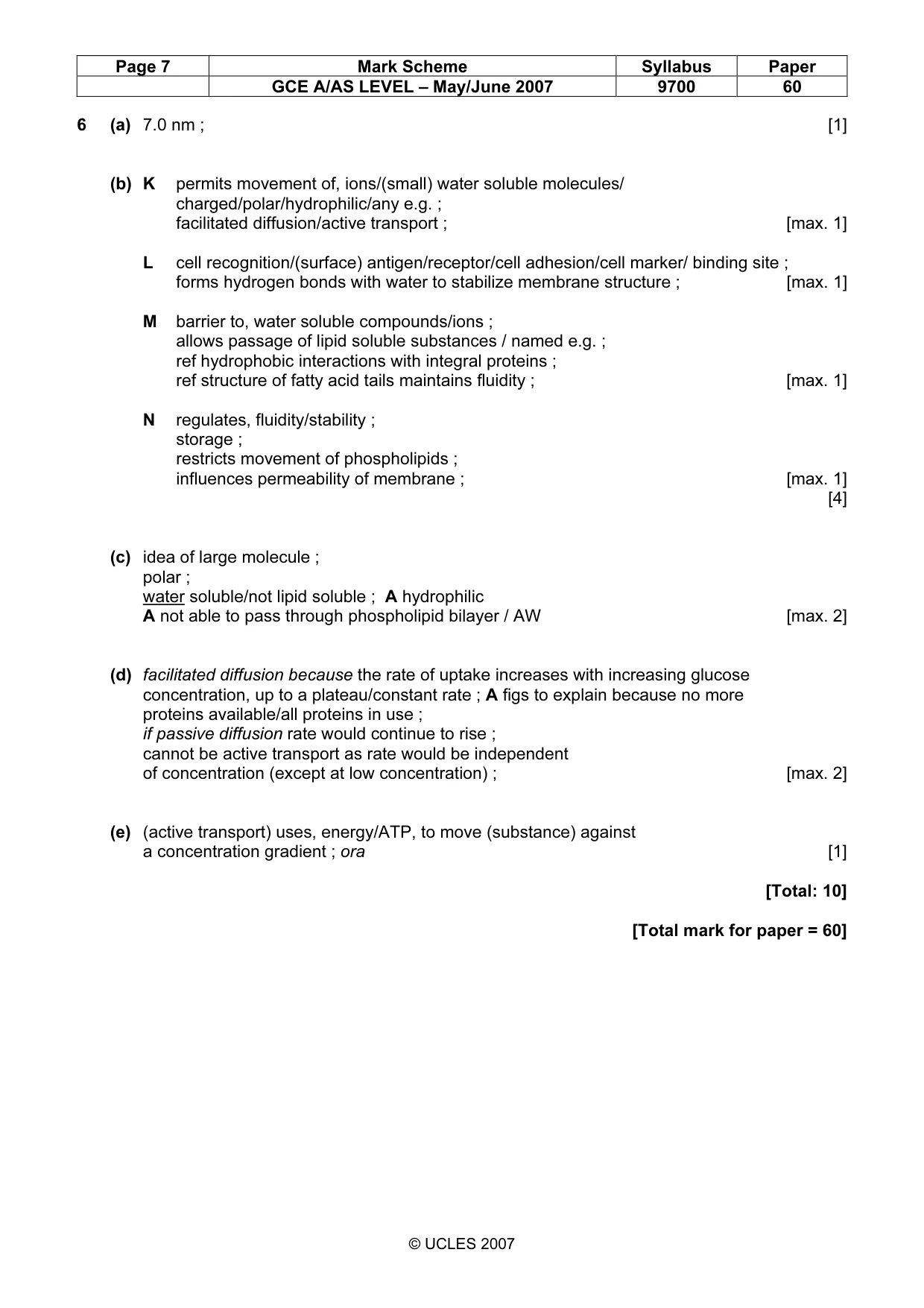
Page 7 Mark Scheme Syllabus Paper GCE A/AS LEVEL – May/June 2007 9700 60 © UCLES 2007 6 (a) 7.0 nm ; [1] (b) K permits movement of, ions/(small) water soluble molecules/ charged/polar/hydrophilic/any e.g. ; facilitated diffusion/active transport ; [max. 1] L cell recognition/(surface) antigen/receptor/cell adhesion/cell marker/ binding site ; forms hydrogen bonds with water to stabilize membrane structure ; [max. 1] M barrier to, water soluble compounds/ions ; allows passage of lipid soluble substances / named e.g. ; ref hydrophobic interactions with integral proteins ; ref structure of fatty acid tails maintains fluidity ; [max. 1] N regulates, fluidity/stability ; storage ; restricts movement of phospholipids ; influences permeability of membrane ; [max. 1] [4] (c) idea of large molecule ; polar ; water soluble/not lipid soluble ; A hydrophilic A not able to pass through phospholipid bilayer / AW [max. 2] (d) facilitated diffusion because the rate of uptake increases with increasing glucose concentration, up to a plateau/constant rate ; A figs to explain because no more proteins available/all proteins in use ; if passive diffusion rate would continue to rise ; cannot be active transport as rate would be independent of concentration (except at low concentration) ; [max. 2] (e) (active transport) uses, energy/ATP, to move (substance) against a concentration gradient ; ora [1] [Total: 10] [Total mark for paper = 60]
What you needed in this session
Cambridge’s own grade thresholds for 2007 May/June, Paper 2 · Variant 1. A higher threshold means an easier paper — the bar moves with how the cohort did.