Cambridge A Level Biology 9700 — 2005 May/June Paper 4 · Variant 1
9700/41/M/J/05
The question paper and its mark scheme, free to read here and free to download. This is Cambridge’s own paper, exactly as it was sat.
Question paper12 pages




Mark scheme10 pages
Answers below. Sit the paper first if you are practising.
Paper as text
Question paper, page 1
This document consists of 8 printed pages, 3 lined pages and 1 blank page. SP (NF/SLM) S83410/2 © UCLES 2005 [Turn over UNIVERSITY OF CAMBRIDGE INTERNATIONAL EXAMINATIONS General Certificate of Education Advanced Level BIOLOGY 9700/04 Paper 4 Structured Questions A2 Core May/June 2005 1 hour 15 minutes Candidates answer on the Question Paper. Additional Materials: Answer Paper should be available on request. READ THESE INSTRUCTIONS FIRST Write your Centre number, candidate number and name in the spaces provided at the top of this page. Write in dark blue or black pen in the spaces provided on the Question Paper. You may use a soft pencil for any diagrams, graphs or rough working. Do not use staples, paper clips, highlighters, glue or correction fluid. Answer all questions in Section A and one question from Section B. Circle the number of the Section B question you have answered in the grid below. At the end of the examination, fasten all your work securely together. The number of marks is given in brackets [ ] at the end of each question or part question. Centre Number Candidate Number Name For Examiner’s Use 1 2 3 4 5 Section A 6 or 7 Total
Question paper, page 2
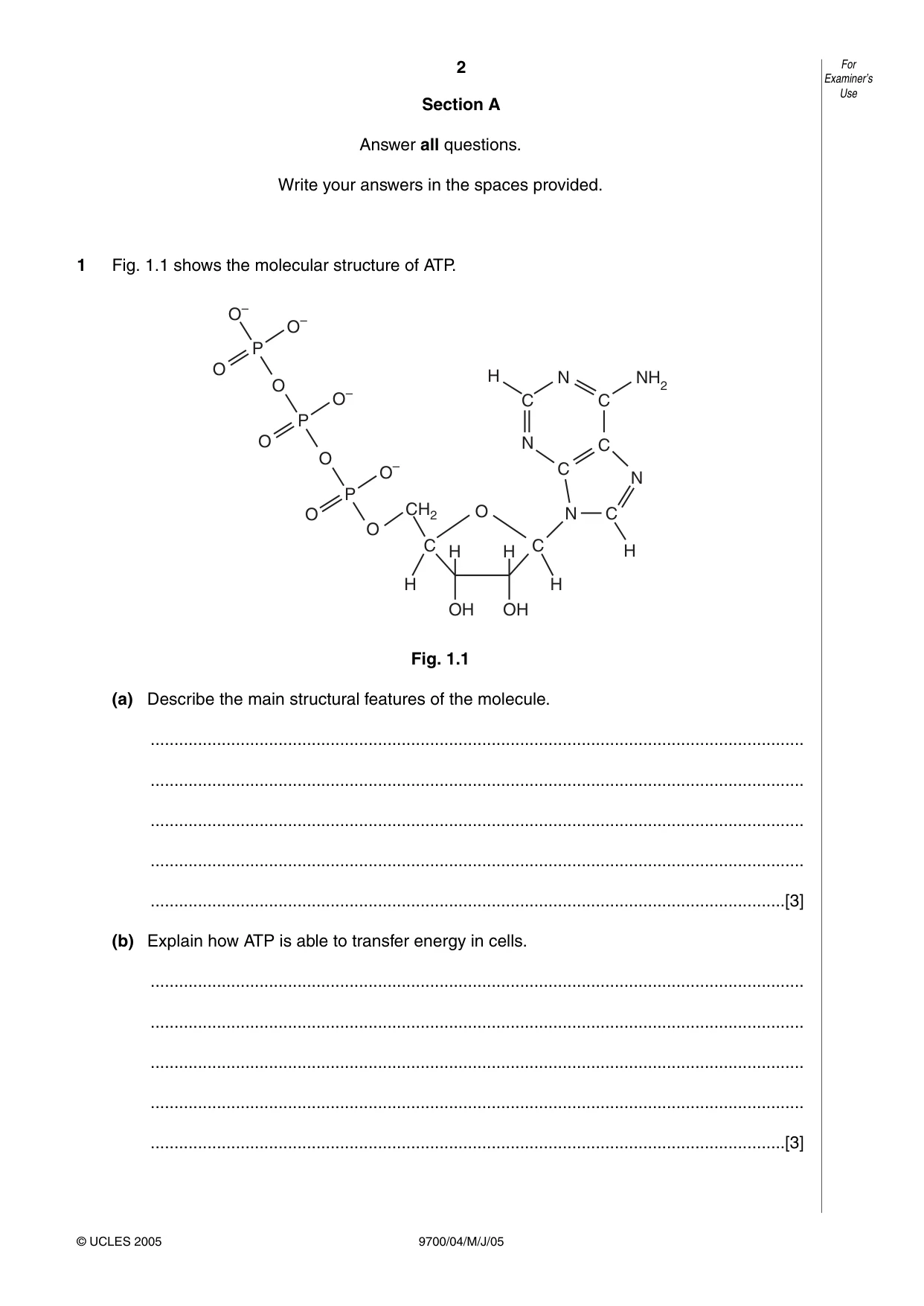
2 9700/04/M/J/05 Section A Answer all questions. Write your answers in the spaces provided. 1 Fig. 1.1 shows the molecular structure of ATP. Fig. 1.1 (a) Describe the main structural features of the molecule. … … … … …[3] (b) Explain how ATP is able to transfer energy in cells. … … … … …[3] O C CH2 H OH H OH C H H O O O– P O O O– P O O– O– P O N N C C C C N H NH2 N C H For Examiner’s Use © UCLES 2005
Question paper, page 3
3 9700/04/M/J/05 [Turn over (c) State how ATP is synthesized in mitochondria. … … … … … …[4] [Total: 10] For Examiner’s Use © UCLES 2005
Question paper, page 4
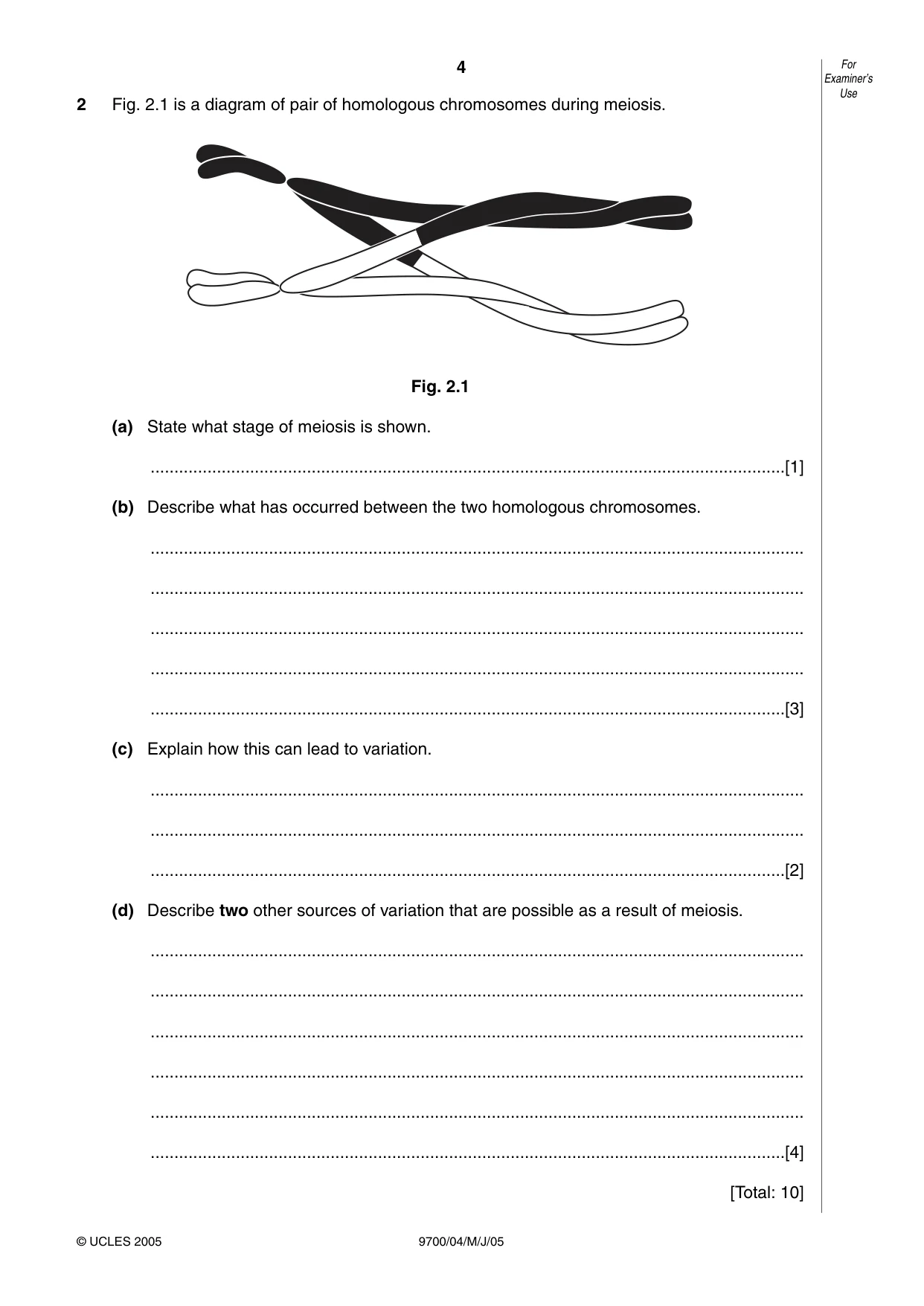
4 9700/04/M/J/05 2 Fig. 2.1 is a diagram of pair of homologous chromosomes during meiosis. Fig. 2.1 (a) State what stage of meiosis is shown. …[1] (b) Describe what has occurred between the two homologous chromosomes. … … … … …[3] (c) Explain how this can lead to variation. … … …[2] (d) Describe two other sources of variation that are possible as a result of meiosis. … … … … … …[4] [Total: 10] For Examiner’s Use © UCLES 2005
Question paper, page 5
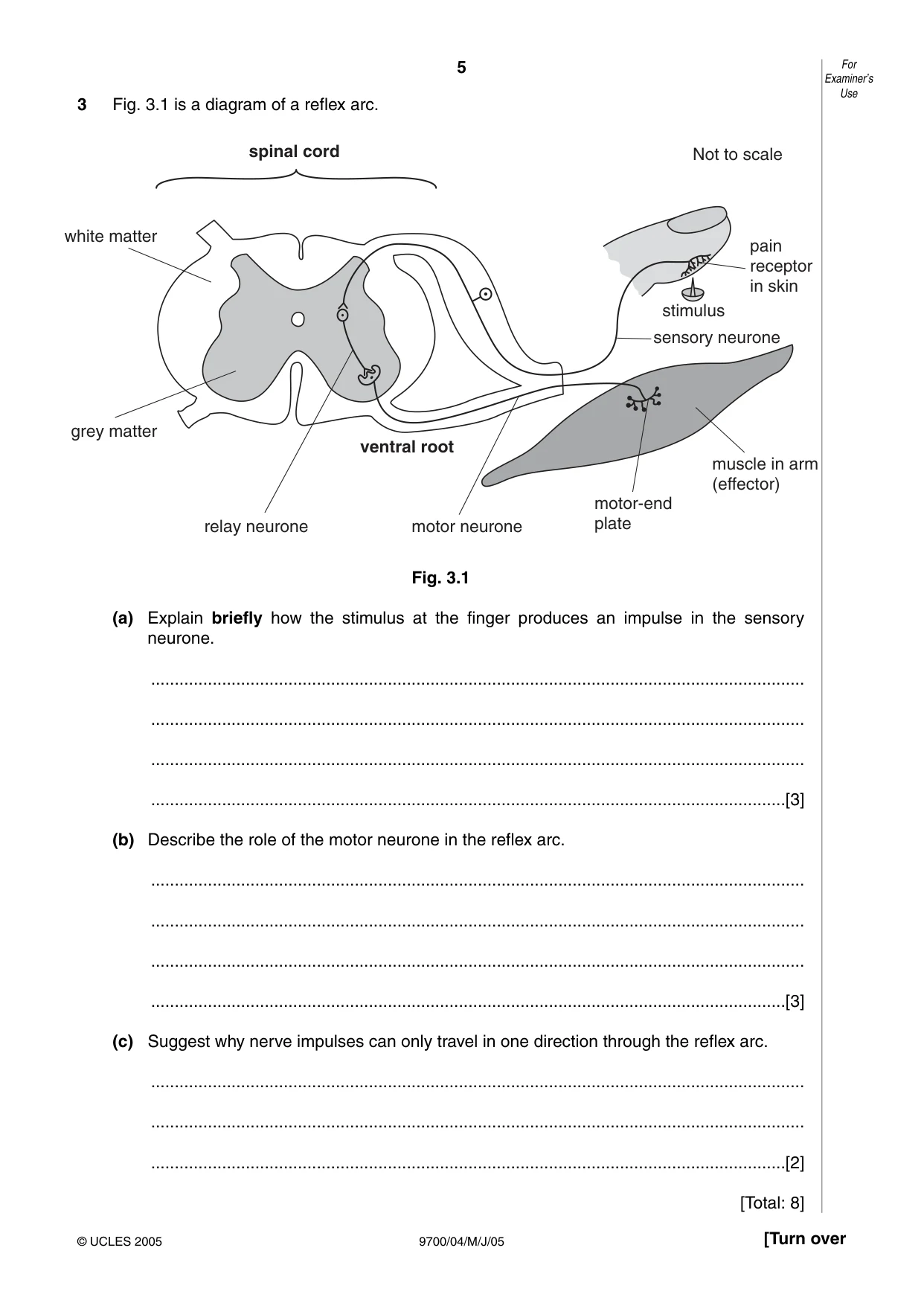
5 9700/04/M/J/05 [Turn over 3 Fig. 3.1 is a diagram of a reflex arc. Fig. 3.1 (a) Explain briefly how the stimulus at the finger produces an impulse in the sensory neurone. … … … …[3] (b) Describe the role of the motor neurone in the reflex arc. … … … …[3] (c) Suggest why nerve impulses can only travel in one direction through the reflex arc. … … …[2] [Total: 8] For Examiner’s Use © UCLES 2005 Not to scale spinal cord white matter relay neurone motor neurone grey matter ventral root motor-end plate muscle in arm (effector) pain receptor in skin sensory neurone stimulus
Question paper, page 6
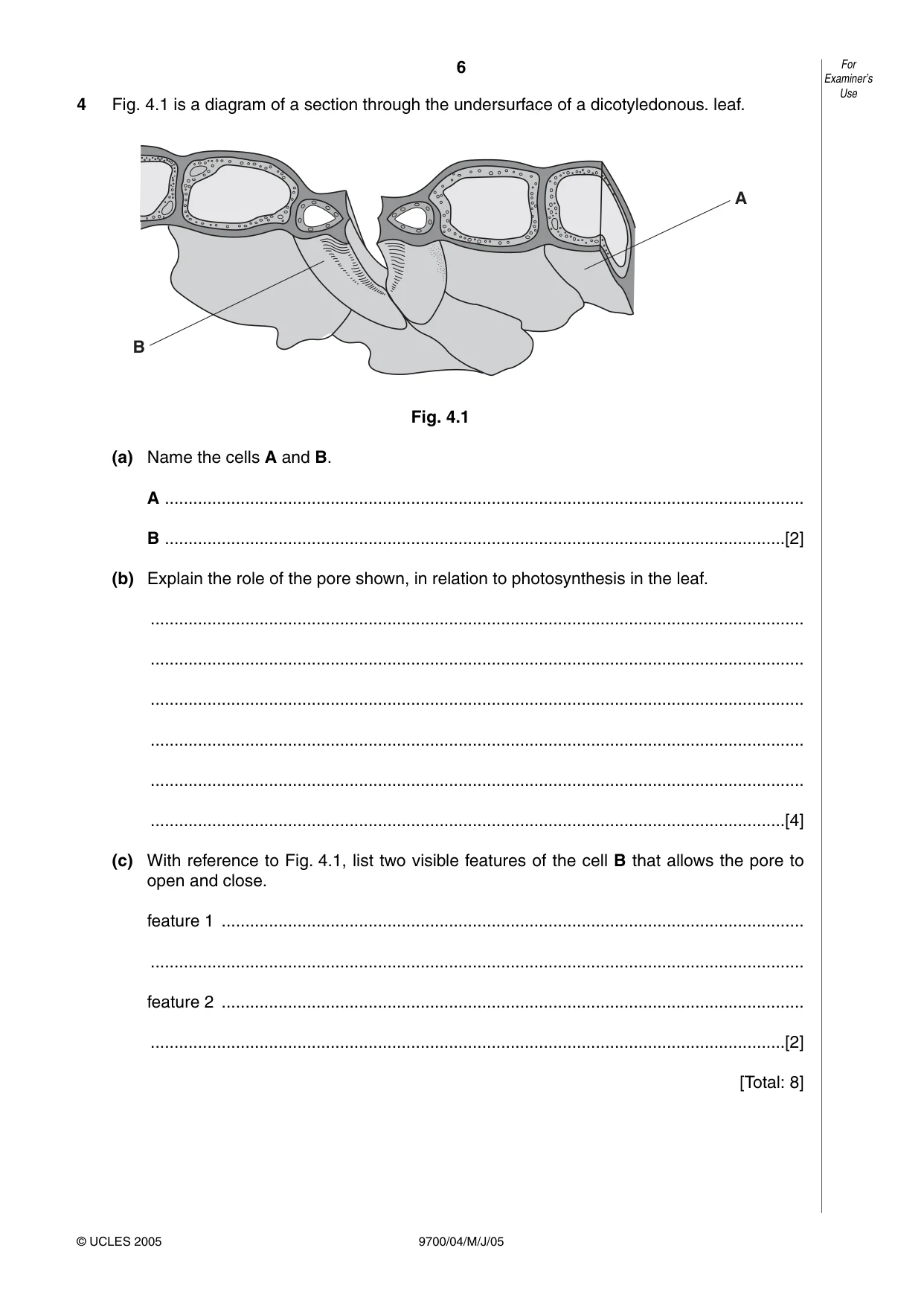
6 9700/04/M/J/05 4 Fig. 4.1 is a diagram of a section through the undersurface of a dicotyledonous. leaf. Fig. 4.1 (a) Name the cells A and B. A … B …[2] (b) Explain the role of the pore shown, in relation to photosynthesis in the leaf. … … … … … …[4] (c) With reference to Fig. 4.1, list two visible features of the cell B that allows the pore to open and close. feature 1 … … feature 2 … …[2] [Total: 8] A B For Examiner’s Use © UCLES 2005
Question paper, page 7
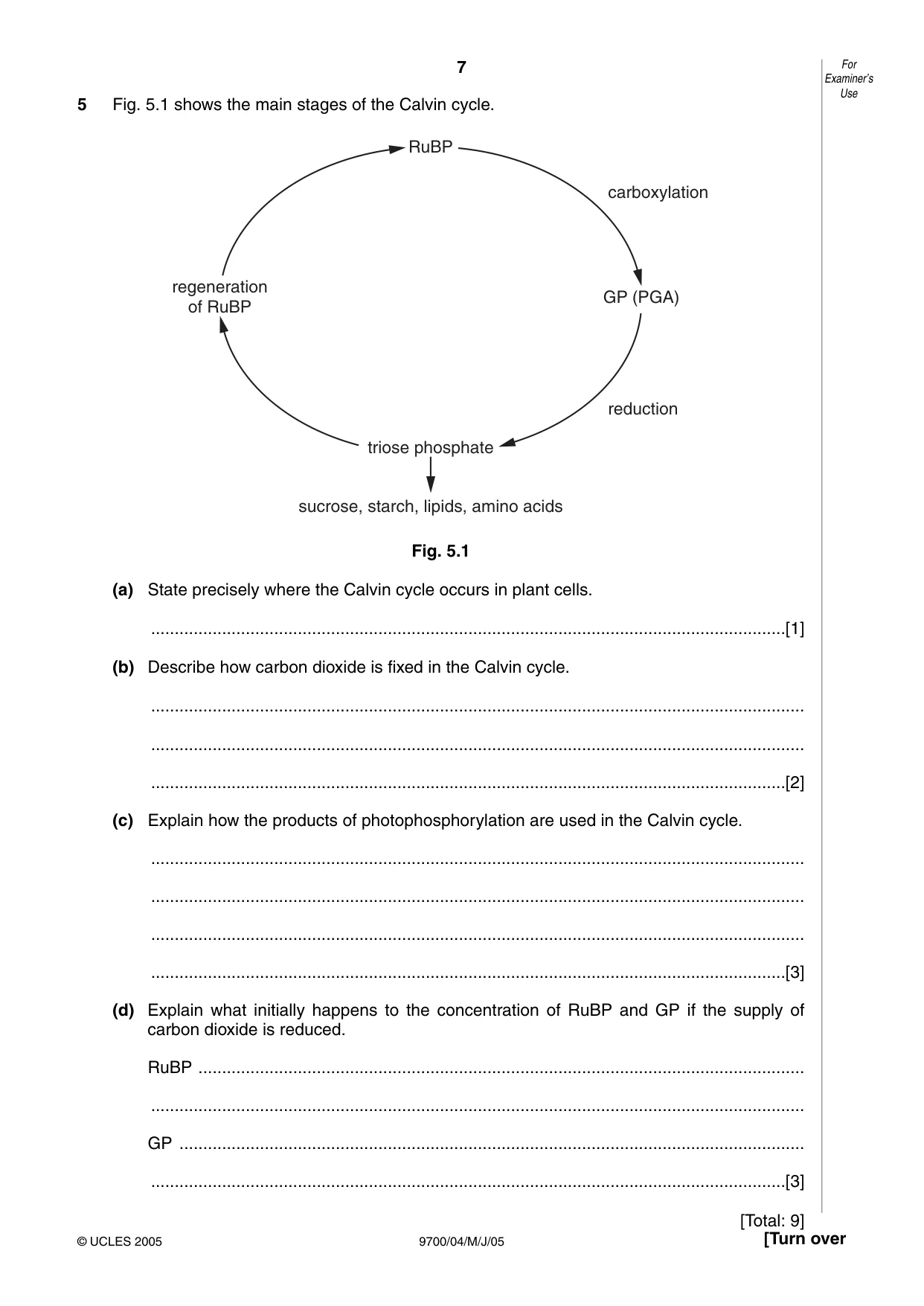
7 9700/04/M/J/05 [Turn over 5 Fig. 5.1 shows the main stages of the Calvin cycle. Fig. 5.1 (a) State precisely where the Calvin cycle occurs in plant cells. …[1] (b) Describe how carbon dioxide is fixed in the Calvin cycle. … … …[2] (c) Explain how the products of photophosphorylation are used in the Calvin cycle. … … … …[3] (d) Explain what initially happens to the concentration of RuBP and GP if the supply of carbon dioxide is reduced. RuBP … … GP … …[3] [Total: 9] RuBP triose phosphate sucrose, starch, lipids, amino acids regeneration of RuBP GP (PGA) reduction carboxylation For Examiner’s Use © UCLES 2005
Question paper, page 8
8 9700/04/M/J/05 Section B Answer only one question from this section. In this section, answers should be illustrated by large, clearly labelled diagrams wherever possible. Your answer to Section B must be in continuous prose, where appropriate. Your answer must be set out in sections (a) and (b), as indicated in the question. 6 (a) Describe the role of auxins in apical dominance. [6] (b) Explain the role of gibberellins in the germination of wheat or barley. [9] [Total: 15] 7 (a) Describe why variation is important in natural selection. [6] (b) Explain the role of isolating mechanisms in the evolution of new species. [9] [Total: 15] … … … … … … … … … … … … … … … For Examiner’s Use © UCLES 2005 © UCLES 2005
Question paper, page 9
9 9700/04/M/J/05 [Turn over … … … … … … … … … … … … … … … … … … … … … … … … … … … … For Examiner’s Use
Question paper, page 10
10 9700/04/M/J/05 … … … … … … … … … … … … … … … … … … … … … … … … … … … … For Examiner’s Use
Question paper, page 11
11 9700/04/M/J/05 … … … … … … … … … … … … … … … … … … … … … … … … … … … … For Examiner’s Use
Question paper, page 12
12 9700/04/M/J/05 BLANK PAGE Permission to reproduce items where third-party owned material protected by copyright is included has been sought and cleared where possible. Every reasonable effort has been made by the publisher (UCLES) to trace copyright holders, but if any items requiring clearance have unwittingly been included, the publisher will be pleased to make amends at the earliest possible opportunity. University of Cambridge International Examinations is part of the University of Cambridge Local Examinations Syndicate (UCLES), which is itself a department of the University of Cambridge.
Mark scheme, page 1
UNIVERSITY OF CAMBRIDGE INTERNATIONAL EXAMINATIONS GCE Advanced Level MARK SCHEME for the June2005 question paper 9700 BIOLOGY 9700/04 Paper 4 (Structured Question A2 Core), maximum raw mark 60 This mark scheme is published as an aid to teachers and students, to indicate the requirements of the examination. This shows the basis on which Examiners were initially instructed to award marks. It does not indicate the details of the discussions that took place at an Examiners’ meeting before marking began. Any substantial changes to the mark scheme that arose from these discussions will be recorded in the published Report on the Examination. All Examiners are instructed that alternative correct answers and unexpected approaches in candidates’ scripts must be given marks that fairly reflect the relevant knowledge and skills demonstrated. Mark schemes must be read in conjunction with the question papers and the Report on the Examination. • CIE will not enter into discussion or correspondence in connection with these mark schemes. CIE is publishing the mark schemes for the June 2005 question papers for most IGCSE and GCE Advanced Level and Advanced Subsidiary Level syllabuses and some Ordinary Level syllabuses’.
Mark scheme, page 2
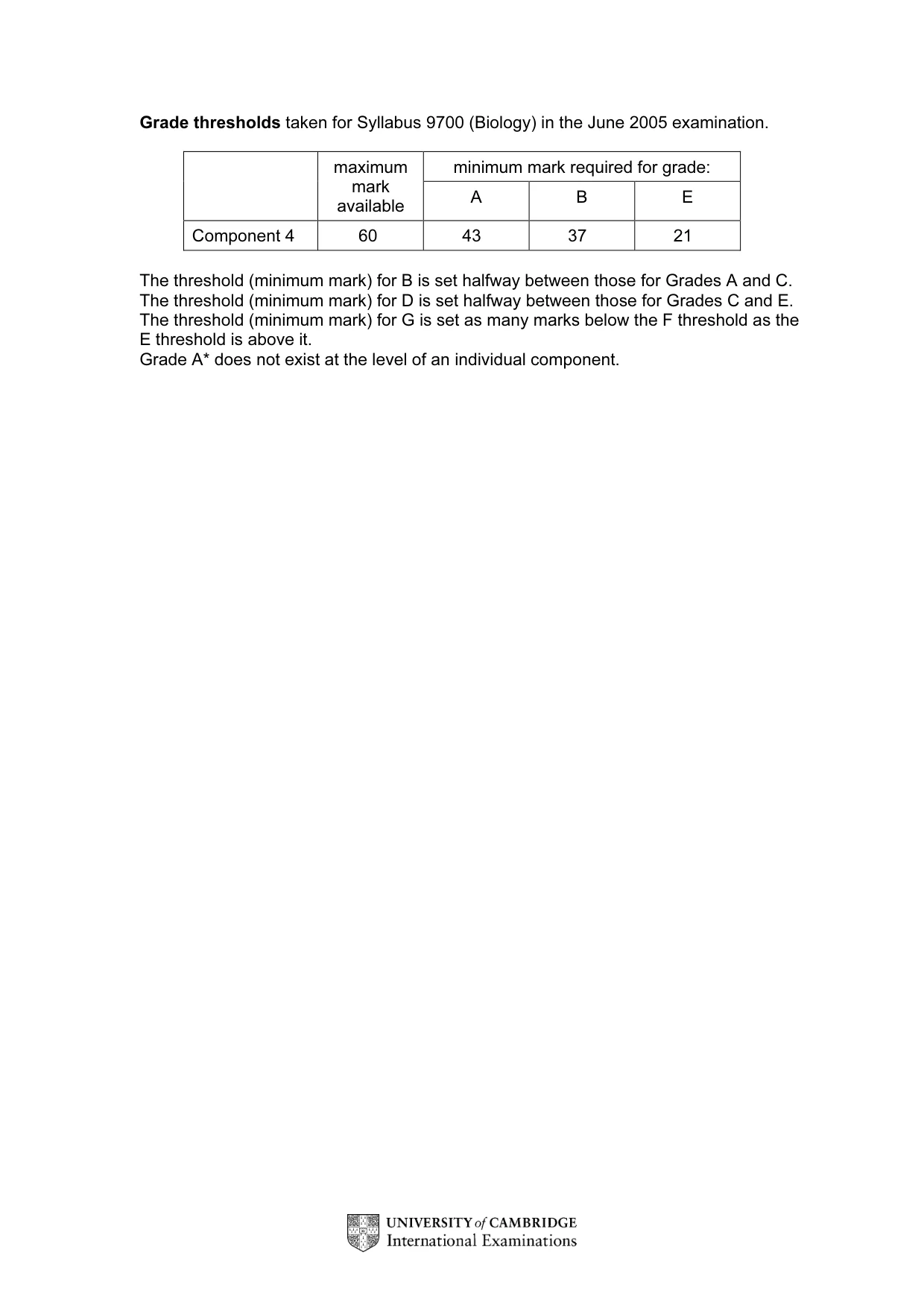
Grade thresholds taken for Syllabus 9700 (Biology) in the June 2005 examination. minimum mark required for grade: maximum mark available A B E Component 4 60 43 37 21 The threshold (minimum mark) for B is set halfway between those for Grades A and C. The threshold (minimum mark) for D is set halfway between those for Grades C and E. The threshold (minimum mark) for G is set as many marks below the F threshold as the E threshold is above it. Grade A* does not exist at the level of an individual component.
Mark scheme, page 3
June 2005 GCE A LEVEL MARK SCHEME MAXIMUM MARK: 60 SYLLABUS/COMPONENT: 9700/04 BIOLOGY Paper 4 (Structured Question A2 Core)
Mark scheme, page 4
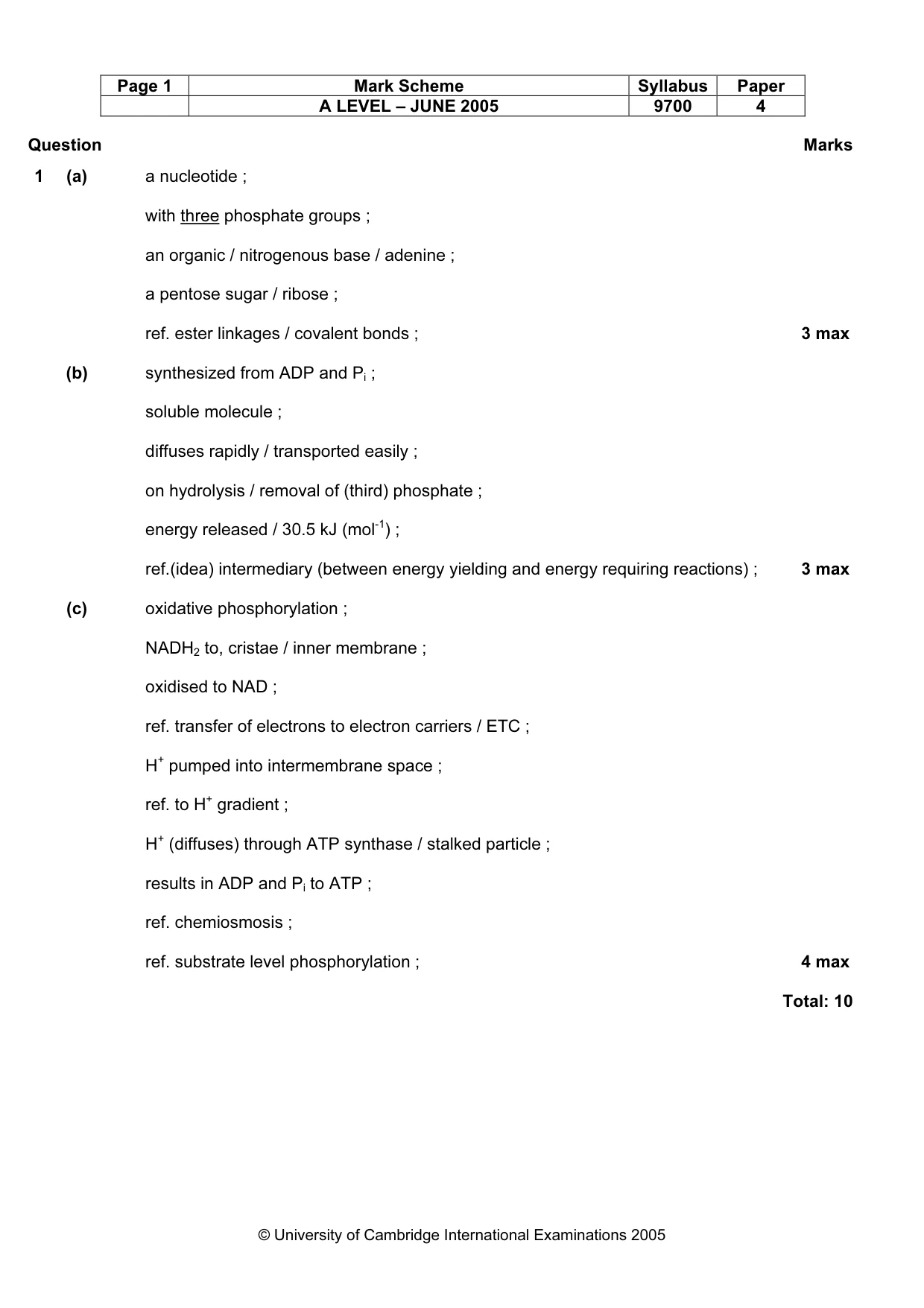
Page 1 Mark Scheme Syllabus Paper A LEVEL – JUNE 2005 9700 4 © University of Cambridge International Examinations 2005 Question Marks 1 (a) a nucleotide ; with three phosphate groups ; an organic / nitrogenous base / adenine ; a pentose sugar / ribose ; ref. ester linkages / covalent bonds ; 3 max (b) synthesized from ADP and Pi ; soluble molecule ; diffuses rapidly / transported easily ; on hydrolysis / removal of (third) phosphate ; energy released / 30.5 kJ (mol-1) ; ref.(idea) intermediary (between energy yielding and energy requiring reactions) ; 3 max (c) oxidative phosphorylation ; NADH2 to, cristae / inner membrane ; oxidised to NAD ; ref. transfer of electrons to electron carriers / ETC ; H+ pumped into intermembrane space ; ref. to H+ gradient ; H+ (diffuses) through ATP synthase / stalked particle ; results in ADP and Pi to ATP ; ref. chemiosmosis ; ref. substrate level phosphorylation ; 4 max Total: 10
Mark scheme, page 5
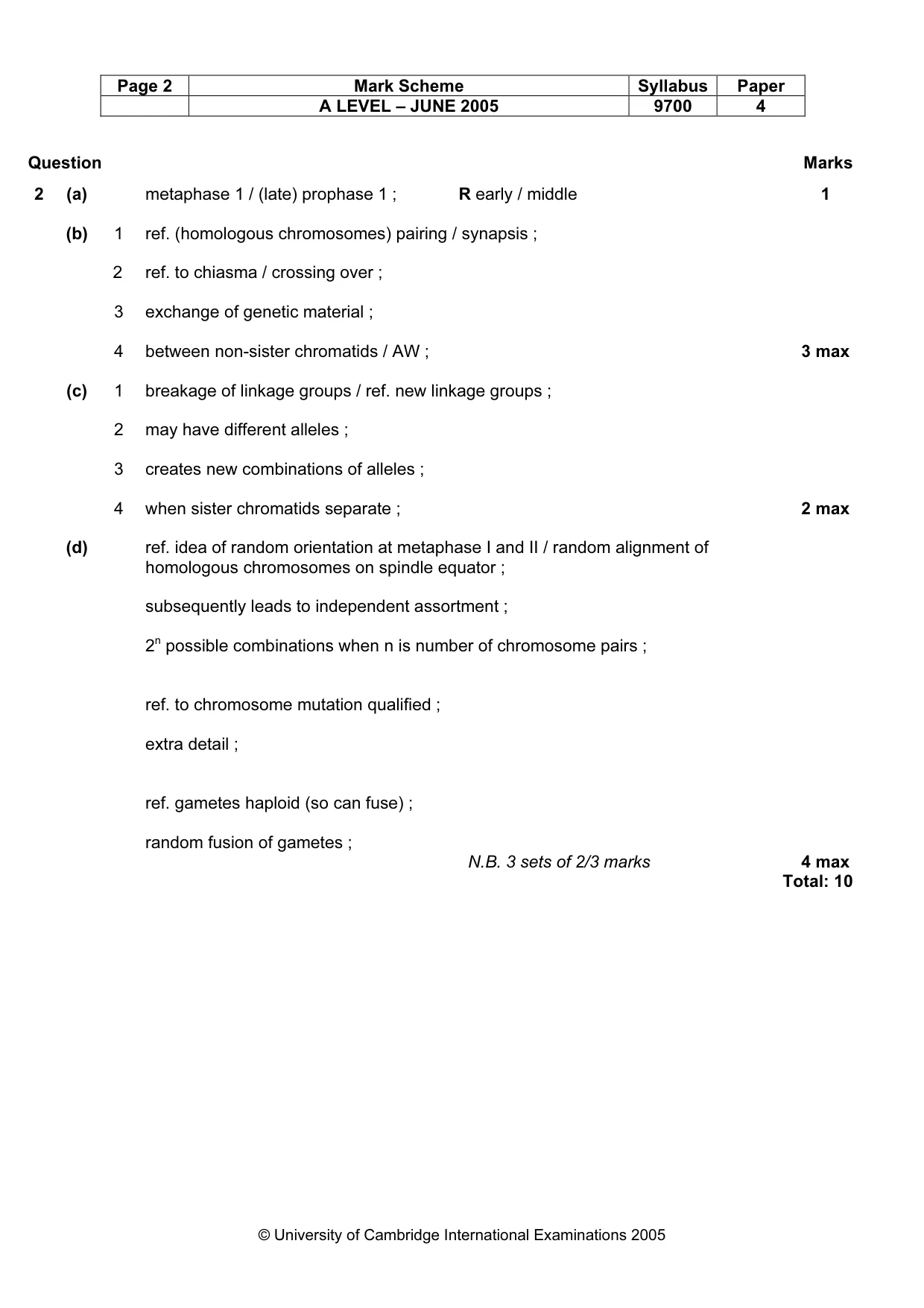
Page 2 Mark Scheme Syllabus Paper A LEVEL – JUNE 2005 9700 4 © University of Cambridge International Examinations 2005 Question Marks 2 (a) metaphase 1 / (late) prophase 1 ; R early / middle 1 (b) 1 ref. (homologous chromosomes) pairing / synapsis ; (c) 2 3 4 1 2 ref. to chiasma / crossing over ; exchange of genetic material ; between non-sister chromatids / AW ; breakage of linkage groups / ref. new linkage groups ; may have different alleles ; 3 max 3 4 creates new combinations of alleles ; when sister chromatids separate ; 2 max (d) ref. idea of random orientation at metaphase I and II / random alignment of homologous chromosomes on spindle equator ; subsequently leads to independent assortment ; 2n possible combinations when n is number of chromosome pairs ; ref. to chromosome mutation qualified ; extra detail ; ref. gametes haploid (so can fuse) ; random fusion of gametes ; N.B. 3 sets of 2/3 marks 4 max Total: 10
Mark scheme, page 6
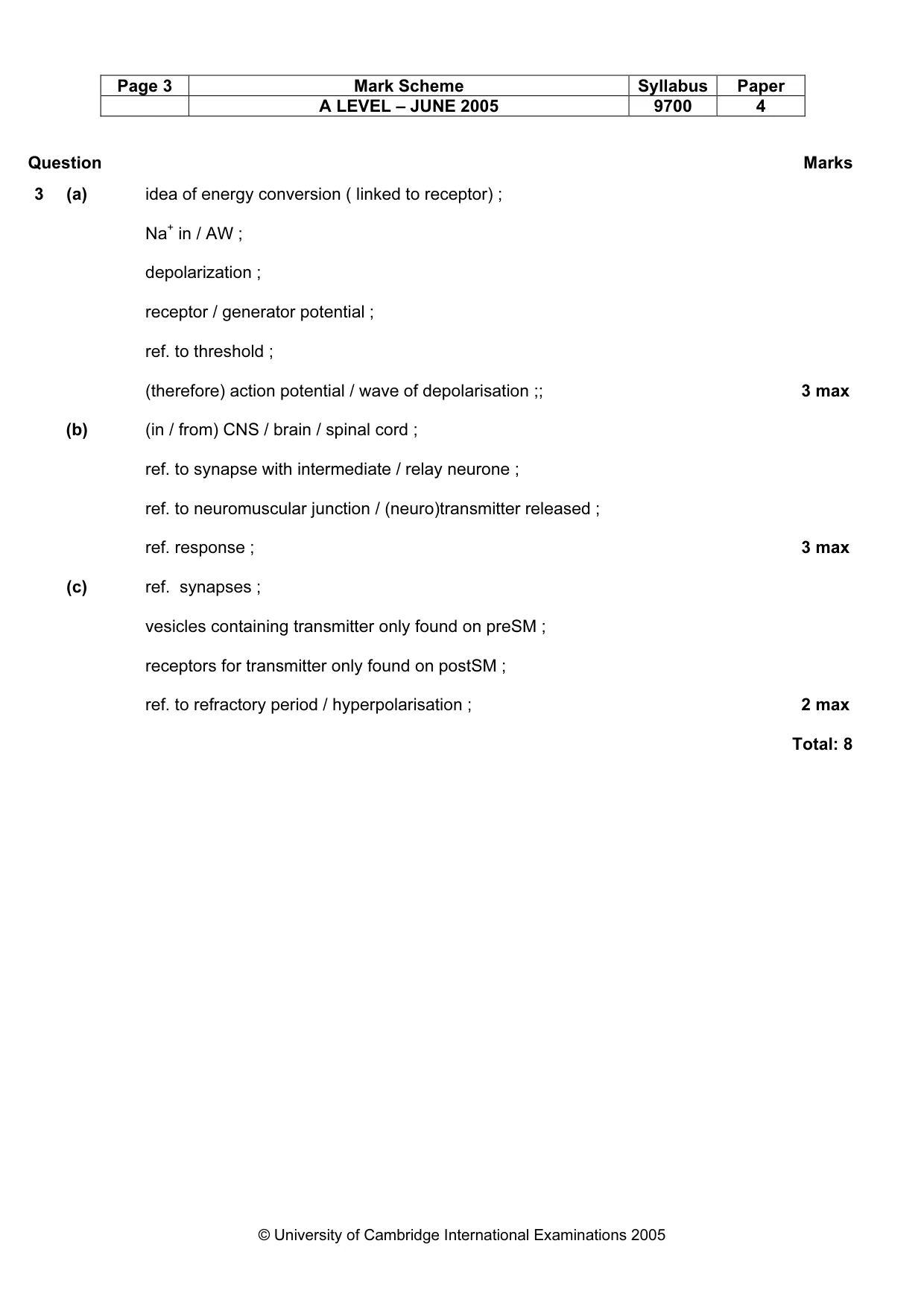
Page 3 Mark Scheme Syllabus Paper A LEVEL – JUNE 2005 9700 4 © University of Cambridge International Examinations 2005 Question Marks 3 (a) idea of energy conversion ( linked to receptor) ; Na+ in / AW ; depolarization ; receptor / generator potential ; ref. to threshold ; (therefore) action potential / wave of depolarisation ;; 3 max (b) (in / from) CNS / brain / spinal cord ; ref. to synapse with intermediate / relay neurone ; ref. to neuromuscular junction / (neuro)transmitter released ; ref. response ; 3 max (c) ref. synapses ; vesicles containing transmitter only found on preSM ; receptors for transmitter only found on postSM ; ref. to refractory period / hyperpolarisation ; 2 max Total: 8
Mark scheme, page 7
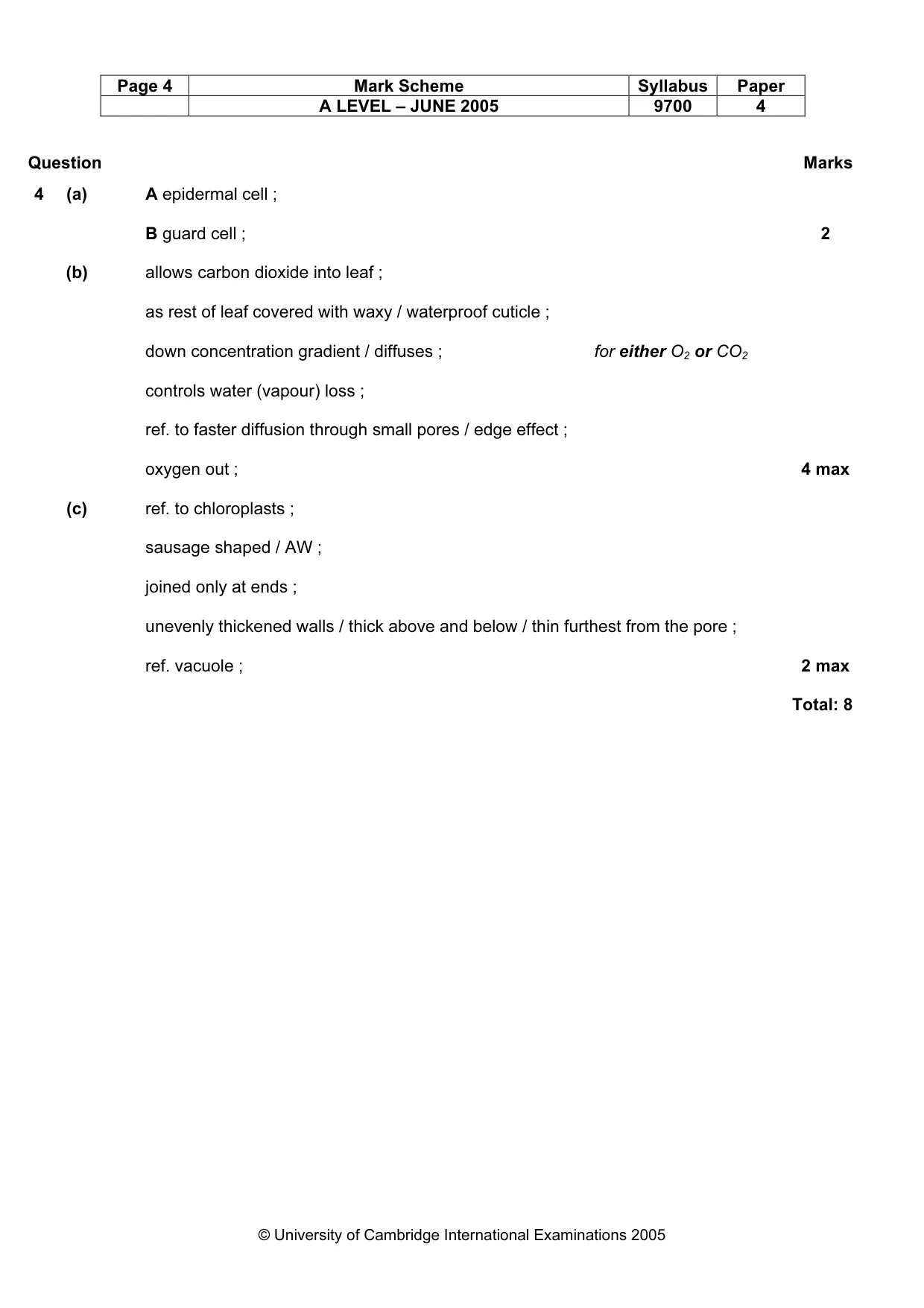
Page 4 Mark Scheme Syllabus Paper A LEVEL – JUNE 2005 9700 4 © University of Cambridge International Examinations 2005 Question Marks 4 (a) A epidermal cell ; B guard cell ; 2 (b) allows carbon dioxide into leaf ; as rest of leaf covered with waxy / waterproof cuticle ; down concentration gradient / diffuses ; for either O2 or CO2 controls water (vapour) loss ; ref. to faster diffusion through small pores / edge effect ; oxygen out ; 4 max (c) ref. to chloroplasts ; sausage shaped / AW ; joined only at ends ; unevenly thickened walls / thick above and below / thin furthest from the pore ; ref. vacuole ; 2 max Total: 8
Mark scheme, page 8
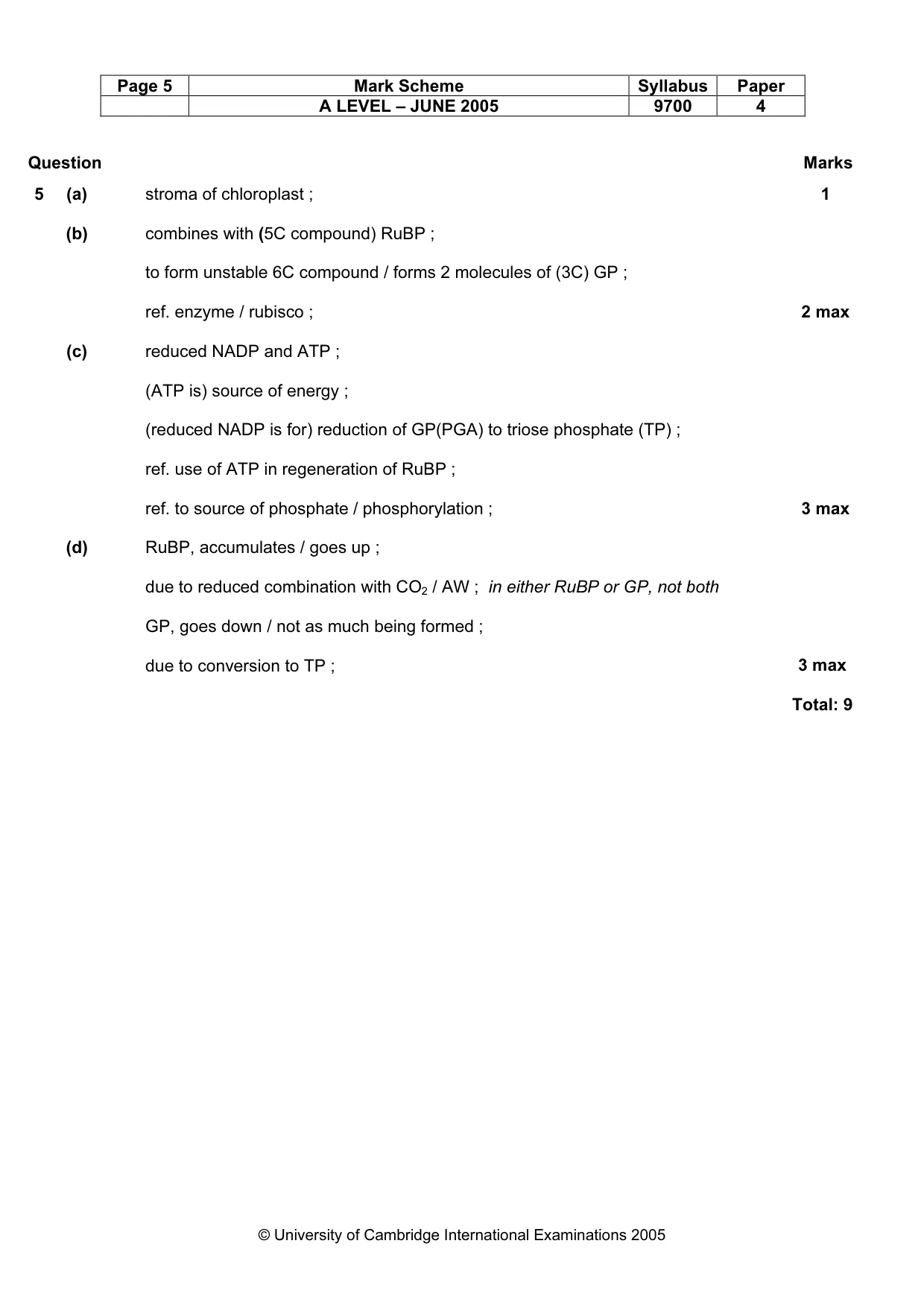
Page 5 Mark Scheme Syllabus Paper A LEVEL – JUNE 2005 9700 4 © University of Cambridge International Examinations 2005 Question Marks 5 (a) stroma of chloroplast ; 1 (b) combines with (5C compound) RuBP ; to form unstable 6C compound / forms 2 molecules of (3C) GP ; ref. enzyme / rubisco ; 2 max (c) reduced NADP and ATP ; (ATP is) source of energy ; (reduced NADP is for) reduction of GP(PGA) to triose phosphate (TP) ; ref. use of ATP in regeneration of RuBP ; ref. to source of phosphate / phosphorylation ; 3 max (d) RuBP, accumulates / goes up ; due to reduced combination with CO2 / AW ; in either RuBP or GP, not both GP, goes down / not as much being formed ; due to conversion to TP ; 3 max Total: 9
Mark scheme, page 9
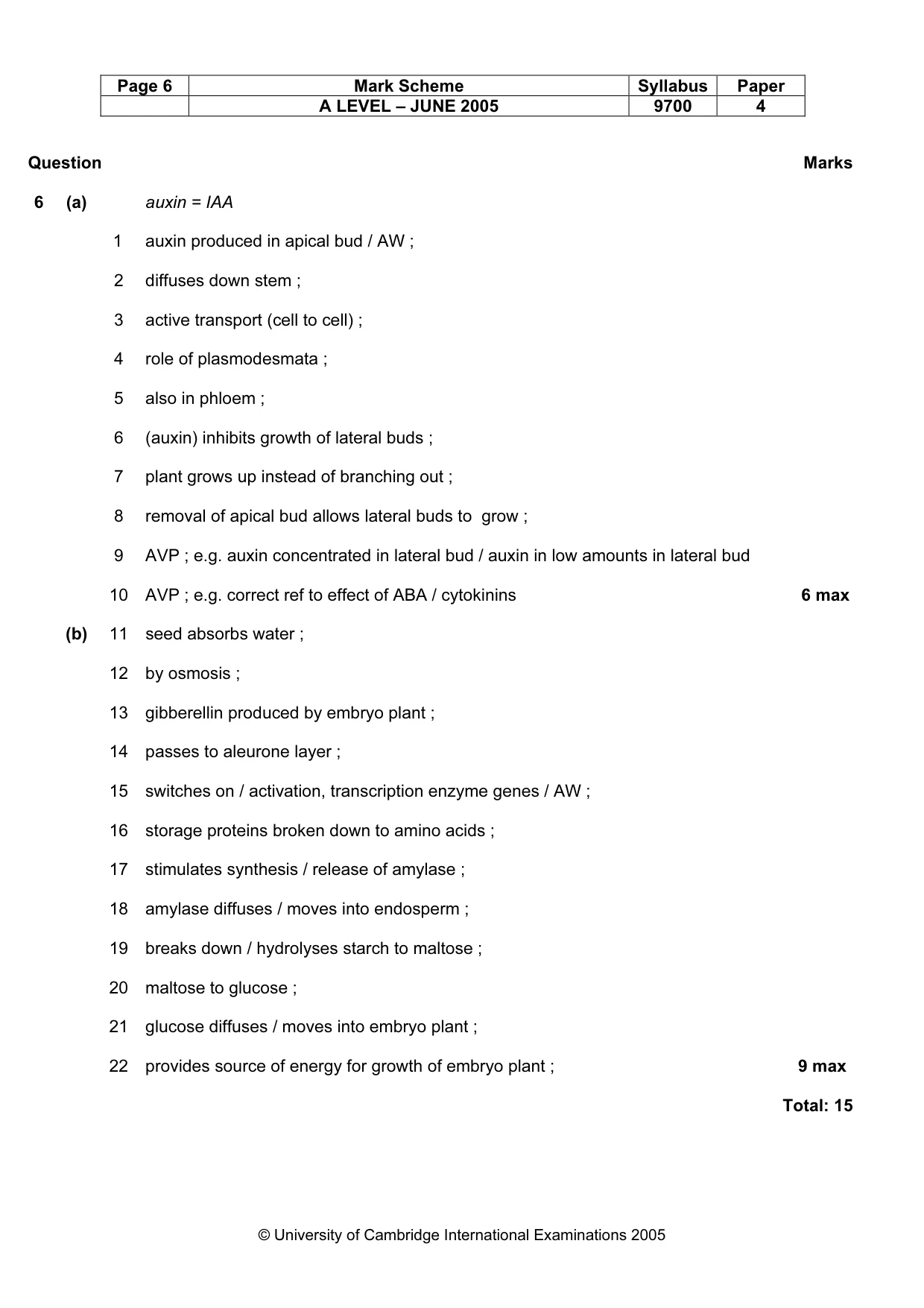
Page 6 Mark Scheme Syllabus Paper A LEVEL – JUNE 2005 9700 4 © University of Cambridge International Examinations 2005 Question Marks 6 (a) 1 2 3 4 5 6 7 8 9 10 auxin = IAA auxin produced in apical bud / AW ; diffuses down stem ; active transport (cell to cell) ; role of plasmodesmata ; also in phloem ; (auxin) inhibits growth of lateral buds ; plant grows up instead of branching out ; removal of apical bud allows lateral buds to grow ; AVP ; e.g. auxin concentrated in lateral bud / auxin in low amounts in lateral bud AVP ; e.g. correct ref to effect of ABA / cytokinins 6 max (b) 11 seed absorbs water ; 12 by osmosis ; 13 gibberellin produced by embryo plant ; 14 passes to aleurone layer ; 15 switches on / activation, transcription enzyme genes / AW ; 16 storage proteins broken down to amino acids ; 17 stimulates synthesis / release of amylase ; 18 amylase diffuses / moves into endosperm ; 19 breaks down / hydrolyses starch to maltose ; 20 maltose to glucose ; 21 glucose diffuses / moves into embryo plant ; 22 provides source of energy for growth of embryo plant ; 9 max Total: 15
Mark scheme, page 10
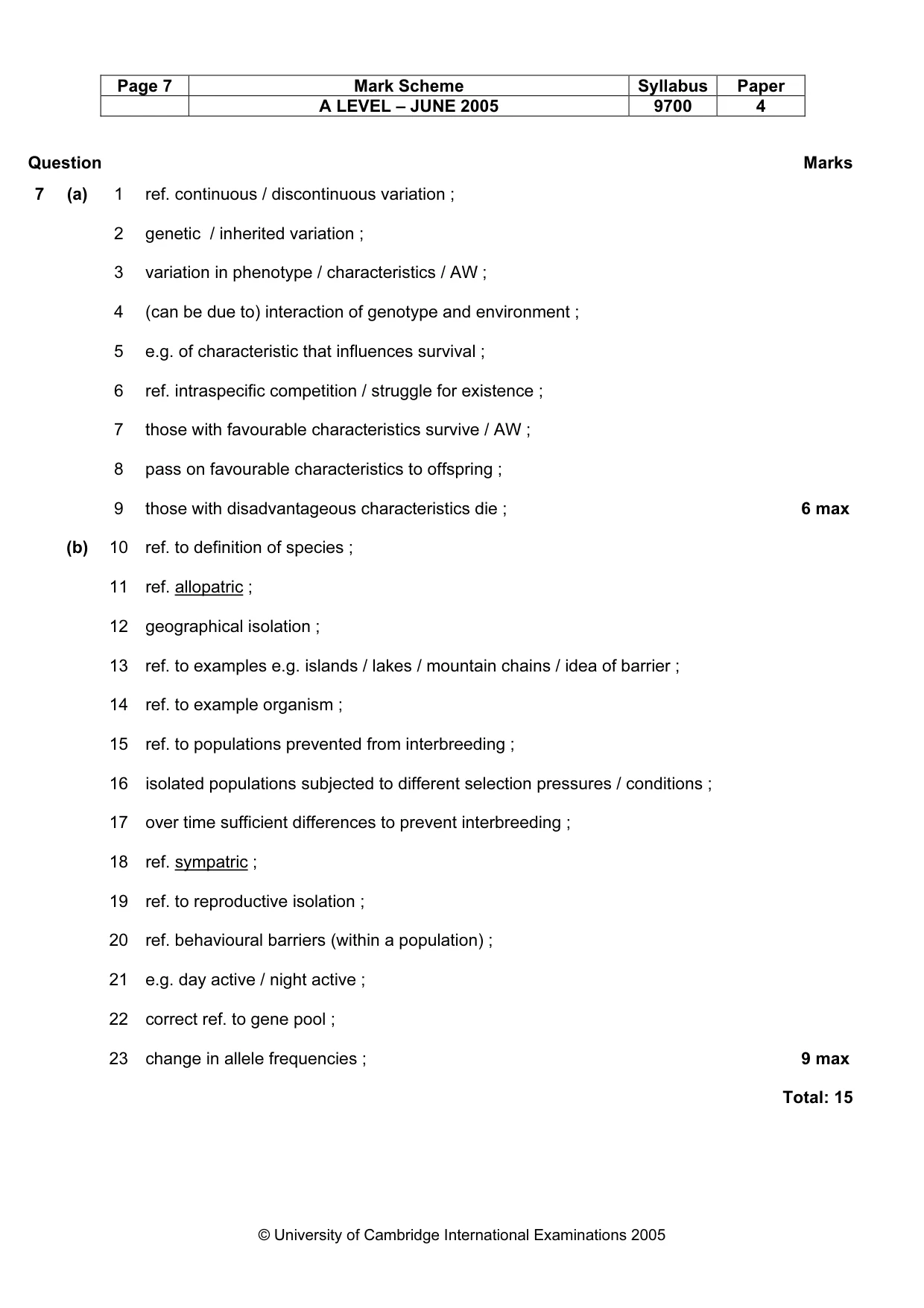
Page 7 Mark Scheme Syllabus Paper A LEVEL – JUNE 2005 9700 4 © University of Cambridge International Examinations 2005 Question Marks 7 (a) 1 2 3 4 5 6 7 8 9 ref. continuous / discontinuous variation ; genetic / inherited variation ; variation in phenotype / characteristics / AW ; (can be due to) interaction of genotype and environment ; e.g. of characteristic that influences survival ; ref. intraspecific competition / struggle for existence ; those with favourable characteristics survive / AW ; pass on favourable characteristics to offspring ; those with disadvantageous characteristics die ; 6 max (b) 10 ref. to definition of species ; 11 ref. allopatric ; 12 geographical isolation ; 13 ref. to examples e.g. islands / lakes / mountain chains / idea of barrier ; 14 ref. to example organism ; 15 ref. to populations prevented from interbreeding ; 16 isolated populations subjected to different selection pressures / conditions ; 17 over time sufficient differences to prevent interbreeding ; 18 ref. sympatric ; 19 ref. to reproductive isolation ; 20 ref. behavioural barriers (within a population) ; 21 e.g. day active / night active ; 22 correct ref. to gene pool ; 23 change in allele frequencies ; 9 max Total: 15